

Chapter 5 Introduction To Euclid’s Geometry (Class 9 - Maths NCERT Concept Notes)
Welcome to Chapter 5: Introduction to Euclid’s Geometry! This chapter takes us back to the foundations of mathematics established by the ancient Greek mathematician Euclid. Euclid’s work, "Elements," transformed geometry from a collection of practical measurements into a rigorous axiomatic system, where complex truths are logically derived from simple, self-evident assumptions.
The structure of Euclidean geometry relies on Axioms and Postulates. While axioms are general truths, postulates are assumptions specific to the behavior of geometric figures. You will learn Euclid's five fundamental postulates, including the famous Fifth Postulate (the Parallel Postulate). We also explore Playfair’s Axiom, which simplifies the idea of parallel lines and explains the uniqueness of a line passing through a point.
In this system, Theorems are statements proven through deductive reasoning. Understanding these logical building blocks is essential for mastering the proofs you will encounter in higher geometry. This chapter emphasizes the precision of mathematical definitions and the power of logic.
To enhance your understanding, this page is filled with images, flowcharts, and mindmaps to visualize abstract concepts. These high-quality resources and examples are prepared by learningspot.co to help you appreciate the beauty and structure of formal geometric thought.
| Content On This Page | ||
|---|---|---|
| Euclidean Geometry | Terms Related to Geometry | Elements, Axioms, Postulates and Theorems |
| Equivalent Versions of Euclid’s Fifth Postulate | ||
Euclidean Geometry
Welcome to the study of Geometry! Geometry is a branch of mathematics that focuses on shapes, sizes, properties of figures, and space. The word 'geometry' originates from the Greek words 'geo' (meaning 'earth') and 'metrein' (meaning 'to measure'). Historically, geometry arose from the need to measure land and construct structures.
Over centuries, various geometric concepts and results were discovered and developed. However, it was the work of Euclid, a Greek mathematician who lived around 300 BCE, that provided a systematic and logical framework for geometry. Euclid compiled the existing knowledge of geometry in his monumental work titled 'The Elements'. This book became the standard text for the study of geometry worldwide for over two thousand years.
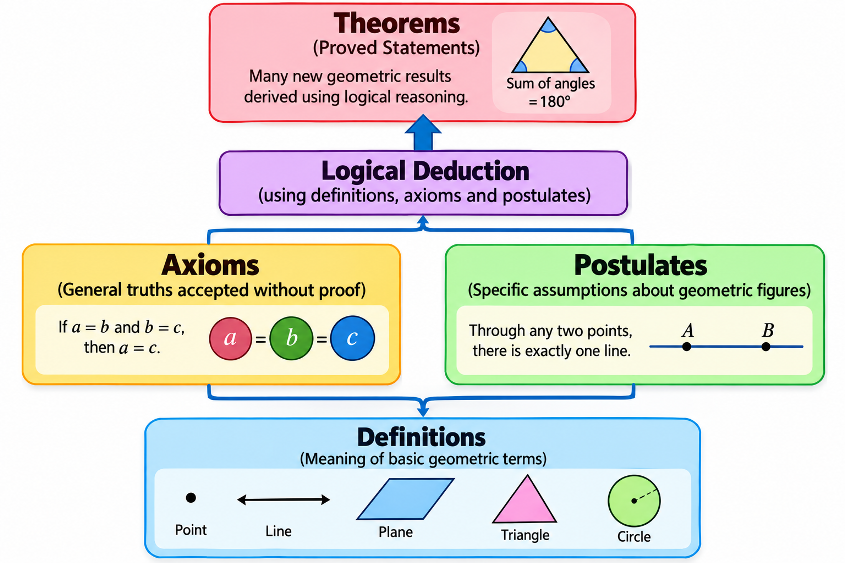
Euclid's approach was groundbreaking. He didn't just list geometric facts; he established a logical system. He started with a few fundamental, intuitively obvious statements that were accepted without proof (called axioms and postulates). From these basic truths and definitions, he used logical reasoning to deduce and prove a large number of other statements, which are called theorems. This deductive approach, starting from unproven assumptions and logically deriving conclusions, is a cornerstone of modern mathematics.
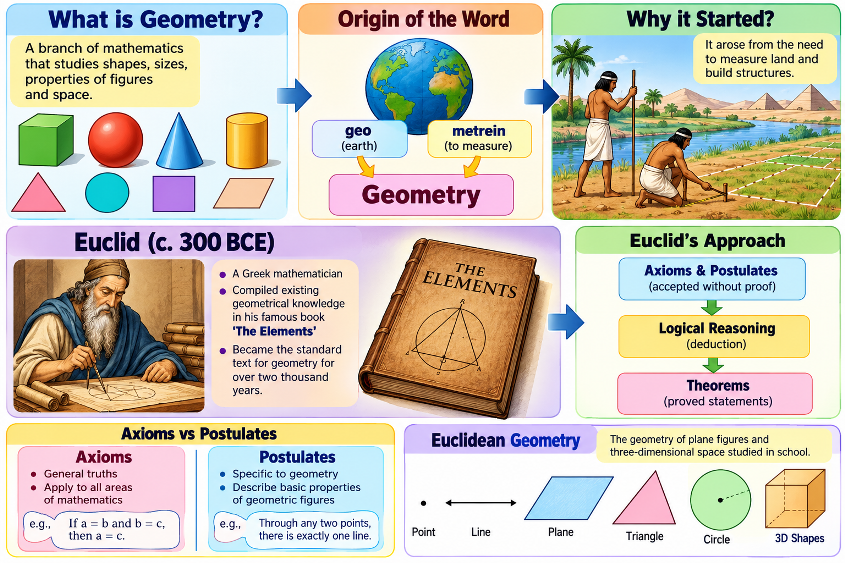
The geometry based on Euclid's system, as presented in 'The Elements', is known as Euclidean Geometry. The geometry of plane figures and three-dimensional space that you study in school (points, lines, planes, triangles, circles, etc.) is primarily Euclidean Geometry.
Euclidean vs. Non-Euclidean Geometry
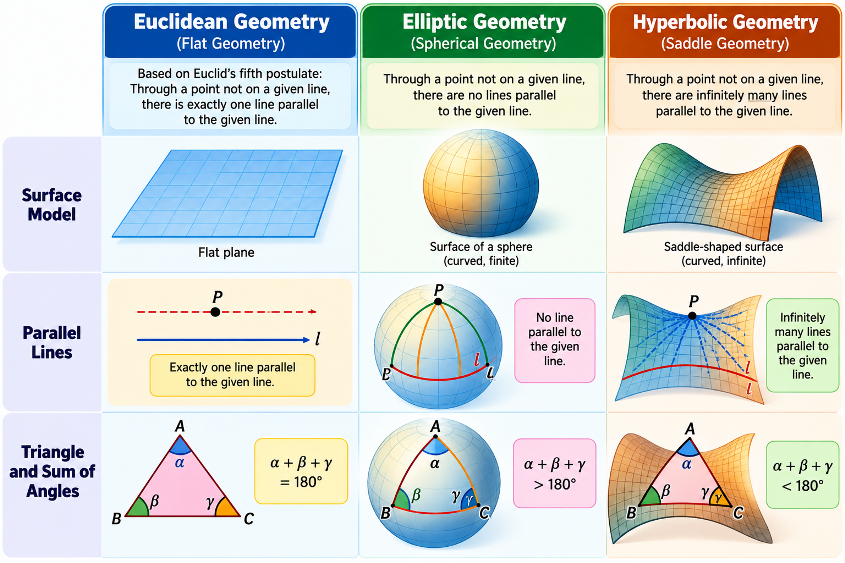
For a very long time, Euclidean geometry was believed to be the only possible consistent geometry describing space. However, in the 19th century, mathematicians like Lobachevsky, Bolyai, and Riemann developed geometric systems based on different assumptions, specifically related to Euclid's fifth postulate (also known as the parallel postulate). These alternative systems are called non-Euclidean geometries.
The key difference lies in the assumption about parallel lines:
- Euclidean Geometry: Assumes that through a point not on a given line, there is exactly one line parallel to the given line.
- Non-Euclidean Geometry (e.g., Hyperbolic Geometry): Assumes that through a point not on a given line, there are infinitely many lines parallel to the given line.
- Non-Euclidean Geometry (e.g., Elliptic Geometry): Assumes that through a point not on a given line, there are no lines parallel to the given line.
These different assumptions lead to different geometric properties. For example, in Euclidean geometry, the sum of angles in a triangle is always $180^\circ$. In Hyperbolic geometry, it is always less than $180^\circ$. In Elliptic geometry, it is always greater than $180^\circ$.
While non-Euclidean geometries are crucial in fields like physics (e.g., describing the curvature of spacetime in Einstein's theory of relativity), Euclidean geometry provides an accurate and practical model for the geometry of flat planes and the space we experience at everyday scales.
Terms Related to Geometry
Euclidean geometry is built upon a logical structure, starting from some very basic concepts that are accepted without formal definition. These fundamental concepts are called undefined terms. From these undefined terms, other geometric concepts are defined rigorously. This approach ensures that all geometric statements are derived logically from a common starting point.
Undefined Terms in Euclidean Geometry
Euclid based his geometric system on a few fundamental, intuitively understood concepts that he did not attempt to define. These serve as the basic building blocks:
Point:
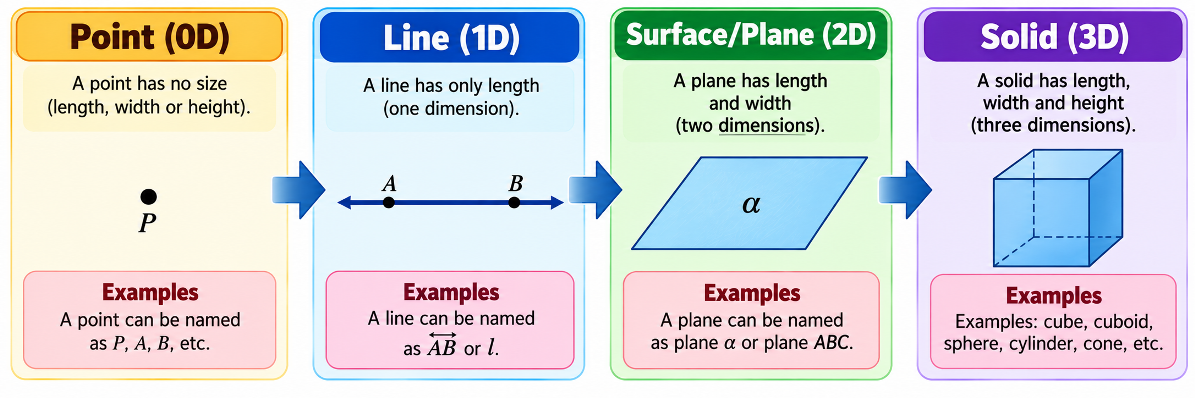
A point is the most basic element in geometry. It is conceived as having no dimension – no length, no width, and no height. It simply indicates a location or position in space. In diagrams, a point is usually represented by a dot and is denoted by a capital letter, for example, Point A ($A$).
Line:
A line is understood as a straight path that extends infinitely in two opposite directions. It has only one dimension: length. It is considered to have no thickness. A line is usually denoted by a lowercase letter (e.g., line $l$) or by two distinct points that lie on the line (e.g., line $AB$, denoted as $\overleftrightarrow{AB}$).
Plane:
A plane is conceptualized as a flat surface that extends infinitely in all directions. It has two dimensions: length and width. It is considered to have no thickness. Think of a perfectly flat floor, wall, or table surface extending indefinitely. A plane can be denoted by a single capital letter or by three points that are not on the same line (non-collinear points) that lie in the plane.
These three terms (point, line, plane) are foundational and are understood based on intuition rather than formal definitions within the Euclidean system.
Defined Terms in Geometry
Using the undefined terms, other geometric concepts are precisely defined. These definitions build upon the basic notions of points, lines, and planes.
Line Segment:
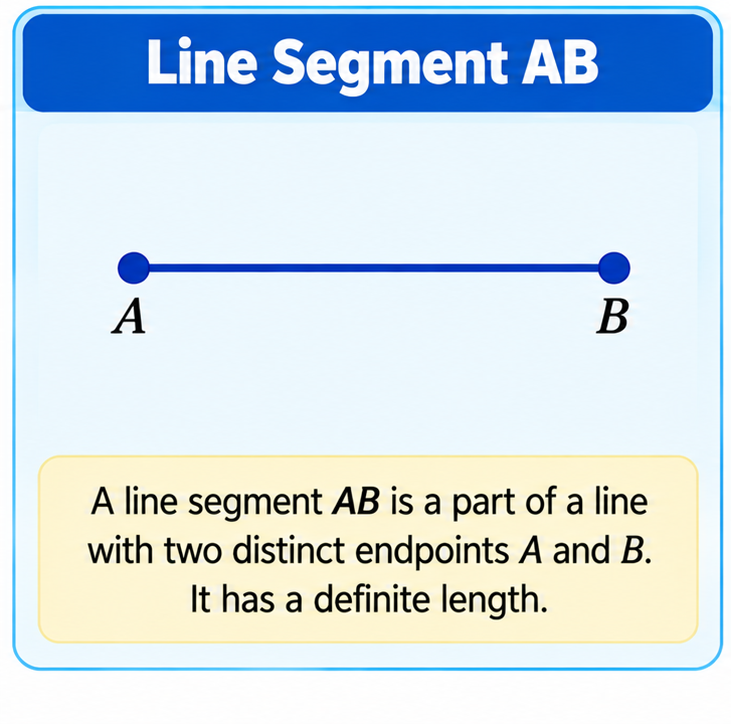
A line segment is a part of a line that has two distinct endpoints. It has a definite length, which is the shortest distance between its two endpoints. A line segment connecting points A and B is denoted as $\overline{AB}$ or $AB$.
Ray:
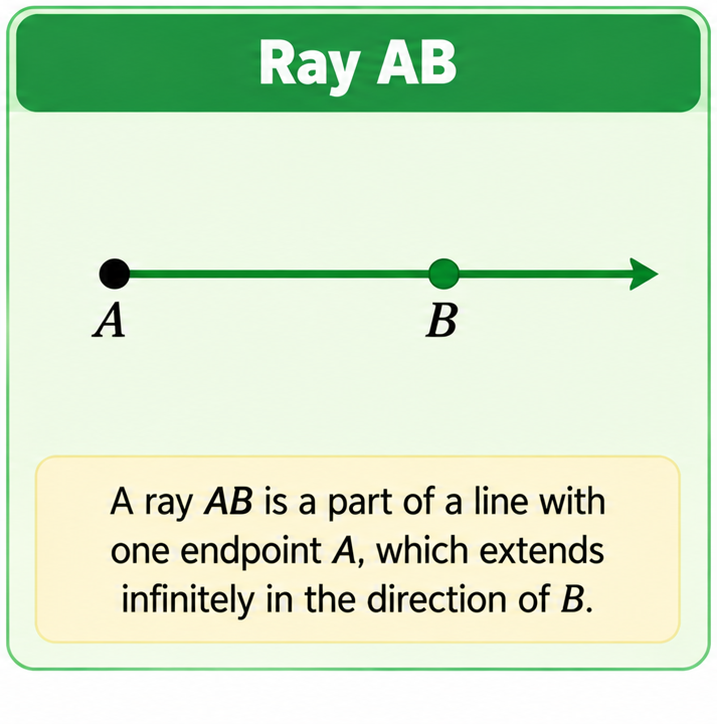
A ray is a part of a line that has only one endpoint and extends infinitely in one direction. A ray starting at point A and passing through point B is denoted as $\overrightarrow{AB}$. The endpoint is written first.
Angle:
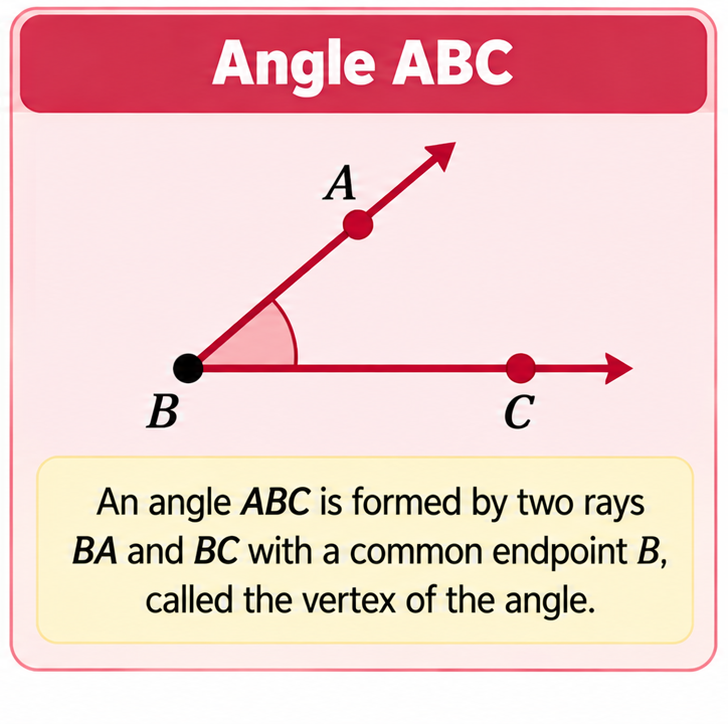
An angle is formed when two rays originate from the same common endpoint. The common endpoint is called the vertex of the angle, and the two rays are called the arms or sides of the angle. Angles are measured in degrees ($^\circ$) or radians.
Collinear Points:
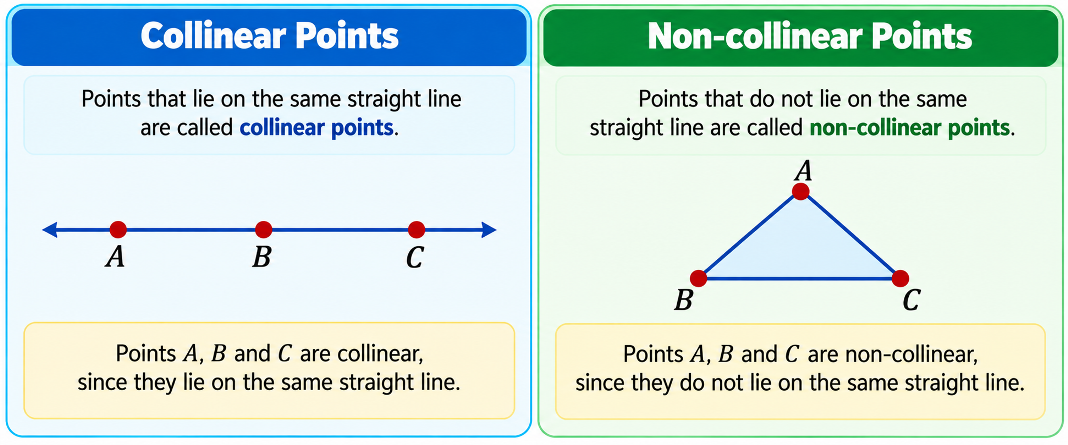
Three or more points that lie on the same straight line are called collinear points.
Non-collinear Points:
Points that do not lie on the same straight line are called non-collinear points. Any two distinct points are always collinear, as a unique line passes through them.
Intersecting Lines:
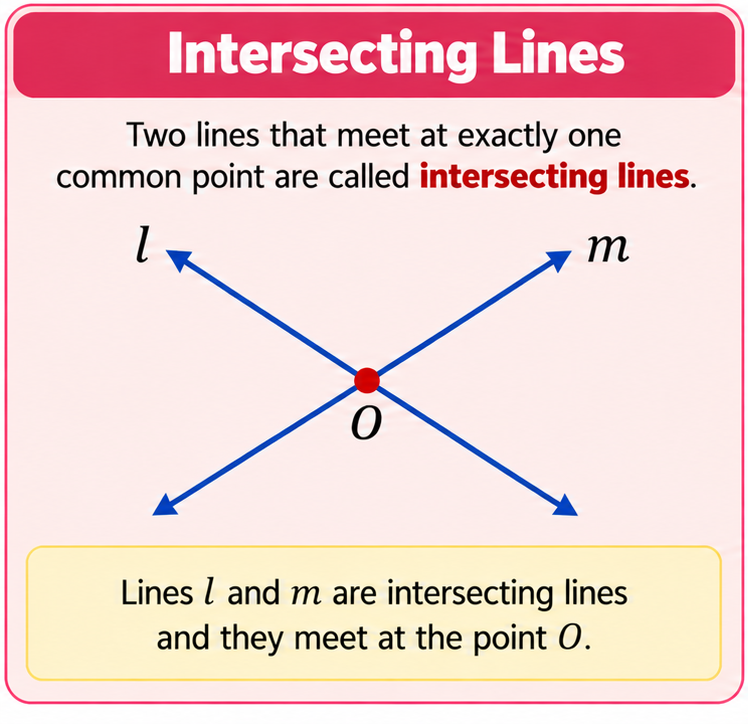
Two distinct lines in a plane are called intersecting lines if they meet at exactly one common point. The common point is called the point of intersection.
Parallel Lines:
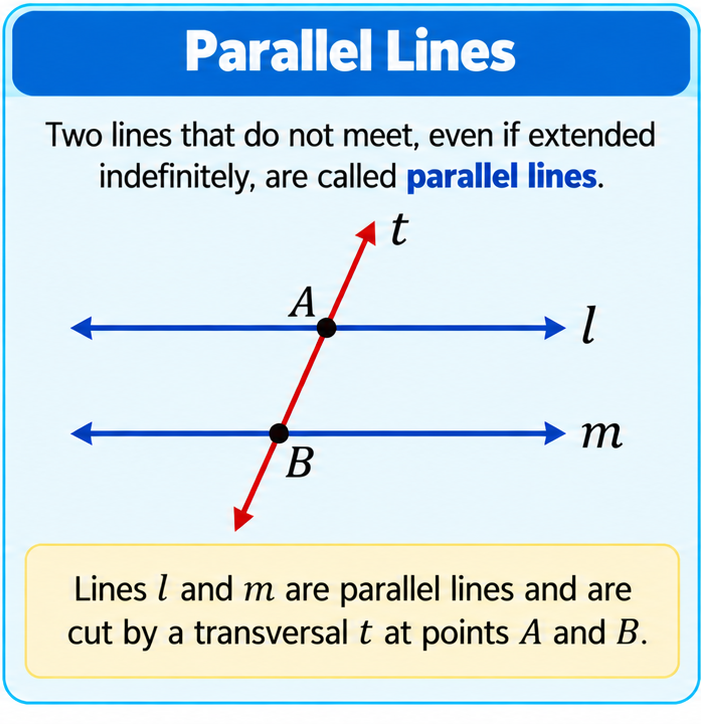
Two lines in the same plane that do not intersect at any point, no matter how far they are extended in either direction, are called parallel lines. The perpendicular distance between two parallel lines is always constant. We denote line $l$ is parallel to line $m$ as $l \parallel m$.
Perpendicular Lines:
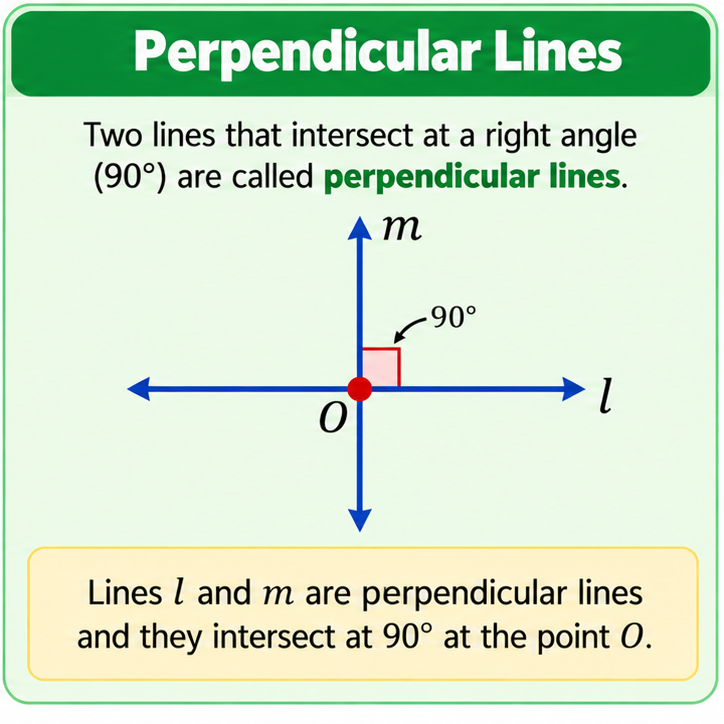
Two lines that intersect each other at a right angle ($90^\circ$) are called perpendicular lines. We denote line $l$ is perpendicular to line $m$ as $l \perp m$.
Surface:
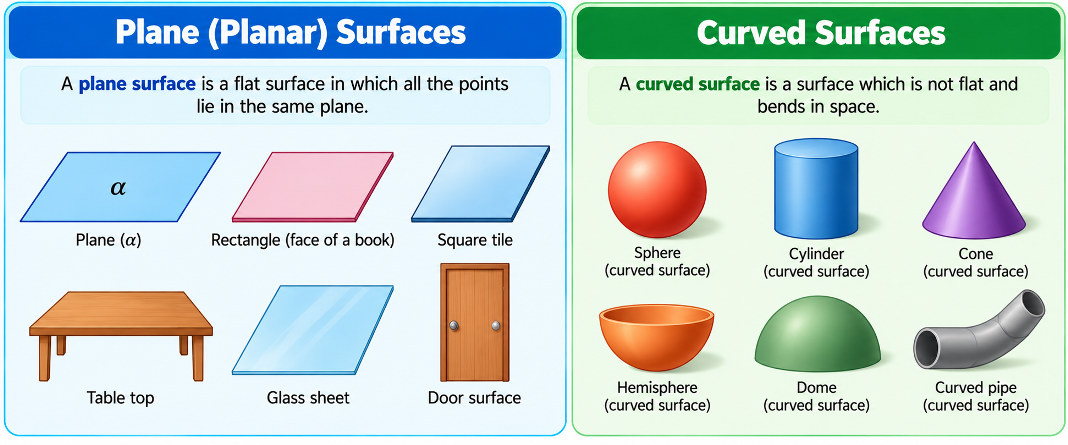
A surface is the boundary of a solid. It has length and breadth but no thickness. Surfaces can be flat (like the face of a cube) or curved (like the surface of a sphere). A flat surface that extends infinitely is a plane.
Solid:
A solid is something that occupies space. It has three dimensions: length, breadth, and height (or depth). The boundary of a solid is composed of one or more surfaces. Examples include a cube, sphere, cylinder, or pyramid.
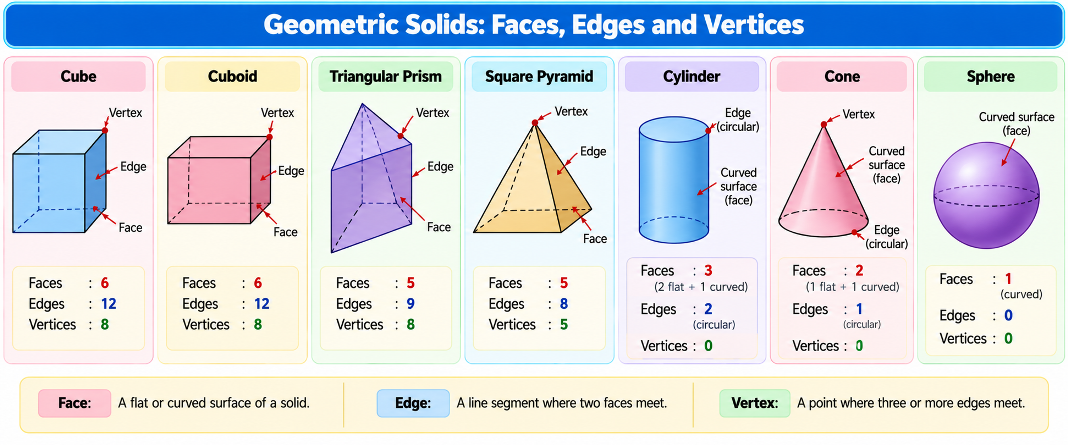
Understanding the distinction between undefined and defined terms is important for appreciating the logical structure of Euclidean geometry.
Example 1. Identify the undefined and defined terms in the statement: "A line segment connects two points."
Answer:
The statement is "A line segment connects two points". Let's identify the geometric terms used:
- 'Point': This is one of the basic building blocks, accepted without definition in Euclidean geometry. So, 'point' is an undefined term.
- 'Line segment': This term is defined as a part of a line with two endpoints. So, 'line segment' is a defined term.
- 'Connects': This describes a relationship or action, not a geometric object itself.
Also, the definition of a line segment depends on the concept of a 'line', which is also an undefined term.
Therefore, in the context of basic Euclidean geometry:
- The undefined terms implicitly or explicitly relied upon are 'point' and 'line'.
- The defined term in the statement is 'line segment'.
Elements, Axioms, Postulates and Theorems
Euclid's great contribution to mathematics was his method of organizing geometry. In his famous book, 'The Elements', he created a logical system, like building with LEGOs. He started with the most basic, undeniable pieces and rules, and used them to construct complex and beautiful geometric truths.
The Building Blocks of Euclidean Geometry
Imagine building a structure. You need basic materials (bricks, beams) and some fundamental rules about how they fit together. Euclid's geometry is built in the same way. He started with foundational ideas that are accepted without needing proof.
Definitions
Euclid began by trying to describe the most basic concepts, like "a point is that which has no part" and "a line is breadthless length." Today, we think of these as intuitive descriptions rather than perfect definitions, because the words used to define them (like 'part' or 'length') are themselves undefined. These are the fundamental, self-explanatory "bricks" of geometry.
Axioms (or Common Notions)
Axioms are "universal truths" that are so obvious we don't need to prove them. They apply not just to geometry, but to all of mathematics and logic. Think of them as the common sense rules of the universe.
Axiom 1: Transitive Property of Equality
Statement: "Things which are equal to the same thing are also equal to one another."
This axiom establishes the transitive and equivalence nature of mathematical equality. If two independent quantities or geometric figures each match a common reference quantity, they are identically equal in measure to each other.
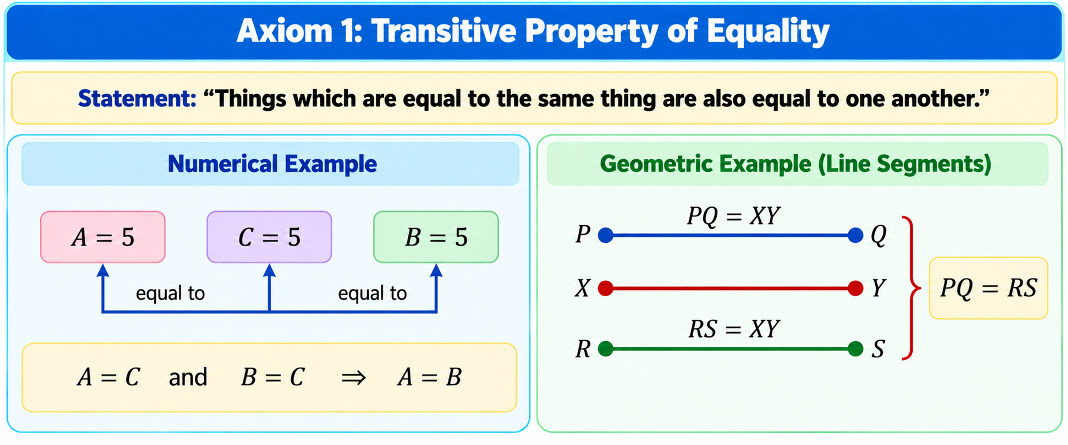
Mathematical Formulation:
Let $A$, $B$, and $C$ represent three mathematical or geometric quantities (such as lengths, angle measures, or areas):
$\text{If } A = C \text{ and } B = C$
[Premise]
$\implies A = B$
[By Euclid's Axiom 1]
Geometric Interpretation: If line segment $PQ$ equals line segment $XY$ in length ($PQ = XY$), and another line segment $RS$ also equals line segment $XY$ ($RS = XY$), then line segment $PQ$ is precisely equal in length to segment $RS$ ($PQ = RS$).
Axiom 2: Addition Property of Equality
Statement: "If equals be added to equals, the wholes are equal."
This axiom formalizes the invariance of an equality under identical positive increments. Adding the same magnitude to both sides of a balanced relationship preserves the balance intact.
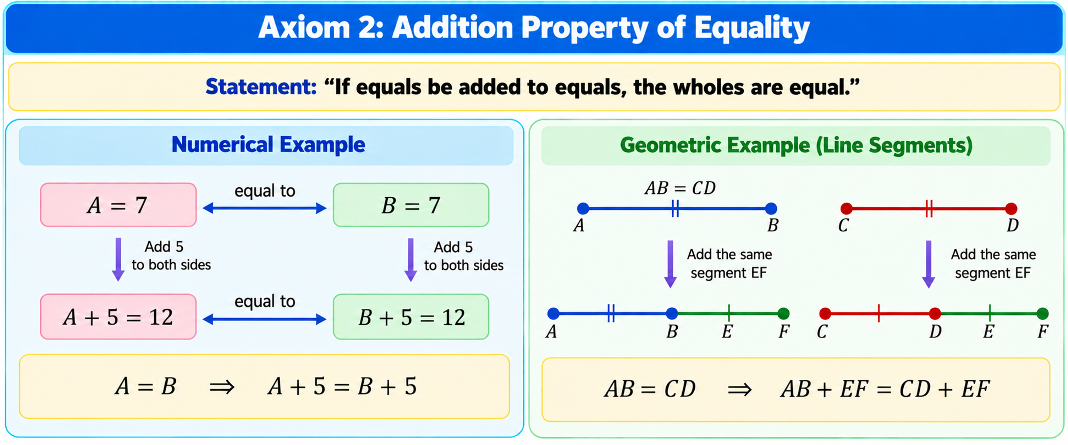
Mathematical Formulation:
If two quantities $A$ and $B$ are equal, and an identical quantity $C$ is added to both:
$\text{Given } A = B$
[Given Equality]
$\implies A + C = B + C$
[By Euclid's Axiom 2]
Geometric Interpretation: If line segment $AB = CD$, and we introduce another segment $EF$ to both so that $AB + EF$ and $CD + EF$ are formed, the resulting combined segments remain equal in length.
Axiom 3: Subtraction Property of Equality
Statement: "If equals be subtracted from equals, the remainders are equal."
Complementary to Axiom 2, this rule asserts that reducing two identical quantities by equal amounts leaves identical residuals.
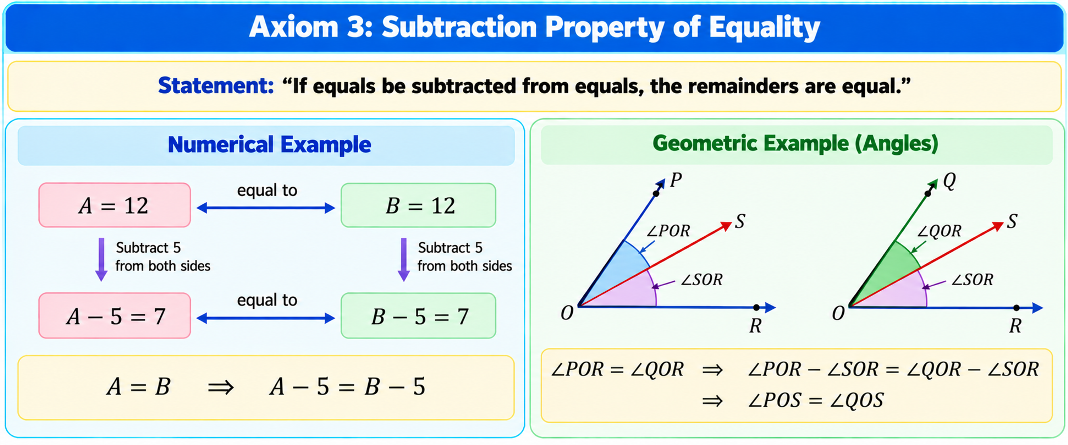
Mathematical Formulation:
If two quantities $A$ and $B$ are equal, and an identical quantity $C$ is subtracted from each:
$\text{Given } A = B$
[Given Equality]
$\implies A - C = B - C$
[By Euclid's Axiom 3]
Geometric Interpretation: Let $\angle POR = \angle QOR$. If a common inner angle $\angle SOR$ is subtracted from both, the remaining angles satisfy $\angle POR - \angle SOR = \angle QOR - \angle SOR$, implying $\angle POS = \angle QOS$.
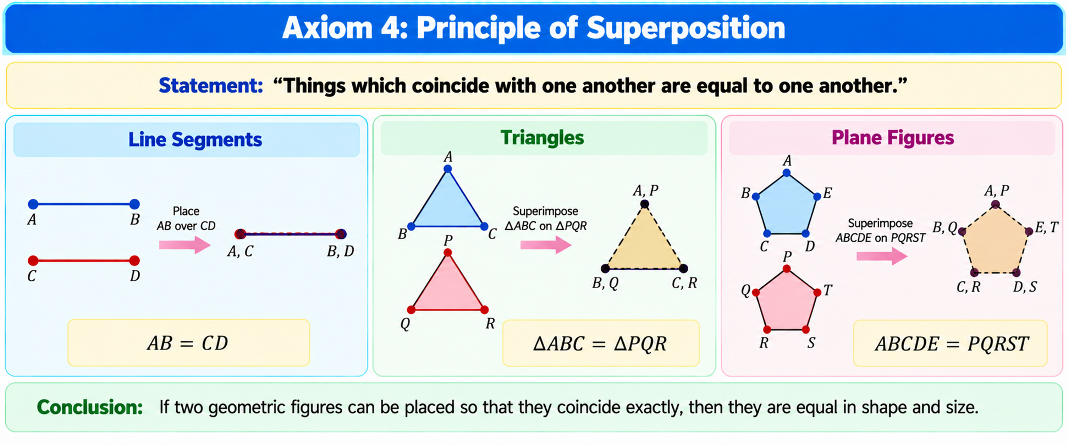
Axiom 4: Principle of Superposition
Statement: "Things which coincide with one another are equal to one another."
This fundamental geometric axiom provides the criterion for congruence. When two geometric objects can be positioned such that every boundary, vertex, and edge coincides exactly without any discrepancy in shape or size, the two objects are strictly congruent and equal in magnitude.
Mathematical Formulation:
If figure $F_1$ perfectly overlaps and covers figure $F_2$ upon rigid motion (translation and rotation):
$\text{Figure } F_1 \equiv \text{Figure } F_2$
[Coincidence Condition]
$\implies \text{Measure}(F_1) = \text{Measure}(F_2)$
[By Euclid's Axiom 4]
Geometric Interpretation: If line segment $\overline{AB}$ is placed over $\overline{CD}$ such that point $A$ coincides with $C$ and point $B$ coincides with $D$, then the length $AB = CD$. This serves as the basis for the Side-Angle-Side (SAS) congruence criterion of triangles.
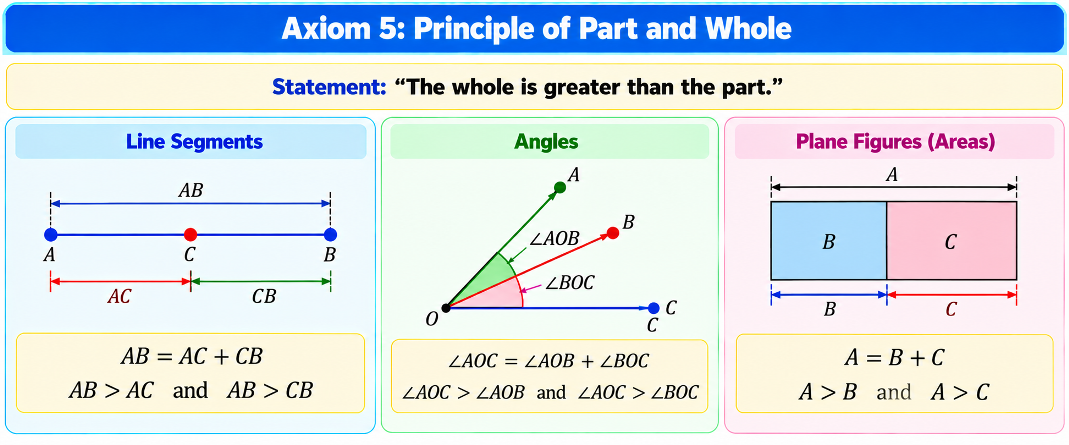
Axiom 5: Principle of Part and Whole
Statement: "The whole is greater than the part."
This axiom introduces the primary concept of strict quantitative inequality ($>$). When a magnitude is partitioned into strictly positive components, the combined magnitude strictly exceeds any of its individual constituent parts.
Mathematical Formulation:
If a positive quantity $A$ is composed of parts $B$ and $C$ such that $B > 0$ and $C > 0$:
$A = B + C$
[Composition of Whole]
$\implies A > B \quad \text{and} \quad A > C$
[By Euclid's Axiom 5]
Geometric Interpretation: If a point $C$ lies strictly in the interior of a line segment $AB$, then segment $AB$ constitutes the whole, while $AC$ and $CB$ are parts. Therefore, $AB > AC$ and $AB > CB$.
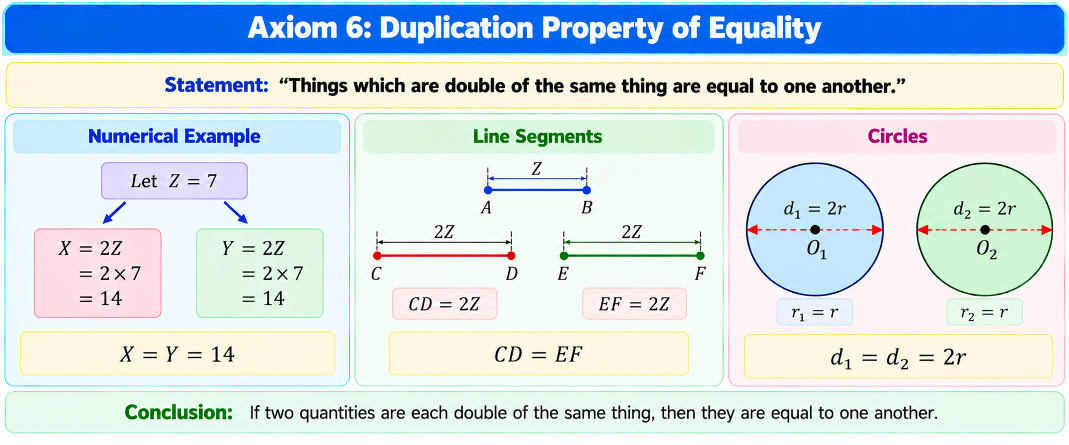
Axiom 6: Duplication Property of Equality
Statement: "Things which are double of the same thing are equal to one another."
This axiom governs linear scaling by a constant factor of $2$. If two different quantities are each formed by doubling identical magnitudes, their resulting values must be equal.
Mathematical Formulation:
Let quantities $X$ and $Y$ each be double of a common quantity $Z$:
$\text{If } X = 2Z \text{ and } Y = 2Z$
[Given Multiplications]
$\implies X = Y$
[By Euclid's Axiom 6]
Geometric Interpretation: If the radius of circle $C_1$ equals the radius of circle $C_2$ ($r_1 = r_2 = r$), then their diameters are $d_1 = 2r$ and $d_2 = 2r$. Since their diameters are doubles of the same radius, $d_1 = d_2$.
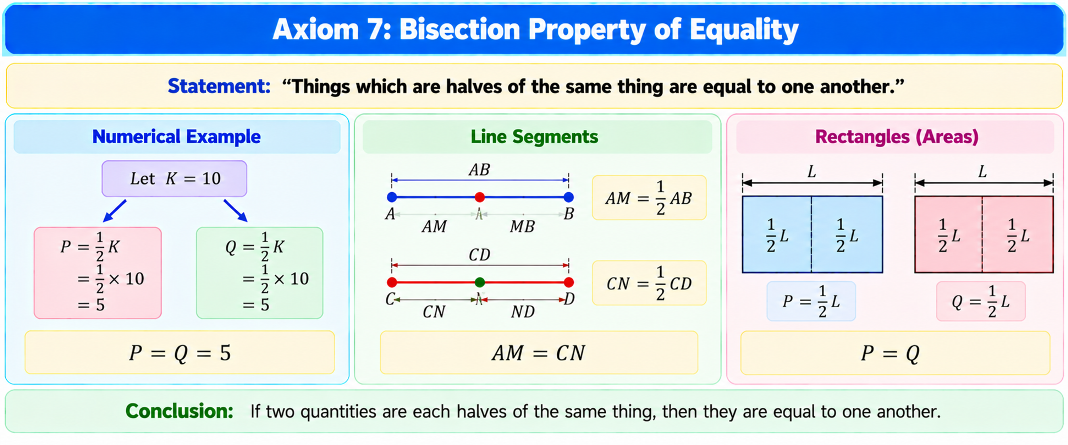
Axiom 7: Bisection Property of Equality
Statement: "Things which are halves of the same thing are equal to one another."
The converse operation of Axiom 6 establishes that halving identical quantities results in identical values.
Mathematical Formulation:
Let quantities $P$ and $Q$ each represent half of a common magnitude $K$:
$\text{If } P = \frac{1}{2}K \text{ and } Q = \frac{1}{2}K$
[Given Halves]
$\implies P = Q$
[By Euclid's Axiom 7]
Geometric Interpretation: If line segment $AB = CD$, and points $M$ and $N$ are the midpoints of $AB$ and $CD$ respectively, then the segment halves $AM = \frac{1}{2}AB$ and $CN = \frac{1}{2}CD$ must be mutually equal ($AM = CN$).
| Number | Axiom Statement | Algebraic Representation |
|---|---|---|
| 1 | Things equal to the same thing are equal to each other. | If $A = C$ and $B = C$, then $A = B$ |
| 2 | If equals are added to equals, the wholes are equal. | If $A = B$, then $A + C = B + C$ |
| 3 | If equals are subtracted from equals, the remainders are equal. | If $A = B$, then $A - C = B - C$ |
| 4 | Things which coincide with one another are equal to one another. | If $A \text{ superimposes on } B$, then $A \cong B$ |
| 5 | The whole is greater than the part. | If $A = B + C$ ($C > 0$), then $A > B$ |
| 6 | Things which are double of the same thing are equal to each other. | If $A = 2C$ and $B = 2C$, then $A = B$ |
| 7 | Things which are halves of the same thing are equal to each other. | If $A = \frac{C}{2}$ and $B = \frac{C}{2}$, then $A = B$ |
Example 1. In the accompanying figure, if $AC = BD$, prove that $AB = CD$, stating Euclid's axioms used in each step.
Answer:
Given:
$AC = BD$
(Given) ... (i)
To Prove:
$AB = CD$
Proof:
From the figure, point $B$ lies between $A$ and $C$. Thus, by the definition of betweenness:
$AC = AB + BC$
[Segment Addition] ... (ii)
Similarly, point $C$ lies between $B$ and $D$. Thus:
$BD = BC + CD$
[Segment Addition] ... (iii)
Substituting equations (ii) and (iii) into the given relation (i):
$AB + BC = BC + CD$
[Substitution Property]
Now, subtracting the common segment $BC$ from both sides:
$(AB + BC) - BC = (BC + CD) - BC$
According to Euclid's Axiom 3 ("If equals be subtracted from equals, the remainders are equal"):
$AB = CD$
[Hence Proved]
Example 2. Two bank accounts in the State Bank of India held by Aarav and Vihaan each contain an amount equal to Rohan's balance of $\textsf{₹} 45000$.
(i) What is the relationship between the balances of Aarav and Vihaan?
(ii) If the bank credits an interest of $\textsf{₹} 1500$ to each of their accounts, what will be their new relationship? State the applicable Euclid's axioms.
Answer:
Given:
$\text{Aarav's Balance} = \text{Rohan's Balance} = \textsf{₹} 45000$
$\text{Vihaan's Balance} = \text{Rohan's Balance} = \textsf{₹} 45000$
Part (i):
Since Aarav's balance and Vihaan's balance are both equal to Rohan's balance, by Euclid's Axiom 1 ("Things which are equal to the same thing are equal to one another"):
$\text{Aarav's Balance} = \text{Vihaan's Balance}$
Part (ii):
An equal amount of interest $C = \textsf{₹} 1500$ is added to both balances. By Euclid's Axiom 2 ("If equals be added to equals, the wholes are equal"):
$\text{Aarav's New Balance} = 45000 + 1500 = \textsf{₹} 46500$
$\text{Vihaan's New Balance} = 45000 + 1500 = \textsf{₹} 46500$
Thus, their balances remain equal:
$\text{Aarav's New Balance} = \text{Vihaan's New Balance}$
Hence, both balances remain mutually equal at $\mathbf{\textsf{₹} 46500}$.
Postulates
Postulates are like axioms, but they are assumptions specific to the "game" of geometry. They are the fundamental rules about points, lines, and circles that we accept without proof to get started.
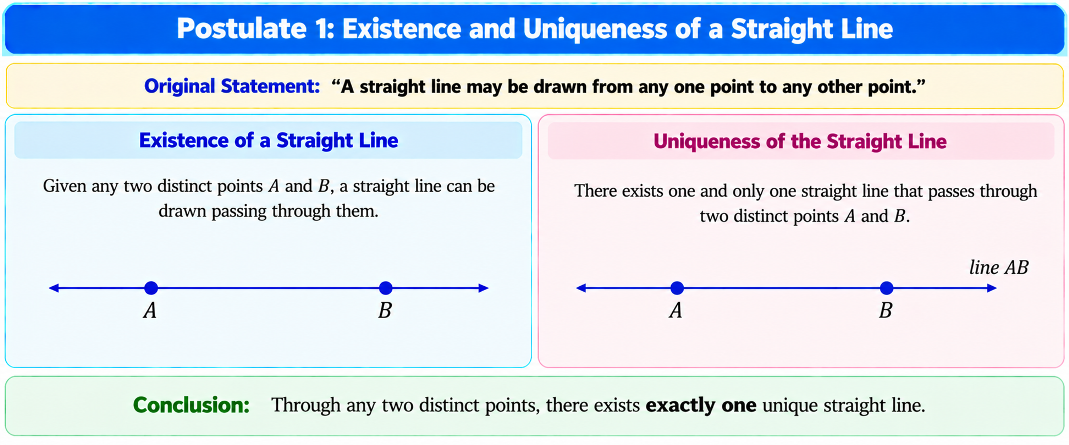
Postulate 1: Existence and Uniqueness of a Straight Line
Original Statement: "A straight line may be drawn from any one point to any other point."
This postulate asserts that connecting any two distinct spatial locations always yields a straight line. In contemporary mathematical frameworks, this postulate is strengthened as an axiom of uniqueness:
Axiom 5.1 (Uniqueness): Given two distinct points, there exists one and only one unique line that passes through both of them.
Postulate 2: Indefinite Extension of a Terminated Line
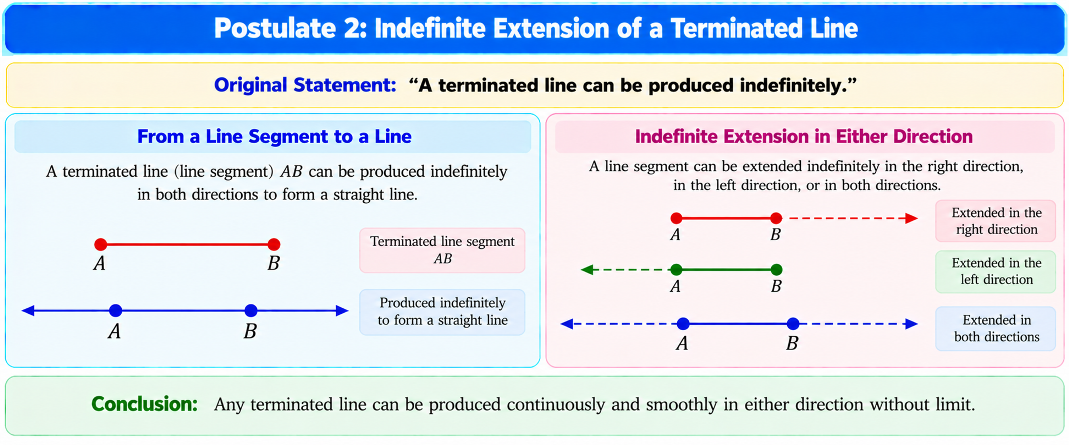
Original Statement: "A terminated line can be produced indefinitely."
In Euclid's nomenclature, what we today term a line segment was referred to as a "terminated line". This postulate states that any finite line segment can be extended continuously and smoothly in either direction without limit to form an infinite straight line.
Postulate 3: Construction of a Circle
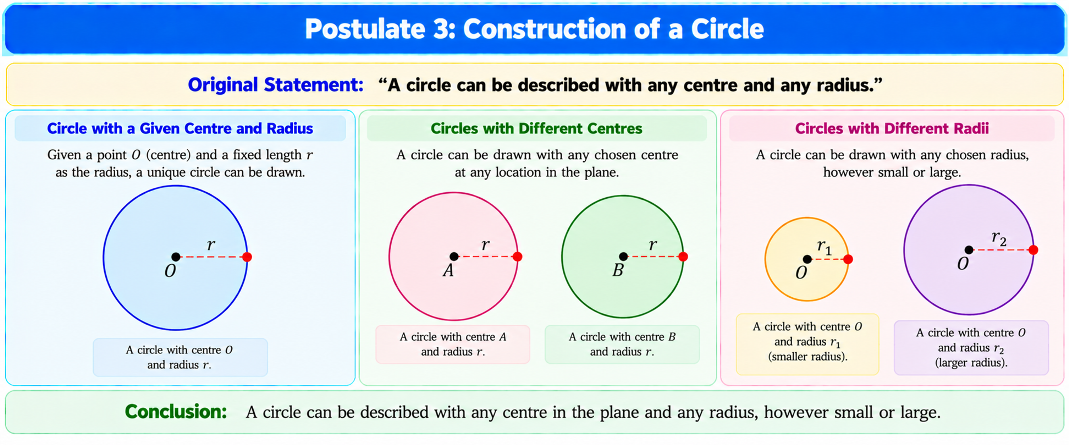
Original Statement: "A circle can be described with any centre and any radius."
This postulate establishes that planar geometry possesses rotational symmetry and homogeneous metric scale. Regardless of where an origin is positioned, and regardless of how small or large a linear span is chosen, a valid, closed circular locus exists.
Postulate 4: Invariance of Right Angles
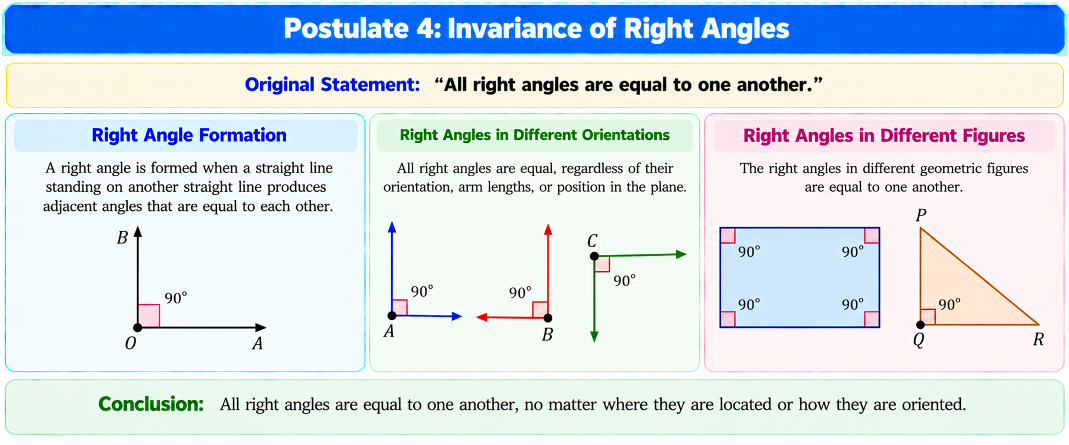
Original Statement: "All right angles are equal to one another."
A right angle is created when a straight line standing upon another straight line produces adjacent angles that are equal to each other. Postulate 4 declares that all right angles are universally congruent, irrespective of orientation, arm lengths, or spatial location.
Postulate 5: The Parallel Postulate
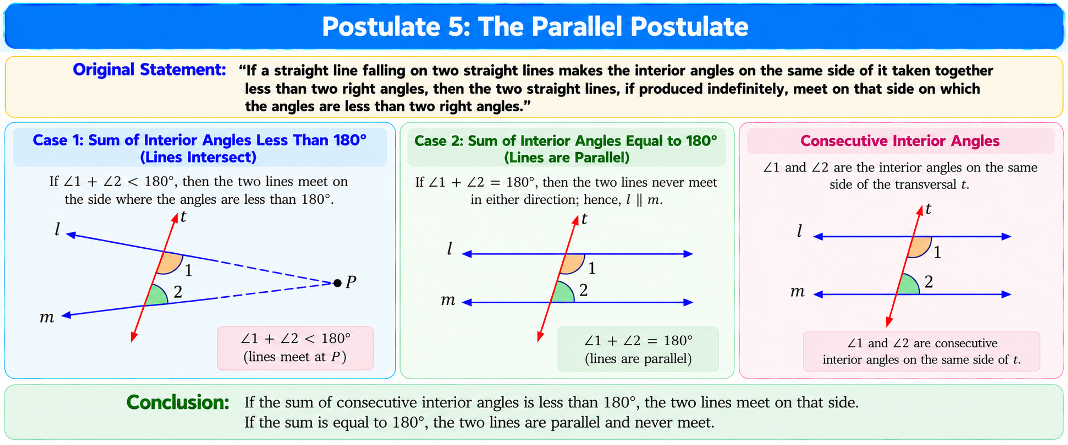
Original Statement: "If a straight line falling on two straight lines makes the interior angles on the same side of it taken together less than two right angles, then the two straight lines, if produced indefinitely, meet on that side on which the angles are less than two right angles."
Postulate 5 is the most celebrated and thoroughly investigated postulate in mathematical history. Unlike the succinct intuitive character of Postulates 1 through 4, the Fifth Postulate is more complex and operationally conditional.
Mathematical Formulation:
Let a transversal line $t$ intersect two straight coplanar lines $l$ and $m$. Let $\angle 1$ and $\angle 2$ denote the consecutive interior angles lying on the right side of line $t$:
$\angle 1 + \angle 2 < 180^\circ$
[Condition for Intersection]
Under this condition, lines $l$ and $m$, when extended indefinitely, will necessarily intersect at a point situated on the right side of $t$.
Conversely, if the sum of consecutive interior angles equals two right angles ($180^\circ$):
$\angle 1 + \angle 2 = 180^\circ$
[Condition for Parallelism]
The two lines will never intersect in either direction; hence, $l \parallel m$.
| Postulate | Geometric Focus | Essential Principle |
|---|---|---|
| Postulate 1 | Straight Line Construction | A unique straight line joins any two distinct points. |
| Postulate 2 | Line Extension | Any line segment can be extended indefinitely in either direction. |
| Postulate 3 | Circle Description | A circle can be drawn with any designated center and radius. |
| Postulate 4 | Right Angle Universality | All right angles are equal to each other ($90^\circ$). |
| Postulate 5 | Parallelism & Convergence | Lines meet on the side where interior angles sum to less than $180^\circ$. |
Example 1. In the accompanying figure, a transversal line $PQ$ falls across two coplanar straight lines $AB$ and $CD$. The interior angles on the left side of the transversal are $\angle APQ = 82^\circ$ and $\angle CQP = 93^\circ$.
Determine whether lines $AB$ and $CD$ will intersect, and if so, identify the side on which the intersection occurs by explicitly citing Euclid's Fifth Postulate.
Answer:
Given:
$\angle APQ = 82^\circ$
(Given) ... (i)
$\angle CQP = 93^\circ$
(Given) ... (ii)
To Find:
Whether lines $AB$ and $CD$ intersect, and on which side of transversal $PQ$.
Solution:
Calculating the sum of the interior angles on the left side of transversal $PQ$:
$\text{Sum} = \angle APQ + \angle CQP$
[Interior Angle Sum]
$\text{Sum} = 82^\circ + 93^\circ = 175^\circ$
[Calculated Sum] ... (iii)
Two right angles equal:
$2 \times 90^\circ = 180^\circ$
[Two Right Angles] ... (iv)
Comparing equation (iii) and equation (iv):
$175^\circ < 180^\circ$
[Sum is less than two right angles]
According to Euclid's Fifth Postulate, since the sum of the interior angles on the left side is strictly less than two right angles ($180^\circ$), the straight lines $AB$ and $CD$, when produced indefinitely, will intersect on the left side of the transversal line $PQ$.
Theorems
A theorem is a statement that is proven to be true. Unlike axioms and postulates which are assumed, theorems must be logically deduced. The proof of a theorem is a step-by-step argument where each step is justified by a definition, an axiom, a postulate, or a previously proven theorem.
Theorem. Two distinct lines cannot have more than one point in common.
Proof:
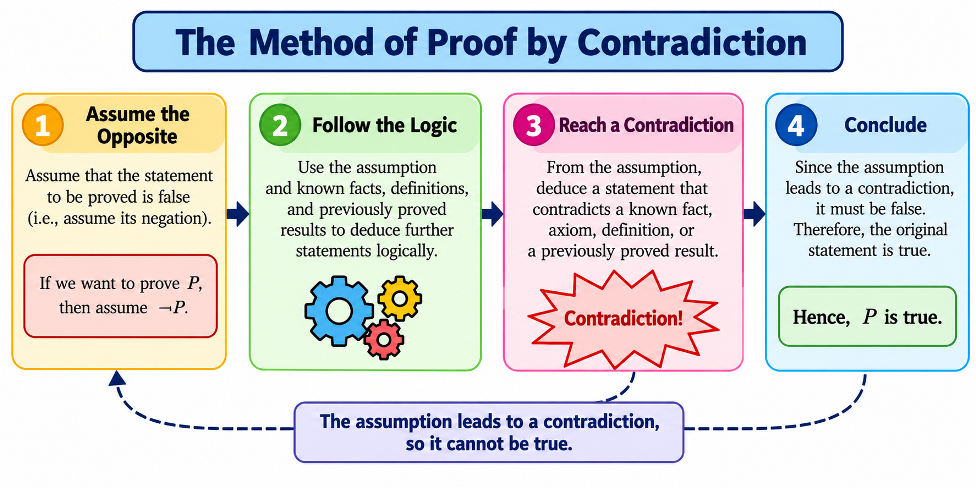
We will use a method called "proof by contradiction." We start by assuming the opposite of what we want to prove, and show that it leads to a logical impossibility.
Assumption: Let's assume the opposite is true. Suppose there are two distinct lines, let's call them $l$ and $m$, that intersect at two different points, say $P$ and $Q$.
Analysis:
So, we have line $l$ passing through both point $P$ and point $Q$.
And we also have line $m$ passing through both point $P$ and point $Q$.
The Rule: Now, let's look at Postulate 1: "You can draw one unique straight line between any two points."
Contradiction: According to this postulate, there can be only ONE unique straight line that passes through the two distinct points $P$ and $Q$. This means that line $l$ and line $m$ must actually be the same line.
But this contradicts our initial assumption that $l$ and $m$ were two distinct (different) lines.
Conclusion: Since our initial assumption led to a logical contradiction, the assumption must be false.
Therefore, our original statement must be true: two distinct lines cannot have more than one point in common.
Difference between Axioms, Postulates, and Theorems
It's easy to get these terms confused. Here is a simple table to show the difference.
| Term | What is it? | Proof Required? | Scope / Example |
|---|---|---|---|
| Axiom | A basic assumption or self-evident truth that applies to all of mathematics. | No (Assumed to be true) | Universal. Example: "The whole is greater than the part." |
| Postulate | A basic assumption that applies specifically to geometry. | No (Assumed to be true) | Geometry-specific. Example: "A straight line can be drawn between any two points." |
| Theorem | A statement that has been proven to be true through logical deduction. | Yes (Must be proven) | A derived result. Example: "The sum of the angles in a triangle is 180°." |
Equivalent Versions of Euclid’s Fifth Postulate
Among Euclid's five postulates, the fifth one is the "odd one out." It's much longer and sounds more like a complex theorem than a simple, self-evident assumption. For nearly 2000 years, mathematicians felt it was a "flaw" and tried to prove it using just the first four postulates. All these attempts failed.
This failure was actually a monumental discovery. It proved that the fifth postulate is an independent rule. You can either accept it (which gives you standard Euclidean geometry) or reject it and replace it with something else (which creates new, consistent systems called non-Euclidean geometries, like the geometry on the surface of a sphere or a saddle).
Understanding Euclid's Fifth Postulate
Here is Euclid's original statement:
"If a straight line falling on two straight lines makes the interior angles on the same side of it taken together less than two right angles, then the two straight lines, if produced indefinitely, meet on that side on which the sum of angles is less than two right angles."
What This Actually Means
Let's break it down with a picture. Imagine two lines, $l$ and $m$, that are crossed by a third line, $n$ (called a transversal).
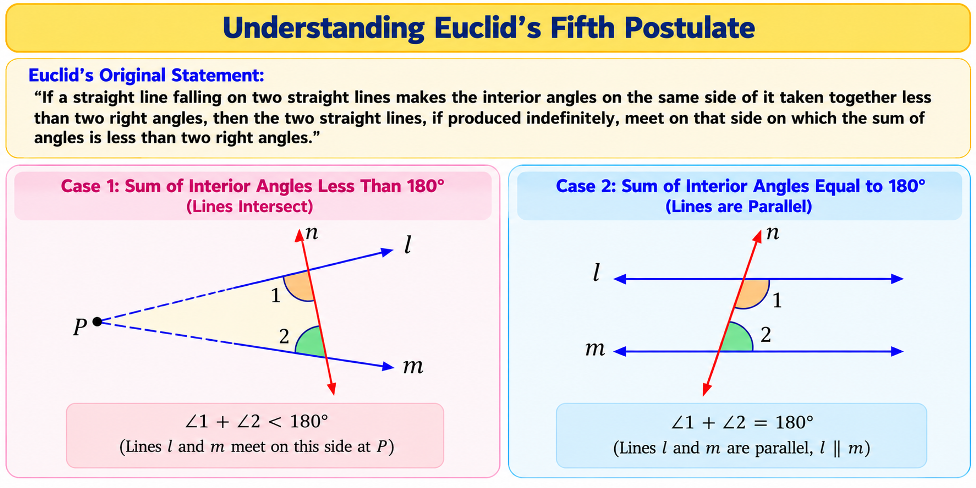
- The line $n$ creates four "interior" (in-between) angles.
- The postulate looks at the two interior angles on the same side of the transversal $n$. In the diagram, these are $\angle 1$ and $\angle 2$.
- "Two right angles" means $90^\circ + 90^\circ = 180^\circ$.
The postulate says: If $\angle 1 + \angle 2 < 180^\circ$, then the lines $l$ and $m$ are guaranteed to intersect somewhere on that side if you extend them far enough.
This also implies the condition for parallel lines: If $\angle 1 + \angle 2 = 180^\circ$, the lines will never meet, meaning they are parallel.
Equivalent Versions of the Fifth Postulate
Because the original wording is so complex, mathematicians have come up with several simpler, logically equivalent statements. If you assume any one of these statements is true (along with the first four postulates), you can prove Euclid's original fifth postulate, and vice-versa.
1. Playfair's Axiom (The Modern Version)
This is the version most commonly taught in schools today because it is much easier to understand. It was stated by the Scottish mathematician John Playfair.
"For every line $l$ and for every point $P$ not on $l$, there exists exactly one line $m$ that passes through $P$ and is parallel to $l$."
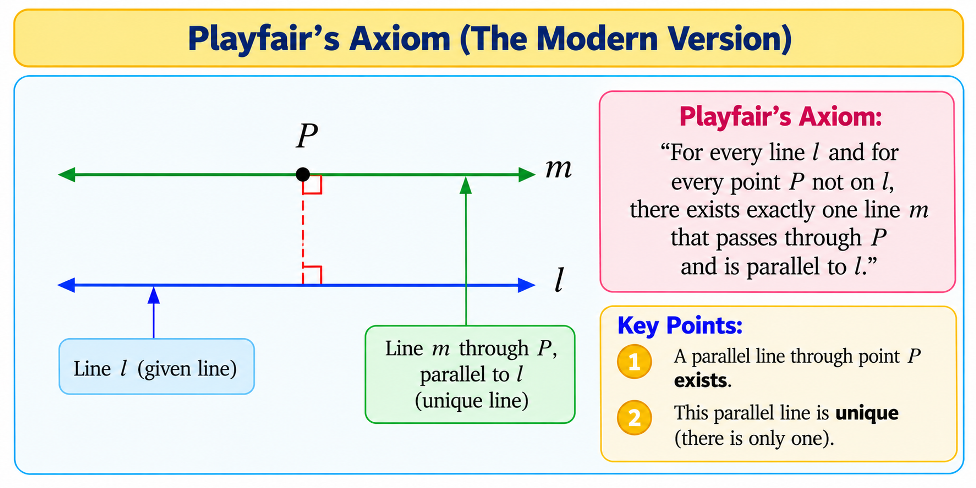
This simple statement guarantees two things:
- A parallel line through point P exists.
- This parallel line is unique (there is only one).
This single, unique parallel line is the defining feature of Euclidean geometry.
2. Other Important Equivalent Statements
The truth of these familiar geometric facts is also tied directly to the fifth postulate.
- The sum of the angles in any triangle is exactly $180^\circ$. In non-Euclidean geometries, this is not true. For example, on a sphere, the sum of a triangle's angles is always greater than $180^\circ$.
- There exists a pair of similar triangles that are not congruent. This statement allows for the concept of scaling shapes up and down without changing their angles.
- Converse of the Alternate Interior Angles Theorem: If a transversal intersects two lines such that the alternate interior angles are equal, then the lines are parallel. This is a cornerstone of proofs involving parallel lines.
Example 1. Which famous statement about parallel lines is now commonly used as a replacement for Euclid's Fifth Postulate?
Answer:
Playfair's Axiom is the most common and straightforward equivalent version of Euclid's Fifth Postulate. It states that through a point not on a given line, there is exactly one line that can be drawn parallel to the given line. It captures the same fundamental property of parallel lines but in a much simpler and more intuitive way.