

Chapter 11 Areas Related To Circles (Class 10 - Maths NCERT Exemplar Solutions)
Welcome to the comprehensive resource for NCERT Exemplar Solutions for Class 10 Mathematics: Chapter 11 Areas Related to Circles! These problems are specifically designed to significantly elevate the difficulty level beyond standard textbook exercises, demanding both visualization skills and precise mathematical application. By presenting scenarios involving more complex calculations and geometrically intricate shapes, these solutions build the analytical foundation and computational proficiency required for mastering the measurement of curved planes.
The solutions thoroughly revisit and apply fundamental circle formulas, including Circumference ($2\pi r$) and Area ($\pi r^2$). Students will master the calculation of Arc Length ($L = \frac{\theta}{360^\circ} \times 2\pi r$) and the Area of a Sector ($A = \frac{\theta}{360^\circ} \times \pi r^2$). A primary focus is placed on determining the Area of a Segment ($A_{\text{sector}} - A_{\text{triangle}}$), often requiring the use of trigonometry (Area $= \frac{1}{2}r^2 \sin\theta$) or properties of special triangles to find central angles and triangle dimensions within sectors.
Significant attention is given to calculating the areas of complex shaded regions formed by intricate combinations of circles, quadrants, and polygons. The Exemplar rigorously tests these skills through diverse word problems, from athletic tracks to grazing areas, requiring a clear strategy of adding or subtracting constituent areas. With step-by-step guidance and meticulous calculations prepared by learningspot.co, students can master the critical skills needed to effectively solve multifaceted mensuration challenges and handle $\pi$ with precision.
Sample Question 1 & 2 (Before Exercise 11.1)
Choose the correct answer from the given four options:
Sample Question 1: If the area of a circle is 154 cm2 , then its perimeter is
(A) 11 cm
(B) 22 cm
(C) 44 cm
(D) 55 cm
Answer:
Given:
Area of the circle = $154\ \text{cm}^2$
To Find:
The perimeter (circumference) of the circle.
Solution:
The formula for the area of a circle is given by:
Area $= \pi r^2$, where $r$ is the radius of the circle.
We are given the area is $154\ \text{cm}^2$. Let's use $\pi = \frac{22}{7}$.
$154 = \frac{22}{7} \times r^2$
... (i)
Now, we solve for $r^2$ from equation (i):
$r^2 = 154 \times \frac{7}{22}$
$r^2 = \frac{\cancel{154}^{7} \times 7}{\cancel{22}_{1}}$
$r^2 = 7 \times 7$
$r^2 = 49$
Taking the square root of both sides:
$r = \sqrt{49}$
$r = 7\ \text{cm}$
The radius of the circle is $7\ \text{cm}$.
The formula for the perimeter (circumference) of a circle is given by:
Perimeter $= 2\pi r$
Substitute the value of $r = 7\ \text{cm}$ and $\pi = \frac{22}{7}$ into the formula:
Perimeter $= 2 \times \frac{22}{7} \times 7$
Perimeter $= 2 \times \frac{22}{\cancel{7}} \times \cancel{7}$
Perimeter $= 2 \times 22$
Perimeter $= 44\ \text{cm}$
The perimeter of the circle is $44\ \text{cm}$.
Comparing this result with the given options, we find that it matches option (C).
Therefore, the correct answer is (C) 44 cm.
Sample Question 2: If θ is the angle (in degrees) of a sector of a circle of radius r, then area of the sector is
(A) $\frac{\pi r^{2}\theta}{360^\circ}$
(B) $\frac{\pi r^{2}\theta}{180^\circ}$
(C) $\frac{2\pi r\theta}{360^\circ}$
(D) $\frac{2\pi r\theta}{180^\circ}$
Answer:
Given:
Angle of the sector = $\theta$ degrees
Radius of the circle = $r$ units
To Find:
Area of the sector.
Solution:
The area of a full circle with radius $r$ is given by the formula $\pi r^2$.
A sector of a circle is a portion of the circle enclosed by two radii and an arc.
The angle of a full circle at the centre is $360^\circ$.
The area of a sector is proportional to the angle subtended at the centre.
If the angle is $\theta$ degrees, the sector represents a fraction $\frac{\theta}{360^\circ}$ of the total circle's area.
Therefore, the area of the sector is given by:
Area of sector $= \left(\text{Fraction of the circle}\right) \times \left(\text{Area of the full circle}\right)$
Area of sector $= \frac{\theta}{360^\circ} \times \pi r^2$
Area of sector $= \frac{\pi r^2 \theta}{360^\circ}$
Comparing this derived formula with the given options:
Option (A) is $\frac{\pi r^{2}\theta}{360^\circ}$. This matches our formula.
Option (B) is $\frac{\pi r^{2}\theta}{180^\circ}$. This is incorrect.
Option (C) is $\frac{2\pi r\theta}{360^\circ}$. This relates to the length of the arc of the sector (which is $\frac{\theta}{360^\circ} \times 2\pi r$), not the area.
Option (D) is $\frac{2\pi r\theta}{180^\circ}$. This is also incorrect.
The correct formula for the area of the sector with angle $\theta$ (in degrees) and radius $r$ is $\frac{\pi r^{2}\theta}{360^\circ}$.
Therefore, the correct answer is (A) $\frac{\pi r^{2}\theta}{360^\circ}$.
Exercise 11.1
Choose the correct answer from the given four options:
Question 1. If the sum of the areas of two circles with radii R1 and R2 is equal to the area of a circle of radius R, then
(A) R1 + R2 = R
(B) $R_1^2 + R_2^2 = R^2$
(C) R1 + R2 < R
(D) $R_1^2 + R_2^2 < R^2$
Answer:
Given:
Radius of the first circle = $R_1$
Radius of the second circle = $R_2$
Radius of the third circle = $R$
The sum of the areas of the two circles with radii $R_1$ and $R_2$ is equal to the area of the circle with radius $R$.
To Find:
The relationship between $R_1$, $R_2$, and $R$.
Solution:
The area of a circle with radius $r$ is given by the formula $\text{Area} = \pi r^2$.
According to the given information:
Area of circle with radius $R_1$ + Area of circle with radius $R_2$ = Area of circle with radius $R$
Using the area formula, we can write this as:
$\pi R_1^2 + \pi R_2^2 = \pi R^2$
We can factor out $\pi$ from the left side of the equation:
$\pi (R_1^2 + R_2^2) = \pi R^2$
Now, we can divide both sides of the equation by $\pi$ (since $\pi \neq 0$):
$\frac{\pi (R_1^2 + R_2^2)}{\pi} = \frac{\pi R^2}{\pi}$
$R_1^2 + R_2^2 = R^2$
This equation represents the relationship between the radii $R_1$, $R_2$, and $R$.
Comparing this result with the given options:
Option (A) is $R_1 + R_2 = R$. This is incorrect.
Option (B) is $R_1^2 + R_2^2 = R^2$. This matches our derived relationship.
Option (C) is $R_1 + R_2 < R$. This is incorrect.
Option (D) is $R_1^2 + R_2^2 < R^2$. This is incorrect.
The relationship between the radii is $R_1^2 + R_2^2 = R^2$.
Therefore, the correct answer is (B) $R_1^2 + R_2^2 = R^2$.
Question 2. If the sum of the circumferences of two circles with radii R1 and R2 is equal to the circumference of a circle of radius R, then
(A) R1 + R2 = R
(B) R1 + R2 > R
(C) R1 + R2 < R
(D) Nothing definite can be said about the relation among R1 , R2 and R.
Answer:
Given:
Radius of the first circle = $R_1$
Radius of the second circle = $R_2$
Radius of the third circle = $R$
The sum of the circumferences of the two circles with radii $R_1$ and $R_2$ is equal to the circumference of the circle with radius $R$.
To Find:
The relationship between $R_1$, $R_2$, and $R$.
Solution:
The circumference of a circle with radius $r$ is given by the formula $\text{Circumference} = 2\pi r$.
According to the given information:
Circumference of circle with radius $R_1$ + Circumference of circle with radius $R_2$ = Circumference of circle with radius $R$
Using the circumference formula, we can write this as:
$2\pi R_1 + 2\pi R_2 = 2\pi R$
We can factor out $2\pi$ from the left side of the equation:
$2\pi (R_1 + R_2) = 2\pi R$
Now, we can divide both sides of the equation by $2\pi$ (since $2\pi \neq 0$):
$\frac{2\pi (R_1 + R_2)}{2\pi} = \frac{2\pi R}{2\pi}$
$R_1 + R_2 = R$
This equation represents the relationship between the radii $R_1$, $R_2$, and $R$.
Comparing this result with the given options:
Option (A) is $R_1 + R_2 = R$. This matches our derived relationship.
Option (B) is $R_1 + R_2 > R$. This is incorrect.
Option (C) is $R_1 + R_2 < R$. This is incorrect.
Option (D) is Nothing definite can be said about the relation among $R_1$, $R_2$ and $R$. This is incorrect as we found a definite relationship.
The relationship between the radii is $R_1 + R_2 = R$.
Therefore, the correct answer is (A) $R_1 + R_2 = R$.
Question 3. If the circumference of a circle and the perimeter of a square are equal, then
(A) Area of the circle = Area of the square
(B) Area of the circle > Area of the square
(C) Area of the circle < Area of the square
(D) Nothing definite can be said about the relation between the areas of the circle and square.
Answer:
Given:
The circumference of a circle is equal to the perimeter of a square.
To Find:
The relationship between the area of the circle and the area of the square.
Solution:
Let $r$ be the radius of the circle and $a$ be the side of the square.
According to the given condition:
Circumference of circle = Perimeter of square
$2\pi r = 4a$
Expressing the side of the square $a$ in terms of radius $r$:
$a = \frac{2\pi r}{4}$
$a = \frac{\pi r}{2}$
... (i)
Now, let us find the area of the circle ($A_c$):
$A_c = \pi r^2$
... (ii)
Next, let us find the area of the square ($A_s$):
$A_s = a^2$
Substituting the value of $a$ from equation (i):
$A_s = \left( \frac{\pi r}{2} \right)^2$
$A_s = \frac{\pi^2 r^2}{4}$
... (iii)
To compare the two areas, we take the ratio of the Area of the Circle to the Area of the Square:
$\frac{A_c}{A_s} = \frac{\pi r^2}{\frac{\pi^2 r^2}{4}}$
Cancelling the common term $r^2$ and simplifying:
$\frac{A_c}{A_s} = \frac{\pi \times 4}{\pi^2} = \frac{4}{\pi}$
Using the value of $\pi \approx \frac{22}{7}$:
$\frac{A_c}{A_s} = \frac{4}{22/7} = \frac{4 \times 7}{22} = \frac{28}{22}$
$\frac{A_c}{A_s} = \frac{14}{11}$
Since $\frac{14}{11} > 1$, it implies that $A_c > A_s$.
Therefore, Area of the circle > Area of the square.
Comparing this with the given options:
(A) Area of the circle = Area of the square
(B) Area of the circle > Area of the square
(C) Area of the circle < Area of the square
(D) Nothing definite can be said about the relation.
The correct option is (B).
Alternate Solution:
This is a standard geometric property. For a given perimeter, the circle is the shape that encloses the maximum possible area. This is known as the Isoperimetric Theorem. Since both the square and the circle have the same perimeter, the circle must have a larger area than the square.
Question 4. Area of the largest triangle that can be inscribed in a semi-circle of radius r units is
(A) r2 sq. units
(B) $\frac{1}{2}$ r2 sq. units
(C) 2 r2 sq. units
(D) $\sqrt{2}$ r 2 sq. units
Answer:
Given:
A semi-circle of radius $r$ units.
To Find:
The area of the largest triangle that can be inscribed in the semi-circle.
Construction Required:
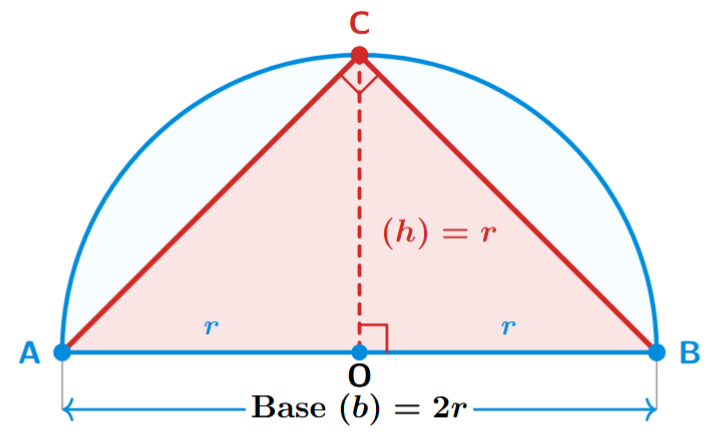
Let the semi-circle have diameter $AB$ and centre $O$. For a triangle to be inscribed in the semi-circle, its base must lie on the diameter and its third vertex $C$ must lie on the arc of the semi-circle. To maximize the area, the base should be the longest possible side, which is the diameter $AB$, and the altitude should be the maximum height possible from the diameter to the arc.
Solution:
The area of a triangle is given by the formula:
Area $= \frac{1}{2} \times \text{base} \times \text{height}$
1. Base: The maximum base for a triangle inscribed in a semi-circle of radius $r$ is the diameter of the semi-circle.
$\text{Base } (b) = 2r$
2. Height: The maximum height of the triangle occurs when the vertex $C$ is at the highest point of the semi-circle, which is directly above the centre $O$. This vertical distance is equal to the radius of the semi-circle.
$\text{Height } (h) = r$
Now, calculating the area:
$\text{Area} = \frac{1}{2} \times (2r) \times (r)$
$\text{Area} = r \times r$
$\text{Area} = r^2$ sq. units
Comparing our result with the given options:
(A) $r^2$ sq. units
(B) $\frac{1}{2} r^2$ sq. units
(C) $2 r^2$ sq. units
(D) $\sqrt{2} r^2$ sq. units
The correct option is (A).
Alternate Solution:
Any triangle inscribed in a semi-circle with the diameter as one side is a right-angled triangle (Angle in a semi-circle is $90^\circ$). Let the two other sides be $x$ and $y$. The area is $\frac{1}{2}xy$. By Pythagoras Theorem, $x^2 + y^2 = (2r)^2 = 4r^2$. The product $xy$ is maximized when $x = y$ (an isosceles right triangle). In that case:
$2x^2 = 4r^2 \implies x^2 = 2r^2 \implies x = r\sqrt{2}$.
$\text{Maximum Area} = \frac{1}{2} \times (r\sqrt{2}) \times (r\sqrt{2}) = \frac{1}{2} \times 2r^2 = r^2$ sq. units.
Question 5. If the perimeter of a circle is equal to that of a square, then the ratio of their areas is
(A) 22 : 7
(B) 14 : 11
(C) 7 : 22
(D) 11: 14
Answer:
Given:
The perimeter of a circle is equal to the perimeter of a square.
To Find:
The ratio of the area of the circle to the area of the square.
Solution:
Let $r$ be the radius of the circle and $s$ be the side length of the square.
The perimeter of the circle (circumference) is given by $C = 2\pi r$.
The perimeter of the square is given by $P = 4s$.
According to the problem, the perimeters are equal:
$2\pi r = 4s$
We can express the side $s$ in terms of the radius $r$:
$s = \frac{2\pi r}{4} = \frac{\pi r}{2}$
The area of the circle is given by $A_{\text{circle}} = \pi r^2$.
The area of the square is given by $A_{\text{square}} = s^2$.
Substitute the expression for $s$ into the formula for the area of the square:
$A_{\text{square}} = \left(\frac{\pi r}{2}\right)^2 = \frac{\pi^2 r^2}{4}$
Now, we find the ratio of the area of the circle to the area of the square:
$\frac{A_{\text{circle}}}{A_{\text{square}}} = \frac{\pi r^2}{\frac{\pi^2 r^2}{4}}$
$\frac{A_{\text{circle}}}{A_{\text{square}}} = \pi r^2 \times \frac{4}{\pi^2 r^2}$
Assuming $r \neq 0$, we can cancel $r^2$ from the numerator and denominator:
$\frac{A_{\text{circle}}}{A_{\text{square}}} = \frac{4\pi}{\pi^2}$
Assuming $\pi \neq 0$, we can cancel $\pi$ from the numerator and denominator:
$\frac{A_{\text{circle}}}{A_{\text{square}}} = \frac{4}{\pi}$
Using the value $\pi = \frac{22}{7}$:
$\frac{A_{\text{circle}}}{A_{\text{square}}} = \frac{4}{\frac{22}{7}}$
$\frac{A_{\text{circle}}}{A_{\text{square}}} = 4 \times \frac{7}{22}$
$\frac{A_{\text{circle}}}{A_{\text{square}}} = \frac{\cancel{4}^{2} \times 7}{\cancel{22}_{11}}$
$\frac{A_{\text{circle}}}{A_{\text{square}}} = \frac{14}{11}$
The ratio of their areas is $14:11$.
Comparing this result with the given options, it matches option (B).
Therefore, the correct answer is (B) 14 : 11.
Question 6. It is proposed to build a single circular park equal in area to the sum of areas of two circular parks of diameters 16 m and 12 m in a locality. The radius of the new park would be
(A) 10 m
(B) 15 m
(C) 20 m
(D) 24 m
Answer:
Given:
1. Diameter of the first circular park ($d_1$) = $16$ m.
2. Diameter of the second circular park ($d_2$) = $12$ m.
3. Area of the new circular park = Sum of the areas of the two given parks.
To Find:
The radius of the new circular park ($R$).
Solution:
First, we determine the radii of the two existing parks:
$r_1 = \frac{d_1}{2} = \frac{16}{2} = 8$ m
(Radius of first park)
$r_2 = \frac{d_2}{2} = \frac{12}{2} = 6$ m
(Radius of second park)
Let $R$ be the radius of the proposed new circular park.
According to the problem, the Area of the new park = Area of park 1 + Area of park 2.
$\pi R^2 = \pi r_1^2 + \pi r_2^2$
Dividing throughout by $\pi$:
$R^2 = r_1^2 + r_2^2$
Substituting the values of $r_1$ and $r_2$:
$R^2 = 8^2 + 6^2$
$R^2 = 64 + 36$
$R^2 = 100$
... (i)
Taking the square root on both sides:
$R = \sqrt{100}$
$R = 10$ m
Comparing this result with the given options:
(A) 10 m
(B) 15 m
(C) 20 m
(D) 24 m
The correct option is (A).
Alternate Solution:
Since the area of a circle is directly proportional to the square of its radius ($A \propto r^2$), the sum of areas translates to the sum of the squares of the radii: $R^2 = r_1^2 + r_2^2$. This relationship is identical to the Pythagorean triplet. For radii 8 and 6, the resulting radius is the hypotenuse of a right triangle with these sides:
$R = \sqrt{8^2 + 6^2} = \sqrt{64 + 36} = \sqrt{100} = 10$ m.
Question 7. The area of the circle that can be inscribed in a square of side 6 cm is
(A) 36 π cm2
(B) 18 π cm2
(C) 12 π cm2
(D) 9 π cm2
Answer:
Given:
1. Side of the square ($a$) = $6 \text{ cm}$.
2. A circle is inscribed in the square.
To Find:
The area of the inscribed circle.
Construction Required:
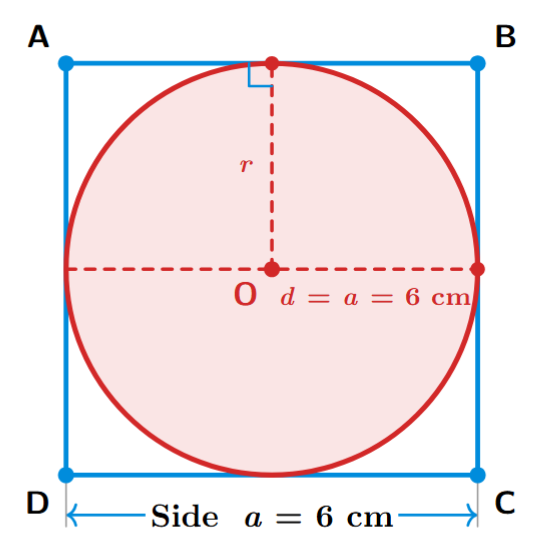
Consider a square of side $6 \text{ cm}$. When a circle is inscribed in a square, it touches all the four sides of the square internally. This implies that the diameter of the circle is equal to the length of the side of the square.
Solution:
As per the geometry of an inscribed circle within a square:
$\text{Diameter of the circle } (d) = \text{Side of the square } (a)$
Given that the side of the square $a = 6 \text{ cm}$, we have:
$d = 6 \text{ cm}$
Now, we calculate the radius ($r$) of the circle:
$r = \frac{d}{2} = \frac{6}{2} = 3 \text{ cm}$
[Radius is half of diameter] ... (i)
The formula for the area of a circle is given by $\pi r^2$:
$\text{Area} = \pi \times r^2$
Substituting the value of $r$ from equation (i):
$\text{Area} = \pi \times (3)^2$
$\text{Area} = 9\pi \text{ cm}^2$
Comparing this result with the provided options:
(A) $36 \pi \text{ cm}^2$
(B) $18 \pi \text{ cm}^2$
(C) $12 \pi \text{ cm}^2$
(D) $9 \pi \text{ cm}^2$
The correct option is (D).
Alternate Solution:
We can use the direct formula for the area of a circle inscribed in a square of side $a$:
$\text{Area} = \frac{\pi a^2}{4}$
Substituting the value $a = 6 \text{ cm}$:
$\text{Area} = \frac{\pi \times 6^2}{4}$
$\text{Area} = \frac{36\pi}{4} = 9\pi \text{ cm}^2$
This confirms the result obtained through the step-by-step process.
Question 8. The area of the square that can be inscribed in a circle of radius 8 cm is
(A) 256 cm2
(B) 128 cm2
(C) 64$\sqrt{2}$ cm2
(D) 64 cm2
Answer:
Given:
1. Radius of the circle ($r$) = $8$ cm.
2. A square is inscribed in this circle.
To Find:
The area of the inscribed square.
Construction Required:
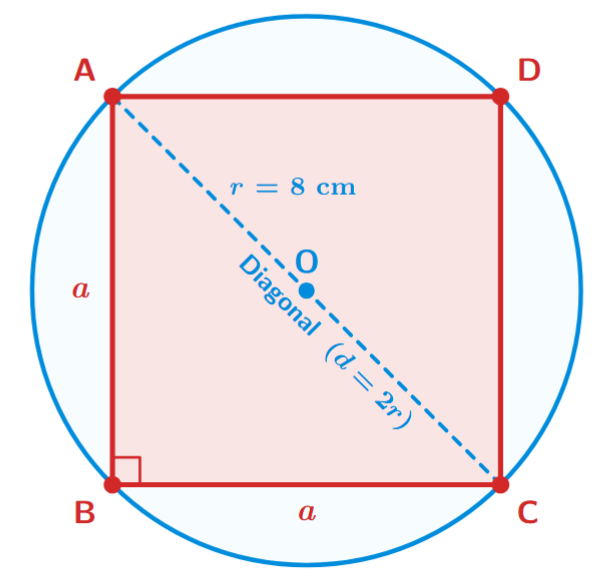
Consider a square $ABCD$ inscribed in a circle with centre $O$ and radius $8$ cm. When a square is inscribed in a circle, the vertices of the square lie on the circumference of the circle. The diagonal of such a square passes through the centre of the circle and is equal to its diameter.
Solution:
Let the side of the square be $a$ and its diagonal be $d$.
The diagonal of a square inscribed in a circle is equal to the diameter of that circle.
$\text{Diameter } (d) = 2 \times \text{radius}$
$d = 2 \times 8 = 16 \text{ cm}$
[Diameter of the circle] ... (i)
In the square $ABCD$, let $AC$ be the diagonal. In right-angled $\triangle ABC$, by the Pythagoras Theorem:
$AB^2 + BC^2 = AC^2$
$a^2 + a^2 = d^2$
(Sides of a square are equal)
$2a^2 = d^2$
$a^2 = \frac{d^2}{2}$
... (ii)
We know that the Area of a square is given by $a^2$. Substituting the value of $d$ from equation (i) into equation (ii):
$\text{Area} = \frac{(16)^2}{2}$
$\text{Area} = \frac{256}{2}$
$\text{Area} = 128 \text{ cm}^2$
Comparing this result with the given options:
(A) $256 \text{ cm}^2$
(B) $128 \text{ cm}^2$
(C) $64\sqrt{2} \text{ cm}^2$
(D) $64 \text{ cm}^2$
The correct option is (B).
Alternate Solution:
The area of any quadrilateral whose diagonals are perpendicular (like a square) can be calculated using the formula:
$\text{Area} = \frac{1}{2} \times d_1 \times d_2$
Since for a square $d_1 = d_2 = d$:
$\text{Area} = \frac{1}{2} \times d^2$
Substituting $d = 16 \text{ cm}$:
$\text{Area} = \frac{1}{2} \times 16^2 = \frac{1}{2} \times 256 = 128 \text{ cm}^2$
This confirms that the area of the inscribed square is 128 cm².
Question 9. The radius of a circle whose circumference is equal to the sum of the circumferences of the two circles of diameters 36cm and 20 cm is
(A) 56 cm
(B) 42 cm
(C) 28 cm
(D) 16 cm
Answer:
Given:
Diameter of the first circle ($d_1$) = $36\ \text{cm}$
Diameter of the second circle ($d_2$) = $20\ \text{cm}$
The circumference of a new circle is equal to the sum of the circumferences of the two given circles.
To Find:
The radius of the new circle ($R$).
Solution:
Let the radius of the first circle be $r_1$.
$r_1 = \frac{d_1}{2} = \frac{36\ \text{cm}}{2} = 18\ \text{cm}$
... (i)
Let the radius of the second circle be $r_2$.
$r_2 = \frac{d_2}{2} = \frac{20\ \text{cm}}{2} = 10\ \text{cm}$
... (ii)
Let the radius of the new circle be $R$.
The circumference of a circle with radius $r$ is given by the formula $C = 2\pi r$.
Circumference of the first circle ($C_1$) $= 2\pi r_1 = 2\pi (18)$
Circumference of the second circle ($C_2$) $= 2\pi r_2 = 2\pi (10)$
Circumference of the new circle ($C_{\text{new}}$) $= 2\pi R$
According to the problem statement:
$C_{\text{new}} = C_1 + C_2$
... (iii)
Substitute the circumference formulas into equation (iii):
$2\pi R = 2\pi (18) + 2\pi (10)$
Factor out $2\pi$ from the right side:
$2\pi R = 2\pi (18 + 10)$
$2\pi R = 2\pi (28)$
Divide both sides by $2\pi$ (since $2\pi \neq 0$):
$\frac{2\pi R}{2\pi} = \frac{2\pi (28)}{2\pi}$
... (iv)
From equation (iv):
$R = 28\ \text{cm}$
The radius of the new circle is $28\ \text{cm}$.
Comparing this result with the given options, it matches option (C).
Therefore, the correct answer is (C) 28 cm.
Question 10. The diameter of a circle whose area is equal to the sum of the areas of the two circles of radii 24 cm and 7 cm is
(A) 31 cm
(B) 25 cm
(C) 62 cm
(D) 50 cm
Answer:
Given:
Radius of the first circle ($r_1$) = $24\ \text{cm}$
Radius of the second circle ($r_2$) = $7\ \text{cm}$
The area of a new circle is equal to the sum of the areas of the two given circles.
To Find:
The diameter of the new circle ($D$).
Solution:
The area of a circle with radius $r$ is given by the formula $A = \pi r^2$.
Area of the first circle ($A_1$) $= \pi r_1^2 = \pi (24\ \text{cm})^2 = 576\pi\ \text{cm}^2$
Area of the second circle ($A_2$) $= \pi r_2^2 = \pi (7\ \text{cm})^2 = 49\pi\ \text{cm}^2$
Let the radius of the new circle be $R$. Its area is $A_{\text{new}} = \pi R^2$.
According to the problem statement, the area of the new circle is the sum of the areas of the two smaller circles:
$A_{\text{new}} = A_1 + A_2$
... (i)
Substitute the areas into equation (i):
$\pi R^2 = 576\pi + 49\pi$
Combine the terms on the right side:
$\pi R^2 = 625\pi$
... (ii)
Divide both sides of equation (ii) by $\pi$ (since $\pi \neq 0$):
$R^2 = 625$
Taking the positive square root to find the radius (since radius must be a positive value):
$R = \sqrt{625}$
... (iii)
From equation (iii):
$R = 25\ \text{cm}$
The radius of the new circle is $25\ \text{cm}$.
The diameter of a circle ($D$) is twice its radius ($R$).
$D = 2R$
... (iv)
Substitute the value of $R$ from equation (iii) into equation (iv):
$D = 2 \times 25\ \text{cm}$
$D = 50\ \text{cm}$
The diameter of the new circle is $50\ \text{cm}$.
Comparing this result with the given options, it matches option (D).
Therefore, the correct answer is (D) 50 cm.
Sample Question 1 & 2 (Before Exercise 11.2)
Sample Question 1: Is the following statement true? Give reasons for your answer.
Area of a segment of a circle = area of the corresponding sector – area of the corresponding triangle.
Answer:
Statement: "Area of a segment of a circle = area of the corresponding sector – area of the corresponding triangle."
Answer: The given statement is False.
Reason:
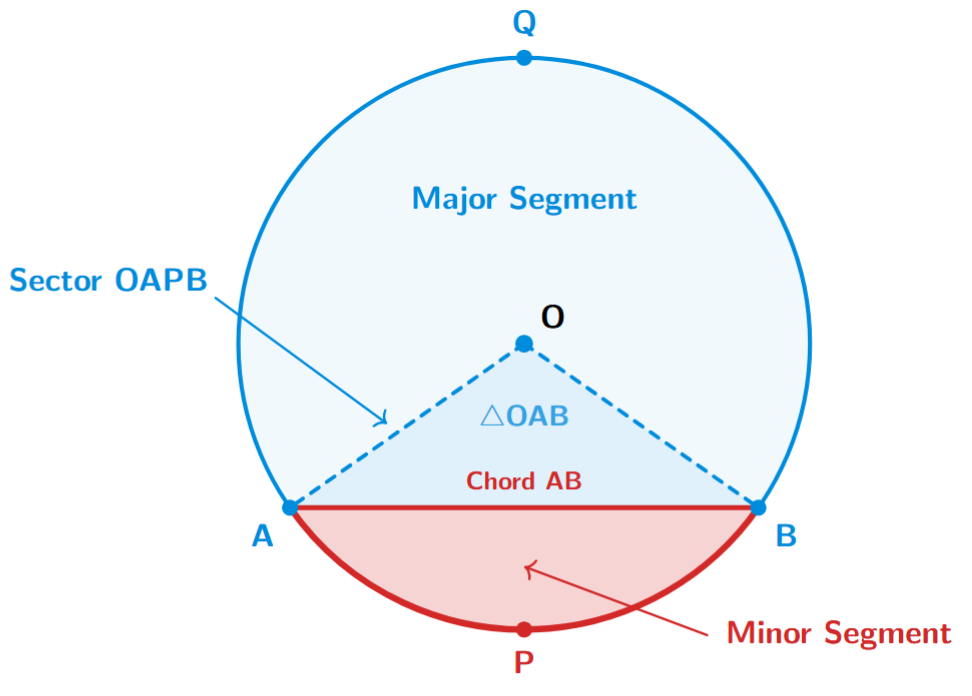
A circle is divided into two types of segments by a chord: the minor segment and the major segment. The provided formula is only applicable to the minor segment.
Case 1: For the Minor Segment
In the case of a minor segment, the area is indeed obtained by subtracting the area of the triangle (formed by the radii and the chord) from the area of the corresponding minor sector.
$\text{Area of minor segment} = \text{Area of minor sector} - \text{Area of } \triangle$
Case 2: For the Major Segment
In the case of a major segment, the area is obtained by adding the area of the corresponding triangle to the area of the corresponding major sector. Alternatively, it can be calculated by subtracting the area of the minor segment from the total area of the circle.
$\text{Area of major segment} = \text{Area of major sector} + \text{Area of } \triangle$
Since the statement does not specify whether it is referring to a minor or major segment, and because it is mathematically incorrect for a major segment, the general statement is false.
Conclusion:
The statement is true only for the minor segment. For the statement to be universally true for any segment, it must account for both cases as shown in equations (i) and (ii).
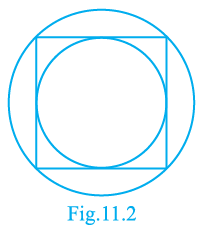
Sample Question 2: In Fig. 11.2, a circle is inscribed in a square of side 5 cm and another circle is circumscribing the square. Is it true to say that area of the outer circle is two times the area of the inner circle? Give reasons for your answer.
Answer:
Given:
Side of the square ($a$) = 5 cm.
Inner circle is inscribed in the square.
Outer circle is circumscribing the square.
To Find:
Whether the area of the outer circle is twice the area of the inner circle.
Solution:
Step 1: Finding the radius of the inner circle.
When a circle is inscribed in a square, its diameter is equal to the side of the square.
$\text{Diameter of inner circle} = a = 5 \text{ cm}$
... (i)
Therefore, the radius ($r$) of the inner circle is:
$r = \frac{5}{2} \text{ cm}$
... (ii)
Step 2: Finding the radius of the outer circle.
When a circle circumscribes a square, its diameter is equal to the diagonal of the square.
Using the Pythagoras theorem, the diagonal of a square with side $a$ is $a\sqrt{2}$.
$\text{Diameter of outer circle} = 5\sqrt{2} \text{ cm}$
[Diagonal of the square] ... (iii)
Therefore, the radius ($R$) of the outer circle is:
$R = \frac{5\sqrt{2}}{2} \text{ cm}$
... (iv)
Step 3: Comparing the areas.
Area of a circle is given by the formula $\pi \times (\text{radius})^2$.
$\text{Area of inner circle} = \pi \times r^2 = \pi \times \left( \frac{5}{2} \right)^2$
$\text{Area of inner circle} = \frac{25\pi}{4} \text{ cm}^2$
... (v)
$\text{Area of outer circle} = \pi \times R^2 = \pi \times \left( \frac{5\sqrt{2}}{2} \right)^2$
$\text{Area of outer circle} = \pi \times \frac{25 \times 2}{4} = \frac{50\pi}{4} \text{ cm}^2$
$\text{Area of outer circle} = \frac{25\pi}{2} \text{ cm}^2$
... (vi)
Step 4: Relationship between the two areas.
Dividing the area of the outer circle by the area of the inner circle:
$\frac{\text{Area of outer circle}}{\text{Area of inner circle}} = \frac{\frac{25\pi}{2}}{\frac{25\pi}{4}}$
$\frac{\text{Area of outer circle}}{\text{Area of inner circle}} = \frac{\cancel{25\pi}}{2} \times \frac{4}{\cancel{25\pi}}$
$\frac{\text{Area of outer circle}}{\text{Area of inner circle}} = \frac{4}{2} = 2$
$\text{Area of outer circle} = 2 \times \text{Area of inner circle}$
Conclusion:
Yes, the given statement is True. The area of the outer circle is indeed two times the area of the inner circle.
Exercise 11.2
Question 1. Is the area of the circle inscribed in a square of side a cm, πa2 cm2 ? Give reasons for your answer.
Answer:
Given:
Side of the square = $a$ cm
A circle is inscribed in the square.
To Find:
Whether the area of this inscribed circle is $\pi a^2 \text{ cm}^2$.
Solution:
When a circle is inscribed in a square, it touches all four sides of the square. Therefore, the diameter of the circle is equal to the side of the square.
$\text{Diameter of circle (d)} = a \text{ cm}$
(Side of the square)
The radius ($r$) of the circle is half of its diameter:
$r = \frac{a}{2} \text{ cm}$
... (i)
Now, we calculate the area of the circle using the formula $\text{Area} = \pi r^2$:
$\text{Area} = \pi \times \left( \frac{a}{2} \right)^2$
$\text{Area} = \frac{\pi a^2}{4} \text{ cm}^2$
... (ii)
Conclusion:
The calculated area is $\frac{\pi a^2}{4} \text{ cm}^2$, whereas the statement claims the area is $\pi a^2 \text{ cm}^2$.
Since $\frac{\pi a^2}{4} \neq \pi a^2$, the given statement is False.
Reason: The diameter of the inscribed circle is $a$, making its radius $\frac{a}{2}$. Thus, the area must be $\frac{\pi a^2}{4} \text{ cm}^2$.
Question 2. Will it be true to say that the perimeter of a square circumscribing a circle of radius a cm is 8a cm? Give reasons for your answer.
Answer:
Given:
Radius of the circle ($r$) = $a$ cm.
The square is circumscribing the circle (the circle is inscribed in the square).
To Find:
Whether it is true to say that the perimeter of the square is $8a$ cm.
Solution:
When a square circumscribes a circle, each side of the square is tangent to the circle. This implies that the side of the square is equal to the diameter of the circle.
First, we find the diameter of the circle:
$\text{Diameter} = 2 \times \text{radius}$
... (i)
Substituting the given radius ($r = a$):
$\text{Diameter} = 2a \text{ cm}$
... (ii)
As per the property of a square circumscribing a circle:
$\text{Side of the square (s)} = \text{Diameter of the circle}$
(Property)
Therefore, the side of the square is:
$s = 2a \text{ cm}$
... (iii)
Now, we calculate the perimeter of the square using the formula:
$\text{Perimeter} = 4 \times s$
... (iv)
Substituting the value of $s$ from equation (iii) into equation (iv):
$\text{Perimeter} = 4 \times (2a)$
$\text{Perimeter} = 8a \text{ cm}$
Conclusion:
Yes, the statement is True.
Reason: The side of the square circumscribing a circle of radius $a$ is equal to the diameter of the circle, which is $2a$. Hence, its perimeter is $4 \times 2a = 8a$ cm.
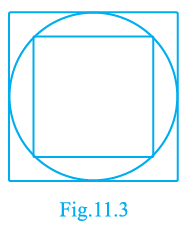
Question 3. In Fig 11.3, a square is inscribed in a circle of diameter d and another square is circumscribing the circle. Is the area of the outer square four times the area of the inner square? Give reasons for your answer.
Answer:
Given:
Diameter of the circle = $d$.
An inner square is inscribed in the circle.
An outer square is circumscribing the circle.
To Find:
Whether the area of the outer square is four times the area of the inner square.
Solution:
Step 1: Area of the Outer Square
When a square circumscribes a circle, the side of the square is equal to the diameter of the circle.
$\text{Side of outer square } (s_{o}) = d$
... (i)
The area of the outer square is calculated as:
$\text{Area of outer square} = (s_{o})^2$
$\text{Area of outer square} = d^2$
... (ii)
Step 2: Area of the Inner Square
When a square is inscribed in a circle, the diagonal of the square is equal to the diameter of the circle.
Let the side of the inner square be $s_{i}$.
$\text{Diagonal of inner square} = d$
... (iii)
We know that for a square, $\text{Diagonal} = \text{side} \times \sqrt{2}$. Therefore:
$s_{i} \times \sqrt{2} = d$
$s_{i} = \frac{d}{\sqrt{2}}$
The area of the inner square is calculated as:
$\text{Area of inner square} = (s_{i})^2 = \left( \frac{d}{\sqrt{2}} \right)^2$
$\text{Area of inner square} = \frac{d^2}{2}$
... (iv)
Step 3: Comparison of Areas
To find the relationship, we divide the area of the outer square by the area of the inner square:
$\frac{\text{Area of outer square}}{\text{Area of inner square}} = \frac{d^2}{\left( \frac{d^2}{2} \right)}$
$\frac{\text{Area of outer square}}{\text{Area of inner square}} = \frac{d^2 \times 2}{d^2}$
$\frac{\text{Area of outer square}}{\text{Area of inner square}} = 2$
Therefore, $\text{Area of outer square} = 2 \times \text{Area of inner square}$.
Conclusion:
The statement is False.
Reason: The area of the outer square is two times (not four times) the area of the inner square.
Question 4. Is it true to say that area of a segment of a circle is less than the area of its corresponding sector? Why?
Answer:
Answer: No, the given statement is False.
Reason:
Whether the area of a segment is less than or greater than the area of its corresponding sector depends on whether we are considering a minor segment or a major segment.
Case 1: Minor Segment
For a minor segment, the area is calculated by subtracting the area of the triangle formed by the chord and the radii from the area of the corresponding sector.
$\text{Area of minor segment} = \text{Area of sector} - \text{Area of triangle}$
In this specific case, the area of the segment is indeed less than the area of the sector.
Case 2: Major Segment
For a major segment, the area is calculated by adding the area of the triangle formed by the chord and the radii to the area of the corresponding major sector.
$\text{Area of major segment} = \text{Area of sector} + \text{Area of triangle}$
In this case, the area of the segment is greater than the area of the sector.
Case 3: Semicircle
In the case of a semicircle, the triangle area becomes zero (as the chord passes through the center), and the area of the segment becomes equal to the area of the sector.
Conclusion:
Since the statement claims that the area of a segment is always less than the area of its corresponding sector without specifying that it is a minor segment, it is False. It is only true for minor segments; for major segments, the area of the segment is greater than the area of the corresponding sector.
Question 5. Is it true that the distance travelled by a circular wheel of diameter d cm in one revolution is 2 π d cm? Why?
Answer:
Given:
Diameter of the circular wheel = $d$ cm.
To Find:
Whether the distance travelled in one revolution is $2\pi d$ cm.
Solution:
When a circular wheel completes one full revolution, the distance it covers along the ground is exactly equal to its circumference.
The formula for the circumference ($C$) of a circle in terms of its radius ($r$) is:
$C = 2\pi r$
... (i)
We know that the diameter ($d$) is twice the radius ($r$):
$d = 2r$
... (ii)
Substituting the value of $2r$ from equation (ii) into equation (i), we get the circumference in terms of diameter:
$C = \pi d$
[Distance covered in one revolution] ... (iii)
Conclusion:
The actual distance travelled in one revolution is $\pi d$ cm.
The statement claims the distance is $2\pi d$ cm.
Since $\pi d \neq 2\pi d$, the given statement is False.
Reason: The distance covered in one revolution is equal to the circumference of the wheel. For a wheel of diameter $d$, the circumference is $\pi d$, not $2\pi d$. The value $2\pi d$ would actually represent the circumference of a wheel with diameter $2d$.
Question 6. In covering a distance s metres, a circular wheel of radius r metres makes $\frac{s}{2\pi r}$ revolutions. Is this statement true? Why?
Answer:
Given:
Radius of the circular wheel = $r$ metres.
Total distance travelled = $s$ metres.
To Find:
Whether the number of revolutions made by the wheel is $\frac{s}{2\pi r}$.
Solution:
When a circular wheel rotates, the distance covered in one complete revolution is equal to the circumference of the wheel.
The circumference ($C$) of a circle with radius $r$ is given by:
$C = 2\pi r \text{ metres}$
... (i)
Let the number of revolutions made by the wheel to cover distance $s$ be $n$.
The total distance covered is the product of the number of revolutions and the distance covered in one revolution.
$\text{Total distance (s)} = n \times (2\pi r)$
... (ii)
To find the number of revolutions ($n$), we rearrange the formula:
$n = \frac{s}{2\pi r}$
... (iii)
Conclusion:
The statement is True.
Reason: The number of revolutions completed by a circular wheel is indeed the ratio of the total distance travelled to the circumference of the wheel. Since the circumference is $2\pi r$, the number of revolutions for distance $s$ is $\frac{s}{2\pi r}$.
Question 7. The numerical value of the area of a circle is greater than the numerical value of its circumference. Is this statement true? Why?
Answer:
Given:
Let the radius of the circle be $r$ units.
To Find:
Whether the numerical value of the area of the circle is always greater than the numerical value of its circumference.
Solution:
The formula for the numerical value of the Area (A) of a circle is:
$A = \pi r^2$
... (i)
The formula for the numerical value of the Circumference (C) of a circle is:
$C = 2\pi r$
... (ii)
To check if the statement "Area is greater than Circumference" ($A > C$) is always true, we consider the following cases:
Case 1: When $r = 2$ units
$A = \pi (2)^2 = 4\pi$
$C = 2\pi (2) = 4\pi$
In this case, the numerical value of the area is equal to the circumference ($A = C$).
Case 2: When $r < 2$ units (e.g., $r = 1$ unit)
$A = \pi (1)^2 = \pi$
$C = 2\pi (1) = 2\pi$
In this case, the numerical value of the area is less than the circumference ($A < C$).
Case 3: When $r > 2$ units (e.g., $r = 3$ units)
$A = \pi (3)^2 = 9\pi$
$C = 2\pi (3) = 6\pi$
In this case, the numerical value of the area is greater than the circumference ($A > C$).
Conclusion:
The statement is False.
Reason: The numerical value of the area is greater than the circumference only when the radius is greater than 2 units. If the radius is less than 2 units, the area is numerically smaller than the circumference, and if the radius is exactly 2 units, they are equal.
Question 8. If the length of an arc of a circle of radius r is equal to that of an arc of a circle of radius 2 r, then the angle of the corresponding sector of the first circle is double the angle of the corresponding sector of the other circle. Is this statement false? Why?
Answer:
Given:
Radius of the first circle ($r_{1}$) = $r$
Radius of the second circle ($r_{2}$) = $2r$
Length of the arc of the first circle ($l_{1}$) = Length of the arc of the second circle ($l_{2}$)
To Evaluate:
Whether the statement "the angle of the first sector is double the angle of the second sector" ($\theta_{1} = 2\theta_{2}$) is false.
Solution:
The formula for the length of an arc ($l$) of a sector with radius $R$ and angle $\theta$ is:
$l = \frac{\theta}{360^\circ} \times 2\pi R$
... (i)
For the first circle with radius $r$ and angle $\theta_{1}$:
$l_{1} = \frac{\theta_{1}}{360^\circ} \times 2\pi r$
... (ii)
For the second circle with radius $2r$ and angle $\theta_{2}$:
$l_{2} = \frac{\theta_{2}}{360^\circ} \times 2\pi (2r)$
... (iii)
According to the question, $l_{1} = l_{2}$. Equating (ii) and (iii):
$\frac{\theta_{1}}{360^\circ} \times 2\pi r = \frac{\theta_{2}}{360^\circ} \times 2\pi (2r)$
On cancelling the common terms ($\frac{2\pi}{360^\circ}$ and $r$) from both sides, we get:
$\theta_{1} = 2\theta_{2}$
... (iv)
This shows that the angle of the first sector is indeed double the angle of the second sector.
Conclusion:
No, the statement is not False; it is True.
Reason: As derived in equation (iv), when the arc lengths are equal and the radius of the second circle is twice that of the first, the central angle of the first circle must be twice the central angle of the second circle to compensate for the smaller radius.
Question 9. The areas of two sectors of two different circles with equal corresponding arc lengths are equal. Is this statement true? Why?
Answer:
The statement is false.
Let the two different circles have radii $r_1$ and $r_2$, where $r_1 \neq r_2$. Let the corresponding arc lengths of the two sectors be $l_1$ and $l_2$. We are given that $l_1 = l_2 = l$ (say).
The formula for the arc length ($l$) of a sector with radius $r$ and angle $\theta$ (in radians) is $l = r\theta$.
The formula for the area ($A$) of a sector in terms of arc length is given by $A = \frac{1}{2}lr$.
For the first sector, the area is $A_1 = \frac{1}{2} l_1 r_1$.
For the second sector, the area is $A_2 = \frac{1}{2} l_2 r_2$.
Since $l_1 = l_2 = l$, we have:
$A_1 = \frac{1}{2} l r_1$
$A_2 = \frac{1}{2} l r_2$
For the areas to be equal, we would need $A_1 = A_2$, which means:
$\frac{1}{2} l r_1 = \frac{1}{2} l r_2$
Assuming $l > 0$ (for non-zero sectors with positive arc length), we can divide both sides by $\frac{1}{2}l$:
$r_1 = r_2$
However, the problem states that the two circles are different, which implies that their radii are not equal, i.e., $r_1 \neq r_2$.
Therefore, if $r_1 \neq r_2$ and $l > 0$, then $\frac{1}{2} l r_1 \neq \frac{1}{2} l r_2$, which means $A_1 \neq A_2$.
Hence, the areas of the two sectors are not equal.
Question 10. The areas of two sectors of two different circles are equal. Is it necessary that their corresponding arc lengths are equal? Why?
Answer:
The statement is false.
Let the two different circles have radii $r_1$ and $r_2$, where $r_1 \neq r_2$. Let the corresponding arc lengths of the two sectors be $l_1$ and $l_2$. We are given that their areas are equal, i.e., $A_1 = A_2 = A$ (say).
The formula for the area ($A$) of a sector with radius $r$ and corresponding arc length $l$ is given by $A = \frac{1}{2}lr$.
For the first sector, the area is $A_1 = \frac{1}{2} l_1 r_1$.
For the second sector, the area is $A_2 = \frac{1}{2} l_2 r_2$.
Since $A_1 = A_2$, we have:
$\frac{1}{2} l_1 r_1 = \frac{1}{2} l_2 r_2$
Multiplying both sides by 2, we get:
$l_1 r_1 = l_2 r_2$
This equation can be rewritten as:
$\frac{l_1}{l_2} = \frac{r_2}{r_1}$
Since the two circles are different, their radii are not equal. So, $r_1 \neq r_2$.
This implies that the ratio $\frac{r_2}{r_1}$ is not equal to 1 (assuming $r_1, r_2 \neq 0$).
Therefore, from the equation $\frac{l_1}{l_2} = \frac{r_2}{r_1}$, we must have $\frac{l_1}{l_2} \neq 1$.
This means $l_1 \neq l_2$.
Thus, if the areas of sectors from two different circles are equal, it is not necessary that their corresponding arc lengths are equal; in fact, if the radii are different, the arc lengths must be different.
Question 11. Is the area of the largest circle that can be drawn inside a rectangle of length a cm and breadth b cm (a > b) is π b2 cm2? Why?
Answer:
Given:
Length of the rectangle = $a$ cm
Breadth of the rectangle = $b$ cm
Condition: $a > b$
To Find:
Whether the area of the largest circle that can be drawn inside this rectangle is $\pi b^2$ $\text{cm}^2$.
Solution:
For a circle to be drawn inside a rectangle, its diameter must not exceed the dimensions of the rectangle. This means the diameter ($d$) must be less than or equal to both the length and the breadth.
$d \leq a$ and $d \leq b$
... (i)
Since it is given that $a > b$, the maximum possible diameter for the circle is limited by the shorter side of the rectangle, which is the breadth ($b$).
$\text{Maximum diameter } (d) = b \text{ cm}$
... (ii)
The radius ($r$) of this largest circle will be half of its diameter:
$r = \frac{b}{2} \text{ cm}$
... (iii)
Now, we calculate the area of the largest circle using the formula $\text{Area} = \pi r^2$:
$\text{Area} = \pi \times \left( \frac{b}{2} \right)^2$
$\text{Area} = \frac{\pi b^2}{4} \text{ cm}^2$
... (iv)
Conclusion:
The statement is False.
Reason: The area of the largest circle that can be inscribed in a rectangle with breadth $b$ (where $b < a$) is $\frac{\pi b^2}{4}$ $\text{cm}^2$, not $\pi b^2$ $\text{cm}^2$. The diameter of the circle is restricted by the smaller dimension of the rectangle.
Question 12. Circumferences of two circles are equal. Is it necessary that their areas be equal? Why?
Answer:
The statement is true.
Let the radii of the two circles be $r_1$ and $r_2$.
Let their circumferences be $C_1$ and $C_2$, respectively.
The formula for the circumference of a circle with radius $r$ is $C = 2\pi r$.
For the first circle, $C_1 = 2\pi r_1$.
For the second circle, $C_2 = 2\pi r_2$.
We are given that the circumferences of the two circles are equal:
C$_1$ = C$_2$
(Given)
Substituting the formulas for circumference:
$2\pi r_1 = 2\pi r_2$
Since $2\pi$ is a non-zero constant, we can divide both sides by $2\pi$:
$\frac{2\pi r_1}{2\pi} = \frac{2\pi r_2}{2\pi}$
$r_1 = r_2$
So, the radii of the two circles must be equal.
Now, let the areas of the two circles be $A_1$ and $A_2$, respectively.
The formula for the area of a circle with radius $r$ is $A = \pi r^2$.
For the first circle, $A_1 = \pi r_1^2$.
For the second circle, $A_2 = \pi r_2^2$.
Since $r_1 = r_2$, it follows that $r_1^2 = r_2^2$.
Multiplying both sides by $\pi$, we get:
$\pi r_1^2 = \pi r_2^2$
This means $A_1 = A_2$.
Therefore, if the circumferences of two circles are equal, their areas must also be equal.
Question 13. Areas of two circles are equal. Is it necessary that their circumferences are equal? Why?
Answer:
The statement is true.
Let the radii of the two circles be $r_1$ and $r_2$.
Let their areas be $A_1$ and $A_2$, respectively.
Let their circumferences be $C_1$ and $C_2$, respectively.
The formula for the area of a circle with radius $r$ is $A = \pi r^2$.
The formula for the circumference of a circle with radius $r$ is $C = 2\pi r$.
For the first circle, $A_1 = \pi r_1^2$ and $C_1 = 2\pi r_1$.
For the second circle, $A_2 = \pi r_2^2$ and $C_2 = 2\pi r_2$.
We are given that the areas of the two circles are equal:
A$_1$ = A$_2$
(Given)
Substituting the formulas for area:
$\pi r_1^2 = \pi r_2^2$
Since $\pi$ is a non-zero constant, we can divide both sides by $\pi$:
$\frac{\pi r_1^2}{\pi} = \frac{\pi r_2^2}{\pi}$
$r_1^2 = r_2^2$
Since radius is a non-negative value, taking the square root of both sides gives:
$\sqrt{r_1^2} = \sqrt{r_2^2}$
$r_1 = r_2$
So, the radii of the two circles must be equal.
Now, we compare their circumferences. Since $r_1 = r_2$, we can write:
$2\pi r_1 = 2\pi r_2$
Substituting the formulas for circumference:
$C_1 = C_2$
Therefore, if the areas of two circles are equal, their circumferences must also be equal.
Question 14. Is it true to say that area of a square inscribed in a circle of diameter p cm is p2 cm2 ? Why?
Answer:
The statement is false.
When a square is inscribed in a circle, the diagonal of the square is equal to the diameter of the circle.
Given that the diameter of the circle is $p$ cm.
So, the diagonal of the inscribed square is $d = p$ cm.
Let the side length of the square be $s$ cm.
In a square, the relationship between the diagonal ($d$) and the side length ($s$) is given by $d^2 = s^2 + s^2$, which simplifies to $d^2 = 2s^2$. Thus, $d = s\sqrt{2}$.
Using the given diagonal $d=p$, we have:
$p = s\sqrt{2}$
Solving for the side length $s$:
$s = \frac{p}{\sqrt{2}}$ cm.
The area of the square is given by $A = s^2$.
Substituting the value of $s$:
$A = \left(\frac{p}{\sqrt{2}}\right)^2$
$A = \frac{p^2}{(\sqrt{2})^2}$
$A = \frac{p^2}{2}$ cm$^2$
The area of the square is $\frac{p^2}{2}$ cm$^2$, not $p^2$ cm$^2$.
Since $\frac{p^2}{2} \neq p^2$ (for $p \neq 0$), the statement is false.
Sample Question 1 to 4 (Before Exercise 11.3)
Sample Question 1: Find the diameter of the circle whose area is equal to the sum of the areas of the two circles of diameters 20 cm and 48 cm.
Answer:
Given:
Diameter of the first circle, $d_1 = 20$ cm.
Diameter of the second circle, $d_2 = 48$ cm.
The area of a third circle ($A$) is equal to the sum of the areas of the first two circles ($A_1$ and $A_2$).
To Find:
The diameter of the third circle.
Solution:
The radius of the first circle is $r_1 = \frac{d_1}{2} = \frac{20}{2} = 10$ cm.
The area of the first circle is $A_1 = \pi r_1^2 = \pi (10)^2 = 100\pi$ cm$^2$.
The radius of the second circle is $r_2 = \frac{d_2}{2} = \frac{48}{2} = 24$ cm.
The area of the second circle is $A_2 = \pi r_2^2 = \pi (24)^2 = 576\pi$ cm$^2$.
Let the radius of the third circle be $R$. Its area is $A = \pi R^2$.
According to the problem, the area of the third circle is the sum of the areas of the first two circles.
A = A$_1$ + A$_2$
(Given condition)
Substituting the area formulas:
$\pi R^2 = 100\pi + 576\pi$
$\pi R^2 = (100 + 576)\pi$
$\pi R^2 = 676\pi$
Divide both sides by $\pi$ (since $\pi \neq 0$):
$R^2 = 676$
Taking the square root of both sides (and considering the positive radius):
$R = \sqrt{676}$
$R = 26$ cm
The diameter of the third circle is $D = 2R$.
$D = 2 \times 26$
$D = 52$ cm
The diameter of the circle whose area is equal to the sum of the areas of the two given circles is 52 cm.
Sample Question 2: Find the area of a sector of circle of radius 21 cm and central angle 120°.
Answer:
Given:
Radius of the circle, $r = 21$ cm.
Central angle of the sector, $\theta = 120^\circ$.
To Find:
Area of the sector.
Solution:
The formula for the area of a sector of a circle with radius $r$ and central angle $\theta$ (in degrees) is given by:
$A = \frac{\theta}{360^\circ} \times \pi r^2$
Substitute the given values $r = 21$ cm and $\theta = 120^\circ$ into the formula. We will use $\pi = \frac{22}{7}$.
$A = \frac{120^\circ}{360^\circ} \times \frac{22}{7} \times (21)^2$
Simplify the fraction $\frac{120}{360}$:
$\frac{\cancel{120}^{1}}{\cancel{360}_{3}} = \frac{1}{3}$
So, the area becomes:
$A = \frac{1}{3} \times \frac{22}{7} \times 21 \times 21$
Cancel out common factors:
$A = \frac{1}{3} \times \frac{22}{\cancel{7}^{1}} \times \cancel{21}^{3} \times 21$
$A = \frac{1}{3} \times 22 \times 3 \times 21$
$A = \frac{1}{\cancel{3}^{1}} \times 22 \times \cancel{3}^{1} \times 21$
$A = 22 \times 21$
Calculate the product:
$22 \times 21 = 462$
The area of the sector is 462 cm$^2$.
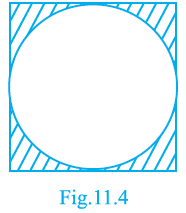
Sample Question 3: In Fig 11.4, a circle of radius 7.5 cm is inscribed in a square. Find the area of the shaded region (Use π = 3.14)
Answer:
Given:
Radius of the inscribed circle, $r = 7.5$ cm.
The circle is inscribed in a square.
Use $\pi = 3.14$.
To Find:
The area of the shaded region (Area of square - Area of circle).
Solution:
When a circle is inscribed in a square, the diameter of the circle is equal to the side length of the square.
Diameter of the circle = $2 \times \text{radius}$
Diameter = $2 \times 7.5 = 15$ cm.
Side length of the square, $s =$ Diameter of the circle
$s = 15$ cm.
Area of the square = $s^2$
Area of square = $(15)^2 = 15 \times 15 = 225$ cm$^2$.
Area of the circle = $\pi r^2$
Area of circle = $3.14 \times (7.5)^2$
Area of circle = $3.14 \times 56.25$
Area of circle = $176.625$ cm$^2$.
The shaded region is the area of the square minus the area of the circle.
Area of shaded region = Area of square - Area of circle
Area of shaded region = $225 - 176.625$
Area of shaded region = $48.375$ cm$^2$.
The area of the shaded region is 48.375 cm$^2$.
Sample Question 4: Area of a sector of a circle of radius 36 cm is 54 π cm2. Find the length of the corresponding arc of the sector.
Answer:
Given:
Radius of the circle, $r = 36$ cm.
Area of the sector, $A = 54\pi$ cm$^2$.
To Find:
The length of the corresponding arc of the sector, $l$.
Solution:
The area of a sector of a circle can be expressed in terms of its radius and corresponding arc length using the formula:
$A = \frac{1}{2} \times \text{arc length} \times \text{radius}$
or
$A = \frac{1}{2}lr$
Substitute the given values for the Area ($A$) and Radius ($r$) into this formula:
$54\pi = \frac{1}{2} \times l \times 36$
Simplify the right side of the equation:
$54\pi = \frac{36}{2} \times l$
$54\pi = 18l$
Now, solve for $l$ by dividing both sides by 18:
$l = \frac{54\pi}{18}$
Simplify the fraction:
$l = \frac{\cancel{54}^{3}\pi}{\cancel{18}^{1}}$
$l = 3\pi$
The length of the corresponding arc is $3\pi$ cm.
Exercise 11.3
Question 1. Find the radius of a circle whose circumference is equal to the sum of the circumferences of two circles of radii 15 cm and 18 cm.
Answer:
Given:
Radius of the first circle, $r_1 = 15$ cm.
Radius of the second circle, $r_2 = 18$ cm.
The circumference of a new circle is equal to the sum of the circumferences of the two given circles.
To Find:
The radius of the new circle.
Solution:
The formula for the circumference of a circle with radius $r$ is given by $C = 2\pi r$.
Let $C_1$ be the circumference of the first circle and $r_1$ be its radius.
$C_1 = 2\pi r_1 = 2\pi (15) = 30\pi$ cm.
Let $C_2$ be the circumference of the second circle and $r_2$ be its radius.
$C_2 = 2\pi r_2 = 2\pi (18) = 36\pi$ cm.
Let the radius of the new circle be $R$ and its circumference be $C_{new}$.
$C_{new} = 2\pi R$
According to the problem statement, the circumference of the new circle is the sum of the circumferences of the two given circles:
$C_{new} = C_1 + C_2$
Substitute the expressions for the circumferences:
$2\pi R = 30\pi + 36\pi$
$2\pi R = (30 + 36)\pi$
$2\pi R = 66\pi$
To find $R$, divide both sides of the equation by $2\pi$ (since $2\pi$ is non-zero):
$\frac{2\pi R}{2\pi} = \frac{66\pi}{2\pi}$
$R = \frac{66}{2}$
$R = 33$ cm.
The radius of the circle whose circumference is equal to the sum of the circumferences of the two given circles is 33 cm.
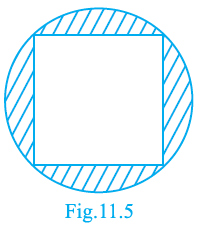
Question 2. In Fig. 11.5, a square of diagonal 8 cm is inscribed in a circle. Find the area of the shaded region.
Answer:
Given:
A square of diagonal 8 cm is inscribed in a circle.
Diagonal of the square, $d = 8$ cm.
To Find:
The area of the shaded region (Area of Circle - Area of Square).
Solution:
When a square is inscribed in a circle, the diagonal of the square is equal to the diameter of the circle.
Diameter of the circle = Diagonal of the square
Diameter, $D = 8$ cm.
The radius of the circle, $r = \frac{D}{2} = \frac{8}{2} = 4$ cm.
The area of the circle is given by $A_{\text{circle}} = \pi r^2$.
$A_{\text{circle}} = \pi (4)^2 = 16\pi$ cm$^2$.
The area of a square can be calculated using its diagonal $d$ with the formula $A_{\text{square}} = \frac{1}{2}d^2$.
$A_{\text{square}} = \frac{1}{2} (8)^2 = \frac{1}{2} (64) = 32$ cm$^2$.
The shaded region is the area of the circle minus the area of the square.
Area of shaded region = $A_{\text{circle}} - A_{\text{square}}$
Area of shaded region = $16\pi - 32$ cm$^2$.
The area of the shaded region is $(16\pi - 32)$ cm$^2$.
Alternatively, factoring out 16:
Area of shaded region = $16(\pi - 2)$ cm$^2$.
Question 3. Find the area of a sector of a circle of radius 28 cm and central angle 45°.
Answer:
Given:
Radius of the circle, $r = 28$ cm.
Central angle of the sector, $\theta = 45^\circ$.
To Find:
Area of the sector.
Solution:
The formula for the area of a sector of a circle with radius $r$ and central angle $\theta$ (in degrees) is given by:
$A = \frac{\theta}{360^\circ} \times \pi r^2$
Substitute the given values $r = 28$ cm and $\theta = 45^\circ$ into the formula. We will use $\pi = \frac{22}{7}$.
$A = \frac{45^\circ}{360^\circ} \times \frac{22}{7} \times (28)^2$
Simplify the fraction $\frac{45}{360}$:
$\frac{\cancel{45}^{1}}{\cancel{360}_{8}} = \frac{1}{8}$
So, the area becomes:
$A = \frac{1}{8} \times \frac{22}{7} \times 28 \times 28$
Cancel out common factors:
$A = \frac{1}{8} \times \frac{22}{\cancel{7}^{1}} \times \cancel{28}^{4} \times 28$
$A = \frac{1}{8} \times 22 \times 4 \times 28$
$A = \frac{1}{\cancel{8}^{2}} \times 22 \times \cancel{4}^{1} \times 28$
$A = \frac{1}{2} \times 22 \times 28$
$A = \cancel{22}^{11} \times \frac{28}{\cancel{2}^{1}}$
$A = 11 \times 28$
Calculate the product:
$11 \times 28 = 308$
The area of the sector is 308 cm$^2$.
Question 4. The wheel of a motor cycle is of radius 35 cm. How many revolutions per minute must the wheel make so as to keep a speed of 66 km/h?
Answer:
Given:
Radius of the motor cycle wheel, $r = 35$ cm.
Speed of the motor cycle, $v = 66$ km/h.
To Find:
Number of revolutions the wheel makes per minute.
Solution:
First, we need to convert the speed from km/h to cm/min to match the unit of the radius.
Speed $v = 66$ km/h
Convert km to cm: $1 \text{ km} = 1000 \text{ m} = 1000 \times 100 \text{ cm} = 100000 \text{ cm}$.
Convert hours to minutes: $1 \text{ hour} = 60 \text{ minutes}$.
So, speed in cm/min is:
$v = \frac{66 \text{ km}}{1 \text{ h}} = \frac{66 \times 100000 \text{ cm}}{60 \text{ min}}$
$v = \frac{6600000}{60}$ cm/min
$v = \frac{660000}{6}$ cm/min
$v = 110000$ cm/min.
Next, calculate the circumference of the wheel. The distance covered in one revolution is equal to the circumference of the wheel.
Circumference, $C = 2\pi r$. Using $\pi = \frac{22}{7}$.
$C = 2 \times \frac{22}{7} \times 35$
$C = 2 \times 22 \times \frac{\cancel{35}^{5}}{\cancel{7}^{1}}$
$C = 2 \times 22 \times 5$
$C = 44 \times 5$
$C = 220$ cm.
The number of revolutions per minute is the total distance covered in one minute divided by the distance covered in one revolution (circumference).
Number of revolutions per minute $= \frac{\text{Distance covered per minute}}{\text{Circumference}}$
Number of revolutions per minute $= \frac{110000 \text{ cm/min}}{220 \text{ cm/revolution}}$
Calculate the value:
Number of revolutions per minute $= \frac{110000}{220}$
$= \frac{11000}{22}$
$= \frac{\cancel{11000}^{500}}{\cancel{22}^{1}}$
$= 500$ revolutions per minute.
The wheel must make 500 revolutions per minute to maintain a speed of 66 km/h.
Question 5. A cow is tied with a rope of length 14 m at the corner of a rectangular field of dimensions 20m × 16m. Find the area of the field in which the cow can graze.
Answer:
Given:
Length of the rectangular field = $20$ m
Breadth of the rectangular field = $16$ m
Length of the rope (which acts as the radius $r$) = $14$ m
The cow is tied at one corner of the rectangular field.
To Find:
The area of the field in which the cow can graze.
Solution:
A rectangular field has internal angles of $90^\circ$ at each corner. When a cow is tied at the corner, the grazing area forms a sector of a circle (specifically a quadrant) with a central angle ($\theta$) of $90^\circ$ and a radius ($r$) equal to the length of the rope.
$\theta = 90^\circ$
[Angle of a rectangle]
Since the rope length ($14$ m) is less than both the length ($20$ m) and the breadth ($16$ m) of the field, the cow can graze freely within a full quadrant inside the field.
The formula for the area of a sector is:
$\text{Area} = \frac{\theta}{360^\circ} \times \pi r^2$
... (i)
Substituting the values $\theta = 90^\circ$, $\pi = \frac{22}{7}$, and $r = 14$ m into equation (i):
$\text{Area} = \frac{\cancel{90}^{1}}{\cancel{360}_{4}} \times \frac{22}{7} \times 14 \times 14$
$\text{Area} = \frac{1}{4} \times \frac{22}{\cancel{7}_{1}} \times \cancel{14}^{2} \times 14$
$\text{Area} = \frac{1}{\cancel{4}_{2}} \times 22 \times \cancel{2}^{1} \times 14$
$\text{Area} = \frac{\cancel{22}^{11}}{\cancel{2}_{1}} \times 14$
$\text{Area} = 11 \times 14$
$\text{Area} = 154 \text{ m}^2$
... (ii)
Conclusion:
The total area of the field in which the cow can graze is $154 \text{ m}^2$.
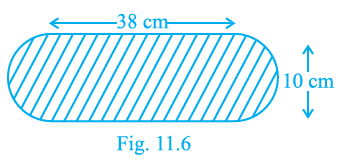
Question 6. Find the area of the flower bed (with semi-circular ends) shown in Fig. 11.6.
Answer:
Given:
Length of the rectangular portion of the flower bed ($l$) = $38 \text{ cm}$
Diameter of the semi-circular ends ($d$) = $10 \text{ cm}$
To Find:
Total area of the flower bed.
Solution:
The flower bed consists of a rectangular part in the middle and two equal semi-circular parts at the ends.
Step 1: Finding the radius of the semi-circular ends.
$r = \frac{d}{2} = \frac{10}{2}$
... (i)
So, the radius ($r$) = $5 \text{ cm}$.
Step 2: Finding the area of the rectangular part.
The dimensions of the rectangle are length = $38 \text{ cm}$ and breadth = $10 \text{ cm}$ (which is the diameter of the semi-circles).
Area of rectangle ($A_{1}$) = $\text{length} \times \text{breadth}$
$A_{1} = 38 \times 10$
$A_{1} = 380 \text{ cm}^2$
... (ii)
Step 3: Finding the area of the two semi-circular ends.
The two semi-circular ends together form one complete circle of radius $r = 5 \text{ cm}$.
Area of two semi-circles ($A_{2}$) = $2 \times \left( \frac{1}{2} \pi r^2 \right) = \pi r^2$
Taking $\pi \approx 3.14$:
$A_{2} = 3.14 \times (5)^2$
$A_{2} = 3.14 \times 25$
$A_{2} = 78.5 \text{ cm}^2$
... (iii)
Step 4: Finding the total area.
Total area of the flower bed = Area of rectangle ($A_{1}$) + Area of two semi-circles ($A_{2}$)
$\text{Total Area} = 380 + 78.5$
[From (ii) and (iii)] ... (iv)
$\text{Total Area} = 458.5 \text{ cm}^2$
Conclusion:
The total area of the flower bed is $458.5 \text{ cm}^2$.
Question 7. In Fig. 11.7, AB is a diameter of the circle, AC = 6 cm and BC = 8 cm. Find the area of the shaded region (Use π = 3.14).

Answer:
Given:
AB is the diameter of the circle.
AC = 6 cm, BC = 8 cm.
Use $\pi = 3.14$.
The shaded region is the area of the circle minus the area of triangle ABC.
To Find:
The area of the shaded region.
Solution:
Since AB is the diameter of the circle and C is a point on the circle, the angle subtended by the diameter at any point on the circumference is $90^\circ$. Therefore, $\triangle$ABC is a right-angled triangle with the right angle at C.
We can find the length of the diameter AB using the Pythagorean theorem in $\triangle$ABC:
$AB^2 = AC^2 + BC^2$
$AB^2 = (6)^2 + (8)^2$
$AB^2 = 36 + 64$
$AB^2 = 100$
$AB = \sqrt{100}$
$AB = 10$ cm.
The diameter of the circle is 10 cm.
The radius of the circle is $r = \frac{\text{Diameter}}{2} = \frac{10}{2} = 5$ cm.
The area of the circle is $A_{\text{circle}} = \pi r^2$.
$A_{\text{circle}} = 3.14 \times (5)^2$
$A_{\text{circle}} = 3.14 \times 25$
$A_{\text{circle}} = 78.5$ cm$^2$.
The area of the right-angled triangle ABC is $\frac{1}{2} \times \text{base} \times \text{height}$. We can take AC as the base and BC as the height (or vice versa).
$A_{\text{triangle}} = \frac{1}{2} \times AC \times BC$
$A_{\text{triangle}} = \frac{1}{2} \times 6 \times 8$
$A_{\text{triangle}} = \frac{1}{2} \times 48$
$A_{\text{triangle}} = 24$ cm$^2$.
The area of the shaded region is the area of the circle minus the area of triangle ABC.
Area of shaded region = $A_{\text{circle}} - A_{\text{triangle}}$
Area of shaded region = $78.5 - 24$
Area of shaded region = $54.5$ cm$^2$.
The area of the shaded region is 54.5 cm$^2$.
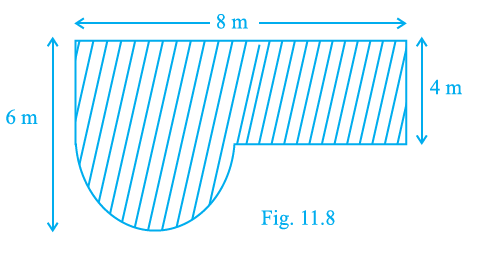
Question 8. Find the area of the shaded field shown in Fig. 11.8
Answer:
Given:
From Fig. 11.8, the shaded field can be divided into a rectangular part and a semi-circular part.
Length of the rectangular part ($l$) = $8\text{ m}$
Breadth of the rectangular part ($b$) = $4\text{ m}$
Total height of the field on the left side = $6\text{ m}$
To Find:
Total area of the shaded field.
Solution:
Step 1: Determine the radius of the semi-circular part.
The semi-circular part is attached to the bottom of the left side of the rectangle. The total height on the left is the sum of the breadth of the rectangle and the radius of the semi-circle.
$\text{Radius (r)} = \text{Total height} - \text{Breadth of rectangle}$
... (i)
Substituting the values:
$r = 6\text{ m} - 4\text{ m}$
$r = 2\text{ m}$
... (ii)
Step 2: Calculate the area of the rectangular part ($A_1$).
$A_1 = l \times b$
(Formula for area of rectangle)
$A_1 = 8 \times 4$
$A_1 = 32\text{ m}^2$
... (iii)
Step 3: Calculate the area of the semi-circular part ($A_2$).
$A_2 = \frac{1}{2} \pi r^2$
(Formula for area of semi-circle)
Taking $\pi = 3.14$ and $r = 2\text{ m}$ from equation (ii):
$A_2 = \frac{1}{2} \times 3.14 \times (2)^2$
$A_2 = \frac{1}{2} \times 3.14 \times 4$
$A_2 = 3.14 \times 2$
$A_2 = 6.28\text{ m}^2$
... (iv)
Step 4: Calculate the total area of the field.
The total area is the sum of the rectangular area and the semi-circular area.
$\text{Total Area} = A_1 + A_2$
$\text{Total Area} = 32 + 6.28$
$\text{Total Area} = 38.28\text{ m}^2$
... (v)
Conclusion:
The total area of the shaded field shown in Fig. 11.8 is $38.28\text{ m}^2$.
Question 9. Find the area of the shaded region in Fig. 11.9.

Answer:
Given:
Length of the outer rectangle = $26 \text{ m}$
Breadth of the outer rectangle = $12 \text{ m}$
Vertical distance between the outer rectangle and the inner shape = $4 \text{ m}$ (both top and bottom).
Horizontal distance between the outer rectangle and the inner shape = $3 \text{ m}$ (both left and right).
To Find:
Area of the shaded region.
Solution:
Step 1: Calculate the area of the outer rectangle.
$\text{Area of outer rectangle } (A_1) = \text{Length} \times \text{Breadth}$
... (i)
$A_1 = 26 \times 12$
$A_1 = 312 \text{ m}^2$
... (ii)
Step 2: Determine the dimensions of the unshaded inner shape.
The inner shape consists of a rectangular middle section with two semi-circular ends.
The total height (diameter $d$) of the inner shape is:
$d = 12 - (4 + 4) = 4 \text{ m}$
The radius ($r$) of the semi-circular ends is:
$r = \frac{d}{2} = \frac{4}{2} = 2 \text{ m}$
... (iii)
The total horizontal length of the inner shape is:
$\text{Total inner length} = 26 - (3 + 3) = 20 \text{ m}$
The length of the straight (rectangular) part of the inner shape ($l_i$) is the total inner length minus the two radii:
$l_i = 20 - (r + r) = 20 - 4 = 16 \text{ m}$
Step 3: Calculate the area of the unshaded inner shape ($A_2$).
Area of inner shape = Area of inner rectangle + Area of two semi-circles
$\text{Area of inner rectangle} = l_i \times d = 16 \times 4 = 64 \text{ m}^2$
$\text{Area of two semi-circles} = \pi r^2 = 3.14 \times (2)^2 = 3.14 \times 4 = 12.56 \text{ m}^2$
$A_2 = 64 + 12.56 = 76.56 \text{ m}^2$
... (iv)
Step 4: Calculate the area of the shaded region.
The shaded area is the difference between the outer rectangle and the inner shape.
$\text{Shaded Area} = A_1 - A_2$
$\text{Shaded Area} = 312 - 76.56$
$\text{Shaded Area} = 235.44 \text{ m}^2$
... (v)
Conclusion:
The area of the shaded region in Fig. 11.9 is $235.44 \text{ m}^2$.
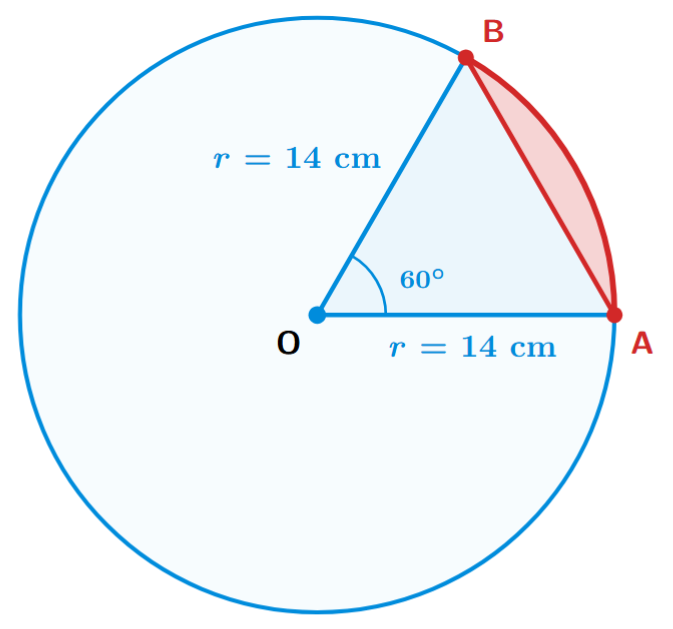
Question 10. Find the area of the minor segment of a circle of radius 14 cm, when the angle of the corresponding sector is 60°.
Answer:
Given:
Radius of the circle ($r$) = $14 \text{ cm}$
Central angle of the sector ($\theta$) = $60^\circ$
To Find:
Area of the minor segment of the circle.
Solution:
The area of a minor segment is calculated by subtracting the area of the corresponding triangle (formed by the radii and the chord) from the area of the corresponding sector.
$\text{Area of segment} = \text{Area of sector} - \text{Area of } \triangle$
... (i)
Step 1: Calculate the area of the sector.
The formula for the area of a sector is $\frac{\theta}{360^\circ} \times \pi r^2$.
Taking $\pi = \frac{22}{7}$:
$\text{Area of sector} = \frac{60^\circ}{360^\circ} \times \frac{22}{7} \times 14 \times 14$
$\text{Area of sector} = \frac{1}{6} \times 22 \times 2 \times 14$
$\text{Area of sector} = \frac{1}{3} \times 22 \times 14 = \frac{308}{3}$
$\text{Area of sector} \approx 102.67 \text{ cm}^2$
... (ii)
Step 2: Calculate the area of the corresponding triangle.
In the circle, let the triangle be $\triangle OAB$, where $OA = OB = 14 \text{ cm}$ (radii). Since the central angle $\angle AOB = 60^\circ$ and the triangle is isosceles, the base angles are also $60^\circ$ each. Thus, $\triangle OAB$ is an equilateral triangle.
Area of an equilateral triangle = $\frac{\sqrt{3}}{4} \times (\text{side})^2$
Taking $\sqrt{3} \approx 1.732$:
$\text{Area of } \triangle = \frac{1.732}{4} \times 14 \times 14$
$\text{Area of } \triangle = 1.732 \times 49$
$\text{Area of } \triangle \approx 84.87 \text{ cm}^2$
... (iii)
Step 3: Calculate the area of the minor segment.
Substituting values from (ii) and (iii) into equation (i):
$\text{Area of segment} = 102.67 - 84.87$
$\text{Area of segment} = 17.8 \text{ cm}^2$
... (iv)
Conclusion:
The area of the minor segment of the circle is approximately $17.8 \text{ cm}^2$.
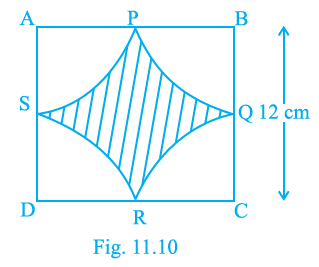
Question 11. Find the area of the shaded region in Fig. 11.10, where arcs drawn with centres A, B, C and D intersect in pairs at mid-points P, Q, R and S of the sides AB, BC, CD and DA, respectively of a square ABCD (Use π = 3.14).
Answer:
Given:
Side of the square $ABCD$ ($a$) = $12 \text{ cm}$.
$P, Q, R$ and $S$ are the mid-points of the sides $AB, BC, CD$ and $DA$ respectively.
Arcs are drawn with centers $A, B, C$ and $D$.
Value of $\pi = 3.14$.
To Find:
The area of the shaded region.
Solution:
Step 1: Find the area of the square $ABCD$.
$\text{Area of square} = a^2$
... (i)
$\text{Area of square} = 12 \times 12$
$\text{Area of square} = 144 \text{ cm}^2$
... (ii)
Step 2: Find the radius of the quadrants.
Since the arcs drawn from the corners intersect at the mid-points of the sides, the radius ($r$) of each quadrant is half the side of the square.
$r = \frac{12}{2} = 6 \text{ cm}$
... (iii)
Step 3: Find the area of the four quadrants.
The four unshaded regions at the corners are quadrants of a circle. Together, four quadrants of the same radius form one full circle.
$\text{Area of 4 quadrants} = 4 \times \left( \frac{1}{4} \pi r^2 \right) = \pi r^2$
... (iv)
Substituting $\pi = 3.14$ and $r = 6 \text{ cm}$:
$\text{Area of 4 quadrants} = 3.14 \times (6)^2$
$\text{Area of 4 quadrants} = 3.14 \times 36$
$\text{Area of 4 quadrants} = 113.04 \text{ cm}^2$
... (v)
Step 4: Find the area of the shaded region.
The shaded area is the difference between the area of the square and the area of the four quadrants.
$\text{Shaded Area} = \text{Area of square} - \text{Area of 4 quadrants}$
$\text{Shaded Area} = 144 - 113.04$
$\text{Shaded Area} = 30.96 \text{ cm}^2$
... (vi)
Conclusion:
The area of the shaded region in Fig. 11.10 is $30.96 \text{ cm}^2$.
Question 12. In Fig. 11.11, arcs are drawn by taking vertices A, B and C of an equilateral triangle of side 10 cm. to intersect the sides BC, CA and AB at their respective mid-points D, E and F. Find the area of the shaded region (Use π = 3.14)

Answer:
Given:
Side of the equilateral triangle $ABC$ ($s$) = $10 \text{ cm}$.
$D, E$ and $F$ are the mid-points of the sides $BC, CA$ and $AB$ respectively.
Arcs are drawn with vertices $A, B$ and $C$ as centers.
Value of $\pi = 3.14$.
To Find:
The area of the shaded region.
Solution:
Step 1: Identify the properties of the triangle and the sectors.
Since $\triangle ABC$ is an equilateral triangle, all its internal angles are equal to $60^\circ$.
$\angle A = \angle B = \angle C = 60^\circ$
(Angles of an equilateral triangle)
The arcs are drawn to the mid-points of the sides. Therefore, the radius ($r$) of each sector is half the length of the side of the triangle.
$r = \frac{10}{2} = 5 \text{ cm}$
... (i)
Step 2: Calculate the area of the shaded region.
The shaded region consists of three identical sectors at vertices $A, B$ and $C$. Each sector has a central angle of $\theta = 60^\circ$ and a radius of $r = 5 \text{ cm}$.
The formula for the area of a sector is $\frac{\theta}{360^\circ} \times \pi r^2$.
$\text{Total Shaded Area} = 3 \times \left( \frac{\theta}{360^\circ} \times \pi r^2 \right)$
... (ii)
Substituting the values $\theta = 60^\circ$, $r = 5$ and $\pi = 3.14$ into equation (ii):
$\text{Total Shaded Area} = 3 \times \left( \frac{\cancel{60}^{1}}{\cancel{360}_{6}} \times 3.14 \times 5^2 \right)$
$\text{Total Shaded Area} = \cancel{3}^{1} \times \frac{1}{\cancel{6}_{2}} \times 3.14 \times 25$
$\text{Total Shaded Area} = \frac{1}{2} \times 3.14 \times 25$
$\text{Total Shaded Area} = 1.57 \times 25$
$\text{Total Shaded Area} = 39.25 \text{ cm}^2$
... (iii)
Conclusion:
The area of the shaded region in Fig. 11.11 is $39.25 \text{ cm}^2$.
Question 13. In Fig. 11.12, arcs have been drawn with radii 14 cm each and with centres P, Q and R. Find the area of the shaded region.

Answer:
Given:
Radius of each arc ($r$) = $14$ cm
The arcs are drawn with centers at the vertices $P, Q$ and $R$ of $\triangle PQR$.
To Find:
The total area of the shaded region.
Solution:
The shaded region consists of three sectors of a circle. Let the internal angles of the triangle at vertices $P, Q$ and $R$ be $\angle P$, $\angle Q$ and $\angle R$ respectively.
The area of a sector with radius $r$ and angle $\theta$ is given by:
$\text{Area} = \frac{\theta}{360^\circ} \times \pi r^2$
... (i)
The total shaded area is the sum of the areas of these three sectors:
$\text{Total Area} = \text{Area at P} + \text{Area at Q} + \text{Area at R}$
$\text{Total Area} = \left( \frac{\angle P}{360^\circ} \times \pi r^2 \right) + \left( \frac{\angle Q}{360^\circ} \times \pi r^2 \right) + \left( \frac{\angle R}{360^\circ} \times \pi r^2 \right)$
Taking common terms out:
$\text{Total Area} = \frac{\angle P + \angle Q + \angle R}{360^\circ} \times \pi r^2$
... (ii)
We know that the sum of the interior angles of any triangle is $180^\circ$:
$\angle P + \angle Q + \angle R = 180^\circ$
(Angle sum property of a triangle) ... (iii)
Substituting the value from equation (iii) into equation (ii):
$\text{Total Area} = \frac{180^\circ}{360^\circ} \times \pi r^2$
$\text{Total Area} = \frac{1}{2} \times \pi r^2$
... (iv)
Now, substituting $r = 14$ cm and $\pi = \frac{22}{7}$:
$\text{Total Area} = \frac{1}{2} \times \frac{22}{7} \times 14 \times 14$
$\text{Total Area} = \frac{1}{\cancel{2}_1} \times \frac{22}{\cancel{7}_1} \times \cancel{14}^2 \times 14$
$\text{Total Area} = 1 \times 22 \times 14$
$\text{Total Area} = 308 \text{ cm}^2$
Conclusion:
The total area of the shaded region in Fig. 11.12 is $308 \text{ cm}^2$.
Question 14. A circular park is surrounded by a road 21 m wide. If the radius of the park is 105 m, find the area of the road.
Answer:
Given:
Radius of the circular park ($r$) = $105\text{ m}$
Width of the road surrounding the park ($w$) = $21\text{ m}$
To Find:
The area of the road.
Solution:
The circular park and the road together form two concentric circles. The inner circle represents the park, and the space between the outer and inner circles represents the road.
Step 1: Calculate the radius of the outer circle ($R$).
$R = r + w$
... (i)
Substituting the given values:
$R = 105 + 21$
$R = 126\text{ m}$
... (ii)
Step 2: Calculate the area of the road.
The area of the road is the difference between the area of the outer circle and the area of the inner circle (park).
$\text{Area of road} = \pi R^2 - \pi r^2$
... (iii)
Taking $\pi$ as a common factor and using the algebraic identity $a^2 - b^2 = (a-b)(a+b)$:
$\text{Area of road} = \pi(R - r)(R + r)$
... (iv)
Substituting $R = 126$, $r = 105$ and $\pi = \frac{22}{7}$:
$\text{Area of road} = \frac{22}{7} \times (126 - 105) \times (126 + 105)$
$\text{Area of road} = \frac{22}{7} \times 21 \times 231$
$\text{Area of road} = 22 \times \frac{\cancel{21}^{3}}{\cancel{7}_{1}} \times 231$
$\text{Area of road} = 22 \times 3 \times 231$
$\text{Area of road} = 66 \times 231$
$\text{Area of road} = 15246\text{ m}^2$
... (v)
Conclusion:
The total area of the road is $15,246\text{ m}^2$.
Question 15. In Fig. 11.13, arcs have been drawn of radius 21 cm each with vertices A, B, C and D of quadrilateral ABCD as centres. Find the area of the shaded region.

Answer:
Given:
Radius of each arc ($r$) = $21$ cm.
Arcs are drawn at the vertices $A, B, C$ and $D$ of a quadrilateral $ABCD$.
To Find:
The total area of the shaded region.
Solution:
The shaded region is composed of four sectors of a circle, each having a radius of $21$ cm. Let the interior angles of the quadrilateral $ABCD$ be $\angle A$, $\angle B$, $\angle C$, and $\angle D$.
The area of a sector with radius $r$ and central angle $\theta$ is given by the formula:
$\text{Area} = \frac{\theta}{360^\circ} \times \pi r^2$
... (i)
The total area of the shaded region is the sum of the areas of these four sectors:
$\text{Total Area} = \left( \frac{\angle A}{360^\circ} \pi r^2 \right) + \left( \frac{\angle B}{360^\circ} \pi r^2 \right) + \left( \frac{\angle C}{360^\circ} \pi r^2 \right) + \left( \frac{\angle D}{360^\circ} \pi r^2 \right)$
Taking common terms ($\frac{\pi r^2}{360^\circ}$) out, we get:
$\text{Total Area} = \frac{\pi r^2}{360^\circ} (\angle A + \angle B + \angle C + \angle D)$
... (ii)
We know that the sum of all interior angles of a quadrilateral is $360^\circ$:
$\angle A + \angle B + \angle C + \angle D = 360^\circ$
(Angle sum property) ... (iii)
Substituting the value from equation (iii) into equation (ii):
$\text{Total Area} = \frac{\pi r^2}{\cancel{360}^\circ} \times \cancel{360}^\circ$
$\text{Total Area} = \pi r^2$
... (iv)
Now, we substitute the value of $r = 21$ cm and $\pi = \frac{22}{7}$:
$\text{Total Area} = \frac{22}{\cancel{7}_1} \times \cancel{21}^3 \times 21$
$\text{Total Area} = 22 \times 3 \times 21$
$\text{Total Area} = 66 \times 21$
$\text{Total Area} = 1386 \text{ cm}^2$
... (v)
Conclusion:
The total area of the shaded region in Fig. 11.13 is $1386 \text{ cm}^2$.
Question 16. A piece of wire 20 cm long is bent into the form of an arc of a circle subtending an angle of 60° at its centre. Find the radius of the circle.
Answer:
Given:
Length of the piece of wire (Arc length, $l$) = $20 \text{ cm}$
Angle subtended at the centre ($\theta$) = $60^\circ$
To Find:
Radius of the circle ($r$).
Solution:
When a wire is bent into the form of an arc, its length is equal to the arc length of the circle. The formula for the length of an arc is:
$l = \frac{\theta}{360^\circ} \times 2\pi r$
[Formula for Arc Length] ... (i)
Substituting the given values into equation (i):
$20 = \frac{60^\circ}{360^\circ} \times 2 \times \pi \times r$
... (ii)
Simplifying the fraction $\frac{60}{360}$:
$20 = \frac{1}{6} \times 2 \times \pi \times r$
$20 = \frac{1}{3} \times \pi \times r$
Now, solving for $r$:
$r = \frac{20 \times 3}{\pi}$
$r = \frac{60}{\pi}$
Taking the value of $\pi = \frac{22}{7}$:
$r = 60 \div \frac{22}{7}$
$r = \frac{60 \times 7}{22}$
$r = \frac{\cancel{420}^{210}}{\cancel{22}_{11}}$
$r = \frac{210}{11} \text{ cm}$
... (iii)
By dividing $210$ by $11$, we get:
$r \approx 19.09 \text{ cm}$
Alternate Solution:
We can also use the relationship between arc length, radius, and angle in radians ($\theta^c$):
$l = r \theta^c$
... (iv)
First, convert $60^\circ$ to radians:
$\theta^c = 60^\circ \times \frac{\pi}{180^\circ} = \frac{\pi}{3} \text{ radians}$
Substituting values into equation (iv):
$20 = r \times \frac{\pi}{3}$
$r = \frac{20 \times 3}{\pi} = \frac{60}{\pi}$
$r = \frac{60 \times 7}{22} = \frac{210}{11} \text{ cm}$
Conclusion:
The radius of the circle is $\frac{210}{11} \text{ cm}$ or approximately $19.09 \text{ cm}$.
Sample Question 1 to 3 (Before Exercise 11.4)
Sample Question 1: A chord of a circle of radius 20 cm subtends an angle of 90° at the centre. Find the area of the corresponding major segment of the circle. (Use π = 3.14).
Answer:
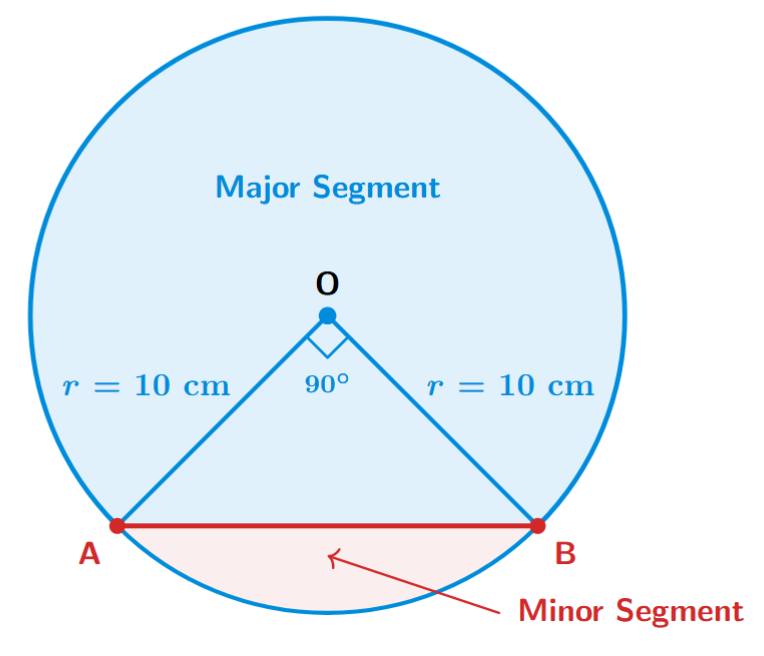
Given:
Radius of the circle ($r$) = $10 \text{ cm}$
Central angle subtended by the chord ($\theta$) = $90^\circ$
Value of $\pi = 3.14$
To Find:
Area of the corresponding major segment of the circle.
Solution:
The area of a major segment is equal to the total area of the circle minus the area of the minor segment.
Step 1: Calculate the area of the circle.
$\text{Area of circle} = \pi r^2$
... (i)
$\text{Area of circle} = 3.14 \times (10)^2$
$\text{Area of circle} = 314 \text{ cm}^2$
... (ii)
Step 2: Calculate the area of the minor sector.
$\text{Area of minor sector} = \frac{\theta}{360^\circ} \times \pi r^2$
... (iii)
$\text{Area of minor sector} = \frac{90^\circ}{360^\circ} \times 314$
$\text{Area of minor sector} = \frac{1}{4} \times 314$
$\text{Area of minor sector} = 78.5 \text{ cm}^2$
... (iv)
Step 3: Calculate the area of the corresponding triangle.
Since the angle at the centre is $90^\circ$, the triangle formed by the chord and radii is a right-angled triangle.
$\text{Area of } \triangle = \frac{1}{2} \times r \times r$
[Area = $\frac{1}{2} \times \text{base} \times \text{height}$] ... (v)
$\text{Area of } \triangle = \frac{1}{2} \times 10 \times 10 = \frac{100}{2}$
$\text{Area of } \triangle = 50 \text{ cm}^2$
... (vi)
Step 4: Calculate the area of the minor segment.
$\text{Area of minor segment} = \text{Area of minor sector} - \text{Area of } \triangle$
$\text{Area of minor segment} = 78.5 - 50 = 28.5 \text{ cm}^2$
Step 5: Calculate the area of the major segment.
$\text{Area of major segment} = \text{Area of circle} - \text{Area of minor segment}$
$\text{Area of major segment} = 314 - 28.5$
$\text{Area of major segment} = 285.5 \text{ cm}^2$
... (vii)
Conclusion:
The area of the major segment of the circle is $285.5 \text{ cm}^2$.
Sample Question 2: With the vertices A, B and C of a triangle ABC as centres, arcs are drawn with radii 5 cm each as shown in Fig. 11.15. If AB = 14 cm, BC = 48 cm and CA = 50 cm, then find the area of the shaded region. (Use π = 3.14).
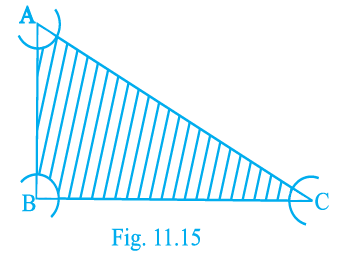
Answer:
Given:
Sides of the triangle: $AB = 14 \text{ cm}$, $BC = 48 \text{ cm}$ and $CA = 50 \text{ cm}$.
Radius of each arc ($r$) = $5 \text{ cm}$.
Value of $\pi = 3.14$.
To Find:
The area of the shaded region.
Solution:
Step 1: Determine the type of triangle and calculate its area.
First, we check if the triangle is a right-angled triangle using Pythagoras theorem ($a^2 + b^2 = c^2$):
$AB^2 + BC^2 = 14^2 + 48^2$
$AB^2 + BC^2 = 196 + 2304 = 2500$
$CA^2 = 50^2 = 2500$
$AB^2 + BC^2 = CA^2$
(By Pythagoras Theorem)
Since the square of the longest side is equal to the sum of the squares of the other two sides, $\triangle ABC$ is a right-angled triangle with $\angle B = 90^\circ$.
$\text{Area of } \triangle ABC = \frac{1}{2} \times BC \times AB$
... (i)
$\text{Area of } \triangle ABC = \frac{1}{2} \times 48 \times 14$
$\text{Area of } \triangle ABC = 24 \times 14$
$\text{Area of } \triangle ABC = 336 \text{ cm}^2$
... (ii)
Step 2: Calculate the combined area of the three sectors.
The unshaded regions are three sectors with the same radius ($r = 5 \text{ cm}$). Let the angles of the triangle at $A, B$ and $C$ be $\angle A, \angle B$ and $\angle C$ respectively.
$\text{Total area of sectors} = \frac{\angle A}{360^\circ} \pi r^2 + \frac{\angle B}{360^\circ} \pi r^2 + \frac{\angle C}{360^\circ} \pi r^2$
$\text{Total area of sectors} = \frac{(\angle A + \angle B + \angle C)}{360^\circ} \pi r^2$
$\angle A + \angle B + \angle C = 180^\circ$
(Angle sum property of triangle) ... (iii)
Substituting the value from equation (iii):
$\text{Total area of sectors} = \frac{180^\circ}{360^\circ} \times \pi r^2 = \frac{1}{2} \pi r^2$
$\text{Total area of sectors} = \frac{1}{2} \times 3.14 \times (5)^2$
$\text{Total area of sectors} = 1.57 \times 25$
$\text{Total area of sectors} = 39.25 \text{ cm}^2$
... (iv)
Step 3: Calculate the area of the shaded region.
From Fig. 11.15, the shaded area is the area of the triangle minus the area of the unshaded sectors.
$\text{Shaded Area} = \text{Area of } \triangle ABC - \text{Total area of sectors}$
$\text{Shaded Area} = 336 - 39.25$
$\text{Shaded Area} = 296.75 \text{ cm}^2$
... (v)
Conclusion:
The area of the shaded region is $296.75 \text{ cm}^2$.
Sample Question 3: A calf is tied with a rope of length 6 m at the corner of a square grassy lawn of side 20 m. If the length of the rope is increased by 5.5m, find the increase in area of the grassy lawn in which the calf can graze.
Answer:
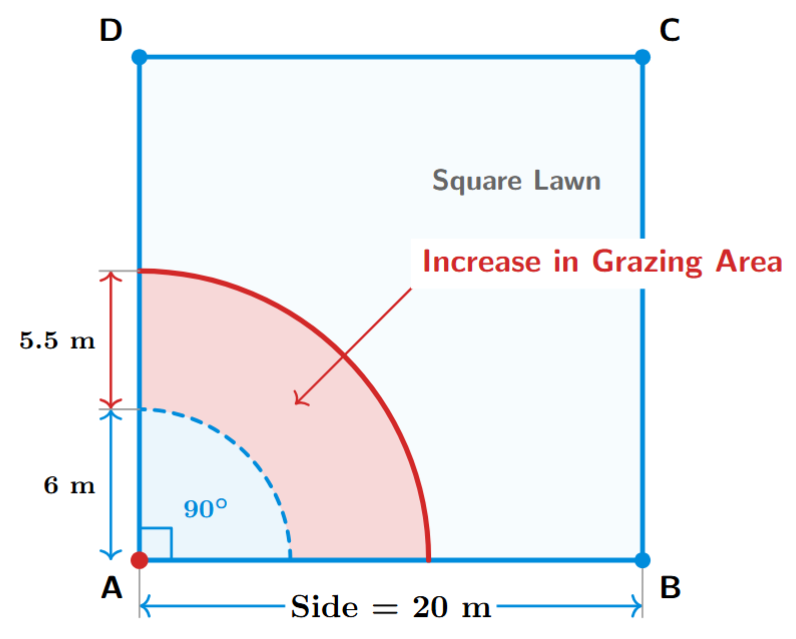
Given:
Side of the square grassy lawn ($s$) = $20 \text{ m}$
Initial length of the rope (radius $r_1$) = $6 \text{ m}$
Increase in the length of the rope = $5.5 \text{ m}$
To Find:
The increase in the area of the grassy lawn in which the calf can graze.
Solution:
The calf is tied at the corner of a square lawn. Therefore, the area it can graze forms a quadrant (a sector with an angle of $90^\circ$).
Step 1: Calculate the new length of the rope ($r_2$).
$r_2 = 6 + 5.5 = 11.5 \text{ m}$
[New radius] ... (i)
Step 2: Calculate the increase in grazing area.
The increase in area is the difference between the area of the quadrant with the new radius ($r_2$) and the area of the quadrant with the initial radius ($r_1$).
$\text{Increase in Area} = \frac{\theta}{360^\circ} \pi r_2^2 - \frac{\theta}{360^\circ} \pi r_1^2$
... (ii)
Since the lawn is square, $\theta = 90^\circ$:
$\text{Increase in Area} = \frac{90^\circ}{360^\circ} \pi (r_2^2 - r_1^2)$
$\text{Increase in Area} = \frac{1}{4} \times \frac{22}{7} \times (11.5^2 - 6^2)$
Using the identity $a^2 - b^2 = (a-b)(a+b)$:
$\text{Increase in Area} = \frac{1}{4} \times \frac{22}{7} \times (11.5 - 6)(11.5 + 6)$
$\text{Increase in Area} = \frac{1}{4} \times \frac{22}{7} \times 5.5 \times 17.5$
Simplifying the expression:
$\text{Increase in Area} = \frac{1}{4} \times 22 \times 5.5 \times \frac{\cancel{17.5}^{2.5}}{\cancel{7}_{1}}$
$\text{Increase in Area} = \frac{\cancel{22}^{11}}{\cancel{4}_{2}} \times 5.5 \times 2.5$
$\text{Increase in Area} = 5.5 \times 5.5 \times 2.5$
$\text{Increase in Area} = 30.25 \times 2.5$
$\text{Increase in Area} = 75.625 \text{ m}^2$
... (iii)
Conclusion:
The increase in the grazing area for the calf is $75.625 \text{ m}^2$.
Exercise 11.4
Question 1. The area of a circular playground is 22176 m2 . Find the cost of fencing this ground at the rate of Rs 50 per metre.
Answer:
Given:
Area of the circular playground, $A = 22176$ m$^2$.
Rate of fencing = $\textsf{₹} 50$ per metre.
To Find:
The cost of fencing the ground.
Solution:
To find the cost of fencing, we first need to find the circumference of the circular playground. The circumference depends on the radius, which can be found from the given area.
The formula for the area of a circle with radius $r$ is $A = \pi r^2$.
Substitute the given area:
$22176 = \pi r^2$
We will use $\pi = \frac{22}{7}$ for the calculation.
$22176 = \frac{22}{7} r^2$
Solve for $r^2$:
$r^2 = \frac{22176 \times 7}{22}$
$r^2 = \frac{\cancel{22176}^{1008} \times 7}{\cancel{22}^{1}}$
$r^2 = 1008 \times 7$
$r^2 = 7056$
Now, find the radius $r$ by taking the square root of $r^2$:
$r = \sqrt{7056}$
$r = 84$ m
(Since radius must be positive)
The formula for the circumference of a circle with radius $r$ is $C = 2\pi r$.
Substitute the radius $r = 84$ m and $\pi = \frac{22}{7}$:
$C = 2 \times \frac{22}{7} \times 84$
$C = 2 \times 22 \times \frac{\cancel{84}^{12}}{\cancel{7}^{1}}$
$C = 2 \times 22 \times 12$
$C = 44 \times 12$
$C = 528$ m.
The cost of fencing the ground is the circumference multiplied by the rate per metre.
Cost = Circumference $\times$ Rate
Cost = $528 \text{ m} \times \textsf{₹} 50 \text{/m}$
Cost = $528 \times 50$
Cost = $26400$
The cost of fencing the ground is $\textsf{₹} 26400$.
Question 2. The diameters of front and rear wheels of a tractor are 80 cm and 2 m respectively. Find the number of revolutions that rear wheel will make in covering a distance in which the front wheel makes 1400 revolutions.
Answer:
Given:
Diameter of the front wheel, $d_f = 80$ cm.
Diameter of the rear wheel, $d_r = 2$ m.
Number of revolutions made by the front wheel = 1400.
To Find:
Number of revolutions the rear wheel will make to cover the same distance.
Solution:
First, ensure all measurements are in the same unit. Let's convert everything to centimeters.
Diameter of the front wheel, $d_f = 80$ cm.
Diameter of the rear wheel, $d_r = 2 \text{ m} = 2 \times 100 \text{ cm} = 200$ cm.
The distance covered by a wheel in one revolution is equal to its circumference.
Circumference of the front wheel, $C_f = \pi d_f = \pi \times 80 = 80\pi$ cm.
Circumference of the rear wheel, $C_r = \pi d_r = \pi \times 200 = 200\pi$ cm.
The total distance covered by the front wheel in 1400 revolutions is:
Distance $= \text{Number of revolutions} \times \text{Circumference per revolution}$
Distance covered by front wheel $= 1400 \times C_f = 1400 \times 80\pi = 112000\pi$ cm.
The rear wheel covers the same distance. Let $N$ be the number of revolutions made by the rear wheel.
Distance covered by rear wheel $= N \times C_r = N \times 200\pi$ cm.
Since the distance covered is the same:
Distance covered by rear wheel = Distance covered by front wheel
$N \times 200\pi = 112000\pi$
To find $N$, divide both sides by $200\pi$ (since $200\pi \neq 0$):
$N = \frac{112000\pi}{200\pi}$
$N = \frac{112000}{200}$
$N = \frac{1120}{2}$
$N = 560$
The rear wheel will make 560 revolutions in covering the same distance.
Question 3. Sides of a triangular field are 15 m, 16 m and 17 m. With the three corners of the field a cow, a buffalo and a horse are tied separately with ropes of length 7 m each to graze in the field. Find the area of the field which cannot be grazed by the three animals.
Answer:
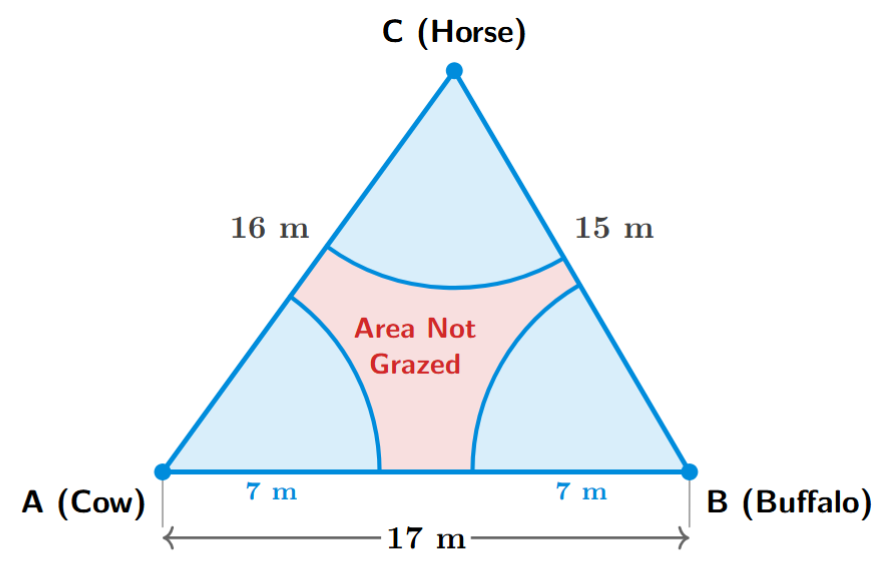
Given:
Sides of the triangular field: $a = 15\text{ m}$, $b = 16\text{ m}$, and $c = 17\text{ m}$.
Length of each rope (radius of each sector, $r$) = $7\text{ m}$.
Three animals (cow, buffalo, and horse) are tied at the three corners of the field.
To Find:
The area of the field which cannot be grazed by the three animals.
Solution:
Step 1: Calculate the area of the triangular field.
We use Heron's formula to find the area of the triangle. First, we calculate the semi-perimeter ($s$):
$s = \frac{a+b+c}{2} = \frac{15+16+17}{2}$
... (i)
$s = \frac{48}{2} = 24\text{ m}$.
The area of the triangle ($A_{T}$) is given by:
$A_{T} = \sqrt{s(s-a)(s-b)(s-c)}$
$A_{T} = \sqrt{24(24-15)(24-16)(24-17)}$
$A_{T} = \sqrt{24 \times 9 \times 8 \times 7}$
$A_{T} = \sqrt{(8 \times 3) \times 9 \times 8 \times 7}$
$A_{T} = 8 \times 3 \times \sqrt{3 \times 7} = 24\sqrt{21}\text{ m}^2$
Taking $\sqrt{21} \approx 4.58$:
$A_{T} = 24 \times 4.58 = 109.92\text{ m}^2$
[Approximate Area] ... (ii)
Step 2: Calculate the total area grazed by the animals.
Each animal grazes in a sector of radius $r = 7\text{ m}$. Let the angles at the three corners be $\angle A, \angle B,$ and $\angle C$.
$\text{Total Grazed Area} = \text{Area of sector A} + \text{Area of sector B} $$ + \text{Area of sector C}$
$\text{Total Grazed Area} = \frac{\angle A}{360^\circ}\pi r^2 + \frac{\angle B}{360^\circ}\pi r^2 + \frac{\angle C}{360^\circ}\pi r^2$
$\text{Total Grazed Area} = \frac{(\angle A + \angle B + \angle C)}{360^\circ} \times \pi r^2$
$\angle A + \angle B + \angle C = 180^\circ$
(Angle sum property of triangle)
$\text{Total Grazed Area} = \frac{180^\circ}{360^\circ} \times \pi r^2 = \frac{1}{2} \pi r^2$
Substituting $\pi = \frac{22}{7}$ and $r = 7$:
$\text{Total Grazed Area} = \frac{1}{2} \times \frac{22}{\cancel{7}} \times \cancel{7} \times 7$
$\text{Total Grazed Area} = 11 \times 7 = 77\text{ m}^2$
... (iii)
Step 3: Calculate the area that cannot be grazed.
The area not grazed is the difference between the total area of the field and the area grazed by the animals.
$\text{Area not grazed} = \text{Total Area } (A_{T}) - \text{Total Grazed Area}$
$\text{Area not grazed} = 109.92 - 77$
$\text{Area not grazed} = 32.92\text{ m}^2$
... (iv)
Conclusion:
The area of the field which cannot be grazed by the three animals is $32.92\text{ m}^2$ (approx).
Question 4. Find the area of the segment of a circle of radius 12 cm whose corresponding sector has a central angle of 60° (Use π = 3.14).
Answer:
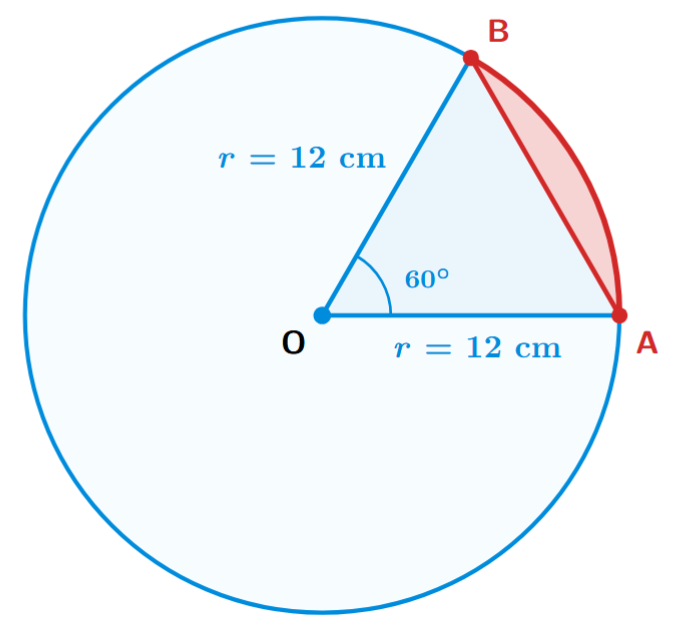
Given:
Radius of the circle ($r$) = $12 \text{ cm}$
Central angle of the sector ($\theta$) = $60^\circ$
Value of $\pi = 3.14$
To Find:
The area of the segment of the circle.
Solution:
To find the area of the minor segment, we must subtract the area of the triangle formed by the chord and the radii from the area of the corresponding sector.
$\text{Area of segment} = \text{Area of sector} - \text{Area of } \triangle OAB$
... (i)
Step 1: Calculate the area of the sector.
The area of a sector is given by the formula $\frac{\theta}{360^\circ} \times \pi r^2$.
$\text{Area of sector} = \frac{60^\circ}{360^\circ} \times 3.14 \times (12)^2$
$\text{Area of sector} = \frac{1}{6} \times 3.14 \times 144$
$\text{Area of sector} = 3.14 \times 24$
$\text{Area of sector} = 75.36 \text{ cm}^2$
... (ii)
Step 2: Calculate the area of $\triangle OAB$.
In $\triangle OAB$, $OA = OB = 12 \text{ cm}$ (radii). The central angle $\angle AOB = 60^\circ$.
Since $OA = OB$, $\triangle OAB$ is an isosceles triangle, meaning $\angle OAB = \angle OBA$.
Using the angle sum property of a triangle:
$\angle OAB + \angle OBA + 60^\circ = 180^\circ$
$2\angle OAB = 120^\circ \implies \angle OAB = 60^\circ$
Since all angles are $60^\circ$, $\triangle OAB$ is an equilateral triangle.
$\text{Area of } \triangle = \frac{\sqrt{3}}{4} (\text{side})^2$
[Area of equilateral triangle] ... (iii)
Using $\sqrt{3} \approx 1.732$:
$\text{Area of } \triangle = \frac{1.732}{4} \times 144$
$\text{Area of } \triangle = 1.732 \times 36$
$\text{Area of } \triangle = 62.352 \text{ cm}^2$
... (iv)
Step 3: Calculate the area of the segment.
Substituting values from (ii) and (iv) into equation (i):
$\text{Area of segment} = 75.36 - 62.352$
$\text{Area of segment} = 13.008 \text{ cm}^2$
... (v)
Conclusion:
The area of the segment of the circle is $13.008 \text{ cm}^2$.
Question 5. A circular pond is 17.5 m is of diameter. It is surrounded by a 2 m wide path. Find the cost of constructing the path at the rate of Rs 25 per m2
Answer:
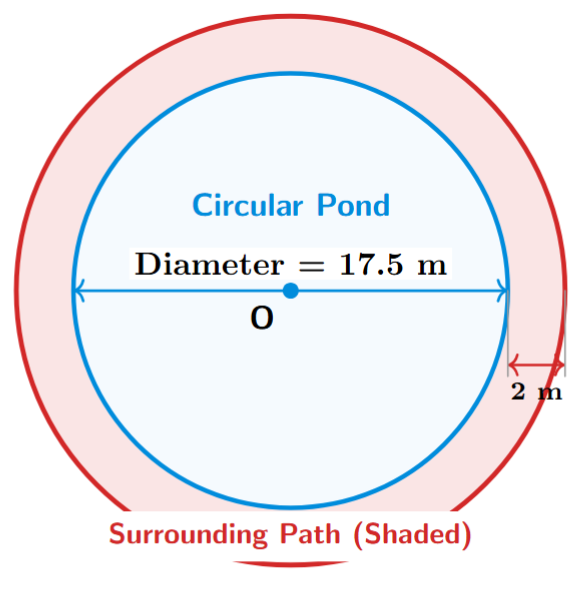
Given:
Diameter of the circular pond ($d$) = $17.5 \text{ m}$
Width of the path surrounding the pond ($w$) = $2 \text{ m}$
Rate of construction = $\textsf{₹} 25$ per $\text{m}^2$
To Find:
The cost of constructing the path.
Solution:
Step 1: Find the inner and outer radii of the path.
The inner radius ($r$) is half the diameter of the pond:
$r = \frac{17.5}{2} = 8.75 \text{ m}$
…(i)
The outer radius ($R$) is the sum of the inner radius and the width of the path:
$R = r + w = 8.75 + 2 = 10.75 \text{ m}$
…(ii)
Step 2: Find the area of the path.
The path forms a circular ring (annulus). Its area is the difference between the area of the outer circle and the inner circle.
$\text{Area of path} = \pi R^2 - \pi r^2 = \pi(R^2 - r^2)$
…(iii)
Using the identity $a^2 - b^2 = (a+b)(a-b)$ and taking $\pi = \frac{22}{7}$:
$\text{Area} = \frac{22}{7} \times (10.75 + 8.75) \times (10.75 - 8.75)$
$\text{Area} = \frac{22}{7} \times 19.5 \times 2$
$\text{Area} = \frac{22}{7} \times 39$
$\text{Area} = \frac{858}{7} \text{ m}^2$
…(iv)
Step 3: Calculate the total cost of construction.
The total cost is the product of the area and the rate per square metre.
$\text{Total Cost} = \text{Area} \times \text{Rate}$
…(v)
$\text{Total Cost} = \frac{858}{7} \times 25$
Now, we divide the result by 7:
$\text{Total Cost} = \frac{21450}{7} = \textsf{₹} 3064.2857...$
Conclusion:
Rounding to two decimal places for the currency, the cost of constructing the path is $\textsf{₹} 3064.29$.
Question 6. In Fig. 11.17, ABCD is a trapezium with AB || DC, AB = 18 cm, DC = 32 cm and distance between AB and DC = 14 cm. If arcs of equal radii 7 cm with centres A, B, C and D have been drawn, then find the area of the shaded region of the figure.
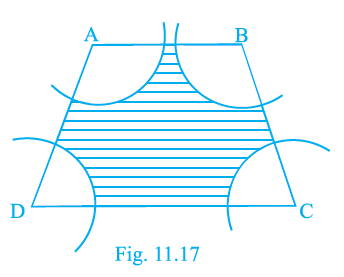
Answer:
Given:
ABCD is a trapezium with AB || DC.
Parallel sides: AB = 18 cm, DC = 32 cm.
Height (distance between parallel sides) = 14 cm.
Arcs are drawn with centres A, B, C, D and equal radii $r = 7$ cm.
The shaded region is the area of the trapezium minus the areas of the four sectors at the vertices.
To Find:
The area of the shaded region.
Solution:
First, find the area of the trapezium ABCD.
Area of trapezium $= \frac{1}{2} \times (\text{sum of parallel sides}) \times \text{height}$
Area of trapezium $= \frac{1}{2} \times (AB + DC) \times \text{distance between AB and DC}$
Area of trapezium $= \frac{1}{2} \times (18 + 32) \times 14$
Area of trapezium $= \frac{1}{2} \times 50 \times 14$
Area of trapezium $= 25 \times 14 = 350$ cm$^2$.
The shaded region is the area of the trapezium minus the areas of the four sectors at the vertices A, B, C, and D. Each sector has a radius of 7 cm.
Let the angles at the vertices of the trapezium be $\angle$A, $\angle$B, $\angle$C, and $\angle$D.
The sum of the interior angles of any quadrilateral is $360^\circ$.
$\angle$A + $\angle$B + $\angle$C + $\angle$D = $360^\circ$
The area of a sector with radius $r$ and angle $\theta$ is $\frac{\theta}{360^\circ} \times \pi r^2$.
The sum of the areas of the four sectors is:
Area of sectors $= \frac{\angle\text{A}}{360^\circ} \pi r^2 + \frac{\angle\text{B}}{360^\circ} \pi r^2 + \frac{\angle\text{C}}{360^\circ} \pi r^2 + \frac{\angle\text{D}}{360^\circ} \pi r^2$
Area of sectors $= \frac{\pi r^2}{360^\circ} (\angle\text{A} + \angle\text{B} + \angle\text{C} + \angle\text{D})$
Substitute the sum of the angles $\angle$A + $\angle$B + $\angle$C + $\angle$D = $360^\circ$ and the radius $r = 7$ cm.
Area of sectors $= \frac{\pi (7)^2}{360^\circ} (360^\circ)$
Area of sectors $= \pi (7)^2 = 49\pi$ cm$^2$.
Using $\pi = \frac{22}{7}$:
Area of sectors $= 49 \times \frac{22}{7} = \cancel{49}^{7} \times \frac{22}{\cancel{7}^{1}} = 7 \times 22 = 154$ cm$^2$.
The area of the shaded region is the area of the trapezium minus the sum of the areas of the four sectors.
Area of shaded region = Area of trapezium - Area of sectors
Area of shaded region $= 350 - 154$
Area of shaded region $= 196$ cm$^2$.
The area of the shaded region of the figure is 196 cm$^2$.
Question 7. Three circles each of radius 3.5 cm are drawn in such a way that each of them touches the other two. Find the area enclosed between these circles.
Answer:
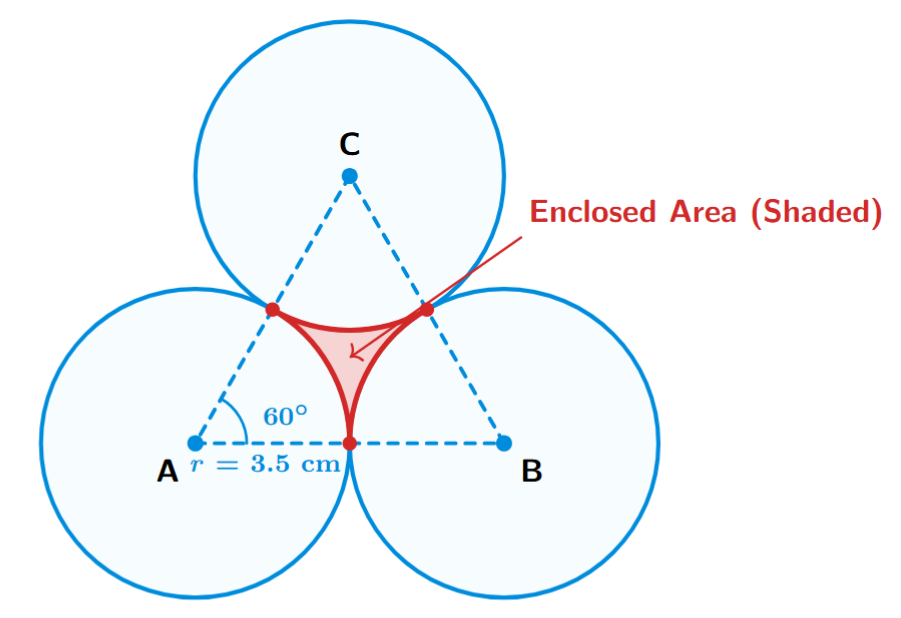
Given:
Radius of each of the three circles ($r$) = $3.5 \text{ cm}$.
Each circle touches the other two circles externally.
To Find:
The area enclosed between these three circles.
Solution:
Step 1: Determine the properties of the triangle formed by the centers.
Let the centers of the three circles be $A, B,$ and $C$. Since the circles touch each other externally, the distance between any two centers is equal to the sum of their radii.
$AB = BC = CA = r + r$
... (i)
$AB = BC = CA = 3.5 + 3.5 = 7 \text{ cm}$.
Since all sides are equal, $\triangle ABC$ is an equilateral triangle with side $s = 7 \text{ cm}$. The interior angle ($\theta$) at each vertex of an equilateral triangle is $60^\circ$.
$\theta = 60^\circ$
... (ii)
Step 2: Calculate the area of the equilateral triangle $ABC$.
$\text{Area of } \triangle ABC = \frac{\sqrt{3}}{4} s^2$
... (iii)
Substituting $s = 7 \text{ cm}$ and $\sqrt{3} \approx 1.732$:
$\text{Area of } \triangle ABC = \frac{1.732}{4} \times (7)^2$
$\text{Area of } \triangle ABC = 0.433 \times 49$
$\text{Area of } \triangle ABC = 21.217 \text{ cm}^2$
... (iv)
Step 3: Calculate the area of the three sectors inside the triangle.
The area enclosed between the circles is the area of the triangle minus the area of the three circular sectors at the vertices.
$\text{Total area of 3 sectors} = 3 \times \left( \frac{\theta}{360^\circ} \times \pi r^2 \right)$
Substituting $\theta = 60^\circ$, $r = 3.5 = \frac{7}{2} \text{ cm}$ and $\pi = \frac{22}{7}$:
$\text{Total area of 3 sectors} = 3 \times \frac{60^\circ}{360^\circ} \times \frac{22}{7} \times \left( \frac{7}{2} \right)^2$
$\text{Total area of 3 sectors} = 3 \times \frac{1}{6} \times \frac{22}{7} \times \frac{7}{2} \times \frac{7}{2}$
$\text{Total area of 3 sectors} = \frac{1}{\cancel{2}} \times \frac{\cancel{22}^{11}}{\cancel{7}} \times \frac{\cancel{7}}{2} \times \frac{7}{2} = \frac{77}{4}$
$\text{Total area of 3 sectors} = 19.25 \text{ cm}^2$
... (v)
Step 4: Calculate the enclosed area.
$\text{Enclosed Area} = \text{Area of } \triangle ABC - \text{Total area of 3 sectors}$
$\text{Enclosed Area} = 21.217 - 19.25$
$\text{Enclosed Area} = 1.967 \text{ cm}^2$
... (vi)
Conclusion:
The area enclosed between the three circles is approximately $1.967 \text{ cm}^2$.
Question 8. Find the area of the sector of a circle of radius 5 cm, if the corresponding arc length is 3.5 cm.
Answer:
Given:
Radius of the circle ($r$) = $5 \text{ cm}$
Length of the corresponding arc ($l$) = $3.5 \text{ cm}$
To Find:
The area of the sector ($A$).
Solution:
The area of a sector of a circle can be directly calculated if the arc length and radius are known. The relationship between the area of the sector ($A$), the arc length ($l$), and the radius ($r$) is given by the formula:
$A = \frac{1}{2} \times l \times r$
[Formula for Area of Sector] ... (i)
Substituting the given values of $l = 3.5 \text{ cm}$ and $r = 5 \text{ cm}$ into equation (i):
$A = \frac{1}{2} \times 3.5 \times 5$
$A = \frac{1}{2} \times 17.5$
$A = 8.75 \text{ cm}^2$
... (ii)
Alternate Solution:
We can also find the area by first calculating the central angle ($\theta$) subtended by the arc.
The formula for arc length is $l = \frac{\theta}{360^\circ} \times 2\pi r$.
$3.5 = \frac{\theta}{360^\circ} \times 2\pi (5)$
$\frac{\theta}{360^\circ} = \frac{3.5}{10\pi}$
Now, the area of the sector is $A = \frac{\theta}{360^\circ} \times \pi r^2$.
Substituting the value of $\frac{\theta}{360^\circ}$:
$A = \left( \frac{3.5}{10\pi} \right) \times \pi \times (5)^2$
$A = \frac{3.5 \times \cancel{\pi} \times 25}{10\cancel{\pi}}$
$A = \frac{3.5 \times 25}{10} = \frac{87.5}{10} = 8.75 \text{ cm}^2$
Conclusion:
The area of the sector of the circle is $8.75 \text{ cm}^2$.
Question 9. Four circular cardboard pieces of radii 7 cm are placed on a paper in such a way that each piece touches other two pieces. Find the area of the portion enclosed between these pieces.
Answer:
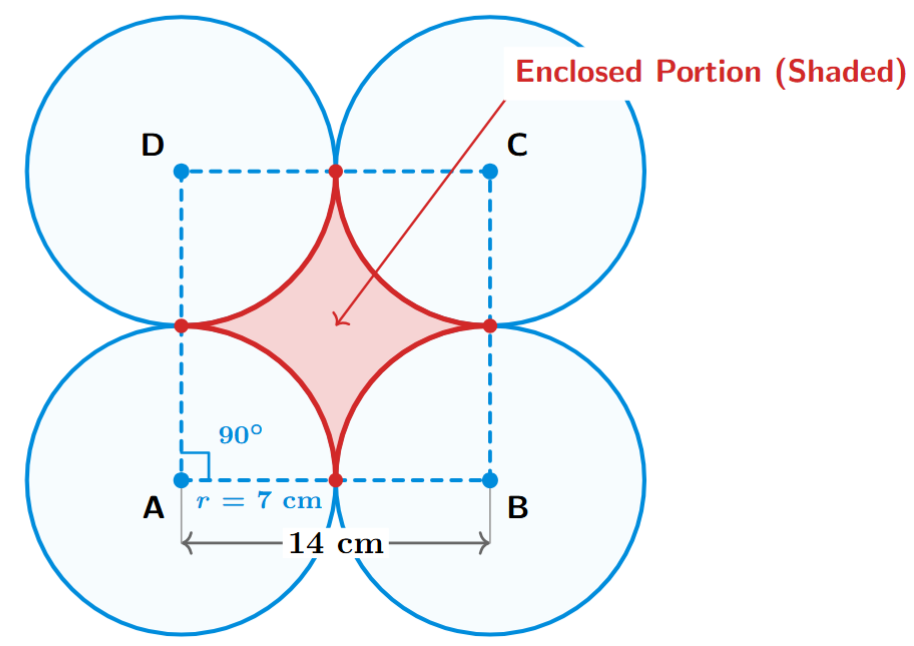
Given:
Radius of each circular piece ($r$) = $7 \text{ cm}$.
Four circular pieces are placed such that each piece touches two others.
To Find:
The area of the portion enclosed between these pieces.
Solution:
Step 1: Determine the shape formed by the centers of the circles.
Let the centers of the four circular cardboard pieces be $A, B, C$ and $D$. When these circles touch each other externally, the distance between the centers of any two adjacent circles is equal to the sum of their radii.
$AB = BC = CD = DA = r + r$
(Property of touching circles)
Substituting $r = 7 \text{ cm}$:
$\text{Side of square (s)} = 7 + 7 = 14 \text{ cm}$
... (i)
Since all sides are equal and the angles between the radii at the points of contact are $90^\circ$, $ABCD$ forms a square.
Step 2: Calculate the area of the square $ABCD$.
$\text{Area of square} = s^2$
... (ii)
$\text{Area of square} = 14 \times 14$
$\text{Area of square} = 196 \text{ cm}^2$
... (iii)
Step 3: Calculate the area of the four quadrants inside the square.
At each vertex of the square, a sector (quadrant) of the circle is formed. The central angle ($\theta$) of each sector is $90^\circ$ because it is an interior angle of a square.
$\theta = 90^\circ$
[Angle of a square] ... (iv)
The total area of the four quadrants is equal to the area of one full circle with radius $r = 7 \text{ cm}$.
$\text{Total area of 4 quadrants} = 4 \times \left( \frac{90^\circ}{360^\circ} \times \pi r^2 \right) = \pi r^2$
Taking $\pi = \frac{22}{7}$:
$\text{Area of 4 quadrants} = \frac{22}{\cancel{7}} \times \cancel{7} \times 7$
$\text{Area of 4 quadrants} = 154 \text{ cm}^2$
... (v)
Step 4: Calculate the enclosed area.
The area of the portion enclosed between the pieces is the difference between the area of the square and the total area of the four quadrants.
$\text{Enclosed Area} = \text{Area of square} - \text{Area of 4 quadrants}$
$\text{Enclosed Area} = 196 - 154$
$\text{Enclosed Area} = 42 \text{ cm}^2$
... (vi)
Conclusion:
The area of the portion enclosed between the four circular cardboard pieces is $42 \text{ cm}^2$.
Question 10. On a square cardboard sheet of area 784 cm2 , four congruent circular plates of maximum size are placed such that each circular plate touches the other two plates and each side of the square sheet is tangent to two circular plates. Find the area of the square sheet not covered by the circular plates.
Answer:
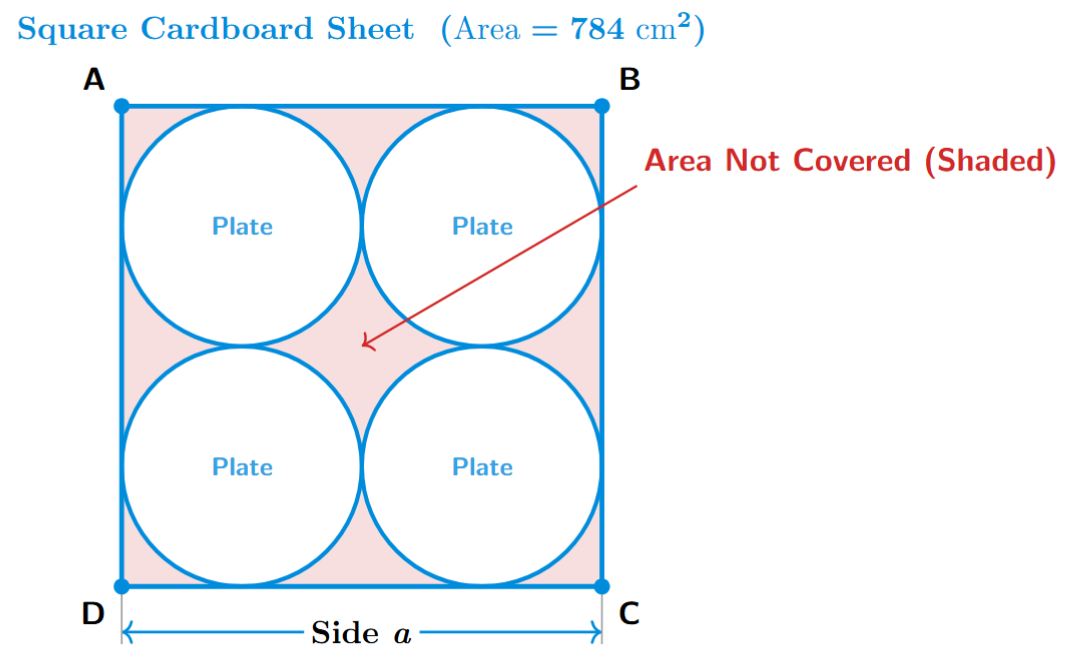
Given:
Area of the square cardboard sheet = $784 \text{ cm}^2$
Number of congruent circular plates = $4$
The plates are of maximum size and touch each other and the sides of the square.
To Find:
The area of the square sheet not covered by the circular plates.
Solution:
Step 1: Find the side of the square cardboard sheet.
Let the side of the square sheet be $a$.
$a^2 = 784$
…(i)
$a = \sqrt{784}$
$a = 28 \text{ cm}$
(Since $28 \times 28 = 784$)
Step 2: Find the radius of the circular plates.
Since four congruent circular plates are placed in a $2 \times 2$ arrangement to occupy the maximum size, the sum of the diameters of two circles is equal to the side of the square.
Let the diameter of each circular plate be $d$.
$2d = a$
…(ii)
$2d = 28$
$d = 14 \text{ cm}$
Now, we find the radius ($r$) of each plate:
$r = \frac{d}{2} = \frac{14}{2} = 7 \text{ cm}$
…(iii)
Step 3: Calculate the total area of the four circular plates.
$\text{Area of one circle} = \pi r^2$
... (iv)
Using $\pi = \frac{22}{7}$ and $r = 7 \text{ cm}$:
$\text{Area of one circle} = \frac{22}{\cancel{7}} \times \cancel{7} \times 7 = 154 \text{ cm}^2$
Therefore, the total area covered by four plates is:
$\text{Total Area Covered} = 4 \times 154 = 616 \text{ cm}^2$
... (v)
Step 4: Calculate the area not covered.
$\text{Area not covered} = \text{Area of square sheet} $$ - \text{Total area of circular plates}$
$\text{Area not covered} = 784 - 616$
$\text{Area not covered} = 168 \text{ cm}^2$
…(vi)
Conclusion:
The area of the square cardboard sheet not covered by the circular plates is $168 \text{ cm}^2$.
Question 11. Floor of a room is of dimensions 5 m × 4 m and it is covered with circular tiles of diameters 50 cm each as shown in Fig. 11.18. Find the area of floor that remains uncovered with tiles. (Use π = 3.14)

Answer:
Given:
Dimensions of the floor = $5 \text{ m} \times 4 \text{ m}$
Diameter of each circular tile ($d$) = $50 \text{ cm}$
Value of $\pi = 3.14$
To Find:
The area of the floor that remains uncovered with tiles.
Solution:
Step 1: Convert all units to centimetres (cm).
$\text{Length of floor (L)} = 5 \times 100 = 500 \text{ cm}$
... (i)
$\text{Breadth of floor (B)} = 4 \times 100 = 400 \text{ cm}$
... (ii)
Step 2: Calculate the number of tiles that can be placed on the floor.
The number of tiles along the length ($n_L$):
$n_L = \frac{\text{Length of floor}}{\text{Diameter of tile}} = \frac{500}{50} = 10$
The number of tiles along the breadth ($n_B$):
$n_B = \frac{\text{Breadth of floor}}{\text{Diameter of tile}} = \frac{400}{50} = 8$
The total number of tiles ($N$) placed on the floor is:
$N = n_L \times n_B = 10 \times 8 = 80$
... (iii)
Step 3: Calculate the area of the floor.
$\text{Area of floor } (A_F) = L \times B$
... (iv)
$A_F = 500 \times 400 = 2,00,000 \text{ cm}^2$
Step 4: Calculate the total area covered by the tiles.
First, find the radius ($r$) of a tile:
$r = \frac{d}{2} = \frac{50}{2} = 25 \text{ cm}$
Area of one circular tile = $\pi r^2$
$\text{Area of one tile} = 3.14 \times (25)^2 = 3.14 \times 625 = 1962.5 \text{ cm}^2$
Total area covered by $80$ tiles ($A_C$):
$A_C = 80 \times 1962.5$
... (v)
Adjusting for decimal: $A_C = 1,57,000 \text{ cm}^2$.
Step 5: Calculate the uncovered area.
$\text{Uncovered Area} = \text{Area of floor } (A_F) - \text{Total area of tiles } (A_C)$
$\text{Uncovered Area} = 43,000 \text{ cm}^2$
... (vi)
To convert this into square metres ($\text{m}^2$):
$\text{Area in m}^2 = \frac{43000}{100 \times 100} = 4.3 \text{ m}^2$
Conclusion:
The area of the floor that remains uncovered with tiles is $4.3 \text{ m}^2$ (or $43,000 \text{ cm}^2$).
Question 12. All the vertices of a rhombus lie on a circle. Find the area of the rhombus, if area of the circle is 1256 cm2 . (Use π = 3.14).
Answer:
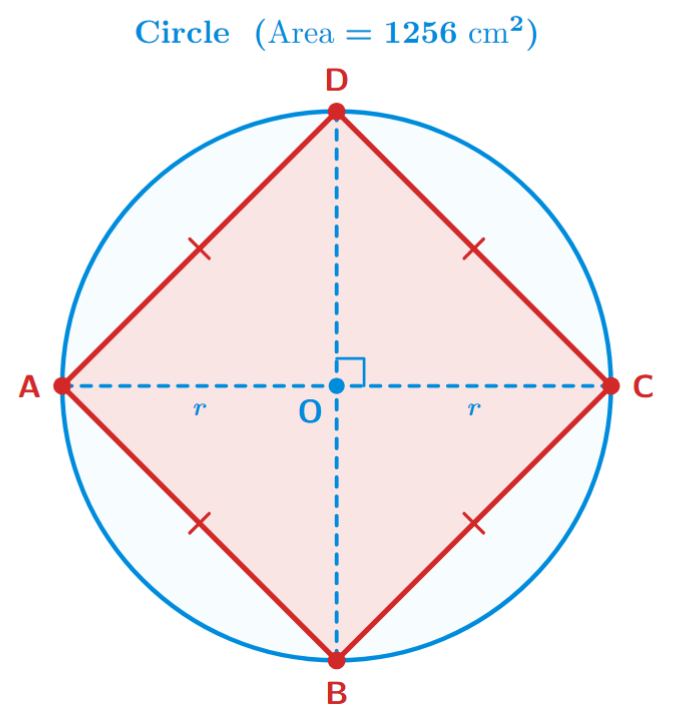
Given:
Area of the circle = $1256 \text{ cm}^2$
The vertices of a rhombus lie on this circle.
Value of $\pi = 3.14$
To Find:
The area of the rhombus.
Solution:
Step 1: Understand the property of the rhombus.
When the vertices of a rhombus lie on a circle, it is called a cyclic rhombus. A parallelogram inscribed in a circle is always a rectangle. Since a rhombus is also a parallelogram, a cyclic rhombus must be a rectangle with equal sides, which is a square.
The diagonals of this rhombus (square) pass through the centre of the circle and are equal to the diameter of the circle.
Step 2: Find the radius of the circle.
$\text{Area of circle} = \pi r^2$
... (i)
Substituting the given area and $\pi$:
$1256 = 3.14 \times r^2$
$r^2 = \frac{1256}{3.14}$
$r^2 = 400$
$r = \sqrt{400} = 20 \text{ cm}$
Step 3: Find the diagonals of the rhombus.
As established, the diagonals ($d_1$ and $d_2$) of the rhombus are equal to the diameter ($d$) of the circle.
$d = 2r = 2 \times 20 = 40 \text{ cm}$
... (ii)
Therefore, $d_1 = 40 \text{ cm}$ and $d_2 = 40 \text{ cm}$.
Step 4: Calculate the area of the rhombus.
$\text{Area of rhombus} = \frac{1}{2} \times d_1 \times d_2$
... (iii)
Substituting the values of the diagonals:
$\text{Area} = \frac{1}{2} \times 40 \times 40$
$\text{Area} = \frac{1600}{2}$
$\text{Area} = 800 \text{ cm}^2$
... (iv)
Conclusion:
The area of the rhombus whose vertices lie on the circle is $800 \text{ cm}^2$.
Question 13. An archery target has three regions formed by three concentric circles as shown in Fig. 11.19. If the diameters of the concentric circles are in the ratio 1: 2:3, then find the ratio of the areas of three regions.

Answer:
Given:
Diameters of the three concentric circles are in the ratio $1 : 2 : 3$.
The archery target is divided into three regions: the innermost circle and the two rings (annuli) surrounding it.
To Find:
The ratio of the areas of the three regions.
Solution:
Let the diameters of the three concentric circles be $d_1$, $d_2$, and $d_3$.
Given that $d_1 : d_2 : d_3 = 1 : 2 : 3$. Since the ratio of the diameters is equal to the ratio of the radii, let the radii of the three circles be $r_1$, $r_2$, and $r_3$.
$r_1 : r_2 : r_3 = 1 : 2 : 3$
[Ratio of radii] ... (i)
Let $r_1 = k$, $r_2 = 2k$, and $r_3 = 3k$, where $k$ is a constant.
Step 1: Calculate the area of the three circles.
Area of first circle ($A_1$) = $\pi r_1^2 = \pi(k)^2 = \pi k^2$
Area of second circle ($A_2$) = $\pi r_2^2 = \pi(2k)^2 = 4\pi k^2$
Area of third circle ($A_3$) = $\pi r_3^2 = \pi(3k)^2 = 9\pi k^2$
Step 2: Calculate the area of the three regions.
Region 1: The area of the innermost circle.
$\text{Area of Region 1} = A_1 = \pi k^2$
... (ii)
Region 2: The area of the ring between the first and second circles.
$\text{Area of Region 2} = A_2 - A_1$
$\text{Area of Region 2} = 4\pi k^2 - \pi k^2$
$\text{Area of Region 2} = 3\pi k^2$
... (iii)
Region 3: The area of the ring between the second and third circles.
$\text{Area of Region 3} = A_3 - A_2$
$\text{Area of Region 3} = 9\pi k^2 - 4\pi k^2$
$\text{Area of Region 3} = 5\pi k^2$
... (iv)
Step 3: Find the ratio of the areas.
The ratio of the areas of the three regions is:
$\text{Area of Region 1} : \text{Area of Region 2} : \text{Area of Region 3}$
$\pi k^2 : 3\pi k^2 : 5\pi k^2$
On dividing by $\pi k^2$, we get:
$1 : 3 : 5$
Conclusion:
The ratio of the areas of the three regions of the archery target is $1 : 3 : 5$.
Question 14. The length of the minute hand of a clock is 5 cm. Find the area swept by the minute hand during the time period 6 : 05 a m and 6 : 40 a m.
Answer:
Given:
Length of the minute hand ($r$) = $5 \text{ cm}$
Starting time = 6 : 05 AM
Ending time = 6 : 40 AM
To Find:
The area swept by the minute hand during this time period.
Solution:
Step 1: Calculate the time elapsed.
The duration between 6 : 05 AM and 6 : 40 AM is:
$\text{Time elapsed} = 40 \text{ minutes} - 5 \text{ minutes}$
... (i)
$\text{Time elapsed} = 35 \text{ minutes}$
Step 2: Calculate the angle subtended by the minute hand ($\theta$).
We know that the minute hand completes one full revolution ($360^\circ$) in 60 minutes.
Angle swept in 1 minute = $\frac{360^\circ}{60} = 6^\circ$
Therefore, the angle swept in 35 minutes is:
$\theta = 35 \times 6^\circ = 210^\circ$
... (ii)
Step 3: Calculate the area swept.
The area swept by the minute hand forms a sector of a circle. The area of a sector is given by:
$\text{Area} = \frac{\theta}{360^\circ} \times \pi r^2$
[Formula for area of sector] ... (iii)
Substituting $\theta = 210^\circ$, $r = 5 \text{ cm}$ and $\pi = \frac{22}{7}$ into equation (iii):
$\text{Area} = \frac{\cancel{210}^{7}}{\cancel{360}_{12}} \times \frac{22}{7} \times (5)^2$
$\text{Area} = \frac{\cancel{7}^{1}}{12} \times \frac{22}{\cancel{7}_{1}} \times 25$
$\text{Area} = \frac{\cancel{22}^{11}}{\cancel{12}_{6}} \times 25$
$\text{Area} = \frac{11 \times 25}{6}$
$\text{Area} = \frac{275}{6} \text{ cm}^2$
$\text{Area} \approx 45.83 \text{ cm}^2$
... (iv)
Conclusion:
The area swept by the minute hand between 6 : 05 AM and 6 : 40 AM is $45.83 \text{ cm}^2$.
Question 15. Area of a sector of central angle 200° of a circle is 770 cm2 . Find the length of the corresponding arc of this sector.
Answer:
Given:
Area of the sector, $A = 770$ cm$^2$.
Central angle of the sector, $\theta = 200^\circ$.
To Find:
The length of the corresponding arc, $l$.
Solution:
We can relate the area of a sector, its central angle, and the radius using the formula:
$A = \frac{\theta}{360^\circ} \times \pi r^2$
We can also relate the arc length, central angle, and radius using the formula:
$l = \frac{\theta}{360^\circ} \times 2\pi r$
From the area formula, we can first find the radius $r$. Substitute the given values $A = 770$ and $\theta = 200^\circ$. We will use $\pi = \frac{22}{7}$.
$770 = \frac{200^\circ}{360^\circ} \times \frac{22}{7} \times r^2$
Simplify the fraction $\frac{200}{360}$:
$\frac{\cancel{200}^{10}}{\cancel{360}_{18}} = \frac{10}{18} = \frac{5}{9}$
The equation becomes:
$770 = \frac{5}{9} \times \frac{22}{7} \times r^2$
$770 = \frac{110}{63} r^2$
Solve for $r^2$:
$r^2 = \frac{770 \times 63}{110}$
$r^2 = \frac{\cancel{770}^{7} \times 63}{\cancel{110}^{1}}$
$r^2 = 7 \times 63 = 441$
Radius, $r = \sqrt{441} = 21$ cm.
Now, use the arc length formula with $r = 21$ cm and $\theta = 200^\circ$ and $\pi = \frac{22}{7}$.
$l = \frac{200^\circ}{360^\circ} \times 2\pi r$
$l = \frac{5}{9} \times 2 \times \frac{22}{7} \times 21$
Simplify the expression:
$l = \frac{5}{9} \times 2 \times \frac{22}{\cancel{7}^{1}} \times \cancel{21}^{3}$
$l = \frac{5}{9} \times 2 \times 22 \times 3$
$l = \frac{5}{\cancel{9}^{3}} \times 2 \times 22 \times \cancel{3}^{1}$
$l = \frac{5}{3} \times 2 \times 22$
$l = \frac{10 \times 22}{3} = \frac{220}{3}$
The length of the corresponding arc is $\frac{220}{3}$ cm.
Alternate Method:
The area of a sector can also be related to the arc length and radius by the formula:
$A = \frac{1}{2} l r$
We know $A = 770$ and we found $r = 21$. We can use this formula to find $l$ directly.
$770 = \frac{1}{2} \times l \times 21$
$770 = \frac{21}{2} l$
Solve for $l$:
$l = \frac{770 \times 2}{21}$
$l = \frac{\cancel{770}^{110} \times 2}{\cancel{21}^{3}}$
$l = \frac{110 \times 2}{3} = \frac{220}{3}$
This confirms the length of the corresponding arc is $\frac{220}{3}$ cm.
Question 16. The central angles of two sectors of circles of radii 7 cm and 21 cm are respectively 120° and 40°. Find the areas of the two sectors as well as the lengths of the corresponding arcs. What do you observe?
Answer:
Given:
For the first sector:
Radius ($r_1$) = $7$ cm
Central angle ($\theta_1$) = $120^\circ$
For the second sector:
Radius ($r_2$) = $21$ cm
Central angle ($\theta_2$) = $40^\circ$
To Find:
1. Areas of the two sectors.
2. Lengths of the corresponding arcs.
3. Observation from the results.
Solution:
Case I: For the first sector (Radius = 7 cm, Angle = 120°)
The formula for the Area of a sector is given by: $\frac{\theta}{360^\circ} \times \pi r^2$
$\text{Area}_1 = \frac{120^\circ}{360^\circ} \times \frac{22}{7} \times 7 \times 7$
$\text{Area}_1 = \frac{\cancel{120}^1}{\cancel{360}_3} \times \frac{22}{\cancel{7}} \times \cancel{7} \times 7$
$\text{Area}_1 = \frac{1}{3} \times 154 = \frac{154}{3} \text{ cm}^2 \approx 51.33 \text{ cm}^2$
The formula for the Length of an arc is given by: $\frac{\theta}{360^\circ} \times 2\pi r$
$\text{Arc Length}_1 = \frac{120^\circ}{360^\circ} \times 2 \times \frac{22}{7} \times 7$
$\text{Arc Length}_1 = \frac{\cancel{120}^1}{\cancel{360}_3} \times 2 \times \frac{22}{\cancel{7}} \times \cancel{7}$
$\text{Arc Length}_1 = \frac{44}{3} \text{ cm} \approx 14.67 \text{ cm}$
Case II: For the second sector (Radius = 21 cm, Angle = 40°)
Applying the formula for the Area of the sector:
$\text{Area}_2 = \frac{40^\circ}{360^\circ} \times \frac{22}{7} \times 21 \times 21$
$\text{Area}_2 = \frac{\cancel{40}^1}{\cancel{360}_9} \times \frac{22}{\cancel{7}} \times \cancel{21}^3 \times 21$
$\text{Area}_2 = \frac{1}{\cancel{9}_3} \times 22 \times \cancel{3} \times 21 = 22 \times 7$
$\text{Area}_2 = 154 \text{ cm}^2$
Applying the formula for the Length of the arc:
$\text{Arc Length}_2 = \frac{40^\circ}{360^\circ} \times 2 \times \frac{22}{7} \times 21$
$\text{Arc Length}_2 = \frac{\cancel{40}^1}{\cancel{360}_9} \times 2 \times \frac{22}{\cancel{7}} \times \cancel{21}^3$
$\text{Arc Length}_2 = \frac{1}{\cancel{9}_3} \times 44 \times \cancel{3} = \frac{44}{3} \text{ cm} \approx 14.67 \text{ cm}$
Observation:
By comparing the above results, we observe that the lengths of the corresponding arcs are equal ($\frac{44}{3}$ cm), even though the radii and central angles of the two sectors are different.
However, the areas of the two sectors are different, with the second sector having a larger area ($154 \text{ cm}^2$) compared to the first sector ($\frac{154}{3} \text{ cm}^2$).
Question 17. Find the area of the shaded region given in Fig. 11.20.

Answer:
Given:
Side of the outer square ($S$) = $14$ cm
Distance from the boundary of the outer square to the peak of each semicircle = $3$ cm
The unshaded region consists of a central square and four semicircles drawn on its sides.
To Find:
The area of the shaded region.
Solution:
Let the side of the inner square be $s$ and the radius of each semicircle be $r$.
From the figure, the diameter of each semicircle is equal to the side of the inner square. Therefore, $s = 2r$.
The total horizontal length of the outer square can be expressed as the sum of the gaps and the width of the inner figure:
$3 + r + s + r + 3 = 14$
Substituting $2r = s$ in the above equation:
$6 + s + s = 14$
[As $r + r = 2r = s$]
$2s = 14 - 6$
$2s = 8$
$s = 4 \text{ cm}$
[Side of inner square]
Since the side of the inner square is $4$ cm, the radius ($r$) of each semicircle is:
$r = \frac{s}{2} = \frac{4}{2} = 2 \text{ cm}$
Step 1: Calculate the Area of the Outer Square
$\text{Area of outer square} = S^2 = 14 \times 14$
$\text{Area of outer square} = 196 \text{ cm}^2$
Step 2: Calculate the Area of the Unshaded Region
The unshaded region = (Area of inner square) + ($4 \times$ Area of semicircle)
$\text{Area of unshaded region} = s^2 + 4 \times \left( \frac{1}{2} \pi r^2 \right)$
$\text{Area of unshaded region} = s^2 + 2 \pi r^2$
Plugging in the values $s = 4$ and $r = 2$ (using $\pi = \frac{22}{7}$):
$\text{Area of unshaded region} = 4^2 + 2 \times \frac{22}{7} \times 2^2$
$\text{Area of unshaded region} = 16 + 2 \times \frac{22}{7} \times 4$
$\text{Area of unshaded region} = 16 + \frac{176}{7}$
$\text{Area of unshaded region} = \frac{112 + 176}{7} = \frac{288}{7} \text{ cm}^2$
$\text{Area of unshaded region} \approx 41.14 \text{ cm}^2$
Step 3: Calculate the Area of the Shaded Region
$\text{Area of shaded region} = \text{Area of outer square} $$ - \text{Area of unshaded region}$
$\text{Area of shaded region} = 196 - 41.14$
$\text{Area of shaded region} = 154.86 \text{ cm}^2$
Final Answer:
The area of the shaded region is $154.86 \text{ cm}^2$ (or $\frac{1084}{7} \text{ cm}^2$).
Question 18. Find the number of revolutions made by a circular wheel of area 1.54 m2 in rolling a distance of 176 m.
Answer:
Given:
Area of the circular wheel = 1.54 m$^2$.
Total distance rolled = 176 m.
To Find:
The number of revolutions made by the wheel.
Solution:
The distance covered by a circular wheel in one revolution is equal to its circumference. To find the number of revolutions, we need to divide the total distance rolled by the circumference of the wheel.
Number of revolutions $= \frac{\text{Total distance rolled}}{\text{Circumference}}$
First, find the radius of the wheel from its area.
Area of wheel $= \pi r^2$
$1.54 = \pi r^2$
Using $\pi = \frac{22}{7}$:
$1.54 = \frac{22}{7} r^2$
Convert 1.54 to a fraction: $1.54 = \frac{154}{100}$.
$\frac{154}{100} = \frac{22}{7} r^2$
Solve for $r^2$:
$r^2 = \frac{154}{100} \times \frac{7}{22}$
$r^2 = \frac{\cancel{154}^{7}}{100} \times \frac{7}{\cancel{22}^{1}}$
$r^2 = \frac{7 \times 7}{100} = \frac{49}{100}$
Radius, $r = \sqrt{\frac{49}{100}} = \frac{\sqrt{49}}{\sqrt{100}} = \frac{7}{10} = 0.7$ m.
Now, find the circumference of the wheel.
Circumference, $C = 2\pi r$
Using $r = 0.7$ m and $\pi = \frac{22}{7}$:
$C = 2 \times \frac{22}{7} \times 0.7$
$C = 2 \times \frac{22}{7} \times \frac{7}{10}$
$C = 2 \times \frac{\cancel{22}^{11}}{\cancel{7}^{1}} \times \frac{\cancel{7}^{1}}{\cancel{10}^{5}}$
$C = 2 \times \frac{11}{5} = \frac{22}{5} = 4.4$ m.
Now, calculate the number of revolutions.
Total distance rolled = 176 m.
Circumference = 4.4 m.
Number of revolutions $= \frac{176}{4.4} = \frac{1760}{44}$.
Number of revolutions $= \frac{\cancel{1760}^{40}}{\cancel{44}^{1}} = 40$.
The number of revolutions made by the circular wheel is 40.
Question 19. Find the difference of the areas of two segments of a circle formed by a chord of length 5 cm subtending an angle of 90° at the centre.
Answer:
Given:
Length of the chord ($AB$) = $5 \text{ cm}$
Angle subtended by the chord at the centre ($\theta$) = $90^\circ$
To Find:
The difference between the areas of the major segment and the minor segment.
Construction Required:
Draw a circle with centre $O$ and a chord $AB$ such that $\angle AOB = 90^\circ$. Let the radius of the circle be $r$.
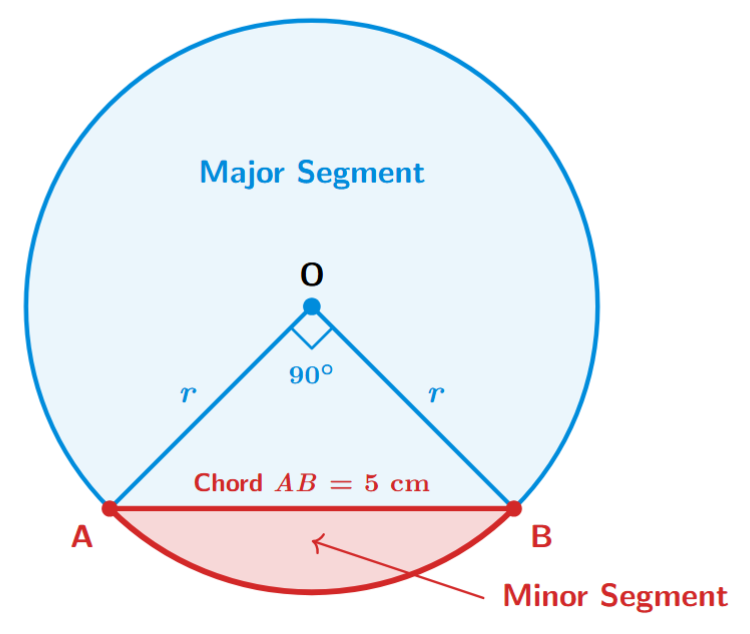
Solution:
In $\triangle OAB$, $\angle AOB = 90^\circ$ and $OA = OB = r$. By Pythagoras theorem:
$OA^2 + OB^2 = AB^2$
$r^2 + r^2 = 5^2$
$2r^2 = 25$
$r^2 = \frac{25}{2} = 12.5$
Now, we calculate the area of the components:
1. Area of the Circle:
$\text{Area of circle} = \pi r^2 = \pi \times 12.5$
2. Area of Minor Sector ($OAB$):
$\text{Area of minor sector} = \frac{\theta}{360^\circ} \times \pi r^2$
$\text{Area of minor sector} = \frac{90^\circ}{360^\circ} \times \pi \times 12.5 = \frac{1}{4} \times 12.5 \pi$
3. Area of $\triangle OAB$:
$\text{Area of } \triangle OAB = \frac{1}{2} \times \text{base} \times \text{height} = \frac{1}{2} \times r \times r = \frac{1}{2} r^2$
$\text{Area of } \triangle OAB = \frac{1}{2} \times 12.5 = 6.25 \text{ cm}^2$
4. Area of Minor Segment ($A_{minor}$):
$A_{minor} = \text{Area of minor sector} - \text{Area of } \triangle OAB$
$A_{minor} = \frac{12.5 \pi}{4} - 6.25$
5. Area of Major Segment ($A_{major}$):
$A_{major} = \text{Area of circle} - A_{minor}$
$A_{major} = 12.5 \pi - \left( \frac{12.5 \pi}{4} - 6.25 \right)$
Required Difference:
The difference between the areas of the two segments is given by $D = A_{major} - A_{minor}$:
$D = \left[ 12.5 \pi - \left( \frac{12.5 \pi}{4} - 6.25 \right) \right] - \left[ \frac{12.5 \pi}{4} - 6.25 \right]$
$D = 12.5 \pi - \frac{12.5 \pi}{4} + 6.25 - \frac{12.5 \pi}{4} + 6.25$
$D = 12.5 \pi - 2 \left( \frac{12.5 \pi}{4} \right) + 12.5$
$D = 12.5 \pi - \frac{12.5 \pi}{2} + 12.5$
$D = \frac{25 \pi - 12.5 \pi}{2} + 12.5$
$D = \frac{12.5 \pi}{2} + 12.5$
$D = 6.25 \pi + 12.5$
Taking $\pi = \frac{22}{7}$:
$D = 6.25 \times \frac{22}{7} + 12.5$
$D = \frac{137.5}{7} + 12.5 = \frac{137.5 + 87.5}{7}$
$D = \frac{225}{7} \approx 32.14 \text{ cm}^2$
Final Answer:
The difference of the areas of the two segments is $32.14 \text{ cm}^2$.
Question 20. Find the difference of the areas of a sector of angle 120° and its corresponding major sector of a circle of radius 21 cm.
Answer:
Given:
Radius of the circle ($r$) = $21$ cm
Central angle of the minor sector ($\theta$) = $120^\circ$
To Find:
The difference of the areas of the major sector and the minor sector.
Solution:
Step 1: Calculate the area of the minor sector
The formula for the area of a sector is $\frac{\theta}{360^\circ} \times \pi r^2$.
$\text{Area of minor sector} = \frac{120^\circ}{360^\circ} \times \frac{22}{7} \times 21 \times 21$
$\text{Area of minor sector} = \frac{\cancel{120}^1}{\cancel{360}_3} \times \frac{22}{\cancel{7}} \times \cancel{21}^3 \times 21$
$\text{Area of minor sector} = \frac{1}{\cancel{3}} \times 22 \times \cancel{3} \times 21$
$\text{Area of minor sector} = 462 \text{ cm}^2$
[Calculation for $120^\circ$ sector] ... (i)
Step 2: Calculate the area of the major sector
The central angle for the major sector = $360^\circ - 120^\circ = 240^\circ$.
$\text{Area of major sector} = \frac{240^\circ}{360^\circ} \times \frac{22}{7} \times 21 \times 21$
$\text{Area of major sector} = \frac{\cancel{240}^2}{\cancel{360}_3} \times \frac{22}{\cancel{7}} \times \cancel{21}^3 \times 21$
$\text{Area of major sector} = \frac{2}{\cancel{3}} \times 22 \times \cancel{3} \times 21$
$\text{Area of major sector} = 2 \times 462$
$\text{Area of major sector} = 924 \text{ cm}^2$
[Calculation for $240^\circ$ sector] ... (ii)
Step 3: Calculate the difference
$\text{Difference} = \text{Area of major sector} - \text{Area of minor sector}$
$\text{Difference} = 924 - 462$
$\text{Difference} = 462 \text{ cm}^2$
... (iii)
Alternate Solution:
We can find the difference directly by subtracting the angles first.
Difference in angles = $240^\circ - 120^\circ = 120^\circ$.
$\text{Required Difference} = \frac{\text{Difference in angles}}{360^\circ} \times \pi r^2$
$\text{Required Difference} = \frac{120^\circ}{360^\circ} \times \frac{22}{7} \times 21 \times 21$
$\text{Required Difference} = \frac{1}{3} \times 22 \times 3 \times 21$
$\text{Required Difference} = 22 \times 21 = 462 \text{ cm}^2$
Final Answer:
The difference of the areas of the two sectors is $462 \text{ cm}^2$.