

Chapter 12 Surface Areas and Volumes (Class 10 - Maths NCERT Exemplar Solutions)
Welcome to the indispensable resource for NCERT Exemplar Solutions for Class 10 Mathematics: Chapter 12 Surface Areas and Volumes! These problems represent a significant leap in complexity compared to standard textbook exercises, specifically designed to challenge your understanding of combinations of solids and the intricate conversion of solids from one shape to another. By exploring sophisticated geometrical reasoning and meticulous calculations, these solutions build the analytical foundation and visualization skills required for mastering advanced 3D mensuration.
The solutions cover the full spectrum of essential shapes, including cylinders, cones, spheres, and hemispheres. A primary focus is placed on composite solids, where students must learn to distinguish between the summation of individual volumes and the careful identification of only exposed surfaces for Total Surface Area (TSA). Furthermore, the solutions explore the principle of conservation of volume during the recasting of solids, providing a systematic approach to solving for unknown dimensions or the total number of smaller objects formed.
Significant attention is given to the frustum of a cone, with detailed applications of formulas for slant height, Curved Surface Area, and Volume ($V = \frac{1}{3}\pi h(r_1^2 + r_2^2 + r_1 r_2)$). The Exemplar rigorously tests these skills through complex word problems involving water flow rates and unit conversions, such as $cm^3$ to litres. With step-by-step guidance and logical justifications prepared by learningspot.co, students can master the critical skills needed to effectively solve multifaceted mensuration challenges and handle calculations involving $\pi$ and square roots with precision.
Sample Question 1 to 5 (Before Exercise 12.1)
Choose the correct answer from the given four options:
Sample Question 1: A funnel (see Fig.12.1) is the combination of

(A) a cone and a cylinder
(B) frustum of a cone and a cylinder
(C) a hemisphere and a cylinder
(D) a hemisphere and a cone
Answer:
Solution:
Upon carefully observing the shape of the funnel shown in Figure 12.1, we can identify its constituent parts.
The upper, wider part of the funnel is in the shape of a cone from which the top portion has been cut off parallel to the base. This specific geometric shape is known as a frustum of a cone.
The lower, narrower part of the funnel, which acts as the spout, is cylindrical in shape.
Therefore, the funnel is a combined solid formed by joining a frustum of a cone and a cylinder.
Comparing this observation with the given options:
- (A) a cone and a cylinder
- (B) frustum of a cone and a cylinder
- (C) a hemisphere and a cylinder
- (D) a hemisphere and a cone
Option (B) accurately describes the combination of shapes that form the funnel.
Thus, the correct answer is (B) frustum of a cone and a cylinder.
Sample Question 2: If a marble of radius 2.1 cm is put into a cylindrical cup full of water of radius 5cm and height 6 cm, then how much water flows out of the cylindrical cup?
(A) 38.8 cm3
(B) 55.4 cm3
(C) 19.4 cm3
(D) 471.4 cm3
Answer:
Given:
Radius of the spherical marble ($r$) = $2.1$ cm
Radius of the cylindrical cup ($R$) = $5$ cm
Height of the cylindrical cup ($h$) = $6$ cm
To Find:
The volume of water that flows out of the cylindrical cup.
Solution:
When an object is submerged in a container full of water, the volume of water that flows out is equal to the volume of the object immersed.
$\text{Volume of water displaced} = \text{Volume of the marble}$
The marble is spherical in shape. The formula for the volume of a sphere is:
$V = \frac{4}{3} \pi r^3$
Substituting the values into the formula:
$V = \frac{4}{3} \times \frac{22}{7} \times (2.1)^3$
$V = \frac{4}{3} \times \frac{22}{7} \times 2.1 \times 2.1 \times 2.1$
Using cancellation for simplification:
$V = 4 \times 22 \times \frac{\cancel{2.1}^{0.7}}{\cancel{3}} \times \frac{\cancel{2.1}^{0.3}}{\cancel{7}} \times 2.1$
$V = 88 \times 0.1 \times 2.1 \times 2.1$
$V = 8.8 \times 4.41$
$V = 38.808 \text{ cm}^3$
Rounding to one decimal place, we get $38.8 \text{ cm}^3$.
Thus, the volume of water that flows out is $38.8 \text{ cm}^3$.
Comparing this with the given options, the correct option is (A).
Sample Question 3: A cubical ice cream brick of edge 22 cm is to be distributed among some children by filling ice cream cones of radius 2 cm and height 7 cm upto its brim. How many children will get the ice cream cones?
(A) 163
(B) 263
(C) 363
(D) 463
Answer:
Given:
Edge of the cubical ice cream brick ($a$) = $22$ cm
Radius of the ice cream cone ($r$) = $2$ cm
Height of the ice cream cone ($h$) = $7$ cm
To Find:
The number of children who will get the ice cream cones.
Solution:
Let the number of children (or number of cones) be $n$.
$n \times \text{Volume of one cone} = \text{Volume of the cubical brick}$
Step 1: Calculate the volume of the cubical brick.
$\text{Volume of cube} = a^3$
$\text{Volume} = (22)^3 = 22 \times 22 \times 22 = 10648 \text{ cm}^3$
Step 2: Calculate the volume of one ice cream cone.
$\text{Volume of cone} = \frac{1}{3} \pi r^2 h$
$\text{Volume} = \frac{1}{3} \times \frac{22}{7} \times 2^2 \times 7$
$\text{Volume} = \frac{1}{3} \times \frac{22}{\cancel{7}} \times 4 \times \cancel{7} = \frac{88}{3} \text{ cm}^3$
Step 3: Calculate the number of children ($n$).
$n = \frac{\text{Volume of cube}}{\text{Volume of cone}}$
$n = \frac{10648}{\frac{88}{3}}$
$n = \frac{10648 \times 3}{88}$
Dividing $10648$ by $88$:
$n = 121 \times 3$
$n = 363$
Therefore, $363$ children will get the ice cream cones.
The correct option is (C).
Sample Question 4: The radii of the ends of a frustum of a cone of height h cm are r1 cm and r2 cm. The volume in cm3 of the frustum of the cone is
(A) $\frac{1}{3}\pi$h [r12 + r22 - r1r2]
(B) $\frac{1}{3}\pi$h [r12 + r22 - r1r2]
(C) $\frac{1}{3}\pi$h [r12 - r22 + r1r2]
(D) $\frac{1}{3}\pi$h [r12 - r22 - r1r2]
Answer:
Given:
Height of the frustum = $h$
Radii of the two circular ends = $r_1$ and $r_2$
To Find:
The correct formula for the volume of the frustum of a cone.
Solution:
A frustum of a cone is the part of a cone that remains when it is cut by a plane parallel to its base.
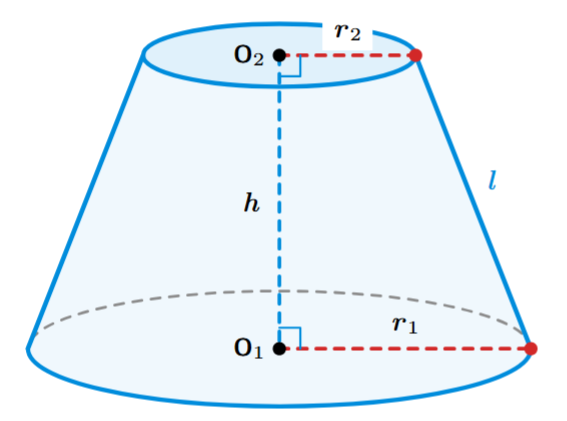
The volume of a frustum of a cone is derived by subtracting the volume of the smaller cone (removed part) from the volume of the original larger cone.
The standard mathematical formula for the volume ($V$) is:
$V = \frac{1}{3} \pi h (r_1^2 + r_2^2 + r_1r_2)$
... (i)
Let's check the options provided in the question:
Option (A): $\frac{1}{3}\pi h [r_1^2 + r_2^2 + r_1r_2]$
Option (B): $\frac{1}{3}\pi h [r_1^2 + r_2^2 - r_1r_2]$
Option (C): $\frac{1}{3}\pi h [r_1^2 - r_2^2 + r_1r_2]$
Option (D): $\frac{1}{3}\pi h [r_1^2 - r_2^2 - r_1r_2]$
By comparing the standard formula with the choices, we find that the correct expression corresponds to option (A).
The volume of the frustum of the cone is $\frac{1}{3} \pi h (r_1^2 + r_2^2 + r_1r_2)$.
The correct option is (A).
Sample Question 5: The volume of the largest right circular cone that can be cut out from a cube of edge 4.2 cm is
(A) 9.7 cm3
(B) 77.6 cm3
(C) 58.2 cm3
(D) 19.4 cm3
Answer:
Given:
Edge of the cube ($a$) = $4.2$ cm
To Find:
The volume of the largest right circular cone that can be cut out from this cube.
Solution:
To cut out the largest possible cone from a cube:
1. The diameter of the base of the cone must be equal to the edge of the cube.
2. The height of the cone must be equal to the edge of the cube.
$\text{Diameter } (d) = a = 4.2$ cm
(Given)
$\text{Radius } (r) = \frac{4.2}{2} = 2.1$ cm
... (i)
$\text{Height } (h) = a = 4.2$ cm
... (ii)
The formula for the volume of a cone is:
$V = \frac{1}{3} \pi r^2 h$
Substituting the values:
$V = \frac{1}{3} \times \frac{22}{7} \times (2.1)^2 \times 4.2$
$V = \frac{1}{3} \times \frac{22}{7} \times 2.1 \times 2.1 \times 4.2$
Simplifying using cancellation:
$V = 22 \times \frac{\cancel{2.1}^{0.7}}{\cancel{3}} \times \frac{\cancel{2.1}^{0.3}}{\cancel{7}} \times 4.2$
$V = 22 \times 0.1 \times 2.1 \times 4.2$
$V = 2.2 \times 8.82$
$V = 19.404 \text{ cm}^3$
Rounding to one decimal place, we get $19.4 \text{ cm}^3$.
Thus, the volume of the largest right circular cone is $19.4 \text{ cm}^3$.
The correct option is (D).
Exercise 12.1
Choose the correct answer from the given four options:
Question 1. A cylindrical pencil sharpened at one edge is the combination of
(A) a cone and a cylinder
(B) frustum of a cone and a cylinder
(C) a hemisphere and a cylinder
(D) two cylinders.
Answer:
Given:
A cylindrical pencil sharpened at one edge.
To Find:
The shapes that combine to form the sharpened pencil.
Solution:
A standard pencil is cylindrical in shape. When we sharpen one edge of the pencil, the wood and lead are shaved off to form a pointed tip.
This pointed tip takes the shape of a cone.
The remaining part of the pencil remains cylindrical.
Therefore, a cylindrical pencil sharpened at one edge is a combination of a cone and a cylinder.
Hence, the correct option is (A).
Question 2. A surahi is the combination of
(A) a sphere and a cylinder
(B) a hemisphere and a cylinder
(C) two hemispheres
(D) a cylinder and a cone.
Answer:
Given:
A surahi (an Indian traditional water pot).
To Find:
The geometric shapes that combine to form a surahi.
Solution:
A surahi is a vessel used to keep water cool. If we look at its structure:
1. The bottom part, which holds the bulk of the water, is spherical in shape.
2. The top part, which forms the neck of the vessel, is cylindrical in shape.
Thus, a surahi is a combination of a sphere and a cylinder.
Hence, the correct option is (A).
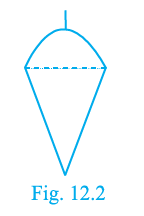
Question 3. A plumbline (sahul) is the combination of (see Fig. 12.2)
(A) a cone and a cylinder
(B) a hemisphere and a cone
(C) frustum of a cone and a cylinder
(D) sphere and cylinder
Answer:
Given:
A plumbline (commonly known as sahul in India, used by masons) as shown in Fig. 12.2.
Solution:
By observing the provided image (Fig. 12.2) of the plumbline:
1. The upper part of the plumbline is a hemisphere.
2. The lower part, which tapers to a point, is a cone.
The two shapes are joined at their common flat circular base.
Therefore, a plumbline is a combination of a hemisphere and a cone.
Hence, the correct option is (B).
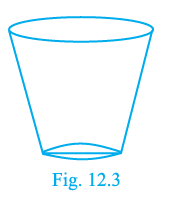
Question 4. The shape of a glass (tumbler) (see Fig. 12.3) is usually in the form of
(A) a cone
(B) frustum of a cone
(C) a cylinder
(D) a sphere
Answer:
Given:
A glass tumbler as shown in Fig. 12.3.
Solution:
A typical drinking glass (tumbler) has the following characteristics:
1. It has two circular ends (base and top).
2. The radii of these two circular ends are unequal (usually the top is wider than the base).
In geometry, when a right circular cone is cut by a plane parallel to its base and the upper portion is removed, the remaining part is called the frustum of a cone.
As seen in Fig. 12.3, the tumbler perfectly matches the shape of a frustum of a cone.
Hence, the correct option is (B).
Question 5. The shape of a gilli, in the gilli-danda game (see Fig. 12.4), is a combination of

(A) two cylinders
(B) a cone and a cylinder
(C) two cones and a cylinder
(D) two cylinders and a cone
Answer:
Given:
A gilli used in the traditional Indian game Gilli-Danda, as shown in Fig. 12.4.
Solution:
By examining the structure of the gilli in Fig. 12.4:
1. The middle part of the gilli is uniform and circular, representing a cylinder.
2. Both the left and right ends of the gilli are tapered to a point, forming two cones.
So, the gilli is made by attaching one cone to each of the two circular faces of a cylinder.
Therefore, it is a combination of two cones and a cylinder.
Hence, the correct option is (C).
Question 6. A shuttle cock used for playing badminton has the shape of the combination of
(A) a cylinder and a sphere
(B) a cylinder and a hemisphere
(C) a sphere and a cone
(D) frustum of a cone and a hemisphere
Answer:
To Find:
Identify the geometric shapes that combine to form a badminton shuttlecock.
Solution:
A badminton shuttlecock consists of two main parts:
1. The top part (feathers) is wider at the top and narrower at the bottom, but it is open and slanted, which represents the shape of a frustum of a cone.
2. The bottom part (base/cork) is rounded and represents the shape of a hemisphere.
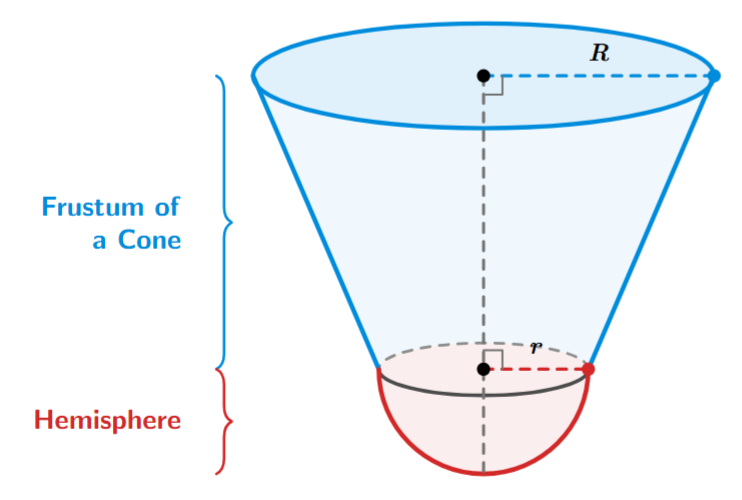
Therefore, a shuttlecock is a combination of a frustum of a cone and a hemisphere.
The correct option is (D).
Question 7. A cone is cut through a plane parallel to its base and then the cone that is formed on one side of that plane is removed. The new part that is left over on the other side of the plane is called
(A) a frustum of a cone
(B) cone
(C) cylinder
(D) sphere
Answer:
Given:
A solid cone is sliced by a plane parallel to its base, and the smaller upper cone is removed.
To Find:
The name of the remaining part of the cone.
Solution:
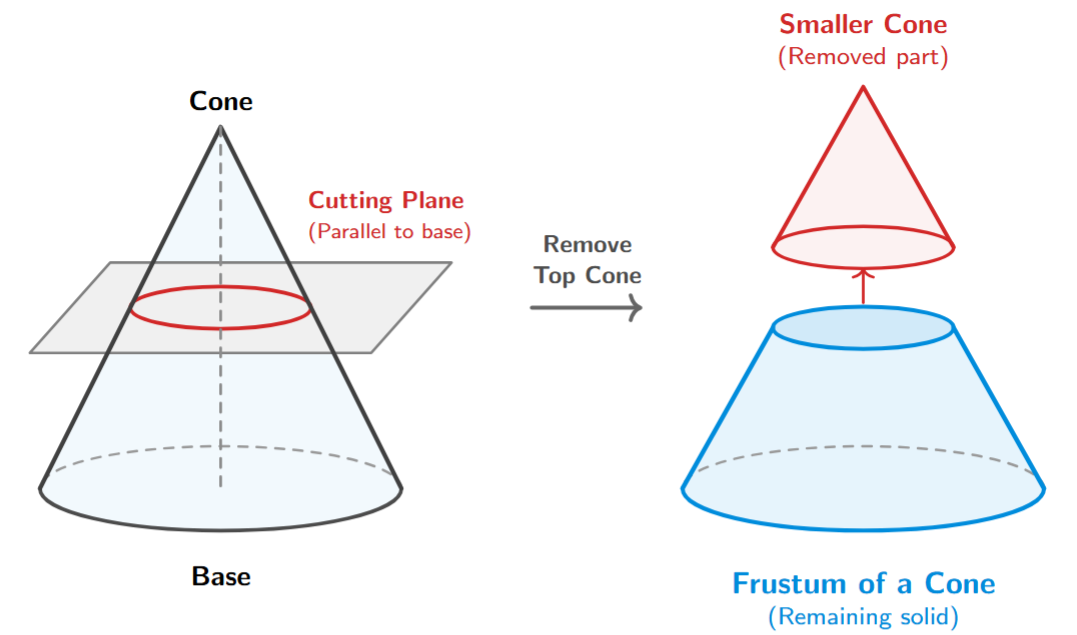
When a cone is cut by a plane parallel to the base, it is divided into two parts:
1. A smaller cone at the top.
2. A bucket-like shape at the bottom.
If the smaller cone is removed, the remaining solid part between the parallel plane and the base of the original cone is known as the frustum of a cone.
The correct option is (A).
Question 8. A hollow cube of internal edge 22cm is filled with spherical marbles of diameter 0.5 cm and it is assumed that $\frac{1}{8}$ space of the cube remains unfilled. Then the number of marbles that the cube can accomodate is
(A) 142296
(B) 142396
(C) 142496
(D) 142596
Answer:
Given:
Internal edge of the cube, $a = 22$ cm
Diameter of each marble, $d = 0.5$ cm
Radius of each marble, $r = \frac{0.5}{2} = 0.25$ cm = $\frac{1}{4}$ cm
Space left unfilled $= \frac{1}{8}$ of the volume of the cube.
To Find:
Number of marbles ($n$) that the cube can accommodate.
Solution:
Volume of the cube $= a^3 = (22)^3$
Volume of the cube $= 10648 \text{ cm}^3$
Space occupied by marbles $= 1 - \frac{1}{8} = \frac{7}{8}$ of the volume of the cube.
Volume occupied by $n$ marbles $= \frac{7}{8} \times 10648 \text{ cm}^3$
Volume occupied by marbles $= 7 \times 1331 = 9317 \text{ cm}^3$
Volume of one spherical marble $= \frac{4}{3} \pi r^3$
Volume of one marble $= \frac{4}{3} \times \frac{22}{7} \times \left(\frac{1}{4}\right)^3$
Volume of one marble $= \frac{4}{3} \times \frac{22}{7} \times \frac{1}{64}$
$\text{Volume of one marble} = \frac{1 \times 11 \times 1}{3 \times 7 \times 8} = \frac{11}{168} \text{ cm}^3$
Let the number of marbles be $n$. Then:
$n \times (\text{Volume of one marble}) = \text{Volume occupied by marbles}$
$n \times \frac{11}{168} = 9317$
$n = \frac{9317 \times 168}{11}$
Performing cancellation:
$n = \frac{\cancel{9317}^{847} \times 168}{\cancel{11}_{1}}$
$n = 847 \times 168$
The number of marbles is 142296.
The correct option is (A).
Question 9. A metallic spherical shell of internal and external diameters 4 cm and 8 cm, respectively is melted and recast into the form a cone of base diameter 8cm. The height of the cone is
(A) 12cm
(B) 14cm
(C) 15cm
(D) 18cm
Answer:
Given:
Internal diameter of spherical shell $= 4$ cm $\implies$ Internal radius ($r$) $= 2$ cm
External diameter of spherical shell $= 8$ cm $\implies$ External radius ($R$) $= 4$ cm
Base diameter of the cone $= 8$ cm $\implies$ Radius of cone ($r_c$) $= 4$ cm
To Find:
The height of the cone ($h$).
Solution:
Since the spherical shell is melted and recast into a cone, the volume of the metal remains the same.
$\text{Volume of Cone} = \text{Volume of Spherical Shell}$
$\frac{1}{3} \pi r_c^2 h = \frac{4}{3} \pi (R^3 - r^3)$
$\frac{1}{3} \times \pi \times 4^2 \times h = \frac{4}{3} \times \pi \times (4^3 - 2^3)$
Cancel $\frac{\pi}{3}$ from both sides:
$16 \times h = 4 \times (64 - 8)$
$16h = 4 \times 56$
$h = \frac{4 \times 56}{16}$
$h = \frac{\cancel{4}^{1} \times 56}{\cancel{16}_{4}}$
$h = \frac{\cancel{56}^{14}}{\cancel{4}_{1}}$
$h = 14 \text{ cm}$
The height of the cone is 14 cm.
The correct option is (B).
Question 10. A solid piece of iron in the form of a cuboid of dimensions 49cm × 33cm × 24cm, is moulded to form a solid sphere. The radius of the sphere is
(A) 21cm
(B) 23cm
(C) 25cm
(D) 19cm
Answer:
Given:
Dimensions of cuboid $= 49 \text{ cm} \times 33 \text{ cm} \times 24 \text{ cm}$
To Find:
The radius of the solid sphere ($R$).
Solution:
The volume of the iron remains constant when moulded from a cuboid to a sphere.
$\text{Volume of Sphere} = \text{Volume of Cuboid}$
... (i)
$\frac{4}{3} \pi R^3 = l \times b \times h$
$\frac{4}{3} \times \frac{22}{7} \times R^3 = 49 \times 33 \times 24$
$\frac{88}{21} \times R^3 = 49 \times 33 \times 24$
$R^3 = \frac{49 \times 33 \times 24 \times 21}{88}$
Perform cancellation:
$R^3 = \frac{49 \times \cancel{33}^{3} \times \cancel{24}^{3} \times 21}{\cancel{88}_{1}}$
$R^3 = 49 \times 3 \times 3 \times 21$
Using prime factorisation to find the cube root:
$R^3 = (7 \times 7) \times (3 \times 3) \times (7 \times 3)$
$R^3 = 7^3 \times 3^3$
$R = \sqrt[3]{7^3 \times 3^3}$
$R = 7 \times 3$
$R = 21 \text{ cm}$
The radius of the sphere is 21 cm.
The correct option is (A).
Question 11. A mason constructs a wall of dimensions 270cm× 300cm × 350cm with the bricks each of size 22.5cm × 11.25cm × 8.75cm and it is assumed that $\frac{1}{8}$ space is covered by the mortar. Then the number of bricks used to construct the wall is
(A) 11100
(B) 11200
(C) 11000
(D) 11300
Answer:
Given:
Dimensions of the wall $= 270 \text{ cm} \times 300 \text{ cm} \times 350 \text{ cm}$
Dimensions of each brick $= 22.5 \text{ cm} \times 11.25 \text{ cm} \times 8.75 \text{ cm}$
Space covered by mortar $= \frac{1}{8}$ of the volume of the wall
To Find:
Number of bricks used to construct the wall.
Solution:
First, we find the volume of the wall:
$\text{Volume of wall} = 270 \times 300 \times 350$
$\text{Volume of wall} = 28,350,000 \text{ cm}^3$
Since $\frac{1}{8}$ of the wall is mortar, the remaining part is occupied by bricks:
$\text{Space for bricks} = \text{Total Volume} - \text{Mortar Volume}$
$\text{Space for bricks} = 1 - \frac{1}{8} = \frac{7}{8} \text{ of the wall volume}$
$\text{Actual volume of bricks} = \frac{7}{8} \times 28,350,000$
$\text{Actual volume of bricks} = 7 \times 3,543,750 = 24,806,250 \text{ cm}^3$
Now, calculate the volume of one brick:
$\text{Volume of one brick} = 22.5 \times 11.25 \times 8.75$
$\text{Volume of one brick} = 2214.84375 \text{ cm}^3$
Number of bricks ($n$) = $\frac{\text{Total volume occupied by bricks}}{\text{Volume of one brick}}$
$n = \frac{24,806,250}{2214.84375}$
To simplify, we can use fractions:
$n = \frac{\frac{7}{8} \times 270 \times 300 \times 350}{\frac{45}{2} \times \frac{45}{4} \times \frac{35}{4}}$
$n = \frac{7 \times 270 \times 300 \times 350 \times 32}{8 \times 45 \times 45 \times 35}$
$n = \frac{7 \times \cancel{270}^6 \times \cancel{300}^{20} \times \cancel{350}^{10} \times 4}{\cancel{45}_1 \times \cancel{45}_3 \times \cancel{35}_1}$
$n = \frac{7 \times \cancel{6}^2 \times 20 \times 10 \times 4}{\cancel{3}_1}$
$n = 7 \times 2 \times 20 \times 10 \times 4$
$n = 11200$
Therefore, the number of bricks used is 11200.
The correct option is (B).
Question 12. Twelve solid spheres of the same size are made by melting a solid metallic cylinder of base diameter 2 cm and height 16 cm. The diameter of each sphere is
(A) 4 cm
(B) 3 cm
(C) 2 cm
(D) 6 cm
Answer:
Given:
Diameter of cylinder $= 2 \text{ cm} \implies$ Radius of cylinder ($r$) $= 1 \text{ cm}$
Height of cylinder ($h$) $= 16 \text{ cm}$
Number of spheres formed $= 12$
To Find:
Diameter of each sphere.
Solution:
When the cylinder is melted to form spheres, the volume remains conserved.
$\text{Volume of 12 spheres} = \text{Volume of cylinder}$
... (i)
$12 \times \frac{4}{3} \pi R^3 = \pi r^2 h$
$4 \times 4 \times \pi \times R^3 = \pi \times (1)^2 \times 16$
$16 \pi R^3 = 16 \pi$
Dividing both sides by $16\pi$:
$R^3 = 1$
[Dividing by $16\pi$]
$R = \sqrt[3]{1} = 1 \text{ cm}$
Radius of each sphere is $1 \text{ cm}$.
$\text{Diameter} = 2 \times R = 2 \times 1 = 2 \text{ cm}$
The diameter of each sphere is 2 cm.
The correct option is (C).
Question 13. The radii of the top and bottom of a bucket of slant height 45 cm are 28 cm and 7 cm, respectively. The curved surface area of the bucket is
(A) 4950 cm2
(B) 4951 cm2
(C) 4952 cm2
(D) 4953 cm2
Answer:
Given:
Slant height of the bucket (frustum), $l = 45 \text{ cm}$
Radius of top, $R = 28 \text{ cm}$
Radius of bottom, $r = 7 \text{ cm}$
To Find:
Curved Surface Area (CSA) of the bucket.
Solution:
The bucket is in the shape of a frustum of a cone.
$\text{CSA of Frustum} = \pi(R + r)l$
Substituting the values:
$\text{CSA} = \frac{22}{7} \times (28 + 7) \times 45$
$\text{CSA} = \frac{22}{7} \times 35 \times 45$
Performing cancellation:
$\text{CSA} = 22 \times \frac{\cancel{35}^5}{\cancel{7}_1} \times 45$
$\text{CSA} = 22 \times 5 \times 45$
$\text{CSA} = 110 \times 45$
The curved surface area is 4950 cm2.
The correct option is (A).
Question 14. A medicine-capsule is in the shape of a cylinder of diameter 0.5 cm with two hemispheres stuck to each of its ends. The length of entire capsule is 2 cm. The capacity of the capsule is
(A) 0.36 cm3
(B) 0.35 cm3
(C) 0.34 cm3
(D) 0.33 cm3
Answer:
Given:
Diameter of the capsule $= 0.5 \text{ cm} \implies$ Radius ($r$) $= 0.25 \text{ cm} = \frac{1}{4} \text{ cm}$
Total length of capsule $= 2 \text{ cm}$
To Find:
Capacity (Volume) of the capsule.
Solution:
The capsule consists of a cylinder and two hemispheres at the ends.
$\text{Height of the cylindrical part (h)} = \text{Total length} - 2 \times \text{Radius}$
$h = 2 - (0.25 + 0.25) = 2 - 0.5 = 1.5 \text{ cm}$
$\text{Total Volume} = \text{Volume of Cylinder} $$ + 2 \times \text{Volume of Hemisphere}$
$\text{Total Volume} = \pi r^2 h + 2 \times \left(\frac{2}{3} \pi r^3\right)$
$\text{Total Volume} = \pi r^2 \left(h + \frac{4}{3}r\right)$
[Taking $\pi r^2$ as common]
Substituting $r = \frac{1}{4}$ and $h = \frac{3}{2}$:
$V = \frac{22}{7} \times \left(\frac{1}{4}\right)^2 \times \left(\frac{3}{2} + \frac{4}{3} \times \frac{1}{4}\right)$
$V = \frac{22}{7} \times \frac{1}{16} \times \left(\frac{3}{2} + \frac{1}{3}\right)$
$V = \frac{11}{7 \times 8} \times \left(\frac{9 + 2}{6}\right)$
$V = \frac{11}{56} \times \frac{11}{6} = \frac{121}{336}$
The capacity is approximately 0.36 cm3.
The correct option is (A).
Question 15. If two solid hemispheres of same base radius r are joined together along their bases, then curved surface area of this new solid is
(A) 4πr2
(B) 6πr2
(C) 3πr2
(D) 8πr2
Answer:
Given:
Two hemispheres, each with radius $r$, joined together at their bases.
To Find:
Curved Surface Area (CSA) of the new solid formed.
Solution:
When two hemispheres of the same radius $r$ are joined along their circular bases, they form a complete solid sphere of radius $r$.
The curved surface area of the new solid is simply the sum of the curved surface areas of the two hemispheres, as the flat bases are now hidden inside the joint.
$\text{CSA of one hemisphere} = 2\pi r^2$
$\text{CSA of new solid} = 2\pi r^2 + 2\pi r^2$
(Sum of curved parts)
$\text{CSA of new solid} = 4\pi r^2$
This is equal to the surface area of a sphere of radius $r$.
The correct option is (A).
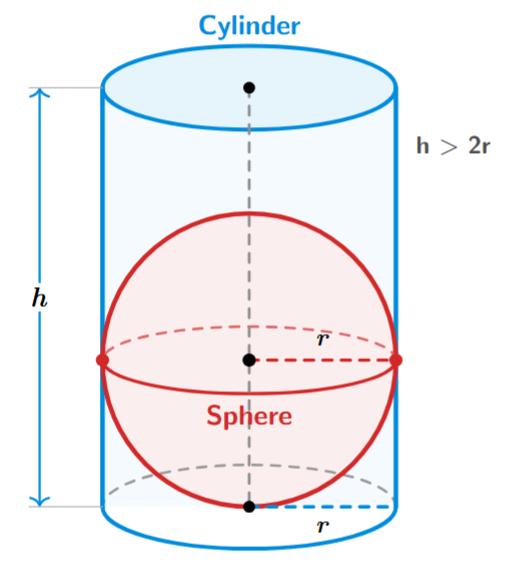
Question 16. A right circular cylinder of radius r cm and height h cm (h > 2r) just encloses a sphere of diameter
(A) r cm
(B) 2r cm
(C) h cm
(D) 2h cm
Answer:
Given:
Radius of the right circular cylinder $= r \text{ cm}$
Height of the cylinder $= h \text{ cm}$ (where $h > 2r$)
To Find:
The diameter of the sphere that is just enclosed by the cylinder.
Solution:
A sphere is said to be "just enclosed" by a cylinder if its surface touches the lateral surface of the cylinder.
For the sphere to fit perfectly inside the cylinder, the width of the sphere must be equal to the width of the cylinder.
$\text{Width of cylinder} = \text{Diameter of cylinder} = 2r$
Since the sphere is just enclosed, its diameter must match the diameter of the cylinder's base.
$\text{Diameter of sphere} = 2r \text{ cm}$
The condition $h > 2r$ simply ensures that the cylinder is tall enough to contain the sphere without the sphere touching both the top and bottom lids simultaneously (or that there is extra space vertically).
The correct option is (B).
Question 17. During conversion of a solid from one shape to another, the volume of the new shape will
(A) increase
(B) decrease
(C) remain unaltered
(D) be doubled
Answer:
To Find:
The change in volume when a solid is converted from one shape to another.
Solution:
When a solid object (like a metallic sphere) is melted and recast into a different shape (like a cone or wire), the amount of material remains the same.
In mathematics and physics, as long as there is no wastage of material during the process, the total space occupied by the object remains constant.
$\text{Volume of original shape} = \text{Volume of new shape}$
Therefore, the volume of the new shape will remain unaltered.
The correct option is (C).
Question 18. The diameters of the two circular ends of the bucket are 44 cm and 24 cm. The height of the bucket is 35 cm. The capacity of the bucket is
(A) 32.7 litres
(B) 33.7 litres
(C) 34.7 litres
(D) 31.7 litres
Answer:
Given:
Diameter of top ($D$) $= 44 \text{ cm} \implies$ Radius ($R$) $= 22 \text{ cm}$
Diameter of bottom ($d$) $= 24 \text{ cm} \implies$ Radius ($r$) $= 12 \text{ cm}$
Height of the bucket ($h$) $= 35 \text{ cm}$
To Find:
The capacity of the bucket in litres.
Solution:
The bucket is in the form of a frustum of a cone.
Capacity (Volume) of frustum $= \frac{1}{3} \pi h (R^2 + r^2 + Rr)$
$V = \frac{1}{3} \times \frac{22}{7} \times 35 \times (22^2 + 12^2 + 22 \times 12)$
$V = \frac{22 \times 5}{3} \times (484 + 144 + 264)$
$V = \frac{110}{3} \times (892)$
$V = \frac{98120}{3} \text{ cm}^3$
$V \approx 32706.67 \text{ cm}^3$
To convert $\text{cm}^3$ into litres, we divide by $1000$ (since $1000 \text{ cm}^3 = 1 \text{ litre}$):
$\text{Capacity in litres} = \frac{32706.67}{1000}$
$\text{Capacity} \approx 32.7 \text{ litres}$
The correct option is (A).
Question 19. In a right circular cone, the cross-section made by a plane parallel to the base is a
(A) circle
(B) frustum of a cone
(C) sphere
(D) hemisphere
Answer:
To Find:
Identify the shape of the cross-section of a cone cut parallel to its base.
Solution:
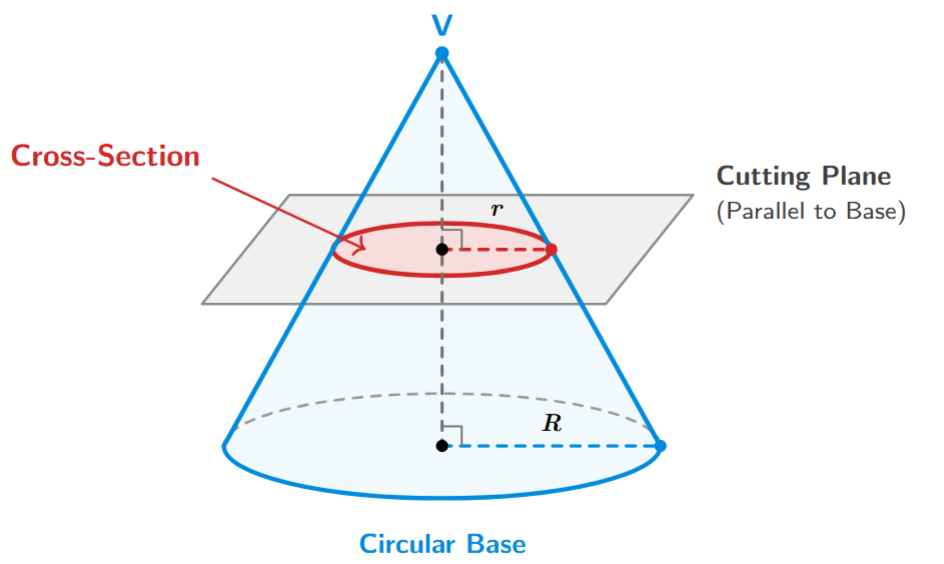
A right circular cone has a circular base. When a plane cuts the cone parallel to this base, the section that appears on the cutting plane maintains the property of the base but on a different scale.
Any plane parallel to the base of a right circular cone will intersect the cone to form a circle. The size (radius) of this circle decreases as the plane moves from the base toward the vertex.
Note: The remaining solid part is called a frustum, but the cross-section itself is a 2D shape, which is a circle.
The correct option is (A).
Question 20. Volumes of two spheres are in the ratio 64:27. The ratio of their surface areas is
(A) 3 : 4
(B) 4 : 3
(C) 9 : 16
(D) 16 : 9
Answer:
Given:
Ratio of volumes of two spheres $= 64 : 27$
To Find:
Ratio of their surface areas.
Solution:
Let the radii of the two spheres be $R_1$ and $R_2$.
$\text{Volume of a sphere} = \frac{4}{3} \pi R^3$
The ratio of their volumes is:
$\frac{\frac{4}{3} \pi R_1^3}{\frac{4}{3} \pi R_2^3} = \frac{64}{27}$
$\frac{R_1^3}{R_2^3} = \frac{64}{27}$
Taking cube root on both sides:
$\frac{R_1}{R_2} = \sqrt[3]{\frac{64}{27}} = \frac{4}{3}$
... (i)
Now, the ratio of their surface areas ($S_1 : S_2$) is:
$\text{Surface Area of a sphere} = 4 \pi R^2$
$\frac{S_1}{S_2} = \frac{4 \pi R_1^2}{4 \pi R_2^2} = \left(\frac{R_1}{R_2}\right)^2$
Substituting the value from equation (i):
$\frac{S_1}{S_2} = \left(\frac{4}{3}\right)^2 = \frac{16}{9}$
The ratio of the surface areas is 16 : 9.
The correct option is (D).
Sample Question 1 to 5 (Before Exercise 12.2)
Write ‘True’ or ‘False’ and justify your answer.
Sample Question 1: If a solid cone of base radius r and height h is placed over a solid cylinder having same base radius and height as that of the cone, then the curved surface area of the shape is $\pi r \sqrt{h^2 + r^2} + 2\pi rh$ .
Answer:
Statement: True
Given:
Radius of the cone $= r$
Height of the cone $= h$
Radius of the cylinder $= r$
Height of the cylinder $= h$
To Verify:
Whether the total curved surface area of the combined solid is $\pi r \sqrt{h^2 + r^2} + 2\pi rh$.
Solution:
The total curved surface area (CSA) of the combined solid consists of the curved surface area of the cone and the curved surface area of the cylinder.
The slant height ($l$) of the cone is given by:
$l = \sqrt{h^2 + r^2}$
... (i)
$\text{CSA of cone} = \pi r l$
... (ii)
$\text{CSA of cylinder} = 2\pi rh$
... (iii)
The total curved surface area of the shape is:
$\text{Total CSA} = \text{CSA of cone} + \text{CSA of cylinder}$
$\text{Total CSA} = \pi r l + 2\pi rh$
Substituting the value of $l$ from equation (i):
$\text{Total CSA} = \pi r \sqrt{h^2 + r^2} + 2\pi rh$
Since the derived expression matches the given statement, the statement is True.
Sample Question 2: A spherical steel ball is melted to make eight new identical balls. Then, the radius of each new ball be $\frac{1}{8}$ th the radius of the original ball.
Answer:
Statement: False
Solution:
Let the radius of the original spherical ball be $R$ and the radius of each new identical ball be $r$.
According to the condition of melting and recasting:
$\text{Volume of original ball} = 8 \times \text{Volume of one new ball}$
$\frac{4}{3} \pi R^3 = 8 \times \left( \frac{4}{3} \pi r^3 \right)$
$R^3 = 8r^3$
[Cancelling $\frac{4}{3}\pi$]
Taking the cube root on both sides:
$R = 2r$
... (i)
$\displaystyle r = \frac{R}{2}$
This shows that the radius of each new ball is half ($\frac{1}{2}$) of the radius of the original ball, not $\frac{1}{8}$th. Thus, the statement is False.
Sample Question 3: Two identical solid cubes of side a are joined end to end. Then the total surface area of the resulting cuboid is 12a2.
Answer:
Statement: False
Solution:
When two identical cubes of side $a$ are joined end to end, they form a cuboid.
The dimensions of the resulting cuboid are:
Length ($l$) $= a + a = 2a$
Breadth ($b$) $= a$
Height ($h$) $= a$
The total surface area (TSA) of the cuboid is calculated as:
$\text{TSA} = 2(lb + bh + hl)$
$\text{TSA} = 2(2a \times a + a \times a + a \times 2a)$
$\text{TSA} = 2(2a^2 + a^2 + 2a^2)$
$\text{TSA} = 2(5a^2) = 10a^2$
The total surface area of the resulting cuboid is $10a^2$, not $12a^2$. Hence, the statement is False.
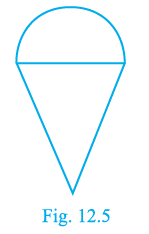
Sample Question 4: Total surface area of a lattu (top) as shown in the Fig. 12.5 is the sum of total surface area of hemisphere and the total surface area of cone.
Answer:
Statement: False
Solution:
A lattu is formed by joining a hemisphere and a cone at their circular bases.
When these two solids are joined, the base of the cone and the base of the hemisphere are no longer visible as they form the internal interface of the solid.
The total surface area of the lattu is the sum of the curved surface areas of the components:
$\text{TSA of lattu} = \text{CSA of hemisphere} + \text{CSA of cone}$
The statement incorrectly mentions the sum of the total surface areas, which would erroneously include the area of the internal bases twice. Therefore, the statement is False.
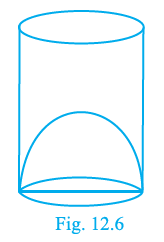
Sample Question 5: Actual capacity of a vessel as shown in the Fig. 12.6 is equal to the difference of volume of the cylinder and volume of the hemisphere.
Answer:
Statement: True
Solution:
The capacity of a vessel is defined as the internal volume available to hold any substance.
As observed in Fig. 12.6, the vessel is cylindrical, but its bottom is not flat. Instead, there is a hemispherical portion that is raised or pushed into the cylinder from the bottom.
This hemispherical part occupies space inside the cylinder that would otherwise be available for liquid.
$\text{Actual capacity} = \text{Volume of cylinder} - \text{Volume of hemisphere}$
Thus, the statement is True.
Exercise 12.2
Write ‘True’ or ‘False’ and justify your answer in the following:
Question 1. Two identical solid hemispheres of equal base radius r cm are stuck together along their bases. The total surface area of the combination is 6πr2 .
Answer:
Statement: False
Given:
Radius of each solid hemisphere $= r \text{ cm}$
The hemispheres are stuck together along their circular bases.
Solution:
When two identical solid hemispheres are joined along their bases, the resulting solid is a complete sphere of the same radius $r$.
The total surface area of the new solid is the sum of the curved surface areas of the two hemispheres, because the flat circular bases are now hidden inside the joint.
$\text{CSA of one hemisphere} = 2\pi r^2$
... (i)
$\text{Total Surface Area} = 2 \times (2\pi r^2)$
[From (i)]
$\text{Total Surface Area} = 4\pi r^2 \text{ cm}^2$
... (ii)
The statement claims the area is $6\pi r^2$, which is actually the sum of the total surface areas of two separate hemispheres ($3\pi r^2 + 3\pi r^2$). Since they are joined, the surface area is $4\pi r^2$.
Question 2. A solid cylinder of radius r and height h is placed over other cylinder of same height and radius. The total surface area of the shape so formed is 4πrh + 4πr2 .
Answer:
Statement: False
Given:
Two solid cylinders, each with radius $= r$ and height $= h$.
One is placed over the other.
Solution:
When one cylinder is placed over another of the same radius and height, they form a single larger cylinder with:
New Radius ($R$) $= r$
New Height ($H$) $= h + h = 2h$
The total surface area (TSA) of a cylinder is given by $2\pi RH + 2\pi R^2$. Substituting the values:
$\text{TSA} = 2\pi r(2h) + 2\pi r^2$
$\text{TSA} = 4\pi rh + 2\pi r^2$
The given statement claims the TSA is $4\pi rh + 4\pi r^2$, which is incorrect as it includes two extra base areas that are actually hidden at the joint. The correct TSA is $4\pi rh + 2\pi r^2$.
Question 3. A solid cone of radius r and height h is placed over a solid cylinder having same base radius and height as that of a cone. The total surface area of the combined solid is $\pi r \left[ \sqrt{r^2 + h^2} + 3r + 2h \right]$ .
Answer:
Statement: False
Given:
Radius of cone and cylinder $= r$
Height of cone and cylinder $= h$
Solution:
The combined solid consists of a cone on top of a cylinder. The surface area of this solid includes:
1. Curved Surface Area of the cone $= \pi r l = \pi r \sqrt{r^2 + h^2}$
2. Curved Surface Area of the cylinder $= 2\pi rh$
3. Area of the bottom circular base of the cylinder $= \pi r^2$
Note: The base of the cone and the top of the cylinder are joined and hidden.
$\text{Total Surface Area} = \pi r \sqrt{r^2 + h^2} + 2\pi rh + \pi r^2$
Taking $\pi r$ as common:
$\text{TSA} = \pi r \left[ \sqrt{r^2 + h^2} + 2h + r \right]$
The statement gives the expression with $3r$, but the calculation shows it should be $r$. Hence, the statement is False.
Question 4. A solid ball is exactly fitted inside the cubical box of side a. The volume of the ball is $\frac{4}{3}$πa3
Answer:
Statement: False
Given:
Side of the cubical box $= a$
A solid ball (sphere) is fitted exactly inside the box.
Solution:
If the ball fits exactly inside the cube, its diameter must be equal to the side of the cube.
$\text{Diameter of ball} = a$
... (i)
$\text{Radius of the ball (r)} = \frac{a}{2}$
$\text{Volume of the ball} = \frac{4}{3} \pi r^3$
$\text{Volume} = \frac{4}{3} \pi \left( \frac{a}{2} \right)^3$
$\text{Volume} = \frac{4}{3} \pi \times \frac{a^3}{8}$
$\text{Volume} = \frac{1}{6} \pi a^3$
[On simplification] ... (ii)
The statement claims the volume is $\frac{4}{3}\pi a^3$, which is incorrect. The correct volume is $\frac{1}{6}\pi a^3$.
Question 5. The volume of the frustum of a cone is $\frac{1}{3}$πh[r12 + r22 - r1r2] where h is vertical height of the frustum and r1 , r2 are the radii of the ends.
Answer:
Statement: False
Solution:
A frustum of a cone is the part of the cone remaining after a smaller cone is cut off by a plane parallel to the base. The standard formula for its volume is derived using the subtraction of volumes of two cones.
The correct formula for the volume of a frustum of height $h$ with radii $r_1$ and $r_2$ is:
$\displaystyle V = \frac{1}{3} \pi h [r_1^2 + r_2^2 + r_1 r_2]$
... (i)
The expression in the question contains a minus sign ($- r_1 r_2$), whereas the correct mathematical formula uses a plus sign ($+ r_1 r_2$). Therefore, the statement is False.
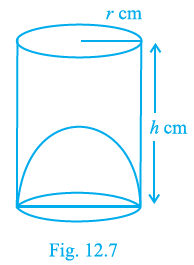
Question 6. The capacity of a cylindrical vessel with a hemispherical portion raised upward at the bottom as shown in the Fig. 12.7 is $\frac{\pi r^2}{3}\left[ 3h - 2r \right]$ .
Answer:
Statement: True
Given:
Radius of the cylindrical vessel $= r$
Height of the cylindrical vessel $= h$
A hemispherical portion of radius $r$ is raised upward at the bottom.
To Find:
The capacity (internal volume) of the vessel.
Solution:
The capacity of the vessel is the volume available for holding any substance. Since the hemisphere is pushed inside the cylinder, that space is excluded from the total volume.
$\text{Volume of Cylinder} = \pi r^2 h$
... (i)
$\text{Volume of Hemisphere} = \frac{2}{3} \pi r^3$
... (ii)
The actual capacity of the vessel is given by:
$\text{Capacity} = \text{Volume of Cylinder} - \text{Volume of Hemisphere}$
$\text{Capacity} = \pi r^2 h - \frac{2}{3} \pi r^3$
Taking $\frac{\pi r^2}{3}$ as a common factor:
$\text{Capacity} = \frac{\pi r^2}{3} [3h - 2r]$
[Factoring out $\pi r^2/3$] ... (iii)
Since the derived formula matches the one given in the question, the statement is True.
Question 7. The curved surface area of a frustum of a cone is πl(r1 + r2), where $l = \sqrt{h^{2} + (r_{1} + r_{2})^2}$ , r1 and r2 are the radii of the two nds of the frustum and h is the vertical height.
Answer:
Statement: False
Solution:
The curved surface area (CSA) of a frustum of a cone with radii $r_1$ and $r_2$ and slant height $l$ is indeed given by:
$\text{CSA} = \pi l (r_1 + r_2)$
... (i)
However, the slant height $l$ is defined as the distance between the boundaries of the two circular ends along the slanted surface. In a frustum, it is calculated using the vertical height $h$ and the difference of the radii.
The correct formula for the slant height $l$ is:
$l = \sqrt{h^2 + (r_1 - r_2)^2}$
... (ii)
The statement incorrectly uses $(r_1 + r_2)^2$ instead of $(r_1 - r_2)^2$. Therefore, the statement is False.
Question 8. An open metallic bucket is in the shape of a frustum of a cone, mounted on a hollow cylindrical base made of the same metallic sheet. The surface area of the metallic sheet used is equal to curved surface area of frustum of a cone + area of circular base + curved surface area of cylinder
Answer:
Statement: True
Solution:
An open bucket constructed this way has three distinct surfaces that require metallic sheet:
1. Curved Surface of the Frustum: This forms the main slanted body of the bucket.
2. Circular Base: Since the bucket must hold contents, the bottom circular part of the frustum (where it meets the cylinder) must be closed with a metallic sheet.
3. Curved Surface of the Cylinder: The bucket is "mounted" on a hollow cylindrical base, meaning only the lateral (curved) wall of the cylinder is added as a stand.
The top of the frustum remains open, so its area is not included.
Therefore, the total area of the sheet used is:
$\text{Total Area} = \text{CSA of frustum} + \text{Area of base} + \text{CSA of cylinder}$
This matches the description provided in the question. Thus, the statement is True.
Sample Question 1 to 5 (Before Exercise 12.3)
Sample Question 1: A cone of maximum size is carved out from a cube of edge 14 cm. Find the surface area of the cone and of the remaining solid left out after the cone carved out
Answer:
Given:
Edge of the cube ($a$) = $14 \text{ cm}$
A cone of maximum size is carved out. For such a cone:
Diameter of the base = Edge of the cube = $14 \text{ cm}$
Radius of the cone ($r$) = $7 \text{ cm}$
Height of the cone ($h$) = Edge of the cube = $14 \text{ cm}$
To Find:
1. Surface area of the cone.
2. Surface area of the remaining solid.
Solution:
First, we find the slant height ($l$) of the cone:
$l = \sqrt{r^2 + h^2}$
$l = \sqrt{7^2 + 14^2} = \sqrt{49 + 196} = \sqrt{245}$
$l = 7\sqrt{5} \approx 15.65 \text{ cm}$
... (i)
Total Surface Area of the cone = $\pi r l + \pi r^2$
$\text{Area} = \frac{22}{7} \times 7 \times (15.65 + 7)$
$\text{Area} = 22 \times 22.65$
Surface area of the cone $\approx 498.3 \text{ cm}^2$
Now, for the remaining solid, the surface area consists of the 5 faces of the cube, the top face minus the circular base, and the curved inner surface of the cone.
$\text{Remaining Surface Area} = 6a^2 - \pi r^2 + \pi r l$
$\text{Area} = 6(14)^2 - \frac{22}{7}(7)^2 + \frac{22}{7}(7)(15.65)$
$\text{Area} = 6(196) - 154 + 344.3$
$\text{Area} = 1176 - 154 + 344.3$
Surface area of the remaining solid $\approx 1366.3 \text{ cm}^2$
Sample Question 2: A solid metallic sphere of radius 10.5 cm is melted and recast into a number of smaller cones, each of radius 3.5 cm and height 3 cm. Find the number of cones so formed.
Answer:
Given:
Radius of the metallic sphere ($R$) = $10.5 \text{ cm}$
Radius of each smaller cone ($r$) = $3.5 \text{ cm}$
Height of each smaller cone ($h$) = $3 \text{ cm}$
To Find:
Number of cones formed ($n$).
Solution:
When a solid is melted and recast, the total volume remains the same.
$\text{Volume of Sphere} = n \times \text{Volume of one cone}$
$\frac{4}{3} \pi R^3 = n \times \frac{1}{3} \pi r^2 h$
$4 R^3 = n \times r^2 h$
$n = \frac{4 \times (10.5)^3}{(3.5)^2 \times 3}$
$n = \frac{4 \times 10.5 \times 10.5 \times 10.5}{3.5 \times 3.5 \times 3}$
Performing cancellation:
$n = \frac{4 \times \cancel{10.5}^3 \times \cancel{10.5}^3 \times \cancel{10.5}^{3.5}}{\cancel{3.5}_1 \times \cancel{3.5}_1 \times \cancel{3}_1}$
$n = 4 \times 3 \times 3 \times 3.5$
$n = 36 \times 3.5$
The number of cones formed is 126.
Sample Question 3: A canal is 300 cm wide and 120 cm deep. The water in the canal is flowing with a speed of 20 km/h. How much area will it irrigate in 20 minutes if 8 cm of standing water is desired?
Answer:
Given:
Width of canal = $300 \text{ cm} = 3 \text{ m}$
Depth of canal = $120 \text{ cm} = 1.2 \text{ m}$
Speed of water = $20 \text{ km/h} = 20,000 \text{ m/h}$
Time = $20 \text{ minutes} = \frac{20}{60} = \frac{1}{3} \text{ hour}$
Height of standing water required = $8 \text{ cm} = 0.08 \text{ m}$
To Find:
Area irrigated in 20 minutes.
Solution:
The volume of water flowing through the canal in 20 minutes acts as the length of a rectangular solid of water.
$\text{Length of water column} = \text{Speed} \times \text{Time}$
$\text{Length} = 20,000 \times \frac{1}{3} \text{ metres}$
$\text{Volume of water} = \text{Width} \times \text{Depth} \times \text{Length}$
$\text{Volume} = 3 \times 1.2 \times \left(\frac{20,000}{3}\right)$
$\text{Volume} = 24,000 \text{ m}^3$
Let the area irrigated be $A$.
$\text{Volume of water} = \text{Area} \times \text{Height of standing water}$
$24,000 = A \times 0.08$
$A = \frac{24,000}{0.08} = \frac{2,400,000}{8}$
Area irrigated = 3,00,000 m2 (or 30 hectares).
Sample Question 4: A cone of radius 4 cm is divided into two parts by drawing a plane through the mid point of its axis and parallel to its base. Compare the volumes of the two parts.
Answer:
Given:
Radius of the original cone ($R$) = $4 \text{ cm}$
The cone is divided into two parts by a plane parallel to the base passing through the midpoint of its axis.
To Find:
Compare the volumes of the two resulting parts (the smaller cone and the frustum).
Solution:
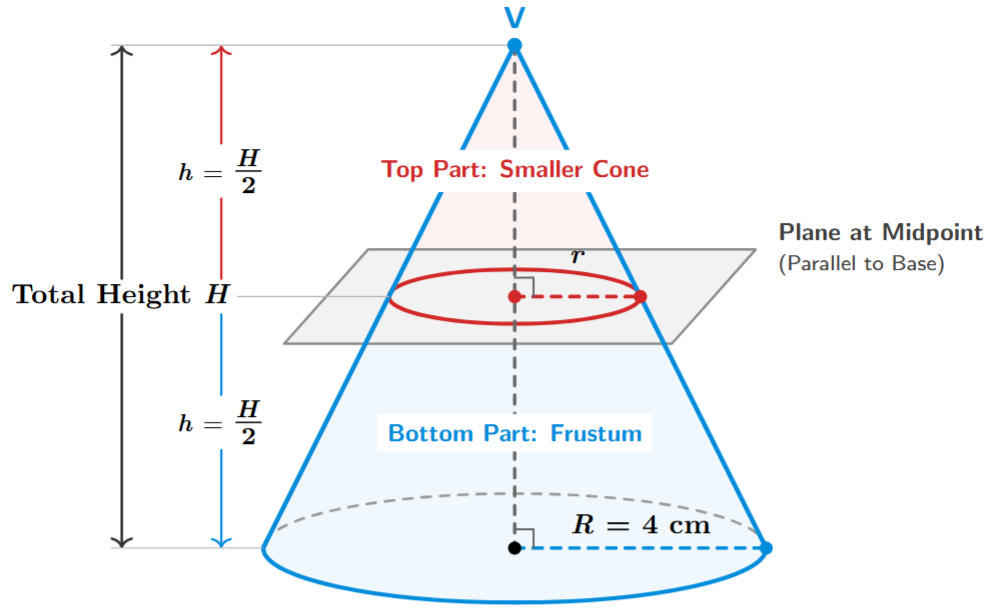
Let $H$ be the height of the original cone and $R$ be its base radius.
Let $h$ and $r$ be the height and radius of the smaller cone formed at the top part.
Since the plane is parallel to the base, the smaller cone is similar to the original cone.
$\frac{r}{R} = \frac{h}{H}$
(By similarity of triangles)
According to the question, the plane passes through the midpoint of the axis.
$h = \frac{H}{2}$
... (i)
Substituting (i) into the similarity ratio:
$\frac{r}{R} = \frac{H/2}{H} = \frac{1}{2}$
$r = \frac{R}{2}$
Now, calculate the volume of the smaller cone ($V_1$):
$V_1 = \frac{1}{3} \pi r^2 h$
$V_1 = \frac{1}{3} \pi \left( \frac{R}{2} \right)^2 \left( \frac{H}{2} \right)$
$V_1 = \frac{1}{24} \pi R^2 H$
... (ii)
Calculate the volume of the original larger cone ($V$):
$V = \frac{1}{3} \pi R^2 H$
The volume of the bottom part, which is a frustum ($V_2$), is the difference between the total volume and the top cone's volume:
$V_2 = V - V_1$
$V_2 = \frac{1}{3} \pi R^2 H - \frac{1}{24} \pi R^2 H$
$V_2 = \frac{7}{24} \pi R^2 H$
... (iii)
To compare the volumes of the two parts ($V_1$ and $V_2$), we find their ratio:
$\frac{V_1}{V_2} = \frac{\frac{1}{24} \pi R^2 H}{\frac{7}{24} \pi R^2 H}$
$\frac{V_1}{V_2} = \frac{1}{7}$
The ratio of the volumes of the two parts is 1 : 7.
Sample Question 5: Three cubes of a metal whose edges are in the ratio 3:4:5 are melted and converted into a single cube whose diagonal is 12$\sqrt{3}$ cm. Find the edges of the three cubes.
Answer:
Given:
Ratio of edges of three cubes = $3 : 4 : 5$.
Let the edges be $3x$, $4x$, and $5x$.
Diagonal of the new single cube = $12\sqrt{3} \text{ cm}$.
To Find:
The edges of the three original cubes.
Solution:
Let the side of the new cube be $L$.
$\text{Diagonal} = L\sqrt{3}$
(Formula for diagonal)
$12\sqrt{3} = L\sqrt{3} \implies L = 12 \text{ cm}$.
The volume of the single cube is equal to the sum of the volumes of the three cubes.
$(3x)^3 + (4x)^3 + (5x)^3 = (12)^3$
$27x^3 + 64x^3 + 125x^3 = 1728$
$216x^3 = 1728$
... (i)
$x^3 = \frac{1728}{216}$
Performing cancellation:
$x^3 = \frac{\cancel{1728}^8}{\cancel{216}_1} = 8$
$x = \sqrt[3]{8} = 2$
The edges are:
$3x = 3 \times 2 = 6 \text{ cm}$
$4x = 4 \times 2 = 8 \text{ cm}$
$5x = 5 \times 2 = 10 \text{ cm}$
The edges of the three cubes are 6 cm, 8 cm, and 10 cm.
Exercise 12.3
Question 1. Three metallic solid cubes whose edges are 3 cm, 4 cm and 5 cm are melted and formed into a single cube. Find the edge of the cube so formed.
Answer:
Given:
Edges of the three metallic solid cubes are $a_1 = 3$ cm, $a_2 = 4$ cm, and $a_3 = 5$ cm.
These cubes are melted and formed into a single cube.
To Find:
The edge length of the single cube so formed.
Solution:
When solid cubes are melted and recast into a single solid, the total volume of the metal is conserved.
Volume of the first cube, $V_1 = a_1^3 = (3)^3 = 27$ cm$^3$.
Volume of the second cube, $V_2 = a_2^3 = (4)^3 = 64$ cm$^3$.
Volume of the third cube, $V_3 = a_3^3 = (5)^3 = 125$ cm$^3$.
Total volume of the three cubes $= V_1 + V_2 + V_3 = 27 + 64 + 125$ cm$^3$.
Total volume $= 91 + 125 = 216$ cm$^3$.
Let the edge of the new single cube be $A$ cm.
The volume of the new cube is $V_{new} = A^3$ cm$^3$.
According to the conservation of volume:
Volume of new cube = Total volume of the three original cubes
$A^3 = 216$
To find the edge $A$, take the cube root of both sides:
$A = \sqrt[3]{216}$
We know that $6^3 = 6 \times 6 \times 6 = 36 \times 6 = 216$.
$A = 6$ cm.
The edge of the cube so formed is 6 cm.
Question 2. How many shots each having diameter 3 cm can be made from a cuboidal lead solid of dimensions 9cm × 11cm × 12cm?
Answer:
Given:
Dimensions of the cuboidal lead solid are length $L = 12$ cm, breadth $B = 11$ cm, and height $H = 9$ cm.
Diameter of each spherical shot is $D = 3$ cm.
To Find:
The number of spherical shots that can be made from the cuboidal solid.
Solution:
When a solid is melted and recast into smaller solids, the total volume of the material remains constant.
Volume of the cuboidal lead solid is given by $V_{cuboid} = L \times B \times H$.
$V_{cuboid} = 12 \text{ cm} \times 11 \text{ cm} \times 9 \text{ cm}$
$V_{cuboid} = 132 \times 9$ cm$^3$
$V_{cuboid} = 1188$ cm$^3$.
The spherical shots are spheres. The diameter of each shot is 3 cm, so the radius is $r = \frac{\text{Diameter}}{2} = \frac{3}{2} = 1.5$ cm.
The volume of one spherical shot is given by the formula $V_{shot} = \frac{4}{3}\pi r^3$.
$V_{shot} = \frac{4}{3} \pi \left(\frac{3}{2}\right)^3$
$V_{shot} = \frac{4}{3} \pi \left(\frac{3^3}{2^3}\right)$
$V_{shot} = \frac{4}{3} \pi \left(\frac{27}{8}\right)$
$V_{shot} = \frac{\cancel{4}^1 \times \pi \times \cancel{27}^9}{\cancel{3}_1 \times \cancel{8}_2}$
$V_{shot} = \frac{9\pi}{2}$ cm$^3$.
Let $n$ be the number of shots that can be made.
The total volume of $n$ shots must be equal to the volume of the cuboidal solid.
$n \times V_{shot} = V_{cuboid}$
$n \times \frac{9\pi}{2} = 1188$
Solve for $n$:
$n = \frac{1188}{\frac{9\pi}{2}}$
$n = 1188 \times \frac{2}{9\pi}$
$n = \frac{1188 \times 2}{9\pi}$
We need to use a value for $\pi$. Assuming $\pi \approx \frac{22}{7}$ (a common approximation in such problems):
$n = \frac{1188 \times 2}{9 \times \frac{22}{7}}$
$n = \frac{1188 \times 2}{9} \times \frac{7}{22}$
Simplify the expression:
First, divide 1188 by 9:
$1188 \div 9 = 132$
So, $n = 132 \times 2 \times \frac{7}{22}$
$n = 264 \times \frac{7}{22}$
Now, divide 264 by 22:
$264 \div 22 = 12$
So, $n = 12 \times 7$
$n = 84$
Thus, 84 spherical shots can be made from the cuboidal lead solid.
Question 3. A bucket is in the form of a frustum of a cone and holds 28.490 litres of water. The radii of the top and bottom are 28 cm and 21 cm, respectively. Find the height of the bucket.
Answer:
Given:
Capacity (Volume) of the bucket ($V$) = $28.490 \text{ litres}$
$V = 28.490 \times 1000 = 28490 \text{ cm}^3$
($1 \text{ litre} = 1000 \text{ cm}^3$)
Radius of the top ($R$) = $28 \text{ cm}$
Radius of the bottom ($r$) = $21 \text{ cm}$
To Find:
The height of the bucket ($h$).
Solution:
The bucket is in the shape of a frustum of a cone. Its volume is given by:
$V = \frac{1}{3} \pi h (R^2 + r^2 + Rr)$
... (i)
Substituting the given values in equation (i):
$28490 = \frac{1}{3} \times \frac{22}{7} \times h \times (28^2 + 21^2 + 28 \times 21)$
$28490 = \frac{22}{21} \times h \times (784 + 441 + 588)$
$28490 = \frac{22}{21} \times h \times 1813$
Rearranging the terms to find $h$:
$h = \frac{28490 \times 21}{22 \times 1813}$
First, performing cancellation with 11:
$h = \frac{\cancel{28490}^{2590} \times 21}{\cancel{22}_{2} \times 1813}$
$h = \frac{2590 \times 21}{2 \times 1813} = \frac{1295 \times 21}{1813}$
Further cancellation with 7:
$h = \frac{1295 \times \cancel{21}^{3}}{\cancel{1813}_{259}}$
$h = \frac{\cancel{1295}^{5} \times 3}{\cancel{259}_{1}}$
$h = 5 \times 3 = 15 \text{ cm}$
The height of the bucket is 15 cm.
Question 4. A cone of radius 8 cm and height 12 cm is divided into two parts by a plane through the mid-point of its axis parallel to its base. Find the ratio of the volumes of two parts.
Answer:
Given:
Height of the original cone ($H$) = $12 \text{ cm}$
Radius of the original cone ($R$) = $8 \text{ cm}$
The plane passes through the midpoint of the axis ($h = H/2 = 6 \text{ cm}$).
To Find:
The ratio of the volumes of the two parts (top cone and bottom frustum).
Solution:
Let $r$ be the radius of the smaller cone at the top. By similarity of triangles:
$\frac{r}{R} = \frac{h}{H}$
... (i)
Since $h$ is the midpoint, $\frac{h}{H} = \frac{1}{2}$. Thus, $r = \frac{R}{2} = \frac{8}{2} = 4 \text{ cm}$.
Volume of smaller top cone ($V_1$):
$V_1 = \frac{1}{3} \pi r^2 h = \frac{1}{3} \pi (4)^2 (6) = 32\pi \text{ cm}^3$
Volume of original larger cone ($V$):
$V = \frac{1}{3} \pi R^2 H = \frac{1}{3} \pi (8)^2 (12) = 256\pi \text{ cm}^3$
Volume of bottom part (frustum) ($V_2$):
$V_2 = V - V_1 = 256\pi - 32\pi = 224\pi \text{ cm}^3$
Ratio of the volumes of the two parts:
$\frac{V_1}{V_2} = \frac{32\pi}{224\pi}$
Performing cancellation:
$\text{Ratio} = \frac{\cancel{32}^{1}}{\cancel{224}_{7}}$
The ratio of the volumes of the two parts is 1 : 7.
Question 5. Two identical cubes each of volume 64 cm3 are joined together end to end. What is the surface area of the resulting cuboid?
Answer:
Given:
Volume of each cube = $64 \text{ cm}^3$
To Find:
Surface area of the resulting cuboid.
Solution:
Let the side of each cube be $a$.
$a^3 = 64 \implies a = \sqrt[3]{64} = 4 \text{ cm}$
When two such cubes are joined end to end, the dimensions of the resulting cuboid are:
Length ($l$) = $4 + 4 = 8 \text{ cm}$
Breadth ($b$) = $4 \text{ cm}$
Height ($h$) = $4 \text{ cm}$
Surface Area of cuboid = $2(lb + bh + hl)$
$\text{Area} = 2(8 \times 4 + 4 \times 4 + 4 \times 8)$
$\text{Area} = 2(32 + 16 + 32)$
[On calculation]
$\text{Area} = 2(80) = 160 \text{ cm}^2$
The surface area of the resulting cuboid is 160 cm2.
Question 6. From a solid cube of side 7 cm, a conical cavity of height 7 cm and radius 3 cm is hollowed out. Find the volume of the remaining solid.
Answer:
Given:
Side of the cube ($a$) = $7 \text{ cm}$
Radius of conical cavity ($r$) = $3 \text{ cm}$
Height of conical cavity ($h$) = $7 \text{ cm}$
To Find:
The volume of the remaining solid.
Solution:
$\text{Volume of cube} = a^3 = 7^3 = 343 \text{ cm}^3$
... (i)
$\text{Volume of cone} = \frac{1}{3} \pi r^2 h$
... (ii)
$\text{Volume of cone} = \frac{1}{3} \times \frac{22}{7} \times (3)^2 \times 7$
$\text{Volume of cone} = \frac{1}{3} \times 22 \times 9 = 22 \times 3 = 66 \text{ cm}^3$
Remaining Volume = Volume of cube - Volume of conical cavity
$\text{Remaining Volume} = 343 - 66$
The volume of the remaining solid is 277 cm3.
Question 7. Two cones with same base radius 8 cm and height 15 cm are joined together along their bases. Find the surface area of the shape so formed.
Answer:
Given:
Radius of each cone ($r$) = $8 \text{ cm}$
Height of each cone ($h$) = $15 \text{ cm}$
To Find:
Surface area of the shape formed by joining them at the bases.
Solution:
When two cones are joined along their bases, the base area is hidden. The total surface area of the resulting solid is the sum of the curved surface areas (CSA) of the two cones.
Slant height ($l$) of each cone:
$l = \sqrt{r^2 + h^2} = \sqrt{8^2 + 15^2}$
$l = \sqrt{64 + 225} = \sqrt{289}$
$l = 17 \text{ cm}$
$\text{Total Surface Area} = 2 \times (\text{CSA of one cone})$
$\text{TSA} = 2 \times \pi r l = 2 \times \frac{22}{7} \times 8 \times 17$
$\text{TSA} = \frac{44 \times 136}{7} = \frac{5984}{7}$
$\text{TSA} \approx 854.85 \text{ cm}^2$
[On division]
The surface area of the shape formed is approximately 854.85 cm2.
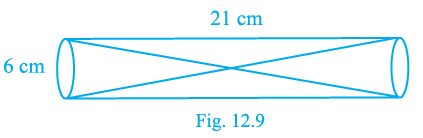
Question 8. Two solid cones A and B are placed in a cylinderical tube as shown in the Fig.12.9. The ratio of their capacities are 2:1. Find the heights and capacities of cones. Also, find the volume of the remaining portion of the cylinder.
Answer:
Given:
Diameter of the cylindrical tube = $6 \text{ cm} \implies$ Radius ($r$) = $3 \text{ cm}$
Total height of the cylinder ($H_{cyl}$) = $21 \text{ cm}$
Ratio of capacities of Cone A ($V_A$) and Cone B ($V_B$) = $2 : 1$
To Find:
1. Heights of the cones ($h_A, h_B$).
2. Capacities of the cones ($V_A, V_B$).
3. Volume of the remaining portion of the cylinder.
Solution:
Both cones share the same base as the cylindrical tube, so their radii are $r = 3 \text{ cm}$.
Let the heights of cones A and B be $h_A$ and $h_B$ respectively.
From the figure: $h_A + h_B = 21 \text{ cm}$.
Ratio of capacities: $\frac{V_A}{V_B} = \frac{\frac{1}{3} \pi r^2 h_A}{\frac{1}{3} \pi r^2 h_B} = \frac{h_A}{h_B} = \frac{2}{1}$
Thus, $h_A = 2h_B$. Substituting this into the sum of heights:
$2h_B + h_B = 21 \implies 3h_B = 21 \implies h_B = 7 \text{ cm}$
And, $h_A = 2 \times 7 = 14 \text{ cm}$.
Capacities:
$V_A = \frac{1}{3} \pi r^2 h_A = \frac{1}{3} \times \frac{22}{7} \times (3)^2 \times 14 = 22 \times 3 \times 2 = 132 \text{ cm}^3$
$V_B = \frac{1}{3} \pi r^2 h_B = \frac{1}{3} \times \frac{22}{7} \times (3)^2 \times 7 = 22 \times 3 = 66 \text{ cm}^3$
Remaining Volume:
$\text{Volume of Cylinder} = \pi r^2 H_{cyl} = \frac{22}{7} \times (3)^2 \times 21 = 22 \times 9 \times 3 $$ = 594 \text{ cm}^3$
$\text{Remaining Volume} = \text{Volume of Cylinder} - (V_A + V_B)$
$\text{Remaining Volume} = 594 - (132 + 66) = 594 - 198$
The heights are 14 cm and 7 cm, capacities are 132 cm3 and 66 cm3, and the remaining volume is 396 cm3.
Question 9. An ice cream cone full of ice cream having radius 5 cm and height 10 cm as shown in the Fig.12.10. Calculate the volume of ice cream, provided that its $\frac{1}{6}$ part is left unfilled with ice cream.

Answer:
Given:
Radius of the hemisphere and cone ($r$) = $5 \text{ cm}$
Total height of the structure = $10 \text{ cm}$
Unfilled part $= \frac{1}{6} \text{ of the total volume}$
To Find:
Volume of ice cream present in the cone.
Solution:
The ice cream consists of a hemispherical top and a conical bottom. First, find the height of the conical part ($h$):
$h = \text{Total height} - \text{Radius}$
(Radius of hemisphere)
$h = 10 - 5 = 5 \text{ cm}$
Total volume of the ice cream shape ($V$) = Volume of hemisphere + Volume of cone
$V = \frac{2}{3} \pi r^3 + \frac{1}{3} \pi r^2 h$
$V = \frac{1}{3} \pi r^2 (2r + h)$
$V = \frac{1}{3} \times \frac{22}{7} \times 5^2 \times (2 \times 5 + 5)$
$V = \frac{1}{3} \times \frac{22}{7} \times 25 \times 15$
... (i)
$V = \frac{22 \times 25 \times 5}{7} = \frac{2750}{7} \text{ cm}^3$
Since $\frac{1}{6}$ part is unfilled, the volume of ice cream actually present is $\left(1 - \frac{1}{6}\right)$ of the total volume.
$\text{Volume of ice cream} = \frac{5}{6} \times V$
$\text{Volume} = \frac{5}{6} \times \frac{2750}{7}$
$\text{Volume} = \frac{5 \times \cancel{2750}^{1375}}{3 \times \cancel{6} \times 7} = \frac{6875}{21}$
$\text{Volume} \approx 327.38 \text{ cm}^3$
The volume of ice cream is approximately 327.38 cm3.
Question 10. Marbles of diameter 1.4 cm are dropped into a cylindrical beaker of diameter 7 cm containing some water. Find the number of marbles that should be dropped into the beaker so that the water level rises by 5.6 cm.
Answer:
Given:
Diameter of marble ($d$) = $1.4 \text{ cm} \implies$ Radius ($r$) = $0.7 \text{ cm}$
Diameter of beaker ($D$) = $7 \text{ cm} \implies$ Radius ($R$) = $3.5 \text{ cm}$
Rise in water level ($h$) = $5.6 \text{ cm}$
To Find:
Number of marbles ($n$).
Solution:
The volume of water displaced by the marbles is equal to the volume of the $n$ spherical marbles.
$\text{Volume of water rise} = n \times \text{Volume of one marble}$
... (i)
$\pi R^2 h = n \times \frac{4}{3} \pi r^3$
$R^2 h = n \times \frac{4}{3} r^3$
$n = \frac{3 \times R^2 \times h}{4 \times r^3}$
$n = \frac{3 \times 3.5 \times 3.5 \times 5.6}{4 \times 0.7 \times 0.7 \times 0.7}$
Multiplying numerator and denominator by 10 to remove decimals:
$n = \frac{3 \times 35 \times 35 \times 56}{4 \times 7 \times 7 \times 7}$
Performing cancellation:
$n = \frac{3 \times \cancel{35}^5 \times \cancel{35}^5 \times \cancel{56}^{8}}{\cancel{4}_1 \times \cancel{7}_1 \times \cancel{7}_1 \times \cancel{7}_1}$
$n = 3 \times 5 \times 5 \times 2 = 150$
The number of marbles that should be dropped is 150.
Question 11. How many spherical lead shots each of diameter 4.2 cm can be obtained from a solid rectangular lead piece with dimensions 66 cm, 42 cm and 21 cm.
Answer:
Given:
Dimensions of rectangular piece: $66 \text{ cm} \times 42 \text{ cm} \times 21 \text{ cm}$
Diameter of lead shot = $4.2 \text{ cm} \implies$ Radius ($r$) = $2.1 \text{ cm}$
To Find:
Number of lead shots ($n$).
Solution:
$\text{Volume of rectangular piece} = n \times \text{Volume of one lead shot}$
$66 \times 42 \times 21 = n \times \frac{4}{3} \times \frac{22}{7} \times (2.1)^3$
$n = \frac{66 \times 42 \times 21 \times 3 \times 7}{4 \times 22 \times 2.1 \times 2.1 \times 2.1}$
$n = \frac{66 \times 42 \times 21 \times 21}{4 \times 22 \times \frac{21}{10} \times \frac{21}{10} \times \frac{21}{10}}$
$n = \frac{\cancel{66}^3 \times \cancel{42}^2 \times \cancel{21}^1 \times 21 \times 1000}{4 \times \cancel{22}_1 \times \cancel{21}_1 \times \cancel{21}_1 \times \cancel{21}_1}$
$n = \frac{3 \times 2 \times 1000}{4}$
$n = \frac{6000}{4} = 1500$
The number of lead shots is 1500.
Question 12. How many spherical lead shots of diameter 4 cm can be made out of a solid cube of lead whose edge measures 44 cm.
Answer:
Given:
Edge of cube ($a$) = $44 \text{ cm}$
Diameter of spherical shot = $4 \text{ cm} \implies$ Radius ($r$) = $2 \text{ cm}$
To Find:
Number of lead shots ($n$).
Solution:
$\text{Volume of cube} = n \times \text{Volume of one lead shot}$
$a^3 = n \times \frac{4}{3} \pi r^3$
$44 \times 44 \times 44 = n \times \frac{4}{3} \times \frac{22}{7} \times (2)^3$
$n = \frac{44 \times 44 \times 44 \times 3 \times 7}{4 \times 22 \times 8}$
Performing cancellation:
$n = \frac{\cancel{44}^{2} \times \cancel{44}^{11} \times 44 \times 21}{\cancel{4}_{1} \times \cancel{22}_{1} \times 8}$
$n = \frac{2 \times 11 \times 44 \times 21}{8}$
$n = \frac{11 \times 44 \times 21}{4}$
$n = 11 \times 11 \times 21$
$n = 121 \times 21 = 2541$
The number of lead shots is 2541.
Question 13. A wall 24 m long, 0.4 m thick and 6 m high is constructed with the bricks each of dimensions 25 cm × 16 cm × 10 cm. If the mortar occupies $\frac{1}{10}$th of the volume of the wall, then find the number of bricks used in constructing the wall.
Answer:
Given:
Wall dimensions: $L = 24 \text{ m} = 2400 \text{ cm}$, $W = 0.4 \text{ m} = 40 \text{ cm}$, $H = 6 \text{ m} = 600 \text{ cm}$
Brick dimensions: $25 \text{ cm} \times 16 \text{ cm} \times 10 \text{ cm}$
Mortar volume $= \frac{1}{10} \text{ of wall volume}$
To Find:
Number of bricks used.
Solution:
First, calculate the volume of the wall:
$\text{Volume of wall} = 2400 \times 40 \times 600 = 57,600,000 \text{ cm}^3$
Since mortar takes $\frac{1}{10}$ of the space, the space occupied by bricks is:
$\text{Volume for bricks} = \text{Total Volume} \times \left(1 - \frac{1}{10}\right) $$ = \text{Total Volume} \times \frac{9}{10}$
$\text{Volume for bricks} = 57,600,000 \times \frac{9}{10} = 51,840,000 \text{ cm}^3$
Now, find the volume of one brick:
$\text{Volume of one brick} = 25 \times 16 \times 10 = 4000 \text{ cm}^3$
Number of bricks ($n$) = $\frac{\text{Total volume for bricks}}{\text{Volume of one brick}}$
$n = \frac{51,840,000}{4,000}$
Performing cancellation:
$n = \frac{\cancel{51840}^{12960}}{\cancel{4}_{1}}$
The number of bricks used is 12960.
Question 14. Find the number of metallic circular disc with 1.5 cm base diameter and of height 0.2 cm to be melted to form a right circular cylinder of height 10 cm and diameter 4.5 cm.
Answer:
Given:
Disc: Diameter = $1.5 \text{ cm} \implies$ Radius ($r$) = $0.75 \text{ cm}$, height ($h$) = $0.2 \text{ cm}$
Target Cylinder: Diameter = $4.5 \text{ cm} \implies$ Radius ($R$) = $2.25 \text{ cm}$, height ($H$) = $10 \text{ cm}$
To Find:
Number of discs ($n$).
Solution:
The total volume of $n$ discs must be equal to the volume of the resulting cylinder.
$n \times \pi r^2 h = \pi R^2 H$
$n = \frac{R^2 H}{r^2 h}$
[Cancelling $\pi$] ... (i)
$n = \frac{(2.25)^2 \times 10}{(0.75)^2 \times 0.2}$
$n = \left( \frac{2.25}{0.75} \right)^2 \times \frac{10}{0.2}$
$\text{Since } \frac{2.25}{0.75} = 3 \text{ and } \frac{10}{0.2} = 50$:
$n = (3)^2 \times 50$
$n = 9 \times 50 = 450$
The number of metallic discs required is 450.
Sample Question 1 to 3 (Before Exercise 12.4)
Sample Question 1: A bucket is in the form of a frustum of a cone of height 30 cm with radii of its lower and upper ends as 10 cm and 20 cm, respectively. Find the capacity and surface area of the bucket. Also, find the cost of milk which can completely fill the container, at the rate of Rs 25 per litre ( use π = 3.14).
Answer:
Given:
Height of the frustum ($h$) = $30 \text{ cm}$
Radius of the upper end ($R$) = $20 \text{ cm}$
Radius of the lower end ($r$) = $10 \text{ cm}$
Value of $\pi = 3.14$
Rate of milk = $\textsf{₹} 25 \text{ per litre}$
To Find:
1. Capacity (Volume) of the bucket.
2. Surface area of the bucket.
3. Cost of milk to fill the bucket.
Solution:
The capacity of the bucket is given by the volume of the frustum of a cone.
$V = \frac{1}{3} \pi h (R^2 + r^2 + Rr)$
... (i)
$V = \frac{1}{3} \times 3.14 \times 30 \times (20^2 + 10^2 + 20 \times 10)$
$V = 31.4 \times (400 + 100 + 200)$
$V = 31.4 \times 700 = 21980 \text{ cm}^3$
To convert capacity into litres:
$\text{Capacity} = \frac{21980}{1000} = 21.98 \text{ litres}$
($1000 \text{ cm}^3 = 1 \text{ litre}$)
Cost of milk = $21.98 \times 25$
Cost of milk = $\textsf{₹} 549.50$
For the surface area of the bucket (open at the top), we need the slant height ($l$):
$l = \sqrt{h^2 + (R - r)^2} = \sqrt{30^2 + (20 - 10)^2}$
$l = \sqrt{900 + 100} = \sqrt{1000} \approx 31.62 \text{ cm}$
Surface area = Curved Surface Area + Area of the base
$\text{Surface Area} = \pi (R + r) l + \pi r^2$
$\text{Surface Area} = 3.14 \times (20 + 10) \times 31.62 + 3.14 \times 10^2$
$\text{Surface Area} = 3.14 \times 30 \times 31.62 + 314$
$\text{Surface Area} = 2978.604 + 314 = 3292.604 \text{ cm}^2$
Surface area of the bucket $\approx 3292.60 \text{ cm}^2$
Sample Question 2: A solid toy is in the form of a hemisphere surmounted by a right circular cone. The height of the cone is 4 cm and the diameter of the base is 8 cm. Determine the volume of the toy. If a cube circumscribes the toy, then find the difference of the volumes of cube and the toy. Also, find the total surface area of the toy
Answer:
Given:
Diameter of the base of the toy = $8 \text{ cm}$
$\text{Radius } (r) = 4 \text{ cm}$
($\text{Radius} = \text{Diameter} / 2$)
Height of the conical part ($h$) = $4 \text{ cm}$
To Find:
1. Volume of the toy.
2. Difference of the volumes of a circumscribing cube and the toy.
3. Total surface area of the toy.
Solution:
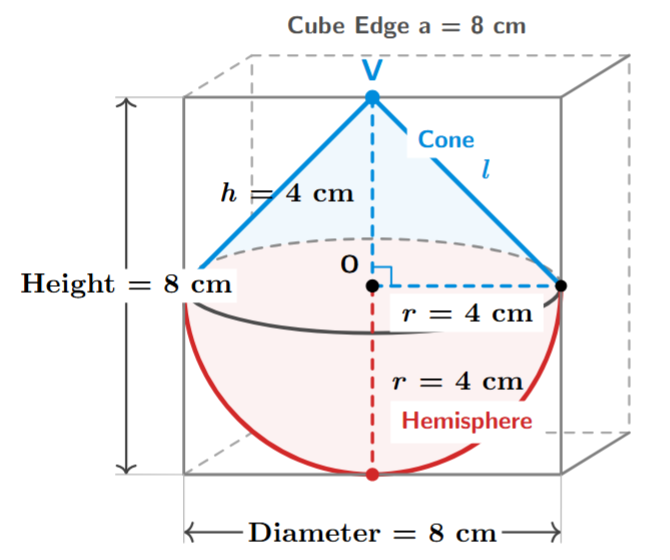
The toy is a combination of a cone and a hemisphere. Its volume ($V$) is the sum of their volumes.
$V = \frac{1}{3} \pi r^2 h + \frac{2}{3} \pi r^3$
... (i)
$V = \frac{1}{3} \pi (4)^2 (4) + \frac{2}{3} \pi (4)^3$
$V = \frac{64\pi}{3} + \frac{128\pi}{3}$
$V = \frac{192\pi}{3} = 64\pi$
Using $\pi \approx 3.142$:
$V = 64 \times 3.142 = 201.088 \text{ cm}^3$
Volume of the toy $\approx 201.1 \text{ cm}^3$
If a cube circumscribes the toy, the length of its edge ($a$) must be equal to the maximum width of the toy (its diameter) and its total height ($h + r$).
$a = 8 \text{ cm}$
[$\text{Diameter} = 8 \text{ cm}, \text{Total height} = 4 + 4 = 8 \text{ cm}$]
$\text{Volume of the cube} = a^3 = 8^3 = 512 \text{ cm}^3$
$\text{Difference of volumes} = \text{Volume of cube} - \text{Volume of toy}$
$\text{Difference} = 512 - 201.1 = 310.9 \text{ cm}^3$
Difference in volumes = 310.9 cm3
The total surface area (TSA) of the toy is the sum of the curved surface area (CSA) of the cone and the CSA of the hemisphere.
First, find the slant height ($l$) of the cone:
$l = \sqrt{r^2 + h^2} = \sqrt{4^2 + 4^2} = \sqrt{16 + 16}$
$l = \sqrt{32} = 4\sqrt{2} \text{ cm}$
$\text{Using } \sqrt{2} \approx 1.414 \implies l \approx 5.656 \text{ cm}$
$\text{TSA of toy} = \pi r l + 2\pi r^2$
$\text{TSA} = \pi r (l + 2r)$
$\text{TSA} = 3.142 \times 4 \times (5.656 + 2 \times 4)$
$\text{TSA} = 12.568 \times (5.656 + 8) = 12.568 \times 13.656$
$\text{TSA} \approx 171.63 \text{ cm}^2$
[On calculation] ... (ii)
Total surface area of the toy $\approx 171.6 \text{ cm}^2$
Sample Question 3: A building is in the form of a cylinder surmounted by a hemispherical dome (see Fig. 12.12). The base diameter of the dome is equal to $\frac{2}{3}$ of the total height of the building. Find the height of the building, if it contains $67\frac{1}{21}$ m3 of air.
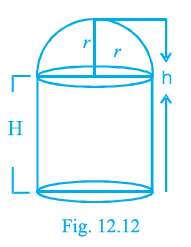
Answer:
Given:
Total height of the building = $H$
Diameter of the dome ($d$) = $\frac{2}{3} H$
Radius ($r$) = $\frac{d}{2} = \frac{1}{2} \times \frac{2}{3} H = \frac{H}{3}$
Volume of air $= 67\frac{1}{21} = \frac{1408}{21} \text{ m}^3$
To Find:
The total height of the building ($H$).
Solution:
Height of the cylindrical part ($h_{cyl}$) = $H - r$
$h_{cyl} = H - \frac{H}{3} = \frac{2H}{3}$
... (i)
Total Volume = Volume of Cylinder + Volume of Hemisphere
$V = \pi r^2 h_{cyl} + \frac{2}{3} \pi r^3$
Substituting values in terms of $H$:
$V = \pi \left( \frac{H}{3} \right)^2 \left( \frac{2H}{3} \right) + \frac{2}{3} \pi \left( \frac{H}{3} \right)^3$
$V = \frac{2\pi H^3}{27} + \frac{2\pi H^3}{81}$
Taking common denominator 81:
$V = \frac{6\pi H^3 + 2\pi H^3}{81} = \frac{8\pi H^3}{81}$
... (ii)
Equating the volume to the given value:
$\frac{8}{81} \times \frac{22}{7} \times H^3 = \frac{1408}{21}$
$H^3 = \frac{1408}{21} \times \frac{81 \times 7}{8 \times 22}$
Performing cancellation:
$H^3 = \frac{1408 \times 81 \times \cancel{7}^1}{\cancel{21}_3 \times 8 \times 22}$
$H^3 = \frac{\cancel{1408}^{64} \times \cancel{27}^{27}}{\cancel{176}_1 \times 1}$
$H^3 = 8 \times 27$
$H = \sqrt[3]{8 \times 27} = 2 \times 3 = 6 \text{ m}$
The total height of the building is 6 m.
Exercise 12.4
Question 1. A solid metallic hemisphere of radius 8 cm is melted and recasted into a right circular cone of base radius 6 cm. Determine the height of the cone.
Answer:
Given:
Radius of the solid metallic hemisphere ($r_1$) = $8 \text{ cm}$
Base radius of the right circular cone ($r_2$) = $6 \text{ cm}$
To Find:
The height of the cone ($h$).
Solution:
When a solid is melted and recast, the volume of the material remains constant.
$\text{Volume of cone} = \text{Volume of hemisphere}$
$\frac{1}{3} \pi r_2^2 h = \frac{2}{3} \pi r_1^3$
Cancelling $\frac{1}{3}\pi$ from both sides:
$r_2^2 h = 2r_1^3$
Substituting the values $r_1 = 8$ and $r_2 = 6$:
$(6)^2 \times h = 2 \times (8)^3$
$36 \times h = 2 \times 512$
$36h = 1024$
$h = \frac{1024}{36}$
Performing cancellation:
$h = \frac{\cancel{1024}^{256}}{\cancel{36}_{9}}$
$h \approx 28.44 \text{ cm}$
[Approximated to 2 decimal places]
The height of the cone is 28.44 cm.
Question 2. A rectangular water tank of base 11 m × 6 m contains water upto a height of 5 m. If the water in the tank is transferred to a cylindrical tank of radius 3.5 m, find the height of the water level in the tank.
Answer:
Given:
Dimensions of rectangular tank: $l = 11 \text{ m}$, $b = 6 \text{ m}$, $h_1 = 5 \text{ m}$
Radius of cylindrical tank ($r$) = $3.5 \text{ m}$
To Find:
Height of the water level in the cylindrical tank ($h_2$).
Solution:
The volume of water transferred remains the same.
$\text{Volume in cylindrical tank} = \text{Volume in rectangular tank}$
$\pi r^2 h_2 = l \times b \times h_1$
$\frac{22}{7} \times (3.5)^2 \times h_2 = 11 \times 6 \times 5$
$\frac{22}{7} \times 12.25 \times h_2 = 330$
$22 \times 1.75 \times h_2 = 330$
$38.5 \times h_2 = 330$
$h_2 = \frac{330}{38.5} = \frac{3300}{385}$
Performing cancellation with 11:
$h_2 = \frac{\cancel{3300}^{300}}{\cancel{385}_{35}}$
$h_2 = \frac{300}{35}$
The height of the water level in the cylindrical tank is 8.57 m.
Question 3. How many cubic centimetres of iron is required to construct an open box whose external dimensions are 36 cm, 25 cm and 16.5 cm provided the thickness of the iron is 1.5 cm. If one cubic cm of iron weighs 7.5 g, find the weight of the box.
Answer:
Given:
External dimensions: $L = 36 \text{ cm}$, $B = 25 \text{ cm}$, $H = 16.5 \text{ cm}$
Thickness of iron $= 1.5 \text{ cm}$
Weight of $1 \text{ cm}^3$ iron $= 7.5 \text{ g}$
To Find:
1. Volume of iron required.
2. Total weight of the box.
Solution:
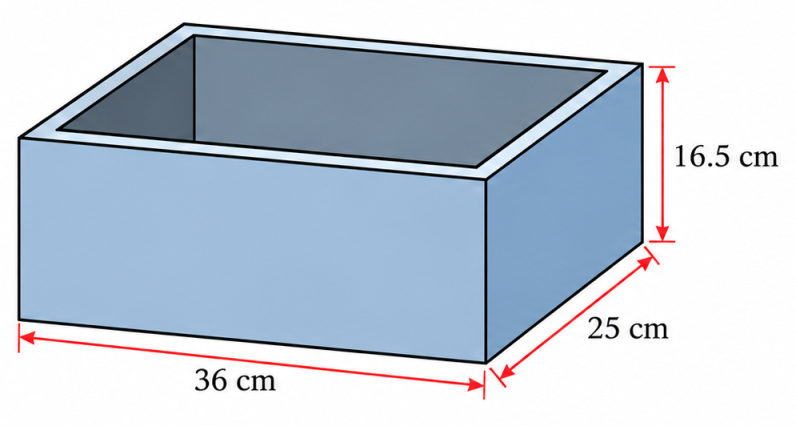
External Volume ($V_{ext}$) $= L \times B \times H = 36 \times 25 \times 16.5$
$V_{ext} = 14850 \text{ cm}^3$
... (i)
Since the box is open at the top, internal dimensions are:
Internal length ($l$) $= L - (2 \times \text{thickness}) = 36 - 3 = 33 \text{ cm}$
Internal breadth ($b$) $= B - (2 \times \text{thickness}) = 25 - 3 = 22 \text{ cm}$
Internal height ($h$) $= H - \text{thickness} = 16.5 - 1.5 = 15 \text{ cm}$
Internal Volume ($V_{int}$) $= l \times b \times h = 33 \times 22 \times 15$
$V_{int} = 10890 \text{ cm}^3$
... (ii)
Volume of iron required $= V_{ext} - V_{int}$
$\text{Volume of iron} = 14850 - 10890$
$\text{Volume of iron} = 3960 \text{ cm}^3$
Weight Calculation:
$\text{Total weight} = \text{Volume of iron} \times \text{Weight per cm}^3$
$\text{Weight} = 3960 \times 7.5$
$\text{Weight} = 29700 \text{ g}$
$\text{Weight} = 29.7 \text{ kg}$
($1000 \text{ g} = 1 \text{ kg}$)
The volume of iron is 3960 cm3 and the weight is 29.7 kg.
Question 4. The barrel of a fountain pen, cylindrical in shape, is 7 cm long and 5 mm in diameter. A full barrel of ink in the pen is used up on writing 3300 words on an average. How many words can be written in a bottle of ink containing one fifth of a litre?
Answer:
Given:
Length of cylindrical barrel ($h$) = $7 \text{ cm}$
Diameter of barrel = $5 \text{ mm} = 0.5 \text{ cm}$
$\text{Radius } (r) = 0.25 \text{ cm}$
($\text{Diameter} / 2$)
Words per full barrel $= 3300$
Total ink volume $= \frac{1}{5} \text{ litre} = \frac{1000}{5} = 200 \text{ cm}^3$
To Find:
Number of words that can be written with 200 cm3 of ink.
Solution:
First, calculate the volume of one barrel of ink:
$V_{barrel} = \pi r^2 h$
$V_{barrel} = \frac{22}{7} \times (0.25)^2 \times 7$
$V_{barrel} = 22 \times 0.0625 = 1.375 \text{ cm}^3$
Number of words written per cm3 of ink:
$\text{Words per cm}^3 = \frac{3300}{1.375} = \frac{3300000}{1375}$
Performing cancellation:
$\text{Words per cm}^3 = \frac{\cancel{3300000}^{2400}}{\cancel{1375}_{1}}$
$1 \text{ cm}^3 \text{ of ink writes } 2400 \text{ words}$
Total words with 200 cm3 of ink:
$\text{Total words} = 200 \times 2400$
$\text{Total words} = 4,80,000$
The number of words that can be written is 4,80,000.
Question 5. Water flows at the rate of 10m/minute through a cylindrical pipe 5 mm in diameter. How long would it take to fill a conical vessel whose diameter at the base is 40 cm and depth 24 cm?
Answer:
Given:
Rate of flow in cylindrical pipe $= 10 \text{ m/min} = 10 \times 100 \text{ cm/min} = 1000 \text{ cm/min}$
Diameter of the pipe $= 5 \text{ mm} = 0.5 \text{ cm} \implies$ Radius of pipe ($r$) $= 0.25 \text{ cm}$
Diameter of the conical vessel $= 40 \text{ cm} \implies$ Radius of vessel ($R$) $= 20 \text{ cm}$
Depth of the conical vessel ($H$) $= 24 \text{ cm}$
To Find:
Time required to fill the conical vessel ($t$).
Solution:
Let the time taken to fill the vessel be $t$ minutes.
The volume of water that flows out of the pipe in $t$ minutes must be equal to the volume of the conical vessel.
$\text{Volume of water from pipe} = \pi r^2 \times (\text{Rate} \times t)$
... (i)
$\text{Volume of conical vessel} = \frac{1}{3} \pi R^2 H$
... (ii)
Equating (i) and (ii):
$\pi \times (0.25)^2 \times 1000 \times t = \frac{1}{3} \times \pi \times (20)^2 \times 24$
$(0.25 \times 0.25) \times 1000 \times t = \frac{1}{3} \times 400 \times 24$
$0.0625 \times 1000 \times t = 400 \times 8$
$62.5 \times t = 3200$
$t = \frac{3200}{62.5}$
$t = \frac{32000}{625}$
Performing cancellation:
$t = \frac{\cancel{32000}^{1280}}{\cancel{625}_{25}}$
$t = \frac{\cancel{1280}^{256}}{\cancel{25}_{5}}$
$t = 51.2 \text{ minutes}$
To convert $0.2$ minutes into seconds: $0.2 \times 60 = 12 \text{ seconds}$.
The time taken to fill the vessel is 51 minutes 12 seconds.
Question 6. A heap of rice is in the form of a cone of diameter 9 m and height 3.5 m. Find the volume of the rice. How much canvas cloth is required to just cover the heap?
Answer:
Given:
Diameter of the conical heap $= 9 \text{ m} \implies$ Radius ($r$) $= 4.5 \text{ m}$
Height of the heap ($h$) $= 3.5 \text{ m}$
To Find:
1. Volume of the rice.
2. Area of canvas cloth required (Curved Surface Area).
Solution:
First, calculate the volume of the rice:
$V = \frac{1}{3} \pi r^2 h$
... (i)
$V = \frac{1}{3} \times \frac{22}{7} \times (4.5)^2 \times 3.5$
$V = \frac{1}{3} \times \frac{22}{7} \times 20.25 \times 3.5$
$V = \frac{22 \times 20.25 \times 0.5}{3}$
$V = \frac{222.75}{3} = 74.25 \text{ m}^3$
Volume of rice is 74.25 m3
To find the canvas required, we need the slant height ($l$):
$l = \sqrt{r^2 + h^2} = \sqrt{(4.5)^2 + (3.5)^2}$
$l = \sqrt{20.25 + 12.25} = \sqrt{32.5} \approx 5.7 \text{ m}$
$\text{Canvas required} = \text{CSA of cone} = \pi r l$
$\text{Area} = \frac{22}{7} \times 4.5 \times 5.7$
$\text{Area} \approx 80.61 \text{ m}^2$
The canvas cloth required is 80.61 m2.
Question 7. A factory manufactures 120000 pencils daily. The pencils are cylindrical in shape each of length 25 cm and circumference of base as 1.5 cm. Determine the cost of colouring the curved surfaces of the pencils manufactured in one day at Rs 0.05 per dm2 .
Answer:
Given:
Number of pencils $= 1,20,000$
Length of one pencil ($h$) $= 25 \text{ cm} = 2.5 \text{ dm}$
Circumference of base ($2\pi r$) $= 1.5 \text{ cm} = 0.15 \text{ dm}$
Rate of colouring $= \textsf{₹} 0.05 \text{ per dm}^2$
To Find:
Total cost of colouring the curved surfaces.
Solution:
The area to be coloured for one pencil is its Curved Surface Area (CSA).
$\text{CSA of one pencil} = 2\pi r h$
... (i)
$\text{CSA} = (\text{Circumference}) \times \text{Height}$
$\text{CSA of one pencil} = 0.15 \text{ dm} \times 2.5 \text{ dm} = 0.375 \text{ dm}^2$
Total area for $1,20,000$ pencils:
$\text{Total Area} = 1,20,000 \times 0.375 \text{ dm}^2$
$\text{Total Area} = 45,000 \text{ dm}^2$
Now, calculate the total cost:
$\text{Total Cost} = \text{Total Area} \times \text{Rate}$
$\text{Cost} = 45,000 \times 0.05$
$\text{Cost} = \textsf{₹} 2,250$
The cost of colouring the pencils manufactured in one day is $\textsf{₹}$ 2,250.
Question 8. Water is flowing at the rate of 15 km/h through a pipe of diameter 14 cm into a cuboidal pond which is 50 m long and 44 m wide. In what time will the level of water in pond rise by 21 cm?
Answer:
Given:
Rate of flow $= 15 \text{ km/h} = 15,000 \text{ m/h}$
Diameter of the pipe $= 14 \text{ cm} \implies$ Radius ($r$) $= 7 \text{ cm} = 0.07 \text{ m}$
Dimensions of the pond: $L = 50 \text{ m}$, $B = 44 \text{ m}$
Required rise in water level ($H$) $= 21 \text{ cm} = 0.21 \text{ m}$
To Find:
Time taken to achieve the rise ($t$).
Solution:
Let the time taken be $t$ hours.
The volume of water flowing from the pipe in $t$ hours must equal the volume of water in the pond for the 21 cm rise.
$\text{Volume required in pond} = L \times B \times H$
$\text{Volume} = 50 \times 44 \times 0.21 = 462 \text{ m}^3$
Volume of water from pipe in $t$ hours:
$\text{Volume from pipe} = \pi r^2 \times (\text{Rate} \times t)$
$\text{Volume} = \frac{22}{7} \times (0.07)^2 \times 15000 \times t$
$\text{Volume} = \frac{22}{7} \times 0.0049 \times 15000 \times t$
$\text{Volume} = 22 \times 0.0007 \times 15000 \times t$
$\text{Volume} = 231 \times t \text{ m}^3$
Equating both volumes:
$231 \times t = 462$
$t = \frac{462}{231}$
$t = 2 \text{ hours}$
The level of water in the pond will rise by 21 cm in 2 hours.
Question 9. A solid iron cuboidal block of dimensions 4.4 m × 2.6 m × 1m is recast into a hollow cylindrical pipe of internal radius 30 cm and thickness 5 cm. Find the length of the pipe.
Answer:
Given:
Dimensions of cuboidal block: $L = 4.4 \text{ m}$, $B = 2.6 \text{ m}$, $H = 1 \text{ m}$
Internal radius of the pipe ($r$) = $30 \text{ cm} = 0.3 \text{ m}$
Thickness of the pipe = $5 \text{ cm} = 0.05 \text{ m}$
To Find:
The length of the pipe ($h$).
Solution:
The external radius ($R$) of the pipe is the sum of the internal radius and the thickness.
$R = r + \text{thickness} = 0.3 + 0.05 = 0.35 \text{ m}$
When the cuboid is recast into a pipe, the volume of iron remains the same.
$\text{Volume of iron in pipe} = \text{Volume of cuboid}$
The volume of a hollow cylinder is $\pi(R^2 - r^2)h$.
$\frac{22}{7} \times [(0.35)^2 - (0.3)^2] \times h = 4.4 \times 2.6 \times 1$
$\frac{22}{7} \times (0.1225 - 0.09) \times h = 11.44$
$\frac{22}{7} \times 0.0325 \times h = 11.44$
$h = \frac{11.44 \times 7}{22 \times 0.0325}$
$h = \frac{\cancel{11.44}^{0.52} \times 7}{\cancel{22}_{1} \times 0.0325}$
$h = \frac{3.64}{0.0325} = 112 \text{ m}$
The length of the pipe is 112 m.
Question 10. 500 persons are taking a dip into a cuboidal pond which is 80 m long and 50 m broad. What is the rise of water level in the pond, if the average displacement of the water by a person is 0.04m3 ?
Answer:
Given:
Dimensions of the pond: $L = 80 \text{ m}$, $B = 50 \text{ m}$
Number of persons = $500$
Average water displacement per person = $0.04 \text{ m}^3$
To Find:
The rise in water level ($h$).
Solution:
Total volume of water displaced by 500 persons is:
$\text{Total Volume} = 500 \times 0.04 = 20 \text{ m}^3$
This displacement causes the water level in the cuboidal pond to rise. The volume of this rise is given by $L \times B \times h$.
$80 \times 50 \times h = 20$
[Volume of rise = Total displacement]
$4000 \times h = 20$
$h = \frac{20}{4000}$
$h = \frac{\cancel{20}^1}{\cancel{4000}_{200}} \text{ m}$
$h = 0.005 \text{ m}$
Converting the rise into centimetres:
$h = 0.005 \times 100 = 0.5 \text{ cm}$
The rise of water level in the pond is 0.5 cm.
Question 11. 16 glass spheres each of radius 2 cm are packed into a cuboidal box of internal dimensions 16 cm × 8 cm × 8 cm and then the box is filled with water. Find the volume of water filled in the box.
Answer:
Given:
Number of glass spheres = $16$
Radius of each sphere ($r$) = $2 \text{ cm}$
Dimensions of the box: $16 \text{ cm} \times 8 \text{ cm} \times 8 \text{ cm}$
To Find:
The volume of water filled in the box.
Solution:
The volume of water will be the remaining space in the box after placing the spheres.
$\text{Volume of box} = 16 \times 8 \times 8 = 1024 \text{ cm}^3$
... (i)
Volume of one glass sphere $= \frac{4}{3} \pi r^3$
$\text{Volume of 16 spheres} = 16 \times \frac{4}{3} \times \frac{22}{7} \times (2)^3$
$\text{Volume of 16 spheres} = 16 \times \frac{4}{3} \times \frac{22}{7} \times 8$
$\text{Volume of 16 spheres} = \frac{11264}{21} \approx 536.38 \text{ cm}^3$
Now, find the volume of water:
$\text{Volume of water} = \text{Volume of box} - \text{Volume of spheres}$
$\text{Volume of water} = 1024 - 536.38$
The volume of water filled in the box is 487.62 cm3.
Question 12. A milk container of height 16 cm is made of metal sheet in the form of a frustum of a cone with radii of its lower and upper ends as 8 cm and 20 cm respectively. Find the cost of milk at the rate of Rs. 22 per litre which the container can hold.
Answer:
Given:
Height of frustum ($h$) = $16 \text{ cm}$
Upper radius ($R$) = $20 \text{ cm}$
Lower radius ($r$) = $8 \text{ cm}$
Rate of milk = $\textsf{₹} 22 \text{ per litre}$
To Find:
The total cost of milk the container can hold.
Solution:
The capacity of the container is given by the volume of a frustum of a cone.
$V = \frac{1}{3} \pi h (R^2 + r^2 + Rr)$
... (i)
Substituting $\pi = 3.14$:
$V = \frac{1}{3} \times 3.14 \times 16 \times (20^2 + 8^2 + 20 \times 8)$
$V = \frac{1}{3} \times 3.14 \times 16 \times (400 + 64 + 160)$
$V = \frac{3.14 \times 16 \times 624}{3}$
Performing cancellation:
$V = 3.14 \times 16 \times \frac{\cancel{624}^{208}}{\cancel{3}_{1}}$
$V = 3.14 \times 3328 = 10449.92 \text{ cm}^3$
Converting volume into litres:
$V = \frac{10449.92}{1000} \approx 10.45 \text{ litres}$
($1000 \text{ cm}^3 = 1 \text{ litre}$)
Now, calculate the total cost:
$\text{Total Cost} = 10.45 \times 22$
$\text{Cost} = \textsf{₹} 229.90$
The cost of milk that the container can hold is $\textsf{₹}$ 229.90.
Question 13. A cylindrical bucket of height 32 cm and base radius 18 cm is filled with sand. This bucket is emptied on the ground and a conical heap of sand is formed. If the height of the conical heap is 24 cm, find the radius and slant height of the heap.
Answer:
Given:
Height of the cylindrical bucket ($h_1$) = $32 \text{ cm}$
Base radius of the bucket ($r_1$) = $18 \text{ cm}$
Height of the conical heap ($h_2$) = $24 \text{ cm}$
To Find:
The radius ($r_2$) and slant height ($l$) of the conical heap.
Solution:
When the sand is emptied from the bucket to form a heap, the volume of the sand remains the same.
$\text{Volume of conical heap} = \text{Volume of cylindrical bucket}$
... (i)
$\frac{1}{3} \pi r_2^2 h_2 = \pi r_1^2 h_1$
$\frac{1}{3} r_2^2 \times 24 = 18^2 \times 32$
$8 r_2^2 = 18 \times 18 \times 32$
[Dividing by $\pi$ and simplifying]
$r_2^2 = \frac{18 \times 18 \times 32}{8}$
$r_2^2 = 18 \times 18 \times 4$
$r_2 = \sqrt{18 \times 18 \times 2 \times 2}$
$r_2 = 18 \times 2 = 36 \text{ cm}$
Now, calculate the slant height ($l$) of the heap:
$l = \sqrt{r_2^2 + h_2^2}$
... (ii)
$l = \sqrt{36^2 + 24^2}$
$l = \sqrt{1296 + 576}$
$l = \sqrt{1872} = \sqrt{144 \times 13}$
$l = 12\sqrt{13} \text{ cm}$
Using $\sqrt{13} \approx 3.605$:
$l \approx 43.26 \text{ cm}$
The radius of the heap is 36 cm and the slant height is 43.26 cm (approx.).
Question 14. A rocket is in the form of a right circular cylinder closed at the lower end and surmounted by a cone with the same radius as that of the cylinder. The diameter and height of the cylinder are 6 cm and 12 cm, respectively. If the the slant height of the conical portion is 5 cm, find the total surface area and volume of the rocket [Use π = 3.14].
Answer:
Given:
Diameter of the rocket = $6 \text{ cm} \implies$ Radius ($r$) = $3 \text{ cm}$
Height of the cylinder ($h_c$) = $12 \text{ cm}$
Slant height of the cone ($l$) = $5 \text{ cm}$
Value of $\pi$ = $3.14$
To Find:
1. Total Surface Area (TSA) of the rocket.
2. Volume of the rocket.
Solution:
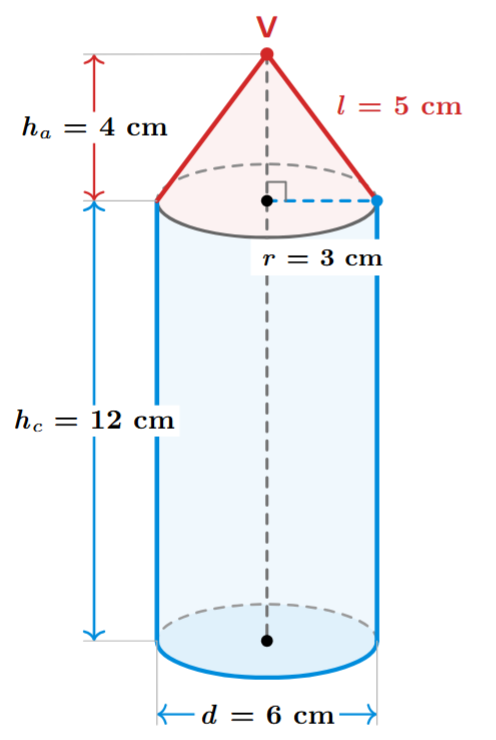
First, find the height of the conical part ($h_a$):
$h_a = \sqrt{l^2 - r^2} = \sqrt{5^2 - 3^2} = \sqrt{25 - 9} = 4 \text{ cm}$
Part I: Total Surface Area
The TSA consists of the base area of the cylinder, the curved surface of the cylinder, and the curved surface of the cone.
$\text{TSA} = \text{Base Area} + \text{CSA of cylinder} + \text{CSA of cone}$
$\text{TSA} = \pi r^2 + 2 \pi r h_c + \pi r l = \pi r (r + 2h_c + l)$
$\text{TSA} = 3.14 \times 3 \times (3 + 2 \times 12 + 5)$
$\text{TSA} = 9.42 \times (3 + 24 + 5)$
$\text{TSA} = 9.42 \times 32 = 301.44 \text{ cm}^2$
Part II: Volume of the rocket
$\text{Volume} = \text{Volume of cylinder} + \text{Volume of cone}$
$V = \pi r^2 h_c + \frac{1}{3} \pi r^2 h_a = \pi r^2 \left(h_c + \frac{h_a}{3}\right)$
$V = 3.14 \times 3^2 \times \left(12 + \frac{4}{3}\right)$
$V = 3.14 \times 9 \times \frac{40}{3} = 3.14 \times 3 \times 40$
$V = 3.14 \times 120 = 376.8 \text{ cm}^3$
The total surface area is 301.44 cm2 and the volume is 376.8 cm3.
Question 15. A building is in the form of a cylinder surmounted by a hemispherical vaulted dome and contains $41\frac{19}{21}$ m3 of air. If the internal diameter of dome is equal to its total height above the floor, find the height of the building?
Answer:
Given:
Internal Volume of air in the building ($V$) = $41\frac{19}{21} \text{ m}^3 = \frac{880}{21} \text{ m}^3$
Condition: Internal diameter of the dome ($d$) = Total height of the building ($H$)
To Find:
The total height of the building ($H$).
Solution:
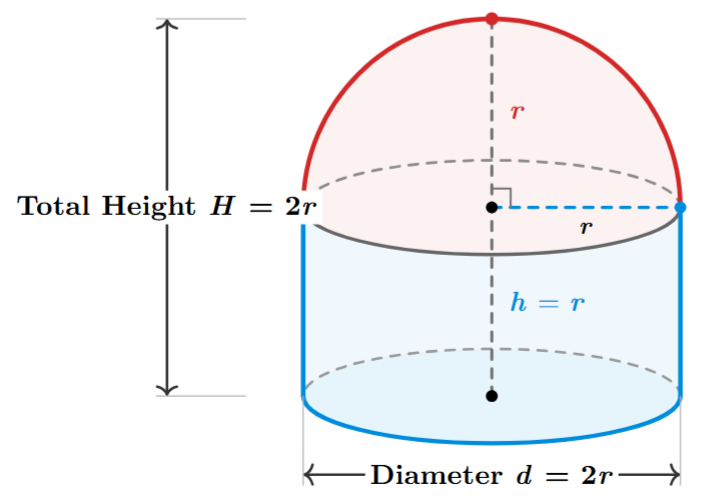
Let the internal radius of the hemisphere and the cylinder be $r$.
Then the internal diameter ($d$) = $2r$.
According to the given condition:
$H = 2r$
... (i)
The total height of the building ($H$) is the sum of the height of the cylindrical part ($h$) and the radius of the hemispherical dome ($r$).
$H = h + r$
$2r = h + r$
$h = r$
[Height of cylinder = Radius]
The total volume of air in the building is the sum of the volume of the cylinder and the volume of the hemispherical dome.
$V = \text{Volume of cylinder} + \text{Volume of hemisphere}$
$V = \pi r^2 h + \frac{2}{3} \pi r^3$
Since $h = r$, we substitute this value:
$V = \pi r^2 (r) + \frac{2}{3} \pi r^3$
$V = \pi r^3 + \frac{2}{3} \pi r^3$
$V = \frac{5}{3} \pi r^3$
[Total internal volume] ... (ii)
Equating the derived volume to the given value:
$\frac{5}{3} \pi r^3 = \frac{880}{21}$
$\frac{5}{3} \times \frac{22}{7} \times r^3 = \frac{880}{21}$
$\frac{110}{21} \times r^3 = \frac{880}{21}$
Multiply both sides by 21:
$110 r^3 = 880$
$r^3 = \frac{880}{110}$
$r^3 = 8$
$r = \sqrt[3]{8} = 2 \text{ m}$
Now, calculate the total height ($H$):
$H = 2r$
$H = 2 \times 2 = 4 \text{ m}$
The total height of the building is 4 m.
Question 16. A hemispherical bowl of internal radius 9 cm is full of liquid. The liquid is to be filled into cylindrical shaped bottles each of radius 1.5 cm and height 4 cm. How many bottles are needed to empty the bowl?
Answer:
Given:
Internal radius of hemisphere ($R$) = $9 \text{ cm}$
Radius of cylindrical bottle ($r$) = $1.5 \text{ cm}$
Height of cylindrical bottle ($h$) = $4 \text{ cm}$
To Find:
Number of bottles ($n$) needed to empty the bowl.
Solution:
The total volume of the liquid in the hemispherical bowl is distributed into $n$ cylindrical bottles.
$\text{Volume of } n \text{ bottles} = \text{Volume of hemispherical bowl}$
$n \times \pi r^2 h = \frac{2}{3} \pi R^3$
$n = \frac{2 R^3}{3 r^2 h}$
$n = \frac{2 \times 9 \times 9 \times 9}{3 \times 1.5 \times 1.5 \times 4}$
Performing cancellation:
$n = \frac{2 \times \cancel{9}^3 \times 9 \times 9}{\cancel{3}_1 \times 1.5 \times 1.5 \times 4}$
$n = \frac{2 \times 3 \times 9 \times 9}{1.5 \times 1.5 \times 4}$
$n = \frac{486}{9} = 54$
The number of bottles needed is 54.
Question 17. A solid right circular cone of height 120 cm and radius 60 cm is placed in a right circular cylinder full of water of height 180 cm such that it touches the bottom. Find the volume of water left in the cylinder, if the radius of the cylinder is equal to the radius of the cone.
Answer:
Given:
For the cone: Radius ($r$) = $60 \text{ cm}$, Height ($h$) = $120 \text{ cm}$
For the cylinder: Radius ($R$) = $60 \text{ cm}$, Height ($H$) = $180 \text{ cm}$
The cylinder is initially full of water.
To Find:
The volume of water left in the cylinder.
Solution:
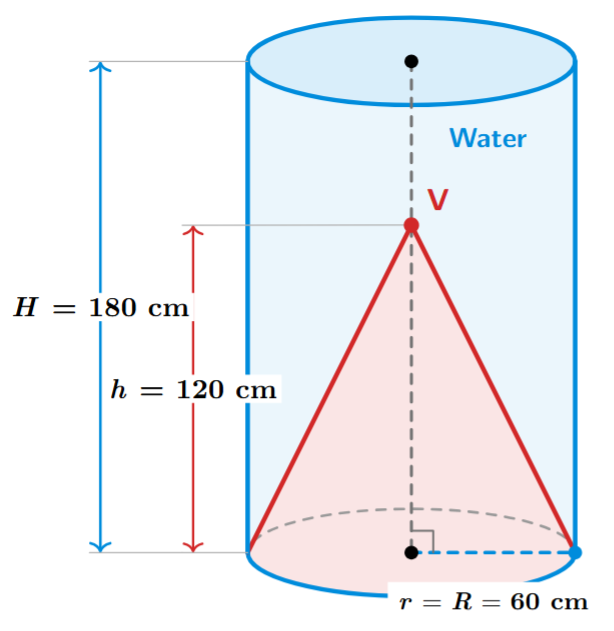
When the solid cone is placed into the cylinder full of water, it displaces a volume of water equal to its own volume.
$\text{Volume of water left} = \text{Volume of cylinder} - \text{Volume of cone}$
We know the following formulas:
$\text{Volume of cylinder} = \pi R^2 H$
$\text{Volume of cone} = \frac{1}{3} \pi r^2 h$
Substituting the values ($R = r = 60$):
$\text{Volume of water left} = \pi (60)^2 (180) - \frac{1}{3} \pi (60)^2 (120)$
$\text{Volume of water left} = \pi (60)^2 [180 - \frac{120}{3}]$
$\text{Volume of water left} = \pi \times 3600 \times [180 - 40]$
$\text{Volume of water left} = 3600 \pi \times 140$
$\text{Volume of water left} = 3600 \times \frac{22}{7} \times 140$
$\text{Volume of water left} = 3600 \times 22 \times \frac{\cancel{140}^{20}}{\cancel{7}_1}$
$\text{Volume of water left} = 3600 \times 440$
$\text{Volume in cm}^3 = 15,84,000 \text{ cm}^3$
Converting to cubic metres ($1 \text{ m}^3 = 10,00,000 \text{ cm}^3$):
$\text{Volume} = \frac{15,84,000}{10,00,000} = 1.584 \text{ m}^3$
The volume of water left in the cylinder is 1.584 m3.
Question 18. Water flows through a cylindrical pipe, whose inner radius is 1 cm, at the rate of 80 cm/sec in an empty cylindrical tank, the radius of whose base is 40 cm. What is the rise of water level in tank in half an hour?
Answer:
Given:
Inner radius of pipe ($r$) = $1 \text{ cm}$
Speed of water flow = $80 \text{ cm/sec}$
Radius of cylindrical tank ($R$) = $40 \text{ cm}$
Time ($t$) = $\text{half an hour} = 30 \text{ minutes} = 1800 \text{ seconds}$
To Find:
The rise of water level ($h$) in the tank.
Solution:
The volume of water that flows through the pipe in the given time is equal to the volume of water in the tank.
The length of the water column in $1800$ seconds is:
$L = \text{Speed} \times \text{Time} = 80 \times 1800 = 1,44,000 \text{ cm}$
$\text{Volume from pipe} = \pi r^2 L$
... (i)
$\text{Volume from pipe} = \pi \times (1)^2 \times 1,44,000 = 1,44,000 \pi \text{ cm}^3$
The volume of water in the cylindrical tank is:
$\text{Volume in tank} = \pi R^2 h$
... (ii)
Equating volumes (i) and (ii):
$\pi \times (40)^2 \times h = 1,44,000 \pi$
$1600 \times h = 1,44,000$
$h = \frac{1,44,000}{1,600}$
$h = \frac{1440}{16}$
The rise of the water level in the tank is 90 cm.
Question 19. The rain water from a roof of dimensions 22 m 20 m drains into a cylindrical vessel having diameter of base 2 m and height 3.5 m. If the rain water collected from the roof just fill the cylindrical vessel, then find the rainfall in cm.
Answer:
Given:
Dimensions of the roof: $22 \text{ m} \times 20 \text{ m}$
Diameter of the cylindrical vessel = $2 \text{ m} \implies$ Radius ($r$) = $1 \text{ m}$
Height of the cylindrical vessel ($h_{cyl}$) = $3.5 \text{ m}$
To Find:
The amount of rainfall ($x$) in cm.
Solution:
The volume of rain water collected from the roof is equal to the volume of the cylindrical vessel.
Let $x$ be the height of rainfall on the roof.
$\text{Volume on roof} = \text{Volume of cylindrical vessel}$
$22 \times 20 \times x = \pi r^2 h_{cyl}$
$440 \times x = \frac{22}{7} \times (1)^2 \times 3.5$
$440 \times x = 22 \times \frac{\cancel{3.5}^{0.5}}{\cancel{7}_1}$
$440 \times x = 22 \times 0.5$
$440x = 11$
[On simplification]
$x = \frac{11}{440} = \frac{1}{40} \text{ m}$
Converting the rainfall height into cm:
$x = \frac{1}{40} \times 100 \text{ cm}$
$x = \frac{10}{4} = 2.5 \text{ cm}$
The rainfall is 2.5 cm.
Question 20. A pen stand made of wood is in the shape of a cuboid with four conical depressions and a cubical depression to hold the pens and pins, respectively. The dimension of the cuboid are 10 cm, 5 cm and 4 cm. The radius of each of the conical depressions is 0.5 cm and the depth is 2.1 cm. The edge of the cubical depression is 3 cm. Find the volume of the wood in the entire stand.
Answer:
Given:
Dimensions of cuboidal stand: $10 \text{ cm} \times 5 \text{ cm} \times 4 \text{ cm}$
Radius of conical depression ($r$) = $0.5 \text{ cm}$
Depth of conical depression ($h$) = $2.1 \text{ cm}$
Number of conical depressions = $4$
Edge of cubical depression ($a$) = $3 \text{ cm}$
To Find:
The volume of the wood in the stand.
Solution:
The volume of wood is calculated by subtracting the volumes of the conical and cubical depressions from the total volume of the cuboid.
$\text{Volume of Cuboid} = 10 \times 5 \times 4 = 200 \text{ cm}^3$
Volume of $4$ conical depressions $= 4 \times \frac{1}{3} \pi r^2 h$
$\text{Vol}_{cones} = 4 \times \frac{1}{3} \times \frac{22}{7} \times (0.5)^2 \times 2.1$
$\text{Vol}_{cones} = 4 \times 22 \times 0.25 \times \frac{\cancel{2.1}^{0.7}}{\cancel{3}_1 \times \cancel{7}_1} = 4 \times 22 \times 0.25 \times 0.1$
$\text{Vol}_{cones} = 22 \times 1 \times 0.1 = 2.2 \text{ cm}^3$
$\text{Volume of cubical depression} = a^3 = 3^3 = 27 \text{ cm}^3$
Now, find the volume of the wood:
$\text{Volume of wood} = \text{Volume of Cuboid} - (\text{Vol}_{cones} + \text{Vol}_{cube})$
$\text{Volume of wood} = 200 - (2.2 + 27)$
$\text{Volume of wood} = 200 - 29.2$
The volume of the wood in the entire stand is 170.8 cm3.