

Chapter 13 Statistics and Probability (Class 10 - Maths NCERT Exemplar Solutions)
Welcome to the comprehensive resource for NCERT Exemplar Solutions for Class 10 Mathematics: Chapter 13 Statistics and Probability! These problems are meticulously crafted to push beyond standard textbook exercises, demanding a significantly deeper level of analytical skill and more complex calculations. By exploring nuanced interpretations of data and chance in non-routine scenarios, these solutions build the computational proficiency and analytical foundation required for advanced statistical studies and real-world applications.
The solutions provide an exhaustive analysis of grouped data, covering the key measures of central tendency: Mean, Median, and Mode. Students will master the Direct Method, Assumed Mean Method, and Step-Deviation Method for calculating the mean, as well as the application of precise formulas for the median ($l + [\frac{(\frac{n}{2})-cf}{f}]\times h$) and mode ($l + [\frac{f_1-f_0}{2f_1-f_0-f_2}]\times h$). A primary focus is placed on identifying missing frequencies and the construction of cumulative frequency curves (ogives) to determine the median graphically.
Significant attention is given to theoretical probability, grounded in the analysis of the sample space for complex experiments like multiple dice rolls, coin tosses, and card deck scenarios. The Exemplar rigorously tests the use of complementary events ($P(E') = 1 - P(E)$) and combinatorial thinking for selection problems. With step-by-step guidance and logical justifications prepared by learningspot.co, students can master the critical skills needed to effectively solve multifaceted statistical challenges and sophisticated probability problems.
Sample Question 1 to 6 (Before Exercise 13.1)
Choose the correct answer from the given four options:
Sample Question 1: Construction of a cumulative frequency table is useful in determining the
(A) mean
(B) median
(C) mode
(D) all the above three measures
Answer:
The correct option is (B).
The correct answer is median.
A cumulative frequency table helps in determining the cumulative frequency of different classes, which is essential for locating the median class (the class containing the $\left(\frac{N}{2}\right)^{\text{th}}$ observation) and subsequently calculating the median.
Sample Question 2: In the following distribution :
| Monthly income range (in Rs) | Number of families |
|---|---|
| Income more than Rs 10000 | 100 |
| Income more than Rs 13000 | 85 |
| Income more than Rs 16000 | 69 |
| Income more than Rs 19000 | 50 |
| Income more than Rs 22000 | 33 |
| Income more than Rs 25000 | 15 |
the number of families having income range (in Rs) 16000 – 19000 is
(A) 15
(B) 16
(C) 17
(D) 19
Answer:
The correct option is (D).
The number of families having income range (in $\textsf{₹}$) 16000 – 19000 is the difference between the number of families having income more than $\textsf{₹}$ 16000 and the number of families having income more than $\textsf{₹}$ 19000.
From the given table:
Number of families with income more than $\textsf{₹}$ 16000 = 69
Number of families with income more than $\textsf{₹}$ 19000 = 50
Number of families in the income range $\textsf{₹}$ 16000 – 19000 = (Number of families with income > $\textsf{₹}$ 16000) - (Number of families with income > $\textsf{₹}$ 19000)
Number of families = $69 - 50$
Number of families = $19$
Sample Question 3: Consider the following frequency distribution of the heights of 60 students of a class :
| Height (in cm) | Number of students |
|---|---|
| 150-155 | 15 |
| 155-160 | 13 |
| 160-165 | 10 |
| 165-170 | 8 |
| 170-175 | 9 |
| 175-180 | 5 |
The sum of the lower limit of the modal class and upper limit of the median class is
(A) 310
(B) 315
(C) 320
(D) 330
Answer:
The correct option is (B).
To find the sum of the lower limit of the modal class and the upper limit of the median class, we first need to identify these classes from the given frequency distribution.
Finding the Modal Class:
The modal class is the class interval with the highest frequency.
Looking at the table, the frequencies are 15, 13, 10, 8, 9, and 5.
The highest frequency is 15, which corresponds to the height range 150-155 cm.
Thus, the modal class is 150-155.
The lower limit of the modal class is 150.
Finding the Median Class:
The median class is the class interval where the cumulative frequency is greater than or equal to $\frac{N}{2}$, where $N$ is the total number of observations (students).
Total number of students $N = 15 + 13 + 10 + 8 + 9 + 5 = 60$.
So, $\frac{N}{2} = \frac{60}{2} = 30$.
Now, let's construct the cumulative frequency table:
| Height (in cm) | Number of students (f) | Cumulative Frequency (cf) |
| 150-155 | 15 | 15 |
| 155-160 | 13 | $15 + 13 = 28$ |
| 160-165 | 10 | $28 + 10 = 38$ |
| 165-170 | 8 | $38 + 8 = 46$ |
| 170-175 | 9 | $46 + 9 = 55$ |
| 175-180 | 5 | $55 + 5 = 60$ |
We are looking for the class where the cumulative frequency is 30 or more. The first cumulative frequency that is greater than or equal to 30 is 38, which corresponds to the class interval 160-165.
Thus, the median class is 160-165.
The upper limit of the median class is 165.
Calculating the Sum:
Sum of the lower limit of the modal class and the upper limit of the median class = Lower limit of modal class + Upper limit of median class
Sum = $150 + 165 = 315$
Sample Question 4: Which of the the following can be the probability of an event?
(A) – 0.04
(B) 1.004
(C) $\frac{18}{23}$
(D) $\frac{8}{7}$
Answer:
The correct option is (C).
The probability of any event E, denoted by $P(E)$, must satisfy the condition $0 \leq P(E) \leq 1$. That is, the probability of an event must be a value between 0 and 1, inclusive.
Let's examine each option:
(A) – 0.04: This value is negative. Probability cannot be negative.
(B) 1.004: This value is greater than 1. Probability cannot be greater than 1.
(C) $\frac{18}{23}$: To check if this value is between 0 and 1, we can compare the numerator and the denominator. Since $18 < 23$, the fraction $\frac{18}{23}$ is less than 1. Also, since both 18 and 23 are positive, the fraction is greater than 0. Thus, $0 < \frac{18}{23} < 1$. This is a valid probability.
(D) $\frac{8}{7}$: Since $8 > 7$, the fraction $\frac{8}{7}$ is greater than 1. This is not a valid probability.
Therefore, the only value that can be the probability of an event is $\frac{18}{23}$.
Sample Question 5: A card is selected at random from a well shuffled deck of 52 playing cards. The probability of its being a face card is
(A) $\frac{3}{13}$
(B) $\frac{4}{13}$
(C) $\frac{6}{13}$
(D) $\frac{9}{13}$
Answer:
The correct option is (A).
In a standard deck of 52 playing cards, there are 4 suits: Hearts, Diamonds, Clubs, and Spades.
Each suit has 13 cards: Ace, 2, 3, 4, 5, 6, 7, 8, 9, 10, Jack, Queen, King.
The face cards are the Jack, Queen, and King.
Number of face cards in each suit = 3.
Since there are 4 suits, the total number of face cards in a deck = $3 \times 4 = 12$.
The total number of possible outcomes when selecting a card at random is the total number of cards in the deck, which is 52.
The number of favourable outcomes (selecting a face card) is 12.
The probability of an event E is given by the formula:
$P(E) = \frac{\text{Number of favourable outcomes}}{\text{Total number of possible outcomes}}$
Probability of being a face card = $\frac{\text{Number of face cards}}{\text{Total number of cards}}$
Probability = $\frac{12}{52}$
Simplify the fraction:
$\frac{12}{52} = \frac{\cancel{12}^{3}}{\cancel{52}_{13}}$
Probability = $\frac{3}{13}$
Sample Question 6: A bag contains 3 red balls, 5 white balls and 7 black balls. What is the probability that a ball drawn from the bag at random will be neither red nor black?
(A) $\frac{1}{5}$
(B) $\frac{1}{3}$
(C) $\frac{7}{15}$
(D) $\frac{8}{15}$
Answer:
The correct option is (B).
We are given the number of balls of different colours in the bag:
Number of red balls = 3
Number of white balls = 5
Number of black balls = 7
The total number of balls in the bag is the sum of the number of balls of each colour.
Total number of balls = $3 + 5 + 7 = 15$
We want to find the probability that a ball drawn from the bag is neither red nor black.
A ball that is neither red nor black must be a white ball.
The number of favourable outcomes (drawing a white ball) is the number of white balls, which is 5.
The probability of an event E is given by the formula:
$P(E) = \frac{\text{Number of favourable outcomes}}{\text{Total number of possible outcomes}}$
Probability of drawing a ball that is neither red nor black = Probability of drawing a white ball
$P(\text{neither red nor black}) = \frac{\text{Number of white balls}}{\text{Total number of balls}}$
$P(\text{neither red nor black}) = \frac{5}{15}$
Simplify the fraction:
$\frac{5}{15} = \frac{\cancel{5}^{1}}{\cancel{15}_{3}}$
$P(\text{neither red nor black}) = \frac{1}{3}$
Exercise 13.1
Choose the correct answer from the given four options:
Question 1. In the formula
$\overline{x} = a + \frac{f_{i}d_{i}}{f_{i}}$
for finding the mean of grouped data di ’s are deviations from a of
(A) lower limits of the classes
(B) upper limits of the classes
(C) mid points of the classes
(D) frequencies of the class marks
Answer:
The correct option is (C).
The formula given for finding the mean of grouped data is a variation of the assumed mean method, which is typically written as:
$\overline{x} = a + \frac{\sum f_{i}d_{i}}{\sum f_{i}}$
where $\overline{x}$ is the mean, $a$ is the assumed mean, $f_i$ is the frequency of the $i$-th class, and $d_i$ is the deviation of the class mark (or midpoint) of the $i$-th class from the assumed mean $a$.
The deviations $d_i$ are calculated as $d_i = x_i - a$, where $x_i$ represents the class mark or midpoint of the $i$-th class interval.
Therefore, $d_i$'s are deviations from $a$ of the mid points of the classes.
Question 2. While computing mean of grouped data, we assume that the frequencies are
(A) evenly distributed over all the classes
(B) centred at the classmarks of the classes
(C) centred at the upper limits of the classes
(D) centred at the lower limits of the classes
Answer:
The correct option is (B).
While computing the mean of grouped data, we use the class mark (midpoint) of each class interval as the representative value for all observations falling within that interval.
This method implicitly assumes that the frequency of each class is centred at the classmark of that class.
In other words, we assume that the data values within each interval are evenly distributed around the classmark, or that the classmark represents the average value for that interval.
Question 3. If xi’s are the mid points of the class intervals of grouped data, fi’s are the corresponding frequencies and $\overline{x}$ is the mean, then $\sum (f_{i}x_{i} - \overline{x})$ is equal to
(A) 0
(B) –1
(C) 1
(D) 2
Answer:
Given:
$x_i$ = mid points of the class intervals.
$f_i$ = corresponding frequencies.
$\overline{x}$ = mean of the grouped data.
To Find:
The value of the expression $\sum f_i(x_i - \overline{x})$.
Solution:
We know that the mean ($\overline{x}$) for grouped data is defined as the sum of the products of frequencies and class marks, divided by the total frequency.
$\overline{x} = \frac{\sum f_i x_i}{\sum f_i}$
... (i)
By cross-multiplying equation (i), we get:
$\sum f_i x_i = \overline{x} \sum f_i$
... (ii)
Now, let us expand the expression we need to evaluate:
$\sum f_i(x_i - \overline{x}) = \sum (f_i x_i - f_i \overline{x})$
Using the property of summation, we can split the terms:
$\sum f_i(x_i - \overline{x}) = \sum f_i x_i - \sum f_i \overline{x}$
Since $\overline{x}$ is a constant value (the mean of the data), it can be taken out of the summation:
$\sum f_i(x_i - \overline{x}) = \sum f_i x_i - \overline{x} \sum f_i$
[$\overline{x}$ is constant] ... (iii)
Now, substitute the value of $\sum f_i x_i$ from equation (ii) into equation (iii):
$\sum f_i(x_i - \overline{x}) = \overline{x} \sum f_i - \overline{x} \sum f_i$
The two terms are identical and subtract to zero:
$\sum f_i(x_i - \overline{x}) = 0$
Final Answer:
The value of $\sum f_i(x_i - \overline{x})$ is 0.
Comparing this with the given options, the correct option is (A).
Question 4. In the formula $\overline{x} = a + h\frac{\sum f_{i}u_{i}}{\sum f_{i}}$ , for finding the mean of grouped frequency distribution, ui =
(A) $\frac{x_{i} \;+\; a}{h}$
(B) $h(x_i - a)$
(C) $\frac{x_{i} \;-\; a}{h}$
(D) $\frac{a \;-\; x_{i}}{h}$
Answer:
The correct option is (C).
The formula given, $\overline{x} = a + h\frac{\sum f_{i}u_{i}}{\sum f_{i}}$, is the formula for finding the mean of grouped frequency distribution using the step-deviation method.
In this method:
- $\overline{x}$ is the mean.
- $a$ is the assumed mean, which is usually taken from the class marks ($x_i$).
- $h$ is the class size (assuming uniform class size).
- $f_i$ is the frequency of the $i$-th class.
- $x_i$ is the class mark (midpoint) of the $i$-th class.
- $u_i$ is the step deviation for the $i$-th class.
The step deviation $u_i$ is obtained by dividing the deviation of the class mark from the assumed mean by the class size $h$. The deviation of the class mark from the assumed mean is $d_i = x_i - a$.
So, the definition of $u_i$ is:
$u_i = \frac{x_i - a}{h}$
Question 5. The abscissa of the point of intersection of the less than type and of the more than type cumulative frequency curves of a grouped data gives its
(A) mean
(B) median
(C) mode
(D) all the three above
Answer:
The correct option is (B).
The graph of a cumulative frequency distribution is called an ogive.
There are two types of cumulative frequency ogives: the less than ogive and the more than ogive.
When both the less than type and the more than type cumulative frequency curves are drawn on the same graph, their point of intersection is significant.
The abscissa (x-coordinate) of this point of intersection represents the median of the grouped data.
The ordinate (y-coordinate) of this point represents half of the total frequency, i.e., $\frac{\sum f_i}{2}$.
Question 6. For the following distribution
| Class | 0 - 5 | 5 - 10 | 10 - 15 | 15 - 20 | 20 - 25 |
|---|---|---|---|---|---|
| Frequency | 10 | 15 | 12 | 20 | 9 |
the sum of lower limits of the median class and modal class is
(A) 15
(B) 25
(C) 30
(D) 35
Answer:
The correct option is (B).
To find the sum of the lower limits of the median class and the modal class, we need to identify these classes from the given frequency distribution.
Finding the Modal Class:
The modal class is the class interval with the highest frequency.
Looking at the frequencies (10, 15, 12, 20, 9), the highest frequency is 20.
The class interval corresponding to the highest frequency (20) is 15-20.
Thus, the modal class is 15-20.
The lower limit of the modal class is 15.
Finding the Median Class:
The median class is the class interval where the cumulative frequency is greater than or equal to $\frac{N}{2}$, where $N$ is the total frequency.
Total frequency $N = 10 + 15 + 12 + 20 + 9 = 66$.
So, $\frac{N}{2} = \frac{66}{2} = 33$.
Now, let's construct the cumulative frequency table:
| Class | Frequency (f) | Cumulative Frequency (cf) |
| 0-5 | 10 | 10 |
| 5-10 | 15 | $10 + 15 = 25$ |
| 10-15 | 12 | $25 + 12 = 37$ |
| 15-20 | 20 | $37 + 20 = 57$ |
| 20-25 | 9 | $57 + 9 = 66$ |
We are looking for the class where the cumulative frequency is 33 or more. The first cumulative frequency that is greater than or equal to 33 is 37, which corresponds to the class interval 10-15.
Thus, the median class is 10-15.
The lower limit of the median class is 10.
Calculating the Sum:
Sum of the lower limits of the median class and modal class = Lower limit of median class + Lower limit of modal class
Sum = $10 + 15 = 25$
Question 7. Consider the following frequency distribution :
| Class | 0 - 5 | 6 - 11 | 12 - 17 | 18 - 23 | 24 - 29 |
|---|---|---|---|---|---|
| Frequency | 13 | 10 | 15 | 8 | 11 |
The upper limit of the median class is
(A) 17
(B) 17.5
(C) 18
(D) 18.5
Answer:
Given:
The frequency distribution is provided with discontinuous class intervals:
| Class | Frequency ($f_i$) |
| 0 - 5 | 13 |
| 6 - 11 | 10 |
| 12 - 17 | 15 |
| 18 - 23 | 8 |
| 24 - 29 | 11 |
To Find:
The upper limit of the Median Class.
Solution:
The given class intervals are discontinuous. To find the median class, we must first convert them into continuous class intervals (also known as true class limits).
The gap between the upper limit of one class and the lower limit of the next class is $6 - 5 = 1$.
The adjustment factor is $\frac{1}{2} = 0.5$. We subtract $0.5$ from the lower limits and add $0.5$ to the upper limits.
We also need to calculate the Cumulative Frequency ($cf$) to identify the median class.
| Discontinuous Class | Continuous Class | Frequency ($f_i$) | Cumulative Frequency ($cf$) |
| 0 - 5 | -0.5 - 5.5 | 13 | 13 |
| 6 - 11 | 5.5 - 11.5 | 10 | 23 |
| 12 - 17 | 11.5 - 17.5 | 15 | 38 |
| 18 - 23 | 17.5 - 23.5 | 8 | 46 |
| 24 - 29 | 23.5 - 29.5 | 11 | 57 |
| Total | $N = 57$ |
Now, we find the value of $\frac{N}{2}$:
$\frac{N}{2} = \frac{57}{2} = 28.5$
... (i)
The cumulative frequency just greater than $28.5$ is 38.
The class interval corresponding to the cumulative frequency $38$ is 11.5 - 17.5.
Median Class = 11.5 - 17.5
(Continuous interval)
In the continuous class 11.5 - 17.5, the lower limit is $11.5$ and the upper limit is $17.5$.
Final Answer:
The upper limit of the median class is 17.5.
Comparing this with the given options, the correct option is (B).
Question 8. For the following distribution :
| Marks | Number of students |
|---|---|
| Below 10 | 3 |
| Below 20 | 12 |
| Below 30 | 27 |
| Below 40 | 57 |
| Below 50 | 75 |
| Below 60 | 80 |
the modal class is
(A) 10-20
(B) 20-30
(C) 30-40
(D) 50-60
Answer:
The correct option is (C).
The given distribution is a "less than" cumulative frequency distribution. To find the modal class, we need to convert this into a simple frequency distribution.
Let's create the frequency distribution table:
| Marks | Number of students (Cumulative Frequency) | Class Interval | Frequency (f) |
| Below 10 | 3 | 0-10 | 3 |
| Below 20 | 12 | 10-20 | $12 - 3 = 9$ |
| Below 30 | 27 | 20-30 | $27 - 12 = 15$ |
| Below 40 | 57 | 30-40 | $57 - 27 = 30$ |
| Below 50 | 75 | 40-50 | $75 - 57 = 18$ |
| Below 60 | 80 | 50-60 | $80 - 75 = 5$ |
The modal class is the class interval with the highest frequency.
Looking at the frequencies (3, 9, 15, 30, 18, 5), the highest frequency is 30.
The class interval corresponding to the frequency 30 is 30-40.
Therefore, the modal class is 30-40.
Question 9. Consider the data :
| Class | 65 - 85 | 85 - 105 | 105 - 125 | 125 - 145 | 145 -165 | 165 -185 | 185 - 205 |
|---|---|---|---|---|---|---|---|
| Frequency | 4 | 5 | 13 | 20 | 14 | 7 | 4 |
The difference of the upper limit of the median class and the lower limit of the modal class is
(A) 0
(B) 19
(C) 20
(D) 38
Answer:
The correct option is (C).
To find the difference of the upper limit of the median class and the lower limit of the modal class, we need to identify these classes from the given frequency distribution.
Finding the Modal Class:
The modal class is the class interval with the highest frequency.
Looking at the frequencies (4, 5, 13, 20, 14, 7, 4), the highest frequency is 20.
The class interval corresponding to the highest frequency (20) is 125-145.
Thus, the modal class is 125-145.
The lower limit of the modal class is 125.
Finding the Median Class:
The median class is the class interval where the cumulative frequency is greater than or equal to $\frac{N}{2}$, where $N$ is the total frequency.
Total frequency $N = 4 + 5 + 13 + 20 + 14 + 7 + 4 = 67$.
So, $\frac{N}{2} = \frac{67}{2} = 33.5$.
Now, let's construct the cumulative frequency table:
| Class | Frequency (f) | Cumulative Frequency (cf) |
| 65-85 | 4 | 4 |
| 85-105 | 5 | $4 + 5 = 9$ |
| 105-125 | 13 | $9 + 13 = 22$ |
| 125-145 | 20 | $22 + 20 = 42$ |
| 145-165 | 14 | $42 + 14 = 56$ |
| 165-185 | 7 | $56 + 7 = 63$ |
| 185-205 | 4 | $63 + 4 = 67$ |
We are looking for the class where the cumulative frequency is 33.5 or more. The first cumulative frequency that is greater than or equal to 33.5 is 42, which corresponds to the class interval 125-145.
Thus, the median class is 125-145.
The upper limit of the median class is 145.
Calculating the Difference:
Difference = Upper limit of median class - Lower limit of modal class
Difference = $145 - 125 = 20$
Question 10. The times, in seconds, taken by 150 atheletes to run a 110 m hurdle race are tabulated below
| Class | 13.8 - 14 | 14 - 14.2 | 14.2 - 14.4 | 14.4 - 14.6 | 14.6 - 14.8 | 14.8 - 15 |
|---|---|---|---|---|---|---|
| Frequency | 2 | 4 | 5 | 71 | 48 | 20 |
The number of atheletes who completed the race in less then 14.6 seconds is :
(A) 11
(B) 71
(C) 82
(D) 130
Answer:
Given:
The frequency distribution of the time taken by 150 athletes to complete a race is as follows:
| Time (in seconds) | Number of athletes (Frequency) |
| 13.8 - 14.0 | 2 |
| 14.0 - 14.2 | 4 |
| 14.2 - 14.4 | 5 |
| 14.4 - 14.6 | 71 |
| 14.6 - 14.8 | 48 |
| 14.8 - 15.0 | 20 |
To Find:
The total number of athletes who completed the race in less than 14.6 seconds.
Solution:
In a continuous frequency distribution, the number of observations "less than" a certain upper limit is the sum of the frequencies of all classes preceding that limit, including the class where that limit is the upper boundary.
To find the athletes who finished in less than 14.6 seconds, we need to sum the frequencies of the following class intervals:
1. 13.8 - 14.0
2. 14.0 - 14.2
3. 14.2 - 14.4
4. 14.4 - 14.6
Let us create a cumulative frequency table for these intervals:
| Time (in seconds) | Frequency ($f_i$) | Cumulative Frequency ($cf$) |
| Less than 14.0 | 2 | 2 |
| Less than 14.2 | 4 | $2 + 4 = 6$ |
| Less than 14.4 | 5 | $6 + 5 = 11$ |
| Less than 14.6 | 71 | $11 + 71 = 82$ |
The total number of athletes is calculated as:
$N = 2 + 4 + 5 + 71$
... (i)
Thus, the number of athletes who took less than 14.6 seconds is 82.
Final Answer:
The number of athletes who completed the race in less than 14.6 seconds is 82.
Comparing this with the given options, the correct option is (C).
Question 11. Consider the following distribution :
| Marks obtained | Number of students |
|---|---|
| More than or equal to 0 | 63 |
| More than or equal to 10 | 58 |
| More than or equal to 20 | 55 |
| More than or equal to 30 | 51 |
| More than or equal to 40 | 48 |
| More than or equal to 50 | 42 |
the frequency of the class 30-40 is
(A) 3
(B) 4
(C) 48
(D) 51
Answer:
Given:
A "more than or equal to" type cumulative frequency distribution is provided as follows:
| Marks Obtained | Number of Students (Cumulative Frequency) |
| More than or equal to 0 | 63 |
| More than or equal to 10 | 58 |
| More than or equal to 20 | 55 |
| More than or equal to 30 | 51 |
| More than or equal to 40 | 48 |
| More than or equal to 50 | 42 |
To Find:
The frequency of the specific class interval 30 - 40.
Solution:
To find the frequency of a class interval $(a - b)$ from a "more than or equal to" distribution, we use the following relation:
$\text{Frequency of } (a - b) = cf(\ge a) - cf(\ge b)$
... (i)
Here, for the class interval 30 - 40:
1. The number of students scoring marks more than or equal to 30 is $51$.
2. The number of students scoring marks more than or equal to 40 is $48$.
The frequency of students scoring marks between 30 and 40 is the difference between these two cumulative frequencies.
$\text{Frequency (30 - 40)} = (\text{Students with marks } \geq 30) $$ - (\text{Students with marks } \geq 40)$
Substituting the values:
$\text{Frequency (30 - 40)} = 51 - 48$
$\text{Frequency} = 3$
... (ii)
Final Answer:
The frequency of the class 30-40 is 3.
Comparing this with the given options, the correct option is (A).
Question 12. If an event cannot occur, then its probability is
(A) 1
(B) $\frac{3}{4}$
(C) $\frac{1}{2}$
(D) 0
Answer:
The correct option is (D).
An event that cannot occur is called an impossible event.
The probability of an impossible event is 0.
The probability of any event E must satisfy $0 \leq P(E) \leq 1$.
A probability of 1 indicates a certain event (an event that is sure to occur).
Values between 0 and 1 represent events that are possible but not certain.
Question 13. Which of the following cannot be the probability of an event?
(A) $\frac{1}{3}$
(B) 0.1
(C) 3%
(D) $\frac{17}{16}$
Answer:
The correct option is (D).
The probability of any event E, denoted by $P(E)$, must satisfy the condition $0 \leq P(E) \leq 1$. This means the probability of an event must be a value between 0 and 1, inclusive.
Let's examine each option:
(A) $\frac{1}{3}$: This is a fraction where the numerator (1) is less than the denominator (3), and both are positive. So, $0 < \frac{1}{3} < 1$. This can be a probability.
(B) 0.1: This is a decimal number between 0 and 1 ($0 < 0.1 < 1$). This can be a probability.
(C) 3%: This is a percentage probability. To convert to a decimal or fraction, we divide by 100: $3\% = \frac{3}{100} = 0.03$. This value is between 0 and 1 ($0 < 0.03 < 1$). This can be a probability.
(D) $\frac{17}{16}$: This is a fraction where the numerator (17) is greater than the denominator (16). This means the value is greater than 1: $\frac{17}{16} = 1.0625$. Since this value is greater than 1, it cannot be the probability of an event.
Therefore, the only option that cannot be the probability of an event is $\frac{17}{16}$.
Question 14. An event is very unlikely to happen. Its probability is closest to
(A) 0.0001
(B) 0.001
(C) 0.01
(D) 0.1
Answer:
The correct option is (A).
The probability of an event indicates how likely it is to occur. A probability value ranges from 0 to 1.
- A probability of 0 means the event is impossible.
- A probability of 1 means the event is certain.
- Probabilities between 0 and 1 represent events that are possible but not certain.
An event that is "very unlikely to happen" has a probability that is very close to 0.
Let's compare the given options:
- (A) 0.0001
- (B) 0.001
- (C) 0.01
- (D) 0.1
We want to find the value that is closest to 0 among these options.
Comparing the values, $0.0001 < 0.001 < 0.01 < 0.1$.
The smallest positive value is the closest to 0.
Therefore, 0.0001 is the probability value closest to 0 among the given options.
Question 15. If the probability of an event is p, the probability of its complementary event will be
(A) p – 1
(B) p
(C) 1 – p
(D) 1 - $\frac{1}{p}$
Answer:
The correct option is (C).
Let E be an event and E' be its complementary event. The complementary event E' is the event that E does not occur.
The sum of the probability of an event and the probability of its complementary event is always equal to 1.
This relationship is expressed as:
$P(E) + P(E') = 1$
We are given that the probability of the event is $p$, so $P(E) = p$.
Substituting this into the formula:
$p + P(E') = 1$
To find the probability of the complementary event $P(E')$, we subtract $p$ from both sides of the equation:
$P(E') = 1 - p$
Therefore, the probability of its complementary event will be $1 - p$.
Question 16. The probability expressed as a percentage of a particular occurrence can never be
(A) less than 100
(B) less than 0
(C) greater than 1
(D) anything but a whole number
Answer:
The correct option is (B).
The probability of any event must be a value between 0 and 1, inclusive. That is, if P is the probability of an event, then $0 \leq P \leq 1$.
When the probability is expressed as a percentage, it is obtained by multiplying the probability value by 100. So, the percentage probability is $P \times 100\%$.
Since $0 \leq P \leq 1$, the probability expressed as a percentage must be between $0 \times 100\% = 0\%$ and $1 \times 100\% = 100\%$.
Thus, the probability expressed as a percentage must be in the range $[0\%, 100\%]$.
Let's examine the given options in light of this range:
(A) less than 100: A percentage probability can be less than 100% (e.g., 50%). So, this is possible.
(B) less than 0: A percentage probability cannot be less than 0% because the probability value cannot be negative. So, this is impossible.
(C) greater than 1: A percentage probability can be greater than 1 (e.g., 50% is numerically 50, which is greater than 1). So, this is possible.
(D) anything but a whole number: A percentage probability can be a non-whole number (e.g., 33.3% or 12.5%). So, it is possible for it to be something other than a whole number. The phrasing is awkward, but it does not describe an impossibility.
Therefore, the probability expressed as a percentage of a particular occurrence can never be less than 0.
Question 17. If P(A) denotes the probability of an event A, then
(A) P(A) < 0
(B) P(A) > 1
(C) 0 ≤ P(A) ≤ 1
(D) –1 ≤ P(A) ≤ 1
Answer:
The correct option is (C).
The probability of any event A, denoted by $P(A)$, is a measure of the likelihood of the event occurring.
By definition, the probability of any event must lie between 0 and 1, inclusive.
This fundamental property can be stated as:
$0 \leq P(A) \leq 1$
This means that the probability of an event can be:
- 0, if the event is impossible.
- 1, if the event is certain to occur.
- Any value between 0 and 1, if the event is possible but not certain.
Let's look at the options:
- (A) $P(A) < 0$: Probability cannot be negative.
- (B) $P(A) > 1$: Probability cannot be greater than 1.
- (C) $0 \leq P(A) \leq 1$: This correctly states that the probability is between 0 and 1, inclusive.
- (D) $-1 \leq P(A) \leq 1$: Probability cannot be negative, so the lower bound must be 0, not -1.
Therefore, the correct range for the probability of an event A is $0 \leq P(A) \leq 1$.
Question 18. A card is selected from a deck of 52 cards. The probability of its being a red face card is
(A) $\frac{3}{26}$
(B) $\frac{3}{13}$
(C) $\frac{2}{13}$
(D) $\frac{1}{2}$
Answer:
The correct option is (A).
In a standard deck of 52 playing cards, there are 4 suits: Hearts, Diamonds, Clubs, and Spades.
Each suit has 13 cards.
The deck is divided into two colours: Red (Hearts and Diamonds) and Black (Clubs and Spades).
Number of red suits = 2 (Hearts, Diamonds)
Number of black suits = 2 (Clubs, Spades)
The face cards in each suit are Jack, Queen, and King.
Number of face cards per suit = 3.
We are interested in red face cards. Red suits are Hearts and Diamonds.
Number of red face cards = (Number of face cards in Hearts) + (Number of face cards in Diamonds)
Number of red face cards = 3 (Jack, Queen, King of Hearts) + 3 (Jack, Queen, King of Diamonds)
Number of red face cards = $3 + 3 = 6$.
The total number of possible outcomes when selecting a card at random is the total number of cards in the deck, which is 52.
The number of favourable outcomes (selecting a red face card) is 6.
The probability of an event E is given by the formula:
$P(E) = \frac{\text{Number of favourable outcomes}}{\text{Total number of possible outcomes}}$
Probability of being a red face card = $\frac{\text{Number of red face cards}}{\text{Total number of cards}}$
Probability = $\frac{6}{52}$
Simplify the fraction:
$\frac{6}{52} = \frac{\cancel{6}^{3}}{\cancel{52}_{26}}$
Probability = $\frac{3}{26}$
Question 19. The probability that a non leap year selected at random will contain 53 sundays is
(A) $\frac{1}{7}$
(B) $\frac{2}{7}$
(C) $\frac{3}{7}$
(D) $\frac{5}{7}$
Answer:
The correct option is (A).
Solution:
A non-leap year has 365 days.
There are 7 days in a week.
To find the number of full weeks and the remaining days in a non-leap year, we divide the total number of days by 7:
$365 \div 7 = 52$ weeks and $1$ day remainder
This means a non-leap year contains exactly 52 full weeks and one extra day.
The 52 full weeks will always contain 52 Sundays.
For the non-leap year to contain 53 Sundays, the extra day must be a Sunday.
The extra day can be any one of the 7 days of the week: Sunday, Monday, Tuesday, Wednesday, Thursday, Friday, or Saturday.
Total number of possible outcomes for the extra day = 7.
The favourable outcome (the extra day being a Sunday) has only 1 possibility.
The probability of an event is given by the formula:
$P(\text{Event}) = \frac{\text{Number of favourable outcomes}}{\text{Total number of possible outcomes}}$
Probability that the extra day is a Sunday = $\frac{\text{Number of ways the extra day is Sunday}}{\text{Total number of possible days for the extra day}}$
Probability = $\frac{1}{7}$
Thus, the probability that a non-leap year selected at random will contain 53 Sundays is $\frac{1}{7}$.
Question 20. When a die is thrown, the probability of getting an odd number less than 3 is
(A) $\frac{1}{6}$
(B) $\frac{1}{3}$
(C) $\frac{1}{2}$
(D) 0
Answer:
The correct option is (A).
When a standard six-sided die is thrown, the possible outcomes are the integers from 1 to 6.
The sample space (S) is $\{1, 2, 3, 4, 5, 6\}$.
The total number of possible outcomes is $n(S) = 6$.
We are interested in the event E of getting an odd number less than 3.
The odd numbers in the sample space are $\{1, 3, 5\}$.
The numbers in the sample space that are less than 3 are $\{1, 2\}$.
We need numbers that are both odd AND less than 3.
The numbers satisfying both conditions is the set $\{1\}$.
The number of favourable outcomes is $n(E) = 1$.
The probability of an event E is given by the formula:
$P(E) = \frac{\text{Number of favourable outcomes}}{\text{Total number of possible outcomes}}$
Probability of getting an odd number less than 3 = $\frac{n(E)}{n(S)}$
$P(\text{odd number less than 3}) = \frac{1}{6}$
Question 21. A card is drawn from a deck of 52 cards. The event E is that card is not an ace of hearts. The number of outcomes favourable to E is
(A) 4
(B) 13
(C) 48
(D) 51
Answer:
The correct option is (D).
The total number of cards in a well-shuffled deck is 52.
So, the total number of possible outcomes when a card is drawn is 52.
The event E is that the card drawn is not an ace of hearts.
This means that the outcomes favourable to E are all the cards in the deck except the ace of hearts.
There is only one ace of hearts in a deck of 52 cards.
Number of outcomes favourable to E = (Total number of cards) - (Number of aces of hearts)
Number of outcomes favourable to E = $52 - 1 = 51$
Question 22. The probability of getting a bad egg in a lot of 400 is 0.035. The number of bad eggs in the lot is
(A) 7
(B) 14
(C) 21
(D) 28
Answer:
The correct option is (B).
We are given the total number of eggs in a lot and the probability of selecting a bad egg.
Total number of eggs in the lot = 400
Probability of getting a bad egg = 0.035
The probability of an event is defined as:
$P(\text{Event}) = \frac{\text{Number of favourable outcomes}}{\text{Total number of possible outcomes}}$
In this case, the event is getting a bad egg.
Number of favourable outcomes = Number of bad eggs
Total number of possible outcomes = Total number of eggs in the lot
So, we have:
$0.035 = \frac{\text{Number of bad eggs}}{400}$
To find the number of bad eggs, we can rearrange the equation:
$\text{Number of bad eggs} = 0.035 \times 400$
Calculate the product:
$0.035 \times 400 = \frac{35}{1000} \times 400 = \frac{35 \times 400}{1000} = \frac{35 \times \cancel{400}^{4}}{\cancel{1000}_{10}}$
$= \frac{35 \times 4}{10} = \frac{140}{10} = 14$
The number of bad eggs in the lot is 14.
Question 23. A girl calculates that the probability of her winning the first prize in a lottery is 0.08. If 6000 tickets are sold, how many tickets has she bought?
(A) 40
(B) 240
(C) 480
(D) 750
Answer:
The correct option is (C).
Given:
Probability of winning the first prize = 0.08
Total number of lottery tickets sold = 6000
To Find:
The number of tickets the girl bought.
Solution:
The probability of an event is calculated as:
$P(\text{Event}) = \frac{\text{Number of favourable outcomes}}{\text{Total number of possible outcomes}}$
In this case:
The event is the girl winning the first prize.
The number of favourable outcomes is the number of tickets the girl bought (assuming each ticket has an equal chance of winning).
The total number of possible outcomes is the total number of tickets sold.
Let $N$ be the number of tickets the girl bought.
We can write the equation:
$0.08 = \frac{N}{6000}$
To find $N$, we multiply both sides of the equation by 6000:
$N = 0.08 \times 6000$
Calculate the product:
$N = \frac{8}{100} \times 6000$
$N = 8 \times \frac{\cancel{6000}^{60}}{\cancel{100}_{1}}$
$N = 8 \times 60$
$N = 480$
The number of tickets she has bought is 480.
Question 24. One ticket is drawn at random from a bag containing tickets numbered 1 to 40. The probability that the selected ticket has a number which is a multiple of 5 is
(A) $\frac{1}{5}$
(B) $\frac{3}{5}$
(C) $\frac{4}{5}$
(D) $\frac{1}{3}$
Answer:
The correct option is (A).
The tickets are numbered from 1 to 40. The total number of possible outcomes when drawing one ticket at random is the total number of tickets.
Total number of possible outcomes = 40.
We are interested in the event that the selected ticket has a number which is a multiple of 5.
The multiples of 5 between 1 and 40 are: 5, 10, 15, 20, 25, 30, 35, 40.
The set of favourable outcomes is $\{5, 10, 15, 20, 25, 30, 35, 40\}$.
The number of favourable outcomes is the count of these numbers, which is 8.
The probability of an event E is given by the formula:
$P(E) = \frac{\text{Number of favourable outcomes}}{\text{Total number of possible outcomes}}$
Probability of getting a multiple of 5 = $\frac{\text{Number of multiples of 5 between 1 and 40}}{\text{Total number of tickets}}$
Probability = $\frac{8}{40}$
Simplify the fraction:
$\frac{8}{40} = \frac{\cancel{8}^{1}}{\cancel{40}_{5}}$
Probability = $\frac{1}{5}$
Question 25. Someone is asked to take a number from 1 to 100. The probability that it is a prime is
(A) $\frac{1}{5}$
(B) $\frac{6}{25}$
(C) $\frac{1}{4}$
(D) $\frac{13}{50}$
Answer:
The correct option is (C).
We are selecting a number from 1 to 100 at random.
The total number of possible outcomes is the total number of integers from 1 to 100.
Total number of possible outcomes = 100.
We are interested in the event that the selected number is a prime number.
A prime number is a natural number greater than 1 that has no positive divisors other than 1 and itself.
Let's list the prime numbers between 1 and 100:
2, 3, 5, 7, 11, 13, 17, 19, 23, 29, 31, 37, 41, 43, 47, 53, 59, 61, 67, 71, 73, 79, 83, 89, 97.
The number of favourable outcomes is the count of these prime numbers.
Number of favourable outcomes = 25.
The probability of an event E is given by the formula:
$P(E) = \frac{\text{Number of favourable outcomes}}{\text{Total number of possible outcomes}}$
Probability of selecting a prime number = $\frac{\text{Number of prime numbers between 1 and 100}}{\text{Total number of integers between 1 and 100}}$
Probability = $\frac{25}{100}$
Simplify the fraction:
$\frac{25}{100} = \frac{\cancel{25}^{1}}{\cancel{100}_{4}}$
Probability = $\frac{1}{4}$
Question 26. A school has five houses A, B, C, D and E. A class has 23 students, 4 from house A, 8 from house B, 5 from house C, 2 from house D and rest from house E. A single student is selected at random to be the class monitor. The probability that the selected student is not from A, B and C is
(A) $\frac{4}{23}$
(B) $\frac{6}{23}$
(C) $\frac{8}{23}$
(D) $\frac{17}{23}$
Answer:
The correct option is (B).
Given:
Total number of students in the class = 23.
Number of students from House A = 4
Number of students from House B = 8
Number of students from House C = 5
Number of students from House D = 2
Number of students from House E = rest
To Find:
The probability that the selected student is not from A, B and C.
Solution:
First, let's find the number of students from House E.
Total number of students = (Students from A) + (Students from B) + (Students from C) + (Students from D) + (Students from E)
$23 = 4 + 8 + 5 + 2 + \text{(Students from E)}$
$23 = 12 + 5 + 2 + \text{(Students from E)}$
$23 = 17 + 2 + \text{(Students from E)}$
$23 = 19 + \text{(Students from E)}$
Number of students from House E = $23 - 19 = 4$.
The event of interest is that the selected student is not from houses A, B, and C.
This means the selected student must be from either House D or House E.
Number of favourable outcomes = (Number of students from D) + (Number of students from E)
Number of favourable outcomes = $2 + 4 = 6$.
The total number of possible outcomes is the total number of students in the class, which is 23.
The probability of an event is given by the formula:
$P(\text{Event}) = \frac{\text{Number of favourable outcomes}}{\text{Total number of possible outcomes}}$
Probability that the selected student is not from A, B and C = $\frac{\text{Number of students from D or E}}{\text{Total number of students}}$
Probability = $\frac{6}{23}$
The fraction $\frac{6}{23}$ cannot be simplified further as 23 is a prime number and 6 is not a multiple of 23.
Sample Question 1 to 3 (Before Exercise 13.2)
Sample Question 1: The mean of ungrouped data and the mean calculated when the same data is grouped are always the same. Do you agree with this statement? Give reason for your answer.
Answer:
Given:
The statement: "The mean of ungrouped data and the mean calculated when the same data is grouped are always the same."
To Check:
Whether the given statement is true or false and provide a valid reason.
Solution:
No, I do not agree with this statement. The mean of ungrouped data and the mean of the same data when grouped are not always the same.
Reason:
When we calculate the mean of ungrouped data, we sum the exact values of all observations and divide by the total number of observations. This provides the actual mean.
$\overline{x} = \frac{\sum x_i}{n}$
(Mean of ungrouped data)
However, when we calculate the mean of grouped data, we use class intervals and their corresponding frequencies. To perform the calculation, we make the assumption that all observations in a particular class interval are concentrated at the class mark (mid-point) of that interval.
$x_i = \frac{\text{Upper Limit} + \text{Lower Limit}}{2}$
(Mid-value assumption)
In reality, the actual values in the ungrouped data may be distributed anywhere within the class interval. They might not be centered exactly at the class mark. Because the grouped mean calculation relies on these mid-points rather than the raw data points, the result is an approximation of the actual mean.
Therefore, while the two values are often very close, they are not identical unless the values in each class happen to be perfectly balanced around the mid-points.
Final Answer:
The statement is incorrect because the calculation for grouped data is based on an assumption (class marks), making the result an estimated mean rather than an exact one.
Sample Question 2: Is it correct to say that an ogive is a graphical representation of a frequency distribution? Give reason.
Answer:
Given:
The statement: "An ogive is a graphical representation of a frequency distribution."
To Check:
Whether the given statement is correct or incorrect and provide a reason.
Solution:
The statement is incorrect. While an ogive is a graphical tool used in statistics, it is specifically a representation of a cumulative frequency distribution, not a simple frequency distribution.
The differences are explained below:
1. Frequency Distribution: A simple frequency distribution shows the frequency of observations within each class interval. This is typically represented graphically using a Histogram or a Frequency Polygon.
2. Cumulative Frequency Distribution: This distribution shows the running total of frequencies up to a certain class limit. There are two types: "less than" type and "more than" type.
3. Ogive: An ogive (also known as a Cumulative Frequency Curve) is constructed by plotting the cumulative frequencies ($cf$) on the Y-axis against the corresponding class limits on the X-axis.
$y = \text{Cumulative Frequency}$
(For an Ogive)
$y = \text{Frequency}$
(For a Histogram/Polygon)
Therefore, calling it a representation of a simple frequency distribution is technically incomplete and incorrect because it omits the "cumulative" nature of the data being plotted.
Final Answer:
No, the statement is not correct. An ogive is the graphical representation of a cumulative frequency distribution.
Sample Question 3: In any situation that has only two possible outcomes, each outcome will have probability $\frac{1}{2}$ . True or false? Why?
Answer:
Given:
The statement: "In any situation that has only two possible outcomes, each outcome will have probability $\frac{1}{2}$."
To Check:
Whether the given statement is True or False and provide a reason.
Solution:
The statement is False.
Reason:
The probability of an outcome is $\frac{1}{2}$ in a two-outcome situation only if the outcomes are equally likely. If the outcomes are not equally likely, their probabilities will differ, although their sum will always remain $1$.
Consider the following examples to justify this:
1. Biased Coin: Suppose a coin is modified such that it is twice as likely to show a Head than a Tail. In this case, there are only two outcomes, but the probabilities are:
$P(\text{Head}) = \frac{2}{3}$ and $P(\text{Tail}) = \frac{1}{3}$
(Not equal to 1/2)
2. Bag of Balls: Suppose a bag contains $9$ red balls and only $1$ blue ball. If you draw one ball at random, there are only two possible outcomes: "Red" or "Blue". However, the probabilities are:
$P(\text{Red}) = \frac{9}{10}$ and $P(\text{Blue}) = \frac{1}{10}$
... (i)
3. General Events: Consider an athlete participating in a race. The two outcomes are "Winning" or "Losing". The probability of winning depends on the athlete's skill and competition, and is rarely exactly $0.5$.
Conclusion:
The probability of an event is determined by the ratio of favourable outcomes to the total number of outcomes only when the sample space consists of equally likely elementary events. Since not all two-outcome situations are equally likely, the statement is False.
Exercise 13.2
Question 1. The median of an ungrouped data and the median calculated when the same data is grouped are always the same. Do you think that this is a correct statement? Give reason.
Answer:
Solution:
No, the given statement is incorrect. The median of an ungrouped data and the median calculated from the same data when grouped are not always the same.
Reason:
In the case of ungrouped data, the median is the actual middle-most observation (or the average of the two middle observations) when the data is arranged in ascending or descending order. This represents the exact value from the data set.
However, when the same data is grouped into class intervals, we lose the identity of individual observations. To calculate the median for grouped data, we use the following formula:
$\text{Median} = l + \left( \frac{\frac{n}{2} - cf}{f} \right) \times h$
... (i)
The application of this formula is based on the fundamental assumption that the observations within the median class are uniformly distributed across the class interval. Since this assumption of uniform distribution is rarely perfectly true for the actual raw data, the result obtained from grouped data is an approximation or an estimate.
Because one method uses exact values and the other uses an estimated value based on distribution assumptions, the two results are usually different, although they are generally close to each other.
Conclusion:
Therefore, it is wrong to say that they are always the same.
Question 2. In calculating the mean of grouped data, grouped in classes of equal width, we may use the formula
$\overline{x} = a + \frac{\sum f_{i}d_{i}}{\sum f_{i}}$
where a is the assumed mean. a must be one of the mid-points of the classes. Is the last statement correct? Justify your answer.
Answer:
Solution:
No, the statement "a must be one of the mid-points of the classes" is incorrect.
Justification:
In the calculation of the mean of grouped data using the Assumed Mean Method, the formula is given by:
$\overline{x} = a + \frac{\sum f_{i}d_{i}}{\sum f_{i}}$
... (i)
Where $d_i = x_i - a$ and $x_i$ is the class mark (mid-point) of the $i^{th}$ class.
The value of $a$ is a constant chosen to simplify the arithmetic calculations. Mathematically, $a$ can be any real number. The final result of the mean ($\overline{x}$) will remain the same regardless of what value is chosen for $a$.
In practice, we generally select $a$ from the mid-points ($x_i$) of the class intervals—and usually the one located in the middle of the data set—simply because it reduces the magnitude of the deviations ($d_i$), thereby making the multiplication and summation easier. However, this is a choice of convenience and not a mathematical requirement.
Conclusion:
Since $a$ is not restricted to class marks only, the statement that it must be one of the mid-points is false.
Question 3. Is it true to say that the mean, mode and median of grouped data will always be different? Justify your answer.
Answer:
No, it is not true to say that the mean, mode and median of grouped data will always be different.
Reason:
The relationship between the mean, median, and mode depends on the shape or skewness of the distribution of the data.
- For a symmetrical distribution (like a normal distribution), the mean, median, and mode are ideally equal. While grouping introduces approximations, it is possible for the calculated values of the mean, median, and mode from grouped data to be equal or very close if the underlying distribution is symmetrical and the grouping is appropriate.
- For a skewed distribution (either positively or negatively skewed), the mean, median, and mode are generally different.
For example, for a moderately skewed distribution, there is an empirical relationship:
Mode $\approx$ 3 Median $-$ 2 Mean
This shows that they are related, and for skewed distributions, they will typically have different values.
However, the statement claims they will always be different, which is false because in cases of symmetry (even when grouped, allowing for the approximations), they can be the same or very close.
Question 4. Will the median class and modal class of grouped data always be different? Justify your answer.
Answer:
No, the median class and modal class of grouped data will not always be different.
Reason:
The modal class is defined as the class interval with the highest frequency.
The median class is defined as the class interval in which the $\left(\frac{N}{2}\right)^{\text{th}}$ observation (where $N$ is the total frequency) falls, determined by looking at the cumulative frequencies.
These two classes are determined by different criteria:
- Modal class depends solely on the maximum frequency.
- Median class depends on the position of the middle observation in the cumulative frequency distribution.
It is possible for the class interval that has the maximum frequency (modal class) to also be the class interval where the cumulative frequency crosses or reaches $\frac{N}{2}$ for the first time (median class).
Consider a dataset where the frequencies are highest in the middle classes, and the cumulative frequency up to the start of this middle class is less than $\frac{N}{2}$, but the cumulative frequency up to the end of this class is greater than or equal to $\frac{N}{2}$. In such a case, the median class will be the same as the modal class.
For example, in a perfectly symmetrical unimodal distribution, both the mode and the median coincide at the center, and thus their respective classes in grouped data are likely to be the same.
Question 5. In a family having three children, there may be no girl, one girl, two girls or three girls. So, the probability of each is $\frac{1}{4}$ . Is this correct? Justify your answer.
Answer:
False.
Reason:
The statement assumes that the four possible outcomes (no girl, one girl, two girls, three girls) are equally likely, which is not correct in this scenario.
Let's consider the possible gender combinations for three children, assuming each child's gender is independent and has an equal probability of being a Boy (B) or a Girl (G).
The sample space consists of all possible combinations of B and G for three children. The possible outcomes are:
BBB, BBG, BGB, GBB, BGG, GBG, GGB, GGG
There are $2^3 = 8$ possible outcomes in the sample space.
Now, let's find the number of outcomes favourable to each event mentioned:
- No girl: This corresponds to the outcome BBB. Number of outcomes = 1.
- One girl: This corresponds to the outcomes BBG, BGB, GBB. Number of outcomes = 3.
- Two girls: This corresponds to the outcomes BGG, GBG, GGB. Number of outcomes = 3.
- Three girls: This corresponds to the outcome GGG. Number of outcomes = 1.
The probability of an event is the ratio of the number of favourable outcomes to the total number of possible outcomes.
Probability (No girl) = $\frac{1}{8}$
Probability (One girl) = $\frac{3}{8}$
Probability (Two girls) = $\frac{3}{8}$
Probability (Three girls) = $\frac{1}{8}$
Since the probabilities of the events "no girl", "one girl", "two girls", and "three girls" are $\frac{1}{8}$, $\frac{3}{8}$, $\frac{3}{8}$, and $\frac{1}{8}$ respectively, and not all equal to $\frac{1}{4}$, the original statement is incorrect.
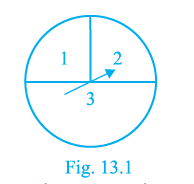
Question 6. A game consists of spinning an arrow which comes to rest pointing at one of the regions (1, 2 or 3) (Fig. 13.1). Are the outcomes 1, 2 and 3 equally likely to occur? Give reasons.
Answer:
Solution:
No, the outcomes 1, 2, and 3 are not equally likely to occur.
Reason:
In a probability experiment involving a spinner, the likelihood of an arrow landing in a particular region depends on the area of that region or the central angle it subtends at the center of the circle.
By observing Fig. 13.1, we can see that:
1. Region 1 is a quadrant of the circle. Its central angle is $90^\circ$.
2. Region 2 is also a quadrant of the circle. Its central angle is $90^\circ$.
3. Region 3 is a semicircle. Its central angle is $180^\circ$.
Let the total area of the circle be $A$. Then:
$\text{Area of Region 1} = \frac{1}{4}A$
... (i)
$\text{Area of Region 2} = \frac{1}{4}A$
... (ii)
$\text{Area of Region 3} = \frac{1}{2}A$
... (iii)
Since the areas of the three regions are not equal, the probability of the arrow landing in each region is different. The probability of landing in Region 3 is twice as much as the probability of landing in Region 1 or Region 2.
Conclusion:
Since the probabilities of the outcomes are not the same, the outcomes are not equally likely.
Question 7. Apoorv throws two dice once and computes the product of the numbers appearing on the dice. Peehu throws one die and squares the number that appears on it. Who has the better chance of getting the number 36? Why?
Answer:
Given:
1. Apoorv throws two dice and calculates the product of the numbers.
2. Peehu throws one die and calculates the square of the number.
To Find:
Who has a better chance (higher probability) of getting the number 36.
Solution:
Case 1: For Apoorv (Two dice)
When two dice are thrown, the total number of possible outcomes is:
$6 \times 6 = 36$
The outcomes are pairs $(x, y)$ where $x, y \in \{1, 2, 3, 4, 5, 6\}$. Apoorv computes the product $xy$. To get a product of 36, the only possible outcome is $(6, 6)$ because the maximum product of two numbers on dice is $6 \times 6 = 36$.
Number of favorable outcomes = 1
$P(\text{Apoorv gets 36}) = \frac{1}{36}$
... (i)
Case 2: For Peehu (One die)
When one die is thrown, the total number of possible outcomes is:
$6$ (which are $\{1, 2, 3, 4, 5, 6\}$)
Peehu squares the number that appears ($x^2$). To get 36, the number appearing on the die must be 6, because $6^2 = 36$.
Number of favorable outcomes = 1
$P(\text{Peehu gets 36}) = \frac{1}{6}$
... (ii)
Comparison:
To compare the two probabilities, we can write them with a common denominator:
$P(\text{Peehu gets 36}) = \frac{1}{6} = \frac{1 \times 6}{6 \times 6} = \frac{6}{36}$
Comparing (i) and (ii):
$\frac{6}{36} > \frac{1}{36}$
... (iii)
Conclusion:
Peehu has a better chance of getting the number 36 because her probability ($\frac{1}{6}$) is greater than Apoorv's probability ($\frac{1}{36}$).
Question 8. When we toss a coin, there are two possible outcomes - Head or Tail. Therefore, the probability of each outcome is $\frac{1}{2}$ . Justify your answer.
Answer:
The statement is correct, provided that the coin is a fair coin.
Justification:
When we toss a coin, the two possible outcomes are Head (H) and Tail (T).
The total number of possible outcomes is 2.
For the probability of each outcome to be $\frac{1}{2}$, the outcomes must be equally likely or equiprobable.
Equally likely outcomes are those that have the same chance of occurring.
In the case of a fair coin, there is no reason to expect one outcome (Head) to occur more or less often than the other outcome (Tail). The symmetry of a fair coin implies that both outcomes are equally likely.
Using the formula for probability when outcomes are equally likely:
$P(\text{Event}) = \frac{\text{Number of favourable outcomes}}{\text{Total number of possible outcomes}}$
For the event of getting a Head, the number of favourable outcomes is 1 (Head).
$P(\text{Head}) = \frac{1}{2}$
For the event of getting a Tail, the number of favourable outcomes is 1 (Tail).
$P(\text{Tail}) = \frac{1}{2}$
Therefore, for a fair coin, the probability of each outcome (Head or Tail) is indeed $\frac{1}{2}$. However, if the coin were biased (not fair), the outcomes would not be equally likely, and their probabilities would not be $\frac{1}{2}$. The statement holds true specifically for a fair coin.
Question 9. A student says that if you throw a die, it will show up 1 or not 1. Therefore, the probability of getting 1 and the probability of getting ‘not 1’ each is equal to $\frac{1}{2}$ . Is this correct? Give reasons.
Answer:
Solution:
No, the student's statement is incorrect.
Reason:
When a fair die is thrown, there are 6 possible outcomes, which are $\{1, 2, 3, 4, 5, 6\}$. These outcomes are equally likely.
Let $E$ be the event of getting '1'.
The number of outcomes favorable to $E = 1$ (i.e., the face with number 1).
The total number of possible outcomes = $6$.
$P(1) = \frac{1}{6}$
... (i)
Now, let $\overline{E}$ be the event of 'not getting 1'.
The outcomes favorable to 'not 1' are $\{2, 3, 4, 5, 6\}$.
The number of outcomes favorable to $\overline{E} = 5$.
$P(\text{not 1}) = \frac{5}{6}$
... (ii)
The student's error lies in assuming that because there are only two possibilities ('1' or 'not 1'), they must be equally likely. In probability, two outcomes are equally likely only if they have the same chance of occurring. Here, 'not 1' is five times more likely than '1'.
Alternate Solution:
We know that for any event $E$:
$P(E) + P(\text{not } E) = 1$
[Complementary Events] ... (iii)
For a die, we have already calculated $P(1) = \frac{1}{6}$.
Therefore, $P(\text{not 1}) = 1 - P(1)$
$P(\text{not 1}) = 1 - \frac{1}{6}$
$P(\text{not 1}) = \frac{5}{6}$
Since $\frac{1}{6} \neq \frac{1}{2}$ and $\frac{5}{6} \neq \frac{1}{2}$, the student is incorrect.
Question 10. I toss three coins together. The possible outcomes are no heads, 1 head, 2 heads and 3 heads. So, I say that probability of no heads is $\frac{1}{4}$ . What is wrong with this conclusion?
Answer:
Given:
1. Experiment: Tossing three coins together.
2. Outcomes listed by the student: {No heads, 1 head, 2 heads, 3 heads}.
3. Student's Conclusion: $P(\text{no heads}) = \frac{1}{4}$.
Solution:
The conclusion is wrong because the four outcomes listed (no heads, 1 head, 2 heads, and 3 heads) are not equally likely. The probability $P(E) = \frac{1}{n}$ can only be applied when all outcomes in the sample space are equally likely.
When three coins are tossed, the actual sample space ($S$) consists of the following 8 elementary outcomes:
$S = \{HHH, HHT, HTH, THH, HTT, THT, TTH, TTT\}$
$\text{Total number of outcomes } (n) = 2^3 = 8$
... (i)
Now, let us analyze the frequency of the events mentioned by the student:
1. No heads: This occurs only in the case $\{TTT\}$. (1 outcome)
2. 1 head: This occurs in $\{HTT, THT, TTH\}$. (3 outcomes)
3. 2 heads: This occurs in $\{HHT, HTH, THH\}$. (3 outcomes)
4. 3 heads: This occurs in $\{HHH\}$. (1 outcome)
Calculating the actual probability for "no heads":
$P(\text{no heads}) = \frac{1}{8}$
[Using (i)] ... (ii)
Conclusion:
The student’s conclusion of $\frac{1}{4}$ is incorrect because they treated the four categories as equally likely elementary outcomes, whereas they are actually composite events with different probabilities. The correct probability is $\frac{1}{8}$.
Alternate Solution (Tabular Representation):
We can represent the distribution of heads as follows:
| Event (Number of Heads) | Favorable Outcomes | Probability |
| 0 Heads | {TTT} | $1/8$ |
| 1 Head | {HTT, THT, TTH} | $3/8$ |
| 2 Heads | {HHT, HTH, THH} | $3/8$ |
| 3 Heads | {HHH} | $1/8$ |
From the table, it is clear that the outcomes are not equally likely, thus the student's logic fails.
Question 11. If you toss a coin 6 times and it comes down heads on each occasion. Can you say that the probability of getting a head is 1? Give reasons.
Answer:
Solution:
No, we cannot say that the probability of getting a head is 1.
Reason:
The outcome of tossing a coin 6 times and getting heads each time is a result of experimental probability based on a very small number of trials. In probability theory, we distinguish between theoretical probability and experimental (empirical) probability.
1. Theoretical Probability: For a fair coin, the probability of getting a head is always $\frac{1}{2}$ and the probability of getting a tail is also $\frac{1}{2}$. This is based on the symmetry of the coin.
2. Experimental Probability: This is calculated as:
$\text{P}(E) = \frac{\text{Number of trials in which the event happened}}{\text{Total number of trials}}$
In this specific case, the experimental probability is $\frac{6}{6} = 1$. However, this does not represent the true nature of the coin. As the number of tosses increases (approaching infinity), the experimental probability tends to get closer to the theoretical probability ($\frac{1}{2}$). This is known as the Law of Large Numbers.
Statistical Analysis:
Getting 6 heads in a row is not impossible for a fair coin. The probability of this occurring by pure chance is:
$P(6 \text{ heads}) = \left(\frac{1}{2}\right)^6 = \frac{1}{64}$
[For a fair coin]
Since $\frac{1}{64}$ is greater than 0, this event can occur simply due to randomness. It does not prove that the coin will always show heads.
Conclusion:
A probability of 1 would mean that getting a head is a Sure Event (like a coin with heads on both sides). A sequence of 6 heads is insufficient evidence to conclude that the coin is not fair or that the probability is 1. Therefore, the statement is incorrect.
Question 12. Sushma tosses a coin 3 times and gets tail each time. Do you think that the outcome of next toss will be a tail? Give reasons.
Answer:
No, the outcome of the next toss is not necessarily a tail. While it is a possible outcome, the probability of getting a tail on the next toss remains the same as that of getting a head.
Reason:
Each toss of a coin is an independent event. This means that the outcome of one toss does not influence or depend on the outcomes of previous tosses.
The fact that Sushma got tails in the first three tosses is simply a sequence of results that occurred. It does not change the inherent probability of the coin landing on heads or tails for any future toss.
Assuming the coin is a fair coin, the probability of getting a head on any single toss is $\frac{1}{2}$, and the probability of getting a tail on any single toss is also $\frac{1}{2}$.
The outcome of the previous tosses (getting three tails in a row) has no memory or influence on the physical process of the next toss.
Therefore, for the fourth toss, the probability of getting a tail is still $\frac{1}{2}$, and the probability of getting a head is also still $\frac{1}{2}$. The past results do not alter these probabilities.
Question 13. If I toss a coin 3 times and get head each time, should I expect a tail to have a higher chance in the 4th toss? Give reason in support of your answer.
Answer:
No, you should not expect a tail to have a higher chance in the 4th toss.
Reason:
Each toss of a coin is an independent event. This means that the outcome of any particular toss is not influenced by the outcomes of the previous tosses.
The fact that you got heads in the first three tosses does not affect the physical properties of the coin or the conditions of the toss for the fourth throw.
Assuming the coin is a fair coin, the probability of getting a head on any single toss is $\frac{1}{2}$, and the probability of getting a tail on any single toss is also $\frac{1}{2}$. These probabilities remain constant for each toss, regardless of the results of previous tosses.
The feeling that a tail is "due" after a sequence of heads is a common misconception known as the Gambler's Fallacy. In reality, the coin has no memory of past results.
Therefore, the probability of getting a tail on the 4th toss is still $\frac{1}{2}$, just as the probability of getting a head on the 4th toss is still $\frac{1}{2}$.
Question 14. A bag contains slips numbered from 1 to 100. If Fatima chooses a slip at random from the bag, it will either be an odd number or an even number. Since this situation has only two possible outcomes, so, the probability of each is $\frac{1}{2}$ . Justify.
Answer:
Yes, the conclusion that the probability of each is $\frac{1}{2}$ is correct in this specific situation, but the reason given is not universally correct.
Justification:
The statement says that since there are only two possible types of outcomes (odd number or even number), the probability of each is $\frac{1}{2}$. This reasoning is flawed in general, as simply having two categories of outcomes does not make them equally likely (as shown in previous questions, e.g., tossing three coins and counting the number of heads).
However, let's consider the specific case of drawing a slip numbered from 1 to 100 at random from the bag.
The total number of possible outcomes is the number of slips, which is 100.
Let's count the number of odd numbers and even numbers between 1 and 100:
- Odd numbers: 1, 3, 5, ..., 99. There are 50 odd numbers from 1 to 100.
- Even numbers: 2, 4, 6, ..., 100. There are 50 even numbers from 1 to 100.
Since a slip is chosen at random, each slip has an equal probability of being chosen.
The probability of drawing an odd number is the number of odd slips divided by the total number of slips:
$P(\text{Odd}) = \frac{\text{Number of odd numbers}}{\text{Total number of slips}} = \frac{50}{100} = \frac{1}{2}$
The probability of drawing an even number is the number of even slips divided by the total number of slips:
$P(\text{Even}) = \frac{\text{Number of even numbers}}{\text{Total number of slips}} = \frac{50}{100} = \frac{1}{2}$
In this particular scenario (numbers from 1 to 100), the number of odd outcomes is equal to the number of even outcomes. Therefore, the events "drawing an odd number" and "drawing an even number" are indeed equally likely, and the probability of each is $\frac{1}{2}$.
So, the conclusion $P(\text{Odd}) = \frac{1}{2}$ and $P(\text{Even}) = \frac{1}{2}$ is correct for this specific problem, but it is correct because the number of odd and even numbers happens to be equal (50 each), not simply because there are only two types of outcomes.
Sample Question 1 to 4 (Before Exercise 13.3)
Sample Question 1: Construct the cumulative frequency distribution of the following distribution :
| Class | 12.5 - 17.5 | 17.5 - 22.5 | 22.5 - 27.5 | 27.5 - 32.5 | 32.5 - 37.5 |
|---|---|---|---|---|---|
| Frequency | 2 | 22 | 19 | 14 | 13 |
Answer:
Given:
A frequency distribution with class intervals and their corresponding frequencies.
To Construct:
The cumulative frequency distribution.
Solution:
To construct the cumulative frequency distribution, we add the frequency of each class to the cumulative frequency of the preceding class. The cumulative frequency of the first class is the frequency of that class itself.
We can construct the table as follows:
| Class | Frequency | Cumulative Frequency |
| 12.5 - 17.5 | 2 | 2 |
| 17.5 - 22.5 | 22 | 2 + 22 = 24 |
| 22.5 - 27.5 | 19 | 24 + 19 = 43 |
| 27.5 - 32.5 | 14 | 43 + 14 = 57 |
| 32.5 - 37.5 | 13 | 57 + 13 = 70 |
The cumulative frequency distribution is shown in the table above.
Sample Question 2: Daily wages of 110 workers, obtained in a survey, are tabulated below :
| Daily wages (in Rs) | Number of workers |
|---|---|
| 100 - 120 | 10 |
| 120 - 140 | 15 |
| 140 - 160 | 20 |
| 160 - 180 | 22 |
| 180 - 200 | 18 |
| 200 - 220 | 12 |
| 220 - 240 | 13 |
Compute the mean daily wages of these workers.
Answer:
Given:
The frequency distribution of daily wages of 110 workers is provided in the table. The total number of workers ($\sum f_i$) is 110.
To Find:
The mean daily wages of the workers ($\overline{x}$).
Solution:
We will use the Assumed Mean Method to calculate the mean daily wages. Let the assumed mean be $a = 170$. Here, the class width ($h$) is 20.
| Daily wages ($\textsf{₹}$) | Number of workers ($f_i$) | Class Mark ($x_i$) | $d_i = x_i - 170$ | $f_i d_i$ |
| 100 - 120 | 10 | 110 | -60 | -600 |
| 120 - 140 | 15 | 130 | -40 | -600 |
| 140 - 160 | 20 | 150 | -20 | -400 |
| 160 - 180 | 22 | 170 | 0 | 0 |
| 180 - 200 | 18 | 190 | 20 | 360 |
| 200 - 220 | 12 | 210 | 40 | 480 |
| 220 - 240 | 13 | 230 | 60 | 780 |
| Total | $\sum f_i = 110$ | $\sum f_i d_i = 20$ |
The formula for the mean using the assumed mean method is:
$\overline{x} = a + \frac{\sum f_{i}d_{i}}{\sum f_{i}}$
... (i)
Substituting the values from the table into the formula:
$\overline{x} = 170 + \frac{20}{110}$
$\overline{x} = 170 + \frac{\cancel{20}^2}{\cancel{110}_{11}}$
$\overline{x} = 170 + \frac{2}{11}$
Calculating the division $\frac{2}{11}$:
$\frac{2}{11} \approx 0.1818$
[Approx. value] ... (ii)
$\overline{x} = 170 + 0.18$ (Taking two decimal places)
$\overline{x} = 170.18$
Final Answer:
The mean daily wages of the workers is $\textsf{₹} \ 170.18$ (approximately).
Alternate Solution (Direct Method):
$\overline{x} = \frac{\sum f_i x_i}{\sum f_i}$
Sum of $f_i x_i = (10 \times 110) + (15 \times 130) + (20 \times 150) $$ + (22 \times 170) + (18 \times 190) + (12 \times 210) + (13 \times 230)$
$\sum f_i x_i = 1100 + 1950 + 3000 + 3740 + 3420 + 2520 + 2990 $$ = 18720$
$\overline{x} = \frac{18720}{110}$
$\overline{x} = \frac{1872}{11}$
$\overline{x} = 170.1818...$
Sample Question 3: The percentage of marks obtained by 100 students in an examination are given below:
| Marks | 30-35 | 35-40 | 40-45 | 45-50 | 50-55 | 55-60 | 60-65 |
| Frequency | 14 | 16 | 18 | 23 | 18 | 8 | 3 |
Determine the median percentage of marks
Answer:
Given:
The percentage of marks obtained by 100 students in different class intervals and the corresponding frequencies.
To Find:
The median percentage of marks.
Solution:
To find the median of grouped data, we first need to calculate the cumulative frequencies. Then, we find the median class, which is the class interval containing the $(\frac{N}{2})^{\text{th}}$ observation, where $N$ is the total number of observations.
Let's construct the cumulative frequency distribution table:
| Marks | Frequency ($f_i$) | Cumulative Frequency (CF) |
| 30-35 | 14 | 14 |
| 35-40 | 16 | $14 + 16 = 30$ |
| 40-45 | 18 | $30 + 18 = 48$ |
| 45-50 | 23 | $48 + 23 = 71$ |
| 50-55 | 18 | $71 + 18 = 89$ |
| 55-60 | 8 | $89 + 8 = 97$ |
| 60-65 | 3 | $97 + 3 = 100$ |
| Total | $\sum\limits f_i = N = 100$ |
Total number of observations, $N = 100$.
We need to find the $(\frac{N}{2})^{\text{th}}$ observation.
$\frac{N}{2} = \frac{100}{2} = 50^{\text{th}}$ observation
Now, we look for the cumulative frequency that is greater than or equal to 50. From the table, the cumulative frequency 71 is the first cumulative frequency greater than 50, and it corresponds to the class interval 45-50.
Thus, the median class is 45-50.
The formula for the median of grouped data is:
$Median = L + \left(\frac{\frac{N}{2} - CF}{f}\right) \times h$
Where:
$L$ = lower boundary of the median class = 45
$N$ = total number of observations = 100
$CF$ = cumulative frequency of the class preceding the median class = 48 (CF of class 40-45)
$f$ = frequency of the median class = 23
$h$ = class size = $50 - 45 = 5$
Substitute these values into the formula:
$Median = 45 + \left(\frac{\frac{100}{2} - 48}{23}\right) \times 5$
$Median = 45 + \left(\frac{50 - 48}{23}\right) \times 5$
$Median = 45 + \left(\frac{2}{23}\right) \times 5$
$Median = 45 + \frac{10}{23}$
$Median = 45 + 0.4347...$
Rounding to two decimal places:
$Median \approx 45.43$
The median percentage of marks is approximately 45.43%.
Sample Question 4: The frequency distribution table of agricultural holdings in a village is given below :
| Area of land (in hectares) | 1-3 | 3-5 | 5-7 | 7-9 | 9-11 | 11-13 |
| Number of families | 20 | 45 | 80 | 55 | 40 | 12 |
Find the modal agricultural holdings of the village.
Answer:
Given:
The frequency distribution table of agricultural holdings in a village.
To Find:
The modal agricultural holdings of the village.
Solution:
The mode for grouped data is given by the formula:
$Mode = L + \left(\frac{f_1 - f_0}{2f_1 - f_0 - f_2}\right) \times h$
Where:
- $L$ is the lower limit of the modal class.
- $f_1$ is the frequency of the modal class.
- $f_0$ is the frequency of the class preceding the modal class.
- $f_2$ is the frequency of the class succeeding the modal class.
- $h$ is the class size.
First, we need to identify the modal class. The modal class is the class interval with the highest frequency.
From the given table, the frequencies are 20, 45, 80, 55, 40, and 12. The highest frequency is 80, which corresponds to the class interval 5-7.
So, the modal class is 5-7.
Now, we extract the values from the modal class and its neighbours:
- $L$ = Lower limit of the modal class = 5
- $f_1$ = Frequency of the modal class = 80
- $f_0$ = Frequency of the class preceding the modal class (3-5) = 45
- $f_2$ = Frequency of the class succeeding the modal class (7-9) = 55
- $h$ = Class size = Upper limit - Lower limit = $7 - 5 = 2$
Substitute these values into the mode formula:
$Mode = 5 + \left(\frac{80 - 45}{2(80) - 45 - 55}\right) \times 2$
$Mode = 5 + \left(\frac{35}{160 - 100}\right) \times 2$
$Mode = 5 + \left(\frac{35}{60}\right) \times 2$
$Mode = 5 + \frac{35}{30}$
$Mode = 5 + \frac{7}{6}$
$Mode = 5 + 1.1666...$
$Mode \approx 6.17$
The modal agricultural holdings of the village is approximately 6.17 hectares.
Exercise 13.3
Question 1. Find the mean of the distribution :
| Class | 1 - 3 | 3 - 5 | 5 - 7 | 7 - 10 |
|---|---|---|---|---|
| Frequency | 9 | 22 | 27 | 17 |
Answer:
Given:
The frequency distribution table for classes and their respective frequencies:
| Class | 1 - 3 | 3 - 5 | 5 - 7 | 7 - 10 |
| Frequency ($f_i$) | 9 | 22 | 27 | 17 |
To Find:
The mean ($\overline{x}$) of the given distribution.
Solution:
To find the mean, we first calculate the class marks ($x_i$) for each class interval using the formula:
$x_i = \frac{\text{Lower Limit} + \text{Upper Limit}}{2}$
Then we calculate the product of frequency and class mark ($f_i x_i$).
| Class | Frequency ($f_i$) | Class Mark ($x_i$) | $f_i x_i$ |
| 1 - 3 | 9 | $\frac{1+3}{2} = 2$ | $9 \times 2 = 18$ |
| 3 - 5 | 22 | $\frac{3+5}{2} = 4$ | $22 \times 4 = 88$ |
| 5 - 7 | 27 | $\frac{5+7}{2} = 6$ | $27 \times 6 = 162$ |
| 7 - 10 | 17 | $\frac{7+10}{2} = 8.5$ | $17 \times 8.5 = 144.5$ |
| Total | $\sum\limits f_i = 75$ | $\sum\limits f_i x_i = 412.5$ |
Now, using the Direct Method formula for mean:
$\overline{x} = \frac{\sum\limits f_i x_i}{\sum\limits f_i}$
…(i)
Substituting the values from the table:
$\overline{x} = \frac{412.5}{75}$
To simplify, we can multiply the numerator and denominator by 10:
$\overline{x} = \frac{4125}{750}$
Dividing both by 75:
$\overline{x} = 5.5$
[Final Mean Value] ... (ii)
Final Answer:
The mean of the given distribution is 5.5.
Alternate Solution (Assumed Mean Method):
Let the assumed mean $a = 6$.
We calculate deviation $d_i = x_i - a$.
| $x_i$ | $f_i$ | $d_i = x_i - 6$ | $f_i d_i$ |
| 2 | 9 | -4 | -36 |
| 4 | 22 | -2 | -44 |
| 6 | 27 | 0 | 0 |
| 8.5 | 17 | 2.5 | 42.5 |
| Total | 75 | -37.5 |
Using the formula:
$\overline{x} = a + \frac{\sum\limits f_i d_i}{\sum\limits f_i}$
$\overline{x} = 6 + \left( \frac{-37.5}{75} \right)$
$\overline{x} = 6 - \frac{37.5}{75}$
$\overline{x} = 6 - 0.5$
$\overline{x} = 5.5$
Question 2. Calculate the mean of the scores of 20 students in a mathematics test :
| Marks | 10 - 20 | 20 - 30 | 30 - 40 | 40 - 50 | 50 - 60 |
|---|---|---|---|---|---|
| Number of students | 2 | 4 | 7 | 6 | 1 |
Answer:
Given:
The frequency distribution of marks obtained by 20 students in a mathematics test is as follows:
| Marks | Number of students ($f_i$) |
| 10 - 20 | 2 |
| 20 - 30 | 4 |
| 30 - 40 | 7 |
| 40 - 50 | 6 |
| 50 - 60 | 1 |
| Total | $\sum f_i = 20$ |
To Find:
The mean score ($\overline{x}$) of the students.
Solution:
To calculate the mean using the Direct Method, we first find the class mark ($x_i$) for each class interval. The class mark is the average of the lower and upper limits of the class.
$x_i = \frac{\text{Lower limit} + \text{Upper limit}}{2}$
| Marks (Class) | Number of students ($f_i$) | Class Mark ($x_i$) | $f_i x_i$ |
| 10 - 20 | 2 | 15 | 30 |
| 20 - 30 | 4 | 25 | 100 |
| 30 - 40 | 7 | 35 | 245 |
| 40 - 50 | 6 | 45 | 270 |
| 50 - 60 | 1 | 55 | 55 |
| Total | $\sum f_i = 20$ | $\sum f_i x_i = 700$ |
Now, we use the formula for the mean:
$\overline{x} = \frac{\sum f_i x_i}{\sum f_i}$
... (i)
Substituting the values obtained from the table:
$\overline{x} = \frac{700}{20}$
$\overline{x} = \frac{\cancel{70}^35}{\cancel{2}}$
... (ii)
$\overline{x} = 35$
Final Answer:
The mean of the scores of the 20 students in the mathematics test is 35.
Alternate Solution (Assumed Mean Method):
Let the assumed mean (a) be 35.
We calculate the deviation $d_i = x_i - a$ for each class mark.
| $x_i$ | $f_i$ | $d_i = x_i - 35$ | $f_i d_i$ |
| 15 | 2 | -20 | -40 |
| 25 | 4 | -10 | -40 |
| 35 | 7 | 0 | 0 |
| 45 | 6 | 10 | 60 |
| 55 | 1 | 20 | 20 |
| Total | $\sum f_i = 20$ | $\sum f_i d_i = 0$ |
Using the Assumed Mean formula:
$\overline{x} = a + \frac{\sum f_i d_i}{\sum f_i}$
... (iii)
$\overline{x} = 35 + \frac{0}{20}$
$\overline{x} = 35 + 0$
$\overline{x} = 35$
Question 3. Calculate the mean of the following data :
| Class | 4 - 7 | 8 - 11 | 12 - 15 | 16 - 19 |
|---|---|---|---|---|
| Frequency | 5 | 4 | 9 | 10 |
Answer:
Given:
The frequency distribution of a data set with inclusive class intervals is given as follows:
| Class | 4 - 7 | 8 - 11 | 12 - 15 | 16 - 19 |
| Frequency ($f_i$) | 5 | 4 | 9 | 10 |
To Find:
The mean ($\overline{x}$) of the given data.
Solution:
In the case of inclusive (discontinuous) classes, the class marks ($x_i$) are calculated by taking the average of the lower and upper limits of each class interval.
$x_i = \frac{\text{Lower Limit} + \text{Upper Limit}}{2}$
... (i)
The calculation table using the Direct Method is as follows:
| Class | Frequency ($f_i$) | Class Mark ($x_i$) | $f_i x_i$ |
| 4 - 7 | 5 | 5.5 | 27.5 |
| 8 - 11 | 4 | 9.5 | 38.0 |
| 12 - 15 | 9 | 13.5 | 121.5 |
| 16 - 19 | 10 | 17.5 | 175.0 |
| Total | $\sum f_i = 28$ | $\sum f_i x_i = 362$ |
The formula for Mean ($\overline{x}$) is:
$\overline{x} = \frac{\sum f_i x_i}{\sum f_i}$
... (ii)
Substituting the values from the table:
$\overline{x} = \frac{362}{28}$
Simplifying the fraction:
$\overline{x} = \frac{\cancel{362}^{181}}{\cancel{28}_{14}}$
... (iii)
$\overline{x} = 12.928...$
Final Answer:
The mean of the given data is approximately 12.93.
Alternate Solution (Assumed Mean Method):
Let the assumed mean ($a$) be 13.5.
| $x_i$ | $f_i$ | $d_i = x_i - 13.5$ | $f_i d_i$ |
| 5.5 | 5 | -8 | -40 |
| 9.5 | 4 | -4 | -16 |
| 13.5 | 9 | 0 | 0 |
| 17.5 | 10 | 4 | 40 |
| Total | 28 | -16 |
Using the formula:
$\overline{x} = a + \frac{\sum f_i d_i}{\sum f_i}$
... (iv)
$\overline{x} = 13.5 + \left( \frac{-16}{28} \right)$
$\overline{x} = 13.5 - \frac{4}{7}$
$\overline{x} = 13.5 - 0.5714...$
$\overline{x} = 12.9285... \approx 12.93$
Question 4. The following table gives the number of pages written by Sarika for completing her own book for 30 days :
| Number of pages written per day | 16 - 18 | 19 - 21 | 22 - 24 | 25 - 27 | 28 - 30 |
|---|---|---|---|---|---|
| Number of days | 1 | 3 | 4 | 9 | 13 |
Find the mean number of pages written per day.
Answer:
Given:
The frequency distribution of the number of pages written per day by Sarika for 30 days is given in the following table:
| Number of pages written per day | 16 - 18 | 19 - 21 | 22 - 24 | 25 - 27 | 28 - 30 |
| Number of days ($f_i$) | 1 | 3 | 4 | 9 | 13 |
Total number of days ($\sum f_i$) = 30
To Find:
The mean number of pages written per day ($\overline{x}$).
Solution:
To calculate the mean, we first find the class marks ($x_i$) for each inclusive class interval. The class mark is calculated as:
$x_i = \frac{\text{Lower limit} + \text{Upper limit}}{2}$
... (i)
We will use the Direct Method to find the mean.
| Class (Pages) | Number of days ($f_i$) | Class Mark ($x_i$) | $f_i x_i$ |
| 16 - 18 | 1 | 17 | 17 |
| 19 - 21 | 3 | 20 | 60 |
| 22 - 24 | 4 | 23 | 92 |
| 25 - 27 | 9 | 26 | 234 |
| 28 - 30 | 13 | 29 | 377 |
| Total | $\sum f_i = 30$ | $\sum f_i x_i = 780$ |
Using the formula for Mean:
$\overline{x} = \frac{\sum f_i x_i}{\sum f_i}$
... (ii)
Substituting the values from the table:
$\overline{x} = \frac{780}{30}$
$\overline{x} = \frac{\cancel{78}^26}{\cancel{3}}$
... (iii)
$\overline{x} = 26$
Final Answer:
The mean number of pages written per day by Sarika is 26.
Alternate Solution (Assumed Mean Method):
Let the assumed mean ($a$) be 26.
We calculate the deviation $d_i = x_i - a$ for each class.
| $x_i$ | $f_i$ | $d_i = x_i - 26$ | $f_i d_i$ |
| 17 | 1 | -9 | -9 |
| 20 | 3 | -6 | -18 |
| 23 | 4 | -3 | -12 |
| 26 | 9 | 0 | 0 |
| 29 | 13 | 3 | 39 |
| Total | 30 | $\sum f_i d_i = 0$ |
The mean is given by:
$\overline{x} = a + \frac{\sum f_i d_i}{\sum f_i}$
$\overline{x} = 26 + \frac{0}{30}$
$\overline{x} = 26 + 0 = 26$
Question 5. The daily income of a sample of 50 employees are tabulated as follows :
| Income (in Rs) | 1 - 200 | 201 - 400 | 401 - 600 | 601 - 800 |
|---|---|---|---|---|
| Number of employees | 14 | 15 | 14 | 7 |
Find the mean daily income of employees.
Answer:
Given:
The frequency distribution of daily income for 50 employees is given below:
| Income (in $\textsf{₹}$) | 1 - 200 | 201 - 400 | 401 - 600 | 601 - 800 |
| Number of employees ($f_i$) | 14 | 15 | 14 | 7 |
Total number of employees ($\sum f_i$) = $14 + 15 + 14 + 7 = 50$
To Find:
The mean daily income of the employees ($\overline{x}$).
Solution:
We first determine the class marks ($x_i$) for each interval. The class mark is calculated as the average of the upper and lower limits:
$x_i = \frac{\text{Lower limit} + \text{Upper limit}}{2}$
... (i)
We will use the Direct Method to calculate the mean.
| Income Class | Frequency ($f_i$) | Class Mark ($x_i$) | $f_i x_i$ |
| 1 - 200 | 14 | 100.5 | 1407.0 |
| 201 - 400 | 15 | 300.5 | 4507.5 |
| 401 - 600 | 14 | 500.5 | 7007.0 |
| 601 - 800 | 7 | 700.5 | 4903.5 |
| Total | $\sum f_i = 50$ | $\sum f_i x_i = 17825$ |
The formula for Mean ($\overline{x}$) is:
$\overline{x} = \frac{\sum f_i x_i}{\sum f_i}$
... (ii)
Substituting the values from the table:
$\overline{x} = \frac{17825}{50}$
To simplify, we can write $\frac{17825}{50}$ as $\frac{17825 \times 2}{100}$:
$\overline{x} = \frac{35650}{100}$
$\overline{x} = 356.5$
... (iii)
Final Answer:
The mean daily income of the employees is $\textsf{₹} \ 356.50$.
Alternate Solution (Assumed Mean Method):
Let the assumed mean ($a$) be $300.5$.
Calculation of deviations $d_i = x_i - a$:
| $x_i$ | $f_i$ | $d_i = x_i - 300.5$ | $f_i d_i$ |
| 100.5 | 14 | -200 | -2800 |
| 300.5 | 15 | 0 | 0 |
| 500.5 | 14 | 200 | 2800 |
| 700.5 | 7 | 400 | 2800 |
| Total | 50 | $\sum f_i d_i = 2800$ |
Using the formula:
$\overline{x} = a + \frac{\sum f_i d_i}{\sum f_i}$
[Assumed Mean Method] ... (iv)
$\overline{x} = 300.5 + \frac{2800}{50}$
$\overline{x} = 300.5 + \frac{\cancel{280}^{56}}{\cancel{5}}$
$\overline{x} = 300.5 + 56$
$\overline{x} = 356.5$
Question 6. An aircraft has 120 passenger seats. The number of seats occupied during 100 flights is given in the following table :
| Number of seats | 100 - 104 | 104 - 108 | 108 - 112 | 112 - 116 | 116 - 120 |
|---|---|---|---|---|---|
| Frequency | 15 | 20 | 32 | 18 | 15 |
Determine the mean number of seats occupied over the flights.
Answer:
Given:
The frequency distribution of seats occupied in 100 flights of an aircraft with a capacity of 120 seats is provided in the table below:
| Number of seats | 100 - 104 | 104 - 108 | 108 - 112 | 112 - 116 | 116 - 120 |
| Frequency ($f_i$) | 15 | 20 | 32 | 18 | 15 |
To Find:
The mean number of seats occupied over the flights ($\overline{x}$).
Solution:
We will calculate the mean using the Assumed Mean Method. First, we determine the class mark ($x_i$) for each interval.
$x_i = \frac{\text{Lower limit} + \text{Upper limit}}{2}$
... (i)
Let the assumed mean ($a$) be 110. We calculate the deviation $d_i = x_i - a$.
| Number of seats (Class) | Frequency ($f_i$) | Class Mark ($x_i$) | $d_i = x_i - 110$ | $f_i d_i$ |
| 100 - 104 | 15 | 102 | -8 | -120 |
| 104 - 108 | 20 | 106 | -4 | -80 |
| 108 - 112 | 32 | 110 | 0 | 0 |
| 112 - 116 | 18 | 114 | 4 | 72 |
| 116 - 120 | 15 | 118 | 8 | 120 |
| Total | $\sum f_i = 100$ | $\sum f_i d_i = -8$ |
The formula for the mean using the assumed mean method is:
$\overline{x} = a + \frac{\sum f_i d_i}{\sum f_i}$
... (ii)
Substituting the values from our calculation table:
$\overline{x} = 110 + \frac{-8}{100}$
$\overline{x} = 110 - 0.08$
$\overline{x} = 109.92$
... (iii)
Final Answer:
The mean number of seats occupied over the flights is 109.92.
Alternate Solution (Direct Method):
Using the formula $\overline{x} = \frac{\sum f_i x_i}{\sum f_i}$:
$\sum f_i x_i = (15 \times 102) + (20 \times 106) + (32 \times 110) + (18 \times 114) $$ + (15 \times 118)$
$\sum f_i x_i = 1530 + 2120 + 3520 + 2052 + 1770$
$\sum f_i x_i = 10992$
$\overline{x} = \frac{10992}{100}$
[Total sum / Total frequency] ... (iv)
$\overline{x} = 109.92$
Question 7. The weights (in kg) of 50 wrestlers are recorded in the following table :
| Weight (in kg) | 100 - 110 | 110 - 120 | 120 - 130 | 130 - 140 | 140 - 150 |
|---|---|---|---|---|---|
| Number of wrestlers | 4 | 14 | 21 | 8 | 3 |
Find the mean weight of the wrestlers.
Answer:
Given:
The frequency distribution of weights of 50 wrestlers is as follows:
| Weight (in kg) | 100 - 110 | 110 - 120 | 120 - 130 | 130 - 140 | 140 - 150 |
| Number of wrestlers ($f_i$) | 4 | 14 | 21 | 8 | 3 |
Total number of wrestlers ($\sum f_i$) = 50
To Find:
The mean weight of the wrestlers ($\overline{x}$).
Solution:
We will use the Assumed Mean Method to calculate the mean. First, we find the class marks ($x_i$) for each interval using the formula:
$x_i = \frac{\text{Lower limit} + \text{Upper limit}}{2}$
... (i)
Let the assumed mean ($a$) be 125. We calculate the deviations $d_i = x_i - a$.
| Weight (kg) | Number of wrestlers ($f_i$) | Class Mark ($x_i$) | $d_i = x_i - 125$ | $f_i d_i$ |
| 100 - 110 | 4 | 105 | -20 | -80 |
| 110 - 120 | 14 | 115 | -10 | -140 |
| 120 - 130 | 21 | 125 | 0 | 0 |
| 130 - 140 | 8 | 135 | 10 | 80 |
| 140 - 150 | 3 | 145 | 20 | 60 |
| Total | $\sum f_i = 50$ | $\sum f_i d_i = -80$ |
The formula for the mean using the assumed mean method is:
$\overline{x} = a + \frac{\sum f_i d_i}{\sum f_i}$
... (ii)
Substituting the values from the table:
$\overline{x} = 125 + \frac{-80}{50}$
$\overline{x} = 125 - \frac{8}{5}$
[Cancelling the zeros] ... (iii)
$\overline{x} = 125 - 1.6$
$\overline{x} = 123.4$
... (iv)
Final Answer:
The mean weight of the wrestlers is 123.4 kg.
Alternate Solution (Direct Method):
Using the formula $\overline{x} = \frac{\sum f_i x_i}{\sum f_i}$:
$\sum f_i x_i = (4 \times 105) + (14 \times 115) + (21 \times 125) + (8 \times 135) $$ + (3 \times 145)$
$\sum f_i x_i = 420 + 1610 + 2625 + 1080 + 435$
$\sum f_i x_i = 6170$
$\overline{x} = \frac{6170}{50}$
$\overline{x} = \frac{617}{5} = 123.4$
Question 8. The mileage (km per litre) of 50 cars of the same model was tested by a manufacturer and details are tabulated as given below :
| Mileage (km/l) | 10 - 12 | 12 - 14 | 14 - 16 | 16 - 18 |
|---|---|---|---|---|
| Number of cars | 7 | 12 | 18 | 13 |
Find the mean mileage.
The manufacturer claimed that the mileage of the model was 16 km/litre. Do you agree with this claim?
Answer:
Given:
The distribution of mileage for 50 cars of the same model is provided below:
| Mileage (km/l) | Number of cars ($f_i$) |
| 10 - 12 | 7 |
| 12 - 14 | 12 |
| 14 - 16 | 18 |
| 16 - 18 | 13 |
| Total | $\sum f_i = 50$ |
Manufacturer's claimed mileage = 16 km/l.
To Find:
1. The mean mileage ($\overline{x}$).
2. Whether the manufacturer's claim of 16 km/l is correct.
Solution:
To find the mean mileage, we calculate the class mark ($x_i$) for each interval using the formula:
$x_i = \frac{\text{Lower limit} + \text{Upper limit}}{2}$
(Formula for class mark)
We will use the Direct Method for calculation:
| Mileage Class | Number of cars ($f_i$) | Class Mark ($x_i$) | $f_i x_i$ |
| 10 - 12 | 7 | 11 | 77 |
| 12 - 14 | 12 | 13 | 156 |
| 14 - 16 | 18 | 15 | 270 |
| 16 - 18 | 13 | 17 | 221 |
| Total | $\sum f_i = 50$ | $\sum f_i x_i = 724$ |
The formula for Mean ($\overline{x}$) is:
$\overline{x} = \frac{\sum f_i x_i}{\sum f_i}$
... (i)
Substituting the values:
$\overline{x} = \frac{724}{50}$
$\overline{x} = \frac{\cancel{724}^{362}}{\cancel{50}_{25}}$
[Dividing both by 2] ... (ii)
$\overline{x} = 14.48$
The mean mileage of the tested cars is 14.48 km/l.
Agreement with Claim:
The manufacturer claims the mileage is 16 km/l. However, our calculated mean is 14.48 km/l.
$\overline{x} < 16$
... (iii)
Since the average mileage obtained from the test (14.48 km/l) is significantly lower than the claimed mileage (16 km/l), we do not agree with the manufacturer's claim.
Alternate Solution (Assumed Mean Method):
Let the assumed mean ($a$) be 15.
Deviation $d_i = x_i - 15$:
| $x_i$ | $f_i$ | $d_i = x_i - 15$ | $f_i d_i$ |
| 11 | 7 | -4 | -28 |
| 13 | 12 | -2 | -24 |
| 15 | 18 | 0 | 0 |
| 17 | 13 | 2 | 26 |
| Total | 50 | -26 |
Mean using the Assumed Mean formula:
$\overline{x} = a + \frac{\sum f_i d_i}{\sum f_i}$
$\overline{x} = 15 + \left( \frac{-26}{50} \right)$
$\overline{x} = 15 - 0.52$
$\overline{x} = 14.48$
Question 9. The following is the distribution of weights (in kg) of 40 persons :
| Weight (in kg) | 40 - 45 | 45 - 50 | 50 - 55 | 55 - 60 | 60 - 65 | 65 - 70 | 70 - 75 | 75 - 80 |
|---|---|---|---|---|---|---|---|---|
| Number of persons | 4 | 4 | 13 | 5 | 6 | 5 | 2 | 1 |
Construct a cumulative frequency distribution (of the less than type) table for the data above.
Answer:
Given:
The frequency distribution of weights (in kg) of 40 persons.
To Construct:
A cumulative frequency distribution table of the less than type.
Solution:
To construct a cumulative frequency distribution of the less than type, we need to consider the upper limit of each class interval. The cumulative frequency for each class represents the total number of observations less than the upper limit of that class.
We add the frequencies sequentially, starting from the first class.
Let's construct the cumulative frequency distribution table:
| Weight (in kg) (Less than) | Number of persons (Cumulative Frequency) |
| Less than 45 | 4 |
| Less than 50 | 4 + 4 = 8 |
| Less than 55 | 8 + 13 = 21 |
| Less than 60 | 21 + 5 = 26 |
| Less than 65 | 26 + 6 = 32 |
| Less than 70 | 32 + 5 = 37 |
| Less than 75 | 37 + 2 = 39 |
| Less than 80 | 39 + 1 = 40 |
The cumulative frequency distribution table (less than type) is shown above. The last cumulative frequency (40) equals the total number of persons, which confirms the calculation is correct.
Question 10. The following table shows the cumulative frequency distribution of marks of 800 students in an examination:
| Marks | Number of students |
|---|---|
| Below 10 | 10 |
| Below 20 | 50 |
| Below 30 | 130 |
| Below 40 | 270 |
| Below 50 | 440 |
| Below 60 | 570 |
| Below 70 | 670 |
| Below 80 | 740 |
| Below 90 | 780 |
| Below 100 | 800 |
Construct a frequency distribution table for the data above.
Answer:
Given:
The cumulative frequency distribution of marks for 800 students is provided in the "Less than" format (Below 10, Below 20, etc.).
To Find:
Construct a Frequency Distribution Table for the given data.
Solution:
To convert a cumulative frequency distribution into a normal frequency distribution, we follow these steps:
1. Determine the Class Intervals: Since the cumulative data increases in steps of 10 (10, 20, 30, ...), our class intervals will be 0 - 10, 10 - 20, 20 - 30, and so on up to 90 - 100.
2. Calculate Frequencies ($f_i$): The frequency of a class is obtained by subtracting the cumulative frequency of the preceding class from the cumulative frequency of the current class. Mathematically:
$f_i = cf_i - cf_{i-1}$
... (i)
Where $cf_i$ is the cumulative frequency of the current class and $cf_{i-1}$ is the cumulative frequency of the previous class.
| Marks (Class Interval) | Cumulative Frequency ($cf$) | Calculation of Frequency ($f_i$) | Frequency ($f_i$) |
| 0 - 10 | 10 | 10 - 0 | 10 |
| 10 - 20 | 50 | 50 - 10 | 40 |
| 20 - 30 | 130 | 130 - 50 | 80 |
| 30 - 40 | 270 | 270 - 130 | 140 |
| 40 - 50 | 440 | 440 - 270 | 170 |
| 50 - 60 | 570 | 570 - 440 | 130 |
| 60 - 70 | 670 | 670 - 570 | 100 |
| 70 - 80 | 740 | 740 - 670 | 70 |
| 80 - 90 | 780 | 780 - 740 | 40 |
| 90 - 100 | 800 | 800 - 780 | 20 |
| Total | $\sum f_i = 800$ |
Final Answer:
The required frequency distribution table is as follows:
| Marks | 0 - 10 | 10 - 20 | 20 - 30 | 30 - 40 | 40 - 50 | 50 - 60 | 60 - 70 | 70 - 80 | 80 - 90 | 90 - 100 |
| Number of Students | 10 | 40 | 80 | 140 | 170 | 130 | 100 | 70 | 40 | 20 |
Since the sum of individual frequencies equals the final cumulative frequency (800), the construction is accurate.
Question 11. Form the frequency distribution table from the following data
| Marks (Out of 90) | Number of candidates |
|---|---|
| More than or equal to 80 | 4 |
| More than or equal to 70 | 6 |
| More than or equal to 60 | 11 |
| More than or equal to 50 | 17 |
| More than or equal to 40 | 23 |
| More than or equal to 30 | 27 |
| More than or equal to 20 | 30 |
| More than or equal to 10 | 32 |
| More than or equal to 0 | 34 |
Answer:
Given:
The "More than or equal to" cumulative frequency distribution of marks (out of 90) for 34 candidates.
To Find:
The Frequency Distribution Table for the given data.
Solution:
In a "More than" type distribution, the frequency of a particular class interval ($l_i - u_i$) is calculated by subtracting the cumulative frequency of the next lower limit ($u_i$) from the cumulative frequency of the current lower limit ($l_i$).
Mathematically, for a class $l_i - u_i$:
$f_i = (\text{CF} \geq l_i) - (\text{CF} \geq u_i)$
... (i)
Based on the provided data, we define the class intervals as 0 - 10, 10 - 20, ... , 80 - 90.
| Marks (Class Interval) | Cumulative Frequency ($cf$) | Calculation | Frequency ($f_i$) |
| 0 - 10 | 34 | 34 - 32 | 2 |
| 10 - 20 | 32 | 32 - 30 | 2 |
| 20 - 30 | 30 | 30 - 27 | 3 |
| 30 - 40 | 27 | 27 - 23 | 4 |
| 40 - 50 | 23 | 23 - 17 | 6 |
| 50 - 60 | 17 | 17 - 11 | 6 |
| 60 - 70 | 11 | 11 - 6 | 5 |
| 70 - 80 | 6 | 6 - 4 | 2 |
| 80 - 90 | 4 | 4 - 0 | 4 |
| Total | $\sum f_i = 34$ |
Final Answer:
The required frequency distribution table is:
| Marks | 0 - 10 | 10 - 20 | 20 - 30 | 30 - 40 | 40 - 50 | 50 - 60 | 60 - 70 | 70 - 80 | 80 - 90 |
| Number of Candidates | 2 | 2 | 3 | 4 | 6 | 6 | 5 | 2 | 4 |
The total sum of frequencies is 34, which matches the cumulative frequency of the "More than or equal to 0" category. Hence, the table is correct.
Question 12. Find the unknown entries a, b, c, d, e, f in the following distribution of heights of students in a class :
| Height (in cm) | Frequency | Cumulative Frequency |
|---|---|---|
| 150 - 155 | 12 | a |
| 155 - 160 | b | 25 |
| 160 - 165 | 10 | c |
| 165 - 170 | d | 43 |
| 170 - 175 | e | 48 |
| 175 - 180 | 2 | f |
| Total | 50 |
Answer:
Given:
A frequency distribution table of heights of students with some missing values for frequencies and cumulative frequencies.
| Height (in cm) | Frequency ($f_i$) | Cumulative Frequency ($cf$) |
| 150 - 155 | 12 | a |
| 155 - 160 | b | 25 |
| 160 - 165 | 10 | c |
| 165 - 170 | d | 43 |
| 170 - 175 | e | 48 |
| 175 - 180 | 2 | f |
| Total | 50 |
To Find:
The unknown entries a, b, c, d, e, and f.
Solution:
We know that the cumulative frequency of the first class is equal to its frequency, and for subsequent classes, the cumulative frequency is the sum of the current frequency and the cumulative frequency of the preceding class.
1. Finding 'a':
$a = 12$
[Frequency of first class] ... (i)
2. Finding 'b':
We know that: $a + b = 25$
$12 + b = 25$
$b = 25 - 12$
$b = 13$
... (ii)
3. Finding 'c':
We know that: $c = (\text{CF of previous class}) $$ + (\text{Frequency of current class})$
$c = 25 + 10$
$c = 35$
... (iii)
4. Finding 'd':
We know that: $c + d = 43$
$35 + d = 43$
$d = 43 - 35$
$d = 8$
... (iv)
5. Finding 'e':
We know that: $43 + e = 48$
$e = 48 - 43$
$e = 5$
... (v)
6. Finding 'f':
We know that: $f = 48 + 2$
$f = 50$
[Matches the total frequency] ... (vi)
Final Answer:
The values of the unknown entries are:
a = 12
b = 13
c = 35
d = 8
e = 5
f = 50
Question 13. The following are the ages of 300 patients getting medical treatment in a hospital on a particular day :
| Age (in years) | 10 - 20 | 20 - 30 | 30 - 40 | 40 - 50 | 50 - 60 | 60 - 70 |
|---|---|---|---|---|---|---|
| Number of patients | 60 | 42 | 55 | 70 | 53 | 20 |
Form:
(i) Less than type cumulative frequency distribution.
(ii) More than type cumulative frequency distribution.
Answer:
Given:
The age distribution of 300 patients in a hospital is as follows:
| Age (in years) | 10 - 20 | 20 - 30 | 30 - 40 | 40 - 50 | 50 - 60 | 60 - 70 |
| Number of patients ($f_i$) | 60 | 42 | 55 | 70 | 53 | 20 |
Total number of patients ($\sum f_i$) = 300
To Find:
1. Less than type cumulative frequency distribution.
2. More than type cumulative frequency distribution.
Solution:
(i) Less than type cumulative frequency distribution:
To form this distribution, we consider the upper class limits of the class intervals. The cumulative frequency is obtained by adding the frequency of the current class to the sum of all previous frequencies.
| Age (in years) | Number of patients ($f_i$) | Cumulative Frequency ($cf$) |
| Less than 20 | 60 | 60 |
| Less than 30 | 42 | $60 + 42 = 102$ |
| Less than 40 | 55 | $102 + 55 = 157$ |
| Less than 50 | 70 | $157 + 70 = 227$ |
| Less than 60 | 53 | $227 + 53 = 280$ |
| Less than 70 | 20 | $280 + 20 = 300$ |
(ii) More than type cumulative frequency distribution:
To form this distribution, we consider the lower class limits of the class intervals. We start with the total number of observations and subtract the frequency of the preceding class as we move down.
| Age (in years) | Number of patients ($f_i$) | Cumulative Frequency ($cf$) |
| More than or equal to 10 | 60 | 300 |
| More than or equal to 20 | 42 | $300 - 60 = 240$ |
| More than or equal to 30 | 55 | $240 - 42 = 198$ |
| More than or equal to 40 | 70 | $198 - 55 = 143$ |
| More than or equal to 50 | 53 | $143 - 70 = 73$ |
| More than or equal to 60 | 20 | $73 - 53 = 20$ |
Final Summary:
We have successfully converted the grouped data into both Less than and More than cumulative frequency distributions. Note that in the "Less than" type, the last cumulative frequency ($300$) matches the total frequency, while in the "More than" type, the first cumulative frequency ($300$) matches the total frequency.
$\sum f_i = 300$
[Verified]
Question 14. Given below is a cumulative frequency distribution showing the marks secured by 50 students of a class :
| Marks | Below 20 | Below 40 | Below 60 | Below 80 | Below 100 |
|---|---|---|---|---|---|
| Number of students | 17 | 22 | 29 | 37 | 50 |
Form the frequency distribution table for the data.
Answer:
Given:
The cumulative frequency distribution (Less than type) for 50 students is provided below:
| Marks | Below 20 | Below 40 | Below 60 | Below 80 | Below 100 |
| Number of students ($cf$) | 17 | 22 | 29 | 37 | 50 |
$n = 50$
[Total number of students] ... (i)
To Find:
The frequency distribution table for the given cumulative data.
Solution:
To convert the "Below" (less than) type cumulative frequency distribution into a grouped frequency distribution, we determine the class intervals and subtract successive cumulative frequencies to find individual frequencies ($f_i$).
Step 1: Define the Class Intervals. Since the marks are grouped in intervals of 20 (Below 20, Below 40, etc.), the classes will be 0 - 20, 20 - 40, 40 - 60, 60 - 80, and 80 - 100.
Step 2: Calculate Frequencies. The frequency of a class is calculated as:
$f_i = cf_i - cf_{i-1}$
... (ii)
Applying this for each class:
1. Frequency for 0 - 20 = $17$
2. Frequency for 20 - 40 = $22 - 17 = 5$
3. Frequency for 40 - 60 = $29 - 22 = 7$
4. Frequency for 60 - 80 = $37 - 29 = 8$
5. Frequency for 80 - 100 = $50 - 37 = 13$
Final Answer:
The required frequency distribution table is as follows:
| Marks (Class Interval) | Number of Students (Frequency $f_i$) |
| 0 - 20 | 17 |
| 20 - 40 | 5 |
| 40 - 60 | 7 |
| 60 - 80 | 8 |
| 80 - 100 | 13 |
| Total | $\sum f_i = 50$ |
Verification: The sum of the frequencies is $17 + 5 + 7 + 8 + 13 = 50$. This matches the total number of students given in the cumulative frequency distribution.
Question 15. Weekly income of 600 families is tabulated below :
| Weekly income (in Rs) | Number of families |
|---|---|
| 0 - 1000 | 250 |
| 1000 - 2000 | 190 |
| 2000 - 3000 | 100 |
| 3000 - 4000 | 40 |
| 4000 - 5000 | 15 |
| 5000 - 6000 | 5 |
| Total | 600 |
Compute the median income.
Answer:
Given:
The frequency distribution of weekly income of 600 families.
To Compute:
The median income.
Solution:
To find the median of grouped data, we first need to construct the cumulative frequency distribution. The median class is the class interval containing the $(\frac{N}{2})^{\text{th}}$ observation, where $N$ is the total number of observations (families).
Let's add a column for cumulative frequency to the table:
| Weekly income (in $\textsf{₹}$) | Number of families ($f_i$) | Cumulative Frequency (CF) |
| 0 - 1000 | 250 | 250 |
| 1000 - 2000 | 190 | $250 + 190 = 440$ |
| 2000 - 3000 | 100 | $440 + 100 = 540$ |
| 3000 - 4000 | 40 | $540 + 40 = 580$ |
| 4000 - 5000 | 15 | $580 + 15 = 595$ |
| 5000 - 6000 | 5 | $595 + 5 = 600$ |
| Total | $N = 600$ |
Total number of families, $N = 600$.
The median position is $\frac{N}{2}$.
$\frac{N}{2} = \frac{600}{2} = 300^{\text{th}}$ observation
Now, we locate the class interval whose cumulative frequency is greater than or equal to 300 for the first time. From the table, the cumulative frequency 440 is the first one greater than or equal to 300, and it corresponds to the class interval 1000 - 2000.
Thus, the median class is 1000 - 2000.
The formula for the median of grouped data is:
$Median = L + \left(\frac{\frac{N}{2} - CF}{f}\right) \times h$
Where:
- $L$ = lower boundary of the median class = 1000
- $N$ = total number of observations = 600
- $CF$ = cumulative frequency of the class preceding the median class (0-1000) = 250
- $f$ = frequency of the median class (1000-2000) = 190
- $h$ = class size = $2000 - 1000 = 1000$
Substitute these values into the formula:
$Median = 1000 + \left(\frac{\frac{600}{2} - 250}{190}\right) \times 1000$
$Median = 1000 + \left(\frac{300 - 250}{190}\right) \times 1000$
$Median = 1000 + \left(\frac{50}{190}\right) \times 1000$
$Median = 1000 + \frac{5}{19} \times 1000$
$Median = 1000 + \frac{5000}{19}$
Perform the division:
$\frac{5000}{19} \approx 263.1578...$
$Median \approx 1000 + 263.1578...$
$Median \approx 1263.1578...$
Rounding to two decimal places, the median income is approximately $\textsf{₹} 1263.16$.
The median income is approximately $\textsf{₹} 1263.16$.
Question 16. The maximum bowling speeds, in km per hour, of 33 players at a cricket coaching centre are given as follows :
| Speed (km/h) | 85 - 100 | 100 - 115 | 115 - 130 | 130 - 145 |
|---|---|---|---|---|
| Number of players | 11 | 9 | 8 | 5 |
Calculate the median bowling speed.
Answer:
Given:
The frequency distribution of bowling speeds of 33 players.
To Calculate:
The median bowling speed.
Solution:
To find the median of grouped data, we first need to construct the cumulative frequency distribution. The median class is the class interval containing the $(\frac{N}{2})^{\text{th}}$ observation, where $N$ is the total number of observations (players).
Let's add a column for cumulative frequency (CF) to the table:
| Speed (km/h) | Number of players ($f_i$) | Cumulative Frequency (CF) |
| 85 - 100 | 11 | 11 |
| 100 - 115 | 9 | $11 + 9 = 20$ |
| 115 - 130 | 8 | $20 + 8 = 28$ |
| 130 - 145 | 5 | $28 + 5 = 33$ |
| Total | $N = 33$ |
Total number of players, $N = 33$.
The median position is $\frac{N}{2}$.
$\frac{N}{2} = \frac{33}{2} = 16.5^{\text{th}}$ observation
Now, we locate the class interval whose cumulative frequency is greater than or equal to 16.5 for the first time. From the table, the cumulative frequency 20 is the first one greater than or equal to 16.5, and it corresponds to the class interval 100 - 115.
Thus, the median class is 100 - 115.
The formula for the median of grouped data is:
$Median = L + \left(\frac{\frac{N}{2} - CF}{f}\right) \times h$
Where:
- $L$ = lower boundary of the median class = 100
- $N$ = total number of observations = 33
- $CF$ = cumulative frequency of the class preceding the median class (85-100) = 11
- $f$ = frequency of the median class (100-115) = 9
- $h$ = class size = $115 - 100 = 15$
Substitute these values into the formula:
$Median = 100 + \left(\frac{\frac{33}{2} - 11}{9}\right) \times 15$
$Median = 100 + \left(\frac{16.5 - 11}{9}\right) \times 15$
$Median = 100 + \left(\frac{5.5}{9}\right) \times 15$
$Median = 100 + \frac{5.5 \times 15}{9}$
$Median = 100 + \frac{82.5}{9}$
$Median = 100 + \frac{825}{90}$
Simplify the fraction:
$Median = 100 + \frac{\cancel{825}^{55}}{\cancel{90}_{6}}$
$Median = 100 + \frac{55}{6}$
Performing the division $\frac{55}{6}$:
$\frac{55}{6} = 9.166...$
$Median \approx 100 + 9.17$
$Median \approx 109.17$
The median bowling speed is approximately 109.17 km/h.
Question 17. The monthly income of 100 families are given as below :
| Income (in Rs) | Number of families |
|---|---|
| 0 - 5000 | 8 |
| 5000 - 10000 | 26 |
| 10000 - 15000 | 41 |
| 15000 - 20000 | 16 |
| 20000 - 25000 | 3 |
| 25000 - 30000 | 3 |
| 30000 - 35000 | 2 |
| 35000 - 40000 | 1 |
Calculate the modal income.
Answer:
Given:
The frequency distribution of monthly income of 100 families.
To Calculate:
The modal income.
Solution:
To find the mode of grouped data, we first need to identify the modal class. The modal class is the class interval with the highest frequency.
From the given table, the frequencies are 8, 26, 41, 16, 3, 3, 2, and 1. The highest frequency is 41, which corresponds to the class interval 10000 - 15000.
Thus, the modal class is 10000 - 15000.
Now, we use the formula for the mode of grouped data:
$Mode = L + \left(\frac{f_1 - f_0}{2f_1 - f_0 - f_2}\right) \times h$
Where:
- $L$ = lower limit of the modal class = 10000
- $f_1$ = frequency of the modal class = 41
- $f_0$ = frequency of the class preceding the modal class (5000-10000) = 26
- $f_2$ = frequency of the class succeeding the modal class (15000-20000) = 16
- $h$ = class size = Upper limit - Lower limit = $15000 - 10000 = 5000$
Substitute these values into the formula:
$Mode = 10000 + \left(\frac{41 - 26}{2(41) - 26 - 16}\right) \times 5000$
$Mode = 10000 + \left(\frac{15}{82 - 42}\right) \times 5000$
$Mode = 10000 + \left(\frac{15}{40}\right) \times 5000$
$Mode = 10000 + \frac{15}{40} \times 5000$
$Mode = 10000 + \frac{15}{\cancel{40}_1} \times \cancel{5000}^{125}$
$Mode = 10000 + 15 \times 125$
$Mode = 10000 + 1875$
$Mode = 11875$
The modal income is $\textsf{₹} 11875$.
Question 18. The weight of coffee in 70 packets are shown in the following table :
| Weight (in g) | Number of packets |
|---|---|
| 200 - 201 | 12 |
| 201 - 202 | 26 |
| 202 - 203 | 20 |
| 203 - 204 | 9 |
| 204 - 205 | 2 |
| 205 - 206 | 1 |
Determine the modal weight.
Answer:
Given:
The frequency distribution of the weight of coffee in 70 packets.
To Determine:
The modal weight.
Solution:
To find the mode of grouped data, we first need to identify the modal class. The modal class is the class interval with the highest frequency.
From the given table, the frequencies are 12, 26, 20, 9, 2, and 1. The highest frequency is 26, which corresponds to the class interval 201 - 202.
Thus, the modal class is 201 - 202.
Now, we use the formula for the mode of grouped data:
$Mode = L + \left(\frac{f_1 - f_0}{2f_1 - f_0 - f_2}\right) \times h$
Where:
- $L$ = lower limit of the modal class = 201
- $f_1$ = frequency of the modal class = 26
- $f_0$ = frequency of the class preceding the modal class (200-201) = 12
- $f_2$ = frequency of the class succeeding the modal class (202-203) = 20
- $h$ = class size = Upper limit - Lower limit = $202 - 201 = 1$
Substitute these values into the formula:
$Mode = 201 + \left(\frac{26 - 12}{2(26) - 12 - 20}\right) \times 1$
$Mode = 201 + \left(\frac{14}{52 - 32}\right) \times 1$
$Mode = 201 + \left(\frac{14}{20}\right) \times 1$
$Mode = 201 + \frac{14}{20}$
$Mode = 201 + \frac{7}{10}$
$Mode = 201 + 0.7$
$Mode = 201.7$
The modal weight is 201.7 g.
Question 19. Two dice are thrown at the same time. Find the probability of getting
(i) same number on both dice.
(ii) different numbers on both dice.
Answer:
Given:
Two fair dice are thrown simultaneously.
To Find:
(i) The probability of getting the same number on both dice.
(ii) The probability of getting different numbers on both dice.
Solution:
When two fair dice are thrown, the total number of possible outcomes is the product of the number of outcomes for each die. Each die has 6 faces (1, 2, 3, 4, 5, 6).
The sample space $S$ consists of pairs of numbers $(d_1, d_2)$, where $d_1$ is the outcome on the first die and $d_2$ is the outcome on the second die.
The total number of possible outcomes is $n(S) = 6 \times 6 = 36$.
The sample space is:
$S = \{(1,1), (1,2), (1,3), (1,4), (1,5), (1,6),$
$\phantom{S = } (2,1), (2,2), (2,3), (2,4), (2,5), (2,6),$
$\phantom{S = } (3,1), (3,2), (3,3), (3,4), (3,5), (3,6),$
$\phantom{S = } (4,1), (4,2), (4,3), (4,4), (4,5), (4,6),$
$\phantom{S = } (5,1), (5,2), (5,3), (5,4), (5,5), (5,6),$
$\phantom{S = } (6,1), (6,2), (6,3), (6,4), (6,5), (6,6)\}$
(i) Probability of getting the same number on both dice:
Let $A$ be the event of getting the same number on both dice. The outcomes for this event are the pairs where both numbers are identical.
$A = \{(1,1), (2,2), (3,3), (4,4), (5,5), (6,6)\}$
The number of favourable outcomes for event $A$ is $n(A) = 6$.
The probability of event $A$, $P(A)$, is given by:
$P(A) = \frac{\text{Number of favourable outcomes}}{\text{Total number of outcomes}} = \frac{n(A)}{n(S)}$
$P(\text{same number}) = \frac{6}{36}$
$P(\text{same number}) = \frac{\cancel{6}^1}{\cancel{36}_6}$
$P(\text{same number}) = \frac{1}{6}$
The probability of getting the same number on both dice is $\frac{1}{6}$.
(ii) Probability of getting different numbers on both dice:
Let $B$ be the event of getting different numbers on both dice. The outcomes for this event are all the outcomes in the sample space except those where the numbers are the same.
The number of favourable outcomes for event $B$ is $n(B) = n(S) - n(A) = 36 - 6 = 30$.
The probability of event $B$, $P(B)$, is given by:
$P(B) = \frac{\text{Number of favourable outcomes}}{\text{Total number of outcomes}} = \frac{n(B)}{n(S)}$
$P(\text{different numbers}) = \frac{30}{36}$
$P(\text{different numbers}) = \frac{\cancel{30}^5}{\cancel{36}_6}$
$P(\text{different numbers}) = \frac{5}{6}$
The probability of getting different numbers on both dice is $\frac{5}{6}$.
Alternate Solution (for part ii):
The event of getting different numbers on both dice is the complement of the event of getting the same number on both dice.
Let $A$ be the event of getting the same number on both dice.
Let $A'$ be the event of getting different numbers on both dice (the complement of $A$).
The probability of the complement event is $P(A') = 1 - P(A)$.
From part (i), we found $P(A) = \frac{1}{6}$.
So, $P(\text{different numbers}) = 1 - P(\text{same number})$
$P(\text{different numbers}) = 1 - \frac{1}{6}$
$P(\text{different numbers}) = \frac{6}{6} - \frac{1}{6} = \frac{6-1}{6}$
$P(\text{different numbers}) = \frac{5}{6}$
This confirms the result obtained earlier.
Question 20. Two dice are thrown simultaneously. What is the probability that the sum of the numbers appearing on the dice is
(i) 7?
(ii) a prime number?
(iii) 1?
Answer:
Given:
Two dice are thrown simultaneously. The numbers on each die are $\{1, 2, 3, 4, 5, 6\}$.
To Find:
The probability that the sum of the numbers appearing on the dice is:
(i) 7
(ii) A prime number
(iii) 1
Solution:
When two dice are thrown, the total number of elementary outcomes is $6 \times 6 = 36$. These outcomes can be represented as $(x, y)$, where $x$ is the number on the first die and $y$ is the number on the second die.
| Die 1 / Die 2 | 1 | 2 | 3 | 4 | 5 | 6 |
| 1 | (1,1) | (1,2) | (1,3) | (1,4) | (1,5) | (1,6) |
| 2 | (2,1) | (2,2) | (2,3) | (2,4) | (2,5) | (2,6) |
| 3 | (3,1) | (3,2) | (3,3) | (3,4) | (3,5) | (3,6) |
| 4 | (4,1) | (4,2) | (4,3) | (4,4) | (4,5) | (4,6) |
| 5 | (5,1) | (5,2) | (5,3) | (5,4) | (5,5) | (5,6) |
| 6 | (6,1) | (6,2) | (6,3) | (6,4) | (6,5) | (6,6) |
$\text{Total number of outcomes } (n) = 36$
... (i)
(i) Probability that the sum is 7:
Let $E_1$ be the event that the sum is 7. The favorable outcomes are:
$\{(1, 6), (2, 5), (3, 4), (4, 3), (5, 2), (6, 1)\}$
Number of favorable outcomes = 6
$P(E_1) = \frac{\text{Number of favorable outcomes}}{\text{Total number of outcomes}}$
$P(E_1) = \frac{\cancel{6}^1}{\cancel{36}_6} = \frac{1}{6}$
... (ii)
(ii) Probability that the sum is a prime number:
The possible sums when two dice are thrown range from $1+1=2$ to $6+6=12$. The prime numbers in this range are 2, 3, 5, 7, and 11.
Let $E_2$ be the event that the sum is a prime number. The favorable outcomes for each prime sum are:
1. Sum = 2: $\{(1, 1)\}$ (1 outcome)
2. Sum = 3: $\{(1, 2), (2, 1)\}$ (2 outcomes)
3. Sum = 5: $\{(1, 4), (2, 3), (3, 2), (4, 1)\}$ (4 outcomes)
4. Sum = 7: $\{(1, 6), (2, 5), (3, 4), (4, 3), (5, 2), (6, 1)\}$ (6 outcomes)
5. Sum = 11: $\{(5, 6), (6, 5)\}$ (2 outcomes)
Total number of favorable outcomes = $1 + 2 + 4 + 6 + 2 = 15$
$P(E_2) = \frac{\cancel{15}^5}{\cancel{36}_{12}} = \frac{5}{12}$
... (iii)
(iii) Probability that the sum is 1:
Let $E_3$ be the event that the sum is 1. The minimum possible sum when two dice are thrown is $1 + 1 = 2$.
Since the sum can never be less than 2, there are no outcomes where the sum is 1. This is an impossible event.
Number of favorable outcomes = 0
$P(E_3) = \frac{0}{36} = 0$
... (iv)
Final Answer:
(i) The probability of getting a sum of 7 is $\frac{1}{6}$.
(ii) The probability of getting a sum that is a prime number is $\frac{5}{12}$.
(iii) The probability of getting a sum of 1 is 0.
Question 21. Two dice are thrown together. Find the probability that the product of the numbers on the top of the dice is
(i) 6
(ii) 12
(iii) 7
Answer:
Given:
Two dice are thrown together. The possible outcomes on each die are $\{1, 2, 3, 4, 5, 6\}$.
To Find:
The probability that the product of the numbers on the top of the dice is:
(i) 6
(ii) 12
(iii) 7
Solution:
When two dice are thrown together, the total number of possible elementary outcomes is:
$n(S) = 6 \times 6 = 36$
... (i)
These outcomes are represented as pairs $(x, y)$, where $x$ and $y$ are the numbers on the first and second die respectively.
(i) Probability that the product is 6:
Let $E_1$ be the event that the product of the two numbers is 6.
The pairs $(x, y)$ such that $x \times y = 6$ are:
$\{(1, 6), (2, 3), (3, 2), (6, 1)\}$
Number of outcomes favorable to $E_1$, $n(E_1) = 4$.
The probability is given by:
$P(E_1) = \frac{n(E_1)}{n(S)} = \frac{\cancel{4}^1}{\cancel{36}_{9}}$
[From (i)] ... (ii)
$P(E_1) = \frac{1}{9}$
(ii) Probability that the product is 12:
Let $E_2$ be the event that the product of the two numbers is 12.
The pairs $(x, y)$ such that $x \times y = 12$ are:
$\{(2, 6), (3, 4), (4, 3), (6, 2)\}$
Number of outcomes favorable to $E_2$, $n(E_2) = 4$.
The probability is given by:
$P(E_2) = \frac{n(E_2)}{n(S)} = \frac{\cancel{4}^1}{\cancel{36}_{9}}$
[From (i)] ... (iii)
$P(E_2) = \frac{1}{9}$
(iii) Probability that the product is 7:
Let $E_3$ be the event that the product of the two numbers is 7.
Since 7 is a prime number, its only factors are 1 and 7. However, the maximum number on a die is 6. Therefore, the outcome $(1, 7)$ or $(7, 1)$ is impossible.
Number of outcomes favorable to $E_3$, $n(E_3) = 0$.
$P(E_3) = \frac{0}{36} = 0$
[Impossible Event] ... (iv)
Final Answer:
(i) The probability that the product is 6 is $\frac{1}{9}$.
(ii) The probability that the product is 12 is $\frac{1}{9}$.
(iii) The probability that the product is 7 is 0.
Question 22. Two dice are thrown at the same time and the product of numbers appearing on them is noted. Find the probability that the product is less than 9.
Answer:
Given:
1. Two dice are thrown simultaneously.
2. The numbers on each die are $\{1, 2, 3, 4, 5, 6\}$.
3. The event $E$ is defined as "the product of the numbers appearing on the dice is less than 9".
To Find:
The probability $P(E)$ that the product of the numbers is less than 9.
Solution:
When two dice are thrown together, the total number of elementary outcomes in the sample space $S$ is:
$n(S) = 6 \times 6 = 36$
... (i)
The outcomes can be expressed as $(x, y)$, where $x$ is the outcome of the first die and $y$ is the outcome of the second die. We need to find outcomes where $x \times y < 9$.
Let us tabulate the products of all possible outcomes:
| Die 1 \ Die 2 | 1 | 2 | 3 | 4 | 5 | 6 |
| 1 | 1 | 2 | 3 | 4 | 5 | 6 |
| 2 | 2 | 4 | 6 | 8 | 10 | 12 |
| 3 | 3 | 6 | 9 | 12 | 15 | 18 |
| 4 | 4 | 8 | 12 | 16 | 20 | 24 |
| 5 | 5 | 10 | 15 | 20 | 25 | 30 |
| 6 | 6 | 12 | 18 | 24 | 30 | 36 |
The outcomes where the product is less than 9 are listed below:
1. When the first die shows 1: $(1,1), (1,2), (1,3), (1,4), (1,5), (1,6)$ — (6 outcomes)
2. When the first die shows 2: $(2,1), (2,2), (2,3), (2,4)$ — (4 outcomes)
3. When the first die shows 3: $(3,1), (3,2)$ — (2 outcomes)
4. When the first die shows 4: $(4,1), (4,2)$ — (2 outcomes)
5. When the first die shows 5: $(5,1)$ — (1 outcome)
6. When the first die shows 6: $(6,1)$ — (1 outcome)
The total number of favorable outcomes $n(E)$ is:
$n(E) = 16$
... (ii)
The probability of the event $E$ is calculated using the formula:
$P(E) = \frac{\text{Number of favorable outcomes}}{\text{Total number of possible outcomes}}$
$P(E) = \frac{n(E)}{n(S)}$
Substituting values from (i) and (ii):
$P(E) = \frac{\cancel{16}^{4}}{\cancel{36}_{9}}$
[Dividing by 4] ... (iii)
$P(E) = \frac{4}{9}$
... (iv)
Final Answer:
The probability that the product of the numbers appearing on the dice is less than 9 is $\frac{4}{9}$.
Question 23. Two dice are numbered 1, 2, 3, 4, 5, 6 and 1, 1, 2, 2, 3, 3, respectively. They are thrown and the sum of the numbers on them is noted. Find the probability of getting each sum from 2 to 9 separately.
Answer:
Given:
1. Die 1 is numbered $\{1, 2, 3, 4, 5, 6\}$.
2. Die 2 is numbered $\{1, 1, 2, 2, 3, 3\}$.
3. The experiment consists of throwing both dice and noting the sum of the numbers appearing on them.
To Find:
The probability of getting each sum from 2 to 9 separately.
Solution:
When two dice are thrown, the total number of elementary outcomes is the product of the number of faces on each die.
$\text{Total outcomes } (n) = 6 \times 6 = 36$
... (i)
Let us create a table to find all possible sums $(x + y)$, where $x$ is from Die 1 and $y$ is from Die 2:
| Die 2 \ Die 1 | 1 | 2 | 3 | 4 | 5 | 6 |
| 1 | 2 | 3 | 4 | 5 | 6 | 7 |
| 1 | 2 | 3 | 4 | 5 | 6 | 7 |
| 2 | 3 | 4 | 5 | 6 | 7 | 8 |
| 2 | 3 | 4 | 5 | 6 | 7 | 8 |
| 3 | 4 | 5 | 6 | 7 | 8 | 9 |
| 3 | 4 | 5 | 6 | 7 | 8 | 9 |
Now, we calculate the number of favorable outcomes for each sum and find the corresponding probabilities ($P = \frac{\text{Favorable outcomes}}{\text{Total outcomes}}$):
1. For Sum = 2:
Favorable outcomes: $\{(1,1), (1,1)\}$. Number of outcomes = 2.
$P(\text{Sum } 2) = \frac{\cancel{2}^1}{\cancel{36}_{18}} = \frac{1}{18}$
... (ii)
2. For Sum = 3:
Favorable outcomes: $\{(2,1), (2,1), (1,2), (1,2)\}$. Number of outcomes = 4.
$P(\text{Sum } 3) = \frac{\cancel{4}^1}{\cancel{36}_{9}} = \frac{1}{9}$
... (iii)
3. For Sum = 4:
Favorable outcomes: $\{(3,1), (3,1), (2,2), (2,2), (1,3), (1,3)\}$. Number of outcomes = 6.
$P(\text{Sum } 4) = \frac{\cancel{6}^1}{\cancel{36}_{6}} = \frac{1}{6}$
... (iv)
4. For Sum = 5:
Favorable outcomes: $\{(4,1), (4,1), (3,2), (3,2), (2,3), (2,3)\}$. Number of outcomes = 6.
$P(\text{Sum } 5) = \frac{\cancel{6}^1}{\cancel{36}_{6}} = \frac{1}{6}$
... (v)
5. For Sum = 6:
Favorable outcomes: $\{(5,1), (5,1), (4,2), (4,2), (3,3), (3,3)\}$. Number of outcomes = 6.
$P(\text{Sum } 6) = \frac{\cancel{6}^1}{\cancel{36}_{6}} = \frac{1}{6}$
... (vi)
6. For Sum = 7:
Favorable outcomes: $\{(6,1), (6,1), (5,2), (5,2), (4,3), (4,3)\}$. Number of outcomes = 6.
$P(\text{Sum } 7) = \frac{\cancel{6}^1}{\cancel{36}_{6}} = \frac{1}{6}$
... (vii)
7. For Sum = 8:
Favorable outcomes: $\{(6,2), (6,2), (5,3), (5,3)\}$. Number of outcomes = 4.
$P(\text{Sum } 8) = \frac{\cancel{4}^1}{\cancel{36}_{9}} = \frac{1}{9}$
... (viii)
8. For Sum = 9:
Favorable outcomes: $\{(6,3), (6,3)\}$. Number of outcomes = 2.
$P(\text{Sum } 9) = \frac{\cancel{2}^1}{\cancel{36}_{18}} = \frac{1}{18}$
... (ix)
Final Answer:
The probabilities of getting sums from 2 to 9 are $1/18, 1/9, 1/6, 1/6, 1/6, 1/6, 1/9, 1/18$ respectively.
Question 24. A coin is tossed two times. Find the probability of getting at most one head.
Answer:
Given:
A fair coin is tossed two times.
To Find:
The probability of getting at most one head.
Solution:
When a fair coin is tossed two times, the possible outcomes are:
Head on the first toss and Head on the second toss (HH)
Head on the first toss and Tail on the second toss (HT)
Tail on the first toss and Head on the second toss (TH)
Tail on the first toss and Tail on the second toss (TT)
The sample space $S$ consists of all possible outcomes:
$S = \{HH, HT, TH, TT\}$
The total number of possible outcomes is $n(S) = 4$.
We are interested in the event of getting "at most one head". This means the number of heads obtained is less than or equal to one. This includes the outcomes with zero heads or exactly one head.
Let $E$ be the event of getting at most one head.
Outcomes with zero heads: TT
Outcomes with exactly one head: HT, TH
The favourable outcomes for event $E$ are:
$E = \{HT, TH, TT\}$
The number of favourable outcomes is $n(E) = 3$.
The probability of an event is calculated using the formula:
$P(E) = \frac{\text{Number of favourable outcomes}}{\text{Total number of outcomes}} = \frac{n(E)}{n(S)}$
Substitute the number of favourable outcomes and the total number of outcomes into the formula:
$P(\text{at most one head}) = \frac{3}{4}$
The probability of getting at most one head is $\frac{3}{4}$.
Question 25. A coin is tossed 3 times. List the possible outcomes. Find the probability of getting
(i) all heads
(ii) at least 2 heads
Answer:
Given:
A fair coin is tossed 3 times.
To Find:
List the possible outcomes. Find the probability of getting:
(i) all heads
(ii) at least 2 heads
Solution:
When a fair coin is tossed 3 times, each toss has two possible outcomes: Head (H) or Tail (T). The total number of possible outcomes is $2 \times 2 \times 2 = 2^3 = 8$.
The possible outcomes can be listed by considering all combinations of H and T for the three tosses.
The sample space $S$ is:
- HHH
- HHT
- HTH
- THH
- HTT
- THT
- TTH
- TTT
The total number of outcomes is $n(S) = 8$.
(i) Probability of getting all heads:
Let $A$ be the event of getting all heads. This means getting H on all three tosses.
The favourable outcome for event $A$ is:
- HHH
The number of favourable outcomes is $n(A) = 1$.
The probability of event $A$ is given by:
$P(A) = \frac{\text{Number of favourable outcomes}}{\text{Total number of outcomes}} = \frac{n(A)}{n(S)}$
$P(\text{all heads}) = \frac{1}{8}$
The probability of getting all heads is $\frac{1}{8}$.
(ii) Probability of getting at least 2 heads:
Let $B$ be the event of getting at least 2 heads. This means getting exactly 2 heads or exactly 3 heads.
Outcomes with exactly 2 heads: HHT, HTH, THH
Outcomes with exactly 3 heads: HHH
The favourable outcomes for event $B$ are:
- HHT
- HTH
- THH
- HHH
The number of favourable outcomes is $n(B) = 4$.
The probability of event $B$ is given by:
$P(B) = \frac{\text{Number of favourable outcomes}}{\text{Total number of outcomes}} = \frac{n(B)}{n(S)}$
$P(\text{at least 2 heads}) = \frac{4}{8}$
Simplify the fraction:
$P(\text{at least 2 heads}) = \frac{\cancel{4}^1}{\cancel{8}_2}$
$P(\text{at least 2 heads}) = \frac{1}{2}$
The probability of getting at least 2 heads is $\frac{1}{2}$.
Question 26. Two dice are thrown at the same time. Determine the probabiity that the difference of the numbers on the two dice is 2.
Answer:
Given:
Two fair dice are thrown simultaneously. The possible numbers on each die are $\{1, 2, 3, 4, 5, 6\}$.
To Find:
The probability that the difference of the numbers appearing on the two dice is 2.
Solution:
When two dice are thrown together, the total number of elementary outcomes in the sample space $S$ is calculated as:
$n(S) = 6 \times 6 = 36$
... (i)
Let $E$ be the event that the difference of the numbers on the two dice is 2. If the numbers appearing are $(x, y)$, we are looking for outcomes where $|x - y| = 2$.
The favorable outcomes for event $E$ are listed below:
1. When the first die shows 1: $(1, 3)$
2. When the first die shows 2: $(2, 4)$
3. When the first die shows 3: $(3, 1)$ and $(3, 5)$
4. When the first die shows 4: $(4, 2)$ and $(4, 6)$
5. When the first die shows 5: $(5, 3)$
6. When the first die shows 6: $(6, 4)$
Collecting these outcomes, we get:
$E = \{(1, 3), (2, 4), (3, 1), (3, 5), (4, 2), (4, 6), (5, 3), (6, 4)\}$
The total number of favorable outcomes $n(E)$ is:
$n(E) = 8$
... (ii)
The probability of the event $E$ is given by the formula:
$P(E) = \frac{\text{Number of favorable outcomes}}{\text{Total number of possible outcomes}}$
Substituting the values from (i) and (ii):
$P(E) = \frac{\cancel{8}^2}{\cancel{36}_{9}}$
[Dividing by 4] ... (iii)
$P(E) = \frac{2}{9}$
... (iv)
Final Answer:
The probability that the difference of the numbers on the two dice is 2 is $\frac{2}{9}$.
Question 27. A bag contains 10 red, 5 blue and 7 green balls. A ball is drawn at random. Find the probability of this ball being a
(i) red ball
(ii) green ball
(iii) not a blue ball
Answer:
Given:
A bag contains 10 red balls, 5 blue balls, and 7 green balls.
A ball is drawn at random from the bag.
To Find:
The probability of the ball being:
(i) a red ball
(ii) a green ball
(iii) not a blue ball
Solution:
First, calculate the total number of balls in the bag.
Total number of balls = Number of red balls + Number of blue balls + Number of green balls
Total number of balls = $10 + 5 + 7 = 22$
The total number of possible outcomes when drawing one ball at random is the total number of balls in the bag, which is 22.
The probability of an event $E$ is given by:
$P(E) = \frac{\text{Number of favourable outcomes}}{\text{Total number of possible outcomes}}$
(i) Probability of being a red ball:
Let $R$ be the event that the drawn ball is red.
The number of favourable outcomes (drawing a red ball) is the number of red balls, which is 10.
$n(R) = 10$
Total number of outcomes = 22.
$P(\text{red ball}) = \frac{n(R)}{\text{Total number of balls}} = \frac{10}{22}$
Simplify the fraction:
$P(\text{red ball}) = \frac{\cancel{10}^5}{\cancel{22}_{11}}$
$P(\text{red ball}) = \frac{5}{11}$
The probability of the ball being a red ball is $\frac{5}{11}$.
(ii) Probability of being a green ball:
Let $G$ be the event that the drawn ball is green.
The number of favourable outcomes (drawing a green ball) is the number of green balls, which is 7.
$n(G) = 7$
Total number of outcomes = 22.
$P(\text{green ball}) = \frac{n(G)}{\text{Total number of balls}} = \frac{7}{22}$
The probability of the ball being a green ball is $\frac{7}{22}$.
(iii) Probability of not being a blue ball:
Let $B$ be the event that the drawn ball is blue.
Let $B'$ be the event that the drawn ball is not blue.
The event "not a blue ball" means the ball is either red or green.
Number of balls that are not blue = Number of red balls + Number of green balls
Number of balls that are not blue = $10 + 7 = 17$.
$n(B') = 17$
Total number of outcomes = 22.
$P(\text{not a blue ball}) = \frac{n(B')}{\text{Total number of balls}} = \frac{17}{22}$
The probability of the ball not being a blue ball is $\frac{17}{22}$.
Alternate Solution (for part iii):
The event "not a blue ball" is the complement of the event "being a blue ball".
Let $B$ be the event of drawing a blue ball.
Number of blue balls = 5.
Total number of balls = 22.
$P(B) = \frac{\text{Number of blue balls}}{\text{Total number of balls}} = \frac{5}{22}$
The probability of not being a blue ball is $P(B') = 1 - P(B)$.
$P(\text{not a blue ball}) = 1 - \frac{5}{22}$
$P(\text{not a blue ball}) = \frac{22}{22} - \frac{5}{22} = \frac{22-5}{22}$
$P(\text{not a blue ball}) = \frac{17}{22}$
This confirms the result obtained earlier.
Question 28. The king, queen and jack of clubs are removed from a deck of 52 playing cards and then well shuffled. Now one card is drawn at random from the remaining cards. Determine the probability that the card is
(i) a heart
(ii) a king
Answer:
Given:
A standard deck of 52 playing cards. The king, queen, and jack of clubs are removed. One card is drawn at random from the remaining cards.
To Determine:
The probability that the card drawn is:
(i) a heart
(ii) a king
Solution:
A standard deck of 52 cards has 4 suits: Hearts, Diamonds, Clubs, and Spades. Each suit has 13 cards: Ace, 2, 3, 4, 5, 6, 7, 8, 9, 10, Jack, Queen, King.
The king, queen, and jack of clubs are removed from the deck.
Initial number of cards = 52.
Number of cards removed = 3 (King of clubs, Queen of clubs, Jack of clubs).
Number of remaining cards = $52 - 3 = 49$.
The total number of possible outcomes when drawing one card from the remaining deck is 49.
The remaining cards consist of:
- Hearts: 13 cards
- Diamonds: 13 cards
- Clubs: 13 - 3 = 10 cards (excluding K, Q, J)
- Spades: 13 cards
Check: $13 + 13 + 10 + 13 = 49$. This matches the number of remaining cards.
(i) Probability that the card is a heart:
Let $H$ be the event that the drawn card is a heart.
The number of favourable outcomes (drawing a heart) is the number of heart cards in the remaining deck, which is 13.
$n(H) = 13$
Total number of outcomes = 49.
$P(\text{a heart}) = \frac{n(H)}{\text{Total number of remaining cards}} = \frac{13}{49}$
The probability that the card is a heart is $\frac{13}{49}$.
(ii) Probability that the card is a king:
Let $K$ be the event that the drawn card is a king.
A standard deck has 4 kings (one of each suit: Hearts, Diamonds, Clubs, Spades).
The king of clubs was removed. So, the kings remaining in the deck are the King of Hearts, King of Diamonds, and King of Spades.
The number of favourable outcomes (drawing a king) is the number of kings remaining, which is 3.
$n(K) = 3$
Total number of outcomes = 49.
$P(\text{a king}) = \frac{n(K)}{\text{Total number of remaining cards}} = \frac{3}{49}$
The probability that the card is a king is $\frac{3}{49}$.
Question 29. Refer to Q.28. What is the probability that the card is
(i) a club
(ii) 10 of hearts
Answer:
Given:
A deck of 52 playing cards from which the king, queen, and jack of clubs have been removed.
One card is drawn at random from the remaining cards.
From Question 28, the total number of remaining cards is $52 - 3 = 49$.
The remaining cards consist of:
- Hearts: 13 cards
- Diamonds: 13 cards
- Clubs: 10 cards (Ace, 2, 3, 4, 5, 6, 7, 8, 9, 10)
- Spades: 13 cards
To Determine:
The probability that the card drawn is:
(i) a club
(ii) 10 of hearts
Solution:
The total number of possible outcomes when drawing one card from the remaining deck is 49.
The probability of an event $E$ is given by:
$P(E) = \frac{\text{Number of favourable outcomes}}{\text{Total number of possible outcomes}}$
(i) Probability that the card is a club:
Let $C$ be the event that the drawn card is a club.
From the given information, the number of club cards remaining after removing the King, Queen, and Jack is 10.
$n(C) = 10$
Total number of outcomes = 49.
$P(\text{a club}) = \frac{n(C)}{\text{Total number of remaining cards}} = \frac{10}{49}$
The probability that the card is a club is $\frac{10}{49}$.
(ii) Probability that the card is 10 of hearts:
Let $T_H$ be the event that the drawn card is the 10 of hearts.
The King, Queen, and Jack of clubs were removed. The heart cards were not affected. There is exactly one card that is the 10 of hearts in a standard deck.
Since the heart suit was not modified, the 10 of hearts is still in the remaining deck.
The number of favourable outcomes (drawing the 10 of hearts) is 1.
$n(T_H) = 1$
Total number of outcomes = 49.
$P(\text{10 of hearts}) = \frac{n(T_H)}{\text{Total number of remaining cards}} = \frac{1}{49}$
The probability that the card is the 10 of hearts is $\frac{1}{49}$.
Question 30. All the jacks, queens and kings are removed from a deck of 52 playing cards. The remaining cards are well shuffled and then one card is drawn at random. Giving ace a value 1 similar value for other cards, find the probability that the card has a value
(i) 7
(ii) greater than 7
(iii) less than 7
Answer:
Given:
A standard deck of 52 playing cards. All jacks, queens, and kings are removed. One card is drawn at random from the remaining cards.
Ace is given a value of 1, and other cards have their face value (2 to 10).
To Find:
The probability that the card drawn has a value:
(i) 7
(ii) greater than 7
(iii) less than 7
Solution:
A standard deck of 52 cards has 4 suits (Hearts, Diamonds, Clubs, Spades). Each suit has 13 cards: Ace, 2, 3, 4, 5, 6, 7, 8, 9, 10, Jack (J), Queen (Q), King (K).
The jacks, queens, and kings from all four suits are removed.
Number of jacks removed = 4 (one from each suit).
Number of queens removed = 4 (one from each suit).
Number of kings removed = 4 (one from each suit).
Total number of cards removed = $4 + 4 + 4 = 12$.
Number of remaining cards = $52 - 12 = 40$.
The total number of possible outcomes when drawing one card from the remaining deck is 40.
The remaining cards in each suit are: Ace (value 1), 2, 3, 4, 5, 6, 7, 8, 9, 10.
There are 10 cards in each of the 4 suits, totalling $10 \times 4 = 40$ cards.
The possible values of the remaining cards are 1, 2, 3, 4, 5, 6, 7, 8, 9, 10.
For each value, there are 4 cards (one from each suit).
The probability of an event $E$ is given by:
$P(E) = \frac{\text{Number of favourable outcomes}}{\text{Total number of possible outcomes}}$
(i) Probability that the card has a value 7:
Let $E_1$ be the event that the drawn card has a value of 7.
The cards with value 7 are the four 7s (7 of Hearts, 7 of Diamonds, 7 of Clubs, 7 of Spades). These cards were not removed.
The number of favourable outcomes is $n(E_1) = 4$.
Total number of outcomes = 40.
$P(\text{value is 7}) = \frac{n(E_1)}{\text{Total number of remaining cards}} = \frac{4}{40}$
$P(\text{value is 7}) = \frac{\cancel{4}^1}{\cancel{40}_{10}}$
$P(\text{value is 7}) = \frac{1}{10}$
The probability that the card has a value 7 is $\frac{1}{10}$.
(ii) Probability that the card has a value greater than 7:
Let $E_2$ be the event that the drawn card has a value greater than 7.
The values greater than 7 among the remaining cards are 8, 9, and 10.
Number of cards with value 8 = 4 (one for each suit)
Number of cards with value 9 = 4 (one for each suit)
Number of cards with value 10 = 4 (one for each suit)
The number of favourable outcomes is $n(E_2) = 4 + 4 + 4 = 12$.
Total number of outcomes = 40.
$P(\text{value > 7}) = \frac{n(E_2)}{\text{Total number of remaining cards}} = \frac{12}{40}$
$P(\text{value > 7}) = \frac{\cancel{12}^3}{\cancel{40}_{10}}$
$P(\text{value > 7}) = \frac{3}{10}$
The probability that the card has a value greater than 7 is $\frac{3}{10}$.
(iii) Probability that the card has a value less than 7:
Let $E_3$ be the event that the drawn card has a value less than 7.
The values less than 7 among the remaining cards are Ace (value 1), 2, 3, 4, 5, and 6.
Number of cards with value 1 (Ace) = 4
Number of cards with value 2 = 4
Number of cards with value 3 = 4
Number of cards with value 4 = 4
Number of cards with value 5 = 4
Number of cards with value 6 = 4
The number of favourable outcomes is $n(E_3) = 4 + 4 + 4 + 4 + 4 + 4 = 6 \times 4 = 24$.
Total number of outcomes = 40.
$P(\text{value < 7}) = \frac{n(E_3)}{\text{Total number of remaining cards}} = \frac{24}{40}$
$P(\text{value < 7}) = \frac{\cancel{24}^3}{\cancel{40}_5}$
$P(\text{value < 7}) = \frac{3}{5}$
The probability that the card has a value less than 7 is $\frac{3}{5}$.
Question 31. An integer is chosen between 0 and 100. What is the probability that it is
(i) divisible by 7?
(ii) not divisible by 7?
Answer:
Given:
An integer is chosen between 0 and 100.
To Find:
The probability that the chosen integer is:
(i) Divisible by 7
(ii) Not divisible by 7
Solution:
The integers between 0 and 100 are $\{1, 2, 3, 4, ..., 99\}$.
Total number of possible outcomes ($n$):
$n = 99$
... (i)
(i) Probability that the integer is divisible by 7:
Let $E$ be the event that the number is divisible by 7. The favorable integers are:
$\{7, 14, 21, 28, 35, 42, 49, 56, 63, 70, 77, 84, 91, 98\}$
Number of favorable outcomes ($m$):
$m = 14$
... (ii)
The probability $P(E)$ is given by:
$P(E) = \frac{m}{n}$
... (iii)
Substituting values from (i) and (ii):
$P(E) = \frac{14}{99}$
... (iv)
(ii) Probability that the integer is not divisible by 7:
Let $\overline{E}$ be the event that the number is not divisible by 7. This is the complementary event of $E$.
We know that for any event $E$:
$P(E) + P(\overline{E}) = 1$
[Sum of probabilities] ... (v)
Therefore, $P(\overline{E}) = 1 - P(E)$
Substituting the value from (iv):
$P(\overline{E}) = 1 - \frac{14}{99}$
$P(\overline{E}) = \frac{99 - 14}{99}$
$P(\overline{E}) = \frac{85}{99}$
... (vi)
Final Answer:
(i) The probability that the integer is divisible by 7 is $\frac{14}{99}$.
(ii) The probability that the integer is not divisible by 7 is $\frac{85}{99}$.
Question 32. Cards with numbers 2 to 101 are placed in a box. A card is selected at random. Find the probability that the card has
(i) an even number
(ii) a square number
Answer:
Given:
Numbers on cards: 2 to 101.
To Find:
1. Probability of selecting an even number.
2. Probability of selecting a square number.
Solution:
First, we determine the total number of possible outcomes. The cards are numbered from 2 to 101.
Total outcomes ($n$) = (Last number - First number) + 1
$n = (101 - 2) + 1 = 99 + 1$
$n = 100$
…(i)
(i) For an even number:
The even numbers between 2 and 101 (inclusive) are 2, 4, 6, ..., 100.
This is an Arithmetic Progression (AP) where $a = 2$, $d = 2$, and $a_l = 100$.
$100 = 2 + (m - 1) \times 2$
$98 = (m - 1) \times 2$
$m - 1 = 49$
$m = 50$
[Number of even numbers] ... (ii)
Probability $P(\text{Even}) = \frac{\text{Number of favorable outcomes}}{\text{Total number of outcomes}}$
$P(\text{Even}) = \frac{\cancel{50}^{1}}{\cancel{100}_{2}}$
…(iii)
$P(\text{Even}) = \frac{1}{2} = 0.5$
(ii) For a square number:
We need to list the perfect squares between 2 and 101.
$2^2 = 4$
$3^2 = 9$
$4^2 = 16$
$5^2 = 25$
$6^2 = 36$
$7^2 = 49$
$8^2 = 64$
$9^2 = 81$
$10^2 = 100$
Note: $1^2 = 1$ is not included because the range starts from 2.
$k = 9$
[Favorable outcomes: 4, 9, 16, 25, 36, 49, 64, 81, 100] ... (iv)
Probability $P(\text{Square}) = \frac{k}{n}$
$P(\text{Square}) = \frac{9}{100}$
…(v)
$P(\text{Square}) = 0.09$
Final Answer:
(i) The probability that the card has an even number is 0.5 (or $\frac{1}{2}$).
(ii) The probability that the card has a square number is 0.09 (or $\frac{9}{100}$).
Question 33. A letter of English alphabets is chosen at random. Determine the probability that the letter is a consonant.
Answer:
Given:
A letter of the English alphabet is chosen at random.
To Determine:
The probability that the letter is a consonant.
Solution:
The English alphabet consists of 26 letters.
The total number of possible outcomes when choosing one letter is 26.
$n(S) = 26$
The English alphabet is divided into vowels and consonants.
The vowels are A, E, I, O, U.
Number of vowels = 5.
The consonants are all the letters that are not vowels.
Number of consonants = Total number of letters - Number of vowels
Number of consonants = $26 - 5 = 21$.
Let $C$ be the event that the chosen letter is a consonant.
The number of favourable outcomes (choosing a consonant) is the number of consonants, which is 21.
$n(C) = 21$
The probability of an event is calculated using the formula:
$P(E) = \frac{\text{Number of favourable outcomes}}{\text{Total number of possible outcomes}}$
$P(\text{a consonant}) = \frac{n(C)}{n(S)} = \frac{21}{26}$
The probability that the letter chosen is a consonant is $\frac{21}{26}$.
Question 34. There are 1000 sealed envelopes in a box, 10 of them contain a cash prize of Rs 100 each, 100 of them contain a cash prize of Rs 50 each and 200 of them contain a cash prize of Rs 10 each and rest do not contain any cash prize. If they are well shuffled and an envelope is picked up out, what is the probability that it contains no cash prize?
Answer:
Given:
Total number of sealed envelopes in a box = 1000.
Number of envelopes with $\textsf{₹} 100$ prize = 10.
Number of envelopes with $\textsf{₹} 50$ prize = 100.
Number of envelopes with $\textsf{₹} 10$ prize = 200.
The rest contain no cash prize.
An envelope is picked at random.
To Find:
The probability that the picked envelope contains no cash prize.
Solution:
First, find the total number of envelopes that contain a cash prize.
Number of envelopes with prize = (Number with $\textsf{₹} 100$) + (Number with $\textsf{₹} 50$) + (Number with $\textsf{₹} 10$)
Number of envelopes with prize = $10 + 100 + 200 = 310$
Next, find the number of envelopes that do not contain any cash prize.
Number of envelopes with no prize = Total number of envelopes - Number of envelopes with prize
Number of envelopes with no prize = $1000 - 310 = 690$
The total number of possible outcomes when picking one envelope at random is the total number of envelopes in the box.
Total number of possible outcomes = 1000.
The number of favourable outcomes for the event "contains no cash prize" is the number of envelopes with no cash prize, which is 690.
The probability of an event is given by:
$P(E) = \frac{\text{Number of favourable outcomes}}{\text{Total number of possible outcomes}}$
Let $N$ be the event that the picked envelope contains no cash prize.
$P(N) = \frac{\text{Number of envelopes with no prize}}{\text{Total number of envelopes}}$
$P(\text{no cash prize}) = \frac{690}{1000}$
Simplify the fraction:
$P(\text{no cash prize}) = \frac{\cancel{690}^{69}}{\cancel{1000}_{100}}$
$P(\text{no cash prize}) = \frac{69}{100}$
The probability that the envelope contains no cash prize is $\frac{69}{100}$.
Question 35. Box A contains 25 slips of which 19 are marked Re 1 and other are marked Rs 5 each. Box B contains 50 slips of which 45 are marked Re 1 each and others are marked Rs 13 each. Slips of both boxes are poured into a third box and resuffled. A slip is drawn at random. What is the probability that it is marked other than Re 1?
Answer:
Given:
Box A:
Total number of slips = 25
Slips marked $\textsf{₹}$ 1 = 19
Slips marked $\textsf{₹}$ 5 = $25 - 19 = 6$
Box B:
Total number of slips = 50
Slips marked $\textsf{₹}$ 1 = 45
Slips marked $\textsf{₹}$ 13 = $50 - 45 = 5$
To Find:
The probability that a slip drawn from the third box is marked other than $\textsf{₹}$ 1.
Solution:
When the slips from both Box A and Box B are poured into the third box, the total number of slips ($n$) becomes:
$n = 75$
[Total number of outcomes] ... (i)
The number of slips marked "other than $\textsf{₹}$ 1" are the ones marked $\textsf{₹}$ 5 (from Box A) and $\textsf{₹}$ 13 (from Box B).
Number of slips marked $\textsf{₹}$ 5 = 6
Number of slips marked $\textsf{₹}$ 13 = 5
Total number of favorable outcomes ($m$):
$m = 6 + 5$
$m = 11$
... (ii)
The probability of an event $E$ is given by:
$P(E) = \frac{\text{Number of favorable outcomes}}{\text{Total number of possible outcomes}}$
$P(\text{other than } \textsf{₹} 1) = \frac{m}{n}$
... (iii)
Substituting the values from (i) and (ii):
$P(\text{other than } \textsf{₹} 1) = \frac{11}{75}$
... (iv)
Final Answer:
The probability that the slip drawn is marked other than $\textsf{₹}$ 1 is $\frac{11}{75}$.
Alternate Solution:
We can first find the probability of getting a slip marked $\textsf{₹}$ 1 ($P(E)$) and then use the complement rule.
Total $\textsf{₹}$ 1 slips = $19 + 45 = 64$
$P(\text{marked } \textsf{₹} 1) = \frac{64}{75}$
We know that $P(\text{not } E) = 1 - P(E)$:
$P(\text{other than } \textsf{₹} 1) = 1 - \frac{64}{75}$
$P(\text{other than } \textsf{₹} 1) = \frac{75 - 64}{75} = \frac{11}{75}$
Question 36. A carton of 24 bulbs contain 6 defective bulbs. One bulbs is drawn at random. What is the probability that the bulb is not defective? If the bulb selected is defective and it is not replaced and a second bulb is selected at random from the rest, what is the probability that the second bulb is defective?
Answer:
Given:
1. Total number of bulbs in the carton = 24
2. Number of defective bulbs = 6
To Find:
(i) Probability that the bulb drawn is not defective.
(ii) Probability that the second bulb is defective, given the first was defective and not replaced.
Solution:
Part (i): Probability that the bulb is not defective
Total number of bulbs ($n$) = 24
$\text{Number of non-defective bulbs} = 24 - 6 = 18$
The probability is given by:
$P(\text{not defective}) = \frac{\text{Number of non-defective bulbs}}{\text{Total number of bulbs}}$
$P(\text{not defective}) = \frac{\cancel{18}^3}{\cancel{24}_4}$
... (i)
$P(\text{not defective}) = \frac{3}{4} = 0.75$
Part (ii): Probability that the second bulb is defective
Condition: The first bulb selected was defective and it is not replaced.
Now, the number of defective bulbs left = $6 - 1 = 5$
The total number of bulbs left in the carton = $24 - 1 = 23$
Now, a second bulb is selected at random from the remaining 23 bulbs.
$P(\text{second bulb is defective}) = \frac{5}{23}$
... (ii)
Final Answer:
1. The probability that the first bulb drawn is not defective is $\frac{3}{4}$.
2. The probability that the second bulb drawn is defective is $\frac{5}{23}$.
Alternate Solution:
For the first part, we can also find the probability of picking a defective bulb first and subtracting it from 1:
$P(\text{defective}) = \frac{6}{24} = \frac{1}{4}$
$P(\text{not defective}) = 1 - P(\text{defective})$
$P(\text{not defective}) = 1 - \frac{1}{4} = \frac{3}{4}$
Question 37. A child’s game has 8 triangles of which 3 are blue and rest are red, and 10 squares of which 6 are blue and rest are red. One piece is lost at random. Find the probability that it is a
(i) triangle
(ii) square
(iii) square of blue colour
(iv) triangle of red colour
Answer:
Given:
A child's game has 8 triangles and 10 squares.
Among the triangles: 3 are blue, the rest are red. So, red triangles = $8 - 3 = 5$.
Among the squares: 6 are blue, the rest are red. So, red squares = $10 - 6 = 4$.
One piece is lost at random.
To Find:
The probability that the lost piece is a:
(i) triangle
(ii) square
(iii) square of blue colour
(iv) triangle of red colour
Solution:
First, find the total number of pieces in the game.
Total number of pieces = Number of triangles + Number of squares
Total number of pieces = $8 + 10 = 18$.
The total number of possible outcomes when one piece is lost is 18.
$n(S) = 18$.
The probability of an event $E$ is given by: $P(E) = \frac{\text{Number of favourable outcomes}}{\text{Total number of possible outcomes}}$.
(i) Probability that the lost piece is a triangle:
Let $T$ be the event that the lost piece is a triangle.
The number of favourable outcomes (lost piece is a triangle) is the total number of triangles, which is 8.
$n(T) = 8$.
$P(\text{a triangle}) = \frac{\text{Number of triangles}}{\text{Total number of pieces}} = \frac{8}{18}$
Simplify the fraction:
$P(\text{a triangle}) = \frac{\cancel{8}^4}{\cancel{18}_9}$
$P(\text{a triangle}) = \frac{4}{9}$
The probability that the lost piece is a triangle is $\frac{4}{9}$.
(ii) Probability that the lost piece is a square:
Let $Q$ be the event that the lost piece is a square.
The number of favourable outcomes (lost piece is a square) is the total number of squares, which is 10.
$n(Q) = 10$.
$P(\text{a square}) = \frac{\text{Number of squares}}{\text{Total number of pieces}} = \frac{10}{18}$
Simplify the fraction:
$P(\text{a square}) = \frac{\cancel{10}^5}{\cancel{18}_9}$
$P(\text{a square}) = \frac{5}{9}$
The probability that the lost piece is a square is $\frac{5}{9}$.
(iii) Probability that the lost piece is a square of blue colour:
Let $QB$ be the event that the lost piece is a blue square.
The number of blue squares is given as 6.
$n(QB) = 6$.
$P(\text{blue square}) = \frac{\text{Number of blue squares}}{\text{Total number of pieces}} = \frac{6}{18}$
Simplify the fraction:
$P(\text{blue square}) = \frac{\cancel{6}^1}{\cancel{18}_3}$
$P(\text{blue square}) = \frac{1}{3}$
The probability that the lost piece is a square of blue colour is $\frac{1}{3}$.
(iv) Probability that the lost piece is a triangle of red colour:
Let $TR$ be the event that the lost piece is a red triangle.
The number of red triangles is the total number of triangles minus the number of blue triangles = $8 - 3 = 5$.
$n(TR) = 5$.
$P(\text{red triangle}) = \frac{\text{Number of red triangles}}{\text{Total number of pieces}} = \frac{5}{18}$
The probability that the lost piece is a triangle of red colour is $\frac{5}{18}$.
Question 38. In a game, the entry fee is Rs 5. The game consists of a tossing a coin 3 times. If one or two heads show, Sweta gets her entry fee back. If she throws 3 heads, she receives double the entry fees. Otherwise she will lose. For tossing a coin three times, find the probability that she
(i) loses the entry fee.
(ii) gets double entry fee.
(iii) just gets her entry fee.
Answer:
Given:
Entry fee for a game is $\textsf{₹} 5$. The game involves tossing a coin 3 times.
Rules for winning/losing:
- One or two heads: Entry fee back ($\textsf{₹} 5$).
- Three heads: Double entry fee ($\textsf{₹} 10$).
- Otherwise (zero heads): Loses the entry fee.
To Find:
For tossing a coin three times, find the probability that Sweta:
(i) loses the entry fee.
(ii) gets double entry fee.
(iii) just gets her entry fee back.
Solution:
When a fair coin is tossed 3 times, the possible outcomes are:
Sample space $S = \{HHH, HHT, HTH, THH, HTT, THT, TTH, TTT\}$
The total number of possible outcomes is $n(S) = 8$.
Let's analyze the number of heads in each outcome:
- HHH: 3 heads
- HHT: 2 heads
- HTH: 2 heads
- THH: 2 heads
- HTT: 1 head
- THT: 1 head
- TTH: 1 head
- TTT: 0 heads
Now, let's relate these outcomes to the game rules and define events for each scenario.
(i) Probability that she loses the entry fee:
Sweta loses the entry fee if she gets "otherwise", which means zero heads.
Let $L$ be the event that Sweta loses the entry fee (gets 0 heads).
The outcome with 0 heads is TTT.
Favourable outcomes for event $L$: $\{TTT\}$
Number of favourable outcomes, $n(L) = 1$.
Probability $P(L) = \frac{n(L)}{n(S)} = \frac{1}{8}$.
The probability that she loses the entry fee is $\frac{1}{8}$.
(ii) Probability that she gets double entry fee:
Sweta gets double entry fee if she throws 3 heads.
Let $D$ be the event that Sweta gets double entry fee (gets 3 heads).
The outcome with 3 heads is HHH.
Favourable outcomes for event $D$: $\{HHH\}$
Number of favourable outcomes, $n(D) = 1$.
Probability $P(D) = \frac{n(D)}{n(S)} = \frac{1}{8}$.
The probability that she gets double entry fee is $\frac{1}{8}$.
(iii) Probability that she just gets her entry fee back:
Sweta gets her entry fee back if she throws one or two heads.
Let $E$ be the event that Sweta just gets her entry fee back (gets 1 or 2 heads).
Outcomes with 1 head: HTT, THT, TTH
Outcomes with 2 heads: HHT, HTH, THH
Favourable outcomes for event $E$: $\{HHT, HTH, THH, HTT, THT, TTH\}$
Number of favourable outcomes, $n(E) = 3 + 3 = 6$.
Probability $P(E) = \frac{n(E)}{n(S)} = \frac{6}{8}$.
Simplify the fraction:
$P(E) = \frac{\cancel{6}^3}{\cancel{8}_4}$
$P(E) = \frac{3}{4}$
The probability that she just gets her entry fee back is $\frac{3}{4}$.
Verification: The sum of probabilities of all possible outcomes should be 1. The possible outcomes regarding heads are 0 heads, 1 head, 2 heads, or 3 heads.
Probability of 0 heads (Losing) = $P(L) = \frac{1}{8}$
Probability of 1 or 2 heads (Getting fee back) = $P(E) = \frac{6}{8}$
Probability of 3 heads (Getting double fee) = $P(D) = \frac{1}{8}$
Sum of probabilities = $P(L) + P(E) + P(D) = \frac{1}{8} + \frac{6}{8} + \frac{1}{8} = \frac{1+6+1}{8} = \frac{8}{8} = 1$. This confirms the calculations are correct.
Question 39. A die has its six faces marked 0, 1, 1, 1, 6, 6. Two such dice are thrown together and the total score is recorded.
(i) How many different scores are possible?
(ii) What is the probability of getting a total of 7?
Answer:
Given:
1. Two dice are thrown together.
2. Each die has six faces marked as $\{0, 1, 1, 1, 6, 6\}$.
To Find:
(i) Number of different possible scores (sums).
(ii) The probability of getting a total score of 7.
Solution:
To find all possible outcomes when two such dice are thrown, we can construct a summation table showing the total score for each combination of faces.
| Die 1 \ Die 2 | 0 | 1 | 1 | 1 | 6 | 6 |
| 0 | 0 | 1 | 1 | 1 | 6 | 6 |
| 1 | 1 | 2 | 2 | 2 | 7 | 7 |
| 1 | 1 | 2 | 2 | 2 | 7 | 7 |
| 1 | 1 | 2 | 2 | 2 | 7 | 7 |
| 6 | 6 | 7 | 7 | 7 | 12 | 12 |
| 6 | 6 | 7 | 7 | 7 | 12 | 12 |
(i) Different possible scores:
From the table above, the distinct (different) sums obtained are:
$\{0, 1, 2, 6, 7, 12\}$
Count of different scores = 6
(ii) Probability of getting a total of 7:
The total number of possible outcomes ($n$) when two dice are thrown is:
$n = 6 \times 6 = 36$
[Total elementary outcomes] ... (i)
Now, we count the number of times the sum 7 appears in our summation table. The sum 7 occurs in the following cases:
1. When Die 1 shows '1' and Die 2 shows '6': There are 3 faces with '1' on Die 1 and 2 faces with '6' on Die 2.
Number of ways = $3 \times 2 = 6$
2. When Die 1 shows '6' and Die 2 shows '1': There are 2 faces with '6' on Die 1 and 3 faces with '1' on Die 2.
Number of ways = $2 \times 3 = 6$
Total number of favorable outcomes ($m$):
$m = 6 + 6 = 12$
... (ii)
The probability $P(\text{total 7})$ is calculated as:
$P(\text{total 7}) = \frac{m}{n}$
Substituting the values:
$P(\text{total 7}) = \frac{\cancel{12}^{1}}{\cancel{36}_{3}}$
[Dividing by 12] ... (iii)
$P(\text{total 7}) = \frac{1}{3}$
Final Answer:
(i) The number of different possible scores is 6.
(ii) The probability of getting a total of 7 is $\frac{1}{3}$.
Question 40. A lot consists of 48 mobile phones of which 42 are good, 3 have only minor defects and 3 have major defects. Varnika will buy a phone if it is good but the trader will only buy a mobile if it has no major defect. One phone is selected at random from the lot. What is the probability that it is
(i) acceptable to Varnika?
(ii) acceptable to the trader?
Answer:
Given:
Total number of mobile phones in the lot = 48
Number of good mobile phones = 42
Number of phones with minor defects = 3
Number of phones with major defects = 3
To Find:
(i) Probability that the phone is acceptable to Varnika.
(ii) Probability that the phone is acceptable to the trader.
Solution:
The total number of possible outcomes ($n$) is the total number of mobile phones in the lot.
$n = 48$
... (i)
(i) Probability that it is acceptable to Varnika:
Varnika will buy a phone only if it is good. Therefore, the number of favorable outcomes ($m_1$) is the number of good phones.
$m_1 = 42$
... (ii)
The probability $P(\text{Varnika})$ is calculated as:
$P(\text{Varnika}) = \frac{\text{Number of favorable outcomes}}{\text{Total number of outcomes}}$
$P(\text{Varnika}) = \frac{\cancel{42}^{7}}{\cancel{48}_{8}}$
[Dividing by 6] ... (iii)
$P(\text{Varnika}) = \frac{7}{8}$
(ii) Probability that it is acceptable to the trader:
The trader will buy a mobile if it has no major defect. This includes "good" phones and phones with "minor defects".
Number of favorable outcomes ($m_2$) = $\text{Good phones} + \text{Minor defect phones}$
$m_2 = 42 + 3 = 45$
$m_2 = 45$
... (iv)
The probability $P(\text{Trader})$ is calculated as:
$P(\text{Trader}) = \frac{m_2}{n}$
$P(\text{Trader}) = \frac{\cancel{45}^{15}}{\cancel{48}_{16}}$
[Dividing by 3] ... (v)
$P(\text{Trader}) = \frac{15}{16}$
Final Answer:
(i) The probability that the phone is acceptable to Varnika is $\frac{7}{8}$.
(ii) The probability that the phone is acceptable to the trader is $\frac{15}{16}$.
Alternate Solution (for Part ii):
The trader rejects a phone only if it has a major defect. Let $E$ be the event that the phone has a major defect.
$P(E) = \frac{3}{48} = \frac{1}{16}$
The probability that the phone is acceptable is the probability of not having a major defect:
$P(\text{Acceptable}) = 1 - P(E)$
$P(\text{Acceptable}) = 1 - \frac{1}{16} = \frac{16 - 1}{16} = \frac{15}{16}$
Question 41. A bag contains 24 balls of which x are red, 2x are white and 3x are blue. A ball is selected at random. What is the probability that it is
(i) not red?
(ii) white?
Answer:
Given:
A bag contains 24 balls.
Number of red balls = $x$
Number of white balls = $2x$
Number of blue balls = $3x$
A ball is selected at random.
To Find:
The probability that the selected ball is:
(i) not red
(ii) white
Solution:
First, find the total number of balls in terms of $x$ and equate it to the given total number of balls to find the value of $x$.
Total number of balls = (Number of red balls) + (Number of white balls) + (Number of blue balls)
$24 = x + 2x + 3x$
$24 = 6x$
Divide both sides by 6:
$x = \frac{24}{6} = 4$
Now we can find the actual number of balls of each colour:
Number of red balls = $x = 4$
Number of white balls = $2x = 2 \times 4 = 8$
Number of blue balls = $3x = 3 \times 4 = 12$
Check the total: $4 + 8 + 12 = 24$. This matches the given total number of balls.
The total number of possible outcomes when selecting one ball at random is 24.
$n(S) = 24$.
The probability of an event $E$ is given by: $P(E) = \frac{\text{Number of favourable outcomes}}{\text{Total number of possible outcomes}}$.
(i) Probability that the ball is not red:
Let $NR$ be the event that the selected ball is not red. This means the ball is either white or blue.
Number of balls that are not red = Number of white balls + Number of blue balls
Number of balls that are not red = $8 + 12 = 20$.
$n(NR) = 20$.
$P(\text{not red}) = \frac{\text{Number of balls that are not red}}{\text{Total number of balls}} = \frac{20}{24}$
Simplify the fraction:
$P(\text{not red}) = \frac{\cancel{20}^5}{\cancel{24}_6}$
$P(\text{not red}) = \frac{5}{6}$
The probability that the ball is not red is $\frac{5}{6}$.
Alternate Solution (for part i):
The event "not red" is the complement of the event "red".
Let $R$ be the event that the selected ball is red.
Number of red balls = 4.
$P(R) = \frac{\text{Number of red balls}}{\text{Total number of balls}} = \frac{4}{24} = \frac{1}{6}$.
$P(\text{not red}) = 1 - P(R) = 1 - \frac{1}{6} = \frac{6}{6} - \frac{1}{6} = \frac{5}{6}$.
This confirms the result.
(ii) Probability that the ball is white:
Let $W$ be the event that the selected ball is white.
The number of favourable outcomes (drawing a white ball) is the number of white balls, which is 8.
$n(W) = 8$.
$P(\text{white}) = \frac{\text{Number of white balls}}{\text{Total number of balls}} = \frac{8}{24}$
Simplify the fraction:
$P(\text{white}) = \frac{\cancel{8}^1}{\cancel{24}_3}$
$P(\text{white}) = \frac{1}{3}$
The probability that the ball is white is $\frac{1}{3}$.
Question 42. At a fete, cards bearing numbers 1 to 1000, one number on one card, are put in a box. Each player selects one card at random and that card is not replaced. If the selected card has a perfect square greater than 500, the player wins a prize. What is the probability that
(i) the first player wins a prize?
(ii) the second player wins a prize, if the first has won?
Answer:
Given:
1. Total number of cards in the box = 1000 (numbered 1 to 1000).
2. Winning condition: The card selected must be a perfect square greater than 500.
3. Selection process: Without replacement.
To Find:
(i) Probability that the first player wins a prize.
(ii) Probability that the second player wins a prize, if the first player has already won.
Solution:
First, we need to identify the perfect squares between 1 and 1000 that are greater than 500.
We know that $22^2 = 484$ and $23^2 = 529$.
Also, $\sqrt{1000} \approx 31.62$, so the largest perfect square within the range is $31^2 = 961$.
The perfect squares greater than 500 are:
$23^2, 24^2, 25^2, 26^2, 27^2, 28^2, 29^2, 30^2, \text{ and } 31^2$
Number of winning cards = $31 - 23 + 1$
$\text{Number of winning cards } (m) = 9$
... (i)
(i) Probability that the first player wins:
Total number of cards in the box ($n$) = 1000.
Number of winning cards ($m$) = 9.
$P(\text{First player wins}) = \frac{m}{n} = \frac{9}{1000}$
[Probability formula] ... (ii)
$P(\text{First player wins}) = 0.009$
(ii) Probability that the second player wins, if the first has won:
If the first player has already won, it means one winning card has been removed and not replaced.
Remaining number of winning cards = $9 - 1 = 8$
Remaining total number of cards in the box = $1000 - 1 = 999$
$P(\text{Second player wins}) = \frac{8}{999}$
[Conditional Probability] ... (iii)
$P(\text{Second player wins}) \approx 0.008$
Final Answer:
(i) The probability that the first player wins a prize is $\frac{9}{1000}$.
(ii) The probability that the second player wins a prize, given the first has won, is $\frac{8}{999}$.
Sample Question 1 to 3 (Before Exercise 13.4)
Sample Question 1: The following is the cumulative frequency distribution (of less than type) of 1000 persons each of age 20 years and above. Determine the mean age.
| Age below (in years) | 30 | 40 | 50 | 60 | 70 | 80 |
| Number of persons | 100 | 220 | 350 | 750 | 950 | 1000 |
Answer:
Given:
The cumulative frequency distribution (less than type) for 1000 persons aged 20 years and above is provided. The total frequency $\sum f_i$ is 1000.
To Find:
The mean age ($\overline{x}$) of the 1000 persons.
Solution:
Since the data is given for persons aged 20 years and above, the first class interval will start from 20. We first convert the cumulative frequency distribution into a normal frequency distribution and find the class marks ($x_i$).
| Age (in years) | Number of persons (cumulative) | Frequency ($f_i$) | Class Mark ($x_i$) | $f_i x_i$ |
| 20 - 30 | 100 | 100 | 25 | 2500 |
| 30 - 40 | 220 | $220 - 100 = 120$ | 35 | 4200 |
| 40 - 50 | 350 | $350 - 220 = 130$ | 45 | 5850 |
| 50 - 60 | 750 | $750 - 350 = 400$ | 55 | 22000 |
| 60 - 70 | 950 | $950 - 750 = 200$ | 65 | 13000 |
| 70 - 80 | 1000 | $1000 - 950 = 50$ | 75 | 3750 |
| Total | $\sum f_i = 1000$ | $\sum f_i x_i = 51300$ |
The formula for Mean ($\overline{x}$) using the Direct Method is:
$\overline{x} = \frac{\sum f_i x_i}{\sum f_i}$
... (i)
Substituting the values calculated in the table above into the formula:
$\overline{x} = \frac{51300}{1000}$
By canceling the zeros in the numerator and denominator:
$\overline{x} = \frac{\cancel{513}00}{\cancel{10}00}$
[Dividing by 100] ... (ii)
$\overline{x} = 51.3$
Final Answer:
The mean age of the 1000 persons is 51.3 years.
Alternate Solution (Assumed Mean Method):
Let the assumed mean ($a$) be 55.
We calculate deviation $d_i = x_i - a$:
| Class Mark ($x_i$) | Frequency ($f_i$) | $d_i = x_i - 55$ | $f_i d_i$ |
| 25 | 100 | -30 | -3000 |
| 35 | 120 | -20 | -2400 |
| 45 | 130 | -10 | -1300 |
| 55 | 400 | 0 | 0 |
| 65 | 200 | 10 | 2000 |
| 75 | 50 | 20 | 1000 |
| Total | 1000 | -3700 |
Mean formula:
$\overline{x} = a + \frac{\sum f_i d_i}{\sum f_i}$
$\overline{x} = 55 + \left( \frac{-3700}{1000} \right)$
$\overline{x} = 55 - 3.7$
$\overline{x} = 51.3$
Sample Question 2: The mean of the following distribution is 18. The frequency f in the class interval 19-21 is missing. Determine f.
| Class interval | 11-13 | 13-15 | 15-17 | 17-19 | 19-21 | 21-23 | 23-25 |
| Frequency | 3 | 6 | 9 | 13 | f | 5 | 4 |
Answer:
Given:
The mean of the distribution ($\overline{x}$) is 18.
$\overline{x} = 18$
(Given)
To Find:
The missing frequency $f$ in the class interval 19-21.
Solution:
To calculate the mean, we first find the class marks ($x_i$) for each interval. The class mark is the midpoint of the class interval, calculated as $\frac{\text{Lower limit} + \text{Upper limit}}{2}$.
| Class interval | Frequency ($f_i$) | Class Mark ($x_i$) | $f_i x_i$ |
| 11 - 13 | 3 | 12 | 36 |
| 13 - 15 | 6 | 14 | 84 |
| 15 - 17 | 9 | 16 | 144 |
| 17 - 19 | 13 | 18 | 234 |
| 19 - 21 | f | 20 | 20f |
| 21 - 23 | 5 | 22 | 110 |
| 23 - 25 | 4 | 24 | 96 |
| Total | $\sum f_i = 40 + f$ | $\sum f_i x_i = 704 + 20f$ |
The formula for the mean of grouped data using the Direct Method is:
$\overline{x} = \frac{\sum f_i x_i}{\sum f_i}$
…(i)
Substituting the values of $\overline{x}$, $\sum f_i$, and $\sum f_i x_i$ in equation (i):
$18 = \frac{704 + 20f}{40 + f}$
By cross-multiplying:
$18(40 + f) = 704 + 20f$
$720 + 18f = 704 + 20f$
Rearranging the terms to solve for $f$:
$720 - 704 = 20f - 18f$
$16 = 2f$
$f = \frac{16}{2}$
[Dividing by 2] ... (ii)
$f = 8$
Final Answer:
The value of the missing frequency f is 8.
Alternate Solution (Assumed Mean Method):
Let the assumed mean ($a$) be 18.
| $x_i$ | $f_i$ | $d_i = x_i - 18$ | $f_i d_i$ |
| 12 | 3 | -6 | -18 |
| 14 | 6 | -4 | -24 |
| 16 | 9 | -2 | -18 |
| 18 | 13 | 0 | 0 |
| 20 | f | 2 | 2f |
| 22 | 5 | 4 | 20 |
| 24 | 4 | 6 | 24 |
| Total | $40+f$ | $2f - 16$ |
$\overline{x} = a + \frac{\sum f_i d_i}{\sum f_i}$
$18 = 18 + \frac{2f - 16}{40 + f}$
$0 = \frac{2f - 16}{40 + f}$
$2f - 16 = 0$
$2f = 16 \implies f = 8$
Sample Question 3: The median of the distribution given below is 14.4. Find the values of x and y, if the total frequency is 20.
| Class interval | 0-6 | 6-12 | 12-18 | 18-24 | 24-30 |
| Frequency | 4 | x | 5 | y | 1 |
Answer:
Given:
Median = 14.4
Total Frequency ($N$) = 20
First, let's construct the cumulative frequency distribution table.
| Class Interval | Frequency ($f_i$) | Cumulative Frequency (CF) |
| 0-6 | 4 | 4 |
| 6-12 | x | $4 + x$ |
| 12-18 | 5 | $4 + x + 5 = 9 + x$ |
| 18-24 | y | $9 + x + y$ |
| 24-30 | 1 | $9 + x + y + 1 = 10 + x + y$ |
The total frequency is given as 20. From the table, the total frequency is also the last cumulative frequency, which is $10 + x + y$.
$10 + x + y = 20$
... (1)
$x + y = 20 - 10$
$x + y = 10$
... (2)
The median is given as 14.4. This value lies in the class interval 12-18.
Therefore, the median class is 12-18.
For the median class:
Lower limit ($L$) = 12
Frequency of the median class ($f$) = 5
Cumulative frequency of the class preceding the median class (CF) = $4 + x$
Class size ($h$) = $18 - 12 = 6$
Total frequency ($N$) = 20, so $\frac{N}{2} = \frac{20}{2} = 10$.
The formula for the median of a grouped frequency distribution is:
$\text{Median} = L + \left(\frac{\frac{N}{2} - CF}{f}\right) \times h$
... (3)
Substitute the known values into the median formula (3):
$14.4 = 12 + \left(\frac{10 - (4 + x)}{5}\right) \times 6$
$14.4 - 12 = \left(\frac{10 - 4 - x}{5}\right) \times 6$
$2.4 = \left(\frac{6 - x}{5}\right) \times 6$
$2.4 = \frac{6(6 - x)}{5}$
$2.4 \times 5 = 6(6 - x)$
$12 = 6(6 - x)$
$\frac{12}{6} = 6 - x$
$2 = 6 - x$
$x = 6 - 2$
$x = 4$
Now substitute the value of x into equation (2) to find y:
$x + y = 10$
$4 + y = 10$
$y = 10 - 4$
$y = 6$
So, the values of the missing frequencies are $x = 4$ and $y = 6$.
Exercise 13.4
Question 1. Find the mean marks of students for the following distribution :
| Marks | Number of students |
|---|---|
| 0 and above | 80 |
| 10 and above | 77 |
| 20 and above | 72 |
| 30 and above | 65 |
| 40 and above | 55 |
| 50 and above | 43 |
| 60 and above | 28 |
| 70 and above | 16 |
| 80 and above | 10 |
| 90 and above | 8 |
| 100 and above | 0 |
Answer:
Given:
The cumulative frequency distribution of "More than or equal to" type for the marks of 80 students is provided. The total number of students ($\sum f_i$) is 80.
To Find:
The mean marks of the students ($\overline{x}$).
Solution:
First, we convert the given "More than" cumulative frequency distribution into a grouped frequency distribution. The frequency of each class is obtained by subtracting the cumulative frequency of the succeeding class from the current class.
We then calculate the class mark ($x_i$) for each interval using the formula:
$x_i = \frac{\text{Lower limit} + \text{Upper limit}}{2}$
... (i)
The calculation table using the Direct Method is as follows:
| Marks (Class) | Number of Students ($f_i$) | Class Mark ($x_i$) | $f_i x_i$ |
| 0 - 10 | $80 - 77 = 3$ | 5 | 15 |
| 10 - 20 | $77 - 72 = 5$ | 15 | 75 |
| 20 - 30 | $72 - 65 = 7$ | 25 | 175 |
| 30 - 40 | $65 - 55 = 10$ | 35 | 350 |
| 40 - 50 | $55 - 43 = 12$ | 45 | 540 |
| 50 - 60 | $43 - 28 = 15$ | 55 | 825 |
| 60 - 70 | $28 - 16 = 12$ | 65 | 780 |
| 70 - 80 | $16 - 10 = 6$ | 75 | 450 |
| 80 - 90 | $10 - 8 = 2$ | 85 | 170 |
| 90 - 100 | $8 - 0 = 8$ | 95 | 760 |
| Total | $\sum f_i = 80$ | $\sum f_i x_i = 4140$ |
Now, we use the formula for the Mean:
$\overline{x} = \frac{\sum f_i x_i}{\sum f_i}$
... (ii)
Substituting the values from the table:
$\overline{x} = \frac{4140}{80}$
$\overline{x} = \frac{\cancel{414}^{207}}{\cancel{8}_{4}}$
[Dividing by 2] ... (iii)
$\overline{x} = 51.75$
Final Answer:
The mean marks of the students for the given distribution is 51.75.
Alternate Solution (Assumed Mean Method):
Let the assumed mean ($a$) be 55.
We calculate the deviation $d_i = x_i - 55$ for each class.
| $x_i$ | $f_i$ | $d_i = x_i - 55$ | $f_i d_i$ |
| 5 | 3 | -50 | -150 |
| 15 | 5 | -40 | -200 |
| 25 | 7 | -30 | -210 |
| 35 | 10 | -20 | -200 |
| 45 | 12 | -10 | -120 |
| 55 | 15 | 0 | 0 |
| 65 | 12 | 10 | 120 |
| 75 | 6 | 20 | 120 |
| 85 | 2 | 30 | 60 |
| 95 | 8 | 40 | 320 |
| Total | 80 | -260 |
Using the Assumed Mean formula:
$\overline{x} = a + \frac{\sum f_i d_i}{\sum f_i}$
[Assumed Mean Method] ... (iv)
$\overline{x} = 55 + \left( \frac{-260}{80} \right)$
$\overline{x} = 55 - \frac{26}{8}$
$\overline{x} = 55 - 3.25$
$\overline{x} = 51.75$
Question 2. Determine the mean of the following distribution :
| Marks | Number of students |
|---|---|
| Below 10 | 5 |
| Below 20 | 9 |
| Below 30 | 17 |
| Below 40 | 29 |
| Below 50 | 45 |
| Below 60 | 60 |
| Below 70 | 70 |
| Below 80 | 78 |
| Below 90 | 83 |
| Below 100 | 85 |
Answer:
Given:
The cumulative frequency distribution of marks (Below type) for 85 students is provided. The total number of students ($\sum f_i$) is 85.
To Find:
The mean marks ($\overline{x}$) of the distribution.
Solution:
Step 1: Conversion of Cumulative Frequency to Frequency Distribution
To calculate the mean, we first convert the "Below" type cumulative distribution into a grouped frequency distribution. The frequency ($f_i$) of each class is calculated by subtracting the cumulative frequency of the preceding class from the current class. We also find the class marks ($x_i$) for each interval.
| Marks (Class) | Cumulative Frequency ($cf$) | Frequency ($f_i$) | Class Mark ($x_i$) |
| 0 - 10 | 5 | 5 | 5 |
| 10 - 20 | 9 | $9 - 5 = 4$ | 15 |
| 20 - 30 | 17 | $17 - 9 = 8$ | 25 |
| 30 - 40 | 29 | $29 - 17 = 12$ | 35 |
| 40 - 50 | 45 | $45 - 29 = 16$ | 45 |
| 50 - 60 | 60 | $60 - 45 = 15$ | 55 |
| 60 - 70 | 70 | $70 - 60 = 10$ | 65 |
| 70 - 80 | 78 | $78 - 70 = 8$ | 75 |
| 80 - 90 | 83 | $83 - 78 = 5$ | 85 |
| 90 - 100 | 85 | $85 - 83 = 2$ | 95 |
| Total | $\sum f_i = 85$ |
Step 2: Calculation of Mean using Assumed Mean Method
Let the assumed mean ($a$) be 55. We calculate the deviation $d_i = x_i - a$ for each class.
| $x_i$ | $f_i$ | $d_i = x_i - 55$ | $f_i d_i$ |
| 5 | 5 | -50 | -250 |
| 15 | 4 | -40 | -160 |
| 25 | 8 | -30 | -240 |
| 35 | 12 | -20 | -240 |
| 45 | 16 | -10 | -160 |
| 55 | 15 | 0 | 0 |
| 65 | 10 | 10 | 100 |
| 75 | 8 | 20 | 160 |
| 85 | 5 | 30 | 150 |
| 95 | 2 | 40 | 80 |
| Total | $\sum f_i = 85$ | $\sum f_i d_i = -560$ |
Using the formula for the mean by Assumed Mean Method:
$\overline{x} = a + \frac{\sum f_i d_i}{\sum f_i}$
... (i)
Substituting the values:
$\overline{x} = 55 + \frac{-560}{85}$
Simplifying the fraction:
$\overline{x} = 55 - \frac{112}{17}$
[Dividing by 5] ... (ii)
Calculating the division:
$\frac{112}{17} \approx 6.588...$
$\overline{x} = 55 - 6.59$ (Rounded to two decimal places)
$\overline{x} = 48.41$
Final Answer:
The mean marks of the students is 48.41.
Alternate Solution (Direct Method):
$\overline{x} = \frac{\sum f_i x_i}{\sum f_i}$
Sum of products ($\sum f_i x_i$):
$(5 \times 5) + (4 \times 15) + (8 \times 25) + (12 \times 35) + (16 \times 45) $$ + (15 \times 55) + (10 \times 65) + (8 \times 75) + (5 \times 85) + (2 \times 95)$
$25 + 60 + 200 + 420 + 720 + 825 + 650 + 600 + 425 + 190 = 4115$
$\overline{x} = \frac{4115}{85}$
$\overline{x} = \frac{\cancel{4115}^{823}}{\cancel{85}_{17}}$
$\overline{x} = 48.4117... \approx 48.41$
Question 3. Find the mean age of 100 residents of a town from the following data :
| Age equal and above (in years) | 0 | 10 | 20 | 30 | 40 | 50 | 60 | 70 |
| Number of Persons | 100 | 90 | 75 | 50 | 25 | 15 | 5 | 0 |
Answer:
Given:
The "More than or equal to" cumulative frequency distribution of ages of 100 residents in a town is provided in the following table:
| Age equal and above (in years) | 0 | 10 | 20 | 30 | 40 | 50 | 60 | 70 |
| Number of Persons | 100 | 90 | 75 | 50 | 25 | 15 | 5 | 0 |
Total number of residents ($\sum f_i$) = 100.
To Find:
The mean age ($\overline{x}$) of the residents.
Solution:
To calculate the mean, we first convert the cumulative frequency distribution into a grouped frequency distribution. The frequency ($f_i$) of each class is found by subtracting the cumulative frequency of the succeeding class from the current class.
Then, we determine the class mark ($x_i$) using the formula:
$x_i = \frac{\text{Lower limit} + \text{Upper limit}}{2}$
…(i)
Step 1: Preparation of the frequency distribution table
| Age Interval | Frequency ($f_i$) | Class Mark ($x_i$) | $f_i x_i$ |
| 0 - 10 | $100 - 90 = 10$ | 5 | 50 |
| 10 - 20 | $90 - 75 = 15$ | 15 | 225 |
| 20 - 30 | $75 - 50 = 25$ | 25 | 625 |
| 30 - 40 | $50 - 25 = 25$ | 35 | 875 |
| 40 - 50 | $25 - 15 = 10$ | 45 | 450 |
| 50 - 60 | $15 - 5 = 10$ | 55 | 550 |
| 60 - 70 | $5 - 0 = 5$ | 65 | 325 |
| Total | $\sum f_i = 100$ | $\sum f_i x_i = 3100$ |
Step 2: Calculation of Mean
Using the Direct Method, the formula for mean is:
$\overline{x} = \frac{\sum f_i x_i}{\sum f_i}$
…(ii)
Substituting the values from the table:
$\overline{x} = \frac{3100}{100}$
$\overline{x} = 31$
[Final Mean Value] ... (iii)
Final Answer:
The mean age of the 100 residents of the town is 31 years.
Alternate Solution (Assumed Mean Method):
Let the assumed mean ($a$) be 35.
We calculate deviation $d_i = x_i - a$.
| $x_i$ | $f_i$ | $d_i = x_i - 35$ | $f_i d_i$ |
| 5 | 10 | -30 | -300 |
| 15 | 15 | -20 | -300 |
| 25 | 25 | -10 | -250 |
| 35 | 25 | 0 | 0 |
| 45 | 10 | 10 | 100 |
| 55 | 10 | 20 | 200 |
| 65 | 5 | 30 | 150 |
| Total | 100 | -400 |
Using the Assumed Mean Method formula:
$\overline{x} = a + \frac{\sum f_i d_i}{\sum f_i}$
…(iv)
$\overline{x} = 35 + \left( \frac{-400}{100} \right)$
$\overline{x} = 35 - 4$
$\overline{x} = 31$
Question 4. The weights of tea in 70 packets are shown in the following table :
| Weight (in gram) | Number of packets |
|---|---|
| 200-201 | 13 |
| 201-202 | 27 |
| 202-203 | 18 |
| 203-204 | 10 |
| 204-205 | 1 |
| 205-206 | 1 |
Find the mean weight of packets.
Answer:
Given:
The frequency distribution of weights of 70 packets is provided as follows:
| Weight (in gram) | Number of packets ($f_i$) |
| 200 - 201 | 13 |
| 201 - 202 | 27 |
| 202 - 203 | 18 |
| 203 - 204 | 10 |
| 204 - 205 | 1 |
| 205 - 206 | 1 |
| Total | $\sum f_i = 70$ |
To Find:
The mean weight ($\overline{x}$) of the packets.
Solution:
We will calculate the mean using the Assumed Mean Method. First, we find the class marks ($x_i$) for each interval using the formula:
$x_i = \frac{\text{Lower limit} + \text{Upper limit}}{2}$
... (i)
Let the assumed mean ($a$) be $202.5$. We calculate the deviations $d_i = x_i - a$.
| Weight (gram) | Frequency ($f_i$) | Class Mark ($x_i$) | $d_i = x_i - 202.5$ | $f_i d_i$ |
| 200 - 201 | 13 | 200.5 | -2 | -26 |
| 201 - 202 | 27 | 201.5 | -1 | -27 |
| 202 - 203 | 18 | 202.5 | 0 | 0 |
| 203 - 204 | 10 | 203.5 | 1 | 10 |
| 204 - 205 | 1 | 204.5 | 2 | 2 |
| 205 - 206 | 1 | 205.5 | 3 | 3 |
| Total | $\sum f_i = 70$ | $\sum f_i d_i = -38$ |
Now, we use the formula for the mean by assumed mean method:
$\overline{x} = a + \frac{\sum f_i d_i}{\sum f_i}$
... (ii)
Substituting the values from the calculation table:
$\overline{x} = 202.5 + \left( \frac{-38}{70} \right)$
$\overline{x} = 202.5 - \frac{38}{70}$
$\overline{x} = 202.5 - 0.5428$
[Approximating to 4 decimal places] ... (iii)
$\overline{x} = 201.9571...$
Final Answer:
The mean weight of the tea packets is 201.96 grams (approximately).
Alternate Solution (Direct Method):
Using the formula $\overline{x} = \frac{\sum f_i x_i}{\sum f_i}$:
$\sum f_i x_i = (13 \times 200.5) + (27 \times 201.5) + (18 \times 202.5) $$ + (10 \times 203.5) + (1 \times 204.5) + (1 \times 205.5)$
$\sum f_i x_i = 2606.5 + 5440.5 + 3645 + 2035 + 204.5 + 205.5 = 14137$
$\overline{x} = \frac{14137}{70}$
$\overline{x} = 201.957...$
... (iv)
$\overline{x} \approx 201.96 \text{ g}$
Question 5. Refer to Q.4 above.
Draw the less than type ogive for this data and use it to find the median weight
Answer:
Given:
The frequency distribution of weights of 70 tea packets from Question 4 is as follows:
| Weight (in gram) | 200 - 201 | 201 - 202 | 202 - 203 | 203 - 204 | 204 - 205 | 205 - 206 |
| Number of packets ($f_i$) | 13 | 27 | 18 | 10 | 1 | 1 |
Total number of packets ($n$) = 70
To Find:
1. Less than type cumulative frequency distribution.
2. Less than type ogive (graph).
3. Median weight from the ogive.
Solution:
Step 1: Create the less than type cumulative frequency table
To draw the "less than" ogive, we use the upper class limits of the weight intervals on the $x$-axis and the cumulative frequencies ($cf$) on the $y$-axis.
| Weight (Upper Class Limit) | Number of Packets ($f_i$) | Cumulative Frequency ($cf$) | Points to Plot $(x, y)$ |
| Less than 201 | 13 | 13 | (201, 13) |
| Less than 202 | 27 | $13 + 27 = 40$ | (202, 40) |
| Less than 203 | 18 | $40 + 18 = 58$ | (203, 58) |
| Less than 204 | 10 | $58 + 10 = 68$ | (204, 68) |
| Less than 205 | 1 | $68 + 1 = 69$ | (205, 69) |
| Less than 206 | 1 | $69 + 1 = 70$ | (206, 70) |
Step 2: Drawing the Ogive
We plot the points $(201, 13), (202, 40), (203, 58), (204, 68), (205, 69),$ and $(206, 70)$ on a graph paper. Join these points with a free-hand smooth curve to obtain the Less than type Ogive.
Step 3: Finding the Median from the Ogive
First, we calculate the value of $\frac{n}{2}$:
$n = 70 \implies \frac{n}{2} = 35$
... (i)
Now, to find the median from the graph:
1. Locate the point corresponding to $cf = 35$ on the $y$-axis.
2. Draw a horizontal line from this point to meet the ogive curve.
3. From that intersection point on the curve, draw a perpendicular line down to the $x$-axis.
4. The point where this perpendicular meets the $x$-axis represents the median weight.
By observing the graph and performing the calculation, we find that the perpendicular meets the $x$-axis at approximately 201.81.
Final Answer:
The median weight of the packets, as determined from the ogive, is 201.81 g (approx.).
Alternate Solution (Mathematical Verification):
For the median class where $cf \geq 35$, the class is 201 - 202.
Using the Median formula:
$\text{Median} = l + \left( \frac{\frac{n}{2} - cf}{f} \right) \times h$
Here, $l = 201$, $n/2 = 35$, $cf = 13$, $f = 27$, $h = 1$.
$\text{Median} = 201 + \left( \frac{35 - 13}{27} \right) \times 1$
$\text{Median} = 201 + \frac{22}{27}$
$\text{Median} = 201 + 0.8148... \approx 201.81 \text{ g}$
Question 6. Refer to Q.4 above.
Draw the less than type and more than type ogives for the data and use them to find the median weight.
Answer:
Given:
The frequency distribution of weights of 70 tea packets from Question 4 is:
| Weight (in gram) | 200 - 201 | 201 - 202 | 202 - 203 | 203 - 204 | 204 - 205 | 205 - 206 |
| Number of packets ($f_i$) | 13 | 27 | 18 | 10 | 1 | 1 |
Total frequency ($n$) = 70
To Find:
1. Less than type and More than type cumulative frequency distributions.
2. Intersection of both ogives to find the median weight.
Solution:
Step 1: Cumulative Frequency Tables
We need to prepare two tables: one for the "less than" ogive (using upper limits) and one for the "more than" ogive (using lower limits).
Table 1: Less than type distribution
| Weight (Upper Limit) | $f_i$ | $cf$ (less than) | Points |
| Less than 201 | 13 | 13 | (201, 13) |
| Less than 202 | 27 | 40 | (202, 40) |
| Less than 203 | 18 | 58 | (203, 58) |
| Less than 204 | 10 | 68 | (204, 68) |
| Less than 205 | 1 | 69 | (205, 69) |
| Less than 206 | 1 | 70 | (206, 70) |
Table 2: More than type distribution
| Weight (Lower Limit) | $f_i$ | $cf$ (more than) | Points |
| More than or equal to 200 | 13 | 70 | (200, 70) |
| More than or equal to 201 | 27 | 57 | (201, 57) |
| More than or equal to 202 | 18 | 30 | (202, 30) |
| More than or equal to 203 | 10 | 12 | (203, 12) |
| More than or equal to 204 | 1 | 2 | (204, 2) |
| More than or equal to 205 | 1 | 1 | (205, 1) |
Step 2: Plotting the Ogives
1. Less than type: Plot points (201, 13), (202, 40), (203, 58), (204, 68), (205, 69), (206, 70).
2. More than type: Plot points (200, 70), (201, 57), (202, 30), (203, 12), (204, 2), (205, 1).
The intersection of these two curves provides the median.
Step 3: Finding Median from the Graph
The two ogives intersect at a point. The $y$-coordinate of this intersection point is always equal to $n/2$.
$n/2 = 70/2 = 35$
[Intersection $y$-coordinate] ... (i)
By dropping a perpendicular from this intersection point to the $x$-axis, we find the Median Weight.
$\text{Median} \approx 201.81$
[From Graph Observation] ... (ii)
Final Answer:
The median weight of the packets, obtained from the intersection of the two ogives, is 201.81 g.
Alternate Solution (Mathematical Verification):
The median class is 201 - 202 as the $cf$ just greater than 35 is 40.
$\text{Median} = l + \left( \frac{\frac{n}{2} - cf}{f} \right) \times h$
$\text{Median} = 201 + \left( \frac{35 - 13}{27} \right) \times 1$
$\text{Median} = 201 + 0.8148... \approx 201.81 \text{ g}$
Question 7. The table below shows the salaries of 280 persons.
| Salary (in thousand $\textsf{₹}$) | Number of persons |
|---|---|
| 5-10 | 49 |
| 10-15 | 133 |
| 15-20 | 63 |
| 20-25 | 15 |
| 25-30 | 6 |
| 30-35 | 7 |
| 35-40 | 4 |
| 40-45 | 2 |
| 45-50 | 1 |
Calculate the median and mode of the data.
Answer:
Given:
The salary distribution of 280 persons is provided in the following table:
| Salary (in thousand $\textsf{₹}$) | Number of persons ($f_i$) |
| 5 - 10 | 49 |
| 10 - 15 | 133 |
| 15 - 20 | 63 |
| 20 - 25 | 15 |
| 25 - 30 | 6 |
| 30 - 35 | 7 |
| 35 - 40 | 4 |
| 40 - 45 | 2 |
| 45 - 50 | 1 |
| Total | $\sum f_i = 280$ |
To Find:
1. The Median salary.
2. The Mode of the salary distribution.
Solution:
1. Calculation of Median
To find the median, we first prepare a cumulative frequency ($cf$) table:
| Salary (in thousand $\textsf{₹}$) | Frequency ($f_i$) | Cumulative Frequency ($cf$) |
| 5 - 10 | 49 | 49 |
| 10 - 15 | 133 | 182 |
| 15 - 20 | 63 | 245 |
| 20 - 25 | 15 | 260 |
| 25 - 30 | 6 | 266 |
| 30 - 35 | 7 | 273 |
| 35 - 40 | 4 | 277 |
| 40 - 45 | 2 | 279 |
| 45 - 50 | 1 | 280 |
$n = 280 \implies \frac{n}{2} = 140$
... (i)
The cumulative frequency just greater than 140 is 182, which corresponds to the class interval 10 - 15.
Therefore, Median Class = 10 - 15.
Here, $l = 10$, $cf = 49$, $f = 133$, and $h = 5$.
Using the Median formula:
$\text{Median} = l + \left( \frac{\frac{n}{2} - cf}{f} \right) \times h$
... (ii)
$\text{Median} = 10 + \left( \frac{140 - 49}{133} \right) \times 5$
$\text{Median} = 10 + \left( \frac{91}{133} \right) \times 5$
$\text{Median} = 10 + \frac{455}{133}$
$\text{Median} = 10 + 3.421$
$\text{Median} \approx 13.42$
[Salary in thousand $\textsf{₹}$] ... (iii)
2. Calculation of Mode
The maximum frequency is 133, which belongs to the class 10 - 15.
Therefore, Modal Class = 10 - 15.
Here, $l = 10$, $f_1 = 133$ (frequency of modal class), $f_0 = 49$ (frequency of preceding class), $f_2 = 63$ (frequency of succeeding class), and $h = 5$.
Using the Mode formula:
$\text{Mode} = l + \left( \frac{f_1 - f_0}{2f_1 - f_0 - f_2} \right) \times h$
... (iv)
$\text{Mode} = 10 + \left( \frac{133 - 49}{2(133) - 49 - 63} \right) \times 5$
$\text{Mode} = 10 + \left( \frac{84}{266 - 112} \right) \times 5$
$\text{Mode} = 10 + \left( \frac{84}{154} \right) \times 5$
$\text{Mode} = 10 + \left( \frac{42}{77} \right) \times 5$
[Dividing numerator and denominator by 2] ... (v)
$\text{Mode} = 10 + \frac{210}{77}$
$\text{Mode} = 10 + 2.727$
$\text{Mode} \approx 12.73$
[Salary in thousand $\textsf{₹}$] ... (vi)
Final Answer:
The median salary is $\textsf{₹} \ 13.42$ thousand (or $\textsf{₹} \ 13,420$) and the mode is $\textsf{₹} \ 12.73$ thousand (or $\textsf{₹} \ 12,730$).
Question 8. The mean of the following frequency distribution is 50, but the frequencies f1 and f2 in classes 20-40 and 60-80, respectively are not known. Find these frequencies, if the sum of all the frequencies is 120.
| Class | 0-20 | 20-40 | 40-60 | 60-80 | 80-100 |
| Frequency | 17 | $f_1$ | 32 | $f_2$ | 19 |
Answer:
Given:
1. Mean of the distribution ($\overline{x}$) = 50.
2. Total frequency ($\sum f_i$) = 120.
3. Frequency distribution table with missing frequencies $f_1$ and $f_2$.
To Find:
The values of the missing frequencies $f_1$ and $f_2$.
Solution:
Step 1: Form an equation using the total frequency
The sum of all frequencies is given as 120.
$17 + f_1 + 32 + f_2 + 19 = 120$
$f_1 + f_2 + 68 = 120$
$f_1 + f_2 = 120 - 68$
$f_1 + f_2 = 52$
[Sum of missing frequencies] ... (i)
Step 2: Prepare the calculation table for the mean
We calculate the class marks ($x_i$) as the mid-value of each class interval.
| Class | Frequency ($f_i$) | Class Mark ($x_i$) | $f_i x_i$ |
| 0 - 20 | 17 | 10 | 170 |
| 20 - 40 | $f_1$ | 30 | $30f_1$ |
| 40 - 60 | 32 | 50 | 1600 |
| 60 - 80 | $f_2$ | 70 | $70f_2$ |
| 80 - 100 | 19 | 90 | 1710 |
| Total | $\sum f_i = 120$ | $\sum f_i x_i = 3480 + 30f_1 + 70f_2$ |
Step 3: Form an equation using the Mean formula
The formula for Mean is:
$\overline{x} = \frac{\sum f_i x_i}{\sum f_i}$
... (ii)
Substituting the given mean (50) and the values from the table:
$50 = \frac{3480 + 30f_1 + 70f_2}{120}$
$50 \times 120 = 3480 + 30f_1 + 70f_2$
$6000 = 3480 + 30f_1 + 70f_2$
$30f_1 + 70f_2 = 6000 - 3480$
$30f_1 + 70f_2 = 2520$
Dividing the entire equation by 10:
$3f_1 + 7f_2 = 252$
... (iii)
Step 4: Solve the system of linear equations
From equation (i), we can express $f_1$ in terms of $f_2$:
$f_1 = 52 - f_2$
... (iv)
Substituting the value of $f_1$ from (iv) into equation (iii):
$3(52 - f_2) + 7f_2 = 252$
$156 - 3f_2 + 7f_2 = 252$
$4f_2 = 252 - 156$
$4f_2 = 96$
$f_2 = \frac{96}{4} = 24$
... (v)
Substituting $f_2 = 24$ in equation (iv):
$f_1 = 52 - 24$
$f_1 = 28$
... (vi)
Final Answer:
The missing frequencies are $f_1 = 28$ and $f_2 = 24$.
Question 9. The median of the following data is 50. Find the values of p and q, if the sum of all the frequencies is 90.
| Marks | Frequency |
|---|---|
| 20-30 | p |
| 30-40 | 15 |
| 40-50 | 25 |
| 50-60 | 20 |
| 60-70 | q |
| 70-80 | 8 |
| 80-90 | 10 |
Answer:
Given:
1. The median of the distribution is 50.
2. The total number of observations (sum of all frequencies), $n = 90$.
3. The frequency distribution table for marks and frequencies ($p$ and $q$ are missing).
To Find:
The values of the missing frequencies p and q.
Solution:
First, we construct the cumulative frequency ($cf$) table for the given distribution:
| Marks (Class) | Frequency ($f_i$) | Cumulative Frequency ($cf$) |
| 20 - 30 | p | p |
| 30 - 40 | 15 | $p + 15$ |
| 40 - 50 | 25 | $p + 40$ |
| 50 - 60 | 20 | $p + 60$ |
| 60 - 70 | q | $p + 60 + q$ |
| 70 - 80 | 8 | $p + 68 + q$ |
| 80 - 90 | 10 | $p + 78 + q$ |
| Total | $n = 90$ |
Step 1: Form an equation using the total frequency
We are given that the sum of all frequencies is 90.
$p + 78 + q = 90$
... (i)
$p + q = 90 - 78$
$p + q = 12$
... (ii)
Step 2: Identify the Median Class and use the Median formula
The given median is 50. This value lies in the class interval 50 - 60.
Therefore, the Median Class is 50 - 60.
The parameters for the median formula are:
Lower limit ($l$) = 50
Total observations ($n$) = 90 $\implies \frac{n}{2} = 45$
Cumulative frequency of the preceding class ($cf$) = $p + 40$
Frequency of the median class ($f$) = 20
Class size ($h$) = 10
The formula for the median is:
$\text{Median} = l + \left( \frac{\frac{n}{2} - cf}{f} \right) \times h$
... (iii)
Substituting the values into the formula:
$50 = 50 + \left( \frac{45 - (p + 40)}{20} \right) \times 10$
$50 - 50 = \left( \frac{45 - p - 40}{20} \right) \times 10$
$0 = \frac{5 - p}{2}$
$5 - p = 0$
$p = 5$
... (iv)
Step 3: Find the value of q
Substituting the value of $p = 5$ from equation (iv) into equation (ii):
$5 + q = 12$
$q = 12 - 5$
$q = 7$
... (v)
Final Answer:
The values of the missing frequencies are p = 5 and q = 7.
Question 10. The distribution of heights (in cm) of 96 children is given below :
| Height (in cm) | Number of children |
|---|---|
| 124-128 | 5 |
| 128-132 | 8 |
| 132-136 | 17 |
| 136-140 | 24 |
| 140-144 | 16 |
| 144-148 | 12 |
| 148-152 | 6 |
| 152-156 | 4 |
| 156-160 | 3 |
| 160-164 | 1 |
Draw a less than type cumulative frequency curve for this data and use it to compute median height of the children.
Answer:
Given:
The frequency distribution of heights (in cm) of 96 children is as follows:
| Height (in cm) | 124-128 | 128-132 | 132-136 | 136-140 | 140-144 | 144-148 | 148-152 | 152-156 | 156-160 | 160-164 |
| Number of children ($f$) | 5 | 8 | 17 | 24 | 16 | 12 | 6 | 4 | 3 | 1 |
Total number of children ($n$) = 96
To Find:
1. Draw the less than type cumulative frequency curve (Ogive).
2. Compute the median height from the curve.
Solution:
Step 1: Form the less than type cumulative frequency table
To draw the ogive, we use the upper class limits on the $x$-axis and the corresponding cumulative frequencies on the $y$-axis.
| Height (Upper Class Limit) | Number of children ($f$) | Cumulative Frequency ($cf$) | Points $(x, y)$ |
| Less than 128 | 5 | 5 | (128, 5) |
| Less than 132 | 8 | 13 | (132, 13) |
| Less than 136 | 17 | 30 | (136, 30) |
| Less than 140 | 24 | 54 | (140, 54) |
| Less than 144 | 16 | 70 | (144, 70) |
| Less than 148 | 12 | 82 | (148, 82) |
| Less than 152 | 6 | 88 | (152, 88) |
| Less than 156 | 4 | 92 | (156, 92) |
| Less than 160 | 3 | 95 | (160, 95) |
| Less than 164 | 1 | 96 | (164, 96) |
Step 2: Plot the Ogive
On a graph paper, we plot the points $(128, 5), (132, 13), (136, 30), (140, 54), (144, 70), (148, 82), (152, 88), $$ (156, 92), (160, 95),$ and $(164, 96)$. Join these points with a free-hand smooth curve to get the less than type ogive.
Step 3: Determine the Median Height from the Graph
Total number of observations ($n$) = 96.
$\frac{n}{2} = \frac{96}{2} = 48$
... (i)
To find the median from the graph:
1. Locate 48 on the cumulative frequency ($y$-axis).
2. From this point, draw a horizontal line to intersect the ogive.
3. From the point of intersection, draw a perpendicular line to the $x$-axis.
4. The point where the perpendicular meets the $x$-axis is the median height.
By observing the ogive, the perpendicular meets the $x$-axis at 139.
Final Answer:
The median height of the children, as computed from the ogive, is 139 cm.
Alternate Solution (By Formula):
The median class is 136 - 140 (as its $cf$ 54 is just greater than 48).
Here, $l = 136$, $cf = 30$, $f = 24$, $h = 4$.
$\text{Median} = l + \left( \frac{\frac{n}{2} - cf}{f} \right) \times h$
$\text{Median} = 136 + \left( \frac{48 - 30}{24} \right) \times 4$
$\text{Median} = 136 + \frac{18}{24} \times 4$
$\text{Median} = 136 + \frac{3}{\cancel{4}_1} \times \cancel{4}$
[Simplified fraction] ... (ii)
$\text{Median} = 136 + 3 = 139 \text{ cm}$
Question 11. Size of agricultural holdings in a survey of 200 families is given in the following table:
| Size of agricultural holdings (in ha) | Number of families |
|---|---|
| 0-5 | 10 |
| 5-10 | 15 |
| 10-15 | 30 |
| 15-20 | 80 |
| 20-25 | 40 |
| 25-30 | 20 |
| 30-35 | 5 |
Compute median and mode size of the holdings.
Answer:
Given:
The frequency distribution of agricultural holdings for 200 families is given. The total frequency $\sum f_{i} = 200$.
To Find:
1. The Median size of the holdings.
2. The Mode size of the holdings.
Solution:
First, we prepare the cumulative frequency ($cf$) table which is required for calculating the median.
| Size of holdings (in ha) | Number of families ($f_i$) | Cumulative Frequency ($cf$) |
| 0 - 5 | 10 | 10 |
| 5 - 10 | 15 | 25 |
| 10 - 15 | 30 | 55 |
| 15 - 20 | 80 | 135 |
| 20 - 25 | 40 | 175 |
| 25 - 30 | 20 | 195 |
| 30 - 35 | 5 | 200 |
| Total | $n = 200$ |
1. Calculation of Median:
Total number of families ($n$) = 200.
$\frac{n}{2} = \frac{200}{2} = 100$
... (i)
The cumulative frequency just greater than 100 is 135, which belongs to the class interval 15 - 20.
Therefore, Median Class = 15 - 20.
Here, $l$ (lower limit) = 15, $cf$ (cumulative frequency of preceding class) = 55, $f$ (frequency of median class) = 80, and $h$ (class size) = 5.
Using the formula for Median:
$\text{Median} = l + \left( \frac{\frac{n}{2} - cf}{f} \right) \times h$
…(ii)
$\text{Median} = 15 + \left( \frac{100 - 55}{80} \right) \times 5$
$\text{Median} = 15 + \left( \frac{45}{80} \right) \times 5$
$\text{Median} = 15 + \frac{45}{16}$
[Dividing 80 by 5] ... (iii)
$\text{Median} = 15 + 2.8125$
Median = 17.8125 ha
2. Calculation of Mode:
The maximum frequency is 80, which belongs to the class interval 15 - 20.
Therefore, Modal Class = 15 - 20.
Here, $l = 15$, $f_1$ (frequency of modal class) = 80, $f_0$ (frequency of preceding class) = 30, $f_2$ (frequency of succeeding class) = 40, and $h = 5$.
Using the formula for Mode:
$\text{Mode} = l + \left( \frac{f_1 - f_0}{2f_1 - f_0 - f_2} \right) \times h$
…(iv)
$\text{Mode} = 15 + \left( \frac{80 - 30}{2(80) - 30 - 40} \right) \times 5$
$\text{Mode} = 15 + \left( \frac{50}{160 - 70} \right) \times 5$
$\text{Mode} = 15 + \left( \frac{50}{90} \right) \times 5$
$\text{Mode} = 15 + \frac{25}{9}$
[Simplified fraction] ... (v)
$\text{Mode} = 15 + 2.777...$
Mode $\approx$ 17.78 ha
Final Answer:
The median size of the holdings is 17.8125 ha and the mode is 17.78 ha (approximately).
Question 12. The annual rainfall record of a city for 66 days is given in the following table.
| Rainfall (in cm) | 0-10 | 10-20 | 20-30 | 30-40 | 40-50 | 50-60 |
| Number of days | 22 | 10 | 8 | 15 | 5 | 6 |
Calculate the median rainfall using ogives (of more than type and of less than type)
Answer:
Given:
The frequency distribution of annual rainfall for a city over 66 days is provided. Total number of days ($n$) = 66.
To Find:
The median rainfall using both "less than type" and "more than type" ogives.
Solution:
To find the median using ogives, we first need to construct the cumulative frequency tables for both types.
1. Less than type cumulative frequency distribution:
| Rainfall (Upper limit) | $f_i$ | $cf$ (less than) | Points $(x, y)$ |
| Less than 10 | 22 | 22 | (10, 22) |
| Less than 20 | 10 | 32 | (20, 32) |
| Less than 30 | 8 | 40 | (30, 40) |
| Less than 40 | 15 | 55 | (40, 55) |
| Less than 50 | 5 | 60 | (50, 60) |
| Less than 60 | 6 | 66 | (60, 66) |
2. More than type cumulative frequency distribution:
| Rainfall (Lower limit) | $f_i$ | $cf$ (more than) | Points $(x, y)$ |
| More than or equal to 0 | 22 | 66 | (0, 66) |
| More than or equal to 10 | 10 | 44 | (10, 44) |
| More than or equal to 20 | 8 | 34 | (20, 34) |
| More than or equal to 30 | 15 | 26 | (30, 26) |
| More than or equal to 40 | 5 | 11 | (40, 11) |
| More than or equal to 50 | 6 | 6 | (50, 6) |
Step 3: Drawing the Ogives
Plot the points for the "less than type" and join them with a smooth curve. Similarly, plot the points for the "more than type" and join them. The two curves will intersect at a point.
The median is the $x$-coordinate of the point of intersection of the "less than type" and "more than type" ogives. At the point of intersection, the $y$-coordinate is $\frac{n}{2}$.
$\frac{n}{2} = \frac{66}{2} = 33$
... (i)
By dropping a perpendicular from the intersection point to the $x$-axis, we find the median rainfall value.
From the graphical representation, the perpendicular meets the $x$-axis at 21.25.
Final Answer:
The median rainfall for the city is 21.25 cm.
Alternate Solution (Mathematical Calculation):
The median class is the class where cumulative frequency (less than) is just greater than 33, which is 20 - 30.
Here, $l = 20$, $cf = 32$, $f = 8$, $h = 10$, and $\frac{n}{2} = 33$.
$\text{Median} = l + \left( \frac{\frac{n}{2} - cf}{f} \right) \times h$
$\text{Median} = 20 + \left( \frac{33 - 32}{8} \right) \times 10$
$\text{Median} = 20 + \frac{1}{8} \times 10$
$\text{Median} = 20 + 1.25$
[Calculation: $10 \div 8 = 1.25$] ... (ii)
$\text{Median} = 21.25 \text{ cm}$
Question 13. The following is the frequency distribution of duration for100 calls made on a mobile phone :
| Duration (in seconds) | Number of calls |
|---|---|
| 95-125 | 14 |
| 125-155 | 22 |
| 155-185 | 28 |
| 185-215 | 21 |
| 215-245 | 15 |
Calculate the average duration (in sec) of a call and also find the median from a cumulative frequency curve.
Answer:
Given:
The frequency distribution of call durations for 100 mobile phone calls is as follows:
| Duration (in seconds) | Number of calls ($f_i$) |
| 95 - 125 | 14 |
| 125 - 155 | 22 |
| 155 - 185 | 28 |
| 185 - 215 | 21 |
| 215 - 245 | 15 |
| Total | $\sum f_i = 100$ |
To Find:
1. The average duration (mean) of a call.
2. The median duration from a cumulative frequency curve (ogive).
Solution:
Step 1: Calculation of Average Duration (Mean)
We will use the Direct Method to calculate the mean. First, we find the class marks ($x_i$) for each interval.
$x_i = \frac{\text{Lower limit} + \text{Upper limit}}{2}$
... (i)
| Duration (sec) | Number of calls ($f_i$) | Class Mark ($x_i$) | $f_i x_i$ |
| 95 - 125 | 14 | 110 | 1540 |
| 125 - 155 | 22 | 140 | 3080 |
| 155 - 185 | 28 | 170 | 4760 |
| 185 - 215 | 21 | 200 | 4200 |
| 215 - 245 | 15 | 230 | 3450 |
| Total | $\sum f_i = 100$ | $\sum f_i x_i = 17030$ |
Using the mean formula:
$\overline{x} = \frac{\sum f_i x_i}{\sum f_i}$
... (ii)
$\overline{x} = \frac{17030}{100}$
$\overline{x} = 170.3$
[Average duration in seconds] ... (iii)
Step 2: Finding Median from Cumulative Frequency Curve (Ogive)
To draw the Less than type ogive, we prepare the cumulative frequency distribution:
| Duration (Upper limit) | Cumulative Frequency ($cf$) | Points to Plot |
| Less than 125 | 14 | (125, 14) |
| Less than 155 | 36 | (155, 36) |
| Less than 185 | 64 | (185, 64) |
| Less than 215 | 85 | (215, 85) |
| Less than 245 | 100 | (245, 100) |
Plot these points on a graph where the $x$-axis represents the duration and the $y$-axis represents the cumulative frequency. Join the points with a smooth curve.
Total observations ($n$) = 100.
$\frac{n}{2} = \frac{100}{2} = 50$
... (iv)
From the $y$-axis, draw a horizontal line at 50 to intersect the ogive. From that intersection point, drop a perpendicular to the $x$-axis. The point on the $x$-axis corresponds to the median.
From the graph, we observe the median value is 170.
Final Answer:
The average duration of a call is 170.3 seconds and the median duration obtained from the ogive is 170 seconds.
Alternate Solution (Median by Formula):
The median class is 155 - 185 (since its $cf$ is 64, which is just greater than 50).
$l = 155, cf = 36, f = 28, h = 30, n/2 = 50$
$\text{Median} = l + \left( \frac{\frac{n}{2} - cf}{f} \right) \times h$
$\text{Median} = 155 + \left( \frac{50 - 36}{28} \right) \times 30$
$\text{Median} = 155 + \left( \frac{\cancel{14}^1}{\cancel{28}_2} \right) \times 30$
$\text{Median} = 155 + 15 = 170 \text{ sec}$
Question 14. 50 students enter for a school javelin throw competition. The distance (in metres) thrown are recorded below :
| Distance (in m) | 0-20 | 20-40 | 40-60 | 60-80 | 80-100 |
| Number of students | 6 | 11 | 17 | 12 | 4 |
(i) Construct a cumulative frequency table.
(ii) Draw a cumulative frequency curve (less than type) and calculate the median distance thrown by using this curve.
(iii) Calculate the median distance by using the formula for median.
(iv) Are the median distance calculated in (ii) and (iii) same?
Answer:
Given:
The frequency distribution of distances (in metres) thrown by 50 students in a javelin throw competition is as follows:
| Distance (in m) | 0 - 20 | 20 - 40 | 40 - 60 | 60 - 80 | 80 - 100 |
| Number of students ($f_i$) | 6 | 11 | 17 | 12 | 4 |
Total number of students ($n$) = 50
To Find:
(i) Construct a cumulative frequency table.
(ii) Median distance using the cumulative frequency curve (Ogive).
(iii) Median distance using the mathematical formula.
(iv) Compare the results of (ii) and (iii).
Solution:
(i) Construction of Cumulative Frequency Table
We calculate the "less than type" cumulative frequency by adding successive frequencies.
| Distance (Upper Limit) | Number of Students ($f_i$) | Cumulative Frequency ($cf$) |
| Less than 20 | 6 | 6 |
| Less than 40 | 11 | $6 + 11 = 17$ |
| Less than 60 | 17 | $17 + 17 = 34$ |
| Less than 80 | 12 | $34 + 12 = 46$ |
| Less than 100 | 4 | $46 + 4 = 50$ |
(ii) Median using the cumulative frequency curve (Ogive)
To draw the ogive, we plot the points: $(20, 6), (40, 17), (60, 34), (80, 46),$ and $(100, 50)$.
Total observations ($n$) = 50.
$\frac{n}{2} = \frac{50}{2} = 25$
... (i)
On the graph, we locate the value 25 on the $y$-axis (cumulative frequency). We draw a horizontal line from this point to meet the ogive. From the point of intersection, we drop a perpendicular to the $x$-axis (distance).
The point on the $x$-axis where the perpendicular meets represents the median.
By observing the graph, the median distance is approximately 49.41 m.
(iii) Median distance by using the formula
From the table, the cumulative frequency just greater than 25 is 34, which corresponds to the class interval 40 - 60.
Therefore, Median Class = 40 - 60.
Here, $l = 40$, $cf = 17$ (preceding class), $f = 17$ (median class), $h = 20$.
Using the Median formula:
$\text{Median} = l + \left( \frac{\frac{n}{2} - cf}{f} \right) \times h$
... (ii)
$\text{Median} = 40 + \left( \frac{25 - 17}{17} \right) \times 20$
$\text{Median} = 40 + \left( \frac{8}{17} \right) \times 20$
$\text{Median} = 40 + \frac{160}{17}$
$\text{Median} = 40 + 9.4117...$
[Calculation: $160 \div 17$] ... (iii)
$\text{Median} = 49.41 \text{ m}$ (approx.)
(iv) Comparison of results
From part (ii), the median obtained graphically is 49.41 m.
From part (iii), the median obtained using the formula is 49.41 m.
Conclusion: Yes, the median distances calculated by both the curve and the formula are the same.