

Chapter 3 Pair of Linear Equations in Two Variables (Class 10 - Maths NCERT Exemplar Solutions)
Welcome to the comprehensive resource for NCERT Exemplar Solutions for Class 10 Mathematics: Chapter 3 Pair of Linear Equations in Two Variables! These problems are intentionally designed to push beyond standard textbook exercises, focusing on more complex systems of equations and the rigorous application of algebraic principles. By exploring intricate word problems and the deeper nuances of graphical interpretations, these solutions build the computational proficiency and analytical depth required for mastering simultaneous linear equations.
The solutions thoroughly explore the entire spectrum of methods for solving linear systems, including Graphical, Substitution, and Elimination techniques. Students will master the analysis of consistency by evaluating the ratios of coefficients to identify unique solutions ($\frac{a_1}{a_2} \neq \frac{b_1}{b_2}$), parallel lines (no solution), or coincident systems (infinitely many solutions). A primary focus is placed on finding the values of unknown parameters ($k$) and solving equations that are reducible to linear form through strategic variable substitutions, such as $u = \frac{1}{x}$ and $v = \frac{1}{y}$.
Significant attention is given to translating complex word problems into accurate mathematical models, covering diverse scenarios like speed and distance (upstream/downstream), fixed charges (such as taxi fares involving $\textsf{₹}$), and time-work calculations. The Exemplar rigorously tests these skills through MCQs and Long Answer questions that demand meticulous formulation and systematic solving. With step-by-step guidance and logical justifications prepared by learningspot.co, students can master the critical skills needed to effectively solve multifaceted algebraic challenges and enhance their mathematical modeling abilities.
Sample Question 1 & 2 (Before Exercise 3.1)
Choose the correct answer from the given four options:
Sample Question 1: The pair of equations 5x – 15y = 8 and 3x – 9y = $\frac{24}{5}$ has
(A) one solution
(B) two solutions
(C) infinitely many solutions
(D) no solution
Answer:
The given pair of linear equations is:
$5x - 15y = 8$
$3x - 9y = \frac{24}{5}$
We can write the equations in the standard form $a_1x + b_1y = c_1$ and $a_2x + b_2y = c_2$.
From the first equation, $a_1 = 5$, $b_1 = -15$, $c_1 = 8$.
From the second equation, $a_2 = 3$, $b_2 = -9$, $c_2 = \frac{24}{5}$.
Now we compare the ratios of the coefficients:
Ratio of x-coefficients: $\frac{a_1}{a_2} = \frac{5}{3}$
Ratio of y-coefficients: $\frac{b_1}{b_2} = \frac{-15}{-9} = \frac{15}{9} = \frac{5}{3}$
Ratio of constant terms: $\frac{c_1}{c_2} = \frac{8}{\frac{24}{5}} = 8 \times \frac{5}{24} = \frac{40}{24} = \frac{5}{3}$
We observe that the ratios are equal:
$\frac{a_1}{a_2} = \frac{b_1}{b_2} = \frac{c_1}{c_2}$
This condition $\frac{a_1}{a_2} = \frac{b_1}{b_2} = \frac{c_1}{c_2}$ indicates that the pair of linear equations represents coincident lines.
Coincident lines overlap completely, meaning every point on one line is also a point on the other line.
Therefore, a system of coincident lines has infinitely many solutions.
Hence, the correct answer is (C) infinitely many solutions.
Sample Question 2: The sum of the digits of a two-digit number is 9. If 27 is added to it, the digits of the number get reversed. The number is
(A) 25
(B) 72
(C) 63
(D) 36
Answer:
Let the two-digit number be represented as $10x + y$, where $x$ is the digit in the tens place and $y$ is the digit in the units place.
The number obtained by reversing the digits is $10y + x$.
According to the first condition, the sum of the digits is 9.
$x + y = 9$
... (i)
According to the second condition, if 27 is added to the number, the digits get reversed.
$(10x + y) + 27 = 10y + x$
Rearranging the terms:
$10x - x + y - 10y = -27$
$9x - 9y = -27$
Dividing the entire equation by 9:
$x - y = -3$
... (ii)
Now we have a system of two linear equations with two variables:
$x + y = 9$
... (i)
$x - y = -3$
... (ii)
Adding equation (i) and equation (ii):
$(x + y) + (x - y) = 9 + (-3)$
$2x = 6$
$x = \frac{6}{2}$
$x = 3$
Substitute the value of $x = 3$ into equation (i):
$3 + y = 9$
$y = 9 - 3$
$y = 6$
The digits are $x=3$ and $y=6$.
The original two-digit number is $10x + y = 10(3) + 6 = 30 + 6 = 36$.
Let's check the conditions:
Sum of digits: $3 + 6 = 9$ (Correct)
Number + 27: $36 + 27 = 63$. The reversed number is $10(6) + 3 = 60 + 3 = 63$ (Correct).
The number is 36.
The correct answer is (D) 36.
Exercise 3.1
Choose the correct answer from the given four options:
Question 1. Graphically, the pair of equations
6x – 3y + 10 = 0
2x – y + 9 = 0
represents two lines which are
(A) intersecting at exactly one point.
(B) intersecting at exactly two points.
(C) coincident.
(D) parallel.
Answer:
The given pair of linear equations is:
$6x - 3y + 10 = 0$
$2x - y + 9 = 0$
We compare these equations with the standard form $a_1x + b_1y + c_1 = 0$ and $a_2x + b_2y + c_2 = 0$.
From the first equation:
$a_1 = 6$
$b_1 = -3$
$c_1 = 10$
From the second equation:
$a_2 = 2$
$b_2 = -1$
$c_2 = 9$
Now, we find the ratios of the coefficients:
$\frac{a_1}{a_2} = \frac{6}{2} = 3$
$\frac{b_1}{b_2} = \frac{-3}{-1} = 3$
$\frac{c_1}{c_2} = \frac{10}{9}$
Comparing the ratios, we see that:
$\frac{a_1}{a_2} = \frac{b_1}{b_2} = 3$
But,
$\frac{b_1}{b_2} \neq \frac{c_1}{c_2}$
Since $\frac{a_1}{a_2} = \frac{b_1}{b_2} \neq \frac{c_1}{c_2}$, the lines are parallel and non-coincident.
Graphically, a pair of linear equations representing parallel lines that are not coincident will never intersect, meaning they have no solution.
Therefore, the pair of equations represents two lines which are parallel.
The correct answer is (D) parallel.
Question 2. The pair of equations x + 2y + 5 = 0 and –3x – 6y + 1 = 0 have
(A) a unique solution
(B) exactly two solutions
(C) infinitely many solutions
(D) no solution
Answer:
The given pair of linear equations is:
$x + 2y + 5 = 0$
$-3x - 6y + 1 = 0$
We compare these equations with the standard form $a_1x + b_1y + c_1 = 0$ and $a_2x + b_2y + c_2 = 0$.
From the first equation:
$a_1 = 1$
$b_1 = 2$
$c_1 = 5$
From the second equation:
$a_2 = -3$
$b_2 = -6$
$c_2 = 1$
Now, we find the ratios of the coefficients:
$\frac{a_1}{a_2} = \frac{1}{-3} = -\frac{1}{3}$
$\frac{b_1}{b_2} = \frac{2}{-6} = -\frac{1}{3}$
$\frac{c_1}{c_2} = \frac{5}{1} = 5$
Comparing the ratios, we observe that:
$\frac{a_1}{a_2} = \frac{b_1}{b_2} = -\frac{1}{3}$
But,
$\frac{b_1}{b_2} \neq \frac{c_1}{c_2}$
Since $\frac{a_1}{a_2} = \frac{b_1}{b_2} \neq \frac{c_1}{c_2}$, the pair of linear equations represents parallel lines.
Parallel lines do not intersect at any point.
Therefore, a system of parallel lines has no solution.
The correct answer is (D) no solution.
Question 3. If a pair of linear equations is consistent, then the lines will be
(A) parallel
(B) always coincident
(C) intersecting or coincident
(D) always intersecting
Answer:
A pair of linear equations is said to be consistent if it has at least one solution.
There are two cases for a pair of linear equations to have solutions:
1. Unique Solution: This occurs when the lines intersect at exactly one point.
The condition for a unique solution for the pair $a_1x + b_1y + c_1 = 0$ and $a_2x + b_2y + c_2 = 0$ is $\frac{a_1}{a_2} \neq \frac{b_1}{b_2}$.
2. Infinitely Many Solutions: This occurs when the lines are coincident (one line lies exactly on top of the other).
The condition for infinitely many solutions is $\frac{a_1}{a_2} = \frac{b_1}{b_2} = \frac{c_1}{c_2}$.
If a pair of linear equations is inconsistent, it has no solution. This occurs when the lines are parallel and non-coincident. The condition for no solution is $\frac{a_1}{a_2} = \frac{b_1}{b_2} \neq \frac{c_1}{c_2}$.
Since a consistent system has at least one solution, the lines must either intersect (unique solution) or be coincident (infinitely many solutions).
Therefore, if a pair of linear equations is consistent, the lines will be intersecting or coincident.
The correct answer is (C) intersecting or coincident.
Question 4. The pair of equations y = 0 and y = –7 has
(A) one solution
(B) two solutions
(C) infinitely many solutions
(D) no solution
Answer:
The given pair of equations is:
$y = 0$
$y = -7$
The equation $y = 0$ represents the x-axis in the Cartesian coordinate system.
The equation $y = -7$ represents a horizontal line parallel to the x-axis, located 7 units below the x-axis.
For a pair of linear equations to have a solution, the lines represented by the equations must intersect.
The x-axis ($y=0$) and the line $y = -7$ are two distinct horizontal lines.
Parallel lines that are not coincident never intersect.
Since these two lines are parallel and distinct, they do not have any point in common.
Therefore, there is no solution that satisfies both equations simultaneously.
The pair of equations has no solution.
The correct answer is (D) no solution.
Question 5. The pair of equations x = a and y = b graphically represents lines which are
(A) parallel
(B) intersecting at (b, a)
(C) coincident
(D) intersecting at (a, b)
Answer:
The given pair of equations is:
$x = a$
$y = b$
The equation $x = a$ represents a vertical line in the Cartesian coordinate system. This line is parallel to the y-axis and passes through the point $(a, 0)$.
The equation $y = b$ represents a horizontal line in the Cartesian coordinate system. This line is parallel to the x-axis and passes through the point $(0, b)$.
A vertical line and a horizontal line in a 2-dimensional plane will always intersect at exactly one point, unless one of the constants $a$ or $b$ makes the equations invalid (which is not the case here as $a$ and $b$ are constants representing specific values).
The point where the two lines intersect must satisfy both equations simultaneously.
From the first equation, the x-coordinate of any point on the line is $a$.
From the second equation, the y-coordinate of any point on the line is $b$.
Therefore, the point of intersection is $(a, b)$.
Graphically, the pair of equations $x = a$ and $y = b$ represents two lines which are intersecting at (a, b).
The correct answer is (D) intersecting at (a, b).
Question 6. For what value of k, do the equations 3x – y + 8 = 0 and 6x – ky = –16 represent coincident lines?
(A) $\frac{1}{2}$
(B) $-\frac{1}{2}$
(C) 2
(D) –2
Answer:
The given pair of linear equations is:
$3x - y + 8 = 0$
$6x - ky = -16$
We can rewrite the second equation in the standard form $a_2x + b_2y + c_2 = 0$:
$6x - ky + 16 = 0$
Comparing the given equations with the standard forms $a_1x + b_1y + c_1 = 0$ and $a_2x + b_2y + c_2 = 0$, we get:
From the first equation ($3x - y + 8 = 0$):
$a_1 = 3$
$b_1 = -1$
$c_1 = 8$
From the second equation ($6x - ky + 16 = 0$):
$a_2 = 6$
$b_2 = -k$
$c_2 = 16$
For the lines to be coincident, the ratios of the corresponding coefficients must be equal:
$\frac{a_1}{a_2} = \frac{b_1}{b_2} = \frac{c_1}{c_2}$
Let's set up the ratios:
$\frac{a_1}{a_2} = \frac{3}{6} = \frac{1}{2}$
$\frac{b_1}{b_2} = \frac{-1}{-k} = \frac{1}{k}$
$\frac{c_1}{c_2} = \frac{8}{16} = \frac{1}{2}$
For coincident lines, we must have $\frac{a_1}{a_2} = \frac{b_1}{b_2}$.
$\frac{1}{2} = \frac{1}{k}$
Cross-multiplying gives:
$1 \times k = 2 \times 1$
$k = 2$
We should also check if $\frac{b_1}{b_2} = \frac{c_1}{c_2}$ for $k=2$.
$\frac{b_1}{b_2} = \frac{-1}{-2} = \frac{1}{2}$
$\frac{c_1}{c_2} = \frac{8}{16} = \frac{1}{2}$
Since $\frac{1}{2} = \frac{1}{2}$, the condition $\frac{b_1}{b_2} = \frac{c_1}{c_2}$ is also satisfied when $k=2$.
Thus, for the equations to represent coincident lines, the value of k must be 2.
The correct answer is (C) 2.
Question 7. If the lines given by 3x + 2ky = 2 and 2x + 5y + 1 = 0 are parallel, then the value of k is
(A) $\frac{-5}{4}$
(B) $\frac{2}{5}$
(C) $\frac{15}{4}$
(D) $\frac{3}{2}$
Answer:
The given pair of linear equations is:
$3x + 2ky = 2$
$2x + 5y + 1 = 0$
We can rewrite the first equation in the standard form $a_1x + b_1y + c_1 = 0$:
$3x + 2ky - 2 = 0$
Comparing the equations with the standard forms $a_1x + b_1y + c_1 = 0$ and $a_2x + b_2y + c_2 = 0$, we get:
From the first equation ($3x + 2ky - 2 = 0$):
$a_1 = 3$
$b_1 = 2k$
$c_1 = -2$
From the second equation ($2x + 5y + 1 = 0$):
$a_2 = 2$
$b_2 = 5$
$c_2 = 1$
For two linear equations to represent parallel lines, the condition is:
$\frac{a_1}{a_2} = \frac{b_1}{b_2} \neq \frac{c_1}{c_2}$
We use the equality part of the condition to find the value of k:
$\frac{a_1}{a_2} = \frac{b_1}{b_2}$
$\frac{3}{2} = \frac{2k}{5}$
Cross-multiply to solve for k:
$3 \times 5 = 2 \times (2k)$
$15 = 4k$
$k = \frac{15}{4}$
We should also verify the inequality $\frac{b_1}{b_2} \neq \frac{c_1}{c_2}$ for $k = \frac{15}{4}$.
$\frac{b_1}{b_2} = \frac{2(\frac{15}{4})}{5} = \frac{\frac{15}{2}}{5} = \frac{15}{2} \times \frac{1}{5} = \frac{\cancel{15}^3}{\cancel{10}^2} = \frac{3}{2}$
$\frac{c_1}{c_2} = \frac{-2}{1} = -2$
Since $\frac{3}{2} \neq -2$, the condition for parallel lines is satisfied for $k = \frac{15}{4}$.
The value of k for which the given lines are parallel is $\frac{15}{4}$.
The correct answer is (C) $\frac{15}{4}$.
Question 8. The value of c for which the pair of equations cx – y = 2 and 6x – 2y = 3 will have infinitely many solutions is
(A) 3
(B) – 3
(C) –12
(D) no value
Answer:
The given pair of linear equations is:
$cx - y = 2$
$6x - 2y = 3$
We rewrite these equations in the standard form $a_1x + b_1y + c_1 = 0$ and $a_2x + b_2y + c_2 = 0$:
$cx - y - 2 = 0$
$6x - 2y - 3 = 0$
Comparing the coefficients with the standard forms, we get:
From the first equation ($cx - y - 2 = 0$):
$a_1 = c$
$b_1 = -1$
$c_1 = -2$
From the second equation ($6x - 2y - 3 = 0$):
$a_2 = 6$
$b_2 = -2$
$c_2 = -3$
For a pair of linear equations to have infinitely many solutions, the condition is that the lines must be coincident. This happens when the ratios of the corresponding coefficients are equal:
$\frac{a_1}{a_2} = \frac{b_1}{b_2} = \frac{c_1}{c_2}$
Let's calculate the ratios:
$\frac{a_1}{a_2} = \frac{c}{6}$
$\frac{b_1}{b_2} = \frac{-1}{-2} = \frac{1}{2}$
$\frac{c_1}{c_2} = \frac{-2}{-3} = \frac{2}{3}$
For infinitely many solutions, we must have all three ratios equal:
$\frac{c}{6} = \frac{1}{2} = \frac{2}{3}$
Let's check the equality of the last two ratios:
$\frac{1}{2} = \frac{2}{3}$
To check if this is true, we can cross-multiply:
$1 \times 3 = 2 \times 2$
$3 = 4$
This is false. The ratio $\frac{b_1}{b_2}$ is $\frac{1}{2}$ and the ratio $\frac{c_1}{c_2}$ is $\frac{2}{3}$, and $\frac{1}{2} \neq \frac{2}{3}$.
Since the condition $\frac{b_1}{b_2} = \frac{c_1}{c_2}$ is not satisfied, the lines can never be coincident, regardless of the value of c.
This pair of equations actually represents parallel lines because $\frac{a_1}{a_2} = \frac{c}{6}$, $\frac{b_1}{b_2} = \frac{1}{2}$, and $\frac{c_1}{c_2} = \frac{2}{3}$. If we set $\frac{c}{6} = \frac{1}{2}$, we get $c=3$. In that case, the ratios would be $\frac{3}{6} = \frac{1}{2}$, $\frac{-1}{-2} = \frac{1}{2}$, and $\frac{-2}{-3} = \frac{2}{3}$. This satisfies $\frac{a_1}{a_2} = \frac{b_1}{b_2} \neq \frac{c_1}{c_2}$, which is the condition for parallel lines (no solution).
Therefore, there is no value of c for which the pair of equations will have infinitely many solutions.
The correct answer is (D) no value.
Question 9. One equation of a pair of dependent linear equations is –5x + 7y = 2. The second equation can be
(A) 10x + 14y + 4 = 0
(B) –10x – 14y + 4 = 0
(C) –10x + 14y + 4 = 0
(D) 10x – 14y = –4
Answer:
A pair of linear equations is dependent if they represent coincident lines. This means that the lines overlap completely, and there are infinitely many solutions.
For two linear equations $a_1x + b_1y + c_1 = 0$ and $a_2x + b_2y + c_2 = 0$ to be dependent (coincident), the ratios of their corresponding coefficients must be equal:
$\frac{a_1}{a_2} = \frac{b_1}{b_2} = \frac{c_1}{c_2}$
The first given equation is $-5x + 7y = 2$. We can rewrite it in the standard form as $-5x + 7y - 2 = 0$.
From this equation, we have:
$a_1 = -5$
$b_1 = 7$
$c_1 = -2$
Now, let's examine each option for the second equation and check the condition $\frac{a_1}{a_2} = \frac{b_1}{b_2} = \frac{c_1}{c_2}$.
Option (A): $10x + 14y + 4 = 0$
$a_2 = 10$, $b_2 = 14$, $c_2 = 4$
$\frac{a_1}{a_2} = \frac{-5}{10} = -\frac{1}{2}$
$\frac{b_1}{b_2} = \frac{7}{14} = \frac{1}{2}$
$\frac{c_1}{c_2} = \frac{-2}{4} = -\frac{1}{2}$
Here, $\frac{a_1}{a_2} = -\frac{1}{2}$, $\frac{b_1}{b_2} = \frac{1}{2}$, $\frac{c_1}{c_2} = -\frac{1}{2}$. The ratios are not equal.
Option (B): –10x – 14y + 4 = 0
$a_2 = -10$, $b_2 = -14$, $c_2 = 4$
$\frac{a_1}{a_2} = \frac{-5}{-10} = \frac{1}{2}$
$\frac{b_1}{b_2} = \frac{7}{-14} = -\frac{1}{2}$
$\frac{c_1}{c_2} = \frac{-2}{4} = -\frac{1}{2}$
Here, $\frac{a_1}{a_2} = \frac{1}{2}$, $\frac{b_1}{b_2} = -\frac{1}{2}$, $\frac{c_1}{c_2} = -\frac{1}{2}$. The ratios are not equal.
Option (C): –10x + 14y + 4 = 0
$a_2 = -10$, $b_2 = 14$, $c_2 = 4$
$\frac{a_1}{a_2} = \frac{-5}{-10} = \frac{1}{2}$
$\frac{b_1}{b_2} = \frac{7}{14} = \frac{1}{2}$
$\frac{c_1}{c_2} = \frac{-2}{4} = -\frac{1}{2}$
Here, $\frac{a_1}{a_2} = \frac{1}{2}$, $\frac{b_1}{b_2} = \frac{1}{2}$, $\frac{c_1}{c_2} = -\frac{1}{2}$. The first two ratios are equal, but the third is different. This represents parallel lines (inconsistent system).
Option (D): 10x – 14y = –4
We rewrite this in the standard form as $10x - 14y + 4 = 0$.
$a_2 = 10$, $b_2 = -14$, $c_2 = 4$
$\frac{a_1}{a_2} = \frac{-5}{10} = -\frac{1}{2}$
$\frac{b_1}{b_2} = \frac{7}{-14} = -\frac{1}{2}$
$\frac{c_1}{c_2} = \frac{-2}{4} = -\frac{1}{2}$
Here, $\frac{a_1}{a_2} = -\frac{1}{2}$, $\frac{b_1}{b_2} = -\frac{1}{2}$, $\frac{c_1}{c_2} = -\frac{1}{2}$.
Since $\frac{a_1}{a_2} = \frac{b_1}{b_2} = \frac{c_1}{c_2} = -\frac{1}{2}$, the condition for coincident lines is satisfied.
Therefore, the second equation that can form a pair of dependent linear equations with $-5x + 7y = 2$ is $10x – 14y = –4$.
The correct answer is (D) 10x – 14y = –4.
Question 10. A pair of linear equations which has a unique solution x = 2, y = –3 is
(A) x + y = –1 , 2x – 3y = –5
(B) 2x + 5y = –11, 4x + 10y = –22
(C) 2x – y = 1, 3x + 2y = 0
(D) x – 4y – 14 = 0, 5x – y – 13 = 0
Answer:
The given unique solution is $x = 2$ and $y = -3$.
For a pair of linear equations to have this unique solution, the point $(2, -3)$ must satisfy both equations in the pair.
Let's check each option by substituting $x = 2$ and $y = -3$ into the equations.
Option (A): $x + y = -1$ and $2x - 3y = -5$
Equation 1: $x + y = -1$
Substitute $x=2, y=-3$: $2 + (-3) = 2 - 3 = -1$. This is true.
Equation 2: $2x - 3y = -5$
Substitute $x=2, y=-3$: $2(2) - 3(-3) = 4 - (-9) = 4 + 9 = 13$. This is not equal to $-5$.
Since the second equation is not satisfied, option (A) is incorrect.
Option (B): $2x + 5y = -11$ and $4x + 10y = -22$
Equation 1: $2x + 5y = -11$
Substitute $x=2, y=-3$: $2(2) + 5(-3) = 4 - 15 = -11$. This is true.
Equation 2: $4x + 10y = -22$
Substitute $x=2, y=-3$: $4(2) + 10(-3) = 8 - 30 = -22$. This is true.
Both equations are satisfied by the point $(2, -3)$. However, let's check the nature of the solution for this pair.
The equations are $2x + 5y + 11 = 0$ and $4x + 10y + 22 = 0$.
Comparing coefficients: $a_1=2, b_1=5, c_1=11$ and $a_2=4, b_2=10, c_2=22$.
Ratios: $\frac{a_1}{a_2} = \frac{2}{4} = \frac{1}{2}$, $\frac{b_1}{b_2} = \frac{5}{10} = \frac{1}{2}$, $\frac{c_1}{c_2} = \frac{11}{22} = \frac{1}{2}$.
Since $\frac{a_1}{a_2} = \frac{b_1}{b_2} = \frac{c_1}{c_2}$, the lines are coincident, and the system has infinitely many solutions, not a unique solution.
Option (B) is incorrect.
Option (C): $2x - y = 1$ and $3x + 2y = 0$
Equation 1: $2x - y = 1$
Substitute $x=2, y=-3$: $2(2) - (-3) = 4 + 3 = 7$. This is not equal to 1.
Since the first equation is not satisfied, option (C) is incorrect.
Option (D): $x - 4y - 14 = 0$ and $5x - y - 13 = 0$
Equation 1: $x - 4y - 14 = 0$
Substitute $x=2, y=-3$: $2 - 4(-3) - 14 = 2 + 12 - 14 = 14 - 14 = 0$. This is true.
Equation 2: $5x - y - 13 = 0$
Substitute $x=2, y=-3$: $5(2) - (-3) - 13 = 10 + 3 - 13 = 13 - 13 = 0$. This is true.
Both equations are satisfied by the point $(2, -3)$.
Let's check the nature of the solution for this pair to ensure it's unique.
The equations are $x - 4y - 14 = 0$ and $5x - y - 13 = 0$.
Comparing coefficients: $a_1=1, b_1=-4, c_1=-14$ and $a_2=5, b_2=-1, c_2=-13$.
Ratios: $\frac{a_1}{a_2} = \frac{1}{5}$, $\frac{b_1}{b_2} = \frac{-4}{-1} = 4$.
Since $\frac{a_1}{a_2} \neq \frac{b_1}{b_2}$ ($\frac{1}{5} \neq 4$), the lines intersect at exactly one point, meaning the system has a unique solution.
Since both equations in option (D) are satisfied by $x=2, y=-3$, and the system has a unique solution, option (D) is the correct answer.
The correct answer is (D) x – 4y – 14 = 0, 5x – y – 13 = 0.
Question 11. If x = a, y = b is the solution of the equations x – y = 2 and x + y = 4, then the values of a and b are, respectively
(A) 3 and 5
(B) 5 and 3
(C) 3 and 1
(D) –1 and –3
Answer:
The given pair of linear equations is:
$x - y = 2$
... (i)
$x + y = 4$
... (ii)
We can solve this system using the elimination method.
Adding equation (i) and equation (ii):
$(x - y) + (x + y) = 2 + 4$
$x - y + x + y = 6$
$2x = 6$
$x = \frac{6}{2}$
$x = 3$
Now, substitute the value of $x = 3$ into equation (ii):
$3 + y = 4$
$y = 4 - 3$
$y = 1$
The solution to the system of equations is $x = 3$ and $y = 1$.
We are given that the solution is $x = a$ and $y = b$.
Therefore, we have $a = 3$ and $b = 1$.
The values of a and b are 3 and 1, respectively.
The correct answer is (C) 3 and 1.
Question 12. Aruna has only Re 1 and Rs 2 coins with her. If the total number of coins that she has is 50 and the amount of money with her is Rs 75, then the number of Re 1 and Rs 2 coins are, respectively
(A) 35 and 15
(B) 35 and 20
(C) 15 and 35
(D) 25 and 25
Answer:
Let the number of Re 1 coins be $x$.
Let the number of Rs 2 coins be $y$.
According to the first condition, the total number of coins is 50.
$x + y = 50$
... (i)
According to the second condition, the total amount of money is $\textsf{₹}75$.
The value of $x$ Re 1 coins is $1 \times x = x$ rupees.
The value of $y$ Rs 2 coins is $2 \times y = 2y$ rupees.
The total value is the sum of the values of Re 1 and Rs 2 coins.
$x + 2y = 75$
... (ii)
We now have a system of two linear equations:
$x + y = 50$
... (i)
$x + 2y = 75$
... (ii)
Subtract equation (i) from equation (ii):
$(x + 2y) - (x + y) = 75 - 50$
$x + 2y - x - y = 25$
$y = 25$
Substitute the value of $y = 25$ into equation (i):
$x + 25 = 50$
$x = 50 - 25$
$x = 25$
So, the number of Re 1 coins is $x = 25$ and the number of Rs 2 coins is $y = 25$.
The number of Re 1 and Rs 2 coins are 25 and 25, respectively.
The correct answer is (D) 25 and 25.
Question 13. The father’s age is six times his son’s age. Four years hence, the age of the father will be four times his son’s age. The present ages, in years, of the son and the father are, respectively
(A) 4 and 24
(B) 5 and 30
(C) 6 and 36
(D) 3 and 24
Answer:
Given:
1. The father's current age is six times his son's current age.
2. Four years from now, the father's age will be four times his son's age at that time.
To Find:
The present ages of the son and the father.
Solution:
Let the present age of the son be $s$ years.
Let the present age of the father be $f$ years.
According to the first condition:
$f = 6s$
... (i)
Four years hence:
Son's age will be $(s+4)$ years.
Father's age will be $(f+4)$ years.
According to the second condition:
$f + 4 = 4(s + 4)$
Expand the right side:
$f + 4 = 4s + 16$
Rearrange the equation:
$f - 4s = 16 - 4$
$f - 4s = 12$
... (ii)
Now we have a system of two linear equations:
$f = 6s$
... (i)
$f - 4s = 12$
... (ii)
Substitute the value of $f$ from equation (i) into equation (ii):
$(6s) - 4s = 12$
$2s = 12$
$s = \frac{12}{2}$
$s = 6$
Now substitute the value of $s = 6$ into equation (i) to find $f$:
$f = 6s$
$f = 6(6)$
$f = 36$
The present age of the son is 6 years, and the present age of the father is 36 years.
Let's verify the answer with the options given.
Option (C) gives son's age = 6 and father's age = 36.
Check condition 1: $36 = 6 \times 6$. This is true.
Check condition 2: In 4 years, son's age will be $6+4 = 10$. In 4 years, father's age will be $36+4 = 40$. Is $40 = 4 \times 10$? Yes, this is true.
The present ages of the son and the father are 6 years and 36 years, respectively.
The correct answer is (C) 6 and 36.
Sample Question 1 to 3 (Before Exercise 3.2)
Sample Question 1: Is it true to say that the pair of equations
– x + 2y + 2 = 0 and $\frac{1}{2}$ x - $\frac{1}{4}$ y - 1 = 0
has a unique solution? Justify your answer.
Answer:
Given:
The pair of linear equations:
$-x + 2y + 2 = 0$
$\frac{1}{2}x - \frac{1}{4}y - 1 = 0$
To Check:
If the pair of equations has a unique solution.
Justification:
For a pair of linear equations $a_1x + b_1y + c_1 = 0$ and $a_2x + b_2y + c_2 = 0$, it has a unique solution if and only if the ratio of the coefficients of $x$ is not equal to the ratio of the coefficients of $y$. That is, $\frac{a_1}{a_2} \neq \frac{b_1}{b_2}$.
Comparing the given equations with the standard forms:
From the first equation ($-x + 2y + 2 = 0$):
$a_1 = -1$
$b_1 = 2$
$c_1 = 2$
From the second equation ($\frac{1}{2}x - \frac{1}{4}y - 1 = 0$):
$a_2 = \frac{1}{2}$
$b_2 = -\frac{1}{4}$
$c_2 = -1$
Now, let's calculate the ratios $\frac{a_1}{a_2}$ and $\frac{b_1}{b_2}$:
$\frac{a_1}{a_2} = \frac{-1}{\frac{1}{2}} = -1 \times 2 = -2$
$\frac{b_1}{b_2} = \frac{2}{-\frac{1}{4}} = 2 \times (-4) = -8$
Comparing the ratios $\frac{a_1}{a_2}$ and $\frac{b_1}{b_2}$:
$-2 \neq -8$
So, $\frac{a_1}{a_2} \neq \frac{b_1}{b_2}$.
The condition for a unique solution is satisfied.
Therefore, the pair of equations has a unique solution.
So, it is true to say that the pair of equations has a unique solution.
Answer:
True.
Justification:
The given equations are $-x + 2y + 2 = 0$ and $\frac{1}{2}x - \frac{1}{4}y - 1 = 0$.
Comparing coefficients, we have $a_1=-1, b_1=2, a_2=\frac{1}{2}, b_2=-\frac{1}{4}$.
The ratio of x-coefficients is $\frac{a_1}{a_2} = \frac{-1}{1/2} = -2$.
The ratio of y-coefficients is $\frac{b_1}{b_2} = \frac{2}{-1/4} = -8$.
Since $\frac{a_1}{a_2} \neq \frac{b_1}{b_2}$ (as $-2 \neq -8$), the lines represented by the equations intersect at a single point, which means the pair of equations has a unique solution.
Sample Question 2: Do the equations 4x + 3y – 1 = 5 and 12x + 9y = 15 represent a pair of coincident lines? Justify your answer.
Answer:
Given:
The pair of linear equations:
$4x + 3y - 1 = 5$
$12x + 9y = 15$
To Check:
If the equations represent a pair of coincident lines.
Justification:
First, let's rewrite the given equations in the standard form $ax + by + c = 0$.
Equation 1: $4x + 3y - 1 = 5$
$4x + 3y - 1 - 5 = 0$
$4x + 3y - 6 = 0$
Equation 2: $12x + 9y = 15$
$12x + 9y - 15 = 0$
For a pair of linear equations $a_1x + b_1y + c_1 = 0$ and $a_2x + b_2y + c_2 = 0$ to represent coincident lines, the ratios of their corresponding coefficients must be equal:
$\frac{a_1}{a_2} = \frac{b_1}{b_2} = \frac{c_1}{c_2}$
From the given equations, we identify the coefficients:
For $4x + 3y - 6 = 0$:
$a_1 = 4$
$b_1 = 3$
$c_1 = -6$
For $12x + 9y - 15 = 0$:
$a_2 = 12$
$b_2 = 9$
$c_2 = -15$
Now, we calculate the ratios of the corresponding coefficients:
$\frac{a_1}{a_2} = \frac{4}{12} = \frac{1}{3}$
$\frac{b_1}{b_2} = \frac{3}{9} = \frac{1}{3}$
$\frac{c_1}{c_2} = \frac{-6}{-15} = \frac{6}{15} = \frac{2}{5}$
Comparing the ratios, we see that:
$\frac{a_1}{a_2} = \frac{1}{3}$
$\frac{b_1}{b_2} = \frac{1}{3}$
$\frac{c_1}{c_2} = \frac{2}{5}$
We have $\frac{a_1}{a_2} = \frac{b_1}{b_2} = \frac{1}{3}$, but $\frac{c_1}{c_2} = \frac{2}{5}$.
So, $\frac{a_1}{a_2} = \frac{b_1}{b_2} \neq \frac{c_1}{c_2}$.
The condition for coincident lines ($\frac{a_1}{a_2} = \frac{b_1}{b_2} = \frac{c_1}{c_2}$) is not satisfied.
The condition $\frac{a_1}{a_2} = \frac{b_1}{b_2} \neq \frac{c_1}{c_2}$ represents a pair of parallel lines, which have no solution.
Therefore, the given equations do not represent a pair of coincident lines.
Answer:
No.
Justification:
The given equations are $4x + 3y - 6 = 0$ and $12x + 9y - 15 = 0$.
Comparing coefficients, we get $a_1=4, b_1=3, c_1=-6$ and $a_2=12, b_2=9, c_2=-15$.
We calculate the ratios: $\frac{a_1}{a_2} = \frac{4}{12} = \frac{1}{3}$, $\frac{b_1}{b_2} = \frac{3}{9} = \frac{1}{3}$, and $\frac{c_1}{c_2} = \frac{-6}{-15} = \frac{2}{5}$.
Since $\frac{a_1}{a_2} = \frac{b_1}{b_2} \neq \frac{c_1}{c_2}$, the lines represented by the equations are parallel and distinct, not coincident. Thus, they do not represent a pair of coincident lines.
Sample Question 3: Is the pair of equations x + 2y – 3 = 0 and 6y + 3x – 9 = 0 consistent? Justify your answer.
Answer:
Given:
The pair of linear equations:
$x + 2y - 3 = 0$
$6y + 3x - 9 = 0$
To Check:
If the pair of equations is consistent.
Justification:
A pair of linear equations is consistent if it has at least one solution. This occurs when the lines are either intersecting (unique solution) or coincident (infinitely many solutions).
The pair is inconsistent if it has no solution, which occurs when the lines are parallel and distinct.
Let's write the second equation in the standard form $ax + by + c = 0$:
$3x + 6y - 9 = 0$
Now, we compare the coefficients of the given equations with the standard forms $a_1x + b_1y + c_1 = 0$ and $a_2x + b_2y + c_2 = 0$.
From the first equation ($x + 2y - 3 = 0$):
$a_1 = 1$
$b_1 = 2$
$c_1 = -3$
From the second equation ($3x + 6y - 9 = 0$):
$a_2 = 3$
$b_2 = 6$
$c_2 = -9$
We find the ratios of the corresponding coefficients:
$\frac{a_1}{a_2} = \frac{1}{3}$
$\frac{b_1}{b_2} = \frac{2}{6} = \frac{1}{3}$
$\frac{c_1}{c_2} = \frac{-3}{-9} = \frac{3}{9} = \frac{1}{3}$
Comparing the ratios, we observe that:
$\frac{a_1}{a_2} = \frac{b_1}{b_2} = \frac{c_1}{c_2} = \frac{1}{3}$
This condition $\frac{a_1}{a_2} = \frac{b_1}{b_2} = \frac{c_1}{c_2}$ means that the lines represented by the equations are coincident.
Coincident lines overlap completely, so they have infinitely many solutions.
Since the system has infinitely many solutions, it has at least one solution.
Therefore, the pair of equations is consistent.
Answer:
Yes, the pair of equations is consistent.
Justification:
The given equations are $x + 2y - 3 = 0$ and $3x + 6y - 9 = 0$.
Comparing coefficients, we have $a_1=1, b_1=2, c_1=-3$ and $a_2=3, b_2=6, c_2=-9$.
The ratios of the corresponding coefficients are $\frac{a_1}{a_2} = \frac{1}{3}$, $\frac{b_1}{b_2} = \frac{2}{6} = \frac{1}{3}$, and $\frac{c_1}{c_2} = \frac{-3}{-9} = \frac{1}{3}$.
Since $\frac{a_1}{a_2} = \frac{b_1}{b_2} = \frac{c_1}{c_2}$, the lines are coincident. A system with coincident lines has infinitely many solutions, which means it is consistent (as it has at least one solution).
Exercise 3.2
Question 1. Do the following pair of linear equations have no solution? Justify your answer.
(i) 2x + 4y = 3 , 12y + 6x = 6
(ii) x = 2y , y = 2x
(iii) 3x + y – 3 = 0 , 2x + $\frac{2}{3}$y = 2
Answer:
A pair of linear equations $a_1x + b_1y + c_1 = 0$ and $a_2x + b_2y + c_2 = 0$ has no solution if the lines they represent are parallel and distinct. This condition is given by:
$\frac{a_1}{a_2} = \frac{b_1}{b_2} \neq \frac{c_1}{c_2}$
We will examine each pair of equations.
(i) 2x + 4y = 3 , 12y + 6x = 6
Rewrite the equations in the standard form $ax + by + c = 0$:
$2x + 4y - 3 = 0$
$6x + 12y - 6 = 0$
Comparing with $a_1x + b_1y + c_1 = 0$ and $a_2x + b_2y + c_2 = 0$:
$a_1 = 2, b_1 = 4, c_1 = -3$
$a_2 = 6, b_2 = 12, c_2 = -6$
Calculate the ratios:
$\frac{a_1}{a_2} = \frac{2}{6} = \frac{1}{3}$
$\frac{b_1}{b_2} = \frac{4}{12} = \frac{1}{3}$
$\frac{c_1}{c_2} = \frac{-3}{-6} = \frac{1}{2}$
Compare the ratios:
$\frac{1}{3} = \frac{1}{3} \neq \frac{1}{2}$
Since $\frac{a_1}{a_2} = \frac{b_1}{b_2} \neq \frac{c_1}{c_2}$, the lines are parallel and distinct. Therefore, the pair of equations has no solution.
Answer for (i): Yes
(ii) x = 2y , y = 2x
Rewrite the equations in the standard form $ax + by + c = 0$:
$x - 2y + 0 = 0$
$2x - y + 0 = 0$
Comparing with $a_1x + b_1y + c_1 = 0$ and $a_2x + b_2y + c_2 = 0$:
$a_1 = 1, b_1 = -2, c_1 = 0$
$a_2 = 2, b_2 = -1, c_2 = 0$
Calculate the ratios:
$\frac{a_1}{a_2} = \frac{1}{2}$
$\frac{b_1}{b_2} = \frac{-2}{-1} = 2$
Compare the ratios:
$\frac{1}{2} \neq 2$
Since $\frac{a_1}{a_2} \neq \frac{b_1}{b_2}$, the lines are intersecting. Therefore, the pair of equations has a unique solution (which is $x=0, y=0$ in this case).
Answer for (ii): No
(iii) 3x + y – 3 = 0 , 2x + $\frac{2}{3}$y = 2
Rewrite the equations in the standard form $ax + by + c = 0$:
$3x + y - 3 = 0$
$2x + \frac{2}{3}y - 2 = 0$
Comparing with $a_1x + b_1y + c_1 = 0$ and $a_2x + b_2y + c_2 = 0$:
$a_1 = 3, b_1 = 1, c_1 = -3$
$a_2 = 2, b_2 = \frac{2}{3}, c_2 = -2$
Calculate the ratios:
$\frac{a_1}{a_2} = \frac{3}{2}$
$\frac{b_1}{b_2} = \frac{1}{2/3} = 1 \times \frac{3}{2} = \frac{3}{2}$
$\frac{c_1}{c_2} = \frac{-3}{-2} = \frac{3}{2}$
Compare the ratios:
$\frac{3}{2} = \frac{3}{2} = \frac{3}{2}$
Since $\frac{a_1}{a_2} = \frac{b_1}{b_2} = \frac{c_1}{c_2}$, the lines are coincident. Therefore, the pair of equations has infinitely many solutions.
Answer for (iii): No
Question 2. Do the following equations represent a pair of coincident lines? Justify your answer.
(i) 3x + $\frac{1}{7}$y = 3, 7x + 3y = 7
(ii) –2x – 3y = 1 , 6y + 4x = – 2
(iii) $\frac{x}{2}$ + y + $\frac{2}{5}$ = 0 , 4x + 8y + $\frac{5}{16}$ = 0
Answer:
A pair of linear equations $a_1x + b_1y + c_1 = 0$ and $a_2x + b_2y + c_2 = 0$ represents coincident lines if the ratios of the corresponding coefficients are equal:
$\frac{a_1}{a_2} = \frac{b_1}{b_2} = \frac{c_1}{c_2}$
We examine each pair of equations.
(i) 3x + $\frac{1}{7}$y = 3 , 7x + 3y = 7
Rewrite the equations in the standard form $ax + by + c = 0$:
$3x + \frac{1}{7}y - 3 = 0$
$7x + 3y - 7 = 0$
Comparing with $a_1x + b_1y + c_1 = 0$ and $a_2x + b_2y + c_2 = 0$:
$a_1 = 3, b_1 = \frac{1}{7}, c_1 = -3$
$a_2 = 7, b_2 = 3, c_2 = -7$
Calculate the ratios:
$\frac{a_1}{a_2} = \frac{3}{7}$
$\frac{b_1}{b_2} = \frac{1/7}{3} = \frac{1}{21}$
$\frac{c_1}{c_2} = \frac{-3}{-7} = \frac{3}{7}$
Comparing the ratios, we see that $\frac{a_1}{a_2} = \frac{3}{7}$, $\frac{b_1}{b_2} = \frac{1}{21}$, and $\frac{c_1}{c_2} = \frac{3}{7}$.
Since $\frac{3}{7} \neq \frac{1}{21}$, the condition $\frac{a_1}{a_2} = \frac{b_1}{b_2} = \frac{c_1}{c_2}$ is not satisfied.
Therefore, the equations do not represent a pair of coincident lines.
Answer for (i): No
(ii) –2x – 3y = 1 , 6y + 4x = – 2
Rewrite the equations in the standard form $ax + by + c = 0$:
$-2x - 3y - 1 = 0$
$4x + 6y + 2 = 0$
Comparing with $a_1x + b_1y + c_1 = 0$ and $a_2x + b_2y + c_2 = 0$:
$a_1 = -2, b_1 = -3, c_1 = -1$
$a_2 = 4, b_2 = 6, c_2 = 2$
Calculate the ratios:
$\frac{a_1}{a_2} = \frac{-2}{4} = -\frac{1}{2}$
$\frac{b_1}{b_2} = \frac{-3}{6} = -\frac{1}{2}$
$\frac{c_1}{c_2} = \frac{-1}{2} = -\frac{1}{2}$
Comparing the ratios, we see that $\frac{a_1}{a_2} = -\frac{1}{2}$, $\frac{b_1}{b_2} = -\frac{1}{2}$, and $\frac{c_1}{c_2} = -\frac{1}{2}$.
Since $\frac{a_1}{a_2} = \frac{b_1}{b_2} = \frac{c_1}{c_2}$, the condition for coincident lines is satisfied.
Therefore, the equations represent a pair of coincident lines.
Answer for (ii): Yes
(iii) $\frac{x}{2}$ + y + $\frac{2}{5}$ = 0 , 4x + 8y + $\frac{5}{16}$ = 0
The equations are already in the standard form $ax + by + c = 0$.
$\frac{1}{2}x + 1y + \frac{2}{5} = 0$
$4x + 8y + \frac{5}{16} = 0$
Comparing with $a_1x + b_1y + c_1 = 0$ and $a_2x + b_2y + c_2 = 0$:
$a_1 = \frac{1}{2}, b_1 = 1, c_1 = \frac{2}{5}$
$a_2 = 4, b_2 = 8, c_2 = \frac{5}{16}$
Calculate the ratios:
$\frac{a_1}{a_2} = \frac{1/2}{4} = \frac{1}{8}$
$\frac{b_1}{b_2} = \frac{1}{8}$
$\frac{c_1}{c_2} = \frac{2/5}{5/16} = \frac{2}{5} \times \frac{16}{5} = \frac{32}{25}$
Comparing the ratios, we see that $\frac{a_1}{a_2} = \frac{1}{8}$, $\frac{b_1}{b_2} = \frac{1}{8}$, and $\frac{c_1}{c_2} = \frac{32}{25}$.
Since $\frac{1}{8} = \frac{1}{8}$, but $\frac{1}{8} \neq \frac{32}{25}$, we have $\frac{a_1}{a_2} = \frac{b_1}{b_2} \neq \frac{c_1}{c_2}$.
This condition represents parallel and distinct lines.
Therefore, the equations do not represent a pair of coincident lines.
Answer for (iii): No
Question 3. Are the following pair of linear equations consistent? Justify your answer.
(i) –3x – 4y = 12 , 4y + 3x = 12
(ii) $\frac{3}{5}$x - y = $\frac{1}{2}$ , $\frac{1}{5}$x - 3y = $\frac{1}{6}$
(iii) 2ax + by = a , 4ax + 2by – 2a = 0; a, b ≠ 0
(iv) x + 3y = 11 , 2(2x + 6y) = 22
Answer:
General Rule for Consistency:
For a pair of linear equations $a_1x + b_1y = c_1$ and $a_2x + b_2y = c_2$:
1. If $\frac{a_1}{a_2} \neq \frac{b_1}{b_2}$, the equations are Consistent (Unique Solution).
2. If $\frac{a_1}{a_2} = \frac{b_1}{b_2} = \frac{c_1}{c_2}$, the equations are Consistent (Infinite Solutions).
3. If $\frac{a_1}{a_2} = \frac{b_1}{b_2} \neq \frac{c_1}{c_2}$, the equations are Inconsistent (No Solution).
(i) –3x – 4y = 12 and 4y + 3x = 12
Rewriting the equations in standard form:
$-3x - 4y = 12$
... (i)
$3x + 4y = 12$
... (ii)
Here, $a_1 = -3, b_1 = -4, c_1 = 12$ and $a_2 = 3, b_2 = 4, c_2 = 12$.
Comparing the ratios:
$\frac{a_1}{a_2} = \frac{-3}{3} = -1$
$\frac{b_1}{b_2} = \frac{-4}{4} = -1$
$\frac{c_1}{c_2} = \frac{12}{12} = 1$
Since $\frac{a_1}{a_2} = \frac{b_1}{b_2} \neq \frac{c_1}{c_2}$, the lines are parallel.
Conclusion: The pair of equations is Inconsistent.
(ii) $\frac{3}{5}x - y = \frac{1}{2}$ and $\frac{1}{5}x - 3y = \frac{1}{6}$
Here, $a_1 = \frac{3}{5}, b_1 = -1$ and $a_2 = \frac{1}{5}, b_2 = -3$.
Comparing the ratios:
$\frac{a_1}{a_2} = \frac{3/5}{1/5} = 3$
$\frac{b_1}{b_2} = \frac{-1}{-3} = \frac{1}{3}$
Since $\frac{a_1}{a_2} \neq \frac{b_1}{b_2}$ ($3 \neq \frac{1}{3}$), the lines intersect at one point.
Conclusion: The pair of equations is Consistent.
(iii) 2ax + by = a and 4ax + 2by – 2a = 0; a, b ≠ 0
Rewriting in standard form:
$2ax + by = a$
... (i)
$4ax + 2by = 2a$
... (ii)
Comparing the ratios:
$\frac{a_1}{a_2} = \frac{2a}{4a} = \frac{1}{2}$
$\frac{b_1}{b_2} = \frac{b}{2b} = \frac{1}{2}$
$\frac{c_1}{c_2} = \frac{a}{2a} = \frac{1}{2}$
Since $\frac{a_1}{a_2} = \frac{b_1}{b_2} = \frac{c_1}{c_2}$, the lines are coincident.
Conclusion: The pair of equations is Consistent (Dependent).
(iv) x + 3y = 11 and 2(2x + 6y) = 22
The second equation can be simplified as:
$4x + 12y = 22$
Comparing the ratios of $x + 3y = 11$ and $4x + 12y = 22$:
$\frac{a_1}{a_2} = \frac{1}{4}$
$\frac{b_1}{b_2} = \frac{3}{12} = \frac{1}{4}$
$\frac{c_1}{c_2} = \frac{11}{22} = \frac{1}{2}$
Since $\frac{a_1}{a_2} = \frac{b_1}{b_2} \neq \frac{c_1}{c_2}$, the lines are parallel.
Conclusion: The pair of equations is Inconsistent.
Question 4. For the pair of equations
λx + 3y = –7 , 2x + 6y = 14
to have infinitely many solutions, the value of λ should be 1. Is the statement true? Give reasons.
Answer:
Given:
The pair of linear equations is:
$\lambda x + 3y = -7$
... (i)
$2x + 6y = 14$
... (ii)
To Prove/Check:
Is the statement "$\lambda = 1$ for infinitely many solutions" True or False?
Solution:
For a pair of linear equations $a_1x + b_1y + c_1 = 0$ and $a_2x + b_2y + c_2 = 0$ to have infinitely many solutions, the following condition must be satisfied:
$\frac{a_1}{a_2} = \frac{b_1}{b_2} = \frac{c_1}{c_2}$
... (iii)
Comparing the given equations with the standard form, we have:
$a_1 = \lambda$, $b_1 = 3$, $c_1 = 7$ (after moving $-7$ to the other side: $\lambda x + 3y + 7 = 0$)
$a_2 = 2$, $b_2 = 6$, $c_2 = -14$ (after moving $14$ to the other side: $2x + 6y - 14 = 0$)
Let us calculate the ratios:
$\frac{b_1}{b_2} = \frac{3}{6} = \frac{1}{2}$
$\frac{c_1}{c_2} = \frac{7}{-14} = -\frac{1}{2}$
From the above calculations, we observe that:
$\frac{b_1}{b_2} \neq \frac{c_1}{c_2}$
[Since $\frac{1}{2} \neq -\frac{1}{2}$]
Justification:
Since the ratio of the coefficients of $y$ is not equal to the ratio of the constant terms, the condition for infinitely many solutions can never be satisfied, regardless of the value of $\lambda$.
If we put $\lambda = 1$, then $\frac{a_1}{a_2} = \frac{1}{2}$. In this case, $\frac{a_1}{a_2} = \frac{b_1}{b_2} \neq \frac{c_1}{c_2}$, which is the condition for No Solution (Parallel lines), not infinitely many solutions.
Final Answer:
The statement is False.
Question 5. For all real values of c, the pair of equations
x – 2y = 8 , 5x – 10y = c
have a unique solution. Justify whether it is true or false.
Answer:
Given:
The pair of linear equations:
$x - 2y = 8$
$5x - 10y = c$
Statement: For all real values of c, this pair has a unique solution.
To Justify:
Whether the given statement is true or false.
Reasoning:
Rewrite the given equations in the standard form $a_1x + b_1y + c_1 = 0$ and $a_2x + b_2y + c_2 = 0$:
$x - 2y - 8 = 0$
$5x - 10y - c = 0$
Identify the coefficients:
$a_1 = 1, b_1 = -2, c_1 = -8$
$a_2 = 5, b_2 = -10, c_2 = -c$
For a pair of linear equations to have a unique solution, the condition is:
$\frac{a_1}{a_2} \neq \frac{b_1}{b_2}$
Let's calculate the ratios of the coefficients of x and y:
$\frac{a_1}{a_2} = \frac{1}{5}$
$\frac{b_1}{b_2} = \frac{-2}{-10} = \frac{2}{10} = \frac{1}{5}$
Comparing these two ratios, we find that:
$\frac{a_1}{a_2} = \frac{b_1}{b_2} = \frac{1}{5}$
Since the ratio of the x-coefficients is equal to the ratio of the y-coefficients ($\frac{a_1}{a_2} = \frac{b_1}{b_2}$), the condition for a unique solution ($\frac{a_1}{a_2} \neq \frac{b_1}{b_2}$) is never satisfied for this pair of equations, regardless of the value of c.
This means the lines are either parallel (no solution) or coincident (infinitely many solutions).
The condition depends on the ratio of the constant terms, $\frac{c_1}{c_2} = \frac{-8}{-c} = \frac{8}{c}$ (assuming $c \neq 0$).
- If $\frac{a_1}{a_2} = \frac{b_1}{b_2} \neq \frac{c_1}{c_2}$ (parallel lines, no solution): $\frac{1}{5} \neq \frac{8}{c} \implies c \neq 40$.
- If $\frac{a_1}{a_2} = \frac{b_1}{b_2} = \frac{c_1}{c_2}$ (coincident lines, infinitely many solutions): $\frac{1}{5} = \frac{8}{c} \implies c = 40$.
In either case (c=40 or c $\neq$ 40), the system does not have a unique solution.
Therefore, the statement "For all real values of c, the pair of equations have a unique solution" is false.
Answer:
False.
Reasons:
The given equations are $x - 2y - 8 = 0$ and $5x - 10y - c = 0$.
Comparing coefficients, we get $a_1=1, b_1=-2, c_1=-8$ and $a_2=5, b_2=-10, c_2=-c$.
We calculate the ratios: $\frac{a_1}{a_2} = \frac{1}{5}$ and $\frac{b_1}{b_2} = \frac{-2}{-10} = \frac{1}{5}$.
Since $\frac{a_1}{a_2} = \frac{b_1}{b_2}$ for all values of c, the lines are either parallel or coincident. They are never intersecting at a single point to have a unique solution.
Specifically, if c = 40, $\frac{c_1}{c_2} = \frac{-8}{-40} = \frac{1}{5}$, so $\frac{a_1}{a_2} = \frac{b_1}{b_2} = \frac{c_1}{c_2} = \frac{1}{5}$, meaning infinitely many solutions.
If c $\neq$ 40, $\frac{c_1}{c_2} \neq \frac{1}{5}$, so $\frac{a_1}{a_2} = \frac{b_1}{b_2} \neq \frac{c_1}{c_2}$, meaning no solution.
Thus, the equations never have a unique solution, and the statement is false.
Question 6. The line represented by x = 7 is parallel to the x–axis. Justify whether the statement is true or not.
Answer:
Given:
The statement: The line represented by $x = 7$ is parallel to the x-axis.
To Justify:
Whether the statement is true or false.
Reasoning:
The equation of a line in the Cartesian coordinate system specifies the relationship between the x and y coordinates of all points on that line.
The equation $x = 7$ represents a line where the x-coordinate of every point is always 7, regardless of the y-coordinate.
Graphically, this is a line that passes through the point $(7, 0)$ and is perpendicular to the x-axis. It is a vertical line.
The x-axis is the horizontal line defined by the equation $y = 0$.
A vertical line and a horizontal line in a 2-dimensional plane are perpendicular to each other, unless one is the y-axis and the other is the x-axis, in which case they are also perpendicular.
Parallel lines have the same slope and never intersect (or are coincident).
The line $x = 7$ is a vertical line and the x-axis ($y=0$) is a horizontal line. These lines intersect at the point $(7, 0)$ at a 90-degree angle.
Since the line $x = 7$ is perpendicular to the x-axis, it cannot be parallel to the x-axis.
Therefore, the statement "The line represented by x = 7 is parallel to the x–axis" is false.
Answer:
False.
Reasons:
The equation $x = 7$ represents a vertical line which is perpendicular to the x-axis. A line parallel to the x-axis is a horizontal line of the form $y = k$. Since a vertical line is not parallel to a horizontal line (unless it is the y-axis and the horizontal line is not the x-axis, which is not the case here), the statement is false.
Sample Question 1 to 3 (Before Exercise 3.3)
Sample Question 1: For which values of p and q, will the following pair of linear equations have infinitely many solutions?
4x + 5y = 2 , (2p + 7q) x + (p + 8q) y = 2q – p + 1
Answer:
Given:
The pair of linear equations:
$4x + 5y = 2$
$(2p + 7q) x + (p + 8q) y = 2q - p + 1$
To Find:
Values of p and q for which the equations have infinitely many solutions.
Solution:
Rewrite the given equations in the standard form $a_1x + b_1y + c_1 = 0$ and $a_2x + b_2y + c_2 = 0$:
$4x + 5y - 2 = 0$
$(2p + 7q) x + (p + 8q) y - (2q - p + 1) = 0$
Identify the coefficients:
$a_1 = 4$
$b_1 = 5$
$c_1 = -2$
$a_2 = 2p + 7q$
$b_2 = p + 8q$
$c_2 = -(2q - p + 1) = p - 2q - 1$
For the pair of linear equations to have infinitely many solutions, the condition is that the lines are coincident. This means the ratios of the corresponding coefficients must be equal:
$\frac{a_1}{a_2} = \frac{b_1}{b_2} = \frac{c_1}{c_2}$
Substitute the coefficients into the condition:
$\frac{4}{2p + 7q} = \frac{5}{p + 8q} = \frac{-2}{p - 2q - 1}$
We can equate the first two ratios to form an equation:
$\frac{4}{2p + 7q} = \frac{5}{p + 8q}$
Cross-multiply:
$4(p + 8q) = 5(2p + 7q)$
$4p + 32q = 10p + 35q$
$32q - 35q = 10p - 4p$
$-3q = 6p$
$q = -2p$
... (i)
Now, we equate the second and third ratios to form another equation:
$\frac{5}{p + 8q} = \frac{-2}{p - 2q - 1}$
Cross-multiply:
$5(p - 2q - 1) = -2(p + 8q)$
$5p - 10q - 5 = -2p - 16q$
$5p + 2p - 10q + 16q = 5$
$7p + 6q = 5$
... (ii)
Substitute the value of q from equation (i) into equation (ii):
$7p + 6(-2p) = 5$
$7p - 12p = 5$
$-5p = 5$
$p = \frac{5}{-5}$
$p = -1$
Substitute the value of $p = -1$ back into equation (i):
$q = -2p$
$q = -2(-1)$
$q = 2$
Thus, for the pair of linear equations to have infinitely many solutions, the values of p and q must be $p = -1$ and $q = 2$.
Final Answer:
The values are p = -1 and q = 2.
Sample Question 2: Solve the following pair of linear equations:
21x + 47y = 110 , 47x + 21y = 162
Answer:
Given:
The pair of linear equations:
$21x + 47y = 110$
... (i)
$47x + 21y = 162$
... (ii)
To Find:
The values of $x$ and $y$ that satisfy both equations.
Solution:
We can solve this system by adding and subtracting the two equations, as the coefficients of $x$ and $y$ are interchanged.
Add equation (i) and equation (ii):
$(21x + 47y) + (47x + 21y) = 110 + 162$
$68x + 68y = 272$
Divide both sides by 68:
$x + y = \frac{272}{68}$
$x + y = 4$
... (iii)
Subtract equation (i) from equation (ii):
$(47x + 21y) - (21x + 47y) = 162 - 110$
$47x + 21y - 21x - 47y = 52$
$26x - 26y = 52$
Divide both sides by 26:
$x - y = \frac{52}{26}$
$x - y = 2$
... (iv)
Now we have a simpler system of equations (iii) and (iv):
$x + y = 4$
... (iii)
$x - y = 2$
... (iv)
Add equation (iii) and equation (iv):
$(x + y) + (x - y) = 4 + 2$
$2x = 6$
$x = \frac{6}{2}$
$x = 3$
Substitute the value of $x = 3$ into equation (iii):
$3 + y = 4$
$y = 4 - 3$
$y = 1$
The solution to the given pair of linear equations is $x = 3$ and $y = 1$.
Verification:
Substitute $x=3$ and $y=1$ into equation (i):
$21(3) + 47(1) = 63 + 47 = 110$
(Satisfied)
Substitute $x=3$ and $y=1$ into equation (ii):
$47(3) + 21(1) = 141 + 21 = 162$
(Satisfied)
Final Answer:
The solution is x = 3, y = 1.
Sample Question 3: Draw the graphs of the pair of linear equations x – y + 2 = 0 and 4x – y – 4 = 0. Calculate the area of the triangle formed by the lines so drawn and the x-axis.
Answer:
Given:
The pair of linear equations are:
$x - y + 2 = 0$
... (i)
$4x - y - 4 = 0$
... (ii)
To Find:
The area of the triangle formed by these two lines and the $x$-axis.
Solution:
First, we find at least two solutions for each equation to draw the graph.
For equation (i): $y = x + 2$
| $x$ | $y = x + 2$ | Point ($x, y$) |
| 0 | 2 | (0, 2) |
| -2 | 0 | (-2, 0) |
| 2 | 4 | (2, 4) |
For equation (ii): $y = 4x - 4$
| $x$ | $y = 4x - 4$ | Point ($x, y$) |
| 0 | -4 | (0, -4) |
| 1 | 0 | (1, 0) |
| 2 | 4 | (2, 4) |
Graph:
Plot the points on a graph paper and join them to represent the lines.
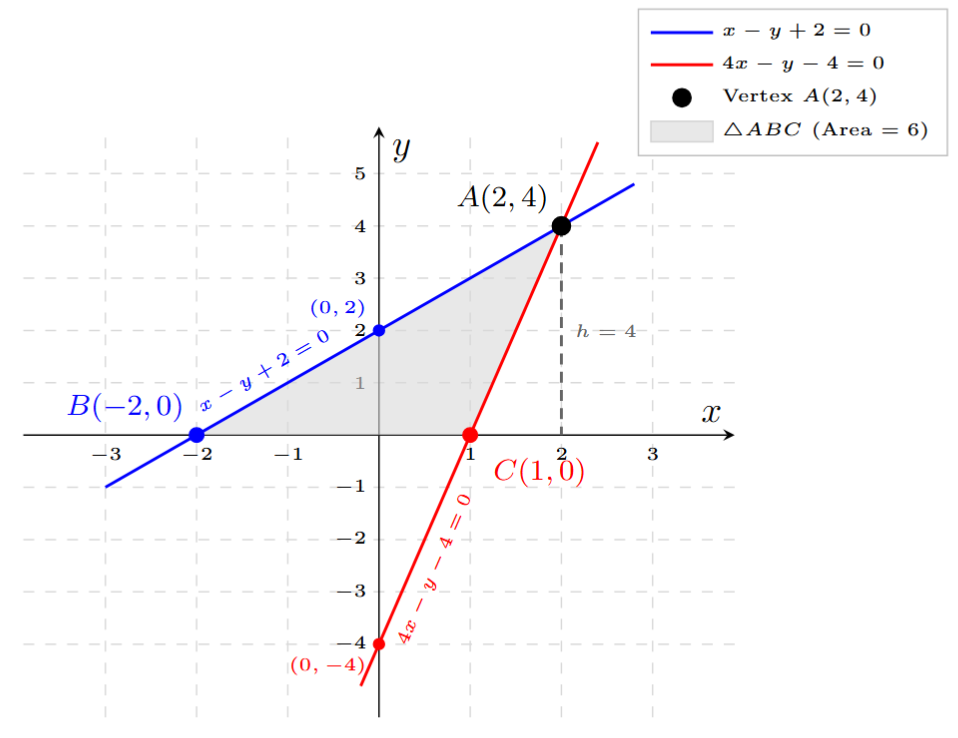
From the graph, we observe that the two lines intersect at point $A(2, 4)$.
The first line $x - y + 2 = 0$ intersects the $x$-axis at point $B(-2, 0)$.
The second line $4x - y - 4 = 0$ intersects the $x$-axis at point $C(1, 0)$.
Thus, the triangle formed is $\triangle ABC$.
Calculation of Area:
The vertices of the triangle are $A(2, 4)$, $B(-2, 0)$, and $C(1, 0)$.
The base of the triangle lies on the $x$-axis between $x = -2$ and $x = 1$.
$\text{Base } (BC) = |1 - (-2)| = 3 \text{ units}$
The height (altitude) of the triangle is the $y$-coordinate of the vertex $A$.
$\text{Height } (h) = 4 \text{ units}$
Now, using the formula for the area of a triangle:
$\text{Area} = \frac{1}{2} \times \text{Base} \times \text{Height}$
$\text{Area} = \frac{1}{2} \times 3 \times 4$
$\text{Area} = 3 \times 2 = 6$
Final Answer:
The area of the triangle formed by the given lines and the $x$-axis is $6 \text{ square units}$.
Exercise 3.3
Question 1. For which value(s) of λ , do the pair of linear equations λx + y = λ2 and x + λy = 1 have
(i) no solution?
(ii) infinitely many solutions?
(iii) a unique solution?
Answer:
Given:
The pair of linear equations is:
$\lambda x + y = \lambda^2$
... (i)
$x + \lambda y = 1$
... (ii)
Comparing these with $a_1x + b_1y + c_1 = 0$ and $a_2x + b_2y + c_2 = 0$, we have:
$a_1 = \lambda, b_1 = 1, c_1 = -\lambda^2$
$a_2 = 1, b_2 = \lambda, c_2 = -1$
To Find:
The value(s) of $\lambda$ for which the system has (i) no solution, (ii) infinitely many solutions, and (iii) a unique solution.
Solution:
Let us first calculate the ratios of the coefficients:
$\frac{a_1}{a_2} = \frac{\lambda}{1} = \lambda$
$\frac{b_1}{b_2} = \frac{1}{\lambda}$
$\frac{c_1}{c_2} = \frac{-\lambda^2}{-1} = \lambda^2$
(i) For No Solution:
The condition for no solution is:
$\frac{a_1}{a_2} = \frac{b_1}{b_2} \neq \frac{c_1}{c_2}$
... (iii)
Taking the first part: $\lambda = \frac{1}{\lambda} \implies \lambda^2 = 1 \implies \lambda = 1$ or $\lambda = -1$.
If $\lambda = 1$:
$\frac{a_1}{a_2} = 1, \frac{b_1}{b_2} = 1, \frac{c_1}{c_2} = (1)^2 = 1$.
Here, all ratios are equal, which is not the case for no solution.
If $\lambda = -1$:
$\frac{a_1}{a_2} = -1, \frac{b_1}{b_2} = -1, \frac{c_1}{c_2} = (-1)^2 = 1$.
Here, $\frac{a_1}{a_2} = \frac{b_1}{b_2} \neq \frac{c_1}{c_2}$ (since $-1 \neq 1$).
Thus, for $\lambda = -1$, the system has no solution.
(ii) For Infinitely Many Solutions:
The condition for infinitely many solutions is:
$\frac{a_1}{a_2} = \frac{b_1}{b_2} = \frac{c_1}{c_2}$
... (iv)
As checked above, when $\lambda = 1$:
$\frac{a_1}{a_2} = 1, \frac{b_1}{b_2} = 1, \frac{c_1}{c_2} = 1$.
Since all ratios are equal, the system has infinitely many solutions when $\lambda = 1$.
(iii) For a Unique Solution:
The condition for a unique solution is:
$\frac{a_1}{a_2} \neq \frac{b_1}{b_2}$
... (v)
$\lambda \neq \frac{1}{\lambda}$
$\lambda^2 \neq 1$
$\lambda \neq \pm 1$
Thus, for all real values of $\lambda$ except $1$ and $-1$, the system has a unique solution.
Final Answer:
(i) No solution: $\lambda = -1$
(ii) Infinitely many solutions: $\lambda = 1$
(iii) Unique solution: For all real values of $\lambda$ except $1$ and $-1$
Question 2. For which value(s) of k will the pair of equations kx + 3y = k – 3 , 12x + ky = k have no solution?
Answer:
Given:
The pair of linear equations is:
$kx + 3y = k - 3$
... (i)
$12x + ky = k$
... (ii)
Comparing these equations with the standard form $a_1x + b_1y = c_1$ and $a_2x + b_2y = c_2$, we have:
$a_1 = k, b_1 = 3, c_1 = k - 3$
$a_2 = 12, b_2 = k, c_2 = k$
To Find:
The value(s) of $k$ for which the system has no solution.
Solution:
For a pair of linear equations to have no solution (parallel lines), the following condition must be satisfied:
$\frac{a_1}{a_2} = \frac{b_1}{b_2} \neq \frac{c_1}{c_2}$
... (iii)
First, we solve for $\frac{a_1}{a_2} = \frac{b_1}{b_2}$:
$\frac{k}{12} = \frac{3}{k}$
$k^2 = 36$
$k = \pm \sqrt{36}$
$k = 6$ or $k = -6$
Now, we must check which of these values satisfies the second part of the condition: $\frac{b_1}{b_2} \neq \frac{c_1}{c_2}$.
Case I: When $k = 6$
$\frac{b_1}{b_2} = \frac{3}{6} = \frac{1}{2}$
$\frac{c_1}{c_2} = \frac{6 - 3}{6} = \frac{3}{6} = \frac{1}{2}$
Since $\frac{a_1}{a_2} = \frac{b_1}{b_2} = \frac{c_1}{c_2}$, for $k = 6$, the system has infinitely many solutions. Therefore, $k = 6$ is not the required value.
Case II: When $k = -6$
$\frac{b_1}{b_2} = \frac{3}{-6} = -\frac{1}{2}$
$\frac{c_1}{c_2} = \frac{-6 - 3}{-6} = \frac{-9}{-6} = \frac{3}{2}$
Here, we see that:
$-\frac{1}{2} \neq \frac{3}{2}$
(Condition satisfied)
Thus, for $k = -6$, the condition $\frac{a_1}{a_2} = \frac{b_1}{b_2} \neq \frac{c_1}{c_2}$ is satisfied.
Final Answer:
The value of $k$ for which the pair of linear equations has no solution is $-6$.
Question 3. For which values of a and b, will the following pair of linear equations have infinitely many solutions?
x + 2y = 1 , (a – b)x + (a + b)y = a + b – 2
Answer:
Given:
The pair of linear equations:
$x + 2y = 1$
$(a - b)x + (a + b)y = a + b - 2$
To Find:
Values of a and b for which the equations have infinitely many solutions.
Solution:
Rewrite the given equations in the standard form $a_1x + b_1y + c_1 = 0$ and $a_2x + b_2y + c_2 = 0$:
$x + 2y - 1 = 0$
$(a - b)x + (a + b)y - (a + b - 2) = 0$
Comparing with the standard forms, we identify the coefficients:
$a_1 = 1, b_1 = 2, c_1 = -1$
$a_2 = a - b, b_2 = a + b, c_2 = -(a + b - 2) = 2 - a - b$
For the pair of linear equations to have infinitely many solutions, the lines must be coincident. The condition for this is:
$\frac{a_1}{a_2} = \frac{b_1}{b_2} = \frac{c_1}{c_2}$
Substitute the coefficients into the condition:
$\frac{1}{a - b} = \frac{2}{a + b} = \frac{-1}{2 - a - b}$
Equate the first two ratios:
$\frac{1}{a - b} = \frac{2}{a + b}$
Cross-multiply:
$1(a + b) = 2(a - b)$
$a + b = 2a - 2b$
$b + 2b = 2a - a$
$3b = a$
... (i)
Equate the second and third ratios:
$\frac{2}{a + b} = \frac{-1}{2 - a - b}$
Cross-multiply:
$2(2 - a - b) = -1(a + b)$
$4 - 2a - 2b = -a - b$
$4 = -a - b + 2a + 2b$
$4 = a + b$
... (ii)
Now we have a system of two linear equations for a and b:
$a = 3b$
... (i)
$a + b = 4$
... (ii)
Substitute the value of a from equation (i) into equation (ii):
$(3b) + b = 4$
$4b = 4$
$b = \frac{4}{4}$
$b = 1$
Substitute the value of $b = 1$ back into equation (i):
$a = 3b$
$a = 3(1)$
$a = 3$
Thus, for the pair of linear equations to have infinitely many solutions, the values of a and b must be $a = 3$ and $b = 1$.
Final Answer:
The values are a = 3 and b = 1.
Question 4. Find the value(s) of p in (i) to (iv) and p and q in (v) for the following pair of equations:
(i) 3x – y – 5 = 0 and 6x – 2y – p = 0, if the lines represented by these equations are parallel.
(ii) – x + py = 1 and px – y = 1, if the pair of equations has no solution.
(iii) – 3x + 5y = 7 and 2px – 3y = 1, if the lines represented by these equations are intersecting at a unique point.
(iv) 2x + 3y – 5 = 0 and px – 6y – 8 = 0, if the pair of equations has a unique solution.
(v) 2x + 3y = 7 and 2px + py = 28 – qy, if the pair of equations have infinitely many solutions.
Answer:
(i) 3x – y – 5 = 0 and 6x – 2y – p = 0
Given: The lines are parallel.
For parallel lines, the condition is:
$\frac{a_1}{a_2} = \frac{b_1}{b_2} \neq \frac{c_1}{c_2}$
... (i)
Comparing the equations with standard form:
$a_1 = 3, b_1 = -1, c_1 = -5$
$a_2 = 6, b_2 = -2, c_2 = -p$
Substituting the values in the condition:
$\frac{3}{6} = \frac{-1}{-2} \neq \frac{-5}{-p}$
$\frac{1}{2} = \frac{1}{2} \neq \frac{5}{p}$
From the second part:
$\frac{1}{2} \neq \frac{5}{p}$
$p \neq 10$
Final Answer: The lines are parallel for all real values of $p$ except 10.
(ii) – x + py = 1 and px – y = 1
Given: The pair of equations has no solution.
The condition for no solution is:
$\frac{a_1}{a_2} = \frac{b_1}{b_2} \neq \frac{c_1}{c_2}$
... (ii)
Comparing the equations (rearranging to $a_1x + b_1y - c_1 = 0$):
$a_1 = -1, b_1 = p, c_1 = -1$
$a_2 = p, b_2 = -1, c_2 = -1$
Substituting in the ratio $\frac{a_1}{a_2} = \frac{b_1}{b_2}$:
$\frac{-1}{p} = \frac{p}{-1}$
$p^2 = 1 \implies p = 1 \text{ or } p = -1$
If $p = 1$, the ratios are: $\frac{-1}{1} = -1$, $\frac{1}{-1} = -1$, and $\frac{-1}{-1} = 1$.
Since $-1 = -1 \neq 1$, the condition for no solution is satisfied.
If $p = -1$, the ratios are: $\frac{-1}{-1} = 1$, $\frac{-1}{-1} = 1$, and $\frac{-1}{-1} = 1$. This leads to infinitely many solutions.
Final Answer: The value of $p$ is 1.
(iii) – 3x + 5y = 7 and 2px – 3y = 1
Given: The lines intersect at a unique point.
The condition for a unique solution is:
$\frac{a_1}{a_2} \neq \frac{b_1}{b_2}$
... (iii)
Comparing the equations:
$a_1 = -3, b_1 = 5$
$a_2 = 2p, b_2 = -3$
Substituting the values:
$\frac{-3}{2p} \neq \frac{5}{-3}$
$\frac{-3}{2p} \neq -\frac{5}{3}$
$9 \neq 10p$
$p \neq \frac{9}{10}$
Final Answer: The lines intersect at a unique point for all real values of $p$ except $\frac{9}{10}$.
(iv) 2x + 3y – 5 = 0 and px – 6y – 8 = 0
Given: The pair of equations has a unique solution.
Condition for a unique solution:
$\frac{a_1}{a_2} \neq \frac{b_1}{b_2}$
... (iv)
Comparing the equations:
$a_1 = 2, b_1 = 3$
$a_2 = p, b_2 = -6$
Substituting the values:
$\frac{2}{p} \neq \frac{3}{-6}$
$\frac{2}{p} \neq -\frac{1}{2}$
$p \neq -4$
Final Answer: The equations have a unique solution for all real values of $p$ except -4.
(v) 2x + 3y = 7 and 2px + py = 28 – qy
Given: The equations have infinitely many solutions.
First, rewrite the second equation in standard form:
$2px + py + qy = 28$
$2px + (p + q)y = 28$
For infinitely many solutions, the condition is:
$\frac{a_1}{a_2} = \frac{b_1}{b_2} = \frac{c_1}{c_2}$
... (v)
Comparing equations $2x + 3y = 7$ and $2px + (p + q)y = 28$:
$\frac{2}{2p} = \frac{3}{p + q} = \frac{7}{28}$
$\frac{1}{p} = \frac{3}{p + q} = \frac{1}{4}$
From $\frac{1}{p} = \frac{1}{4}$, we get $p = 4$.
Now, substitute $p = 4$ in $\frac{3}{p + q} = \frac{1}{4}$:
$\frac{3}{4 + q} = \frac{1}{4}$
$12 = 4 + q$
$q = 12 - 4 = 8$
Final Answer: The values are $p = 4$ and $q = 8$.
Question 5. Two straight paths are represented by the equations x – 3y = 2 and –2x + 6y = 5. Check whether the paths cross each other or not.
Answer:
Given:
The equations representing two straight paths are:
$x - 3y = 2$
... (i)
$-2x + 6y = 5$
... (ii)
To Find:
Check whether the paths cross each other or not.
Solution:
Two straight paths will cross each other if the pair of linear equations has a unique solution. They will not cross if the lines are parallel or coincident.
Comparing the given equations with the standard form $a_1x + b_1y + c_1 = 0$ and $a_2x + b_2y + c_2 = 0$:
For equation (i): $x - 3y - 2 = 0$
$a_1 = 1, b_1 = -3, c_1 = -2$
For equation (ii): $-2x + 6y - 5 = 0$
$a_2 = -2, b_2 = 6, c_2 = -5$
Now, let us find the ratios of the coefficients:
$\frac{a_1}{a_2} = \frac{1}{-2} = -\frac{1}{2}$
$\frac{b_1}{b_2} = \frac{-3}{6} = -\frac{1}{2}$
$\frac{c_1}{c_2} = \frac{-2}{-5} = \frac{2}{5}$
From the above ratios, we observe that:
$\frac{a_1}{a_2} = \frac{b_1}{b_2} \neq \frac{c_1}{c_2}$
[Condition for Parallel Lines]
Since the condition for parallel lines is satisfied, the two paths represent parallel lines. Parallel lines never intersect or cross each other.
Conclusion: The two paths do not cross each other.
Alternate Solution:
We can attempt to solve the equations by the Method of Substitution.
From equation (i):
$x = 3y + 2$
Substituting the value of $x$ in equation (ii):
$-2(3y + 2) + 6y = 5$
$-6y - 4 + 6y = 5$
$-4 = 5$
The above statement is false and represents a contradiction. This indicates that the system of equations has no solution. Since there is no solution, the lines do not have a common point of intersection. Hence, the paths do not cross each other.
Question 6. Write a pair of linear equations which has the unique solution x = – 1, y =3. How many such pairs can you write?
Answer:
Given:
A unique solution for a pair of linear equations is $x = -1$ and $y = 3$.
To Find:
1. A pair of linear equations having the given solution.
2. The total number of such pairs that can be written.
Solution:
A linear equation in two variables $x$ and $y$ is of the form $ax + by + c = 0$. Since $x = -1$ and $y = 3$ is a solution, these values must satisfy the equations we write.
Let us construct the first equation by choosing arbitrary values for $a$ and $b$. Let $a = 1$ and $b = 1$.
Then, the equation is $1(x) + 1(y) = c$
Substituting $x = -1$ and $y = 3$:
$-1 + 3 = 2$
So, the first equation is:
$x + y = 2$
... (i)
Now, let us construct the second equation. Let $a = 2$ and $b = -1$.
Then, the equation is $2(x) - 1(y) = c$
Substituting $x = -1$ and $y = 3$:
$2(-1) - 3 = -2 - 3 = -5$
So, the second equation is:
$2x - y = -5$
... (ii)
Verification:
For a unique solution, the condition is $\frac{a_1}{a_2} \neq \frac{b_1}{b_2}$.
In equations (i) and (ii), $a_1 = 1, b_1 = 1$ and $a_2 = 2, b_2 = -1$.
$\frac{a_1}{a_2} = \frac{1}{2}$ and $\frac{b_1}{b_2} = \frac{1}{-1} = -1$.
Since $\frac{1}{2} \neq -1$, the pair of equations has a unique solution.
Number of such pairs:
The solution $x = -1, y = 3$ represents a point $(-1, 3)$ on the Cartesian plane. We know that infinitely many lines can pass through a single point.
Since each pair of intersecting lines passing through $(-1, 3)$ provides a unique solution, we can write infinitely many such pairs of linear equations.
Final Answer:
One possible pair of linear equations is $x + y = 2$ and $2x - y = -5$.
There are infinitely many such pairs possible.
Alternate Solution:
We can write any two equations of the form $a(x + 1) + b(y - 3) = 0$ where the ratios of coefficients of $x$ and $y$ are not equal.
Example 2:
$5x + y = -2$ ($5(-1) + 3 = -2$)
$x - y = -4$ ($-1 - 3 = -4$)
Question 7. If 2x + y = 23 and 4x – y = 19, find the values of 5y – 2x and $\frac{y}{x}$ – 2.
Answer:
Given:
The pair of linear equations:
$2x + y = 23$
... (i)
$4x - y = 19$
... (ii)
To Find:
The values of $5y - 2x$ and $\frac{y}{x} - 2$.
Solution:
First, we need to solve the given system of equations to find the values of x and y.
We can use the elimination method. Notice that the coefficients of y in the two equations are opposite (1 and -1).
Add equation (i) and equation (ii):
$(2x + y) + (4x - y) = 23 + 19$
$2x + y + 4x - y = 42$
$6x = 42$
$x = \frac{42}{6}$
$x = 7$
Now, substitute the value of $x = 7$ into equation (i):
$2(7) + y = 23$
$14 + y = 23$
$y = 23 - 14$
$y = 9$
So, the solution to the system is $x = 7$ and $y = 9$.
Now, we evaluate the given expressions using $x = 7$ and $y = 9$.
Value of $5y - 2x$:
$5y - 2x = 5(9) - 2(7)$
$5y - 2x = 45 - 14$
$5y - 2x = 31$
Value of $\frac{y}{x} - 2$:
$\frac{y}{x} - 2 = \frac{9}{7} - 2$
To subtract, find a common denominator:
$\frac{y}{x} - 2 = \frac{9}{7} - \frac{2 \times 7}{1 \times 7}$
$\frac{y}{x} - 2 = \frac{9}{7} - \frac{14}{7}$
$\frac{y}{x} - 2 = \frac{9 - 14}{7}$
$\frac{y}{x} - 2 = \frac{-5}{7}$
Final Answer:
The value of $5y - 2x$ is 31.
The value of $\frac{y}{x} - 2$ is $-\frac{5}{7}$.
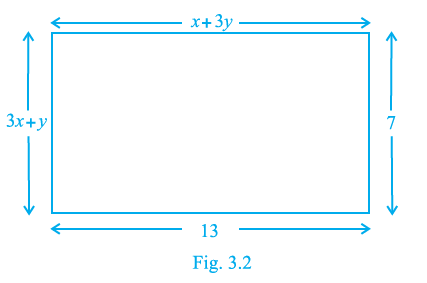
Question 8. Find the values of x and y in the following rectangle [see Fig. 3.2].
Answer:
Given:
A rectangle with side lengths as shown in the figure. The lengths of the sides are expressed in terms of $x$ and $y$.
The side lengths are given as $x + 3y$, $13$, $3x + y$, and $7$.
To Find:
The values of $x$ and $y$.
Solution:
In a rectangle, opposite sides are equal in length.
From the figure, we can equate the lengths of the opposite sides to form a pair of linear equations.
Equating the longer sides:
$x + 3y = 13$
... (i)
Equating the shorter sides:
$3x + y = 7$
... (ii)
We now have a system of two linear equations:
$x + 3y = 13$
... (i)
$3x + y = 7$
... (ii)
We can solve this system using the elimination method. Multiply equation (ii) by 3:
$3 \times (3x + y) = 3 \times 7$
$9x + 3y = 21$
... (iii)
Subtract equation (i) from equation (iii):
$(9x + 3y) - (x + 3y) = 21 - 13$
$9x + 3y - x - 3y = 8$
$8x = 8$
$x = \frac{8}{8}$
$x = 1$
Substitute the value of $x = 1$ into equation (i):
$1 + 3y = 13$
$3y = 13 - 1$
$3y = 12$
$y = \frac{12}{3}$
$y = 4$
So, the values are $x = 1$ and $y = 4$.
Let's verify the side lengths with these values:
$x + 3y = 1 + 3(4) = 1 + 12 = 13$ (Correct)
$3x + y = 3(1) + 4 = 3 + 4 = 7$ (Correct)
Final Answer:
The values are x = 1 and y = 4.
Question 9. Solve the following pairs of equations:
(i) x + y = 3.3 , $\frac{0.6}{3x \;-\; 2y}$ = -1, 3x – 2y ≠ 0
(ii) $\frac{x}{3}$ + $\frac{y}{4}$ = 4 , $\frac{5x}{6}$ - $\frac{y}{8}$ = 4
(iii) 4x + $\frac{6}{y}$ = 15 , 6x - $\frac{8}{y}$ = 14, y ≠ 0
(iv) $\frac{1}{2x}$ - $\frac{1}{y}$ = -1 , $\frac{1}{x}$ + $\frac{1}{2y}$ = 8, x, y ≠ 0
(v) 43x + 67y = – 24 , 67x + 43y = 24
(vi) $\frac{x}{a}$ + $\frac{y}{b}$ = a + b , $\frac{x}{a^2}$ + $\frac{y}{b^2}$ = 2 , a, b ≠ 0
(vii) $\frac{2xy}{x \;+\; y}$ = $\frac{3}{2}$ , $\frac{xy}{2x \;-\; y}$ = $\frac{-3}{10}$ , x + y ≠ 0, 2x – y ≠ 0
Answer:
(i) Solve: $x + y = 3.3$ and $\frac{0.6}{3x - 2y} = -1$
Given equations:
$x + y = 3.3$
... (1)
$\frac{0.6}{3x - 2y} = -1$
From the second equation, since $3x - 2y \neq 0$, we can multiply by $(3x - 2y)$: $0.6 = -1(3x - 2y)$
$0.6 = -3x + 2y$
$3x - 2y = -0.6$
... (2)
Multiply equation (1) by 2:
$2(x + y) = 2(3.3)$
$2x + 2y = 6.6$
... (3)
Add equation (3) and equation (2):
$(2x + 2y) + (3x - 2y) = 6.6 + (-0.6)$
$5x = 6$
$x = \frac{6}{5} = 1.2$
Substitute $x = 1.2$ into equation (1):
$1.2 + y = 3.3$
$y = 3.3 - 1.2$
$y = 2.1$
Solution: x = 1.2, y = 2.1
(ii) Solve: $\frac{x}{3} + \frac{y}{4} = 4$ and $\frac{5x}{6} - \frac{y}{8} = 4$
Given equations:
$\frac{x}{3} + \frac{y}{4} = 4$
$\frac{5x}{6} - \frac{y}{8} = 4$
Multiply the first equation by the LCM of 3 and 4 (which is 12):
$12(\frac{x}{3}) + 12(\frac{y}{4}) = 12(4)$
$4x + 3y = 48$
... (1)
Multiply the second equation by the LCM of 6 and 8 (which is 24):
$24(\frac{5x}{6}) - 24(\frac{y}{8}) = 24(4)$
$20x - 3y = 96$
... (2)
Add equation (1) and equation (2):
$(4x + 3y) + (20x - 3y) = 48 + 96$
$24x = 144$
$x = \frac{144}{24} = 6$
Substitute $x = 6$ into equation (1):
$4(6) + 3y = 48$
$24 + 3y = 48$
$3y = 48 - 24$
$3y = 24$
$y = \frac{24}{3} = 8$
Solution: x = 6, y = 8
(iii) Solve: $4x + \frac{6}{y} = 15$ and $6x - \frac{8}{y} = 14$, y $\neq$ 0
Given equations:
$4x + \frac{6}{y} = 15$
... (1)
$6x - \frac{8}{y} = 14$
... (2)
These equations are not linear. Let $v = \frac{1}{y}$. The equations become linear in terms of x and v:
$4x + 6v = 15$
... (3)
$6x - 8v = 14$
... (4)
Multiply equation (3) by 4 and equation (4) by 3 to eliminate v:
$4(4x + 6v) = 4(15)$
$16x + 24v = 60$
... (5)
$3(6x - 8v) = 3(14)$
$18x - 24v = 42$
... (6)
Add equation (5) and equation (6):
$(16x + 24v) + (18x - 24v) = 60 + 42$
$34x = 102$
$x = \frac{102}{34} = 3$
Substitute $x = 3$ into equation (3):
$4(3) + 6v = 15$
$12 + 6v = 15$
$6v = 15 - 12$
$6v = 3$
$v = \frac{3}{6} = \frac{1}{2}$
Now substitute back $v = \frac{1}{y}$:
$\frac{1}{y} = \frac{1}{2}$
$y = 2$
The condition $y \neq 0$ is satisfied.
Solution: x = 3, y = 2
(iv) Solve: $\frac{1}{2x} - \frac{1}{y} = -1$ and $\frac{1}{x} + \frac{1}{2y} = 8$, x, y $\neq$ 0
Given equations:
$\frac{1}{2x} - \frac{1}{y} = -1$
... (1)
$\frac{1}{x} + \frac{1}{2y} = 8$
... (2)
These equations are not linear. Let $u = \frac{1}{x}$ and $v = \frac{1}{y}$. The equations become linear in terms of u and v:
$\frac{1}{2}u - v = -1$
$u + \frac{1}{2}v = 8$
Multiply both equations by 2 to clear fractions:
$2(\frac{1}{2}u - v) = 2(-1) \implies u - 2v = -2$
... (3)
$2(u + \frac{1}{2}v) = 2(8) \implies 2u + v = 16$
... (4)
Multiply equation (4) by 2:
$2(2u + v) = 2(16)$
$4u + 2v = 32$
... (5)
Add equation (3) and equation (5):
$(u - 2v) + (4u + 2v) = -2 + 32$
$5u = 30$
$u = \frac{30}{5} = 6$
Substitute $u = 6$ into equation (4):
$2(6) + v = 16$
$12 + v = 16$
$v = 16 - 12 = 4$
Now substitute back $u = \frac{1}{x}$ and $v = \frac{1}{y}$:
$\frac{1}{x} = 6 \implies x = \frac{1}{6}$
$\frac{1}{y} = 4 \implies y = \frac{1}{4}$
The conditions $x \neq 0, y \neq 0$ are satisfied.
Solution: x = $\frac{1}{6}$, y = $\frac{1}{4}$
(v) Solve: $43x + 67y = – 24$ and $67x + 43y = 24$
Given equations:
$43x + 67y = -24$
... (1)
$67x + 43y = 24$
... (2)
Add equation (1) and equation (2):
$(43x + 67y) + (67x + 43y) = -24 + 24$
$110x + 110y = 0$
$110(x + y) = 0$
$x + y = 0$
... (3)
Subtract equation (1) from equation (2):
$(67x + 43y) - (43x + 67y) = 24 - (-24)$
$24x - 24y = 48$
$24(x - y) = 48$
$x - y = \frac{48}{24} = 2$
... (4)
Add equation (3) and equation (4):
$(x + y) + (x - y) = 0 + 2$
$2x = 2$
$x = 1$
Substitute $x = 1$ into equation (3):
$1 + y = 0$
$y = -1$
Solution: x = 1, y = -1
(vi) Solve: $\frac{x}{a} + \frac{y}{b} = a + b$ and $\frac{x}{a^2} + \frac{y}{b^2} = 2$, a, b $\neq$ 0
Given equations:
$\frac{x}{a} + \frac{y}{b} = a + b$
... (1)
$\frac{x}{a^2} + \frac{y}{b^2} = 2$
... (2)
Multiply equation (1) by $\frac{1}{a}$:
$\frac{1}{a}(\frac{x}{a} + \frac{y}{b}) = \frac{1}{a}(a + b)$
$\frac{x}{a^2} + \frac{y}{ab} = 1 + \frac{b}{a}$
... (3)
Subtract equation (3) from equation (2):
$(\frac{x}{a^2} + \frac{y}{b^2}) - (\frac{x}{a^2} + \frac{y}{ab}) = 2 - (1 + \frac{b}{a})$
$\frac{y}{b^2} - \frac{y}{ab} = 2 - 1 - \frac{b}{a}$
$y(\frac{1}{b^2} - \frac{1}{ab}) = 1 - \frac{b}{a}$
$y(\frac{a - b}{ab^2}) = \frac{a - b}{a}$
Assuming $a \neq b$, we can divide both sides by $(a-b)$:
$y(\frac{1}{ab^2}) = \frac{1}{a}$
$y = \frac{1}{a} \times ab^2 = b^2$
Substitute $y = b^2$ into equation (1):
$\frac{x}{a} + \frac{b^2}{b} = a + b$
$\frac{x}{a} + b = a + b$
$\frac{x}{a} = a + b - b$
$\frac{x}{a} = a$
$x = a \times a = a^2$
If $a=b \neq 0$, the original equations become $\frac{x}{a} + \frac{y}{a} = 2a \implies x+y=2a^2$ and $\frac{x}{a^2} + \frac{y}{a^2} = 2 \implies x+y=2a^2$. These are coincident lines, having infinitely many solutions. The solution $x=a^2, y=b^2$ gives $x=a^2, y=a^2$, which satisfies $x+y = a^2+a^2 = 2a^2$. So, $x=a^2, y=b^2$ is a valid solution even when $a=b$.
Solution: x = $a^2$, y = $b^2$
(vii) Solve: $\frac{2xy}{x + y} = \frac{3}{2}$ and $\frac{xy}{2x - y} = \frac{-3}{10}$, x + y $\neq$ 0, 2x – y $\neq$ 0
Given equations:
$\frac{2xy}{x + y} = \frac{3}{2}$
$\frac{xy}{2x - y} = \frac{-3}{10}$
Assume $x \neq 0$ and $y \neq 0$. Invert the first equation:
$\frac{x + y}{2xy} = \frac{2}{3}$
$\frac{x}{2xy} + \frac{y}{2xy} = \frac{2}{3}$
$\frac{1}{2y} + \frac{1}{2x} = \frac{2}{3}$
Multiply by 6:
$3(\frac{1}{y}) + 3(\frac{1}{x}) = 4$
... (1)
Invert the second equation:
$\frac{2x - y}{xy} = \frac{10}{-3}$
$\frac{2x}{xy} - \frac{y}{xy} = -\frac{10}{3}$
$\frac{2}{y} - \frac{1}{x} = -\frac{10}{3}$
Multiply by 3:
$6(\frac{1}{y}) - 3(\frac{1}{x}) = -10$
... (2)
Let $u = \frac{1}{x}$ and $v = \frac{1}{y}$. The equations become linear in terms of u and v:
$3v + 3u = 4 \implies 3u + 3v = 4$
... (3)
$6v - 3u = -10 \implies -3u + 6v = -10$
... (4)
Add equation (3) and equation (4):
$(3u + 3v) + (-3u + 6v) = 4 + (-10)$
$9v = -6$
$v = \frac{-6}{9} = -\frac{2}{3}$
Substitute $v = -\frac{2}{3}$ into equation (3):
$3u + 3(-\frac{2}{3}) = 4$
$3u - 2 = 4$
$3u = 6$
$u = 2$
Now substitute back $u = \frac{1}{x}$ and $v = \frac{1}{y}$:
$\frac{1}{x} = 2 \implies x = \frac{1}{2}$
$\frac{1}{y} = -\frac{2}{3} \implies y = -\frac{3}{2}$
The conditions $x+y \neq 0$ and $2x-y \neq 0$ are satisfied for $x = 1/2, y = -3/2$ as $x+y = 1/2 - 3/2 = -1$ and $2x-y = 2(1/2) - (-3/2) = 1 + 3/2 = 5/2$. The conditions $x, y \neq 0$ for inversion are also satisfied.
Solution: x = $\frac{1}{2}$, y = $-\frac{3}{2}$
Question 10. Find the solution of the pair of equations $\frac{x}{10}$ + $\frac{y}{5}$ - 1 = 0 and $\frac{x}{8}$ + $\frac{y}{6}$ = 15 Hence, find λ, if y = λx + 5.
Answer:
Given:
The pair of linear equations:
$\frac{x}{10} + \frac{y}{5} - 1 = 0$
$\frac{x}{8} + \frac{y}{6} = 15$
Also, $y = \lambda x + 5$ at the solution.
To Find:
1. The solution (x, y) of the given pair of equations.
2. The value of $\lambda$ using the solution and the equation $y = \lambda x + 5$.
Solution:
Rewrite the given equations to eliminate fractions and put them in standard form.
Equation 1: $\frac{x}{10} + \frac{y}{5} - 1 = 0$. Multiply by the LCM of 10 and 5 (which is 10):
$10(\frac{x}{10}) + 10(\frac{y}{5}) - 10(1) = 10(0)$
$x + 2y - 10 = 0$
$x + 2y = 10$
... (1)
Equation 2: $\frac{x}{8} + \frac{y}{6} = 15$. Multiply by the LCM of 8 and 6 (which is 24):
$24(\frac{x}{8}) + 24(\frac{y}{6}) = 24(15)$
$3x + 4y = 360$
... (2)
Now we have a system of two linear equations:
$x + 2y = 10$
... (1)
$3x + 4y = 360$
... (2)
Multiply equation (1) by 2 to eliminate y:
$2(x + 2y) = 2(10)$
$2x + 4y = 20$
... (3)
Subtract equation (3) from equation (2):
$(3x + 4y) - (2x + 4y) = 360 - 20$
$x = 340$
Substitute the value of $x = 340$ into equation (1):
$340 + 2y = 10$
$2y = 10 - 340$
$2y = -330$
$y = \frac{-330}{2}$
$y = -165$
The solution of the pair of equations is $x = 340$ and $y = -165$.
Now we use the relation $y = \lambda x + 5$ and the found values of x and y to find $\lambda$.
Substitute $x = 340$ and $y = -165$ into $y = \lambda x + 5$:
$-165 = \lambda(340) + 5$
$-165 - 5 = 340\lambda$
$-170 = 340\lambda$
$\lambda = \frac{-170}{340}$
$\lambda = -\frac{\cancel{170}^1}{\cancel{340}^2} = -\frac{1}{2}$
Final Answer:
The solution of the pair of equations is x = 340, y = -165.
The value of $\lambda$ is $-\frac{1}{2}$.
Question 11. By the graphical method, find whether the following pair of equations are consistent or not. If consistent, solve them.
(i) 3x + y + 4 = 0 , 6x – 2y + 4 = 0
(ii) x – 2y = 6 , 3x – 6y = 0
(iii) x + y = 3 , 3x + 3y = 9
Answer:
General Rule for Consistency:
A pair of linear equations $a_1x + b_1y + c_1 = 0$ and $a_2x + b_2y + c_2 = 0$ is:
1. Consistent, if it has a unique solution ($\frac{a_1}{a_2} \neq \frac{b_1}{b_2}$) or infinitely many solutions ($\frac{a_1}{a_2} = \frac{b_1}{b_2} = \frac{c_1}{c_2}$).
2. Inconsistent, if it has no solution ($\frac{a_1}{a_2} = \frac{b_1}{b_2} \neq \frac{c_1}{c_2}$).
(i) 3x + y + 4 = 0 and 6x – 2y + 4 = 0
Given Equations:
$3x + y + 4 = 0$
... (i)
$6x - 2y + 4 = 0$
... (ii)
Consistency Check:
$\frac{a_1}{a_2} = \frac{3}{6} = \frac{1}{2}$
$\frac{b_1}{b_2} = \frac{1}{-2} = -\frac{1}{2}$
Since $\frac{a_1}{a_2} \neq \frac{b_1}{b_2}$, the pair of equations is Consistent and has a unique solution.
Graphical Solution:
For equation (i): $y = -3x - 4$
| x | y | Point (x, y) |
| 0 | -4 | (0, -4) |
| -1 | -1 | (-1, -1) |
| -2 | 2 | (-2, 2) |
For equation (ii): $2y = 6x + 4 \implies y = 3x + 2$
| x | y | Point (x, y) |
| 0 | 2 | (0, 2) |
| -1 | -1 | (-1, -1) |
| 1 | 5 | (1, 5) |
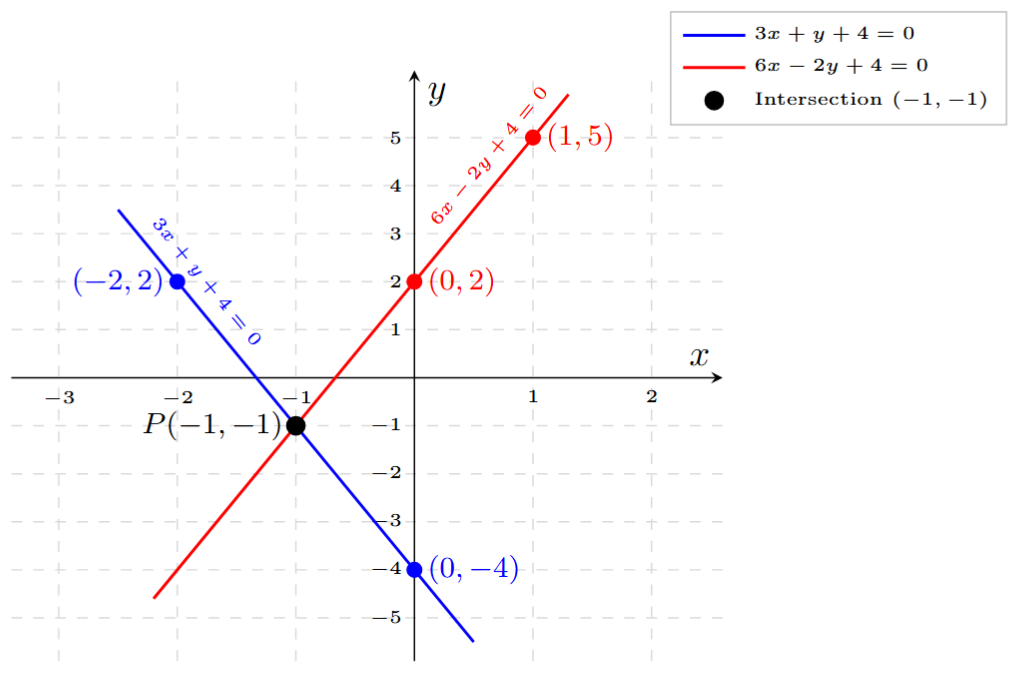
The lines intersect at the point $(-1, -1)$. Therefore, the unique solution is $x = -1, y = -1$.
(ii) x – 2y = 6 and 3x – 6y = 0
Given Equations:
$x - 2y - 6 = 0$
... (i)
$3x - 6y = 0$
... (ii)
Consistency Check:
$\frac{a_1}{a_2} = \frac{1}{3}$
$\frac{b_1}{b_2} = \frac{-2}{-6} = \frac{1}{3}$
$\frac{c_1}{c_2} = \frac{-6}{0}$ (Undefined)
Since $\frac{a_1}{a_2} = \frac{b_1}{b_2} \neq \frac{c_1}{c_2}$, the lines are parallel. Therefore, the pair of equations is Inconsistent.
Graphical Representation:
For equation (i): $y = \frac{x - 6}{2}$
| x | y | Point (x, y) |
| 0 | -3 | (0, -3) |
| 6 | 0 | (6, 0) |
For equation (ii): $y = \frac{x}{2}$
| x | y | Point (x, y) |
| 0 | 0 | (0, 0) |
| 2 | 1 | (2, 1) |
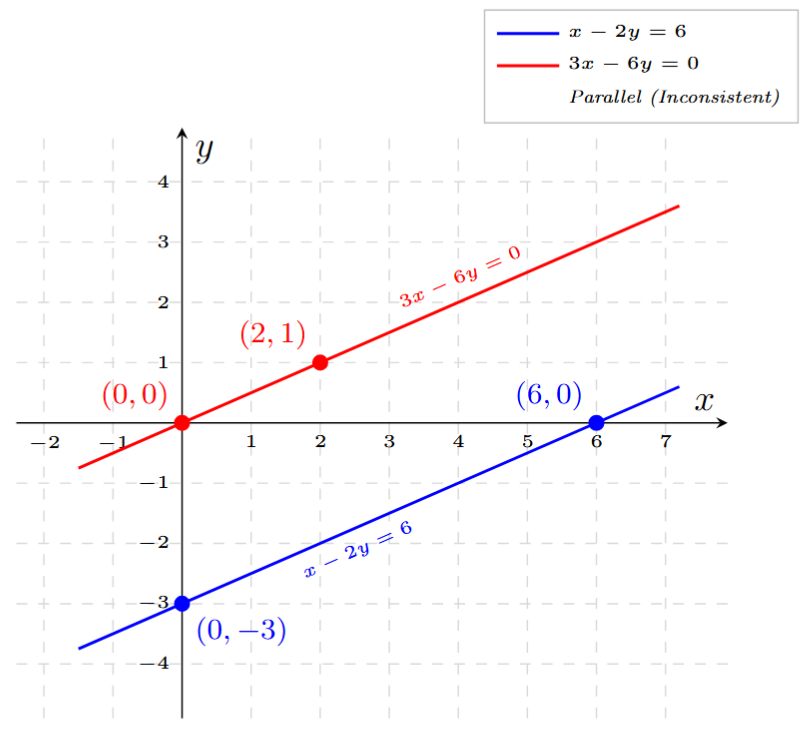
The graph shows that the lines are parallel and never intersect. Thus, there is no solution.
(iii) x + y = 3 and 3x + 3y = 9
Given Equations:
$x + y = 3$
... (i)
$3x + 3y = 9$
... (ii)
Consistency Check:
$\frac{a_1}{a_2} = \frac{1}{3}$
$\frac{b_1}{b_2} = \frac{1}{3}$
$\frac{c_1}{c_2} = \frac{3}{9} = \frac{1}{3}$
Since $\frac{a_1}{a_2} = \frac{b_1}{b_2} = \frac{c_1}{c_2}$, the pair of equations is Consistent and has infinitely many solutions as the lines are coincident.
Graphical Solution:
For both equations, we can use $y = 3 - x$:
| x | y | Point (x, y) |
| 0 | 3 | (0, 3) |
| 3 | 0 | (3, 0) |
| 1 | 2 | (1, 2) |
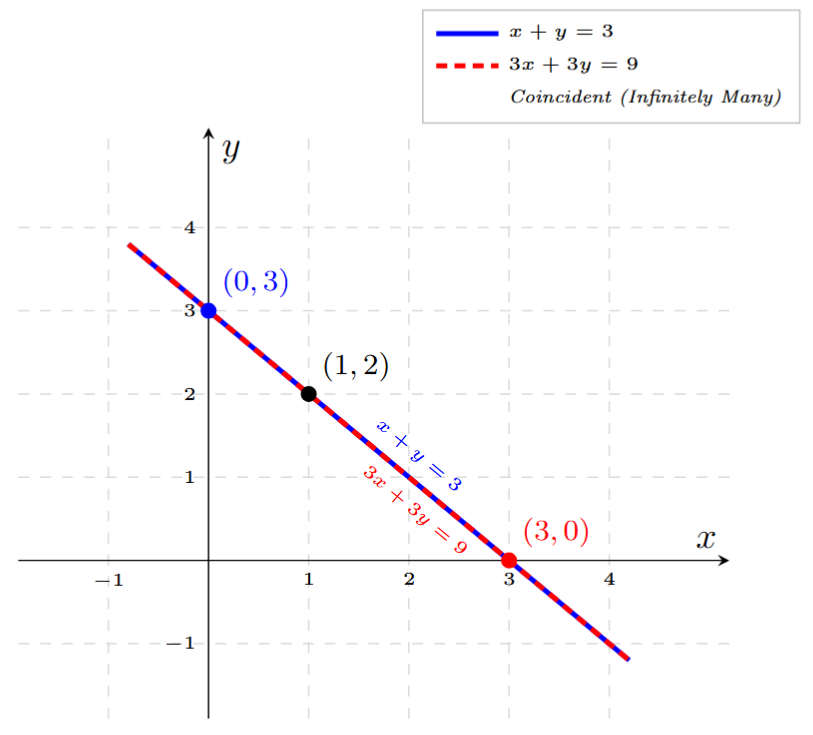
Since both lines lie on top of each other, every point on the line is a solution. The system is consistent with infinitely many solutions.
Question 12. Draw the graph of the pair of equations 2x + y = 4 and 2x – y = 4. Write the vertices of the triangle formed by these lines and the y-axis. Also find the area of this triangle.
Answer:
Given:
The pair of linear equations is:
$2x + y = 4$
... (i)
$2x - y = 4$
... (ii)
To Find:
1. The vertices of the triangle formed by these two lines and the $y$-axis.
2. The area of the triangle.
Solution:
To draw the graph, we find at least two solutions for each equation.
For Equation (i): $y = 4 - 2x$
| $x$ | $y = 4 - 2x$ | Point ($x, y$) |
| 0 | 4 | (0, 4) |
| 2 | 0 | (2, 0) |
For Equation (ii): $y = 2x - 4$
| $x$ | $y = 2x - 4$ | Point ($x, y$) |
| 0 | -4 | (0, -4) |
| 2 | 0 | (2, 0) |
Graph:
Plot the points on the graph and join them to obtain the lines.
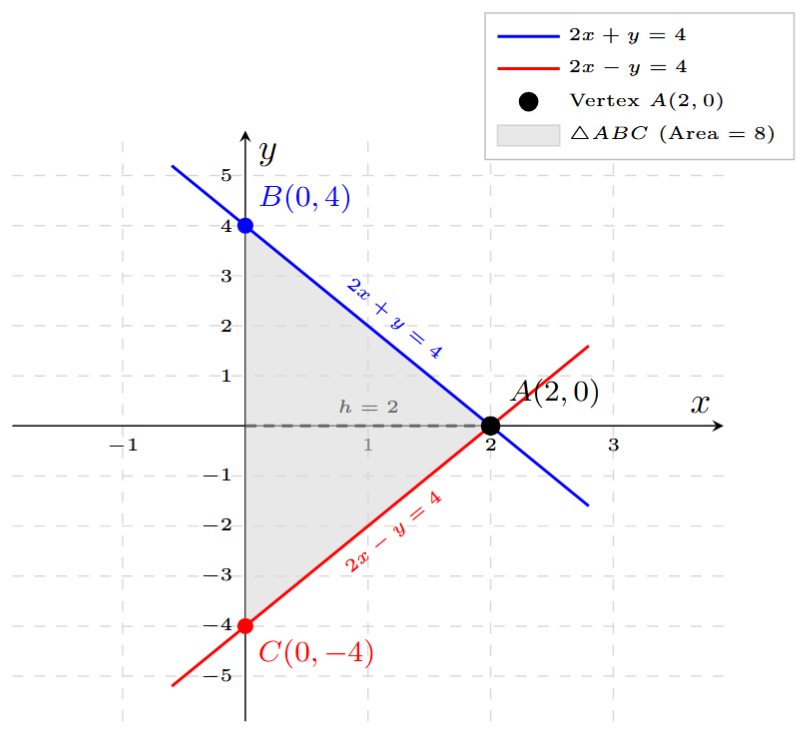
From the graph, we observe the following:
$\bullet$ The two lines intersect at the point $A(2, 0)$.
$\bullet$ The line $2x + y = 4$ intersects the $y$-axis at point $B(0, 4)$.
$\bullet$ The line $2x - y = 4$ intersects the $y$-axis at point $C(0, -4)$.
Therefore, the triangle formed by these lines and the $y$-axis is $\triangle ABC$.
Vertices of the Triangle:
The vertices of the triangle are $A(2, 0)$, $B(0, 4)$, and $C(0, -4)$.
Calculation of Area:
The base of the triangle ($BC$) lies along the $y$-axis.
$\text{Base } (BC) = |y_1 - y_2| = |4 - (-4)| = 8 \text{ units}$
The height (altitude) of the triangle is the perpendicular distance from vertex $A(2, 0)$ to the $y$-axis.
$\text{Height } (h) = |x\text{-coordinate of } A| = 2 \text{ units}$
Now, using the formula for the area of a triangle:
$\text{Area} = \frac{1}{2} \times \text{Base} \times \text{Height}$
$\text{Area} = \frac{1}{2} \times 8 \times 2$
$\text{Area} = 8 \text{ square units}$
Final Answer:
The vertices of the triangle are $(2, 0), (0, 4),$ and $(0, -4)$.
The area of the triangle is $8 \text{ square units}$.
Question 13. Write an equation of a line passing through the point representing solution of the pair of linear equations x + y = 2 and 2x – y = 1. How many such lines can we find?
Answer:
Given:
The pair of linear equations is:
$x + y = 2$
... (i)
$2x - y = 1$
... (ii)
To Find:
An equation of a line passing through the point representing the solution of the given equations and the total number of such lines.
Solution:
First, we need to find the solution of the given pair of linear equations to identify the point through which the new line must pass.
Adding equation (i) and equation (ii):
$\begin{array}{cc} & x & + & y & = & 2 \\ + & 2x & - & y & = & 1 \\ \hline & 3x & & & = & 3 \\ \hline \end{array}$
$x = 1$
[Dividing by 3] ... (iii)
Now, substituting the value of $x = 1$ in equation (i):
$1 + y = 2$
$y = 1$
[By transposing] ... (iv)
The solution of the pair of linear equations is $(1, 1)$. Therefore, the point of intersection is $(1, 1)$.
Writing an equation of a line:
To find an equation of a line passing through $(1, 1)$, we can write any linear equation in $x$ and $y$ that is satisfied by $x = 1$ and $y = 1$.
Let us consider a simple relationship: $x - y = 0$.
Check: $1 - 1 = 0$, which is true. Thus, $x - y = 0$ is one such line.
Another example could be: $3x + y = 4$.
Check: $3(1) + 1 = 4$, which is also true.
Number of such lines:
The point $(1, 1)$ is a specific coordinate on the Cartesian plane. According to a basic postulate of geometry, infinitely many lines can pass through a single given point.
Final Answer:
One such equation is $x - y = 0$ (or any other equation satisfied by $x=1, y=1$).
There are infinitely many such lines that can pass through the solution point $(1, 1)$.
Question 14. If x + 1 is a factor of 2x3 + ax2 + 2bx + 1, then find the values of a and b given that 2a – 3b = 4.
Answer:
Given:
1. $(x + 1)$ is a factor of the polynomial $P(x) = 2x^3 + ax^2 + 2bx + 1$.
2. The linear equation $2a - 3b = 4$.
To Find:
The values of $a$ and $b$.
Solution:
According to the Factor Theorem, if $(x - k)$ is a factor of a polynomial $P(x)$, then $P(k) = 0$.
In this case, the factor is $(x + 1)$, which can be written as $(x - (-1))$. So, $k = -1$.
Therefore, since $(x + 1)$ is a factor of $P(x) = 2x^3 + ax^2 + 2bx + 1$, we must have $P(-1) = 0$.
Substitute $x = -1$ into the polynomial:
$P(-1) = 2(-1)^3 + a(-1)^2 + 2b(-1) + 1$
$P(-1) = 2(-1) + a(1) + 2b(-1) + 1$
$P(-1) = -2 + a - 2b + 1$
$P(-1) = a - 2b - 1$
Set $P(-1)$ equal to 0:
$a - 2b - 1 = 0$
$a - 2b = 1$
... (i)
We are also given a second linear equation in terms of a and b:
$2a - 3b = 4$
... (ii)
Now we have a system of two linear equations with two variables a and b:
$a - 2b = 1$
... (i)
$2a - 3b = 4$
... (ii)
Multiply equation (i) by 2 to eliminate a:
$2(a - 2b) = 2(1)$
$2a - 4b = 2$
... (iii)
Subtract equation (iii) from equation (ii):
$(2a - 3b) - (2a - 4b) = 4 - 2$
$2a - 3b - 2a + 4b = 2$
$b = 2$
Substitute the value of $b = 2$ into equation (i):
$a - 2(2) = 1$
$a - 4 = 1$
$a = 1 + 4$
$a = 5$
The values of a and b are 5 and 2, respectively.
Final Answer:
The values are a = 5 and b = 2.
Question 15. The angles of a triangle are x, y and 40°. The difference between the two angles x and y is 30°. Find x and y.
Answer:
Given:
The three angles of a triangle are $x$, $y$, and $40^\circ$.
The difference between the angles $x$ and $y$ is $30^\circ$. This means $|x - y| = 30^\circ$.
To Find:
The values of $x$ and $y$.
Solution:
The sum of the interior angles in any triangle is always $180^\circ$.
$x + y + 40^\circ = 180^\circ$
$x + y = 180^\circ - 40^\circ$
$x + y = 140^\circ$
... (i)
We are given that the difference between $x$ and $y$ is $30^\circ$. This leads to two possible cases:
Case 1: The difference is $x - y = 30^\circ$.
$x - y = 30^\circ$
... (ii)
We now have a system of two linear equations:
$x + y = 140^\circ$
... (i)
$x - y = 30^\circ$
... (ii)
Adding equation (i) and equation (ii):
$(x + y) + (x - y) = 140^\circ + 30^\circ$
$2x = 170^\circ$
$x = \frac{170^\circ}{2}$
$x = 85^\circ$
Substitute the value of $x$ into equation (i):
$85^\circ + y = 140^\circ$
$y = 140^\circ - 85^\circ$
$y = 55^\circ$
So, in Case 1, $x = 85^\circ$ and $y = 55^\circ$. The angles are $85^\circ, 55^\circ, 40^\circ$. Their sum is $85+55+40 = 180^\circ$, and $85-55 = 30^\circ$. This is a valid solution.
Case 2: The difference is $y - x = 30^\circ$.
$-x + y = 30^\circ$
... (iii)
We now have a system of two linear equations:
$x + y = 140^\circ$
... (i)
$-x + y = 30^\circ$
... (iii)
Adding equation (i) and equation (iii):
$(x + y) + (-x + y) = 140^\circ + 30^\circ$
$2y = 170^\circ$
$y = \frac{170^\circ}{2}$
$y = 85^\circ$
Substitute the value of $y$ into equation (i):
$x + 85^\circ = 140^\circ$
$x = 140^\circ - 85^\circ$
$x = 55^\circ$
So, in Case 2, $x = 55^\circ$ and $y = 85^\circ$. The angles are $55^\circ, 85^\circ, 40^\circ$. Their sum is $55+85+40 = 180^\circ$, and $85-55 = 30^\circ$. This is also a valid solution.
Therefore, there are two possible pairs of values for $x$ and $y$.
The possible values are:
- $x = 85^\circ$ and $y = 55^\circ$
- $x = 55^\circ$ and $y = 85^\circ$
Question 16. Two years ago, Salim was thrice as old as his daughter and six years later, he will be four years older than twice her age. How old are they now?
Answer:
Given:
Condition 1: Two years ago, Salim's age was thrice his daughter's age.
Condition 2: Six years later, Salim's age will be four years older than twice his daughter's age.
To Find:
Their present ages.
Solution:
Let Salim's present age be $S$ years.
Let his daughter's present age be $D$ years.
According to the first condition:
Salim's age two years ago $= S - 2$
Daughter's age two years ago $= D - 2$
$S - 2 = 3(D - 2)$
$S - 2 = 3D - 6$
$S - 3D = -6 + 2$
$S - 3D = -4$
... (i)
According to the second condition:
Salim's age six years later $= S + 6$
Daughter's age six years later $= D + 6$
$S + 6 = 2(D + 6) + 4$
$S + 6 = 2D + 12 + 4$
$S + 6 = 2D + 16$
$S - 2D = 16 - 6$
$S - 2D = 10$
... (ii)
We now have a system of two linear equations with two variables $S$ and $D$:
$S - 3D = -4$
... (i)
$S - 2D = 10$
... (ii)
Subtract equation (i) from equation (ii):
$(S - 2D) - (S - 3D) = 10 - (-4)$
$S - 2D - S + 3D = 10 + 4$
$D = 14$
Substitute the value of $D$ into equation (ii):
$S - 2(14) = 10$
$S - 28 = 10$
$S = 10 + 28$
$S = 38$
Thus, Salim's present age is $38$ years and his daughter's present age is $14$ years.
Verification:
Two years ago: Salim was $38 - 2 = 36$ years old. Daughter was $14 - 2 = 12$ years old.
$36 = 3 \times 12$
(True)
Six years later: Salim will be $38 + 6 = 44$ years old. Daughter will be $14 + 6 = 20$ years old.
$44 = 2 \times 20 + 4$
$44 = 40 + 4$
(True)
Answer:
Salim's present age is $38$ years.
His daughter's present age is $14$ years.
Question 17. The age of the father is twice the sum of the ages of his two children. After 20 years, his age will be equal to the sum of the ages of his children. Find the age of the father.
Answer:
Given:
Condition 1: The father's present age is twice the sum of the present ages of his two children.
Condition 2: After 20 years, the father's age will be equal to the sum of the ages of his children at that time.
To Find:
The present age of the father.
Solution:
Let the present age of the father be $F$ years.
Let the sum of the present ages of his two children be $C$ years.
According to the first condition:
$F = 2C$
... (i)
After 20 years:
Father's age will be $F + 20$ years.
Since there are two children, each child's age will increase by 20 years. So, the sum of their ages will increase by $20 + 20 = 40$ years.
The sum of the children's ages after 20 years will be $C + 40$ years.
According to the second condition:
$F + 20 = C + 40$
$F - C = 40 - 20$
$F - C = 20$
... (ii)
Now we have a system of two linear equations:
$F = 2C$
... (i)
$F - C = 20$
... (ii)
Substitute the value of $F$ from equation (i) into equation (ii):
$(2C) - C = 20$
$C = 20$
Now substitute the value of $C$ back into equation (i) to find $F$:
$F = 2C$
$F = 2(20)$
$F = 40$
The present age of the father is 40 years.
Verification:
Present ages: Father = 40 years, Sum of children's ages = 20 years.
$40 = 2 \times 20$
(True)
After 20 years: Father = $40 + 20 = 60$ years. Sum of children's ages = $20 + 40 = 60$ years.
$60 = 60$
(True)
Answer:
The present age of the father is $40$ years.
Question 18. Two numbers are in the ratio 5 : 6. If 8 is subtracted from each of the numbers, the ratio becomes 4 : 5. Find the numbers.
Answer:
Given:
The ratio of two numbers is $5 : 6$.
When 8 is subtracted from each number, their ratio becomes $4 : 5$.
To Find:
The two numbers.
Solution:
Let the two numbers be $5x$ and $6x$, where $x$ is a common multiplier.
According to the second condition, when 8 is subtracted from each number, their new values are $5x - 8$ and $6x - 8$. The ratio of these new numbers is $4 : 5$.
We can write this as an equation:
$\frac{5x - 8}{6x - 8} = \frac{4}{5}$
Now, we cross-multiply to solve for $x$:
$5(5x - 8) = 4(6x - 8)$
$25x - 40 = 24x - 32$
Rearrange the terms to one side to solve for $x$:
$25x - 24x = -32 + 40$
$x = 8$
Now substitute the value of $x$ back into the expressions for the two numbers:
First number $= 5x = 5 \times 8 = 40$
Second number $= 6x = 6 \times 8 = 48$
The two numbers are $40$ and $48$.
Verification:
The ratio of the numbers is $40 : 48 = \frac{40}{48} = \frac{\cancel{8} \times 5}{\cancel{8} \times 6} = \frac{5}{6}$. This matches the first condition.
Subtract 8 from each number: $40 - 8 = 32$ and $48 - 8 = 40$.
The new ratio is $32 : 40 = \frac{32}{40} = \frac{\cancel{8} \times 4}{\cancel{8} \times 5} = \frac{4}{5}$. This matches the second condition.
Answer:
The two numbers are $40$ and $48$.
Question 19. There are some students in the two examination halls A and B. To make the number of students equal in each hall, 10 students are sent from A to B. But if 20 students are sent from B to A, the number of students in A becomes double the number of students in B. Find the number of students in the two halls.
Answer:
Given:
Condition 1: If 10 students are sent from hall A to hall B, the number of students in both halls becomes equal.
Condition 2: If 20 students are sent from hall B to hall A, the number of students in hall A becomes double the number of students in hall B.
To Find:
The initial number of students in hall A and hall B.
Solution:
Let the initial number of students in hall A be $N_A$.
Let the initial number of students in hall B be $N_B$.
According to the first condition, when 10 students are sent from A to B:
Number of students in A becomes $N_A - 10$.
Number of students in B becomes $N_B + 10$.
Since the numbers are equal:
$N_A - 10 = N_B + 10$
$N_A - N_B = 10 + 10$
$N_A - N_B = 20$
... (i)
According to the second condition, when 20 students are sent from B to A:
Number of students in A becomes $N_A + 20$.
Number of students in B becomes $N_B - 20$.
The number of students in A becomes double the number in B:
$N_A + 20 = 2(N_B - 20)$
$N_A + 20 = 2N_B - 40$
$N_A - 2N_B = -40 - 20$
$N_A - 2N_B = -60$
... (ii)
Now we have a system of two linear equations:
$N_A - N_B = 20$
... (i)
$N_A - 2N_B = -60$
... (ii)
Subtract equation (ii) from equation (i):
$(N_A - N_B) - (N_A - 2N_B) = 20 - (-60)$
$N_A - N_B - N_A + 2N_B = 20 + 60$
$N_B = 80$
Substitute the value of $N_B$ into equation (i):
$N_A - 80 = 20$
$N_A = 20 + 80$
$N_A = 100$
The initial number of students in hall A is $100$ and in hall B is $80$.
Verification:
Initial students: A=100, B=80.
Condition 1: 10 from A to B. New counts: A = $100 - 10 = 90$, B = $80 + 10 = 90$. $90 = 90$ (True).
Condition 2: 20 from B to A. New counts: A = $100 + 20 = 120$, B = $80 - 20 = 60$. Is A double B? $120 = 2 \times 60$ (True).
Answer:
The number of students in hall A is $100$.
The number of students in hall B is $80$.
Question 20. A shopkeeper gives books on rent for reading. She takes a fixed charge for the first two days, and an additional charge for each day thereafter. Latika paid Rs 22 for a book kept for six days, while Anand paid Rs 16 for the book kept for four days. Find the fixed charges and the charge for each extra day.
Answer:
Given:
A fixed charge for the first two days and an additional charge for each day thereafter.
Latika paid $\textsf{₹}22$ for keeping a book for six days.
Anand paid $\textsf{₹}16$ for keeping a book for four days.
To Find:
The fixed charge and the additional charge for each extra day.
Solution:
Let the fixed charge for the first two days be $\textsf{₹}F$.
Let the additional charge for each extra day be $\textsf{₹}E$.
For Latika, the book was kept for 6 days. This is 2 fixed days plus $6 - 2 = 4$ extra days.
The total charge paid by Latika is the fixed charge plus the charge for 4 extra days.
$F + 4E = 22$
... (i)
For Anand, the book was kept for 4 days. This is 2 fixed days plus $4 - 2 = 2$ extra days.
The total charge paid by Anand is the fixed charge plus the charge for 2 extra days.
$F + 2E = 16$
... (ii)
We have a system of two linear equations:
$F + 4E = 22$
... (i)
$F + 2E = 16$
... (ii)
Subtract equation (ii) from equation (i):
$(F + 4E) - (F + 2E) = 22 - 16$
$F + 4E - F - 2E = 6$
$2E = 6$
$E = \frac{6}{2}$
$E = 3$
Substitute the value of $E$ into equation (ii):
$F + 2(3) = 16$
$F + 6 = 16$
$F = 16 - 6$
$F = 10$
The fixed charge for the first two days is $\textsf{₹}10$ and the additional charge for each extra day is $\textsf{₹}3$.
Verification:
For Latika (6 days): Fixed charge ($\textsf{₹}10$) + 4 extra days ($\textsf{₹}3$ per day) = $10 + 4 \times 3 = 10 + 12 = \textsf{₹}22$. This matches the given information.
For Anand (4 days): Fixed charge ($\textsf{₹}10$) + 2 extra days ($\textsf{₹}3$ per day) = $10 + 2 \times 3 = 10 + 6 = \textsf{₹}16$. This matches the given information.
Answer:
The fixed charge is $\textsf{₹}10$.
The charge for each extra day is $\textsf{₹}3$.
Question 21. In a competitive examination, one mark is awarded for each correct answer while $\frac{1}{2}$ mark is deducted for every wrong answer. Jayanti answered 120 questions and got 90 marks. How many questions did she answer correctly?
Answer:
Given:
Total number of questions answered = 120.
Marks awarded for each correct answer = 1.
Marks deducted for each wrong answer = $\frac{1}{2}$.
Total marks obtained = 90.
To Find:
The number of questions answered correctly.
Solution:
Let the number of questions answered correctly be $c$.
Let the number of questions answered incorrectly (wrong) be $w$.
The total number of questions answered is 120, so:
$c + w = 120$
... (i)
The total marks obtained is the sum of marks for correct answers minus the marks deducted for wrong answers.
Marks from correct answers = $1 \times c = c$
Marks deducted for wrong answers = $\frac{1}{2} \times w = \frac{w}{2}$
Total marks = $c - \frac{w}{2}$
We are given that the total marks obtained is 90, so:
$c - \frac{w}{2} = 90$
... (ii)
We now have a system of two linear equations:
$c + w = 120$
... (i)
$c - \frac{w}{2} = 90$
... (ii)
From equation (i), we can express $w$ in terms of $c$:
$w = 120 - c$
Substitute this expression for $w$ into equation (ii):
$c - \frac{120 - c}{2} = 90$
Multiply the entire equation by 2 to eliminate the fraction:
$2c - (120 - c) = 180$
Simplify and solve for $c$:
$2c - 120 + c = 180$
$3c - 120 = 180$
$3c = 180 + 120$
$3c = 300$
$c = \frac{300}{3}$
$c = 100$
The number of questions answered correctly is 100.
We can also find the number of wrong answers:
$w = 120 - c = 120 - 100 = 20$
Verification:
Correct answers = 100, Wrong answers = 20.
Total questions = $100 + 20 = 120$ (Correct).
Marks obtained = (Correct answers $\times$ 1) - (Wrong answers $\times$ $\frac{1}{2}$)
Marks = $100 \times 1 - 20 \times \frac{1}{2}$
Marks = $100 - 10$
Marks = $90$
(Correct)
Answer:
Jayanti answered 100 questions correctly.
Question 22. The angles of a cyclic quadrilateral ABCD are
∠A = (6x + 10)°,
∠B = (5x)°
∠C = (x + y)°,
∠D = (3y – 10)°
Find x and y, and hence the values of the four angles.
Answer:
Given:
ABCD is a cyclic quadrilateral.
The angles are given as:
$\angle A = (6x + 10)^\circ$
$\angle B = (5x)^\circ$
$\angle C = (x + y)^\circ$
$\angle D = (3y – 10)^\circ$
To Find:
The values of $x$ and $y$, and the measure of each angle $\angle A$, $\angle B$, $\angle C$, and $\angle D$.
Solution:
In a cyclic quadrilateral, the sum of opposite angles is $180^\circ$ (supplementary).
Therefore, we have the following equations:
$\angle A + \angle C = 180^\circ$
$(6x + 10) + (x + y) = 180$
... (i)
Simplify Equation (i):
$6x + x + y + 10 = 180$
$7x + y = 180 - 10$
... (ii)
$7x + y = 170$
Also,
$\angle B + \angle D = 180^\circ$
$(5x) + (3y – 10) = 180$
... (iii)
Simplify Equation (iii):
$5x + 3y - 10 = 180$
$5x + 3y = 190$
Now we have a system of two linear equations with two variables $x$ and $y$:
$7x + y = 170 \quad (1)$
$5x + 3y = 190 \quad (2)$
From Equation (1), we can express $y$ in terms of $x$:
$y = 170 - 7x$
... (iv)
Substitute this expression for $y$ into Equation (2):
$5x + 3(170 - 7x) = 190$
$5x + 510 - 21x = 190$
$5x - 21x = 190 - 510$
$-16x = -320$
$x = \frac{-320}{-16}$
$x = 20$
... (v)
Now substitute the value of $x = 20$ into Equation (iv) to find the value of $y$:
$y = 170 - 7(20)$
$y = 170 - 140$
$y = 30$
So, the values of $x$ and $y$ are $x=20$ and $y=30$.
Now, we find the measure of each angle using the values $x=20$ and $y=30$:
$\angle A = (6x + 10)^\circ = (6(20) + 10)^\circ = (120 + 10)^\circ = \mathbf{130^\circ}$
$\angle B = (5x)^\circ = (5(20))^\circ = \mathbf{100^\circ}$
$\angle C = (x + y)^\circ = (20 + 30)^\circ = \mathbf{50^\circ}$
$\angle D = (3y – 10)^\circ = (3(30) – 10)^\circ = (90 – 10)^\circ = \mathbf{80^\circ}$
Verification:
Check if opposite angles are supplementary:
$\angle A + \angle C = 130^\circ + 50^\circ = 180^\circ$
$\angle B + \angle D = 100^\circ + 80^\circ = 180^\circ$
The conditions for a cyclic quadrilateral are satisfied.
Final Answer:
The value of $x$ is 20 and the value of $y$ is 30.
The measures of the angles are:
$\angle A = \mathbf{130^\circ}$
$\angle B = \mathbf{100^\circ}$
$\angle C = \mathbf{50^\circ}$
$\angle D = \mathbf{80^\circ}$
Sample Question 1 to 4 (Before Exercise 3.4)
Sample Question 1: Draw the graphs of the lines x = –2 and y = 3. Write the vertices of the figure formed by these lines, the x-axis and the y-axis. Also, find the area of the figure
Answer:
Given:
The equations of the lines are:
$x = -2$
... (i)
$y = 3$
... (ii)
The other boundaries are the $x$-axis (represented by $y = 0$) and the $y$-axis (represented by $x = 0$).
To Find:
1. Draw the graphs of the given lines.
2. Write the vertices of the figure formed by these lines and the axes.
3. Find the area of the resulting figure.
Solution:
To draw the graph, we identify the nature of the lines:
The line $x = -2$ is a vertical line parallel to the $y$-axis, passing through the point $(-2, 0)$.
The line $y = 3$ is a horizontal line parallel to the $x$-axis, passing through the point $(0, 3)$.
The intersection points of these lines and the coordinate axes form a rectangle.
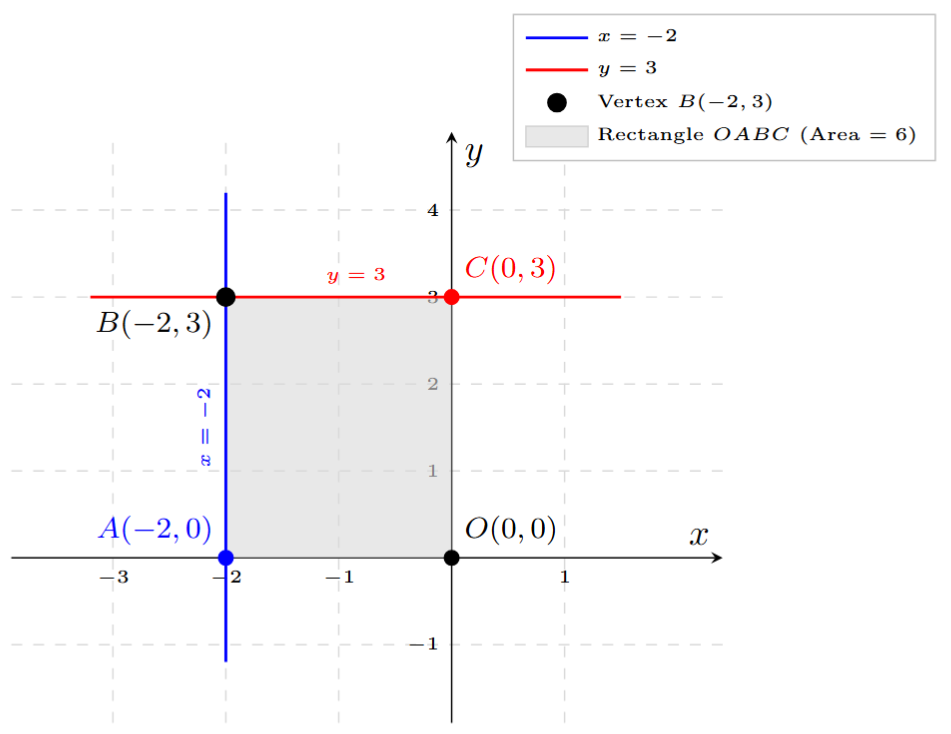
Let the vertices of the figure be $O$, $A$, $B$, and $C$.
1. The intersection of the $x$-axis and $y$-axis is the origin:
$O = (0, 0)$
2. The intersection of the line $x = -2$ and the $x$-axis ($y = 0$):
$A = (-2, 0)$
3. The intersection of the line $x = -2$ and the line $y = 3$:
$B = (-2, 3)$
4. The intersection of the line $y = 3$ and the $y$-axis ($x = 0$):
$C = (0, 3)$
The vertices of the figure (rectangle $OABC$) are $(0, 0)$, $(-2, 0)$, $(-2, 3)$, and $(0, 3)$.
Calculation of Area:
The figure formed is a rectangle where:
The length of side $OA$ (along the $x$-axis) is the absolute value of the $x$-coordinate of $A$:
$Length (l) = |-2| = 2 \text{ units}$
The breadth of side $OC$ (along the $y$-axis) is the absolute value of the $y$-coordinate of $C$:
$Breadth (b) = |3| = 3 \text{ units}$
Now, we calculate the area:
$Area = Length \times Breadth$
(Formula for Rectangle)
$Area = 2 \times 3$
$Area = 6 \text{ square units}$
Thus, the area of the figure is $6 \text{ square units}$.
Sample Question 2: Determine, algebraically, the vertices of the triangle formed by the lines
5x – y = 5 , x + 2y = 1 and 6x + y = 17.
Answer:
Given:
The equations of the three lines are:
$5x - y = 5$
$x + 2y = 1$
$6x + y = 17$
To Find:
The vertices of the triangle formed by the intersection of these lines.
Solution:
The vertices of the triangle are the points where any two of the given lines intersect. We need to find the intersection points of the three pairs of lines.
Intersection of Line 1 ($5x - y = 5$) and Line 2 ($x + 2y = 1$):
Equation (1): $5x - y = 5$
Equation (2): $x + 2y = 1$
From Equation (1), we can express $y$ in terms of $x$:
$y = 5x - 5$
Substitute this expression for $y$ into Equation (2):
$x + 2(5x - 5) = 1$
$x + 10x - 10 = 1$
$11x - 10 = 1$
$11x = 1 + 10$
$11x = 11$
$x = \frac{11}{11}$
$x = 1$
Substitute the value of $x = 1$ back into the expression for $y$:
$y = 5(1) - 5$
$y = 5 - 5$
$y = 0$
The first vertex (intersection of Line 1 and Line 2) is $(1, 0)$.
Intersection of Line 1 ($5x - y = 5$) and Line 3 ($6x + y = 17$):
Equation (1): $5x - y = 5$
Equation (3): $6x + y = 17$
Add Equation (1) and Equation (3) to eliminate $y$:
$(5x - y) + (6x + y) = 5 + 17$
$5x + 6x - y + y = 22$
$11x = 22$
$x = \frac{22}{11}$
$x = 2$
Substitute the value of $x = 2$ back into Equation (3):
$6(2) + y = 17$
$12 + y = 17$
$y = 17 - 12$
$y = 5$
The second vertex (intersection of Line 1 and Line 3) is $(2, 5)$.
Intersection of Line 2 ($x + 2y = 1$) and Line 3 ($6x + y = 17$):
Equation (2): $x + 2y = 1$
Equation (3): $6x + y = 17$
From Equation (3), we can express $y$ in terms of $x$:
$y = 17 - 6x$
Substitute this expression for $y$ into Equation (2):
$x + 2(17 - 6x) = 1$
$x + 34 - 12x = 1$
$x - 12x = 1 - 34$
$-11x = -33$
$x = \frac{-33}{-11}$
$x = 3$
Substitute the value of $x = 3$ back into the expression for $y$ from Equation (3):
$y = 17 - 6(3)$
$y = 17 - 18$
$y = -1$
The third vertex (intersection of Line 2 and Line 3) is $(3, -1)$.
Final Answer:
The vertices of the triangle formed by the given lines are $(1, 0)$, $(2, 5)$, and $(3, -1)$.
Sample Question 3: Jamila sold a table and a chair for Rs 1050, thereby making a profit of 10% on the table and 25% on the chair. If she had taken a profit of 25% on the table and 10% on the chair she would have got Rs 1065. Find the cost price of each.
Answer:
Given:
In the first case, the selling price of the table (with 10% profit) and the chair (with 25% profit) is $\textsf{₹} 1050$.
In the second case, the selling price of the table (with 25% profit) and the chair (with 10% profit) is $\textsf{₹} 1065$.
To Find:
The cost price of the table and the cost price of the chair.
Solution:
Let the cost price of the table be $\textsf{₹} x$.
Let the cost price of the chair be $\textsf{₹} y$.
According to the first condition:
Selling price of table with 10% profit = $x + 10\%\text{ of } x = x + \frac{10}{100}x = x + 0.1x = 1.1x$.
Selling price of chair with 25% profit = $y + 25\%\text{ of } y = y + \frac{25}{100}y = y + 0.25y = 1.25y$.
Total selling price in the first case = $1.1x + 1.25y$.
$1.1x + 1.25y = 1050$
Multiply by 100 to remove decimals:
$110x + 125y = 105000$
Dividing by 5, we get:
$22x + 25y = 21000$
... (i)
According to the second condition:
Selling price of table with 25% profit = $x + 25\%\text{ of } x = x + \frac{25}{100}x = x + 0.25x = 1.25x$.
Selling price of chair with 10% profit = $y + 10\%\text{ of } y = y + \frac{10}{100}y = y + 0.1y = 1.1y$.
Total selling price in the second case = $1.25x + 1.1y$.
$1.25x + 1.1y = 1065$
Multiply by 100 to remove decimals:
$125x + 110y = 106500$
Dividing by 5, we get:
$25x + 22y = 21300$
... (ii)
Now we have a system of two linear equations:
$22x + 25y = 21000$ ...(i)
$25x + 22y = 21300$ ...(ii)
Adding equation (i) and equation (ii):
$(22x + 25y) + (25x + 22y) = 21000 + 21300$
$47x + 47y = 42300$
Dividing both sides by 47:
$x + y = \frac{42300}{47}$
$x + y = 900$
... (iii)
Subtracting equation (i) from equation (ii):
$(25x + 22y) - (22x + 25y) = 21300 - 21000$
$25x + 22y - 22x - 25y = 300$
$3x - 3y = 300$
Dividing both sides by 3:
$x - y = 100$
... (iv)
Now we solve the system of equations (iii) and (iv):
$x + y = 900$ ...(iii)
$x - y = 100$ ...(iv)
Adding equation (iii) and equation (iv):
$(x + y) + (x - y) = 900 + 100$
$2x = 1000$
$x = \frac{1000}{2}$
$\mathbf{x = 500}$
Substitute the value of $x$ in equation (iii):
$500 + y = 900$
$y = 900 - 500$
$\mathbf{y = 400}$
Thus, the cost price of the table is $\textsf{₹} 500$ and the cost price of the chair is $\textsf{₹} 400$.
Sample Question 4: It can take 12 hours to fill a swimming pool using two pipes. If the pipe of larger diameter is used for 4 hours and the pipe of smaller diameter for 9 hours, only half the pool can be filled.How long would it take for each pipe to fill the pool separately?
Answer:
Given:
Time taken to fill the pool by two pipes together = 12 hours.
Time taken by the larger pipe for partial filling = 4 hours.
Time taken by the smaller pipe for partial filling = 9 hours.
Fraction of the pool filled by partial use = $\frac{1}{2}$.
To Find:
Time taken by each pipe to fill the pool separately.
Solution:
Let the time taken by the larger pipe to fill the pool separately be $x$ hours.
Let the time taken by the smaller pipe to fill the pool separately be $y$ hours.
Work done by the larger pipe in 1 hour = $\frac{1}{x}$.
Work done by the smaller pipe in 1 hour = $\frac{1}{y}$.
According to the first condition, both pipes together fill the pool in 12 hours.
Work done by both pipes in 1 hour = $\frac{1}{12}$.
$\frac{1}{x} + \frac{1}{y} = \frac{1}{12}$
... (i)
According to the second condition, the larger pipe works for 4 hours and the smaller pipe works for 9 hours to fill half the pool.
Work done by the larger pipe in 4 hours = $4 \times \frac{1}{x} = \frac{4}{x}$.
Work done by the smaller pipe in 9 hours = $9 \times \frac{1}{y} = \frac{9}{y}$.
$\frac{4}{x} + \frac{9}{y} = \frac{1}{2}$
... (ii)
Let $u = \frac{1}{x}$ and $v = \frac{1}{y}$. Substituting these values into the equations (i) and (ii), we get:
$u + v = \frac{1}{12}$
... (iii)
$4u + 9v = \frac{1}{2}$
... (iv)
From equation (iii), multiply by 4:
$4(u + v) = 4 \times \frac{1}{12}$
$\mathbf{4u + 4v = \frac{4}{12} = \frac{1}{3}}$
... (v)
Subtract equation (v) from equation (iv):
$(4u + 9v) - (4u + 4v) = \frac{1}{2} - \frac{1}{3}$
$5v = \frac{3 - 2}{6}$
$5v = \frac{1}{6}$
$\mathbf{v = \frac{1}{30}}$
Substitute the value of $v$ in equation (iii):
$u + \frac{1}{30} = \frac{1}{12}$
$u = \frac{1}{12} - \frac{1}{30}$
Find the LCM of 12 and 30. LCM(12, 30) = 60.
$u = \frac{5}{60} - \frac{2}{60}$
$\mathbf{u = \frac{3}{60} = \frac{1}{20}}$
Now, we find $x$ and $y$ using $u = \frac{1}{x}$ and $v = \frac{1}{y}$.
$u = \frac{1}{x} \implies \frac{1}{20} = \frac{1}{x} \implies x = 20$.
$v = \frac{1}{y} \implies \frac{1}{30} = \frac{1}{y} \implies y = 30$.
Therefore, the larger pipe takes 20 hours to fill the pool separately, and the smaller pipe takes 30 hours to fill the pool separately.
Exercise 3.4
Question 1. Graphically, solve the following pair of equations:
2x + y = 6 , 2x – y + 2 = 0
Find the ratio of the areas of the two triangles formed by the lines representing these equations with the x-axis and the lines with the y-axis.
Answer:
Given:
The pair of linear equations are:
$2x + y = 6$
... (i)
$2x - y + 2 = 0$
... (ii)
To Find:
1. Graphical solution of the pair of equations.
2. The ratio of the areas of the two triangles formed by these lines with the $x$-axis and the $y$-axis.
Solution:
First, we find at least two or three points for each line to plot the graph.
For Equation (i): $2x + y = 6 \implies y = 6 - 2x$
| $x$ | $y = 6 - 2x$ | Point $(x, y)$ |
| $0$ | $6$ | $(0, 6)$ |
| $3$ | $0$ | $(3, 0)$ |
| $1$ | $4$ | $(1, 4)$ |
For Equation (ii): $2x - y + 2 = 0 \implies y = 2x + 2$
| $x$ | $y = 2x + 2$ | Point $(x, y)$ |
| $0$ | $2$ | $(0, 2)$ |
| $-1$ | $0$ | $(-1, 0)$ |
| $1$ | $4$ | $(1, 4)$ |
Plotting these points on a graph, we observe that the two lines intersect at the point $(1, 4)$. Thus, the solution is $x = 1$ and $y = 4$.
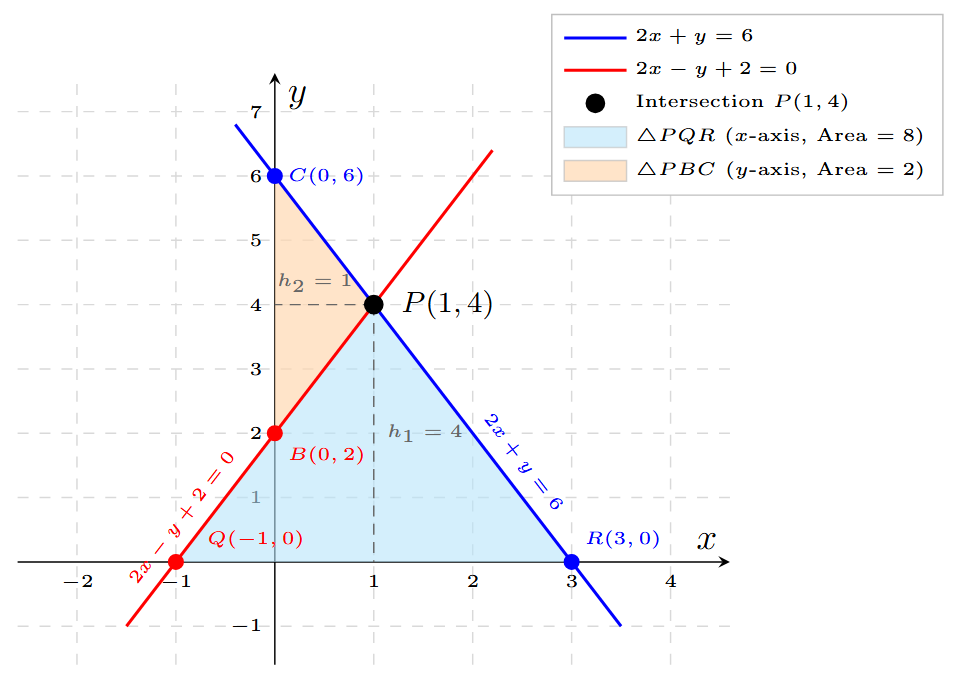
Area of Triangle formed with the $x$-axis:
Let the triangle formed by the two lines and the $x$-axis be $\triangle PQR$.
The vertices are $P(1, 4)$, $Q(-1, 0)$, and $R(3, 0)$.
The base $QR$ lies on the $x$-axis. The length of the base is:
$Base (b_1) = 3 - (-1) = 4 \text{ units}$
The height of the triangle is the $y$-coordinate of the intersection point $P(1, 4)$:
$Height (h_1) = 4 \text{ units}$
$Area (\triangle_1) = \frac{1}{2} \times b_1 \times h_1$
$Area (\triangle_1) = \frac{1}{2} \times 4 \times 4 = 8 \text{ sq. units}$
... (iii)
Area of Triangle formed with the $y$-axis:
Let the triangle formed by the two lines and the $y$-axis be $\triangle PBC$.
The vertices are $P(1, 4)$, $B(0, 2)$, and $C(0, 6)$.
The base $BC$ lies on the $y$-axis. The length of the base is:
$Base (b_2) = 6 - 2 = 4 \text{ units}$
The height of the triangle is the $x$-coordinate of the intersection point $P(1, 4)$:
$Height (h_2) = 1 \text{ unit}$
$Area (\triangle_2) = \frac{1}{2} \times b_2 \times h_2$
$Area (\triangle_2) = \frac{1}{2} \times 4 \times 1 = 2 \text{ sq. units}$
... (iv)
Ratio of the Areas:
We need to find the ratio of $Area (\triangle_1)$ to $Area (\triangle_2)$:
$Ratio = \frac{Area (\triangle_1)}{Area (\triangle_2)}$
$Ratio = \frac{8}{2}$
[From (iii) and (iv)]
$Ratio = \frac{4}{1}$
The ratio of the areas of the two triangles is $4 : 1$.
Question 2. Determine, graphically, the vertices of the triangle formed by the lines
y = x,
3y = x,
x + y = 8
Answer:
Given:
The equations of the three lines forming the triangle are:
$y = x$
…(i)
$3y = x$
…(ii)
$x + y = 8$
…(iii)
To Find:
The vertices of the triangle formed by these three lines graphically.
Solution:
To plot the lines on a graph, we first find a few solutions for each equation.
For Equation (i): $y = x$
| $x$ | $y = x$ | Point $(x, y)$ |
| $0$ | $0$ | $(0, 0)$ |
| $2$ | $2$ | $(2, 2)$ |
| $4$ | $4$ | $(4, 4)$ |
For Equation (ii): $3y = x \implies y = \frac{x}{3}$
| $x$ | $y = \frac{x}{3}$ | Point $(x, y)$ |
| $0$ | $0$ | $(0, 0)$ |
| $3$ | $1$ | $(3, 1)$ |
| $6$ | $2$ | $(6, 2)$ |
For Equation (iii): $x + y = 8 \implies y = 8 - x$
| $x$ | $y = 8 - x$ | Point $(x, y)$ |
| $0$ | $8$ | $(0, 8)$ |
| $4$ | $4$ | $(4, 4)$ |
| $8$ | $0$ | $(8, 0)$ |
Graphical Representation:
Plot these lines on a Cartesian plane. The triangle is formed by the intersection of these three lines.
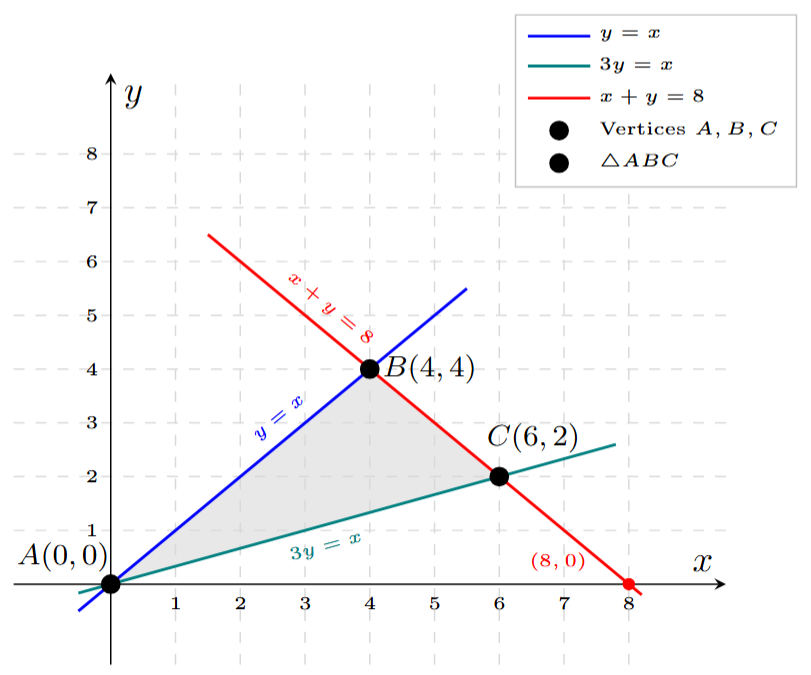
From the graph and the tables, we can identify the points where the lines intersect:
1. Intersection of Line (i) and Line (ii):
Both lines $y = x$ and $3y = x$ pass through the origin.
$Vertex A = (0, 0)$
2. Intersection of Line (i) and Line (iii):
By substituting $y = x$ into $x + y = 8$:
$x + x = 8 \implies 2x = 8 \implies x = 4$
Since $y = x$, then $y = 4$.
$Vertex B = (4, 4)$
3. Intersection of Line (ii) and Line (iii):
By substituting $x = 3y$ into $x + y = 8$:
$3y + y = 8 \implies 4y = 8 \implies y = 2$
Substituting $y = 2$ in $x = 3y$ gives $x = 3(2) = 6$.
$Vertex C = (6, 2)$
Conclusion:
The vertices of the triangle formed by the given lines are $(0, 0)$, $(4, 4)$, and $(6, 2)$.
Question 3. Draw the graphs of the equations x = 3, x = 5 and 2x – y – 4 = 0. Also find the area of the quadrilateral formed by the lines and the x–axis.
Answer:
Given:
The equations of the lines are:
$x = 3$
... (i)
$x = 5$
... (ii)
$2x - y - 4 = 0$
... (iii)
The figure is also bounded by the $x$-axis, whose equation is $y = 0$.
To Find:
1. Draw the graphs of the three lines.
2. Find the area of the quadrilateral formed by these lines and the $x$-axis.
Solution:
First, we find the coordinates for the line $2x - y - 4 = 0$.
Rewriting the equation: $y = 2x - 4$
| $x$ | $y = 2x - 4$ | Point $(x, y)$ |
| $2$ | $0$ | $(2, 0)$ |
| $3$ | $2$ | $(3, 2)$ |
| $5$ | $6$ | $(5, 6)$ |
The line $x = 3$ is a vertical line parallel to the $y$-axis passing through $(3, 0)$.
The line $x = 5$ is a vertical line parallel to the $y$-axis passing through $(5, 0)$.
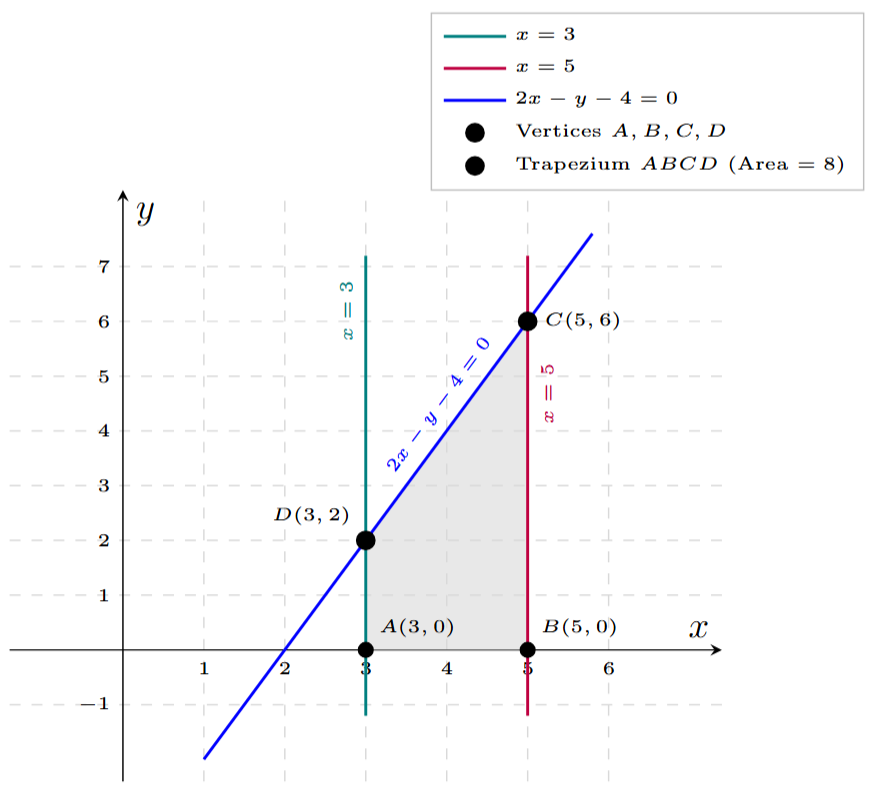
The quadrilateral is formed by the vertices where these lines intersect each other and the $x$-axis ($y = 0$).
Let the vertices of the quadrilateral be $A, B, C,$ and $D$:
1. Intersection of $x = 3$ and $y = 0$ (the $x$-axis):
$A = (3, 0)$
2. Intersection of $x = 5$ and $y = 0$ (the $x$-axis):
$B = (5, 0)$
3. Intersection of $x = 5$ and $y = 2x - 4$:
$y = 2(5) - 4 = 6$
[Putting $x=5$ in (iii)] ... (iv)
$C = (5, 6)$
4. Intersection of $x = 3$ and $y = 2x - 4$:
$y = 2(3) - 4 = 2$
[Putting $x=3$ in (iii)] ... (v)
$D = (3, 2)$
Calculation of Area:
The figure $ABCD$ is a trapezium because the sides $AD$ and $BC$ are both vertical (parallel to the $y$-axis) and thus parallel to each other.
The lengths of the parallel sides are:
$AD = 2 \text{ units}$
(Height at $x=3$)
$BC = 6 \text{ units}$
(Height at $x=5$)
The distance between the parallel sides (height of the trapezium) is the distance along the $x$-axis from $x=3$ to $x=5$:
$h = 5 - 3 = 2 \text{ units}$
Using the formula for the Area of a Trapezium:
$Area = \frac{1}{2} \times (\text{sum of parallel sides}) \times h$
$Area = \frac{1}{2} \times (AD + BC) \times h$
$Area = \frac{1}{2} \times (2 + 6) \times 2$
$Area = 8 \text{ square units}$
The area of the quadrilateral formed is $8 \text{ square units}$.
Question 4. The cost of 4 pens and 4 pencil boxes is Rs 100. Three times the cost of a pen is Rs 15 more than the cost of a pencil box. Form the pair of linear equations for the above situation. Find the cost of a pen and a pencil box.
Answer:
Given:
The cost of 4 pens and 4 pencil boxes is $\textsf{₹} 100$.
Three times the cost of a pen is $\textsf{₹} 15$ more than the cost of a pencil box.
To Find:
The pair of linear equations representing the given situation.
The cost of a pen and the cost of a pencil box.
Solution:
Let the cost of a pen be $\textsf{₹} x$.
Let the cost of a pencil box be $\textsf{₹} y$.
According to the first condition:
The cost of 4 pens is $4x$.
The cost of 4 pencil boxes is $4y$.
Total cost is $\textsf{₹} 100$.
$4x + 4y = 100$
Dividing the equation by 4, we get:
$\mathbf{x + y = 25}$
... (i)
According to the second condition:
Three times the cost of a pen is $3x$.
This is $\textsf{₹} 15$ more than the cost of a pencil box ($y$).
$\mathbf{3x = y + 15}$
Rearranging the terms, we get:
$\mathbf{3x - y = 15}$
... (ii)
The pair of linear equations is $x + y = 25$ and $3x - y = 15$.
Now, we solve this system of equations to find the values of $x$ and $y$.
$x + y = 25$ ...(i)
$3x - y = 15$ ...(ii)
Adding equation (i) and equation (ii):
$(x + y) + (3x - y) = 25 + 15$
$x + y + 3x - y = 40$
$4x = 40$
$\mathbf{x = 10}$
Substitute the value of $x = 10$ into equation (i):
$10 + y = 25$
$\mathbf{y = 15}$
Thus, the cost of a pen is $\textsf{₹} 10$ and the cost of a pencil box is $\textsf{₹} 15$.
Question 5. Determine, algebraically, the vertices of the triangle formed by the lines
3x - y = 3
2x - 3y = 2
x + 2y = 8
Answer:
Given:
The three linear equations:
$3x - y = 3$ (1)
$2x - 3y = 2$ (2)
$x + 2y = 8$ (3)
To Find:
The vertices of the triangle formed by the given lines using algebraic methods.
Solution:
To find the vertices of the triangle, we need to find the intersection points of each pair of lines by solving the corresponding system of linear equations.
1. Intersection of lines (1) and (2):
Equation (1): $3x - y = 3 \implies y = 3x - 3$
Substitute this expression for $y$ into equation (2):
$2x - 3(3x - 3) = 2$
$2x - 9x + 9 = 2$
$-7x = 2 - 9$
$-7x = -7$
$\mathbf{x = 1}$
Substitute $x = 1$ back into $y = 3x - 3$:
y = 3(1) - 3
$\mathbf{y = 0}$
The first vertex is (1, 0).
2. Intersection of lines (1) and (3):
Equation (1): $3x - y = 3 \implies y = 3x - 3$
Substitute this expression for $y$ into equation (3):
$x + 2(3x - 3) = 8$
$x + 6x - 6 = 8$
$7x = 8 + 6$
$7x = 14$
$\mathbf{x = 2}$
Substitute $x = 2$ back into $y = 3x - 3$:
y = 3(2) - 3
y = 6 - 3
$\mathbf{y = 3}$
The second vertex is (2, 3).
3. Intersection of lines (2) and (3):
Equation (3): $x + 2y = 8 \implies x = 8 - 2y$
Substitute this expression for $x$ into equation (2):
$2(8 - 2y) - 3y = 2$
$16 - 4y - 3y = 2$
$16 - 7y = 2$
$-7y = 2 - 16$
$-7y = -14$
$\mathbf{y = 2}$
Substitute $y = 2$ back into $x = 8 - 2y$:
$x = 8 - 2(2)$
$x = 8 - 4$
$\mathbf{x = 4}$
The third vertex is (4, 2).
The vertices of the triangle formed by the given lines are (1, 0), (2, 3), and (4, 2).
Question 6. Ankita travels 14 km to her home partly by rickshaw and partly by bus. She takes half an hour if she travels 2 km by rickshaw, and the remaining distance by bus. On the other hand, if she travels 4 km by rickshaw and the remaining distance by bus, she takes 9 minutes longer. Find the speed of the rickshaw and of the bus.
Answer:
Given:
Total distance to travel = 14 km.
Case 1: 2 km by rickshaw, remaining (12 km) by bus. Total time = half an hour (30 minutes).
Case 2: 4 km by rickshaw, remaining (10 km) by bus. Total time = half an hour + 9 minutes = 39 minutes.
To Find:
The speed of the rickshaw and the speed of the bus in km/hour.
Solution:
Let the speed of the rickshaw be $v_r$ km/minute.
Let the speed of the bus be $v_b$ km/minute.
We know that Time = $\frac{\text{Distance}}{\text{Speed}}$.
According to the first condition:
Time taken by rickshaw for 2 km = $\frac{2}{v_r}$ minutes.
Time taken by bus for 12 km = $\frac{12}{v_b}$ minutes.
Total time = 30 minutes.
$\frac{2}{v_r} + \frac{12}{v_b} = 30$
... (i)
According to the second condition:
Time taken by rickshaw for 4 km = $\frac{4}{v_r}$ minutes.
Time taken by bus for 10 km = $\frac{10}{v_b}$ minutes.
Total time = 39 minutes.
$\frac{4}{v_r} + \frac{10}{v_b} = 39$
... (ii)
Let $u = \frac{1}{v_r}$ and $v = \frac{1}{v_b}$. Substituting these values into equations (i) and (ii), we get:
$2u + 12v = 30$
... (iii)
$4u + 10v = 39$
... (iv)
From equation (iii), we can write $2u = 30 - 12v$, or $u = 15 - 6v$.
Substitute the expression for $u$ into equation (iv):
$4(15 - 6v) + 10v = 39$
$60 - 24v + 10v = 39$
$-14v = 39 - 60$
$-14v = -21$
$\mathbf{v = \frac{-21}{-14} = \frac{3}{2}}$
Substitute the value of $v$ into the expression for $u$:
$u = 15 - 6\left(\frac{3}{2}\right)$
$u = 15 - 3 \times 3$
$\mathbf{u = 15 - 9 = 6}$
We have $u = \frac{1}{v_r} = 6$ and $v = \frac{1}{v_b} = \frac{3}{2}$.
From $u = 6$, we get $v_r = \frac{1}{6}$ km/minute.
From $v = \frac{3}{2}$, we get $v_b = \frac{1}{\frac{3}{2}} = \frac{2}{3}$ km/minute.
To convert speed from km/minute to km/hour, we multiply by 60 (since 1 hour = 60 minutes).
Speed of rickshaw in km/hour = $v_r \times 60 = \frac{1}{6} \times 60 = 10$ km/hour.
Speed of bus in km/hour = $v_b \times 60 = \frac{2}{3} \times 60 = 2 \times 20 = 40$ km/hour.
The speed of the rickshaw is 10 km/hour and the speed of the bus is 40 km/hour.
Question 7. A person, rowing at the rate of 5 km/h in still water, takes thrice as much time in going 40 km upstream as in going 40 km downstream. Find the speed of the stream.
Answer:
Given:
Speed of the person in still water = 5 km/h.
Distance travelled upstream = 40 km.
Distance travelled downstream = 40 km.
Time taken upstream is thrice the time taken downstream.
To Find:
The speed of the stream.
Solution:
Let the speed of the stream be $x$ km/h.
Speed of the person in still water = 5 km/h.
Speed upstream = (Speed in still water) - (Speed of stream)
Speed upstream = $(5 - x)$ km/h
Speed downstream = (Speed in still water) + (Speed of stream)
Speed downstream = $(5 + x)$ km/h
We know that $\text{Time} = \frac{\text{Distance}}{\text{Speed}}$.
Time taken to go 40 km upstream ($T_{upstream}$) = $\frac{40}{5 - x}$ hours.
Time taken to go 40 km downstream ($T_{downstream}$) = $\frac{40}{5 + x}$ hours.
According to the given condition, $T_{upstream} = 3 \times T_{downstream}$.
$\frac{40}{5 - x} = 3 \times \frac{40}{5 + x}$
Multiply both sides by $(5 - x)(5 + x)$ (assuming $x \neq 5$ and $x \neq -5$, which is true for speed):
$40(5 + x) = 3 \times 40 (5 - x)$
Divide both sides by 40:
$(5 + x) = 3 (5 - x)$
Distribute 3 on the right side:
$5 + x = 15 - 3x$
Bring terms with $x$ to one side and constant terms to the other:
$x + 3x = 15 - 5$
$4x = 10$
$\mathbf{x = \frac{10}{4}}$
$\mathbf{x = 2.5}$
The speed of the stream must be less than the speed of the person in still water for upstream motion to be possible, i.e., $5 - x > 0 \implies x < 5$. Our calculated value $x = 2.5$ satisfies this condition.
The speed of the stream is 2.5 km/h.
Question 8. A motor boat can travel 30 km upstream and 28 km downstream in 7 hours. It can travel 21 km upstream and return in 5 hours. Find the speed of the boat in still water and the speed of the stream.
Answer:
Given:
Case 1: Time taken to travel 30 km upstream and 28 km downstream is 7 hours.
Case 2: Time taken to travel 21 km upstream and 21 km downstream (return) is 5 hours.
To Find:
The speed of the boat in still water and the speed of the stream.
Solution:
Let the speed of the boat in still water be $x$ km/h.
Let the speed of the stream be $y$ km/h.
The speed of the boat upstream is $(x - y)$ km/h.
The speed of the boat downstream is $(x + y)$ km/h.
We know that $\text{Time} = \frac{\text{Distance}}{\text{Speed}}$.
According to the first condition:
Time taken to travel 30 km upstream = $\frac{30}{x - y}$ hours.
Time taken to travel 28 km downstream = $\frac{28}{x + y}$ hours.
Total time = 7 hours.
$\frac{30}{x - y} + \frac{28}{x + y} = 7$
... (i)
According to the second condition:
Time taken to travel 21 km upstream = $\frac{21}{x - y}$ hours.
Time taken to travel 21 km downstream = $\frac{21}{x + y}$ hours.
Total time = 5 hours.
$\frac{21}{x - y} + \frac{21}{x + y} = 5$
... (ii)
These are non-linear equations. Let $u = \frac{1}{x - y}$ and $v = \frac{1}{x + y}$. Substituting these into equations (i) and (ii), we get a system of linear equations:
30$u$ + 28$v$ = 7
... (iii)
21$u$ + 21$v$ = 5
... (iv)
We can solve this system for $u$ and $v$. Multiply equation (iii) by 21 and equation (iv) by 30:
21(30$u$ + 28$v$) = 21 $\times$ 7
630$u$ + 588$v$ = 147
... (v)
30(21$u$ + 21$v$) = 30 $\times$ 5
630$u$ + 630$v$ = 150
... (vi)
Subtract equation (v) from equation (vi):
(630$u$ + 630$v$) - (630$u$ + 588$v$) = 150 - 147
42$v$ = 3
$\mathbf{v = \frac{3}{42} = \frac{1}{14}}$
Substitute the value of $v = \frac{1}{14}$ into equation (iv):
21$u$ + 21$\left(\frac{1}{14}\right)$ = 5
21$u$ + $\frac{3}{2}$ = 5
21$u$ = $5 - \frac{3}{2}$
21$u$ = $\frac{10 - 3}{2}$
21$u$ = $\frac{7}{2}$
$\mathbf{u = \frac{7}{2 \times 21} = \frac{7}{42} = \frac{1}{6}}$
Now substitute back $u = \frac{1}{x - y}$ and $v = \frac{1}{x + y}$:
$\frac{1}{x - y} = \frac{1}{6} \implies x - y = 6$
... (vii)
$\frac{1}{x + y} = \frac{1}{14} \implies x + y = 14$
... (viii)
Now we have a simple system of linear equations for $x$ and $y$. Add equation (vii) and equation (viii):
$(x - y) + (x + y) = 6 + 14$
$2x = 20$
$\mathbf{x = 10}$
Substitute the value of $x = 10$ into equation (viii):
10 + $y$ = 14
$\mathbf{y = 4}$
The speed of the boat in still water is 10 km/h, and the speed of the stream is 4 km/h.
The speed of the boat in still water is 10 km/h and the speed of the stream is 4 km/h.
Question 9. A two-digit number is obtained by either multiplying the sum of the digits by 8 and then subtracting 5 or by multiplying the difference of the digits by 16 and then adding 3. Find the number.
Answer:
Given:
A two-digit number satisfies two conditions based on its digits:
Condition 1: The number is 8 times the sum of its digits, minus 5.
Condition 2: The number is 16 times the difference of its digits, plus 3.
To Find:
The two-digit number.
Solution:
Let the tens digit of the two-digit number be $t$ and the units digit be $u$.
The two-digit number can be represented as $10t + u$.
According to the first condition:
10t + u = 8(t + u) - 5
Simplify the equation:
10t + u = 8t + 8u - 5
10t - 8t + u - 8u = -5
2t - 7u = -5
... (1)
According to the second condition, the number is 16 times the difference of the digits, plus 3.
The "difference of the digits" can mean $(t - u)$ or $(u - t)$. We consider both cases.
Case 1: Assume the difference of the digits is $(t - u)$, where $t \ge u$.
10t + u = 16(t - u) + 3
Simplify the equation:
10t + u = 16t - 16u + 3
10t - 16t + u + 16u = 3
-6t + 17u = 3
... (2a)
Now we solve the system of linear equations formed by (1) and (2a):
$2t - 7u = -5$ (1)
$-6t + 17u = 3$ (2a)
Multiply equation (1) by 3:
3(2t - 7u) = 3(-5)
6t - 21u = -15
... (3)
Add equation (3) and equation (2a):
(6t - 21u) + (-6t + 17u) = -15 + 3
-4u = -12
u = $\frac{-12}{-4}$
u = 3
Substitute the value of $u = 3$ into equation (1):
2t - 7(3) = -5
2t - 21 = -5
2t = -5 + 21
2t = 16
t = 8
The digits are $t = 8$ and $u = 3$. Since $8 \ge 3$, this is consistent with our assumption for Case 1.
The number is $10t + u = 10(8) + 3 = 83$.
Let's check if this number satisfies the original conditions:
Condition 1: Sum of digits = $8+3=11$. $8(11) - 5 = 88 - 5 = 83$. Correct.
Condition 2: Difference of digits = $8-3=5$. $16(5) + 3 = 80 + 3 = 83$. Correct.
So, 83 is a valid solution.
Case 2: Assume the difference of the digits is $(u - t)$, where $u > t$.
10t + u = 16(u - t) + 3
Simplify the equation:
10t + u = 16u - 16t + 3
10t + 16t + u - 16u = 3
26t - 15u = 3
... (2b)
Now we solve the system of linear equations formed by (1) and (2b):
$2t - 7u = -5$ (1)
$26t - 15u = 3$ (2b)
Multiply equation (1) by 13:
13(2t - 7u) = 13(-5)
26t - 91u = -65
... (4)
Subtract equation (4) from equation (2b):
(26t - 15u) - (26t - 91u) = 3 - (-65)
26t - 15u - 26t + 91u = 3 + 65
76u = 68
u = $\frac{68}{76}$
u = $\frac{17}{19}$
Since $u$ must be an integer digit between 0 and 9, this case does not yield a valid two-digit number.
The only valid solution is from Case 1.
The two-digit number is 83.
Question 10. A railway half ticket costs half the full fare, but the reservation charges are the same on a half ticket as on a full ticket. One reserved first class ticket from the station A to B costs Rs 2530. Also, one reserved first class ticket and one reserved first class half ticket from A to B costs Rs 3810. Find the full first class fare from station A to B, and also the reservation charges for a ticket.
Answer:
Given:
1. A railway half ticket costs half the full fare, but reservation charges are the same for both half and full tickets.
2. Cost of one reserved first-class ticket from station A to B = $\textsf{₹} 2530$.
3. Cost of one reserved first-class ticket and one reserved first-class half ticket = $\textsf{₹} 3810$.
To Find:
1. The full first-class fare ($x$).
2. The reservation charges ($y$).
Solution:
Let the full first-class fare be $\textsf{₹} x$.
Let the reservation charges for any ticket be $\textsf{₹} y$.
According to the first condition, one reserved first-class ticket consists of the full fare and the reservation charge.
$x + y = 2530$
... (i)
According to the second condition, the cost of one reserved full ticket and one reserved half ticket is $\textsf{₹} 3810$.
Full ticket cost = $x + y$
Half ticket cost = $\frac{x}{2} + y$
So, the equation becomes:
$(x + y) + (\frac{x}{2} + y) = 3810$
$\frac{3x}{2} + 2y = 3810$
Multiplying the entire equation by $2$ to clear the fraction:
$3x + 4y = 7620$
... (ii)
Now, multiply equation (i) by $4$:
$4x + 4y = 10120$
... (iii)
Subtracting equation (ii) from equation (iii):
$(4x + 4y) - (3x + 4y) = 10120 - 7620$
[Elimination method] ... (iv)
$x = 2500$
Substituting the value of $x = 2500$ in equation (i):
$2500 + y = 2530$
$y = 2530 - 2500$
$y = 30$
Therefore, the full first-class fare is $\textsf{₹} 2500$ and the reservation charge is $\textsf{₹} 30$.
Alternate Solution:
We know that the cost of one reserved full ticket is $\textsf{₹} 2530$.
Let the cost of a reserved half ticket be $H$.
Given: Reserved full ticket + Reserved half ticket = $\textsf{₹} 3810$
$2530 + H = 3810$
$H = 3810 - 2530 = 1280$
Since $H = \frac{x}{2} + y$, we have:
$\frac{x}{2} + y = 1280$
... (v)
Subtracting equation (v) from $x + y = 2530$:
$(x + y) - (\frac{x}{2} + y) = 2530 - 1280$
$\frac{x}{2} = 1250$
$x = 2500$
Substituting $x$ back into the first equation gives $y = 30$.
Final Answer: Full fare = $\textsf{₹} 2500$, Reservation charge = $\textsf{₹} 30$.
Question 11. A shopkeeper sells a saree at 8% profit and a sweater at 10% discount, thereby, getting a sum Rs 1008. If she had sold the saree at 10% profit and the sweater at 8% discount, she would have got Rs 1028. Find the cost price of the saree and the list price (price before discount) of the sweater.
Answer:
Given:
1. Case 1: A saree is sold at $8\%$ profit and a sweater at $10\%$ discount. The total sum received is $\textsf{₹} 1008$.
2. Case 2: If the saree were sold at $10\%$ profit and the sweater at $8\%$ discount, the total sum received would be $\textsf{₹} 1028$.
To Find:
1. The cost price of the saree.
2. The list price (price before discount) of the sweater.
Solution:
Let the cost price of the saree be $\textsf{₹} x$.
Let the list price of the sweater be $\textsf{₹} y$.
Case 1:
Selling price of saree at $8\%$ profit = $x + 8\% \text{ of } x = x + \frac{8}{100}x = 1.08x$
Selling price of sweater at $10\%$ discount = $y - 10\% \text{ of } y = y - \frac{10}{100}y = 0.90y$
Total Selling Price = $1008$
$1.08x + 0.90y = 1008$
... (i)
Multiplying equation (i) by $100$:
$108x + 90y = 100800$
Dividing by $18$ to simplify:
$6x + 5y = 5600$
... (ii)
Case 2:
Selling price of saree at $10\%$ profit = $x + 10\% \text{ of } x = 1.10x$
Selling price of sweater at $8\%$ discount = $y - 8\% \text{ of } y = 0.92y$
Total Selling Price = $1028$
$1.10x + 0.92y = 1028$
... (iii)
Multiplying equation (iii) by $100$:
$110x + 92y = 102800$
Dividing by $2$ to simplify:
$55x + 46y = 51400$
... (iv)
Solving the Equations:
From equation (ii), we can express $y$ in terms of $x$:
$5y = 5600 - 6x \implies y = \frac{5600 - 6x}{5}$
... (v)
Substituting the value of $y$ from (v) into equation (iv):
$55x + 46\left(\frac{5600 - 6x}{5}\right) = 51400$
Multiplying the whole equation by $5$ to remove the denominator:
$275x + 46(5600 - 6x) = 257000$
$275x + 257600 - 276x = 257000$
$-x = 257000 - 257600$
$-x = -600$
$x = 600$
Now, substitute $x = 600$ in equation (ii):
$6(600) + 5y = 5600$
$3600 + 5y = 5600$
$5y = 2000$
$y = 400$
Conclusion:
The cost price of the saree is $\textsf{₹} 600$.
The list price of the sweater is $\textsf{₹} 400$.
Question 12. Susan invested certain amount of money in two schemes A and B, which offer interest at the rate of 8% per annum and 9% per annum, respectively. She received Rs 1860 as annual interest. However, had she interchanged the amount of investments in the two schemes, she would have received Rs 20 more as annual interest. How much money did she invest in each scheme?
Answer:
Given:
Annual interest rate for Scheme A = 8%.
Annual interest rate for Scheme B = 9%.
Case 1: Investment in A + Investment in B gives annual interest = $\textsf{₹} 1860$.
Case 2: Interchanged investments give annual interest = $\textsf{₹} 1860 + \textsf{₹} 20 = \textsf{₹} 1880$.
To Find:
The amount of money invested in each scheme.
Solution:
Let the amount invested in Scheme A be $\textsf{₹} x$.
Let the amount invested in Scheme B be $\textsf{₹} y$.
The annual interest from Scheme A is 8% of $x$, which is $0.08x$.
The annual interest from Scheme B is 9% of $y$, which is $0.09y$.
According to the first condition:
0.08$x$ + 0.09$y$ = 1860
Multiply by 100 to remove decimals:
8$x$ + 9$y$ = 186000
... (1)
According to the second condition, if the investments were interchanged ($y$ in A and $x$ in B), the total interest would be $\textsf{₹} 1880$.
Interest from Scheme A (with amount $y$) = 8% of $y$ = $0.08y$.
Interest from Scheme B (with amount $x$) = 9% of $x$ = $0.09x$.
0.09$x$ + 0.08$y$ = 1880
Multiply by 100 to remove decimals:
9$x$ + 8$y$ = 188000
... (2)
Now we have a system of two linear equations:
8$x$ + 9$y$ = 186000 (1)
9$x$ + 8$y$ = 188000 (2)
To solve by elimination, multiply equation (1) by 9 and equation (2) by 8:
9(8$x$ + 9$y$) = 9(186000)
72$x$ + 81$y$ = 1674000
... (3)
8(9$x$ + 8$y$) = 8(188000)
72$x$ + 64$y$ = 1504000
... (4)
Subtract equation (4) from equation (3):
(72$x$ + 81$y$) - (72$x$ + 64$y$) = 1674000 - 1504000
72$x$ + 81$y$ - 72$x$ - 64$y$ = 170000
17$y$ = 170000
y = $\frac{170000}{17}$
y = 10000
Substitute the value of $y = 10000$ into equation (1):
8$x$ + 9(10000) = 186000
8$x$ + 90000 = 186000
8$x$ = 186000 - 90000
8$x$ = 96000
x = $\frac{96000}{8}$
x = 12000
The amount invested in Scheme A was $\textsf{₹} 12000$, and the amount invested in Scheme B was $\textsf{₹} 10000$.
Question 13. Vijay had some bananas, and he divided them into two lots A and B. He sold the first lot at the rate of Rs 2 for 3 bananas and the second lot at the rate of Re 1 per banana, and got a total of Rs 400. If he had sold the first lot at the rate of Re 1 per banana, and the second lot at the rate of Rs 4 for 5 bananas, his total collection would have been Rs 460. Find the total number of bananas he had.
Answer:
Given:
Bananas are divided into two lots, A and B.
Case 1: Lot A sold at $\textsf{₹} 2$ for 3 bananas, Lot B sold at $\textsf{₹} 1$ per banana. Total collection = $\textsf{₹} 400$.
Case 2: Lot A sold at $\textsf{₹} 1$ per banana, Lot B sold at $\textsf{₹} 4$ for 5 bananas. Total collection = $\textsf{₹} 460$.
To Find:
The total number of bananas Vijay had.
Solution:
Let the number of bananas in Lot A be $x$.
Let the number of bananas in Lot B be $y$.
In Case 1:
Selling price per banana in Lot A = $\textsf{₹} \frac{2}{3}$.
Selling price per banana in Lot B = $\textsf{₹} 1$.
Total collection = (Price of bananas in Lot A) + (Price of bananas in Lot B)
$\frac{2}{3}x + 1y = 400$
Multiply by 3 to clear the fraction:
2x + 3y = 1200
... (1)
In Case 2:
Selling price per banana in Lot A = $\textsf{₹} 1$.
Selling price per banana in Lot B = $\textsf{₹} \frac{4}{5}$.
Total collection = (Price of bananas in Lot A) + (Price of bananas in Lot B)
1x + $\frac{4}{5}$y = 460
Multiply by 5 to clear the fraction:
5x + 4y = 2300
... (2)
Now we solve the system of linear equations:
2x + 3y = 1200 (1)
5x + 4y = 2300 (2)
To eliminate $x$, multiply equation (1) by 5 and equation (2) by 2:
5(2x + 3y) = 5(1200)
10x + 15y = 6000
... (3)
2(5x + 4y) = 2(2300)
10x + 8y = 4600
... (4)
Subtract equation (4) from equation (3):
(10x + 15y) - (10x + 8y) = 6000 - 4600
10x + 15y - 10x - 8y = 1400
7y = 1400
y = $\frac{1400}{7}$
y = 200
Substitute the value of $y = 200$ into equation (1):
2x + 3(200) = 1200
2x + 600 = 1200
2x = 1200 - 600
2x = 600
x = $\frac{600}{2}$
x = 300
The number of bananas in Lot A is 300, and the number of bananas in Lot B is 200.
The total number of bananas Vijay had is the sum of the bananas in Lot A and Lot B.
Total bananas = x + y
Total bananas = 300 + 200
Total bananas = 500
Vijay had a total of 500 bananas.