

Chapter 4 Quadratic Equations (Class 10 - Maths NCERT Exemplar Solutions)
Welcome to this essential resource for NCERT Exemplar Solutions for Class 10 Mathematics: Chapter 4 Quadratic Equations! These problems are strategically designed to move significantly beyond standard textbook exercises, focusing on a deeper conceptual understanding and challenging your problem-solving abilities. By exploring more complex applications of solving techniques and the rigorous analysis of algebraic structures, these solutions build the analytical foundation and computational proficiency required for advanced studies.
The solutions comprehensively cover the standard methods for solving quadratic equations ($ax^2 + bx + c = 0$), including Factorization, Completing the Square, and the Quadratic Formula ($x = \frac{-b \pm \sqrt{b^2 - 4ac}}{2a}$). A primary focus is placed on the analysis of the discriminant ($D = b^2 - 4ac$) to determine the nature of roots—identifying whether they are distinct, equal, or non-real. Students will master the technique of finding unknown parameters (like $k$) embedded within coefficients to satisfy specific root conditions, ensuring a robust grasp of algebraic dexterity.
Significant attention is given to the formulation of quadratic equations derived from intricate word problems, ranging from geometric area calculations to complex speed-distance-time scenarios involving upstream and downstream conditions. The Exemplar rigorously tests these skills through various formats, including MCQs and Long Answer questions that demand precise calculations and the verification of roots within real-world contexts. With step-by-step guidance and logical justifications prepared by learningspot.co, students can master the critical skills needed to effectively solve multifaceted algebraic challenges and elevate their mathematical reasoning.
Sample Question 1 & 2 (Before Exercise 4.1)
Choose the correct answer from the given four options:
Sample Question 1: Which one of the following is not a quadratic equation?
(A) (x + 2)2 = 2(x + 3)
(B) x2 + 3x = (–1) (1 – 3x)2
(C) (x + 2) (x – 1) = x2 – 2x – 3
(D) x3 – x2 + 2x + 1 = (x + 1)3
Answer:
Solution:
A quadratic equation is an equation that can be written in the standard form $ax^2 + bx + c = 0$, where $x$ is the variable, and $a$, $b$, $c$ are coefficients, with $a \neq 0$. We will examine each option by simplifying it to see if it fits this form.
(A) $(x + 2)^2 = 2(x + 3)$
Expanding the left side using $(a+b)^2 = a^2 + 2ab + b^2$:
$(x + 2)^2 = x^2 + 2(x)(2) + 2^2 = x^2 + 4x + 4$
Expanding the right side:
$2(x + 3) = 2x + 6$
Equating the expanded forms:
$x^2 + 4x + 4 = 2x + 6$
Rearranging all terms to one side:
$x^2 + 4x - 2x + 4 - 6 = 0$
$x^2 + 2x - 2 = 0$
This equation is in the form $ax^2 + bx + c = 0$ with $a=1$, $b=2$, and $c=-2$. Since $a=1 \neq 0$, this is a quadratic equation.
(B) $x^2 + 3x = (-1) (1 - 3x)^2$
Expanding the term $(1 - 3x)^2$ using $(a-b)^2 = a^2 - 2ab + b^2$:
$(1 - 3x)^2 = 1^2 - 2(1)(3x) + (3x)^2 = 1 - 6x + 9x^2$
Multiplying by $(-1)$:
$(-1)(1 - 3x)^2 = -(1 - 6x + 9x^2) = -1 + 6x - 9x^2$
Equating the left and right sides:
$x^2 + 3x = -1 + 6x - 9x^2$
Rearranging all terms to one side:
$x^2 + 9x^2 + 3x - 6x + 1 = 0$
$10x^2 - 3x + 1 = 0$
This equation is in the form $ax^2 + bx + c = 0$ with $a=10$, $b=-3$, and $c=1$. Since $a=10 \neq 0$, this is a quadratic equation.
(C) $(x + 2) (x - 1) = x^2 - 2x - 3$
Expanding the left side:
$(x + 2) (x - 1) = x(x - 1) + 2(x - 1) = x^2 - x + 2x - 2 = x^2 + x - 2$
Equating the left and right sides:
$x^2 + x - 2 = x^2 - 2x - 3$
Rearranging all terms to one side:
$x^2 - x^2 + x + 2x - 2 + 3 = 0$
$0x^2 + 3x + 1 = 0$
$3x + 1 = 0$
In this equation, the coefficient of $x^2$ is $a=0$. Therefore, this equation is of degree 1 and is a linear equation, not a quadratic equation.
(D) $x^3 - x^2 + 2x + 1 = (x + 1)^3$
Expanding the right side using $(a+b)^3 = a^3 + 3a^2b + 3ab^2 + b^3$:
$(x + 1)^3 = x^3 + 3(x^2)(1) + 3(x)(1^2) + 1^3 = x^3 + 3x^2 + 3x + 1$
Equating the left and right sides:
$x^3 - x^2 + 2x + 1 = x^3 + 3x^2 + 3x + 1$
Rearranging all terms to one side:
$x^3 - x^3 - x^2 - 3x^2 + 2x - 3x + 1 - 1 = 0$
$0x^3 - 4x^2 - x + 0 = 0$
$-4x^2 - x = 0$
This equation can be written as $-4x^2 - x + 0 = 0$, which is in the form $ax^2 + bx + c = 0$ with $a=-4$, $b=-1$, and $c=0$. Since $a=-4 \neq 0$, this is a quadratic equation.
Based on the analysis, only option (C) simplifies to a linear equation ($3x+1=0$). All other options simplify to quadratic equations.
Thus, the equation that is not a quadratic equation is (C) $(x + 2) (x - 1) = x^2 - 2x - 3$.
Sample Question 2: Which constant should be added and subtracted to solve the quadratic equation 4x2 - $\sqrt{3}$x - 5 = 0 by the method of completing the square?
(A) $\frac{9}{16}$
(B) $\frac{3}{16}$
(C) $\frac{3}{4}$
(D) $\frac{\sqrt{3}}{4}$
Answer:
Given:
The quadratic equation is:
$4x^2 - \sqrt{3}x - 5 = 0$
... (i)
To Find:
The constant that should be added and subtracted to solve the given equation by the method of completing the square.
Solution:
To solve the equation $4x^2 - \sqrt{3}x - 5 = 0$ by completing the square, we need to transform the quadratic expression into the form $(a - b)^2$ or $(a + b)^2$.
First, we express the term $4x^2$ as a perfect square:
$4x^2 = (2x)^2$
Here, let $a = 2x$. We now compare the middle term of the equation, $-\sqrt{3}x$, with the middle term of the expansion $(a - b)^2 = a^2 - 2ab + b^2$, which is $-2ab$.
$2ab = \sqrt{3}x$
Substitute $a = 2x$ into the equation:
$2(2x) \cdot b = \sqrt{3}x$
$4xb = \sqrt{3}x$
$b = \frac{\sqrt{3}x}{4x}$
$b = \frac{\sqrt{3}}{4}$
To complete the square, the constant to be added and subtracted is $b^2$.
$b^2 = \left(\frac{\sqrt{3}}{4}\right)^2$
$b^2 = \frac{3}{16}$
Comparing this result with the given options:
(A) $\frac{9}{16}$
(B) $\frac{3}{16}$
(C) $\frac{3}{4}$
(D) $\frac{\sqrt{3}}{4}$
The correct option is (B).
Alternate Solution:
In some textbooks, the first step is to make the coefficient of $x^2$ equal to $1$ by dividing the entire equation by $4$.
$x^2 - \frac{\sqrt{3}}{4}x - \frac{5}{4} = 0$
... (ii)
In this method, the constant to be added and subtracted is the square of half of the coefficient of $x$.
$\text{Coefficient of } x = -\frac{\sqrt{3}}{4}$
$\text{Half of coefficient} = \frac{1}{2} \times \left(-\frac{\sqrt{3}}{4}\right) = -\frac{\sqrt{3}}{8}$
$\text{Square of half} = \left(-\frac{\sqrt{3}}{8}\right)^2 = \frac{3}{64}$
Since $\frac{3}{64}$ is not among the options, the question follows the primary method where the coefficient of $x^2$ is treated as $(2x)^2$, yielding the constant $\frac{3}{16}$.
Exercise 4.1
Choose the correct answer from the given four options in the following questions:
Question 1. Which of the following is a quadratic equation?
(A) x2 + 2x + 1 = (4 – x)2 + 3
(B) –2x2 = (5 – x)$\left( 2x - \frac{2}{5} \right)$
(C) (k + 1)x2 + $\frac{3}{2}$ x = 7, where k = –1
(D) x3 – x2 = (x – 1)3
Answer:
Solution:
A quadratic equation is an equation of the form $ax^2 + bx + c = 0$, where $x$ is the variable, and $a$, $b$, and $c$ are real numbers with $a \neq 0$. We need to simplify each given option and check if it fits this form.
(A) $x^2 + 2x + 1 = (4 – x)^2 + 3$
Expanding the right side: $(4 – x)^2 = 4^2 - 2(4)(x) + x^2 = 16 - 8x + x^2$.
So, the equation becomes: $x^2 + 2x + 1 = 16 - 8x + x^2 + 3$
Simplifying: $x^2 + 2x + 1 = x^2 - 8x + 19$
Moving all terms to one side: $x^2 - x^2 + 2x + 8x + 1 - 19 = 0$
$10x - 18 = 0$
This is a linear equation because the coefficient of $x^2$ is 0. It is not a quadratic equation.
(B) $-2x^2 = (5 – x)\left( 2x - \frac{2}{5} \right)$
Expanding the right side:
$(5 – x)\left( 2x - \frac{2}{5} \right) = 5(2x) + 5\left(-\frac{2}{5}\right) - x(2x) - x\left(-\frac{2}{5}\right)$
$= 10x - 2 - 2x^2 + \frac{2}{5}x$
Combining like terms on the right side: $-2x^2 + \left(10 + \frac{2}{5}\right)x - 2$
$10 + \frac{2}{5} = \frac{50}{5} + \frac{2}{5} = \frac{52}{5}$
So, the right side is $-2x^2 + \frac{52}{5}x - 2$.
The equation becomes: $-2x^2 = -2x^2 + \frac{52}{5}x - 2$
Moving all terms to one side: $-2x^2 + 2x^2 - \frac{52}{5}x + 2 = 0$
$-\frac{52}{5}x + 2 = 0$
This is a linear equation because the coefficient of $x^2$ is 0. It is not a quadratic equation.
(C) $(k + 1)x^2 + \frac{3}{2} x = 7$, where $k = –1$
Substitute the value of $k = -1$ into the equation:
$(-1 + 1)x^2 + \frac{3}{2}x = 7$
$(0)x^2 + \frac{3}{2}x = 7$
$\frac{3}{2}x = 7$
This is a linear equation because the coefficient of $x^2$ is 0. It is not a quadratic equation.
(D) $x^3 – x^2 = (x – 1)^3$
Expanding the right side using the identity $(a-b)^3 = a^3 - 3a^2b + 3ab^2 - b^3$:
$(x – 1)^3 = x^3 - 3(x^2)(1) + 3(x)(1^2) - 1^3 = x^3 - 3x^2 + 3x - 1$
The equation becomes: $x^3 - x^2 = x^3 - 3x^2 + 3x - 1$
Moving all terms to one side: $x^3 - x^3 - x^2 + 3x^2 - 3x + 1 = 0$
Combining like terms: $2x^2 - 3x + 1 = 0$
This equation is in the form $ax^2 + bx + c = 0$ with $a=2$, $b=-3$, and $c=1$. Since $a=2 \neq 0$, this is a quadratic equation.
Based on the analysis, only option (D) results in an equation of the form $ax^2 + bx + c = 0$ with $a \neq 0$.
The correct answer is (D) x3 – x2 = (x – 1)3.
Question 2. Which of the following is not a quadratic equation?
(A) 2(x – 1)2 = 4x2 – 2x + 1
(B) 2x – x2 = x2 + 5
(C) ($\sqrt{2}$x + $\sqrt{3}$)2 + x2 = 3x2 - 5x
(D) (x2 + 2x)2 = x4 + 3 + 4x3
Answer:
Solution:
A quadratic equation is an equation of the form $ax^2 + bx + c = 0$, where $x$ is the variable, and $a$, $b$, and $c$ are real numbers with $a \neq 0$. We will examine each option to determine if it is a quadratic equation.
(A) $2(x – 1)^2 = 4x^2 – 2x + 1$
Expanding the left side: $2(x^2 - 2x + 1) = 2x^2 - 4x + 2$
The equation becomes: $2x^2 - 4x + 2 = 4x^2 - 2x + 1$
Moving all terms to the left side:
$2x^2 - 4x^2 - 4x + 2x + 2 - 1 = 0$
$-2x^2 - 2x + 1 = 0$
This equation is of the form $ax^2 + bx + c = 0$ with $a=-2$, $b=-2$, and $c=1$. Since $a=-2 \neq 0$, this is a quadratic equation.
(B) $2x – x^2 = x^2 + 5$
Moving all terms to the left side:
$2x - x^2 - x^2 - 5 = 0$
$-2x^2 + 2x - 5 = 0$
This equation is of the form $ax^2 + bx + c = 0$ with $a=-2$, $b=2$, and $c=-5$. Since $a=-2 \neq 0$, this is a quadratic equation.
(C) $(\sqrt{2}x + \sqrt{3})^2 + x^2 = 3x^2 - 5x$
Expanding the term $(\sqrt{2}x + \sqrt{3})^2$ using $(a+b)^2 = a^2 + 2ab + b^2$:
$(\sqrt{2}x)^2 + 2(\sqrt{2}x)(\sqrt{3}) + (\sqrt{3})^2 = 2x^2 + 2\sqrt{6}x + 3$
The equation becomes: $2x^2 + 2\sqrt{6}x + 3 + x^2 = 3x^2 - 5x$
Combining like terms on the left side:
$3x^2 + 2\sqrt{6}x + 3 = 3x^2 - 5x$
Moving all terms to the left side:
$3x^2 - 3x^2 + 2\sqrt{6}x + 5x + 3 = 0$
$(2\sqrt{6} + 5)x + 3 = 0$
In this equation, the coefficient of the $x^2$ term is 0. This is a linear equation, not a quadratic equation.
(D) $(x^2 + 2x)^2 = x^4 + 3 + 4x^3$
Expanding the left side using $(a+b)^2 = a^2 + 2ab + b^2$:
$(x^2)^2 + 2(x^2)(2x) + (2x)^2 = x^4 + 4x^3 + 4x^2$
The equation becomes: $x^4 + 4x^3 + 4x^2 = x^4 + 3 + 4x^3$
Moving all terms to the left side:
$x^4 - x^4 + 4x^3 - 4x^3 + 4x^2 - 3 = 0$
$4x^2 - 3 = 0$
This equation can be written as $4x^2 + 0x - 3 = 0$, which is of the form $ax^2 + bx + c = 0$ with $a=4$, $b=0$, and $c=-3$. Since $a=4 \neq 0$, this is a quadratic equation.
Based on the simplification, option (C) is the only equation that is not a quadratic equation as the coefficient of $x^2$ becomes 0.
The correct answer is (C) ($\sqrt{2}$x + $\sqrt{3}$)2 + x2 = 3x2 - 5x .
Question 3. Which of the following equations has 2 as a root?
(A) x2 – 4x + 5 = 0
(B) x2 + 3x – 12 = 0
(C) 2x2 – 7x + 6 = 0
(D) 3x2 – 6x – 2 = 0
Answer:
Solution:
A number is a root of a quadratic equation if substituting the number for the variable makes the equation true (i.e., satisfies the equation).
We are given four quadratic equations and asked to find which one has $x=2$ as a root. We will substitute $x=2$ into each equation and check if the left side equals the right side (which is 0 in all these cases).
(A) $x^2 – 4x + 5 = 0$
Substitute $x=2$:
$(2)^2 - 4(2) + 5$
$= 4 - 8 + 5$
$= -4 + 5$
$= 1$
Since $1 \neq 0$, $x=2$ is not a root of this equation.
(B) $x^2 + 3x – 12 = 0$
Substitute $x=2$:
$(2)^2 + 3(2) - 12$
$= 4 + 6 - 12$
$= 10 - 12$
$= -2$
Since $-2 \neq 0$, $x=2$ is not a root of this equation.
(C) $2x^2 – 7x + 6 = 0$
Substitute $x=2$:
$2(2)^2 - 7(2) + 6$
$= 2(4) - 14 + 6$
$= 8 - 14 + 6$
$= -6 + 6$
$= 0$
Since $0 = 0$, $x=2$ is a root of this equation.
(D) $3x^2 – 6x – 2 = 0$
Substitute $x=2$:
$3(2)^2 - 6(2) - 2$
$= 3(4) - 12 - 2$
$= 12 - 12 - 2$
$= 0 - 2$
$= -2$
Since $-2 \neq 0$, $x=2$ is not a root of this equation.
Therefore, the equation which has 2 as a root is $2x^2 – 7x + 6 = 0$.
The correct answer is (C) 2x2 – 7x + 6 = 0.
Question 4. If $\frac{1}{2}$ is a root of the equation x2 + kx – $\frac{5}{4}$ = 0, then the value of k is
(A) 2
(B) – 2
(C) $\frac{1}{4}$
(D) $\frac{1}{2}$
Answer:
Given:
The quadratic equation is $x^2 + kx - \frac{5}{4} = 0$.
One of the roots of the equation is $x = \frac{1}{2}$.
To Find:
The value of the constant $k$.
Solution:
If $x = \frac{1}{2}$ is a root of the equation $x^2 + kx - \frac{5}{4} = 0$, then substituting $x = \frac{1}{2}$ into the equation must satisfy the equation.
Substitute $x = \frac{1}{2}$ into the equation:
$(\frac{1}{2})^2 + k(\frac{1}{2}) - \frac{5}{4} = 0$
Calculate the square of $\frac{1}{2}$:
$\frac{1}{4} + \frac{k}{2} - \frac{5}{4} = 0$
Combine the constant terms $\frac{1}{4}$ and $-\frac{5}{4}$:
$\frac{1 - 5}{4} + \frac{k}{2} = 0$
$\frac{-4}{4} + \frac{k}{2} = 0$
$-1 + \frac{k}{2} = 0$
Add 1 to both sides of the equation:
$\frac{k}{2} = 1$
Multiply both sides by 2 to solve for $k$:
$k = 1 \times 2$
$k = 2$
Thus, the value of $k$ is 2.
Comparing this value with the given options:
(A) 2
(B) – 2
(C) $\frac{1}{4}$
(D) $\frac{1}{2}$
The calculated value $k=2$ matches option (A).
The correct answer is (A) 2.
Question 5. Which of the following equations has the sum of its roots as 3?
(A) 2x2 – 3x + 6 = 0
(B) –x2 + 3x – 3 = 0
(C) $\sqrt{2}$x2 - $\frac{3}{\sqrt{2}}$ x + 1 = 0
(D) 3x2 – 3x + 3 = 0
Answer:
Solution:
For a standard quadratic equation in the form $ax^2 + bx + c = 0$, where $a \neq 0$, the sum of its roots ($\alpha + \beta$) is given by the formula: $\alpha + \beta = -\frac{b}{a}$.
We will calculate the sum of roots for each given equation and check which one equals 3.
(A) $2x^2 – 3x + 6 = 0$
Here, $a = 2$, $b = -3$, $c = 6$.
Sum of roots $= -\frac{b}{a} = - \frac{-3}{2} = \frac{3}{2}$.
Since $\frac{3}{2} \neq 3$, this equation does not have the sum of its roots as 3.
(B) $-x^2 + 3x – 3 = 0$
This equation can be written as $-1x^2 + 3x - 3 = 0$.
Here, $a = -1$, $b = 3$, $c = -3$.
Sum of roots $= -\frac{b}{a} = - \frac{3}{-1} = -(-3) = 3$.
The sum of roots is 3. This equation satisfies the condition.
(C) $\sqrt{2}x^2 - \frac{3}{\sqrt{2}} x + 1 = 0$
Here, $a = \sqrt{2}$, $b = -\frac{3}{\sqrt{2}}$, $c = 1$.
Sum of roots $= -\frac{b}{a} = - \frac{-\frac{3}{\sqrt{2}}}{\sqrt{2}}$.
Sum of roots $= - \left( -\frac{3}{\sqrt{2}} \times \frac{1}{\sqrt{2}} \right) = - \left( -\frac{3}{(\sqrt{2})^2} \right) = - \left( -\frac{3}{2} \right) = \frac{3}{2}$.
Since $\frac{3}{2} \neq 3$, this equation does not have the sum of its roots as 3.
(D) $3x^2 – 3x + 3 = 0$
Here, $a = 3$, $b = -3$, $c = 3$.
Sum of roots $= -\frac{b}{a} = - \frac{-3}{3} = -(-1) = 1$.
Since $1 \neq 3$, this equation does not have the sum of its roots as 3.
Only option (B) has the sum of its roots equal to 3.
The correct answer is (B) –x2 + 3x – 3 = 0.
Question 6. Values of k for which the quadratic equation 2x2 – kx + k = 0 has equal roots is
(A) 0 only
(B) 4
(C) 8 only
(D) 0, 8
Answer:
Given:
The quadratic equation is $2x^2 - kx + k = 0$.
To Find:
The values of $k$ for which the equation has equal roots.
Solution:
For a quadratic equation in the standard form $ax^2 + bx + c = 0$, the nature of the roots is determined by the discriminant, $\Delta = b^2 - 4aC$.
For the given equation $2x^2 - kx + k = 0$, we compare it to the standard form and identify the coefficients:
$a = 2$
$b = -k$
$c = k$
The condition for a quadratic equation to have equal roots is that the discriminant must be equal to zero ($\Delta = 0$).
So, we set the discriminant to 0:
$b^2 - 4ac = 0$
Substitute the values of $a$, $b$, and $c$ into the discriminant equation:
$(-k)^2 - 4(2)(k) = 0$
Simplify the equation:
$k^2 - 8k = 0$
Factor out $k$ from the equation:
$k(k - 8) = 0$
For the product of two factors to be zero, at least one of the factors must be zero.
So, either $k = 0$ or $k - 8 = 0$.
If $k - 8 = 0$, then $k = 8$.
Thus, the values of $k$ for which the quadratic equation has equal roots are $k = 0$ and $k = 8$.
Comparing these values with the given options:
(A) 0 only
(B) 4
(C) 8 only
(D) 0, 8
The calculated values $k=0$ and $k=8$ match option (D).
The correct answer is (D) 0, 8.
Question 7. Which constant must be added and subtracted to solve the quadratic equation 9x2 + $\frac{3}{4}$x - $\sqrt{2}$ = 0 by the method of completing the square?
(A) $\frac{1}{8}$
(B) $\frac{1}{64}$
(C) $\frac{1}{4}$
(D) $\frac{9}{64}$
Answer:
Solution:
The given quadratic equation is $9x^2 + \frac{3}{4}x - \sqrt{2} = 0$.
To solve a quadratic equation $ax^2 + bx + c = 0$ by the method of completing the square, we need to add and subtract a specific constant to the terms involving $x^2$ and $x$ to form a perfect square trinomial.
The method involves factoring out the coefficient of $x^2$ (which is $a$) from the first two terms and then adding the square of half the coefficient of $x$ inside the parenthesis. The constant to be added and subtracted to the original equation is $\frac{b^2}{4a}$.
In the given equation, $9x^2 + \frac{3}{4}x - \sqrt{2} = 0$, we have:
$a = 9$
$b = \frac{3}{4}$
$c = -\sqrt{2}$
The constant to be added and subtracted is $\frac{b^2}{4a}$.
Substitute the values of $a$ and $b$ into the formula:
Constant $= \frac{(\frac{3}{4})^2}{4 \times 9}$
Calculate the square of $\frac{3}{4}$:
$(\frac{3}{4})^2 = \frac{3^2}{4^2} = \frac{9}{16}$
Substitute this back into the expression for the constant:
Constant $= \frac{\frac{9}{16}}{36}$
Divide the fraction by 36:
Constant $= \frac{9}{16} \times \frac{1}{36}$
Cancel out common factors. The numerator 9 and the denominator 36 have a common factor of 9:
$\frac{\cancel{9}^{1}}{16} \times \frac{1}{\cancel{36}_{4}}$
Constant $= \frac{1}{16} \times \frac{1}{4}$
Multiply the fractions:
Constant $= \frac{1 \times 1}{16 \times 4} = \frac{1}{64}$
So, the constant that must be added and subtracted is $\frac{1}{64}$.
Comparing this value with the given options:
(A) $\frac{1}{8}$
(B) $\frac{1}{64}$
(C) $\frac{1}{4}$
(D) $\frac{9}{64}$
The calculated constant $\frac{1}{64}$ matches option (B).
The correct answer is (B) $\frac{1}{64}$.
Question 8. The quadratic equation 2x2 – $\sqrt{5}$x + 1 = 0 has
(A) two distinct real roots
(B) two equal real roots
(C) no real roots
(D) more than 2 real roots
Answer:
Solution:
The given quadratic equation is $2x^2 - \sqrt{5}x + 1 = 0$.
For a standard quadratic equation in the form $ax^2 + bx + c = 0$, the nature of the roots is determined by the value of the discriminant, denoted by $\Delta$ or $D$, which is calculated as $\Delta = b^2 - 4ac$.
The relationship between the discriminant and the nature of roots is as follows:
- If $\Delta > 0$, the equation has two distinct real roots.
- If $\Delta = 0$, the equation has two equal real roots.
- If $\Delta < 0$, the equation has no real roots (the roots are complex conjugates).
In the given equation $2x^2 - \sqrt{5}x + 1 = 0$, we identify the coefficients by comparing it to the standard form $ax^2 + bx + c = 0$:
$a = 2$
$b = -\sqrt{5}$
$c = 1$
Now, we calculate the discriminant $\Delta = b^2 - 4ac$ using these values:
$\Delta = (-\sqrt{5})^2 - 4(2)(1)$
Calculate $(-\sqrt{5})^2$: $(-\sqrt{5})^2 = (-1)^2 \times (\sqrt{5})^2 = 1 \times 5 = 5$.
Calculate $4(2)(1)$: $4 \times 2 \times 1 = 8$.
Substitute these values back into the discriminant formula:
$\Delta = 5 - 8$
$\Delta = -3$
Since the discriminant $\Delta = -3$, which is less than 0 ($\Delta < 0$), the quadratic equation $2x^2 - \sqrt{5}x + 1 = 0$ has no real roots.
Comparing our finding with the given options:
(A) two distinct real roots (Requires $\Delta > 0$)
(B) two equal real roots (Requires $\Delta = 0$)
(C) no real roots (Requires $\Delta < 0$)
(D) more than 2 real roots (A quadratic equation has at most 2 roots)
Our result $\Delta = -3 < 0$ matches the condition for having no real roots.
The correct answer is (C) no real roots.
Question 9. Which of the following equations has two distinct real roots?
(A) 2x2 – 3$\sqrt{2}$x + $\frac{9}{4}$ = 0
(B) x2 + x – 5 = 0
(C) x2 + 3x + 2$\sqrt{2}$ = 0
(D) 5x2 – 3x + 1 = 0
Answer:
Solution:
For a quadratic equation in the standard form $ax^2 + bx + c = 0$, the nature of the roots is determined by the discriminant, $\Delta = b^2 - 4ac$.
An equation has two distinct real roots if and only if its discriminant is strictly greater than zero ($\Delta > 0$).
We will calculate the discriminant for each given equation and check which one is positive.
(A) $2x^2 – 3\sqrt{2}x + \frac{9}{4} = 0$
Here, $a = 2$, $b = -3\sqrt{2}$, $c = \frac{9}{4}$.
Discriminant $\Delta = b^2 - 4ac = (-3\sqrt{2})^2 - 4(2)(\frac{9}{4})$
Calculate $(-3\sqrt{2})^2 = (-3)^2 \times (\sqrt{2})^2 = 9 \times 2 = 18$.
Calculate $4(2)(\frac{9}{4}) = \cancel{4}^{1} \times 2 \times \frac{9}{\cancel{4}_{1}} = 2 \times 9 = 18$.
$\Delta = 18 - 18 = 0$.
Since $\Delta = 0$, this equation has two equal real roots, not two distinct real roots.
(B) $x^2 + x – 5 = 0$
Here, $a = 1$, $b = 1$, $c = -5$.
Discriminant $\Delta = b^2 - 4ac = (1)^2 - 4(1)(-5)$
$\Delta = 1 - (-20)$
$\Delta = 1 + 20 = 21$.
Since $\Delta = 21 > 0$, this equation has two distinct real roots.
(C) $x^2 + 3x + 2\sqrt{2} = 0$
Here, $a = 1$, $b = 3$, $c = 2\sqrt{2}$.
Discriminant $\Delta = b^2 - 4ac = (3)^2 - 4(1)(2\sqrt{2})$
$\Delta = 9 - 8\sqrt{2}$.
To determine if $9 - 8\sqrt{2}$ is positive or negative, we can compare $9$ with $8\sqrt{2}$.
Compare $9^2$ with $(8\sqrt{2})^2$:
$9^2 = 81$
$(8\sqrt{2})^2 = 8^2 \times (\sqrt{2})^2 = 64 \times 2 = 128$.
Since $81 < 128$, it means $9 < 8\sqrt{2}$.
Therefore, $9 - 8\sqrt{2} < 0$.
Since $\Delta < 0$, this equation has no real roots, not two distinct real roots.
(D) $5x^2 – 3x + 1 = 0$
Here, $a = 5$, $b = -3$, $c = 1$.
Discriminant $\Delta = b^2 - 4ac = (-3)^2 - 4(5)(1)$
$\Delta = 9 - 20 = -11$.
Since $\Delta = -11 < 0$, this equation has no real roots, not two distinct real roots.
Based on the discriminant values, only option (B) has a positive discriminant, indicating two distinct real roots.
The correct answer is (B) x2 + x – 5 = 0.
Question 10. Which of the following equations has no real roots?
(A) x2 – 4x + 3$\sqrt{2}$ = 0
(B) x2 + 4x – 3$\sqrt{2}$ = 0
(C) x2 – 4x – 3$\sqrt{2}$ = 0
(D) 3x2 + 4$\sqrt{3}$ x + 4 = 0
Answer:
Solution:
For a quadratic equation in the standard form $ax^2 + bx + c = 0$, the nature of the roots is determined by the discriminant, $\Delta = b^2 - 4ac$.
An equation has no real roots if and only if its discriminant is strictly less than zero ($\Delta < 0$).
We will calculate the discriminant for each given equation and check which one is negative.
(A) $x^2 – 4x + 3\sqrt{2} = 0$
Here, $a = 1$, $b = -4$, $c = 3\sqrt{2}$.
Discriminant $\Delta = b^2 - 4ac = (-4)^2 - 4(1)(3\sqrt{2})$
$\Delta = 16 - 12\sqrt{2}$.
To determine if $16 - 12\sqrt{2}$ is positive or negative, we compare $16$ with $12\sqrt{2}$.
Compare $16^2$ with $(12\sqrt{2})^2$:
$16^2 = 256$
$(12\sqrt{2})^2 = 12^2 \times (\sqrt{2})^2 = 144 \times 2 = 288$.
Since $256 < 288$, it means $16 < 12\sqrt{2}$.
Therefore, $16 - 12\sqrt{2} < 0$.
Since $\Delta < 0$, this equation has no real roots.
(B) $x^2 + 4x – 3\sqrt{2} = 0$
Here, $a = 1$, $b = 4$, $c = -3\sqrt{2}$.
Discriminant $\Delta = b^2 - 4ac = (4)^2 - 4(1)(-3\sqrt{2})$
$\Delta = 16 - (-12\sqrt{2})$
$\Delta = 16 + 12\sqrt{2}$.
Since both terms are positive, $16 + 12\sqrt{2} > 0$.
Since $\Delta > 0$, this equation has two distinct real roots, not no real roots.
(C) $x^2 – 4x – 3\sqrt{2} = 0$
Here, $a = 1$, $b = -4$, $c = -3\sqrt{2}$.
Discriminant $\Delta = b^2 - 4ac = (-4)^2 - 4(1)(-3\sqrt{2})$
$\Delta = 16 - (-12\sqrt{2})$
$\Delta = 16 + 12\sqrt{2}$.
Since both terms are positive, $16 + 12\sqrt{2} > 0$.
Since $\Delta > 0$, this equation has two distinct real roots, not no real roots.
(D) $3x^2 + 4\sqrt{3} x + 4 = 0$
Here, $a = 3$, $b = 4\sqrt{3}$, $c = 4$.
Discriminant $\Delta = b^2 - 4ac = (4\sqrt{3})^2 - 4(3)(4)$
Calculate $(4\sqrt{3})^2 = 4^2 \times (\sqrt{3})^2 = 16 \times 3 = 48$.
Calculate $4(3)(4) = 4 \times 3 \times 4 = 48$.
$\Delta = 48 - 48 = 0$.
Since $\Delta = 0$, this equation has two equal real roots, not no real roots.
Based on the discriminant values, only option (A) has a negative discriminant, indicating no real roots.
The correct answer is (A) x2 – 4x + 3$\sqrt{2}$ = 0.
Question 11. (x2 + 1)2 – x2 = 0 has
(A) four real roots
(B) two real roots
(C) no real roots
(D) one real root.
Answer:
Solution:
The given equation is $(x^2 + 1)^2 – x^2 = 0$.
First, we need to expand and simplify the equation to determine its form.
Expand the term $(x^2 + 1)^2$ using the identity $(a+b)^2 = a^2 + 2ab + b^2$:
$(x^2 + 1)^2 = (x^2)^2 + 2(x^2)(1) + 1^2 = x^4 + 2x^2 + 1$
Substitute this back into the original equation:
$x^4 + 2x^2 + 1 – x^2 = 0$
Combine the like terms ($2x^2$ and $-x^2$):
$x^4 + x^2 + 1 = 0$
This is a biquadratic equation. Notice that it only contains terms with even powers of $x$. We can use a substitution to simplify it.
Let $y = x^2$. Since $x$ is a real number, $x^2$ must be non-negative, i.e., $y \geq 0$.
Substituting $y = x^2$ (and $x^4 = (x^2)^2 = y^2$) into the simplified equation $x^4 + x^2 + 1 = 0$, we get:
$y^2 + y + 1 = 0$
This is a quadratic equation in the variable $y$. To find the nature of the roots for $y$, we calculate its discriminant $\Delta_y = B^2 - 4AC$, where $A=1$, $B=1$, and $C=1$ are the coefficients of the quadratic in $y$.
$\Delta_y = (1)^2 - 4(1)(1)$
$\Delta_y = 1 - 4$
$\Delta_y = -3$
Since the discriminant $\Delta_y = -3$ is less than zero ($\Delta_y < 0$), the quadratic equation $y^2 + y + 1 = 0$ has no real roots for $y$. The roots for $y$ are complex numbers.
Recall that we made the substitution $y = x^2$. For a real number $x$, $x^2$ must be a non-negative real number ($x^2 \geq 0$).
Since the quadratic equation in $y$ ($y^2 + y + 1 = 0$) has no real solutions for $y$ (let alone non-negative real solutions), there are no real values of $x$ for which $x^2$ can satisfy this equation.
Therefore, the original equation $(x^2 + 1)^2 – x^2 = 0$ has no real roots.
Comparing our conclusion with the given options:
(A) four real roots
(B) two real roots
(C) no real roots
(D) one real root
Our finding matches option (C).
The correct answer is (C) no real roots.
Sample Question 1 & 2 (Before Exercise 4.2)
Sample Question 1: Does (x – 1)2 + 2(x + 1) = 0 have a real root? Justify your answer.
Answer:
Solution:
The given equation is $(x – 1)^2 + 2(x + 1) = 0$.
To determine if the equation has real roots, we need to simplify it into the standard quadratic form $ax^2 + bx + c = 0$ and then calculate its discriminant.
First, expand the terms in the equation:
$(x – 1)^2 = x^2 - 2(x)(1) + 1^2 = x^2 - 2x + 1$
$2(x + 1) = 2x + 2$
Substitute these expanded forms back into the original equation:
$(x^2 - 2x + 1) + (2x + 2) = 0$
Combine like terms:
$x^2 + (-2x + 2x) + (1 + 2) = 0$
$x^2 + 0x + 3 = 0$
The simplified equation is $x^2 + 3 = 0$.
Justification:
For a quadratic equation in the form $ax^2 + bx + c = 0$, the nature of the roots is determined by the discriminant $\Delta = b^2 - 4ac$.
- If $\Delta > 0$, there are two distinct real roots.
- If $\Delta = 0$, there are two equal real roots.
- If $\Delta < 0$, there are no real roots.
From the simplified equation $x^2 + 0x + 3 = 0$, we have the coefficients:
$a = 1$
$b = 0$
$c = 3$
Calculate the discriminant:
$\Delta = b^2 - 4ac = (0)^2 - 4(1)(3)$
$\Delta = 0 - 12$
$\Delta = -12$
Since the discriminant $\Delta = -12$ is less than zero ($\Delta < 0$), the quadratic equation $x^2 + 3 = 0$ has no real roots.
Conclusion:
No, the equation $(x – 1)^2 + 2(x + 1) = 0$ does not have a real root. This is because its discriminant is $-12$, which is less than zero.
Sample Question 2: Is the following statement ‘True’ or ‘False’?Justify your answer. If in a quadratic equation the coefficient of x is zero, then the quadratic equation has no real roots.
Answer:
Statement:
"If in a quadratic equation the coefficient of $x$ is zero, then the quadratic equation has no real roots."
Solution:
Let the standard form of a quadratic equation be $ax^2 + bx + c = 0$, where $a \neq 0$.
The statement says that the coefficient of $x$ is zero, which means $b = 0$.
So, the quadratic equation becomes $ax^2 + 0x + c = 0$, which simplifies to $ax^2 + c = 0$.
Justification:
The nature of the roots of a quadratic equation is determined by its discriminant, $\Delta = b^2 - 4ac$.
For real roots to exist, the discriminant must be greater than or equal to zero ($\Delta \geq 0$). For no real roots to exist, the discriminant must be less than zero ($\Delta < 0$).
In the case where the coefficient of $x$ is zero ($b=0$), the discriminant is calculated as:
$\Delta = (0)^2 - 4ac$
$\Delta = -4ac$
For the equation to have no real roots, we require $\Delta < 0$.
$-4ac < 0$
Dividing both sides by $-4$ (and reversing the inequality sign):
$ac > 0$
This means that the equation $ax^2 + c = 0$ has no real roots only if the coefficients $a$ and $c$ have the same sign (both positive or both negative).
However, if $a$ and $c$ have opposite signs, then $ac < 0$, which means $-4ac > 0$. In this case, $\Delta > 0$, and the equation has two distinct real roots.
For example, consider the equation $x^2 - 4 = 0$. Here, $a=1$, $b=0$, $c=-4$. The coefficient of $x$ is zero. The discriminant is $\Delta = (0)^2 - 4(1)(-4) = 16$. Since $\Delta = 16 > 0$, this equation has two distinct real roots ($x = 2$ and $x = -2$).
Another example is $x^2 = 0$. Here, $a=1$, $b=0$, $c=0$. The coefficient of $x$ is zero. The discriminant is $\Delta = (0)^2 - 4(1)(0) = 0$. Since $\Delta = 0$, this equation has two equal real roots ($x = 0$ repeated).
These examples demonstrate that a quadratic equation with the coefficient of $x$ being zero can indeed have real roots.
Conclusion:
The statement "If in a quadratic equation the coefficient of $x$ is zero, then the quadratic equation has no real roots" is False.
Justification: A quadratic equation $ax^2 + c = 0$ (where $b=0$) has real roots if $ac \leq 0$. This occurs when $a$ and $c$ have opposite signs or when $c=0$. Only when $a$ and $c$ have the same sign ($ac > 0$) does the equation have no real roots.
Exercise 4.2
Question 1. State whether the following quadratic equations have two distinct real roots. Justify your answer.
(i) x2 – 3x + 4 = 0
(ii) 2x2 + x – 1 = 0
(iii) 2x2 – 6x + $\frac{9}{2}$ = 0
(iv) 3x2 – 4x + 1 = 0
(v) (x + 4)2 – 8x = 0
(vi) (x – $\sqrt{2}$)2 – 2(x + 1) = 0
(vii) $\sqrt{2}$x2 - $\frac{3}{\sqrt{2}}$x + $\frac{1}{\sqrt{2}}$ = 0
(viii) x (1 – x) – 2 = 0
(ix) (x – 1) (x + 2) + 2 = 0
(x) (x + 1) (x – 2) + x = 0
Answer:
Solution:
A quadratic equation in the standard form $ax^2 + bx + c = 0$ ($a \neq 0$) has two distinct real roots if and only if its discriminant, $\Delta = b^2 - 4ac$, is strictly greater than zero ($\Delta > 0$). We will calculate the discriminant for each equation and check its sign.
(i) $x^2 – 3x + 4 = 0$
Comparing with $ax^2 + bx + c = 0$, we have $a = 1$, $b = -3$, $c = 4$.
Discriminant $\Delta = b^2 - 4ac = (-3)^2 - 4(1)(4)$
$\Delta = 9 - 16$
$\Delta = -7$
Since $\Delta = -7 < 0$, the equation has no real roots.
Conclusion: No. Justification: The discriminant is negative ($\Delta = -7$).
(ii) $2x^2 + x – 1 = 0$
Comparing with $ax^2 + bx + c = 0$, we have $a = 2$, $b = 1$, $c = -1$.
Discriminant $\Delta = b^2 - 4ac = (1)^2 - 4(2)(-1)$
$\Delta = 1 - (-8)$
$\Delta = 1 + 8 = 9$
Since $\Delta = 9 > 0$, the equation has two distinct real roots.
Conclusion: Yes. Justification: The discriminant is positive ($\Delta = 9$).
(iii) $2x^2 – 6x + \frac{9}{2} = 0$
Comparing with $ax^2 + bx + c = 0$, we have $a = 2$, $b = -6$, $c = \frac{9}{2}$.
Discriminant $\Delta = b^2 - 4ac = (-6)^2 - 4(2)(\frac{9}{2})$
$\Delta = 36 - \cancel{4}^{2} \times \cancel{2}^{1} \times \frac{9}{\cancel{2}_{1}}$
$\Delta = 36 - 36 = 0$
Since $\Delta = 0$, the equation has two equal real roots.
Conclusion: No. Justification: The discriminant is zero ($\Delta = 0$).
(iv) $3x^2 – 4x + 1 = 0$
Comparing with $ax^2 + bx + c = 0$, we have $a = 3$, $b = -4$, $c = 1$.
Discriminant $\Delta = b^2 - 4ac = (-4)^2 - 4(3)(1)$
$\Delta = 16 - 12$
$\Delta = 4$
Since $\Delta = 4 > 0$, the equation has two distinct real roots.
Conclusion: Yes. Justification: The discriminant is positive ($\Delta = 4$).
(v) $(x + 4)^2 – 8x = 0$
First, simplify the equation:
$(x^2 + 8x + 16) - 8x = 0$
$x^2 + 16 = 0$
Comparing with $ax^2 + bx + c = 0$, we have $a = 1$, $b = 0$, $c = 16$.
Discriminant $\Delta = b^2 - 4ac = (0)^2 - 4(1)(16)$
$\Delta = 0 - 64$
$\Delta = -64$
Since $\Delta = -64 < 0$, the equation has no real roots.
Conclusion: No. Justification: The discriminant is negative ($\Delta = -64$).
(vi) $(x – \sqrt{2})^2 – 2(x + 1) = 0$
First, simplify the equation:
$(x^2 - 2\sqrt{2}x + (\sqrt{2})^2) - (2x + 2) = 0$
$x^2 - 2\sqrt{2}x + 2 - 2x - 2 = 0$
$x^2 + (-2\sqrt{2} - 2)x + (2 - 2) = 0$
$x^2 - (2\sqrt{2} + 2)x + 0 = 0$
Comparing with $ax^2 + bx + c = 0$, we have $a = 1$, $b = -(2\sqrt{2} + 2)$, $c = 0$.
Discriminant $\Delta = b^2 - 4ac = (-(2\sqrt{2} + 2))^2 - 4(1)(0)$
$\Delta = (2\sqrt{2} + 2)^2 - 0$
$\Delta = (2\sqrt{2})^2 + 2(2\sqrt{2})(2) + 2^2$
$\Delta = (4 \times 2) + 8\sqrt{2} + 4$
$\Delta = 8 + 8\sqrt{2} + 4 = 12 + 8\sqrt{2}$
Since $\sqrt{2}$ is positive, $8\sqrt{2}$ is positive, and $12$ is positive, $\Delta = 12 + 8\sqrt{2} > 0$.
Since $\Delta > 0$, the equation has two distinct real roots.
Conclusion: Yes. Justification: The discriminant is positive ($\Delta = 12 + 8\sqrt{2}$).
(vii) $\sqrt{2}$x2 - $\frac{3}{\sqrt{2}}$x + $\frac{1}{\sqrt{2}}$ = 0
Comparing with $ax^2 + bx + c = 0$, we have $a = \sqrt{2}$, $b = -\frac{3}{\sqrt{2}}$, $c = \frac{1}{\sqrt{2}}$.
Discriminant $\Delta = b^2 - 4ac = (-\frac{3}{\sqrt{2}})^2 - 4(\sqrt{2})(\frac{1}{\sqrt{2}})$
$\Delta = \frac{(-3)^2}{(\sqrt{2})^2} - 4(\cancel{\sqrt{2}})(\frac{1}{\cancel{\sqrt{2}}})$
$\Delta = \frac{9}{2} - 4(1)$
$\Delta = \frac{9}{2} - 4 = \frac{9}{2} - \frac{8}{2} = \frac{1}{2}$
Since $\Delta = \frac{1}{2} > 0$, the equation has two distinct real roots.
Conclusion: Yes. Justification: The discriminant is positive ($\Delta = \frac{1}{2}$).
(viii) $x (1 – x) – 2 = 0$
First, simplify the equation:
$x - x^2 - 2 = 0$
Rearrange in standard form: $-x^2 + x - 2 = 0$
Comparing with $ax^2 + bx + c = 0$, we have $a = -1$, $b = 1$, $c = -2$.
Discriminant $\Delta = b^2 - 4ac = (1)^2 - 4(-1)(-2)$
$\Delta = 1 - (8)$
$\Delta = 1 - 8 = -7$
Since $\Delta = -7 < 0$, the equation has no real roots.
Conclusion: No. Justification: The discriminant is negative ($\Delta = -7$).
(ix) $(x – 1) (x + 2) + 2 = 0$
First, simplify the equation:
$x(x + 2) - 1(x + 2) + 2 = 0$
$x^2 + 2x - x - 2 + 2 = 0$
$x^2 + x = 0$
Comparing with $ax^2 + bx + c = 0$, we have $a = 1$, $b = 1$, $c = 0$.
Discriminant $\Delta = b^2 - 4ac = (1)^2 - 4(1)(0)$
$\Delta = 1 - 0$
$\Delta = 1$
Since $\Delta = 1 > 0$, the equation has two distinct real roots.
Conclusion: Yes. Justification: The discriminant is positive ($\Delta = 1$).
(x) $(x + 1) (x – 2) + x = 0$
First, simplify the equation:
$x(x – 2) + 1(x – 2) + x = 0$
$x^2 - 2x + x - 2 + x = 0$
$x^2 + (-2x + x + x) - 2 = 0$
$x^2 + 0x - 2 = 0$
Comparing with $ax^2 + bx + c = 0$, we have $a = 1$, $b = 0$, $c = -2$.
Discriminant $\Delta = b^2 - 4ac = (0)^2 - 4(1)(-2)$
$\Delta = 0 - (-8)$
$\Delta = 8$
Since $\Delta = 8 > 0$, the equation has two distinct real roots.
Conclusion: Yes. Justification: The discriminant is positive ($\Delta = 8$).
Question 2. Write whether the following statements are true or false. Justify your answers.
(i) Every quadratic equation has exactly one root.
(ii) Every quadratic equation has at least one real root.
(iii) Every quadratic equation has at least two roots.
(iv) Every quadratic equations has at most two roots.
(v) If the coefficient of x2 and the constant term of a quadratic equation have opposite signs, then the quadratic equation has real roots.
(vi) If the coefficient of x2 and the constant term have the same sign and if the coefficient of x term is zero, then the quadratic equation has no real roots.
Answer:
(i) Statement: Every quadratic equation has exactly one root.
False
Justification:
A quadratic equation $ax^2 + bx + c = 0$ can have two distinct real roots, two equal real roots, or no real roots at all, depending on the value of the discriminant $D = b^2 - 4ac$.
For example, in the equation $x^2 - 5x + 6 = 0$, the roots are $x = 2$ and $x = 3$. Hence, it has two distinct roots, not exactly one.
(ii) Statement: Every quadratic equation has at least one real root.
False
Justification:
A quadratic equation has real roots only if the discriminant $D = b^2 - 4ac \geq 0$. If $D < 0$, the equation has no real roots.
Consider the equation $x^2 + x + 1 = 0$:
$D = (1)^2 - 4(1)(1)$
$D = 1 - 4 = -3$
Since $D < 0$, this equation has no real roots.
(iii) Statement: Every quadratic equation has at least two roots.
False
Justification:
As established, a quadratic equation can have no real roots if $D < 0$. Furthermore, if $D = 0$, the equation has two equal real roots, which is often considered as a single repeated root in practical terms. Therefore, it is not guaranteed to have "at least" two distinct real roots.
(iv) Statement: Every quadratic equation has at most two roots.
True
Justification:
By the fundamental properties of polynomials, a polynomial equation of degree $n$ can have at most $n$ roots. Since a quadratic equation is a polynomial of degree $2$, it can have at most two roots.
(v) Statement: If the coefficient of $x^2$ and the constant term of a quadratic equation have opposite signs, then the quadratic equation has real roots.
True
Justification:
Let the quadratic equation be $ax^2 + bx + c = 0$. The nature of roots depends on the discriminant $D = b^2 - 4ac$.
If $a$ and $c$ have opposite signs, then their product $ac$ will be negative ($ac < 0$).
$-4ac > 0$
[Since $ac$ is negative]
We know that $b^2$ is always non-negative ($b^2 \geq 0$) for any real $b$. Thus:
$D = b^2 + (-4ac)$
Since we are adding a positive value to a non-negative value, $D$ will always be greater than $0$.
$D > 0$
(Real and distinct roots)
(vi) Statement: If the coefficient of $x^2$ and the constant term have the same sign and if the coefficient of $x$ term is zero, then the quadratic equation has no real roots.
True
Justification:
Let the equation be $ax^2 + c = 0$ (where $b = 0$).
Since $a$ and $c$ have the same sign, their product $ac$ is positive ($ac > 0$).
The discriminant is:
$D = b^2 - 4ac$
$D = 0^2 - 4ac$
(Given $b = 0$)
$D = -4ac$
Since $ac > 0$, then $-4ac$ must be negative.
$D < 0$
When the discriminant is negative, the quadratic equation has no real roots.
Question 3. A quadratic equation with integral coefficient has integral roots. Justify your answer.
Answer:
The given statement is False.
Justification:
A quadratic equation with integral coefficients ($a, b, c \in \mathbb{Z}$) is of the form $ax^2 + bx + c = 0$. According to the quadratic formula, the roots are given by:
$x = \frac{-b \pm \sqrt{b^2 - 4ac}}{2a}$
... (i)
For the roots to be integers, several conditions must be met:
1. The discriminant $D = b^2 - 4ac$ must be a perfect square so that $\sqrt{D}$ is an integer.
2. The resulting numerator $(-b \pm \sqrt{D})$ must be exactly divisible by the denominator $2a$.
If either of these conditions is not met, the roots will be either irrational or rational (fractions), but not integers.
Example:
Consider the quadratic equation:
$2x^2 + x - 1 = 0$
Here, the coefficients are $a = 2, b = 1,$ and $c = -1$. All of these are integers.
Calculating the discriminant ($D$):
$D = b^2 - 4ac$
$D = (1)^2 - 4(2)(-1)$
$D = 1 + 8 = 9$
[Perfect Square]
Now, finding the roots using equation (i):
$x = \frac{-1 \pm \sqrt{9}}{2(2)}$
$x = \frac{-1 \pm 3}{4}$
Case 1: Taking the positive sign:
$x = \frac{-1 + 3}{4} = \frac{2}{4} = \frac{1}{2}$
Case 2: Taking the negative sign:
$x = \frac{-1 - 3}{4} = \frac{-4}{4} = -1$
In this example, while $-1$ is an integer, $\frac{1}{2}$ is not an integer. Since one of the roots is a fraction, the statement that every quadratic equation with integral coefficients must have integral roots is proven False.
Question 4. Does there exist a quadratic equation whose coefficients are rational but both of its roots are irrational? Justify your answer.
Answer:
Yes, there exist quadratic equations whose coefficients are rational but both of its roots are irrational.
Justification:
Consider a general quadratic equation $ax^2 + bx + c = 0$, where the coefficients $a, b,$ and $c$ are rational numbers and $a \neq 0$.
The roots of this quadratic equation are given by the quadratic formula:
$x = \frac{-b \pm \sqrt{D}}{2a}$
…(i)
Where $D$ is the discriminant:
$D = b^2 - 4ac$
…(ii)
If $D > 0$ but not a perfect square of a rational number, then $\sqrt{D}$ will be an irrational number.
In such a case, both the roots $\frac{-b + \sqrt{D}}{2a}$ and $\frac{-b - \sqrt{D}}{2a}$ will be irrational because the sum or difference of a rational number and an irrational number is always irrational.
Example:
Consider the quadratic equation:
$x^2 - 2 = 0$
Here, the coefficients are:
$a = 1, b = 0, c = -2$
(Rational numbers)
Calculating the discriminant ($D$):
$D = (0)^2 - 4(1)(-2)$
$D = 8$
[Not a perfect square]
Finding the roots:
$x = \frac{-0 \pm \sqrt{8}}{2(1)}$
$x = \pm \frac{2\sqrt{2}}{2}$
$x = \pm \sqrt{2}$
The roots are $\sqrt{2}$ and $-\sqrt{2}$. Both of these are irrational numbers, even though the coefficients of the equation are rational.
Alternate Solution:
Irrational roots of a quadratic equation with rational coefficients always occur in conjugate pairs. This means if one root is of the form $p + \sqrt{q}$, then the other root must be $p - \sqrt{q}$ (where $p$ and $q$ are rational and $\sqrt{q}$ is irrational). Therefore, if one root is irrational, the other root must also be irrational for a quadratic equation with rational coefficients.
Question 5. Does there exist a quadratic equation whose coefficients are all distinct irrationals but both the roots are rationals? Why?
Answer:
Yes, there exists a quadratic equation whose coefficients are all distinct irrational numbers but both of its roots are rational numbers.
To Find:
A quadratic equation with distinct irrational coefficients and rational roots, and the reasoning behind its existence.
Solution:
We can construct such an equation by starting with two rational roots and multiplying the entire equation by an irrational number.
Let the two rational roots be:
$x_1 = 1$ and $x_2 = 2$
The standard form of a quadratic equation with roots $x_1$ and $x_2$ is given by:
$k(x - x_1)(x - x_2) = 0$
[Where $k \neq 0$]
Substituting the values of the roots:
$k(x - 1)(x - 2) = 0$
$k(x^2 - 3x + 2) = 0$
$kx^2 - 3kx + 2k = 0$
…(i)
Now, to make the coefficients irrational, we can choose any irrational value for $k$. Let $k = \sqrt{2}$.
Substituting $k = \sqrt{2}$ into equation (i):
$\sqrt{2}x^2 - 3\sqrt{2}x + 2\sqrt{2} = 0$
…(ii)
In this equation, the coefficients are:
$a = \sqrt{2}$
$b = -3\sqrt{2}$
$c = 2\sqrt{2}$
We can observe that:
1. The coefficients $a, b,$ and $c$ are all irrational.
2. The coefficients are distinct ($ \sqrt{2} \neq -3\sqrt{2} \neq 2\sqrt{2} $).
3. The roots of the equation are $1$ and $2$, which are rational numbers.
Reasoning:
The roots of a quadratic equation $ax^2 + bx + c = 0$ are rational if the ratio of the coefficients is rational. Specifically, if we have a quadratic equation with rational coefficients $Px^2 + Qx + R = 0$ that has rational roots, multiplying the entire equation by an irrational constant $k$ will result in a new equation $(kP)x^2 + (kQ)x + (kR) = 0$.
Since the product of a non-zero rational and an irrational is always irrational, the new coefficients $kP, kQ,$ and $kR$ will be irrational, while the roots remain unchanged (rational).
Question 6. Is 0.2 a root of the equation x2 – 0.4 = 0? Justify.
Answer:
Statement:
"Is 0.2 a root of the equation $x^2 – 0.4 = 0$?"
Solution:
A number is a root of an equation if substituting the number for the variable makes the equation true.
We need to check if substituting $x = 0.2$ into the equation $x^2 – 0.4 = 0$ satisfies the equation.
Substitute $x = 0.2$ into the left side of the equation:
Left Side $= (0.2)^2 - 0.4$
Calculate $(0.2)^2$:
$(0.2)^2 = 0.2 \times 0.2 = 0.04$
Now, substitute this value back into the expression:
Left Side $= 0.04 - 0.4$
Subtract 0.4 from 0.04:
$0.04 - 0.40 = -0.36$
The left side evaluates to $-0.36$.
The right side of the equation is 0.
Since $-0.36 \neq 0$, the equation is not satisfied when $x = 0.2$.
Justification:
To check if $0.2$ is a root of $x^2 - 0.4 = 0$, we substitute $x = 0.2$ into the equation:
$(0.2)^2 - 0.4$
$= 0.04 - 0.4$
$= -0.36$
Since the result $-0.36$ is not equal to $0$, $x = 0.2$ does not satisfy the equation.
Alternatively, we can find the actual roots of the equation $x^2 - 0.4 = 0$ and see if $0.2$ is one of them.
$x^2 = 0.4$
$x = \pm \sqrt{0.4}$
$x = \pm \sqrt{\frac{4}{10}} = \pm \sqrt{\frac{2}{5}} = \pm \frac{\sqrt{2}}{\sqrt{5}} = \pm \frac{\sqrt{10}}{5}$
The roots are $\frac{\sqrt{10}}{5}$ and $-\frac{\sqrt{10}}{5}$.
We know that $\sqrt{9} = 3$ and $\sqrt{16} = 4$, so $\sqrt{10}$ is slightly larger than 3, approximately 3.16.
$\frac{\sqrt{10}}{5} \approx \frac{3.16}{5} = 0.632$
The roots are approximately $0.632$ and $-0.632$.
Since $0.2$ is not equal to $0.632$ or $-0.632$, $0.2$ is not a root of the equation.
Conclusion:
No, 0.2 is not a root of the equation $x^2 – 0.4 = 0$.
Justification: Substituting $x=0.2$ into the equation yields $(0.2)^2 - 0.4 = 0.04 - 0.4 = -0.36$, which is not equal to 0. Therefore, 0.2 does not satisfy the equation and is not a root.
Question 7. If b = 0, c < 0, is it true that the roots of x2 + bx + c = 0 are numerically equal and opposite in sign? Justify.
Answer:
Statement:
"If $b = 0$ and $c < 0$, the roots of $x^2 + bx + c = 0$ are numerically equal and opposite in sign."
Solution:
The given quadratic equation is $x^2 + bx + c = 0$.
We are given the conditions $b = 0$ and $c < 0$.
Substituting $b = 0$ into the equation, we get:
$x^2 + (0)x + c = 0$
$x^2 + c = 0$
Since $c < 0$, we can write $c = -k$ for some positive number $k$ (i.e., $k > 0$).
Substituting $c = -k$ into the equation:
$x^2 - k = 0$
Solve for $x^2$:
$x^2 = k$
Since $k > 0$, we can take the square root of both sides:
$x = \pm \sqrt{k}$
The two roots are $x_1 = \sqrt{k}$ and $x_2 = -\sqrt{k}$.
Justification:
We have the roots as $\sqrt{k}$ and $-\sqrt{k}$, where $k = -c$ and $k > 0$.
- Real roots: Since $k > 0$, $\sqrt{k}$ is a real number. Thus, both roots are real.
- Numerically equal: The numerical value (or absolute value) of $\sqrt{k}$ is $|\sqrt{k}| = \sqrt{k}$. The numerical value of $-\sqrt{k}$ is $|-\sqrt{k}| = \sqrt{k}$. Since $\sqrt{k} = \sqrt{k}$, the roots are numerically equal.
- Opposite in sign: One root is $\sqrt{k}$ (which is positive since $k>0$) and the other root is $-\sqrt{k}$ (which is negative). Thus, the roots are opposite in sign.
For example, if $c = -4$, then $k = -c = 4$. The equation is $x^2 - 4 = 0$. The roots are $x = \pm \sqrt{4} = \pm 2$. The roots are 2 and -2, which are numerically equal (both have numerical value 2) and opposite in sign.
Since the roots are $x = \pm \sqrt{-c}$ and $c < 0$, $-c > 0$. Let $\sqrt{-c} = \alpha$, where $\alpha$ is a real number. The roots are $\alpha$ and $-\alpha$. These are clearly numerically equal ($|\alpha| = |-\alpha| = \alpha$) and opposite in sign.
Conclusion:
Yes, the statement is True.
Justification: When $b=0$ and $c<0$, the quadratic equation simplifies to $x^2 = -c$. Since $c<0$, $-c > 0$. The roots are $x = \pm \sqrt{-c}$. Let $\sqrt{-c} = \alpha$. The roots are $\alpha$ and $-\alpha$. These roots are real, numerically equal ($|\alpha| = |-\alpha|$), and opposite in sign.
Sample Question 1 & 2 (Before Exercise 4.3)
Sample Question 1: Find the roots of the quadratic equation 2x2 – $\sqrt{5}$x – 2 = 0 using the quadratic formula.
Answer:
Solution:
The given quadratic equation is $2x^2 – \sqrt{5}x – 2 = 0$.
We need to find the roots using the quadratic formula.
The standard form of a quadratic equation is $ax^2 + bx + c = 0$. Comparing the given equation with the standard form, we identify the coefficients:
$a = 2$
$b = -\sqrt{5}$
$c = -2$
The quadratic formula for finding the roots of $ax^2 + bx + c = 0$ is:
$x = \frac{-b \pm \sqrt{b^2 - 4ac}}{2a}$
First, calculate the discriminant $\Delta = b^2 - 4ac$:
$\Delta = (-\sqrt{5})^2 - 4(2)(-2)$
$\Delta = 5 - (-16)$
$\Delta = 5 + 16 = 21$
Since the discriminant $\Delta = 21 > 0$, the equation has two distinct real roots.
Now, substitute the values of $a$, $b$, and $\Delta$ into the quadratic formula:
$x = \frac{-(-\sqrt{5}) \pm \sqrt{21}}{2(2)}$
$x = \frac{\sqrt{5} \pm \sqrt{21}}{4}$
The two roots are:
$x_1 = \frac{\sqrt{5} + \sqrt{21}}{4}$
$x_2 = \frac{\sqrt{5} - \sqrt{21}}{4}$
The roots of the quadratic equation $2x^2 – \sqrt{5}x – 2 = 0$ are $\frac{\sqrt{5} + \sqrt{21}}{4}$ and $\frac{\sqrt{5} - \sqrt{21}}{4}$.
Sample Question 2: Find the roots of 6x2 – $\sqrt{2}$x – 2 = 0 by the factorisation of the corresponding quadratic polynomial.
Answer:
Solution:
The given quadratic equation is:
$6x^2 - \sqrt{2}x - 2 = 0$
To find the roots by the factorisation method, we need to split the middle term ($-\sqrt{2}x$) into two terms such that their sum is $-\sqrt{2}x$ and their product is equal to the product of the coefficient of $x^2$ (which is 6) and the constant term (which is -2).
Product of the coefficient of $x^2$ and the constant term $= (6) \times (-2) = -12$.
Coefficient of the middle term $= -\sqrt{2}$.
We need to find two numbers whose product is $-12$ and sum is $-\sqrt{2}$. Let these numbers be $p\sqrt{2}$ and $q\sqrt{2}$.
Their sum is $p\sqrt{2} + q\sqrt{2} = (p+q)\sqrt{2}$. Comparing this with $-\sqrt{2}$, we get $p+q = -1$.
Their product is $(p\sqrt{2})(q\sqrt{2}) = pq (\sqrt{2})^2 = 2pq$. Comparing this with $-12$, we get $2pq = -12$, which simplifies to $pq = -6$.
We need two numbers $p$ and $q$ such that $p+q = -1$ and $pq = -6$. These numbers are $2$ and $-3$.
So, the two terms for splitting the middle term are $2\sqrt{2}x$ and $-3\sqrt{2}x$. We can rewrite $-\sqrt{2}x$ as $2\sqrt{2}x - 3\sqrt{2}x$.
Substitute the split middle term back into the equation:
$6x^2 + 2\sqrt{2}x - 3\sqrt{2}x - 2 = 0$
Group the terms:
$(6x^2 + 2\sqrt{2}x) - (3\sqrt{2}x + 2) = 0$
Factor out common terms from each group:
From the first group, $2x$ is common:
$6x^2 + 2\sqrt{2}x = 2x(3x + \sqrt{2})$
From the second group, note that $2$ can be written as $\sqrt{2} \times \sqrt{2}$. So $\sqrt{2}$ is common:
$3\sqrt{2}x + 2 = 3\sqrt{2}x + \sqrt{2}\sqrt{2} = \sqrt{2}(3x + \sqrt{2})$
Substitute the factored terms back into the equation:
$2x(3x + \sqrt{2}) - \sqrt{2}(3x + \sqrt{2}) = 0$
Factor out the common binomial term $(3x + \sqrt{2})$:
$(3x + \sqrt{2})(2x - \sqrt{2}) = 0$
For the product of two factors to be zero, at least one of the factors must be zero.
Case 1:
$3x + \sqrt{2} = 0$
$3x = -\sqrt{2}$
$x = -\frac{\sqrt{2}}{3}$
Case 2:
$2x - \sqrt{2} = 0$
$2x = \sqrt{2}$
$x = \frac{\sqrt{2}}{2}$
Therefore, the roots of the quadratic equation $6x^2 – \sqrt{2}x – 2 = 0$ are $x = -\frac{\sqrt{2}}{3}$ and $x = \frac{\sqrt{2}}{2}$.
Exercise 4.3
Question 1. Find the roots of the quadratic equations by using the quadratic formula in each of the following:
(i) 2x2 – 3x – 5 = 0
(ii) 5x2 + 13x + 8 = 0
(iii) –3x2 + 5x + 12 = 0
(iv) –x2 + 7x – 10 = 0
(v) x2 + 2$\sqrt{2}$x – 6 = 0
(vi) x2 – 3$\sqrt{5}$x + 10 = 0
(vii) $\frac{1}{2}$x2 - $\sqrt{11}$x + 1 = 0
Answer:
The general form of a quadratic equation is $ax^2 + bx + c = 0$. The roots of a quadratic equation can be found using the quadratic formula:
$x = \frac{-b \pm \sqrt{b^2 - 4ac}}{2a}$
The discriminant is $\Delta = b^2 - 4ac$.
(i) $2x^2 – 3x – 5 = 0$
Comparing with $ax^2 + bx + c = 0$, we have $a=2$, $b=-3$, $c=-5$.
Discriminant $\Delta = b^2 - 4ac = (-3)^2 - 4(2)(-5) = 9 + 40 = 49$.
Since $\Delta = 49 > 0$, the equation has two distinct real roots.
Using the quadratic formula:
$x = \frac{-(-3) \pm \sqrt{49}}{2(2)}$
$x = \frac{3 \pm 7}{4}$
The roots are:
$x_1 = \frac{3 + 7}{4} = \frac{10}{4} = \frac{5}{2}$
$x_2 = \frac{3 - 7}{4} = \frac{-4}{4} = -1$
(ii) $5x^2 + 13x + 8 = 0$
Comparing with $ax^2 + bx + c = 0$, we have $a=5$, $b=13$, $c=8$.
Discriminant $\Delta = b^2 - 4ac = (13)^2 - 4(5)(8) = 169 - 160 = 9$.
Since $\Delta = 9 > 0$, the equation has two distinct real roots.
Using the quadratic formula:
$x = \frac{-13 \pm \sqrt{9}}{2(5)}$
$x = \frac{-13 \pm 3}{10}$
The roots are:
$x_1 = \frac{-13 + 3}{10} = \frac{-10}{10} = -1$
$x_2 = \frac{-13 - 3}{10} = \frac{-16}{10} = -\frac{8}{5}$
(iii) $-3x^2 + 5x + 12 = 0$
Comparing with $ax^2 + bx + c = 0$, we have $a=-3$, $b=5$, $c=12$.
Discriminant $\Delta = b^2 - 4ac = (5)^2 - 4(-3)(12) = 25 + 144 = 169$.
Since $\Delta = 169 > 0$, the equation has two distinct real roots.
Using the quadratic formula:
$x = \frac{-5 \pm \sqrt{169}}{2(-3)}$
$x = \frac{-5 \pm 13}{-6}$
The roots are:
$x_1 = \frac{-5 + 13}{-6} = \frac{8}{-6} = -\frac{4}{3}$
$x_2 = \frac{-5 - 13}{-6} = \frac{-18}{-6} = 3$
(iv) $-x^2 + 7x – 10 = 0$
Comparing with $ax^2 + bx + c = 0$, we have $a=-1$, $b=7$, $c=-10$.
Discriminant $\Delta = b^2 - 4ac = (7)^2 - 4(-1)(-10) = 49 - 40 = 9$.
Since $\Delta = 9 > 0$, the equation has two distinct real roots.
Using the quadratic formula:
$x = \frac{-7 \pm \sqrt{9}}{2(-1)}$
$x = \frac{-7 \pm 3}{-2}$
The roots are:
$x_1 = \frac{-7 + 3}{-2} = \frac{-4}{-2} = 2$
$x_2 = \frac{-7 - 3}{-2} = \frac{-10}{-2} = 5$
(v) $x^2 + 2\sqrt{2}x – 6 = 0$
Comparing with $ax^2 + bx + c = 0$, we have $a=1$, $b=2\sqrt{2}$, $c=-6$.
Discriminant $\Delta = b^2 - 4ac = (2\sqrt{2})^2 - 4(1)(-6) = (4 \times 2) + 24 = 8 + 24 = 32$.
Since $\Delta = 32 > 0$, the equation has two distinct real roots.
Using the quadratic formula:
$x = \frac{-(2\sqrt{2}) \pm \sqrt{32}}{2(1)}$
$x = \frac{-2\sqrt{2} \pm \sqrt{16 \times 2}}{2}$
$x = \frac{-2\sqrt{2} \pm 4\sqrt{2}}{2}$
The roots are:
$x_1 = \frac{-2\sqrt{2} + 4\sqrt{2}}{2} = \frac{2\sqrt{2}}{2} = \sqrt{2}$
$x_2 = \frac{-2\sqrt{2} - 4\sqrt{2}}{2} = \frac{-6\sqrt{2}}{2} = -3\sqrt{2}$
(vi) $x^2 – 3\sqrt{5}x + 10 = 0$
Comparing with $ax^2 + bx + c = 0$, we have $a=1$, $b=-3\sqrt{5}$, $c=10.
Discriminant $\Delta = b^2 - 4ac = (-3\sqrt{5})^2 - 4(1)(10) = (9 \times 5) - 40 = 45 - 40 = 5$.
Since $\Delta = 5 > 0$, the equation has two distinct real roots.
Using the quadratic formula:
$x = \frac{-(-3\sqrt{5}) \pm \sqrt{5}}{2(1)}$
$x = \frac{3\sqrt{5} \pm \sqrt{5}}{2}$
The roots are:
$x_1 = \frac{3\sqrt{5} + \sqrt{5}}{2} = \frac{4\sqrt{5}}{2} = 2\sqrt{5}$
$x_2 = \frac{3\sqrt{5} - \sqrt{5}}{2} = \frac{2\sqrt{5}}{2} = \sqrt{5}$
(vii) $\frac{1}{2}$x2 - $\sqrt{11}$x + 1 = 0
Multiplying the entire equation by 2 to remove the fraction, we get:
$x^2 - 2\sqrt{11}x + 2 = 0$
Comparing with $ax^2 + bx + c = 0$, we have $a=1$, $b=-2\sqrt{11}$, $c=2.
Discriminant $\Delta = b^2 - 4ac = (-2\sqrt{11})^2 - 4(1)(2) = (4 \times 11) - 8 = 44 - 8 = 36$.
Since $\Delta = 36 > 0$, the equation has two distinct real roots.
Using the quadratic formula:
$x = \frac{-(-2\sqrt{11}) \pm \sqrt{36}}{2(1)}$
$x = \frac{2\sqrt{11} \pm 6}{2}$
The roots are:
$x_1 = \frac{2\sqrt{11} + 6}{2} = \frac{2(\sqrt{11} + 3)}{2} = \sqrt{11} + 3$
$x_2 = \frac{2\sqrt{11} - 6}{2} = \frac{2(\sqrt{11} - 3)}{2} = \sqrt{11} - 3$
Question 2. Find the roots of the following quadratic equations by the factorisation method:
(i) 2x2 + $\frac{5}{3}$ x – 2 = 0
(ii) $\frac{2}{5}$ x2 - x - $\frac{3}{5}$ = 0
(iii) 3$\sqrt2$ x2 – 5x – $\sqrt{2}$ = 0
(iv) 3x2 + 5$\sqrt{5}$x – 10 = 0
(v) 21x2 – 2x + $\frac{1}{21}$ = 0
Answer:
We will find the roots of the given quadratic equations by the factorisation method.
(i) $2x^2 + \frac{5}{3} x – 2 = 0$
First, multiply the equation by 3 to eliminate the fraction:
$3 \times (2x^2 + \frac{5}{3} x – 2) = 3 \times 0$
$6x^2 + 5x – 6 = 0$
Here, $a=6$, $b=5$, $c=-6$. We need to find two numbers whose product is $ac = 6 \times (-6) = -36$ and whose sum is $b = 5$. The numbers are $9$ and $-4$ ($9 \times -4 = -36$ and $9 + (-4) = 5$).
Split the middle term $5x$ as $9x - 4x$:
$6x^2 + 9x - 4x - 6 = 0$
Group the terms and factor:
$(6x^2 + 9x) - (4x + 6) = 0$
$3x(2x + 3) - 2(2x + 3) = 0$
Factor out the common binomial term $(2x + 3)$:
$(2x + 3)(3x - 2) = 0$
Set each factor to zero:
$2x + 3 = 0$ or $3x - 2 = 0$
$2x = -3 \implies x = -\frac{3}{2}$
$3x = 2 \implies x = \frac{2}{3}$
The roots are $x = -\frac{3}{2}$ and $x = \frac{2}{3}$.
(ii) $\frac{2}{5} x^2 - x - \frac{3}{5} = 0$
First, multiply the equation by 5 to eliminate the fractions:
$5 \times (\frac{2}{5} x^2 - x - \frac{3}{5}) = 5 \times 0$
$2x^2 - 5x - 3 = 0$
Here, $a=2$, $b=-5$, $c=-3$. We need to find two numbers whose product is $ac = 2 \times (-3) = -6$ and whose sum is $b = -5$. The numbers are $-6$ and $1$ ($-6 \times 1 = -6$ and $-6 + 1 = -5$).
Split the middle term $-5x$ as $-6x + x$:
$2x^2 - 6x + x - 3 = 0$
Group the terms and factor:
$(2x^2 - 6x) + (x - 3) = 0$
$2x(x - 3) + 1(x - 3) = 0$
Factor out the common binomial term $(x - 3)$:
$(x - 3)(2x + 1) = 0$
Set each factor to zero:
$x - 3 = 0$ or $2x + 1 = 0$
$x = 3$
$2x = -1 \implies x = -\frac{1}{2}$
The roots are $x = 3$ and $x = -\frac{1}{2}$.
(iii) $3\sqrt{2} x^2 – 5x – \sqrt{2} = 0$
Here, $a=3\sqrt{2}$, $b=-5$, $c=-\sqrt{2}$. We need to find two numbers whose product is $ac = (3\sqrt{2}) \times (-\sqrt{2}) = -3 \times 2 = -6$ and whose sum is $b = -5$. The numbers are $-6$ and $1$ ($-6 \times 1 = -6$ and $-6 + 1 = -5$).
Split the middle term $-5x$ as $-6x + x$:
$3\sqrt{2} x^2 - 6x + x - \sqrt{2} = 0$
Note that $6 = 3 \times 2 = 3 \times \sqrt{2} \times \sqrt{2}$.
Group the terms and factor:
$(3\sqrt{2} x^2 - 6x) + (x - \sqrt{2}) = 0$
$3\sqrt{2}x(x - \sqrt{2}) + 1(x - \sqrt{2}) = 0$
Factor out the common binomial term $(x - \sqrt{2})$:
$(x - \sqrt{2})(3\sqrt{2}x + 1) = 0$
Set each factor to zero:
$x - \sqrt{2} = 0$ or $3\sqrt{2}x + 1 = 0$
$x = \sqrt{2}$
$3\sqrt{2}x = -1 \implies x = -\frac{1}{3\sqrt{2}} = -\frac{\sqrt{2}}{6}$ (by rationalizing the denominator)
The roots are $x = \sqrt{2}$ and $x = -\frac{\sqrt{2}}{6}$.
(iv) $3x^2 + 5\sqrt{5}x – 10 = 0$
Here, $a=3$, $b=5\sqrt{5}$, $c=-10$. We need to find two numbers whose product is $ac = 3 \times (-10) = -30$ and whose sum is $b = 5\sqrt{5}$. Let the numbers be $p\sqrt{5}$ and $q\sqrt{5}$.
Sum: $p\sqrt{5} + q\sqrt{5} = (p+q)\sqrt{5} = 5\sqrt{5} \implies p+q = 5$.
Product: $(p\sqrt{5})(q\sqrt{5}) = 5pq = -30 \implies pq = -6$.
We need two numbers $p$ and $q$ such that $p+q=5$ and $pq=-6$. The numbers are $6$ and $-1$ ($6 \times -1 = -6$ and $6 + (-1) = 5$).
So the terms are $6\sqrt{5}x$ and $-\sqrt{5}x$.
Split the middle term $5\sqrt{5}x$ as $6\sqrt{5}x - \sqrt{5}x$:
$3x^2 + 6\sqrt{5}x - \sqrt{5}x - 10 = 0$
Note that $6 = 2 \times 3$ and $10 = 2 \times 5 = 2 \times \sqrt{5} \times \sqrt{5}$.
Group the terms and factor:
$(3x^2 + 6\sqrt{5}x) - (\sqrt{5}x + 10) = 0$
$3x(x + 2\sqrt{5}) - \sqrt{5}(x + 2\sqrt{5}) = 0$
Factor out the common binomial term $(x + 2\sqrt{5})$:
$(x + 2\sqrt{5})(3x - \sqrt{5}) = 0$
Set each factor to zero:
$x + 2\sqrt{5} = 0$ or $3x - \sqrt{5} = 0$
$x = -2\sqrt{5}$
$3x = \sqrt{5} \implies x = \frac{\sqrt{5}}{3}$
The roots are $x = -2\sqrt{5}$ and $x = \frac{\sqrt{5}}{3}$.
(v) $21x^2 – 2x + \frac{1}{21} = 0$
First, multiply the equation by 21 to eliminate the fraction:
$21 \times (21x^2 – 2x + \frac{1}{21}) = 21 \times 0$
$441x^2 - 42x + 1 = 0$
Here, $a=441$, $b=-42$, $c=1$. We need to find two numbers whose product is $ac = 441 \times 1 = 441$ and whose sum is $b = -42$. Note that $441 = 21^2$ and $-42 = -21 - 21$. The numbers are $-21$ and $-21$ ($-21 \times -21 = 441$ and $-21 + (-21) = -42$).
Split the middle term $-42x$ as $-21x - 21x$:
$441x^2 - 21x - 21x + 1 = 0$
Group the terms and factor:
$(441x^2 - 21x) - (21x - 1) = 0$
$21x(21x - 1) - 1(21x - 1) = 0$
Factor out the common binomial term $(21x - 1)$:
$(21x - 1)(21x - 1) = 0$
This is a perfect square trinomial $(21x-1)^2 = 0$.
Set the factor to zero:
$21x - 1 = 0$
$21x = 1$
$x = \frac{1}{21}$
The equation has two equal real roots (or one real root with multiplicity 2).
The roots are $x = \frac{1}{21}$ and $x = \frac{1}{21}$.
Sample Question 1 to 3 (Before Exercise 4.4)
Sample Question 1: Check whether the equation 6x2 – 7x + 2 = 0 has real roots, and if it has, find them by the method of completing the squares.
Answer:
Solution:
The given quadratic equation is $6x^2 – 7x + 2 = 0$.
To check for real roots, we first calculate the discriminant $\Delta = b^2 - 4ac$.
Comparing the given equation with the standard form $ax^2 + bx + c = 0$, we have $a=6$, $b=-7$, and $c=2$.
Discriminant $\Delta = (-7)^2 - 4(6)(2)$
$\Delta = 49 - 48$
$\Delta = 1$
Since the discriminant $\Delta = 1 > 0$, the equation has two distinct real roots.
Now, we find the roots using the method of completing the square.
The equation is $6x^2 – 7x + 2 = 0$.
Divide the entire equation by the coefficient of $x^2$, which is 6:
$\frac{6x^2}{6} - \frac{7x}{6} + \frac{2}{6} = \frac{0}{6}$
$x^2 - \frac{7}{6}x + \frac{1}{3} = 0$
Move the constant term to the right side of the equation:
$x^2 - \frac{7}{6}x = -\frac{1}{3}$
Now, we need to add the square of half of the coefficient of $x$ to both sides of the equation. The coefficient of $x$ is $-\frac{7}{6}$. Half of the coefficient is $\frac{1}{2} \times (-\frac{7}{6}) = -\frac{7}{12}$. The square of half the coefficient is $(-\frac{7}{12})^2 = \frac{49}{144}$.
Add $\frac{49}{144}$ to both sides:
$x^2 - \frac{7}{6}x + \frac{49}{144} = -\frac{1}{3} + \frac{49}{144}$
The left side is now a perfect square trinomial $(x - \frac{7}{12})^2$. Simplify the right side:
$-\frac{1}{3} + \frac{49}{144} = -\frac{1 \times 48}{3 \times 48} + \frac{49}{144} = -\frac{48}{144} + \frac{49}{144} = \frac{49 - 48}{144} = \frac{1}{144}$
So the equation becomes:
$(x - \frac{7}{12})^2 = \frac{1}{144}$
Take the square root of both sides:
$x - \frac{7}{12} = \pm \sqrt{\frac{1}{144}}$
$x - \frac{7}{12} = \pm \frac{1}{12}$
Now, solve for $x$ using both the positive and negative values:
Case 1:
$x - \frac{7}{12} = \frac{1}{12}$
$x = \frac{7}{12} + \frac{1}{12}$
$x = \frac{7+1}{12} = \frac{8}{12} = \frac{\cancel{8}^2}{\cancel{12}^3} = \frac{2}{3}$
Case 2:
$x - \frac{7}{12} = -\frac{1}{12}$
$x = \frac{7}{12} - \frac{1}{12}$
$x = \frac{7-1}{12} = \frac{6}{12} = \frac{\cancel{6}^1}{\cancel{12}^2} = \frac{1}{2}$
The roots of the quadratic equation $6x^2 – 7x + 2 = 0$ are $\frac{2}{3}$ and $\frac{1}{2}$.
Sample Question 2: Had Ajita scored 10 more marks in her mathematics test out of 30 marks, 9 times these marks would have been the square of her actual marks. How many marks did she get in the test?
Answer:
Solution:
Let the actual marks scored by Ajita in the mathematics test be $x$.
According to the problem, the maximum marks for the test are 30.
If she had scored 10 more marks, her marks would have been $x + 10$.
The problem states that 9 times these increased marks would have been the square of her actual marks.
So, we can write the equation:
$9(x + 10) = x^2$
Now, let's simplify and solve this quadratic equation:
$9x + 90 = x^2$
Rearrange the terms to get the standard quadratic form $ax^2 + bx + c = 0$:
$x^2 - 9x - 90 = 0$
We can solve this by factorisation.
We need two numbers whose product is $ac = 1 \times (-90) = -90$ and whose sum is $b = -9$. The numbers are $-15$ and $6$ (since $-15 \times 6 = -90$ and $-15 + 6 = -9$).
Split the middle term $-9x$ as $-15x + 6x$:
$x^2 - 15x + 6x - 90 = 0$
Group the terms and factor:
$(x^2 - 15x) + (6x - 90) = 0$
$x(x - 15) + 6(x - 15) = 0$
Factor out the common binomial term $(x - 15)$:
$(x - 15)(x + 6) = 0$
Set each factor to zero to find the possible values of $x$:
$x - 15 = 0$ or $x + 6 = 0$
$x = 15$ or $x = -6$
Since the marks obtained in a test cannot be negative, $x = -6$ is not a valid solution.
The only valid solution is $x = 15$.
The maximum marks are 30, and $15$ is a valid score within this range.
Therefore, the actual marks scored by Ajita in the test are 15.
Sample Question 3: A train travels at a certain average speed for a distance of 63 km and then travels a distance of 72 km at an average speed of 6 km/h more than its original speed. If it takes 3 hours to complete the total journey, what is its original average speed?
Answer:
Solution:
Let the original average speed of the train be $v$ km/h.
We know that $\text{Time} = \frac{\text{Distance}}{\text{Speed}}$.
For the first part of the journey:
Distance covered = 63 km
Average speed = $v$ km/h
Time taken, $t_1 = \frac{63}{v}$ hours.
For the second part of the journey:
Distance covered = 72 km
Average speed = $(v+6)$ km/h (6 km/h more than the original speed)
Time taken, $t_2 = \frac{72}{v+6}$ hours.
The total time taken for the entire journey is given as 3 hours.
Total time = $t_1 + t_2 = 3$ hours.
So, we have the equation:
$\frac{63}{v} + \frac{72}{v+6} = 3$
To solve this equation for $v$, first find a common denominator, which is $v(v+6)$. Assume $v \neq 0$ and $v+6 \neq 0$. Since speed must be positive, this assumption holds for a valid solution.
Multiply both sides by $v(v+6)$:
$v(v+6) \left( \frac{63}{v} + \frac{72}{v+6} \right) = 3 v(v+6)$
$63(v+6) + 72v = 3v(v+6)$
Expand both sides:
$63v + 378 + 72v = 3v^2 + 18v$
Combine like terms:
$135v + 378 = 3v^2 + 18v$
Rearrange into the standard quadratic form $av^2 + bv + c = 0$:
$3v^2 + 18v - 135v - 378 = 0$
$3v^2 - 117v - 378 = 0$
Divide the entire equation by 3 to simplify:
$\frac{3v^2}{3} - \frac{117v}{3} - \frac{378}{3} = 0$
$v^2 - 39v - 126 = 0$
Now, we solve the quadratic equation $v^2 - 39v - 126 = 0$ by factorisation.
We need to find two numbers whose product is $1 \times (-126) = -126$ and whose sum is $-39$. The numbers are $-42$ and $3$. (Since $-42 \times 3 = -126$ and $-42 + 3 = -39$).
Split the middle term $-39v$ as $-42v + 3v$:
$v^2 - 42v + 3v - 126 = 0$
Group the terms and factor common factors:
$(v^2 - 42v) + (3v - 126) = 0$
$v(v - 42) + 3(v - 42) = 0$
Factor out the common binomial term $(v - 42)$:
$(v - 42)(v + 3) = 0$
Set each factor equal to zero to find the possible values of $v$:
$v - 42 = 0$ or $v + 3 = 0$
If $v - 42 = 0$, then $v = 42$.
If $v + 3 = 0$, then $v = -3$.
Since speed is a physical quantity, it cannot be negative. Therefore, $v = -3$ km/h is not a valid solution for the original average speed.
The valid solution is $v = 42$ km/h.
Thus, the original average speed of the train is 42 km/h.
Exercise 4.4
Question 1. Find whether the following equations have real roots. If real roots exist, find them.
(i) 8x2 + 2x – 3 = 0
(ii) –2x2 + 3x + 2 = 0
(iii) 5x2 – 2x – 10 = 0
(iv) $\frac{1}{2x \;-\; 3}$ + $\frac{1}{x \;-\; 5}$ = 1. $x \neq \frac{3}{2}$ , 5
(v) x2 + 5$\sqrt{5}$x – 70 = 0
Answer:
To check for real roots of a quadratic equation $ax^2 + bx + c = 0$, we calculate the discriminant $\Delta = b^2 - 4ac$.
If $\Delta \ge 0$, real roots exist. If $\Delta < 0$, real roots do not exist.
If real roots exist, they can be found using the quadratic formula: $x = \frac{-b \pm \sqrt{\Delta}}{2a}$.
(i) $8x^2 + 2x – 3 = 0$
Here, $a=8$, $b=2$, $c=-3$.
Discriminant $\Delta = b^2 - 4ac = (2)^2 - 4(8)(-3) = 4 + 96 = 100$.
Since $\Delta = 100 > 0$, the equation has two distinct real roots.
Using the quadratic formula:
$x = \frac{-2 \pm \sqrt{100}}{2(8)}$
$x = \frac{-2 \pm 10}{16}$
The roots are:
$x_1 = \frac{-2 + 10}{16} = \frac{8}{16} = \frac{1}{2}$
$x_2 = \frac{-2 - 10}{16} = \frac{-12}{16} = -\frac{3}{4}$
The real roots are $\frac{1}{2}$ and $-\frac{3}{4}$.
(ii) $-2x^2 + 3x + 2 = 0$
Here, $a=-2$, $b=3$, $c=2$.
Discriminant $\Delta = b^2 - 4ac = (3)^2 - 4(-2)(2) = 9 + 16 = 25$.
Since $\Delta = 25 > 0$, the equation has two distinct real roots.
Using the quadratic formula:
$x = \frac{-3 \pm \sqrt{25}}{2(-2)}$
$x = \frac{-3 \pm 5}{-4}$
The roots are:
$x_1 = \frac{-3 + 5}{-4} = \frac{2}{-4} = -\frac{1}{2}$
$x_2 = \frac{-3 - 5}{-4} = \frac{-8}{-4} = 2$
The real roots are $-\frac{1}{2}$ and $2$.
(iii) $5x^2 – 2x – 10 = 0$
Here, $a=5$, $b=-2$, $c=-10$.
Discriminant $\Delta = b^2 - 4ac = (-2)^2 - 4(5)(-10) = 4 + 200 = 204$.
Since $\Delta = 204 > 0$, the equation has two distinct real roots.
Using the quadratic formula:
$x = \frac{-(-2) \pm \sqrt{204}}{2(5)}$
$x = \frac{2 \pm \sqrt{4 \times 51}}{10}$
$x = \frac{2 \pm 2\sqrt{51}}{10}$
$x = \frac{2(1 \pm \sqrt{51})}{10}$
$x = \frac{1 \pm \sqrt{51}}{5}$
The real roots are $\frac{1 + \sqrt{51}}{5}$ and $\frac{1 - \sqrt{51}}{5}$.
(iv) $\frac{1}{2x \;-\; 3} + \frac{1}{x \;-\; 5}$ = 1
Given $x \neq \frac{3}{2}$ and $x \neq 5$.
Find a common denominator for the left side:
$\frac{(x - 5) + (2x - 3)}{(2x - 3)(x - 5)} = 1$
Simplify the numerator and the denominator:
$\frac{x - 5 + 2x - 3}{2x^2 - 10x - 3x + 15} = 1$
$\frac{3x - 8}{2x^2 - 13x + 15} = 1$
Multiply both sides by the denominator $(2x^2 - 13x + 15)$ (which is non-zero as $x \neq \frac{3}{2}, 5$):
$3x - 8 = 1 \times (2x^2 - 13x + 15)$
$3x - 8 = 2x^2 - 13x + 15$
Rearrange into the standard quadratic form $ax^2 + bx + c = 0$:
$0 = 2x^2 - 13x - 3x + 15 + 8$
$2x^2 - 16x + 23 = 0$
Here, $a=2$, $b=-16$, $c=23$.
Discriminant $\Delta = b^2 - 4ac = (-16)^2 - 4(2)(23) = 256 - 184 = 72$.
Since $\Delta = 72 > 0$, the equation has two distinct real roots.
Using the quadratic formula:
$x = \frac{-(-16) \pm \sqrt{72}}{2(2)}$
$x = \frac{16 \pm \sqrt{36 \times 2}}{4}$
$x = \frac{16 \pm 6\sqrt{2}}{4}$
$x = \frac{2(8 \pm 3\sqrt{2})}{4}$
$x = \frac{8 \pm 3\sqrt{2}}{2}$
The real roots are $\frac{8 + 3\sqrt{2}}{2}$ and $\frac{8 - 3\sqrt{2}}{2}$.
(v) $x^2 + 5\sqrt{5}$x – 70 = 0
Here, $a=1$, $b=5\sqrt{5}$, $c=-70$.
Discriminant $\Delta = b^2 - 4ac = (5\sqrt{5})^2 - 4(1)(-70) = (25 \times 5) + 280 = 125 + 280 = 405$.
Since $\Delta = 405 > 0$, the equation has two distinct real roots.
Using the quadratic formula:
$x = \frac{-(5\sqrt{5}) \pm \sqrt{405}}{2(1)}$
$x = \frac{-5\sqrt{5} \pm \sqrt{81 \times 5}}{2}$
$x = \frac{-5\sqrt{5} \pm 9\sqrt{5}}{2}$
The roots are:
$x_1 = \frac{-5\sqrt{5} + 9\sqrt{5}}{2} = \frac{4\sqrt{5}}{2} = 2\sqrt{5}$
$x_2 = \frac{-5\sqrt{5} - 9\sqrt{5}}{2} = \frac{-14\sqrt{5}}{2} = -7\sqrt{5}$
The real roots are $2\sqrt{5}$ and $-7\sqrt{5}$.
Question 2. Find a natural number whose square diminished by 84 is equal to thrice of 8 more than the given number.
Answer:
Solution:
Let the required natural number be $x$.
According to the problem statement, the square of the number diminished by 84 is $x^2 - 84$.
Thrice of 8 more than the number is $3 \times (x + 8)$.
The problem states that these two expressions are equal.
So, we can write the equation:
$x^2 - 84 = 3(x + 8)$
Now, let's simplify and solve the equation:
Expand the right side:
$x^2 - 84 = 3x + 24$
Rearrange the terms to form a quadratic equation in standard form $ax^2 + bx + c = 0$:
$x^2 - 3x - 84 - 24 = 0$
$x^2 - 3x - 108 = 0$
We can solve this quadratic equation by factorisation.
We need to find two numbers whose product is $ac = 1 \times (-108) = -108$ and whose sum is $b = -3$. The numbers are $-12$ and $9$, since $(-12) \times 9 = -108$ and $-12 + 9 = -3$.
Split the middle term $-3x$ as $-12x + 9x$:
$x^2 - 12x + 9x - 108 = 0$
Group the terms and factor common factors:
$(x^2 - 12x) + (9x - 108) = 0$
$x(x - 12) + 9(x - 12) = 0$
Factor out the common binomial term $(x - 12)$:
$(x - 12)(x + 9) = 0$
Set each factor to zero to find the possible values of $x$:
$x - 12 = 0$ or $x + 9 = 0$
$x = 12$ or $x = -9$
The problem asks for a natural number. Natural numbers are positive integers (1, 2, 3, ...).
The possible solutions are $x = 12$ and $x = -9$.
Since $-9$ is not a natural number, we discard this solution.
The natural number satisfying the condition is $x = 12$.
Let's verify the answer: Square of 12 diminished by 84 is $12^2 - 84 = 144 - 84 = 60$. Thrice of 8 more than 12 is $3 \times (12 + 8) = 3 \times 20 = 60$. The values are equal, so the answer is correct.
The required natural number is 12.
Question 3. A natural number, when increased by 12, equals 160 times its reciprocal. Find the number.
Answer:
Solution:
Let the required natural number be $x$.
According to the problem statement:
"A natural number, when increased by 12" is $x + 12$.
"160 times its reciprocal" is $160 \times \frac{1}{x} = \frac{160}{x}$.
The problem states that these two quantities are equal:
$x + 12 = \frac{160}{x}$
To solve this equation, multiply both sides by $x$. Since $x$ is a natural number, $x \neq 0$.
$x(x + 12) = x \left( \frac{160}{x} \right)$
$x^2 + 12x = 160$
Rearrange the terms to form a standard quadratic equation $ax^2 + bx + c = 0$:
$x^2 + 12x - 160 = 0$
We can solve this quadratic equation by factorisation.
We need to find two numbers whose product is $ac = 1 \times (-160) = -160$ and whose sum is $b = 12$. The numbers are $20$ and $-8$, since $20 \times (-8) = -160$ and $20 + (-8) = 12$.
Split the middle term $12x$ as $20x - 8x$:
$x^2 + 20x - 8x - 160 = 0$
Group the terms and factor common factors:
$(x^2 + 20x) - (8x + 160) = 0$
$x(x + 20) - 8(x + 20) = 0$
Factor out the common binomial term $(x + 20)$:
$(x + 20)(x - 8) = 0$
Set each factor to zero to find the possible values of $x$:
$x + 20 = 0$ or $x - 8 = 0$
$x = -20$ or $x = 8$
The problem asks for a natural number. Natural numbers are positive integers (1, 2, 3, ...).
The possible solutions are $x = -20$ and $x = 8$.
Since $-20$ is not a natural number, we discard this solution.
The natural number satisfying the condition is $x = 8$.
Let's verify the answer: The number increased by 12 is $8 + 12 = 20$. 160 times its reciprocal is $160 \times \frac{1}{8} = \frac{160}{8} = 20$. The values are equal, so the answer is correct.
The required natural number is 8.
Question 4. A train, travelling at a uniform speed for 360 km, would have taken 48 minutes less to travel the same distance if its speed were 5 km/h more. Find the original speed of the train.
Answer:
Solution:
Let the original uniform speed of the train be $v$ km/h.
The distance to be travelled is 360 km.
The time taken to travel this distance at the original speed is given by:
Original time $t_1 = \frac{\text{Distance}}{\text{Speed}} = \frac{360}{v}$ hours.
If the speed were 5 km/h more, the new speed would be $(v+5)$ km/h.
The time taken to travel the same distance (360 km) at this increased speed is:
New time $t_2 = \frac{360}{v+5}$ hours.
According to the problem, the train would have taken 48 minutes less to travel the same distance with the increased speed.
First, convert 48 minutes to hours: $48 \text{ minutes} = \frac{48}{60} \text{ hours} = \frac{4}{5} \text{ hours}$.
The difference between the original time and the new time is $\frac{4}{5}$ hours:
$t_1 - t_2 = \frac{4}{5}$
Substitute the expressions for $t_1$ and $t_2$:
$\frac{360}{v} - \frac{360}{v+5} = \frac{4}{5}$
Now, we solve this equation for $v$. Find a common denominator on the left side, which is $v(v+5)$. Assume $v > 0$ since it's a speed.
$\frac{360(v+5) - 360v}{v(v+5)} = \frac{4}{5}$
Simplify the numerator:
$\frac{360v + 1800 - 360v}{v^2 + 5v} = \frac{4}{5}$
$\frac{1800}{v^2 + 5v} = \frac{4}{5}$
Cross-multiply:
$5 \times 1800 = 4 \times (v^2 + 5v)$
$9000 = 4v^2 + 20v$
Rearrange into the standard quadratic form $av^2 + bv + c = 0$:
$4v^2 + 20v - 9000 = 0$
Divide the entire equation by 4:
$\frac{4v^2}{4} + \frac{20v}{4} - \frac{9000}{4} = \frac{0}{4}$
$v^2 + 5v - 2250 = 0$
We can solve this quadratic equation by factorisation. We need two numbers whose product is $1 \times (-2250) = -2250$ and whose sum is $5$. The numbers are $50$ and $-45$ ($50 \times -45 = -2250$ and $50 + (-45) = 5$).
Split the middle term $5v$ as $50v - 45v$:
$v^2 + 50v - 45v - 2250 = 0$
Group the terms and factor:
$(v^2 + 50v) - (45v + 2250) = 0$
$v(v + 50) - 45(v + 50) = 0$
Factor out the common binomial term $(v + 50)$:
$(v + 50)(v - 45) = 0$
Set each factor to zero to find the possible values of $v$:
$v + 50 = 0$ or $v - 45 = 0$
$v = -50$ or $v = 45$
Since the speed of the train cannot be negative, the value $v = -50$ km/h is not a valid solution.
The valid solution for the original speed is $v = 45$ km/h.
The original speed of the train is 45 km/h.
Question 5. If Zeba were younger by 5 years than what she really is, then the square of her age (in years) would have been 11 more than five times her actual age. What is her age now?
Answer:
Solution:
Let Zeba's present or actual age be $x$ years.
If Zeba were younger by 5 years, her age would be $x - 5$ years.
According to the problem, the square of this hypothetical age is 11 more than five times her actual age.
So, we can form the equation:
$(x - 5)^2 = 5x + 11$
Now, we solve this equation for $x$.
Expand the left side of the equation $(x - 5)^2 = x^2 - 2(x)(5) + 5^2 = x^2 - 10x + 25$.
The equation becomes:
$x^2 - 10x + 25 = 5x + 11$
Rearrange the terms to get a standard quadratic equation $ax^2 + bx + c = 0$:
$x^2 - 10x - 5x + 25 - 11 = 0$
$x^2 - 15x + 14 = 0$
We can solve this quadratic equation by factorisation. We need to find two numbers whose product is $ac = 1 \times 14 = 14$ and whose sum is $b = -15$. The numbers are $-14$ and $-1$, since $(-14) \times (-1) = 14$ and $(-14) + (-1) = -15$.
Split the middle term $-15x$ as $-14x - x$:
$x^2 - 14x - x + 14 = 0$
Group the terms and factor common factors:
$(x^2 - 14x) - (x - 14) = 0$
$x(x - 14) - 1(x - 14) = 0$
Factor out the common binomial term $(x - 14)$:
$(x - 14)(x - 1) = 0$
Set each factor to zero to find the possible values of $x$:
$x - 14 = 0$ or $x - 1 = 0$
$x = 14$ or $x = 1$
Since $x$ represents Zeba's age, it must be a positive value. Both 14 and 1 are positive. However, the problem mentions "If Zeba were younger by 5 years". This implies that her actual age must be at least 5 years so that $x-5$ is a non-negative age.
If $x=1$, then $x-5 = 1-5 = -4$, which is not a valid age.
If $x=14$, then $x-5 = 14-5 = 9$, which is a valid age.
Therefore, the only valid solution is $x = 14$.
Zeba's actual age is 14 years.
Let's verify: If her age were 9 (14-5), the square would be $9^2 = 81$. Five times her actual age (14) is $5 \times 14 = 70$. 11 more than five times her actual age is $70 + 11 = 81$. The values match.
Zeba's age now is 14 years.
Question 6. At present Asha’s age (in years) is 2 more than the square of her daughter Nisha’s age. When Nisha grows to her mother’s present age, Asha’s age would be one year less than 10 times the present age of Nisha. Find the present ages of both Asha and Nisha.
Answer:
Given:
Let the present age of Nisha be $x$ years.
Let the present age of Asha (mother) be $y$ years.
To Find:
The present ages of both Asha and Nisha.
Solution:
According to the first condition, Asha’s present age is 2 more than the square of Nisha’s age:
$y = x^2 + 2$
... (i)
Now, we consider the future. Nisha grows to her mother’s present age ($y$).
The number of years it takes for Nisha to reach age $y$ is the difference between their ages:
$Gap = y - x$
In those $y - x$ years, Asha's age will also increase by the same amount. So, Asha's future age will be:
$Asha's \ future \ age = y + (y - x) = 2y - x$
According to the second condition, at this future time, Asha's age is 1 year less than 10 times Nisha's present age ($x$):
$2y - x = 10x - 1$
... (ii)
Substituting the value of $y$ from equation (i) into equation (ii):
$2(x^2 + 2) - x = 10x - 1$
$2x^2 + 4 - x = 10x - 1$
$2x^2 - 11x + 5 = 0$
Solving this quadratic equation by splitting the middle term:
$2x^2 - 10x - x + 5 = 0$
$2x(x - 5) - 1(x - 5) = 0$
$(2x - 1)(x - 5) = 0$
This gives us two possible values for $x$:
$x = 5$ or $x = \frac{1}{2}$
If $x = \frac{1}{2} = 0.5$ years, then Asha's age $y = (0.5)^2 + 2 = 2.25$ years. This is not possible as a mother cannot be $2.25$ years old.
Thus, we take $x = 5$.
Now, finding Asha's age by substituting $x = 5$ in equation (i):
$y = (5)^2 + 2$
$y = 25 + 2 = 27$
So, Nisha's present age is $5$ years and Asha's present age is $27$ years.
Question 7. In the centre of a rectangular lawn of dimensions 50 m × 40 m, a rectangular pond has to be constructed so that the area of the grass surrounding the pond would be 1184 m2 [see Fig. 4.1]. Find the length and breadth of the pond.
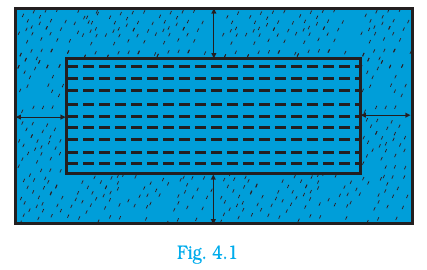
Answer:
Solution:
Let the dimensions of the rectangular lawn be: Length = 50 m, Breadth = 40 m.
Area of the rectangular lawn = Length $\times$ Breadth = $50 \times 40 = 2000$ m$^2$.
A rectangular pond is to be constructed in the centre of the lawn, with grass surrounding it. Let the uniform width of the grass surrounding the pond be $x$ metres.
The dimensions of the rectangular pond will be:
Length of pond = (Length of lawn) - $2 \times$ (Width of grass) = $50 - 2x$ metres.
Breadth of pond = (Breadth of lawn) - $2 \times$ (Width of grass) = $40 - 2x$ metres.
For the pond to have valid dimensions, its length and breadth must be positive. Thus, $50 - 2x > 0 \implies 2x < 50 \implies x < 25$, and $40 - 2x > 0 \implies 2x < 40 \implies x < 20$. Since $x$ is a width, $x \ge 0$. Combining these, we have $0 \le x < 20$.
Area of the rectangular pond = (Length of pond) $\times$ (Breadth of pond) = $(50 - 2x)(40 - 2x)$ m$^2$.
The area of the grass surrounding the pond is the difference between the area of the lawn and the area of the pond.
Area of grass = Area of lawn - Area of pond
We are given that the area of the grass surrounding the pond is 1184 m$^2$.
$1184 = 2000 - (50 - 2x)(40 - 2x)$
Rearrange the equation to solve for $x$:
$(50 - 2x)(40 - 2x) = 2000 - 1184$
$(50 - 2x)(40 - 2x) = 816$
Expand the left side of the equation:
$50 \times 40 + 50 \times (-2x) + (-2x) \times 40 + (-2x) \times (-2x) = 816$
$2000 - 100x - 80x + 4x^2 = 816$
$4x^2 - 180x + 2000 = 816$
Move all terms to one side to form a quadratic equation:
$4x^2 - 180x + 2000 - 816 = 0$
$4x^2 - 180x + 1184 = 0$
Divide the equation by 4 to simplify:
$\frac{4x^2}{4} - \frac{180x}{4} + \frac{1184}{4} = \frac{0}{4}$
$x^2 - 45x + 296 = 0$
We solve this quadratic equation for $x$ by factorisation.
We need to find two numbers whose product is $1 \times 296 = 296$ and whose sum is $-45$. By considering the factors of 296, we find that $-8$ and $-37$ satisfy these conditions ($-8 \times -37 = 296$ and $-8 + (-37) = -45$).
Split the middle term $-45x$ as $-8x - 37x$:
$x^2 - 8x - 37x + 296 = 0$
Group the terms and factor common factors:
$(x^2 - 8x) - (37x - 296) = 0$
$x(x - 8) - 37(x - 8) = 0$
Factor out the common binomial term $(x - 8)$:
$(x - 8)(x - 37) = 0$
Set each factor to zero to find the possible values of $x$:
$x - 8 = 0 \implies x = 8$
$x - 37 = 0 \implies x = 37$
We found two possible values for the width of the grass, $x=8$ m and $x=37$ m.
However, we established the condition that $0 \le x < 20$ for the pond dimensions to be positive.
The value $x=37$ does not satisfy the condition $x < 20$. If $x=37$, the pond dimensions would be $50 - 2(37) = -24$ m and $40 - 2(37) = -34$ m, which are not physically possible.
The value $x=8$ satisfies the condition $0 \le 8 < 20$. So, the width of the grass surrounding the pond is 8 m.
Now, we find the dimensions of the pond using $x=8$ m:
Length of the pond = $50 - 2x = 50 - 2(8) = 50 - 16 = 34$ metres.
Breadth of the pond = $40 - 2x = 40 - 2(8) = 40 - 16 = 24$ metres.
The length and breadth of the pond are 34 m and 24 m respectively.
Question 8. At t minutes past 2 pm, the time needed by the minutes hand of a clock to show 3 pm was found to be 3 minutes less than $\frac{t^2}{4}$ minutes. Find t.
Answer:
Solution:
Let the time be $t$ minutes past 2 pm.
The time needed by the minutes hand to show 3 pm (i.e., to reach 3:00 pm) from $t$ minutes past 2 pm is the remaining time until the hour mark changes from 2 to 3.
Total minutes from 2 pm to 3 pm is 60 minutes.
So, the time needed to reach 3 pm from $t$ minutes past 2 pm is $(60 - t)$ minutes.
According to the problem statement, this time is 3 minutes less than $\frac{t^2}{4}$ minutes.
So, we can set up the equation:
$60 - t = \frac{t^2}{4} - 3$
Now, we need to solve this equation for $t$.
To eliminate the fraction, multiply the entire equation by 4:
$4 \times (60 - t) = 4 \times (\frac{t^2}{4} - 3)$
$240 - 4t = t^2 - 12$
Rearrange the terms to form a standard quadratic equation $at^2 + bt + c = 0$:
$0 = t^2 + 4t - 12 - 240$
$t^2 + 4t - 252 = 0$
We solve the quadratic equation $t^2 + 4t - 252 = 0$ by factorisation.
We need to find two numbers whose product is $1 \times (-252) = -252$ and whose sum is $4$. The numbers are $18$ and $-14$, since $18 \times (-14) = -252$ and $18 + (-14) = 4$.
Split the middle term $4t$ as $18t - 14t$:
$t^2 + 18t - 14t - 252 = 0$
Group the terms and factor common factors:
$(t^2 + 18t) - (14t + 252) = 0$
$t(t + 18) - 14(t + 18) = 0$
Factor out the common binomial term $(t + 18)$:
$(t + 18)(t - 14) = 0$
Set each factor to zero to find the possible values of $t$:
$t + 18 = 0$ or $t - 14 = 0$
$t = -18$ or $t = 14$
$t$ represents the number of minutes past 2 pm. Therefore, $t$ must be a non-negative value and less than 60 (since it's time past 2 pm, not past 3 pm, and before 3 pm). So, $0 \le t < 60$.
The value $t = -18$ is not valid because time cannot be negative in this context.
The value $t = 14$ is valid because $0 \le 14 < 60$.
The required value of $t$ is 14.
At 14 minutes past 2 pm, the time needed to show 3 pm is $60 - 14 = 46$ minutes. The given expression for this time is $\frac{t^2}{4} - 3 = \frac{14^2}{4} - 3 = \frac{196}{4} - 3 = 49 - 3 = 46$ minutes. This matches.
The value of t is 14.