

Chapter 8 Introduction to Trigonometry (Class 10 - Maths NCERT Exemplar Solutions)
Welcome to the comprehensive resource for NCERT Exemplar Solutions for Class 10 Mathematics: Chapter 8 Introduction to Trigonometry! These problems are specifically designed to challenge students beyond routine calculations, demanding a deeper understanding of trigonometric relationships and the ability to manipulate complex expressions. By constructing rigorous proofs for intricate identities, these solutions build the strategic thinking and strong algebraic manipulation skills absolutely vital for success in higher mathematics, including calculus.
The solutions thoroughly cover the fundamental building blocks of trigonometry, including the six trigonometric ratios ($\sin, \cos, \tan, \csc, \sec, \cot$) and their reciprocal and quotient identities. Students will master evaluating expressions involving standard angles ($0^\circ, 30^\circ, 45^\circ, 60^\circ, 90^\circ$) and simplifying complex terms using complementary angle identities such as $\sin(90^\circ - A) = \cos A$. A primary focus is placed on leveraging the three Pythagorean identities, most notably $\sin^2 A + \cos^2 A = 1$, to transform and simplify trigonometric statements.
Significant attention is given to proving trigonometric identities through multi-step logical deductions, including techniques like converting terms to sine and cosine or multiplying by conjugates. The Exemplar rigorously tests these skills through MCQs and Long Answer questions that demand meticulous step-by-step algebraic workings and explicit justification using relevant identities. With detailed guidance and precise logic prepared by learningspot.co, students can master the critical skills needed to effectively solve complex trigonometric proofs and elevate their mathematical reasoning capabilities.
Sample Question 1 to 3 (Before Exercise 8.1)
Choose the correct answer from the given four options:
Sample Question 1: The value of (sin 30° + cos 30°) – (sin 60° + cos 60°) is
(A) – 1
(B) 0
(C) 1
(D) 2
Answer:
Solution:
We need to find the value of $(\sin 30^\circ + \cos 30^\circ) - (\sin 60^\circ + \cos 60^\circ)$.
We know the values of the standard trigonometric angles:
$\sin 30^\circ = \frac{1}{2}$
$\cos 30^\circ = \frac{\sqrt{3}}{2}$
$\sin 60^\circ = \frac{\sqrt{3}}{2}$
$\cos 60^\circ = \frac{1}{2}$
Substitute these values into the given expression:
$(\sin 30^\circ + \cos 30^\circ) - (\sin 60^\circ + \cos 60^\circ) = \left(\frac{1}{2} + \frac{\sqrt{3}}{2}\right) - \left(\frac{\sqrt{3}}{2} + \frac{1}{2}\right)$
Now, simplify the expression:
$\left(\frac{1}{2} + \frac{\sqrt{3}}{2}\right) - \left(\frac{\sqrt{3}}{2} + \frac{1}{2}\right) = \frac{1}{2} + \frac{\sqrt{3}}{2} - \frac{\sqrt{3}}{2} - \frac{1}{2}$
Combine the terms:
$\left(\frac{1}{2} - \frac{1}{2}\right) + \left(\frac{\sqrt{3}}{2} - \frac{\sqrt{3}}{2}\right) = 0 + 0 = 0$
Thus, the value of $(\sin 30^\circ + \cos 30^\circ) - (\sin 60^\circ + \cos 60^\circ)$ is $0$.
The correct option is (B).
Sample Question 2: The value of $\frac{\tan 30^\circ}{\cot 60^\circ}$ is
(A) $\frac{1}{\sqrt{2}}$
(B) $\frac{1}{\sqrt{3}}$
(C) $\sqrt{3}$
(D) 1
Answer:
Solution:
We need to find the value of $\frac{\tan 30^\circ}{\cot 60^\circ}$.
We know the values of the standard trigonometric angles:
$\tan 30^\circ = \frac{1}{\sqrt{3}}$
$\cot 60^\circ = \frac{1}{\tan 60^\circ} = \frac{1}{\sqrt{3}}$
Substitute these values into the given expression:
$\frac{\tan 30^\circ}{\cot 60^\circ} = \frac{\frac{1}{\sqrt{3}}}{\frac{1}{\sqrt{3}}}$
Simplify the expression:
$\frac{\frac{1}{\sqrt{3}}}{\frac{1}{\sqrt{3}}} = 1$
Thus, the value of $\frac{\tan 30^\circ}{\cot 60^\circ}$ is $1$.
The correct option is (D).
Sample Question 3: The value of (sin 45° + cos 45°) is
(A) $\frac{1}{\sqrt{2}}$
(B) $\sqrt{2}$
(C) $\frac{\sqrt{3}}{2}$
(D) 1
Answer:
Solution:
We need to find the value of $(\sin 45^\circ + \cos 45^\circ)$.
We know the values of the standard trigonometric angles:
$\sin 45^\circ = \frac{1}{\sqrt{2}}$
$\cos 45^\circ = \frac{1}{\sqrt{2}}$
Substitute these values into the given expression:
$(\sin 45^\circ + \cos 45^\circ) = \frac{1}{\sqrt{2}} + \frac{1}{\sqrt{2}}$
Combine the terms:
$\frac{1}{\sqrt{2}} + \frac{1}{\sqrt{2}} = \frac{1+1}{\sqrt{2}} = \frac{2}{\sqrt{2}}$
Simplify the expression by rationalizing the denominator or by recognizing that $2 = \sqrt{2} \times \sqrt{2}$:
$\frac{2}{\sqrt{2}} = \frac{\sqrt{2} \times \sqrt{2}}{\sqrt{2}} = \sqrt{2}$
Thus, the value of $(\sin 45^\circ + \cos 45^\circ)$ is $\sqrt{2}$.
The correct option is (B).
Exercise 8.1
Choose the correct answer from the given four options:
Question 1. If cos A = $\frac{4}{5}$ , then the value of tan A is
(A) $\frac{3}{5}$
(B) $\frac{3}{4}$
(C) $\frac{4}{3}$
(D) $\frac{5}{3}$
Answer:
Solution:
Given:
$\cos A = \frac{4}{5}$
To Find:
The value of $\tan A$.
Consider a right-angled triangle ABC, right-angled at B, with respect to angle A.
We know that $\cos A = \frac{\text{Adjacent side}}{\text{Hypotenuse}}$.
Given $\cos A = \frac{4}{5}$, let the adjacent side (AB) be $4k$ and the hypotenuse (AC) be $5k$, where $k$ is a positive number.
Using the Pythagoras theorem in $\triangle$ABC:
$(\text{Hypotenuse})^2 = (\text{Adjacent side})^2 + (\text{Opposite side})^2$
$AC^2 = AB^2 + BC^2$
$(5k)^2 = (4k)^2 + BC^2$
$25k^2 = 16k^2 + BC^2$
$BC^2 = 25k^2 - 16k^2$
$BC^2 = 9k^2$
$BC = \sqrt{9k^2} = 3k$ (Since BC is a length, we take the positive square root)
Now we can find the value of $\tan A$. We know that $\tan A = \frac{\text{Opposite side}}{\text{Adjacent side}}$.
$\tan A = \frac{BC}{AB} = \frac{3k}{4k}$
$\tan A = \frac{3}{4}$
Alternate Solution (Using trigonometric identity):
We know the identity $\sin^2 A + \cos^2 A = 1$.
Substitute the given value of $\cos A$:
$\sin^2 A + \left(\frac{4}{5}\right)^2 = 1$
$\sin^2 A + \frac{16}{25} = 1$
$\sin^2 A = 1 - \frac{16}{25} = \frac{25 - 16}{25} = \frac{9}{25}$
$\sin A = \pm \sqrt{\frac{9}{25}} = \pm \frac{3}{5}$
Assuming angle A is acute (as typically in these problems unless otherwise specified), $\sin A$ is positive.
So, $\sin A = \frac{3}{5}$.
Now, use the identity $\tan A = \frac{\sin A}{\cos A}$.
$\tan A = \frac{\frac{3}{5}}{\frac{4}{5}}$
$\tan A = \frac{3}{5} \times \frac{5}{4}$
$\tan A = \frac{3}{4}$
The value of $\tan A$ is $\frac{3}{4}$.
The correct option is (B).
Question 2. If sin A = $\frac{1}{2}$ , then the value of cot A is
(A) $\sqrt{3}$
(B) $\frac{1}{\sqrt{3}}$
(C) $\frac{\sqrt{3}}{2}$
(D) 1
Answer:
Solution:
Given:
$\sin A = \frac{1}{2}$
To Find:
The value of $\cot A$.
Consider a right-angled triangle ABC, right-angled at B, with respect to angle A.
We know that $\sin A = \frac{\text{Opposite side}}{\text{Hypotenuse}}$.
Given $\sin A = \frac{1}{2}$, let the opposite side (BC) be $1k$ and the hypotenuse (AC) be $2k$, where $k$ is a positive number.
Using the Pythagoras theorem in $\triangle$ABC:
$(\text{Hypotenuse})^2 = (\text{Adjacent side})^2 + (\text{Opposite side})^2$
$AC^2 = AB^2 + BC^2$
$(2k)^2 = AB^2 + (1k)^2$
$4k^2 = AB^2 + k^2$
$AB^2 = 4k^2 - k^2$
$AB^2 = 3k^2$
$AB = \sqrt{3k^2} = \sqrt{3}k$ (Since AB is a length, we take the positive square root)
Now we can find the value of $\cot A$. We know that $\cot A = \frac{\text{Adjacent side}}{\text{Opposite side}}$.
$\cot A = \frac{AB}{BC} = \frac{\sqrt{3}k}{1k}$
$\cot A = \sqrt{3}$
Alternate Solution (Using trigonometric identity):
We know the identity $\sin^2 A + \cos^2 A = 1$.
Substitute the given value of $\sin A$:
$\left(\frac{1}{2}\right)^2 + \cos^2 A = 1$
$\frac{1}{4} + \cos^2 A = 1$
$\cos^2 A = 1 - \frac{1}{4} = \frac{4 - 1}{4} = \frac{3}{4}$
$\cos A = \pm \sqrt{\frac{3}{4}} = \pm \frac{\sqrt{3}}{2}$
Assuming angle A is acute (as typically in these problems unless otherwise specified), $\cos A$ is positive.
So, $\cos A = \frac{\sqrt{3}}{2}$.
Now, use the identity $\cot A = \frac{\cos A}{\sin A}$.
$\cot A = \frac{\frac{\sqrt{3}}{2}}{\frac{1}{2}}$
$\cot A = \frac{\sqrt{3}}{2} \times \frac{2}{1}$
$\cot A = \sqrt{3}$
The value of $\cot A$ is $\sqrt{3}$.
The correct option is (A).
Question 3. The value of the expression [cosec (75° + θ) – sec (15° – θ) – tan (55° + θ) + cot (35° – θ)] is
(A) – 1
(B) 0
(C) 1
(D) $\frac{3}{2}$
Answer:
Solution:
We are asked to find the value of the expression:
$[\text{cosec} (75^\circ + \theta) – \sec (15^\circ – \theta) – \tan (55^\circ + \theta) + \cot (35^\circ – \theta)]$
We use the complementary angle identities:
$\sec (90^\circ - x) = \text{cosec} x$
$\cot (90^\circ - x) = \tan x$
Consider the first two terms: $\text{cosec} (75^\circ + \theta) – \sec (15^\circ – \theta)$.
Notice that $(75^\circ + \theta) + (15^\circ – \theta) = 75^\circ + 15^\circ + \theta - \theta = 90^\circ$.
So, $(15^\circ – \theta)$ and $(75^\circ + \theta)$ are complementary angles.
Using the identity $\sec (90^\circ - x) = \text{cosec} x$, we can write:
$\sec (15^\circ – \theta) = \sec (90^\circ - (75^\circ + \theta)) = \text{cosec} (75^\circ + \theta)$
Therefore, the first part of the expression becomes:
$\text{cosec} (75^\circ + \theta) – \sec (15^\circ – \theta) = \text{cosec} (75^\circ + \theta) – \text{cosec} (75^\circ + \theta) = 0$
Now consider the last two terms: $-\tan (55^\circ + \theta) + \cot (35^\circ – \theta)$.
Notice that $(55^\circ + \theta) + (35^\circ – \theta) = 55^\circ + 35^\circ + \theta - \theta = 90^\circ$.
So, $(35^\circ – \theta)$ and $(55^\circ + \theta)$ are complementary angles.
Using the identity $\cot (90^\circ - x) = \tan x$, we can write:
$\cot (35^\circ – \theta) = \cot (90^\circ - (55^\circ + \theta)) = \tan (55^\circ + \theta)$
Therefore, the second part of the expression becomes:
$-\tan (55^\circ + \theta) + \cot (35^\circ – \theta) = -\tan (55^\circ + \theta) + \tan (55^\circ + \theta) = 0$
The value of the entire expression is the sum of these two parts:
$[\text{cosec} (75^\circ + \theta) – \sec (15^\circ – \theta) – \tan (55^\circ + \theta) + \cot (35^\circ – \theta)] = 0 + 0 = 0$
The value of the expression is $\mathbf{0}$.
The correct option is (B).
Question 4. Given that sin θ = $\frac{a}{b}$ , then cos θ is equal to
(A) $\frac{b}{\sqrt{b^2 \;-\; a^2}}$
(B) $\frac{b}{a}$
(C) $\frac{\sqrt{b^2 \;-\; a^2}}{b}$
(D) $\frac{a}{\sqrt{b^2 \;-\; a^2}}$
Answer:
Solution:
Given:
$\sin \theta = \frac{a}{b}$
To Find:
The value of $\cos \theta$.
We use the fundamental trigonometric identity:
$\sin^2 \theta + \cos^2 \theta = 1$
Substitute the given value of $\sin \theta$ into the identity:
$\left(\frac{a}{b}\right)^2 + \cos^2 \theta = 1$
$\frac{a^2}{b^2} + \cos^2 \theta = 1$
Solve for $\cos^2 \theta$:
$\cos^2 \theta = 1 - \frac{a^2}{b^2}$
$\cos^2 \theta = \frac{b^2 - a^2}{b^2}$
Take the square root of both sides to find $\cos \theta$:
$\cos \theta = \pm \sqrt{\frac{b^2 - a^2}{b^2}}$
$\cos \theta = \pm \frac{\sqrt{b^2 - a^2}}{\sqrt{b^2}}$
Assuming $\theta$ is an acute angle or in a quadrant where $\cos \theta$ is positive, and $b > 0$, we take the positive root:
$\cos \theta = \frac{\sqrt{b^2 - a^2}}{b}$
Alternatively, using a right-angled triangle, if $\sin \theta = \frac{\text{Opposite}}{\text{Hypotenuse}} = \frac{a}{b}$, let the opposite side be $a$ and the hypotenuse be $b$ (assuming $a>0, b>0$).
By Pythagoras theorem, the adjacent side = $\sqrt{b^2 - a^2}$.
Then $\cos \theta = \frac{\text{Adjacent}}{\text{Hypotenuse}} = \frac{\sqrt{b^2 - a^2}}{b}$.
Comparing this result with the given options, we find the correct option.
The correct option is (C).
Question 5. If $\cos (α + β) = 0$, then $\sin (α – β)$ can be reduced to
(A) $\cos β$
(B) $\cos 2β$
(C) $\sin α$
(D) $\sin 2α$
Answer:
Solution:
Given:
$\cos (\alpha + \beta) = 0$
To Find:
A simplified expression for $\sin (\alpha – \beta)$.
We are given that $\cos (\alpha + \beta) = 0$. This means that $(\alpha + \beta)$ is an angle whose cosine is 0.
The general solution for $\cos x = 0$ is $x = (2n+1)\frac{\pi}{2}$, where $n$ is an integer.
So, $\alpha + \beta = (2n+1)\frac{\pi}{2}$.
For simplicity, and as suggested by the options provided, let us consider the principal case where $n=0$, which gives $\alpha + \beta = \frac{\pi}{2}$ (or $90^\circ$).
From $\alpha + \beta = 90^\circ$, we can express $\alpha$ in terms of $\beta$:
$\alpha = 90^\circ - \beta$
Now substitute this expression for $\alpha$ into the expression we want to simplify, $\sin (\alpha – β)$:
$\sin (\alpha – β) = \sin ((90^\circ - \beta) – \beta)$
Simplify the argument of the sine function:
$(90^\circ - \beta) – \beta = 90^\circ - 2\beta$
So, $\sin (\alpha – β) = \sin (90^\circ - 2\beta)$.
Using the complementary angle identity $\sin (90^\circ - x) = \cos x$, we can write:
$\sin (90^\circ - 2\beta) = \cos (2\beta)$
Therefore, if $\cos (\alpha + \beta) = 0$ (considering the principal case $\alpha + \beta = 90^\circ$), $\sin (\alpha – \beta)$ can be reduced to $\cos (2\beta)$.
The correct option is (B) $\cos 2β$.
Question 6. The value of (tan1° tan2° tan3° ... tan 89°) is
(A) 0
(B) 1
(C) 2
(D) $\frac{1}{2}$
Answer:
Solution:
We need to find the value of the product $\tan 1^\circ \tan 2^\circ \tan 3^\circ \cdots \tan 89^\circ$.
We can group the terms in pairs using the complementary angle identity: $\tan (90^\circ - x) = \cot x$.
Also, we know that $\cot x = \frac{1}{\tan x}$.
Consider the terms in the product. The angles range from $1^\circ$ to $89^\circ$. We can pair angles that sum up to $90^\circ$:
$(1^\circ, 89^\circ), (2^\circ, 88^\circ), \ldots, (44^\circ, 46^\circ)$.
There is one term left in the middle: $\tan 45^\circ$.
Let's look at a pair, for example, $\tan 1^\circ$ and $\tan 89^\circ$:
$\tan 89^\circ = \tan (90^\circ - 1^\circ) = \cot 1^\circ$
So, $\tan 1^\circ \times \tan 89^\circ = \tan 1^\circ \times \cot 1^\circ = \tan 1^\circ \times \frac{1}{\tan 1^\circ} = 1$.
This applies to every pair of angles $(x, 90^\circ - x)$ for $x$ from $1^\circ$ to $44^\circ$:
$\tan x \times \tan (90^\circ - x) = \tan x \times \cot x = \tan x \times \frac{1}{\tan x} = 1$.
The product can be written as:
$(\tan 1^\circ \tan 89^\circ) (\tan 2^\circ \tan 88^\circ) \cdots (\tan 44^\circ \tan 46^\circ) \tan 45^\circ$
Substituting the value 1 for each pair product and the value of $\tan 45^\circ$:
We know that $\tan 45^\circ = 1$.
So the product becomes:
$(1) \times (1) \times \cdots \times (1) \times 1$
There are 44 such pairs, and the term $\tan 45^\circ$.
The product is $1^{44} \times 1 = 1 \times 1 = 1$.
The value of (tan1° tan2° tan3° ... tan 89°) is $\mathbf{1}$.
The correct option is (B).
Question 7. If cos 9$α$ = sin $α$ and 9$α$ < 90° , then the value of tan 5$α$ is
(A) $\frac{1}{\sqrt{3}}$
(B) $\sqrt{3}$
(C) 1
(D) 0
Answer:
Solution:
Given:
$\cos 9\alpha = \sin \alpha$
$9\alpha < 90^\circ$
To Find:
The value of $\tan 5\alpha$.
We use the complementary angle identity $\sin x = \cos (90^\circ - x)$.
Using this identity, we can rewrite $\sin \alpha$ as $\cos (90^\circ - \alpha)$.
Substitute this into the given equation:
$\cos 9\alpha = \cos (90^\circ - \alpha)$
Since $9\alpha < 90^\circ$ and $\alpha$ must be positive (for $\sin \alpha$ to be involved in a standard trigonometric context as implied by the problem, and $\alpha = (90^\circ - 9\alpha)/10$, which is positive if $9\alpha < 90^\circ$), both $9\alpha$ and $90^\circ - \alpha$ are acute angles. If the cosine of two acute angles is equal, then the angles must be equal.
Therefore,
$9\alpha = 90^\circ - \alpha$
Now, solve for $\alpha$:
$9\alpha + \alpha = 90^\circ$
$10\alpha = 90^\circ$
$\alpha = \frac{90^\circ}{10}$
$\alpha = 9^\circ$
Now we need to find the value of $\tan 5\alpha$. Substitute the value of $\alpha$:
$5\alpha = 5 \times 9^\circ = 45^\circ$
So we need to find $\tan 45^\circ$.
We know that the value of $\tan 45^\circ$ is 1.
$\tan 5\alpha = \tan 45^\circ = 1$
The value of $\tan 5\alpha$ is $\mathbf{1}$.
The correct option is (C).
Question 8. If ΔABC is right angled at C, then the value of cos (A + B) is
(A) 0
(B) 1
(C) $\frac{1}{2}$
(D) $\frac{\sqrt{3}}{2}$
Answer:
Solution:
Given:
$\triangle$ABC is right-angled at C.
To Find:
The value of $\cos (A + B)$.
In any triangle, the sum of the angles is $180^\circ$.
For $\triangle$ABC, the sum of angles A, B, and C is $180^\circ$.
$A + B + C = 180^\circ$
Since the triangle is right-angled at C, the angle C is $90^\circ$.
Substitute the value of C into the equation:
$A + B + 90^\circ = 180^\circ$
Solve for $A + B$:
$A + B = 180^\circ - 90^\circ$
$A + B = 90^\circ$
Now we need to find the value of $\cos (A + B)$. Substitute the value of $A + B$:
$\cos (A + B) = \cos 90^\circ$
We know that the value of $\cos 90^\circ$ is 0.
$\cos (A + B) = 0$
The value of $\cos (A + B)$ is $\mathbf{0}$.
The correct option is (A).
Question 9. If sin A + sin2 A = 1, then the value of the expression (cos2 A + cos4 A) is
(A) 1
(B) $\frac{1}{2}$
(C) 2
(D) 3
Answer:
Solution:
Given:
$\sin A + \sin^2 A = 1$
To Find:
The value of the expression $(\cos^2 A + \cos^4 A)$.
From the given equation, we can rearrange the terms to get:
$\sin A = 1 - \sin^2 A$
We know the fundamental trigonometric identity $\sin^2 A + \cos^2 A = 1$.
From this identity, we can write $\cos^2 A = 1 - \sin^2 A$.
Comparing the rearranged given equation with the identity, we see that:
$\sin A = \cos^2 A$
Now, consider the expression we need to evaluate: $(\cos^2 A + \cos^4 A)$.
We can rewrite $\cos^4 A$ as $(\cos^2 A)^2$.
So, the expression is $\cos^2 A + (\cos^2 A)^2$.
Substitute the relationship $\cos^2 A = \sin A$ into this expression:
$\cos^2 A + (\cos^2 A)^2 = (\sin A) + (\sin A)^2 = \sin A + \sin^2 A$
We are given that $\sin A + \sin^2 A = 1$.
Therefore, the value of the expression $(\cos^2 A + \cos^4 A)$ is equal to 1.
The value of $(\cos^2 A + \cos^4 A)$ is $\mathbf{1}$.
The correct option is (A).
Question 10. Given that $\sin α = \frac{1}{2}$ and $\cos β = \frac{1}{2}$ , then the value of $(α + β)$ is
(A) 0°
(B) 30°
(C) 60°
(D) 90°
Answer:
Solution:
Given:
$\sin \alpha = \frac{1}{2}$
$\cos \beta = \frac{1}{2}$
To Find:
The value of $(\alpha + \beta)$.
We need to find the angles $\alpha$ and $\beta$ for which the given trigonometric conditions hold. Assuming $\alpha$ and $\beta$ are acute angles (in the range $0^\circ$ to $90^\circ$) as is common in basic trigonometry problems unless specified otherwise.
For $\sin \alpha = \frac{1}{2}$, the standard angle is $\alpha = 30^\circ$.
$\sin 30^\circ = \frac{1}{2}$
For $\cos \beta = \frac{1}{2}$, the standard angle is $\beta = 60^\circ$.
$\cos 60^\circ = \frac{1}{2}$
Now, we calculate the sum $(\alpha + \beta)$:
$\alpha + \beta = 30^\circ + 60^\circ$
$\alpha + \beta = 90^\circ$
The value of $(\alpha + \beta)$ is $\mathbf{90^\circ}$.
The correct option is (D).
Question 11. The value of the expression is $\left[ \frac{\sin^2 22^\circ \;+\; \sin^2 68^\circ}{\cos^2 22^\circ \;+\; \cos^2 68^\circ} + \sin^2 63^\circ + \cos 63^\circ\sin 27^\circ \right]$
(A) 3
(B) 2
(C) 1
(D) 0
Answer:
Solution:
We need to evaluate the expression: $\left[ \frac{\sin^2 22^\circ \;+\; \sin^2 68^\circ}{\cos^2 22^\circ \;+\; \cos^2 68^\circ} + \sin^2 63^\circ + \cos 63^\circ\sin 27^\circ \right]$.
Let's evaluate the first part of the expression: $\frac{\sin^2 22^\circ \;+\; \sin^2 68^\circ}{\cos^2 22^\circ \;+\; \cos^2 68^\circ}$.
We use the complementary angle identity: $\sin (90^\circ - x) = \cos x$ and $\cos (90^\circ - x) = \sin x$.
Notice that $22^\circ + 68^\circ = 90^\circ$.
So, $\sin 68^\circ = \sin (90^\circ - 22^\circ) = \cos 22^\circ$.
And, $\cos 68^\circ = \cos (90^\circ - 22^\circ) = \sin 22^\circ$.
Substitute these into the first part:
Numerator: $\sin^2 22^\circ + \sin^2 68^\circ = \sin^2 22^\circ + (\cos 22^\circ)^2 = \sin^2 22^\circ + \cos^2 22^\circ$.
Using the identity $\sin^2 x + \cos^2 x = 1$, the numerator is $1$.
Denominator: $\cos^2 22^\circ + \cos^2 68^\circ = \cos^2 22^\circ + (\sin 22^\circ)^2 = \cos^2 22^\circ + \sin^2 22^\circ$.
Using the identity $\sin^2 x + \cos^2 x = 1$, the denominator is $1$.
So, the first part of the expression is $\frac{1}{1} = 1$.
Now, let's evaluate the second part of the expression: $\sin^2 63^\circ + \cos 63^\circ\sin 27^\circ$.
We use the complementary angle identity: $\sin (90^\circ - x) = \cos x$.
Notice that $63^\circ + 27^\circ = 90^\circ$.
So, $\sin 27^\circ = \sin (90^\circ - 63^\circ) = \cos 63^\circ$.
Substitute this into the second part:
$\sin^2 63^\circ + \cos 63^\circ\sin 27^\circ = \sin^2 63^\circ + \cos 63^\circ \times \cos 63^\circ$
$\sin^2 63^\circ + \cos 63^\circ\sin 27^\circ = \sin^2 63^\circ + \cos^2 63^\circ$.
Using the identity $\sin^2 x + \cos^2 x = 1$, this part is $1$.
Now, combine the values of the two parts to find the value of the entire expression:
Value = (First part) + (Second part)
Value = $1 + 1 = 2$
The value of the expression is $\mathbf{2}$.
The correct option is (B).
Question 12. If 4 tan θ = 3, then $\left( \frac{4\sin\theta \;-\; \cos\theta}{4\sin\theta \;+\; \cos\theta} \right)$ is equal to
(A) $\frac{2}{3}$
(B) $\frac{1}{3}$
(C) $\frac{1}{2}$
(D) $\frac{3}{4}$
Answer:
Solution:
Given:
$4 \tan \theta = 3$
To Find:
The value of $\left( \frac{4\sin\theta \;-\; \cos\theta}{4\sin\theta \;+\; \cos\theta} \right)$.
From the given equation, we can find the value of $\tan \theta$:
$4 \tan \theta = 3$
$\tan \theta = \frac{3}{4}$
We need to evaluate the expression $\frac{4\sin\theta \;-\; \cos\theta}{4\sin\theta \;+\; \cos\theta}$.
We can divide the numerator and the denominator of this expression by $\cos \theta$. This is valid as long as $\cos \theta \neq 0$. If $\cos \theta = 0$, then $\tan \theta$ would be undefined, which contradicts the given $4 \tan \theta = 3$. Therefore, $\cos \theta \neq 0$.
Dividing numerator and denominator by $\cos \theta$:
$\frac{4\sin\theta \;-\; \cos\theta}{4\sin\theta \;+\; \cos\theta} = \frac{\frac{4\sin\theta}{\cos\theta} \;-\; \frac{\cos\theta}{\cos\theta}}{\frac{4\sin\theta}{\cos\theta} \;+\; \frac{\cos\theta}{\cos\theta}}$
Using the identity $\tan \theta = \frac{\sin \theta}{\cos \theta}$, we get:
$\frac{4\tan\theta \;-\; 1}{4\tan\theta \;+\; 1}$
Now, substitute the value of $\tan \theta = \frac{3}{4}$ into this expression:
$\frac{4\left(\frac{3}{4}\right) \;-\; 1}{4\left(\frac{3}{4}\right) \;+\; 1} = \frac{3 \;-\; 1}{3 \;+\; 1}$
Simplify the expression:
$\frac{3 \;-\; 1}{3 \;+\; 1} = \frac{2}{4} = \frac{1}{2}$
The value of the expression is $\mathbf{\frac{1}{2}}$.
The correct option is (C).
Question 13. If sin θ – cos θ = 0, then the value of (sin4 θ + cos4 θ) is
(A) 1
(B) $\frac{3}{4}$
(C) $\frac{1}{2}$
(D) $\frac{1}{4}$
Answer:
Solution:
Given:
$\sin \theta – \cos \theta = 0$
To Find:
The value of $(\sin^4 \theta + \cos^4 \theta)$.
From the given condition, we can write:
$\sin \theta = \cos \theta$
Since $\sin \theta = \cos \theta$, we can divide both sides by $\cos \theta$ (assuming $\cos \theta \neq 0$. If $\cos \theta = 0$, then $\sin \theta$ would also be 0 from the given condition, which is not possible for any angle $\theta$).
$\frac{\sin \theta}{\cos \theta} = 1$
$\tan \theta = 1$
For acute angles, $\tan \theta = 1$ implies $\theta = 45^\circ$.
In this case, $\sin 45^\circ = \frac{1}{\sqrt{2}}$ and $\cos 45^\circ = \frac{1}{\sqrt{2}}$.
Substituting these values into the expression $(\sin^4 \theta + \cos^4 \theta)$:
$(\sin 45^\circ)^4 + (\cos 45^\circ)^4 = \left(\frac{1}{\sqrt{2}}\right)^4 + \left(\frac{1}{\sqrt{2}}\right)^4$
Calculate the powers:
$\left(\frac{1}{\sqrt{2}}\right)^4 = \left(\left(\frac{1}{\sqrt{2}}\right)^2\right)^2 = \left(\frac{1}{2}\right)^2 = \frac{1}{4}$
So, $\sin^4 45^\circ = \frac{1}{4}$ and $\cos^4 45^\circ = \frac{1}{4}$.
Substitute these values back into the expression:
$\sin^4 \theta + \cos^4 \theta = \frac{1}{4} + \frac{1}{4} = \frac{2}{4} = \frac{1}{2}$
Alternate Solution:
From $\sin \theta = \cos \theta$ and the identity $\sin^2 \theta + \cos^2 \theta = 1$, we can substitute $\cos \theta = \sin \theta$ into the identity:
$\sin^2 \theta + (\sin \theta)^2 = 1$
$2\sin^2 \theta = 1$
$\sin^2 \theta = \frac{1}{2}$
Since $\sin \theta = \cos \theta$, we also have $\cos^2 \theta = (\sin \theta)^2 = \sin^2 \theta = \frac{1}{2}$.
Now consider the expression $(\sin^4 \theta + \cos^4 \theta)$. We can write this as $(\sin^2 \theta)^2 + (\cos^2 \theta)^2$.
Substitute the value $\sin^2 \theta = \frac{1}{2}$ and $\cos^2 \theta = \frac{1}{2}$:
$(\sin^2 \theta)^2 + (\cos^2 \theta)^2 = \left(\frac{1}{2}\right)^2 + \left(\frac{1}{2}\right)^2 = \frac{1}{4} + \frac{1}{4} = \frac{2}{4} = \frac{1}{2}$
The value of $(\sin^4 \theta + \cos^4 \theta)$ is $\mathbf{\frac{1}{2}}$.
The correct option is (C).
Question 14. sin (45° + θ) – cos (45° – θ) is equal to
(A) 2cos θ
(B) 0
(C) 2sin θ
(D) 1
Answer:
Solution:
We need to find the value of $\sin (45^\circ + \theta) – \cos (45^\circ – \theta)$.
We use the complementary angle identity: $\cos x = \sin (90^\circ - x)$.
Consider the term $\cos (45^\circ – \theta)$. Let $x = 45^\circ – \theta$.
Then $90^\circ - x = 90^\circ - (45^\circ – \theta) = 90^\circ - 45^\circ + \theta = 45^\circ + \theta$.
Using the identity, $\cos (45^\circ – \theta) = \sin (90^\circ - (45^\circ – \theta)) = \sin (45^\circ + \theta)$.
Substitute this result back into the original expression:
$\sin (45^\circ + \theta) – \cos (45^\circ – \theta) = \sin (45^\circ + \theta) – \sin (45^\circ + \theta)$
Simplifying the expression gives:
$\sin (45^\circ + \theta) – \sin (45^\circ + \theta) = 0$
The value of the expression is $\mathbf{0}$.
The correct option is (B).
Question 15. A pole 6 m high casts a shadow 2$\sqrt{3}$ m long on the ground, then the Sun’s elevation is
(A) 60°
(B) 45°
(C) 30°
(D) 90°
Answer:
Given:
Height of the vertical pole ($AB$) = $6$ m
Length of the shadow on the ground ($BC$) = $2\sqrt{3}$ m
To Find:
The Sun’s elevation, which is the angle of elevation ($\theta$) of the Sun from the tip of the shadow.
Solution:
Let $AB$ represent the pole and $BC$ represent its shadow. In this scenario, the pole and its shadow form a right-angled triangle $ABC$, where $\angle ABC = 90^\circ$.
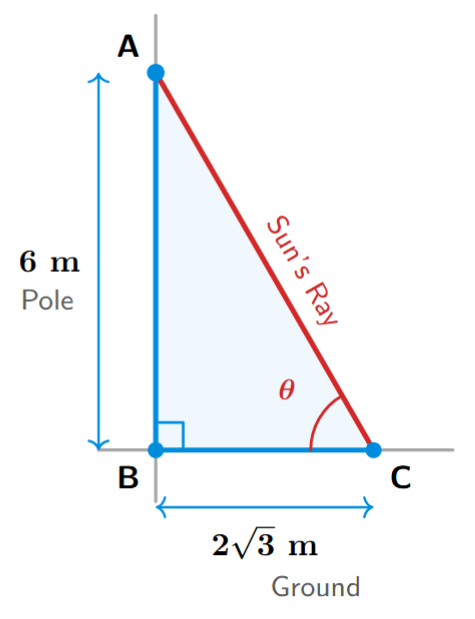
In $\Delta ABC$, let the Sun's elevation be $\angle ACB = \theta$.
We know that the trigonometric ratio relating the opposite side (height) and the adjacent side (shadow) is tangent.
$\tan \theta = \frac{\text{Perpendicular}}{\text{Base}}$
(Trigonometric Ratio)
Substituting the values of $AB$ and $BC$:
$\tan \theta = \frac{6}{2\sqrt{3}}$
Using the cancellation rule:
$\tan \theta = \frac{\cancel{6}^{3}}{\cancel{2}_{1}\sqrt{3}}$
$\tan \theta = \frac{3}{\sqrt{3}}$
Since $3$ can be written as $\sqrt{3} \times \sqrt{3}$:
$\tan \theta = \frac{\sqrt{3} \times \sqrt{3}}{\sqrt{3}}$
$\tan \theta = \sqrt{3}$
[Simplified value] ... (i)
From the trigonometric table, we know that the value of $\tan 60^\circ$ is $\sqrt{3}$.
$\tan \theta = \tan 60^\circ$
$\theta = 60^\circ$
... (ii)
Thus, the Sun's elevation is 60°.
Alternate Solution:
We can also use the cotangent ratio:
$\cot \theta = \frac{\text{Base}}{\text{Perpendicular}} = \frac{BC}{AB}$
$\cot \theta = \frac{2\sqrt{3}}{6} = \frac{\sqrt{3}}{3}$
$\cot \theta = \frac{\sqrt{3}}{\sqrt{3} \times \sqrt{3}} = \frac{1}{\sqrt{3}}$
We know that $\cot 60^\circ = \frac{1}{\sqrt{3}}$.
Therefore, $\theta = 60^\circ$.
Conclusion:
The Sun's elevation is 60°. The correct option is (A).
Final Answer: 60°
Sample Question 1 to 4 (Before Exercise 8.2)
Write ‘True’ or ‘False’ and justify your answer.
Sample Question 1: The value of sin θ + cos θ is always greater than 1.
Answer:
Statement:
The given statement is False.
Justification:
To check if the value of $\sin \theta + \cos \theta$ is always greater than 1, we can test the standard trigonometric values for $\theta$ in the range $0^\circ \leq \theta \leq 90^\circ$.
Case 1: When $\theta = 0^\circ$
We know that $\sin 0^\circ = 0$ and $\cos 0^\circ = 1$.
$\sin 0^\circ + \cos 0^\circ = 0 + 1$
$\sin 0^\circ + \cos 0^\circ = 1$
... (i)
In this case, the value is equal to 1, not greater than 1.
Case 2: When $\theta = 90^\circ$
We know that $\sin 90^\circ = 1$ and $\cos 90^\circ = 0$.
$\sin 90^\circ + \cos 90^\circ = 1 + 0$
$\sin 90^\circ + \cos 90^\circ = 1$
... (ii)
In this case also, the value is equal to 1, not greater than 1.
Case 3: When $\theta = 45^\circ$
We know that $\sin 45^\circ = \frac{1}{\sqrt{2}}$ and $\cos 45^\circ = \frac{1}{\sqrt{2}}$.
$\sin 45^\circ + \cos 45^\circ = \frac{1}{\sqrt{2}} + \frac{1}{\sqrt{2}} = \frac{2}{\sqrt{2}}$
$\sin 45^\circ + \cos 45^\circ = \sqrt{2} \approx 1.414$
In this case, the value is indeed greater than 1.
Conclusion:
While the value of $\sin \theta + \cos \theta$ is greater than 1 for values of $\theta$ between $0^\circ$ and $90^\circ$, it is exactly equal to 1 at $\theta = 0^\circ$ and $\theta = 90^\circ$.
Since the statement claims the value is always greater than 1, the presence of these boundary cases ($0^\circ$ and $90^\circ$) makes the statement False.
Correct conclusion: $1 \leq \sin \theta + \cos \theta \leq \sqrt{2}$
Sample Question 2: The value of tan θ (θ < 90°) increases as θ increases.
Answer:
Statement:
The given statement is True.
Justification:
In trigonometry, the value of $\tan \theta$ is the ratio of the sine of an angle to its cosine. As the angle $\theta$ increases from $0^\circ$ to $90^\circ$, the value of $\sin \theta$ increases while the value of $\cos \theta$ decreases.
Because the numerator increases and the denominator decreases, the overall value of the fraction $\frac{\sin \theta}{\cos \theta}$ increases rapidly.
Let us look at the values of $\tan \theta$ for standard angles between $0^\circ$ and $90^\circ$:
| Angle ($\theta$) | Value of $\tan \theta$ | Approximate Value |
| $0^\circ$ | $0$ | $0$ |
| $30^\circ$ | $\frac{1}{\sqrt{3}}$ | $0.577$ |
| $45^\circ$ | $1$ | $1.000$ |
| $60^\circ$ | $\sqrt{3}$ | $1.732$ |
| $90^\circ$ | Not defined | $\infty$ (approaches infinity) |
Observation:
From the table above, we can observe the following trend:
$0 < 0.577 < 1 < 1.732 < \infty$
... (i)
As the value of the angle $\theta$ increases from $0^\circ$ towards $90^\circ$, the value of $\tan \theta$ also increases continuously.
Conclusion:
The statement is True because the function $\tan \theta$ is an increasing function in the interval $[0^\circ, 90^\circ)$.
Sample Question 3: tan θ increases faster than sin θ as θ increases.
Answer:
Statement: True
Justification:
We know the mathematical relationship between the trigonometric ratios $\tan \theta$ and $\sin \theta$ is given by:
$\tan \theta = \frac{\sin \theta}{\cos \theta}$
(By trigonometric identity)
As the value of $\theta$ increases from $0^\circ$ to $90^\circ$ (in the first quadrant):
1. The value of $\sin \theta$ increases from $0$ to $1$.
2. The value of $\cos \theta$ decreases from $1$ to $0$.
Since $\tan \theta$ is a fraction where the numerator is increasing and the denominator is decreasing (and remains less than $1$), the overall value of the fraction increases much more rapidly than the numerator alone.
To further justify this, let us compare the values of both functions at specific standard angles:
| Angle $\theta$ | $\sin \theta$ (approx.) | $\tan \theta$ (approx.) |
| $0^\circ$ | $0$ | $0$ |
| $30^\circ$ | $0.500$ | $0.577$ |
| $45^\circ$ | $0.707$ | $1.000$ |
| $60^\circ$ | $0.866$ | $1.732$ |
From the table, we can observe that at $\theta = 0^\circ$, both values are equal. However, as $\theta$ increases, the value of $\tan \theta$ grows significantly faster than $\sin \theta$.
Specifically, at $\theta = 45^\circ$, $\tan \theta$ is already $1$, whereas $\sin \theta$ is only approximately $0.707$. As $\theta$ approaches $90^\circ$, $\sin \theta$ approaches $1$, while $\tan \theta$ approaches infinity ($\infty$).
Therefore, it is True that $\tan \theta$ increases faster than $\sin \theta$ as $\theta$ increases.
Sample Question 4: The value of sin θ is a + $\frac{1}{a}$ , where ‘a’ is a positive number.
Answer:
Statement: False
Given:
The expression for the sine of an angle $\theta$ is:
$\sin \theta = a + \frac{1}{a}$
Where $a$ is a positive number ($a > 0$).
To Find:
Whether the given statement is true or false for $0^\circ \le \theta \le 90^\circ$.
Solution:
According to the Arithmetic Mean-Geometric Mean (AM-GM) inequality, for any positive real number $a$:
$\frac{a + \frac{1}{a}}{2} \ge \sqrt{a \times \frac{1}{a}}$
$\frac{a + \frac{1}{a}}{2} \ge \sqrt{1}$
$a + \frac{1}{a} \ge 2$
... (i)
Now, let us consider the range of the sine function for the given domain. For $0^\circ \le \theta \le 90^\circ$, the value of $\sin \theta$ lies between $0$ and $1$.
$\sin \theta \le 1$
[Maximum value of $\sin \theta$ is 1] ... (ii)
From equation (i) and (ii), we can see a contradiction:
1. The expression $a + \frac{1}{a}$ must be at least 2.
2. The value of $\sin \theta$ cannot exceed 1.
Since the value of $\sin \theta$ can never be equal to or greater than 2, the given equation $\sin \theta = a + \frac{1}{a}$ is impossible for any positive real number $a$.
Alternate Explanation:
If we take any positive value for $a$, say $a = 2$:
$\sin \theta = 2 + \frac{1}{2} = 2.5$
If we take $a = 1$:
$\sin \theta = 1 + \frac{1}{1} = 2$
In all cases where $a > 0$, the sum $a + \frac{1}{a}$ will result in a value greater than or equal to 2. Since the maximum value of $\sin \theta$ is $1$, this statement is False.
Exercise 8.2
Write ‘True’ or ‘False’ and justify your answer in each of the following:
Question 1. $\frac{\tan 47^\circ}{\cot 43^\circ}$ = 1
Answer:
True
Justification:
We need to check if the statement $\frac{\tan 47^\circ}{\cot 43^\circ} = 1$ is true.
We know the complementary angle identity: $\cot x = \tan (90^\circ - x)$.
Let $x = 43^\circ$. Then $90^\circ - x = 90^\circ - 43^\circ = 47^\circ$.
So, $\cot 43^\circ = \tan (90^\circ - 43^\circ) = \tan 47^\circ$.
Substitute this into the given expression:
$\frac{\tan 47^\circ}{\cot 43^\circ} = \frac{\tan 47^\circ}{\tan 47^\circ}$
Assuming $\tan 47^\circ \neq 0$, which is true for $47^\circ$, we can cancel the term:
$\frac{\tan 47^\circ}{\tan 47^\circ} = 1$
Since the value of the expression is 1, the given statement $\frac{\tan 47^\circ}{\cot 43^\circ} = 1$ is true.
Question 2. The value of the expression (cos2 23° – sin2 67°) is positive.
Answer:
False
Justification:
We need to evaluate the expression $(\cos^2 23^\circ – \sin^2 67^\circ)$ and determine if its value is positive.
We use the complementary angle identity: $\sin x = \cos (90^\circ - x)$.
Notice that $23^\circ + 67^\circ = 90^\circ$. So, $67^\circ = 90^\circ - 23^\circ$.
Using the identity, we can rewrite $\sin 67^\circ$:
$\sin 67^\circ = \sin (90^\circ - 23^\circ) = \cos 23^\circ$.
Now, substitute this into the given expression:
$\cos^2 23^\circ – \sin^2 67^\circ = \cos^2 23^\circ – (\cos 23^\circ)^2$
$\cos^2 23^\circ – \sin^2 67^\circ = \cos^2 23^\circ – \cos^2 23^\circ$
$\cos^2 23^\circ – \sin^2 67^\circ = 0$
The value of the expression is 0. Since 0 is neither positive nor negative, the statement that the value is positive is false.
Question 3. The value of the expression (sin 80° – cos 80°) is negative.
Answer:
Statement: False
Given:
The expression is $(\sin 80^\circ - \cos 80^\circ)$.
To Find:
To determine if the value of the given expression is negative or positive.
Solution:
We know the complementary angle relationship between sine and cosine:
$\cos \theta = \sin(90^\circ - \theta)$
(Trigonometric Identity)
Applying this to $\cos 80^\circ$:
$\cos 80^\circ = \sin(90^\circ - 80^\circ)$
$\cos 80^\circ = \sin 10^\circ$
…(i)
Now, substituting the value from equation (i) into the original expression:
$\sin 80^\circ - \cos 80^\circ = \sin 80^\circ - \sin 10^\circ$
In the first quadrant ($0^\circ$ to $90^\circ$), the value of $\sin \theta$ increases as the angle $\theta$ increases.
As $80^\circ > 10^\circ \implies \sin 80^\circ > \sin 10^\circ$
... (ii)
Since the first term ($\sin 80^\circ$) is greater than the second term ($\sin 10^\circ$), their difference must be positive.
$\sin 80^\circ - \sin 10^\circ > 0$
Thus, the value of $(\sin 80^\circ - \cos 80^\circ)$ is positive, making the statement false.
Alternate Solution:
We can analyze the behavior of sine and cosine functions at the point $\theta = 45^\circ$.
1. At $\theta = 45^\circ$, $\sin 45^\circ = \cos 45^\circ = \frac{1}{\sqrt{2}}$.
2. For any angle $\theta$ such that $45^\circ < \theta \le 90^\circ$, the value of $\sin \theta$ is greater than $\cos \theta$.
$\sin 80^\circ > \cos 80^\circ$
[Since $80^\circ > 45^\circ$] ... (iii)
By subtracting $\cos 80^\circ$ from both sides of the inequality (iii):
$\sin 80^\circ - \cos 80^\circ > 0$
The result is greater than zero, which means it is positive. Hence, the statement that the value is negative is False.
Question 4. $\sqrt{(1 - \cos^2\theta)\sec^2\theta} = \tan\theta$
Answer:
Statement: True
Given:
The trigonometric equation is $\sqrt{(1 - \cos^2\theta)\sec^2\theta} = \tan\theta$.
To Prove:
Left Hand Side (LHS) = Right Hand Side (RHS)
Proof:
Let us consider the Left Hand Side (LHS) of the given expression:
LHS = $\sqrt{(1 - \cos^2\theta)\sec^2\theta}$
We know the fundamental trigonometric identity:
$\sin^2\theta + \cos^2\theta = 1$
(Trigonometric Identity)
By rearranging the above identity, we get:
$1 - \cos^2\theta = \sin^2\theta$
…(i)
Now, substitute the value from equation (i) into the LHS:
LHS = $\sqrt{\sin^2\theta \cdot \sec^2\theta}$
We also know the reciprocal identity for secant:
$\sec\theta = \frac{1}{\cos\theta}$
[Reciprocal Identity] ... (ii)
Squaring both sides of equation (ii), we get $\sec^2\theta = \frac{1}{\cos^2\theta}$. Substituting this into the expression:
LHS = $\sqrt{\sin^2\theta \cdot \frac{1}{\cos^2\theta}}$
LHS = $\sqrt{\frac{\sin^2\theta}{\cos^2\theta}}$
Using the identity $\tan\theta = \frac{\sin\theta}{\cos\theta}$:
LHS = $\sqrt{\tan^2\theta}$
LHS = $\tan\theta$
Since we are considering $0^\circ \le \theta \le 90^\circ$ (Class 10th level), the value of $\tan\theta$ is non-negative. Thus, the positive square root is taken.
LHS = RHS
Hence, the statement is True.
Alternate Solution:
We can solve this by distributing the $\sec^2\theta$ inside the square root:
LHS = $\sqrt{\sec^2\theta(1 - \cos^2\theta)}$
LHS = $\sqrt{\sec^2\theta - \sec^2\theta \cdot \cos^2\theta}$
Since $\sec\theta \cdot \cos\theta = 1$, the expression becomes:
LHS = $\sqrt{\sec^2\theta - 1}$
Using the identity $1 + \tan^2\theta = \sec^2\theta$:
$\sec^2\theta - 1 = \tan^2\theta$
…(iii)
LHS = $\sqrt{\tan^2\theta}$
LHS = $\tan\theta$
This confirms the RHS. Therefore, the statement is True.
Question 5. If cos A + cos2 A = 1, then sin2 A + sin4 A = 1.
Answer:
True
Justification:
We are given the equation: $\cos A + \cos^2 A = 1$.
Rearranging the terms in the given equation, we get:
$\cos A = 1 - \cos^2 A$
Using the fundamental trigonometric identity, $\sin^2 \theta + \cos^2 \theta = 1$, we know that $1 - \cos^2 A = \sin^2 A$.
Substituting this into the rearranged equation from the given condition:
$\cos A = \sin^2 A$
Now, consider the expression we need to evaluate: $\sin^2 A + \sin^4 A$.
We can rewrite $\sin^4 A$ as $(\sin^2 A)^2$.
So, the expression is $\sin^2 A + (\sin^2 A)^2$.
Substitute the relationship $\sin^2 A = \cos A$ into this expression:
$\sin^2 A + (\sin^2 A)^2 = (\cos A) + (\cos A)^2 = \cos A + \cos^2 A$
From the initial given condition, we know that $\cos A + \cos^2 A = 1$.
Therefore, $\sin^2 A + \sin^4 A = 1$.
Since the value of the expression $\sin^2 A + \sin^4 A$ is 1, the given statement is true.
Question 6. (tan θ + 2) (2 tan θ + 1) = 5 tan θ + sec2 θ .
Answer:
Statement: False
Given:
The trigonometric equation provided is:
$(\tan \theta + 2) (2 \tan \theta + 1) = 5 \tan \theta + \sec^2 \theta$
To Prove:
To verify if the Left Hand Side (LHS) is equal to the Right Hand Side (RHS).
Solution:
Let us begin by expanding the Left Hand Side (LHS) of the equation:
LHS = $(\tan \theta + 2) (2 \tan \theta + 1)$
Multiplying the binomials:
LHS = $\tan \theta(2 \tan \theta + 1) + 2(2 \tan \theta + 1)$
LHS = $2 \tan^2 \theta + \tan \theta + 4 \tan \theta + 2$
LHS = $2 \tan^2 \theta + 5 \tan \theta + 2$
Rearranging the terms to group the constant and the squared term:
$LHS = 5 \tan \theta + (2 \tan^2 \theta + 2)$
…(i)
Factoring out 2 from the bracketed terms:
LHS = $5 \tan \theta + 2(\tan^2 \theta + 1)$
We know the standard trigonometric identity:
$1 + \tan^2 \theta = \sec^2 \theta$
(Trigonometric Identity)
Substituting this identity into our expression:
$LHS = 5 \tan \theta + 2\sec^2 \theta$
[After substitution] ... (ii)
Comparison:
Now, let us look at the Right Hand Side (RHS) given in the question:
RHS = $5 \tan \theta + \sec^2 \theta$
Comparing the simplified LHS from equation (ii) with the given RHS:
$5 \tan \theta + 2\sec^2 \theta \neq 5 \tan \theta + \sec^2 \theta$
As we can see, the LHS has a coefficient of 2 for the $\sec^2 \theta$ term, whereas the RHS has a coefficient of 1.
Conclusion:
Since the Left Hand Side (LHS) is not equal to the Right Hand Side (RHS), the given statement is False.
Question 7. If the length of the shadow of a tower is increasing, then the angle of elevation of the sun is also increasing.
Answer:
Statement: False
Given:
1. A tower of a fixed height (let it be $h$).
2. The length of the shadow of the tower (let it be $s$).
3. The angle of elevation of the sun (let it be $\theta$).
To Find:
The relationship between the length of the shadow ($s$) and the angle of elevation ($\theta$) to determine if $\theta$ increases when $s$ increases.
Solution:
Consider a vertical tower $AB$ of height $h$. Let $BC$ be the length of its shadow $s$ on the ground, and $\theta$ be the angle of elevation of the sun at point $C$.
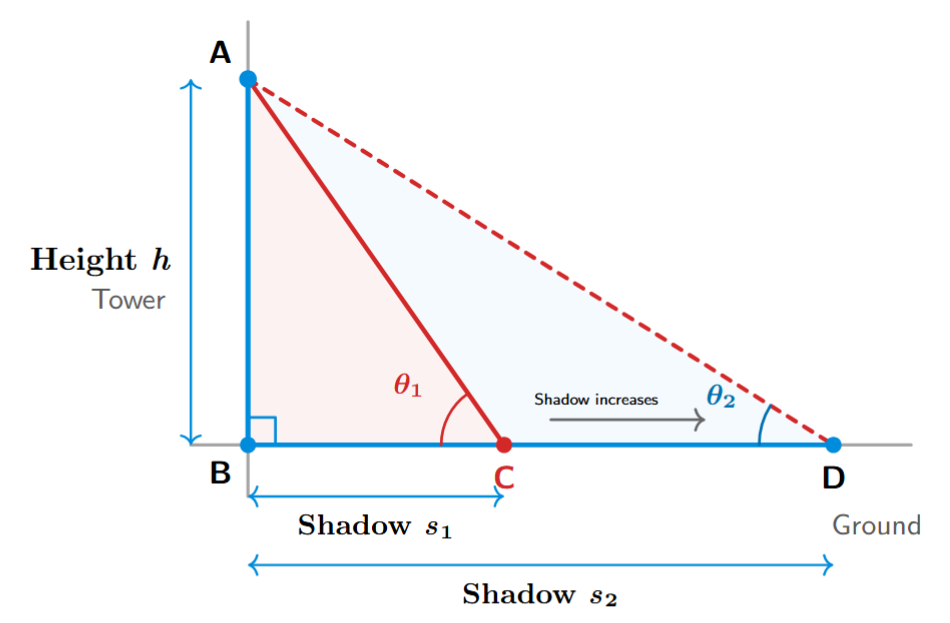
In the right-angled triangle $\triangle ABC$:
$\tan \theta = \frac{AB}{BC}$
(By trigonometric ratio)
Substituting the values of height and shadow:
$\tan \theta = \frac{h}{s}$
…(i)
From equation (i), we can see that for a constant height $h$, the value of $\tan \theta$ is inversely proportional to the length of the shadow $s$.
$\tan \theta \propto \frac{1}{s}$
[As $h$ is constant] ... (ii)
This means that if the length of the shadow ($s$) increases, the value of $\tan \theta$ must decrease.
In the range of $0^\circ$ to $90^\circ$, as the value of $\tan \theta$ decreases, the angle $\theta$ also decreases.
Therefore, as the length of the shadow increases, the angle of elevation of the sun decreases (it does not increase).
Justification with an Example:
Let us assume the height of the tower is $10\sqrt{3}$ m.
| Shadow Length $s$ (in m) | $\tan \theta = \frac{10\sqrt{3}}{s}$ | Angle of Elevation $\theta$ |
| $10$ | $\sqrt{3}$ | $60^\circ$ |
| $10\sqrt{3}$ | $1$ | $45^\circ$ |
| $30$ | $\frac{1}{\sqrt{3}}$ | $30^\circ$ |
As seen in the table above, when the length of the shadow increases from $10$ m to $30$ m, the angle of elevation decreases from $60^\circ$ to $30^\circ$. Thus, the statement is False.
Question 8. If a man standing on a platform 3 metres above the surface of a lake observes a cloud and its reflection in the lake, then the angle of elevation of the cloud is equal to the angle of depression of its reflection.
Answer:
Statement: False
Given:
1. Height of the platform above the water surface = $3$ m.
2. Let the height of the cloud from the water surface be $H$.
3. Let the horizontal distance of the cloud from the observer be $x$.
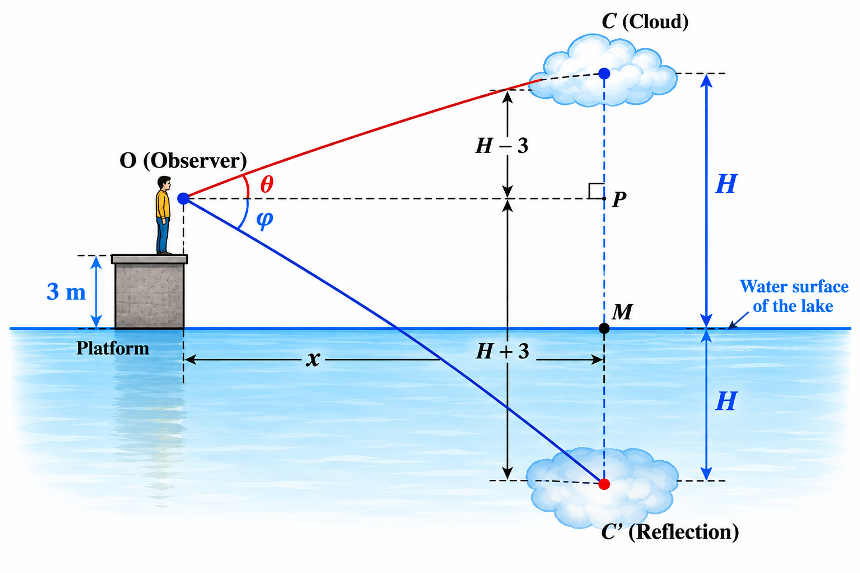
To Find:
Whether the angle of elevation ($\theta$) is equal to the angle of depression ($\phi$).
Solution:
In reflection, the water surface acts as a plane mirror. Therefore, the height of the cloud above the water surface is equal to the depth of its reflection below the water surface.
$\text{Height of cloud} = \text{Depth of reflection} = H$
(Laws of Reflection)
The observer is $3$ m above the water. Thus, we calculate the vertical distances from the observer's eye level:
1. The vertical distance to the cloud is $(H - 3)$.
2. The vertical distance to the reflection is $(H + 3)$.
Using the formula $\tan \text{angle} = \frac{\text{Perpendicular}}{\text{Base}}$:
$\tan \theta = \frac{H - 3}{x}$
…(i)
$\tan \phi = \frac{H + 3}{x}$
…(ii)
From equations (i) and (ii), we can compare the two values:
$\frac{H + 3}{x} > \frac{H - 3}{x}$
[Since $H+3$ is greater than $H-3$] ... (iii)
This implies that $\tan \phi > \tan \theta$, which means the angle of depression ($\phi$) is greater than the angle of elevation ($\theta$).
Conclusion:
Since the vertical distances from the observer to the cloud and the reflection are different, the angles cannot be equal. Hence, the statement is False.
Question 9. The value of 2sin θ can be a + $\frac{1}{a}$ , where a is a positive number, and a ≠ 1.
Answer:
Statement: False
Given:
The equation provided is $2\sin \theta = a + \frac{1}{a}$.
Conditions: $a$ is a positive number ($a > 0$) and $a \neq 1$.
To Find:
Whether the given mathematical statement is possible for any value of $\theta$.
Solution:
According to the Arithmetic Mean-Geometric Mean (AM-GM) inequality, for any positive real number $a$, the sum of the number and its reciprocal is always greater than or equal to 2.
$\frac{a + \frac{1}{a}}{2} \ge \sqrt{a \times \frac{1}{a}}$
(AM-GM Inequality)
$\frac{a + \frac{1}{a}}{2} \ge 1$
$a + \frac{1}{a} \ge 2$
Since it is specifically given that $a \neq 1$, the sum $a + \frac{1}{a}$ can never be equal to 2. It must be strictly greater than 2.
$a + \frac{1}{a} > 2$
…(i)
Now, let us analyze the Left Hand Side (LHS) of the equation, which is $2\sin \theta$.
We know that for any angle $\theta$ (specifically $0^\circ \le \theta \le 90^\circ$ for Class 10th), the maximum value of $\sin \theta$ is $1$.
$\sin \theta \le 1$
[Maximum value of sine is 1] ... (ii)
Multiplying the inequality (ii) by 2, we get:
$2\sin \theta \le 2$
…(iii)
Conclusion:
Comparing result (i) and result (iii):
1. The term $a + \frac{1}{a}$ is always greater than 2.
2. The term $2\sin \theta$ is always less than or equal to 2.
Therefore, $2\sin \theta$ can never be equal to $a + \frac{1}{a}$ when $a \neq 1$. The statement is False.
Question 10. cos θ = $\frac{a^2 \;+\; b^2}{2ab}$ , where a and b are two distinct numbers such that ab > 0.
Answer:
Statement: False
Given:
1. The equation is $\cos \theta = \frac{a^2 + b^2}{2ab}$.
2. $a$ and $b$ are distinct numbers ($a \neq b$).
3. $ab > 0$ (This implies that $a$ and $b$ have the same sign, making the denominator positive).
To Find:
Whether the value of $\cos \theta$ can be $\frac{a^2 + b^2}{2ab}$ under the given conditions.
Solution:
We know that for any real numbers $a$ and $b$, the square of their difference is always non-negative.
$(a - b)^2 \ge 0$
Expanding the identity:
$a^2 + b^2 - 2ab \ge 0$
Since the question states that $a$ and $b$ are distinct ($a \neq b$), the value of $(a - b)^2$ must be strictly greater than zero.
$a^2 + b^2 - 2ab > 0$
(Since $a \neq b$)
Adding $2ab$ to both sides:
$a^2 + b^2 > 2ab$
…(i)
Given that $ab > 0$, we can divide both sides of the inequality (i) by $2ab$ without changing the direction of the inequality:
$\frac{a^2 + b^2}{2ab} > 1$
[Dividing by $2ab$] ... (ii)
Now, let us consider the property of the cosine function. For any angle $\theta$, the value of $\cos \theta$ cannot exceed $1$.
$\cos \theta \le 1$
…(iii)
Comparing equation (ii) and equation (iii):
1. The expression $\frac{a^2 + b^2}{2ab}$ is greater than 1.
2. The value of $\cos \theta$ must be less than or equal to 1.
Thus, $\cos \theta$ can never be equal to $\frac{a^2 + b^2}{2ab}$ if $a$ and $b$ are distinct.
Conclusion:
Since the given fraction is always greater than the maximum possible value of cosine, the statement is False.
Question 11. The angle of elevation of the top of a tower is 30°. If the height of the tower is doubled, then the angle of elevation of its top will also be doubled.
Answer:
Statement: False
Given:
1. Initial angle of elevation ($\theta_1$) = $30^\circ$.
2. Let the initial height of the tower be $h$.
3. Let the distance of the observation point from the foot of the tower be $x$.
4. The height of the tower is doubled to $2h$.
To Find:
Whether the new angle of elevation ($\theta_2$) is equal to $2 \times 30^\circ = 60^\circ$.
Solution:
Consider the figure below representing the tower and the angles of elevation from a point $C$ on the ground.
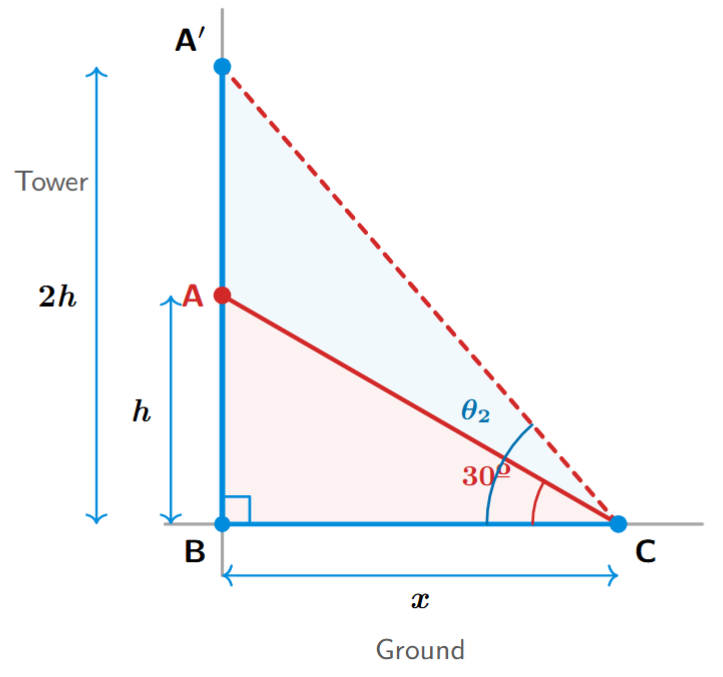
In the first case, let the tower be $AB$ with height $h$. In right-angled $\triangle ABC$:
$\tan 30^\circ = \frac{AB}{BC}$
(By trigonometric ratio)
$\frac{1}{\sqrt{3}} = \frac{h}{x}$
$x = h\sqrt{3}$
…(i)
Now, the height is doubled. Let the new tower be $AB'$ with height $2h$. In right-angled $\triangle AB'C$, let the new angle of elevation be $\theta_2$:
$\tan \theta_2 = \frac{AB'}{BC}$
$\tan \theta_2 = \frac{2h}{x}$
Substituting the value of $x$ from equation (i):
$\tan \theta_2 = \frac{2h}{h\sqrt{3}}$
$\tan \theta_2 = \frac{2}{\sqrt{3}}$
[Cancelling h] ... (ii)
We know that $\frac{2}{\sqrt{3}} \approx \frac{2}{1.732} \approx 1.154$.
However, if the angle were doubled, the new angle would be $60^\circ$. Let us check the value of $\tan 60^\circ$:
$\tan 60^\circ = \sqrt{3} \approx 1.732$
…(iii)
Comparing equation (ii) and (iii), we see that:
$\tan \theta_2 \neq \tan 60^\circ$
$\theta_2 \neq 60^\circ$
Conclusion:
Since $\tan \theta$ does not increase linearly with the height $h$, doubling the height does not result in doubling the angle of elevation. Thus, the statement is False.
Question 12. If the height of a tower and the distance of the point of observation from its foot, both, are increased by 10%, then the angle of elevation of its top remains unchanged.
Answer:
Statement: True
Given:
1. Let the initial height of the tower be $h$.
2. Let the initial distance of the point of observation from the foot of the tower be $d$.
3. Let the initial angle of elevation be $\theta$.
4. Both the height and the distance are increased by 10%.
To Find:
To determine if the new angle of elevation ($\theta'$) remains the same as the initial angle ($\theta$).
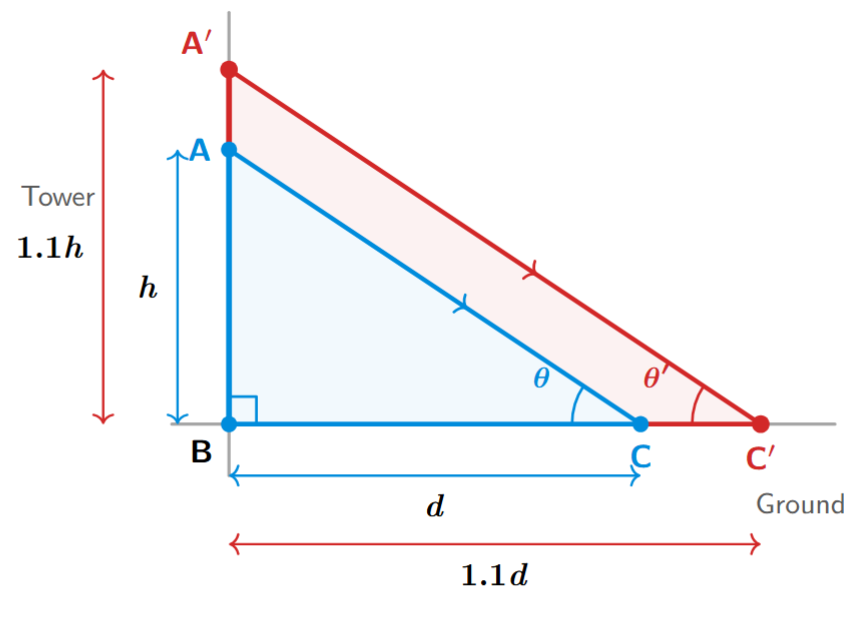
Solution:
Initially, in the right-angled triangle formed by the tower and the observation point, we have:
$\tan \theta = \frac{h}{d}$
…(i)
Now, according to the question, the height and the distance are increased by 10%.
The new height ($h'$) is calculated as:
$h' = h + 10\% \text{ of } h$
$h' = h + 0.1h$
$h' = 1.1h$
…(ii)
The new distance ($d'$) is calculated as:
$d' = d + 10\% \text{ of } d$
$d' = d + 0.1d$
$d' = 1.1d$
…(iii)
Let the new angle of elevation be $\theta'$. Then:
$\tan \theta' = \frac{h'}{d'}$
Substituting the values of $h'$ and $d'$ from equations (ii) and (iii):
$\tan \theta' = \frac{1.1h}{1.1d}$
By cancelling the common factor $1.1$ from the numerator and the denominator:
$\tan \theta' = \frac{\cancel{1.1}h}{\cancel{1.1}d}$
[Cancelling 1.1] ... (iv)
$\tan \theta' = \frac{h}{d}$
Comparing this with equation (i):
$\tan \theta' = \tan \theta$
$\theta' = \theta$
(Angle remains unchanged)
Conclusion:
Since the ratio of the height to the distance remains the same after the proportional increase, the angle of elevation remains unchanged. Thus, the statement is True.
Sample Question 1 to 4 (Before Exercise 8.3)
Sample Question 1: Prove that sin6 θ + cos6 θ + 3sin2 θ cos2 θ = 1
Answer:
Solution:
We need to prove the identity: $\sin^6 \theta + \cos^6 \theta + 3\sin^2 \theta \cos^2 \theta = 1$.
We start with the fundamental trigonometric identity:
$\sin^2 \theta + \cos^2 \theta = 1$
Cube both sides of this identity:
$(\sin^2 \theta + \cos^2 \theta)^3 = 1^3$
$(\sin^2 \theta + \cos^2 \theta)^3 = 1$
We use the algebraic identity for the cube of a sum: $(a+b)^3 = a^3 + b^3 + 3ab(a+b)$.
Let $a = \sin^2 \theta$ and $b = \cos^2 \theta$.
Substitute these into the algebraic identity:
$(\sin^2 \theta)^3 + (\cos^2 \theta)^3 + 3(\sin^2 \theta)(\cos^2 \theta)(\sin^2 \theta + \cos^2 \theta) = 1$
Simplify the terms:
$\sin^6 \theta + \cos^6 \theta + 3\sin^2 \theta \cos^2 \theta (\sin^2 \theta + \cos^2 \theta) = 1$
We know that $\sin^2 \theta + \cos^2 \theta = 1$. Substitute this back into the equation:
$\sin^6 \theta + \cos^6 \theta + 3\sin^2 \theta \cos^2 \theta (1) = 1$
$\sin^6 \theta + \cos^6 \theta + 3\sin^2 \theta \cos^2 \theta = 1$
This is the identity we were asked to prove.
Hence, the identity is proved.
Sample Question 2: Prove that (sin4 θ – cos4 θ + 1) cosec2 θ = 2
Answer:
Solution:
We need to prove the identity: $(\sin^4 \theta – \cos^4 \theta + 1) \text{cosec}^2 \theta = 2$.
Consider the Left Hand Side (LHS):
LHS $= (\sin^4 \theta – \cos^4 \theta + 1) \text{cosec}^2 \theta$
We can factor the term $(\sin^4 \theta – \cos^4 \theta)$ as a difference of squares:
$\sin^4 \theta – \cos^4 \theta = (\sin^2 \theta)^2 – (\cos^2 \theta)^2 = (\sin^2 \theta – \cos^2 \theta)(\sin^2 \theta + \cos^2 \theta)$
Using the fundamental trigonometric identity $\sin^2 \theta + \cos^2 \theta = 1$, we substitute this into the factored expression:
$\sin^4 \theta – \cos^4 \theta = (\sin^2 \theta – \cos^2 \theta)(1) = \sin^2 \theta – \cos^2 \theta$
Now substitute this back into the LHS expression:
LHS $= (\sin^2 \theta – \cos^2 \theta + 1) \text{cosec}^2 \theta$
Rearrange the terms inside the parenthesis:
LHS $= (\sin^2 \theta + (1 – \cos^2 \theta)) \text{cosec}^2 \theta$
Using the fundamental trigonometric identity again, $1 – \cos^2 \theta = \sin^2 \theta$, we substitute this into the parenthesis:
LHS $= (\sin^2 \theta + \sin^2 \theta) \text{cosec}^2 \theta$
Combine the terms inside the parenthesis:
LHS $= (2\sin^2 \theta) \text{cosec}^2 \theta$
Using the reciprocal identity $\text{cosec} \theta = \frac{1}{\sin \theta}$, which means $\text{cosec}^2 \theta = \frac{1}{\sin^2 \theta}$ (provided $\sin \theta \neq 0$), substitute this into the expression:
LHS $= 2\sin^2 \theta \times \frac{1}{\sin^2 \theta}$
Assuming $\sin^2 \theta \neq 0$, we can cancel the term $\sin^2 \theta$:
LHS $= 2 \times 1$
LHS $= 2$
The Right Hand Side (RHS) is 2.
Since LHS = RHS, the identity is proved.
Sample Question 3: Given that $α + β = 90°$, show that
$\sqrt{\cos\alpha\; cosec\;\beta - \cos\alpha \sin\beta} = \sin\alpha$
Answer:
Given:
$\alpha + \beta = 90^\circ$
(Given)
From the above equation, we can write $\beta$ in terms of $\alpha$ as:
$\beta = 90^\circ - \alpha$
…(i)
To Prove:
$\sqrt{\cos\alpha \cdot \text{cosec } \beta - \cos\alpha \sin\beta} = \sin\alpha$
Proof:
Let us consider the Left Hand Side (LHS) of the expression:
LHS = $\sqrt{\cos\alpha \cdot \text{cosec } \beta - \cos\alpha \sin\beta}$
Using equation (i), we substitute $\beta = 90^\circ - \alpha$ into the expression:
LHS = $\sqrt{\cos\alpha \cdot \text{cosec } (90^\circ - \alpha) - \cos\alpha \sin (90^\circ - \alpha)}$
We know the following complementary angle trigonometric identities:
$\text{cosec } (90^\circ - \alpha) = \sec \alpha$
[Complementary identity] ... (ii)
$\sin (90^\circ - \alpha) = \cos \alpha$
[Complementary identity] ... (iii)
Substituting the values from (ii) and (iii) into the LHS:
LHS = $\sqrt{\cos\alpha \cdot \sec \alpha - \cos\alpha \cdot \cos \alpha}$
LHS = $\sqrt{\cos\alpha \cdot \sec \alpha - \cos^2 \alpha}$
Since $\sec \alpha$ is the reciprocal of $\cos \alpha$:
$\cos\alpha \cdot \sec\alpha = 1$
(Reciprocal identity)
Substituting this value:
LHS = $\sqrt{1 - \cos^2 \alpha}$
Using the fundamental identity $\sin^2 \alpha + \cos^2 \alpha = 1$, we have:
$1 - \cos^2 \alpha = \sin^2 \alpha$
…(iv)
Substituting (iv) into the square root:
LHS = $\sqrt{\sin^2 \alpha}$
LHS = $\sin \alpha$
Comparing this with the Right Hand Side (RHS):
LHS = RHS
Hence Proved.
Alternate Solution:
We can factor out $\cos \alpha$ from the terms inside the square root first:
LHS = $\sqrt{\cos\alpha (\text{cosec } \beta - \sin \beta)}$
Since $\beta = 90^\circ - \alpha$, then $\text{cosec } \beta = \sec \alpha$ and $\sin \beta = \cos \alpha$:
LHS = $\sqrt{\cos \alpha (\sec \alpha - \cos \alpha)}$
LHS = $\sqrt{\cos \alpha \cdot \sec \alpha - \cos^2 \alpha}$
LHS = $\sqrt{1 - \cos^2 \alpha}$
LHS = $\sqrt{\sin^2 \alpha} = \sin \alpha$
Sample Question 4: If sin θ + cos θ = $\sqrt{3}$ , then prove that tan θ + cot θ = 1
Answer:
Solution:
Given:
$\sin \theta + \cos \theta = \sqrt{3}$
To Prove:
$\tan \theta + \cot \theta = 1$
Proof:
Start with the given equation:
$\sin \theta + \cos \theta = \sqrt{3}$
Square both sides of the equation:
$(\sin \theta + \cos \theta)^2 = (\sqrt{3})^2$
Expand the left side using the formula $(a+b)^2 = a^2 + 2ab + b^2$:
$\sin^2 \theta + \cos^2 \theta + 2\sin \theta \cos \theta = 3$
Using the fundamental trigonometric identity $\sin^2 \theta + \cos^2 \theta = 1$, substitute this into the equation:
$1 + 2\sin \theta \cos \theta = 3$
Subtract 1 from both sides:
$2\sin \theta \cos \theta = 3 - 1$
$2\sin \theta \cos \theta = 2$
Divide both sides by 2:
$\sin \theta \cos \theta = 1$
Now, consider the Left Hand Side (LHS) of the identity we want to prove: $\tan \theta + \cot \theta$.
Rewrite $\tan \theta$ as $\frac{\sin \theta}{\cos \theta}$ and $\cot \theta$ as $\frac{\cos \theta}{\sin \theta}$:
LHS $= \frac{\sin \theta}{\cos \theta} + \frac{\cos \theta}{\sin \theta}$
Combine the fractions by finding a common denominator, which is $\sin \theta \cos \theta$:
LHS $= \frac{\sin \theta \times \sin \theta + \cos \theta \times \cos \theta}{\cos \theta \sin \theta}$
LHS $= \frac{\sin^2 \theta + \cos^2 \theta}{\sin \theta \cos \theta}$
Using the fundamental trigonometric identity $\sin^2 \theta + \cos^2 \theta = 1$ in the numerator:
LHS $= \frac{1}{\sin \theta \cos \theta}$
Substitute the value $\sin \theta \cos \theta = 1$ (derived earlier) into this expression:
LHS $= \frac{1}{1}$
LHS $= 1$
The Right Hand Side (RHS) of the identity to be proved is 1.
Since LHS = RHS, the identity is proved.
Exercise 8.3
Prove the following (from Q.1 to Q.7)
Question 1. $\frac{sin\; θ}{1 \;+\; cos\; θ}$ + $\frac{1 \;+\; cos\; θ}{sin\; θ}$ = 2 cosec θ
Answer:
Solution:
We need to prove the identity: $\frac{\sin\; \theta}{1 \;+\; \cos\; \theta}$ + $\frac{1 \;+\; \cos\; \theta}{\sin\; \theta}$ = 2 $\text{cosec}\;\theta$.
Consider the Left Hand Side (LHS):
LHS $= \frac{\sin\; \theta}{1 \;+\; \cos\; \theta}$ + $\frac{1 \;+\; \cos\; \theta}{\sin\; \theta}$
Combine the fractions by finding a common denominator, which is $(\sin\; \theta)(1 \;+\; \cos\; \theta)$:
LHS $= \frac{(\sin\; \theta)(\sin\; \theta) \;+\; (1 \;+\; \cos\; \theta)(1 \;+\; \cos\; \theta)}{(\sin\; \theta)(1 \;+\; \cos\; \theta)}$
LHS $= \frac{\sin^2\; \theta \;+\; (1 \;+\; \cos\; \theta)^2}{\sin\; \theta(1 \;+\; \cos\; \theta)}$
Expand the term $(1 \;+\; \cos\; \theta)^2$ using the formula $(a+b)^2 = a^2 + 2ab + b^2$:
$(1 \;+\; \cos\; \theta)^2 = 1^2 + 2(1)(\cos\; \theta) + (\cos\; \theta)^2 = 1 + 2\cos\; \theta + \cos^2\; \theta$
Substitute the expanded term back into the numerator of the LHS:
LHS $= \frac{\sin^2\; \theta \;+\; 1 + 2\cos\; \theta + \cos^2\; \theta}{\sin\; \theta(1 \;+\; \cos\; \theta)}$
Group the terms $\sin^2\; \theta + \cos^2\; \theta$ in the numerator:
LHS $= \frac{(\sin^2\; \theta + \cos^2\; \theta) \;+\; 1 + 2\cos\; \theta}{\sin\; \theta(1 \;+\; \cos\; \theta)}$
Using the fundamental trigonometric identity $\sin^2\; \theta + \cos^2\; \theta = 1$, substitute 1 into the numerator:
LHS $= \frac{1 \;+\; 1 + 2\cos\; \theta}{\sin\; \theta(1 \;+\; \cos\; \theta)}$
LHS $= \frac{2 + 2\cos\; \theta}{\sin\; \theta(1 \;+\; \cos\; \theta)}$
Factor out the common factor 2 from the numerator:
LHS $= \frac{2(1 \;+\; \cos\; \theta)}{\sin\; \theta(1 \;+\; \cos\; \theta)}$
Cancel out the common term $(1 \;+\; \cos\; \theta)$ from the numerator and the denominator (assuming $1 + \cos \theta \neq 0$, which is true if $\theta \neq (2n+1)\pi$ for integer $n$):
LHS $= \frac{2}{\sin\; \theta}$
Using the reciprocal identity $\text{cosec}\;\theta = \frac{1}{\sin\; \theta}$, substitute this into the expression:
LHS $= 2 \times \frac{1}{\sin\; \theta}$
LHS $= 2 \text{cosec}\;\theta$
This is the Right Hand Side (RHS).
Since LHS = RHS, the identity is proved.
Question 2. $\frac{tan\; A}{1 \;+\; sec\;A}$ - $\frac{tan\; A}{1 \;-\; sec\;A}$ = 2 cosec A
Answer:
Solution:
We need to prove the identity: $\frac{\tan\; A}{1 \;+\; \sec\;A}$ - $\frac{\tan\; A}{1 \;-\; \sec\;A}$ = 2 $\text{cosec}\;$A.
Consider the Left Hand Side (LHS):
LHS $= \frac{\tan\; A}{1 \;+\; \sec\;A}$ - $\frac{\tan\; A}{1 \;-\; \sec\;A}$
Combine the fractions by finding a common denominator, which is $(1 \;+\; \sec\;A)(1 \;-\; \sec\;A)$:
LHS $= \frac{\tan\; A (1 \;-\; \sec\;A) \;-\; \tan\; A (1 \;+\; \sec\;A)}{(1 \;+\; \sec\;A)(1 \;-\; \sec\;A)}$
Expand the numerator:
Numerator $= \tan\; A - \tan\; A \sec\; A - (\tan\; A + \tan\; A \sec\; A)$
Numerator $= \tan\; A - \tan\; A \sec\; A - \tan\; A - \tan\; A \sec\; A$
Numerator $= (\tan\; A - \tan\; A) + (-\tan\; A \sec\; A - \tan\; A \sec\; A)$
Numerator $= 0 - 2 \tan\; A \sec\; A$
Numerator $= -2 \tan\; A \sec\; A$
Expand the denominator using the difference of squares formula $(x+y)(x-y) = x^2 - y^2$:
Denominator $= (1 \;+\; \sec\;A)(1 \;-\; \sec\;A) = 1^2 - \sec^2\; A = 1 - \sec^2\; A$
Substitute the expanded numerator and denominator back into the LHS expression:
LHS $= \frac{-2 \tan\; A \sec\; A}{1 - \sec^2\; A}$
Using the trigonometric identity $1 + \tan^2\; \theta = \sec^2\; \theta$, we can write $1 - \sec^2\; A = -\tan^2\; A$.
Substitute this into the denominator:
LHS $= \frac{-2 \tan\; A \sec\; A}{-\tan^2\; A}$
Cancel the negative signs and simplify the expression (assuming $\tan\; A \neq 0$):
LHS $= \frac{2 \cancel{\tan\; A} \sec\; A}{\tan^{\cancel{2}}\; A} = \frac{2 \sec\; A}{\tan\; A}$
Rewrite $\sec\; A$ and $\tan\; A$ in terms of $\sin\; A$ and $\cos\; A$:
$\sec\; A = \frac{1}{\cos\; A}$
$\tan\; A = \frac{\sin\; A}{\cos\; A}$
Substitute these into the LHS expression:
LHS $= \frac{2 \times \frac{1}{\cos\; A}}{\frac{\sin\; A}{\cos\; A}}$
Simplify the complex fraction (assuming $\cos\; A \neq 0$):
LHS $= \frac{2}{\cos\; A} \times \frac{\cos\; A}{\sin\; A} = \frac{2 \cancel{\cos\; A}}{\cancel{\cos\; A} \sin\; A} = \frac{2}{\sin\; A}$
Using the reciprocal identity $\text{cosec}\; A = \frac{1}{\sin\; A}$ (assuming $\sin\; A \neq 0$):
LHS $= 2 \times \frac{1}{\sin\; A} = 2 \text{cosec}\; A$
This is the Right Hand Side (RHS).
Since LHS = RHS, the identity is proved for all values of A where the expressions are defined.
Question 3. If tan A = $\frac{3}{4}$ then sin A cos A = $\frac{12}{25}$
Answer:
Statement: True
Given:
The value of tangent for angle $A$ is:
$\tan A = \frac{3}{4}$
To Prove:
$\sin A \cos A = \frac{12}{25}$
Solution:
We know that in a right-angled triangle, the tangent ratio is defined as:
$\tan A = \frac{\text{Perpendicular (P)}}{\text{Base (B)}}$
(By definition)
Let the Perpendicular $P = 3k$ and the Base $B = 4k$, where $k$ is a positive proportionality constant.
To find the Hypotenuse ($H$), we apply the Pythagoras Theorem:
$H^2 = P^2 + B^2$
$H^2 = (3k)^2 + (4k)^2$
$H^2 = 9k^2 + 16k^2$
$H^2 = 25k^2$
$H = 5k$
…(i)
Now, we determine the values of $\sin A$ and $\cos A$ using their respective ratios:
$\sin A = \frac{P}{H} = \frac{3k}{5k} = \frac{3}{5}$
[Ratio of Perpendicular to Hypotenuse] ... (ii)
$\cos A = \frac{B}{H} = \frac{4k}{5k} = \frac{4}{5}$
[Ratio of Base to Hypotenuse] ... (iii)
Now, multiplying $\sin A$ and $\cos A$:
$\sin A \cos A = \frac{3}{5} \times \frac{4}{5}$
$\sin A \cos A = \frac{12}{25}$
Since the calculated value matches the value given in the statement, the statement is True.
Alternate Solution:
We can express $\sin A \cos A$ in terms of $\tan A$ using the following identity:
$\sin A \cos A = \frac{\sin A \cos A}{1} = \frac{\sin A \cos A}{\sin^2 A + \cos^2 A}$
Dividing the numerator and the denominator by $\cos^2 A$:
$\sin A \cos A = \frac{\frac{\sin A \cos A}{\cos^2 A}}{\frac{\sin^2 A + \cos^2 A}{\cos^2 A}}$
$\sin A \cos A = \frac{\tan A}{1 + \tan^2 A}$
…(iv)
Substituting $\tan A = \frac{3}{4}$ into equation (iv):
$\sin A \cos A = \frac{\frac{3}{4}}{1 + (\frac{3}{4})^2}$
$\sin A \cos A = \frac{\frac{3}{4}}{1 + \frac{9}{16}}$
$\sin A \cos A = \frac{\frac{3}{4}}{\frac{25}{16}}$
$\sin A \cos A = \frac{3}{4} \times \frac{16}{25}$
$\sin A \cos A = \frac{12}{25}$
This confirms the result obtained previously.
Question 4. $(\sin α + \cos α) (\tan α + \cot α) = \sec α + cosec \ α$
Answer:
Solution:
We need to prove the identity: $(\sin \alpha + \cos \alpha) (\tan \alpha + \cot \alpha) = \sec \alpha + \text{cosec} \ \alpha$.
Consider the Left Hand Side (LHS):
LHS $= (\sin \alpha + \cos \alpha) (\tan \alpha + \cot \alpha)$
Rewrite $\tan \alpha$ and $\cot \alpha$ in terms of $\sin \alpha$ and $\cos \alpha$:
$\tan \alpha = \frac{\sin \alpha}{\cos \alpha}$
$\cot \alpha = \frac{\cos \alpha}{\sin \alpha}$
Substitute these into the LHS expression:
LHS $= (\sin \alpha + \cos \alpha) \left(\frac{\sin \alpha}{\cos \alpha} + \frac{\cos \alpha}{\sin \alpha}\right)$
Combine the terms in the second parenthesis by finding a common denominator, which is $\sin \alpha \cos \alpha$:
$\frac{\sin \alpha}{\cos \alpha} + \frac{\cos \alpha}{\sin \alpha} = \frac{\sin^2 \alpha + \cos^2 \alpha}{\sin \alpha \cos \alpha}$
Using the fundamental trigonometric identity $\sin^2 \alpha + \cos^2 \alpha = 1$ in the numerator:
$\frac{\sin^2 \alpha + \cos^2 \alpha}{\sin \alpha \cos \alpha} = \frac{1}{\sin \alpha \cos \alpha}$
Substitute this back into the LHS expression:
LHS $= (\sin \alpha + \cos \alpha) \left(\frac{1}{\sin \alpha \cos \alpha}\right)$
Distribute the term $(\sin \alpha + \cos \alpha)$:
LHS $= \frac{\sin \alpha}{\sin \alpha \cos \alpha} + \frac{\cos \alpha}{\sin \alpha \cos \alpha}$
Simplify the terms by cancelling common factors (assuming $\sin \alpha \neq 0$ and $\cos \alpha \neq 0$):
LHS $= \frac{1}{\cos \alpha} + \frac{1}{\sin \alpha}$
Using the reciprocal identities $\sec \alpha = \frac{1}{\cos \alpha}$ and $\text{cosec} \alpha = \frac{1}{\sin \alpha}$ (assuming $\sin \alpha \neq 0$ and $\cos \alpha \neq 0$):
LHS $= \sec \alpha + \text{cosec} \ \alpha$
This is the Right Hand Side (RHS).
Since LHS = RHS, the identity is proved for all values of $\alpha$ where the expressions are defined.
Question 5. ($\sqrt{3}$ + 1)(3 – cot 30°) = tan3 60° – 2 sin 60°
Answer:
Solution:
We need to prove the given equation by evaluating both sides.
First, let's find the values of the trigonometric terms involved:
$\cot 30^\circ = \sqrt{3}$
$\tan 60^\circ = \sqrt{3}$
$\sin 60^\circ = \frac{\sqrt{3}}{2}$
Consider the Left Hand Side (LHS):
LHS $= (\sqrt{3} + 1)(3 – \cot 30^\circ)$
Substitute the value of $\cot 30^\circ$:
LHS $= (\sqrt{3} + 1)(3 – \sqrt{3})$
Expand the product using the difference of squares formula $(a+b)(a-b) = a^2 - b^2$, with $a=3$ and $b=\sqrt{3}$, or by direct multiplication:
LHS $= 3(\sqrt{3}) - (\sqrt{3})(\sqrt{3}) + 1(3) - 1(\sqrt{3})$
LHS $= 3\sqrt{3} - 3 + 3 - \sqrt{3}$
LHS $= (3\sqrt{3} - \sqrt{3}) + (-3 + 3)$
LHS $= 2\sqrt{3} + 0$
LHS $= 2\sqrt{3}$
Now, consider the Right Hand Side (RHS):
RHS $= \tan^3 60^\circ – 2 \sin 60^\circ$
Substitute the values of $\tan 60^\circ$ and $\sin 60^\circ$:
RHS $= (\sqrt{3})^3 – 2 \left(\frac{\sqrt{3}}{2}\right)$
Calculate the terms:
$(\sqrt{3})^3 = \sqrt{3} \times \sqrt{3} \times \sqrt{3} = 3 \times \sqrt{3} = 3\sqrt{3}$
$2 \left(\frac{\sqrt{3}}{2}\right) = \cancel{2} \times \frac{\sqrt{3}}{\cancel{2}} = \sqrt{3}$
Substitute these values back into the RHS expression:
RHS $= 3\sqrt{3} – \sqrt{3}$
RHS $= 2\sqrt{3}$
Since LHS $= 2\sqrt{3}$ and RHS $= 2\sqrt{3}$, we have LHS = RHS.
Hence, the given equation is proved.
Question 6. $1 + \frac{\cot^2\alpha}{1 \;+\; cosec\;\alpha} = cosec\;\alpha$
Answer:
Solution:
We need to prove the identity: $1 + \frac{\cot^2\alpha}{1 \;+\; \text{cosec}\;\alpha} = \text{cosec}\;\alpha$.
Consider the Left Hand Side (LHS):
LHS $= 1 + \frac{\cot^2\alpha}{1 \;+\; \text{cosec}\;\alpha}$
We use the trigonometric identity: $\cot^2 \alpha + 1 = \text{cosec}^2 \alpha$.
From this identity, we can write $\cot^2 \alpha = \text{cosec}^2 \alpha - 1$.
Substitute this expression for $\cot^2 \alpha$ into the LHS:
LHS $= 1 + \frac{\text{cosec}^2\alpha \;-\; 1}{1 \;+\; \text{cosec}\;\alpha}$
Factor the numerator $(\text{cosec}^2\alpha \;-\; 1)$ as a difference of squares using the formula $x^2 - y^2 = (x-y)(x+y)$, with $x = \text{cosec}\;\alpha$ and $y = 1$:
$\text{cosec}^2\alpha \;-\; 1 = (\text{cosec}\;\alpha \;-\; 1)(\text{cosec}\;\alpha \;+\; 1)$
Substitute the factored numerator back into the LHS expression:
LHS $= 1 + \frac{(\text{cosec}\;\alpha \;-\; 1)(\text{cosec}\;\alpha \;+\; 1)}{1 \;+\; \text{cosec}\;\alpha}$
Cancel out the common term $(1 \;+\; \text{cosec}\;\alpha)$ from the numerator and the denominator (assuming $1 + \text{cosec}\;\alpha \neq 0$, which means $\text{cosec}\;\alpha \neq -1$, or $\sin\alpha \neq -1$, i.e., $\alpha \neq \frac{3\pi}{2} + 2n\pi$ for integer $n$):
LHS $= 1 + (\text{cosec}\;\alpha \;-\; 1)$
Simplify the expression:
LHS $= 1 + \text{cosec}\;\alpha - 1$
LHS $= \text{cosec}\;\alpha$
This is the Right Hand Side (RHS).
Since LHS = RHS, the identity is proved for all values of $\alpha$ where the expressions are defined and $1 + \text{cosec}\;\alpha \neq 0$.
Question 7. tan θ + tan (90° – θ) = sec θ sec (90° – θ)
Answer:
Solution:
We need to prove the identity: $\tan \theta + \tan (90^\circ – \theta) = \sec \theta \sec (90^\circ – \theta)$.
We use the complementary angle identities:
$\tan (90^\circ - \theta) = \cot \theta$
$\sec (90^\circ - \theta) = \text{cosec} \theta$
Consider the Left Hand Side (LHS):
LHS $= \tan \theta + \tan (90^\circ – \theta)$
Substitute the complementary angle identity for $\tan (90^\circ – \theta)$:
LHS $= \tan \theta + \cot \theta$
Rewrite $\tan \theta$ and $\cot \theta$ in terms of $\sin \theta$ and $\cos \theta$:
LHS $= \frac{\sin \theta}{\cos \theta} + \frac{\cos \theta}{\sin \theta}$
Combine the terms by finding a common denominator, which is $\sin \theta \cos \theta$ (assuming $\sin \theta \neq 0$ and $\cos \theta \neq 0$):
LHS $= \frac{\sin^2 \theta + \cos^2 \theta}{\sin \theta \cos \theta}$
Using the fundamental trigonometric identity $\sin^2 \theta + \cos^2 \theta = 1$ in the numerator:
LHS $= \frac{1}{\sin \theta \cos \theta}$
Now, consider the Right Hand Side (RHS):
RHS $= \sec \theta \sec (90^\circ – \theta)$
Substitute the complementary angle identity for $\sec (90^\circ – \theta)$:
RHS $= \sec \theta \ \text{cosec} \theta$
Rewrite $\sec \theta$ and $\text{cosec} \theta$ in terms of $\sin \theta$ and $\cos \theta$:
RHS $= \frac{1}{\cos \theta} \times \frac{1}{\sin \theta}$
RHS $= \frac{1}{\cos \theta \sin \theta} = \frac{1}{\sin \theta \cos \theta}$
Comparing the simplified LHS and RHS:
LHS $= \frac{1}{\sin \theta \cos \theta}$
RHS $= \frac{1}{\sin \theta \cos \theta}$
Question 8. Find the angle of elevation of the sun when the shadow of a pole h metres high is $\sqrt{3}$ h metres long.
Answer:
Given:
1. Height of the pole ($AB$) = $h$ m
2. Length of the shadow ($BC$) = $\sqrt{3}h$ m
To Find:
The angle of elevation of the sun (let it be $\theta$).
Solution:
Let $AB$ represent the vertical pole and $BC$ represent its shadow on the level ground. Let $\theta$ be the angle of elevation of the sun from the tip of the shadow ($C$) to the top of the pole ($A$).
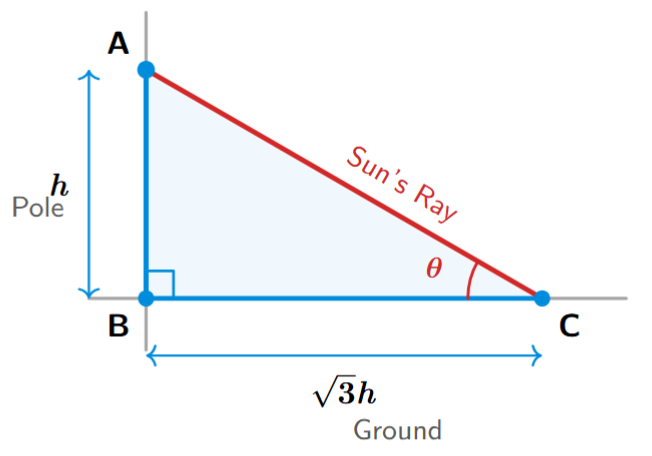
In the right-angled triangle $\triangle ABC$, we use the trigonometric ratio for tangent:
$\tan \theta = \frac{\text{Perpendicular (AB)}}{\text{Base (BC)}}$
(By trigonometric definition)
Substituting the given values of height and shadow length into the equation:
$\tan \theta = \frac{h}{\sqrt{3}h}$
[Substituting the values of h and s] ... (i)
On simplifying the fraction by cancelling the common term $h$ from the numerator and the denominator:
$\tan \theta = \frac{\cancel{h}^1}{\sqrt{3}\cancel{h}_1}$
[Cancelling h] ... (ii)
$\tan \theta = \frac{1}{\sqrt{3}}$
We know from the standard trigonometric table that the value of tangent is $\frac{1}{\sqrt{3}}$ for an angle of $30^\circ$:
$\tan 30^\circ = \frac{1}{\sqrt{3}}$
…(iii)
Comparing equation (ii) and equation (iii):
$\theta = 30^\circ$
Conclusion:
The angle of elevation of the sun is $30^\circ$.
Question 9. If $\sqrt{3}$ tan θ = 1, then find the value of sin2 θ – cos2 θ.
Answer:
Solution:
Given:
$\sqrt{3} \tan \theta = 1$
To Find:
The value of $\sin^2 \theta – \cos^2 \theta$.
From the given equation, find the value of $\tan \theta$:
$\tan \theta = \frac{1}{\sqrt{3}}$
We know that for an acute angle $\theta$, $\tan \theta = \frac{1}{\sqrt{3}}$ corresponds to $\theta = 30^\circ$.
Now, find the values of $\sin \theta$ and $\cos \theta$ for $\theta = 30^\circ$:
$\sin 30^\circ = \frac{1}{2}$
$\cos 30^\circ = \frac{\sqrt{3}}{2}$
Substitute these values into the expression $\sin^2 \theta – \cos^2 \theta$:
$\sin^2 30^\circ – \cos^2 30^\circ = \left(\frac{1}{2}\right)^2 – \left(\frac{\sqrt{3}}{2}\right)^2$
Calculate the squares:
$\left(\frac{1}{2}\right)^2 = \frac{1^2}{2^2} = \frac{1}{4}$
$\left(\frac{\sqrt{3}}{2}\right)^2 = \frac{(\sqrt{3})^2}{2^2} = \frac{3}{4}$
Substitute the squared values back into the expression:
$\sin^2 \theta – \cos^2 \theta = \frac{1}{4} – \frac{3}{4}$
$\sin^2 \theta – \cos^2 \theta = \frac{1 - 3}{4} = \frac{-2}{4} = -\frac{1}{2}$
The value of $\sin^2 \theta – \cos^2 \theta$ is $\mathbf{-\frac{1}{2}}$.
Alternate Solution (without finding $\theta$):
Given $\tan \theta = \frac{1}{\sqrt{3}}$.
We need to find $\sin^2 \theta – \cos^2 \theta$. We know that $\sin^2 \theta + \cos^2 \theta = 1$.
Also, we can express $\sin^2 \theta$ and $\cos^2 \theta$ in terms of $\tan^2 \theta$.
Divide the identity $\sin^2 \theta + \cos^2 \theta = 1$ by $\cos^2 \theta$ (assuming $\cos \theta \neq 0$):
$\frac{\sin^2 \theta}{\cos^2 \theta} + \frac{\cos^2 \theta}{\cos^2 \theta} = \frac{1}{\cos^2 \theta}$
$\tan^2 \theta + 1 = \sec^2 \theta$
Since $\sec \theta = \frac{1}{\cos \theta}$, $\sec^2 \theta = \frac{1}{\cos^2 \theta}$.
So, $\cos^2 \theta = \frac{1}{\sec^2 \theta} = \frac{1}{1 + \tan^2 \theta}$.
From $\sin^2 \theta + \cos^2 \theta = 1$, we have $\sin^2 \theta = 1 - \cos^2 \theta = 1 - \frac{1}{1 + \tan^2 \theta} = \frac{(1 + \tan^2 \theta) - 1}{1 + \tan^2 \theta} = \frac{\tan^2 \theta}{1 + \tan^2 \theta}$.
Now, substitute $\tan \theta = \frac{1}{\sqrt{3}}$ (so $\tan^2 \theta = \left(\frac{1}{\sqrt{3}}\right)^2 = \frac{1}{3}$) into the expressions for $\sin^2 \theta$ and $\cos^2 \theta$:
$\sin^2 \theta = \frac{\frac{1}{3}}{1 + \frac{1}{3}} = \frac{\frac{1}{3}}{\frac{3+1}{3}} = \frac{\frac{1}{3}}{\frac{4}{3}} = \frac{1}{3} \times \frac{3}{4} = \frac{1}{4}$
$\cos^2 \theta = \frac{1}{1 + \tan^2 \theta} = \frac{1}{1 + \frac{1}{3}} = \frac{1}{\frac{4}{3}} = 1 \times \frac{3}{4} = \frac{3}{4}$
Now, calculate $\sin^2 \theta – \cos^2 \theta$:
$\sin^2 \theta – \cos^2 \theta = \frac{1}{4} – \frac{3}{4} = \frac{1 - 3}{4} = \frac{-2}{4} = -\frac{1}{2}$
Both methods yield the same result.
Question 10. A ladder 15 metres long just reaches the top of a vertical wall. If the ladder makes an angle of 60° with the wall, find the height of the wall.
Answer:
Given:
1. Length of the ladder (Hypotenuse, $AC$) = $15$ m.
2. Angle made by the ladder with the vertical wall ($\angle BAC$) = $60^\circ$.
$\angle ABC = 90^\circ$
(Wall is vertical)
To Find:
The height of the wall (length $AB$).
Solution:
Let $AB$ represent the height of the vertical wall and $AC$ represent the ladder leaning against it at point $A$.
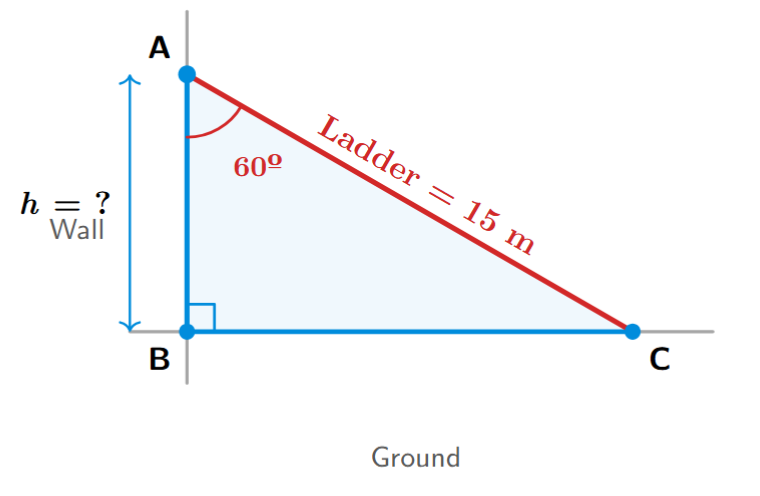
In the right-angled $\triangle ABC$, we need to find the side $AB$ (which is adjacent to the given angle of $60^\circ$). We know the length of the hypotenuse $AC$.
Using the trigonometric ratio for cosine:
$\cos \theta = \frac{\text{Adjacent side}}{\text{Hypotenuse}}$
(By definition)
Applying this to our triangle at angle $A$:
$\cos 60^\circ = \frac{AB}{AC}$
Substituting the known values ($AC = 15$ and $\cos 60^\circ = \frac{1}{2}$):
$\frac{1}{2} = \frac{AB}{15}$
[Value of $\cos 60^\circ$ is 0.5] ... (i)
Cross-multiplying to solve for $AB$:
$2 \times AB = 15$
$AB = \frac{15}{2}$
$AB = 7.5$
[Height of the wall in metres] ... (ii)
The height of the wall is $7.5$ metres.
Alternate Solution:
We can also find the angle made by the ladder with the ground ($\angle ACB$):
$\angle ACB = 180^\circ - (90^\circ + 60^\circ) = 30^\circ$
Now, using the sine ratio for angle $C$:
$\sin 30^\circ = \frac{\text{Opposite (AB)}}{\text{Hypotenuse (AC)}}$
$\frac{1}{2} = \frac{AB}{15}$
$AB = \frac{15}{2} = 7.5$ m
The result remains the same.
Question 11. Simplify (1 + tan2 θ) (1 – sin θ) (1 + sin θ)
Answer:
Solution:
We need to simplify the expression: $(1 + \tan^2 \theta) (1 – \sin \theta) (1 + \sin \theta)$.
Consider the terms $(1 – \sin \theta) (1 + \sin \theta)$. This is in the form of a difference of squares, $(a-b)(a+b) = a^2 - b^2$, where $a=1$ and $b=\sin \theta$.
So, $(1 – \sin \theta) (1 + \sin \theta) = 1^2 – \sin^2 \theta = 1 – \sin^2 \theta$.
Using the fundamental trigonometric identity $\sin^2 \theta + \cos^2 \theta = 1$, we can rewrite $1 – \sin^2 \theta$ as $\cos^2 \theta$.
So, $(1 – \sin \theta) (1 + \sin \theta) = \cos^2 \theta$.
Now the original expression becomes $(1 + \tan^2 \theta) (\cos^2 \theta)$.
We use another fundamental trigonometric identity: $1 + \tan^2 \theta = \sec^2 \theta$.
Substitute this into the expression:
The expression is now $(\sec^2 \theta) (\cos^2 \theta)$.
Using the reciprocal identity $\sec \theta = \frac{1}{\cos \theta}$, we have $\sec^2 \theta = \frac{1}{\cos^2 \theta}$.
Substitute this into the expression (assuming $\cos \theta \neq 0$):
The expression becomes $\left(\frac{1}{\cos^2 \theta}\right) (\cos^2 \theta)$.
Cancel the common term $\cos^2 \theta$ (assuming $\cos^2 \theta \neq 0$):
$\frac{1}{\cancel{\cos^2 \theta}} \times \cancel{\cos^2 \theta} = 1$
The simplified value of the expression is $\mathbf{1}$.
Question 12. If 2sin2 θ – cos2 θ = 2, then find the value of θ.
Answer:
Given:
The trigonometric equation is:
$2\sin^2 \theta - \cos^2 \theta = 2$
[Given equation] ... (i)
To Find:
The value of the angle $\theta$ (where $0^\circ \le \theta \le 90^\circ$).
Solution:
We know the fundamental Trigonometric Identity:
$\sin^2 \theta + \cos^2 \theta = 1$
(Identity)
From this identity, we can express $\cos^2 \theta$ in terms of $\sin^2 \theta$:
$\cos^2 \theta = 1 - \sin^2 \theta$
…(ii)
Now, substitute the value of $\cos^2 \theta$ from equation (ii) into equation (i):
$2\sin^2 \theta - (1 - \sin^2 \theta) = 2$
Open the brackets and simplify:
$2\sin^2 \theta - 1 + \sin^2 \theta = 2$
$3\sin^2 \theta - 1 = 2$
Add 1 to both sides:
$3\sin^2 \theta = 2 + 1$
$3\sin^2 \theta = 3$
[Simplification] ... (iii)
Divide both sides by 3:
$\sin^2 \theta = \frac{3}{3}$
$\sin^2 \theta = 1$
Taking the square root of both sides:
$\sin \theta = \sqrt{1}$
$\sin \theta = 1$
We know that in the trigonometric table, the value of sine is 1 at $90^\circ$:
$\sin 90^\circ = 1$
(Standard value)
By comparing the values, we get:
$\theta = 90^\circ$
Alternate Solution:
We can also solve the equation by converting $\sin^2 \theta$ into $\cos^2 \theta$ using the identity $\sin^2 \theta = 1 - \cos^2 \theta$:
$2(1 - \cos^2 \theta) - \cos^2 \theta = 2$
$2 - 2\cos^2 \theta - \cos^2 \theta = 2$
$2 - 3\cos^2 \theta = 2$
Subtracting 2 from both sides:
$-3\cos^2 \theta = 0$
$\cos^2 \theta = 0$
$\cos \theta = 0$
Since $\cos 90^\circ = 0$, we have $\theta = 90^\circ$.
Conclusion:
The value of $\theta$ that satisfies the given equation is $90^\circ$.
Question 13. Show that $\frac{\cos^2\; (45^\circ \;+ \;\theta) \;+\; \cos^2\; (45^\circ \;- \;\theta)}{\tan \; (60^\circ \;+ \;\theta)\; \tan \; (30^\circ \;- \;\theta)} = 1$
Answer:
Solution:
We need to show that $\frac{\cos^2\; (45^\circ \;+ \;\theta) \;+\; \cos^2\; (45^\circ \;- \;\theta)}{\tan \; (60^\circ \;+ \;\theta)\; \tan \; (30^\circ \;- \;\theta)} = 1$.
Consider the numerator of the fraction:
Numerator $= \cos^2\; (45^\circ \;+ \;\theta) \;+\; \cos^2\; (45^\circ \;- \;\theta)$
We use the complementary angle identity: $\cos x = \sin (90^\circ - x)$.
Let $x = 45^\circ + \theta$. Then $90^\circ - x = 90^\circ - (45^\circ + \theta) = 90^\circ - 45^\circ - \theta = 45^\circ - \theta$.
So, $\cos (45^\circ + \theta) = \sin (90^\circ - (45^\circ + \theta)) = \sin (45^\circ - \theta)$.
Therefore, $\cos^2 (45^\circ + \theta) = (\sin (45^\circ - \theta))^2 = \sin^2 (45^\circ - \theta)$.
Substitute this into the numerator expression:
Numerator $= \sin^2\; (45^\circ \;- \;\theta) \;+\; \cos^2\; (45^\circ \;- \;\theta)$
Using the fundamental trigonometric identity $\sin^2 A + \cos^2 A = 1$, with $A = 45^\circ - \theta$, the numerator simplifies to 1.
Numerator $= 1$
Now, consider the denominator of the fraction:
Denominator $= \tan \; (60^\circ \;+ \;\theta)\; \tan \; (30^\circ \;- \;\theta)$
We use the complementary angle identity: $\tan x = \cot (90^\circ - x)$.
Let $x = 60^\circ + \theta$. Then $90^\circ - x = 90^\circ - (60^\circ + \theta) = 90^\circ - 60^\circ - \theta = 30^\circ - \theta$.
So, $\tan (60^\circ + \theta) = \cot (90^\circ - (60^\circ + \theta)) = \cot (30^\circ - \theta)$.
Substitute this into the denominator expression:
Denominator $= \cot \; (30^\circ \;- \;\theta)\; \tan \; (30^\circ \;- \;\theta)$
Using the reciprocal identity $\cot A = \frac{1}{\tan A}$ (assuming $\tan (30^\circ - \theta) \neq 0$ and $\cot (30^\circ - \theta) \neq 0$), we have $\cot A \tan A = 1$.
Let $A = 30^\circ - \theta$.
Denominator $= \cot \; (30^\circ \;- \;\theta)\; \tan \; (30^\circ \;- \;\theta) = 1$
Now, substitute the simplified numerator and denominator back into the original fraction:
$\frac{\text{Numerator}}{\text{Denominator}} = \frac{1}{1} = 1$
The value of the expression is 1.
Since the value is 1, the identity is shown to be true for all values of $\theta$ for which the expressions are defined.
Question 14. An observer 1.5 metres tall is 20.5 metres away from a tower 22 metres high. Determine the angle of elevation of the top of the tower from the eye of the observer.
Answer:
Given:
1. Height of the tower (let it be $AB$) = $22$ m.
2. Height of the observer (let it be $CD$) = $1.5$ m.
3. Distance between the observer and the tower ($BD$) = $20.5$ m.
To Find:
The angle of elevation ($\theta$) of the top of the tower from the eye of the observer.
Solution:
Let $AB$ represent the tower and $CD$ represent the observer. Let $C$ be the position of the observer's eye. Draw a horizontal line $CE$ from the eye to the tower such that $CE \perp AB$.
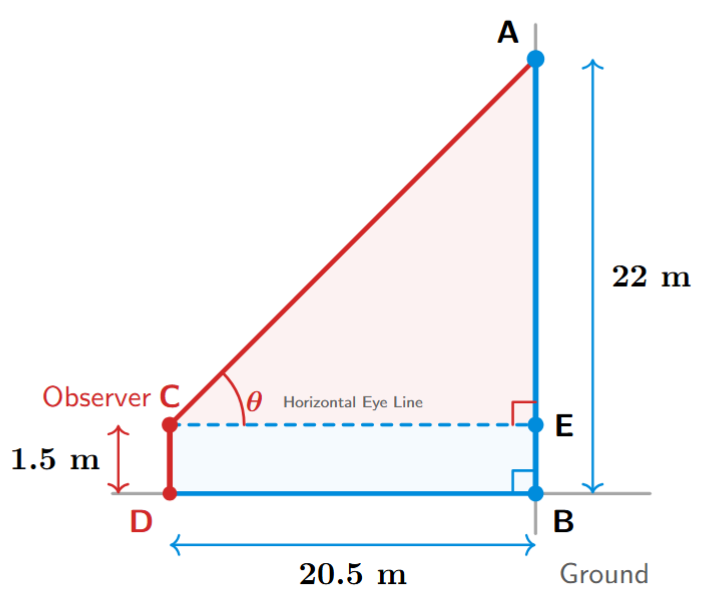
From the figure, we can observe that:
$CE = BD = 20.5 \text{ m}$
(Horizontal distance)
$BE = CD = 1.5 \text{ m}$
(Height of observer)
Now, we find the height of the tower above the observer's eye level ($AE$):
$AE = AB - BE$
$AE = 20.5 \text{ m}$
[Height above eye level] ... (i)
In the right-angled $\triangle ACE$, let the angle of elevation $\angle ACE = \theta$:
$\tan \theta = \frac{AE}{CE}$
(Trigonometric Ratio)
Substituting the values of $AE$ and $CE$:
$\tan \theta = \frac{\cancel{20.5}^{1}}{\cancel{20.5}_{1}}$
$\tan \theta = 1$
…(ii)
We know from the standard trigonometric table:
$\tan 45^\circ = 1$
(Standard Value)
By comparing the values, we get:
$\theta = 45^\circ$
Conclusion:
The angle of elevation of the top of the tower from the eye of the observer is $45^\circ$.
Question 15. Show that tan4 θ + tan2 θ = sec4 θ – sec2 θ.
Answer:
Solution:
We need to show that $\tan^4 \theta + \tan^2 \theta = \sec^4 \theta – \sec^2 \theta$.
Consider the Left Hand Side (LHS):
LHS $= \tan^4 \theta + \tan^2 \theta$
Factor out the common term $\tan^2 \theta$ from the LHS:
LHS $= \tan^2 \theta (\tan^2 \theta + 1)$
We use the fundamental trigonometric identity relating tangent and secant:
$\tan^2 \theta + 1 = \sec^2 \theta$
Substitute $\sec^2 \theta$ for $(\tan^2 \theta + 1)$ in the LHS expression:
LHS $= \tan^2 \theta (\sec^2 \theta)$
From the same identity, we can express $\tan^2 \theta$ in terms of $\sec^2 \theta$:
$\tan^2 \theta = \sec^2 \theta - 1$
Substitute this expression for $\tan^2 \theta$ into the current LHS expression:
LHS $= (\sec^2 \theta - 1) (\sec^2 \theta)$
Expand the expression by multiplying $\sec^2 \theta$ with each term inside the parenthesis:
LHS $= \sec^2 \theta \times \sec^2 \theta - 1 \times \sec^2 \theta$
LHS $= \sec^4 \theta - \sec^2 \theta$
This is the Right Hand Side (RHS) of the identity.
Since LHS = RHS, the identity $\tan^4 \theta + \tan^2 \theta = \sec^4 \theta – \sec^2 \theta$ is shown to be true for all values of $\theta$ where the functions are defined.
Sample Question 1 to 3 (Before Exercise 8.4)
Sample Question 1: A spherical balloon of radius r subtends an angle θ at the eye of an observer. If the angle of elevation of its centre is $\phi$ , find the height of the centre of the balloon.
Answer:
Given:
1. Radius of the spherical balloon = $r$
2. Angle subtended by the balloon at the observer's eye ($O$) = $\theta$
3. Angle of elevation of the centre of the balloon ($C$) = $\phi$
To Find:
The height of the centre of the balloon from the ground ($h$).
Construction:
Let $C$ be the centre of the balloon and $O$ be the eye of the observer. Let $OA$ and $OB$ be the tangents drawn from $O$ to the spherical balloon. Join $OC$. Draw $CH \perp OX$, where $OX$ is the horizontal ground level.
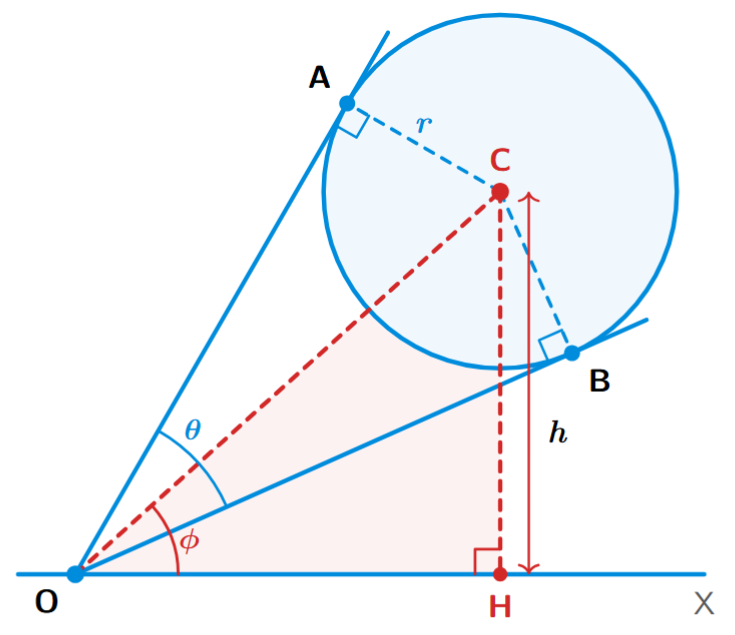
Solution:
In the figure, $O$ is the point of observation. The balloon subtends an angle $\theta$ at $O$. Therefore, $\angle AOB = \theta$.
Since the centre of the circle lies on the bisector of the angle between the tangents drawn from an external point:
$\angle AOC = \angle BOC = \frac{\theta}{2}$
(Property of tangents)
In $\triangle OAC$, $AC \perp OA$ because the radius is perpendicular to the tangent at the point of contact. Thus, $\triangle OAC$ is a right-angled triangle at $A$.
In right-angled $\triangle OAC$:
$\sin \frac{\theta}{2} = \frac{AC}{OC}$
$\sin \frac{\theta}{2} = \frac{r}{OC}$
[Since $AC = r$]
$OC = \frac{r}{\sin \frac{\theta}{2}}$
$OC = r \cdot \text{cosec} \frac{\theta}{2}$
... (i)
Now, let the height of the centre $C$ from the ground be $CH = h$.
The angle of elevation of the centre $C$ is $\angle COH = \phi$.
In right-angled $\triangle OHC$:
$\sin \phi = \frac{CH}{OC}$
$h = OC \sin \phi$
... (ii)
Substituting the value of $OC$ from equation (i) into equation (ii):
$h = (r \cdot \text{cosec} \frac{\theta}{2}) \sin \phi$
Rearranging the terms, we get:
$h = r \sin \phi \cdot \text{cosec} \frac{\theta}{2}$
Hence, the height of the centre of the balloon is $r \sin \phi \text{cosec} \frac{\theta}{2}$.
Alternate Solution:
We can also express the relationship using the hypotenuse $OC$ directly. By observing that the distance from the observer to the centre is fixed by the angular size of the balloon ($r$ and $\theta$), and the vertical component of this distance is determined by the elevation angle $\phi$.
1. From $\triangle OAC$: $OC = r / \sin(\theta/2)$.
2. From the elevation triangle: $h = OC \sin \phi$.
By direct substitution:
$h = \frac{r \sin \phi}{\sin \frac{\theta}{2}} = r \sin \phi \text{cosec} \frac{\theta}{2}$.
Sample Question 2: From a balloon vertically above a straight road, the angles of depression of two cars at an instant are found to be 45° and 60°. If the cars are 100 m apart, find the height of the balloon.
Answer:
Given:
1. Distance between the two cars ($AB$) = $100$ m.
2. Angles of depression of the two cars from the balloon are $45^\circ$ and $60^\circ$.
3. The balloon is vertically above the road.
To Find:
The height of the balloon above the road ($h$).
Construction:
Let $P$ be the position of the balloon and $h$ be its height above the ground. Let $O$ be the point on the road vertically below the balloon. Let $A$ and $B$ be the positions of the two cars. We assume the cars are on the same side of the balloon for the primary solution.
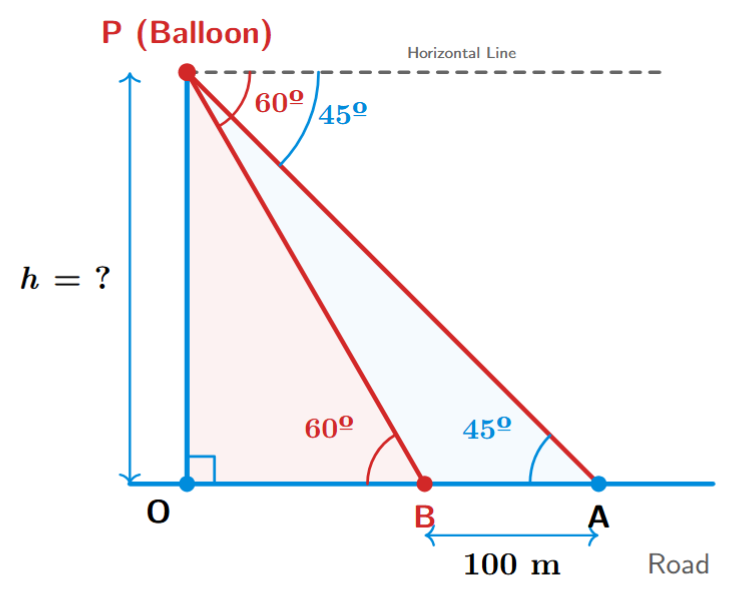
Solution:
Let $PO = h$ be the height of the balloon.
The angles of depression of cars $A$ and $B$ from $P$ are $45^\circ$ and $60^\circ$ respectively.
By the property of alternate interior angles, the angles of elevation of the balloon from the cars are:
$\angle PAO = 45^\circ$ and $\angle PBO = 60^\circ$
In right-angled $\triangle PBO$:
$\tan 60^\circ = \frac{PO}{OB}$
$\sqrt{3} = \frac{h}{OB}$
$OB = \frac{h}{\sqrt{3}}$
... (i)
In right-angled $\triangle PAO$:
$\tan 45^\circ = \frac{PO}{OA}$
$1 = \frac{h}{OA}$
$OA = h$
... (ii)
Given that the distance between the cars $AB = 100$ m:
$OA - OB = 100$
[Cars on the same side]
Substituting values from (i) and (ii):
$h - \frac{h}{\sqrt{3}} = 100$
$h \left( \frac{\sqrt{3} - 1}{\sqrt{3}} \right) = 100$
$h = \frac{100\sqrt{3}}{\sqrt{3} - 1}$
Rationalizing the denominator:
$h = \frac{100\sqrt{3}(\sqrt{3} + 1)}{(\sqrt{3} - 1)(\sqrt{3} + 1)}$
$h = \frac{100(3 + \sqrt{3})}{3 - 1}$
$h = \frac{100(3 + 1.732)}{2}$
[Taking $\sqrt{3} \approx 1.732$]
$h = 50 \times 4.732$
$h = 236.6$
Hence, the height of the balloon is 236.6 m (if cars are on the same side).
Alternate Solution (Cars on opposite sides):
If the cars $A$ and $B$ are on opposite sides of the vertical line $PO$, then $OA + OB = 100$ m.
$h + \frac{h}{\sqrt{3}} = 100$
$h \left( \frac{\sqrt{3} + 1}{\sqrt{3}} \right) = 100$
$h = \frac{100\sqrt{3}}{\sqrt{3} + 1}$
Rationalizing the denominator:
$h = \frac{100\sqrt{3}(\sqrt{3} - 1)}{2} = 50(3 - \sqrt{3})$
$h = 50(3 - 1.732) = 50(1.268)$
$h = 63.4$
In this case, the height of the balloon is 63.4 m.
Sample Question 3: The angle of elevation of a cloud from a point h metres above the surface of a lake is θ and the angle of depression of its reflection in the lake is φ. Prove that the height of the cloud above the lake is h $\left( \frac{tan\;\phi \;+\;tan\;\theta}{tan\;\phi\;-\;tan\;\theta} \right)$ .
Answer:
Given:
1. Height of the point of observation ($A$) above the lake surface ($PM$) = $h$ metres.
2. Angle of elevation of the cloud ($C$) from point $A$ = $\theta$.
3. Angle of depression of the reflection of the cloud ($C'$) in the lake from point $A$ = $\phi$.
To Prove:
The height of the cloud above the lake ($H$) is $h \left( \frac{\tan \phi + \tan \theta}{\tan \phi - \tan \theta} \right)$.
Construction:
Let $PM$ represent the surface of the lake. Let $A$ be the point of observation such that $AP = h$. Let $C$ be the cloud and $C'$ be its reflection in the lake. Draw $AB \perp CM$, where $M$ is a point on the surface vertically below the cloud. Thus, $BM = AP = h$.
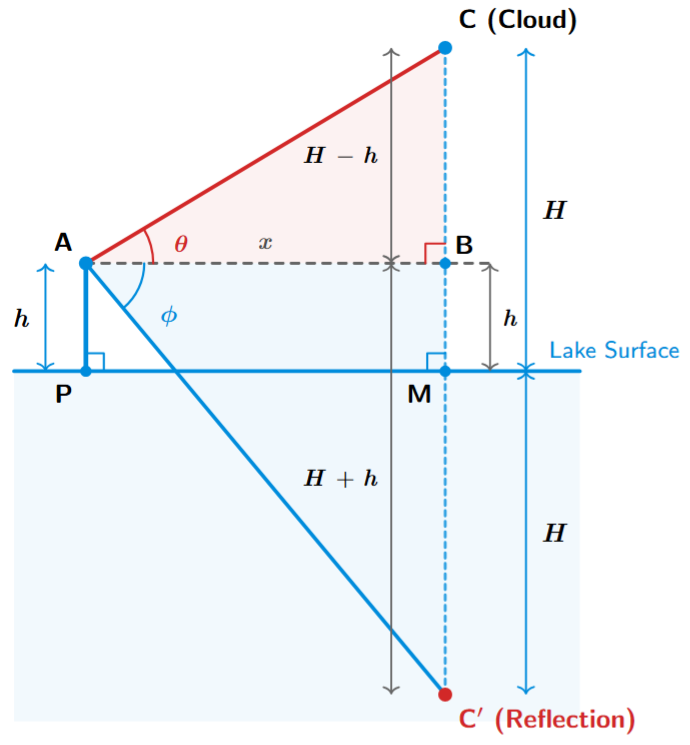
Proof:
Let the height of the cloud above the lake surface be $CM = H$.
According to the laws of reflection, the distance of the object above the water surface is equal to the distance of its image below the water surface.
$MC' = CM = H$
... (i)
From the figure, we have:
$CB = CM - BM = H - h$
$C'B = C'M + MB = H + h$
Let the horizontal distance $AB = x$.
In right-angled $\triangle ABC$:
$\tan \theta = \frac{CB}{AB}$
$\tan \theta = \frac{H - h}{x}$
$x = \frac{H - h}{\tan \theta}$
... (ii)
In right-angled $\triangle ABC'$:
$\tan \phi = \frac{C'B}{AB}$
$\tan \phi = \frac{H + h}{x}$
$x = \frac{H + h}{\tan \phi}$
... (iii)
From equations (ii) and (iii), we equate the values of $x$:
$\frac{H - h}{\tan \theta} = \frac{H + h}{\tan \phi}$
$(H - h) \tan \phi = (H + h) \tan \theta$
$H \tan \phi - h \tan \phi = H \tan \theta + h \tan \theta$
Rearranging the terms to isolate $H$:
$H \tan \phi - H \tan \theta = h \tan \phi + h \tan \theta$
$H (\tan \phi - \tan \theta) = h (\tan \phi + \tan \theta)$
$H = h \left( \frac{\tan \phi + \tan \theta}{\tan \phi - \tan \theta} \right)$
Hence Proved.
Alternate Solution:
We can use the componento and dividendo rule after setting up the ratio of the heights.
From the triangles, we found $x = \frac{H-h}{\tan \theta}$ and $x = \frac{H+h}{\tan \phi}$.
Thus, $\frac{H+h}{H-h} = \frac{\tan \phi}{\tan \theta}$.
Applying componendo and dividendo:
$\frac{(H+h) + (H-h)}{(H+h) - (H-h)} = \frac{\tan \phi + \tan \theta}{\tan \phi - \tan \theta}$
$\frac{2H}{2h} = \frac{\tan \phi + \tan \theta}{\tan \phi - \tan \theta}$
$H = h \left( \frac{\tan \phi + \tan \theta}{\tan \phi - \tan \theta} \right)$.
Exercise 8.4
Question 1. If cosec θ + cot θ = p, then prove that cos θ = $\frac{p^2 \;-\; 1}{p^2 \;+\; 1}$ .
Answer:
Given:
$\text{cosec}\; \theta + \cot\; \theta = p$
... (i)
To Prove:
$\cos\; \theta = \frac{p^2 \;-\; 1}{p^2 \;+\; 1}$
Proof:
We know the identity involving $\text{cosec}\; \theta$ and $\cot\; \theta$ is:
$\text{cosec}^2\; \theta - \cot^2\; \theta = 1$
Using the difference of squares formula ($a^2 - b^2 = (a-b)(a+b)$), we can factor the left side:
$(\text{cosec}\; \theta - \cot\; \theta)(\text{cosec}\; \theta + \cot\; \theta) = 1$
Substitute the given value from equation (i):
$(\text{cosec}\; \theta - \cot\; \theta)(p) = 1$
From this, we get:
$\text{cosec}\; \theta - \cot\; \theta = \frac{1}{p}$
... (ii)
Now we have a system of two linear equations in terms of $\text{cosec}\; \theta$ and $\cot\; \theta$:
Equation (i): $\text{cosec}\; \theta + \cot\; \theta = p$
Equation (ii): $\text{cosec}\; \theta - \cot\; \theta = \frac{1}{p}$
Adding equation (i) and equation (ii):
$(\text{cosec}\; \theta + \cot\; \theta) + (\text{cosec}\; \theta - \cot\; \theta) = p + \frac{1}{p}$
$2 \text{cosec}\; \theta = p + \frac{1}{p}$
$2 \text{cosec}\; \theta = \frac{p^2+1}{p}$
$\text{cosec}\; \theta = \frac{p^2+1}{2p}$
... (iii)
Subtracting equation (ii) from equation (i):
$(\text{cosec}\; \theta + \cot\; \theta) - (\text{cosec}\; \theta - \cot\; \theta) = p - \frac{1}{p}$
$2 \cot\; \theta = p - \frac{1}{p}$
$2 \cot\; \theta = \frac{p^2-1}{p}$
$\cot\; \theta = \frac{p^2-1}{2p}$
... (iv)
We know that $\cos\; \theta = \frac{\cos\; \theta}{\sin\; \theta} / \frac{1}{\sin\; \theta} = \frac{\cot\; \theta}{\text{cosec}\; \theta}$.
Substitute the expressions for $\cot\; \theta$ and $\text{cosec}\; \theta$ from equations (iv) and (iii) respectively:
$\cos\; \theta = \frac{\frac{p^2-1}{2p}}{\frac{p^2+1}{2p}}$
$\cos\; \theta = \frac{p^2-1}{2p} \times \frac{2p}{p^2+1}$
Cancel out the $2p$ term from the numerator and denominator:
$\cos\; \theta = \frac{p^2-1}{\cancel{2p}} \times \frac{\cancel{2p}}{p^2+1}$
$\cos\; \theta = \frac{p^2-1}{p^2+1}$
Hence Proved.
Question 2. Prove that $\sqrt{\sec^2\theta + cosecc^2 \;\theta}$ = tan θ + cot θ
Answer:
To Prove:
$\sqrt{\sec^2\theta + \text{cosec}^2 \;\theta}$ = $\tan \theta + \cot \theta$
Proof:
Consider the Left Hand Side (LHS):
LHS = $\sqrt{\sec^2\theta + \text{cosec}^2 \;\theta}$
Using the trigonometric identities $\sec^2\theta = 1 + \tan^2\theta$ and $\text{cosec}^2\theta = 1 + \cot^2\theta$, we substitute them into the expression:
LHS = $\sqrt{(1 + \tan^2\theta) + (1 + \cot^2\theta)}$
LHS = $\sqrt{1 + \tan^2\theta + 1 + \cot^2\theta}$
LHS = $\sqrt{2 + \tan^2\theta + \cot^2\theta}$
We know another fundamental identity: $\tan\theta \cdot \cot\theta = 1$.
So, we can write $2$ as $2 \cdot 1 = 2 (\tan\theta \cot\theta)$.
Substitute this into the expression under the square root:
LHS = $\sqrt{\tan^2\theta + \cot^2\theta + 2 \tan\theta \cot\theta}$
This expression under the square root is in the form of $(a+b)^2 = a^2 + b^2 + 2ab$, where $a = \tan\theta$ and $b = \cot\theta$.
LHS = $\sqrt{(\tan\theta + \cot\theta)^2}$
Taking the square root of a squared term:
LHS = $|\tan\theta + \cot\theta|$
For values of $\theta$ where $\tan\theta$ and $\cot\theta$ have the same sign (i.e., in quadrants I and III), $\tan\theta + \cot\theta$ is positive, so $|\tan\theta + \cot\theta| = \tan\theta + \cot\theta$.
Assuming the domain of $\theta$ is such that $\tan\theta + \cot\theta \ge 0$, we have:
LHS = $\tan\theta + \cot\theta$
This is the Right Hand Side (RHS).
LHS = RHS
Hence Proved.
Question 3. The angle of elevation of the top of a tower from certain point is 30°. If the observer moves 20 metres towards the tower, the angle of elevation of the top increases by 15°. Find the height of the tower.
Answer:
Given:
1. Initial angle of elevation of the top of the tower from point $C$ = $30^\circ$.
2. Distance moved towards the tower ($CD$) = $20$ m.
3. The new angle of elevation at point $D$ increases by $15^\circ$.
To Find:
The height of the tower ($h$).
Construction:
Let $AB$ be the tower of height $h$. Let $C$ be the initial point of observation on the ground. Let $D$ be the second point of observation such that $CD = 20$ m and $D$ lies on the line segment joining $C$ and the base $B$ of the tower.
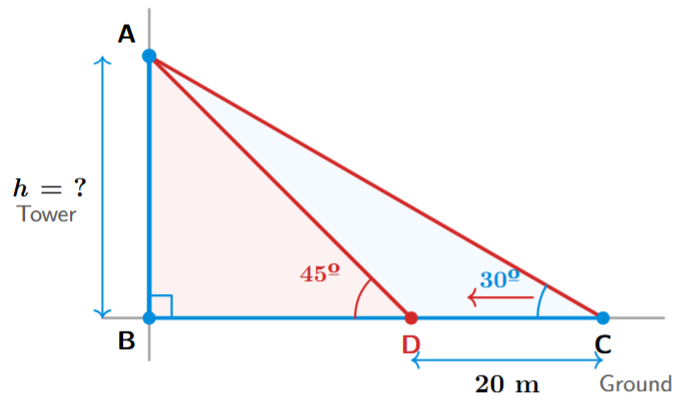
Solution:
Let $AB = h$ be the height of the tower.
Let $D$ be the point after moving $20$ m towards the tower from $C$.
The new angle of elevation at $D$ is $30^\circ + 15^\circ = 45^\circ$.
$\angle ACB = 30^\circ$
$\angle ADB = 45^\circ$
In right-angled $\triangle ABD$:
$\tan 45^\circ = \frac{AB}{BD}$
$1 = \frac{h}{BD}$
$BD = h$
... (i)
Now, in right-angled $\triangle ABC$:
$\tan 30^\circ = \frac{AB}{BC}$
$\frac{1}{\sqrt{3}} = \frac{h}{CD + DB}$
$\frac{1}{\sqrt{3}} = \frac{h}{20 + h}$
[From (i), $BD = h$] ... (ii)
Cross-multiplying the terms in equation (ii):
$20 + h = h\sqrt{3}$
$h\sqrt{3} - h = 20$
$h(\sqrt{3} - 1) = 20$
$h = \frac{20}{\sqrt{3} - 1}$
To simplify, we rationalize the denominator:
$h = \frac{20(\sqrt{3} + 1)}{(\sqrt{3} - 1)(\sqrt{3} + 1)}$
$h = \frac{20(\sqrt{3} + 1)}{3 - 1}$
$h = \frac{20(\sqrt{3} + 1)}{2}$
$h = 10(\sqrt{3} + 1)$
Using the value $\sqrt{3} \approx 1.732$:
$h = 10(1.732 + 1)$
$h = 10(2.732)$
$h = 27.32$
Hence, the height of the tower is 27.32 m.
Alternate Solution:
We can use the general formula for the distance $d$ moved between two angles of elevation $\alpha$ and $\beta$:
$h = \frac{d}{\cot \alpha - \cot \beta}$
Here, $d = 20$, $\alpha = 30^\circ$, and $\beta = 45^\circ$.
$h = \frac{20}{\cot 30^\circ - \cot 45^\circ}$
$h = \frac{20}{\sqrt{3} - 1}$
Upon rationalizing, $h = 10(\sqrt{3} + 1) = 27.32$ m.
Question 4. If 1 + sin2 θ = 3sin θ cos θ , then prove that tan θ = 1 or $\frac{1}{2}$ .
Answer:
Given:
1 + $\sin^2 \theta = 3 \sin \theta \cos \theta$
... (i)
To Prove:
$\tan \theta = 1$ or $\tan \theta = \frac{1}{2}$.
Proof:
Consider the given equation:
1 + $\sin^2 \theta = 3 \sin \theta \cos \theta$
Assuming $\cos \theta \neq 0$, divide the entire equation by $\cos^2 \theta$ to convert it into terms of $\tan \theta$ and $\sec^2 \theta$:
$\frac{1}{\cos^2 \theta} + \frac{\sin^2 \theta}{\cos^2 \theta} = \frac{3 \sin \theta \cos \theta}{\cos^2 \theta}$
Simplify each term using trigonometric identities ($\sec^2 \theta = \frac{1}{\cos^2 \theta}$, $\tan^2 \theta = \frac{\sin^2 \theta}{\cos^2 \theta}$, and $\tan \theta = \frac{\sin \theta}{\cos \theta}$):
$\sec^2 \theta + \tan^2 \theta = 3 \tan \theta$
Now, use the identity $\sec^2 \theta = 1 + \tan^2 \theta$:
$(1 + \tan^2 \theta) + \tan^2 \theta = 3 \tan \theta$
Combine like terms:
1 + $2 \tan^2 \theta = 3 \tan \theta$
Rearrange the equation into a quadratic equation in terms of $\tan \theta$:
$2 \tan^2 \theta - 3 \tan \theta + 1 = 0$
Let $t = \tan \theta$. The quadratic equation becomes:
$2t^2 - 3t + 1 = 0$
Factor the quadratic equation. We look for two numbers that multiply to $(2)(1) = 2$ and add up to $-3$. These numbers are $-2$ and $-1$.
$2t^2 - 2t - t + 1 = 0$
Group terms and factor:
$2t(t - 1) - 1(t - 1) = 0$
$(2t - 1)(t - 1) = 0$
For the product of two factors to be zero, at least one of the factors must be zero.
Case 1:
$2t - 1 = 0$
$2t = 1$
$t = \frac{1}{2}$
Since $t = \tan \theta$, we have $\tan \theta = \frac{1}{2}$.
Case 2:
$t - 1 = 0$
$t = 1$
Since $t = \tan \theta$, we have $\tan \theta = 1$.
Thus, the possible values for $\tan \theta$ are 1 and $\frac{1}{2}$.
Note: If $\cos \theta = 0$, then $\sin^2 \theta = 1$. The original equation becomes $1 + 1 = 3 \sin \theta \cdot 0$, which gives $2 = 0$, a contradiction. Hence, $\cos \theta$ cannot be 0, and dividing by $\cos^2 \theta$ is valid.
Hence Proved.
Question 5. Given that sin θ + 2cos θ = 1, then prove that 2sin θ – cos θ = 2.
Answer:
Given:
$\sin \theta + 2\cos \theta = 1$
... (i)
To Prove:
$2\sin \theta - \cos \theta = 2$
Proof:
Let us assume the expression we need to find is equal to $x$:
$2\sin \theta - \cos \theta = x$
... (ii)
To eliminate the trigonometric terms and solve for $x$, we square both equations (i) and (ii) and then add them.
Squaring equation (i):
$(\sin \theta + 2\cos \theta)^2 = 1^2$
$\sin^2 \theta + 4\cos^2 \theta + 4\sin \theta \cos \theta = 1$
... (iii)
Squaring equation (ii):
$(2\sin \theta - \cos \theta)^2 = x^2$
$4\sin^2 \theta + \cos^2 \theta - 4\sin \theta \cos \theta = x^2$
... (iv)
Now, adding equation (iii) and equation (iv):
$(\sin^2 \theta + 4\cos^2 \theta + 4\sin \theta \cos \theta) + (4\sin^2 \theta + \cos^2 \theta - 4\sin \theta \cos \theta) $$ = 1 + x^2$
Grouping the similar terms together:
$(\sin^2 \theta + 4\sin^2 \theta) + (4\cos^2 \theta + \cos^2 \theta) = 1 + x^2$
$5\sin^2 \theta + 5\cos^2 \theta = 1 + x^2$
$5(\sin^2 \theta + \cos^2 \theta) = 1 + x^2$
Using the trigonometric identity $\sin^2 \theta + \cos^2 \theta = 1$:
$5(1) = 1 + x^2$
[$\because \sin^2 \theta + \cos^2 \theta = 1$] ... (v)
$5 = 1 + x^2$
$x^2 = 5 - 1$
$x^2 = 4$
$x = \sqrt{4}$
$x = 2$
Substituting the value of $x$ back into equation (ii):
$2\sin \theta - \cos \theta = 2$
Hence Proved.
Alternate Solution:
From the given equation $\sin \theta + 2\cos \theta = 1$, we can observe that if $\theta = 90^\circ$:
$\sin 90^\circ + 2\cos 90^\circ = 1 + 2(0) = 1$.
Substituting $\theta = 90^\circ$ into the expression we need to prove:
$2\sin 90^\circ - \cos 90^\circ = 2(1) - 0 = 2$.
While this verifies the statement for a specific value, the algebraic method provided above proves it identically for all $\theta$ satisfying the condition.
Question 6. The angle of elevation of the top of a tower from two points distant s and t from its foot are complementary. Prove that the height of the tower is $\sqrt{st}$ .
Answer:
Given:
1. Let $AB$ be a tower of height $h$.
2. Two points $C$ and $D$ are at distances $s$ and $t$ respectively from the foot of the tower ($B$).
3. The angles of elevation of the top of the tower ($A$) from points $C$ and $D$ are complementary.
To Prove:
Height of the tower ($h$) = $\sqrt{st}$
Construction:
Draw a vertical line $AB$ representing the tower. Mark two points $C$ and $D$ on the same side of the tower on the horizontal ground such that $BC = s$ and $BD = t$. Join $AC$ and $AD$.
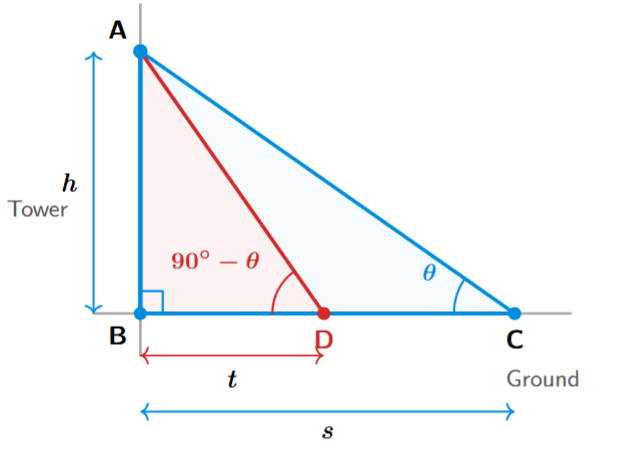
Proof:
Let the height of the tower $AB = h$.
Let the angle of elevation at point $C$ be $\theta$.
$\angle ACB = \theta$
Since the angles of elevation at $C$ and $D$ are complementary, the angle of elevation at point $D$ will be $(90^\circ - \theta)$.
$\angle ADB = 90^\circ - \theta$
In right-angled $\triangle ABC$:
$\tan \theta = \frac{AB}{BC}$
$\tan \theta = \frac{h}{s}$
... (i)
In right-angled $\triangle ABD$:
$\tan (90^\circ - \theta) = \frac{AB}{BD}$
$\cot \theta = \frac{h}{t}$
[$\because \tan(90^\circ - \theta) = \cot \theta$] ... (ii)
Multiplying equation (i) and equation (ii):
$\tan \theta \cdot \cot \theta = \frac{h}{s} \cdot \frac{h}{t}$
$1 = \frac{h^2}{st}$
[$\because \tan \theta \cdot \cot \theta = 1$]
$h^2 = st$
$h = \sqrt{st}$
Hence Proved.
Alternate Solution:
From equation (ii), we have $\cot \theta = \frac{h}{t}$, which implies:
$\tan \theta = \frac{t}{h}$
... (iii)
Equating the values of $\tan \theta$ from equation (i) and equation (iii):
$\frac{h}{s} = \frac{t}{h}$
$h^2 = st$
$h = \sqrt{st}$
This confirms that the height of the tower is the geometric mean of the distances of the two points from its foot.
Question 7. The shadow of a tower standing on a level plane is found to be 50 m longer when Sun’s elevation is 30° than when it is 60°. Find the height of the tower.
Answer:
Given:
1. The increase in the length of the shadow = $50$ m.
2. Initial angle of elevation of the Sun = $60^\circ$.
3. Final angle of elevation of the Sun = $30^\circ$.
To Find:
The height of the tower ($h$).
Construction:
Let $AB$ be the tower of height $h$ metres standing on a level plane. Let $BD$ be the length of the shadow when the Sun’s elevation is $60^\circ$. Let $BC$ be the length of the shadow when the Sun’s elevation is $30^\circ$. Points $C, D$ and $B$ are collinear.
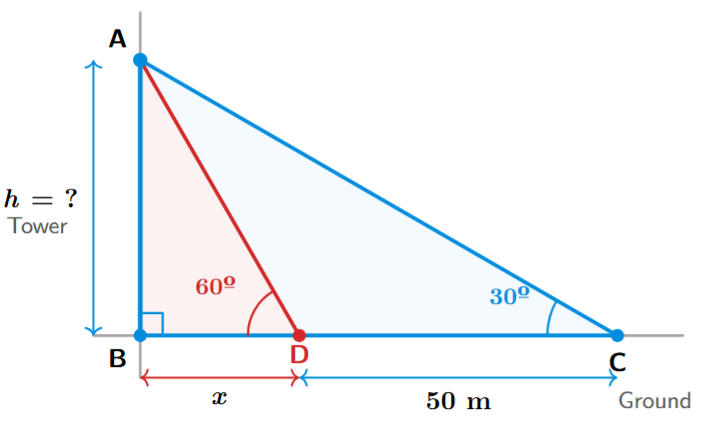
Solution:
Let $AB = h$ m and $BD = x$ m.
According to the question, the shadow $BC$ is $50$ m longer than shadow $BD$.
Therefore, $BC = BD + CD = (x + 50)$ m.
In right-angled $\triangle ABD$:
$\tan 60^\circ = \frac{AB}{BD}$
$\sqrt{3} = \frac{h}{x}$
$x = \frac{h}{\sqrt{3}}$
... (i)
In right-angled $\triangle ABC$:
$\tan 30^\circ = \frac{AB}{BC}$
$\frac{1}{\sqrt{3}} = \frac{h}{x + 50}$
$x + 50 = h\sqrt{3}$
... (ii)
Substitute the value of $x$ from equation (i) into equation (ii):
$\frac{h}{\sqrt{3}} + 50 = h\sqrt{3}$
$50 = h\sqrt{3} - \frac{h}{\sqrt{3}}$
$50 = \frac{3h - h}{\sqrt{3}}$
$50 = \frac{2h}{\sqrt{3}}$
$h = \frac{50\sqrt{3}}{2}$
$h = 25\sqrt{3}$
Taking the value of $\sqrt{3} \approx 1.732$:
$h = 25 \times 1.732$
$h = 43.3$
Hence, the height of the tower is 43.3 m.
Alternate Solution:
Using the direct formula for the difference in shadow lengths ($d$) for angles $\alpha$ and $\beta$:
$d = h(\cot \beta - \cot \alpha)$
Where $\beta = 30^\circ$, $\alpha = 60^\circ$ and $d = 50$ m.
$50 = h(\cot 30^\circ - \cot 60^\circ)$
$50 = h(\sqrt{3} - \frac{1}{\sqrt{3}})$
$50 = h(\frac{3 - 1}{\sqrt{3}})$
$50 = \frac{2h}{\sqrt{3}}$
$h = 25\sqrt{3} = 43.3$ m.
Question 8. A vertical tower stands on a horizontal plane and is surmounted by a vertical flag staff of height h. At a point on the plane, the angles of elevation of the bottom and the top of the flag staff are α and β, respectively. Prove that the height of the tower is $\left( \frac{h \tan \alpha}{\tan \beta - \tan \alpha} \right)$.
Answer:
Given:
1. Height of the vertical flagstaff = $h$.
2. Angle of elevation of the bottom of the flagstaff from a point on the plane = $\alpha$.
3. Angle of elevation of the top of the flagstaff from the same point = $\beta$.
To Prove:
The height of the tower is $\left( \frac{h \tan \alpha}{\tan \beta - \tan \alpha} \right)$.
Construction:
Let $BC$ be the tower of height $H$. Let $CD$ be the flagstaff of height $h$ standing on the tower. Let $A$ be the point of observation on the horizontal plane at a distance $x$ from the base of the tower $B$. Join $AC$ and $AD$.
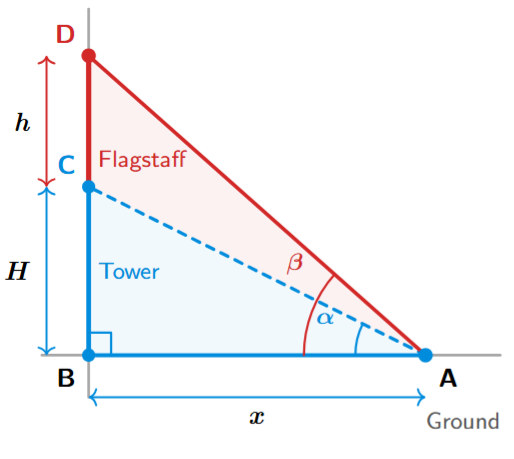
Proof:
Let the height of the tower $BC = H$ and the horizontal distance $AB = x$.
In right-angled $\triangle ABC$:
$\tan \alpha = \frac{BC}{AB}$
$\tan \alpha = \frac{H}{x}$
$x = \frac{H}{\tan \alpha}$
... (i)
In right-angled $\triangle ABD$:
$\tan \beta = \frac{BD}{AB}$
$\tan \beta = \frac{BC + CD}{AB}$
$\tan \beta = \frac{H + h}{x}$
$x = \frac{H + h}{\tan \beta}$
... (ii)
From equations (i) and (ii), equating the values of $x$:
$\frac{H}{\tan \alpha} = \frac{H + h}{\tan \beta}$
Cross-multiplying the terms:
$H \tan \beta = (H + h) \tan \alpha$
$H \tan \beta = H \tan \alpha + h \tan \alpha$
Grouping terms containing $H$ on one side:
$H \tan \beta - H \tan \alpha = h \tan \alpha$
$H (\tan \beta - \tan \alpha) = h \tan \alpha$
$H = \frac{h \tan \alpha}{\tan \beta - \tan \alpha}$
Hence Proved.
Alternate Solution:
We can also solve by expressing $H$ in terms of $\cot$ values first. From the triangles:
$x = H \cot \alpha$ and $x = (H + h) \cot \beta$
Equating them: $H \cot \alpha = H \cot \beta + h \cot \beta$
$H(\cot \alpha - \cot \beta) = h \cot \beta$
$H = \frac{h \cot \beta}{\cot \alpha - \cot \beta}$
Converting $\cot$ back to $\tan$:
$H = \frac{h / \tan \beta}{1/\tan \alpha - 1/\tan \beta} = \frac{h / \tan \beta}{(\tan \beta - \tan \alpha) / (\tan \alpha \tan \beta)}$
$H = \frac{h \tan \alpha}{\tan \beta - \tan \alpha}$.
Question 9. If tan θ + sec θ = l, then prove that sec θ = $\frac{l^2 \;+\; 1}{2l}$ .
Answer:
Given:
$\tan \theta + \sec \theta = l$
... (i)
To Prove:
$\sec \theta = \frac{l^2 \;+\; 1}{2l}$
Proof:
We know the fundamental trigonometric identity relating $\sec \theta$ and $\tan \theta$:
$\sec^2 \theta - \tan^2 \theta = 1$
Using the difference of squares formula ($a^2 - b^2 = (a-b)(a+b)$), we can factor the left side:
$(\sec \theta - \tan \theta)(\sec \theta + \tan \theta) = 1$
Substitute the given value from equation (i):
$(\sec \theta - \tan \theta)(l) = 1$
From this, we get:
$\sec \theta - \tan \theta = \frac{1}{l}$
... (ii)
Now we have a system of two linear equations in terms of $\sec \theta$ and $\tan \theta$:
Equation (i): $\sec \theta + \tan \theta = l$
Equation (ii): $\sec \theta - \tan \theta = \frac{1}{l}$
Add equation (i) and equation (ii):
$(\sec \theta + \tan \theta) + (\sec \theta - \tan \theta) = l + \frac{1}{l}$
$2 \sec \theta = l + \frac{1}{l}$
Combine the terms on the right side by finding a common denominator:
$2 \sec \theta = \frac{l^2+1}{l}$
Solve for $\sec \theta$ by dividing both sides by 2:
$\sec \theta = \frac{l^2+1}{2l}$
Thus, $\sec \theta = \mathbf{\frac{l^2 \;+\; 1}{2l}}$.
Hence Proved.
Question 10. If sin θ + cos θ = p and sec θ + cosec θ = q, then prove that q (p2 – 1) = 2p.
Answer:
Given:
$\sin \theta + \cos \theta = p$
... (i)
$\sec \theta + \text{cosec } \theta = q$
... (ii)
To Prove:
$q(p^2 - 1) = 2p$
Proof:
First, let us simplify the expression for $q$ from equation (ii):
$q = \sec \theta + \text{cosec } \theta$
$q = \frac{1}{\cos \theta} + \frac{1}{\sin \theta}$
$q = \frac{\sin \theta + \cos \theta}{\sin \theta \cos \theta}$
Substituting the value of $(\sin \theta + \cos \theta)$ from equation (i):
$q = \frac{p}{\sin \theta \cos \theta}$
... (iii)
Now, let us consider the term $(p^2 - 1)$. Using equation (i):
$p^2 = (\sin \theta + \cos \theta)^2$
Expanding the right-hand side using the identity $(a+b)^2 = a^2 + b^2 + 2ab$:
$p^2 = \sin^2 \theta + \cos^2 \theta + 2 \sin \theta \cos \theta$
Using the trigonometric identity $\sin^2 \theta + \cos^2 \theta = 1$:
$p^2 = 1 + 2 \sin \theta \cos \theta$
$p^2 - 1 = 2 \sin \theta \cos \theta$
... (iv)
Now, we take the L.H.S. of the equation to be proved:
$\text{L.H.S.} = q(p^2 - 1)$
Substituting values from equation (iii) and equation (iv):
$\text{L.H.S.} = \left( \frac{p}{\sin \theta \cos \theta} \right) \cdot (2 \sin \theta \cos \theta)$
Cancelling the common term $(\sin \theta \cos \theta)$ in the numerator and denominator:
$\text{L.H.S.} = p \cdot 2$
$\text{L.H.S.} = 2p$
$\text{L.H.S.} = \text{R.H.S.}$
Hence Proved.
Alternate Solution:
We can start directly from the L.H.S. and substitute the trigonometric definitions of $p$ and $q$:
$q(p^2 - 1) = (\sec \theta + \text{cosec } \theta) [(\sin \theta + \cos \theta)^2 - 1]$
$q(p^2 - 1) = \left( \frac{\sin \theta + \cos \theta}{\sin \theta \cos \theta} \right) [\sin^2 \theta + \cos^2 \theta + 2\sin \theta \cos \theta - 1]$
$q(p^2 - 1) = \left( \frac{\sin \theta + \cos \theta}{\sin \theta \cos \theta} \right) [1 + 2\sin \theta \cos \theta - 1]$
$q(p^2 - 1) = \left( \frac{\sin \theta + \cos \theta}{\sin \theta \cos \theta} \right) [2\sin \theta \cos \theta]$
After cancellation, we get:
$q(p^2 - 1) = 2(\sin \theta + \cos \theta) = 2p$.
Question 11. If a sin θ + b cos θ = c, then prove that a cos θ – b sin θ = $\sqrt{a^{2} + b^{2} - c^{2}}$ .
Answer:
Given:
$a \sin \theta + b \cos \theta = c$
... (i)
To Prove:
$a \cos \theta - b \sin \theta = \sqrt{a^2 + b^2 - c^2}$
Proof:
Let the expression we need to prove be equal to $x$.
$a \cos \theta - b \sin \theta = x$
... (ii)
In order to eliminate the trigonometric terms, we square both equations (i) and (ii) and then add them together.
Squaring equation (i):
$(a \sin \theta + b \cos \theta)^2 = c^2$
$a^2 \sin^2 \theta + b^2 \cos^2 \theta + 2ab \sin \theta \cos \theta = c^2$
... (iii)
Squaring equation (ii):
$(a \cos \theta - b \sin \theta)^2 = x^2$
$a^2 \cos^2 \theta + b^2 \sin^2 \theta - 2ab \sin \theta \cos \theta = x^2$
... (iv)
Now, adding equation (iii) and equation (iv):
$(a^2 \sin^2 \theta + b^2 \cos^2 \theta + 2ab \sin \theta \cos \theta) + (a^2 \cos^2 \theta + b^2 \sin^2 \theta $$ - 2ab \sin \theta \cos \theta) = c^2 + x^2$
The term $2ab \sin \theta \cos \theta$ cancels out. Grouping the terms with $a^2$ and $b^2$:
$a^2(\sin^2 \theta + \cos^2 \theta) + b^2(\sin^2 \theta + \cos^2 \theta) = c^2 + x^2$
Using the fundamental trigonometric identity $\sin^2 \theta + \cos^2 \theta = 1$:
$a^2(1) + b^2(1) = c^2 + x^2$
[$\because \sin^2 \theta + \cos^2 \theta = 1$] ... (v)
$a^2 + b^2 = c^2 + x^2$
Rearranging the equation to solve for $x$:
$x^2 = a^2 + b^2 - c^2$
$x = \sqrt{a^2 + b^2 - c^2}$
Substituting the value of $x$ back into equation (ii):
$a \cos \theta - b \sin \theta = \sqrt{a^2 + b^2 - c^2}$
Hence Proved.
Alternate Solution:
We can use the identity $(a \sin \theta + b \cos \theta)^2 + (a \cos \theta - b \sin \theta)^2 = a^2 + b^2$.
Let $y = a \cos \theta - b \sin \theta$.
We know that $(a \sin \theta + b \cos \theta)^2 + y^2 = a^2(\sin^2 \theta + \cos^2 \theta) + b^2(\cos^2 \theta + \sin^2 \theta)$.
$c^2 + y^2 = a^2(1) + b^2(1)$.
$y^2 = a^2 + b^2 - c^2$.
$y = \sqrt{a^2 + b^2 - c^2}$.
This confirms the result by directly utilizing the invariant sum of squares of these two specific linear combinations of sine and cosine.
Question 12. Prove that $\frac{1 \;+\; sec\; θ \;-\; tan\; θ}{1 \;+\; sec\;θ \;+\; tan\; θ} = \frac{1 \;-\; sin\; θ}{cos\; θ}$
Answer:
To Prove:
$\frac{1 \;+\; \sec\; \theta \;-\; \tan\; \theta}{1 \;+\; \sec\;θ \;+\; \tan\; θ} = \frac{1 \;-\; \sin\; \theta}{\cos\; \theta}$
Proof:
Consider the Left Hand Side (LHS):
LHS = $\frac{1 \;+\; \sec\; \theta \;-\; \tan\; \theta}{1 \;+\; \sec\;θ \;+\; \tan\; θ}$
We know the identity $\sec^2 \theta - \tan^2 \theta = 1$. We can substitute $1$ in the numerator with this identity:
LHS = $\frac{(\sec^2 \theta - \tan^2 \theta) \;+\; \sec\; \theta \;-\; \tan\; \theta}{1 \;+\; \sec\;θ \;+\; \tan\; θ}$
Factor the difference of squares term ($\sec^2 \theta - \tan^2 \theta = (\sec \theta - \tan \theta)(\sec \theta + \tan \theta)$):
LHS = $\frac{(\sec \theta - \tan \theta)(\sec \theta + \tan \theta) \;+\; (\sec\; \theta \;-\; \tan\; \theta)}{1 \;+\; \sec\;θ \;+\; tan\; θ}$
Factor out the common term $(\sec \theta - \tan \theta)$ from the numerator:
LHS = $\frac{(\sec \theta - \tan \theta) [(\sec \theta + \tan \theta) + 1]}{1 \;+\; \sec\;θ \;+\; tan\; θ}$
Rearrange the terms inside the square brackets in the numerator:
LHS = $\frac{(\sec \theta - \tan \theta) (1 \;+\; \sec \theta \;+\; \tan \theta)}{1 \;+\; \sec\;θ \;+\; tan\; θ}$
Assuming that $1 + \sec \theta + \tan \theta \neq 0$, we can cancel the common factor in the numerator and denominator:
LHS = $\sec \theta - \tan \theta$
Now, convert $\sec \theta$ and $\tan \theta$ into terms of $\sin \theta$ and $\cos \theta$ using the identities $\sec \theta = \frac{1}{\cos \theta}$ and $\tan \theta = \frac{\sin \theta}{\cos \theta}$:
LHS = $\frac{1}{\cos \theta} - \frac{\sin \theta}{\cos \theta}$
Since the fractions have a common denominator, combine them:
LHS = $\frac{1 - \sin \theta}{\cos \theta}$
This is the Right Hand Side (RHS).
LHS = RHS
Hence Proved.
Question 13. The angle of elevation of the top of a tower 30 m high from the foot of another tower in the same plane is 60° and the angle of elevation of the top of the second tower from the foot of the first tower is 30°. Find the distance between the two towers and also the height of the other tower.
Answer:
Given:
1. Height of the first tower ($AB$) = $30$ m.
2. Angle of elevation of the top of the first tower from the foot of the second tower = $60^\circ$.
3. Angle of elevation of the top of the second tower from the foot of the first tower = $30^\circ$.
To Find:
1. The distance between the two towers ($x$).
2. The height of the second tower ($h$).
Construction:
Let $AB$ represent the first tower of height $30$ m and $CD$ represent the second tower of height $h$. Let the distance between their feet $B$ and $D$ be $x$ m. Join $AD$ and $CB$.
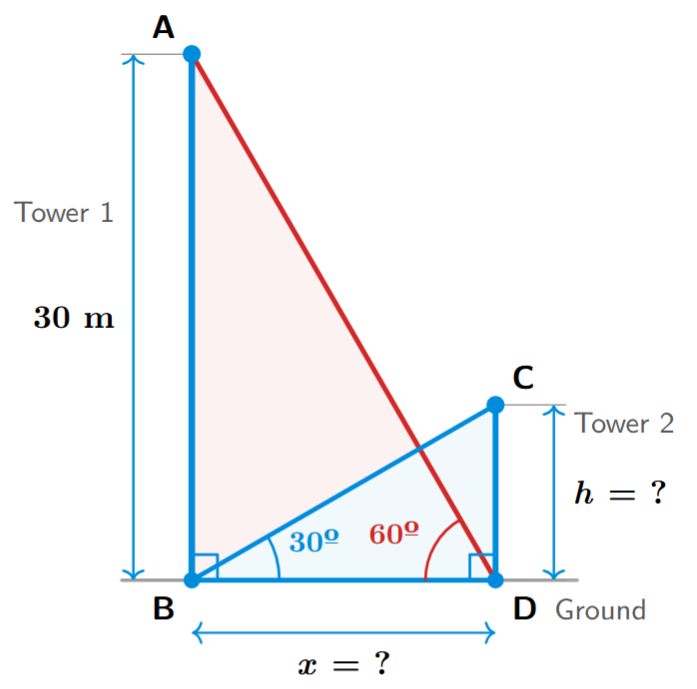
Solution:
Let $AB = 30$ m be the first tower and $CD = h$ be the second tower.
The distance between the towers $BD = x$ m.
In right-angled $\triangle ABD$:
$\tan 60^\circ = \frac{AB}{BD}$
$\sqrt{3} = \frac{30}{x}$
$x = \frac{30}{\sqrt{3}}$
Rationalizing the denominator:
$x = \frac{30 \times \sqrt{3}}{\sqrt{3} \times \sqrt{3}}$
$x = \frac{30\sqrt{3}}{3}$
$x = 10\sqrt{3}$
... (i)
Taking $\sqrt{3} \approx 1.732$:
$x = 10 \times 1.732 = 17.32$ m
Now, in right-angled $\triangle CDB$:
$\tan 30^\circ = \frac{CD}{BD}$
$\frac{1}{\sqrt{3}} = \frac{h}{x}$
$h = \frac{x}{\sqrt{3}}$
Substituting the value of $x$ from equation (i):
$h = \frac{10\sqrt{3}}{\sqrt{3}}$
$h = 10$ m
... (ii)
Hence, the distance between the two towers is 17.32 m and the height of the second tower is 10 m.
Alternate Solution:
From the two equations, we can observe the relationship between the heights directly:
In $\triangle ABD$: $x = 30 \cot 60^\circ$
In $\triangle CDB$: $x = h \cot 30^\circ$
Equating them: $h \cot 30^\circ = 30 \cot 60^\circ$
$h (\sqrt{3}) = 30 (\frac{1}{\sqrt{3}})$
$h = \frac{30}{3} = 10$ m.
Distance $x = h \tan 60^\circ$ (incorrect) or $x = 30 \cot 60^\circ = \frac{30}{\sqrt{3}} = 10\sqrt{3}$ m.
Question 14. From the top of a tower h m high, the angles of depression of two objects, which are in line with the foot of the tower are $α$ and $β$ $(β > α)$. Find the distance between the two objects.
Answer:
Given:
1. Height of the tower = $h$ m.
2. Angles of depression of two objects = $\alpha$ and $\beta$.
3. Condition: $\beta > \alpha$.
4. The objects are in line with the foot of the tower.
To Find:
The distance between the two objects.
Construction:
Let $PQ$ be the tower of height $h$, where $P$ is the top and $Q$ is the foot of the tower. Let $A$ and $B$ be the positions of the two objects on the horizontal road such that they are in line with $Q$. Since $\beta > \alpha$, the object $B$ is closer to the tower than object $A$. Join $PA$ and $PB$.
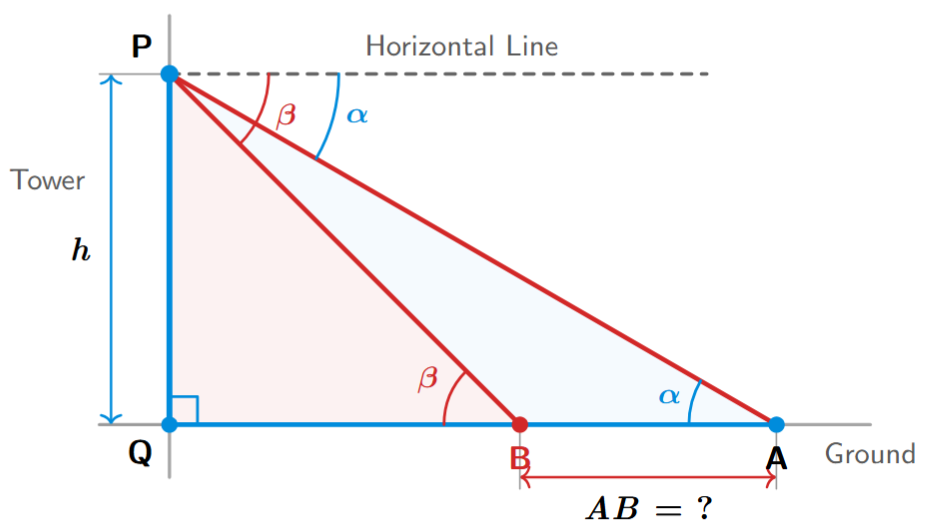
Solution:
Let $PQ = h$ be the tower.
The angles of depression of objects $A$ and $B$ from the top $P$ are $\alpha$ and $\beta$ respectively.
By the property of alternate interior angles, the angles of elevation of the top of the tower from the objects are:
$\angle PAQ = \alpha$
$\angle PBQ = \beta$
In right-angled $\triangle PBQ$:
$\tan \beta = \frac{PQ}{QB}$
$\tan \beta = \frac{h}{QB}$
$QB = \frac{h}{\tan \beta}$
$QB = h \cot \beta$
... (i)
In right-angled $\triangle PAQ$:
$\tan \alpha = \frac{PQ}{QA}$
$\tan \alpha = \frac{h}{QA}$
$QA = \frac{h}{\tan \alpha}$
$QA = h \cot \alpha$
... (ii)
The distance between the two objects is $AB$:
$AB = QA - QB$
Substituting the values from equations (i) and (ii):
$AB = h \cot \alpha - h \cot \beta$
$AB = h (\cot \alpha - \cot \beta)$
Hence, the distance between the two objects is $h(\cot \alpha - \cot \beta)$ m.
Alternate Solution:
We can also express the distance using the tangent function directly:
$AB = \frac{h}{\tan \alpha} - \frac{h}{\tan \beta}$
$AB = h \left( \frac{1}{\tan \alpha} - \frac{1}{\tan \beta} \right)$
Taking the L.C.M. inside the bracket:
$AB = h \left( \frac{\tan \beta - \tan \alpha}{\tan \alpha \tan \beta} \right)$
This is an equivalent form for the distance between the two objects.
Question 15. A ladder rests against a vertical wall at an inclination $α$ to the horizontal. Its foot is pulled away from the wall through a distance p so that its upper end slides a distance q down the wall and then the ladder makes an angle $β$ to the horizontal.
Show that $\frac{p}{q}$ = $\frac{cos \;β \;-\; cos\; α}{sin\; α \;-\; sin\; β}$
Answer:
Given:
1. Length of the ladder = $L$ (remains constant).
2. Initial inclination of the ladder with the horizontal = $\alpha$.
3. Distance the foot is pulled away from the wall = $p$.
4. Distance the upper end slides down the wall = $q$.
5. Final inclination of the ladder with the horizontal = $\beta$.
To Prove:
$\frac{p}{q} = \frac{\cos \beta - \cos \alpha}{\sin \alpha - \sin \beta}$
Construction:
Let $OY$ be the vertical wall and $OX$ be the horizontal ground. Let $AB$ be the initial position of the ladder such that $OA$ is the height on the wall and $OB$ is the distance from the foot to the wall. Let $CD$ be the new position of the ladder after sliding.
Here, $AB = CD = L$ (Length of the ladder).
Initial position: $\angle ABO = \alpha$.
Final position: $\angle CDO = \beta$.
Given that $BD = p$ and $AC = q$.
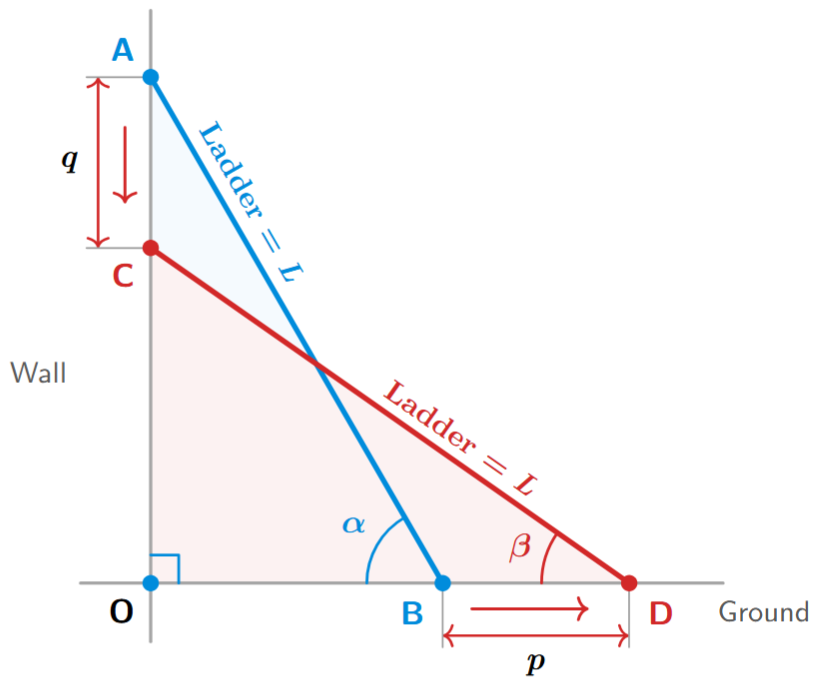
Proof:
Let the length of the ladder be $L$.
In right-angled $\triangle ABO$:
$\sin \alpha = \frac{OA}{AB} = \frac{OA}{L}$
$OA = L \sin \alpha$
... (i)
$\cos \alpha = \frac{OB}{AB} = \frac{OB}{L}$
$OB = L \cos \alpha$
... (ii)
In right-angled $\triangle CDO$:
$\sin \beta = \frac{OC}{CD} = \frac{OC}{L}$
$OC = L \sin \beta$
... (iii)
$\cos \beta = \frac{OD}{CD} = \frac{OD}{L}$
$OD = L \cos \beta$
... (iv)
We are given that $p$ is the distance the foot is pulled away:
$p = OD - OB$
Substituting values from (ii) and (iv):
$p = L \cos \beta - L \cos \alpha$
$p = L(\cos \beta - \cos \alpha)$
... (v)
We are given that $q$ is the distance the top end slides down:
$q = OA - OC$
Substituting values from (i) and (iii):
$q = L \sin \alpha - L \sin \beta$
$q = L(\sin \alpha - \sin \beta)$
... (vi)
Now, dividing equation (v) by equation (vi):
$\frac{p}{q} = \frac{L(\cos \beta - \cos \alpha)}{L(\sin \alpha - \sin \beta)}$
Cancelling $L$ from the numerator and denominator:
$\frac{p}{q} = \frac{\cos \beta - \cos \alpha}{\sin \alpha - \sin \beta}$
Hence Proved.
Alternate Solution:
This problem can also be viewed through the lens of coordinates. Let the wall be the y-axis and the floor be the x-axis.
Initial coordinates of the ladder ends: $(L \cos \alpha, 0)$ and $(0, L \sin \alpha)$.
Final coordinates of the ladder ends: $(L \cos \beta, 0)$ and $(0, L \sin \beta)$.
The change in x-coordinate is $p = L \cos \beta - L \cos \alpha$.
The change in y-coordinate is $q = L \sin \alpha - L \sin \beta$.
Taking the ratio gives the desired result directly:
$\frac{p}{q} = \frac{L(\cos \beta - \cos \alpha)}{L(\sin \alpha - \sin \beta)} = \frac{\cos \beta - \cos \alpha}{\sin \alpha - \sin \beta}$.
Question 16. The angle of elevation of the top of a vertical tower from a point on the ground is 60o. From another point 10 m vertically above the first, its angle of elevation is 45o. Find the height of the tower.
Answer:
Given:
1. Angle of elevation of the top of the tower from a point on the ground ($A$) = $60^\circ$.
2. Height of the second point ($B$) vertically above the first point = $10$ m.
3. Angle of elevation of the top of the tower from point $B$ = $45^\circ$.
To Find:
The height of the tower ($h$).
Construction:
Let $PQ$ be the tower of height $h$, where $Q$ is the foot of the tower on the ground. Let $A$ be the first point on the ground. Let $B$ be the point $10$ m vertically above $A$. Draw $BC \perp PQ$ meeting $PQ$ at $C$. Let the horizontal distance $AQ = x$.
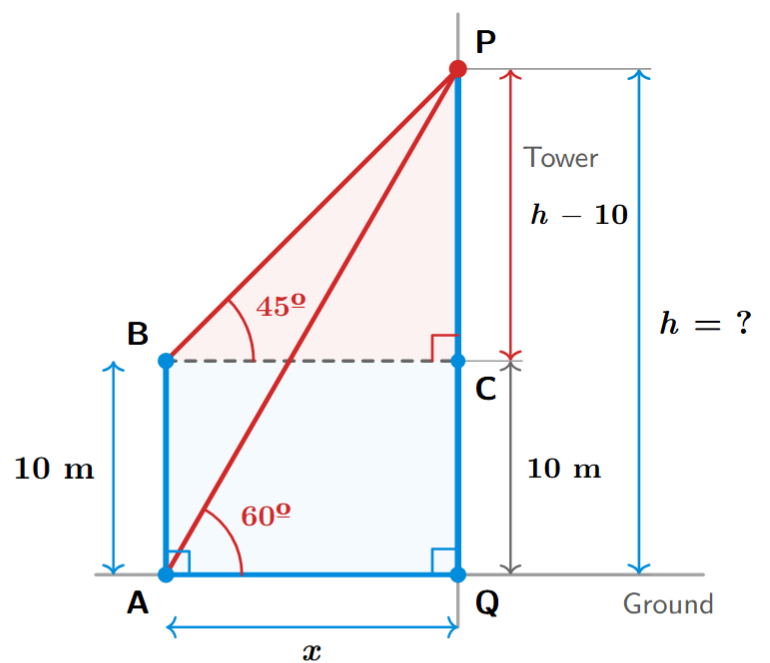
Solution:
Let $PQ = h$ be the height of the tower and $AQ = x$ be the distance of the point $A$ from the foot of the tower.
Given $AB = 10$ m. Since $BC \perp PQ$ and $AQ \perp PQ$, $BCQA$ forms a rectangle.
$BC = AQ = x$
$CQ = AB = 10$ m
Now, the height $PC$ can be expressed as:
$PC = PQ - CQ = h - 10$
In right-angled $\triangle PAQ$:
$\tan 60^\circ = \frac{PQ}{AQ}$
$\sqrt{3} = \frac{h}{x}$
$x = \frac{h}{\sqrt{3}}$
... (i)
In right-angled $\triangle PBC$:
$\tan 45^\circ = \frac{PC}{BC}$
$1 = \frac{h - 10}{x}$
$x = h - 10$
... (ii)
Equating the values of $x$ from equations (i) and (ii):
$\frac{h}{\sqrt{3}} = h - 10$
$h = \sqrt{3}(h - 10)$
$h = h\sqrt{3} - 10\sqrt{3}$
$h\sqrt{3} - h = 10\sqrt{3}$
$h(\sqrt{3} - 1) = 10\sqrt{3}$
$h = \frac{10\sqrt{3}}{\sqrt{3} - 1}$
Rationalizing the denominator:
$h = \frac{10\sqrt{3}(\sqrt{3} + 1)}{(\sqrt{3} - 1)(\sqrt{3} + 1)}$
$h = \frac{10(3 + \sqrt{3})}{3 - 1}$
$h = \frac{10(3 + 1.732)}{2}$
[Taking $\sqrt{3} \approx 1.732$]
$h = 5 \times 4.732$
$h = 23.66$
Hence, the height of the tower is 23.66 m.
Alternate Solution:
We can use the distance between two observation heights formula:
$h_{diff} = h (\cot \theta_2 - \cot \theta_1)$ is not directly applicable here because the points are vertical. Instead, we use:
$x = h \cot 60^\circ$ and $x = (h - 10) \cot 45^\circ$.
$h \frac{1}{\sqrt{3}} = (h - 10) \cdot 1$
$h = \sqrt{3}h - 10\sqrt{3}$
$h(\sqrt{3} - 1) = 10\sqrt{3}$
$h = \frac{10\sqrt{3}}{\sqrt{3}-1} = 5(3 + \sqrt{3}) = 23.66$ m.
Question 17. A window of a house is h metres above the ground. From the window, the angles of elevation and depression of the top and the bottom of another house situated on the opposite side of the lane are found to be $α$ and $β$, respectively. Prove that the height of the other house is $h ( 1 + \tan α \cot β )$ metres.
Answer:
Given:
1. Height of the window of the first house above the ground ($W$) = $h$ metres.
2. Angle of elevation of the top of the second house ($C$) from the window = $\alpha$.
3. Angle of depression of the bottom of the second house ($D$) from the window = $\beta$.
To Prove:
The height of the other house is $h ( 1 + \tan \alpha \cot \beta )$ metres.
Construction:
Let $AB$ be the first house and $W$ be the window such that $AW = h$. Let $CD$ be the second house on the opposite side of the lane. Draw $WQ \perp CD$ meeting $CD$ at $Q$. Let the width of the lane be $WQ = x$ metres.
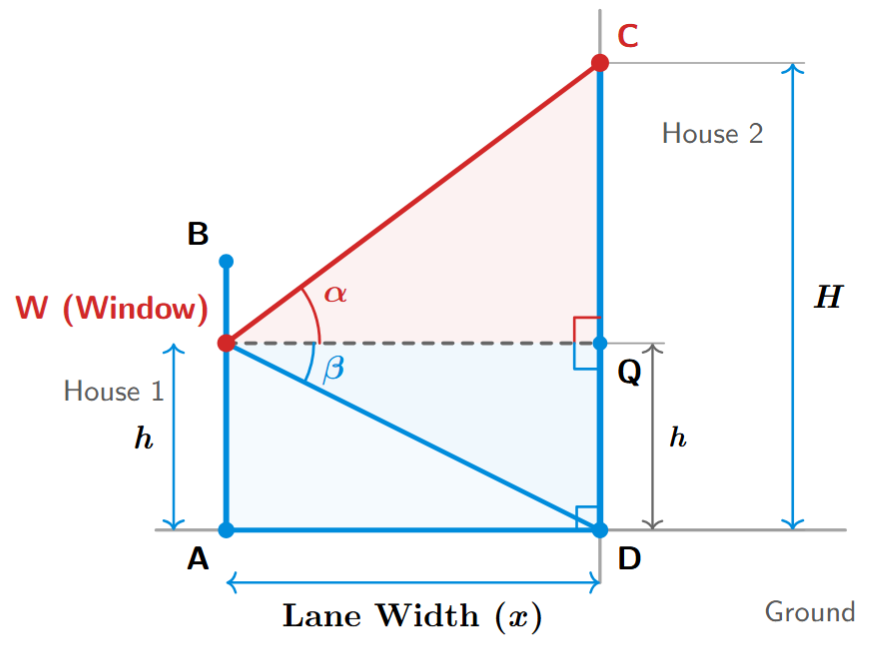
Proof:
Let $CD$ be the height of the second house. From the construction, $WQDA$ is a rectangle.
$QD = AW = h$
(Opposite sides of a rectangle)
Let the height of the second house $CD = H$.
Then, $CQ = CD - QD = H - h$.
In right-angled $\triangle WQD$:
$\tan \beta = \frac{QD}{WQ}$
$\tan \beta = \frac{h}{x}$
$x = \frac{h}{\tan \beta}$
$x = h \cot \beta$
... (i)
In right-angled $\triangle WQC$:
$\tan \alpha = \frac{CQ}{WQ}$
$\tan \alpha = \frac{CQ}{x}$
$CQ = x \tan \alpha$
Substituting the value of $x$ from equation (i):
$CQ = (h \cot \beta) \tan \alpha$
... (ii)
Now, the total height of the second house $CD$ is:
$H = CQ + QD$
$H = h \cot \beta \tan \alpha + h$
Taking $h$ as common factor:
$H = h ( \cot \beta \tan \alpha + 1 )$
$H = h ( 1 + \tan \alpha \cot \beta )$
Hence Proved.
Alternate Solution:
We can use the property of right triangles where the horizontal distance $x$ is common to both observations.
1. From the depression triangle, the width of the lane $x = h / \tan \beta$.
2. From the elevation triangle, the part of the house above the window level is $y = x \tan \alpha$.
3. Total height $H = h + y = h + x \tan \alpha$.
4. $H = h + (h / \tan \beta) \tan \alpha = h (1 + \frac{\tan \alpha}{\tan \beta})$.
5. Since $1/\tan \beta = \cot \beta$, we get $H = h (1 + \tan \alpha \cot \beta)$.
Question 18. The lower window of a house is at a height of 2 m above the ground and its upper window is 4 m vertically above the lower window. At certain instant the angles of elevation of a balloon from these windows are observed to be 60o and 30o , respectively. Find the height of the balloon above the ground.
Answer:
Given:
1. Height of the lower window from the ground = $2$ m.
2. Vertical distance between the lower and upper window = $4$ m.
3. Angle of elevation of the balloon from the lower window = $60^\circ$.
4. Angle of elevation of the balloon from the upper window = $30^\circ$.
To Find:
The height of the balloon above the ground ($H$).
Construction:
Let $G$ be the ground level. Let $W_1$ and $W_2$ be the positions of the lower and upper windows respectively. Let $B$ be the position of the balloon. Draw $W_1P \perp BG$ and $W_2Q \perp BG$. Let $H$ be the total height of the balloon from the ground ($BG = H$). Let the horizontal distance between the house and the balloon be $x$ m ($W_1P = W_2Q = x$).
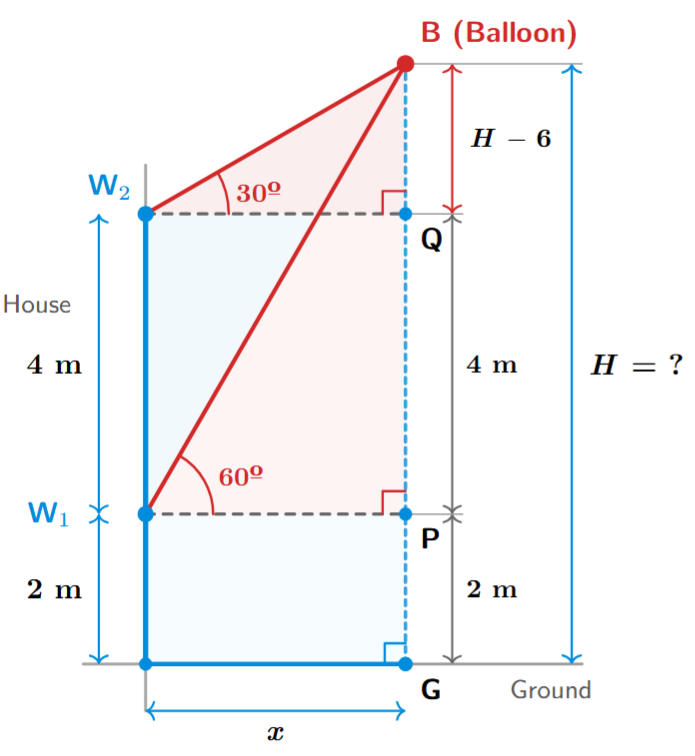
Solution:
The height of the lower window $W_1$ from ground is $2$ m. Thus, $PG = 2$ m.
The height of the upper window $W_2$ from ground is $2 + 4 = 6$ m. Thus, $QG = 6$ m.
Let the height of the balloon above the ground be $H$.
The height of the balloon above the lower window level is:
$BP = BG - PG = H - 2$
The height of the balloon above the upper window level is:
$BQ = BG - QG = H - 6$
In right-angled $\triangle BPW_1$:
$\tan 60^\circ = \frac{BP}{W_1P}$
$\sqrt{3} = \frac{H - 2}{x}$
$x = \frac{H - 2}{\sqrt{3}}$
... (i)
In right-angled $\triangle BQW_2$:
$\tan 30^\circ = \frac{BQ}{W_2Q}$
$\frac{1}{\sqrt{3}} = \frac{H - 6}{x}$
$x = (H - 6)\sqrt{3}$
... (ii)
Equating the values of $x$ from equations (i) and (ii):
$\frac{H - 2}{\sqrt{3}} = (H - 6)\sqrt{3}$
$H - 2 = 3(H - 6)$
$H - 2 = 3H - 18$
$3H - H = 18 - 2$
$2H = 16$
$H = 8$
Hence, the height of the balloon above the ground is 8 m.
Alternate Solution:
We can find the horizontal distance $x$ first. From the two triangles, we have:
$BP - BQ = (H - 2) - (H - 6) = 4$ m.
Also, $BP = x \tan 60^\circ$ and $BQ = x \tan 30^\circ$.
$x(\tan 60^\circ - \tan 30^\circ) = 4$
$x(\sqrt{3} - \frac{1}{\sqrt{3}}) = 4$
$x(\frac{3 - 1}{\sqrt{3}}) = 4 \implies \frac{2x}{\sqrt{3}} = 4 \implies x = 2\sqrt{3}$ m.
Now, $H = 2 + BP = 2 + x \tan 60^\circ = 2 + (2\sqrt{3})(\sqrt{3}) = 2 + 6 = 8$ m.