

Class 10 Maths Sample Paper Set I (NCERT Exemplar Solutions)
Welcome to the crucial resource for Class 10 Mathematics Sample Paper Set I, aligned with the rigorous NCERT Exemplar standards! These papers are meticulously designed to provide a truly realistic assessment experience by mirroring the difficulty level and diverse question typologies expected in final examinations. By focusing on Higher-Order Thinking Skills (HOTS) and application-based problems, these solutions build the analytical foundation and conceptual depth required to navigate the most demanding academic assessments.
The sample paper provides comprehensive coverage of the entire Class 10 syllabus, from Real Numbers and Polynomials to Trigonometry and Statistics. Students will master key formulas and theorems, such as the Quadratic Formula ($x = \frac{-b \pm \sqrt{D}}{2a}$), the Pythagoras Theorem ($a^2 + b^2 = c^2$), and the properties of Arithmetic Progressions ($a_n = a + (n-1)d$). A primary focus is placed on the integration of concepts across chapters, challenging students to apply geometric principles and algebraic manipulations to solve multifaceted problems.
Beyond providing final answers, this resource serves as a strategic learning tool to refine time management and model the expected standards for clear, logical answer presentation. These solutions provide a powerful mechanism for self-assessment, allowing students to accurately identify areas of weakness in complex topics like Surface Areas and Volumes or Circles. With step-by-step guidance and thorough justifications prepared by learningspot.co, students can master the critical skills needed to effectively solve integrated problems and approach their final revision cycles with confidence.
| Content On This Page | ||
|---|---|---|
| Section A | Section B | Section C |
| Section D | ||
Section A
Question 1. After how many decimal places will the decimal expansion of the number $\frac{47}{2^{3}5^{2}}$ terminate?
(A) 5
(B) 2
(C) 3
(D) 1
Answer:
Given:
The rational number is $\frac{47}{2^{3} \cdot 5^{2}}$.
To Find:
The number of decimal places after which the decimal expansion terminates.
Solution:
According to the Fundamental Theorem of Arithmetic, for a rational number in the form $\frac{p}{q}$ (where $p$ and $q$ are co-primes), the decimal expansion terminates if the prime factorisation of the denominator $q$ is of the form $2^m \cdot 5^n$, where $m, n$ are non-negative integers.
The number of decimal places after which the expansion terminates is equal to the maximum of $m$ and $n$.
In the given number $\frac{47}{2^{3} \cdot 5^{2}}$:
$m = 3$
[Power of 2]
$n = 2$
[Power of 5]
Since the maximum value between $3$ and $2$ is $3$, the decimal expansion will terminate after 3 decimal places.
Verification (Alternate Solution):
To convert the denominator into a power of $10$, we multiply both the numerator and the denominator by $5^1$:
$\frac{47}{2^{3} \cdot 5^{2}} = \frac{47 \times 5}{2^{3} \times 5^{2} \times 5}$
[Making powers of 2 and 5 equal] ... (i)
Now, substituting the value back into the equation:
$\frac{235}{2^{3} \cdot 5^{3}} = \frac{235}{(2 \times 5)^{3}}$
... (ii)
$\frac{235}{10^{3}} = \frac{235}{1000}$
... (iii)
$0.235$
[Decimal expansion]
We can clearly see that there are 3 digits after the decimal point.
Conclusion:
The decimal expansion terminates after 3 decimal places. Therefore, the correct option is (C).
Question 2. Euclid’s division lemma states that for two positive integers a and b, there exist unique integers q and r such that a = bq + r, where
(A) 0 ≤ r ≤ a
(B) 0 < r < b
(C) 0 ≤ r ≤ b
(D) 0 ≤ r < b
Answer:
Given:
Euclid’s division lemma states that for two positive integers $a$ and $b$, there exist unique integers $q$ and $r$ such that $a = bq + r$.
To Find:
The condition on the remainder $r$ in the statement of Euclid's division lemma.
Solution:
Euclid's division lemma (also known as the Euclidean Algorithm) is a fundamental theorem in number theory. It precisely defines the relationship between the dividend ($a$), the divisor ($b$), the quotient ($q$), and the remainder ($r$) when one positive integer is divided by another.
The statement of Euclid's division lemma is:
For any two positive integers $a$ and $b$, there exist unique integers $q$ (quotient) and $r$ (remainder) such that:
$a = bq + r$
The crucial condition on the remainder $r$ is that it must be non-negative and strictly less than the divisor $b$. This ensures the uniqueness of $q$ and $r$.
The condition is expressed as:
$0 \leq r < b$
This means the remainder $r$ can be zero (when $a$ is perfectly divisible by $b$) or any positive integer less than $b$.
Conclusion:
The condition on the remainder $r$ in Euclid’s division lemma is $0 \leq r < b$.
The correct option is (D) $0 \leq r < b$.
Question 3. The number of zeroes, the polynomial p (x) = (x – 2)2 + 4 can have, is
(A) 1
(B) 2
(C) 0
(D) 3
Answer:
Given:
The polynomial is $p(x) = (x - 2)^{2} + 4$.
To Find:
The number of real zeroes the polynomial $p(x)$ can have.
Solution:
A zero of a polynomial $p(x)$ is the value of $x$ for which $p(x) = 0$.
$(x - 2)^{2} + 4 = 0$
... (i)
$(x - 2)^{2} = -4$
[Transposing 4 to RHS]
We know that for any real number $x$, the square of a quantity, i.e., $(x - 2)^{2}$, is always non-negative (greater than or equal to zero).
$(x - 2)^{2} \geq 0$
... (ii)
Since a non-negative number cannot be equal to a negative number ($-4$), there is no real value of $x$ that satisfies equation (i).
Therefore, the polynomial has zero real zeroes.
Alternate Solution (Using Discriminant):
Let us expand the polynomial:
$p(x) = (x - 2)^{2} + 4$
$p(x) = (x^{2} - 4x + 4) + 4$
$p(x) = x^{2} - 4x + 8$
... (iii)
Comparing this with the standard quadratic form $ax^{2} + bx + c$, we get:
$a = 1, \ b = -4, \ c = 8$
The Discriminant ($D$) is given by $b^{2} - 4ac$:
$D = (-4)^{2} - 4(1)(8)$
$D = 16 - 32$
$D = -16$
... (iv)
Since the Discriminant ($D < 0$) is negative, the quadratic polynomial has no real roots (zeroes).
Conclusion:
The number of real zeroes is 0. Thus, the correct option is (C).
Question 4. A pair of linear equations a1x + b1y + c1 = 0; a2x + b2y + c2 = 0 is said to be inconsistent, if
(A) $\frac{a_{1}}{a_{2}} \neq \frac{b_{1}}{b_{2}}$
(B) $\frac{a_{1}}{a_{2}} \neq \frac{b_{1}}{b_{2}} = \frac{c_{1}}{c_{2}}$
(C) $\frac{a_{1}}{a_{2}} = \frac{b_{1}}{b_{2}} \neq \frac{c_{1}}{c_{2}}$
(D) $\frac{a_{1}}{a_{2}} \neq \frac{c_{1}}{c_{2}} $
Answer:
Given:
A pair of linear equations:
$a_1x + b_1y + c_1 = 0$
... (1)
$a_2x + b_2y + c_2 = 0$
... (2)
To Find:
The condition for the pair of linear equations to be inconsistent.
Solution:
A system of linear equations is said to be inconsistent if it has no solution. Graphically, this corresponds to two parallel lines that do not intersect.
For a pair of linear equations $a_1x + b_1y + c_1 = 0$ and $a_2x + b_2y + c_2 = 0$, the consistency and the nature of solutions are determined by comparing the ratios of the coefficients:
1. Unique Solution (Consistent): If the lines intersect at exactly one point, there is a unique solution. The condition for this is:
$\frac{a_{1}}{a_{2}} \neq \frac{b_{1}}{b_{2}}$
2. Infinitely Many Solutions (Consistent): If the lines are coincident (one lies exactly on top of the other), there are infinitely many solutions. The condition for this is:
$\frac{a_{1}}{a_{2}} = \frac{b_{1}}{b_{2}} = \frac{c_{1}}{c_{2}}$
3. No Solution (Inconsistent): If the lines are parallel and distinct (they never intersect), there is no solution. The condition for this is:
$\frac{a_{1}}{a_{2}} = \frac{b_{1}}{b_{2}} \neq \frac{c_{1}}{c_{2}}$
The question asks for the condition when the system is inconsistent, which means there is no solution.
Comparing the condition for no solution with the given options, we find that option (C) matches the condition for an inconsistent system.
$\frac{a_{1}}{a_{2}} = \frac{b_{1}}{b_{2}} \neq \frac{c_{1}}{c_{2}}$
Conclusion:
A pair of linear equations $a_1x + b_1y + c_1 = 0$ and $a_2x + b_2y + c_2 = 0$ is inconsistent if $\frac{a_{1}}{a_{2}} = \frac{b_{1}}{b_{2}} \neq \frac{c_{1}}{c_{2}}$.
The correct option is (C) $\frac{a_{1}}{a_{2}} = \frac{b_{1}}{b_{2}} \neq \frac{c_{1}}{c_{2}}$.
Question 5. The smallest value of k for which the equation x2 + kx + 9 = 0 has real roots, is
(A) – 6
(B) 6
(C) 36
(D) –3
Answer:
Given:
The given quadratic equation is:
$x^2 + kx + 9 = 0$
The equation is stated to have real roots.
To Find:
The smallest value of $k$ that satisfies the condition for real roots.
Solution:
A quadratic equation of the form $ax^2 + bx + c = 0$ has real roots if its discriminant $D$ is greater than or equal to zero ($D \geq 0$).
Comparing the given equation $x^2 + kx + 9 = 0$ with the standard form $ax^2 + bx + c = 0$, we have:
$a = 1$
$b = k$
$c = 9$
The formula for the discriminant is:
$D = b^2 - 4ac$
For real roots, the condition is:
$D \geq 0$
... (i)
Substituting the values of $a$, $b$, and $c$ in the inequality (i):
$k^2 - 4(1)(9) \geq 0$
$k^2 - 36 \geq 0$
$k^2 \geq 36$
To solve for $k$, we take the square root on both sides:
$\sqrt{k^2} \geq \sqrt{36}$
$|k| \geq 6$
This absolute value inequality represents two possible ranges for $k$:
$k \leq -6 \quad \text{or} \quad k \geq 6$
... (ii)
Now, let us examine the given options based on the condition derived in (ii):
(A) $-6$: This satisfies $k \leq -6$. It is a valid value for real roots.
(B) $6$: This satisfies $k \geq 6$. It is a valid value for real roots.
(C) $36$: This satisfies $k \geq 6$. It is a valid value for real roots.
(D) $-3$: This does not satisfy $k \leq -6$ or $k \geq 6$ (since $(-3)^2 = 9$, which is less than $36$).
The question asks for the smallest value of $k$. Comparing the valid options $-6$, $6$, and $36$, the smallest numerical value is $-6$.
Alternate Method (Checking Options):
We can substitute the values from the options into the discriminant formula $D = k^2 - 36$ and check for $D \geq 0$.
1. For $k = -6$: $D = (-6)^2 - 36 = 36 - 36 = 0$ (Roots are real and equal).
2. For $k = 6$: $D = (6)^2 - 36 = 36 - 36 = 0$ (Roots are real and equal).
3. For $k = 36$: $D = (36)^2 - 36 = 1296 - 36 = 1260$ (Roots are real and distinct).
4. For $k = -3$: $D = (-3)^2 - 36 = 9 - 36 = -27$ (Roots are imaginary).
Among the values that result in real roots ($-6, 6, 36$), the smallest value is $-6$.
Final Answer:
The smallest value of $k$ for which the equation has real roots is -6.
Hence, the correct option is (A).
Question 6. The coordinates of the points P and Q are (4, –3) and (–1, 7). Then the abscissa of a point R on the line segment PQ such that $\frac{PR}{PQ}$ = $\frac{3}{5}$ is
(A) $\frac{18}{5}$
(B) $\frac{17}{5}$
(C) $\frac{17}{8}$
(D) 1
Answer:
Given:
Coordinates of point $P(x_1, y_1) = (4, -3)$
Coordinates of point $Q(x_2, y_2) = (-1, 7)$
Point $R$ lies on the line segment $PQ$ such that:
$\frac{PR}{PQ} = \frac{3}{5}$
... (i)
To Find:
The abscissa (x-coordinate) of point $R$.
Solution:
Since point $R$ lies on the line segment $PQ$, the total length $PQ$ is the sum of $PR$ and $RQ$.
$PQ = PR + RQ$
(R lies on PQ)
From the given ratio in equation (i), we can say that if the total length $PQ$ is $5$ units, then $PR$ is $3$ units.
To find the length of $RQ$ in terms of the ratio:
$RQ = PQ - PR$
$RQ = 5 - 3 = 2 \text{ units}$
Therefore, point $R$ divides the line segment $PQ$ internally in the ratio $m : n$, where:
$m : n = PR : RQ = 3 : 2$
By using the Section Formula, the coordinates of a point $R(x, y)$ dividing the line segment joining $(x_1, y_1)$ and $(x_2, y_2)$ in the ratio $m : n$ are given by:
$x = \frac{mx_2 + nx_1}{m + n}$
Here, we only need to find the abscissa ($x$):
$m = 3$
$n = 2$
$x_1 = 4$
$x_2 = -1$
Substituting these values into the formula:
$x = \frac{3(-1) + 2(4)}{3 + 2}$
$x = \frac{-3 + 8}{5}$
$x = \frac{5}{5}$
$x = 1$
Final Answer:
The abscissa of point $R$ is 1.
Hence, the correct option is (D).
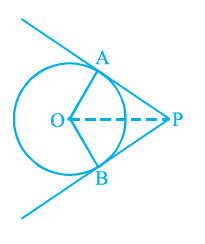
Question 7. In the adjoining figure, PA and PB are tangents from a point P to a circle with centre O. Then the quadrilateral OAPB must be a
(A) square
(B) rhombus
(C) cyclic quadrilateral
(D) parallelogram
Answer:
Given:
PA and PB are tangents drawn from an external point P to a circle with centre O. OAPB is a quadrilateral formed by joining the points O, A, P, and B.
To Determine:
The type of quadrilateral OAPB.
Solution:
We know the following properties related to tangents drawn from an external point to a circle:
1. The radius through the point of contact is perpendicular to the tangent.
Therefore, the radius OA is perpendicular to the tangent PA, and the radius OB is perpendicular to the tangent PB.
$\angle OAP = 90^\circ$
$\angle OBP = 90^\circ$
Now consider the quadrilateral OAPB. The sum of the interior angles of any quadrilateral is $360^\circ$.
So, in quadrilateral OAPB:
$\angle AOB + \angle OAP + \angle APB + \angle OBP = 360^\circ$
Substitute the values of $\angle OAP$ and $\angle OBP$:
$\angle AOB + 90^\circ + \angle APB + 90^\circ = 360^\circ$
$\angle AOB + \angle APB + 180^\circ = 360^\circ$
$\angle AOB + \angle APB = 360^\circ - 180^\circ$
$\angle AOB + \angle APB = 180^\circ$
We have found that the sum of the opposite angles $\angle AOB$ and $\angle APB$ is $180^\circ$.
We also know that the sum of the other pair of opposite angles is $\angle OAP + \angle OBP = 90^\circ + 90^\circ = 180^\circ$.
A quadrilateral is called a cyclic quadrilateral if the sum of each pair of opposite angles is $180^\circ$.
Since both pairs of opposite angles ($\angle OAP$ and $\angle OBP$; $\angle AOB$ and $\angle APB$) sum up to $180^\circ$, the quadrilateral OAPB is a cyclic quadrilateral.
Let's consider the other options:
- Square: A square requires all angles to be $90^\circ$ and all sides equal (OA=AP=PB=BO). While $\angle OAP = \angle OBP = 90^\circ$, $\angle AOB$ and $\angle APB$ are not necessarily $90^\circ$. Also, OA (radius) is not necessarily equal to AP (tangent length).
- Rhombus: A rhombus requires all sides to be equal (OA=AP=PB=BO). Again, OA is not necessarily equal to AP.
- Parallelogram: A parallelogram requires opposite angles to be equal and opposite sides parallel. While $\angle OAP = \angle OBP = 90^\circ$ (so opposite angles are equal), $\angle AOB$ is not necessarily equal to $\angle APB$.
The property that the sum of opposite angles is $180^\circ$ always holds for OAPB when PA and PB are tangents from P. This confirms that OAPB is a cyclic quadrilateral.
Conclusion:
The quadrilateral OAPB must be a cyclic quadrilateral.
The correct option is (C) cyclic quadrilateral.
Question 8. If for some angle θ , cot 2θ = $\frac{1}{\sqrt{3}}$ then the value of sin 3θ ,where 2θ ≤ 90° is
(A) $\frac{1}{\sqrt{2}}$
(B) 1
(C) 0
(D) $\frac{\sqrt{3}}{2}$
Answer:
Given:
$\cot 2\theta = \frac{1}{\sqrt{3}}$ and $2\theta \leq 90^\circ$.
To Find:
The value of $\sin 3\theta$.
Solution:
We are given that $\cot 2\theta = \frac{1}{\sqrt{3}}$.
We know the standard trigonometric values for common angles. The cotangent of $60^\circ$ is $\frac{1}{\sqrt{3}}$.
$\cot 60^\circ = \frac{1}{\sqrt{3}}$
Comparing the given equation with the standard value, we have:
$\cot 2\theta = \cot 60^\circ$
Since the angle $2\theta$ is in the range $2\theta \leq 90^\circ$, and the cotangent value is positive, $2\theta$ must be an angle in the first quadrant.
In the first quadrant, if $\cot A = \cot B$, then $A = B$.
Therefore, we can equate the angles:
$2\theta = 60^\circ$
Now, we can find the value of $\theta$:
$\theta = \frac{60^\circ}{2}$
$\theta = 30^\circ$
We need to find the value of $\sin 3\theta$. Substitute the value of $\theta$ we found:
$\sin 3\theta = \sin (3 \times 30^\circ)$
$\sin 3\theta = \sin 90^\circ$
We know the value of $\sin 90^\circ$:
$\sin 90^\circ = 1$
So, the value of $\sin 3\theta$ is 1.
Conclusion:
The value of $\sin 3\theta$ is 1.
The correct option is (B) 1.
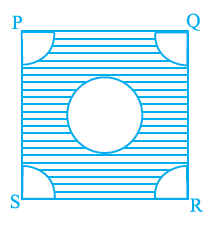
Question 9. From each corner of a square of side 4 cm, a quadrant of a circle of radius 1 cm is cut and also a circle of diameter 2 cm is cut as shown in figure. The area of the remaining (shaded) portion is
(A) (16 – 2π) cm2
(B) (16 – 5π) cm2
(C) 2π cm2
(D) 5π cm2
Answer:
Given:
Side of the square ($s$) = $4\text{ cm}$
Radius of each quadrant at the corners ($r$) = $1\text{ cm}$
Diameter of the central circle = $2\text{ cm}$
$\text{Radius of central circle } (r) = \frac{2}{2} = 1\text{ cm}$
To Find:
The area of the remaining (shaded) portion of the square.
Solution:
To find the area of the remaining portion, we need to subtract the area of the four quadrants and the area of the central circle from the total area of the square.
Step 1: Calculate the area of the square
The formula for the area of a square is $\text{side} \times \text{side}$.
$\text{Area of the square} = 4 \times 4 = 16\text{ cm}^2$
... (i)
Step 2: Calculate the area of the four quadrants
A quadrant is one-fourth of a circle. Therefore, four quadrants of the same radius together form a complete circle.
$\text{Area of 4 quadrants} = 4 \times \left( \frac{1}{4} \pi r^2 \right) = \pi r^2$
Substituting $r = 1\text{ cm}$:
$\text{Area of 4 quadrants} = \pi \times (1)^2 = \pi\text{ cm}^2$
... (ii)
Step 3: Calculate the area of the central circle
The radius of the central circle is also $1\text{ cm}$.
$\text{Area of the central circle} = \pi r^2$
$\text{Area of the central circle} = \pi \times (1)^2 = \pi\text{ cm}^2$
... (iii)
Step 4: Calculate the area of the remaining portion
$\text{Remaining Area} = \text{Area of Square} - (\text{Area of 4 quadrants} $$ + \text{Area of central circle})$
Using values from equations (i), (ii), and (iii):
$\text{Remaining Area} = 16 - (\pi + \pi)$
$\text{Remaining Area} = (16 - 2\pi)\text{ cm}^2$
Final Answer:
The area of the remaining (shaded) portion is $(16 - 2\pi)\text{ cm}^2$.
Hence, the correct option is (A).
Question 10. A letter of English alphabets is chosen at random. The probability that it is a letter of the word ‘MATHEMATICS’ is
(A) $\frac{11}{26}$
(B) $\frac{5}{13}$
(C) $\frac{9}{26}$
(D) $\frac{4}{13}$
Answer:
Given:
The word provided is ‘MATHEMATICS’.
A letter is chosen at random from the English alphabets.
To Find:
The probability that the chosen letter is one of the letters present in the word ‘MATHEMATICS’.
Solution:
Total number of letters in the English alphabet is 26.
Total outcomes $n(S) = 26$
... (i)
Now, let us identify the unique letters in the word ‘MATHEMATICS’:
The letters are: $M, \ A, \ T, \ H, \ E, \ M, \ A, \ T, \ I, \ C, \ S$.
The unique letters (distinct outcomes) are: M, A, T, H, E, I, C, S.
Counting the unique letters:
1. M
2. A
3. T
4. H
5. E
6. I
7. C
8. S
Number of favorable outcomes $n(E) = 8$
... (ii)
The formula for the probability of an event $E$ is given by:
$P(E) = \frac{\text{Number of favorable outcomes}}{\text{Total number of outcomes}}$
$P(E) = \frac{n(E)}{n(S)}$
Substituting the values from equations (i) and (ii):
$P(E) = \frac{8}{26}$
Simplifying the fraction by dividing both numerator and denominator by 2:
$P(E) = \frac{\cancel{8}^{4}}{\cancel{26}_{13}}$
$P(E) = \frac{4}{13}$
Final Answer:
The probability that a chosen letter is a letter of the word ‘MATHEMATICS’ is $\frac{4}{13}$.
Hence, the correct option is (D).
Section B
Question 11. Is there any natural number n for which 4n ends with the digit 0? Give reasons in support of your answer.
Answer:
To Find:
Whether there exists any natural number $n$ for which the expression $4^n$ ends with the digit 0.
Solution:
For a number to end with the digit 0, it must be divisible by 10.
The prime factors of 10 are 2 and 5. Therefore, any number ending with the digit 0 must have both 2 and 5 as its prime factors.
Let us examine the prime factorization of the given number $4^n$:
$4^n = (2 \times 2)^n$
$4^n = (2^2)^n = 2^{2n}$
... (i)
From equation (i), it is evident that the only prime factor of $4^n$ is 2.
The Fundamental Theorem of Arithmetic states that the prime factorization of every composite number is unique, apart from the order in which the prime factors occur.
Since the prime factorization of $4^n$ contains only the prime 2 and does not contain the prime 5, $4^n$ is not divisible by 5.
Because $4^n$ is not divisible by 5, it cannot be divisible by 10.
Therefore, there is no natural number $n$ for which $4^n$ ends with the digit 0.
Final Answer:
No, there is no natural number $n$ for which $4^n$ ends with the digit 0, because its prime factorization does not contain the factor 5.
Question 12. Without using the formula for the nth term, find which term of the AP : 5, 17, 29, 41, ... will be 120 more than its 15th term? Justify your answer.
OR
Is 144 a term of the AP : 3, 7, 11, ... ? Justify your answer.
Answer:
Question 12
Given:
The Arithmetic Progression (AP) is: $5, \ 17, \ 29, \ 41, \ \dots$
To Find:
The term of the AP which is $120$ more than its $15^{th}$ term, without using the $n^{th}$ term formula directly.
Solution:
First, we find the common difference ($d$) of the given AP:
$d = \text{Second term} - \text{First term}$
$d = 17 - 5 = 12$
... (i)
In an AP, each term is obtained by adding the common difference $d$ to the preceding term. Therefore, the difference between any two terms, say the $n^{th}$ term and the $m^{th}$ term, is always a multiple of the common difference $d$.
Specifically, the difference between the $n^{th}$ term and the $15^{th}$ term is given by:
$\text{Difference} = (n - 15) \times d$
... (ii)
According to the question, this difference is $120$. So,
$(n - 15) \times 12 = 120$
Dividing both sides by 12:
$(n - 15) = \frac{120}{12}$
$(n - 15) = 10$
Adding 15 to both sides:
$n = 10 + 15$
$n = 25$
This means the $25^{th}$ term is $10$ common differences ahead of the $15^{th}$ term.
Justification: Since each step in an AP increases the value by $d = 12$, to increase the value by $120$, we need $\frac{120}{12} = 10$ more steps. Adding $10$ steps to the $15^{th}$ term brings us to the $(15 + 10) = 25^{th}$ term.
Final Answer: The 25th term of the AP will be 120 more than its 15th term.
OR Question
Given:
The Arithmetic Progression (AP) is: $3, \ 7, \ 11, \ \dots$
Target value = $144$
To Find:
Whether $144$ is a term of the given AP.
Solution:
For the given AP:
First term ($a$) = $3$
Common difference ($d$) = $7 - 3 = 4$
Let $144$ be the $n^{th}$ term of the AP.
The formula for the $n^{th}$ term ($a_n$) of an AP is:
$a_n = a + (n - 1)d$
Substituting the known values:
$144 = 3 + (n - 1)4$
Subtracting 3 from both sides:
$144 - 3 = (n - 1)4$
$141 = (n - 1)4$
Dividing by 4:
$(n - 1) = \frac{141}{4}$
$(n - 1) = 35.25$
$n = 35.25 + 1$
$n = 36.25$
Justification: The position of a term ($n$) in an AP must always be a natural number (i.e., $1, 2, 3, \dots$). Since the value of $n$ calculated here is $36.25$, which is not a whole number or natural number, $144$ cannot be a term of the given progression.
Final Answer: No, 144 is not a term of the AP: 3, 7, 11, ...
Question 13. The coordinates of the points P, Q and R are (3, 4), (3, –4) and (–3, 4), respectively. Is the area of ∆PQR 24 sq. units? Justify your answer.
Answer:
Given:
The coordinates of the vertices of the triangle are:
$P(x_1, y_1) = (3, 4)$
$Q(x_2, y_2) = (3, -4)$
$R(x_3, y_3) = (-3, 4)$
Stated area of $\Delta PQR = 24$ sq. units.
To Find:
Verify whether the area of $\Delta PQR$ is indeed $24$ sq. units and justify the answer.
Solution:
The area of a triangle with vertices $(x_1, y_1)$, $(x_2, y_2)$, and $(x_3, y_3)$ is given by the formula:
$\text{Area} = \frac{1}{2} |x_1(y_2 - y_3) + x_2(y_3 - y_1) + x_3(y_1 - y_2)|$
... (i)
Substituting the given coordinates into the formula:
$\text{Area} = \frac{1}{2} |3(-4 - 4) + 3(4 - 4) + (-3)(4 - (-4))|$
$\text{Area} = \frac{1}{2} |3(-8) + 3(0) - 3(4 + 4)|$
$\text{Area} = \frac{1}{2} |-24 + 0 - 3(8)|$
$\text{Area} = \frac{1}{2} |-24 - 24|$
$\text{Area} = \frac{1}{2} |-48|$
$\text{Area} = \frac{48}{2} = 24$ sq. units
[Area is always positive] ... (ii)
Justification: Since the calculated area matches the stated area, the given statement is correct.
Alternate Solution:
We can also justify this by observing the positions of the points on a Cartesian plane.
1. Points $P(3, 4)$ and $Q(3, -4)$ have the same x-coordinate ($x=3$). Therefore, $PQ$ is a vertical line segment.
Length $PQ = |4 - (-4)| = 8$ units
(Height)
2. Points $P(3, 4)$ and $R(-3, 4)$ have the same y-coordinate ($y=4$). Therefore, $PR$ is a horizontal line segment.
Length $PR = |3 - (-3)| = 6$ units
(Base)
3. Since $PQ$ is vertical and $PR$ is horizontal, they are perpendicular to each other. This means $\Delta PQR$ is a right-angled triangle at $P$.
$\text{Area of } \Delta PQR = \frac{1}{2} \times \text{Base} \times \text{Height}$
$\text{Area} = \frac{1}{2} \times 6 \times 8$
$\text{Area} = 3 \times 8 = 24$ sq. units.
Final Answer:
Yes, the area of $\Delta PQR$ is 24 sq. units. The calculation through the area formula and the geometric property of the right-angled triangle both confirm this result.
Question 14. The length of a line segment is 10 units. If one end is (2, –3) and the abscissa of the other end is 10, then its ordinate is either 3 or –9. Give justification for the two answers.
Answer:
Given:
Length of the line segment = $10$ units.
Coordinates of one end point $P(x_1, y_1) = (2, -3)$.
Coordinates of the other end point $Q(x_2, y_2) = (10, y)$.
$\text{Abscissa} = 10, \text{ Ordinate} = y$
(Given)
To Find:
The possible values of the ordinate ($y$) of point $Q$.
Solution:
The distance between two points $(x_1, y_1)$ and $(x_2, y_2)$ is calculated using the Distance Formula:
$\text{Distance} = \sqrt{(x_2 - x_1)^2 + (y_2 - y_1)^2}$
Substituting the given values into the formula:
$10 = \sqrt{(10 - 2)^2 + (y - (-3))^2}$
$10 = \sqrt{(8)^2 + (y + 3)^2}$
[Distance is 10 units] ... (i)
To eliminate the square root, we square both sides of the equation:
$(10)^2 = (8)^2 + (y + 3)^2$
$100 = 64 + (y + 3)^2$
Subtracting 64 from both sides:
$100 - 64 = (y + 3)^2$
$36 = (y + 3)^2$
Taking the square root on both sides:
$\pm \sqrt{36} = y + 3$
$y + 3 = \pm 6$
... (ii)
This gives us two distinct cases for the value of $y$:
Case 1: Taking the positive root
$y + 3 = 6$
$y = 6 - 3$
$y = 3$
... (iii)
Case 2: Taking the negative root
$y + 3 = -6$
$y = -6 - 3$
$y = -9$
... (iv)
Justification:
The distance formula leads to a quadratic equation in terms of $y$. Since a quadratic equation generally has two solutions, we obtain two possible values for the ordinate. Geometrically, this means there are two points on the vertical line $x = 10$ that are exactly $10$ units away from the point $(2, -3)$, one located above the level of the first point and one located below it.
Final Answer:
The ordinate of the other end of the line segment is indeed either 3 or -9.
Question 15. What is the maximum value of $\frac{3}{cosec\;\theta}$ ? Justify your answer.
Answer:
Given:
The trigonometric expression is:
$\frac{3}{\text{cosec} \theta}$
To Find:
The maximum value of the given expression.
Solution:
We know the reciprocal relationship between the sine and cosecant functions:
$\sin \theta = \frac{1}{\text{cosec} \theta}$
(Reciprocal Identity)
By using this identity, the given expression can be rewritten as:
$\frac{3}{\text{cosec} \theta} = 3 \times \frac{1}{\text{cosec} \theta}$
$\frac{3}{\text{cosec} \theta} = 3 \sin \theta$
... (i)
Now, let us observe the values of $\sin \theta$ for angles between $0^\circ$ and $90^\circ$ as provided in the standard trigonometric table:
For $\theta = 0^\circ, \ \sin 0^\circ = 0$
For $\theta = 30^\circ, \ \sin 30^\circ = \frac{1}{2} = 0.5$
For $\theta = 45^\circ, \ \sin 45^\circ = \frac{1}{\sqrt{2}} \approx 0.707$
For $\theta = 60^\circ, \ \sin 60^\circ = \frac{\sqrt{3}}{2} \approx 0.866$
$\text{For } \theta = 90^\circ, \ \sin 90^\circ = 1$
... (ii)
From the above values, we can see that as the angle $\theta$ increases from $0^\circ$ to $90^\circ$, the value of $\sin \theta$ also increases from 0 to 1.
Therefore, the maximum value of $\sin \theta$ for $0^\circ \leq \theta \leq 90^\circ$ is 1.
Using this in equation (i):
$\text{Maximum value of } 3 \sin \theta = 3 \times (\text{Maximum value of } \sin \theta)$
$\text{Maximum value} = 3 \times 1$
$\text{Maximum value} = 3$
Final Answer:
The maximum value of $\frac{3}{\text{cosec} \theta}$ is 3.
Section C
Question 16. Find the zeroes of the polynomial p (x) = 4$\sqrt{3}$ x2 - 2$\sqrt{3}$ - 2$\sqrt{3}$ and verify the relationship between the zeroes and the coefficients.
OR
On dividing the polynomial f (x) = x3 – 5x2 + 6x – 4 by a polynomial g(x), the quotient q(x) and remainder r(x) are x – 3, –3x + 5, respectively. Find the polynomial g(x).
Answer:
Question 16 (First Part)
Given:
The quadratic polynomial is $p(x) = 4\sqrt{3}x^2 + 5x - 2\sqrt{3}$.
(Note: Based on the standard NCERT Exemplar Question 16, the middle term is $+ 5x$. We will proceed with this corrected polynomial.)
To Find:
1. The zeroes of the polynomial $p(x)$.
2. Verify the relationship between the zeroes and the coefficients.
Solution:
To find the zeroes, we set $p(x) = 0$:
$4\sqrt{3}x^2 + 5x - 2\sqrt{3} = 0$
We use the method of splitting the middle term. We need two numbers whose sum is $5$ and whose product is $(4\sqrt{3}) \times (-2\sqrt{3}) = -8 \times 3 = -24$.
The numbers are $8$ and $-3$ (since $8 - 3 = 5$ and $8 \times -3 = -24$).
$4\sqrt{3}x^2 + 8x - 3x - 2\sqrt{3} = 0$
$4x(\sqrt{3}x + 2) - \sqrt{3}(\sqrt{3}x + 2) = 0$
$(\sqrt{3}x + 2)(4x - \sqrt{3}) = 0$
This gives two cases:
Case 1: $\sqrt{3}x + 2 = 0 \implies x = -\frac{2}{\sqrt{3}}$
Case 2: $4x - \sqrt{3} = 0 \implies x = \frac{\sqrt{3}}{4}$
$\text{Zeroes: } \alpha = -\frac{2}{\sqrt{3}}, \beta = \frac{\sqrt{3}}{4}$
... (i)
Verification:
Comparing $4\sqrt{3}x^2 + 5x - 2\sqrt{3}$ with $ax^2 + bx + c$, we have:
$a = 4\sqrt{3}, \ b = 5, \ c = -2\sqrt{3}$
1. Sum of zeroes:
$\alpha + \beta = -\frac{2}{\sqrt{3}} + \frac{\sqrt{3}}{4} = \frac{-8 + 3}{4\sqrt{3}} = -\frac{5}{4\sqrt{3}}$
$-\frac{b}{a} = -\frac{5}{4\sqrt{3}}$
$\text{Hence, } \alpha + \beta = -\frac{b}{a}$
2. Product of zeroes:
$\alpha \beta = \left( -\frac{2}{\sqrt{3}} \right) \left( \frac{\sqrt{3}}{4} \right) = -\frac{2}{4} = -\frac{1}{2}$
$\frac{c}{a} = \frac{-2\sqrt{3}}{4\sqrt{3}} = -\frac{2}{4} = -\frac{1}{2}$
$\text{Hence, } \alpha \beta = \frac{c}{a}$
The relationship between zeroes and coefficients is verified.
OR Question
Given:
Dividend $f(x) = x^3 - 5x^2 + 6x - 4$
Quotient $q(x) = x - 3$
Remainder $r(x) = -3x + 5$
To Find:
The divisor polynomial $g(x)$.
Solution:
According to the Division Algorithm for Polynomials:
$f(x) = g(x) \cdot q(x) + r(x)$
... (ii)
Substituting the given values:
$x^3 - 5x^2 + 6x - 4 = g(x) \cdot (x - 3) + (-3x + 5)$
Subtracting the remainder from the dividend:
$g(x) \cdot (x - 3) = (x^3 - 5x^2 + 6x - 4) - (-3x + 5)$
$g(x) \cdot (x - 3) = x^3 - 5x^2 + 6x - 4 + 3x - 5$
$g(x) \cdot (x - 3) = x^3 - 5x^2 + 9x - 9$
To find $g(x)$, we divide $(x^3 - 5x^2 + 9x - 9)$ by $(x - 3)$ using Long Division:
$\begin{array}{r} x^2 - 2x + 3 \phantom{x^3-5x^2)} \\ x-3{\overline{\smash{\big)}\,x^3-5x^2+9x-9\phantom{)}}} \\ \underline{-~\phantom{(}(x^3-3x^2)\phantom{-b--)}} \\ -2x^2+9x\phantom{)} \\ \underline{-~\phantom{()}(-2x^2+6x)} \\ 3x-9\phantom{)} \\ \underline{-~\phantom{()}(3x-9)} \\ 0\phantom{)} \end{array}$
Final Answer:
The polynomial $g(x)$ is $x^2 - 2x + 3$.
Question 17. Solve the equations 5x – y = 5 and 3x – y = 3 graphically.
Answer:
Given:
The pair of linear equations are:
$5x - y = 5$
…(i)
$3x - y = 3$
…(ii)
To Find:
The solution of the given system of equations graphically.
Solution:
To solve the equations graphically, we first find at least two or three points (coordinates) for each equation.
Step 1: Points for Equation (i) $5x - y = 5$
We can rewrite the equation as $y = 5x - 5$.
1. If $x = 0$, then $y = 5(0) - 5 = -5$.
2. If $x = 1$, then $y = 5(1) - 5 = 0$.
3. If $x = 2$, then $y = 5(2) - 5 = 5$.
| $x$ | $y = 5x - 5$ | Point $(x, y)$ |
| 0 | -5 | (0, -5) |
| 1 | 0 | (1, 0) |
| 2 | 5 | (2, 5) |
Step 2: Points for Equation (ii) $3x - y = 3$
We can rewrite the equation as $y = 3x - 3$.
1. If $x = 0$, then $y = 3(0) - 3 = -3$.
2. If $x = 1$, then $y = 3(1) - 3 = 0$.
3. If $x = 2$, then $y = 3(2) - 3 = 3$.
| $x$ | $y = 3x - 3$ | Point $(x, y)$ |
| 0 | -3 | (0, -3) |
| 1 | 0 | (1, 0) |
| 2 | 3 | (2, 3) |
Step 3: Plotting the Graph
Plot the points from both tables on a graph paper and join them to form two straight lines.
From the graph, we observe that the two lines intersect at a specific point.
\text{Point of Intersection} = (1, 0)
(From Plotting)
The coordinates of the point of intersection are $x = 1$ and $y = 0$.
Final Answer:
The solution of the given pair of linear equations is $x = 1$ and $y = 0$.
Question 18. If the sum of the first n terms of an AP is 4n – n2, what is the 10th term and the nth term?
OR
How many terms of the AP : 9, 17, 25, ... must be taken to give a sum 636?
Answer:
Question 18
Given:
The sum of the first $n$ terms of an AP is given by the formula:
$S_n = 4n - n^2$
To Find:
The $n^{th}$ term ($a_n$) and the $10^{th}$ term ($a_{10}$).
Solution:
We know that the $n^{th}$ term of an AP can be found using the relationship between the $n^{th}$ term and the sum of terms:
$a_n = S_n - S_{n-1}$
[For $n > 1$] ... (i)
First, let us find the expression for $S_{n-1}$ by replacing $n$ with $(n-1)$ in the given formula:
$S_{n-1} = 4(n-1) - (n-1)^2$
$S_{n-1} = 4n - 4 - (n^2 - 2n + 1)$
$S_{n-1} = 4n - 4 - n^2 + 2n - 1$
$S_{n-1} = -n^2 + 6n - 5$
... (ii)
Now, substitute the expressions for $S_n$ and $S_{n-1}$ into equation (i):
$a_n = (4n - n^2) - (-n^2 + 6n - 5)$
$a_n = 4n - n^2 + n^2 - 6n + 5$
$a_n = 4n - 6n + 5$
$a_n = 5 - 2n$
This is the expression for the $n^{th}$ term.
To find the $10^{th}$ term, we substitute $n = 10$ in the expression for $a_n$:
$a_{10} = 5 - 2(10)$
$a_{10} = 5 - 20$
$a_{10} = -15$
Final Answer:
The $n^{th}$ term is $5 - 2n$ and the $10^{th}$ term is $-15$.
OR Question
Given:
The Arithmetic Progression (AP) is: $9, \ 17, \ 25, \ \dots$
Sum required ($S_n$) = $636$
To Find:
The number of terms ($n$) that must be taken to get the sum $636$.
Solution:
From the given AP:
First term ($a$) = $9$
Common difference ($d$) = $17 - 9 = 8$
The formula for the sum of the first $n$ terms is:
$S_n = \frac{n}{2} [2a + (n-1)d]$
Substituting the values of $S_n$, $a$, and $d$:
$636 = \frac{n}{2} [2(9) + (n-1)8]$
$636 = \frac{n}{2} [18 + 8n - 8]$
$636 = \frac{n}{2} [10 + 8n]$
Taking 2 common from the bracket:
$636 = \frac{n}{2} \times 2 [5 + 4n]$
$636 = n(5 + 4n)$
$636 = 5n + 4n^2$
Rearranging into a standard quadratic equation form:
$4n^2 + 5n - 636 = 0$
We solve this quadratic equation using the Quadratic Formula: $n = \frac{-b \pm \sqrt{b^2 - 4ac}}{2a}$
Here, $a = 4$, $b = 5$, and $c = -636$.
$D = b^2 - 4ac$
$D = (5)^2 - 4(4)(-636)$
$D = 25 + 10176$
$D = 10201$
Now, finding $n$:
$n = \frac{-5 \pm \sqrt{10201}}{2(4)}$
$n = \frac{-5 \pm 101}{8}$
This gives two possible values for $n$:
1. $n = \frac{-5 + 101}{8} = \frac{96}{8} = 12$
2. $n = \frac{-5 - 101}{8} = \frac{-106}{8} = -13.25$
Since the number of terms $n$ must be a natural number, we reject the negative and fractional value.
$n = 12$
(Valid Answer)
Final Answer:
12 terms of the AP must be taken to give a sum of 636.
Question 19. If (1, 2), (4, y), (x, 6) and (3, 5) are the vertices of a parallelogram taken in order, find the values of x and y.
Answer:
Given:
The vertices of a parallelogram taken in order are:
$A(x_1, y_1) = (1, 2)$
$B(x_2, y_2) = (4, y)$
$C(x_3, y_3) = (x, 6)$
$D(x_4, y_4) = (3, 5)$
To Find:
The values of $x$ and $y$.
Solution:
In a parallelogram, the diagonals bisect each other. This means that the midpoint of the diagonal $AC$ is the same as the midpoint of the diagonal $BD$.
The Midpoint Formula for a line segment joining $(x_1, y_1)$ and $(x_2, y_2)$ is given by:
$\text{Midpoint} = \left( \frac{x_1 + x_2}{2}, \frac{y_1 + y_2}{2} \right)$
Step 1: Find the midpoint of diagonal $AC$
Using vertices $A(1, 2)$ and $C(x, 6)$:
$\text{Midpoint of } AC = \left( \frac{1 + x}{2}, \frac{2 + 6}{2} \right)$
$\text{Midpoint of } AC = \left( \frac{1 + x}{2}, 4 \right)$
... (i)
Step 2: Find the midpoint of diagonal $BD$
Using vertices $B(4, y)$ and $D(3, 5)$:
$\text{Midpoint of } BD = \left( \frac{4 + 3}{2}, \frac{y + 5}{2} \right)$
$\text{Midpoint of } BD = \left( \frac{7}{2}, \frac{y + 5}{2} \right)$
... (ii)
Step 3: Equate the coordinates
Since the diagonals bisect each other, the midpoints from (i) and (ii) must be equal.
Comparing the x-coordinates:
$\frac{1 + x}{2} = \frac{7}{2}$
$1 + x = 7$
$x = 6$
... (iii)
Comparing the y-coordinates:
$4 = \frac{y + 5}{2}$
$8 = y + 5$
$y = 8 - 5$
$y = 3$
... (iv)
Final Answer:
The value of $x$ is 6 and the value of $y$ is 3.
Question 20. The sides AB, BC and median AD of a ∆ABC are respectively propotional to the sides PQ, QR and the median PM of ∆PQR. Show that ∆ABC ~ ∆PQR.
Answer:
Given:
In $\Delta ABC$, $AD$ is the median to the side $BC$.
In $\Delta PQR$, $PM$ is the median to the side $QR$.
It is given that:
$\frac{AB}{PQ} = \frac{BC}{QR} = \frac{AD}{PM}$
... (i)
To Prove:
$\Delta ABC \sim \Delta PQR$
Image:
Proof:
Since $AD$ is the median of $\Delta ABC$, $D$ is the midpoint of $BC$.
$BC = 2BD$
(D is midpoint of BC)
Similarly, since $PM$ is the median of $\Delta PQR$, $M$ is the midpoint of $QR$.
$QR = 2QM$
(M is midpoint of QR)
Now, substituting these values into the given ratio from equation (i):
$\frac{AB}{PQ} = \frac{2BD}{2QM} = \frac{AD}{PM}$
By canceling the common factor 2 in the middle term:
$\frac{AB}{PQ} = \frac{BD}{QM} = \frac{AD}{PM}$
... (ii)
In $\Delta ABD$ and $\Delta PQM$, all three corresponding sides are proportional as shown in equation (ii). Therefore, by SSS Similarity Criterion:
$\Delta ABD \sim \Delta PQM$
Since corresponding angles of similar triangles are equal, we have:
$\angle B = \angle Q$
[Corresponding angles of similar triangles] ... (iii)
Now, consider the larger triangles $\Delta ABC$ and $\Delta PQR$:
1. From the given equation (i), we have:
$\frac{AB}{PQ} = \frac{BC}{QR}$
2. From equation (iii), we have:
$\angle B = \angle Q$
Since two pairs of sides are proportional and the included angles are equal, by the SAS Similarity Criterion:
$\Delta ABC \sim \Delta PQR$
Hence Proved.
Question 21. A triangle ABC is drawn to circumscribe a circle of radius 4 cm such that the segments BD and DC into which BC is divided by the point of contact D are of lengths 8 cm and 7 cm, respectively. Find the sides AB and AC.
Answer:
Given:
A triangle $ABC$ circumscribes a circle with center $O$ and radius $r = 4\text{ cm}$.
The circle touches the side $BC$ at point $D$ such that $BD = 8\text{ cm}$ and $DC = 7\text{ cm}$.
To Find:
The lengths of the sides AB and AC.
Construction:
1. Let the points of contact of the circle with sides $AC$ and $AB$ be $E$ and $F$ respectively.
2. Join the center $O$ to the points of contact $D, E, F$ and to the vertices $A, B, C$.
Solution:
We know that the lengths of tangents drawn from an external point to a circle are equal.
$BD = BF = 8\text{ cm}$
(Tangents from point B)
$CD = CE = 7\text{ cm}$
(Tangents from point C)
Let the length of the tangents from point $A$ be $x$.
$AF = AE = x\text{ cm}$
... (i)
Now, the lengths of the sides of the triangle are:
$a = BC = 8 + 7 = 15\text{ cm}$
$b = AC = x + 7\text{ cm}$
$c = AB = x + 8\text{ cm}$
The semi-perimeter ($s$) of $\Delta ABC$ is:
$s = \frac{a + b + c}{2} = \frac{15 + (x + 7) + (x + 8)}{2}$
$s = \frac{2x + 30}{2} = x + 15\text{ cm}$
... (ii)
Step 1: Area of $\Delta ABC$ using Heron's Formula
$\text{Area} = \sqrt{s(s-a)(s-b)(s-c)}$
$\text{Area} = \sqrt{(x + 15)(x + 15 - 15)(x + 15 - (x + 7))(x + 15 - (x + 8))}$
$\text{Area} = \sqrt{(x + 15)(x)(8)(7)}$
$\text{Area} = \sqrt{56x(x + 15)}$
... (iii)
Step 2: Area of $\Delta ABC$ using In-radius
The total area of the triangle is the sum of the areas of triangles $OBC$, $OAC$, and $OAB$.
$\text{Area} = \text{Area}(\Delta OBC) + \text{Area}(\Delta OAC) + \text{Area}(\Delta OAB)$
$\text{Area} = \frac{1}{2}(BC \times r) + \frac{1}{2}(AC \times r) + \frac{1}{2}(AB \times r)$
$\text{Area} = \frac{1}{2} \times r \times (a + b + c) = r \times s$
Substituting $r = 4$ and $s = x + 15$:
$\text{Area} = 4(x + 15)$
... (iv)
Step 3: Equating the two area expressions
From (iii) and (iv):
$\sqrt{56x(x + 15)} = 4(x + 15)$
Squaring both sides:
$56x(x + 15) = 16(x + 15)^2$
Dividing both sides by $8(x + 15)$ (since $x + 15 \neq 0$):
$7x = 2(x + 15)$
$7x = 2x + 30$
$5x = 30$
$x = 6\text{ cm}$
... (v)
Step 4: Finding the sides
$AB = x + 8 = 6 + 8 = 14\text{ cm}$
$AC = x + 7 = 6 + 7 = 13\text{ cm}$
Final Answer:
The sides of the triangle are AB = 14 cm and AC = 13 cm.
Question 22. Construct an isosceles triangle whose base is 6 cm and altitude 5 cm and then another triangle whose sides are $\frac{7}{5}$ of the corresponding sides of the isosceles triangle.
Answer:
Given:
1. An isosceles triangle with base = $6\text{ cm}$ and altitude = $5\text{ cm}$.
2. Scale factor for the new triangle = $\frac{7}{5}$.
To Construct:
A triangle $\Delta A'BC'$ similar to the isosceles triangle $\Delta ABC$ such that its sides are $\frac{7}{5}$ of the corresponding sides of $\Delta ABC$.
Steps of Construction:
1. Draw a line segment $BC = 6\text{ cm}$.
2. Draw the perpendicular bisector of $BC$ and let it intersect $BC$ at point $M$.
3. Mark a point $A$ on the perpendicular bisector such that $MA = 5\text{ cm}$.
4. Join $AB$ and $AC$. Now, $\Delta ABC$ is the required isosceles triangle.
5. Draw a ray $BX$ making an acute angle with $BC$ on the side opposite to vertex $A$.
6. Locate 7 points $B_1, B_2, B_3, B_4, B_5, B_6,$ and $B_7$ on $BX$ such that:
$BB_1 = B_1B_2 = B_2B_3 = B_3B_4 = B_4B_5 = B_5B_6 = B_6B_7$
7. Join $B_5$ (the $5^{th}$ point, as the denominator is 5) to $C$.
8. Draw a line through $B_7$ (the $7^{th}$ point, as the numerator is 7) parallel to $B_5C$, intersecting the extended line segment $BC$ at $C'$.
9. Draw a line through $C'$ parallel to $CA$, intersecting the extended line segment $BA$ at $A'$.
10. $\Delta A'BC'$ is the required triangle.
Image:
Justification:
By construction, $C'A' \parallel CA$. Therefore, by the AA Similarity Criterion:
$\Delta ABC \sim \Delta A'BC'$
Also, since $B_7C' \parallel B_5C$, by the Basic Proportionality Theorem in $\Delta BB_7C'$:
$\frac{BC'}{BC} = \frac{BB_7}{BB_5} = \frac{7}{5}$
Since the triangles are similar, the ratio of all corresponding sides will be the same:
$\frac{A'B}{AB} = \frac{BC'}{BC} = \frac{A'C'}{AC} = \frac{7}{5}$
... (i)
This justifies that the sides of the new triangle are $\frac{7}{5}$ of the corresponding sides of the original triangle.
Question 23. Prove that $\frac{\cos\;\theta \;-\; \sin\;\theta\;+\;1}{\sin\;\theta\;+\;\cos\;\theta\;-\;1}=\frac{1}{cosec\;\theta\;-\;\cot\;\theta}$
OR
Evaluate:
$\left( \frac{3cos \;43^\circ}{sin \;47^\circ} \right)^2 - \frac{cos \;37^\circ\; cosec\;53^\circ}{tan \;5^\circ \;tan \;25^\circ \;tan \;45^\circ \;tan \;65^\circ \;tan \;85^\circ}$
Answer:
Question 23
To Prove:
$\frac{\cos\theta - \sin\theta + 1}{\sin\theta + \cos\theta - 1} = \frac{1}{\text{cosec}\theta - \cot\theta}$
Proof:
Let us consider the Left Hand Side (LHS) of the equation:
$LHS = \frac{\cos\theta - \sin\theta + 1}{\sin\theta + \cos\theta - 1}$
To convert this into the terms of $\text{cosec}\theta$ and $\cot\theta$, we divide both the numerator and the denominator by $\sin\theta$:
$LHS = \frac{\frac{\cos\theta}{\sin\theta} - \frac{\sin\theta}{\sin\theta} + \frac{1}{\sin\theta}}{\frac{\sin\theta}{\sin\theta} + \frac{\cos\theta}{\sin\theta} - \frac{1}{\sin\theta}}$
$LHS = \frac{\cot\theta - 1 + \text{cosec}\theta}{1 + \cot\theta - \text{cosec}\theta}$
$\left( \because \frac{\cos\theta}{\sin\theta} = \cot\theta, \frac{1}{\sin\theta} = \text{cosec}\theta \right)$
Rearranging the terms in the numerator:
$LHS = \frac{(\text{cosec}\theta + \cot\theta) - 1}{1 - \text{cosec}\theta + \cot\theta}$
We know the trigonometric identity:
$\text{cosec}^2\theta - \cot^2\theta = 1$
... (i)
Substituting the value of $1$ from equation (i) into the numerator:
$LHS = \frac{(\text{cosec}\theta + \cot\theta) - (\text{cosec}^2\theta - \cot^2\theta)}{1 - \text{cosec}\theta + \cot\theta}$
Using the algebraic identity $a^2 - b^2 = (a-b)(a+b)$:
$LHS = \frac{(\text{cosec}\theta + \cot\theta) - [(\text{cosec}\theta - \cot\theta)(\text{cosec}\theta + \cot\theta)]}{1 - \text{cosec}\theta + \cot\theta}$
Taking $(\text{cosec}\theta + \cot\theta)$ as common from the numerator:
$LHS = \frac{(\text{cosec}\theta + \cot\theta) [1 - (\text{cosec}\theta - \cot\theta)]}{1 - \text{cosec}\theta + \cot\theta}$
$LHS = \frac{(\text{cosec}\theta + \cot\theta) (1 - \text{cosec}\theta + \cot\theta)}{1 - \text{cosec}\theta + \cot\theta}$
Canceling the common term $(1 - \text{cosec}\theta + \cot\theta)$:
$LHS = \text{cosec}\theta + \cot\theta$
... (ii)
Now, let us simplify the Right Hand Side (RHS):
$RHS = \frac{1}{\text{cosec}\theta - \cot\theta}$
To rationalize the denominator, multiply and divide by $(\text{cosec}\theta + \cot\theta)$:
$RHS = \frac{1}{\text{cosec}\theta - \cot\theta} \times \frac{\text{cosec}\theta + \cot\theta}{\text{cosec}\theta + \cot\theta}$
$RHS = \frac{\text{cosec}\theta + \cot\theta}{\text{cosec}^2\theta - \cot^2\theta}$
Using the identity $\text{cosec}^2\theta - \cot^2\theta = 1$:
$RHS = \frac{\text{cosec}\theta + \cot\theta}{1} = \text{cosec}\theta + \cot\theta$
... (iii)
From equations (ii) and (iii), we have:
LHS = RHS
Hence Proved.
OR Question
To Evaluate:
$\left( \frac{3\cos 43^\circ}{\sin 47^\circ} \right)^2 - \frac{\cos 37^\circ \text{cosec} 53^\circ}{\tan 5^\circ \tan 25^\circ \tan 45^\circ \tan 65^\circ \tan 85^\circ}$
Solution:
We will use the Trigonometric Ratios of Complementary Angles: $\sin(90^\circ - \theta) = \cos\theta$, $\cos(90^\circ - \theta) = \sin\theta$, and $\tan(90^\circ - \theta) = \cot\theta$.
Step 1: Evaluate the first term
$\sin 47^\circ = \sin(90^\circ - 43^\circ) = \cos 43^\circ$
Therefore, $\left( \frac{3\cos 43^\circ}{\sin 47^\circ} \right)^2 = \left( \frac{3\cos 43^\circ}{\cos 43^\circ} \right)^2 = (3)^2 = 9$
Step 2: Evaluate the numerator of the second term
$\text{cosec} 53^\circ = \text{cosec}(90^\circ - 37^\circ) = \sec 37^\circ$
Numerator = $\cos 37^\circ \text{cosec} 53^\circ = \cos 37^\circ \times \sec 37^\circ$
$\text{Numerator} = \cos 37^\circ \times \frac{1}{\cos 37^\circ} = 1$
$(\because \sec\theta = 1/\cos\theta)$
Step 3: Evaluate the denominator of the second term
The denominator is: $\tan 5^\circ \tan 25^\circ \tan 45^\circ \tan 65^\circ \tan 85^\circ$
$\tan 85^\circ = \tan(90^\circ - 5^\circ) = \cot 5^\circ$
$\tan 65^\circ = \tan(90^\circ - 25^\circ) = \cot 25^\circ$
$\tan 45^\circ = 1$
Substituting these in the denominator:
$\text{Denominator} = (\tan 5^\circ \cot 5^\circ) \times (\tan 25^\circ \cot 25^\circ) \times 1$
$\text{Denominator} = 1 \times 1 \times 1 = 1$
$(\because \tan\theta \cot\theta = 1)$
Step 4: Calculate the final value
Value $= 9 - \frac{1}{1}$
Value $= 9 - 1$
Value $= 8$
Final Answer:
The value of the expression is 8.
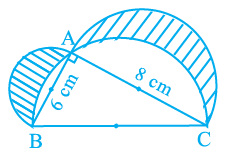
Question 24. In the figure, ABC is a triangle right angled at A. Semicircles are drawn on AB, AC and BC as diameters. Find the area of the shaded region.
Answer:
Given:
Triangle $ABC$ is right-angled at $A$.
Side $AB = 6$ cm
Side $AC = 8$ cm
Three semicircles are drawn with $AB$, $AC$, and $BC$ as their respective diameters.
To Find:
The area of the shaded region.
Solution:
Step 1: Calculate the length of the hypotenuse $BC$
In right-angled triangle $ABC$, by Pythagoras Theorem:
$BC^2 = AB^2 + AC^2$
$BC^2 = 6^2 + 8^2$
$BC^2 = 36 + 64 = 100$
$BC = \sqrt{100} = 10$ cm
... (i)
Step 2: Calculate the area of the triangle $ABC$
$\text{Area of } \Delta ABC = \frac{1}{2} \times \text{Base} \times \text{Height}$
$\text{Area of } \Delta ABC = \frac{1}{2} \times 6 \times 8$
$\text{Area of } \Delta ABC = 24 \text{ cm}^2$
... (ii)
Step 3: Calculate the areas of the semicircles
Let $A_1$, $A_2$, and $A_3$ be the areas of the semicircles on $AB$, $AC$, and $BC$ respectively.
$A_1 = \frac{1}{2} \pi \left(\frac{6}{2}\right)^2 = \frac{1}{2} \pi (3)^2 = 4.5\pi \text{ cm}^2$
[Semicircle on AB] ... (iii)
$A_2 = \frac{1}{2} \pi \left(\frac{8}{2}\right)^2 = \frac{1}{2} \pi (4)^2 = 8\pi \text{ cm}^2$
[Semicircle on AC] ... (iv)
$A_3 = \frac{1}{2} \pi \left(\frac{10}{2}\right)^2 = \frac{1}{2} \pi (5)^2 = 12.5\pi \text{ cm}^2$
[Semicircle on BC] ... (v)
Step 4: Calculate the area of the shaded region
From the figure, the area of the shaded region is the sum of the areas of the two smaller semicircles and the triangle, minus the area of the largest semicircle.
$\text{Area of Shaded Region} = (A_1 + A_2 + \text{Area of } \Delta ABC) - A_3$
Substituting the values from equations (ii), (iii), (iv), and (v):
$\text{Area of Shaded Region} = (4.5\pi + 8\pi + 24) - 12.5\pi$
$\text{Area of Shaded Region} = (12.5\pi + 24) - 12.5\pi$
$\text{Area of Shaded Region} = 24 \text{ cm}^2$
Final Answer:
The area of the shaded region is 24 cm2.
Question 25. A bag contains white, black and red balls only. A ball is drawn at random from the bag. The probability of getting a white ball is $\frac{3}{10}$ and that of a black ball is $\frac{2}{5}$ . Find the probability of getting a red ball. If the bag contains 20 black balls, then find the total number of balls in the bag.
Answer:
Given:
Probability of getting a white ball, $P(\text{White}) = \frac{3}{10}$
Probability of getting a black ball, $P(\text{Black}) = \frac{2}{5}$
Number of black balls in the bag = $20$
To Find:
1. The probability of getting a red ball, $P(\text{Red})$.
2. The total number of balls in the bag.
Solution:
Step 1: Finding the probability of getting a red ball
Since the bag contains only white, black, and red balls, these are the only possible outcomes. The sum of the probabilities of all mutually exclusive and exhaustive events is always 1.
$P(\text{White}) + P(\text{Black}) + P(\text{Red}) = 1$
... (i)
Substituting the given probabilities into equation (i):
$\frac{3}{10} + \frac{2}{5} + P(\text{Red}) = 1$
To add the fractions, we take the L.C.M. of the denominators (10 and 5), which is 10:
$\frac{3}{10} + \frac{4}{10} + P(\text{Red}) = 1$
$\frac{7}{10} + P(\text{Red}) = 1$
$P(\text{Red}) = 1 - \frac{7}{10}$
$P(\text{Red}) = \frac{10 - 7}{10}$
$P(\text{Red}) = \frac{3}{10}$
... (ii)
Step 2: Finding the total number of balls in the bag
Let the total number of balls in the bag be $N$.
We know that the probability of an event is given by:
$P(\text{Event}) = \frac{\text{Number of favorable outcomes}}{\text{Total number of outcomes}}$
For black balls:
$P(\text{Black}) = \frac{\text{Number of black balls}}{\text{Total number of balls}}$
... (iii)
Substituting the known values into equation (iii):
$\frac{2}{5} = \frac{20}{N}$
By cross-multiplication:
$2 \times N = 20 \times 5$
$2N = 100$
$N = \frac{\cancel{100}^{50}}{\cancel{2}_{1}}$
$N = 50$
(Total Balls)
Final Answer:
The probability of getting a red ball is $\frac{3}{10}$ and the total number of balls in the bag is 50.
Section D
Question 26. If the price of a book is reduced by Rs 5, a person can buy 5 more books for Rs 300. Find the original list price of the book.
OR
The sum of the ages of two friends is 20 years. Four years ago, the product of their ages in years was 48. Is this situation possible? If so, determine their present ages.
Answer:
Question 26
Given:
Total amount spent = $\textsf{₹} 300$
Reduction in the price of each book = $\textsf{₹} 5$
Number of extra books that can be bought = $5$
To Find:
The original list price of the book.
Solution:
Let the original list price of the book be $\textsf{₹} x$.
Then, the number of books originally bought for $\textsf{₹} 300$ is:
$\text{Number of books} = \frac{300}{x}$
…(i)
When the price is reduced by $\textsf{₹} 5$, the new price of the book becomes $\textsf{₹} (x - 5)$.
The number of books that can be bought at the new price is:
$\text{New number of books} = \frac{300}{x - 5}$
…(ii)
According to the question, the difference between the new number of books and the original number of books is $5$.
$\frac{300}{x - 5} - \frac{300}{x} = 5$
Taking $300$ common and solving the fraction:
$300 \left[ \frac{x - (x - 5)}{x(x - 5)} \right] = 5$
$300 \left[ \frac{5}{x^2 - 5x} \right] = 5$
Dividing both sides by $5$:
$\frac{300}{x^2 - 5x} = 1$
$x^2 - 5x = 300$
$x^2 - 5x - 300 = 0$
[Standard Quadratic Form] ... (iii)
We solve this quadratic equation by splitting the middle term. We need two numbers whose sum is $-5$ and product is $-300$. These numbers are $-20$ and $15$.
$x^2 - 20x + 15x - 300 = 0$
$x(x - 20) + 15(x - 20) = 0$
$(x - 20)(x + 15) = 0$
This gives two possible values for $x$:
$x - 20 = 0 \implies x = 20$
$x + 15 = 0 \implies x = -15$
Since the price of a book cannot be negative, we reject $x = -15$.
$x = 20$
(Valid Answer)
Final Answer:
The original list price of the book is $\textsf{₹} 20$.
OR Question
Given:
Sum of the present ages of two friends = $20$ years.
Product of their ages $4$ years ago = $48$.
To Find:
Whether this situation is possible, and if so, determine their present ages.
Solution:
Let the present age of the first friend be $x$ years.
Then, the present age of the second friend is $(20 - x)$ years.
Four years ago:
Age of the first friend = $(x - 4)$ years.
Age of the second friend = $(20 - x - 4) = (16 - x)$ years.
According to the given condition, the product of their ages was $48$:
$(x - 4)(16 - x) = 48$
$16x - x^2 - 64 + 4x = 48$
$-x^2 + 20x - 64 = 48$
$-x^2 + 20x - 64 - 48 = 0$
$-x^2 + 20x - 112 = 0$
Multiplying the whole equation by $-1$:
$x^2 - 20x + 112 = 0$
…(i)
To check if the situation is possible, we need to find the discriminant $D$ of the quadratic equation $ax^2 + bx + c = 0$.
Here, $a = 1, b = -20, c = 112$.
$D = b^2 - 4ac$
$D = (-20)^2 - 4(1)(112)$
$D = 400 - 448$
$D = -48$
... (ii)
Since the discriminant $D < 0$, the quadratic equation has no real roots.
This means there are no real values of $x$ that satisfy the given conditions.
Final Answer:
No, this situation is not possible because the discriminant of the resulting quadratic equation is negative ($D < 0$).
Question 27. Prove that the lengths of the tangents drawn from an external point to a circle are equal.
Using the above theorem, prove that:
If quadrilateral ABCD is circumscribing a circle, then AB + CD = AD + BC.
OR
Prove that the ratio of the areas of two similar triangles is equal to the ratio of the squares of the corresponding sides.
Using the above theorem, do the following :
ABC is an iscosceles triangle right angled at B. Two equilateral triangles ACD and ABE are constructed on the sides AC and AB, respectively. Find the ratio of the areas of ∆ABE and ∆ACD.
Answer:
Question 27 (Part I)
Given:
A circle with center $O$ and a point $P$ outside the circle. $PQ$ and $PR$ are two tangents drawn from point $P$ to the circle at points $Q$ and $R$ respectively.
To Prove:
The lengths of the tangents are equal, i.e., $PQ = PR$.
Construction:
Join $OQ, OR,$ and $OP$.
Proof:
We know that the tangent at any point of a circle is perpendicular to the radius through the point of contact.
$\angle OQP = \angle ORP = 90^\circ$
... (i)
In $\Delta OQP$ and $\Delta ORP$:
$OQ = OR$
(Radii of the same circle)
$OP = OP$
(Common hypotenuse)
$\angle OQP = \angle ORP = 90^\circ$
[From (i)] ... (ii)
Therefore, by RHS (Right-angle Hypotenuse Side) congruence criterion:
$\Delta OQP \cong \Delta ORP$
By CPCT (Corresponding Parts of Congruent Triangles):
$PQ = PR$
Hence Proved.
Question 27 (Part II - Application)
Given:
A quadrilateral $ABCD$ circumscribes a circle. The sides $AB, BC, CD,$ and $DA$ touch the circle at points $P, Q, R,$ and $S$ respectively.
To Prove:
$AB + CD = AD + BC$
Proof:
Using the theorem proved above, the lengths of tangents from an external point to a circle are equal.
$AP = AS$
…(iii)
$BP = BQ$
…(iv)
$CR = CQ$
…(v)
$DR = DS$
…(vi)
Adding equations (iii), (iv), (v), and (vi):
$AP + BP + CR + DR = AS + BQ + CQ + DS$
Rearranging the terms:
$(AP + BP) + (CR + DR) = (AS + DS) + (BQ + CQ)$
From the figure, we can see that:
$AP + BP = AB$
$CR + DR = CD$
$AS + DS = AD$
$BQ + CQ = BC$
Substituting these values:
$AB + CD = AD + BC$
Hence Proved.
OR Question (Part I - Theorem)
Given:
Two triangles $ABC$ and $PQR$ such that $\Delta ABC \sim \Delta PQR$.
To Prove:
$\frac{\text{Area}(\Delta ABC)}{\text{Area}(\Delta PQR)} = \left(\frac{AB}{PQ}\right)^2 = \left(\frac{BC}{QR}\right)^2 = \left(\frac{AC}{PR}\right)^2$
Construction:
Draw altitudes $AM \perp BC$ and $PN \perp QR$.
Proof:
Since $\Delta ABC \sim \Delta PQR$, their corresponding sides are in the same ratio and corresponding angles are equal.
$\frac{AB}{PQ} = \frac{BC}{QR} = \frac{AC}{PR}$
... (i)
In $\Delta ABM$ and $\Delta PQN$:
$\angle B = \angle Q$ (Given similar triangles)
$\angle M = \angle N = 90^\circ$ (Construction)
So, $\Delta ABM \sim \Delta PQN$ by AA Similarity Criterion.
$\frac{AM}{PN} = \frac{AB}{PQ}$
... (ii)
Comparing (i) and (ii):
$\frac{AM}{PN} = \frac{BC}{QR}$
... (iii)
Now, $\frac{\text{Area}(\Delta ABC)}{\text{Area}(\Delta PQR)} = \frac{\frac{1}{2} \times BC \times AM}{\frac{1}{2} \times QR \times PN} = \frac{BC}{QR} \times \frac{AM}{PN}$
Substituting the ratio from (iii):
$\frac{\text{Area}(\Delta ABC)}{\text{Area}(\Delta PQR)} = \frac{BC}{QR} \times \frac{BC}{QR} = \frac{BC^2}{QR^2}$
Hence Proved.
OR Question (Part II - Application)
Given:
$\Delta ABC$ is an isosceles triangle, right-angled at $B$.
$\Delta ABE$ and $\Delta ACD$ are equilateral triangles constructed on sides $AB$ and $AC$.
Solution:
In isosceles right-angled $\Delta ABC$, let $AB = BC = a$.
By Pythagoras Theorem:
$AC^2 = AB^2 + BC^2$
$AC^2 = a^2 + a^2 = 2a^2$
$AC = a\sqrt{2}$
Since $\Delta ABE$ and $\Delta ACD$ are equilateral triangles, they are similar (all angles are $60^\circ$).
Using the theorem proved above:
$\frac{\text{Area}(\Delta ABE)}{\text{Area}(\Delta ACD)} = \left( \frac{AB}{AC} \right)^2$
Substituting the values of $AB$ and $AC$:
$\frac{\text{Area}(\Delta ABE)}{\text{Area}(\Delta ACD)} = \left( \frac{a}{a\sqrt{2}} \right)^2$
$\frac{\text{Area}(\Delta ABE)}{\text{Area}(\Delta ACD)} = \left( \frac{1}{\sqrt{2}} \right)^2 = \frac{1}{2}$
Final Answer:
The ratio of the areas of $\Delta ABE$ and $\Delta ACD$ is 1 : 2.
Question 28. The angles of depression of the top and bottom of a building 50 metres high as observed from the top of a tower are 30° and 60°, respectively. Find the height of the tower and also the horizontal distances between the building and the tower.
Answer:
Given:
Height of the building ($CD$) = $50\text{ m}$
Angle of depression of the top of the building ($C$) from the top of the tower ($A$) = $30^\circ$
Angle of depression of the bottom of the building ($D$) from the top of the tower ($A$) = $60^\circ$
To Find:
1. The height of the tower ($AB$).
2. The horizontal distance between the building and the tower ($BD$).
Construction:
Let $AB$ be the tower of height $H$ and $CD$ be the building of height $50\text{ m}$.
Draw $CE \perp AB$ such that $E$ lies on $AB$.
Therefore, $CE = BD = x$ (horizontal distance) and $BE = CD = 50\text{ m}$.
The height $AE = AB - BE = H - 50$.
By alternate interior angles, $\angle ACE = 30^\circ$ and $\angle ADB = 60^\circ$.
Solution:
In right-angled triangle $\Delta ABD$:
$\tan 60^\circ = \frac{AB}{BD}$
$\sqrt{3} = \frac{H}{x}$
$x = \frac{H}{\sqrt{3}}$
... (i)
In right-angled triangle $\Delta ACE$:
$\tan 30^\circ = \frac{AE}{CE}$
$\frac{1}{\sqrt{3}} = \frac{H - 50}{x}$
$x = \sqrt{3}(H - 50)$
... (ii)
Equating the values of $x$ from equations (i) and (ii):
$\frac{H}{\sqrt{3}} = \sqrt{3}(H - 50)$
$H = 3(H - 50)$
$H = 3H - 150$
$150 = 3H - H$
$2H = 150$
$H = 75\text{ m}$
(Height of Tower)
Now, substitute the value of $H$ in equation (i) to find the horizontal distance $x$:
$x = \frac{75}{\sqrt{3}}$
To rationalize the denominator, multiply and divide by $\sqrt{3}$:
$x = \frac{75 \times \sqrt{3}}{\sqrt{3} \times \sqrt{3}}$
$x = \frac{75\sqrt{3}}{3}$
$x = 25\sqrt{3}\text{ m}$
... (iii)
Using the value $\sqrt{3} \approx 1.732$:
$x = 25 \times 1.732$
$x = 43.3\text{ m}$
Final Answer:
The height of the tower is 75 m and the horizontal distance between the building and the tower is $25\sqrt{3}$ m (or approximately 43.3 m).
Question 29. A well of diameter 3 m and 14 m deep is dug. The earth, taken out of it, has been evenly spread all around it in the shape of a circular ring of width 4 m to form an embankment . Find the height of the embankment.
Answer:
Given:
For the cylindrical well:
$\text{Diameter } (d) = 3\text{ m}$
(Given)
$\text{Radius } (r) = \frac{3}{2} = 1.5\text{ m}$
... (i)
$\text{Depth or Height } (h) = 14\text{ m}$
For the embankment (circular ring):
$\text{Width of the embankment} = 4\text{ m}$
$\text{Inner radius } (r_1) = r = 1.5\text{ m}$
(Radius of the well)
$\text{Outer radius } (r_2) = 1.5 + 4 = 5.5\text{ m}$
... (ii)
To Find:
The height of the embankment ($H$).
Solution:
The earth taken out from the well is used to form the embankment. Therefore, the volume of the earth dug out is equal to the volume of the embankment formed.
Step 1: Calculate the volume of earth dug out
The well is in the shape of a cylinder. The volume of a cylinder is given by $\pi r^2 h$.
$\text{Volume of earth} = \pi \times (1.5)^2 \times 14$
$\text{Volume of earth} = 2.25 \times 14 \times \pi$
... (iii)
Step 2: Calculate the volume of the embankment
The embankment is in the shape of a hollow cylinder (circular ring) with height $H$. Its volume is given by the area of its base multiplied by its height.
$\text{Volume of embankment} = \text{Area of ring} \times H$
$\text{Volume of embankment} = \pi (r_2^2 - r_1^2) \times H$
Substituting values from equation (ii):
$\text{Volume of embankment} = \pi (5.5^2 - 1.5^2) \times H$
Using the identity $a^2 - b^2 = (a - b)(a + b)$:
$\text{Volume of embankment} = \pi [(5.5 - 1.5)(5.5 + 1.5)] \times H$
$\text{Volume of embankment} = \pi [4 \times 7] \times H$
$\text{Volume of embankment} = 28\pi H$
... (iv)
Step 3: Equating the volumes
According to the problem:
$\text{Volume of embankment} = \text{Volume of earth dug out}$
... (v)
Substituting values from (iii) and (iv) into (v):
$28\pi H = 2.25 \times 14 \times \pi$
Dividing both sides by $\pi$ and $14$:
$2H = 2.25$
$H = \frac{2.25}{2}$
$H = 1.125\text{ m}$
Final Answer:
The height of the embankment is 1.125 m.
Question 30. The following table shows the ages of the patients admitted in a hospital during a month:
| Age (in years) | 5 - 15 | 15 - 25 | 25 - 35 | 35 - 45 | 45 - 55 | 55 - 65 |
|---|---|---|---|---|---|---|
| Number of patients | 6 | 11 | 21 | 23 | 14 | 5 |
Find the mode and the mean of the data given above.
Answer:
Given:
The distribution of ages of patients is as follows:
| Age (in years) | Number of patients ($f_i$) |
| 5 - 15 | 6 |
| 15 - 25 | 11 |
| 25 - 35 | 21 |
| 35 - 45 | 23 |
| 45 - 55 | 14 |
| 55 - 65 | 5 |
To Find:
1. The Mode of the data.
2. The Mean of the data.
Solution:
1. Calculation of Mean
To calculate the mean, we first find the class mark ($x_i$) for each class interval using the formula $x_i = \frac{\text{Upper Limit} + \text{Lower Limit}}{2}$.
| Age (in years) | Number of patients ($f_i$) | Class Mark ($x_i$) | $f_i x_i$ |
| 5 - 15 | 6 | 10 | 60 |
| 15 - 25 | 11 | 20 | 220 |
| 25 - 35 | 21 | 30 | 630 |
| 35 - 45 | 23 | 40 | 920 |
| 45 - 55 | 14 | 50 | 700 |
| 55 - 65 | 5 | 60 | 300 |
| Total | $\sum\limits f_i = 80$ | $\sum\limits f_i x_i = 2830$ |
The formula for Mean ($\bar{x}$) is:
$\bar{x} = \frac{\sum\limits f_i x_i}{\sum\limits f_i}$
Substituting the values:
$\bar{x} = \frac{2830}{80}$
$\bar{x} = \frac{\cancel{2830}}{\cancel{80}}$
$\bar{x} = 35.375$
Therefore, the Mean age of the patients is 35.38 years (approx).
2. Calculation of Mode
From the given data, the maximum frequency is 23.
The class corresponding to the maximum frequency is 35 - 45. Therefore, the Modal Class is 35 - 45.
$l = 35$
(Lower limit of modal class)
$h = 10$
(Class size)
$f_1 = 23$
(Frequency of modal class)
$f_0 = 21$
(Frequency of class preceding modal class)
$f_2 = 14$
(Frequency of class succeeding modal class)
The formula for Mode is:
$\text{Mode} = l + \left( \frac{f_1 - f_0}{2f_1 - f_0 - f_2} \right) \times h$
Substituting the values:
$\text{Mode} = 35 + \left( \frac{23 - 21}{2(23) - 21 - 14} \right) \times 10$
$\text{Mode} = 35 + \left( \frac{2}{46 - 35} \right) \times 10$
$\text{Mode} = 35 + \left( \frac{2}{11} \right) \times 10$
$\text{Mode} = 35 + \frac{20}{11}$
$\text{Mode} = 35 + 1.818...$
$\text{Mode} = 36.818...$
Therefore, the Mode age of the patients is 36.8 years (approx).
Conclusion:
The Mode of the data is 36.8 years and the Mean of the data is 35.38 years.
Interpretation: The maximum number of patients admitted to the hospital are of the age 36.8 years (approx), while on average, the age of a patient admitted is 35.38 years.