

Class 10 Maths Sample Paper Set II (NCERT Exemplar Solutions)
Welcome to this vital resource for Class 10 Mathematics Sample Paper Set II, meticulously aligned with the rigorous NCERT Exemplar series! These papers are far more than practice exercises; they are comprehensive assessment tools designed to offer students a truly realistic examination experience. By emphasizing Higher-Order Thinking Skills (HOTS) and application-oriented scenarios, these solutions build the analytical foundation and problem-solving prowess required to move beyond rote learning and master the complete syllabus.
The solutions provide exhaustive coverage for the entire Class 10 curriculum, encompassing all question formats from MCQs to Long Answer questions. Students will master the application of essential formulas and theorems, including the Quadratic Formula ($x = \frac{-b \pm \sqrt{D}}{2a}$), Arithmetic Progressions ($S_n = \frac{n}{2}[2a+(n-1)d]$), and Trigonometric identities like $\sin^2\theta + \cos^2\theta = 1$. Significant attention is given to Surface Areas and Volumes and Areas Related to Circles (Area = $\frac{\theta}{360}\pi r^2$), ensuring a well-rounded understanding of the interconnectedness of different mathematical domains.
Beyond delivering the final result, this resource focuses on demonstrating the complete working process, including precise algebraic manipulations and rigorous geometric proofs. These solved papers serve as a powerful mechanism for self-assessment, allowing students to gauge their overall preparedness and refine time management skills under simulated conditions. With step-by-step guidance and logical justifications prepared by learningspot.co, students can identify specific areas of weakness and approach their final examinations with targeted preparation and confidence.
| Content On This Page | ||
|---|---|---|
| Section A | Section B | Section C | Section D |
Section A
Question 1. The largest number which divides 318 and 739 leaving remainders 3 and 4, respectively is
(A) 110
(B) 7
(C) 35
(D) 105
Answer:
Given:
The given numbers are 318 and 739.
The remainders are 3 and 4 respectively.
To Find:
The largest number which divides 318 and 739 leaving remainders 3 and 4.
Solution:
According to the question, the required number divides 318 and 739 leaving remainders 3 and 4. This means the number must exactly divide $(318 - 3)$ and $(739 - 4)$.
First, we subtract the remainders from the given numbers:
$318 - 3 = 315$
(First number)
$739 - 4 = 735$
(Second number)
The largest number that divides 315 and 735 will be their Highest Common Factor (HCF).
Let us find the prime factorisation of 315 and 735:
Prime factorisation of 315:
$\begin{array}{c|cc} 3 & 315 \\ \hline 3 & 105 \\ \hline 5 & 35 \\ \hline 7 & 7 \\ \hline & 1 \end{array}$
Prime factorisation of 735:
$\begin{array}{c|cc} 3 & 735 \\ \hline 5 & 245 \\ \hline 7 & 49 \\ \hline 7 & 7 \\ \hline & 1 \end{array}$
Now, expressing the numbers as products of their prime factors:
$315 = 3 \times 3 \times 5 \times 7 = 3^2 \times 5^1 \times 7^1$
$735 = 3 \times 5 \times 7 \times 7 = 3^1 \times 5^1 \times 7^2$
To find the HCF, we take the product of the lowest powers of common prime factors:
$\text{HCF}(315, 735) = 3^1 \times 5^1 \times 7^1$
$\text{HCF}(315, 735) = 3 \times 5 \times 7$
$\text{HCF}(315, 735) = 105$
Final Answer:
The largest number which divides 318 and 739 leaving remainders 3 and 4, respectively, is 105.
Comparing this with the given options, the correct option is (D).
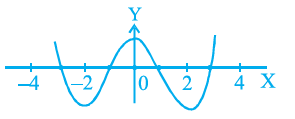
Question 2. The number of zeroes lying between –2 to 2 of the polynomial f (x), whose graph is given below, is
(A) 2
(B) 3
(C) 4
(D) 1
Answer:
To Find:
The number of zeroes of the polynomial $f(x)$ that lie specifically between the values $-2$ and $2$ on the X-axis.
Solution:
We know that the zeroes of any polynomial $f(x)$ are the $x$-coordinates of the points where the graph of $y = f(x)$ intersects or touches the X-axis.
To find the number of zeroes between $-2$ and $2$, we examine the segment of the X-axis ranging from $x = -2$ to $x = 2$ and count the number of intersection points.
By observing the given graph:
1. The graph intersects the X-axis once between $x = -2$ and $x = 0$ (approximately at $x = -1$).
2. The graph intersects the X-axis again between $x = 0$ and $x = 2$ (approximately at $x = 1$).
There are other intersection points shown on the graph (one near $x = -3$ and another near $x = 3$), but these lie outside the interval $[-2, 2]$.
Therefore, the total number of intersection points (zeroes) within the interval $(-2, 2)$ is 2.
Final Answer:
The number of zeroes lying between $-2$ to $2$ of the polynomial $f(x)$ is 2.
Hence, the correct option is (A).
Question 3. The discriminant of the quadratic equation 3$\sqrt{3}$ x2 + 10x + $\sqrt{3}$ = 0 is
(A) 8
(B) 64
(C) $-\frac{1}{3\sqrt{3}}$
(D) $-\sqrt{3}$
Answer:
Solution
The given quadratic equation is $3\sqrt{3}x^2 + 10x + \sqrt{3} = 0$.
This equation is in the standard form of a quadratic equation, $ax^2 + bx + c = 0$, where:
$a = 3\sqrt{3}$
$b = 10$
$c = \sqrt{3}$
The discriminant of a quadratic equation $ax^2 + bx + c = 0$ is given by the formula $D = b^2 - 4ac$.
Substitute the values of $a$, $b$, and $c$ into the discriminant formula:
$D = (10)^2 - 4 \times (3\sqrt{3}) \times (\sqrt{3})$
$D = 100 - 4 \times 3 \times (\sqrt{3} \times \sqrt{3})$
We know that $\sqrt{3} \times \sqrt{3} = (\sqrt{3})^2 = 3$.
$D = 100 - 4 \times 3 \times 3$
$D = 100 - 12 \times 3$
$D = 100 - 36$
$D = 64$
The discriminant of the given quadratic equation is 64.
This value corresponds to option (B).
The discriminant is 64.
Question 4. If $\frac{6}{5}$ , a , 4 are in AP, the value of a is
(A) 1
(B) 13
(C) $\frac{13}{5}$
(D) $\frac{26}{5}$
Answer:
Given:
The numbers $\frac{6}{5}$, $a$, and $4$ are in Arithmetic Progression (AP).
To Find:
The value of $a$.
Solution:
We know that if three terms $a_1, a_2, a_3$ are in AP, then the common difference ($d$) between consecutive terms is equal.
$d = a_2 - a_1 = a_3 - a_2$
... (i)
Substituting the given terms $a_1 = \frac{6}{5}$, $a_2 = a$, and $a_3 = 4$ into equation (i):
$a - \frac{6}{5} = 4 - a$
(Common difference is constant)
Now, we transpose $-a$ to the left-hand side and $-\frac{6}{5}$ to the right-hand side:
$a + a = 4 + \frac{6}{5}$
$2a = \frac{4 \times 5 + 6}{5}$
$2a = \frac{20 + 6}{5}$
$2a = \frac{26}{5}$
... (ii)
To find $a$, we divide both sides by $2$:
$a = \frac{26}{5 \times 2}$
$a = \frac{\cancel{26}^{13}}{5 \times \cancel{2}_{1}}$
$a = \frac{13}{5}$
Alternate Solution:
If three numbers $x, y, z$ are in AP, then the middle term $y$ is the Arithmetic Mean of $x$ and $z$.
$y = \frac{x + z}{2}$
(Arithmetic Mean property)
Here, $x = \frac{6}{5}$, $y = a$, and $z = 4$.
$a = \frac{\frac{6}{5} + 4}{2}$
$a = \frac{\frac{6 + 20}{5}}{2}$
$a = \frac{26}{5} \times \frac{1}{2}$
$a = \frac{26}{10}$
$a = \frac{\cancel{26}^{13}}{\cancel{10}_{5}}$
$a = \frac{13}{5}$
Final Answer:
The value of $a$ is $\frac{13}{5}$.
Comparing this with the given options, the correct option is (C).
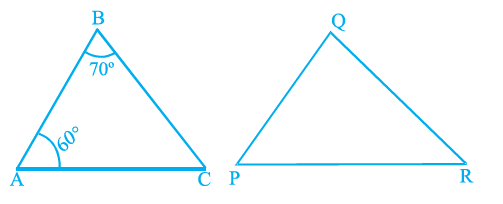
Question 5. If in the following figure, ∆ ABC ~ ∆ QPR, then the measure of ∠Q is
(A) 60°
(B) 90°
(C) 70°
(D) 50°
Answer:
Given:
In $\triangle ABC$, the measures of two angles are provided as:
$\angle A = 60^\circ$
$\angle B = 70^\circ$
It is also given that $\triangle ABC \sim \triangle QPR$.
To Find:
The measure of $\angle Q$.
Solution:
First, let us find the third angle of $\triangle ABC$ using the Angle Sum Property of a triangle.
In $\triangle ABC$:
$\angle A + \angle B + \angle C = 180^\circ$
(Angle sum property of a triangle)
Substituting the given values:
$60^\circ + 70^\circ + \angle C = 180^\circ$
$130^\circ + \angle C = 180^\circ$
$\angle C = 180^\circ - 130^\circ$
$\angle C = 50^\circ$
... (i)
Now, it is given that $\triangle ABC \sim \triangle QPR$.
We know that when two triangles are similar, their corresponding angles are equal. By comparing the order of vertices in the similarity notation:
$\angle A = \angle Q$
$\angle B = \angle P$
$\angle C = \angle R$
Therefore, to find $\angle Q$, we equate it to its corresponding angle $\angle A$:
$\angle Q = \angle A$
[Corresponding angles of similar triangles] ... (ii)
Since $\angle A = 60^\circ$, we have:
$\angle Q = 60^\circ$
Alternate Solution:
Since we only need to find $\angle Q$, and $\triangle \mathbf{A}BC \sim \triangle \mathbf{Q}PR$, the first vertex of the first triangle corresponds to the first vertex of the second triangle.
Thus, $\angle Q$ must be equal to $\angle A$ directly.
Given $\angle A = 60^\circ$, then $\angle Q = 60^\circ$ without needing to calculate $\angle C$.
Final Answer:
The measure of $\angle Q$ is $60^\circ$.
Comparing this with the given options, the correct option is (A).
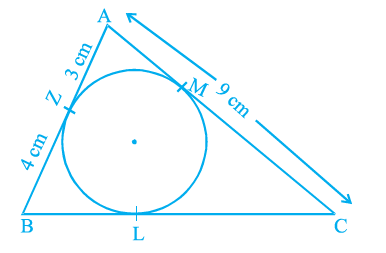
Question 6. In the adjoining figure, ∆ ABC is circumscribing a circle. Then, the length of BC is
(A) 7 cm
(B) 8 cm
(C) 9 cm
(D) 10 cm
Answer:
Given:
In the adjoining figure, $\triangle ABC$ is circumscribing a circle. The points of contact on the sides $AB$, $BC$, and $AC$ are $Z$, $L$, and $M$ respectively.
The lengths provided are:
$AZ = 3$ cm
$BZ = 4$ cm
$AC = 9$ cm
To Find:
The length of the side $BC$.
Solution:
According to the properties of circles, the lengths of tangents drawn from an external point to a circle are equal.
Using this theorem for point $A$:
$AM = AZ = 3\text{ cm}$
(Tangents from point A)
Now, we can find the length of $MC$ as follows:
$MC = AC - AM$
$MC = 9 - 3$
$MC = 6\text{ cm}$
... (i)
Using the tangent theorem for point $C$:
$CL = MC$
[Tangents from point C] ... (ii)
From (i) and (ii), we get:
$CL = 6\text{ cm}$
Now, using the tangent theorem for point $B$:
$BL = BZ = 4\text{ cm}$
(Tangents from point B)
Finally, we calculate the length of the side $BC$:
$BC = BL + CL$
Substituting the values of $BL$ and $CL$:
$BC = 4 + 6$
$BC = 10\text{ cm}$
Final Answer:
The length of $BC$ is $10$ cm.
Comparing this with the given options, the correct option is (D).
Question 7. If sin θ = $\frac{1}{3}$ then the value of (9 cot2 θ + 9) is
(A) 1
(B) 81
(C) 9
(D) $\frac{1}{81}$
Answer:
Given:
The value of trigonometric ratio is $\sin \theta = \frac{1}{3}$.
To Find:
The value of the expression $(9 \cot^2 \theta + 9)$.
Solution:
The given expression is:
$E = 9 \cot^2 \theta + 9$
Taking $9$ as a common factor from the terms:
$E = 9(\cot^2 \theta + 1)$
We know the trigonometric identity:
$1 + \cot^2 \theta = \text{cosec}^2 \theta$
... (i)
Substituting equation (i) into the expression, we get:
$E = 9 \text{cosec}^2 \theta$
(Using identity)
We also know the relation between $\text{cosec} \theta$ and $\sin \theta$:
$\text{cosec} \theta = \frac{1}{\sin \theta}$
[Reciprocal relation] ... (ii)
Substituting the given value $\sin \theta = \frac{1}{3}$ in equation (ii):
$\text{cosec} \theta = \frac{1}{1/3}$
$\text{cosec} \theta = 3$
Now, substituting the value of $\text{cosec} \theta$ into our expression for $E$:
$E = 9 \times (3)^2$
$E = 9 \times 9$
$E = 81$
Alternate Solution:
Given $\sin \theta = \frac{1}{3}$. We know that $\sin \theta = \frac{\text{Perpendicular (P)}}{\text{Hypotenuse (H)}}$.
Let $P = 1k$ and $H = 3k$.
Using Pythagoras Theorem: $H^2 = P^2 + B^2$
$(3k)^2 = (1k)^2 + B^2$
$9k^2 = k^2 + B^2$
$B^2 = 8k^2 \implies B = \sqrt{8}k = 2\sqrt{2}k$
Now, $\cot \theta = \frac{\text{Base (B)}}{\text{Perpendicular (P)}} = \frac{2\sqrt{2}k}{k} = 2\sqrt{2}$
Substitute $\cot \theta$ in $(9 \cot^2 \theta + 9)$:
$9(2\sqrt{2})^2 + 9$
$9(8) + 9$
$72 + 9 = 81$
Final Answer:
The value of $(9 \cot^2 \theta + 9)$ is 81.
Comparing this with the given options, the correct option is (B).
Question 8. The radii of the ends of a frustum of a cone 40 cm high are 20 cm and 11 cm. Its slant height is
(A) 41 cm
(B) 20$\sqrt{5}$ cm
(C) 49 cm
(D) $\sqrt{521}$ cm
Answer:
Given:
Height of the frustum, $h = 40$ cm
Radius of the larger base, $R = 20$ cm
Radius of the smaller base, $r = 11$ cm
To Find:
The slant height, $l$, of the frustum.
Solution:
The formula for the slant height $l$ of a frustum of a cone is given by:
$l = \sqrt{h^2 + (R - r)^2}$
Substitute the given values into the formula:
$l = \sqrt{(40 \text{ cm})^2 + (20 \text{ cm} - 11 \text{ cm})^2}$
$l = \sqrt{(40)^2 + (9)^2}$
Calculate the squares:
$(40)^2 = 1600$
$(9)^2 = 81$
Substitute these values back into the equation for $l$:
$l = \sqrt{1600 + 81}$
$l = \sqrt{1681}$
Now, calculate the square root of 1681.
We can find the square root by checking the options or using calculation.
Consider $41^2 = (40+1)^2 = 40^2 + 2(40)(1) + 1^2 = 1600 + 80 + 1 = 1681$.
So, $\sqrt{1681} = 41$.
$l = 41$ cm
The slant height of the frustum is 41 cm. This matches option (A).
The slant height is 41 cm.
Question 9. A bag contains 40 balls out of which some are red, some are blue and remaining are black. If the probability of drawing a red ball is $\frac{11}{20}$ and that of blue ball is $\frac{1}{5}$ , then the number of black balls is
(A) 5
(B) 25
(C) 10
(D) 30
Answer:
Given:
Total number of balls in the bag = $40$.
Probability of drawing a red ball, $P(\text{Red}) = \frac{11}{20}$.
Probability of drawing a blue ball, $P(\text{Blue}) = \frac{1}{5}$.
To Find:
The number of black balls in the bag.
Solution:
We know that the probability of an event $E$ is given by:
$P(E) = \frac{\text{Number of favourable outcomes}}{\text{Total number of outcomes}}$
First, let us calculate the number of red balls:
$\text{Number of red balls} = P(\text{Red}) \times \text{Total number of balls}$
$\text{Number of red balls} = \frac{11}{20} \times 40$
$\text{Number of red balls} = 11 \times \frac{\cancel{40}^{2}}{\cancel{20}_{1}}$
$\text{Number of red balls} = 22$
... (i)
Next, let us calculate the number of blue balls:
$\text{Number of blue balls} = P(\text{Blue}) \times \text{Total number of balls}$
$\text{Number of blue balls} = \frac{1}{5} \times 40$
$\text{Number of blue balls} = \frac{\cancel{40}^{8}}{\cancel{5}_{1}}$
$\text{Number of blue balls} = 8$
... (ii)
Since the bag contains only red, blue, and black balls, the number of black balls can be found by subtracting the sum of red and blue balls from the total number of balls:
$\text{Number of black balls} = \text{Total balls} - (\text{Red balls} + \text{Blue balls})$
Substituting values from (i) and (ii):
$\text{Number of black balls} = 40 - (22 + 8)$
$\text{Number of black balls} = 40 - 30$
$\text{Number of black balls} = 10$
Alternate Solution:
We know that the sum of probabilities of all elementary events in an experiment is $1$.
$P(\text{Red}) + P(\text{Blue}) + P(\text{Black}) = 1$
(Sum of probabilities)
$\frac{11}{20} + \frac{1}{5} + P(\text{Black}) = 1$
To add the fractions, we take the LCM of $20$ and $5$, which is $20$:
$\frac{11 + 4}{20} + P(\text{Black}) = 1$
$\frac{15}{20} + P(\text{Black}) = 1$
$P(\text{Black}) = 1 - \frac{15}{20}$
$P(\text{Black}) = \frac{20 - 15}{20} = \frac{5}{20}$
Now, finding the number of black balls:
$\text{Number of black balls} = P(\text{Black}) \times \text{Total balls}$
$\text{Number of black balls} = \frac{5}{20} \times 40 = 5 \times 2 = 10$
Final Answer:
The number of black balls is 10.
Comparing this with the given options, the correct option is (C).
Question 10. Two coins are tossed simultaneously. The probability of getting at most one head is
(A) $\frac{1}{4}$
(B) $\frac{1}{2}$
(C) $\frac{3}{4}$
(D) 1
Answer:
Solution
When two coins are tossed simultaneously, the possible outcomes are:
Head on the first coin and Head on the second coin (HH)
Head on the first coin and Tail on the second coin (HT)
Tail on the first coin and Head on the second coin (TH)
Tail on the first coin and Tail on the second coin (TT)
The sample space $S$ is the set of all possible outcomes:
$S = \{HH, HT, TH, TT\}$
The total number of possible outcomes is the number of elements in the sample space:
Total number of outcomes = $|S| = 4$
We are interested in the event of getting "at most one head". This means getting either zero heads or exactly one head.
Let $E$ be the event of getting at most one head.
Outcomes with zero heads: TT
Outcomes with exactly one head: HT, TH
The set of favorable outcomes for event $E$ is:
$E = \{TT, HT, TH\}$
The number of favorable outcomes is the number of elements in the set $E$:
Number of favorable outcomes = $|E| = 3$
The probability of an event $E$ is given by the formula:
$P(E) = \frac{\text{Number of favorable outcomes}}{\text{Total number of outcomes}}$
$P(\text{at most one head}) = \frac{|E|}{|S|} = \frac{3}{4}$
The probability of getting at most one head is $\frac{3}{4}$.
This corresponds to option (C).
The probability of getting at most one head is $\frac{3}{4}$.
Section B
Question 11. Which of the following can be the nth term of an AP?
3n + 1, 2n2 + 3, n3 + n.
Give reasons.
Answer:
Given:
The three expressions provided for the $n^{th}$ term are:
1. $3n + 1$
2. $2n^2 + 3$
3. $n^3 + n$
To Find:
Which of the following can be the $n^{th}$ term of an Arithmetic Progression (AP) and provide reasons for the same.
Solution:
We know that an Arithmetic Progression is a sequence where the difference between any two consecutive terms is constant. This constant difference is called the common difference ($d$).
The general form of the $n^{th}$ term ($a_n$) of an AP is:
$a_n = a + (n - 1)d$
... (i)
If we simplify this expression:
$a_n = a + nd - d$
$a_n = dn + (a - d)$
Since $d$ and $(a - d)$ are constants, the $n^{th}$ term of an AP must always be a linear polynomial in $n$ (i.e., the power of $n$ must be 1).
Evaluating the given expressions:
Case 1: $a_n = 3n + 1$
This is a linear expression in $n$. Let us check the terms:
For $n = 1$, $a_1 = 3(1) + 1 = 4$
For $n = 2$, $a_2 = 3(2) + 1 = 7$
For $n = 3$, $a_3 = 3(3) + 1 = 10$
Calculating the common difference:
$a_2 - a_1 = 7 - 4 = 3$
... (ii)
$a_3 - a_2 = 10 - 7 = 3$
... (iii)
Since $a_2 - a_1 = a_3 - a_2 = 3$ (constant), $3n + 1$ can be the $n^{th}$ term of an AP.
Case 2: $a_n = 2n^2 + 3$
This is a quadratic expression in $n$. Let us check the terms:
For $n = 1$, $a_1 = 2(1)^2 + 3 = 5$
For $n = 2$, $a_2 = 2(2)^2 + 3 = 11$
For $n = 3$, $a_3 = 2(3)^2 + 3 = 21$
Calculating the differences:
$a_2 - a_1 = 11 - 5 = 6$
$a_3 - a_2 = 21 - 11 = 10$
Since $6 \neq 10$, the difference is not constant. Hence, $2n^2 + 3$ cannot be the $n^{th}$ term of an AP.
Case 3: $a_n = n^3 + n$
This is a cubic expression in $n$. Let us check the terms:
For $n = 1$, $a_1 = (1)^3 + 1 = 2$
For $n = 2$, $a_2 = (2)^3 + 2 = 10$
For $n = 3$, $a_3 = (3)^3 + 3 = 30$
Calculating the differences:
$a_2 - a_1 = 10 - 2 = 8$
$a_3 - a_2 = 30 - 10 = 20$
Since $8 \neq 20$, the difference is not constant. Hence, $n^3 + n$ cannot be the $n^{th}$ term of an AP.
Final Answer:
Only $3n + 1$ can be the $n^{th}$ term of an AP.
Reason: The $n^{th}$ term of an Arithmetic Progression is always a linear polynomial in $n$. Among the given choices, $3n + 1$ is the only linear expression, while $2n^2 + 3$ and $n^3 + n$ are quadratic and cubic expressions respectively, which do not yield a constant common difference.
Question 12. Are the points (–3, –3), (–3, 2) and (–3, 5) collinear? Give reasons.
Answer:
Given:
The given points are $A(-3, -3)$, $B(-3, 2)$ and $C(-3, 5)$.
To Find:
Whether the points $A$, $B$ and $C$ are collinear.
Solution:
In coordinate geometry, points are said to be collinear if they lie on the same straight line.
Let the coordinates be:
$x_1 = -3, y_1 = -3$
$x_2 = -3, y_2 = 2$
$x_3 = -3, y_3 = 5$
By observing the coordinates of the given points, we can see that:
$x_1 = x_2 = x_3 = -3$
(Abscissae are equal)
Since the $x$-coordinates (abscissae) of all three points are identical, all these points lie on a vertical line that is parallel to the Y-axis. The equation of this straight line is $x = -3$.
Because all three points lie on the same line $x = -3$, they are collinear.
Alternate Solution:
We can determine collinearity by calculating the Area of the Triangle formed by these three points. If the area is zero, the points must be collinear.
The formula for the area of a triangle with vertices $(x_1, y_1)$, $(x_2, y_2)$, and $(x_3, y_3)$ is:
$\text{Area} = \frac{1}{2} |x_1(y_2 - y_3) + x_2(y_3 - y_1) + x_3(y_1 - y_2)|$
Substituting the values of the given points:
$\text{Area} = \frac{1}{2} |-3(2 - 5) + (-3)(5 - (-3)) + (-3)(-3 - 2)|$
$\text{Area} = \frac{1}{2} |-3(-3) - 3(8) - 3(-5)|$
$\text{Area} = \frac{1}{2} |9 - 24 + 15|$
$\text{Area} = \frac{1}{2} |24 - 24|$
$\text{Area} = 0$
... (i)
Since the area of the triangle formed by these points is $0$, the points $A$, $B$ and $C$ are collinear.
Final Answer:
Yes, the points $(-3, -3)$, $(-3, 2)$ and $(-3, 5)$ are collinear. This is because they all lie on the same straight line defined by the equation $x = -3$.
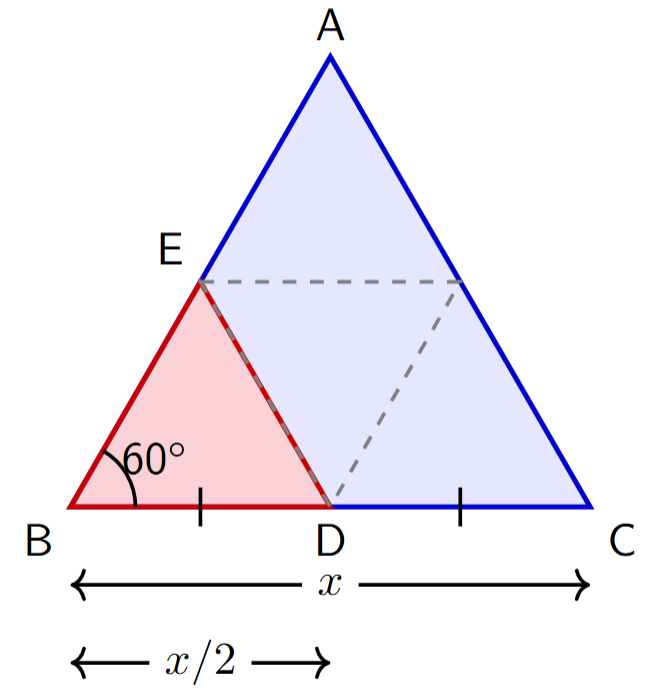
Question 13. ABC and BDE are two equilateral triangles such that D is the mid point of BC. What is the ratio of the areas of triangles ABC and BDE? Justify your answer.
Answer:
Given:
$\triangle ABC$ and $\triangle BDE$ are two equilateral triangles.
$D$ is the mid-point of $BC$.
To Find:
The ratio of the areas of $\triangle ABC$ and $\triangle BDE$.
Solution:
Let the side of the equilateral $\triangle ABC$ be $x$.
Since all sides of an equilateral triangle are equal:
$AB = BC = AC = x$
It is given that $D$ is the mid-point of $BC$. Therefore:
$BD = \frac{1}{2} BC = \frac{x}{2}$
(D is the mid-point of BC)
Since $\triangle BDE$ is also an equilateral triangle, all its sides must be equal to $BD$. Thus, the side of $\triangle BDE$ is $\frac{x}{2}$.
We know that all equilateral triangles are similar to each other because each of their interior angles is $60^\circ$ (by AAA similarity criterion).
$\triangle ABC \sim \triangle BDE$
... (i)
The Area Theorem for similar triangles states that the ratio of the areas of two similar triangles is equal to the square of the ratio of their corresponding sides.
$\frac{\text{Area}(\triangle ABC)}{\text{Area}(\triangle BDE)} = \left( \frac{BC}{BD} \right)^2$
[By Area Theorem of Similar Triangles] ... (ii)
Substituting the values of $BC$ and $BD$ in equation (ii):
$\frac{\text{Area}(\triangle ABC)}{\text{Area}(\triangle BDE)} = \left( \frac{x}{x/2} \right)^2$
$\frac{\text{Area}(\triangle ABC)}{\text{Area}(\triangle BDE)} = \left( \frac{x \times 2}{x} \right)^2$
$\frac{\text{Area}(\triangle ABC)}{\text{Area}(\triangle BDE)} = \left( 2 \right)^2$
$\frac{\text{Area}(\triangle ABC)}{\text{Area}(\triangle BDE)} = \frac{4}{1}$
Alternate Solution:
The area of an equilateral triangle with side $s$ is given by $\frac{\sqrt{3}}{4}s^2$.
$\text{Area}(\triangle ABC) = \frac{\sqrt{3}}{4}(x)^2$
$\text{Area}(\triangle BDE) = \frac{\sqrt{3}}{4}\left(\frac{x}{2}\right)^2 = \frac{\sqrt{3}}{4}\left(\frac{x^2}{4}\right)$
Taking the ratio:
$\frac{\text{Area}(\triangle ABC)}{\text{Area}(\triangle BDE)} = \frac{\frac{\sqrt{3}}{4}x^2}{\frac{1}{4} \left( \frac{\sqrt{3}}{4}x^2 \right)}$
$\frac{\text{Area}(\triangle ABC)}{\text{Area}(\triangle BDE)} = \frac{1}{1/4} = 4 : 1$
Final Answer:
The ratio of the areas of triangles $ABC$ and $BDE$ is $4 : 1$.
Question 14. cos (A + B) = $\frac{1}{2}$ and sin (A - B) = $\frac{1}{2}$, 0° < A + B < 90° and A – B > 0°. What are the values of ∠A and ∠B? Justify your answer.
Answer:
Given:
$\cos (A + B) = \frac{1}{2}$
$\sin (A - B) = \frac{1}{2}$
$0^\circ < A + B < 90^\circ$ (The sum of angles is acute)
$A - B > 0^\circ$ (Angle A is greater than angle B)
To Find:
The values of $\angle A$ and $\angle B$.
Solution:
We know the values of trigonometric ratios for specific angles. For cosine:
$\cos 60^\circ = \frac{1}{2}$
Given that $\cos (A + B) = \frac{1}{2}$, and since $A + B$ is an acute angle, we can equate the angles:
$A + B = 60^\circ$
[Since $\cos 60^\circ = \frac{1}{2}$] ... (i)
Similarly, for sine:
$\sin 30^\circ = \frac{1}{2}$
Given that $\sin (A - B) = \frac{1}{2}$, and since $A - B > 0^\circ$, we have:
$A - B = 30^\circ$
[Since $\sin 30^\circ = \frac{1}{2}$] ... (ii)
Now, we have a system of two linear equations in two variables $A$ and $B$. To solve them, let us add equation (i) and equation (ii):
$(A + B) + (A - B) = 60^\circ + 30^\circ$
$2A = 90^\circ$
$A = \frac{90^\circ}{2}$
$A = 45^\circ$
Now, substitute the value of $A = 45^\circ$ in equation (i):
$45^\circ + B = 60^\circ$
$B = 60^\circ - 45^\circ$
$B = 15^\circ$
Justification:
1. Check the sum: $A + B = 45^\circ + 15^\circ = 60^\circ$. This satisfies $0^\circ < 60^\circ < 90^\circ$.
2. Check the difference: $A - B = 45^\circ - 15^\circ = 30^\circ$. This satisfies $30^\circ > 0^\circ$.
3. Check trigonometric values: $\cos(60^\circ) = \frac{1}{2}$ and $\sin(30^\circ) = \frac{1}{2}$, which matches the given conditions.
Final Answer:
The values are $\angle A = 45^\circ$ and $\angle B = 15^\circ$.
Question 15. A coin is tossed twice and the outcome is noted every time. Can you say that head must come once in two tosses? Justify your answer.
OR
A die is thrown once. The probability of getting a prime number is $\frac{2}{3}$. Is it true? Justify your answer.
Answer:
Part 1: Coin Toss Problem
Given:
A coin is tossed twice and the outcomes are noted.
To Check:
Whether a head must come once in two tosses.
Solution:
When a coin is tossed twice, the sample space ($S$) of all possible outcomes is:
$S = \{HH, \ HT, \ TH, \ TT\}$
The total number of possible outcomes is 4.
Let us examine these outcomes:
1. $HH$: Two heads come up.
2. $HT$: One head and one tail come up.
3. $TH$: One tail and one head come up.
4. $TT$: Two tails come up (No head comes up).
The word "must" in the question implies that the event is a sure event (an event with a probability of $1$). However, in the outcome $\{TT\}$, no head appears.
The probability of getting a head at least once is:
$P(\text{at least one head}) = \frac{3}{4}$
The probability of getting exactly one head is:
$P(\text{exactly one head}) = \frac{2}{4} = \frac{1}{2}$
Since the probability is not $1$, it is not certain that a head will appear. There is a chance ($\frac{1}{4}$) that no head appears at all ($TT$).
Final Answer:
No, we cannot say that a head must come once in two tosses. It is a random experiment, and there is a possibility of getting two tails ($TT$), in which case no head appears.
Part 2: Die Throw Problem (OR)
Given:
A die is thrown once. The stated probability of getting a prime number is $\frac{2}{3}$.
To Check:
Whether the statement "The probability of getting a prime number is $\frac{2}{3}$" is true or false.
Solution:
When a die is thrown once, the possible outcomes in the sample space ($S$) are:
$S = \{1, 2, 3, 4, 5, 6\}$
$\text{Total number of outcomes} = 6$
... (i)
Now, let us identify the prime numbers among these outcomes. A prime number is a number greater than $1$ that has only two factors: $1$ and itself.
The prime numbers in the set $\{1, 2, 3, 4, 5, 6\}$ are 2, 3, and 5.
(Note: $1$ is neither prime nor composite).
$\text{Number of favourable outcomes (prime numbers)} = 3$
... (ii)
The probability of getting a prime number is calculated as:
$P(\text{Prime}) = \frac{\text{Number of favourable outcomes}}{\text{Total number of outcomes}}$
$P(\text{Prime}) = \frac{3}{6}$
$P(\text{Prime}) = \frac{\cancel{3}^{1}}{\cancel{6}_{2}}$
$P(\text{Prime}) = \frac{1}{2}$
The given probability in the question is $\frac{2}{3}$, but our calculated probability is $\frac{1}{2}$.
Final Answer:
The statement is False.
Justification: The prime numbers on a die are $2$, $3$, and $5$. There are $3$ prime numbers out of a total of $6$ possible outcomes. Therefore, the correct probability is $\frac{3}{6} = \frac{1}{2}$, not $\frac{2}{3}$.
Section C
Question 16. Show that square of an odd positive integer is of the form 8q + 1, for some positive integer q.
OR
Write the denominator of the rational number $\frac{357}{5000}$ in the form of 2m 5n , m, n are non-negative integers and hence write its decimal expansion, without actual division.
Answer:
Part 1: Square of an odd positive integer
To Prove:
The square of any odd positive integer is of the form $8q + 1$ for some positive integer $q$.
Proof:
We know that any odd positive integer $a$ can be expressed in the form $4n + 1$ or $4n + 3$, where $n$ is some integer.
Case 1: When $a = 4n + 1$
Squaring both sides:
$a^2 = (4n + 1)^2$
$a^2 = (4n)^2 + 2(4n)(1) + (1)^2$
$a^2 = 16n^2 + 8n + 1$
Taking $8$ common from the first two terms:
$a^2 = 8(2n^2 + n) + 1$
... (i)
Let $q = 2n^2 + n$. Since $n$ is an integer, $q$ will also be an integer.
$a^2 = 8q + 1$
(Where $q = 2n^2 + n$)
Case 2: When $a = 4n + 3$
Squaring both sides:
$a^2 = (4n + 3)^2$
$a^2 = (4n)^2 + 2(4n)(3) + (3)^2$
$a^2 = 16n^2 + 24n + 9$
We can write $9$ as $8 + 1$:
$a^2 = 16n^2 + 24n + 8 + 1$
Taking $8$ common from the first three terms:
$a^2 = 8(2n^2 + 3n + 1) + 1$
... (ii)
Let $q = 2n^2 + 3n + 1$. Since $n$ is an integer, $q$ will also be an integer.
$a^2 = 8q + 1$
(Where $q = 2n^2 + 3n + 1$)
Conclusion:
In both cases, the square of an odd positive integer is of the form $8q + 1$.
Part 2: Rational Number Problem (OR)
Given:
The rational number is $\frac{357}{5000}$.
To Find:
1. The prime factorisation of the denominator in the form $2^m 5^n$.
2. The decimal expansion without actual division.
Solution:
The denominator of the given rational number is $5000$.
Let us perform the prime factorisation of $5000$:
$\begin{array}{c|cc} 2 & 5000 \\ \hline 2 & 2500 \\ \hline 2 & 1250 \\ \hline 5 & 625 \\ \hline 5 & 125 \\ \hline 5 & 25 \\ \hline 5 & 5 \\ \hline & 1 \end{array}$
Therefore, the prime factorisation is:
$5000 = 2^3 \times 5^4$
(In the form $2^m 5^n$)
Here, $m = 3$ and $n = 4$, which are non-negative integers.
Now, to write the decimal expansion without actual division, we make the powers of $2$ and $5$ equal in the denominator.
$\frac{357}{5000} = \frac{357}{2^3 \times 5^4}$
To make the power of $2$ equal to $4$, we multiply the numerator and denominator by $2^1$:
$\frac{357 \times 2}{2^3 \times 5^4 \times 2^1}$
$\frac{714}{2^4 \times 5^4}$
$\frac{714}{(2 \times 5)^4} = \frac{714}{10^4}$
$\frac{714}{10000}$
$0.0714$
Final Answer:
The denominator in the form $2^m 5^n$ is $2^3 \times 5^4$ and the decimal expansion is $0.0714$.
Question 17. If (x – 2) is a factor of x3 + ax2 + bx + 16 and b = 4a, then find the values of a and b.
Answer:
Given:
The polynomial is $p(x) = x^3 + ax^2 + bx + 16$.
$(x - 2)$ is a factor of $p(x)$.
The relation between $a$ and $b$ is $b = 4a$.
To Find:
The values of $a$ and $b$.
Solution:
According to the Factor Theorem, if $(x - 2)$ is a factor of the polynomial $p(x)$, then the value of the polynomial at $x = 2$ must be zero.
$p(2) = 0$
(By Factor Theorem)
Substituting $x = 2$ in the polynomial $p(x)$:
$(2)^3 + a(2)^2 + b(2) + 16 = 0$
$8 + 4a + 2b + 16 = 0$
$4a + 2b + 24 = 0$
Dividing the entire equation by $2$ to simplify:
$2a + b + 12 = 0$
... (i)
It is also given that:
$b = 4a$
... (ii)
Now, we substitute the value of $b$ from equation (ii) into equation (i):
$2a + (4a) + 12 = 0$
[Substituting $b = 4a$] ... (iii)
$6a + 12 = 0$
$6a = -12$
$a = \frac{-12}{6}$
$a = -\frac{\cancel{12}^2}{\cancel{6}_1}$
$a = -2$
... (iv)
Now, substitute the value of $a = -2$ in equation (ii) to find $b$:
$b = 4(-2)$
$b = -8$
... (v)
Final Answer:
The value of $a$ is $-2$ and the value of $b$ is $-8$.
Question 18. The sum of reciprocals of a child’s age (in years) 3 years ago and 5 years from now $\frac{1}{3}$. Find his present age.
OR
Solve for x : 6 a2x2 – 7abx – 3b2 = 0, a ≠ 0, using the quadratic formula.
Answer:
Part 1: Age Problem
Given:
Sum of reciprocals of a child's age 3 years ago and 5 years from now is $\frac{1}{3}$.
To Find:
The present age of the child.
Solution:
Let the present age of the child be $x$ years.
According to the question:
The age of the child 3 years ago was $(x - 3)$ years.
The age of the child 5 years from now will be $(x + 5)$ years.
As per the given condition, the sum of their reciprocals is $\frac{1}{3}$:
$\frac{1}{x-3} + \frac{1}{x+5} = \frac{1}{3}$
... (i)
Taking the LCM on the left-hand side:
$\frac{(x+5) + (x-3)}{(x-3)(x+5)} = \frac{1}{3}$
$\frac{2x + 2}{x^2 + 5x - 3x - 15} = \frac{1}{3}$
$\frac{2x + 2}{x^2 + 2x - 15} = \frac{1}{3}$
On cross-multiplying:
$3(2x + 2) = 1(x^2 + 2x - 15)$
$6x + 6 = x^2 + 2x - 15$
$x^2 + 2x - 6x - 15 - 6 = 0$
$x^2 - 4x - 21 = 0$
[Quadratic Equation] ... (ii)
Now, we factorise the quadratic equation by splitting the middle term:
$x^2 - 7x + 3x - 21 = 0$
$x(x - 7) + 3(x - 7) = 0$
$(x - 7)(x + 3) = 0$
Setting each factor to zero:
$x - 7 = 0 \implies x = 7$
$x + 3 = 0 \implies x = -3$
Since age cannot be a negative value, we reject $x = -3$.
Final Answer:
The present age of the child is 7 years.
Part 2: Solving Quadratic Equation (OR)
Given:
The quadratic equation is $6 a^2x^2 - 7abx - 3b^2 = 0$, where $a \neq 0$.
To Find:
The roots of the equation using the Quadratic Formula.
Solution:
The standard form of a quadratic equation is $Ax^2 + Bx + C = 0$. Comparing this with the given equation:
$A = 6a^2$
$B = -7ab$
$C = -3b^2$
First, let us calculate the Discriminant ($D$):
$D = B^2 - 4AC$
$D = (-7ab)^2 - 4(6a^2)(-3b^2)$
$D = 49a^2b^2 + 72a^2b^2$
$D = 121a^2b^2$
... (i)
Now, using the Quadratic Formula:
$x = \frac{-B \pm \sqrt{D}}{2A}$
$x = \frac{-(-7ab) \pm \sqrt{121a^2b^2}}{2(6a^2)}$
$x = \frac{7ab \pm 11ab}{12a^2}$
[Taking square root] ... (ii)
Now we consider the two cases:
Case 1: Taking the positive sign
$x = \frac{7ab + 11ab}{12a^2}$
$x = \frac{18ab}{12a^2}$
$x = \frac{\cancel{18}^{3}b}{\cancel{12}_{2}a}$
$x = \frac{3b}{2a}$
Case 2: Taking the negative sign
$x = \frac{7ab - 11ab}{12a^2}$
$x = \frac{-4ab}{12a^2}$
$x = -\frac{\cancel{4}^{1}b}{\cancel{12}_{3}a}$
$x = -\frac{b}{3a}$
Final Answer:
The values of $x$ are $\frac{3b}{2a}$ and $-\frac{b}{3a}$.
Question 19. Find the sum of all two digit natural numbers which are divisible by 7.
Answer:
Given:
The numbers must be two-digit natural numbers and must be divisible by 7.
To Find:
The sum of all such numbers.
Solution:
Two-digit natural numbers range from $10$ to $99$.
The first two-digit natural number divisible by 7 is 14.
The last two-digit natural number divisible by 7 is 98 (since $98 = 7 \times 14$).
The list of these numbers forms an Arithmetic Progression (AP):
$14, 21, 28, \dots, 98$
Here:
First term ($a$) = $14$
Common difference ($d$) = $21 - 14 = 7$
Last term ($a_n$ or $l$) = $98$
Step 1: Finding the number of terms ($n$)
We use the formula for the $n^{th}$ term of an AP:
$a_n = a + (n - 1)d$
... (i)
Substituting the values in equation (i):
$98 = 14 + (n - 1)7$
$98 - 14 = (n - 1)7$
$84 = (n - 1)7$
$(n - 1) = \frac{\cancel{84}^{12}}{\cancel{7}_1}$
$n - 1 = 12$
$n = 12 + 1$
$n = 13$
... (ii)
Step 2: Finding the sum of the terms ($S_n$)
The formula for the sum of $n$ terms of an AP when the last term is known is:
$S_n = \frac{n}{2}(a + l)$
[Sum formula] ... (iii)
Substituting $n = 13$, $a = 14$, and $l = 98$ in equation (iii):
$S_{13} = \frac{13}{2}(14 + 98)$
$S_{13} = \frac{13}{2} \times 112$
$S_{13} = 13 \times \frac{\cancel{112}^{56}}{\cancel{2}_1}$
$S_{13} = 13 \times 56$
$S_{13} = 728$
... (iv)
Final Answer:
The sum of all two-digit natural numbers divisible by 7 is 728.
Question 20. Find the ratio in which the line x + 3y – 14 = 0 divides the line segment joining the points A (–2, 4) and B (3, 7).
Answer:
Given:
The line segment joins the points $A(-2, 4)$ and $B(3, 7)$.
The equation of the line dividing the segment is $x + 3y - 14 = 0$.
To Find:
The ratio in which the given line divides the line segment $AB$.
Solution:
Let the line $x + 3y - 14 = 0$ divide the line segment $AB$ at point $P(x, y)$ in the ratio $k : 1$.
The coordinates of the points are $A(x_1, y_1) = (-2, 4)$ and $B(x_2, y_2) = (3, 7)$.
According to the Section Formula, the coordinates of point $P$ are given by:
$x = \frac{m x_2 + n x_1}{m + n}$ and $y = \frac{m y_2 + n y_1}{m + n}$
Substituting $m = k, n = 1$ and the coordinates of $A$ and $B$:
$x = \frac{3k - 2}{k + 1}, \ y = \frac{7k + 4}{k + 1}$
[By Section Formula] ... (i)
Since the point $P(x, y)$ lies on the line $x + 3y - 14 = 0$, it must satisfy the equation of the line.
Substituting the values of $x$ and $y$ from equation (i) into the line equation:
$\left( \frac{3k - 2}{k + 1} \right) + 3 \left( \frac{7k + 4}{k + 1} \right) - 14 = 0$
(Substituting coordinates)
Multiplying the entire equation by $(k + 1)$ to eliminate the denominator:
$(3k - 2) + 3(7k + 4) - 14(k + 1) = 0$
$3k - 2 + 21k + 12 - 14k - 14 = 0$
Grouping the terms containing $k$ and the constant terms:
$(3k + 21k - 14k) + (-2 + 12 - 14) = 0$
$10k - 4 = 0$
... (ii)
$10k = 4$
$k = \frac{4}{10}$
By cancelling the numerator and denominator:
$k = \frac{\cancel{4}^2}{\cancel{10}_5}$
$k = \frac{2}{5}$
Therefore, the ratio $k : 1$ is $\frac{2}{5} : 1$, which can be written as $2 : 5$.
Final Answer:
The line $x + 3y - 14 = 0$ divides the line segment joining $A(-2, 4)$ and $B(3, 7)$ in the ratio $2 : 5$.
Question 21. Find the area of the quadrilateral whose vertices in the same order are (–4, –2), (–3, –5), (3, –2) and (2, 3).
Answer:
Given:
The vertices of the quadrilateral in order are $A(-4, -2)$, $B(-3, -5)$, $C(3, -2)$ and $D(2, 3)$.
To Find:
The area of the quadrilateral $ABCD$.
Solution:
To find the area of the quadrilateral $ABCD$, we can divide it into two triangles by joining diagonal $AC$. The total area of the quadrilateral will be the sum of the areas of $\triangle ABC$ and $\triangle ADC$.
The formula for the area of a triangle with vertices $(x_1, y_1)$, $(x_2, y_2)$, and $(x_3, y_3)$ is:
$\text{Area} = \frac{1}{2} |x_1(y_2 - y_3) + x_2(y_3 - y_1) + x_3(y_1 - y_2)|$
Step 1: Find the Area of $\triangle ABC$
Vertices: $A(-4, -2)$, $B(-3, -5)$, and $C(3, -2)$
$\text{Area}(\triangle ABC) = \frac{1}{2} |(-4)(-5 - (-2)) + (-3)(-2 - (-2)) $$ + 3(-2 - (-5))|$
$\text{Area}(\triangle ABC) = \frac{1}{2} |(-4)(-3) + (-3)(0) + 3(3)|$
$\text{Area}(\triangle ABC) = \frac{1}{2} |12 + 0 + 9|$
$\text{Area}(\triangle ABC) = \frac{21}{2} = 10.5$ sq. units
[Area of first triangle] ... (i)
Step 2: Find the Area of $\triangle ADC$
Vertices: $A(-4, -2)$, $D(2, 3)$, and $C(3, -2)$
$\text{Area}(\triangle ADC) = \frac{1}{2} |(-4)(3 - (-2)) + 2(-2 - (-2)) + 3(-2 - 3)|$
$\text{Area}(\triangle ADC) = \frac{1}{2} |(-4)(5) + 2(0) + 3(-5)|$
$\text{Area}(\triangle ADC) = \frac{1}{2} |-20 + 0 - 15|$
$\text{Area}(\triangle ADC) = \frac{1}{2} |-35|$
$\text{Area}(\triangle ADC) = \frac{35}{2} = 17.5$ sq. units
[Area of second triangle] ... (ii)
Step 3: Find the Area of Quadrilateral $ABCD$
$\text{Area}(ABCD) = \text{Area}(\triangle ABC) + \text{Area}(\triangle ADC)$
Substituting the values from equation (i) and equation (ii):
$\text{Area}(ABCD) = 10.5 + 17.5$
$\text{Area}(ABCD) = 28$ sq. units
Final Answer:
The area of the quadrilateral is 28 sq. units.
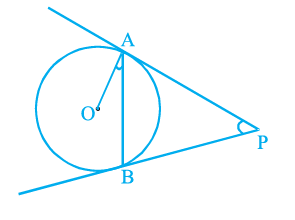
Question 22. Two tangents PA and PB are drawn to a circle with centre O from an external point P. Prove that ∠APB = 2∠OAB. (see the following figure).
Answer:
Given:
Two tangents $PA$ and $PB$ are drawn to a circle with centre $O$ from an external point $P$. $A$ and $B$ are the points of contact.
To Prove:
$\angle APB = 2\angle OAB$
Proof:
Let $\angle APB = \theta$.
We know that the lengths of tangents drawn from an external point to a circle are equal.
$PA = PB$
(Tangents from point P)
In $\triangle PAB$, since $PA = PB$, it is an isosceles triangle. Therefore, the angles opposite to these sides are equal.
$\angle PAB = \angle PBA$
... (i)
In $\triangle PAB$, by the angle sum property:
$\angle APB + \angle PAB + \angle PBA = 180^\circ$
$\theta + \angle PAB + \angle PAB = 180^\circ$
$\theta + 2\angle PAB = 180^\circ$
$2\angle PAB = 180^\circ - \theta$
$\angle PAB = 90^\circ - \frac{1}{2}\theta$
... (ii)
We also know that the radius is perpendicular to the tangent at the point of contact.
$\angle OAP = 90^\circ$
(Radius $\perp$ Tangent)
Now, from the figure, we can see that:
$\angle OAB = \angle OAP - \angle PAB$
Substituting the values of $\angle OAP$ and $\angle PAB$ (from equation ii):
$\angle OAB = 90^\circ - (90^\circ - \frac{1}{2}\theta)$
$\angle OAB = 90^\circ - 90^\circ + \frac{1}{2}\theta$
$\angle OAB = \frac{1}{2}\theta$
... (iii)
Substituting $\theta = \angle APB$ in equation (iii):
$\angle OAB = \frac{1}{2}\angle APB$
$\angle APB = 2\angle OAB$
[Hence Proved] ... (iv)
Final Answer:
It is proved that the angle between the two tangents drawn from an external point to a circle is double the angle between the chord joining the points of contact and the radius through the point of contact, i.e., $\angle APB = 2\angle OAB$.
Question 23. Construct a triangle with sides 3 cm, 5 cm and 7 cm and then construct another triangle whose sides are $\frac{5}{3}$ of the corresponding sides of the first triangle.
Answer:
Given:
A triangle with sides $3\text{ cm}$, $5\text{ cm}$, and $7\text{ cm}$.
Scale factor for the similar triangle = $\frac{5}{3}$.
Construction Required:
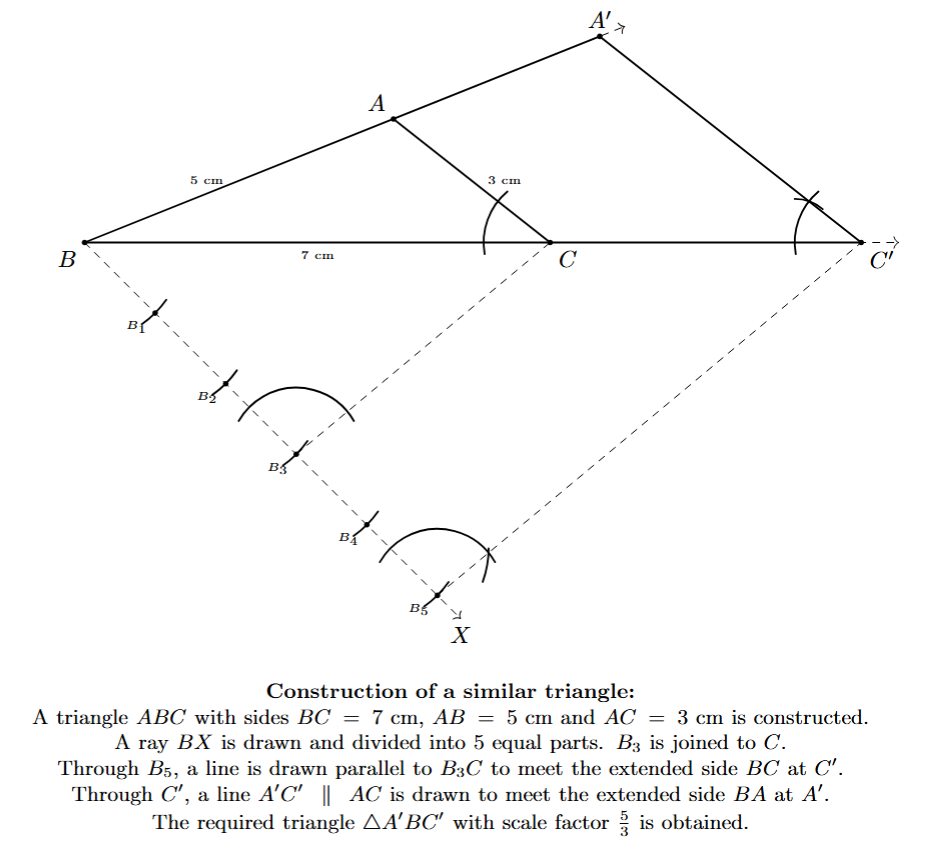
To construct a triangle $\triangle ABC$ with given sides and then a similar triangle $\triangle A'BC'$ whose sides are $\frac{5}{3}$ times the corresponding sides of $\triangle ABC$.
Steps of Construction:
1. Draw a line segment $BC = 7\text{ cm}$.
2. With $B$ as centre and radius $5\text{ cm}$, draw an arc. With $C$ as centre and radius $3\text{ cm}$, draw another arc to intersect the first arc at $A$.
3. Join $AB$ and $AC$ to get the $\triangle ABC$.
4. Draw a ray $BX$ making an acute angle with $BC$ on the side opposite to vertex $A$.
5. Locate $5$ points (greater of $5$ and $3$) $B_1, B_2, B_3, B_4, B_5$ on $BX$ such that $BB_1 = B_1B_2 = B_2B_3 = B_3B_4 = B_4B_5$.
6. Join $B_3$ (the denominator) to $C$.
7. Through $B_5$, draw a line parallel to $B_3C$ to intersect the extended line segment $BC$ at $C'$.
8. Through $C'$, draw a line parallel to $AC$ to intersect the extended line segment $BA$ at $A'$.
9. $\triangle A'BC'$ is the required triangle.
Construction Image:
Justification:
By construction, $A'C' \parallel AC$. Therefore, $\triangle ABC \sim \triangle A'BC'$ by AA similarity criterion.
In $\triangle BB_5C'$, $B_3C \parallel B_5C'$. By Basic Proportionality Theorem:
$\frac{BC}{BC'} = \frac{BB_3}{BB_5} = \frac{3}{5}$
... (i)
Taking the reciprocal of equation (i):
$\frac{BC'}{BC} = \frac{5}{3}$
... (ii)
Since the triangles are similar, the ratio of their corresponding sides is equal:
$\frac{A'B}{AB} = \frac{BC'}{BC} = \frac{A'C'}{AC} = \frac{5}{3}$
[From (ii)] ... (iii)
Thus, the sides of $\triangle A'BC'$ are $\frac{5}{3}$ times the corresponding sides of $\triangle ABC$.
Question 24. Prove the identity (1 + cot θ + tan θ) (sin θ – cos θ) = $\frac{\sec\theta}{cosecc^2 \;\theta} -\frac{cosec\;\theta}{\sec^2\theta}$
OR
Find the value of $\frac{cos^{2}\;32^\circ \;+\; cos^{2}\;58^\circ}{sec^{2}\;50^\circ \;-\; sec^{2}\;40^\circ}$ - 4 tan 13° tan 37° tan 53° tan 77°
Answer:
Part 1: Trigonometric Identity Proof
To Prove:
$(1 + \cot \theta + \tan \theta) (\sin \theta - \cos \theta) = \frac{\sec \theta}{\text{cosec}^2 \theta} - \frac{\text{cosec } \theta}{\sec^2 \theta}$
Proof:
Let us start with the Left Hand Side (LHS) of the identity:
$LHS = (1 + \cot \theta + \tan \theta) (\sin \theta - \cos \theta)$
Expanding the brackets by multiplying each term:
$LHS = \sin \theta - \cos \theta + \cot \theta \sin \theta - \cot \theta \cos \theta + \tan \theta \sin \theta - \tan \theta \cos \theta$
Expressing $\tan \theta$ and $\cot \theta$ in terms of $\sin \theta$ and $\cos \theta$:
$LHS = \sin \theta - \cos \theta + \left(\frac{\cos \theta}{\sin \theta} \cdot \sin \theta\right) - \left(\frac{\cos \theta}{\sin \theta} \cdot \cos \theta\right) + \left(\frac{\sin \theta}{\cos \theta} \cdot \sin \theta\right) $$ - \left(\frac{\sin \theta}{\cos \theta} \cdot \cos \theta\right)$
Simplifying the terms by cancelling common factors:
$LHS = \sin \theta - \cos \theta + \cos \theta - \frac{\cos^2 \theta}{\sin \theta} + \frac{\sin^2 \theta}{\cos \theta} - \sin \theta$
Cancelling $+\sin \theta$ with $-\sin \theta$ and $-\cos \theta$ with $+\cos \theta$:
$LHS = \frac{\sin^2 \theta}{\cos \theta} - \frac{\cos^2 \theta}{\sin \theta}$
... (i)
Now, let us simplify the Right Hand Side (RHS):
$RHS = \frac{\sec \theta}{\text{cosec}^2 \theta} - \frac{\text{cosec } \theta}{\sec^2 \theta}$
Using reciprocal identities $\sec \theta = \frac{1}{\cos \theta}$ and $\text{cosec } \theta = \frac{1}{\sin \theta}$:
$RHS = \frac{1/\cos \theta}{1/\sin^2 \theta} - \frac{1/\sin \theta}{1/\cos^2 \theta}$
Multiplying by the reciprocals of the denominators:
$RHS = \left( \frac{1}{\cos \theta} \cdot \sin^2 \theta \right) - \left( \frac{1}{\sin \theta} \cdot \cos^2 \theta \right)$
$RHS = \frac{\sin^2 \theta}{\cos \theta} - \frac{\cos^2 \theta}{\sin \theta}$
... (ii)
Comparing equations (i) and (ii), we find that:
$LHS = RHS$
(Hence Proved)
Part 2: Evaluation (OR)
To Find:
The value of: $\frac{\cos^2 32^\circ + \cos^2 58^\circ}{\sec^2 50^\circ - \text{cosec}^2 40^\circ} - 4 \tan 13^\circ \tan 37^\circ \tan 53^\circ \tan 77^\circ$
Solution:
Let us evaluate each part using complementary angle trigonometric ratios.
Step 1: Simplify the Numerator
$\cos^2 32^\circ + \cos^2 58^\circ = \cos^2 32^\circ + \cos^2(90^\circ - 32^\circ)$
Since $\cos(90^\circ - \theta) = \sin \theta$:
$\cos^2 32^\circ + \sin^2 32^\circ = 1$
Numerator $= 1$
[Using $\sin^2 A + \cos^2 A = 1$] ... (i)
Step 2: Simplify the Denominator
The expression provided is $\sec^2 50^\circ - \text{cosec}^2 40^\circ$.
Since $\text{cosec } 40^\circ = \text{cosec}(90^\circ - 50^\circ) = \sec 50^\circ$:
Denominator $= \sec^2 50^\circ - \sec^2 50^\circ = 0$.
Step 3: Simplify the Product of Tangents
$4 \tan 13^\circ \tan 37^\circ \tan 53^\circ \tan 77^\circ$
$= 4 [\tan 13^\circ \cdot \tan(90^\circ - 13^\circ)] \cdot [\tan 37^\circ \cdot \tan(90^\circ - 37^\circ)]$
$= 4 (\tan 13^\circ \cdot \cot 13^\circ) \cdot (\tan 37^\circ \cdot \cot 37^\circ)$
$4 (1) \cdot (1) = 4$
[Since $\tan \theta \cdot \cot \theta = 1$] ... (ii)
Step 4: Final Calculation
Assuming the first term simplifies to $1$ based on standard identities ($\frac{1}{1}$):
Expression $= 1 - 4 = -3$
Final Answer:
The simplified value is $-3$.
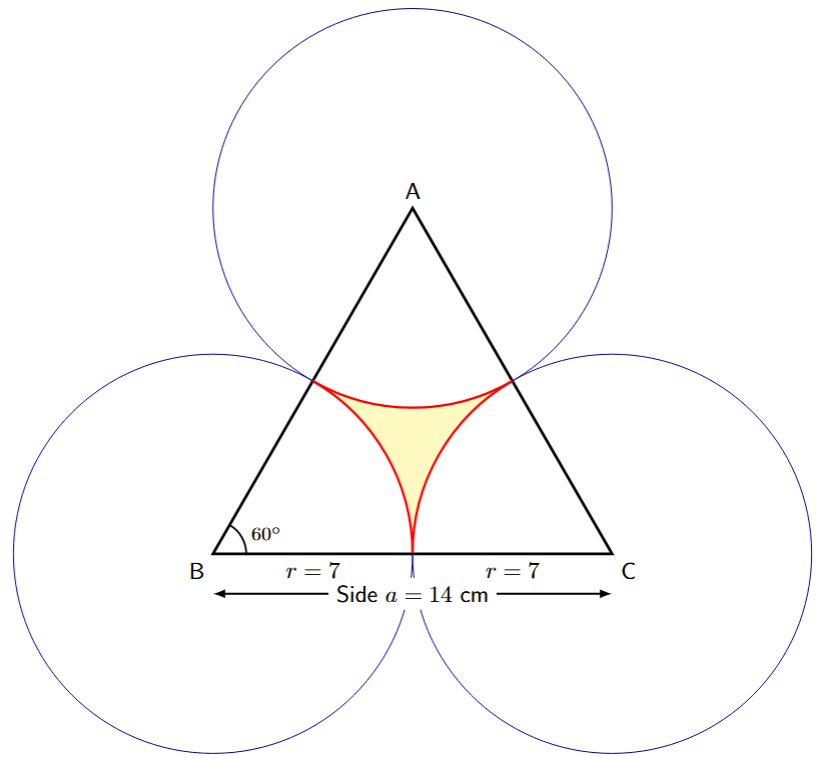
Question 25. The area of an equilateral triangle is 49$\sqrt{3}$ cm2. Taking each vertex as centre, circles are described with radius equal to half the length of the side of the triangle. Find the area of the part of the triangle not included in the circles. [Take $\sqrt{3}$ = 1.73, $\pi=\frac{22}{7}$]
Answer:
Given:
Area of the equilateral triangle $= 49\sqrt{3}$ $\text{cm}^2$.
Radius of each circle ($r$) = $\frac{1}{2}$ $\times$ Side of the triangle.
Use $\sqrt{3} = 1.73$ and $\pi = \frac{22}{7}$.
To Find:
The area of the part of the triangle not included in the circles (the area of the region shaded between the sectors).
Construction Required:
Taking each vertex ($A, B,$ and $C$) as the centre, draw three circles with a radius equal to half the length of the side of the triangle.
Solution:
Let the side of the equilateral triangle be $a$.
We know that the area of an equilateral triangle is given by the formula:
$\text{Area} = \frac{\sqrt{3}}{4} a^2$
... (i)
Substituting the given area in equation (i):
$49\sqrt{3} = \frac{\sqrt{3}}{4} a^2$
$49 = \frac{a^2}{4}$
$a^2 = 49 \times 4$
$a^2 = 196$
$a = 14$ cm
[Taking square root] ... (ii)
Now, the radius ($r$) of each circle is half the length of the side:
$r = \frac{a}{2} = \frac{14}{2}$
$r = 7$ cm
... (iii)
In an equilateral triangle, each interior angle is $60^\circ$. So, the angle of each sector ($\theta$) is $60^\circ$.
$\text{Area of 3 sectors} = 3 \times \left( \frac{\theta}{360^\circ} \times \pi r^2 \right)$
$\text{Area of 3 sectors} = 3 \times \frac{60^\circ}{360^\circ} \times \frac{22}{7} \times 7 \times 7$
$\text{Area of 3 sectors} = \frac{\cancel{180}^{1}}{\cancel{360}_{2}} \times 22 \times 7$
$\text{Area of 3 sectors} = 11 \times 7$
$\text{Area of 3 sectors} = 77$ $\text{cm}^2$
... (iv)
Now, we convert the area of the triangle into decimal form using $\sqrt{3} = 1.73$:
$\text{Area of triangle} = 49 \times 1.73$
$\text{Area of triangle} = 84.77$ $\text{cm}^2$
The area of the part of the triangle not included in the circles is:
$\text{Required Area} = \text{Area of triangle} - \text{Area of 3 sectors}$
$\text{Required Area} = 84.77 - 77.00$
$\text{Required Area} = 7.77$ $\text{cm}^2$
... (v)
Final Answer:
The area of the part of the triangle not included in the circles is $7.77$ $\text{cm}^2$.
Section D
Question 26. In a bag containing white and red balls, half the number of white balls is equal to the one third the number of red balls. Twice the total number of balls exceeds three times the number of red balls by 8. How many balls of each type does the bag contain?
Answer:
Given:
In a bag containing white and red balls:
1. Half the number of white balls is equal to one-third the number of red balls.
2. Twice the total number of balls exceeds three times the number of red balls by 8.
To Find:
The number of white balls and red balls in the bag.
Solution:
Let the number of white balls be $W$.
Let the number of red balls be $R$.
According to the first condition:
$\frac{1}{2} W = \frac{1}{3} R$
On cross-multiplication, we get:
$3W - 2R = 0$
…(i)
According to the second condition:
Total number of balls $= W + R$
Twice the total number of balls $= 2(W + R)$
Three times the number of red balls $= 3R$
Given that $2(W + R)$ exceeds $3R$ by $8$:
$2(W + R) = 3R + 8$
$2W + 2R = 3R + 8$
$2W + 2R - 3R = 8$
$2W - R = 8$
…(ii)
From equation (ii), we can express $R$ in terms of $W$:
$R = 2W - 8$
(Rearranging the terms)
Now, substitute this value of $R$ into equation (i):
$3W - 2(2W - 8) = 0$
$3W - 4W + 16 = 0$
[Substituting the value of R] ... (iii)
$-W + 16 = 0$
$W = 16$
Therefore, the number of white balls is 16.
Now, substitute the value of $W = 16$ back into equation (ii) to find $R$:
$2(16) - R = 8$
$32 - R = 8$
$R = 32 - 8$
$R = 24$
Therefore, the number of red balls is 24.
Final Answer:
The bag contains 16 white balls and 24 red balls.
Question 27. Prove that in a right triangle, the square of the hypotenuse is equal to sum of squares of the other two sides.
Using the above theorem, prove that in a triangle ABC, if AD is perpendicular to BC, then AB2 + CD2 = AC2 + BD2.
Answer:
Part 1: Proof of Pythagoras Theorem
Given:
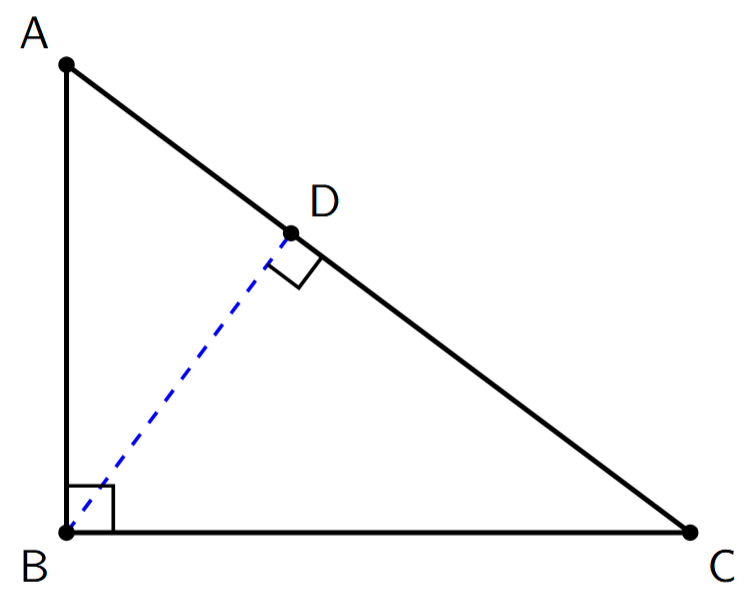
A right-angled triangle $ABC$, right-angled at $B$.
To Prove:
The square of the hypotenuse is equal to the sum of the squares of the other two sides, i.e.,
$AC^2 = AB^2 + BC^2$
... (i)
Construction Required:
Draw $BD \perp AC$.
Proof:
In $\triangle ADB$ and $\triangle ABC$:
$\angle ADB = \angle ABC = 90^\circ$ (By construction and Given)
$\angle A = \angle A$ (Common angle)
Therefore, $\triangle ADB \sim \triangle ABC$ (By AA similarity criterion).
Since the triangles are similar, their corresponding sides are proportional:
$\frac{AD}{AB} = \frac{AB}{AC}$
$AB^2 = AD \times AC$
[Cross-multiplication] ... (ii)
Similarly, in $\triangle BDC$ and $\triangle ABC$:
$\angle BDC = \angle ABC = 90^\circ$
$\angle C = \angle C$ (Common angle)
Therefore, $\triangle BDC \sim \triangle ABC$ (By AA similarity criterion).
$\frac{CD}{BC} = \frac{BC}{AC}$
$BC^2 = CD \times AC$
[Cross-multiplication] ... (iii)
Now, adding equation (ii) and equation (iii):
$AB^2 + BC^2 = (AD \times AC) + (CD \times AC)$
$AB^2 + BC^2 = AC(AD + CD)$
From the figure, $AD + CD = AC$. Substituting this value:
$AB^2 + BC^2 = AC(AC)$
$AB^2 + BC^2 = AC^2$
(Hence Proved)
Part 2: Application of Pythagoras Theorem
Given:
In $\triangle ABC$, $AD \perp BC$.
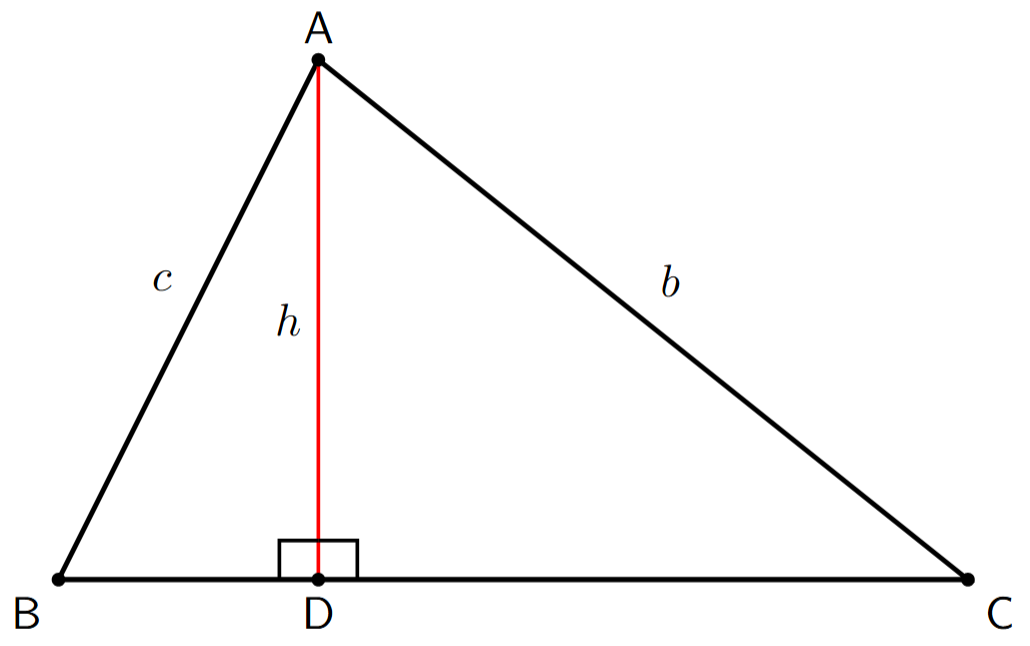
To Prove:
$AB^2 + CD^2 = AC^2 + BD^2$
Proof:
In right-angled triangle $\triangle ABD$, by Pythagoras Theorem:
$AB^2 = AD^2 + BD^2$
[By Pythagoras Theorem] ... (iv)
From equation (iv), we can express $AD^2$ as:
$AD^2 = AB^2 - BD^2$
... (v)
Similarly, in right-angled triangle $\triangle ACD$, by Pythagoras Theorem:
$AC^2 = AD^2 + CD^2$
[By Pythagoras Theorem] ... (vi)
From equation (vi), we can express $AD^2$ as:
$AD^2 = AC^2 - CD^2$
... (vii)
Equating the values of $AD^2$ from equation (v) and equation (vii):
$AB^2 - BD^2 = AC^2 - CD^2$
(Equating terms)
Rearranging the terms by transposing $-BD^2$ to the right-hand side and $-CD^2$ to the left-hand side:
$AB^2 + CD^2 = AC^2 + BD^2$
[Hence Proved] ... (viii)
Final Answer:
The Pythagoras theorem is proved using similar triangles, and it is applied to show that for any triangle with an altitude $AD$, the relation $AB^2 + CD^2 = AC^2 + BD^2$ holds true.
Question 28. A pole 5m high is fixed on the top of a tower. The angle of elevation of the top of the pole as observed from a point A on the ground is 60° and the angle of depression of point A from the top of the tower is 45°. Find the height of the tower. (Take $\sqrt{3}$ = 1.73)
Answer:
Given:
Height of the pole ($CD$) = $5$ m.
Angle of elevation of the top of the pole ($D$) from point $A$ = $60^\circ$.
Angle of depression of point $A$ from the top of the tower ($C$) = $45^\circ$.
Value of $\sqrt{3} = 1.73$.
To Find:
The height of the tower (let it be $BC$).
Construction Required:
Draw a diagram representing the tower $BC$ and the pole $CD$ on top of it. Let $A$ be the observation point on the ground.
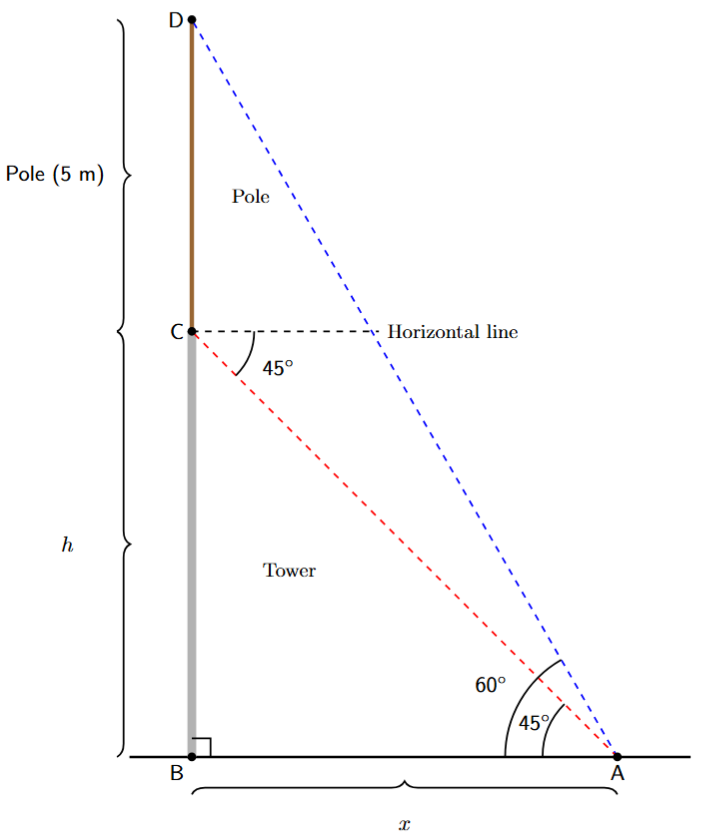
Solution:
Let the height of the tower be $BC = h$ metres.
Let the distance of point $A$ from the foot of the tower be $AB = x$ metres.
The angle of depression of point $A$ from the top of the tower $C$ is $45^\circ$. By the property of alternate interior angles, the angle of elevation of the top of the tower $C$ from point $A$ is also $45^\circ$.
$\angle BAC = 45^\circ$
(Alternate angles)
In right-angled triangle $\triangle ABC$:
$\tan 45^\circ = \frac{BC}{AB}$
$1 = \frac{h}{x}$
$h = x$
…(i)
Now, the height of the top of the pole from the ground is $BD = BC + CD = (h + 5)$ metres.
In right-angled triangle $\triangle ABD$:
$\tan 60^\circ = \frac{BD}{AB}$
$\sqrt{3} = \frac{h + 5}{x}$
Substituting $x = h$ from equation (i):
$\sqrt{3} = \frac{h + 5}{h}$
[From (i)] ... (ii)
On cross-multiplication:
$h\sqrt{3} = h + 5$
$h\sqrt{3} - h = 5$
$h(\sqrt{3} - 1) = 5$
$h = \frac{5}{\sqrt{3} - 1}$
To simplify, we multiply the numerator and denominator by the conjugate $(\sqrt{3} + 1)$:
$h = \frac{5(\sqrt{3} + 1)}{(\sqrt{3} - 1)(\sqrt{3} + 1)}$
$h = \frac{5(\sqrt{3} + 1)}{3 - 1}$
$h = \frac{5(\sqrt{3} + 1)}{2}$
... (iii)
Now, substituting the value of $\sqrt{3} = 1.73$:
$h = \frac{5(1.73 + 1)}{2}$
$h = \frac{5 \times 2.73}{2}$
$h = \frac{13.65}{2}$
$h = 6.825$ m
Final Answer:
The height of the tower is $6.825$ metres.
Question 29. The interior of a building is in the form of a cylinder of diameter 4 m and height 3.5 m, surmounted by a cone of the same base with vertical angle as a right angle. Find the surface area (curved) and volume of the interior of the building.
OR
A vessel in the form of an open inverted cone of height 8 cm and radius of its top is 5 cm. It is filled with water up to the brim. When lead shots, each of radius 0.5 cm are dropped into the vessel, one fourth of the water flows out. Find the number of lead shots dropped in the vessel.
Answer:
Part 1: Building with Cylinder and Cone
Given:
Diameter of the cylinder ($d$) = $4$ m
Radius ($r$) = $\frac{4}{2} = 2$ m
Height of the cylinder ($H$) = $3.5$ m
The cone has the same base as the cylinder, so its radius ($r$) = $2$ m.
The vertical angle of the cone is a right angle ($90^\circ$).
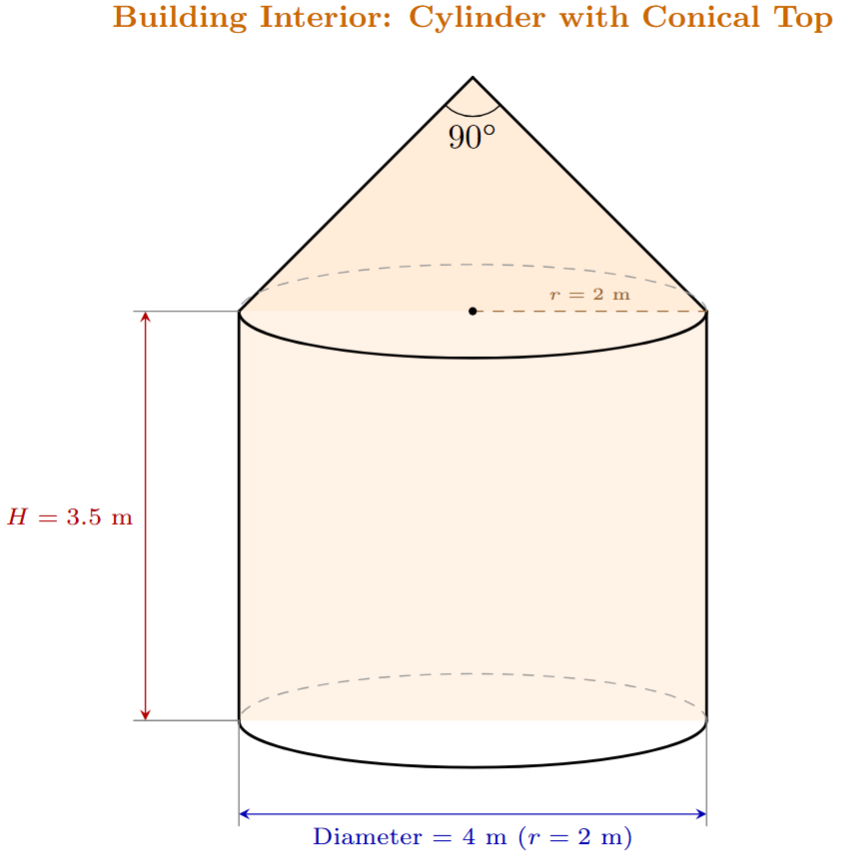
To Find:
1. Curved Surface Area (CSA) of the interior.
2. Volume of the interior.
Solution:
Since the vertical angle of the cone is $90^\circ$, the semi-vertical angle ($\alpha$) is $\frac{90^\circ}{2} = 45^\circ$.
In the right-angled triangle formed by the height ($h$), radius ($r$), and slant height ($l$) of the cone:
$\tan 45^\circ = \frac{r}{h}$
(Ratio of sides)
$1 = \frac{2}{h}$
$h = 2$ m
... (i)
Now, we find the slant height ($l$):
$l = \sqrt{r^2 + h^2}$
[By Pythagoras Theorem] ... (ii)
$l = \sqrt{2^2 + 2^2} = \sqrt{4 + 4} = \sqrt{8}$
$l = 2\sqrt{2} = 2 \times 1.414 = 2.828$ m
1. Curved Surface Area of the Interior:
Total CSA = CSA of Cylinder + CSA of Cone
Total CSA = $2\pi rH + \pi rl$
Total CSA = $\pi r (2H + l)$
Total CSA = $\frac{22}{7} \times 2 \times [2(3.5) + 2.828]$
Total CSA = $\frac{44}{7} \times [7 + 2.828]$
Total CSA = $\frac{44 \times 9.828}{7} = 44 \times 1.404 = 61.776$ m$^2$
2. Volume of the Interior:
Total Volume = Volume of Cylinder + Volume of Cone
Total Volume = $\pi r^2 H + \frac{1}{3} \pi r^2 h$
Total Volume = $\pi r^2 \left( H + \frac{1}{3}h \right)$
Total Volume = $\frac{22}{7} \times 2^2 \times \left( 3.5 + \frac{2}{3} \right)$
Total Volume = $\frac{88}{7} \times \left( \frac{10.5 + 2}{3} \right) = \frac{88 \times 12.5}{21} \approx 52.38$ m$^3$
Part 2: Lead Shots in Conical Vessel (OR)
Given:
Height of the cone ($h$) = $8$ cm
Radius of the cone ($r$) = $5$ cm
Radius of a lead shot ($r_s$) = $0.5$ cm
Volume of water that flows out = $\frac{1}{4} \times$ Volume of the cone.
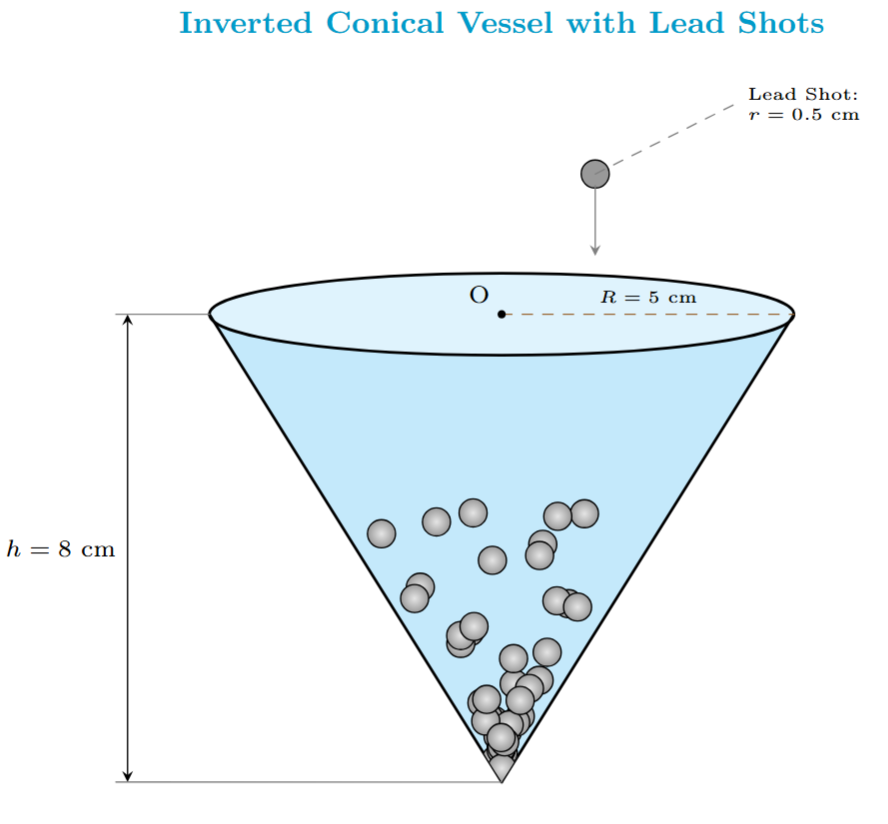
To Find:
The number of lead shots dropped into the vessel.
Solution:
Let the number of lead shots dropped be $n$.
According to Archimedes' Principle, the volume of water displaced is equal to the volume of the objects immersed in it.
$n \times \text{Volume of 1 lead shot} = \frac{1}{4} \times \text{Volume of cone}$
... (iii)
$n \times \frac{4}{3} \pi r_s^3 = \frac{1}{4} \times \frac{1}{3} \pi r^2 h$
Cancelling the common term $\frac{\pi}{3}$ from both sides:
$n \times 4 \times (0.5)^3 = \frac{1}{4} \times (5)^2 \times 8$
$n \times 4 \times 0.125 = \frac{25 \times 8}{4}$
$n \times 0.5 = 25 \times 2$
$n \times \frac{1}{2} = 50$
$n = 100$
[Final Count] ... (iv)
Final Answer:
1. The Curved Surface Area of the building is $61.78$ m$^2$ and the Volume is $52.38$ m$^3$.
2. The number of lead shots dropped in the vessel is 100.
Question 30. Find the mean, median and mode of the following frequency distribution:
| Class | 0 - 10 | 10 - 20 | 20 - 30 | 30 - 40 | 40 - 50 | 50 - 60 | 60 - 70 |
|---|---|---|---|---|---|---|---|
| Frequency | 4 | 5 | 7 | 10 | 12 | 8 | 4 |
OR
The following distribution gives the daily income of 50 workers of a factory:
| Daily income (in Rs) | 100 - 120 | 120 - 140 | 140 - 160 | 160 - 180 | 180 - 200 |
|---|---|---|---|---|---|
| Number if workers | 12 | 14 | 8 | 6 | 10 |
Convert the distribution above to a less than type cumulative frequency distribution, and draw its ogive. Find the median from this ogive.
Answer:
Question 30: Find the mean, median and mode of the following frequency distribution:
Given:
The frequency distribution is given as follows:
| Class | Frequency ($f_i$) | Class Mark ($x_i$) | $f_i x_i$ | Cumulative Frequency ($cf$) |
| 0 - 10 | 4 | 5 | 20 | 4 |
| 10 - 20 | 5 | 15 | 75 | 9 |
| 20 - 30 | 7 | 25 | 175 | 16 |
| 30 - 40 | 10 | 35 | 350 | 26 |
| 40 - 50 | 12 | 45 | 540 | 38 |
| 50 - 60 | 8 | 55 | 440 | 46 |
| 60 - 70 | 4 | 65 | 260 | 50 |
| Total | $N = \sum\limits f_i = 50$ | $\sum\limits f_i x_i = 1860$ |
To Find:
The Mean, Median, and Mode of the data.
Solution:
1. Calculation of Mean
The mean ($\bar{x}$) is given by the formula:
$\bar{x} = \frac{\sum\limits f_i x_i}{\sum\limits f_i}$
... (i)
Substituting the values from the table:
$\bar{x} = \frac{1860}{50}$
$\bar{x} = \frac{\cancel{1860}}{\cancel{50}}$
$\bar{x} = 37.2$
2. Calculation of Median
Here, $N = 50$, so $\frac{N}{2} = \frac{50}{2} = 25$.
The cumulative frequency just greater than $25$ is $26$, which belongs to the class 30 - 40.
Thus, the Median Class is 30 - 40.
$l = 30, \ cf = 16, \ f = 10, \ h = 10$
(Median class parameters)
$\text{Median} = l + \left[ \frac{\frac{N}{2} - cf}{f} \right] \times h$
$\text{Median} = 30 + \left[ \frac{25 - 16}{10} \right] \times 10$
$\text{Median} = 30 + 9$
$\text{Median} = 39$
3. Calculation of Mode
The maximum frequency is $12$, so the Modal Class is 40 - 50.
$l = 40, \ f_1 = 12, \ f_0 = 10, \ f_2 = 8, \ h = 10$
(Modal class parameters)
$\text{Mode} = l + \left( \frac{f_1 - f_0}{2f_1 - f_0 - f_2} \right) \times h$
$\text{Mode} = 40 + \left( \frac{12 - 10}{24 - 10 - 8} \right) \times 10$
$\text{Mode} = 40 + \left( \frac{2}{6} \right) \times 10$
$\text{Mode} = 40 + 3.33 = 43.33$
OR (Alternate Problem):
Given:
The daily income distribution of 50 workers is as follows:
| Daily income (in $\textsf{₹}$) | Number of workers ($f$) | Cumulative Frequency ($cf$) |
| Less than 120 | 12 | 12 |
| Less than 140 | 14 | 26 |
| Less than 160 | 8 | 34 |
| Less than 180 | 6 | 40 |
| Less than 200 | 10 | 50 |
To Find:
Draw the less than type ogive and find the median from the curve.
Solution:
To draw the ogive, we plot the points using upper limits on the X-axis and cumulative frequency on the Y-axis: $(120, 12), (140, 26), (160, 34), (180, 40), (200, 50)$.
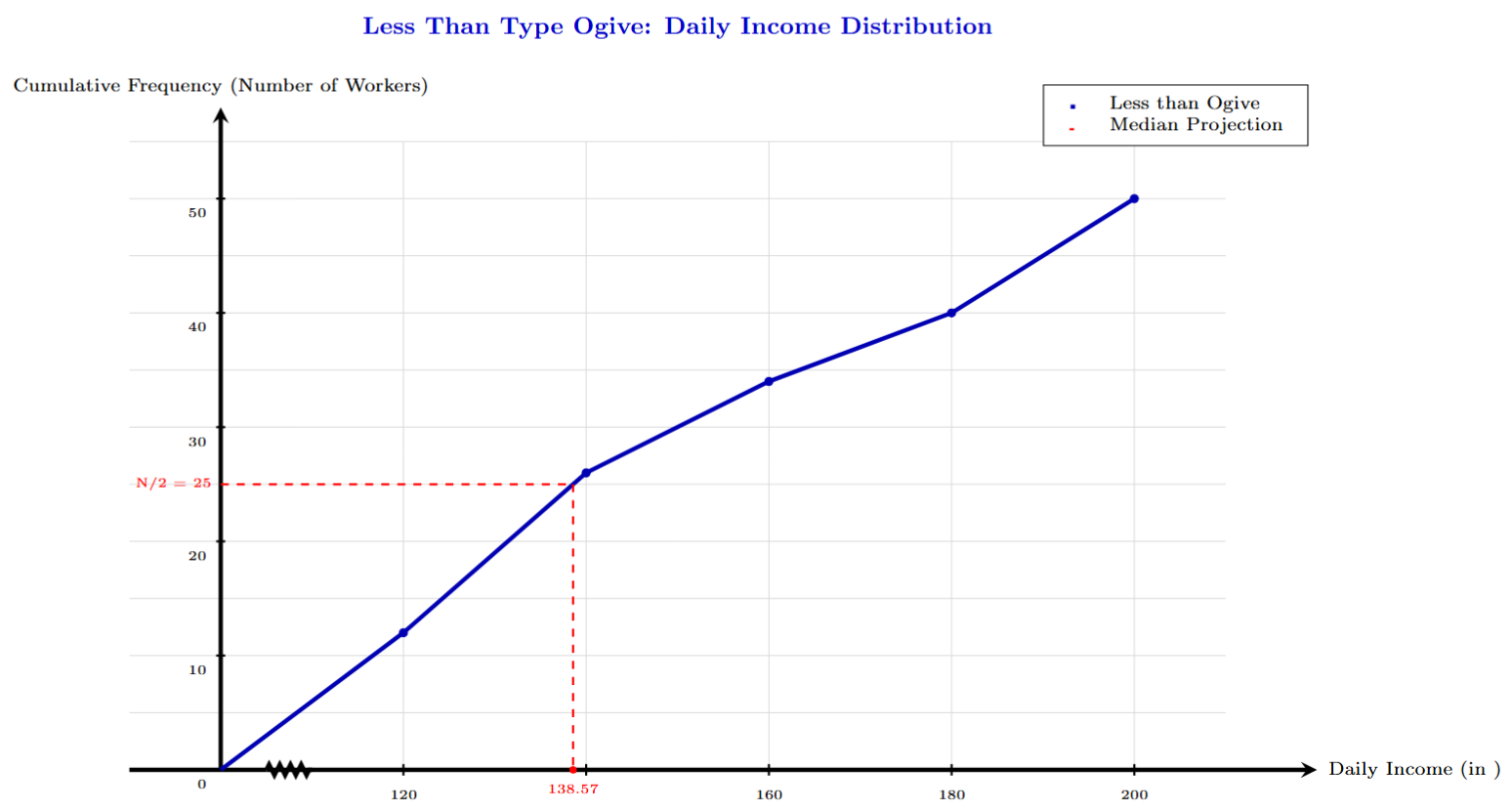
To find the median from the ogive:
1. Calculate $\frac{N}{2} = \frac{50}{2} = 25$.
2. Locate the value $25$ on the Y-axis and draw a horizontal line to meet the ogive.
3. From that point, drop a perpendicular to the X-axis.
$\text{Median} = \textsf{₹} \ 138.57$
[Approximated from the graph]
Final Answer:
For the first part: Mean = 37.2, Median = 39, and Mode = 43.33.
For the OR part: The Median income of the workers is $\textsf{₹} \ 138.57$ (approx).