

Chapter 2 Geometry (Class 6 - Maths NCERT Exemplar Solutions)
Welcome to the comprehensive guide for NCERT Exemplar Solutions for Class 6 Mathematics: Chapter 2 Geometry! This resource covers the core concepts found in "Basic Geometrical Ideas" and "Understanding Elementary Shapes." These solutions are designed to address the higher level of difficulty inherent in Exemplar problems, which aim to cultivate spatial reasoning and a precise understanding of geometric definitions. By working through these problems, students move beyond simple recognition to a rigorous application of fundamental properties in complex figures.
The solutions encompass the entire range of foundational geometry, starting with the building blocks: points, lines, line segments, and rays. Students will explore the relationships between intersecting and parallel lines, classify open and closed curves, and study the properties of polygons like triangles and quadrilaterals. A significant portion is dedicated to angles—identifying acute, obtuse, right, straight, and reflex angles—as well as classifying triangles based on sides (scalene, isosceles, equilateral) and angles. The chapter also explores the parts of a circle and the properties of three-dimensional shapes, including counting their faces, edges, and vertices.
Exemplar problems often require systematic observation, such as counting distinct triangles within a complex diagram or using the angle sum property (where the sum of angles in a triangle is $180^\circ$) to find unknown values. Our solutions provide step-by-step logic for Multiple Choice Questions (MCQs), True/False statements, and long-answer justifications. With clear explanations and correct geometric terminology prepared by learningspot.co, students can master the analytical skills and visualization techniques necessary for higher-order thinking in geometry.
| Content On This Page | ||
|---|---|---|
| Solved Examples (Examples 1 to 12) | Question 1 to 16 (Multiple Choice Questions) | Question 17 to 31 (Fill in the Blanks) |
| Question 32 to 41 (True or False) | Question 42 to 78 | |
Solved Examples (Examples 1 to 12)
In examples 1 and 2, write the correct answer from the given four options.
Example 1: The number of diagonals of a pentagon is
(A) 3
(B) 4
(C) 5
(D) 10
Answer:
Given:
A pentagon has 5 sides. So, $n = 5$.
To Find:
The number of diagonals in a pentagon.
Solution:
The formula to find the number of diagonals in a polygon with $n$ sides is:
$\text{Number of Diagonals} = \frac{n(n - 3)}{2}$
Substituting $n = 5$ into the formula:
$\text{Number of Diagonals} = \frac{5(5 - 3)}{2}$
$\text{Number of Diagonals} = \frac{5 \times 2}{2}$
By cancelling the 2 in numerator and denominator:
$\text{Number of Diagonals} = \frac{5 \times \cancel{2}^{1}}{\cancel{2}_{1}} = 5$
Conclusion:
A pentagon has 5 diagonals. Therefore, the correct option is (C).
Example 2: The number of diagonals of a triangle is
(A) 0
(B) 1
(C) 2
(D) 3
Answer:
Given:
A triangle has 3 sides. So, $n = 3$.
To Find:
The number of diagonals in a triangle.
Solution:
Using the formula for the number of diagonals:
$\text{Number of Diagonals} = \frac{n(n - 3)}{2}$
Substituting $n = 3$ into the formula:
$\text{Number of Diagonals} = \frac{3(3 - 3)}{2}$
$\text{Number of Diagonals} = \frac{3 \times 0}{2}$
$\text{Number of Diagonals} = 0$
Conclusion:
A triangle has 0 diagonals because no two non-adjacent vertices can be joined within the figure. Therefore, the correct option is (A).
In examples 3 and 4, fill in the blanks to make the statements true:
Example 3: A polygon of six sides is called a ______.
Answer:
Solution:
Polygons are named based on the number of sides they possess.
1. 3 sides: Triangle
2. 4 sides: Quadrilateral
3. 5 sides: Pentagon
4. 6 sides: Hexagon
Conclusion:
A polygon of six sides is called a Hexagon.
Example 4: A triangle with all its sides of unequal lengths is called a ______ triangle.
Answer:
Solution:
Triangles are classified by their side lengths as follows:
1. Equilateral Triangle: All three sides are equal.
2. Isosceles Triangle: At least two sides are equal.
3. Scalene Triangle: All three sides have different (unequal) lengths.
Conclusion:
A triangle with all its sides of unequal lengths is called a Scalene triangle.
In examples 5 to 7, state whether the statements are true or false.
Example 5: Two non-parallel line segments will always intersect.
Answer:
Solution:
While non-parallel lines in the same plane will always intersect when extended indefinitely, line segments have fixed end points and specific lengths.
If two non-parallel line segments are positioned such that they do not reach each other, they will not intersect.
Conclusion:
The statement is False.
Example 6: All equilateral triangles are isosceles also.
Answer:
Solution:
An isosceles triangle is defined as a triangle having at least two equal sides.
An equilateral triangle has all three sides equal.
Since an equilateral triangle has three equal sides, it automatically satisfies the condition of having at least two equal sides.
Conclusion:
The statement is True.
Example 7: Angle of 0° is an acute angle.
Answer:
Solution:
Angles are classified as follows:
1. Zero Angle: An angle of exactly $0^\circ$.
2. Acute Angle: An angle greater than $0^\circ$ and less than $90^\circ$.
$0^\circ < \text{Acute Angle} < 90^\circ$
(Definition)
Since an acute angle must be strictly greater than $0^\circ$, an angle of $0^\circ$ itself is not considered acute; it is a Zero angle.
Conclusion:
The statement is False.
Example 8: In Fig. 2.1, PQ ⊥ AB and PO = OQ. Is PQ the perpendicular bisector of line segment AB? Why or why not?
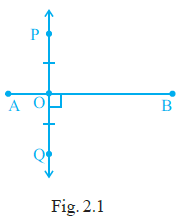
Answer:
Given:
1. Line $PQ$ is perpendicular to line segment $AB$ ($PQ \perp AB$) at point $O$.
2. $PO = OQ$, which means $O$ is the midpoint of segment $PQ$.
To Find:
Is $PQ$ the perpendicular bisector of line segment $AB$?
Solution:
To be the perpendicular bisector of a line segment $AB$, a line must satisfy two conditions:
1. It must be perpendicular to $AB$.
2. It must pass through the midpoint of $AB$ (i.e., it must bisect $AB$).
In the given figure:
$PQ \perp AB$
(Given)
However, for $PQ$ to bisect $AB$, point $O$ must be the midpoint of $AB$, meaning $AO$ must be equal to $OB$. From the figure, it is clearly visible that:
$AO \neq OB$
Although $PQ$ is bisected by $AB$ (since $PO = OQ$), the line $PQ$ does not bisect the segment $AB$.
Conclusion: No, $PQ$ is not the perpendicular bisector of $AB$.
Example 9: In Fig. 2.2, if AC ⊥ BD , then name all the right angles.
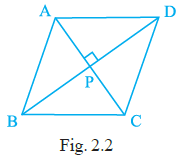
Answer:
Given:
Line segment $AC$ is perpendicular to line segment $BD$ ($AC \perp BD$) at point $P$.
Solution:
When two lines or line segments are perpendicular to each other, they form four right angles at the point of intersection.
The right angles formed at the intersection point $P$ are:
1. $\angle APD = 90^\circ$
2. $\angle DPC = 90^\circ$
3. $\angle CPB = 90^\circ$
4. $\angle BPA = 90^\circ$
$\angle APD = \angle DPC = \angle CPB = \angle BPA = 90^\circ$
Example 10: Is ABCD of Fig. 2.3 a polygon? If yes, what is the special name for it?
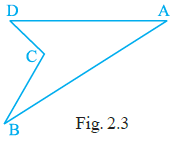
Answer:
Solution:
A polygon is defined as a simple closed curve made up entirely of line segments. Figure $ABCD$ is a closed figure formed by four line segments: $AB$, $BC$, $CD$, and $DA$.
Therefore, ABCD is a polygon.
Since the polygon has four sides, its general name is a quadrilateral.
Special observation: In this figure, the interior angle at vertex $C$ is greater than $180^\circ$ (a reflex angle). Such a polygon is specifically called a Concave Quadrilateral.
Alternate Solution:
We can also identify it simply as a quadrilateral based on the number of vertices ($A, B, C, D$) and sides.
Example 11: In Fig. 2.4, BCDE is a square and a 3D shape has been formed by joining the point A in space with the vertices B, C, D and E. Name the 3D shape and also its
(i) vertices,
(ii) edges and
(iii) faces.
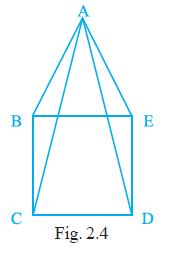
Answer:
Given:
The base $BCDE$ is a square. Point $A$ is located in space and is connected to vertices $B, C, D,$ and $E$.
Solution:
A 3D shape with a polygonal base and triangular lateral faces meeting at a common apex is called a pyramid. Since the base is a square, the shape is a Square Pyramid.
(i) Vertices:
The vertices are the corner points of the shape. There are 5 vertices in total:
A, B, C, D, and E
(ii) Edges:
The edges are the line segments where two faces meet. There are 8 edges in total:
Base edges: BC, CD, DE, and EB
Lateral edges: AB, AC, AD, and AE
(iii) Faces:
The faces are the flat surfaces of the shape. There are 5 faces in total:
1. Square base: BCDE
2. Triangular lateral faces: $\triangle ABC$, $\triangle ACD$, $\triangle ADE$, and $\triangle ABE$
Example 12: Write the measure of smaller angle formed by the hour and the minute hands of a clock at 7 O’ clock. Also, write the measure of the other angle and also state what types of angles these are.
Answer:
Given:
The time on the clock is 7 O’ clock.
To Find:
1. Measure of the smaller angle.
2. Measure of the other (larger) angle.
3. Types of these angles.
Solution:
A clock is circular in shape, and a complete rotation represents $360^\circ$. The clock face is divided into 12 equal hour divisions.
First, we calculate the angle represented by one hour division:
$\text{Angle of one division} = \frac{360^\circ}{12} = 30^\circ$
At 7 O’ clock, the minute hand is at 12 and the hour hand is at 7.
The number of divisions between 12 and 7 (counting the shorter way, counter-clockwise) is:
$12 - 7 = 5 \text{ divisions}$
(Shorter path)
(i) Calculating the smaller angle:
$\text{Smaller angle} = 5 \times 30^\circ$
$\text{Smaller angle} = 150^\circ$
[Measure of the smaller angle]
Since $150^\circ$ is greater than $90^\circ$ but less than $180^\circ$, it is an Obtuse Angle.
(ii) Calculating the other (larger) angle:
The total angle around the centre is $360^\circ$. The other angle is the reflex angle formed between the hands.
$\text{Other angle} = 360^\circ - 150^\circ$
$\text{Other angle} = 210^\circ$
[Measure of the reflex angle]
Since $210^\circ$ is greater than $180^\circ$ but less than $360^\circ$, it is a Reflex Angle.
Final Result:
| Angle | Measure | Type |
| Smaller Angle | $150^\circ$ | Obtuse Angle |
| Other Angle | $210^\circ$ | Reflex Angle |
Exercise
Question 1 to 16 (Multiple Choice Questions)
In each of the questions 1 to 16, out of four options only one is correct. Write the correct answer.
Question 1. Number of lines passing through five points such that no three of them are collinear is
(A) 10
(B) 5
(C) 20
(D) 8
Answer:
Given:
Number of points = 5
Condition: No three points are collinear (they do not lie on the same straight line).
To Find:
The total number of lines that can be drawn passing through these points.
Solution:
A line is uniquely determined by two distinct points. To find the number of lines, we need to find how many pairs of points can be formed from the 5 given points.
The formula for the number of lines passing through $n$ points (where no three are collinear) is:
$\text{Number of lines} = \frac{n(n - 1)}{2}$
Substituting $n = 5$:
$\text{Number of lines} = \frac{5(5 - 1)}{2}$
$\text{Number of lines} = \frac{5 \times 4}{2}$
$\text{Number of lines} = \frac{20}{2} = 10$
Conclusion:
The number of lines passing through five points is 10. Therefore, the correct option is (A).
Question 2. The number of diagonals in a septagon is
(A) 21
(B) 42
(C) 7
(D) 14
Answer:
Given:
The polygon is a septagon (also known as a heptagon).
Number of sides ($n$) = 7
To Find:
The number of diagonals in a septagon.
Solution:
A diagonal is a line segment connecting two non-adjacent vertices of a polygon. The formula to find the number of diagonals for a polygon with $n$ sides is:
$\text{Number of diagonals} = \frac{n(n - 3)}{2}$
Substituting $n = 7$:
$\text{Number of diagonals} = \frac{7(7 - 3)}{2}$
$\text{Number of diagonals} = \frac{7 \times 4}{2}$
$\text{Number of diagonals} = \frac{28}{2} = 14$
Conclusion:
The number of diagonals in a septagon is 14. Therefore, the correct option is (D).
Alternate Solution:
Total ways to join 7 points is $\frac{7 \times 6}{2} = 21$. Out of these 21 lines, 7 are the sides of the polygon. The rest are diagonals. So, $21 - 7 = 14$.
Question 3. Number of line segments in Fig. 2.5 is
(A) 5
(B) 10
(C) 15
(D) 20
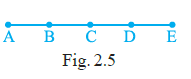
Answer:
Given:
A line containing 5 points: A, B, C, D, and E.
To Find:
The total number of line segments that can be formed using these points.
Solution:
A line segment is formed by joining any two points. We can list all possible segments starting from each point:
1. Starting from A: AB, AC, AD, AE (4 segments)
2. Starting from B: BC, BD, BE (3 segments)
3. Starting from C: CD, CE (2 segments)
4. Starting from D: DE (1 segment)
Total number of segments = $4 + 3 + 2 + 1 = 10$.
Mathematical Calculation:
The number of ways to choose 2 points out of $n$ points on a line is given by:
$\text{Total Segments} = \frac{n(n - 1)}{2}$
Substituting $n = 5$:
$\text{Total Segments} = \frac{5 \times 4}{2} = 10$
Conclusion:
There are 10 line segments in the figure. Therefore, the correct option is (B).
Question 4. Measures of the two angles between hour and minute hands of a clock at 9 O’ clock are
(A) 60°, 300°
(B) 270°, 90°
(C) 75°, 285°
(D) 30°, 330°
Answer:
Given:
The time on the clock is 9 O' clock.
To Find:
The measures of the two angles formed between the hour and minute hands.
Solution:
At 9 O' clock, the minute hand is at 12 and the hour hand is at 9.
The clock is divided into 12 equal hour divisions. Each division represents:
$\text{Angle per division} = \frac{360^\circ}{12} = 30^\circ$
Step 1: Calculate the smaller angle:
The number of divisions between 9 and 12 is 3 (9 to 10, 10 to 11, 11 to 12).
$\text{Smaller angle} = 3 \times 30^\circ = 90^\circ$
Step 2: Calculate the larger angle:
The total angle in a circle is $360^\circ$. The other angle is the reflex angle.
$\text{Larger angle} = 360^\circ - 90^\circ = 270^\circ$
Conclusion:
The two angles are 90° and 270°. Therefore, the correct option is (B).
Question 5. If a bicycle wheel has 48 spokes, then the angle between a pair of two consecutive spokes is
(A) $\left( 5\frac{1}{2} \right)$
(B) $\left( 7\frac{1}{2} \right)$
(C) $\left( \frac{2}{11} \right)$
(D) $\left( \frac{2}{15} \right)$
Answer:
Given:
Total number of spokes in the wheel = 48
To Find:
The angle between a pair of two consecutive spokes.
Solution:
A full wheel represents a complete angle of $360^\circ$. The 48 spokes divide this total angle into 48 equal parts.
$\text{Angle between spokes} = \frac{360^\circ}{48}$
Dividing the terms by 12:
$\text{Angle} = \frac{\cancel{360}^{30}}{\cancel{48}_{4}} = \frac{30}{4} = \frac{15}{2}$
Converting the improper fraction to a mixed number:
$\text{Angle} = 7.5^\circ = 7\frac{1}{2}^\circ$
Conclusion:
The angle is $7\frac{1}{2}^\circ$. Therefore, the correct option is (B).
Question 6. In Fig. 2.6, ∠XYZ cannot be written as
(A) ∠Y
(B) ∠ZXY
(C) ∠ZYX
(D) ∠XYP
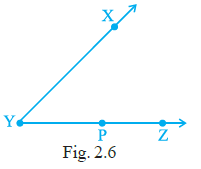
Answer:
Solution:
The angle given is $\angle XYZ$. In naming an angle, the vertex must always be the middle letter.
Here, the vertex of the angle is Y.
1. $\angle Y$: This is a correct way to name the angle using only the vertex.
2. $\angle ZXY$: This name places X as the vertex. This is incorrect.
3. $\angle ZYX$: This is the same as $\angle XYZ$, just the order of the arms is reversed. It is correct.
4. $\angle XYP$: Since point P lies on the same ray as Z, $\angle XYP$ refers to the same angle. It is correct.
Conclusion:
The angle cannot be written as $\angle ZXY$. Therefore, the correct option is (B).
Question 7. In Fig 2.7, if point A is shifted to point B along the ray PX such that PB = 2PA, then the measure of ∠BPY is
(A) greater than 45°
(B) 45°
(C) less than 45°
(D) 90°
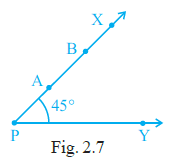
Answer:
Given:
$\angle APY = 45^\circ$. Point A is moved to point B along the same ray $PX$.
Solution:
The measure of an angle depends entirely on the inclination (direction) between the two rays that form it. It does not depend on the length of the rays or the position of points marked on them.
Since point B is shifted along the same ray $PX$, the direction of the arm of the angle remains unchanged. Therefore, $\angle BPY$ is the exact same angle as $\angle APY$.
$\angle BPY = \angle APY = 45^\circ$
Conclusion:
The measure of $\angle BPY$ remains 45°. Therefore, the correct option is (B).
Question 8. The number of angles in Fig. 2.8 is
(A) 3
(B) 4
(C) 5
(D) 6
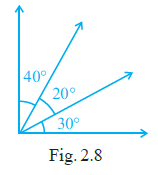
Answer:
Solution:
In the given figure, there are 4 rays starting from a common vertex. Let us name the rays from top to bottom as $R_1, R_2, R_3, R_4$.
We can count the angles by combining these rays:
Single Angles:
1. Angle between $R_1$ and $R_2$ ($40^\circ$)
2. Angle between $R_2$ and $R_3$ ($20^\circ$)
3. Angle between $R_3$ and $R_4$ ($30^\circ$)
Combined (Double) Angles:
4. Angle between $R_1$ and $R_3$ ($40^\circ + 20^\circ = 60^\circ$)
5. Angle between $R_2$ and $R_4$ ($20^\circ + 30^\circ = 50^\circ$)
Total (Triple) Angle:
6. Angle between $R_1$ and $R_4$ ($40^\circ + 20^\circ + 30^\circ = 90^\circ$)
Mathematical Calculation:
For $n$ rays from a common vertex, the number of angles is $\frac{n(n - 1)}{2}$.
With $n = 4$ rays:
$\text{Number of angles} = \frac{4 \times 3}{2} = 6$
Conclusion:
The total number of angles is 6. Therefore, the correct option is (D).
Question 9. The number of obtuse angles in Fig. 2.9 is
(A) 2
(B) 3
(C) 4
(D) 5
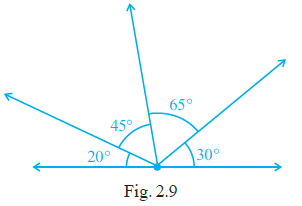
Answer:
Given:
As per the figure, the correct measures of the four adjacent angles are $25^\circ, 55^\circ, 60^\circ,$ and $40^\circ$ respectively.
To Find:
The total number of obtuse angles present in the figure.
Solution:
An obtuse angle is defined as an angle whose measure is greater than $90^\circ$ but less than $180^\circ$.
$90^\circ < \text{Obtuse Angle} < 180^\circ$
(Definition)
We check all possible combinations of these adjacent angles:
1. Sum of two adjacent angles:
$25^\circ + 55^\circ = 80^\circ$ (Acute)
$55^\circ + 60^\circ = 115^\circ$ (Obtuse)
$60^\circ + 40^\circ = 100^\circ$ (Obtuse)
2. Sum of three adjacent angles:
$25^\circ + 55^\circ + 60^\circ = 140^\circ$ (Obtuse)
$55^\circ + 60^\circ + 40^\circ = 155^\circ$ (Obtuse)
3. Sum of all four adjacent angles:
$25^\circ + 55^\circ + 60^\circ + 40^\circ = 180^\circ$
Since $180^\circ$ is a straight angle, it is not considered an obtuse angle.
The obtuse angles formed are $115^\circ, 100^\circ, 140^\circ,$ and $155^\circ$.
Conclusion:
There are exactly 4 obtuse angles in the figure. Therefore, the correct option is (C).
Question 10. The number of triangles in Fig. 2.10 is
(A) 10
(B) 12
(C) 13
(D) 14
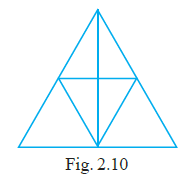
Answer:
To Find:
The total number of triangles in Fig. 2.10.
Solution:
To determine the total number of triangles, we count them systematically based on the number of smaller components they contain:
1. Single triangles (individual small units): 6
2. Triangles formed by 2 small units: 3
3. Triangles formed by 3 small units: 2
4. The largest outer triangle (formed by all units): 1
Summing these up:
$\text{Total number of triangles} = 6 + 3 + 2 + 1$
$\text{Total} = 12$
Conclusion:
The total number of triangles in the figure is 12. Therefore, the correct option is (B).
Question 11. If the sum of two angles is greater than 180°, then which of the following is not possible for the two angles?
(A) One obtuse angle and one acute angle
(B) One reflex angle and one acute angle
(C) Two obtuse angles
(D) Two right angles.
Answer:
Solution:
We are given that $\text{Sum} > 180^\circ$. Let's check each option:
(A) Obtuse ($>90^\circ$) + Acute ($<90^\circ$): For example, $120^\circ + 70^\circ = 190^\circ$. Possible.
(B) Reflex ($>180^\circ$) + Acute ($>0^\circ$): The sum will always be $>180^\circ$. Possible.
(C) Two obtuse angles: For example, $100^\circ + 100^\circ = 200^\circ$. Possible.
(D) Two right angles: $90^\circ + 90^\circ = 180^\circ$. This is not greater than $180^\circ$.
Conclusion:
Option (D) is not possible.
Question 12. If the sum of two angles is equal to an obtuse angle, then which of the following is not possible?
(A) One obtuse angle and one acute angle.
(B) One right angle and one acute angle.
(C) Two acute angles.
(D) Two right angles.
Answer:
Solution:
An obtuse angle is between $90^\circ$ and $180^\circ$.
(A) Obtuse + Acute: $100^\circ + 10^\circ = 110^\circ$ (Obtuse). Possible.
(B) Right + Acute: $90^\circ + 20^\circ = 110^\circ$ (Obtuse). Possible.
(C) Two acute: $50^\circ + 60^\circ = 110^\circ$ (Obtuse). Possible.
(D) Two right angles: $90^\circ + 90^\circ = 180^\circ$. A $180^\circ$ angle is a straight angle, not an obtuse angle.
Conclusion:
Option (D) is not possible.
Question 13. A polygon has prime number of sides. Its number of sides is equal to the sum of the two least consecutive primes. The number of diagonals of the polygon is
(A) 4
(B) 5
(C) 7
(D) 10
Answer:
Given:
Number of sides is the sum of the two least consecutive primes.
Solution:
The prime numbers are $2, 3, 5, 7, 11, \dots$
The two least consecutive primes are 2 and 3.
Number of sides ($n$) = $2 + 3 = 5$. (A Pentagon)
The formula for the number of diagonals is:
$\text{Diagonals} = \frac{n(n - 3)}{2}$
Substituting $n = 5$:
$\text{Diagonals} = \frac{5(5 - 3)}{2} = \frac{5 \times 2}{2} = 5$
Conclusion:
The number of diagonals is 5. Thus, the correct option is (B).
Question 14. In Fig. 2.11, AB = BC and AD = BD = DC. The number of isoscles triangles in the figure is
(A) 1
(B) 2
(C) 3
(D) 4

Answer:
Solution:
An isosceles triangle has at least two equal sides. Let's identify them based on the given information:
1. In $\triangle ABC$: $AB = BC$ (Given). This is an isosceles triangle.
2. In $\triangle ABD$: $AD = BD$ (Given). This is an isosceles triangle.
3. In $\triangle BDC$: $BD = DC$ (Given). This is an isosceles triangle.
Conclusion:
There are 3 isosceles triangles in the figure. Thus, the correct option is (C).
Question 15. In Fig. 2.12, ∠BAC = 90° and AD ⊥ BC. The number of right triangles in the figure is
(A) 1
(B) 2
(C) 3
(D) 4
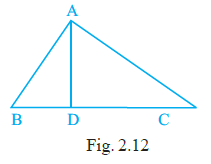
Answer:
Solution:
A right triangle contains one angle of $90^\circ$. Let's identify them:
1. $\triangle ABC$: It is given that $\angle BAC = 90^\circ$.
2. $\triangle ADB$: It is given that $AD \perp BC$, so $\angle ADB = 90^\circ$.
3. $\triangle ADC$: It is given that $AD \perp BC$, so $\angle ADC = 90^\circ$.
Conclusion:
There are 3 right triangles in the figure. Thus, the correct option is (C).
Question 16. In Fig. 2.13, PQ ⊥ RQ, PQ = 5 cm and QR = 5 cm. Then ∆ PQR is
(A) a right triangle but not isosceles
(B) an isosceles right triangle
(C) isosceles but not a right triangle
(D) neither isosceles nor right triangle
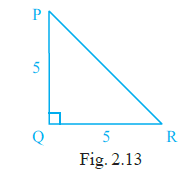
Answer:
Solution:
1. Given $PQ \perp RQ$, which means $\angle Q = 90^\circ$. Therefore, $\triangle PQR$ is a right triangle.
2. Given $PQ = 5 \text{ cm}$ and $QR = 5 \text{ cm}$. Since two sides are equal, the triangle is also isosceles.
Conclusion:
Combining these properties, $\triangle PQR$ is an isosceles right triangle. Thus, the correct option is (B).
Question 17 to 31 (Fill in the Blanks)
In questions 17 to 31, fill in the blanks to make the statements true:
Question 17. An angle greater than 180° and less than a complete angle is called _______.
Answer:
An angle greater than $180^\circ$ and less than a complete angle ($360^\circ$) is called a reflex angle.
Question 18. The number of diagonals in a hexagon is ________.
Answer:
A hexagon is a polygon with 6 sides.
The number of sides is $n=6$.
The formula for the number of diagonals in a polygon with $n$ sides is:
Number of diagonals $= \frac{n(n-3)}{2}$
Substituting $n=6$ for a hexagon:
Number of diagonals $= \frac{6(6-3)}{2}$
Number of diagonals $= \frac{6(3)}{2}$
Number of diagonals $= \frac{18}{2}$
Number of diagonals $= 9$
The number of diagonals in a hexagon is 9.
Question 19. A pair of opposite sides of a trapezium are ________.
Answer:
A trapezium (also known as a trapezoid) is a quadrilateral with at least one pair of parallel opposite sides.
Therefore, a pair of opposite sides of a trapezium are parallel.
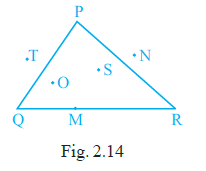
Question 20. In Fig. 2.14, points lying in the interior of the triangle PQR are ______, that in the exterior are ______ and that on the triangle itself are ______.
Answer:
Solution:
By observing the positions of the points relative to the boundary of the triangle $PQR$:
1. Interior points: These are the points located inside the space enclosed by the three sides of the triangle. The points are O and S.
2. Exterior points: These are the points located outside the triangle. The points are T and N.
3. Points on the triangle: These are the points that lie exactly on the line segments forming the sides. The points are P, Q, R, and M.
Conclusion:
Points lying in the interior of the triangle PQR are O, S, that in the exterior are T, N and that on the triangle itself are P, Q, R, M.
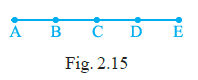
Question 21. In Fig. 2.15, points A, B, C, D and E are collinear such that AB = BC = CD = DE. Then
(a) AD = AB + ______
(b) AD = AC + ______
(c) mid point of AE is ______
(d) mid point of CE is ______
(e) AE = ______ × AB
Answer:
Given:
Points $A, B, C, D, E$ are on a straight line and the distances between consecutive points are equal:
$AB = BC = CD = DE$
Solution:
(a) $AD$ consists of segments $AB, BC,$ and $CD$. Thus, $AD = AB + (BC + CD) = AB + BD$.
(b) $AD$ consists of segments $AC$ and $CD$. Thus, $AD = AC + CD$.
(c) Total segments in $AE$ are 4 units ($AB+BC+CD+DE$). The middle point would be at 2 units from $A$, which is point C (since $AC = CE = 2$ units).
(d) $CE$ consists of segments $CD$ and $DE$. Since $CD = DE$, the point exactly in the middle is D.
(e) $AE = AB + BC + CD + DE$. Since all these are equal to $AB$, then $AE = AB + AB + AB + AB = 4 \times AB$.
Conclusion:
(a) BD; (b) CD; (c) C; (d) D; (e) 4.
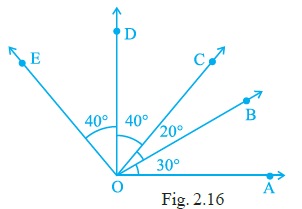
Question 22. In Fig. 2.16,
(a) ∠AOD is a/an ______ angle
(b) ∠COA is a/an ______ angle
(c) ∠AOE is a/an ______ angle
Answer:
Given:
$\angle AOB = 30^\circ$, $\angle BOC = 20^\circ$, $\angle COD = 40^\circ$, $\angle DOE = 40^\circ$.
Solution:
(a) For $\angle AOD$:
$\angle AOD = \angle AOB + \angle BOC + \angle COD$
$\angle AOD = 30^\circ + 20^\circ + 40^\circ = 90^\circ$
Since it is exactly $90^\circ$, it is a right angle.
(b) For $\angle COA$:
$\angle COA = \angle COB + \angle BOA$
$\angle COA = 20^\circ + 30^\circ = 50^\circ$
Since $50^\circ$ is less than $90^\circ$, it is an acute angle.
(c) For $\angle AOE$:
$\angle AOE = \angle AOB + \angle BOC + \angle COD + \angle DOE$
$\angle AOE = 30^\circ + 20^\circ + 40^\circ + 40^\circ = 130^\circ$
Since $130^\circ$ is greater than $90^\circ$ but less than $180^\circ$, it is an obtuse angle.
Conclusion:
(a) right; (b) acute; (c) obtuse.
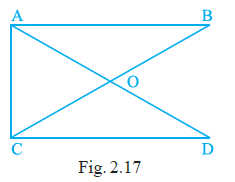
Question 23. The number of triangles in Fig. 2.17 is ______. Their names are ________.
Answer:
Given:
In Fig. 2.17, we are given points $A, B, C, D$ and an intersection point $O$. The line segments joined are $AB$, $AC$, $CD$ and the diagonals $AD$ and $BC$. It is explicitly given that $BD$ is not joined.
To Find:
The precise number of triangles and their respective names.
Solution:
A triangle is a closed figure formed by exactly three line segments. We will identify all such figures by examining the vertices.
1. Triangles formed at the intersection point $O$:
By using the segments $OA, OB, OC, OD$ (which are parts of the diagonals) and the outer sides:
$\triangle OAB$ (Segments: $OA, OB, AB$)
$\triangle OAC$ (Segments: $OA, OC, AC$)
$\triangle OCD$ (Segments: $OC, OD, CD$)
Note: Since $BD$ is not joined, the figure $OBD$ is not a triangle.
2. Larger triangles formed by full diagonals and sides:
$\triangle ABC$ (Segments: $AB, BC, AC$)
$\triangle ACD$ (Segments: $AC, CD, AD$)
Note: $\triangle ABD$ and $\triangle BCD$ are not triangles because the side $BD$ does not exist.
Total Calculation:
Counting the identified triangles:
$\text{Total Triangles} = 3 + 2 = 5$
[Precise Count]
Conclusion:
The number of triangles in Fig. 2.17 is 5. Their names are $\triangle OAB$, $\triangle OAC$, $\triangle OCD$, $\triangle ABC$, and $\triangle ACD$.
Question 24. Number of angles less than 180° in Fig. 2.17 is ______and their names are ______.
Answer:
Given:
Points $A, B, C, D$ with diagonals $AD$ and $BC$ intersecting at $O$. Segments $AB, AC, CD$ exist, but $BD$ is not joined.
To Find:
The precise number of angles whose measure is less than $180^\circ$.
Solution:
An angle is formed by two line segments sharing a common endpoint. We will list all such angles vertex by vertex.
1. At Vertex $A$:
Rays $AB, AC, AD$ meet at $A$. The angles are:
$\angle BAC$, $\angle CAD$, and $\angle BAD$ (3 angles)
2. At Vertex $B$:
Rays $BA$ and $BC$ meet at $B$. The angle is:
$\angle ABC$ (1 angle)
3. At Vertex $C$:
Rays $CA, CB, CD$ meet at $C$. The angles are:
$\angle ACB$, $\angle BCD$, and $\angle ACD$ (3 angles)
4. At Vertex $D$:
Rays $DC$ and $DA$ meet at $D$. The angle is:
$\angle ADC$ (1 angle)
5. At Vertex $O$:
The diagonals $AD$ and $BC$ intersect at $O$, forming four non-straight angles:
$\angle AOB$, $\angle BOC$, $\angle COD$, and $\angle DOA$ (4 angles)
Note: $\angle AOD$ and $\angle COB$ are straight angles ($180^\circ$), so they are excluded.
Total Calculation:
Summing the angles from all vertices:
$\text{Total Angles} = 3 + 1 + 3 + 1 + 4 = 12$
Conclusion:
The number of angles less than $180^\circ$ is 12. Their names are $\angle BAC, \angle CAD, \angle BAD, \angle ABC, \angle ACB, \angle BCD, \angle ACD, \angle ADC, $$ \angle AOB, \angle BOC, \angle COD, \text{ and } \angle DOA$.
Question 25. The number of straight angles in Fig. 2.17 is ______.
Answer:
Given:
In Fig. 2.17, there are two intersecting line segments, AD and BC, which cross each other at point O.
To Find:
The total number of straight angles in the figure.
Solution:
A straight angle is defined as an angle that measures exactly $180^\circ$. It is represented by a straight line with a vertex point chosen on it. Geometrically, at any point on a straight line, two straight angles are formed—one on each side of the line.
In Fig. 2.17, there are two straight lines ($AD$ and $BC$) intersecting at point $O$. We count the straight angles at vertex $O$ for both lines.
1. Straight angles on line AD:
The line segment $AD$ has the vertex $O$ on it. This creates two straight angles, one above the line and one below the line.
$\angle AOD = 180^\circ$
(Upper side of line AD)
$\angle AOD = 180^\circ$
(Lower side of line AD)
2. Straight angles on line BC:
Similarly, the line segment $BC$ has the vertex $O$ on it. This also creates two straight angles, one on the left side and one on the right side of the line.
$\angle COB = 180^\circ$
(Left side of line BC)
$\angle COB = 180^\circ$
(Right side of line BC)
3. Total Calculation:
To find the total number of straight angles, we add the angles identified for both lines:
$\text{Total straight angles} = 2 + 2$
$\text{Total straight angles} = 4$
Conclusion:
The total number of straight angles in Fig. 2.17 is 4. These are formed by the two sides of $\angle AOD$ and the two sides of $\angle COB$.
Question 26. The number of right angles in a straight angle is ______ and that in a complete angle is ______.
Answer:
Solution:
1. A straight angle is $180^\circ$. Since $180^\circ = 2 \times 90^\circ$, it contains 2 right angles.
2. A complete angle is $360^\circ$. Since $360^\circ = 4 \times 90^\circ$, it contains 4 right angles.
Conclusion:
The number of right angles in a straight angle is 2 and in a complete angle is 4.
Question 27. The number of common points in the two angles marked in Fig. 2.18 is ______.
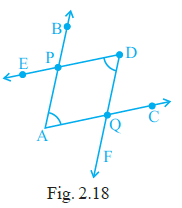
Answer:
Given:
In Fig. 2.18, we have two angles marked with arcs at vertices A and D.
To Find:
The number of common points between the two marked angles.
Solution:
An angle is formed by two rays sharing a common endpoint (the vertex). The points on an angle include the vertex and all the points lying on its two arms (rays).
1. Identification of the first marked angle:
The first angle is marked at vertex A. Its arms are the rays starting from $A$ and passing through points $P$ and $Q$.
Points on this angle include vertex A and all points on ray AP and ray AQ.
2. Identification of the second marked angle:
The second angle is marked at vertex D. Its arms are the rays starting from $D$ and passing through points $P$ and $Q$.
Points on this angle include vertex D and all points on ray DP and ray DQ.
3. Finding Common Points:
By observing the figure, we can see where the arms of the two angles meet or overlap:
Point P lies on ray $AP$ (an arm of the first angle) and also on ray $DP$ (an arm of the second angle).
Point Q lies on ray $AQ$ (an arm of the first angle) and also on ray $DQ$ (an arm of the second angle).
There are no other points or rays that are shared between these two specific angles.
Conclusion:
The number of common points in the two marked angles is 2. These common points are P and Q.
Question 28. The number of common points in the two angles marked in Fig. 2.19 is ______.
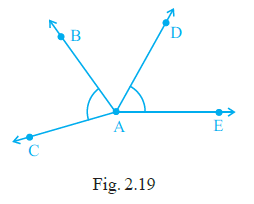
Answer:
Solution:
In Fig. 2.19, the two marked angles are $\angle BAC$ and $\angle DAE$. Both angles share the same starting point, which is vertex A. No other rays or points overlap.
Conclusion:
The number of common points is 1 (Point A).
Question 29. The number of common points in the two angles marked in Fig. 2.20 ______ .
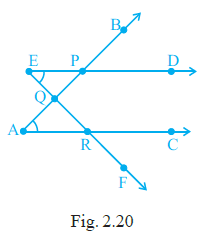
Answer:
Given:
In Fig. 2.20, two angles are marked with arcs. One angle has its vertex at point E and the other has its vertex at point A.
To Find:
The number of common points between these two marked angles.
Solution:
An angle is composed of a vertex and two rays, known as arms. The points that make up an angle include the vertex itself and all the points situated along its two arms.
1. Analysis of the first marked angle (at vertex E):
The vertex is E. The two arms forming this angle are the ray ED and the ray EF.
The points shown on these arms include E, P, D, Q, R, and F.
2. Analysis of the second marked angle (at vertex A):
The vertex is A. The two arms forming this angle are the ray AC and the ray AB.
The points shown on these arms include A, R, C, Q, P, and B.
3. Identifying the Common Points:
Common points are the locations where the arms of the first angle intersect or overlap with the arms of the second angle. By observing Fig. 2.20:
The arm $ED$ (from the angle at $E$) intersects the arm $AB$ (from the angle at $A$) at point P.
The arm $EF$ (from the angle at $E$) intersects the arm $AB$ (from the angle at $A$) at point Q.
The arm $EF$ (from the angle at $E$) intersects the arm $AC$ (from the angle at $A$) at point R.
Conclusion:
There are exactly 3 common points between the two marked angles. These common points are P, Q, and R.
Question 30. The number of common points in the two angles marked in Fig. 2.21 is ______.
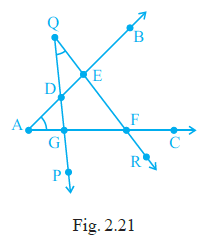
Answer:
Given:
In Fig. 2.21, two angles are marked with arcs. One angle is located at vertex A and the other angle is located at vertex Q.
To Find:
The total number of common points between these two marked angles.
Solution:
An angle is formed by two rays that share a common endpoint. The points belonging to an angle include the vertex point and all points situated on its two arms (rays).
1. Analysis of the angle at vertex A:
The arms of this angle are the rays $AB$ and $AC$. The points marked on these arms in the figure are:
On ray $AB$: Points D, E, and B.
On ray $AC$: Points G, F, and C.
The vertex itself is point A.
2. Analysis of the angle at vertex Q:
The arms of this angle are the rays $QP$ and $QR$. The points marked on these arms in the figure are:
On ray $QP$: Points D, G, and P.
On ray $QR$: Points E, F, and R.
The vertex itself is point Q.
3. Identifying Common Points:
Common points are the locations where the arms of the angle at $A$ cross or overlap with the arms of the angle at $Q$. By observing Fig. 2.21, we can see the following intersections:
Point D: It is the intersection of ray $AB$ and ray $QP$.
Point E: It is the intersection of ray $AB$ and ray $QR$.
Point G: It is the intersection of ray $AC$ and ray $QP$.
Point F: It is the intersection of ray $AC$ and ray $QR$.
Conclusion:
The total number of common points in the two marked angles is 4. These points are D, E, F, and G.
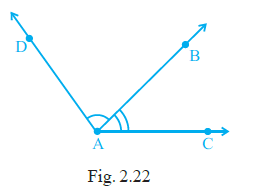
Question 31. The common part between the two angles BAC and DAB in Fig. 2.22 is ______.
Answer:
Solution:
$\angle BAC$ is formed by rays $AB$ and $AC$.
$\angle DAB$ is formed by rays $AD$ and $AB$.
The ray AB is a part of both angles.
Conclusion:
The common part between the two angles is ray AB.
Question 32 to 41 (True or False)
State whether the statements given in questions 32 to 41 are true (T) or false (F):
Question 32. A horizontal line and a vertical line always intersect at right angles.
Answer:
The statement is about the intersection of a horizontal line and a vertical line.
A horizontal line extends left and right, perpendicular to the direction of gravity.
A vertical line extends up and down, parallel to the direction of gravity.
When a horizontal line and a vertical line intersect, they are perpendicular to each other. Perpendicular lines intersect at an angle of $90^\circ$.
$90^\circ$ is the definition of a right angle.
Therefore, a horizontal line and a vertical line always intersect at right angles.
The statement is True (T).
Question 33. If the arms of an angle on the paper are increased, the angle increases.
Answer:
An angle is defined by the measure of the rotation between its two rays (arms) from the common endpoint (vertex).
The length of the lines drawn on paper representing the arms of an angle does not affect the amount of rotation between the rays.
For example, if we draw a $45^\circ$ angle, it remains a $45^\circ$ angle regardless of whether the arms are drawn 1 cm long or 10 cm long.
The angle measure is independent of the visual length of its arms.
Therefore, if the arms of an angle on the paper are increased, the angle does not increase.
The statement is False (F).
Question 34. If the arms of an angle on the paper are decreased, the angle decreases.
Answer:
An angle is defined by the amount of rotation between its two rays (arms) that share a common endpoint (vertex).
The measure of an angle depends only on the relative orientation of its two arms (rays), not on the physical length drawn for the arms on a piece of paper.
Changing the length of the line segments drawn to represent the arms does not change the angle between the rays they represent.
Therefore, if the arms of an angle on the paper are decreased, the angle does not decrease.
The statement is False (F).
Question 35. If line PQ || line m, then line segment PQ || m
Answer:
Given:
Line $PQ$ is parallel to line $m$.
To Find:
Whether the statement "line segment $PQ \parallel$ line $m$" is true or false.
Solution:
In geometry, a line is an infinite path that extends forever in both directions. A line segment is a finite part of that line, defined by two fixed endpoints.
$\text{Line } PQ \parallel \text{Line } m$
(Given)
Parallel lines are lines in the same plane that never intersect, no matter how far they are extended. They always maintain a constant distance from each other.
Since the line segment $PQ$ is a specific part of the line $PQ$, every point on the segment also lies on the line. If the entire infinite line $PQ$ never meets line $m$, then any portion of that line (the segment) will also never meet line $m$.
Therefore, if a line is parallel to another line, any segment contained within that line is also parallel to the other line.
Conclusion:
The statement is True.
Question 36. Two parallel lines meet each other at some point.
Answer:
Parallel lines are defined as two or more lines that lie in the same plane and never intersect each other, even if extended infinitely in both directions.
The statement says that two parallel lines meet each other at some point, which is contrary to the definition of parallel lines.
Therefore, the statement is incorrect.
The statement is False (F).
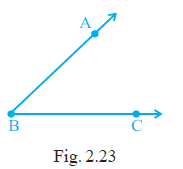
Question 37. Measures of ∠ABC and ∠CBA in Fig. 2.23 are the same.
Answer:
The angle $\angle$ABC is an angle with vertex at point B and arms being the ray BA and the ray BC.
The angle $\angle$CBA is an angle with vertex at point B and arms being the ray BC and the ray BA.
In standard geometry, the order of the non-vertex letters in the notation of an angle does not change the angle itself. Both notations, $\angle$ABC and $\angle$CBA, refer to the same geometric angle formed by the two rays originating from B and passing through A and C, respectively.
The measure of an angle is a property of the angle itself, determined by the separation between its arms. Since $\angle$ABC and $\angle$CBA represent the same angle, their measures must be equal.
Therefore, the measures of $\angle$ABC and $\angle$CBA are the same.
The statement is True (T).
Question 38. Two line segments may intersect at two points.
Answer:
A line segment is a part of a line that is bounded by two distinct endpoints.
Let's consider two line segments. For them to intersect, they must have one or more points in common.
Case 1: The two line segments lie on the same line (they are collinear).
If two collinear line segments intersect at two distinct points, say P and Q, then all the points on the segment PQ must be common to both line segments. This means they overlap along the segment PQ. In this case, they would have infinitely many common points (all points on the overlapping segment), not just two.
Case 2: The two line segments lie on different lines.
According to the postulates of Euclidean geometry, two distinct lines can intersect at most at one point. If the line segments are parts of two distinct lines, they can intersect at most at the single intersection point of those two lines. This intersection point, if it exists and lies on both segments, is a single common point.
In neither case is it possible for two line segments to intersect at exactly two distinct points.
The statement is False (F).
Question 39. Many lines can pass through two given points.
Answer:
The statement refers to the number of lines that can pass through two specific, distinct points.
A fundamental principle in geometry (often an axiom or postulate) states that through any two distinct points, there exists exactly one unique straight line.
This means that given two different points, there is only one possible line that connects them and passes through both points.
The statement "Many lines can pass through two given points" contradicts this fundamental principle, as "many" implies more than one.
Therefore, the statement is incorrect.
The statement is False (F).
Question 40. Only one line can pass through a given point.
Answer:
The statement claims that only one line can pass through a single given point.
Consider a single point in a plane.
We can draw multiple lines that all go through this one point.
Imagine drawing lines that rotate around the point. Each distinct orientation represents a different line passing through the point.
In geometry, it is a fundamental concept that infinitely many lines can pass through a single given point.
Therefore, the statement "Only one line can pass through a given point" is incorrect.
The statement is False (F).
Question 41. Two angles can have exactly five points in common.
Answer:
To Prove:
Whether the statement "Two angles can have exactly five points in common" is true or false.
Proof/Solution:
An angle is a geometric figure formed by two rays (arms) originating from a common vertex. Rays are parts of straight lines.
To determine the number of common points between two angles, we must consider the intersection of their rays. When two straight lines or rays intersect, they can have:
1. Zero points in common (if they are parallel).
2. Exactly one point in common (at the point of intersection).
3. Infinitely many points in common (if the rays are coincident/overlapping).
Detailed Analysis:
Two angles consist of a total of four rays (two rays for each angle). Let the rays of the first angle be $r_1, r_2$ and the rays of the second angle be $r_3, r_4$.
The common points between the two angles are the intersection points of these rays. The possible intersections are between pairs $(r_1, r_3)$, $(r_1, r_4)$, $(r_2, r_3)$, and $(r_2, r_4)$.
Since each pair of rays can intersect at most at one point, the maximum number of discrete (individual) common points for two angles is:
$\text{Max discrete points} = 2 \times 2 = 4$
[For non-overlapping rays]
If any ray overlaps with another, the number of common points immediately becomes infinite, as a line segment or a ray contains an unending number of points.
There is no configuration of two angles (formed by straight rays) that can produce exactly five discrete common points.
Conclusion:
The statement is False.
Question 42 to 78
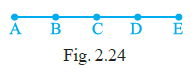
Question 42. Name all the line segments in Fig. 2.24.
Answer:
Given:
A line containing five points: A, B, C, D, and E.
To Find:
List all the line segments present in Fig. 2.24.
Solution:
A line segment is a part of a line that is bounded by two distinct end points. To find all segments, we can systematically list them starting from each point:
1. Segments starting from A: $AB$, $AC$, $AD$, and $AE$.
2. Segments starting from B: $BC$, $BD$, and $BE$.
3. Segments starting from C: $CD$ and $CE$.
4. Segments starting from D: $DE$.
Conclusion:
The line segments are $AB, AC, AD, AE, BC, BD, BE, CD, CE,$ and $DE$.
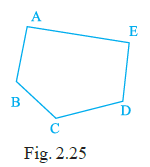
Question 43. Name the line segments shown in Fig. 2.25.
Answer:
Given:
A closed polygon with vertices A, B, C, D, and E.
To Find:
Name the line segments shown in Fig. 2.25.
Solution:
The line segments in a polygon are the sides that connect the consecutive vertices. By following the perimeter of the figure, we can identify the following segments:
1. Segment connecting A and B: $AB$
2. Segment connecting B and C: $BC$
3. Segment connecting C and D: $CD$
4. Segment connecting D and E: $DE$
5. Segment connecting E and A: $EA$ (or $AE$)
Conclusion:
The line segments are $AB, BC, CD, DE,$ and $EA$.
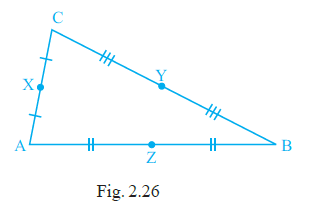
Question 44. State the mid points of all the sides of Fig. 2.26.
Answer:
Given:
A triangle $ABC$ where each side has a point marked on it. Markings (short bars) on the segments indicate that the segments on either side of the points are equal.
To Find:
Identify the midpoints of all the sides of Fig. 2.26.
Solution:
A midpoint of a line segment is the point that divides the segment into two equal parts.
1. On side $AB$, the point $Z$ is marked. The two bars on $AZ$ and $ZB$ indicate that $AZ = ZB$. Therefore, $Z$ is the midpoint of $AB$.
2. On side $BC$, the point $Y$ is marked. The three bars on $BY$ and $YC$ indicate that $BY = YC$. Therefore, $Y$ is the midpoint of $BC$.
3. On side $AC$, the point $X$ is marked. The single bar on $AX$ and $XC$ indicates that $AX = XC$. Therefore, $X$ is the midpoint of $AC$.
Conclusion:
The midpoints are $Z$ for side $AB$, $Y$ for side $BC$, and $X$ for side $AC$.
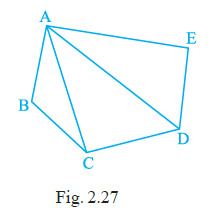
Question 45. Name the vertices and the line segments in Fig. 2.27.
Answer:
Given:
Fig. 2.27 shows a pentagon ABCDE with additional lines drawn from vertex A to vertices C and D.
Solution:
Vertices:
The vertices are the points where the line segments meet. The vertices are:
A, B, C, D, and E
Line Segments:
The line segments are the parts of lines bounded by two endpoints. From the figure, these are:
1. Outer segments: $AB, BC, CD, DE,$ and $EA$
2. Inner segments (diagonals): $AC$ and $AD$
Conclusion: There are 5 vertices and 7 line segments in the figure.
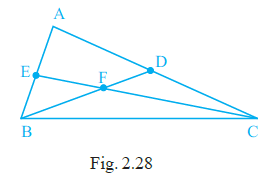
Question 46. Write down fifteen angles (less than 180°) involved in Fig. 2.28.
Answer:
Given:
Fig. 2.28 shows a triangle ABC. Point E lies on side AB and point D lies on side AC. The segments BD and CE intersect at point F.
Solution:
We need to list fifteen angles that measure less than $180^\circ$. We can group them by their vertices:
1. At Vertex A: $\angle BAC$ (or $\angle EAD$)
2. At Vertex B: $\angle ABD, \angle DBC, \angle ABC$
3. At Vertex C: $\angle ACE, \angle ECB, \angle ACB$
4. At Vertex D: $\angle BDC, \angle BDA$
5. At Vertex E: $\angle AEC, \angle CEB$
6. At Vertex F: $\angle BFE, \angle EFD, \angle DFC, \angle CFB$
Total List:
$\angle BAC, \angle ABD, \angle DBC, \angle ABC, \angle ACE, \angle ECB, \angle ACB, \angle BDC, $$ \angle BDA, \angle AEC, \angle CEB, \angle BFE, \angle EFD, \angle DFC, \text{ and } \angle CFB$.
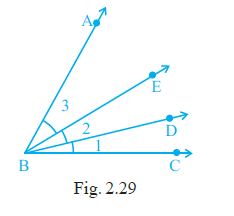
Question 47. Name the following angles of Fig. 2.29, using three letters:
(a) ∠1
(b) ∠2
(c) ∠3
(d) ∠1 + ∠2
(e) ∠2 + ∠3
(f) ∠1 + ∠2 + ∠3
(g) ∠CBA – ∠1
Answer:
Given:
Fig. 2.29 shows four rays originating from vertex B, forming three adjacent angles labeled 1, 2, and 3.
Solution:
Using the three-letter notation (where the middle letter is the vertex B), we can name the angles as follows:
(a) $\angle 1$ = $\angle CBD$
(b) $\angle 2$ = $\angle DBE$
(c) $\angle 3$ = $\angle EBA$
(d) $\angle 1 + \angle 2$ = $\angle CBE$
(e) $\angle 2 + \angle 3$ = $\angle DBA$
(f) $\angle 1 + \angle 2 + \angle 3$ = $\angle CBA$
(g) $\angle CBA - \angle 1$ = $\angle CBA - \angle CBD$ = $\angle DBA$
Question 48. Name the points and then the line segments in each of the following figures (Fig. 2.30):
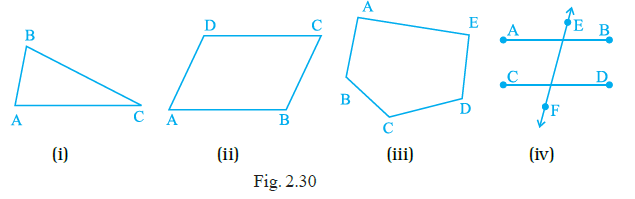
Answer:
To Find:
Identify the points and the line segments in each sub-figure of Fig. 2.30.
Solution:
(i) Figure (i):
Points: A, B, and C
Line Segments: $AB, BC,$ and $CA$
(ii) Figure (ii):
Points: A, B, C, and D
Line Segments: $AB, BC, CD,$ and $DA$
(iii) Figure (iii):
Points: A, B, C, D, and E
Line Segments: $AB, BC, CD, DE,$ and $EA$
(iv) Figure (iv):
Points: A, B, C, D, E, and F
Line Segments: $AB, CD,$ and $EF$
Question 49. Which points in Fig. 2.31, appear to be mid-points of the line segments? When you locate a mid-point, name the two equal line segments formed by it.
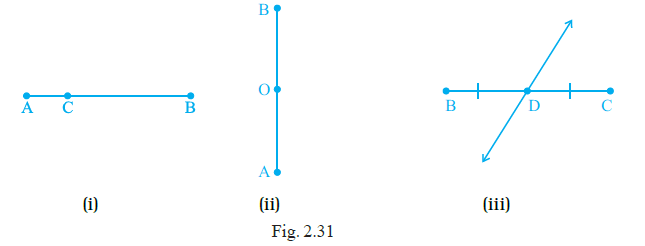
Answer:
To Find:
Identify the points that appear to be mid-points and name the two equal line segments formed by them in Fig. 2.31.
Solution:
A mid-point is a point on a line segment that divides it into two segments of equal length.
(i) Figure (i):
Point $C$ lies on the segment $AB$, but it is significantly closer to $A$ than to $B$.
Conclusion: Point C is not a mid-point.
(ii) Figure (ii):
Point $O$ lies on the segment $BA$ and appears to be exactly in the center.
Conclusion: Point O is the mid-point of segment $BA$.
Equal line segments: $BO = OA$
(iii) Figure (iii):
Point $D$ lies on the segment $BC$. The two small vertical marks (tally marks) on segments $BD$ and $DC$ indicate that they are equal in length.
Conclusion: Point D is the mid-point of segment $BC$.
Equal line segments: $BD = DC$
Question 50. Is it possible for the same
(a) line segment to have two different lengths?
(b) angle to have two different measures?
Answer:
(a) Is it possible for the same line segment to have two different lengths?
No, it is not possible for the same line segment to have two different lengths.
A line segment is defined by two distinct points, and its length is the unique distance between these two points.
(b) Is it possible for the same angle to have two different measures?
No, it is not possible for the same angle to have two different measures.
An angle is formed by two rays sharing a common endpoint, and its measure represents the unique amount of rotation between these two rays.
Question 51. Will the measure of ∠ABC and of ∠CBD make measure of ∠ABD in Fig. 2.32?

Answer:
Given:
In Fig. 2.32, we have three rays BA, BC, and BD originating from a common vertex B. The ray BC lies between the rays BA and BD.
To Find:
Will the sum of the measures of $\angle ABC$ and $\angle CBD$ be equal to the measure of $\angle ABD$?
Solution:
Two angles are said to be adjacent if they have a common vertex, a common arm, and their non-common arms lie on opposite sides of the common arm.
In Fig. 2.32:
1. $\angle ABC$ and $\angle CBD$ share the common vertex B.
2. They share the common arm (ray) BC.
3. Ray BA and ray BD are the non-common arms.
When one ray lies in the interior of a larger angle, the measure of the larger angle is the sum of the measures of the two smaller angles formed.
$\angle ABD = \angle ABC + \angle CBD$
Conclusion:
Yes, the measures of $\angle ABC$ and $\angle CBD$ will make the measure of $\angle ABD$.
Question 52. Will the lengths of line segment AB and line segment BC make the length of line segment AC in Fig. 2.33?
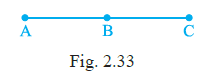
Answer:
Given:
In Fig. 2.33, three points A, B, and C are collinear (they lie on the same straight line). Point B lies between points A and C.
To Find:
Will the sum of the lengths of line segment AB and line segment BC be equal to the length of line segment AC?
Solution:
For any three collinear points where one point lies between the other two, the whole segment is the sum of its parts. This is known as the Segment Addition Postulate.
In the figure:
1. The distance from A to B is represented by the segment $AB$.
2. The distance from B to C is represented by the segment $BC$.
3. The total distance from A to C is represented by the segment $AC$.
Since B is an interior point of the segment $AC$:
$AC = AB + BC$
Conclusion:
Yes, the lengths of line segment $AB$ and $BC$ will make the length of line segment $AC$.
Question 53. Draw two acute angles and one obtuse angle without using a protractor. Estimate the measures of the angles. Measure them with the help of a protractor and see how much accurate is your estimate.
Answer:
To Do:
Draw two acute angles and one obtuse angle without a protractor, estimate their measures, and then verify the accuracy using a protractor.
Solution:
This is a practical activity. Below is a representation of how you should draw and record your observations.
Step 1: Drawing the angles
Using a scale and a pencil, draw three angles. An acute angle should be smaller than a corner of a square ($90^\circ$), and an obtuse angle should be wider than a corner but not a straight line.
Step 2: Estimation and Verification
First, look at the opening of the arms and guess the value in degrees ($^\circ$). Then, place the centre of your protractor on the vertex and align the baseline with one arm to find the actual measurement.
Observation Table (Sample Data):
| Angle Type | Estimated Measure | Actual Measure | Accuracy/Difference |
| Acute Angle 1 | $30^\circ$ | $35^\circ$ | $5^\circ$ |
| Acute Angle 2 | $75^\circ$ | $70^\circ$ | $5^\circ$ |
| Obtuse Angle | $120^\circ$ | $125^\circ$ | $5^\circ$ |
Conclusion:
By comparing the estimated and actual values, you can see how accurate your visual judgment is. In the sample above, the accuracy is within a range of $5^\circ$.
Question 54. Look at Fig. 2.34. Mark a point
(a) A which is in the interior of both ∠1 and ∠2.
(b) B which is in the interior of only ∠1.
(c) Point C in the interior of ∠1.
Now, state whether points B and C lie in the interior of ∠2 also.
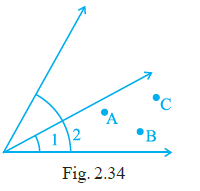
Answer:
Given:
In Fig. 2.34, we have three rays with a common vertex. By observing the markings:
1. $\angle 1$ is the smaller angle formed between the bottom ray and the middle ray.
2. $\angle 2$ is the larger angle formed between the bottom ray and the top ray.
Solution:
The interior of an angle is the region between its two arms. From the figure, it is clear that the space belonging to $\angle 1$ is completely contained within the space belonging to $\angle 2$.
(a) Marking point A: Since point A must be in the interior of both angles, it should be placed anywhere in the region between the bottom and middle rays.
(b) Marking point B: The question asks for a point in the interior of only $\angle 1$. However, because every point that is inside $\angle 1$ is also inside the larger $\angle 2$, it is not possible to find a point that belongs to $\angle 1$ but not to $\angle 2$. Therefore, point B is marked in the region of $\angle 1$.
(c) Marking point C: Point C is placed in the interior of $\angle 1$.
Reasoning:
Since the region of $\angle 1$ is a part of the region of $\angle 2$, any point placed inside the smaller angle automatically becomes a point inside the larger angle.
Conclusion:
Yes, points B and C lie in the interior of $\angle 2$ also. This is because the interior of $\angle 1$ is entirely contained within the interior of $\angle 2$.
Question 55. Find out the incorrect statement, if any, in the following:
An angle is formed when we have
(a) two rays with a common end-point
(b) two line segments with a common end-point
(c) a ray and a line segment with a common end-point
Answer:
Given:
Three statements describing the formation of an angle using rays and line segments.
To Find:
The incorrect statement(s) among the given options.
Solution:
In formal geometry, the strict definition of an angle is a figure formed by two rays that share a common initial point, known as the vertex. The rays are referred to as the arms of the angle.
Let us evaluate each statement based on this standard geometric definition:
(a) Two rays with a common end-point:
This statement is correct. By definition, an angle's arms must be rays, which extend infinitely in one direction. This allows the angle to represent the amount of rotation between two directions without being limited by length.
(b) Two line segments with a common end-point:
This statement is incorrect. A line segment has a fixed length and two endpoints. While the sides of a polygon (like a triangle) are line segments, the angle itself is considered to be formed by the rays that contain those segments. A pair of segments alone does not satisfy the formal infinite nature of an angle's arms.
(c) A ray and a line segment with a common end-point:
This statement is also incorrect. Since one of the arms is a line segment (finite in length), it does not meet the requirement that both arms of an angle must be rays.
Conclusion:
The incorrect statements are (b) and (c).
Question 56. In which of the following figures (Fig. 2.35),
(a) perpendicular bisector is shown?
(b) bisector is shown?
(c) only bisector is shown?
(d) only perpendicular is shown?
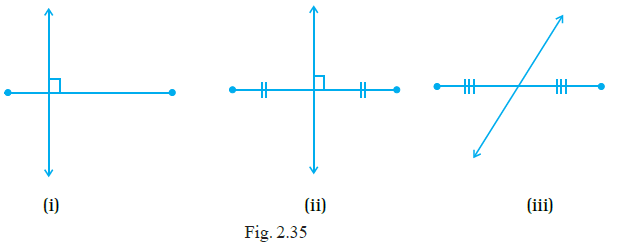
Answer:
To Identify:
Match the geometric properties (perpendicular, bisector) with the sub-figures in Fig. 2.35.
Solution:
A perpendicular line meets another line at $90^\circ$ (indicated by a square symbol). A bisector divides a segment into two equal parts (indicated by identical tally marks).
(a) Perpendicular bisector: This is shown in Fig. (ii) because the line is perpendicular to the segment and passes through its midpoint (shown by the marks $||$).
(b) Bisector: This is shown in both Fig. (ii) and Fig. (iii), as both lines divide the segment into two equal halves.
(c) Only bisector: This is shown in Fig. (iii) because it bisects the segment but is not perpendicular to it.
(d) Only perpendicular: This is shown in Fig. (i) because it meets the segment at $90^\circ$ but does not pass through the midpoint (one side is clearly longer).
Question 57. What is common in the following figures (i) and (ii) (Fig. 2.36.)?
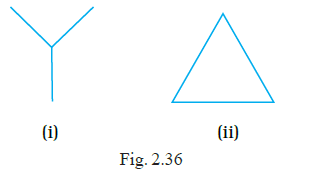
Is Fig. 2.36 (i) that of triangle? if not, why?
Answer:
Given:
Fig. 2.36 (i) showing three line segments meeting at a common central point and Fig. 2.36 (ii) showing a triangle.
Solution:
By observing both figures, the common feature is that both figures are composed of three line segments.
Is Fig. 2.36 (i) a triangle?
No, Fig. 2.36 (i) is not a triangle.
Reason: A triangle is defined as a closed figure formed by three line segments. While figure (i) has three segments, they do not enclose a space; it is an open figure. In a triangle, the segments must meet at their endpoints to form a boundary.
Question 58. If two rays intersect, will their point of intersection be the vertex of an angle of which the rays are the two sides?
Answer:
Solution:
Yes, if two rays intersect, their point of intersection will be the vertex of the angles formed.
Reasoning: An angle is formed by two rays having a common starting point. When two rays intersect at a point, that point becomes a common endpoint for the parts of the rays extending from it. Thus, the intersection point serves as the vertex, and the portions of the rays extending from this vertex act as the arms (sides) of the angles.
Question 59. In Fig. 2.37,
(a) name any four angles that appear to be acute angles.
(b) name any two angles that appear to be obtuse angles.
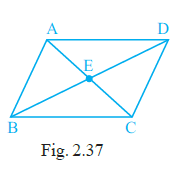
Answer:
Given:
Fig. 2.37 shows a quadrilateral $ABCD$ with diagonals $AC$ and $BD$ intersecting at point $E$.
Solution:
An acute angle is less than $90^\circ$ and an obtuse angle is between $90^\circ$ and $180^\circ$. Based on the visual representation:
(a) Four acute angles:
1. $\angle EAB$ (or $\angle CAB$)
2. $\angle EBA$ (or $\angle DBA$)
3. $\angle EDC$ (or $\angle BDC$)
4. $\angle ECD$ (or $\angle ACD$)
(b) Two obtuse angles:
1. $\angle AED$
2. $\angle BEC$
Question 60. In Fig. 2.38,
(a) is AC + CB = AB?
(b) is AB + AC = CB?
(c) is AB + BC = CA?
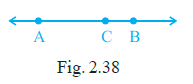
Answer:
Given:
In Fig. 2.38, points A, C, and B are collinear, and point C lies between A and B.
Solution:
According to the Segment Addition Property, if a point $C$ lies between $A$ and $B$, then the total length of the segment is the sum of its parts.
(a) Is AC + CB = AB?
Yes. Since $C$ is between $A$ and $B$, the sum of the two smaller segments equals the whole segment.
(b) Is AB + AC = CB?
No. $AB$ is the longest segment here, so adding $AC$ to it will result in a length much greater than $CB$.
(c) Is AB + BC = CA?
No. For the same reason, $AB$ is already longer than $CA$. Adding $BC$ makes it even larger.
Question 61. In Fig. 2.39,
(a) What is AE + EC?
(b) What is AC – EC?
(c) What is BD – BE?
(d) What is BD – DE?
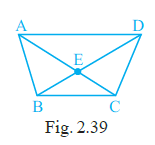
Answer:
Given:
According to the given Fig. 2.39, we have a quadrilateral $ABCD$.
The line segments $AC$ and $BD$ are the diagonals of the quadrilateral which intersect at point $E$.
From the figure, it is clear that point $E$ lies on the line segment $AC$ and also on the line segment $BD$.
To Find:
(a) The value of $AE + EC$.
(b) The value of $AC - EC$.
(c) The value of $BD - BE$.
(d) The value of $BD - DE$.
Solution:
(a) Finding $AE + EC$:
Since the point $E$ lies between $A$ and $C$ on the line segment $AC$, the sum of the lengths of the parts $AE$ and $EC$ is equal to the length of the whole segment $AC$.
$AE + EC = AC$
... (i)
(b) Finding $AC - EC$:
Using the relation established in equation (i):
$AE + EC = AC$
(From segment addition)
By transposing $EC$ to the right hand side, we get:
$AC - EC = AE$
... (ii)
(c) Finding $BD - BE$:
Similarly, the point $E$ lies on the diagonal $BD$ between points $B$ and $D$. Therefore, the total length $BD$ is the sum of segments $BE$ and $ED$.
$BE + ED = BD$
... (iii)
Subtracting $BE$ from both sides (or transposing $BE$):
$BD - BE = ED$
[Or $DE$]
(d) Finding $BD - DE$:
Using the relation from equation (iii):
$BE + ED = BD$
(Points $B, E, D$ are collinear)
By transposing $ED$ (or $DE$) to the right hand side, we get:
$BD - DE = BE$
... (iv)
Final Answers:
(a) $AE + EC = \mathbf{AC}$
(b) $AC - EC = \mathbf{AE}$
(c) $BD - BE = \mathbf{ED \text{ (or } DE)}$
(d) $BD - DE = \mathbf{BE}$
Question 62. Using the information given, name the right angles in each part of Fig. 2.40:
(a) BA ⊥ BD
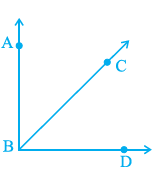
(b) RT ⊥ ST
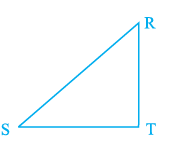
(c) AC ⊥ BD

(d) RS ⊥ RW
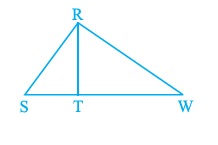
(e) AC ⊥ BD
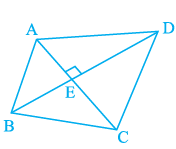
(f) AE ⊥ CE
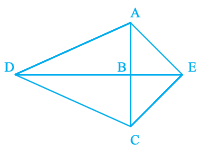
(g) AC ⊥ CD
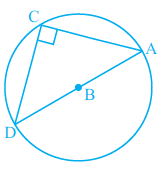
(h) OP ⊥ AB
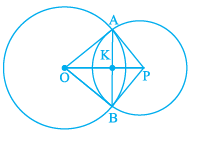
Answer:
Given:
The following perpendicularity conditions are provided for various geometric shapes:
(a) $BA \perp BD$
(b) $RT \perp ST$
(c) $AC \perp BD$
(d) $RS \perp RW$
(e) $AC \perp BD$
(f) $AE \perp CE$
(g) $AC \perp CD$
(h) $OP \perp AB$
To Find:
We need to identify and name the right angles formed in each case based on the given information.
Solution:
(a) For the condition $BA \perp BD$:
Since the rays $BA$ and $BD$ are perpendicular, they meet at the vertex $B$ to form a right angle.
$\angle ABD = 90^\circ$
... (i)
(b) For the condition $RT \perp ST$:
The segments $RT$ and $ST$ meet at point $T$ perpendicularly.
$\angle RTS = 90^\circ$
... (ii)
(c) For the condition $AC \perp BD$:
The line $AC$ is perpendicular to the base $BD$ at point $C$, forming right angles on both sides of the segment $AC$.
$\angle ACB = 90^\circ \text{ and } \angle ACD = 90^\circ$
... (iii)
(d) For the condition $RS \perp RW$:
The segments $RS$ and $RW$ meet at the vertex $R$.
$\angle SRW = 90^\circ$
... (iv)
(e) For the condition $AC \perp BD$:
The diagonals intersect at point $E$ at right angles, creating four right angles around the intersection point.
$\angle AEB, \angle BEC, \angle CED, \angle AED$
[Each is $90^\circ$] ... (v)
(f) For the condition $AE \perp CE$:
The segments $AE$ and $CE$ are perpendicular at the vertex $E$.
$\angle AEC = 90^\circ$
... (vi)
(g) For the condition $AC \perp CD$:
The segments $AC$ and $CD$ meet at the vertex $C$.
$\angle ACD = 90^\circ$
... (vii)
(h) For the condition $OP \perp AB$:
The line segment $OP$ and the chord $AB$ intersect at point $K$ perpendicularly. This results in four right angles at the point of intersection.
$\angle OKA, \angle AKP, \angle PKB, \angle BKO$
[Each is $90^\circ$] ... (viii)
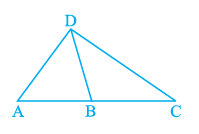
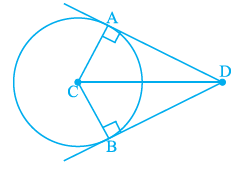
Question 63. What conclusion can be drawn from each part of Fig. 2.41, if
(a) DB is the bisector of ∠ADC?
(b) BD bisects ∠ABC?
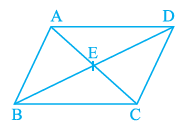
(c) DC is the bisector of ∠ADB, CA ⊥ DA and CB ⊥ DB?
Answer:
Given:
The problem provides three different geometric scenarios based on Fig. 2.41 (divided into three parts) with specific bisector and perpendicularity conditions.
(a) Condition: $DB$ is the bisector of $\angle ADC$.
Conclusion:
The line segment $DB$ divides the angle at vertex $D$ into two equal parts.
Solution:
Since $DB$ is given as the bisector of $\angle ADC$:
$\angle ADB = \angle CDB$
... (i)
(b) Condition: $BD$ bisects $\angle ABC$.
Conclusion:
The line segment $BD$ (diagonal) divides the angle at vertex $B$ into two equal parts.
Solution:
By the definition of an angle bisector, the two resulting angles are equal in measure:
$\angle ABD = \angle CBD$
... (ii)
(c) Given: $DC$ is the bisector of $\angle ADB$, $CA \perp DA$ and $CB \perp DB$
To Find: Conclusion based on the given information.
Solution:
From the given information, we can draw the following conclusions:
1. Since $DC$ is the bisector of $\angle ADB$, it divides the angle into two equal parts.
$\angle ADC = \angle BDC$
... (iii)
2. Since $CA \perp DA$, the angle formed between segment $CA$ and segment $DA$ is a right angle.
$\angle CAD = 90^\circ$
... (iv)
3. Similarly, since $CB \perp DB$, the angle formed between segment $CB$ and segment $DB$ is also a right angle.
$\angle CBD = 90^\circ$
... (v)
Final Conclusion for (c):
The conclusions for part (c) are: $\angle ADC = \angle BDC$, $\angle CAD = 90^\circ$, and $\angle CBD = 90^\circ$.
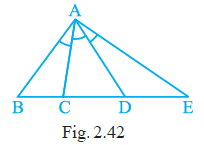
Question 64. An angle is said to be trisected, if it is divided into three equal parts. If in Fig. 2.42, ∠ BAC = ∠ CAD = ∠ DAE, how many trisectors are there for ∠BAE ?
Answer:
Given:
According to the problem and Fig. 2.42:
1. An angle is trisected if it is divided into three equal parts.
2. In the figure, it is given that:
$\angle BAC = \angle CAD = \angle DAE$
... (i)
To Find:
How many trisectors are there for the angle $\angle BAE$.
Solution:
By observing the figure, the total angle $\angle BAE$ is composed of three adjacent angles:
$\angle BAE = \angle BAC + \angle CAD + \angle DAE$
... (ii)
From the given condition in equation (i), we know that all these three parts are equal. This means the angle $\angle BAE$ has been divided into three equal parts.
The rays that divide an angle into three equal parts are called trisectors. In this figure:
1. The ray $AC$ is the first line of division.
2. The ray $AD$ is the second line of division.
Together, these two rays ($AC$ and $AD$) create the three equal angles $\angle BAC$, $\angle CAD$, and $\angle DAE$.
Conclusion:
Since there are two rays inside $\angle BAE$ that perform the division into three equal parts, there are 2 (two) trisectors.
The names of the trisectors are $AC$ and $AD$.
Question 65. How many points are marked in Fig. 2.43?
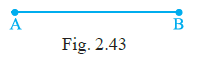
Answer:
Given:
A figure (Fig. 2.43) showing a line with labeled dots.
To Find:
The total number of points marked in the given figure.
Solution:
In geometry, a point is usually represented by a small dot and named with a capital letter. By observing the figure, we can see two distinct dots labeled with letters.
The points marked are:
1. Point $A$
2. Point $B$
Therefore, there are 2 (two) points marked in the figure.
Question 66. How many line segments are there in Fig. 2.43?
Answer:
The same figure (Fig. 2.43) with points $A$ and $B$.
To Find:
The total number of line segments present in the figure.
Solution:
A line segment is a part of a line that is bounded by two distinct end points. It contains every point on the line between its endpoints.
In the given figure, there are two points, $A$ and $B$. The straight path connecting these two points forms one specific line segment.
The line segment is denoted as $\overline{AB}$.
Since there are no other points marked on the line, only one such combination of endpoints is possible.
Therefore, there is only 1 (one) line segment in the figure.
Question 67. In Fig. 2.44, how many points are marked? Name them.
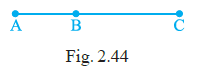
Answer:
Given:
A geometric figure (Fig. 2.44) consisting of a line with several dots marked on it.
To Find:
The total number of points marked in the figure and their names.
Solution:
By observing the given figure, we can see dots representing positions on the line, each labeled with a capital letter. In geometry, these dots are called points.
The points marked in the figure are:
1. Point $A$
2. Point $B$ (situated between $A$ and $C$)
3. Point $C$
Counting these, we find that there are 3 (three) points marked in the figure.
Conclusion: There are 3 points marked, namely $A$, $B$, and $C$.
Question 68. How many line segments are there in Fig. 2.44? Name them.
Answer:
Given:
The same figure (Fig. 2.44) with three collinear points $A, B,$ and $C$.
To Find:
The total number of line segments and their names.
Solution:
A line segment is a portion of a line that connects two distinct endpoints. To find all possible line segments, we must consider every possible pair of marked points.
The possible pairs of points are:
1. Segment starting at $A$ and ending at $B$, denoted as $AB$.
2. Segment starting at $B$ and ending at $C$, denoted as $BC$.
3. Segment starting at $A$ and ending at $C$, denoted as $AC$.
Thus, we have identified three distinct line segments.
Conclusion: There are 3 (three) line segments in the figure. Their names are $AB, BC,$ and $AC$.
Question 69. In Fig. 2.45 how many points are marked? Name them.
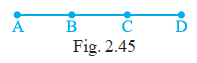
Answer:
Given:
A geometric figure (Fig. 2.45) showing a line with several labeled dots.
To Find:
The number of points marked and their respective names.
Solution:
A point in geometry is a location represented by a dot and labeled with a capital letter. By observing the given figure, we can identify the following dots:
1. Point $A$
2. Point $B$
3. Point $C$
4. Point $D$
Counting these labels, we find that there are exactly 4 (four) points marked on the line.
Conclusion: There are 4 points marked, namely $A$, $B$, $C$, and $D$.
Question 70. In Fig. 2.45 how many line segments are there? Name them.
Answer:
Given:
The same figure (Fig. 2.45) with four collinear points: $A$, $B$, $C$, and $D$.
To Find:
The total number of line segments and their names.
Solution:
A line segment is a part of a line that is bounded by two distinct endpoints. To find the total number of line segments, we need to list every possible pair of endpoints from the set of points $\{A, B, C, D\}$.
The possible line segments are:
1. Segments formed by adjacent points: $AB$, $BC$, and $CD$.
2. Segments formed by skipping one point: $AC$ and $BD$.
3. Segment formed by the outermost points: $AD$.
Let us count them: $AB, BC, CD, AC, BD, AD$.
Total number of segments = $6$.
Conclusion: There are 6 (six) line segments in the figure. Their names are $AB$, $BC$, $CD$, $AC$, $BD$, and $AD$.
Question 71. In Fig. 2.46, how many points are marked? Name them.
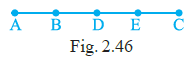
Answer:
Given:
A geometric figure (Fig. 2.46) representing a line segment with several distinct labels marked on it.
To Find:
The total number of points marked and their respective names.
Solution:
In geometry, a point is a precise location in space, represented by a dot and labeled with a capital letter. By examining Fig. 2.46, we can identify the dots labeled with letters on the line.
The points marked in the figure are:
1. Point $A$
2. Point $B$
3. Point $D$
4. Point $E$
5. Point $C$
By counting these individual labels, we find that there are exactly 5 (five) points marked.
Conclusion: There are 5 points marked, and their names are $A, B, D, E,$ and $C$.
Question 72. In Fig. 2.46 how many line segments are there? Name them.
Answer:
Given:
The same figure (Fig. 2.46) which contains 5 collinear points: $A, B, D, E,$ and $C$.
To Find:
The total number of line segments present in the figure and their names.
Solution:
A line segment is a part of a line that is bounded by two distinct endpoints. Every unique pair of points on the line forms a line segment.
With 5 points ($n = 5$), the number of line segments can be calculated by listing all possible pairs:
1. Segments starting with point $A$: $AB, AD, AE, AC$ (4 segments)
2. Segments starting with point $B$: $BD, BE, BC$ (3 segments)
3. Segments starting with point $D$: $DE, DC$ (2 segments)
4. Segments starting with point $E$: $EC$ (1 segment)
Total number of segments = $4 + 3 + 2 + 1 = 10$.
Conclusion: There are 10 (ten) line segments in the figure. Their names are $AB, AD, AE, AC, BD, BE, BC, DE, DC,$ and $EC$.
Question 73. In Fig. 2.47, O is the centre of the circle.
(a) Name all chords of the circle.
(b) Name all radii of the circle.
(c) Name a chord, which is not the diameter of the circle.
(d) Shade sectors OAC and OPB.
(e) Shade the smaller segment of the circle formed by CP.
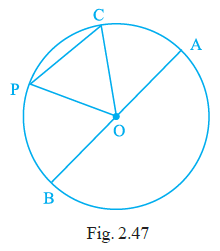
Answer:
Given:
In Fig. 2.47, we are given a circle where:
1. The point $O$ is the centre of the circle.
2. Points $A, B, C, \text{ and } P$ lie on the boundary (circumference) of the circle.
3. The line segment $AB$ passes through the centre $O$, making it a diameter.
To Find / Identify:
(a) All chords of the circle.
(b) All radii of the circle.
(c) A chord which is not a diameter.
(d) Regions representing sectors $OAC$ and $OPB$.
(e) The region representing the smaller segment formed by chord $CP$.
Solution:
(a) All chords of the circle:
A chord is a line segment that joins any two points lying on the circumference of a circle. Since the diameter is also the longest chord of a circle, it is included in the list.
The chords present in the figure are:
$CP$ and $AB$
(b) All radii of the circle:
A radius is a line segment that connects the centre of the circle to any point on its circumference. All radii of a given circle are equal in length.
The radii present in the figure are:
$OA, OB, OC, \text{ and } OP$
(c) A chord which is not the diameter:
A diameter must pass through the centre $O$. In the figure, $AB$ passes through $O$, so it is a diameter. The chord $CP$ does not pass through the centre.
Chord $CP$
($CP$ is not a diameter)
(d) Shade sectors OAC and OPB:
A sector is a region enclosed by two radii and the intercepted arc. Sector $OAC$ is bounded by radii $OA, OC$ and arc $AC$. Sector $OPB$ is bounded by radii $OP, OB$ and arc $PB$.
(e) Shade the smaller segment of the circle formed by CP:
A segment is the region between a chord and its corresponding arc. The smaller (minor) segment is the portion of the circle cut off by chord $CP$ that does not contain the centre $O$.
Question 74. Can we have two acute angles whose sum is
(a) an acute angle? Why or why not?
(b) a right angle? Why or why not?
(c) an obtuse angle? Why or why not?
(d) a straight angle? Why or why not?
(e) a reflex angle? Why or why not?
Answer:
Given:
Two acute angles. Let us denote the two acute angles as $A$ and $B$.
By the definition of an acute angle:
$0^\circ < A < 90^\circ$
... (i)
$0^\circ < B < 90^\circ$
... (ii)
To Find:
Whether the sum $(A + B)$ can result in an acute, right, obtuse, straight, or reflex angle, with reasons.
Solution:
(a) Can the sum be an acute angle?
Yes. Two acute angles can sum up to another acute angle if their total measure remains less than $90^\circ$.
Example: Let $A = 20^\circ$ and $B = 30^\circ$. Both are acute.
$A + B = 20^\circ + 30^\circ = 50^\circ$
(Which is acute)
(b) Can the sum be a right angle?
Yes. Two acute angles can sum up to exactly $90^\circ$. Such angles are known as complementary angles.
Example: Let $A = 45^\circ$ and $B = 45^\circ$. Both are acute.
$A + B = 45^\circ + 45^\circ = 90^\circ$
(Which is a right angle)
(c) Can the sum be an obtuse angle?
Yes. Two acute angles can sum up to an obtuse angle if their total measure is greater than $90^\circ$ but less than $180^\circ$.
Example: Let $A = 60^\circ$ and $B = 70^\circ$. Both are acute.
$A + B = 60^\circ + 70^\circ = 130^\circ$
(Which is obtuse)
(d) Can the sum be a straight angle?
No. A straight angle measures exactly $180^\circ$. Since each acute angle is strictly less than $90^\circ$, their sum must be strictly less than $180^\circ$.
$A + B < 90^\circ + 90^\circ$
[As $A, B < 90^\circ$] ... (iii)
$A + B < 180^\circ$
... (iv)
Since the sum is always less than $180^\circ$, it can never form a straight angle.
(e) Can the sum be a reflex angle?
No. A reflex angle is greater than $180^\circ$. As shown in equation (iv), the maximum possible sum of two acute angles is always less than $180^\circ$.
Reason: Even if we take the largest possible acute angles (e.g., $89.9^\circ$), their sum will be $179.8^\circ$, which is still less than $180^\circ$. Therefore, it can never reach the range of a reflex angle ($> 180^\circ$).
Question 75. Can we have two obtuse angles whose sum is
(a) a reflex angle? Why or why not?
(b) a complete angle? Why or why not?
Answer:
Given:
We are considering two obtuse angles. Let us denote them as $\angle A$ and $\angle B$.
By the definition of an obtuse angle, each angle must be greater than $90^\circ$ but less than $180^\circ$.
$90^\circ < A < 180^\circ$
... (i)
$90^\circ < B < 180^\circ$
... (ii)
To Find:
Whether the sum $(A + B)$ can result in:
(a) A reflex angle.
(b) A complete angle.
Solution:
(a) Can the sum be a reflex angle?
Yes. A reflex angle is defined as an angle whose measure is greater than $180^\circ$ but less than $360^\circ$.
To find the range of the sum $(A + B)$, we add the inequalities (i) and (ii):
$90^\circ + 90^\circ < A + B < 180^\circ + 180^\circ$
Simplifying the above expression:
$180^\circ < A + B < 360^\circ$
... (iii)
Since the sum is always greater than $180^\circ$ and less than $360^\circ$, it perfectly fits the definition of a reflex angle.
Example: Let $A = 100^\circ$ and $B = 120^\circ$. Both are obtuse.
$A + B = 100^\circ + 120^\circ = 220^\circ$
(Which is a reflex angle)
(b) Can the sum be a complete angle?
No. A complete angle measures exactly $360^\circ$.
As established in inequality (iii) from the previous part:
$A + B < 360^\circ$
[Since $A, B < 180^\circ$] ... (iv)
Since both angles are strictly less than $180^\circ$, their sum will always be strictly less than $360^\circ$.
Even if we take the largest possible obtuse angles, such as $179^\circ$ and $179^\circ$, their sum is $358^\circ$, which is still less than a complete angle.
Therefore, two obtuse angles can never sum up to a complete angle.
Question 76. Write the name of
(a) vertices
(b) edges, and
(c) faces of the prism shown in Fig. 2.48.
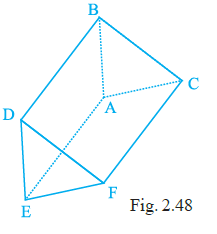
Answer:
Given:
The given figure (Fig. 2.48) is a triangular prism.
To Find:
(a) Names of the vertices.
(b) Names of the edges.
(c) Names of the faces.
Solution:
(a) Vertices:
A vertex is a point where the edges of a solid meet. By observing the figure, we can see the labeled corner points.
The vertices of the prism are: $A, B, C, D, E, \text{ and } F$.
Total number of vertices = $6$.
(b) Edges:
An edge is a line segment where two faces of a solid intersect. The edges can be categorized as follows:
1. Edges of the first triangular base: $AB, BC, \text{ and } CA$.
2. Edges of the second triangular base: $DE, EF, \text{ and } FD$.
3. Lateral edges connecting the two bases: $AD, BE, \text{ and } CF$.
Total number of edges = $9$.
(c) Faces:
A face is a flat surface of a 3D object. A triangular prism consists of two triangular bases and three rectangular lateral faces.
1. Triangular faces (Bases): $\triangle ABC$ and $\triangle DEF$.
2. Rectangular faces (Lateral faces): $ABED$, $BCFE$, and $ACFD$.
Total number of faces = $5$.
Question 77. How many edges, faces and vertices are there in a sphere?
Answer:
To Find:
The number of edges, faces, and vertices in a sphere.
Solution:
A sphere is a unique three-dimensional solid figure that is perfectly round. Unlike polyhedrons (like cubes or pyramids), a sphere does not have flat surfaces or straight lines.
According to the geometric properties of a sphere:
1. Faces: A sphere does not have any flat faces. It consists of only one continuous curved surface. Therefore, it is considered to have No faces.
2. Edges: An edge is a line segment where two faces meet. Since there are no flat faces to intersect, a sphere has No edges.
3. Vertices: A vertex is a point or corner where edges meet. Since there are no edges, a sphere has No vertices.
Question 78. Draw all the diagonals of a pentagon ABCDE and name them.
Answer:
Given:
A pentagon named $ABCDE$. A pentagon is a polygon with 5 sides and 5 vertices.
To Find:
Draw and name all the diagonals of the pentagon.
Solution:
A diagonal is a line segment that connects two non-adjacent vertices of a polygon. To find the total number of diagonals in a pentagon ($n = 5$), we can use the formula:
$\text{Number of diagonals} = \frac{n(n-3)}{2}$
Substituting $n = 5$ into the formula:
$\text{Total} = \frac{5(5-3)}{2} = \frac{5 \times 2}{2} = 5$
The five diagonals are formed by connecting each vertex to its non-neighboring vertices:
$AC$ and $AD$
(From vertex $A$)
$BD$ and $BE$
(From vertex $B$)
$CE$
(From vertex $C$)
Visual Representation:
The names of all the diagonals are: $AC, AD, BD, BE, \text{ and } CE$.