

Chapter 4 Fractions & Decimals (Class 6 - Maths NCERT Exemplar Solutions)
Welcome to the comprehensive resource for NCERT Exemplar Solutions for Class 6 Mathematics: Chapter 4 Fractions & Decimals! These problems are strategically designed to move beyond the scope of standard textbook exercises, focusing on significantly enhancing conceptual understanding and computational fluency. This chapter challenges students to apply their knowledge of parts and wholes to more complex, thought-provoking scenarios, building the analytical skills required for advanced mathematical accuracy.
For Fractions, the solutions meticulously cover everything from representing elements of a collection to identifying Proper Fractions (e.g., $\frac{3}{5}$), Improper Fractions (e.g., $\frac{7}{4}$), and Mixed Fractions. Students will master the systematic conversion between these forms and the technique of finding equivalent fractions. Significant emphasis is placed on simplifying fractions to their lowest terms using the Highest Common Factor (HCF) and comparing unlike fractions by calculating the Least Common Multiple (LCM) of their denominators or using cross-multiplication.
In the Decimals section, the focus shifts to understanding place value—specifically tenths, hundredths, and thousandths—and performing accurate additions and subtractions by precisely aligning decimal points. The Exemplar problems utilize diverse formats including Multiple Choice Questions (MCQs), True/False statements, and complex word problems involving real-world measurements and money ($\textsf{₹}$). With step-by-step working and logical justifications prepared by learningspot.co, students can confidently master these core concepts and refine their problem-solving capabilities in quantitative contexts.
Solved Examples (Examples 1 to 14)
In examples 1 and 2, write the correct answer from the given four options:
Example 1: Which of the following fractions is the smallest?
(A) $\frac{11}{9}$
(B) $\frac{11}{7}$
(C) $\frac{11}{10}$
(D) $\frac{11}{6}$
Answer:
Correct Option: (C)
Elaborate Solution:
In all the given fractions, the numerator is the same, which is $11$.
When the numerators of two or more fractions are identical, the fraction with the largest denominator represents the smallest value.
Comparing the denominators: $10, 9, 7, \text{ and } 6$.
Since $10$ is the largest denominator among the choices, $\frac{11}{10}$ is the smallest fraction.
Example 2: 0.7625 lies between
(A) 0.7 and 0.76
(B) 0.77 and 0.78
(C) 0.76 and 0.761
(D) 0.76 and 0.763
Answer:
Correct Option: (D)
Elaborate Solution:
To determine where $0.7625$ lies, we can compare it digit by digit or equalize the decimal places:
$0.7625$ has four decimal places. Let us look at the range in option (D):
$0.76 = 0.7600$
$0.763 = 0.7630$
Comparing these values, we find that:
$0.7600 < 0.7625 < 0.7630$
Therefore, $0.7625$ lies between $0.76$ and $0.763$.
Example 3: Fill in the blanks so that the statement is true:
Decimal 8.125 is equal to the fraction ________.
Answer:
Answer: $\frac{65}{8}$ (or $8\frac{1}{8}$)
Elaborate Solution:
To convert the decimal $8.125$ into a fraction, we write the number without the decimal point as the numerator and place $1000$ in the denominator (since there are three decimal places):
$8.125 = \frac{8125}{1000}$
Now, we simplify the fraction by dividing both the numerator and the denominator by their greatest common divisor, which is $125$:
$\frac{\cancel{8125}^{65}}{\cancel{1000}_{8}} = \frac{65}{8}$
We can also express this as a mixed fraction:
$\frac{65}{8} = 8\frac{1}{8}$
Example 4: Fill in the blanks so that the statement is true:
6.45 – 3.78 = _________.
Answer:
Answer: 2.67
Elaborate Solution:
To find the difference, we align the decimal points and perform vertical subtraction:
$\begin{array}{cc} & 6 & . & 4 & 5 \\ - & 3 & . & 7 & 8 \\ \hline & 2 & . & 6 & 7 \\ \hline \end{array}$
The result of $6.45 - 3.78$ is $2.67$.
Example 5: State true or false:
The fraction $14\frac{2}{5}$ is equal to 14.2.
Answer:
Answer: False
Elaborate Solution:
To check the validity of the statement, let us convert the mixed fraction $14\frac{2}{5}$ into decimal form.
Step 1: Keep the whole number $14$ as it is.
Step 2: Convert the fractional part $\frac{2}{5}$ into a decimal by making the denominator $10$:
$\frac{2 \times 2}{5 \times 2} = \frac{4}{10} = 0.4$
Step 3: Combine the whole number and the decimal part:
$14 + 0.4 = 14.4$
Since $14.4 \neq 14.2$, the statement is false.
Example 6: Fill in the blanks using > or < :
$\frac{8}{45} - \frac{16}{89}$
Answer:
Answer: <
Elaborate Solution:
To compare $\frac{8}{45}$ and $\frac{16}{89}$, we can make the numerators equal.
First, we multiply the numerator and denominator of $\frac{8}{45}$ by $2$:
$\frac{8 \times 2}{45 \times 2} = \frac{16}{90}$
Now, we compare $\frac{16}{90}$ and $\frac{16}{89}$.
When the numerators are equal, the fraction with the smaller denominator is the larger fraction.
Since $89 < 90$, it follows that:
$\frac{16}{89} > \frac{16}{90}$
Therefore, the original comparison is:
$\frac{8}{45} < \frac{16}{89}$
Example 7: Express $\frac{12}{25}$ as a decimal.
Answer:
Solution:
To express a fraction as a decimal, we can convert the denominator to a power of $10$ (like $10, 100, 1000,$ etc.).
Since the denominator is $25$, we can multiply both the numerator and denominator by $4$ to make the denominator $100$:
$\frac{12 \times 4}{25 \times 4} = \frac{48}{100}$
A fraction with $100$ in the denominator can be written as a decimal by placing the decimal point two places from the right:
$\frac{48}{100} = 0.48$
Final Answer: The decimal form of $\frac{12}{25}$ is $0.48$.
Example 8: Convert 5809g to kg.
Answer:
Given:
Weight in grams = $5809 \text{ g}$
To Find:
Weight in kilograms ($\text{kg}$)
Solution:
We know that $1000 \text{ grams}$ is equal to $1 \text{ kilogram}$.
$1000 \text{ g} = 1 \text{ kg}$
$1 \text{ g} = \frac{1}{1000} \text{ kg}$
To convert $5809 \text{ g}$ into $\text{kg}$, we divide the given value by $1000$:
$5809 \text{ g} = \frac{5809}{1000} \text{ kg}$
$5809 \text{ g} = 5.809 \text{ kg}$
Final Answer: $5809 \text{ g}$ is equal to $5.809 \text{ kg}$.
Example 9: Round off 87.952 to tenths place.
Answer:
Given:
Decimal number = $87.952$
Solution:
To round off a decimal to the tenths place, we look at the digit in the hundredths place.
In $87.952$:
- Digit at tenths place = $9$
- Digit at hundredths place = $5$
According to rounding rules, if the digit in the hundredths place is $5$ or more, we increase the digit in the tenths place by $1$.
Here, $5 \geq 5$, so we add $1$ to the tenths place ($9 + 1 = 10$).
Since the result is $10$, we write $0$ in the tenths place and carry over $1$ to the units place ($7 + 1 = 8$).
Final Answer: $87.952$ rounded off to the tenths place is $88.0$.
Example 10: Add the fractions $5\frac{3}{8}$ and $\frac{5}{16}$
Answer:
Given:
Fractions to add: $5\frac{3}{8}$ and $\frac{5}{16}$
Solution:
First, convert the mixed fraction $5\frac{3}{8}$ into an improper fraction:
$5\frac{3}{8} = \frac{(5 \times 8) + 3}{8} = \frac{40 + 3}{8} = \frac{43}{8}$
Now, we need to add $\frac{43}{8}$ and $\frac{5}{16}$. Since the denominators are different, we find their Least Common Multiple (LCM).
$\text{LCM of } 8 \text{ and } 16 = 16$
Convert $\frac{43}{8}$ to an equivalent fraction with denominator $16$:
$\frac{43 \times 2}{8 \times 2} = \frac{86}{16}$
Now add the fractions:
$\frac{86}{16} + \frac{5}{16} = \frac{86 + 5}{16} = \frac{91}{16}$
Converting back to a mixed fraction:
$\frac{91}{16} = 5\frac{11}{16}$
Example 11: What should be added to 37.28 to obtain 46.8?
Answer:
Given:
Initial value = $37.28$
Required total = $46.8$
To Find:
The number to be added.
Solution:
Let the number to be added be $x$.
$x + 37.28 = 46.8$
$x = 46.8 - 37.28$
Perform decimal subtraction (aligning the decimals and adding a placeholder zero):
$\begin{array}{cc} & 4 & 6 & . & 8 & 0 \\ - & 3 & 7 & . & 2 & 8 \\ \hline & & 9 & . & 5 & 2 \\ \hline \end{array}$
Final Answer: The number that should be added is $9.52$.
Example 12: Arrange the following in ascending order.
2.2, 2.023, 2.0226, 22.1, 20.42
Answer:
Solution:
To arrange decimal numbers, it is easier to convert them into like decimals (decimals having the same number of digits after the decimal point).
The maximum number of decimal places here is $4$. Let us convert all numbers:
- $2.2 = 2.2000$
- $2.023 = 2.0230$
- $2.0226 = 2.0226$
- $22.1 = 22.1000$
- $20.42 = 20.4200$
Now, comparing the values:
$2.0226 < 2.0230 < 2.2000 < 20.4200 < 22.1000$
Ascending Order: $2.0226, \ 2.023, \ 2.2, \ 20.42, \ 22.1$
Example 13: Gorang purchased 2kg 280g apples, 3kg 375g bananas, 225g grapes and 5kg 385g oranges. Find the total weight of the fruits purchased by Gorang in kg.
Answer:
Given:
Weight of Apples = $2 \text{ kg } 280 \text{ g} = 2.280 \text{ kg}$
Weight of Bananas = $3 \text{ kg } 375 \text{ g} = 3.375 \text{ kg}$
Weight of Grapes = $225 \text{ g} = 0.225 \text{ kg}$
Weight of Oranges = $5 \text{ kg } 385 \text{ g} = 5.385 \text{ kg}$
To Find:
Total weight in $\text{kg}$.
Solution:
Add the weights vertically:
$\begin{array}{cc} & 2 & . & 2 & 8 & 0 \\ & 3 & . & 3 & 7 & 5 \\ & 0 & . & 2 & 2 & 5 \\ + & 5 & . & 3 & 8 & 5 \\ \hline 1 & 1 & . & 2 & 6 & 5 \\ \hline \end{array}$
Final Answer: The total weight of fruits purchased by Gorang is $11.265 \text{ kg}$.
Example 14: What is wrong in the following?
$\frac{7}{4} + \frac{5}{2} = \frac{7\;+\;5}{4\;+\;2} = \frac{12}{6} = 2$
Answer:
Analysis:
The error in the calculation is that the numerators and denominators have been added directly. Fractions can only be added by keeping the denominators the same.
Correct Solution:
To add $\frac{7}{4}$ and $\frac{5}{2}$, we must first find a common denominator.
$\text{LCM of } 4 \text{ and } 2 = 4$
Convert $\frac{5}{2}$ into an equivalent fraction with denominator $4$:
$\frac{5 \times 2}{2 \times 2} = \frac{10}{4}$
Now, perform the addition:
$\frac{7}{4} + \frac{10}{4} = \frac{7 + 10}{4} = \frac{17}{4}$
In mixed fraction form: $4\frac{1}{4}$ (which is equal to $4.25$, not $2$).
Exercise
Question 1 to 20 (Multiple Choice Questions)
In questions 1 to 20, out of the four options, only one answer is correct. Choose the correct answer.
Question 1. The fraction which is not equal to $\frac{4}{5}$ is
(A) $\frac{40}{50}$
(B) $\frac{12}{15}$
(C) $\frac{16}{20}$
(D) $\frac{9}{15}$
Answer:
Correct Option: (D)
Elaborate Solution:
To find which fraction is not equal to $\frac{4}{5}$, we simplify each option to its lowest form or check if $\frac{4}{5}$ can be expanded into it.
(A) $\frac{40}{50}$: Dividing both numerator and denominator by $10$, we get $\frac{40 \div 10}{50 \div 10} = \frac{4}{5}$. This is equal.
(B) $\frac{12}{15}$: Dividing both numerator and denominator by $3$, we get $\frac{12 \div 3}{15 \div 3} = \frac{4}{5}$. This is equal.
(C) $\frac{16}{20}$: Dividing both numerator and denominator by $4$, we get $\frac{16 \div 4}{20 \div 4} = \frac{4}{5}$. This is equal.
(D) $\frac{9}{15}$: Dividing both numerator and denominator by $3$, we get $\frac{9 \div 3}{15 \div 3} = \frac{3}{5}$.
Since $\frac{3}{5} \neq \frac{4}{5}$, the fraction which is not equal is $\frac{9}{15}$.
Question 2. The two consecutive integers between which the fraction 5/7 lies are
(A) 5 and 6
(B) 0 and 1
(C) 5 and 7
(D) 6 and 7
Answer:
Correct Option: (B)
Elaborate Solution:
A proper fraction is a fraction where the numerator is less than the denominator.
In the fraction $\frac{5}{7}$, we see that $5 < 7$.
All proper fractions have a value that is greater than $0$ but less than $1$.
We can also verify this by division: $5 \div 7 \approx 0.714$.
The value $0.714$ lies between the consecutive integers $0$ and $1$.
Question 3. When $\frac{1}{4}$ is written with denominator as 12, its numerator is
(A) 3
(B) 8
(C) 24
(D) 12
Answer:
Correct Option: (A)
To Find: The numerator $x$ such that $\frac{x}{12} = \frac{1}{4}$.
Solution:
To convert the denominator from $4$ to $12$, we need to determine the multiplication factor.
$12 \div 4 = 3$
This means we must multiply both the numerator and the denominator of $\frac{1}{4}$ by $3$ to maintain an equivalent fraction:
$\frac{1 \times 3}{4 \times 3} = \frac{3}{12}$
Therefore, the new numerator is $3$.
Question 4. Which of the following is not in the lowest form?
(A) $\frac{7}{5}$
(B) $\frac{15}{20}$
(C) $\frac{13}{33}$
(D) $\frac{27}{28}$
Answer:
Correct Option: (B)
Elaborate Solution:
A fraction is in its lowest form if the only common factor between the numerator and denominator is $1$.
(A) $\frac{7}{5}$: $7$ and $5$ are both prime numbers. Their only common factor is $1$. This is in lowest form.
(B) $\frac{15}{20}$: Both $15$ and $20$ are divisible by $5$.
$\frac{15 \div 5}{20 \div 5} = \frac{3}{4}$.
Since it can be simplified further, it was not in the lowest form.
(C) $\frac{13}{33}$: $13$ is a prime number and is not a factor of $33$. Their common factor is $1$. This is in lowest form.
(D) $\frac{27}{28}$: These are consecutive integers. Consecutive integers always have a common factor of only $1$. This is in lowest form.
Question 5. If $\frac{5}{8} = \frac{20}{p}$ , then value of p is
(A) 23
(B) 2
(C) 32
(D) 16
Answer:
Correct Option: (C)
Given: $\frac{5}{8} = \frac{20}{p}$
Solution:
To find $p$, we look at the relationship between the numerators $5$ and $20$.
$5 \times 4 = 20$
Since the fractions are equal, the same multiplication factor must apply to the denominator:
$8 \times 4 = p$
$p = 32$
Alternate Method (Cross Multiplication):
$5 \times p = 20 \times 8$
$5p = 160$
$p = \frac{160}{5} = 32$
Question 6. Which of the following is not equal to the others?
(A) $\frac{6}{8}$
(B) $\frac{12}{16}$
(C) $\frac{15}{25}$
(D) $\frac{18}{24}$
Answer:
Correct Option: (C)
Elaborate Solution:
Let's simplify each fraction to its lowest form to compare them:
(A) $\frac{6}{8} = \frac{6 \div 2}{8 \div 2} = \frac{3}{4}$
(B) $\frac{12}{16} = \frac{12 \div 4}{16 \div 4} = \frac{3}{4}$
(C) $\frac{15}{25} = \frac{15 \div 5}{25 \div 5} = \frac{3}{5}$
(D) $\frac{18}{24} = \frac{18 \div 6}{24 \div 6} = \frac{3}{4}$
We can see that options (A), (B), and (D) are all equal to $\frac{3}{4}$. Option (C) is equal to $\frac{3}{5}$, which is different.
Question 7. Which of the following fractions is the greatest?
(A) $\frac{5}{7}$
(B) $\frac{5}{6}$
(C) $\frac{5}{9}$
(D) $\frac{5}{8}$
Answer:
Correct Option: (B)
Elaborate Solution:
All the given fractions have the same numerator ($5$).
Rule: When numerators are equal, the fraction with the smallest denominator has the greatest value.
Comparing the denominators: $7, 6, 9, 8$.
The smallest denominator is $6$.
Therefore, $\frac{5}{6}$ is the greatest fraction among the given choices.
Question 8. Which of the following fractions is the smallest?
(A) $\frac{7}{8}$
(B) $\frac{9}{8}$
(C) $\frac{3}{8}$
(D) $\frac{5}{8}$
Answer:
Correct Option: (C)
Elaborate Solution:
All the given fractions have the same denominator ($8$). These are called like fractions.
Rule: When denominators are equal, the fraction with the smallest numerator has the smallest value.
Comparing the numerators: $7, \ 9, \ 3, \ \text{and} \ 5$.
Since $3$ is the smallest numerator, $\frac{3}{8}$ is the smallest fraction.
Question 9. Sum of $\frac{4}{17}$ and $\frac{15}{17}$ is
(A) $\frac{19}{17}$
(B) $\frac{11}{17}$
(C) $\frac{19}{34}$
(D) $\frac{2}{17}$
Answer:
Correct Option: (A)
Elaborate Solution:
To find the sum of like fractions (fractions with the same denominator), we add the numerators and keep the denominator as it is.
$\text{Sum} = \frac{4}{17} + \frac{15}{17}$
$\text{Sum} = \frac{4 + 15}{17}$
$\text{Sum} = \frac{19}{17}$
Question 10. On subtracting $\frac{5}{9}$ from $\frac{19}{9}$ , the result is
(A) $\frac{24}{9}$
(B) $\frac{14}{9}$
(C) $\frac{14}{18}$
(D) $\frac{14}{0}$
Answer:
Correct Option: (B)
Elaborate Solution:
To subtract like fractions, we find the difference between the numerators and place it over the common denominator.
$\text{Result} = \frac{19}{9} - \frac{5}{9}$
$\text{Result} = \frac{19 - 5}{9}$
$\text{Result} = \frac{14}{9}$
Question 11. 0.7499 lies between
(A) 0.7 and 0.74
(B) 0.75 and 0.79
(C) 0.749 and 0.75
(D) 0.74992 and 0.75
Answer:
Correct Option: (C)
Elaborate Solution:
Let us equalize the number of decimal places for comparison:
The given number is $0.7499$.
In option (C), the boundaries are $0.749$ and $0.75$. Converting them to four decimal places, we get:
$0.7490$ and $0.7500$.
Comparing these: $0.7490 < 0.7499 < 0.7500$.
Therefore, $0.7499$ lies between $0.749$ and $0.75$.
Question 12. 0.023 lies between
(A) 0.2 and 0.3
(B) 0.02 and 0.03
(C) 0.03 and 0.029
(D) 0.026 and 0.024
Answer:
Correct Option: (B)
Elaborate Solution:
Let us convert the boundaries in option (B) to three decimal places to match $0.023$:
$0.02 = 0.020$
$0.03 = 0.030$
Since $0.020 < 0.023 < 0.030$, the number $0.023$ lies between $0.02$ and $0.03$.
Question 13. $\frac{11}{7}$ can be expressed in the form
(A) $7\frac{1}{4}$
(B) $4\frac{1}{7}$
(C) $1\frac{4}{7}$
(D) $11\frac{1}{7}$
Answer:
Correct Option: (C)
Elaborate Solution:
To convert an improper fraction ($\frac{11}{7}$) into a mixed fraction, we divide the numerator by the denominator.
$11 \div 7$
Quotient ($Q$) = $1$
Remainder ($R$) = $4$
Denominator ($D$) = $7$
The form is $Q\frac{R}{D}$, which gives us $1\frac{4}{7}$.
Question 14. The mixed fraction $5\frac{4}{7}$ can be expressed as
(A) $\frac{33}{7}$
(B) $\frac{39}{7}$
(C) $\frac{33}{4}$
(D) $\frac{39}{4}$
Answer:
Correct Option: (B)
Elaborate Solution:
To convert a mixed fraction $5\frac{4}{7}$ into an improper fraction, we use the formula:
$\text{Improper Fraction} = \frac{(\text{Whole Number} \times \text{Denominator}) + \text{Numerator}}{\text{Denominator}}$
$\text{Improper Fraction} = \frac{(5 \times 7) + 4}{7}$
$\text{Improper Fraction} = \frac{35 + 4}{7}$
$\text{Improper Fraction} = \frac{39}{7}$
Question 15. 0.07 + 0.008 is equal to
(A) 0.15
(B) 0.015
(C) 0.078
(D) 0.78
Answer:
Correct Option: (C)
Elaborate Solution:
To add these decimals, we first convert them into like decimals by ensuring they have the same number of digits after the decimal point.
$0.07$ can be written as $0.070$.
Now, we align the decimal points and add vertically:
$\begin{array}{cc} & 0 & . & 0 & 7 & 0 \\ + & 0 & . & 0 & 0 & 8 \\ \hline & 0 & . & 0 & 7 & 8 \\ \hline \end{array}$
Therefore, the sum is $0.078$.
Question 16. Which of the following decimals is the greatest?
(A) 0.182
(B) 0.0925
(C) 0.29
(D) 0.038
Answer:
Correct Option: (C)
Elaborate Solution:
To compare decimals, we should first convert them into like decimals by adding placeholder zeros so that each has four decimal places:
(A) $0.182 = 0.1820$
(B) $0.0925 = 0.0925$
(C) $0.29 = 0.2900$
(D) $0.038 = 0.0380$
Now, comparing the values after the decimal point: $2900, 1820, 925,$ and $380$.
Since $2900$ is the largest value, $0.29$ is the greatest decimal.
Question 17. Which of the following decimals is the smallest?
(A) 0.27
(B) 1.5
(C) 0.082
(D) 0.103
Answer:
Correct Option: (C)
Elaborate Solution:
We convert the given decimals into like decimals with three decimal places:
(A) $0.27 = 0.270$
(B) $1.5 = 1.500$
(C) $0.082 = 0.082$
(D) $0.103 = 0.103$
Comparing the whole number parts first, $1.5$ is the largest. Among the remaining decimals (all starting with $0$), we compare the decimal parts: $270, 082,$ and $103$.
The smallest value is $82$, which corresponds to $0.082$.
Question 18. 13.572 correct to the tenths place is
(A) 10
(B) 13.57
(C) 14.5
(D) 13.6
Answer:
Correct Option: (D)
Elaborate Solution:
To round off $13.572$ to the tenths place, we must examine the digit in the place immediately to its right, which is the hundredths place.
In $13.572$:
Digit at the tenths place = $5$
Digit at the hundredths place = $7$
Since the digit at the hundredths place ($7$) is greater than or equal to $5$, we increase the digit at the tenths place by $1$.
So, $5 + 1 = 6$.
The rounded number becomes $13.6$.
Question 19. 15.8 – 6.73 is equal to
(A) 8.07
(B) 9.07
(C) 9.13
(D) 9.25
Answer:
Correct Option: (B)
Elaborate Solution:
To subtract $6.73$ from $15.8$, we first make them like decimals by adding a zero to $15.8$.
$15.8 = 15.80$
Now, we align the decimal points and subtract vertically:
$\begin{array}{cc} & 1 & 5 & . & 8 & 0 \\ - & & 6 & . & 7 & 3 \\ \hline & & 9 & . & 0 & 7 \\ \hline \end{array}$
Therefore, $15.8 - 6.73 = 9.07$.
Question 20. The decimal 0.238 is equal to the fraction
(A) $\frac{119}{500}$
(B) $\frac{238}{25}$
(C) $\frac{119}{25}$
(D) $\frac{119}{50}$
Answer:
Correct Option: (A)
Elaborate Solution:
To convert the decimal $0.238$ into a fraction, we write the number as the numerator and place $1$ followed by as many zeros as there are decimal places in the denominator.
$0.238 = \frac{238}{1000}$
Now, we simplify the fraction by dividing both the numerator and the denominator by their highest common factor. Here, both are divisible by $2$:
$\frac{\cancel{238}^{119}}{\cancel{1000}_{500}} = \frac{119}{500}$
Therefore, $0.238$ is equal to $\frac{119}{500}$.
Question 21 to 44 (Fill in the Blanks)
In questions 21 to 44, fill in the blanks to make the statements true:
Question 21. A number representing a part of a _________ is called a fraction.
Answer:
Answer: whole
Elaboration:
A fraction is a mathematical value that represents a part of a whole. This "whole" may be a single object (like a pizza) or a group of objects (like a collection of marbles).
Question 22. A fraction with denominator greater than the numerator is called a _________ fraction.
Answer:
Answer: proper
Elaboration:
A proper fraction is one where the numerator is smaller than the denominator. Mathematically, if we have a fraction $\frac{a}{b}$, it is proper if $a < b$. Such fractions always have a value less than $1$.
Question 23. Fractions with the same denominator are called _________ fractions.
Answer:
Answer: like
Elaboration:
Fractions that have the same denominator are known as like fractions. For example, $\frac{2}{7}$, $\frac{3}{7}$, and $\frac{5}{7}$ are all like fractions. It is easy to add or subtract like fractions because their parts are of the same size.
Question 24. $13\frac{5}{18}$ is a _________ fraction.
Answer:
Answer: mixed
Elaboration:
A fraction that contains both a whole number and a proper fraction is called a mixed fraction (or mixed number). In $13\frac{5}{18}$, $13$ is the whole number part and $\frac{5}{18}$ is the fractional part.
Question 25. $\frac{18}{5}$ is an ______ fraction.
Answer:
Answer: improper
Elaboration:
An improper fraction is a fraction where the numerator is greater than or equal to the denominator. Since $18 > 5$ in the fraction $\frac{18}{5}$, it is classified as improper. Its value is always greater than or equal to $1$.
Question 26. $\frac{7}{19}$ is a ______ fraction.
Answer:
Answer: proper
Elaboration:
In the fraction $\frac{7}{19}$, the numerator ($7$) is less than the denominator ($19$). Therefore, it is a proper fraction.
Question 27. $\frac{5}{8}$ and $\frac{3}{8}$ are ______ proper fractions.
Answer:
Answer: like
Elaboration:
Because both fractions share the same denominator ($8$), they are called like fractions. Additionally, since the numerators ($5$ and $3$) are both smaller than $8$, they are both proper fractions.
Question 28. $\frac{6}{11}$ and $\frac{6}{13}$ are ______ proper fractions.
Answer:
Answer: unlike
Elaboration:
Fractions that have different denominators are called unlike fractions. Here, the denominators are $11$ and $13$. Although their numerators are the same, the fact that their denominators differ makes them unlike.
Question 29. The fraction $\frac{6}{15}$ in simplest form is ______.
Answer:
Answer: $\frac{2}{5}$
Elaborate Solution:
A fraction is in its simplest form when the only common factor between the numerator and the denominator is $1$.
To simplify $\frac{6}{15}$, we find the Highest Common Factor (HCF) of $6$ and $15$.
Factors of $6$: $1, 2, 3, 6$
Factors of $15$: $1, 3, 5, 15$
The HCF is $3$. Dividing both the numerator and denominator by $3$:
$\frac{\cancel{6}^{2}}{\cancel{15}_{5}} = \frac{2}{5}$
Question 30. The fraction $\frac{17}{34}$ in simplest form is ______.
Answer:
Answer: $\frac{1}{2}$
Elaborate Solution:
We check for common factors between $17$ and $34$. Since $17$ is a prime number, we check if $34$ is divisible by $17$.
$17 \times 2 = 34$
Since $17$ is a common factor, we divide both the numerator and the denominator by $17$:
$\frac{\cancel{17}^{1}}{\cancel{34}_{2}} = \frac{1}{2}$
Question 31. $\frac{18}{135}$ and $\frac{90}{675}$ are proper, unlike and ______ fractions.
Answer:
Answer: equivalent
Elaborate Solution:
To determine the relationship between these two fractions, let us simplify them to their lowest terms.
For $\frac{18}{135}$: Both numbers are divisible by $9$.
$\frac{18 \div 9}{135 \div 9} = \frac{2}{15}$
For $\frac{90}{675}$: Both numbers are divisible by $45$.
$\frac{90 \div 45}{675 \div 45} = \frac{2}{15}$
Since both fractions simplify to $\frac{2}{15}$, they represent the same value and are called equivalent fractions.
Question 32. $8\frac{2}{7}$ is equal to the improper fraction ______.
Answer:
Answer: $\frac{58}{7}$
Elaborate Solution:
To convert a mixed fraction into an improper fraction, we multiply the whole number by the denominator and add the numerator. The result is placed over the original denominator.
$\text{Improper fraction} = \frac{(\text{Whole number} \times \text{Denominator}) + \text{Numerator}}{\text{Denominator}}$
$\text{Improper fraction} = \frac{(8 \times 7) + 2}{7}$
$\text{Improper fraction} = \frac{56 + 2}{7} = \frac{58}{7}$
Question 33. $\frac{87}{7}$ is equal to the mixed fraction ______.
Answer:
Answer: $12\frac{3}{7}$
Elaborate Solution:
To convert an improper fraction into a mixed fraction, we divide the numerator by the denominator.
We divide $87$ by $7$:
$87 \div 7 = 12$ with a remainder of $3$.
Here, the quotient is $12$ (the whole number part), the remainder is $3$ (the new numerator), and the denominator remains $7$.
Therefore, $\frac{87}{7} = 12\frac{3}{7}$
Question 34. $9 + \frac{2}{10} + \frac{6}{100}$ is equal to the decimal number ______.
Answer:
Answer: 9.26
Elaborate Solution:
We convert each term into its decimal equivalent based on place value:
$9$ is the whole number part.
$\frac{2}{10} = 0.2$ (Tenths place)
$\frac{6}{100} = 0.06$ (Hundredths place)
Adding these together:
$9 + 0.2 + 0.06 = 9.26$
Question 35. Decimal 16.25 is equal to the fraction ______.
Answer:
Answer: $\frac{65}{4}$ (or $16\frac{1}{4}$)
Elaborate Solution:
To convert $16.25$ into a fraction, we write it without the decimal point as the numerator and place $100$ (since there are two decimal places) in the denominator.
$16.25 = \frac{1625}{100}$
Now, we simplify the fraction by dividing both by their HCF, which is $25$:
$\frac{1625 \div 25}{100 \div 25} = \frac{65}{4}$
Converting to a mixed fraction: $65 \div 4 = 16$ R $1$, which gives $16\frac{1}{4}$.
Question 36. Fraction $\frac{7}{25}$ is equal to the decimal number ______.
Answer:
Answer: 0.28
Elaborate Solution:
To convert a fraction into a decimal, we can multiply the numerator and denominator by a number that makes the denominator a power of $10$ (like $100$).
Since $25 \times 4 = 100$, we multiply both terms by $4$:
$\frac{7 \times 4}{25 \times 4} = \frac{28}{100}$
A fraction with $100$ in the denominator represents two decimal places:
$\frac{28}{100} = 0.28$
Question 37. $\frac{17}{9} + \frac{41}{9}$ = __________.
Answer:
Answer: $\frac{58}{9}$ or $6\frac{4}{9}$
Elaborate Solution:
The given fractions are like fractions because they have the same denominator, which is $9$.
To add like fractions, we simply add their numerators and keep the common denominator:
$\frac{17}{9} + \frac{41}{9} = \frac{17 + 41}{9}$
$= \frac{58}{9}$
To express the result as a mixed fraction, we divide $58$ by $9$:
$58 = (6 \times 9) + 4$
So, $\frac{58}{9} = 6\frac{4}{9}$
Question 38. $\frac{67}{14} - \frac{24}{14}$ = _______.
Answer:
Answer: $\frac{43}{14}$ or $3\frac{1}{14}$
Elaborate Solution:
The given fractions have the same denominator, $14$. We subtract the numerators while keeping the denominator constant:
$\frac{67}{14} - \frac{24}{14} = \frac{67 - 24}{14}$
$= \frac{43}{14}$
Converting the improper fraction $\frac{43}{14}$ to a mixed fraction:
$43 \div 14 = 3$ with a remainder of $1$.
Therefore, the result is $3\frac{1}{14}$.
Question 39. $\frac{17}{2} + 3\frac{1}{2}$ = ______.
Answer:
Answer: 12
Elaborate Solution:
First, let us convert the mixed fraction $3\frac{1}{2}$ into an improper fraction:
$3\frac{1}{2} = \frac{(3 \times 2) + 1}{2} = \frac{7}{2}$
Now, we add the two like fractions:
$\frac{17}{2} + \frac{7}{2} = \frac{17 + 7}{2}$
$= \frac{24}{2}$
Simplifying the fraction by dividing both numerator and denominator by $2$:
$\frac{\cancel{24}^{12}}{\cancel{2}_{1}} = 12$
Question 40. $9\frac{1}{4} - \frac{5}{4}$ = ________.
Answer:
Answer: $8$
Elaborate Solution:
First, convert the mixed fraction $9\frac{1}{4}$ into an improper fraction:
$9\frac{1}{4} = \frac{(9 \times 4) + 1}{4} = \frac{37}{4}$
Now, performing the subtraction:
$\frac{37}{4} - \frac{5}{4} = \frac{37 - 5}{4} = \frac{32}{4}$
Reducing the fraction to its lowest terms by dividing both by $2$:
$\frac{\cancel{32}^{8}}{\cancel{4}_{1}} = 8$
Question 41. 4.55 + 9.73 = ______.
Answer:
Answer: 14.28
Elaborate Solution:
To add these decimal numbers, we align them vertically by their decimal points:
$\begin{array}{cc} & 4 & . & 5 & 5 \\ + & 9 & . & 7 & 3 \\ \hline 1 & 4 & . & 2 & 8 \\ \hline \end{array}$
The sum of $4.55$ and $9.73$ is $14.28$.
Question 42. 8.76 – 2.68 = ______.
Answer:
Answer: 6.08
Elaborate Solution:
We perform the subtraction by aligning the decimal points:
$\begin{array}{cc} & 8 & . & 7 & 6 \\ - & 2 & . & 6 & 8 \\ \hline & 6 & . & 0 & 8 \\ \hline \end{array}$
The difference is $6.08$.
Question 43. The value of 50 coins of 50 paisa = Rs ______.
Answer:
Answer: $\textsf{₹} 25$
Elaborate Solution:
First, calculate the total value in paisa:
$\text{Total Paisa} = 50 \times 50 = 2500 \text{ paisa}$
In the Indian currency system, $100 \text{ paisa} = \textsf{₹} 1$. To convert paisa into rupees, we divide by $100$:
$\text{Value in Rupees} = \frac{2500}{100}$
Value in Rupees = $\textsf{₹} 25$
Question 44. 3 Hundredths + 3 tenths = ______.
Answer:
Answer: 0.33
Elaborate Solution:
We convert the place value names into decimal values:
$3 \text{ tenths} = \frac{3}{10} = 0.3$
$3 \text{ hundredths} = \frac{3}{100} = 0.03$
Adding these values together:
$0.3 + 0.03 = 0.33$
The sum is $0.33$.
Question 45 to 65 (True or False)
In each of the questions 45 to 65, state whether the statement is true or false:
Question 45. Fractions with same numerator are called like fractions.
Answer:
Answer: False
Elaborate Solution:
Fractions are classified as like fractions only when they have the same denominator. For example, $\frac{2}{7}$ and $\frac{5}{7}$ are like fractions.
Fractions that have the same numerator but different denominators, such as $\frac{3}{5}$ and $\frac{3}{8}$, are called unlike fractions.
Question 46. Fraction $\frac{18}{39}$ is in its lowest form.
Answer:
Answer: False
Elaborate Solution:
A fraction is said to be in its lowest form (or simplest form) if the Highest Common Factor (HCF) of its numerator and denominator is $1$.
For the fraction $\frac{18}{39}$, let us check for common factors:
Factors of $18$: $1, 2, 3, 6, 9, 18$
Factors of $39$: $1, 3, 13, 39$
Since both $18$ and $39$ are divisible by $3$, their HCF is not $1$. We can simplify it as:
$\frac{18 \div 3}{39 \div 3} = \frac{6}{13}$
Since the fraction can be simplified further, it is not in its lowest form.
Question 47. Fractions $\frac{15}{39}$ and $\frac{45}{117}$ are equivalent fractions.
Answer:
Answer: True
Elaborate Solution:
Two fractions are equivalent if they represent the same value after simplification.
Let us check if we can obtain $\frac{45}{117}$ by multiplying the numerator and denominator of $\frac{15}{39}$ by the same number:
$15 \times 3 = 45$
$39 \times 3 = 117$
Since $\frac{15 \times 3}{39 \times 3} = \frac{45}{117}$, the fractions are indeed equivalent.
Question 48. The sum of two fractions is always a fraction.
Answer:
Answer: True
Elaborate Solution:
When you add two fractions, the result is always a rational number, which can be expressed in the form of a fraction ($\frac{p}{q}$). Even if the sum results in a whole number, such as $1 + 1 = 2$, it can be written as the fraction $\frac{2}{1}$. Thus, the sum is always a fraction.
Question 49. The result obtained by subtracting a fraction from another fraction is necessarily a fraction.
Answer:
Answer: True
Elaborate Solution:
Similar to addition, the difference between two fractions will always be a number that can be represented as a fraction. In the context of school mathematics, even if the result is zero or a whole number, it is considered a member of the fraction family (e.g., $0 = \frac{0}{1}$).
Question 50. If a whole or an object is divided into a number of equal parts, then each part represents a fraction.
Answer:
Answer: True
Elaborate Solution:
This is the fundamental definition of a fraction. If a whole object is divided into $n$ equal parts, each individual part is represented by the fraction $\frac{1}{n}$. For example, if a chapati is divided into $4$ equal parts, each part is $\frac{1}{4}$ of the chapati.
Question 51. The place value of a digit at the tenths place is 10 times the same digit at the ones place.
Answer:
Answer: False
Elaborate Solution:
In our decimal system, the place value of a position is one-tenth ($\frac{1}{10}$) of the value of the place to its immediate left.
The tenths place is located to the right of the ones place. Therefore, the value of a digit in the tenths place is $\frac{1}{10}$ times its value in the ones place.
Conversely, the ones place is $10$ times the tenths place.
Question 52. The place value of a digit at the hundredths place is $\frac{1}{10}$ times the same digit at the tenths place.
Answer:
Answer: True
Elaborate Solution:
In the decimal system, the value of each place is $\frac{1}{10}$ times the value of the place to its immediate left.
The tenths place represents the value $0.1$ or $\frac{1}{10}$, and the hundredths place represents the value $0.01$ or $\frac{1}{100}$.
Since $\frac{1}{100} = \frac{1}{10} \times \frac{1}{10}$, the place value of a digit at the hundredths place is indeed $\frac{1}{10}$ times the value of the same digit at the tenths place.
Question 53. The decimal 3.725 is equal to 3.72 correct to two decimal places.
Answer:
Answer: False
Elaborate Solution:
To round a number to two decimal places, we must look at the digit in the third decimal place (the thousandths place).
In $3.725$, the digit in the third decimal place is $5$.
According to the rules of rounding, if this digit is $5$ or more, we must increase the digit in the second decimal place by $1$.
Therefore, $3.725$ rounded to two decimal places is $3.73$, not $3.72$.
Question 54. In the decimal form, fraction $\frac{25}{8}$ = 3.125.
Answer:
Answer: True
Elaborate Solution:
To convert $\frac{25}{8}$ into a decimal, we divide $25$ by $8$:
$\begin{array}{r} 3.125 \phantom{)} \\ 8{\overline{\smash{\big)}\,25.000 \phantom{)}}} \\ \underline{-~ 24 \phantom{(...}} \\ 1.0 \phantom{..)} \\ \underline{-~ 0.8 \phantom{..}} \\ 0.20 \phantom{.)} \\ \underline{-~ 0.16 \phantom{.)}} \\ 0.040 \\ \underline{-~ 0.040} \\ 0 \phantom{..)} \end{array}$
The calculation shows that $25 \div 8 = 3.125$. Hence, the statement is true.
Question 55. The decimal 23.2 = $23\frac{2}{5}$
Answer:
Answer: False
Elaborate Solution:
Let us convert the decimal $23.2$ into a mixed fraction to verify:
$23.2 = 23 + \frac{2}{10}$
Simplifying the fractional part: $\frac{2 \div 2}{10 \div 2} = \frac{1}{5}$.
So, $23.2 = 23\frac{1}{5}$.
Now let us check the value of $23\frac{2}{5}$:
$23\frac{2}{5} = 23 + \frac{2 \times 2}{5 \times 2} = 23 + \frac{4}{10} = 23.4$
Since $23.2 \neq 23.4$, the statement is false.
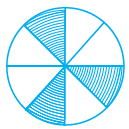
Question 56. The fraction represented by the shaded portion in the adjoining figure is $\frac{3}{8}$.
Answer:
Answer: True
Elaborate Solution:
To find the fraction represented by the shaded portion:
1. Count the total number of equal parts the circle is divided into. Here, there are 8 equal parts.
2. Count the number of shaded parts. Here, 3 parts are shaded with blue lines.
The fraction is defined as $\frac{\text{Number of shaded parts}}{\text{Total number of equal parts}}$.
Therefore, the shaded fraction is $\frac{3}{8}$.
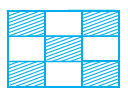
Question 57. The fraction represented by the unshaded portion in the adjoining figure is $\frac{5}{9}$ .
Answer:
Answer: False
Elaborate Solution:
Let us analyze the figure:
1. Total number of equal rectangles in the grid = $3 \times 3 = 9$.
2. Number of shaded rectangles = $5$.
3. Number of unshaded rectangles = $9 - 5 = 4$.
The fraction of the unshaded portion is $\frac{\text{Number of unshaded parts}}{\text{Total number of parts}} = \frac{4}{9}$.
Since the statement says the fraction is $\frac{5}{9}$ (which is actually the shaded portion), the statement is false.
Question 58. $\frac{25}{19} + \frac{6}{19} = \frac{31}{38}$
Answer:
Answer: False
Elaborate Solution:
The given fractions are like fractions because they share the common denominator $19$.
To add like fractions, we add the numerators and keep the common denominator unchanged.
$\frac{25}{19} + \frac{6}{19} = \frac{25 + 6}{19} = \frac{31}{19}$
The statement incorrectly adds the denominators ($19 + 19 = 38$), which is a common mistake. Therefore, the statement is false.
Question 59. $\frac{8}{18} - \frac{8}{15} = \frac{8}{18}$
Answer:
Answer: False
Elaborate Solution:
Mathematically, for any number $x$, the equation $x - y = x$ is only true if $y = 0$. In this statement, we are subtracting $\frac{8}{15}$ from $\frac{8}{18}$. Since $\frac{8}{15}$ is not zero, the result cannot be equal to the starting fraction.
Let us solve the Left Hand Side (LHS) by finding a common denominator for $18$ and $15$, which is $90$:
$\frac{8}{18} = \frac{8 \times 5}{18 \times 5} = \frac{40}{90}$
$\frac{8}{15} = \frac{8 \times 6}{15 \times 6} = \frac{48}{90}$
Now, $\text{LHS} = \frac{40}{90} - \frac{48}{90} = -\frac{8}{90}$
The Right Hand Side (RHS) is $\frac{8}{18} = \frac{40}{90}$.
Since $-\frac{8}{90} \neq \frac{40}{90}$, the statement is false.
Question 60. $\frac{7}{12} + \frac{11}{12} = \frac{3}{2}$
Answer:
Answer: True
Elaborate Solution:
The fractions on the Left Hand Side (LHS) are like fractions as they have the same denominator, $12$.
$\text{LHS} = \frac{7}{12} + \frac{11}{12}$
$= \frac{7 + 11}{12}$
$= \frac{18}{12}$
Now, simplify the fraction by dividing both the numerator and the denominator by their Highest Common Factor (HCF), which is $6$:
$\frac{\cancel{18}^{3}}{\cancel{12}_{2}} = \frac{3}{2}$
Since the simplified LHS is equal to the RHS ($\frac{3}{2}$), the statement is true.
Question 61. 3.03 + 0.016 = 3.019
Answer:
Answer: False
Elaborate Solution:
To add these decimals, we first convert them into like decimals by giving them the same number of decimal places.
$3.03 = 3.030$
$0.016 = 0.016$
Now, perform the addition vertically:
$\begin{array}{cc} & 3 & . & 0 & 3 & 0 \\ + & 0 & . & 0 & 1 & 6 \\ \hline & 3 & . & 0 & 4 & 6 \\ \hline \end{array}$
The sum is $3.046$. Since $3.046 \neq 3.019$, the statement is false.
Question 62. 42.28 – 3.19 = 39.09
Answer:
Answer: True
Elaborate Solution:
To find the difference, we align the decimals vertically and subtract:
$\begin{array}{cc} & 4 & 2 & . & 2 & 8 \\ - & & 3 & . & 1 & 9 \\ \hline & 3 & 9 & . & 0 & 9 \\ \hline \end{array}$
The subtraction result is $39.09$. Since this matches the given value, the statement is true.
Question 63. $\frac{16}{25} > \frac{13}{25}$
Answer:
Answer: True
Elaborate Solution:
When comparing like fractions (fractions with the same denominator), the fraction with the greater numerator is the larger fraction.
Here, the denominator is $25$ for both fractions.
Comparing the numerators, we see that $16 > 13$.
Therefore, $\frac{16}{25} > \frac{13}{25}$ is a true statement.
Question 64. 19.25 < 19.053
Answer:
Answer: False
Elaborate Solution:
To compare these decimals, we convert them into like decimals by adding a zero to $19.25$:
$19.25 = 19.250$
Now we compare $19.250$ and $19.053$. Both have the same whole number part ($19$). In the decimal part:
The tenths digit of $19.250$ is $2$.
The tenths digit of $19.053$ is $0$.
Since $2 > 0$, it follows that $19.250 > 19.053$. The statement claims that $19.25 < 19.053$, which is false.
Question 65. 13.730 = 13.73
Answer:
Answer: True
Elaborate Solution:
Adding or removing zeros at the end of a decimal number (trailing zeros) does not change its value.
$13.730$ means $13 + \frac{7}{10} + \frac{3}{100} + \frac{0}{1000}$
$13.73$ means $13 + \frac{7}{10} + \frac{3}{100}$
Since $\frac{0}{1000} = 0$, both expressions represent the same numerical value. Therefore, $13.730 = 13.73$ is true.
Question 66 to 71 (Fill in the Blanks using '>' , '<' or '=')
In each of the questions 66 to 71, fill in the blanks using ‘>’ , ‘<’ or ‘=’ :
Question 66. $\frac{11}{16}\cdots\frac{14}{15}$
Answer:
Answer: $\frac{11}{16} < \frac{14}{15}$
Elaborate Solution:
To compare the fractions $\frac{11}{16}$ and $\frac{14}{15}$, we can use the cross-multiplication method.
Multiply the numerator of the first fraction by the denominator of the second:
$11 \times 15 = 165$
Multiply the numerator of the second fraction by the denominator of the first:
$14 \times 16 = 224$
Since $165 < 224$, the first fraction is smaller than the second fraction.
Therefore, $\frac{11}{16} < \frac{14}{15}$.
Question 67. $\frac{8}{15}\cdots\frac{95}{14}$
Answer:
Answer: $\frac{8}{15} < \frac{95}{14}$
Elaborate Solution:
In this case, we can compare the fractions by identifying their types:
1. The fraction $\frac{8}{15}$ is a proper fraction because the numerator ($8$) is less than the denominator ($15$). The value of any proper fraction is always less than $1$.
2. The fraction $\frac{95}{14}$ is an improper fraction because the numerator ($95$) is much larger than the denominator ($14$). Converting it to a mixed fraction, we get $6\frac{11}{14}$, which is clearly greater than $1$.
Since a value less than $1$ is always smaller than a value greater than $1$, we have:
$\frac{8}{15} < \frac{95}{14}$
Question 68. $\frac{12}{75}\cdots\frac{32}{200}$
Answer:
Answer: $\frac{12}{75} = \frac{32}{200}$
Elaborate Solution:
To compare these fractions, let us simplify both to their lowest terms.
For $\frac{12}{75}$:
Divide both numerator and denominator by their HCF, which is $3$.
$\frac{12 \div 3}{75 \div 3} = \frac{4}{25}$
For $\frac{32}{200}$:
Divide both numerator and denominator by their HCF, which is $8$.
$\frac{32 \div 8}{200 \div 8} = \frac{4}{25}$
Since both fractions simplify to the same value, $\frac{4}{25}$, they are equal.
Question 69. 3.25 ... 3.4
Answer:
Answer: $3.25 < 3.4$
Elaborate Solution:
To compare decimal numbers, we first convert them into like decimals by giving them the same number of digits after the decimal point.
$3.4$ can be written as $3.40$.
Now, compare $3.25$ and $3.40$:
The whole number part ($3$) is the same for both. Looking at the decimal parts, $25 < 40$.
Therefore, $3.25 < 3.4$.
Question 70. $\frac{18}{25}\cdots 1.3$
Answer:
Answer: $\frac{18}{25} < 1.3$
Elaborate Solution:
Let us convert the fraction $\frac{18}{25}$ into a decimal for easier comparison.
We can multiply both the numerator and denominator by $4$ to make the denominator $100$:
$\frac{18 \times 4}{25 \times 4} = \frac{72}{100} = 0.72$
Now, compare $0.72$ and $1.3$.
The whole number part of $0.72$ is $0$, while the whole number part of $1.3$ is $1$.
Since $0 < 1$, it follows that $0.72 < 1.3$.
Therefore, $\frac{18}{25} < 1.3$.
Question 71. $6.25 \cdots \frac{25}{4}$
Answer:
Answer: $6.25 = \frac{25}{4}$
Elaborate Solution:
Let us convert the improper fraction $\frac{25}{4}$ into its decimal form.
Divide $25$ by $4$:
$25 \div 4 = 6.25$
Verification:
$\frac{25 \times 25}{4 \times 25} = \frac{625}{100} = 6.25$
Since the decimal value of the fraction is exactly $6.25$, we use the equality sign.
Therefore, $6.25 = \frac{25}{4}$.
Question 72 to 129
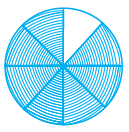
Question 72. Write the fraction represented by the shaded portion of the adjoining figure:
Answer:
Solution:
To find the fraction of the shaded portion, we follow these steps:
1. Total number of equal parts: By observing the figure, we see the circle is divided into $8$ equal sectors.
2. Number of shaded parts: There are $7$ parts shaded with blue lines.
The fraction is given by:
$\text{Fraction} = \frac{\text{Number of shaded parts}}{\text{Total number of equal parts}}$
$\text{Fraction} = \frac{7}{8}$
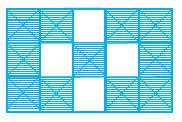
Question 73. Write the fraction represented by the unshaded portion of the adjoining figure:
Answer:
Solution:
1. Total number of equal parts: The grid consists of $15$ equal rectangles ($5$ columns and $3$ rows).
2. Number of unshaded parts: By counting the white (unshaded) blocks, we find there are $4$ such rectangles.
The fraction is given by:
$\text{Fraction} = \frac{\text{Number of unshaded parts}}{\text{Total number of parts}}$
$\text{Fraction} = \frac{4}{15}$
Therefore, the unshaded portion represents $\frac{4}{15}$ of the figure.
Question 74. Ali divided one fruit cake equally among six persons. What part of the cake he gave to each person?
Answer:
Given:
Total number of cakes = $1$
Total number of persons = $6$
Solution:
When a whole object is divided equally into a certain number of parts, each part represents a fraction of the whole.
$\text{Part given to each person} = \frac{\text{Total cake}}{\text{Number of persons}}$
$\text{Part given to each person} = \frac{1}{6}$
Ali gave $\frac{1}{6}$ of the cake to each person.
Question 75. Arrange 12.142, 12.124, 12.104, 12.401 and 12.214 in ascending order.
Answer:
Solution:
Ascending order means arranging numbers from the smallest to the greatest.
All the given numbers have the same whole number part, which is $12$. Therefore, we compare the decimal parts starting from the tenths place, then the hundredths, and so on.
Comparing the decimal values:
1. $0.104$ (smallest, since $0$ is in the hundredths place)
2. $0.124$ (next smallest, $2$ in the hundredths place)
3. $0.142$ ($4$ in the hundredths place)
4. $0.214$ ($2$ in the tenths place)
5. $0.401$ (largest, $4$ in the tenths place)
Ascending Order:
12.104, 12.124, 12.142, 12.214, 12.401
Question 76. Write the largest four digit decimal number less than1using the digits 1, 5, 3 and 8 once.
Answer:
To Find: The largest four-digit decimal number less than $1$ using digits $1, \ 5, \ 3,$ and $8$.
Solution:
Since the decimal number must be less than $1$, the whole number part (the digit before the decimal point) must be $0$.
To make the decimal number as large as possible, we must arrange the given digits in descending order (from largest to smallest) starting from the tenths place.
The given digits are: $8, \ 5, \ 3, \ 1$.
Arranging them in descending order after the decimal point, we get:
$.8531$
Final Answer: The largest four-digit decimal number is $0.8531$.
Question 77. Using the digits 2, 4, 5 and 3 once, write the smallest four digit decimal number.
Answer:
To Find: The smallest four-digit decimal number using digits $2, \ 4, \ 5,$ and $3$.
Solution:
To form the smallest decimal number, we should place the smallest digits in the positions with the highest place values. In this context, we place $0$ in the whole number part to keep the value less than $1$.
The given digits are: $2, \ 3, \ 4, \ 5$.
We arrange these digits in ascending order (from smallest to largest) after the decimal point:
$.2345$
Final Answer: The smallest four-digit decimal number is $0.2345$.
Question 78. Express $\frac{11}{20}$ as a decimal.
Answer:
Given: Fraction = $\frac{11}{20}$
Solution:
To convert a fraction into a decimal, we can convert the denominator into a power of $10$ (like $100$).
We know that $20 \times 5 = 100$. So, we multiply both the numerator and the denominator by $5$:
$\frac{11 \times 5}{20 \times 5} = \frac{55}{100}$
A fraction with $100$ in the denominator is written as a decimal by placing the decimal point two places from the right:
$\frac{55}{100} = 0.55$
Final Answer: $\frac{11}{20}$ expressed as a decimal is $0.55$.
Question 79. Express $6\frac{2}{3}$ as an improper fraction.
Answer:
Given: Mixed fraction = $6\frac{2}{3}$
Solution:
To convert a mixed fraction into an improper fraction, we use the following formula:
$\text{Improper Fraction} = \frac{(\text{Whole Number} \times \text{Denominator}) + \text{Numerator}}{\text{Denominator}}$
Substituting the values:
$\text{Improper Fraction} = \frac{(6 \times 3) + 2}{3}$
$\text{Improper Fraction} = \frac{18 + 2}{3}$
$\text{Improper Fraction} = \frac{20}{3}$
Final Answer: $6\frac{2}{3}$ as an improper fraction is $\frac{20}{3}$.
Question 80. Express $3\frac{2}{5}$ as a decimal.
Answer:
Given: Mixed fraction = $3\frac{2}{5}$
Solution:
A mixed fraction can be separated into its whole number part and fractional part:
$3\frac{2}{5} = 3 + \frac{2}{5}$
Now, convert the fractional part $\frac{2}{5}$ into a decimal by making the denominator $10$:
$\frac{2 \times 2}{5 \times 2} = \frac{4}{10}$
$\frac{4}{10} = 0.4$
Finally, add the whole number part and the decimal part together:
$3 + 0.4 = 3.4$
Final Answer: $3\frac{2}{5}$ expressed as a decimal is $3.4$.
Question 81. Express 0.041 as a fraction.
Answer:
To Find: The fractional form of the decimal $0.041$.
Solution:
To convert a decimal into a fraction, we observe the number of digits after the decimal point. Here, there are three decimal places (tenths, hundredths, and thousandths).
We write the digits as the numerator and $1000$ (since there are three decimal places) as the denominator:
$0.041 = \frac{41}{1000}$
Since $41$ is a prime number and is not a factor of $1000$, the fraction is already in its simplest form.
Final Answer: $0.041$ as a fraction is $\frac{41}{1000}$.
Question 82. Express 6.03 as a mixed fraction.
Answer:
To Find: The mixed fraction form of the decimal $6.03$.
Solution:
A decimal can be split into its whole number part and its fractional part:
$6.03 = 6 + 0.03$
The decimal part $0.03$ has two decimal places, so it can be written as a fraction with $100$ in the denominator:
$0.03 = \frac{3}{100}$
Now, combining the whole number and the fraction:
$6 + \frac{3}{100} = 6\frac{3}{100}$
Final Answer: $6.03$ as a mixed fraction is $6\frac{3}{100}$.
Question 83. Convert 5201g to kg.
Answer:
Given: Weight = $5201 \text{ g}$
Solution:
We know the standard conversion for weight is:
$1000 \text{ g} = 1 \text{ kg}$
$1 \text{ g} = \frac{1}{1000} \text{ kg}$
To convert $5201 \text{ g}$ to $\text{kg}$, we divide the value by $1000$:
$5201 \text{ g} = \frac{5201}{1000} \text{ kg}$
$5201 \text{ g} = 5.201 \text{ kg}$
Final Answer: $5201 \text{ g}$ is equal to $5.201 \text{ kg}$.
Question 84. Convert 2009 paise to rupees and express the result as a mixed fraction.
Answer:
Given: Amount = $2009 \text{ paise}$
Solution:
In the Indian currency system, we know that:
$100 \text{ paise} = \textsf{₹} 1$
$1 \text{ paisa} = \textsf{₹} \frac{1}{100}$
To convert $2009 \text{ paise}$ to rupees, we divide by $100$:
$\text{Amount in Rupees} = \textsf{₹} \frac{2009}{100}$
Now, we convert the improper fraction $\frac{2009}{100}$ into a mixed fraction by dividing $2009$ by $100$:
$2009 \div 100 = 20$ with a remainder of $9$.
Therefore, the amount is $\textsf{₹} 20\frac{9}{100}$.
Question 85. Convert 1537cm to m and express the result as an improper fraction.
Answer:
Given: Length = $1537 \text{ cm}$
Solution:
We know the standard unit conversion for length is:
$100 \text{ cm} = 1 \text{ m}$
$1 \text{ cm} = \frac{1}{100} \text{ m}$
To convert $1537 \text{ cm}$ to meters, we divide the value by $100$:
$1537 \text{ cm} = \frac{1537}{100} \text{ m}$
The question asks to express the result as an improper fraction (a fraction where the numerator is larger than the denominator). Since $1537$ and $100$ do not have any common factors other than $1$, the fraction is already in its simplest improper form.
Final Answer: $1537 \text{ cm}$ as an improper fraction is $\frac{1537}{100} \text{ m}$.
Question 86. Convert 2435 m to km and express the result as mixed fraction.
Answer:
Given:
Distance = $2435 \text{ m}$
To Find:
The distance in kilometres ($\text{km}$) as a mixed fraction.
Solution:
We know that $1000 \text{ metres}$ is equal to $1 \text{ kilometre}$.
$1000 \text{ m} = 1 \text{ km}$
$1 \text{ m} = \frac{1}{1000} \text{ km}$
To convert $2435 \text{ m}$ to $\text{km}$, we divide the value by $1000$:
Distance in $\text{km} = \frac{2435}{1000}$
First, simplify the improper fraction by dividing both numerator and denominator by their common factor, $5$:
$\frac{\cancel{2435}^{487}}{\cancel{1000}_{200}} = \frac{487}{200}$
Now, convert the improper fraction $\frac{487}{200}$ into a mixed fraction by dividing $487$ by $200$:
Quotient = $2$, Remainder = $87$, Denominator = $200$.
The mixed fraction is $2\frac{87}{200}$.
Final Answer: $2435 \text{ m}$ is equal to $2\frac{87}{200} \text{ km}$.
Question 87. Arrange the fractions $\frac{2}{3}$ , $\frac{3}{4}$ , $\frac{1}{2}$ , and $\frac{5}{6}$ in ascending order.
Answer:
To Find: Ascending order (smallest to largest) of the given fractions.
Solution:
To compare unlike fractions, we must first find a common denominator by taking the Least Common Multiple (LCM) of the denominators: $3, 4, 2, \text{ and } 6$.
$\text{LCM}(3, 4, 2, 6) = 12$
Now, convert each fraction to an equivalent fraction with denominator $12$:
$\frac{2}{3} = \frac{2 \times 4}{3 \times 4} = \frac{8}{12}$
$\frac{3}{4} = \frac{3 \times 3}{4 \times 3} = \frac{9}{12}$
$\frac{1}{2} = \frac{1 \times 6}{2 \times 6} = \frac{6}{12}$
$\frac{5}{6} = \frac{5 \times 2}{6 \times 2} = \frac{10}{12}$
Comparing the numerators of the like fractions: $6 < 8 < 9 < 10$.
Thus, the order of the fractions is: $\frac{6}{12} < \frac{8}{12} < \frac{9}{12} < \frac{10}{12}$.
Ascending Order: $\frac{1}{2}, \frac{2}{3}, \frac{3}{4}, \frac{5}{6}$
Question 88. Arrange the fractions $\frac{6}{7}$ , $\frac{7}{8}$ , $\frac{4}{5}$ and $\frac{3}{4}$ in descending order.
Answer:
To Find: Descending order (largest to smallest) of the given fractions.
Solution:
First, find the LCM of the denominators $7, 8, 5, \text{ and } 4$ to convert them into like fractions.
$\text{LCM}(7, 8, 5, 4) = 280$
Now, find equivalent fractions with denominator $280$:
$\frac{6}{7} = \frac{6 \times 40}{7 \times 40} = \frac{240}{280}$
$\frac{7}{8} = \frac{7 \times 35}{8 \times 35} = \frac{245}{280}$
$\frac{4}{5} = \frac{4 \times 56}{5 \times 56} = \frac{224}{280}$
$\frac{3}{4} = \frac{3 \times 70}{4 \times 70} = \frac{210}{280}$
Comparing the numerators in descending order: $245 > 240 > 224 > 210$.
Thus, the order is: $\frac{245}{280} > \frac{240}{280} > \frac{224}{280} > \frac{210}{280}$.
Descending Order: $\frac{7}{8}, \frac{6}{7}, \frac{4}{5}, \frac{3}{4}$
Question 89. Write $\frac{3}{4}$ as a fraction with denominator 44.
Answer:
Given:
Fraction = $\frac{3}{4}$
Target denominator = $44$
Solution:
To find the equivalent fraction, we first determine the number by which the original denominator must be multiplied to get $44$.
$44 \div 4 = 11$
Since we must multiply the denominator by $11$, we must also multiply the numerator by $11$ to keep the fraction equivalent.
$\text{New Numerator} = 3 \times 11 = 33$
Final Answer: The fraction with denominator $44$ is $\frac{33}{44}$.
Question 90. Write $\frac{5}{6}$ as a fraction with numerator 60.
Answer:
Given:
Fraction = $\frac{5}{6}$
Target numerator = $60$
Solution:
First, find the factor by which the original numerator $5$ is multiplied to reach $60$.
$60 \div 5 = 12$
Since the numerator is multiplied by $12$, the denominator must also be multiplied by $12$.
$\text{New Denominator} = 6 \times 12 = 72$
Final Answer: The fraction with numerator $60$ is $\frac{60}{72}$.
Question 91. Write $\frac{129}{8}$ as a mixed fraction.
Answer:
To Find: The mixed fraction form of the improper fraction $\frac{129}{8}$.
Solution:
To convert an improper fraction into a mixed fraction, we divide the numerator by the denominator.
Step 1: Perform the division.
We divide $129$ by $8$:
$129 \div 8$
$8 \times 16 = 128$
$129 - 128 = 1$
Step 2: Identify the components.
From the division, we have:
Quotient $= 16$
Remainder $= 1$
Denominator (Divisor) $= 8$
Step 3: Write in mixed fraction form.
The form is $\text{Quotient}\frac{\text{Remainder}}{\text{Denominator}}$.
$\frac{129}{8} = 16\frac{1}{8}$
Final Answer: The mixed fraction is $16\frac{1}{8}$.
Question 92. Round off 20.83 to nearest tenths.
Answer:
Given: Decimal number $= 20.83$
Solution:
To round off a number to the nearest tenths place, we look at the digit in the place immediately to its right, which is the hundredths place.
1. The digit at the tenths place is $8$.
2. The digit at the hundredths place is $3$.
3. Rule: If the digit to the right is less than $5$, we keep the digit in the rounding place the same and remove all digits to its right.
4. Since $3 < 5$, the digit $8$ remains unchanged.
Final Answer: $20.83$ rounded off to the nearest tenths is $20.8$.
Question 93. Round off 75.195 to nearest hundredths.
Answer:
Given: Decimal number $= 75.195$
Solution:
To round off to the hundredths place, we look at the digit in the thousandths place.
1. The digit at the hundredths place is $9$.
2. The digit at the thousandths place is $5$.
3. Rule: If the digit to the right is $5$ or more, we increase the digit in the rounding place by $1$.
4. Since the digit is $5$, we add $1$ to the hundredths place: $9 + 1 = 10$.
5. We write $0$ at the hundredths place and carry over $1$ to the tenths place: $1 + 1 = 2$.
Final Answer: $75.195$ rounded off to the nearest hundredths is $75.20$.
Question 94. Round off 27.981 to nearest tenths.
Answer:
Given: Decimal number $= 27.981$
Solution:
To round off to the tenths place, we look at the digit in the hundredths place.
1. The digit at the tenths place is $9$.
2. The digit at the hundredths place is $8$.
3. Rule: Since $8 \ge 5$, we increase the digit at the tenths place by $1$.
4. Adding $1$ to $9$ gives $10$. We write $0$ in the tenths place and carry over $1$ to the ones place.
5. Ones place becomes $7 + 1 = 8$.
Final Answer: $27.981$ rounded off to the nearest tenths is $28.0$.
Question 95. Add the fractions $\frac{3}{8}$ and $\frac{2}{3}$ .
Answer:
To Find: The sum of $\frac{3}{8}$ and $\frac{2}{3}$.
Solution:
Since the denominators are different ($8$ and $3$), we must first find the Least Common Multiple (LCM) of the denominators to make them like fractions.
Step 1: Find the LCM of $8$ and $3$.
$\begin{array}{c|cc} 2 & 8 \;, & 3 \\ \hline 2 & 4 \; , & 3 \\ \hline 2 & 2 \; , & 3 \\ \hline 3 & 1 \; , & 3 \\ \hline & 1 \; , & 1 \end{array}$
$\text{LCM} = 2 \times 2 \times 2 \times 3 = 24$
Step 2: Convert to equivalent fractions with denominator $24$.
For $\frac{3}{8}$: $\frac{3 \times 3}{8 \times 3} = \frac{9}{24}$
For $\frac{2}{3}$: $\frac{2 \times 8}{3 \times 8} = \frac{16}{24}$
Step 3: Add the like fractions.
$\frac{9}{24} + \frac{16}{24} = \frac{9 + 16}{24} = \frac{25}{24}$
Step 4: Convert to mixed fraction.
$\frac{25}{24} = 1\frac{1}{24}$
Final Answer: The sum is $1\frac{1}{24}$.
Question 96. Add the fractions $\frac{3}{8}$ and $6\frac{3}{4}$ .
Answer:
Given:
First fraction = $\frac{3}{8}$
Second fraction = $6\frac{3}{4}$
Solution:
First, we convert the mixed fraction $6\frac{3}{4}$ into an improper fraction:
$6\frac{3}{4} = \frac{(6 \times 4) + 3}{4} = \frac{24 + 3}{4} = \frac{27}{4}$
Now, we need to add $\frac{3}{8}$ and $\frac{27}{4}$. Since the denominators are different, we find their Least Common Multiple (LCM):
LCM of $8$ and $4$ is $8$.
Convert $\frac{27}{4}$ to an equivalent fraction with denominator $8$:
$\frac{27 \times 2}{4 \times 2} = \frac{54}{8}$
Now add the like fractions:
$\frac{3}{8} + \frac{54}{8} = \frac{3 + 54}{8} = \frac{57}{8}$
Converting the improper fraction $\frac{57}{8}$ back to a mixed fraction:
$57 \div 8 = 7$ with a remainder of $1$.
Therefore, the sum is $7\frac{1}{8}$.
Question 97. Subtract $\frac{1}{6}$ from $\frac{1}{2}$ .
Answer:
To Find: $\frac{1}{2} - \frac{1}{6}$
Solution:
The denominators are $2$ and $6$. To subtract these fractions, we must find their LCM.
LCM of $2$ and $6$ is $6$.
Convert $\frac{1}{2}$ to an equivalent fraction with denominator $6$:
$\frac{1 \times 3}{2 \times 3} = \frac{3}{6}$
Now, perform the subtraction:
$\frac{3}{6} - \frac{1}{6} = \frac{3 - 1}{6} = \frac{2}{6}$
Simplify the result by dividing both the numerator and denominator by their HCF, which is $2$:
$\frac{\cancel{2}^{1}}{\cancel{6}_{3}} = \frac{1}{3}$
Final Answer: The result of the subtraction is $\frac{1}{3}$.
Question 98. Subtract $8\frac{1}{3}$ from $\frac{100}{9}$ .
Answer:
Given:
Subtract $8\frac{1}{3}$ from $\frac{100}{9}$.
Solution:
First, convert the mixed fraction $8\frac{1}{3}$ into an improper fraction:
$8\frac{1}{3} = \frac{(8 \times 3) + 1}{3} = \frac{24 + 1}{3} = \frac{25}{3}$
Now, the expression becomes: $\frac{100}{9} - \frac{25}{3}$
The LCM of the denominators $9$ and $3$ is $9$. Convert $\frac{25}{3}$ to an equivalent fraction with denominator $9$:
$\frac{25 \times 3}{3 \times 3} = \frac{75}{9}$
Subtract the like fractions:
$\frac{100}{9} - \frac{75}{9} = \frac{100 - 75}{9} = \frac{25}{9}$
Converting the improper fraction to a mixed fraction:
$25 \div 9 = 2$ with a remainder of $7$.
Therefore, the result is $2\frac{7}{9}$.
Question 99. Subtract $1\frac{1}{4}$ from $6\frac{1}{2}$ .
Answer:
Solution:
Convert both mixed fractions into improper fractions:
$6\frac{1}{2} = \frac{13}{2}$
$1\frac{1}{4} = \frac{5}{4}$
We need to calculate: $\frac{13}{2} - \frac{5}{4}$
Find the LCM of the denominators $2$ and $4$. The LCM is $4$.
Convert $\frac{13}{2}$ to an equivalent fraction with denominator $4$:
$\frac{13 \times 2}{2 \times 2} = \frac{26}{4}$
Subtract the fractions:
$\frac{26}{4} - \frac{5}{4} = \frac{26 - 5}{4} = \frac{21}{4}$
Convert back to a mixed fraction: $21 \div 4 = 5$ with a remainder of $1$.
Final Answer: $5\frac{1}{4}$
Question 100. Add $1\frac{1}{4}$ and $6\frac{1}{2}$ .
Answer:
Solution:
Convert the mixed fractions into improper fractions:
$1\frac{1}{4} = \frac{5}{4}$
$6\frac{1}{2} = \frac{13}{2}$
To add these, find the LCM of the denominators $4$ and $2$, which is $4$.
Make the denominators equal:
$\frac{13}{2} = \frac{13 \times 2}{2 \times 2} = \frac{26}{4}$
Add the like fractions:
$\frac{5}{4} + \frac{26}{4} = \frac{5 + 26}{4} = \frac{31}{4}$
Convert the result to a mixed fraction: $31 \div 4 = 7$ with a remainder of $3$.
Final Answer: $7\frac{3}{4}$
Question 101. Katrina rode her bicycle $6\frac{1}{2}$ km in the morning and $8\frac{3}{4}$ km in the evening. Find the distance travelled by her altogether on that day.
Answer:
Given:
Distance travelled in the morning = $6\frac{1}{2}\text{ km}$
Distance travelled in the evening = $8\frac{3}{4}\text{ km}$
To Find:
Total distance travelled altogether.
Solution:
First, we convert the mixed fractions into improper fractions:
$6\frac{1}{2} = \frac{(6 \times 2) + 1}{2} = \frac{13}{2}\text{ km}$
$8\frac{3}{4} = \frac{(8 \times 4) + 3}{4} = \frac{35}{4}\text{ km}$
Now, we find the total distance by adding these two fractions:
$\text{Total distance} = \frac{13}{2} + \frac{35}{4}$
To add these unlike fractions, find the LCM of denominators $2$ and $4$, which is $4$.
$\text{Total distance} = \frac{13 \times 2}{2 \times 2} + \frac{35}{4}$
$\text{Total distance} = \frac{26}{4} + \frac{35}{4} = \frac{26 + 35}{4} = \frac{61}{4}\text{ km}$
Converting the improper fraction back to a mixed fraction:
$\frac{61}{4} = 15\frac{1}{4}\text{ km}$
Final Answer: Katrina travelled a total of $15\frac{1}{4}\text{ km}$ on that day.
Question 102. A rectangle is divided into certain number of equal parts. If 16 of the parts so formed represent the fraction $\frac{1}{4}$ , find the number of parts in which the rectangle has been divided.
Answer:
Given:
Number of parts representing the fraction = $16$
The fraction represented by these parts = $\frac{1}{4}$
To Find:
Total number of parts the rectangle was divided into.
Solution:
Let the total number of equal parts be $x$.
According to the problem, $16$ parts out of the total $x$ is equal to $\frac{1}{4}$.
$\frac{16}{x} = \frac{1}{4}$
By cross-multiplying:
$1 \times x = 16 \times 4$
$x = 64$
Final Answer: The rectangle has been divided into $64$ equal parts.
Question 103. Grip size of a tennis racquet is $11\frac{9}{80}$ cm. Express the size as an improper fraction.
Answer:
Given:
Grip size = $11\frac{9}{80}\text{ cm}$
Solution:
To convert a mixed fraction into an improper fraction, we use the formula:
$\text{Improper Fraction} = \frac{(\text{Whole number} \times \text{Denominator}) + \text{Numerator}}{\text{Denominator}}$
Substituting the given values:
$\text{Improper Fraction} = \frac{(11 \times 80) + 9}{80}$
$\text{Improper Fraction} = \frac{880 + 9}{80} = \frac{889}{80}$
Final Answer: The grip size as an improper fraction is $\frac{889}{80}\text{ cm}$.
Question 104. On an average $\frac{1}{10}$ of the food eaten is turned into organism’s own body and is available for the nextlevel of consumer in a food chain. What fraction of the food eaten is not available for the next level?
Answer:
Given:
Fraction of food available for the next level = $\frac{1}{10}$
To Find:
Fraction of food not available for the next level.
Solution:
The total food eaten is represented by the whole number $1$.
The fraction not available is found by subtracting the available fraction from the whole.
$\text{Fraction not available} = 1 - \frac{1}{10}$
To perform the subtraction, represent $1$ as $\frac{10}{10}$:
$\text{Fraction not available} = \frac{10}{10} - \frac{1}{10} = \frac{10 - 1}{10} = \frac{9}{10}$
Final Answer: $\frac{9}{10}$ of the food eaten is not available for the next level.
Question 105. Mr. Rajan got a job at the age of 24 years and he got retired from the job at the age of 60 years. What fraction of his age till retirement was he in the job?
Answer:
Given:
Age when job started = $24\text{ years}$
Age at retirement = $60\text{ years}$
To Find:
The fraction of his total age (at the point of retirement) that he spent in the job.
Solution:
First, calculate the total number of years spent in the job:
$\text{Duration of job} = 60 - 24 = 36\text{ years}$
Now, calculate the fraction relative to his age at retirement ($60$ years):
$\text{Required Fraction} = \frac{\text{Duration of job}}{\text{Total age at retirement}} = \frac{36}{60}$
Simplify the fraction by dividing both numerator and denominator by their HCF, which is $12$:
$\frac{\cancel{36}^{3}}{\cancel{60}_{5}} = \frac{3}{5}$
Final Answer: Mr. Rajan was in the job for $\frac{3}{5}$ of his age till retirement.
Question 106. The food we eat remains in the stomach for a maximum of 4 hours. For what fraction of a day, does it remain there?
Answer:
Given:
Time food remains in stomach = $4$ hours
Solution:
We know that the total number of hours in a day is $24$.
$\text{Total hours in a day} = 24 \text{ hours}$
To find the fraction of the day, we compare the given time to the total time in a day:
$\text{Required Fraction} = \frac{\text{Time in stomach}}{\text{Total hours in a day}}$
$\text{Required Fraction} = \frac{4}{24}$
Simplifying the fraction by dividing both numerator and denominator by their Highest Common Factor (HCF), which is $4$:
$\frac{\cancel{4}^{1}}{\cancel{24}_{6}} = \frac{1}{6}$
Final Answer: The food remains in the stomach for $\frac{1}{6}$ of a day.
Question 107. What should be added to 25.5 to get 50?
Answer:
Given:
The number to which another value is added = $25.5$
The total result required = $50$
Solution:
Let the number to be added be $x$.
According to the question:
$x + 25.5 = 50$
$x = 50 - 25.5$
To perform the subtraction, we align the decimal points and add a placeholder zero to $50$:
$\begin{array}{cc} & 5 & 0 & . & 0 \\ - & 2 & 5 & . & 5 \\ \hline & 2 & 4 & . & 5 \\ \hline \end{array}$
Final Answer: The number that should be added is $24.5$.
Question 108. Alok purchased 1kg 200g potatoes, 250g dhania, 5kg 300g onion, 500g palak and 2kg 600g tomatoes. Find the total weight of his purchases in kilograms.
Answer:
Given Weights:
Potatoes = $1\text{ kg } 200\text{ g} = 1.200\text{ kg}$
Dhania = $250\text{ g} = 0.250\text{ kg}$
Onion = $5\text{ kg } 300\text{ g} = 5.300\text{ kg}$
Palak = $500\text{ g} = 0.500\text{ kg}$
Tomatoes = $2\text{ kg } 600\text{ g} = 2.600\text{ kg}$
Solution:
To find the total weight, we add the weights in kilograms by aligning the decimal points:
$\begin{array}{cc} & 1 & . & 2 & 0 & 0 \\ & 0 & . & 2 & 5 & 0 \\ & 5 & . & 3 & 0 & 0 \\ & 0 & . & 5 & 0 & 0 \\ + & 2 & . & 6 & 0 & 0 \\ \hline & 9 & . & 8 & 5 & 0 \\ \hline \end{array}$
Final Answer: The total weight of Alok's purchases is $9.850\text{ kg}$ (or $9.85\text{ kg}$).
Question 109. Arrange in ascending order:
0.011, 1.001, 0.101, 0.110
Answer:
Solution:
Ascending order means arranging numbers from the smallest to the greatest. All given decimals have three decimal places, so we compare them digit by digit from left to right.
1. Compare whole numbers: $1.001$ has $1$ as the whole number part, making it the largest. The others have $0$.
2. Compare tenths place for decimals with whole number $0$:
- $0.011$ has $0$ in the tenths place.
- $0.101$ has $1$ in the tenths place.
- $0.110$ has $1$ in the tenths place.
Since $0 < 1$, $0.011$ is the smallest.
3. Compare hundredths place for $0.101$ and $0.110$:
- $0.101$ has $0$ in the hundredths place.
- $0.110$ has $1$ in the hundredths place.
Since $0 < 1$, $0.101$ is smaller than $0.110$.
Ascending Order: $0.011, \ 0.101, \ 0.110, \ 1.001$
Question 110. Add the following:
20.02 and 2.002
Answer:
Solution:
To add these decimal numbers, we first convert them into like decimals so that they have the same number of digits after the decimal point.
$20.02 = 20.020$
$2.002 = 2.002$
Now, we align the decimal points and add vertically:
$\begin{array}{cc} & 2 & 0 & . & 0 & 2 & 0 \\ + & & 2 & . & 0 & 0 & 2 \\ \hline & 2 & 2 & . & 0 & 2 & 2 \\ \hline \end{array}$
Final Answer: The sum of $20.02$ and $2.002$ is $22.022$.
Question 111. It was estimated that because of people switching to Metro trains, about 33000 tonnes of CNG, 3300 tonnes of diesel and 21000 tonnes of petrol was saved by the end of year 2007. Find the fraction of :
(i) the quantity of diesel saved to the quantity of petrol saved.
(ii) the quantity of diesel saved to the quantity of CNG saved.
Answer:
Given:
Quantity of CNG saved = $33000$ tonnes
Quantity of diesel saved = $3300$ tonnes
Quantity of petrol saved = $21000$ tonnes
To Find:
(i) Fraction of diesel saved to petrol saved.
(ii) Fraction of diesel saved to CNG saved.
Solution:
(i) Quantity of diesel saved to petrol saved:
$\text{Required Fraction} = \frac{\text{Diesel saved}}{\text{Petrol saved}}$
$\text{Required Fraction} = \frac{3300}{21000}$
$\text{Required Fraction} = \frac{\cancel{3300}^{33}}{\cancel{21000}_{210}}$
$\text{Required Fraction} = \frac{\cancel{33}^{11}}{\cancel{210}_{70}}$
The fraction is $\frac{11}{70}$.
(ii) Quantity of diesel saved to CNG saved:
$\text{Required Fraction} = \frac{\text{Diesel saved}}{\text{CNG saved}}$
$\text{Required Fraction} = \frac{3300}{33000}$
$\text{Required Fraction} = \frac{\cancel{3300}^{1}}{\cancel{33000}_{10}}$
The fraction is $\frac{1}{10}$.
Question 112. Energy content of different foods are as follows:
| Food | Energy Content per kg. |
| Wheat | 3.2 Joules |
| Rice | 5.3 Joules |
| Potatoes (Cooked) | 3.7 Joules |
| Milk | 3.0 Joules |
Which food provides the least energy and which provides the maximum?
Express the least energy as a fraction of the maximum energy.
Answer:
Given:
Comparing the decimal values: $3.0, 3.2, 3.7, 5.3$
Solution:
By comparing the decimals, we find:
The least value is $3.0$ Joules (Milk).
The maximum value is $5.3$ Joules (Rice).
Fraction of least energy to maximum energy:
$\text{Fraction} = \frac{\text{Least Energy}}{\text{Maximum Energy}}$
$\text{Fraction} = \frac{3.0}{5.3}$
To convert this into a proper fraction, we multiply both the numerator and the denominator by $10$ to remove the decimals:
$\text{Fraction} = \frac{3.0 \times 10}{5.3 \times 10} = \frac{30}{53}$
Final Answer: Milk provides the least energy, Rice provides the maximum energy, and the fraction is $\frac{30}{53}$.
Question 113. A cup is $\frac{1}{3}$ full of milk. What part of the cup is still to be filled by milk to make it full?
Answer:
Given:
Part of the cup filled with milk = $\frac{1}{3}$
To Find:
Part of the cup still to be filled.
Solution:
The total capacity of the cup is represented by the whole number $1$.
$\text{Part to be filled} = 1 - \frac{1}{3}$
$\text{Part to be filled} = \frac{3}{3} - \frac{1}{3}$
$\text{Part to be filled} = \frac{3 - 1}{3} = \frac{2}{3}$
Final Answer: $\frac{2}{3}$ part of the cup is still to be filled.
Question 114. Mary bought $3\frac{1}{2}$ m of lace. She used $1\frac{3}{4}$ m of lace for her new dress. How much lace is left with her?
Answer:
Given:
Total lace bought = $3\frac{1}{2}$ m
Lace used = $1\frac{3}{4}$ m
To Find:
Lace left with Mary.
Solution:
First, convert the mixed fractions into improper fractions:
$3\frac{1}{2} = \frac{(3 \times 2) + 1}{2} = \frac{7}{2}$ m
$1\frac{3}{4} = \frac{(1 \times 4) + 3}{4} = \frac{7}{4}$ m
Now, subtract the lace used from the total lace:
$\text{Lace left} = \frac{7}{2} - \frac{7}{4}$
Taking LCM of $2$ and $4$, which is $4$:
$\text{Lace left} = \frac{7 \times 2}{2 \times 2} - \frac{7}{4}$
$\text{Lace left} = \frac{14}{4} - \frac{7}{4} = \frac{14 - 7}{4} = \frac{7}{4}$ m
Converting back to a mixed fraction:
$\frac{7}{4} = 1\frac{3}{4}$ m
Final Answer: $1\frac{3}{4}$ m of lace is left with her.
Question 115. When Sunita weighed herself on Monday, she found that she had gained $1\frac{1}{4}$ 5kg. Earlier her weight was $46\frac{3}{8}$ kg. What was her weight on Monday?
Answer:
Given:
Earlier weight = $46\frac{3}{8}$ kg
Weight gained = $1\frac{1}{4}$ kg
To Find:
Current weight on Monday.
Solution:
To find the current weight, we add the weight gained to the earlier weight.
First, convert the mixed fractions into improper fractions:
$46\frac{3}{8} = \frac{(46 \times 8) + 3}{8} = \frac{368 + 3}{8} = \frac{371}{8}$ kg
$1\frac{1}{4} = \frac{(1 \times 4) + 1}{4} = \frac{5}{4}$ kg
Now, find the sum:
$\text{Weight on Monday} = \frac{371}{8} + \frac{5}{4}$
Taking LCM of $8$ and $4$, which is $8$:
$\text{Weight on Monday} = \frac{371}{8} + \frac{5 \times 2}{4 \times 2}$
$\text{Weight on Monday} = \frac{371}{8} + \frac{10}{8} = \frac{371 + 10}{8} = \frac{381}{8}$ kg
Converting back to a mixed fraction:
$\frac{381}{8} = 47\frac{5}{8}$ kg
Final Answer: Her weight on Monday was $47\frac{5}{8}$ kg.
Question 116. Sunil purchased $12\frac{1}{2}$ litres of juice on Monday and $14\frac{3}{4}$ litres of juice on Tuesday. How many litres of juice did he purchase together in two days?
Answer:
Given:
Quantity of juice purchased on Monday = $12\frac{1}{2}$ litres
Quantity of juice purchased on Tuesday = $14\frac{3}{4}$ litres
To Find:
Total quantity of juice purchased together in two days.
Solution:
To find the total quantity, we need to add the quantities purchased on both days.
First, convert the mixed fractions into improper fractions:
$12\frac{1}{2} = \frac{(12 \times 2) + 1}{2} = \frac{25}{2}$ litres
$14\frac{3}{4} = \frac{(14 \times 4) + 3}{4} = \frac{59}{4}$ litres
Now, find a common denominator for $\frac{25}{2}$ and $\frac{59}{4}$. The LCM of $2$ and $4$ is $4$.
$\frac{25}{2} = \frac{25 \times 2}{2 \times 2} = \frac{50}{4}$
Total Quantity = $\frac{50}{4} + \frac{59}{4}$
$\text{Total Quantity} = \frac{109}{4}$ litres
Converting the improper fraction back to a mixed fraction:
$109 \div 4 = 27$ with a remainder of $1$.
$\text{Total juice} = 27\frac{1}{4}$
[Total quantity in litres]
Final Answer: Sunil purchased $27\frac{1}{4}$ litres of juice altogether.
Question 117. Nazima gave $2\frac{3}{4}$ litres out of the $5\frac{1}{2}$ litres of juice she purchased to her friends. How many litres of juice is left with her?
Answer:
Given:
Total quantity of juice Nazima had = $5\frac{1}{2}$ litres
Quantity of juice given to friends = $2\frac{3}{4}$ litres
To Find:
Quantity of juice left with Nazima.
Solution:
To find the remaining juice, we subtract the quantity given away from the total quantity.
Convert the mixed fractions into improper fractions:
$5\frac{1}{2} = \frac{(5 \times 2) + 1}{2} = \frac{11}{2}$ litres
$2\frac{3}{4} = \frac{(2 \times 4) + 3}{4} = \frac{11}{4}$ litres
Find the common denominator. The LCM of $2$ and $4$ is $4$.
$\frac{11}{2} = \frac{11 \times 2}{2 \times 2} = \frac{22}{4}$
$\text{Juice left} = \frac{22}{4} - \frac{11}{4} = \frac{22 - 11}{4}$
$\text{Juice left} = \frac{11}{4}$ litres
Converting to mixed fraction:
$11 \div 4 = 2$ with a remainder of $3$.
$\text{Remaining juice} = 2\frac{3}{4}$
[Quantity left in litres]
Final Answer: Nazima is left with $2\frac{3}{4}$ litres of juice.
Question 118. Roma gave a wooden board of length $150\frac{1}{4}$ cm to a carpenter for making a shelf. The Carpenter sawed off a piece of $40\frac{1}{5}$ cm from it. What is the length of the remaining piece?
Answer:
Given:
Initial length of the wooden board = $150\frac{1}{4}$ cm
Length of the piece sawed off = $40\frac{1}{5}$ cm
To Find:
Length of the remaining piece.
Solution:
Convert the mixed fractions into improper fractions:
$150\frac{1}{4} = \frac{(150 \times 4) + 1}{4} = \frac{601}{4}$ cm
$40\frac{1}{5} = \frac{(40 \times 5) + 1}{5} = \frac{201}{5}$ cm
To find the remaining length, we subtract the piece cut from the total length:
$\text{Remaining length} = \frac{601}{4} - \frac{201}{5}$
The LCM of the denominators $4$ and $5$ is $20$. Convert both fractions to have denominator $20$:
$\frac{601}{4} = \frac{601 \times 5}{4 \times 5} = \frac{3005}{20}$
$\frac{201}{5} = \frac{201 \times 4}{5 \times 4} = \frac{804}{20}$
Subtracting the numerators:
$\begin{array}{cc} & 3 & 0 & 0 & 5 \\ - & & 8 & 0 & 4 \\ \hline & 2 & 2 & 0 & 1 \\ \hline \end{array}$
$\text{Remaining length} = \frac{2201}{20}$ cm
Converting back to mixed fraction:
$2201 \div 20 = 110$ with a remainder of $1$.
$\text{Length} = 110\frac{1}{20}$
[Remaining board length in cm]
Final Answer: The length of the remaining wooden piece is $110\frac{1}{20}$ cm.
Question 119. Nasir travelled $3\frac{1}{2}$ km in a bus and then walked $1\frac{1}{8}$ km to reach a town. How much did he travel to reach the town?
Answer:
Given:
Distance travelled by bus = $3\frac{1}{2}$ km
Distance Nasir walked = $1\frac{1}{8}$ km
To Find:
Total distance travelled to reach the town.
Solution:
Convert the mixed fractions into improper fractions:
$3\frac{1}{2} = \frac{(3 \times 2) + 1}{2} = \frac{7}{2}$ km
$1\frac{1}{8} = \frac{(1 \times 8) + 1}{8} = \frac{9}{8}$ km
The total distance is the sum of both distances:
$\text{Total distance} = \frac{7}{2} + \frac{9}{8}$
Find a common denominator. The LCM of $2$ and $8$ is $8$.
$\frac{7}{2} = \frac{7 \times 4}{2 \times 4} = \frac{28}{8}$
$\text{Total distance} = \frac{28}{8} + \frac{9}{8} = \frac{28 + 9}{8}$
$\text{Total distance} = \frac{37}{8}$ km
Converting to mixed fraction:
$37 \div 8 = 4$ with a remainder of $5$.
$\text{Distance} = 4\frac{5}{8}$
[Total distance in km]
Final Answer: Nasir travelled a total of $4\frac{5}{8}$ km to reach the town.
Question 120. The fish caught by Neetu was of weight $3\frac{3}{4}$ kg and the fish caught by Narendra was of weight $2\frac{1}{2}$ kg. How much more did Neetu’s fish weigh than that of Narendra?
Answer:
Given:
Weight of fish caught by Neetu = $3\frac{3}{4}$ kg
Weight of fish caught by Narendra = $2\frac{1}{2}$ kg
To Find:
The difference in weight between Neetu’s fish and Narendra’s fish.
Solution:
Convert the mixed fractions into improper fractions:
$3\frac{3}{4} = \frac{(3 \times 4) + 3}{4} = \frac{15}{4}$ kg
$2\frac{1}{2} = \frac{(2 \times 2) + 1}{2} = \frac{5}{2}$ kg
To find how much more Neetu's fish weighed, subtract Narendra’s fish weight from Neetu’s:
$\text{Difference} = \frac{15}{4} - \frac{5}{2}$
Find a common denominator. The LCM of $4$ and $2$ is $4$.
$\frac{5}{2} = \frac{5 \times 2}{2 \times 2} = \frac{10}{4}$
$\text{Difference} = \frac{15}{4} - \frac{10}{4} = \frac{15 - 10}{4}$
$\text{Difference} = \frac{5}{4}$ kg
Converting to mixed fraction:
$5 \div 4 = 1$ with a remainder of $1$.
$\text{Weight difference} = 1\frac{1}{4}$
[Extra weight in kg]
Final Answer: Neetu’s fish weighed $1\frac{1}{4}$ kg more than Narendra’s fish.
Question 121. Neelam’s father needs $1\frac{3}{4}$ m of cloth for the skirt of Neelam’s new dress and $\frac{1}{2}$ m for the scarf. How much cloth must he buy in all?
Answer:
Given:
Cloth required for the skirt = $1\frac{3}{4}$ m
Cloth required for the scarf = $\frac{1}{2}$ m
To Find:
Total length of cloth Neelam’s father must buy.
Solution:
To find the total cloth, we need to add the cloth required for the skirt and the scarf.
Total cloth = $1\frac{3}{4}$ + $\frac{1}{2}$
First, we convert the mixed fraction into an improper fraction:
$1\frac{3}{4} = \frac{(4 \times 1) + 3}{4} = \frac{7}{4}$
Now, we add the two fractions:
Total cloth = $\frac{7}{4} + \frac{1}{2}$
To add these, we find the L.C.M. of the denominators $4$ and $2$:
$\begin{array}{c|cc} 2 & 4 \;, & 2 \\ \hline 2 & 2 \; , & 1 \\ \hline & 1 \; , & 1 \end{array}$
L.C.M. = $2 \times 2 = 4$
Now, convert $\frac{1}{2}$ to an equivalent fraction with denominator $4$:
$\frac{1 \times 2}{2 \times 2} = \frac{2}{4}$
Adding the fractions:
Total cloth = $\frac{7}{4} + \frac{2}{4}$
Total cloth = $\frac{7 + 2}{4} = \frac{9}{4}$ m
Total cloth = $2\frac{1}{4}$ m
Conclusion: Neelam’s father must buy $2\frac{1}{4}$ m of cloth in all.
Question 122. What is wrong in the following additions?
(a) $$\begin{array}{cc} & 8\frac{1}{2} & = & 8\frac{2}{4} \\ + & 4\frac{1}{4} & = & 4\frac{1}{4} \\ \hline & & = & 12\frac{3}{8} \\ \hline \end{array}$$
(b) $$\begin{array}{cc} & 6\frac{1}{2} & \\ + & 2\frac{1}{4} & \\ \hline = & 8\frac{2}{6} & = & 8\frac{1}{3} \\ \hline \end{array}$$
Answer:
Solution (a):
In the given addition:
$8\frac{2}{4} + 4\frac{1}{4} = 12\frac{3}{8}$
Error: The mistake is in adding the denominators. When adding like fractions (fractions with the same denominator), the numerators are added while the denominator remains the same.
Correct Addition:
$8\frac{2}{4} + 4\frac{1}{4} = (8+4) + (\frac{2+1}{4}) = 12\frac{3}{4}$
Solution (b):
In the given addition:
$6\frac{1}{2} + 2\frac{1}{4} = 8\frac{2}{6}$
Error: The mistake here is that the numerators were added $(1+1=2)$ and the denominators were also added directly $(2+4=6)$. Fractions cannot be added by simply adding their denominators.
Correct Addition:
First, make the denominators equal:
$6\frac{1}{2} = 6\frac{2}{4}$
Now add:
$6\frac{2}{4} + 2\frac{1}{4} = (6+2) + (\frac{2+1}{4}) = 8\frac{3}{4}$
Question 123. Which one is greater?
1 metre 40 centimetres + 60 centimetres or 2.6 metres.
Answer:
Given:
First Value: $1$ metre $40$ centimetres + $60$ centimetres
Second Value: $2.6$ metres
To Find:
Which value is greater?
Solution:
First, let us calculate the first value:
$1$ m $40$ cm + $60$ cm
Adding the centimetres:
$40$ cm + $60$ cm = $100$ cm
We know that $100$ cm = $1$ m.
So, $1$ m $40$ cm + $60$ cm = $1$ m + $1$ m = $2$ m
Now, let us compare the two values in the same unit (metres):
Value 1 = $2$ m
Value 2 = $2.6$ m
Since $2.6 > 2.0$, it is clear that $2.6$ metres is greater.
Final Answer: $2.6$ metres is greater.
Question 124. Match the fractions of Column I with the shaded or marked portion of figures of Column II:
| Column I | Column II |
|---|---|
|
(i) $\frac{6}{4}$ (ii) $\frac{6}{10}$ (iii) $\frac{6}{6}$ (iv) $\frac{6}{16}$ |
(A)
.png "Page 66 Chapter 4 Class 6th NCERT Exemplar")
(B)
.png "Page 66 Chapter 4 Class 6th NCERT Exemplar")
(C)
.png "Page 67 Chapter 4 Class 6th NCERT Exemplar")
(D)
.png "Page 67 Chapter 4 Class 6th NCERT Exemplar")
(E)
.png "Page 67 Chapter 4 Class 6th NCERT Exemplar")
|
Answer:
To Find:
Match the fractions given in Column I with the correct pictorial representations in Column II.
Step-by-step Solution:
(i) Analysis for $\frac{6}{4}$:
The fraction $\frac{6}{4}$ is an improper fraction where $6$ parts are considered, and $4$ parts make one whole. Looking at figure (D), there are two circles. Each circle is divided into $4$ equal parts. The total number of shaded parts is $4$ (from the first circle) + $2$ (from the second circle) = $6$ parts. Thus, (i) matches with (D).
(ii) Analysis for $\frac{6}{10}$:
The fraction $\frac{6}{10}$ represents $6$ parts out of a total of $10$ equal parts. In figure (A), the number line between $0$ and $2$ is divided into $10$ equal small divisions (tenths). The thick blue line starts at $0$ and ends at the $6^{th}$ mark. Thus, it represents $\frac{6}{10}$. So, (ii) matches with (A).
(iii) Analysis for $\frac{6}{6}$:
The fraction $\frac{6}{6}$ represents $6$ parts out of $6$, which is equal to $1$ whole. In figure (E), a rectangular bar is divided into $6$ equal parts, and all $6$ parts are shaded. Thus, it represents $\frac{6}{6}$. So, (iii) matches with (E).
(iv) Analysis for $\frac{6}{16}$:
The fraction $\frac{6}{16}$ represents $6$ parts out of a total of $16$ equal parts. In figure (B), there is a square grid of $4 \times 4$, which contains a total of $16$ small squares. By counting, we see that exactly $6$ of these squares are shaded. Thus, it represents $\frac{6}{16}$. So, (iv) matches with (B).
Note on Figure (C): Figure (C) shows a bar with $8$ total divisions, out of which $6$ are shaded. This represents the fraction $\frac{6}{8}$, which is not listed in Column I.
Final Answer (Matching Table):
| Column I | Column II |
| (i) $\frac{6}{4}$ | (D) |
| (ii) $\frac{6}{10}$ | (A) |
| (iii) $\frac{6}{6}$ | (E) |
| (iv) $\frac{6}{16}$ | (B) |
Question 125. Find the fraction that represents the number of natural numbers to total numbers in the collection 0, 1, 2, 3, 4, 5. What fraction will it be for whole numbers?
Answer:
Given:
The collection of numbers is: $0, 1, 2, 3, 4, 5$
To Find:
1. Fraction of natural numbers in the collection.
2. Fraction of whole numbers in the collection.
Solution:
The given collection of numbers is $\{0, 1, 2, 3, 4, 5\}$.
Total count of numbers in the collection = $6$
Case 1: Natural Numbers
Natural numbers start from $1, 2, 3, ...$
In the given collection, the natural numbers are: $1, 2, 3, 4, 5$.
Number of natural numbers = $5$
Fraction = $\frac{\text{Number of natural numbers}}{\text{Total numbers}}$ = $\frac{5}{6}$
Case 2: Whole Numbers
Whole numbers start from $0, 1, 2, ...$
In the given collection, the whole numbers are: $0, 1, 2, 3, 4, 5$.
Number of whole numbers = $6$
Fraction = $\frac{\text{Number of whole numbers}}{\text{Total numbers}}$ = $\frac{6}{6} = 1$
Conclusion: The fraction of natural numbers is $\frac{5}{6}$ and the fraction of whole numbers is $1$.
Question 126. Write the fraction representing the total number of natural numbers in the collection of numbers –3, – 2, –1, 0, 1, 2, 3. What fraction will it be for whole numbers? What fraction will it be for integers?
Answer:
Given:
The collection of numbers is: $-3, -2, -1, 0, 1, 2, 3$
To Find:
1. Fraction of natural numbers.
2. Fraction of whole numbers.
3. Fraction of integers.
Solution:
Total count of numbers in the collection = $7$
(i) Natural Numbers:
Natural numbers in the collection are: $1, 2, 3$.
Number of natural numbers = $3$
Fraction = $\frac{3}{7}$
(ii) Whole Numbers:
Whole numbers in the collection are: $0, 1, 2, 3$.
Number of whole numbers = $4$
Fraction = $\frac{4}{7}$
(iii) Integers:
All numbers in the collection ($-3, -2, -1, 0, 1, 2, 3$) are integers.
Number of integers = $7$
Fraction = $\frac{7}{7} = 1$
Conclusion: The required fractions are $\frac{3}{7}$, $\frac{4}{7}$, and $1$ respectively.
Question 127. Write a pair of fractions whose sum is $\frac{7}{11}$ and difference is $\frac{2}{11}$ .
Answer:
To Find:
A pair of fractions (let them be $x$ and $y$).
Solution:
Let the two fractions be $x$ and $y$.
According to the question:
$x + y = \frac{7}{11}$
... (i)
$x - y = \frac{2}{11}$
... (ii)
By adding equation (i) and (ii), we get:
$(x + y) + (x - y) = \frac{7}{11} + \frac{2}{11}$
$2x = \frac{9}{11}$
$x = \frac{9}{11 \times 2} = \frac{9}{22}$
Now, substituting the value of $x$ in equation (i):
$\frac{9}{22} + y = \frac{7}{11}$
$y = \frac{7}{11} - \frac{9}{22}$
To subtract, we make the denominators same by taking L.C.M. of $11$ and $22$, which is $22$:
$y = \frac{7 \times 2}{22} - \frac{9}{22}$
$y = \frac{14 - 9}{22} = \frac{5}{22}$
Conclusion: The pair of fractions is $\frac{9}{22}$ and $\frac{5}{22}$.
Question 128. What fraction of a straight angle is a right angle?
Answer:
Given:
A right angle and a straight angle.
To Find:
The fraction of a straight angle that equals a right angle.
Solution:
We know that:
Measure of a Right Angle = $90^\circ$
Measure of a Straight Angle = $180^\circ$
Required Fraction = $\frac{\text{Measure of Right Angle}}{\text{Measure of Straight Angle}}$
Fraction = $\frac{90}{180}$
Simplifying the fraction by dividing both numerator and denominator by $90$:
$\frac{\cancel{90}^{1}}{\cancel{180}_{2}} = \frac{1}{2}$
Conclusion: A right angle is $\frac{1}{2}$ of a straight angle.
Question 129. Put the right card in the right bag.
| Cards | Bags |
|
(i) $\frac{3}{7}$ (ii) $\frac{4}{4}$ (iii) $\frac{9}{8}$ (iv) $\frac{8}{9}$ (v) $\frac{5}{6}$ (vi) $\frac{6}{11}$ (vii) $\frac{18}{18}$ (viii) $\frac{19}{25}$ (ix) $\frac{2}{3}$ (x) $\frac{13}{17}$ |
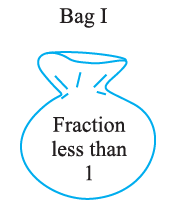
.png "Page 68 Chapter 4 Class 6th NCERT Exemplar")
.png "Page 68 Chapter 4 Class 6th NCERT Exemplar")
|
Answer:
Given:
Ten fraction cards and three bags categorized as:
1. Bag I: Fractions less than $1$ (Proper fractions where $Numerator < Denominator$)
2. Bag II: Fractions equal to $1$ (Fractions where $Numerator = Denominator$)
3. Bag III: Fractions greater than $1$ (Improper fractions where $Numerator > Denominator$)
To Find:
The correct bag for each of the ten cards.
Solution:
We will evaluate each card based on the relationship between the numerator and the denominator.
1. Sorting into Bag I (Fraction $< 1$):
A fraction is less than $1$ if the numerator is smaller than the denominator.
Card (i) $\frac{3}{7} \Rightarrow 3 < 7$
Card (iv) $\frac{8}{9} \Rightarrow 8 < 9$
Card (v) $\frac{5}{6} \Rightarrow 5 < 6$
Card (vi) $\frac{6}{11} \Rightarrow 6 < 11$
Card (viii) $\frac{19}{25} \Rightarrow 19 < 25$
Card (ix) $\frac{2}{3} \Rightarrow 2 < 3$
Card (x) $\frac{13}{17} \Rightarrow 13 < 17$
2. Sorting into Bag II (Fraction $= 1$):
A fraction is equal to $1$ if the numerator is equal to the denominator.
Card (ii) $\frac{4}{4} \Rightarrow 4 = 4$
Card (vii) $\frac{18}{18} \Rightarrow 18 = 18$
3. Sorting into Bag III (Fraction $> 1$):
A fraction is greater than $1$ if the numerator is larger than the denominator.
Card (iii) $\frac{9}{8} \Rightarrow 9 > 8$
Conclusion:
The final classification of the cards is as follows:
| Bag Type | Card Numbers | Fractions |
| Bag I: Fraction less than $1$ | (i), (iv), (v), (vi), (viii), (ix), (x) | $\frac{3}{7}, \frac{8}{9}, \frac{5}{6}, \frac{6}{11}, \frac{19}{25}, \frac{2}{3}, \frac{13}{17}$ |
| Bag II: Fraction equal to $1$ | (ii), (vii) | $\frac{4}{4}, \frac{18}{18}$ |
| Bag III: Fraction greater than $1$ | (iii) | $\frac{9}{8}$ |