

Chapter 6 Mensuration (Class 6 - Maths NCERT Exemplar Solutions)
Welcome to the comprehensive resource for NCERT Exemplar Solutions for Class 6 Mathematics: Chapter 6 Mensuration! This chapter is intentionally designed to move beyond routine textbook exercises, challenging students with complex geometric shapes and intricate word problems. It focuses on developing a deeper, more flexible understanding of perimeter and area, ensuring that students can apply these concepts to practical scenarios rather than relying on simple formula plugging.
The solutions meticulously cover fundamental concepts such as calculating the perimeter of various polygons by summing the lengths of their sides. Students will master specific formulas for regular polygons, including squares ($P = 4 \times \text{side}$) and equilateral triangles. For Area, the emphasis is on understanding the surface enclosed within a boundary, using both grid-based estimation and standard formulas for rectangles ($A = l \times b$) and squares ($A = s^2$). These foundational skills are vital for visualizing spatial relationships and accurately measuring two-dimensional regions.
Significant attention is given to composite figures—shapes formed by combining multiple rectangles or squares—and real-world applications involving unit conversions and cost calculations using the $\textsf{₹}$ symbol. Whether determining the length of fencing required or the cost of leveling a field, these problems require careful multi-step reasoning. With clear diagrams and step-by-step working prepared by learningspot.co, students can build the accuracy and confidence needed to master higher-order thinking skills in mensuration.
Solved Examples (Examples 1 to 8)
Example 1: Choose the correct answer from the given four options:

In Fig. 6.1, a square of side 1 cm is joined to a square of side 3 cm. The perimeter of the new figure is
(A) 13cm
(B) 14cm
(C) 15cm
(D) 16cm
Answer:
Solution:
The perimeter of a figure is the total length of its outer boundary. Let us calculate the length of all the outer edges starting from the bottom-left corner and moving clockwise:
1. Left vertical side of the small square = $1\text{ cm}$
2. Top horizontal side of the small square = $1\text{ cm}$
3. Vertical segment connecting the two squares: Since the larger square has a side of $3\text{ cm}$ and the smaller square has a side of $1\text{ cm}$, the remaining vertical part is $3\text{ cm} - 1\text{ cm} = 2\text{ cm}$.
4. Top horizontal side of the large square = $3\text{ cm}$
5. Right vertical side of the large square = $3\text{ cm}$
6. Bottom horizontal side (combined) = $3\text{ cm} + 1\text{ cm} = 4\text{ cm}$
Total Perimeter = Sum of all outer sides
Total Perimeter = $1\text{ cm} + 1\text{ cm} + 2\text{ cm} + 3\text{ cm} + 3\text{ cm} + 4\text{ cm}$
Total Perimeter = $14\text{ cm}$
Thus, the correct option is (B).
Example 2: Which of the following statements are true or false?
(a) Geeta wants to raise a boundary wall around her house. For this, she must find the area of the land of her house.
(b) A person preparing a track to conduct sports must find the perimeter of the sports ground.
Answer:
Solution:
(a) False.
To raise a boundary wall around a house, one needs to know the length of the boundary, which is the Perimeter of the land, not its Area.
(b) True.
A sports track is built along the boundary of the ground. Therefore, the person must find the Perimeter to determine the length of the track.
Example 3: Fill in the blanks to make the statements true:
(a) Perimeter of a triangle with sides 4.5 cm, 6.02 cm and 5.38 cm is ____________ .
(b) Area of a square of side 5 cm is _____________ .
Answer:
Solution:
(a) Perimeter of a triangle = Sum of all its sides.
Perimeter = $4.5\text{ cm} + 6.02\text{ cm} + 5.38\text{ cm}$
The perimeter is $15.9\text{ cm}$.
(b) Area of a square = $\text{Side} \times \text{Side}$
Area = $5\text{ cm} \times 5\text{ cm}$
Area = $25\text{ cm}^2$.
Example 4: Bhavna runs 10 times around a square field of side 80 m. Her sister Sushmita runs 8 times around a rectangular field with length 150 m and breadth 60 m. Who covers more distance? By how much?
Answer:
Given:
For Bhavna: Side of square field = $80\text{ m}$, Number of rounds = $10$.
For Sushmita: Length of rectangular field = $150\text{ m}$, Breadth = $60\text{ m}$, Number of rounds = $8$.
To Find: Who covers more distance and by how much.
Solution:
Distance covered by Bhavna:
Perimeter of the square field = $4 \times \text{Side}$
Perimeter = $4 \times 80\text{ m} = 320\text{ m}$
Total distance = $10 \times 320\text{ m} = 3200\text{ m}$
Distance covered by Sushmita:
Perimeter of the rectangular field = $2 \times (\text{Length} + \text{Breadth})$
Perimeter = $2 \times (150\text{ m} + 60\text{ m}) = 2 \times 210\text{ m} = 420\text{ m}$
Total distance = $8 \times 420\text{ m}$
Total distance = $3360\text{ m}$
Comparison:
Sushmita covers more distance than Bhavna.
Difference in distance = $3360\text{ m} - 3200\text{ m} = 160\text{ m}$
Sushmita covers $160\text{ m}$ more distance.
Example 5: The length of a rectangular field is thrice its breadth. If the perimeter of this field is 800m, what is the length of the field?
Answer:
Given:
Perimeter of the rectangular field = $800\text{ m}$.
Length ($l$) is thrice its breadth ($b$).
To Find: The length of the field.
Solution:
Let the breadth of the field be $x$ metres.
Then, the length of the field = $3x$ metres.
Perimeter = $2 \times (l + b)$
$800 = 2 \times (3x + x)$
... (i)
$800 = 2 \times 4x$
$800 = 8x$
$x = \frac{800}{8} = 100$
(Breadth of the field)
Length of the field = $3x = 3 \times 100\text{ m} = 300\text{ m}$
The length of the field is $300\text{ m}$.
Example 6: Cost of fencing around a square field is Rs. 12000. If the cost of fencing per metre is Rs. 30, find the area of the square field.
Answer:
Given:
Total cost of fencing = $\textsf{₹}\! 12000$.
Cost of fencing per metre = $\textsf{₹}\! 30$.
To Find: Area of the square field.
Solution:
Perimeter of the square field = $\frac{\text{Total Cost}}{\text{Cost per metre}}$
Perimeter = $\frac{12000}{30} = 400\text{ m}$
We know that Perimeter of a square = $4 \times \text{Side}$
$4 \times \text{Side} = 400$
$\text{Side} = \frac{400}{4} = 100\text{ m}$
Now, Area of the square field = $\text{Side} \times \text{Side}$
$\text{Area} = 100\text{ m} \times 100\text{ m} = 10000\text{ m}^2$
The area of the square field is $10000\text{ m}^2$.
Example 7: Sabina wants to cover the floor of her room whose length is 4 m and breadth is 3m by square tiles. If each square tile is of side 20cm, then find the number of tiles required to cover the floor of her room.
Answer:
Given:
Length of the room = $4\text{ m}$, Breadth of the room = $3\text{ m}$.
Side of the square tile = $20\text{ cm}$.
To Find: Number of tiles required.
Solution:
First, we convert all dimensions to the same unit (cm).
Length of the floor = $4 \times 100\text{ cm} = 400\text{ cm}$
Breadth of the floor = $3 \times 100\text{ cm} = 300\text{ cm}$
Area of the floor = $\text{Length} \times \text{Breadth} = 400\text{ cm} \times 300\text{ cm} = 120000\text{ cm}^2$
Area of one square tile = $\text{Side} \times \text{Side} = 20\text{ cm} \times 20\text{ cm} = 400\text{ cm}^2$
Number of tiles required = $\frac{\text{Area of the floor}}{\text{Area of one tile}}$
Number of tiles = $\frac{120000}{400}$
Number of tiles = $\frac{\cancel{120000}^{300}}{\cancel{400}_{1}}$
The number of tiles required is $300$.
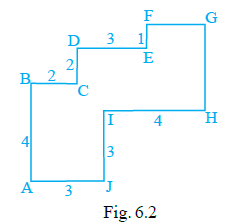
Example 8: By splitting the figure into rectangles, find its area. (see Fig. 6.2)
Answer:
Example 8
Given: A figure (Fig. 6.2) with the following side lengths:
$AB = 4$, $BC = 2$, $CD = 2$, $DE = 3$, $EF = 1$, $IH = 4$, $IJ = 3$ and $AJ = 3$.
To Find: The area of the figure by splitting it into four vertical rectangles.
Construction Required:
Split the figure into four vertical rectangles by drawing vertical lines. As per the dimensions provided:
1. Rectangle 1 has dimensions $4 \times 2$.
2. Rectangle 2 has dimensions $6 \times 1$.
3. Rectangle 3 has dimensions $3 \times 2$.
4. Rectangle 4 has dimensions $4 \times 2$.

Solution:
To find the total area, we calculate the area of each individual rectangle and then add them together.
Area of a rectangle = $\text{length} \times \text{breadth}$
$\text{Area of Rectangle 1} = 4 \times 2 = 8$
... (i)
$\text{Area of Rectangle 2} = 6 \times 1 = 6$
... (ii)
$\text{Area of Rectangle 3} = 3 \times 2 = 6$
... (iii)
$\text{Area of Rectangle 4} = 4 \times 2 = 8$
... (iv)
Now, we find the Total Area by adding the results of equations (i), (ii), (iii), and (iv):
Total Area = $\text{Area of Rectangle 1} + \text{Area of Rectangle 2} $$ + \text{Area of Rectangle 3} + \text{Area of Rectangle 4}$
Total Area = $8 + 6 + 6 + 8$
Thus, the total area of the figure is $28 \text{ sq units}$.
Alternate Solution
We can also find the area by splitting the figure into horizontal rectangles. However, based on the specific vertical split provided, the calculation above is the most direct method to achieve the result as per the requirements.
Exercise
Question 1 to 6 (Multiple Choice Questions)
In questions 1 to 6, out of the four options only one is correct. Write the correct answer.
Question 1. Following figures are formed by joining six unit squares. Which figure has the smallest perimeter in Fig. 6.4?

(A) (ii)
(B) (iii)
(C) (iv)
(D) (i)
Answer:
Analysis of Perimeter
Given: Four figures (i), (ii), (iii), and (iv) are each composed of 6 unit squares. A unit square has a side length of 1 unit.
To Find: The figure with the smallest perimeter.
Solution:
The perimeter of any shape is the total length of its outer boundary. Since each square is a unit square, we calculate the perimeter by counting the number of unit segments along the outside of each figure.
For Figure (i):
This figure forms a rectangle with a length of 3 units and a breadth of 2 units.
Perimeter of rectangle = $2 \times (\text{length} + \text{breadth})$
$\text{Perimeter} = 2 \times (3 + 2) = 10 \text{ units}$
For Figure (ii):
By counting the external unit segments of the boundary:
Top edges = $2 \text{ units}$, Bottom edges = $1 \text{ unit}$, Left edges = $4 \text{ units}$, Right edges = $4 \text{ units}$, and internal steps = $1 \text{ unit}$.
$\text{Perimeter} = 12 \text{ units}$
For Figure (iii):
By counting the unit segments along the outer boundary of this shape:
$\text{Perimeter} = 14 \text{ units}$
For Figure (iv):
By counting the unit segments along the outer boundary of this shape:
$\text{Perimeter} = 14 \text{ units}$
Comparison:
Comparing the perimeters obtained from (i), (ii), (iii), and (iv):
$10 < 12 < 14$
(Comparing values)
The smallest perimeter is $10 \text{ units}$, which corresponds to Figure (i).
Therefore, the correct option is (D).
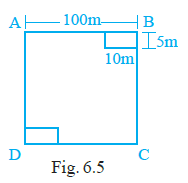
Question 2. A square shaped park ABCD of side 100m has two equal rectangular flower beds each of size 10m × 5m (Fig. 6.5). Length of the boundary of the remaining park is
(A) 360m
(B) 400m
(C) 340m
(D) 460m
Answer:
Given:
Side of the square park $ABCD = 100\text{ m}$.
Dimensions of each rectangular flower bed = $10\text{ m} \times 5\text{ m}$.
The flower beds are located at the corners of the square park.
To Find:
The length of the boundary (perimeter) of the remaining park.
Solution:
The length of the boundary of a shape is its perimeter.
Initially, the perimeter of the square park $ABCD$ is calculated as:
$\text{Perimeter} = 4 \times \text{side}$
(Formula for Perimeter of Square)
$\text{Perimeter} = 4 \times 100\text{ m}$
$\text{Perimeter} = 400\text{ m}$
When a rectangular shape is removed from the corner of a square, the boundary length replaced inside the park is equal to the boundary length removed from the outside.
Specifically, for each rectangular flower bed of $10\text{ m} \times 5\text{ m}$:
The segments of the original square boundary removed are one length ($10\text{ m}$) and one breadth ($5\text{ m}$).
The new segments added to the boundary inside the park are also one length ($10\text{ m}$) and one breadth ($5\text{ m}$).
Therefore, there is no change in the total length of the boundary.
Length of the boundary of the remaining park = $400\text{ m}$.
The correct option is (B).
Question 3. The side of a square is 10cm. How many times will the new perimeter become if the side of the square is doubled?
(A) 2 times
(B) 4 times
(C) 6 times
(D) 8 times
Answer:
Given:
Original side of the square ($s$) = $10\text{ cm}$.
The side is doubled, so the new side ($s'$) = $2 \times 10\text{ cm} = 20\text{ cm}$.
To Find:
How many times the new perimeter is compared to the original perimeter.
Solution:
First, let us calculate the original perimeter ($P_1$):
$P_1 = 4 \times 10\text{ cm}$
$P_1 = 40\text{ cm}$
... (i)
Now, let us calculate the new perimeter ($P_2$) with the doubled side:
$P_2 = 4 \times 20\text{ cm}$
$P_2 = 80\text{ cm}$
... (ii)
To find the ratio:
$\text{Ratio} = \frac{P_2}{P_1} = \frac{80}{40}$
$\text{Ratio} = 2$
The new perimeter becomes 2 times the original perimeter.
Alternate Solution:
Let the side of the square be $s$.
Perimeter $P = 4s$.
If the side is doubled, the new side is $2s$.
New Perimeter $P' = 4(2s) = 8s$.
Comparing $P'$ and $P$:
$P' = 2 \times (4s)$
[Since $P = 4s$]
$P' = 2P$.
The correct option is (A).
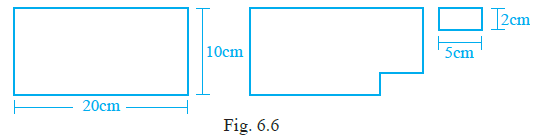
Question 4. Length and breadth of a rectangular sheet of paper are 20cm and 10cm, respectively. A rectangular piece is cut from the sheet as shown in Fig. 6.6. Which of the following statements is correct for the remaining sheet?
(A) Perimeter remains same but area changes.
(B) Area remains the same but perimeter changes.
(C) Both area and perimeter are changing.
(D) Both area and perimeter remain the same.
Answer:
Given:
Length of the rectangular sheet ($l$) = $20\text{ cm}$.
Breadth of the rectangular sheet ($b$) = $10\text{ cm}$.
A rectangular piece of size $5\text{ cm} \times 2\text{ cm}$ is cut from one corner.
To Find:
The correct statement regarding the change in Area and Perimeter of the remaining sheet.
Solution:
1. Regarding Area:
The area of the original rectangular sheet is calculated as:
$\text{Area} = l \times b$
(Formula for Area of Rectangle)
$\text{Area} = 20 \times 10 = 200\text{ cm}^2$
Since a rectangular piece is removed from the sheet, the area of the remaining sheet will definitely decrease. Specifically, the new area will be $200\text{ cm}^2 - (5 \times 2)\text{ cm}^2 = 190\text{ cm}^2$.
2. Regarding Perimeter:
The perimeter is the total length of the boundary. The original perimeter is:
$\text{Perimeter} = 2(l + b) = 2(20 + 10) = 60\text{ cm}$
When a rectangle is cut from a corner, the segments that were removed from the outer boundary ($5\text{ cm}$ horizontal and $2\text{ cm}$ vertical) are replaced by two new segments of the same lengths inside the sheet to form the new boundary.
Thus, the total length of the boundary (perimeter) remains the same ($60\text{ cm}$).
Therefore, Perimeter remains same but area changes.
The correct option is (A).
Question 5. Two regular Hexagons of perimeter 30cm each are joined as shown in Fig. 6.7. The perimeter of the new figure is

(A) 65cm
(B) 60cm
(C) 55cm
(D) 50cm
Answer:
Given:
Two regular hexagons are provided.
Perimeter of each regular hexagon = $30\text{ cm}$.
To Find:
The perimeter of the new figure formed by joining them.
Solution:
A regular hexagon has $6$ equal sides. Let the side length be $s$.
$\text{Perimeter of Hexagon} = 6 \times s$
$30 = 6 \times s$
$s = \frac{30}{6} = 5\text{ cm}$
When two hexagons are joined along one side, that side becomes internal and is not part of the boundary (perimeter).
The new figure has $5$ sides from the first hexagon and $5$ sides from the second hexagon on its boundary.
$\text{Total boundary sides} = 5 + 5 = 10\text{ sides}$
$\text{Perimeter of new figure} = 10 \times s$
$\text{Perimeter of new figure} = 10 \times 5 = 50\text{ cm}$
The correct option is (D).
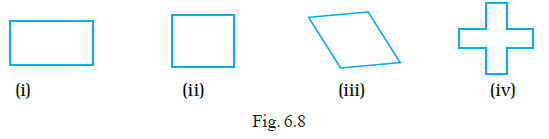
Question 6. In Fig. 6.8 which of the following is a regular polygon? All have equal side except (i)
(A) (i)
(B) (ii)
(C) (iii)
(D) (iv)
Answer:
Given:
Four figures (i), (ii), (iii), and (iv) are shown.
Condition: Figures (ii), (iii), and (iv) have all sides equal. Figure (i) does not have all sides equal.
To Find:
Which of the following is a regular polygon.
Solution:
A polygon is said to be a regular polygon if it satisfies two conditions:
1. All its sides are of equal length (Equilateral).
2. All its interior angles are of equal measure (Equiangular).
Let us evaluate each figure:
(i) Rectangle: In this figure, sides are not equal (as per the question). Thus, it is not a regular polygon.
(ii) Square: All sides are equal and each interior angle is $90^\circ$. It satisfies both conditions. Thus, it is a regular polygon.
(iii) Rhombus: All sides are equal, but the interior angles are not equal (opposite angles are equal, but adjacent angles are different). Thus, it is not a regular polygon.
(iv) Plus sign shape (Decagon): Although all sides are equal, the interior angles are not all the same. It has some internal angles of $90^\circ$ and some reflex angles of $270^\circ$. Thus, it is not a regular polygon.
Therefore, figure (ii) is the only regular polygon.
The correct option is (B).
Question 7 to 8 (Match the Following)
Question 7. Match the shapes (each sides measures 2cm) in column I with the corresponding perimeters in column II:
| Column I | Column II |
|
(A) (B) (C) (D) |
(i) 16cm (ii) 20cm (iii) 24cm (iv) 28cm (v) 32cm |
.png "Page 94 Chapter 6 Class 6th NCERT Exemplar")
.png "Page 94 Chapter 6 Class 6th NCERT Exemplar")
.png "Page 94 Chapter 6 Class 6th NCERT Exemplar")
.png "Page 94 Chapter 6 Class 6th NCERT Exemplar")
Answer:
Given:
Length of each side segment = $2\text{ cm}$.
Number of sides for shape (A) = $14$.
Number of sides for shape (B) = $8$.
Number of sides for shape (C) = $10$.
Number of sides for shape (D) = $12$.
To Find:
Perimeter of each shape and matching with Column II.
Solution:
The perimeter of a polygon is the total length of its boundary. Since all sides are of equal length, we use the formula:
$\text{Perimeter} = \text{Number of sides} \times \text{Length of each side}$
For Shape (A):
$\text{Perimeter} = 14 \times 2 = 28\text{ cm}$
(Match with iv)
For Shape (B):
$\text{Perimeter} = 8 \times 2 = 16\text{ cm}$
(Match with i)
For Shape (C):
$\text{Perimeter} = 10 \times 2 = 20\text{ cm}$
(Match with ii)
For Shape (D):
$\text{Perimeter} = 12 \times 2 = 24\text{ cm}$
(Match with iii)
Matching Result Table:
| Shape (Column I) | Sides Count | Perimeter ($n \times 2$) | Column II |
| (A) | $14$ | $28\text{ cm}$ | (iv) |
| (B) | $8$ | $16\text{ cm}$ | (i) |
| (C) | $10$ | $20\text{ cm}$ | (ii) |
| (D) | $12$ | $24\text{ cm}$ | (iii) |
Question 8. Match the following
| Column I | Column II |
|
(A) (B) (C) (D) |
(i) 10 (ii) 18 (iii) 20 (iv) 25 |
.png "Page 95 Chapter 6 Class 6th NCERT Exemplar")
.png "Page 95 Chapter 6 Class 6th NCERT Exemplar")
.png "Page 95 Chapter 6 Class 6th NCERT Exemplar")
.png "Page 95 Chapter 6 Class 6th NCERT Exemplar")
Answer:
Given:
Figures in Column I with specified side lengths.
To Find:
The perimeter of each figure.
Solution:
(A) Rectangle:
Length ($l$) = $6$, Breadth ($b$) = $4$.
$\text{Perimeter} = 2(l + b)$
$\text{Perimeter} = 2(6 + 4) = 2 \times 10 = 20$
This matches with (iii).
(B) Square:
Side ($s$) = $5$.
$\text{Perimeter} = 4 \times s$
$\text{Perimeter} = 4 \times 5 = 20$
This matches with (iii).
(C) Equilateral Triangle:
Side ($s$) = $6$.
$\text{Perimeter} = 3 \times s$
$\text{Perimeter} = 3 \times 6 = 18$
This matches with (ii).
(D) Isosceles Triangle:
Sides are $4$, $4$, and $2$.
$\text{Perimeter} = 4 + 4 + 2 = 10$
This matches with (i).
Final Result:
The matching pairs are: A - (iii), B - (iii), C - (ii), D - (i).
Question 9 to 13 (Fill in the Blanks)
In questions 9 to 13, fill in the blanks to make the statements true.
Question 9. Perimeter of the shaded portion in Fig. 6.9 is
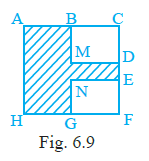
AB + _ + _ + _ + _ + _ + _ + HA
Answer:
Given:
A shaded figure inside a grid with vertices labeled A, B, C, D, E, F, G, H, M, and N.
To Find:
The sequence of line segments that make up the perimeter of the shaded portion.
Solution:
The perimeter of a figure is the total length of its boundary. To find the perimeter of the shaded portion, we follow the outer boundary line starting from point A and moving clockwise until we return to point A.
The path is as follows:
1. From A to B (AB)
2. From B to M (BM)
3. From M to D (MD)
4. From D to E (DE)
5. From E to N (EN)
6. From N to G (NG)
7. From G to H (GH)
8. From H to A (HA)
Therefore, the complete expression for the perimeter is:
AB + BM + MD + DE + EN + NG + GH + HA
Question 10. The amount of region enclosed by a plane closed figure is called its _________.
Answer:
Solution:
The amount of surface or region enclosed within the boundary of a closed plane figure is defined as its Area.
Answer: Area
Question 11. Area of a rectangle with length 5cm and breadth 3cm is _________.
Answer:
Given:
Length of the rectangle ($l$) = $5\text{ cm}$
Breadth of the rectangle ($b$) = $3\text{ cm}$
To Find:
Area of the rectangle.
Solution:
$\text{Area of Rectangle} = \text{length} \times \text{breadth}$
$\text{Area} = 5\text{ cm} \times 3\text{ cm}$
$\text{Area} = 15\text{ sq cm}$
Answer: $15\text{ sq cm}$
Question 12. A rectangle and a square have the same perimeter (Fig. 6.10).
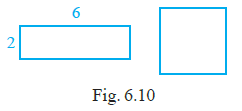
(a) The area of the rectangle is _________.
(b) The area of the square is _________.
Answer:
Given:
Length of rectangle ($l$) = $6$ units
Breadth of rectangle ($b$) = $2$ units
Perimeter of Square = Perimeter of Rectangle
Solution:
(a) Finding Area of Rectangle:
$\text{Area of Rectangle} = l \times b$
$\text{Area} = 6 \times 2 = 12$ units
(b) Finding Area of Square:
First, find the perimeter of the rectangle:
$\text{Perimeter} = 2(l + b) = 2(6 + 2)$
$\text{Perimeter} = 2 \times 8 = 16$ units
Since the perimeters are the same, Perimeter of Square = $16$ units.
$4 \times \text{side} = 16$
$\text{side} = \frac{16}{4} = 4$ units
Now, calculate the area of the square:
$\text{Area of Square} = \text{side} \times \text{side}$
$\text{Area} = 4 \times 4 = 16$ units
Answers: (a) $12$, (b) $16$
Question 13.
(a) 1 m = _________ cm.
(b) 1 sqcm = _________ cm × 1 cm.
(c) 1 sqm = 1 m × _________ m = 100 cm × _________ cm.
(d) 1 sqm = _________ sqcm.
Answer:
Solution:
(a) We know that $1$ metre is equal to $100$ centimetres.
Answer: $100$
(b) $1$ square centimetre is the area of a square with side $1\text{ cm}$.
$1\text{ sqcm} = 1\text{ cm} \times 1\text{ cm}$
Answer: $1$
(c) $1$ square metre is the area of a square with side $1\text{ m}$.
$1\text{ sqm} = 1\text{ m} \times 1\text{ m}$
Since $1\text{ m} = 100\text{ cm}$:
$1\text{ sqm} = 100\text{ cm} \times 100\text{ cm}$
Answer: $1$, $100$
(d) From the previous part:
$1\text{ sqm} = 100 \times 100\text{ sqcm}$
$1\text{ sqm} = 10,000\text{ sqcm}$
Answer: $10,000$
Question 14 to 20 (True or False)
In questions 14 to 20, state which of the statements are true and which are false.
Question 14. If length of a rectangle is halved and breadth is doubled then the area of the rectangle obtained remains same.
Answer:
Given:
Original length of rectangle = $l$
Original breadth of rectangle = $b$
New length = $\frac{l}{2}$
New breadth = $2b$
Solution:
Area of the original rectangle is given by:
$\text{Area}_1 = l \times b$
Area of the new rectangle is given by:
$\text{Area}_2 = \text{New length} \times \text{New breadth}$
$\text{Area}_2 = \left(\frac{l}{2}\right) \times (2b)$
$\text{Area}_2 = \frac{l \times 2b}{2} = l \times b$
Since $\text{Area}_1 = \text{Area}_2$, the area remains the same.
Answer: True
Question 15. Area of a square is doubled if the side of the square is doubled.
Answer:
Given:
Side of the original square = $s$
New side of the square = $2s$
Solution:
Area of the original square is:
$\text{Area}_1 = s^2$
Area of the new square is:
$\text{Area}_2 = (2s)^2$
$\text{Area}_2 = 4s^2$
The new area is $4$ times the original area, not double ($2$ times).
Answer: False
Question 16. Perimeter of a regular octagon of side 6cm is 36cm.
Answer:
Given:
Shape is a regular octagon (Number of sides, $n = 8$).
Side of the octagon ($s$) = $6\text{ cm}$.
Solution:
$\text{Perimeter} = n \times s$
$\text{Perimeter} = 8 \times 6 = 48\text{ cm}$
The calculated perimeter is $48\text{ cm}$, but the statement says $36\text{ cm}$.
Answer: False
Question 17. A farmer who wants to fence his field, must find the perimeter of the field.
Answer:
Solution:
Fencing is done along the boundary of a field. The total length of the boundary of a closed figure is its perimeter.
Therefore, to calculate the amount of fencing material required, the farmer must find the perimeter.
Answer: True
Question 18. An engineer who plans to build a compound wall on all sides of a house must find the area of the compound.
Answer:
Solution:
A compound wall is built along the boundary of the property. To determine the length of the wall, one needs to calculate the perimeter, not the area.
Area represents the surface region inside the boundary, which is irrelevant for the length of the wall.
Answer: False
Question 19. To find the cost of painting a wall we need to find the perimeter of the wall.
Answer:
Solution:
Painting is an activity that covers the entire surface of the wall. The measure of this surface is the area of the wall.
The cost of painting is usually calculated per square unit of area. Perimeter only gives the length of the boundary.
Answer: False
Question 20. To find the cost of a frame of a picture, we need to find the perimeter of the picture.
Answer:
Solution:
A frame is placed around the edges (boundary) of a picture. To find the length of the framing material needed, we must calculate the total length of the boundary.
This measure is the perimeter of the picture.
Answer: True
Question 21 to 60
Question 21. Four regular hexagons are drawn so as to form the design as shown in Fig. 6.11. If the perimeter of the design is 28 cm, find the length of each side of the hexagon.

Answer:
Given:
Total perimeter of the design = $28\text{ cm}$.
The design consists of four regular hexagons joined together.
To Find:
The length of each side of the regular hexagon.
Solution:
First, we need to count the number of side segments that form the outer boundary (perimeter) of the given design in Fig. 6.11.
By observing the figure:
1. The top hexagon contributes $3$ side segments to the boundary.
2. The bottom hexagon contributes $3$ side segments to the boundary.
3. The left hexagon contributes $4$ side segments to the boundary.
4. The right hexagon contributes $4$ side segments to the boundary.
Total number of sides on the boundary = $3 + 3 + 4 + 4 = 14$ sides.
Let the length of each side of the regular hexagon be $s$.
$\text{Perimeter of the design} = 14 \times s$
$28 = 14 \times s$
$s = \frac{28}{14}$
$s = 2\text{ cm}$
[Length of each side]
Thus, the length of each side of the hexagon is $2\text{ cm}$.
Question 22. Perimeter of an isosceles triangle is 50 cm. If one of the two equal sides is 18 cm, find the third side.
Answer:
Given:
Perimeter of the isosceles triangle = $50\text{ cm}$.
Length of one of the equal sides = $18\text{ cm}$.
To Find:
Length of the third side.
Solution:
In an isosceles triangle, two sides are equal in length.
Let the equal sides be $a = 18\text{ cm}$ and the third side be $b$.
$\text{Perimeter} = a + a + b$
(Sum of all sides)
$50 = 18 + 18 + b$
$50 = 36 + b$
$b = 50 - 36$
$b = 14\text{ cm}$
[Third side]
The length of the third side is $14\text{ cm}$.
Question 23. Length of a rectangle is three times its breadth. Perimeter of the rectangle is 40 cm. Find its length and width.
Answer:
Given:
Perimeter of the rectangle = $40\text{ cm}$.
Condition: Length ($l$) is three times the breadth ($b$).
To Find:
Length ($l$) and Width (Breadth, $b$) of the rectangle.
Solution:
Let the breadth of the rectangle be $x\text{ cm}$.
According to the question, the length is:
$l = 3x$
We know the formula for the perimeter of a rectangle:
$\text{Perimeter} = 2(l + b)$
Substituting the values:
$40 = 2(3x + x)$
$40 = 2(4x)$
$40 = 8x$
$x = \frac{40}{8}$
$x = 5\text{ cm}$
[Breadth]
Now, find the length using equation (i):
$l = 3 \times 5 = 15\text{ cm}$
[Length]
The dimensions of the rectangle are: Length = $15\text{ cm}$ and Width = $5\text{ cm}$.
Question 24. There is a rectangular lawn 10m long and 4 m wide in front of Meena’s house (Fig. 6.12). It is fenced along the two smaller sides and one longer side leaving a gap of 1m for the entrance. Find the length of fencing.
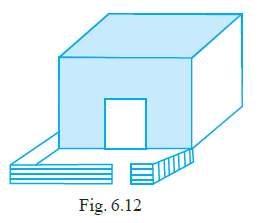
Answer:
Given:
Length of the rectangular lawn ($l$) = $10\text{ m}$
Width (breadth) of the rectangular lawn ($b$) = $4\text{ m}$
Sides to be fenced: Two smaller sides and one longer side.
Entrance gap = $1\text{ m}$
To Find:
The total length of the fencing required.
Solution:
According to the problem, the fencing is done on three sides of the rectangle: two smaller sides (widths) and one longer side (length).
$\text{Total boundary length to cover} = b + b + l$
$\text{Total boundary length to cover} = 4 + 4 + 10 = 18\text{ m}$
However, there is a gap of $1\text{ m}$ left for the entrance. This gap should be subtracted from the total boundary length to find the actual length of the fence.
$\text{Length of fencing} = 18\text{ m} - 1\text{ m}$
$\text{Length of fencing} = 17\text{ m}$
The length of the fencing is $17\text{ m}$.
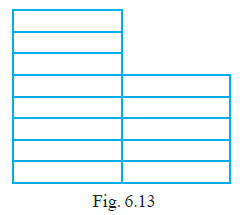
Question 25. The region given in Fig. 6.13 is measured by taking  as a unit. What is the area of the region?
Answer:
Given:
A unit of area represented by one small rectangle $\square$.
A figure (Fig. 6.13) composed of these unit rectangles.
To Find:
The total area of the region in terms of the given unit.
Solution:
The total area of the region is the sum of all the unit rectangles contained within the boundary of Fig. 6.13.
Looking at the figure, it is divided into two vertical columns:
1. The left column consists of $8$ unit rectangles stacked vertically.
2. The right column consists of $5$ unit rectangles stacked vertically.
$\text{Total unit rectangles} = 8 + 5$
$\text{Total unit rectangles} = 13$
Since each small rectangle represents one unit of area, the area of the region is $13$ units.
Question 26. Tahir measured the distance around a square field as 200 rods (lathi). Later he found that the length of this rod was 140cm. Find the side of this field in metres.
Answer:
Given:
Distance around the square field (Perimeter) = $200$ rods.
Length of one rod = $140\text{ cm}$.
To Find:
The length of the side of the field in metres.
Solution:
First, calculate the total distance around the field (Perimeter) in centimetres.
$\text{Perimeter in cm} = 200 \times 140$
$\text{Perimeter in cm} = 28000\text{ cm}$
Now, convert the perimeter into metres ($1\text{ m} = 100\text{ cm}$):
$\text{Perimeter in m} = \frac{28000}{100} = 280\text{ m}$
Since the field is square, all four sides are equal. Let the side be $s$.
$\text{Perimeter} = 4 \times s$
$280 = 4 \times s$
$s = \frac{280}{4}$
$s = 70\text{ m}$
[Side of the square]
The side of the field is $70\text{ m}$.
Question 27. The length of a rectangular field is twice its breadth. Jamal jogged around it four times and covered a distance of 6km. What is the length of the field?
Answer:
Given:
Total distance covered in $4$ rounds = $6\text{ km}$.
Condition: Length ($l$) = $2 \times$ Breadth ($b$).
To Find:
The length of the field ($l$).
Solution:
First, convert the total distance into metres ($1\text{ km} = 1000\text{ m}$):
$\text{Total distance} = 6 \times 1000 = 6000\text{ m}$
Calculate the distance covered in one round (Perimeter):
$\text{Perimeter} = \frac{6000}{4} = 1500\text{ m}$
... (i)
Let the breadth of the field be $x\text{ m}$. Then the length is $2x\text{ m}$.
$\text{Perimeter} = 2(l + b)$
$1500 = 2(2x + x)$
$1500 = 2(3x)$
$1500 = 6x$
$x = \frac{1500}{6} = 250\text{ m}$
[Breadth]
Now, calculate the length:
$l = 2x = 2 \times 250 = 500\text{ m}$
... (ii)
The length of the field is $500\text{ m}$.
Alternate Solution:
We know Perimeter $P = 1500\text{ m}$ and $l = 2b$.
Substitute $b = \frac{l}{2}$ into the perimeter formula:
$1500 = 2(l + \frac{l}{2})$
[Using $b = \frac{l}{2}$] ... (iii)
$1500 = 2(\frac{3l}{2})$
$1500 = 3l$
$l = 500\text{ m}$
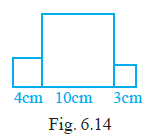
Question 28. Three squares are joined together as shown in Fig. 6.14. Their sides are 4cm, 10cm and 3cm. Find the perimeter of the figure.
Answer:
Given:
Three squares are joined together with sides $4\text{ cm}$, $10\text{ cm}$ and $3\text{ cm}$ as shown in Fig. 6.14.
To Find:
The perimeter of the resulting figure.
Solution:
The perimeter of the figure is the sum of all its outer boundaries. Let us calculate the lengths of the horizontal and vertical boundaries separately.
1. Horizontal Boundaries:
The bottom boundary is the sum of the bases of the three squares:
$\text{Bottom length} = 4\text{ cm} + 10\text{ cm} + 3\text{ cm} = 17\text{ cm}$
The top boundary consists of the top sides of each square:
$\text{Top length} = 4\text{ cm} + 10\text{ cm} + 3\text{ cm} = 17\text{ cm}$
2. Vertical Boundaries:
The leftmost outer vertical side is $4\text{ cm}$.
The rightmost outer vertical side is $3\text{ cm}$.
There are also vertical segments where the squares of different heights meet:
The difference in height between the middle square and the left square:
$10\text{ cm} - 4\text{ cm} = 6\text{ cm}$
(Vertical gap 1)
The difference in height between the middle square and the right square:
$10\text{ cm} - 3\text{ cm} = 7\text{ cm}$
(Vertical gap 2)
3. Total Perimeter:
$\text{Perimeter} = \text{Sum of all outer segments}$
$\text{Perimeter} = 17 \text{ (bottom)} + 4 \text{ (top left)} + 10 \text{ (top middle)} $$ + 3 \text{ (top right)} + 4 \text{ (left)} + 3 \text{ (right)} + 6 \text{ (gap 1)} + 7 \text{ (gap 2)}$
$\text{Perimeter} = 17 + 17 + 4 + 3 + 6 + 7$
$\text{Perimeter} = 54\text{ cm}$
Final Answer: The perimeter of the figure is $54\text{ cm}$.
Question 29. In Fig. 6.15 all triangles are equilateral and AB = 8 units. Other triangles have been formed by taking the mid points of the sides. What is the perimeter of the figure?

Answer:
Given:
In Fig. 6.15, all triangles are equilateral. The largest triangle $ABC$ has a side $AB = 8$ units. Subsequent triangles are formed by taking the midpoints of the sides.
To Find:
The perimeter of the figure.
Solution:
The figure consists of a central equilateral triangle of side $8$ units, with branches of smaller triangles attached to each side. Based on the midpoint property, the side lengths of the triangles at each level are:
Side of Level 1 triangle = $8$ units
Side of Level 2 triangle = $4$ units
Side of Level 3 triangle = $2$ units
Side of Level 4 triangle = $1$ unit
The perimeter is the sum of the outer boundary segments. We calculate the contribution of each triangle level to the total perimeter for all three sides of the central triangle:
1. Contribution of the $8$-unit triangle:
On each side of $8$ units, $4$ units are covered by the base of the next triangle. The outer part is $8 - 4 = 4$ units.
$\text{Total contribution} = 3 \times (8 - 4) = 12\text{ units}$
2. Contribution of the $4$-unit triangles:
There are 3 such triangles. For each, one side ($4$ units) is completely outer, and another side has $2$ units covered by the next triangle ($4 - 2 = 2$ units outer).
$\text{Total contribution} = 3 \times (4 + 2) = 18\text{ units}$
3. Contribution of the $2$-unit triangles:
There are 3 such triangles. For each, one side ($2$ units) is outer, and another side has $1$ unit covered by the next triangle ($2 - 1 = 1$ unit outer).
$\text{Total contribution} = 3 \times (2 + 1) = 9\text{ units}$
4. Contribution of the $1$-unit triangles:
There are 3 such triangles. For each, two sides are outer boundaries.
$\text{Total contribution} = 3 \times (1 + 1) = 6\text{ units}$
Total Perimeter:
$\text{Total Perimeter} = 12 + 18 + 9 + 6$
$\text{Total Perimeter} = 45\text{ units}$
Final Answer: The perimeter of the figure is $45\text{ units}$.
Question 30. Length of a rectangular field is 250m and width is 150m. Anuradha runs around this field 3 times. How far did she run? How many times she should run around the field to cover a distance of 4km?
Answer:
Given:
Length of rectangular field ($l$) = $250\text{ m}$
Width of rectangular field ($w$) = $150\text{ m}$
Total distance to cover in second case = $4\text{ km} = 4000\text{ m}$
To Find:
1. Distance covered in 3 rounds.
2. Number of rounds required to cover $4\text{ km}$.
Solution:
First, we find the distance covered in one round, which is equal to the perimeter of the rectangular field.
$\text{Perimeter} = 2 \times (l + w)$
[Formula for Perimeter of Rectangle]
$\text{Perimeter} = 2 \times (250\text{ m} + 150\text{ m})$
$\text{Perimeter} = 2 \times 400\text{ m}$
$\text{Perimeter} = 800\text{ m}$
Case 1: Distance covered in 3 rounds
$\text{Distance} = 3 \times \text{Perimeter}$
$\text{Distance} = 3 \times 800\text{ m}$
$\text{Distance} = 2400\text{ m}$
Converting to kilometers ($1000\text{ m} = 1\text{ km}$):
$\text{Distance} = 2.4\text{ km}$
Case 2: Number of rounds for $4\text{ km}$
We know that $4\text{ km} = 4000\text{ m}$.
$\text{Number of rounds} = \frac{\text{Total Distance}}{\text{Perimeter}}$
$\text{Number of rounds} = \frac{4000}{800}$
$\text{Number of rounds} = \frac{\cancel{4000}^{5}}{\cancel{800}_{1}}$
$\text{Number of rounds} = 5$
Final Answer: Anuradha ran $2400\text{ m}$ (or $2.4\text{ km}$) in 3 rounds. She should run $5$ times around the field to cover $4\text{ km}$.
Question 31. Bajinder runs ten times around a square track and covers 4km. Find the length of the track.
Answer:
Given:
Total distance covered = $4\text{ km}$
Number of rounds = $10$
To Find:
The length of the track (side of the square track).
Solution:
First, we convert the total distance into metres:
$4\text{ km} = 4 \times 1000\text{ m} = 4000\text{ m}$
The distance covered in $10$ rounds is the perimeter of the square track multiplied by $10$. Therefore, the perimeter of the square track is:
$\text{Perimeter} = \frac{\text{Total Distance}}{\text{Number of rounds}}$
$\text{Perimeter} = \frac{\cancel{4000}^{400}}{\cancel{10}_{1}}\text{ m}$
$\text{Perimeter} = 400\text{ m}$
Since the track is a square, the perimeter is given by $4 \times \text{side}$.
$4 \times \text{side} = 400\text{ m}$
(Formula for Perimeter of Square)
$\text{side} = \frac{\cancel{400}^{100}}{\cancel{4}_{1}}$
$\text{side} = 100\text{ m}$
Final Answer: The length of the track (each side) is $100\text{ m}$.
Question 32. The lawn in front of Molly’s house is 12m × 8m, whereas the lawn in front of Dolly’s house is 15m × 5m. A bamboo fencing is built around both the lawns. How much fencing is required for both?
Answer:
Given:
Dimensions of Molly’s lawn = $12\text{ m} \times 8\text{ m}$
Dimensions of Dolly’s lawn = $15\text{ m} \times 5\text{ m}$
To Find:
Total fencing required for both lawns.
Solution:
Fencing is built around the boundary, so we need to find the perimeter of both rectangular lawns.
For Molly’s Lawn:
$\text{Length} (l_1) = 12\text{ m}, \text{ Breadth} (b_1) = 8\text{ m}$
$\text{Perimeter} = 2 \times (l_1 + b_1)$
$\text{Perimeter} = 2 \times (12 + 8) = 2 \times 20 = 40\text{ m}$
For Dolly’s Lawn:
$\text{Length} (l_2) = 15\text{ m}, \text{ Breadth} (b_2) = 5\text{ m}$
$\text{Perimeter} = 2 \times (l_2 + b_2)$
$\text{Perimeter} = 2 \times (15 + 5) = 2 \times 20 = 40\text{ m}$
Total Fencing Required:
$\text{Total fencing} = \text{Perimeter of Molly's lawn} $$ + \text{Perimeter of Dolly's lawn}$
$\text{Total fencing} = 80\text{ m}$
Final Answer: Total fencing required for both lawns is $80\text{ m}$.
Question 33. The perimeter of a regular pentagon is 1540cm. How long is its each side?
Answer:
Given:
Perimeter of a regular pentagon = $1540\text{ cm}$
To Find:
Length of each side.
Solution:
A regular pentagon has five equal sides.
$\text{Perimeter} = 5 \times \text{side}$
(For a regular pentagon)
$1540 = 5 \times \text{side}$
$\text{side} = \frac{1540}{5}$
$\text{side} = 308\text{ cm}$
Final Answer: The length of each side of the regular pentagon is $308\text{ cm}$.
Question 34. The perimeter of a triangle is 28cm. One of it’s sides is 8cm. Write all the sides of the possible isosceles triangles with these measurements.
Answer:
Given:
Perimeter of the triangle = $28\text{ cm}$
Length of one side = $8\text{ cm}$
To Find:
All possible sides of an isosceles triangle with these measurements.
Solution:
An isosceles triangle has two equal sides. Let the sides of the triangle be $a, b,$ and $c$. We are given one side is $8\text{ cm}$. There are two possible cases:
Case 1: The given side ($8\text{ cm}$) is the unequal side (base).
Let the two equal sides be $x$.
$x + x + 8 = 28$
$2x = 28 - 8$
$2x = 20$
$x = 10\text{ cm}$
In this case, the sides are $(10\text{ cm}, 10\text{ cm}, 8\text{ cm})$. Since $10 + 8 > 10$, this triangle is possible.
Case 2: The given side ($8\text{ cm}$) is one of the two equal sides.
Let the equal sides be $8\text{ cm}$ and $8\text{ cm}$, and the third side be $y$.
$8 + 8 + y = 28$
$16 + y = 28$
$y = 28 - 16$
$y = 12\text{ cm}$
In this case, the sides are $(8\text{ cm}, 8\text{ cm}, 12\text{ cm})$. Since $8 + 8 > 12$ (sum of two sides is greater than the third), this triangle is also possible.
Final Answer: The possible sets of sides for the isosceles triangle are $(10\text{ cm}, 10\text{ cm}, 8\text{ cm})$ and $(8\text{ cm}, 8\text{ cm}, 12\text{ cm})$.
Question 35. The length of an aluminium strip is 40cm. If the lengths in cm are measured in natural numbers, write the measurement of all the possible rectangular frames which can be made out of it. (For example, a rectangular frame with 15cm length and 5cm breadth can be made from this strip.)
Answer:
Given:
Total length of aluminium strip (Perimeter) = $40\text{ cm}$
Dimensions must be natural numbers.
To Find:
All possible pairs of length ($l$) and breadth ($b$) for the rectangular frames.
Solution:
The length of the strip is equal to the perimeter of the rectangle.
$2 \times (l + b) = 40$
(Formula for Perimeter)
$l + b = \frac{40}{2}$
$l + b = 20$
We need to find pairs of natural numbers $(l, b)$ such that their sum is $20$. By convention, we usually take $l \ge b$.
The possible pairs are:
| Length ($l$) in cm | Breadth ($b$) in cm | Sum ($l+b=20$) |
| 19 | 1 | 20 |
| 18 | 2 | 20 |
| 17 | 3 | 20 |
| 16 | 4 | 20 |
| 15 | 5 | 20 |
| 14 | 6 | 20 |
| 13 | 7 | 20 |
| 12 | 8 | 20 |
| 11 | 9 | 20 |
| 10 | 10 | 20 (Square) |
Final Answer: There are 10 possible rectangular frames with dimensions (in cm): (19, 1), (18, 2), (17, 3), (16, 4), (15, 5), (14, 6), (13, 7), (12, 8), (11, 9), and (10, 10).
Question 36. Base of a tent is a regular hexagon of perimeter 60cm. What is the length of each side of the base?
Answer:
Given:
Shape of the base = Regular hexagon
Perimeter of the base = $60\text{ cm}$
To Find:
Length of each side of the base.
Solution:
A regular hexagon is a polygon with six equal sides.
$\text{Perimeter} = 6 \times \text{side}$
(For a regular hexagon)
Substituting the given perimeter:
$60\text{ cm} = 6 \times \text{side}$
$\text{side} = \frac{\cancel{60}^{10}}{\cancel{6}_{1}}$
$\text{side} = 10\text{ cm}$
Final Answer: The length of each side of the base is $10\text{ cm}$.
Question 37. In an exhibition hall, there are 24 display boards each of length 1m 50cm and breadth 1m. There is a 100m long aluminium strip, which is used to frame these boards. How many boards will be framed using this strip? Find also the length of the aluminium strip required for the remaining boards.
Answer:
Given:
Total number of display boards = $24$
Length of one board ($l$) = $1\text{ m } 50\text{ cm} = 1.5\text{ m}$
Breadth of one board ($b$) = $1\text{ m}$
Total length of aluminium strip available = $100\text{ m}$
To Find:
1. Number of boards that can be framed with $100\text{ m}$ strip.
2. Length of strip required for the remaining boards.
Solution:
The framing is done along the boundary, so we first find the perimeter of one display board.
$\text{Perimeter} = 2 \times (l + b)$
(Perimeter of rectangular board)
$\text{Perimeter} = 2 \times (1.5\text{ m} + 1\text{ m})$
$\text{Perimeter} = 2 \times 2.5\text{ m}$
$\text{Perimeter of one board} = 5\text{ m}$
1. Number of boards framed:
$\text{Number of boards} = \frac{\text{Total strip available}}{\text{Perimeter of one board}}$
$\text{Number of boards} = \frac{\cancel{100}^{20}}{\cancel{5}_{1}}$
$\text{Number of boards} = 20$
2. Length required for remaining boards:
$\text{Remaining boards} = 24 - 20 = 4$
$\text{Strip required for 4 boards} = 4 \times \text{Perimeter of one board}$
$\text{Strip required} = 4 \times 5\text{ m} = 20\text{ m}$
Final Answer: $20$ boards will be framed using the available strip, and $20\text{ m}$ more strip is required for the remaining boards.
Question 38. In the above question, how many square metres of cloth is required to cover all the display boards? What will be the length in m of the cloth used, if its breadth is 120cm?
Answer:
Given:
Total number of boards = $24$
Length of one board ($l$) = $1.5\text{ m}$
Breadth of one board ($b$) = $1\text{ m}$
Breadth of the cloth = $120\text{ cm} = 1.2\text{ m}$
To Find:
1. Total area of cloth required (in square metres).
2. Length of the cloth if its breadth is $1.2\text{ m}$.
Solution:
To cover the boards, we need to calculate the area.
$\text{Area of one board} = l \times b$
(Area of rectangle)
$\text{Area of one board} = 1.5\text{ m} \times 1\text{ m} = 1.5\text{ m}^2$
1. Total area for 24 boards:
$\text{Total Area} = 24 \times 1.5\text{ m}^2$
$\text{Total Area} = 36\text{ m}^2$
2. Length of the cloth:
The total area of the cloth must equal the total area of the boards.
$\text{Area of cloth} = \text{Length of cloth} \times \text{Breadth of cloth}$
$36\text{ m}^2 = \text{Length} \times 1.2\text{ m}$
$\text{Length} = \frac{36}{1.2}$
To simplify, multiply numerator and denominator by $10$:
$\text{Length} = \frac{\cancel{360}^{30}}{\cancel{12}_{1}}$
$\text{Length} = 30\text{ m}$
Final Answer: Total $36\text{ sq m}$ of cloth is required, and the length of the cloth will be $30\text{ m}$.
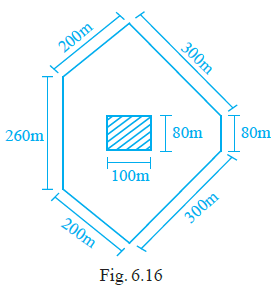
Question 39. What is the length of outer boundary of the park shown in Fig. 6.16? What will be the total cost of fencing it at the rate of Rs 20 per metre? There is a rectangular flower bed in the center of the park. Find the cost of manuring the flower bed at the rate of Rs 50 per square metre.
Answer:
Given:
The outer sides of the park from Fig. 6.16 are $200\text{ m}$, $300\text{ m}$, $80\text{ m}$, $300\text{ m}$, $200\text{ m}$ and $260\text{ m}$.
Rate of fencing = $\textsf{₹} 20$ per metre.
Dimensions of rectangular flower bed: Length ($l$) = $100\text{ m}$, Breadth ($b$) = $80\text{ m}$.
Rate of manuring = $\textsf{₹} 50$ per square metre.
To Find:
1. Length of the outer boundary (Perimeter).
2. Total cost of fencing the park.
3. Cost of manuring the flower bed.
Solution:
1. Length of the outer boundary:
The length of the outer boundary is the sum of all external sides of the park.
$\text{Perimeter} = 200\text{ m} + 300\text{ m} + 80\text{ m} + 300\text{ m} + 200\text{ m} + 260\text{ m}$
$\text{Length of outer boundary} = 1340\text{ m}$
2. Total cost of fencing:
$\text{Cost of fencing} = \text{Perimeter} \times \text{Rate}$
$\text{Cost of fencing} = 1340 \times 20$
$\text{Cost of fencing} = \textsf{₹} 26,800$
3. Cost of manuring the flower bed:
First, calculate the area of the rectangular flower bed.
$\text{Area of flower bed} = l \times b$
$\text{Area} = 100\text{ m} \times 80\text{ m} = 8000\text{ m}^2$
$\text{Cost of manuring} = \text{Area} \times \text{Rate of manuring}$
$\text{Cost of manuring} = 8000 \times 50$
$\text{Cost of manuring} = \textsf{₹} 4,00,000$
Final Answer: The length of the outer boundary is $1340\text{ m}$. The total cost of fencing is $\textsf{₹} 26,800$. The cost of manuring the flower bed is $\textsf{₹} 4,00,000$.
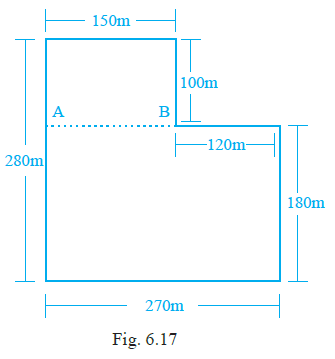
Question 40. Total cost of fencing the park shown in Fig. 6.17 is Rs 55000. Find the cost of fencing per metre.
Answer:
Given:
The sides of the park from Fig. 6.17 are $150\text{ m}$, $100\text{ m}$, $120\text{ m}$, $180\text{ m}$, $270\text{ m}$ and $280\text{ m}$.
Total cost of fencing = $\textsf{₹} 55,000$.
To Find:
Cost of fencing per metre.
Solution:
First, we find the total perimeter (length of fencing) of the park by adding all its outer sides.
$\text{Perimeter} = 150 + 100 + 120 + 180 + 270 + 280$
$\text{Total Perimeter} = 1100\text{ m}$
Now, we find the cost per metre.
$\text{Cost per metre} = \frac{\text{Total Cost}}{\text{Perimeter}}$
(Formula)
$\text{Cost per metre} = \frac{55000}{1100}$
$\text{Cost per metre} = \frac{\cancel{550}^{50}}{\cancel{11}_{1}}$
$\text{Cost per metre} = \textsf{₹} 50$
Final Answer: The cost of fencing per metre is $\textsf{₹} 50$.
Question 41. In Fig. 6.18 each square is of unit length
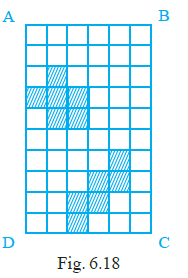
(a) What is the perimeter of the rectangle ABCD?
(b) What is the area of the rectangle ABCD?
(c) Divide this rectangle into ten parts of equal area by shading squares. (Two parts of equal area are shown here)
(d) Find the perimeter of each part which you have divided. Are they all equal?
Answer:
Given:
Rectangle $ABCD$ is composed of unit squares (side = $1$ unit).
By counting the small squares in Fig. 6.18:
Length of the rectangle ($l$) = $10$ units
Breadth of the rectangle ($b$) = $6$ units
To Find:
(a) Perimeter of the rectangle $ABCD$.
(b) Area of the rectangle $ABCD$.
(c) Ten parts of equal area.
(d) Perimeter of each part.
Solution:
(a) Perimeter of the rectangle $ABCD$:
$\text{Perimeter} = 2 \times (l + b)$
(Formula for Perimeter)
$\text{Perimeter} = 2 \times (10 + 6) = 2 \times 16$
$\text{Perimeter} = 32\text{ units}$
(b) Area of the rectangle $ABCD$:
$\text{Area} = l \times b$
(Formula for Area)
$\text{Area} = 10 \times 6 = 60\text{ square units}$
(c) Division into ten parts of equal area:
Total Area = $60$ sq units. To divide it into $10$ equal parts:
$\text{Area of each part} = \frac{60}{10} = 6\text{ square units}$
Each shaded part must consist of $6$ unit squares. The figure already shows two such parts.
(d) Perimeter of each part:
Let's calculate the perimeter of the two already shaded parts in Fig. 6.18.
For the lower shaded portion (staircase shape):
Number of unit squares = $6$
Tracing the outer boundary edges: $1 \text{ (top)} + 1 + 1 + 1 + 1 + 2 + 1 + 2 + 1 + 1 + 1 + 1 = 14\text{ units}$.
For the upper shaded portion (cross-like shape):
Number of unit squares = $6$
Tracing the outer boundary edges: $1 \text{ (top)} + 1 + 1 + 1 + 1 + 1 + 1 + 1 + 1 + 1 + 1 + 1 = 12\text{ units}$.
Since $14 \neq 12$, we conclude that the perimeters of the parts are not all equal, even though their areas are the same.
Final Answer: (a) $32\text{ units}$, (b) $60\text{ sq units}$, (d) Perimeter of top part is $14\text{ units}$ and bottom part is $12\text{ units}$. They are not equal.
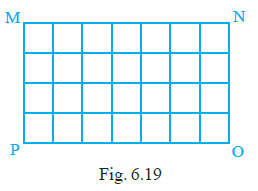
Question 42. Rectangular wall MNOP of a kitchen is covered with square tiles of 15cm length (Fig. 6.19). Find the area of the wall.
Answer:
Given:
Side of each square tile = $15\text{ cm}$
From Fig 6.19, we count the number of tiles:
Number of tiles along the length ($PO$ or $MN$) = $7$
Number of tiles along the breadth ($PM$ or $ON$) = $4$
To Find:
The area of the wall $MNOP$.
Solution:
First, let us find the actual dimensions of the wall in cm.
$\text{Length of the wall} = 7 \times 15\text{ cm} = 105\text{ cm}$
$\text{Breadth of the wall} = 4 \times 15\text{ cm} = 60\text{ cm}$
Now, we calculate the area of the rectangular wall.
$\text{Area} = \text{Length} \times \text{Breadth}$
(Formula)
$\text{Area} = 105\text{ cm} \times 60\text{ cm}$
$\text{Area} = 6300\text{ cm}^2$
Final Answer: The area of the wall is $6300\text{ cm}^2$.
Question 43. Length of a rectangular field is 6 times its breadth. If the length of the field is 120 cm, find the breadth and perimeter of the field.
Answer:
Given:
Length of the rectangular field ($l$) = $120\text{ cm}$
Relation between length and breadth: $l = 6 \times \text{breadth } (b)$
To Find:
1. Breadth of the field ($b$)
2. Perimeter of the field
Solution:
1. Finding the breadth ($b$):
According to the given condition:
$l = 6 \times b$
(Given relation)
$120 = 6 \times b$
$b = \frac{120}{6}$
$b = 20\text{ cm}$
2. Finding the perimeter:
The formula for the perimeter of a rectangle is:
$\text{Perimeter} = 2 \times (l + b)$
(Formula)
Substituting the values of $l$ and $b$:
$\text{Perimeter} = 2 \times (120 + 20)$
$\text{Perimeter} = 2 \times 140$
$\text{Perimeter} = 280\text{ cm}$
Final Answer: The breadth of the field is $20\text{ cm}$ and the perimeter is $280\text{ cm}$.
Question 44. Anmol has a chart paper of measure 90 cm × 40 cm, whereas Abhishek has one which measures 50 cm × 70 cm. Which will cover more area on the table and by how much?
Answer:
Given:
Dimensions of Anmol's chart paper = $90\text{ cm} \times 40\text{ cm}$
Dimensions of Abhishek's chart paper = $50\text{ cm} \times 70\text{ cm}$
To Find:
Which chart paper has more area and the difference between them.
Solution:
Area of Anmol's chart paper:
$\text{Area}_1 = \text{length} \times \text{breadth}$
$\text{Area}_1 = 90 \times 40 = 3600\text{ cm}^2$
Area of Abhishek's chart paper:
$\text{Area}_2 = \text{length} \times \text{breadth}$
$\text{Area}_2 = 50 \times 70 = 3500\text{ cm}^2$
Comparison:
Comparing both areas, we see that $3600\text{ cm}^2 > 3500\text{ cm}^2$.
$\text{Difference} = 100\text{ cm}^2$
Final Answer: Anmol's chart paper will cover more area by $100\text{ cm}^2$.
Question 45. A rectangular path of 60m length and 3m width is covered by square tiles of side 25cm. How many tiles will there be in one row along its width? How many such rows will be there? Find the number of tiles used to make this path?
Answer:
Given:
Length of path ($L$) = $60\text{ m} = 6000\text{ cm}$
Width of path ($W$) = $3\text{ m} = 300\text{ cm}$
Side of square tile ($s$) = $25\text{ cm}$
To Find:
1. Number of tiles in one row along the width.
2. Number of such rows along the length.
3. Total number of tiles used.
Solution:
1. Number of tiles in one row along width:
$\text{Tiles along width} = \frac{\text{Width of path}}{\text{Side of tile}}$
$\text{Tiles along width} = \frac{300}{25} = 12$
2. Number of such rows (along the length):
$\text{Number of rows} = \frac{\text{Length of path}}{\text{Side of tile}}$
$\text{Number of rows} = \frac{6000}{25} = 240$
3. Total number of tiles used:
$\text{Total tiles} = \text{Tiles along width} \times \text{Number of rows}$
$\text{Total tiles} = 12 \times 240 = 2880$
Alternate Solution:
Total number of tiles = $\frac{\text{Area of path}}{\text{Area of one tile}}$
$\text{Total tiles} = \frac{6000 \times 300}{25 \times 25}$
$\text{Total tiles} = \frac{\cancel{6000}^{240} \times \cancel{300}^{12}}{\cancel{25}_{1} \times \cancel{25}_{1}} = 240 \times 12 = 2880$
Final Answer: There are $12$ tiles in a row along the width, $240$ rows, and a total of $2880$ tiles were used.
Question 46. How many square slabs each with side 90cm are needed to cover a floor of area 81sqm.
Answer:
Given:
Side of square slab = $90\text{ cm} = 0.9\text{ m}$
Area of floor = $81\text{ m}^2$
To Find:
Number of square slabs.
Solution:
First, we find the area of one square slab in square metres.
$\text{Area of one slab} = \text{side} \times \text{side}$
$\text{Area of one slab} = 0.9\text{ m} \times 0.9\text{ m} = 0.81\text{ m}^2$
Now, we find the total number of slabs required:
$\text{Number of slabs} = \frac{\text{Total area of floor}}{\text{Area of one slab}}$
$\text{Number of slabs} = \frac{81}{0.81}$
To simplify, multiply numerator and denominator by $100$:
$\text{Number of slabs} = \frac{8100}{81}$
$\text{Number of slabs} = 100$
Final Answer: A total of $100$ square slabs are needed.
Question 47. The length of a rectangular field is 8m and breadth is 2m. If a square field has the same perimeter as this rectangular field, find which field has the greater area.
Answer:
Given:
Length of rectangular field ($l$) = $8\text{ m}$
Breadth of rectangular field ($b$) = $2\text{ m}$
Perimeter of square field = Perimeter of rectangular field
To Find:
Compare the areas of both fields and find which is greater.
Solution:
1. Calculations for the Rectangular Field:
$\text{Perimeter of rectangle} = 2 \times (l + b)$
$\text{Perimeter} = 2 \times (8 + 2) = 2 \times 10 = 20\text{ m}$
$\text{Area of rectangle} = l \times b$
$\text{Area of rectangle} = 8 \times 2 = 16\text{ m}^2$
2. Calculations for the Square Field:
The perimeter of the square field is also $20\text{ m}$.
$4 \times \text{side} = 20\text{ m}$
(Perimeter of square)
$\text{side} = \frac{20}{4} = 5\text{ m}$
$\text{Area of square} = \text{side} \times \text{side}$
$\text{Area of square} = 5 \times 5 = 25\text{ m}^2$
Comparison:
Area of square field = $25\text{ m}^2$
Area of rectangular field = $16\text{ m}^2$
Since $25\text{ m}^2 > 16\text{ m}^2$:
Final Answer: The square field has the greater area.
Question 48. Parmindar walks around a square park once and covers 800m. What will be the area of this park?
Answer:
Given:
Distance covered in one round (Perimeter) = $800\text{ m}$
To Find:
Area of the square park.
Solution:
The distance covered in one round of a square park is equal to its perimeter.
$\text{Perimeter} = 4 \times \text{side}$
(Formula for square)
$800 = 4 \times \text{side}$
$\text{side} = \frac{800}{4}$
$\text{side} = 200\text{ m}$
Now, we find the area of the square park:
$\text{Area} = \text{side} \times \text{side}$
(Formula for Area)
$\text{Area} = 200 \times 200$
$\text{Area} = 40,000\text{ m}^2$
Final Answer: The area of the park is $40,000\text{ m}^2$.
Question 49. The side of a square is 5cm. How many times does the area increase, if the side of the square is doubled?
Answer:
Given:
Initial side of the square ($s_1$) = $5\text{ cm}$
Solution:
1. Initial Area:
$\text{Initial Area} = s_1 \times s_1$
$\text{Initial Area} = 5 \times 5 = 25\text{ cm}^2$
2. Area when side is doubled:
New side ($s_2$) = $2 \times 5 = 10\text{ cm}$
$\text{New Area} = s_2 \times s_2$
$\text{New Area} = 10 \times 10 = 100\text{ cm}^2$
3. Comparison:
$\text{Increase in area} = \frac{\text{New Area}}{\text{Initial Area}}$
$\text{Increase in area} = \frac{\cancel{100}^4}{\cancel{25}_1}$
$\text{Increase in area} = 4\text{ times}$
Final Answer: If the side of the square is doubled, its area increases by $4$ times.
Question 50. Amita wants to make rectangular cards measuring 8cm × 5cm. She has a square chart paper of side 60cm. How many complete cards can she make from this chart? What area of the chart paper will be left?
Answer:
Given:
Dimensions of rectangular card = $8\text{ cm} \times 5\text{ cm}$
Side of square chart paper = $60\text{ cm}$
To Find:
1. Number of complete cards that can be made.
2. Area of the chart paper left.
Solution:
1. Number of cards:
To find how many cards can be placed, we check how many fit along the length and width of the square paper.
Number of cards along one side of $60\text{ cm}$ ($8\text{ cm}$ side) = $\frac{60}{8} = 7.5 \approx 7$ cards
Number of cards along the other side of $60\text{ cm}$ ($5\text{ cm}$ side) = $\frac{60}{5} = 12$ cards
$\text{Total complete cards} = 7 \times 12 = 84$
2. Area left:
$\text{Area of square chart paper} = 60 \times 60 = 3600\text{ cm}^2$
$\text{Area of one rectangular card} = 8 \times 5 = 40\text{ cm}^2$
$\text{Area of 84 cards} = 84 \times 40$
$\text{Area of cards} = 3360\text{ cm}^2$
$\text{Remaining area} = \text{Total Area} - \text{Area of cards}$
$\text{Remaining area} = 240\text{ cm}^2$
Final Answer: Amita can make $84$ cards and the area left is $240\text{ cm}^2$.
Question 51. A magazine charges Rs 300 per 10sqcm area for advertising. A company decided to order a half page advertisment. If each page of the magazine is 15cm × 24cm, what amount will the company has to pay for it?
Answer:
Given:
Dimensions of one page = $15\text{ cm} \times 24\text{ cm}$
Advertisement size = Half page
Rate of advertising = $\textsf{₹} 300$ per $10\text{ cm}^2$
To Find:
Total amount to be paid.
Solution:
First, we calculate the area of the full page:
$\text{Area of full page} = 15 \times 24$
$\text{Area} = 360\text{ cm}^2$
$\text{Area of half-page advertisement} = \frac{360}{2} = 180\text{ cm}^2$
Now, calculate the cost:
$\text{Cost for } 10\text{ cm}^2 = \textsf{₹} 300$
$\text{Cost for } 1\text{ cm}^2 = \textsf{₹} \frac{300}{10} = \textsf{₹} 30$
$\text{Total Cost} = 180 \times 30$
$\text{Total Cost} = \textsf{₹} 5400$
Final Answer: The company has to pay $\textsf{₹} 5400$.
Question 52. The perimeter of a square garden is 48m. A small flower bed covers 18sqm area inside this garden. What is the area of the garden that is not covered by the flower bed? What fractional part of the garden is covered by flower bed? Find the ratio of the area covered by the flower bed and the remaining area.
Answer:
Given:
Perimeter of square garden = $48\text{ m}$
Area of flower bed = $18\text{ m}^2$
To Find:
1. Area not covered by flower bed.
2. Fractional part covered by flower bed.
3. Ratio of covered area to remaining area.
Solution:
1. Area of the garden:
$\text{Perimeter} = 4 \times \text{side} = 48\text{ m}$
$\text{side} = \frac{48}{4} = 12\text{ m}$
$\text{Area of garden} = 12 \times 12 = 144\text{ m}^2$
2. Area not covered (remaining area):
$\text{Remaining area} = 144 - 18 = 126\text{ m}^2$
3. Fractional part covered:
$\text{Fraction} = \frac{\text{Area of flower bed}}{\text{Total area of garden}}$
$\text{Fraction} = \frac{\cancel{18}^1}{\cancel{144}_8} = \frac{1}{8}$
4. Ratio of covered area to remaining area:
$\text{Ratio} = \text{Area of flower bed} : \text{Remaining area}$
$\text{Ratio} = 18 : 126$
Dividing both by $18$:
$\text{Ratio} = \frac{\cancel{18}^1}{\cancel{126}_7} = 1 : 7$
Final Answer: The area not covered is $126\text{ m}^2$, the fractional part covered is $\frac{1}{8}$, and the ratio is $1 : 7$.
Question 53. Perimeter of a square and a rectangle is same. If a side of the square is 15cm and one side of the rectangle is 18cm, find the area of the rectangle.
Answer:
Given:
Side of the square ($s$) = $15\text{ cm}$
One side of the rectangle ($l$) = $18\text{ cm}$
Perimeter of Square = Perimeter of Rectangle
To Find:
Area of the rectangle.
Solution:
First, we find the perimeter of the square.
$\text{Perimeter of Square} = 4 \times s$
(Formula)
$\text{Perimeter of Square} = 4 \times 15 = 60\text{ cm}$
Now, let the other side of the rectangle be $b$. According to the question:
$\text{Perimeter of Rectangle} = 60\text{ cm}$
$2 \times (18 + b) = 60$
(Perimeter formula)
$18 + b = \frac{\cancel{60}^{30}}{\cancel{2}_{1}}$
$18 + b = 30$
$b = 30 - 18 = 12\text{ cm}$
Now, we calculate the area of the rectangle:
$\text{Area} = l \times b$
(Area formula)
$\text{Area} = 18 \times 12$
$\text{Area} = 216\text{ cm}^2$
Final Answer: The area of the rectangle is $216\text{ cm}^2$.
Question 54. A wire is cut into several small pieces. Each of the small pieces is bent into a square of side 2cm. If the total area of the small squares is 28 square cm, what was the original length of the wire?
Answer:
Given:
Side of each small square = $2\text{ cm}$
Total area of all squares = $28\text{ cm}^2$
To Find:
Original length of the wire.
Solution:
First, let's find the area of one small square.
$\text{Area of one square} = \text{side} \times \text{side} = 2 \times 2 = 4\text{ cm}^2$
Now, let's find the total number of small squares formed.
$\text{Number of squares} = \frac{\text{Total Area}}{\text{Area of one square}}$
$\text{Number of squares} = \frac{\cancel{28}^{7}}{\cancel{4}_{1}} = 7$
Each square was made by bending one piece of wire. The length of wire used for one square is its perimeter.
$\text{Perimeter of one square} = 4 \times \text{side} = 4 \times 2 = 8\text{ cm}$
Since there are $7$ such squares, the original length of the wire was:
$\text{Total length} = \text{Number of squares} \times \text{Perimeter of one square}$
$\text{Total length} = 7 \times 8 = 56\text{ cm}$
Final Answer: The original length of the wire was $56\text{ cm}$.
Question 55. Divide the park shown in Fig. 6.17 of question 40 into two rectangles . Find the total area of this park. If one packet of fertilizer is used for 300sqm, how many packets of fertilizer are required for the whole park?
Answer:
Given:
The dimensions of the park are given in Fig. 6.17.
Rate of fertilizer = $1$ packet per $300\text{ m}^2$.
To Find:
1. Total area of the park by dividing it into two rectangles.
2. Number of packets of fertilizer required.
Solution:
Let's divide the park into two rectangles by extending the dotted line $AB$ horizontally.
1. Dimensions of the two rectangles:
Rectangle 1 (Top part): Length = $150\text{ m}$. Height = $280\text{ m} - 180\text{ m} = 100\text{ m}$.
Rectangle 2 (Bottom part): Length = $270\text{ m}$. Breadth = $180\text{ m}$.
2. Calculating Areas:
$\text{Area of Rectangle 1} = 150 \times 100 = 15,000\text{ m}^2$
$\text{Area of Rectangle 2} = 270 \times 180$
$\text{Area of Rectangle 2} = 48,600\text{ m}^2$
$\text{Total Area} = 15,000 + 48,600 = 63,600\text{ m}^2$
3. Calculating Fertilizer Packets:
$\text{Number of packets} = \frac{\text{Total Area}}{300}$
$\text{Number of packets} = \frac{63600}{300} = \frac{\cancel{636}^{212}}{\cancel{3}_{1}}$
$\text{Number of packets} = 212$
Final Answer: The total area of the park is $63,600\text{ m}^2$ and $212$ packets of fertilizer are required.
Question 56. The area of a rectangular field is 1600sqm. If the length of the field is 80m, find the perimeter of the field.
Answer:
Given:
Area of the rectangular field = $1600\text{ m}^2$
Length ($l$) = $80\text{ m}$
To Find:
Perimeter of the field.
Solution:
First, find the breadth ($b$) using the area formula.
$\text{Area} = l \times b$
(Formula)
$1600 = 80 \times b$
$b = \frac{\cancel{1600}^{20}}{\cancel{80}_{1}} = 20\text{ m}$
Now, find the perimeter:
$\text{Perimeter} = 2 \times (l + b)$
$\text{Perimeter} = 2 \times (80 + 20) = 2 \times 100$
$\text{Perimeter} = 200\text{ m}$
Final Answer: The perimeter of the field is $200\text{ m}$.
Question 57. The area of each square on a chess board is 4sqcm. Find the area of the board.
(a) At the beginning of game when all the chess men are put on the board, write area of the squares left unoccupied.
(b) Find the area of the squares occupied by chess men.
Answer:
Given:
Area of one small square on chess board = $4\text{ cm}^2$
A standard chess board has $8 \times 8 = 64$ small squares.
Solution:
Total area of the board:
$\text{Total Area} = 64 \times 4 = 256\text{ cm}^2$
At the beginning of a game, there are $32$ chess men in total ($16$ white and $16$ black), each occupying one square.
(b) Area of squares occupied by chess men:
$\text{Number of occupied squares} = 32$
$\text{Occupied Area} = 32 \times 4 = 128\text{ cm}^2$
(a) Area of squares left unoccupied:
$\text{Unoccupied Area} = \text{Total Area} - \text{Occupied Area}$
$\text{Unoccupied Area} = 256 - 128 = 128\text{ cm}^2$
Final Answer: Total area is $256\text{ cm}^2$, unoccupied area is $128\text{ cm}^2$, and occupied area is $128\text{ cm}^2$.
Question 58.
(a) Find all the possible dimensions (in natural numbers) of a rectangle with a perimeter 36cm and find their areas.
(b) Find all the possible dimensions (in natural numbers) of a rectangle with an area of 36sqcm, and find their perimeters.
Answer:
(a) Solution:
Perimeter = $36\text{ cm}$. Since $P = 2(l + b)$, we have $l + b = 18\text{ cm}$. We find natural number pairs for $l$ and $b$ (taking $l \ge b$):
| Length ($l$) | Breadth ($b$) | Area ($l \times b$) |
| 17 | 1 | 17 |
| 16 | 2 | 32 |
| 15 | 3 | 45 |
| 14 | 4 | 56 |
| 13 | 5 | 65 |
| 12 | 6 | 72 |
| 11 | 7 | 77 |
| 10 | 8 | 80 |
| 9 | 9 | 81 (Square) |
(b) Solution:
Area = $36\text{ cm}^2$. Since $A = l \times b$, we find factors of $36$:
| Length ($l$) | Breadth ($b$) | Perimeter $2(l+b)$ |
| 36 | 1 | 74 |
| 18 | 2 | 40 |
| 12 | 3 | 30 |
| 9 | 4 | 26 |
| 6 | 6 | 24 (Square) |
Question 59. Find the area and Perimeter of each of the following figures, if area of each small square is 1sqcm.

Answer:
Given:
Each small square has an area of $1\text{ cm}^2$.
Since $\text{Area} = \text{side} \times \text{side}$, the length of each side of a small square is $1\text{ cm}$.
To Find:
The area and perimeter of figures (i), (ii), and (iii).
Solution for Figure (i):
1. Area:
The area is the total number of unit squares contained in the figure.
By counting, the right column has $6$ squares and the left column has $5$ squares (with a gap of one square in between).
$\text{Area} = (6 + 5) \times 1\text{ cm}^2$
(Number of squares $\times$ Area of one square)
$\text{Area} = 11\text{ cm}^2$
2. Perimeter:
The perimeter is the sum of the lengths of all outer boundary segments.
Outer segments = $2\text{ (top)} + 6\text{ (right)} + 2\text{ (bottom)} $$ + 2\text{ (bottom-left)} $$ + 1\text{ (in)} + 1\text{ (up)} + 1\text{ (out)} + 3\text{ (top-left)}$
$\text{Perimeter} = 2 + 6 + 2 + 2 + 1 + 1 + 1 + 3$
$\text{Perimeter} = 18\text{ cm}$
Solution for Figure (ii):
1. Area:
Counting the total number of unit squares in the shape:
Central square = $1$
Four arms, each consisting of $3$ squares = $4 \times 3 = 12$
$\text{Total Area} = 1 + 12 = 13\text{ cm}^2$
2. Perimeter:
The perimeter consists of the outer edges. Each of the $4$ outer ends has $3$ segments exposed ($1+1+1=3$). Additionally, there are $8$ inward corners where $2$ segments meet for each corner.
$\text{Perimeter} = (4 \times 3) + (8 \times 2)$
$\text{Perimeter} = 12 + 16$
$\text{Perimeter} = 28\text{ cm}$
Solution for Figure (iii):
1. Area:
Counting the unit squares:
Left pillar = $6$ squares
Right pillar = $5$ squares
Connecting top bar = $2$ squares
$\text{Total Area} = 6 + 5 + 2 = 13\text{ cm}^2$
2. Perimeter:
Summing the outer and inner boundary segments:
$\text{Outer edges} = 4\text{ (top)} + 6\text{ (left)} + 5\text{ (right)} + 1\text{ (bottom-left)} $$ + 1\text{ (bottom-right)} = 17\text{ units}$
$\text{Inner edges} = 5\text{ (left-inner)} + 2\text{ (top-inner)} + 4\text{ (right-inner)} $$ = 11\text{ units}$
$\text{Perimeter} = 17 + 11$
$\text{Perimeter} = 28\text{ cm}$
Summary:
| Figure | Area (in $\text{cm}^2$) | Perimeter (in $\text{cm}$) |
| (i) | 11 | 18 |
| (ii) | 13 | 28 |
| (iii) | 13 | 28 |
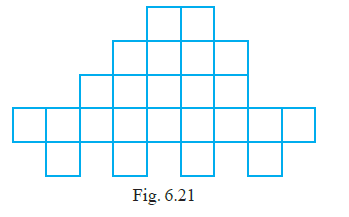
Question 60. What is the area of each small square in the Fig. 6.21 if the area of entire figure is 96sqcm. Find the perimeter of the figure.
Answer:
Given:
Total area of the figure = $96\text{ cm}^2$
The figure is composed of several small identical squares as shown in Fig. 6.21.
To Find:
1. Area of each small square.
2. Perimeter of the figure.
Solution:
1. Finding the area of each small square:
First, we count the total number of small squares in the given figure row by row from top to bottom:
Top row = $2\text{ squares}$
Second row = $4\text{ squares}$
Third row = $5\text{ squares}$
Fourth row (the longest bar) = $9\text{ squares}$
Fifth row (bottom hanging squares) = $4\text{ squares}$
$\text{Total number of small squares} = 2 + 4 + 5 + 9 + 4 = 24$
$\text{Area of each small square} = \frac{\text{Total Area}}{\text{Total number of squares}}$
$\text{Area of each small square} = \frac{96}{24}$
$\text{Area of each small square} = 4\text{ cm}^2$
2. Finding the perimeter of the figure:
To find the perimeter, we first need the length of the side ($s$) of each small square.
$\text{Area of square} = s^2$
$4\text{ cm}^2 = s^2$
$s = \sqrt{4} = 2\text{ cm}$
Now, we count the number of unit segments (sides of the small squares) that form the outer boundary of the figure:
Horizontal segments:
Topmost edges = $2$
Edges on steps and bar top = $1 (\text{right}) + 2 (\text{right wing}) + 2 (\text{left wing}) $$ + 1 (\text{left}) + 1 (\text{left}) = 7$
Bottom edges (including bar base and hanging square bases) = $9$
$\text{Total horizontal units} = 2 + 7 + 9 = 18$
Vertical segments:
Right side steps and bar end = $4$
Left side steps and bar end = $4$
Vertical sides of the 4 hanging squares = $4 \times 2 = 8$
$\text{Total vertical units} = 4 + 4 + 8 = 16$
Total Perimeter:
$\text{Total boundary segments} = 18 + 16 = 34\text{ units}$
$\text{Perimeter} = \text{Number of boundary segments} \times \text{side length}$
$\text{Perimeter} = 34 \times 2\text{ cm}$
$\text{Perimeter} = 68\text{ cm}$
Final Answer: The area of each small square is $4\text{ cm}^2$ and the perimeter of the figure is $68\text{ cm}$.