

Chapter 8 Ratio & Proportion (Class 6 - Maths NCERT Exemplar Solutions)
Welcome to the comprehensive resource for NCERT Exemplar Solutions for Class 6 Mathematics: Chapter 8 Ratio & Proportion! This chapter is meticulously crafted to extend beyond standard textbook exercises, focusing on a deep conceptual grasp of comparing quantities. Students will move past rote memorization to master the relationships inherent in proportions and the versatile unitary method, which are essential for solving complex, application-oriented tasks in both mathematical and real-world contexts.
The solutions thoroughly address the fundamental principles of Ratio, emphasizing that quantities must be in the same units before comparison (often requiring unit conversions). Key topics include simplifying ratios to their lowest terms using the Highest Common Factor (HCF) and comparing different ratios by converting them to like fractions using the Least Common Multiple (LCM) of denominators or through cross-multiplication. These skills are vital for understanding how quantities relate to one another proportionally.
Furthermore, the chapter delves into Proportion, where students learn to identify if four quantities $a, b, c, d$ are in proportion by checking if the product of the extremes equals the product of the means ($a \times d = b \times c$). A major focus is the Unitary Method, which involves first finding the value of one unit to calculate the value for any required quantity. These methods are applied to practical problems involving cost ($\textsf{₹}$), distance, and time. With logical step-by-step guidance prepared by learningspot.co, students can confidently master these essential tools and enhance their problem-solving accuracy.
Solved Examples (Examples 1 to 8)
In examples 1 and 2, write the correct answer from the given four options:
Example 1. The ratio of Rs 8 to 80 paise is
(A) 1 : 10
(B) 10 : 1
(C) 1: 1
(D) 100 : 1
Answer:
Given:
Two amounts: $\textsf{₹} 8$ and $80$ paise.
To Find:
Ratio of $\textsf{₹} 8$ to $80$ paise.
Solution:
To find the ratio, both quantities must be in the same unit.
$\textsf{₹} 1 = 100 \text{ paise}$
$\textsf{₹} 8 = 8 \times 100 = 800 \text{ paise}$
Now, the ratio of $800$ paise to $80$ paise is:
$\text{Ratio} = \frac{800}{80}$
$\text{Ratio} = \frac{10}{1} = 10 : 1$
Correct Option: (B)
Example 2. The length and breadth of a steel tape are 10m and 2.4cm, respectively. The ratio of the length to the breadth is
(A) 5 : 1.2
(B) 25 : 6
(C) 625 : 6
(D) 1250 : 3
Answer:
Given:
Length of steel tape $= 10 \text{ m}$
Breadth of steel tape $= 2.4 \text{ cm}$
To Find:
Ratio of length to breadth.
Solution:
First, convert length into centimeters:
$1 \text{ m} = 100 \text{ cm}$
$10 \text{ m} = 10 \times 100 = 1000 \text{ cm}$
Now, the ratio of length to breadth is:
$\text{Ratio} = \frac{1000}{2.4}$
$\text{Ratio} = \frac{1000 \times 10}{24}$
$\text{Ratio} = \frac{10000}{24}$
Simplifying the fraction:
$\text{Ratio} = \frac{1250}{3} = 1250 : 3$
Correct Option: (D)
Example 3. Find the missing number in the box in the following proportion:
⬜ : 8 :: 12 : 32
Answer:
To Find:
Missing number in $\square : 8 :: 12 : 32$
Solution:
Let the missing number be $x$.
According to the property of proportion, the product of extremes is equal to the product of means.
$x : 8 :: 12 : 32$
$\frac{x}{8} = \frac{12}{32}$
Cross multiplying:
$x \times 32 = 12 \times 8$
$32x = 96$
$x = \frac{96}{32}$
$x = 3$
The missing number is 3.
Example 4. State whether the given statements are true or false:
(a) 12 : 18 = 28 : 56
(b) 25 persons : 130 persons = 15kg : 78kg
Answer:
Solution:
(a) $12 : 18 = 28 : 56$
Simplifying LHS: $\frac{12}{18} = \frac{2}{3}$
Simplifying RHS: $\frac{28}{56} = \frac{1}{2}$
Since $\frac{2}{3} \neq \frac{1}{2}$, the statement is False.
(b) $25$ persons : $130$ persons $= 15 \text{ kg} : 78 \text{ kg}$
Simplifying LHS ratio: $\frac{25}{130} = \frac{5}{26}$
Simplifying RHS ratio: $\frac{15}{78} = \frac{5}{26}$
Since both ratios are equal, the statement is True.
Example 5. Fill in the blanks:
If two ratios are ______, then they are in proportion.
Answer:
The definition of a proportion is an equality between two ratios.
Therefore, if two ratios are equal, they form a proportion.
Filling in the blank:
If two ratios are equal, then they are in proportion.
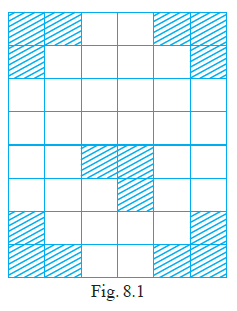
Example 6. Find the ratio of the shaded portion to the unshaded portion in Fig. 8.1
Answer:
Given:
A grid in Fig. 8.1 with shaded and unshaded squares.
To Find:
Ratio of shaded portion to unshaded portion.
Solution:
Total squares in the grid $= 6 \times 8 = 48$
Number of shaded squares $= 15$
Number of unshaded squares $= \text{Total squares} - \text{Shaded squares}$
$48 - 15 = 33$
Now, the ratio of shaded to unshaded squares is:
$\text{Ratio} = \frac{15}{33}$
Dividing both by their HCF, which is 3:
$\text{Ratio} = \frac{5}{11} = 5 : 11$
Example 7. Income of Rahim is Rs 12000 per month and that of Ami is Rs 191520 per annum. If the monthly expenditure of each of them is Rs 9960 per month find the ratio of their savings.
Answer:
Given:
Monthly Income of Rahim $= \textsf{₹} 12000$
Annual Income of Ami $= \textsf{₹} 191520$
Monthly expenditure of each $= \textsf{₹} 9960$
To Find:
Ratio of their savings.
Solution:
First, find Ami's monthly income:
$\text{Ami's Monthly Income} = \frac{191520}{12}$
$= \textsf{₹} 15960$
Now, calculate monthly savings:
$\text{Rahim's Savings} = 12000 - 9960 = \textsf{₹} 2040$
$\text{Ami's Savings} = 15960 - 9960 = \textsf{₹} 6000$
Ratio of savings (Rahim to Ami):
$\text{Ratio} = \frac{2040}{6000}$
$\text{Ratio} = \frac{204}{600} = \frac{17}{50} = 17 : 50$
Example 8. 20 tons of iron costs Rs 600000. Find the cost of 560kg of iron.
Answer:
Given:
Cost of 20 tons of iron $= \textsf{₹} 6,00,000$
To Find:
Cost of $560 \text{ kg}$ of iron.
Solution:
First, convert tons into kilograms:
$1 \text{ ton} = 1000 \text{ kg}$
$20 \text{ tons} = 20 \times 1000 = 20,000 \text{ kg}$
Using the unitary method:
$\text{Cost of } 20,000 \text{ kg} = \textsf{₹} 6,00,000$
$\text{Cost of } 1 \text{ kg} = \frac{600000}{20000} = \textsf{₹} 30$
Now, calculate the cost of $560 \text{ kg}$:
$\text{Cost of } 560 \text{ kg} = 560 \times 30$
$\text{Cost} = \textsf{₹} 16,800$
Alternate Solution:
Using proportion method:
Let the cost be $x$.
$20000 : 560 :: 600000 : x$
$\frac{20000}{560} = \frac{600000}{x}$
$x = \frac{600000 \times 560}{20000} = 30 \times 560 = \textsf{₹} 16,800$
Exercise
Question 1 to 10 (Multiple Choice Questions)
In questions 1 to 10, only one of the four options is correct. Write the correct one.
Question 1. The ratio of 8 books to 20 books is
(A) 2 : 5
(B) 5 : 2
(C) 4 : 5
(D) 5 : 4
Answer:
Given:
Quantity 1 = 8 books
Quantity 2 = 20 books
To Find:
Ratio of 8 books to 20 books.
Solution:
The ratio of two quantities of the same kind is the fraction that one quantity is of the other.
$\text{Ratio} = \frac{8}{20}$
To find the simplest form, we divide both the numerator and the denominator by their Highest Common Factor (HCF), which is 4.
$\text{Ratio} = \frac{8 \div 4}{20 \div 4}$
$\text{Ratio} = \frac{2}{5} = 2 : 5$
Correct Option: (A)
Question 2. The ratio of the number of sides of a square to the number of edges of a cube is
(A) 1 : 2
(B) 3 : 2
(C) 4 : 1
(D) 1 : 3
Answer:
Given:
A square and a cube.
To Find:
Ratio of sides of a square to edges of a cube.
Solution:
Step 1: Identify the number of sides of a square.
$\text{Number of sides of a square} = 4$
Step 2: Identify the number of edges of a cube.
$\text{Number of edges of a cube} = 12$
Step 3: Calculate the ratio.
$\text{Ratio} = \frac{4}{12}$
Simplifying the fraction by dividing both parts by 4:
$\text{Ratio} = \frac{1}{3} = 1 : 3$
Correct Option: (D)
Question 3. A picture is 60cm wide and 1.8m long. The ratio of its width to its perimeter in lowest form is
(A) 1 : 2
(B) 1 : 3
(C) 1 : 4
(D) 1 : 8
Answer:
Given:
Width of the picture ($w$) = $60$ cm
Length of the picture ($l$) = $1.8$ m
To Find:
Ratio of width to perimeter in lowest form.
Solution:
Step 1: Convert length to the same unit as width (centimetres).
$1 \text{ m} = 100 \text{ cm}$
$\text{Length} = 1.8 \times 100 = 180 \text{ cm}$
Step 2: Calculate the perimeter of the picture.
$\text{Perimeter} = 2(l + w)$
$\text{Perimeter} = 2(180 + 60)$
$\text{Perimeter} = 2(240) = 480 \text{ cm}$
Step 3: Find the ratio of width to perimeter.
$\text{Ratio} = \frac{60}{480}$
Simplifying the fraction:
$\text{Ratio} = \frac{6}{48} = \frac{1}{8} = 1 : 8$
Correct Option: (D)
Question 4. Neelam’s annual income is Rs. 288000. Her annual savings amount to Rs. 36000. The ratio of her savings to her expenditure is
(A) 1 : 8
(B) 1 : 7
(C) 1 : 6
(D) 1 : 5
Answer:
Given:
Annual Income = $\textsf{₹} 288000$
Annual Savings = $\textsf{₹} 36000$
To Find:
Ratio of savings to expenditure.
Solution:
Step 1: Calculate the annual expenditure.
$\text{Expenditure} = \text{Income} - \text{Savings}$
$\text{Expenditure} = 288000 - 36000$
$\text{Expenditure} = \textsf{₹} 252000$
Step 2: Calculate the ratio of savings to expenditure.
$\text{Ratio} = \frac{36000}{252000}$
Cancelling the zeros:
$\text{Ratio} = \frac{36}{252}$
Dividing both by 36 (since $36 \times 7 = 252$):
$\text{Ratio} = \frac{1}{7} = 1 : 7$
Correct Option: (B)
Question 5. Mathematics textbook for Class VI has 320 pages. The chapter ‘symmetry’ runs from page 261 to page 272. The ratio of the number of pages of this chapter to the total number of pages of the book is
(A) 11 : 320
(B) 3 : 40
(C) 3 : 80
(D) 272 : 320
Answer:
Given:
Total pages in book = $320$
Chapter range = Page $261$ to $272$
To Find:
Ratio of chapter pages to total pages.
Solution:
Step 1: Find the number of pages in the chapter.
Since both page 261 and page 272 are included, we use the formula: $(\text{Last Page} - \text{First Page}) + 1$.
$\text{Number of pages} = (272 - 261) + 1$
$\text{Number of pages} = 11 + 1 = 12$
Step 2: Calculate the ratio.
$\text{Ratio} = \frac{12}{320}$
Simplifying the fraction by dividing both by 4:
$\text{Ratio} = \frac{3}{80} = 3 : 80$
Correct Option: (C)
Question 6. In a box, the ratio of red marbles to blue marbles is 7:4. Which of the following could be the total number of marbles in the box?
(A) 18
(B) 19
(C) 21
(D) 22
Answer:
Given:
Ratio of red marbles to blue marbles $= 7 : 4$
To Find:
Possible total number of marbles.
Solution:
Let the number of red marbles be $7x$ and the number of blue marbles be $4x$, where $x$ is a natural number.
$\text{Total marbles} = 7x + 4x$
$\text{Total marbles} = 11x$
The total number of marbles must be a multiple of 11.
From the given options:
(A) 18 (Not a multiple of 11)
(B) 19 (Not a multiple of 11)
(C) 21 (Not a multiple of 11)
(D) 22 (Multiple of 11, since $11 \times 2 = 22$)
Correct Option: (D)
Question 7. On a shelf, books with green cover and that with brown cover are in the ratio 2:3. If there are 18 books with green cover, then the number of books with brown cover is
(A) 12
(B) 24
(C) 27
(D) 36
Answer:
Given:
Ratio of green cover books to brown cover books $= 2 : 3$
Number of green cover books $= 18$
To Find:
Number of books with brown cover.
Solution:
Let the number of brown cover books be $x$.
The ratio of green cover books to brown cover books can be written as:
$\frac{18}{x} = \frac{2}{3}$
By cross-multiplication:
$2 \times x = 18 \times 3$
$2x = 54$
$x = \frac{54}{2}$
$x = 27$
Correct Option: (C)
Question 8. The greatest ratio among the ratios 2 : 3, 5 : 8, 75 : 121 and 40 : 25 is
(A) 2 : 3
(B) 5 : 8
(C) 75 : 121
(D) 40 : 25
Answer:
Solution:
To compare the ratios, we can convert them into decimal form:
1. $2 : 3 = \frac{2}{3} \approx 0.666$
2. $5 : 8 = \frac{5}{8} = 0.625$
3. $75 : 121 = \frac{75}{121} \approx 0.619$
4. $40 : 25 = \frac{40}{25} = 1.6$
Comparing the decimal values: $1.6 > 0.666 > 0.625 > 0.619$.
Clearly, $1.6$ is the greatest value, which corresponds to the ratio $40 : 25$.
Correct Option: (D)
Question 9. There are ‘b’ boys and ‘g’ girls in a class. The ratio of the number of boys to the total number of students in the class is:
(A) $\frac{b}{b \;+ \;g}$
(B) $\frac{g}{b \;+ \;g}$
(C) $\frac{b}{g}$
(D) $\frac{b \;+ \;g}{b}$
Answer:
Given:
Number of boys $= b$
Number of girls $= g$
To Find:
Ratio of boys to total students.
Solution:
First, we find the total number of students in the class:
$\text{Total students} = \text{Number of boys} + \text{Number of girls}$
$\text{Total students} = b + g$
Now, the ratio of the number of boys to the total number of students is:
$\text{Ratio} = \frac{\text{Number of boys}}{\text{Total students}}$
$\text{Ratio} = \frac{b}{b + g}$
Correct Option: (A)
Question 10. If a bus travels 160 km in 4 hours and a train travels 320km in 5 hours at uniform speeds, then the ratio of the distances travelled by them in one hour is
(A) 1 : 2
(B) 4 : 5
(C) 5 : 8
(D) 8 : 5
Answer:
Given:
Bus distance $= 160 \text{ km}$, Bus time $= 4$ hours
Train distance $= 320 \text{ km}$, Train time $= 5$ hours
To Find:
Ratio of distances travelled in one hour (speeds).
Solution:
Distance travelled by the bus in one hour (Speed of bus):
$\text{Bus speed} = \frac{160}{4} = 40 \text{ km/hr}$
Distance travelled by the train in one hour (Speed of train):
$\text{Train speed} = \frac{320}{5} = 64 \text{ km/hr}$
Now, the ratio of their speeds:
$\text{Ratio} = \frac{40}{64}$
Simplifying the fraction by dividing both by 8:
$\text{Ratio} = \frac{5}{8} = 5 : 8$
Correct Option: (C)
Question 11 to 15 (Fill the Missing Number)
In questions 11 to 15, find the missing number in the box ⬜ in each of the proportions:
Question 11. $\frac{3}{5} = \frac{⬜}{20}$
Answer:
Given:
An incomplete proportion: $\frac{3}{5} = \frac{\square}{20}$
To Find:
The missing number in the box.
Solution:
Let the missing number in the box be $x$.
Then the equation becomes:
$\frac{3}{5} = \frac{x}{20}$
By cross-multiplication, we get:
$5 \times x = 3 \times 20$
$5x = 60$
$x = \frac{60}{5}$
$x = 12$
The missing number is 12.
Question 12. $\frac{⬜}{18} = \frac{2}{9}$
Answer:
Given:
An incomplete proportion: $\frac{\square}{18} = \frac{2}{9}$
To Find:
The missing number in the box.
Solution:
Let the missing number in the box be $x$.
$\frac{x}{18} = \frac{2}{9}$
By cross-multiplication, we get:
$9 \times x = 2 \times 18$
$9x = 36$
$x = \frac{36}{9}$
$x = 4$
The missing number is 4.
Question 13. $\frac{8}{⬜} = \frac{3.2}{4}$
Answer:
Given:
An incomplete proportion: $\frac{8}{\square} = \frac{3.2}{4}$
To Find:
The missing number in the box.
Solution:
Let the missing number in the box be $x$.
$\frac{8}{x} = \frac{3.2}{4}$
By cross-multiplication, we get:
$3.2 \times x = 8 \times 4$
$3.2x = 32$
$x = \frac{32}{3.2}$
$x = \frac{32 \times 10}{32}$
$x = 10$
The missing number is 10.
Question 14. $\frac{⬜}{45} = \frac{16}{40} = \frac{24}{⬜}$
Answer:
Given:
$\frac{\square}{45} = \frac{16}{40} = \frac{24}{\square}$
To Find:
The missing numbers in the boxes.
Solution:
First, let us simplify the middle ratio which is completely known:
$\frac{16}{40} = \frac{16 \div 8}{40 \div 8} = \frac{2}{5}$
Now, let the first missing number be $x$ and the second be $y$.
Step 1: Finding $x$
$\frac{x}{45} = \frac{2}{5}$
$5x = 45 \times 2$
$5x = 90$
$x = 18$
Step 2: Finding $y$
$\frac{2}{5} = \frac{24}{y}$
$2y = 24 \times 5$
$2y = 120$
$y = 60$
The missing numbers are 18 and 60 respectively.
Question 15. $\frac{16}{36} = \frac{⬜}{63} = \frac{36}{⬜} = \frac{⬜}{117}$
Answer:
Given:
$\frac{16}{36} = \frac{\square}{63} = \frac{36}{\square} = \frac{\square}{117}$
To Find:
The missing numbers in the boxes.
Solution:
First, let us simplify the known ratio $\frac{16}{36}$:
$\frac{16}{36} = \frac{16 \div 4}{36 \div 4} = \frac{4}{9}$
Let the missing numbers be $x, y,$ and $z$ respectively.
Step 1: Finding $x$
$\frac{x}{63} = \frac{4}{9}$
$9x = 63 \times 4$
$x = \frac{252}{9} = 28$
Step 2: Finding $y$
$\frac{36}{y} = \frac{4}{9}$
$4y = 36 \times 9$
$y = \frac{324}{4} = 81$
Step 3: Finding $z$
$\frac{z}{117} = \frac{4}{9}$
$9z = 117 \times 4$
$z = \frac{468}{9} = 52$
The missing numbers are 28, 81, and 52 respectively.
Question 16 to 34 (True or False)
In questions 16 to 34, state whether the given statements are true (T) or false (F).
Question 16. $\frac{3}{8} = \frac{15}{40}$
Answer:
Solution:
To check if the statement is true, we simplify the fraction on the Right Hand Side (RHS).
$\text{RHS} = \frac{15}{40}$
Dividing both the numerator and the denominator by their common factor 5:
$\text{RHS} = \frac{15 \div 5}{40 \div 5} = \frac{3}{8}$
Since LHS $=$ RHS, the statement is true.
Answer: True (T)
Question 17. 4 : 7 = 20 : 35
Answer:
Solution:
Simplifying the ratio on the Right Hand Side:
$20 : 35 = \frac{20}{35}$
$\frac{20 \div 5}{35 \div 5} = \frac{4}{7}$
[Dividing by HCF 5]
As $4 : 7 = 4 : 7$, the statement is true.
Answer: True (T)
Question 18. 0.2 : 5 = 2 : 0.5
Answer:
Solution:
Let's calculate the values of both ratios:
$\text{LHS} = \frac{0.2}{5} = \frac{2}{50} = \frac{1}{25}$
$\text{RHS} = \frac{2}{0.5} = \frac{20}{5} = 4$
Since $\frac{1}{25} \neq 4$, the statement is false.
Answer: False (F)
Question 19. 3 : 33 = 33 : 333
Answer:
Solution:
Simplifying both ratios:
$\text{LHS} = \frac{3}{33} = \frac{1}{11}$
$\text{RHS} = \frac{33}{333} = \frac{11}{111}$
Since $\frac{1}{11} \neq \frac{11}{111}$, the statement is false.
Answer: False (F)
Question 20. 15m : 40m = 35m : 65m
Answer:
Solution:
Simplifying the ratios by removing the units and reducing the fractions:
$\text{LHS} = \frac{15}{40} = \frac{3}{8}$
[Dividing by 5]
$\text{RHS} = \frac{35}{65} = \frac{7}{13}$
[Dividing by 5]
Since $\frac{3}{8} \neq \frac{7}{13}$, the statement is false.
Answer: False (F)
Question 21. 27cm2 : 57cm2 = 18cm : 38cm
Answer:
Solution:
Simplifying LHS:
$\frac{27}{57} = \frac{27 \div 3}{57 \div 3} = \frac{9}{19}$
Simplifying RHS:
$\frac{18}{38} = \frac{18 \div 2}{38 \div 2} = \frac{9}{19}$
As $\frac{9}{19} = \frac{9}{19}$, the statement is true.
Answer: True (T)
Question 22. 5kg : 7.5kg = Rs 7.50 : Rs 5
Answer:
Solution:
Simplifying LHS:
$\frac{5}{7.5} = \frac{50}{75} = \frac{2}{3}$
Simplifying RHS:
$\frac{7.50}{5} = \frac{75}{50} = \frac{3}{2}$
Since $\frac{2}{3} \neq \frac{3}{2}$, the statement is false.
Answer: False (F)
Question 23. 20g : 100g = 1metre : 500cm
Answer:
Solution:
LHS simplification:
$\frac{20}{100} = \frac{1}{5}$
RHS simplification (Note: $1\text{m} = 100\text{cm}$):
$\frac{100\text{cm}}{500\text{cm}} = \frac{1}{5}$
LHS $=$ RHS, so the statement is true.
Answer: True (T)
Question 24. 12 hours : 30 hours = 8km : 20km
Answer:
Solution:
LHS simplification:
$\frac{12}{30} = \frac{12 \div 6}{30 \div 6} = \frac{2}{5}$
RHS simplification:
$\frac{8}{20} = \frac{8 \div 4}{20 \div 4} = \frac{2}{5}$
LHS $=$ RHS, so the statement is true.
Answer: True (T)
Question 25. The ratio of 10kg to 100kg is 1:10
Answer:
Solution:
Calculating the ratio:
$\text{Ratio} = \frac{10}{100}$
$\text{Ratio} = \frac{1}{10} = 1:10$
The calculated ratio matches the statement.
Answer: True (T)
Question 26. The ratio of 150cm to 1metre is 1:1.5.
Answer:
Solution:
To find the ratio, we must convert both quantities to the same unit.
$1\text{ metre} = 100\text{ cm}$
Now, calculate the ratio of $150\text{cm}$ to $100\text{cm}$:
$\text{Ratio} = \frac{150}{100}$
$\text{Ratio} = \frac{1.5}{1} = 1.5 : 1$
The statement says the ratio is $1:1.5$, which is the inverse of the actual result.
Answer: False (F)
Question 27. 25 kg : 20 g = 50 kg : 40 g
Answer:
Solution:
Let's simplify both ratios to see if they are equal.
LHS Ratio:
$\frac{25\text{ kg}}{20\text{ g}} = \frac{25000\text{ g}}{20\text{ g}}$
[Since $1\text{kg} = 1000\text{g}$]
$\text{LHS} = \frac{2500}{2} = 1250 : 1$
RHS Ratio:
$\frac{50\text{ kg}}{40\text{ g}} = \frac{50000\text{ g}}{40\text{ g}}$
$\text{RHS} = \frac{5000}{4} = 1250 : 1$
Since LHS $=$ RHS, the statement is true.
Answer: True (T)
Question 28. The ratio of 1 hour to one day is 1:1.
Answer:
Solution:
Units must be same to compare.
$1\text{ day} = 24\text{ hours}$
The ratio of $1\text{ hour}$ to $24\text{ hours}$ is:
$\text{Ratio} = 1 : 24$
This is not equal to $1:1$.
Answer: False (F)
Question 29. The ratio 4:16 is in its lowest form.
Answer:
Solution:
A ratio is in its lowest form if the numerator and denominator have no common factor other than 1.
In $4:16$:
$\frac{4}{16} = \frac{4 \div 4}{16 \div 4} = \frac{1}{4}$
[HCF of 4 and 16 is 4]
Since it can be further simplified, it is not in its lowest form.
Answer: False (F)
Question 30. The ratio 5 : 4 is different from the ratio 4 : 5.
Answer:
Solution:
In a ratio, the order of terms is very important. $5:4$ means $\frac{5}{4}$ (which is $1.25$), while $4:5$ means $\frac{4}{5}$ (which is $0.8$).
Since $1.25 \neq 0.8$, the two ratios are indeed different.
Answer: True (T)
Question 31. A ratio will always be more than 1.
Answer:
Solution:
A ratio is a comparison of two numbers. If the first term (antecedent) is smaller than the second term (consequent), the ratio will be less than 1.
Example: The ratio $1:2 = 0.5$, which is less than 1.
Answer: False (F)
Question 32. A ratio can be equal to 1.
Answer:
Solution:
A ratio is equal to 1 when both the terms of the ratio are equal.
Example: The ratio of $5\text{kg}$ to $5\text{kg}$ is $\frac{5}{5} = 1$.
Answer: True (T)
Question 33. If b : a = c : d, then a, b, c, d are in proportion.
Answer:
Solution:
Four numbers $a, b, c, d$ are said to be in proportion if $a : b = c : d$ (i.e., $\frac{a}{b} = \frac{c}{d}$).
The given condition $b : a = c : d$ means $\frac{b}{a} = \frac{c}{d}$. This implies the numbers $b, a, c, d$ are in proportion, but not necessarily in the order $a, b, c, d$.
For example, if $2, 1, 4, 2$ are used: $\frac{2}{1} = \frac{4}{2}$. Here $b:a=c:d$ is true, but $a:b=c:d$ would be $1:2=4:2$, which is false.
Answer: False (F)
Question 34. The two terms of a ratio can be in two different units.
Answer:
Solution:
A ratio is a comparison of two quantities of the same kind. To compare them, they must be expressed in the same units. If they are in different units, we must convert them to a common unit before finding the ratio.
Answer: False (F)
Question 35 to 46 (Fill in the Blanks)
In questions 35 to 46, fill in the blanks to make the statements true.
Question 35. A ratio is a form of comparison by ______.
Answer:
Solution:
There are two primary ways to compare quantities: by difference and by division. When we compare two quantities to find out how many times one quantity is of the other, we call it comparison by division.
A ratio is defined as the comparison of two quantities of the same kind by the method of division.
Answer: division
Question 36. 20m : 70m = Rs 8 : Rs ______.
Answer:
Given:
A proportion: $20\text{m} : 70\text{m} = \textsf{₹} 8 : \textsf{₹} \text{_____}$
To Find:
The missing value (in rupees).
Solution:
Let the missing value be $x$. According to the definition of proportion, the two ratios must be equal.
$\frac{20}{70} = \frac{8}{x}$
Simplifying the first ratio:
$\frac{2}{7} = \frac{8}{x}$
By cross-multiplication:
$2 \times x = 8 \times 7$
$2x = 56$
$x = \frac{56}{2}$
$x = 28$
Answer: 28
Question 37. There is a number in the box ⬜ such that ⬜ , 24, 9, 12 are in proportion. The number in the box is _____.
Answer:
Given:
The numbers $\square, 24, 9, 12$ are in proportion.
To Find:
The value of the number in the box.
Solution:
Let the missing number in the box be $x$.
For four numbers to be in proportion, the ratio of the first two must be equal to the ratio of the last two.
$x : 24 = 9 : 12$
$\frac{x}{24} = \frac{9}{12}$
Simplifying the second ratio $\frac{9}{12}$ by dividing both parts by 3:
$\frac{x}{24} = \frac{3}{4}$
By cross-multiplication:
$4 \times x = 24 \times 3$
$4x = 72$
$x = \frac{72}{4}$
$x = 18$
Answer: 18
Question 38. If two ratios are equal, then they are in _____.
Answer:
Solution:
By mathematical definition, equality of two ratios is called a proportion.
If $a : b$ and $c : d$ are two ratios such that $a : b = c : d$, then we say that $a, b, c, d$ are in proportion. This is represented using the symbol "$::$".
$a : b :: c : d$
Answer: proportion
Use Fig. 8.2 (In which each square is of unit length) for questions 39 and 40:

Question 39. The ratio of the perimeter of the boundary of the shaded portion to the perimeter of the whole figure is _______.
Answer:
Given:
Each small square is of unit length ($1$ unit).
In Fig 8.2, the whole figure is a rectangle of length $4$ units and breadth $3$ units.
The shaded portion is a rectangle of length $2$ units and breadth $1$ unit.
To Find:
Ratio of the perimeter of the shaded portion to the perimeter of the whole figure.
Solution:
Step 1: Calculate the perimeter of the whole figure.
$\text{Perimeter of whole figure} = 2 \times (\text{length} + \text{breadth})$
$= 2 \times (4 + 3) = 2 \times 7 = 14$ units
Step 2: Calculate the perimeter of the shaded portion.
$\text{Perimeter of shaded portion} = 2 \times (2 + 1)$
$= 2 \times 3 = 6$ units
Step 3: Find the ratio.
$\text{Ratio} = \frac{6}{14}$
Dividing both terms by $2$:
$\text{Ratio} = 3 : 7$
Answer: $3 : 7$
Question 40. The ratio of the area of the shaded portion to that of the whole figure is ______.
Answer:
Given:
Whole figure dimensions: Length $= 4$ units, Breadth $= 3$ units.
Shaded portion dimensions: Length $= 2$ units, Breadth $= 1$ unit.
To Find:
Ratio of the area of the shaded portion to the area of the whole figure.
Solution:
Step 1: Calculate the area of the whole figure.
$\text{Area of whole figure} = \text{length} \times \text{breadth}$
$= 4 \times 3 = 12$ sq units
Step 2: Calculate the area of the shaded portion.
$\text{Area of shaded portion} = 2 \times 1 = 2$ sq units
Step 3: Find the ratio.
$\text{Ratio} = \frac{2}{12}$
Dividing both terms by $2$:
$\text{Ratio} = 1 : 6$
Answer: $1 : 6$
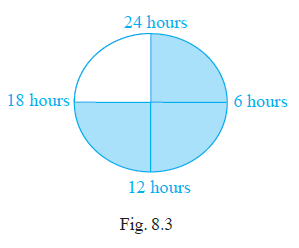
Question 41. Sleeping time of a python in a 24 hour clock is represented by the shaded portion in Fig. 8.3
The ratio of sleeping time to awaking time is ______.
Answer:
Given:
Total time in a day $= 24$ hours.
From Fig 8.3, the shaded portion (sleeping time) covers $18$ hours ($3$ quadrants of $6$ hours each).
To Find:
Ratio of sleeping time to awaking time.
Solution:
Step 1: Identify sleeping time.
$\text{Sleeping time} = 18$ hours
Step 2: Calculate awaking time.
$\text{Awaking time} = \text{Total time} - \text{Sleeping time}$
$= 24 - 18 = 6$ hours
Step 3: Find the ratio of sleeping time to awaking time.
$\text{Ratio} = \frac{18}{6}$
$= \frac{3}{1} = 3 : 1$
Answer: $3 : 1$
Question 42. A ratio expressed in lowest form has no common factor other than ______ in its terms.
Answer:
Solution:
A ratio $a : b$ is said to be in its lowest form or simplest form if the Highest Common Factor (HCF) of $a$ and $b$ is $1$. This means there is no number that divides both terms exactly except for $1$.
Answer: $1$
Question 43. To find the ratio of two quantities, they must be expressed in _____units.
Answer:
Solution:
A ratio is a comparison of two quantities of the same kind. For a meaningful comparison, both quantities must be in the same (or identical) units. If they are in different units, we convert them before calculating the ratio.
Answer: same
Question 44. Ratio of 5 paise to 25 paise is the same as the ratio of 20 paise to _____
Answer:
Solution:
Let the missing value be $x$ paise.
Step 1: Find the first ratio.
$\text{Ratio 1} = \frac{5}{25} = \frac{1}{5}$
Step 2: Set the second ratio equal to the first.
$\frac{20}{x} = \frac{1}{5}$
Step 3: Cross multiply to solve for $x$.
$x \times 1 = 20 \times 5$
$x = 100$ paise
In Indian currency, $100$ paise is equal to $\textsf{₹} 1$.
Answer: 100 paise (or ₹ 1)
Question 45. Saturn and Jupiter take 9 hours 56 minutes and 10 hours 40 minutes, respectively for one spin on their axes. The ratio of the time taken by Saturn and Jupiter in lowest form is ______.
Answer:
Given:
Time taken by Saturn $= 9$ hours $56$ minutes
Time taken by Jupiter $= 10$ hours $40$ minutes
To Find:
Ratio of the time taken in lowest form.
Solution:
Step 1: Convert both times into minutes.
$\text{Time for Saturn} = (9 \times 60) + 56$
$= 540 + 56 = 596$ minutes
$\text{Time for Jupiter} = (10 \times 60) + 40$
$= 600 + 40 = 640$ minutes
Step 2: Find the ratio.
$\text{Ratio} = \frac{596}{640}$
Step 3: Simplify to the lowest form by dividing both by their HCF, which is $4$.
$\text{Ratio} = \frac{596 \div 4}{640 \div 4} = \frac{149}{160}$
Answer: $149 : 160$
Question 46. 10g of caustic soda dissolved in 100mL of water makes a solution of caustic soda. Amount of caustic soda needed for 1 litre of water to make the same type of solution is ______.
Answer:
Given:
Caustic soda $= 10 \text{ g}$
Water $= 100 \text{ mL}$
To Find:
Caustic soda needed for $1$ litre of water.
Solution:
Step 1: Convert water quantity to the same unit.
$1 \text{ litre} = 1000 \text{ mL}$
Step 2: Use the unitary method or proportion.
If $100 \text{ mL}$ of water requires $10 \text{ g}$ of caustic soda,
Then $1 \text{ mL}$ of water requires $= \frac{10}{100} \text{ g}$
So, $1000 \text{ mL}$ of water requires:
$\text{Soda needed} = \frac{10}{100} \times 1000$
$= 10 \times 10 = 100 \text{ g}$
Answer: $100 \text{ g}$
Question 47 to 89
Question 47. The marked price of a table is Rs 625 and its sale price is Rs 500. What is the ratio of the sale price to the marked price?
Answer:
Given:
Marked price of the table = $\textsf{₹} 625$
Sale price of the table = $\textsf{₹} 500$
To Find:
The ratio of the sale price to the marked price.
Solution:
To find the ratio, we place the sale price in the numerator and the marked price in the denominator.
$\text{Ratio} = \frac{\text{Sale Price}}{\text{Marked Price}}$
$\text{Ratio} = \frac{500}{625}$
To simplify this fraction, we divide both the numerator and the denominator by their Highest Common Factor (HCF). The HCF of 500 and 625 is 125.
$\text{Ratio} = \frac{500 \div 125}{625 \div 125}$
$\text{Ratio} = \frac{4}{5}$
Thus, the ratio in its simplest form is $4 : 5$.
Question 48. Which pair of ratios are equal? And why?
(i) $\frac{2}{3}$ , $\frac{4}{6}$
(ii) $\frac{8}{4}$ , $\frac{2}{1}$
(iii) $\frac{4}{5}$ , $\frac{12}{20}$
Answer:
Solution:
Ratios are equal if their simplest forms are the same.
(i) $\frac{2}{3}$ and $\frac{4}{6}$
The first ratio $\frac{2}{3}$ is already in its simplest form.
For the second ratio $\frac{4}{6}$:
$\frac{4 \div 2}{6 \div 2} = \frac{2}{3}$
Since $\frac{2}{3} = \frac{2}{3}$, this pair of ratios is Equal.
(ii) $\frac{8}{4}$ and $\frac{2}{1}$
The second ratio $\frac{2}{1}$ is in its simplest form.
For the first ratio $\frac{8}{4}$:
$\frac{8 \div 4}{4 \div 4} = \frac{2}{1}$
Since $\frac{2}{1} = \frac{2}{1}$, this pair of ratios is Equal.
(iii) $\frac{4}{5}$ and $\frac{12}{20}$
The first ratio $\frac{4}{5}$ is in its simplest form.
For the second ratio $\frac{12}{20}$:
$\frac{12 \div 4}{20 \div 4} = \frac{3}{5}$
Since $\frac{4}{5} \neq \frac{3}{5}$, this pair of ratios is Not Equal.
Conclusion: Pairs (i) and (ii) are equal because they simplify to the same fraction, whereas pair (iii) does not.
Question 49. Which ratio is larger 10 : 21 or 21 : 93?
Answer:
To Find:
Which of the two ratios, $10 : 21$ or $21 : 93$, is greater.
Solution:
To compare ratios, we can convert them into decimals or make their denominators equal.
Method 1: Using Decimals
First ratio:
$10 : 21 = \frac{10}{21} \approx 0.476$
Second ratio:
$21 : 93 = \frac{21}{93} = \frac{7}{31} \approx 0.225$
Since $0.476 > 0.225$, the ratio $10 : 21$ is larger.
Method 2: Cross Multiplication
Compare $\frac{10}{21}$ and $\frac{21}{93}$:
$10 \times 93 = 930$
$21 \times 21 = 441$
Since $930 > 441$, the first fraction $\frac{10}{21}$ is larger.
Question 50. Reshma prepared 18kg of Burfi by mixing Khoya with sugar in the ratio of 7 : 2. How much Khoya did she use?
Answer:
Given:
Total weight of Burfi = $18 \text{ kg}$
Ratio of Khoya to Sugar = $7 : 2$
To Find:
The quantity of Khoya used.
Solution:
Step 1: Find the sum of the ratio parts.
$\text{Sum of parts} = 7 + 2 = 9$
Step 2: Calculate the weight of one part of the total mixture.
$\text{Weight of one part} = \frac{\text{Total weight}}{\text{Sum of parts}}$
$\text{Weight of one part} = \frac{18}{9} = 2 \text{ kg}$
Step 3: Calculate the quantity of Khoya.
Since the ratio of Khoya is 7 parts:
$\text{Quantity of Khoya} = 7 \times 2 \text{ kg}$
$\text{Quantity of Khoya} = 14 \text{ kg}$
Therefore, Reshma used $14 \text{ kg}$ of Khoya to prepare the Burfi.
Question 51. A line segment 56cm long is to be divided into two parts in the ratio of 2 : 5. Find the length of each part.
Answer:
Given:
Total length of the line segment $= 56 \text{ cm}$
Ratio of the two parts $= 2 : 5$
To Find:
Length of each part.
Solution:
Step 1: Calculate the sum of the ratio terms.
$\text{Sum of parts} = 2 + 5 = 7$
Step 2: Calculate the length of the first part.
$\text{First part} = \frac{2}{7} \times 56$
$\text{First part} = 2 \times 8 = 16 \text{ cm}$
Step 3: Calculate the length of the second part.
$\text{Second part} = \frac{5}{7} \times 56$
$\text{Second part} = 5 \times 8 = 40 \text{ cm}$
Conclusion: The lengths of the two parts are $16 \text{ cm}$ and $40 \text{ cm}$.
Question 52. The number of milk teeth in human beings is 20 and the number of permanent teeth is 32. Find the ratio of the number of milk teeth to the number of permanent teeth.
Answer:
Given:
Number of milk teeth $= 20$
Number of permanent teeth $= 32$
To Find:
Ratio of milk teeth to permanent teeth.
Solution:
The ratio is found by dividing the number of milk teeth by the number of permanent teeth.
$\text{Ratio} = \frac{20}{32}$
To simplify the ratio, we divide both terms by their Highest Common Factor (HCF), which is $4$.
$\text{Ratio} = \frac{20 \div 4}{32 \div 4}$
$\text{Ratio} = \frac{5}{8} = 5 : 8$
The required ratio is $5 : 8$.
Question 53. Sex ratio is defined as the number of females per 1000 males in the population. Find the sex ratio if there are 3732 females per 4000 males in a town.
Answer:
Given:
Number of females $= 3732$
Number of males $= 4000$
To Find:
Sex ratio (number of females per $1000$ males).
Solution:
To find the number of females per $1000$ males, we can use the following formula:
$\text{Sex Ratio} = \frac{\text{Number of females}}{\text{Number of males}} \times 1000$
$\text{Sex Ratio} = \frac{3732}{4000} \times 1000$
Simplifying the expression:
$\text{Sex Ratio} = \frac{3732}{4}$
Now, perform the division:
$3732 \div 4 = 933$
Therefore, the sex ratio of the town is $933$.
Question 54. In a year, Ravi earns Rs 360000 and paid Rs 24000 as income tax. Find the ratio of his
(a) income to income tax.
(b) income tax to income after paying income tax.
Answer:
Given:
Total Income $= \textsf{₹} 360000$
Income Tax paid $= \textsf{₹} 24000$
To Find:
(a) Ratio of income to income tax.
(b) Ratio of income tax to income after paying tax.
Solution:
Part (a): Ratio of income to income tax
$\text{Ratio} = \frac{360000}{24000}$
$\text{Ratio} = \frac{360}{24}$
$\text{Ratio} = \frac{15}{1} = 15 : 1$
Part (b): Ratio of income tax to income after paying tax
First, calculate income after paying tax:
$\text{Income after tax} = 360000 - 24000$
$\text{Income after tax} = \textsf{₹} 336000$
Now, calculate the ratio:
$\text{Ratio} = \frac{24000}{336000}$
$\text{Ratio} = \frac{24}{336}$
Dividing both by $24$ ($336 \div 24 = 14$):
$\text{Ratio} = \frac{1}{14} = 1 : 14$
Question 55. Ramesh earns Rs 28000 per month. His wife Rama earns Rs 36000 per month. Find the ratio of
(a) Ramesh’s earnings to their total earnings
(b) Rama’s earnings to their total earnings.
Answer:
Given:
Ramesh's monthly earnings $= \textsf{₹} 28000$
Rama's monthly earnings $= \textsf{₹} 36000$
To Find:
Ratios (a) Ramesh : Total and (b) Rama : Total.
Solution:
Step 1: Calculate the total earnings of both.
$\text{Total earnings} = 28000 + 36000 = \textsf{₹} 64000$
Part (a): Ratio of Ramesh's earnings to total earnings
$\text{Ratio} = \frac{28000}{64000} = \frac{28}{64}$
Dividing by HCF $4$:
$\text{Ratio} = \frac{28 \div 4}{64 \div 4} = \frac{7}{16} = 7 : 16$
Part (b): Ratio of Rama's earnings to total earnings
$\text{Ratio} = \frac{36000}{64000} = \frac{36}{64}$
Dividing by HCF $4$:
$\text{Ratio} = \frac{36 \div 4}{64 \div 4} = \frac{9}{16} = 9 : 16$
Question 56. Of the 288 persons working in a company, 112 are men and the remaining are women. Find the ratio of the number of
(a) men to that of women.
(b) men to the total number of persons.
(c) women to the total number of persons.
Answer:
Given:
Total number of persons $= 288$
Number of men $= 112$
To Find:
Ratios of (a) Men : Women, (b) Men : Total, and (c) Women : Total.
Solution:
Step 1: Find the number of women.
$\text{Number of women} = 288 - 112 = 176$
Part (a): Ratio of men to women
$\text{Ratio} = \frac{112}{176}$
Simplifying by dividing both by $16$:
$\text{Ratio} = \frac{7}{11} = 7 : 11$
Part (b): Ratio of men to total number of persons
$\text{Ratio} = \frac{112}{288}$
Simplifying by dividing both by $16$:
$\text{Ratio} = \frac{7}{18} = 7 : 18$
Part (c): Ratio of women to total number of persons
$\text{Ratio} = \frac{176}{288}$
Simplifying by dividing both by $16$:
$\text{Ratio} = \frac{11}{18} = 11 : 18$
Question 57. A rectangular sheet of paper is of length 1.2m and width 21cm. Find the ratio of width of the paper to its length.
Answer:
Given:
Length of the rectangular sheet ($l$) = $1.2$ m
Width of the rectangular sheet ($w$) = $21$ cm
To Find:
Ratio of width to length.
Solution:
To find the ratio, both quantities must be expressed in the same unit. Let us convert the length from metres to centimetres.
$1 \text{ m} = 100 \text{ cm}$
$l = 1.2 \times 100 \text{ cm} = 120 \text{ cm}$
Now, we find the ratio of width to length:
$\text{Ratio} = \frac{w}{l} = \frac{21}{120}$
Simplifying the fraction by dividing both terms by their Highest Common Factor (HCF), which is 3:
$\text{Ratio} = \frac{\cancel{21}^{7}}{\cancel{120}_{40}}$
$\text{Ratio} = 7 : 40$
The ratio of the width of the paper to its length is $7 : 40$.
Question 58. A scooter travels 120km in 3 hours and a train travels 120km in 2 hours. Find the ratio of their speeds.
(Hint: $Speed = \frac{distance\; travelled}{time \;taken}$)
Answer:
Given:
Distance travelled by scooter = $120$ km, Time taken = $3$ hours
Distance travelled by train = $120$ km, Time taken = $2$ hours
To Find:
Ratio of the speed of the scooter to the speed of the train.
Solution:
Step 1: Calculate the speed of the scooter.
$\text{Speed of scooter} = \frac{120}{3} = 40 \text{ km/h}$
Step 2: Calculate the speed of the train.
$\text{Speed of train} = \frac{120}{2} = 60 \text{ km/h}$
Step 3: Find the ratio of their speeds.
$\text{Ratio} = \frac{40}{60}$
Simplifying the fraction by dividing by 20:
$\text{Ratio} = \frac{2}{3} = 2 : 3$
The ratio of their speeds is $2 : 3$.
Question 59. An office opens at 9 a.m. and closes at 5.30 p.m. with a lunch break of 30 minutes. What is the ratio of lunch break to the total period in the office?
Answer:
Given:
Office opening time = 9:00 a.m.
Office closing time = 5:30 p.m.
Duration of lunch break = $30$ minutes
To Find:
Ratio of lunch break to the total period spent in the office.
Solution:
Step 1: Calculate the total time duration from 9 a.m. to 5:30 p.m.
From 9 a.m. to 12 noon = $3$ hours
From 12 noon to 5:30 p.m. = $5$ hours $30$ minutes
$\text{Total period} = 3 \text{ h} + 5 \text{ h } 30 \text{ min} = 8 \text{ h } 30 \text{ min}$
Step 2: Convert the total period into minutes.
$\text{Total period in minutes} = (8 \times 60) + 30$
$= 480 + 30 = 510 \text{ minutes}$
Step 3: Find the ratio of lunch break to the total period.
$\text{Ratio} = \frac{30}{510}$
$\text{Ratio} = \frac{\cancel{30}^{1}}{\cancel{510}_{17}} = 1 : 17$
The required ratio is $1 : 17$.
Question 60. The shadow of a 3m long stick is 4m long. At the same time of the day, if the shadow of a flagstaff is 24m long, how tall is the flagstaff?
Answer:
Given:
Length of stick = $3$ m, Length of its shadow = $4$ m
Length of shadow of flagstaff = $24$ m
To Find:
Height of the flagstaff.
Solution:
At the same time of day, the ratio of the height of an object to the length of its shadow is constant because the angle of the sun is the same.
Let the height of the flagstaff be $h$ metres.
$\frac{\text{Height of stick}}{\text{Shadow of stick}} = \frac{\text{Height of flagstaff}}{\text{Shadow of flagstaff}}$
$\frac{3}{4} = \frac{h}{24}$
By cross-multiplication:
$4 \times h = 3 \times 24$
$4h = 72$
$h = \frac{72}{4}$
$h = 18 \text{ m}$
The flagstaff is $18$ metres tall.
Question 61. A recipe calls for 1 cup of milk for every $2\frac{1}{2}$ cups of flour to make a cake that would feed 6persons. How many cups of both flour and milk will be needed to make a similar cake for 8 people?
Answer:
Given:
For $6$ persons:
Milk needed = $1$ cup
Flour needed = $2\frac{1}{2}$ cups $= \frac{5}{2}$ cups
To Find:
Amount of milk and flour needed for $8$ persons.
Solution:
Step 1: Calculate quantities for 1 person using the unitary method.
$\text{Milk for 1 person} = \frac{1}{6} \text{ cup}$
$\text{Flour for 1 person} = \frac{5}{2} \div 6 = \frac{5}{12} \text{ cup}$
Step 2: Calculate quantities for 8 persons.
$\text{Milk for 8 persons} = \frac{1}{6} \times 8 = \frac{4}{3} \text{ cups}$
$\text{Milk required} = 1\frac{1}{3} \text{ cups}$
$\text{Flour for 8 persons} = \frac{5}{12} \times 8 = \frac{10}{3} \text{ cups}$
$\text{Flour required} = 3\frac{1}{3} \text{ cups}$
Conclusion: For 8 people, $1\frac{1}{3}$ cups of milk and $3\frac{1}{3}$ cups of flour are needed.
Question 62. In a school, the ratio of the number of large classrooms to small classrooms is 3:4. If the number of small rooms is 20, then find the number of large rooms.
Answer:
Given:
Ratio of large classrooms to small classrooms $= 3 : 4$
Number of small classrooms $= 20$
To Find:
Number of large classrooms.
Solution:
Let the number of large classrooms be $x$.
According to the given ratio:
$\frac{\text{Number of large rooms}}{\text{Number of small rooms}} = \frac{3}{4}$
$\frac{x}{20} = \frac{3}{4}$
By cross-multiplication:
$4 \times x = 3 \times 20$
$4x = 60$
$x = \frac{60}{4}$
$x = 15$
There are $15$ large classrooms in the school.
Question 63. Samira sells newspapers at Janpath crossing daily. On a particular day, she had 312 newspapers out of which 216 are in English and remaining in Hindi. Find the ratio of
(a) the number of English newspapers to the number of Hindi newspapers.
(b) the number of Hindi newspapers to the total number of newspapers.
Answer:
Given:
Total number of newspapers = $312$
Number of English newspapers = $216$
To Find:
(a) Ratio of English newspapers to Hindi newspapers.
(b) Ratio of Hindi newspapers to total newspapers.
Solution:
First, we calculate the number of Hindi newspapers:
Hindi newspapers = Total $-$ English
Hindi newspapers = $312 - 216 = 96$
(a) Ratio of English newspapers to Hindi newspapers:
$\text{Ratio} = \frac{216}{96}$
Dividing both by their HCF, which is $24$:
$\text{Ratio} = \frac{\cancel{216}^{9}}{\cancel{96}_{4}} = 9 : 4$
(b) Ratio of Hindi newspapers to the total number of newspapers:
$\text{Ratio} = \frac{96}{312}$
Dividing both by $24$:
$\text{Ratio} = \frac{\cancel{96}^{4}}{\cancel{312}_{13}} = 4 : 13$
Question 64. The students of a school belong to different religious backgrounds. The number of Hindu students is 288, the number of Muslim students is 252, the number of Sikh students is 144 and the number of Christian students is 72. Find the ratio of
(a) the number of Hindu students to the number of Christian students.
(b) the number of Muslim students to the total number of students.
Answer:
Given:
Hindu students = $288$
Muslim students = $252$
Sikh students = $144$
Christian students = $72$
To Find:
(a) Ratio of Hindu to Christian students.
(b) Ratio of Muslim to total students.
Solution:
First, calculate the total number of students:
Total = $288 + 252 + 144 + 72$
Total = $756$
(a) Ratio of Hindu students to Christian students:
$\text{Ratio} = \frac{288}{72}$
$\text{Ratio} = \frac{\cancel{288}^{4}}{\cancel{72}_{1}} = 4 : 1$
(b) Ratio of Muslim students to the total number of students:
$\text{Ratio} = \frac{252}{756}$
Dividing both by $252$:
$\text{Ratio} = \frac{\cancel{252}^{1}}{\cancel{756}_{3}} = 1 : 3$
Question 65. When Chinmay visted chowpati at Mumbai on a holiday, he observed that the ratio of North Indian food stalls to South Indian food stalls is 5:4. If the total number of food stalls is 117, find the number of each type of food stalls.
Answer:
Given:
Ratio (North Indian : South Indian) = $5 : 4$
Total food stalls = $117$
To Find:
Number of North Indian food stalls and South Indian food stalls.
Solution:
Sum of the ratio parts = $5 + 4 = 9$
North Indian food stalls:
$\text{Number} = \frac{5}{9} \times 117$
$\text{Number} = 5 \times 13 = 65$
South Indian food stalls:
$\text{Number} = \frac{4}{9} \times 117$
$\text{Number} = 4 \times 13 = 52$
Therefore, there are 65 North Indian stalls and 52 South Indian stalls.
Question 66. At the parking stand of Ramleela ground, Kartik counted that there are 115 cycles, 75 scooters and 45 bikes. Find the ratio of the number of cycles to the total number of vehicles.
Answer:
Given:
Cycles = $115$
Scooters = $75$
Bikes = $45$
To Find:
Ratio of the number of cycles to the total number of vehicles.
Solution:
First, calculate the total number of vehicles:
Total = $115 + 75 + 45$
Total = $235$
Now, find the ratio of cycles to total vehicles:
$\text{Ratio} = \frac{115}{235}$
Dividing both by $5$:
$\text{Ratio} = \frac{\cancel{115}^{23}}{\cancel{235}_{47}} = 23 : 47$
Question 67. A train takes 2 hours to travel from Ajmer to Jaipur, which are 130km apart. How much time will it take to travel from Delhi to Bhopal which are 780km apart if the train is travelling at the uniform speed?
Answer:
Given:
Distance (Ajmer to Jaipur) = $130$ km
Time taken = $2$ hours
Distance (Delhi to Bhopal) = $780$ km
To Find:
Time taken to travel from Delhi to Bhopal.
Solution:
Since the train travels at a uniform speed, the ratio of distance to time remains constant.
Let the time taken for the second journey be $x$ hours.
$\frac{130}{2} = \frac{780}{x}$
Solving for $x$:
$65 = \frac{780}{x}$
(Speed is $65$ km/hr)
$x = \frac{780}{65}$
$x = 12$
Therefore, it will take 12 hours to travel from Delhi to Bhopal.
Question 68. The length and breadth of a school ground are 150m and 90m respectively, while the length and breadth of a mela ground are 210m and 126m, respectively. Are these measurements in proportion?
Answer:
Given:
School ground: Length ($L_1$) = $150 \text{ m}$, Breadth ($B_1$) = $90 \text{ m}$
Mela ground: Length ($L_2$) = $210 \text{ m}$, Breadth ($B_2$) = $126 \text{ m}$
To Find:
Whether the measurements are in proportion ($L_1 : B_1 :: L_2 : B_2$).
Solution:
Two ratios are in proportion if their simplest forms are equal.
Step 1: Find the ratio of length to breadth for the school ground.
$\text{Ratio}_1 = \frac{150}{90}$
$\text{Ratio}_1 = \frac{15}{9} = \frac{5}{3} = 5 : 3$
[Dividing by 30]
Step 2: Find the ratio of length to breadth for the mela ground.
$\text{Ratio}_2 = \frac{210}{126}$
Dividing both by their HCF, which is 42:
$\text{Ratio}_2 = \frac{210 \div 42}{126 \div 42} = \frac{5}{3} = 5 : 3$
Step 3: Compare the two ratios.
$\text{Ratio}_1 = \text{Ratio}_2$
Since both ratios are equal, the measurements are in proportion.
Answer: Yes, the measurements are in proportion.
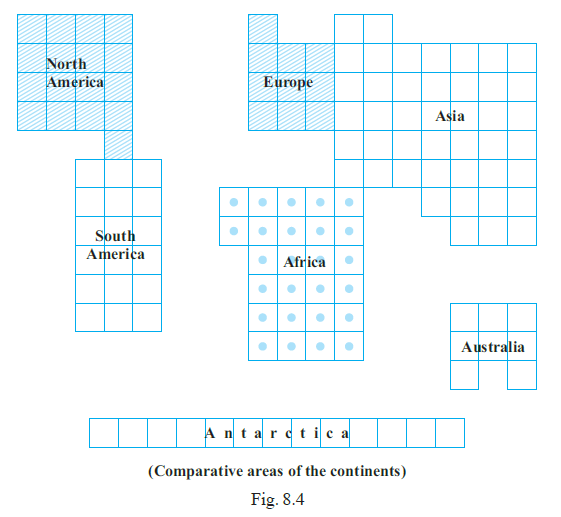
Question 69. In Fig. 8.4, the comparative areas of the continents are given:
What is the ratio of the areas of
(a) Africa to Europe
(b) Australia to Asia
(c) Antarctica to Combined area of North America and South America.
Answer:
Given:
By counting the number of unit squares for each continent in Fig. 8.4, we have the following areas:
1. Area of Africa = $26$ units
2. Area of Europe = $10$ units
3. Area of Australia = $8$ units
4. Area of Asia = $44$ units
5. Area of Antarctica = $13$ units
6. Area of North America = $17$ units
7. Area of South America = $18$ units
To Find:
(a) Ratio of the area of Africa to Europe
(b) Ratio of the area of Australia to Asia
(c) Ratio of the area of Antarctica to the combined area of North America and South America
Solution:
(a) Ratio of the area of Africa to Europe:
$\text{Ratio} = \frac{\text{Area of Africa}}{\text{Area of Europe}}$
$\text{Ratio} = \frac{26}{10}$
Dividing both terms by their Highest Common Factor (HCF), which is $2$:
$\text{Ratio} = \frac{13}{5}$
[Simplest Form]
Therefore, the ratio is $13 : 5$.
(b) Ratio of the area of Australia to Asia:
$\text{Ratio} = \frac{\text{Area of Australia}}{\text{Area of Asia}}$
$\text{Ratio} = \frac{8}{44}$
Dividing both terms by their HCF, which is $4$:
$\text{Ratio} = \frac{2}{11}$
[Simplest Form]
Therefore, the ratio is $2 : 11$.
(c) Ratio of Antarctica to Combined area of North America and South America:
First, we calculate the combined area of North America and South America:
$\text{Combined Area} = 17 + 18$
$\text{Combined Area} = 35 \text{ units}$
Now, we find the ratio of the area of Antarctica to this combined area:
$\text{Ratio} = \frac{\text{Area of Antarctica}}{\text{Combined Area}}$
$\text{Ratio} = \frac{13}{35}$
Since $13$ and $35$ have no common factor other than $1$, the ratio is already in its simplest form.
Therefore, the ratio is $13 : 35$.
Question 70. A tea merchant blends two varieties of tea costing her Rs 234 and Rs 130 per kg in the ratio of their costs. If the weight of the mixture is 84kg, then find the weight of each variety of tea.
Answer:
Given:
Cost of variety 1 = $\textsf{₹} 234 \text{/kg}$
Cost of variety 2 = $\textsf{₹} 130 \text{/kg}$
Total weight of mixture = $84 \text{ kg}$
To Find:
Weight of each variety.
Solution:
Step 1: Find the ratio of their costs.
$\text{Ratio} = \frac{234}{130}$
Dividing both by their HCF, which is 26:
$\text{Ratio} = \frac{234 \div 26}{130 \div 26} = \frac{9}{5} = 9 : 5$
Step 2: Calculate the weight of each variety using the ratio $9 : 5$.
$\text{Sum of ratio parts} = 9 + 5 = 14$
Weight of Variety 1:
$= \frac{9}{14} \times 84$
$= 9 \times 6 = 54 \text{ kg}$
Weight of Variety 2:
$= \frac{5}{14} \times 84$
$= 5 \times 6 = 30 \text{ kg}$
Answer: The weights are 54 kg and 30 kg respectively.
Question 71. An alloy contains only zinc and copper and they are in the ratio of 7:9. If the weight of the alloy is 8kg, then find the weight of copper in the alloy
Answer:
Given:
Ratio of Zinc to Copper = $7 : 9$
Total weight of alloy = $8 \text{ kg}$
To Find:
Weight of copper in the alloy.
Solution:
Step 1: Find the sum of the ratio terms.
$\text{Sum of parts} = 7 + 9 = 16$
Step 2: Calculate the weight of copper.
Since the copper part in the ratio is 9:
$\text{Weight of Copper} = \frac{9}{16} \times 8$
$= \frac{9}{2} \text{ kg}$
$= 4.5 \text{ kg}$
Answer: The weight of copper in the alloy is 4.5 kg.
Question 72. In the following figure, each division represents 1cm:

Express numerically the ratios of the following distances:
(i) AC : AF
(ii) AG : AD
(iii) BF : AI
(iv) CE : DI
Answer:
Given:
Each division on the number line in Fig. 8.5 represents $1 \text{ cm}$.
The coordinates of the points are: A = 0, B = 1, C = 2, D = 3, E = 4, F = 5, G = 6, H = 7, I = 8.
To Find:
The numerical ratios of the specified distances.
Solution:
First, let's find the lengths of the segments:
$\text{AC} = |2 - 0| = 2 \text{ cm}$
$\text{AF} = |5 - 0| = 5 \text{ cm}$
$\text{AG} = |6 - 0| = 6 \text{ cm}$
$\text{AD} = |3 - 0| = 3 \text{ cm}$
$\text{BF} = |5 - 1| = 4 \text{ cm}$
$\text{AI} = |8 - 0| = 8 \text{ cm}$
$\text{CE} = |4 - 2| = 2 \text{ cm}$
$\text{DI} = |8 - 3| = 5 \text{ cm}$
Now, calculating the ratios:
(i) AC : AF
$\text{Ratio} = 2 : 5$
(ii) AG : AD
$\text{Ratio} = 6 : 3 = 2 : 1$
(iii) BF : AI
$\text{Ratio} = 4 : 8 = 1 : 2$
(iv) CE : DI
$\text{Ratio} = 2 : 5$
Question 73. Find two numbers whose sum is 100 and whose ratio is 9 :16.
Answer:
Given:
Sum of two numbers $= 100$
Ratio of the two numbers $= 9 : 16$
To Find:
The two numbers.
Solution:
Let the two numbers be $9x$ and $16x$.
According to the given condition:
$9x + 16x = 100$
$25x = 100$
$x = \frac{100}{25}$
$x = 4$
Now, finding the numbers:
$\text{First number} = 9 \times 4 = 36$
$\text{Second number} = 16 \times 4 = 64$
Answer: The two numbers are 36 and 64.
Alternate Solution:
Sum of ratio parts $= 9 + 16 = 25$
$\text{First number} = \frac{9}{25} \times 100 = 9 \times 4 = 36$
$\text{Second number} = \frac{16}{25} \times 100 = 16 \times 4 = 64$
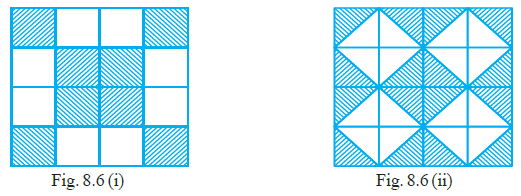
Question 74. In Fig. 8.6 (i) and Fig. 8.6 (ii), find the ratio of the area of the shaded portion to that of the whole figure:
Answer:
To Find:
Ratio of shaded area to total area for both figures.
Solution:
For Fig 8.6 (i):
Total number of small squares in the grid $= 4 \times 4 = 16$
Number of shaded squares $= 4 \text{ (corners)} + 4 \text{ (center)} = 8$
$\text{Ratio} = \frac{8}{16} = \frac{1}{2}$
Therefore, the ratio for Fig 8.6 (i) is $1 : 2$.
For Fig 8.6 (ii):
Total number of large squares $= 4$. Each large square is divided into 8 small triangles.
$\text{Total number of triangles} = 4 \times 8 = 32$
By observing the pattern, in every large square, exactly 4 out of 8 triangles are shaded.
$\text{Number of shaded triangles} = 4 \times 4 = 16$
Calculating the ratio:
$\text{Ratio} = \frac{16}{32} = \frac{1}{2}$
Therefore, the ratio for Fig 8.6 (ii) is $1 : 2$.
Question 75. A typist has to type a manuscript of 40 pages. She has typed 30 pages of the manuscript. What is the ratio of the number of pages typed to the number of pages left?
Answer:
Given:
Total number of pages = 40
Number of pages typed = 30
To Find:
The ratio of the number of pages typed to the number of pages left.
Solution:
Step 1: Calculate the number of pages left to be typed.
$\text{Pages left} = \text{Total pages} - \text{Typed pages}$
$\text{Pages left} = 40 - 30 = 10$
Step 2: Find the ratio of typed pages to pages left.
$\text{Ratio} = \frac{\text{Pages typed}}{\text{Pages left}}$
$\text{Ratio} = \frac{30}{10}$
Simplifying the fraction by dividing both terms by 10:
$\text{Ratio} = \frac{3}{1} = 3 : 1$
Therefore, the required ratio is $3 : 1$.
Question 76. In a floral design made from tiles each of dimensions 40cm by 60cm (See Fig. 8.7), find the ratios of:
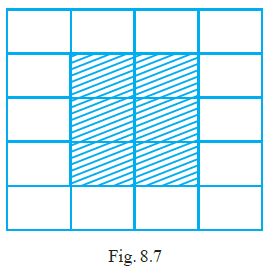
(a) the perimeter of shaded portion to the perimeter of the whole design.
(b) the area of the shaded portion to the area of the unshaded portion.
Answer:
Given:
Dimensions of the whole design $= 40 \text{ cm} \times 60 \text{ cm}$.
Total number of tiles in the design $= 20$.
Dimension of each rectangular tile $= 15 \text{ cm} \times 8 \text{ cm}$ (since $15 \times 4 = 60$ and $8 \times 5 = 40$).
The whole design is a grid of 5 tiles horizontally and 4 tiles vertically.
The shaded portion consists of 3 tiles horizontally and 2 tiles vertically.
Solution:
(a) Ratio of the perimeter of shaded portion to the perimeter of the whole design:
Let one unit along the breadth be represented by the side of a tile (8 cm) and one unit along the length by 15 cm.
Perimeter of whole design $= 2 \times (5 \text{ units} + 4 \text{ units}) = 18 \text{ units}$
Perimeter of shaded portion $= 2 \times (3 \text{ units} + 2 \text{ units}) = 10 \text{ units}$
Calculating the ratio:
Ratio $= \frac{10}{18}$
Ratio $= 5 : 9$
[Dividing by 2]
(b) Ratio of the area of the shaded portion to the area of the whole design:
The area can be represented by the number of tiles since all tiles are of identical dimensions.
Total number of tiles $= 5 \times 4 = 20$
Number of shaded tiles $= 3 \times 2 = 6$
Calculating the ratio of shaded area to the total area of the whole design:
Ratio $= \frac{6}{20}$
Ratio $= 3 : 10$
[Dividing by 2]
Conclusion:
(a) The ratio of the perimeters is $5 : 9$.
(b) The ratio of the shaded area to the total area is $3 : 10$.
Question 77. In Fig. 8.8, what is the ratio of the areas of
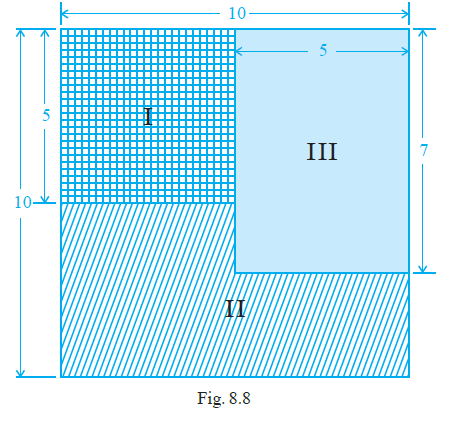
(a) shaded portion I to shaded portion II ?
(b) shaded portion II to shaded portion III?
(c) shaded portions I and II taken together and shaded portion III?
Answer:
Given:
From the given figure 8.8:
Total length of the square side $= 10$ units
Portion I: Length $= 5$, Breadth $= 5$
Portion III: Length $= 5$, Breadth $= 7$
To Find:
Ratios of areas of (a) I to II, (b) II to III, and (c) (I + II) to III.
Solution:
First, we calculate the area of each portion:
$\text{Total Area of the square} = 10 \times 10 = 100 \text{ sq units}$
$\text{Area of portion I} = 5 \times 5 = 25 \text{ sq units}$
…(i)
$\text{Area of portion III} = 5 \times 7 = 35 \text{ sq units}$
…(ii)
Now, we find the Area of portion II:
$\text{Area of II} = \text{Total Area} - (\text{Area of I} + \text{Area of III})$
$\text{Area of II} = 100 - (25 + 35) = 100 - 60$
$\text{Area of II} = 40 \text{ sq units}$
…(iii)
(a) Ratio of shaded portion I to shaded portion II:
$\text{Ratio} = \frac{25}{40}$
[Using (i) and (iii)]
$\text{Ratio} = \frac{5}{8}$
[Dividing by 5]
The ratio of I to II is $5 : 8$.
(b) Ratio of shaded portion II to shaded portion III:
$\text{Ratio} = \frac{40}{35}$
[Using (iii) and (ii)]
$\text{Ratio} = \frac{8}{7}$
[Dividing by 5]
The ratio of II to III is $8 : 7$.
(c) Ratio of shaded portions I and II taken together to shaded portion III:
$\text{Area of (I + II)} = 25 + 40 = 65 \text{ sq units}$
$\text{Ratio} = \frac{65}{35}$
$\text{Ratio} = \frac{13}{7}$
[Dividing by 5]
The ratio of (I + II) to III is $13 : 7$.
Question 78. A car can travel 240km in 15 litres of petrol. How much distance will it travel in 25 litres of petrol?
Answer:
Given:
Distance travelled with $15 \text{ litres}$ of petrol $= 240 \text{ km}$
To Find:
Distance travelled with $25 \text{ litres}$ of petrol.
Solution:
We will solve this using the unitary method.
First, we find the distance the car travels in $1 \text{ litre}$ of petrol:
$\text{Distance in } 1 \text{ litre} = \frac{240}{15}$
$\text{Distance in } 1 \text{ litre} = 16 \text{ km}$
Now, we find the distance the car travels in $25 \text{ litres}$ of petrol:
$\text{Distance in } 25 \text{ litres} = 16 \times 25$
$\text{Distance} = 400 \text{ km}$
The car will travel $400 \text{ km}$ in $25 \text{ litres}$ of petrol.
Question 79. Bachhu Manjhi earns Rs 24000 in 8 months. At this rate,
(a) how much does he earn in one year?
(b) in how many months does he earn Rs 42000?
Answer:
Given:
Total earnings in $8 \text{ months} = \textsf{₹} 24000$
Solution:
First, we calculate the earnings for $1 \text{ month}$:
$\text{Earnings in } 1 \text{ month} = \frac{24000}{8}$
$\text{Earnings per month} = \textsf{₹} 3000$
…(i)
(a) How much does he earn in one year?
We know that $1 \text{ year} = 12 \text{ months}$.
$\text{Earnings in } 12 \text{ months} = 3000 \times 12$
[Using (i)]
$\text{Total Earnings} = \textsf{₹} 36000$
Bachhu Manjhi earns $\textsf{₹} 36,000$ in one year.
(b) In how many months does he earn $\textsf{₹} 42000$?
$\text{Number of months} = \frac{\text{Target earnings}}{\text{Earnings per month}}$
$\text{Number of months} = \frac{42000}{3000}$
$\text{Time} = 14 \text{ months}$
He earns $\textsf{₹} 42,000$ in $14 \text{ months}$.
Question 80. The yield of wheat from 8 hectares of land is 360 quintals. Find the number of hectares of land required for a yield of 540 quintals?
Answer:
Given:
Yield from $8 \text{ hectares} = 360 \text{ quintals}$
To Find:
Land area required for a yield of $540 \text{ quintals}$.
Solution:
We will solve this using the unitary method.
First, we find the area required for $1 \text{ quintal}$ of yield:
$\text{Land for } 1 \text{ quintal} = \frac{8}{360} \text{ hectares}$
$\text{Land for } 1 \text{ quintal} = \frac{1}{45} \text{ hectares}$
…(i)
Now, calculate the land required for $540 \text{ quintals}$:
$\text{Total Land Area} = \frac{1}{45} \times 540$
[Using (i)]
$\text{Total Land Area} = 12 \text{ hectares}$
[$45 \times 12 = 540$]
Therefore, $12 \text{ hectares}$ of land is required for a yield of $540 \text{ quintals}$.
Question 81. The earth rotates 360o about its axis in about 24 hours. By how much degree will it rotate in 2 hours?
Answer:
Given:
Rotation of the earth in 24 hours = $360^\circ$
To Find:
Degree of rotation in 2 hours.
Solution:
We use the unitary method to find the rotation per hour first.
Rotation in 24 hours $= 360^\circ$
Rotation in 1 hour $= \frac{360^\circ}{24}$
Rotation in 1 hour $= 15^\circ$
... (i)
Now, we find the rotation for 2 hours:
Rotation in 2 hours $= 15^\circ \times 2$
[From (i)]
Rotation in 2 hours $= 30^\circ$
Answer: The earth will rotate by $30^\circ$ in 2 hours.
Question 82. Shivangi is suffering from anaemia as haemoglobin level in her blood is lower than the normal range. Doctor advised her to take one iron tablet two times a day. If the cost of 10 tablets is Rs 17, then what amount will she be required to pay for her medical bill for 15 days?
Answer:
Given:
Dosage = 1 tablet, twice a day
Duration = 15 days
Cost of 10 tablets = $\textsf{₹} 17$
To Find:
Total amount to be paid for 15 days.
Solution:
Step 1: Find the total number of tablets required for 15 days.
Tablets per day $= 1 \times 2 = 2$
Total tablets for 15 days $= 2 \times 15 = 30$
... (i)
Step 2: Find the cost of one tablet.
Cost of 10 tablets $= \textsf{₹} 17$
Cost of 1 tablet $= \textsf{₹} \frac{17}{10} = \textsf{₹} 1.70$
... (ii)
Step 3: Calculate the total medical bill.
Total Bill $= \text{Total tablets} \times \text{Cost per tablet}$
Total Bill $= 30 \times 1.70$
[From (i) and (ii)]
Total Bill $= \textsf{₹} 51$
Answer: Shivangi will be required to pay $\textsf{₹} 51$ for her medical bill.
Question 83. The quarterly school fee in Kendriya Vidyalaya for Class VI is Rs 540. What will be the fee for seven months?
Answer:
Given:
Quarterly fee (for 3 months) = $\textsf{₹} 540$
To Find:
Fee for seven months.
Solution:
Step 1: Calculate the fee for one month.
Fee for 3 months $= \textsf{₹} 540$
Fee for 1 month $= \textsf{₹} \frac{540}{3}$
Fee for 1 month $= \textsf{₹} 180$
... (i)
Step 2: Calculate the fee for seven months.
Fee for 7 months $= 180 \times 7$
[From (i)]
Fee for 7 months $= \textsf{₹} 1260$
Answer: The school fee for seven months will be $\textsf{₹} 1260$.
Question 84. In an election, the votes cast for two of the candidates were in the ratio 5 : 7. If the successful candidate received 20734 votes, how many votes did his opponent receive?
Answer:
Given:
Ratio of votes cast $= 5 : 7$
Votes of the successful candidate $= 20734$
To Find:
Number of votes received by the opponent.
Solution:
In the ratio $5 : 7$, the higher number (7) corresponds to the successful candidate and the lower number (5) corresponds to the opponent.
Let the total votes be represented in terms of $x$.
Votes of successful candidate $= 7x$
$7x = 20734$
$x = \frac{20734}{7}$
$x = 2962$
... (i)
Now, calculate the opponent's votes:
Opponent's votes $= 5x$
Opponent's votes $= 5 \times 2962$
[From (i)]
Opponent's votes $= 14810$
Answer: The opponent received 14810 votes.
Question 85. A metal pipe 3 metre long was found to weigh 7.6 kg. What would be the weight of the same kind of 7.8 m long pipe?
Answer:
Given:
Weight of 3 m pipe = $7.6 \text{ kg}$
Length of the new pipe = $7.8 \text{ m}$
To Find:
Weight of the 7.8 m long pipe.
Solution:
We use the unitary method to find the weight per metre of the pipe.
Weight of 3 m pipe $= 7.6 \text{ kg}$
Weight of 1 m pipe $= \frac{7.6}{3} \text{ kg}$
... (i)
Now, calculate the weight for 7.8 m:
Weight of 7.8 m pipe $= \frac{7.6}{3} \times 7.8$
Weight $= 7.6 \times 2.6$
[Dividing 7.8 by 3]
Weight $= 19.76 \text{ kg}$
Answer: The weight of the 7.8 m long pipe would be 19.76 kg.
Question 86. A recipe for raspberry jelly calls for 5 cups of raspberry juice and $2\frac{1}{2}$ cups of sugar. Find the amount of sugar needed for 6 cups of the juice?
Answer:
Given:
Quantity of raspberry juice $= 5$ cups
Quantity of sugar $= 2\frac{1}{2}$ cups $= 2.5$ cups
To Find:
Amount of sugar needed for 6 cups of raspberry juice.
Solution:
We can solve this using the unitary method.
First, let's find the amount of sugar required for 1 cup of raspberry juice:
Sugar for $5$ cups $= 2.5$ cups
Sugar for $1$ cup $= \frac{2.5}{5}$ cups
Sugar for $1$ cup $= 0.5$ cups
... (i)
Now, calculate the sugar needed for 6 cups of juice:
Sugar for $6$ cups $= 0.5 \times 6$
[From (i)]
Sugar for $6$ cups $= 3$ cups
Answer: 3 cups of sugar are needed for 6 cups of juice.
Question 87. A farmer planted 1890 tomato plants in a field in rows each having 63 plants. A certain type of worm destroyed 18 plants in each row. How many plants did the worm destroy in the whole field?
Answer:
Given:
Total number of tomato plants $= 1890$
Number of plants in each row $= 63$
Number of plants destroyed per row $= 18$
To Find:
Total number of plants destroyed in the whole field.
Solution:
Step 1: Calculate the total number of rows in the field.
Number of rows $= \frac{\text{Total plants}}{\text{Plants per row}}$
Number of rows $= \frac{1890}{63}$
Number of rows $= 30$
... (i)
Step 2: Calculate the total number of plants destroyed.
Total destroyed $= \text{Number of rows} \times \text{Destroyed per row}$
Total destroyed $= 30 \times 18$
[From (i)]
Total destroyed $= 540$
Answer: The worm destroyed 540 plants in the whole field.
Question 88. Length and breadth of the floor of a room are 5m and 3m, respectively. forty tiles, each with area $\frac{1}{16}$ m2 are used to cover the floor partially. Find the ratio of the tiled and the non tiled portion of the floor.
Answer:
Given:
Length of the floor $= 5$ m
Breadth of the floor $= 3$ m
Number of tiles used $= 40$
Area of each tile $= \frac{1}{16} \text{ m}^2$
To Find:
Ratio of the tiled portion to the non-tiled portion of the floor.
Solution:
Step 1: Calculate the total area of the floor.
Area of floor $= 5 \times 3 = 15 \text{ m}^2$
Step 2: Calculate the total area covered by the tiles (tiled portion).
Tiled area $= 40 \times \frac{1}{16}$
Tiled area $= \frac{\cancel{40}^{5}}{\cancel{16}_{2}} = 2.5 \text{ m}^2$
Step 3: Calculate the area of the non-tiled portion.
Non-tiled area $= \text{Total area} - \text{Tiled area}$
Non-tiled area $= 15 - 2.5 = 12.5 \text{ m}^2$
Step 4: Find the ratio of tiled area to non-tiled area.
Ratio $= \frac{2.5}{12.5}$
Ratio $= \frac{25}{125} = \frac{1}{5}$
Answer: The ratio of the tiled portion to the non-tiled portion is $1 : 5$.
Question 89. A carpenter had a board which measured 3m × 2m. She cut out a rectangular piece of 250 cm × 90 cm. What is the ratio of the area of cut out piece and the remaining piece?
Answer:
Given:
Dimensions of the original board $= 3$ m $\times 2$ m
Dimensions of the cut-out piece $= 250$ cm $\times 90$ cm
To Find:
Ratio of the area of the cut-out piece to the remaining piece.
Solution:
Let's convert all dimensions to metres for consistency.
Length of cut piece $= \frac{250}{100} = 2.5$ m
Breadth of cut piece $= \frac{90}{100} = 0.9$ m
Step 1: Calculate the area of the original board.
Area of board $= 3 \times 2 = 6 \text{ m}^2$
Step 2: Calculate the area of the cut-out piece.
Area of cut-out $= 2.5 \times 0.9 = 2.25 \text{ m}^2$
Step 3: Calculate the area of the remaining piece.
Area remaining $= 6 - 2.25 = 3.75 \text{ m}^2$
Step 4: Find the ratio of the cut-out piece area to the remaining piece area.
Ratio $= \frac{2.25}{3.75}$
Multiply both by 100 to remove decimals:
Ratio $= \frac{225}{375}$
Dividing by HCF $75$:
Ratio $= \frac{3}{5} = 3 : 5$
Answer: The ratio is $3 : 5$.