
Chapter 9 Symmetry & Practical Geometry (Class 6 - Maths NCERT Exemplar Solutions)
Welcome to the dedicated resource for NCERT Exemplar Solutions for Class 6 Mathematics: Chapter 9 Symmetry & Practical Geometry! This section is designed to significantly enhance students' spatial visualization skills and precision in geometric drawing. These Exemplar problems move beyond standard textbook exercises, offering a deeper exploration of geometric properties through the analysis of symmetrical patterns and the execution of fundamental constructions using specific mathematical tools.
In the realm of Symmetry, the solutions meticulously address the identification of lines of symmetry (mirror lines) in various shapes, including regular polygons, circles, and letters of the alphabet. Students will learn to analyze complex figures to determine if they possess single or multiple lines of symmetry and develop the skill to complete figures when only a partial shape and its line of symmetry are provided, essentially mastering the concept of the mirror image.
The Practical Geometry section focuses on the art of accurate construction using only an ungraduated ruler and a pair of compasses. Key constructions include creating line segments, perpendicular bisectors, and angle bisectors. Students will also learn to construct specific angles such as $60^\circ$, $30^\circ$, $90^\circ$, and $45^\circ$ with high precision. By following the sequential instructions and logical justifications prepared by learningspot.co, students can master accuracy and neatness in their geometrical work, building a strong foundation for advanced engineering and design concepts.
| Content On This Page | ||
|---|---|---|
| Solved Examples (Examples 1 to 11) | Question 1 to 17 (Multiple Choice Questions) | Question 18 to 42 (Fill in the Blanks) |
| Question 43 to 61 (True or False) | Question 62 to 89 | |
Solved Examples (Examples 1 to 11)
In examples 1 and 2, out of four given options, only one is correct. Write the correct answer.
Example 1: Which of the following letters does not have any line of symmetry?
(A) E
(B) T
(C) N
(D) X
Answer:
Correct Option: (C)
Explanation:
A line of symmetry is a line that divides a figure into two identical halves that are mirror images of each other.
1. E has one horizontal line of symmetry.
2. T has one vertical line of symmetry.
3. X has both vertical and horizontal lines of symmetry.
4. N does not have any line of symmetry (it only has rotational symmetry).
Final Answer: The letter N does not have any line of symmetry.
Example 2: Which of the following angles cannot be constructed using ruler and compasses?
(A) 75°
(B) 15°
(C) 135°
(D) 85°
Answer:
Correct Option: (D)
Explanation:
Using a ruler and compasses, we can construct angles that are multiples of $15^\circ$ (such as $15^\circ, 30^\circ, 45^\circ, 60^\circ, 75^\circ, 90^\circ, 105^\circ, 120^\circ, 135^\circ, 150^\circ,$ etc.) or angles obtained by further bisecting these.
1. $75^\circ$ can be constructed (bisecting the angle between $60^\circ$ and $90^\circ$).
2. $15^\circ$ can be constructed (bisecting $30^\circ$).
3. $135^\circ$ can be constructed (bisecting the angle between $90^\circ$ and $180^\circ$).
4. $85^\circ$ is not a multiple of $15$ and cannot be reached by standard bisection methods.
Final Answer: $85^\circ$ cannot be constructed using ruler and compasses.
In examples 3 to 5, fill in the blanks so that the statements are true:
Example 3: If B is the image of A in line l and D is the image of C in line l, then AC = _________.
Answer:
Answer: $BD$
Explanation:
Symmetry (reflection in a line) is a transformation that preserves distances between points. This means the distance between any two original points is equal to the distance between their corresponding image points.
$A \rightarrow B$
(Image of A is B)
$C \rightarrow D$
(Image of C is D)
Since reflection preserves distance, the length of segment $AC$ must be equal to the length of segment $BD$.
Final Answer: $AC = BD$
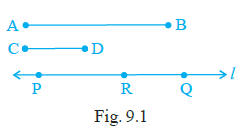
Example 4: In Fig. 9.1, the line segments PQ and RQ have been marked on a line l such that PQ = AB and RQ = CD.
Then AB – CD =__________.
Answer:
Answer: $PR$
Explanation:
From the given figure 9.1, the points $P, R,$ and $Q$ lie on the same line $l$. We can see that the segment $PQ$ is made up of segments $PR$ and $RQ$.
$PQ = PR + RQ$
Subtracting $RQ$ from both sides:
$PR = PQ - RQ$
Given that:
$PQ = AB$
(Given)
$RQ = CD$
(Given)
Substituting these values into the equation:
$PR = AB - CD$
Final Answer: $AB - CD = PR$
Example 5: The number of scales in a protractor for measuring the angles is __________.
Answer:
Answer: two
Explanation:
A standard semicircular protractor used in geometry sets has two scales.
1. The Outer Scale: It reads from $0^\circ$ to $180^\circ$ in a clockwise direction (from left to right).
2. The Inner Scale: It reads from $0^\circ$ to $180^\circ$ in an anti-clockwise direction (from right to left).
These two scales allow us to measure angles starting from either the left side or the right side of the baseline.
Final Answer: The number of scales is two.
In examples 6 and 7, state whether the statements are true or false:
Example 6: Using the set squares 30° – 60° – 90° and 45° – 45° – 90°, we can draw an angle of 75°.
Answer:
Statement: True
Explanation:
We can construct various angles by placing two set squares together. To draw an angle of $75^\circ$, we can use the $30^\circ$ angle from the first set square and the $45^\circ$ angle from the second set square.
$30^\circ + 45^\circ = 75^\circ$
By placing these two angles adjacent to each other at a common vertex and along a common arm, the resulting outer arms will form a $75^\circ$ angle.
Final Answer: The statement is True.
Example 7: A circle has only 8 lines of symmetry.
Answer:
Statement: False
Explanation:
A line of symmetry of a circle is any line that passes through its centre (i.e., its diameter). Since we can draw an infinite number of diameters through the centre of a circle, it possesses an infinite number of lines of symmetry.
Final Answer: The statement is False as a circle has infinitely many lines of symmetry.
Example 8: Write the letters of the word ALGEBRA which have no line of symmetry
Answer:
Given:
The word ALGEBRA.
To Find:
Letters of this word which have no line of symmetry.
Solution:
Let us examine each letter of the word ALGEBRA individually:
1. A: Has one vertical line of symmetry.
2. L: Has no line of symmetry.
3. G: Has no line of symmetry.
4. E: Has one horizontal line of symmetry.
5. B: Has one horizontal line of symmetry.
6. R: Has no line of symmetry.
7. A: Has one vertical line of symmetry.
The letters that do not have any line of symmetry are L, G, and R.
Final Answer: The letters are L, G, and R.
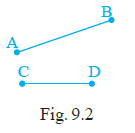
Example 9: Draw a line segment equal to the sum of two line segments given in Fig. 9.2
Answer:
Given:
Two line segments $AB$ and $CD$ as shown in Fig. 9.2.
To Construct:
A line segment whose length is equal to the sum of $AB$ and $CD$.
Construction Required:
1. Draw a line $l$ and mark a point $P$ on it.
2. Open the compasses to measure the length of the segment $AB$.
3. Without changing the settings of the compasses, place the pointer at $P$ and draw an arc to cut the line $l$ at point $Q$. Now, $PQ = AB$.
4. Again, open the compasses to measure the length of the segment $CD$.
5. Place the pointer of the compasses at $Q$ and draw another arc on the line $l$ (on the side opposite to $P$) to cut it at point $R$. Now, $QR = CD$.
6. The resulting line segment $PR$ is the required segment.
$PR = PQ + QR$
$PR = AB + CD$

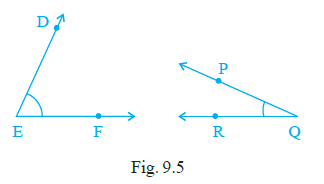
Example 10: Draw an angle equal to the difference of two angles given in Fig. 9.5.
Answer:
Given:
Two angles $\angle DEF$ and $\angle PQR$ are given in Fig. 9.5. By observation, we can see that:
$\angle DEF > \angle PQR$
To Construct:
An angle equal to the difference $(\angle DEF - \angle PQR)$.
Construction Required:
1. Draw a ray $OX$.
2. Copy the larger angle: Place the pointer of the compasses at vertex $E$ of $\angle DEF$ and draw an arc cutting the arms $ED$ and $EF$. Without changing the radius, place the pointer at $O$ and draw a similar arc cutting $OX$ at a point $A$.
3. Measure the width of the arc of $\angle DEF$ using the compasses. Place the pointer at $A$ and cut the previous arc at point $B$. Join $OB$ to form ray $OY$.
$\angle XOY = \angle DEF$
(By construction)
4. Copy the smaller angle inside: Now, take the width of the arc of the smaller angle $\angle PQR$ using the compasses.
5. Place the pointer of the compasses at $A$ and cut the arc $AB$ at a point $C$ towards the ray $OY$.
6. Join $OC$ to form ray $OZ$. This ray $OZ$ lies inside the angle $\angle XOY$.
$\angle XOZ = \angle PQR$
(By construction)
7. The remaining angle $\angle ZOY$ is the required difference.

Example 11: Complete Fig. 9.7 so that l is the line of symmetry of the completed figure.

Answer:
Given:
A partial figure and a line $l$ as the line of symmetry in Fig. 9.7.
Solution:
To complete the figure so that $l$ is the line of symmetry, we must draw the mirror image of the given part on the other side of line $l$.
1. Identify the key vertices (points) of the given figure.
2. For each vertex, find a corresponding point on the opposite side of line $l$ such that both points are at the same perpendicular distance from $l$.
3. Join these new points in the same order as the original figure to complete the symmetric shape.

Exercise
Question 1 to 17 (Multiple Choice Questions)
In questions 1 to 17, out of the given four options, only one is correct. Write the correct answer.
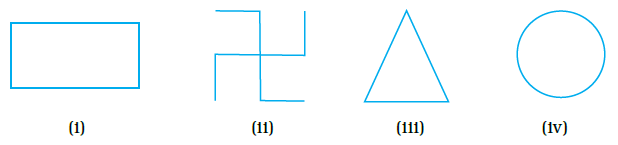
Question 1. In the following figures, the figure that is not symmetric with respect to any line is:
(A) (i)
(B) (ii)
(C) (iii)
(D) (iv)
Answer:
Correct Option: (B)
Explanation:
1. Figure (i) is a rectangle. It has two lines of symmetry (one horizontal and one vertical).
2. Figure (ii) is a swastika-like shape. If we try to fold it along any line passing through its centre, the two parts will not coincide. Therefore, it has no line of symmetry.
3. Figure (iii) is an isosceles triangle. It has one vertical line of symmetry passing through the vertex between the equal sides.
4. Figure (iv) is a circle. It has infinitely many lines of symmetry (any line passing through its centre).
Final Answer: Figure (ii) is not symmetric with respect to any line.
Question 2. The number of lines of symmetry in a scalene triangle is
(A) 0
(B) 1
(C) 2
(D) 3
Answer:
Correct Option: (A)
Explanation:
A scalene triangle is a triangle where all three sides have different lengths and all three internal angles have different measures. Because there is no equality between any sides or angles, there is no line along which the triangle can be folded to obtain two matching halves.
Final Answer: The number of lines of symmetry in a scalene triangle is $0$.
Question 3. The number of lines of symmetry in a circle is
(A) 0
(B) 2
(C) 4
(D) more than 4
Answer:
Correct Option: (D)
Explanation:
A circle is perfectly symmetrical about any line that passes through its centre. Such lines are the diameters of the circle. Since infinitely many diameters can be drawn in a circle, it has infinitely many lines of symmetry. Out of the given options, "more than 4" best describes this infinite property.
Final Answer: The number of lines of symmetry in a circle is more than 4.
Question 4. Which of the following letters does not have the vertical line of symmetry?
(A) M
(B) H
(C) E
(D) V
Answer:
Correct Option: (C)
Explanation:
1. M has a vertical line of symmetry.
2. H has both vertical and horizontal lines of symmetry.
3. E has only a horizontal line of symmetry. A vertical line through its centre would result in different left and right halves.
4. V has a vertical line of symmetry.
Final Answer: The letter E does not have a vertical line of symmetry.
Question 5. Which of the following letters have both horizontal and vertical lines of symmetry?
(A) X
(B) E
(C) M
(D) K
Answer:
Correct Option: (A)
Explanation:
1. X can be folded both vertically and horizontally into identical halves.
2. E has only a horizontal line of symmetry.
3. M has only a vertical line of symmetry.
4. K usually has only a horizontal line of symmetry.
Final Answer: The letter X has both horizontal and vertical lines of symmetry.
Question 6. Which of the following letters does not have any line of symmetry?
(A) M
(B) S
(C) K
(D) H
Answer:
Correct Option: (B)
Explanation:
1. M has one line of symmetry (vertical).
2. S does not have any line of symmetry. Even though it looks balanced, if you fold it along any axis, the parts will not match exactly. It only has rotational symmetry.
3. K has one line of symmetry (horizontal).
4. H has two lines of symmetry (vertical and horizontal).
Final Answer: The letter S does not have any line of symmetry.
Question 7. Which of the following letters has only one line of symmetry?
(A) H
(B) X
(C) Z
(D) T
Answer:
Correct Option: (D)
Explanation:
Let us analyze the lines of symmetry for each letter:
1. H has two lines of symmetry (one vertical and one horizontal).
2. X has two lines of symmetry (one vertical and one horizontal).
3. Z has no lines of symmetry (it only has rotational symmetry).
4. T has only one line of symmetry, which is a vertical line passing through its center.
Final Answer: The letter T has only one line of symmetry.
Question 8. The instrument to measure an angle is a
(A) Ruler
(B) Protractor
(C) Divider
(D) Compasses
Answer:
Correct Option: (B)
Explanation:
1. Ruler is used to draw straight lines and measure lengths.
2. Protractor is a semi-circular instrument used specifically to measure and draw angles in degrees.
3. Divider is used to compare lengths of line segments.
4. Compasses are used to draw circles and arcs.
Final Answer: The instrument to measure an angle is a Protractor.
Question 9. The instrument to draw a circle is
(A) Ruler
(B) Protractor
(C) Divider
(D) Compasses
Answer:
Correct Option: (D)
Explanation:
To draw a circle, we need an instrument with a fixed pointer and a moving pencil arm to maintain a constant radius. This instrument is called Compasses.
Final Answer: The instrument to draw a circle is Compasses.
Question 10. Number of set squares in the geometry box is
(A) 0
(B) 1
(C) 2
(D) 3
Answer:
Correct Option: (C)
Explanation:
In a standard Indian geometry box, there are two set squares:
1. One with angles $45^\circ$, $45^\circ$ and $90^\circ$.
2. Another with angles $30^\circ$, $60^\circ$ and $90^\circ$.
Final Answer: The number of set squares is $2$.
Question 11. The number of lines of symmetry in a ruler is
(A) 0
(B) 1
(C) 2
(D) 4
Answer:
Correct Option: (C)
Explanation:
A standard ruler is rectangular in shape. A rectangle has two lines of symmetry:
1. One line passing through the mid-points of the longer sides (vertical symmetry).
2. One line passing through the mid-points of the shorter sides (horizontal symmetry).
Final Answer: The number of lines of symmetry in a ruler is $2$.
Question 12. The number of lines of symmetry in a divider is
(A) 0
(B) 1
(C) 2
(D) 3
Answer:
Correct Option: (B)
Explanation:
A divider, when its arms are kept equal, is symmetrical about a single line. This line passes through the hinge (vertex) and bisects the angle between the two arms.
Final Answer: The number of lines of symmetry in a divider is $1$.
Question 13. The number of lines of symmetry in compasses is
(A) 0
(B) 1
(C) 2
(D) 3
Answer:
Correct Option: (A)
Explanation:
Compasses consist of two different arms: one arm has a sharp metal needle at the end, while the other arm is designed to hold a pencil. Since these two arms are not identical in shape or appearance, the instrument is asymmetrical.
Final Answer: The number of lines of symmetry in compasses is 0.
Question 14. The number of lines of symmetry in a protractor is
(A) 0
(B) 1
(C) 2
(D) more than 2
Answer:
Correct Option: (B)
Explanation:
A protractor is semi-circular in shape. A semi-circle is symmetrical about exactly one line, which is the perpendicular bisector of its diameter. This line passes through the $90^\circ$ mark on the protractor.
Final Answer: The number of lines of symmetry in a protractor is 1.
Question 15. The number of lines of symmetry in a $45^o - 45^o - 90^o$ set-square is
(A) 0
(B) 1
(C) 2
(D) 3
Answer:
Correct Option: (B)
Explanation:
A $45^\circ - 45^\circ - 90^\circ$ set-square is an isosceles right-angled triangle because it has two equal angles (and thus two equal sides). Any isosceles triangle has exactly one line of symmetry, which bisects the angle between the equal sides.
Final Answer: The number of lines of symmetry in a $45^\circ - 45^\circ - 90^\circ$ set-square is 1.
Question 16. The number of lines of symmetry in a $30^o - 60^o - 90^o$ set square is
(A) 0
(B) 1
(C) 2
(D) 3
Answer:
Correct Option: (A)
Explanation:
A $30^\circ - 60^\circ - 90^\circ$ set-square is a scalene triangle because all three of its angles are different, which means all three of its sides are also of different lengths. A scalene triangle does not have any lines of symmetry.
Final Answer: The number of lines of symmetry in a $30^\circ - 60^\circ - 90^\circ$ set-square is 0.
Question 17. The instrument in the geometry box having the shape of a triangle is called a
(A) Protractor
(B) Compasses
(C) Divider
(D) Set-square
Answer:
Correct Option: (D)
Explanation:
In a standard geometry box, the instruments that are shaped like right-angled triangles are known as Set-squares. They are used to draw parallel and perpendicular lines as well as specific angles.
Final Answer: The triangular instrument is called a Set-square.
Question 18 to 42 (Fill in the Blanks)
In questions 18 to 42, fill in the blanks to make the statements true.
Question 18. The distance of the image of a point (or an object) from the line of symmetry (mirror) is ________ as that of the point (object) from the line (mirror).
Answer:
Solution:
In reflection symmetry, the line of symmetry acts as a mirror. A fundamental property of reflection is that the object and its image are at the same perpendicular distance from the mirror line.
Final Answer: The distance of the image of a point (or an object) from the line of symmetry (mirror) is same as that of the point (object) from the line (mirror).
Question 19. The number of lines of symmetry in a picture of Taj Mahal is _______.
Answer:
Solution:
The Taj Mahal is a world-renowned example of architectural symmetry. A frontal photograph of the Taj Mahal shows a clear bilateral symmetry. If we draw a vertical line through the center of the main dome, the left and right halves of the picture are identical mirror images.
Final Answer: The number of lines of symmetry in a picture of Taj Mahal is one.
Question 20. The number of lines of symmetry in a rectangle and a rhombus are ______ (equal/unequal).
Answer:
Solution:
A rectangle has $2$ lines of symmetry (the lines joining the midpoints of opposite sides).
A rhombus also has $2$ lines of symmetry (its two diagonals).
Since both figures have the same number of lines of symmetry, the counts are equal.
Final Answer: The number of lines of symmetry in a rectangle and a rhombus are equal.
Question 21. The number of lines of symmetry in a rectangle and a square are______ (equal/unequal).
Answer:
Solution:
A rectangle has $2$ lines of symmetry.
A square has $4$ lines of symmetry (two joining midpoints of opposite sides and two diagonals).
Since $2$ is not equal to $4$, the counts are unequal.
Final Answer: The number of lines of symmetry in a rectangle and a square are unequal.
Question 22. If a line segment of length 5cm is reflected in a line of symmetry (mirror), then its reflection (image) is a ______ of length _______.
Answer:
Solution:
Reflection is a transformation that preserves the shape and size (congruence) of an object. When a line segment is reflected, its image remains a line segment of the exact same length.
Final Answer: If a line segment of length $5\text{ cm}$ is reflected in a line of symmetry (mirror), then its reflection (image) is a line segment of length $5\text{ cm}$.
Question 23. If an angle of measure 80o is reflected in a line of symmetry, then the reflection is an ______ of measure _______.
Answer:
Solution:
Reflection in a line preserves the magnitude of angles. If an object is an angle of a certain measure, its mirror image will also be an angle of the same measure.
Final Answer: If an angle of measure $80^\circ$ is reflected in a line of symmetry, then the reflection is an angle of measure $80^\circ$.
Question 24. The image of a point lying on a line l with respect to the line of symmetry l lies on _______.
Answer:
Explanation:
In reflection symmetry, the line of symmetry $l$ acts as a mirror. If a point is located exactly on the mirror line, its mirror image will be produced at the same location as the point itself. Such points are called invariant points.
Final Answer: The image of a point lying on a line $l$ with respect to the line of symmetry $l$ lies on $l$ itself (or the same line).
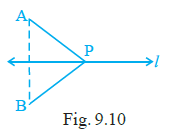
Question 25. In Fig. 9.10, if B is the image of the point A with respect to the line l and P is any point lying on l, then the lengths of line segments PA and PB are _______.
Answer:
Given:
From Fig. 9.10, $B$ is the image of the point $A$ with respect to the line $l$. Point $P$ is any point lying on the line $l$.
Solution:
When point $B$ is the image of point $A$ with respect to line $l$, the line $l$ is the perpendicular bisector of the line segment $AB$. According to the properties of a perpendicular bisector, any point lying on it is equidistant from the two endpoints of the segment.
$PA = PB$
(Property of Perpendicular Bisector)
Final Answer: The lengths of line segments $PA$ and $PB$ are equal.
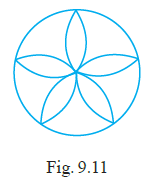
Question 26. The number of lines of symmetry in Fig. 9.11 is__________.
Answer:
Solution:
The figure 9.11 represents a circular shape containing a flower with five identical petals. For any regular arrangement of five identical parts around a center, there are five lines of symmetry. Each line passes through the center of the circle and the tip of one of the five petals.
Final Answer: The number of lines of symmetry in Fig. 9.11 is $5$.
Question 27. The common properties in the two set-squares of a geometry box are that they have a __________ angle and they are of the shape of a __________.
Answer:
Solution:
In a standard geometry box, there are two triangular instruments called set-squares. The first one has angles $30^\circ, 60^\circ, 90^\circ$ and the second one has angles $45^\circ, 45^\circ, 90^\circ$.
Both instruments share a common $90^\circ$ angle and both are triangular in their physical shape.
Final Answer: The common properties in the two set-squares of a geometry box are that they have a $90^\circ$ (or right) angle and they are of the shape of a triangle.
Question 28. The digits having only two lines of symmetry are_________ and __________.
Answer:
Solution:
Let us examine the digits $0, 1, 2, 3, 4, 5, 6, 7, 8, 9$ for symmetry. In standard block form:
1. The digit $0$ has two lines of symmetry (one horizontal and one vertical).
2. The digit $8$ has two lines of symmetry (one horizontal and one vertical).
Final Answer: The digits having only two lines of symmetry are $0$ and $8$.
Question 29. The digit having only one line of symmetry is __________.
Answer:
Solution:
Reviewing the digits for a single line of symmetry, we find that the digit $3$ is symmetrical about a single horizontal line passing through its middle.
Final Answer: The digit having only one line of symmetry is $3$.
Question 30. The number of digits having no line of symmetry is_________.
Answer:
Solution:
The digits that do not have any line of symmetry (neither vertical nor horizontal) are $1, 2, 4, 5, 6, 7,$ and $9$.
Counting these digits, we have a total of $7$ such digits.
Final Answer: The number of digits having no line of symmetry is $7$.
Question 31. The number of capital letters of the English alphabets having only vertical line of symmetry is ________.
Answer:
Explanation:
To find the letters having only a vertical line of symmetry, we list all letters with vertical symmetry and exclude those that also have horizontal symmetry. The letters with vertical symmetry are: A, H, I, M, O, T, U, V, W, X, Y (Total 11). Out of these, H, I, O, and X also have horizontal symmetry.
Letters with only vertical symmetry: A, M, T, U, V, W, Y.
$\text{Count} = 11 - 4$
$\text{Count} = 7$
Final Answer: The number of capital letters having only vertical line of symmetry is $7$.
Question 32. The number of capital letters of the English alphabets having only horizontal line of symmetry is________.
Answer:
Explanation:
The letters with horizontal symmetry are: B, C, D, E, H, I, K, O, X (Total 9). We exclude those that also have vertical symmetry (H, I, O, X).
Letters with only horizontal symmetry: B, C, D, E, K.
$\text{Count} = 9 - 4$
$\text{Count} = 5$
Final Answer: The number of capital letters having only horizontal line of symmetry is $5$.
Question 33. The number of capital letters of the English alphabets having both horizontal and vertical lines of symmetry is________.
Answer:
Explanation:
These are the letters that can be folded both vertically and horizontally to yield identical halves. These letters are H, I, O, and X.
Final Answer: The number of capital letters having both horizontal and vertical lines of symmetry is $4$.
Question 34. The number of capital letters of the English alphabets having no line of symmetry is__________.
Answer:
Explanation:
We subtract the letters with any symmetry from the total number of alphabets ($26$).
Letters with no line of symmetry: F, G, J, L, N, P, Q, R, S, Z.
$\text{Count} = 26 - (7 + 5 + 4)$
$\text{Count} = 26 - 16 = 10$
Final Answer: The number of capital letters having no line of symmetry is $10$.
Question 35. The line of symmetry of a line segment is the ________ bisector of the line segment.
Answer:
Explanation:
The line of symmetry of a line segment divides the segment into two equal parts and meets it at a right angle ($90^\circ$). This specific line is known as the perpendicular bisector.
Final Answer: The line of symmetry of a line segment is the perpendicular bisector of the line segment.
Question 36. The number of lines of symmetry in a regular hexagon is __________.
Answer:
Explanation:
For any regular polygon with $n$ sides, the number of lines of symmetry is equal to $n$. A regular hexagon has $6$ equal sides and $6$ equal angles.
The lines of symmetry consist of $3$ lines passing through opposite vertices and $3$ lines passing through the midpoints of opposite sides.
Final Answer: The number of lines of symmetry in a regular hexagon is $6$.
Question 37. The number of lines of symmetry in a regular polygon of n sides is_______.
Answer:
Explanation:
A regular polygon is a polygon that is both equilateral (all sides equal) and equiangular (all angles equal). For any regular polygon with $n$ sides, the number of lines of symmetry is always equal to the number of its sides. For example, an equilateral triangle has $3$ lines of symmetry and a square has $4$ lines of symmetry.
Final Answer: The number of lines of symmetry in a regular polygon of $n$ sides is $n$.
Question 38. A protractor has __________ line/lines of symmetry.
Answer:
Explanation:
A protractor is semi-circular in shape. A semi-circle has exactly one line of symmetry, which is the perpendicular bisector of its base (diameter). In a protractor, this line passes through the $90^\circ$ mark.
Final Answer: A protractor has one line of symmetry.
Question 39. A 30o - 60o - 90o set-square has ________ line/lines of symmetry.
Answer:
Explanation:
A $30^\circ - 60^\circ - 90^\circ$ set-square is a scalene triangle. Since all three angles are different, all three sides are also of different lengths. A scalene triangle does not possess any lines of symmetry.
Final Answer: A $30^\circ - 60^\circ - 90^\circ$ set-square has no (or zero) line of symmetry.
Question 40. A 45o - 45o - 90o set-square has _______ line/lines of symmetry.
Answer:
Explanation:
A $45^\circ - 45^\circ - 90^\circ$ set-square is an isosceles right-angled triangle. Since it has two equal angles, the sides opposite to those angles are also equal. Any isosceles triangle has exactly one line of symmetry passing through the vertex of the unequal angle.
Final Answer: A $45^\circ - 45^\circ - 90^\circ$ set-square has one line of symmetry.
Question 41. A rhombus is symmetrical about _________.
Answer:
Explanation:
A rhombus is a quadrilateral where all sides are equal. The lines of symmetry for a rhombus are the lines containing its diagonals. Folding the rhombus along either diagonal results in two parts that coincide perfectly.
Final Answer: A rhombus is symmetrical about its diagonals.
Question 42. A rectangle is symmetrical about the lines joining the _________ of the opposite sides.
Answer:
Explanation:
A rectangle has two lines of symmetry. These lines are formed by connecting the middle points of the opposite parallel sides. Folding a rectangle along these lines divides it into two identical mirror images.
Final Answer: A rectangle is symmetrical about the lines joining the midpoints of the opposite sides.
Question 43 to 61 (True or False)
In questions 43 - 61, state whether the statements are true (T) or false (F).
Question 43. A right triangle can have at most one line of symmetry.
Answer:
Statement: True
Explanation:
A right-angled triangle can either be scalene or isosceles.
1. If it is a right-angled scalene triangle, it has zero lines of symmetry.
2. If it is a right-angled isosceles triangle (with angles $45^\circ, 45^\circ$ and $90^\circ$), it has exactly one line of symmetry which bisects the $90^\circ$ angle.
In no case can it have more than one. Therefore, the statement that it can have at most one line of symmetry is correct.
Final Answer: The statement is True.
Question 44. A kite has two lines of symmetry.
Answer:
Explanation:
A kite is a quadrilateral with two pairs of equal adjacent sides. A standard kite (which is not a rhombus) has only one line of symmetry, which is the diagonal passing through the vertices where the unequal sides meet. Folding along the other diagonal does not result in matching halves.
Final Answer: The statement is False.
Question 45. A parallelogram has no line of symmetry.
Answer:
Statement: True
Explanation:
A general parallelogram has no lines of symmetry. While it has rotational symmetry of order $2$, there is no line along which it can be folded so that the two parts coincide perfectly. Special cases of parallelograms like rectangles and rhombuses do have lines of symmetry, but for a general parallelogram, the count is zero.
Final Answer: The statement is True.
Question 46. If an isosceles triangle has more than one line of symmetry, then it need not be an equilateral triangle.
Answer:
Statement: False
Explanation:
If a triangle has more than one line of symmetry, it must have three lines of symmetry. A triangle with three lines of symmetry is always an equilateral triangle. Therefore, if an isosceles triangle has more than one line of symmetry, it must be an equilateral triangle.
Final Answer: The statement is False.
Question 47. If a rectangle has more than two lines of symmetry, then it must be a square.
Answer:
Statement: True
Explanation:
A standard rectangle has exactly two lines of symmetry (the lines joining the midpoints of opposite sides). A square is a special type of rectangle that has four lines of symmetry (two joining midpoints and two diagonals). If any rectangle is found to have more than two lines of symmetry, it must be a square.
Final Answer: The statement is True.
Question 48. With ruler and compasses, we can bisect any given line segment.
Answer:
Statement: True
Explanation:
Using a ruler to draw a line segment and a compass to draw arcs from both endpoints with a radius greater than half the length of the segment, we can always find two points of intersection. Joining these points allows us to bisect the line segment into two equal halves. This is a fundamental construction in geometry.
Final Answer: The statement is True.
Question 49. Only one perpendicular bisector can be drawn to a given line segment.
Answer:
Statement: True
Explanation:
For any given line segment, there is only one unique line that is both perpendicular to the segment and passes through its exact midpoint. This uniqueness is a basic property of Euclidean geometry.
Final Answer: The statement is True.
Question 50. Two perpendiculars can be drawn to a given line from a point not lying on it.
Answer:
Statement: False
Explanation:
From a point not lying on a given line, exactly one unique perpendicular line can be drawn to that line. This is also referred to as the perpendicular distance from a point to a line.
Final Answer: The statement is False.
Question 51. With a given centre and a given radius, only one circle can be drawn.
Answer:
Statement: True
Explanation:
A circle is defined as the collection of all points in a plane that are at a fixed distance (called the radius) from a fixed point (called the centre). Since the position of the centre and the length of the radius are uniquely given, only one such set of points can exist in the plane.
Final Answer: The statement is True.
Question 52. Using only the two set-squares of the geometry box, an angle of $40^o$ can be drawn.
Answer:
Statement: False
Explanation:
The angles available on the two set-squares are $\{30^\circ, 60^\circ, 90^\circ\}$ and $\{45^\circ, 45^\circ, 90^\circ\}$. By combining these (adding or subtracting), we can draw angles that are multiples of $15^\circ$, such as:
$45^\circ - 30^\circ = 15^\circ$
$45^\circ + 30^\circ = 75^\circ$
$45^\circ + 60^\circ = 105^\circ$
There is no mathematical combination of these standard angles that results in exactly $40^\circ$.
Final Answer: The statement is False.
Question 53. Using only the two set-squares of the geometry box, an angle of $15^o$ can be drawn.
Answer:
Statement: True
Explanation:
An angle of $15^\circ$ can be drawn by using the $45^\circ$ angle of one set-square and the $30^\circ$ angle of the other. By placing them such that their vertices and one arm coincide, the difference between the other two arms will form the required angle.
$45^\circ - 30^\circ = 15^\circ$
Final Answer: The statement is True.
Question 54. If an isosceles triangle has more than one line of symmetry, then it must be an equilateral triangle.
Answer:
Statement: True
Explanation:
A triangle can have $0, 1,$ or $3$ lines of symmetry. An isosceles triangle typically has $1$ line of symmetry. If it is specified that it has more than one, the only remaining possibility is $3$ lines of symmetry. A triangle with $3$ lines of symmetry is, by definition, an equilateral triangle.
Final Answer: The statement is True.
Question 55. A square and a rectangle have the same number of lines of symmetry.
Answer:
Statement: False
Explanation:
A square has $4$ lines of symmetry (two horizontal/vertical lines and two diagonal lines). A rectangle (which is not a square) has only $2$ lines of symmetry (one horizontal and one vertical line passing through the midpoints of opposite sides). Therefore, the numbers are not the same.
Final Answer: The statement is False.
Question 56. A circle has only 16 lines of symmetry.
Answer:
Statement: False
Explanation:
Any line passing through the centre of a circle (a diameter) acts as a line of symmetry. Since we can draw an infinite number of diameters through the centre of a circle, it has infinitely many lines of symmetry.
Final Answer: The statement is False.
Question 57. A 45o - 45o - 90o set-square and a protractor have the same number of lines of symmetry.
Answer:
Statement: True
Explanation:
1. A $45^\circ - 45^\circ - 90^\circ$ set-square is an isosceles right-angled triangle. It has exactly one line of symmetry, which is the perpendicular bisector of the hypotenuse (the side opposite the $90^\circ$ angle).
2. A protractor is in the shape of a semi-circle. A semi-circle also has exactly one line of symmetry, which passes through its centre and is perpendicular to its diameter (the $90^\circ$ line).
Since both instruments have exactly one line of symmetry, the statement is true.
Final Answer: The statement is True.
Question 58. It is possible to draw two bisectors of a given angle.
Answer:
Statement: False
Explanation:
The bisector of an angle is a unique ray that originates from the vertex and divides the angle into two equal parts. For any given angle, there is only one unique internal bisector that can be drawn.
Final Answer: The statement is False.
Question 59. A regular octagon has 10 lines of symmetry.
Answer:
Statement: False
Explanation:
In geometry, a regular polygon with $n$ sides has exactly $n$ lines of symmetry. An octagon is a polygon with $8$ sides. Therefore, a regular octagon has $8$ lines of symmetry, not $10$.
Final Answer: The statement is False.
Question 60. Infinitely many perpendiculars can be drawn to a given ray.
Answer:
Statement: True
Explanation:
A ray is a collection of an infinite number of points extending in one direction. At each and every point on that ray, a unique line can be drawn that is perpendicular to the ray. Because there are infinitely many points on the ray, infinitely many perpendiculars can be drawn to it.
Final Answer: The statement is True.
Question 61. Infinitely many perpendicular bisectors can be drawn to a given ray.
Answer:
Statement: False
Explanation:
A perpendicular bisector is a line that is perpendicular to a line segment and passes through its midpoint. A ray has one endpoint and extends infinitely in the other direction; it does not have a finite length or a midpoint. Therefore, the concept of a "perpendicular bisector" cannot be applied to a ray.
Final Answer: The statement is False.
Question 62 to 89
Question 62. Is there any line of symmetry in the Fig. 9.12? If yes, draw all the lines of symmetry.

Answer:
Given:
Figure 9.12 shows a kite $ABCD$ where:
$AB = AD$
(Pairs of adjacent sides are equal)
$BC = DC$
(Pairs of adjacent sides are equal)
To Find:
Whether the figure has lines of symmetry, and if so, to identify them.
Solution:
Yes, there is one line of symmetry in the given figure.
A kite is a quadrilateral that is symmetrical about the diagonal connecting the vertices where the pairs of equal sides meet. In Fig. 9.12, the line passing through the points A and C (diagonal $AC$) is the line of symmetry.
If the figure is folded along the line $AC$, vertex $B$ will coincide with vertex $D$. Thus, the two halves are mirror images of each other.

Final Answer: Yes, there is one line of symmetry, which is the line passing through A and C.
Question 63. In Fig. 9.13, PQRS is a rectangle. State the lines of symmetry of the rectangle.

Answer:
Given:
A rectangle $PQRS$ and several dashed lines ($AC$, $BD$, $PR$, $QS$) passing through it as shown in Fig. 9.13.
To Find:
The lines of symmetry of the rectangle.
Solution:
A rectangle has exactly two lines of symmetry. These are the lines that join the midpoints of the opposite sides of the rectangle.
Based on Fig. 9.13, we can identify the following:
1. The line AC joins the midpoints of the sides $PQ$ and $SR$. Folding the rectangle along this vertical line makes the left and right halves coincide.
2. The line BD joins the midpoints of the sides $PS$ and $QR$. Folding the rectangle along this horizontal line makes the top and bottom halves coincide.
Note regarding diagonals:
The lines PR and QS are the diagonals of the rectangle. While they divide the rectangle into two triangles of equal area, they are not lines of symmetry for a rectangle (unless it is a square), because the parts do not coincide perfectly when folded along a diagonal.
Final Answer: The lines of symmetry of the rectangle are Line AC and Line BD.
Question 64. Write all the capital letters of the English alphabets which have more than one lines of symmetry.
Answer:
Analysis:
A capital letter of the English alphabet has more than one line of symmetry if it possesses both vertical and horizontal lines of symmetry. Let us examine the letters:
H: Has one vertical and one horizontal line of symmetry.
I: Has one vertical and one horizontal line of symmetry.
O: Has vertical, horizontal, and many other lines of symmetry (depending on the font, usually treated as two).
X: Has one vertical and one horizontal line of symmetry.
Final Answer: The letters are H, I, O, and X.
Question 65. Write the letters of the word ‘MATHEMATICS’ which have no line of symmetry.
Answer:
Given:
The word ‘MATHEMATICS’.
Solution:
Let us check the lines of symmetry for each unique letter in the word:
M: $1$ line (vertical)
A: $1$ line (vertical)
T: $1$ line (vertical)
H: $2$ lines (vertical and horizontal)
E: $1$ line (horizontal)
I: $2$ lines (vertical and horizontal)
C: $1$ line (horizontal)
S: $0$ lines
Final Answer: In the word ‘MATHEMATICS’, only the letter S has no line of symmetry.
Question 66. Write the number of lines of symmetry in each letter of the word ‘SYMMETRY’.
Answer:
Given:
The word ‘SYMMETRY’.
Solution:
The number of lines of symmetry for each letter is as follows:
1. S: $0$
2. Y: $1$ (vertical)
3. M: $1$ (vertical)
4. M: $1$ (vertical)
5. E: $1$ (horizontal)
6. T: $1$ (vertical)
7. R: $0$
8. Y: $1$ (vertical)
Final Answer: The sequence of the number of lines of symmetry is $0, 1, 1, 1, 1, 1, 0, 1$.
Question 67. Match the following:
Shape
(i) Isosceles triangle
(ii) Square
(iii) Kite
(iv) Equilateral triangle
(v) Rectangle
(vi) Regular hexagon
(vii) Scalene triangle
Number of lines of symmetry
(a) 6
(b) 5
(c) 4
(d) 3
(e) 2
(f) 1
(g) 0
Answer:
Matching of Shapes with their Number of Lines of Symmetry:
Based on the geometric properties of regular and irregular polygons, the correct matches are as follows:
| Shape | Number of lines of symmetry | Reasoning |
| (i) Isosceles triangle | (f) 1 | Symmetrical only about the line bisecting the vertex angle. |
| (ii) Square | (c) 4 | Symmetrical about its two diagonals and two lines joining midpoints of opposite sides. |
| (iii) Kite | (f) 1 | Symmetrical only about the diagonal joining the common vertices of equal adjacent sides. |
| (iv) Equilateral triangle | (d) 3 | Symmetrical about each of its three medians. |
| (v) Rectangle | (e) 2 | Symmetrical about the two lines joining the midpoints of opposite sides. |
| (vi) Regular hexagon | (a) 6 | A regular polygon of $n$ sides has $n$ lines of symmetry. |
| (vii) Scalene triangle | (g) 0 | All sides and angles are unequal, hence no symmetry. |
Note: Option (b) 5 is not used in this match as no regular pentagon is listed.
Question 68. Open your geometry box. There are some drawing tools. Observe them and complete the following table:
| Name of the tool | Number of lines symmetry |
|---|---|
| (i) The Ruler | ________ |
| (ii) The Divider | ________ |
| (iii) The Compasses | ________ |
| (iv) The Protactor | ________ |
| (v) Triangle piece with two eqaual sides | ________ |
| (vi) Triangle piece with unequal sides | ________ |
Answer:
Analysis of Geometry Box Drawing Tools:
Observing the tools found in a standard Indian geometry box, we find the following lines of symmetry for each instrument:
| Name of the tool | Number of lines of symmetry | Observation |
| (i) The Ruler | 2 | Rectangular shape; one vertical and one horizontal line of symmetry. |
| (ii) The Divider | 1 | Symmetrical only along the line bisecting the angle at the hinge. |
| (iii) The Compasses | 0 | Asymmetrical because one arm has a needle and the other holds a pencil. |
| (iv) The Protractor | 1 | Semi-circular shape; symmetrical about the $90^\circ$ line. |
| (v) Triangle piece with two equal sides ($45^\circ - 45^\circ - 90^\circ$) | 1 | An isosceles triangle has only one line of symmetry. |
| (vi) Triangle piece with unequal sides ($30^\circ - 60^\circ - 90^\circ$) | 0 | A scalene triangle has no lines of symmetry. |
Question 69. Draw the images of points A and B in line l of Fig. 9.14 and name them as A′ and B′ respectively. Measure AB and A′ B′. Are they equal?

Answer:
Given:
Points $A$, $B$ and a line $l$ as shown in Fig. 9.14.
To Construct and Find:
1. Draw the images of $A$ and $B$ in line $l$ and name them $A'$ and $B'$.
2. Measure $AB$ and $A'B'$ and check if they are equal.
Construction Required:
1. From point $A$, draw a line perpendicular to line $l$ using a set-square or ruler. Let it intersect line $l$ at point $M$.
2. Extend this perpendicular line to the other side of $l$ and mark a point $A'$ such that the distance $AM$ is equal to the distance $MA'$.
$AM = MA'$
(Image property)
3. Similarly, from point $B$, draw a perpendicular to line $l$ intersecting it at point $N$.
4. Extend the line and mark point $B'$ such that $BN$ is equal to $NB'$.
$BN = NB'$
(Image property)
5. Join $A'$ and $B'$ to form the line segment $A'B'$.

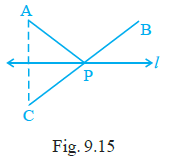
Question 70. In Fig. 9.15, the point C is the image of point A in line l and line segment BC intersects the line l at P.
(a) Is the image of P in line l the point P itself?
(b) Is PA = PC?
(c) Is PA + PB = PC + PB?
(d) Is P that point on line l from which the sum of the distances of points A and B is minimum?
Answer:
Given:
In Fig. 9.15, point $C$ is the image of point $A$ in the line of symmetry $l$. The line segment $BC$ intersects the line $l$ at point $P$.
Solution:
(a) Is the image of $P$ in line $l$ the point $P$ itself?
Yes. Any point that lies on the line of symmetry (the mirror line) is its own image. Since point $P$ lies on line $l$, its image is the point $P$ itself.
(b) Is $PA = PC$?
Yes. By the property of reflection symmetry, the line of symmetry $l$ is the perpendicular bisector of the line segment joining a point and its image ($AC$). Any point on the perpendicular bisector of a segment is equidistant from the endpoints of the segment.
$PA = PC$
[Distance of a point on the line of symmetry from object and image]
(c) Is $PA + PB = PC + PB$?
Yes. We can verify this using the equality found in part (b).
From equation (i), we have $PA = PC$.
Adding $PB$ to both sides of the equation:
$PA + PB = PC + PB$
(d) Is $P$ that point on line $l$ from which the sum of the distances of points $A$ and $B$ is minimum?
Yes. The sum of the distances from $A$ and $B$ to point $P$ is $PA + PB$. From part (c), we know $PA + PB = PC + PB$.
In the figure, points $B, P,$ and $C$ lie on a straight line (since $P$ is the intersection of $BC$ and $l$). Therefore, $PC + PB$ is equal to the length of the straight line segment $BC$.
The shortest distance between any two points ($B$ and $C$) is a straight line. For any other point $P'$ on line $l$, the sum $P'C + P'B$ would form a triangle $BP'C$, and by the triangle inequality, $P'C + P'B > BC$. Since $P'A = P'C$, it follows that $P'A + P'B > PA + PB$.
Final Answer: All statements (a), (b), (c), and (d) are Yes/True.
Question 71. Complete the figure so that line l becomes the line of symmetry of the whole figure (Fig. 9.16).

Answer:
Solution:
To complete the figure so that line $l$ becomes the line of symmetry, we must perform a reflection of the existing upper portion across the line $l$.
1. Identify the vertices of the given shape above line $l$.
2. For each vertex, plot a corresponding point below line $l$ at the same perpendicular distance.
3. Join these reflected points with straight lines to create a mirror image of the top part.
The resulting figure will look like a symmetric block-style shape centered vertically on line $l$.

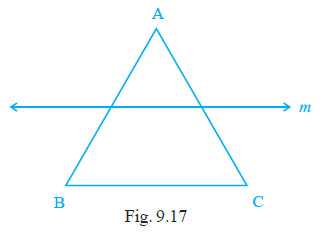
Question 72. Draw the images of the points A, B and C in the line m (Fig. 9.17). Name them as A′, B′ and C′, respectively and join them in pairs. Measure AB, BC, CA, A′B′, B′C′ and C′A′. Is AB = A′B′, BC = B′C′ and CA = C′A′?
Answer:
Given:
A triangle $ABC$ and a line $m$ passing through it as shown in Fig. 9.17.
To Find:
1. The images of points $A, B,$ and $C$ in line $m$ (named $A', B', C'$).
2. To verify if the lengths of the corresponding segments are equal ($AB = A'B'$, $BC = B'C'$, and $CA = C'A'$).
Construction Required:
1. From point $A$, drop a perpendicular to line $m$. Extend it to the other side of the line and mark point $A'$ such that the distance of $A$ from $m$ is equal to the distance of $A'$ from $m$.
2. Repeat the same process for points $B$ and $C$ to find their images $B'$ and $C'$ respectively.
3. Join $A'$ to $B'$, $B'$ to $C'$, and $C'$ to $A'$ to form $\triangle A'B'C'$.

Solution:
Reflection is a transformation that preserves distances between points. This property is known as isometry.
After measuring the sides of the original $\triangle ABC$ and the reflected $\triangle A'B'C'$ using a ruler, we find:
$AB = A'B'$
(Length preserved in reflection)
$BC = B'C'$
(Length preserved in reflection)
$CA = C'A'$
(Length preserved in reflection)
Final Answer: Yes, the lengths of the corresponding sides are equal, i.e., $AB = A'B'$, $BC = B'C'$, and $CA = C'A'$.
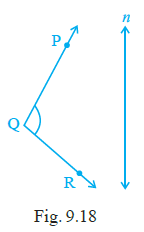
Question 73. Draw the images P′, Q′ and R′ of the points P, Q and R, respectively in the line n (Fig. 9.18). Join P′ Q′ and Q′ R′ to form an angle P′ Q′ R′. Measure ∠PQR and ∠P′Q′R′. Are the two angles equal?
Answer:
Given:
An angle $\angle PQR$ and a line $n$ as the line of symmetry in Fig. 9.18.
To Find:
1. The images $P', Q',$ and $R'$ of points $P, Q,$ and $R$ in line $n$.
2. To verify if $\angle PQR = \angle P'Q'R'$.
Construction Required:
1. Draw perpendiculars from points $P, Q,$ and $R$ to line $n$.
2. Extend these perpendiculars to the opposite side of line $n$ to mark points $P', Q',$ and $R'$ at the same distance from $n$ as their original points.
3. Join $P'$ to $Q'$ and $Q'$ to $R'$ to form the angle $\angle P'Q'R'$.

Solution:
Reflection in a line preserves the magnitude of angles. This means that the shape and size of an object remain identical in its mirror image.
On measuring the original angle $\angle PQR$ and the image angle $\angle P'Q'R'$ using a protractor, we observe:
$\angle PQR = \angle P'Q'R'$
(Angle measure is preserved)
Final Answer: Yes, the two angles are equal.
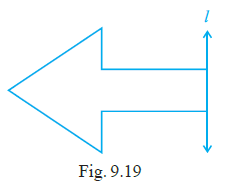
Question 74. Complete Fig. 9.19 by taking l as the line of symmetry of the whole figure.
Answer:
Given:
A partial figure of an arrow and a line $l$ acting as the line of symmetry in Fig. 9.19.
To Construct:
Complete the figure using $l$ as the axis of symmetry.
Solution:
To complete the figure, we must draw the exact mirror image of the given arrow part on the other side of line $l$.
1. The original figure shows the tail of an arrow touching the line $l$ and the head pointing to the left.
2. To create the symmetric part, we draw an identical arrow pointing to the right, starting from the line $l$.
3. The completed figure will look like a double-headed arrow that is bisected vertically by the line $l$.

Question 75. Draw a line segment of length 7cm. Draw its perpendicular bisector, using ruler and compasses.
Answer:
Given:
A line segment $AB = 7\text{ cm}$.
To Construct:
Perpendicular bisector of $AB$.
Construction Required:
1. Draw a line segment $AB$ of length $7\text{ cm}$ using a ruler.
2. With $A$ as centre and radius more than half of $AB$ (i.e., more than $3.5\text{ cm}$), draw two arcs, one above and one below the line segment $AB$.
3. With $B$ as centre and the same radius, draw two more arcs intersecting the previous arcs at points $P$ and $Q$.
4. Join $P$ and $Q$. Let $PQ$ intersect $AB$ at point $M$.
5. $PQ$ is the required perpendicular bisector of $AB$.
$AM = MB = 3.5\text{ cm}$
(By construction)

Final Answer: The line $PQ$ bisects $AB$ at $90^\circ$ such that $AM = MB$.
Question 76. Draw a line segment of length 6.5cm and divide it into four equal parts, using ruler and compasses.
Answer:
Given:
A line segment $XY = 6.5\text{ cm}$.
To Construct:
Divide $XY$ into four equal parts.
Construction Required:
1. Draw $XY = 6.5\text{ cm}$.
2. Draw the perpendicular bisector of $XY$ which meets $XY$ at point $M$. Now $XY$ is divided into two equal parts $XM$ and $MY$.
3. Draw the perpendicular bisector of $XM$ which meets $XM$ at point $P$.
4. Draw the perpendicular bisector of $MY$ which meets $MY$ at point $Q$.
5. Now, the points $P, M,$ and $Q$ divide $XY$ into four equal parts: $XP, PM, MQ,$ and $QY$.
Calculation:
Length of each part:
$\frac{6.5}{4} = 1.625\text{ cm}$

Final Answer: The segments $XP = PM = MQ = QY$ are the four equal parts of the line segment.
Question 77. Draw an angle of 140o with the help of a protractor and bisect it using ruler and compasses.
Answer:
Given:
An angle of $140^\circ$.
To Construct:
The bisector of the angle.
Construction Required:
1. Draw an angle $\angle ABC = 140^\circ$ using a protractor.
2. With $B$ as centre and any convenient radius, draw an arc intersecting arms $BA$ and $BC$ at points $E$ and $F$ respectively.
3. With $E$ as centre and radius more than half of $EF$, draw an arc in the interior of the angle.
4. With $F$ as centre and the same radius, draw another arc intersecting the previous arc at point $D$.
5. Join $BD$. Ray $BD$ is the bisector of $\angle ABC$.
$\angle ABD = \angle DBC = 70^\circ$
[Bisector divides angle into two equal halves]

Final Answer: Ray $BD$ bisects the $140^\circ$ angle into two $70^\circ$ angles.
Question 78. Draw an angle of 65o and draw an angle equal to this angle, using ruler and compasses.
Answer:
Given:
An angle $\angle ABC = 65^\circ$.
To Construct:
An angle equal to $\angle ABC$ without using a protractor for the second angle.
Construction Required:
1. Draw $\angle ABC = 65^\circ$ using a protractor.
2. Draw a ray $OX$.
3. With $B$ as centre, draw an arc of any radius intersecting arms $BA$ and $BC$ at $E$ and $F$.
4. With $O$ as centre and the same radius, draw an arc cutting ray $OX$ at point $P$.
5. Measure the distance $EF$ using compasses. With $P$ as centre and radius equal to $EF$, draw an arc intersecting the previous arc at point $Q$.
6. Join $OQ$ and extend it to $Y$.
$\angle YOX = \angle ABC = 65^\circ$
(By copying angle construction)

Final Answer: Angle $\angle YOX$ is constructed equal to $65^\circ$.
Question 79. Draw an angle of 80o using a protractor and divide it into four equal parts, using ruler and compasses.Check your construction by measurement.
Answer:
Given:
An angle of $80^\circ$.
To Construct:
Divide the $80^\circ$ angle into four equal parts.
Construction Required:
1. Draw an angle $\angle POQ = 80^\circ$ using a protractor.
2. Construct the bisector $OR$ of $\angle POQ$. Now, $\angle POR = \angle ROQ = 40^\circ$.
3. Construct the bisector $OS$ of $\angle POR$.
4. Construct the bisector $OT$ of $\angle ROQ$.
5. The rays $OS, OR,$ and $OT$ divide the $80^\circ$ angle into four equal parts.
Verification:
On measuring with a protractor, each of the four angles $\angle POS, \angle SOR, \angle ROT,$ and $\angle TOQ$ should be exactly $20^\circ$.
$80^\circ \div 4 = 20^\circ$

Final Answer: The $80^\circ$ angle is successfully divided into four equal parts of $20^\circ$ each.
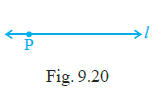
Question 80. Copy Fig. 9.20 on your notebook and draw a perpendicular to l through P, using
(i) set squares
(ii) Protractor
(iii) ruler and compasses.
How many such perpendiculars are you able to draw?
Answer:
Given:
A line $l$ and a point $P$ lying on it.
Construction Required:
(i) Using Set-squares:
1. Align the edge of a ruler with the line $l$.
2. Place a set-square such that one of its edges forming the right angle is against the ruler.
3. Slide it until the vertical edge reaches point $P$.
4. Draw a line through $P$ along this vertical edge.

(ii) Using Protractor:
1. Place the protractor center at point $P$ and align the $0^\circ-180^\circ$ line with line $l$.
2. Mark a point at the $90^\circ$ graduation.
3. Join this point with $P$ to get the perpendicular.

(iii) Using Ruler and Compasses:
1. With $P$ as centre, draw an arc cutting line $l$ at $X$ and $Y$.
2. With $X$ and $Y$ as centres and radius $> PX$, draw arcs intersecting at $Z$.
3. Join $PZ$ to get the perpendicular.

Solution:
Through a point $P$ on a line $l$, we can draw only one unique perpendicular line.
Final Answer: We are able to draw only one such perpendicular.
Question 81. Copy Fig. 9.21 on your notebook and draw a perpendicular from P to line m, using
(i) set squares
(ii) Protractor
(iii) ruler and compasses.
How many such perpendiculars are you able to draw?
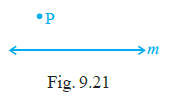
Answer:
Given:
A line $m$ and a point $P$ not on it.
Construction Required:
(i) Using Set-squares:
1. Place a ruler along line $m$.
2. Place a set-square on the ruler and slide it until the edge perpendicular to the ruler passes through $P$.
3. Draw a line segment from $P$ to the line $m$.

(ii) Using Protractor:
1. Align the protractor baseline with line $m$.
2. Slide it horizontally until the $90^\circ$ mark is vertically aligned with point $P$.
3. Drop a perpendicular line from $P$ to the centre of the protractor on line $m$.

(iii) Using Ruler and Compasses:
1. With $P$ as centre, draw an arc cutting line $m$ at $A$ and $B$.
2. With $A$ and $B$ as centres, draw arcs on the opposite side of $P$ intersecting at $Q$.
3. Join $PQ$. The line $PQ$ is perpendicular to $m$.

Solution:
From a point $P$ outside a line $m$, only one unique perpendicular can be dropped to the line.
Final Answer: We are able to draw only one such perpendicular.
Question 82. Draw a circle of radius 6cm using ruler and compasses. Draw one of its diameters. Draw the perpendicular bisector of this diameter. Does this perpendicular bisector contain another diameter of the circle?
Answer:
Given:
Radius of the circle ($r$) = $6\text{ cm}$
To Construct:
1. A circle with radius $6\text{ cm}$.
2. A diameter of the circle.
3. The perpendicular bisector of this diameter.
Construction Required:
1. Mark a point $O$ as the centre of the circle.
2. Using a ruler, open the compasses to a radius of $6\text{ cm}$.
3. Placing the pointer at $O$, draw a complete circle.
4. Draw a straight line passing through the centre $O$ that intersects the circle at two points, $A$ and $B$. $AB$ is the diameter of the circle.
5. With $A$ as centre and a radius more than half of $AB$ (i.e., $> 6\text{ cm}$), draw two arcs, one above and one below the diameter $AB$.
6. With $B$ as centre and the same radius, draw two more arcs intersecting the previous arcs at points $P$ and $Q$.
7. Join $P$ and $Q$ using a ruler. Let this line intersect the circle at points $C$ and $D$.

Solution:
The perpendicular bisector of a diameter always passes through the centre of the circle because the centre is the midpoint of any diameter.
$O \text{ is the midpoint of } AB$
[Definition of diameter]
Since the line $PQ$ (the perpendicular bisector) passes through the centre $O$ and connects two points $C$ and $D$ on the boundary of the circle, the segment $CD$ is also a diameter of the circle.
Final Answer: Yes, the perpendicular bisector contains another diameter of the circle.
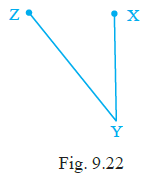
Question 83. Bisect ∠XYZ of Fig. 9.22
Answer:
Given:
An angle $\angle XYZ$ as shown in Fig. 9.22.
To Construct:
The bisector of $\angle XYZ$.
Construction Required:
1. With $Y$ as the centre and any convenient radius, draw an arc that intersects the arms $YX$ and $YZ$ at two points, say $P$ and $Q$ respectively.
2. With $P$ as the centre and a radius more than half of the distance $PQ$, draw an arc in the interior of $\angle XYZ$.
3. With $Q$ as the centre and the same radius, draw another arc that intersects the previous arc at a point, say $S$.
4. Join the vertex $Y$ and the point $S$ with a straight line and extend it to form a ray.
5. The ray $YS$ is the required bisector of $\angle XYZ$.
$\angle XYS = \angle ZYS$
(By construction)

Final Answer: The ray $YS$ bisects $\angle XYZ$ into two equal parts.
Question 84. Draw an angle of 60o using ruler and compasses and divide it into four equal parts. Measure each part.
Answer:
Given:
An angle of $60^\circ$ to be constructed and divided into four equal parts.
Construction Required:
1. Draw a ray $OA$.
2. With $O$ as centre and any radius, draw an arc cutting $OA$ at a point $B$.
3. With $B$ as centre and the same radius, draw an arc cutting the first arc at $C$.
4. Join $OC$. $\angle COA$ is the $60^\circ$ angle.
5. Draw the bisector $OD$ of $\angle COA$. Now $\angle COA$ is divided into two $30^\circ$ parts ($\angle COD$ and $\angle DOA$).
6. Draw the bisector $OE$ of $\angle DOA$.
7. Draw the bisector $OF$ of $\angle COD$.

Solution:
Since the total angle is $60^\circ$ and it has been divided into four equal parts by successive bisection:
$\text{Measure of each part} = \frac{60^\circ}{4}$
$\text{Measure of each part} = 15^\circ$
Final Answer: Upon measurement with a protractor, each of the four parts measures $15^\circ$.
Question 85. Bisect a straight angle, using ruler and compasses. Measure each part.
Answer:
Given:
A straight angle ($180^\circ$).
To Construct:
The bisector of the straight angle.
Construction Required:
1. Draw a line $AB$ and mark a point $O$ on it. $\angle AOB$ is a straight angle ($180^\circ$).
2. With $O$ as centre and any radius, draw a semi-circle cutting $AB$ at $X$ and $Y$.
3. With $X$ as centre and radius more than $OX$, draw an arc above the line.
4. With $Y$ as centre and the same radius, draw another arc intersecting the previous arc at point $C$.
5. Join $OC$. Ray $OC$ is the bisector of the straight angle.

Solution:
A straight angle measures $180^\circ$. Bisection divides the angle into two equal parts.
$\text{Measure of each part} = \frac{180^\circ}{2}$
$\text{Measure of each part} = 90^\circ$
Final Answer: On measuring with a protractor, each part measures $90^\circ$ (a right angle).
Question 86. Bisect a right angle, using ruler and compasses. Measure each part. Bisect each of these parts. What will be the measure of each of these parts?
Answer:
Given:
A right angle ($90^\circ$).
Construction Required:
1. Draw a right angle $\angle ABC = 90^\circ$ (using compasses by constructing $60^\circ$ and $120^\circ$ and bisecting their difference).
2. Draw the bisector $BD$ of $\angle ABC$. This divides the $90^\circ$ angle into two equal parts.
3. Now, bisect $\angle ABD$ and $\angle DBC$ using the standard angle bisection method.

Solution:
Step 1: Bisecting the right angle
$\text{Measure of each part} = \frac{90^\circ}{2} = 45^\circ$
Step 2: Bisecting each of these $45^\circ$ parts
$\text{Measure of each resulting part} = \frac{45^\circ}{2}$
$\text{Measure} = 22.5^\circ$
Final Answer: The measure of each part after the first bisection is $45^\circ$. After bisecting those parts again, each final part measures $22.5^\circ$.
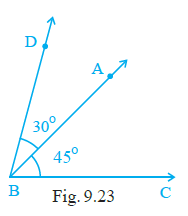
Question 87. Draw an angle ABC of measure 45o , using ruler and compasses. Now draw an angle DBA of measure 30o , using ruler and compasses as shown in Fig. 9.23. What is the measure of ∠DBC?
Answer:
Given:
According to Fig. 9.23:
Measure of $\angle ABC = 45^\circ$
Measure of $\angle DBA = 30^\circ$
To Find:
The measure of $\angle DBC$.
Construction Required:
1. Draw a ray $BC$.
2. Construct 45°: At point $B$, construct a $90^\circ$ angle using ruler and compasses by bisecting the straight angle. Now, bisect this $90^\circ$ angle to get ray $BA$. Thus, $\angle ABC = 45^\circ$.
3. Construct 30°: With $BA$ as the initial arm, construct a $60^\circ$ angle using a compass. Bisect this $60^\circ$ angle to get ray $BD$. Thus, $\angle DBA = 30^\circ$.
4. Resulting Angle: Ray $BD$ and ray $BC$ now form $\angle DBC$.

Solution:
From the construction and the given figure, we see that $\angle DBA$ and $\angle ABC$ are adjacent angles sharing the common arm $BA$.
The total angle $\angle DBC$ is the sum of these two angles:
$\angle DBC = \angle DBA + \angle ABC$
[Angle Addition Property]
Substituting the values of the angles:
$\angle DBC = 30^\circ + 45^\circ$
$\angle DBC = 75^\circ$
Final Answer: The measure of $\angle DBC$ is $75^\circ$.
Question 88. Draw a line segment of length 6cm. Construct its perpendicular bisector. Measure the two parts of the line segment.
Answer:
Given:
A line segment of length $6\text{ cm}$.
Construction Required:
1. Draw a line segment $AB = 6\text{ cm}$ using a ruler.
2. With $A$ as the centre and radius more than half of $AB$ (i.e., $> 3\text{ cm}$), draw two arcs, one above and one below $AB$.
3. With $B$ as the centre and the same radius, draw two more arcs intersecting the previous arcs at points $P$ and $Q$.
4. Join $P$ and $Q$. Let $PQ$ intersect $AB$ at point $M$.
5. $PQ$ is the perpendicular bisector of $AB$.

Solution:
Since $PQ$ is the perpendicular bisector, it divides the segment $AB$ into two equal parts at point $M$.
$\text{Length of each part} = \frac{\text{Total Length}}{2}$
$\text{Length} = \frac{6}{2} = 3\text{ cm}$
Verification:
On measuring with a ruler, we find:
$AM = 3\text{ cm}$
$MB = 3\text{ cm}$
Final Answer: The two parts of the line segment measure $3\text{ cm}$ each.
Question 89. Draw a line segment of length 10cm. Divide it into four equal parts. Measure each of these parts.
Answer:
Given:
A line segment of length $10\text{ cm}$.
Construction Required:
1. Draw a line segment $PQ = 10\text{ cm}$.
2. Construct the perpendicular bisector of $PQ$ which intersects $PQ$ at point $M$. Now, $PQ$ is divided into two equal parts: $PM$ and $MQ$.
3. Construct the perpendicular bisector of the segment $PM$. Let it intersect $PM$ at point $A$.
4. Construct the perpendicular bisector of the segment $MQ$. Let it intersect $MQ$ at point $B$.
5. The points $A, M,$ and $B$ divide $PQ$ into four equal parts: $PA, AM, MB,$ and $BQ$.

Solution:
The total length of $10\text{ cm}$ is divided into $4$ equal segments.
$\text{Length of each part} = \frac{10\text{ cm}}{4}$
$\text{Length of each part} = 2.5\text{ cm}$
Final Answer: Upon measurement, each of the four equal parts measures $2.5\text{ cm}$.