

Chapter 1 Integers (Class 7 - Maths NCERT Exemplar Solutions)
Welcome to the comprehensive resource for NCERT Exemplar Solutions for Class 7 Mathematics: Chapter 1 Integers! These problems are specifically designed to push students beyond basic operational proficiency, fostering a deeper understanding of the integer system. By focusing on fundamental properties and advanced problem-solving techniques, these solutions aim to cultivate the higher-order thinking skills (HOTS) necessary for mathematical mastery and competitive excellence.
The solutions cover the complete range of Class 7 topics, including addition, subtraction, multiplication, and division, with a strong emphasis on mastering sign rules. A significant portion of the chapter is dedicated to the structural properties of integers, such as Closure, Commutativity (e.g., $a + b = b + a$), Associativity (e.g., $(a \times b) \times c = a \times (b \times c)$), and the existence of Identities (0 and 1). Special attention is given to the Distributive Property ($a \times (b + c) = (a \times b) + (a \times c)$) and the concept of the Additive Inverse, which are essential for simplifying complex numerical expressions strategically rather than through brute-force calculations.
The Exemplar includes diverse formats like Multiple Choice Questions (MCQs), True/False statements, and intricate word problems involving real-world scenarios such as temperature fluctuations, changes in elevation relative to sea level, and financial transactions using the $\textsf{₹}$ symbol. Our step-by-step solutions provide logical justifications and clear guidance to help students avoid common pitfalls, especially sign errors during multi-step simplifications. Prepared by learningspot.co, these resources ensure an unshakeable foundation for future algebraic studies and a thorough grasp of the integer system.
| Content On This Page | ||
|---|---|---|
| Solved Examples (Examples 1 to 17) | Question 1 to 30 (Multiple Choice Questions) | Question 31 to 71 (Fill in the Blanks) |
| Question 72 to 108 (True or False) | Question 109 to 136 | |
Solved Examples (Examples 1 to 17)
In Examples 1 to 3, there are four options, out of which one is correct. Write the correct answer.
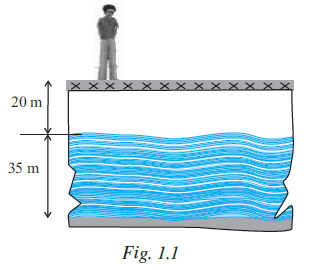
Example 1: Madhre is standing in the middle of a bridge which is 20 m above the water level of a river. If a 35 m deep river is flowing under the bridge (see Fig. 1.1), then the vertical distance between the foot of Madhre and bottom level of the river is:
(a) 55 m
(b) 35 m
(c) 20 m
(d) 15 m
Answer:
Given:
Height of the bridge above the water level = $20 \text{ m}$
Depth of the river = $35 \text{ m}$
To Find:
The vertical distance between the foot of Madhre and the bottom level of the river.
Solution:
Madhre is standing in the middle of the bridge, which means their foot is at the level of the bridge deck.
The vertical distance between the foot of Madhre (at the bridge level) and the bottom level of the river is the sum of the height of the bridge above the water level and the depth of the river.
Vertical distance = Height of bridge above water level + Depth of river
Vertical distance = $20 \text{ m} + 35 \text{ m}$
Vertical distance = $55 \text{ m}$
The vertical distance between the foot of Madhre and the bottom level of the river is $55 \text{ m}$.
This matches option (a).
The correct answer is (a) 55 m.
Example 2: [(– 10) × (+ 9)] + ( – 10) is equal to
(a) 100
(b) –100
(c) – 80
(d) 80
Answer:
Solution:
We need to evaluate the expression $[(- 10) \times (+ 9)] + ( - 10)$.
First, evaluate the expression inside the square brackets:
$(- 10) \times (+ 9)$
When multiplying a negative integer by a positive integer, the result is a negative integer.
$(- 10) \times (+ 9) = - (10 \times 9) = -90$
Now, substitute this result back into the original expression:
$[-90] + (- 10)$
Adding a negative number is the same as subtracting the corresponding positive number.
$-90 + (-10) = -90 - 10$
When subtracting a positive number from a negative number, or adding two negative numbers, we add their absolute values and keep the negative sign.
$90 + 10 = 100$
So, $-90 - 10 = -100$
Thus, $[(- 10) \times (+ 9)] + ( - 10) = -100$.
This matches option (b).
The correct answer is (b) –100.
Example 3: –16 ÷ [8 ÷ (–2)] is equal to
(a) –1
(b) 1
(c) 4
(d) –4
Answer:
Solution:
We need to evaluate the expression $-16 \div [8 \div (-2)]$.
First, evaluate the expression inside the square brackets using the order of operations (PEMDAS/BODMAS):
$[8 \div (-2)]$
When a positive integer is divided by a negative integer, the result is a negative integer.
$8 \div (-2) = -(8 \div 2) = -4$
Now, substitute this result back into the original expression:
$-16 \div [-4]$
When a negative integer is divided by a negative integer, the result is a positive integer.
$-16 \div (-4) = +(16 \div 4) = 4$
Thus, $-16 \div [8 \div (-2)] = 4$.
This matches option (c).
The correct answer is (c) 4.
In Examples 4 and 5, fill in the blanks to make the statements true.
Example 4: (– 25) × 30 = – 30 × _______.
Answer:
Solution:
The given equation is $(– 25) \times 30 = – 30 \times \text{_______}$.
Let the missing number in the blank be $x$.
So, we have the equation:
$(-25) \times 30 = -30 \times x$
First, calculate the product on the left side:
$(-25) \times 30 = -750$
Now the equation becomes:
$-750 = -30 \times x$
To find the value of $x$, divide both sides of the equation by $-30$:
$x = \frac{-750}{-30}$
$x = \frac{750}{30}$
$x = \frac{75}{3}$
$x = 25$
Thus, the statement becomes $(– 25) \times 30 = – 30 \times 25$, which is true as both sides are equal to $-750$.
The number to fill in the blank is $25$.
Example 5: 75 ÷ _______ = – 75
Answer:
Solution:
The given equation is $75 \div \text{_______} = – 75$.
Let the missing number in the blank be $x$.
So, we have the equation:
$75 \div x = -75$
We can rewrite the division as a fraction:
$\frac{75}{x} = -75$
To solve for $x$, we can multiply both sides by $x$ (assuming $x \neq 0$):
$75 = -75 \times x$
Now, divide both sides by $-75$:
$x = \frac{75}{-75}$
$x = -1$
Thus, the statement becomes $75 \div (-1) = -75$, which is true.
The number to fill in the blank is $-1$.
In Examples 6 and 7, state whether the statements are True or False.
Example 6: (–5) × (–7) is same as (–7) × (–5)
Answer:
Statement:
$(–5) \times (–7)$ is same as $(–7) \times (–5)$.
Solution:
We need to check if the product of $(-5)$ and $(-7)$ is equal to the product of $(-7)$ and $(-5)$.
Consider the left side of the comparison:
$(-5) \times (-7)$
The product of two negative integers is a positive integer.
$(-5) \times (-7) = 5 \times 7 = 35$
Consider the right side of the comparison:
$(-7) \times (-5)$
The product of two negative integers is a positive integer.
$(-7) \times (-5) = 7 \times 5 = 35$
Since $35 = 35$, the statement $(–5) \times (–7) = (–7) \times (–5)$ is true.
This equality illustrates the commutative property of multiplication for integers, which states that for any two integers $a$ and $b$, $a \times b = b \times a$.
Conclusion:
The statement is True.
Example 7: (– 80) ÷ (4) is not same as 80 ÷ (–4)
Answer:
Statement:
$(– 80) \div (4)$ is not same as $80 \div (–4)$.
Solution:
We need to evaluate both expressions and compare their results.
Consider the left side of the comparison:
$(-80) \div (4)$
When a negative integer is divided by a positive integer, the result is a negative integer.
$(-80) \div (4) = -(80 \div 4) = -20$
Consider the right side of the comparison:
$80 \div (-4)$
When a positive integer is divided by a negative integer, the result is a negative integer.
$80 \div (-4) = -(80 \div 4) = -20$
Comparing the results, we have:
Left side result: $-20$
Right side result: $-20$
Since $-20 = -20$, the statement $(– 80) \div (4)$ is the same as $80 \div (–4)$.
The given statement claims that the results are *not* the same, which is false.
Conclusion:
The statement is False.
Example 8: Find the odd one out of the four options in the following:
(a) (–2, 24)
(b) (–3, 10)
(c) (–4, 12)
(d) (–6, 8)
Answer:
Solution:
We are given four pairs of integers and need to find the one that does not fit a pattern shared by the others.
Let's examine a possible relationship between the two numbers in each pair, such as their product.
For option (a):
The product of the integers is $(-2) \times 24$.
$(-2) \times 24 = -48$
For option (b):
The product of the integers is $(-3) \times 10$.
$(-3) \times 10 = -30$
For option (c):
The product of the integers is $(-4) \times 12$.
$(-4) \times 12 = -48$
For option (d):
The product of the integers is $(-6) \times 8$.
$(-6) \times 8 = -48$
We can see that the product of the integers in options (a), (c), and (d) is $-48$.
The product of the integers in option (b) is $-30$, which is different from the others.
Therefore, the pair (–3, 10) is the odd one out.
The correct answer is (b) (–3, 10).
Example 9: Find the odd one out of the four options given below:
(a) (–3, –6)
(b) (+1, –10)
(c) (–2, –7)
(d) (–4, –9)
Answer:
Given:
Four pairs of integers are provided:
(a) $(-3, -6)$
(b) $(+1, -10)$
(c) $(-2, -7)$
(d) $(-4, -9)$
To Find:
The pair that does not follow the same mathematical pattern or property as the others.
Solution:
In this problem, we examine the sum of the two integers in each given pair to identify a common property.
For option (a): Sum $= -3 + (-6) = -3 - 6 = -9$
For option (b): Sum $= 1 + (-10) = 1 - 10 = -9$
For option (c): Sum $= -2 + (-7) = -2 - 7 = -9$
For option (d): Sum $= -4 + (-9) = -4 - 9 = -13$
Observation Table:
| Option | Pair $(x, y)$ | Operation: Sum $(x + y)$ | Result |
| (a) | $(-3, -6)$ | $-3 + (-6)$ | $-9$ |
| (b) | $(1, -10)$ | $1 + (-10)$ | $-9$ |
| (c) | $(-2, -7)$ | $-2 + (-7)$ | $-9$ |
| (d) | $(-4, -9)$ | $-4 + (-9)$ | $-13$ |
By comparing the results in the table, we can see that for the pairs in options (a), (b), and (c), the sum of the integers is consistently $-9$.
$Sum = -9$
(Property for a, b, c)
However, for option (d), the sum of the integers is $-13$.
$Sum = -13$
(Different result)
Since option (d) does not result in a sum of $-9$, it is the odd one out.
Final Answer: The odd one out is (d) (–4, –9).
Example 10: Match the integer in Column I to an integer in Column II so that the sum is between –11 and – 4
Column I
(a) –6
(b) +1
(c) +7
(d) –2
Column II
(i) –11
(ii) –5
(iii) +1
(iv) –13
Answer:
Solution:
We need to match an integer from Column I with an integer from Column II such that their sum lies strictly between $-11$ and $-4$. This means the sum must be greater than $-11$ and less than $-4$, i.e., in the range $(-11, -4)$. The possible integer sums in this range are $-10, -9, -8, -7, -6, -5$.
Let's find the sum for each possible combination of an integer from Column I and an integer from Column II:
From Column I (a) $-6$ with integers in Column II:
$-6 + (-11) = -17$
$-6 + (-5) = -11$
$-6 + (+1) = -5$
$-6 + (-13) = -19$
The sum $-5$ is between $-11$ and $-4$. So, (a) matches with (iii).
From Column I (b) $+1$ with integers in Column II:
$+1 + (-11) = -10$
$+1 + (-5) = -4$
$+1 + (+1) = +2$
$+1 + (-13) = -12$
The sum $-10$ is between $-11$ and $-4$. So, (b) matches with (i).
From Column I (c) $+7$ with integers in Column II:
$+7 + (-11) = -4$
$+7 + (-5) = +2$
$+7 + (+1) = +8$
$+7 + (-13) = -6$
The sum $-6$ is between $-11$ and $-4$. So, (c) matches with (iv).
From Column I (d) $-2$ with integers in Column II:
$-2 + (-11) = -13$
$-2 + (-5) = -7$
$-2 + (+1) = -1$
$-2 + (-13) = -15$
The sum $-7$ is between $-11$ and $-4$. So, (d) matches with (ii).
The matches are:
(a) –6 matches with (iii) +1 (Sum = -5)
(b) +1 matches with (i) –11 (Sum = -10)
(c) +7 matches with (iv) –13 (Sum = -6)
(d) –2 matches with (ii) –5 (Sum = -7)
Example 11: If a is an integer other than 1 and –1, match the following:
Column I
(a) a ÷ (–1)
(b) 1 ÷ (a)
(c) (–a) ÷ (–a)
(d) a ÷ (+1)
Column II
(i) a
(ii) 1
(iii) Not an integer
(iv) –a
Answer:
Given:
$a$ is an integer.
$a$ is not equal to $1$ or $-1$.
To Find:
Match the expressions in Column I with the correct results in Column II.
Solution:
We will evaluate each expression in Column I using the rules of division for integers.
Part (a): $a \div (-1)$
When we divide an integer by $-1$, the sign of the integer changes.
$\frac{a}{-1} = -a$
(Division by $-1$ gives the additive inverse)
Thus, (a) matches with (iv).
Part (b): $1 \div a$
It is given that $a$ is an integer other than $1$ and $-1$. This means the absolute value of $a$ is greater than $1$ (like $2, 3, -4,$ etc.).
$1 \div a = \frac{1}{a}$
(Result is a fraction)
Since the numerator is $1$ and the denominator is an integer with a magnitude greater than $1$, the result is not a whole number or an integer.
Thus, (b) matches with (iii).
Part (c): $(-a) \div (-a)$
Any non-zero integer divided by itself always results in $1$.
$\frac{-a}{-a} = 1$
(Division of a number by itself)
Thus, (c) matches with (ii).
Part (d): $a \div 1$
When any integer is divided by $1$, the result is the integer itself.
$\frac{a}{1} = a$
(Division by $1$ is the identity property)
Thus, (d) matches with (i).
Final Match Table:
| Column I | Result | Column II Match |
| (a) $a \div (-1)$ | $-a$ | (iv) |
| (b) $1 \div a$ | $\frac{1}{a}$ | (iii) |
| (c) $(-a) \div (-a)$ | $1$ | (ii) |
| (d) $a \div 1$ | $a$ | (i) |
Example 12: Write a pair of integers whose sum is zero (0) but difference is 10.
Answer:
To Find:
A pair of integers whose sum is $0$ and whose difference is $10$.
Solution:
Let the two integers be $x$ and $y$.
According to the problem statement, the sum of the two integers is $0$.
$x + y = 0$
... (i)
The difference between the two integers is $10$. Let's assume the difference is $x - y$.
$x - y = 10$
... (ii)
Now we have a system of two linear equations:
(i) $x + y = 0$
(ii) $x - y = 10$
We can solve this system by adding the two equations.
Adding equation (i) and equation (ii):
$(x + y) + (x - y) = 0 + 10$
$x + y + x - y = 10$
$2x = 10$
Divide both sides by $2$:
$x = \frac{10}{2}$
$x = 5$
Now substitute the value of $x = 5$ into equation (i):
$5 + y = 0$
Subtract $5$ from both sides:
$y = 0 - 5$
$y = -5$
So, the pair of integers is $(5, -5)$.
Verification:
Check the sum:
$x + y = 5 + (-5) = 5 - 5 = 0$. (Sum is 0, correct).
Check the difference:
$x - y = 5 - (-5) = 5 + 5 = 10$. (Difference is 10, correct).
If we had assumed the difference as $y - x = 10$, we would get the pair $(-5, 5)$. The sum $(-5) + 5 = 0$, and the difference $5 - (-5) = 10$. Both pairs satisfy the conditions depending on the order of subtraction.
A pair of integers satisfying the conditions is $5$ and $-5$.
Example 13: Write two integers which are smaller than –3, but their difference is greater than –3.
Answer:
Given:
We need to find two integers, let's call them $x$ and $y$, such that:
$x < -3$ and $y < -3$
(Integers smaller than $-3$)
To Find:
Two integers whose difference is greater than $-3$.
$Difference > -3$
(Requirement)
Solution:
First, let us list some integers that are smaller than $-3$. On a number line, integers to the left of $-3$ are smaller.
Integers smaller than $-3$ are: $-4, -5, -6, -7, -8, \dots$
Let us choose two integers from this list:
Let the first integer be $-5$.
Let the second integer be $-4$.
Now, let us verify the conditions:
1. Are they smaller than $-3$?
$-5 < -3$
[True]
$-4 < -3$
[True]
2. Is their difference greater than $-3$?
Difference $= (-4) - (-5)$
$= -4 + 5$
$Difference = 1$
... (i)
Since $1$ is a positive integer, it is clearly greater than any negative integer.
$1 > -3$
[Condition satisfied]
Final Answer: Two such integers are $-5$ and $-4$.
Example 14: Write a pair of integers whose product is – 15 and whose difference is 8.
Answer:
To Find:
A pair of integers whose product is $-15$ and whose difference is $8$.
Solution:
Let the two integers be $x$ and $y$.
According to the problem statement:
Product of the integers: $x \times y = -15$
Difference of the integers: $x - y = 8$
We need to find two integers whose product is $-15$. Let's list the pairs of integers whose product is $-15$ and check their differences:
Possible pairs $(x, y)$ with product $x \times y = -15$:
- $(1, -15)$: Difference $1 - (-15) = 1 + 15 = 16$ (Not 8)
- $(-1, 15)$: Difference $-1 - 15 = -16$ (Not 8)
- $(3, -5)$: Difference $3 - (-5) = 3 + 5 = 8$ (Satisfies the condition)
- $(-3, 5)$: Difference $-3 - 5 = -8$ (Not 8)
- $(5, -3)$: Difference $5 - (-3) = 5 + 3 = 8$ (Satisfies the condition)
- $(-5, 3)$: Difference $-5 - 3 = -8$ (Not 8)
- $(15, -1)$: Difference $15 - (-1) = 15 + 1 = 16$ (Not 8)
- $(-15, 1)$: Difference $-15 - 1 = -16$ (Not 8)
The pairs whose difference is $8$ are $(3, -5)$ and $(5, -3)$. Both pairs have a product of $-15$. We can provide either one as the answer.
A pair of integers whose product is – 15 and whose difference is 8 is 3 and –5 (or 5 and –3).
Example 15: If ∆ is an operation such that for integers a and b we have a ∆ b = a × a + b × b – a × b, then find (–3) ∆ 2.
Answer:
Given:
The operation is defined as:
$a \ \Delta \ b = a \times a + b \times b - a \times b$
(Definition of operation)
To Find:
The value of $(-3) \ \Delta \ 2$.
Solution:
In the given expression $(-3) \ \Delta \ 2$, we have:
$a = -3$
$b = 2$
Substituting these values into the defined operation:
$(-3) \ \Delta \ 2 = (-3) \times (-3) + (2) \times (2) - (-3) \times (2)$
Now, calculating each term:
$(-3) \times (-3) = 9$
$(2) \times (2) = 4$
$(-3) \times (2) = -6$
Placing these values back into the expression:
$(-3) \ \Delta \ 2 = 9 + 4 - (-6)$
$(-3) \ \Delta \ 2 = 9 + 4 + 6$
$(-3) \ \Delta \ 2 = 19$
Final Answer: The value of $(-3) \ \Delta \ 2$ is $19$.
Alternate Solution:
We can rearrange the operation as $a \ \Delta \ b = a^2 + b^2 - ab$.
For $a = -3$ and $b = 2$:
$(-3)^2 + 2^2 - (-3)(2)$
$= 9 + 4 - (-6)$
$= 13 + 6 = 19$
Example 16: In an objective type test containing 25 questions. A student is to be awarded +5 marks for every correct answer, –5 for every incorrect answer and zero for not writing any answer. Mention the ways of scoring 110 marks by a student.
Answer:
Given:
Total number of questions $= 25$
Marks for every correct answer $= +5$
Marks for every incorrect answer $= -5$
Marks for unattempted questions $= 0$
Total marks scored $= 110$
To Find:
Possible ways (combinations of correct, incorrect, and unattempted answers) to score exactly $110$ marks.
Solution:
Let the number of correct answers be $C$ and the number of incorrect answers be $I$.
The total score is calculated as:
$5 \times C - 5 \times I = 110$
... (i)
Dividing the entire equation by $5$:
$C - I = 22$
[Simplified relation]
Also, the total questions attempted $(C + I)$ cannot exceed the total number of questions ($25$).
$C + I \leq 25$
... (ii)
Now, let us find possible integer values for $C$ and $I$ that satisfy both conditions:
Case 1: If $I = 0$
$C - 0 = 22 \implies C = 22$
Check: $C + I = 22 + 0 = 22$, which is less than $25$. (Possible)
Case 2: If $I = 1$
$C - 1 = 22 \implies C = 23$
Check: $C + I = 23 + 1 = 24$, which is less than $25$. (Possible)
Case 3: If $I = 2$
$C - 2 = 22 \implies C = 24$
Check: $C + I = 24 + 2 = 26$, which is greater than $25$. (Impossible)
Summary of Possible Ways:
| Way | Correct (C) | Incorrect (I) | Unattempted (25 - C - I) | Total Marks |
| 1 | 22 | 0 | 3 | $110 - 0 = 110$ |
| 2 | 23 | 1 | 1 | $115 - 5 = 110$ |
Final Answer: There are two ways to score $110$ marks:
1. By answering 22 questions correctly and leaving 3 questions unattempted.
2. By answering 23 questions correctly, 1 question incorrectly, and leaving 1 question unattempted.
Example 17: A boy standing on the third stair on a staircase goes up by five more stairs. Which stair is he standing at now? At which step will he be after he comes down by 2 stairs?
Answer:
Given:
Initial position of the boy $= 3^{rd}$ stair
Movement upwards $= 5$ stairs
Movement downwards $= 2$ stairs
To Find:
1. The position after going up.
2. The final position after coming down.
Solution:
Let the stairs be represented by positive integers.
Step 1: Position after going up
Current step $= 3$
Going up means addition of steps.
New position $= 3 + 5$
$\text{Position}_1 = 8$
(He is at the $8^{th}$ stair)
Step 2: Position after coming down
Starting from the $8^{th}$ stair, coming down means subtraction of steps.
Final position $= 8 - 2$
$\text{Position}_2 = 6$
(He is at the $6^{th}$ stair)
Final Answer: The boy is currently standing at the $8^{th}$ stair. After coming down, he will be at the $6^{th}$ stair.
Alternate Solution:
We can calculate the net movement from the initial position.
Net movement $= (\text{Upward movement}) + (\text{Downward movement})$
Net movement $= +5 - 2 = +3$
Final Position $= \text{Initial position} + \text{Net movement}$
Final Position $= 3 + 3 = 6$
This confirms that after both movements, the boy ends up on the $6^{th}$ stair.
Exercise
Question 1 to 30 (Multiple Choice Questions)
In the Questions 1 to 25, there are four options, out of which only one is correct. Write the correct one.
Question 1. When the integers 10, 0, 5, – 5, – 7 are arranged in descending or ascending order, them find out which of the following integers always remains in the middle of the arrangement.
(a) 0
(b) 5
(c) – 7
(d) – 5
Answer:
Solution:
The given integers are $10, 0, 5, -5, -7$.
There are 5 integers in the set.
When 5 items are arranged in order, the middle item is the $3^\text{rd}$ item.
Let's arrange the integers in ascending order (from smallest to largest):
The order is: $-7, -5, 0, 5, 10$.
The middle integer (the $3^\text{rd}$ integer) is $0$.
Let's arrange the integers in descending order (from largest to smallest):
The order is: $10, 5, 0, -5, -7$.
The middle integer (the $3^\text{rd}$ integer) is $0$.
In both ascending and descending order, the integer $0$ remains in the middle of the arrangement.
The correct answer is (a) 0.
Question 2. By observing the number line (Fig. 1.2), state which of the following statements is not true.

(a) B is greater than –10
(b) A is greater than 0
(c) B is greater than A
(d) B is smaller than 0
Answer:
Given:
A number line (Fig. 1.2) where $0$, $10$, and $-10$ are marked with equal divisions. Each small division represents $1$ unit.
To Find:
The statement which is not true among the given options.
Solution:
First, let us identify the values of points A and B by counting the divisions from the origin ($0$).
1. For Point A: It is on the right side of $0$. Counting $7$ divisions to the right, we get:
$A = +7$
[A is a positive integer]
2. For Point B: It is on the left side of $0$. Counting $4$ divisions to the left, we get:
$B = -4$
[B is a negative integer]
Now, let us evaluate each option:
(a) B is greater than –10:
$-4 > -10$
[True: On a number line, $-4$ is to the right of $-10$]
(b) A is greater than 0:
$7 > 0$
[True: All positive integers are greater than $0$]
(c) B is greater than A:
$-4 > 7$
[False: A negative integer is always smaller than a positive integer]
(d) B is smaller than 0:
$-4 < 0$
[True: All negative integers are smaller than $0$]
Observation Table:
| Point | Value | Comparison with 0 |
| A | $7$ | $A > 0$ |
| B | $-4$ | $B < 0$ |
Final Answer: The statement which is not true is (c) B is greater than A.
Question 3. By observing the above number line (Fig. 1.2), state which of the following statements is true.
(a) B is 2
(b) A is – 4
(c) B is –13
(d) B is – 4
Answer:
Given:
The number line (Fig. 1.2) from the previous question.
To Find:
The statement which is true about the values of A or B.
Solution:
Based on the observations from the number line:
1. The origin is at $0$.
2. To the left of $0$, the integers are negative. Point B is $4$ units to the left of $0$.
$B = -4$
[Counting 4 steps left from 0]
3. To the right of $0$, the integers are positive. Point A is $7$ units to the right of $0$.
$A = 7$
[Counting 7 steps right from 0]
Now let us check the options:
(a) B is $2$ $\rightarrow$ False (B is $-4$)
(b) A is $-4$ $\rightarrow$ False (A is $7$)
(c) B is $-13$ $\rightarrow$ False (B is $-4$)
(d) B is $-4$ $\rightarrow$ True
Final Answer: The correct statement is (d) B is – 4.
Question 4. Next three consecutive numbers in the pattern 11, 8, 5, 2, --, --, -- are
(a) 0, – 3, – 6
(b) – 1, – 5, – 8
(c) – 2, – 5, – 8
(d) – 1, – 4, – 7
Answer:
Solution:
The given pattern is a sequence of numbers: 11, 8, 5, 2, ...
Let's find the difference between consecutive terms to identify the pattern:
Difference between the 2nd and 1st term: $8 - 11 = -3$
Difference between the 3rd and 2nd term: $5 - 8 = -3$
Difference between the 4th and 3rd term: $2 - 5 = -3$
The pattern shows that each number is obtained by subtracting $3$ from the previous number. This is an arithmetic progression with a common difference of $-3$.
To find the next three consecutive numbers, we continue this pattern starting from the last given number, which is $2$.
The 5th number is $2 - 3 = -1$
The 6th number is $-1 - 3 = -4$
The 7th number is $-4 - 3 = -7$
The next three consecutive numbers in the pattern are $-1, -4, -7$.
Comparing this with the given options:
(a) 0, – 3, – 6
(b) – 1, – 5, – 8
(c) – 2, – 5, – 8
(d) – 1, – 4, – 7
The sequence $-1, -4, -7$ matches option (d).
The correct answer is (d) – 1, – 4, – 7.
Question 5. The next number in the pattern – 62, – 37, – 12 _________ is
(a) 25
(b) 13
(c) 0
(d) –13
Answer:
Solution:
The given pattern is a sequence of numbers: $-62, -37, -12, \text{_______}$.
Let's find the difference between consecutive terms to identify the pattern:
Difference between the 2nd term and the 1st term:
$-37 - (-62) = -37 + 62 = 25$
Difference between the 3rd term and the 2nd term:
$-12 - (-37) = -12 + 37 = 25$
The pattern shows that each number is obtained by adding $25$ to the previous number. This is an arithmetic progression with a common difference of $+25$.
To find the next number in the pattern, we add $25$ to the last given number, which is $-12$.
Next number = $-12 + 25$
Next number = $13$
The next number in the pattern is $13$.
Comparing this with the given options:
(a) 25
(b) 13
(c) 0
(d) –13
The calculated next number $13$ matches option (b).
The correct answer is (b) 13.
Question 6. Which of the following statements is not true?
(a) When two positive integers are added, we always get a positive integer.
(b) When two negative integers are added we always get a negative integer.
(c) When a positive integer and a negative integer is added we always get a negative integer.
(d) Additive inverse of an integer 2 is (– 2) and additive inverse of (– 2) is 2.
Answer:
To Find:
The statement that is mathematically not true regarding the properties of integers.
Solution:
Let us evaluate each statement one by one:
(a) Addition of two positive integers: When we add two positive numbers, the result is always positive. For example: $5 + 3 = 8$. This statement is True.
(b) Addition of two negative integers: When we add two negative numbers, we add their absolute values and put a negative sign. For example: $(-5) + (-3) = -8$. This statement is True.
(c) Addition of a positive and a negative integer: The sign of the result depends on which integer has a greater absolute value.
$5 + (-3) = 2$
(Result is positive)
$3 + (-5) = -2$
(Result is negative)
Since the result is not always a negative integer, this statement is False.
(d) Additive Inverse: The additive inverse of a number $a$ is $-a$ because $a + (-a) = 0$. So, the inverse of $2$ is $-2$, and the inverse of $-2$ is $2$. This statement is True.
Final Answer: The statement which is not true is (c).
Question 7. On the following number line value ‘Zero’ is shown by the point

(a) X
(b) Y
(c) Z
(d) W
Answer:
Given:
A number line starting from $-15$ and ending at $10$, with points $X, Y, Z,$ and $W$ marked at equal intervals.
To Find:
The point that represents the value Zero.
Solution:
First, let us find the total distance between the marked endpoints $-15$ and $10$.
Total distance $= 10 - (-15) = 10 + 15 = 25$ units.
By observing the image, there are $5$ equal segments between $-15$ and $10$ (Segments: $-15$ to $X$, $X$ to $Y$, $Y$ to $Z$, $Z$ to $W$, and $W$ to $10$).
Value of each segment $= \frac{25}{5} = 5$ units.
Now, let us calculate the value of each point by adding $5$ units progressively:
Point $X = -15 + 5 = -10$
Point $Y = -10 + 5 = -5$
Point $Z = -5 + 5 = 0$
Point $W = 0 + 5 = 5$
Verification: $W + 5 = 5 + 5 = 10$ (Matches the endpoint).
Final Answer: The value Zero is shown by point (c) Z.
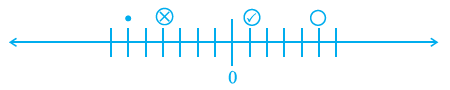
Question 8. If $\times$ , , $\checkmark$ and • represent some integers on number line, then descending order of these numbers is
(a) • , $\times$ , $\checkmark$ ,
(b) $\times$ , • , $\checkmark$ ,
(c) , $\checkmark$ , $\times$ , •
(d) , • , $\times$ , $\checkmark$
Answer:
To Find:
The descending order of the integers represented by the symbols.
Solution:
On a number line, values decrease as we move from right to left. Descending order means arranging the values from the largest to the smallest.
By observing the given number line (Fig. 1.2), the symbols from right to left are:
1. Empty Circle ($ \bigcirc $) [Furthest to the right, hence the Largest]
2. Tick mark in Circle ($ \checkmark $) [To the right of zero]
3. Cross in Circle ($ \otimes $) [To the left of zero]
4. Dot ($ \bullet $) [Furthest to the left, hence the Smallest]
Order Table:
| Position on Number Line | Symbol | Value Type |
| Rightmost | $ \bigcirc $ | Positive (Highest) |
| Right of 0 | $ \checkmark $ | Positive |
| Left of 0 | $ \otimes $ | Negative |
| Leftmost | $ \bullet $ | Negative (Lowest) |
Therefore, the descending order is: $ \bigcirc , \checkmark , \otimes , \bullet $.
Final Answer: The correct option is (c).
Question 9. On the number line, the value of (–3) × 3 lies on right hand side of
(a) – 10
(b) – 4
(c) 0
(d) 9
Answer:
Solution:
First, let us calculate the product:
$(-3) \times 3 = -9$
(Negative $\times$ Positive = Negative)
On a number line, a value $x$ lies on the right hand side of another value $y$ if $x > y$.
Let us compare $-9$ with the given options:
(a) –10: Since $-9 > -10$, $-9$ lies on the right of $-10$. (Correct)
(b) –4: Since $-9 < -4$, $-9$ lies on the left of $-4$.
(c) 0: Since $-9 < 0$, $-9$ lies on the left of $0$.
(d) 9: Since $-9 < 9$, $-9$ lies on the left of $9$.
Final Answer: The value lies on the right hand side of (a) – 10.
Question 10. The value of 5 ÷ (–1) does not lie between
(a) 0 and – 10
(b) 0 and 10
(c) – 4 and – 15
(d) – 6 and 6
Answer:
Solution:
First, we need to calculate the value of the expression $5 \div (–1)$.
When a positive integer is divided by a negative integer, the result is a negative integer.
$5 \div (-1) = - (5 \div 1) = -5$
The value of the expression is $-5$. Now, we need to check which of the given ranges does not contain the value $-5$.
Let's examine each option:
(a) Between 0 and –10:
The integers between 0 and –10 (exclusive) are $-9, -8, -7, -6, -5, -4, -3, -2, -1$.
Since $-5$ is in this list, $-5$ lies between 0 and –10.
(b) Between 0 and 10:
The integers between 0 and 10 (exclusive) are $1, 2, 3, 4, 5, 6, 7, 8, 9$.
Since $-5$ is a negative integer, it is not in this list. $-5$ is less than 0.
So, $-5$ does not lie between 0 and 10.
(c) Between –4 and –15:
The integers between –4 and –15 (exclusive) are –14, –13, –12, –11, –10, –9, –8, –7, –6, –5.
Since $-5$ is in this list, $-5$ lies between –4 and –15.
(d) Between –6 and 6:
The integers between –6 and 6 (exclusive) are –5, –4, –3, –2, –1, 0, 1, 2, 3, 4, 5.
Since $-5$ is in this list, $-5$ lies between –6 and 6.
The value $-5$ does not lie between 0 and 10.
The correct answer is (b) 0 and 10.
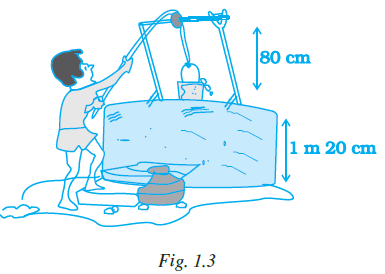
Question 11. Water level in a well was 20m below ground level. During rainy season, rain water collected in different water tanks was drained into the well and the water level rises 5 m above the previous level. The wall of the well is 1m 20 cm high and a pulley is fixed at a height of 80 cm. Raghu wants to draw water from the well. The minimum length of the rope that he can use is
(a) 17 m
(b) 18 m
(c) 96 m
(d) 97 m
Answer:
Given:
Initial water level $= 20$ m below ground level
Rise in water level $= 5$ m
Height of the well wall $= 1$ m $20$ cm $= 1.2$ m
Height of pulley above the wall $= 80$ cm $= 0.8$ m
To Find:
The minimum length of the rope required to reach the water level from the pulley.
Solution:
Let us calculate the current depth of water below the ground level:
New depth of water $= 20\text{ m} - 5\text{ m} = 15\text{ m}$ below ground level.
Now, let us calculate the total height of the pulley above the ground level:
Total height of pulley $= \text{Height of wall} $$ + \text{Height of pulley above wall}$
Total height of pulley $= 1.2\text{ m} + 0.8\text{ m} = 2.0\text{ m}$.
The total length of the rope needed is the distance from the pulley to the current water level:
Length of rope $= \text{Height above ground} + \text{Depth below ground}$
Length of rope $= 2\text{ m} + 15\text{ m}$
$Total \ Length = 17 \text{ m}$
Final Answer: The minimum length of the rope is (a) 17 m.
Question 12. (– 11) × 7 is not equal to
(a) 11 × (– 7)
(b) – (11 × 7)
(c) (– 11) × (– 7)
(d) 7 × (– 11)
Answer:
Solution:
First, let us calculate the value of the given expression:
$(-11) \times 7 = -77$
Now let us check each option:
(a) $11 \times (-7)$: Result is $-77$. (Matches)
(b) $-(11 \times 7)$: Result is $-(77) = -77$. (Matches)
(c) $(-11) \times (-7)$: When two negative integers are multiplied, the product is positive.
$(-11) \times (-7) = +77$
[Does not match $-77$]
(d) $7 \times (-11)$: Result is $-77$ (Commutative property). (Matches)
Final Answer: The expression is not equal to (c) (– 11) × (– 7).
Question 13. (– 10) × (– 5) + (– 7) is equal to
(a) – 57
(b) 57
(c) – 43
(d) 43
Answer:
Solution:
We need to evaluate the expression $(– 10) \times (– 5) + (– 7)$ using the order of operations (PEMDAS/BODMAS).
Multiplication is performed before addition.
First, evaluate the multiplication: $(– 10) \times (– 5)$.
The product of two negative integers is a positive integer.
$(-10) \times (-5) = 10 \times 5 = 50$
Now, substitute this result back into the expression:
$50 + (– 7)$
Adding a negative integer is the same as subtracting the corresponding positive integer.
$50 + (-7) = 50 - 7$
$50 - 7 = 43$
Thus, $(– 10) \times (– 5) + (– 7) = 43$.
This matches option (d).
The correct answer is (d) 43.
Question 14. Which of the folllowing is not the additive inverse of a ?
(a) – (– a)
(b) a × (– 1)
(c) – a
(d) a ÷ (–1)
Answer:
Solution:
The additive inverse of an integer $a$ is the integer that, when added to $a$, gives a sum of $0$. This integer is denoted as $-a$. We need to find which of the given expressions is not equal to $-a$.
Let's evaluate each option:
(a) – (– a)
The negative of a negative number is the positive number itself.
$– (– a) = a$
If $a$ is an integer, its additive inverse is $-a$. So, $-(-a) = a$ is the additive inverse of $-a$, not the additive inverse of $a$, unless $a=0$. However, the question asks for what is *not* the additive inverse of $a$. Since $a$ is the additive inverse of $-a$, $a$ is generally not the additive inverse of $a$ (unless $a=0$).
(b) a × (– 1)
When an integer $a$ is multiplied by $-1$, the result is the negative of $a$.
$a \times (-1) = -a$
This is the additive inverse of $a$.
(c) – a
By definition, $-a$ is the additive inverse of $a$.
$a + (-a) = 0$
This is the additive inverse of $a$.
(d) a ÷ (–1)
When an integer $a$ is divided by $-1$, the result is the negative of $a$.
$a \div (-1) = \frac{a}{-1} = -a$
This is the additive inverse of $a$.
Comparing the evaluated options:
(a) $– (– a) = a$
(b) $a \times (– 1) = -a$
(c) $– a$
(d) $a \div (–1) = -a$
The expression $– (– a)$ simplifies to $a$, which is the additive inverse of $-a$, not $a$ (unless $a=0$). The question asks which is *not* the additive inverse of $a$. $a$ is generally not the additive inverse of $a$.
The correct answer is (a) – (– a).
Question 15. Which of the following is the multiplicative identity for an integer a ?
(a) a
(b) 1
(c) 0
(d) – 1
Answer:
Solution:
The multiplicative identity is a number that, when multiplied by any integer $a$, results in the same integer $a$.
$a \times 1 = a$
(Identity property)
Since multiplying by $1$ keeps the value of the integer unchanged, $1$ is the multiplicative identity for integers.
| Identity Type | Value | Property |
| Additive Identity | $0$ | $a + 0 = a$ |
| Multiplicative Identity | $1$ | $a \times 1 = a$ |
Final Answer: The multiplicative identity is (b) 1.
Question 16. [(– 8) × ( – 3)] × (– 4) is not equal to
(a) (– 8) × [(– 3) × (– 4)]
(b) [(– 8) × (– 4)] × (– 3)
(c) [(– 3) × (– 8)] × (– 4)
(d) (– 8) × (– 3) – (– 8) × (– 4)
Answer:
To Find: The expression which is not equal to $[(-8) \times (-3)] \times (-4)$.
Solution:
First, let us calculate the value of the given expression:
$[(-8) \times (-3)] \times (-4) = 24 \times (-4) = -96$
Now, checking the options:
(a) $(-8) \times [(-3) \times (-4)] = (-8) \times 12 = -96$
$a \times (b \times c) = (a \times b) \times c$
(Associative Property)
(b) $[(-8) \times (-4)] \times (-3) = 32 \times (-3) = -96$
(c) $[(-3) \times (-8)] \times (-4) = 24 \times (-4) = -96$
(d) $(-8) \times (-3) - (-8) \times (-4) = 24 - (32) = -8$
Since $-8 \neq -96$, the expression in option (d) is not equal to the given expression.
Correct Option: (d)
Question 17. (– 25) × [6 + 4] is not same as
(a) (– 25) × 10
(b) (– 25) × 6 + (– 25) × 4
(c) (– 25) × 6 × 4
(d) – 250
Answer:
Solution:
The given expression is $(-25) \times [6 + 4]$.
Calculation: $(-25) \times 10 = -250$
Evaluating the options:
(a) $(-25) \times 10 = -250$ (Same as result)
(b) $(-25) \times 6 + (-25) \times 4 = -150 + (-100) = -250$
$a \times (b + c) = a \times b + a \times c$
(Distributive Property)
(c) $(-25) \times 6 \times 4 = -150 \times 4 = -600$
(d) $-250$ (Same as result)
Comparing the values, $-600 \neq -250$.
Correct Option: (c)
Question 18. – 35 × 107 is not same as
(a) – 35 × (100 + 7)
(b) (– 35) × 7 + ( – 35) × 100
(c) – 35 × 7 + 100
(d) ( – 30 – 5) × 107
Answer:
Solution:
The given expression is $-35 \times 107$.
Evaluating the options:
(a) $-35 \times (100 + 7) = -35 \times 107$ (Using distributive property)
(b) $(-35) \times 7 + (-35) \times 100 = -35 \times (7 + 100) = -35 \times 107$
(c) $-35 \times 7 + 100 = -245 + 100 = -145$
(d) $(-30 - 5) \times 107 = -35 \times 107$
The calculation in option (c) yields $-145$, which is not equal to $-35 \times 107$. In option (c), the multiplication is only applied to 7, not to the entire value of 107.
Correct Option: (c)
Question 19. (– 43) × (– 99) + 43 is equal to
(a) 4300
(b) – 4300
(c) 4257
(d) – 4214
Answer:
To Find: The value of $(-43) \times (-99) + 43$.
Solution:
We can solve this using the distributive property of multiplication over addition.
Given expression: $(-43) \times (-99) + 43$
We know that $(-43) \times (-99) = 43 \times 99$ (Product of two negative integers is positive).
Also, $43$ can be written as $43 \times 1$.
Substituting these:
$= (43 \times 99) + (43 \times 1)$
Taking 43 common using the distributive property:
$= 43 \times (99 + 1)$
$= 43 \times 100$
$= 4300$
Correct Option: (a)
Question 20. (– 16) ÷ 4 is not same as
(a) ( – 4) ÷ 16
(b) – (16 ÷ 4)
(c) 16 ÷ (– 4)
(d) – 4
Answer:
Solution:
The given expression is $(-16) \div 4 = -4$.
Evaluating the options:
(a) $(-4) \div 16 = \frac{-4}{16} = -\frac{1}{4}$
(b) $-(16 \div 4) = -(4) = -4$
(c) $16 \div (-4) = -4$
(d) $-4$
Since $-\frac{1}{4} \neq -4$, option (a) is the one that is not the same.
Correct Option: (a)
Question 21. Which of the following does not represent an integer?
(a) 0 ÷ (– 7)
(b) 20 ÷ (– 4)
(c) (– 9) ÷ 3
(d) (– 12) ÷ 5
Answer:
Solution:
An integer is a whole number (not a fractional number) that can be positive, negative, or zero.
Checking the division results:
(a) $0 \div (-7) = 0$ (0 is an integer)
(b) $20 \div (-4) = -5$ (-5 is an integer)
(c) $(-9) \div 3 = -3$ (-3 is an integer)
(d) $(-12) \div 5 = -2.4$ (This is a decimal/fraction, not an integer)
Correct Option: (d)
Question 22. Which of the following is different from the others?
(a) 20 + (–25)
(b) (– 37) – (– 32)
(c) (– 5) × (–1)
(d) ( 45 ) ÷ (– 9)
Answer:
Solution:
To find the different one, let us calculate the value of each expression:
(a) $20 + (-25) = 20 - 25 = -5$
(b) $(-37) - (-32) = -37 + 32 = -5$
(c) $(-5) \times (-1) = 5$
(d) $(45) \div (-9) = -5$
Calculated values are: $-5, -5, 5, -5$.
We can see that the value of option (c) is positive 5, while all other options result in negative 5.
Correct Option: (c)
Question 23. Which of the following shows the maximum rise in temperature?
(a) 23° to 32°
(b) – 10° to + 1°
(c) – 18° to – 11°
(d) – 5° to 5°
Answer:
To Find: The pair that shows the maximum rise in temperature.
Solution:
The rise in temperature is calculated as: $Rise = \text{Final Temperature} - \text{Initial Temperature}$
Calculating the rise for each option:
(a) $23^\circ$ to $32^\circ$:
$Rise = 32^\circ - 23^\circ = 9^\circ$
(b) $-10^\circ$ to $+1^\circ$:
$Rise = 1^\circ - (-10^\circ) = 1^\circ + 10^\circ = 11^\circ$
(c) $-18^\circ$ to $-11^\circ$:
$Rise = -11^\circ - (-18^\circ) = -11^\circ + 18^\circ = 7^\circ$
(d) $-5^\circ$ to $5^\circ$:
$Rise = 5^\circ - (-5^\circ) = 5^\circ + 5^\circ = 10^\circ$
Comparing the results: $9^\circ, 11^\circ, 7^\circ,$ and $10^\circ$.
The maximum value is $11^\circ$, which corresponds to option (b).
Correct Option: (b)
Question 24. If a and b are two integers, then which of the following may not be an integer?
(a) a + b
(b) a – b
(c) a × b
(d) a ÷ b
Answer:
Solution:
Let us check the closure property of integers for different operations:
(a) Addition: The sum of two integers is always an integer. For example, $2 + 3 = 5$ (Integer).
(b) Subtraction: The difference of two integers is always an integer. For example, $2 - 5 = -3$ (Integer).
(c) Multiplication: The product of two integers is always an integer. For example, $4 \times (-3) = -12$ (Integer).
(d) Division: The quotient of two integers may or may not be an integer. For example, $5 \div 2 = 2.5$ (Not an integer).
Since division does not guarantee an integer result, option (d) is correct.
Correct Option: (d)
Question 25. For a non-zero integer a which of the following is not defined?
(a) a ÷ 0
(b) 0 ÷ a
(c) a ÷ 1
(d) 1 ÷ a
Answer:
Solution:
In mathematics, division by zero is not defined.
(a) $a \div 0 = \frac{a}{0}$. Since the divisor is zero, this expression is not defined.
(b) $0 \div a = \frac{0}{a} = 0$ (Defined).
(c) $a \div 1 = \frac{a}{1} = a$ (Defined).
(d) $1 \div a = \frac{1}{a}$ (Defined as a fraction).
Correct Option: (a)
Encircle the odd one of the following (Questions 26 to 30).
Question 26.
(a) (–3, 3)
(b) (–5, 5)
(c) (–6, 1)
(d) (–8, 8)
Answer:
Solution:
Let us check the relationship between the two numbers in each pair by adding them:
(a) $-3 + 3 = 0$
(b) $-5 + 5 = 0$
(c) $-6 + 1 = -5$
(d) $-8 + 8 = 0$
In options (a), (b), and (d), the numbers are additive inverses of each other (their sum is zero). However, in option (c), the sum is not zero. Therefore, option (c) is the odd one.
Correct Option: (c)
Question 27.
(a) (–1, –2)
(b) (–5, +2)
(c) (–4, +1)
(d) (–9, +7)
Answer:
Solution:
Let us find the sum of the integers in each pair:
(a) $-1 + (-2) = -1 - 2 = -3$
(b) $-5 + 2 = -3$
(c) $-4 + 1 = -3$
(d) $-9 + 7 = -2$
The sum of the numbers in options (a), (b), and (c) is $-3$. The sum in option (d) is $-2$, making it different from the others.
Correct Option: (d)
Question 28.
(a) (–9) × 5 × 6 × (–3)
(b) 9 × (–5) × 6 × (–3)
(c) (–9) × (–5) × (–6) × 3
(d) 9 × (–5) × (–6) × 3
Answer:
Solution:
To identify the odd one, we look at the sign of the product in each case. The product of integers is positive if the number of negative factors is even, and negative if it is odd.
(a) $(-9) \times 5 \times 6 \times (-3) \rightarrow$ 2 negative factors (Even). Product is Positive.
(b) $9 \times (-5) \times 6 \times (-3) \rightarrow$ 2 negative factors (Even). Product is Positive.
(c) $(-9) \times (-5) \times (-6) \times 3 \rightarrow$ 3 negative factors (Odd). Product is Negative.
(d) $9 \times (-5) \times (-6) \times 3 \rightarrow$ 2 negative factors (Even). Product is Positive.
Since the sign of the product in option (c) is negative while all others are positive, it is the odd one.
Correct Option: (c)
Question 29.
(a) (–100) ÷ 5
(b) (–81) ÷ 9
(c) (–75) ÷ 5
(d) (–32) ÷ 9
Answer:
Solution:
Let us evaluate each division:
(a) $(-100) \div 5 = -20$ (Integer)
(b) $(-81) \div 9 = -9$ (Integer)
(c) $(-75) \div 5 = -15$ (Integer)
(d) $(-32) \div 9 = -3.55... = -3.\overline{5}$ (Not an integer)
Options (a), (b), and (c) result in integers, whereas option (d) results in a recurring decimal (rational number). Thus, (d) is the odd one.
Correct Option: (d)
Question 30.
(a) (–1) × (–1)
(b) (–1) × (–1) × (–1)
(c) (–1) × (–1) × (–1) × (–1)
(d) (–1) × (–1) × (–1) × (–1) × (–1) × (–1)
Answer:
Solution:
The result of multiplying $(-1)$ with itself depends on the number of factors:
$(-1)^n = 1$
(if $n$ is even)
$(-1)^n = -1$
(if $n$ is odd)
(a) $(-1) \times (-1) = 1$ (Even number of factors)
(b) $(-1) \times (-1) \times (-1) = -1$ (Odd number of factors)
(c) $(-1) \times (-1) \times (-1) \times (-1) = 1$ (Even number of factors)
(d) $(-1) \times (-1) \times (-1) \times (-1) \times (-1) \times (-1) = 1$ (Even number of factors)
Option (b) results in $-1$, while all other options result in $1$. Therefore, (b) is the odd one.
Correct Option: (b)
Question 31 to 71 (Fill in the Blanks)
In Questions 31 to 71, fill in the blanks to make the statements true.
Question 31. (–a) + b = b + Additive inverse of __________.
Answer:
Given: The expression is $(-a) + b = b + \text{Additive inverse of } \_\_\_\_\_\_$.
Solution:
According to the commutative property of addition for integers:
$(-a) + b = b + (-a)$
We know that the additive inverse of any integer $x$ is $-x$.
Therefore, $-a$ is the additive inverse of $a$.
Answer: $a$
Question 32. ________ ÷ (–10) = 0
Answer:
Solution:
Let the missing number be $x$.
$x \div (-10) = 0$
$\frac{x}{-10} = 0$
$x = 0 \times (-10)$
$x = 0$
Answer: $0$
Question 33. (–157) × (–19) + 157 = ___________
Answer:
Solution:
The given expression is $(-157) \times (-19) + 157$.
Since the product of two negative integers is positive:
$(-157) \times (-19) = 157 \times 19$
Now the expression becomes:
$(157 \times 19) + (157 \times 1)$
Using the distributive property $a \times b + a \times c = a \times (b + c)$:
$= 157 \times (19 + 1)$
$= 157 \times 20$
$= 3140$
Answer: $3140$
Question 34. [(–8) + ______ ] + ________ = ________ + [(–3) + ________ ] = –3
Answer:
Solution:
We need to fill the blanks such that the final result is $-3$. Let's use the associative property: $(a + b) + c = a + (b + c)$.
To get the sum $-3$ using the number $-8$, we need to add $5$ to it because $-8 + 5 = -3$. We can split $5$ into $8 + (-3)$.
Let $a = -8$, $b = 8$, and $c = -3$.
First part: $[(-8) + 8] + (-3) = 0 + (-3) = -3$
Second part: $(-8) + [(-3) + 8] = -8 + 5 = -3$
Comparing with the blanks:
$[(-8) + 8] + (-3) = (-8) + [(-3) + 8] = -3$
Answer: $8$, $-3$, $-8$, $8$
Question 35. On the following number line, (–4) × 3 is represented by the point _________.

Answer:
Given: The expression is $(-4) \times 3$.
Solution:
First, calculate the value: $(-4) \times 3 = -12$.
Now, let's analyze the number line:
The distance between $-20$ and $2$ is $|2 - (-20)| = 22$ units.
There are $11$ equal gaps between the markings $-20$ and $2$.
The value of each gap $= \frac{22}{11} = 2$ units.
Starting from $-20$ and moving to the right in steps of $2$:
$-20$
$A = -20 + 2 = -18$
$B = -18 + 2 = -16$
$C = -16 + 2 = -14$
$D = -14 + 2 = -12$
Since the value $-12$ corresponds to point D, the point representing the expression is D.
Answer: D
Question 36. If x, y and z are integers then (x + ___ ) + z = _____ + (y + _____ )
Answer:
Solution:
This statement represents the Associative Property of addition for integers.
$(x + y) + z = x + (y + z)$
(Property)
Filling the blanks based on the property:
$(x + y) + z = x + (y + z)$
Answer: $y, x, z$
Question 37. (– 43) + _____ = – 43
Answer:
Solution:
According to the Additive Identity property of integers, adding $0$ to any integer results in the same integer.
$a + 0 = a$
(Additive Identity)
Thus, $(-43) + 0 = -43$.
Answer: $0$
Question 38. (– 8) + (– 8) + (– 8) = _____ × (– 8)
Answer:
Solution:
Multiplication is defined as repeated addition of the same number.
Here, the number $(-8)$ is added to itself $3$ times.
$(-8) + (-8) + (-8) = 3 \times (-8)$
Answer: $3$
Question 39. 11 × (– 5) = – ( _____ × _____ ) = _____
Answer:
Solution:
When multiplying a positive integer and a negative integer, we multiply their absolute values and place a negative sign before the result.
$11 \times (-5) = -(11 \times 5)$
$11 \times (-5) = -55$
Answer: $11$, $5$, $-55$
Question 40. (– 9) × 20 = _____
Answer:
Solution:
The product of a negative integer and a positive integer is always a negative integer.
$(-9) \times 20 = -(9 \times 20)$
$(-9) \times 20 = -180$
Answer: $-180$
Question 41. (– 23) × (42) = (– 42) × _____
Answer:
Solution:
We know that multiplication of integers is commutative ($a \times b = b \times a$).
Also, the sign can be shifted: $(-a) \times b = a \times (-b)$.
Given: $(-23) \times 42$
This can be written as: $23 \times (-42)$
By commutative property: $(-42) \times 23$
Answer: $23$
Question 42. While multiplying a positive integer and a negative integer, we multiply them as ________ numbers and put a ________ sign before the product.
Answer:
Solution:
To find the product of a positive and a negative integer:
1. We treat them as whole numbers (ignoring the signs).
2. We multiply them.
3. We place a minus (negative) sign before the product.
Answer: whole, minus
Question 43. If we multiply ________ number of negative integers, then the resulting integer is positive.
Answer:
Solution:
The sign of the product depends on the count of negative integers:
1. If the number of negative integers is even, the product is positive.
2. If the number of negative integers is odd, the product is negative.
Answer: even
Question 44. If we multiply six negative integers and six positive integers, then the resulting integer is _______.
Answer:
Solution:
Let's check the sign of the product:
1. Six negative integers: Since 6 is an even number, the product of these six negative integers will be positive.
2. Six positive integers: The product of any number of positive integers is always positive.
Product = (Positive) $\times$ (Positive) = Positive.
Answer: positive
Question 45. If we multiply five positive integers and one negative integer, then the resulting integer is _______.
Answer:
Solution:
Let's determine the sign:
1. Product of five positive integers = Positive.
2. There is one negative integer. Since 1 is an odd number, the negative sign persists.
Product = (Positive) $\times$ (Negative) = Negative.
Answer: negative
Question 46. __________ is the multiplicative identity for integers.
Answer:
Solution:
A multiplicative identity is a number that, when multiplied by any integer $a$, leaves the integer unchanged.
$a \times 1 = a$
(Multiplicative Identity)
Therefore, 1 is the multiplicative identity for integers.
Answer: $1$
Question 47. We get additive inverse of an integer a when we multiply it by ________.
Answer:
Solution:
The additive inverse of an integer $a$ is $-a$.
To get $-a$ from $a$, we must multiply $a$ by $-1$.
$a \times (-1) = -a$
(Property of Multiplication)
Answer: $-1$
Question 48. (– 25) × (– 2) = __________.
Answer:
Solution:
We are multiplying two negative integers.
Rule: Negative $\times$ Negative = Positive.
$(-25) \times (-2) = 25 \times 2$
$(-25) \times (-2) = 50$
Answer: $50$
Question 49. (– 5) × (– 6) × (– 7) = ________.
Answer:
Solution:
Here, we are multiplying three negative integers. Since $3$ is an odd number, the resulting product will be negative.
$[(-5) \times (-6)] \times (-7)$
$= 30 \times (-7)$
$= -210$
Answer: $-210$
Question 50. 3 × (– 1 ) × (– 15) = _______.
Answer:
Solution:
Here, we have two negative integers. Since $2$ is an even number, the product of the negative integers will be positive.
$3 \times [(-1) \times (-15)]$
$= 3 \times 15$
$= 45$
Answer: $45$
Question 51. [12 × (– 7)] × 5 = ________× [(– 7) × ]
Answer:
Solution:
This follows the Associative Property of multiplication: $(a \times b) \times c = a \times (b \times c)$.
Given: $a = 12$, $b = -7$, and $c = 5$.
Substituting into the property:
$[12 \times (-7)] \times 5 = 12 \times [(-7) \times 5]$
Answer: $12$, $5$
Question 52. 23 × (– 99) = _______ × (– 100 + _______) = 23 × _______ + 23 × _____.
Answer:
Solution:
We can use the Distributive Property: $a \times (b + c) = a \times b + a \times c$.
First, express $-99$ as $(-100 + 1)$.
$23 \times (-99) = 23 \times (-100 + 1)$
Now apply the distribution:
$= 23 \times (-100) + 23 \times 1$
Answer: $23$, $1$, $-100$, $1$
Question 53. __________ × ( – 1) = – 35
Answer:
Solution:
Let the missing integer be $x$.
$x \times (-1) = -35$
Multiplying any integer by $-1$ changes its sign.
Therefore, $x = 35$.
Answer: $35$
Question 54. ________× ( – 1) = 47
Answer:
Solution:
Let the missing integer be $x$.
$x \times (-1) = 47$
Multiplying an integer by $-1$ results in its additive inverse.
Since the result is positive $47$, the original integer must have been negative.
$x = -47$
Answer: $-47$
Question 55. 88 × _______ = – 88
Answer:
To Find: The integer that makes the equation true.
Solution:
Let the missing integer be $x$.
$88 \times x = -88$
$x = \frac{-88}{88}$
$x = -1$
Answer: $-1$
Question 56. _____× (–93) = 93
Answer:
Solution:
Let the missing integer be $x$.
$x \times (-93) = 93$
$x = \frac{93}{-93}$
$x = -1$
When we multiply a negative integer by $-1$, we get its additive inverse (the positive version of the same number).
Answer: $-1$
Question 57. (– 40) × _______= 80
Answer:
Solution:
Let the missing integer be $x$.
$(-40) \times x = 80$
$x = \frac{80}{-40}$
$x = -2$
Answer: $-2$
Question 58. ___________× (–23) = – 920
Answer:
To Find: The missing integer $x$ in $x \times (-23) = -920$.
Solution:
$x = \frac{-920}{-23}$
Since both numerator and denominator are negative, the result will be positive.
$x = \frac{920}{23}$
So, $x = 40$.
Answer: $40$
Question 59. When we divide a negative integer by a positive integer, we divide them as whole numbers and put a _______ sign before quotient.
Answer:
Solution:
The rule for division of integers with different signs states that the quotient of a negative integer and a positive integer is always negative.
1. Treat them as whole numbers.
2. Divide them.
3. Place a minus or negative sign before the result.
Answer: minus (or negative)
Question 60. When –16 is divided by _________ the quotient is 4.
Answer:
Given: Dividend = $-16$, Quotient = $4$.
Solution:
Let the divisor be $x$.
$(-16) \div x = 4$
$x = \frac{-16}{4}$
$x = -4$
Answer: $-4$
Question 61. Division is the inverse operation of ____________.
Answer:
Solution:
In arithmetic, operations come in pairs where one reverses the effect of the other.
1. Subtraction is the inverse of addition.
2. Division is the inverse of multiplication.
For example: If $5 \times 4 = 20$, then $20 \div 4 = 5$.
Answer: multiplication
Question 62. 65 ÷ ( – 13) = ___________.
Answer:
Solution:
When dividing a positive integer by a negative integer, the result is negative.
Divide the absolute values:
$\frac{65}{13} = 5$
Apply the negative sign:
$65 \div (-13) = -5$
Answer: $-5$
Question 63. (– 100) ÷ ( – 10) = _______.
Answer:
Solution:
When we divide a negative integer by another negative integer, the quotient is a positive integer.
$(-100) \div (-10) = \frac{100}{10} = 10$
Answer: $10$
Question 64. (– 225) ÷ 5 = ___________.
Answer:
Solution:
When we divide a negative integer by a positive integer, the quotient is a negative integer.
Divide the absolute values:
$\begin{array}{r} 45 \phantom{5)} \\ 5{\overline{\smash{\big)}\,225 \phantom{)}}} \\ \underline{-~ 20 \phantom{x}} \\ 25 \phantom{)} \\ \underline{-~ 25 \phantom{x}} \\ 0 \phantom{)} \end{array}$
So, $(-225) \div 5 = -45$.
Answer: $-45$
Question 65. _____÷ (– 1 ) = – 83
Answer:
Solution:
Let the missing integer be $x$.
$x \div (-1) = -83$
By the rule of division, any integer divided by $-1$ results in its additive inverse.
Therefore, $x = 83$ (since the additive inverse of $83$ is $-83$).
Answer: $83$
Question 66. _____ ÷ (– 1) = 75
Answer:
Solution:
Let the missing integer be $x$.
$x \div (-1) = 75$
Dividing an integer by $-1$ changes its sign. Since the result is positive $75$, the original integer must be negative.
$x = -75$
Answer: $-75$
Question 67. 51 ÷ _____ = – 51
Answer:
Solution:
Let the missing integer be $x$.
$51 \div x = -51$
$\frac{51}{x} = -51$
$x = \frac{51}{-51} = -1$
Answer: $-1$
Question 68. 113 ÷ _____ = – 1
Answer:
Solution:
Let the missing integer be $x$.
$113 \div x = -1$
To get a quotient of $1$ (regardless of sign), we must divide a number by itself. To get a negative sign, one of the numbers must be negative.
$x = \frac{113}{-1} = -113$
Answer: $-113$
Question 69. (– 95) ÷ _____ = 95
Answer:
Solution:
Let the missing integer be $x$.
$(-95) \div x = 95$
$x = \frac{-95}{95} = -1$
Answer: $-1$
Question 70. (– 69) ÷ ( 69) = _____
Answer:
Solution:
When an integer is divided by its additive inverse, the quotient is always $-1$.
$(-69) \div 69 = -1$
Answer: $-1$
Question 71. (– 28) ÷ ( – 28) = _____
Answer:
Solution:
When a non-zero integer is divided by itself, the quotient is always $1$.
$(-28) \div (-28) = 1$
Answer: $1$
Question 72 to 108 (True or False)
In Questions 72 to 108, state whether the statements are True or False.
Question 72. 5 – (– 8) is same as 5 + 8.
Answer:
Solution:
Let us evaluate the expression $5 - (-8)$.
We know that when we subtract a negative integer, it is equivalent to adding its additive inverse (the positive version of the number).
$5 - (-8) = 5 + 8$
Both sides result in 13. Therefore, the statement is true.
Answer: True
Question 73. (– 9) + (– 11) is greater than (– 9) – (– 11).
Answer:
Solution:
Let us calculate the values for both sides of the comparison:
LHS: $(-9) + (-11) = -9 - 11 = -20$
RHS: $(-9) - (-11) = -9 + 11 = 2$
Comparing the results: $-20$ and $2$.
Since every positive integer is greater than every negative integer, $2 > -20$.
Thus, $(-9) + (-11)$ is smaller than $(-9) - (-11)$.
Answer: False
Question 74. Sum of two negative integers always gives a number smaller than both the integers.
Answer:
Solution:
Let us take two negative integers, say $-2$ and $-3$.
Sum $= (-2) + (-3) = -5$
Now, compare $-5$ with the original integers:
$-5 < -2$
$-5 < -3$
On a number line, as we move further to the left, the value of the integer decreases. Adding two negative integers always results in a point further to the left of both numbers.
Answer: True
Question 75. Difference of two negative integers cannot be a positive integer.
Answer:
Solution:
Let us test this statement with an example.
Let the two negative integers be $-2$ and $-5$.
Calculate the difference:
$(-2) - (-5) = -2 + 5 = 3$
Here, $3$ is a positive integer.
Since we found an example where the difference is positive, the statement "cannot be a positive integer" is incorrect.
Answer: False
Question 76. We can write a pair of integers whose sum is not an integer.
Answer:
Solution:
According to the Closure Property of addition for integers, the sum of any two integers is always an integer.
$a + b = c$
(Where $c$ is always an integer)
Because addition of integers is closed, it is impossible to find a pair of integers whose sum is not an integer.
Answer: False
Question 77. Integers are closed under subtraction.
Answer:
Solution:
Closure property under subtraction means that for any two integers $a$ and $b$, $(a - b)$ is always an integer.
Example: $5 - 10 = -5$ (Integer)
Example: $(-3) - (-8) = 5$ (Integer)
Since the result of subtracting any two integers is always an integer, integers are indeed closed under subtraction.
Answer: True
Question 78. (– 23) + 47 is same as 47 + (– 23).
Answer:
Solution:
This statement refers to the Commutative Property of addition.
$a + b = b + a$
(Commutative Law)
Evaluating both sides:
LHS: $-23 + 47 = 24$
RHS: $47 + (-23) = 47 - 23 = 24$
Since LHS = RHS, the statement is true.
Answer: True
Question 79. When we change the order of integers, their sum remains the same.
Answer:
Solution:
The sum of integers is commutative. This means that changing the order in which we add integers does not affect the final result.
$x + y = y + x$
(Commutative Property)
Answer: True
Question 80. When we change the order of integers their difference remains thesame.
Answer:
Solution:
Let us check if subtraction is commutative for integers by using an example.
Let $a = 5$ and $b = 3$.
Order 1: $a - b = 5 - 3 = 2$
Order 2: $b - a = 3 - 5 = -2$
Since $2 \neq -2$, changing the order changes the result. Therefore, subtraction is not commutative for integers.
Answer: False
Question 81. Going 500 m towards east first and then 200 m back is same as going 200 m towards west first and then going 500 m back.
Answer:
Solution:
Let us represent direction towards East with a positive integer and direction towards West (back from East) with a negative integer.
Case 1: 500 m towards East and then 200 m back.
$500 + (-200)$
$500 - 200 = 300\text{ m}$
(Towards East)
Case 2: 200 m towards West first and then going 500 m back (towards East).
$(-200) + 500$
$-200 + 500 = 300\text{ m}$
(Towards East)
Since both cases result in the same final position ($300\text{ m}$ towards East), the statement is true.
Answer: True
Question 82. (– 5) × (33) = 5 × ( – 33)
Answer:
Solution:
We check the property: $(-a) \times b = a \times (-b) = -(a \times b)$.
LHS: $(-5) \times 33 = -165$
RHS: $5 \times (-33) = -165$
Since LHS = RHS, the statement is true.
Answer: True
Question 83. (– 19) × (– 11) = 19 × 11
Answer:
Solution:
The product of two negative integers is always a positive integer.
$(-a) \times (-b) = a \times b$
LHS: $(-19) \times (-11) = 209$
RHS: $19 \times 11 = 209$
Since LHS = RHS, the statement is true.
Answer: True
Question 84. (– 20) × ( 5 – 3) = (– 20) × ( – 2)
Answer:
Solution:
Let us evaluate both sides of the equation.
LHS: $(-20) \times (5 - 3)$
$(-20) \times 2 = -40$
RHS: $(-20) \times (-2)$
$(-20) \times (-2) = 40$
Since $-40 \neq 40$, the statement is false.
Answer: False
Question 85. 4 × (– 5) = (– 10) × (– 2)
Answer:
Solution:
Evaluate both sides:
LHS: $4 \times (-5) = -20$
RHS: $(-10) \times (-2) = 20$
Since $-20$ is not equal to $20$, the statement is false.
Answer: False
Question 86. (– 1) × (– 2) × (– 3) = 1 × 2 × 3
Answer:
Solution:
We check the number of negative signs on each side.
LHS: There are 3 negative integers. Since 3 is an odd number, the product will be negative.
$(-1) \times (-2) \times (-3) = 2 \times (-3) = -6$
RHS: $1 \times 2 \times 3 = 6$
Since $-6 \neq 6$, the statement is false.
Answer: False
Question 87. – 3 × 3 = – 12 – ( – 3)
Answer:
Solution:
Evaluate both sides:
LHS: $-3 \times 3 = -9$
RHS: $-12 - (-3)$
$-12 + 3 = -9$
Since LHS = RHS, the statement is true.
Answer: True
Question 88. Product of two negative integers is a negative integer.
Answer:
Solution:
Let us test this statement with two negative integers $a$ and $b$.
$(-a) \times (-b) = a \times b$
(Rule of Signs)
Example: $(-2) \times (-3) = 6$.
Since $6$ is a positive integer, the product of two negative integers is always positive.
Answer: False
Question 89. Product of three negative integers is a negative integer.
Answer:
Solution:
The sign of the product of integers depends on the number of negative integers being multiplied.
Rule: If the number of negative integers is odd, their product is negative.
In this case, we are multiplying three negative integers. Since 3 is an odd number, the product will be negative.
$(-1) \times (-1) \times (-1) = -1$
(Example)
Answer: True
Question 90. Product of a negative integer and a positive integer is a positive integer.
Answer:
Solution:
When we multiply a negative integer by a positive integer, the resulting product is always negative.
$(-a) \times b = -(ab)$
(Rule of Signs)
Example: $(-5) \times 4 = -20$.
Since $-20$ is a negative integer, the statement is false.
Answer: False
Question 91. When we multiply two integers their product is always greater than both the integers.
Answer:
Solution:
Let us test this statement with different types of integers.
Case 1: Positive integers. $2 \times 3 = 6$. Here, $6 > 2$ and $6 > 3$. (Statement holds)
Case 2: Multiplication with 1. $5 \times 1 = 5$. Here, $5$ is not greater than 5. (Statement fails)
Case 3: Multiplication with 0. $5 \times 0 = 0$. Here, $0$ is not greater than 5. (Statement fails)
Case 4: Negative integers. $2 \times (-3) = -6$. Here, $-6$ is smaller than both 2 and -3. (Statement fails)
Since the condition does not hold for all cases (especially involving 0, 1, or negative integers), the statement is false.
Answer: False
Question 92. Integers are closed under multiplication.
Answer:
Solution:
The Closure Property states that an operation on two elements of a set always results in an element that also belongs to that same set.
For any two integers $a$ and $b$, their product $a \times b$ is always an integer.
Example: $4 \times (-5) = -20$, which is an integer.
Example: $0 \times (-10) = 0$, which is an integer.
Answer: True
Question 93. (–237) × 0 is same as 0 × (–39)
Answer:
Solution:
Any integer multiplied by zero results in zero.
$a \times 0 = 0$
(Property of Zero)
Evaluating both expressions:
LHS: $(-237) \times 0 = 0$
RHS: $0 \times (-39) = 0$
Since both are equal to 0, the statement is true.
Answer: True
Question 94. Multiplication is not commutative for integers.
Answer:
Solution:
The Commutative Property states that the order of numbers does not change the result of the operation.
$a \times b = b \times a$
Example: $3 \times (-4) = -12$ and $(-4) \times 3 = -12$.
Since multiplication is commutative for integers, the statement "Multiplication is not commutative" is false.
Answer: False
Question 95. (–1) is not a multiplicative identity of integers.
Answer:
Solution:
A multiplicative identity is a number $e$ such that $a \times e = a$ for any integer $a$.
For integers, the multiplicative identity is $1$, because $a \times 1 = a$.
If we multiply by $-1$: $a \times (-1) = -a$.
Since $a \times (-1)$ results in the additive inverse and not the original number, $-1$ is not the multiplicative identity.
Therefore, the statement is true.
Answer: True
Question 96. 99 × 101 can be written as (100 – 1) × (100 + 1)
Answer:
Solution:
Let us check the numerical values of the expressions.
On the left: $99 \times 101$
We know that $99 = 100 - 1$ and $101 = 100 + 1$.
Substituting these values:
$99 \times 101 = (100 - 1) \times (100 + 1)$
This is a standard way to simplify multiplication using the identity $(a - b)(a + b) = a^2 - b^2$.
Answer: True
Question 97. If a, b, c are integers and b ≠ 0 then, a × (b – c) = a × b – a × c
Answer:
Solution:
This statement represents the Distributive Property of multiplication over subtraction for integers.
$a \times (b - c) = a \times b - a \times c$
(Distributive Law)
Example: Let $a = 2, b = 5, c = 3$.
LHS: $2 \times (5 - 3) = 2 \times 2 = 4$
RHS: $2 \times 5 - 2 \times 3 = 10 - 6 = 4$
Since the property holds true for all integers, the statement is true.
Answer: True
Question 98. (a + b) × c = a × c + a × b
Answer:
Solution:
According to the Distributive Property of multiplication over addition:
$(a + b) \times c = a \times c + b \times c$
However, the statement provided in the question is $(a + b) \times c = a \times c + a \times b$.
In the RHS of the given statement, the second term is $a \times b$ instead of $b \times c$. This is incorrect unless $a = c$.
Example: Let $a = 2, b = 3, c = 4$.
LHS: $(2 + 3) \times 4 = 5 \times 4 = 20$
RHS: $2 \times 4 + 2 \times 3 = 8 + 6 = 14$
Since $20 \neq 14$, the statement is false.
Answer: False
Question 99. a × b = b × a
Answer:
Solution:
The Commutative Property of multiplication states that the product of two integers remains the same regardless of the order in which they are multiplied.
$a \times b = b \times a$
(Commutative Property)
Example: $2 \times (-3) = -6$ and $(-3) \times 2 = -6$.
Answer: True
Question 100. a ÷ b = b ÷ a
Answer:
Solution:
Division of integers is not commutative. Changing the order of dividend and divisor changes the result.
Example: Let $a = 10$ and $b = 2$.
LHS: $10 \div 2 = 5$
RHS: $2 \div 10 = 0.2$
Since $5 \neq 0.2$, the statement $a \div b = b \div a$ is false.
Answer: False
Question 101. a – b = b – a
Answer:
Solution:
Subtraction of integers is not commutative. Changing the order of the numbers in a subtraction expression results in the additive inverse of the original result.
Example: Let $a = 8$ and $b = 3$.
LHS: $8 - 3 = 5$
RHS: $3 - 8 = -5$
Since $5 \neq -5$, the statement is false.
Answer: False
Question 102. a ÷ (–b) = – (a ÷ b)
Answer:
Solution:
When dividing two integers, if one is positive and the other is negative, the quotient is negative.
LHS: $a \div (-b) = \frac{a}{-b} = -\frac{a}{b}$
RHS: $-(a \div b) = -(\frac{a}{b}) = -\frac{a}{b}$
Since LHS = RHS, the statement is true.
Answer: True
Question 103. a ÷ ( –1) = – a
Answer:
Solution:
Any integer $a$ divided by $-1$ results in the additive inverse of that integer.
Calculation: $a \div (-1) = \frac{a}{-1} = -a$
Example: $5 \div (-1) = -5$
Example: $(-8) \div (-1) = 8$ (which is $-(-8)$)
The statement is true.
Answer: True
Question 104. Multiplication fact (–8) × (–10) = 80 is same as division fact 80 ÷ (– 8) = (–10)
Answer:
Solution:
Division is the inverse operation of multiplication.
If $x \times y = z$, then $z \div x = y$ and $z \div y = x$.
Given: $(-8) \times (-10) = 80$
According to the inverse relation:
$80 \div (-8) = -10$
Since this matches the given division fact, the statement is true.
Answer: True
Question 105. Integers are closed under division.
Answer:
Solution:
The closure property for division states that if $a$ and $b$ are any two integers, then $a \div b$ must also be an integer.
Let us test this property with an example:
Let $a = 5$ and $b = 2$ (both are integers).
$a \div b = 5 \div 2 = 2.5$
Since $2.5$ is not an integer, integers are not closed under division. The result of division can be a fraction or a decimal.
Answer: False
Question 106. [(–32) ÷ 8 ] ÷ 2 = –32 ÷ [ 8 ÷ 2]
Answer:
Solution:
We need to check if division is associative for integers. Let us evaluate both sides separately.
LHS: $[(-32) \div 8] \div 2$
$(-4) \div 2$
[Since $-32 \div 8 = -4$]
$= -2$
RHS: $-32 \div [8 \div 2]$
$-32 \div 4$
[Since $8 \div 2 = 4$]
$= -8$
Comparing the results: $-2 \neq -8$.
Therefore, the statement is false because division is not associative.
Answer: False
Question 107. The sum of an integer and its additive inverse is zero (0).
Answer:
Solution:
The additive inverse of an integer $a$ is defined as $-a$, such that when they are added together, the result is the additive identity (0).
Proof:
$a + (-a) = 0$
Example: Let the integer be $7$. Its additive inverse is $-7$.
$Sum = 7 + (-7) = 0$
The statement is true for all integers.
Answer: True
Question 108. The successor of 0 × (–25) is 1 × (–25)
Answer:
Solution:
First, let us calculate the value of the first expression:
$0 \times (-25) = 0$
The successor of an integer is obtained by adding $1$ to it.
Successor of $0 = 0 + 1 = 1$.
Now, let us calculate the value of the second expression provided in the statement:
$1 \times (-25) = -25$.
Comparing the actual successor ($1$) with the given expression ($ -25$):
$1 \neq -25$.
Answer: False
Question 109 to 136
Question 109. Observe the following patterns and fill in the blanks to make the statements true:
(a) – 5 × 4 = – 20
– 5 × 3 = – 15 = –20 – ( – 5)
– 5 × 2 = _______ = – 15 – ( –5)
– 5 × 1 = _______ = _______
– 5 × 0 = 0 = _______
– 5 × – 1 = 5 = _______
– 5 × – 2 = _______ = _______
(b) 7 × 4 = 28
7 × 3 = _______ = 28 – 7
7 × 2 = __ __ = _______– 7
7 × 1 = 7 = _______ – 7
7 × 0 = _______ = _______ –________
7 × – 1 = –7 = _______ – _______
7 × – 2 = _______ = _______ – _______
7 × – 3 _______ = _______ – ________
Answer:
Given:
Two patterns of multiplication involving integers $-5$ and $7$.
To Find:
The missing integers and expressions to complete the patterns.
Solution:
The logic of these patterns is based on repeated subtraction. To find the product of a number and an integer that is one less than the previous multiplier, we subtract the number from the previous product.
(a) Pattern for $-5$:
Here, in each step, we subtract $(-5)$ from the previous result.
$-5 \times 4 = -20$
$-5 \times 3 = -15 = -20 - (-5)$
$-5 \times 2 = \underline{-10} = -15 - (-5)$
$-5 \times 1 = \underline{-5} = \underline{-10 - (-5)}$
$-5 \times 0 = 0 = \underline{-5 - (-5)}$
$-5 \times -1 = 5 = \underline{0 - (-5)}$
$-5 \times -2 = \underline{10} = \underline{5 - (-5)}$
(b) Pattern for $7$:
Here, in each step, we subtract $7$ from the previous result.
$7 \times 4 = 28$
$7 \times 3 = \underline{21} = 28 - 7$
$7 \times 2 = \underline{14} = \underline{21} - 7$
$7 \times 1 = 7 = \underline{14} - 7$
$7 \times 0 = \underline{0} = \underline{7} - \underline{7}$
$7 \times -1 = -7 = \underline{0} - \underline{7}$
$7 \times -2 = \underline{-14} = \underline{-7} - \underline{7}$
$7 \times -3 = \underline{-21} = \underline{-14} - \underline{7}$
Question 110. Science Application: An atom consists of charged particles called electrons and protons. Each proton has a charge of +1 and each electron has a charge of –1. Remember number of electrons is equal to number of protons, while answering these questions:
(a) What is the charge on an atom?
(b) What will be the charge on an atom if it loses an electron?
(c) What will be the charge on an atom if it gains an electron?
Answer:
Given:
Charge of a proton $= +1$
Charge of an electron $= -1$
For a neutral atom, Number of protons $(p) =$ Number of electrons $(e)$. Let this number be '$n$'.
Solution (a):
Total charge on an atom $=$ (Number of protons $\times$ charge of 1 proton) $+$ (Number of electrons $\times$ charge of 1 electron)
Total charge $= n \times (+1) + n \times (-1)$
Total charge $= n - n = 0$
Therefore, the charge on a neutral atom is 0.
Solution (b):
If an atom loses an electron, the number of electrons becomes $(n - 1)$, while the number of protons remains $n$.
New charge $= n \times (+1) + (n - 1) \times (-1)$
New charge $= n - (n - 1)$
New charge $= n - n + 1 = +1$
Therefore, if an atom loses an electron, it acquires a charge of $+1$.
Solution (c):
If an atom gains an electron, the number of electrons becomes $(n + 1)$, while the number of protons remains $n$.
New charge $= n \times (+1) + (n + 1) \times (-1)$
New charge $= n - (n + 1)$
New charge $= n - n - 1 = -1$
Therefore, if an atom gains an electron, it acquires a charge of $-1$.
Question 111. An atom changes to a charged particle called ion if it loses or gains electrons. The charge on an ion is the charge on electrons plus charge on protons. Now, write the missing information in the table given below:
| Name of Iron | Proton Charge | Electron Charge | Ion Charge |
|---|---|---|---|
| Hydroxide Ion | +9 | ________ | -1 |
| Sodium Ion | +11 | ________ | +1 |
| Aluminium Ion | +13 | -10 | ________ |
| oxide Ion | +8 | -10 | ________ |
Answer:
Given:
$\text{Ion Charge} = \text{Charge on Protons} + \text{Charge on Electrons}$
To Find:
The missing electron and ion charges in the table.
Solution:
1. Hydroxide Ion:
Proton Charge $= +9$, Ion Charge $= -1$.
Let Electron Charge $= x$.
$+9 + x = -1$
$x = -1 - 9 = -10$
2. Sodium Ion:
Proton Charge $= +11$, Ion Charge $= +1$.
Let Electron Charge $= x$.
$+11 + x = +1$
$x = 1 - 11 = -10$
3. Aluminium Ion:
Proton Charge $= +13$, Electron Charge $= -10$.
$\text{Ion Charge} = +13 + (-10) = +3$
4. Oxide Ion:
Proton Charge $= +8$, Electron Charge $= -10$.
$\text{Ion Charge} = +8 + (-10) = -2$
Completed Table:
| Name of Ion | Proton Charge | Electron Charge | Ion Charge |
| Hydroxide Ion | $+9$ | $\underline{-10}$ | $-1$ |
| Sodium Ion | $+11$ | $\underline{-10}$ | $+1$ |
| Aluminium Ion | $+13$ | $-10$ | $\underline{+3}$ |
| Oxide Ion | $+8$ | $-10$ | $\underline{-2}$ |
Question 112. Social Studies Application: Remembering that 1AD came immediately after 1BC, while solving these problems take 1BC as –1 and 1AD as +1.
(a) The Greeco-Roman era, when Greece and Rome ruled Egypt started in the year 330 BC and ended in the year 395 AD. How long did this era last?
(b) Bhaskaracharya was born in the year 1114 AD and died in the year 1185 AD. What was his age when he died?
(c) Turks ruled Egypt in the year 1517 AD and Queen Nefertis ruled Egypt about 2900 years before the Turks ruled. In what year did she rule?
(d) Greek mathematician Archimedes lived between 287 BC and 212 BC and Aristotle lived between 380 BC and 322 BC. Who lived during an earlier period?
Answer:
Given:
$1\text{ BC} = -1$ and $1\text{ AD} = +1$.
Solution:
(a) Duration of Greeco-Roman era:
Start year $= 330\text{ BC} = -330$
End year $= 395\text{ AD} = 395$
Since there is no year 0, the duration is calculated by subtracting the start year from the end year and then subtracting 1.
$\text{Duration} = 395 - (-330) - 1$
$\text{Duration} = 395 + 330 - 1 = 724\text{ years}$
(b) Age of Bhaskaracharya:
Birth year $= 1114\text{ AD} = 1114$
Death year $= 1185\text{ AD} = 1185$
$\text{Age} = 1185 - 1114 = 71\text{ years}$
(c) Queen Nefertis' rule:
Turks rule start $= 1517\text{ AD} = 1517$
Queen Nefertis ruled $2900$ years before this.
$\text{Year} = 1517 - 2900 = -1383$
Since negative integers represent BC, the year was $1383\text{ BC}$.
(d) Comparing Archimedes and Aristotle:
Archimedes: $287\text{ BC}$ to $212\text{ BC} \rightarrow$ Integers: $-287$ to $-212$
Aristotle: $380\text{ BC}$ to $322\text{ BC} \rightarrow$ Integers: $-380$ to $-322$
An "earlier" period starts at a smaller integer (further back in time).
Comparing the start years: $-380 < -287$.
Therefore, Aristotle lived during an earlier period.
Question 113. The table shows the lowest recorded temperatures for each continent. Write the continents in order from the lowest recorded temperature to the highest recorded temperature.
| The Lowest Recorded Temperature | |
|---|---|
| Continent | Temperature |
| Africa | -11$^\circ$ |
| Antartica | -129$^\circ$ |
| Asia | -90$^\circ$ |
| Australia | -9$^\circ$ |
| Europe | -67$^\circ$ |
| North America | -81$^\circ$ |
| South America | -27$^\circ$ |
Answer:
To Find:
Arrangement of continents in order from lowest to highest recorded temperature.
Solution:
Lowest temperature means the integer with the highest absolute value but a negative sign.
The temperatures given are (in $^\circ\text{F}$): $-11, -129, -90, -9, -67, -81, -27$.
Arranging these integers in ascending order (lowest to highest):
$-129 < -90 < -81 < -67 < -27 < -11 < -9$
Mapping these temperatures back to their continents:
| Order | Continent | Temperature |
| 1 | Antarctica | $-129^\circ$ |
| 2 | Asia | $-90^\circ$ |
| 3 | North America | $-81^\circ$ |
| 4 | Europe | $-67^\circ$ |
| 5 | South America | $-27^\circ$ |
| 6 | Africa | $-11^\circ$ |
| 7 | Australia | $-9^\circ$ |
Question 114. Write a pair of integers whose product is –12 and there lies seven integers between them (excluding the given integers).
Answer:
To Find: A pair of integers $(x, y)$ such that $x \times y = -12$ and there are $7$ integers between them.
Solution:
First, let us list the pairs of integers whose product is $-12$:
$1$ and $-12$
$2$ and $-6$
$3$ and $-4$
$-1$ and $12$
$-2$ and $6$
$-3$ and $4$
Now, let us calculate the number of integers between each pair. The number of integers between $x$ and $y$ (where $x > y$) is calculated as: $(x - y) - 1$.
For pair $(2, -6)$:
Number of integers $= 2 - (-6) - 1 = 2 + 6 - 1 = 7$.
The integers between $2$ and $-6$ are: $1, 0, -1, -2, -3, -4, -5$. (Total 7 integers)
For pair $(6, -2)$:
Number of integers $= 6 - (-2) - 1 = 6 + 2 - 1 = 7$.
The integers between $6$ and $-2$ are: $5, 4, 3, 2, 1, 0, -1$. (Total 7 integers)
Answer: The pair of integers is $2$ and $-6$ (or $6$ and $-2$).
Question 115. From given integers in Column I match an integer of Column II so that their product lies between –19 and –6:
| Column I | Column II |
|---|---|
| - 5 | 1 |
| 6 | -1 |
| -7 | 3 |
| 8 | -2 |
Answer:
To Find: Pairs from Column I and Column II whose product $P$ satisfies $-19 < P < -6$.
Solution:
Let us check various combinations:
1. For $-5$ from Col I: If we multiply by $3$ from Col II, product $= -5 \times 3 = -15$. ($-15$ is between $-19$ and $-6$)
2. For $6$ from Col I: If we multiply by $-2$ from Col II, product $= 6 \times (-2) = -12$. ($-12$ is between $-19$ and $-6$)
3. For $-7$ from Col I: If we multiply by $1$ from Col II, product $= -7 \times 1 = -7$. ($-7$ is between $-19$ and $-6$)
4. For $8$ from Col I: If we multiply by $-1$ from Col II, product $= 8 \times (-1) = -8$. ($-8$ is between $-19$ and $-6$)
Matched Result:
| Column I | Column II | Product |
| $-5$ | $3$ | $-15$ |
| $6$ | $-2$ | $-12$ |
| $-7$ | $1$ | $-7$ |
| $8$ | $-1$ | $-8$ |
Question 116. Write a pair of integers whose product is – 36 and whose difference is 15.
Answer:
To Find: A pair of integers $(x, y)$ such that:
$x \times y = -36$
$x - y = 15$
Solution:
Let us list the factors of $-36$ and check their difference:
1. $1 \times (-36) = -36 \rightarrow$ Difference $= 1 - (-36) = 37$
2. $2 \times (-18) = -36 \rightarrow$ Difference $= 2 - (-18) = 20$
3. $3 \times (-12) = -36$ $\rightarrow$ Difference $= 3 - (-12) = \underline{15}$
4. $4 \times (-9) = -36 \rightarrow$ Difference $= 4 - (-9) = 13$
5. $6 \times (-6) = -36 \rightarrow$ Difference $= 6 - (-6) = 12$
The pair of integers that satisfies both conditions is $3$ and $-12$.
Verification:
Product: $3 \times (-12) = -36$
Difference: $3 - (-12) = 3 + 12 = 15$
Question 117. Match the following
Column I
(a) $a \times 1$
(b) $1$
(c) $(-a) \div (-b)$
(d) $a \times (-1)$
(e) $a \times 0$
(f) $(-a) \div b$
(g) $0$
(h) $a \div (-a)$
(i) $-a$
Column II
(i) Additive inverse of $a$
(ii) Additive identity
(iii) Multiplicative identity
(iv) $a \div (-b)$
(v) $a \div b$
(vi) $a$
(vii) $-a$
(viii) $0$
(ix) $-1$
Answer:
Solution:
By applying the basic properties of integers (identity, inverse, and division rules), we can match the columns as follows:
(a) $a \times 1$: Any number multiplied by $1$ is the number itself. Match: (vi) $a$.
(b) $1$: The number $1$ is the (iii) Multiplicative identity.
(c) $(-a) \div (-b)$: Division of two negative integers results in a positive quotient. Match: (v) $a \div b$.
(d) $a \times (-1)$: Multiplying by $-1$ changes the sign. Match: (vii) $-a$.
(e) $a \times 0$: Any number multiplied by zero is zero. Match: (viii) $0$.
(f) $(-a) \div b$: A negative divided by a positive is the same as a positive divided by a negative. Match: (iv) $a \div (-b)$.
(g) $0$: The number $0$ is the (ii) Additive identity.
(h) $a \div (-a)$: Any non-zero number divided by its additive inverse is $-1$. Match: (ix) $-1$.
(i) $-a$: The negative of an integer is its (i) Additive inverse of $a$.
Final Matching:
(a) $\rightarrow$ (vi)
(b) $\rightarrow$ (iii)
(c) $\rightarrow$ (v)
(d) $\rightarrow$ (vii)
(e) $\rightarrow$ (viii)
(f) $\rightarrow$ (iv)
(g) $\rightarrow$ (ii)
(h) $\rightarrow$ (ix)
(i) $\rightarrow$ (i)
Question 118. You have ₹ 500 in your savings account at the beginning of the month. The record below shows all of your transactions during the month. How much money is in your account after these transactions?
| Cheque No. | Date | Transaction Description | Payment | Deposit |
|---|---|---|---|---|
| 384102 | 4/9 | Jal Board | $\textsf{₹}$ 120 | |
| 275146 | 12/9 | Deposit | $\textsf{₹}$ 200 | |
| 384103 | 22/9 | LIC India | $\textsf{₹}$ 240 | |
| 801351 | 29/9 | Deposit | $\textsf{₹}$ 150 |
Answer:
Given:
Opening Balance = $\textsf{₹} 500$
Payments are treated as negative integers (subtraction) and Deposits are treated as positive integers (addition).
To Find:
Final Balance after all transactions.
Solution:
We will calculate the balance step-by-step for each transaction:
1. Initial Balance = $\textsf{₹} 500$
2. Transaction on 4/9 (Jal Board Payment):
New Balance = $500 - 120 = 380$
3. Transaction on 12/9 (Deposit):
New Balance = $380 + 200 = 580$
4. Transaction on 22/9 (LIC India Payment):
New Balance = $580 - 240 = 340$
5. Transaction on 29/9 (Deposit):
Final Balance = $340 + 150 = 490$
Alternatively, we can calculate total deposits and total payments separately:
Total Deposits = $500 (\text{Initial}) + 200 + 150 = 850$
Total Payments = $120 + 240 = 360$
Final Balance = $850 - 360 = 490$
The final amount in the account is $\textsf{₹} 490$.
Question 119.
(a) Write a positive integer and a negative integer whose sum is a negative integer.
(b) Write a positive integer and a negative integer whose sum is a positive integer.
(c) Write a positive integer and a negative integer whose difference is a negative integer.
(d) Write a positive integer and a negative integer whose difference is a positive integer.
(e) Write two integers which are smaller than – 5 but their difference is – 5.
(f) Write two integers which are greater than – 10 but their sum is smaller than – 10.
(g) Write two integers which are greater than – 4 but their difference is smaller than – 4.
(h) Write two integers which are smaller than – 6 but their difference is greater than – 6.
(i) Write two negative integers whose difference is 7.
(j) Write two integers such that one is smaller than –11, and other is greater than –11 but their difference is –11.
(k) Write two integers whose product is smaller than both the integers.
(l) Write two integers whose product is greater than both the integers.
Answer:
Solution:
(a) Let positive integer $= 2$ and negative integer $= -5$.
Sum $= 2 + (-5) = -3$ (Negative)
(b) Let positive integer $= 5$ and negative integer $= -2$.
Sum $= 5 + (-2) = 3$ (Positive)
(c) Let negative integer $= -5$ and positive integer $= 2$.
Difference $= -5 - 2 = -7$ (Negative)
(d) Let positive integer $= 5$ and negative integer $= -2$.
Difference $= 5 - (-2) = 5 + 2 = 7$ (Positive)
(e) Two integers smaller than $-5$ are $-15$ and $-10$.
Difference $= -15 - (-10) = -15 + 10 = -5$
(f) Two integers greater than $-10$ are $-4$ and $-7$.
Sum $= (-4) + (-7) = -11$. Note: $-11 < -10$.
(g) Two integers greater than $-4$ are $-3$ and $2$.
Difference $= -3 - 2 = -5$. Note: $-5 < -4$.
(h) Two integers smaller than $-6$ are $-10$ and $-9$.
Difference $= -9 - (-10) = 1$. Note: $1 > -6$.
(i) Two negative integers are $-3$ and $-10$.
Difference $= -3 - (-10) = -3 + 10 = 7$.
(j) Integer smaller than $-11$ is $-15$; integer greater than $-11$ is $-4$.
Difference $= -15 - (-4) = -15 + 4 = -11$.
(k) Let integers be $5$ and $-2$.
Product $= 5 \times (-2) = -10$. Note: $-10 < 5$ and $-10 < -2$.
(l) Let integers be $2$ and $3$.
Product $= 2 \times 3 = 6$. Note: $6 > 2$ and $6 > 3$.
Question 120. What’s the Error? Ramu evaluated the expression –7 – (–3) and came up with the answer –10. What did Ramu do wrong?
Answer:
Given Expression: $-7 - (-3)$
Ramu's Result: $-10$
Solution:
Let us evaluate the expression correctly:
$-7 - (-3) = -7 + 3$
$=-4$
(Correct Answer)
Analysis of Error:
Ramu likely added the two numbers as if they both had negative signs, ignoring the subtraction of the negative integer.
He performed: $(-7) + (-3) = -10$.
Ramu's mistake was that he forgot to change the sign of the subtrahend (the number being subtracted) when subtracting a negative integer. Subtracting $-3$ is equivalent to adding $+3$.
Question 121. What’s the Error? Reeta evaluated –4 + d for d = –6 and gave an answer of 2. What might Reeta have done wrong?
Answer:
Given:
Expression: $-4 + d$
Value of $d = -6$
Correct Evaluation:
$-4 + (-6)$
(Substituting $d = -6$)
$-4 - 6 = -10$
Error Analysis:
Reeta's answer was $2$. This suggests she might have performed the calculation as $-4 - (-6)$ instead of $-4 + (-6)$.
If she subtracted $d$ instead of adding it:
$-4 - (-6) = -4 + 6 = 2$
Alternatively, she might have ignored the negative sign of $d$ and calculated $-4 + 6 = 2$ by mistake. Reeta's error was likely in handling the signs during substitution or using the wrong operation.
Question 122. The table given below shows the elevations relative to sea level of four locations.
Taking sea level as zero, answer the following questions:
| Location | Elevation (in m) |
|---|---|
| A | -180 |
| B | 1600 |
| C | - 55 |
| D | 3200 |
(a) Which location is closest to sea level?
(b) Which location is farthest from sea level?
(c) Arrange the locations from the least to the greatest elevation.
Answer:
Solution:
Sea level is represented by the integer $0$. The distance from sea level is determined by the absolute value of the elevation.
(a) Closest to sea level:
We find the location with the smallest absolute value of elevation:
$|A| = |-180| = 180\text{ m}$
$|B| = |1600| = 1600\text{ m}$
$|C| = |-55| = 55\text{ m}$
$|D| = |3200| = 3200\text{ m}$
Since $55$ is the smallest distance, Location C is closest to sea level.
(b) Farthest from sea level:
We find the location with the greatest absolute value of elevation. From the calculations above, $3200$ is the largest distance.
Therefore, Location D is farthest from sea level.
(c) Arrange from least to greatest elevation:
We compare the integers: $-180, 1600, -55, 3200$.
$-180 < -55 < 1600 < 3200$
The order is: Location A, Location C, Location B, Location D.
Question 123. You are at an elevation 380 m above sea level as you start a motor ride. During the ride, your elevation changes by the following metres: 540 m, –268 m, 116 m, –152 m, 490 m, –844 m, 94 m. What is your elevation relative to the sea level at the end of the ride?
Answer:
Given:
Starting elevation $= 380\text{ m}$
Elevation changes: $540, -268, 116, -152, 490, -844, 94$
To Find:
Final elevation relative to sea level.
Solution:
Final elevation is the sum of the initial elevation and all the changes.
$\text{Elevation} = 380 + 540 + (-268) + 116 + (-152) + 490 $$ + (-844) + 94$
Grouping positive and negative integers:
Sum of positives $= 380 + 540 + 116 + 490 + 94$
Sum of positives $= 1620$
Sum of negatives $= (-268) + (-152) + (-844)$
Sum of negatives $= -1264$
Final Elevation $= 1620 - 1264$
Final Elevation $= 356\text{ m}$
The elevation at the end of the ride is $356\text{ m}$ above sea level.
Question 124. Evaluate the following, using distributive property.
(i) – 39 × 99
(ii) (– 85) × 43 + 43 × ( – 15)
(iii) 53 × ( – 9) – ( – 109) × 53
(iv) 68 × (–17) + ( –68) × 3
Answer:
Solution (i):
$-39 \times 99$
We can write $99$ as $(100 - 1)$.
$= -39 \times (100 - 1)$
$= (-39 \times 100) - (-39 \times 1)$
$= -3900 - (-39)$
$= -3900 + 39 = -3861$
Solution (ii):
$(-85) \times 43 + 43 \times (-15)$
Using $a \times b + a \times c = a \times (b + c)$, where $a = 43$.
$= 43 \times [(-85) + (-15)]$
$= 43 \times (-100)$
$= -4300$
Solution (iii):
$53 \times (-9) - (-109) \times 53$
Using $a \times b - c \times a = a \times (b - c)$, where $a = 53$.
$= 53 \times [(-9) - (-109)]$
$= 53 \times [-9 + 109]$
$= 53 \times 100$
$= 5300$
Solution (iv):
$68 \times (-17) + (-68) \times 3$
We can rewrite $(-68) \times 3$ as $68 \times (-3)$.
$= 68 \times (-17) + 68 \times (-3)$
$= 68 \times [(-17) + (-3)]$
$= 68 \times (-20)$
$= -1360$
Question 125. If * is an operation such that for integers a and b we have
a * b = a × b + (a × a + b × b)
then find
(i) ( – 3) * (– 5)
(ii) ( – 6) * 2
Answer:
Given:
$a * b = a \times b + (a^2 + b^2)$
Solution (i): Find $(-3) * (-5)$
Here, $a = -3$ and $b = -5$.
$(-3) * (-5) = (-3) \times (-5) + [(-3)^2 + (-5)^2]$
$= 15 + [9 + 25]$
$= 15 + 34 = 49$
Solution (ii): Find $(-6) * 2$
Here, $a = -6$ and $b = 2$.
$(-6) * 2 = (-6) \times 2 + [(-6)^2 + 2^2]$
$= -12 + [36 + 4]$
$= -12 + 40$
$= 28$
Question 126. If ∆ is an operation such that for integers a and b we have
a ∆ b = a × b – 2 × a × b + b × b (–a) × b + b × b
then find
(i) 4 ∆ ( – 3)
(ii) ( – 7) ∆ ( – 1)
Also show that 4 ∆ ( – 3) ≠ (– 3) ∆ 4
and ( – 7) ∆ ( – 1) ≠ ( – 1) ∆ (– 7)
Answer:
Given:
The operation is defined as $a \Delta b = a \times b - 2 \times a \times b + b \times b \times (-a) \times b + b \times b$.
First, let us simplify the given expression using algebraic properties:
$a \Delta b = (ab - 2ab) + (b^2 \times -a \times b) + b^2$
$a \Delta b = -ab - ab^3 + b^2$
We will use this simplified formula for the calculations.
(i) Finding the value of $4 \Delta (-3)$:
Here, $a = 4$ and $b = -3$. Substituting these into the formula:
$4 \Delta (-3) = -(4)(-3) - (4)(-3)^3 + (-3)^2$
$4 \Delta (-3) = 12 - (4)(-27) + 9$
$4 \Delta (-3) = 12 + 108 + 9$
$4 \Delta (-3) = 129$
(ii) Finding the value of $(-7) \Delta (-1)$:
Here, $a = -7$ and $b = -1$. Substituting these into the formula:
$(-7) \Delta (-1) = -(-7)(-1) - (-7)(-1)^3 + (-1)^2$
$(-7) \Delta (-1) = -(7) - (-7)(-1) + 1$
$(-7) \Delta (-1) = -7 - 7 + 1$
$(-7) \Delta (-1) = -13$
To Show: $4 \Delta ( – 3) \neq (– 3) \Delta 4$
We found $4 \Delta (-3) = 129$. Now, find $(-3) \Delta 4$ ($a = -3, b = 4$):
$(-3) \Delta 4 = -(-3)(4) - (-3)(4)^3 + 4^2$
$(-3) \Delta 4 = 12 - (-3)(64) + 16$
$(-3) \Delta 4 = 12 + 192 + 16 = 220$
Since $\mathbf{129 \neq 220}$, it is proved that $4 \Delta (-3) \neq (-3) \Delta 4$.
To Show: $( – 7) \Delta ( – 1) \neq ( – 1) \Delta (– 7)$
We found $(-7) \Delta (-1) = -13$. Now, find $(-1) \Delta (-7)$ ($a = -1, b = -7$):
$(-1) \Delta (-7) = -(-1)(-7) - (-1)(-7)^3 + (-7)^2$
$(-1) \Delta (-7) = -(7) - (-1)(-343) + 49$
$(-1) \Delta (-7) = -7 - 343 + 49$
$(-1) \Delta (-7) = -301$
Since $\mathbf{-13 \neq -301}$, it is proved that $(-7) \Delta (-1) \neq (-1) \Delta (-7)$.
Question 127. Below u, v, w and x represent different integers, where u = –4 and x ≠ 1. By using following equations, find each of the values:
u × v = u
x × w = w
u + x = w
(a) v
(b) w
(c) x
Explain your reasoning using the properties of integers.
Answer:
Given:
$u = -4$
... (i)
$u \times v = u$
... (ii)
$x \times w = w$
... (iii)
$u + x = w$
... (iv)
Solution:
(a) Finding $v$:
From equation (ii), $u \times v = u$. According to the Multiplicative Identity property, any integer multiplied by $1$ remains the same ($a \times 1 = a$).
Since $u \neq 0$, $v$ must be 1.
(b) Finding $w$:
From equation (iii), $x \times w = w$. This equation implies that either $x = 1$ or $w = 0$ (Property of Zero).
It is given that $x \neq 1$. Therefore, $w$ must be 0.
(c) Finding $x$:
Substitute the values of $u$ and $w$ in equation (iv):
$-4 + x = 0$
$x = 0 + 4$
$x = 4$
Here, $x$ is the Additive Inverse of $u$.
Final Values: $v = 1$, $w = 0$, $x = 4$.
Question 128. Height of a place A is 1800 m above sea level. Another place B is 700 m below sea level. What is the difference between the levels of these two places?
Answer:
Given:
Elevation of place A $= +1800\text{ m}$ (above sea level)
Elevation of place B $= -700\text{ m}$ (below sea level)
To Find:
The difference between the levels of place A and place B.
Solution:
Difference in levels $= \text{Elevation of A} - \text{Elevation of B}$
$= 1800 - (-700)$
$= 1800 + 700$
$= 2500\text{ m}$
The difference between the levels of the two places is $2500\text{ m}$.
Question 129. The given table shows the freezing points in 0F of different gases at sea level. Convert each of these into 0C to the nearest integral value using the relation and complete the table,
$C = \frac{5}{9} (F - 32)$
| Gas | Freezing Point at See Level ($^\circ$F) | Freezing Point at See Level ($^\circ$C) |
|---|---|---|
| Hydrogen | -435 | _________ |
| Krypton | -251 | _________ |
| Oxygen | -369 | _________ |
| Helium | -458 | _________ |
| Argon | -309 | _________ |
Answer:
Solution:
Using the formula $C = \frac{5}{9}(F - 32)$:
1. Hydrogen: $F = -435$
$C = \frac{5}{9}(-435 - 32) = \frac{5}{9}(-467) = \frac{-2335}{9} \approx -259.44 \rightarrow \mathbf{-259^\circ C}$
2. Krypton: $F = -251$
$C = \frac{5}{9}(-251 - 32) = \frac{5}{9}(-283) = \frac{-1415}{9} \approx -157.22 \rightarrow \mathbf{-157^\circ C}$
3. Oxygen: $F = -369$
$C = \frac{5}{9}(-369 - 32) = \frac{5}{9}(-401) = \frac{-2005}{9} \approx -222.77 \rightarrow \mathbf{-223^\circ C}$
4. Helium: $F = -458$
$C = \frac{5}{9}(-458 - 32) = \frac{5}{9}(-490) = \frac{-2450}{9} \approx -272.22 \rightarrow \mathbf{-272^\circ C}$
5. Argon: $F = -309$
$C = \frac{5}{9}(-309 - 32) = \frac{5}{9}(-341) = \frac{-1705}{9} \approx -189.44 \rightarrow \mathbf{-189^\circ C}$
Completed Table:
| Gas | Freezing Point ($^\circ\text{F}$) | Freezing Point ($^\circ\text{C}$) |
| Hydrogen | $-435$ | $-259$ |
| Krypton | $-251$ | $-157$ |
| Oxygen | $-369$ | $-223$ |
| Helium | $-458$ | $-272$ |
| Argon | $-309$ | $-189$ |
Question 130. Sana and Fatima participated in an apple race. The race was conducted in 6 parts. In the first part, Sana won by 10 seconds. In the second part she lost by 1 minute, then won by 20 seconds in the third part and lost by 25 seconds in the fourth part, she lost by 37 seconds in the fifth part and won by 12 seconds in the last part. Who won the race finally?
Answer:
Given:
Winning time is represented as positive $(+)$ and losing time as negative $(-)$.
Sana's performance in 6 parts:
1st part: $+10\text{ sec}$
2nd part: $-1\text{ min} = -60\text{ sec}$
3rd part: $+20\text{ sec}$
4th part: $-25\text{ sec}$
5th part: $-37\text{ sec}$
6th part: $+12\text{ sec}$
Solution:
Total time difference for Sana $= 10 + (-60) + 20 + (-25) + (-37) + 12$
Grouping the values:
Positive integers $= 10 + 20 + 12 = 42\text{ sec}$
Negative integers $= -60 - 25 - 37 = -122\text{ sec}$
Total $= 42 - 122 = -80\text{ sec}$
Since the total time difference is negative, Sana lost the race overall by $80$ seconds.
This means Fatima won the race.
Answer: Fatima won the race by 80 seconds.
Question 131. A green grocer had a profit of ₹ 47 on Monday, a loss of ₹ 12 on Tuesday and loss of ₹ 8 on Wednesday. Find his net profit or loss in 3 days.
Answer:
Given:
Profit on Monday = $\textsf{₹} 47$ (represented as $+47$)
Loss on Tuesday = $\textsf{₹} 12$ (represented as $-12$)
Loss on Wednesday = $\textsf{₹} 8$ (represented as $-8$)
Solution:
Net profit or loss = Sum of profits and losses over the 3 days.
Net amount $= 47 + (-12) + (-8)$
Net amount $= 47 - 12 - 8$
Net amount $= 47 - 20$
Net amount $= 27$
Since the result is positive, the grocer had a net profit of $\textsf{₹} 27$.
Question 132. In a test, +3 marks are given for every correct answer and –1 mark are given for every incorrect answer. Sona attempted all the questions and scored +20 marks though she got 10 correct answers.
(i) How many incorrect answers has she attempted?
(ii) How many questions were given in the test?
Answer:
Given:
Marks for 1 correct answer = $+3$
Marks for 1 incorrect answer = $-1$
Total score of Sona = $20$
Number of correct answers = $10$
Solution:
(i) Number of incorrect answers:
Marks obtained for correct answers $= 10 \times 3 = 30$
Let the marks obtained for incorrect answers be $x$.
$\text{Total Score} = \text{Marks for correct} + \text{Marks for incorrect}$
$20 = 30 + x$
$x = 20 - 30 = -10$
Since each incorrect answer carries $-1$ mark:
Number of incorrect answers $= \frac{-10}{-1} = 10$
(ii) Total questions in the test:
As Sona attempted all questions:
Total questions $=$ Correct answers $+$ Incorrect answers
Total questions $= 10 + 10 = 20$
Therefore, there were 20 questions in the test.
Question 133. In a true-false test containing 50 questions, a student is to be awarded 2 marks for every correct answer and –2 for every incorrect answer and 0 for not supplying any answer. If Yash secured 94 marks in a test, what are the possibilities of his marking correct or wrong answer?
Answer:
Given:
Total questions $= 50$
Marks for correct answer $= +2$
Marks for incorrect answer $= -2$
Total marks secured $= 94$
Solution:
Let the number of correct answers be $c$ and incorrect answers be $w$.
The equation for the score is:
$2c - 2w = 94$
Dividing the whole equation by 2:
$c - w = 47$
We also know that $c + w \leq 50$ (total attempted cannot exceed 50).
Possible cases for $c$ and $w$ where $c \leq 50$:
Case 1: If $w = 0$, then $c = 47 + 0 = 47$.
Total questions used $= 47 + 0 = 47$ (which is $\leq 50$).
Case 2: If $w = 1$, then $c = 47 + 1 = 48$.
Total questions used $= 48 + 1 = 49$ (which is $\leq 50$).
Case 3: If $w = 2$, then $c = 47 + 2 = 49$.
Total questions used $= 49 + 2 = 51$ (This is not possible as there are only 50 questions).
The two possibilities are:
1. 47 correct answers and 0 incorrect answers (3 unattempted).
2. 48 correct answers and 1 incorrect answer (1 unattempted).
Question 134. A multistorey building has 25 floors above the ground level each of height 5m. It also has 3 floors in the basement each of height 5m. A lift in building moves at a rate of 1m/s. If a man starts from 50m above the ground, how long will it take him to reach at 2nd floor of basement?
Answer:
Given:
Height of each floor $= 5\text{ m}$
Starting position $= 50\text{ m}$ (above ground)
Target position = 2nd floor of basement
Speed of lift $= 1\text{ m/s}$
Solution:
The 2nd floor of the basement is below the ground.
Target elevation $= 2 \times (-5\text{ m}) = -10\text{ m}$
Total distance to be covered $= \text{Starting position} - \text{Target position}$
Total distance $= 50 - (-10) = 50 + 10 = 60\text{ m}$
Time taken $= \frac{\text{Distance}}{\text{Speed}}$
Time taken $= \frac{60\text{ m}}{1\text{ m/s}} = 60\text{ seconds}$
Therefore, it will take the man 1 minute (or 60 seconds) to reach the 2nd basement floor.
Question 135. Taking today as zero on the number line, if the day before yesterday is 17 January, what is the date 3 days after tomorrow?
Answer:
Solution:
Let today be represented as $0$ on the number line.
Yesterday is $-1$.
Day before yesterday is $-2$.
Given that $-2$ corresponds to 17 January.
So, $-1$ (Yesterday) $= 18\text{ January}$
$0$ (Today) $= 19\text{ January}$
$+1$ (Tomorrow) $= 20\text{ January}$
We need to find the date 3 days after tomorrow.
Date $= \text{Tomorrow} + 3\text{ days}$
Date $= 1 + 3 = +4$ (on the number line relative to today)
Counting from today (19 Jan):
$19 + 4 = 23\text{ January}$
The date 3 days after tomorrow is 23 January.
Question 136. The highest point measured above sea level is the summit of Mt. Everest which is 8,848m above sea level and the lowest point is challenger Deep at the bottom of Mariana Trench which is 10911m below sea level. What is the vertical distance between these two points?
Answer:
Given:
Elevation of Mt. Everest summit $= +8848\text{ m}$
Elevation of Challenger Deep $= -10911\text{ m}$
Solution:
The vertical distance is the difference between the two elevations.
Vertical distance $= 8848 - (-10911)$
Vertical distance $= 8848 + 10911$
Vertical distance $= 19759\text{ m}$
The vertical distance between the two points is $19,759\text{ m}$.