

Chapter 10 Algebraic Expressions (Class 7 - Maths NCERT Exemplar Solutions)
Welcome to the comprehensive resource for NCERT Exemplar Solutions for Class 7 Mathematics: Chapter 10 Algebraic Expressions! This chapter is intentionally designed to significantly strengthen students' foundational algebraic skills by pushing them beyond routine textbook exercises. These problems challenge learners with complex expressions and foster a deeper exploration of fundamental concepts like terms, coefficients, and the systematic evaluation of expressions, ensuring a robust mathematical understanding.
The solutions provided here meticulously cover the essential building blocks of elementary algebra. Students will master identifying terms, factors, and coefficients—such as recognizing that in the term $-5xy^2$, the numerical coefficient is $-5$. The resource also guides students in classifying expressions as Monomials, Binomials, Trinomials, or Polynomials. A critical focus is placed on the skill of identifying like terms (e.g., $3x^2y$ and $-7x^2y$), which is the absolute prerequisite for performing any algebraic operation.
A major emphasis of the Exemplar is the arithmetic of expressions. The solutions demonstrate the addition and subtraction of algebraic expressions, highlighting the core principle that only like terms can be combined. Special attention is given to the subtraction process, where every term in the expression being subtracted must undergo a sign change. Students will also learn to simplify elaborate expressions containing multiple sets of brackets—parentheses, curly braces, and square brackets—by applying removal rules methodically.
Furthermore, the chapter addresses the evaluation of expressions by substituting numerical values (including negative integers and fractions) for variables. Practical application problems, such as determining "what should be added to expression $A$ to get expression $B$," are solved with step-by-step manipulations. Prepared by learningspot.co, these detailed solutions help students build the accuracy and confidence required for success in higher-level topics like functions and calculus.
| Content On This Page | ||
|---|---|---|
| Solved Examples (Examples 1 to 16) | Question 1 to 16 (Multiple Choice Questions) | Question 17 to 32 (Fill in the Blanks) |
| Question 33 to 52 (True or False) | Question 53 to 100 | |
Solved Examples (Examples 1 to 16)
In Examples 1 to 3, there are four options, out of which one is correct. Write the correct answer.
Example 1: The like terms in 3x (3 – 2y) and 2 (xy + x2) are
(a) 9x and 2x2
(b) – 6xy and 2xy
(c) 9x and 2xy
(d) – 6xy and 2x2
Answer:
Given:
Expression 1: $3x (3 - 2y)$
Expression 2: $2 (xy + x^2)$
Solution:
First, let us expand both expressions using the distributive property:
Expression 1: $3x \times 3 - 3x \times 2y = 9x - 6xy$
Expression 2: $2 \times xy + 2 \times x^2 = 2xy + 2x^2$
Like terms are terms that have the same variables with the same powers. Looking at the expanded terms:
From expression 1, we have: $9x$ and $-6xy$
From expression 2, we have: $2xy$ and $2x^2$
Comparing these, we find that $-6xy$ and $2xy$ are like terms because they both have the same algebraic factor $xy$.
Correct Option: (b)
Example 2: The coefficient of xy in 3x2zy + 7xyz – 2z2x is
(a) 3z
(b) – 2
(c) 7yz
(d) 7z
Answer:
Given:
Expression: $3x^2zy + 7xyz - 2z^2x$
To Find:
The coefficient of $xy$.
Solution:
To find the coefficient of $xy$, we identify the term that contains both $x$ and $y$.
In the term $7xyz$, the factors are $7, x, y,$ and $z$.
The coefficient of $xy$ is the product of the remaining factors in that term.
Remaining factors = $7 \times z = 7z$
Correct Option: (d)
Example 3: The factors of the term –xy2 are
(a) x × y × y
(b) – 1 × y × y
(c) – 1 × x × y
(d) – 1 × x × y × y
Answer:
Solution:
A term is a product of its factors. The given term is $-xy^2$.
We can break this down as follows:
1. The negative sign represents the numerical factor $-1$.
2. The variable factor $x$ is present once.
3. The variable factor $y^2$ means $y \times y$.
Therefore, the factors are: $-1 \times x \times y \times y$.
Correct Option: (d)
In Examples 4 to 7, fill in the blanks to make the statements true.
Example 4: An algebraic expression having one or more terms with non-negative integral exponents of the variables is called ___________.
Answer:
Solution:
According to the standard mathematical definition, an algebraic expression where the variables have only non-negative integer powers is known as a polynomial.
The blank should be filled with polynomial.
Example 5: Numerical factor in any term of a polynomial is called ___________ of the term.
Answer:
Solution:
In any algebraic term, the number that multiplies the variables is known as the numerical coefficient or simply the coefficient.
The blank should be filled with numerical coefficient (or coefficient).
Example 6: The terms with different algebraic factors are called ______.
Answer:
Solution:
Terms that do not have the same literal (variable) factors are known as unlike terms.
The blank should be filled with unlike terms.
Example 7: The terms with same algebraic factors are called _______.
Answer:
Solution:
Terms that consist of the same variables raised to the same corresponding powers are known as like terms.
The blank should be filled with like terms.
In Examples 8 to 10, state whether the statements are True or False.
Example 8: An expression with two terms is called a binomial.
Answer:
Solution:
By definition, an algebraic expression that consists of exactly two unlike terms is known as a binomial.
Example: $2x + 3y$ or $a^2 - 5$.
Therefore, the statement is True.
Example 9: Every polynomial is a monomial.
Answer:
Solution:
A polynomial is a general category of algebraic expressions that can have one, two, three, or many terms. A monomial specifically refers to a polynomial with only one term.
For example, $x + y$ is a polynomial (specifically a binomial), but it is not a monomial.
Therefore, the statement is False.
Example 10: The value of a variable is fixed.
Answer:
Solution:
The word "variable" itself means something that can change. A variable is a symbol (like $x, y,$ or $z$) that can take on different numerical values depending on the context or equation. It is the "constant" whose value remains fixed.
Therefore, the statement is False.
Example 11: Twice the sum of length x and breadth y of a rectangle is the perimeter of a rectangle. Write the expression for perimeter.
Answer:
Given:
Length of the rectangle = $x$
Breadth of the rectangle = $y$
To Find:
The algebraic expression for the perimeter.
Solution:
According to the problem, the perimeter is "twice the sum of length and breadth".
1. Sum of length and breadth = $(x + y)$
2. Twice the sum = $2 \times (x + y)$
So, the expression for the perimeter ($P$) is:
$P = 2(x + y)$
Example 12: Identify the term containing u2 in the expression u3 + 3u2v + 3uv2 + v3 and write its coefficient.
Answer:
Given Expression:
$u^3 + 3u^2v + 3uv^2 + v^3$
Solution:
First, we identify the term that has the variable part $u^2$.
By observing the expression, the term containing $u^2$ is $3u^2v$.
Now, we find the coefficient of $u^2$. The coefficient is the factor that multiplies $u^2$ in that specific term.
In the term $3u^2v$, the factors are $3, u^2,$ and $v$.
Therefore, the coefficient of $u^2$ is $3v$.
Example 13: Simplify the expression by combining the like terms:
7x3 – 3x2y + xy2 + x2y – y3
Answer:
Given Expression:
$7x^3 - 3x^2y + xy^2 + x^2y - y^3$
Solution:
To simplify, we group the like terms (terms with same variable factors) together.
The like terms in this expression are $-3x^2y$ and $+x^2y$.
Rearranging the expression:
$7x^3 + (-3x^2y + x^2y) + xy^2 - y^3$
Combining the coefficients of the like terms:
$7x^3 + (-3 + 1)x^2y + xy^2 - y^3$
$7x^3 - 2x^2y + xy^2 - y^3$
Therefore, the simplified expression is $7x^3 - 2x^2y + xy^2 - y^3$.
Example 14: Subtract the sum of – 3x3y2 + 2x2y3 and – 3x2y3 – 5y4 from x4 + x3y2 + x2y3 + y4.
Answer:
Step 1: Find the sum of the first two expressions
Let $S$ be the sum.
$S = (-3x^3y^2 + 2x^2y^3) + (-3x^2y^3 - 5y^4)$
$S = -3x^3y^2 + 2x^2y^3 - 3x^2y^3 - 5y^4$
Combining like terms ($2x^2y^3$ and $-3x^2y^3$):
$S = -3x^3y^2 - x^2y^3 - 5y^4$
Step 2: Subtract the sum from the third expression
We need to calculate: $(x^4 + x^3y^2 + x^2y^3 + y^4) - S$
$= (x^4 + x^3y^2 + x^2y^3 + y^4) - (-3x^3y^2 - x^2y^3 - 5y^4)$
Distributing the negative sign:
$= x^4 + x^3y^2 + x^2y^3 + y^4 + 3x^3y^2 + x^2y^3 + 5y^4$
Grouping and combining like terms:
$= x^4 + (x^3y^2 + 3x^3y^2) + (x^2y^3 + x^2y^3) + (y^4 + 5y^4)$
$= x^4 + 4x^3y^2 + 2x^2y^3 + 6y^4$
Therefore, the result is $x^4 + 4x^3y^2 + 2x^2y^3 + 6y^4$.
Example 15: Find the value of the following expressions at a = 1 and b = –2:
(i) a2 + b2 + 3ab
(ii) a3 + a2b + ab2 + b3
Answer:
Given values: $a = 1, b = -2$
(i) $a^2 + b^2 + 3ab$
Substituting the values:
$= (1)^2 + (-2)^2 + 3(1)(-2)$
$= 1 + 4 - 6$
$= 5 - 6$
$= -1$
(ii) $a^3 + a^2b + ab^2 + b^3$
Substituting the values:
$= (1)^3 + (1)^2(-2) + (1)(-2)^2 + (-2)^3$
$= 1 + 1(-2) + 1(4) + (-8)$
$= 1 - 2 + 4 - 8$
$= 5 - 10$
$= -5$
Example 16: Find each side of an equilateral triangle given below, if it’s perimeter is 240 cm.

Answer:
Given:
The triangle is an equilateral triangle (all sides are equal).
Side length given in the figure = $2x + 3$
Perimeter of the triangle = $240$ cm
To Find:
The length of each side.
Solution:
We know that the perimeter of an equilateral triangle is given by:
$\text{Perimeter} = 3 \times \text{Side}$
Substituting the given values:
$240 = 3 \times (2x + 3)$
Dividing both sides by $3$:
$\frac{240}{3} = 2x + 3$
$80 = 2x + 3$
Subtracting $3$ from both sides:
$80 - 3 = 2x$
$77 = 2x$
$x = \frac{77}{2} = 38.5$
Now, we find the actual length of the side by substituting $x$ back into the expression:
$\text{Side} = 2x + 3$
$\text{Side} = 2(38.5) + 3$
$\text{Side} = 77 + 3 = 80$ cm
Alternate Solution:
Since it is an equilateral triangle, all three sides are equal.
$\text{Length of each side} = \frac{\text{Perimeter}}{3}$
$\text{Length of each side} = \frac{240}{3} = 80$ cm
Therefore, each side of the equilateral triangle is $80$ cm.
Exercise
Question 1 to 16 (Multiple Choice Questions)
In each of the questions 1 to 16, out of the four options, only one is correct. Write the correct answer.
Question 1. An algebraic expression containing three terms is called a
(a) monomial
(b) binomial
(c) trinomial
(d) All of these
Answer:
Solution:
In algebra, we classify expressions based on the number of terms they contain:
1. A monomial contains only one term.
2. A binomial contains exactly two unlike terms.
3. A trinomial contains exactly three unlike terms.
Since the question asks for an expression with three terms, it is called a trinomial.
Correct Option: (c)
Question 2. Number of terms in the expression 3x2y – 2y2z – z2x + 5 is
(a) 2
(b) 3
(c) 4
(d) 5
Answer:
Given Expression:
$3x^2y - 2y^2z - z^2x + 5$
Solution:
Terms are the parts of an algebraic expression that are separated by addition ($+$) or subtraction ($-$) signs. Let us identify the individual terms in the given expression:
1. $3x^2y$
2. $-2y^2z$
3. $-z^2x$
4. $5$
There are total 4 terms in the expression.
Correct Option: (c)
Question 3. The terms of expression 4x2 – 3xy are:
(a) 4x2 and –3xy
(b) 4x2 and 3xy
(c) 4x2 and –xy
(d) x2 and xy
Answer:
Given Expression:
$4x^2 - 3xy$
Solution:
Terms are the building blocks of an expression. In the expression $4x^2 - 3xy$, the terms are added or subtracted. Note that the sign ($+$ or $-$) is part of the term.
The first term is $4x^2$.
The second term is $-3xy$.
Therefore, the terms are $4x^2$ and $-3xy$.
Correct Option: (a)
Question 4. Factors of –5x2y2z are
(a) – 5 × x × y × z
(b) – 5 × x2 × y × z
(c) – 5 × x × x × y × y × z
(d) – 5 × x × y × z2
Answer:
Solution:
A term is formed by the product of its factors. The given term is $-5x^2y^2z$. Let us break it down into its irreducible factors:
1. The numerical factor is $-5$.
2. $x^2$ is $x \times x$.
3. $y^2$ is $y \times y$.
4. $z$ is $z$.
Multiplying these together: $-5 \times x \times x \times y \times y \times z$.
Correct Option: (c)
Question 5. Coefficient of x in – 9xy2z is
(a) 9yz
(b) – 9yz
(c) 9y2z
(d) – 9y2z
Answer:
Given Term:
$-9xy^2z$
Solution:
The coefficient of a variable in a term is the product of all the other factors in that term. To find the coefficient of $x$, we look at what is multiplying $x$ in the given term.
Term = $(-9y^2z) \times x$
So, the coefficient of $x$ is $-9y^2z$.
Correct Option: (d)
Question 6. Which of the following is a pair of like terms?
(a) –7xy2z, – 7x2yz
(b) –10xyz2, 3xyz2
(c) 3xyz, 3x2y2z2
(d) 4xyz2, 4x2yz
Answer:
Solution:
Like terms are terms that have exactly the same literal (variable) factors. This means the variables and their respective exponents must be identical.
Let's examine the options:
(a) $xy^2z$ and $x^2yz$: Variable parts are different. (Unlike)
(b) $xyz^2$ and $xyz^2$: Both have the same variable part $xyz^2$. (Like)
(c) $xyz$ and $x^2y^2z^2$: Exponents are different. (Unlike)
(d) $xyz^2$ and $x^2yz$: Variable parts are different. (Unlike)
Correct Option: (b)
Question 7. Identify the binomial out of the following:
(a) 3xy2 + 5y – x2y
(b) x2y – 5y – x2y
(c) xy + yz + zx
(d) 3xy2 + 5y – xy2
Answer:
Solution:
A binomial is an expression which, after simplification, contains exactly two unlike terms.
(a) $3xy^2 + 5y - x^2y$: It has 3 unlike terms (Trinomial).
(b) $x^2y - 5y - x^2y = (1-1)x^2y - 5y = -5y$: It simplifies to 1 term (Monomial).
(c) $xy + yz + zx$: It has 3 unlike terms (Trinomial).
(d) $3xy^2 + 5y - xy^2 = (3-1)xy^2 + 5y = 2xy^2 + 5y$: It simplifies to 2 unlike terms (Binomial).
Correct Option: (d)
Question 8. The sum of x4 – xy + 2y2 and –x4 + xy + 2y2 is
(a) Monomial and polynomial in y
(b) Binomial and Polynomial
(c) Trinomial and polynomial
(d) Monomial and polynomial in x
Answer:
To Find:
The sum of $(x^4 - xy + 2y^2)$ and $(-x^4 + xy + 2y^2)$.
Solution:
Sum $= (x^4 - xy + 2y^2) + (-x^4 + xy + 2y^2)$
Grouping like terms:
Sum $= (x^4 - x^4) + (-xy + xy) + (2y^2 + 2y^2)$
Sum $= 0 + 0 + 4y^2$
Sum $= 4y^2$
The resulting expression is $4y^2$. It has only one term, so it is a monomial. Since it contains only the variable $y$, it is a polynomial in $y$.
Correct Option: (a)
Question 9. The subtraction of 5 times of y from x is
(a) 5x – y
(b) y – 5x
(c) x – 5y
(d) 5y – x
Answer:
Solution:
1. "5 times of y" can be written as $5y$.
2. "Subtraction from x" means $x$ is the starting value from which something is taken away.
Combining these, the expression is $x - 5y$.
Correct Option: (c)
Question 10. – b – 0 is equal to
(a) –1 × b
(b) 1 – b – 0
(c) 0 – (–1) × b
(d) – b – 0 – 1
Answer:
Solution:
The given expression is $-b - 0$.
Since subtracting zero does not change the value of a number, $-b - 0 = -b$.
Now let's check the options:
(a) $-1 \times b = -b$. (Matches)
(b) $1 - b - 0 = 1 - b$. (Incorrect)
(c) $0 - (-1) \times b = 0 - (-b) = +b$. (Incorrect)
(d) $-b - 0 - 1 = -b - 1$. (Incorrect)
Correct Option: (a)
Question 11. The side length of the top of square table is x. The expression for perimeter is:
(a) 4 + x
(b) 2x
(c) 4x
(d) 8x
Answer:
Solution:
A square has four equal sides. The perimeter of a square is the sum of the lengths of its four sides.
$\text{Perimeter} = \text{Side} + \text{Side} + \text{Side} + \text{Side}$
$\text{Perimeter} = 4 \times \text{Side}$
Given the side length is $x$, the perimeter is $4x$.
Correct Option: (c)
Question 12. The number of scarfs of length half metre that can be made from y metres of cloth is :
(a) 2y
(b) $\frac{y}{2}$
(c) y + 2
(d) y + $\frac{1}{2}$
Answer:
Solution:
To find the number of pieces, we divide the total length of the cloth by the length of one scarf.
Total cloth $= y$ m
Length of one scarf $= \frac{1}{2}$ m
$\text{Number of scarfs} = y \div \frac{1}{2}$
$\text{Number of scarfs} = y \times \frac{2}{1} = 2y$
Correct Option: (a)
Question 13. 123x2y – 138x2y is a like term of :
(a) 10xy
(b) –15xy
(c) –15xy2
(d) 10x2y
Answer:
Solution:
Like terms are terms that have the same algebraic factors (variables and exponents).
The given expression $123x^2y - 138x^2y$ consists of terms with the algebraic factor $x^2y$.
Checking the options for the same algebraic factor $x^2y$:
(a) $10xy$ (Incorrect)
(b) $-15xy$ (Incorrect)
(c) $-15xy^2$ (Incorrect)
(d) $10x^2y$ (Matches)
Correct Option: (d)
Question 14. The value of 3x2 – 5x + 3 when x = 1 is
(a) 1
(b) 0
(c) –1
(d) 11
Answer:
Given:
Expression: $3x^2 - 5x + 3$
Value of $x = 1$
Solution:
Substitute $x = 1$ into the expression:
$= 3(1)^2 - 5(1) + 3$
$= 3(1) - 5 + 3$
$= 3 - 5 + 3$
$= 6 - 5 = 1$
Correct Option: (a)
Question 15. The expression for the number of diagonals that we can make from one vertex of a n sided polygon is:
(a) 2n + 1
(b) n – 2
(c) 5n + 2
(d) n – 3
Answer:
Solution:
Consider a polygon with $n$ vertices. From one specific vertex, you cannot draw a diagonal to:
1. Itself (1 point)
2. The two adjacent vertices (2 points)
Since these 3 points must be excluded, the number of diagonals from a single vertex is $n - 3$.
Correct Option: (d)
Question 16. The length of a side of square is given as 2x + 3. Which expression represents the perimeter of the square?
(a) 2x + 16
(b) 6x + 9
(c) 8x + 3
(d) 8x + 12
Answer:
Given:
Side of square $= 2x + 3$
Solution:
We know that the perimeter of a square $= 4 \times \text{side}$.
$\text{Perimeter} = 4 \times (2x + 3)$
Using the distributive property:
$\text{Perimeter} = 4 \times 2x + 4 \times 3$
$\text{Perimeter} = 8x + 12$
Correct Option: (d)
Question 17 to 32 (Fill in the Blanks)
In questions 17 to 32, fill in the blanks to make the statements true.
Question 17. Sum or difference of two like terms is ________.
Answer:
Solution:
Like terms are terms that have the same algebraic factors. When we add or subtract two like terms, we only operate on their numerical coefficients, while the variable part remains exactly the same.
For example: $3x + 5x = 8x$, where $3x, 5x,$ and $8x$ are all like terms.
Therefore, the blank should be filled with a like term.
Question 18. In the formula, area of circle = πr2, the numerical constant of the expression πr2 is ________.
Answer:
Solution:
In the expression $\pi r^2$, the variable is $r$ (radius), which can change. The symbol $\pi$ (Pi) represents a fixed numerical value (approximately $3.14159...$ or $\frac{22}{7}$).
Therefore, the numerical constant is $\pi$.
Question 19. 3a2b and –7ba2 are ________ terms.
Answer:
Solution:
Let's look at the algebraic factors of both terms:
Term 1: $3a^2b \rightarrow$ Algebraic factors are $a, a, b$ (or $a^2b$).
Term 2: $-7ba^2 \rightarrow$ Algebraic factors are $b, a, a$ (or $ba^2$).
Since multiplication is commutative ($a^2b = ba^2$), the variable parts are identical.
Therefore, these are like terms.
Question 20. –5a2b and –5b2a are ________ terms.
Answer:
Solution:
Let's compare the literal (variable) factors:
Term 1: $-5a^2b \rightarrow$ Power of $a$ is $2$, power of $b$ is $1$.
Term 2: $-5b^2a \rightarrow$ Power of $a$ is $1$, power of $b$ is $2$.
Since the powers of the corresponding variables are not the same, the variable parts are different.
Therefore, these are unlike terms.
Question 21. In the expression 2πr, the algebraic variable is ________.
Answer:
Solution:
The expression $2\pi r$ represents the circumference of a circle. Here:
1. $2$ is a constant number.
2. $\pi$ is a mathematical constant.
3. $r$ stands for the radius, which can take different values for different circles.
Therefore, the algebraic variable is $r$.
Question 22. Number of terms in a monomial is ________.
Answer:
Solution:
The word "mono" means "one". By definition, a monomial is an algebraic expression consisting of only one term.
Therefore, the number of terms is one.
Question 23. Like terms in the expression n (n + 1) + 6 (n – 1) are ___________and ________.
Answer:
Solution:
First, we expand the given expression:
$n(n + 1) + 6(n - 1) = (n \times n) + (n \times 1) + (6 \times n) - (6 \times 1)$
$= n^2 + n + 6n - 6$
In this expanded expression, the terms are $n^2, n, 6n,$ and $-6$. We look for terms with the same variable part.
The terms $n$ and $6n$ both have the variable $n$ raised to the power $1$.
Therefore, the like terms are $n$ and $6n$.
Question 24. The expression 13 + 90 is a ________.
Answer:
Solution:
The expression $13 + 90$ consists only of constants. When simplified, it equals $103$. Since it simplifies to a single numerical value, it can be classified as a monomial (specifically a numerical monomial or a constant expression).
Therefore, the blank should be filled with monomial (or constant).
Question 25. The speed of car is 55 km/hrs. The distance covered in y hours is ________.
Answer:
Given:
Speed of the car = $55$ km/hrs
Time taken = $y$ hours
To Find:
Distance covered in $y$ hours.
Solution:
The relationship between speed, distance, and time is given by the formula:
$\text{Distance} = \text{Speed} \times \text{Time}$
(Formula)
Substituting the given values into the formula:
$\text{Distance} = 55 \times y$
$\text{Distance} = 55y$
The distance covered in $y$ hours is $55y$ km.
Question 26. x + y + z is an expression which is neither monomial nor ________.
Answer:
Solution:
In algebra, expressions are classified based on the number of terms they contain:
1. Monomial: An expression containing only one term.
2. Binomial: An expression containing exactly two terms.
3. Trinomial: An expression containing exactly three terms.
The given expression is $x + y + z$.
This expression has three distinct unlike terms: $x$, $y$, and $z$. Therefore, it is a trinomial.
Since it is a trinomial, it is neither a monomial nor a binomial.
Question 27. If (x2y + y2 + 3) is subtracted from (3x2y + 2y2 + 5), then coefficient of y in the result is ________.
Answer:
To Find:
The coefficient of $y$ in the resulting expression after subtraction.
Solution:
Subtracting $(x^2y + y^2 + 3)$ from $(3x^2y + 2y^2 + 5)$:
$(3x^2y + 2y^2 + 5) - (x^2y + y^2 + 3)$
Expanding the brackets and changing signs of terms to be subtracted:
$3x^2y + 2y^2 + 5 - x^2y - y^2 - 3$
Grouping the like terms together:
$(3x^2y - x^2y) + (2y^2 - y^2) + (5 - 3)$
$2x^2y + y^2 + 2$
In the resulting expression $2x^2y + y^2 + 2$:
The term containing $y$ is $2x^2y$.
The coefficient of $y$ in the term $2x^2y$ is $2x^2$.
Question 28. – a – b – c is same as – a – ( ________ ).
Answer:
Solution:
We are given the expression $- a - b - c$.
We need to find the expression inside the bracket such that when a negative sign is applied, it results in $- b - c$.
Using the distributive property of signs:
$- a - b - c = - a - (b + c)$
When the negative sign outside the parenthesis is distributed, it changes the sign of every term inside the parenthesis.
$- (b + c) = - b - c$
Therefore, the blank should be filled with $b + c$.
Question 29. The unlike terms in perimeters of following figures are___________ and __________.
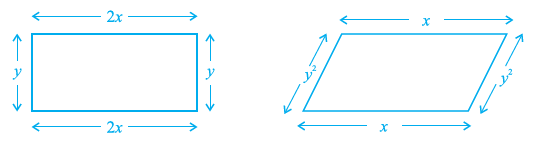
Answer:
Solution:
First, let's find the perimeter of the Rectangle (first figure):
Length ($l$) = $2x$
Breadth ($b$) = $y$
$\text{Perimeter of Rectangle} = 2(l + b)$
$\text{Perimeter} = 2(2x + y) = 4x + 2y$
Now, let's find the perimeter of the Parallelogram (second figure):
Base ($a$) = $x$
Adjacent side ($b$) = $y^2$
$\text{Perimeter of Parallelogram} = 2(a + b)$
$\text{Perimeter} = 2(x + y^2) = 2x + 2y^2$
Comparing the terms in both perimeters: $4x, 2y, 2x, 2y^2$.
Terms that have the same literal factor (variable and power) are like terms. Here, $4x$ and $2x$ are like terms.
Terms that have different literal factors are unlike terms. Here, $2y$ and $2y^2$ have the same variable but different powers.
Therefore, the unlike terms are $2y$ and $2y^2$.
Question 30. On adding a monomial _____________ to – 2x + 4y2 + z, the resulting expression becomes a binomial.
Answer:
Given:
Trinomial expression: $- 2x + 4y^2 + z$
Solution:
A binomial is an expression consisting of exactly two terms. To make the given trinomial a binomial, we must add a term that cancels out one of the existing three terms.
If we add the monomial $2x$ to the expression:
$(- 2x + 4y^2 + z) + 2x = (-2x + 2x) + 4y^2 + z$
$= 0 + 4y^2 + z = 4y^2 + z$
Since $4y^2 + z$ has only two terms, it is a binomial.
The monomial can be $2x$ (similarly, adding $-4y^2$ or $-z$ would also result in a binomial).
Question 31. 3x + 23x2 + 6y2 + 2x + y2 + ____________ = 5x + 7y2.
Answer:
Solution:
Let the missing term be $P$.
$3x + 23x^2 + 6y^2 + 2x + y^2 + P = 5x + 7y^2$
First, simplify the terms on the left side by adding like terms:
$(3x + 2x) + 23x^2 + (6y^2 + y^2) + P = 5x + 7y^2$
$5x + 23x^2 + 7y^2 + P = 5x + 7y^2$
Now, subtract $(5x + 23x^2 + 7y^2)$ from both sides to find $P$:
$P = (5x + 7y^2) - (5x + 23x^2 + 7y^2)$
$P = 5x - 5x + 7y^2 - 7y^2 - 23x^2$
$P = -23x^2$
The blank should be filled with $-23x^2$.
Question 32. If Rohit has 5xy toffees and Shantanu has 20yx toffees, then Shantanu has _____ more toffees.
Answer:
Given:
Number of toffees Rohit has = $5xy$
Number of toffees Shantanu has = $20yx$
Solution:
In algebraic multiplication, the order of variables does not change the value (Commutative Property).
$yx = xy$
(Commutative Property)
So, Shantanu has $20xy$ toffees.
To find how many more toffees Shantanu has compared to Rohit, we subtract:
$\text{Difference} = \text{Shantanu's toffees} - \text{Rohit's toffees}$
$\text{Difference} = 20xy - 5xy$
$\text{Difference} = 15xy$
Shantanu has $15xy$ more toffees.
Question 33 to 52 (True or False)
In questions 33 to 52, state whether the statements given are True or False.
Question 33. 1 + $\frac{x}{2}$ + x3 is a polynomial.
Answer:
Solution:
An algebraic expression is called a polynomial if the exponents (powers) of the variables involved are non-negative integers (i.e., $0, 1, 2, 3, \dots$).
The given expression is: $1 + \frac{x}{2} + x^3$
In this expression, the powers of the variable $x$ are $1$ (in $\frac{x}{2}$) and $3$ (in $x^3$). Since both $1$ and $3$ are positive integers, the expression satisfies the condition of being a polynomial.
Hence, the statement is True.
Question 34. (3a – b + 3) – (a + b) is a binomial.
Answer:
Solution:
Let's simplify the given expression by performing the subtraction:
$(3a - b + 3) - (a + b)$
$= 3a - b + 3 - a - b$
Grouping the like terms together:
$= (3a - a) + (-b - b) + 3$
$= 2a - 2b + 3$
A binomial is an expression that contains exactly two terms.
The simplified expression $2a - 2b + 3$ contains three unlike terms ($2a$, $-2b$, and $3$), which makes it a trinomial, not a binomial.
Hence, the statement is False.
Question 35. A trinomial can be a polynomial.
Answer:
Solution:
By definition, a polynomial is an algebraic expression consisting of one or more terms with non-negative integer powers of the variables.
Based on the number of terms, polynomials are classified as:
1. Monomial (1 term)
2. Binomial (2 terms)
3. Trinomial (3 terms)
Since a trinomial is simply a specific type of polynomial (one with exactly three terms), the statement is correct.
Hence, the statement is True.
Question 36. A polynomial with more than two terms is a trinomial.
Answer:
Solution:
A polynomial with exactly three terms is called a trinomial.
The phrase "more than two terms" includes expressions with $3, 4, 5, \dots$ terms.
If a polynomial has 4 terms, it has "more than two terms," but it is called a quadrinomial (or generally a polynomial), not a trinomial.
Hence, the statement is False.
Question 37. Sum of x and y is x + y.
Answer:
Solution:
In algebra, the word "Sum" represents the addition of two or more quantities.
To find the sum of two variables $x$ and $y$, we use the addition operator ($+$).
Therefore, the sum is written as $x + y$.
Hence, the statement is True.
Question 38. Sum of 2 and p is 2p.
Answer:
Solution:
The sum of $2$ and $p$ refers to the addition of these two values, which is written as $2 + p$.
The expression $2p$ represents the product (multiplication) of $2$ and $p$.
$2 + p \neq 2p$
(Sum vs Product)
Hence, the statement is False.
Question 39. A binomial has more than two terms.
Answer:
Solution:
The prefix "bi-" means two.
In algebra, a binomial is defined as an expression consisting of exactly two unlike terms.
An expression with "more than two terms" (such as 3 or 4 terms) would be a trinomial or a general polynomial, not a binomial.
Hence, the statement is False.
Question 40. A trinomial has exactly three terms.
Answer:
Solution:
The prefix "tri-" means three.
In algebra, a trinomial is defined as an algebraic expression containing exactly three unlike terms.
Hence, the statement is True.
Question 41. In like terms, variables and their powers are the same.
Answer:
Statement: In like terms, variables and their powers are the same.
Solution:
The given statement is True.
In algebra, Like Terms are defined as terms that contain the same variables (literal factors) raised to the same exponents (powers).
For example, in the expression $7x^2y$ and $-3x^2y$, both terms have the same variables $x$ and $y$ with the same powers $2$ and $1$ respectively. Therefore, they are like terms.
Question 42. The expression x + y + 5x is a trinomial.
Answer:
Statement: The expression $x + y + 5x$ is a trinomial.
Solution:
The given statement is False.
An algebraic expression is categorized as a monomial, binomial, or trinomial based on the number of terms it contains after it has been simplified by combining all like terms.
Given expression: $x + y + 5x$
$=(x + 5x) + y$
(Combining like terms)
$=6x + y$
The simplified expression $6x + y$ contains exactly two terms ($6x$ and $y$).
By definition, an expression with two terms is called a Binomial. Therefore, the original expression is not a trinomial.
Question 43. 4p is the numerical coefficient of q2 in – 4pq2.
Answer:
Statement: $4p$ is the numerical coefficient of $q^2$ in $-4pq^2$.
Solution:
The given statement is False.
In the term $-4pq^2$, we look for the factors that are multiplied by $q^2$.
The coefficient of $q^2$ in the term $-4pq^2$ is $-4p$.
The numerical coefficient specifically refers to the constant or number part of the term. In the term $-4pq^2$, the numerical coefficient is $-4$.
Since the statement claims the coefficient is $4p$ (missing the negative sign) and identifies it as a "numerical coefficient" (despite containing the variable $p$), the statement is incorrect.
Question 44. 5a and 5b are unlike terms.
Answer:
Statement: $5a$ and $5b$ are unlike terms.
Solution:
The given statement is True.
Terms are called unlike terms when they do not have the same algebraic (literal) factors. The numerical coefficients do not determine whether terms are "like" or "unlike".
In the terms $5a$ and $5b$:
1. The literal factor of $5a$ is $a$.
2. The literal factor of $5b$ is $b$.
Since the variables $a$ and $b$ are different, these are unlike terms.
Question 45. Sum of x2 + x and y + y2 is 2x2 + 2y2.
Answer:
Statement: Sum of $x^2 + x$ and $y + y^2$ is $2x^2 + 2y^2$.
Solution:
The given statement is False.
To find the sum, we add the two expressions together:
$\text{Sum} = (x^2 + x) + (y + y^2)$
$\text{Sum} = x^2 + x + y + y^2$
Since all four terms ($x^2$, $x$, $y$, and $y^2$) are unlike terms, they cannot be simplified further or combined into $2x^2$ or $2y^2$. Like terms must have the same variable raised to the same power to be added numerically.
Question 46. Subtracting a term from a given expression is the same as adding its additive inverse to the given expression.
Answer:
Statement: Subtracting a term from a given expression is the same as adding its additive inverse to the given expression.
Solution:
The given statement is True.
In algebra, the operation of subtraction is equivalent to the addition of the additive inverse (or the negative) of the term being subtracted.
If we have an expression $E$ and we subtract a term $T$, the operation is:
$E - T = E + (-T)$
Here, $-T$ is the additive inverse of $T$. For example, subtracting $5$ is the same as adding $-5$.
Question 47. The total number of planets of Sun can be denoted by the variable n.
Answer:
Statement: The total number of planets of Sun can be denoted by the variable $n$.
Solution:
The given statement is False.
A variable is a quantity that can take different values and does not have a fixed value. In mathematics, we use variables to represent quantities that change.
The number of planets in our solar system orbiting the Sun is a fixed, known value (which is 8). Because this value does not change, it is a constant, not a variable.
Question 48. In like terms, the numerical coefficients should also be the same.
Answer:
Statement: In like terms, the numerical coefficients should also be the same.
Solution:
The given statement is False.
For terms to be classified as like terms, only their algebraic (literal) factors—the variables and their respective powers—must be identical. Their numerical coefficients can be any real number and do not need to be the same.
For example, $4xy$ and $-9xy$ are like terms because they both have the same literal factor $xy$, even though their numerical coefficients ($4$ and $-9$) are different.
Question 49. If we add a monomial and binomial, then answer can never be a monomial.
Answer:
Statement: If we add a monomial and binomial, then answer can never be a monomial.
Solution:
The given statement is False.
To understand why, let us consider an example where the monomial is the additive inverse of one of the terms in the binomial.
Let the monomial be $-x$.
Let the binomial be $x + y$.
Now, let us find their sum:
$\text{Sum} = (-x) + (x + y)$
$\text{Sum} = -x + x + y$
$\text{Sum} = 0 + y = y$
In this case, the result is $y$, which is a monomial. Therefore, it is possible for the sum of a monomial and a binomial to be a monomial.
Question 50. If we subtract a monomial from a binomial, then answer is atleast a binomial.
Answer:
Statement: If we subtract a monomial from a binomial, then answer is atleast a binomial.
Solution:
The given statement is False.
Let us take an example where we subtract a monomial from a binomial containing a like term.
Let the binomial be $2x + 3y$.
Let the monomial be $2x$.
Subtracting the monomial from the binomial:
$\text{Result} = (2x + 3y) - (2x)$
$\text{Result} = 2x - 2x + 3y$
$\text{Result} = 3y$
Here, the result $3y$ is a monomial, not a binomial. Thus, the result can be a monomial.
Question 51. When we subtract a monomial from a trinomial, then answer can be a polynomial.
Answer:
Statement: When we subtract a monomial from a trinomial, then answer can be a polynomial.
Solution:
The given statement is True.
By definition, any algebraic expression consisting of one or more terms with non-negative integer exponents is a polynomial. This includes monomials, binomials, and trinomials.
When you subtract a monomial from a trinomial:
1. If there are no like terms, the result is an expression with four terms (a polynomial).
2. If there is a like term, the result is a binomial or a trinomial (both of which are polynomials).
Since the result will always be an algebraic expression of this nature, it will always be a polynomial.
Question 52. When we add a monomial and a trinomial, then answer can be a monomial.
Answer:
Statement: When we add a monomial and a trinomial, then answer can be a monomial.
Solution:
The given statement is False.
A trinomial has three unlike terms. A monomial is a single term. When we add a monomial to a trinomial, the monomial can, at most, cancel out one of the terms of the trinomial (if it is the additive inverse of that term).
Let the trinomial be $a + b + c$.
Let the monomial be $-a$.
$\text{Sum} = (a + b + c) + (-a) = b + c$
The result $b + c$ is a binomial. Since a single monomial cannot eliminate two terms of a trinomial simultaneously, the result will always have at least two terms. Thus, it can never be a monomial.
Question 53 to 100
Question 53. Write the following statements in the form of algebraic expressions and write whether it is monomial, binomial or trinomial.
(a) x is multiplied by itself and then added to the product of x and y.
(b) Three times of p and two times of q are multiplied and then subtracted from r.
(c) Product of p, twice of q and thrice of r .
(d) Sum of the products of a and b, b and c and c and a.
(e) Perimeter of an equilateral triangle of side x.
(f) Perimeter of a rectangle with length p and breadth q.
(g) Area of a triangle with base m and height n.
(h) Area of a square with side x.
(i) Cube of s subtracted from cube of t.
(j) Quotient of x and 15 multiplied by x.
(k) The sum of square of x and cube of z.
(l) Two times q subtracted from cube of q.
Answer:
(a) $x$ is multiplied by itself and then added to the product of $x$ and $y$.
Expression: $x \cdot x + x \cdot y = x^2 + xy$
Type: Binomial
(b) Three times of $p$ and two times of $q$ are multiplied and then subtracted from $r$.
Expression: $r - (3p \cdot 2q) = r - 6pq$
Type: Binomial
(c) Product of $p$, twice of $q$ and thrice of $r$.
Expression: $p \cdot 2q \cdot 3r = 6pqr$
Type: Monomial
(d) Sum of the products of $a$ and $b$, $b$ and $c$ and $c$ and $a$.
Expression: $ab + bc + ca$
Type: Trinomial
(e) Perimeter of an equilateral triangle of side $x$.
Expression: $x + x + x = 3x$
Type: Monomial
(f) Perimeter of a rectangle with length $p$ and breadth $q$.
Expression: $2(p + q) = 2p + 2q$
Type: Binomial
(g) Area of a triangle with base $m$ and height $n$.
Expression: $\frac{1}{2} \cdot m \cdot n = \frac{1}{2}mn$
Type: Monomial
(h) Area of a square with side $x$.
Expression: $x \cdot x = x^2$
Type: Monomial
(i) Cube of $s$ subtracted from cube of $t$.
Expression: $t^3 - s^3$
Type: Binomial
(j) Quotient of $x$ and $15$ multiplied by $x$.
Expression: $\left(\frac{x}{15}\right) \cdot x = \frac{x^2}{15}$
Type: Monomial
(k) The sum of square of $x$ and cube of $z$.
Expression: $x^2 + z^3$
Type: Binomial
(l) Two times $q$ subtracted from cube of $q$.
Expression: $q^3 - 2q$
Type: Binomial
Question 54. Write the coefficient of x2 in the following:
(i) x2 – x + 4
(ii) x3 – 2x2 + 3x + 1
(iii) 1 + 2x + 3x2 + 4x3
(iv) y + y2x + y3x2 + y4x3
Answer:
Solution:
The coefficient of a variable in a term is the factor (numerical or literal) that multiplies that variable.
(i) In the expression $x^2 - x + 4$, the term containing $x^2$ is $1 \cdot x^2$.
Therefore, the coefficient of $x^2$ is $1$.
(ii) In the expression $x^3 - 2x^2 + 3x + 1$, the term containing $x^2$ is $-2x^2$.
Therefore, the coefficient of $x^2$ is $-2$.
(iii) In the expression $1 + 2x + 3x^2 + 4x^3$, the term containing $x^2$ is $3x^2$.
Therefore, the coefficient of $x^2$ is $3$.
(iv) In the expression $y + y^2x + y^3x^2 + y^4x^3$, the term containing $x^2$ is $y^3x^2$.
Therefore, the coefficient of $x^2$ is $y^3$.
Question 55. Find the numerical coefficient of each of the terms :
(i) x3y2z, xy2z3, –3xy2z3, 5x3y2z, –7x2y2z2
(ii) 10xyz, –7xy2z, –9xyz, 2xy2z, 2x2y2z2
Answer:
Solution:
The numerical coefficient is the constant (number) part of an algebraic term.
(i) Given terms: $x^3y^2z$, $xy^2z^3$, $-3xy^2z^3$, $5x^3y^2z$, $-7x^2y^2z^2$
| Term | Numerical Coefficient |
| $x^3y^2z$ | $1$ |
| $xy^2z^3$ | $1$ |
| $-3xy^2z^3$ | $-3$ |
| $5x^3y^2z$ | $5$ |
| $-7x^2y^2z^2$ | $-7$ |
(ii) Given terms: $10xyz$, $-7xy^2z$, $-9xyz$, $2xy^2z$, $2x^2y^2z^2$
| Term | Numerical Coefficient |
| $10xyz$ | $10$ |
| $-7xy^2z$ | $-7$ |
| $-9xyz$ | $-9$ |
| $2xy^2z$ | $2$ |
| $2x^2y^2z^2$ | $2$ |
Question 56. Simplify the following by combining the like terms and then write whether the expression is a monomial, a binomial or a trinomial.
(a) 3x2yz2 – 3xy2z + x2yz2 + 7xy2z
(b) x4 + 3x3y + 3x2y2 – 3x3y – 3xy3 + y4 – 3x2y2
(c) p3q2r + pq2r3 + 3p2qr2 – 9p2qr2
(d) 2a + 2b + 2c – 2a – 2b – 2c – 2b + 2c + 2a
(e) 50x3 – 21x + 107 + 41x3 – x + 1 – 93 + 71x – 31x3
Answer:
Solution:
(a) $3x^2yz^2 - 3xy^2z + x^2yz^2 + 7xy^2z$
Grouping like terms:
$= (3x^2yz^2 + x^2yz^2) + (-3xy^2z + 7xy^2z)$
$= 4x^2yz^2 + 4xy^2z$
The simplified expression has two terms. Therefore, it is a Binomial.
(b) $x^4 + 3x^3y + 3x^2y^2 - 3x^3y - 3xy^3 + y^4 - 3x^2y^2$
Grouping like terms:
$= x^4 + (3x^3y - 3x^3y) + (3x^2y^2 - 3x^2y^2) - 3xy^3 + y^4$
$= x^4 + 0 + 0 - 3xy^3 + y^4$
$= x^4 - 3xy^3 + y^4$
The simplified expression has three terms. Therefore, it is a Trinomial.
(c) $p^3q^2r + pq^2r^3 + 3p^2qr^2 - 9p^2qr^2$
Grouping like terms:
$= p^3q^2r + pq^2r^3 + (3 - 9)p^2qr^2$
$= p^3q^2r + pq^2r^3 - 6p^2qr^2$
The simplified expression has three terms. Therefore, it is a Trinomial.
(d) $2a + 2b + 2c - 2a - 2b - 2c - 2b + 2c + 2a$
Grouping like terms:
$= (2a - 2a + 2a) + (2b - 2b - 2b) + (2c - 2c + 2c)$
$= 2a - 2b + 2c$
The simplified expression has three terms. Therefore, it is a Trinomial.
(e) $50x^3 - 21x + 107 + 41x^3 - x + 1 - 93 + 71x - 31x^3$
Grouping like terms:
$= (50x^3 + 41x^3 - 31x^3) + (-21x - x + 71x) + (107 + 1 - 93)$
$= (91 - 31)x^3 + (-22 + 71)x + (108 - 93)$
$= 60x^3 + 49x + 15$
The simplified expression has three terms. Therefore, it is a Trinomial.
Question 57. Add the following expressions:
(a) p2 – 7pq – q2 and – 3p2 – 2pq + 7q2
(b) x3 – x2y – xy2 – y3 and x3 – 2x2y + 3xy2 + 4y
(c) ab + bc + ca and – bc – ca – ab
(d) p2 – q + r, q2 – r + p and r2 – p + q
(e) x3y2 + x2y3 +3y4 and x4 + 3x2y3 + 4y4
(f) p2qr + pq2r + pqr2 and – 3pq2r –2pqr2
(g) uv – vw, vw – wu and wu – uv
(h) a2 + 3ab – bc, b2 + 3bc – ca and c2 + 3ca – ab
(i) $\frac{5}{8}$p4 + 2p2 + $\frac{5}{8}$ ; $\frac{1}{8}$ - 17p + $\frac{9}{8}$p2 and p5 - p3 + 7
(j) t – t2 – t3 – 14; 15t3 + 13 + 9t – 8t2; 12t2 – 19 – 24t and 4t – 9t2 + 19t3
Answer:
Solution:
(a) $(p^2 - 7pq - q^2) + (-3p^2 - 2pq + 7q^2)$
$\begin{array}{cc} & p^2 & -7pq & -q^2 \\ + & -3p^2 & -2pq & +7q^2 \\ \hline & -2p^2 & -9pq & +6q^2 \\ \hline \end{array}$
(b) $(x^3 - x^2y - xy^2 - y^3) + (x^3 - 2x^2y + 3xy^2 + 4y)$
Combining like terms:
$= (x^3 + x^3) + (-x^2y - 2x^2y) + (-xy^2 + 3xy^2) - y^3 + 4y$
$= 2x^3 - 3x^2y + 2xy^2 - y^3 + 4y$
(c) $(ab + bc + ca) + (-bc - ca - ab)$
$= ab - ab + bc - bc + ca - ca$
$= 0$
(d) $(p^2 - q + r) + (q^2 - r + p) + (r^2 - p + q)$
$= p^2 + q^2 + r^2 + (-q + q) + (r - r) + (p - p)$
$= p^2 + q^2 + r^2$
(e) $(x^3y^2 + x^2y^3 + 3y^4) + (x^4 + 3x^2y^3 + 4y^4)$
$= x^4 + x^3y^2 + (x^2y^3 + 3x^2y^3) + (3y^4 + 4y^4)$
$= x^4 + x^3y^2 + 4x^2y^3 + 7y^4$
(f) $(p^2qr + pq^2r + pqr^2) + (-3pq^2r - 2pqr^2)$
$= p^2qr + (pq^2r - 3pq^2r) + (pqr^2 - 2pqr^2)$
$= p^2qr - 2pq^2r - pqr^2$
(g) $(uv - vw) + (vw - wu) + (wu - uv)$
$= uv - uv - vw + vw - wu + wu$
$= 0$
(h) $(a^2 + 3ab - bc) + (b^2 + 3bc - ca) + (c^2 + 3ca - ab)$
$= a^2 + b^2 + c^2 + (3ab - ab) + (-bc + 3bc) + (-ca + 3ca)$
$= a^2 + b^2 + c^2 + 2ab + 2bc + 2ca$
(i) $(\frac{5}{8}p^4 + 2p^2 + \frac{5}{8}) + (\frac{1}{8} - 17p + \frac{9}{8}p^2) + (p^5 - p^3 + 7)$
Grouping like powers of $p$:
$= p^5 + \frac{5}{8}p^4 - p^3 + (2 + \frac{9}{8})p^2 - 17p + (\frac{5}{8} + \frac{1}{8} + 7)$
$= p^5 + \frac{5}{8}p^4 - p^3 + (\frac{16+9}{8})p^2 - 17p + (\frac{6}{8} + 7)$
$= p^5 + \frac{5}{8}p^4 - p^3 + \frac{25}{8}p^2 - 17p + (\frac{3}{4} + 7)$
$= p^5 + \frac{5}{8}p^4 - p^3 + \frac{25}{8}p^2 - 17p + \frac{31}{4}$
(j) Add: $(t - t^2 - t^3 - 14)$, $(15t^3 + 13 + 9t - 8t^2)$, $(12t^2 - 19 - 24t)$, $(4t - 9t^2 + 19t^3)$
Adding term by term:
Sum of $t^3$ terms: $-t^3 + 15t^3 + 19t^3 = 33t^3$
Sum of $t^2$ terms: $-t^2 - 8t^2 + 12t^2 - 9t^2 = -6t^2$
Sum of $t$ terms: $t + 9t - 24t + 4t = -10t$
Sum of constant terms: $-14 + 13 - 19 = -20$
Resulting Expression: $33t^3 - 6t^2 - 10t - 20$
Question 58. Subtract
(a) – 7p2qr from – 3p2qr.
(b) –a2 – ab from b2 + ab.
(c) –4x2y – y3 from x3 + 3xy2 – x2y.
(d) x4 + 3x3y3 + 5y4 from 2x4 – x3y3 + 7y4.
(e) ab – bc – ca from – ab + bc + ca.
(f) –2a2 – 2b2 from – a2 – b2 + 2ab.
(g) x3y2 + 3x2y2 – 7xy3 from x4 + y4 + 3x2y2 – xy3.
(h) 2 (ab + bc + ca) from –ab – bc – ca.
(i) 4.5x5 – 3.4x2 + 5.7 from 5x4 – 3.2x2 – 7.3x.
(j) 11 – 15y2 from y3 – 15y2 – y – 11.
Answer:
(a) Subtract $-7p^2qr$ from $-3p^2qr$.
Difference $= (-3p^2qr) - (-7p^2qr)$
Difference $= -3p^2qr + 7p^2qr$
Difference $= (-3+7)p^2qr$
Difference $= 4p^2qr$
(b) Subtract $-a^2 - ab$ from $b^2 + ab$.
Difference $= (b^2 + ab) - (-a^2 - ab)$
Difference $= b^2 + ab + a^2 + ab$
Difference $= a^2 + b^2 + ab + ab$
Difference $= a^2 + b^2 + 2ab$
(c) Subtract $-4x^2y - y^3$ from $x^3 + 3xy^2 - x^2y$.
Difference $= (x^3 + 3xy^2 - x^2y) - (-4x^2y - y^3)$
Difference $= x^3 + 3xy^2 - x^2y + 4x^2y + y^3$
Difference $= x^3 + y^3 + 3xy^2 - x^2y + 4x^2y$
Difference $= x^3 + y^3 + 3xy^2 + (-1+4)x^2y$
Difference $= x^3 + y^3 + 3xy^2 + 3x^2y$
(d) Subtract $x^4 + 3x^3y^3 + 5y^4$ from $2x^4 - x^3y^3 + 7y^4$.
Difference $= (2x^4 - x^3y^3 + 7y^4) - (x^4 + 3x^3y^3 + 5y^4)$
Difference $= 2x^4 - x^3y^3 + 7y^4 - x^4 - 3x^3y^3 - 5y^4$
Difference $= 2x^4 - x^4 - x^3y^3 - 3x^3y^3 + 7y^4 - 5y^4$
Difference $= (2-1)x^4 + (-1-3)x^3y^3 + (7-5)y^4$
Difference $= x^4 - 4x^3y^3 + 2y^4$
(e) Subtract $ab - bc - ca$ from $-ab + bc + ca$.
Difference $= (-ab + bc + ca) - (ab - bc - ca)$
Difference $= -ab + bc + ca - ab + bc + ca$
Difference $= -ab - ab + bc + bc + ca + ca$
Difference $= (-1-1)ab + (1+1)bc + (1+1)ca$
Difference $= -2ab + 2bc + 2ca$
(f) Subtract $-2a^2 - 2b^2$ from $-a^2 - b^2 + 2ab$.
Difference $= (-a^2 - b^2 + 2ab) - (-2a^2 - 2b^2)$
Difference $= -a^2 - b^2 + 2ab + 2a^2 + 2b^2$
Difference $= -a^2 + 2a^2 - b^2 + 2b^2 + 2ab$
Difference $= (-1+2)a^2 + (-1+2)b^2 + 2ab$
Difference $= a^2 + b^2 + 2ab$
(g) Subtract $x^3y^2 + 3x^2y^2 - 7xy^3$ from $x^4 + y^4 + 3x^2y^2 - xy^3$.
Difference $= (x^4 + y^4 + 3x^2y^2 - xy^3) - (x^3y^2 + 3x^2y^2 - 7xy^3)$
Difference $= x^4 + y^4 + 3x^2y^2 - xy^3 - x^3y^2 - 3x^2y^2 + 7xy^3$
Difference $= x^4 + y^4 - x^3y^2 + (3x^2y^2 - 3x^2y^2) + (-xy^3 + 7xy^3)$
Difference $= x^4 + y^4 - x^3y^2 + 0 + (-1+7)xy^3$
Difference $= x^4 + y^4 - x^3y^2 + 6xy^3$
(h) Subtract $2(ab + bc + ca)$ from $-ab - bc - ca$.
$2(ab + bc + ca) = 2ab + 2bc + 2ca$
Difference $= (-ab - bc - ca) - (2ab + 2bc + 2ca)$
Difference $= -ab - bc - ca - 2ab - 2bc - 2ca$
Difference $= (-1-2)ab + (-1-2)bc + (-1-2)ca$
Difference $= -3ab - 3bc - 3ca$
Difference $= -3(ab + bc + ca)$
(i) Subtract $4.5x^5 - 3.4x^2 + 5.7$ from $5x^4 - 3.2x^2 - 7.3x$.
Difference $= (5x^4 - 3.2x^2 - 7.3x) - (4.5x^5 - 3.4x^2 + 5.7)$
Difference $= 5x^4 - 3.2x^2 - 7.3x - 4.5x^5 + 3.4x^2 - 5.7$
Difference $= -4.5x^5 + 5x^4 + (-3.2 + 3.4)x^2 - 7.3x - 5.7$
Difference $= -4.5x^5 + 5x^4 + 0.2x^2 - 7.3x - 5.7$
(j) Subtract $11 - 15y^2$ from $y^3 - 15y^2 - y - 11$.
Difference $= (y^3 - 15y^2 - y - 11) - (11 - 15y^2)$
Difference $= y^3 - 15y^2 - y - 11 - 11 + 15y^2$
Difference $= y^3 + (-15y^2 + 15y^2) - y + (-11 - 11)$
Difference $= y^3 + 0 - y - 22$
Difference $= y^3 - y - 22$
Question 59.
(a) What should be added to x3 + 3x2y + 3xy2 + y3 to get x3 + y3?
(b) What should be added to 3pq + 5p2q2 + p3 to get p3 + 2p2q2 + 4pq ?
Answer:
(a) To find what should be added to $x^3 + 3x^2y + 3xy^2 + y^3$ to get $x^3 + y^3$, we subtract the first expression from the second expression.
Required expression $= (x^3 + y^3) - (x^3 + 3x^2y + 3xy^2 + y^3)$
Required expression $= x^3 + y^3 - x^3 - 3x^2y - 3xy^2 - y^3$
Required expression $= (x^3 - x^3) + (y^3 - y^3) - 3x^2y - 3xy^2$
Required expression $= 0 + 0 - 3x^2y - 3xy^2$
Required expression $= -3x^2y - 3xy^2$
(b) To find what should be added to $3pq + 5p^2q^2 + p^3$ to get $p^3 + 2p^2q^2 + 4pq$, we subtract the first expression from the second expression.
Required expression $= (p^3 + 2p^2q^2 + 4pq) - (3pq + 5p^2q^2 + p^3)$
Required expression $= p^3 + 2p^2q^2 + 4pq - 3pq - 5p^2q^2 - p^3$
Required expression $= (p^3 - p^3) + (2p^2q^2 - 5p^2q^2) + (4pq - 3pq)$
Required expression $= 0 + (2-5)p^2q^2 + (4-3)pq$
Required expression $= -3p^2q^2 + pq$
Question 60.
(a) What should be subtracted from 2x3 – 3x2y + 2xy2 + 3y3 to get x3 – 2x2y + 3xy2 + 4y3?
(b) What should be subtracted from –7mn + 2m2 + 3n2 to get m2 + 2mn + n2 ?
Answer:
(a) Let the expression that should be subtracted be $E$.
According to the question:
$(2x^3 - 3x^2y + 2xy^2 + 3y^3) - E = x^3 - 2x^2y + 3xy^2 + 4y^3$
To find $E$, we rearrange the equation:
$E = (2x^3 - 3x^2y + 2xy^2 + 3y^3) - (x^3 - 2x^2y + 3xy^2 + 4y^3)$
$E = 2x^3 - 3x^2y + 2xy^2 + 3y^3 - x^3 + 2x^2y - 3xy^2 - 4y^3$
Combine like terms:
$E = (2x^3 - x^3) + (-3x^2y + 2x^2y) + (2xy^2 - 3xy^2) + (3y^3 - 4y^3)$
$E = (2-1)x^3 + (-3+2)x^2y + (2-3)xy^2 + (3-4)y^3$
$E = 1x^3 - 1x^2y - 1xy^2 - 1y^3$
$E = x^3 - x^2y - xy^2 - y^3$
Thus, $x^3 - x^2y - xy^2 - y^3$ should be subtracted.
(b) Let the expression that should be subtracted be $E$.
According to the question:
$(-7mn + 2m^2 + 3n^2) - E = m^2 + 2mn + n^2$
To find $E$, we rearrange the equation:
$E = (-7mn + 2m^2 + 3n^2) - (m^2 + 2mn + n^2)$
$E = -7mn + 2m^2 + 3n^2 - m^2 - 2mn - n^2$
Combine like terms:
$E = (2m^2 - m^2) + (3n^2 - n^2) + (-7mn - 2mn)$
$E = (2-1)m^2 + (3-1)n^2 + (-7-2)mn$
$E = 1m^2 + 2n^2 - 9mn$
$E = m^2 + 2n^2 - 9mn$
Thus, $m^2 + 2n^2 - 9mn$ should be subtracted.
Question 61. How much is 21a3 – 17a2 less than 89a3 – 64a2 + 6a + 16?
Answer:
To find how much $21a^3 - 17a^2$ is less than $89a^3 - 64a^2 + 6a + 16$, we need to subtract the first expression from the second expression.
Difference $= (89a^3 - 64a^2 + 6a + 16) - (21a^3 - 17a^2)$
Difference $= 89a^3 - 64a^2 + 6a + 16 - 21a^3 + 17a^2$
Group like terms:
Difference $= (89a^3 - 21a^3) + (-64a^2 + 17a^2) + 6a + 16$
Combine the coefficients:
Difference $= (89 - 21)a^3 + (-64 + 17)a^2 + 6a + 16$
Difference $= 68a^3 - 47a^2 + 6a + 16$
So, $21a^3 - 17a^2$ is $68a^3 - 47a^2 + 6a + 16$ less than $89a^3 - 64a^2 + 6a + 16$.
Question 62. How much is y4 – 12y2 + y + 14 greater than 17y3 + 34y2 – 51y + 68?
Answer:
To find how much $y^4 - 12y^2 + y + 14$ is greater than $17y^3 + 34y^2 - 51y + 68$, we need to subtract the second expression from the first expression.
Difference $= (y^4 - 12y^2 + y + 14) - (17y^3 + 34y^2 - 51y + 68)$
Difference $= y^4 - 12y^2 + y + 14 - 17y^3 - 34y^2 + 51y - 68$
Group like terms, arranging in descending order of powers of $y$:
Difference $= y^4 - 17y^3 + (-12y^2 - 34y^2) + (y + 51y) + (14 - 68)$
Combine the coefficients of like terms:
Difference $= y^4 - 17y^3 + (-12 - 34)y^2 + (1 + 51)y + (14 - 68)$
Difference $= y^4 - 17y^3 - 46y^2 + 52y - 54$
So, $y^4 - 12y^2 + y + 14$ is $y^4 - 17y^3 - 46y^2 + 52y - 54$ greater than $17y^3 + 34y^2 - 51y + 68$.
Question 63. How much does 93p2 – 55p + 4 exceed 13p3 – 5p2 + 17p – 90?
Answer:
To find how much $93p^2 - 55p + 4$ exceeds $13p^3 - 5p^2 + 17p - 90$, we need to subtract the second expression from the first expression.
Expression 1: $93p^2 - 55p + 4$
Expression 2: $13p^3 - 5p^2 + 17p - 90$
Difference $= (93p^2 - 55p + 4) - (13p^3 - 5p^2 + 17p - 90)$
Remove parentheses and change signs of the terms being subtracted:
Difference $= 93p^2 - 55p + 4 - 13p^3 + 5p^2 - 17p + 90$
Group like terms:
Difference $= -13p^3 + (93p^2 + 5p^2) + (-55p - 17p) + (4 + 90)$
Combine coefficients of like terms:
Difference $= -13p^3 + (93+5)p^2 + (-55-17)p + (4+90)$
Difference $= -13p^3 + 98p^2 - 72p + 94$
Thus, $93p^2 - 55p + 4$ exceeds $13p^3 - 5p^2 + 17p - 90$ by $98p^2 - 72p + 94 - 13p^3$.
We can also write the result as $-13p^3 + 98p^2 - 72p + 94$.
Question 64. To what expression must 99x3 – 33x2 – 13x – 41 be added to make the sum zero?
Answer:
Let the expression that must be added be $E$.
According to the question, when $E$ is added to $99x^3 - 33x^2 - 13x - 41$, the sum is zero.
So, we have the equation:
$(99x^3 - 33x^2 - 13x - 41) + E = 0$
To find the expression $E$, we subtract $(99x^3 - 33x^2 - 13x - 41)$ from $0$:
$E = 0 - (99x^3 - 33x^2 - 13x - 41)$
$E = - (99x^3 - 33x^2 - 13x - 41)$
Distribute the negative sign to each term inside the parentheses:
$E = -99x^3 - (-33x^2) - (-13x) - (-41)$
$E = -99x^3 + 33x^2 + 13x + 41$
Thus, the expression that must be added is $-99x^3 + 33x^2 + 13x + 41$.
Question 65. Subtract 9a2 – 15a + 3 from unity.
Answer:
Unity means the number $1$.
To subtract the expression $9a^2 - 15a + 3$ from unity, we write:
Difference $= 1 - (9a^2 - 15a + 3)$
Remove the parentheses by distributing the negative sign to each term inside:
Difference $= 1 - 9a^2 - (-15a) - (+3)$
Difference $= 1 - 9a^2 + 15a - 3$
Combine the constant terms $1$ and $-3$:
Difference $= -9a^2 + 15a + (1 - 3)$
Difference $= -9a^2 + 15a - 2$
Thus, the result of subtracting $9a^2 - 15a + 3$ from unity is $-9a^2 + 15a - 2$.
Question 66. Find the values of the following polynomials at a = – 2 and b = 3:
(a) a2 + 2ab + b2
(b) a2 – 2ab + b2
(c) a3 + 3a2b + 3ab2 + b3
(d) a3 – 3a2b + 3ab2 – b3
(e) $\frac{a^2 + b^2}{3}$
(f) $\frac{a^2 - b^2}{3}$
(g) $\frac{a}{b}$ + $\frac{b}{a}$
(h) a2 + b2 – ab – b2 – a2
Answer:
We are given $a = -2$ and $b = 3$. We need to find the value of each expression by substituting these values.
(a) $a^2 + 2ab + b^2$
Substitute $a=-2$ and $b=3$:
$(-2)^2 + 2(-2)(3) + (3)^2$
$= 4 + 2(-6) + 9$
$= 4 - 12 + 9$
$= -8 + 9$
$= 1$
(b) $a^2 - 2ab + b^2$
Substitute $a=-2$ and $b=3$:
$(-2)^2 - 2(-2)(3) + (3)^2$
$= 4 - 2(-6) + 9$
$= 4 + 12 + 9$
$= 16 + 9$
$= 25$
(c) $a^3 + 3a^2b + 3ab^2 + b^3$
This is the expansion of $(a+b)^3$.
Substitute $a=-2$ and $b=3$:
$(-2+3)^3 = (1)^3 = 1$
Alternatively, substitute directly:
$(-2)^3 + 3(-2)^2(3) + 3(-2)(3)^2 + (3)^3$
$= -8 + 3(4)(3) + 3(-2)(9) + 27$
$= -8 + 36 - 54 + 27$
$= 63 - 62 = 1$
(d) $a^3 - 3a^2b + 3ab^2 - b^3$
This is the expansion of $(a-b)^3$.
Substitute $a=-2$ and $b=3$:
$(-2-3)^3 = (-5)^3 = -125$
Alternatively, substitute directly:
$(-2)^3 - 3(-2)^2(3) + 3(-2)(3)^2 - (3)^3$
$= -8 - 3(4)(3) + 3(-2)(9) - 27$
$= -8 - 36 - 54 - 27$
$= -125$
(e) $\frac{a^2 + b^2}{3}$
Substitute $a=-2$ and $b=3$:
$\frac{(-2)^2 + (3)^2}{3} = \frac{4 + 9}{3} = \frac{13}{3}$
(f) $\frac{a^2 - b^2}{3}$
Substitute $a=-2$ and $b=3$:
$\frac{(-2)^2 - (3)^2}{3} = \frac{4 - 9}{3} = \frac{-5}{3}$
(g) $\frac{a}{b} + \frac{b}{a}$
Substitute $a=-2$ and $b=3$:
$\frac{-2}{3} + \frac{3}{-2} = -\frac{2}{3} - \frac{3}{2}$
Find a common denominator:
$-\frac{2}{3} - \frac{3}{2} = -\frac{2 \times 2}{3 \times 2} - \frac{3 \times 3}{2 \times 3} = -\frac{4}{6} - \frac{9}{6} = \frac{-4-9}{6} = \frac{-13}{6}$
(h) $a^2 + b^2 - ab - b^2 - a^2$
First, simplify the expression:
$a^2 + b^2 - ab - b^2 - a^2 = (a^2 - a^2) + (b^2 - b^2) - ab $$ = 0 + 0 - ab = -ab$
Now, substitute $a=-2$ and $b=3$ into the simplified expression:
$-(-2)(3) = -(-6) = 6$
Question 67. Find the values of following polynomials at m = 1, n = –1 and p = 2:
(a) m + n + p
(b) m2 + n2 + p2
(c) m3 + n3 + p3
(d) mn + np + pm
(e) m3 + n3 + p3 – 3mnp
(f) m2n2 + n2p2 + p2m2
Answer:
We are given $m = 1$, $n = -1$, and $p = 2$. We will substitute these values into each expression.
(a) $m + n + p$
Substitute $m=1$, $n=-1$, $p=2$:
$1 + (-1) + 2$
$= 1 - 1 + 2$
$= 0 + 2$
$= 2$
(b) $m^2 + n^2 + p^2$
Substitute $m=1$, $n=-1$, $p=2$:
$(1)^2 + (-1)^2 + (2)^2$
$= 1 + 1 + 4$
$= 2 + 4$
$= 6$
(c) $m^3 + n^3 + p^3$
Substitute $m=1$, $n=-1$, $p=2$:
$(1)^3 + (-1)^3 + (2)^3$
$= 1 + (-1) + 8$
$= 1 - 1 + 8$
$= 0 + 8$
$= 8$
(d) $mn + np + pm$
Substitute $m=1$, $n=-1$, $p=2$:
$(1)(-1) + (-1)(2) + (2)(1)$
$= -1 + (-2) + 2$
$= -1 - 2 + 2$
$= -3 + 2$
$= -1$
(e) $m^3 + n^3 + p^3 - 3mnp$
From part (c), $m^3 + n^3 + p^3 = 8$.
Calculate $3mnp$:
$3(1)(-1)(2)$
$= 3(-2)$
$= -6$
Now substitute these values into the expression:
$(m^3 + n^3 + p^3) - 3mnp = 8 - (-6)$
$= 8 + 6$
$= 14$
Alternatively, substitute directly into the expression:
$(1)^3 + (-1)^3 + (2)^3 - 3(1)(-1)(2)$
$= 1 + (-1) + 8 - 3(-2)$
$= 1 - 1 + 8 + 6$
$= 0 + 8 + 6$
$= 14$
(f) $m^2n^2 + n^2p^2 + p^2m^2$
Substitute $m=1$, $n=-1$, $p=2$:
$(1)^2(-1)^2 + (-1)^2(2)^2 + (2)^2(1)^2$
$= (1)(1) + (1)(4) + (4)(1)$
$= 1 + 4 + 4$
$= 9$
Question 68. If A = 3x2 – 4x + 1, B = 5x2 + 3x – 8 and C = 4x2 – 7x + 3, then find:
(i) (A + B) – C
(ii) B + C – A
(iii) A + B + C
Answer:
Given the expressions:
$A = 3x^2 - 4x + 1$
$B = 5x^2 + 3x - 8$
$C = 4x^2 - 7x + 3$
(i) Find $(A + B) - C$
First, calculate $A + B$:
$A + B = (3x^2 - 4x + 1) + (5x^2 + 3x - 8)$
$A + B = 3x^2 + 5x^2 - 4x + 3x + 1 - 8$
$A + B = (3+5)x^2 + (-4+3)x + (1-8)$
$A + B = 8x^2 - x - 7$
Now, subtract $C$ from $A + B$:
$(A + B) - C = (8x^2 - x - 7) - (4x^2 - 7x + 3)$
$(A + B) - C = 8x^2 - x - 7 - 4x^2 + 7x - 3$
$(A + B) - C = 8x^2 - 4x^2 - x + 7x - 7 - 3$
$(A + B) - C = (8-4)x^2 + (-1+7)x + (-7-3)$
$(A + B) - C = 4x^2 + 6x - 10$
(ii) Find $B + C - A$
First, calculate $B + C$:
$B + C = (5x^2 + 3x - 8) + (4x^2 - 7x + 3)$
$B + C = 5x^2 + 4x^2 + 3x - 7x - 8 + 3$
$B + C = (5+4)x^2 + (3-7)x + (-8+3)$
$B + C = 9x^2 - 4x - 5$
Now, subtract $A$ from $B + C$:
$(B + C) - A = (9x^2 - 4x - 5) - (3x^2 - 4x + 1)$
$(B + C) - A = 9x^2 - 4x - 5 - 3x^2 + 4x - 1$
$(B + C) - A = 9x^2 - 3x^2 - 4x + 4x - 5 - 1$
$(B + C) - A = (9-3)x^2 + (-4+4)x + (-5-1)$
$(B + C) - A = 6x^2 + 0x - 6$
$(B + C) - A = 6x^2 - 6$
(iii) Find $A + B + C$
Add the three expressions:
$A + B + C = (3x^2 - 4x + 1) + (5x^2 + 3x - 8) + (4x^2 - 7x + 3)$
$A + B + C = 3x^2 + 5x^2 + 4x^2 - 4x + 3x - 7x + 1 - 8 + 3$
$A + B + C = (3+5+4)x^2 + (-4+3-7)x + (1-8+3)$
$A + B + C = (8+4)x^2 + (-1-7)x + (-7+3)$
$A + B + C = 12x^2 - 8x - 4$
Question 69. If P = –(x – 2), Q = –2(y + 1) and R = –x + 2y, find a, when P + Q + R = ax.
Answer:
Given the expressions:
$P = -(x - 2)$
$Q = -2(y + 1)$
$R = -x + 2y$
Simplify expressions P and Q:
$P = -x + 2$
$Q = -2y - 2$
$R = -x + 2y$
Calculate the sum $P + Q + R$:
$P + Q + R = (-x + 2) + (-2y - 2) + (-x + 2y)$
Group like terms:
$P + Q + R = (-x - x) + (-2y + 2y) + (2 - 2)$
Combine coefficients:
$P + Q + R = (-1 - 1)x + (-2 + 2)y + (2 - 2)$
$P + Q + R = -2x + 0y + 0$
$P + Q + R = -2x$
We are given that $P + Q + R = ax$.
Substitute the calculated sum into the given equation:
$-2x = ax$
To find the value of $a$, compare the coefficients of $x$ on both sides of the equation.
The coefficient of $x$ on the left side is $-2$.
The coefficient of $x$ on the right side is $a$.
Equating the coefficients:
$-2 = a$
Thus, the value of $a$ is $-2$.
Question 70. From the sum of x2 – y2 – 1, y2 – x2 – 1 and 1 – x2 – y2 subtract – (1 + y2).
Answer:
First, find the sum of the three expressions: $x^2 - y^2 - 1$, $y^2 - x^2 - 1$, and $1 - x^2 - y^2$.
Sum $= (x^2 - y^2 - 1) + (y^2 - x^2 - 1) + (1 - x^2 - y^2)$
Sum $= x^2 - y^2 - 1 + y^2 - x^2 - 1 + 1 - x^2 - y^2$
Group the like terms:
Sum $= (x^2 - x^2 - x^2) + (-y^2 + y^2 - y^2) + (-1 - 1 + 1)$
Combine the coefficients:
Sum $= (1 - 1 - 1)x^2 + (-1 + 1 - 1)y^2 + (-1 - 1 + 1)$
Sum $= (-1)x^2 + (-1)y^2 + (-1)$
Sum $= -x^2 - y^2 - 1$
Next, identify the expression to be subtracted: $-(1 + y^2)$.
Simplify the expression to be subtracted:
$-(1 + y^2) = -1 - y^2$
Now, subtract the simplified expression from the sum obtained above.
Result $= (\text{Sum}) - (-1 - y^2)$
Result $= (-x^2 - y^2 - 1) - (-1 - y^2)$
Remove the parentheses and change the sign of each term being subtracted:
Result $= -x^2 - y^2 - 1 + 1 + y^2$
Group the like terms:
Result $= -x^2 + (-y^2 + y^2) + (-1 + 1)$
Combine the like terms:
Result $= -x^2 + 0 + 0$
Result $= -x^2$
The final result is $-x^2$.
Question 71. Subtract the sum of 12ab – 10b2 – 18a2 and 9ab + 12b2 + 14a2 from the sum of ab + 2b2 and 3b2 – a2.
Answer:
First, find the sum of the expressions $12ab - 10b^2 - 18a^2$ and $9ab + 12b^2 + 14a^2$.
Sum 1 $= (12ab - 10b^2 - 18a^2) + (9ab + 12b^2 + 14a^2)$
Sum 1 $= 12ab + 9ab - 10b^2 + 12b^2 - 18a^2 + 14a^2$
Sum 1 $= (12+9)ab + (-10+12)b^2 + (-18+14)a^2$
Sum 1 $= 21ab + 2b^2 - 4a^2$
Rearranging in terms of descending powers of a (and b):
Sum 1 $= -4a^2 + 2b^2 + 21ab$
Next, find the sum of the expressions $ab + 2b^2$ and $3b^2 - a^2$.
Sum 2 $= (ab + 2b^2) + (3b^2 - a^2)$
Sum 2 $= ab + 2b^2 + 3b^2 - a^2$
Sum 2 $= -a^2 + (2+3)b^2 + ab$
Sum 2 $= -a^2 + 5b^2 + ab$
Now, subtract Sum 1 from Sum 2.
Result $= \text{Sum 2} - \text{Sum 1}$
Result $= (-a^2 + 5b^2 + ab) - (-4a^2 + 2b^2 + 21ab)$
Remove parentheses and change signs of the terms being subtracted:
Result $= -a^2 + 5b^2 + ab + 4a^2 - 2b^2 - 21ab$
Group the like terms:
Result $= (-a^2 + 4a^2) + (5b^2 - 2b^2) + (ab - 21ab)$
Combine the coefficients:
Result $= (-1+4)a^2 + (5-2)b^2 + (1-21)ab$
Result $= 3a^2 + 3b^2 - 20ab$
Question 72. Each symbol given below represents an algebraic expression:
.png "Page 322 Chapter 10 Class 7th NCERT Exemplar") = 2x2 + 3y ,
= 2x2 + 3y ,
.png "Page 322 Chapter 10 Class 7th NCERT Exemplar") = 5x2 + 3x ,
= 5x2 + 3x ,
.png "Page 322 Chapter 10 Class 7th NCERT Exemplar") = 8y2 - 3x2 + 2x + 3y
= 8y2 - 3x2 + 2x + 3y
The symbols are then represented in the expression:

Find the expression which is represented by the above symbols.
Answer:
Given:
According to the corrected values provided:
$\text{Triangle} = 2x^2 + 3y$
(i)
$\text{Circle} = 5x^2 + 3x$
(ii)
$\text{Square} = 8y^2 - 3x^2 + 2x + 3y$
(iii)
To Find:
The algebraic expression represented by the combination:
$\text{Triangle} + \text{Circle} - \text{Square}$
Solution:
First, we find the sum of Triangle and Circle:
$\text{Sum} = (2x^2 + 3y) + (5x^2 + 3x)$
$\begin{array}{cc} & 2x^2 & + & 0x & + & 3y \\ + & 5x^2 & + & 3x & + & 0y \\ \hline & 7x^2 & + & 3x & + & 3y \\ \hline \end{array}$
$\text{Triangle} + \text{Circle} = 7x^2 + 3x + 3y$
Now, we subtract Square from this sum:
$\text{Result} = (7x^2 + 3x + 3y) - (8y^2 - 3x^2 + 2x + 3y)$
Subtracting by adding the additive inverse of Square:
$\begin{array}{cc} & 7x^2 & + & 3x & + & 3y & + & 0y^2 \\ - & (-3x^2 & + & 2x & + & 3y & + & 8y^2) \\ \hline & 10x^2 & + & x & + & 0y & - & 8y^2 \\ \hline \end{array}$
Alternate Solution:
We can solve it by grouping like terms directly:
$= (2x^2 + 3y) + (5x^2 + 3x) - (8y^2 - 3x^2 + 2x + 3y)$
$= 2x^2 + 3y + 5x^2 + 3x - 8y^2 + 3x^2 - 2x - 3y$
Grouping the $x^2$ terms, $x$ terms, $y^2$ terms, and $y$ terms:
$= (2x^2 + 5x^2 + 3x^2) + (3x - 2x) + (3y - 3y) - 8y^2$
$= 10x^2 + 1x + 0 - 8y^2$
$= 10x^2 + x - 8y^2$
Therefore, the expression represented by the symbols is $10x^2 + x - 8y^2$.
Question 73. Observe the following nutritional chart carefully:
Food Item (Per Unit = 100g)
Rajma
Cabbage
Potato
Carrot
Tomato
Apples
Carbohydrates
60g
5g
22g
11g
4g
14g
Write an algebraic expression for the amount of carbohydrates in ‘g’ for
(a) y units of potatoes and 2 units of rajma
(b) 2x units tomatoes and y units apples.
Answer:
From the given chart, the amount of carbohydrates per unit (100g) is:
Potatoes: 22g
Rajma: 60g
Tomatoes: 4g
Apples: 14g
(a) y units of potatoes and 2 units of rajma
Amount of carbohydrates in y units of potatoes = $y \times 22\text{g} = 22y\text{g}$
Amount of carbohydrates in 2 units of rajma = $2 \times 60\text{g} = 120\text{g}$
Total amount of carbohydrates = (Carbs from potatoes) + (Carbs from rajma)
Total amount of carbohydrates = $22y + 120\text{g}$
The algebraic expression for the amount of carbohydrates is $\mathbf{22y + 120}$.
(b) 2x units tomatoes and y units apples
Amount of carbohydrates in 2x units of tomatoes = $2x \times 4\text{g} = 8x\text{g}$
Amount of carbohydrates in y units of apples = $y \times 14\text{g} = 14y\text{g}$
Total amount of carbohydrates = (Carbs from tomatoes) + (Carbs from apples)
Total amount of carbohydrates = $8x + 14y\text{g}$
The algebraic expression for the amount of carbohydrates is $\mathbf{8x + 14y}$.
Question 74. Arjun bought a rectangular plot with length x and breadth y and then sold a triangular part of it whose base is y and height is z. Find the area of the remaining part of the plot.
Answer:
Given:
Length of the rectangular plot = x
Breadth of the rectangular plot = y
Base of the triangular part sold = y
Height of the triangular part sold = z
To Find:
The area of the remaining part of the plot.
Solution:
The area of a rectangle is given by the formula: Area = length $\times$ breadth.
Area of the rectangular plot = $x \times y = xy$
The area of a triangle is given by the formula: Area = $\frac{1}{2} \times$ base $\times$ height.
Area of the triangular part sold = $\frac{1}{2} \times y \times z = \frac{1}{2}yz$
The area of the remaining part of the plot is the area of the rectangular plot minus the area of the triangular part sold.
Area of remaining part = (Area of rectangle) - (Area of triangle)
Area of remaining part = $xy - \frac{1}{2}yz$
The area of the remaining part of the plot is $\mathbf{xy - \frac{1}{2}yz}$.
Question 75. Amisha has a square plot of side m and another triangular plot with base and height each equal to m. What is the total area of both plots?
Answer:
Given:
Side of the square plot = m
Base of the triangular plot = m
Height of the triangular plot = m
To Find:
The total area of both plots.
Solution:
The area of a square is given by the formula: Area = side $\times$ side.
Area of the square plot = $m \times m = m^2$
The area of a triangle is given by the formula: Area = $\frac{1}{2} \times$ base $\times$ height.
Area of the triangular plot = $\frac{1}{2} \times m \times m = \frac{1}{2}m^2$
The total area of both plots is the sum of the area of the square plot and the area of the triangular plot.
Total Area = (Area of square plot) + (Area of triangular plot)
Total Area = $m^2 + \frac{1}{2}m^2$
Total Area = $(1 + \frac{1}{2})m^2$
Total Area = $(\frac{2}{2} + \frac{1}{2})m^2$
Total Area = $\frac{3}{2}m^2$
The total area of both plots is $\mathbf{\frac{3}{2}m^2}$.
Question 76. A taxi service charges ₹ 8 per km and levies a fixed charge of ₹ 50. Write an algebraic expression for the above situation, if the taxi is hired for x km.
Answer:
Given:
Charge per km = $\textsf{₹}$ 8
Fixed charge = $\textsf{₹}$ 50
Distance covered = x km
To Find:
An algebraic expression for the total charge if the taxi is hired for x km.
Solution:
The total charge consists of two parts:
1. The fixed charge.
2. The variable charge which depends on the distance covered.
Fixed charge = $\textsf{₹}$ 50
Variable charge = (Charge per km) $\times$ (Number of km)
Variable charge = $\textsf{₹}$ 8 $\times$ x = $\textsf{₹}$ $8x$
Total charge = Fixed charge + Variable charge
Total charge = $\textsf{₹}$ 50 + $\textsf{₹}$ $8x$
Total charge = $\textsf{₹}$ $(50 + 8x)$
The algebraic expression for the total charge in $\textsf{₹}$ is $\mathbf{50 + 8x}$.
Question 77. Shiv works in a mall and gets paid ₹ 50 per hour. Last week he worked for 7 hours and this week he will work for x hours. Write an algebraic expression for the money paid to him for both the weeks.
Answer:
Given:
Hourly pay rate = $\textsf{₹}$ 50
Hours worked last week = 7 hours
Hours to work this week = x hours
To Find:
An algebraic expression for the total money paid to him for both the weeks.
Solution:
Money earned last week = Hourly pay $\times$ Hours worked last week
Money earned last week = $\textsf{₹ }50 \times 7$
Money earned last week = $\textsf{₹ }350$
Money earned this week = Hourly pay $\times$ Hours worked this week
Money earned this week = $\textsf{₹ }50 \times x$
Money earned this week = $\textsf{₹ }50x$
Total money paid for both weeks = (Money earned last week) + (Money earned this week)
Total money paid = $\textsf{₹ }350 + \textsf{₹ }50x$
Total money paid = $\textsf{₹ }(350 + 50x)$
The algebraic expression for the money paid to him for both the weeks is $\mathbf{350 + 50x}$.
Question 78. Sonu and Raj have to collect different kinds of leaves for science project. They go to a park where Sonu collects 12 leaves and Raj collects x leaves. After some time Sonu loses 3 leaves and Raj collects 2x leaves. Write an algebraic expression to find the total number of leaves collected by both of them.
Answer:
Given:
Initially, Sonu collects 12 leaves.
Initially, Raj collects x leaves.
Sonu loses 3 leaves.
Raj collects an additional 2x leaves.
To Find:
An algebraic expression for the total number of leaves collected by both Sonu and Raj.
Solution:
First, let's find the number of leaves Sonu has after losing some.
Number of leaves Sonu has = (Initial leaves) - (Leaves lost)
Number of leaves Sonu has = $12 - 3 = 9$
Next, let's find the total number of leaves Raj has.
Number of leaves Raj has = (Initial leaves) + (Additional leaves collected)
Number of leaves Raj has = $x + 2x$
Number of leaves Raj has = $3x$
The total number of leaves collected by both of them is the sum of the leaves Sonu has and the leaves Raj has.
Total number of leaves = (Leaves Sonu has) + (Leaves Raj has)
Total number of leaves = $9 + 3x$
The algebraic expression for the total number of leaves collected by both of them is $\mathbf{9 + 3x}$.
Question 79. A school has a rectangular play ground with length x and breadth y and a square lawn with side x as shown in the figure given below. What is the total perimeter of both of them combined together?
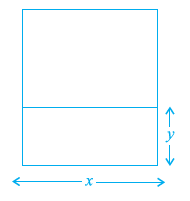
Answer:
Given:
From the figure and the question, we have:
Length of the rectangular playground = $x$
Breadth of the rectangular playground = $y$
Side of the square lawn = $x$
To Find:
Total perimeter of both the playground and the lawn combined together.
Solution:
When the square lawn and the rectangular playground are combined as shown in the figure, the total perimeter is the sum of the lengths of all the outer boundaries of the combined shape.
The outer boundary consists of the following sides:
1. The top side of the square lawn = $x$
2. The left side of the square lawn = $x$
3. The left side (breadth) of the rectangular playground = $y$
4. The bottom side (length) of the rectangular playground = $x$
5. The right side (breadth) of the rectangular playground = $y$
6. The right side of the square lawn = $x$
Note: The side where the square and rectangle meet is an internal boundary and is not included in the perimeter.
Therefore, the Total Perimeter ($P$) is:
$P = \text{Top} + \text{Left Square} + \text{Left Rect} + \text{Bottom} + \text{Right Rect} $$ + \text{Right Square}$
$P = x + x + y + x + y + x$
Grouping the like terms together:
$P = (x + x + x + x) + (y + y)$
$P = 4x + 2y$
Alternate Method:
The combined figure forms a large rectangle where:
$\text{Total Length} = x$
$\text{Total Breadth} = x + y$
Perimeter of a rectangle is given by the formula:
$\text{Perimeter} = 2 \times (\text{Length} + \text{Breadth})$
Substituting the values:
$\text{Perimeter} = 2 \times (x + (x + y))$
$\text{Perimeter} = 2 \times (2x + y)$
$\text{Perimeter} = 4x + 2y$
Thus, the total perimeter of the combined figure is $4x + 2y$.
Question 80. The rate of planting the grass is ₹ x per square metre. Find the cost of planting the grass on a triangular lawn whose base is y metres and height is z metres.
Answer:
Given:
Rate of planting grass = $\textsf{₹}$ x per square metre
Base of the triangular lawn = y metres
Height of the triangular lawn = z metres
To Find:
The cost of planting the grass on the triangular lawn.
Solution:
First, we need to find the area of the triangular lawn.
The area of a triangle is given by the formula: Area = $\frac{1}{2} \times$ base $\times$ height.
Area of the triangular lawn = $\frac{1}{2} \times y \times z$ square metres
Area of the triangular lawn = $\frac{1}{2}yz$ square metres
Next, we need to find the total cost of planting the grass.
Cost of planting grass = Area $\times$ Rate per square metre
Cost of planting grass = $(\frac{1}{2}yz) \times x$
Cost of planting grass = $\frac{1}{2}xyz$
The cost is in Rupees ($\textsf{₹}$).
The cost of planting the grass on the triangular lawn is $\mathbf{\textsf{₹} \frac{1}{2}xyz}$.
Question 81. Find the perimeter of the figure given below:
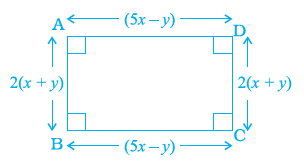
Answer:
Given:
From the given figure of the rectangle $ABCD$:
Length ($l$) = $5x - y$
Breadth ($b$) = $2(x + y)$
To Find:
Perimeter of the rectangle $ABCD$.
Solution:
The formula for the Perimeter of a rectangle is given by:
$\text{Perimeter} = 2 \times (\text{Length} + \text{Breadth})$
Substituting the given values in the formula:
$\text{Perimeter} = 2 \times [(5x - y) + 2(x + y)]$
First, let us simplify the expression inside the brackets:
$= 2 \times [5x - y + 2x + 2y]$
Grouping the like terms together:
$= 2 \times [(5x + 2x) + (2y - y)]$
$= 2 \times [7x + y]$
Now, multiplying by $2$:
$= 14x + 2y$
Thus, the perimeter of the given figure is $14x + 2y$ units.
Question 82. In a rectangular plot, 5 square flower beds of side (x + 2) metres each have been laid (see figure given below). Find the total cost of fencing the flower beds at the cost of ₹ 50 per 100 metres:

Answer:
Given:
Number of square flower beds = $5$
Side of each square flower bed ($s$) = $(x + 2)$ metres
Rate of fencing = $\textsf{₹} 50$ per $100$ metres
To Find:
Total cost of fencing the $5$ flower beds.
Solution:
First, we find the perimeter of one square flower bed:
$\text{Perimeter of 1 bed} = 4 \times \text{side}$
$\text{Perimeter of 1 bed} = 4 \times (x + 2)$
$\text{Perimeter of 1 bed} = 4x + 8$ metres
Now, we find the total length of fencing required for $5$ such beds:
$\text{Total Perimeter} = 5 \times (4x + 8)$
$\text{Total Perimeter} = 20x + 40$ metres
Calculation of Cost:
Given that the cost of fencing $100$ metres is $\textsf{₹} 50$.
Therefore, the cost of fencing $1$ metre is:
$\text{Cost per metre} = \textsf{₹} \frac{\cancel{50}^{1}}{\cancel{100}_{2}} = \textsf{₹} \frac{1}{2}$
Total Cost = $\text{Total Perimeter} \times \text{Cost per metre}$
$\text{Total Cost} = (20x + 40) \times \frac{1}{2}$
$\text{Total Cost} = \frac{20x}{2} + \frac{40}{2}$
$\text{Total Cost} = 10x + 20$
The total cost of fencing the $5$ flower beds is $\textsf{₹} (10x + 20)$.
Question 83. A wire is (7x – 3) metres long. A length of (3x – 4) metres is cut for use. Now, answer the following questions:
(a) How much wire is left?
(b) If this left out wire is used for making an equilateral triangle.
What is the length of each side of the triangle so formed?
Answer:
Given:
Initial length of the wire = $(7x - 3)$ metres
Length of wire cut = $(3x - 4)$ metres
(a) How much wire is left?
The length of the wire left is the initial length minus the length cut for use.
Length of wire left = (Initial length) - (Length cut)
Length of wire left = $(7x - 3) - (3x - 4)$
Remove the parentheses. Remember to distribute the negative sign to both terms inside the second parenthesis:
Length of wire left = $7x - 3 - 3x + 4$
Combine the like terms:
Length of wire left = $(7x - 3x) + (-3 + 4)$
Length of wire left = $(7 - 3)x + (4 - 3)$
Length of wire left = $4x + 1$
The length of wire left is $\mathbf{(4x + 1)}$ metres.
(b) What is the length of each side of the triangle so formed?
The wire left is used to make an equilateral triangle. An equilateral triangle has three sides of equal length.
The perimeter of the equilateral triangle is equal to the length of the wire left.
Perimeter of equilateral triangle = $(4x + 1)$ metres
Let the length of each side of the equilateral triangle be 's'.
Perimeter of equilateral triangle = $3 \times s$
So, $3s = 4x + 1$
To find the length of each side, divide the perimeter by 3:
$s = \frac{4x + 1}{3}$
$s = \frac{4x}{3} + \frac{1}{3}$
The length of each side of the equilateral triangle is $\mathbf{\frac{4x + 1}{3}}$ metres or $\mathbf{(\frac{4}{3}x + \frac{1}{3})}$ metres.
Question 84. Rohan's mother gave him ₹ 3xy2 and his father gave him ₹ 5(xy2 + 2). Out of this total money he spent ₹ (10 – 3xy2) on his birthday party. How much money is left with him?
Answer:
Given:
Money given by mother = $\textsf{₹ }3xy^2$
Money given by father = $\textsf{₹ }5(xy^2 + 2)$
Money spent on birthday party = $\textsf{₹ }(10 - 3xy^2)$
To Find:
The amount of money left with Rohan.
Solution:
First, calculate the money given by the father:
Money from father = $5(xy^2 + 2) = 5 \times xy^2 + 5 \times 2 = 5xy^2 + 10$
So, money from father is $\textsf{₹ }(5xy^2 + 10)$.
Next, calculate the total money Rohan has before spending:
Total money = Money from mother + Money from father
Total money = $\textsf{₹ }3xy^2 + \textsf{₹ }(5xy^2 + 10)$
Total money = $\textsf{₹ }(3xy^2 + 5xy^2 + 10)$
Total money = $\textsf{₹ }(8xy^2 + 10)$
Now, calculate the money left with Rohan by subtracting the money spent from the total money:
Money left = Total money - Money spent
Money left = $\textsf{₹ }(8xy^2 + 10) - \textsf{₹ }(10 - 3xy^2)$
Money left = $8xy^2 + 10 - (10 - 3xy^2)$
Remove the parentheses, distributing the negative sign:
Money left = $8xy^2 + 10 - 10 + 3xy^2$
Combine the like terms:
Money left = $(8xy^2 + 3xy^2) + (10 - 10)$
Money left = $(8 + 3)xy^2 + 0$
Money left = $11xy^2$
The money left with Rohan is $\mathbf{\textsf{₹ }11xy^2}$.
Question 85.
(i) A triangle is made up of 2 red sticks and 1 blue sticks  . The length of a red stick is given by r and that of a blue stick is given by b. Using this information, write an expression for the total length of sticks in the pattern given below:
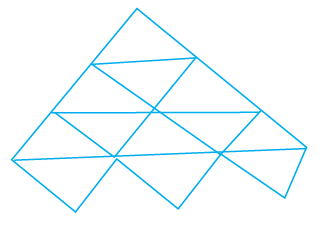
(ii) In the given figure, the length of a green side is given by g and that of the red side is given by p.
Write an expression for the following pattern. Also write an expression if 100 such shapes are joined together.
Answer:
(i) Solution for Triangle Pattern:
Given:
Length of one red stick = $r$
Length of one blue stick = $b$
In the given pattern, there are 6 upright triangles and 3 inverted triangles.
Total number of small triangles in the pattern = $6 + 3 = 9$
To Find:
Total length of sticks in the entire pattern.
Solution:
Each of the 9 triangles is formed using 2 red sticks as its slanting sides.
Total number of red sticks = $9 \times 2 = 18$
The blue sticks form the horizontal bases of the upright triangles. In the triangular arrangement:
Row 1 has 1 blue stick.
Row 2 has 2 blue sticks.
Row 3 has 3 blue sticks.
Total number of blue sticks = $1 + 2 + 3 = 6$
The expression for the total length of sticks is:
$\text{Total Length} = (\text{Number of red sticks} \times r) $$ + (\text{Number of blue sticks} \times b)$
$\text{Total Length} = 18r + 6b$
(ii) Solution for Joined Shapes Pattern:
Given:
Length of a green side = $g$
Length of a red side = $p$
The basic shape (kite-like) consists of 2 green sides and 2 red sides.
Total length of one shape = $2g + 2p$
To Find:
1. Expression for the pattern shown (consisting of 3 shapes).
2. Expression if 100 such shapes are joined together.
Solution:
The pattern shown in the full sequence consists of 3 such shapes.
Expression for 3 shapes = $3 \times (2g + 2p)$
Expression for 3 shapes = $6g + 6p$
Now, if 100 such shapes are joined together:
Expression for 100 shapes = $100 \times (2g + 2p)$
Expression for 100 shapes = $200g + 200p$
Taking 200 as common:
Expression for 100 shapes = $200(g + p)$
Therefore, the total length for the triangle pattern is $18r + 6b$. For the second part, the expression for the pattern is $6g + 6p$ and for 100 shapes, it is $200(g + p)$.
Questino 86. The sum of first n natural numbers is given by $\frac{1}{2}$n2 + $\frac{1}{2}$n. Find
(i) The sum of first 5 natural numbers.
(ii) The sum of first 11 natural numbers.
(iii) The sum of natural numbers from 11 to 30.
Answer:
Given:
The sum of the first n natural numbers is given by the formula: $S_n = \frac{1}{2}n^2 + \frac{1}{2}n$
(i) The sum of first 5 natural numbers.
Here, we need to find the sum of the first 5 natural numbers, so n = 5.
Substitute $n=5$ into the formula:
$S_5 = \frac{1}{2}(5)^2 + \frac{1}{2}(5)$
$S_5 = \frac{1}{2}(25) + \frac{1}{2}(5)$
$S_5 = \frac{25}{2} + \frac{5}{2}$
$S_5 = \frac{25 + 5}{2}$
$S_5 = \frac{30}{2}$
$S_5 = 15$
The sum of the first 5 natural numbers is $\mathbf{15}$.
(ii) The sum of first 11 natural numbers.
Here, we need to find the sum of the first 11 natural numbers, so n = 11.
Substitute $n=11$ into the formula:
$S_{11} = \frac{1}{2}(11)^2 + \frac{1}{2}(11)$
$S_{11} = \frac{1}{2}(121) + \frac{1}{2}(11)$
$S_{11} = \frac{121}{2} + \frac{11}{2}$
$S_{11} = \frac{121 + 11}{2}$
$S_{11} = \frac{132}{2}$
$S_{11} = 66$
The sum of the first 11 natural numbers is $\mathbf{66}$.
(iii) The sum of natural numbers from 11 to 30.
To find the sum of natural numbers from 11 to 30, we subtract the sum of the first 10 natural numbers from the sum of the first 30 natural numbers.
Sum (11 to 30) = Sum (1 to 30) - Sum (1 to 10)
First, find the sum of the first 30 natural numbers (n = 30):
$S_{30} = \frac{1}{2}(30)^2 + \frac{1}{2}(30)$
$S_{30} = \frac{1}{2}(900) + \frac{1}{2}(30)$
$S_{30} = 450 + 15$
$S_{30} = 465$
Next, find the sum of the first 10 natural numbers (n = 10):
$S_{10} = \frac{1}{2}(10)^2 + \frac{1}{2}(10)$
$S_{10} = \frac{1}{2}(100) + \frac{1}{2}(10)$
$S_{10} = 50 + 5$
$S_{10} = 55$
Now, subtract the sum of the first 10 numbers from the sum of the first 30 numbers:
Sum (11 to 30) = $S_{30} - S_{10}$
Sum (11 to 30) = $465 - 55$
Sum (11 to 30) = $410$
The sum of natural numbers from 11 to 30 is $\mathbf{410}$.
Question 87. The sum of squares of first n natural numbers is given by $\frac{1}{6}$n (n + 1) (2n + 1) or $\frac{1}{6}$ (2n3 + 3n2 + n). Find the sum of squares of the first 10 natural numbers.
Answer:
Given:
The sum of squares of the first n natural numbers is given by the formula:
$S_n = \frac{1}{6}n(n + 1)(2n + 1)$ or $S_n = \frac{1}{6}(2n^3 + 3n^2 + n)$
To Find:
The sum of squares of the first 10 natural numbers.
Solution:
We need to find the sum of squares of the first 10 natural numbers, so we set $n = 10$ in the formula $S_n = \frac{1}{6}n(n + 1)(2n + 1)$.
Substitute $n = 10$ into the formula:
$S_{10} = \frac{1}{6}(10)(10 + 1)(2 \times 10 + 1)$
$S_{10} = \frac{1}{6}(10)(11)(20 + 1)$
$S_{10} = \frac{1}{6}(10)(11)(21)$
$S_{10} = \frac{10 \times 11 \times 21}{6}$
Perform the calculation by cancelling common factors:
$S_{10} = \frac{\cancel{10}^{5} \times 11 \times \cancel{21}^{7}}{\cancel{6}_{1}}$
$S_{10} = 5 \times 11 \times 7$
$S_{10} = 55 \times 7$
$S_{10} = 385$
The sum of squares of the first 10 natural numbers is $\mathbf{385}$.
Question 88. The sum of the multiplication table of natural number ‘n’ is given by 55 × n. Find the sum of
(a) Table of 7
(b) Table of 10
(c) Table of 19
Answer:
Given:
The sum of the multiplication table of a natural number 'n' is given by the formula: Sum $= 55 \times n$
To Find:
The sum of the multiplication table of 7, 10, and 19.
Solution:
We use the given formula $Sum = 55 \times n$ for each part.
(a) Table of 7
Here, $n = 7$.
Sum of table of 7 $= 55 \times 7$
Sum $= 385$
The sum of the table of 7 is $\mathbf{385}$.
(b) Table of 10
Here, $n = 10$.
Sum of table of 10 $= 55 \times 10$
Sum $= 550$
The sum of the table of 10 is $\mathbf{550}$.
(c) Table of 19
Here, $n = 19$.
Sum of table of 19 $= 55 \times 19$
Sum $= 55 \times (20 - 1)$
Sum $= 55 \times 20 - 55 \times 1$
Sum $= 1100 - 55$
Sum $= 1045$
The sum of the table of 19 is $\mathbf{1045}$.
Question 89. If
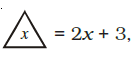 ,
,
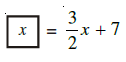 and
and

then find the value of :
(i)
.png "Page 327 Chapter 10 Class 7th NCERT Exemplar")
(ii)
.png "Page 327 Chapter 10 Class 7th NCERT Exemplar")
Answer:
Given:
The rules for the symbols are provided as follows:
$\text{Triangle}(x) = 2x + 3$
$\text{Square}(x) = \frac{3}{2}x + 7$
$\text{Circle}(x) = x - 3$
To Find:
(i) The value of $2 \times \text{Triangle}(6) + \text{Square}(3) - \text{Circle}(1)$
(ii) The value of $\frac{1}{2} \times \text{Square}(2) + \text{Circle}(8) - 3 \times \text{Triangle}(0)$
Solution for (i):
First, we evaluate each symbol individually based on the given rules:
$\text{Triangle}(6) = 2(6) + 3 = 12 + 3 = 15$
$\text{Square}(3) = \frac{3}{2}(3) + 7 = \frac{9}{2} + 7 = 4.5 + 7 = 11.5$
$\text{Circle}(1) = 1 - 3 = -2$
Now, substitute these values back into the expression:
$= 2(15) + (11.5) - (-2)$
$= 30 + 11.5 + 2$
$= 43.5$
Solution for (ii):
Again, we evaluate each symbol individually:
$\text{Square}(2) = \frac{3}{\cancel{2}} \times \cancel{2} + 7 = 3 + 7 = 10$
$\text{Circle}(8) = 8 - 3 = 5$
$\text{Triangle}(0) = 2(0) + 3 = 0 + 3 = 3$
Now, substitute these values into the required expression:
$= \frac{1}{2}(10) + (5) - 3(3)$
$= 5 + 5 - 9$
$= 10 - 9$
$= 1$
Final Answers:
The values are $43.5$ for (i) and $1$ for (ii).
Question 90. If  then find the value of:
(i)
.png "Page 327 Chapter 10 Class 7th NCERT Exemplar")
(ii)
.png "Page 327 Chapter 10 Class 7th NCERT Exemplar")
Answer:
Given:
The algebraic operations for the given symbols are defined as follows:
$\text{Triangle}(x) = \frac{3}{4}x - 2$
$\text{Diamond}(x) = x + 6$
To Find:
(i) The value of $\text{Triangle}(10) - \text{Diamond}(4)$
(ii) The value of $2 \times \text{Diamond}(12) - \frac{3}{2} \times \text{Triangle}(1)$
Solution for (i):
First, we evaluate each symbol by substituting the given values into their respective expressions:
Step 1: Evaluate Triangle(10)
$\text{Triangle}(10) = \frac{3}{4}(10) - 2$
(Substituting $x = 10$)
$\text{Triangle}(10) = \frac{3 \times \cancel{10}^5}{\cancel{4}_2} - 2$
$\text{Triangle}(10) = \frac{15}{2} - 2$
$\text{Triangle}(10) = 7.5 - 2 = 5.5$
Step 2: Evaluate Diamond(4)
$\text{Diamond}(4) = 4 + 6 = 10$
(Substituting $x = 4$)
Step 3: Calculate the final result for (i)
$\text{Value} = \text{Triangle}(10) - \text{Diamond}(4)$
$\text{Value} = 5.5 - 10$
$\text{Value} = -4.5$
Solution for (ii):
Now, we evaluate the expression $2 \times \text{Diamond}(12) - \frac{3}{2} \times \text{Triangle}(1)$:
Step 1: Evaluate Diamond(12)
$\text{Diamond}(12) = 12 + 6 = 18$
(Substituting $x = 12$)
Step 2: Evaluate Triangle(1)
$\text{Triangle}(1) = \frac{3}{4}(1) - 2$
(Substituting $x = 1$)
$\text{Triangle}(1) = \frac{3}{4} - \frac{2}{1} = \frac{3 - 8}{4} = -\frac{5}{4}$
Step 3: Calculate the final result for (ii)
$\text{Value} = 2 \times (18) - \frac{3}{2} \times \left(-\frac{5}{4}\right)$
$\text{Value} = 36 + \left(\frac{3 \times 5}{2 \times 4}\right)$
$\text{Value} = 36 + \frac{15}{8}$
$\text{Value} = 36 + 1.875$
$\text{Value} = 37.875$
Final Answers:
The value for expression (i) is $-4.5$.
The value for expression (ii) is $37.875$.
Translate each of the following algebraic expressions Question 91 to 94 into words.
Question 91. 4b – 3
Answer:
The expression is $4b - 3$.
This expression involves multiplication (4 multiplied by b) and subtraction (3 is subtracted from the result).
We can translate this into words in several ways:
1. Three subtracted from four times b.
2. The product of 4 and b, reduced by 3.
3. 3 less than the product of 4 and b.
A common translation is: Three subtracted from four times b.
Question 92. 8 (m + 5)
Answer:
The expression is $8(m + 5)$.
This expression involves the sum of m and 5, and then the result is multiplied by 8.
We can translate this into words as:
1. 8 times the sum of m and 5.
2. The product of 8 and the sum of m and 5.
3. 8 multiplied by the quantity m plus 5.
A common and clear translation is: 8 times the sum of m and 5.
Question 93. $\frac{7}{ 8 - x}$
Answer:
The expression is $\frac{7}{8 - x}$.
This expression is a fraction, which represents division. The numerator is 7 and the denominator is $(8 - x)$. The denominator involves subtraction.
First, translate the denominator $(8 - x)$: This can be expressed as "the difference between 8 and x", or "x subtracted from 8".
Now, translate the entire expression (7 divided by the denominator):
Using "the difference between 8 and x" for the denominator, the expression can be translated as:
7 divided by the difference between 8 and x.
Alternatively, we could say:
The quotient of 7 and the difference between 8 and x.
Question 94. 7 $\left( \frac{16}{w} \right)$
Answer:
The expression is $7 \left( \frac{16}{w} \right)$.
This expression involves division (16 divided by w) inside parentheses, and then the result is multiplied by 7.
First, consider the part inside the parentheses: $\frac{16}{w}$.
This can be translated as "16 divided by w" or "the quotient of 16 and w".
Now, the entire expression means 7 multiplied by the result of the division.
Using "16 divided by w" for the inner part, the expression can be translated as:
7 times 16 divided by w.
Alternatively, using "the quotient of 16 and w":
7 times the quotient of 16 and w.
Or:
The product of 7 and the quotient of 16 and w.
Question 95.
(i) Critical Thinking Write two different algebraic expressions for the word phrase “ $\left( \frac{1}{4} \right)$ of the sum of x and 7.”
(ii) What’s the Error? A student wrote an algebraic expression for “5 less than a number n divided by 3” as $\frac{n}{3}$ - 5 What error did the student make?
(iii) Write About it Shashi used addition to solve a word problem about the weekly cost of commuting by toll tax for ₹ 15 each day. Ravi solved the same problem by multiplying. They both got the correct answer. How is this possible?
Answer:
(i) Solution:
To Find:
Two different algebraic expressions for the phrase "$\frac{1}{4}$ of the sum of $x$ and $7$".
Solution:
The phrase "sum of $x$ and $7$" is written as $(x + 7)$.
Taking "$\frac{1}{4}$ of" this sum can be represented in the following two ways:
1. Using multiplication: $\frac{1}{4}(x + 7)$
2. Using division: $\frac{x + 7}{4}$
Both expressions are mathematically identical and represent the given word phrase correctly.
(ii) Solution:
To Find:
The error made by the student in the expression $\frac{n}{3} - 5$ for the phrase "5 less than a number $n$ divided by 3".
Solution:
The phrase "5 less than a number $n$ divided by 3" is ambiguous and can be interpreted in two ways. However, in a mathematical context, it usually implies that the subtraction happens before the division or that the division applies to the entire quantity described first.
If the phrase intended the division to apply to the result of "5 less than $n$", the correct expression should be:
$\frac{n - 5}{3}$
The Error:
The student wrote $\frac{n}{3} - 5$. This expression represents "the quotient of $n$ and $3$, decreased by $5$".
The student likely confused the order of operations. They divided the number $n$ by $3$ first and then subtracted $5$, whereas the wording "5 less than a number $n$ (pause) divided by 3" typically suggests that the quantity $(n - 5)$ is the one being divided by $3$.
(iii) Solution:
Given:
Weekly cost of toll tax = $\textsf{₹} 15$ per day.
Shashi used Addition.
Ravi used Multiplication.
Solution:
A week has 7 days. To find the total cost for the week:
Shashi's Method (Repeated Addition):
Shashi added the daily cost seven times:
$\text{Total Cost} = \textsf{₹} (15 + 15 + 15 + 15 + 15 + 15 + 15)$
$\text{Total Cost} = \textsf{₹} 105$
Ravi's Method (Multiplication):
Ravi multiplied the daily cost by the number of days:
$\text{Total Cost} = \textsf{₹} (15 \times 7)$
$\text{Total Cost} = \textsf{₹} 105$
Why they both got the correct answer:
This is possible because multiplication is defined as repeated addition. Multiplying a number by 7 is the same as adding that number to itself 7 times. Since both operations are mathematically equivalent, they both arrived at the same correct result of $\textsf{₹} 105$.
Question 96. Challenge Write an expression for the sum of 1 and twice a number n. If you let n be any odd number, will the result always be an odd number?
Answer:
To Find:
An algebraic expression for the sum of 1 and twice a number $n$ and determine if the result is always odd when $n$ is an odd number.
Solution:
According to the statement, "twice a number $n$" is represented as $2n$.
The sum of 1 and $2n$ is written as:
$1 + 2n$
Now, let us test if the result is always odd for any odd value of $n$.
Let $n$ be an odd number. Any odd number can be represented in the form $2k + 1$, where $k$ is an integer.
Substituting $n = 2k + 1$ in our expression:
$= 1 + 2(2k + 1)$
$= 1 + 4k + 2$
$= 4k + 3$
$= 4k + 2 + 1$
$= 2(2k + 1) + 1$
Since any number in the form $2(\text{integer}) + 1$ is always odd, the result will always be an odd number.
Alternate Explanation:
1. For any integer $n$, $2n$ is always an even number (since it is a multiple of 2).
2. We know that $\text{Even} + 1 = \text{Odd}$.
3. Therefore, $2n + 1$ will always be an odd number regardless of whether $n$ is odd or even.
Thus, the result is Yes, it will always be an odd number.
Question 97. Critical Thinking Will the value of 11x for x = –5 be greater than 11 or less than 11? Explain.
Answer:
Given:
Expression = $11x$
Value of $x = -5$
Solution:
Let us find the value of the expression by substituting $x = -5$:
$= 11 \times (-5)$
$= -55$
Comparison:
We need to compare $-55$ and $11$.
On a number line, any negative number lies to the left of a positive number. Therefore, every negative number is smaller than every positive number.
Since $-55 < 11$, the value of $11x$ for $x = -5$ is less than 11.
Question 98. Match Column I with Column II in the following:
Column I
1. The difference of 3 and a number squared
2. 5 less than twice a number squared
3. Five minus twice the square of a number
4. Four minus a number multiplied by 2
5. Seven times the sum of a number and 1
6. A number squared plus 6
7. 2 times the sum of a number and 6
8. Three less than the square of a number
Column II
(a) 4 – 2x
(b) n2 – 3
(c) 2n2 – 5
(d) 5 – 2n2
(e) 3 – n2
(f) 2 (n + 6)
(g) 7 (n + 1)
(h) n2 + 6
Answer:
Solution:
By converting the word phrases into algebraic expressions, we can match the columns as follows:
| S.No. | Column I (Phrase) | Column II (Expression) |
| 1 | The difference of 3 and a number squared | (e) $3 - n^2$ |
| 2 | 5 less than twice a number squared | (c) $2n^2 - 5$ |
| 3 | Five minus twice the square of a number | (d) $5 - 2n^2$ |
| 4 | Four minus a number multiplied by 2 | (a) $4 - 2x$ |
| 5 | Seven times the sum of a number and 1 | (g) $7(n + 1)$ |
| 6 | A number squared plus 6 | (h) $n^2 + 6$ |
| 7 | 2 times the sum of a number and 6 | (f) $2(n + 6)$ |
| 8 | Three less than the square of a number | (b) $n^2 - 3$ |
Question 99. At age of 2 years, a cat or a dog is considered 24 “human” years old.
Each year, after age 2 is equivalent to 4 “human” years. Fill in the expression [24 + (a – 2)] so that it represents the age of a cat or dog in human years. Also, you need to determine for what ‘a’ stands for. Copy the chart and use your expression to complete it.
| Age | [24 + (a – 2)] | Age (Human Years) |
|---|---|---|
| 2 | ||
| 3 | ||
| 4 | ||
| 5 | ||
| 6 |
Answer:
Given:
Age at 2 years = $24$ human years.
Rate of increase after 2 years = $4$ human years per actual year.
To Find:
1. The missing value in the expression $[24 + \_\_\_ (a - 2)]$.
2. The meaning of the variable '$a$'.
3. Completed table for ages 2 to 6.
Solution:
Since each year after age 2 adds 4 human years, the number of additional years must be multiplied by 4. Thus, the filled expression is $[24 + 4(a - 2)]$.
In this expression, '$a$' stands for the actual age of the cat or dog in years.
The term $(a - 2)$ represents the number of years passed after the initial 2 years.
Completed Table:
| Age (a) | $[24 + 4(a - 2)]$ | Age (Human Years) |
| 2 | $24 + 4(2 - 2) = 24 + 0$ | 24 |
| 3 | $24 + 4(3 - 2) = 24 + 4$ | 28 |
| 4 | $24 + 4(4 - 2) = 24 + 8$ | 32 |
| 5 | $24 + 4(5 - 2) = 24 + 12$ | 36 |
| 6 | $24 + 4(6 - 2) = 24 + 16$ | 40 |
Question 100. Express the following properties with variables x, y and z.
(i) Commutative property of addition
(ii) Commutative property of multiplication
(iii) Associative property of addition
(iv) Associative property of multiplication
(v) Distributive property of multiplication over addition
Answer:
Solution:
Using the variables $x, y$ and $z$, the properties are expressed as follows:
(i) Commutative property of addition:
$x + y = y + x$
(ii) Commutative property of multiplication:
$x \times y = y \times x$
(iii) Associative property of addition:
$(x + y) + z = x + (y + z)$
(iv) Associative property of multiplication:
$(x \times y) \times z = x \times (y \times z)$
(v) Distributive property of multiplication over addition:
$x \times (y + z) = (x \times y) + (x \times z)$