Chapter 12 Practical Geometry, Symmetry & Visualising Solid Shapes (Class 7 - Maths NCERT Exemplar Solutions)
Welcome to the comprehensive resource for NCERT Exemplar Solutions for Class 7 Mathematics: Chapter 12! This integrated section is crafted to significantly challenge students by enhancing their spatial visualization abilities and geometric precision. By connecting triangle constructions with the analysis of symmetry and 3D forms, these solutions foster a holistic understanding of how geometric principles apply to both flat surfaces and solid objects.
In Practical Geometry, the solutions provide meticulous guidance on constructions using a ruler and compasses. Students will master building triangles based on SSS, SAS, ASA, and RHS criteria, alongside constructing parallel lines. The Symmetry section explores reflectional and rotational symmetry in depth, including calculating the angle of rotation ($\frac{360^\circ}{n}$) for various polygons and non-standard figures.
Finally, Visualising Solid Shapes bridges 2D patterns and 3D objects through the study of nets, isometric sketches, and various views (front, top, and side). A key highlight is the application of Euler's Formula ($F + V - E = 2$) to verify the properties of polyhedrons. With step-by-step guidance and logical justifications prepared by learningspot.co, students can confidently master problem-solving in advanced geometric contexts.
| Content On This Page | ||
|---|---|---|
| Solved Examples (Examples 1 to 16) | Question 1 to 28 (Multiple Choice Questions) | Question 29 to 58 (Fill in the Blanks) |
| Question 59 to 92 (True or False) | Question 93 to 124 | |
Solved Examples (Examples 1 to 16)
In Examples 1 to 3, there are four options, out of which one is correct. Choose the correct one.
Example 1: Which of the following is not a symmetrical figure?

Answer:
To Find: The figure among the given options that is not symmetrical.
Solution:
A figure is said to be symmetrical if it can be divided into two identical halves by a line (Line Symmetry) or if it looks the same after a certain degree of rotation (Rotational Symmetry).
1. Figure (a) is a double-headed arrow. It has both horizontal and vertical lines of symmetry.
2. Figure (b) is a smiley face. It has a vertical line of symmetry passing through the centre.
3. Figure (c) is a directional arrow. It has a horizontal line of symmetry.
4. Figure (d) is a parallelogram. A general parallelogram does not have any line of symmetry (though it has rotational symmetry of order $2$). Since the question usually refers to line symmetry in this context, the parallelogram is considered the non-symmetrical figure among the choices.
Final Answer: (d)
Example 2: In the word “MATHS” which of the following pairs of letters shows rotational symmetry
(a) M and T
(b) H and S
(c) A and S
(d) T and S
Answer:
To Find: The pair of letters in "MATHS" that possess rotational symmetry.
Solution:
Rotational symmetry occurs when a figure looks exactly the same after a rotation of less than $360^\circ$ about its centre.
1. M: Shows only line symmetry; it does not show rotational symmetry.
2. A: Shows only line symmetry; it does not show rotational symmetry.
3. T: Shows only line symmetry; it does not show rotational symmetry.
4. H: Shows rotational symmetry of order $2$ (looks the same after $180^\circ$).
5. S: Shows rotational symmetry of order $2$ (looks the same after $180^\circ$).
Comparing these with the given options, the pair H and S both show rotational symmetry.
Final Answer: (b)
Example 3: The angle of rotation for the figure 12.2 is

(a) 45°
(b) 60°
(c) 90°
(d) 180°
Answer:
To Find: The angle of rotation for Figure 12.2.
Solution:
Figure 12.2 consists of a square containing five circles arranged such that one is in the centre and four are at the corners. This arrangement follows the symmetry of a square.
A square has rotational symmetry of order $4$. The angle of rotation is calculated as:
$\text{Angle of Rotation} = \frac{360^\circ}{n}$
Where $n$ is the order of rotational symmetry. For a square-based pattern, $n = 4$.
$\text{Angle of Rotation} = \frac{360^\circ}{4} = 90^\circ$
Final Answer: (c)
In Examples 4 to 6, fill in the blanks to make it a true statement.
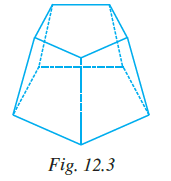
Example 4: The figure 12.3 has ________ vertices, __________ edges and __________ faces.
Answer:
To Find: The number of vertices, edges, and faces in Figure 12.3.
Solution:
Figure 12.3 represents a Pentagonal Frustum (a portion of a pentagonal pyramid). Let us count its components:
1. Faces: There is one pentagonal face at the top, one pentagonal face at the bottom, and $5$ trapezoidal lateral faces. Total faces $= 1 + 1 + 5 = 7$.
2. Vertices: There are $5$ vertices on the top face and $5$ vertices on the bottom face. Total vertices $= 5 + 5 = 10$.
3. Edges: There are $5$ edges at the top, $5$ edges at the bottom, and $5$ lateral edges connecting the top and bottom. Total edges $= 5 + 5 + 5 = 15$.
We can verify this using Euler’s Formula:
$F + V - E = 2$
$7 + 10 - 15 = 2$
(Verified)
Final Answer: The figure 12.3 has 10 vertices, 15 edges and 7 faces.
Example 5: The adjoining net in Fig. 12.4 represents a _________.

Answer:
To Find: The 3-D shape represented by the given net.
Solution:
The net in Figure 12.4 consists of $6$ identical square faces arranged in a 'T' shape. When these faces are folded along the edges, they form a closed 3-D solid where all faces are squares and meet at right angles.
This solid is known as a Cube.
Final Answer: Cube
Example 6: Rotation turns an object about a fixed point. This fixed point is called _______.
Answer:
To Find: The term used for the fixed point in rotation.
Solution:
In geometry, rotation is a transformation that turns a figure about a specific fixed point. The characteristics of a rotation include the angle of rotation, the direction (clockwise or anti-clockwise), and the point of rotation.
This fixed point is technically termed the Centre of Rotation.
Final Answer: Centre of Rotation
In Examples 7 to 9, state whether the statements are True or False.
Example 7: A net of a 3-D shape is a sort of skeleton - outline in 2-D, which, when folded results in the 3-D shape.
Answer:
To Find: Whether the definition of a net is true or false.
Solution:
A net is a two-dimensional pattern that can be folded to form a three-dimensional object. It acts as a 2-D layout or "skeleton" that shows all the faces of the solid connected at their edges. Folding this layout along the lines (edges) recreates the 3-D shape.
Therefore, the statement is correct.
Final Answer: True
Example 8: A regular pentagon has no lines of symmetry.
Answer:
To Find: Whether a regular pentagon lacks lines of symmetry.
Solution:
A regular polygon is a polygon where all sides and all angles are equal. A property of regular polygons is that they have as many lines of symmetry as the number of their sides.
For a regular pentagon:
Number of sides $= 5$
Number of lines of symmetry $= 5$
Since a regular pentagon actually has $5$ lines of symmetry, the statement that it has "no lines of symmetry" is incorrect.
Final Answer: False
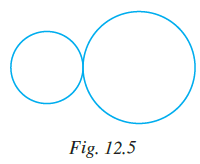
Example 9: Order of rotational symmetry for the figure 12.5 is 4.
Answer:
To Find: Whether the statement "Order of rotational symmetry for the figure 12.5 is 4" is True or False.
Solution:
Rotational symmetry refers to how many times a figure looks identical to its original position during one full $360^\circ$ rotation. Let us examine the letters in Figure 12.5:
1. A: It looks the same only once in a full turn. Order = $1$.
2. B: It looks the same only once in a full turn. Order = $1$.
3. S: It looks the same twice ($180^\circ$ and $360^\circ$). Order = $2$.
4. O: It looks the same twice ($180^\circ$ and $360^\circ$) or infinitely if it is a perfect circle. Order = $2$.
Since none of these letters (nor the set as a whole) have an order of rotational symmetry of $4$, the statement is incorrect.
Final Answer: False
Example 10: Draw all the lines of symmetry for the following letters if they exist.

Answer:
To Find: The lines of symmetry for letters A, B, S, and O.
Solution:
A line of symmetry is an imaginary line that passes through the centre of a shape and divides it into two identical halves (mirror images).
1. A: It has one vertical line of symmetry passing through its apex.
2. B: It has one horizontal line of symmetry passing through its middle.
3. S: It has no lines of symmetry. (It only possesses rotational symmetry).
4. O: It has two lines of symmetry: one vertical and one horizontal (assuming it is an oval/elliptical shape as shown).

Example 11: State whether the figure 12.6 shows rotational symmetry. If yes, then what is the order of rotational symmetry?

Answer:
To Find: Presence and order of rotational symmetry in Figure 12.6.
Solution:
Figure 12.6 is a four-pointed star. If we rotate this star about its centre, it will look exactly the same at certain angles.
1. At $90^\circ$, it looks identical to the original.
2. At $180^\circ$, it looks identical to the original.
3. At $270^\circ$, it looks identical to the original.
4. At $360^\circ$, it looks identical to the original.
Since the figure looks the same $4$ times during a full rotation, it possesses rotational symmetry.
Order of Rotational Symmetry: 4
Angle of Rotation: $90^\circ$
Example 12: Identify the following figures:

Answer:
Solution:
Based on the visual representation in Fig 12.7:
1. Figure (i): This is a 3-D solid with a rectangle base and four triangular lateral faces meeting at a single vertex (apex). This is a Rectangular Pyramid.
2. Figure (ii): This is a 3-D solid with two identical triangular bases and three rectangular lateral faces. This is a Triangular Prism.
Example 13: Construct a triangle PQR such that PQ = 6 cm, QR = 7 cm and PR = 4.5 cm.
Answer:
Given:
Side $PQ = 6 \text{ cm}$
Side $QR = 7 \text{ cm}$
Side $PR = 4.5 \text{ cm}$
Construction Required: Triangle $PQR$.
Steps of Construction:
1. Draw a line segment $QR$ of length $7 \text{ cm}$.
2. With $Q$ as the centre and a radius of $6 \text{ cm}$, draw an arc using a compass.
3. With $R$ as the centre and a radius of $4.5 \text{ cm}$, draw another arc intersecting the previous arc.
4. Mark the point of intersection as $P$.
5. Join $PQ$ and $PR$ to complete the triangle $PQR$.

Example 14: Draw the top, the front and the side views of the following solid figure made up of cubes.
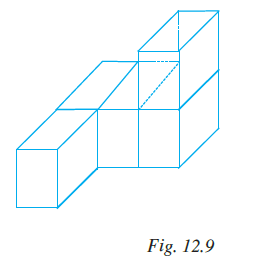
Answer:
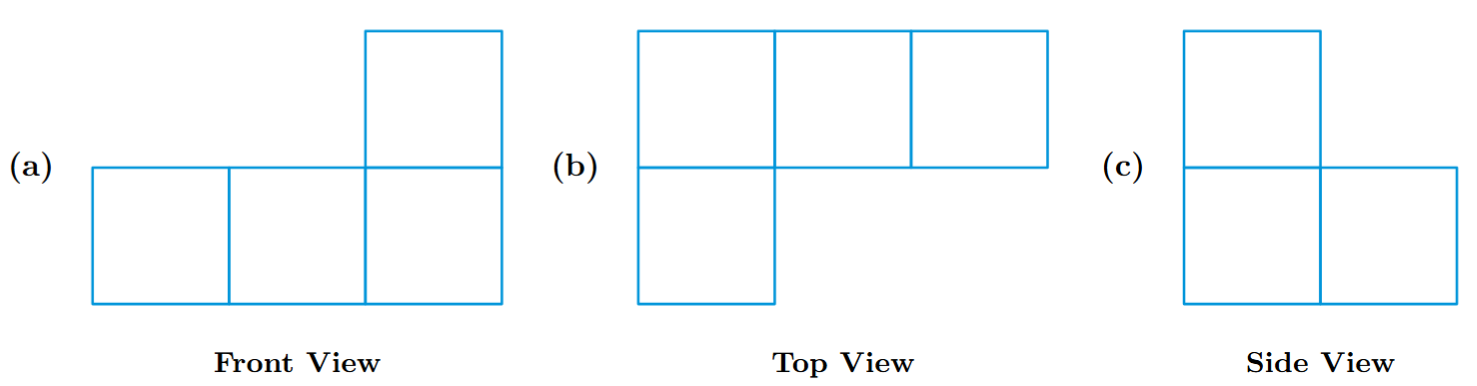
Example 15: Given a line l and a point M on it draw a perpendicular MP to l where MP = 5.2cm and a line q parallel to l through P.
Answer:
Given:
1. A line $l$.
2. A point $M$ lying on line $l$.
3. Distance $MP = 5.2 \text{ cm}$.
Construction Required:
1. A perpendicular line segment $MP$ such that $MP \perp l$.
2. A line $q$ passing through $P$ such that $q \parallel l$.
Steps of Construction:
1. Draw a straight line $l$ and mark a point $M$ on it.
2. Using a compass and taking $M$ as the centre, draw an arc of any radius that intersects line $l$ at two points.
3. From these two points, draw two intersecting arcs above the line and join the intersection point with $M$ to form a perpendicular line.
4. From point $M$, use a ruler and compass to mark a point $P$ on this perpendicular line such that the length is $5.2 \text{ cm}$.
$MP = 5.2 \text{ cm}$
(Required distance)
5. Now, at point $P$, construct an angle of $90^\circ$ with respect to the line segment $MP$.
6. Extend this line on both sides and name it line $q$.
$q \parallel l$
(By alternate interior angles property)

Conclusion: Line $q$ is the required line parallel to $l$ at a distance of $5.2 \text{ cm}$.
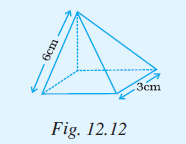
Example 16: Determine the number of edges, vertices and faces in the Fig. 12.12.
Answer:
To Find: Number of Faces ($F$), Vertices ($V$), and Edges ($E$) for the given pyramid.
Solution:
Figure 12.12 is a Square Pyramid. Let us count its components:
1. Faces (F): It has $1$ square base and $4$ triangular faces meeting at the top. Total $F = 5$.
2. Vertices (V): It has $4$ vertices at the base and $1$ vertex at the top (apex). Total $V = 5$.
3. Edges (E): It has $4$ edges along the square base and $4$ lateral edges connecting the base to the apex. Total $E = 8$.
We can verify these values using Euler's Formula:
$F + V - E = 2$
$5 + 5 - 8 = 2$
(Hence proved)
Final Answer: The figure has 5 faces, 5 vertices and 8 edges.
Exercise
Question 1 to 28 (Multiple Choice Questions)
In each of the Questions 1 to 28, there are four options, out of which one is correct. Choose the correct one.
Question 1. A triangle can be constructed by taking its sides as:
(a) 1.8 cm, 2.6 cm, 4.4 cm
(b) 2 cm, 3 cm, 4 cm
(c) 2.4 cm, 2.4 cm, 6.4 cm
(d) 3.2 cm, 2.3 cm, 5.5 cm
Answer:
To Find: The set of side lengths that can form a triangle.
Solution:
According to the Triangle Inequality Property, the sum of the lengths of any two sides of a triangle must be greater than the length of the third side.
Let the sides be $a, b,$ and $c$. Then $a + b > c$.
Checking option (a): $1.8, 2.6, 4.4$
$1.8 + 2.6 = 4.4$
(Sum is equal to the 3rd side)
Checking option (b): $2, 3, 4$
$2 + 3 = 5 > 4$
(Condition satisfied)
Checking option (c): $2.4, 2.4, 6.4$
$2.4 + 2.4 = 4.8 < 6.4$
(Sum is less than the 3rd side)
Checking option (d): $3.2, 2.3, 5.5$
$3.2 + 2.3 = 5.5$
(Sum is equal to the 3rd side)
Only option (b) satisfies the triangle inequality property.
Correct Option: (b)
Question 2. A triangle can be constructed by taking two of its angles as:
(a) 110°, 40°
(b) 70°, 115°
(c) 135°, 45°
(d) 90°, 90°
Answer:
To Find: The pair of angles with which a triangle can be constructed.
Solution:
According to the Angle Sum Property of a triangle, the sum of all three interior angles must be exactly $180^\circ$. Therefore, the sum of any two angles must be less than $180^\circ$.
Checking option (a): $110^\circ + 40^\circ = 150^\circ$ (Less than $180^\circ$, possible).
Checking option (b): $70^\circ + 115^\circ = 185^\circ$ (Greater than $180^\circ$, impossible).
Checking option (c): $135^\circ + 45^\circ = 180^\circ$ (Equal to $180^\circ$, leaves no room for a 3rd angle, impossible).
Checking option (d): $90^\circ + 90^\circ = 180^\circ$ (Equal to $180^\circ$, impossible).
Correct Option: (a)
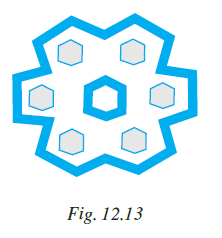
Question 3. The number of lines of symmetry in the figure given below is:
(a) 4
(b) 8
(c) 6
(d) Infinitely many
Answer:
To Find: Number of lines of symmetry in Fig. 12.13.
Solution:
The figure shown is a symmetrical hexagonal pattern. A regular hexagon has $6$ lines of symmetry: $3$ lines passing through the opposite vertices and $3$ lines passing through the midpoints of the opposite sides.
Since the internal design (the small hexagons) is also arranged in a hexagonal symmetry, the total number of lines of symmetry for the entire figure remains $6$.
Correct Option: (c)
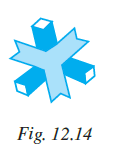
Question 4. The number of lines of symmetry in Fig. 12.14 is
(a) 1
(b) 3
(c) 6
(d) Infinitely many
Answer:
To Find: Number of lines of symmetry in Fig. 12.14.
Solution:
The figure displays a pattern with three-fold rotational symmetry. It has $3$ identical "loops" or "ribbons" meeting at the centre. Lines of symmetry can be drawn passing through the centre of each loop to the opposite intersection point.
There are exactly $3$ such lines that divide the figure into two identical mirror images.
Correct Option: (b)
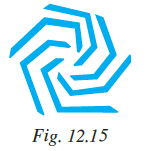
Question 5. The order of rotational symmetry in the Fig. 12.15 given below is
(a) 4
(b) 8
(c) 6
(d) Infinitely many
Answer:
To Find: The order of rotational symmetry for Fig. 12.15.
Solution:
The order of rotational symmetry is the number of times a figure looks identical to its original position during a full $360^\circ$ rotation.
Fig 12.15 is a hexagonal spiral. It has $6$ identical arms curving outwards. As it is based on a hexagonal structure, rotating it by $60^\circ, 120^\circ, 180^\circ, 240^\circ, 300^\circ,$ and $360^\circ$ will result in the same appearance.
$\text{Order} = \frac{360^\circ}{60^\circ} = 6$
Correct Option: (c)
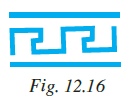
Question 6. The order of rotational symmetry in the figure 12.16 given below is
(a) 4
(b) 2
(c) 1
(d) Infinitely many
Answer:
To Find: The order of rotational symmetry for Fig. 12.16.
Solution:
The figure consists of a repeating "step" or "S-like" pattern between two parallel lines. If we rotate this specific pattern segment about its centre point:
1. At $180^\circ$, the pattern upside down looks identical to the original.
2. At $360^\circ$, it returns to its original position.
Since it looks the same twice in a full rotation, the order of rotational symmetry is $2$.
Correct Option: (b)
Question 7. The name of the given solid in Fig 12.17 is:

(a) triangular pyramid
(b) rectangular pyramid
(c) rectangular prism
(d) triangular prism
Answer:
Solution:
A solid is named based on its base and the shape of its lateral faces. In Fig. 12.17:
1. The base is a rectangle (or square).
2. All lateral faces are triangles that meet at a single point (apex).
A solid with a polygonal base and triangular faces meeting at an apex is called a pyramid. Since the base is rectangular, the solid is a rectangular pyramid.
Correct Option: (b)
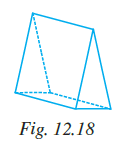
Question 8. The name of the solid in Fig. 12.18 is:
(a) triangular pyramid
(b) rectangular prism
(c) triangular prism
(d) rectangular pyramid
Answer:
Solution:
In Fig. 12.18:
1. The two bases are identical triangles.
2. The lateral faces connecting the bases are rectangles.
A solid that has two identical and parallel polygonal bases and rectangular lateral faces is called a prism. Since the bases are triangles, it is a triangular prism.
Correct Option: (c)
Question 9. All faces of a pyramid are always:
(a) Triangular
(b) Rectangular
(c) Congruent
(d) None of these
Answer:
Solution:
In a pyramid, the lateral faces (sides) are always triangular. However, the base of a pyramid can be any polygon, such as a square, rectangle, pentagon, etc.
For example, in a square pyramid, the base is a square and the lateral faces are triangles. Therefore, not "all" faces are always triangular, nor are they always rectangular or congruent.
Correct Option: (d)
Question 10. A solid that has only one vertex is
(a) Pyramid
(b) Cube
(c) Cone
(d) Cylinder
Answer:
Solution:
Let us examine the number of vertices in the given solids:
1. Pyramid: A triangular pyramid has $4$ vertices, a square pyramid has $5$ vertices.
2. Cube: A cube has $8$ vertices.
3. Cone: A cone has exactly one vertex (also called the apex).
4. Cylinder: A cylinder has $0$ vertices.
Correct Option: (c)
Question 11. Out of the following which is a 3-D figure?
(a) Square
(b) Sphere
(c) Triangle
(d) Circle
Answer:
Solution:
A 3-D (three-dimensional) figure has length, breadth, and height/depth.
1. Square, Triangle, and Circle are 2-D figures (plane figures).
2. Sphere is a 3-D solid figure (like a ball).
Correct Option: (b)
Question 12. Total number of edges a cylinder has
(a) 0
(b) 1
(c) 2
(d) 3
Answer:
Solution:
A cylinder consists of two flat circular faces and one curved surface. The boundaries where the curved surface meets the flat faces are the edges.
A cylinder has 2 circular edges.
Correct Option: (c)
Question 13. A solid that has two opposite identical faces and other faces as parallelograms is a
(a) prism
(b) pyramid
(c) cone
(d) sphere
Answer:
Solution:
By definition, a prism is a solid whose side faces are parallelograms (usually rectangles in a right prism) and whose ends (bases) are identical, parallel polygons.
Correct Option: (a)
Question 14. The solid with one circular face, one curved surface and one vertex is known as:
(a) cone
(b) sphere
(c) cylinder
(d) prism
Answer:
Solution:
A cone has:
1. One circular face (the base).
2. One curved surface.
3. One vertex (the apex).
Correct Option: (a)
Question 15. If three cubes each of edge 4 cm are placed end to end, then the dimensions of resulting solid are:
(a) 12 cm × 4 cm × 4 cm
(b) 4 cm × 8 cm × 4 cm
(c) 4 cm × 8 cm × 12 cm
(d) 4 cm × 6 cm × 8 cm
Answer:
Given:
Edge of each cube = $4 \text{ cm}$
Number of cubes placed end to end = $3$
Solution:
When three cubes are placed end to end, the resulting solid is a cuboid.
The length ($l$) of the cuboid will be the sum of the edges of the three cubes:
$l = 4 \text{ cm} + 4 \text{ cm} + 4 \text{ cm} = 12 \text{ cm}$
The breadth ($b$) and height ($h$) will remain the same as the edge of the original cube:
$b = 4 \text{ cm}$
$h = 4 \text{ cm}$
Dimensions = $12 \text{ cm} \times 4 \text{ cm} \times 4 \text{ cm}$
Correct Option: (a)
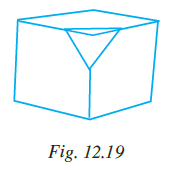
Question 16. When we cut a corner of a cube as shown in the figure 12.19, we get the cutout piece as :
(a) square pyramid
(b) trapezium prism
(c) triangular pyramid
(d) a triangle
Answer:
Solution:
In Figure 12.19, when a corner of a cube is cut off, the resulting cutout piece has a triangular base and three triangular lateral faces that meet at the original corner vertex of the cube.
A solid with a triangular base and triangular lateral faces is known as a triangular pyramid (or a tetrahedron).
Correct Option: (c)
Question 17. If we rotate a right-angled triangle of height 5 cm and base 3 cm about its height a full turn, we get
(a) cone of height 5 cm, base 3 cm
(b) triangle of height 5 cm, base 3 cm
(c) cone of height 5 cm, base 6 cm
(d) triangle of height 5 cm, base 6 cm
Answer:
Given:
Height of the right-angled triangle = $5\text{ cm}$
Base of the right-angled triangle = $3\text{ cm}$
To Find: The shape formed by rotating the triangle about its height.
Solution:
When a right-angled triangle is rotated about one of its sides containing the right angle (the height in this case), it generates a three-dimensional solid called a Cone.
1. The side about which the triangle is rotated (height) becomes the height of the cone.
2. The other side (base) becomes the radius of the circular base of the cone.
$\text{Height of cone} = 5\text{ cm}$
$\text{Radius of base} = 3\text{ cm}$
Thus, the resulting solid is a cone of height $5\text{ cm}$ and base radius $3\text{ cm}$.
Correct Option: (a)
Question 18. If we rotate a right-angled triangle of height 5 cm and base 3 cm about its base, we get:
(a) cone of height 3 cm and base 3 cm
(b) cone of height 5 cm and base 5 cm
(c) cone of height 5 cm and base 3 cm
(d) cone of height 3 cm and base 5 cm
Answer:
Given:
Height of the right-angled triangle = $5\text{ cm}$
Base of the right-angled triangle = $3\text{ cm}$
To Find: The shape formed by rotating the triangle about its base.
Solution:
When the triangle is rotated about its base, the base becomes the axis of the cone.
1. The length of the base ($3\text{ cm}$) becomes the height of the resulting cone.
2. The original height ($5\text{ cm}$) becomes the radius of the circular base of the cone.
$\text{Height of cone} = 3\text{ cm}$
$\text{Radius of base} = 5\text{ cm}$
Correct Option: (d)
Question 19. When a torch is pointed towards one of the vertical edges of a cube, you get a shadow of cube in the shape of
(a) square
(b) rectangle but not a square
(c) circle
(d) triangle
Answer:
Solution:
When light falls on a vertical edge of a cube, the light rays are blocked by two adjacent faces meeting at that edge. The projected shadow on a screen captures the width of these combined faces.
Since the light source is hitting an edge and not a flat face directly, the width of the shadow will be greater than the height (the height remains equal to the edge of the cube, but the width is the diagonal projection of the two faces). This creates a rectangular shadow that is not a square.
Correct Option: (b)
Question 20. Which of the following sets of triangles could be the lengths of the sides of a right-angled triangle:
(a) 3 cm, 4 cm, 6 cm
(b) 9 cm, 16 cm, 26 cm
(c) 1.5 cm, 3.6 cm, 3.9 cm
(d) 7 cm, 24 cm, 26 cm
Answer:
Solution:
For a triangle to be right-angled, it must satisfy the Pythagoras Theorem:
$a^2 + b^2 = c^2$
(where c is the longest side)
Let us check option (c): $1.5\text{ cm}, 3.6\text{ cm}, 3.9\text{ cm}$
$(1.5)^2 + (3.6)^2 = 2.25 + 12.96$
$\text{Sum} = 15.21$
Now, finding the square of the longest side:
$(3.9)^2 = 15.21$
$15.21 = 15.21$
(Verified)
Since the condition is satisfied, these lengths form a right-angled triangle.
Correct Option: (c)
Question 21. In which of the following cases, a unique triangle can be drawn
(a) AB = 4 cm, BC = 8 cm and CA = 2 cm
(b) BC = 5.2 cm, ∠B = 90° and ∠C = 110°
(c) XY = 5 cm, ∠X = 45° and ∠Y = 60°
(d) An isosceles triangle with the length of each equal side 6.2 cm.
Answer:
Solution:
We analyze each case based on construction rules:
1. Case (a): $AB + CA = 4 + 2 = 6\text{ cm}$. Since $6 < 8$, the sum of two sides is not greater than the third side. No triangle can be drawn.
2. Case (b): $\angle B + \angle C = 90^\circ + 110^\circ = 200^\circ$. This is greater than $180^\circ$, which violates the angle sum property. No triangle can be drawn.
3. Case (c): We are given one side and two adjacent angles. This follows the ASA (Angle-Side-Angle) criterion. A unique triangle can be constructed.
4. Case (d): Only two sides are given. Without the angle between them or the third side, a unique triangle cannot be determined.
Correct Option: (c)
Question 22. Which of the following has a line of symmetry?

Answer:
Solution:
A figure has line symmetry if it can be folded into two identical halves that match exactly.
1. (a) Letter 'F': No line can divide it into two identical halves.
2. (b) The curve: It is asymmetrical.
3. (c) Letter 'T': It has one vertical line of symmetry passing through the middle of the horizontal bar and the vertical stem.
4. (d) The question mark: No line of symmetry exists.
Correct Option: (c)
Question 23. Which of the following are reflections of each other?

Answer:
Solution:
Reflections (or mirror images) are symmetrical across a line. If you place a mirror between two reflecting shapes, the image in the mirror will match the second shape.
In option (a), the two triangles are facing each other such that each vertex is at an equal distance from the central vertical axis. They are perfect reflections.
Options (b), (c), and (d) show translations or rotations, but not reflections.
Correct Option: (a)
Question 24. Which of these nets is a net of a cube?

Answer:
Solution:
A net is a 2-D skeleton that can be folded to form a 3-D shape.
1. Net (a): Consists of rectangles, representing a cuboid or prism.
2. Net (b): This is the classic cross-shaped net consisting of six identical squares. When folded, it forms a Cube.
3. Net (c): This net represents a cone.
4. Net (d): This net consists of two triangles and three rectangles, representing a triangular prism.
Correct Option: (b)
Question 25. Which of the following nets is a net of a cylinder?

Answer:
To Find: The correct net representing a cylinder.
A cylinder is a solid figure with two congruent circular bases and a curved surface. To identify its net, we must look for a configuration that includes:
1. A rectangle, which represents the lateral (curved) surface when unfolded.
2. Two circles, which represent the top and bottom bases.
Let us analyze the options based on the provided image:
Option (a) shows a rectangle with two semicircles. This would not form a complete cylinder as the bases are not full circles.
Option (b) shows two circles attached to the shorter ends of a rectangle. While this looks like a potential net, this configuration often lacks the correct proportions or alignment required for the circles to fold correctly into bases.
Option (c) shows a rectangle with two circles attached to its opposite long sides. This is the standard net for a cylinder because the length of the rectangle corresponds to the circumference of the circular bases ($2\pi r$), allowing it to wrap perfectly around them.
Option (d) is the net of a cone (a sector of a circle and one small circle).
Therefore, based on the geometric properties and standard textbook solutions, the correct net of a cylinder is (c).
Correct Option: (c)
Question 26. Which of the following letters of English alphabets have more than 2 lines of symmetry?

Answer:
Solution:
We need to check the lines of symmetry for each given letter:
1. Letter Z: It has no lines of symmetry. It only has rotational symmetry of order $2$.
2. Letter O: Since 'O' is shaped like a circle, it has infinitely many lines of symmetry (any line passing through its center). Thus, it definitely has more than $2$ lines of symmetry.
3. Letter E: It has only $1$ line of symmetry, which is a horizontal line passing through its middle.
4. Letter H: It has $2$ lines of symmetry: one vertical line passing through the center and one horizontal line passing through the middle bar.
Based on the analysis, only the letter O has more than $2$ lines of symmetry.
Correct Option: (b)
Question 27. Take a square piece of paper as shown in figure (1). Fold it along its diagonals as shown in figure (2). Again fold it as shown in figure (3). Imagine that you have cut off 3 pieces of the form of congruent isosceles right-angled triangles out of it as shown in figure 4.
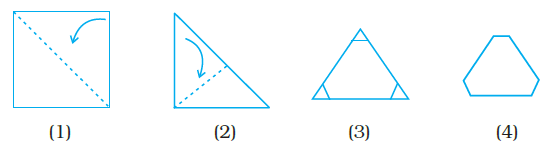
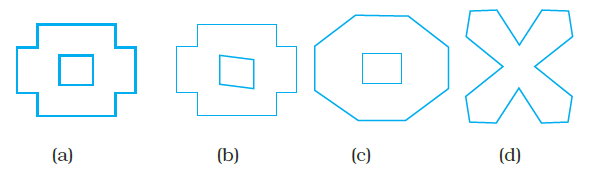
On opening the piece of paper which of the following shapes will you get?
Answer:
Solution:
Let us trace the folding and cutting process:
1. A square paper is folded along a diagonal, forming a triangle. It is folded again to form a smaller triangle. This means the paper is now $4$ layers thick.
2. In figure (4), we see $3$ cuts made on this folded triangle:
i. A cut at the apex (top corner) of the triangle: Since this corner corresponds to the center of the original square, unfolding it will create a square hole in the middle of the paper.
ii. Cuts at the other two corners: Since these corners correspond to the midpoints of the sides or outer edges of the square, unfolding them will create notches or "V" shapes on the outer boundary.
3. Looking at the resulting options:
Option (a) shows a central square hole and a symmetric, cross-like outer boundary which matches the result of cutting the corners of the folded triangle.
Option (b) shows a slanted central hole (rhombus-like) which does not match the symmetry of the folds.
Option (c) and (d) do not correctly represent the mirroring of the cuts across the $4$ layers.
Hence, figure (a) is the correct shape obtained on opening the paper.
Correct Option: (a)
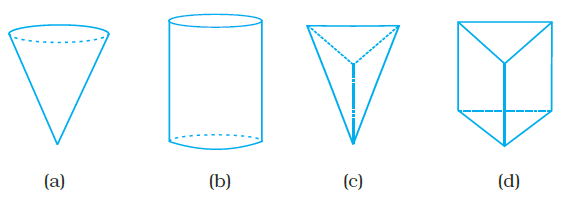
Question 28. Which of the following 3-dimensional figures has the top, side and front as triangles?
Answer:
Solution:
We need to identify the shape where the front view, side view, and top view are all triangles.
1. Option (a) - Cone: Front and side views are triangles, but the top view is a circle with a point in the center.
2. Option (b) - Cylinder: Front and side views are rectangles, and the top view is a circle.
3. Option (c) - Triangular Pyramid (Tetrahedron): In a triangular pyramid, the base is a triangle and the three side faces are also triangles. Therefore, the front, side, and top views are all triangles.
4. Option (d) - Triangular Prism: The top and bottom are triangles, but the front and side views are typically rectangles.
Thus, the figure with all views as triangles is the triangular pyramid shown in (c).
Correct Option: (c)
Question 29 to 58 (Fill in the Blanks)
In Questions 29 to 58, fill in the blanks to make the statements true.
Question 29. In an isosceles right triangle, the number of lines of symmetry is ________.
Answer:
Solution: In an isosceles right triangle, the number of lines of symmetry is $1$.
Reasoning: An isosceles right-angled triangle has two equal sides and one right angle. The only line of symmetry is the bisector of the right angle, which is also the perpendicular bisector of the hypotenuse.
$\text{Lines of symmetry}$ = $1$
(For Isosceles Right Triangle)
Question 30. Rhombus is a figure that has ______lines of symmetry and has a rotational symmetry of order _______.
Answer:
Solution: Rhombus is a figure that has $2$ lines of symmetry and has a rotational symmetry of order $2$.
Reasoning: A rhombus has $2$ lines of symmetry, which are its diagonals. It looks exactly the same after a rotation of $180^\circ$ and $360^\circ$, so its rotational symmetry order is $2$.
Question 31. __________ triangle is a figure that has a line of symmetry but lacks rotational symmetry.
Answer:
Solution: Isosceles triangle is a figure that has a line of symmetry but lacks rotational symmetry.
Reasoning: An isosceles triangle (which is not equilateral) has $1$ line of symmetry. However, it only fits onto itself after a full $360^\circ$ rotation, meaning it has a rotational symmetry of order $1$ (which is generally considered as "lacking" rotational symmetry in this context).
Question 32. __________ is a figure that has neither a line of symmetry nor a rotational symmetry.
Answer:
Solution: Scalene triangle is a figure that has neither a line of symmetry nor a rotational symmetry.
Reasoning: A scalene triangle has all sides and angles of different measures. Therefore, it has $0$ lines of symmetry and a rotational symmetry of order $1$ (no symmetry other than the identity rotation).
Question 33. __________ and __________ are the capital letters of English alphabets that have one line of symmetry but they interchange to each other when rotated through 180°.
Answer:
Answer: M and W
Reasoning: The letters M and W each possess exactly one vertical line of symmetry passing through their center. When the letter M is rotated by $180^\circ$, it upside-down position perfectly matches the shape of the letter W, and similarly, a $180^\circ$ rotation of W results in M.
Question 34. The common portion of two adjacent faces of a cuboid is called ________.
Answer:
Answer: an edge
Reasoning: In solid geometry, an edge is defined as the line segment where two surfaces or faces of a three-dimensional figure meet. For a cuboid, any two adjacent rectangular faces intersect at a straight line segment, which is its edge.
Question 35. A plane surface of a solid enclosed by edges is called __________ .
Answer:
Answer: a face
Reasoning: The individual flat surfaces that form the boundary of a solid object are called faces. Each face is a polygon (like a square, rectangle, or triangle) that is bounded by edges.
Question 36. The corners of solid shapes are called its __________.
Answer:
Answer: vertices
Reasoning: A vertex (plural: vertices) is a point where three or more edges of a solid shape meet. In common terms, these are the "sharp corners" of the object.
Question 37. A solid with no vertex is __________.
Answer:
Answer: a sphere
Reasoning: A sphere is a perfectly round geometrical object that has only one continuous curved surface. Since it has no flat faces and no edges, it does not have any points where edges meet, hence it has zero vertices.
Question 38. A triangular prism has __________ faces, __________ edges and __________ vertices.
Answer:
Answer: 5 faces, 9 edges and 6 vertices.
Reasoning: A triangular prism consists of $2$ triangular bases and $3$ rectangular lateral faces, making a total of $2 + 3 = 5$ faces. It has $3$ edges on each triangle and $3$ connecting edges, totaling $3 + 3 + 3 = 9$ edges. It has $3$ corners on each triangular base, totaling $3 + 3 = 6$ vertices.
Question 39. A triangular pyramid has __________ faces, __________ edges and __________vertices.
Answer:
Answer: 4 faces, 6 edges and 4 vertices.
Reasoning: A triangular pyramid (also known as a tetrahedron) has $1$ triangular base and $3$ triangular side faces, totaling $4$ faces. It has $3$ edges on the base and $3$ edges meeting at the top apex, totaling $6$ edges. There are $3$ vertices on the base and $1$ at the apex, totaling $4$ vertices.
Question 40. A square pyramid has __________ faces, __________ edges and __________ vertices.
Answer:
Answer: 5 faces, 8 edges and 5 vertices.
Reasoning: A square pyramid has $1$ square base and $4$ triangular side faces, totaling $1 + 4 = 5$ faces. It has $4$ edges on the square base and $4$ slanted edges, totaling $8$ edges. There are $4$ vertices on the base and $1$ at the apex, totaling $5$ vertices.
Question 41. Out of __________ faces of a triangular prism, __________are rectangles and __________ are triangles.
Answer:
Answer: Out of 5 faces, 3 are rectangles and 2 are triangles.
Reasoning: By definition, a triangular prism is a polyhedron with two parallel and congruent triangular "bases" and three rectangular "lateral" faces connecting the corresponding sides of the two triangles.
Question 42. The base of a triangular pyramid is a __________.
Answer:
Answer: triangle
Reasoning: A pyramid is named after the shape of its base. Therefore, a triangular pyramid is a solid whose base is a triangle and whose side faces are also triangles meeting at a single point (apex).
Question 43. Out of __________ faces of a square pyramid, __________ are triangles and __________ is/are squares.
Answer:
Answer: Out of 5 faces, 4 are triangles and 1 is a square.
Reasoning: A square pyramid consists of a single square base. From the four edges of this square base, four triangular faces rise up to meet at a common vertex called the apex.
Question 44. Out of __________ faces of a rectangular pyramid __________ are triangles and base is __________.
Answer:
Answer: Out of 5 faces, 4 are triangles and base is a rectangle.
Reasoning: A rectangular pyramid has a rectangular base (which counts as $1$ face). It has $4$ lateral faces which are all triangles that meet at the apex, making a total of $1 + 4 = 5$ faces.
Question 45. Each of the letters H, N, S and Z has a rotational symmetry of order __________.
Answer:
Answer: 2
Reasoning: Each of these letters (H, N, S, and Z) maps onto itself twice during a full $360^\circ$ rotation—specifically at $180^\circ$ and $360^\circ$. Therefore, the order of rotational symmetry is $2$.
Question 46. Order of rotational symmetry of a rectangle is __________.
Answer:
Answer: 2
Reasoning: A rectangle looks exactly the same after a rotation of $180^\circ$ and after a full rotation of $360^\circ$ about its center. Thus, it has rotational symmetry of order $2$.
Question 47. Order of rotational symmetry of a circle is __________.
Answer:
Answer: infinite
Reasoning: A circle is perfectly symmetrical about its center. No matter how small the angle of rotation is, the circle will always map onto itself. Therefore, it has an infinite order of rotational symmetry.
Question 48. Each face of a cuboid is a __________.
Answer:
Answer: rectangle
Reasoning: A cuboid is a three-dimensional solid object bounded by six faces, where each face is a rectangle. (Note: A cube is a special type of cuboid where all faces are squares).
Question 49. Line of symmetry for an angle is its __________.
Answer:
Answer: bisector
Reasoning: The angle bisector is the ray that divides an angle into two equal parts. If you fold the angle along this bisector, the two arms of the angle will coincide perfectly, making it the line of symmetry.
Question 50. A parallelogram has __________ line of symmetry.
Answer:
Answer: no (or zero)
Reasoning: A general parallelogram (that is not a rhombus or a rectangle) does not have any line along which it can be folded to make the two halves match exactly. However, it does have rotational symmetry of order $2$.
Question 51. Order of rotational symmetry of
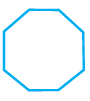 is _________.
Answer:
Answer: 8
Reasoning: The image represents a regular octagon. A regular polygon with $n$ sides has an order of rotational symmetry equal to $n$. Since an octagon has $8$ equal sides and $8$ equal angles, it will map onto itself $8$ times during a full $360^\circ$ rotation.
Question 52. A __________ triangle has no lines of symmetry.
Answer:
Answer: scalene
Reasoning: A scalene triangle has three sides of different lengths and three different angles. Because of this lack of uniformity, there is no axis through which it can be folded to create identical halves.
Question 53. Cuboid is a rectangular_________ .
Answer:
Answer: prism
Reasoning: A prism is a polyhedron with two congruent and parallel faces (bases). In a cuboid, any two opposite rectangular faces can be considered bases, and the lateral faces are also rectangles. Therefore, it is a rectangular prism.
Question 54. A sphere has __________vertex, __________edge and __________curved surface.
Answer:
Answer: no (zero), no (zero), and one
Reasoning: A sphere is a perfectly smooth round object. It has no corners (vertices), no segments where faces meet (edges), and it consists of only one continuous curved surface.
Question 55. 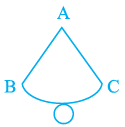 is a net of a __________. Circumference of circle = ______.
Answer:
Answer: cone, length of arc BC
Reasoning: The net consists of a sector of a large circle (which forms the lateral curved surface) and a small circle (which forms the base). This is the net of a cone. When folded, the boundary of the base circle must exactly match the length of the curved edge of the sector, which is the length of arc $BC$.
Question 56.  is a net of a __________.
Answer:
Answer: triangular prism
Reasoning: The net shows three rectangles and two triangles. When folded, the two triangles become the parallel bases and the three rectangles become the lateral faces. This configuration is the net of a triangular prism.
Question 57. Order of rotational symmetry of 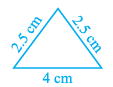 is __________.
Answer:
Answer: 1
Reasoning: The given image shows an isosceles triangle with two sides of length $2.5\text{ cm}$ and one side of $4\text{ cm}$. A figure has rotational symmetry if it maps onto itself in less than a full $360^\circ$ turn. This triangle only looks identical to its original position after a full rotation of $360^\circ$. Therefore, its order of rotational symmetry is $1$.
Question 58. Identical cubes are stacked in the corner of a room as shown below. The number of cubes that are not visible are _________.

Answer:
Answer: 10
Reasoning: Let us calculate the total number of cubes by looking at the columns from the back corner to the front edge:
1. The back corner column has $4$ cubes (only the top one is visible, so $3$ are hidden).
2. The next two columns adjacent to the corner have $3$ cubes each ($2$ columns $\times$ $2$ hidden cubes each = $4$ hidden).
3. The next three columns have $2$ cubes each ($3$ columns $\times$ $1$ hidden cube each = $3$ hidden).
4. The front-most four columns have only $1$ cube each ($0$ hidden).
Total hidden cubes = $3 + 4 + 3 + 0 = 10$.
Question 59 to 92 (True or False)
In Questions from 59 to 92, state whether the statements are True or False.
Question 59. We can draw exactly one triangle whose angles are 70°, 30° and 80°.
Answer:
Answer: False
Reasoning: Although the sum of the angles is $180^\circ$ ($70^\circ + 30^\circ + 80^\circ = 180^\circ$), we can draw infinitely many such triangles. These triangles will all be similar (same shape) but can have different side lengths (different sizes).
Question 60. The distance between the two parallel lines is the same everywhere.
Answer:
Answer: True
Reasoning: By definition, parallel lines are lines in a plane that never meet, no matter how far they are extended. This is because the perpendicular distance between them remains constant at all points.
Question 61. A circle has two lines of symmetry.
Answer:
Answer: False
Reasoning: A circle has infinitely many lines of symmetry. Any straight line passing through the center of the circle (the diameter) acts as a line of symmetry.
Question 62. An angle has two lines of symmetry.
Answer:
Answer: False
Reasoning: An angle has only one line of symmetry, which is its angle bisector. Folding the angle along this line makes its two arms coincide.
Question 63. A regular hexagon has six lines of symmetry.
Answer:
Answer: True
Reasoning: A regular polygon with $n$ sides always has $n$ lines of symmetry. Since a regular hexagon has $6$ equal sides, it has $6$ lines of symmetry ($3$ passing through opposite vertices and $3$ passing through midpoints of opposite sides).
Question 64. An isosceles trapezium has one line of symmetry.
Answer:
Answer: True
Reasoning: In an isosceles trapezium, the non-parallel sides are equal. The line connecting the midpoints of the two parallel bases serves as the single line of symmetry.
Question 65. A parallelogram has two lines of symmetry.
Answer:
Answer: False
Reasoning: A general parallelogram has no (zero) lines of symmetry. While it has rotational symmetry of order $2$, there is no line along which you can fold it to get perfectly matching halves.
Question 66. Order of rotational symmetry of a rhombus is four.
Answer:
Answer: False
Reasoning: The order of rotational symmetry for a rhombus is 2. It maps onto itself after rotations of $180^\circ$ and $360^\circ$. (Only a square, which is a special rhombus, has an order of $4$).
Question 67. An equilateral triangle has six lines of symmetry.
Answer:
Answer: False
Reasoning: An equilateral triangle has three lines of symmetry. These lines are the medians (or altitudes/angle bisectors) drawn from each vertex to the opposite side.
Question 68. Order of rotational symmetry of a semi circle is two.
Answer:
Answer: False
Reasoning: A semi-circle has a rotational symmetry of order 1. This means it only looks exactly the same after a full $360^\circ$ rotation.
Question 69. In oblique sketch of the solid, the measurements are kept proportional.
Answer:
Answer: False
Reasoning: In an oblique sketch, the front face of the solid is drawn with its actual size, but the other faces (the depth) are drawn at an angle and usually not to scale (shorter than actual). This is done to provide a visual sense of 3D depth, whereas in an isometric sketch, measurements are kept proportional.
Question 70. An isometric sketch does not have proportional length.
Answer:
Answer: False
Reasoning: An isometric sketch is drawn on dotted paper where the distance between dots is fixed. This allows the lengths in the sketch to remain proportional to the actual measurements of the solid, unlike an oblique sketch.
Question 71. A cylinder has no vertex.
Answer:
Answer: True
Reasoning: A vertex is a point where three or more edges meet. A cylinder consists of two circular flat faces and one curved surface. While it has two circular edges, there are no sharp corners or points where edges intersect, hence it has no vertices.
Question 72. All the faces, except the base of a square pyramid are triangular.
Answer:
Answer: True
Reasoning: A square pyramid has one square base. From the four edges of this base, four lateral faces rise to meet at the apex. These four lateral faces are all triangles.
Question 73. A pyramid has only one vertex.
Answer:
Answer: False
Reasoning: A pyramid has multiple vertices. For example, a square pyramid has $5$ vertices ($4$ at the corners of the base and $1$ at the apex). The statement incorrectly suggests that only the apex is a vertex.
Question 74. A triangular prism has 5 faces, 9 edges and 6 vertices.
Answer:
Answer: True
Reasoning: A triangular prism consists of $2$ triangular bases and $3$ rectangular faces, totaling $5$ faces. It has $3$ edges on each triangle and $3$ connecting them ($3+3+3=9$ edges). It has $3$ vertices on each triangle ($3+3=6$ vertices).
Question 75. If the base of a pyramid is a square, it is called a square pyramid.
Answer:
Answer: True
Reasoning: Pyramids are named according to the shape of their base. Therefore, a pyramid with a square base is correctly identified as a square pyramid.
Question 76. A rectangular pyramid has 5 rectangular faces.
Answer:
Answer: False
Reasoning: A rectangular pyramid has $1$ rectangular face (the base) and $4$ triangular faces (the lateral sides). It does not have $5$ rectangular faces.
Question 77. Rectangular prism and cuboid refer to the same solid.
Answer:
Answer: True
Reasoning: A cuboid is a three-dimensional shape with six rectangular faces. Since it also fits the definition of a prism (uniform cross-section along its length), it is also commonly called a rectangular prism.
Question 78. A tetrahedron has 3 triangular faces and 1 rectangular face.
Answer:
Answer: False
Reasoning: A tetrahedron is another name for a triangular pyramid. It has $4$ triangular faces (one base and three lateral faces) and no rectangular faces.
Question 79. While rectangle is a 2-D figure, cuboid is a 3-D figure.
Answer:
Answer: True
Reasoning: A rectangle only has length and breadth, making it two-dimensional ($2$-D). A cuboid has length, breadth, and height, making it three-dimensional ($3$-D).
Question 80. While sphere is a 2-D figure, circle is a 3-D figure.
Answer:
Answer: False
Reasoning: This statement is the exact opposite of the truth. A circle is a $2$-D figure (plane shape), and a sphere is a $3$-D figure (solid shape).
Question 81. Two dimensional figures are also called plane figures.
Answer:
Answer: True
Reasoning: Two-dimensional ($2$-D) figures have only length and breadth. Since they lie entirely on a flat surface or a "plane," they are correctly referred to as plane figures.
Question 82. A cone is a polyhedron.
Answer:
Answer: False
Reasoning: A polyhedron is a solid figure bounded entirely by polygons (flat faces with straight edges). A cone is not a polyhedron because it has a curved surface.
Question 83. A prism has four bases.
Answer:
Answer: False
Reasoning: By definition, a prism is a polyhedron that has exactly two congruent and parallel faces called bases. The other faces are lateral faces (usually parallelograms or rectangles).
Question 84. The number of lines of symmetry of a regular polygon is equal to the vertices of the polygon.
Answer:
Answer: True
Reasoning: In any regular polygon with $n$ sides, the number of lines of symmetry is equal to $n$. Since the number of vertices is also $n$, the statement is true. For example, a square has $4$ vertices and $4$ lines of symmetry.
Question 85. The order of rotational symmetry of a figure is 4 and the angle of rotation is 180° only.
Answer:
Answer: False
Reasoning: If the order of rotational symmetry is $4$, the smallest angle of rotation (angle of symmetry) is calculated as:
$\text{Angle of rotation} = \frac{360^\circ}{\text{Order}}$
$\text{Angle of rotation} = \frac{360^\circ}{4} = 90^\circ$
A figure with order $4$ will coincide with itself at $90^\circ, 180^\circ, 270^\circ,$ and $360^\circ$. Thus, saying it is $180^\circ$ "only" is incorrect.
Question 86. After rotating a figure by 120° about its centre, the figure coincides with its original position. This will happen again if the figure is rotated at an angle of 240°.
Answer:
Answer: True
Reasoning: If a figure coincides with its original position at an angle $\theta$, it will also coincide at every multiple of that angle ($2\theta, 3\theta,$ etc.). Since $240^\circ = 2 \times 120^\circ$, the figure will definitely coincide again at $240^\circ$.
Question 87. Mirror reflection leads to symmetry always.
Answer:
Answer: True
Reasoning: Line symmetry (or reflection symmetry) is defined by the property that one half of a figure is the mirror image of the other half. Therefore, the concept of symmetry in this context is intrinsically linked to mirror reflection.
Question 88. Rotation turns an object about a fixed point which is known as centre of rotation.
Answer:
Answer: True
Reasoning: This is the fundamental definition of rotation in geometry. The fixed point around which the object is turned is called the centre of rotation.
Question 89. Isometric sheet divides the paper into small isosceles triangles made up of dots or lines.
Answer:
Answer: False
Reasoning: An isometric sheet (or isometric dot paper) is designed using a grid of dots that form equilateral triangles, not isosceles triangles. This ensures that measurements in all three primary directions remain proportional.
Question 90. The circle, the square, the rectangle and the triangle are examples of plane figures.
Answer:
Answer: True
Reasoning: All these shapes are two-dimensional as they have only length and breadth and can be drawn on a flat surface (plane).
Question 91. The solid shapes are of two-dimensional.
Answer:
Answer: False
Reasoning: Solid shapes (like cubes, spheres, and cylinders) are three-dimensional ($3$-D) because they possess length, breadth, and height/depth.
Question 92. Triangle with length of sides as 5 cm, 6 cm and 11 cm can be constructed.
Answer:
Answer: False
Reasoning: According to the Triangle Inequality Property, the sum of the lengths of any two sides of a triangle must be greater than the length of the third side. Let's check the given sides:
$5\text{ cm} + 6\text{ cm} = 11\text{ cm}$
Since $11\text{ cm}$ is equal to (not greater than) the third side ($11\text{ cm}$), the triangle cannot be constructed. The three points would lie on a straight line.
Question 93 to 124
Question 93. Draw the top, side and front views of the solids given below in Figures 12.21 and 12.22:
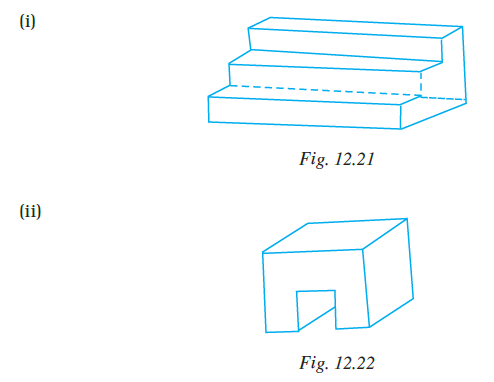
Answer:
To Find: The Top, Side, and Front views for the given three-dimensional solids.
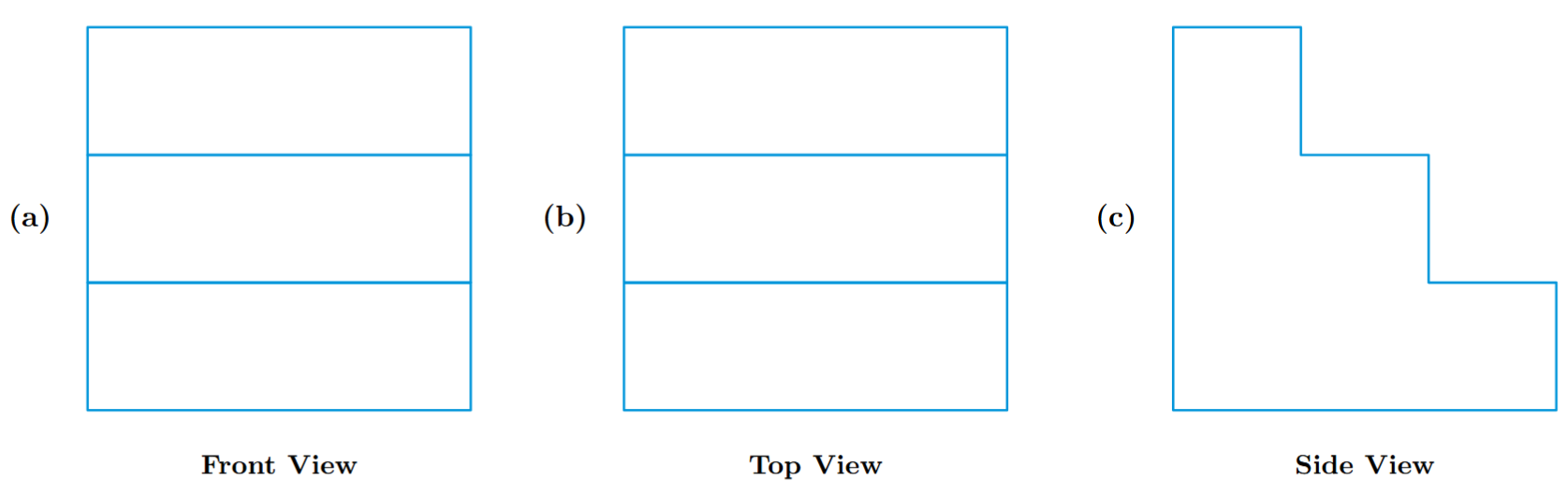
(i) For Figure 12.21 (Staircase):
1. Front View: When looking at the stairs from the front, we see three long horizontal rectangles stacked vertically (the risers of the steps).
2. Side View: From the side, the solid appears as a "stepped" profile or an L-shaped jagged figure showing the rise and run of each step.
3. Top View: Looking from above, we see three long horizontal rectangles representing the surface of each step (the treads).
Reasoning: Each view is a two-dimensional projection of the 3D object from a specific perpendicular direction.
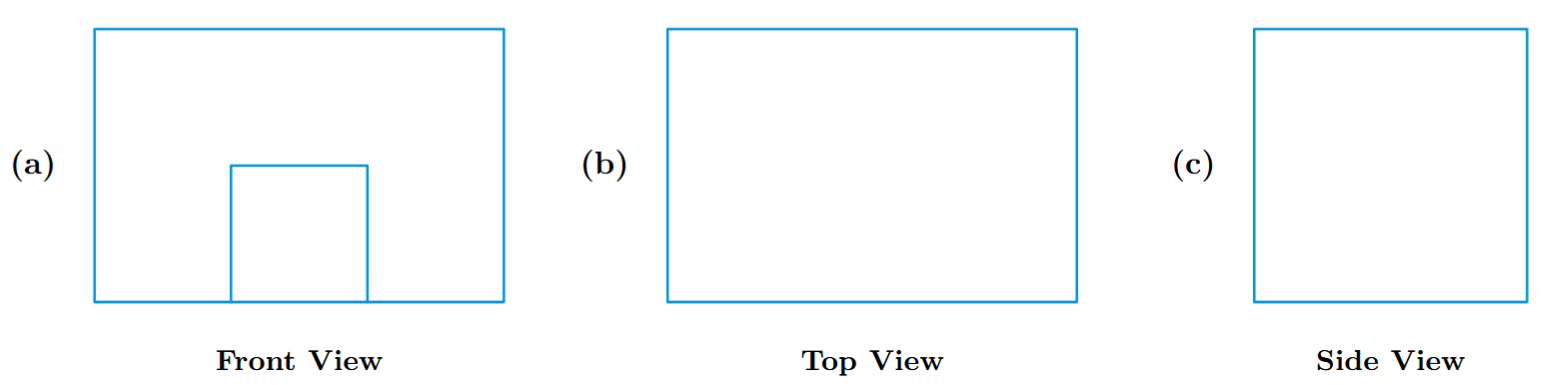
(ii) For Figure 12.22 (Block with a Tunnel):
1. Front View: It appears as a large rectangle with a smaller rectangular "cut-out" or notch at the bottom center.
2. Side View: From the side, we only see a solid vertical rectangle (the outer wall of the block).
3. Top View: From the top, it appears as a solid horizontal rectangle (the roof or top surface of the block).
Reasoning: Since the tunnel is internal and passes through the front and back, it is visible in the front view but hidden or represented by a solid boundary in the side and top views.
Question 94. Draw a solid using the top. side and front views as shown below. [Use Isometric dot paper].

Answer:
Given:
1. Top View: A square.
2. Side View: A tall rectangle.
3. Front View: An L-shaped figure.
To Draw: The three-dimensional solid on isometric dot paper.
Solution:
By combining the three views, we can visualize that the solid is an L-shaped prism. The L-shape seen from the front represents the main profile. The top view being a square implies that the width of the L-shape is consistent, and the side view shows the vertical depth.
To draw this on isometric dot paper:
1. Draw the front L-profile using the dots to maintain proportions.
2. Extend parallel lines from each vertex of the L-profile at a $30^\circ$ angle to represent the depth.
3. Connect the ends of these depth lines to form the back face and the top surface.
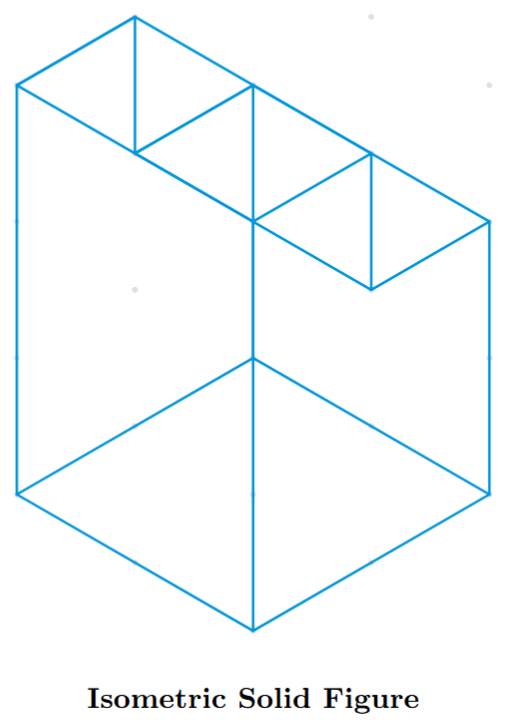
Reasoning: An isometric sketch represents a 3D object in 2D such that the three axes appear equally inclined to each other. The given views uniquely define a stepped block or an L-shaped column.
Question 95. Construct a right-angled triangle whose hypotenuse measures 5 cm and one of the other sides measures 3.2 cm.
Answer:
Given: In a right-angled triangle, the hypotenuse is $5\text{ cm}$ and one of the legs is $3.2\text{ cm}$. Let the triangle be $\Delta ABC$ where $\angle B = 90^\circ$, $AC = 5\text{ cm}$ (hypotenuse) and $BC = 3.2\text{ cm}$ (base).
Construction Required: To construct the right-angled triangle $ABC$.
Steps of Construction:
1. Draw a line segment $BC = 3.2\text{ cm}$.
2. At point $B$, draw a ray $BX$ making an angle of $90^\circ$ with $BC$ using a compass.
3. With $C$ as the centre and a radius of $5\text{ cm}$, draw an arc that cuts the ray $BX$ at point $A$.
4. Join $A$ to $C$.
5. $\Delta ABC$ is the required right-angled triangle.
Reasoning: This construction follows the RHS (Right angle-Hypotenuse-Side) criterion, which states that a unique right triangle can be formed given its hypotenuse and one side.

Question 96. Construct a right-angled isosceles triangle with one side (other than hypotenuse) of length 4.5 cm.
Answer:
Given: A right-angled isosceles triangle has two equal sides (legs). Here, one leg is $4.5\text{ cm}$, so both legs must be $4.5\text{ cm}$ each, and the angle between them is $90^\circ$. Let the triangle be $\Delta PQR$ with $PQ = QR = 4.5\text{ cm}$ and $\angle Q = 90^\circ$.
Construction Required: To construct the isosceles right triangle $PQR$.
Steps of Construction:
1. Draw a line segment $QR = 4.5\text{ cm}$.
2. At point $Q$, draw a ray $QX$ such that $\angle RQX = 90^\circ$.
3. With $Q$ as the centre and a radius of $4.5\text{ cm}$, draw an arc on ray $QX$. Mark the intersection point as $P$.
4. Join $P$ to $R$.
5. $\Delta PQR$ is the required isosceles right-angled triangle.
Reasoning: The triangle is constructed using the SAS (Side-Angle-Side) criterion where two sides are equal to $4.5\text{ cm}$ and the included angle is $90^\circ$.

Question 97. Draw two parallel lines at a distance of 2.2 cm apart.
Answer:
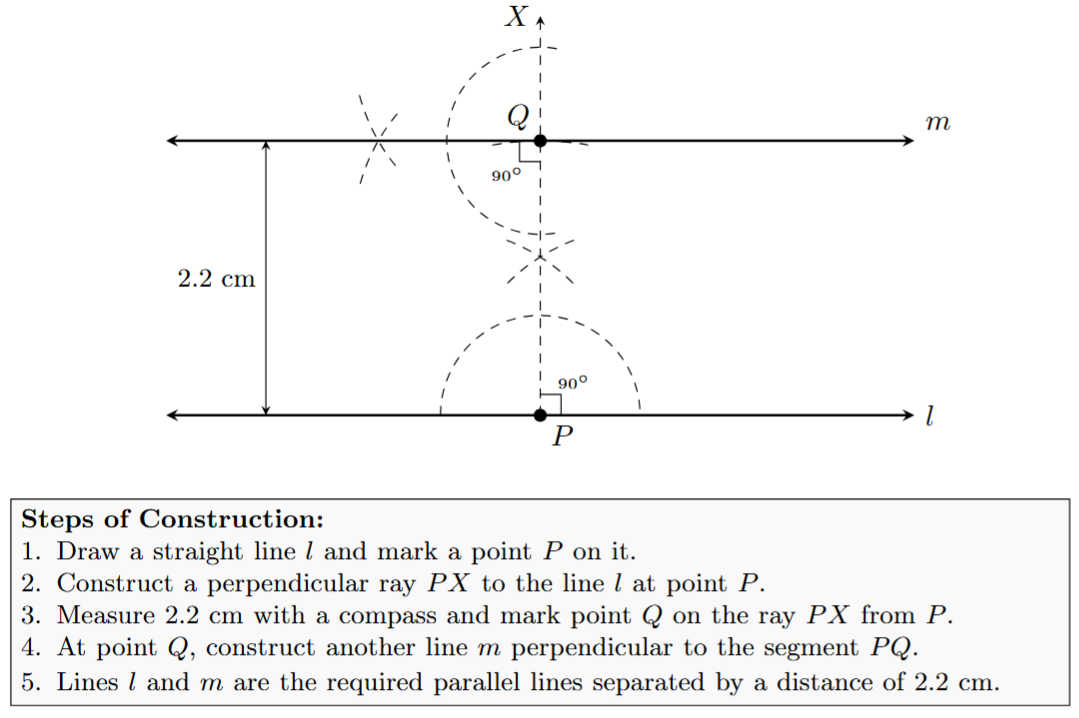
Given: The perpendicular distance between two parallel lines is $2.2\text{ cm}$.
Construction Required: To draw two parallel lines $l$ and $m$.
Steps of Construction:
1. Draw a straight line $l$ and mark a point $P$ on it.
2. At point $P$, construct a perpendicular ray $PX$ to the line $l$.
3. From point $P$, mark a point $Q$ on the ray $PX$ such that $PQ = 2.2\text{ cm}$.
4. At point $Q$, draw another line $m$ perpendicular to $PX$.
5. Lines $l$ and $m$ are parallel to each other at a distance of $2.2\text{ cm}$.
Reasoning: Since both lines are perpendicular to the same segment $PQ$, they are parallel to each other by the property of alternate interior angles or corresponding angles being $90^\circ$.
Question 98. Draw an isosceles triangle with each of equal sides of length 3 cm and the angle between them as 45°.
Answer:
Given: In an isosceles triangle, the two equal sides are $3\text{ cm}$ each and the included angle is $45^\circ$. Let the triangle be $\Delta XYZ$ where $XY = XZ = 3\text{ cm}$ and $\angle YXZ = 45^\circ$.
Construction Required: To construct the isosceles triangle $XYZ$.
Steps of Construction:
1. Draw a line segment $XY = 3\text{ cm}$.
2. At point $X$, use a protractor or compass to draw a ray $XP$ making an angle of $45^\circ$ with $XY$.
3. With $X$ as the centre and a radius of $3\text{ cm}$, draw an arc on ray $XP$. Mark the intersection point as $Z$.
4. Join $Z$ to $Y$.
5. $\Delta XYZ$ is the required isosceles triangle.
Reasoning: The construction is completed using the SAS criterion where $XY = 3\text{ cm}$, $XZ = 3\text{ cm}$ and $\angle X = 45^\circ$.

Question 99. Draw a triangle whose sides are of lengths 4 cm, 5 cm and 7 cm.
Answer:
Given: The lengths of the three sides of a triangle are $4\text{ cm}$, $5\text{ cm}$, and $7\text{ cm}$.
Construction Required: To construct the triangle $ABC$.
Steps of Construction:
1. Draw the longest side $BC = 7\text{ cm}$ as the base.
2. With $B$ as the centre and a radius of $4\text{ cm}$, draw an arc above $BC$.
3. With $C$ as the centre and a radius of $5\text{ cm}$, draw another arc intersecting the previous arc at point $A$.
4. Join $A$ to $B$ and $A$ to $C$.
5. $\Delta ABC$ is the required triangle with sides $4\text{ cm}$, $5\text{ cm}$, and $7\text{ cm}$.
Reasoning: This construction uses the SSS (Side-Side-Side) criterion. The triangle is possible because the sum of any two sides is greater than the third side:
$4 + 5 > 7$
(Triangle Inequality Property)

Question 100. Construct an obtuse angled triangle which has a base of 5.5 cm and base angles of 30° and 120°.
Answer:
Given: Base of the triangle $BC = 5.5\text{ cm}$. Base angles are $\angle B = 30^\circ$ and $\angle C = 120^\circ$.
To Find: Construction of obtuse-angled $\Delta ABC$.
Construction Required: Using a ruler, compass, and protractor.
Steps of Construction:
1. Draw a line segment $BC = 5.5\text{ cm}$ using a ruler.
2. At point $B$, draw a ray $BX$ making an angle of $30^\circ$ with $BC$.
3. At point $C$, draw a ray $CY$ making an angle of $120^\circ$ with $CB$.
4. Extend the rays $BX$ and $CY$ until they intersect at point $A$.
5. $\Delta ABC$ is the required obtuse-angled triangle.
Reasoning: Since one angle ($\angle C = 120^\circ$) is greater than $90^\circ$, the triangle is obtuse-angled. The sum of the given angles is $30^\circ + 120^\circ = 150^\circ$, which is less than $180^\circ$, making the construction possible.

Question 101. Construct an equilateral triangle ABC of side 6 cm.
Answer:
Given: Each side of the equilateral triangle is $6\text{ cm}$.
To Find: Construction of equilateral $\Delta ABC$.
Steps of Construction:
1. Draw a line segment $BC = 6\text{ cm}$.
2. Open the compass to a radius of $6\text{ cm}$.
3. With $B$ as the centre, draw an arc above the segment $BC$.
4. With $C$ as the centre and the same radius ($6\text{ cm}$), draw another arc intersecting the first arc at point $A$.
5. Join $AB$ and $AC$.
6. $\Delta ABC$ is the required equilateral triangle.
Reasoning: In an equilateral triangle, all three sides are equal ($6\text{ cm}$) and all internal angles are $60^\circ$. This construction uses the SSS (Side-Side-Side) criterion.

Question 102. By what minimum angle does a regular hexagon rotate so as to coincide with its origional position for the first time?
Answer:
To Find: The minimum angle of rotation for a regular hexagon.
Solution:
A regular hexagon has $6$ equal sides and $6$ equal angles. The order of rotational symmetry for a regular polygon is equal to its number of sides.
$\text{Order of rotational symmetry (n)} = 6$
(For regular hexagon)
The minimum angle of rotation (also known as the angle of symmetry) is calculated by dividing $360^\circ$ by the order of rotational symmetry.
$\text{Minimum Angle} = \frac{360^\circ}{n}$
$\text{Minimum Angle} = \frac{360^\circ}{6} = 60^\circ$
Reasoning: Because the figure is regular, a rotation of $60^\circ$ around its centre will move each vertex to the position previously occupied by the adjacent vertex, making the figure appear identical to its original state.
Question 103. In each of the following figures, write the number of lines of symmetry and order of rotational symmetry
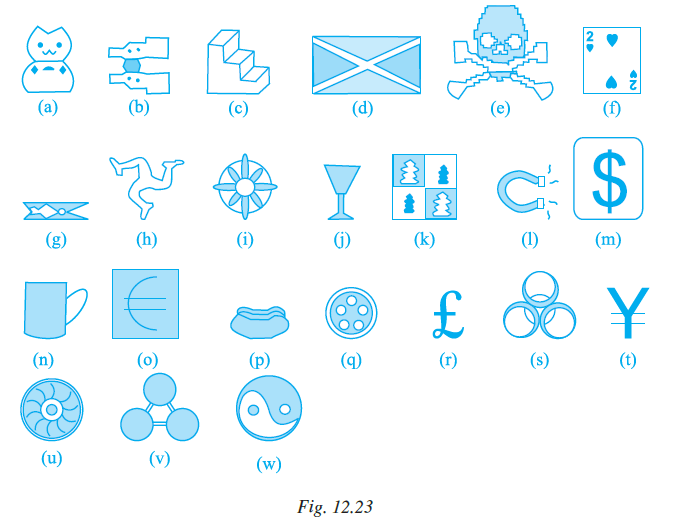
[Hint: Consider these as 2-D figures not as 3-D objects.]
Answer:
To Find: The number of lines of symmetry and the order of rotational symmetry for each figure shown in Figure 12.23.
Solution:
The following table provides the symmetry properties for each figure as per the required technical analysis:
| Figure | Number of Lines of Symmetry | Order of Rotational Symmetry |
| (a) | 1 | 1 |
| (b) | 1 | 1 |
| (c) | 1 | 1 |
| (d) | 2 | 2 |
| (e) | 1 | 2 |
| (f) | 0 | 1 |
| (g) | 1 | 1 |
| (h) | 0 | 3 |
| (i) | 4 | 4 |
| (j) | 1 | 1 |
| (k) | 0 | 1 |
| (l) | 1 | 1 |
| (m) | 0 | 2 |
| (n) | 0 | 1 |
| (o) | 1 | 1 |
| (p) | 1 | 1 |
| (q) | 1 | 1 |
| (r) | 0 | 3 |
| (s) | 3 | 3 |
| (t) | 1 | 1 |
| (u) | 10 | 10 |
| (v) | 3 | 3 |
| (w) | 0 | 1 |
Reasoning:
1. Line of Symmetry: It is an imaginary line where you can fold a figure and have both halves match exactly.
2. Rotational Symmetry: It is the property a shape has when it looks the same after some rotation by less than $360^\circ$. The Order is the number of times the figure coincides with its original position during a full $360^\circ$ turn.
For example, in figure (u), which represents a fan with 10 blades, the figure coincides with itself every $36^\circ$ ($360^\circ \div 10$), giving it an order of $10$. Similarly, figures like (d) have both horizontal and vertical lines of symmetry ($2$) and look the same twice during a full rotation.
Question 104. In the figure 12.24 of a cube,
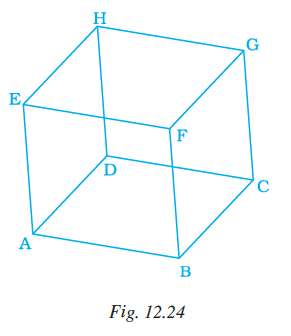
(i) Which edge is the intersection of faces EFGH and EFBA?
(ii) Which faces intersect at edge FB?
(iii) Which three faces form the vertex A?
(iv) Which vertex is formed by the faces ABCD, ADHE and CDHG?
(v) Give all the edges that are parallelto edge AB.
(vi) Give the edges that are neitherparallel nor perpendicular to edge BC.
(vii) Give all the edges that areperpendicular to edge AB.
(viii) Give four vertices that do not all liein one plane.
Answer:
Solution: Using the properties of a cube as shown in Figure 12.24:
(i) The faces EFGH (top) and EFBA (front) intersect at edge EF.
(ii) The faces that intersect at edge FB are ABFE (front face) and BCGF (right-side face).
(iii) The three faces that meet to form vertex A are ABCD (bottom face), ABFE (front face), and ADHE (left-side face).
(iv) The vertex formed by the intersection of faces ABCD (bottom), ADHE (left), and CDHG (back) is D.
(v) The edges parallel to AB are CD, EF, and HG.
(vi) In a cube, all edges are either parallel or perpendicular to a given edge. However, if we consider edges that are "skew" (lines that do not intersect and are not parallel), they are neither parallel nor perpendicular. For edge BC, these are AE, DH, EF, HG.
(vii) The edges perpendicular to edge AB are AD, BC, AE, and BF.
(viii) Any four vertices where one does not lie in the plane formed by the other three, for example: A, B, C, and H.
Reasoning: These answers are based on the orthogonal geometry of a cube where faces meet at $90^\circ$ and opposite edges/faces are parallel.
Question 105. Draw a net of a cuboid having same breadth and height, but length double the breadth.
Answer:
Given: A cuboid where breadth ($b$) and height ($h$) are equal, and length ($l$) is twice the breadth.
$b = h$
…(i)
$l = 2b$
…(ii)
To Find: A 2-D net representing this solid.
Solution:
A cuboid has 6 faces. For this specific cuboid:
1. Two opposite faces are squares of side $b \times b$.
2. Four faces are rectangles of dimensions $2b \times b$.
The net consists of these six faces arranged such that they can be folded into the required 3-D shape.

Question 106. Draw the nets of the following:
(i) Triangular prism
(ii) Tetrahedron
(iii) Cuboid
Answer:
(i) Triangular Prism:
A triangular prism has 2 triangular bases and 3 rectangular lateral faces.

(ii) Tetrahedron (Triangular Pyramid):
A tetrahedron consists of 4 triangular faces. If it is regular, all four triangles are equilateral.

(iii) Cuboid:
A general cuboid has 6 rectangular faces arranged in opposite pairs of equal dimensions.

Reasoning: A net is a 2-D representation that, when folded along the edges, results in the 3-D solid. Each face of the solid must be represented exactly once in the net.
Question 107. Draw a net of the solid given in the figure 12.25:
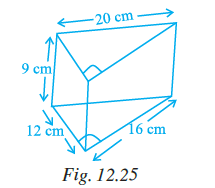
Answer:
Given:
As per the provided figure 12.25, the solid is a triangular prism with the following dimensions:
1. The height of the prism is $9\text{ cm}$.
2. The base of the prism is a right-angled triangle with two legs measuring $12\text{ cm}$ and $16\text{ cm}$.
3. The longest side (hypotenuse) of the triangular base is $20\text{ cm}$.
$12^2 + 16^2 = 144 + 256 = 400 = 20^2$
[Verification of Dimensions]
To Find:
To draw a net of the given solid (Triangular Prism).
Construction Required:
A net of a triangular prism consists of five faces:
1. Two congruent right-angled triangles with sides $12\text{ cm}, 16\text{ cm},$ and $20\text{ cm}$.
2. Three rectangles representing the lateral faces with dimensions:
$\bullet$ Rectangle 1: $9\text{ cm} \times 12\text{ cm}$
$\bullet$ Rectangle 2: $9\text{ cm} \times 16\text{ cm}$
$\bullet$ Rectangle 3: $9\text{ cm} \times 20\text{ cm}$
Solution:
To draw the net, we lay out the three rectangular faces side-by-side and attach the two triangular bases to the edges of one of the rectangles.
Steps to draw the net:
1. Draw three adjacent rectangles of height $9\text{ cm}$ with widths $12\text{ cm}, 16\text{ cm},$ and $20\text{ cm}$ respectively.
2. On the top and bottom edges of the middle rectangle (e.g., the $16\text{ cm}$ wide one), draw right-angled triangles with legs $12\text{ cm}$ and $16\text{ cm}$.
3. Ensure that when folded, the $12\text{ cm}$ edge of the triangle meets the $12\text{ cm}$ edge of the first rectangle, and the $20\text{ cm}$ hypotenuse meets the $20\text{ cm}$ edge of the third rectangle.

Question 108. Draw an isometric view of a cuboid 6 cm × 4 cm × 2 cm.
Answer:
Given: Dimensions of the cuboid are $L = 6\text{ cm}$, $B = 4\text{ cm}$, $H = 2\text{ cm}$.
Construction Required: An isometric sketch on dot paper.
Solution:
1. Use isometric dot paper where the distance between two dots is $1\text{ cm}$.
2. Draw the front face as a rectangle of $6 \times 2$ units (tilted as per isometric rules).
3. Draw the depth of $4$ units from each vertex at a $30^\circ$ angle to the horizontal.
4. Connect the back vertices to complete the cuboid.

Reasoning: In an isometric view, the measurements along the axes are kept proportional to the actual dimensions, providing a realistic 3-D visualization.
Question 109. The net given below in Fig. 12.26 can be used to make a cube.

(i) Which edge meets AN?
(ii) Which edge meets DE?
Answer:
Analysis: Let us visualize folding the cube net around the base square $MBDK$.
1. Side $AB$ folds up, $BC$ folds up.
2. $DE$ and $EF$ wrap around.
Solution:
(i) When the cube is folded, the edge AN will meet the edge GH.
(ii) The edge DE will meet the edge DC.
Reasoning: By mapping the perimeter of the net as it wraps into a 3-D cube, we identify vertices that coincide. Vertex $N$ coincides with $H$, and $A$ coincides with $G$. Similarly, as the squares $BCDL$ and $DEJK$ are adjacent to the same edge $BD$, $DE$ will fold to meet $DC$.
Question 110. Draw the net of triangular pyramid with base as equilateral triangle of side 3 cm and slant edges 5 cm.
Answer:
Given: Base is an equilateral triangle with side $3\text{ cm}$. Slant edges (length of the edges meeting at the apex) are $5\text{ cm}$ each.
Solution:
The net consists of:
1. One central equilateral triangle with side $3\text{ cm}$.
2. Three isosceles triangles attached to the sides of the equilateral triangle, each having a base of $3\text{ cm}$ and two equal sides of $5\text{ cm}$.

Reasoning: When the three isosceles triangles are folded upwards, their $5\text{ cm}$ edges will meet at a single point (the apex), forming the triangular pyramid.
Question 111. Draw the net of a square pyramid with base as square of side 4 cm and slant edges 6 cm.
Answer:
Given: A square pyramid with base side = $4\text{ cm}$ and slant edges = $6\text{ cm}$.
To Find: The 2-D net of the square pyramid.
Solution:
A square pyramid consists of one square base and four congruent isosceles triangular lateral faces.
1. The base is a square with dimensions $4\text{ cm} \times 4\text{ cm}$.
2. Each of the four lateral faces is an isosceles triangle with a base of $4\text{ cm}$ and two equal sides (slant edges) of $6\text{ cm}$.
To draw the net, place the square in the center and attach one isosceles triangle to each of its four sides.

Reasoning: When the four triangular flaps are folded upwards such that their vertices meet at a single point (the apex), they form the three-dimensional square pyramid.
Question 112. Draw the net of rectangular pyramid with slant edge 6 cm and base as rectangle with length 4 cm and breadth 3 cm.
Answer:
Given: A rectangular pyramid with base dimensions $4\text{ cm} \times 3\text{ cm}$ and slant edges of $6\text{ cm}$.
To Find: The 2-D net of the rectangular pyramid.
Solution:
A rectangular pyramid consists of one rectangular base and four triangular lateral faces (two pairs of congruent triangles).
1. The base is a rectangle of $4\text{ cm} \times 3\text{ cm}$.
2. Pair 1: Two isosceles triangles attached to the sides of length $4\text{ cm}$, each having equal sides of $6\text{ cm}$.
3. Pair 2: Two isosceles triangles attached to the sides of length $3\text{ cm}$, each having equal sides of $6\text{ cm}$.

Reasoning: The net represents the flat unfolded surface area. Since all slant edges are equal ($6\text{ cm}$), the triangles will meet perfectly at the apex when folded.
Question 113. Find the number of cubes in each of the following figures and in each case give the top, front, left side and right side view (arrow indicating the front view).

Answer:
Solution: By analyzing the stacking of identical cubes in each figure, we determine the total count and the orthogonal views.
| Figure | Total Number of Cubes | Front View (Projection) | Top View (Projection) |
| (a) | 6 | L-shape (3 vertical, 2 base) | L-shape (3 horizontal) |
| (b) | 8 | T-shape/Stepped | U-shape/Irregular |
| (c) | 7 | Rectangle $3 \times 2$ with top center | Rectangle $3 \times 2$ |
| (d) | 8 | $3$ columns (height 2, 1, 2) | Square $3 \times 3$ (minus 1) |
| (e) | 6 | Rectangle $2 \times 2$ | Square $2 \times 2$ |
| (f) | 8 | Rectangle $3 \times 2$ | L-shape |
| (g) | 6 | Stepped (height 2, 1) | Rectangle $3 \times 1$ |
| (h) | 8 | 2 columns (height 4 and 3) | Rectangle $2 \times 1$ |
Reasoning: The total number of cubes is found by summing the visible cubes and the hidden cubes required to support them. The views are 2-D representations of the 3-D object from different fixed directions.
Question 114. Draw all lines of symmetry for each of the following figures as given below:

Answer:
Solution: We examine each 2-D shape to find axes that divide them into identical mirror images.
1. Figure (a) Heart: It has 1 vertical line of symmetry passing through the center notch and the bottom point.
2. Figure (b) Letter J: It has no (0) lines of symmetry as it is an asymmetrical shape.
3. Figure (c) Bow-tie shape: It has 2 lines of symmetry—one vertical line passing through the center and one horizontal line passing through the center.
Reasoning: A line of symmetry exists if a figure can be folded along that line so that the two parts coincide exactly. The heart is bilaterally symmetrical, the 'J' is asymmetrical, and the bow-tie shape has both horizontal and vertical mirror planes.

Question 115. How many faces does Fig. 12.27 have?
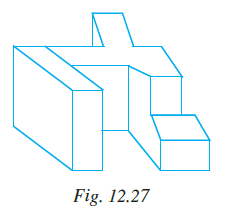
Answer:
To Find:
The total number of faces in the solid figure shown in Fig. 12.27.
Solution:
A face is defined as a flat surface of a three-dimensional solid object. To find the total number of faces in the given figure, we must count all the surfaces including those that are visible and those that are hidden from the current perspective.
Let us count the faces systematically by their orientation:
1. Top-facing faces: There are $4$ flat surfaces looking upwards (the top of the left pillar, the top of the middle connecting bridge, the top of the right upper pillar, and the top of the right lower step).
2. Bottom-facing face: There is $1$ flat surface at the base of the entire solid.
3. Front-facing faces: There are $4$ flat surfaces looking towards the front (the front of the left pillar, the front of the recessed middle section, the front of the right upper pillar, and the front of the right lower step).
4. Back-facing face: There is $1$ flat surface at the back of the solid (assuming the back is a single flat wall).
5. Side-facing faces (Left and Right): There are $6$ surfaces looking towards the sides. These include:
- The leftmost outer side face.
- The two rightmost outer side faces (one for the upper part and one for the lower step).
- The two inner side faces within the "U" shaped gap.
- The side face of the protrusion at the back.
Calculation:
Total Number of Faces = (Top faces) + (Bottom face) + (Front faces) + (Back face) + (Side faces)
Total Faces = $4 + 1 + 4 + 1 + 6$
Total Faces = $16$
Therefore, the solid figure shown in Fig. 12.27 has 16 faces.
Question 116. Trace each figure. Then draw all lines of symmetry, if it has.
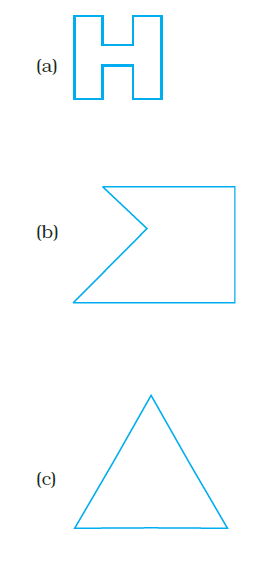
Answer:
To Find:
The lines of symmetry for figures (a), (b), and (c) as shown in the provided image.
Solution:
A line of symmetry is an axis that divides a figure into two identical halves that are mirror images of each other. If the figure is folded along this line, the two parts will coincide exactly.
(a) Analysis of Figure (a) - Letter 'H':
The block letter 'H' possesses two lines of symmetry:
1. Vertical Line of Symmetry: A line passing vertically through the center of the horizontal bar, dividing the 'H' into identical left and right halves.
2. Horizontal Line of Symmetry: A line passing horizontally through the middle of the crossbar, dividing the 'H' into identical top and bottom halves.

(b) Analysis of Figure (b) - Concave Polygon:
Upon careful observation of the drawing in Figure (b), it is an irregular concave polygon. The "V" shaped cutout on the left is not aligned with the horizontal or vertical center of the right side, and the lengths of the edges are not equal.
Since no line can be drawn to divide this specific shape into two perfect mirror images, it has no lines of symmetry.
Total lines of symmetry = $0$
(c) Analysis of Figure (c) - Equilateral Triangle:
The figure represents a regular equilateral triangle. In a regular polygon, the number of lines of symmetry is equal to the number of sides.
An equilateral triangle has three lines of symmetry. Each line passes through one vertex and the midpoint of the side opposite to that vertex.

Question 117. Tell whether each figure has rotational symmetry or not.
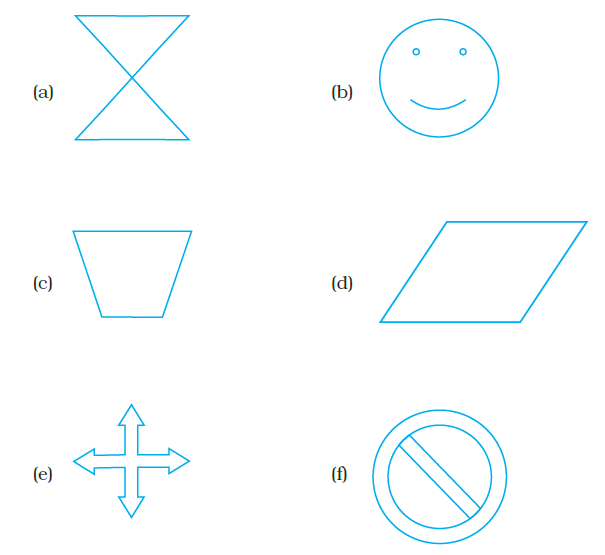
Answer:
To Find:
Determine whether each figure in the provided image (a) to (f) has rotational symmetry or not.
Solution:
A figure is said to have rotational symmetry if it maps onto itself more than once during a complete rotation of $360^\circ$ around its center point. The number of times it looks the same in one full turn is called the order of rotational symmetry.
(a) Hourglass / Double Triangle Shape:
If we rotate this figure by $180^\circ$, it will look exactly like the original. Since it looks the same at $180^\circ$ and $360^\circ$, it has rotational symmetry of order $2$.
(b) Smiley Face:
When this figure is rotated by $180^\circ$, the eyes will move to the bottom and the smile will be at the top (appearing as a frown). It only returns to its original appearance after a full $360^\circ$ turn. Thus, it does not have rotational symmetry.
(c) Isosceles Trapezium:
Because the top parallel side is shorter than the bottom parallel side, rotating the figure by $180^\circ$ would make the shorter side appear at the bottom. It only looks the same after a $360^\circ$ rotation. Therefore, it does not have rotational symmetry.
(d) Parallelogram:
A parallelogram looks identical after a rotation of $180^\circ$ about its center (where the diagonals intersect). Therefore, it has rotational symmetry of order $2$.
(e) Four-directional Arrow Cross:
This figure is highly symmetric. It looks identical after rotations of $90^\circ$, $180^\circ$, $270^\circ$, and $360^\circ$. Therefore, it has rotational symmetry of order $4$.
(f) Prohibition Sign (Circle with Diagonal Bar):
The circle and the diagonal bar will look identical after a rotation of $180^\circ$. Therefore, it has rotational symmetry of order $2$.
Summary:
| Figure | Rotational Symmetry | Order (if yes) |
| (a) | Yes | $2$ |
| (b) | No | - |
| (c) | No | - |
| (d) | Yes | $2$ |
| (e) | Yes | $4$ |
| (f) | Yes | $2$ |
Question 118. Draw all lines of symmetry for each of the following figures.
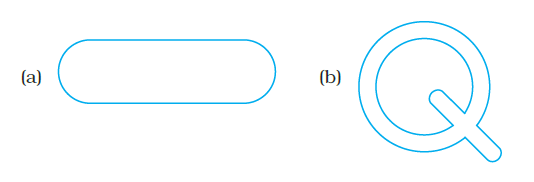

Answer:
To Find:
Draw all possible lines of symmetry for each of the figures (a), (b), (c), (d), (e), and (f).
Solution:
A line of symmetry is an axis that passes through the center of a shape and divides it into two identical halves. If the shape is folded along this line, both halves will match exactly.
(a) Capsule Shape:
This figure consists of a central rectangle with two identical semicircles at the ends. It is symmetrical in two directions. It has 2 lines of symmetry:
1. A horizontal line passing through the center of the semicircles.
2. A vertical line passing through the midpoint of the rectangular section.
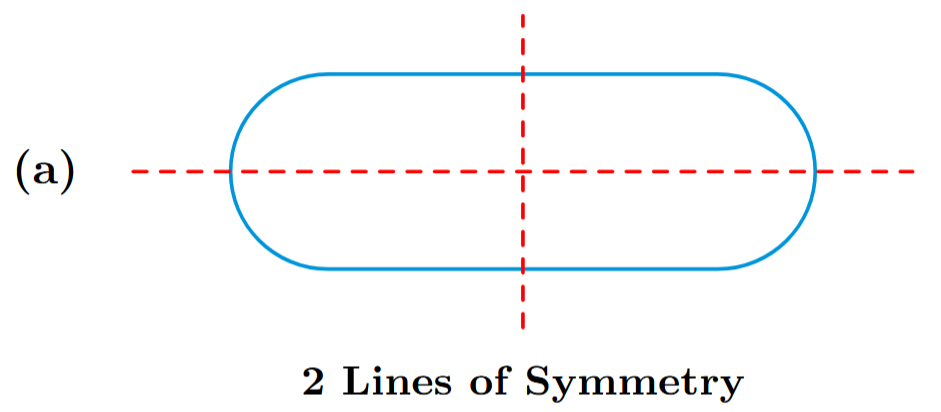
(b) Ring with Tail (Q-shape):
This figure represents a circular ring with a protrusion (tail) at the bottom right. It has 1 line of symmetry:
1. A diagonal line that passes exactly through the center of the circular ring and bisects the tail at the bottom right. This line divides the shape into two mirror-image halves.
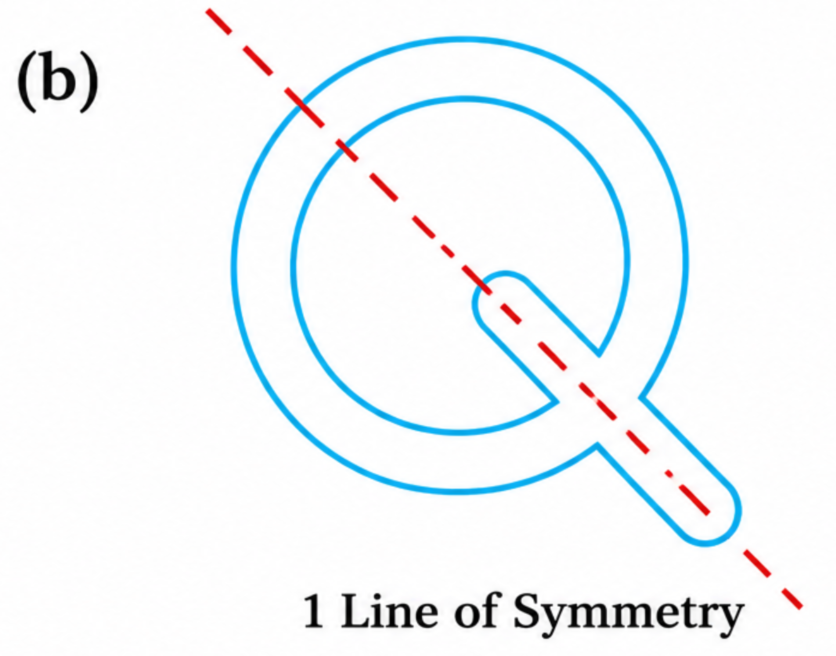
(c) Regular Hexagon:
A regular hexagon has six equal sides and six equal angles. It has 6 lines of symmetry:
1. Three lines passing through opposite vertices.
2. Three lines passing through the midpoints of opposite sides.
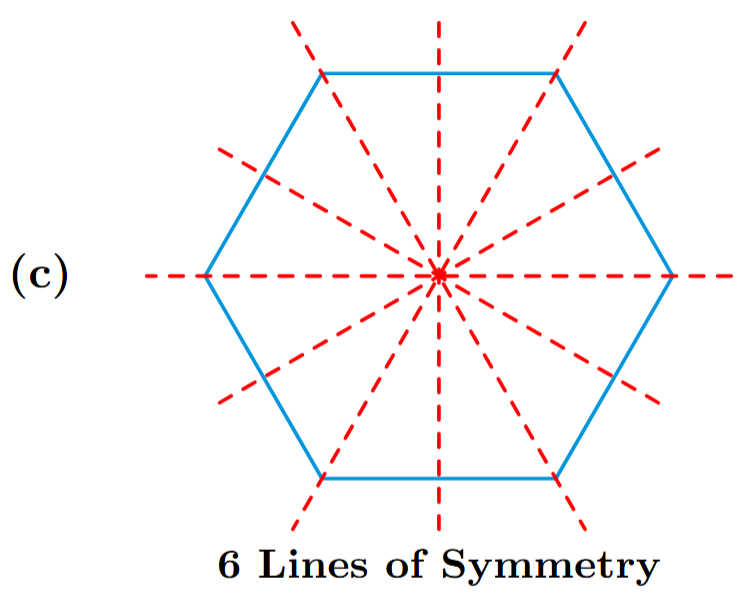
(d) Double-Headed Arrow:
This vertical arrow figure is symmetrical both vertically and horizontally. It has 2 lines of symmetry:
1. A vertical line passing through the tips of the arrows.
2. A horizontal line that bisects the central shaft.
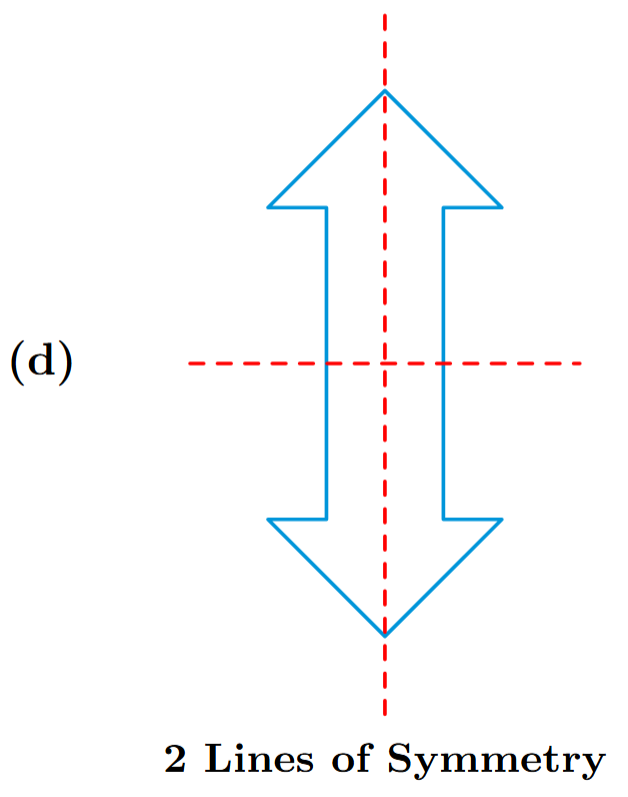
(e) Tilted Rectangle:
Regardless of its orientation, a rectangle has 2 lines of symmetry. These lines pass through the midpoints of the opposite sides. Note that for a rectangle (unlike a square), the diagonals are not lines of symmetry.
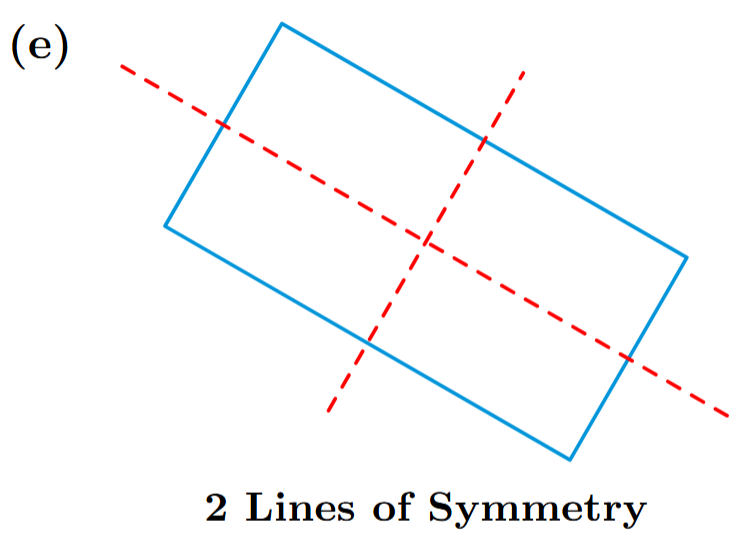
(f) Square with Arrowhead:
This composite figure consists of a square with an arrowhead attached to its left side. It has 1 line of symmetry:
1. A horizontal line passing through the tip of the arrow and the center of the square, dividing the whole figure into identical top and bottom halves.
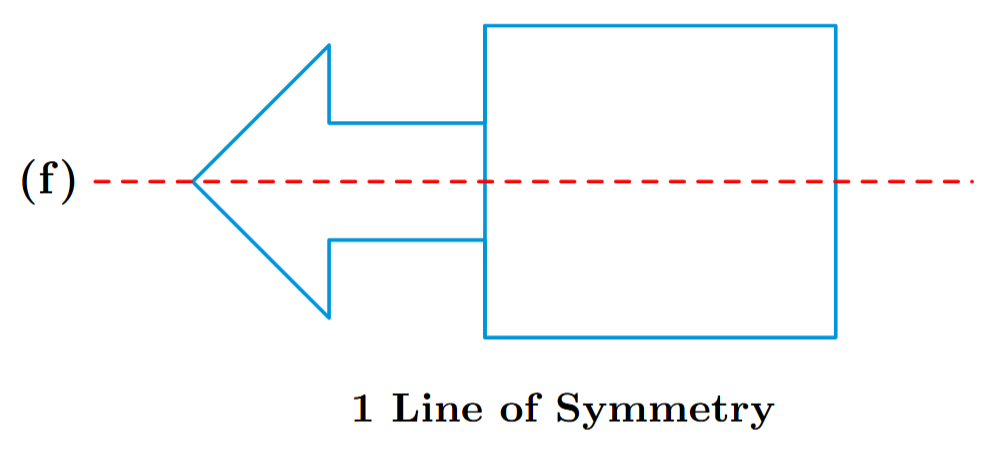
Summary:
| Part | Shape Description | Lines of Symmetry |
| (a) | Capsule | $2$ |
| (b) | Q-shape | $1$ |
| (c) | Hexagon | $6$ |
| (d) | Double Arrow | $2$ |
| (e) | Rectangle | $2$ |
| (f) | Square and Arrow | $1$ |
Question 119. Tell whether each figure has rotational symmetry. Write yes or no.
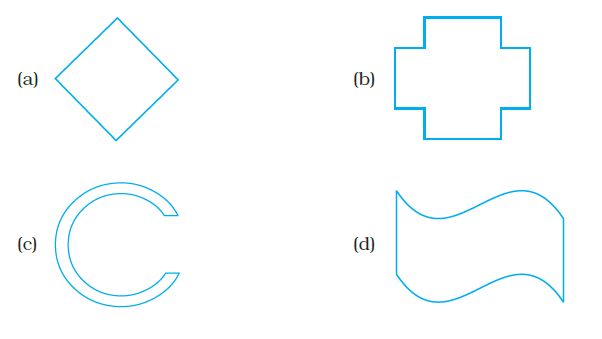
Answer:
To Find:
Identify if the given figures (a), (b), (c), and (d) possess rotational symmetry and state the answer as Yes or No.
Definition:
A figure is said to have rotational symmetry if it looks exactly the same as the original position more than once during a complete rotation of $360^\circ$ about its center. The number of times it looks the same is called the order of rotational symmetry.
Solution:
(a) Square (Diamond Orientation):
A square is a regular quadrilateral. Regardless of its orientation (even when placed as a diamond), it looks identical after every $90^\circ$ rotation. Since it looks the same at $90^\circ$, $180^\circ$, $270^\circ$, and $360^\circ$, it has rotational symmetry of order $4$.
Answer: Yes
(b) Cross/Plus Shape:
This figure is made of four identical rectangular/square arms meeting at right angles. If we rotate this figure by $90^\circ$, it maps perfectly onto itself. It has rotational symmetry of order $4$.
Answer: Yes
(c) Open Ring (C-shape):
This figure is a circular ring with a segment missing. If we rotate it by any angle less than $360^\circ$, the gap will move to a different position (e.g., at $180^\circ$, the gap would face the opposite side). It only looks the same after a full $360^\circ$ turn.
Answer: No
(d) Wave-like Flag Shape:
This shape has a point-symmetric nature. If the figure is rotated by $180^\circ$ about its center, the top-left corner moves to the bottom-right, and the curved top edge matches the curved bottom edge perfectly. Since it looks the same at $180^\circ$ and $360^\circ$, it has rotational symmetry of order $2$.
Answer: Yes
Summary Table:
| Figure | Description | Rotational Symmetry |
| (a) | Square | Yes |
| (b) | Cross Shape | Yes |
| (c) | Open Ring | No |
| (d) | Wave Shape | Yes |
Question 120. Does the Fig. 12.28 have rotational symmetry?
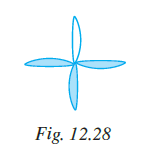
Answer:
To Find:
Determine if Fig. 12.28 possesses rotational symmetry.
Solution:
A figure has rotational symmetry if it looks identical to its original position after being rotated by an angle less than $360^\circ$ about its center.
Because the petals are of different colors and shapes, if we rotate the figure by $90^\circ$, $180^\circ$, or $270^\circ$, the shaded petal and the thinner petal will move to new positions. This will make the figure look different from its starting position.
Conclusion:
Since the figure only looks the same after a full rotation of $360^\circ$, it does not have rotational symmetry of any order greater than $1$.
Answer: No, Fig. 12.28 does not have rotational symmetry.
Question 121. The flag of Japan is shown below. How many lines of symmetry does the flag have?
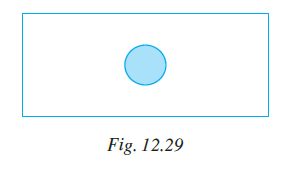
Answer:
To Find:
Calculate the total number of lines of symmetry in the flag of Japan.
Solution:
A line of symmetry is a line that divides a shape into two identical mirror halves.
The flag of Japan (Fig. 12.29) is a rectangle containing a circle at its exact center. To find the lines of symmetry for the whole flag, we must find lines that are common to both the rectangle and the centered circle.
1. Vertical Line of Symmetry: A line passing vertically through the center of the flag. Since it bisects both the rectangle and the circle, it creates two mirror-image halves (left and right).
2. Horizontal Line of Symmetry: A line passing horizontally through the center of the flag. Since it bisects both the rectangle and the circle, it creates two mirror-image halves (top and bottom).
Note: Although a circle has infinite lines of symmetry, a rectangle only has two (vertical and horizontal). The diagonal lines of a rectangle are not lines of symmetry because the corners do not overlap when folded.
Conclusion:
The flag of Japan has a total of 2 lines of symmetry.
Total Lines of Symmetry = $2$
Question 122. Which of the figures given below have both line and rotational symmetry?

Answer:
To Find:
Identify which of the given figures—(a) Ship's Wheel, (b) Anchor, (c) Star, and (d) Maple Leaf—possess both line symmetry and rotational symmetry.
Definition of Terms:
1. Line Symmetry: A figure has line symmetry if there is a line (axis) that divides the figure into two identical halves that are mirror images of each other.
2. Rotational Symmetry: A figure has rotational symmetry if it looks exactly the same more than once during a complete $360^\circ$ rotation about its center.
Analysis of Figures:
(a) Ship’s Wheel:
This figure has 8 identical handles and spokes. It possesses 8 lines of symmetry (passing through opposite handles and midpoints between handles). Since it has repeating identical parts, it looks the same after every rotation of $\frac{360^\circ}{8} = 45^\circ$. Thus, it has rotational symmetry of order $8$.
(b) Anchor:
This figure has 1 line of symmetry, which is a vertical line passing through its center. However, if rotated, it will only look the same after a full $360^\circ$ turn. Therefore, it does not have rotational symmetry.
(c) Five-pointed Star:
This is a regular star shape. It has 5 lines of symmetry, each passing through a vertex and the midpoint of the opposite indentation. It also looks the same after every rotation of $\frac{360^\circ}{5} = 72^\circ$. Thus, it has rotational symmetry of order $5$.
(d) Maple Leaf:
The stylized leaf has 1 line of symmetry (a vertical line passing through the center and the stem). Similar to the anchor, rotating it will change its orientation (the stem will move). It only looks the same after $360^\circ$. Therefore, it does not have rotational symmetry.
Summary Table:
| Figure | Line Symmetry | Rotational Symmetry | Both? |
| (a) Ship's Wheel | Yes | Yes | Yes |
| (b) Anchor | Yes | No | No |
| (c) Star | Yes | Yes | Yes |
| (d) Maple Leaf | Yes | No | No |
Conclusion:
Figures (a) and (c) have both line and rotational symmetry.
Question 123. Which of the following figures do not have line symmetry?
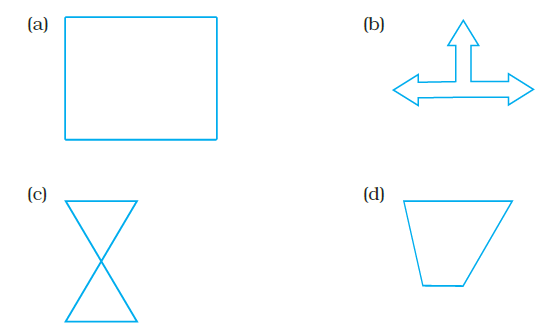
Answer:
To Find:
Identify which of the given figures (a), (b), (c), or (d) does not possess line symmetry.
Solution:
A figure has line symmetry if a line can be drawn dividing it into two identical halves that are mirror images of each other. Let us analyze each figure:
(a) Rectangle: A rectangle has 2 lines of symmetry (one horizontal and one vertical passing through the midpoints of opposite sides).
(b) T-shaped Arrow: This figure has 1 line of symmetry. A vertical line passing through the center of the vertical arrow and the midpoint of the horizontal bar divides it into two mirror-image halves.
(c) Hourglass/Double Triangle: This figure has 2 lines of symmetry (one vertical and one horizontal line passing through the point of intersection of the two triangles).
(d) Irregular Quadrilateral: Upon observing the figure, it is an irregular shape with unequal sides and angles. No line can be drawn that divides this shape into two identical mirror halves.
Conclusion:
Required Figure = (d)
Therefore, Figure (d) does not have line symmetry.
Question 124. Which capital letters of English alphabet have no line of symmetry?
Answer:
To Find:
List all capital letters of the English alphabet that do not have any line of symmetry.
Solution:
We examine each of the 26 capital letters of the English alphabet to see if any line (vertical, horizontal, or diagonal) can divide the letter into mirror-image halves.
Letters like A, B, C, D, E, H, I, K, M, O, T, U, V, W, X, Y all have at least one line of symmetry.
The letters that cannot be divided into mirror halves by any line are as follows:
F, G, J, L, N, P, Q, R, S, Z
Categorization Table:
| Category | Letters |
| Vertical Line of Symmetry | A, H, I, M, O, T, U, V, W, X, Y |
| Horizontal Line of Symmetry | B, C, D, E, H, I, K, O, X |
| No Line of Symmetry | F, G, J, L, N, P, Q, R, S, Z |
Conclusion:
The capital letters of the English alphabet with no line of symmetry are: F, G, J, L, N, P, Q, R, S, and Z.