

Chapter 2 Fractions & Decimals (Class 7 - Maths NCERT Exemplar Solutions)
Welcome to the comprehensive resource for NCERT Exemplar Solutions for Class 7 Mathematics: Chapter 2 Fractions & Decimals! This chapter is specifically designed to challenge students beyond routine calculations found in standard textbooks. The primary aim is to master complex arithmetic operations, intricate comparison tasks, and demanding multi-step word problems. These solutions provide a solid foundation for handling rational numbers and real-world measurements with high precision and computational fluency.
The solutions encompass the full operational scope required for Class 7, including addition, subtraction, multiplication, and division of all types of fractions—proper, improper (e.g., $\frac{7}{3}$), and mixed numbers (e.g., $2\frac{1}{4}$). Key concepts such as finding the reciprocal of a fraction (where the reciprocal of $\frac{a}{b}$ is $\frac{b}{a}$) and interpreting the word "of" as a multiplication operator (e.g., $\frac{1}{2}$ of 10) are explained in detail. Furthermore, the resource covers the rules for decimal operations, ensuring students accurately place the decimal point during multi-step multiplications and divisions.
Special emphasis is placed on comparing fractions and decimals using the Least Common Multiple (LCM) of denominators and applying the BODMAS rule to simplify complex expressions. The Exemplar utilizes diverse formats, including Multiple Choice Questions (MCQs), True/False statements, and word problems involving area, perimeter, and financial calculations using the $\textsf{₹}$ symbol. With meticulous step-by-step working and logical justifications prepared by learningspot.co, students can achieve mastery over these essential mathematical tools and enhance their problem-solving accuracy in various quantitative contexts.
| Content On This Page | ||
|---|---|---|
| Solved Examples (Examples 1 to 36) | Question 1 to 20 (Multiple Choice Questions) | Question 21 to 44 (Fill in the Blanks) |
| Question 45 to 54 (True or False) | Question 55 to 125 | |
Solved Examples (Examples 1 to 36)
In Examples 1 to 11, there are four options, out of which one is correct. Write the correct one.
Example 1: Savita is dividing $1\frac{3}{4}$ kg of sweets equally among her seven friends. How much does each friend receive?
(a) $\frac{3}{4}$ kg
(b) $\frac{1}{4}$ kg
(c) $\frac{1}{2}$ kg
(d) $\frac{3}{28}$ kg
Answer:
Given:
Total weight of sweets = $1\frac{3}{4}$ kg
Number of friends = $7$
To Find:
Weight of sweets received by each friend.
Solution:
First, we convert the mixed fraction into an improper fraction:
$1\frac{3}{4} = \frac{(4 \times 1) + 3}{4} = \frac{7}{4}$ kg
To find the share of each friend, we divide the total weight by the number of friends:
$\text{Each friend's share} = \frac{7}{4} \div 7$
$= \frac{7}{4} \times \frac{1}{7}$
$= \frac{\cancel{7}^1}{4} \times \frac{1}{\cancel{7}_1}$
$= \frac{1}{4}$ kg
Therefore, each friend receives $\frac{1}{4}$ kg of sweets.
Correct Option: (b)
Example 2: If $\frac{3}{4}$ of a number is 12, the number is
(a) 9
(b) 16
(c) 18
(d) 32
Answer:
To Find:
The unknown number.
Solution:
Let the required number be $x$.
According to the question:
$\frac{3}{4} \times x = 12$
$x = 12 \times \frac{4}{3}$
(Transposing $\frac{3}{4}$ to RHS)
$x = \frac{\cancel{12}^4 \times 4}{\cancel{3}_1}$
$x = 4 \times 4$
$x = 16$
The number is 16.
Correct Option: (b)
Example 3: Product of fractions $\frac{2}{7}$ and $\frac{5}{9}$ is.
(a) $\frac{2 \;×\; 5}{7 \;+\; 9}$
(b) $\frac{2 \;+\; 5}{2 \;+\; 9}$
(c) $\frac{2 \;×\; 9}{5 \;×\; 7}$
(d) $\frac{2 \;×\; 5}{7 \;×\; 9}$
Answer:
Solution:
To find the product of two fractions, we use the following rule:
$\text{Product of Fractions} = \frac{\text{Product of Numerators}}{\text{Product of Denominators}}$
Applying this rule to $\frac{2}{7}$ and $\frac{5}{9}$:
$\frac{2}{7} \times \frac{5}{9} = \frac{2 \times 5}{7 \times 9}$
The product is $\frac{10}{63}$, which is represented by option (d).
Correct Option: (d)
Example 4: Given that 0 < p < q < r < s and p, q, r, s are integers, which of the following is the smallest?
(a) $\frac{p \;+\; q}{r \;+\; s}$
(b) $\frac{p \;+\; s}{q \;+\; r}$
(c) $\frac{q \;+\; s}{p \;+\; r}$
(d) $\frac{r \;+\; s}{p \;+\; q}$
Answer:
Solution:
A fraction is smallest when its numerator is the smallest possible and its denominator is the largest possible.
Given $0 < p < q < r < s$, we observe the following:
1. The smallest possible sum of two distinct integers from the set $\{p, q, r, s\}$ is $(p + q)$.
2. The largest possible sum of two distinct integers from the set is $(r + s)$.
Comparing the options:
(a) $\frac{p + q}{r + s}$ has the smallest numerator and the largest denominator among all combinations of these four integers.
(d) $\frac{r + s}{p + q}$ would be the largest as it has the largest numerator and smallest denominator.
Thus, $\frac{p + q}{r + s}$ is the smallest value.
Correct Option: (a)
Example 5: The next number of the pattern 60, 30, 15, _______ is
(a) 10
(b) 5
(c) $\frac{15}{4}$
(d) $\frac{15}{2}$
Answer:
Solution:
Let us observe the relation between the consecutive terms of the pattern:
$60 \div 2 = 30$
$30 \div 2 = 15$
The rule of the pattern is that each subsequent term is half of the previous term.
Therefore, the next term will be:
$15 \div 2 = \frac{15}{2}$
Correct Option: (d)
Example 6: The decimal expression for 8 rupees 8 paise (in Rupees) is
(a) 8.8
(b) 8.08
(c) 8.008
(d) 88.0
Answer:
Given:
Amount = $8$ rupees and $8$ paise.
Solution:
We know that in the Indian currency system:
$100 \text{ paise} = \textsf{₹} 1$
$1 \text{ paisa} = \textsf{₹} \frac{1}{100}$
Now, converting $8$ paise into rupees:
$8 \text{ paise} = \textsf{₹} \frac{8}{100} = \textsf{₹} 0.08$
Total amount in rupees:
$\text{Total} = \textsf{₹} 8 + \textsf{₹} 0.08$
$= \textsf{₹} 8.08$
Correct Option: (b)
Example 7: Each side of a regular hexagon is 3.5cm long. The perimeter of the given polygon is
(a) 17.5cm
(b) 21cm
(c) 18.3cm
(d) 20cm
Answer:
Given:
Length of each side of the regular hexagon $= 3.5\text{ cm}$.
To Find:
The perimeter of the regular hexagon.
Solution:
A regular hexagon is a polygon with six equal sides.
$\text{Perimeter} = 6 \times \text{side}$
$\text{Perimeter} = 6 \times 3.5\text{ cm}$
$\text{Perimeter} = 21.0\text{ cm}$
Therefore, the perimeter of the regular hexagon is $21\text{ cm}$.
Correct Option: (b)
Example 8: 2.5 ÷ 1000 is equal to
(a) 0.025
(b) 0.0025
(c) 0.2500
(d) 25000
Answer:
Solution:
To divide a decimal number by $1000$, we shift the decimal point to the left by three places (since there are three zeros in $1000$).
Given expression: $2.5 \div 1000$
Starting with $2.5$:
1. Shift one place left: $0.25$
2. Shift two places left: $0.025$
3. Shift three places left: $0.0025$
Thus, $2.5 \div 1000 = 0.0025$.
Correct Option: (b)
Example 9: Which of the following has the smallest value?
(a) 0.0002
(b) $\frac{2}{1000}$
(c) $\frac{\left( 0.2 \right)^2}{2}$
(d) $\frac{2}{100} \;÷\; 0.01$
Answer:
Solution:
Let us evaluate the value of each option to compare them:
(a) $0.0002$
(b) $\frac{2}{1000} = 0.002$
(c) $\frac{(0.2)^2}{2} = \frac{0.04}{2} = 0.02$
(d) $\frac{2}{100} \div 0.01 = 0.02 \div 0.01 = \frac{0.02}{0.01} = 2$
Comparing the values: $0.0002, 0.002, 0.02,$ and $2$.
We can see that $0.0002$ is the smallest value.
Correct Option: (a)
Example 10: Which of the following has the largest value?
(a) $\frac{32}{0.05}$
(b) $\frac{0.320}{50}$
(c) $\frac{3.2}{0.05}$
(d) $\frac{3.2}{50}$
Answer:
Solution:
Let us evaluate each expression:
(a) $\frac{32}{0.05} = \frac{32 \times 100}{5} = \frac{3200}{5} = 640$
(b) $\frac{0.320}{50} = \frac{0.32}{50} = 0.0064$
(c) $\frac{3.2}{0.05} = \frac{3.2 \times 100}{5} = \frac{320}{5} = 64$
(d) $\frac{3.2}{50} = 0.064$
Comparing the results: $640, 0.0064, 64,$ and $0.064$.
The largest value is $640$, which corresponds to option (a).
Correct Option: (a)
Example 11: The largest of the following is
(a) 0.0001
(b) $\frac{1}{1000}$
(c) (0.100)2
(d) $\frac{1}{10} \;÷\; 0.1$
Answer:
Solution:
Evaluating the numerical values of each option:
(a) $0.0001$
(b) $\frac{1}{1000} = 0.001$
(c) $(0.100)^2 = 0.1 \times 0.1 = 0.01$
(d) $\frac{1}{10} \div 0.1 = 0.1 \div 0.1 = 1$
Comparing the values: $0.0001, 0.001, 0.01,$ and $1$.
The largest value is $1$.
Correct Option: (d)
In Examples 12 to 19, fill in the blanks to make the statement true.
Example 12: A fraction acts as an operator___________
Answer:
Solution:
In mathematics, especially when dealing with word problems involving portions, a fraction often acts as an operator represented by the word 'of'.
For example: $\frac{1}{2}$ 'of' $10$ means $\frac{1}{2} \times 10$.
Answer: of
Example 13: Fraction which is reciprocal of $\frac{2}{3}$ is _________.
Answer:
Solution:
The reciprocal of a fraction $\frac{a}{b}$ is obtained by interchanging the numerator and the denominator, i.e., $\frac{b}{a}$.
Given fraction is $\frac{2}{3}$.
Its reciprocal is $\frac{3}{2}$.
Answer: $\frac{3}{2}$
Example 14: Product of a proper and improper fraction is ____________ the improper fraction.
Answer:
Solution:
Let us consider a proper fraction (numerator < denominator) and an improper fraction (numerator > denominator).
Example: Let proper fraction $= \frac{1}{2}$ and improper fraction $= \frac{3}{2}$.
Product $= \frac{1}{2} \times \frac{3}{2} = \frac{3}{4}$
Comparing the product ($\frac{3}{4} = 0.75$) with the improper fraction ($\frac{3}{2} = 1.5$):
$0.75 < 1.5$
Since the product of any number and a fraction less than $1$ (proper fraction) is always smaller than the original number, the product is less than the improper fraction.
Answer: less than
Example 15: The two non-zero fractions whose product is 1, are called the ________ of each other.
Answer:
Solution:
By definition, if the product of two fractions is $1$, then each fraction is the multiplicative inverse or reciprocal of the other.
Example: $\frac{4}{5} \times \frac{5}{4} = 1$
Answer: reciprocals (or multiplicative inverse)
Example 16: 5 rupees 5 paise = ₹ ________.
Answer:
Given:
Amount = $5$ rupees and $5$ paise.
Solution:
We know that $100$ paise $= \textsf{₹} 1$.
Therefore, $1$ paisa $= \textsf{₹} \frac{1}{100}$.
Converting $5$ paise to rupees:
$5 \text{ paise} = \textsf{₹} \frac{5}{100} = \textsf{₹} 0.05$
Total amount in rupees:
Total $= \textsf{₹} 5 + \textsf{₹} 0.05 = \textsf{₹} 5.05$
Answer: $5.05$
Example 17: 45mm = _________ m.
Answer:
Solution:
We use the standard metric conversion factors:
$10 \text{ mm} = 1 \text{ cm}$
$100 \text{ cm} = 1 \text{ m}$
Therefore, $1000 \text{ mm} = 1 \text{ m}$.
To convert mm to m, we divide the value by $1000$:
$45 \text{ mm} = \frac{45}{1000} \text{ m}$
$45 \text{ mm} = 0.045 \text{ m}$
Answer: $0.045$
Example 18: 2.4 × 1000 = _________.
Answer:
Solution:
When we multiply a decimal number by $1000$, we shift the decimal point to the right by three places.
Starting with $2.4$:
1st shift: $24$
2nd shift: $240$
3rd shift: $2400$
Answer: $2400$
Example 19: To divide a decimal number by 100, we shift the decimal point in the number to the ________ by ______ places.
Answer:
Solution:
The rule for dividing a decimal number by powers of 10 ($10, 100, 1000$, etc.) states that we must move the decimal point to the left.
Since $100$ has two zeros, the decimal point is shifted by two places to the left.
Answer: left, two
In Examples 20 to 23 state whether the statements are True or False.
Example 20: Reciprocal of an improper fraction is an improper fraction.
Answer:
Solution:
An improper fraction is a fraction where the numerator is greater than or equal to the denominator (e.g., $\frac{3}{2}$).
The reciprocal is obtained by interchanging the numerator and the denominator.
Example: Reciprocal of $\frac{3}{2}$ is $\frac{2}{3}$.
Since $\frac{2}{3}$ is a proper fraction (numerator < denominator), the statement is false.
Answer: False
Example 21: $2\frac{2}{5} \;÷ \; 2\frac{1}{5} = 2$
Answer:
Solution:
Let us evaluate the LHS (Left Hand Side) by converting mixed fractions into improper fractions:
$2\frac{2}{5} = \frac{(5 \times 2) + 2}{5} = \frac{12}{5}$
$2\frac{1}{5} = \frac{(5 \times 2) + 1}{5} = \frac{11}{5}$
Now, perform the division:
$\frac{12}{5} \div \frac{11}{5} = \frac{12}{5} \times \frac{5}{11}$
$= \frac{12}{\cancel{5}} \times \frac{\cancel{5}}{11} = \frac{12}{11}$
Since $\frac{12}{11} \neq 2$, the statement is false.
Answer: False
Example 22: 0.04 ÷ 0.2 = 0.2
Answer:
Solution:
Let us evaluate the division:
$0.04 \div 0.2 = \frac{0.04}{0.2}$
To simplify, multiply both numerator and denominator by $100$:
$= \frac{0.04 \times 100}{0.2 \times 100} = \frac{4}{20}$
$= \frac{\cancel{4}^1}{\cancel{20}_5} = \frac{1}{5}$
$= 0.2$
Since the result matches the RHS, the statement is true.
Answer: True
Example 23: 0.2 × 0.3 = 0.6
Answer:
Solution:
To multiply decimals, we first multiply them as whole numbers and then place the decimal point.
Product of whole numbers: $2 \times 3 = 6$.
Total decimal places in the factors: $1$ (in $0.2$) $+ 1$ (in $0.3$) $= 2$ decimal places.
Therefore, the product must have two decimal places:
$0.2 \times 0.3 = 0.06$
Since $0.06 \neq 0.6$, the statement is false.
Answer: False
Example 24: Find $\frac{2}{3}$ of 6 using circles with shaded parts.
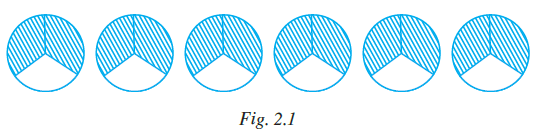
Answer:
To Find: The value of $\frac{2}{3}$ of $6$.
Solution:
$\frac{2}{3}$ of $6$ means we divide $6$ items into $3$ equal groups and take $2$ of those groups.
$\frac{2}{3} \times 6$
('of' acts as multiplication operator)
$= 2 \times 2 = 4$
Visual Representation:
Looking at the provided figure, we have $6$ circles. Each circle is divided into $3$ equal parts. If we shade $2$ parts out of $3$ in each of the $6$ circles, we get:
$6 \times \frac{2}{3} = \frac{12}{3} = 4$ whole circles.
Therefore, 4 circles will be shaded in total if we combine the parts.
Example 25: Find the value of
$\frac{1}{4\frac{2}{7}} + \frac{1}{3\frac{11}{13}} + \frac{1}{\left( \frac{5}{9} \right)}$
Answer:
To Find: The sum of the given complex fractions.
Solution:
Step 1: Convert the mixed fractions in the denominators into improper fractions.
$4\frac{2}{7} = \frac{(4 \times 7) + 2}{7} = \frac{30}{7}$
$3\frac{11}{13} = \frac{(3 \times 13) + 11}{13} = \frac{50}{13}$
Step 2: Express the reciprocals.
$\frac{1}{\frac{30}{7}} = \frac{7}{30}$
$\frac{1}{\frac{50}{13}} = \frac{13}{50}$
$\frac{1}{\frac{5}{9}} = \frac{9}{5}$
Step 3: Find the sum of the fractions.
The expression becomes: $\frac{7}{30} + \frac{13}{50} + \frac{9}{5}$
To add these, we find the LCM of denominators $30, 50, \text{ and } 5$.
$\begin{array}{c|cc} 2 & 30 \;, & 50 \;, & 5 \\ \hline 3 & 15 \; , & 25 \; , & 5 \\ \hline 5 & 5 \; , & 25 \; , & 5 \\ \hline 5 & 1 \; , & 5 \; , & 1 \\ \hline & 1 \; , & 1 \; , & 1 \end{array}$
$\text{LCM} = 2 \times 3 \times 5 \times 5 = 150$.
Step 4: Equivalent fractions with denominator 150.
$\frac{7 \times 5}{30 \times 5} + \frac{13 \times 3}{50 \times 3} + \frac{9 \times 30}{5 \times 30}$
$= \frac{35}{150} + \frac{39}{150} + \frac{270}{150}$
$= \frac{35 + 39 + 270}{150} = \frac{344}{150}$
Step 5: Simplify the fraction.
$\frac{\cancel{344}^{172}}{\cancel{150}_{75}} = \frac{172}{75} = 2\frac{22}{75}$
The final value is $2\frac{22}{75}$.
Example 26: There is a 3 × 3 × 3 cube which consists of twenty seven 1 × 1 × 1 cubes (see Fig. 2.3). It is ‘tunneled’ by removing cubes from the coloured squares. Find:

(i) Fraction of number of small cubes removed to the number of small cubes left in given cube.
(ii) Fraction of the number of small cubes removed to the total number of small cubes.
(iii) What part is (ii) of (i)?
Answer:
Given:
Total number of small $1 \times 1 \times 1$ cubes in a $3 \times 3 \times 3$ cube $= 3 \times 3 \times 3 = 27$.
The cube is "tunneled" by removing a column of cubes from the center of each face.
To Find: Fractions as specified in the question.
Solution:
Step 1: Calculate cubes removed
1. Center of front-to-back: $3$ cubes removed.
2. Center of left-to-right: $3$ cubes, but the center-most cube is already removed in step 1. So, $2$ new cubes removed.
3. Center of top-to-bottom: $3$ cubes, but the center-most cube is already removed in step 1. So, $2$ new cubes removed.
Total small cubes removed $= 3 + 2 + 2 = 7$.
Total small cubes left $= 27 - 7 = 20$.
(i) Fraction of cubes removed to cubes left:
$\text{Fraction} = \frac{\text{Cubes removed}}{\text{Cubes left}} = \frac{7}{20}$
(ii) Fraction of cubes removed to total cubes:
$\text{Fraction} = \frac{\text{Cubes removed}}{\text{Total cubes}} = \frac{7}{27}$
(iii) What part is (ii) of (i)?
Let part be $x$.
$(ii) = x \times (i)$
$\frac{7}{27} = x \times \frac{7}{20}$
$x = \frac{7}{27} \div \frac{7}{20}$
$x = \frac{7}{27} \times \frac{20}{7}$
$x = \frac{20}{27}$
The required part is $\frac{20}{27}$.
Example 27: Ramu finishes $\frac{1}{3}$ part of a work in 1 hour. How much part of the work will be finished in $2\frac{1}{5}$ hours?
Answer:
Given:
Work finished in $1$ hour $= \frac{1}{3}$ part.
Total time $= 2\frac{1}{5}$ hours.
Solution:
To find the total work finished, we multiply the rate of work by the total time.
Total time in improper fraction $= 2\frac{1}{5} = \frac{11}{5}$ hours.
$\text{Work finished} = \text{Work in 1 hour} \times \text{Total hours}$
$\text{Work finished} = \frac{1}{3} \times \frac{11}{5}$
$\text{Work finished} = \frac{1 \times 11}{3 \times 5}$
$\text{Work finished} = \frac{11}{15}$
Ramu will finish $\frac{11}{15}$ part of the work.
Example 28: How many $\frac{2}{3}$ kg pieces can be cut from a cake of weight 4 kg?
Answer:
Given:
Total weight of the cake $= 4$ kg.
Weight of each piece $= \frac{2}{3}$ kg.
Solution:
To find the number of pieces, we divide the total weight by the weight of one piece.
$\text{Number of pieces} = 4 \div \frac{2}{3}$
$\text{Number of pieces} = 4 \times \frac{3}{2}$
$\text{Number of pieces} = \frac{\cancel{4}^2 \times 3}{\cancel{2}_1}$
$\text{Number of pieces} = 2 \times 3 = 6$.
Therefore, 6 pieces can be cut from the cake.
Example 29: Harmeet purchased 3.5kg of potatoes at the rate of ₹ 13.75 per kg. How much money should she pay in nearest rupees?
Answer:
Given:
Weight of potatoes $= 3.5$ kg.
Cost per kg $= \textsf{₹} 13.75$.
Solution:
Total money to be paid $= \text{Weight} \times \text{Rate per kg}$
$\text{Total cost} = 3.5 \times 13.75$
Performing multiplication:
$\begin{array}{cc}& & 1 & 3 & 7 & 5 \\ \times & & & & 3 & 5 \\ \hline && 6 & 8 & 7 & 5 \\ & 4 & 1 & 2 & 5 & \times \\ \hline & 4 & 8 & 1 & 2 & 5 \\ \hline \end{array}$
Since there are $2 + 1 = 3$ decimal places, the product is $48.125$.
$\text{Total cost} = \textsf{₹} 48.125$
Rounding to nearest Rupee:
Since the decimal part $.125$ is less than $.50$, we round down.
$\textsf{₹} 48.125 \approx \textsf{₹} 48$.
Harmeet should pay $\textsf{₹} 48$.
Example 30: Kavita had a piece of rope of length 9.5 m. She needed some small pieces of rope of length 1.9 m each. How many pieces of the required length will she get out of this rope?
Answer:
Given:
Total length of the rope = $9.5\text{ m}$
Length of each small piece = $1.9\text{ m}$
To Find:
Number of small pieces Kavita will get.
Solution:
The number of pieces is obtained by dividing the total length by the length of one piece.
$\text{Number of pieces} = 9.5 \div 1.9$
$\text{Number of pieces} = \frac{9.5}{1.9}$
Multiplying the numerator and denominator by 10 to remove the decimals:
$\text{Number of pieces} = \frac{95}{19}$
$\text{Number of pieces} = \frac{\cancel{95}^5}{\cancel{19}_1}$
$\text{Number of pieces} = 5$
Therefore, Kavita will get 5 pieces of the rope.
Example 31: Three boys earned a total of ₹ 235.50. What was the average amount earned per boy?
Answer:
Given:
Total amount earned by three boys = $\textsf{₹} 235.50$
Number of boys = $3$
To Find:
Average amount earned per boy.
Solution:
The average amount is calculated by dividing the total earnings by the number of boys.
$\text{Average amount} = \frac{\text{Total amount}}{\text{Number of boys}}$
$\text{Average amount} = \frac{\textsf{₹} 235.50}{3}$
$\begin{array}{r} 78.50 \phantom{3)} \\ 3{\overline{\smash{\big)}\,235.50 \phantom{)}}} \\ \underline{-~ 21 \phantom{(00)}} \\ 25 \phantom{(0)} \\ \underline{-~ 24 \phantom{(0)}} \\ 1.5 \phantom{)} \\ \underline{-~ 1.5 \phantom{)}} \\ 0.0 \phantom{)} \end{array}$
$\text{Average amount} = \textsf{₹} 78.50$
Therefore, the average amount earned per boy was $\textsf{₹} 78.50$.
Example 32: Find the product of
(i) $\frac{1}{2}$ and $\frac{5}{8}$
(ii) $\frac{1}{3}$ and $\frac{7}{5}$
(iii) $\frac{4}{3}$ and $\frac{5}{2}$
Answer:
Solution (i):
$\frac{1}{2} \times \frac{5}{8} = \frac{1 \times 5}{2 \times 8} = \frac{5}{16}$
Solution (ii):
$\frac{1}{3} \times \frac{7}{5} = \frac{1 \times 7}{3 \times 5} = \frac{7}{15}$
Solution (iii):
$\frac{4}{3} \times \frac{5}{2} = \frac{\cancel{4}^2 \times 5}{3 \times \cancel{2}_1} = \frac{2 \times 5}{3 \times 1} = \frac{10}{3} = 3\frac{1}{3}$
Example 33: Observe the 3 products given in Example 32 and now give the answers of the following questions.
(i) Does interchanging the fractions in the example, $\frac{1}{12}$ × $\frac{5}{8}$ affect the answer?
(ii) Is the value of the fraction in the product greater or less than the value of either fraction?
Answer:
Solution:
(i) Effect of interchanging fractions:
No, interchanging the fractions does not affect the answer. This is because multiplication of fractions follows the Commutative Property.
$\frac{1}{12} \times \frac{5}{8} = \frac{5}{96}$
$\frac{5}{8} \times \frac{1}{12} = \frac{5}{96}$
(ii) Comparing product value:
Case (i) and (ii) of Example 32 involve proper fractions. When we multiply two proper fractions, the product is less than each of the fractions.
In Case (iii), we multiply an improper fraction ($\frac{4}{3}$) and an improper fraction ($\frac{5}{2}$). In this case, the product is greater than each of the fractions.
In general, if we multiply a proper fraction by another fraction, the value of the product is less than the other fraction.
Example 34: Reshma uses $\frac{3}{4}$ m of cloth to stitch a shirt. How many shirts can she make with $2\frac{1}{4}$ m cloth?
Answer:
Given:
Cloth required for one shirt = $\frac{3}{4}\text{ m}$
Total length of cloth available = $2\frac{1}{4}\text{ m}$
To Find:
Number of shirts Reshma can make.
Solution:
First, convert the mixed fraction into an improper fraction:
Total cloth = $2\frac{1}{4} = \frac{(4 \times 2) + 1}{4} = \frac{9}{4}\text{ m}$
Number of shirts = $\text{Total cloth} \div \text{Cloth per shirt}$
Number of shirts = $\frac{9}{4} \div \frac{3}{4}$
Number of shirts = $\frac{9}{4} \times \frac{4}{3}$
Number of shirts = $\frac{\cancel{9}^3}{\cancel{4}_1} \times \frac{\cancel{4}^1}{\cancel{3}_1} = 3$
Therefore, Reshma can make 3 shirts.
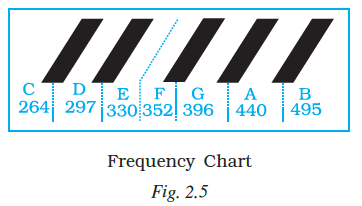
Example 35: If the fraction of the frequencies of two notes have a common factor between the numerator and denominator, the two notes are harmonious. Use the graphic below to find the fraction of frequency of notes D and B.
Answer:
Given:
Frequency of note D = $297$
Frequency of note B = $495$
To Find:
The fraction of the frequency of note D to note B and check if they are harmonious.
Solution:
The fraction of frequencies of D and B is given by:
$\text{Fraction} = \frac{\text{Frequency of D}}{\text{Frequency of B}}$
$\text{Fraction} = \frac{297}{495}$
Now, we simplify the fraction by finding common factors:
Dividing both numerator and denominator by 9:
$\frac{297 \div 9}{495 \div 9} = \frac{33}{55}$
Dividing by 11:
$\frac{33 \div 11}{55 \div 11} = \frac{3}{5}$
Since there was a common factor (9 and 11), the notes are harmonious. The resulting fraction is $\frac{3}{5}$.
Example 36: Khilona said that we have gone about 120km or $\frac{2}{3}$ of the way to the camp site. So, how much farther do we have to go?
Answer:
Given:
Distance covered = $120\text{ km}$
Fraction of the way covered = $\frac{2}{3}$
To Find:
The remaining distance to the camp site.
Solution:
Let the total distance to the camp site be $x\text{ km}$.
According to the problem:
$\frac{2}{3}$ of $x = 120$
$\frac{2}{3} \times x = 120$
$x = \frac{120 \times 3}{2}$
$x = \frac{\cancel{120}^{60} \times 3}{\cancel{2}_1}$
$x = 180\text{ km}$
Now, the distance remaining is:
$\text{Remaining distance} = \text{Total distance} - \text{Distance covered}$
$\text{Remaining distance} = 180 - 120 = 60\text{ km}$
Alternate Solution:
If $\frac{2}{3}$ of the way is covered, the remaining part is $1 - \frac{2}{3} = \frac{1}{3}$.
If 2 parts (out of 3) = $120\text{ km}$
Then 1 part (out of 3) = $\frac{120}{2} = 60\text{ km}$
Therefore, they have to go $60\text{ km}$ farther.
Exercise
Question 1 to 20 (Multiple Choice Questions)
In questions 1 to 20, out of four options, only one is correct. Write the correct answer.
Question 1. $\frac{2}{5}$ × $5\frac{1}{5}$ is equal to:
(a) $\frac{26}{25}$
(b) $\frac{52}{25}$
(c) $\frac{2}{5}$
(d) 6
Answer:
Given:
The expression is $\frac{2}{5} \times 5\frac{1}{5}$.
Solution:
First, convert the mixed fraction into an improper fraction:
$5\frac{1}{5} = \frac{(5 \times 5) + 1}{5} = \frac{26}{5}$
Now, perform the multiplication:
$\frac{2}{5} \times \frac{26}{5} = \frac{2 \times 26}{5 \times 5}$
$= \frac{52}{25}$
Comparing the result with the options, it matches (b).
Correct Option: (b)
Question 2. $3\frac{3}{4}$ ÷ $\frac{3}{4}$ is equal to:
(a) 3
(b) 4
(c) 5
(d) $\frac{45}{16}$
Answer:
Solution:
Convert the mixed fraction into an improper fraction:
$3\frac{3}{4} = \frac{(4 \times 3) + 3}{4} = \frac{15}{4}$
Now, perform the division by multiplying with the reciprocal of the divisor:
$\frac{15}{4} \div \frac{3}{4} = \frac{15}{4} \times \frac{4}{3}$
$= \frac{15}{\cancel{4}^1} \times \frac{\cancel{4}_1}{3}$
$= \frac{\cancel{15}^5}{3_1} = 5$
Correct Option: (c)
Question 3. A ribbon of length $5\frac{1}{4}$ m is cut into small pieces each of length $\frac{3}{4}$ m. Number of pieces will be:
(a) 5
(b) 6
(c) 7
(d) 8
Answer:
Given:
Total length of ribbon = $5\frac{1}{4}$ m
Length of each piece = $\frac{3}{4}$ m
To Find:
The total number of pieces.
Solution:
Total length in improper fraction:
$5\frac{1}{4} = \frac{21}{4}$ m
Number of pieces = Total length $\div$ length of one piece
$\text{Pieces} = \frac{21}{4} \div \frac{3}{4}$
$= \frac{21}{4} \times \frac{4}{3}$
$= \frac{\cancel{21}^7}{\cancel{4}^1} \times \frac{\cancel{4}_1}{\cancel{3}_1}$
$= 7$
Correct Option: (c)
Question 4. The ascending arrangement of $\frac{2}{3}$ , $\frac{6}{7}$ , $\frac{13}{21}$ is
(a) $\frac{6}{7}$ , $\frac{2}{3}$ , $\frac{13}{21}$
(b) $\frac{13}{21}$ , $\frac{2}{3}$ , $\frac{6}{7}$
(c) $\frac{6}{7}$ , $\frac{13}{21}$ , $\frac{2}{3}$
(d) $\frac{2}{3}$ , $\frac{6}{7}$ , $\frac{13}{21}$
Answer:
Solution:
To arrange the fractions in ascending order, we must first make their denominators equal by finding the LCM of 3, 7, and 21.
$\text{LCM}(3, 7, 21) = 21$
Now, convert each fraction to an equivalent fraction with denominator 21:
1. $\frac{2}{3} = \frac{2 \times 7}{3 \times 7} = \frac{14}{21}$
2. $\frac{6}{7} = \frac{6 \times 3}{7 \times 3} = \frac{18}{21}$
3. $\frac{13}{21}$ is already $\frac{13}{21}$
Comparing the numerators: $13 < 14 < 18$.
Therefore, $\frac{13}{21} < \frac{14}{21} < \frac{18}{21}$.
The original fractions in ascending order are: $\frac{13}{21}, \frac{2}{3}, \frac{6}{7}$.
Correct Option: (b)
Question 5. Reciprocal of the fraction $\frac{2}{3}$ is:
(a) 2
(b) 3
(c) $\frac{2}{3}$
(d) $\frac{3}{2}$
Answer:
Solution:
The reciprocal of a fraction is obtained by interchanging the numerator and the denominator.
$\text{Reciprocal of } \frac{a}{b} = \frac{b}{a}$
Therefore, the reciprocal of $\frac{2}{3}$ is $\frac{3}{2}$.
Correct Option: (d)
Question 6. The product of $\frac{11}{13}$ and 4 is:
(a) $3\frac{5}{13}$
(b) $5\frac{3}{13}$
(c) $13\frac{3}{5}$
(d) $13\frac{5}{3}$
Answer:
Solution:
To find the product, multiply the numerator by the integer:
$\frac{11}{13} \times 4 = \frac{11 \times 4}{13} = \frac{44}{13}$
Now, convert the improper fraction into a mixed fraction:
$\begin{array}{r} 3 \phantom{13)} \\ 13{\overline{\smash{\big)}\,44 \phantom{)}}} \\ \underline{-~ 39 \phantom{x}} \\ 5 \phantom{)} \end{array}$
Thus, $\frac{44}{13} = 3\frac{5}{13}$.
Correct Option: (a)
Question 7. The product of 3 and $4\frac{2}{5}$ is:
(a) $17\frac{2}{5}$
(b) $\frac{24}{5}$
(c) $13\frac{1}{5}$
(d) $5\frac{1}{3}$
Answer:
Solution:
First, convert the mixed fraction into an improper fraction:
$4\frac{2}{5} = \frac{(5 \times 4) + 2}{5} = \frac{22}{5}$
Now, multiply by 3:
$3 \times \frac{22}{5} = \frac{3 \times 22}{5} = \frac{66}{5}$
Now, convert the result back into a mixed fraction:
$\begin{array}{r} 13 \phantom{5)} \\ 5{\overline{\smash{\big)}\,66 \phantom{)}}} \\ \underline{-~ 5 \phantom{xx}} \\ 16 \phantom{(} \\ \underline{-~ 15 \phantom{x}} \\ 1 \phantom{)} \end{array}$
Thus, $\frac{66}{5} = 13\frac{1}{5}$.
Correct Option: (c)
Question 8. Pictorial representation of 3 × $\frac{2}{3}$ is:

Answer:
Solution:
The expression $3 \times \frac{2}{3}$ represents three groups of $\frac{2}{3}$.
1. The fraction $\frac{2}{3}$ means that out of 3 equal parts of a whole, 2 parts are shaded.
2. Therefore, $3 \times \frac{2}{3}$ will show three circles, where each circle has 2 out of 3 parts shaded.
Looking at the given options:
In option (b), there are three circles and each has exactly 2 parts shaded out of 3 total parts.
Correct Option: (b)
Question 9. $\frac{1}{5}$ ÷ $\frac{4}{5}$ equal to:
(a) $\frac{4}{5}$
(b) $\frac{1}{5}$
(c) $\frac{5}{4}$
(d) $\frac{1}{4}$
Answer:
Solution:
To divide one fraction by another, we multiply the first fraction by the reciprocal of the second fraction.
$\frac{1}{5} \div \frac{4}{5} = \frac{1}{5} \times \frac{5}{4}$
Now, we cancel the common factor $5$ from the numerator and denominator:
$= \frac{1}{\cancel{5}_1} \times \frac{\cancel{5}^1}{4}$
$= \frac{1}{4}$
Correct Option: (d)
Question 10. The product of 0.03 × 0.9 is:
(a) 2.7
(b) 0.27
(c) 0.027
(d) 0.0027
Answer:
Solution:
To multiply decimals, we first multiply the numbers as whole numbers and then place the decimal point based on the total number of decimal places in the factors.
1. Multiply whole numbers: $3 \times 9 = 27$
2. Count decimal places:
In $0.03$, there are 2 decimal places.
In $0.9$, there is 1 decimal place.
Total decimal places $= 2 + 1 = 3$.
3. Place the decimal point in $27$ such that there are 3 decimal places:
$0.03 \times 0.9 = 0.027$
Correct Option: (c)
Question 11. $\frac{5}{7}$ ÷ 6 is equal to:
(a) $\frac{30}{7}$
(b) $\frac{5}{42}$
(c) $\frac{30}{42}$
(d) $\frac{6}{7}$
Answer:
Solution:
The division of a fraction by a whole number is done by multiplying the fraction by the reciprocal of the whole number.
Given expression: $\frac{5}{7} \div 6$
The reciprocal of $6$ is $\frac{1}{6}$.
$= \frac{5}{7} \times \frac{1}{6}$
$= \frac{5 \times 1}{7 \times 6}$
$= \frac{5}{42}$
Correct Option: (b)
Question 12. $5\frac{1}{6}$ ÷ $\frac{9}{2}$ is equal to
(a) $\frac{31}{6}$
(b) $\frac{1}{27}$
(c) $5\frac{1}{27}$
(d) $\frac{31}{27}$
Answer:
Solution:
First, convert the mixed fraction into an improper fraction.
$5\frac{1}{6} = \frac{(5 \times 6) + 1}{6} = \frac{31}{6}$
Now, perform the division:
$\frac{31}{6} \div \frac{9}{2} = \frac{31}{6} \times \frac{2}{9}$
Cancel the common factor $2$ from the numerator and denominator:
$= \frac{31}{\cancel{6}_3} \times \frac{\cancel{2}^1}{9}$
$= \frac{31 \times 1}{3 \times 9}$
$= \frac{31}{27}$
Correct Option: (d)
Question 13. Which of the following represents $\frac{1}{3}$ of $\frac{1}{6}$ ?
(a) $\frac{1}{3}$ + $\frac{1}{6}$
(b) $\frac{1}{3}$ - $\frac{1}{6}$
(c) $\frac{1}{3}$ × $\frac{1}{6}$
(d) $\frac{1}{3}$ ÷ $\frac{1}{6}$
Answer:
Solution:
In the context of fractions, the word "of" acts as an operator for multiplication.
Therefore, $\frac{1}{3}$ of $\frac{1}{6}$ is mathematically represented as:
$\frac{1}{3} \times \frac{1}{6}$
Correct Option: (c)
Question 14. $\frac{3}{7}$ of $\frac{2}{5}$ is equal to
(a) $\frac{5}{12}$
(b) $\frac{5}{35}$
(c) $\frac{1}{35}$
(d) $\frac{6}{35}$
Answer:
Solution:
Using the rule that "of" represents multiplication:
$\frac{3}{7} \times \frac{2}{5}$
Multiply the numerators and denominators:
$= \frac{3 \times 2}{7 \times 5}$
$= \frac{6}{35}$
Correct Option: (d)
Question 15. One packet of biscuits requires $2\frac{1}{2}$ cups of flour and $1\frac{2}{3}$ cups of sugar. Estimated total quantity of both ingredients used in 10 such packets of biscuits will be
(a) less than 30 cups
(b) between 30 cups and 40 cups
(c) between 40 cups and 50 cups
(d) above 50 cups
Answer:
Given:
Flour required for 1 packet = $2\frac{1}{2}$ cups
Sugar required for 1 packet = $1\frac{2}{3}$ cups
Number of packets = $10$
To Find:
The estimated total quantity of both ingredients for 10 packets.
Solution:
First, we find the total quantity of ingredients for one packet:
Quantity for 1 packet = $2\frac{1}{2} + 1\frac{2}{3}$
$= \frac{5}{2} + \frac{5}{3}$
Taking LCM of 2 and 3, which is 6:
$= \frac{5 \times 3 + 5 \times 2}{6} = \frac{15 + 10}{6} = \frac{25}{6}$ cups
Now, calculate the quantity for 10 packets:
Total quantity $= 10 \times \frac{25}{6}$
$= \frac{\cancel{10}^5 \times 25}{\cancel{6}_3}$
$= \frac{125}{3}$
Converting to a mixed fraction:
$= 41\frac{2}{3}$ cups
The value $41\frac{2}{3}$ lies between 40 cups and 50 cups.
Correct Option: (c)
Question 16. The product of 7 and $6\frac{3}{4}$ is
(a) $42\frac{1}{4}$
(b) $47\frac{1}{4}$
(c) $42\frac{3}{4}$
(d) $47\frac{3}{4}$
Answer:
Solution:
Convert the mixed fraction into an improper fraction:
$6\frac{3}{4} = \frac{(4 \times 6) + 3}{4} = \frac{24 + 3}{4} = \frac{27}{4}$
Now, find the product with 7:
Product $= 7 \times \frac{27}{4}$
$= \frac{7 \times 27}{4} = \frac{189}{4}$
Convert the improper fraction back into a mixed fraction:
$\begin{array}{r} 47 \phantom{4)} \\ 4{\overline{\smash{\big)}\,189 \phantom{)}}} \\ \underline{-~ 16 \phantom{xx}} \\ 29 \phantom{(} \\ \underline{-~ 28 \phantom{x}} \\ 1 \phantom{)} \end{array}$
So, the result is $47\frac{1}{4}$.
Correct Option: (b)
Question 17. On dividing 7 by $\frac{2}{5}$ , the result is
(a) $\frac{14}{2}$
(b) $\frac{35}{4}$
(c) $\frac{14}{5}$
(d) $\frac{35}{2}$
Answer:
Solution:
To divide a whole number by a fraction, we multiply the whole number by the reciprocal of the fraction.
The reciprocal of $\frac{2}{5}$ is $\frac{5}{2}$.
$7 \div \frac{2}{5} = 7 \times \frac{5}{2}$
$= \frac{7 \times 5}{2}$
$= \frac{35}{2}$
Correct Option: (d)
Question 18. $2\frac{2}{3}$ ÷ 5 is equal to
(a) $\frac{8}{15}$
(b) $\frac{40}{3}$
(c) $\frac{40}{5}$
(d) $\frac{8}{3}$
Answer:
Solution:
Convert the mixed fraction into an improper fraction:
$2\frac{2}{3} = \frac{(3 \times 2) + 2}{3} = \frac{8}{3}$
Now, divide by 5 by multiplying with its reciprocal $\frac{1}{5}$:
$\frac{8}{3} \div 5 = \frac{8}{3} \times \frac{1}{5}$
$= \frac{8 \times 1}{3 \times 5}$
$= \frac{8}{15}$
Correct Option: (a)
Question 19. $\frac{4}{5}$ of 5 kg apples were used on Monday. The next day $\frac{1}{3}$ of what was left was used. Weight (in kg) of apples left now is
(a) $\frac{2}{7}$
(b) $\frac{1}{14}$
(c) $\frac{2}{3}$
(d) $\frac{4}{21}$
Answer:
Given:
Total weight of apples $= 5$ kg
Apples used on Monday $= \frac{4}{5}$ of total
Apples used on Tuesday $= \frac{1}{3}$ of the remainder
To Find:
Weight of apples left at the end.
Solution:
1. Apples used on Monday:
Usage $= \frac{4}{5} \times 5 = 4$ kg
Remaining apples $= 5 - 4 = 1$ kg
2. Apples used on Tuesday:
Usage $= \frac{1}{3}$ of remaining $= \frac{1}{3} \times 1 = \frac{1}{3}$ kg
3. Apples left finally:
Left $= 1 - \frac{1}{3} = \frac{3 - 1}{3}$
Left $= \frac{2}{3}$ kg
Correct Option: (c)
Question 20. The picture

interprets
(a) $\frac{1}{4}$ ÷ 3
(b) 3 × $\frac{1}{4}$
(c) $\frac{3}{4}$ × 3
(d) 3 ÷ $\frac{1}{4}$
Answer:
Solution:
Looking at the pictorial representation:
1. There are three identical circles on the left side of the equal sign.
2. Each circle is divided into 4 equal parts, and one part is shaded. This represents the fraction $\frac{1}{4}$.
3. On the right side, there is one circle where three parts are shaded, representing the fraction $\frac{3}{4}$.
So, the interpretation is the addition of $\frac{1}{4}$ three times:
$\frac{1}{4} + \frac{1}{4} + \frac{1}{4} = 3 \times \frac{1}{4} = \frac{3}{4}$
Correct Option: (b)
Question 21 to 44 (Fill in the Blanks)
In Questions 21 to 44, fill in the blanks to make the statements true.
Question 21. Rani ate $\frac{2}{7}$ part of a cake while her brother Ravi ate $\frac{4}{5}$ of the remaining. Part of the cake left is __________
Answer:
Given:
Part of cake eaten by Rani = $\frac{2}{7}$
Part of cake eaten by Ravi = $\frac{4}{5}$ of the remaining cake.
Solution:
Let the total cake be $1$.
Remaining cake after Rani ate = $1 - \frac{2}{7}$
$= \frac{7 - 2}{7} = \frac{5}{7}$
Part of cake eaten by Ravi = $\frac{4}{5}$ of $\frac{5}{7}$
$= \frac{4}{\cancel{5}_1} \times \frac{\cancel{5}^1}{7} = \frac{4}{7}$
Total part of cake eaten = $\frac{2}{7} + \frac{4}{7} = \frac{6}{7}$
Part of the cake left = $1 - \frac{6}{7} = \frac{1}{7}$
Answer: $\frac{1}{7}$
Question 22. The reciprocal of $\frac{3}{7}$ is ___________
Answer:
Solution:
The reciprocal of a fraction is obtained by inverting it (swapping the numerator and denominator).
Reciprocal of $\frac{3}{7} = \frac{7}{3}$
Answer: $\frac{7}{3}$
Question 23. $\frac{2}{3}$ of 27 is ___________
Answer:
Solution:
$\frac{2}{3}$ of $27 = \frac{2}{3} \times 27$
$= 2 \times \frac{\cancel{27}^9}{\cancel{3}_1}$
$= 2 \times 9 = 18$
Answer: $18$
Question 24. $\frac{4}{5}$ of 45 is ______
Answer:
Solution:
$\frac{4}{5}$ of $45 = \frac{4}{5} \times 45$
$= 4 \times \frac{\cancel{45}^9}{\cancel{5}_1}$
$= 4 \times 9 = 36$
Answer: $36$
Question 25. 4 × $6\frac{1}{3}$ is equal to _______
Answer:
Solution:
First, convert the mixed fraction into an improper fraction:
$6\frac{1}{3} = \frac{(6 \times 3) + 1}{3} = \frac{19}{3}$
Now, multiply by 4:
$4 \times \frac{19}{3} = \frac{76}{3}$
Converting to mixed fraction:
$= 25\frac{1}{3}$
Answer: $25\frac{1}{3}$ (or $\frac{76}{3}$)
Question 26. $\frac{1}{2}$ of $4\frac{2}{7}$ is _______
Answer:
Solution:
First, convert the mixed fraction into an improper fraction:
$4\frac{2}{7} = \frac{(4 \times 7) + 2}{7} = \frac{30}{7}$
Now, find $\frac{1}{2}$ of it:
$\frac{1}{2} \times \frac{30}{7} = \frac{1}{\cancel{2}_1} \times \frac{\cancel{30}^{15}}{7} = \frac{15}{7}$
Converting to mixed fraction:
$= 2\frac{1}{7}$
Answer: $2\frac{1}{7}$ (or $\frac{15}{7}$)
Question 27. $\frac{1}{9}$ of $\frac{6}{5}$ is ______
Answer:
Solution:
$\frac{1}{9} \times \frac{6}{5} = \frac{1 \times \cancel{6}^2}{\cancel{9}_3 \times 5}$
$= \frac{2}{15}$
Answer: $\frac{2}{15}$
Question 28. The lowest form of the product $2\frac{3}{7}$ × $\frac{7}{9}$ is _______.
Answer:
Solution:
First, convert the mixed fraction into an improper fraction:
$2\frac{3}{7} = \frac{(2 \times 7) + 3}{7} = \frac{17}{7}$
Now, multiply by $\frac{7}{9}$:
$\frac{17}{7} \times \frac{7}{9} = \frac{17}{\cancel{7}_1} \times \frac{\cancel{7}^1}{9} = \frac{17}{9}$
Converting to mixed fraction:
$= 1\frac{8}{9}$
Answer: $1\frac{8}{9}$ (or $\frac{17}{9}$)
Question 29. $\frac{4}{5}$ ÷ 4 is equal to _______
Answer:
Solution:
To divide a fraction by a whole number, we multiply the fraction by the reciprocal of that whole number.
$\frac{4}{5} \div 4 = \frac{4}{5} \times \frac{1}{4}$
Using the cancellation method:
$\frac{\cancel{4}^1}{5} \times \frac{1}{\cancel{4}_1} = \frac{1}{5}$
Answer: $\frac{1}{5}$
Question 30. $\frac{2}{5}$ of 25 is ________
Answer:
Solution:
The operator "of" represents multiplication.
$\frac{2}{5} \times 25 = 2 \times \frac{\cancel{25}^5}{\cancel{5}_1}$
$= 2 \times 5 = 10$
Answer: 10
Question 31. $\frac{1}{5}$ ÷ $\frac{5}{6}$ = $\frac{1}{5}$ ______ $\frac{6}{5}$
Answer:
Solution:
When we divide a fraction by another fraction, it is equivalent to multiplying the first fraction by the reciprocal of the second fraction.
Reciprocal of $\frac{5}{6}$ is $\frac{6}{5}$.
Thus, $\frac{1}{5} \div \frac{5}{6} = \frac{1}{5} \times \frac{6}{5}$
Answer: $\times$ (multiplication sign)
Question 32. 3.2 × 10 = _______
Answer:
Solution:
When a decimal number is multiplied by 10, the decimal point shifts one place to the right.
$3.2 \times 10 = 32.0 = 32$
Answer: 32
Question 33. 25.4 × 1000 = _______
Answer:
Solution:
When a decimal number is multiplied by 1000, the decimal point shifts three places to the right.
$25.4 \times 1000 = 25400.0 = 25400$
Answer: 25400
Question 34. 93.5 × 100 = _______
Answer:
Solution:
When a decimal number is multiplied by 100, the decimal point shifts two places to the right.
$93.5 \times 100 = 9350.0 = 9350$
Answer: 9350
Question 35. 4.7 ÷ 10 = ______
Answer:
Solution:
When a decimal number is divided by 10, the decimal point shifts one place to the left.
$4.7 \div 10 = 0.47$
Answer: 0.47
Question 36. 4.7 ÷ 100 = _____
Answer:
Solution:
When a decimal number is divided by 100, the decimal point shifts two places to the left.
$4.7 \div 100 = 0.047$
Answer: 0.047
Question 37. 4.7 ÷ 1000 = ______
Answer:
Solution:
When dividing a decimal number by $1000$, the decimal point shifts three places to the left.
$4.7 \div 1000 = 0.0047$
Answer: $0.0047$
Question 38. The product of two proper fractions is _______ than each of the fractions that are multiplied.
Answer:
Solution:
A proper fraction has a value less than $1$. When we multiply two numbers that are both less than $1$, the resulting product is always smaller than both original numbers.
Example: $\frac{1}{2} \times \frac{1}{3} = \frac{1}{6}$. Here, $\frac{1}{6} < \frac{1}{2}$ and $\frac{1}{6} < \frac{1}{3}$.
Answer: less (or smaller)
Question 39. While dividing a fraction by another fraction, we _________ the first fraction by the _______ of the other fraction.
Answer:
Solution:
According to the rule of division for fractions, we keep the first fraction as it is and change the division sign to multiplication, then take the reciprocal of the second fraction.
Answer: multiply, reciprocal
Question 40. 8.4 ÷ ______ = 2.1
Answer:
To Find: The missing value.
Solution:
Let the missing value be $x$.
$8.4 \div x = 2.1$
$\frac{8.4}{x} = 2.1$
$x = \frac{8.4}{2.1}$
Multiplying numerator and denominator by $10$:
$x = \frac{84}{21} = 4$
Answer: $4$
Question 41. 52.7 ÷ _______ = 0.527
Answer:
Solution:
Observe the shift in the decimal point. The decimal moved from after the digit $2$ to before the digit $5$. This is a shift of two places to the left.
A shift of two places to the left occurs when we divide by $100$.
Answer: $100$
Question 42. 0.5 _____ 0.7 = 0.35
Answer:
Solution:
If we multiply $5$ and $7$, we get $35$. Since there are two decimal places in total ($0.5$ and $0.7$), the product is $0.35$.
Answer: $\times$ (multiplication sign)
Question 43. 2 ____ $\frac{5}{3}$ = $\frac{10}{3}$
Answer:
Solution:
To get $\frac{10}{3}$, we multiply the whole number $2$ by the numerator $5$.
$2 \times 5 = 10$.
Answer: $\times$ (multiplication sign) or 'of'
Question 44. 2.001 ÷ 0.003 = __________
Answer:
Solution:
To solve this, we can remove the decimals by multiplying both numbers by $1000$ (as both have three decimal places).
$\frac{2.001}{0.003} = \frac{2001}{3}$
Now, perform the division:
$\frac{\cancel{2001}^{667}}{\cancel{3}_{1}} = 667$
Answer: $667$
Question 45 to 54 (True or False)
In each of the Questions 45 to 54, state whether the statement is True or False.
Question 45. The reciprocal of a proper fraction is a proper fraction.
Answer:
Solution:
A proper fraction is a fraction where the numerator is less than the denominator ($a < b$). Its reciprocal is $\frac{b}{a}$, where the numerator is now greater than the denominator.
For example, the reciprocal of $\frac{2}{3}$ is $\frac{3}{2}$. Since $\frac{3}{2}$ is an improper fraction, the statement is false.
Answer: False
Question 46. The reciprocal of an improper fraction is an improper fraction.
Answer:
Solution:
An improper fraction is a fraction where the numerator is greater than the denominator ($a > b$). Its reciprocal is $\frac{b}{a}$, where the numerator is now less than the denominator.
For example, the reciprocal of $\frac{5}{4}$ is $\frac{4}{5}$. Since $\frac{4}{5}$ is a proper fraction, the statement is false.
Answer: False
Question 47. Product of two fractions = $\frac{Product of their denominators}{Product of their numerators}$
Answer:
Solution:
According to the rules of fraction multiplication:
$\text{Product of two fractions} = \frac{\text{Product of their numerators}}{\text{Product of their denominators}}$
Since the given formula is inverted, the statement is false.
Answer: False
Question 48. The product of two improper fractions is less than both the fractions.
Answer:
Solution:
Improper fractions are always greater than or equal to 1. When two numbers greater than 1 are multiplied, the product is always greater than both original numbers.
Example: $\frac{3}{2} \times \frac{4}{3} = \frac{12}{6} = 2$. Here, $2$ is greater than both $\frac{3}{2}$ ($1.5$) and $\frac{4}{3}$ ($1.33$).
Answer: False
Question 49. A reciprocal of a fraction is obtained by inverting it upside down.
Answer:
Solution:
To find the reciprocal of a fraction $\frac{a}{b}$, we interchange the numerator and denominator to get $\frac{b}{a}$. This is commonly described as inverting the fraction.
Answer: True
Question 50. To multiply a decimal number by 1000, we move the decimal point in the number to the right by three places.
Answer:
Solution:
When multiplying by a power of 10, the decimal point shifts to the right. Since $1000$ has three zeros, the decimal point moves exactly three places to the right.
Example: $1.2345 \times 1000 = 1234.5$.
Answer: True
Question 51. To divide a decimal number by 100, we move the decimal point in the number to the left by two places.
Answer:
Solution:
When a decimal number is divided by a power of 10, the decimal point shifts to the left. The number of places it shifts is equal to the number of zeros in the divisor.
Since 100 has two zeros, the decimal point moves two places to the left.
Answer: True
Question 52. 1 is the only number which is its own reciprocal.
Answer:
Solution:
The reciprocal of a number $x$ is $\frac{1}{x}$. A number is its own reciprocal if $x = \frac{1}{x}$, which implies $x^2 = 1$.
The solutions to $x^2 = 1$ are $1$ and $-1$.
1. Reciprocal of $1 = \frac{1}{1} = 1$
2. Reciprocal of $-1 = \frac{1}{-1} = -1$
Since both $1$ and $-1$ are their own reciprocals, the statement that $1$ is the only such number is false.
Answer: False
Question 53. $\frac{2}{3}$ of 8 is same as $\frac{2}{3}$ ÷ 8.
Answer:
Solution:
Let us evaluate both expressions:
LHS: $\frac{2}{3}$ of $8$
$= \frac{2}{3} \times 8 = \frac{16}{3}$
RHS: $\frac{2}{3} \div 8$
$= \frac{2}{3} \times \frac{1}{8} = \frac{2}{24} = \frac{1}{12}$
Since $\frac{16}{3} \neq \frac{1}{12}$, the statement is false.
Answer: False
Question 54. The reciprocal of $\frac{4}{7}$ is $\frac{4}{7}$ .
Answer:
Solution:
The reciprocal of a fraction $\frac{a}{b}$ is obtained by interchanging the numerator and the denominator, resulting in $\frac{b}{a}$.
Reciprocal of $\frac{4}{7} = \frac{7}{4}$
Since $\frac{7}{4} \neq \frac{4}{7}$, the statement is false.
Answer: False
Question 55 to 125
Question 55. If 5 is added to both the numerator and the denominator of the fraction $\frac{5}{9}$ , will the value of the fraction be changed? If so, will the value increase or decrease?
Answer:
Given:
Original fraction $= \frac{5}{9}$
Value added to numerator and denominator $= 5$
Solution:
New numerator $= 5 + 5 = 10$
New denominator $= 9 + 5 = 14$
$\text{New fraction} = \frac{10}{14} = \frac{5}{7}$
To compare $\frac{5}{9}$ and $\frac{5}{7}$, we can find their decimal values or use cross-multiplication.
Original: $\frac{5}{9} \approx 0.555$
New: $\frac{5}{7} \approx 0.714$
Since $0.714 > 0.555$, the value changes and it increases.
Question 56. What happens to the value of a fraction if the denominator of the fraction is decreased while numerator is kept unchanged?
Answer:
Solution:
A fraction is represented as $\frac{\text{Numerator}}{\text{Denominator}}$. The denominator indicates the number of parts a whole is divided into.
When the denominator decreases, the size of each part becomes larger while the number of parts taken (numerator) remains the same.
Therefore, the value of the fraction increases.
Question 57. Which letter comes $\frac{2}{5}$ of the way among A and J?
Answer:
Solution:
The letters from A to J are: A, B, C, D, E, F, G, H, I, J.
The total number of letters in this sequence is $10$.
To find $\frac{2}{5}$ of the way, we calculate:
$\frac{2}{5} \times 10 = \frac{2 \times \cancel{10}^{2}}{\cancel{5}_{1}}$
$= 2 \times 2 = 4$
The 4th letter in the sequence is D.
Question 58. If $\frac{2}{3}$ of a number is 10, then what is 1.75 times of that number?
Answer:
To Find: The value of $1.75$ times the number.
Solution:
Let the number be $x$.
$\frac{2}{3} \times x = 10$
$x = \frac{10 \times 3}{2}$
$x = \frac{30}{2} = 15$
Now, we need to find $1.75$ times of $15$:
$\text{Value} = 1.75 \times 15$
$\text{Value} = 26.25$
The required value is $26.25$.
Question 59. In a class of 40 students, $\frac{1}{5}$ of the total number of students like to eat rice only, $\frac{2}{5}$ of the total number of students like to eat chapati only and the remaining students like to eat both. What fraction of the total number of students like to eat both?
Answer:
Given:
Fraction of students liking rice only $= \frac{1}{5}$
Fraction of students liking chapati only $= \frac{2}{5}$
Solution:
Let the total fraction of students be $1$.
Fraction of students liking only rice or only chapati:
$= \frac{1}{5} + \frac{2}{5} = \frac{3}{5}$
Fraction of students liking both:
$= 1 - \frac{3}{5}$
$= \frac{5 - 3}{5} = \frac{2}{5}$
The fraction of students who like to eat both is $\frac{2}{5}$.
Question 60. Renu completed $\frac{2}{3}$ part of her home work in 2 hours. How much part of her home work had she completed in $1\frac{1}{4}$ hours?
Answer:
Given:
Part of homework completed in $2$ hours $= \frac{2}{3}$
Time given $= 1\frac{1}{4}$ hours $= \frac{5}{4}$ hours
Solution:
First, find the part of homework completed in 1 hour:
$\text{Part in 1 hour} = \frac{2}{3} \div 2$
$= \frac{\cancel{2}^{1}}{3} \times \frac{1}{\cancel{2}_{1}} = \frac{1}{3}$
Now, calculate the part completed in $\frac{5}{4}$ hours:
$\text{Part completed} = \frac{1}{3} \times \frac{5}{4}$
$= \frac{5}{12}$
Renu completed $\frac{5}{12}$ part of her homework.
Question 61. Reemu read $\frac{1}{5}$th pages of a book. If she reads further 40 pages, she would have read $\frac{7}{10}$th pages of the book. How many pages are left to be read?
Answer:
Given:
Initial part of the book read = $\frac{1}{5}$
Additional pages read = $40$
Final part of the book read = $\frac{7}{10}$
To Find:
Number of pages left to be read.
Solution:
Let the total number of pages in the book be $x$.
According to the question:
$\frac{1}{5}x + 40 = \frac{7}{10}x$
$40 = \frac{7}{10}x - \frac{1}{5}x$
$40 = \frac{7x - 2x}{10}$
$40 = \frac{5x}{10}$
$40 = \frac{x}{2}$
$x = 40 \times 2 = 80$
Total pages in the book = $80$.
Pages already read = $\frac{7}{10} \times 80 = 56$ pages.
Pages left to be read = $80 - 56 = 24$ pages.
Answer: 24 pages
Question 62. Write the number in the box ⬜ such that
$\frac{3}{7}$ × ⬜ = $\frac{15}{98}$
Answer:
Solution:
Let the missing fraction be $\frac{a}{b}$.
$\frac{3}{7} \times \frac{a}{b} = \frac{15}{98}$
$\frac{a}{b} = \frac{15}{98} \div \frac{3}{7}$
$\frac{a}{b} = \frac{15}{98} \times \frac{7}{3}$
Using cancellation:
$\frac{a}{b} = \frac{\cancel{15}^5}{\cancel{98}_{14}} \times \frac{\cancel{7}^1}{\cancel{3}_1}$
$\frac{a}{b} = \frac{5}{14}$
Answer: $\frac{5}{14}$
Question 63. Will the quotient $7\frac{1}{6}$ ÷ $3\frac{2}{3}$ be a fraction greater than 1.5 or less than 1.5? Explain.
Answer:
Solution:
First, convert the mixed fractions into improper fractions:
$7\frac{1}{6} = \frac{43}{6}$ and $3\frac{2}{3} = \frac{11}{3}$
Now, perform the division:
$\frac{43}{6} \div \frac{11}{3} = \frac{43}{6} \times \frac{3}{11}$
$= \frac{43}{\cancel{6}_2} \times \frac{\cancel{3}^1}{11}$
$= \frac{43}{22} \approx 1.95$
Since $1.95 > 1.5$, the quotient is greater than 1.5.
Question 64. Describe two methods to compare $\frac{13}{17}$ and 0.82. Which do you think is easier and why?
Answer:
Solution:
Method 1: Converting fraction to decimal
We divide $13$ by $17$ to get a decimal value.
$13 \div 17 \approx 0.764$
Comparing $0.764$ and $0.82$, we see that $0.764 < 0.82$.
Method 2: Converting decimal to fraction
$0.82 = \frac{82}{100} = \frac{41}{50}$
Now compare $\frac{13}{17}$ and $\frac{41}{50}$ by cross-multiplication:
$13 \times 50 = 650$
$17 \times 41 = 697$
Since $650 < 697$, $\frac{13}{17} < 0.82$.
Conclusion: Method 1 is generally easier because long division quickly gives a comparative decimal value without needing to multiply large numbers.
Question 65. Health: The directions for a pain reliever recommend that an adult of 60 kg and over take 4 tablets every 4 hours as needed, and an adult who weighs between 40 and 50 kg take only $2\frac{1}{2}$ tablets every 4 hours as needed. Each tablet weighs $\frac{4}{25}$ gram.
(a) If a 72 kg adult takes 4 tablets, how many grams of pain reliever is he or she receivings?
(b) How many grams of pain reliever is the recommended dose for an adult weighing 46 kg?
Answer:
(a) Grams received by a 72 kg adult:
A 72 kg adult falls in the "60 kg and over" category, so they take 4 tablets.
$\text{Weight} = 4 \times \frac{4}{25} = \frac{16}{25}\text{ gram}$
$= 0.64\text{ gram}$
(b) Recommended dose for a 46 kg adult:
A 46 kg adult falls in the "40 to 50 kg" category, so they take $2\frac{1}{2} = \frac{5}{2}$ tablets.
$\text{Weight} = \frac{5}{2} \times \frac{4}{25}$
$= \frac{\cancel{5}^1}{\cancel{2}_1} \times \frac{\cancel{4}^2}{\cancel{25}_5} = \frac{2}{5}\text{ gram}$
$= 0.4\text{ gram}$
Question 66. Animals: The label on a bottle of pet vitamins lists dosage guidelines.
What dosage would you give to each of these animals?
(a) a 18 kg adult dog
(b) a 6 kg cat
(c) a 18 kg pregnant dog
Do Good Pet Vitamins
• Adult dogs: $\frac{1}{2}$ tsp (tea spoon full) per $9$ kg body weight
• Puppies, pregnant dogs, or nursing dogs: $\frac{1}{2}$ tsp per $4.5$ kg body weight
• Cats: $\frac{1}{4}$ tsp per $1$ kg body weight
Answer:
Given:
1. An adult dog with weight = $18$ kg.
2. A cat with weight = $6$ kg.
3. A pregnant dog with weight = $18$ kg.
To Find:
The required vitamin dosage for each animal based on the provided guidelines.
Solution:
(a) For an $18$ kg adult dog:
The guideline states $\frac{1}{2}$ tsp is required for every $9$ kg of body weight.
Number of $9$ kg units in $18$ kg is calculated as:
$\text{Units} = \frac{18}{9} = 2$
Therefore, the total dosage is:
$\text{Dosage} = 2 \times \frac{1}{2}$ tsp
$\text{Dosage} = 1$ tsp
(b) For a $6$ kg cat:
The guideline states $\frac{1}{4}$ tsp is required for every $1$ kg of body weight.
Number of $1$ kg units in $6$ kg is $6$.
Therefore, the total dosage is:
$\text{Dosage} = 6 \times \frac{1}{4}$ tsp
$\text{Dosage} = \frac{\cancel{6}^3}{\cancel{4}_2}$ tsp
$\text{Dosage} = \frac{3}{2}$ tsp = $1.5$ tsp
(c) For an $18$ kg pregnant dog:
The guideline states $\frac{1}{2}$ tsp is required for every $4.5$ kg of body weight for pregnant dogs.
Number of $4.5$ kg units in $18$ kg is calculated as:
$\text{Units} = \frac{18}{4.5} = \frac{180}{45} = 4$
Therefore, the total dosage is:
$\text{Dosage} = 4 \times \frac{1}{2}$ tsp
$\text{Dosage} = 2$ tsp
Summary of Dosages:
(a) Adult dog ($18$ kg): $1$ tsp
(b) Cat ($6$ kg): $1.5$ tsp (or $1 \frac{1}{2}$ tsp)
(c) Pregnant dog ($18$ kg): $2$ tsp
Question 67. How many $\frac{1}{16}$ kg boxes of chocolates can be made with $1\frac{1}{2}$ kg chocolates?
Answer:
Given:
Total chocolates = $1\frac{1}{2} = \frac{3}{2}$ kg
Box capacity = $\frac{1}{16}$ kg
Solution:
$\text{Number of boxes} = \frac{3}{2} \div \frac{1}{16}$
$= \frac{3}{2} \times 16$
$= 3 \times \cancel{8} = 24$
Answer: 24 boxes
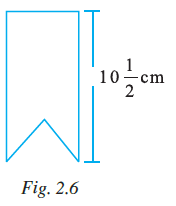
Question 68. Anvi is making bookmarker like the one shown in Fig. 2.6. How many bookmarker can she make from a 15 m long ribbon?
Answer:
Given:
Length of one bookmark (from Fig. 2.6) = $10 \frac{1}{2}$ cm
Total length of the ribbon = $15$ m
To Find:
Number of bookmarks Anvi can make.
Solution:
First, we need to ensure both lengths are in the same unit. We know that $1$ m = $100$ cm.
$\text{Total length of ribbon} = 15 \times 100 \text{ cm} = 1500$ cm
Now, let's convert the mixed fraction of the bookmark length into an improper fraction:
$\text{Length of one bookmark} = 10 \frac{1}{2} \text{ cm} = \frac{21}{2}$ cm
To find the number of bookmarks, we divide the total length of the ribbon by the length of one bookmark:
$\text{Number of bookmarks} = \text{Total length} \div \text{Length of one bookmark}$
$\text{Number of bookmarks} = 1500 \div \frac{21}{2}$
$\text{Number of bookmarks} = 1500 \times \frac{2}{21}$
$\text{Number of bookmarks} = \frac{3000}{21}$
On dividing $3000$ by $21$:
$\text{Number of bookmarks} = 142.85...$
Since the number of bookmarks must be a whole number, Anvi can make $142$ bookmarks.
Question 69. A rule for finding the approximate length of diagonal of a square is to multiply the length of a side of the square by 1.414. Find the length of the diagonal when :
(a) The length of a side of the square is 8.3 cm.
(b) The length of a side of the square is exactly 7.875 cm.
Answer:
Given Rule:
$\text{Length of diagonal} = \text{Side} \times 1.414$
(Given Rule)
Solution (a):
Length of a side = $8.3$ cm
$\text{Length of diagonal} = 8.3 \times 1.414$
$\text{Length of diagonal} = 11.7362$ cm
Solution (b):
Length of a side = $7.875$ cm
$\text{Length of diagonal} = 7.875 \times 1.414$
$\text{Length of diagonal} = 11.13525$ cm
Question 70. The largest square that can be drawn in a circle has a side whose length is 0.707 times the diameter of the circle. By this rule, find the length of the side of such a square when the diameter of the circle is
(a) 14.35 cm
(b) 8.63 cm
Answer:
Given Rule:
$\text{Side of square} = 0.707 \times \text{Diameter of circle}$
Solution (a):
Diameter = $14.35$ cm
$\text{Length of side} = 0.707 \times 14.35$
$\text{Length of side} = 10.14545$ cm
Solution (b):
Diameter = $8.63$ cm
$\text{Length of side} = 0.707 \times 8.63$
$\text{Length of side} = 6.10141$ cm
Question 71. To find the distance around a circular disc, multiply the diameter of the disc by 3.14. What is the distance around the disc when :
(a) the diameter is 18.7 cm?
(b) the radius is 6.45 cm?
Answer:
Given Rule:
$\text{Distance around disc} = \text{Diameter} \times 3.14$
Solution (a):
Diameter = $18.7$ cm
$\text{Distance around disc} = 18.7 \times 3.14$
$\text{Distance} = 58.718$ cm
Solution (b):
Radius = $6.45$ cm
We know that Diameter = $2 \times$ Radius
$\text{Diameter} = 2 \times 6.45 = 12.9$ cm
$\text{Distance around disc} = 12.9 \times 3.14$
$\text{Distance} = 40.506$ cm
Question 72. What is the cost of 27.5 m of cloth at ₹ 53.50 per metre?
Answer:
Given:
Total length of cloth = $27.5$ m
Cost of cloth per metre = $\textsf{₹} 53.50$
To Find:
Total cost of the cloth.
Solution:
$\text{Total Cost} = \text{Length of cloth} \times \text{Cost per metre}$
$\text{Total Cost} = 27.5 \times 53.50$
To calculate the product:
$\begin{array}{cc} & & & 5 & 3 & 5 & 0 \\ \times & & & & 2 & 7 & 5 \\ \hline && 2 & 6 & 7 & 5 & 0 \\ & 3 & 7 & 4 & 5 & 0 & \times \\ 1 & 0 & 7 & 0 & 0 & \times & \times \\ \hline 1 & 4 & 7 & 1 & 2 & 5 & 0 \\ \hline \end{array}$
After adjusting the decimal places (one place in 27.5 and two places in 53.50, total three places):
$\text{Total Cost} = \textsf{₹} 1471.25$
The total cost of $27.5$ m of cloth is $\textsf{₹} 1471.25$.
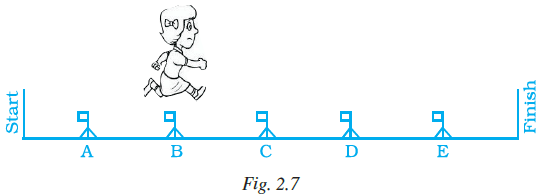
Question 73. In a hurdle race, Nidhi is over hurdle B and $\frac{2}{6}$ of the way through the race, as shown in Fig. 2.7.
Then, answer the following:
(a) Where will Nidhi be, when she is $\frac{4}{6}$ of the way through the race?
(b) Where will Nidhi be when she is $\frac{5}{6}$ of the way through the race?
(c) Give two fractions to tell what part of the race Nidhi has finished when she is over hurdle C.
Answer:
Given:
As per the given figure and information, the race is divided into equal segments by hurdles A, B, C, D, and E.
$\text{Position at Hurdle B} = \frac{2}{6}$
(Given)
Since Hurdle B represents the second segment out of six, we can conclude that each hurdle represents a successive sixth of the total race distance:
Hurdle A = $\frac{1}{6}$, Hurdle B = $\frac{2}{6}$, Hurdle C = $\frac{3}{6}$, Hurdle D = $\frac{4}{6}$, Hurdle E = $\frac{5}{6}$.
Solution:
(a) Where will Nidhi be at $\frac{4}{6}$ of the way?
Based on the pattern established above, the position $\frac{4}{6}$ corresponds to Hurdle D.
(b) Where will Nidhi be at $\frac{5}{6}$ of the way?
Based on the pattern established above, the position $\frac{5}{6}$ corresponds to Hurdle E.
(c) Two fractions for the part of the race finished at Hurdle C:
At Hurdle C, Nidhi is at the third marker out of six segments.
First fraction: $\frac{3}{6}$
To find the second fraction, we simplify the first one:
$\frac{\cancel{3}^1}{\cancel{6}_2} = \frac{1}{2}$
So, the two fractions are $\frac{3}{6}$ and $\frac{1}{2}$.
Question 74. Diameter of Earth is 12756000 m. In 1996, a new planet was discovered whose diameter is $\frac{5}{86}$ of the diameter of Earth. Find the diameter of this planet in km
Answer:
Given:
Diameter of Earth = $12756000$ m
Ratio of the new planet's diameter to Earth's diameter = $\frac{5}{86}$
To Find:
Diameter of the new planet in km.
Solution:
First, let's convert the diameter of Earth from metres to kilometres.
$\text{Diameter of Earth (in km)} = \frac{12756000}{1000}$
[$1$ km = $1000$ m]
$\text{Diameter of Earth} = 12756$ km
Now, calculate the diameter of the new planet:
$\text{Diameter of new planet} = \frac{5}{86} \times 12756$
$\text{Diameter of new planet} = 5 \times \frac{12756}{86}$
$\text{Diameter of new planet} = 5 \times 148.325...$
$\text{Diameter of new planet} \approx 741.63$ km
The diameter of the new planet is approximately $741.63$ km.
Question 75. What is the product of $\frac{5}{129}$ and its reciprocal?
Answer:
Given:
The fraction is $\frac{5}{129}$.
Solution:
The reciprocal of a fraction $\frac{a}{b}$ is $\frac{b}{a}$.
$\text{Reciprocal of } \frac{5}{129} = \frac{129}{5}$
Now, find the product:
$\text{Product} = \frac{5}{129} \times \frac{129}{5}$
$\text{Product} = \frac{\cancel{5}^1}{\cancel{129}_1} \times \frac{\cancel{129}^1}{\cancel{5}_1}$
$\text{Product} = 1$
The product of any non-zero fraction and its reciprocal is always $1$.
Question 76. Simplify: $\frac{2\frac{1}{2}+\frac{1}{5}}{2\frac{1}{2}\div\frac{1}{5}}$
Answer:
Given Expression:
$\frac{2\frac{1}{2}+\frac{1}{5}}{2\frac{1}{2}\div\frac{1}{5}}$
Solution:
First, convert the mixed fraction $2\frac{1}{2}$ to an improper fraction:
$2\frac{1}{2} = \frac{(2 \times 2) + 1}{2} = \frac{5}{2}$
Now, simplify the Numerator:
$\text{Numerator} = \frac{5}{2} + \frac{1}{5}$
Taking LCM of $2$ and $5$, which is $10$:
$\text{Numerator} = \frac{5 \times 5}{10} + \frac{1 \times 2}{10} = \frac{25 + 2}{10} = \frac{27}{10}$
Now, simplify the Denominator:
$\text{Denominator} = \frac{5}{2} \div \frac{1}{5}$
$\text{Denominator} = \frac{5}{2} \times \frac{5}{1} = \frac{25}{2}$
Finally, divide the simplified numerator by the simplified denominator:
$\text{Result} = \frac{27}{10} \div \frac{25}{2}$
$\text{Result} = \frac{27}{10} \times \frac{2}{25}$
$\text{Result} = \frac{27 \times \cancel{2}^1}{\cancel{10}_5 \times 25}$
$\text{Result} = \frac{27}{125}$
The simplified value is $\frac{27}{125}$.
Question 77. Simplify: $\frac{\frac{1}{4}+\frac{1}{5}}{1-\frac{3}{8}\times\frac{1}{5}}$
Answer:
Given Expression:
$\frac{\frac{1}{4}+\frac{1}{5}}{1-\frac{3}{8}\times\frac{1}{5}}$
Solution:
Simplify the Numerator:
$\text{Numerator} = \frac{1}{4} + \frac{1}{5}$
Taking LCM of $4$ and $5$, which is $20$:
$\text{Numerator} = \frac{5 + 4}{20} = \frac{9}{20}$
Simplify the Denominator:
$\text{Denominator} = 1 - \left( \frac{3}{8} \times \frac{1}{5} \right)$
$\text{Denominator} = 1 - \frac{3}{40}$
$\text{Denominator} = \frac{40 - 3}{40} = \frac{37}{40}$
Now, divide the numerator by the denominator:
$\text{Result} = \frac{9}{20} \div \frac{37}{40}$
$\text{Result} = \frac{9}{20} \times \frac{40}{37}$
$\text{Result} = \frac{9 \times \cancel{40}^2}{\cancel{20}_1 \times 37}$
$\text{Result} = \frac{18}{37}$
The simplified value is $\frac{18}{37}$.
Question 78. Divide $\frac{3}{10}$ by $\left( \frac{1}{4} \; of \; \frac{3}{5} \right)$
Answer:
To Find:
$\frac{3}{10} \div \left( \frac{1}{4} \text{ of } \frac{3}{5} \right)$
Solution:
First, solve the part within the brackets using the 'of' operator (multiplication):
$\left( \frac{1}{4} \text{ of } \frac{3}{5} \right) = \frac{1}{4} \times \frac{3}{5} = \frac{3}{20}$
Now, perform the division:
$\text{Result} = \frac{3}{10} \div \frac{3}{20}$
To divide by a fraction, we multiply by its reciprocal:
$\text{Result} = \frac{3}{10} \times \frac{20}{3}$
$\text{Result} = \frac{\cancel{3}^1}{\cancel{10}_1} \times \frac{\cancel{20}^2}{\cancel{3}_1}$
$\text{Result} = 1 \times 2 = 2$
The final answer is $2$.
Question 79. $\frac{1}{8}$ of a number equals $\frac{2}{5}$ ÷ $\frac{1}{20}$ . What is the number?
Answer:
Given:
One-eighth of a number is equal to the quotient of $\frac{2}{5}$ divided by $\frac{1}{20}$.
To Find:
The unknown number.
Solution:
Let the required number be $x$.
According to the question, the mathematical expression is:
$\frac{1}{8} \text{ of } x = \frac{2}{5} \div \frac{1}{20}$
First, let's solve the Right Hand Side (RHS):
$\frac{2}{5} \div \frac{1}{20} = \frac{2}{5} \times \frac{20}{1}$
$\text{RHS} = \frac{2 \times \cancel{20}^4}{\cancel{5}_1}$
$\text{RHS} = 2 \times 4 = 8$
Now, substitute this value back into the equation:
$\frac{1}{8} \times x = 8$
Multiply both sides by $8$ to find $x$:
$x = 8 \times 8$
$x = 64$
The required number is $64$.
Question 80. Heena’s father paid an electric bill of ₹ 385.70 out of a 500 rupee note. How much change should he have received?
Answer:
Given:
Amount paid by Heena's father = $\textsf{₹} 500.00$
Amount of the electric bill = $\textsf{₹} 385.70$
To Find:
The change received by him.
Solution:
To find the change, we subtract the bill amount from the total amount paid:
$\text{Change} = 500.00 - 385.70$
$\begin{array}{cc} & 5 & 0 & 0 & . & 0 & 0 \\ - & 3 & 8 & 5 & . & 7 & 0 \\ \hline & 1 & 1 & 4 & . & 3 & 0 \\ \hline \end{array}$
Heena's father should have received $\textsf{₹} 114.30$ as change.
Question 81. The normal body temperature is 98.6°F. When Savitri was ill her temperature rose to 103.1°F. How many degrees above normal was that?
Answer:
Given:
Normal body temperature = $98.6^\circ F$
Temperature during illness = $103.1^\circ F$
To Find:
The temperature difference (rise in temperature).
Solution:
To find how many degrees above normal the temperature was, we subtract the normal temperature from the measured temperature:
$\text{Temperature Rise} = 103.1^\circ F - 98.6^\circ F$
$\begin{array}{cc} & 1 & 0 & 3 & . & 1 \\ - & & 9 & 8 & . & 6 \\ \hline & & & 4 & . & 5 \\ \hline \end{array}$
The temperature was $4.5^\circ F$ above normal.
Question 82. Meteorology: One measure of average global temperature shows how each year varies from a base measure. The table shows results for several years.
| Year | 1958 | 1964 | 1965 | 1978 | 2002 |
| Difference from Base (°C) | 0.10$^\circ C$ | –0.17$^\circ C$ | –0.10$^\circ C$ | $\left( \frac{1}{50} \right)^\circ C$ | 0.54$^\circ C$ |
See the table and answer the following:
(a) Order the five years from coldest to warmest.
(b) In 1946, the average temperature varied by –0.030C from the base measure. Between which two years should 1946 fall when the years are ordered from coldest to warmest?
Answer:
Given:
Variation from base temperature for different years. Let's convert all variations to decimal form for easy comparison:
| Year | Difference from Base ($\circ C$) |
| 1958 | $0.10$ |
| 1964 | $-0.17$ |
| 1965 | $-0.10$ |
| 1978 | $\frac{1}{50} = 0.02$ |
| 2002 | $0.54$ |
Solution (a):
To order the years from coldest to warmest, we arrange the temperature differences in ascending order (lowest value to highest value):
Comparing the values: $-0.17 < -0.10 < 0.02 < 0.10 < 0.54$
The order of years from coldest to warmest is: 1964, 1965, 1978, 1958, 2002.
Solution (b):
For the year 1946, the variation is $-0.03^\circ C$.
We need to place $-0.03$ in our sorted list of values:
$-0.10 < -0.03 < 0.02$
Since $-0.10$ corresponds to 1965 and $0.02$ corresponds to 1978, the year 1946 should fall between 1965 and 1978.
Science Application
Question 83. In her science class, Jyoti learned that the atomic weight of Helium is 4.0030; of Hydrogen is 1.0080; and of Oxygen is 16.0000. Find the difference between the atomic weights of:
(a) Oxygen and Hydrogen
(b) Oxygen and Helium
(c) Helium and Hydrogen
Answer:
Given:
Atomic weight of Helium (He) = $4.0030$
Atomic weight of Hydrogen (H) = $1.0080$
Atomic weight of Oxygen (O) = $16.0000$
Solution:
(a) Difference between Oxygen and Hydrogen:
$\begin{array}{cc} & 1 & 6 & . & 0 & 0 & 0 & 0 \\ - & & 1 & . & 0 & 0 & 8 & 0 \\ \hline & 1 & 4 & . & 9 & 9 & 2 & 0 \\ \hline \end{array}$
The difference is $14.9920$.
(b) Difference between Oxygen and Helium:
$\begin{array}{cc} & 1 & 6 & . & 0 & 0 & 0 & 0 \\ - & & 4 & . & 0 & 0 & 3 & 0 \\ \hline & 1 & 1 & . & 9 & 9 & 7 & 0 \\ \hline \end{array}$
The difference is $11.9970$.
(c) Difference between Helium and Hydrogen:
$\begin{array}{cc} & 4 & . & 0 & 0 & 3 & 0 \\ - & 1 & . & 0 & 0 & 8 & 0 \\ \hline & 2 & . & 9 & 9 & 5 & 0 \\ \hline \end{array}$
The difference is $2.9950$.
Question 84. Measurement made in science lab must be as accurate as possible. Ravi measured the length of an iron rod and said it was 19.34 cm long; Kamal said 19.25 cm; and Tabish said 19.27 cm. The correct length was 19.33 cm. How much of error was made by each of the boys?
Answer:
Given:
Correct length of the iron rod = $19.33$ cm
Ravi's measurement = $19.34$ cm
Kamal's measurement = $19.25$ cm
Tabish's measurement = $19.27$ cm
Solution:
The error is the difference between the measured length and the correct length.
Error by Ravi:
$|19.34 - 19.33| = 0.01$ cm
Error by Kamal:
$|19.33 - 19.25|$
$\begin{array}{cc} & 1 & 9 & . & 3 & 3 \\ - & 1 & 9 & . & 2 & 5 \\ \hline & & 0 & . & 0 & 8 \\ \hline \end{array}$
The error is $0.08$ cm.
Error by Tabish:
$|19.33 - 19.27|$
$\begin{array}{cc} & 1 & 9 & . & 3 & 3 \\ - & 1 & 9 & . & 2 & 7 \\ \hline & & 0 & . & 0 & 6 \\ \hline \end{array}$
The error is $0.06$ cm.
Summary:
The errors made are: Ravi ($0.01$ cm), Kamal ($0.08$ cm), and Tabish ($0.06$ cm).
Question 85. When 0.02964 is divided by 0.004, what will be the quotient?
Answer:
To Find:
The quotient of $0.02964 \div 0.004$.
Solution:
First, we can express the division as a fraction:
$\frac{0.02964}{0.004}$
To eliminate the decimals in the denominator, we multiply both numerator and denominator by $1000$ (since there are three decimal places in the denominator):
$\frac{0.02964 \times 1000}{0.004 \times 1000} = \frac{29.64}{4}$
Now, perform the division:
$\begin{array}{r} 7.41\phantom{)} \\ 4{\overline{\smash{\big)}\,29.64\phantom{)}}} \\ \underline{-~28\phantom{.00}} \\ 1.6\phantom{4)} \\ \underline{-~1.6\phantom{4)}} \\ 0.04\phantom{)} \\ \underline{-~0.04\phantom{)}} \\ 0\phantom{)} \end{array}$
The quotient is $7.41$.
Question 86. What number divided by 520 gives the same quotient as 85 divided by 0.625?
Answer:
Given:
We need to find a number $x$ such that:
$\frac{x}{520} = \frac{85}{0.625}$
Solution:
First, let's calculate the quotient of $85 \div 0.625$:
$\frac{85}{0.625} = \frac{85 \times 1000}{625}$
$\frac{85000}{625} = 136$
Now, substitute this value back into equation (i):
$\frac{x}{520} = 136$
$x = 136 \times 520$
To find the product of $136$ and $520$:
$\begin{array}{cc}& & & 5 & 2 & 0 \\ \times & & & 1 & 3 & 6 \\ \hline && 3 & 1 & 2 & 0 \\ & 1 & 5 & 6 & 0 & \times \\ & 5 & 2 & 0 & \times & \times \\ \hline & 7 & 0 & 7 & 2 & 0 \\ \hline \end{array}$
The required number is $70720$.
Question 87. A floor is 4.5 m long and 3.6 m wide. A 6 cm square tile costs ₹ 23.25. What will be the cost to cover the floor with these tiles?
Answer:
Given:
Length of the floor = $4.5$ m = $450$ cm
Width of the floor = $3.6$ m = $360$ cm
Side of the square tile = $6$ cm
Cost of one tile = $\textsf{₹} 23.25$
To Find:
The total cost to cover the floor with tiles.
Solution:
First, we calculate the area of the floor:
$\text{Area of floor} = \text{Length} \times \text{Width}$
(Formula)
$\text{Area of floor} = 450 \times 360 = 162000 \text{ cm}^2$
Next, we calculate the area of one square tile:
$\text{Area of one tile} = \text{side} \times \text{side} = 6 \times 6 = 36 \text{ cm}^2$
Now, we find the number of tiles required:
$\text{Number of tiles} = \frac{\text{Area of floor}}{\text{Area of one tile}}$
$\text{Number of tiles} = \frac{162000}{36} = 4500$
Finally, we calculate the total cost:
$\text{Total Cost} = \text{Number of tiles} \times \text{Cost per tile}$
$\text{Total Cost} = 4500 \times 23.25$
$\text{Total Cost} = 45 \times 2325$
$\begin{array}{cc}& & 2 & 3 & 2 & 5 \\ \times & & & & 4 & 5 \\ \hline & 1 & 1 & 6 & 2 & 5 \\ & 9 & 3 & 0 & 0 & \times \\ \hline 1 & 0 & 4 & 6 & 2 & 5 \\ \hline \end{array}$
The total cost to cover the floor is $\textsf{₹} 104625$.
Question 88. Sunita and Rehana want to make dresses for their dolls. Sunita has $\frac{3}{4}$ m of cloth, and she gave $\frac{1}{3}$ of it to Rehana. How much did Rehana have?
Answer:
Given:
Total cloth Sunita has = $\frac{3}{4}$ m
Fraction of cloth given to Rehana = $\frac{1}{3}$ of Sunita's cloth
Solution:
Amount of cloth Rehana has:
$\text{Cloth with Rehana} = \frac{1}{3} \text{ of } \frac{3}{4}$
$\text{Cloth with Rehana} = \frac{1}{\cancel{3}} \times \frac{\cancel{3}}{4}$
$\text{Cloth with Rehana} = \frac{1}{4}$ m
Rehana had $\frac{1}{4}$ m of cloth (or $0.25$ m).
Question 89. A flower garden is 22.50 m long. Sheela wants to make a border along one side using bricks that are 0.25 m long. How many bricks will be needed?
Answer:
Given:
Length of the garden side = $22.50$ m
Length of one brick = $0.25$ m
Solution:
To find the number of bricks needed, we divide the total length of the garden side by the length of one brick:
$\text{Number of bricks} = \frac{22.50}{0.25}$
To simplify, multiply both numerator and denominator by $100$:
$\text{Number of bricks} = \frac{2250}{25}$
$\text{Number of bricks} = \frac{\cancel{2250}^{90}}{\cancel{25}_{1}}$
Sheela will need $90$ bricks.
Question 90. How much cloth will be used in making 6 shirts, if each required $2\frac{1}{4}$ m of cloth, allowing $\frac{1}{8}$ m for waste in cutting and finishing in each shirt?
Answer:
Given:
Cloth required for one shirt = $2 \frac{1}{4}$ m
Waste per shirt = $\frac{1}{8}$ m
Number of shirts = $6$
Solution:
First, calculate the total cloth needed for one shirt including waste:
$\text{Total per shirt} = 2 \frac{1}{4} + \frac{1}{8}$
$\text{Total per shirt} = \frac{9}{4} + \frac{1}{8}$
Taking LCM of $4$ and $8$, which is $8$:
$\text{Total per shirt} = \frac{18}{8} + \frac{1}{8} = \frac{19}{8}$ m
Now, calculate the cloth for $6$ shirts:
$\text{Total cloth} = 6 \times \frac{19}{8}$
$\text{Total cloth} = \frac{\cancel{6}^3 \times 19}{\cancel{8}_4}$
$\text{Total cloth} = \frac{57}{4}$ m
Converting to decimal or mixed fraction:
$\text{Total cloth} = 14 \frac{1}{4}$ m or $14.25$ m
The total cloth used will be $14.25$ m.
Question 91. A picture hall has seats for 820 persons. At a recent film show, one usher guessed it was $\frac{3}{4}$ full, another that it was $\frac{2}{3}$ full. The ticket office reported 648 sales. Which usher (first or second) made the better guess?
Answer:
Given:
Total capacity of the hall = $820$ seats
Actual ticket sales = $648$
Usher 1 guess = $\frac{3}{4}$ full
Usher 2 guess = $\frac{2}{3}$ full
Solution:
First, calculate the actual number of people for each guess:
Usher 1's guess:
$\text{Guess 1} = \frac{3}{4} \times 820 = 3 \times 205 = 615$ persons
Usher 2's guess:
$\text{Guess 2} = \frac{2}{3} \times 820 = \frac{1640}{3} \approx 546.67$ persons
Now, find the error (difference from actual sales) for each:
$\text{Error 1} = |648 - 615| = 33$
$\text{Error 2} = |648 - 546.67| = 101.33$
Since the first usher's error ($33$) is smaller than the second usher's error ($101.33$), the first usher made the better guess.
Question 92. For the celebrating children’s students of Class VII bought sweets for ₹ 740.25 and cold drink for ₹ 70. If 35 students contributed equally what amount was contributed by each student?
Answer:
Given:
Cost of sweets = $\textsf{₹} 740.25$
Cost of cold drinks = $\textsf{₹} 70.00$
Number of students = $35$
To Find:
Contribution per student.
Solution:
First, find the total expenditure:
$\text{Total Expense} = 740.25 + 70.00$
$\begin{array}{cc} & 7 & 4 & 0 & . & 2 & 5 \\ + & & 7 & 0 & . & 0 & 0 \\ \hline & 8 & 1 & 0 & . & 2 & 5 \\ \hline \end{array}$
Now, divide the total expense by the number of students:
$\text{Contribution per student} = \frac{810.25}{35}$
$\text{Contribution per student} = 23.15$
Each student contributed $\textsf{₹} 23.15$.
Question 93. The time taken by Rohan in five different races to run a distance of 500 m was 3.20 minutes, 3.37 minutes, 3.29 minutes, 3.17 minutes and 3.32 minutes. Find the average time taken by him in the races.
Answer:
Given:
Times taken in 5 races (in minutes): $3.20,\ 3.37,\ 3.29,\ 3.17,\ 3.32$
To Find:
Average time taken by Rohan.
Solution:
Average is calculated by dividing the sum of all observations by the total number of observations.
$\text{Average Time} = \frac{\text{Sum of all race times}}{\text{Total number of races}}$
First, we find the sum of the times:
$\begin{array}{cc} & 3 & . & 2 & 0 \\ & 3 & . & 3 & 7 \\ & 3 & . & 2 & 9 \\ & 3 & . & 1 & 7 \\ + & 3 & . & 3 & 2 \\ \hline 1 & 6 & . & 3 & 5 \\ \hline \end{array}$
Now, substituting the sum in equation (i):
$\text{Average Time} = \frac{16.35}{5}$
$\text{Average Time} = 3.27$ minutes
The average time taken by Rohan in the races is $3.27$ minutes.
Question 94. A public sewer line is being installed along $80\frac{1}{4}$ m of road. The supervisor says that the labourers will be able to complete 7.5 m in one day. How long will the project take to complete?
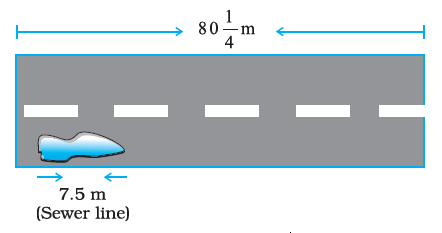
Answer:
Given:
Total length of the sewer line = $80\frac{1}{4}$ m
Work completed in one day = $7.5$ m
To Find:
Total number of days to complete the project.
Solution:
First, convert the mixed fraction and decimal into improper fractions:
$\text{Total Length} = 80\frac{1}{4} = \frac{321}{4}$ m
[As $80 \times 4 + 1 = 321$]
$\text{Daily Work} = 7.5 = \frac{75}{10} = \frac{15}{2}$ m
[Simplified by $5$]
To find the total time, we divide the total length by the daily work rate:
$\text{Number of days} = \text{Total Length} \div \text{Daily Work}$
$\text{Number of days} = \frac{321}{4} \div \frac{15}{2}$
$\text{Number of days} = \frac{321}{4} \times \frac{2}{15}$
$\text{Number of days} = \frac{321 \times \cancel{2}^1}{\cancel{4}_2 \times 15}$
$\text{Number of days} = \frac{\cancel{321}^{107}}{2 \times \cancel{15}_5}$
$\text{Number of days} = \frac{107}{10} = 10.7$ days
The project will take $10.7$ (round off 11) days to complete.
Question 95. The weight of an object on moon is $\frac{1}{6}$ its weight on Earth. If an object weighs $5\frac{3}{5}$kg on Earth, how much would it weigh on the moon?
Answer:
Given:
Weight of the object on Earth = $5\frac{3}{5}$ kg
$\text{Weight on Moon} = \frac{1}{6} \times \text{Weight on Earth}$
Solution:
Convert the mixed fraction to an improper fraction:
$\text{Weight on Earth} = 5\frac{3}{5} = \frac{(5 \times 5) + 3}{5} = \frac{28}{5}$ kg
Now, calculate the weight on the moon:
$\text{Weight on Moon} = \frac{1}{6} \times \frac{28}{5}$
$\text{Weight on Moon} = \frac{1 \times \cancel{28}^{14}}{\cancel{6}_3 \times 5}$
$\text{Weight on Moon} = \frac{14}{15}$ kg
The object would weigh $\frac{14}{15}$ kg on the moon.
Question 96. In a survey, 200 students were asked what influenced them most to buy their latest CD. The results are shown in the circle graph.
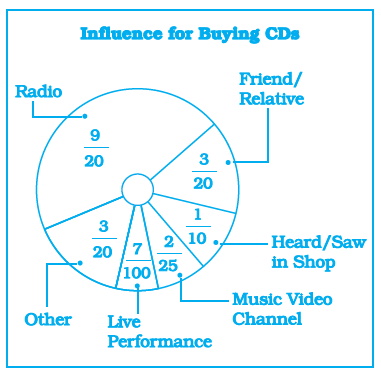
(a) How many students said radio influenced them most?
(b) How many more students were influenced by radio than by a music video channel?
(c) How many said a friend or relative influenced them or they heard the CD in a shop?
Answer:
Given:
Total number of students surveyed = $200$
Fractions from the graph:
• Radio = $\frac{9}{20}$
• Music Video Channel = $\frac{2}{25}$
• Friend/Relative = $\frac{3}{20}$
• Heard/Saw in Shop = $\frac{1}{10}$
• Live Performance = $\frac{7}{100}$
• Heard/Saw in Shop = $\frac{3}{20}$
Solution (a):
Number of students influenced by Radio:
$\text{Students} = \frac{9}{20} \times 200$
$\text{Students} = 9 \times 10 = 90$
$90$ students said radio influenced them most.
Solution (b):
First, find the number of students influenced by Music Video Channel:
$\text{Students} = \frac{2}{25} \times 200$
$\text{Students} = 2 \times 8 = 16$
Now, find the difference between Radio and Music Video Channel:
$\text{Difference} = 90 - 16 = 74$
$74$ more students were influenced by radio than by a music video channel.
Solution (c):
Find the number of students for both categories:
1. Friend or Relative = $\frac{3}{20} \times 200 = 3 \times 10 = 30$ students
2. Heard/Saw in Shop = $\frac{1}{10} \times 200 = 20$ students
Total for both = $30 + 20 = 50$ students
$50$ students said a friend/relative influenced them or they heard it in a shop.
Question 97. In the morning, a milkman filled $5\frac{1}{2}$ L of milk in his can. He sold to Renu, Kamla and Renuka $\frac{3}{4}$ L each; to Shadma he sold $\frac{7}{8}$ L ; and to Jassi he gave $1\frac{1}{2}$ L. How much milk is left in the can?
Answer:
Given:
Total milk initially = $5\frac{1}{2}$ L = $\frac{11}{2}$ L
Milk sold to Renu, Kamla, and Renuka = $3 \times \frac{3}{4}$ L
Milk sold to Shadma = $\frac{7}{8}$ L
Milk sold to Jassi = $1\frac{1}{2}$ L = $\frac{3}{2}$ L
To Find:
The remaining quantity of milk in the can.
Solution:
First, calculate the Total Milk Sold:
$\text{Total Sold} = \left( 3 \times \frac{3}{4} \right) + \frac{7}{8} + \frac{3}{2}$
$\text{Total Sold} = \frac{9}{4} + \frac{7}{8} + \frac{3}{2}$
Taking the LCM of $4, 8,$ and $2$, which is $8$:
$\text{Total Sold} = \frac{9 \times 2}{8} + \frac{7}{8} + \frac{3 \times 4}{8}$
$\text{Total Sold} = \frac{18 + 7 + 12}{8} = \frac{37}{8}$ L
Now, find the Milk Left by subtracting the sold quantity from the initial quantity:
$\text{Milk Left} = \text{Total Milk} - \text{Total Sold}$
$\text{Milk Left} = \frac{11}{2} - \frac{37}{8}$
Taking LCM of $2$ and $8$, which is $8$:
$\text{Milk Left} = \frac{11 \times 4}{8} - \frac{37}{8}$
$\text{Milk Left} = \frac{44 - 37}{8}$
$\text{Milk Left} = \frac{7}{8}$ L
The quantity of milk left in the can is $\frac{7}{8}$ L.
Question 98. Anuradha can do a piece of work in 6 hours. What part of the work can she do in 1 hour, in 5 hours, in 6 hours?
Answer:
Given:
Time taken by Anuradha to complete the whole work = $6$ hours.
To Find:
Part of the work done in $1$ hour, $5$ hours, and $6$ hours.
Solution:
The rate of work done per hour is the reciprocal of the total time taken to finish the work.
1. Part of work done in $1$ hour:
Since the whole work takes $6$ hours, in $1$ hour, she will complete $\frac{1}{6}$ of the work.
2. Part of work done in $5$ hours:
$\text{Work done in } 5 \text{ hours} = 5 \times (\text{Work done in } 1 \text{ hour})$
$\text{Work done} = 5 \times \frac{1}{6} = \frac{5}{6}$
3. Part of work done in $6$ hours:
$\text{Work done in } 6 \text{ hours} = 6 \times \frac{1}{6}$
$\text{Work done} = \frac{\cancel{6}^1}{\cancel{6}_1} = 1$ (which represents the whole work).
Final Answer:
Anuradha can do $\frac{1}{6}$ of the work in $1$ hour, $\frac{5}{6}$ in $5$ hours, and $1$ full work in $6$ hours.
Question 99. What portion of a ‘saree’ can Rehana paint in 1 hour if it requires 5 hours to paint the whole saree? In $4\frac{3}{5}$ hours? In $3\frac{1}{2}$ hours?
Answer:
Given:
Total time required to paint the whole saree = $5$ hours.
To Find:
Portion of saree painted in $1$ hour, $4\frac{3}{5}$ hours, and $3\frac{1}{2}$ hours.
Solution:
1. Portion painted in $1$ hour:
$\text{Portion in } 1 \text{ hour} = \frac{1}{\text{Total time}} = \frac{1}{5}$
2. Portion painted in $4\frac{3}{5}$ hours:
First, convert $4\frac{3}{5}$ to an improper fraction: $4\frac{3}{5} = \frac{(4 \times 5) + 3}{5} = \frac{23}{5}$ hours.
$\text{Portion painted} = \text{Time} \times \text{Work per hour}$
$\text{Portion painted} = \frac{23}{5} \times \frac{1}{5} = \frac{23}{25}$
3. Portion painted in $3\frac{1}{2}$ hours:
First, convert $3\frac{1}{2}$ to an improper fraction: $3\frac{1}{2} = \frac{(3 \times 2) + 1}{2} = \frac{7}{2}$ hours.
$\text{Portion painted} = \frac{7}{2} \times \frac{1}{5} = \frac{7}{10}$
Final Answer:
Portion painted in $1$ hour is $\frac{1}{5}$, in $4\frac{3}{5}$ hours is $\frac{23}{25}$, and in $3\frac{1}{2}$ hours is $\frac{7}{10}$.
Question 100. Rama has $6\frac{1}{4}$ kg of cotton wool for making pillows. If one pillow takes $1\frac{1}{4}$ kg, how many pillows can she make?
Answer:
Given:
Total weight of cotton wool = $6 \frac{1}{4}$ kg
Cotton wool required for one pillow = $1 \frac{1}{4}$ kg
To Find:
Number of pillows Rama can make.
Solution:
First, let us convert the mixed fractions into improper fractions:
$\text{Total cotton} = 6 \frac{1}{4} = \frac{(6 \times 4) + 1}{4} = \frac{25}{4}$ kg
$\text{Cotton per pillow} = 1 \frac{1}{4} = \frac{(1 \times 4) + 1}{4} = \frac{5}{4}$ kg
To find the number of pillows, divide the total cotton by cotton per pillow:
$\text{Number of pillows} = \frac{25}{4} \div \frac{5}{4}$
$\text{Number of pillows} = \frac{25}{4} \times \frac{4}{5}$
$\text{Number of pillows} = \frac{\cancel{25}^5}{\cancel{4}_1} \times \frac{\cancel{4}^1}{\cancel{5}_1} = 5$
Rama can make $5$ pillows.
Question 101. It takes $2\frac{1}{3}$ m of cloth to make a shirt. How many shirts can Radhika make from a piece of cloth $9\frac{1}{3}$ m long?
Answer:
Given:
Total length of cloth = $9 \frac{1}{3}$ m
Cloth required for one shirt = $2 \frac{1}{3}$ m
To Find:
Number of shirts Radhika can make.
Solution:
Converting mixed fractions into improper fractions:
$\text{Total length} = 9 \frac{1}{3} = \frac{28}{3}$ m
$\text{Cloth per shirt} = 2 \frac{1}{3} = \frac{7}{3}$ m
Number of shirts = $\text{Total length} \div \text{Cloth per shirt}$
$\text{Number of shirts} = \frac{28}{3} \div \frac{7}{3}$
$\text{Number of shirts} = \frac{28}{3} \times \frac{3}{7}$
$\text{Number of shirts} = \frac{\cancel{28}^4}{\cancel{3}_1} \times \frac{\cancel{3}^1}{\cancel{7}_1} = 4$
Radhika can make $4$ shirts.
Question 102. Ravi can walk $3\frac{1}{3}$ km in one hour. How long will it take him to walk to his office which is 10 km from his home?
Answer:
Given:
Speed of Ravi = $3 \frac{1}{3}$ km/h
Distance to office = $10$ km
To Find:
Time taken to reach the office.
Solution:
Convert speed into an improper fraction:
$\text{Speed} = 3 \frac{1}{3} = \frac{10}{3}$ km/h
We know the formula for time:
$\text{Time} = \frac{\text{Distance}}{\text{Speed}}$
(Formula)
$\text{Time} = 10 \div \frac{10}{3}$
$\text{Time} = 10 \times \frac{3}{10}$
$\text{Time} = \frac{\cancel{10}^1 \times 3}{\cancel{10}_1} = 3$ hours
It will take Ravi $3$ hours to reach his office.
Question 103. Raj travels 360 km on three fifths of his petrol tank. How far would he travel at the same rate with a full tank of petrol?
Answer:
Given:
Distance covered with $\frac{3}{5}$ tank of petrol = $360$ km.
To Find:
Distance covered with a full tank (i.e., $1$ full tank).
Solution:
Let the distance covered with a full tank be $D$.
According to the question:
$\frac{3}{5} \times D = 360$
To find $D$, we multiply $360$ by the reciprocal of $\frac{3}{5}$:
$D = 360 \div \frac{3}{5}$
$D = 360 \times \frac{5}{3}$
$D = \frac{\cancel{360}^{120} \times 5}{\cancel{3}_1}$
$D = 120 \times 5 = 600$ km
Raj would travel $600$ km with a full tank of petrol.
Question 104. Kajol has ₹ 75. This is $\frac{3}{8}$ of the amount she earned. How much did she earn?
Answer:
Given:
Amount Kajol has = $\textsf{₹} 75$
This amount is $\frac{3}{8}$ of her total earnings.
To Find:
The total amount she earned.
Solution:
Let the total amount earned by Kajol be $\textsf{₹} x$.
According to the question:
$\frac{3}{8} \text{ of } x = 75$
$\frac{3}{8} \times x = 75$
$x = \frac{75 \times 8}{3}$
$x = \frac{\cancel{75}^{25} \times 8}{\cancel{3}_{1}}$
$x = 25 \times 8$
$x = 200$
Kajol earned a total of $\textsf{₹} 200$.
Question 105. It takes 17 full specific type of trees to make one tonne of paper. If there are 221 such trees in a forest, then
(i) what fraction of forest will be used to make;
(a) 5 tonnes of paper.
(b) 10 tonnes of paper.
(ii) To save $\frac{7}{13}$ part of the forest how much of paper we have to save.
Answer:
Given:
Number of trees required for $1$ tonne of paper = $17$
Total number of trees in the forest = $221$
Solution (i):
First, find the number of trees required for the given tonnes of paper:
(a) For 5 tonnes of paper:
$\text{Trees needed} = 5 \times 17 = 85$
$\text{Fraction of forest used} = \frac{\text{Trees used}}{\text{Total trees}} = \frac{85}{221}$
Simplifying by $17$:
$\text{Fraction} = \frac{\cancel{85}^{5}}{\cancel{221}_{13}} = \frac{5}{13}$
(b) For 10 tonnes of paper:
$\text{Trees needed} = 10 \times 17 = 170$
$\text{Fraction of forest used} = \frac{170}{221}$
Simplifying by $17$:
$\text{Fraction} = \frac{\cancel{170}^{10}}{\cancel{221}_{13}} = \frac{10}{13}$
Solution (ii):
To find the amount of paper to save, we first find the total paper capacity of the forest:
$\text{Total paper potential} = \frac{\text{Total trees}}{\text{Trees per tonne}} = \frac{221}{17} = 13$ tonnes.
We need to save $\frac{7}{13}$ part of the forest. This corresponds to the same fraction of the total paper potential.
$\text{Paper to be saved} = \frac{7}{13} \times 13 \text{ tonnes}$
$\text{Paper to be saved} = 7$ tonnes.
We have to save $7$ tonnes of paper.
Question 106. Simplify and write the result in decimal form :
$\left(1 \div \frac{2}{9} \right) + \left(1 \div 3\frac{1}{5} \right) + \left(1 \div 2\frac{2}{3} \right)$
Answer:
Given Expression:
$\left(1 \div \frac{2}{9} \right) + \left(1 \div 3\frac{1}{5} \right) + \left(1 \div 2\frac{2}{3} \right)$
Solution:
First, convert the mixed fractions into improper fractions:
$3\frac{1}{5} = \frac{16}{5}$
$2\frac{2}{3} = \frac{8}{3}$
Now, simplify each term:
1. $\left(1 \div \frac{2}{9}\right) = 1 \times \frac{9}{2} = \frac{9}{2} = 4.5$
2. $\left(1 \div \frac{16}{5}\right) = 1 \times \frac{5}{16} = \frac{5}{16} = 0.3125$
3. $\left(1 \div \frac{8}{3}\right) = 1 \times \frac{3}{8} = \frac{3}{8} = 0.375$
Finally, add the decimal results:
$\text{Total} = 4.5 + 0.3125 + 0.375$
$\begin{array}{cc} & 4 & . & 5 & 0 & 0 & 0 \\ & 0 & . & 3 & 1 & 2 & 5 \\ + & 0 & . & 3 & 7 & 5 & 0 \\ \hline & 5 & . & 1 & 8 & 7 & 5 \\ \hline \end{array}$
The result in decimal form is $5.1875$.
Question 107. Some pictures (a) to (f) are given below. Tell which of them show:
(1) 2 × $\frac{1}{4}$
(2) 2 × $\frac{3}{7}$
(3) 2 × $\frac{1}{3}$
(4) $\frac{1}{4}$ × 4
(5) 3 × $\frac{2}{9}$
(6) $\frac{1}{4}$ × 3
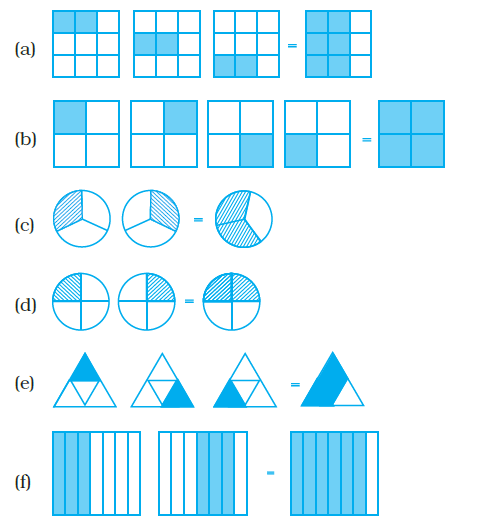
Answer:
By observing the shaded parts in each figure:
(a) There are 3 squares, each divided into 9 small squares. In each, 2 parts are shaded. This represents $3 \times \frac{2}{9}$.
(a) Matches with (5)
$\left( 3 \times \frac{2}{9} \right)$
(b) There are 4 squares, each divided into 4 parts. In each, 1 part is shaded. This represents $\frac{1}{4} \times 4$.
(b) Matches with (4)
$\left( \frac{1}{4} \times 4 \right)$
(c) There are 2 circles, each divided into 3 parts. In each, 1 part is shaded. This represents $2 \times \frac{1}{3}$.
(c) Matches with (3)
$\left( 2 \times \frac{1}{3} \right)$
(d) There are 2 circles, each divided into 4 parts. In each, 1 part is shaded. This represents $2 \times \frac{1}{4}$.
(d) Matches with (1)
$\left( 2 \times \frac{1}{4} \right)$
(e) There are 3 triangles, each divided into 4 smaller triangles. In each, 1 part is shaded. This represents $\frac{1}{4} \times 3$.
(e) Matches with (6)
$\left( \frac{1}{4} \times 3 \right)$
(f) There are 2 rectangles, each divided into 7 columns. In each, 3 columns are shaded. This represents $2 \times \frac{3}{7}$.
(f) Matches with (2)
$\left( 2 \times \frac{3}{7} \right)$
Question 108. Evaluate : (0.3) × (0.3) – (0.2) × (0.2)
Answer:
To Evaluate:
$(0.3) \times (0.3) - (0.2) \times (0.2)$
Solution:
First, find the product of each term:
$(0.3) \times (0.3) = 0.09$
$(0.2) \times (0.2) = 0.04$
Now, perform the subtraction:
$\text{Result} = 0.09 - 0.04$
$\begin{array}{cc} & 0 & . & 0 & 9 \\ - & 0 & . & 0 & 4 \\ \hline & 0 & . & 0 & 5 \\ \hline \end{array}$
The final value is $0.05$.
Question 109. Evaluate $\frac{0.6}{0.3}$ + $\frac{0.16}{0.4}$
Answer:
To Evaluate:
$\frac{0.6}{0.3} + \frac{0.16}{0.4}$
Solution:
First, simplify the first term:
$\frac{0.6}{0.3} = \frac{6}{3} = 2$
Next, simplify the second term:
$\frac{0.16}{0.4} = \frac{1.6}{4} = 0.4$
Now, add the two results:
$\text{Result} = 2 + 0.4 = 2.4$
The final evaluated value is $2.4$.
Question 110. Find the value of: $\frac{(0.2 \;×\; 0.14)\; + \;(0.5 \;×\; 0.91)}{(0.1 \;×\; 0.2)}$
Answer:
Given Expression:
$\frac{(0.2 \times 0.14) + (0.5 \times 0.91)}{(0.1 \times 0.2)}$
Solution:
First, calculate the products in the numerator:
$0.2 \times 0.14 = 0.028$
$0.5 \times 0.91 = 0.455$
Add the results in the numerator:
$\text{Numerator Sum} = 0.028 + 0.455 = 0.483$
Next, calculate the product in the denominator:
$0.1 \times 0.2 = 0.02$
Finally, divide the numerator by the denominator:
$\text{Result} = \frac{0.483}{0.02}$
$\text{Result} = \frac{48.3}{2} = 24.15$
The final value is $24.15$.
Question 111. A square and an equilateral triangle have a side in common. If side of triangle is $\frac{4}{3}$ cm long, find the perimeter of figure formed (Fig. 2.8).
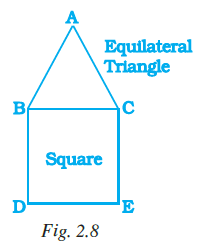
Answer:
Given:
Side of the equilateral triangle ($ABC$) = $\frac{4}{3}$ cm
The square ($BCED$) and the triangle share a common side $BC$.
$BC = \frac{4}{3}$ cm
(Given)
To Find:
Perimeter of the entire figure $ABDEC$.
Solution:
The perimeter of the combined figure consists of the outer boundary only. The common side $BC$ is inside the figure and is not counted in the perimeter.
The outer sides are: $AB, AC, CE, ED,$ and $DB$.
Since the triangle is equilateral, all its sides are equal:
$AB = AC = BC = \frac{4}{3}$ cm
Since the square has all sides equal and shares $BC$ with the triangle:
$BC = CE = ED = DB = \frac{4}{3}$ cm
Total number of outer sides = $2$ (from triangle) + $3$ (from square) = $5$ equal sides.
$\text{Perimeter} = 5 \times \text{side}$
$\text{Perimeter} = 5 \times \frac{4}{3} = \frac{20}{3}$ cm
Converting to a mixed fraction:
$\text{Perimeter} = 6 \frac{2}{3}$ cm
The perimeter of the figure is $6 \frac{2}{3}$ cm.
Question 112. Rita has bought a carpet of size 4 m × $6\frac{2}{3}$ m. But her room size is $3\frac{1}{3}$ m × $5\frac{1}{3}$ m. What fraction of area should be cut off to fit wall to wall carpet into the room?
Answer:
Given:
Dimensions of carpet = $4$ m $\times$ $6 \frac{2}{3}$ m
Dimensions of room = $3 \frac{1}{3}$ m $\times$ $5 \frac{1}{3}$ m
Solution:
First, calculate the Area of the carpet:
$\text{Area of carpet} = 4 \times \frac{20}{3} = \frac{80}{3} \text{ m}^2$
Next, calculate the Area of the room:
$\text{Area of room} = \frac{10}{3} \times \frac{16}{3} = \frac{160}{9} \text{ m}^2$
The area to be cut off is the difference between the carpet area and the room area:
$\text{Area to be cut} = \frac{80}{3} - \frac{160}{9}$
Taking LCM as $9$:
$\text{Area to be cut} = \frac{240 - 160}{9} = \frac{80}{9} \text{ m}^2$
Now, we find the fraction of the carpet area that needs to be cut off:
$\text{Fraction} = \frac{\text{Area to be cut}}{\text{Total carpet area}}$
$\text{Fraction} = \frac{80}{9} \div \frac{80}{3} = \frac{80}{9} \times \frac{3}{80}$
$\text{Fraction} = \frac{\cancel{80}^1}{\cancel{9}_3} \times \frac{\cancel{3}^1}{\cancel{80}_1} = \frac{1}{3}$
Therefore, $\frac{1}{3}$ of the area should be cut off.
Question 113. Family photograph has length $14\frac{2}{5}$ cm and breadth $10\frac{2}{5}$ cm. It has border of uniform width $2\frac{3}{5}$ cm. Find the area of framed photograph.
Answer:
Given:
Length of photograph ($l$) = $14 \frac{2}{5} = \frac{72}{5}$ cm
Breadth of photograph ($b$) = $10 \frac{2}{5} = \frac{52}{5}$ cm
Width of border ($w$) = $2 \frac{3}{5} = \frac{13}{5}$ cm
Solution:
The border is uniform on all sides. So, the total length and breadth of the framed photograph will increase by twice the width of the border.
$\text{New Length} (L) = \frac{72}{5} + 2 \times \left( \frac{13}{5} \right) = \frac{72}{5} + \frac{26}{5} = \frac{98}{5}$ cm
$\text{New Breadth} (B) = \frac{52}{5} + 2 \times \left( \frac{13}{5} \right) = \frac{52}{5} + \frac{26}{5} = \frac{78}{5}$ cm
Now, calculate the area of the framed photograph:
$\text{Area} = L \times B$
$\text{Area} = \frac{98}{5} \times \frac{78}{5} = \frac{7644}{25}$ cm$^2$
Converting to decimal form:
$\text{Area} = 305.76$ cm$^2$
The area of the framed photograph is $305.76$ cm$^2$.
Question 114. Cost of a burger is ₹ $20\frac{3}{4}$ and of Macpuff is ₹ $15\frac{1}{2}$ . Find the cost of 4 burgers and 14 macpuffs.
Answer:
Given:
Cost of one burger = $\textsf{₹} 20 \frac{3}{4} = \textsf{₹} \frac{83}{4}$
Cost of one Macpuff = $\textsf{₹} 15 \frac{1}{2} = \textsf{₹} \frac{31}{2}$
Solution:
1. Cost of 4 burgers:
$\text{Cost} = 4 \times \textsf{₹} \frac{83}{4}$
$\text{Cost} = \textsf{₹} \cancel{4} \times \frac{83}{\cancel{4}} = \textsf{₹} 83$
2. Cost of 14 Macpuffs:
$\text{Cost} = 14 \times \textsf{₹} \frac{31}{2}$
$\text{Cost} = \textsf{₹} \cancel{14}^7 \times \frac{31}{\cancel{2}_1}$
$\text{Cost} = 7 \times 31 = \textsf{₹} 217$
Total Cost:
$\text{Total} = 83 + 217 = 300$
The total cost of 4 burgers and 14 Macpuffs is $\textsf{₹} 300$.
Question 115. A hill, $101\frac{1}{3}$ m in height, has $\frac{1}{4}$ th of its height under water. What is the height of the hill visible above the water?
Answer:
Given:
Total height of the hill = $101\frac{1}{3}$ m
Fraction of height under water = $\frac{1}{4}$ of the total height
To Find:
Height of the hill visible above the water.
Solution:
First, convert the mixed fraction into an improper fraction:
$\text{Total height} = 101\frac{1}{3} = \frac{(101 \times 3) + 1}{3} = \frac{304}{3}$ m
If $\frac{1}{4}$ of the height is under water, then the fraction of the hill visible above water is:
$\text{Visible fraction} = 1 - \frac{1}{4} = \frac{3}{4}$
[Fraction of total height]
Now, calculate the visible height:
$\text{Visible height} = \frac{3}{4} \times \frac{304}{3}$
$\text{Visible height} = \frac{\cancel{3}^1}{4} \times \frac{304}{\cancel{3}_1}$
$\text{Visible height} = \frac{304}{4}$
$\text{Visible height} = 76$ m
The height of the hill visible above the water is $76$ m.
Question 116. Sports: Reaction time measures how quickly a runner reacts to the starter pistol. In the 100 m dash at the 2004 Olympic Games, Lauryn Williams had a reaction time of 0.214 second. Her total race time, including reaction time, was 11.03 seconds. How long did it take her to run the actual distance?
Answer:
Given:
Total race time = $11.03$ seconds
Reaction time = $0.214$ seconds
To Find:
Actual running time (excluding reaction time).
Solution:
To find the actual running time, we subtract the reaction time from the total race time:
$\text{Actual running time} = 11.03 - 0.214$
Aligning the decimals for subtraction:
$\begin{array}{cc} & 1 & 1 & . & 0 & 3 & 0 \\ - & 0 & 0 & . & 2 & 1 & 4 \\ \hline & 1 & 0 & . & 8 & 1 & 6 \\ \hline \end{array}$
It took her $10.816$ seconds to run the actual distance.
Question 117. State whether the answer is greater than 1 or less than 1. Put a ‘✓’ mark in appropriate box.
| Questions | Greater than 1 | Less than 1 |
|---|---|---|
| $\frac{2}{3} \div \frac{1}{2}$ | ||
| $\frac{2}{3} \div \frac{2}{1}$ | ||
| $6 \div \frac{1}{4}$ | ||
| $\frac{1}{5} \div \frac{1}{2}$ | ||
| $4 \frac{1}{3} \div 3 \frac{1}{2}$ | ||
| $\frac{2}{3} \times 8 \frac{1}{2}$ |
Answer:
To determine if the result is greater than or less than 1, we solve each expression:
1. $\frac{2}{3} \div \frac{1}{2} = \frac{2}{3} \times 2 = \frac{4}{3} \approx 1.33$ (Greater than 1)
2. $\frac{2}{3} \div \frac{2}{1} = \frac{2}{3} \times \frac{1}{2} = \frac{1}{3} \approx 0.33$ (Less than 1)
3. $6 \div \frac{1}{4} = 6 \times 4 = 24$ (Greater than 1)
4. $\frac{1}{5} \div \frac{1}{2} = \frac{1}{5} \times 2 = \frac{2}{5} = 0.4$ (Less than 1)
5. $4 \frac{1}{3} \div 3 \frac{1}{2} = \frac{13}{3} \div \frac{7}{2} = \frac{13}{3} \times \frac{2}{7} = \frac{26}{21} \approx 1.24$ (Greater than 1)
6. $\frac{2}{3} \times 8 \frac{1}{2} = \frac{2}{3} \times \frac{17}{2} = \frac{17}{3} \approx 5.67$ (Greater than 1)
The completed table is as follows:
| Questions | Greater than 1 | Less than 1 |
| $\frac{2}{3} \div \frac{1}{2}$ | ✓ | |
| $\frac{2}{3} \div \frac{2}{1}$ | ✓ | |
| $6 \div \frac{1}{4}$ | ✓ | |
| $\frac{1}{5} \div \frac{1}{2}$ | ✓ | |
| $4 \frac{1}{3} \div 3 \frac{1}{2}$ | ✓ | |
| $\frac{2}{3} \times 8 \frac{1}{2}$ | ✓ |
Question 118. There are four containers that are arranged in the ascending order of their heights. If the height of the smallest container given in the figure is expressed as $\frac{7}{25}$ x = 10.5 cm. Find the height of the largest container.
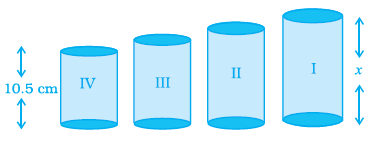
Answer:
Given:
The containers are arranged in ascending order of height. The smallest container is labeled IV and the largest is labeled I.
Height of the smallest container (IV) = $10.5$ cm
Equation relating the height of the smallest to the largest ($x$):
$\frac{7}{25} x = 10.5$
To Find:
The height of the largest container, denoted by $x$.
Solution:
Using equation (i), we solve for $x$:
$x = 10.5 \div \frac{7}{25}$
$x = 10.5 \times \frac{25}{7}$
First, divide $10.5$ by $7$:
$10.5 \div 7 = 1.5$
Now, multiply by $25$:
$x = 1.5 \times 25$
$x = 37.5$ cm
The height of the largest container is $37.5$ cm.
In Questions 119 to 122, replace ‘?’ with appropriate fraction.
Question 119.
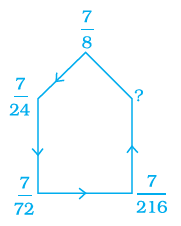
Answer:
Given:
A sequence of fractions: $\frac{7}{8}, \frac{7}{24}, \frac{7}{72}, \frac{7}{216}$.
To Find:
The value at the vertex marked with ‘?’.
Solution:
Let us observe the relationship between the denominators of the fractions:
$\frac{7}{8} \times \frac{1}{3} = \frac{7}{24}$
(First step)
$\frac{7}{24} \times \frac{1}{3} = \frac{7}{72}$
(Second step)
$\frac{7}{72} \times \frac{1}{3} = \frac{7}{216}$
(Third step)
The pattern is that each term is obtained by multiplying the previous term by $\frac{1}{3}$ (or multiplying the denominator by $3$).
To find the missing value (?):
$? = \frac{7}{216} \times \frac{1}{3}$
$? = \frac{7}{216 \times 3}$
$? = \frac{7}{648}$
The value of ‘?’ is $\frac{7}{648}$.
Question 120.
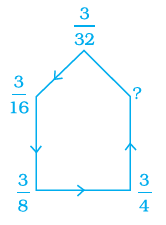
Answer:
Given:
A pentagonal flow chart starting from the top vertex and moving clockwise through the values: $\frac{3}{32}$, $\frac{3}{16}$, $\frac{3}{8}$, and $\frac{3}{4}$.
To Find:
The value at the vertex marked with ‘?’.
Solution:
Let us analyze the relationship between consecutive values in the sequence:
$\frac{3}{32} \times 2 = \frac{3}{16}$
(First step)
$\frac{3}{16} \times 2 = \frac{3}{8}$
(Second step)
$\frac{3}{8} \times 2 = \frac{3}{4}$
(Third step)
The pattern is that each term is obtained by multiplying the previous term by $2$.
To find the missing value (?):
$? = \frac{3}{4} \times 2$
$? = \frac{3 \times \cancel{2}^1}{\cancel{4}_2}$
$? = \frac{3}{2}$
The value of ‘?’ is $\frac{3}{2}$ (which is $1 \frac{1}{2}$ or $1.5$).
Questoin 121.
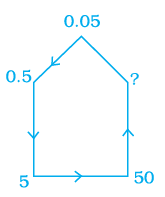
Answer:
Given:
A sequence of decimal numbers: $0.05, 0.5, 5, 50$.
To Find:
The value at the vertex marked with ‘?’.
Solution:
Let us observe the multiplier used between terms:
$0.05 \times 10 = 0.5$
(First step)
$0.5 \times 10 = 5$
(Second step)
$5 \times 10 = 50$
(Third step)
The pattern is that each term is obtained by multiplying the previous term by $10$.
To find the missing value (?):
$? = 50 \times 10$
$? = 500$
The value of ‘?’ is $500$.
Question 122.
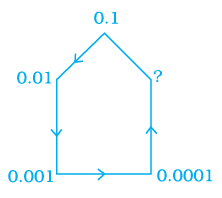
Answer:
Given:
A sequence of decimal numbers: $0.1, 0.01, 0.001, 0.0001$.
To Find:
The value at the vertex marked with ‘?’.
Solution:
Let us analyze the decimal movement in the sequence:
$0.1 \times 0.1 = 0.01$
(First step)
$0.01 \times 0.1 = 0.001$
(Second step)
$0.001 \times 0.1 = 0.0001$
(Third step)
The pattern shows that each term is multiplied by $0.1$ (or divided by $10$).
To find the missing value (?):
$? = 0.0001 \times 0.1$
$? = 0.00001$
The value of ‘?’ is $0.00001$.
What is the Error in each of question 123 to 125?
Question 123. A student compared $-\frac{1}{4}$ and –0.3. He changed $-\frac{1}{4}$ to the decimal –0.25 and wrote, “Since 0.3 is greater than 0.25, –0.3 is greater than –0.25”. What was the student’s error?
Answer:
Given:
The student compared two negative values: $-\frac{1}{4}$ and $-0.3$.
Calculation: $-\frac{1}{4} = -0.25$
Student's logic: Since $0.3 > 0.25$, then $-0.3 > -0.25$.
To Find:
The error in the student's reasoning.
Solution:
The student made an error in comparing negative numbers. While it is true that for positive numbers $0.3 > 0.25$, the rule for negative numbers is the exact opposite.
On a number line, a number to the right is always greater than a number to the left. Since $-0.25$ is closer to zero than $-0.3$, it lies to the right of $-0.3$.
$-0.25 > -0.3$
(Correct Comparison)
In negative numbers, the number with the smaller absolute value is actually the greater number.
Therefore, the student's error was assuming that the inequality sign remains the same when comparing negative magnitudes as it does for positive magnitudes.
Question 124. A student multiplied two mixed fractions in the following manner:
$2\frac{4}{7}$ × $3\frac{1}{4}$ = $6\frac{1}{7}$
What error the student has done?
Answer:
Given:
The multiplication: $2\frac{4}{7} \times 3\frac{1}{4} = 6\frac{1}{7}$
To Find:
The procedural error committed by the student.
Solution:
By observing the student's result ($6\frac{1}{7}$), we can identify the following incorrect steps taken:
1. The student multiplied the whole numbers separately: $2 \times 3 = 6$.
2. The student multiplied the fractional parts separately: $\frac{4}{7} \times \frac{1}{4} = \frac{1}{7}$.
3. They then combined these to get $6\frac{1}{7}$.
The Error: Mixed fractions cannot be multiplied by treating whole numbers and fractions as independent entities. They must first be converted into improper fractions.
Correct Method (Alternate Solution):
First, convert to improper fractions:
$2\frac{4}{7} = \frac{18}{7}$
$3\frac{1}{4} = \frac{13}{4}$
Now, multiply the improper fractions:
$\text{Product} = \frac{18}{7} \times \frac{13}{4}$
$\text{Product} = \frac{\cancel{18}^9}{7} \times \frac{13}{\cancel{4}_2} = \frac{117}{14}$
$\text{Product} = 8\frac{5}{14}$
The student's result $6\frac{1}{7}$ is incorrect because they failed to convert the mixed fractions first.
Question 125. In the pattern $\frac{1}{3}$ + $\frac{1}{4}$ + $\frac{1}{5}$ + ...... which fraction makes the sum greater than 1 (first time)? Explain.
Answer:
Given:
The sequence of addition is $\frac{1}{3} + \frac{1}{4} + \frac{1}{5} + \frac{1}{6} + \dots$
To Find:
The specific fraction in the sequence that makes the cumulative sum cross the value of $1$ for the first time.
Solution:
Let us calculate the sum step-by-step by adding one fraction at a time:
Step 1: Sum of first two fractions
$\text{Sum}_2 = \frac{1}{3} + \frac{1}{4} = \frac{4 + 3}{12} = \frac{7}{12} \approx 0.583$
Step 2: Add the third fraction ($\frac{1}{5}$)
$\text{Sum}_3 = \frac{7}{12} + \frac{1}{5} = \frac{35 + 12}{60} = \frac{47}{60} \approx 0.783$
Step 3: Add the fourth fraction ($\frac{1}{6}$)
$\text{Sum}_4 = \frac{47}{60} + \frac{1}{6} = \frac{47 + 10}{60} = \frac{57}{60}$
$\text{Sum}_4 = \frac{19}{20} = 0.95$
Step 4: Add the fifth fraction ($\frac{1}{7}$)
$\text{Sum}_5 = \frac{19}{20} + \frac{1}{7} = \frac{133 + 20}{140} = \frac{153}{140}$
$\text{Sum}_5 \approx 1.093$
Explanation:
We see that the cumulative sum after adding $\frac{1}{6}$ was $0.95$, which is less than $1$. Upon adding the next fraction in the pattern, which is $\frac{1}{7}$, the sum becomes approximately $1.093$.
Therefore, the fraction $\frac{1}{7}$ makes the sum greater than $1$ for the first time.