

Chapter 4 Simple Equations (Class 7 - Maths NCERT Exemplar Solutions)
Welcome to the comprehensive resource for NCERT Exemplar Solutions for Class 7 Mathematics: Chapter 4 Simple Equations! These problems are intentionally designed to move significantly beyond the basic exercises found in standard textbooks. They aim to substantially strengthen students' foundational algebraic skills by presenting complex equations and challenging word problems that demand careful formulation and systematic solving techniques, fostering deeper algebraic reasoning.
The solutions provided here cover the essential spectrum of linear equations in one variable, including the translation of verbal statements into algebraic forms. Students will find detailed guidance on solving various forms of equations, such as those where the variable appears on both sides (e.g., $ax + b = cx + d$) or equations involving fractional coefficients or constants (e.g., $\frac{y}{2} - 5 = \frac{y}{3} + 1$). A key focus is the application of the distributive property to simplify equations containing brackets, such as expanding $3(p - 4) = 21$ into $3p - 12 = 21$ before proceeding with the solution process.
Mastery of solving techniques is emphasized through the balancing method and the efficient transposition method. A significant portion of the Exemplar challenge lies in mathematical modeling through word problems involving ages, consecutive integers, geometry, and financial contexts using the $\textsf{₹}$ symbol. With step-by-step algebraic manipulations and logical derivations prepared by learningspot.co, students can accurately identify unknowns, set up precise equations, and build a solid foundation essential for success in more advanced algebra studies.
Solved Examples (Examples 1 to 18)
In Examples 1 to 3, there are four options, out of which one is correct. Choose the correct one.
Example 1: The solution of the equation 3x + 5 = 0 is
(a) $\frac{5}{3}$
(b) – 5
(c) $-\frac{5}{3}$
(d) 5
Answer:
Given:
The linear equation is $3x + 5 = 0$.
To Find:
The solution (value of $x$).
Solution:
To solve for $x$, we need to isolate the variable on one side of the equation.
Step 1: Transpose $+5$ from the Left Hand Side (LHS) to the Right Hand Side (RHS).
$3x = 0 - 5$
$3x = -5$
Step 2: Divide both sides by $3$ to solve for $x$.
$x = -\frac{5}{3}$
Comparing this result with the given options, we find it matches option (c).
Thus, the correct option is (c).
Example 2: –1 is not a solution of the equation
(a) x + 1 = 0
(b) x – 1 = 2
(c) 2y + 3 =1
(d) 2p + 7 = 5
Answer:
Solution:
We need to check each equation by substituting the value $-1$ for the variable and see where the LHS does not equal the RHS.
(a) $x + 1 = 0$:
Substituting $x = -1$, LHS $= -1 + 1 = 0$. Since LHS $=$ RHS, $-1$ is a solution.
(b) $x - 1 = 2$:
Substituting $x = -1$, LHS $= -1 - 1 = -2$. Since $-2 \neq 2$, LHS $\neq$ RHS.
Therefore, $-1$ is not a solution for this equation.
(c) $2y + 3 = 1$:
Substituting $y = -1$, LHS $= 2(-1) + 3 = -2 + 3 = 1$. Since LHS $=$ RHS, $-1$ is a solution.
(d) $2p + 7 = 5$:
Substituting $p = -1$, LHS $= 2(-1) + 7 = -2 + 7 = 5$. Since LHS $=$ RHS, $-1$ is a solution.
Thus, the correct option is (b).
Example 3: Which of the following equations can be formed using the expression x = 5:
(a) 2x + 3 = 13
(b) 3x + 2 = 13
(c) x – 5 = 1
(d) 4x – 9 =21
Answer:
Solution:
We substitute $x = 5$ into each equation to see which one holds true.
(a) $2x + 3 = 13$:
LHS $= 2(5) + 3 = 10 + 3 = 13$. Since LHS $=$ RHS, this equation can be formed using $x = 5$.
(b) $3x + 2 = 13$:
LHS $= 3(5) + 2 = 15 + 2 = 17$. Since $17 \neq 13$, this equation is not valid for $x = 5$.
(c) $x - 5 = 1$:
LHS $= 5 - 5 = 0$. Since $0 \neq 1$, this equation is not valid for $x = 5$.
(d) $4x - 9 = 21$:
LHS $= 4(5) - 9 = 20 - 9 = 11$. Since $11 \neq 21$, this equation is not valid for $x = 5$.
Thus, the correct option is (a).
In Examples 4 to 6, fill in the blanks to make it a true statement.
Example 4: Any value of the variable which makes both sides of an equation equal, is known as a ______ of the equation.
Answer:
Solution:
An equation represents a condition on a variable. The specific value that satisfies this condition and makes the Left Hand Side equal to the Right Hand Side is called the solution or the root of the equation.
Answer: solution (or root)
Example 5: The root of the equation y – 13 = 9 is ________.
Answer:
Given:
Equation: $y - 13 = 9$
Solution:
To find the root, we transpose $-13$ from LHS to RHS:
$y = 9 + 13$
$y = 22$
The root of the equation $y - 13 = 9$ is $22$.
Example 6: 2x + ________ = 11 has the solution – 4.
Answer:
Given:
Equation: $2x + \text{blank} = 11$
Solution: $x = -4$
Solution:
Let the missing value in the blank be $k$. The equation becomes:
$2x + k = 11$
Since the solution is $-4$, we substitute $x = -4$ into the equation:
$2(-4) + k = 11$
$-8 + k = 11$
To find $k$, transpose $-8$ to the RHS:
$k = 11 + 8$
$k = 19$
The value to fill in the blank is $19$.
In Examples 7 to 10, state whether the statements are True or False.
Example 7: 12 is a solution of the equation 4x – 5 = 3x + 10.
Answer:
Solution:
To check if $12$ is a solution, we substitute $x = 12$ into both sides of the equation $4x - 5 = 3x + 10$.
Left Hand Side (LHS):
$4(12) - 5$
$= 48 - 5 = 43$
Right Hand Side (RHS):
$3(12) + 10$
$= 36 + 10 = 46$
Since LHS $\neq$ RHS ($43 \neq 46$), $12$ is not the correct solution.
Therefore, the statement is False.
Example 8: A number x divided by 7 gives 2 can be written as $\frac{x \;+\; 1}{7}$ = 2.
Answer:
Solution:
Let's translate the given word statement into an algebraic expression:
1. "A number $x$ divided by $7$" is written as $\frac{x}{7}$.
2. "Gives $2$" means the result is equal to $2$.
So, the correct equation should be $\frac{x}{7} = 2$.
The statement provides the equation $\frac{x + 1}{7} = 2$, which is incorrect.
Therefore, the statement is False.
Example 9: x + 2 = 5 and 3x – 1 = 8 have the same solutions.
Answer:
Solution:
We need to solve both equations to see if they share the same root.
Equation 1: $x + 2 = 5$
$x = 5 - 2$
$x = 3$
Equation 2: $3x - 1 = 8$
$3x = 8 + 1$
$3x = 9$
$x = \frac{9}{3} = 3$
Since both equations have the same solution, $x = 3$, the statement is True.
Example 10: The equation 3x + 7 = 10 has 1 as its solution.
Answer:
Solution:
Substitute $x = 1$ into the Left Hand Side (LHS) of the equation $3x + 7 = 10$.
LHS: $3(1) + 7 = 3 + 7 = 10$
RHS: $10$
Since LHS = RHS, the value $1$ satisfies the equation.
Therefore, the statement is True.
Example 11: One fourth of a number is 20 less than the number itself.
Answer:
Solution:
To write this as an algebraic equation:
Let the unknown number be $x$.
1. "One fourth of a number" is $\frac{1}{4}x$ or $\frac{x}{4}$.
2. "20 less than the number itself" is $x - 20$.
The algebraic equation for the statement is:
$\frac{x}{4} = x - 20$
Example 12: On subtracting 13 from 3 times of a number, the result is 8.
Answer:
Solution:
Let the unknown number be $n$.
1. "3 times of a number" is $3n$.
2. "Subtracting 13 from 3 times of a number" is $3n - 13$.
3. "The result is 8" means $= 8$.
The algebraic equation for the statement is:
$3n - 13 = 8$
Example 13: Two times a number increased by 5 equals 9.
Answer:
Solution:
Let the unknown number be $x$.
According to the given statement:
1. "Two times a number" is $2x$.
2. "Increased by 5" means we add $5$ to it ($2x + 5$).
3. "Equals 9" means the result is $= 9$.
The algebraic equation for the statement is:
$2x + 5 = 9$
Example 14: 9 added to twice a number gives 13. Find the number.
Answer:
Given:
The statement is: "9 added to twice a number gives 13."
To Find:
The value of the unknown number.
Solution:
Let the number be $n$.
As per the condition:
$2n + 9 = 13$
To solve for $n$, transpose $9$ to the Right Hand Side (RHS):
$2n = 13 - 9$
$2n = 4$
Divide both sides by $2$:
$n = \frac{4}{2}$
$n = 2$
The required number is $2$.
Example 15: 1 subtracted from one third of a number gives 1. Find the number.
Answer:
Given:
The statement is: "1 subtracted from one third of a number gives 1."
To Find:
The value of the unknown number.
Solution:
Let the number be $x$.
As per the condition:
$\frac{1}{3}x - 1 = 1$
Transpose $-1$ to the RHS:
$\frac{x}{3} = 1 + 1$
$\frac{x}{3} = 2$
Multiply both sides by $3$:
$x = 2 \times 3$
$x = 6$
The required number is $6$.
Example 16: Correct the incorrect equation written in Roman numerals by moving only one tooth pick.
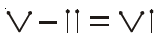
Answer:
Analysis:
The given incorrect equation in Roman numerals is:
$V - II = VI$
In Hindu-Arabic numerals, this reads as: $5 - 2 = 6$, which is mathematically incorrect.
Solution:
To correct this by moving only one toothpick, we can move one stick from the '$II$' to the '$-$' sign.
1. Take one toothpick from the Roman numeral '$II$' (making it '$I$').
2. Place it on the minus sign '$-$' to turn it into a plus sign '$+$'.
The new equation becomes:
$V + I = VI$
Translating back to Hindu-Arabic: $5 + 1 = 6$, which is correct.
Example 17: Solve the riddle “What is too much fun for one, enough for two, and means nothing to three?” The answer to this is hidden in the equations given below.
If 4c = 16, then c = ?
If 4e + 8 = 20, then e = ?
If 2r – 3 = 7, then r = ?
If 3t + 8 = 29, then t = ?
If 2s + 4 = 4s, then s = ?
To get the answer substitute the numbers for the letters it equals in the following manner:
$\frac{⬜}{2}$ , $\frac{⬜}{3}$ , $\frac{⬜}{4}$ , $\frac{⬜}{5}$ , $\frac{e}{⬜}$ , $\frac{⬜}{7}$
Answer:
Step 1: Solve the individual equations:
• $4c = 16 \Rightarrow c = \frac{16}{4} \Rightarrow$ $c = 4$
• $4e + 8 = 20 \Rightarrow 4e = 12 \Rightarrow e = \frac{12}{4} \Rightarrow$ $e = 3$
• $2r - 3 = 7 \Rightarrow 2r = 10 \Rightarrow r = \frac{10}{2} \Rightarrow$ $r = 5$
• $3t + 8 = 29 \Rightarrow 3t = 21 \Rightarrow t = \frac{21}{3} \Rightarrow$ $t = 7$
• $2s + 4 = 4s \Rightarrow 4 = 4s - 2s \Rightarrow 4 = 2s \Rightarrow s = \frac{4}{2} \Rightarrow$ $s = 2$
Step 2: Map the values to the code:
The code is $\frac{\square}{2} , \frac{\square}{3} , \frac{\square}{4} , \frac{\square}{5} , \frac{e}{\square} , \frac{\square}{7}$
We replace the numbers at the bottom with the corresponding letters ($s=2, e=3, c=4, r=5, t=7$):
• For $2 \rightarrow$ S
• For $3 \rightarrow$ E
• For $4 \rightarrow$ C
• For $5 \rightarrow$ R
• For $e$ (which equals 3) $\rightarrow$ E
• For $7 \rightarrow$ T
Conclusion:
The word formed is SECRET.
Example 18: Solve the following equation.
10 = 4 + 3 ( t + 2)
Answer:
Given Equation:
$10 = 4 + 3(t + 2)$
Solution:
Step 1: Transpose $4$ to the LHS.
$10 - 4 = 3(t + 2)$
$6 = 3(t + 2)$
Step 2: Divide both sides by $3$.
$\frac{6}{3} = t + 2$
$2 = t + 2$
Step 3: Transpose $+2$ to the other side.
$t = 2 - 2$
$t = 0$
The solution for the equation is $t = 0$.
Exercise
Question 1 to 18 (Multiple Choice Questions)
In the Questions 1 to 18, there are four options out of which, one is correct. Choose the correct one.
Question 1. The solution of the equation ax + b = 0 is
(a) $\frac{a}{b}$
(b) – b
(c) $-\frac{b}{a}$
(d) $\frac{b}{a}$
Answer:
Given: The linear equation in one variable is $ax + b = 0$.
To Find: The value of $x$.
Solution:
Starting with the given equation:
$ax + b = 0$
To isolate the term with $x$, we transpose $b$ from the Left Hand Side (LHS) to the Right Hand Side (RHS). Upon transposition, the sign of $b$ changes from positive to negative:
$ax = -b$
(By transposing $b$ to RHS)
Now, to find the value of $x$, we divide both sides by $a$ (assuming $a \neq 0$):
$x = -\frac{b}{a}$
Comparing this result with the given options, we find it matches option (c).
Hence, the correct option is (c).
Question 2. If a and b are positive integers, then the solution of the equation ax = b will always be a
(a) positive number
(b) negative number
(c) 1
(d) 0
Answer:
Given: The equation is $ax = b$, where $a > 0$ and $b > 0$.
Solution:
The solution for $x$ in the given equation is obtained by dividing $b$ by $a$:
$x = \frac{b}{a}$
We know that if we divide a positive integer by another positive integer, the result is always a positive number (a positive rational number).
Since both $a$ and $b$ are positive, their quotient $\frac{b}{a}$ cannot be negative, zero, or necessarily $1$.
Thus, the correct option is (a).
Question 3. Which of the following is not allowed in a given equation?
(a) Adding the same number to both sides of the equation.
(b) Subtracting the same number from both sides of the equation.
(c) Multiplying both sides of the equation by the same non-zero number.
(d) Dividing both sides of the equation by the same number
Answer:
Solution:
The rules for maintaining the equality of an equation are:
1. We can add the same number to both sides.
2. We can subtract the same number from both sides.
3. We can multiply both sides by the same non-zero number.
4. We can divide both sides by the same non-zero number.
Option (d) states "Dividing both sides of the equation by the same number". It does not specify that the number must be non-zero. In mathematics, division by zero is undefined. Therefore, dividing both sides by zero is not allowed.
Hence, the correct option is (d).
Question 4. The solution of which of the following equations is neither a fraction nor an integer?
(a) 2x + 6 = 0
(b) 3x – 5 = 0
(c) 5x – 8 = x + 4
(d) 4x + 7 = x + 2
Answer:
Solution:
Let us solve each equation to find the nature of the solutions:
For (a): $2x + 6 = 0 \implies 2x = -6 \implies x = -3$. This is an integer.
For (b): $3x - 5 = 0 \implies 3x = 5 \implies x = \frac{5}{3}$. This is a fraction (a ratio of two positive integers).
For (c): $5x - 8 = x + 4 \implies 5x - x = 4 + 8 \implies 4x = 12 \implies x = 3$. This is an integer.
For (d): Solve $4x + 7 = x + 2$
$4x - x = 2 - 7$
$3x = -5$
$x = -\frac{5}{3}$
Fractions are typically defined as numbers of the form $\frac{p}{q}$ where $p, q$ are whole numbers and $q \neq 0$. Therefore, negative values like $-\frac{5}{3}$ are negative rational numbers, not fractions. Since $-\frac{5}{3}$ is also not an integer, it satisfies the condition.
Thus, the correct option is (d).
Question 5. The equation which cannot be solved in integers is
(a) 5y – 3 = – 18
(b) 3x – 9 = 0
(c) 3z + 8 = 3 + z
(d) 9y + 8 = 4y – 7
Answer:
To Find: The equation where $x, y, \text{ or } z$ is not an integer.
Solution:
Let us solve the equations:
(a) $5y = -18 + 3 \implies 5y = -15 \implies y = -3$ (Integer).
(b) $3x = 9 \implies x = 3$ (Integer).
(c) $3z + 8 = 3 + z$
$3z - z = 3 - 8$
$2z = -5$
$z = -\frac{5}{2} = -2.5$
Since $-2.5$ is not an integer, this equation cannot be solved in integers.
(d) $9y - 4y = -7 - 8 \implies 5y = -15 \implies y = -3$ (Integer).
Thus, the correct option is (c).
Question 6. If 7x + 4 = 25, then x is equal to
(a) $\frac{29}{7}$
(b) $\frac{100}{7}$
(c) 2
(d) 3
Answer:
Given: $7x + 4 = 25$
To Find: The value of $x$.
Solution:
We start with the given equation:
$7x + 4 = 25$
Transposing $4$ to the RHS:
$7x = 25 - 4$
$7x = 21$
Now, dividing both sides by $7$:
$x = \frac{\cancel{21}^{3}}{\cancel{7}_{1}}$
$x = 3$
Thus, the value of $x$ is $3$.
The correct option is (d).
Question 7. The solution of the equation 3x + 7 = – 20 is
(a) $\frac{17}{7}$
(b) – 9
(c) 9
(d) $\frac{13}{3}$
Answer:
Given: The equation $3x + 7 = -20$.
To Find: The value of $x$.
Solution:
Starting with the given linear equation:
$3x + 7 = -20$
Transposing $7$ from the Left Hand Side (LHS) to the Right Hand Side (RHS), its sign changes from positive to negative:
$3x = -20 - 7$
[By transposing $7$ to RHS]
$3x = -27$
Now, dividing both sides by $3$ to find the value of $x$:
$x = \frac{\cancel{-27}^{-9}}{\cancel{3}_{1}}$
$x = -9$
Thus, the solution is $-9$.
The correct option is (b).
Question 8. The value of y for which the expressions (y – 15) and (2y + 1) become equal is
(a) 0
(b) 16
(c) 8
(d) – 16
Answer:
To Find: The value of $y$ such that both expressions are equal.
Solution:
According to the question, we equate the two expressions:
$y - 15 = 2y + 1$
To solve for $y$, we collect the variable terms on one side and the constant terms on the other side. Transposing $y$ to RHS and $1$ to LHS:
$-15 - 1 = 2y - y$
[By transposing terms]
$-16 = y$
Or,
$y = -16$
The value of $y$ is $-16$.
The correct option is (d).
Question 9. If k + 7 = 16, then the value of 8k – 72 is
(a) 0
(b) 1
(c) 112
(d) 56
Answer:
Given: $k + 7 = 16$
To Find: The value of $8k - 72$.
Solution:
First, we solve for $k$ using the given equation:
$k + 7 = 16$
$k = 16 - 7$
$k = 9$
Now, substitute the value of $k = 9$ into the expression $8k - 72$:
Value $= 8(9) - 72$
Value $= 72 - 72$
Value $= 0$
The correct option is (a).
Alternate Solution:
We have $k = 9$. We can write $8k - 72$ by taking $8$ as a common factor:
$8k - 72 = 8(k - 9)$
Since $k = 9$, then $k - 9 = 0$.
Therefore, $8(0) = 0$.
Question 10. If 43m = 0.086, then the value of m is
(a) 0.002
(b) 0.02
(c) 0.2
(d) 2
Answer:
Given: $43m = 0.086$
To Find: The value of $m$.
Solution:
The given equation is:
$43m = 0.086$
Dividing both sides by $43$:
$m = \frac{0.086}{43}$
To simplify, we can remove the decimal by multiplying the denominator by $1000$:
$m = \frac{86}{43 \times 1000}$
$m = \frac{\cancel{86}^{2}}{\cancel{43}_{1} \times 1000}$
$m = \frac{2}{1000}$
$m = 0.002$
The correct option is (a).
Question 11. x exceeds 3 by 7, can be represented as
(a) x + 3 = 2
(b) x + 7 = 3
(c) x – 3 = 7
(d) x – 7 = 3
Answer:
Solution:
The phrase "$x$ exceeds $3$ by $7$" means that $x$ is greater than $3$, and the difference between $x$ and $3$ is $7$.
Mathematically, this can be written as:
$x - 3 = 7$
This matches option (c).
Additionally, it could be written as $x = 3 + 7$, but based on the given options, $x - 3 = 7$ is the correct representation.
The correct option is (c).
Question 12. The equation having 5 as a solution is:
(a) 4x + 1 = 2
(b) 3 – x = 8
(c) x – 5 = 3
(d) 3 + x = 8
Answer:
To Find: The equation which is satisfied when $x = 5$.
Solution:
Let's substitute $x = 5$ in the Left Hand Side (LHS) of each option:
(a) $4(5) + 1 = 20 + 1 = 21 \neq 2$. (Incorrect)
(b) $3 - 5 = -2 \neq 8$. (Incorrect)
(c) $5 - 5 = 0 \neq 3$. (Incorrect)
(d) $3 + x = 8$
Substituting $x = 5$ in LHS:
$3 + 5 = 8$
Here, LHS = RHS.
Thus, $x = 5$ is the solution for the equation in option (d).
The correct option is (d).
Question 13. The equation having – 3 as a solution is:
(a) x + 3 =1
(b) 8 + 2x = 3
(c) 10 + 3x = 1
(d) 2x + 1 = 3
Answer:
To Find: The equation which is satisfied by $x = -3$.
Solution:
We will substitute $x = -3$ in the Left Hand Side (LHS) of each given option to check if it equals the Right Hand Side (RHS).
For option (a): $x + 3 = -3 + 3 = 0 \neq 1$.
For option (b): $8 + 2x = 8 + 2(-3) = 8 - 6 = 2 \neq 3$.
For option (c): $10 + 3x = 1$
$\text{LHS} = 10 + 3(-3)$
$\text{LHS} = 10 - 9$
$\text{LHS} = 1$
(RHS)
Since $\text{LHS} = \text{RHS}$ for option (c), $-3$ is the solution to this equation.
For option (d): $2(-3) + 1 = -6 + 1 = -5 \neq 3$.
The correct option is (c).
Question 14. Which of the following equations can be formed starting with x = 0 ?
(a) 2x + 1 = – 1
(b) $\frac{x}{2}$ + 5 = 7
(c) 3x – 1 = – 1
(d) 3x – 1 = 1
Answer:
Given: Initial condition $x = 0$.
Solution:
Starting with $x = 0$, we can perform arithmetic operations on both sides to form an equation.
Multiply both sides by $3$:
$3x = 0 \times 3$
$3x = 0$
Subtract $1$ from both sides:
$3x - 1 = 0 - 1$
$3x - 1 = -1$
This matches option (c).
The correct option is (c).
Question 15. Which of the following equations cannot be formed using the equation x = 7 ?
(a) 2x + 1 =15
(b) 7x – 1 = 50
(c) x – 3 = 4
(d) $\frac{x}{7}$ – 1 = 0
Answer:
To Find: The equation which is not satisfied by $x = 7$.
Solution:
Let's check each equation by substituting $x = 7$:
(a) $2x + 1 = 2(7) + 1 = 14 + 1 = 15$. (Matches RHS)
(b) $7x - 1 = 50$
$\text{LHS} = 7(7) - 1$
$\text{LHS} = 49 - 1$
$\text{LHS} = 48$
Here, $48 \neq 50$. So, $\text{LHS} \neq \text{RHS}$.
(c) $x - 3 = 7 - 3 = 4$. (Matches RHS)
(d) $\frac{x}{7} - 1 = \frac{7}{7} - 1 = 1 - 1 = 0$. (Matches RHS)
Equation (b) is the only one that cannot be formed starting from $x = 7$.
The correct option is (b).
Question 16. If $\frac{x}{2}$ = 3, then the value of 3x + 2 is
(a) 20
(b) 11
(c) $\frac{13}{2}$
(d) 8
Answer:
Given: $\frac{x}{2} = 3$
To Find: The value of $3x + 2$.
Solution:
First, we solve for $x$ from the given equation:
$\frac{x}{2} = 3$
$x = 3 \times 2$
$x = 6$
Now, substitute $x = 6$ into the expression $3x + 2$:
$\text{Value} = 3(6) + 2$
$\text{Value} = 18 + 2$
$\text{Value} = 20$
The correct option is (a).
Question 17. Which of the following numbers satisfy the equation –6 + x = –12 ?
(a) 2
(b) 6
(c) – 6
(d) – 2
Answer:
Given: $-6 + x = -12$
To Find: The value of $x$.
Solution:
Starting with the equation:
$-6 + x = -12$
To find $x$, we transpose $-6$ from the LHS to the RHS. Its sign will change to positive:
$x = -12 + 6$
[Transposition of $-6$]
$x = -6$
The number that satisfies the equation is $-6$.
The correct option is (c).
Question 18. Shifting one term from one side of an equation to another side with a change of sign is known as
(a) commutativity
(b) transposition
(c) distributivity
(d) associativity
Answer:
Solution:
In the study of Linear Equations in One Variable, there are specific mathematical terms for manipulating equations.
1. Commutativity: Refers to the order of numbers in addition or multiplication (e.g., $a + b = b + a$).
2. Transposition: This is the process of moving a term from one side of the equals sign to the other, which results in the inversion of its operation (addition becomes subtraction, and vice versa).
3. Distributivity: Refers to how multiplication is distributed over addition (e.g., $a(b + c) = ab + ac$).
4. Associativity: Refers to the grouping of numbers (e.g., $(a + b) + c = a + (b + c)$).
Based on these definitions, shifting a term with a sign change is called transposition.
The correct option is (b).
Question 19 to 48 (Fill in the Blanks)
In Questions 19 to 48, fill in the blanks to make the statements true.
Question 19. The sum of two numbers is 60 and their difference is 30.
(a) If smaller number is x, the other number is __________.(use sum)
(b) The difference of numbers in term of x is ________.
(c) The equation formed is_________ .
(d) The solution of the equation is_______ .
(e) The numbers are _______and__________ .
Answer:
Given: Sum of two numbers is $60$. Difference is $30$. Let the smaller number be $x$.
(a) Since the sum of the two numbers is $60$, if one number is $x$, the other number is $60 - x$.
(b) The difference is calculated as (larger number) - (smaller number). In terms of $x$, this is $(60 - x) - x =$ $60 - 2x$.
(c) Given that the difference is $30$, the equation formed is $60 - 2x = 30$.
(e) Solving the equation:
$60 - 30 = 2x$
$30 = 2x$
$x = \frac{\cancel{30}^{15}}{\cancel{2}_{1}} = 15$
(d) The solution of the equation is $x = 15$.
(e) The smaller number is $15$ and the other number is $60 - 15 = 45$. So, the numbers are $15$ and $45$.
Question 20. Sum of two numbers is 81. One is twice the other.
(a) If smaller number is x, the other number is _________.
(b) The equation formed is __________.
(c) The solution of the equation is__________ .
(d) The numbers are___________ and______ .
Answer:
Given: Sum $= 81$. One number is twice the other.
(a) If the smaller number is $x$, then the other (larger) number is $2x$.
(b) According to the condition that their sum is $81$, the equation formed is $x + 2x = 81$ (or $3x = 81$).
(c) Solving the equation:
$3x = 81$
$x = \frac{\cancel{81}^{27}}{\cancel{3}_{1}} = 27$
The solution of the equation is $x = 27$.
(d) The smaller number is $27$. The other number is $2 \times 27 = 54$. So, the numbers are $27$ and $54$.
Question 21. In a test Abha gets twice the marks as that of Palak. Two times Abha's marks and three times Palak's marks make 280.
(a) If Palak gets x marks, Abha gets __________marks.
(b) The equation formed is______ .
(c) The solution of the equation ________is .
(d) Marks obtained by Abha are ________.
Answer:
Given: Abha's marks $= 2 \times$ Palak's marks. $2(\text{Abha}) + 3(\text{Palak}) = 280$.
(a) If Palak gets $x$ marks, Abha gets $2x$ marks.
(b) Substituting the values into the given condition:
$2(2x) + 3(x) = 280$
The equation formed is $4x + 3x = 280$ (or $7x = 280$).
(c) Solving the equation:
$7x = 280$
$x = \frac{\cancel{280}^{40}}{\cancel{7}_{1}} = 40$
The solution is $x = 40$.
(d) Since Abha gets $2x$ marks, marks obtained by Abha are $2 \times 40 =$ $80$.
Question 22. The length of a rectangle is two times its breadth. Its perimeter is 60 cm.
(a) If the breadth of rectangle is x cm, the length of the rectangle is_________.
(b) Perimeter in terms of x is________ .
(c) The equation formed is________ .
(d) The solution of the equation is_________ .
Answer:
Given: Length $= 2 \times$ Breadth. Perimeter $= 60$ cm.
(a) If the breadth is $x$ cm, the length of the rectangle is $2x$ cm.
(b) Perimeter $= 2(\text{length} + \text{breadth}) = 2(2x + x) = 2(3x)$. So, perimeter in terms of $x$ is $6x$ cm.
(c) Since the perimeter is $60$ cm, the equation formed is $6x = 60$.
(d) Solving the equation:
$x = \frac{\cancel{60}^{10}}{\cancel{6}_{1}} = 10$
The solution of the equation is $x = 10$.
Question 23. In a bag there are 5 and 2 rupee coins. If they are equal in number and their worth is ₹ 70, then
(a) The worth of x coins of ₹ 5 each__________ .
(b) The worth of x coins of ₹ 2 each __________.
(c) The equation formed is_________ .
(d) There are __________5 rupee coins and________ 2 rupee coins.
Answer:
Given: Number of $\textsf{₹} 5$ coins $=$ Number of $\textsf{₹} 2$ coins. Let this number be $x$. Total value $= \textsf{₹} 70$.
(a) The worth of $x$ coins of $\textsf{₹} 5$ each is $\textsf{₹} 5x$.
(b) The worth of $x$ coins of $\textsf{₹} 2$ each is $\textsf{₹} 2x$.
(c) The total worth is $5x + 2x$, so the equation formed is $5x + 2x = 70$ (or $7x = 70$).
(d) Solving for $x$:
$7x = 70 \implies x = 10$
Therefore, there are $10$ five rupee coins and $10$ two rupee coins.
Question 24. In a Mathematics quiz, 30 prizes consisting of 1st and 2nd prizes only are to be given. 1st and 2nd prizes are worth ₹ 2000 and ₹ 1000, respectively. If the total prize money is ₹ 52,000 then show that:
(a) If 1st prizes are x in number the number of 2nd prizes are _______.
(b) The total value of prizes in terms of x are __________.
(c) The equation formed is __________.
(d) The solution of the equation is__________ .
(e) The number of 1st prizes are _______and the number of 2nd prizes are ______.
Answer:
Given: Total prizes $= 30$. 1st prize worth $= \textsf{₹} 2000$. 2nd prize worth $= \textsf{₹} 1000$. Total money $= \textsf{₹} 52,000$.
(a) If 1st prizes are $x$ in number, the number of 2nd prizes are $30 - x$.
(b) The total value $= 2000(x) + 1000(30 - x)$. In terms of $x$, this is $2000x + 30000 - 1000x =$ $1000x + 30000$.
(c) The equation formed is $1000x + 30000 = 52000$.
(d) Solving the equation:
$1000x = 52000 - 30000$
$1000x = 22000$
$x = \frac{22000}{1000} = 22$
The solution is $x = 22$.
(e) The number of 1st prizes are $22$ and the number of 2nd prizes are $30 - 22 =$ $8$.
Question 25. If z + 3 = 5, then z = ____________.
Answer:
Given equation is:
$z + 3 = 5$
To find the value of $z$, we need to isolate $z$ on one side of the equation.
Subtract 3 from both sides of the equation:
$z + 3 - 3 = 5 - 3$
Simplifying both sides:
$z = 2$
Therefore, if $z + 3 = 5$, then $z = \underline{2}$.
Question 26. ___________is the solution of the equation 3x – 2 =7.
Answer:
We are given the equation:
$3x - 2 = 7$
To solve for $x$, first, add 2 to both sides of the equation:
$3x - 2 + 2 = 7 + 2$
$3x = 9$
Next, divide both sides by 3:
$\frac{3x}{3} = \frac{9}{3}$
$x = 3$
The solution of the equation $3x - 2 = 7$ is $x = 3$.
$\underline{3}$ is the solution of the equation 3x – 2 =7.
Question 27. _____________is the solution of 3x + 10 = 7.
Answer:
We are given the equation:
$3x + 10 = 7$
To solve for $x$, first, subtract 10 from both sides of the equation:
$3x + 10 - 10 = 7 - 10$
$3x = -3$
Next, divide both sides by 3:
$\frac{3x}{3} = \frac{-3}{3}$
$x = -1$
The solution of the equation $3x + 10 = 7$ is $x = -1$.
$\underline{-1}$ is the solution of 3x + 10 = 7.
Question 28. If 2x + 3 = 5, then value of 3x + 2 is ___________.
Answer:
We are given the equation:
$2x + 3 = 5$
First, we need to find the value of $x$ by solving this equation.
Subtract 3 from both sides:
$2x + 3 - 3 = 5 - 3$
$2x = 2$
Divide both sides by 2:
$\frac{2x}{2} = \frac{2}{2}$
$x = 1$
Now we need to find the value of the expression $3x + 2$ using the value of $x$ we just found.
Substitute $x = 1$ into the expression $3x + 2$:
$3(1) + 2 = 3 + 2 = 5$
The value of $3x + 2$ is 5.
If 2x + 3 = 5, then value of 3x + 2 is $\underline{5}$.
Question 29. In integers, 4x – 1 = 8 has __________solution.
Answer:
We are given the equation:
$4x - 1 = 8$
To solve for $x$, add 1 to both sides of the equation:
$4x - 1 + 1 = 8 + 1$
$4x = 9$
Now, divide both sides by 4:
$\frac{4x}{4} = \frac{9}{4}$
$x = \frac{9}{4}$
We are asked about the solution in integers. An integer is a whole number (positive, negative, or zero). The value we found for $x$ is $\frac{9}{4}$, which is a fraction and not an integer.
Therefore, the equation $4x - 1 = 8$ has no solution within the set of integers.
In integers, 4x – 1 = 8 has $\underline{\text{no}}$ solution.
Question 30. In natural numbers, 4x + 5 = – 7 has __________solution.
Answer:
We are given the equation:
$4x + 5 = -7$
To solve for $x$, subtract 5 from both sides of the equation:
$4x + 5 - 5 = -7 - 5$
$4x = -12$
Now, divide both sides by 4:
$\frac{4x}{4} = \frac{-12}{4}$
$x = -3$
We are asked about the solution in natural numbers. Natural numbers are positive integers (1, 2, 3, ...). The value we found for $x$ is $-3$, which is a negative integer and not a natural number.
Therefore, the equation $4x + 5 = -7$ has no solution within the set of natural numbers.
In natural numbers, 4x + 5 = – 7 has $\underline{\text{no}}$ solution.
Question 31. In natural numbers, x – 5 = – 5 has_______ solution.
Answer:
We are given the equation:
$x - 5 = -5$
To solve for $x$, add 5 to both sides of the equation:
$x - 5 + 5 = -5 + 5$
$x = 0$
We are asked about the solution in natural numbers. Natural numbers are typically defined as the positive integers $\{1, 2, 3, ...\}$. Some definitions include 0, but the most common definition in this context excludes 0.
The solution we found is $x = 0$. According to the standard definition, 0 is not a natural number.
Therefore, the equation $x - 5 = -5$ has no solution within the set of natural numbers.
In natural numbers, x – 5 = – 5 has $\underline{\text{no}}$ solution.
Question 32. In whole numbers, x + 8 = 12 – 4 has ____solution.
Answer:
We are given the equation:
$x + 8 = 12 - 4$
First, simplify the right side of the equation:
$12 - 4 = 8$
So the equation becomes:
$x + 8 = 8$
To solve for $x$, subtract 8 from both sides of the equation:
$x + 8 - 8 = 8 - 8$
$x = 0$
We are asked about the solution in whole numbers. Whole numbers are the set of non-negative integers $\{0, 1, 2, 3, ...\}$.
The solution we found is $x = 0$, which is indeed a whole number.
Therefore, the equation $x + 8 = 12 - 4$ has a solution in whole numbers.
In whole numbers, x + 8 = 12 – 4 has $\underline{\text{one}}$ solution.
Question 33. If 5 is added to three times a number, it becomes the same as 7 is subtracted from four times the same number. This fact can be represented as __________.
Answer:
Let the number be represented by the variable $x$.
According to the problem, "three times a number" is $3x$.
"5 is added to three times a number" can be written as $3x + 5$.
"Four times the same number" is $4x$.
"7 is subtracted from four times the same number" can be written as $4x - 7$.
The problem states that these two expressions "become the same", which means they are equal.
So, the equation that represents this fact is:
$3x + 5 = 4x - 7$
This fact can be represented as $\underline{3x + 5 = 4x - 7}$.
Question 34. x + 7 = 10 has the solution __________.
Answer:
We are given the equation:
$x + 7 = 10$
To find the solution for $x$, subtract 7 from both sides of the equation:
$x + 7 - 7 = 10 - 7$
$x = 3$
The solution of the equation $x + 7 = 10$ is $x = 3$.
x + 7 = 10 has the solution $\underline{3}$.
Question 35. x – 0 = ________; when 3x = 12.
Answer:
We are given the equation $3x = 12$.
First, we need to find the value of $x$ by solving this equation.
Divide both sides of the equation by 3:
$\frac{3x}{3} = \frac{12}{3}$
$x = 4$
Now, we need to find the value of the expression $x - 0$ using the value of $x$ we just found.
Substitute $x = 4$ into the expression $x - 0$:
$4 - 0 = 4$
The value of $x - 0$ is 4 when $3x = 12$.
x – 0 = $\underline{4}$; when 3x = 12.
Question 36. x – 1= ________; when 2x = 2.
Answer:
We are given the equation $2x = 2$.
First, we need to find the value of $x$ by solving this equation.
Divide both sides of the equation by 2:
$\frac{2x}{2} = \frac{2}{2}$
$x = 1$
Now, we need to find the value of the expression $x - 1$ using the value of $x$ we just found.
Substitute $x = 1$ into the expression $x - 1$:
$1 - 1 = 0$
The value of $x - 1$ is 0 when $2x = 2$.
x – 1= $\underline{0}$; when 2x = 2.
Question 37. x –_________ = 15; when $\frac{x}{2}$ = 6.
Answer:
Given: We need to find the number that fills the blank in the equation $x - \text{___} = 15$, given the condition $\frac{x}{2} = 6$.
Solution:
First, we find the value of $x$ from the given condition:
$\frac{x}{2} = 6$
(Given)
Multiplying both sides by $2$:
$x = 6 \times 2$
$x = 12$
Now, we substitute this value of $x$ into the equation with the blank. Let the number in the blank be represented by $y$.
$12 - y = 15$
To find $y$, we can transpose $y$ to the Right Hand Side (RHS) and $15$ to the Left Hand Side (LHS):
$12 - 15 = y$
$-3 = y$
Therefore, the number that fills the blank is -3.
The completed statement is: $x – \underline{(-3)} = 15$.
Question 38. The solution of the equation x + 15 = 19 is__________ .
Answer:
We are given the equation:
$x + 15 = 19$
To find the solution for $x$, subtract 15 from both sides of the equation:
$x + 15 - 15 = 19 - 15$
$x = 4$
The solution of the equation x + 15 = 19 is $\underline{4}$.
Question 39. Finding the value of a variable in a linear equation that the equation is called a ________of the equation.
Answer:
Solution:
A linear equation is an equality involving variables. The value of the variable which, when substituted in the equation, makes the Left Hand Side (LHS) equal to the Right Hand Side (RHS) is said to satisfy the equation.
This specific value of the variable is called the solution (or root) of the equation.
Therefore, the blank should be filled with solution.
Question 40. Any term of an equation may be transposed from one side of the equation to the other side of the equation by changing the_________ of the term.
Answer:
Solution:
Transposition is a process used to solve equations where a term is moved from one side of the equality to the other. According to the rules of transposition:
1. A positive term becomes negative on the other side.
2. A negative term becomes positive on the other side.
In both cases, we are changing the mathematical sign (or operation) of the term.
Therefore, the blank should be filled with sign.
Question 41. If $\frac{9}{5}$ x = $\frac{18}{5}$ , then x = ______________.
Answer:
Given: The equation is $\frac{9}{5} x = \frac{18}{5}$.
To Find: The value of $x$.
Solution:
The given equation is:
$\frac{9}{5} x = \frac{18}{5}$
To isolate $x$, we can multiply both sides by the reciprocal of $\frac{9}{5}$, which is $\frac{5}{9}$:
$x = \frac{18}{5} \times \frac{5}{9}$
Cancelling the common terms in the numerator and the denominator:
$x = \frac{\cancel{18}^{2}}{\cancel{5}_{1}} \times \frac{\cancel{5}^{1}}{\cancel{9}_{1}}$
$x = 2$
Therefore, the value of $x$ is 2.
Question 42. If 3 – x = – 4, then x = _________.
Answer:
We are given the equation:
$3 - x = -4$
To solve for $x$, we can first isolate the term with $x$. Subtract 3 from both sides of the equation:
$3 - x - 3 = -4 - 3$
$-x = -7$
Now, to find $x$, we need to eliminate the negative sign. Multiply or divide both sides by -1:
$(-1) \times (-x) = (-1) \times (-7)$
$x = 7$
Therefore, if $3 - x = -4$, then $x = \underline{7}$.
Question 43. If x − $\frac{1}{2}$ = $-\frac{1}{2}$ , then x =___________ .
Answer:
We are given the equation:
$x - \frac{1}{2} = -\frac{1}{2}$
To find the value of $x$, we need to isolate $x$ on one side of the equation.
Add $\frac{1}{2}$ to both sides of the equation:
$x - \frac{1}{2} + \frac{1}{2} = -\frac{1}{2} + \frac{1}{2}$
On the left side, $-\frac{1}{2} + \frac{1}{2} = 0$, so the left side simplifies to $x + 0$ or just $x$.
On the right side, $-\frac{1}{2} + \frac{1}{2} = 0$.
So the equation simplifies to:
$x = 0$
Therefore, if x − $\frac{1}{2}$ = $-\frac{1}{2}$, then x = $\underline{0}$.
Question 44. If $\frac{1}{6}$ - x = $\frac{1}{6}$ , then x = __________.
Answer:
We are given the equation:
$\frac{1}{6} - x = \frac{1}{6}$
To find the value of $x$, we can isolate the term with $x$. Subtract $\frac{1}{6}$ from both sides of the equation:
$\frac{1}{6} - x - \frac{1}{6} = \frac{1}{6} - \frac{1}{6}$
On the left side, $\frac{1}{6} - \frac{1}{6} = 0$, so the left side becomes $0 - x = -x$.
On the right side, $\frac{1}{6} - \frac{1}{6} = 0$.
So the equation simplifies to:
$-x = 0$
To find $x$, multiply or divide both sides by -1:
$(-1) \times (-x) = (-1) \times 0$
$x = 0$
Therefore, if $\frac{1}{6}$ - x = $\frac{1}{6}$, then x = $\underline{0}$.
Question 45. If 10 less than a number is 65, then the number is__________ .
Answer:
Let the unknown number be represented by the variable $n$.
The phrase "10 less than a number" means we subtract 10 from the number. This can be written as $n - 10$.
The problem states that "10 less than a number is 65". This translates to the equation:
$n - 10 = 65$
To solve for $n$, we need to isolate $n$ on one side of the equation. Add 10 to both sides:
$n - 10 + 10 = 65 + 10$
$n = 75$
The number is 75.
Verification: 10 less than 75 is $75 - 10 = 65$. This matches the given information.
If 10 less than a number is 65, then the number is $\underline{75}$.
Question 46. If a number is increased by 20, it becomes 45. Then the number is______.
Answer:
Let the unknown number be represented by the variable $n$.
"A number is increased by 20" means we add 20 to the number. This can be written as $n + 20$.
The problem states that "it becomes 45". This means the result of increasing the number by 20 is equal to 45.
This translates to the equation:
$n + 20 = 45$
To solve for $n$, we need to isolate $n$ on one side of the equation. Subtract 20 from both sides:
$n + 20 - 20 = 45 - 20$
$n = 25$
The number is 25.
Verification: If the number is 25 and it is increased by 20, we get $25 + 20 = 45$. This matches the given information.
If a number is increased by 20, it becomes 45. Then the number is $\underline{25}$.
Question 47. If 84 exceeds another number by 12, then the other number is_______.
Answer:
Given: 84 exceeds another number by 12.
To Find: The other number.
Solution:
Let the other number be $x$.
According to the question, 84 is greater than $x$ by 12. This can be expressed as:
$84 - x = 12$
To find $x$, we transpose $x$ to the Right Hand Side (RHS) and 12 to the Left Hand Side (LHS):
$84 - 12 = x$
$72 = x$
Or,
$x = 72$
Therefore, the other number is 72.
Question 48. If x − $\frac{7}{8}$ = $\frac{7}{8}$ , then x = _________.
Answer:
Given: The equation $x - \frac{7}{8} = \frac{7}{8}$.
To Find: The value of $x$.
Solution:
Starting with the given equation:
$x - \frac{7}{8} = \frac{7}{8}$
To find $x$, we transpose $-\frac{7}{8}$ from the Left Hand Side (LHS) to the Right Hand Side (RHS). The sign will change from negative to positive:
$x = \frac{7}{8} + \frac{7}{8}$
Since the denominators are the same, we add the numerators:
$x = \frac{7 + 7}{8}$
$x = \frac{14}{8}$
Reducing the fraction to its simplest form by dividing both numerator and denominator by their common factor 2:
$x = \frac{\cancel{14}^{7}}{\cancel{8}_{4}}$
$x = \frac{7}{4}$
Therefore, the value of $x$ is $\frac{7}{4}$.
Question 49 to 55 (True or False)
In Questions 49 to 55, state whether the statements are True or False.
Question 49. 5 is the solution of the equation 3x + 2 = 17.
Answer:
Given: The equation $3x + 2 = 17$ and the value $x = 5$.
Solution:
To check if $5$ is the solution, we substitute $x = 5$ into the Left Hand Side (LHS) of the equation:
$\text{LHS} = 3(5) + 2$
$\text{LHS} = 15 + 2$
$\text{LHS} = 17$
Since $\text{LHS} = \text{RHS}$, the value $x = 5$ satisfies the equation.
Therefore, the statement is True.
Question 50. $\frac{9}{5}$ is the solution of the equation 4x – 1 = 8.
Answer:
Given: The equation $4x - 1 = 8$ and the value $x = \frac{9}{5}$.
Solution:
Substitute $x = \frac{9}{5}$ into the LHS:
$\text{LHS} = 4\left(\frac{9}{5}\right) - 1$
$\text{LHS} = \frac{36}{5} - 1$
$\text{LHS} = \frac{36 - 5}{5} = \frac{31}{5}$
The Right Hand Side (RHS) is $8$. Since $\frac{31}{5} \neq 8$, the value does not satisfy the equation.
Therefore, the statement is False.
Question 51. 4x – 5 = 7 does not have an integer as its solution.
Answer:
Solution:
Let's solve the given equation:
$4x - 5 = 7$
Transposing $-5$ to the RHS:
$4x = 7 + 5$
$4x = 12$
Dividing by $4$:
$x = \frac{\cancel{12}^{3}}{\cancel{4}_{1}} = 3$
Since $3$ is an integer, the equation does have an integer solution. The statement claims it does not.
Therefore, the statement is False.
Question 52. One third of a number added to itself gives 10, can be represented as $\frac{x}{3}$ + 10 = x.
Answer:
Solution:
Let the number be $x$.
"One third of the number" is represented as $\frac{x}{3}$.
"Added to itself" means we add $x$ to $\frac{x}{3}$.
According to the statement, the result is $10$. So the equation should be:
$\frac{x}{3} + x = 10$
The equation provided in the question is $\frac{x}{3} + 10 = x$, which is not the same.
Therefore, the statement is False.
Question 53. $\frac{3}{2}$ is the solution of the equation 8x – 5 = 7.
Answer:
Given: The equation $8x - 5 = 7$ and $x = \frac{3}{2}$.
Solution:
Substitute $x = \frac{3}{2}$ into the LHS:
$\text{LHS} = 8\left(\frac{3}{2}\right) - 5$
$\text{LHS} = \cancel{8}^{4} \times \frac{3}{\cancel{2}_{1}} - 5$
$\text{LHS} = 12 - 5 = 7$
Since $\text{LHS} = \text{RHS} = 7$, the value satisfies the equation.
Therefore, the statement is True.
Question 54. If 4x – 7 = 11, then x = 4.
Answer:
Solution:
Solve the equation $4x - 7 = 11$:
$4x = 11 + 7$
$4x = 18$
$x = \frac{18}{4} = 4.5$
Since $4.5 \neq 4$, the statement is incorrect.
Therefore, the statement is False.
Question 55. If 9 is the solution of variable x in the equation $\frac{5x \;-\; 7}{2}$ = y , then the value of y is 28.
Answer:
Given: $x = 9$ and the equation $\frac{5x - 7}{2} = y$.
Solution:
Substitute $x = 9$ in the expression for $y$:
$y = \frac{5(9) - 7}{2}$
$y = \frac{45 - 7}{2}$
$y = \frac{38}{2} = 19$
The value of $y$ is $19$, not $28$.
Therefore, the statement is False.
Question 56 (Match the Following)
Question 56. Match each of the entries in Column I with the appropriate entries in Column II.
Column I
(i) $x + 5 = 9$
(ii) $x – 7 = 4$
(iii) $\frac{x}{12} = – 5$
(iv) $5x = 30$
(v) The value of y which satisfies $3y = 5$
(vi) If $p = 2$, then the value of $\frac{1}{3}(1 – 3p)$
Column II
(A) $-\frac{5}{3}$
(B) $\frac{5}{3}$
(C) 4
(D) 6
(E) 11
(F) – 60
(G) 3
Answer:
Solving each entry in Column I:
(i) $x + 5 = 9$
Subtract 5 from both sides: $x = 9 - 5 = 4$.
Matches with (C) 4.
(ii) $x – 7 = 4$
Add 7 to both sides: $x = 4 + 7 = 11$.
Matches with (E) 11.
(iii) $\frac{x}{12} = – 5$
Multiply both sides by 12: $x = -5 \times 12 = -60$.
Matches with (F) – 60.
(iv) $5x = 30$
Divide both sides by 5: $x = \frac{30}{5} = 6$.
Matches with (D) 6.
(v) The value of y which satisfies $3y = 5$
Divide both sides by 3: $y = \frac{5}{3}$.
Matches with (B) $\frac{5}{3}$.
(vi) If $p = 2$, then the value of $\frac{1}{3}(1 – 3p)$
Substitute $p = 2$: $\frac{1}{3}(1 – 3(2)) = \frac{1}{3}(1 – 6) = \frac{1}{3}(-5) = -\frac{5}{3}$.
Matches with (A) $-\frac{5}{3}$.
Matching results:
(i) $\to$ (C)
(ii) $\to$ (E)
(iii) $\to$ (F)
(iv) $\to$ (D)
(v) $\to$ (B)
(vi) $\to$ (A)
Question 57 to 67 (Statement to Equation)
In Questions 57 to 67, express each of the given statements as an equation.
Question 57. 13 subtracted from twice of a number gives 3 .
Answer:
Let the number be $x$.
Twice of the number is $2x$.
13 subtracted from twice of the number is $2x - 13$.
This "gives 3", which means it is equal to 3.
The equation formed is:
$2x - 13 = 3$
Question 58. One-fifth of a number is 5 less than that number.
Answer:
Let the number be $n$.
One-fifth of the number is $\frac{1}{5}n$ or $\frac{n}{5}$.
"5 less than that number" means subtracting 5 from the number. This is $n - 5$.
The statement "One-fifth of a number is 5 less than that number" means that $\frac{n}{5}$ is equal to $n - 5$.
The equation formed is:
$\frac{n}{5} = n - 5$
Question 59. A number is 7 more than one-third of itself.
Answer:
Let the number be $y$.
One-third of itself is $\frac{1}{3}y$ or $\frac{y}{3}$.
"7 more than one-third of itself" means adding 7 to one-third of the number. This is $\frac{y}{3} + 7$.
The statement "A number is 7 more than one-third of itself" means that the number itself ($y$) is equal to 7 more than one-third of itself ($\frac{y}{3} + 7$).
The equation formed is:
$y = \frac{y}{3} + 7$
Question 60. Six times a number is 10 more than the number.
Answer:
Let the number be $a$.
Six times a number is $6a$.
"10 more than the number" means adding 10 to the number. This is $a + 10$.
The statement "Six times a number is 10 more than the number" means that $6a$ is equal to $a + 10$.
The equation formed is:
$6a = a + 10$
Question 61. If 10 is subtracted from half of a number, the result is 4.
Answer:
Let the number be $k$.
Half of a number is $\frac{1}{2}k$ or $\frac{k}{2}$.
"10 is subtracted from half of a number" means $\frac{k}{2} - 10$.
The statement "the result is 4" means the expression is equal to 4.
The equation formed is:
$\frac{k}{2} - 10 = 4$
Question 62. Subtracting 5 from p, the result is 2.
Answer:
The variable is given as $p$.
"Subtracting 5 from p" means $p - 5$.
"The result is 2" means the expression is equal to 2.
The equation formed is:
$p - 5 = 2$
Question 63. Five times a number increased by 7 is 27.
Answer:
Let the number be $n$.
"Five times a number" is $5n$.
"Increased by 7" means adding 7 to $5n$. This is $5n + 7$.
"Is 27" means the expression is equal to 27.
The equation formed is:
$5n + 7 = 27$
Question 64. Mohan is 3 years older than Sohan. The sum of their ages is 43 years
Answer:
Let Sohan's age be $s$ years.
"Mohan is 3 years older than Sohan" means Mohan's age is Sohan's age plus 3. So, Mohan's age is $s + 3$ years.
"The sum of their ages is 43 years" means Sohan's age plus Mohan's age equals 43.
Sohan's age + Mohan's age = 43
$s + (s + 3) = 43$
Combine like terms on the left side:
$2s + 3 = 43$
The equation formed is:
$2s + 3 = 43$
Question 65. If 1 is subtracted from a number and the difference is multiplied by $\frac{1}{2}$, the result is 7.
Answer:
Let the number be $m$.
"1 is subtracted from a number" means $m - 1$. This is the difference.
"The difference is multiplied by $\frac{1}{2}$" means multiplying $(m - 1)$ by $\frac{1}{2}$. This is $\frac{1}{2}(m - 1)$.
"The result is 7" means the expression is equal to 7.
The equation formed is:
$\frac{1}{2}(m - 1) = 7$
Question 66. A number divided by 2 and then increased by 5 is 9.
Answer:
Let the number be $p$.
"A number divided by 2" is $\frac{p}{2}$.
"Then increased by 5" means adding 5 to the previous result. This is $\frac{p}{2} + 5$.
"Is 9" means the expression is equal to 9.
The equation formed is:
$\frac{p}{2} + 5 = 9$
Question 67. The sum of twice a number and 4 is 18.
Answer:
Let the number be $y$.
"Twice a number" is $2y$.
"The sum of twice a number and 4" means adding 4 to $2y$. This is $2y + 4$.
"Is 18" means the expression is equal to 18.
The equation formed is:
$2y + 4 = 18$
Question 68 to 107
Question 68. The age of Sohan Lal is four times that of his son Amit. If the difference of their ages is 27 years, find the age of Amit.
Answer:
Given:
Sohan Lal's age is four times Amit's age.
The difference between their ages is $27$ years.
To Find: The age of Amit.
Solution:
Let the present age of Amit be $x$ years.
Then, the age of Sohan Lal will be $4x$ years.
According to the given condition:
$4x - x = 27$
$3x = 27$
Dividing both sides by $3$:
$x = \frac{\cancel{27}^{9}}{\cancel{3}_{1}}$
$x = 9$
Therefore, the age of Amit is 9 years.
Question 69. A number exceeds the other number by 12. If their sum is 72, find the numbers.
Answer:
Given:
One number exceeds the other by $12$.
Sum of the two numbers is $72$.
To Find: The two numbers.
Solution:
Let the smaller number be $x$.
Then, the larger number is $x + 12$.
According to the problem:
$x + (x + 12) = 72$
$2x + 12 = 72$
Transposing $12$ to the Right Hand Side (RHS):
$2x = 72 - 12$
$2x = 60$
Dividing by $2$:
$x = 30$
The smaller number is 30.
The larger number is $30 + 12 =$ 42.
The numbers are 30 and 42.
Question 70. Seven times a number is 12 less than thirteen times the same number. Find the number.
Answer:
To Find: The unknown number.
Solution:
Let the required number be $x$.
Seven times the number is $7x$.
Thirteen times the number is $13x$.
According to the question, $7x$ is $12$ less than $13x$:
$7x = 13x - 12$
Transposing $-12$ to LHS and $7x$ to RHS:
$12 = 13x - 7x$
$12 = 6x$
Dividing both sides by $6$:
$x = \frac{12}{6}$
$x = 2$
Thus, the required number is 2.
Question 71. The interest received by Karim is ₹ 30 more than that of Ramesh. If the total interest received by them is ₹ 70, find the interest received by Ramesh.
Answer:
Given:
Karim's interest = Ramesh's interest + $\textsf{₹} 30$.
Total interest = $\textsf{₹} 70$.
To Find: Interest received by Ramesh.
Solution:
Let the interest received by Ramesh be $\textsf{₹} x$.
Then, the interest received by Karim is $\textsf{₹} (x + 30)$.
According to the given information:
$x + (x + 30) = 70$
$2x + 30 = 70$
Transposing $30$ to the RHS:
$2x = 70 - 30$
$2x = 40$
Dividing by $2$:
$x = \frac{40}{2}$
$x = 20$
Therefore, the interest received by Ramesh is $\textsf{₹} 20$.
Question 72. Subramaniam and Naidu donate some money in a Relief Fund. The amount paid by Naidu is ₹ 125 more than that of Subramaniam. If the total money paid by them is ₹ 975, find the amount of money donated by Subramaniam.
Answer:
Given:
Naidu's donation = Subramaniam's donation + $\textsf{₹} 125$.
Total donation = $\textsf{₹} 975$.
To Find: Amount donated by Subramaniam.
Solution:
Let the amount donated by Subramaniam be $\textsf{₹} x$.
Then, the amount donated by Naidu is $\textsf{₹} (x + 125)$.
Summing their donations to find the total:
$x + (x + 125) = 975$
$2x + 125 = 975$
Transposing $125$ to the RHS:
$2x = 975 - 125$
$2x = 850$
Dividing by $2$:
$x = \frac{850}{2}$
$x = 425$
Therefore, the amount of money donated by Subramaniam is $\textsf{₹} 425$.
Question 73. In a school, the number of girls is 50 more than the number of boys. The total number of students is 1070. Find the number of girls.
Answer:
Given:
Number of girls = Number of boys + $50$.
Total students = $1070$.
To Find: The number of girls.
Solution:
Let the number of boys in the school be $x$.
Then, the number of girls will be $x + 50$.
The total strength of the school is the sum of boys and girls:
$x + (x + 50) = 1070$
$2x + 50 = 1070$
Transposing $50$ to the RHS:
$2x = 1070 - 50$
$2x = 1020$
Dividing by $2$ to find the number of boys:
$x = \frac{1020}{2}$
$x = 510$
Now, to find the number of girls:
$\text{Girls} = x + 50 = 510 + 50$
$\text{Girls} = 560$
Therefore, there are 560 girls in the school.
Question 74. Two times a number increased by 5 equals 9. Find the number.
Answer:
To Find: The unknown number.
Solution:
Let the required number be $x$.
According to the question, two times the number ($2x$) increased by $5$ is equal to $9$.
$2x + 5 = 9$
Transposing $5$ to the Right Hand Side (RHS):
$2x = 9 - 5$
$2x = 4$
Dividing both sides by $2$:
$x = \frac{4}{2}$
$x = 2$
Thus, the required number is 2.
Question 75. 9 added to twice a number gives 13. Find the number.
Answer:
To Find: The unknown number.
Solution:
Let the number be $x$.
According to the given condition, $9$ added to twice the number ($2x$) results in $13$.
$2x + 9 = 13$
Transposing $9$ to the RHS:
$2x = 13 - 9$
$2x = 4$
Dividing both sides by $2$:
$x = \frac{4}{2}$
$x = 2$
Thus, the required number is 2.
Question 76. 1 subtracted from one-third of a number gives 1. Find the number.
Answer:
To Find: The unknown number.
Solution:
Let the required number be $x$.
One-third of the number is $\frac{x}{3}$.
According to the question, subtracting $1$ from $\frac{x}{3}$ gives $1$.
$\frac{x}{3} - 1 = 1$
Transposing $-1$ to the RHS:
$\frac{x}{3} = 1 + 1$
$\frac{x}{3} = 2$
Multiplying both sides by $3$:
$x = 2 \times 3$
$x = 6$
Thus, the required number is 6.
Question 77. After 25 years, Rama will be 5 times as old as he is now. Find his present age.
Answer:
To Find: Rama's present age.
Solution:
Let the present age of Rama be $x$ years.
After $25$ years, Rama's age will be $(x + 25)$ years.
According to the question, his age after $25$ years will be $5$ times his present age.
$x + 25 = 5x$
Transposing $x$ to the RHS:
$25 = 5x - x$
$25 = 4x$
Dividing by $4$:
$x = \frac{25}{4}$
$x = 6.25$
Therefore, Rama's present age is 6.25 years (or 6 years and 3 months).
Question 78. After 20 years, Manoj will be 5 times as old as he is now. Find his present age.
Answer:
To Find: Manoj's present age.
Solution:
Let the present age of Manoj be $x$ years.
After $20$ years, Manoj's age will be $(x + 20)$ years.
According to the given condition:
$x + 20 = 5x$
Transposing $x$ to the RHS:
$20 = 5x - x$
$20 = 4x$
Dividing both sides by $4$:
$x = \frac{20}{4}$
$x = 5$
Therefore, the present age of Manoj is 5 years.
Question 79. My younger sister's age today is 3 times, what it will be 3 years from now minus 3 times what her age was 3 years ago. Find her present age.
Answer:
To Find: The present age of the younger sister.
Solution:
Let the present age of the younger sister be $x$ years.
Her age $3$ years from now will be $(x + 3)$ years.
Her age $3$ years ago was $(x - 3)$ years.
According to the given condition:
$x = 3(x + 3) - 3(x - 3)$
Expanding the brackets:
$x = 3x + 9 - 3x + 9$
Simplifying the RHS by combining like terms:
$x = (3x - 3x) + (9 + 9)$
$x = 18$
Therefore, the sister's present age is 18 years.
Question 80. If 45 is added to half a number, the result is triple the number. Find the number.
Answer:
To Find: The unknown number.
Solution:
Let the required number be $x$.
Half of the number is $\frac{x}{2}$ and triple the number is $3x$.
According to the question:
$45 + \frac{x}{2} = 3x$
Transposing $\frac{x}{2}$ to the RHS:
$45 = 3x - \frac{x}{2}$
Taking the LCM on the RHS:
$45 = \frac{6x - x}{2}$
$45 = \frac{5x}{2}$
Multiplying by $2$ and dividing by $5$:
$45 \times 2 = 5x$
$90 = 5x$
$x = \frac{90}{5}$
$x = 18$
Therefore, the required number is 18.
Question 81. In a family, the consumption of wheat is 4 times that of rice. The total consumption of the two cereals is 80 kg. Find the quantities of rice and wheat consumed in the family.
Answer:
Given:
Consumption of wheat is $4$ times the consumption of rice.
Total consumption of wheat and rice = $80$ kg.
To Find: Quantities of rice and wheat consumed.
Solution:
Let the quantity of rice consumed be $x$ kg.
Then, the quantity of wheat consumed will be $4x$ kg.
According to the given condition:
$x + 4x = 80$
$5x = 80$
Dividing both sides by $5$:
$x = \frac{80}{5}$
$x = 16$
Therefore, the quantity of rice consumed is 16 kg.
Quantity of wheat consumed = $4 \times 16$ = 64 kg.
Question 82. In a bag, the number of one rupee coins is three times the number of two rupees coins. If the worth of the coins is ₹ 120, find the number of 1 rupee coins.
Answer:
Given:
Number of $1$ rupee coins = $3 \times$ Number of $2$ rupee coins.
Total value = $\textsf{₹} 120$.
To Find: The number of $1$ rupee coins.
Solution:
Let the number of $2$ rupee coins be $x$.
Then, the number of $1$ rupee coins will be $3x$.
Worth of $x$ coins of $\textsf{₹} 2$ each = $\textsf{₹} 2x$.
Worth of $3x$ coins of $\textsf{₹} 1$ each = $\textsf{₹} 3x$.
According to the problem:
$3x + 2x = 120$
$5x = 120$
Dividing by $5$:
$x = \frac{120}{5}$
$x = 24$
Number of $2$ rupee coins is $24$.
Number of $1$ rupee coins = $3x = 3 \times 24$ = 72.
Therefore, there are 72 coins of one rupee.
Question 83. Anamika thought of a number. She multiplied it by 2, added 5 to the product and obtained 17 as the result. What is the number she had thought of ?
Answer:
To Find: The number Anamika thought of.
Solution:
Let the number thought of by Anamika be $x$.
When she multiplies it by $2$, the product is $2x$.
Adding $5$ to the product gives $2x + 5$.
Given the result is $17$:
$2x + 5 = 17$
Transposing $5$ to the Right Hand Side (RHS):
$2x = 17 - 5$
$2x = 12$
Dividing by $2$:
$x = \frac{12}{2}$
$x = 6$
Thus, the number thought of by Anamika is 6.
Question 84. One of the two numbers is twice the other. The sum of the numbers is 12. Find the numbers.
Answer:
To Find: The two numbers.
Solution:
Let the smaller number be $x$.
Then, the other number is $2x$.
Given that their sum is $12$:
$x + 2x = 12$
$3x = 12$
Dividing by $3$:
$x = \frac{12}{3} = 4$
So, the first number is 4.
The second number is $2 \times 4$ = 8.
The numbers are 4 and 8.
Question 85. The sum of three consecutive integers is 5 more than the smallest of the integers. Find the integers.
Answer:
To Find: Three consecutive integers.
Solution:
Let the three consecutive integers be $n$, $(n + 1)$, and $(n + 2)$.
Smallest integer = $n$.
Sum of these integers = $n + (n + 1) + (n + 2) = 3n + 3$.
According to the condition, the sum is $5$ more than the smallest integer:
$3n + 3 = n + 5$
Transposing $n$ to the LHS and $3$ to the RHS:
$3n - n = 5 - 3$
$2n = 2$
$n = 1$
The smallest integer is 1.
The other integers are $1 + 1 = 2$ and $1 + 2 = 3$.
The required integers are 1, 2, and 3.
Question 86. A number when divided by 6 gives the quotient 6. What is the number?
Answer:
To Find: The unknown number.
Solution:
Let the required number be $x$.
According to the question, when $x$ is divided by $6$, the result is $6$.
$\frac{x}{6} = 6$
Multiplying both sides by $6$:
$x = 6 \times 6$
$x = 36$
Thus, the required number is 36.
Question 87. The perimeter of a rectangle is 40 m. The length of the rectangle is 4 m less than 5 times its breadth. Find the length of the rectangle.
Answer:
Given:
Perimeter of rectangle = $40$ m.
Length = $5 \times \text{Breadth} - 4$ m.
To Find: The length of the rectangle.
Solution:
Let the breadth of the rectangle be $x$ m.
Then, the length of the rectangle will be $(5x - 4)$ m.
We know that the perimeter of a rectangle is given by the formula:
$\text{Perimeter} = 2(\text{Length} + \text{Breadth})$
Substituting the given values:
$40 = 2[(5x - 4) + x]$
$40 = 2(6x - 4)$
Dividing both sides by $2$:
$20 = 6x - 4$
Transposing $-4$ to the LHS:
$20 + 4 = 6x$
$24 = 6x$
$x = \frac{24}{6} = 4$
The breadth is $4$ m.
Length = $5(4) - 4 = 20 - 4 = 16$ m.
Therefore, the length of the rectangle is 16 m.
Question 88. Each of the 2 equal sides of an isosceles triangle is twice as large as the third side. If the perimeter of the triangle is 30 cm, find the length of each side of the triangle.
Answer:
Given:
An isosceles triangle has two equal sides.
Each equal side is twice the third side.
Perimeter of the triangle is $30$ cm.
To Find: The length of each side of the triangle.
Solution:
Let the length of the third side (base) be $x$ cm.
Then, the length of each of the two equal sides is $2x$ cm.
We know that the perimeter of a triangle is the sum of the lengths of all its sides.
$\text{Perimeter} = \text{Side}_1 + \text{Side}_2 + \text{Side}_3$
Substituting the values:
$30 = 2x + 2x + x$
$30 = 5x$
Dividing both sides by $5$:
$x = \frac{30}{5}$
$x = 6$ cm
Now, we find the lengths of the equal sides:
$\text{Equal sides} = 2x = 2 \times 6 = 12$ cm
Therefore, the lengths of the sides of the triangle are 12 cm, 12 cm, and 6 cm.
Question 89. The sum of two consecutive multiples of 2 is 18. Find the numbers
Answer:
To Find: Two consecutive multiples of $2$.
Solution:
Let the first multiple of $2$ be $2x$.
The next consecutive multiple of $2$ will be $(2x + 2)$.
According to the given condition, their sum is $18$:
$2x + (2x + 2) = 18$
$4x + 2 = 18$
Transposing $2$ to the Right Hand Side (RHS):
$4x = 18 - 2$
$4x = 16$
Dividing by $4$:
$x = \frac{16}{4} = 4$
Now, finding the multiples:
$\text{First multiple} = 2x = 2 \times 4 = 8$
$\text{Second multiple} = 8 + 2 = 10$
Therefore, the numbers are 8 and 10.
Question 90. Two complementary angles differ by 20°. Find the angles.
Answer:
Given:
Two angles are complementary (sum is $90^\circ$).
The difference between them is $20^\circ$.
To Find: The two angles.
Solution:
Let the smaller angle be $x$.
Then, the larger angle will be $(x + 20^\circ)$.
Since they are complementary angles:
$x + (x + 20^\circ) = 90^\circ$
$2x + 20^\circ = 90^\circ$
Transposing $20^\circ$ to the RHS:
$2x = 90^\circ - 20^\circ$
$2x = 70^\circ$
Dividing by $2$:
$x = 35^\circ$
The first angle is $35^\circ$.
The second angle is $35^\circ + 20^\circ = 55^\circ$.
Therefore, the angles are $35^\circ$ and $55^\circ$.
Question 91. 150 has been divided into two parts such that twice the first part is equal to the second part. Find the parts.
Answer:
Given:
Total value = $150$.
$2 \times$ First Part = Second Part.
To Find: The two parts.
Solution:
Let the first part be $x$.
Then, the second part is $2x$.
According to the question, the sum of these two parts is $150$:
$x + 2x = 150$
$3x = 150$
Dividing by $3$:
$x = \frac{150}{3}$
$x = 50$
The first part is $50$.
The second part is $2 \times 50 = 100$.
Therefore, the parts are 50 and 100.
Question 92. In a class of 60 students, the number of girls is one third the number of boys. Find the number of girls and boys in the class.
Answer:
Given:
Total students = $60$.
Number of girls = $\frac{1}{3} \times$ Number of boys.
To Find: The number of girls and boys.
Solution:
Let the number of boys be $x$.
Then, the number of girls is $\frac{x}{3}$.
The total number of students is the sum of boys and girls:
$x + \frac{x}{3} = 60$
Taking the LCM on the Left Hand Side (LHS):
$\frac{3x + x}{3} = 60$
$\frac{4x}{3} = 60$
Multiplying by $3$ and dividing by $4$:
$4x = 180$
$x = \frac{180}{4} = 45$
The number of boys is $45$.
The number of girls = $\frac{45}{3} = 15$.
Therefore, there are 45 boys and 15 girls in the class.
Question 93. Two-third of a number is greater than one-third of the number by 3. Find the number.
Answer:
To Find: The unknown number.
Solution:
Let the required number be $x$.
Two-third of the number is $\frac{2}{3}x$.
One-third of the number is $\frac{1}{3}x$.
According to the given condition:
$\frac{2}{3}x - \frac{1}{3}x = 3$
Simplifying the LHS:
$\frac{x}{3} = 3$
Multiplying both sides by $3$:
$x = 3 \times 3$
$x = 9$
Therefore, the required number is 9.
Question 94. A number is as much greater than 27 as it is less than 73. Find the number.
Answer:
To Find: The unknown number.
Solution:
Let the required number be $x$.
According to the question, the amount by which $x$ is greater than $27$ is the same as the amount by which it is less than $73$.
Greater than $27$ means: $x - 27$
Less than $73$ means: $73 - x$
Setting them equal:
$x - 27 = 73 - x$
Transposing $-x$ to the Left Hand Side (LHS) and $-27$ to the Right Hand Side (RHS):
$x + x = 73 + 27$
$2x = 100$
Dividing both sides by $2$:
$x = \frac{100}{2}$
$x = 50$
Therefore, the required number is 50.
Question 95. A man travelled two fifth of his journey by train, one-third by bus, one-fourth by car and the remaining 3 km on foot. What is the length of his total journey?
Answer:
To Find: The total length of the journey.
Solution:
Let the total length of the journey be $x$ km.
Distance travelled by train $= \frac{2}{5}x$
Distance travelled by bus $= \frac{1}{3}x$
Distance travelled by car $= \frac{1}{4}x$
Distance travelled on foot $= 3$ km
The total journey is the sum of all these distances:
$\frac{2x}{5} + \frac{x}{3} + \frac{x}{4} + 3 = x$
To solve for $x$, we take the LCM of the denominators $5, 3,$ and $4$, which is $60$:
$\frac{24x + 20x + 15x}{60} + 3 = x$
$\frac{59x}{60} + 3 = x$
Transposing $\frac{59x}{60}$ to the RHS:
$3 = x - \frac{59x}{60}$
$3 = \frac{60x - 59x}{60}$
$3 = \frac{x}{60}$
Multiplying both sides by $60$:
$x = 3 \times 60$
$x = 180$
Therefore, the total length of his journey is 180 km.
Question 96. Twice a number added to half of itself equals 24. Find the number.
Answer:
To Find: The unknown number.
Solution:
Let the required number be $x$.
Twice the number is $2x$ and half of the number is $\frac{x}{2}$.
According to the question:
$2x + \frac{x}{2} = 24$
Taking the LCM on the LHS:
$\frac{4x + x}{2} = 24$
$\frac{5x}{2} = 24$
Multiplying both sides by $2$:
$5x = 48$
Dividing by $5$:
$x = \frac{48}{5}$
$x = 9.6$
Thus, the required number is 9.6.
Question 97. Thrice a number decreased by 5 exceeds twice the number by 1. Find the number.
Answer:
To Find: The unknown number.
Solution:
Let the required number be $x$.
Thrice the number decreased by $5$ is represented as $(3x - 5)$.
Twice the number is represented as $2x$.
According to the question, $(3x - 5)$ is greater than $2x$ by $1$:
$(3x - 5) - 2x = 1$
Combining like terms on the LHS:
$x - 5 = 1$
Transposing $-5$ to the RHS:
$x = 1 + 5$
$x = 6$
Thus, the required number is 6.
Question 98. A girl is 28 years younger than her father. The sum of their ages is 50 years. Find the ages of the girl and her father.
Answer:
To Find: The age of the girl and her father.
Solution:
Let the age of the girl be $x$ years.
Since the girl is $28$ years younger than her father, the father's age is $(x + 28)$ years.
Given that the sum of their ages is $50$ years:
$x + (x + 28) = 50$
$2x + 28 = 50$
Transposing $28$ to the RHS:
$2x = 50 - 28$
$2x = 22$
Dividing by $2$:
$x = \frac{22}{2} = 11$
Girl's age $= 11$ years.
Father's age $= 11 + 28 = 39$ years.
Therefore, the age of the girl is 11 years and the age of her father is 39 years.
Question 99. The length of a rectangle is two times its width. The perimeter of the rectangle is 180 cm. Find the dimensions of the rectangle.
Answer:
To Find: The length and width of the rectangle.
Solution:
Let the width of the rectangle be $w$ cm.
The length of the rectangle is given as two times its width, so length $(l) = 2w$ cm.
The perimeter of a rectangle is given by $2(l + w)$:
$2(2w + w) = 180$
$2(3w) = 180$
$6w = 180$
Dividing by $6$:
$w = \frac{180}{6} = 30$ cm
Now, finding the length:
$l = 2w = 2 \times 30 = 60$ cm
Therefore, the dimensions are Length = 60 cm and Width = 30 cm.
Question 100. Look at this riddle?
If she answers the riddle correctly how ever will she pay for the pencils?

Answer:
Given:
The girl wants to buy $10$ pencils.
The shopkeeper offers $1$ pencil free if she answers the riddle.
Riddle: "If $7$ pencils would cost you $\textsf{₹} 6$ more than $5$ pencils, then find the cost of your $10$ pencils."
Solution:
Let the cost of $1$ pencil be $\textsf{₹} x$.
According to the riddle:
$7x = 5x + 6$
Transposing $5x$ to the LHS:
$7x - 5x = 6$
$2x = 6$
$x = 3$
So, the cost of $1$ pencil is $\textsf{₹} 3$.
If she answers the riddle correctly, she gets $1$ pencil free. Since she wants $10$ pencils in total, she will only have to pay for $(10 - 1) = 9$ pencils.
$\text{Total payment} = 9 \times 3$
$\text{Total payment} = \textsf{₹} 27$
Therefore, she will pay $\textsf{₹} 27$ for the pencils.
Question 101. In a certain examination, a total of 3768 students secured first division in the years 2006 and 2007. The number of first division in 2007 exceeded those in 2006 by 34. How many students got first division in 2006?
Answer:
Given:
Total number of students in first division (2006 and 2007) = $3768$
Number of students in 2007 = Number of students in 2006 + $34$
To Find:
The number of students who got first division in 2006.
Solution:
Let the number of students who got first division in 2006 be $x$.
Then, the number of students who got first division in 2007 is $(x + 34)$.
According to the question, the sum of students in both years is $3768$:
$x + (x + 34) = 3768$
$2x + 34 = 3768$
Transposing $34$ to the Right Hand Side (RHS):
$2x = 3768 - 34$
$2x = 3734$
Dividing both sides by $2$:
$x = \frac{3734}{2}$
$x = 1867$
Therefore, 1867 students got first division in 2006.
Question 102. Radha got ₹ 17,480 as her monthly salary and over-time. Her salary exceeds the over-time by ₹ 10,000. What is her monthly salary ?
Answer:
Given:
Total amount (Salary + Over-time) = $\textsf{₹} 17,480$
Salary = Over-time + $\textsf{₹} 10,000$
To Find:
Radha's monthly salary.
Solution:
Let the over-time amount be $\textsf{₹} x$.
Then, the monthly salary is $\textsf{₹} (x + 10000)$.
According to the question, the total sum is $\textsf{₹} 17,480$:
$x + (x + 10000) = 17480$
$2x + 10000 = 17480$
Transposing $10000$ to the RHS:
$2x = 17480 - 10000$
$2x = 7480$
Dividing by $2$ to find the over-time:
$x = \frac{7480}{2} = 3740$
Now, we find the monthly salary:
$\text{Monthly Salary} = 3740 + 10000$
$\text{Monthly Salary} = 13740$
Therefore, Radha's monthly salary is $\textsf{₹} 13,740$.
Question 103. If one side of a square is represented by 18x – 20 and the adjacent side is represented by 42 – 13x, find the length of the side of the square.
Answer:
Given:
One side of the square = $18x - 20$
Adjacent side of the square = $42 - 13x$
To Find:
The length of the side of the square.
Solution:
We know that in a square, all sides are equal in length.
$18x - 20 = 42 - 13x$
(Sides of a square are equal)
Transposing $-13x$ to the LHS and $-20$ to the RHS:
$18x + 13x = 42 + 20$
$31x = 62$
Dividing by $31$:
$x = \frac{62}{31} = 2$
Now, substitute $x = 2$ into the expression for one side to find the length:
$\text{Side} = 18(2) - 20$
$\text{Side} = 36 - 20$
$\text{Side} = 16$ units
Therefore, the length of the side of the square is 16 units.
Question 104. Follow the directions and correct the given incorrect equation, written in Roman numerals:
(a) Remove two of these matchsticks to make a valid equation:

(b) Move one matchstick to make the equation valid. Find two different solutions.
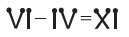
Answer:
Solution (a):
The original incorrect equation is $IX - VI = V$, which means $9 - 6 = 5$.
To make it a valid equation by removing two matchsticks:
We remove the $I$ from $IX$ (making it $X$) and the $I$ from $VI$ (making it $V$).
The new equation becomes: $X - V = V$
In Hindu-Arabic numerals, this is $10 - 5 = 5$, which is correct.
Solution (b):
The original incorrect equation is $VI - IV = XI$, which means $6 - 4 = 11$.
To make it valid by moving one matchstick, we have two solutions:
Solution 1: Move the vertical matchstick from $IV$ to the minus sign to turn it into a plus sign.
$VI + V = XI$
($6 + 5 = 11$)
Solution 2: Move the $I$ from $XI$ to the minus sign to turn it into a plus sign.
$VI + IV = X$
($6 + 4 = 10$)
Question 105. What does a duck do when it flies upside down? The answer to this riddle is hidden in the equation given below:
If i + 69 = 70, then i = ? If 8u = 6u + 8, then u =?
If 4a = –5a + 45, then a = ? if 4q + 5 = 17, then q =?
If –5t – 60 = – 70, then t = ? If $\frac{1}{4}$ s + 98 = 100, then s =?
If $\frac{5}{3}$ p + 9 = 24, then p =_____?
If 3c = c +12, then c =_____?
If 3 (k + 1) = 24, then k =_____?
For riddle answer : substitute the number for the letter it equals

Answer:
To Find: The values of the variables to decode the riddle.
Solution:
Let us solve each equation one by one:
1. $i + 69 = 70 \implies i = 70 - 69 \implies$ i = 1
2. $8u = 6u + 8 \implies 8u - 6u = 8 \implies 2u = 8 \implies$ u = 4
3. $4a = -5a + 45 \implies 4a + 5a = 45 \implies 9a = 45 \implies$ a = 5
4. $4q + 5 = 17 \implies 4q = 17 - 5 \implies 4q = 12 \implies$ q = 3
5. $-5t - 60 = -70 \implies -5t = -70 + 60 \implies -5t = -10 \implies$ t = 2
6. $\frac{1}{4}s + 98 = 100 \implies \frac{1}{4}s = 100 - 98 \implies \frac{s}{4} = 2 \implies$ s = 8
7. $\frac{5}{3}p + 9 = 24 \implies \frac{5}{3}p = 24 - 9 \implies \frac{5p}{3} = 15 \implies 5p = 45 \implies$ p = 9
8. $3c = c + 12 \implies 3c - c = 12 \implies 2c = 12 \implies$ c = 6
9. $3(k + 1) = 24 \implies k + 1 = \frac{24}{3} \implies k + 1 = 8 \implies$ k = 7
Now, let us substitute these letters for the numbers given in the riddle slots:
$\text{Slot } 1 = i$
$\text{Slot } 2 = t$
$\text{Slot } 3 = q$
$\text{Slot } 4 = u$
$\text{Slot } 5 = a$
$\text{Slot } 6 = c$
$\text{Slot } 7 = k$
$\text{Slot } 8 = s$
$\text{Slot } 9 = p$ (Slot for number 9)
Following the pattern 1 2 / 3 4 5 6 7 8 / 4 9:
I T / Q U A C K S / U P
Therefore, the answer to the riddle is: IT QUACKS UP.
Question 106. The three scales below are perfectly balanced if • = 3. What are the values of ∆ and * ?
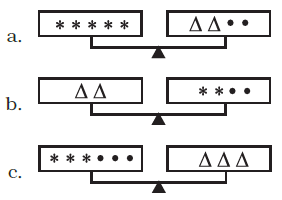
Answer:
Given:
The value of a dot ($\bullet$) is $3$.
Scale (a) is balanced: $5* = 2\Delta + 2\bullet$
Scale (b) is balanced: $2\Delta = 2* + 2\bullet$
Scale (c) is balanced: $3* + 3\bullet = 3\Delta$
To Find: The values of $\Delta$ and $*$.
Solution:
Substitute the value $\bullet = 3$ into the equations from the scales.
From Scale (c):
$3* + 3(3) = 3\Delta$
$3* + 9 = 3\Delta$
Dividing the entire equation by $3$:
$* + 3 = \Delta$
Now, substitute this value of $\Delta$ into the equation for Scale (a):
$5* = 2(* + 3) + 2(3)$
$5* = 2* + 6 + 6$
$5* = 2* + 12$
Transposing $2*$ to the LHS:
$5* - 2* = 12$
$3* = 12$
$* = 4$
Now, find the value of $\Delta$ using the relation $\Delta = * + 3$:
$\Delta = 4 + 3$
$\Delta = 7$
Therefore, the value of $\Delta = 7$ and $* = 4$.
Question 107. The given figure represents a weighing balance. The weights of some objects in the balance are given. Find the weight of each square and the circle.
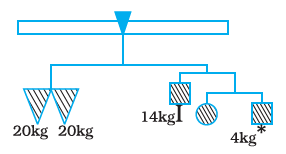
Answer:
Given:
1. The weight of each triangle on the left side of the main balance is $20$ kg.
2. There are two such triangles on the left side.
3. The right side contains a system of sub-balances with squares and a circle.
4. The weights of $14$ kg and $4$ kg are placed at specific positions as shown in the figure.
To Find:
1. The weight of each square ($S$).
2. The weight of the circle ($C$).
Solution:
For a weighing balance to be in equilibrium, the total weight on the left arm of any horizontal bar must be equal to the total weight on its right arm.
Step 1: Analyzing the top-most main balance
The left side has two triangles of $20$ kg each. So, the total weight on the left is $20 + 20 = 40$ kg. For the main bar to be balanced, the total weight of the entire structure hanging on the right must also be $40$ kg.
$\text{Total Right Weight} = 40$ kg
Step 2: Analyzing the middle horizontal bar
This bar divides the $40$ kg weight into two equal parts (assuming the pivot is at the center). The left branch of this bar carries a square and a $14$ kg weight. The right branch carries the bottom-most sub-balance.
$\text{Weight of left branch} = \frac{40}{2}$
$S + 14 = 20$
Transposing $14$ to the Right Hand Side (RHS):
$S = 20 - 14$
$S = 6$ kg
So, the weight of each square is 6 kg.
Step 3: Analyzing the bottom-most horizontal bar
The right branch of the middle bar also weighs $20$ kg (half of $40$ kg). This $20$ kg is further divided equally between the two branches of the bottom-most bar.
$\text{Weight of each bottom branch} = \frac{20}{2} = 10$ kg
The left branch of this bottom bar carries only the circle ($C$). Therefore:
$C = 10$ kg
We can verify this using the right branch of the bottom bar, which carries a square and a $4$ kg weight:
$\text{Right branch weight} = S + 4$
$\text{Right branch weight} = 6 + 4 = 10$ kg
Since both branches of the bottom bar weigh $10$ kg, the calculations are consistent.
Conclusion:
The weight of each square is 6 kg and the weight of the circle is 10 kg.