

Chapter 5 Lines & Angles (Class 7 - Maths NCERT Exemplar Solutions)
Welcome to the comprehensive resource for NCERT Exemplar Solutions for Class 7 Mathematics: Chapter 5 Lines & Angles! This chapter is intentionally designed to move beyond basic textbook exercises, aiming to significantly deepen students' understanding of fundamental angle relationships and the properties associated with parallel lines. These problems challenge learners with more complex diagrams, multi-step problem-solving approaches, and the application of deductive reasoning skills.
The solutions provided here thoroughly cover the core essentials of geometry at this level, including Complementary and Supplementary angles (summing to $90^\circ$ and $180^\circ$ respectively), Adjacent angles, Linear Pairs, and Vertically Opposite angles. A major focus is placed on the interaction between parallel lines and a transversal. Students will master the properties of Corresponding angles, Alternate Interior/Exterior angles, and Consecutive Interior angles (Co-interior), as well as learning how to use these relationships as rigorous proof that two lines are indeed parallel.
Exemplar problems often feature intricate figures that require identifying multiple angle pairs sequentially to find unknown measures. Our solutions cater to all formats, including Multiple Choice Questions (MCQs), True/False statements, and demanding Short/Long Answer questions. Each step in the derivation is accompanied by the specific geometric reason, such as the "Linear Pair Axiom" or "Vertically Opposite Angles Property." With clear diagrams and logical justifications prepared by learningspot.co, students can build the geometric reasoning capabilities and confidence needed to excel in higher-level geometry studies.
| Content On This Page | ||
|---|---|---|
| Solved Examples (Examples 1 to 18) | Question 1 to 41 (Multiple Choice Questions) | Question 42 to 56 (Fill in the Blanks) |
| Question 57 to 71 (True or False) | Question 72 to 113 | |
Solved Examples (Examples 1 to 18)
In each of the Examples 1 to 4, there are four options, out of which one option is correct. Write the correct one.
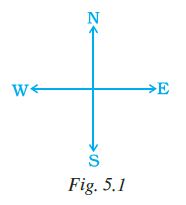
Example 1: The angles between North and East and North and West are
(a) complementary angles
(b) supplementary angles
(c) both acute angles
(d) both obtuse angles
Answer:
By observing the cardinal directions in Fig. 5.1, we know that the angle between any two consecutive main directions (North, East, South, West) is a right angle ($90^\circ$).
$\text{Angle between North and East} = 90^\circ$
$\text{Angle between North and West} = 90^\circ$
To determine their relationship, we find their sum:
$\text{Sum} = 90^\circ + 90^\circ = 180^\circ$
In geometry, two angles whose sum is $180^\circ$ are known as supplementary angles.
Therefore, the correct option is (b).
Example 2: Which of the following pair of angles are supplementary?
(a) 48°, 42°
(b) 60°, 60°
(c) 75°, 105°
(d) 179°, 2°
Answer:
Two angles are called supplementary if the sum of their measures is exactly $180^\circ$. Let us check the given pairs:
(a) $48^\circ + 42^\circ = 90^\circ$ (These are complementary angles).
(b) $60^\circ + 60^\circ = 120^\circ$.
(c) $75^\circ + 105^\circ = 180^\circ$ (These are supplementary angles).
(d) $179^\circ + 2^\circ = 181^\circ$.
Therefore, the correct option is (c).
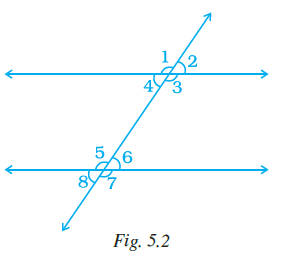
Example 3: In Fig. 5.2, a pair of corresponding angles is
(a) ∠1, ∠2
(b) ∠3, ∠6
(c) ∠3, ∠5
(d) ∠3, ∠7
Answer:
In Fig. 5.2, when a transversal intersects two lines, angles that occupy the same relative position at each intersection are called corresponding angles.
Let us analyze the pairs:
(a) $\angle 1$ and $\angle 2$ are adjacent angles forming a linear pair.
(b) $\angle 3$ and $\angle 6$ are alternate interior angles.
(c) $\angle 3$ and $\angle 5$ are interior angles on the same side of the transversal.
(d) $\angle 3$ and $\angle 7$ are in the same relative position (bottom-right of each intersection). Thus, they are corresponding angles.
Therefore, the correct option is (d).
Example 4: If two lines are intersected by a transversal, then the number of pairs of interior angles on the same side of the transversal is
(a) 1
(b) 2
(c) 3
(d) 4
Answer:
When a transversal intersects two lines, the region between the two lines is the interior. There are four interior angles in total.
Two of these angles lie on the left side of the transversal, and the other two lie on the right side. This results in exactly 2 pairs of interior angles on the same side of the transversal.
Therefore, the correct option is (b).
In Examples 5 to 7, fill in the blanks to make the statements true.
Example 5: Two lines in a plane which never meet at any point are called _________.
Answer:
Lines in the same flat surface (plane) that are at an equal distance from each other at every point and never intersect, no matter how far they are extended, are known as parallel lines.
Blank: parallel lines
Example 6: Angles of a linear pair are _________ as well as ________ .
Answer:
A linear pair consists of two angles that are formed when two lines intersect. By definition, these angles are adjacent (sharing a common arm and vertex) and their non-common arms form a straight line, making them supplementary ($180^\circ$).
Blanks: adjacent, supplementary
Example 7: Adjacent angles have a common vertex, a common __________ and no-common _________.
Answer:
According to the properties of adjacent angles:
1. They have a common vertex.
2. They have a common arm (or side).
3. They have no common interior points (their regions do not overlap).
Blanks: arm, interior points
In Examples 8 to 11, state whether the statements are True or False.
Example 8: Sum of two complementary angles is 180°.
Answer:
Statement: Sum of two complementary angles is $180^\circ$.
Result: False
Reason: By definition, the sum of two complementary angles is always $90^\circ$. The sum of two supplementary angles is $180^\circ$.
Example 9: Sum of two supplementary angles is 180°.
Answer:
Statement: Sum of two supplementary angles is $180^\circ$.
Result: True
Reason: Two angles are said to be supplementary if the sum of their measures is exactly $180^\circ$.
Example 10: Sum of interior angles on the same side of a transversal with two parallel lines is 90°.
Answer:
Statement: Sum of interior angles on the same side of a transversal with two parallel lines is $90^\circ$.
Result: False
Reason: When two parallel lines are cut by a transversal, the sum of the interior angles on the same side of the transversal (co-interior angles) is always $180^\circ$ (they are supplementary), not $90^\circ$.
Example 11: Vertically opposite angles are equal.
Answer:
Statement: Vertically opposite angles are equal.
Result: True
Reason: According to the vertically opposite angles theorem, when two lines intersect, the angles opposite to each other at the vertex are always equal.
Example 12: In Fig. 5.3, four line segments PQ, QR, RS and ST are making the letter W, PQ || RS and QR || ST. If angle between PQ and QR is 39°, find the values of x and y.

Answer:
Given:
In Fig. 5.3, $PQ \parallel RS$ and $QR \parallel ST$.
Angle between $PQ$ and $QR$ is $39^\circ$, i.e., $\angle PQR = 39^\circ$.
To Find:
Values of $x$ and $y$.
Solution:
$PQ \parallel RS$
(Given)
For parallel lines $PQ$ and $RS$, $QR$ acts as a transversal.
$\angle PQR = \angle QRS$
(Alternate interior angles)
$39^\circ = x^\circ$
$x = 39$
... (i)
Now, consider $QR \parallel ST$. Here, $RS$ acts as a transversal.
$\angle QRS = \angle RST$
(Alternate interior angles)
$x^\circ = y^\circ$
$39 = y$
[From (i)] ... (ii)
Therefore, the values are $x = 39$ and $y = 39$.
Example 13: In Fig. 5.4, are the angles 1 and 2 of the letter N forming a pair of adjacent angles? Give reasons.

Answer:
Given:
Fig. 5.4 showing the letter 'N' with angles $1$ and $2$.
Solution:
No, the angles $1$ and $2$ are not adjacent angles.
Reason: For two angles to be adjacent, they must satisfy three conditions:
1. They must have a common vertex.
2. They must have a common arm.
3. Their non-common arms should be on either side of the common arm.
In the given figure of the letter 'N', angle $1$ and angle $2$ are formed at different vertices. Since they do not share a common vertex, they cannot be adjacent angles.
Example 14: In Fig. 5.5, the points A, O and B are collinear. Ray OC ⊥ ray OD. Check whether

(i) ∠AOD and ∠BOC are complementary,
(ii) ∠AOC and ∠BOC are supplementary.
Answer:
Given:
Points $A, O, B$ are collinear (forming a straight line $AB$).
Ray $OC \perp$ ray $OD$, which means $\angle COD = 90^\circ$.
$\angle AOD = A^\circ$ and $\angle BOC = 3a^\circ$.
To Check:
(i) Whether $\angle AOD$ and $\angle BOC$ are complementary.
(ii) Whether $\angle AOC$ and $\angle BOC$ are supplementary.
Solution:
Since $AOB$ is a straight line, the sum of all angles on it at point $O$ is $180^\circ$.
$\angle AOD + \angle DOC + \angle COB = 180^\circ$
(Angles on a straight line)
$A^\circ + 90^\circ + 3a^\circ = 180^\circ$
(Given $\angle DOC = 90^\circ$)
$A^\circ + 3a^\circ = 180^\circ - 90^\circ$
$A^\circ + 3a^\circ = 90^\circ$
... (i)
(i) For $\angle AOD$ and $\angle BOC$:
Sum $= \angle AOD + \angle BOC = A^\circ + 3a^\circ$.
From equation (i), we know $A^\circ + 3a^\circ = 90^\circ$.
Since their sum is $90^\circ$, $\angle AOD$ and $\angle BOC$ are complementary.
(ii) For $\angle AOC$ and $\angle BOC$:
From the figure, $\angle AOC = \angle AOD + \angle DOC$.
$\angle AOC = A^\circ + 90^\circ$
Sum $= \angle AOC + \angle BOC = (A^\circ + 90^\circ) + 3a^\circ$.
Rearranging the terms: Sum $= (A^\circ + 3a^\circ) + 90^\circ$.
Substituting value from (i): Sum $= 90^\circ + 90^\circ = 180^\circ$.
Since their sum is $180^\circ$, $\angle AOC$ and $\angle BOC$ are supplementary.
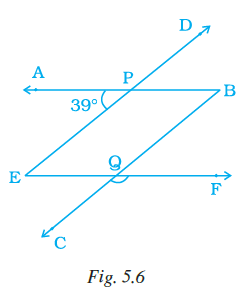
Example 15: In Fig. 5.6 AB || EF, ED || CB and ∠APE is 39°. Find∠CQF.
Answer:
Given:
In Fig. 5.6, $AB \parallel EF$ and $ED \parallel CB$.
$\angle APE = 39^\circ$.
To Find:
The value of $\angle CQF$.
Solution:
Consider parallel lines $AB$ and $EF$ with transversal $EP$.
$\angle PEQ = \angle APE$
(Alternate interior angles)
$\angle PEQ = 39^\circ$
... (i)
Now, consider parallel lines $ED$ and $CB$ with transversal $EF$.
$\angle BQF = \angle PEQ$
(Corresponding angles)
$\angle BQF = 39^\circ$
[From (i)] ... (ii)
Since $B, Q$ and $F$ lie on the line $EF$, $\angle BQF$ and $\angle CQF$ form a linear pair.
$\angle BQF + \angle CQF = 180^\circ$
(Linear pair)
$39^\circ + \angle CQF = 180^\circ$
$\angle CQF = 180^\circ - 39^\circ$
$\angle CQF = 141^\circ$
Therefore, the value of $\angle CQF$ is $141^\circ$.
Example 16: Out of a pair of complementary angles, one is two-third of the other. Find the angles.
Answer:
To Find: The measures of two complementary angles where one is two-third of the other.
Solution:
Let one of the complementary angles be $x$.
According to the question, the other angle is $\frac{2}{3}$ of $x$, i.e., $\frac{2}{3}x$.
We know that the sum of two complementary angles is $90^\circ$.
$x + \frac{2}{3}x = 90^\circ$
[Sum of complementary angles]
Taking the LCM on the LHS:
$\frac{3x + 2x}{3} = 90^\circ$
$\frac{5x}{3} = 90^\circ$
$5x = 90^\circ \times 3$
$5x = 270^\circ$
$x = \frac{270^\circ}{5}$
$x = 54^\circ$
Now, finding the second angle:
$\text{Second angle} = \frac{2}{3} \times 54^\circ$
$\text{Second angle} = 2 \times 18^\circ = 36^\circ$
Thus, the two angles are $54^\circ$ and $36^\circ$.
Example 17: In Fig. 5.7, CD intersects the line AB at F, ∠CFB = 50° and ∠EFA = ∠AFD. Find the measure of ∠EFC.

Answer:
Given:
Line $CD$ intersects line $AB$ at point $F$.
$\angle CFB = 50^\circ$
$\angle EFA = \angle AFD$
To Find:
Measure of $\angle EFC$.
Solution:
When two lines $AB$ and $CD$ intersect at $F$, vertically opposite angles are equal.
$\angle AFD = \angle CFB$
(Vertically opposite angles)
$\angle AFD = 50^\circ$
It is given that $\angle EFA = \angle AFD$.
$\angle EFA = 50^\circ$
Now, points $A, F$ and $B$ lie on a straight line $AB$. The sum of angles on a straight line at a point is $180^\circ$.
$\angle EFA + \angle EFC + \angle CFB = 180^\circ$
(Angles on a straight line)
Substituting the known values:
$50^\circ + \angle EFC + 50^\circ = 180^\circ$
$\angle EFC + 100^\circ = 180^\circ$
$\angle EFC = 180^\circ - 100^\circ$
$\angle EFC = 80^\circ$
Therefore, the measure of $\angle EFC$ is $80^\circ$.
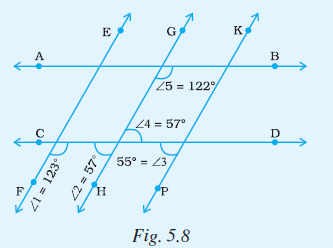
Example 18: In the given figure, find out which pair of lines are parallel.
Answer:
To Find: Which pair of lines are parallel in Fig. 5.8.
Solution:
1. Checking lines $EF$ and $GH$:
Consider the transversal $CD$. The angles $\angle 1$ and $\angle 2$ are interior angles on the same side of the transversal.
$\angle 1 = 123^\circ$ and $\angle 2 = 57^\circ$
$\text{Sum} = 123^\circ + 57^\circ = 180^\circ$
Since the sum of co-interior angles is $180^\circ$, the lines are parallel.
$\therefore EF \parallel GH$
... (i)
2. Checking lines $GH$ and $KP$:
Consider the transversal $CD$. The angles $\angle 4$ and $\angle 3$ are interior angles on the same side of the transversal.
$\angle 4 = 57^\circ$ and $\angle 3 = 55^\circ$
$\text{Sum} = 57^\circ + 55^\circ = 112^\circ$
Since $112^\circ \neq 180^\circ$, the sum of co-interior angles is not supplementary.
$\therefore GH \not\parallel KP$
3. Checking lines $AB$ and $CD$:
Consider line $GH$ as a transversal. For $AB \parallel CD$, the corresponding angles should be equal.
The angle corresponding to $\angle 5$ ($122^\circ$) on line $CD$ would be the angle above $CD$ and to the right of $GH$. Let this angle be $\theta$.
Since $\theta$ and $\angle 4$ form a linear pair:
$\theta = 180^\circ - \angle 4 = 180^\circ - 57^\circ = 123^\circ$
Comparing corresponding angles:
$122^\circ \neq 123^\circ$
($\angle 5 \neq \theta$)
$\therefore AB \not\parallel CD$
Thus, the only pair of parallel lines is $EF \parallel GH$.
Exercise
Question 1 to 41 (Multiple Choice Questions)
In questions 1 to 41, there are four options out of which one is correct. Write the correct one.
Question 1. The angles between North and West and South and East are
(a) complementary
(b) supplementary
(c) both are acute
(d) both are obtuse
Answer:
Solution:
The angle between the cardinal directions North and West is $90^\circ$.
Similarly, the angle between South and East is also $90^\circ$.
Sum of these two angles $= 90^\circ + 90^\circ = 180^\circ$.
Since the sum of these two angles is $180^\circ$, they are supplementary.
Correct Option: (b)
Question 2. Angles between South and West and South and East are
(a) vertically opposite angles
(b) complementary angles
(c) making a linear pair
(d) adjacent but not supplementary
Answer:
Solution:
The angle between South and West is $90^\circ$.
The angle between South and East is $90^\circ$.
Both these angles share a common vertex (the center point) and a common arm (South).
The non-common arms (West and East) lie on opposite sides of the common arm and form a straight line.
Sum of angles $= 90^\circ + 90^\circ = 180^\circ$.
Therefore, they are forming a linear pair.
Correct Option: (c)
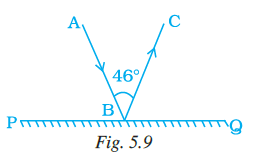
Question 3. In Fig. 5.9, PQ is a mirror, AB is the incident ray and BC is the reflected ray. If ∠ABC = 46°, then ∠ABP is equal to
(a) 44°
(b) 67°
(c) 13°
(d) 62°
Answer:
Given:
$\angle ABC = 46^\circ$
$PQ$ is a straight line mirror.
To Find:
$\angle ABP$
Solution:
According to the laws of reflection, the angle of incidence is equal to the angle of reflection.
In the given figure, the angles made with the mirror surface are also equal:
$\angle ABP = \angle CBQ$
Since $PBQ$ is a straight line, the sum of angles on it is $180^\circ$:
$\angle ABP + \angle ABC + \angle CBQ = 180^\circ$
Substituting $\angle CBQ$ with $\angle ABP$ and $\angle ABC$ with $46^\circ$:
$\angle ABP + 46^\circ + \angle ABP = 180^\circ$
$2\angle ABP = 180^\circ - 46^\circ$
$2\angle ABP = 134^\circ$
$\angle ABP = \frac{134^\circ}{2}$
$\angle ABP = 67^\circ$
Correct Option: (b)
Question 4. If the complement of an angle is 79°, then the angle will be of
(a) 1°
(b) 11°
(c) 79°
(d) 101°
Answer:
Solution:
Let the required angle be $x$.
We know that the sum of an angle and its complement is $90^\circ$.
$x + 79^\circ = 90^\circ$
$x = 90^\circ - 79^\circ$
$x = 11^\circ$
The measure of the angle is $11^\circ$.
Correct Option: (b)
Question 5. Angles which are both supplementary and vertically opposite are
(a) 95°, 85°
(b) 90°, 90°
(c) 100°, 80°
(d) 45°, 45°
Answer:
Solution:
Let the two angles be $x$ and $y$.
Since they are vertically opposite angles, they must be equal:
$x = y$
Since they are also supplementary angles, their sum must be $180^\circ$:
$x + y = 180^\circ$
Substituting $y = x$ into the second equation:
$x + x = 180^\circ$
$2x = 180^\circ$
$x = 90^\circ$
Thus, both angles are $90^\circ$.
Correct Option: (b)
Question 6. The angle which makes a linear pair with an angle of 61° is of
(a) 29°
(b) 61°
(c) 122°
(d) 119°
Answer:
Solution:
Let the required angle be $x$.
Angles forming a linear pair are supplementary, meaning their sum is $180^\circ$.
$x + 61^\circ = 180^\circ$
$x = 180^\circ - 61^\circ$
$x = 119^\circ$
Correct Option: (d)
Question 7. The angles x and 90° – x are
(a) supplementary
(b) complementary
(c) vertically opposite
(d) making a linear pair
Answer:
Solution:
To determine the relationship, we find the sum of the two given angles.
$\text{Sum} = x + (90^\circ - x)$
$\text{Sum} = x - x + 90^\circ$
$\text{Sum} = 90^\circ$
Since the sum of the angles is exactly $90^\circ$, they are complementary.
Correct Option: (b)
Question 8. The angles x – 10° and 190° – x are
(a) interior angles on the same side of the transversal
(b) making a linear pair
(c) complementary
(d) supplementary
Answer:
Solution:
To determine the relationship, we find the sum of the two given angles.
$\text{Sum} = (x - 10^\circ) + (190^\circ - x)$
$\text{Sum} = x - x + 190^\circ - 10^\circ$
$\text{Sum} = 180^\circ$
Since the sum of the angles is exactly $180^\circ$, they are supplementary.
Correct Option: (d)
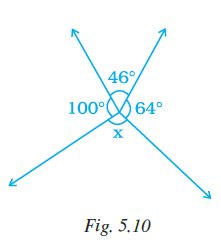
Question 9. In Fig. 5.10, the value of x is
(a) 110°
(b) 46°
(c) 64°
(d) 150°
Answer:
Solution:
We know that the sum of all angles around a point is $360^\circ$ (Complete angle).
$100^\circ + 46^\circ + 64^\circ + x = 360^\circ$
(Sum of angles around a point)
$210^\circ + x = 360^\circ$
$x = 360^\circ - 210^\circ$
$x = 150^\circ$
Correct Option: (d)
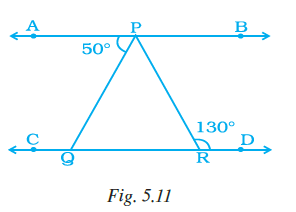
Question 10. In Fig. 5.11, if AB || CD, ∠ APQ = 50° and ∠PRD = 130°, then ∠ QPR is
(a) 130°
(b) 50°
(c) 80°
(d) 30°
Answer:
Given:
$AB \parallel CD$
$\angle APQ = 50^\circ$
$\angle PRD = 130^\circ$
To Find:
$\angle QPR$
Solution:
Since $AB \parallel CD$ and $PR$ acts as a transversal:
$\angle APR = \angle PRD$
(Alternate interior angles)
$\angle APR = 130^\circ$
From the figure, we can see that $\angle APR$ is composed of two angles:
$\angle APR = \angle APQ + \angle QPR$
Substituting the known values:
$130^\circ = 50^\circ + \angle QPR$
$\angle QPR = 130^\circ - 50^\circ$
$\angle QPR = 80^\circ$
Correct Option: (c)
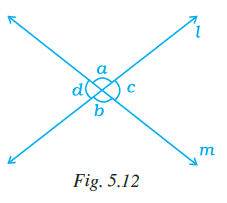
Question 11. In Fig. 5.12, lines l and m intersect each other at a point. Which of the following is false?
(a) ∠a = ∠b
(b) ∠d = ∠c
(c) ∠a + ∠d = 180°
(d) ∠a = ∠d
Answer:
Solution:
When two lines $l$ and $m$ intersect at a point:
1. Vertically opposite angles are equal. Therefore, $\angle a = \angle b$ and $\angle d = \angle c$. Options (a) and (b) are true.
2. Adjacent angles on a straight line are supplementary. Therefore, $\angle a + \angle d = 180^\circ$. Option (c) is true.
3. $\angle a$ and $\angle d$ are adjacent angles forming a linear pair. They are equal only if the lines are perpendicular ($90^\circ$ each), which is not specified. Thus, the statement $\angle a = \angle d$ is generally false.
Correct Option: (d)
Question 12. If angle P and angle Q are supplementary and the measure of angle P is 60°, then the measure of angle Q is
(a) 120°
(b) 60°
(c) 30°
(d) 20°
Answer:
Given:
Angle $P$ and $Q$ are supplementary.
$\angle P = 60^\circ$
Solution:
By the definition of supplementary angles:
$\angle P + \angle Q = 180^\circ$
$60^\circ + \angle Q = 180^\circ$
$\angle Q = 180^\circ - 60^\circ$
$\angle Q = 120^\circ$
Correct Option: (a)
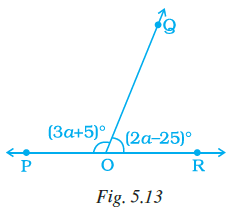
Question 13. In Fig. 5.13, POR is a line. The value of a is
(a) 40°
(b) 45°
(c) 55°
(d) 60°
Answer:
Solution:
Since $POR$ is a straight line, the angles on it form a linear pair and their sum is $180^\circ$.
$(3a + 5)^\circ + (2a - 25)^\circ = 180^\circ$
(Linear pair)
$3a + 2a + 5 - 25 = 180$
$5a - 20 = 180$
$5a = 180 + 20$
$5a = 200$
$a = \frac{200}{5}$
$a = 40^\circ$
Correct Option: (a)
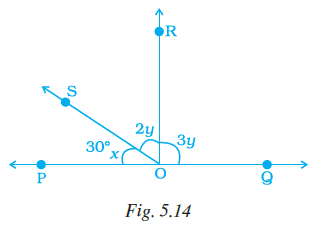
Question 14. In Fig. 5.14, POQ is a line. If x = 30°, then ∠ QOR is
(a) 90°
(b) 30°
(c) 150°
(d) 60°
Answer:
Given:
$POQ$ is a straight line.
$x = 30^\circ$
Solution:
Since $POQ$ is a line, the sum of all angles at point $O$ on one side is $180^\circ$.
$\angle POS + \angle SOR + \angle ROQ = 180^\circ$
From the figure, the angles are $x$, $2y$, and $3y$.
$x + 2y + 3y = 180^\circ$
Substituting $x = 30^\circ$:
$30^\circ + 5y = 180^\circ$
$5y = 180^\circ - 30^\circ$
$5y = 150^\circ$
$y = 30^\circ$
Now, we need to find $\angle QOR$:
$\angle QOR = 3y$
$\angle QOR = 3 \times 30^\circ = 90^\circ$
Correct Option: (a)
Question 15. The measure of an angle which is four times its supplement is
(a) 36°
(b) 144°
(c) 16°
(d) 64
Answer:
Solution:
Let the required angle be $x$.
The supplement of this angle will be $(180^\circ - x)$.
According to the given condition, the angle is four times its supplement:
$x = 4(180^\circ - x)$
$x = 720^\circ - 4x$
$x + 4x = 720^\circ$
$5x = 720^\circ$
$x = \frac{720^\circ}{5}$
$x = 144^\circ$
The measure of the angle is $144^\circ$.
Correct Option: (b)
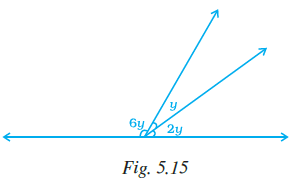
Question 16. In Fig. 5.15, the value of y is
(a) 30°
(b) 15°
(c) 20°
(d) 22.5°
Answer:
Solution:
The angles $6y$, $y$, and $2y$ lie on a straight line.
The sum of angles on a straight line is $180^\circ$.
$6y + y + 2y = 180^\circ$
$9y = 180^\circ$
$y = \frac{180^\circ}{9}$
$y = 20^\circ$
Correct Option: (c)
Question 17. In Fig. 5.16, PA || BC || DT and AB || DC. Then, the values of a and b are respectively.

(a) 60°, 120°
(b) 50°,130°
(c) 70°,110°
(d) 80°,100°
Answer:
Given:
$PA \parallel BC \parallel DT$ and $AB \parallel DC$.
$\angle PAB = 50^\circ$.
Solution:
Since $PA \parallel BC$ and $AB$ acts as a transversal:
$\angle ABC = \angle PAB$
(Alternate interior angles)
$a = 50^\circ$
Now, consider $AB \parallel DC$ and $BC$ as a transversal:
$\angle ABC + \angle BCD = 180^\circ$
(Co-interior angles)
$50^\circ + \angle BCD = 180^\circ$
$\angle BCD = 180^\circ - 50^\circ = 130^\circ$
Next, consider $BC \parallel DT$ and $CD$ as a transversal:
$\angle CDT = \angle BCD$
(Alternate interior angles)
$b = 130^\circ$
Thus, the values are $a = 50^\circ$ and $b = 130^\circ$.
Correct Option: (b)
Question 18. The difference of two complementary angles is 30°. Then, the angles are
(a) 60°, 30°
(b) 70°, 40°
(c) 20°,50°
(d) 105°,75°
Answer:
Solution:
Let the two complementary angles be $x$ and $y$.
According to the definition of complementary angles:
$x + y = 90^\circ$
... (i)
According to the given problem, their difference is $30^\circ$:
$x - y = 30^\circ$
... (ii)
Adding equations (i) and (ii):
$2x = 120^\circ$
$x = 60^\circ$
Substituting $x = 60^\circ$ in equation (i):
$60^\circ + y = 90^\circ$
$y = 30^\circ$
The angles are $60^\circ$ and $30^\circ$.
Correct Option: (a)
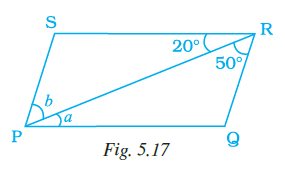
Question 19. In Fig. 5.17, PQ || SR and SP || RQ. Then, angles a and b are respectively
(a) 20°, 50°
(b) 50°, 20°
(c) 30°,50°
(d) 45°, 35°
Answer:
Given:
$PQ \parallel SR$ and $SP \parallel RQ$.
$\angle SRP = 20^\circ$ and $\angle SPR = 50^\circ$.
Solution:
Since $PQ \parallel SR$ and $PR$ is the transversal:
$a = \angle SRP$
(Alternate interior angles)
$a = 20^\circ$
Since $SP \parallel RQ$ and $PR$ is the transversal:
$b = \angle SPR$
(Alternate interior angles)
$b = 50^\circ$
Thus, the values are $a = 20^\circ$ and $b = 50^\circ$.
Correct Option: (a)
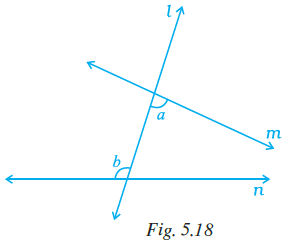
Question 20. In Fig. 5.18, a and b are
(a) alternate exterior angles
(b) corresponding angles
(c) alternate interior angles
(d) vertically opposite angles
Answer:
Solution:
In the given figure, line $l$ is a transversal intersecting lines $m$ and $n$.
Angles $a$ and $b$ are located on the inner side of the lines $m$ and $n$ and on opposite sides of the transversal $l$.
Therefore, these angles are called alternate interior angles.
Correct Option: (c)
Question 21. If two supplementary angles are in the ratio 1 : 2, then the bigger angle is
(a) 120°
(b) 125°
(c) 110°
(d) 90°
Answer:
Solution:
Let the two supplementary angles be $x$ and $2x$.
We know that the sum of supplementary angles is $180^\circ$.
$x + 2x = 180^\circ$
$3x = 180^\circ$
$x = \frac{180^\circ}{3}$
$x = 60^\circ$
The bigger angle is $2x$:
$2x = 2 \times 60^\circ = 120^\circ$
Correct Option: (a)
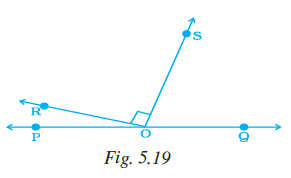
Question 22. In Fig. 5.19, ∠ROS is a right angle and ∠POR and ∠QOS are in the ratio 1 : 5. Then, ∠ QOS measures
(a) 150°
(b) 75°
(c) 45°
(d) 60°
Answer:
Given:
$POQ$ is a straight line.
$\angle ROS = 90^\circ$
$\angle POR : \angle QOS = 1 : 5$
Solution:
Let $\angle POR = x$ and $\angle QOS = 5x$.
Since $POQ$ is a straight line, the sum of angles on it is $180^\circ$.
$\angle POR + \angle ROS + \angle QOS = 180^\circ$
$x + 90^\circ + 5x = 180^\circ$
$6x = 180^\circ - 90^\circ$
$6x = 90^\circ$
$x = 15^\circ$
Now, we find $\angle QOS$:
$\angle QOS = 5x = 5 \times 15^\circ = 75^\circ$
Correct Option: (b)
Question 23. Statements a and b are as given below:
a : If two lines intersect, then the vertically opposite angles are equal.
b : If a transversal intersects, two other lines, then the sum of two interior angles on the same side of the transversal is 180°.
Then
(a) Both a and b are true
(b) a is true and b is false
(c) a is false and b is true
(d) both a and b are false
Answer:
Solution:
Statement a: This is a standard theorem in geometry. When two lines intersect, the angles opposite each other at the vertex are always equal. So, a is true.
Statement b: The sum of interior angles on the same side of the transversal is $180^\circ$ only if the two lines are parallel. If the lines are not parallel, the sum will not be $180^\circ$. Since the statement doesn't specify that the lines are parallel, b is false.
Correct Option: (b)
Question 24. For Fig. 5.20, statements p and q are given below:
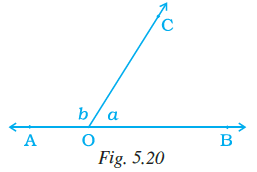
p : a and b are forming a linear pair.
q : a and b are forming a pair of adjacent angles.
Then,
(a) both p and q are true
(b) p is true and q is false
(c) p is false and q is true
(d) both p and q are false
Answer:
Solution:
Statement p: Angles $a$ and $b$ lie on a straight line $AB$ and are supplementary. Therefore, they form a linear pair. So, p is true.
Statement q: Angles $a$ and $b$ share a common vertex $O$ and a common arm $OC$. Their non-common arms ($OA$ and $OB$) are on opposite sides of the common arm. Therefore, they are adjacent angles. So, q is true.
Since both statements are correct, both p and q are true.
Correct Option: (a)
Question 25. In Fig. 5.21, ∠AOC and ∠ BOC form a pair of

(a) vertically opposite angles
(b) complementary angles
(c) alternate interior angles
(d) supplementary angles
Answer:
Solution:
In Fig. 5.21, points $A, O,$ and $B$ lie on a straight line. The ray $OC$ stands on this line.
Angles $\angle AOC$ and $\angle BOC$ are adjacent angles that lie on a straight line.
We know that the sum of angles on a straight line is $180^\circ$. Therefore, these angles are supplementary angles (also known as a linear pair).
Correct Option: (d)
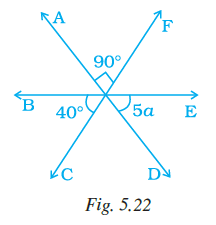
Question 26. In Fig. 5.22, the value of a is
(a) 20°
(b) 15°
(c) 5°
(d) 10°
Answer:
Solution:
Assuming the figure consists of three straight lines intersecting at a common point.
From the figure, the angle vertically opposite to $\angle BOC$ is $\angle FOE$.
$\angle FOE = \angle BOC = 40^\circ$
(Vertically opposite angles)
Now, consider the straight line $AD$. The sum of angles on one side of this line is $180^\circ$.
$\angle AOF + \angle FOE + \angle EOD = 180^\circ$
Substituting the given values ($\angle AOF = 90^\circ$ as shown by the square symbol):
$90^\circ + 40^\circ + 5a = 180^\circ$
$130^\circ + 5a = 180^\circ$
$5a = 180^\circ - 130^\circ$
$5a = 50^\circ$
$a = 10^\circ$
Correct Option: (d)
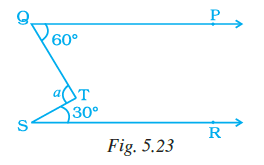
Question 27. In Fig. 5.23, if QP || SR, the value of a is
(a) 40°
(b) 30°
(c) 90°
(d) 80°
Answer:
Given:
In Fig. 5.23, $QP \parallel SR$.
$\angle PQT = 60^\circ$ and $\angle TSR = 30^\circ$.
To Find:
The value of angle $a$ ($\angle QTS$).
Construction Required:
Through point $T$, draw a line $XY$ such that $XY \parallel QP$.
Solution:
It is given that $QP \parallel SR$. By construction, $XY \parallel QP$.
$XY \parallel SR$
(Lines parallel to the same line are parallel to each other)
Now, consider parallel lines $QP$ and $XY$ with $QT$ as the transversal:
$\angle QTX = \angle PQT$
(Alternate interior angles)
$\angle QTX = 60^\circ$
... (i)
Next, consider parallel lines $XY$ and $SR$ with $ST$ as the transversal:
$\angle STX = \angle TSR$
(Alternate interior angles)
$\angle STX = 30^\circ$
... (ii)
From the figure, we can see that the angle $a$ is the sum of $\angle QTX$ and $\angle STX$:
$a = \angle QTX + \angle STX$
Substituting values from equations (i) and (ii):
$a = 60^\circ + 30^\circ$
$a = 90^\circ$
Therefore, the value of $a$ is $90^\circ$.
Correct Option: (c)
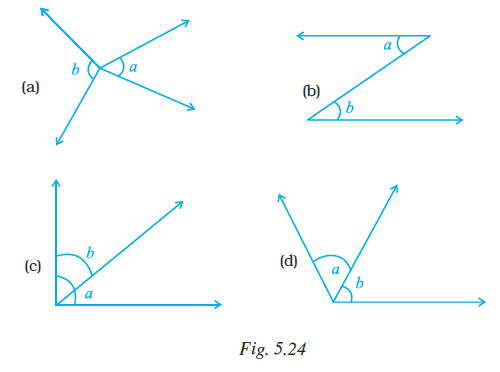
Question 28. In which of the following figures, a and b are forming a pair of adjacent angles?
Answer:
Solution:
Two angles are adjacent if they have a common vertex, a common arm, and their non-common arms are on opposite sides of the common arm.
(a) These are vertically opposite angles, not adjacent.
(b) These angles do not share a common vertex.
(c) These angles share a common vertex and arm, but angle $a$ is part of angle $b$ (overlapping), so their non-common arms are not on opposite sides of the common arm.
(d) These angles share a common vertex and a common arm, and the non-common arms are on opposite sides. Thus, they are adjacent.
Correct Option: (d)
Question 29. In a pair of adjacent angles,
(i) vertex is always common,
(ii) one arm is always common, and
(iii) uncommon arms are always opposite rays
Then
(a) All (i), (ii) and (iii) are true
(b) (iii) is false
(c) (i) is false but (ii) and (iii) are true
(d) (ii) is false
Answer:
Solution:
Statements (i) and (ii) are parts of the fundamental definition of adjacent angles. However, statement (iii) says that uncommon arms are always opposite rays. This is only true for linear pairs of angles. For general adjacent angles, the non-common arms can be at any angle to each other. Therefore, (iii) is false.
Correct Option: (b)
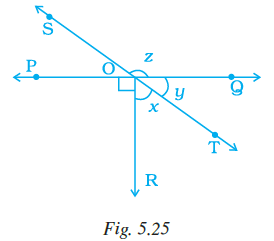
Question 30. In Fig. 5.25, lines PQ and ST intersect at O. If ∠POR = 90° and x : y = 3 : 2, then z is equal to
(a) 126°
(b) 144°
(c) 136°
(d) 154°
Answer:
Solution:
Since $PQ$ is a straight line and $\angle POR = 90^\circ$, the remaining angle $\angle ROQ$ is also $90^\circ$.
$x + y = 90^\circ$
Given $x : y = 3 : 2$. Let $x = 3k$ and $y = 2k$.
$3k + 2k = 90^\circ$
$5k = 90^\circ \implies k = 18^\circ$
So, $x = 3 \times 18^\circ = 54^\circ$ and $y = 2 \times 18^\circ = 36^\circ$.
Since lines $PQ$ and $ST$ intersect at $O$, vertically opposite angles are equal:
$\angle SOQ = \angle POT$
From the figure, $\angle POT = \angle POR + \angle ROT = 90^\circ + x$.
$z = 90^\circ + 54^\circ$
$z = 144^\circ$
Correct Option: (b)
Question 31. In Fig. 5.26, POQ is a line, then a is equal to

(a) 35°
(b) 100°
(c) 80°
(d) 135°
Answer:
Solution:
Since $POQ$ is a straight line, the sum of angles on the line is $180^\circ$.
$\angle POR + \angle ROQ = 180^\circ$
(Linear pair)
Given $\angle POR = 100^\circ$ and $\angle ROQ = a$.
$100^\circ + a = 180^\circ$
$a = 180^\circ - 100^\circ$
$a = 80^\circ$
Correct Option: (c)
Question 32. Vertically opposite angles are always
(a) supplementary
(b) complementary
(c) adjacent
(d) equal
Answer:
Solution:
It is a fundamental theorem in geometry that when two straight lines intersect, the pair of angles formed opposite each other at the vertex (vertically opposite angles) are always equal in magnitude.
Correct Option: (d)
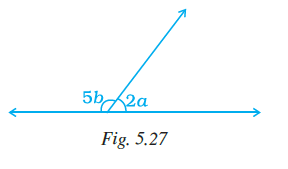
Question 33. In Fig. 5.27, a = 40°. The value of b is
(a) 20°
(b) 24°
(c) 36°
(d) 120°
Answer:
Given:
$a = 40^\circ$
Solution:
From Fig. 5.27, we can see that the angles $5b$ and $2a$ lie on a straight line.
Therefore, they form a linear pair and their sum must be $180^\circ$.
$5b + 2a = 180^\circ$
(Linear pair)
Substituting the given value of $a = 40^\circ$:
$5b + 2(40^\circ) = 180^\circ$
$5b + 80^\circ = 180^\circ$
$5b = 180^\circ - 80^\circ$
$5b = 100^\circ$
$b = \frac{100^\circ}{5}$
$b = 20^\circ$
Correct Option: (a)
Question 34. If an angle is 60° less than two times of its supplement, then the greater angle is
(a) 100°
(b) 80°
(c) 60°
(d) 120°
Answer:
Solution:
Let the angle be $x$.
The supplement of this angle will be $(180^\circ - x)$.
According to the question, the angle $x$ is $60^\circ$ less than two times its supplement:
$x = 2(180^\circ - x) - 60^\circ$
$x = 360^\circ - 2x - 60^\circ$
$x + 2x = 300^\circ$
$3x = 300^\circ$
$x = 100^\circ$
Now, finding the supplement angle:
$\text{Supplement} = 180^\circ - 100^\circ = 80^\circ$
Comparing $100^\circ$ and $80^\circ$, the greater angle is $100^\circ$.
Correct Option: (a)
Question 35. In Fig. 5.28, PQ || RS.
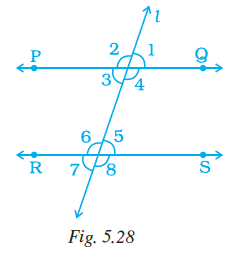
If ∠1 = (2a + b)° and ∠6 = (3a – b)°, then the measure of ∠2 in terms of b is
(a) (2 + b)°
(b) (3 – b)°
(c) (108 – b)°
(d) (180 – b)°
Answer:
Given:
$PQ \parallel RS$
$\angle 1 = (2a + b)^\circ$ and $\angle 6 = (3a - b)^\circ$
Solution:
In the given figure, line $l$ is a transversal.
Since $PQ \parallel RS$, the corresponding angles are equal:
$\angle 2 = \angle 6$
(Corresponding angles)
$\angle 2 = (3a - b)^\circ$
... (i)
Also, $\angle 1$ and $\angle 2$ form a linear pair on line $PQ$:
$\angle 1 + \angle 2 = 180^\circ$
(Linear pair)
Substituting the values of $\angle 1$ and $\angle 2$ (using $\angle 6$):
$(2a + b) + (3a - b) = 180$
$5a = 180 \implies a = 36$
Now, find the measure of $\angle 2$ using the value of $a$:
$\angle 2 = 3a - b$
$\angle 2 = 3(36) - b$
$\angle 2 = (108 - b)^\circ$
Correct Option: (c)
Question 36. In Fig. 5.29, PQ || RS and a : b = 3 : 2. Then, f is equal to
(a) 36°
(b) 108°
(c) 72°
(d) 144°
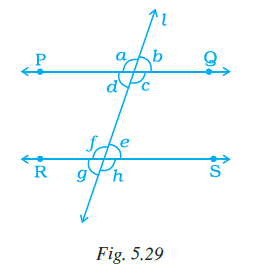
Answer:
Given:
$PQ \parallel RS$ and $a : b = 3 : 2$
Solution:
Angles $a$ and $b$ form a linear pair on line $l$.
$a + b = 180^\circ$
Let $a = 3x$ and $b = 2x$.
$3x + 2x = 180^\circ \implies 5x = 180^\circ \implies x = 36^\circ$
So, $a = 3 \times 36^\circ = 108^\circ$.
Since $PQ \parallel RS$, the corresponding angles are equal:
$f = a$
(Corresponding angles)
$f = 108^\circ$
Correct Option: (b)
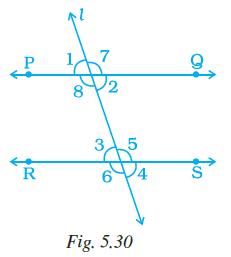
Question 37. In Fig. 5.30, line l intersects two parallel lines PQ and RS. Then, which one of the following is not true?
(a) ∠1 = ∠3
(b) ∠2 = ∠4
(c) ∠6 = ∠7
(d) ∠4 = ∠8
Answer:
Given:
In Fig. 5.30, line $l$ intersects two parallel lines $PQ$ and $RS$.
The angles at the intersection with line $PQ$ are: $\angle 1$, $\angle 7$, $\angle 8$, and $\angle 2$.
The angles at the intersection with line $RS$ are: $\angle 3$, $\angle 5$, $\angle 6$, and $\angle 4$.
To Find:
Which of the following statements is NOT true:
(a) $\angle 1 = \angle 3$
(b) $\angle 2 = \angle 4$
(c) $\angle 6 = \angle 7$
(d) $\angle 4 = \angle 8$
Solution:
We evaluate each option based on the properties of parallel lines intersected by a transversal:
(a) Checking $\angle 1 = \angle 3$:
Angle $1$ and Angle $3$ are in the top-left position at their respective intersections. These are called corresponding angles. When lines are parallel, corresponding angles are equal.
$\angle 1 = \angle 3$
(True)
(b) Checking $\angle 2 = \angle 4$:
Angle $2$ and Angle $4$ are in the bottom-right position at their respective intersections. These are also corresponding angles. Therefore, they are equal.
$\angle 2 = \angle 4$
(True)
(c) Checking $\angle 6 = \angle 7$:
Angle $7$ is an exterior angle on the top-right, and Angle $6$ is an exterior angle on the bottom-left. These are alternate exterior angles. When lines are parallel, alternate exterior angles are equal.
$\angle 6 = \angle 7$
(True)
(d) Checking $\angle 4 = \angle 8$:
Angle $4$ is an exterior angle on the bottom-right. Angle $8$ is an interior angle on the bottom-left.
From the figure, Angle $4$ corresponds to Angle $2$ ($\angle 4 = \angle 2$).
Angle $2$ and Angle $8$ lie on the straight line $PQ$, so they form a linear pair.
$\angle 2 + \angle 8 = 180^\circ$
Substituting $\angle 4$ for $\angle 2$:
$\angle 4 + \angle 8 = 180^\circ$
Since their sum is $180^\circ$, they are supplementary and generally not equal.
$\angle 4 \neq \angle 8$
(Unless the transversal is perpendicular)
Conclusion: Statement (d) is NOT true.
Correct Option: (d)
Question 38. In Fig. 5.30, which one of the following is not true?
(a) ∠1 + ∠5 = 180°
(b) ∠2 + ∠5 = 180°
(c) ∠3 + ∠8 = 180°
(d) ∠2 + ∠3 = 180°
Answer:
Given:
In Fig. 5.30, line $l$ is a transversal intersecting two parallel lines $PQ$ and $RS$.
Position of angles at intersection of $PQ$: $\angle 1$ (Top-Left), $\angle 7$ (Top-Right), $\angle 8$ (Bottom-Left), $\angle 2$ (Bottom-Right).
Position of angles at intersection of $RS$: $\angle 3$ (Top-Left), $\angle 5$ (Top-Right), $\angle 6$ (Bottom-Left), $\angle 4$ (Bottom-Right).
To Find:
Which one of the following statements is NOT true:
(a) $\angle 1 + \angle 5 = 180^\circ$
(b) $\angle 2 + \angle 5 = 180^\circ$
(c) $\angle 3 + \angle 8 = 180^\circ$
(d) $\angle 2 + \angle 3 = 180^\circ$
Solution:
We will examine each option one by one based on the properties of parallel lines:
(a) Evaluating $\angle 1 + \angle 5 = 180^\circ$:
$\angle 1 = \angle 3$
(Corresponding angles)
On line $RS$, $\angle 3$ and $\angle 5$ form a linear pair.
$\angle 3 + \angle 5 = 180^\circ$
Substituting $\angle 1$ for $\angle 3$:
$\angle 1 + \angle 5 = 180^\circ$
(True)
(b) Evaluating $\angle 2 + \angle 5 = 180^\circ$:
$\angle 2 = \angle 4$
(Corresponding angles)
On line $RS$, $\angle 4$ and $\angle 5$ form a linear pair.
$\angle 4 + \angle 5 = 180^\circ$
Substituting $\angle 2$ for $\angle 4$:
$\angle 2 + \angle 5 = 180^\circ$
(True)
(c) Evaluating $\angle 3 + \angle 8 = 180^\circ$:
$\angle 3$ and $\angle 8$ are interior angles on the same side of the transversal (co-interior angles).
$\angle 3 + \angle 8 = 180^\circ$
[Co-interior angles are supplementary]
Therefore, this statement is True.
(d) Evaluating $\angle 2 + \angle 3 = 180^\circ$:
$\angle 2$ and $\angle 3$ are alternate interior angles. For parallel lines, alternate interior angles are equal.
$\angle 2 = \angle 3$
Since they are equal, their sum would be $180^\circ$ only if both are $90^\circ$. As a general property for parallel lines, they are equal, not supplementary.
$\angle 2 + \angle 3 \neq 180^\circ$
(False)
Conclusion: Statement (d) is NOT true.
Correct Option: (d)
Question 39. In Fig. 5.30, which of the following is true?
(a) ∠1 = ∠5
(b) ∠4 = ∠8
(c) ∠5 = ∠8
(d) ∠3 = ∠7
Answer:
Given:
In Fig. 5.30, line $l$ is a transversal intersecting two parallel lines $PQ$ and $RS$.
The angles at the intersection with $PQ$ are $\angle 1$, $\angle 7$, $\angle 8$, and $\angle 2$.
The angles at the intersection with $RS$ are $\angle 3$, $\angle 5$, $\angle 6$, and $\angle 4$.
To Find:
Which of the following statements is TRUE:
(a) $\angle 1 = \angle 5$
(b) $\angle 4 = \angle 8$
(c) $\angle 5 = \angle 8$
(d) $\angle 3 = \angle 7$
Solution:
We will examine each statement based on the properties of parallel lines intersected by a transversal:
(a) Evaluating $\angle 1 = \angle 5$:
Angle $1$ is the exterior angle at the top-left, and Angle $5$ is the interior angle at the top-right. These angles do not have a standard equality relationship. In fact, since $\angle 1 = \angle 3$ (corresponding) and $\angle 3 + \angle 5 = 180^\circ$ (linear pair), $\angle 1 + \angle 5 = 180^\circ$.
$\angle 1 = \angle 5$
(False)
(b) Evaluating $\angle 4 = \angle 8$:
Angle $4$ is the exterior angle at the bottom-right, and Angle $8$ is the interior angle at the bottom-left. Similar to option (a), these angles are supplementary, not equal.
$\angle 4 = \angle 8$
(False)
(c) Evaluating $\angle 5 = \angle 8$:
Angle $8$ and Angle $5$ are located in the interior region between the parallel lines $PQ$ and $RS$, and they are on opposite sides of the transversal $l$.
These are called alternate interior angles. According to the property of parallel lines, alternate interior angles are always equal.
$\angle 5 = \angle 8$
[Alternate interior angles]
Therefore, this statement is True.
(d) Evaluating $\angle 3 = \angle 7$:
Angle $3$ is the interior angle at the top-left, and Angle $7$ is the exterior angle at the top-right. These angles are supplementary, not equal.
$\angle 3 = \angle 7$
(False)
Conclusion: Statement (c) is TRUE.
Correct Option: (c)
Question 40. In Fig. 5.31, PQ || ST. Then, the value of x + y is
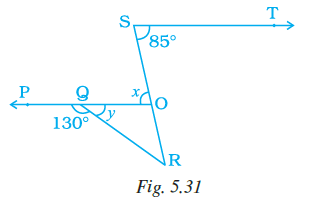
(a) 125°
(b) 135°
(c) 145°
(d) 120°
Answer:
Given:
$PQ \parallel ST$
Solution:
1. On the line containing $PQ$, the angle $130^\circ$ and $y$ form a linear pair.
$130^\circ + y = 180^\circ$
$y = 180^\circ - 130^\circ = 50^\circ$
2. Since $PQ \parallel ST$, if we consider $SO$ as a transversal, the alternate interior angle to $\angle TSR$ ($85^\circ$) is $x$.
$x = 85^\circ$
3. Now, we find the sum:
$x + y = 85^\circ + 50^\circ = 135^\circ$
Correct Option: (b)
Question 41. In Fig. 5.32, if PQ || RS and QR || TS, then the value a is

(a) 95°
(b) 90°
(c) 85°
(d) 75°
Answer:
Given:
In Fig. 5.32, $PQ \parallel RS$ and $QR \parallel TS$.
The measure of $\angle PQR = 85^\circ$.
To Find:
The value of $a$.
Solution:
First, we consider the parallel lines $PQ$ and $RS$ with $QR$ acting as the transversal.
$\angle QRS = \angle PQR$
[Alternate interior angles] ... (i)
$\angle QRS = 85^\circ$
Next, we consider the parallel lines $QR$ and $TS$ with $RS$ acting as the transversal.
$\angle TSR = \angle QRS$
[Alternate interior angles] ... (ii)
$\angle TSR = 85^\circ$
(From equation (i))
From the figure, it is observed that $\angle TSR$ and angle $a$ lie on a straight line at point $S$. Therefore, they form a linear pair.
$a + \angle TSR = 180^\circ$
... (iii)
Substituting the value of $\angle TSR$ from equation (ii) into equation (iii):
$a + 85^\circ = 180^\circ$
$a = 180^\circ - 85^\circ$
$a = 95^\circ$
Therefore, the value of $a$ is $95^\circ$.
Conclusion: Comparing the result with the given options, the correct option is (a).
Correct Option: (a)
Question 42 to 56 (Fill in the Blanks)
In questions 42 to 56, fill in the blanks to make the statements true.
Question 42. If sum of measures of two angles is 90°, then the angles are _________.
Answer:
Answer: complementary
Reason: By definition, if the sum of the measures of two angles is $90^\circ$, they are called complementary angles.
Question 43. If the sum of measures of two angles is 180°, then they are _________.
Answer:
Answer: supplementary
Reason: By definition, if the sum of the measures of two angles is $180^\circ$, they are called supplementary angles.
Question 44. A transversal intersects two or more than two lines at _________ points.
Answer:
Answer: distinct
Reason: A transversal is a line that intersects two or more lines at different (distinct) points.
If a transversal intersects two parallel lines, then (Q. 45 to 48).
Question 45. sum of interior angles on the same side of a transversal is_________ .
Answer:
Answer: $180^\circ$ (or supplementary)
Reason: When a transversal intersects two parallel lines, the interior angles on the same side of the transversal (co-interior angles) are supplementary, meaning their sum is $180^\circ$.
Question 46. alternate interior angles have one common______ .
Answer:
Answer: arm
Reason: Alternate interior angles share the segment of the transversal between the two lines as a common arm.
Question 47. corresponding angles are on the _________side of the transversal.
Answer:
Answer: same
Reason: By definition, corresponding angles are pairs of angles that are in similar positions at each intersection where a straight line crosses two others, and they lie on the same side of the transversal.
Question 48. alternate interior angles are on the______` side of the transversal.
Answer:
Answer: opposite
Reason: Alternate interior angles are located in the interior region between the two lines and lie on opposite sides of the transversal.
Question 49. Two lines in a plane which do not meet at a point anywhere are called____ lines.
Answer:
Answer: parallel
Reason: Lines in the same plane that never intersect, no matter how far they are extended, are known as parallel lines.
Question 50. Two angles forming a __________ pair are supplementary.
Answer:
Answer: linear
Reason: By the Linear Pair Axiom, if a ray stands on a line, then the sum of two adjacent angles so formed is $180^\circ$. Angles whose sum is $180^\circ$ are called supplementary.
Question 51. The supplement of an acute is always __________ angle.
Answer:
Answer: obtuse
Reason: An acute angle is less than $90^\circ$. Let the acute angle be $x$, where $x < 90^\circ$.
Its supplement $= 180^\circ - x$.
Since $x < 90^\circ$, then $180^\circ - x > 90^\circ$.
Any angle greater than $90^\circ$ (but less than $180^\circ$) is an obtuse angle.
Question 52. The supplement of a right angle is always _________ angle.
Answer:
Answer: right
Reason: A right angle is exactly $90^\circ$.
Its supplement $= 180^\circ - 90^\circ = 90^\circ$.
Therefore, the supplement of a right angle is also a right angle.
Question 53. The supplement of an obtuse angle is always _________ angle.
Answer:
Answer: acute
Reason: An obtuse angle is greater than $90^\circ$. Let the obtuse angle be $y$, where $y > 90^\circ$.
Its supplement $= 180^\circ - y$.
Since $y > 90^\circ$, then $180^\circ - y < 90^\circ$.
Any angle less than $90^\circ$ is an acute angle.
Question 54. In a pair of complementary angles, each angle cannot be more than _________.
Answer:
Answer: $90^\circ$
Reason: Complementary angles are two angles whose sum is $90^\circ$. If one angle were more than $90^\circ$, the sum would exceed $90^\circ$ (assuming positive measures), which is not possible by definition.
Question 55. An angle is 45°. Its complementary angle will be __________ .
Answer:
Given:
Angle $= 45^\circ$
To Find:
Its complementary angle.
Solution:
Let the complementary angle be $x$.
We know that the sum of complementary angles is $90^\circ$.
$x + 45^\circ = 90^\circ$
$x = 90^\circ - 45^\circ$
$x = 45^\circ$
The complementary angle is $45^\circ$.
Question 56. An angle which is half of its supplement is of __________.
Answer:
To Find:
Measure of an angle that is half of its supplement.
Solution:
Let the required angle be $x$.
Then its supplement will be $(180^\circ - x)$.
According to the question:
$x = \frac{1}{2}(180^\circ - x)$
$2x = 180^\circ - x$
$2x + x = 180^\circ$
$3x = 180^\circ$
$x = \frac{180^\circ}{3}$
$x = 60^\circ$
The angle is $60^\circ$.
Question 57 to 71 (True or False)
In questions 57 to 71, state whether the statements are True or False.
Question 57. Two right angles are complementary to each other.
Answer:
Statement: Two right angles are complementary to each other.
Result: False
Reason: A right angle measures $90^\circ$. If we take two right angles, their sum is:
$90^\circ + 90^\circ = 180^\circ$
For angles to be complementary, their sum must be exactly $90^\circ$. Therefore, two right angles are supplementary, not complementary.
Question 58. One obtuse angle and one acute angle can make a pair of complementary angles.
Answer:
Statement: One obtuse angle and one acute angle can make a pair of complementary angles.
Result: False
Reason: An obtuse angle is greater than $90^\circ$. For two angles to be complementary, their sum must be exactly $90^\circ$. Since one angle alone is already more than $90^\circ$, it is impossible for their sum to be $90^\circ$.
Question 59. Two supplementary angles are always obtuse angles.
Answer:
Statement: Two supplementary angles are always obtuse angles.
Result: False
Reason: Supplementary angles are two angles whose sum is $180^\circ$. They can be:
1. Two right angles ($90^\circ + 90^\circ$)
2. One acute angle and one obtuse angle (e.g., $60^\circ + 120^\circ$)
Two obtuse angles (both $> 90^\circ$) would sum to more than $180^\circ$.
Question 60. Two right angles are always supplementary to each other.
Answer:
Statement: Two right angles are always supplementary to each other.
Result: True
Reason: Each right angle measures $90^\circ$. The sum of two right angles is:
$90^\circ + 90^\circ = 180^\circ$
By definition, angles whose sum is $180^\circ$ are supplementary.
Question 61. One obtuse angle and one acute angle can make a pair of suplementary angles.
Answer:
Statement: One obtuse angle and one acute angle can make a pair of supplementary angles.
Result: True
Reason: For example, let an acute angle be $70^\circ$ and an obtuse angle be $110^\circ$. Their sum is:
$70^\circ + 110^\circ = 180^\circ$
Since the sum is $180^\circ$, they form a pair of supplementary angles.
Question 62. Both angles of a pair of supplementary angles can never be acute angles.
Answer:
Statement: Both angles of a pair of supplementary angles can never be acute angles.
Result: True
Reason: An acute angle is less than $90^\circ$. If both angles are less than $90^\circ$, their sum will always be less than $180^\circ$. For example, even $89^\circ + 89^\circ = 178^\circ$, which is not supplementary.
Question 63. Two supplementary angles always form a linear pair.
Answer:
Statement: Two supplementary angles always form a linear pair.
Result: False
Reason: Supplementary angles only need to have a sum of $180^\circ$; they do not need to be adjacent (sharing a vertex and a common arm). A linear pair, however, must be adjacent. Non-adjacent angles can be supplementary but cannot be a linear pair.
Question 64. Two angles making a linear pair are always supplementary.
Answer:
Statement: Two angles making a linear pair are always supplementary.
Result: True
Reason: By the definition of a linear pair, the angles are adjacent and their non-common arms form a straight line. The sum of angles on a straight line is always $180^\circ$, which makes them supplementary.
Question 65. Two angles making a linear pair are always adjacent angles.
Answer:
Statement: Two angles making a linear pair are always adjacent angles.
Result: True
Reason: By definition, a linear pair is a pair of adjacent angles whose non-common arms are opposite rays. Since adjacency is a prerequisite for forming a linear pair, the statement is true.
Question 66. Vertically opposite angles form a linear pair.
Answer:
Statement: Vertically opposite angles form a linear pair.
Result: False
Reason: Vertically opposite angles are formed by two intersecting lines and are opposite to each other at the vertex; they are not adjacent. A linear pair, by definition, must be adjacent and supplementary.
Question 67. Interior angles on the same side of a transversal with two distinct parallel lines are complementary angles.
Answer:
Statement: Interior angles on the same side of a transversal with two distinct parallel lines are complementary angles.
Result: False
Reason: When two parallel lines are cut by a transversal, the co-interior angles (interior angles on the same side) are supplementary ($180^\circ$), not complementary ($90^\circ$).
Question 68. Vertically opposite angles are either both acute angles or both obtuse angles.
Answer:
Statement: Vertically opposite angles are either both acute angles or both obtuse angles.
Result: True
Reason: Vertically opposite angles are always equal. Therefore, if one angle is acute ($< 90^\circ$), its opposite must also be acute. If one is obtuse ($> 90^\circ$), its opposite must also be obtuse. (In the special case where lines are perpendicular, both are right angles).
Question 69. A linear pair may have two acute angles.
Answer:
Statement: A linear pair may have two acute angles.
Result: False
Reason: An acute angle is less than $90^\circ$. If we add two acute angles, the sum will always be less than $180^\circ$.
$\text{Sum of two acute angles} < 180^\circ$
Since the sum of a linear pair must be exactly $180^\circ$, it cannot consist of two acute angles.
Question 70. An angle is more than 45°. Its complementary angle must be less than 45°.
Answer:
Statement: An angle is more than $45^\circ$. Its complementary angle must be less than $45^\circ$.
Result: True
Reason: Let the angle be $x$ and its complement be $y$.
$x + y = 90^\circ$
It is given that:
$x > 45^\circ$
Subtracting $x$ from both sides of the sum equation:
$y = 90^\circ - x$
Since $x > 45^\circ$, subtracting a value larger than $45^\circ$ from $90^\circ$ results in a value smaller than $45^\circ$.
$90^\circ - x < 90^\circ - 45^\circ$
$y < 45^\circ$
Question 71. Two adjacent angles always form a linear pair.
Answer:
Statement: Two adjacent angles always form a linear pair.
Result: False
Reason: Adjacent angles only need a common vertex and a common arm. They form a linear pair only if their sum is $180^\circ$ (i.e., their non-common arms form a straight line). Adjacent angles can have any sum, such as $30^\circ$ and $40^\circ$ ($70^\circ$ total), which is not a linear pair.
Question 72 to 113
Question 72. Write down each pair of adjacent angles shown in the following figures:
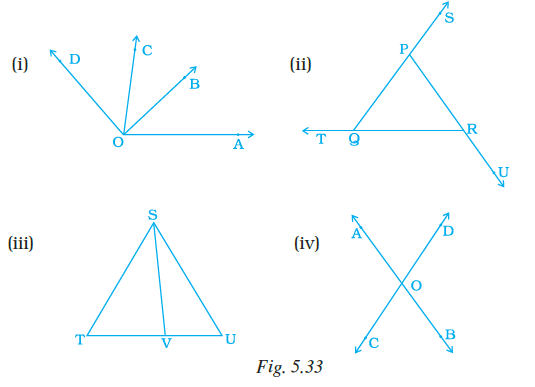
Answer:
Solution:
Two angles are adjacent if they have a common vertex, a common arm, and their non-common arms are on opposite sides of the common arm.
(i) Pairs of adjacent angles:
1. $\angle AOB$ and $\angle BOC$
2. $\angle BOC$ and $\angle COD$
3. $\angle AOB$ and $\angle BOD$
4. $\angle AOC$ and $\angle COD$
(ii) Pairs of adjacent angles:
1. $\angle PQT$ and $\angle PQR$
2. $\angle PRQ$ and $\angle QRU$
3. $\angle QPR$ and $\angle SPR$
(iii) Pairs of adjacent angles:
1. $\angle TSV$ and $\angle USV$
2. $\angle SVT$ and $\angle SVU$
(iv) Pairs of adjacent angles:
1. $\angle AOC$ and $\angle AOD$
2. $\angle AOD$ and $\angle DOB$
3. $\angle DOB$ and $\angle BOC$
4. $\angle BOC$ and $\angle COA$
Question 73. In each of the following figures, write, if any, (i) each pair of vertically opposite angles, and (ii) each linear pair.

Answer:
Solution:
Figure (i):
(i) Vertically opposite angles: $(\angle 1, \angle 3)$, $(\angle 2, \angle 4)$, $(\angle 5, \angle 7)$, $(\angle 6, \angle 8)$.
(ii) Linear pairs: $(\angle 1, \angle 2)$, $(\angle 2, \angle 3)$, $(\angle 3, \angle 4)$, $(\angle 4, \angle 1)$, $(\angle 5, \angle 6)$, $(\angle 6, \angle 7)$, $(\angle 7, \angle 8)$, $(\angle 8, \angle 5)$.
Figure (ii):
(i) Vertically opposite angles: None.
(ii) Linear pair: $\angle ABD$ and $\angle CBD$ , $\angle ABE$ and $\angle CBE$ (as $ABC$ is a straight line).
Figure (iii):
(i) Vertically opposite angles: None.
(ii) Linear pair: None.
Figure (iv):
(i) Vertically opposite angles: $(\angle POR, \angle QOS)$, $(\angle ROQ, \angle POS)$.
(ii) Linear pairs: $(\angle ROQ, \angle QOS)$, $(\angle QOS, \angle SOP)$, $(\angle SOP, \angle POR)$, $(\angle POR, \angle ROQ)$. Also, if $POQ$ is a line, $(\angle POT, \angle TOQ)$ is a linear pair.
Question 74. Name the pairs of supplementary angles in the following figures:
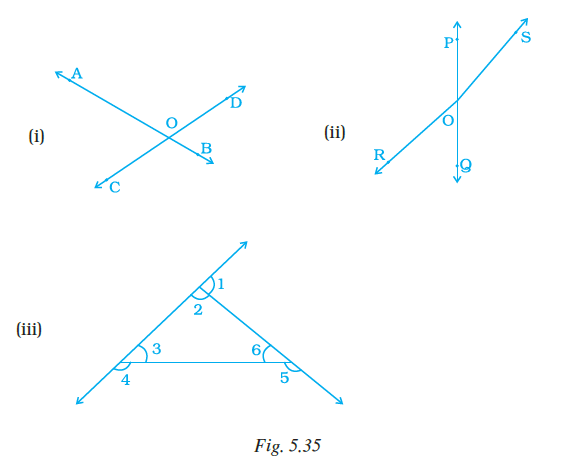
Answer:
Solution:
Supplementary angles are pairs of angles whose sum is $180^\circ$. Angles forming a linear pair are always supplementary.
Figure (i):
Pairs: $(\angle AOC, \angle COB)$, $(\angle COB, \angle BOD)$, $(\angle BOD, \angle DOA)$, $(\angle DOA, \angle AOC)$.
Figure (ii):
Pairs: $(\angle POS, \angle SOQ)$, $(\angle SOQ, \angle QOR)$, $(\angle QOR, \angle ROP)$, $(\angle ROP, \angle POS)$.
Figure (iii):
Pairs: $(\angle 1, \angle 2)$, $(\angle 3, \angle 4)$, $(\angle 5, \angle 6)$.
Question 75. In Fig. 5.36, PQ || RS, TR || QU and ∠PTR = 42°. Find ∠QUR.

Answer:
Given:
$PQ \parallel RS$
$TR \parallel QU$
$\angle PTR = 42^\circ$
To Find:
$\angle QUR$
Solution:
Consider the parallel lines $PQ$ and $RS$ with $TR$ acting as the transversal.
$\angle TRU = \angle PTR$
(Alternate interior angles)
$\angle TRU = 42^\circ$
... (i)
Now, consider the parallel lines $TR$ and $QU$ with line $RS$ acting as the transversal.
The angles $\angle TRU$ and $\angle QUR$ are interior angles on the same side of the transversal (co-interior angles).
$\angle QUR + \angle TRU = 180^\circ$
Substituting the value from equation (i):
$\angle QUR + 42^\circ = 180^\circ$
$\angle QUR = 180^\circ - 42^\circ$
$\angle QUR = 138^\circ$
Therefore, the measure of $\angle QUR$ is $138^\circ$.
Question 76. The drawings below (Fig. 5.37), show angles formed by the goalposts at different positions of a football player. The greater the angle, the better chance the player has of scoring a goal. For example, the player has a better chance of scoring a goal from Position A than from Position B.
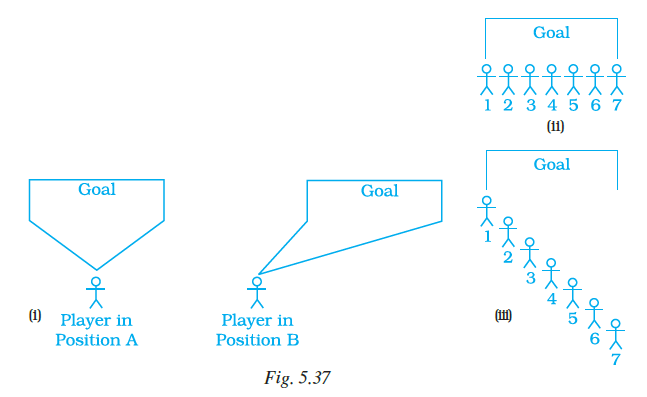
In Parts (a) and (b) given below it may help to trace the diagrams and draw and measure angles.
(a) Seven football players are practicing their kicks. They are lined up in a straight line in front of the goalpost [Fig.(ii)]. Which player has the best (the greatest) kicking angle?
(b) Now the players are lined up as shown in Fig. (iii). Which player has the best kicking angle?
(c) Estimate atleast two situations such that the angles formed by different positions of two players are complement to each other.
Answer:
Solution:
(a) In Fig. 5.37(ii), the players are lined up in a straight line. The angle formed with the goalposts is greatest when the player is directly in the center, perpendicular to the goal line. Therefore, Player 4 has the best kicking angle.
(b) In Fig. 5.37(iii), the players are lined up diagonally. As the player moves closer to the center and closer to the goal line, the angle increases. By observation/measurement, Player 4 (or the one closest to the central perpendicular path) has the best kicking angle.
(c) Two situations where angles might be complementary (summing to $90^\circ$):
1. If one player is at a position where the angle is $30^\circ$ and another player is at a position where the angle is $60^\circ$.
2. If two players are at symmetric positions such that their individual angles are both $45^\circ$.
Question 77. The sum of two vertically opposite angles is 166°. Find each of the angles.
Answer:
Given:
Sum of two vertically opposite angles = $166^\circ$
To Find:
The measure of each angle.
Solution:
We know that vertically opposite angles are always equal.
Let the measure of each angle be $x$.
According to the given condition:
$x + x = 166^\circ$
[Vertically opposite angles are equal] ... (i)
$2x = 166^\circ$
$x = \frac{166^\circ}{2}$
$x = 83^\circ$
Therefore, each of the vertically opposite angles measures $83^\circ$.
Question 78. In Fig. 5.38, l || m || n, ∠QPS = 35° and ∠QRT = 55°. Find ∠PQR.

Answer:
Given:
Lines $l \parallel m \parallel n$.
$\angle QPS = 35^\circ$ and $\angle QRT = 55^\circ$.
To Find:
$\angle PQR$
Solution:
Consider the parallel lines $l$ and $m$. Line $PQ$ acts as a transversal for them.
$\angle PQM = \angle QPS$
[Alternate interior angles] ... (i)
$\angle PQM = 35^\circ$
Now, consider the parallel lines $m$ and $n$. Line $QR$ acts as a transversal for them.
$\angle RQM = \angle QRT$
[Alternate interior angles] ... (ii)
$\angle RQM = 55^\circ$
From the figure, we can observe that:
$\angle PQR = \angle PQM + \angle RQM$
Substituting the values from equations (i) and (ii):
$\angle PQR = 35^\circ + 55^\circ$
$\angle PQR = 90^\circ$
Therefore, the value of $\angle PQR$ is $90^\circ$.
Question 79. In Fig. 5.39, P, Q and R are collinear points and TQ ⊥ PR,

Name;
(a) pair of complementary angles
(b) two pairs of supplementary angles.
(c) four pairs of adjacent angles.
Answer:
Given:
Points $P, Q, R$ are collinear. Ray $TQ \perp PR$ ($\angle TQR = 90^\circ$ and $\angle TQP = 90^\circ$).
Solution:
(a) Pair of complementary angles:
Complementary angles sum to $90^\circ$. Since $\angle TQR = 90^\circ$, the adjacent angles within it are:
$\angle TQS$ and $\angle SQR$
(b) Two pairs of supplementary angles:
Supplementary angles sum to $180^\circ$. Angles on the straight line $PR$ are:
1. $\angle TQP$ and $\angle TQR$ (both are $90^\circ$)
2. $\angle PQS$ and $\angle SQR$ (forming a linear pair)
(c) Four pairs of adjacent angles:
1. $\angle PQT$ and $\angle TQS$
2. $\angle TQS$ and $\angle SQR$
3. $\angle PQT$ and $\angle TQR$
4. $\angle PQS$ and $\angle SQR$
Question 80. In Fig. 5.40, OR ⊥ OP.
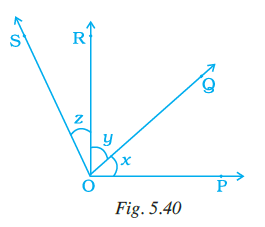
(i) Name all the pairs of adjacent angles.
(ii) Name all the pairs of complementary angles.
Answer:
Given:
$OR \perp OP$, which means $\angle POR = 90^\circ$.
Solution:
(i) All the pairs of adjacent angles:
1. $\angle POQ$ and $\angle QOR$
2. $\angle QOR$ and $\angle ROS$
3. $\angle POQ$ and $\angle QOS$
4. $\angle POR$ and $\angle ROS$
(ii) All the pairs of complementary angles:
Since $\angle POR = 90^\circ$, any pair of adjacent angles that make up this right angle are complementary:
1. $\angle POQ$ and $\angle QOR$
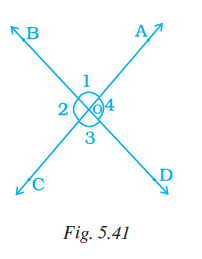
Question 81. If two angles have a common vertex and their arms form opposite rays (Fig. 5.41), Then,
(a) how many angles are formed?
(b) how many types of angles are formed?
(c) write all the pairs of vertically opposite angles.
Answer:
To Find:
(a) Number of angles formed.
(b) Number of types of angles formed.
(c) Pairs of vertically opposite angles.
Solution:
(a) In Fig. 5.41, when two lines $AB$ and $CD$ intersect at point $O$, a total of 4 angles are formed ($\angle 1, \angle 2, \angle 3,$ and $\angle 4$).
(b) There are 2 types of angle relationships formed here:
1. Vertically opposite angles (which are equal).
2. Linear pairs (which are supplementary).
(c) The pairs of vertically opposite angles are:
1. $\angle 1$ and $\angle 3$
2. $\angle 2$ and $\angle 4$
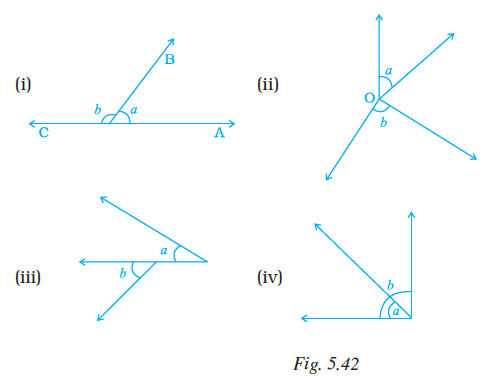
Question 82. In (Fig 5.42) are the following pairs of angles adjacent? Justify your answer.
Answer:
To Determine: Whether the following pairs of angles are adjacent and provide justification.
Solution:
(i) Yes
Justification: The angles $a$ and $b$ have a common vertex, a common arm (the ray pointing upwards to the right), and their non-common arms are on opposite sides of the common arm. Therefore, they are adjacent.
(ii) No
Justification: Although the angles $a$ and $b$ share a common vertex $O$, they do not share a common arm. There is another angle between them; hence, they are not adjacent.
(iii) No
Justification: These angles do not have a common vertex. Adjacent angles must originate from the same point (vertex).
(iv) No
Justification: These angles share a common vertex and one common arm, but their non-common arms are on the same side of the common arm. In this case, angle $a$ is a part of angle $b$ (overlapping), so they are not adjacent.
Question 83. In Fig. 5.43, write all the pairs of supplementary angles.

Answer:
To Find:
All pairs of supplementary angles in Fig. 5.43.
Solution:
Supplementary angles are pairs of angles whose sum is $180^\circ$. In a geometry diagram, angles forming a linear pair (adjacent angles on a straight line) are always supplementary.
By observing the intersections in Fig. 5.43, we identify the following pairs:
1. At the Top Intersection:
There are four angles formed by the intersection of two straight lines. The adjacent angles on each line are:
$\angle 3$ and $\angle 4$
(Linear pair)
$\angle 4$ and $\angle 5$
(Linear pair)
$\angle 5$ and $\angle 6$
(Linear pair)
$\angle 6$ and $\angle 3$
(Linear pair)
2. At the Bottom-Left Intersection:
The angles $\angle 7$ and $\angle 2$ lie on the same straight line (the base of the triangle extended). Therefore, they are adjacent and supplementary.
$\angle 7$ and $\angle 2$
(Linear pair)
3. At the Bottom-Right Intersection:
The angles $\angle 1$ and $\angle 8$ lie on the same straight line (the base of the triangle extended). Therefore, they are adjacent and supplementary.
$\angle 1$ and $\angle 8$
(Linear pair)
Final List of Supplementary Pairs:
The required pairs are ($\angle 1, \angle 8$), ($\angle 2, \angle 7$), ($\angle 3, \angle 4$), ($\angle 4, \angle 5$), ($\angle 5, \angle 6$), and ($\angle 6, \angle 3$).
Question 84. What is the type of other angle of a linear pair if
(a) one of its angle is acute?
(b) one of its angles is obtuse?
(c) one of its angles is right?
Answer:
Solution:
We know that a linear pair of angles consists of two adjacent angles whose sum is $180^\circ$.
(a) One of its angle is acute:
If one angle is acute (less than $90^\circ$), then the other angle must be greater than $90^\circ$ ($180^\circ - \text{acute angle} > 90^\circ$) to make the sum $180^\circ$.
Therefore, the other angle is obtuse.
(b) One of its angles is obtuse:
If one angle is obtuse (greater than $90^\circ$), then the other angle must be less than $90^\circ$ ($180^\circ - \text{obtuse angle} < 90^\circ$) to make the sum $180^\circ$.
Therefore, the other angle is acute.
(c) One of its angles is right:
If one angle is a right angle ($90^\circ$), then the other angle must be $180^\circ - 90^\circ = 90^\circ$.
Therefore, the other angle is also a right angle.
Question 85. Can two acute angles form a pair of supplementary angles? Give reason in support of your answer.
Answer:
Solution:
No, two acute angles cannot form a pair of supplementary angles.
Reason:
An acute angle is defined as an angle whose measure is less than $90^\circ$.
If we take the two largest possible acute angles, say $89.9^\circ$ each, their sum would be:
$89.9^\circ + 89.9^\circ = 179.8^\circ$
Since the sum of two acute angles will always be less than $180^\circ$ ($90^\circ + 90^\circ$), they cannot satisfy the condition for supplementary angles, which requires the sum to be exactly $180^\circ$.
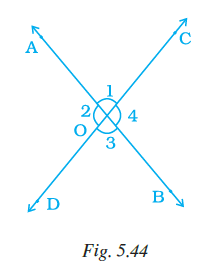
Question 86. Two lines AB and CD intersect at O (Fig. 5.44). Write all the pairs of adjacent angles by taking angles 1, 2, 3, and 4 only.
Answer:
Solution:
Adjacent angles are those that have a common vertex and a common arm but no common interior points.
In the given figure, the pairs of adjacent angles are:
(i) $\angle 1$ and $\angle 2$ (Common arm OA)
(ii) $\angle 2$ and $\angle 3$ (Common arm OD)
(iii) $\angle 3$ and $\angle 4$ (Common arm OB)
(iv) $\angle 4$ and $\angle 1$ (Common arm OC)
Thus, the required pairs are ($\angle 1, \angle 2$), ($\angle 2, \angle 3$), ($\angle 3, \angle 4$), and ($\angle 4, \angle 1$).
Question 87. If the complement of an angle is 62°, then find its supplement.
Answer:
Given:
Complement of an angle $= 62^\circ$.
To Find:
The supplement of that angle.
Solution:
Let the required angle be $x$.
We know that the sum of an angle and its complement is $90^\circ$.
$x + 62^\circ = 90^\circ$
$x = 90^\circ - 62^\circ$
$x = 28^\circ$
Now, we need to find the supplement of $x = 28^\circ$.
We know that the sum of an angle and its supplement is $180^\circ$.
Supplement of $28^\circ = 180^\circ - 28^\circ$
Supplement of $28^\circ = 152^\circ$
Therefore, the supplement of the angle is $152^\circ$.
Question 88. A road crosses a railway line at an angle of 30° as shown in Fig.5.45. Find the values of a, b and c.

Answer:
Given:
An angle formed by the road and the lower railway track is $30^\circ$ (bottom-left exterior angle).
The railway tracks are parallel, and the road acts as a transversal.
To Find:
The values of $a, b$ and $c$.
Solution:
Step 1: Finding the value of $c$.
The angle $30^\circ$ and angle $c$ are exterior angles on the same side of the transversal (co-exterior angles).
$c + 30^\circ = 180^\circ$
(Co-exterior angles)
$c = 180^\circ - 30^\circ$
$c = 150^\circ$
Step 2: Finding the value of $a$.
The angles $c$ and $a$ are exterior angles on the same straight line (the top railway track).
$c + a = 180^\circ$
(Co-exterior angles on a line)
$150^\circ + a = 180^\circ$
$a = 180^\circ - 150^\circ$
$a = 30^\circ$
Step 3: Finding the value of $b$.
Let the vertically opposite angle (VOA) of $a$ be $x$.
$x = a$
(Vertically opposite angles)
$x = 30^\circ$
Now, $x$ and $b$ are interior angles on the same side of the transversal (co-interior angles).
$x + b = 180^\circ$
(Co-interior angles)
$30^\circ + b = 180^\circ$
$b = 180^\circ - 30^\circ$
$b = 150^\circ$
Final Values:
The values are $a = 30^\circ$, $b = 150^\circ$ and $c = 150^\circ$.
Alternate Solution for $b$:
Angle $b$ and angle $c$ are alternate interior angles. Since $c = 150^\circ$, then $b = 150^\circ$.
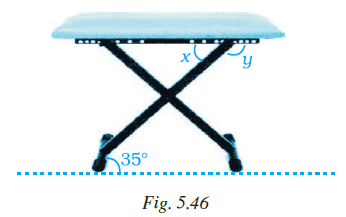
Question 89. The legs of a stool make an angle of 35° with the floor as shown in Fig. 5.46. Find the angles x and y.
Answer:
Given:
Angle made by the leg with the floor $= 35^\circ$.
The top of the stool is parallel to the floor.
Solution:
In Fig. 5.46, the stool's top and the floor line are parallel. The leg of the stool acts as a transversal line.
Finding $x$:
The angle $x$ and the $35^\circ$ angle are alternate interior angles.
$x = 35^\circ$
(Alternate interior angles)
Finding $y$:
Angles $x$ and $y$ lie on the same straight line (the top frame of the stool) and are adjacent, forming a linear pair.
$x + y = 180^\circ$
(Linear pair)
Substituting the value of $x$:
$35^\circ + y = 180^\circ$
$y = 180^\circ - 35^\circ$
$y = 145^\circ$
Final Answer:
The values are $x = 35^\circ$ and $y = 145^\circ$.
Question 90. Iron rods a, b, c, d, e and f are making a design in a bridge as shown in Fig. 5.47, in which a || b, c || d, e || f. Find the marked angles between

(i) b and c
(ii) d and e
(iii) d and f
(iv) c and f
Answer:
Given:
$a \parallel b$, $c \parallel d$, and $e \parallel f$.
Solution:
(i) Angle between $b$ and $c$:
By observing the design and the orientation of the rods:
The angle between rod $b$ and rod $c$ is $30^\circ$.
(ii) Angle between $d$ and $e$:
It is given that the angle between $d$ and $e$ is co-interior to the $75^\circ$ angle.
$\text{Angle between } d \text{ and } e + 75^\circ = 180^\circ$
(Co-interior angles)
$\text{Angle between } d \text{ and } e = 180^\circ - 75^\circ$
$\text{Angle between } d \text{ and } e = 105^\circ$
(iii) Angle between $d$ and $f$:
The angle between $d$ and $e$ (found above as $105^\circ$) and the angle between $d$ and $f$ are co-interior.
$\text{Angle between } d \text{ and } f + 105^\circ = 180^\circ$
(Co-interior angles)
$\text{Angle between } d \text{ and } f = 180^\circ - 105^\circ$
$\text{Angle between } d \text{ and } f = 75^\circ$
(iv) Angle between $c$ and $f$:
The angle between $d$ and $f$ (found above as $75^\circ$) and the angle between $c$ and $f$ are co-interior.
$\text{Angle between } c \text{ and } f + 75^\circ = 180^\circ$
(Co-interior angles)
$\text{Angle between } c \text{ and } f = 180^\circ - 75^\circ$
$\text{Angle between } c \text{ and } f = 105^\circ$
Question 91. Amisha makes a star with the help of line segments a, b, c, d, e and f, in which a || d, b || e and c || f. Chhaya marks an angle as 120° as shown in Fig. 5.48 and asks Amisha to find the ∠x, ∠y and ∠z. Help Amisha in finding the angles.

Answer:
Given:
Line segments $a \parallel d, b \parallel e, c \parallel f$.
One exterior angle is marked as $120^\circ$.
Solution:
Finding the value of $x$ and $z$:
Let the vertically opposite angle (VOA) of $120^\circ$ be $\angle 1$.
$\angle 1 = 120^\circ$
(Vertically opposite angles)
The angle $\angle 1$ is co-interior to both $\angle x$ and $\angle z$ due to the parallel lines $c \parallel f$ and $a \parallel d$.
$x + 120^\circ = 180^\circ$
(Co-interior angles)
$x = 180^\circ - 120^\circ = 60^\circ$
$z + 120^\circ = 180^\circ$
(Co-interior angles)
$z = 180^\circ - 120^\circ = 60^\circ$
Finding the value of $y$:
As per the observation, the co-interior angle of $x$ (or $z$), which is $120^\circ$, is the vertically opposite angle of $y$.
$y = 120^\circ$
(Vertically opposite angles)
Final Answer:
The values are $\angle x = 60^\circ$, $\angle y = 120^\circ$ and $\angle z = 60^\circ$.
Question 92. In Fig. 5.49, AB||CD, AF||ED, ∠AFC = 68° and ∠FED = 42°. Find ∠EFD.
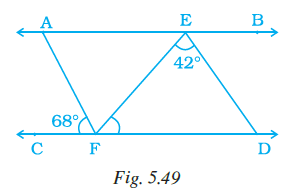
Answer:
Given:
$AB \parallel CD$, $AF \parallel ED$.
$\angle AFC = 68^\circ$ and $\angle FED = 42^\circ$.
To Find:
$\angle EFD$
Solution:
Since $AF \parallel ED$ and $FE$ is a transversal line intersecting them:
$\angle AFE = \angle FED$
(Alternate interior angles)
$\angle AFE = 42^\circ$
Now, points $C, F, \text{ and } D$ lie on a straight line $CD$. Therefore, the sum of angles on this straight line at point $F$ is $180^\circ$.
$\angle AFC + \angle AFE + \angle EFD = 180^\circ$
(Angles on a straight line)
Substituting the known values:
$68^\circ + 42^\circ + \angle EFD = 180^\circ$
$110^\circ + \angle EFD = 180^\circ$
$\angle EFD = 180^\circ - 110^\circ$
$\angle EFD = 70^\circ$
Final Answer:
The value of $\angle EFD$ is $70^\circ$.
Question 93. In Fig. 5.50, OB is perpendicular to OA and ∠BOC = 49°. Find ∠AOD.
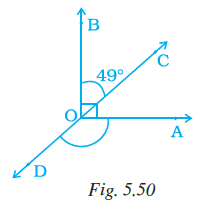
Answer:
Given:
$OB \perp OA$, which means $\angle AOB = 90^\circ$.
$\angle BOC = 49^\circ$.
To Find:
The measure of $\angle AOD$.
Solution:
Since $\angle AOB = 90^\circ$, the angles $\angle BOC$ and $\angle AOC$ are complementary angles.
$\angle BOC + \angle AOC = 90^\circ$
(Complementary angles)
$49^\circ + \angle AOC = 90^\circ$
$\angle AOC = 90^\circ - 49^\circ = 41^\circ$
From the figure, $CD$ is a straight line, which implies $\angle AOC$ and $\angle AOD$ form a linear pair.
$\angle AOC + \angle AOD = 180^\circ$
(Linear pair)
$41^\circ + \angle AOD = 180^\circ$
$\angle AOD = 180^\circ - 41^\circ$
$\angle AOD = 139^\circ$
Therefore, the value of $\angle AOD$ is $139^\circ$.
Question 94. Three lines AB, CD and EF intersect each other at O. If ∠AOE = 30° and ∠DOB = 40° (Fig. 5.51), find ∠COF.
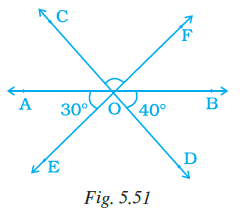
Answer:
Given:
Lines AB, CD, and EF intersect at O.
$\angle AOE = 30^\circ$
$\angle DOB = 40^\circ$
To Find:
The measure of $\angle COF$.
Solution:
Since the lines AB and EF intersect at O, the vertically opposite angles are equal.
$\angle FOB = \angle AOE$
(Vertically opposite angles)
$\angle FOB = 30^\circ$
Similarly, since the lines AB and CD intersect at O, the vertically opposite angles are equal.
$\angle AOC = \angle DOB$
(Vertically opposite angles)
$\angle AOC = 40^\circ$
Now, AB is a straight line. Therefore, the sum of all angles on one side of the line at point O is $180^\circ$.
$\angle AOC + \angle COF + \angle FOB = 180^\circ$
(Angles on a straight line)
Substituting the values of $\angle AOC$ and $\angle FOB$:
$40^\circ + \angle COF + 30^\circ = 180^\circ$
$70^\circ + \angle COF = 180^\circ$
$\angle COF = 180^\circ - 70^\circ$
$\angle COF = 110^\circ$
Therefore, the value of $\angle COF$ is $110^\circ$.
Question 95. Measures (in degrees) of two complementary angles are two consecutive even integers. Find the angles.
Answer:
To Find:
The measure of two complementary angles.
Solution:
Let the first even integer (angle) be $x^\circ$.
Since the angles are consecutive even integers, the second angle will be $(x + 2)^\circ$.
We know that the sum of two complementary angles is $90^\circ$.
$x + (x + 2) = 90$
$2x + 2 = 90$
$2x = 90 - 2$
$2x = 88$
$x = \frac{88}{2} = 44$
The first angle is $44^\circ$.
The second angle is $x + 2 = 44 + 2 = 46^\circ$.
Therefore, the two angles are $44^\circ$ and $46^\circ$.
Question 96. If a transversal intersects two parallel lines, and the difference of two interior angles on the same side of a transversal is 20°, find the angles.
Answer:
Given:
The difference between two interior angles on the same side of a transversal is $20^\circ$.
To Find:
The measure of the two angles.
Solution:
Let the two interior angles on the same side of the transversal be $x$ and $y$.
We know that interior angles on the same side of a transversal (co-interior angles) are supplementary, meaning their sum is $180^\circ$.
$x + y = 180^\circ$
…(i)
According to the question, the difference between these angles is $20^\circ$:
$x - y = 20^\circ$
…(ii)
Adding equations (i) and (ii):
$(x + y) + (x - y) = 180^\circ + 20^\circ$
$2x = 200^\circ$
$x = \frac{200^\circ}{2} = 100^\circ$
Substituting the value of $x$ in equation (i):
$100^\circ + y = 180^\circ$
$y = 180^\circ - 100^\circ$
$y = 80^\circ$
Therefore, the required angles are $100^\circ$ and $80^\circ$.
Question 97. Two angles are making a linear pair. If one of them is one-third of the other, find the angles.
Answer:
To Find:
The measure of the two angles in the linear pair.
Solution:
Let one of the angles be $x$.
According to the given condition, the other angle is $\frac{1}{3}$ of $x$, i.e., $\frac{x}{3}$.
Since they form a linear pair, their sum is $180^\circ$.
$x + \frac{x}{3} = 180^\circ$
(Linear pair property)
Taking the LCM:
$\frac{3x + x}{3} = 180^\circ$
$\frac{4x}{3} = 180^\circ$
$4x = 180^\circ \times 3$
$4x = 540^\circ$
$x = \frac{540^\circ}{4} = 135^\circ$
The first angle is $135^\circ$.
The second angle $= \frac{135^\circ}{3} = 45^\circ$.
Therefore, the two angles are $135^\circ$ and $45^\circ$.
Question 98. Measures (in degrees) of two supplementary angles are consecutive odd integers. Find the angles.
Answer:
To Find:
The measure of the two supplementary angles.
Solution:
Let the first odd integer (angle) be $x^\circ$.
Since the angles are consecutive odd integers, the next angle will be $(x + 2)^\circ$.
We know that the sum of two supplementary angles is $180^\circ$.
$x + (x + 2) = 180$
$2x + 2 = 180$
$2x = 180 - 2$
$2x = 178$
$x = \frac{178}{2} = 89$
The first angle is $89^\circ$.
The second angle is $x + 2 = 89 + 2 = 91^\circ$.
Therefore, the two supplementary angles are $89^\circ$ and $91^\circ$.
Question 99. In Fig. 5.52, AE || GF || BD, AB || CG || DF and ∠CHE = 120°. Find ∠ABC and ∠CDE.
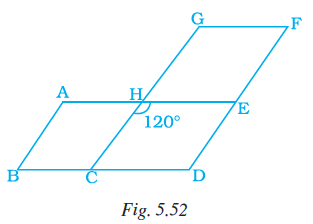
Answer:
Given:
$AE \parallel GF \parallel BD$
$AB \parallel CG \parallel DF$
$\angle CHE = 120^\circ$
To Find:
$\angle ABC$ and $\angle CDE$
Solution:
Step 1: Finding the value of $\angle HCD$.
Considering parallel lines $AE \parallel BD$ and $CG$ as a transversal, $\angle CHE$ and $\angle HCD$ are interior angles on the same side of the transversal (co-interior angles).
$\angle CHE + \angle HCD = 180^\circ$
(Co-interior angles)
$120^\circ + \angle HCD = 180^\circ$
$\angle HCD = 180^\circ - 120^\circ$
$\angle HCD = 60^\circ$
Step 2: Finding the value of $\angle ABC$.
Considering parallel lines $AB \parallel CG$ and $BD$ as a transversal, $\angle ABC$ and $\angle HCD$ are corresponding angles.
$\angle ABC = \angle HCD$
(Corresponding angles)
$\angle ABC = 60^\circ$
Step 3: Finding the value of $\angle CDE$.
Considering parallel lines $CG \parallel DF$ and $BD$ as a transversal, $\angle HCD$ and $\angle CDE$ are interior angles on the same side of the transversal (co-interior angles).
$\angle HCD + \angle CDE = 180^\circ$
(Co-interior angles)
$60^\circ + \angle CDE = 180^\circ$
$\angle CDE = 180^\circ - 60^\circ$
$\angle CDE = 120^\circ$
Final Answer:
The values are $\angle ABC = 60^\circ$ and $\angle CDE = 120^\circ$.
Question 100. In Fig. 5.53, find the value of ∠BOC, if points A, O and B are collinear.
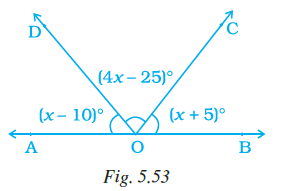
Answer:
Given:
Points $A, O$ and $B$ are collinear, meaning $AOB$ is a straight line.
$\angle AOD = (x - 10)^\circ$
$\angle DOC = (4x - 25)^\circ$
$\angle COB = (x + 5)^\circ$
To Find:
The value of $\angle BOC$.
Solution:
Since $AOB$ is a straight line, the sum of all angles on it is $180^\circ$.
$\angle AOD + \angle DOC + \angle COB = 180^\circ$
(Angles on a straight line)
$(x - 10) + (4x - 25) + (x + 5) = 180$
$x + 4x + x - 10 - 25 + 5 = 180$
$6x - 30 = 180$
$6x = 180 + 30$
$6x = 210$
$x = \frac{210}{6} = 35$
Now, substitute the value of $x$ to find $\angle BOC$:
$\angle BOC = (x + 5)^\circ$
$\angle BOC = (35 + 5)^\circ = 40^\circ$
Final Answer:
The value of $\angle BOC$ is $40^\circ$.
Question 101. In Fig. 5.54, if l || m, find the values of a and b.
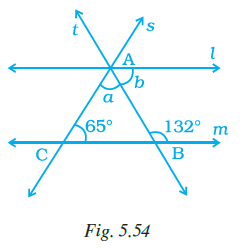
Answer:
Given:
$l \parallel m$. Angle at $C$ is $65^\circ$. Angle at $B$ is $132^\circ$.
Solution:
Step 1: Finding $b$.
Based on the orientation, angle $b$ and the $132^\circ$ angle are interior angles on the same side of transversal $t$.
$b + 132^\circ = 180^\circ$
(Co-interior angles)
$b = 180^\circ - 132^\circ = 48^\circ$.
Step 2: Finding $a$.
The total angle at the top vertex $(a + b)$ and the $65^\circ$ angle at vertex $C$ are interior angles on the same side of transversal $s$.
$(a + b) + 65^\circ = 180^\circ$
(Co-interior angles)
Substituting the value of $b$:
$(a + 48^\circ) + 65^\circ = 180^\circ$
$a + 113^\circ = 180^\circ \implies a = 180^\circ - 113^\circ = 67^\circ$.
Final Answer:
The values are $a = 67^\circ$ and $b = 48^\circ$.
Question 102. In Fig. 5.55, l || m and a line t intersects these lines at P and Q , respectively. Find the sum 2a + b.
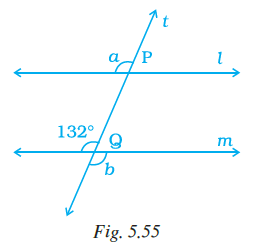
Answer:
Given:
Line $l$ is parallel to line $m$ ($l \parallel m$).
Line $t$ is a transversal intersecting lines $l$ and $m$ at points $P$ and $Q$ respectively.
At intersection $Q$, one of the angles is $132^\circ$.
To Find:
The value of the expression $2a + b$.
Solution:
Step 1: Finding the value of $a$.
By observing Fig. 5.55, angle $a$ at intersection $P$ and the $132^\circ$ angle at intersection $Q$ are in corresponding positions relative to the parallel lines and the transversal.
$a = 132^\circ$
(Corresponding angles)
Step 2: Finding the value of $b$.
Angle $b$ and the angle measuring $132^\circ$ are at the same intersection $Q$ and are opposite to each other.
$b = 132^\circ$
(Vertically opposite angles)
Step 3: Calculating $2a + b$.
Now, substitute the values of $a$ and $b$ into the given expression:
$2a + b = 2(132^\circ) + 132^\circ$
$2a + b = 264^\circ + 132^\circ$
$2a + b = 396^\circ$
Final Answer:
The sum of $2a + b$ is $396^\circ$.
Question 103. In Fig. 5.56, QP || RS. Find the values of a and b.

Answer:
Given:
$QP \parallel RS$
$\angle PQR = 70^\circ$
$\angle QPR = 65^\circ$
To Find:
The values of $a$ and $b$.
Solution:
Step 1: Finding $a$.
Since $QP \parallel RS$ and $PR$ acts as a transversal line, the angle $\angle QPR$ and $\angle a$ are alternate interior angles.
$a = 65^\circ$
(Alternate interior angles)
Step 2: Finding $b$.
Since $QP \parallel RS$ and the line $QR$ (extended) acts as a transversal, the angle $\angle PQR$ and $\angle b$ are corresponding angles.
$b = 70^\circ$
(Corresponding angles)
Final Answer:
The values are $a = 65^\circ$ and $b = 70^\circ$.
Question 104. In Fig. 5.57, PQ || RT. Find the value of a + b.

Answer:
Given:
$PQ \parallel RT$
$\angle RPQ = 45^\circ$
$\angle RQP = 55^\circ$
To Find:
The value of $a + b$.
Solution:
In Fig. 5.57, since $PQ \parallel RT$ and $PS$ is a transversal line passing through them:
$a = \angle RPQ$
(Corresponding angles)
$a = 45^\circ$
Now, considering $PQ \parallel RT$ and $QR$ as a transversal line:
$b = \angle RQP$
(Alternate interior angles)
$b = 55^\circ$
We need to find the sum $a + b$:
$a + b = 45^\circ + 55^\circ$
$a + b = 100^\circ$
Therefore, the value of $a + b$ is $100^\circ$.
Question 105. In Fig 5.58, PQ, RS and UT are parallel lines.

(i) If c = 57° and a = $\frac{c}{3}$ , find the value of d.
(ii) If c = 75° and a = $\frac{2}{5}$ c, find b.
Answer:
Given:
$PQ \parallel RS \parallel UT$
Solution (i):
Given $c = 57^\circ$ and $a = \frac{c}{3}$.
$a = \frac{57^\circ}{3} = 19^\circ$
Since $PQ \parallel UT$ and $PT$ is a transversal line, the alternate interior angles are equal.
$a + b = c$
(Alternate interior angles)
$19^\circ + b = 57^\circ$
$b = 57^\circ - 19^\circ = 38^\circ$
Now, since $PQ \parallel RS$ and $PR$ is a transversal line, the interior angles on the same side of the transversal (co-interior angles) are supplementary.
$b + d = 180^\circ$
(Co-interior angles)
$38^\circ + d = 180^\circ$
$d = 180^\circ - 38^\circ = 142^\circ$
Thus, $d = 142^\circ$.
Solution (ii):
Given $c = 75^\circ$ and $a = \frac{2}{5}c$.
$a = \frac{2}{5} \times 75^\circ = 2 \times 15^\circ = 30^\circ$
As established earlier, $a + b = c$ because $PQ \parallel UT$ and $PT$ is a transversal.
$30^\circ + b = 75^\circ$
$b = 75^\circ - 30^\circ = 45^\circ$
Thus, $b = 45^\circ$.
Question 106. In Fig. 5.59, AB || CD . Find the reflex ∠ EFG.
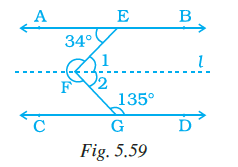
Answer:
Given:
$AB \parallel CD$, $\angle AEF = 34^\circ$, $\angle FGD = 135^\circ$
Construction:
Draw a line $l$ passing through point $F$ such that $l \parallel AB$. Since $AB \parallel CD$, it follows that $l \parallel CD$ as well.
Solution:
Let the interior $\angle EFG$ be divided into $\angle 1$ and $\angle 2$ by the constructed line $l$.
Since $AB \parallel l$ and $EF$ is a transversal:
$\angle 1 = 34^\circ$
(Alternate interior angles)
Since $CD \parallel l$ and $FG$ is a transversal, the co-interior angles are supplementary:
$\angle 2 + 135^\circ = 180^\circ$
(Co-interior angles)
$\angle 2 = 180^\circ - 135^\circ = 45^\circ$
Now, calculate interior $\angle EFG$:
Interior $\angle EFG = \angle 1 + \angle 2$
Interior $\angle EFG = 34^\circ + 45^\circ = 79^\circ$
To find the reflex $\angle EFG$:
Reflex $\angle EFG = 360^\circ - 79^\circ = 281^\circ$
Therefore, the reflex $\angle EFG$ is $281^\circ$.
Question 107. In Fig. 5.60, two parallel lines l and m are cut by two transversals n and p. Find the values of x and y.
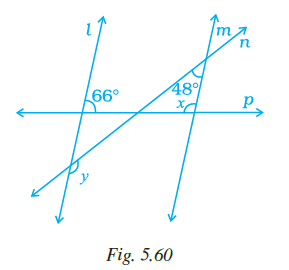
Answer:
Given:
Line $l$ is parallel to line $m$ ($l \parallel m$).
Lines $n$ and $p$ are transversal lines.
The interior angles formed by transversal $p$ include $66^\circ$ and $x$.
The interior angles formed by transversal $n$ include $y$ and $48^\circ$.
To Find:
The values of $x$ and $y$.
Solution:
Step 1: Finding the value of $x$.
Since line $l \parallel m$ and line $p$ is the transversal, the angle $x$ and the angle measuring $66^\circ$ are interior angles on the same side of the transversal.
$x + 66^\circ = 180^\circ$
(Co-interior angles)
$x = 180^\circ - 66^\circ$
$x = 114^\circ$
Step 2: Finding the value of $y$.
Since line $l \parallel m$ and line $n$ is the transversal, the angle $y$ and the angle measuring $48^\circ$ are interior angles on the same side of the transversal.
$y + 48^\circ = 180^\circ$
(Co-interior angles)
$y = 180^\circ - 48^\circ$
$y = 132^\circ$
Final Answer:
The calculated values are $x = 114^\circ$ and $y = 132^\circ$.
Question 108. In Fig. 5.61, l, m and n are parallel lines, and the lines p and q are also parallel. Find the values of a, b and c.
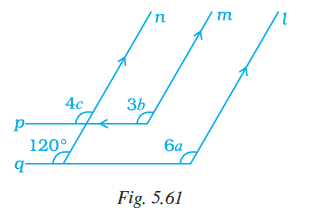
Answer:
Given:
Lines $l, m$ and $n$ are parallel to each other ($l \parallel m \parallel n$).
Lines $p$ and $q$ are parallel to each other ($p \parallel q$).
To Find:
The values of $a$, $b$ and $c$.
Solution:
Step 1: Finding the value of $c$.
Considering parallel lines $p$ and $q$ with line $n$ as a transversal, the angle $4c$ and the angle $120^\circ$ are in corresponding positions.
$4c = 120^\circ$
(Corresponding angles as $p \parallel q$)
$c = \frac{120^\circ}{4}$
$c = 30^\circ$
Step 2: Finding the value of $b$.
Considering parallel lines $m$ and $n$ with line $p$ as a transversal, the angle $3b$ and the angle $4c$ are corresponding angles.
$3b = 4c$
(Corresponding angles as $m \parallel n$)
Substituting the value of $4c = 120^\circ$ from step 1:
$3b = 120^\circ$
$b = \frac{120^\circ}{3}$
$b = 40^\circ$
Step 3: Finding the value of $a$.
Considering parallel lines $n$ and $l$ with line $q$ as a transversal, the angle $6a$ and the angle $120^\circ$ are corresponding angles.
$6a = 120^\circ$
(Corresponding angles as $n \parallel l$)
$a = \frac{120^\circ}{6}$
$a = 20^\circ$
Final Answer:
The values are $a = 20^\circ$, $b = 40^\circ$ and $c = 30^\circ$.
Question 109. In Fig. 5.62, state which pair of lines are parallel. Give reason.
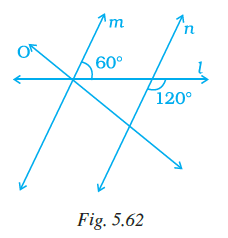
Answer:
Given:
In Fig. 5.62, an angle of $60^\circ$ is formed at the intersection of line $l$ and line $m$.
An angle of $120^\circ$ is formed at the intersection of line $l$ and line $n$.
To Find:
The pair of lines that are parallel.
Solution:
By observing the figure, line $l$ acts as a transversal for lines $m$ and $n$.
Let the vertically opposite angle of the $120^\circ$ angle be denoted as $\angle 1$.
$\angle 1 = 120^\circ$
(Vertically opposite angles)
Now, the angle $\angle 1$ and the given $60^\circ$ angle are interior angles on the same side of the transversal line $l$ (co-interior angles).
Let's calculate their sum:
$\text{Sum} = 60^\circ + \angle 1$
$\text{Sum} = 60^\circ + 120^\circ$
$\text{Sum} = 180^\circ$
Since the sum of the interior angles on the same side of the transversal is supplementary ($180^\circ$), the lines $m$ and $n$ must be parallel to each other.
Final Answer:
The pair of parallel lines is $m \parallel n$.
Question 110. In Fig. 5.63, examine whether the following pairs of lines are parallel or not:

(i) EF and GH
(ii) AB and CD
Answer:
Solution:
(i) To examine if line EF is parallel to line GH:
Let line CD be the transversal for lines EF and GH.
At the intersection of line EF and transversal CD, an exterior angle of $65^\circ$ is given.
$\text{Vertically opposite angle (VOA) of } 65^\circ = 65^\circ$
This VOA of $65^\circ$ and the angle $70^\circ$ (at the intersection of GH and CD) are a pair of corresponding angles.
$65^\circ \neq 70^\circ$
(Corresponding angles are not equal)
Since the corresponding angles are not equal, lines EF and GH are not parallel.
(ii) To examine if line AB is parallel to line CD:
Let line EF be the transversal for lines AB and CD.
At the intersection of line CD and transversal EF, an exterior angle of $65^\circ$ is given.
$\text{Vertically opposite angle (VOA) of } 65^\circ = 65^\circ$
At the intersection of line AB and transversal EF, an interior angle of $115^\circ$ is given.
The VOA of $65^\circ$ and the $115^\circ$ angle are interior angles on the same side of the transversal EF (co-interior angles). Let's check their sum:
$\text{Sum} = 115^\circ + 65^\circ = 180^\circ$
(Co-interior angles are supplementary)
Since the sum of the interior angles on the same side of the transversal is $180^\circ$, the lines must be parallel.
Therefore, line AB is parallel to line CD (AB $\parallel$ CD).
Question 111. In Fig. 5.64, find out which pair of lines are parallel:
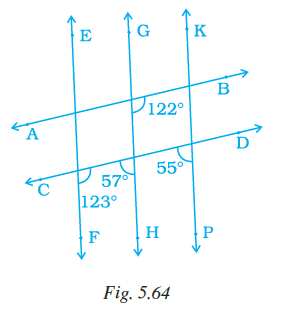
Answer:
To Find:
The pair of parallel lines from the given figure.
Solution:
Step 1: Check lines EF and GH.
Consider line CD as the transversal line for EF and GH. The angles measuring $123^\circ$ and $57^\circ$ are interior angles on the same side of the transversal (co-interior angles).
$\text{Sum} = 123^\circ + 57^\circ = 180^\circ$
(Co-interior angles are supplementary)
Since the sum of co-interior angles is exactly $180^\circ$, line EF is parallel to line GH (EF $\parallel$ GH).
Step 2: Check lines GH and KP.
Consider line CD as the transversal for lines GH and KP. The angle $57^\circ$ and the given angle $55^\circ$ are in corresponding positions.
$57^\circ \neq 55^\circ$
(Corresponding angles are not equal)
Since the corresponding angles are not equal, lines GH and KP are not parallel.
Step 3: Check lines AB and CD.
Consider line GH as the transversal line for lines AB and CD. At the intersection with line CD, the given angle is $57^\circ$. Its linear pair is:
$180^\circ - 57^\circ = 123^\circ$
This $123^\circ$ angle and the given angle $122^\circ$ at the intersection with line AB are corresponding angles.
$123^\circ \neq 122^\circ$
(Corresponding angles are not equal)
Since the corresponding angles are not equal, lines AB and CD are not parallel.
Final Answer:
The only pair of parallel lines is EF $\parallel$ GH.
Question 112. In Fig. 5.65, show that
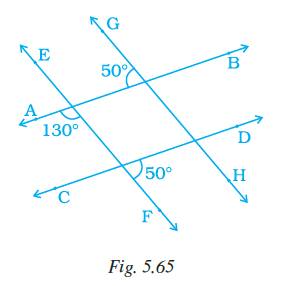
(i) AB || CD
(ii) EF || GH
Answer:
Given:
From the given Fig. 5.65, we observe the following angle measures:
$\angle$ at intersection of AB and EF = $130^\circ$
$\angle$ at intersection of AB and GH = $50^\circ$
$\angle$ at intersection of CD and EF = $50^\circ$
To Prove:
(i) AB $\parallel$ CD
(ii) EF $\parallel$ GH
Proof:
Let the linear pair of the $130^\circ$ angle at the intersection of AB and EF be denoted as $\angle 1$.
$\angle 1 = 180^\circ - 130^\circ = 50^\circ$
(Linear pair property)
(i) For lines AB and CD:
Consider lines AB and CD with line EF acting as the transversal.
We found that the linear pair of $130^\circ$ ($\angle 1$) is $50^\circ$.
The $\angle$ at the intersection of CD and EF is also given as $50^\circ$.
These two angles are in corresponding positions relative to the transversal EF.
$50^\circ = 50^\circ$
(Corresponding angles are equal)
Since the corresponding angles are equal, the lines are parallel.
AB $\parallel$ CD
(Hence Proved)
(ii) For lines EF and GH:
Consider lines EF and GH with line AB acting as the transversal.
We found that the linear pair of $130^\circ$ ($\angle 1$) is $50^\circ$.
The $\angle$ at the intersection of AB and GH is given as $50^\circ$.
These two angles are in alternate interior positions relative to the transversal AB.
$50^\circ = 50^\circ$
(Alternate interior angles are equal)
Since the alternate interior angles are equal, the lines are parallel.
EF $\parallel$ GH
(Hence Proved)
Question 113. In Fig. 5.66, two parallel lines l and m are cut by two transversals p and q. Determine the values of x and y.
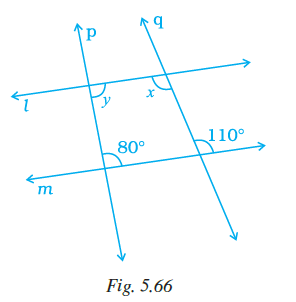
Answer:
Given:
Line $l$ is parallel to line $m$ ($l \parallel m$).
Line $p$ and line $q$ are transversals.
To Find:
The values of $x$ and $y$.
Solution:
Step 1: Finding the value of $y$.
Consider the parallel lines $l$ and $m$ with line $p$ acting as the transversal. The angles $y$ and $80^\circ$ are interior angles on the same side of the transversal.
$y + 80^\circ = 180^\circ$
(Co-interior angles)
$y = 180^\circ - 80^\circ$
$y = 100^\circ$
Step 2: Finding the value of $x$.
Consider the parallel lines $l$ and $m$ with line $q$ acting as the transversal. By observing Fig. 5.66, the angle $x$ and the angle $110^\circ$ are alternate interior angles.
$x = 110^\circ$
(Alternate interior angles)
Final Answer:
The determined values are $x = 110^\circ$ and $y = 100^\circ$.