

Chapter 6 Triangles (Class 7 - Maths NCERT Exemplar Solutions)
Welcome to the comprehensive resource centre for NCERT Exemplar Solutions for Class 7 Mathematics: Chapter 6 Triangles! This chapter covers the essential properties of triangles and the foundational concepts of congruence. These Exemplar problems are purposefully crafted to move beyond standard textbook exercises, challenging students with complex geometric figures and introductory geometric proofs. The primary goal is to foster a deeper conceptual understanding and enhance problem-solving and logical reasoning skills in geometry.
The solutions meticulously cover the classifications of triangles based on sides—including Scalene, Isosceles, and Equilateral triangles—and based on angles, such as Acute-angled, Right-angled, and Obtuse-angled triangles. Students will gain a clear understanding of key elements like medians and altitudes. Furthermore, the solutions delve into fundamental theorems such as the Angle Sum Property (where the sum of interior angles is $180^\circ$) and the Exterior Angle Property, which states that an exterior angle equals the sum of its two opposite interior angles.
Significant emphasis is also placed on the Triangle Inequality Property, ensuring that the sum of the lengths of any two sides is always greater than the third side ($a + b > c$), and the celebrated Pythagorean Theorem for right-angled triangles ($c^2 = a^2 + b^2$). A vital portion of this chapter is dedicated to the Congruence of Triangles, explaining the four standard criteria: SSS, SAS, ASA, and RHS. Students will learn to apply the powerful principle of CPCTC (Corresponding Parts of Congruent Triangles are Congruent) to deduce equality in complex diagrams. With structured proofs and detailed justifications prepared by learningspot.co, students can master the fundamental techniques of geometric deductive proof and build a solid mathematical base.
| Content On This Page | ||
|---|---|---|
| Solved Examples (Examples 1 to 13) | Question 1 to 49 (Multiple Choice Questions) | Question 50 to 69 (Fill in the Blanks) |
| Question 70 to 106 (True or False) | Question 107 to 158 | |
Solved Examples (Examples 1 to 13)
In Examples 1 to 5, there are four options, out of which only one is correct. Write the correct one.
Example 1: In Fig. 6.1, side QR of a ∆PQR has been produced to the point S. If ∠PRS = 115° and ∠P = 45°, then ∠Q is equal to,

(a) 70°
(b) 105°
(c) 51°
(d) 80°
Answer:
Given:
In $\triangle PQR$, side $QR$ is produced to $S$.
Exterior angle $\angle PRS = 115^\circ$
Interior opposite angle $\angle P = 45^\circ$
To Find:
The measure of $\angle Q$.
Solution:
According to the Exterior Angle Theorem, the measure of an exterior angle of a triangle is equal to the sum of its two interior opposite angles.
$\angle PRS = \angle P + \angle Q$
(Exterior Angle Property)
Substituting the given values:
$115^\circ = 45^\circ + \angle Q$
$\angle Q = 115^\circ - 45^\circ$
$\angle Q = 70^\circ$
Final Answer: The correct option is (a).
Example 2: In an equilateral triangle ABC (Fig. 6.2), AD is an altitude. Then 4AD2 is equal to

(a) 2BD2
(b) BC2
(c) 3AB2
(d) 2DC2
Answer:
Given:
$\triangle ABC$ is an equilateral triangle ($AB = BC = CA$).
$AD \perp BC$ (Altitude).
Solution:
In an equilateral triangle, the altitude bisects the base.
$BD = DC = \frac{1}{2}BC$
In right-angled triangle $\triangle ABD$, applying the Pythagoras Theorem:
$AD^2 + BD^2 = AB^2$
$AD^2 = AB^2 - BD^2$
Since $BD = \frac{1}{2}BC$ and in an equilateral triangle $BC = AB$:
$AD^2 = AB^2 - \left(\frac{AB}{2}\right)^2$
$AD^2 = AB^2 - \frac{AB^2}{4}$
$AD^2 = \frac{4AB^2 - AB^2}{4}$
$AD^2 = \frac{3AB^2}{4}$
$4AD^2 = 3AB^2$
Final Answer: The correct option is (c).
Example 3: Which of the following cannot be the sides of a triangle?
(a) 3 cm, 4 cm, 5 cm
(b) 2 cm, 4 cm, 6 cm
(c) 2.5 cm, 3.5 cm, 4.5 cm
(d) 2.3 cm, 6.4 cm, 5.2 cm
Answer:
Solution:
According to the Triangle Inequality Property, the sum of the lengths of any two sides of a triangle must be greater than the length of the third side.
Let's check the options:
(a) $3 + 4 = 7 > 5$ (Possible)
(b) $2 + 4 = 6$. Here, the sum of two sides is equal to the third side ($6 = 6$), not greater. (Not Possible)
(c) $2.5 + 3.5 = 6 > 4.5$ (Possible)
(d) $2.3 + 5.2 = 7.5 > 6.4$ (Possible)
Final Answer: The correct option is (b).
Example 4: Which one of the following is not a criterion for congruence of two triangles?
(a) ASA
(b) SSA
(c) SAS
(d) SSS
Answer:
Solution:
The standard criteria for congruence of triangles are:
1. SSS (Side-Side-Side)
2. SAS (Side-Angle-Side)
3. ASA (Angle-Side-Angle) or AAS (Angle-Angle-Side)
4. RHS (Right angle-Hypotenuse-Side)
SSA (Side-Side-Angle) is not a valid criterion because it does not guarantee that two triangles are identical in shape and size.
Final Answer: The correct option is (b).
Example 5: In Fig. 6.3, PS is the bisector of ∠P and PQ = PR. Then ∆PRS and ∆PQS are congruent by the criterion
(a) AAA
(b) SAS
(c) ASA
(d) both (b) and (c)

Answer:
Given:
In $\triangle PQS$ and $\triangle PRS$:
$PQ = PR$ (Given Side)
$\angle QPS = \angle RPS$ (Given $PS$ is the bisector of $\angle P$)
Solution:
In $\triangle PQS$ and $\triangle PRS$:
1. $PQ = PR$ (Side)
2. $\angle QPS = \angle RPS$ (Angle)
3. $PS = PS$ (Common Side)
By SAS criterion, $\triangle PQS \cong \triangle PRS$.
Additionally, since $PQ = PR$, $\triangle PQR$ is an isosceles triangle. In an isosceles triangle, the angle bisector of the vertex angle is also the perpendicular bisector of the base. Thus, $\angle Q = \angle R$.
Using $PQ=PR$ (Side), $\angle QPS = \angle RPS$ (Angle), and $\angle Q = \angle R$ (Angle), we can also use ASA criterion.
Final Answer: The correct option is (d).
In examples 6 to 9, fill in the blanks to make the statements true.
Example 6: The line segment joining a vertex of a triangle to the mid-point of its opposite side is called its __________.
Answer:
Solution:
By definition, a line segment that connects a vertex of a triangle to the midpoint of the side opposite to that vertex is known as a median.
Final Answer: median
Example 7: A triangle is said to be ________, if each one of its sides has the same length.
Answer:
Solution:
A triangle where all three sides are equal in length is called an equilateral triangle.
Final Answer: equilateral
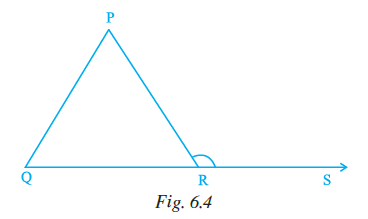
Example 8: In Fig. 6.4, ∠ PRS = ∠ QPR + ∠ ________
Answer:
Solution:
According to the Exterior Angle Property of a triangle, the measure of an exterior angle is equal to the sum of the measures of its two interior opposite angles.
In $\triangle PQR$, $\angle PRS$ is an exterior angle at vertex $R$. The two interior opposite angles are $\angle QPR$ and $\angle PQR$.
Therefore, $\angle PRS = \angle QPR + \angle PQR$.
Final Answer: PQR
Example 9: Let ABC and DEF be two triangles in which AB = DE, BC = FD and CA = EF. The two triangles are congruent under the correspondence
ABC ↔ ________
Answer:
Solution:
To find the correct correspondence, we match the vertices based on the equal sides given:
1. $AB = DE$ and $CA = EF$: The vertex common to $AB$ and $CA$ is $A$. The vertex common to $DE$ and $EF$ is $E$. So, $A \leftrightarrow E$.
2. $AB = DE$ and $BC = FD$: The vertex common to $AB$ and $BC$ is $B$. The vertex common to $DE$ and $FD$ is $D$. So, $B \leftrightarrow D$.
3. $BC = FD$ and $CA = EF$: The vertex common to $BC$ and $CA$ is $C$. The vertex common to $FD$ and $EF$ is $F$. So, $C \leftrightarrow F$.
Therefore, the correspondence is $ABC \leftrightarrow EDF$.
Final Answer: EDF
In Examples 10 to 12, state whether the statements are True or False.
Example 10: Sum of any two sides of a triangle is not less than the third side.
Answer:
Solution:
The Triangle Inequality Property states that the sum of the lengths of any two sides of a triangle is always greater than the length of the third side.
Since the sum is always strictly greater, it can never be less than the third side. Therefore, the statement "not less than" (meaning greater than or equal to) holds true for the existence of a triangle.
Final Answer: True
Example 11: The measure of any exterior angle of a triangle is equal to the sum of the measures of its two interior opposite angles.
Answer:
Solution:
This is the standard definition of the Exterior Angle Theorem for triangles.
Final Answer: True
Example 12: If in ∆ABC and ∆DEF, AB = DE, ∠A = ∠D and BC = EF then the two triangle ABC and DEF are congruent by SAS criterion.
Answer:
Solution:
The SAS (Side-Angle-Side) criterion states that two triangles are congruent if two sides and the included angle of one triangle are equal to the corresponding two sides and the included angle of the other triangle.
In $\triangle ABC$, for sides $AB$ and $BC$, the included angle is $\angle B$. However, the given angle is $\angle A$.
Since the given angle is not the included angle between the two given sides, the SAS criterion cannot be applied.
Final Answer: False
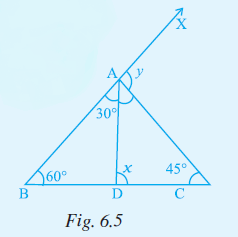
Example 13: In Fig. 6.5, find x and y.
Answer:
Given:
In $\triangle ABC$, $D$ is a point on side $BC$.
In $\triangle ABD$: $\angle B = 60^\circ$ and $\angle BAD = 30^\circ$.
In $\triangle ABC$: $\angle C = 45^\circ$.
To Find:
The values of $x$ and $y$.
Solution:
Step 1: Finding the value of $x$.
By observing Fig. 6.5, $x$ ($\angle ADC$) is the exterior angle of $\triangle ABD$ at vertex $D$, formed by extending side $BD$.
According to the Exterior Angle Property, the measure of an exterior angle of a triangle is equal to the sum of its two interior opposite angles.
$x = \angle ABD + \angle BAD$
(Exterior Angle Property of $\triangle ABD$)
Substituting the given values:
$x = 60^\circ + 30^\circ$
$x = 90^\circ$
Step 2: Finding the value of $y$.
In the figure, $y$ ($\angle XAC$) is the exterior angle of $\triangle ABC$ at vertex $A$, formed by extending the side $BA$ to $X$.
Using the Exterior Angle Property for $\triangle ABC$, the exterior angle $y$ is equal to the sum of its two interior opposite angles, $\angle B$ and $\angle C$.
$y = \angle B + \angle C$
(Exterior Angle Property of $\triangle ABC$)
Substituting the given values:
$y = 60^\circ + 45^\circ$
$y = 105^\circ$
Final Answer:
The values are $x = 90^\circ$ and $y = 105^\circ$.
Exercise
Question 1 to 49 (Multiple Choice Questions)
In each of the questions 1 to 49, four options are given, out of which only one is correct. Choose the correct one.
Question 1. The sides of a triangle have lengths (in cm) 10, 6.5 and a, where a is a whole number. The minimum value that a can take is
(a) 6
(b) 5
(c) 3
(d) 4
Answer:
Solution:
According to the Triangle Inequality Property, the sum of any two sides of a triangle must be greater than the third side.
Let the sides be $s_1 = 10$, $s_2 = 6.5$, and $s_3 = a$.
From the property, we have two conditions to find the range of $a$:
1. The sum of the two smaller sides must be greater than the largest side:
$a + 6.5 > 10$
$a > 10 - 6.5$
$a > 3.5$
2. The sum of the two given sides must be greater than the third side:
$10 + 6.5 > a$
$16.5 > a$
So, the value of $a$ must be greater than $3.5$ and less than $16.5$.
Given that $a$ is a whole number, the possible values for $a$ are $\{4, 5, 6, ..., 16\}$.
The minimum value among these is 4.
The correct option is (d).
Question 2. Triangle DEF of Fig. 6.6 is a right triangle with ∠E = 90°.
What type of angles are ∠D and ∠F?

(a) They are equal angles
(b) They form a pair of adjacent angles
(c) They are complementary angles
(d) They are supplementary angles
Answer:
Solution:
In $\triangle DEF$, the sum of all interior angles is $180^\circ$ (Angle Sum Property).
$\angle D + \angle E + \angle F = 180^\circ$
Given that $\angle E = 90^\circ$:
$\angle D + 90^\circ + \angle F = 180^\circ$
$\angle D + \angle F = 180^\circ - 90^\circ$
$\angle D + \angle F = 90^\circ$
When the sum of two angles is $90^\circ$, they are called complementary angles.
The correct option is (c).
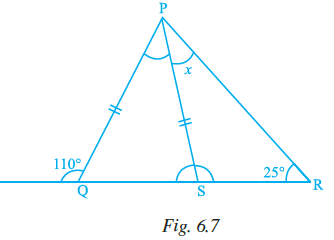
Question 3. In Fig. 6.7, PQ = PS. The value of x is
(a) 35°
(b) 45°
(c) 55°
(d) 70°
Answer:
Solution:
In the figure, at point $Q$, the exterior angle is $110^\circ$.
$\angle PQS + 110^\circ = 180^\circ$ (Linear pair)
$\angle PQS = 180^\circ - 110^\circ = 70^\circ$
In $\triangle PQS$, it is given that $PQ = PS$. This means $\triangle PQS$ is an isosceles triangle.
Therefore, the angles opposite to equal sides are equal:
$\angle PSQ = \angle PQS = 70^\circ$
Now, $\angle PSQ$ is an exterior angle for $\triangle PSR$.
According to the Exterior Angle Property, $\angle PSQ = \angle SPR + \angle PRS$
$70^\circ = x + 25^\circ$
$x = 70^\circ - 25^\circ$
$x = 45^\circ$
The correct option is (b).
Question 4. In a right-angled triangle, the angles other than the right angle are
(a) obtuse
(b) right
(c) acute
(d) straight
Answer:
Solution:
In a right-angled triangle, one angle is $90^\circ$.
Since the sum of all three angles is $180^\circ$, the sum of the remaining two angles must be:
$180^\circ - 90^\circ = 90^\circ$
Since the sum of the two angles is $90^\circ$ and neither can be $0^\circ$, each individual angle must be less than $90^\circ$.
Angles less than $90^\circ$ are called acute angles.
The correct option is (c).
Question 5. In an isosceles triangle, one angle is 70°. The other two angles are of
(i) 55° and 55°
(ii) 70° and 40°
(iii) any measure
In the given option(s) which of the above statement(s) are true?
(a) (i) only
(b) (ii) only
(c) (iii) only
(d) (i) and (ii)
Answer:
Solution:
In an isosceles triangle, two angles are equal. Let the angles be $A, B, \text{ and } C$.
Case 1: The given $70^\circ$ angle is the vertical angle (the unequal angle).
Then, the other two angles ($x$) must be equal.
$x + x + 70^\circ = 180^\circ$
$2x = 110^\circ \implies x = 55^\circ$
So, the angles are $55^\circ$ and $55^\circ$. (Statement (i) is possible)
Case 2: The given $70^\circ$ angle is one of the base angles (the equal angles).
Then, the other base angle is also $70^\circ$.
The third angle $= 180^\circ - (70^\circ + 70^\circ)$
Third angle $= 180^\circ - 140^\circ = 40^\circ$
So, the angles are $70^\circ$ and $40^\circ$. (Statement (ii) is possible)
Since both cases are valid, the correct option is (d).
Question 6. In a triangle, one angle is of 90°. Then
(i) The other two angles are of 45° each
(ii) In remaining two angles, one angle is 90° and other is 45°
(iii) Remaining two angles are complementary
In the given option(s) which is true?
(a) (i) only
(b) (ii) only
(c) (iii) only
(d) (i) and (ii)
Answer:
Solution:
In any triangle, the sum of angles is $180^\circ$.
If one angle is $90^\circ$, the sum of the other two angles is $180^\circ - 90^\circ = 90^\circ$.
1. Statement (i) is only true if the triangle is isosceles. Since it's not specified, it's not always true.
2. Statement (ii) is impossible because the sum of two $90^\circ$ angles would already be $180^\circ$, leaving no room for a third angle.
3. Statement (iii) is always true because the sum of the remaining two angles is exactly $90^\circ$, which is the definition of complementary angles.
The correct option is (c).
Question 7. Lengths of sides of a triangle are 3 cm, 4 cm and 5 cm. The triangle is
(a) Obtuse angled triangle
(b) Acute-angled triangle
(c) Right-angled triangle
(d) An Isosceles right triangle
Answer:
Solution:
Let the sides be $a = 3$, $b = 4$, and $c = 5$. We check if they satisfy the Pythagoras Theorem ($a^2 + b^2 = c^2$).
$a^2 = 3^2 = 9$
$b^2 = 4^2 = 16$
$c^2 = 5^2 = 25$
Adding the squares of the two smaller sides:
$a^2 + b^2 = 9 + 16 = 25$
Since $a^2 + b^2 = c^2$ ($25 = 25$), the sides form a Pythagorean triplet.
Therefore, the triangle is a Right-angled triangle.
The correct option is (c).
Question 8. In Fig. 6.8, PB = PD. The value of x is

(a) 85°
(b) 90°
(c) 25°
(d) 35°
Answer:
Solution:
At vertex $B$, the exterior angle is $120^\circ$.
$\angle PBD = 180^\circ - 120^\circ = 60^\circ$ (Linear pair)
In $\triangle PBD$, it is given that $PB = PD$. This makes $\triangle PBD$ an isosceles triangle.
$\angle PDB = \angle PBD = 60^\circ$ (Angles opposite to equal sides)
Now, $\angle PDB$ and $\angle PDC$ form a linear pair on line $BC$:
$\angle PDC = 180^\circ - \angle PDB$
$\angle PDC = 180^\circ - 60^\circ = 120^\circ$
In $\triangle PDC$, we use the Angle Sum Property:
$\angle DPC + \angle PDC + \angle PCD = 180^\circ$
$35^\circ + 120^\circ + x = 180^\circ$
$155^\circ + x = 180^\circ$
$x = 180^\circ - 155^\circ$
$x = 25^\circ$
The correct option is (c).
Question 9. In ∆ PQR,
(a) PQ – QR > PR
(b) PQ + QR < PR
(c) PQ – QR < PR
(d) PQ + PR < QR
Answer:
Solution:
In any triangle, there are two fundamental properties regarding the lengths of its sides:
1. The sum of the lengths of any two sides is always greater than the length of the third side.
2. The difference between the lengths of any two sides is always less than the length of the third side.
Let's evaluate the options for $\Delta PQR$:
(a) $PQ - QR > PR$ : This contradicts the second property. (False)
(b) $PQ + QR < PR$ : This contradicts the first property. (False)
(c) $PQ - QR < PR$ : This correctly represents the property that the difference of two sides is less than the third side. (True)
(d) $PQ + PR < QR$ : This contradicts the first property. (False)
The correct option is (c).
Question 10. In ∆ ABC,
(a) AB + BC > AC
(b) AB + BC < AC
(c) AB + AC < BC
(d) AC + BC < AB
Answer:
Solution:
According to the Triangle Inequality Property, for any triangle, the sum of the lengths of any two sides must be strictly greater than the length of the third side.
For $\Delta ABC$, the following inequalities must hold true:
1. $AB + BC > AC$
2. $BC + AC > AB$
3. $AB + AC > BC$
Option (a) matches the first inequality.
The correct option is (a).
Question 11. The top of a broken tree touches the ground at a distance of 12 m from its base. If the tree is broken at a height of 5 m from the ground then the actual height of the tree is
(a) 25 m
(b) 13 m
(c) 18 m
(d) 17 m
Answer:
Given:
Height at which the tree is broken $= 5$ m
Distance from the base where the top touches the ground $= 12$ m
Solution:
The standing part of the tree, the ground, and the broken part (fallen part) form a right-angled triangle. Let the standing part be the perpendicular ($p$), the ground distance be the base ($b$), and the fallen part be the hypotenuse ($h$).
$p = 5$ m
(Standing part)
$b = 12$ m
(Base distance)
Using Pythagoras Theorem ($h^{2} = p^{2} + b^{2}$):
$h^{2} = 5^{2} + 12^{2}$
$h^{2} = 25 + 144$
$h^{2} = 169$
$h = \sqrt{169} = 13$ m
The actual height of the tree is the sum of the standing part and the broken part:
$\text{Actual height} = 5 \text{ m} + 13 \text{ m} = 18$ m
The correct option is (c).
Question 12. The trianlge ABC formed by AB = 5 cm, BC = 8 cm, AC = 4 cm is
(a) an isosceles triangle only
(b) a scalene triangle only
(c) an isosceles right triangle
(d) scalene as well as a right triangle
Answer:
Given:
$AB = 5$ cm, $BC = 8$ cm, $AC = 4$ cm
Solution:
1. Check the type based on sides: All three sides (4 cm, 5 cm, 8 cm) are of different lengths. Therefore, it is a scalene triangle.
2. Check if it is a right triangle using Pythagoras Theorem ($a^{2} + b^{2} = c^{2}$):
Smallest sides are 4 and 5.
$4^{2} + 5^{2} = 16 + 25 = 41$
Square of largest side ($8^{2}$) $= 64$
Since $41 \neq 64$, it is not a right-angled triangle.
The triangle is a scalene triangle only.
The correct option is (b).
Question 13. Two trees 7 m and 4 m high stand upright on a ground. If their bases (roots) are 4 m apart, then the distance between their tops is
(a) 3 m
(b) 5 m
(c) 4 m
(d) 11 m
Answer:
Given:
Height of first tree $= 7$ m
Height of second tree $= 4$ m
Distance between bases $= 4$ m
Solution:
Imagine a horizontal line from the top of the 4m tree to the 7m tree. This forms a right-angled triangle where:
1. The base is the distance between the trees $= 4$ m.
2. The perpendicular is the difference in heights $= 7 \text{ m} - 4 \text{ m} = 3$ m.
3. The hypotenuse is the distance between their tops.
Using Pythagoras Theorem:
$\text{Distance}^{2} = 3^{2} + 4^{2}$
$\text{Distance}^{2} = 9 + 16$
$\text{Distance}^{2} = 25$
$\text{Distance} = \sqrt{25} = 5$ m
The correct option is (b).
Question 14. If in an isosceles triangle, each of the base angles is 40°, then the triangle is
(a) Right-angled triangle
(b) Acute angled triangle
(c) Obtuse angled triangle
(d) Isosceles right-angled triangle
Answer:
Given:
In an isosceles triangle, base angles are $40^\circ$ each.
Solution:
Let the third angle be $x$.
According to the Angle Sum Property of a triangle:
$40^\circ + 40^\circ + x = 180^\circ$
$80^\circ + x = 180^\circ$
$x = 180^\circ - 80^\circ$
$x = 100^\circ$
Since one of the angles ($100^\circ$) is greater than $90^\circ$, it is an obtuse angled triangle.
The correct option is (c).
Question 15. If two angles of a triangle are 60° each, then the triangle is
(a) Isosceles but not equilateral
(b) Scalene
(c) Equilateral
(d) Right-angled
Answer:
Given:
Two angles of a triangle are $60^\circ$ and $60^\circ$.
Solution:
Let the third angle be $x$.
$60^\circ + 60^\circ + x = 180^\circ$
$120^\circ + x = 180^\circ$
$x = 180^\circ - 120^\circ = 60^\circ$
Since all three angles are $60^\circ$, all three sides will also be equal.
A triangle with all angles equal to $60^\circ$ is an equilateral triangle.
The correct option is (c).
Question 16. The perimeter of the rectangle whose length is 60 cm and a diagonal is 61 cm is
(a) 120 cm
(b) 122 cm
(c) 71 cm
(d) 142 cm
Answer:
Given:
Length ($l$) of rectangle $= 60$ cm
Diagonal ($d$) of rectangle $= 61$ cm
To Find:
The perimeter of the rectangle.
Solution:
In a rectangle, the diagonal forms a right-angled triangle with the length and breadth ($b$).
Using Pythagoras Theorem ($d^{2} = l^{2} + b^{2}$):
$61^{2} = 60^{2} + b^{2}$
$3721 = 3600 + b^{2}$
$b^{2} = 3721 - 3600$
$b^{2} = 121$
$b = \sqrt{121} = 11$ cm
Now, calculate the perimeter:
$\text{Perimeter} = 2(l + b)$
$\text{Perimeter} = 2(60 + 11)$
$\text{Perimeter} = 2(71) = 142$ cm
The correct option is (d).
Question 17. In ∆PQR, if PQ = QR and ∠Q = 100°, then ∠R is equal to
(a) 40°
(b) 80°
(c) 120°
(d) 50°
Answer:
Given:
In $\triangle PQR$, $PQ = QR$ and $\angle Q = 100^\circ$.
To Find:
The measure of $\angle R$.
Solution:
In $\triangle PQR$, since $PQ = QR$, the angles opposite to these sides must be equal.
$\angle R = \angle P$
(Angles opposite to equal sides)
Let $\angle R = \angle P = x$.
According to the Angle Sum Property of a triangle, the sum of all interior angles is $180^\circ$.
$\angle P + \angle Q + \angle R = 180^\circ$
Substituting the values:
$x + 100^\circ + x = 180^\circ$
$2x + 100^\circ = 180^\circ$
$2x = 180^\circ - 100^\circ$
$2x = 80^\circ$
$x = 40^\circ$
Therefore, $\angle R = 40^\circ$.
Final Answer: The correct option is (a).
Question 18. Which of the following statements is not correct?
(a) The sum of any two sides of a triangle is greater than the third side
(b) A triangle can have all its angles acute
(c) A right-angled triangle cannot be equilateral
(d) Difference of any two sides of a triangle is greater than the third side
Answer:
Solution:
Let us examine each statement based on triangle properties:
(a) Sum of any two sides > third side: This is a fundamental property of triangles. (Correct)
(b) A triangle can have all its angles acute: An acute-angled triangle (like an equilateral triangle where each angle is $60^\circ$) is possible. (Correct)
(c) A right-angled triangle cannot be equilateral: In an equilateral triangle, all angles must be $60^\circ$. A right triangle must have one $90^\circ$ angle. Thus, a triangle cannot be both. (Correct)
(d) Difference of any two sides > third side: According to the triangle property, the difference between the lengths of any two sides is always less than the third side. (Incorrect)
Final Answer: The correct option is (d).
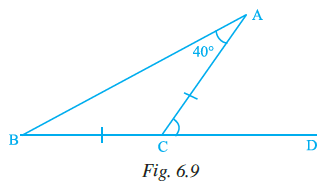
Question 19. In Fig. 6.9, BC = CA and ∠A = 40. Then, ∠ACD is equal to
(a) 40°
(b) 80°
(c) 120°
(d) 60°
Answer:
Given:
In $\triangle ABC$, $BC = CA$ and $\angle A = 40^\circ$.
Solution:
In $\triangle ABC$, since $BC = CA$, the angles opposite to these sides are equal.
$\angle B = \angle A$
(Angles opposite to equal sides)
$\angle B = 40^\circ$
Now, $\angle ACD$ is the exterior angle at vertex $C$, formed by producing side $BC$.
By the Exterior Angle Property, the exterior angle is equal to the sum of the two interior opposite angles.
$\angle ACD = \angle A + \angle B$
$\angle ACD = 40^\circ + 40^\circ$
$\angle ACD = 80^\circ$
Final Answer: The correct option is (b).
Question 20. The length of two sides of a triangle are 7 cm and 9 cm. The length of the third side may lie between
(a) 1 cm and 10 cm
(b) 2 cm and 8 cm
(c) 3 cm and 16 cm
(d) 1 cm and 16 cm
Answer:
Given:
Two sides of the triangle are $s_1 = 7$ cm and $s_2 = 9$ cm. Let the third side be $x$.
Solution:
According to the properties of triangle side lengths:
1. The third side must be less than the sum of the other two sides:
$x < 7 + 9 \implies x < 16$ cm
2. The third side must be greater than the difference of the other two sides:
$x > 9 - 7 \implies x > 2$ cm
Therefore, the third side lies between 2 cm and 16 cm. In the given options, the range 3 cm and 16 cm is the most suitable fitting range.
Final Answer: The correct option is (c).
Question 21. From Fig. 6.10, the value of x is
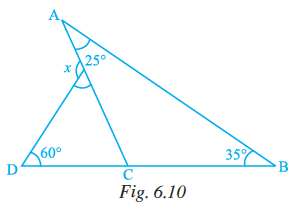
(a) 75°
(b) 90°
(c) 120°
(d) 60°
Answer:
Given:
From the given figure 6.10, we have the following angle measures:
$\angle CAB = 25^\circ$
$\angle ABC = 35^\circ$
$\angle XDC = 60^\circ$
Let the vertex at which the angle $x$ is formed be the vertex $X$ and the vertex below it be $C$.
To Find:
The value of $x$.
Solution:
In $\triangle ABC$, the angle $\angle ACD$ is an exterior angle at vertex $C$. According to the Exterior Angle Property, the measure of an exterior angle of a triangle is equal to the sum of its two interior opposite angles.
$\angle ACD = \angle CAB + \angle ABC$
(Exterior Angle Property)
Substituting the given values:
$\angle ACD = 25^\circ + 35^\circ$
$\angle ACD = 60^\circ$
Now, let us consider $\triangle XDC$. In this triangle, $x$ is the exterior angle at point $X$.
Using the Exterior Angle Property again for $\triangle XDC$, the exterior angle $x$ is equal to the sum of its interior opposite angles, $\angle XDC$ and $\angle XCD$.
$x = \angle XDC + \angle XCD$
(Exterior Angle Property)
From the figure, $\angle XDC = 60^\circ$ and $\angle XCD$ is the same as $\angle ACD$, which we calculated as $60^\circ$.
$x = 60^\circ + 60^\circ$
$x = 120^\circ$
Final Answer:
The value of $x$ is $120^\circ$. Therefore, the correct option is (c).
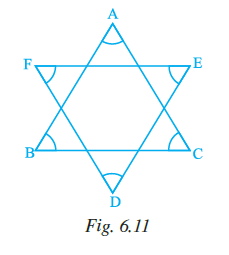
Question 22. In Fig. 6.11, the value of ∠A + ∠B + ∠C + ∠D + ∠E + ∠F is
(a) 190°
(b) 540°
(c) 360°
(d) 180°
Answer:
Given:
The figure represents a six-pointed star formed by two overlapping triangles.
The two triangles are $\triangle ABC$ and $\triangle DEF$.
To Find:
The sum of the angles: $\angle A + \angle B + \angle C + \angle D + \angle E + \angle F$.
Solution:
We know that according to the Angle Sum Property of a triangle, the sum of all the interior angles of a triangle is always $180^\circ$.
Step 1: Consider the first triangle, $\triangle ABC$.
$\angle A + \angle B + \angle C = 180^\circ$
(Angle sum property)
Step 2: Consider the second triangle, $\triangle DEF$.
$\angle D + \angle E + \angle F = 180^\circ$
(Angle sum property)
Step 3: To find the total sum of all the marked angles in the star, we add the sums of the angles of both triangles:
Total Sum $= (\angle A + \angle B + \angle C) + (\angle D + \angle E + \angle F)$
Total Sum $= 180^\circ + 180^\circ$
Total Sum $= 360^\circ$
Final Answer:
The value of $\angle A + \angle B + \angle C + \angle D + \angle E + \angle F$ is $360^\circ$. Therefore, the correct option is (c).
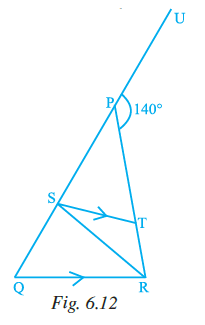
Question 23. In Fig. 6.12, PQ = PR, RS = RQ and ST || QR. If the exterior angle RPU is 140°, then the measure of angle TSR is
(a) 55°
(b) 40°
(c) 50°
(d) 45°
Answer:
Given:
$PQ = PR$, $RS = RQ$, $ST \parallel QR$, and exterior $\angle RPU = 140^\circ$.
Solution:
Step 1: In $\triangle PQR$, points $U, P, Q$ lie on a line. Thus:
$\angle QPR = 180^\circ - \angle RPU = 180^\circ - 140^\circ = 40^\circ$
Since $PQ = PR$, then $\angle PQR = \angle PRQ$. Let them be $y$.
$y + y + 40^\circ = 180^\circ \implies 2y = 140^\circ \implies y = 70^\circ$.
So, $\angle PQR = 70^\circ$ and $\angle PRQ = 70^\circ$.
Step 2: In $\triangle RSQ$, $RS = RQ$, so $\angle RSQ = \angle RQS$.
Since $Q, S, P$ are collinear, $\angle RQS$ is the same as $\angle PQR = 70^\circ$.
Thus, $\angle RSQ = 70^\circ$.
By Angle Sum Property in $\triangle RSQ$: $\angle SRQ = 180^\circ - (70^\circ + 70^\circ) = 40^\circ$.
Step 3: Since $ST \parallel QR$ and $RS$ is the transversal:
$\angle TSR = \angle SRQ$
(Alternate interior angles)
$\angle TSR = 40^\circ$.
Final Answer: The correct option is (b).
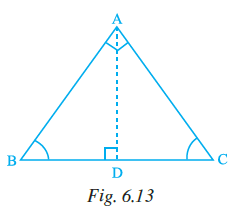
Question 24. In Fig. 6.13, ∠BAC = 90°, AD ⊥ BC and ∠BAD = 50°, then ∠ACD is
(a) 50°
(b) 40°
(c) 70°
(d) 60°
Answer:
Given:
$\angle BAC = 90^\circ$, $AD \perp BC$, and $\angle BAD = 50^\circ$.
Solution:
Step 1: In $\triangle ABD$, we have $\angle ADB = 90^\circ$ (since $AD \perp BC$).
By Angle Sum Property of $\triangle ABD$:
$\angle ABD + \angle BAD + \angle ADB = 180^\circ$
$\angle ABD + 50^\circ + 90^\circ = 180^\circ$
$\angle ABD = 180^\circ - 140^\circ = 40^\circ$.
Step 2: In the large triangle $\triangle ABC$, we have $\angle BAC = 90^\circ$ and $\angle B = 40^\circ$.
By Angle Sum Property of $\triangle ABC$:
$\angle B + \angle BAC + \angle C = 180^\circ$
$40^\circ + 90^\circ + \angle C = 180^\circ$
$\angle C = 180^\circ - 130^\circ = 50^\circ$.
Note that $\angle ACD$ is the same as $\angle C$.
Final Answer: The correct option is (a).
Question 25. If one angle of a triangle is equal to the sum of the other two angles, the triangle is
(a) obtuse
(b) acute
(c) right
(d) equilateral
Answer:
Solution:
Let the three angles of the triangle be $\angle 1$, $\angle 2$, and $\angle 3$.
According to the given condition, let $\angle 1 = \angle 2 + \angle 3$.
We know from the Angle Sum Property of a triangle that:
$\angle 1 + \angle 2 + \angle 3 = 180^\circ$
Substituting $(\angle 2 + \angle 3)$ with $\angle 1$:
$\angle 1 + \angle 1 = 180^\circ$
$2\angle 1 = 180^\circ$
$\angle 1 = \frac{180^\circ}{2} = 90^\circ$
Since one angle is $90^\circ$, the triangle is a right-angled triangle.
The correct option is (c).
Question 26. If the exterior angle of a triangle is 130° and its interior opposite angles are equal, then measure of each interior opposite angle is
(a) 55°
(b) 65°
(c) 50°
(d) 60°
Answer:
Given:
Exterior angle $= 130^\circ$
Interior opposite angles are equal.
Solution:
Let each interior opposite angle be $x$.
According to the Exterior Angle Property, the measure of an exterior angle of a triangle is equal to the sum of its two interior opposite angles.
$x + x = 130^\circ$
$2x = 130^\circ$
$x = \frac{130^\circ}{2} = 65^\circ$
Therefore, each interior opposite angle is $65^\circ$.
The correct option is (b).
Question 27. If one of the angles of a triangle is 110°, then the angle between the bisectors of the other two angles is
(a) 70°
(b) 110°
(c) 35°
(d) 145°
Answer:
Given:
One angle of the triangle (say $\angle A$) $= 110^\circ$.
Solution:
Let the other two angles be $\angle B$ and $\angle C$.
Sum of these angles $= 180^\circ - 110^\circ = 70^\circ$.
The angle between the bisectors of $\angle B$ and $\angle C$ in a triangle is given by the formula:
$\text{Angle} = 90^\circ + \frac{1}{2} \angle A$
Substituting $\angle A = 110^\circ$:
$\text{Angle} = 90^\circ + \frac{110^\circ}{2}$
$\text{Angle} = 90^\circ + 55^\circ = 145^\circ$
The correct option is (d).
Question 28. In ∆ABC, AD is the bisector of ∠A meeting BC at D, CF ⊥ AB and E is the mid-point of AC. Then median of the triangle is
(a) AD
(b) BE
(c) FC
(d) DE
Answer:
Solution:
A median of a triangle is a line segment joining a vertex to the mid-point of the opposite side.
In the given problem:
1. $AD$ is an angle bisector.
2. $CF$ is an altitude ($CF \perp AB$).
3. $E$ is the mid-point of side $AC$.
The segment that connects the vertex opposite to $AC$ (which is vertex $B$) to the mid-point $E$ is the median.
Therefore, BE is the median.
The correct option is (b).
Question 29. In ∆PQR, if ∠P = 60°, and ∠Q = 40°, then the exterior angle formed by producing QR is equal to
(a) 60°
(b) 120°
(c) 100°
(d) 80°
Answer:
Given:
$\angle P = 60^\circ, \angle Q = 40^\circ$.
Solution:
When side $QR$ is produced to a point, say $S$, an exterior angle $\angle PRS$ is formed.
According to the Exterior Angle Property, the exterior angle is equal to the sum of the two interior opposite angles ($\angle P$ and $\angle Q$).
$\text{Exterior Angle} = \angle P + \angle Q$
$\text{Exterior Angle} = 60^\circ + 40^\circ = 100^\circ$
The correct option is (c).
Question 30. Which of the following triplets cannot be the angles of a triangle?
(a) 67°, 51°, 62°
(b) 70°, 83°, 27°
(c) 90°, 70°, 20°
(d) 40°, 132°, 18°
Answer:
Solution:
According to the Angle Sum Property of a triangle, the sum of all three interior angles must be exactly $180^\circ$.
Let's check the sum for each option:
(a) $67^\circ + 51^\circ + 62^\circ = 180^\circ$ (Possible)
(b) $70^\circ + 83^\circ + 27^\circ = 180^\circ$ (Possible)
(c) $90^\circ + 70^\circ + 20^\circ = 180^\circ$ (Possible)
(d) $40^\circ + 132^\circ + 18^\circ = 190^\circ$ (Not Possible)
The correct option is (d).
Question 31. Which of the following can be the length of the third side of a triangle whose two sides measure 18 cm and 14 cm?
(a) 4 cm
(b) 3 cm
(c) 5 cm
(d) 32 cm
Answer:
Solution:
Let the two given sides be $s_1 = 18$ cm and $s_2 = 14$ cm. Let the third side be $x$.
According to triangle properties, the third side $x$ must satisfy:
1. $x < s_1 + s_2 \implies x < 18 + 14 \implies x < 32$ cm
2. $x > s_1 - s_2 \implies x > 18 - 14 \implies x > 4$ cm
So, the third side must be strictly between 4 cm and 32 cm.
From the options: 4 cm (No), 3 cm (No), 32 cm (No), 5 cm (Yes).
The correct option is (c).
Question 32. How many altitudes does a triangle have?
(a) 1
(b) 3
(c) 6
(d) 9
Answer:
Solution:
An altitude of a triangle is a perpendicular line segment from a vertex to the opposite side.
Since every triangle has exactly three vertices and three corresponding opposite sides, it can have exactly three altitudes.
The correct option is (b).
Question 33. If we join a vertex to a point on opposite side which divides that side in the ratio 1:1, then what is the special name of that line segment?
(a) Median
(b) Angle bisector
(c) Altitude
(d) Hypotenuse
Answer:
Solution:
A point that divides a line segment in the ratio $1:1$ is known as the mid-point of that segment.
By definition, a line segment joining a vertex of a triangle to the mid-point of the side opposite to it is called a median.
Final Answer: The correct option is (a).
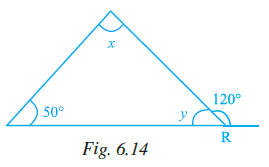
Question 34. The measures of ∠x and ∠y in Fig. 6.14 are respectively
(a) 30°, 60°
(b) 40°, 40°
(c) 70°, 70°
(d) 70°, 60°
Answer:
Given:
In the triangle, one interior angle is $50^\circ$.
The exterior angle at vertex $R$ is $120^\circ$.
Solution:
Step 1: Finding $y$
The angle $y$ and the exterior angle $120^\circ$ lie on a straight line at vertex $R$, forming a linear pair.
$y + 120^\circ = 180^\circ$
(Linear pair)
$y = 180^\circ - 120^\circ$
$y = 60^\circ$
Step 2: Finding $x$
According to the Exterior Angle Property, the exterior angle of a triangle is equal to the sum of its two interior opposite angles.
$x + 50^\circ = 120^\circ$
(Exterior angle property)
$x = 120^\circ - 50^\circ$
$x = 70^\circ$
Therefore, the measures are $x = 70^\circ$ and $y = 60^\circ$.
Final Answer: The correct option is (d).
Question 35. If length of two sides of a triangle are 6 cm and 10 cm, then the length of the third side can be
(a) 3 cm
(b) 4 cm
(c) 2 cm
(d) 6 cm
Answer:
Solution:
According to the Triangle Inequality Property, the length of the third side of a triangle ($x$) must satisfy two conditions:
1. It must be less than the sum of the other two sides: $x < 10 + 6 \implies x < 16$ cm.
2. It must be greater than the difference of the other two sides: $x > 10 - 6 \implies x > 4$ cm.
So, the length of the third side must be between 4 cm and 16 cm (exclusive).
Evaluating the options:
(a) 3 cm (Not possible)
(b) 4 cm (Not possible, must be strictly greater than 4)
(c) 2 cm (Not possible)
(d) 6 cm (Possible, as $4 < 6 < 16$)
Final Answer: The correct option is (d).
Question 36. In a right-angled triangle ABC, if angle B = 90°, BC = 3 cm and AC = 5 cm, then the length of side AB is
(a) 3 cm
(b) 4 cm
(c) 5 cm
(d) 6 cm
Answer:
Given:
In right-angled $\triangle ABC$, $\angle B = 90^\circ$.
Base $BC = 3$ cm and Hypotenuse $AC = 5$ cm.
Solution:
Applying the Pythagoras Theorem ($p^2 + b^2 = h^2$):
$AB^2 + BC^2 = AC^2$
$AB^2 + 3^2 = 5^2$
$AB^2 + 9 = 25$
$AB^2 = 25 - 9$
$AB^2 = 16$
$AB = \sqrt{16} = 4$ cm
Final Answer: The correct option is (b).
Question 37. In a right-angled triangle ABC, if angle B = 90°, then which of the following is true?
(a) AB2 = BC2 + AC2
(b) AC2 = AB2 + BC2
(c) AB = BC + AC
(d) AC = AB + BC
Answer:
Solution:
In a right-angled triangle, the side opposite to the right angle ($90^\circ$) is called the hypotenuse. The hypotenuse is the longest side.
In $\triangle ABC$, if $\angle B = 90^\circ$, then the hypotenuse is $AC$.
According to the Pythagoras Theorem, the square of the hypotenuse is equal to the sum of the squares of the other two sides.
$AC^2 = AB^2 + BC^2$
Final Answer: The correct option is (b).
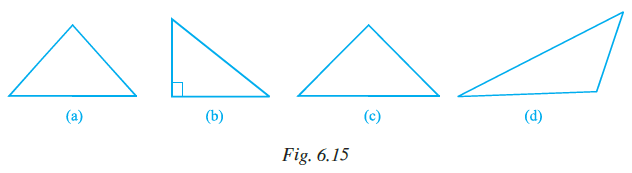
Question 38. Which of the following figures will have it’s altitude outside the triangle?
Answer:
Solution:
The location of the altitudes of a triangle depends on its type:
1. In an acute-angled triangle, all three altitudes lie inside the triangle.
2. In a right-angled triangle, two altitudes coincide with the sides, and one is inside.
3. In an obtuse-angled triangle, the altitudes from the two acute vertices to their opposite sides lie outside the triangle.
By observing Fig. 6.15, triangle (d) is an obtuse-angled triangle.
Final Answer: The correct option is (d).
Question 39. In Fig. 6.16, if AB || CD, then

(a) ∠ 2 = ∠ 3
(b) ∠ 1 = ∠ 4
(c) ∠ 4 = ∠ 1 + ∠ 2
(d) ∠ 1 + ∠ 2 = ∠ 3 + ∠ 4
Answer:
Given:
$AB \parallel CD$
Solution:
1. For parallel lines $AB$ and $CD$ with $AC$ as the transversal:
$\angle 1 = \angle 3$
(Alternate interior angles)
2. For parallel lines $AB$ and $CD$ with $BC$ as the transversal:
$\angle 2 = \angle 4$
(Corresponding angles)
Adding the two equations:
$\angle 1 + \angle 2 = \angle 3 + \angle 4$
Final Answer: The correct option is (d).
Question 40. In ∆ABC, ∠Α = 100°, AD bisects ∠A and AD⊥BC. Then, ∠B is equal to
(a) 80°
(b) 20°
(c) 40°
(d) 30°
Answer:
Given:
In $\triangle ABC$, $\angle A = 100^\circ$.
$AD$ is the angle bisector of $\angle A$.
$AD \perp BC$ (which means $\angle ADB = 90^\circ$).
Solution:
Step 1: Since $AD$ bisects $\angle A$:
$\angle BAD = \frac{\angle A}{2} = \frac{100^\circ}{2} = 50^\circ$
Step 2: In $\triangle ABD$, applying the Angle Sum Property:
$\angle B + \angle BAD + \angle ADB = 180^\circ$
$\angle B + 50^\circ + 90^\circ = 180^\circ$
$\angle B + 140^\circ = 180^\circ$
$\angle B = 180^\circ - 140^\circ$
$\angle B = 40^\circ$
Final Answer: The correct option is (c).
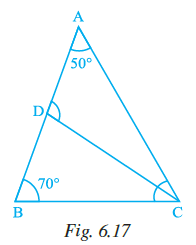
Question 41. In ∆ABC, ∠Α = 50°, ∠B = 70° and bisector of ∠C meets AB in D (Fig. 6.17). Measure of ∠ADC is.
(a) 50°
(b) 100°
(c) 30°
(d) 70°
Answer:
Given:
In $\triangle ABC$, $\angle A = 50^\circ$ and $\angle B = 70^\circ$. $CD$ is the bisector of $\angle C$.
To Find:
The measure of $\angle ADC$.
Solution:
Step 1: First, find the measure of $\angle C$ using the Angle Sum Property of $\triangle ABC$.
$\angle A + \angle B + \angle C = 180^\circ$
(Sum of angles of a triangle)
$50^\circ + 70^\circ + \angle C = 180^\circ$
$120^\circ + \angle C = 180^\circ$
$\angle C = 180^\circ - 120^\circ = 60^\circ$
Step 2: Since $CD$ is the bisector of $\angle C$:
$\angle ACD = \frac{1}{2} \angle C = \frac{60^\circ}{2} = 30^\circ$
Step 3: Now, in $\triangle ADC$, find $\angle ADC$ using the Angle Sum Property:
$\angle A + \angle ACD + \angle ADC = 180^\circ$
$50^\circ + 30^\circ + \angle ADC = 180^\circ$
$80^\circ + \angle ADC = 180^\circ$
$\angle ADC = 180^\circ - 80^\circ = 100^\circ$
Final Answer: The measure of $\angle ADC$ is $100^\circ$. The correct option is (b).
Question 42. If for ∆ABC and ∆DEF, the correspondence CAB ↔ EDF gives a congruence, then which of the following is not true?
(a) AC = DE
(b) AB = EF
(c) ∠A = ∠D
(d) ∠C = ∠E
Answer:
Solution:
Given the congruence correspondence: $CAB \leftrightarrow EDF$.
This means the corresponding parts of the congruent triangles are:
1. Vertices: $C \leftrightarrow E$, $A \leftrightarrow D$, and $B \leftrightarrow F$.
2. Sides: $CA = ED$, $AB = DF$, and $BC = FE$.
3. Angles: $\angle C = \angle E$, $\angle A = \angle D$, and $\angle B = \angle F$.
Evaluating the options:
(a) $AC = DE$ (Matches $CA = ED$) - True.
(b) $AB = EF$. From the correspondence, $AB = DF$ and $BC = EF$. So, $AB = EF$ is False.
(c) $\angle A = \angle D$ - True.
(d) $\angle C = \angle E$ - True.
Final Answer: The correct option is (b).
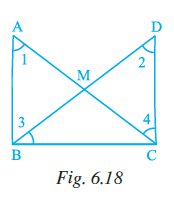
Question 43. In Fig. 6.18, M is the mid-point of both AC and BD. Then
(a) ∠1 = ∠2
(b) ∠1 = ∠4
(c) ∠2 = ∠4
(d) ∠1 = ∠3
Answer:
Given:
$M$ is the midpoint of $AC$ ($AM = MC$) and $BD$ ($BM = MD$).
Solution:
In $\triangle AMB$ and $\triangle CMD$:
1. $AM = CM$ (Given)
2. $BM = DM$ (Given)
3. $\angle AMB = \angle CMD$
(Vertically opposite angles)
So, $\triangle AMB \cong \triangle CMD$ by SAS congruence criterion.
By CPCT (Corresponding Parts of Congruent Triangles):
$\angle MAB = \angle MCD$
From the figure, $\angle MAB$ is $\angle 1$ and $\angle MCD$ is $\angle 4$.
Therefore, $\angle 1 = \angle 4$.
Final Answer: The correct option is (b).
Question 44. If D is the mid-point of the side BC in ∆ABC where AB = AC, then ∠ADC is
(a) 60°
(b) 45°
(c) 120s°
(d) 90°
Answer:
Given:
In $\triangle ABC$, $AB = AC$ and $D$ is the mid-point of $BC$ ($BD = DC$).
Solution:
In $\triangle ABD$ and $\triangle ACD$:
1. $AB = AC$ (Given)
2. $BD = CD$ (Given)
3. $AD = AD$ (Common side)
Thus, $\triangle ABD \cong \triangle ACD$ by SSS criterion.
By CPCT:
$\angle ADB = \angle ADC$
Since points $B, D, \text{ and } C$ lie on a straight line:
$\angle ADB + \angle ADC = 180^\circ$
(Linear pair)
$2\angle ADC = 180^\circ$
$\angle ADC = 90^\circ$
Final Answer: The correct option is (d).
Question 45. Two triangles are congruent, if two angles and the side included between them in one of the triangles are equal to the two angles and the side included between them of the other triangle. This is known as the
(a) RHS congruence criterion
(b) ASA congruence criterion
(c) SAS congruence criterion
(d) AAA congruence criterion
Answer:
Solution:
The ASA (Angle-Side-Angle) criterion states that if two angles and the included side of one triangle are equal to the corresponding two angles and the included side of another triangle, then the triangles are congruent.
Final Answer: The correct option is (b).
Question 46. By which congruency criterion, the two triangles in Fig. 6.19 are congruent?
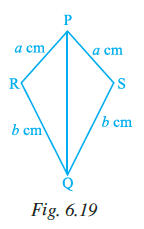
(a) RHS
(b) ASA
(c) SSS
(d) SAS
Answer:
Given:
In $\triangle PRQ$ and $\triangle PSQ$:
1. $PR = PS = a$ cm
2. $RQ = SQ = b$ cm
3. $PQ = PQ$ (Common side)
Solution:
Since all three sides of $\triangle PRQ$ are equal to the three corresponding sides of $\triangle PSQ$, the triangles are congruent.
The criterion used is SSS (Side-Side-Side).
Final Answer: The correct option is (c).
Question 47. By which of the following criterion two triangles cannot be proved congruent?
(a) AAA
(b) SSS
(c) SAS
(d) ASA
Answer:
Solution:
Congruence requires triangles to be identical in both shape and size. The standard criteria are SSS, SAS, ASA (or AAS), and RHS.
The AAA (Angle-Angle-Angle) criterion only ensures that the triangles have the same shape (similar triangles), but it does not guarantee they are the same size.
Final Answer: The correct option is (a).
Question 48. If ∆PQR is congruent to ∆STU (Fig. 6.20), then what is the length of TU?
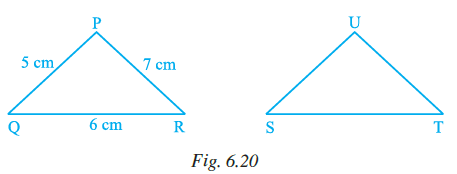
(a) 5 cm
(b) 6 cm
(c) 7 cm
(d) cannot be determined
Answer:
Given:
$\triangle PQR \cong \triangle STU$.
In $\triangle PQR$, the side lengths are: $PQ = 5$ cm, $QR = 6$ cm, and $PR = 7$ cm.
Solution:
When two triangles are congruent, their corresponding parts are equal (CPCT).
From the congruence statement $\triangle \mathbf{PQ}\mathbf{R} \cong \triangle \mathbf{ST}\mathbf{U}$, the correspondence is:
$P \leftrightarrow S$, $Q \leftrightarrow T$, and $R \leftrightarrow U$.
Thus, the corresponding side for $TU$ is $QR$.
$TU = QR$
(CPCT)
$TU = 6$ cm
Final Answer: The correct option is (b).
Question 49. If ∆ABC and ∆DBC are on the same base BC, AB = DC and AC = DB (Fig. 6.21), then which of the following gives a congruence relationship?
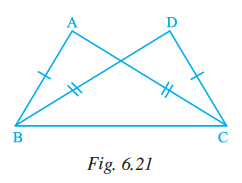
(a) ∆ ABC ≅ ∆ DBC
(b) ∆ ABC ≅ ∆CBD
(c) ∆ ABC ≅ ∆DCB
(d) ∆ ABC ≅ ∆BCD
Answer:
Given:
In $\triangle ABC$ and $\triangle DCB$:
1. $AB = DC$ (Given)
2. $AC = DB$ (Given)
3. $BC = CB$ (Common base)
Solution:
Since the three sides of $\triangle ABC$ are equal to the corresponding three sides of $\triangle DCB$, the triangles are congruent by the SSS criterion.
To write the relationship correctly, we match the equal sides:
$AB = DC \implies A$ corresponds to $D$ and $B$ corresponds to $C$.
$BC$ is common, so $B$ corresponds to $C$ and $C$ corresponds to $B$.
Therefore, $\triangle ABC \cong \triangle DCB$.
Final Answer: The correct option is (c).
Question 50 to 69 (Fill in the Blanks)
In questions 50 to 69, fill in the blanks to make the statements true.
Question 50. The ________triangle always has altitude outside itself.
Answer:
Given: A triangle that always has an altitude outside itself.
To Find: The name of the triangle.
Solution:
The Obtuse-angled triangle always has altitude outside itself.
In an obtuse-angled triangle, one angle is greater than $90^\circ$. To draw an altitude from either of the acute angled vertices to the opposite side, we must extend the opposite side. The perpendicular segment (altitude) dropped from the vertex to this extended line falls in the exterior of the triangle.
Question 51. The sum of an exterior angle of a triangle and its adjacent angle is always __________.
Answer:
Given: An exterior angle of a triangle and its adjacent interior angle.
To Find: The sum of these angles.
Solution:
The sum of an exterior angle of a triangle and its adjacent angle is always $180^\circ$ (or supplementary).
An exterior angle is formed by extending one side of a triangle. This extended side and the adjacent side of the triangle form a straight line. Since the exterior angle and the adjacent interior angle lie on this straight line, they form a linear pair.
$\text{Exterior angle} + \text{Adjacent interior angle} = 180^\circ$
(Linear pair)
Question 52. The longest side of a right angled triangle is called its _________.
Answer:
Given: A right-angled triangle.
To Find: The name of the longest side.
Solution:
The longest side of a right angled triangle is called its Hypotenuse.
In any triangle, the side opposite to the largest angle is always the longest side. In a right-angled triangle, the right angle ($90^\circ$) is the largest angle. Therefore, the side opposite to the $90^\circ$ angle, known as the hypotenuse, is the longest side.
Question 53. Median is also called_______ in an equilateral triangle.
Answer:
Given: An equilateral triangle.
To Find: Another name for the median in this triangle.
Solution:
Median is also called Altitude in an equilateral triangle.
In an equilateral triangle, all three sides are equal and all three interior angles are $60^\circ$. Due to this symmetry, the line segment joining a vertex to the midpoint of the opposite side (median) is also perpendicular to that side. Hence, the median and altitude coincide.
Alternate Solution:
The median is also known as the Perpendicular Bisector or the Angle Bisector in an equilateral triangle.
Question 54. Measures of each of the angles of an equilateral triangle is _______.
Answer:
Given: An equilateral triangle.
To Find: The measure of each interior angle.
Solution:
Measures of each of the angles of an equilateral triangle is $60^\circ$.
In an equilateral triangle, all three sides are equal. According to the property of triangles, angles opposite to equal sides are equal. Let each angle be $x$.
$x + x + x = 180^\circ$
(Angle sum property)
$3x = 180^\circ$
$x = \frac{\cancel{180}^{60}}{\cancel{3}_{1}}$
$x = 60^\circ$
Question 55. In an isosceles triangle, two angles are always__________ .
Answer:
Given: An isosceles triangle.
To Find: The relationship between two of its angles.
Solution:
In an isosceles triangle, two angles are always Equal.
An isosceles triangle is defined as a triangle with two equal sides. By the property that angles opposite to equal sides of a triangle are equal, the two angles opposite those equal sides must be equal.
Question 56. In an isosceles triangle, angles opposite to equal sides are ___________.
Answer:
Given: An isosceles triangle with two equal sides.
To Find: Relationship of angles opposite to those sides.
Solution:
In an isosceles triangle, angles opposite to equal sides are Equal.
Consider $\triangle ABC$ where $AB = AC$. According to the Isosceles Triangle Theorem, the base angles are equal.
$\angle B = \angle C$
(Angles opposite to equal sides)
Question 57. If one angle of a triangle is equal to the sum of other two, then the measure of that angle is ___________ .
Answer:
Given:
In a triangle, let the angles be $\angle A$, $\angle B$, and $\angle C$.
According to the condition:
$\angle A = \angle B + \angle C$
To Find:
The measure of $\angle A$.
Solution:
We know that the sum of all interior angles of a triangle is $180^\circ$.
$\angle A + \angle B + \angle C = 180^\circ$
(Angle sum property)
Substituting the value from equation (i) into the sum:
$\angle A + (\angle A) = 180^\circ$
$2 \angle A = 180^\circ$
$\angle A = \frac{\cancel{180}^{90}}{\cancel{2}_{1}}$
$\angle A = 90^\circ$
Therefore, if one angle of a triangle is equal to the sum of the other two, then the measure of that angle is $90^\circ$.
Question 58. Every triangle has at least ___________ acute angle (s).
Answer:
Solution:
Every triangle has at least two acute angle(s).
In a triangle, the sum of all angles is $180^\circ$. If a triangle had only one acute angle (less than $90^\circ$), the other two angles would have to be $90^\circ$ or more. However, two angles of $90^\circ$ or more would already sum to at least $180^\circ$, making it impossible for a third angle to exist. Thus, every triangle must have at least two angles that are less than $90^\circ$.
Question 59. Two line segments are congruent, if they are of ___________ lengths.
Answer:
Solution:
Two line segments are congruent, if they are of equal lengths.
Congruence in geometry means that two figures have the same shape and size. For line segments, the only measure of size is their length. Therefore, if the lengths are equal, the segments are congruent.
Question 60. Two angles are said to be ___________ , if they have equal measures.
Answer:
Solution:
Two angles are said to be congruent, if they have equal measures.
When the measure of two angles is the same (e.g., both are $45^\circ$), they are geometrically identical in size and are referred to as congruent angles.
Question 61. Two rectangles are congruent, if they have same_______ and_________.
Answer:
Solution:
Two rectangles are congruent, if they have same length and breadth (or width).
For two rectangles to be congruent, their corresponding dimensions must be identical. If the length and breadth of one rectangle match the length and breadth of another, they will perfectly overlap, satisfying the condition of congruence.
Question 62. Two squares are congruent, if they have same ________.
Answer:
Solution:
Two squares are congruent, if they have same side length.
In a square, all sides are equal and all angles are $90^\circ$. Since the angles are already fixed, the only parameter that determines the size of a square is its side. If two squares have the same side length, they are congruent.
Question 63. If ∆PQR and ∆XYZ are congruent under the correspondence QPR ↔ XYZ, then
(i) ∠R = __________
(ii) QR = ____________
(iii) ∠P = ________
(iv) QP = __________
(v) ∠ Q = _______
(vi) RP = _________
Answer:
Given:
$\triangle PQR \cong \triangle YXZ$ (implied by the correspondence $QPR \leftrightarrow XYZ$).
The correspondence $QPR \leftrightarrow XYZ$ means:
Vertex $Q$ corresponds to Vertex $X$
Vertex $P$ corresponds to Vertex $Y$
Vertex $R$ corresponds to Vertex $Z$
Solution:
Based on the CPCT (Corresponding Parts of Congruent Triangles):
(i) $\angle R =$ $\angle Z$
(ii) $QR =$ $XZ$
(iii) $\angle P =$ $\angle Y$
(iv) $QP =$ $XY$
(v) $\angle Q =$ $\angle X$
(vi) $RP =$ $ZY$
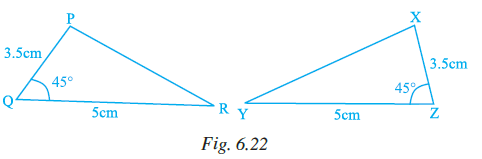
Question 64. In Fig. 6.22, ∆PQR ≅∆ ________
Answer:
Given:
In $\triangle PQR$:
$PQ = 3.5 \text{ cm}$
$QR = 5 \text{ cm}$
$\angle PQR = 45^\circ$
In the second triangle (let's observe vertices $X, Z, Y$):
$XZ = 3.5 \text{ cm}$
$ZY = 5 \text{ cm}$
$\angle XZY = 45^\circ$
Solution:
Comparing $\triangle PQR$ and $\triangle XZY$:
$PQ = XZ = 3.5 \text{ cm}$
(Given)
$\angle Q = \angle Z = 45^\circ$
(Given)
$QR = ZY = 5 \text{ cm}$
(Given)
By SAS (Side-Angle-Side) congruence criterion, the two triangles are congruent.
Matching the vertices according to the equal parts:
$P \leftrightarrow X$
$Q \leftrightarrow Z$
$R \leftrightarrow Y$
Therefore, $\triangle PQR \cong \triangle$ $XZY$.
Question 65. In Fig. 6.23, ∆PQR ≅∆ ___________
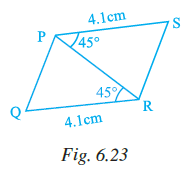
Answer:
Given:
From the figure, in $\triangle PQR$ and $\triangle RSP$:
$QR = SP = 4.1 \text{ cm}$
(Given)
$\angle PRQ = \angle SPR = 45^\circ$
(Given)
$PR = RP$
(Common side)
Solution:
By SAS (Side-Angle-Side) congruence criterion, the two triangles are congruent.
Mapping the corresponding vertices:
$P \leftrightarrow R$
$Q \leftrightarrow S$
$R \leftrightarrow P$
Therefore, $\triangle PQR \cong \triangle$ $RSP$.
Question 66. In Fig. 6.24, ∆ __________ ≅ ∆ PQR
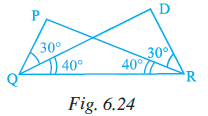
Answer:
Given:
In $\triangle PQR$ and $\triangle DRQ$:
$\angle PQR = 30^\circ + 40^\circ = 70^\circ$
$\angle DRQ = 40^\circ + 30^\circ = 70^\circ$
$\angle PQR = \angle DRQ = 70^\circ$
(Angle)
$QR = RQ$
(Common side)
$\angle PRQ = \angle DQR = 40^\circ$
(Given)
Solution:
By ASA (Angle-Side-Angle) congruence criterion:
$\triangle PQR \cong \triangle DRQ$
Thus, $\triangle$ $DRQ$ $\cong \triangle PQR$.
Question 67. In Fig. 6.25, ∆ ARO ≅ ∆ _______
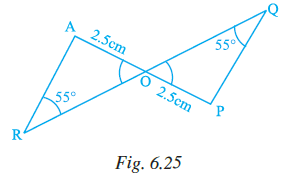
Answer:
Given:
In $\triangle ARO$ and $\triangle PQO$:
$\angle R = \angle Q = 55^\circ$
(Given)
$\angle AOR = \angle POQ$
(Vertically opposite angles)
$AO = PO = 2.5 \text{ cm}$
(Given)
Solution:
By AAS (Angle-Angle-Side) congruence criterion, the triangles are congruent.
Mapping vertices:
$A \leftrightarrow P$
$R \leftrightarrow Q$
$O \leftrightarrow O$
Therefore, $\triangle ARO \cong \triangle$ $PQO$.
Question 68. In Fig. 6.26, AB = AD and ∠BAC = ∠DAC. Then

(i) ∆ _______ ≅ ∆ABC.
(ii) BC = _________.
(iii) ∠BCA = __________ .
(iv) Line segment AC bisects _________ and __________ .
Answer:
Given:
In $\triangle ABC$ and $\triangle ADC$:
$AB = AD$
(Given)
$\angle BAC = \angle DAC$
(Given)
$AC = AC$
(Common side)
Solution:
By SAS congruence criterion, $\triangle ABC \cong \triangle ADC$.
(i) $\triangle$ $ADC$ $\cong \triangle ABC$.
(ii) $BC =$ $DC$. (By CPCT)
(iii) $\angle BCA =$ $\angle DCA$. (By CPCT)
(iv) Line segment $AC$ bisects $\angle BAD$ and $\angle BCD$.
Question 69. In Fig. 6.27,
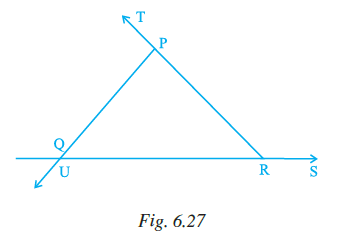
(i) ∠ TPQ = ∠ _____ + ∠ _____
(ii) ∠ UQR = ∠ _____ + ∠ _____
(iii) ∠ PRS = ∠ _____ + ∠ _____
Answer:
Solution:
According to the Exterior Angle Property of a triangle, an exterior angle is equal to the sum of its two interior opposite angles.
(i) $\angle TPQ = \angle$ $PQR$ $+ \angle$ $PRQ$
(ii) $\angle UQR = \angle$ $QPR$ $+ \angle$ $QRP$
(iii) $\angle PRS = \angle$ $RPQ$ $+ \angle$ $RQP$
Question 70 to 106 (True or False)
In questions 70 to 106 state whether the statements are True or False.
Question 70. In a triangle, sum of squares of two sides is equal to the square of the third side.
Answer:
Statement: In a triangle, sum of squares of two sides is equal to the square of the third side.
Answer: False
This property (Pythagoras Theorem) holds true only for right-angled triangles. For acute or obtuse-angled triangles, this equality does not exist.
Question 71. Sum of two sides of a triangle is greater than or equal to the third side.
Answer:
Statement: Sum of two sides of a triangle is greater than or equal to the third side.
Answer: False
The Triangle Inequality Theorem states that the sum of the lengths of any two sides of a triangle must be strictly greater than the length of the third side. If the sum is equal to the third side, the three points will be collinear, and a triangle cannot be formed.
Question 72. The difference between the lengths of any two sides of a triangle is smaller than the length of third side.
Answer:
Statement: The difference between the lengths of any two sides of a triangle is smaller than the length of third side.
Answer: True
This is a corollary of the Triangle Inequality Theorem. For any triangle with sides $a, b,$ and $c$:
$|a - b| < c$
The difference between any two sides is always strictly less than the third side.
Question 73. In ∆ABC, AB = 3.5 cm, AC = 5 cm, BC = 6 cm and in ∆PQR, PR= 3.5 cm, PQ = 5 cm, RQ = 6 cm. Then ∆ABC ≅∆PQR.
Answer:
Given:
In $\triangle ABC$:
$AB = 3.5 \text{ cm}, AC = 5 \text{ cm}, BC = 6 \text{ cm}$
In $\triangle PQR$:
$PR = 3.5 \text{ cm}, PQ = 5 \text{ cm}, RQ = 6 \text{ cm}$
Statement: $\triangle ABC \cong \triangle PQR$
Answer: False
Solution:
For two triangles to be congruent, their corresponding sides must be equal. If $\triangle ABC \cong \triangle PQR$, the correspondence must be $A \leftrightarrow P$, $B \leftrightarrow Q$, and $C \leftrightarrow R$.
This would mean:
$AB = PQ$
$BC = QR$
$AC = PR$
However, from the given data:
$AB = 3.5 \text{ cm}$ and $PQ = 5 \text{ cm}$. Since $AB \neq PQ$, the statement $\triangle ABC \cong \triangle PQR$ is incorrect.
The correct congruence statement would be $\triangle ABC \cong \triangle PRQ$.
Question 74. Sum of any two angles of a triangle is always greater than the third angle.
Answer:
Answer: False
Solution:
Consider an obtuse-angled triangle with angles $120^\circ, 40^\circ,$ and $20^\circ$.
Sum of the two smaller angles is:
$40^\circ + 20^\circ = 60^\circ$
Comparing with the third angle:
$60^\circ < 120^\circ$
Since the sum of two angles ($60^\circ$) is less than the third angle ($120^\circ$), the statement is false.
Question 75. The sum of the measures of three angles of a triangle is greater than 180°.
Answer:
Answer: False
Solution:
According to the Angle Sum Property of a triangle, the sum of the measures of the three interior angles of a triangle is exactly equal to $180^\circ$. It can neither be greater than nor less than $180^\circ$ in Euclidean geometry.
Question 76. It is possible to have a right-angled equilateral triangle.
Answer:
Answer: False
Solution:
An equilateral triangle must have all three angles equal to $60^\circ$. A right-angled triangle must have one angle equal to $90^\circ$. Since a triangle cannot have an angle that is both $60^\circ$ and $90^\circ$ simultaneously, a right-angled equilateral triangle is impossible.
Question 77. If M is the mid-point of a line segment AB, then we can say that AM and MB are congruent.
Answer:
Given: $M$ is the mid-point of line segment $AB$.
Answer: True
Solution:
By definition, a mid-point divides a line segment into two parts of equal length. Since $AM = MB$, and two line segments with equal lengths are said to be congruent, we can state that segment $AM \cong$ segment $MB$.
Question 78. It is possible to have a triangle in which two of the angles are right angles.
Answer:
Answer: False
Solution:
If a triangle had two right angles ($90^\circ$ each), the sum of just those two angles would be:
$90^\circ + 90^\circ = 180^\circ$
This would leave $0^\circ$ for the third angle ($180^\circ - 180^\circ = 0^\circ$), which is impossible as a triangle must have three angles with non-zero measures.
Question 79. It is possible to have a triangle in which two of the angles are obtuse.
Answer:
Answer: False
Solution:
An obtuse angle is greater than $90^\circ$. If a triangle had two obtuse angles, their sum would be greater than $180^\circ$. For example, if two angles were $91^\circ$ each:
$91^\circ + 91^\circ = 182^\circ$
Since the total sum of all three angles in a triangle must be exactly $180^\circ$, having two obtuse angles is impossible.
Question 80. It is possible to have a triangle in which two angles are acute.
Answer:
Answer: True
Solution:
Every triangle must have at least two acute angles. For example:
1. In a right-angled triangle, there is one $90^\circ$ angle and two acute angles.
2. In an obtuse-angled triangle, there is one obtuse angle and two acute angles.
3. In an acute-angled triangle, all three angles are acute.
Question 81. It is possible to have a triangle in which each angle is less than 60°.
Answer:
Answer: False
Solution:
In a triangle, let the three angles be $\angle A$, $\angle B$, and $\angle C$. If each angle is less than $60^\circ$, then:
$\angle A < 60^\circ$
$\angle B < 60^\circ$
$\angle C < 60^\circ$
Adding these three inequalities:
$\angle A + \angle B + \angle C < 180^\circ$
However, the Angle Sum Property of a triangle states that the sum must be exactly $180^\circ$. Since a sum less than $180^\circ$ cannot form a triangle, the statement is false.
Question 82. It is possible to have a triangle in which each angle is greater than 60°.
Answer:
Answer: False
Solution:
If each angle of a triangle is greater than $60^\circ$, let the angles be $\angle A$, $\angle B$, and $\angle C$. Then:
$\angle A > 60^\circ, \angle B > 60^\circ, \angle C > 60^\circ$
Summing them up:
$\angle A + \angle B + \angle C > 180^\circ$
According to the Angle Sum Property, the total sum of angles in a triangle must be exactly $180^\circ$. A sum exceeding $180^\circ$ is not possible for a triangle.
Question 83. It is possible to have a triangle in which each angle is equal to 60°.
Answer:
Answer: True
Solution:
If each angle is $60^\circ$, the sum of the angles is:
$60^\circ + 60^\circ + 60^\circ = 180^\circ$
This satisfies the Angle Sum Property. Such a triangle is known as an equilateral triangle.
Question 84. A right-angled triangle may have all sides equal.
Answer:
Answer: False
Solution:
In a right-angled triangle, the side opposite to the right angle (hypotenuse) is always the longest side. According to Pythagoras Theorem, for sides $a, b$ and hypotenuse $c$:
$a^2 + b^2 = c^2$
If all sides were equal ($a = b = c$), then:
$a^2 + a^2 = a^2$
$2a^2 = a^2$
$2 = 1$ (Which is impossible)
Thus, a right-angled triangle can never be equilateral; it can at most be an isosceles right-angled triangle where the two legs are equal.
Question 85. If two angles of a triangle are equal, the third angle is also equal to each of the other two angles.
Answer:
Answer: False
Solution:
If two angles of a triangle are equal, it is an isosceles triangle. The third angle does not necessarily have to be equal to the others. For example, a triangle can have angles of $40^\circ, 40^\circ,$ and $100^\circ$. Here, two angles are equal, but the third one is different. The third angle is only equal to the others in the specific case of an equilateral triangle.
Question 86. In Fig. 6.28, two triangles are congruent by RHS.

Answer:
Answer: False
Solution:
In Fig. 6.28, both triangles are right-angled and have legs of length $4 \text{ cm}$ and $5 \text{ cm}$. The RHS (Right angle-Hypotenuse-Side) congruence criterion requires the hypotenuse and one side of one triangle to be equal to the hypotenuse and one side of the other.
In the given figure, the sides provided are the legs (the sides forming the right angle), not the hypotenuse. Therefore, the triangles are congruent by the SAS (Side-Angle-Side) criterion, not RHS.
Question 87. The congruent figures super impose each other completely.
Answer:
Answer: True
Solution:
By definition, congruent figures are identical in shape and size. If one figure is placed over the other, they will cover each other perfectly, which is termed as superimposition.
Question 88. A one rupee coin is congruent to a five rupee coin.
Answer:
Answer: False
Solution:
A $\textsf{₹} 1$ coin and a $\textsf{₹} 5$ coin have different physical dimensions (diameter and thickness). For two circular objects to be congruent, their radii must be exactly equal. Since their sizes differ, they are not congruent.
Question 89. The top and bottom faces of a kaleidoscope are congruent.
Answer:
Answer: True
Solution:
A kaleidoscope is generally in the shape of a prism (most commonly a triangular prism). By the geometric definition of a prism, the two bases (top and bottom faces) are always identical in shape and size. Therefore, they are congruent to each other.
Question 90. Two acute angles are congruent.
Answer:
Answer: False
Solution:
An acute angle is any angle whose measure is between $0^\circ$ and $90^\circ$. For two angles to be congruent, their measures must be exactly equal. Since two different acute angles can have different measures (for example, $30^\circ$ and $60^\circ$), they are not necessarily congruent.
Question 91. Two right angles are congruent.
Answer:
Answer: True
Solution:
Every right angle, by definition, has a measure of exactly $90^\circ$. Since all right angles have the same measure, any two right angles will always be congruent to each other.
Question 92. Two figures are congruent, if they have the same shape.
Answer:
Answer: False
Solution:
Congruence requires two conditions: the figures must have the same shape and the same size. Figures that have the same shape but different sizes are called "similar" figures, not congruent figures. For example, a small circle and a large circle have the same shape but are not congruent.
Question 93. If the areas of two squares is same, they are congruent.
Answer:
Answer: True
Solution:
Let the sides of two squares be $s_1$ and $s_2$.
$\text{Area of Square 1} = s_1^2$
$\text{Area of Square 2} = s_2^2$
If the areas are equal:
$s_1^2 = s_2^2$
$s_1 = s_2$
Since the side lengths are equal and all angles in a square are $90^\circ$, the two squares are congruent.
Question 94. If the areas of two rectangles are same, they are congruent.
Answer:
Answer: False
Solution:
The area of a rectangle is calculated as $\text{length} \times \text{breadth}$. Two rectangles can have the same area with different dimensions. For example:
Rectangle A: $\text{Length} = 6 \text{ cm}$, $\text{Breadth} = 2 \text{ cm} \rightarrow \text{Area} = 12 \text{ cm}^2$
Rectangle B: $\text{Length} = 4 \text{ cm}$, $\text{Breadth} = 3 \text{ cm} \rightarrow \text{Area} = 12 \text{ cm}^2$
Even though their areas are the same, their sides are not equal, so they are not congruent.
Question 95. If the areas of two circles are the same, they are congruent.
Answer:
Answer: True
Solution:
The area of a circle is given by the formula $\pi r^2$. If the areas of two circles are equal:
$\pi r_1^2 = \pi r_2^2$
$r_1^2 = r_2^2$
$r_1 = r_2$
Since their radii are equal, the two circles will have the exact same size and shape, making them congruent.
Question 96. Two squares having same perimeter are congruent.
Answer:
Answer: True
Solution:
The perimeter of a square is given by $4 \times \text{side}$. If the perimeters of two squares are equal:
$4 \times s_1 = 4 \times s_2$
$s_1 = s_2$
Since the sides of the two squares are equal in length, the squares are congruent.
Question 97. Two circles having same circumference are congruent.
Answer:
Given: Two circles have the same circumference.
To Prove: Whether the statement "they are congruent" is True or False.
Solution:
Let the radii of the two circles be $r_1$ and $r_2$. The circumference of a circle is given by $2\pi r$.
$2\pi r_1 = 2\pi r_2$
(Given)
Dividing both sides by $2\pi$:
$r_1 = r_2$
Since the radii of the two circles are equal, they have the same size and shape. Therefore, the circles are congruent.
Answer: True
Question 98. If three angles of two triangles are equal, triangles are congruent.
Answer:
Answer: False
Solution:
There is no AAA (Angle-Angle-Angle) congruence criterion. If three angles of one triangle are equal to the three angles of another, the triangles are similar (same shape) but not necessarily congruent (same size). One triangle could be a magnified version of the other.
For example, an equilateral triangle with side $2 \text{ cm}$ and an equilateral triangle with side $5 \text{ cm}$ both have angles of $60^\circ, 60^\circ, 60^\circ$, but they are not congruent.
Question 99. If two legs of a right triangle are equal to two legs of another right triangle, then the right triangles are congruent.
Answer:
Given: Two right-angled triangles where the two legs (sides forming the right angle) are equal.
Solution:
In a right-angled triangle, the angle between the two legs is always $90^\circ$. If the two legs of one triangle are equal to the two legs of another, we have:
1. Side (Leg 1) = Side (Leg 1)
2. Included Angle ($90^\circ$) = Included Angle ($90^\circ$)
3. Side (Leg 2) = Side (Leg 2)
This satisfies the SAS (Side-Angle-Side) congruence criterion.
Answer: True
Question 100. If two sides and one angle of a triangle are equal to the two sides and angle of another triangle, then the two triangles are congruent.
Answer:
Answer: False
Solution:
For two triangles to be congruent using two sides and one angle, the angle must be the included angle (the angle between the two equal sides) as per the SAS criterion. If the given angle is not the included angle, the triangles may not be congruent (this is often called the SSA condition, which is not a valid congruence rule).
Question 101. If two triangles are congruent, then the corresponding angles are equal.
Answer:
Answer: True
Solution:
By the definition of congruence, if two triangles are congruent, all their corresponding parts (sides and angles) must be exactly equal. This property is referred to as CPCT (Corresponding Parts of Congruent Triangles).
Question 102. If two angles and a side of a triangle are equal to two angles and a side of another triangle, then the triangles are congruent.
Answer:
Answer: True
Solution:
This statement is true based on the ASA (Angle-Side-Angle) or AAS (Angle-Angle-Side) congruence criteria. If two angles of a triangle are equal to two angles of another, the third angle is also automatically equal (due to the Angle Sum Property). Therefore, any corresponding side being equal will satisfy the condition for congruence.
Question 103. If the hypotenuse of one right triangle is equal to the hypotenuse of another right triangle, then the triangles are congruent.
Answer:
Answer: False
Solution:
To prove two right-angled triangles are congruent using the RHS criterion, we need the hypotenuse and one side (leg) to be equal. Having only the hypotenuse equal is not sufficient, as the lengths of the legs or the measures of the acute angles could still differ.
Question 104. If hypotenuse and an acute angle of one right triangle are equal to the hypotenuse and an acute angle of another right triangle, then the triangles are congruent.
Answer:
Answer: True
Solution:
In the two right-angled triangles, we have:
1. One right angle ($90^\circ$) = One right angle ($90^\circ$)
2. One acute angle = One acute angle
3. Hypotenuse (side) = Hypotenuse (side)
Since two angles and one side are equal, the triangles are congruent by the AAS (Angle-Angle-Side) congruence criterion.
Question 105. AAS congruence criterion is same as ASA congruence criterion.
Answer:
Answer: True
Solution:
In a triangle, if two angles are known, the third angle is automatically determined because the sum of all angles is always $180^\circ$. Thus, the AAS (Angle-Angle-Side) criterion is logically a result of the ASA (Angle-Side-Angle) criterion. While they refer to different arrangements of parts, they are considered equivalent in terms of proving the congruence of triangles.
Question 106. In Fig. 6.29, AD ⊥ BC and AD is the bisector of angle BAC. Then, ∆ABD ≅∆ACD by RHS.

Answer:
Given:
In $\triangle ABD$ and $\triangle ACD$:
$\angle ADB = \angle ADC = 90^\circ$
(Given: $AD \perp BC$)
$\angle BAD = \angle CAD$
(Given: $AD$ is bisector of $\angle BAC$)
$AD = AD$
(Common side)
Solution:
From the above given information, the triangles satisfy the ASA (Angle-Side-Angle) congruence criterion.
The RHS criterion requires the Hypotenuse ($AB$ and $AC$) and one Side to be equal. Since the equality of the hypotenuse is not given initially, the congruence is not proven by RHS.
Answer: False
Question 107 to 158
Question 107. The measure of three angles of a triangle are in the ratio 5 : 3 : 1.
Find the measures of these angles.
Answer:
Given:
Ratio of angles $= 5 : 3 : 1$
To Find:
The measures of the three angles.
Solution:
Let the three angles of the triangle be $5x$, $3x$, and $1x$.
According to the Angle Sum Property of a triangle:
$5x + 3x + x = 180^\circ$
$9x = 180^\circ$
$x = \frac{\cancel{180}^{20}}{\cancel{9}_{1}}$
[Dividing by 9]
$x = 20^\circ$
Now, calculating the measures of each angle:
First angle $= 5x = 5 \times 20^\circ = 100^\circ$
Second angle $= 3x = 3 \times 20^\circ = 60^\circ$
Third angle $= 1x = 1 \times 20^\circ = 20^\circ$
The measures of the angles are $100^\circ, 60^\circ,$ and $20^\circ$.
Question 108. In Fig. 6.30, find the value of x.

Answer:
Given:
In the left-hand side right-angled triangle:
One angle is $55^\circ$.
One angle is $90^\circ$ (indicated by the perpendicular square symbol).
The third angle is $x$.
To Find:
The value of $x$.
Solution:
In the smaller triangle on the left:
$x + 55^\circ + 90^\circ = 180^\circ$
(Angle sum property)
$x + 145^\circ = 180^\circ$
$x = 180^\circ - 145^\circ$
$x = 35^\circ$
Question 109. In Fig. 6.31 (i) and (ii), find the values of a, b and c.
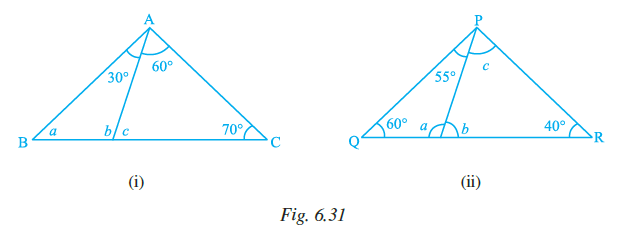
Answer:
Part (i):
Given:
In $\triangle ABC$, a line segment is drawn from vertex $A$ to the side $BC$. Let us assume this point of intersection on $BC$ is $D$.
In the right-side triangle ($ADC$): $\angle DAC = 60^\circ$ and $\angle ACD = 70^\circ$.
In the left-side triangle ($ABD$): $\angle DAB = 30^\circ$.
To Find:
The values of $a, b$ and $c$.
Solution:
In the triangle on the right side:
$60^\circ + 70^\circ + c = 180^\circ$
(Angle sum property)
$130^\circ + c = 180^\circ$
$c = 180^\circ - 130^\circ$
$c = 50^\circ$
Now, the angles $b$ and $c$ lie on the straight line $BC$. Therefore, they form a linear pair.
$b + c = 180^\circ$
(Linear pair)
$b + 50^\circ = 180^\circ$
$b = 180^\circ - 50^\circ$
$b = 130^\circ$
In the triangle on the left side:
$30^\circ + a + b = 180^\circ$
(Angle sum property)
$30^\circ + a + 130^\circ = 180^\circ$
$a + 160^\circ = 180^\circ$
$a = 180^\circ - 160^\circ$
$a = 20^\circ$
Thus, the values for figure (i) are: $a = 20^\circ, b = 130^\circ, c = 50^\circ$.
Part (ii):
Given:
In $\triangle PQR$, a line segment is drawn from vertex $P$ to the side $QR$. Let this point be $S$.
In the left triangle ($PQS$): $\angle PQS = 60^\circ$ and $\angle QPS = 55^\circ$.
In the right triangle ($PRS$): $\angle PRS = 40^\circ$.
To Find:
The values of $a, b$ and $c$.
Solution:
In the triangle on the left side:
$60^\circ + 55^\circ + a = 180^\circ$
(Angle sum property)
$115^\circ + a = 180^\circ$
$a = 180^\circ - 115^\circ$
$a = 65^\circ$
Since the angles at the base $a$ and $b$ form a linear pair:
$a + b = 180^\circ$
(Linear pair)
$65^\circ + b = 180^\circ$
$b = 180^\circ - 65^\circ$
$b = 115^\circ$
In the triangle on the right side:
$b + c + 40^\circ = 180^\circ$
(Angle sum property)
$115^\circ + c + 40^\circ = 180^\circ$
$155^\circ + c = 180^\circ$
$c = 180^\circ - 155^\circ$
$c = 25^\circ$
Thus, the values for figure (ii) are: $a = 65^\circ, b = 115^\circ, c = 25^\circ$.
Question 110. In triangle XYZ, the measure of angle X is 30° greater than the measure of angle Y and angle Z is a right angle. Find the measure of ∠Y.
Answer:
Given:
In $\triangle XYZ$, $\angle Z = 90^\circ$.
$\angle X = \angle Y + 30^\circ$
To Find: The measure of $\angle Y$.
Solution:
By Angle Sum Property of a triangle:
$\angle X + \angle Y + \angle Z = 180^\circ$
Substituting the values of $\angle X$ and $\angle Z$:
$(\angle Y + 30^\circ) + \angle Y + 90^\circ = 180^\circ$
$2\angle Y + 120^\circ = 180^\circ$
$2\angle Y = 180^\circ - 120^\circ$
$2\angle Y = 60^\circ$
$\angle Y = \frac{\cancel{60}^{30}}{\cancel{2}_{1}}$
$\angle Y = 30^\circ$
The measure of $\angle Y$ is $30^\circ$.
Question 111. In a triangle ABC, the measure of angle A is 40° less than the measure of angle B and 50° less than that of angle C. Find the measure of ∠ A.
Answer:
Given:
$\angle A = \angle B - 40^\circ \Rightarrow \angle B = \angle A + 40^\circ$
... (i)
$\angle A = \angle C - 50^\circ \Rightarrow \angle C = \angle A + 50^\circ$
... (ii)
To Find: The measure of $\angle A$.
Solution:
We know that in $\triangle ABC$:
$\angle A + \angle B + \angle C = 180^\circ$
Substituting values from (i) and (ii):
$\angle A + (\angle A + 40^\circ) + (\angle A + 50^\circ) = 180^\circ$
$3\angle A + 90^\circ = 180^\circ$
$3\angle A = 180^\circ - 90^\circ$
$3\angle A = 90^\circ$
$\angle A = \frac{\cancel{90}^{30}}{\cancel{3}_{1}}$
$\angle A = 30^\circ$
The measure of $\angle A$ is $30^\circ$.
Question 112. I have three sides. One of my angle measures 15°. Another has a measure of 60°. What kind of a polygon am I? If I am a triangle, then what kind of triangle am I?
Answer:
Given:
Number of sides $= 3$
Two angles are $15^\circ$ and $60^\circ$.
Solution:
Since the polygon has three sides, it is a Triangle.
Let the third angle be $x$.
$15^\circ + 60^\circ + x = 180^\circ$
$75^\circ + x = 180^\circ$
$x = 180^\circ - 75^\circ = 105^\circ$
Since one angle ($105^\circ$) is greater than $90^\circ$, it is an Obtuse-angled triangle.
Also, since all three angles ($15^\circ, 60^\circ, 105^\circ$) are different, it is a Scalene triangle.
Question 113. Jiya walks 6 km due east and then 8 km due north. How far is she from her starting place?
Answer:
Given:
Distance walked East $= 6 \text{ km}$
Distance walked North $= 8 \text{ km}$
To Find:
Distance from the starting point.
Solution:
The movement of Jiya forms a right-angled triangle where the legs are $6 \text{ km}$ and $8 \text{ km}$. The distance from the starting point is the hypotenuse of this triangle.
By Pythagoras Theorem:
$\text{Distance}^2 = (\text{East distance})^2 + (\text{North distance})^2$
$\text{Distance}^2 = 6^2 + 8^2$
$\text{Distance}^2 = 36 + 64$
$\text{Distance}^2 = 100$
$\text{Distance} = \sqrt{100} = 10 \text{ km}$
Jiya is $10 \text{ km}$ away from her starting place.
Question 114. Jayanti takes shortest route to her home by walking diagonally across a rectangular park. The park measures 60 metres × 80 metres. How much shorter is the route across the park than the route around its edges?
Answer:
Given:
Dimensions of the rectangular park:
Length ($l$) = $80 \text{ m}$
Breadth ($b$) = $60 \text{ m}$
To Find:
The difference between the distance around the edges and the diagonal distance.
Solution:
Step 1: Calculate the distance walking around the edges.
If Jayanti walks along the two edges of the park, the distance covered is:
$\text{Distance around edges} = \text{Length} + \text{Breadth}$
$\text{Distance around edges} = 80 \text{ m} + 60 \text{ m} = 140 \text{ m}$
Step 2: Calculate the diagonal distance (the shortest route).
A rectangular park can be split into two right-angled triangles by its diagonal. Let the diagonal be $d$.
By Pythagoras Theorem:
$d^2 = l^2 + b^2$
$d^2 = 80^2 + 60^2$
$d^2 = 6400 + 3600$
$d^2 = 10000$
$d = \sqrt{10000} = 100 \text{ m}$
Step 3: Calculate how much shorter the diagonal route is.
$\text{Difference} = \text{Distance around edges} - \text{Diagonal distance}$
$\text{Difference} = 140 \text{ m} - 100 \text{ m} = 40 \text{ m}$
The diagonal route is $40 \text{ m}$ shorter than the route around the edges.
Question 115. In ∆PQR of Fig. 6.32, PQ = PR. Find the measures of ∠Q and ∠R.
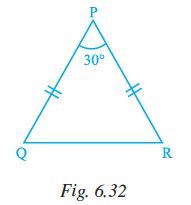
Answer:
Given:
In $\triangle PQR$, $PQ = PR$ and $\angle P = 30^\circ$.
Solution:
Since $PQ = PR$, the triangle is an isosceles triangle. In an isosceles triangle, angles opposite to equal sides are equal.
$\angle Q = \angle R$
(Angles opposite to equal sides)
Let $\angle Q = \angle R = x$.
By Angle Sum Property of a triangle:
$\angle P + \angle Q + \angle R = 180^\circ$
$30^\circ + x + x = 180^\circ$
$30^\circ + 2x = 180^\circ$
$2x = 180^\circ - 30^\circ$
$2x = 150^\circ$
$x = \frac{150^\circ}{2} = 75^\circ$
Therefore, $\angle Q = 75^\circ$ and $\angle R = 75^\circ$.
Question 116. In Fig. 6.33, find the measures of ∠ x and ∠ y.

Answer:
Given:
In the triangle, internal angles are $60^\circ, 45^\circ,$ and $x$. Angle $y$ is an exterior angle adjacent to the $45^\circ$ interior angle.
Solution:
Finding y:
The interior angle $45^\circ$ and exterior angle $y$ form a linear pair on a straight line.
$y + 45^\circ = 180^\circ$
(Linear pair)
$y = 180^\circ - 45^\circ$
$y = 135^\circ$
Finding x:
Using the Angle Sum Property of the triangle:
$60^\circ + 45^\circ + x = 180^\circ$
$105^\circ + x = 180^\circ$
$x = 180^\circ - 105^\circ$
$x = 75^\circ$
Question 117. In Fig. 6.34, find the measures of ∠ PON and ∠ NPO.

Answer:
Given:
In $\triangle LOM$: $\angle L = 70^\circ$ and $\angle M = 20^\circ$.
In $\triangle PON$: $\angle N = 70^\circ$.
Solution:
First, find $\angle LOM$ in $\triangle LOM$:
$\angle L + \angle M + \angle LOM = 180^\circ$
$70^\circ + 20^\circ + \angle LOM = 180^\circ$
$90^\circ + \angle LOM = 180^\circ$
$\angle LOM = 90^\circ$
Now, $\angle PON$ and $\angle LOM$ are vertically opposite angles.
$\angle PON = \angle LOM = 90^\circ$
(Vertically opposite angles)
In $\triangle PON$, using the Angle Sum Property:
$\angle PON + \angle N + \angle NPO = 180^\circ$
$90^\circ + 70^\circ + \angle NPO = 180^\circ$
$160^\circ + \angle NPO = 180^\circ$
$\angle NPO = 180^\circ - 160^\circ = 20^\circ$
Therefore, $\angle PON = 90^\circ$ and $\angle NPO = 20^\circ$.
Question 118. In Fig. 6.35, QP || RT. Find the values of x and y.

Answer:
Given:
$QP \parallel RT$, $\angle Q = 30^\circ$, and the angle between $PR$ and $RT$ is $70^\circ$.
Solution:
Finding x:
Since $QP \parallel RT$ and $PR$ acts as a transversal line:
$x = \angle PRT = 70^\circ$
(Alternate interior angles)
$x = 70^\circ$
Finding y:
In $\triangle PQR$, the sum of angles is $180^\circ$.
$\angle Q + \angle P + \angle PRQ = 180^\circ$
$30^\circ + x + y = 180^\circ$
Substituting the value of $x$:
$30^\circ + 70^\circ + y = 180^\circ$
$100^\circ + y = 180^\circ$
$y = 180^\circ - 100^\circ$
$y = 80^\circ$
Therefore, the values are $x = 70^\circ$ and $y = 80^\circ$.
Question 119. Find the measure of ∠ A in Fig. 6.36.

Answer:
Given:
From the given figure 6.36, in $\triangle ABC$:
Interior $\angle B = 65^\circ$
Exterior angle at $C = 115^\circ$
To Find:
The measure of $\angle A$.
Solution:
By the Exterior Angle Property of a triangle, the measure of an exterior angle is equal to the sum of its interior opposite angles.
$\angle A + \angle B = \text{Exterior } \angle C$
(Exterior angle property)
Substituting the given values:
$\angle A + 65^\circ = 115^\circ$
$\angle A = 115^\circ - 65^\circ$
$\angle A = 50^\circ$
Therefore, the measure of $\angle A$ is $50^\circ$.
Question 120. In a right-angled triangle if an angle measures 35°, then find the measure of the third angle.
Answer:
Given:
In a right-angled triangle, one angle is $90^\circ$.
Measure of the second angle $= 35^\circ$.
To Find:
The measure of the third angle.
Solution:
Let the third angle be $x$.
By the Angle Sum Property of a triangle, the sum of all three angles is $180^\circ$.
$x + 35^\circ + 90^\circ = 180^\circ$
$x + 125^\circ = 180^\circ$
$x = 180^\circ - 125^\circ$
$x = 55^\circ$
Therefore, the measure of the third angle is $55^\circ$.
Question 121. Each of the two equal angles of an isosceles triangle is four times the third angle. Find the angles of the triangle.
Answer:
Given:
An isosceles triangle has two equal angles.
The equal angles are four times the third angle.
To Find:
The measures of all three angles of the triangle.
Solution:
Let the measure of the third angle (unequal angle) be $x$.
Then, according to the question, the measure of each of the two equal angles $= 4x$.
By the Angle Sum Property of a triangle:
$4x + 4x + x = 180^\circ$
$9x = 180^\circ$
$x = \frac{\cancel{180}^{20}}{\cancel{9}_{1}}$
$x = 20^\circ$
Now, calculating the three angles:
First angle $= 4x = 4 \times 20^\circ = 80^\circ$
Second angle $= 4x = 4 \times 20^\circ = 80^\circ$
Third angle $= x = 20^\circ$
The angles of the triangle are $80^\circ, 80^\circ$ and $20^\circ$.
Question 122. The angles of a triangle are in the ratio 2 : 3 : 5. Find the angles.
Answer:
Given:
The ratio of the angles of a triangle $= 2 : 3 : 5$.
To Find:
The measures of the angles.
Solution:
Let the three angles of the triangle be $2x, 3x$ and $5x$.
By the Angle Sum Property of a triangle:
$2x + 3x + 5x = 180^\circ$
$10x = 180^\circ$
$x = \frac{\cancel{180}^{18}}{\cancel{10}_{1}}$
$x = 18^\circ$
Now, calculating each angle:
First angle $= 2x = 2 \times 18^\circ = 36^\circ$
Second angle $= 3x = 3 \times 18^\circ = 54^\circ$
Third angle $= 5x = 5 \times 18^\circ = 90^\circ$
The measures of the angles are $36^\circ, 54^\circ$ and $90^\circ$.
Question 123. If the sides of a triangle are produced in an order, show that the sum of the exterior angles so formed is 360°.
Answer:
To Prove:
The sum of the exterior angles of a triangle formed by producing sides in an order is $360^\circ$.
Construction Required:
Consider a triangle $ABC$. Extend side $BC$ to $D$, side $CA$ to $E$, and side $AB$ to $F$ in an order.
Proof:
Let the interior angles of the triangle be $\angle 1, \angle 2$ and $\angle 3$.
Let the corresponding exterior angles be $\angle x, \angle y$ and $\angle z$.
At each vertex, the interior and exterior angles form a linear pair:
$\angle 1 + \angle x = 180^\circ$
... (i)
$\angle 2 + \angle y = 180^\circ$
... (ii)
$\angle 3 + \angle z = 180^\circ$
... (iii)
Adding equations (i), (ii) and (iii):
$(\angle 1 + \angle 2 + \angle 3) + (\angle x + \angle y + \angle z) = 180^\circ + 180^\circ + 180^\circ$
$(\angle 1 + \angle 2 + \angle 3) + (\angle x + \angle y + \angle z) = 540^\circ$
We know that by the Angle Sum Property of a triangle:
$\angle 1 + \angle 2 + \angle 3 = 180^\circ$
Substituting this value in the combined equation:
$180^\circ + (\angle x + \angle y + \angle z) = 540^\circ$
$\angle x + \angle y + \angle z = 540^\circ - 180^\circ$
$\angle x + \angle y + \angle z = 360^\circ$
Hence, the sum of the exterior angles of a triangle is $360^\circ$.
Question 124. In ∆ABC, if ∠A = ∠C, and exterior angle ABX = 140°, then find the angles of the triangle.
Answer:
Given:
In $\triangle ABC$, the measure of $\angle A$ is equal to $\angle C$.
The exterior angle $\angle ABX$ at vertex $B$ is $140^\circ$.
To Find:
The measures of the interior angles $\angle A, \angle B$ and $\angle C$.
Solution:
The exterior angle $\angle ABX$ and the interior angle $\angle ABC$ lie on a straight line, thus they form a linear pair.
$\angle ABC + \angle ABX = 180^\circ$
(Linear Pair)
$\angle ABC + 140^\circ = 180^\circ$
$\angle ABC = 180^\circ - 140^\circ$
$\angle ABC = 40^\circ$
... (i)
Now, according to the Angle Sum Property of a triangle, the sum of all interior angles is $180^\circ$.
$\angle A + \angle ABC + \angle C = 180^\circ$
Since it is given that $\angle A = \angle C$, we can substitute $\angle C$ with $\angle A$ and use the value of $\angle ABC$ from equation (i):
$\angle A + 40^\circ + \angle A = 180^\circ$
$2\angle A + 40^\circ = 180^\circ$
$2\angle A = 180^\circ - 40^\circ$
$2\angle A = 140^\circ$
$\angle A = \frac{\cancel{140}^{70}}{\cancel{2}_{1}}$
[Dividing by 2] ... (ii)
From equation (ii), we find $\angle A = 70^\circ$.
Since $\angle A = \angle C$:
$\angle C = 70^\circ$
Therefore, the measures of the angles of the triangle are $70^\circ, 40^\circ$ and $70^\circ$.
Question 125. Find the values of x and y in Fig. 6.37.

Answer:
Given:
From the figure, we observe a large triangle containing a vertical segment. The interior angles of the smaller triangle on the left are $30^\circ$ and $50^\circ$. For the largest triangle, the base angles are $30^\circ$ and $45^\circ$.
To Find:
The values of $x$ and $y$.
Solution:
According to the Exterior Angle Theorem, an exterior angle of a triangle is equal to the sum of its two interior opposite angles.
Step 1: Finding the value of x.
Consider the triangle on the left side. The angle $x$ is an exterior angle to this triangle. Its interior opposite angles are $30^\circ$ and $50^\circ$.
$x = 50^\circ + 30^\circ$
(Exterior angle theorem)
$x = 80^\circ$
Step 2: Finding the value of y.
Consider the big (largest) triangle. The angle $y$ is an exterior angle formed at the top vertex. The two interior opposite angles for this exterior angle are the base angles of the big triangle, which are $30^\circ$ and $45^\circ$.
$y = 30^\circ + 45^\circ$
(Exterior angle theorem)
$y = 75^\circ$
Final Answer: The values are $x = 80^\circ$ and $y = 75^\circ$.
Question 126. Find the value of x in Fig. 6.38.

Answer:
Given:
In $\triangle ABC$:
$\angle B = 30^\circ$, $\angle A = 80^\circ$.
Side $BC$ is produced to $D$.
$CE \perp CD$ (Thus, $\angle ECD = 90^\circ$).
To Find:
The value of $x$.
Solution:
First, we find the exterior angle $\angle ACD$ using the Exterior Angle Property:
$\angle ACD = \angle A + \angle B$
(Exterior angle property)
$\angle ACD = 80^\circ + 30^\circ = 110^\circ$
From the figure, the exterior angle $\angle ACD$ is the sum of $\angle ACE$ (which is $x$) and $\angle ECD$.
$\angle ACD = x + \angle ECD$
$110^\circ = x + 90^\circ$
$x = 110^\circ - 90^\circ$
$x = 20^\circ$
Question 127. The angles of a triangle are arranged in descending order of their magnitudes. If the difference between two consecutive angles is 10°, find the three angles.
Answer:
Given:
Difference between consecutive angles $= 10^\circ$.
The angles are in descending order.
Solution:
Let the largest angle of the triangle be $x$.
Since the difference between consecutive angles is $10^\circ$, the second angle is $(x - 10^\circ)$ and the third angle is $(x - 20^\circ)$.
By the Angle Sum Property of a triangle:
$x + (x - 10^\circ) + (x - 20^\circ) = 180^\circ$
$3x - 30^\circ = 180^\circ$
$3x = 180^\circ + 30^\circ$
$3x = 210^\circ$
$x = \frac{210^\circ}{3} = 70^\circ$
Now, calculating the measures:
Largest angle $= x = 70^\circ$
Middle angle $= x - 10^\circ = 60^\circ$
Smallest angle $= x - 20^\circ = 50^\circ$
The three angles are $70^\circ, 60^\circ$ and $50^\circ$.
Question 128. In ∆ ABC, DE || BC (Fig. 6.39). Find the values of x, y and z.

Answer:
Given:
In $\triangle ABC$, $DE \parallel BC$.
$\angle B = 30^\circ$ and $\angle C = 40^\circ$.
To Find:
The values of $x, y$ and $z$.
Solution:
Since $DE \parallel BC$ and $AB$ is a transversal line, the angles $x$ and $\angle B$ are corresponding angles.
$x = \angle B = 30^\circ$
(Corresponding angles)
Similarly, $DE \parallel BC$ and $AC$ is a transversal line, so $y$ and $\angle C$ are corresponding angles.
$y = \angle C = 40^\circ$
(Corresponding angles)
Now, in $\triangle ADE$, the sum of angles is $180^\circ$.
$x + y + z = 180^\circ$
$30^\circ + 40^\circ + z = 180^\circ$
$70^\circ + z = 180^\circ$
$z = 180^\circ - 70^\circ$
$z = 110^\circ$
The values are $x = 30^\circ, y = 40^\circ$ and $z = 110^\circ$.
Question 129. In Fig. 6.40, find the values of x, y and z.

Answer:
Given:
From the figure 6.40, we have $\triangle ABC$. A line is drawn from vertex $A$ to the base $BC$.
In the left triangle, interior angles are $60^\circ$ and $60^\circ$ and $x$.
In the right triangle, interior angles are $30^\circ, y$ and $z$.
Solution:
Step 1: To find the value of x.
In the triangle on the left, according to the Angle Sum Property of a triangle:
$x + 60^\circ + 60^\circ = 180^\circ$
$x + 120^\circ = 180^\circ$
$x = 180^\circ - 120^\circ$
$x = 60^\circ$
Step 2: To find the value of y.
Considering the left triangle, the angle $y$ is an exterior angle. According to the Exterior Angle Theorem, the exterior angle is equal to the sum of the two interior opposite angles.
$y = 60^\circ + 60^\circ$
$y = 120^\circ$
Step 3: To find the value of z.
Considering the large triangle $ABC$, the total angle at vertex $A$ is the sum of the two parts ($60^\circ + 30^\circ$). According to the Angle Sum Property in $\triangle ABC$:
$\angle B + \angle A + \angle C = 180^\circ$
$60^\circ + (60^\circ + 30^\circ) + z = 180^\circ$
$60^\circ + 60^\circ + 30^\circ + z = 180^\circ$
$150^\circ + z = 180^\circ$
$z = 180^\circ - 150^\circ$
$z = 30^\circ$
Therefore, the required values are $x = 60^\circ$, $y = 120^\circ$ and $z = 30^\circ$.
Question 130. If one angle of a triangle is 60° and the other two angles are in the ratio 1 : 2, find the angles.
Answer:
Given:
One angle $= 60^\circ$.
Ratio of the other two angles $= 1 : 2$.
Solution:
Let the other two angles be $1k$ and $2k$.
By the Angle Sum Property of a triangle, the sum of all three angles is $180^\circ$.
$60^\circ + k + 2k = 180^\circ$
$3k = 180^\circ - 60^\circ$
$3k = 120^\circ$
$k = \frac{\cancel{120}^{40}}{\cancel{3}_{1}}$
$k = 40^\circ$
Now, finding the measures of the angles:
Second angle $= 1k = 40^\circ$
Third angle $= 2k = 2 \times 40^\circ = 80^\circ$
The three angles of the triangle are $60^\circ, 40^\circ$ and $80^\circ$.
Question 131. In ∆PQR, if 3∠P = 4∠Q = 6∠R, calculate the angles of the triangle.
Answer:
Given:
$3\angle P = 4\angle Q = 6\angle R$
Solution:
Let $3\angle P = 4\angle Q = 6\angle R = k$.
Then, we have:
$\angle P = \frac{k}{3}, \angle Q = \frac{k}{4}, \angle R = \frac{k}{6}$
By the Angle Sum Property of $\triangle PQR$:
$\angle P + \angle Q + \angle R = 180^\circ$
$\frac{k}{3} + \frac{k}{4} + \frac{k}{6} = 180^\circ$
To solve, take the LCM of 3, 4, and 6, which is 12.
$\frac{4k + 3k + 2k}{12} = 180^\circ$
$\frac{9k}{12} = 180^\circ$
$9k = 180^\circ \times 12$
$9k = 2160^\circ$
$k = \frac{2160^\circ}{9} = 240^\circ$
Now, calculating each angle:
$\angle P = \frac{240^\circ}{3} = 80^\circ$
$\angle Q = \frac{240^\circ}{4} = 60^\circ$
$\angle R = \frac{240^\circ}{6} = 40^\circ$
The angles of the triangle are $80^\circ, 60^\circ$ and $40^\circ$.
Question 132. In ∆DEF, ∠D = 60°, ∠E = 70° and the bisectors of ∠E and ∠F meet at O. Find (i) ∠F (ii) ∠EOF.
Answer:
Given:
In $\triangle DEF$, $\angle D = 60^\circ$ and $\angle E = 70^\circ$. Bisectors of $\angle E$ and $\angle F$ meet at point $O$.
Solution:
(i) To find ∠F:
In $\triangle DEF$, by the Angle Sum Property:
$\angle D + \angle E + \angle F = 180^\circ$
$60^\circ + 70^\circ + \angle F = 180^\circ$
$130^\circ + \angle F = 180^\circ$
$\angle F = 180^\circ - 130^\circ$
$\angle F = 50^\circ$
(ii) To find ∠EOF:
Since $EO$ is the bisector of $\angle E$:
$\angle OEF = \frac{1}{2} \angle E = \frac{1}{2} \times 70^\circ = 35^\circ$
Since $FO$ is the bisector of $\angle F$:
$\angle OFE = \frac{1}{2} \angle F = \frac{1}{2} \times 50^\circ = 25^\circ$
Now, in $\triangle EOF$, using the Angle Sum Property:
$\angle OEF + \angle OFE + \angle EOF = 180^\circ$
$35^\circ + 25^\circ + \angle EOF = 180^\circ$
$60^\circ + \angle EOF = 180^\circ$
$\angle EOF = 180^\circ - 60^\circ$
$\angle EOF = 120^\circ$
Question 133. In Fig. 6.41, ∆PQR is right-angled at P. U and T are the points on line QRF. If QP || ST and US || RP, find ∠S.

Answer:
Given:
In $\triangle PQR$, $\angle P = 90^\circ$.
The line segment $QP$ is parallel to $ST$ ($QP \parallel ST$).
The line segment $US$ is parallel to $RP$ ($US \parallel RP$).
Points $Q, U, R, T$ lie on a straight line, which acts as a transversal.
To Find:
The measure of $\angle S$.
Solution:
In $\triangle PQR$, applying the Angle Sum Property:
$\angle P + \angle PQR + \angle PRQ = 180^\circ$
$90^\circ + \angle PQR + \angle PRQ = 180^\circ$
$\angle PQR + \angle PRQ = 180^\circ - 90^\circ$
$\angle PQR + \angle PRQ = 90^\circ$
…(i)
Now, considering the parallel lines and the transversal $QT$:
Since $QP \parallel ST$, the angles $\angle PQR$ and $\angle STU$ are alternate interior angles.
$\angle PQR = \angle STU$
(Alternate interior angles)
Since $US \parallel RP$, the angles $\angle PRU$ (same as $\angle PRQ$) and $\angle SUR$ (same as $\angle SUT$) are alternate interior angles.
$\angle PRQ = \angle SUR$
(Alternate interior angles)
In $\triangle SUT$, applying the Angle Sum Property:
$\angle S + \angle STU + \angle SUR = 180^\circ$
Substituting the values of $\angle STU$ and $\angle SUR$ with their equal counterparts from $\triangle PQR$:
$\angle S + \angle PQR + \angle PRQ = 180^\circ$
From equation (i), we know that $\angle PQR + \angle PRQ = 90^\circ$. Substituting this value into the equation:
$\angle S + 90^\circ = 180^\circ$
$\angle S = 180^\circ - 90^\circ$
$\angle S = 90^\circ$
Final Answer: The measure of $\angle S$ is $90^\circ$.
Question 134. In each of the given pairs of triangles of Fig. 6.42, applying only ASA congruence criterion, determine which triangles are congruent. Also, write the congruent triangles in symbolic form.


Answer:
Case (a)
Given:
In $\triangle ABC$: $\angle A = 55^\circ$, $\angle B = 60^\circ$ and side $AC = 6 \text{ cm}$.
In $\triangle PQR$: $\angle P = 50^\circ$, $\angle Q = 55^\circ$ and side $QR = 6 \text{ cm}$.
Solution:
First, we find the third angle of each triangle using the Angle Sum Property.
In $\triangle ABC$:
$\angle A + \angle B + \angle C = 180^\circ$
$55^\circ + 60^\circ + \angle C = 180^\circ$
$\angle C = 180^\circ - 115^\circ = 65^\circ$
In $\triangle PQR$:
$\angle P + \angle Q + \angle R = 180^\circ$
$50^\circ + 55^\circ + \angle R = 180^\circ$
$\angle R = 180^\circ - 105^\circ = 75^\circ$
For triangles to be congruent by ASA (Angle-Side-Angle) criterion, two angles and the included side of one triangle must be equal to the corresponding parts of the other. Comparing the two triangles:
1. The angles in $\triangle ABC$ are $\{55^\circ, 60^\circ, 65^\circ\}$.
2. The angles in $\triangle PQR$ are $\{50^\circ, 55^\circ, 75^\circ\}$.
Since the sets of angles are not identical, these triangles cannot be congruent.
Case (b)
Given:
A quadrilateral $ABCD$ with diagonal $BD$.
In $\triangle ABD$: $\angle ADB = 40^\circ$ and $\angle ABD = 30^\circ$.
In $\triangle CDB$: $\angle CBD = 40^\circ$ and $\angle CDB = 30^\circ$.
Solution:
In $\triangle ABD$ and $\triangle CDB$, we compare the corresponding parts:
$\angle ADB = \angle CBD = 40^\circ$
(Given)
$BD = DB$
(Common side)
$\angle ABD = \angle CDB = 30^\circ$
(Given)
Here, two angles and the included side ($BD$) of $\triangle ABD$ are equal to the corresponding parts of $\triangle CDB$.
Therefore, by ASA congruence criterion:
$\triangle ABD \cong \triangle CDB$
Case (c)
Given:
In $\triangle XYZ$: $\angle X = 100^\circ$, $\angle Y = 50^\circ$ and side $XY = 4.8 \text{ cm}$.
In $\triangle LMN$: $\angle L = 100^\circ$, $\angle M = 50^\circ$ and side $LM = 4.8 \text{ cm}$.
Solution:
Comparing $\triangle XYZ$ and $\triangle LMN$:
$\angle X = \angle L = 100^\circ$
(Given)
$XY = LM = 4.8 \text{ cm}$
(Given)
$\angle Y = \angle M = 50^\circ$
(Given)
Since two angles and the included side ($XY$ and $LM$ respectively) are equal, the triangles satisfy the ASA criterion.
Therefore, $\triangle XYZ \cong \triangle LMN$.
Case (d)
Given:
Triangles $ABC$ and $DFE$ with marked equal parts.
Solution:
From the figure markings, we have:
$\angle A = \angle D$ (marked with one tick)
$\angle B = \angle F$ (marked with two ticks)
$BC = FE$ (marked with one tick)
If two angles of a triangle are equal to two angles of another, the third angles must also be equal by the Angle Sum Property:
$\angle C = \angle E$
Now, in $\triangle ABC$ and $\triangle DFE$:
$\angle B = \angle F$
(Angle)
$BC = FE$
(Included Side)
$\angle C = \angle E$
(Angle)
Therefore, $\triangle ABC \cong \triangle DFE$ by ASA congruence criterion.
Case (e)
Given:
Triangles $MNO$ and $PON$ share a common base $NO$.
Solution:
In $\triangle MNO$ and $\triangle PON$, we look for the ASA parts (Angle-Side-Angle) where the side $NO$ is included:
$\angle MNO = \angle PON = 90^\circ$
(Given)
$NO = ON$
(Common Included Side)
$\angle MON = \angle PNO = 50^\circ$
(Given)
As two angles and the included side of $\triangle MNO$ are equal to the corresponding parts of $\triangle PON$, the triangles are congruent.
Symbolic Form: $\triangle MNO \cong \triangle PON$
Case (f)
Given:
Two triangles $AOD$ and $BOC$ intersecting at $O$.
$\angle ADO = \angle BCO = 90^\circ$ and $DO = CO$.
Solution:
In $\triangle AOD$ and $\triangle BOC$:
$\angle ADO = \angle BCO = 90^\circ$
(Given)
$DO = CO$
(Given side)
$\angle AOD = \angle BOC$
(Vertically opposite angles)
Since the side $DO$ (and $CO$) is the included side between the two marked angles in each triangle:
Therefore, $\triangle AOD \cong \triangle BOC$ by ASA congruence criterion.
Question 135. In each of the given pairs of triangles of Fig. 6.43, using only RHS congruence criterion, determine which pairs of triangles are congruent. In case of congruence, write the result in symbolic form:
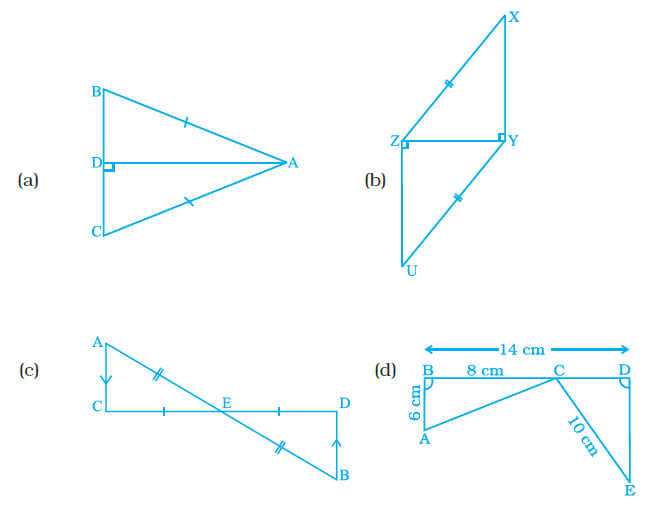
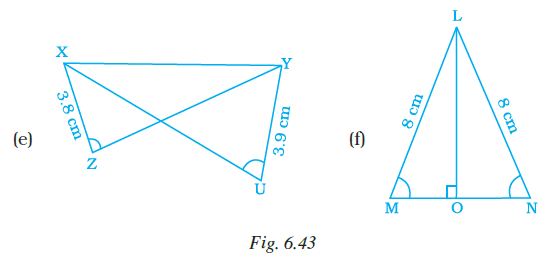
Answer:
Case (a)
Given:
In $\triangle ABD$ and $\triangle ACD$:
$\angle ADB = \angle ADC = 90^\circ$
(Right Angle)
$AB = AC$
(Hypotenuse - Marked equal)
$AD = AD$
(Common Side)
Solution:
Since the right angle, hypotenuse, and one side of $\triangle ABD$ are equal to the corresponding parts of $\triangle ACD$, the triangles are congruent by RHS criterion.
Symbolic Form: $\triangle ABD \cong \triangle ACD$
Case (b)
Given:
In $\triangle XYZ$ and $\triangle UZY$:
$\angle XYZ = \angle UZY = 90^\circ$
(Right Angle)
$XZ = UY$
(Hypotenuse - Marked equal)
$YZ = ZY$
(Common Side)
Solution:
By RHS congruence criterion, the two triangles are congruent.
Symbolic Form: $\triangle XYZ \cong \triangle UZY$
Case (c)
Given:
In $\triangle ACE$ and $\triangle BDE$:
$\angle C = \angle D = 90^\circ$
(Right Angle)
$AE = BE$
(Hypotenuse - Marked equal)
$CE = DE$
(Side - Marked equal)
Solution:
Since the right angle, hypotenuse, and one side of $\triangle ACE$ are equal to the corresponding parts of $\triangle BDE$, the triangles are congruent by the RHS (Right-Angle Hypotenuse Side) congruence criterion.
Symbolic Form: $\triangle ACE \cong \triangle BDE$
Case (d)
Given:
In $\triangle ABC$: $\angle B = 90^\circ, AB = 6 \text{ cm}, BC = 8 \text{ cm}$.
In $\triangle EDC$: $\angle D = 90^\circ, CE = 10 \text{ cm}, BD = 14 \text{ cm}$.
Solution:
First, we find $CD$ in $\triangle EDC$:
$CD = BD - BC$
$CD = 14 \text{ cm} - 8 \text{ cm} = 6 \text{ cm}$
Now, in $\triangle ABC$, by Pythagoras Theorem:
$AC^2 = AB^2 + BC^2$
$AC^2 = 6^2 + 8^2 = 36 + 64 = 100$
$AC = \sqrt{100} = 10 \text{ cm}$
Comparing $\triangle ABC$ and $\triangle EDC$:
$\angle B = \angle D = 90^\circ$
(Right Angle)
$AC = CE = 10 \text{ cm}$
(Hypotenuse)
$AB = CD = 6 \text{ cm}$
(Side)
The triangles are congruent by RHS criterion.
Symbolic Form: $\triangle ABC \cong \triangle CDE$
Case (e)
Given:
Two triangles $\triangle XZY$ and $\triangle YUX$. The markings on $\angle Z$ and $\angle U$ are arcs, not square right-angle symbols.
Solution:
Even if we assume they are right angles, the sides $XZ (3.8 \text{ cm})$ and $YU (3.9 \text{ cm})$ are not equal. For RHS, at least one pair of sides and the hypotenuse must be equal.
Result: Not congruent by RHS.
Case (f)
Given:
In $\triangle LOM$ and $\triangle LON$:
$\angle LOM = \angle LON = 90^\circ$
(Right Angle)
$LM = LN = 8 \text{ cm}$
(Hypotenuse)
$LO = LO$
(Common Side)
Solution:
Since the right angle, hypotenuse, and one side are equal, the triangles are congruent by RHS criterion.
Symbolic Form: $\triangle LOM \cong \triangle LON$
Question 136. In Fig. 6.44, if RP = RQ, find the value of x.

Answer:
Given:
In $\triangle PQR$:
$RP = RQ$
(Given markings)
An exterior angle at vertex $P$ is formed by intersecting lines, where one angle is $50^\circ$.
To Find:
The value of $x$.
Solution:
In the figure, the interior angle $\angle RPQ$ and the given $50^\circ$ angle are vertically opposite angles.
$\angle RPQ = 50^\circ$
(Vertically opposite angles)
Since $RP = RQ$, $\triangle PQR$ is an isosceles triangle. We know that angles opposite to equal sides of a triangle are equal.
$\angle RQP = \angle RPQ$
(Angles opposite to equal sides)
From the figure, $x$ is the interior angle at vertex $Q$. Therefore:
$x = 50^\circ$
The value of $x$ is $50^\circ$.
Question 137. In Fig. 6.45, if ST = SU, then find the values of x and y.

Answer:
Given:
In $\triangle STU$:
$ST = SU$
(Given)
The vertex angle $\angle TSU$ is vertically opposite to a $78^\circ$ angle.
To Find:
The values of $x$ and $y$.
Solution:
Step 1: Finding the value of y.
First, we find the interior angle at $S$.
$\angle TSU = 78^\circ$
(Vertically opposite angles)
Since $ST = SU$, the triangle is an isosceles triangle. Thus, the base angles are equal.
$\angle STU = \angle SUT = y$
(Angles opposite to equal sides)
Using the Angle Sum Property in $\triangle STU$:
$y + y + 78^\circ = 180^\circ$
$2y + 78^\circ = 180^\circ$
$2y = 180^\circ - 78^\circ$
$2y = 102^\circ$
$y = 51^\circ$
Step 2: Finding the value of x.
From the figure, $x$ is an exterior angle at vertex $U$. It forms a linear pair with the interior angle $\angle SUT$.
$x + y = 180^\circ$
(Linear pair)
$x + 51^\circ = 180^\circ$
$x = 180^\circ - 51^\circ$
$x = 129^\circ$
Therefore, the values are $x = 129^\circ$ and $y = 51^\circ$.
Alternate Solution:
By the Exterior Angle Property, the exterior angle $x$ is equal to the sum of the interior opposite angles.
$x = y + 78^\circ$
$x = 51^\circ + 78^\circ$
$x = 129^\circ$
Question 138. Check whether the following measures (in cm) can be the sides of a right-angled triangle or not.
1.5, 3.6, 3.9
Answer:
Given:
Side lengths: $a = 1.5 \text{ cm}$, $b = 3.6 \text{ cm}$ and $c = 3.9 \text{ cm}$.
To Find:
Check if these sides form a right-angled triangle.
Solution:
According to Pythagoras Theorem, for a triangle to be right-angled, the sum of the squares of the two shorter sides must be equal to the square of the longest side (hypotenuse).
Here, the longest side is $3.9 \text{ cm}$.
Checking the condition $a^2 + b^2 = c^2$:
L.H.S:
$a^2 + b^2 = (1.5)^2 + (3.6)^2$
$(1.5)^2 = 2.25$
$(3.6)^2 = 12.96$
Sum $= 2.25 + 12.96 = 15.21$
R.H.S:
$c^2 = (3.9)^2$
$(3.9)^2 = 15.21$
Since L.H.S = R.H.S ($15.21 = 15.21$), the sides satisfy the Pythagorean theorem.
Therefore, the given measures can be the sides of a right-angled triangle.
Question 139. Height of a pole is 8 m. Find the length of rope tied with its top from a point on the ground at a distance of 6 m from its bottom.
Answer:
Given:
Height of the pole (Perpendicular) $= 8 \text{ m}$
Distance of the point from the bottom (Base) $= 6 \text{ m}$
To Find:
The length of the rope tied to the top (Hypotenuse).
Solution:
The pole, the ground distance, and the rope form a right-angled triangle, where the pole is vertical to the ground.
According to the Pythagoras Theorem:
$(\text{Hypotenuse})^2 = (\text{Base})^2 + (\text{Perpendicular})^2$
Let the length of the rope be $l$.
$l^2 = 6^2 + 8^2$
$l^2 = 36 + 64$
$l^2 = 100$
$l = \sqrt{100} = 10 \text{ m}$
Therefore, the length of the rope is $10 \text{ m}$.
Question 140. In Fig. 6.46, if y is five times x, find the value of z.

Answer:
Given:
In $\triangle RQS$, $\angle R = 60^\circ$.
$y = 5x$
(Given)
To Find:
The value of $z$.
Solution:
In $\triangle RQS$, according to the Angle Sum Property:
$\angle R + \angle RQS + \angle RSQ = 180^\circ$
$60^\circ + x + y = 180^\circ$
Substituting $y = 5x$ into the equation:
$60^\circ + x + 5x = 180^\circ$
$60^\circ + 6x = 180^\circ$
$6x = 180^\circ - 60^\circ$
$6x = 120^\circ$
$x = 20^\circ$
Now, from the figure, angle $z$ and angle $x$ lie on a straight line $PS$. Therefore, they form a linear pair.
$z + x = 180^\circ$
(Linear pair)
$z + 20^\circ = 180^\circ$
$z = 180^\circ - 20^\circ$
$z = 160^\circ$
Question 141. The lengths of two sides of an isosceles triangle are 9 cm and 20 cm. What is the perimeter of the triangle? Give reason.
Answer:
Given:
Lengths of two sides of an isosceles triangle are $9 \text{ cm}$ and $20 \text{ cm}$.
Solution:
In an isosceles triangle, at least two sides are equal. Therefore, the possible sets of side lengths are:
Case 1: $9 \text{ cm}, 9 \text{ cm}, 20 \text{ cm}$
Case 2: $9 \text{ cm}, 20 \text{ cm}, 20 \text{ cm}$
According to the Triangle Inequality Property, the sum of any two sides of a triangle must be strictly greater than the third side.
Checking Case 1:
$9 + 9 = 18 \text{ cm}$
Since $18 \text{ cm} < 20 \text{ cm}$, the sum of two sides is less than the third side. Thus, a triangle with these sides cannot be formed.
Checking Case 2:
$9 + 20 = 29 \text{ cm}$
Since $29 \text{ cm} > 20 \text{ cm}$, a triangle with these sides can be formed.
Therefore, the side lengths of the triangle are $9 \text{ cm}, 20 \text{ cm}$ and $20 \text{ cm}$.
Calculation of Perimeter:
Perimeter $= \text{Sum of all sides}$
Perimeter $= 9 + 20 + 20 = 49 \text{ cm}$
The perimeter of the triangle is $49 \text{ cm}$.
Question 142. Without drawing the triangles write all six pairs of equal measures in each of the following pairs of congruent triangles.
(a) ∆STU ≅ ∆DEF
(b) ∆ABC ≅ ∆LMN
(c) ∆YZX ≅ ∆PQR
(d) ∆XYZ ≅ ∆MLN
Answer:
Solution:
When two triangles are congruent, their corresponding angles and corresponding sides are equal. This is known as CPCT (Corresponding Parts of Congruent Triangles).
(a) ∆STU ≅ ∆DEF
Corresponding Angles:
1. $\angle S = \angle D$
2. $\angle T = \angle E$
3. $\angle U = \angle F$
Corresponding Sides:
4. $ST = DE$
5. $TU = EF$
6. $SU = DF$
(b) ∆ABC ≅ ∆LMN
Corresponding Angles:
1. $\angle A = \angle L$
2. $\angle B = \angle M$
3. $\angle C = \angle N$
Corresponding Sides:
4. $AB = LM$
5. $BC = MN$
6. $AC = LN$
(c) ∆YZX ≅ ∆PQR
Corresponding Angles:
1. $\angle Y = \angle P$
2. $\angle Z = \angle Q$
3. $\angle X = \angle R$
Corresponding Sides:
4. $YZ = PQ$
5. $ZX = QR$
6. $YX = PR$
(d) ∆XYZ ≅ ∆MLN
Corresponding Angles:
1. $\angle X = \angle M$
2. $\angle Y = \angle L$
3. $\angle Z = \angle N$
Corresponding Sides:
4. $XY = ML$
5. $YZ = LN$
6. $XZ = MN$
Question 143. In the following pairs of triangles of Fig. 6.47, the lengths of the sides are indicated along the sides. By applying SSS congruence criterion, determine which triangles are congruent. If congruent, write the results in symbolic form.


Answer:
Case (a)
Given:
In $\triangle ABC$: $AB = 5 \text{ cm}$, $AC = 4 \text{ cm}$ and $BC = 6 \text{ cm}$.
In $\triangle LMN$: $LM = 6 \text{ cm}$, $MN = 4 \text{ cm}$ and $LN = 5 \text{ cm}$.
To Find:
Determine if the triangles are congruent using the SSS criterion.
Solution:
Comparing the sides of $\triangle ABC$ and $\triangle LMN$:
$AB = LN = 5 \text{ cm}$
(Given)
$AC = MN = 4 \text{ cm}$
(Given)
$BC = LM = 6 \text{ cm}$
(Given)
Since all three sides of $\triangle ABC$ are equal to the corresponding three sides of another triangle, they are congruent by the SSS (Side-Side-Side) criterion.
By matching the vertices ($A \leftrightarrow N, B \leftrightarrow L, C \leftrightarrow M$):
Symbolic Form: $\triangle ABC \cong \triangle NLM$
Case (b)
Given:
In $\triangle LMN$: $LM = 4.5 \text{ cm}$, $MN = 6 \text{ cm}$ and $LN = 5 \text{ cm}$.
In $\triangle GHI$: $GH = 4.5 \text{ cm}$, $HI = 6 \text{ cm}$ and $GI = 5 \text{ cm}$.
Solution:
Comparing the sides of $\triangle LMN$ and $\triangle GHI$:
$LM = GH = 4.5 \text{ cm}$
(Side)
$MN = HI = 6 \text{ cm}$
(Side)
$LN = GI = 5 \text{ cm}$
(Side)
Since all corresponding sides are equal, the triangles are congruent by the SSS criterion.
Symbolic Form: $\triangle LMN \cong \triangle GHI$
Case (c)
Given:
Two triangles $\triangle LMN$ and $\triangle LON$ sharing a common side $LN$.
$LM = LO = 5 \text{ cm}$ and $MN = ON = 5.5 \text{ cm}$.
Solution:
In $\triangle LMN$ and $\triangle LON$:
$LM = LO = 5 \text{ cm}$
(Given)
$MN = ON = 5.5 \text{ cm}$
(Given)
$LN = LN$
(Common side)
By the SSS criterion, the triangles are congruent.
Symbolic Form: $\triangle LMN \cong \triangle LON$
Case (d)
Given:
Two triangles $\triangle WXY$ and $\triangle ZYX$ sharing side $XY$.
$WX = ZY = 3 \text{ cm}$ and $WY = ZX = 5 \text{ cm}$.
Solution:
In $\triangle WXY$ and $\triangle ZYX$:
$WX = ZY = 3 \text{ cm}$
(Given)
$WY = ZX = 5 \text{ cm}$
(Given)
$XY = YX$
(Common side)
By the SSS criterion, the triangles are congruent.
Symbolic Form: $\triangle WXY \cong \triangle ZYX$
Case (e)
Given:
Two triangles $\triangle AOB$ and $\triangle DOE$ intersecting at $O$.
$AO = DO = 2 \text{ cm}$, $OB = OE = 1.5 \text{ cm}$ and $AB = DE = 2 \text{ cm}$.
Solution:
Comparing $\triangle AOB$ and $\triangle DOE$:
$AO = DO = 2 \text{ cm}$
(Given)
$OB = OE = 1.5 \text{ cm}$
(Given)
$AB = DE = 2 \text{ cm}$
(Given)
By the SSS criterion, the triangles are congruent.
Symbolic Form: $\triangle AOB \cong \triangle DOE$
Case (f)
Given:
Two triangles $\triangle TUS$ and $\triangle VUS$ sharing side $US$.
$TU = VU = 3 \text{ cm}$ and $TS = VS = 5 \text{ cm}$.
Solution:
In $\triangle TUS$ and $\triangle VUS$:
$TU = VU = 3 \text{ cm}$
(Given)
$TS = VS = 5 \text{ cm}$
(Given)
$US = US$
(Common side)
By the SSS criterion, the triangles are congruent.
Symbolic Form: $\triangle TUS \cong \triangle VUS$
Case (g)
Given:
A quadrilateral $PQRS$ with diagonal $PR$.
$PS = QR = 3 \text{ cm}$ and $SR = PQ = 5 \text{ cm}$.
Solution:
In $\triangle PSR$ and $\triangle RQP$:
$PS = RQ = 3 \text{ cm}$
(Given)
$SR = QP = 5 \text{ cm}$
(Given)
$PR = RP$
(Common side)
By the SSS criterion, the triangles are congruent.
Symbolic Form: $\triangle PSR \cong \triangle RQP$
Case (h)
Given:
In right-angled triangles $\triangle STU$ and $\triangle PQR$:
$ST = PQ = 5 \text{ cm}$ and $SU = PR = 10.5 \text{ cm}$.
Solution:
In $\triangle STU$ and $\triangle PQR$, we are given two sides are equal and they are right-angled. By the Pythagoras property, the third sides $TU$ and $QR$ must also be equal as:
$TU = \sqrt{SU^2 - ST^2}$ and $QR = \sqrt{PR^2 - PQ^2}$
Since the hypotenuse and one side are equal for both, the third side is also equal. Thus:
$ST = PQ = 5 \text{ cm}$
$SU = PR = 10.5 \text{ cm}$
$TU = QR$
(Calculated side)
By the SSS criterion, the triangles are congruent.
Symbolic Form: $\triangle STU \cong \triangle PQR$
Question 144. ABC is an isosceles triangle with AB = AC and D is the mid-point of base BC (Fig. 6.48).
(a) State three pairs of equal parts in the triangles ABD and ACD.
(b) Is ∆ABD ≅ ∆ACD. If so why?

Answer:
Given:
In $\triangle ABC$, $AB = AC$. $D$ is the mid-point of the base $BC$.
Solution:
(a) Three pairs of equal parts in $\triangle ABD$ and $\triangle ACD$ are:
$AB = AC$
(Given: $\triangle ABC$ is isosceles)
$BD = CD$
(Given: $D$ is the mid-point of $BC$)
$AD = AD$
(Common side)
(b) Is $\triangle ABD \cong \triangle ACD$?
Yes, $\triangle ABD \cong \triangle ACD$ by the SSS (Side-Side-Side) congruence criterion.
Reason: All three corresponding sides of $\triangle ABD$ are equal to the three sides of $\triangle ACD$, as listed in part (a).
Question 145. In Fig. 6.49, it is given that LM = ON and NL = MO
(a) State the three pairs of equal parts in the triangles NOM and MLN.
(b) Is ∆NOM ≅ ∆MLN. Give reason?

Answer:
Given:
In the figure, $LM = ON$ and $NL = MO$.
Solution:
(a) Three pairs of equal parts in $\triangle NOM$ and $\triangle MLN$ are:
$ON = LM$
(Given)
$MO = NL$
(Given)
$NM = MN$
(Common side)
(b) Is $\triangle NOM \cong \triangle MLN$?
Yes, $\triangle NOM \cong \triangle MLN$ by the SSS (Side-Side-Side) congruence criterion.
Reason: As shown in part (a), the three sides of $\triangle NOM$ are equal to the three corresponding sides of $\triangle MLN$. Hence, they satisfy the condition for SSS congruence.
Question 146. Triangles DEF and LMN are both isosceles with DE = DF and LM = LN, respectively. If DE = LM and EF = MN, then, are the two triangles congruent? Which condition do you use?
If ∠ E = 40°, what is the measure of ∠ N?
Answer:
Given:
1. In isosceles $\triangle DEF$: $DE = DF$.
2. In isosceles $\triangle LMN$: $LM = LN$.
3. $DE = LM$ and $EF = MN$.
To Find:
1. Are the triangles congruent and which condition is used?
2. Measure of $\angle N$ if $\angle E = 40^\circ$.
Solution:
Since $DE = DF$ and $LM = LN$, and it is given that $DE = LM$, it follows that:
$DF = LN$
(As $DE=DF$ and $LM=LN$)
Now, comparing $\triangle DEF$ and $\triangle LMN$:
1. $DE = LM$ (Given)
2. $EF = MN$ (Given)
3. $DF = LN$ (Proved above)
Therefore, $\triangle DEF \cong \triangle LMN$ by SSS (Side-Side-Side) congruence criterion.
Finding $\angle N$:
In $\triangle DEF$, since $DE = DF$:
$\angle E = \angle F = 40^\circ$
(Angles opposite to equal sides)
Since $\triangle DEF \cong \triangle LMN$:
$\angle F = \angle N$
(By CPCT)
Therefore, $\angle N = 40^\circ$.
Question 147. If ∆PQR and ∆SQR are both isosceles triangle on a common base QR such that P and S lie on the same side of QR. Are triangles PSQ and PSR congruent? Which condition do you use?
Answer:
Given:
1. $\triangle PQR$ is isosceles with base $QR \Rightarrow PQ = PR$.
2. $\triangle SQR$ is isosceles with base $QR \Rightarrow SQ = SR$.
3. $P$ and $S$ lie on the same side of $QR$.
To Find:
Check if $\triangle PSQ \cong \triangle PSR$.
Solution:
Comparing $\triangle PSQ$ and $\triangle PSR$:
$PQ = PR$
(Sides of isosceles $\triangle PQR$)
$SQ = SR$
(Sides of isosceles $\triangle SQR$)
$PS = PS$
(Common side)
Since all three sides of $\triangle PSQ$ are equal to the corresponding sides of $\triangle PSR$:
Yes, the triangles are congruent.
The condition used is the SSS (Side-Side-Side) congruence criterion.
Therefore, $\triangle PSQ \cong \triangle PSR$.
Question 148. In Fig. 6.50, which pairs of triangles are congruent by SAS congruence criterion (condition)? If congruent, write the congruence of the two triangles in symbolic form.

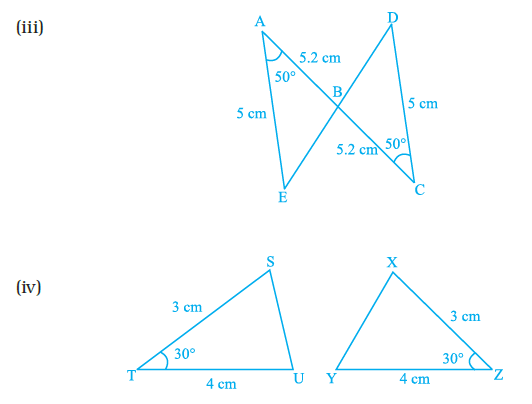
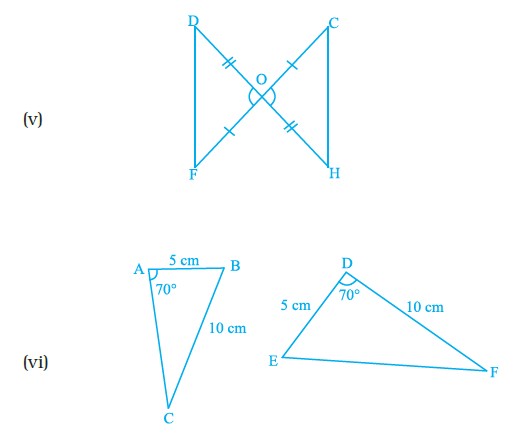
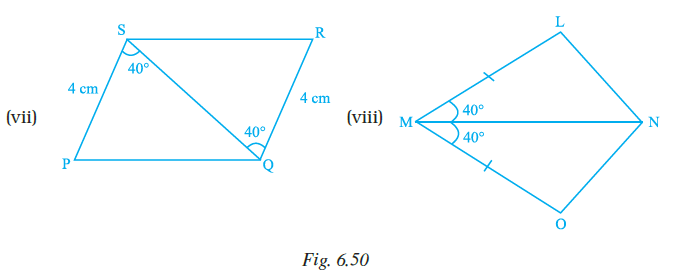
Answer:
(i) Comparison of $\triangle PQR$ and $\triangle TUS$:
$PQ = TU = 3 \text{ cm}$
(Given Side)
$\angle Q = \angle U = 40^\circ$
(Given Included Angle)
$QR = US = 5.5 \text{ cm}$
(Given Side)
Two sides and the included angle of $\triangle PQR$ are equal to the corresponding parts of $\triangle TUS$.
Congruence Criterion: SAS (Side-Angle-Side)
Symbolic Form: $\triangle PQR \cong \triangle TUS$
(ii) Comparison of $\triangle JKL$ and $\triangle MNO$:
In $\triangle JKL$, the given sides are $JK = 3.2 \text{ cm}$ and $KL = 4.3 \text{ cm}$. The included angle between these two sides is $\angle K$. however, the given angle is $\angle J = 60^\circ$.
In $\triangle MNO$, the given sides are $MN = 3.2 \text{ cm}$ and $NO = 4.3 \text{ cm}$. The included angle between these sides is $\angle N = 60^\circ$.
Since the given angle in $\triangle JKL$ is not the included angle between the given sides, the SAS condition is not satisfied.
Congruence Criterion: SAS (Not satisfied)
Result: These triangles are not congruent by SAS.
(iii) Comparison of $\triangle ABE$ and $\triangle CBD$:
$AB = CB = 5.2 \text{ cm}$
(Given Side)
$\angle A = \angle C = 50^\circ$
(Given Included Angle)
$AE = CD = 5 \text{ cm}$
(Given Side)
Two sides and the included angle of one triangle are equal to the corresponding parts of the other.
Congruence Criterion: SAS
Symbolic Form: $\triangle ABE \cong \triangle CBD$
(iv) Comparison of $\triangle STU$ and $\triangle XZY$:
$ST = XZ = 3 \text{ cm}$
(Given Side)
$\angle T = \angle Z = 30^\circ$
(Given Included Angle)
$TU = ZY = 4 \text{ cm}$
(Given Side)
The SAS condition is satisfied as the equal angles are included between the equal sides.
Congruence Criterion: SAS
Symbolic Form: $\triangle STU \cong \triangle XZY$
(v) Comparison of $\triangle DOF$ and $\triangle HOC$:
$DO = HO$
(Marked Sides)
$\angle DOF = \angle HOC$
(Vertically opposite angles)
$FO = CO$
(Marked Sides)
The triangles share vertex $O$. The vertically opposite angles at $O$ are the included angles for the marked equal sides.
Congruence Criterion: SAS
Symbolic Form: $\triangle DOF \cong \triangle HOC$
(vi) Comparison of $\triangle ABC$ and $\triangle DEF$:
In $\triangle ABC$, the sides are $AB = 5 \text{ cm}$ and $AC$ (unmarked, though $BC=10$). The angle $\angle A = 70^\circ$ is given, but it is not the angle included between sides $AB$ and $BC$.
In $\triangle DEF$, the sides are $DE = 5 \text{ cm}$ and $DF = 10 \text{ cm}$. The included angle is $\angle D = 70^\circ$.
Since the angle in the first triangle is not the included angle, SAS congruence cannot be established.
Congruence Criterion: SAS (Not satisfied)
Result: These triangles are not congruent by SAS.
(vii) Comparison of $\triangle PSQ$ and $\triangle RQS$:
$PS = RQ = 4 \text{ cm}$
(Given Side)
$\angle PSQ = \angle RQS = 40^\circ$
(Given Included Angle)
$SQ = QS$
(Common Side)
The common side $SQ$ and the given sides $PS$ and $RQ$ enclose the $40^\circ$ angles in both triangles.
Congruence Criterion: SAS
Symbolic Form: $\triangle PSQ \cong \triangle RQS$
(viii) Comparison of $\triangle LMN$ and $\triangle OMN$:
$LM = OM$
(Marked Sides)
$\angle LMN = \angle OMN = 40^\circ$
(Given Included Angle)
$MN = MN$
(Common Side)
By comparing the side $MN$, the marked sides, and the included $40^\circ$ angle, the SAS criterion is met.
Congruence Criterion: SAS
Symbolic Form: $\triangle LMN \cong \triangle OMN$
Question 149. State which of the following pairs of triangles are congruent. If yes, write them in symbolic form (you may draw a rough figure).
(a) ∆ PQR : PQ = 3.5 cm, QR = 4.0 cm, ∠ Q = 60°
∆ STU : ST = 3.5 cm, TU = 4 cm, ∠ T = 60°
(b) ∆ABC : AB = 4.8 cm, ∠ A = 90°, AC = 6.8 cm
∆XYZ : YZ = 6.8 cm, ∠ X = 90° , ZX = 4.8 cm
Answer:
(a) Comparison of $\triangle PQR$ and $\triangle STU$:
Given:
In $\triangle PQR$: $PQ = 3.5 \text{ cm}$, $QR = 4.0 \text{ cm}$ and included angle $\angle Q = 60^\circ$.
In $\triangle STU$: $ST = 3.5 \text{ cm}$, $TU = 4 \text{ cm}$ and included angle $\angle T = 60^\circ$.
Solution:
Comparing the corresponding parts of the two triangles:
$PQ = ST = 3.5 \text{ cm}$
(Side)
$\angle Q = \angle T = 60^\circ$
(Included Angle)
$QR = TU = 4.0 \text{ cm}$
(Side)
Since two sides and the included angle of $\triangle PQR$ are equal to the corresponding parts of $\triangle STU$, the triangles are congruent by the SAS (Side-Angle-Side) criterion.
Symbolic Form: $\triangle PQR \cong \triangle STU$
(b) Comparison of $\triangle ABC$ and $\triangle XYZ$:
Given:
In right-angled $\triangle ABC$: $AB = 4.8 \text{ cm}$, $AC = 6.8 \text{ cm}$ and $\angle A = 90^\circ$.
In right-angled $\triangle XYZ$: $YZ = 6.8 \text{ cm}$ (hypotenuse), $ZX = 4.8 \text{ cm}$ and $\angle X = 90^\circ$.
Solution:
In $\triangle ABC$, the sides forming the right angle are $4.8 \text{ cm}$ and $6.8 \text{ cm}$. Let's calculate the hypotenuse $BC$ using Pythagoras Theorem:
$BC^2 = AB^2 + AC^2$
$BC^2 = (4.8)^2 + (6.8)^2$
$BC^2 = 23.04 + 46.24$
$BC^2 = 69.28$
$BC = \sqrt{69.28} \approx 8.32 \text{ cm}$
In $\triangle XYZ$, the hypotenuse is given as $YZ = 6.8 \text{ cm}$.
Comparing the hypotenuses: $BC \approx 8.32 \text{ cm}$ and $YZ = 6.8 \text{ cm}$. Since the hypotenuses are not equal ($BC \neq YZ$), the triangles cannot be congruent by RHS or any other criterion.
Result: The triangles are not congruent.
Question 150. In Fig. 6.51, PQ = PS and ∠ 1 = ∠ 2.
(i) Is ∆PQR ≅ ∆PSR? Give reasons.
(ii) Is QR = SR? Give reasons.

Answer:
(i) Congruence of $\triangle PQR$ and $\triangle PSR$:
In $\triangle PQR$ and $\triangle PSR$:
$PQ = PS$
(Given)
$\angle 1 = \angle 2$
(Given Included Angle)
$PR = PR$
(Common Side)
Reason: Since two sides and the included angle of $\triangle PQR$ are equal to the corresponding parts of $\triangle PSR$, the triangles are congruent by the SAS criterion.
Therefore, $\triangle PQR \cong \triangle PSR$.
(ii) Equality of $QR$ and $SR$:
Yes, $QR = SR$.
Reason: Since $\triangle PQR \cong \triangle PSR$, their corresponding parts must be equal by the property of CPCT (Corresponding Parts of Congruent Triangles).
Question 151. In Fig. 6.52, DE = IH, EG = FI and ∠ E = ∠ I. Is ∆DEF ≅ ∆HIG? If yes, by which congruence criterion?

Answer:
Given:
$DE = IH$, $EG = FI$ and $\angle E = \angle I$.
Solution:
Observe the line segment on the base. We have $EG = FI$.
Adding the common segment $FG$ from both sides:
$EG + FG = FI + FG$
$EF = GI$
Now, in $\triangle DEF$ and $\triangle HIG$:
$DE = IH$
(Given Side)
$\angle E = \angle I$
(Given Included Angle)
$EF = GI$
(Proved above)
Yes, $\triangle DEF \cong \triangle HIG$.
Criterion: The triangles are congruent by the SAS (Side-Angle-Side) congruence criterion.
Question 152. In Fig. 6.53, ∠1 = ∠ 2 and ∠ 3 = ∠ 4.
(i) Is ∆ADC ≅ ∆ ABC? Why ?
(ii) Show that AD = AB and CD = CB.

Answer:
(i) Congruence of $\triangle ADC$ and $\triangle ABC$:
In $\triangle ADC$ and $\triangle ABC$:
$\angle 1 = \angle 2$
(Given Angle)
$AC = AC$
(Common Included Side)
$\angle 3 = \angle 4$
(Given Angle)
Reason: The triangles are congruent by the ASA (Angle-Side-Angle) congruence criterion because two angles and the included side of $\triangle ADC$ are equal to the corresponding parts of $\triangle ABC$.
Therefore, $\triangle ADC \cong \triangle ABC$.
(ii) To Show $AD = AB$ and $CD = CB$:
Since $\triangle ADC \cong \triangle ABC$ (as proved above), all their corresponding parts must be equal.
$AD = AB$
(By CPCT)
$CD = CB$
(By CPCT)
Hence shown.
Question 153. Observe Fig. 6.54 and state the three pairs of equal parts in triangles ABC and DBC.
(i) Is ∆ABC ≅ ∆DCB? Why?
(ii) Is AB = DC? Why?
(iii) Is AC = DB? Why?
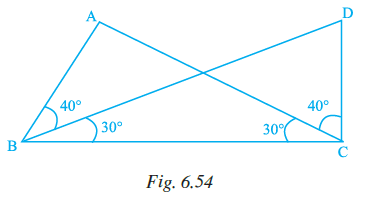
Answer:
Three pairs of equal parts in $\triangle ABC$ and $\triangle DCB$:
Observe the total angles at the base vertices $B$ and $C$.
Total $\angle ABC = 40^\circ + 30^\circ = 70^\circ$
Total $\angle DCB = 30^\circ + 40^\circ = 70^\circ$
1. $\angle ABC = \angle DCB = 70^\circ$
2. $\angle ACB = \angle DBC = 30^\circ$ (Given)
3. $BC = CB$ (Common Side)
(i) Is $\triangle ABC \cong \triangle DCB$?
Yes. The triangles are congruent by the ASA (Angle-Side-Angle) congruence criterion because two angles and the included side $BC$ of $\triangle ABC$ are equal to the corresponding parts of $\triangle DCB$.
(ii) Is $AB = DC$?
Yes. Since $\triangle ABC \cong \triangle DCB$, then $AB = DC$ by the property of CPCT (Corresponding Parts of Congruent Triangles).
(iii) Is $AC = DB$?
Yes. By the same property of CPCT, the corresponding sides $AC$ and $DB$ are equal.
Question 154. In Fig. 6.55, QS ⊥ PR, RT ⊥ PQ and QS = RT.
(i) Is ∆ QSR ≅ ∆ RTQ? Give reasons.
(ii) Is ∠ PQR = ∠ PRQ? Give reasons.
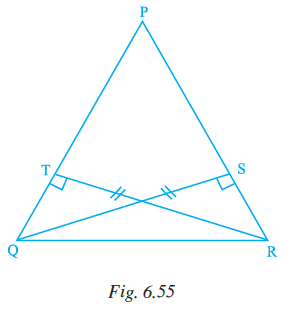
Answer:
Given:
In $\triangle PQR$:
$QS \perp PR \Rightarrow \angle QSR = 90^\circ$
$RT \perp PQ \Rightarrow \angle RTQ = 90^\circ$
$QS = RT$
(i) Congruence of $\triangle QSR$ and $\triangle RTQ$:
Comparing $\triangle QSR$ and $\triangle RTQ$:
$\angle QSR = \angle RTQ = 90^\circ$
(Given: Right angle)
$QR = RQ$
(Common Hypotenuse)
$QS = RT$
(Given Side)
By the RHS (Right-Angle Hypotenuse Side) congruence criterion, the two triangles are congruent.
$\triangle QSR \cong \triangle RTQ$
(ii) Equality of ∠PQR and ∠PRQ:
Yes, $\angle PQR = \angle PRQ$.
Reason: From the congruence $\triangle QSR \cong \triangle RTQ$ proved above, we can say that their corresponding parts are equal (CPCT).
$\angle SQR = \angle TRQ$ (By CPCT)
These angles are the same as $\angle PQR$ and $\angle PRQ$ respectively. Therefore, $\angle PQR = \angle PRQ$.
Question 155. Points A and B are on the opposite edges of a pond as shown in Fig. 6.56. To find the distance between the two points, the surveyor makes a right-angled triangle as shown. Find the distance AB.

Answer:
Given:
From the figure, the surveyor has formed a right-angled triangle. Let the right-angle vertex be $C$.
Length of one leg $= 30 \text{ m}$
Length of the other leg $= 40 \text{ m}$
Point $B$ is located on the hypotenuse such that the segment from point $C$ to point $B$ is not the full hypotenuse. However, standard interpretation of this NCERT figure shows $A$ and $C$ as vertices of the legs, and $B$ as the point on the hypotenuse.
Solution:
Let the total length of the hypotenuse (from $A$ to the far point $C$) be $H$.
Using Pythagoras Theorem:
$H^2 = 30^2 + 40^2$
$H^2 = 900 + 1600$
$H^2 = 2500$
$H = \sqrt{2500} = 50 \text{ m}$
From the figure, the total length of the line where $A$ and $B$ lie is $50 \text{ m}$. The distance between $B$ and the end point is given as $12 \text{ m}$.
Distance $AB = \text{Total Hypotenuse} - \text{Segment } BC$
$AB = 50 \text{ m} - 12 \text{ m} = 38 \text{ m}$
The distance $AB$ is $38 \text{ m}$.
Question 156. Two poles of 10 m and 15 m stand upright on a plane ground. If the distance between the tops is 13 m, find the distance between their feet.
Answer:
Given:
Height of Pole 1 ($h_1$) $= 10 \text{ m}$
Height of Pole 2 ($h_2$) $= 15 \text{ m}$
Distance between tops $= 13 \text{ m}$
To Find:
The distance between their feet.
Solution:
Let the distance between their feet be $x$. If we draw a line from the top of the shorter pole perpendicular to the longer pole, we form a right-angled triangle.
In this triangle:
The base is the distance between the feet $= x$.
The perpendicular height is the difference in pole heights:
$\text{Height difference} = 15 \text{ m} - 10 \text{ m} = 5 \text{ m}$
The hypotenuse is the distance between the tops $= 13 \text{ m}$.
Applying Pythagoras Theorem:
$x^2 + 5^2 = 13^2$
$x^2 + 25 = 169$
$x^2 = 169 - 25$
$x^2 = 144$
$x = \sqrt{144} = 12 \text{ m}$
The distance between their feet is $12 \text{ m}$.
Question 157. The foot of a ladder is 6 m away from its wall and its top reaches a window 8 m above the ground,
(a) Find the length of the ladder.
(b) If the ladder is shifted in such a way that its foot is 8 m away from the wall, to what height does its top reach?
Answer:
Given Case (a):
Distance from wall (Base) $= 6 \text{ m}$
Height of window (Perpendicular) $= 8 \text{ m}$
Solution (a):
Let the length of the ladder be $L$. By Pythagoras Theorem:
$L^2 = 6^2 + 8^2$
$L^2 = 36 + 64 = 100$
$L = \sqrt{100} = 10 \text{ m}$
The length of the ladder is $10 \text{ m}$.
Given Case (b):
Length of ladder (Hypotenuse) $= 10 \text{ m}$
New distance from wall (Base) $= 8 \text{ m}$
Solution (b):
Let the new height reached by the ladder be $h$. By Pythagoras Theorem:
$h^2 + 8^2 = 10^2$
$h^2 + 64 = 100$
$h^2 = 100 - 64$
$h^2 = 36$
$h = \sqrt{36} = 6 \text{ m}$
The top of the ladder reaches a height of $6 \text{ m}$.
Question 158. In Fig. 6.57, state the three pairs of equal parts in ∆ABC and ∆EOD.
Is ∆ABC ≅ ∆EOD? Why?
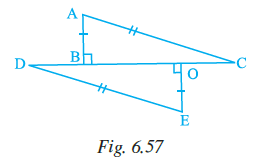
Answer:
Given:
From Fig. 6.57, we observe the following markings:
1. $\angle ABC = 90^\circ$ and $\angle EOD = 90^\circ$
2. Hypotenuse $AC$ is marked equal to hypotenuse $ED$.
3. Side $AB$ is marked equal to side $EO$.
Solution:
Three pairs of equal parts in $\triangle ABC$ and $\triangle EOD$:
$\angle ABC = \angle EOD = 90^\circ$
(Given: Right angle)
$AC = ED$
(Given: Hypotenuse)
$AB = EO$
(Given: Side)
Is $\triangle ABC \cong \triangle EOD$?
Yes, $\triangle ABC \cong \triangle EOD$ by the RHS (Right-Angle Hypotenuse Side) congruence criterion.
Reason: The right angle, the hypotenuse, and one corresponding side of $\triangle ABC$ are equal to those of $\triangle EOD$.