

Chapter 7 Comparing Quantities (Class 7 - Maths NCERT Exemplar Solutions)
Welcome to the comprehensive resource for NCERT Exemplar Solutions for Class 7 Mathematics: Chapter 7 Comparing Quantities! This chapter is strategically designed to move beyond routine exercises, focusing on the application of ratio, proportion, percentage, profit and loss, and simple interest within challenging real-world scenarios. By engaging with these problems, students will significantly enhance their quantitative reasoning and develop the analytical skills required to solve multi-faceted mathematical problems.
The solutions provided here cover various methods for comparing quantities, including the conversion of ratios into percentages and vice versa. Students will master the calculation of percentage increase or decrease, which is essential for analyzing changes in prices or populations. A significant focus is placed on tackling complex problems, such as finding the original quantity when only the final value after a percentage change is known, ensuring a thorough grasp of percentage-based comparisons.
In the field of commerce, the chapter delves into Profit and Loss. Detailed guidance is provided for calculating profit and loss percentages, which are always calculated on the Cost Price (CP). The solutions also address overhead expenses, which are added to the initial CP, and the calculation of overall gain or loss in transactions involving monetary values in $\textsf{₹}$. Mastery of these concepts is vital for developing financial literacy and accuracy in commercial mathematics.
Finally, the fundamental concepts of Simple Interest (SI) are thoroughly addressed using the core formula $SI = \frac{P \times R \times T}{100}$. Students will learn to calculate the Principal (P), Rate (R), Time (T), and the total Amount (A) payable using $A = P + SI$. With step-by-step workings and logical justifications prepared by learningspot.co, students can confidently master these quantitative techniques and excel in complex practical applications.
| Content On This Page | ||
|---|---|---|
| Solved Examples (Examples 1 to 11) | Question 1 to 23 (Multiple Choice Questions) | Question 24 to 59 (Fill in the Blanks) |
| Question 60 to 79 (True or False) | Question 80 to 140 | |
Solved Examples (Examples 1 to 11)
In Examples 1 to 3, there are four options, out of which one is correct. Choose the correct one.
Example 1: The ratio of the heights 1.50 m and 75 cm of two persons can be written as
(a) 1 : 50
(b) 1 : 5
(c) 2 : 1
(d) 1 : 2
Answer:
Given:
Height of the first person = $1.50$ m
Height of the second person = $75$ cm
To Find:
The ratio of the heights of the two persons.
Solution:
To find the ratio, both quantities must be in the same unit. We know that:
$1$ m = $100$ cm
So, height of the first person in cm = $1.50 \times 100$ cm = $150$ cm
Now, the ratio of the heights is:
Ratio = $\frac{150 \text{ cm}}{75 \text{ cm}}$
Dividing both numerator and denominator by $75$:
Ratio = $\frac{\cancel{150}^2}{\cancel{75}_1}$ = $\frac{2}{1}$
Therefore, the ratio is $2 : 1$.
Correct Option: (c)
Example 2: Out of 50 children in a class, 20 are boys. Then the percentage of girls is
(a) 60
(b) 30
(c) 50
(d) $66\frac{2}{3}$
Answer:
Given:
Total number of children = $50$
Number of boys = $20$
To Find:
The percentage of girls in the class.
Solution:
First, we find the number of girls in the class:
Number of girls = Total children - Number of boys
Number of girls = $50 - 20 = 30$
Now, we calculate the percentage of girls:
Percentage of girls = $\left( \frac{\text{Number of girls}}{\text{Total children}} \times 100 \right) \%$
Percentage of girls = $\left( \frac{30}{50} \times 100 \right) \%$
Percentage of girls = $(30 \times 2) \%$ = $60 \%$
Correct Option: (a)
Alternate Solution:
Percentage of boys = $\left( \frac{20}{50} \times 100 \right) \% = 40 \%$
Percentage of girls = $100 \% - \text{Percentage of boys}$
Percentage of girls = $100 \% - 40 \% = 60 \%$
Example 3: The interest on ₹ 5000 at the rate of 15% per annum for one month is
(a) ₹ 750
(b) ₹ 75
(c) ₹ 625
(d) ₹ 62.50
Answer:
Given:
Principal ($P$) = $\textsf{₹} 5000$
Rate of interest ($R$) = $15 \%$ per annum
Time ($T$) = $1$ month = $\frac{1}{12}$ year
To Find:
The simple interest ($I$).
Solution:
The formula for Simple Interest is:
$I = \frac{P \times R \times T}{100}$
Substituting the given values:
$I = \frac{5000 \times 15 \times \frac{1}{12}}{100}$
$I = \frac{50 \times 15}{12}$
$I = \frac{750}{12}$
$I = \textsf{₹} 62.50$
Correct Option: (d)
In Examples 4 and 5, fill in the blanks to make the statements true.
Example 4: If two ratios are equivalent, then the four quantities are said to be in ______.
Answer:
Solution:
When two ratios $a : b$ and $c : d$ are equivalent (i.e., $a : b = c : d$), then the four quantities $a, b, c, d$ are said to be in proportion.
Therefore, the blank should be filled with proportion.
Example 5: 40% of 250 km is __________.
Answer:
To Find:
$40 \%$ of $250$ km.
Solution:
$40 \%$ of $250 = \frac{40}{100} \times 250$
Simplifying the expression:
$= \frac{4}{10} \times 250$
$= 4 \times 25$
$= 100$
So, $40 \%$ of $250$ km is $100$ km.
In Examples 6 and 7, state whether the statements are True or False.
Example 6: If 25% of a journey is 800 km, the total distance of the journey is 3000 km.
Answer:
Solution:
Let the total distance of the journey be $x$ km.
According to the statement:
$25 \%$ of $x = 800$
$\frac{25}{100} \times x = 800$
$\frac{1}{4} \times x = 800$
$x = 800 \times 4$
$x = 3200$ km
Since the calculated total distance is $3200$ km and the statement claims it is $3000$ km, the statement is False.
Example 7: 0.05 is equivalent to 5%.
Answer:
Solution:
To convert a decimal into a percentage, we multiply it by $100$.
$0.05 \times 100 = \frac{5}{100} \times 100$
$= 5 \%$
Since $0.05$ is indeed equal to $5 \%$, the statement is True.
Example 8: Suhana sells a sofa set for ₹ 9600 making a profit of 20%. What is the C.P. of the sofa set?
Answer:
Given:
Selling Price ($S.P.$) of the sofa set = $\textsf{₹} 9600$
Profit percentage = $20 \%$
To Find:
Cost Price ($C.P.$) of the sofa set.
Solution:
We know the formula to find $C.P.$ when $S.P.$ and Profit $\%$ are given is:
$C.P. = \frac{100}{100 + \text{Profit} \%} \times S.P.$
Substituting the given values into the formula:
$C.P. = \frac{100}{100 + 20} \times 9600$
$C.P. = \frac{100}{120} \times 9600$
$C.P. = \frac{10}{12} \times 9600$
$C.P. = 10 \times \frac{\cancel{9600}^{800}}{\cancel{12}_{1}}$
$C.P. = 10 \times 800$
$C.P. = \textsf{₹} 8000$
Therefore, the cost price of the sofa set is $\textsf{₹} 8000$.
Example 9: John borrowed ₹ 75000 from his friend and after one year returned ₹ 80000 to his friend. Find the interest.
Answer:
Given:
Principal ($P$) = $\textsf{₹} 75000$
Amount ($A$) = $\textsf{₹} 80000$
To Find:
Interest ($I$).
Solution:
We know that Amount is the sum of Principal and Interest. Therefore, Interest can be calculated as:
$\text{Interest} = \text{Amount} - \text{Principal}$
$\text{Interest} = 80000 - 75000$
$\text{Interest} = \textsf{₹} 5000$
Therefore, the interest paid by John is $\textsf{₹} 5000$.
Example 10: If Meenakshee pays an interest of ₹ 1500 for 4 years on a sum of ₹ 2500, find the rate of interest per annum (p.a.)
Answer:
Given:
Principal ($P$) = $\textsf{₹} 2500$
Simple Interest ($I$) = $\textsf{₹} 1500$
Time ($T$) = $4$ years
To Find:
Rate of interest per annum ($R$).
Solution:
We know the formula for Simple Interest is:
$I = \frac{P \times R \times T}{100}$
To find the Rate ($R$), we can rearrange the formula as:
$R = \frac{I \times 100}{P \times T}$
Substituting the given values:
$R = \frac{1500 \times 100}{2500 \times 4}$
Using the cancellation method:
$R = \frac{1500 \times \cancel{100}^1}{\cancel{2500}_{25} \times 4}$
$R = \frac{1500}{25 \times 4}$
$R = \frac{1500}{100}$
$R = \frac{\cancel{1500}^{15}}{\cancel{100}_1}$
$R = 15 \%$
Therefore, the rate of interest per annum is $15 \%$.
Example 11: Refer to the graphic. If a cheetah and tortoise travel at their top speeds for 1minute; how much farther does the cheetah travel?
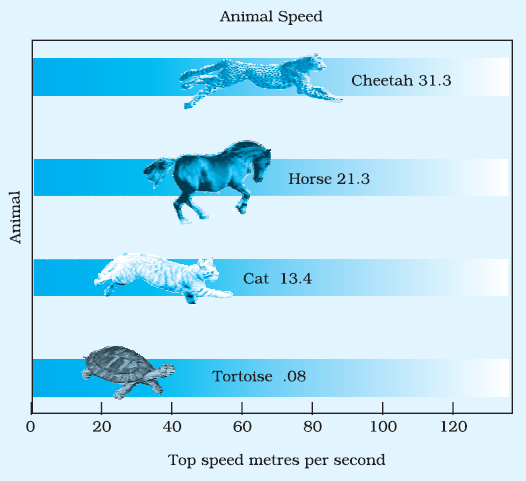
Answer:
Given:
From the provided graphic:
Top speed of Cheetah = $31.3$ m/s
Top speed of Tortoise = $0.08$ m/s
Time taken ($t$) = $1$ minute = $60$ seconds
To Find:
How much farther the cheetah travels compared to the tortoise (Difference in distance).
Solution:
We know that $\text{Distance} = \text{Speed} \times \text{Time}$.
1. Distance traveled by the Cheetah:
$D_1 = 31.3 \times 60$
$D_1 = 1878$ m
2. Distance traveled by the Tortoise:
$D_2 = 0.08 \times 60$
$D_2 = 4.8$ m
3. Difference in distance:
$\text{Difference} = D_1 - D_2$
$\text{Difference} = 1878 - 4.8$
$\text{Difference} = 1873.2$ m
Therefore, the cheetah travels $1873.2$ m farther than the tortoise.
Exercise
Question 1 to 23 (Multiple Choice Questions)
In questions 1 to 23, there are four options, out of which one is correct. write the correct one.
Question 1. 20% of 700 m is
(a) 560 m
(b) 70 m
(c) 210 m
(d) 140 m
Answer:
Given:
Total length = $700$ m
Percentage = $20 \%$
To Find:
The value of $20 \%$ of $700$ m.
Solution:
We calculate the percentage as follows:
$20 \%$ of $700 = \frac{20}{100} \times 700$
$= 20 \times \frac{\cancel{700}^7}{\cancel{100}_1}$
$= 20 \times 7$
$= 140$ m
Correct Option: (d)
Question 2. Gayatri’s income is ₹ 1,60,000 per year. She pays 15% of this as house rent and 10% of the remainder on her child’s education. The money left with her is
(a) ₹ 136000
(b) ₹ 120000
(c) ₹ 122400
(d) ₹ 14000
Answer:
Given:
Total Income = $\textsf{₹} 1,60,000$
House rent percentage = $15 \%$
Child's education percentage = $10 \%$ of the remainder
To Find:
The money left with Gayatri.
Solution:
First, calculate the house rent:
House Rent = $15 \%$ of $1,60,000 = \frac{15}{100} \times 1,60,000$
$= 15 \times 1600 = \textsf{₹} 24,000$
Now, calculate the remainder income:
Remainder = $1,60,000 - 24,000 = \textsf{₹} 1,36,000$
Next, calculate the money spent on education:
Education Expense = $10 \%$ of $1,36,000 = \frac{10}{100} \times 1,36,000$
$= \textsf{₹} 13,600$
Finally, the money left is:
Money Left = Remainder - Education Expense
Money Left = $1,36,000 - 13,600$
Money Left = $\textsf{₹} 1,22,400$
Correct Option: (c)
Question 3. The ratio of Fatima’s income to her savings is 4 : 1. The percentage of money saved by her is :
(a) 20%
(b) 25%
(c) 40%
(d) 80%
Answer:
Given:
Ratio of Fatima's income to her savings = $4 : 1$
To Find:
The percentage of money saved by her.
Solution:
The given ratio is $4 : 1$.
To find the percentage of savings, we first determine the total parts represented by the ratio:
Total parts = $4 + 1 = 5$
Now, the savings represent $1$ part out of the total $5$ parts.
Percentage of money saved = $\left( \frac{\text{Savings part}}{\text{Total parts}} \times 100 \right) \%$
Percentage of money saved = $\left( \frac{1}{5} \times 100 \right) \%$
Percentage of money saved = $\frac{1}{\cancel{5}_1} \times \cancel{100}^{20} \%$
Percentage of money saved = $20 \%$
Correct Option: (a)
Alternate Solution:
If we consider the ratio components as parts of a whole where the total income is divided into $5$ equal units ($4$ units for expenditure and $1$ unit for savings):
Income = $5$ units
Savings = $1$ unit
Percentage saved = $\frac{1}{5} \times 100 \% = 20 \%$
Question 4. 0.07 is equal to
(a) 70%
(b) 7%
(c) 0.7%
(d) 0.07%
Answer:
Solution:
To convert a decimal into a percentage, we multiply by $100$.
$0.07 = 0.07 \times 100 \%$
$= \frac{7}{100} \times 100 \%$
$= 7 \%$
Correct Option: (b)
Question 5. In a scout camp, 40% of the scouts were from Gujarat State and 20% of these were from Ahmedabad. The percentage of scouts in the camp from Ahmedabad is:
(a) 25
(b) 32.5
(c) 8
(d) 50
Answer:
Given:
Scouts from Gujarat = $40 \%$ of total scouts.
Scouts from Ahmedabad = $20 \%$ of those from Gujarat.
To Find:
Percentage of total scouts from Ahmedabad.
Solution:
Percentage of scouts from Ahmedabad = $20 \%$ of $40 \%$
$= \frac{20}{100} \times 40 \%$
$= \frac{1}{5} \times 40 \%$
$= 8 \%$
Correct Option: (c)
Question 6. What percent of ₹ 4500 is ₹ 9000?
(a) 200
(b) $\frac{1}{2}$
(c) 2
(d) 50
Answer:
Solution:
Let $x \%$ of $\textsf{₹} 4500$ be $\textsf{₹} 9000$.
$\frac{x}{100} \times 4500 = 9000$
$x \times 45 = 9000$
$x = \frac{9000}{45}$
$x = 200$
So, the percentage is $200 \%$.
Correct Option: (a)
Question 7. 5.2 is equal to
(a) 52%
(b) 5.2%
(c) 520%
(d) 0.52%
Answer:
Solution:
Converting decimal $5.2$ to percentage:
$5.2 \times 100 \%$
$= 520 \%$
Correct Option: (c)
Question 8. The ratio 3 : 8 is equal to
(a) 3.75%
(b) 37.5%
(c) 0.375%
(d) 267%
Answer:
Solution:
To convert the ratio $3 : 8$ into percentage:
Percentage = $\frac{3}{8} \times 100 \%$
$= \frac{300}{8} \%$
$= 37.5 \%$
Correct Option: (b)
Question 9. 225% is equal to
(a) 9 : 4
(b) 4 : 9
(c) 3 : 2
(d) 2 : 3
Answer:
Given:
Percentage = $225 \%$
To Find:
The equivalent ratio of the given percentage.
Solution:
To convert a percentage into a ratio, we first write it as a fraction by dividing by $100$ and then simplify it.
$225 \% = \frac{225}{100}$
Dividing both numerator and denominator by their highest common factor, which is $25$:
$\frac{\cancel{225}^{9}}{\cancel{100}_{4}} = \frac{9}{4}$
The fraction $\frac{9}{4}$ can be written in the form of a ratio as $9 : 4$.
Correct Option: (a)
Question 10. A bicycle is purchased for ₹ 1800 and is sold at a profit of 12%. Its selling price is
(a) ₹ 1584
(b) ₹ 2016
(c) ₹ 1788
(d) ₹ 1812
Answer:
Given:
Cost Price ($C.P.$) of the bicycle = $\textsf{₹} 1800$
Profit percentage = $12 \%$
To Find:
Selling Price ($S.P.$) of the bicycle.
Solution:
First, we calculate the profit amount:
$\text{Profit} = 12 \% \text{ of } 1800$
$\text{Profit} = \frac{12}{100} \times 1800$
$\text{Profit} = 12 \times 18 = \textsf{₹} 216$
Now, we find the Selling Price using the formula:
$S.P. = C.P. + \text{Profit}$
$S.P. = 1800 + 216$
$S.P. = \textsf{₹} 2016$
Correct Option: (b)
Question 11. A cricket bat was purchased for ₹ 800 and was sold for ₹ 1600. Then profit earned is
(a) 100%
(b) 64%
(c) 50%
(d) 60%
Answer:
Given:
Cost Price ($C.P.$) = $\textsf{₹} 800$
Selling Price ($S.P.$) = $\textsf{₹} 1600$
To Find:
Profit percentage.
Solution:
First, calculate the profit amount:
$\text{Profit} = S.P. - C.P.$
$\text{Profit} = 1600 - 800 = \textsf{₹} 800$
Now, calculate the profit percentage:
$\text{Profit} \% = \left( \frac{\text{Profit}}{C.P.} \times 100 \right) \%$
$\text{Profit} \% = \left( \frac{800}{800} \times 100 \right) \%$
$\text{Profit} \% = 1 \times 100 \% = 100 \%$
Correct Option: (a)
Question 12. A farmer bought a buffalo for ₹ 44000 and a cow for ₹ 18000. He sold the buffalo at a loss of 5% but made a profit of 10% on the cow. The net result of the transaction is
(a) loss of ₹ 200
(b) profit of ₹ 400
(c) loss of ₹ 400
(d) profit of ₹ 200
Answer:
Given:
$C.P.$ of buffalo = $\textsf{₹} 44000$, Loss on buffalo = $5 \%$
$C.P.$ of cow = $\textsf{₹} 18000$, Profit on cow = $10 \%$
To Find:
Net result (Total Profit or Total Loss).
Solution:
Step 1: Calculate loss on buffalo
$\text{Loss} = 5 \% \text{ of } 44000$
$\text{Loss} = \frac{5}{100} \times 44000 = 5 \times 440 = \textsf{₹} 2200$
Step 2: Calculate profit on cow
$\text{Profit} = 10 \% \text{ of } 18000$
$\text{Profit} = \frac{10}{100} \times 18000 = \textsf{₹} 1800$
Step 3: Calculate net result
Since the loss ($\textsf{₹} 2200$) is greater than the profit ($\textsf{₹} 1800$), there is a net loss.
$\text{Net Loss} = \text{Total Loss} - \text{Total Profit}$
$\text{Net Loss} = 2200 - 1800 = \textsf{₹} 400$
Correct Option: (c)
Question 13. If Mohan’s income is 25% more than Raman’s income, then Raman’s income is less than Mohan’s income by
(a) 25%
(b) 80%
(c) 20%
(d) 75%
Answer:
Solution:
Let Raman's income be $\textsf{₹} 100$.
Mohan's income is $25 \%$ more than Raman's income.
Mohan's income = $100 + (25 \% \text{ of } 100) = 100 + 25 = \textsf{₹} 125$.
Now, we need to find how much Raman's income is less than Mohan's income in terms of percentage.
Difference in income = $125 - 100 = \textsf{₹} 25$.
Percentage less = $\left( \frac{\text{Difference}}{\text{Mohan's income}} \times 100 \right) \%$
Percentage less = $\left( \frac{25}{125} \times 100 \right) \%$
$\frac{\cancel{25}^{1}}{\cancel{125}_{5}} \times 100 = \frac{100}{5} = 20 \%$
Correct Option: (c)
Question 14. The interest on ₹ 30000 for 3 years at the rate of 15% per annum is
(a) ₹ 4500
(b) ₹ 9000
(c) ₹ 18000
(d) ₹ 13500
Answer:
Given:
Principal ($P$) = $\textsf{₹} 30000$
Time ($T$) = $3$ years
Rate ($R$) = $15 \%$ p.a.
To Find:
Simple Interest ($I$).
Solution:
$I = \frac{P \times R \times T}{100}$
$I = \frac{30000 \times 15 \times 3}{100}$
$I = 300 \times 45$
$I = \textsf{₹} 13500$
Correct Option: (d)
Question 15. Amount received on ₹ 3000 for 2 years at the rate of 11% per annum is
(a) ₹ 2340
(b) ₹ 3660
(c) ₹ 4320
(d) ₹ 3330
Answer:
Given:
Principal ($P$) = $\textsf{₹} 3000$
Time ($T$) = $2$ years
Rate ($R$) = $11 \%$ p.a.
To Find:
Total Amount ($A$).
Solution:
First, calculate the interest:
$I = \frac{3000 \times 11 \times 2}{100} = 30 \times 22 = \textsf{₹} 660$
Now, calculate the Amount:
$A = P + I$
$A = 3000 + 660 = \textsf{₹} 3660$
Correct Option: (b)
Question 16. Interest on ₹ 12000 for 1 month at the rate of 10 % per annum is
(a) ₹ 1200
(b) ₹ 600
(c) ₹ 100
(d) ₹ 12100
Answer:
Given:
Principal ($P$) = $\textsf{₹} 12000$
Rate ($R$) = $10 \%$ p.a.
Time ($T$) = $1$ month = $\frac{1}{12}$ year
To Find:
Interest ($I$).
Solution:
$I = \frac{P \times R \times T}{100}$
$I = \frac{12000 \times 10 \times \frac{1}{12}}{100}$
$I = \frac{12000 \times 10}{100 \times 12}$
$I = \frac{1000 \times 12 \times 10}{100 \times 12}$
$I = \frac{\cancel{12000}^{1000}}{\cancel{12}_{1}} \times \frac{10}{100}$
$I = 1000 \times \frac{10}{100} = 100$
$I = \textsf{₹} 100$
Correct Option: (c)
Question 17. Rajni and Mohini deposited ₹ 3000 and ₹ 4000 in a company at the rate of 10% per annum for 3 years and $2\frac{1}{2}$ years respectively. The difference of the amounts received by them will be
(a) ₹ 100
(b) ₹ 1000
(c) ₹ 900
(d) ₹ 1100
Answer:
Given:
For Rajni: Principal ($P_1$) = $\textsf{₹} 3000$, Rate ($R$) = $10 \%$ p.a., Time ($T_1$) = $3$ years.
For Mohini: Principal ($P_2$) = $\textsf{₹} 4000$, Rate ($R$) = $10 \%$ p.a., Time ($T_2$) = $2\frac{1}{2}$ years = $2.5$ years.
To Find:
The difference of the amounts received by them.
Solution:
1. Calculation for Rajni:
Simple Interest ($I_1$) = $\frac{3000 \times 10 \times 3}{100} = \textsf{₹} 900$
Amount received by Rajni ($A_1$) = $P_1 + I_1$
$A_1 = 3000 + 900 = \textsf{₹} 3900$
2. Calculation for Mohini:
Simple Interest ($I_2$) = $\frac{4000 \times 10 \times 2.5}{100} = 40 \times 25 = \textsf{₹} 1000$
Amount received by Mohini ($A_2$) = $P_2 + I_2$
$A_2 = 4000 + 1000 = \textsf{₹} 5000$
3. Difference of the amounts:
Difference = $A_2 - A_1$
Difference = $5000 - 3900 = \textsf{₹} 1100$
Correct Option: (d)
Question 18. If 90% of x is 315 km, then the value of x is
(a) 325 km
(b) 350 km
(c) 405 km
(d) 340 km
Answer:
Given:
$90 \%$ of $x = 315$ km
To Find:
The value of $x$.
Solution:
According to the question:
$\frac{90}{100} \times x = 315$
$x = \frac{315 \times 100}{90}$
$x = \frac{315 \times 10}{9}$
Dividing $315$ by $9$:
$x = 35 \times 10$
$x = 350$ km
Correct Option: (b)
Question 19. On selling an article for ₹ 329, a dealer lost 6%. The cost price of the article is
(a) ₹ 310.37
(b) ₹ 348.74
(c) ₹ 335
(d) ₹ 350
Answer:
Given:
Selling Price ($S.P.$) = $\textsf{₹} 329$
Loss percentage = $6 \%$
To Find:
Cost Price ($C.P.$).
Solution:
We use the formula:
$C.P. = \frac{100}{100 - \text{Loss} \%} \times S.P.$
$C.P. = \frac{100}{100 - 6} \times 329$
$C.P. = \frac{100}{94} \times 329$
$C.P. = \frac{32900}{94}$
$C.P. = \textsf{₹} 350$
Correct Option: (d)
Question 20. $\frac{25\% \;of \;50\% \;of \;100\%}{25 \;×\; 50}$ is equal to
(a) 1.1%
(b) 0.1%
(c) 0.01%
(d) 1 %
Answer:
Solution:
The expression is: $\frac{25\% \times 50\% \times 100\%}{25 \times 50}$
Converting percentages into fractions:
$= \frac{\frac{25}{100} \times \frac{50}{100} \times \frac{100}{100}}{25 \times 50}$
$= \frac{\frac{1}{4} \times \frac{1}{2} \times 1}{1250}$
$= \frac{1/8}{1250}$
$= \frac{1}{8 \times 1250}$
$= \frac{1}{10000}$
Now, to convert this into percentage, we multiply by $100$:
$= \left( \frac{1}{10000} \times 100 \right) \%$
$= \frac{1}{100} \% = 0.01 \%$
Correct Option: (c)
Question 21. The sum which will earn a simple interest of ₹ 126 in 2 years at 14% per annum is
(a) ₹ 394
(b) ₹ 395
(c) ₹ 450
(d) ₹ 540
Answer:
Given:
Simple Interest ($I$) = $\textsf{₹} 126$
Time ($T$) = $2$ years
Rate ($R$) = $14 \%$ p.a.
To Find:
Principal (Sum, $P$).
Solution:
$P = \frac{I \times 100}{R \times T}$
$P = \frac{126 \times 100}{14 \times 2}$
$P = \frac{12600}{28}$
Dividing by $14$:
$P = \frac{\cancel{126}^{9} \times 100}{\cancel{14}_{1} \times 2}$
$P = \frac{900}{2}$
$P = \textsf{₹} 450$
Correct Option: (c)
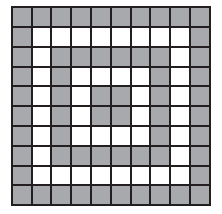
Question 22. The per cent that represents the unshaded region in the figure.
(a) 75%
(b) 50%
(c) 40%
(d) 60%
Answer:
Solution:
The given figure is a $10 \times 10$ square grid, making a total of $100$ small squares.
Let's count the shaded squares ring by ring:
1. Outer shaded border: $10 + 10 + 8 + 8 = 36$ squares.
2. Inner shaded ring: $6 + 6 + 4 + 4 = 20$ squares.
3. Central shaded block: $2 \times 2 = 4$ squares.
Total shaded squares = $36 + 20 + 4 = 60$ squares.
Now, the number of unshaded squares = Total squares - Shaded squares
Unshaded squares = $100 - 60 = 40$ squares.
Percentage of unshaded region = $\left( \frac{40}{100} \times 100 \right) \% = 40 \%$
Correct Option: (c)
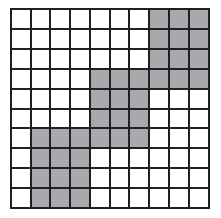
Question 23. The per cent that represents the shaded region in the figure is
(a) 36%
(b) 64%
(c) 27%
(d) 48%
Answer:
Solution:
The grid is a $10 \times 10$ square, containing $100$ small squares in total.
By observing the image, there are three distinct shaded blocks:
1. Top right shaded block: $4 \times 3 = 12$ squares.
2. Center shaded block: $4 \times 3 = 12$ squares.
3. Bottom left shaded block: $4 \times 3 = 12$ squares.
Total shaded squares = $12 + 12 + 12 = 36$ squares.
Percentage of shaded region = $\left( \frac{36}{100} \times 100 \right) \% = 36 \%$
Correct Option: (a)
Question 24 to 59 (Fill in the Blanks)
In each of the questions 24 to 59, fill in the blanks to make the statements true.
Question 24. 2 : 3 = ________ %
Answer:
Given:
Ratio = $2 : 3$
To Find:
Percentage equivalent of the given ratio.
Solution:
To convert a ratio into a percentage, we first express the ratio as a fraction and then multiply it by $100$.
Fraction form = $\frac{2}{3}$
Percentage = $\left( \frac{2}{3} \times 100 \right) \%$
Percentage = $\frac{200}{3} \%$
The value can be written as $66\frac{2}{3} \%$ or approximately $66.67 \%$.
Thus, $2 : 3 = $ $66\frac{2}{3}$ %.
Question 25. $18\frac{3}{4}$ % = _______ : _______
Answer:
Given:
Percentage = $18\frac{3}{4} \%$
To Find:
The equivalent ratio.
Solution:
First, convert the mixed fraction into an improper fraction:
$18\frac{3}{4} = \frac{(18 \times 4) + 3}{4} = \frac{72 + 3}{4} = \frac{75}{4}$
Now, to remove the percentage sign, divide the fraction by $100$:
Fraction = $\frac{75}{4} \times \frac{1}{100}$
Fraction = $\frac{75}{400}$
Simplifying by dividing both numerator and denominator by $25$:
Ratio = $\frac{\cancel{75}^3}{\cancel{400}_{16}} = \frac{3}{16}$
In ratio form, it is $3 : 16$.
Thus, $18\frac{3}{4} \%$ = $3$ : $16$.
Question 26. 30% of ₹ 360 = ________.
Answer:
Given:
Total Amount = $\textsf{₹} 360$
Percentage = $30 \%$
To Find:
The value of $30 \%$ of the given amount.
Solution:
Value = $30 \%$ of $360$
Value = $\frac{30}{100} \times 360$
Value = $\frac{3 \times \cancel{10}}{10 \times \cancel{10}} \times 360$
Value = $3 \times 36$
Value = $\textsf{₹} 108$.
Question 27. 120% of 50 km = ________.
Answer:
Given:
Distance = $50$ km
Percentage = $120 \%$
To Find:
The result of the percentage calculation.
Solution:
Result = $120 \%$ of $50$ km
Result = $\frac{120}{100} \times 50$
Result = $120 \times \frac{\cancel{50}^1}{\cancel{100}_2}$
Result = $\frac{120}{2}$
Result = $60$ km.
Thus, $120 \%$ of $50$ km = $60$ km.
Question 28. 2.5 = ________%
Answer:
Given:
Decimal value = $2.5$
To Find:
Equivalent percentage.
Solution:
To convert a decimal into a percentage, we multiply the decimal by $100$.
Percentage = $2.5 \times 100 \%$
Percentage = $\frac{25}{10} \times 100 \%$
Percentage = $25 \times 10 \%$
Percentage = $250 \%$
Thus, $2.5$ = $250$ %.
Question 29. $\frac{8}{5}$ = _______ %
Answer:
Given:
Fraction = $\frac{8}{5}$
To Find:
Equivalent percentage.
Solution:
To convert a fraction into a percentage, we multiply it by $100$.
Percentage = $\left( \frac{8}{5} \times 100 \right) \%$
Percentage = $8 \times \frac{\cancel{100}^{20}}{\cancel{5}_1} \%$
Percentage = $8 \times 20 \%$
Percentage = $160 \%$
Thus, $\frac{8}{5}$ = $160$ %.
Question 30. A _______ with its denominator 100 is called a per cent.
Answer:
Solution:
By definition, a fraction with its denominator $100$ is called a per cent. The word "percent" is derived from the Latin "per centum," meaning "by the hundred."
Example: $\frac{5}{100} = 5 \%$
Therefore, the blank should be filled with fraction.
Question 31. 15 kg is _______ % of 50 kg.
Answer:
Given:
Part value = $15$ kg
Total value = $50$ kg
To Find:
Percentage of $15$ kg in $50$ kg.
Solution:
Percentage = $\left( \frac{\text{Part Value}}{\text{Total Value}} \times 100 \right) \%$
Substituting the values:
Percentage = $\left( \frac{15}{50} \times 100 \right) \%$
Percentage = $15 \times \frac{\cancel{100}^{2}}{\cancel{50}_{1}} \%$
Percentage = $15 \times 2 \%$
Percentage = $30 \%$
Thus, $15$ kg is $30$ % of $50$ kg.
Question 32. Weight of Nikhil increased from 60 kg to 66 kg. Then, the increase in weight is _______ %.
Answer:
Given:
Original weight = $60$ kg
New weight = $66$ kg
To Find:
Percentage increase in weight.
Solution:
First, find the increase in weight:
$\text{Increase} = \text{New weight} - \text{Original weight}$
$\text{Increase} = 66 - 60 = 6$ kg
Now, calculate the percentage increase:
$\text{Percentage Increase} = \left( \frac{\text{Increase}}{\text{Original weight}} \times 100 \right) \%$
$\text{Percentage Increase} = \left( \frac{6}{60} \times 100 \right) \%$
$\text{Percentage Increase} = \left( \frac{1}{10} \times 100 \right) \% = 10 \%$
Thus, the increase in weight is $10$ %.
Question 33. In a class of 50 students, 8 % were absent on one day. The number of students present on that day was ________.
Answer:
Given:
Total students = $50$
Percentage of absent students = $8 \%$
To Find:
Number of students present.
Solution:
First, find the number of absent students:
Number of absent students = $8 \%$ of $50$
Number of absent students = $\frac{8}{100} \times 50$
Number of absent students = $\frac{8}{\cancel{2}} = 4$
Now, find the number of present students:
Number of present students = $\text{Total students} - \text{Absent students}$
Number of present students = $50 - 4 = 46$
Alternate Solution:
Percentage of present students = $100 \% - 8 \% = 92 \%$
Number of present students = $92 \%$ of $50$
Number of present students = $\frac{92}{100} \times 50 = \frac{92}{2} = 46$
Thus, the number of students present was $46$.
Question 34. Savitri obtained 440 marks out of 500 in an examination. She secured _______ % marks in the examination.
Answer:
Given:
Marks obtained = $440$
Total marks = $500$
To Find:
Percentage of marks secured.
Solution:
Percentage = $\left( \frac{\text{Marks obtained}}{\text{Total marks}} \times 100 \right) \%$
Percentage = $\left( \frac{440}{500} \times 100 \right) \%$
Percentage = $\frac{440}{\cancel{500}_{5}} \times \cancel{100}^{1} \%$
Percentage = $\frac{440}{5} \%$
Percentage = $88 \%$
Thus, she secured $88$ % marks.
Question 35. Out of a total deposit of ₹ 1500 in her bank account, Abida withdrew 40% of the deposit. Now the balance in her account is ______.
Answer:
Given:
Total deposit = $\textsf{₹} 1500$
Percentage withdrawn = $40 \%$
To Find:
The balance remaining in the account.
Solution:
First, calculate the amount withdrawn:
Amount withdrawn = $40 \%$ of $1500$
Amount withdrawn = $\frac{40}{100} \times 1500$
Amount withdrawn = $40 \times 15 = \textsf{₹} 600$
Now, calculate the remaining balance:
$\text{Balance} = \text{Total deposit} - \text{Amount withdrawn}$
Balance = $\textsf{₹} 900$
Alternate Solution:
Percentage of balance remaining = $100 \% - 40 \% = 60 \%$
Balance = $60 \%$ of $1500$
Balance = $\frac{60}{100} \times 1500 = 60 \times 15 = \textsf{₹} 900$
Thus, the balance in her account is $\textsf{₹} 900$.
Question 36. ________ is 50% more than 60.
Answer:
To Find:
A value which is $50 \%$ greater than $60$.
Solution:
First, find $50 \%$ of $60$:
$50 \% \text{ of } 60 = \frac{50}{100} \times 60 = \frac{1}{2} \times 60 = 30$
Now, add this value to the original number $60$:
Value = $60 + 30$
Value = $90$
Thus, $90$ is $50 \%$ more than $60$.
Question 37. John sells a bat for ₹ 75 and suffers a loss of ₹ 8. The cost price of the bat is ________.
Answer:
Given:
Selling Price ($S.P.$) = $\textsf{₹} 75$
Loss = $\textsf{₹} 8$
To Find:
Cost Price ($C.P.$) of the bat.
Solution:
We know that in case of a loss:
$C.P. = S.P. + \text{Loss}$
Substituting the values:
$C.P. = 75 + 8$
$C.P. = \textsf{₹} 83$
Thus, the cost price of the bat is $\textsf{₹} 83$.
Question 38. If the price of sugar is decreased by 20%, then the new price of 3kg sugar originally costing ₹ 120 will be ________.
Answer:
Given:
Original price of $3$ kg sugar = $\textsf{₹} 120$
Percentage decrease = $20 \%$
To Find:
The new price of $3$ kg sugar.
Solution:
First, calculate the amount of decrease:
Decrease = $20 \%$ of $120$
Decrease = $\frac{20}{100} \times 120 = \frac{1}{5} \times 120 = \textsf{₹} 24$
Now, calculate the new price:
$\text{New Price} = \text{Original Price} - \text{Decrease}$
New Price = $120 - 24$
New Price = $\textsf{₹} 96$
Thus, the new price will be $\textsf{₹} 96$.
Question 39. Mohini bought a cow for ₹ 9000 and sold it at a loss of ₹ 900. The selling price of the cow is ________.
Answer:
Given:
Cost Price ($C.P.$) of the cow = $\textsf{₹} 9000$
Loss = $\textsf{₹} 900$
To Find:
Selling Price ($S.P.$) of the cow.
Solution:
We know that the formula for Selling Price in case of loss is:
$S.P. = C.P. - \text{Loss}$
Substituting the values:
$S.P. = 9000 - 900$
$S.P. = \textsf{₹} 8100$
Thus, the selling price of the cow is $\textsf{₹} 8100$.
Question 40. Devangi buys a chair for ₹ 700 and sells it for ₹ 750. She earns a profit of ________ % in the transaction.
Answer:
Given:
Cost Price ($C.P.$) = $\textsf{₹} 700$
Selling Price ($S.P.$) = $\textsf{₹} 750$
To Find:
Profit percentage.
Solution:
First, we calculate the profit amount:
$\text{Profit} = S.P. - C.P.$
$\text{Profit} = 750 - 700 = \textsf{₹} 50$
Now, calculate the profit percentage:
$\text{Profit } \% = \left( \frac{\text{Profit}}{C.P.} \times 100 \right) \%$
$\text{Profit } \% = \left( \frac{50}{700} \times 100 \right) \%$
$\text{Profit } \% = \frac{50}{7} \%$
$\text{Profit } \% = 7\frac{1}{7} \%$ or approximately $7.14 \%$.
Thus, she earns a profit of $7\frac{1}{7}$ %.
Question 41. Sonal bought a bed sheet for ₹ 400 and sold it for ₹ 440. Her ____% is _____.
Answer:
Given:
Cost Price ($C.P.$) = $\textsf{₹} 400$
Selling Price ($S.P.$) = $\textsf{₹} 440$
To Find:
Type of transaction (Profit/Loss) and its percentage.
Solution:
Since $S.P. > C.P.$, there is a profit.
$\text{Profit} = S.P. - C.P.$
$\text{Profit} = 440 - 400 = \textsf{₹} 40$
Now, calculate profit percentage:
$\text{Profit } \% = \left( \frac{\text{Profit}}{C.P.} \times 100 \right) \%$
$\text{Profit } \% = \left( \frac{40}{400} \times 100 \right) \%$
$\text{Profit } \% = \frac{\cancel{40}^1}{\cancel{400}_{10}} \times 100 \%$
$\text{Profit } \% = 10 \%$
Thus, her profit % is 10.
Question 42. Nasim bought a pen for ₹ 60 and sold it for ₹ 54. His _____% is ________.
Answer:
Given:
Cost Price ($C.P.$) = $\textsf{₹} 60$
Selling Price ($S.P.$) = $\textsf{₹} 54$
To Find:
Type of transaction (Profit/Loss) and its percentage.
Solution:
Since $C.P. > S.P.$, there is a loss.
$\text{Loss} = C.P. - S.P.$
$\text{Loss} = 60 - 54 = \textsf{₹} 6$
Now, calculate loss percentage:
$\text{Loss } \% = \left( \frac{\text{Loss}}{C.P.} \times 100 \right) \%$
$\text{Loss } \% = \left( \frac{6}{60} \times 100 \right) \%$
$\text{Loss } \% = \frac{\cancel{6}^1}{\cancel{60}_{10}} \times 100 \%$
$\text{Loss } \% = 10 \%$
Thus, his loss % is 10.
Question 43. Aahuti purchased a house for ₹ 50,59,700 and spent ₹ 40300 on its repairs. To make a profit of 5%, she should sell the house for ₹ ________.
Answer:
Given:
Purchase price = $\textsf{₹} 50,59,700$
Repair costs = $\textsf{₹} 40,300$
Desired Profit = $5 \%$
To Find:
The Selling Price ($S.P.$).
Solution:
First, calculate the total Cost Price ($C.P.$) including repairs:
$\text{Total } C.P. = \text{Purchase Price} + \text{Repair costs}$
Total $C.P. = \textsf{₹} 51,00,000$
Now, calculate the profit amount:
$\text{Profit} = 5 \% \text{ of } 51,00,000$
$\text{Profit} = \frac{5}{100} \times 51,00,000 = 5 \times 51,000 = \textsf{₹} 2,55,000$
Now, find the Selling Price:
$S.P. = C.P. + \text{Profit}$
$S.P. = 51,00,000 + 2,55,000$
$S.P. = \textsf{₹} 53,55,000$
Thus, she should sell the house for $\textsf{₹} 53,55,000$.
Question 44. If 20 lemons are bought for ₹ 10 and sold at 5 for three rupees, then ________ in the transaction is ________%.
Answer:
Given:
$C.P.$ of $20$ lemons = $\textsf{₹} 10$
$S.P.$ of $5$ lemons = $\textsf{₹} 3$
To Find:
Nature of transaction and the percentage.
Solution:
First, find the Cost Price of $1$ lemon:
$C.P. \text{ of } 1 \text{ lemon} = \frac{10}{20} = \textsf{₹} 0.50$
Next, find the Selling Price of $1$ lemon:
$S.P. \text{ of } 1 \text{ lemon} = \frac{3}{5} = \textsf{₹} 0.60$
Since $S.P. > C.P.$, there is a profit.
$\text{Profit per lemon} = 0.60 - 0.50 = \textsf{₹} 0.10$
Now, calculate profit percentage:
$\text{Profit } \% = \left( \frac{\text{Profit}}{C.P.} \times 100 \right) \%$
$\text{Profit } \% = \left( \frac{0.10}{0.50} \times 100 \right) \%$
$\text{Profit } \% = \frac{1}{5} \times 100 \% = 20 \%$
Thus, profit in the transaction is 20 %.
Question 45. Narain bought 120 oranges at ₹ 4 each. He sold 60 % of the oranges at ₹ 5 each and the remaining at ₹ 3.50 each. His ________ is ________%.
Answer:
Given:
Total oranges = $120$
Rate of purchase = $\textsf{₹} 4$ per orange
Sales: $60 \%$ at $\textsf{₹} 5$ each, remainder at $\textsf{₹} 3.50$ each.
To Find:
Net Profit or Loss percentage.
Solution:
1. Total Cost Price:
$C.P. = 120 \times 4 = \textsf{₹} 480$
2. Total Selling Price:
Oranges sold at ₹ 5 = $60 \%$ of $120$
$= \frac{60}{100} \times 120 = 72 \text{ oranges}$
$S.P. \text{ part 1} = 72 \times 5 = \textsf{₹} 360$
Remaining oranges = $120 - 72 = 48 \text{ oranges}$
$S.P. \text{ part 2} = 48 \times 3.50 = \textsf{₹} 168$
Total $S.P. = 360 + 168 = \textsf{₹} 528$
3. Profit and Percentage:
Since $S.P. > C.P.$, there is a profit.
$\text{Profit} = 528 - 480 = \textsf{₹} 48$
$\text{Profit } \% = \left( \frac{48}{480} \times 100 \right) \% = 10 \%$
Thus, his profit is 10 %.
Question 46. A fruit seller purchased 20 kg of apples at ₹ 50 per kg. Out of these, 5% of the apples were found to be rotten. If he sells the remaining apples at ₹ 60 per kg, then his _________is _________%.
Answer:
Given:
Purchase quantity = $20$ kg at $\textsf{₹} 50$/kg
Rotten apples = $5 \%$
Selling rate = $\textsf{₹} 60$/kg
To Find:
Net Profit or Loss percentage.
Solution:
1. Total Cost Price:
$C.P. = 20 \times 50 = \textsf{₹} 1000$
2. Total Selling Price:
Rotten apples = $5 \%$ of $20$ kg
$= \frac{5}{100} \times 20 = 1 \text{ kg}$
Remaining apples = $20 - 1 = 19 \text{ kg}$
$S.P. = 19 \text{ kg} \times 60 = \textsf{₹} 1140$
3. Profit and Percentage:
Since $S.P. > C.P.$, there is a profit.
$\text{Profit} = 1140 - 1000 = \textsf{₹} 140$
$\text{Profit } \% = \left( \frac{140}{1000} \times 100 \right) \% = 14 \%$
Thus, his profit is 14 %.
Question 47. Interest on ₹ 3000 at 10% per annum for a period of 3 years is ________.
Answer:
Given:
Principal ($P$) = $\textsf{₹} 3000$
Rate of interest ($R$) = $10 \%$ p.a.
Time ($T$) = $3$ years
To Find:
Simple Interest ($I$).
Solution:
The formula for Simple Interest is:
$I = \frac{P \times R \times T}{100}$
Substituting the given values:
$I = \frac{3000 \times 10 \times 3}{100}$
$I = 30 \times 10 \times 3$
$I = \textsf{₹} 900$
Thus, the interest is $\textsf{₹} 900$.
Question 48. Amount obtained by depositing ₹ 20,000 at 8 % per annum for six months is ________.
Answer:
Given:
Principal ($P$) = $\textsf{₹} 20,000$
Rate ($R$) = $8 \%$ p.a.
Time ($T$) = $6$ months = $\frac{6}{12}$ year = $0.5$ year
To Find:
Total Amount ($A$).
Solution:
First, calculate the Simple Interest ($I$):
$I = \frac{P \times R \times T}{100}$
$I = \frac{20000 \times 8 \times 0.5}{100}$
$I = 200 \times 4$
$I = \textsf{₹} 800$
Now, calculate the Amount ($A$):
$A = P + I$
$A = 20000 + 800$
$A = \textsf{₹} 20,800$
Thus, the amount obtained is $\textsf{₹} 20,800$.
Question 49. Interest on ₹ 12500 at 18% per annum for a period of 2 years and 4 months is ________.
Answer:
Given:
Principal ($P$) = $\textsf{₹} 12500$
Rate ($R$) = $18 \%$ p.a.
Time ($T$) = $2$ years $4$ months = $2\frac{4}{12}$ years = $2\frac{1}{3}$ years = $\frac{7}{3}$ years
To Find:
Simple Interest ($I$).
Solution:
$I = \frac{P \times R \times T}{100}$
$I = \frac{12500 \times 18 \times \frac{7}{3}}{100}$
$I = \frac{125 \times 18 \times 7}{3}$
$I = 125 \times 6 \times 7$
$I = 125 \times 42$
$I = \textsf{₹} 5250$
Thus, the interest is $\textsf{₹} 5250$.
Question 50. 25 ml is _________ per cent of 5 litres.
Answer:
Given:
Part value = $25$ ml
Total value = $5$ litres
To Find:
Percentage of $25$ ml in $5$ litres.
Solution:
First, convert litres into millilitres ($1$ litre = $1000$ ml):
$5$ litres = $5000$ ml
Now, calculate the percentage:
Percentage = $\left( \frac{25}{5000} \times 100 \right) \%$
Percentage = $\frac{25}{50} \%$
Percentage = $0.5 \%$
Thus, $25$ ml is $0.5$ per cent of $5$ litres.
Question 51. If A is increased by 20%, it equals B. If B is decreased by 50%, it equals C. Then __________ % of A is equal to C.
Answer:
Solution:
Let the value of $A$ be $100$.
Given, $A$ is increased by $20 \%$ to get $B$:
$B = 100 + 20\% \text{ of } 100$
$B = 100 + 20 = 120$
Now, $B$ is decreased by $50 \%$ to get $C$:
$C = 120 - 50\% \text{ of } 120$
$C = 120 - 60 = 60$
We need to find what percent of $A$ is $C$:
$\text{Percentage} = \frac{C}{A} \times 100$
$\text{Percentage} = \frac{60}{100} \times 100 = 60 \%$
Thus, $60$ % of A is equal to C.
Question 52. Interest = $\frac{ P \;×\; R \;×\; T}{100}$ , where
T is ____________
R% is ____________ and
P is ____________.
Answer:
Solution:
In the formula for simple interest:
$T$ is Time period (usually in years)
$R\%$ is Rate of interest per annum and
$P$ is Principal.
Question 53. The difference of interest for 2 years and 3 years on a sum of ₹ 2100 at 8% per annum is _________.
Answer:
Given:
Principal ($P$) = $\textsf{₹} 2100$
Rate ($R$) = $8 \%$ p.a.
To Find:
The difference in interest for $3$ years and $2$ years.
Solution:
The difference in interest for $3$ years and $2$ years is simply the interest for $1$ year ($3 - 2 = 1$).
Difference = Interest for $1$ year
Difference = $\frac{P \times R \times 1}{100}$
Difference = $\frac{2100 \times 8 \times 1}{100}$
Difference = $21 \times 8 = \textsf{₹} 168$
Thus, the difference of interest is $\textsf{₹} 168$.
Question 54. To convert a fraction into a per cent, we _________ it by 100.
Answer:
Solution:
To convert any fraction into a percentage, we multiply the fraction by $100$ and attach the $\%$ symbol.
Example: To convert $\frac{1}{4}$ to percent: $\frac{1}{4} \times 100 = 25 \%$
Thus, the blank should be filled with multiply.
Question 55. To convert a decimal into a per cent, we shift the decimal point two places to the _________.
Answer:
Solution:
To convert a decimal into a percentage, we multiply the decimal by $100$. Multiplying by $100$ is equivalent to shifting the decimal point two places to the right.
Example: $0.125 = 0.125 \times 100 \% = 12.5 \%$
Thus, the blank should be filled with right.
Question 56. The _________ of interest on a sum of ₹ 2000 at the rate of 6% per annum for $1\frac{1}{2}$ years and 2 years is ₹ 420.
Answer:
Given:
Principal ($P$) = $\textsf{₹} 2000$
Rate ($R$) = $6 \%$ p.a.
Time period 1 ($T_1$) = $1\frac{1}{2}$ years = $1.5$ years
Time period 2 ($T_2$) = $2$ years
Solution:
First, calculate interest for $1.5$ years ($I_1$):
$I_1 = \frac{2000 \times 6 \times 1.5}{100} = 20 \times 9 = \textsf{₹} 180$
Now, calculate interest for $2$ years ($I_2$):
$I_2 = \frac{2000 \times 6 \times 2}{100} = 20 \times 12 = \textsf{₹} 240$
Adding both interests:
Total Interest = $180 + 240 = \textsf{₹} 420$
Since the sum of the two interests equals $\textsf{₹} 420$, the missing word is sum or total.
Question 57. When converted into percentage, the value of 6.5 is _________ than 100%.
Answer:
Solution:
To convert the decimal $6.5$ into a percentage, we multiply it by $100$:
$6.5 \times 100 = 650 \%$
Comparing $650 \%$ with $100 \%$:
$650 \% > 100 \%$
Therefore, the value of $6.5$ is greater (or more) than $100 \%$.
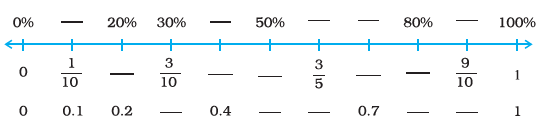
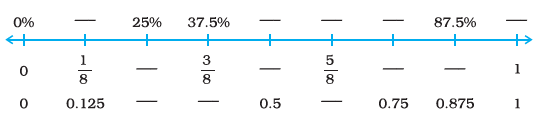
In questions 58 and 59, copy each number line. Fill in the blanks so that each mark on the number line is labelled with a per cent, a fraction and a decimal. Write all fractions in lowest terms.
Question 58.
Answer:
Solution:
The number line is divided into $10$ equal parts between $0$ and $1$. Each part represents an increment of $\frac{1}{10}$ or $0.1$ or $10 \%$. We will convert the given values to find the missing blanks.
1st Mark: $10 \%$ is $\frac{1}{10}$ and $0.1$. (Given)
2nd Mark: Percent is $20 \%$. Fraction = $\frac{20}{100} = \frac{1}{5}$. Decimal = $0.2$.
3rd Mark: Percent is $30 \%$. Fraction = $\frac{3}{10}$. Decimal = $\frac{3}{10} = 0.3$.
4th Mark: Decimal is $0.4$. Percent = $0.4 \times 100 = 40 \%$. Fraction = $\frac{4}{10} = \frac{2}{5}$.
5th Mark: Percent is $50 \%$. Fraction = $\frac{50}{100} = \frac{1}{2}$. Decimal = $0.5$.
6th Mark: Fraction is $\frac{3}{5}$. Percent = $\frac{3}{5} \times 100 = 60 \%$. Decimal = $0.6$.
7th Mark: Decimal is $0.7$. Percent = $0.7 \times 100 = 70 \%$. Fraction = $\frac{7}{10}$.
8th Mark: Percent is $80 \%$. Fraction = $\frac{80}{100} = \frac{4}{5}$. Decimal = $0.8$.
9th Mark: Fraction is $\frac{9}{10}$. Percent = $\frac{9}{10} \times 100 = 90 \%$. Decimal = $0.9$.
10th Mark: Percent is $100 \%$. Fraction = $1$. Decimal = $1.0$.
The completed labels for the blanks (highlighted in bold) are as follows:
| Mark | Per cent | Fraction (Lowest Terms) | Decimal |
| 1st | $10 \%$ | $\frac{1}{10}$ | $0.1$ |
| 2nd | $20 \%$ | $\frac{1}{5}$ | $0.2$ |
| 3rd | $30 \%$ | $\frac{3}{10}$ | $0.3$ |
| 4th | $40 \%$ | $\frac{2}{5}$ | $0.4$ |
| 5th | $50 \%$ | $\frac{1}{2}$ | $0.5$ |
| 6th | $60 \%$ | $\frac{3}{5}$ | $0.6$ |
| 7th | $70 \%$ | $\frac{7}{10}$ | $0.7$ |
| 8th | $80 \%$ | $\frac{4}{5}$ | $0.8$ |
| 9th | $90 \%$ | $\frac{9}{10}$ | $0.9$ |
| 10th | $100 \%$ | $1$ | $1$ |
Question 59.
Answer:
Solution:
The number line is divided into $8$ equal parts between $0$ and $1$. Each part represents an increment of $\frac{1}{8} = 0.125 = 12.5 \%$.
1st Mark: Fraction is $\frac{1}{8}$. Percent = $\frac{1}{8} \times 100 = 12.5 \%$. Decimal = $0.125$. (Given)
2nd Mark: Percent is $25 \%$. Fraction = $\frac{25}{100} = \frac{1}{4}$. Decimal = $0.25$.
3rd Mark: Percent is $37.5 \%$. Fraction = $\frac{37.5}{100} = \frac{375}{1000} = \frac{3}{8}$. Decimal = $0.375$.
4th Mark: Decimal is $0.5$. Percent = $0.5 \times 100 = 50 \%$. Fraction = $\frac{5}{10} = \frac{1}{2}$.
5th Mark: Fraction is $\frac{5}{8}$. Percent = $\frac{5}{8} \times 100 = 62.5 \%$. Decimal = $0.625$.
6th Mark: Decimal is $0.75$. Percent = $0.75 \times 100 = 75 \%$. Fraction = $\frac{75}{100} = \frac{3}{4}$.
7th Mark: Percent is $87.5 \%$. Fraction = $\frac{87.5}{100} = \frac{7}{8}$. Decimal = $0.875$.
8th Mark: End point $1$. Percent = $100 \%$. Fraction = $1$. Decimal = $1.0$.
The completed labels for the blanks (highlighted in bold) are as follows:
| Mark | Per cent | Fraction (Lowest Terms) | Decimal |
| 1st | $12.5 \%$ | $\frac{1}{8}$ | $0.125$ |
| 2nd | $25 \%$ | $\frac{1}{4}$ | $0.25$ |
| 3rd | $37.5 \%$ | $\frac{3}{8}$ | $0.375$ |
| 4th | $50 \%$ | $\frac{1}{2}$ | $0.5$ |
| 5th | $62.5 \%$ | $\frac{5}{8}$ | $0.625$ |
| 6th | $75 \%$ | $\frac{3}{4}$ | $0.75$ |
| 7th | $87.5 \%$ | $\frac{7}{8}$ | $0.875$ |
| 8th | $100 \%$ | $1$ | $1$ |
Question 60 to 79 (True or False)
In questions 60 to 79, state whether the statements are True or False.
Question 60. $\frac{2}{3}$ = $66\frac{2}{3}$ %
Answer:
Solution:
To convert a fraction into a percentage, we multiply it by $100$.
Percentage = $\left( \frac{2}{3} \times 100 \right) \%$
Percentage = $\frac{200}{3} \%$
Converting the improper fraction $\frac{200}{3}$ into a mixed fraction:
$\frac{200}{3} = 66\frac{2}{3} \%$
Since the calculated value matches the statement, the statement is True.
Question 61. When an improper fraction is converted into percentage then the answer can also be less than 100.
Answer:
Solution:
An improper fraction is a fraction where the numerator is greater than or equal to the denominator (e.g., $\frac{5}{4}$, $\frac{3}{2}$, $\frac{1}{1}$).
The value of an improper fraction is always greater than or equal to $1$.
When multiplied by $100$ to find the percentage, the result will always be $100 \%$ or more.
Therefore, the percentage cannot be less than $100$.
Hence, the statement is False.
Question 62. 8 hours is 50% of 4 days.
Answer:
Solution:
First, we convert $4$ days into hours:
$1$ day = $24$ hours
$4$ days = $4 \times 24 = 96$ hours
Now, calculate $50 \%$ of $4$ days ($96$ hours):
$50 \%$ of $96 = \frac{50}{100} \times 96$
$= \frac{1}{2} \times 96 = 48$ hours
Since $8$ hours is not equal to $48$ hours, the statement is False.
Question 63. The interest on 350 at 5% per annum for 73 days is ₹ 35.
Answer:
Given:
Principal ($P$) = $\textsf{₹} 350$
Rate ($R$) = $5 \%$ p.a.
Time ($T$) = $73$ days = $\frac{73}{365}$ year
Solution:
We know that $365$ is a multiple of $73$ ($73 \times 5 = 365$).
So, $T = \frac{73}{365} = \frac{1}{5}$ year.
Simple Interest ($I$) = $\frac{P \times R \times T}{100}$
$I = \frac{350 \times 5 \times \frac{1}{5}}{100}$
$I = \frac{350}{100} = \textsf{₹} 3.50$
Since the calculated interest is $\textsf{₹} 3.50$ and the statement claims it is $\textsf{₹} 35$, the statement is False.
Question 64. The simple interest on a sum of ₹ P for T years at R% per annum is given by the formula: Simple Interest = $\frac{T \;×\; P \;×\; R}{100}$ .
Answer:
Solution:
The standard formula for calculating simple interest is the product of Principal ($P$), Rate of interest ($R$), and Time period ($T$), divided by $100$.
$\text{Simple Interest} = \frac{P \times R \times T}{100}$
Since multiplication is commutative ($P \times R \times T = T \times P \times R$), the formula provided in the statement is correct.
Hence, the statement is True.
Question 65. 75% = $\frac{4}{3}$ .
Answer:
Solution:
To convert a percentage into a fraction, we divide by $100$:
$75 \% = \frac{75}{100}$
Simplifying the fraction by dividing both numerator and denominator by $25$:
$\frac{\cancel{75}^3}{\cancel{100}_4} = \frac{3}{4}$
Since $\frac{3}{4}$ is not equal to $\frac{4}{3}$ (it is actually the reciprocal), the statement is False.
Question 66. 12% of 120 is 100.
Answer:
Solution:
We calculate $12 \%$ of $120$:
$= \frac{12}{100} \times 120$
$= \frac{12 \times 12}{10}$
$= \frac{144}{10} = 14.4$
Since $14.4$ is not equal to $100$, the statement is False.
Question 67. If Ankita obtains 336 marks out of 600, then percentage of marks obtained by her is 33.6. 68. 0.018 is equivalent to 8%.
Answer:
Given:
Marks obtained = $336$
Total marks = $600$
Solution:
Percentage = $\left( \frac{\text{Marks obtained}}{\text{Total marks}} \times 100 \right) \%$
Percentage = $\left( \frac{336}{600} \times 100 \right) \%$
Percentage = $\frac{336}{6} \%$
Dividing $336$ by $6$:
$336 \div 6 = 56 \%$
Since the calculated percentage is $56 \%$ and the statement claims it is $33.6 \%$, the statement is False.
Question 68. 0.018 is equivalent to 8%.
Answer:
Solution:
To convert a decimal into a percentage, we multiply the decimal by $100$ and append the percent sign ($\%$).
Calculation:
$0.018 \times 100 \%$
$= \frac{18}{1000} \times 100 \%$
$= \frac{18}{10} \%$
$= 1.8 \%$
Since $1.8 \%$ is not equal to $8 \%$, the statement is False.
Question 69. 50% of ₹ 50 is ₹ 25.
Answer:
Given:
Total amount = $\textsf{₹} 50$
Percentage = $50 \%$
Solution:
We calculate $50 \%$ of the given amount:
$50 \% \text{ of } \textsf{₹} 50 = \frac{50}{100} \times 50$
$= \frac{1}{2} \times 50$
$= \textsf{₹} 25$
Since the calculated value matches the statement, the statement is True.
Question 70. 250 cm is 4% of 1 km.
Answer:
Given:
Part value = $250$ cm
Total value = $1$ km
Solution:
First, we convert both quantities to the same unit (cm):
$1$ km = $1000$ m
$1$ m = $100$ cm
So, $1$ km = $1000 \times 100$ cm = $1,00,000$ cm
Now, we calculate $4 \%$ of $1,00,000$ cm:
$4 \% \text{ of } 1,00,000 = \frac{4}{100} \times 1,00,000$
$= 4 \times 1000 = 4000$ cm
Since $250$ cm is not equal to $4000$ cm, the statement is False.
Question 71. Out of 600 students of a school, 126 go for a picnic. The percentage of students that did not go for the picnic is 75.
Answer:
Given:
Total students = $600$
Students who went for picnic = $126$
Solution:
Number of students who did not go = $\text{Total students} - \text{Students who went}$
Number of students who did not go = $600 - 126 = 474$
Now, calculate the percentage of students who did not go:
Percentage = $\left( \frac{474}{600} \times 100 \right) \%$
Percentage = $\frac{474}{6} \%$
The percentage is $79 \%$.
Since the calculated percentage is $79 \%$ and the statement claims it is $75$, the statement is False.
Question 72. By selling a book for ₹ 50, a shopkeeper suffers a loss of 10%. The cost price of the book is ₹ 60.
Answer:
Given:
Selling Price ($S.P.$) = $\textsf{₹} 50$
Loss Percentage = $10 \%$
Solution:
Let's check if the Cost Price ($C.P.$) is $\textsf{₹} 60$.
If $C.P. = \textsf{₹} 60$ and Loss $= 10 \%$, then:
Loss amount = $10 \%$ of $60 = \textsf{₹} 6$
$S.P. = C.P. - \text{Loss}$
$S.P. = 60 - 6 = \textsf{₹} 54$
However, the given $S.P.$ is $\textsf{₹} 50$. Since $54 \neq 50$, the statement is False.
Question 73. If a chair is bought for ₹ 2000 and is sold at a gain of 10%, then selling price of the chair is ₹ 2010.
Answer:
Given:
Cost Price ($C.P.$) = $\textsf{₹} 2000$
Gain Percentage = $10 \%$
Solution:
First, calculate the gain amount:
$\text{Gain} = 10 \% \text{ of } 2000 = \frac{10}{100} \times 2000 = \textsf{₹} 200$
Now, calculate the Selling Price ($S.P.$):
$S.P. = C.P. + \text{Gain}$
$S.P. = 2000 + 200 = \textsf{₹} 2200$
Since the calculated $S.P.$ is $\textsf{₹} 2200$ and the statement claims it is $\textsf{₹} 2010$, the statement is False.
Question 74. If a bicycle was bought for ₹ 650 and sold for ₹ 585, then the percentage of profit is 10.
Answer:
Given:
Cost Price ($C.P.$) = $\textsf{₹} 650$
Selling Price ($S.P.$) = $\textsf{₹} 585$
Solution:
Since $C.P. > S.P.$, the transaction results in a loss, not a profit.
$\text{Loss} = C.P. - S.P.$
$\text{Loss} = 650 - 585 = \textsf{₹} 65$
$\text{Loss } \% = \left( \frac{\text{Loss}}{C.P.} \times 100 \right) \%$
$\text{Loss } \% = \left( \frac{65}{650} \times 100 \right) \% = 10 \%$
Although the magnitude ($10$) is correct, the statement calls it a profit when it is actually a loss. Therefore, the statement is False.
Question 75. Sushma sold her watch for ₹ 3320 at a gain of ₹ 320. For earning a gain of 10% she should have sold the watch for ₹ 3300.
Answer:
Given:
Selling Price ($S.P.$) = $\textsf{₹} 3320$
Gain amount = $\textsf{₹} 320$
Solution:
First, we find the Cost Price ($C.P.$):
$C.P. = S.P. - \text{Gain}$
$C.P. = 3320 - 320 = \textsf{₹} 3000$
Now, calculate the Selling Price required for a $10 \%$ gain:
New Gain = $10 \% \text{ of } 3000 = \textsf{₹} 300$
New $S.P. = C.P. + \text{New Gain}$
New $S.P. = 3000 + 300 = \textsf{₹} 3300$
Since the calculated $S.P.$ matches the statement, the statement is True.
Question 76. Interest on ₹ 1200 for $1\frac{1}{2}$ years at the rate of 15% per annum is ₹ 180.
Answer:
Given:
Principal ($P$) = $\textsf{₹} 1200$
Time ($T$) = $1\frac{1}{2}$ years = $1.5$ years
Rate ($R$) = $15 \%$ p.a.
Solution:
We calculate the Simple Interest ($I$):
$I = \frac{P \times R \times T}{100}$
$I = \frac{1200 \times 15 \times 1.5}{100}$
$I = 12 \times 15 \times 1.5$
$I = 180 \times 1.5$
$I = \textsf{₹} 270$
Since the calculated interest is $\textsf{₹} 270$ and the statement claims it is $\textsf{₹} 180$, the statement is False.
Question 77. Amount received after depositing ₹ 800 for a period of 3 years at the rate of 12% per annum is ₹ 896.
Answer:
Given:
Principal ($P$) = $\textsf{₹} 800$
Time ($T$) = $3$ years
Rate ($R$) = $12 \%$ p.a.
Solution:
First, we calculate the Interest ($I$):
$I = \frac{800 \times 12 \times 3}{100} = 8 \times 36 = \textsf{₹} 288$
Now, calculate the Amount ($A$):
$A = P + I$
$A = 800 + 288 = \textsf{₹} 1088$
Since the calculated amount is $\textsf{₹} 1088$ and the statement claims it is $\textsf{₹} 896$, the statement is False.
Question 78. ₹ 6400 were lent to Feroz and Rashmi at 15% per annum for $3\frac{1}{2}$ and 5 years respectively. The difference in the interest paid by them is ₹ 150.
Answer:
Given:
Principal ($P$) = $\textsf{₹} 6400$
Rate ($R$) = $15 \%$ p.a.
Time for Feroz ($T_1$) = $3.5$ years
Time for Rashmi ($T_2$) = $5$ years
Solution:
Difference in time ($\Delta T$) = $5 - 3.5 = 1.5$ years
Difference in interest = $\frac{P \times R \times \Delta T}{100}$
Difference = $\frac{6400 \times 15 \times 1.5}{100}$
Difference = $64 \times 15 \times 1.5$
Difference = $960 \times 1.5 = \textsf{₹} 1440$
Since the calculated difference is $\textsf{₹} 1440$ and the statement claims it is $\textsf{₹} 150$, the statement is False.
Question 79. A vendor purchased 720 lemons at ₹ 120 per hundred.10% of the lemons were found rotten which he sold at ₹ 50 per hundred. If he sells the remaining lemons at ₹ 125 per hundred, then his profit will be 16%.
Answer:
Given:
Total lemons = $720$
Cost Price ($C.P.$) rate = $\textsf{₹} 120$ per $100$ lemons
Solution:
1. Total Cost Price:
$C.P. = \frac{120}{100} \times 720 = 1.2 \times 720 = \textsf{₹} 864$
2. Total Selling Price:
Rotten lemons = $10 \%$ of $720 = 72$
$S.P.$ of rotten lemons = $\frac{50}{100} \times 72 = 0.5 \times 72 = \textsf{₹} 36$
Remaining lemons = $720 - 72 = 648$
$S.P.$ of remaining lemons = $\frac{125}{100} \times 648 = 1.25 \times 648 = \textsf{₹} 810$
Total $S.P. = 36 + 810 = \textsf{₹} 846$
3. Profit or Loss:
Since $C.P. > S.P.$ ($864 > 846$), the vendor suffered a loss.
Loss = $864 - 846 = \textsf{₹} 18$
Since there is a loss and not a profit, the statement is False.
Question 80 to 140
Question 80. Find the value of x if
(i) 8% of ₹ x is ₹ 100
(ii) 32% of x kg is 400 kg
(iii) 35% of ₹ x is ₹ 280
(iv) 45% of marks x is 405.
Answer:
(i) 8% of ₹ x is ₹ 100
$\frac{8}{100} \times x = 100$
$x = \frac{100 \times 100}{8} = \frac{10000}{8}$
$x = 1250$
So, the value of $x$ is $\textsf{₹} 1250$.
(ii) 32% of x kg is 400 kg
$\frac{32}{100} \times x = 400$
$x = \frac{400 \times 100}{32} = \frac{40000}{32}$
$x = 1250$
So, the value of $x$ is $1250$ kg.
(iii) 35% of ₹ x is ₹ 280
$\frac{35}{100} \times x = 280$
$x = \frac{280 \times 100}{35}$
$x = 8 \times 100 = 800$
So, the value of $x$ is $\textsf{₹} 800$.
(iv) 45% of marks x is 405
$\frac{45}{100} \times x = 405$
$x = \frac{405 \times 100}{45}$
$x = 9 \times 100 = 900$
So, the value of $x$ is $900$ marks.
Question 81. Imagine that a 10 × 10 grid has value 300 and that this value is divided evenly among the small squares. In other words, each small square is worth 3. Use a new grid for each part of this problem, and label each grid “Value : 300.”

(a) Shade 25% of the grid. What is 25% of 300? Compare the two answers.
(b) What is the value of 25 squares?
(c) Shade 17% of the grid. What is 17% of 300? Compare the two answers.
(d) What is the value of of $\frac{1}{10}$ the grid?
Answer:
Given:
Total squares in a $10 \times 10$ grid = $100$
Total value of the grid = $300$
Value of each small square = $3$
(a) Shade 25% of the grid. What is 25% of 300? Compare the two answers.
Number of squares to be shaded = $25 \%$ of $100 = 25$ squares.
Value of shaded region = $25 \times 3 = 75$.
Calculation: $25 \%$ of $300 = \frac{25}{100} \times 300 = 25 \times 3 = 75$.
Comparison: Both answers are the same ($75$). This shows that $25 \%$ of the total value is equal to the total value of $25 \%$ of the squares.
(b) What is the value of 25 squares?
Value of $1$ square = $3$
Value of $25$ squares = $25 \times 3 = 75$
(c) Shade 17% of the grid. What is 17% of 300? Compare the two answers.
Number of squares to be shaded = $17 \%$ of $100 = 17$ squares.
Value of shaded region = $17 \times 3 = 51$.
Calculation: $17 \%$ of $300 = \frac{17}{100} \times 300 = 17 \times 3 = 51$.
Comparison: Both answers are the same ($51$).
(d) What is the value of $\frac{1}{10}$ of the grid?
Number of squares in $\frac{1}{10}$ of the grid = $\frac{1}{10} \times 100 = 10$ squares.
Value of $10$ squares = $10 \times 3 = 30$.
Question 82. Express $\frac{1}{6}$ as a per cent.
Answer:
Solution:
To convert a fraction into a per cent, we multiply it by $100$.
Percentage = $\left( \frac{1}{6} \times 100 \right) \%$
Percentage = $\frac{100}{6} \%$
Simplifying the fraction:
Percentage = $\frac{\cancel{100}^{50}}{\cancel{6}_{3}} \%$
Percentage = $16\frac{2}{3} \%$ or approximately $16.67 \%$
Question 83. Express $\frac{9}{40}$ as a per cent.
Answer:
Solution:
Percentage = $\left( \frac{9}{40} \times 100 \right) \%$
Percentage = $\frac{9 \times \cancel{100}^{5}}{\cancel{40}_{2}} \%$
Percentage = $\frac{45}{2} \%$
Percentage = $22.5 \%$
Question 84. Express $\frac{1}{100}$ as a per cent.
Answer:
Solution:
Percentage = $\left( \frac{1}{100} \times 100 \right) \%$
Percentage = $1 \%$
Question 85. Express 80% as fraction in its lowest term.
Answer:
Solution:
To convert a per cent into a fraction, we divide it by $100$.
$80 \% = \frac{80}{100}$
Simplifying to lowest terms:
$= \frac{\cancel{80}^{4}}{\cancel{100}_{5}}$
$= \frac{4}{5}$
Question 86. Express $33\frac{1}{3}$ % as a ratio in the lowest term.
Answer:
Solution:
First, convert the mixed fraction to an improper fraction:
$33\frac{1}{3} \% = \frac{100}{3} \%$
Now, convert the per cent into a fraction:
$= \frac{100}{3} \times \frac{1}{100}$
$= \frac{\cancel{100}^{1}}{3 \times \cancel{100}_{1}}$
$= \frac{1}{3}$
In ratio form, it is $1 : 3$.
Question 87. Express $16\frac{2}{3}$ % as a ratio in the lowest form.
Answer:
Solution:
First, convert to an improper fraction:
$16\frac{2}{3} \% = \frac{50}{3} \%$
Convert the per cent into a fraction:
$= \frac{50}{3} \times \frac{1}{100}$
$= \frac{\cancel{50}^{1}}{3 \times \cancel{100}_{2}}$
$= \frac{1}{6}$
In ratio form, it is $1 : 6$.
Question 88. Express 150% as a ratio in the lowest form.
Answer:
Solution:
$150 \% = \frac{150}{100}$
Simplifying to lowest terms:
$= \frac{\cancel{150}^{3}}{\cancel{100}_{2}}$
$= \frac{3}{2}$
In ratio form, it is $3 : 2$.
Question 89. Sachin and Sanjana are calculating 23% of 800.
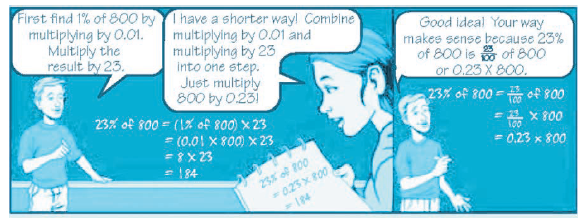
Now calculate 52% of 700 using both the ways described above. Which way do you find easier?
Answer:
To Find:
$52 \%$ of $700$ using two different methods.
Solution:
Way 1: Sachin's Method (Unitary Approach)
First, we find $1 \%$ of $700$ by multiplying it by $0.01$ (or dividing by $100$):
$1 \%$ of $700 = 0.01 \times 700 = 7$
Now, multiply the result by $52$:
$52 \%$ of $700 = 7 \times 52$
$52 \%$ of $700 = 364$
Way 2: Sanjana's Method (Direct Decimal Approach)
In this method, we combine the steps by converting the percentage directly into a decimal ($0.52$) and multiplying it by the number:
$52 \%$ of $700 = 0.52 \times 700$
$= \frac{52}{100} \times 700$
$= 52 \times 7$
$= 364$
Conclusion:
Both methods yield the same result, i.e., $364$. Generally, Way 2 (Sanjana's method) is found to be easier and faster as it involves a single multiplication step.
Question 90. Write 0.089 as a per cent.
Answer:
Solution:
To convert a decimal into a percentage, we multiply the decimal by $100$ and add the $\%$ sign.
$0.089 = (0.089 \times 100) \%$
$= \left( \frac{89}{1000} \times 100 \right) \%$
$= \frac{89}{10} \%$
$= 8.9 \%$
Thus, $0.089$ written as a per cent is $8.9 \%$.
Question 91. Write 1.56 as a per cent.
Answer:
Solution:
To convert a decimal into a percentage, we multiply by $100$.
$1.56 = (1.56 \times 100) \%$
$= 156 \%$
Thus, $1.56$ written as a per cent is $156 \%$.
Question 92. What is 15% of 20?
Answer:
Solution:
$15 \%$ of $20 = \frac{15}{100} \times 20$
Using the cancellation method:
$= \frac{15}{\cancel{100}_5} \times \cancel{20}^1$
$= \frac{15}{5}$
$= 3$
Thus, $15 \%$ of $20$ is $3$.
Question 93. What is 800% of 800?
Answer:
Solution:
$800 \%$ of $800 = \frac{800}{100} \times 800$
$= 8 \times 800$
$= 6400$
Thus, $800 \%$ of $800$ is $6400$.
Question 94. What is 100% of 500?
Answer:
Solution:
$100 \%$ of $500 = \frac{100}{100} \times 500$
$= 1 \times 500$
$= 500$
Thus, $100 \%$ of $500$ is $500$.
Question 95. What per cent of 1 hour is 30 minutes?
Answer:
Given:
Total time = $1$ hour
Part time = $30$ minutes
To Find:
Percentage of $30$ minutes in $1$ hour.
Solution:
First, we convert both quantities to the same unit. We know that:
$1 \text{ hour} = 60 \text{ minutes}$
(Conversion factor)
Now, calculate the percentage:
Percentage = $\left( \frac{\text{Part time}}{\text{Total time}} \times 100 \right) \%$
Percentage = $\left( \frac{30}{60} \times 100 \right) \%$
Percentage = $\frac{\cancel{30}^1}{\cancel{60}_2} \times 100 \%$
Percentage = $\frac{100}{2} \%$
Percentage = $50 \%$
Therefore, $30$ minutes is $50 \%$ of $1$ hour.
Question 96. What per cent of 1 day is 1 minute?
Answer:
Given:
Total time = $1$ day
Part time = $1$ minute
To Find:
Percentage of $1$ minute in $1$ day.
Solution:
First, we convert $1$ day into minutes:
$1 \text{ day} = 24 \text{ hours}$
$1 \text{ hour} = 60 \text{ minutes}$
So, $1 \text{ day} = 24 \times 60 \text{ minutes}$
Total time = $1440 \text{ minutes}$
Now, calculate the percentage:
Percentage = $\left( \frac{1}{1440} \times 100 \right) \%$
Percentage = $\frac{100}{1440} \%$
Simplifying the fraction:
Percentage = $\frac{\cancel{100}^5}{\cancel{1440}_{72}} \%$
Percentage = $\frac{5}{72} \%$
Therefore, $1$ minute is $\frac{5}{72} \%$ of $1$ day.
Question 97. What per cent of 1 km is 1000 metres?
Answer:
Given:
Total distance = $1$ km
Part distance = $1000$ metres
Solution:
First, we convert km to metres:
$1$ km = $1000$ metres
Now, calculate the percentage:
Percentage = $\left( \frac{1000 \text{ m}}{1000 \text{ m}} \times 100 \right) \%$
Percentage = $1 \times 100 \%$
Percentage = $100 \%$
Therefore, $1000$ metres is $100 \%$ of $1$ km.
Question 98. Find out 8% of 25 kg.
Answer:
Solution:
We need to calculate $8 \%$ of $25$ kg.
Value = $\frac{8}{100} \times 25$
Value = $8 \times \frac{\cancel{25}^1}{\cancel{100}_4}$
Value = $\frac{8}{4}$
Value = $2$ kg
Therefore, $8 \%$ of $25$ kg is $2$ kg.
Question 99. What percent of ₹ 80 is ₹ 100?
Answer:
Given:
Total Value (Whole) = $\textsf{₹} 80$
Part Value = $\textsf{₹} 100$
Solution:
Percentage = $\left( \frac{\text{Part Value}}{\text{Total Value}} \times 100 \right) \%$
Percentage = $\left( \frac{100}{80} \times 100 \right) \%$
Percentage = $\frac{\cancel{100}^5}{\cancel{80}_4} \times 100 \%$
Percentage = $5 \times \frac{\cancel{100}^{25}}{\cancel{4}_1} \%$
Percentage = $5 \times 25 \%$
Percentage = $125 \%$
Therefore, $\textsf{₹} 100$ is $125 \%$ of $\textsf{₹} 80$.
Question 100. 45% of the population of a town are men and 40% are women. What is the percentage of children?
Answer:
Given:
Percentage of men = $45 \%$
Percentage of women = $40 \%$
To Find:
Percentage of children in the town.
Solution:
The total population of the town is considered as $100 \%$.
Total percentage of men and women = Percentage of men + Percentage of women
Total percentage of men and women = $45 \% + 40 \% = 85 \%$
Now, calculate the percentage of children:
Percentage of children = $100 \% - 85 \%$
Percentage of children = $15 \%$
Therefore, the percentage of children in the town is $15 \%$.
Question 101. The strength of a school is 2000. If 40 % of the students are girls then how many boys are there in the school?
Answer:
Given:
Total strength of the school = $2000$
Percentage of girls = $40 \%$
To Find:
Number of boys in the school.
Solution:
Percentage of boys = $\text{Total percentage} - \text{Percentage of girls}$
Percentage of boys = $100 \% - 40 \% = 60 \%$
Now, we find the number of boys:
Number of boys = $60 \%$ of $2000$
Number of boys = $\frac{60}{100} \times 2000$
Number of boys = $60 \times 20 = 1200$
Therefore, there are $1200$ boys in the school.
Alternate Solution:
Number of girls = $40 \%$ of $2000 = \frac{40}{100} \times 2000 = 800$
Number of boys = $\text{Total students} - \text{Number of girls}$
Number of boys = $2000 - 800 = 1200$
Question 102. Chalk contains 10% calcium, 3% carbon and 12% oxygen. Find the amount of carbon and calcium (in grams) in $2\frac{1}{2}$ kg of chalk.
Answer:
Given:
Percentage of Calcium = $10 \%$
Percentage of Carbon = $3 \%$
Total weight of chalk = $2\frac{1}{2}$ kg = $2.5$ kg
To Find:
Amount of Carbon and Calcium in grams.
Solution:
First, convert the total weight from kg to grams:
Total weight = $2.5 \times 1000$ g = $2500$ g
1. Amount of Calcium:
Amount of Calcium = $10 \%$ of $2500$ g
Amount of Calcium = $\frac{10}{100} \times 2500 = 250$ g
2. Amount of Carbon:
Amount of Carbon = $3 \%$ of $2500$ g
Amount of Carbon = $\frac{3}{100} \times 2500 = 3 \times 25 = 75$ g
Therefore, the amount of calcium is $250$ g and the amount of carbon is $75$ g.
Question 103. 800 kg of mortar consists of 55% sand, 33% cement and rest lime. What is the mass of lime in mortar?
Answer:
Given:
Total mass of mortar = $800$ kg
Percentage of sand = $55 \%$
Percentage of cement = $33 \%$
To Find:
The mass of lime in the mortar.
Solution:
First, find the percentage of lime in the mortar:
Percentage of lime = $100 \% - (\text{Percentage of sand} $$ + \text{Percentage of cement})$
Percentage of lime = $100 \% - (55 \% + 33 \%) = 100 \% - 88 \% = 12 \%$
Now, calculate the mass of lime:
Mass of lime = $12 \%$ of $800$ kg
Mass of lime = $\frac{12}{100} \times 800 = 12 \times 8 = 96$ kg
Therefore, the mass of lime in the mortar is $96$ kg.
Question 104. In a furniture shop, 24 tables were bought at the rate of ₹ 450 per table. The shopkeeper sold 16 of them at the rate of ₹ 600 per table and the remaining at the rate of 400 per table. Find her gain or loss percent.
Answer:
Given:
Number of tables bought = $24$
Cost Price ($C.P.$) per table = $\textsf{₹} 450$
To Find:
Gain or Loss percentage.
Solution:
1. Total Cost Price:
Total $C.P. = 24 \times 450$
Total $C.P. = \textsf{₹} 10,800$
2. Total Selling Price:
$S.P.$ of $16$ tables = $16 \times 600 = \textsf{₹} 9,600$
Remaining tables = $24 - 16 = 8$
$S.P.$ of $8$ tables = $8 \times 400 = \textsf{₹} 3,200$
Total $S.P. = 9,600 + 3,200 = \textsf{₹} 12,800$
3. Gain or Loss:
Since $S.P. > C.P.$, there is a gain.
Gain = $12,800 - 10,800 = \textsf{₹} 2,000$
Gain $\%$ = $\left( \frac{\text{Gain}}{C.P.} \times 100 \right) \%$
Gain $\%$ = $\frac{2000}{10800} \times 100 = \frac{2000}{108} = \frac{500}{27}$
Gain $\%$ $\approx$ $18.52 \%$ (or $18\frac{14}{27} \%$).
Question 105. Medha deposited 20% of her money in a bank. After spending 20% of the remainder, she has ₹ 4800 left with her. How much did she originally have?
Answer:
Given:
Percentage deposited = $20 \%$
Percentage of remainder spent = $20 \%$
Final amount left = $\textsf{₹} 4800$
To Find:
Original amount Medha had.
Solution:
Let the original amount be $\textsf{₹} x$.
Amount deposited in bank = $20 \%$ of $x = 0.20x$
Remainder amount = $x - 0.20x = 0.80x$
Amount spent from remainder = $20 \%$ of $0.80x = 0.20 \times 0.80x = 0.16x$
Final amount left = $0.80x - 0.16x = 0.64x$
According to the question:
$0.64x = 4800$
$x = \frac{4800}{0.64} = \frac{4800 \times 100}{64}$
$x = \frac{480000}{64}$
Dividing by $8$:
$x = \frac{60000}{8} = 7500$
Therefore, Medha originally had $\textsf{₹} 7500$.
Question 106. The cost of a flower vase got increased by 12%. If the current cost is ₹ 896, what was its original cost?
Answer:
Given:
Percentage increase = $12 \%$
Current cost = $\textsf{₹} 896$
To Find:
The original cost of the flower vase.
Solution:
Let the original cost be $\textsf{₹} x$.
According to the question, the original cost plus $12 \%$ of the original cost equals the current cost.
$x + (12 \% \text{ of } x) = 896$
$x + 0.12x = 896$
$1.12x = 896$
$x = \frac{896}{1.12}$
$x = \frac{89600}{112}$
Performing division:
$x = 800$
Therefore, the original cost was $\textsf{₹} 800$.
Question 107. Radhika borrowed ₹ 12000 from her friends. Out of which ₹ 4000 were borrowed at 18% and the remaining at 15% rate of interest per annum. What is the total interest after 3 years?
Answer:
Given:
Total amount borrowed = $\textsf{₹} 12000$
Part 1: Principal ($P_1$) = $\textsf{₹} 4000$, Rate ($R_1$) = $18 \%$ p.a., Time ($T$) = $3$ years
Part 2: Principal ($P_2$) = $\textsf{₹} 12000 - \textsf{₹} 4000 = \textsf{₹} 8000$, Rate ($R_2$) = $15 \%$ p.a., Time ($T$) = $3$ years
To Find:
Total interest after $3$ years.
Solution:
First, we calculate the simple interest for Part 1 ($I_1$):
$I_1 = \frac{P_1 \times R_1 \times T}{100}$
$I_1 = \frac{4000 \times 18 \times 3}{100} = 40 \times 54 = \textsf{₹} 2160$
Next, we calculate the simple interest for Part 2 ($I_2$):
$I_2 = \frac{P_2 \times R_2 \times T}{100}$
$I_2 = \frac{8000 \times 15 \times 3}{100} = 80 \times 45 = \textsf{₹} 3600$
Now, we find the total interest:
$\text{Total Interest} = I_1 + I_2$
$\text{Total Interest} = 2160 + 3600$
$\text{Total Interest} = \textsf{₹} 5760$
Therefore, the total interest after 3 years is $\textsf{₹} 5760$.
Question 108. A man travelled 60 km by car and 240 km by train. Find what per cent of total journey did he travel by car and what per cent by train?
Answer:
Given:
Distance travelled by car = $60$ km
Distance travelled by train = $240$ km
To Find:
Percentage of total journey travelled by car and by train.
Solution:
First, calculate the total journey distance:
Total distance = $60$ km + $240$ km = $300$ km
Now, calculate the percentage of journey by car:
$\text{Percentage by car} = \left( \frac{\text{Distance by car}}{\text{Total distance}} \times 100 \right) \%$
$\text{Percentage by car} = \left( \frac{60}{300} \times 100 \right) \% = \frac{60}{3} \% = 20 \%$
Next, calculate the percentage of journey by train:
$\text{Percentage by train} = \left( \frac{\text{Distance by train}}{\text{Total distance}} \times 100 \right) \%$
$\text{Percentage by train} = \left( \frac{240}{300} \times 100 \right) \% = \frac{240}{3} \% = 80 \%$
Therefore, the man travelled $20 \%$ of the journey by car and $80 \%$ by train.
Question 109. By selling a chair for ₹ 1440, a shopkeeper loses 10%. At what price did he buy it?
Answer:
Given:
Selling Price ($S.P.$) = $\textsf{₹} 1440$
Loss percentage = $10 \%$
To Find:
Cost Price ($C.P.$) of the chair.
Solution:
Let the Cost Price be $C.P$. We know that:
$C.P. = \frac{100}{100 - \text{Loss } \%} \times S.P.$
$C.P. = \frac{100}{100 - 10} \times 1440$
$C.P. = \frac{100}{90} \times 1440$
$C.P. = 100 \times \frac{\cancel{1440}^{16}}{\cancel{90}_{1}}$
$C.P. = 100 \times 16 = 1600$
$C.P. = \textsf{₹} 1600$
Therefore, the shopkeeper bought the chair for $\textsf{₹} 1600$.
Question 110. Dhruvika invested money for a period from May 2006 to April 2008 at rate of 12% per annum. If interest received by her is ₹ 1620, find the money invested.
Answer:
Given:
Rate of interest ($R$) = $12 \%$ p.a.
Interest ($I$) = $\textsf{₹} 1620$
Time period ($T$) = From May 2006 to April 2008 = $2$ years
To Find:
Principal ($P$), i.e., money invested.
Solution:
The formula for Simple Interest is $I = \frac{P \times R \times T}{100}$.
Rearranging the formula to find $P$:
$P = \frac{I \times 100}{R \times T}$
$P = \frac{1620 \times 100}{12 \times 2}$
$P = \frac{162000}{24}$
Dividing by $12$ first:
$P = \frac{\cancel{1620}^{135} \times 100}{\cancel{12}_{1} \times 2} = \frac{13500}{2}$
$P = 6750$
$P = \textsf{₹} 6750$
Therefore, the money invested by Dhruvika was $\textsf{₹} 6750$.
Question 111. A person wanted to sell a scooter at a loss of 25%. But at the last moment he changed his mind and sold the scooter at a loss of 20%. If the difference in the two SP’s is ₹ 4000, then find the CP of the scooter.
Answer:
Given:
Initial loss percentage = $25 \%$
Actual loss percentage = $20 \%$
Difference in Selling Prices ($S.P.s$) = $\textsf{₹} 4000$
To Find:
Cost Price ($C.P.$) of the scooter.
Solution:
Let the Cost Price ($C.P.$) of the scooter be $x$.
$S.P. \text{ at } 25 \% \text{ loss} = x - 25 \% \text{ of } x = 0.75x$
$S.P. \text{ at } 20 \% \text{ loss} = x - 20 \% \text{ of } x = 0.80x$
The difference between these two $S.P.s$ is $\textsf{₹} 4000$.
$0.80x - 0.75x = 4000$
(According to the condition)
$0.05x = 4000$
$x = \frac{4000}{0.05}$
$x = \frac{4000 \times 100}{5}$
$x = 800 \times 100 = 80000$
Therefore, the cost price of the scooter is $\textsf{₹} 80,000$.
Question 112. The population of a village is 8000. Out of these, 80% are literate and of these literate people, 40% are women. Find the ratio of the number of literate women to the total population.
Answer:
Given:
Total population = $8000$
Literacy percentage = $80 \%$
Percentage of women among literates = $40 \%$
To Find:
The ratio of literate women to the total population.
Solution:
First, find the total number of literate people:
$\text{Number of literates} = 80 \% \text{ of } 8000 = \frac{80}{100} \times 8000 = 6400$
Next, find the number of literate women:
$\text{Number of literate women} = 40 \% \text{ of } 6400 = \frac{40}{100} \times 6400 = 2560$
Now, find the ratio of literate women to the total population:
$\text{Ratio} = \frac{\text{Literate women}}{\text{Total population}}$
$\text{Ratio} = \frac{2560}{8000}$
Simplifying the fraction:
$\text{Ratio} = \frac{256}{800}$
$\text{Ratio} = \frac{\cancel{256}^{8}}{\cancel{800}_{25}} = \frac{8}{25}$
Therefore, the ratio is $8 : 25$.
Question 113. In an entertainment programme, 250 tickets of ₹ 400 and 500 tickets of ₹ 100 were sold. If the entertainment tax is 40% on ticket of ₹ 400 and 20% on ticket of ₹ 100, find how much entertainment tax was collected from the programme.
Answer:
Given:
Number of tickets of $\textsf{₹} 400$ = $250$
Tax on $\textsf{₹} 400$ ticket = $40 \%$
Number of tickets of $\textsf{₹} 100$ = $500$
Tax on $\textsf{₹} 100$ ticket = $20 \%$
To Find:
Total entertainment tax collected.
Solution:
First, we calculate the tax collected from the $\textsf{₹} 400$ tickets:
Tax per ticket = $40 \%$ of $\textsf{₹} 400$ = $\frac{40}{100} \times 400 = \textsf{₹} 160$
Total tax from 250 tickets = $250 \times 160$
Tax from first category = $\textsf{₹} 40,000$
Now, we calculate the tax collected from the $\textsf{₹} 100$ tickets:
Tax per ticket = $20 \%$ of $\textsf{₹} 100$ = $\textsf{₹} 20$
Total tax from 500 tickets = $500 \times 20 = \textsf{₹} 10,000$
Total entertainment tax collected = $\textsf{₹} 40,000 + \textsf{₹} 10,000$
Total tax = $\textsf{₹} 50,000$
Question 114. Bhavya earns ₹ 50,000 per month and spends 80% of it. Due to pay revision, her monthly income increases by 20% but due to price rise, she has to spend 20% more. Find her new savings.
Answer:
Given:
Original Income = $\textsf{₹} 50,000$
Original Expenditure = $80 \%$ of income
Income Increase = $20 \%$
Expenditure Increase = $20 \%$
To Find:
New Savings.
Solution:
Step 1: Calculate original expenditure
Original Expenditure = $\frac{80}{100} \times 50,000 = \textsf{₹} 40,000$
Step 2: Calculate new income
Increase in Income = $20 \%$ of $50,000 = \frac{20}{100} \times 50,000 = \textsf{₹} 10,000$
New Income = $50,000 + 10,000 = \textsf{₹} 60,000$
Step 3: Calculate new expenditure
Increase in Expenditure = $20 \%$ of $40,000 = \frac{20}{100} \times 40,000 = \textsf{₹} 8,000$
New Expenditure = $40,000 + 8,000 = \textsf{₹} 48,000$
Step 4: Calculate new savings
New Savings = New Income $-$ New Expenditure
New Savings = $60,000 - 48,000$
New Savings = $\textsf{₹} 12,000$
Question 115. In an examination, there are three papers each of 100 marks. A candidate obtained 53 marks in the first and 75 marks in the second paper. How many marks must the candidate obtain in the third paper to get an overall of 70 per cent marks?
Answer:
Given:
Number of papers = $3$
Maximum marks per paper = $100$
Marks in Paper 1 = $53$
Marks in Paper 2 = $75$
Target overall percentage = $70 \%$
To Find:
Marks required in the third paper.
Solution:
Total maximum marks = $3 \times 100 = 300$
Required total marks to get $70 \%$ = $70 \%$ of $300$
Required total = $\frac{70}{100} \times 300 = 210$ marks
Sum of marks obtained in first two papers = $53 + 75$
Marks required in the third paper = Required total $-$ Marks obtained
Marks required = $210 - 128$
Marks required = $82$
Question 116. Health Application
A doctor reports blood pressure in millimetres of mercury (mm Hg) as a ratio of systolic blood pressure to diastolic blood pressure (such as 140 over 80). Systolic pressure is measured when the heart beats, and diastolic pressure is measured when it rests. Refer to the table of blood pressure ranges for adults.
| Blood Pressure Rane | |||
|---|---|---|---|
| Normal | Prehypertension | Hypertension (Very High) | |
| Sytolic | Under 120 mm Hg | 120 - 139 mm Hg | 140 mm Hg and above |
| Distolic | Under 80 mm Hg | 80 - 89 mm Hg | 90 mm Hg and above |
Manohar is a healthy 37 years old man whose blood pressure is in the normal category.
(a) Calculate an approximate ratio of systolic to diastolic blood pressures in the normal range.
(b) If Manohar’s systolic blood pressure is 102 mm Hg, use the ratio from part (a) to predict his diastolic blood pressure.
(c) Calculate ratio of average systolic to average diastolic blood pressure in the prehypertension category.
Answer:
(a) Calculate an approximate ratio of systolic to diastolic blood pressures in the normal range.
In the normal range, the upper limits are approximately $120$ for systolic and $80$ for diastolic.
Ratio = $\frac{\text{Systolic}}{\text{Diastolic}}$
Ratio = $\frac{120}{80}$
Simplifying the fraction:
Ratio = $\frac{\cancel{120}^{3}}{\cancel{80}_{2}} = \frac{3}{2}$ or $3 : 2$ (which is $1.5$).
(b) If Manohar’s systolic blood pressure is 102 mm Hg, use the ratio from part (a) to predict his diastolic blood pressure.
Using the ratio $\frac{\text{Systolic}}{\text{Diastolic}} = \frac{3}{2}$:
$\frac{102}{\text{Diastolic}} = \frac{3}{2}$
$3 \times \text{Diastolic} = 102 \times 2$
$3 \times \text{Diastolic} = 204$
$\text{Diastolic} = \frac{204}{3}$
$\text{Diastolic} = 68$ mm Hg
Predicted Diastolic blood pressure = $68$ mm Hg.
(c) Calculate ratio of average systolic to average diastolic blood pressure in the prehypertension category.
Systolic Range (Prehypertension): $120$ to $139$
Average Systolic = $\frac{120 + 139}{2} = \frac{259}{2} = 129.5$
Diastolic Range (Prehypertension): $80$ to $89$
Average Diastolic = $\frac{80 + 89}{2} = \frac{169}{2} = 84.5$
Ratio = $\frac{129.5}{84.5}$
Multiplying by 10 to remove decimals: $\frac{1295}{845}$
Dividing both by 5: $\frac{\cancel{1295}^{259}}{\cancel{845}_{169}}$
The ratio is approximately $1.53 : 1$ (or $259 : 169$).
Question 117.
(a) Science Application: The king cobra can reach a length of 558 cm. This is only about 60 per cent of the length of the largest reticulated python. Find the length of the largest reticulated python.
(b) Physical Science Application: Unequal masses will not balance on a fulcrum if they are at equal distance from it; one side will go up and the other side will go down. Unequal masses will balance when the following proportion is true:
$\frac{mass\;1}{length\;2} = \frac{mass\;2}{length\;1}$
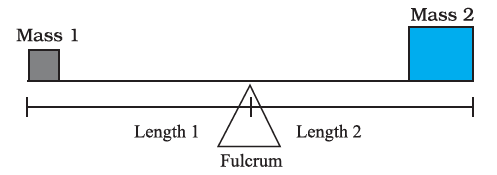
Two children can be balanced on a seesaw when $\frac{mass\;1}{length\;2} = \frac{mass\;2}{length\;1}$ . The child on the left and child on the right are balanced. What is the mass of the child on the right?
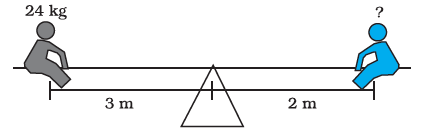
(c) Life Science Application
A DNA model was built using the scale 2 cm : 0.0000001 mm. If the model of the DNA chain is 17 cm long, what is the length of the actual chain?
Answer:
(a) Solution:
Given:
Length of the King Cobra = $558$ cm
Percentage of python's length represented by Cobra = $60 \%$
To Find:
The length of the largest reticulated python.
Solution:
Let the length of the largest reticulated python be $x$ cm.
According to the question:
$60 \%$ of $x = 558$
$\frac{60}{100} \times x = 558$
$x = \frac{558 \times 100}{60}$
$x = \frac{558 \times 10}{6}$
$x = 93 \times 10$
$x = 930$ cm
Therefore, the length of the largest reticulated python is $930$ cm.
(b) Solution:
Given:
From the image of the children on the seesaw:
Mass on the left ($\text{mass 1}$) = $24$ kg
Distance of child 1 from fulcrum ($\text{length 1}$) = $3$ m
Distance of child 2 from fulcrum ($\text{length 2}$) = $2$ m
To Find:
Mass of the child on the right ($\text{mass 2}$).
Solution:
The balancing condition is given as:
$\frac{\text{mass 1}}{\text{length 2}} = \frac{\text{mass 2}}{\text{length 1}}$
Substituting the known values:
$\frac{24}{2} = \frac{\text{mass 2}}{3}$
$12 = \frac{\text{mass 2}}{3}$
$\text{mass 2} = 12 \times 3$
$\text{mass 2} = 36$ kg
Therefore, the mass of the child on the right is $36$ kg.
(c) Solution:
Given:
Scale of the model = $2$ cm : $0.0000001$ mm
Length of the DNA model = $17$ cm
To Find:
The actual length of the DNA chain.
Solution:
Let the actual length be $y$ mm.
Using the unitary method:
If $2$ cm model length corresponds to $0.0000001$ mm actual length,
Then $1$ cm model length corresponds to $\frac{0.0000001}{2}$ mm.
So, $17$ cm model length corresponds to $\frac{0.0000001}{2} \times 17$ mm.
Actual length = $8.5 \times 0.0000001$ mm
Actual length = $0.00000085$ mm
Therefore, the length of the actual DNA chain is $0.00000085$ mm.
Question 118. Language Application
Given below are few Mathematical terms.
Find
(a) The ratio of consonants to vowels in each of the terms.
(b) The percentage of consonants in each of the terms.
Answer:
Solution:
First, we identify the vowels (A, E, I, O, U) and consonants in each word provided in the cloud image. Note: 'Y' is treated as a consonant in this context.
1. Hypotenuse (H-Y-P-O-T-E-N-U-S-E)
Total letters = $10$
Vowels = O, E, U, E (Total = $4$)
Consonants = H, Y, P, T, N, S (Total = $6$)
(a) Ratio (Consonants : Vowels) = $6 : 4 = \mathbf{3 : 2}$
(b) Percentage of Consonants = $\left( \frac{6}{10} \times 100 \right) \% = \mathbf{60 \%}$
2. Congruence (C-O-N-G-R-U-E-N-C-E)
Total letters = $10$
Vowels = O, U, E, E (Total = $4$)
Consonants = C, N, G, R, N, C (Total = $6$)
(a) Ratio (Consonants : Vowels) = $6 : 4 = \mathbf{3 : 2}$
(b) Percentage of Consonants = $\left( \frac{6}{10} \times 100 \right) \% = \mathbf{60 \%}$
3. Perpendicular (P-E-R-P-E-N-D-I-C-U-L-A-R)
Total letters = $13$
Vowels = E, E, I, U, A (Total = $5$)
Consonants = P, R, P, N, D, C, L, R (Total = $8$)
(a) Ratio (Consonants : Vowels) = $\mathbf{8 : 5}$
(b) Percentage of Consonants = $\left( \frac{8}{13} \times 100 \right) \% \approx \mathbf{61.54 \%}$
4. Transversal (T-R-A-N-S-V-E-R-S-A-L)
Total letters = $11$
Vowels = A, E, A (Total = $3$)
Consonants = T, R, N, S, V, R, S, L (Total = $8$)
(a) Ratio (Consonants : Vowels) = $\mathbf{8 : 3}$
(b) Percentage of Consonants = $\left( \frac{8}{11} \times 100 \right) \% \approx \mathbf{72.73 \%}$
5. Correspondence (C-O-R-R-E-S-P-O-N-D-E-N-C-E)
Total letters = $14$
Vowels = O, E, O, E, E (Total = $5$)
Consonants = C, R, R, S, P, N, D, N, C (Total = $9$)
(a) Ratio (Consonants : Vowels) = $\mathbf{9 : 5}$
(b) Percentage of Consonants = $\left( \frac{9}{14} \times 100 \right) \% \approx \mathbf{64.29 \%}$
Question 119. What’s the Error? An analysis showed that 0.06 per cent of the T-shirts made by one company were defective. A student says this is 6 out of every 100. What is the student’s error?
Answer:
Given:
Percentage of defective T-shirts = $0.06 \%$
Student's claim = $6$ out of every $100$
Solution:
To find how many T-shirts are defective out of $100$, we convert the percentage into a number:
$0.06 \%$ of $100 = \frac{0.06}{100} \times 100 = 0.06$
So, $0.06 \%$ means $0.06$ T-shirts out of $100$, which is equivalent to $6$ out of $10,000$.
The Student's Error:
The student confused $0.06 \%$ with $6 \%$. A claim of "$6$ out of every $100$" represents $6 \%$, whereas the actual defective rate is much lower at $0.06 \%$.
Question 120. What’s the Error? A student said that the ratios $\frac{3}{4}$ and $\frac{9}{16}$ were proportional. What error did the student make?
Answer:
Solution:
Two ratios are said to be in proportion if they are equal.
Let's check if $\frac{3}{4} = \frac{9}{16}$.
By cross-multiplication:
$3 \times 16 = 48$
$4 \times 9 = 36$
Since $48 \neq 36$, the ratios are not proportional.
The Student's Error:
The student likely thought that since $3^2 = 9$ and $4^2 = 16$, the ratios must be equivalent. However, to maintain proportionality, the numerator and denominator must be multiplied by the same number, not squared. To make $\frac{3}{4}$ have a numerator of $9$, it should be multiplied by $3$ ($ \frac{3 \times 3}{4 \times 3} = \frac{9}{12} $).
Question 121. What’s the Error? A clothing store charges ₹ 1024 for 4 T-shirts. A student says that the unit price is ₹ 25.6 per T-shirt. What is the error? What is the correct unit price?
Answer:
Given:
Price of $4$ T-shirts = $\textsf{₹} 1024$
Student's claim for unit price = $\textsf{₹} 25.6$
Solution:
To find the correct unit price, we divide the total cost by the number of T-shirts:
$\text{Correct Unit Price} = \frac{1024}{4}$
The correct unit price is $\textsf{₹} 256$.
The Student's Error:
The student made a decimal point error. They likely divided $102.4$ by $4$ or simply placed the decimal incorrectly after dividing. The student's answer is $10$ times smaller than the correct value.
Question 122. A tea merchant blends two varieties of tea in the ratio of 5 : 4. The cost of first variety is ₹ 200 per kg and that of second variety is ₹ 300 per kg. If he sells the blended tea at the rate of ₹ 275 per kg, find out the percentage of her profit or loss.
Answer:
Given:
Ratio of two varieties = $5 : 4$
Cost of variety 1 = $\textsf{₹} 200/\text{kg}$
Cost of variety 2 = $\textsf{₹} 300/\text{kg}$
Selling Price of blend = $\textsf{₹} 275/\text{kg}$
To Find:
Profit or Loss percentage.
Solution:
Let the merchant blend $5$ kg of variety 1 and $4$ kg of variety 2.
Total weight of the blend = $5 + 4 = 9$ kg
1. Calculation of Total Cost Price ($C.P.$):
$C.P. \text{ of variety 1} = 5 \times 200 = \textsf{₹} 1000$
$C.P. \text{ of variety 2} = 4 \times 300 = \textsf{₹} 1200$
Total $C.P. = 1000 + 1200 = \textsf{₹} 2200$
2. Calculation of Total Selling Price ($S.P.$):
Total $S.P. = \text{Total weight} \times \text{S.P. rate}$
Total $S.P. = 9 \times 275 = \textsf{₹} 2475$
3. Calculation of Profit/Loss:
Since $S.P. > C.P.$, there is a profit.
$\text{Profit} = S.P. - C.P. = 2475 - 2200 = \textsf{₹} 275$
$\text{Profit } \% = \left( \frac{\text{Profit}}{C.P.} \times 100 \right) \%$
$\text{Profit } \% = \left( \frac{275}{2200} \times 100 \right) \%$
$\text{Profit } \% = \frac{\cancel{275}^{25}}{\cancel{2200}_{22 \times 100}} \times 100$
$\text{Profit } \% = \frac{275}{22} = 12.5 \%$
Therefore, the merchant makes a $12.5 \%$ profit.
Question 123. A piece of cloth 5 m long shrinks 10 per cent on washing. How long will the cloth be after washing?
Answer:
Given:
Original length of cloth = $5$ m
Shrinkage percentage = $10 \%$
To Find:
New length of cloth after washing.
Solution:
First, we calculate the length that the cloth shrinks:
$\text{Shrinkage} = 10 \% \text{ of } 5 \text{ m}$
$\text{Shrinkage} = \frac{10}{100} \times 5 = 0.1 \times 5 = 0.5 \text{ m}$
Now, we find the new length:
$\text{New Length} = \text{Original Length} - \text{Shrinkage}$
$\text{New Length} = 5 - 0.5 = 4.5 \text{ m}$
Therefore, the cloth will be $4.5$ m long after washing.
Question 124. Nancy obtained 426 marks out of 600 and the marks obtained by Rohit are 560 out of 800. Whose performance is better?
Answer:
Given:
Marks obtained by Nancy = $426$ out of $600$
Marks obtained by Rohit = $560$ out of $800$
To Find:
Whose performance is better by comparing their percentages.
Solution:
To compare the performance, we need to calculate the percentage of marks obtained by both Nancy and Rohit.
1. Percentage obtained by Nancy:
$\text{Percentage} = \left( \frac{\text{Marks Obtained}}{\text{Total Marks}} \times 100 \right) \%$
$\text{Percentage} = \left( \frac{426}{600} \times 100 \right) \%$
$\text{Percentage} = \frac{426}{6} \%$
$\text{Percentage} = 71 \%$
2. Percentage obtained by Rohit:
$\text{Percentage} = \left( \frac{560}{800} \times 100 \right) \%$
$\text{Percentage} = \frac{560}{8} \%$
$\text{Percentage} = 70 \%$
Comparing the two percentages, we see that $71 \% > 70 \%$.
Therefore, Nancy's performance is better.
Question 125. A memorial trust donates ₹ 5,00,000 to a school, the interest on which is to be used for awarding 3 scholarships to students obtaining first three positions in the school examination every year. If the donation earns an interest of 12 per cent per annum and the values of the second and third scholarships are ₹ 20,000 and ₹ 15,000 respectively, find out the value of the first scholarship.
Answer:
Given:
Principal Donation ($P$) = $\textsf{₹} 5,00,000$
Rate of Interest ($R$) = $12 \%$ per annum
Time ($T$) = $1$ year
Value of 2nd Scholarship = $\textsf{₹} 20,000$
Value of 3rd Scholarship = $\textsf{₹} 15,000$
To Find:
The value of the 1st scholarship.
Solution:
First, we calculate the total interest earned on the donation in one year:
$\text{Interest} = \frac{P \times R \times T}{100}$
$\text{Interest} = \frac{5,00,000 \times 12 \times 1}{100}$
$\text{Interest} = 5,000 \times 12 = \textsf{₹} 60,000$
The total interest is used to award the three scholarships. Therefore:
$\text{Total Interest} = \text{1st Scholarship} + \text{2nd Scholarship} + \text{3rd Scholarship}$
$60,000 = \text{1st Scholarship} + 20,000 + 15,000$
$60,000 = \text{1st Scholarship} + 35,000$
$\text{1st Scholarship} = 60,000 - 35,000$
$\text{1st Scholarship} = \textsf{₹} 25,000$
Therefore, the value of the first scholarship is $\textsf{₹} 25,000$.
Question 126. Ambika got 99 per cent marks in Mathematics, 76 per cent marks in Hindi, 61 per cent in English, 84 per cent in Science, and 95% in Social Science. If each subject carries 100 marks, then find the percentage of marks obtained by Ambika in the aggregate of all the subjects.
Answer:
Given:
Number of subjects = $5$
Marks in each subject = $100$
Marks in Mathematics = $99 \%$ of $100 = 99$
Marks in Hindi = $76 \%$ of $100 = 76$
Marks in English = $61 \%$ of $100 = 61$
Marks in Science = $84 \%$ of $100 = 84$
Marks in Social Science = $95 \%$ of $100 = 95$
To Find:
The aggregate percentage of marks obtained by Ambika.
Solution:
First, we find the total marks obtained by Ambika:
$\text{Total marks obtained} = 99 + 76 + 61 + 84 + 95$
$\text{Total marks obtained} = 415$
Now, we find the total maximum marks:
$\text{Total maximum marks} = 5 \times 100 = 500$
Finally, we calculate the aggregate percentage:
$\text{Aggregate Percentage} = \left( \frac{\text{Total Marks Obtained}}{\text{Total Maximum Marks}} \times 100 \right) \%$
$\text{Aggregate Percentage} = \left( \frac{415}{500} \times 100 \right) \%$
$\text{Aggregate Percentage} = \frac{415}{5} \%$
$\text{Aggregate Percentage} = 83 \%$
Therefore, the aggregate percentage of marks obtained by Ambika is $83 \%$.
Question 127. What sum of money lent out at 16 per cent per annum simple interest would produce ₹ 9600 as interest in 2 years?
Answer:
Given:
Simple Interest ($I$) = $\textsf{₹} 9600$
Rate ($R$) = $16 \%$ per annum
Time ($T$) = $2$ years
To Find:
The Principal sum ($P$).
Solution:
The formula for Simple Interest is:
$I = \frac{P \times R \times T}{100}$
Rearranging the formula to find the Principal ($P$):
$P = \frac{I \times 100}{R \times T}$
Substituting the given values:
$P = \frac{9600 \times 100}{16 \times 2}$
$P = \frac{9600 \times 100}{32}$
Dividing $9600$ by $32$:
$P = 300 \times 100$
$P = 30,000$
Therefore, the sum of money lent out is $\textsf{₹} 30,000$.
Question 128. Harish bought a gas-chullah for ₹ 900 and later sold it to Archana at a profit of 5 per cent. Archana used it for a period of two years and later sold it to Babita at a loss of 20 per cent. For how much did Babita get it?
Answer:
Given:
Cost Price for Harish = $\textsf{₹} 900$
Profit percentage for Harish = $5 \%$
Loss percentage for Archana = $20 \%$
To Find:
The price Babita paid for the gas-chullah.
Solution:
1. Transaction between Harish and Archana:
Profit amount for Harish = $5 \%$ of $900$
$\text{Profit} = \frac{5}{100} \times 900 = \textsf{₹} 45$
Selling Price for Harish (which is the Cost Price for Archana) = $900 + 45 = \textsf{₹} 945$
2. Transaction between Archana and Babita:
Archana's Cost Price = $\textsf{₹} 945$
Loss amount for Archana = $20 \%$ of $945$
$\text{Loss} = \frac{20}{100} \times 945 = \frac{1}{5} \times 945$
$\text{Loss} = \textsf{₹} 189$
Selling Price for Archana (which is the price Babita pays) = $945 - 189$
Price paid by Babita = $\textsf{₹} 756$
Therefore, Babita got the gas-chullah for $\textsf{₹} 756$.
Question 129. Match each of the entries in Column I with the appropriate entries in Column II:
Column I
(i) 3:5
(ii) 2.5
(iii) 100%
(iv) $\frac{2}{3}$
(v) $6\frac{1}{4}$ %
(vi) 12.5 %
(vii) SP when CP = ₹ 50 and loss = 6 %
(viii) SP when CP = ₹ 50 and profit = ₹ 4
(ix) Profit% when CP = ₹ 40 and SP = ₹ 50
(x) Profit% when CP = ₹ 50 and SP = ₹ 60
(xi) Interest when principal = ₹ 800, Rate of interest = 10% per annum and period = 2 years
(xii) Amount when principal = ₹ 150, Rate of interest = 6% per annum and period = 1 year
Column II
(A) ₹ 54
(B) ₹ 47
(C) ₹ 53
(D) ₹ 160
(E) 60 %
(F) 25 %
(G) $\frac{1}{16}$
(H) 250 %
(I) ₹ 159
(J) $66\frac{2}{3}$ %
(K) 20 %
(L) 0. 125
(M) 3 : 2
(N) ₹ 164
(O) 3 : 3
Answer:
Solution:
Let's solve each entry in Column I to find its match in Column II:
(i) $3:5 = \frac{3}{5} \times 100 \% = 60 \%$ $\rightarrow$ (E)
(ii) $2.5 = 2.5 \times 100 \% = 250 \%$ $\rightarrow$ (H)
(iii) $100 \% = \frac{100}{100} = 1$, which can be written as $3:3$ $\rightarrow$ (O)
(iv) $\frac{2}{3} = \frac{2}{3} \times 100 \% = \frac{200}{3} \% = 66\frac{2}{3} \%$ $\rightarrow$ (J)
(v) $6\frac{1}{4} \% = \frac{25}{4} \% = \frac{25}{4 \times 100} = \frac{1}{4 \times 4} = \frac{1}{16}$ $\rightarrow$ (G)
(vi) $12.5 \% = \frac{12.5}{100} = 0.125$ $\rightarrow$ (L)
(vii) $S.P.$ when $C.P. = \textsf{₹} 50$ and loss $= 6 \%$:
$\text{Loss} = \frac{6}{100} \times 50 = \textsf{₹} 3$
$S.P. = 50 - 3 = \textsf{₹} 47$
$\rightarrow$ (B)
(viii) $S.P.$ when $C.P. = \textsf{₹} 50$ and profit $= \textsf{₹} 4$:
$S.P. = 50 + 4 = \textsf{₹} 54$
$\rightarrow$ (A)
(ix) Profit% when $C.P. = \textsf{₹} 40$ and $S.P. = \textsf{₹} 50$:
$\text{Profit} = 50 - 40 = 10$
$\text{Profit \%} = \frac{10}{40} \times 100 = 25 \%$
$\rightarrow$ (F)
(x) Profit% when $C.P. = \textsf{₹} 50$ and $S.P. = \textsf{₹} 60$:
$\text{Profit} = 60 - 50 = 10$
$\text{Profit \%} = \frac{10}{50} \times 100 = 20 \%$
$\rightarrow$ (K)
(xi) Interest when $P = \textsf{₹} 800, R = 10 \%, T = 2$ years:
$I = \frac{800 \times 10 \times 2}{100} = \textsf{₹} 160$
$\rightarrow$ (D)
(xii) Amount when $P = \textsf{₹} 150, R = 6 \%, T = 1$ year:
$I = \frac{150 \times 6 \times 1}{100} = 9$
$A = 150 + 9 = \textsf{₹} 159$
$\rightarrow$ (I)
Matching Summary Table:
| Column I | Column II |
| (i) | (E) |
| (ii) | (H) |
| (iii) | (O) |
| (iv) | (J) |
| (v) | (G) |
| (vi) | (L) |
| (vii) | (B) |
| (viii) | (A) |
| (ix) | (F) |
| (x) | (K) |
| (xi) | (D) |
| (xii) | (I) |
Question 130. In a debate competition, the judges decide that 20 per cent of the total marks would be given for accent and presentation. 60 per cent of the rest are reserved for the subject matter and the rest are for rebuttal. If this means 8 marks for rebuttal, then find the total marks.
Answer:
Given:
Percentage for Accent and Presentation = $20 \%$
Percentage for Subject Matter = $60 \%$ of the remaining marks
Marks for Rebuttal = $8$
To Find:
Total marks.
Solution:
Let the total marks be $x$.
Marks for Accent and Presentation = $20 \%$ of $x = 0.20x$
Remaining marks = $x - 0.20x = 0.80x$
Marks for Subject Matter = $60 \%$ of $0.80x = 0.48x$
Remaining marks for Rebuttal = $0.80x - 0.48x = 0.32x$
According to the question, the marks for rebuttal is $8$:
$0.32x = 8$
$x = \frac{8}{0.32}$
$x = \frac{800}{32}$
$x = 25$
Therefore, the total marks are $25$.
Question 131. Divide ₹ 10000 in two parts so that the simple interest on the first part for 4 years at 12 per cent per annum may be equal to the simple interest on the second part for 4.5 years at 16 per cent per annum.
Answer:
Given:
Total Amount = $\textsf{₹} 10000$
Condition: Simple Interest on Part 1 ($I_1$) = Simple Interest on Part 2 ($I_2$)
Part 1: Time ($T_1$) = $4$ years, Rate ($R_1$) = $12 \%$
Part 2: Time ($T_2$) = $4.5$ years, Rate ($R_2$) = $16 \%$
To Find:
The two parts of the money.
Solution:
Let the first part be $\textsf{₹} x$.
Then, the second part will be $\textsf{₹} (10000 - x)$.
Simple Interest on first part ($I_1$):
$I_1 = \frac{x \times 12 \times 4}{100} = \frac{48x}{100}$
Simple Interest on second part ($I_2$):
$I_2 = \frac{(10000 - x) \times 16 \times 4.5}{100}$
$I_2 = \frac{(10000 - x) \times 72}{100}$
Since $I_1 = I_2$:
$\frac{48x}{100} = \frac{72(10000 - x)}{100}$
$48x = 720000 - 72x$
$48x + 72x = 720000$
$120x = 720000$
$x = \frac{720000}{120} = 6000$
So, the first part is $\textsf{₹} 6000$.
The second part = $10000 - 6000 = $ $\textsf{₹} 4000$.
Question 132. ₹ 9000 becomes ₹ 18000 at simple interest in 8 years. Find the rate per cent per annum.
Answer:
Given:
Principal ($P$) = $\textsf{₹} 9000$
Amount ($A$) = $\textsf{₹} 18000$
Time ($T$) = $8$ years
To Find:
Rate of interest per annum ($R$).
Solution:
First, we find the Simple Interest ($I$):
$I = A - P$
$I = 18000 - 9000 = \textsf{₹} 9000$
Now, using the Simple Interest formula:
$I = \frac{P \times R \times T}{100}$
$9000 = \frac{9000 \times R \times 8}{100}$
$1 = \frac{8R}{100}$
$8R = 100$
$R = \frac{100}{8} = 12.5 \%$
Therefore, the rate of interest is $12.5 \%$ per annum.
Question 133. In how many years will the simple interest on a certain sum be 4.05 times the principal at 13.5 per cent per annum?
Answer:
Given:
$SI = 4.05 \times P$
(Interest is 4.05 times Principal)
$R = 13.5\%$ p.a.
(Rate of Interest)
To Find:
Time period ($T$) in years.
Solution:
We know the formula for Simple Interest:
$SI = \frac{P \times R \times T}{100}$
Substituting the given values into the formula:
$4.05P = \frac{P \times 13.5 \times T}{100}$
Cancelling $P$ from both sides:
$4.05 = \frac{13.5 \times T}{100}$
$4.05 \times 100 = 13.5 \times T$
$405 = 13.5 \times T$
$T = \frac{405}{13.5}$
$T = \frac{4050}{135}$
Dividing $4050$ by $135$:
$T = 30$
Therefore, the simple interest will be $4.05$ times the principal in $30$ years.
Question 134. The simple interest on a certain sum for 8 years at 12 per cent per annum is ₹ 3120 more than the simple interest on the same sum for 5 years at 14 per cent per annum. Find the sum.
Answer:
Given:
Let the sum (Principal) be $\textsf{₹} P$.
Case 1: $T_1 = 8$ years, $R_1 = 12\%$ p.a.
Case 2: $T_2 = 5$ years, $R_2 = 14\%$ p.a.
Difference in Simple Interest ($SI_1 - SI_2$) = $\textsf{₹} 3120$
To Find:
The sum ($\textsf{₹} P$).
Solution:
Calculating interest for Case 1:
$SI_1 = \frac{P \times 12 \times 8}{100} = \frac{96P}{100}$
Calculating interest for Case 2:
$SI_2 = \frac{P \times 14 \times 5}{100} = \frac{70P}{100}$
According to the question:
$SI_1 - SI_2 = 3120$
$\frac{96P}{100} - \frac{70P}{100} = 3120$
$\frac{26P}{100} = 3120$
$26P = 3120 \times 100$
$P = \frac{312000}{26}$
$P = 12000$
Therefore, the required sum is $\textsf{₹} 12,000$.
Question 135. The simple interest on a certain sum for 2.5 years at 12 per cent per annum is ₹ 300 less than the simple interest on the same sum for 4.5 years at 8 per cent per annum. Find the sum.
Answer:
Given:
Let the sum (Principal) be $\textsf{₹} P$.
Case 1: $T_1 = 2.5$ years, $R_1 = 12\%$ p.a.
Case 2: $T_2 = 4.5$ years, $R_2 = 8\%$ p.a.
Condition: $SI_1 = SI_2 - 300$
To Find:
The sum ($\textsf{₹} P$).
Solution:
Calculating interest for Case 1:
$SI_1 = \frac{P \times 12 \times 2.5}{100} = \frac{30P}{100} = 0.30P$
Calculating interest for Case 2:
$SI_2 = \frac{P \times 8 \times 4.5}{100} = \frac{36P}{100} = 0.36P$
According to the given condition:
$SI_2 - SI_1 = 300$
$0.36P - 0.30P = 300$
$0.06P = 300$
$P = \frac{300}{0.06}$
$P = \frac{30000}{6}$
$P = 5000$
Therefore, the required sum is $\textsf{₹} 5,000$.
Question 136. Designing a Healthy Diet
When you design your healthy diet, you want to make sure that you meet the dietary requirements to help you grow into a healthy adult.
As you plan your menu, follow the following guidelines
1. Calculate your ideal weight as per your height from the table given at the end of this question.
2. An active child should eat around 55.11 calories for each kilogram desired weight.
3. 55 per cent of calories should come from carbohydrates. There are 4 calories in each gram of carbohydrates.
4. 15 per cent of your calories should come from proteins. There are 4 calories in each gram of proteins.
5. 30 per cent of your calories may come from fats. There are 9 calories in each gram of fat.
Following is an example to design your own healthy diet.
Example
1. Ideal weight = 40 kg.
2. The number of calories needed = 40 × 55.11 = 2204.4
3. Calories that should come from carbohydrates = 2204.4 × 0.55 = 1212.42 calories.
Therefore, required quantity of carbohydrates = $\frac{1212.42}{4}$ = 303.105g = 300 g. (approx).
4. Calories that should come from proteins = 2204.4 × 0.15 = 330.66 calories.
Therefore, required quantity of protein = $\frac{330.66}{4}$ g = 82.66 g.
5. Calories that may come from fat = 2204.4 × 0.3 = 661.3 calories.
Therefore, required quantity of fat = $\frac{661.3}{9}$ g = 73.47 g.
Answer the Given Questions
1. Your ideal desired weight is __________ kg.
2. The quantity of calories you need to eat is _______.
3. The quantity of protein needed is ________ g.
4. The quantity of fat required is ___________ g.
5. The quantity of carbohydrates required is __________ g.
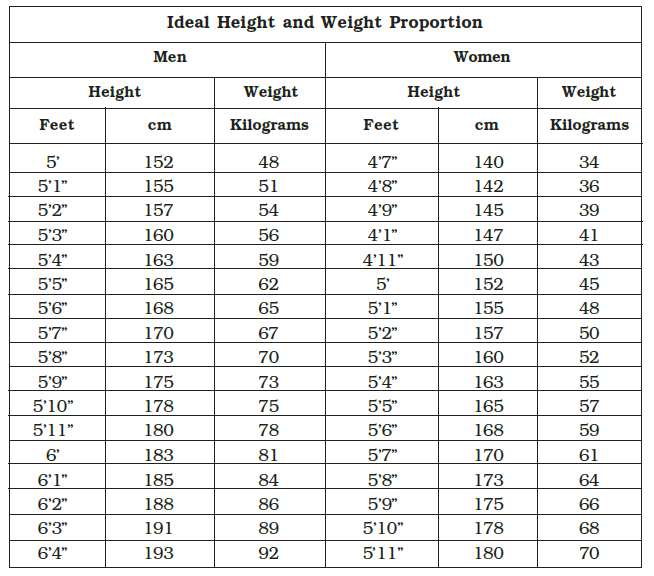
Answer:
Solution:
To answer these questions, let us consider a specific case. Suppose a male student has a height of 5' (152 cm). Referring to the Ideal Height and Weight Proportion table:
1. Your ideal desired weight is __________ kg.
From the table, for a height of 152 cm (Men), the ideal weight is $48$ kg.
2. The quantity of calories you need to eat is _______ .
Calories needed = Ideal weight $\times$ 55.11
Calories = $48 \times 55.11 = 2645.28$
Total calories needed $\approx$ $2645.28$ calories.
3. The quantity of protein needed is ________ g.
Calories from protein = $15\%$ of total calories
Calories from protein = $0.15 \times 2645.28 = 396.792$ cal
Quantity of protein (in grams) = $\frac{\text{Calories from protein}}{4}$
Quantity of protein = $\frac{396.792}{4} = 99.198$ g
Protein required $\approx$ $99.20$ g.
4. The quantity of fat required is ___________ g.
Calories from fat = $30\%$ of total calories
Calories from fat = $0.30 \times 2645.28 = 793.584$ cal
Quantity of fat (in grams) = $\frac{\text{Calories from fat}}{9}$
Quantity of fat = $\frac{793.584}{9} = 88.176$ g
Fat required $\approx$ $88.18$ g.
5. The quantity of carbohydrates required is __________ g.
Calories from carbohydrates = $55\%$ of total calories
Calories from carbohydrates = $0.55 \times 2645.28 = 1454.904$ cal
Quantity of carbohydrates (in grams) = $\frac{\text{Calories from carbohydrates}}{4}$
Quantity of carbohydrates = $\frac{1454.904}{4} = 363.726$ g
Carbohydrates required $\approx$ $363.73$ g.
Question 137. 150 students are studying English, Maths or both. 62 per cent of students study English and 68 per cent are studying Maths. How many students are studying both?
Answer:
Given:
Total number of students studying English, Maths or both = $150$
Percentage of students studying English = $62 \%$
Percentage of students studying Maths = $68 \%$
To Find:
Number of students studying both subjects.
Solution:
Let the total percentage of students be $100 \%$.
According to the principle of set theory, the percentage of students studying both subjects can be found by adding the individual percentages and subtracting the total percentage.
Percentage of students studying both = (Percentage in English + Percentage in Maths) - Total Percentage
Percentage of students studying both = $(62 \% + 68 \%) - 100 \%$
Percentage of students studying both = $130 \% - 100 \% = 30 \%$
Now, we find the actual number of students:
Number of students studying both = $30 \%$ of $150$
Number of students studying both = $\frac{30}{100} \times 150$
Number of students studying both = $3 \times 15 = 45$
Therefore, $45$ students are studying both subjects.
Question 138. Earth Science: The table lists the world’s 10 largest deserts.
| Largest Desert in the World | |
|---|---|
| Desert | Area (km 2) |
| Sahara (Africa) | 8,800,000 |
| Gobi (Asia) | 1,300,000 |
| Australian Desert (Australia) | 1,250,000 |
| Arabian Desert (Asia) | 850,000 |
| Kalahari Desert (Africa) | 580,000 |
| Chihuahuan Desert (North America) | 370,000 |
| Takla Makan Desert (Asia) | 320,000 |
| Kara Kum (Asia) | 310,000 |
| Namib Desert (Africa) | 310,000 |
| Thar Desert (Asia) | 260,000 |
(a) What are the mean, median and mode of the areas listed?
(b) How many times the size of the Gobi Desert is the Namib Desert?
(c) What percentage of the deserts listed are in Asia?
(d) What percentage of the total area of the deserts listed is in Asia?
Answer:
(a) Mean, Median, and Mode:
Mean: Sum of all areas divided by $10$.
$\text{Sum} = 8,800,000 + 1,300,000 + 1,250,000 + 850,000 + 580,000 $$ + 370,000 + 320,000 + 310,000 + 310,000 + 260,000 = 14,350,000$
$\text{Mean} = \frac{14,350,000}{10} = 1,435,000$ km$^{2}$.
Median: Areas in descending order are already provided. The median is the average of the 5th and 6th terms.
$\text{Median} = \frac{580,000 + 370,000}{2} = \frac{950,000}{2} = 475,000$ km$^{2}$.
Mode: The value that occurs most frequently.
Since $310,000$ occurs twice, the Mode = $310,000$ km$^{2}$.
(b) How many times the size of the Gobi Desert is the Namib Desert?
Ratio = $\frac{\text{Area of Namib}}{\text{Area of Gobi}} = \frac{310,000}{1,300,000}$
Ratio = $\frac{\cancel{310,000}^{31}}{\cancel{1,300,000}_{130}} \approx 0.238$
The Namib Desert is approximately $0.24$ times the size of the Gobi Desert.
(c) What percentage of the deserts listed are in Asia?
Deserts in Asia: Gobi, Arabian, Takla Makan, Kara Kum, Thar (Total = $5$).
Percentage = $\left( \frac{5}{10} \times 100 \right) \% = 50 \%$
(d) What percentage of the total area of the deserts listed is in Asia?
Area in Asia = $1,300,000 + 850,000 + 320,000 + 310,000 $$ + 260,000 = 3,040,000$ km$^{2}$.
Percentage = $\left( \frac{3,040,000}{14,350,000} \times 100 \right) \%$
Percentage = $\frac{3040}{143.5} \% \approx 21.18 \%$
Question 139. Geography Application: Earth’s total land area is about 148428950 km2. The land area of Asia is about 30 per cent of this total. What is the approximate land area of Asia to the nearest square km?
Answer:
Given:
Total land area = $148,428,950$ km$^{2}$
Percentage of Asia = $30 \%$
Solution:
Land area of Asia = $30 \%$ of $148,428,950$
Land area of Asia = $\frac{30}{100} \times 148,428,950$
Land area of Asia = $3 \times 14,842,895$
Land area of Asia = $44,528,685$ km$^{2}$.
Question 140. The pieces of Tangrams have been rearranged to make the given shape.
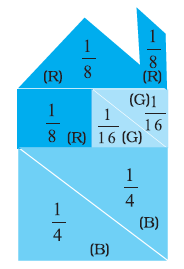
By observing the given shape, answer the following questions:
- What percentage of total has been coloured?
(i) Red (R) = _________
(ii) Blue (B) = ________
(iii) Green (G) = _______
- Check that the sum of all the percentages calculated above should be 100.
- If we rearrange the same pieces to form some other shape, will the percentatge of colours change?
Answer:
Solution:
By analyzing the fractions provided in the Tangram shape:
Total Red (R) parts = $\frac{1}{8} + \frac{1}{8} + \frac{1}{8} = \frac{3}{8}$
Total Blue (B) parts = $\frac{1}{4} + \frac{1}{4} = \frac{2}{4} = \frac{1}{2}$
Total Green (G) parts = $\frac{1}{16} + \frac{1}{16} = \frac{2}{16} = \frac{1}{8}$
(i) Percentage of Red (R):
$\frac{3}{8} \times 100 \% = \frac{300}{8} \% = 37.5 \%$
(ii) Percentage of Blue (B):
$\frac{1}{2} \times 100 \% = 50 \%$
(iii) Percentage of Green (G):
$\frac{1}{8} \times 100 \% = 12.5 \%$
Verification of Sum:
Sum = $37.5 \% + 50 \% + 12.5 \%$
Sum = $100 \%$ (Verified)
Rearrangement:
If we rearrange the same pieces, the percentage of colours will NOT change because the total area and the area of individual pieces remain constant regardless of their position.