

Chapter 8 Rational Numbers (Class 7 - Maths NCERT Exemplar Solutions)
Welcome to the comprehensive resource for NCERT Exemplar Solutions for Class 7 Mathematics: Chapter 8 Rational Numbers! This chapter represents a significant expansion from integers, encompassing all numbers that can be expressed in the form $\frac{p}{q}$, where $p$ and $q$ are integers and the denominator $q \neq 0$. These Exemplar problems are intentionally designed to move beyond basic definitions, focusing on complex operational scenarios and thought-provoking conceptual questions that demand a deeper grasp of the number system.
The solutions provided here meticulously cover the formal identification of rational numbers, finding equivalent rational numbers, and reducing them to their standard form (where the denominator is positive and the terms are co-prime). Students will master the techniques of representing negative fractions on the number line and comparing rational numbers using the Least Common Multiple (LCM) of denominators or cross-multiplication. These foundational skills are critical for maintaining accuracy in more advanced algebraic calculations.
A substantial part of the Exemplar challenge revolves around the four fundamental arithmetic operations. Our solutions provide detailed guidance on addition and subtraction of unlike rational numbers, multiplication ($\frac{a}{b} \times \frac{c}{d} = \frac{ac}{bd}$), and division using the reciprocal (multiplicative inverse) method. Every step emphasizes strict adherence to sign rules and the BODMAS rule for multi-step expressions, ensuring that final results are simplified to their standard form.
Finally, the chapter explores properties such as Closure, Commutativity, and Associativity, as well as the technique of finding multiple rational numbers between any two given values. With step-by-step guidance and logical justifications prepared by learningspot.co, students can significantly enhance their computational fluency and build the confidence needed to effectively solve complex problems involving both fractions and integers in the $\frac{p}{q}$ form.
Solved Examples (Examples 1 to 16)
In Examples 1 to 4, there are four options, out of which one is correct. Choose the correct one.
Example 1: Which of the following rational numbers is equivalent to $\frac{2}{3}$ ?
(a) $\frac{3}{2}$
(b) $\frac{4}{9}$
(c) $\frac{4}{6}$
(d) $\frac{9}{4}$
Answer:
Given:
Rational number = $\frac{2}{3}$
To Find:
The equivalent rational number from the given options.
Solution:
Equivalent rational numbers are obtained by multiplying or dividing the numerator and the denominator of a given rational number by the same non-zero integer.
Multiplying the numerator and the denominator by $2$:
$\frac{2 \times 2}{3 \times 2} = \frac{4}{6}$
Comparing this with the given options, we find that $\frac{4}{6}$ matches option (c).
Correct Option: (c)
Example 2: Which of the following rational numbers is in standard form?
(a) $\frac{20}{30}$
(b) $\frac{10}{4}$
(c) $\frac{1}{2}$
(d) $\frac{1}{-3}$
Answer:
Solution:
A rational number is said to be in standard form if its denominator is a positive integer and the numerator and denominator have no common factor other than $1$.
Checking the options:
(a) $\frac{20}{30}$: Numerator and denominator have a common factor $10$. Not in standard form.
(b) $\frac{10}{4}$: Numerator and denominator have a common factor $2$. Not in standard form.
(c) $\frac{1}{2}$: Denominator is positive and $\text{HCF}(1, 2) = 1$. This is in standard form.
(d) $\frac{1}{-3}$: Denominator is negative. Not in standard form.
Correct Option: (c)
Example 3: The sum of $\frac{-3}{2}$ and $\frac{1}{2}$ is
(a) –1
(b) –2
(c) 4
(d) 3
Answer:
Given:
Rational numbers are $\frac{-3}{2}$ and $\frac{1}{2}$.
To Find:
The sum of the given numbers.
Solution:
Since the denominators are the same, we can directly add the numerators:
$\text{Sum} = \frac{-3}{2} + \frac{1}{2}$
$\text{Sum} = \frac{-3 + 1}{2}$
$\text{Sum} = \frac{-2}{2}$
$\text{Sum} = -1$
Correct Option: (a)
Example 4: The value of $-\frac{4}{3}$ − $\frac{-1}{3}$ is
(a) – 2
(b) – 3
(c) 2
(d) –1
Answer:
To Find:
The value of $-\frac{4}{3} - \left(\frac{-1}{3}\right)$.
Solution:
We simplify the expression by handling the negative signs first:
$-\frac{4}{3} - \left(\frac{-1}{3}\right) = -\frac{4}{3} + \frac{1}{3}$
As the denominators are equal:
$= \frac{-4 + 1}{3}$
$= \frac{-3}{3}$
$= -1$
Correct Option: (d)
In Examples 5 and 6, fill in the blanks to make the statements true.
Example 5: There are _______ number of rational numbers between two rational numbers.
Answer:
Solution:
Between any two given rational numbers, we can find unlimited or infinite number of rational numbers. This is known as the density property of rational numbers.
Therefore, the blank should be filled with infinite.
Example 6: The rational number _________ is neither positive nor negative.
Answer:
Solution:
The rational number $0$ (zero) is the only rational number that is neither positive nor negative.
Therefore, the blank should be filled with $0$.
In Examples 7 to 9, state whether the statements are True or False.
Example 7: In any rational number $\frac{p}{q}$ , denominator is always a non-zero integer.
Answer:
Solution:
By the definition of a rational number, it is a number that can be expressed in the form $\frac{p}{q}$, where $p$ and $q$ are integers and $q \neq 0$.
Since the denominator $q$ cannot be zero, the statement is True.
Example 8: “To reduce the rational number to its standard form, we divide its numerator and denominator by their HCF”.
Answer:
Solution:
The standard way to reduce a fraction or rational number to its simplest (standard) form is to divide both the numerator and denominator by their Highest Common Factor (HCF).
Therefore, the statement is True.
Example 9: “All rational numbers are integers”.
Answer:
Solution:
While all integers are rational numbers (since any integer $n$ can be written as $\frac{n}{1}$), the converse is not true.
For example, $\frac{1}{2}$ is a rational number, but it is not an integer.
Therefore, the statement is False.
Example 10: List three rational numbers between $\frac{4}{5}$ and $\frac{5}{6}$ .
Answer:
Given:
Two rational numbers: $\frac{4}{5}$ and $\frac{5}{6}$
To Find:
Three rational numbers between them.
Solution:
To find rational numbers between two given numbers, we first make their denominators equal by finding the LCM of the denominators ($5$ and $6$).
LCM of $5$ and $6 = 30$
Now, we convert the given rational numbers to equivalent rational numbers with denominator $30$:
$\frac{4 \times 6}{5 \times 6} = \frac{24}{30}$
$\frac{5 \times 5}{6 \times 5} = \frac{25}{30}$
Since we need to find three rational numbers between them, we should multiply the numerator and denominator of both fractions by a number such as $3 + 1 = 4$ (or any larger number):
$\frac{24 \times 4}{30 \times 4} = \frac{96}{120}$
$\frac{25 \times 4}{30 \times 4} = \frac{100}{120}$
Now, we can clearly see the rational numbers between $\frac{96}{120}$ and $\frac{100}{120}$.
The three rational numbers are: $\frac{97}{120}, \frac{98}{120}, \frac{99}{120}$.
Example 11: Which of the following pairs represent equivalent rational numbers ?
(i) $\frac{7}{12}$ and $\frac{28}{48}$
(ii) $\frac{-2}{-3}$ and $\frac{-16}{24}$
Answer:
To Find:
Identify which pair represents equivalent rational numbers.
Solution:
(i) $\frac{7}{12}$ and $\frac{28}{48}$
To check for equivalence, we simplify the second fraction:
$\frac{28}{48} = \frac{28 \div 4}{48 \div 4} = \frac{7}{12}$
Since $\frac{7}{12} = \frac{7}{12}$, this pair represents equivalent rational numbers.
(ii) $\frac{-2}{-3}$ and $\frac{-16}{24}$
First, simplify the signs of the first fraction:
$\frac{-2}{-3} = \frac{2}{3}$ (Positive rational number)
Now, simplify the second fraction:
$\frac{-16}{24} = \frac{-16 \div 8}{24 \div 8} = \frac{-2}{3}$ (Negative rational number)
Since $\frac{2}{3} \neq \frac{-2}{3}$, this pair does not represent equivalent rational numbers.
Example 12: Write four more rational numbers to complete the pattern:
$\frac{-1}{3}$ , $\frac{-2}{6}$ , $\frac{-3}{9}$ , ____, ____, ____, ____.
Answer:
Given Pattern:
$\frac{-1}{3}$ , $\frac{-2}{6}$ , $\frac{-3}{9}$
Solution:
By observing the given pattern, we can see that each subsequent number is obtained by multiplying the numerator and denominator of the first rational number ($\frac{-1}{3}$) by $2, 3, \dots$ and so on.
$\frac{-1 \times 1}{3 \times 1} = \frac{-1}{3}$
$\frac{-1 \times 2}{3 \times 2} = \frac{-2}{6}$
$\frac{-1 \times 3}{3 \times 3} = \frac{-3}{9}$
To complete the pattern, we multiply by $4, 5, 6,$ and $7$:
$\frac{-1 \times 4}{3 \times 4} = \mathbf{\frac{-4}{12}}$
$\frac{-1 \times 5}{3 \times 5} = \mathbf{\frac{-5}{15}}$
$\frac{-1 \times 6}{3 \times 6} = \mathbf{\frac{-6}{18}}$
$\frac{-1 \times 7}{3 \times 7} = \mathbf{\frac{-7}{21}}$
The completed pattern is: $\frac{-1}{3}, \frac{-2}{6}, \frac{-3}{9}, \mathbf{\frac{-4}{12}}, \mathbf{\frac{-5}{15}}, \mathbf{\frac{-6}{18}}, \mathbf{\frac{-7}{21}}$.
Example 13: Find the sum of $-4\frac{5}{6}$ and $-7\frac{3}{4}$
Answer:
Given:
Mixed fractions: $-4\frac{5}{6}$ and $-7\frac{3}{4}$
To Find:
The sum of the two numbers.
Solution:
First, we convert the mixed fractions into improper fractions:
$-4\frac{5}{6} = -\left(\frac{4 \times 6 + 5}{6}\right) = -\frac{29}{6}$
$-7\frac{3}{4} = -\left(\frac{7 \times 4 + 3}{4}\right) = -\frac{31}{4}$
Now, we find the sum:
$\text{Sum} = \left(-\frac{29}{6}\right) + \left(-\frac{31}{4}\right)$
To add these, we find the LCM of the denominators $6$ and $4$:
LCM($6, 4$) $= 12$
Converting to equivalent fractions with denominator $12$:
$\text{Sum} = \frac{-29 \times 2}{12} + \frac{-31 \times 3}{12}$
$\text{Sum} = \frac{-58}{12} + \frac{-93}{12}$
$\text{Sum} = \frac{-58 - 93}{12}$
$\text{Sum} = \frac{-151}{12}$
Converting back to a mixed fraction:
$\text{Sum} = \mathbf{-12\frac{7}{12}}$
Example 14: Find the product of $-2\frac{3}{4}$ and $5\frac{6}{7}$
Answer:
Given:
First mixed fraction = $-2\frac{3}{4}$
Second mixed fraction = $5\frac{6}{7}$
To Find:
The product of the two numbers.
Solution:
First, we convert the given mixed fractions into improper fractions:
$-2\frac{3}{4} = -\frac{(2 \times 4) + 3}{4} = -\frac{11}{4}$
$5\frac{6}{7} = \frac{(5 \times 7) + 6}{7} = \frac{41}{7}$
Now, find the product:
$\text{Product} = \left( -\frac{11}{4} \right) \times \left( \frac{41}{7} \right)$
$\text{Product} = -\frac{11 \times 41}{4 \times 7}$
Calculating the numerator: $11 \times 41 = 451$
Calculating the denominator: $4 \times 7 = 28$
$\text{Product} = -\frac{451}{28}$
$\text{Product} = -16\frac{3}{28}$
Therefore, the product is $-16\frac{3}{28}$.
Example 15: Match column I to column II in the following:
Column I
(i) $\frac{3}{4}$ ÷ $\frac{3}{4}$
(ii) $\frac{1}{2}$ ÷ $\frac{4}{3}$
(iii) $\frac{2}{3}$ ÷ (-1)
(iv) $\frac{3}{4}$ ÷ $\frac{1}{2}$
(v) $\frac{5}{7}$ ÷ $\left( \frac{-5}{7} \right)$
Column II
(a) –1
(b) $\frac{-2}{3}$
(c) $\frac{3}{2}$
(d) $\frac{3}{8}$
(e) 1
Answer:
Solution:
Let us solve each expression in Column I:
(i) $\frac{3}{4} \div \frac{3}{4} = \frac{3}{4} \times \frac{4}{3} = 1$ $\rightarrow$ (e)
(ii) $\frac{1}{2} \div \frac{4}{3} = \frac{1}{2} \times \frac{3}{4} = \frac{3}{8}$ $\rightarrow$ (d)
(iii) $\frac{2}{3} \div (-1) = \frac{2}{3} \times (-1) = -\frac{2}{3}$ $\rightarrow$ (b)
(iv) $\frac{3}{4} \div \frac{1}{2} = \frac{3}{4} \times \frac{2}{1} = \frac{3}{2}$ $\rightarrow$ (c)
(v) $\frac{5}{7} \div \left( \frac{-5}{7} \right) = \frac{5}{7} \times \left( \frac{-7}{5} \right) = -1$ $\rightarrow$ (a)
Correct Matches:
| Column I | Column II |
| (i) | (e) |
| (ii) | (d) |
| (iii) | (b) |
| (iv) | (c) |
| (v) | (a) |
Example 16: Find the reciprocal of $\frac{2}{11}$ ÷ $-\frac{5}{55}$
Answer:
To Find:
The reciprocal of the result of the expression $\frac{2}{11} \div -\frac{5}{55}$.
Solution:
First, we perform the division:
$\frac{2}{11} \div \left( -\frac{5}{55} \right) = \frac{2}{11} \times \left( -\frac{55}{5} \right)$
Now, simplifying the fraction:
$= \frac{2 \times (-55)}{11 \times 5}$
$= \frac{2 \times \cancel{(-55)}^{-5}}{\cancel{11}_1 \times 5}$
$= \frac{2 \times \cancel{(-5)}^{-1}}{\cancel{5}_1}$
$= -2$
Now, we find the reciprocal of $-2$.
We know that $-2$ can be written as $-\frac{2}{1}$.
The reciprocal of $-\frac{2}{1}$ is $-\frac{1}{2}$.
Therefore, the required reciprocal is $-\frac{1}{2}$.
Exercise
Question 1 to 12 (Multiple Choice Questions)
In each of the following questions 1 to 12, there are four options, out of which, only one is correct. Write the correct one.
Question 1. A rational number is defined as a number that can be expressed in the form $\frac{p}{q}$ , where p and q are integers and
(a) q = 0
(b) q = 1
(c) q ≠ 1
(d) q ≠ 0
Answer:
Solution:
By the definition of a rational number, it is a number that can be expressed in the form $\frac{p}{q}$, where $p$ and $q$ are integers and $q$ must not be equal to zero. If $q = 0$, the expression becomes undefined.
Therefore, the condition is $q \neq 0$.
Correct Option: (d)
Question 2. Which of the following rational numbers is positive?
(a) $\frac{-8}{7}$
(b) $\frac{19}{-13}$
(c) $\frac{-3}{-4}$
(d) $\frac{-21}{13}$
Answer:
Solution:
A rational number is said to be positive if its numerator and denominator both have the same sign (both positive or both negative).
Let's check the options:
(a) $\frac{-8}{7}$: Opposite signs (Negative)
(b) $\frac{19}{-13}$: Opposite signs (Negative)
(c) $\frac{-3}{-4}$: Same signs (Negative signs cancel out to become $\frac{3}{4}$, which is Positive)
(d) $\frac{-21}{13}$: Opposite signs (Negative)
Correct Option: (c)
Question 3. Which of the following rational numbers is negative?
(a) $-\left( \frac{-3}{7} \right)$
(b) $\frac{-5}{-8}$
(c) $\frac{9}{8}$
(d) $\frac{3}{-7}$
Answer:
Solution:
A rational number is negative if its numerator and denominator have opposite signs.
Checking the options:
(a) $-\left( \frac{-3}{7} \right) = \frac{3}{7}$ (Positive)
(b) $\frac{-5}{-8} = \frac{5}{8}$ (Positive)
(c) $\frac{9}{8}$ (Positive)
(d) $\frac{3}{-7} = -\frac{3}{7}$ (Negative)
Correct Option: (d)
Question 4. In the standard form of a rational number, the common factor of numerator and denominator is always:
(a) 0
(b) 1
(c) – 2
(d) 2
Answer:
Solution:
A rational number is in its standard form (or simplest form) when the numerator and the denominator are integers having no common factors other than $1$, and the denominator is a positive integer.
Therefore, the common factor is always $1$.
Correct Option: (b)
Question 5. Which of the following rational numbers is equal to its reciprocal?
(a) 1
(b) 2
(c) $\frac{1}{2}$
(d) 0
Answer:
Solution:
The reciprocal of a number $x$ is $\frac{1}{x}$. We need to find $x$ such that $x = \frac{1}{x}$.
$x^2 = 1 \implies x = 1 \text{ or } -1$.
Checking the given options:
(a) $1$: The reciprocal of $1$ is $\frac{1}{1} = 1$. This is correct.
(b) $2$: The reciprocal is $\frac{1}{2}$.
(c) $\frac{1}{2}$: The reciprocal is $2$.
(d) $0$: $0$ does not have a reciprocal.
Correct Option: (a)
Question 6. The reciproal of $\frac{1}{2}$ is
(a) 3
(b) 2
(c) – 1
(d) 0
Answer:
Solution:
The reciprocal of a rational number $\frac{a}{b}$ is $\frac{b}{a}$.
For the number $\frac{1}{2}$, the reciprocal is $\frac{2}{1} = 2$.
Correct Option: (b)
Question 7. The standard form of $\frac{-48}{60}$ is
(a) $\frac{48}{60}$
(b) $\frac{-60}{48}$
(c) $\frac{-4}{5}$
(d) $\frac{-4}{-5}$
Answer:
Given:
Rational number = $\frac{-48}{60}$
To Find:
Standard form of the given rational number.
Solution:
To convert $\frac{-48}{60}$ into standard form, we divide both the numerator and the denominator by their HCF.
Prime factors of $48$: $2 \times 2 \times 2 \times 2 \times 3$
Prime factors of $60$: $2 \times 2 \times 3 \times 5$
$\text{HCF}(48, 60) = 2 \times 2 \times 3 = 12$
Now, divide the numerator and denominator by $12$:
$\frac{-48 \div 12}{60 \div 12} = \frac{-4}{5}$
Correct Option: (c)
Question 8. Which of the following is equivalent to $\frac{4}{5}$ ?
(a) $\frac{5}{4}$
(b) $\frac{16}{25}$
(c) $\frac{16}{20}$
(d) $\frac{15}{25}$
Answer:
Given:
Rational number = $\frac{4}{5}$
To Find:
Equivalent rational number from the choices.
Solution:
Equivalent rational numbers are obtained by multiplying the numerator and denominator by the same non-zero integer.
Let's check the options:
(a) $\frac{5}{4}$: Reciprocal, not equivalent.
(b) $\frac{16}{25}$: $\frac{4 \times 4}{5 \times 5} = \frac{16}{25}$. Here numerator is multiplied by $4$ but denominator by $5$. Not equivalent.
(c) $\frac{16}{20}$: $\frac{4 \times 4}{5 \times 4} = \frac{16}{20}$. Both are multiplied by $4$. This is Equivalent.
(d) $\frac{15}{25}$: $\frac{3 \times 5}{5 \times 5}$. Not equivalent to $\frac{4}{5}$.
Correct Option: (c)
Question 9. How many rational numbers are there between two rational numbers?
(a) 1
(b) 0
(c) unlimited
(d) 100
Answer:
Solution:
Between any two given rational numbers, there are unlimited (infinitely many) rational numbers. For any two rational numbers $a$ and $b$, their mean $\frac{a+b}{2}$ is also a rational number that lies between them. This process can be repeated indefinitely.
Correct Option: (c)
Question 10. In the standard form of a rational number, the denominator is always a
(a) 0
(b) negative integer
(c) positive integer
(d) 1
Answer:
Solution:
A rational number $\frac{p}{q}$ is said to be in standard form if the denominator $q$ is a positive integer and the numerator $p$ and denominator $q$ have no common factor other than $1$.
Correct Option: (c)
Question 11. To reduce a rational number to its standard form, we divide its numerator and denominator by their
(a) LCM
(b) HCF
(c) product
(d) multiple
Answer:
Solution:
To reduce a rational number to its simplest or standard form, we divide both the numerator and the denominator by their Highest Common Factor (HCF). This ensures that the only remaining common factor is $1$.
Correct Option: (b)
Question 12. Which is greater number in the following:
(a) $\frac{-1}{2}$
(b) 0
(c) $\frac{1}{2}$
(d) – 2
Answer:
Solution:
On a number line:
1. Positive rational numbers are always greater than zero and negative rational numbers.
2. Zero is always greater than negative rational numbers.
Comparing the given numbers:
Negative numbers: $-2$, $-\frac{1}{2}$
Zero: $0$
Positive numbers: $\frac{1}{2}$
Since $\frac{1}{2}$ is the only positive rational number, it is the greatest among the options.
Correct Option: (c)
Question 13 to 46 (Fill in the Blanks)
In Questions 13 to 46, fill in the blanks to make the statements true.
Question 13. $-\frac{3}{8}$ is a ______ rational number.
Answer:
Solution:
A rational number is negative if its numerator and denominator have opposite signs. Here, the numerator is $-3$ (negative) and the denominator is $8$ (positive).
Therefore, $-\frac{3}{8}$ is a negative rational number.
Question 14. 1 is a ______ rational number.
Answer:
Solution:
The number $1$ can be written as $\frac{1}{1}$. Since both the numerator and the denominator are positive, it is a positive rational number.
Therefore, $1$ is a positive rational number.
Question 15. The standard form of $\frac{-8}{-36}$ is ______.
Answer:
Given:
Rational number = $\frac{-8}{-36}$
To Find:
The standard form.
Solution:
First, we simplify the signs. A negative divided by a negative results in a positive:
$\frac{-8}{-36} = \frac{8}{36}$
Now, we find the HCF of $8$ and $36$:
Factors of $8$: $1, 2, 4, 8$
Factors of $36$: $1, 2, 3, 4, 6, 9, 12, 18, 36$
$\text{HCF}(8, 36) = 4$
Dividing both numerator and denominator by $4$:
$\frac{\cancel{8}^{2}}{\cancel{36}_{9}} = \frac{2}{9}$
The standard form is $\frac{2}{9}$.
Question 16. The standard form of $\frac{18}{-24}$ is ______.
Answer:
Given:
Rational number = $\frac{18}{-24}$
To Find:
The standard form.
Solution:
In standard form, the denominator must be positive. We transfer the negative sign to the numerator:
$\frac{18}{-24} = \frac{-18}{24}$
Now, we find the HCF of $18$ and $24$:
Since $24$ and $18$ are a multiple of $6$, the HCF is $6$.
Dividing both numerator and denominator by $6$:
$\frac{\cancel{-18}^{-3}}{\cancel{24}_{4}} = \frac{-3}{4}$
The standard form is $\frac{-3}{4}$.
Question 17. On a number line, $\frac{-1}{2}$ is to the ______ of zero (0).
Answer:
Solution:
In a standard horizontal number line used in mathematics, zero $(0)$ is the origin. All positive rational numbers are placed to the right of zero, and all negative rational numbers are placed to the left of zero.
Since $\frac{-1}{2}$ is a negative rational number, it must be located on the left side.
Therefore, the blank should be filled with left.
Question 18. On a number line, $\frac{4}{3}$ is to the ______ of zero (0).
Answer:
Solution:
On the number line, positive rational numbers are always positioned to the right of the origin, which is zero $(0)$.
The number $\frac{4}{3}$ is a positive rational number because both its numerator and denominator have the same sign (positive).
Therefore, the blank should be filled with right.
Question 19. $-\frac{1}{2}$ is ______ than $\frac{1}{5}$ .
Answer:
Solution:
When comparing rational numbers, we follow the rule that every negative rational number is always smaller than every positive rational number.
In this case, $-\frac{1}{2}$ is a negative number and $\frac{1}{5}$ is a positive number.
Therefore, $-\frac{1}{2}$ is smaller (or less) than $\frac{1}{5}$.
Question 20. $-\frac{3}{5}$ is ______ than 0.
Answer:
Solution:
On the number line, all negative rational numbers lie to the left of zero, meaning they are always less than zero.
Since $-\frac{3}{5}$ is a negative number, it is smaller (or less) than $0$.
Therefore, the blank should be filled with smaller.
Question 21. $\frac{-16}{24}$ and $\frac{20}{-16}$ represent ______ rational numbers.
Answer:
To Find:
Whether the given rational numbers are equivalent or different.
Solution:
We will reduce both rational numbers to their simplest (standard) form for comparison:
For the first number: $\frac{-16}{24}$
$\text{HCF}(16, 24) = 8$
$\frac{-16 \div 8}{24 \div 8} = \frac{-2}{3}$
For the second number: $\frac{20}{-16}$
$\text{HCF}(20, 16) = 4$
$\frac{20 \div 4}{-16 \div 4} = \frac{5}{-4} = \frac{-5}{4}$
Since $\frac{-2}{3} \neq \frac{-5}{4}$, the two numbers are not equivalent.
Therefore, they represent different (or non-equivalent) rational numbers.
Question 22. $\frac{-27}{45}$ and $\frac{-3}{5}$ represent ______ rational numbers.
Answer:
Solution:
We simplify $\frac{-27}{45}$ to see if it matches $\frac{-3}{5}$:
The Highest Common Factor (HCF) of $27$ and $45$ is $9$.
$\frac{-27 \div 9}{45 \div 9} = \frac{-3}{5}$
Since the simplified form of the first number is exactly the same as the second number, they are equal in value.
Therefore, they represent equivalent (or same) rational numbers.
Question 23. Additive inverse of $\frac{2}{3}$ is ______.
Answer:
Solution:
The additive inverse of a rational number $\frac{a}{b}$ is the number which, when added to $\frac{a}{b}$, results in zero $(0)$. It is generally denoted by $-\frac{a}{b}$.
For $\frac{2}{3}$, we find the value such that:
$\frac{2}{3} + x = 0$
$x = -\frac{2}{3}$
Therefore, the additive inverse of $\frac{2}{3}$ is $-\frac{2}{3}$.
Question 24. $\frac{-3}{5}$ + $\frac{2}{5}$ = _______.
Answer:
Given:
Expression: $\frac{-3}{5} + \frac{2}{5}$
Solution:
Since the denominators of both rational numbers are the same $(5)$, we can simply add their numerators:
$\frac{-3}{5} + \frac{2}{5} = \frac{-3 + 2}{5}$
$= \frac{-1}{5}$
Therefore, the answer is $-\frac{1}{5}$.
Question 25. $\frac{-5}{6}$ + $\frac{-1}{6}$ = _________.
Answer:
Solution:
The given expression is $\frac{-5}{6} + \frac{-1}{6}$. Since the denominators are the same, we can add the numerators directly.
$\frac{-5 + (-1)}{6}$
$= \frac{-5 - 1}{6}$
$= \frac{-6}{6}$
$= -1$
Therefore, the blank should be filled with $-1$.
Question 26. $\frac{3}{4}$ × $\left( \frac{-2}{3} \right)$ = _______.
Answer:
Solution:
To find the product of two rational numbers, we multiply the numerators together and the denominators together.
$\frac{3 \times (-2)}{4 \times 3}$
We can simplify by cancelling the common factor $3$ from the numerator and denominator:
$\frac{\cancel{3}^1 \times (-2)}{4 \times \cancel{3}_1}$
$= \frac{-2}{4}$
Now, simplifying $\frac{-2}{4}$ by dividing both by $2$:
$\frac{\cancel{-2}^{-1}}{\cancel{4}_2} = -\frac{1}{2}$
Therefore, the blank should be filled with $-\frac{1}{2}$.
Question 27. $\frac{-5}{3}$ × $\left( \frac{-3}{5} \right)$ = ______.
Answer:
Solution:
The product of a rational number and its reciprocal (with the same sign) is always $1$. Let's solve it step-by-step:
$\frac{-5 \times (-3)}{3 \times 5}$
Multiplying the numerators (negative $\times$ negative = positive):
$= \frac{15}{15}$
$= 1$
Therefore, the blank should be filled with $1$.
Question 28. $\frac{-6}{7}$ = $\frac{-}{42}$
Answer:
Solution:
To find the missing numerator, we determine what the denominator $7$ was multiplied by to get $42$.
$7 \times 6 = 42$
Since the denominator was multiplied by $6$, we must also multiply the numerator by $6$ to maintain equivalence:
$-6 \times 6 = -36$
Therefore, $\frac{-6}{7} = \frac{-36}{42}$. The blank should be filled with $-36$.
Question 29. $\frac{1}{2}$ = $\frac{6}{-}$
Answer:
Solution:
To find the missing denominator, we determine what the numerator $1$ was multiplied by to get $6$.
$1 \times 6 = 6$
Since the numerator was multiplied by $6$, we must also multiply the denominator by $6$:
$2 \times 6 = 12$
Therefore, the blank should be filled with $12$.
Question 30. $\frac{-2}{9}$ - $\frac{7}{9}$ = ________.
Answer:
Solution:
Since the denominators are the same, we subtract the numerators:
$\frac{-2 - 7}{9}$
$= \frac{-9}{9}$
$= -1$
Therefore, the blank should be filled with $-1$.
In questions 31 to 35, fill in the boxes with the correct symbol >,< or =.
Question 31. $\frac{7}{-8}$ ⬜ $\frac{8}{9}$
Answer:
Solution:
We are comparing a negative rational number and a positive rational number.
$\frac{7}{-8} = -\frac{7}{8}$ (Negative)
$\frac{8}{9}$ (Positive)
Since every negative rational number is always smaller than every positive rational number, we have:
$-\frac{7}{8} < \frac{8}{9}$
Therefore, the correct symbol is $<$.
Question 32. $\frac{3}{7}$ ⬜ $\frac{- 5}{6}$
Answer:
Solution:
We are comparing a positive rational number and a negative rational number.
$\frac{3}{7}$ is positive.
$\frac{-5}{6}$ is negative.
Since any positive number is always greater than any negative number, we have:
$\frac{3}{7} > \frac{-5}{6}$
Therefore, the correct symbol is $>$.
Question 33. $\frac{5}{6}$ ⬜ $\frac{8}{4}$
Answer:
To Find: Compare the two rational numbers using the correct symbol ($<, >, =$ ).
Solution:
To compare $\frac{5}{6}$ and $\frac{8}{4}$, we can cross-multiply or make the denominators equal.
First, simplify $\frac{8}{4}$:
$\frac{8}{4} = 2$
Now, we compare $\frac{5}{6}$ and $2$. Since $\frac{5}{6}$ is a proper fraction (numerator is less than denominator), its value is less than $1$.
Clearly, $1 < 2$, so $\frac{5}{6} < 2$.
Alternate Solution (Cross Multiplication):
Multiply the numerator of the first fraction by the denominator of the second:
$5 \times 4 = 20$
Multiply the denominator of the first fraction by the numerator of the second:
$6 \times 8 = 48$
Since $20 < 48$, the first rational number is smaller.
$\frac{5}{6} < \frac{8}{4}$
Therefore, the correct symbol is $<$.
Question 34. $\frac{-9}{7}$ ⬜ $\frac{4}{-7}$
Answer:
Solution:
The given rational numbers are $\frac{-9}{7}$ and $\frac{4}{-7}$.
We can write $\frac{4}{-7}$ as $\frac{-4}{7}$ in standard form.
Now we compare $\frac{-9}{7}$ and $\frac{-4}{7}$. Since the denominators are the same, we only need to compare the numerators $-9$ and $-4$.
On a number line, $-9$ is to the left of $-4$, which means $-9 < -4$.
Therefore, $\frac{-9}{7} < \frac{-4}{7}$.
The correct symbol is $<$.
Question 35. $\frac{8}{8}$ ⬜ $\frac{2}{2}$
Answer:
Solution:
First, simplify both the rational numbers:
$\frac{8}{8} = 1$
$\frac{2}{2} = 1$
Since $1 = 1$, the two rational numbers are equal.
Therefore, the correct symbol is $=$.
Question 36. The reciprocal of ______ does not exist.
Answer:
Solution:
The reciprocal of a number $x$ is defined as $\frac{1}{x}$. This expression is undefined when the denominator is zero because division by zero is not possible in mathematics.
Therefore, the reciprocal of $0$ (zero) does not exist.
Question 37. The reciprocal of 1 is ______.
Answer:
Solution:
The reciprocal of a number is $1$ divided by that number.
Reciprocal of $1 = \frac{1}{1} = 1$
Therefore, the reciprocal of $1$ is $1$.
Question 38. $\frac{-3}{7}$ ÷ $\left( \frac{-7}{3} \right)$ = ________.
Answer:
Solution:
To divide one rational number by another, we multiply the first number by the reciprocal of the second number.
The reciprocal of $\frac{-7}{3}$ is $\frac{3}{-7}$ or $-\frac{3}{7}$.
So, $\frac{-3}{7} \div \left( \frac{-7}{3} \right) = \frac{-3}{7} \times \frac{3}{-7}$
$= \frac{(-3) \times 3}{7 \times (-7)}$
$= \frac{-9}{-49}$
$= \frac{9}{49}$
Therefore, the answer is $\frac{9}{49}$.
Question 39. 0 ÷ $\left( \frac{-5}{6} \right)$ = ________.
Answer:
Solution:
When zero is divided by any non-zero rational number, the result is always zero.
$0 \div \left( \frac{-5}{6} \right) = 0 \times \left( \frac{6}{-5} \right)$
$= 0$
Therefore, the blank should be filled with $0$.
Question 40. 0 × $\left( \frac{-5}{6} \right)$ = ______.
Answer:
Solution:
According to the property of zero, the product of any rational number and zero is always zero.
$0 \times \left( \frac{-5}{6} \right) = 0$
Therefore, the blank should be filled with $0$.
Question 41. ______ × $\left( \frac{-2}{5} \right)$ = 1.
Answer:
Solution:
We know that the product of a non-zero rational number and its reciprocal (multiplicative inverse) is always $1$.
The reciprocal of $\frac{-2}{5}$ is $\frac{5}{-2}$, which can be written as $-\frac{5}{2}$.
Let's verify:
$\left( -\frac{5}{2} \right) \times \left( -\frac{2}{5} \right) = \frac{(-5) \times (-2)}{2 \times 5} = \frac{10}{10} = 1$
Therefore, the blank should be filled with $-\frac{5}{2}$.
Question 42. The standard form of rational number –1 is ______.
Answer:
Solution:
A rational number is in standard form if its denominator is a positive integer and the numerator and denominator have no common factor other than $1$.
The integer $-1$ can be expressed as a fraction $\frac{-1}{1}$. Here, the denominator $1$ is a positive integer and $\text{HCF}(1, 1) = 1$.
Therefore, the standard form of $-1$ is $\frac{-1}{1}$.
Question 43. If m is a common divisor of a and b, then $\frac{a}{b}$ = $\frac{a \;÷\; m}{----}$
Answer:
Solution:
To obtain an equivalent rational number, if we divide the numerator by a non-zero common divisor $m$, we must divide the denominator by the same divisor $m$.
$\frac{a}{b} = \frac{a \div m}{b \div m}$
Therefore, the blank should be filled with $b \div m$.
Question 44. If p and q are positive integers, then $\frac{p}{q}$ is a ______ rational number and $\frac{p}{-q}$ is a ______ rational number.
Answer:
Solution:
1. In $\frac{p}{q}$, both $p$ and $q$ are positive. Since both the numerator and denominator have the same sign, the rational number is positive.
2. In $\frac{p}{-q}$, $p$ is positive and $-q$ is negative. Since the numerator and denominator have opposite signs, the rational number is negative.
Therefore, the first blank is positive and the second blank is negative.
Question 45. Two rational numbers are said to be equivalent or equal, if they have the same ______ form.
Answer:
Solution:
Different rational numbers can represent the same value (e.g., $\frac{1}{2}$ and $\frac{2}{4}$). When these numbers are reduced to their simplest form, they yield the same result.
This simplest form is known as the standard form.
Therefore, the blank should be filled with standard.
Question 46. If $\frac{p}{q}$ is a rational number, then q cannot be ______.
Answer:
Solution:
By the fundamental definition of a rational number, it must be in the form $\frac{p}{q}$ where $p$ and $q$ are integers and the denominator $q$ is not equal to zero.
Therefore, $q$ cannot be zero (0).
Question 47 to 65 (True or False)
State whether the statements given in question 47 to 65 are True or False.
Question 47. Every natural number is a rational number but every rational number need not be a natural number.
Answer:
Solution:
1. Any natural number $n$ can be written as $\frac{n}{1}$, which fits the definition of a rational number. So, every natural number is a rational number.
2. However, a rational number like $\frac{1}{2}$ is not a counting number (natural number). So, every rational number need not be a natural number.
The statement is True.
Question 48. Zero is a rational number.
Answer:
Solution:
The number $0$ can be expressed in the form $\frac{p}{q}$ as $\frac{0}{1}$, where $0$ and $1$ are integers and the denominator $1 \neq 0$.
The statement is True.
Question 49. Every integer is a rational number but every rational number need not be an integer.
Answer:
Solution:
Any integer $n$ can be expressed as a rational number $\frac{n}{1}$. For example, $5 = \frac{5}{1}$ and $-3 = \frac{-3}{1}$. Thus, every integer is a rational number.
However, a rational number such as $\frac{3}{4}$ or $\frac{-5}{2}$ cannot be simplified into a whole number or its negative counterpart (an integer).
The statement is True.
Question 50. Every negative integer is not a negative rational number.
Answer:
Solution:
A negative integer, for example $-7$, can be written in the form $\frac{p}{q}$ as $\frac{-7}{1}$. Since it is expressed as a ratio of integers where the denominator is non-zero and the overall value is negative, it is by definition a negative rational number.
The statement is False.
Question 51. If $\frac{p}{q}$ is a rational number and m is a non-zero integer, then $\frac{p}{q}$ = $\frac{p × m}{ q × m}$
Answer:
Solution:
According to the property of equivalent rational numbers, if we multiply the numerator and the denominator of a rational number by the same non-zero integer, the value of the rational number remains unchanged.
Explanation:
Let $\frac{p}{q}$ be a rational number. If we multiply both $p$ and $q$ by a non-zero integer $m$, we get:
$\frac{p \times m}{q \times m}$
Since $m$ is non-zero, we can cancel $m$ from the numerator and the denominator:
$\frac{p \times \cancel{m}}{q \times \cancel{m}} = \frac{p}{q}$
The statement is True.
Question 52. If $\frac{p}{q}$ is a rational number and m is a non-zero common divisor of p and q, then $\frac{p}{q}$ = $\frac{p ÷ m}{q ÷ m}$
Answer:
Solution:
A rational number remains unchanged in value if we divide its numerator and denominator by the same non-zero integer (common divisor). This is the standard method used to simplify rational numbers or convert them into their standard form.
The statement is True.
Question 53. In a rational number, denominator always has to be a non-zero integer.
Answer:
Solution:
By the fundamental definition of a rational number $\frac{p}{q}$, the variables $p$ and $q$ must be integers and the denominator $q$ must satisfy the condition $q \neq 0$. If the denominator were zero, the value would be undefined.
The statement is True.
Question 54. If $\frac{p}{q}$ is a rational number and m is a non-zero integer, then $\frac{p × m}{q × m}$ is a rational number not equivalent to $\frac{p}{q}$.
Answer:
Solution:
When we multiply the numerator and the denominator of a rational number by the same non-zero integer $m$, the resulting number is always equivalent to the original number.
Example: $\frac{1}{2} = \frac{1 \times 2}{2 \times 2} = \frac{2}{4}$. Here, $\frac{2}{4}$ is equivalent to $\frac{1}{2}$.
The statement claims they are "not equivalent," which is incorrect.
The statement is False.
Question 55. Sum of two rational numbers is always a rational number.
Answer:
Solution:
Rational numbers are closed under addition. If we add two rational numbers $\frac{a}{b}$ and $\frac{c}{d}$, the result is $\frac{ad + bc}{bd}$. Since the sum and product of integers are also integers, and $bd \neq 0$, the result is always a rational number.
The statement is True.
Question 56. All decimal numbers are also rational numbers.
Answer:
Solution:
Only terminating decimals (like $0.5 = \frac{1}{2}$) and non-terminating repeating decimals (like $0.333... = \frac{1}{3}$) are rational numbers.
There are also non-terminating, non-repeating decimals (such as $\pi = 3.14159...$ or $\sqrt{2} = 1.41421...$) which are irrational numbers and cannot be expressed as a fraction $\frac{p}{q}$.
The statement is False.
Question 57. The quotient of two rationals is always a rational number.
Answer:
Solution:
The quotient of two rational numbers $\frac{a}{b}$ and $\frac{c}{d}$ is calculated as $\frac{a}{b} \div \frac{c}{d} = \frac{ad}{bc}$. This result is a rational number only if the divisor is non-zero (i.e., $c \neq 0$).
If we divide a rational number by $0$ (which is also a rational number), the result is undefined and not a rational number.
Therefore, the statement is False.
Question 58. Every fraction is a rational number.
Answer:
Solution:
A fraction is typically defined as $\frac{a}{b}$ where $a$ and $b$ are whole numbers and $b \neq 0$. A rational number is defined as $\frac{p}{q}$ where $p$ and $q$ are integers and $q \neq 0$.
Since all whole numbers are also integers, every fraction meets the criteria of being a rational number.
The statement is True.
Question 59. Two rationals with different numerators can never be equal.
Answer:
Solution:
Two rational numbers can have different numerators and still be equal if they are equivalent. For example, consider $\frac{1}{2}$ and $\frac{2}{4}$. Their numerators are $1$ and $2$ (different), but:
$\frac{2}{4} = \frac{2 \div 2}{4 \div 2} = \frac{1}{2}$
Since they represent the same value, the statement is False.
Question 60. 8 can be written as a rational number with any integer as denominator.
Answer:
Solution:
While $8$ can be written with many integers as a denominator (e.g., $\frac{8}{1}, \frac{16}{2}, \frac{-24}{-3}$), it cannot be written with $0$ as a denominator, because the denominator of a rational number must be a non-zero integer.
The statement is False.
Question 61. $\frac{4}{6}$ is equivalent to $\frac{2}{3}$ .
Answer:
Solution:
To check for equivalence, we reduce $\frac{4}{6}$ to its simplest form by dividing the numerator and denominator by their HCF, which is $2$.
$\frac{4 \div 2}{6 \div 2} = \frac{2}{3}$
Since the simplified form is equal to $\frac{2}{3}$, the statement is True.
Question 62. The rational number $\frac{-3}{4}$ lies to the right of zero on the number line.
Answer:
Solution:
On a standard number line, positive rational numbers lie to the right of zero, and negative rational numbers lie to the left of zero.
Since $\frac{-3}{4}$ is a negative rational number, it must lie to the left of zero.
The statement is False.
Question 63. The rational numbers $\frac{-12}{-5}$ and $\frac{-7}{17}$ are on the opposite sides of zero on the number line.
Answer:
Solution:
Let's determine the signs of the two numbers:
1. $\frac{-12}{-5} = \frac{12}{5}$, which is a positive rational number (lies to the right of zero).
2. $\frac{-7}{17}$, which is a negative rational number (lies to the left of zero).
Since one is positive and the other is negative, they are indeed on opposite sides of zero.
The statement is True.
Question 64. Every rational number is a whole number.
Answer:
Solution:
Whole numbers are $0, 1, 2, 3, \dots$. Rational numbers include these, but also include fractions like $\frac{1}{2}, \frac{3}{4}, \frac{-5}{7}$.
Since a fraction like $\frac{1}{2}$ is a rational number but not a whole number, the statement is incorrect.
The statement is False.
Question 65. Zero is the smallest rational number.
Answer:
Solution:
A rational number can be positive, negative, or zero. Negative rational numbers (like $-1, -2.5, -\frac{100}{3}$) are all smaller than zero.
Since there are infinitely many negative rational numbers, there is no "smallest" rational number.
The statement is False.
Question 66 (Match the Following)
Question 66. Match the following:
Column I
(i) $\frac{a}{b}$ ÷ $\frac{a}{b}$
(ii) $\frac{a}{b}$ ÷ $\frac{c}{d}$
(iii) $\frac{a}{b}$ ÷ (–1)
(iv) $\frac{a}{b}$ ÷ $\frac{-a}{b}$
(v) $\frac{b}{a}$ ÷ $\left( \frac{d}{c} \right)$)
Column II
(a) $\frac{-a}{b}$
(b) –1
(c) 1
(d) $\frac{bc}{ad}$
(e) $\frac{ad}{bc}$
Answer:
To Match: Match the expressions in Column I with their equivalent simplified forms in Column II.
Solution:
We evaluate each expression in Column I, assuming $a, b, c, d$ are non-zero integers where they appear in denominators or as divisors.
(i) $\frac{a}{b}$ ÷ $\frac{a}{b}$
Dividing a non-zero number by itself always results in 1.
$\frac{a}{b} \div \frac{a}{b} = \frac{a}{b} \times \frac{b}{a} = \frac{a \times b}{b \times a} = \frac{ab}{ab} = 1$ (assuming $a \neq 0$).
This matches option (c).
(ii) $\frac{a}{b}$ ÷ $\frac{c}{d}$
Division by a fraction is multiplication by its reciprocal ($\frac{d}{c}$, assuming $c \neq 0$).
$\frac{a}{b} \div \frac{c}{d} = \frac{a}{b} \times \frac{d}{c} = \frac{a \times d}{b \times c} = \frac{ad}{bc}$ (assuming $c \neq 0$).
This matches option (e).
(iii) $\frac{a}{b}$ ÷ (–1)
Dividing by -1 is equivalent to multiplying by the reciprocal of -1, which is -1.
$\frac{a}{b} \div (-1) = \frac{a}{b} \times \frac{1}{-1} = \frac{a}{b} \times (-1) = \frac{a \times (-1)}{b} = \frac{-a}{b}$.
This matches option (a).
(iv) $\frac{a}{b}$ ÷ $\frac{-a}{b}$
Division by a fraction is multiplication by its reciprocal ($\frac{b}{-a}$, assuming $a \neq 0$).
$\frac{a}{b} \div \frac{-a}{b} = \frac{a}{b} \times \frac{b}{-a} = \frac{a \times b}{b \times (-a)} = \frac{ab}{-ab}$ (assuming $a \neq 0$).
Assuming $a \neq 0$ and $b \neq 0$, $ab \neq 0$. The expression simplifies to -1.
$\frac{ab}{-ab} = -1$.
This matches option (b).
(v) $\frac{b}{a}$ ÷ $\left( \frac{d}{c} \right)$
Division by a fraction is multiplication by its reciprocal ($\frac{c}{d}$, assuming $a \neq 0$ and $d \neq 0$).
$\frac{b}{a} \div \frac{d}{c} = \frac{b}{a} \times \frac{c}{d} = \frac{b \times c}{a \times d} = \frac{bc}{ad}$ (assuming $a \neq 0, d \neq 0$).
This matches option (d).
Matching results:
(i) - (c)
(ii) - (e)
(iii) - (a)
(iv) - (b)
(v) - (d)
Question 67 to 110
Question 67. Write each of the following rational numbers with positive denominators: $\frac{5}{-8}$ , $\frac{15}{-28}$ , $\frac{-17}{-13}$ .
Answer:
Given:
The rational numbers are $\frac{5}{-8}$, $\frac{15}{-28}$, and $\frac{-17}{-13}$.
To Find:
Rewrite the rational numbers such that their denominators are positive.
Solution:
To make the denominator of a rational number positive, we multiply both the numerator and the denominator by $-1$. This changes the sign of the numbers but keeps the value of the rational number the same.
1. For $\frac{5}{-8}$:
$\frac{5 \times (-1)}{-8 \times (-1)} = \frac{-5}{8}$
2. For $\frac{15}{-28}$:
$\frac{15 \times (-1)}{-28 \times (-1)} = \frac{-15}{28}$
3. For $\frac{-17}{-13}$:
$\frac{-17 \times (-1)}{-13 \times (-1)} = \frac{17}{13}$
Therefore, the rational numbers with positive denominators are $\frac{-5}{8}$, $\frac{-15}{28}$, and $\frac{17}{13}$.
Question 68. Express $\frac{3}{4}$ as a rational number with denominator:
(i) 36
(ii) – 80
Answer:
Given:
Rational number = $\frac{3}{4}$
To Find:
Equivalent rational numbers with denominators (i) $36$ and (ii) $-80$.
Solution:
(i) To get denominator 36:
We need to find a number which, when multiplied by $4$, gives $36$.
$36 \div 4 = 9$
So, we multiply both the numerator and the denominator by $9$:
$\frac{3 \times 9}{4 \times 9} = \frac{27}{36}$
(ii) To get denominator –80:
We need to find a number which, when multiplied by $4$, gives $-80$.
$-80 \div 4 = -20$
So, we multiply both the numerator and the denominator by $-20$:
$\frac{3 \times (-20)}{4 \times (-20)} = \frac{-60}{-80}$
Therefore, the required rational numbers are (i) $\frac{27}{36}$ and (ii) $\frac{-60}{-80}$.
Question 69. Reduce each of the following rational numbers in its lowest form:
(i) $\frac{-60}{72}$
(ii) $\frac{91}{-364}$
Answer:
To Find:
The lowest form (simplest form) of the given rational numbers.
Solution:
(i) $\frac{-60}{72}$
First, find the Highest Common Factor (HCF) of $60$ and $72$.
Factors of $60 = 1, 2, 3, 4, 5, 6, 10, 12, 15, 20, 30, 60$
Factors of $72 = 1, 2, 3, 4, 6, 8, 9, 12, 18, 24, 36, 72$
$\text{HCF}(60, 72) = 12$
Dividing numerator and denominator by $12$:
$\frac{-60 \div 12}{72 \div 12} = \frac{-5}{6}$
(ii) $\frac{91}{-364}$
First, we can make the denominator positive: $\frac{-91}{364}$.
Now, find the HCF of $91$ and $364$. Note that $91 \times 4 = 364$.
$\text{HCF}(91, 364) = 91$
Dividing numerator and denominator by $91$:
$\frac{-91 \div 91}{364 \div 91} = \frac{-1}{4}$
Therefore, the lowest forms are (i) $\frac{-5}{6}$ and (ii) $\frac{-1}{4}$.
Question 70. Express each of the following rational numbers in its standard form:
(i) $\frac{-12}{-30}$
(ii) $\frac{14}{-49}$
(iii) $\frac{-15}{35}$
(iv) $\frac{299}{-161}$
Answer:
Solution:
A rational number is in standard form if its denominator is positive and the HCF of its numerator and denominator is $1$.
(i) $\frac{-12}{-30}$
Simplifying the signs: $\frac{12}{30}$.
$\text{HCF}(12, 30) = 6$. Dividing by $6$: $\frac{12 \div 6}{30 \div 6} = \frac{2}{5}$.
(ii) $\frac{14}{-49}$
Making denominator positive: $\frac{-14}{49}$.
$\text{HCF}(14, 49) = 7$. Dividing by $7$: $\frac{-14 \div 7}{49 \div 7} = \frac{-2}{7}$.
(iii) $\frac{-15}{35}$
$\text{HCF}(15, 35) = 5$. Dividing by $5$: $\frac{-15 \div 5}{35 \div 5} = \frac{-3}{7}$.
(iv) $\frac{299}{-161}$
Making denominator positive: $\frac{-299}{161}$.
Finding HCF: $161 = 7 \times 23$ and $299 = 13 \times 23$. So, HCF is $23$.
Dividing by $23$: $\frac{-299 \div 23}{161 \div 23} = \frac{-13}{7}$.
The standard forms are: (i) $\frac{2}{5}$, (ii) $\frac{-2}{7}$, (iii) $\frac{-3}{7}$, and (iv) $\frac{-13}{7}$.
Question 71. Are the rational numbers $\frac{-8}{28}$ and $\frac{32}{-112}$ equivalent? Give reason.
Answer:
Given:
Two rational numbers: $\frac{-8}{28}$ and $\frac{32}{-112}$
To Find:
Check if they are equivalent and provide a reason.
Solution:
To check for equivalence, we simplify both rational numbers to their standard form.
For the first number $\frac{-8}{28}$:
$\text{HCF}(8, 28) = 4$
$\frac{-8 \div 4}{28 \div 4} = \frac{-2}{7}$
For the second number $\frac{32}{-112}$:
$\text{HCF}(32, 112) = 16$
$\frac{32 \div 16}{-112 \div 16} = \frac{2}{-7} = \frac{-2}{7}$
Reason:
Since both rational numbers reduce to the same standard form, i.e., $\frac{-2}{7}$, they represent the same value on the number line.
Therefore, the rational numbers $\frac{-8}{28}$ and $\frac{32}{-112}$ are equivalent.
Question 72. Arrange the rational numbers $\frac{-7}{10}$ , $\frac{5}{-8}$ , $\frac{2}{-3}$ , $\frac{-1}{4}$ , $\frac{-3}{5}$ in ascending order.
Answer:
Given:
The rational numbers are: $\frac{-7}{10}$ , $\frac{5}{-8}$ , $\frac{2}{-3}$ , $\frac{-1}{4}$ , and $\frac{-3}{5}$
To Find:
Arrange the given rational numbers in ascending order (from smallest to largest).
Solution:
First, we rewrite all the given rational numbers with positive denominators:
$\frac{-7}{10} \;, \frac{-5}{8} \;, \frac{-2}{3} \;, \frac{-1}{4} \;, \frac{-3}{5}$
To compare these rational numbers, we find the Least Common Multiple (LCM) of the denominators: $10, 8, 3, 4,$ and $5$.
$\begin{array}{c|cc} 2 & 10 \;, & 8 \;, & 3 \;, & 4 \;, & 5 \\ \hline 2 & 5 \; , & 4 \; , & 3 \; , & 2 \; , & 5 \\ \hline 2 & 5 \; , & 2 \; , & 3 \; , & 1 \; , & 5 \\ \hline 3 & 5 \; , & 1 \; , & 3 \; , & 1 \; , & 5 \\ \hline 5 & 5 \; , & 1 \; , & 1 \; , & 1 \; , & 5 \\ \hline & 1 \; , & 1 \; , & 1 \; , & 1 \; , & 1 \end{array}$
$\text{LCM} = 2 \times 2 \times 2 \times 3 \times 5 = 120$
Now, we convert each rational number into an equivalent rational number with the common denominator $120$:
1. $\frac{-7}{10} = \frac{-7 \times 12}{10 \times 12} = \frac{-84}{120}$
2. $\frac{-5}{8} = \frac{-5 \times 15}{8 \times 15} = \frac{-75}{120}$
3. $\frac{-2}{3} = \frac{-2 \times 40}{3 \times 40} = \frac{-80}{120}$
4. $\frac{-1}{4} = \frac{-1 \times 30}{4 \times 30} = \frac{-30}{120}$
5. $\frac{-3}{5} = \frac{-3 \times 24}{5 \times 24} = \frac{-72}{120}$
Now, we compare the numerators of these equivalent fractions:
$-84 < -80 < -75 < -72 < -30$
Thus, we have:
$\frac{-84}{120} < \frac{-80}{120} < \frac{-75}{120} < \frac{-72}{120} < \frac{-30}{120}$
Replacing them with the original rational numbers:
$\frac{-7}{10} < \frac{2}{-3} < \frac{5}{-8} < \frac{-3}{5} < \frac{-1}{4}$
Therefore, the ascending order is $\frac{-7}{10}, \frac{2}{-3}, \frac{5}{-8}, \frac{-3}{5}, \frac{-1}{4}$.
Question 73. Represent the following rational numbers on a number line:
$\frac{3}{8}$ , $\frac{-7}{3}$ , $\frac{22}{-6}$.
Answer:
Solution:
1. $\frac{3}{8}$: This is a positive proper fraction. It lies between $0$ and $1$. Divide the space between $0$ and $1$ into $8$ equal parts and mark the $3^{rd}$ part.
2. $\frac{-7}{3}$: This can be written as a mixed fraction $-2\frac{1}{3}$. It lies between $-2$ and $-3$ on the left side of zero. Divide the space between $-2$ and $-3$ into $3$ equal parts and mark the $1^{st}$ part from $-2$ moving left.
3. $\frac{22}{-6}$: First, simplify to standard form: $\frac{-11}{3}$, which is $-3\frac{2}{3}$. This lies between $-3$ and $-4$ on the left side of zero. Divide the space between $-3$ and $-4$ into $3$ equal parts and mark the $2^{nd}$ part from $-3$ moving left.
Question 74. If $\frac{-5}{7}$ = $\frac{x}{28}$ , find the value of x.
Answer:
Given:
$\frac{-5}{7} = \frac{x}{28}$
To Find:
The value of $x$.
Solution:
By using the property of cross-multiplication for equivalent fractions:
$-5 \times 28 = 7 \times x$
$7x = -140$
$x = \frac{-140}{7}$
$x = -20$
Alternatively, we observe that the denominator $7$ was multiplied by $4$ to get $28$. So, we multiply the numerator by $4$ as well:
$x = -5 \times 4 = -20$
Therefore, the value of $x$ is $-20$.
Question 75. Give three rational numbers equivalent to:
(i) $\frac{-3}{4}$
(ii) $\frac{7}{11}$
Answer:
Solution:
To find equivalent rational numbers, we multiply both the numerator and the denominator by the same non-zero integers such as $2, 3,$ and $4$.
(i) $\frac{-3}{4}$
$\frac{-3 \times 2}{4 \times 2} = \frac{-6}{8}$
$\frac{-3 \times 3}{4 \times 3} = \frac{-9}{12}$
$\frac{-3 \times 4}{4 \times 4} = \frac{-12}{16}$
Three equivalent rational numbers are: $\frac{-6}{8}, \frac{-9}{12}, \frac{-12}{16}$.
(ii) $\frac{7}{11}$
$\frac{7 \times 2}{11 \times 2} = \frac{14}{22}$
$\frac{7 \times 3}{11 \times 3} = \frac{21}{33}$
$\frac{7 \times 4}{11 \times 4} = \frac{28}{44}$
Three equivalent rational numbers are: $\frac{14}{22}, \frac{21}{33}, \frac{28}{44}$.
Question 76. Write the next three rational numbers to complete the pattern:
(i) $\frac{4}{-5}$ , $\frac{8}{-10}$ , $\frac{12}{-15}$ , $\frac{16}{-20}$ , ______, ______,______.
(ii) $\frac{-8}{7}$ , $\frac{-16}{14}$ , $\frac{-24}{21}$ , $\frac{-32}{28}$ , ______, ______, ______.
Answer:
Solution:
(i) Pattern: $\frac{4}{-5}$ , $\frac{8}{-10}$ , $\frac{12}{-15}$ , $\frac{16}{-20}$
In this pattern, the numerators are multiples of $4$ and the denominators are multiples of $-5$.
Next term = $\frac{4 \times 5}{-5 \times 5} = \frac{20}{-25}$
Next term = $\frac{4 \times 6}{-5 \times 6} = \frac{24}{-30}$
Next term = $\frac{4 \times 7}{-5 \times 7} = \frac{28}{-35}$
The next three numbers are: $\frac{20}{-25}, \frac{24}{-30}, \frac{28}{-35}$.
(ii) Pattern: $\frac{-8}{7}$ , $\frac{-16}{14}$ , $\frac{-24}{21}$ , $\frac{-32}{28}$
In this pattern, the numerators are multiples of $-8$ and the denominators are multiples of $7$.
Next term = $\frac{-8 \times 5}{7 \times 5} = \frac{-40}{35}$
Next term = $\frac{-8 \times 6}{7 \times 6} = \frac{-48}{42}$
Next term = $\frac{-8 \times 7}{7 \times 7} = \frac{-56}{49}$
The next three numbers are: $\frac{-40}{35}, \frac{-48}{42}, \frac{-56}{49}$.
Question 77. List four rational numbers between $\frac{5}{7}$ and $\frac{7}{8}$ .
Answer:
Given:
Rational numbers are $\frac{5}{7}$ and $\frac{7}{8}$.
To Find:
Four rational numbers between them.
Solution:
First, we make the denominators same by finding the LCM of $7$ and $8$.
$\text{LCM}(7, 8) = 56$
Now, convert the given rational numbers to equivalent forms with denominator $56$:
$\frac{5 \times 8}{7 \times 8} = \frac{40}{56}$
$\frac{7 \times 7}{8 \times 7} = \frac{49}{56}$
The rational numbers between $\frac{40}{56}$ and $\frac{49}{56}$ are $\frac{41}{56}, \frac{42}{56}, \frac{43}{56}, \frac{44}{56}, \frac{45}{56}, \frac{46}{56}, \frac{47}{56},$ and $\frac{48}{56}$.
We can pick any four of these and write them in their simplest form if possible:
1. $\frac{41}{56}$
2. $\frac{42}{56} = \frac{3}{4}$
3. $\frac{43}{56}$
4. $\frac{44}{56} = \frac{11}{14}$
Therefore, four rational numbers between $\frac{5}{7}$ and $\frac{7}{8}$ are $\frac{41}{56}, \frac{3}{4}, \frac{43}{56},$ and $\frac{11}{14}$.
Question 78. Find the sum of
(i) $\frac{8}{13}$ and $\frac{3}{11}$
(ii) $\frac{7}{3}$ and $\frac{-4}{3}$
Answer:
(i) $\frac{8}{13} + \frac{3}{11}$
LCM of $13$ and $11 = 143$
$\text{Sum} = \frac{8 \times 11 + 3 \times 13}{143}$
$\text{Sum} = \frac{88 + 39}{143}$
$\text{Sum} = \frac{127}{143}$
(ii) $\frac{7}{3} + \frac{-4}{3}$
Since the denominators are same:
$\text{Sum} = \frac{7 + (-4)}{3}$
$\text{Sum} = \frac{7 - 4}{3}$
$\text{Sum} = \frac{3}{3} = 1$
The required sums are (i) $\frac{127}{143}$ and (ii) $1$.
Question 79. Solve:
(i) $\frac{29}{4}$ - $\frac{30}{7}$
(ii) $\frac{5}{13}$ − $\frac{-8}{26}$
Answer:
(i) $\frac{29}{4} - \frac{30}{7}$
LCM of $4$ and $7 = 28$
Value $= \frac{29 \times 7 - 30 \times 4}{28}$
Value $= \frac{203 - 120}{28}$
Value $= \frac{83}{28}$
Converting to mixed fraction: $2\frac{27}{28}$
(ii) $\frac{5}{13} - \frac{-8}{26}$
Value $= \frac{5}{13} + \frac{8}{26}$
LCM of $13$ and $26 = 26$
Value $= \frac{5 \times 2 + 8}{26}$
Value $= \frac{10 + 8}{26}$
Value $= \frac{18}{26} = \frac{\cancel{18}^9}{\cancel{26}_{13}} = \frac{9}{13}$
The answers are (i) $\frac{83}{28}$ and (ii) $\frac{9}{13}$.
Question 80. Find the product of:
(i) $\frac{-4}{5}$ and $\frac{-5}{12}$
(ii) $\frac{-22}{11}$ and $\frac{-21}{11}$
Answer:
(i) $\frac{-4}{5} \times \frac{-5}{12}$
$\text{Product} = \frac{(-4) \times (-5)}{5 \times 12}$
$\text{Product} = \frac{20}{60}$
$\text{Product} = \frac{\cancel{20}^1}{\cancel{60}_3} = \frac{1}{3}$
(ii) $\frac{-22}{11} \times \frac{-21}{11}$
First, simplify the first rational number: $\frac{-22}{11} = -2$
$\text{Product} = (-2) \times \left( \frac{-21}{11} \right)$
$\text{Product} = \frac{(-2) \times (-21)}{11}$
$\text{Product} = \frac{42}{11}$
Converting to mixed fraction: $3\frac{9}{11}$
The products are (i) $\frac{1}{3}$ and (ii) $\frac{42}{11}$.
Question 81. Simplify:
(i) $\frac{13}{11}$ × $\frac{-14}{5}$ + $\frac{13}{11}$ × $\frac{-7}{5}$ + $\frac{-13}{11}$ × $\frac{34}{5}$
(ii) $\frac{6}{5}$ × $\frac{3}{7}$ - $\frac{1}{5}$ × $\frac{3}{7}$
Answer:
(i) $\frac{13}{11} \times \frac{-14}{5} + \frac{13}{11} \times \frac{-7}{5} + \frac{-13}{11} \times \frac{34}{5}$
Using the distributive property, we can factor out $\frac{13}{11}$:
$= \frac{13}{11} \left[ \frac{-14}{5} + \frac{-7}{5} - \frac{34}{5} \right]$
$= \frac{13}{11} \left[ \frac{-14 - 7 - 34}{5} \right]$
$= \frac{13}{11} \left[ \frac{-55}{5} \right]$
$= \frac{13}{11} \times (-11)$
$= \frac{13 \times (-11)}{11} = -13$
(ii) $\frac{6}{5} \times \frac{3}{7} - \frac{1}{5} \times \frac{3}{7}$
Factoring out $\frac{3}{7}$:
$= \frac{3}{7} \left[ \frac{6}{5} - \frac{1}{5} \right]$
$= \frac{3}{7} \left[ \frac{5}{5} \right]$
$= \frac{3}{7} \times 1 = \frac{3}{7}$
The simplified results are (i) $-13$ and (ii) $\frac{3}{7}$.
Question 82. Simplify:
(i) $\frac{3}{7}$ ÷ $\left( \frac{27}{-55} \right)$
(ii) 1 ÷ $\left( -\frac{1}{2} \right)$
Answer:
(i) $\frac{3}{7} \div \left( \frac{27}{-55} \right)$
$= \frac{3}{7} \times \left( \frac{-55}{27} \right)$
$= \frac{\cancel{3}^1 \times (-55)}{7 \times \cancel{27}_9}$
$= \frac{-55}{63}$
(ii) $1 \div \left( -\frac{1}{2} \right)$
$= 1 \times \left( -2 \right)$
$= -2$
The simplified results are (i) $\frac{-55}{63}$ and (ii) $-2$.
Question 83. Which is greater in the following?
(i) $\frac{3}{4}$ , $\frac{7}{8}$
(ii) $-3\frac{5}{7}$ , $3\frac{1}{9}$
Answer:
(i) $\frac{3}{4}$ or $\frac{7}{8}$
To Find: The greater rational number.
Solution:
To compare $\frac{3}{4}$ and $\frac{7}{8}$, we first make their denominators equal by finding the LCM of $4$ and $8$.
$\text{LCM}(4, 8) = 8$
Now, convert $\frac{3}{4}$ to an equivalent fraction with denominator $8$:
$\frac{3}{4} = \frac{3 \times 2}{4 \times 2} = \frac{6}{8}$
Comparing $\frac{6}{8}$ and $\frac{7}{8}$, we see that:
$7 > 6 \implies \frac{7}{8} > \frac{6}{8}$
Therefore, $\frac{7}{8}$ is greater.
(ii) $-3\frac{5}{7}$ or $3\frac{1}{9}$
Solution:
In this case, we are comparing a negative rational number and a positive rational number.
$-3\frac{5}{7}$ is a negative value ($< 0$).
$3\frac{1}{9}$ is a positive value ($> 0$).
Since every positive rational number is always greater than every negative rational number, $3\frac{1}{9}$ is greater.
Question 84. Write a rational number in which the numerator is less than ‘–7 × 11’ and the denominator is greater than ‘12 + 4’.
Answer:
Given Conditions:
$\text{Numerator} < -7 \times 11$
... (i)
$\text{Denominator} > 12 + 4$
... (ii)
Solution:
First, we calculate the values for the boundaries:
$-7 \times 11 = -77$
$12 + 4 = 16$
So, the Numerator must be less than $-77$ (e.g., $-78, -79, -80, \dots$). Let's choose $-78$.
The Denominator must be greater than $16$ (e.g., $17, 18, 19, \dots$). Let's choose $17$.
Therefore, one such rational number is $\frac{-78}{17}$.
Question 85. If x = $\frac{1}{10}$ and y = $\frac{-3}{8}$ , then evaluate x + y, x – y, x × y and x ÷ y.
Answer:
Given:
$x = \frac{1}{10}, y = \frac{-3}{8}$
(Given values)
Solution:
1. Evaluation of $x + y$:
$x + y = \frac{1}{10} + \left(\frac{-3}{8}\right) = \frac{1}{10} - \frac{3}{8}$
$\text{LCM}(10, 8) = 40$
$= \frac{1 \times 4 - 3 \times 5}{40} = \frac{4 - 15}{40} = \mathbf{-\frac{11}{40}}$
2. Evaluation of $x - y$:
$x - y = \frac{1}{10} - \left(\frac{-3}{8}\right) = \frac{1}{10} + \frac{3}{8}$
$= \frac{4 + 15}{40} = \mathbf{\frac{19}{40}}$
3. Evaluation of $x \times y$:
$x \times y = \frac{1}{10} \times \frac{-3}{8} = \frac{1 \times (-3)}{10 \times 8} = \mathbf{-\frac{3}{80}}$
4. Evaluation of $x \div y$:
$x \div y = \frac{1}{10} \div \frac{-3}{8} = \frac{1}{10} \times \frac{8}{-3}$
$= \frac{\cancel{8}^4}{10 \times (-3)} = \frac{4}{5 \times (-3)} = \mathbf{-\frac{4}{15}}$
Question 86. Find the reciprocal of the following:
(i) $\left( \frac{1}{2} × \frac{1}{4} \right)$ + $\left( \frac{1}{2} × 6 \right)$
(ii) $\frac{20}{51}$ × $\frac{4}{91}$
(iii) $\frac{3}{13}$ ÷ $\frac{-4}{65}$
(iv) $\left( -5 × \frac{12}{15} \right)$ - $\left( -3 × \frac{2}{9} \right)$
Answer:
To Find:
The reciprocal of the given mathematical expressions.
Solution for (i):
Expression: $\left( \frac{1}{2} \times \frac{1}{4} \right) + \left( \frac{1}{2} \times 6 \right)$
First, we simplify each term inside the brackets:
$\frac{1 \times 1}{2 \times 4} + \frac{1 \times 6}{2}$
$= \frac{1}{8} + 3$
To add these, we take the LCM ($8$):
$= \frac{1 + (3 \times 8)}{8} = \frac{1 + 24}{8} = \frac{25}{8}$
The reciprocal is the inverse of the fraction.
Reciprocal of $\frac{25}{8} = \mathbf{\frac{8}{25}}$
Solution for (ii):
Expression: $\frac{20}{51} \times \frac{4}{91}$
Multiplying the numerators and denominators:
$= \frac{20 \times 4}{51 \times 91}$
$= \frac{80}{4641}$
Reciprocal of $\frac{80}{4641} = \mathbf{\frac{4641}{80}}$
Solution for (iii):
Expression: $\frac{3}{13} \div \frac{-4}{65}$
To divide, we multiply by the reciprocal of the divisor:
$= \frac{3}{13} \times \frac{65}{-4}$
Simplifying using cancellation:
$= \frac{3 \times \cancel{65}^5}{\cancel{13}_1 \times (-4)}$
$= \frac{3 \times 5}{-4} = -\frac{15}{4}$
Reciprocal of $-\frac{15}{4} = \mathbf{-\frac{4}{15}}$
Solution for (iv):
Expression: $\left( -5 \times \frac{12}{15} \right) - \left( -3 \times \frac{2}{9} \right)$
Simplifying the first bracket:
$- \cancel{5}^1 \times \frac{12}{\cancel{15}_3} = -\frac{12}{3} = -4$
Simplifying the second bracket:
$- \cancel{3}^1 \times \frac{2}{\cancel{9}_3} = -\frac{2}{3}$
Now, subtract the results:
$= (-4) - \left( -\frac{2}{3} \right)$
$= -4 + \frac{2}{3}$
$= \frac{-12 + 2}{3} = -\frac{10}{3}$
Reciprocal of $-\frac{10}{3} = \mathbf{-\frac{3}{10}}$
Question 87. Complete the following table by finding the sums:
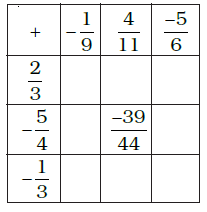
Answer:
Solution:
To complete the table, we add each row element to each column element. The calculations for the missing cells are as follows:
1. $\frac{2}{3} + (-\frac{1}{9}) = \frac{6-1}{9} = \frac{5}{9}$
2. $\frac{2}{3} + \frac{4}{11} = \frac{22+12}{33} = \frac{34}{33}$
3. $\frac{2}{3} + (-\frac{5}{6}) = \frac{4-5}{6} = -\frac{1}{6}$
4. $-\frac{5}{4} + (-\frac{1}{9}) = \frac{-45-4}{36} = -\frac{49}{36}$
5. $-\frac{5}{4} + (-\frac{5}{6}) = \frac{-15-10}{12} = -\frac{25}{12}$
6. $-\frac{1}{3} + (-\frac{1}{9}) = \frac{-3-1}{9} = -\frac{4}{9}$
7. $-\frac{1}{3} + \frac{4}{11} = \frac{-11+12}{33} = \frac{1}{33}$
8. $-\frac{1}{3} + (-\frac{5}{6}) = \frac{-2-5}{6} = -\frac{7}{6}$
The completed table is given below:
| $+$ | $-\frac{1}{9}$ | $\frac{4}{11}$ | $-\frac{5}{6}$ |
| $\frac{2}{3}$ | $\frac{5}{9}$ | $\frac{34}{33}$ | $-\frac{1}{6}$ |
| $-\frac{5}{4}$ | $-\frac{49}{36}$ | $-\frac{39}{44}$ | $-\frac{25}{12}$ |
| $-\frac{1}{3}$ | $-\frac{4}{9}$ | $\frac{1}{33}$ | $-\frac{7}{6}$ |
Question 88. Write each of the following numbers in the form $\frac{p}{q}$ , where p and q are integers:
(a) six-eighths
(b) three and half
(c) opposite of 1
(d) one-fourth
(e) zero
(f) opposite of three-fifths
Answer:
To Find: Express the given phrases as rational numbers in $\frac{p}{q}$ form.
Solution:
(a) six-eighths: This means $6$ parts out of $8$.
In $\frac{p}{q}$ form: $\mathbf{\frac{6}{8}}$ (which can be simplified to $\frac{3}{4}$).
(b) three and half: This is a mixed fraction $3\frac{1}{2}$.
In $\frac{p}{q}$ form: $\frac{(3 \times 2) + 1}{2} = \mathbf{\frac{7}{2}}$.
(c) opposite of 1: The opposite (additive inverse) of $1$ is $-1$.
In $\frac{p}{q}$ form: $\mathbf{\frac{-1}{1}}$.
(d) one-fourth: This means $1$ part out of $4$.
In $\frac{p}{q}$ form: $\mathbf{\frac{1}{4}}$.
(e) zero: Zero can be written with any non-zero integer as a denominator.
In $\frac{p}{q}$ form: $\mathbf{\frac{0}{1}}$.
(f) opposite of three-fifths: The opposite of $\frac{3}{5}$ is $-\frac{3}{5}$.
In $\frac{p}{q}$ form: $\mathbf{\frac{-3}{5}}$.
Question 89. If p = m × t and q = n × t, then $\frac{p}{q}$ = $\frac{⬜}{⬜}$
Answer:
Given:
$p = m \times t$
(i)
$q = n \times t$
(ii)
Solution:
Substituting the values of $p$ and $q$ in the fraction $\frac{p}{q}$:
$\frac{p}{q} = \frac{m \times t}{n \times t}$
Since $t$ is a common factor in both the numerator and the denominator, we can cancel it out (assuming $t \neq 0$):
$\frac{p}{q} = \frac{m \times \cancel{t}}{n \times \cancel{t}} = \frac{m}{n}$
Therefore, $\frac{p}{q} = \mathbf{\frac{m}{n}}$.
Question 90. Given that $\frac{p}{q}$ and $\frac{r}{s}$ are two rational numbers with different denominators and both of them are in standard form. To compare these rational numbers we say that:
(a) $\frac{⬜}{⬜}$ < $\frac{⬜}{⬜}$ , if p × s < r × q
(b) $\frac{p}{q}$ = $\frac{r}{s}$ , if ________ = _________
(c) $\frac{⬜}{⬜}$ > $\frac{⬜}{⬜}$ , if p × s > r × q
Answer:
Solution:
To compare two rational numbers $\frac{p}{q}$ and $\frac{r}{s}$ (where $q, s > 0$), we use the cross-multiplication method.
(a) $\mathbf{\frac{p}{q} < \frac{r}{s}}$ , if $p \times s < r \times q$
(b) $\frac{p}{q} = \frac{r}{s}$ , if $p \times s$ = $r \times q$
(c) $\mathbf{\frac{p}{q} > \frac{r}{s}}$ , if $p \times s > r \times q$
Question 91. In each of the following cases, write the rational number whose numerator and denominator are respectively as under:
(a) 5 – 39 and 54 – 6
(b) (–4) × 6 and 8 ÷ 2
(c) 35 ÷ (–7) and 35 –18
(d) 25 + 15 and 81 ÷ 40
Answer:
Solution:
(a) Numerator: $5 - 39$; Denominator: $54 - 6$
Numerator $= -34$
Denominator $= 48$
Rational Number = $\mathbf{\frac{-34}{48}}$ (Standard form: $\frac{-17}{24}$)
(b) Numerator: $(-4) \times 6$; Denominator: $8 \div 2$
Numerator $= -24$
Denominator $= 4$
Rational Number = $\mathbf{\frac{-24}{4}}$ (Standard form: $\frac{-6}{1}$)
(c) Numerator: $35 \div (-7)$; Denominator: $35 - 18$
Numerator $= -5$
Denominator $= 17$
Rational Number = $\mathbf{\frac{-5}{17}}$
(d) Numerator: $25 + 15$; Denominator: $81 \div 40$
Numerator $= 40$
Denominator $= \frac{81}{40}$
Rational Number = $\frac{40}{81/40} = 40 \times \frac{40}{81} = \mathbf{\frac{1600}{81}}$
Question 92. Write the following as rational numbers in their standard forms:
(a) 35%
(b) 1.2
(c) $-6\frac{3}{7}$
(d) 240 ÷ (– 840)
(e) 115 ÷ 207
Answer:
Solution:
A rational number is in standard form if its denominator is a positive integer and the numerator and denominator have no common factor other than $1$.
(a) 35%
$35\% = \frac{35}{100}$
Dividing numerator and denominator by their HCF, which is $5$:
$\frac{\cancel{35}^7}{\cancel{100}_{20}} = \mathbf{\frac{7}{20}}$
(b) 1.2
$1.2 = \frac{12}{10}$
Dividing numerator and denominator by their HCF, which is $2$:
$\frac{\cancel{12}^6}{\cancel{10}_5} = \mathbf{\frac{6}{5}}$
(c) $-6\frac{3}{7}$
First, convert the mixed fraction to an improper fraction:
$-\left(\frac{6 \times 7 + 3}{7}\right) = -\frac{42 + 3}{7} = \mathbf{-\frac{45}{7}}$
(Note: $45$ and $7$ have no common factors, so it is already in standard form.)
(d) 240 ÷ (– 840)
This can be written as $\frac{240}{-840}$. Making the denominator positive: $\frac{-240}{840}$.
Dividing both by $10$: $\frac{-24}{84}$
Dividing both by their HCF, which is $12$:
$\frac{\cancel{-24}^{-2}}{\cancel{84}_{7}} = \mathbf{-\frac{2}{7}}$
(e) 115 ÷ 207
This can be written as $\frac{115}{207}$.
Finding HCF of $115$ and $207$:
$\begin{array}{c|cc} 5 & 115 \\ \hline 23 & 23 \\ \hline & 1 \end{array}$ $\begin{array}{c|cc} 3 & 207 \\ \hline 3 & 69 \\ \hline 23 & 23 \\ \hline & 1 \end{array}$
Common factor is $23$. Dividing both by $23$:
$\frac{\cancel{115}^5}{\cancel{207}_9} = \mathbf{\frac{5}{9}}$
Question 93. Find a rational number exactly halfway between:
(a) $\frac{-1}{3}$ and $\frac{1}{3}$
(b) $\frac{1}{6}$ and $\frac{1}{9}$
(c) $\frac{5}{-13}$ and $\frac{-7}{9}$
(d) $\frac{1}{15}$ and $\frac{1}{12}$
Answer:
Solution:
To find a rational number exactly halfway between two numbers $a$ and $b$, we use the formula: $\frac{a + b}{2}$
(a) $\frac{-1}{3}$ and $\frac{1}{3}$
Halfway number $= \frac{-\frac{1}{3} + \frac{1}{3}}{2} = \frac{0}{2} = \mathbf{0}$
(b) $\frac{1}{6}$ and $\frac{1}{9}$
Sum $= \frac{1}{6} + \frac{1}{9} = \frac{3 + 2}{18} = \frac{5}{18}$
Halfway number $= \frac{5/18}{2} = \frac{5}{18 \times 2} = \mathbf{\frac{5}{36}}$
(c) $\frac{5}{-13}$ and $\frac{-7}{9}$
First, write with positive denominators: $\frac{-5}{13}$ and $\frac{-7}{9}$
Sum $= \frac{-5}{13} + \left(\frac{-7}{9}\right) = \frac{-5 \times 9 - 7 \times 13}{117} = \frac{-45 - 91}{117} = \frac{-136}{117}$
Halfway number $= \frac{-136/117}{2} = \frac{-136}{117 \times 2} = \frac{\cancel{-136}^{-68}}{117 \times \cancel{2}_1} = \mathbf{-\frac{68}{117}}$
(d) $\frac{1}{15}$ and $\frac{1}{12}$
Sum $= \frac{1}{15} + \frac{1}{12} = \frac{4 + 5}{60} = \frac{9}{60} = \frac{3}{20}$
Halfway number $= \frac{3/20}{2} = \mathbf{\frac{3}{40}}$
Question 94. Taking x = $\frac{-4}{9}$ , y = $\frac{5}{12}$ and z = $\frac{7}{18}$ , find
(a) the rational number which when added to x gives y.
(b) the rational number which subtracted from y gives z.
(c) the rational number which when added to z gives us x.
(d) the rational number which when multiplied by y to get x.
(e) the reciprocal of x + y.
(f) the sum of reciprocals of x and y.
(g) (x ÷ y) × z
(h) (x – y) + z
(i) x + (y + z)
(j) x ÷ (y ÷ z)
(k) x – (y + z)
Answer:
Given: $x = \frac{-4}{9}$, $y = \frac{5}{12}$, and $z = \frac{7}{18}$
(a) The number which when added to $x$ gives $y$:
Let the number be $a$. Then $a + x = y \implies a = y - x$
$a = \frac{5}{12} - \left(\frac{-4}{9}\right) = \frac{5}{12} + \frac{4}{9}$
LCM of $12$ and $9$ is $36$.
$a = \frac{5 \times 3 + 4 \times 4}{36} = \frac{15 + 16}{36} = \mathbf{\frac{31}{36}}$
(b) The number which subtracted from $y$ gives $z$:
$y - a = z \implies a = y - z$
$a = \frac{5}{12} - \frac{7}{18} = \frac{5 \times 3 - 7 \times 2}{36} = \frac{15 - 14}{36} = \mathbf{\frac{1}{36}}$
(c) The number which when added to $z$ gives us $x$:
$z + a = x \implies a = x - z$
$a = \frac{-4}{9} - \frac{7}{18} = \frac{-8 - 7}{18} = \frac{-15}{18} = \mathbf{-\frac{5}{6}}$
(d) The number which when multiplied by $y$ to get $x$:
$a \times y = x \implies a = x \div y$
$a = \frac{-4}{9} \div \frac{5}{12} = \frac{-4}{9} \times \frac{12}{5} = \frac{-4 \times 4}{3 \times 5} = \mathbf{-\frac{16}{15}}$
(e) Reciprocal of $x + y$:
$x + y = \frac{-4}{9} + \frac{5}{12} = \frac{-16 + 15}{36} = -\frac{1}{36}$
Reciprocal of $-\frac{1}{36}$ is $\mathbf{-36}$.
(f) Sum of reciprocals of $x$ and $y$:
Reciprocal of $x$ is $-\frac{9}{4}$; Reciprocal of $y$ is $\frac{12}{5}$
Sum $= -\frac{9}{4} + \frac{12}{5} = \frac{-45 + 48}{20} = \mathbf{\frac{3}{20}}$
(g) $(x \div y) \times z$:
From part (d), $x \div y = -\frac{16}{15}$
Result $= \left(-\frac{16}{15}\right) \times \frac{7}{18} = \frac{-8 \times 7}{15 \times 9} = \mathbf{-\frac{56}{135}}$
(h) $(x - y) + z$:
$x - y = \frac{-4}{9} - \frac{5}{12} = \frac{-16 - 15}{36} = -\frac{31}{36}$
Result $= -\frac{31}{36} + \frac{7}{18} = \frac{-31 + 14}{36} = \mathbf{-\frac{17}{36}}$
(i) $x + (y + z)$:
$y + z = \frac{5}{12} + \frac{7}{18} = \frac{15 + 14}{36} = \frac{29}{36}$
Result $= \frac{-4}{9} + \frac{29}{36} = \frac{-16 + 29}{36} = \mathbf{\frac{13}{36}}$
(j) $x \div (y \div z)$:
$y \div z = \frac{5}{12} \times \frac{18}{7} = \frac{5 \times 3}{2 \times 7} = \frac{15}{14}$
Result $= \frac{-4}{9} \div \frac{15}{14} = \frac{-4}{9} \times \frac{14}{15} = \mathbf{-\frac{56}{135}}$
(k) $x - (y + z)$:
From part (i), $y + z = \frac{29}{36}$
Result $= \frac{-4}{9} - \frac{29}{36} = \frac{-16 - 29}{36} = \frac{-45}{36} = \mathbf{-\frac{5}{4}}$
Question 95. What should be added to $\frac{-1}{2}$ to obtain the nearest natural number?
Answer:
Given:
The rational number is $\frac{-1}{2}$.
To Find:
The value to be added to obtain the nearest natural number.
Solution:
Natural numbers are counting numbers starting from $1$, i.e., $1, 2, 3, \dots$.
The given number $\frac{-1}{2}$ is equal to $-0.5$ in decimal form.
The nearest natural number to $-0.5$ is $1$.
Let the number to be added be $x$.
$-\frac{1}{2} + x = 1$
$x = 1 + \frac{1}{2}$
$x = \frac{2 + 1}{2}$
$x = \frac{3}{2}$
Therefore, $\frac{3}{2}$ should be added to $\frac{-1}{2}$ to obtain the nearest natural number.
Question 96. What should be subtracted from $\frac{-2}{3}$ to obtain the nearest integer?
Answer:
Given:
The rational number is $\frac{-2}{3}$.
To Find:
The value to be subtracted to obtain the nearest integer.
Solution:
The decimal value of $\frac{-2}{3}$ is approximately $-0.67$.
The integers surrounding this value are $-1$ and $0$.
Distance from $-0.67$ to $-1$ is $|-0.67 - (-1)| = 0.33$.
Distance from $-0.67$ to $0$ is $|-0.67 - 0| = 0.67$.
Since the distance to $-1$ is smaller, the nearest integer is $-1$.
Let the number to be subtracted be $x$.
$-\frac{2}{3} - x = -1$
$-x = -1 + \frac{2}{3}$
$-x = \frac{-3 + 2}{3}$
$-x = -\frac{1}{3}$
$x = \frac{1}{3}$
Therefore, $\frac{1}{3}$ should be subtracted.
Question 97. What should be multiplied with $\frac{-5}{8}$ to obtain the nearest integer?
Answer:
Given:
The rational number is $\frac{-5}{8}$.
To Find:
The value to be multiplied to obtain the nearest integer.
Solution:
The decimal value of $\frac{-5}{8}$ is $-0.625$.
The integers surrounding this value are $-1$ and $0$.
The distance to $-1$ is $|-0.625 - (-1)| = 0.375$.
The distance to $0$ is $|-0.625 - 0| = 0.625$.
So, the nearest integer is $-1$.
Let the number to be multiplied be $x$.
$\left( -\frac{5}{8} \right) \times x = -1$
$x = -1 \times \left( -\frac{8}{5} \right)$
$x = \frac{8}{5}$
Therefore, $\frac{8}{5}$ (or $1.6$) should be multiplied.
Question 98. What should be divided by $\frac{1}{2}$ to obtain the greatest negative integer?
Answer:
To Find:
The number which when divided by $\frac{1}{2}$ gives the greatest negative integer.
Solution:
The greatest negative integer is $-1$.
Let the required number be $x$.
$x \div \frac{1}{2} = -1$
$x \times \frac{2}{1} = -1$
$2x = -1$
$x = -\frac{1}{2}$
Therefore, $-\frac{1}{2}$ should be divided by $\frac{1}{2}$.
Question 99. From a rope 68 m long, pieces of equal size are cut. If length of one piece is $4\frac{1}{4}$ m, find the number of such pieces.
Answer:
Given:
Total length of the rope = $68$ m
Length of each piece = $4\frac{1}{4}$ m
To Find:
The number of pieces.
Solution:
First, convert the mixed fraction into an improper fraction:
Length of one piece = $4\frac{1}{4} = \frac{4 \times 4 + 1}{4} = \frac{17}{4}$ m
Number of pieces = $\text{Total length} \div \text{Length of one piece}$
Number of pieces = $68 \div \frac{17}{4}$
Number of pieces = $68 \times \frac{4}{17}$
Number of pieces = $\frac{\cancel{68}^4 \times 4}{\cancel{17}_1}$
Number of pieces = $4 \times 4 = 16$
Therefore, there are $16$ such pieces.
Question 100. If 12 shirts of equal size can be prepared from 27m cloth, what is length of cloth required for each shirt?
Answer:
Given:
Total number of shirts = $12$
Total length of cloth = $27$ m
To Find:
Length of cloth required for one shirt.
Solution:
Length for each shirt = $\text{Total cloth} \div \text{Total shirts}$
Length for each shirt = $\frac{27}{12}$ m
Dividing both numerator and denominator by $3$:
Length for each shirt = $\frac{\cancel{27}^9}{\cancel{12}_4}$ m
Length for each shirt = $\frac{9}{4}$ m
Converting to decimal or mixed fraction:
$\frac{9}{4} = 2.25$ m
Therefore, the length of cloth required for each shirt is $2.25$ m (or $2\frac{1}{4}$ m).
Question 101. Insert 3 equivalent rational numbers between
(i) $\frac{-1}{2}$ and $\frac{1}{5}$
(ii) 0 and –10
Answer:
(i) $\frac{-1}{2}$ and $\frac{1}{5}$
To find rational numbers between $\frac{-1}{2}$ and $\frac{1}{5}$, we first find a common denominator. The LCM of $2$ and $5$ is $10$.
$\frac{-1}{2} = \frac{-1 \times 5}{2 \times 5} = \frac{-5}{10}$
$\frac{1}{5} = \frac{1 \times 2}{5 \times 2} = \frac{2}{10}$
The rational numbers between $\frac{-5}{10}$ and $\frac{2}{10}$ are $\frac{-4}{10}, \frac{-3}{10}, \frac{-2}{10}, \frac{-1}{10}, 0, \frac{1}{10}$.
We can pick any three, for example: $\frac{-4}{10}, \frac{-3}{10},$ and $\frac{-2}{10}$.
(ii) 0 and –10
We can write $0$ as $\frac{0}{1}$ and $-10$ as $\frac{-10}{1}$.
The integers between $0$ and $-10$ are $-1, -2, -3, -4, -5, -6, -7, -8, -9$.
Any of these can be written in rational form. For example: $-1, -2,$ and $-3$ (which are $\frac{-1}{1}, \frac{-2}{1}, \frac{-3}{1}$).
Question 102. Put the ($\checkmark$), wherever applicable
| Number | Natural Number | Whole Number | Integer | Fraction | Rational Number |
|---|---|---|---|---|---|
| (a) – 114 | |||||
| (b) $\frac{19}{27}$ | |||||
| (c) $\frac{623}{1}$ | |||||
| (d) $-19\frac{3}{4}$ | |||||
| (e) $\frac{73}{71}$ | |||||
| (f) 0 |
Answer:
Solution:
Based on the definitions of various number systems, here is the completed table:
| Number | Natural | Whole | Integer | Fraction | Rational |
| (a) – 114 | $\checkmark$ | $\checkmark$ | |||
| (b) $\frac{19}{27}$ | $\checkmark$ | $\checkmark$ | |||
| (c) $\frac{623}{1}$ | $\checkmark$ | $\checkmark$ | $\checkmark$ | $\checkmark$ | $\checkmark$ |
| (d) $-19\frac{3}{4}$ | $\checkmark$ | ||||
| (e) $\frac{73}{71}$ | $\checkmark$ | $\checkmark$ | |||
| (f) 0 | $\checkmark$ | $\checkmark$ | $\checkmark$ | $\checkmark$ |
Question 103. ‘a’ and ‘b’ are two different numbers taken from the numbers 1 – 50. What is the largest value that $\frac{a - b}{a + b}$ can have? What is the largest value that $\frac{a + b}{a - b}$ can have?
Answer:
Given: $a, b \in \{1, 2, 3, \dots, 50\}$ and $a \neq b$.
1. Largest value of $\frac{a - b}{a + b}$:
To maximize this fraction, the numerator $(a - b)$ should be as large as possible and the denominator $(a + b)$ should be as small as possible.
Maximum $a = 50$, Minimum $b = 1$.
Value $= \frac{50 - 1}{50 + 1} = \frac{49}{51}$.
2. Largest value of $\frac{a + b}{a - b}$:
To maximize this fraction, the numerator $(a + b)$ should be as large as possible and the denominator $(a - b)$ should be as small as possible (positive).
Smallest positive difference for $a - b$ is $1$ (since they are different integers).
Let $a = 50$ and $b = 49$.
Value $= \frac{50 + 49}{50 - 49} = \frac{99}{1} = 99$.
Therefore, the largest values are $\frac{49}{51}$ and $99$ respectively.
Question 104. 150 students are studying English, Maths or both. 62 per cent of the students are studying English and 68 per cent are studying Maths. How many students are studying both?
Answer:
Given:
Total number of students = $150$
Percentage of students studying English = $62 \%$
Percentage of students studying Maths = $68 \%$
To Find:
The number of students who are studying both English and Maths.
Solution:
First, we calculate the number of students studying English:
Number of English students = $62 \%$ of $150$
Number of English students = $\frac{62}{100} \times 150$
Number of English students = $\frac{62 \times 3}{2}$ = $31 \times 3 = 93$
Next, we calculate the number of students studying Maths:
Number of Maths students = $68 \%$ of $150$
Number of Maths students = $\frac{68}{100} \times 150$
Number of Maths students = $\frac{68 \times 3}{2}$ = $34 \times 3 = 102$
Now, we find the sum of students in both categories:
Sum of students = $93 + 102 = 195$
Since the total number of students is only $150$, the extra count represents students who were counted twice because they study both subjects.
Number of students studying both = Sum of students $-$ Total actual students
Number of students studying both = $195 - 150$
Therefore, $45$ students are studying both English and Maths.
Alternate Method:
Sum of percentages = $62 \% + 68 \% = 130 \%$
Since the total percentage should be $100 \%$, the excess percentage represents students studying both subjects.
Percentage of students studying both = $130 \% - 100 \% = 30 \%$
Number of students studying both = $30 \%$ of $150$
Number of students studying both = $\frac{30}{100} \times 150 = 3 \times 15 = 45$
Question 105. A body floats $\frac{2}{9}$ of its volume above the surface. What is the ratio of the body submerged volume to its exposed volume? Re-write it as a rational number.
Answer:
Given:
Let the total volume of the body be $V$.
Exposed volume (volume above surface) $= \frac{2}{9} V$
Solution:
Submerged volume $= \text{Total volume} - \text{Exposed volume}$
Submerged volume $= V - \frac{2}{9} V = \frac{7}{9} V$
Ratio of submerged volume to exposed volume:
$\text{Ratio} = \frac{\text{Submerged Volume}}{\text{Exposed Volume}} = \frac{\frac{7}{9} V}{\frac{2}{9} V}$
$\text{Ratio} = \frac{7}{9} \times \frac{9}{2} = \frac{7}{2}$
In ratio form, it is $7 : 2$.
As a rational number, it is $\frac{7}{2}$.
Find the odd one out of the following and give reason.
Question 106.
(a) $\frac{4}{3}$ × $\frac{3}{4}$
(b) $\frac{-3}{2}$ × $\frac{-2}{3}$
(c) 2 × $\frac{1}{2}$
(d) $\frac{-1}{3}$ × $\frac{3}{1}$
Answer:
Solution:
Let's calculate the product for each option:
(a) $\frac{4}{3} \times \frac{3}{4} = \frac{\cancel{4}^1}{\cancel{3}_1} \times \frac{\cancel{3}^1}{\cancel{4}_1} = 1$
(b) $\frac{-3}{2} \times \frac{-2}{3} = \frac{\cancel{-3}^{-1}}{\cancel{2}_1} \times \frac{\cancel{-2}^{-1}}{\cancel{3}_1} = (-1) \times (-1) = 1$
(c) $2 \times \frac{1}{2} = \cancel{2}^1 \times \frac{1}{\cancel{2}_1} = 1$
(d) $\frac{-1}{3} \times \frac{3}{1} = \frac{-1}{\cancel{3}_1} \times \frac{\cancel{3}^1}{1} = -1$
Odd one out: (d)
Reason: In options (a), (b), and (c), the product of the numbers is $1$ (multiplicative identity), whereas in option (d), the product is $-1$.
Question 107.
(a) $\frac{4}{-9}$
(b) $\frac{-16}{36}$
(c) $\frac{-20}{-45}$
(d) $\frac{28}{-63}$
Answer:
Solution:
Let's simplify each rational number to its standard form:
(a) $\frac{4}{-9} = -\frac{4}{9}$
(b) $\frac{-16}{36} = \frac{-16 \div 4}{36 \div 4} = -\frac{4}{9}$
(c) $\frac{-20}{-45} = \frac{-20 \div (-5)}{-45 \div (-5)} = \frac{4}{9}$
(d) $\frac{28}{-63} = \frac{28 \div 7}{-63 \div 7} = \frac{4}{-9} = -\frac{4}{9}$
Odd one out: (c)
Reason: Options (a), (b), and (d) are all negative rational numbers equivalent to $-\frac{4}{9}$, whereas option (c) is a positive rational number equivalent to $\frac{4}{9}$.
Question 108.
(a) $\frac{-4}{3}$
(b) $\frac{-7}{6}$
(c) $\frac{-10}{3}$
(d) $\frac{-8}{7}$
Answer:
Solution:
Let's examine the relationship between the numerator and the denominator (ignoring the signs) for each option:
(a) Numerator $= 4$, Denominator $= 3$; Difference $= 4 - 3 = 1$
(b) Numerator $= 7$, Denominator $= 6$; Difference $= 7 - 6 = 1$
(c) Numerator $= 10$, Denominator $= 3$; Difference $= 10 - 3 = 7$
(d) Numerator $= 8$, Denominator $= 7$; Difference $= 8 - 7 = 1$
Odd one out: (c)
Reason: In options (a), (b), and (d), the absolute difference between the numerator and the denominator is $1$, whereas in option (c), the difference is $7$. Alternatively, (c) is the only number that does not lie between $-1$ and $-2$ on the number line.
Question 109.
(a) $\frac{-3}{7}$
(b) $\frac{-9}{15}$
(c) $\frac{+24}{20}$
(d) $\frac{+35}{25}$
Answer:
Solution:
Let's check if the rational numbers are in their standard (simplest) form:
(a) $\frac{-3}{7}$: The HCF of $3$ and $7$ is $1$. This is in standard form.
(b) $\frac{-9}{15}$: The HCF of $9$ and $15$ is $3$. It can be reduced to $\frac{-3}{5}$. Not in standard form.
(c) $\frac{+24}{20}$: The HCF of $24$ and $20$ is $4$. It can be reduced to $\frac{6}{5}$. Not in standard form.
(d) $\frac{+35}{25}$: The HCF of $35$ and $25$ is $5$. It can be reduced to $\frac{7}{5}$. Not in standard form.
Odd one out: (a)
Reason: Option (a) is the only rational number that is already in its standard form, whereas the others can be simplified further.
Question 110. What’s the Error? Chhaya simplified a rational number in this manner $\frac{-25}{-30}$ = $\frac{5}{6}$ . What error did the student make?
Answer:
Solution:
To simplify $\frac{-25}{-30}$, we divide both the numerator and the denominator by their Highest Common Factor (HCF).
The HCF of $25$ and $30$ is $5$. Since both numbers are negative, we divide by $-5$:
$\frac{-25 \div (-5)}{-30 \div (-5)} = \frac{5}{6}$
Conclusion:
In this specific case, Chhaya’s final result $\frac{5}{6}$ is mathematically correct. There is no error in her calculation because a negative number divided by a negative number yields a positive number, and $\frac{25}{30}$ simplifies correctly to $\frac{5}{6}$.
If the student was expected to show the intermediate step of dividing by the HCF and did not, that is a lack of detail rather than a mathematical error.