

Chapter 9 Perimeter & Area (Class 7 - Maths NCERT Exemplar Solutions)
Welcome to the comprehensive resource for NCERT Exemplar Solutions for Class 7 Mathematics: Chapter 9 Perimeter & Area! This chapter significantly expands upon basic mensuration, moving beyond standard squares and rectangles to explore more complex geometric figures. These Exemplar problems are strategically designed to challenge students with intricate application-based tasks involving parallelograms, triangles, and circles, requiring a deeper conceptual understanding and a more sophisticated approach to problem-solving.
The solutions provided here cover the measurement of boundaries and enclosed regions for a variety of plane figures. For Parallelograms, students will learn to apply the formula $A = \text{base} \times \text{height}$, emphasizing the use of the perpendicular height. For Triangles, the focus is on the area formula $A = \frac{1}{2} \times \text{base} \times \text{height}$. A major highlight of this chapter is the Circle, where students will master calculating the Circumference ($C = 2\pi r$) and Area ($A = \pi r^2$) using appropriate approximations for $\pi$ such as $\frac{22}{7}$ or $3.14$.
Significant attention is given to composite figures—shapes formed by combining multiple geometric forms—and finding the area of paths or borders constructed inside or outside rectangular or circular fields. Students will also learn to perform essential unit conversions, such as moving between $m^2$ and hectares (where $1 \text{ hectare} = 10000 \text{ m}^2$). Practical word problems involving the cost of fencing, floor polishing, or leveling a ground are addressed with calculations using the $\textsf{₹}$ symbol to ensure real-world accuracy.
These solutions cater to all Exemplar formats, including Multiple Choice Questions (MCQs), Fill-in-the-Blanks, and detailed word problems. With step-by-step guidance, clear diagrams, and logical justifications prepared by learningspot.co, students can achieve mastery over these crucial mensuration concepts and develop the accuracy needed to solve complex spatial problems with confidence.
| Content On This Page | ||
|---|---|---|
| Solved Examples (Examples 1 to 15) | Question 1 to 37 (Multiple Choice Questions) | Question 38 to 56 (Fill in the Blanks) |
| Question 57 to 72 (True or False) | Question 73 to 131 | |
Solved Examples (Examples 1 to 15)
In Examples 1 and 2, there are four options, out of which one is correct. Choose the correct one.
Example 1: Following rectangle is composed of 8 congruent parts.

Area of each part is
(a) 72 cm2
(b) 36 cm2
(c) 18 cm2
(d) 9 cm2
Answer:
Given:
Length of the rectangle $= 12$ cm
Breadth of the rectangle $= 6$ cm
Number of congruent parts $= 8$
To Find:
Area of each congruent part.
Solution:
First, we calculate the total area of the rectangle:
$\text{Area of rectangle} = \text{Length} \times \text{Breadth}$
$\text{Area of rectangle} = 12 \times 6$
$\text{Area of rectangle} = 72$ cm$^2$
Since the rectangle is composed of 8 congruent parts, the area of each part is equal.
$\text{Area of each part} = \frac{\text{Total Area}}{\text{Number of parts}}$
$\text{Area of each part} = \frac{\cancel{72}^{9}}{\cancel{8}_{1}}$
$\text{Area of each part} = 9$ cm$^2$
Hence, the correct option is (d).
Example 2: Area of a right triangle is 54 cm2. If one of its legs is 12 cm long, its perimeter is
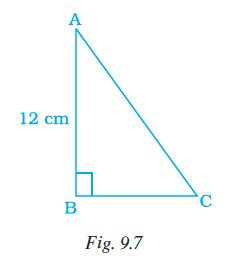
(a) 18 cm
(b) 27 cm
(c) 36 cm
(d) 54 cm
Answer:
Given:
Area of right triangle $= 54$ cm$^2$
Length of one leg (say, altitude AB) $= 12$ cm
To Find:
Perimeter of the triangle.
Solution:
Let the other leg be the base (BC).
$\text{Area of triangle} = \frac{1}{2} \times \text{base} \times \text{height}$
$54 = \frac{1}{2} \times BC \times 12$
(Given)
$54 = 6 \times BC$
$BC = \frac{54}{6} = 9$ cm
Now, we find the hypotenuse (AC) using Pythagoras theorem:
$AC^2 = AB^2 + BC^2$
$AC^2 = 12^2 + 9^2$
$AC^2 = 144 + 81$
$AC^2 = 225$
$AC = \sqrt{225} = 15$ cm
Finally, we calculate the perimeter:
$\text{Perimeter} = AB + BC + AC$
$\text{Perimeter} = 12 + 9 + 15$
$\text{Perimeter} = 36$ cm
Hence, the correct option is (c).
In Examples 3 to 6, fill in the blanks to make it a statement true.
Example 3: Area of parallelogram QPON is ______cm2.
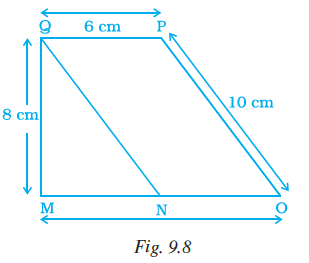
Answer:
Given:
In parallelogram QPON:
Base $QP = 6$ cm
Height (altitude) $QM = 8$ cm
Solution:
The area of a parallelogram is given by the product of its base and corresponding height.
$\text{Area} = \text{base} \times \text{height}$
$\text{Area} = 6 \times 8$
$\text{Area} = 48$ cm$^2$
Therefore, the area of parallelogram QPON is 48 cm$^2$.
Example 4: 1 hectare = _________ cm2
Answer:
Solution:
We know that $1$ hectare $= 10,000$ m$^2$.
Also, $1$ m $= 100$ cm, therefore $1$ m$^2 = (100 \times 100)$ cm$^2 = 10,000$ cm$^2$.
To convert hectare to cm$^2$:
$1 \text{ hectare} = 10,000 \times 10,000$ cm$^2$
$1 \text{ hectare} = 10,00,00,000$ cm$^2$
Using exponential notation, $1$ hectare $= 10^8$ cm$^2$.
Example 5: _______ squares of each side 1 m makes a square of side 5 km.
Answer:
Given:
Side of small square $= 1$ m
Side of large square $= 5$ km $= 5,000$ m
Solution:
$\text{Area of large square} = \text{side} \times \text{side}$
$\text{Area of large square} = 5,000 \times 5,000 = 2,50,00,000$ m$^2$
$\text{Area of small square} = 1 \times 1 = 1$ m$^2$
$\text{Number of small squares} = \frac{\text{Area of large square}}{\text{Area of small square}}$
$\text{Number of small squares} = \frac{2,50,00,000}{1} = 2,50,00,000$
Therefore, 2,50,00,000 (or 2.5 crore) squares are required.
Example 6: All the congruent triangles have _____ area.
Answer:
Solution:
Congruent triangles are identical in shape and size. Since their corresponding bases and altitudes are equal, their calculated areas must be the same.
Therefore, all the congruent triangles have equal (or same) area.
In Examples 7 to 10, state whether the statements are True or False.
Example 7: All the triangles equal in area are congruent.
Answer:
Solution:
The given statement is False.
Triangles can have the same area if the product of their base and height is equal, even if their sides and angles (shape) are completely different.
For example, a triangle with base 4 cm and height 3 cm has an area of 6 cm$^2$. Another triangle with base 6 cm and height 2 cm also has an area of 6 cm$^2$, but they are clearly not congruent.
Example 8: The area of any parallelogram ABCD, is AB × BC.
Answer:
Statement: The area of any parallelogram $ABCD$, is $AB \times BC$.
Solution:
The given statement is False.
The area of a parallelogram is calculated by the formula:
$\text{Area} = \text{Base} \times \text{Corresponding Height (Altitude)}$
In a parallelogram $ABCD$, $AB$ and $BC$ are adjacent sides. The product $AB \times BC$ would only represent the area if the angle between them is $90^\circ$ (making it a rectangle). In general parallelograms, the height is not equal to the adjacent side.
Example 9: Ratio of the circumference and the diameter of a circle is more than 3.
Answer:
Statement: Ratio of the circumference and the diameter of a circle is more than $3$.
Solution:
The given statement is True.
We know that the circumference ($C$) of a circle is given by $C = \pi d$, where $d$ is the diameter.
The ratio of the circumference to the diameter is:
$\frac{C}{d} = \pi$
The value of $\pi$ is approximately $3.14$ (or $\frac{22}{7}$), which is clearly greater than $3$.
Example 10: A nursery school play ground is 160 m long and 80 m wide. In it 80 m × 80 m is kept for swings and in the remaining portion, there is 1.5 m wide path parallel to its width and parallel to its remaining length as shown in Fig. 9.9. The remaining area is covered by grass. Find the area covered by grass.
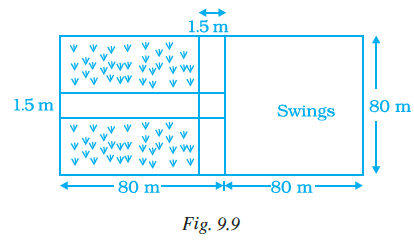
Answer:
Given:
Total Length of playground $= 160$ m
Total Width of playground $= 80$ m
Area for swings $= 80 \text{ m} \times 80 \text{ m}$
Width of the path $= 1.5$ m
To Find:
Area covered by grass.
Solution:
The total area of the playground is $160 \times 80 = 12,800$ m$^2$.
The area remaining after the swing portion is:
Remaining Length $= 160 - 80 = 80$ m
Remaining Width $= 80$ m
Remaining Area $= 80 \times 80 = 6,400$ m$^2$
Now, within this $80 \times 80$ portion, there are two paths of width $1.5$ m:
1. Area of path parallel to width $= 80 \times 1.5 = 120$ m$^2$
2. Area of path parallel to length $= 80 \times 1.5 = 120$ m$^2$
3. Area of common square at intersection $= 1.5 \times 1.5 = 2.25$ m$^2$
Total Area of Path $= 120 + 120 - 2.25 = 237.75$ m$^2$
Area covered by grass $=$ Remaining Area $-$ Total Area of Path
Area of grass $= 6,400 - 237.75 = 6,162.25$ m$^2$
Thus, the area covered by grass is $6,162.25$ m$^2$.
Example 11: In Fig. 9.10, ABCD is a parallelogram, in which AB = 8 cm, AD = 6 cm and altitude AE = 4 cm. Find the altitude corresponding to side AD.
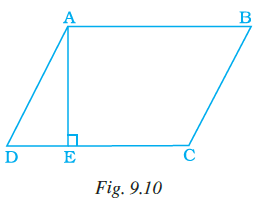
Answer:
Given:
Base $AB = 8$ cm, Altitude $AE = 4$ cm
Base $AD = 6$ cm
To Find:
Altitude corresponding to side $AD$ (Let it be $h$).
Solution:
The area of a parallelogram remains constant regardless of which side is taken as the base.
$\text{Area of parallelogram } ABCD = \text{Base } AB \times \text{Altitude } AE$
$\text{Area} = 8 \times 4 = 32$ cm$^2$
Now, using $AD$ as the base:
$\text{Area} = AD \times h$
$32 = 6 \times h$
$h = \frac{32}{6} = \frac{16}{3}$ cm
$h = 5.33$ cm (approx.)
The altitude corresponding to side $AD$ is $5.33$ cm.
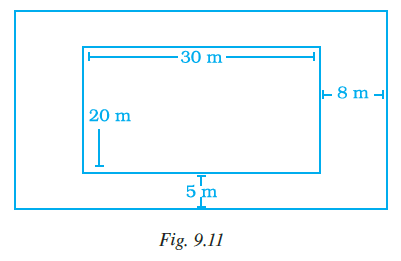
Example 12: A rectangular shaped swimming pool with dimensions 30 m × 20 m has 5 m wide cemented path along its length and 8 m wide path along its width (as shown in Fig. 9.11). Find the cost of cementing the path at the rate of Rs 200 per m2.
Answer:
Given:
Inner Length ($l$) $= 30$ m, Inner Width ($w$) $= 20$ m
Path width along length $= 5$ m, Path width along width $= 8$ m
Rate $= \textsf{₹} 200$ per m$^2$
To Find:
Total cost of cementing the path.
Solution:
The outer dimensions of the plot including the path are:
Outer Length $= 30 + 8 + 8 = 46$ m
Outer Width $= 20 + 5 + 5 = 30$ m
$\text{Area of path} = (\text{Outer Area}) - (\text{Inner Area})$
$\text{Area of path} = (46 \times 30) - (30 \times 20)$
$\text{Area of path} = 1,380 - 600 = 780$ m$^2$
$\text{Total Cost} = \text{Area} \times \text{Rate}$
$\text{Total Cost} = 780 \times \textsf{₹} 200$
$\text{Total Cost} = \textsf{₹} 1,56,000$
The cost of cementing the path is $\textsf{₹} 1,56,000$.
Example 13: Circumference of a circle is 33 cm. Find its area.
Answer:
Given:
Circumference ($C$) $= 33$ cm
To Find:
Area of the circle.
Solution:
We first find the radius ($r$) using the circumference formula:
$2\pi r = 33$
$2 \times \frac{22}{7} \times r = 33$
$r = \frac{33 \times 7}{44} = \frac{3 \times 7}{4} = \frac{21}{4}$ cm
Now, we find the area:
$\text{Area} = \pi r^2$
$\text{Area} = \frac{22}{7} \times \left(\frac{21}{4}\right) \times \left(\frac{21}{4}\right)$
$\text{Area} = \frac{22 \times 3 \times 21}{16} = \frac{1,386}{16}$
$\text{Area} = 86.625$ cm$^2$
The area of the circle is $86.625$ cm$^2$.
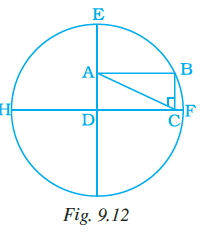
Example 14: Rectangle ABCD is formed in a circle as shown in Fig. 9.12. If AE = 8 cm and AD = 5 cm, find the perimeter of the rectangle.
Answer:
Given:
In the given figure (Fig. 9.12):
1. Point $D$ is the center of the circle.
2. $DE$ is the radius of the circle.
3. $AD = 5 \text{ cm}$ and $AE = 8 \text{ cm}$.
4. $ABCD$ is a rectangle where $D$ is a vertex and $B$ lies on the circumference of the circle.
To Find:
The perimeter of the rectangle $ABCD$.
Solution:
First, we find the radius of the circle. Since $A$ lies on the line segment $DE$:
$\text{Radius } (r) = DE = AD + AE$
$r = 5 \text{ cm} + 8 \text{ cm}$
$r = 13 \text{ cm}$
In a rectangle, the diagonals are equal. Since $D$ is the center and $B$ is a point on the circle, the segment $DB$ is also a radius of the circle.
$DB = r = 13 \text{ cm}$
(Radius of the circle)
Now, consider the right-angled triangle $\triangle DAB$ (since $\angle DAB = 90^\circ$ in a rectangle). By Pythagoras Theorem:
$AB^2 + AD^2 = DB^2$
$AB^2 + 5^2 = 13^2$
$AB^2 + 25 = 169$
$AB^2 = 169 - 25$
$AB^2 = 144$
$AB = \sqrt{144}$
$AB = 12 \text{ cm}$
Now, we calculate the perimeter of the rectangle $ABCD$:
$\text{Perimeter} = 2 \times (\text{Length} + \text{Breadth})$
$\text{Perimeter} = 2 \times (AB + AD)$
$\text{Perimeter} = 2 \times (12 \text{ cm} + 5 \text{ cm})$
$\text{Perimeter} = 2 \times 17 \text{ cm}$
$\text{Perimeter} = 34 \text{ cm}$
Therefore, the perimeter of the rectangle $ABCD$ is $34 \text{ cm}$.
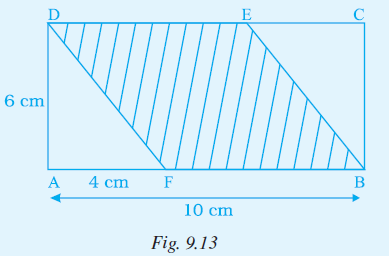
Example 15: Find the area of a parallelogram shaped shaded region of Fig. 9.13. Also, find the area of each triangle. What is the ratio of area of shaded portion to the remaining area of rectangle?
Answer:
Given:
From the figure (Fig. 9.13), we have a rectangle $ABCD$ where:
Length ($AB$) = $10 \text{ cm}$
Width ($AD$) = $6 \text{ cm}$
Length ($AF$) = $4 \text{ cm}$
The shaded region $DEBF$ is a parallelogram.
To Find:
1. Area of the shaded parallelogram $DEBF$.
2. Area of each triangle ($\triangle DAF$ and $\triangle BCE$).
3. Ratio of the area of the shaded portion to the remaining area of the rectangle.
Solution:
Step 1: Determine the unknown lengths.
In rectangle $ABCD$, the opposite sides are equal ($AB = CD = 10 \text{ cm}$ and $AD = BC = 6 \text{ cm}$).
We can find the length of the base of the shaded parallelogram ($FB$):
$FB = AB - AF$
$FB = 10 \text{ cm} - 4 \text{ cm} = 6 \text{ cm}$
Since $DEBF$ is a parallelogram, opposite sides are equal, so $DE = FB = 6 \text{ cm}$.
Now find $EC$:
$EC = DC - DE = 10 \text{ cm} - 6 \text{ cm} = 4 \text{ cm}$.
Step 2: Calculate the area of the shaded parallelogram $DEBF$.
$\text{Area of parallelogram} = \text{Base} \times \text{Height}$
Here, Base ($FB$) = $6 \text{ cm}$ and Height ($AD$) = $6 \text{ cm}$.
$\text{Area of shaded region} = 6 \text{ cm} \times 6 \text{ cm}$
$\text{Area of shaded region} = 36 \text{ cm}^2$
Step 3: Calculate the area of each triangle.
For $\triangle DAF$ (Right-angled at $A$):
$\text{Area} = \frac{1}{2} \times \text{Base} \times \text{Height}$
$\text{Area of } \triangle DAF = \frac{1}{2} \times 4 \text{ cm} \times 6 \text{ cm} = 12 \text{ cm}^2$
For $\triangle BCE$ (Right-angled at $C$):
$\text{Area of } \triangle BCE = \frac{1}{2} \times 4 \text{ cm} \times 6 \text{ cm} = 12 \text{ cm}^2$
Step 4: Calculate the ratio.
The remaining area of the rectangle consists of the two triangles:
$\text{Remaining area} = \text{Area of } \triangle DAF + \text{Area of } \triangle BCE$
$\text{Remaining area} = 12 \text{ cm}^2 + 12 \text{ cm}^2 = 24 \text{ cm}^2$
Now, the ratio of shaded area to remaining area is:
$\text{Ratio} = \frac{\text{Shaded Area}}{\text{Remaining Area}}$
$\text{Ratio} = \frac{36}{24}$
Dividing both by their highest common factor (12):
$\text{Ratio} = \frac{3}{2}$
Final Answers:
1. Area of the shaded parallelogram is $36 \text{ cm}^2$.
2. Area of each triangle is $12 \text{ cm}^2$.
3. The required ratio is $3 : 2$.
Exercise
Question 1 to 37 (Multiple Choice Questions)
In the Questions 1 to 37, there are four options, out of which one is correct. Choose the correct one.
Question 1. Observe the shapes 1, 2, 3 and 4 in the figures. Which of the following statements is not correct?

(a) Shapes 1, 3 and 4 have different areas and different perimeters.
(b) Shapes 1 and 4 have the same area as well as the same perimeter.
(c) Shapes 1, 2 and 4 have the same area.
(d) Shapes 1, 3 and 4 have the same perimeter.
Answer:
Given:
Four shapes (1, 2, 3, and 4) are drawn on a squared grid. Let each small square side be $1 \text{ unit}$ and the area of each small square be $1 \text{ sq. unit}$.
To Find:
Identify the statement that is not correct among the given options.
Solution:
To evaluate the statements, we first calculate the Area and Perimeter of each shape by counting the grid units.
1. For Shape 1:
$\text{Area} = 18 \text{ sq. units}$
(By counting unit squares)
$\text{Perimeter} = 22 \text{ units}$
(By counting boundary segments)
2. For Shape 2:
$\text{Area} = 18 \text{ sq. units}$
(Rectangle of $6 \times 3$)
$\text{Perimeter} = 18 \text{ units}$
($2 \times (6 + 3)$)
3. For Shape 3:
$\text{Area} = 16 \text{ sq. units}$
(By counting unit squares)
$\text{Perimeter} = 22 \text{ units}$
(By counting boundary segments)
4. For Shape 4:
$\text{Area} = 18 \text{ sq. units}$
(By counting unit squares)
$\text{Perimeter} = 22 \text{ units}$
(By counting boundary segments)
Verification of Statements:
(a) Shapes 1, 3 and 4 have different areas and different perimeters: Let's check. Shapes 1 and 4 have area $18$, while Shape 3 has area $16$ (Areas are different). However, Shapes 1, 3, and 4 all have the same perimeter of $22 \text{ units}$. Therefore, the claim that they have "different perimeters" is incorrect.
(b) Shapes 1 and 4 have the same area as well as the same perimeter: This is correct as both have Area $= 18$ and Perimeter $= 22$.
(c) Shapes 1, 2 and 4 have the same area: This is correct as all three have an Area of $18 \text{ sq. units}$.
(d) Shapes 1, 3 and 4 have the same perimeter: This is correct as all three have a Perimeter of $22 \text{ units}$.
Based on the analysis, statement (a) is the one that is not correct.
Correct Option: (a)
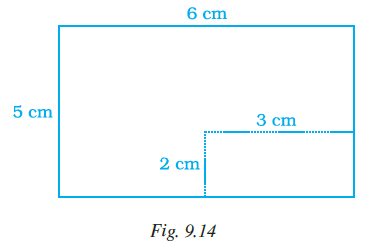
Question 2. A rectangular piece of dimensions 3 cm × 2 cm was cut from a rectangular sheet of paper of dimensions 6 cm × 5 cm (Fig. 9.14). Area of remaining sheet of paper is
(a) 30 cm2
(b) 36 cm2
(c) 24 cm2
(d) 22 cm2
Answer:
Given:
Dimensions of original sheet $= 6 \text{ cm} \times 5 \text{ cm}$
Dimensions of cut piece $= 3 \text{ cm} \times 2 \text{ cm}$
Solution:
$\text{Area of original sheet} = 6 \times 5 = 30 \text{ cm}^2$
$\text{Area of cut piece} = 3 \times 2 = 6 \text{ cm}^2$
$\text{Area of remaining sheet} = 30 - 6 = 24 \text{ cm}^2$
Hence, the correct option is (c).
Question 3. 36 unit squares are joined to form a rectangle with the least perimeter. Perimeter of the rectangle is
(a) 12 units
(b) 26 units
(c) 24 units
(d) 36 units
Answer:
Given:
Total number of unit squares $= 36$.
Area of the rectangle $= 36 \text{ sq. units}$.
To Find:
The least perimeter of a rectangle (where length $\neq$ breadth) formed by these squares.
Solution:
A rectangle is formed by joining $36$ unit squares. Let the length and breadth of the rectangle be $l$ and $b$ respectively. The area is given by the product of its dimensions:
$l \times b = 36$
To find the possible dimensions, we look for the factor pairs of $36$. For each pair, we calculate the perimeter using the formula:
$\text{Perimeter} = 2(l + b)$
The possible integer dimensions and their respective perimeters are shown in the table below:
| Length ($l$) | Breadth ($b$) | Perimeter ($2(l+b)$) |
| 36 | 1 | $2(36+1) = 74 \text{ units}$ |
| 18 | 2 | $2(18+2) = 40 \text{ units}$ |
| 12 | 3 | $2(12+3) = 30 \text{ units}$ |
| 9 | 4 | $2(9+4) = 26 \text{ units}$ |
| 6 | 6 | $2(6+6) = 24 \text{ units}$ |
Conclusion:
Mathematically, a square is a special type of rectangle with the least perimeter ($24 \text{ units}$). However, if the question distinguishes a rectangle from a square (implying length and breadth must be different), we look for the next smallest perimeter.
From the table, the perimeter values are $74, 40, 30, 26,$ and $24$.
Excluding the square ($6 \times 6$), the rectangle with the least perimeter has dimensions $9 \text{ units} \times 4 \text{ units}$.
Calculating the perimeter for these dimensions:
$\text{Perimeter} = 2(9 + 4)$
$\text{Perimeter} = 2 \times 13$
$\text{Perimeter} = 26 \text{ units}$
Thus, considering a rectangle with distinct sides, the least perimeter is $26 \text{ units}$.
Hence, the correct option is (b).
Question 4. A wire is bent to form a square of side 22 cm. If the wire is rebent to form a circle, its radius is
(a) 22 cm
(b) 14 cm
(c) 11 cm
(d) 7 cm
Answer:
Given:
Side of square $= 22 \text{ cm}$.
Solution:
The length of the wire is equal to the perimeter of the square.
$\text{Length of wire} = 4 \times 22 = 88 \text{ cm}$.
When the wire is rebent into a circle, its circumference ($C$) will be $88 \text{ cm}$.
$2\pi r = 88$
$2 \times \frac{22}{7} \times r = 88$
$\frac{44}{7} \times r = 88$
$r = \frac{88 \times 7}{44} = 2 \times 7 = 14 \text{ cm}$.
Hence, the correct option is (b).
Question 5. Area of the circle obtained in Question 4 is
(a) 196 cm2
(b) 212 cm2
(c) 616 cm2
(d) 644 cm2
Answer:
Given:
Radius of circle ($r$) $= 14 \text{ cm}$ (from Question 4).
Solution:
$\text{Area of circle} = \pi r^2$
$\text{Area} = \frac{22}{7} \times 14 \times 14$
$\text{Area} = 22 \times 2 \times 14$
$\text{Area} = 44 \times 14 = 616 \text{ cm}^2$.
Hence, the correct option is (c).
Question 6. Area of a rectangle and the area of a circle are equal. If the dimensions of the rectangle are 14cm × 11 cm, then radius of the circle is
(a) 21 cm
(b) 10.5 cm
(c) 14 cm
(d) 7 cm.
Answer:
Given:
Area of rectangle $= 14 \text{ cm} \times 11 \text{ cm} = 154 \text{ cm}^2$.
$\text{Area of circle} = \text{Area of rectangle}$.
Solution:
$\pi r^2 = 154$
$\frac{22}{7} \times r^2 = 154$
$r^2 = \frac{154 \times 7}{22}$
$r^2 = 7 \times 7 = 49$
$r = \sqrt{49} = 7 \text{ cm}$.
Hence, the correct option is (d).
Question 7. Area of shaded portion in Fig. 9.15 is
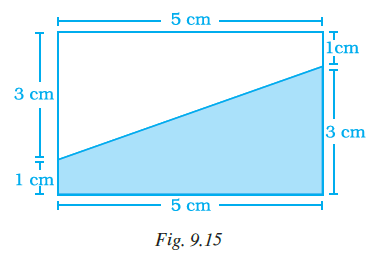
(a) 25 cm2
(b) 15 cm2
(c) 14 cm2
(d) 10 cm2
Answer:
Given:
The shaded portion is a trapezium (or can be seen as rectangle minus a triangle).
Solution:
Base of rectangle $= 5 \text{ cm}$; Height $= 3 \text{ cm} + 1 \text{ cm} = 4 \text{ cm}$.
$\text{Area of shaded portion} = \text{Area of Trapezium}$
Parallel sides are $1 \text{ cm}$ and $3 \text{ cm}$. Distance between them (height) is $5 \text{ cm}$.
$\text{Area} = \frac{1}{2} \times (\text{sum of parallel sides}) \times \text{height}$
$\text{Area} = \frac{1}{2} \times (1 + 3) \times 5 = \frac{1}{2} \times 4 \times 5 = 10 \text{ cm}^2$.
Hence, the correct option is (d).
Question 8. Area of parallelogram ABCD (Fig. 9.16) is not equal to
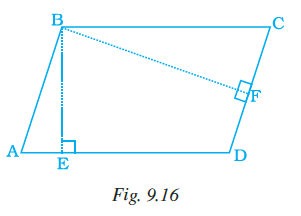
(a) DE × DC
(b) BE × AD
(c) BF × DC
(d) BE × BC
Answer:
Solution:
Area of a parallelogram is $\text{Base} \times \text{Height}$.
1. Using base $AD$, height is $BE$. So, $\text{Area} = AD \times BE$. (Option b is correct)
2. Using base $BC$, height is $BE$. So, $\text{Area} = BC \times BE$. (Option d is correct)
3. Using base $CD$ (or $DC$), height is $BF$. So, $\text{Area} = DC \times BF$. (Option c is correct)
Option (a) says $DE \times DC$. Here $DE$ is only a segment of the side $AD$ and not an altitude to $DC$. Therefore, this does not represent the area.
Hence, the correct option is (a).
Question 9. Area of triangle MNO of Fig. 9.17 is
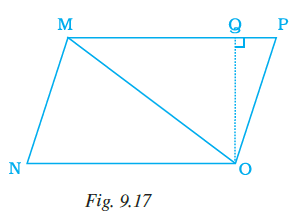
(a) $\frac{1}{2}$ MN × NO
(b) $\frac{1}{2}$ NO × MO
(c) $\frac{1}{2}$ MN × OQ
(d) $\frac{1}{2}$ NO × OQ
Answer:
Given:
In Fig. 9.17, $MNOP$ is a parallelogram. $OQ$ is the altitude dropped from vertex $O$ to the side $MP$.
Solution:
In the given figure, for $\triangle MNO$, let us consider $NO$ as the base.
Since $MNOP$ is a parallelogram, $MP$ is parallel to $NO$ ($MP \parallel NO$). The perpendicular distance between these parallel lines is given by the altitude $OQ$.
The height of $\triangle MNO$ corresponding to the base $NO$ is equal to the distance between the parallel lines $MP$ and $NO$, which is $OQ$.
We know that the area of a triangle is given by the formula:
$\text{Area} = \frac{1}{2} \times \text{base} \times \text{height}$
Substituting base $= NO$ and height $= OQ$:
$\text{Area of } \triangle MNO = \frac{1}{2} \times NO \times OQ$
Therefore, the correct option is (d).
Question 10. Ratio of area of ∆MNO to the area of parallelogram MNOP in the same figure 9.17 is
(a) 2 : 3
(b) 1 : 1
(c) 1 : 2
(d) 2 : 1
Answer:
Given:
$\triangle MNO$ and parallelogram $MNOP$ share the same base $NO$ and lie between the same parallel lines $MP \parallel NO$.
Solution:
Let the base $NO = b$ and the height (distance between parallels) be $h$.
The area of $\triangle MNO$ is:
$\text{Area}(\triangle MNO) = \frac{1}{2} \times b \times h$
The area of parallelogram $MNOP$ is:
$\text{Area}(MNOP) = b \times h$
Now, finding the ratio:
$\text{Ratio} = \frac{\frac{1}{2} \times b \times h}{b \times h}$
$\text{Ratio} = \frac{1}{2}$
This can be written as $1 : 2$.
Therefore, the correct option is (c).
Question 11. Ratio of areas of ∆ MNO, ∆MOP and ∆MPQ in Fig. 9.18 is

(a) 2 : 1 : 3
(b) 1 : 3 : 2
(c) 2 : 3 : 1
(d) 1 : 2 : 3
Answer:
Given:
From Fig. 9.18, we have three triangles $\triangle MNO$, $\triangle MOP$, and $\triangle MPQ$.
All three triangles have a common vertex $M$ and their bases $NO$, $OP$, and $PQ$ lie on the same straight line. Thus, they all have the same height, $MO = 5 \text{ cm}$.
The lengths of the bases are: $NO = 4 \text{ cm}$, $OP = 2 \text{ cm}$, and $PQ = 6 \text{ cm}$.
Solution:
Area of a triangle $= \frac{1}{2} \times \text{base} \times \text{height}$.
1. $\text{Area}(\triangle MNO) = \frac{1}{2} \times 4 \times 5 = 10 \text{ cm}^2$
2. $\text{Area}(\triangle MOP) = \frac{1}{2} \times 2 \times 5 = 5 \text{ cm}^2$
3. $\text{Area}(\triangle MPQ) = \frac{1}{2} \times 6 \times 5 = 15 \text{ cm}^2$
The ratio of their areas is:
$10 : 5 : 15$
Dividing throughout by $5$:
$2 : 1 : 3$
Therefore, the correct option is (a).
Question 12. In Fig. 9.19, EFGH is a parallelogram, altitudes FK and FI are 8 cm and 4cm respectively. If EF = 10 cm, then area of EFGH is
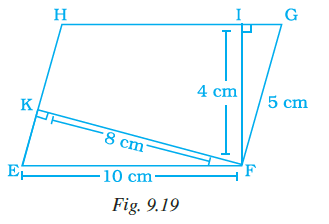
(a) 20 cm2
(b) 32 cm2
(c) 40 cm2
(d) 80 cm2
Answer:
Given:
Parallelogram $EFGH$ with base $EF = 10 \text{ cm}$.
Altitude corresponding to base $EF$ is $FI = 4 \text{ cm}$ (since $FI \perp HG$ and $HG \parallel EF$).
Solution:
The area of a parallelogram is calculated as:
$\text{Area} = \text{base} \times \text{height}$
Taking $EF$ as the base and $FI$ as the height:
$\text{Area} = EF \times FI$
$\text{Area} = 10 \text{ cm} \times 4 \text{ cm}$
$\text{Area} = 40 \text{ cm}^2$
Therefore, the correct option is (c).
Question 13. In reference to a circle the value of π is equal to
(a) $\frac{area}{circumfrence}$
(b) $\frac{area}{diameter}$
(c) $\frac{circumfrence}{diameter}$
(d) $\frac{circumfrence}{radius}$
Answer:
Solution:
By definition, $\pi$ (pi) is the ratio of the circumference of a circle to its diameter.
We know the formula for circumference ($C$) is:
$C = \pi \times d$
(where $d$ is diameter)
Rearranging the formula to find $\pi$:
$\pi = \frac{C}{d}$
$\pi = \frac{\text{circumference}}{\text{diameter}}$
Therefore, the correct option is (c).
Question 14. Circumference of a circle is always
(a) more than three times of its diameter
(b) three times of its diameter
(c) less than three times of its diameter
(d) three times of its radius
Answer:
Solution:
The circumference ($C$) of a circle is given by the formula:
$C = \pi \times d$
The value of $\pi$ is approximately $3.14$ or $\frac{22}{7}$.
Since $3.14 > 3$, the value of $\pi \times d$ will always be greater than $3 \times d$.
Hence, the circumference is more than three times of its diameter.
Therefore, the correct option is (a).
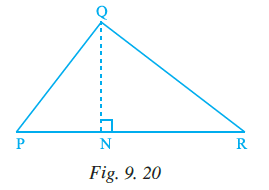
Question 15. Area of triangle PQR is 100 cm2 (Fig. 9.20). If altitude QT is 10 cm, then its base PR is
(a) 20 cm
(b) 15 cm
(c) 10 cm
(d) 5 cm
Answer:
Given:
$\text{Area of } \triangle PQR = 100 \text{ cm}^2$
$\text{Altitude (height) } QT = 10 \text{ cm}$
To Find:
Base $PR$ of the triangle.
Solution:
We use the area formula for a triangle:
$\text{Area} = \frac{1}{2} \times \text{base} \times \text{height}$
Substituting the given values:
$100 = \frac{1}{2} \times PR \times 10$
$100 = 5 \times PR$
Dividing both sides by $5$:
$PR = \frac{100}{5}$
$PR = 20 \text{ cm}$
Therefore, the correct option is (a).
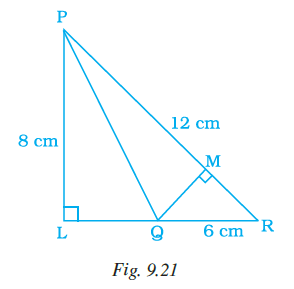
Question 16. In Fig. 9.21, if PR = 12 cm, QR = 6 cm and PL = 8 cm, then QM is
(a) 6 cm
(b) 9 cm
(c) 4 cm
(d) 2 cm
Answer:
Given:
In $\triangle PQR$:
$PR = 12 \text{ cm}$, $QR = 6 \text{ cm}$
$PL \perp QR$ extended, so $PL = 8 \text{ cm}$ (height for base $QR$)
$QM \perp PR$ (height for base $PR$)
Solution:
The area of the triangle remains the same regardless of which side is chosen as the base.
Case 1: Taking $QR$ as base and $PL$ as height.
$\text{Area} = \frac{1}{2} \times QR \times PL$
$\text{Area} = \frac{1}{2} \times 6 \times 8 = 24 \text{ cm}^2$
Case 2: Taking $PR$ as base and $QM$ as height.
$\text{Area} = \frac{1}{2} \times PR \times QM$
Since the area is $24 \text{ cm}^2$:
$24 = \frac{1}{2} \times 12 \times QM$
$24 = 6 \times QM$
$QM = \frac{24}{6} = 4 \text{ cm}$
Therefore, the correct option is (c).
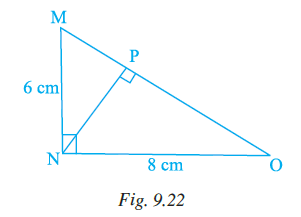
Question 17. In Fig. 9.22 ∆ MNO is a right-angled triangle. Its legs are 6 cm and 8 cm long. Length of perpendicular NP on the side MO is
(a) 4.8 cm
(b) 3.6 cm
(c) 2.4 cm
(d) 1.2 cm
Answer:
Given:
In right-angled triangle $\triangle MNO$, legs $MN = 6 \text{ cm}$ and $NO = 8 \text{ cm}$. $NP \perp MO$.
To Find:
Length of perpendicular $NP$.
Solution:
First, we find the hypotenuse $MO$ using the Pythagoras theorem:
$MO^2 = MN^2 + NO^2$
$MO^2 = 6^2 + 8^2$
$MO^2 = 36 + 64 = 100$
$MO = \sqrt{100} = 10 \text{ cm}$
Now, we calculate the area of $\triangle MNO$ using legs $MN$ and $NO$:
$\text{Area} = \frac{1}{2} \times MN \times NO$
$\text{Area} = \frac{1}{2} \times 6 \times 8 = 24 \text{ cm}^2$
We can also calculate the area using $MO$ as the base and $NP$ as the height:
$\text{Area} = \frac{1}{2} \times MO \times NP$
$24 = \frac{1}{2} \times 10 \times NP$
$24 = 5 \times NP$
$NP = \frac{24}{5} = 4.8 \text{ cm}$
Therefore, the correct option is (a).
Question 18. Area of a right-angled triangle is 30 cm2. If its smallest side is 5 cm, then its hypotenuse is
(a) 14 cm
(b) 13 cm
(c) 12 cm
(d) 11cm
Answer:
Given:
$\text{Area of right-angled triangle} = 30 \text{ cm}^2$.
Smallest side (let it be the base) $= 5 \text{ cm}$.
To Find:
Length of the hypotenuse.
Solution:
In a right-angled triangle, the two sides containing the right angle are the base and height.
$\text{Area} = \frac{1}{2} \times \text{base} \times \text{height}$
$30 = \frac{1}{2} \times 5 \times \text{height}$
$60 = 5 \times \text{height}$
$\text{height} = 12 \text{ cm}$
Now, using the Pythagoras theorem to find the hypotenuse ($h$):
$h^2 = 5^2 + 12^2$
$h^2 = 25 + 144 = 169$
$h = \sqrt{169} = 13 \text{ cm}$
Therefore, the correct option is (b).
Question 19. Circumference of a circle of diameter 5 cm is
(a) 3.14 cm
(b) 31.4 cm
(c) 15.7 cm
(d) 1.57 cm
Answer:
Given:
$\text{Diameter (} d \text{)} = 5 \text{ cm}$.
Solution:
We know that the formula for the circumference ($C$) of a circle is:
$C = \pi \times d$
Taking $\pi = 3.14$:
$C = 3.14 \times 5$
$C = 15.7 \text{ cm}$
Therefore, the correct option is (c).
Question 20. Circumference of a circle disc is 88 cm. Its radius is
(a) 8 cm
(b) 11 cm
(c) 14 cm
(d) 44 cm
Answer:
Given:
$\text{Circumference (} C \text{)} = 88 \text{ cm}$.
Solution:
The formula for circumference is $C = 2 \pi r$.
$88 = 2 \times \frac{22}{7} \times r$
$88 = \frac{44}{7} \times r$
Solving for $r$:
$r = 88 \times \frac{7}{44}$
$r = 2 \times 7 = 14 \text{ cm}$
Therefore, the correct option is (c).
Question 21. Length of tape required to cover the edges of a semicircular disc of radius 10 cm is
(a) 62.8 cm
(b) 51.4 cm
(c) 31.4 cm
(d) 15.7 cm
Answer:
Given:
$\text{Radius (} r \text{)} = 10 \text{ cm}$.
Solution:
The edge of a semicircular disc consists of the curved boundary (arc) and the straight boundary (diameter).
Length of curved boundary $= \pi r$
Length of straight boundary (diameter) $= 2r$
$\text{Total Length} = \pi r + 2r$
Using $\pi = 3.14$ and $r = 10$:
$\text{Total Length} = (3.14 \times 10) + (2 \times 10)$
$\text{Total Length} = 31.4 + 20$
$\text{Total Length} = 51.4 \text{ cm}$
Therefore, the correct option is (b).
Question 22. Area of circular garden with diameter 8 m is
(a) 12.56 m2
(b) 25.12 m2
(c) 50.24 m2
(d) 200.96 m2
Answer:
Given:
$\text{Diameter (} d \text{)} = 8 \text{ m}$.
Solution:
First, find the radius ($r$):
$r = \frac{d}{2} = \frac{8}{2} = 4 \text{ m}$
The formula for the area of a circle is:
$\text{Area} = \pi r^2$
Using $\pi = 3.14$:
$\text{Area} = 3.14 \times 4^2$
$\text{Area} = 3.14 \times 16 = 50.24 \text{ m}^2$
Therefore, the correct option is (c).
Question 23. Area of a circle with diameter ‘m’ radius ‘n’ and circumference ‘p’ is
(a) 2 πn
(b) πm2
(c) πp2
(d) πn2
Answer:
Given:
Diameter $= m$, Radius $= n$, and Circumference $= p$.
Solution:
The area ($A$) of any circle is given by the formula:
$A = \pi \times (\text{radius})^2$
Substituting the given radius $n$:
$A = \pi \times n^2$
$A = \pi n^2$
Therefore, the correct option is (d).
Question 24. A table top is semicircular in shape with diameter 2.8 m. Area of this table top is
(a) 3.08 m2
(b) 6.16 m2
(c) 12.32 m2
(d) 24.64 m2
Answer:
Given:
$\text{Diameter (} d \text{)} = 2.8 \text{ m}$.
Solution:
First, find the radius ($r$):
$r = \frac{2.8}{2} = 1.4 \text{ m}$
The formula for the area of a semicircle is:
$\text{Area} = \frac{1}{2} \pi r^2$
Using $\pi = \frac{22}{7}$:
$\text{Area} = \frac{1}{2} \times \frac{22}{7} \times (1.4)^2$
$\text{Area} = \frac{11}{7} \times 1.96$
$\text{Area} = 11 \times 0.28$
$\text{Area} = 3.08 \text{ m}^2$
Therefore, the correct option is (a).
Question 25. If 1 m2 = x mm2 , then the value of x is
(a) 1000
(b) 10000
(c) 100000
(d) 1000000
Answer:
Given:
$1 \text{ m}^2 = x \text{ mm}^2$
Solution:
We know the relationship between meters and millimeters is:
$1 \text{ m} = 100 \text{ cm}$
$1 \text{ cm} = 10 \text{ mm}$
Therefore,
$1 \text{ m} = 100 \times 10 = 1000 \text{ mm}$
To find the area in square millimeters, we square both sides:
$1 \text{ m}^2 = (1000 \text{ mm})^2$
$1 \text{ m}^2 = 1000 \times 1000 \text{ mm}^2$
$1 \text{ m}^2 = 1,000,000 \text{ mm}^2$
Comparing this with $1 \text{ m}^2 = x \text{ mm}^2$, we get $x = 10,00,000$.
Therefore, the correct option is (d).
Question 26. If p squares of each side 1mm makes a square of side 1cm, then p is equal to
(a) 10
(b) 100
(c) 1000
(d) 10000
Answer:
Solution:
Area of one small square with side $1 \text{ mm}$ is:
$\text{Area}_s = 1 \text{ mm} \times 1 \text{ mm} = 1 \text{ mm}^2$
Area of the large square with side $1 \text{ cm}$ (where $1 \text{ cm} = 10 \text{ mm}$) is:
$\text{Area}_L = 10 \text{ mm} \times 10 \text{ mm} = 100 \text{ mm}^2$
The number of small squares $p$ is calculated as:
$p = \frac{\text{Area of large square}}{\text{Area of small square}}$
$p = \frac{100 \text{ mm}^2}{1 \text{ mm}^2} = 100$
Therefore, the correct option is (b).
Question 27. 12 m2 is the area of
(a) a square with side 12 m
(b) 12 squares with side 1m each
(c) 3 squares with side 4 m each
(d) 4 squares with side 3 m each
Answer:
Evaluation of Options:
(a) Square with side 12 m: $\text{Area} = 12 \times 12 = 144 \text{ m}^2$. (Incorrect)
(b) 12 squares with side 1 m each: $\text{Area of 1 square} = 1 \times 1 = 1 \text{ m}^2$. Total area for 12 such squares $= 12 \times 1 \text{ m}^2 = 12 \text{ m}^2$. (Correct)
(c) 3 squares with side 4 m each: $\text{Area of 1 square} = 4 \times 4 = 16 \text{ m}^2$. Total area $= 3 \times 16 = 48 \text{ m}^2$. (Incorrect)
(d) 4 squares with side 3 m each: $\text{Area of 1 square} = 3 \times 3 = 9 \text{ m}^2$. Total area $= 4 \times 9 = 36 \text{ m}^2$. (Incorrect)
Therefore, the correct option is (b).
Question 28. If each side of a rhombus is doubled, how much will its area increase?
(a) 1.5 times
(b) 2 times
(c) 3 times
(d) 4 times
Answer:
Solution:
Let the side of the original rhombus be $s$ and its height be $h$.
$\text{Original Area (} A_1 \text{)} = s \times h$
When each side is doubled, the new side $s' = 2s$. Since the shape remains a rhombus, the altitude (height) $h'$ also doubles, $h' = 2h$.
$\text{New Area (} A_2 \text{)} = (2s) \times (2h)$
$A_2 = 4 \times (s \times h) = 4 A_1$
The new area is 4 times the original area.
Therefore, the correct option is (d).
Question 29. If the sides of a parallelogram are increased to twice its original lengths, how much will the perimeter of the new parallelogram?
(a) 1.5 times
(b) 2 times
(c) 3 times
(d) 4 times
Answer:
Solution:
Let the original sides of the parallelogram be $a$ and $b$.
$\text{Original Perimeter (} P_1 \text{)} = 2(a + b)$
The new sides are $2a$ and $2b$.
$\text{New Perimeter (} P_2 \text{)} = 2(2a + 2b)$
$P_2 = 2 \times [2(a + b)]$
$P_2 = 2 \times P_1$
The perimeter of the new parallelogram will be 2 times the original perimeter.
Therefore, the correct option is (b).
Question 30. If radius of a circle is increased to twice its original length, how much will the area of the circle increase?
(a) 1.4 times
(b) 2 times
(c) 3 times
(d) 4 times
Answer:
Solution:
Let the original radius be $r$.
$\text{Original Area (} A_1 \text{)} = \pi r^2$
The new radius is $2r$.
$\text{New Area (} A_2 \text{)} = \pi (2r)^2$
$A_2 = \pi \times 4r^2 = 4 \times (\pi r^2)$
$A_2 = 4 A_1$
The area increases to 4 times the original area.
Therefore, the correct option is (d).
Question 31. What will be the area of the largest square that can be cut out of a circle of radius 10 cm?
(a) 100 cm2
(b) 200 cm2
(c) 300 cm2
(d) 400 cm2
Answer:
Given:
$\text{Radius of the circle (} r \text{)} = 10 \text{ cm}$.
Solution:
For the largest square to be cut out of a circle, the diagonal of the square must be equal to the diameter of the circle.
$\text{Diagonal (} d \text{)} = \text{Diameter} = 2 \times r$
$d = 2 \times 10 = 20 \text{ cm}$
The area of a square can be calculated using its diagonal as:
$\text{Area} = \frac{1}{2} \times d^2$
$\text{Area} = \frac{1}{2} \times (20)^2$
$\text{Area} = \frac{1}{2} \times 400 = 200 \text{ cm}^2$
Therefore, the correct option is (b).
Question 32. What is the radius of the largest circle that can be cut out of the rectangle measuring 10 cm in length and 8 cm in breadth?
(a) 4 cm
(b) 5 cm
(c) 8 cm
(d) 10 cm
Answer:
Given:
$\text{Length of rectangle} = 10 \text{ cm}$.
$\text{Breadth of rectangle} = 8 \text{ cm}$.
Solution:
The largest circle that can fit inside a rectangle must have its diameter equal to the shorter side of the rectangle. If the diameter were larger, the circle would extend beyond the boundaries of the rectangle.
$\text{Diameter of circle (} D \text{)} = \text{Breadth} = 8 \text{ cm}$
To find the radius ($r$):
$r = \frac{D}{2}$
$r = \frac{8}{2} = 4 \text{ cm}$
Therefore, the correct option is (a).
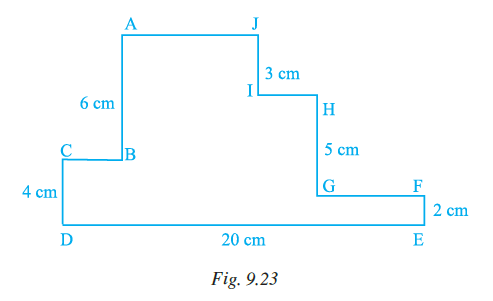
Question 33. The perimeter of the figure ABCDEFGHIJ is
(a) 60 cm
(b) 30 cm
(c) 40 cm
(d) 50 cm
Answer:
Given:
From the figure, the lengths of the vertical segments are: $CD = 4 \text{ cm}$, $AB = 6 \text{ cm}$, $JI = 3 \text{ cm}$, $HG = 5 \text{ cm}$, and $FE = 2 \text{ cm}$.
The total horizontal base $DE = 20 \text{ cm}$.
Solution:
The perimeter of the figure is the sum of all its boundary segments.
Step 1: Sum of Vertical Segments
$\text{Sum (Vertical)} = CD + AB + JI + HG + FE$
$\text{Sum (Vertical)} = 4 + 6 + 3 + 5 + 2 = 20 \text{ cm}$
Step 2: Sum of Horizontal Segments
The segments $CB$, $AJ$, $IH$, and $GF$ are horizontal. By observing the figure, the sum of these segments corresponds to the total horizontal span, which is equal to the base $DE$.
$CB + AJ + IH + GF = DE = 20 \text{ cm}$
Total horizontal distance is the sum of the top segments and the bottom segment:
$\text{Sum (Horizontal)} = 20 + 20 = 40 \text{ cm}$
Step 3: Total Perimeter
$\text{Perimeter} = \text{Sum (Vertical)} + \text{Sum (Horizontal)}$
$\text{Perimeter} = 20 + 40 = 60 \text{ cm}$
Therefore, the correct option is (a).
Question 34. The circumference of a circle whose area is 81πr2, is
(a) 9πr
(b) 18πr
(c) 3πr
(d) 81πr
Answer:
Given:
$\text{Area of circle} = 81 \pi r^2$
Solution:
Let the radius of the circle be $R$. We know the formula for area is:
$\text{Area} = \pi R^2$
$\pi R^2 = 81 \pi r^2$
Canceling $\pi$ from both sides:
$R^2 = 81 r^2$
$R = \sqrt{81 r^2} = 9r$
Now, calculate the circumference ($C$):
$C = 2 \pi R$
$C = 2 \pi (9r) = 18 \pi r$
Therefore, the correct option is (b).
Question 35. The area of a square is 100 cm2. The circumference (in cm) of the largest circle cut of it is
(a) 5 π
(b) 10 π
(c) 15 π
(d) 20 π
Answer:
Given:
$\text{Area of square} = 100 \text{ cm}^2$
Solution:
First, find the side of the square ($s$):
$s^2 = 100 \implies s = 10 \text{ cm}$
The largest circle that can be cut out of a square has a diameter equal to the side of the square.
$\text{Diameter (} D \text{)} = s = 10 \text{ cm}$
The circumference ($C$) is given by $\pi D$:
$C = \pi \times 10 = 10 \pi \text{ cm}$
Therefore, the correct option is (b).
Question 36. If the radius of a circle is tripled, the area becomes
(a) 9 times
(b) 3 times
(c) 6 times
(d) 30 times
Answer:
Solution:
Let the original radius be $r$. Then the original area is $A_1 = \pi r^2$.
When the radius is tripled, the new radius becomes $3r$.
$\text{New Area (} A_2 \text{)} = \pi (3r)^2$
$A_2 = \pi \times 9r^2 = 9 \times (\pi r^2)$
$A_2 = 9 A_1$
The area becomes 9 times the original area.
Therefore, the correct option is (a).
Question 37. The area of a semicircle of radius 4r is
(a) 8πr2
(b) 4πr2
(c) 12πr2
(d) 2πr2
Answer:
Given:
$\text{Radius of semicircle (} R \text{)} = 4r$
Solution:
The formula for the area of a semicircle is:
$\text{Area} = \frac{1}{2} \pi R^2$
Substituting $R = 4r$:
$\text{Area} = \frac{1}{2} \pi (4r)^2$
$\text{Area} = \frac{1}{2} \pi (16 r^2)$
$\text{Area} = 8 \pi r^2$
Therefore, the correct option is (a).
Question 38 to 56 (Fill in the Blanks)
In Questions 38 to 56, fill in the blanks to make the statements true.
Question 38. Perimeter of a regular polygon = length of one side × ___________.
Answer:
Solution:
For a regular polygon, all sides are of equal length. The total distance around the polygon is the product of the number of sides and the length of one side.
Blank: number of sides
Question 39. If a wire in the shape of a square is rebent into a rectangle, then the ____ of both shapes remain same, but ________may vary.
Answer:
Solution:
When a wire is rebent, its total length does not change. The length of the wire forms the boundary of the shape.
$\text{Length of wire} = \text{Perimeter}$
However, the amount of region enclosed by the boundary can change depending on the dimensions.
Blanks: perimeter, area
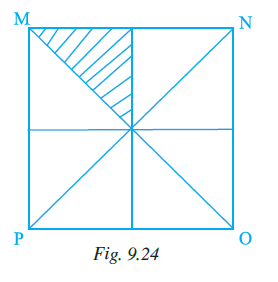
Question 40. Area of the square MNOP of Fig. 9.24 is 144 cm2. Area of each triangle is _____.
Answer:
Given:
$\text{Area of square MNOP} = 144 \text{ cm}^2$
Solution:
In Fig. 9.24, the square $MNOP$ is divided by its two diagonals and two lines passing through the center (connecting the midpoints of opposite sides).
This construction divides the square into $8$ congruent (equal) triangles.
$\text{Area of each triangle} = \frac{\text{Total Area}}{8}$
$\text{Area of each triangle} = \frac{144}{8}$
$\text{Area of each triangle} = 18 \text{ cm}^2$
Blank: 18 cm2
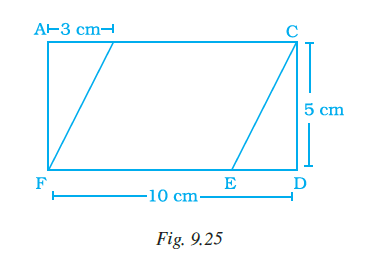
Question 41. In Fig. 9.25, area of parallelogram BCEF is ________ cm2 where ACDF is a rectangle.
Answer:
Given:
$ACDF$ is a rectangle with length $FD = 10 \text{ cm}$ and breadth $CD = 5 \text{ cm}$.
In the figure, $AB = 3 \text{ cm}$ and $BC$ is a part of the side $AC$.
Solution:
Since $ACDF$ is a rectangle, opposite sides are equal. Therefore:
$AC = FD = 10 \text{ cm}$
Now, we find the length of the base $BC$ of the parallelogram $BCEF$:
$BC = AC - AB$
$BC = 10 \text{ cm} - 3 \text{ cm} = 7 \text{ cm}$
The height of parallelogram $BCEF$ is the perpendicular distance between the parallel lines $AC$ and $FD$, which is equal to the side $CD$ of the rectangle.
$\text{Height} = CD = 5 \text{ cm}$
Area of a parallelogram is calculated as:
$\text{Area} = \text{base} \times \text{height}$
$\text{Area} = BC \times CD$
$\text{Area} = 7 \text{ cm} \times 5 \text{ cm} = 35 \text{ cm}^2$
Blank: 35
Question 42. To find area, any side of a parallelogram can be chosen as __________of the parallelogram.
Answer:
Solution:
In a parallelogram, any of the four sides can be considered as the base for the purpose of calculating the area, provided the corresponding altitude (height) is used.
Blank: base
Question 43. Perpendicular dropped on the base of a parallelogram from the opposite vertex is known as the corresponding ________ of the base.
Answer:
Solution:
The vertical or perpendicular distance from an opposite vertex to the chosen base is called the altitude or height.
Blank: altitude (or height)
Question 44. The distance around a circle is its__________ .
Answer:
Solution:
Just as perimeter refers to the boundary of a polygon, the total length of the boundary of a circle is specifically called its circumference.
Blank: circumference
Question 45. Ratio of the circumference of a circle to its diameter is denoted by symbol __________.
Answer:
Solution:
The mathematical constant representing the ratio $\frac{\text{Circumference}}{\text{Diameter}}$ is denoted by the Greek letter $\pi$ (pi).
Blank: $\pi$
Question 46. If area of a triangular piece of cardboard is 90 cm2, then the length of altitude corresponding to 20 cm long base is __________cm.
Answer:
Given:
$\text{Area} = 90 \text{ cm}^2$
$\text{Base} = 20 \text{ cm}$
To Find:
Length of the altitude ($h$).
Solution:
Using the area formula for a triangle:
$\text{Area} = \frac{1}{2} \times \text{base} \times \text{height}$
$90 = \frac{1}{2} \times 20 \times h$
$90 = 10 \times h$
$h = \frac{90}{10} = 9 \text{ cm}$
Blank: 9
Question 47. Value of π is __________ approximately.
Answer:
Solution:
In common calculations, $\pi$ is an irrational number approximated for ease of use.
Blank: $\frac{22}{7}$ (or $3.14$)
Question 48. Circumference ‘C’ of a circle can be found by multiplying diameter ‘d’ with____________ .
Answer:
Solution:
From the definition of $\pi$, we have $C = \pi \times d$.
Blank: $\pi$
Question 49. Circumference ‘C’ of a circle is equal to 2 π × __________.
Answer:
Solution:
The standard formula for the circumference ($C$) of a circle in terms of its radius ($r$) is given by:
$C = 2 \pi r$
Blank: radius (or r)
Question 50. 1 m2 = __________ cm2.
Answer:
Solution:
We know that:
$1 \text{ m} = 100 \text{ cm}$
Squaring both sides to find the area conversion:
$1 \text{ m}^2 = (100 \text{ cm})^2$
$1 \text{ m}^2 = 100 \times 100 \text{ cm}^2$
$1 \text{ m}^2 = 10,000 \text{ cm}^2$
Blank: 10,000
Question 51. 1 cm2 = ______ mm2.
Answer:
Solution:
We know that:
$1 \text{ cm} = 10 \text{ mm}$
Squaring both sides:
$1 \text{ cm}^2 = (10 \text{ mm})^2$
$1 \text{ cm}^2 = 100 \text{ mm}^2$
Blank: 100
Question 52. 1 hectare = _______m2.
Answer:
Solution:
A hectare is a metric unit of area defined as the area of a square with sides of $100 \text{ metres}$.
$1 \text{ hectare} = 100 \text{ m} \times 100 \text{ m}$
$1 \text{ hectare} = 10,000 \text{ m}^2$
Blank: 10,000
Question 53. Area of a triangle = $\frac{1}{2}$ base × _______.
Answer:
Solution:
The general formula to calculate the area of any triangle is half the product of its base and its corresponding vertical height.
Blank: height (or altitude)
Question 54. 1 km2 =___________ m2.
Answer:
Solution:
We know that:
$1 \text{ km} = 1000 \text{ m}$
Squaring both sides:
$1 \text{ km}^2 = (1000 \text{ m})^2$
$1 \text{ km}^2 = 1,000,000 \text{ m}^2$
In the Indian numbering system, this is written as $10,00,000$.
Blank: 10,00,000 (or 1,000,000)
Question 55. Area of a square of side 6 m is equal to the area of ___________ squares of each side 1 cm.
Answer:
Solution:
First, calculate the area of the large square in square centimeters ($cm^2$).
$\text{Side of square} = 6 \text{ m} = 600 \text{ cm}$
$\text{Area} = 600 \text{ cm} \times 600 \text{ cm} = 3,60,000 \text{ cm}^2$
Area of one small square with side $1 \text{ cm}$:
$\text{Area}_s = 1 \text{ cm} \times 1 \text{ cm} = 1 \text{ cm}^2$
Number of small squares needed:
$\text{Number} = \frac{3,60,000 \text{ cm}^2}{1 \text{ cm}^2} = 3,60,000$
Blank: 3,60,000
Question 56. 10 cm2 = ____________ m2.
Answer:
Solution:
We know that:
$1 \text{ m}^2 = 10,000 \text{ cm}^2$
Therefore,
$1 \text{ cm}^2 = \frac{1}{10,000} \text{ m}^2$
For $10 \text{ cm}^2$:
$10 \text{ cm}^2 = \frac{10}{10,000} \text{ m}^2 = \frac{1}{1,000} \text{ m}^2$
$10 \text{ cm}^2 = 0.001 \text{ m}^2$
Blank: 0.001 (or $\frac{1}{1000}$)
Question 57 to 72 (True or False)
In Questions 57 to 72, state whether the statements are True or False.
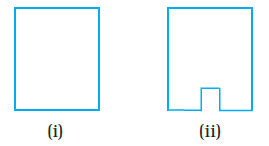
Question 57. In Fig. 9.26, perimeter of (ii) is greater than that of (i), but its area is smaller than that of (i).
Answer:
Solution:
1. Area: Figure (ii) is formed by removing a small rectangular portion from the interior edge of Figure (i). Since part of the region is removed, the area of (ii) is definitely smaller than the area of (i).
2. Perimeter: The perimeter is the length of the outer boundary. In Figure (ii), the flat bottom edge of (i) is replaced by three segments (two vertical and one horizontal) that "go inside" the shape. The sum of these three segments is greater than the single straight segment they replaced. Therefore, the perimeter of (ii) is greater than that of (i).
The statement is True.
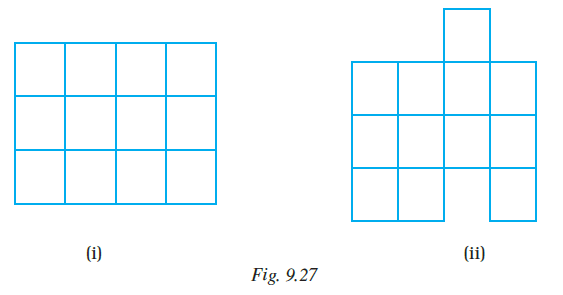
Question 58. In Fig. 9.27,
(a) area of (i) is the same as the area of (ii).
(b) Perimeter of (ii) is the same as (i).
(c) If (ii) is divided into squares of unit length, then its area is 13 unit squares.
(d) Perimeter of (ii) is 18 units.
Answer:
Solution:
Let us count the unit squares and boundary segments on the grid for both shapes.
For Shape (i):
$\text{Area} = 12 \text{ sq. units}$
(4 columns $\times$ 3 rows)
$\text{Perimeter} = 2(4 + 3) = 14 \text{ units}$
For Shape (ii):
This shape is created by taking the $4 \times 3$ rectangle, removing $1$ square from the bottom and adding $1$ square to the top.
$\text{Area} = 12 - 1 + 1 = 12 \text{ sq. units}$
Perimeter count for (ii): 3 (Left) + 1 (bottom segment) + 1 (up) + 1 (across) + 1 (down) + 1 (bottom segment) + 3 (Right) + 1 (top segment) + 1 (up) + 1 (across) + 1 (down) + 1 (top segment).
$\text{Perimeter} = 18 \text{ units}$
Verification:
(a) True (Both have area $12$).
(b) False (Perimeter of (i) is $14$, while (ii) is $18$).
(c) False (Area is $12$ unit squares, not $13$).
(d) True (By counting boundary segments, perimeter is $18$).
Question 59. If perimeter of two parallelograms are equal, then their areas are also equal.
Answer:
Solution:
Two parallelograms can have the same perimeter but different shapes. For example, a square (special parallelogram) and a very thin, slanted parallelogram can have equal perimeters, but the square will enclose a much larger area.
The statement is False.
Question 60. All congruent triangles are equal in area.
Answer:
Solution:
Congruent triangles are identical in all respects (sides and angles). Since their dimensions are exactly the same, the region they enclose (area) must also be identical.
The statement is True.
Question 61. All parallelograms having equal areas have same perimeters.
Answer:
Solution:
The area of a parallelogram depends on the product of its base and height, whereas the perimeter depends on the sum of the lengths of its adjacent sides.
Consider two rectangles (which are special types of parallelograms) with the same area of $36 \text{ cm}^2$:
1. Rectangle A: sides are $6 \text{ cm}$ and $6 \text{ cm}$.
$\text{Area} = 6 \times 6 = 36 \text{ cm}^2$
$\text{Perimeter} = 2(6 + 6) = 24 \text{ cm}$
2. Rectangle B: sides are $9 \text{ cm}$ and $4 \text{ cm}$.
$\text{Area} = 9 \times 4 = 36 \text{ cm}^2$
$\text{Perimeter} = 2(9 + 4) = 26 \text{ cm}$
Since the areas are equal but the perimeters are different, the given statement is incorrect.
Therefore, the statement is False.
Observe all the four triangles FAB, EAB, DAB and CAB as shown in Fig. 9.28:
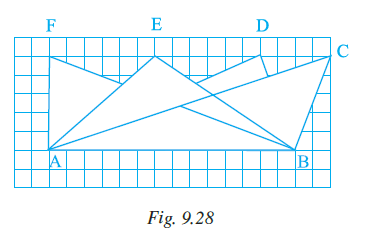
Now answer Questions 62 to 65:
Question 62. All triangles have the same base and the same altitude.
Answer:
Solution:
In Fig. 9.28, all triangles ($\triangle FAB, \triangle EAB, \triangle DAB, \text{ and } \triangle CAB$) share the common base AB. Furthermore, the vertices $F, E, D, \text{ and } C$ all lie on the same horizontal line which is parallel to the base line. Thus, the perpendicular distance (altitude) from these vertices to the base $AB$ is the same for all.
The statement is True.
Question 63. All triangles are congruent.
Answer:
Solution:
While the triangles have the same base and height, their side lengths and interior angles are clearly different (e.g., $\triangle FAB$ is a right-angled triangle, while others are not). Shapes must be identical to be congruent.
The statement is False.
Question 64. All triangles are equal in area.
Answer:
Solution:
The area of a triangle is given by the formula:
$\text{Area} = \frac{1}{2} \times \text{base} \times \text{altitude}$
As established in Question 62, all these triangles have the same base and the same altitude. Therefore, their areas must be equal.
The statement is True.
Question 65. All triangles may not have the same perimeter.
Answer:
Solution:
Referring to Fig. 9.28, all the triangles ($\triangle FAB, \triangle EAB, \triangle DAB, \text{ and } \triangle CAB$) are constructed on the same base AB and between the same parallel lines.
While these triangles have the same base and the same altitude (perpendicular height), the lengths of their other two sides (slanted sides) are different because their third vertices are at different positions on the top parallel line.
For example, in $\triangle FAB$, the side $AF$ is vertical, making it a right-angled triangle, whereas in $\triangle EAB$, the sides $AE$ and $EB$ have different lengths compared to $AF$ and $FB$.
Since perimeter is the sum of all three sides, and at least two sides vary in length for each triangle, their perimeters will not be the same.
Therefore, the statement is True.
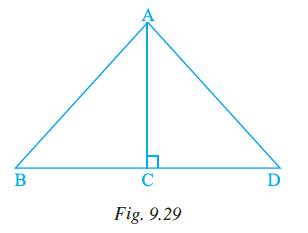
Question 66. In Fig. 9.29 ratio of the area of triangle ABC to the area of triangle ACD is the same as the ratio of base BC of triangle ABC to the base CD of triangle ACD.
Answer:
Solution:
In Fig. 9.29, both triangles $\triangle ABC$ and $\triangle ACD$ share the same vertex $A$ and their bases $BC$ and $CD$ lie on the same straight line $BD$.
The perpendicular $AC$ is the common altitude (height) for both triangles.
$\text{Area of } \triangle ABC = \frac{1}{2} \times BC \times AC$
$\text{Area of } \triangle ACD = \frac{1}{2} \times CD \times AC$
Now, finding the ratio of their areas:
$\frac{\text{Area}(\triangle ABC)}{\text{Area}(\triangle ACD)} = \frac{\frac{1}{2} \times BC \times AC}{\frac{1}{2} \times CD \times AC}$
$\frac{\text{Area}(\triangle ABC)}{\text{Area}(\triangle ACD)} = \frac{BC}{CD}$
This shows the ratio of the areas is indeed the same as the ratio of their bases.
Therefore, the statement is True.
Question 67. Triangles having the same base have equal area.
Answer:
Solution:
The area of a triangle is given by the formula:
$\text{Area} = \frac{1}{2} \times \text{base} \times \text{height}$
For two triangles to have equal area, they must have both the same base and the same altitude (height). If they only have the same base but different heights, their areas will be different.
Therefore, the statement is False.
Question 68. Ratio of circumference of a circle to its radius is always 2π : 1.
Answer:
Solution:
The formula for the circumference ($C$) of a circle in terms of its radius ($r$) is:
$C = 2 \pi r$
To find the ratio of circumference to radius, we divide $C$ by $r$:
$\frac{C}{r} = \frac{2 \pi r}{r}$
$\frac{C}{r} = \frac{2 \pi}{1}$
This can be expressed as the ratio $2 \pi : 1$.
Therefore, the statement is True.
Question 69. 5 hectare = 500 m2
Answer:
Solution:
In the metric system of measurement commonly used in India, $1 \text{ hectare}$ is defined as follows:
$1 \text{ hectare} = 10,000 \text{ m}^2$
To find the value of $5 \text{ hectares}$:
$5 \text{ hectares} = 5 \times 10,000 \text{ m}^2$
$5 \text{ hectares} = 50,000 \text{ m}^2$
Since $50,000 \neq 500$, the statement is incorrect.
Therefore, the statement is False.
Question 70. An increase in perimeter of a figure always increases the area of the figure.
Answer:
Solution:
There is no direct proportional relationship between perimeter and area when comparing different shapes. It is possible for a figure to have a larger perimeter but a smaller area than another figure.
Example:
1. Consider a square with side $10 \text{ cm}$:
$\text{Perimeter} = 4 \times 10 = 40 \text{ cm}$
$\text{Area} = 10 \times 10 = 100 \text{ cm}^2$
2. Consider a very thin rectangle with length $20 \text{ cm}$ and breadth $1 \text{ cm}$:
$\text{Perimeter} = 2(20 + 1) = 42 \text{ cm}$
$\text{Area} = 20 \times 1 = 20 \text{ cm}^2$
In this case, the perimeter increased from $40$ to $42$, but the area decreased from $100$ to $20$.
Therefore, the statement is False.
Question 71. Two figures can have the same area but different perimeters.
Answer:
Solution:
This is a standard geometric property. Different shapes can enclose the same amount of space (area) using boundaries of different lengths (perimeter).
Example:
1. A rectangle of $9 \text{ cm} \times 4 \text{ cm}$ has $\text{Area} = 36 \text{ cm}^2$ and $\text{Perimeter} = 26 \text{ cm}$.
2. A rectangle (square) of $6 \text{ cm} \times 6 \text{ cm}$ has $\text{Area} = 36 \text{ cm}^2$ and $\text{Perimeter} = 24 \text{ cm}$.
Both figures have the same area of $36 \text{ cm}^2$ but different perimeters.
Therefore, the statement is True.
Question 72. Out of two figures if one has larger area, then its perimeter need not to be larger than the other figure.
Answer:
Solution:
A figure with a larger area does not automatically have a larger perimeter. The shape of the figure significantly influences these values.
Example:
1. Figure A: A square with side $4 \text{ cm}$.
$\text{Area} = 16 \text{ cm}^2, \text{ Perimeter} = 16 \text{ cm}$
2. Figure B: A rectangle with length $8 \text{ cm}$ and breadth $1 \text{ cm}$.
$\text{Area} = 8 \text{ cm}^2, \text{ Perimeter} = 18 \text{ cm}$
Here, Figure A has a larger area ($16 > 8$) but a smaller perimeter ($16 < 18$) than Figure B.
Therefore, the statement is True.
Question 73 to 131
Question 73. A hedge boundary needs to be planted around a rectangular lawn of size 72 m × 18 m. If 3 shrubs can be planted in a metre of hedge, how many shrubs will be planted in all?
Answer:
Given:
Length of the rectangular lawn ($l$) $= 72 \text{ m}$
Breadth of the rectangular lawn ($b$) $= 18 \text{ m}$
Number of shrubs per metre $= 3$
To Find:
Total number of shrubs to be planted along the boundary.
Solution:
The shrubs are planted along the boundary, which corresponds to the perimeter of the rectangle.
We know that:
$\text{Perimeter} = 2(l + b)$
Substituting the given values:
$\text{Perimeter} = 2(72 + 18)$
$\text{Perimeter} = 2 \times 90$
$\text{Perimeter} = 180 \text{ m}$
Now, to find the total number of shrubs:
$\text{Total shrubs} = \text{Perimeter} \times \text{Shrubs per metre}$
$\text{Total shrubs} = 180 \times 3$
$\text{Total shrubs} = 540$
Therefore, 540 shrubs will be planted in all.
Question 74. People of Khejadli village take good care of plants, trees and animals. They say that plants and animals can survive without us, but we can not survive without them. Inspired by her elders Amrita marked some land for her pets (camel and ox ) and plants. Find the ratio of the areas kept for animals and plants to the living area.

Answer:
Given:
Total land dimensions $= 15 \text{ m} \times 10 \text{ m}$
Camel area (rectangle) $= 5 \text{ m} \times 3 \text{ m}$
Ox area (circle) with diameter $= 2.8 \text{ m}$
Plants area (rectangle) $= 9 \text{ m} \times 1 \text{ m}$
Solution:
First, we calculate the area of each section:
$\text{Total Area} = 15 \times 10 = 150 \text{ m}^2$
$\text{Area for Camel} = 5 \times 3 = 15 \text{ m}^2$
For the Ox area, radius $r = \frac{2.8}{2} = 1.4 \text{ m}$:
$\text{Area for Ox} = \pi r^2 = \frac{22}{7} \times (1.4)^2$
$\text{Area for Ox} = \frac{22}{7} \times 1.96 = 6.16 \text{ m}^2$
$\text{Area for Plants} = 9 \times 1 = 9 \text{ m}^2$
Now, find the combined area for animals and plants:
$\text{Total occupied area} = 15 + 6.16 + 9 = 30.16 \text{ m}^2$
Calculate the remaining living area:
$\text{Living area} = 150 - 30.16 = 119.84 \text{ m}^2$
Find the required ratio:
$\text{Ratio} = \frac{30.16}{119.84} = \frac{3016}{11984}$
Dividing both by $8$:
$\text{Ratio} = \frac{377}{1498}$
Therefore, the ratio is 377 : 1498.
Question 75. The perimeter of a rectangle is 40 m. Its length is four metres less than five times its breadth. Find the area of the rectangle.
Answer:
Given:
Perimeter ($P$) $= 40 \text{ m}$
Length ($l$) $= 5 \times \text{breadth} - 4$
Solution:
Let the breadth of the rectangle be $b$ metres.
Then, the length $l = 5b - 4$.
The formula for perimeter is:
$P = 2(l + b)$
Substituting the values:
$40 = 2[(5b - 4) + b]$
$20 = 6b - 4$
$24 = 6b$
$b = 4 \text{ m}$
Now, calculate the length:
$l = 5(4) - 4 = 20 - 4 = 16 \text{ m}$
Finally, find the area:
$\text{Area} = l \times b = 16 \times 4$
$\text{Area} = 64 \text{ m}^2$
Therefore, the area of the rectangle is 64 m2.
Question 76. A wall of a room is of dimensions 5 m × 4 m. It has a window of dimensions 1.5 m × 1m and a door of dimensions 2.25 m × 1m. Find the area of the wall which is to be painted.
Answer:
Given:
Wall dimensions $= 5 \text{ m} \times 4 \text{ m}$
Window dimensions $= 1.5 \text{ m} \times 1 \text{ m}$
Door dimensions $= 2.25 \text{ m} \times 1 \text{ m}$
To Find:
The area of the wall to be painted (excluding window and door).
Solution:
Calculate the areas of individual components:
$\text{Area of Wall} = 5 \times 4 = 20 \text{ m}^2$
$\text{Area of Window} = 1.5 \times 1 = 1.5 \text{ m}^2$
$\text{Area of Door} = 2.25 \times 1 = 2.25 \text{ m}^2$
The area to be painted is:
$\text{Area to be painted} = \text{Area of Wall} - (\text{Area of Window} + \text{Area of Door})$
$\text{Area to be painted} = 20 - (1.5 + 2.25)$
$\text{Area to be painted} = 20 - 3.75$
$\text{Area to be painted} = 16.25 \text{ m}^2$
Therefore, the area to be painted is 16.25 m2.
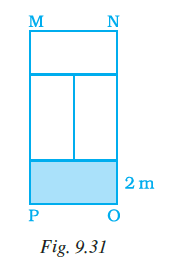
Question 77. Rectangle MNOP is made up of four congruent rectangles (Fig. 9.31). If the area of one of the rectangles is 8 m2 and breadth is 2 m, then find the perimeter of MNOP.
Answer:
Given:
Area of one small rectangle $= 8 \text{ m}^2$
Breadth of one small rectangle $= 2 \text{ m}$
MNOP is composed of four such congruent rectangles.
Solution:
First, find the length ($l$) of one small rectangle:
$\text{Area} = \text{length} \times \text{breadth}$
$8 = l \times 2 \implies l = 4 \text{ m}$
From Fig. 9.31, the large rectangle $MNOP$ is arranged as follows:
1. The bottom part consists of one horizontal rectangle (Width $= 4 \text{ m}$, Height $= 2 \text{ m}$).
2. The top part consists of one horizontal rectangle (Width $= 4 \text{ m}$, Height $= 2 \text{ m}$).
3. The middle part consists of two vertical rectangles placed side-by-side. Each has height $= 4 \text{ m}$ and width $= 2 \text{ m}$. Together, their total width is $2 + 2 = 4 \text{ m}$.
Now, calculate the total dimensions of $MNOP$:
$\text{Total Width (MNOP)} = 4 \text{ m}$
$\text{Total Height (MNOP)} = 2 \text{ (bottom)} + 4 \text{ (middle)} + 2 \text{ (top)} = 8 \text{ m}$
Find the perimeter of $MNOP$:
$\text{Perimeter} = 2(\text{Width} + \text{Height})$
$\text{Perimeter} = 2(4 + 8)$
$\text{Perimeter} = 2 \times 12 = 24 \text{ m}$
Therefore, the perimeter of MNOP is 24 m.
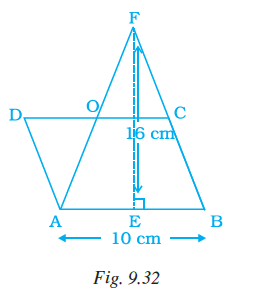
Question 78. In Fig. 9.32, area of ∆ AFB is equal to the area of parallelogram ABCD. If altitude EF is 16 cm long, find the altitude of the parallelogram to the base AB of length 10 cm. What is the area of ∆DAO, where O is the mid point of DC?
Answer:
Given:
In Fig. 9.32, $ABCD$ is a parallelogram and $\triangle AFB$ is a triangle on the same base $AB$.
Base $AB = 10 \text{ cm}$.
Altitude of $\triangle AFB$ (EF) $= 16 \text{ cm}$.
Area of $\triangle AFB = \text{Area of parallelogram } ABCD$.
$O$ is the midpoint of $DC$.
To Find:
(i) Altitude of the parallelogram $ABCD$ to the base $AB$.
(ii) Area of $\triangle DAO$.
Solution:
First, we calculate the area of $\triangle AFB$:
$\text{Area of } \triangle AFB = \frac{1}{2} \times \text{base} \times \text{height}$
$\text{Area of } \triangle AFB = \frac{1}{2} \times 10 \times 16$
$\text{Area of } \triangle AFB = 80 \text{ cm}^2$
According to the question, Area of parallelogram $ABCD = \text{Area of } \triangle AFB$.
$\text{Area of parallelogram } ABCD = 80 \text{ cm}^2$
Let $h$ be the altitude of the parallelogram to the base $AB$.
$\text{Area of parallelogram} = \text{base} \times \text{altitude}$
$80 = 10 \times h$
$h = \frac{80}{10} = 8 \text{ cm}$
Now, for the second part, $O$ is the midpoint of $DC$. Since $ABCD$ is a parallelogram, $DC = AB = 10 \text{ cm}$.
$DO = \frac{1}{2} \times DC = \frac{1}{2} \times 10 = 5 \text{ cm}$
In $\triangle DAO$, the base is $DO$ and the altitude corresponds to the distance between the parallel lines $AB$ and $DC$, which we found to be $8 \text{ cm}$.
$\text{Area of } \triangle DAO = \frac{1}{2} \times \text{base} \times \text{height}$
$\text{Area of } \triangle DAO = \frac{1}{2} \times 5 \times 8$
$\text{Area of } \triangle DAO = 20 \text{ cm}^2$
Results:
Altitude of parallelogram $= 8 \text{ cm}$.
Area of $\triangle DAO = 20 \text{ cm}^2$.
Question 79. Ratio of the area of ∆ WXY to the area of ∆ WZY is 3 : 4 (Fig. 9.33). If the area of ∆ WXZ is 56 cm2 and WY = 8 cm, find the lengths of XY and YZ.

Answer:
Given:
Ratio of Area($\triangle WXY$) : Area($\triangle WZY$) $= 3 : 4$.
Total Area($\triangle WXZ$) $= 56 \text{ cm}^2$.
Altitude $WY = 8 \text{ cm}$.
To Find:
Lengths of $XY$ and $YZ$.
Solution:
Let the area of $\triangle WXY$ be $3k$ and the area of $\triangle WZY$ be $4k$.
$\text{Area}(\triangle WXZ) = \text{Area}(\triangle WXY) + \text{Area}(\triangle WZY)$
$56 = 3k + 4k$
$56 = 7k \implies k = 8$
Now, we find the individual areas:
$\text{Area}(\triangle WXY) = 3 \times 8 = 24 \text{ cm}^2$
$\text{Area}(\triangle WZY) = 4 \times 8 = 32 \text{ cm}^2$
Using the area formula for $\triangle WXY$ with base $XY$ and height $WY$:
$\text{Area}(\triangle WXY) = \frac{1}{2} \times XY \times WY$
$24 = \frac{1}{2} \times XY \times 8$
$24 = 4 \times XY \implies XY = 6 \text{ cm}$
Similarly, for $\triangle WZY$ with base $YZ$ and height $WY$:
$\text{Area}(\triangle WZY) = \frac{1}{2} \times YZ \times WY$
$32 = \frac{1}{2} \times YZ \times 8$
$32 = 4 \times YZ \implies YZ = 8 \text{ cm}$
Results:
$XY = 6 \text{ cm}$ and $YZ = 8 \text{ cm}$.
Question 80. Rani bought a new field that is next to one she already owns (Fig. 9.34). This field is in the shape of a square of side 70 m. She makes a semi circular lawn of maximum area in this field.
(i) Find the perimeter of the lawn.
(ii) Find the area of the square field excluding the lawn.

Answer:
Given:
Side of the square field $= 70 \text{ m}$.
A semicircular lawn is made with the maximum area inside this field.
Solution:
For a semicircular lawn to have maximum area within a square of side $70 \text{ m}$, its diameter must be equal to the side of the square.
$\text{Diameter (} d \text{)} = 70 \text{ m}$
$\text{Radius (} r \text{)} = \frac{70}{2} = 35 \text{ m}$
(i) Perimeter of the lawn:
The perimeter of a semicircular lawn consists of the curved arc and the straight diameter.
$\text{Perimeter} = \pi r + d$
$\text{Perimeter} = \left(\frac{22}{7} \times 35\right) + 70$
$\text{Perimeter} = 110 + 70 = 180 \text{ m}$
(ii) Area of square field excluding the lawn:
$\text{Area of square} = \text{side}^2 = 70^2 = 4900 \text{ m}^2$
$\text{Area of semicircle} = \frac{1}{2} \pi r^2$
$\text{Area of semicircle} = \frac{1}{2} \times \frac{22}{7} \times 35 \times 35$
$\text{Area of semicircle} = 11 \times 5 \times 35 = 1925 \text{ m}^2$
The excluded area is:
$\text{Excluded Area} = 4900 - 1925 = 2975 \text{ m}^2$
Results:
Perimeter of lawn $= 180 \text{ m}$.
Excluded area $= 2975 \text{ m}^2$.
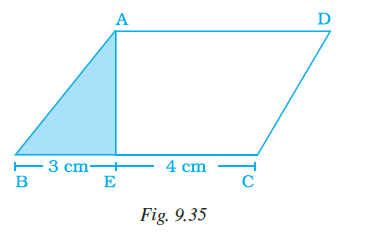
Question 81. In Fig. 9.35, find the area of parallelogram ABCD if the area of shaded triangle is 9 cm2.
Answer:
Given:
In Fig. 9.35, $ABCD$ is a parallelogram.
Shaded triangle $\triangle ABE$ has Area $= 9 \text{ cm}^2$.
Base of triangle $BE = 3 \text{ cm}$.
Remaining part of parallelogram base $EC = 4 \text{ cm}$.
To Find:
Area of parallelogram $ABCD$.
Solution:
Let $h$ be the height of the triangle $ABE$ (perpendicular $AE$). This $h$ is also the height of the parallelogram $ABCD$.
$\text{Area}(\triangle ABE) = \frac{1}{2} \times \text{base} \times \text{height}$
$9 = \frac{1}{2} \times 3 \times h$
$18 = 3 \times h \implies h = 6 \text{ cm}$
The base of the parallelogram $ABCD$ is $BC$.
$BC = BE + EC = 3 \text{ cm} + 4 \text{ cm} = 7 \text{ cm}$
Now, calculate the area of the parallelogram:
$\text{Area}(ABCD) = \text{base} \times \text{height}$
$\text{Area}(ABCD) = 7 \times 6 = 42 \text{ cm}^2$
Therefore, the area of the parallelogram is 42 cm2.
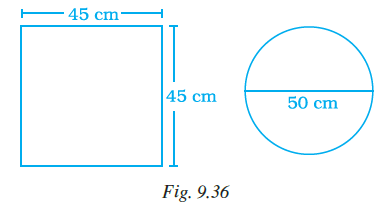
Question 82. Pizza factory has come out with two kinds of pizzas. A square pizza of side 45 cm costs ₹ 150 and a circular pizza of diameter 50 cm costs ₹ 160 (Fig. 9.36). Which pizza is a better deal?
Answer:
Given:
Square Pizza: side $= 45 \text{ cm}$, Cost $= \textsf{₹} 150$.
Circular Pizza: diameter $= 50 \text{ cm}$, Cost $= \textsf{₹} 160$.
Solution:
To determine the better deal, we should find out which pizza gives more area per unit of money spent (or has a lower cost per unit area).
1. For Square Pizza:
$\text{Area} = \text{side}^2 = 45 \times 45 = 2025 \text{ cm}^2$
$\text{Area per rupee} = \frac{2025}{150} = 13.5 \text{ cm}^2/\textsf{₹}$
2. For Circular Pizza:
Radius $r = \frac{50}{2} = 25 \text{ cm}$. Taking $\pi \approx 3.14$:
$\text{Area} = \pi r^2 = 3.14 \times 25 \times 25$
$\text{Area} = 3.14 \times 625 = 1962.5 \text{ cm}^2$
$\text{Area per rupee} = \frac{1962.5}{160} \approx 12.26 \text{ cm}^2/\textsf{₹}$
Comparing the two results:
Square pizza gives $13.5 \text{ cm}^2$ per rupee, while the circular pizza gives approximately $12.26 \text{ cm}^2$ per rupee.
Since the square pizza provides a larger area for every rupee spent, it is the better deal.
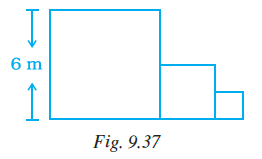
Question 83. Three squares are attached to each other as shown in Fig. 9.37. Each square is attached at the mid point of the side of the square to its right. Find the perimeter of the complete figure.
Answer:
Given:
Three squares are attached such that each square to the left is attached at the midpoint of the side of the square to its right. From the figure:
Side of the largest square (left) $= 6 \text{ m}$
Side of the middle square $= 3 \text{ m}$ (Since it is attached to the midpoint of the $6 \text{ m}$ side)
Side of the smallest square (right) $= 1.5 \text{ m}$ (Since it is attached to the midpoint of the $3 \text{ m}$ side)
Solution:
The perimeter of the figure is the sum of all its external boundary segments.
1. Horizontal Boundary:
The bottom horizontal boundary is the sum of the sides of the three squares:
$\text{Bottom length} = 6 + 3 + 1.5 = 10.5 \text{ m}$
The top horizontal boundary consists of the top sides of each square:
$\text{Top length} = 6 + 3 + 1.5 = 10.5 \text{ m}$
2. Vertical Boundary:
The leftmost vertical side is $6 \text{ m}$.
The rightmost vertical side is $1.5 \text{ m}$.
Additionally, there are vertical segments where the squares meet. Since they are attached at midpoints:
Exposed vertical parts of the $6 \text{ m}$ square $= (6 - 3) = 3 \text{ m}$ ($1.5 \text{ m}$ above and $1.5 \text{ m}$ below the junction).
Exposed vertical parts of the $3 \text{ m}$ square $= (3 - 1.5) = 1.5 \text{ m}$ ($0.75 \text{ m}$ above and $0.75 \text{ m}$ below the junction).
3. Total Perimeter Calculation:
$\text{Perimeter} = \text{Sum of all horizontal and vertical boundary segments}$
$\text{Perimeter} = (10.5 + 10.5) + (6 + 1.5 + 3 + 1.5)$
$\text{Perimeter} = 21 + 12 = 33 \text{ m}$
Therefore, the perimeter of the complete figure is 33 m.
Question 84. In Fig. 9.38, ABCD is a square with AB = 15 cm. Find the area of the square BDFE.
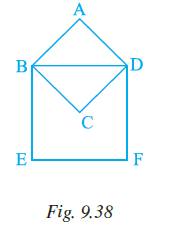
Answer:
Given:
$ABCD$ is a square with side $s = 15 \text{ cm}$.
$BDFE$ is a square formed on the diagonal $BD$ of square $ABCD$.
Solution:
First, we find the length of the diagonal $BD$ using the Pythagoras theorem in $\triangle BCD$:
$BD^2 = BC^2 + CD^2$
$BD^2 = 15^2 + 15^2$
$BD^2 = 225 + 225 = 450$
Since $BDFE$ is a square with side $BD$, its area is given by the square of its side:
$\text{Area of square BDFE} = (BD)^2$
$\text{Area} = 450 \text{ cm}^2$
Therefore, the area of the square BDFE is 450 cm2.
Question 85. In the given triangles of Fig. 9.39, perimeter of ∆ABC = perimeter of ∆PQR. Find the area of ∆ABC.
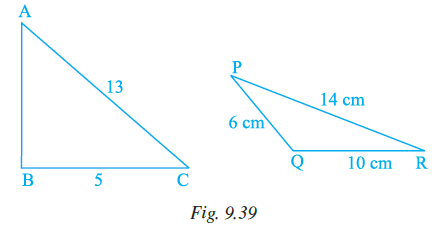
Answer:
Given:
In $\triangle PQR$: sides are $6 \text{ cm}$, $10 \text{ cm}$, and $14 \text{ cm}$.
In $\triangle ABC$: $\angle B = 90^\circ$, $BC = 5 \text{ cm}$, and hypotenuse $AC = 13 \text{ cm}$.
$\text{Perimeter}(\triangle ABC) = \text{Perimeter}(\triangle PQR)$.
Solution:
First, calculate the perimeter of $\triangle PQR$:
$\text{Perimeter}(\triangle PQR) = 6 + 10 + 14 = 30 \text{ cm}$
So, $\text{Perimeter}(\triangle ABC) = 30 \text{ cm}$.
In $\triangle ABC$, let the altitude $AB$ be $x$. The perimeter is:
$AB + BC + AC = 30$
$x + 5 + 13 = 30$
$x + 18 = 30 \implies x = 12 \text{ cm}$
Now, we find the area of the right-angled $\triangle ABC$:
$\text{Area} = \frac{1}{2} \times \text{base} \times \text{height}$
$\text{Area} = \frac{1}{2} \times 5 \times 12$
$\text{Area} = 30 \text{ cm}^2$
Therefore, the area of $\triangle ABC$ is 30 cm2.
Question 86. Altitudes MN and MO of parallelogram MGHK are 8 cm and 4 cm long respectively (Fig. 9.40). One side GH is 6 cm long. Find the perimeter of MGHK.

Answer:
Given:
In parallelogram $MGHK$:
Side $GH = 6 \text{ cm}$. Altitude corresponding to side $GH$ is $MN = 8 \text{ cm}$.
Altitude corresponding to side $MG$ is $MO = 4 \text{ cm}$.
Solution:
The area of the parallelogram remains constant regardless of which base is chosen.
Step 1: Calculate Area using base GH
$\text{Area} = GH \times MN$
$\text{Area} = 6 \times 8 = 48 \text{ cm}^2$
Step 2: Find side MG using Area
$\text{Area} = MG \times MO$
$48 = MG \times 4 \implies MG = 12 \text{ cm}$
Step 3: Calculate Perimeter
Since $MGHK$ is a parallelogram, $MK = GH = 6 \text{ cm}$ and $KH = MG = 12 \text{ cm}$.
$\text{Perimeter} = 2(GH + MG)$
$\text{Perimeter} = 2(6 + 12) = 2 \times 18 = 36 \text{ cm}$
Therefore, the perimeter of MGHK is 36 cm.
Question 87. In Fig. 9.41, area of ∆PQR is 20 cm2 and area of ∆PQS is 44 cm2. Find the length RS, if PQ is perpendicular to QS and QR is 5cm.

Answer:
Given:
$\text{Area}(\triangle PQR) = 20 \text{ cm}^2$.
$\text{Area}(\triangle PQS) = 44 \text{ cm}^2$.
$PQ \perp QS$ and base $QR = 5 \text{ cm}$.
To Find:
Length of the segment $RS$.
Solution:
Since $PQ \perp QS$, $PQ$ is the common altitude for both $\triangle PQR$ and $\triangle PQS$.
Step 1: Find the length of PQ
$\text{Area}(\triangle PQR) = \frac{1}{2} \times QR \times PQ$
$20 = \frac{1}{2} \times 5 \times PQ$
$40 = 5 \times PQ \implies PQ = 8 \text{ cm}$
Step 2: Find the length of QS
$\text{Area}(\triangle PQS) = \frac{1}{2} \times QS \times PQ$
$44 = \frac{1}{2} \times QS \times 8$
$44 = 4 \times QS \implies QS = 11 \text{ cm}$
Step 3: Find RS
From the figure, $S$, $R$, and $Q$ lie on the same straight line, so:
$RS = QS - QR$
$RS = 11 \text{ cm} - 5 \text{ cm} = 6 \text{ cm}$
Therefore, the length of RS is 6 cm.
Question 88. Area of an isosceles triangle is 48 cm2. If the altitudes corresponding to the base of the triangle is 8 cm, find the perimeter of the triangle.
Answer:
Given:
Area of an isosceles triangle $= 48 \text{ cm}^2$
Altitude (height) corresponding to the base $= 8 \text{ cm}$
To Find:
Perimeter of the triangle.
Solution:
Let the base of the isosceles triangle be $b$.
$\text{Area} = \frac{1}{2} \times \text{base} \times \text{altitude}$
$48 = \frac{1}{2} \times b \times 8$
$48 = 4b$
$b = 12 \text{ cm}$
In an isosceles triangle, the altitude to the base bisects the base into two equal parts.
$\text{Length of each part} = \frac{12}{2} = 6 \text{ cm}$
Let $a$ be the length of the equal sides. Using Pythagoras theorem in the right-angled triangle formed by the altitude and half of the base:
$a^2 = 8^2 + 6^2$
$a^2 = 64 + 36 = 100$
$a = \sqrt{100} = 10 \text{ cm}$
Now, we find the perimeter:
$\text{Perimeter} = \text{Sum of all sides}$
$\text{Perimeter} = 10 + 10 + 12$
$\text{Perimeter} = 32 \text{ cm}$
Therefore, the perimeter of the triangle is 32 cm.
Question 89. Perimeter of a parallelogram shaped land is 96 m and its area is 270 square metres. If one of the sides of this parallelogram is 18 m, find the length of the other side. Also, find the lengths of altitudes l and m (Fig. 9.42).

Answer:
Given:
Perimeter of parallelogram $= 96 \text{ m}$
Area of parallelogram $= 270 \text{ m}^2$
One side $= 18 \text{ m}$
To Find:
Other side, and altitudes $l$ and $m$.
Solution:
Let the other side of the parallelogram be $b$.
$\text{Perimeter} = 2(18 + b)$
$96 = 2(18 + b)$
$48 = 18 + b \implies b = 30 \text{ m}$
Finding Altitude $m$ (corresponding to side 18 m):
$\text{Area} = \text{side} \times \text{altitude}$
$270 = 18 \times m$
$m = \frac{270}{18} = 15 \text{ m}$
Finding Altitude $l$ (corresponding to side 30 m):
$\text{Area} = 30 \times l$
$270 = 30 \times l$
$l = \frac{270}{30} = 9 \text{ m}$
Therefore, the other side is 30 m, and the altitudes are $l = 9 \text{ m}$ and $m = 15 \text{ m}$.
Question 90. Area of a triangle PQR right-angled at Q is 60 cm2 (Fig. 9.43). If the smallest side is 8 cm long, find the length of the other two sides.
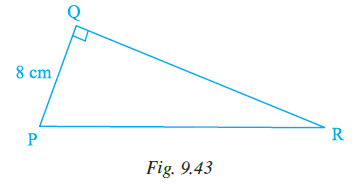
Answer:
Given:
In $\triangle PQR$, $\angle Q = 90^\circ$.
Area $= 60 \text{ cm}^2$.
Smallest side (let $PQ$) $= 8 \text{ cm}$.
To Find:
The other two sides ($QR$ and hypotenuse $PR$).
Solution:
Since the triangle is right-angled at $Q$, sides $PQ$ and $QR$ are the base and height.
$\text{Area} = \frac{1}{2} \times PQ \times QR$
$60 = \frac{1}{2} \times 8 \times QR$
$60 = 4 \times QR \implies QR = 15 \text{ cm}$
Now, find the hypotenuse $PR$ using Pythagoras theorem:
$PR^2 = PQ^2 + QR^2$
$PR^2 = 8^2 + 15^2$
$PR^2 = 64 + 225 = 289$
$PR = \sqrt{289} = 17 \text{ cm}$
Therefore, the lengths of the other two sides are 15 cm and 17 cm.
Question 91. In Fig. 9.44 a rectangle with perimeter 264 cm is divided into five congruent rectangles. Find the perimeter of one of the rectangles.

Answer:
Given:
A large rectangle is composed of 5 congruent (identical) small rectangles.
Perimeter of the large rectangle $= 264 \text{ cm}$.
Solution:
Let the length of one small rectangle be $l$ and its breadth be $b$.
From Fig. 9.44, we see that the top row has 3 rectangles placed vertically (width $b$), and the bottom row has 2 rectangles placed horizontally (width $l$). Since they form a single large rectangle, their total widths must be equal:
$3b = 2l$
$l = 1.5b$
Now, consider the dimensions of the large rectangle:
$\text{Total Width} = 3b$
$\text{Total Height} = l + b$
Using the perimeter formula for the large rectangle:
$2(\text{Width} + \text{Height}) = 264$
$2(3b + l + b) = 264$
$4b + l = 132$
Substitute $l = 1.5b$:
$4b + 1.5b = 132$
$5.5b = 132 \implies b = 24 \text{ cm}$
Finding $l$:
$l = 1.5 \times 24 = 36 \text{ cm}$
Now, calculate the perimeter of one small rectangle:
$\text{Perimeter} = 2(l + b)$
$\text{Perimeter} = 2(36 + 24) = 2 \times 60 = 120 \text{ cm}$
Therefore, the perimeter of one of the rectangles is 120 cm.
Question 92. Find the area of a square inscribed in a circle whose radius is 7 cm (Fig. 9.45).
[Hint: Four right-angled triangles joined at right angles to form a square]
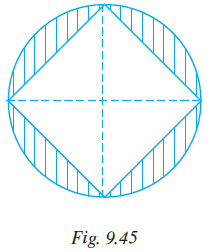
Answer:
Given:
Radius of the circle ($r$) $= 7 \text{ cm}$.
To Find:
Area of the inscribed square.
Solution:
When a square is inscribed in a circle, the diagonal of the square is equal to the diameter of the circle.
$\text{Diagonal (} d \text{)} = 2 \times r$
$d = 2 \times 7 = 14 \text{ cm}$
The area of a square can be found using the length of its diagonal:
$\text{Area} = \frac{1}{2} \times d^2$
$\text{Area} = \frac{1}{2} \times (14)^2$
$\text{Area} = \frac{1}{2} \times 196 = 98 \text{ cm}^2$
Therefore, the area of the square is 98 cm2.
Question 93. Find the area of the shaded portion in question 92.
Answer:
Given:
Radius of the circle ($r$) $= 7 \text{ cm}$.
A square is inscribed in the circle as shown in Fig. 9.45. From Question 92, the area of this square is $98 \text{ cm}^2$.
To Find:
Area of the shaded portion (the region between the circle and the square).
Solution:
First, we calculate the area of the circle:
$\text{Area of Circle} = \pi r^2$
$\text{Area of Circle} = \frac{22}{7} \times 7 \times 7$
$\text{Area of Circle} = 154 \text{ cm}^2$
Now, to find the shaded portion, we subtract the area of the square from the area of the circle:
$\text{Shaded Area} = \text{Area of Circle} - \text{Area of Square}$
$\text{Shaded Area} = 154 - 98$
$\text{Shaded Area} = 56 \text{ cm}^2$
Therefore, the area of the shaded portion is 56 cm2.
In Questions 94 to 97 find the area enclosed by each of the following figures:
Question 94.

Answer:
Given:
The figure (Fig. 9.46) consists of a rectangle and a semicircle.
Total base of the figure $= 10.2 \text{ cm}$.
Height of the rectangular part $= 1.5 \text{ cm}$.
Horizontal segment before the semicircle $= 3.9 \text{ cm}$.
Solution:
Step 1: Find the dimensions of the semicircle.
The diameter ($d$) of the semicircle is the remaining part of the total base:
$d = 10.2 - 3.9 = 6.3 \text{ cm}$
$\text{Radius (} r \text{)} = \frac{6.3}{2} = 3.15 \text{ cm}$
Step 2: Calculate individual areas.
$\text{Area of rectangle} = 10.2 \times 1.5 = 15.3 \text{ cm}^2$
$\text{Area of semicircle} = \frac{1}{2} \pi r^2$
$\text{Area of semicircle} = \frac{1}{2} \times \frac{22}{7} \times 3.15 \times 3.15$
$\text{Area of semicircle} = 11 \times 0.45 \times 3.15 = 15.5925 \text{ cm}^2$
Step 3: Calculate total area.
$\text{Total Area} = 15.3 + 15.5925 = 30.8925 \text{ cm}^2$
Therefore, the area enclosed is 30.8925 cm2.
Question 95.
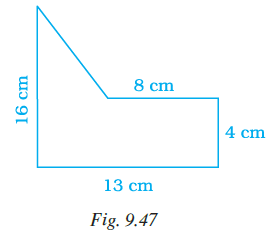
Answer:
Solution:
The figure (Fig. 9.47) can be divided into a rectangle and a right-angled triangle by drawing a horizontal line from the $4 \text{ cm}$ height.
1. Dimensions of the Rectangle:
Length $= 13 \text{ cm}$, Breadth $= 4 \text{ cm}$.
$\text{Area of Rectangle} = 13 \times 4 = 52 \text{ cm}^2$
2. Dimensions of the Triangle:
$\text{Height} = 16 - 4 = 12 \text{ cm}$
$\text{Base} = 13 - 8 = 5 \text{ cm}$
$\text{Area of Triangle} = \frac{1}{2} \times 5 \times 12 = 30 \text{ cm}^2$
Total Area:
$\text{Total Area} = 52 + 30 = 82 \text{ cm}^2$
Therefore, the total area enclosed is 82 cm2.
Question 96.
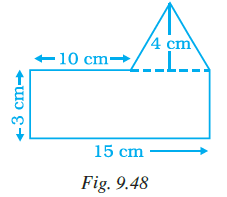
Answer:
Solution:
The figure (Fig. 9.48) is composed of a rectangle and a triangle.
1. Area of the Rectangle:
Length $= 15 \text{ cm}$, Breadth $= 3 \text{ cm}$.
$\text{Area of Rectangle} = 15 \times 3 = 45 \text{ cm}^2$
2. Area of the Triangle:
Height $= 4 \text{ cm}$.
Base of the triangle $= \text{Total length} - \text{labeled segment} $$ = 15 - 10 = 5 \text{ cm}$.
$\text{Area of Triangle} = \frac{1}{2} \times 5 \times 4 = 10 \text{ cm}^2$
Total Area:
$\text{Total Area} = 45 + 10 = 55 \text{ cm}^2$
Therefore, the area enclosed is 55 cm2.
Question 97.
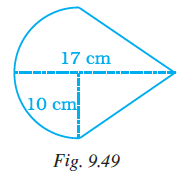
Answer:
Solution:
The figure (Fig. 9.49) is a combination of a semicircle and a triangle.
1. Area of the Semicircle:
From the figure, the radius $r = 10 \text{ cm}$.
$\text{Area of Semicircle} = \frac{1}{2} \pi r^2$
Using $\pi = 3.14$:
$\text{Area} = \frac{1}{2} \times 3.14 \times 10^2$
$\text{Area} = 1.57 \times 100 = 157 \text{ cm}^2$
2. Area of the Triangle:
The base of the triangle is the diameter of the semicircle $= 2 \times 10 = 20 \text{ cm}$.
The altitude (height) of the triangle $= 17 - 10 = 7 \text{ cm}$.
$\text{Area of Triangle} = \frac{1}{2} \times 20 \times 7$
$\text{Area of Triangle} = 10 \times 7 = 70 \text{ cm}^2$
Total Area:
$\text{Total Area} = 157 + 70 = 227 \text{ cm}^2$
Therefore, the area enclosed is 227 cm2.
In Questions 98 and 99 find the areas of the shaded region:
Question 98.
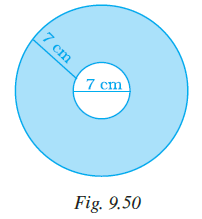
Answer:
Given:
Diameter of the inner circle ($d$) $= 7 \text{ cm}$.
Width of the shaded ring $= 7 \text{ cm}$.
Solution:
First, we find the radius of the inner circle ($r$):
$r = \frac{d}{2} = \frac{7}{2} = 3.5 \text{ cm}$
The radius of the outer circle ($R$) is the inner radius plus the width of the ring:
$R = r + \text{width} = 3.5 + 7 = 10.5 \text{ cm}$
The area of the shaded region is the difference between the areas of the outer and inner circles:
$\text{Area} = \pi R^2 - \pi r^2 = \pi (R^2 - r^2)$
$\text{Area} = \frac{22}{7} \times (10.5^2 - 3.5^2)$
Using the identity $a^2 - b^2 = (a+b)(a-b)$:
$\text{Area} = \frac{22}{7} \times (10.5 + 3.5)(10.5 - 3.5)$
$\text{Area} = \frac{22}{7} \times 14 \times 7$
$\text{Area} = 22 \times 14 = 308 \text{ cm}^2$
Therefore, the area of the shaded region is 308 cm2.
Question 99.

Answer:
Given:
Diameter of the large circle ($D$) $= 14 \text{ cm}$.
Diameter of each small circle ($d$) $= \frac{7}{4} \text{ cm}$.
Solution:
Step 1: Calculate the area of the large circle.
Radius of large circle $R = \frac{14}{2} = 7 \text{ cm}$.
$\text{Area}_L = \pi R^2 = \frac{22}{7} \times 7 \times 7 = 154 \text{ cm}^2$
Step 2: Calculate the area of the two small circles.
Radius of small circle $r = \frac{d}{2} = \frac{7}{4 \times 2} = \frac{7}{8} \text{ cm}$.
$\text{Area of 2 circles} = 2 \times \pi r^2$
$\text{Area} = 2 \times \frac{22}{7} \times \frac{7}{8} \times \frac{7}{8}$
$\text{Area} = \frac{44 \times 7}{64} = \frac{11 \times 7}{16} = \frac{77}{16} = 4.8125 \text{ cm}^2$
Step 3: Calculate shaded area.
$\text{Shaded Area} = \text{Area}_L - \text{Area of 2 circles}$
$\text{Shaded Area} = 154 - 4.8125 = 149.1875 \text{ cm}^2$
Therefore, the area of the shaded region is 149.1875 cm2.
Question 100. A circle with radius 16 cm is cut into four equal parts and rearranged to form another shape as shown in Fig. 9.52:
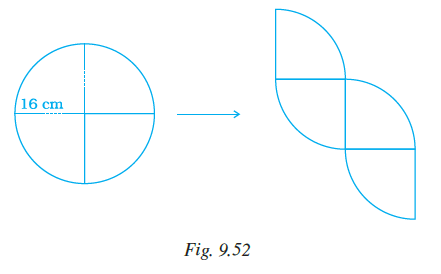
Does the perimeter change? If it does change, by how much does it increase or decrease?
Answer:
Given:
Radius of the circle ($r$) $= 16 \text{ cm}$.
Solution:
1. Original Perimeter:
The perimeter of the original circle is its circumference ($C$).
$C = 2 \pi r = 2 \times \pi \times 16 = 32 \pi \text{ cm}$
2. Perimeter of the new shape:
The circle is cut into four quadrants. When rearranged, the boundary of the new shape consists of:
i. The four arcs of the quadrants, which together equal the original circumference ($2 \pi r$).
ii. Two straight radial segments (radii) that were internal in the original circle but are now part of the external boundary.
$\text{New Perimeter} = 2 \pi r + 2r$
$\text{New Perimeter} = (32 \pi + 2 \times 16) = (32 \pi + 32) \text{ cm}$
3. Change in Perimeter:
$\text{Increase} = \text{New Perimeter} - \text{Original Perimeter}$
$\text{Increase} = (32 \pi + 32) - 32 \pi = 32 \text{ cm}$
Therefore, the perimeter increases by 32 cm.
Question 101. A large square is made by arranging a small square surrounded by four congruent rectangles as shown in Fig. 9.53. If the perimeter of each of the rectangle is 16 cm, find the area of the large square.

Answer:
Given:
Perimeter of each congruent rectangle $= 16 \text{ cm}$.
Solution:
Let the length and breadth of one rectangle be $l$ and $b$ respectively.
$2(l + b) = 16 \implies l + b = 8 \text{ cm}$
By observing Fig. 9.53, we can see that the side of the large square is formed by the sum of the length of one rectangle and the breadth of another rectangle.
$\text{Side of large square} = l + b$
$\text{Side} = 8 \text{ cm}$
Now, calculate the area of the large square:
$\text{Area} = \text{side} \times \text{side} = 8 \times 8 = 64 \text{ cm}^2$
Therefore, the area of the large square is 64 cm2.
Question 102. ABCD is a parallelogram in which AE is perpendicular to CD (Fig. 9.54). Also AC = 5 cm, DE = 4 cm, and the area of ∆ AED = 6 cm2. Find the perimeter and area of ABCD.
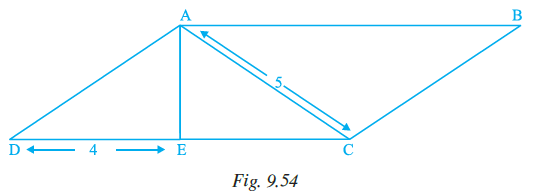
Answer:
Given:
$AE \perp CD$
$AC = 5 \text{ cm}$, $DE = 4 \text{ cm}$
$\text{Area}(\triangle AED) = 6 \text{ cm}^2$
Solution:
Step 1: Find the height AE.
In right-angled triangle $AED$:
$\text{Area}(\triangle AED) = \frac{1}{2} \times DE \times AE$
$6 = \frac{1}{2} \times 4 \times AE \implies 6 = 2 \times AE \implies AE = 3 \text{ cm}$
Step 2: Find sides AD and EC.
In right $\triangle AED$, using Pythagoras theorem:
$AD^2 = AE^2 + DE^2 = 3^2 + 4^2 = 9 + 16 = 25 \implies AD = 5 \text{ cm}$
In right $\triangle AEC$, using Pythagoras theorem ($AC$ is hypotenuse):
$EC^2 = AC^2 - AE^2 = 5^2 - 3^2 = 25 - 9 = 16 \implies EC = 4 \text{ cm}$
Step 3: Calculate Area and Perimeter of ABCD.
Base $CD = DE + EC = 4 + 4 = 8 \text{ cm}$.
$\text{Area} = \text{Base} \times \text{Height} = CD \times AE = 8 \times 3 = 24 \text{ cm}^2$
$\text{Perimeter} = 2(AD + CD) = 2(5 + 8) = 26 \text{ cm}$
Therefore, the area is 24 cm2 and the perimeter is 26 cm.
Question 103. Ishika has designed a small oval race track for her remote control car. Her design is shown in the figure 9.55. What is the total distance around the track? Round your answer to the nearest whole cm.

Answer:
Given:
From the design shown in Fig. 9.55:
Length of each straight part of the track $= 52 \text{ cm}$.
The radius of the semicircular ends is indicated by the arrow from the center line to the boundary.
$\text{Radius (} r \text{)} = 16 \text{ cm}$
(Given)
To Find:
Total distance around the track (rounded to the nearest whole cm).
Solution:
The total distance around the track is the sum of the lengths of the two straight parallel segments and the length of the two semicircular ends.
1. Length of straight parts:
There are two parallel straight segments of $52 \text{ cm}$ each.
$\text{Distance (straight)} = 2 \times 52 = 104 \text{ cm}$
2. Length of curved parts:
There are two semicircular ends with the same radius. Together, they form one complete circle.
$\text{Distance (curved)} = 2 \pi r$
Using $\pi \approx 3.14$ and $r = 16 \text{ cm}$:
$\text{Distance (curved)} = 2 \times 3.14 \times 16$
$\text{Distance (curved)} = 6.28 \times 16 = 100.48 \text{ cm}$
3. Total Distance:
$\text{Total distance} = 104 + 100.48$
$\text{Total distance} = 204.48 \text{ cm}$
Rounding to the nearest whole number:
$\text{Total distance} \approx 204 \text{ cm}$
Therefore, the total distance around the track is 204 cm.
Question 104. A table cover of dimensions 3 m 25 cm × 2 m 30 cm is spread on a table. If 30 cm of the table cover is hanging all around the table, find the area of the table cover which is hanging outside the top of the table. Also find the cost of polishing the table top at ₹ 16 per square metre.
Answer:
Given:
$\text{Length of table cover (} L \text{)} = 3.25 \text{ m}$
$\text{Breadth of table cover (} B \text{)} = 2.30 \text{ m}$
The cover hangs $30 \text{ cm}$ (or $0.3 \text{ m}$) all around the table.
To Find:
Area of hanging portion and the cost of polishing the table top.
Solution:
The dimensions of the table top are smaller than the cover by twice the hanging length (once for each side).
$\text{Length of table top (} l \text{)} = 3.25 - (2 \times 0.3)$
$l = 3.25 - 0.6 = 2.65 \text{ m}$
$\text{Breadth of table top (} w \text{)} = 2.30 - (2 \times 0.3)$
$w = 2.30 - 0.6 = 1.70 \text{ m}$
1. Area of hanging part:
$\text{Area of table cover} = 3.25 \times 2.30 = 7.475 \text{ m}^2$
$\text{Area of table top} = 2.65 \times 1.70 = 4.505 \text{ m}^2$
$\text{Area of hanging cover} = 7.475 - 4.505 = 2.97 \text{ m}^2$
2. Cost of polishing:
$\text{Cost} = \text{Area of top} \times \text{Rate}$
$\text{Cost} = 4.505 \times 16$
$\text{Cost} = \textsf{₹ } 72.08$
Area of hanging cover is 2.97 m2 and cost of polishing is $\textsf{₹}$ 72.08.
Question 105. The dimensions of a plot are 200 m × 150 m. A builder builds 3 roads which are 3 m wide along the length on either side and one in the middle. On either side of the middle road he builds houses to sell. How much area did he get for building the houses?
Answer:
Given:
Dimensions of plot $= 200 \text{ m} \times 150 \text{ m}$.
Three roads, each $3 \text{ m}$ wide, run along the length ($200 \text{ m}$).
Solution:
Since the roads are along the length, the area of each road is a rectangle of $200 \text{ m} \times 3 \text{ m}$.
$\text{Area of 3 roads} = 3 \times (200 \times 3) = 1800 \text{ m}^2$
$\text{Total Area of plot} = 200 \times 150 = 30000 \text{ m}^2$
The area available for building houses is the total area minus the road area:
$\text{Area for houses} = 30000 - 1800 = 28200 \text{ m}^2$
Therefore, the area for building houses is 28,200 m2.
Question 106. A room is 4.5 m long and 4 m wide. The floor of the room is to be covered with tiles of size 15 cm by 10 cm. Find the cost of coveringthe floor with tiles at the rate of ₹ 4.50 per tile.
Answer:
Given:
Room dimensions $= 4.5 \text{ m} \times 4 \text{ m}$.
Tile dimensions $= 15 \text{ cm} \times 10 \text{ cm}$. Rate $= \textsf{₹ } 4.50 \text{ per tile}$.
Solution:
Convert room dimensions to cm ($1 \text{ m} = 100 \text{ cm}$):
$\text{Length} = 450 \text{ cm}, \text{ Width} = 400 \text{ cm}$
$\text{Area of floor} = 450 \times 400 = 1,80,000 \text{ cm}^2$
$\text{Area of one tile} = 15 \times 10 = 150 \text{ cm}^2$
Calculate the number of tiles required:
$\text{Number of tiles} = \frac{1,80,000}{150} = 1200$
$\text{Total Cost} = 1200 \times 4.50 = \textsf{₹ } 5,400$
Therefore, the total cost of covering the floor is $\textsf{₹}$ 5,400.
Question 107. Find the total cost of wooden fencing around a circular garden of diameter 28 m, if 1m of fencing costs ₹ 300.
Answer:
Given:
Diameter of circular garden ($d$) $= 28 \text{ m}$.
Cost of fencing per metre $= \textsf{₹ } 300$.
Solution:
Fencing is done along the boundary of the garden, which is its circumference.
$\text{Circumference (} C \text{)} = \pi d$
Taking $\pi = \frac{22}{7}$:
$C = \frac{22}{7} \times 28$
$C = 22 \times 4 = 88 \text{ m}$
Now, calculate the total cost of fencing:
$\text{Total Cost} = C \times \text{Rate}$
$\text{Total Cost} = 88 \times 300$
$\text{Total Cost} = \textsf{₹ } 26,400$
Therefore, the total cost of the wooden fencing is $\textsf{₹}$ 26,400.
Question 108. Priyanka took a wire and bent it to form a circle of radius 14 cm. Then she bent it into a rectangle with one side 24 cm long. What is the length of the wire? Which figure encloses more area, the circle or the rectangle?
Answer:
Given:
Radius of the circle ($r$) $= 14 \text{ cm}$.
One side of the rectangle ($l$) $= 24 \text{ cm}$.
To Find:
Length of the wire and comparison of areas of the circle and the rectangle.
Solution:
The length of the wire is equal to the circumference of the circle.
$\text{Length of wire} = 2 \pi r$
$\text{Length of wire} = 2 \times \frac{22}{7} \times 14$
$\text{Length of wire} = 2 \times 22 \times 2 = 88 \text{ cm}$
The same wire is used to form a rectangle, so the perimeter of the rectangle is also $88 \text{ cm}$. Let the breadth be $b$.
$2(l + b) = 88$
$2(24 + b) = 88$
$24 + b = 44 \implies b = 20 \text{ cm}$
Now, let us calculate the areas of both shapes:
$\text{Area of Circle} = \pi r^2$
$\text{Area of Circle} = \frac{22}{7} \times 14 \times 14 = 616 \text{ cm}^2$
$\text{Area of Rectangle} = l \times b$
$\text{Area of Rectangle} = 24 \times 20 = 480 \text{ cm}^2$
Comparing the areas, $616 \text{ cm}^2 > 480 \text{ cm}^2$.
Therefore, the length of the wire is 88 cm and the circle encloses more area.
Question 109. How much distance, in metres, a wheel of 25 cm radius will cover if it rotates 350 times?
Answer:
Given:
Radius of the wheel ($r$) $= 25 \text{ cm}$.
Number of rotations $= 350$.
Solution:
The distance covered in one rotation is equal to the circumference of the wheel.
$\text{Distance (1 rotation)} = 2 \pi r$
$\text{Distance (1 rotation)} = 2 \times \frac{22}{7} \times 25 \text{ cm}$
Now, calculate total distance for 350 rotations:
$\text{Total distance} = 350 \times \left( 2 \times \frac{22}{7} \times 25 \right)$
$\text{Total distance} = 50 \times 2 \times 22 \times 25$
$\text{Total distance} = 100 \times 550 = 55,000 \text{ cm}$
Convert distance to metres ($1 \text{ m} = 100 \text{ cm}$):
$\text{Total distance} = \frac{55000}{100} = 550 \text{ m}$
Therefore, the wheel will cover a distance of 550 metres.
Question 110. A circular pond is surrounded by a 2 m wide circular path. If outer circumference of circular path is 44 m, find the inner circumference of the circular path. Also find area of the path.
Answer:
Given:
Outer circumference of the path $= 44 \text{ m}$.
Width of the circular path $= 2 \text{ m}$.
Solution:
Let the outer radius be $R$.
$2 \pi R = 44 \implies 2 \times \frac{22}{7} \times R = 44$
$R = \frac{44 \times 7}{44} = 7 \text{ m}$
Inner radius $r = R - \text{width} = 7 - 2 = 5 \text{ m}$.
1. Inner Circumference:
$\text{Inner C} = 2 \pi r = 2 \times \frac{22}{7} \times 5 = \frac{220}{7} \approx 31.43 \text{ m}$
2. Area of Path:
$\text{Area} = \pi R^2 - \pi r^2 = \frac{22}{7}(7^2 - 5^2)$
$\text{Area} = \frac{22}{7}(49 - 25) = \frac{22}{7} \times 24 = \frac{528}{7} \approx 75.43 \text{ m}^2$
The inner circumference is approx 31.43 m and area of the path is approx 75.43 m2.
Question 111. A carpet of size 5 m × 2 m has 25 cm wide red border. The inner part of the carpet is blue in colour (Fig. 9.56). Find the area of blue portion. What is the ratio of areas of red portion to blue portion?
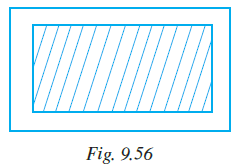
Answer:
Given:
Outer dimensions of carpet: $L = 5 \text{ m}$, $B = 2 \text{ m}$.
Width of red border $= 25 \text{ cm} = 0.25 \text{ m}$.
Solution:
1. Area of blue portion:
The blue portion is the inner rectangle.
$\text{Inner Length} = 5 - (2 \times 0.25) = 4.5 \text{ m}$
$\text{Inner Breadth} = 2 - (2 \times 0.25) = 1.5 \text{ m}$
$\text{Area of blue portion} = 4.5 \times 1.5 = 6.75 \text{ m}^2$
2. Area of red portion:
$\text{Total Area} = 5 \times 2 = 10 \text{ m}^2$
$\text{Area of red portion} = \text{Total Area} - \text{Area of blue portion}$
$\text{Area of red portion} = 10 - 6.75 = 3.25 \text{ m}^2$
3. Ratio:
$\text{Ratio (Red : Blue)} = 3.25 : 6.75 = 325 : 675$
$\text{Ratio} = 13 : 27$
Area of blue portion is 6.75 m2 and the ratio of red to blue area is 13 : 27.
Question 112. Use the Fig. 9.57 showing the layout of a farm house:

(a) What is the area of land used to grow hay?
(b) It costs ₹ 91 per m2 to fertilise the vegetable garden. What is the total cost?
(c) A fence is to be enclosed around the house. The dimensions of the house are 18.7 m ×12.6 m. At least how many metres of fencing are needed?
(d) Each banana tree required 1.25 m2 of ground space. How many banana trees can there be in the orchard?
Answer:
Solution:
(a) Area for Hay:
From the figure, the hay region is a rectangle of $17.8 \text{ m}$ by $10.6 \text{ m}$.
$\text{Area of Hay} = 17.8 \times 10.6 = 188.68 \text{ m}^2$
(b) Cost for Vegetable Garden:
The vegetable garden dimensions are $49 \text{ m}$ by $15.2 \text{ m}$.
$\text{Area} = 49 \times 15.2 = 744.8 \text{ m}^2$
$\text{Total Cost} = 744.8 \times \textsf{₹ } 91 = \textsf{₹ } 67,776.80$
(c) Fencing for the house:
Fencing length is the perimeter of the house.
$\text{Perimeter} = 2(18.7 + 12.6) = 2 \times 31.3 = 62.6 \text{ m}$
(d) Banana Orchard:
The orchard dimensions are $15.7 \text{ m}$ by $20 \text{ m}$.
$\text{Area of Orchard} = 15.7 \times 20 = 314 \text{ m}^2$
$\text{Number of trees} = \frac{314}{1.25} = 251.2$
Since the number of trees must be a whole number, there can be 251 trees.
Question 113. Study the layout given below in Fig. 9.58 and answer the questions:

(a) Write an expression for the total area covered by both the bedrooms and the kitchen.
(b) Write an expression to calculate the perimeter of the living room.
(c) If the cost of carpeting is ₹ 50/m2, write an expression for calculating the total cost of carpeting both the bedrooms and the living room.
(d) If the cost of tiling is ₹ 30/m2, write an expression for calculating the total cost of floor tiles used for the bathroom and kitchen floors.
(e) If the floor area of each bedroom is 35 m2, then find x.
Answer:
Solution:
From the layout (Fig. 9.58), the dimensions are as follows:
Total Width $= 15 \text{ m}$
Bedroom 1 & 2 Width $= x$, Height $= 5 \text{ m}$
Bathroom Width $= 2 \text{ m}$, Height $= 5 \text{ m}$
Kitchen Width $= 15 - (x + 2) = (13 - x) \text{ m}$, Height $= 5 \text{ m}$
(a) Expression for total area of both bedrooms and kitchen:
$\text{Area (Bedrooms)} = 2 \times (x \times 5) = 10x \text{ m}^2$
$\text{Area (Kitchen)} = 5 \times (13 - x) = (65 - 5x) \text{ m}^2$
$\text{Total Area} = 10x + 65 - 5x = (5x + 65) \text{ m}^2$
(b) Expression for the perimeter of the living room:
The living room is L-shaped. Its boundary consists of segments of lengths $15, (5+2), (15-x), 2, x,$ and $5$ metres.
$\text{Perimeter} = 15 + 7 + (15 - x) + 2 + x + 5$
$\text{Perimeter} = 44 \text{ m}$
(c) Cost of carpeting bedrooms and living room:
$\text{Total Area} = \text{Area (Bedrooms)} + \text{Area (Living Room)}$
$\text{Total Area} = 10x + [15 \times 7 - 5x] = (105 + 5x) \text{ m}^2$
$\text{Cost} = 50 \times (105 + 5x)$
(d) Cost of tiling bathroom and kitchen:
$\text{Area} = \text{Area (Bath)} + \text{Area (Kitchen)}$
$\text{Area} = (2 \times 5) + 5(13 - x) = (10 + 65 - 5x) = (75 - 5x) \text{ m}^2$
$\text{Cost} = 30 \times (75 - 5x)$
(e) Find x if bedroom area is 35 m2:
$5 \times x = 35$
$x = 7 \text{ m}$
Question 114. A 10 m long and 4 m wide rectangular lawn is in front of a house. Along its three sides a 50 cm wide flower bed is there as shown in Fig. 9.58. Find the area of the remaining portion.
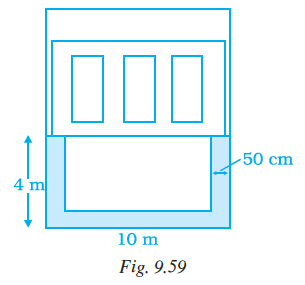
Answer:
Given:
Lawn Dimensions $= 10 \text{ m} \times 4 \text{ m}$.
Width of flower bed $= 50 \text{ cm} = 0.5 \text{ m}$.
Solution:
The flower bed is along three sides of the lawn. By looking at Fig. 9.59, the bed is along the two widths ($4 \text{ m}$ sides) and one length ($10 \text{ m}$ side).
The dimensions of the inner remaining rectangular portion are:
$\text{Remaining Length} = 10 - (0.5 + 0.5) = 9 \text{ m}$
$\text{Remaining Width} = 4 - 0.5 = 3.5 \text{ m}$
$\text{Area of remaining portion} = 9 \times 3.5 = 31.5 \text{ m}^2$
Therefore, the area of the remaining portion is 31.5 m2.
Question 115. A school playground is divided by a 2 m wide path which is parallel to the width of the playground, and a 3 m wide path which is parallel to the length of the ground (Fig. 9.60). If the length and width of the playground are 120 m and 80 m respectively, find the area of the remaining playground.
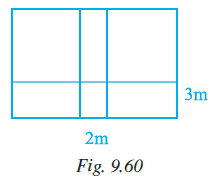
Answer:
Given:
Playground Dimensions $= 120 \text{ m} \times 80 \text{ m}$.
Path 1 Width (along length) $= 3 \text{ m}$.
Path 2 Width (along width) $= 2 \text{ m}$.
Solution:
Step 1: Calculate total area of the paths.
$\text{Area of Path 1} = 120 \times 3 = 360 \text{ m}^2$
$\text{Area of Path 2} = 80 \times 2 = 160 \text{ m}^2$
The paths intersect at the center. The area of the intersection ($3 \text{ m} \times 2 \text{ m}$) is counted twice, so we subtract it once.
$\text{Total path area} = 360 + 160 - (3 \times 2) = 514 \text{ m}^2$
Step 2: Calculate remaining area.
$\text{Total area of playground} = 120 \times 80 = 9600 \text{ m}^2$
$\text{Remaining Area} = 9600 - 514 = 9086 \text{ m}^2$
Therefore, the area of the remaining playground is 9086 m2.
Question 116. In a park of dimensions 20 m × 15 m, there is a L shaped 1m wide flower bed as shown in Fig. 9.61. Find the total cost of manuring for the flower bed at the rate of Rs 45 per m2.
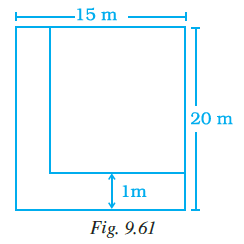
Answer:
Given:
Park Dimensions $= 20 \text{ m} \times 15 \text{ m}$.
Flower bed width $= 1 \text{ m}$. Rate for manuring $= \textsf{₹ } 45/\text{m}^2$.
Solution:
The L-shaped bed consists of two rectangular strips.
$\text{Area of Strip 1 (horizontal)} = 15 \times 1 = 15 \text{ m}^2$
$\text{Area of Strip 2 (vertical)} = (20 - 1) \times 1 = 19 \text{ m}^2$
$\text{Total Area of bed} = 15 + 19 = 34 \text{ m}^2$
Total Cost:
$\text{Total Cost} = 34 \times 45 = \textsf{₹ } 1,530$
Therefore, the total cost of manuring is $\textsf{₹}$ 1,530.
Question 117. Dimensions of a painting are 60 cm × 38 cm. Find the area of the wooden frame of width 6 cm around the painting as shown in Fig. 9.62.
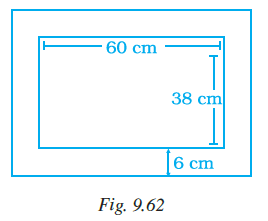
Answer:
Given:
Painting Dimensions $= 60 \text{ cm} \times 38 \text{ cm}$.
Width of frame $= 6 \text{ cm}$.
Solution:
The frame is "around" the painting, so it increases the overall dimensions of the object.
$\text{Outer Length} = 60 + (2 \times 6) = 72 \text{ cm}$
$\text{Outer Breadth} = 38 + (2 \times 6) = 50 \text{ cm}$
Area of the Frame:
$\text{Outer Area} = 72 \times 50 = 3600 \text{ cm}^2$
$\text{Inner Area (Painting)} = 60 \times 38 = 2280 \text{ cm}^2$
$\text{Area of Frame} = 3600 - 2280 = 1320 \text{ cm}^2$
Therefore, the area of the wooden frame is 1320 cm2.
Question 118. A design is made up of four congruent right triangles as shown in Fig. 9.63. Find the area of the shaded portion.
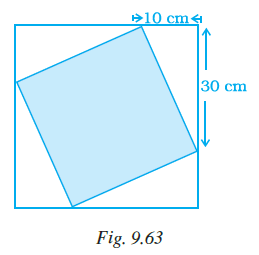
Answer:
Given:
The figure shows an outer square containing four congruent right-angled triangles. The dimensions provided are the legs of these triangles.
$\text{Base of one triangle} = 10 \text{ cm}$
(Given)
$\text{Height of one triangle} = 30 \text{ cm}$
(Given)
Solution:
The shaded portion is an inner square. Its area can be found by subtracting the area of the four congruent triangles from the area of the outer square.
1. Area of the four triangles:
$\text{Area of one triangle} = \frac{1}{2} \times \text{base} \times \text{height}$
$\text{Area of one triangle} = \frac{1}{2} \times 10 \times 30 = 150 \text{ cm}^2$
$\text{Area of 4 triangles} = 4 \times 150 = 600 \text{ cm}^2$
2. Area of the outer square:
The side of the outer square is the sum of the base and height of the triangles.
$\text{Side of outer square} = 10 + 30 = 40 \text{ cm}$
$\text{Area of outer square} = 40 \times 40 = 1600 \text{ cm}^2$
3. Area of the shaded portion:
$\text{Shaded Area} = 1600 - 600$
$\text{Shaded Area} = 1000 \text{ cm}^2$
Therefore, the area of the shaded portion is 1000 cm2.
Question 119. A square tile of length 20 cm has four quarter circles at each corner as shown in Fig. 9.64 (i). Find the area of shaded portion. Another tile with same dimensions has a circle in the centre of the tile[Fig. 9.64 (ii)]. If the circle touches all the four sides of the square tile, find the area of the shaded portion. In which tile, area of shaded portion will be more? (Take π = 3.14)

Answer:
Given:
Side of the square tile $= 20 \text{ cm}$.
Solution:
Case (i): The tile has four quarter circles at the corners. From the figure, these quarter circles meet, meaning the radius of each is half the side of the square.
$\text{Radius (} r \text{)} = \frac{20}{2} = 10 \text{ cm}$
The area of 4 quarter circles is equal to the area of 1 full circle.
$\text{Area of 1 circle} = \pi r^2 = 3.14 \times 10^2 = 314 \text{ cm}^2$
The shaded area is the region left in the center:
$\text{Shaded Area (i)} = \text{Area of square} - \text{Area of circle}$
$\text{Shaded Area (i)} = (20 \times 20) - 314 = 400 - 314 = 86 \text{ cm}^2$
Case (ii): A central circle touches all sides. Its diameter is equal to the side of the square ($20 \text{ cm}$), so its radius is $10 \text{ cm}$.
$\text{Area of central circle} = \pi \times 10^2 = 314 \text{ cm}^2$
The shaded area is the region at the corners:
$\text{Shaded Area (ii)} = \text{Area of square} - \text{Area of circle}$
$\text{Shaded Area (ii)} = 400 - 314 = 86 \text{ cm}^2$
Conclusion:
The area of the shaded portion in both tiles is 86 cm2. The areas are equal.
Question 120. A rectangular field is 48 m long and 12 m wide. How many right triangular flower beds can be laid in this field, if sides including the right angle measure 2 m and 4 m, respectively?
Answer:
Given:
Field Dimensions $= 48 \text{ m} \times 12 \text{ m}$.
Triangle legs $= 2 \text{ m}$ and $4 \text{ m}$.
Solution:
$\text{Area of rectangular field} = 48 \times 12 = 576 \text{ m}^2$
$\text{Area of one triangular bed} = \frac{1}{2} \times 2 \times 4 = 4 \text{ m}^2$
Number of beds that can be laid:
$\text{Number of beds} = \frac{\text{Total Area}}{\text{Area of one bed}}$
$\text{Number of beds} = \frac{576}{4} = 144$
Therefore, 144 flower beds can be laid in the field.
Question 121. Ramesh grew wheat in a rectangular field that measured 32 metres long and 26 metres wide. This year he increased the area for wheat by increasing the length but not the width. He increased the area of the wheat field by 650 square metres. What is the length of the expanded wheat field?
Answer:
Given:
Original Length $= 32 \text{ m}$, Original Width $= 26 \text{ m}$.
Increase in Area $= 650 \text{ m}^2$. Width remains constant ($26 \text{ m}$).
Solution:
$\text{Original Area} = 32 \times 26 = 832 \text{ m}^2$
$\text{New Total Area} = 832 + 650 = 1482 \text{ m}^2$
Let the new length be $L$. Since width is still $26 \text{ m}$:
$L \times 26 = 1482$
$L = \frac{1482}{26} = 57 \text{ m}$
Therefore, the length of the expanded wheat field is 57 metres.
Question 122. In Fig. 9.65, triangle AEC is right-angled at E, B is a point on EC, BD is the altitude of triangle ABC, AC = 25 cm, BC = 7 cm and AE = 15 cm. Find the area of triangle ABC and the length of DB.
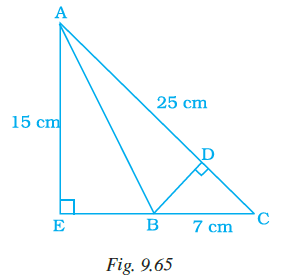
Answer:
Given:
In $\triangle AEC$, $\angle E = 90^\circ$. $AC = 25 \text{ cm}, AE = 15 \text{ cm}, BC = 7 \text{ cm}$. $BD \perp AC$.
Solution:
Step 1: Find the length of EC.
Using Pythagoras theorem in $\triangle AEC$:
$EC^2 = AC^2 - AE^2 = 25^2 - 15^2$
$EC^2 = 625 - 225 = 400 \implies EC = 20 \text{ cm}$
Step 2: Find the area of $\triangle ABC$.
In $\triangle ABC$, considering $BC$ as the base, the corresponding altitude is $AE$ (since $AE \perp EC$).
$\text{Area}(\triangle ABC) = \frac{1}{2} \times \text{base} \times \text{height} = \frac{1}{2} \times BC \times AE$
$\text{Area}(\triangle ABC) = \frac{1}{2} \times 7 \times 15 = 52.5 \text{ cm}^2$
Step 3: Find the length of DB.
The area of $\triangle ABC$ can also be expressed using base $AC$ and altitude $DB$.
$\text{Area}(\triangle ABC) = \frac{1}{2} \times AC \times DB$
$52.5 = \frac{1}{2} \times 25 \times DB$
$105 = 25 \times DB \implies DB = \frac{105}{25} = 4.2 \text{ cm}$
The area of $\triangle ABC$ is 52.5 cm2 and the length of $DB$ is 4.2 cm.
Question 123.
Answer:
Given:
Dimensions of the large chocolate sheet $= 18 \text{ cm} \times 18 \text{ cm}$
Dimensions of one small chocolate piece $= 1.5 \text{ cm} \times 2 \text{ cm}$
Solution:
To find the total number of pieces, we divide the total area of the sheet by the area of one piece.
$\text{Area of sheet} = 18 \times 18 = 324 \text{ cm}^2$
$\text{Area of one piece} = 1.5 \times 2 = 3 \text{ cm}^2$
Number of pieces:
$\text{Number of pieces} = \frac{324}{3}$
$\text{Number of pieces} = 108$
Alternative Check:
Along the length ($18 \text{ cm}$), we can cut $18 / 1.5 = 12$ pieces.
Along the breadth ($18 \text{ cm}$), we can cut $18 / 2 = 9$ pieces.
Total pieces $= 12 \times 9 = 108$.
Therefore, 108 pieces of chocolate can be cut.
Question 124. Calculate the area of shaded region in Fig. 9.66, where all of the short line segments are at right angles to each other and 1 cm long.
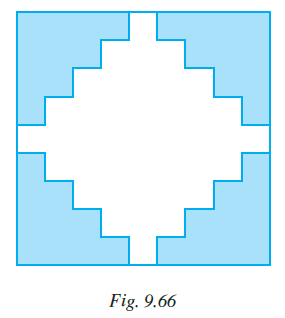
Answer:
Given:
The figure (Fig. 9.66) consists of a shaded square with a unshaded central region. Every small step segment is $1 \text{ cm}$ long.
Solution:
By observing the steps, we can determine the dimensions of the outer square. There are 8 horizontal segments of $1 \text{ cm}$ each across the span.
$\text{Side of outer square} = 9 \text{ cm}$
The shaded region is composed of four identical corner shapes. Let's count the number of unit squares ($1 \text{ cm} \times 1 \text{ cm}$) in one corner:
Row 1: 4 squares
Row 2: 3 squares
Row 3: 2 squares
Row 4: 1 square
$\text{Squares in one corner} = 4 + 3 + 2 + 1 = 10$
Since there are four such corners:
$\text{Total shaded squares} = 4 \times 10 = 40$
$\text{Area of shaded region} = 40 \text{ cm}^2$
Therefore, the area of the shaded region is 40 cm2.
Question 125. The plan and measurement for a house are given in Fig. 9.67. The house is surrounded by a path 1m wide.
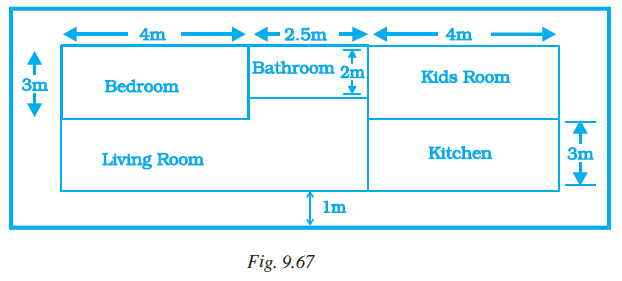
Find the following:
(i) Cost of paving the path with bricks at rate of ₹ 120 per m2.
(ii) Cost of wooden flooring inside the house except the bathroom at the cost of ₹ 1200 per m2.
(iii) Area of Living Room.
Answer:
Solution:
Step 1: House Dimensions
$\text{Total House Width} = 4 + 2.5 + 4 = 10.5 \text{ m}$
$\text{Total House Height} = 3 + 3 = 6 \text{ m}$
$\text{House Area} = 10.5 \times 6 = 63 \text{ m}^2$
(i) Cost of paving the path:
The path is $1 \text{ m}$ wide around the house. The outer dimensions including the path are:
$\text{Outer Width} = 10.5 + 2 = 12.5 \text{ m}$
$\text{Outer Height} = 6 + 2 = 8 \text{ m}$
$\text{Outer Area} = 12.5 \times 8 = 100 \text{ m}^2$
$\text{Path Area} = 100 - 63 = 37 \text{ m}^2$
$\text{Cost} = 37 \times 120 = \textsf{₹ } 4,440$
(ii) Cost of wooden flooring (except bathroom):
$\text{Bathroom Area} = 2.5 \times 2 = 5 \text{ m}^2$
$\text{Flooring Area} = 63 - 5 = 58 \text{ m}^2$
$\text{Cost} = 58 \times 1200 = \textsf{₹ } 69,600$
(iii) Area of Living Room:
The total area of the house is $63 \text{ m}^2$. Subtract areas of other rooms:
Bedroom: $4 \times 3 = 12 \text{ m}^2$ | Kids Room: $4 \times 3 = 12 \text{ m}^2$ | Kitchen: $4 \times 3 = 12 \text{ m}^2$ | Bath: $5 \text{ m}^2$
$\text{Living Room Area} = 63 - (12 + 12 + 12 + 5)$
$\text{Living Room Area} = 63 - 41 = 22 \text{ m}^2$
Question 126. Architects design many types of buildings. They draw plans for houses, such as the plan shown in Fig. 9.68:

An architect wants to install a decorative moulding around the ceilings in all the rooms. The decorative moulding costs ₹ 500/metre.
(a) Find how much moulding will be needed for each room.
(i) family room
(ii) living room
(iii) dining room
(iv) bedroom 1
(v) bedroom 2
(b) The carpet costs ₹ 200/m2. Find the cost of carpeting each room.
(c) What is the total cost of moulding for all the five rooms.
Answer:
Solution:
Moulding is installed around the ceiling, which is equal to the perimeter of the room. Carpeting is done on the floor, equal to the area.
| Room | Perimeter (m) | Area (m2) | Carpet Cost (₹) |
| Family Room ($4.57 \times 5.48$) | 20.10 | 25.04 | 5,008 |
| Living Room ($3.81 \times 7.53$) | 22.68 | 28.69 | 5,738 |
| Dining Room ($5.41 \times 5.48$) | 21.78 | 29.65 | 5,930 |
| Bedroom 1 ($3.04 \times 3.04$) | 12.16 | 9.24 | 1,848 |
| Bedroom 2 ($3.04 \times 2.43$) | 10.94 | 7.39 | 1,478 |
(c) Total Cost of Moulding:
$\text{Total Perimeter} = 20.10 + 22.68 + 21.78 + 12.16 + 10.94 $$ = 87.66 \text{ m}$
$\text{Total Cost} = 87.66 \times 500 = \textsf{₹ } 43,830$
Question 127. ABCD is a given rectangle with length as 80 cm and breadth as 60 cm. P, Q, R, S are the mid points of sides AB, BC, CD, DA respectively. A circular rangoli of radius 10 cm is drawn at the centre as shown in Fig. 9.69. Find the area of shaded portion.

Answer:
Given:
Rectangle $ABCD$: $L = 80 \text{ cm}, B = 60 \text{ cm}$.
A rhombus $PQRS$ is formed by connecting midpoints. A central circle has radius $r = 10 \text{ cm}$.
Solution:
The area of the shaded portion is the area of the rhombus minus the area of the circle.
$\text{Area of Rhombus } PQRS = \frac{1}{2} \times d_1 \times d_2 = \frac{1}{2} \times 80 \times 60$
$\text{Area of Rhombus} = 2400 \text{ cm}^2$
Area of circular rangoli (using $\pi \approx 3.14$):
$\text{Area of Circle} = \pi r^2 = 3.14 \times 10^2 = 314 \text{ cm}^2$
Area of shaded portion:
$\text{Shaded Area} = 2400 - 314 = 2086 \text{ cm}^2$
Therefore, the area of the shaded portion is 2086 cm2.
Question 128. 4 squares each of side 10 cm have been cut from each corner of a rectangular sheet of paper of size 100 cm × 80 cm. From the remaining piece of paper, an isosceles right triangle is removed whose equal sides are each of 10 cm length. Find the area of the remaining part of the paper.
Answer:
Given:
Dimensions of rectangular sheet $= 100 \text{ cm} \times 80 \text{ cm}$.
Side of each of the 4 squares $= 10 \text{ cm}$.
Equal sides of the isosceles right triangle $= 10 \text{ cm}$.
Solution:
We first calculate the area of the original sheet and the areas of the parts removed.
1. Area of the original rectangular sheet:
$\text{Area}_{\text{sheet}} = \text{Length} \times \text{Breadth}$
$\text{Area}_{\text{sheet}} = 100 \times 80 = 8000 \text{ cm}^2$
2. Area of the 4 squares removed:
$\text{Area of 1 square} = \text{side}^2 = 10 \times 10 = 100 \text{ cm}^2$
$\text{Area of 4 squares} = 4 \times 100 = 400 \text{ cm}^2$
3. Area of the isosceles right triangle removed:
$\text{Area}_{\text{triangle}} = \frac{1}{2} \times \text{base} \times \text{height}$
Since it is an isosceles right triangle, the two equal sides are the base and the height.
$\text{Area}_{\text{triangle}} = \frac{1}{2} \times 10 \times 10 = 50 \text{ cm}^2$
4. Area of the remaining part:
$\text{Remaining Area} = \text{Area}_{\text{sheet}} - (\text{Area of 4 squares} + \text{Area}_{\text{triangle}})$
$\text{Remaining Area} = 8000 - (400 + 50)$
$\text{Remaining Area} = 8000 - 450 = 7550 \text{ cm}^2$
Therefore, the area of the remaining part of the paper is 7550 cm2.
Question 129. A dinner plate is in the form of a circle. A circular region encloses a beautiful design as shown in Fig. 9.70. The inner circumference is 352 mm and outer is 396 mm. Find the width of circular design.

Answer:
Given:
Inner circumference ($C_1$) $= 352 \text{ mm}$
Outer circumference ($C_2$) $= 396 \text{ mm}$
To Find:
The width of the design region ($R - r$).
Solution:
Let $r$ be the inner radius and $R$ be the outer radius.
1. Find the inner radius (r):
$2 \pi r = 352$
$2 \times \frac{22}{7} \times r = 352$
$r = \frac{352 \times 7}{44} = 8 \times 7 = 56 \text{ mm}$
2. Find the outer radius (R):
$2 \pi R = 396$
$2 \times \frac{22}{7} \times R = 396$
$R = \frac{396 \times 7}{44} = 9 \times 7 = 63 \text{ mm}$
3. Find the width:
$\text{Width} = R - r$
$\text{Width} = 63 - 56 = 7 \text{ mm}$
Therefore, the width of the circular design is 7 mm.
Question 130. The moon is about 384000 km from earth and its path around the earth is nearly circular. Find the length of path described by moon in one complete revolution. (Take π = 3.14)
Answer:
Given:
Distance of the moon from the earth (radius of circular path, $r$) $= 384000 \text{ km}$.
$\pi = 3.14$.
Solution:
The length of the path described in one complete revolution is equal to the circumference of the circular path.
$\text{Circumference} = 2 \pi r$
$C = 2 \times 3.14 \times 384000$
$C = 6.28 \times 384000$
$C = 2411520 \text{ km}$
Therefore, the length of the path is 24,11,520 km.
Question 131. A photograph of Billiard/Snooker table has dimensions as $\frac{1}{10}$ th of its actual size as shown in Fig. 9.71:

The portion excluding six holes each of diameter 0.5 cm needs to be polished at rate of ₹ 200 per m2. Find the cost of polishing.
Answer:
Given:
Scale of photograph $= 1:10$.
Dimensions in photograph: $L = 25 \text{ cm}, B = 10 \text{ cm}, \text{hole diameter} = 0.5 \text{ cm}$.
Rate of polishing $= \textsf{₹ } 200/\text{m}^2$.
Solution:
Step 1: Find actual dimensions of the table and holes.
$\text{Actual Length} = 25 \times 10 = 250 \text{ cm} = 2.5 \text{ m}$
$\text{Actual Breadth} = 10 \times 10 = 100 \text{ cm} = 1 \text{ m}$
$\text{Actual Hole Diameter} = 0.5 \times 10 = 5 \text{ cm} = 0.05 \text{ m}$
$\text{Actual Hole Radius (} r \text{)} = 2.5 \text{ cm} = 0.025 \text{ m}$
Step 2: Calculate areas in square metres.
$\text{Area of table} = 2.5 \times 1 = 2.5 \text{ m}^2$
$\text{Area of 1 hole} = \pi r^2 = 3.14 \times (0.025)^2$
$\text{Area of 6 holes} = 6 \times 3.14 \times 0.000625 = 0.011775 \text{ m}^2$
Step 3: Area to be polished and total cost.
$\text{Polishing Area} = 2.5 - 0.011775 = 2.488225 \text{ m}^2$
$\text{Total Cost} = 2.488225 \times 200$
$\text{Total Cost} = \textsf{₹ } 497.645$
Therefore, the cost of polishing is approximately $\textsf{₹}$ 497.65.