

Chapter 1 Rational Numbers (Class 8 - Maths NCERT Exemplar Solutions)
Welcome to the comprehensive resource for NCERT Exemplar Solutions for Class 8 Mathematics: Chapter 1 Rational Numbers! This chapter is meticulously crafted to push students beyond basic operations, focusing on the intricate properties and diverse applications of numbers in the form $\frac{p}{q}$ where $q \neq 0$. These problems are designed to deepen conceptual understanding and build a robust algebraic foundation.
The solutions thoroughly explore the Closure, Commutative, and Associative properties under addition and multiplication. A primary focus is the Distributive Property, which students learn to apply strategically to simplify complex numerical expressions efficiently rather than relying on brute-force calculation. Mastery of the Additive Identity (0), Multiplicative Identity (1), Additive Inverse, and Reciprocal (Multiplicative Inverse) is also emphasized to ensure a complete grasp of the number system.
Furthermore, the chapter covers reducing fractions to their standard form, representing them on the number line, and applying the density property to find multiple rational numbers between two given values. Whether tackling Multiple Choice Questions (MCQs) or multi-step word problems, these step-by-step solutions prepared by learningspot.co provide clear justifications and logical breakdowns to help students achieve mathematical mastery and excellence.
| Content On This Page | ||
|---|---|---|
| Solved Examples (Examples 1 to 16) | Question 1 to 25 (Multiple Choice Questions) | Question 26 to 47 (Fill in the Blanks) |
| Question 48 to 99 (True or False) | Question 100 to 152 | |
Solved Examples (Examples 1 to 16)
In examples 1 to 3, there are four options out of which one is correct. Choose the correct answer.
Example 1: Which of the following is not true?
(a) $\frac{2}{3}$ + $\frac{5}{4}$ = $\frac{5}{4}$ + $\frac{2}{3}$
b) $\frac{2}{3}$ - $\frac{5}{4}$ = $\frac{5}{4}$ - $\frac{2}{3}$
(c) $\frac{2}{3}$ × $\frac{5}{4}$ = $\frac{5}{4}$ × $\frac{2}{3}$
(d) $\frac{2}{3}$ ÷ $\frac{5}{4}$ = $\frac{2}{3}$ × $\frac{4}{5}$
Answer:
Solution:
We check each option based on the properties of rational numbers:
(a) $\frac{2}{3} + \frac{5}{4} = \frac{5}{4} + \frac{2}{3}$: This is True as addition is commutative for rational numbers.
(b) $\frac{2}{3} - \frac{5}{4} = \frac{5}{4} - \frac{2}{3}$: This is False because subtraction is not commutative for rational numbers. Let's verify:
L.H.S. $= \frac{2}{3} - \frac{5}{4} = \frac{8 - 15}{12} = \frac{-7}{12}$
R.H.S. $= \frac{5}{4} - \frac{2}{3} = \frac{15 - 8}{12} = \frac{7}{12}$
Since $\frac{-7}{12} \neq \frac{7}{12}$, the statement is not true.
(c) $\frac{2}{3} \times \frac{5}{4} = \frac{5}{4} \times \frac{2}{3}$: This is True as multiplication is commutative for rational numbers.
(d) $\frac{2}{3} \div \frac{5}{4} = \frac{2}{3} \times \frac{4}{5}$: This is True by the definition of division of rational numbers (multiplying by the reciprocal).
The correct option is (b).
Example 2: Multiplicative inverse of $\frac{0}{1}$ is
(a) 1
(b) –1
(c) 0
(d) not defined
Answer:
Solution:
The given number is $\frac{0}{1}$, which is equal to $0$.
The multiplicative inverse of a rational number $a$ is $\frac{1}{a}$ such that $a \times \frac{1}{a} = 1$.
For $0$, the multiplicative inverse would be $\frac{1}{0}$.
Since division by zero is not defined in mathematics, the multiplicative inverse of $0$ does not exist.
The correct option is (d).
Example 3: Three rational numbers lying between $\frac{-3}{4}$ and $\frac{1}{2}$ are
(a) $\frac{-1}{2}$ , 0, $\frac{3}{4}$
(b) $\frac{-1}{4}$ , $\frac{1}{4}$ , $\frac{3}{4}$
(c) $\frac{-1}{4}$ , 0 , $\frac{1}{4}$
(d) $\frac{-5}{4}$ , 0 , $\frac{1}{4}$
Answer:
Solution:
First, let's convert the given numbers to have a common denominator or decimal form for easier comparison:
$\frac{-3}{4} = -0.75$
$\frac{1}{2} = 0.50$
We check the values in option (c):
$\frac{-1}{4} = -0.25$
$0 = 0$
$\frac{1}{4} = 0.25$
Comparing these with the range $(-0.75, 0.50)$:
$-0.75 < -0.25 < 0.50$ (True)
$-0.75 < 0 < 0.50$ (True)
$-0.75 < 0.25 < 0.50$ (True)
In other options, values like $\frac{3}{4} (0.75)$ or $\frac{-5}{4} (-1.25)$ fall outside the range.
The correct option is (c).
In examples 4 and 5, fill in the blanks to make the statements true.
Example 4: The product of a non-zero rational number and its reciprocal is ________.
Answer:
Solution:
Let the non-zero rational number be $x = \frac{a}{b}$ where $a, b \neq 0$.
Its reciprocal is $\frac{1}{x} = \frac{b}{a}$.
The product is:
$\frac{a}{b} \times \frac{b}{a} = 1$
The correct answer is 1.
Example 5: If x = $\frac{1}{3}$ and y = $\frac{6}{7}$ then xy - $\frac{y}{x}$ = _______.
Answer:
Solution:
Given: $x = \frac{1}{3}$ and $y = \frac{6}{7}$
First, calculate $xy$:
$xy = \frac{1}{3} \times \frac{6}{7} = \frac{1 \times 6}{3 \times 7} = \frac{2}{7}$
Next, calculate $\frac{y}{x}$:
$\frac{y}{x} = \frac{6}{7} \div \frac{1}{3} = \frac{6}{7} \times 3 = \frac{18}{7}$
Now, find the value of $xy - \frac{y}{x}$:
$xy - \frac{y}{x} = \frac{2}{7} - \frac{18}{7} = \frac{2 - 18}{7} = \frac{-16}{7}$
The correct answer is $-\frac{16}{7}$.
In examples 6 and 7, state whether the given statements are true or false.
Example 6: Every rational number has a reciprocal.
Answer:
Solution:
A rational number is any number that can be expressed in the form $\frac{p}{q}$ where $p$ and $q$ are integers and $q \neq 0$.
The number $0$ is a rational number (can be written as $\frac{0}{1}$).
The reciprocal of $0$ would be $\frac{1}{0}$, which is not defined.
Therefore, not every rational number has a reciprocal.
The statement is False.
Example 7: $\frac{-4}{5}$ is larger than $\frac{-5}{4}$ .
Answer:
Solution:
Let's convert the fractions to decimals for comparison:
$\frac{-4}{5} = -0.8$
$\frac{-5}{4} = -1.25$
On a number line, $-0.8$ lies to the right of $-1.25$.
Since a number to the right is always larger than a number to the left on a number line:
$-0.8 > -1.25$
Therefore, $\frac{-4}{5}$ is larger than $\frac{-5}{4}$.
The statement is True.
Example 8: Find $\frac{4}{7}$ × $\frac{14}{3}$ ÷ $\frac{2}{3}$
Answer:
Solution:
To Find: The value of the expression $\frac{4}{7} \times \frac{14}{3} \div \frac{2}{3}$
Using the rule of division for rational numbers (multiplication by reciprocal):
$\frac{4}{7} \times \frac{14}{3} \div \frac{2}{3} = \frac{4}{7} \times \frac{14}{3} \times \frac{3}{2}$
Now, perform the multiplication and simplify by canceling terms:
$\frac{4 \times \cancel{14}^{\cancel{2}^{1}} \times \cancel{3}^{1}}{\cancel{7}_{1} \times \cancel{3}_{1} \times \cancel{2}_{1}}$
$= 4 \times 1$
$= 4$
The final value is 4.
Example 9: Using appropriate properties, find $\frac{2}{3}$ × $\frac{-5}{7}$ + $\frac{7}{3}$ + $\frac{2}{3}$ × $\frac{-2}{7}$ .
Answer:
Solution:
The given expression is:
$\frac{2}{3} \times \frac{-5}{7} + \frac{7}{3} + \frac{2}{3} \times \frac{-2}{7}$
Rearranging the terms using Commutative Property of addition to group terms with the common factor $\frac{2}{3}$:
$= \frac{2}{3} \times \left(\frac{-5}{7}\right) + \frac{2}{3} \times \left(\frac{-2}{7}\right) + \frac{7}{3}$
Using the Distributive Property [$a \times b + a \times c = a(b + c)$]:
$= \frac{2}{3} \times \left[\frac{-5}{7} + \left(\frac{-2}{7}\right)\right] + \frac{7}{3}$
Simplifying the terms inside the bracket:
$= \frac{2}{3} \times \left[\frac{-5 - 2}{7}\right] + \frac{7}{3}$
$= \frac{2}{3} \times \left(\frac{-7}{7}\right) + \frac{7}{3}$
$= \frac{2}{3} \times (-1) + \frac{7}{3}$
Now, calculating the final sum:
$= -\frac{2}{3} + \frac{7}{3}$
$= \frac{-2 + 7}{3}$
$= \frac{5}{3}$
Therefore, the value of the expression is $\frac{5}{3}$.
Example 10: Let O, P and Z represent the numbers 0, 3 and -5 respectively on the number line. Points Q, R and S are between O and P such that OQ = QR = RS = SP.
What are the rational numbers represented by the points Q, R and S. Next choose a point T between Z and O so that ZT = TO. Which rational number does T represent?
Answer:
Given:
Point O represents the number 0.
Point P represents the number 3.
Point Z represents the number -5.
OQ = QR = RS = SP (segment OP is divided into 4 equal parts).
ZT = TO (T is the midpoint of segment ZO).
To Find:
Rational numbers represented by points Q, R, S, and T.
Number Line Representation:
Solution:
Step 1: Finding the values of Q, R, and S
The total length of the segment OP is calculated as:
$OP = P - O = 3 - 0 = 3$ units.
Since the segment OP is divided into 4 equal parts, the length of each part is $\frac{3}{4}$ units.
The points can be calculated by adding the part length successively starting from O:
Point Q $= O + \frac{3}{4} = 0 + \frac{3}{4} = \frac{3}{4}$
Point R $= Q + \frac{3}{4} = \frac{3}{4} + \frac{3}{4} = \frac{6}{4} = \frac{3}{2}$
Point S $= R + \frac{3}{4} = \frac{6}{4} + \frac{3}{4} = \frac{9}{4}$
Step 2: Finding the value of T
Point T lies between Z $(-5)$ and O $(0)$ such that $ZT = TO$. This implies that T is the midpoint of the segment ZO.
The value of T is the average of the values at Z and O:
$T = \frac{-5 + 0}{2}$
(Midpoint formula)
$T = -\frac{5}{2} = -2.5$
Final Answer:
The rational numbers represented by the points are:
Q = $\frac{3}{4}$
R = $\frac{3}{2}$
S = $\frac{9}{4}$
T = $-\frac{5}{2}$
Example 11: A farmer has a field of area $49\frac{4}{5}$ ha. He wants to divide it equally among his one son and two daughters. Find the area of each one’s share.
(ha means hectare; 1 hectare = 10,000 m2)
Answer:
Given:
Total area of the field $= 49\frac{4}{5}$ ha.
Total number of people dividing the field $= 1 \text{ (son)} + 2 \text{ (daughters)} = 3 \text{ people}$.
To Find:
Area of each one's share.
Solution:
First, convert the mixed fraction of the area into an improper fraction:
$49\frac{4}{5} = \frac{49 \times 5 + 4}{5} = \frac{245 + 4}{5} = \frac{249}{5}$ ha.
Now, divide this area equally among 3 children:
Share of each child $= \frac{249}{5} \div 3$
Share of each child $= \frac{249}{5} \times \frac{1}{3}$
Share of each child $= \frac{\cancel{249}^{83}}{5} \times \frac{1}{\cancel{3}_{1}}$
Share of each child $= \frac{83}{5}$ ha.
Converting back to a mixed fraction:
$\frac{83}{5} = 16\frac{3}{5}$ ha.
Therefore, each child's share is $16\frac{3}{5}$ ha.
Example 12: Let a, b, c be the three rational numbers where a = $\frac{2}{3}$ , b = $\frac{4}{5}$ , and c = $-\frac{5}{6}$
Verify:
(i) a + (b + c) = (a + b) + c (Associative property of addition)
(ii) a × (b × c) = (a × b) × c (Associative property of multiplication)
Answer:
Given:
Three rational numbers are:
$a = \frac{2}{3}$
$b = \frac{4}{5}$
$c = -\frac{5}{6}$
Verification (i): Associative property of addition
To verify: $a + (b + c) = (a + b) + c$
L.H.S. $= a + (b + c)$
$= \frac{2}{3} + \left[\frac{4}{5} + \left(-\frac{5}{6}\right)\right]$
$= \frac{2}{3} + \left[\frac{4 \times 6 - 5 \times 5}{30}\right]$
$= \frac{2}{3} + \left[\frac{24 - 25}{30}\right]$
$= \frac{2}{3} + \left(-\frac{1}{30}\right) = \frac{20 - 1}{30}$
L.H.S. $= \frac{19}{30}$
R.H.S. $= (a + b) + c$
$= \left(\frac{2}{3} + \frac{4}{5}\right) + \left(-\frac{5}{6}\right)$
$= \left(\frac{2 \times 5 + 4 \times 3}{15}\right) - \frac{5}{6}$
$= \frac{10 + 12}{15} - \frac{5}{6} = \frac{22}{15} - \frac{5}{6}$
$= \frac{22 \times 2 - 5 \times 5}{30} = \frac{44 - 25}{30}$
R.H.S. $= \frac{19}{30}$
Since L.H.S. = R.H.S., the associative property of addition is verified.
Verification (ii): Associative property of multiplication
To verify: $a \times (b \times c) = (a \times b) \times c$
L.H.S. $= a \times (b \times c)$
$= \frac{2}{3} \times \left[\frac{4}{5} \times \left(-\frac{5}{6}\right)\right]$
$= \frac{2}{3} \times \left[\frac{4 \times (-5)}{5 \times 6}\right]$
$= \frac{2}{3} \times \left[\frac{-20}{30}\right] = \frac{2}{3} \times \left(-\frac{2}{3}\right)$
L.H.S. $= -\frac{4}{9}$
R.H.S. $= (a \times b) \times c$
$= \left(\frac{2}{3} \times \frac{4}{5}\right) \times \left(-\frac{5}{6}\right)$
$= \frac{8}{15} \times \left(-\frac{5}{6}\right)$
$= \frac{8 \times (-5)}{15 \times 6} = \frac{-40}{90}$
R.H.S. $= -\frac{4}{9}$
Since L.H.S. = R.H.S., the associative property of multiplication is verified.
Example 13: Solve the following questions and write your observations.
(i) $\frac{5}{3}$ + 0 = ?
(ii) $\frac{-2}{5}$ + 0 = ?
(iii) $\frac{3}{7}$ + 0 = ?
(iv) $\frac{2}{3}$ × 1 = ?
(v) $\frac{-6}{7}$ × 1 = ?
(vi) $\frac{9}{8}$ × 1 = ?
Answer:
Solutions:
(i) $\frac{5}{3} + 0 = \frac{5}{3}$
(ii) $\frac{-2}{5} + 0 = \frac{-2}{5}$
(iii) $\frac{3}{7} + 0 = \frac{3}{7}$
(iv) $\frac{2}{3} \times 1 = \frac{2}{3}$
(v) $\frac{-6}{7} \times 1 = \frac{-6}{7}$
(vi) $\frac{9}{8} \times 1 = \frac{9}{8}$
Observations:
1. In cases (i), (ii), and (iii), adding zero to any rational number results in the same rational number. Therefore, 0 is the additive identity for rational numbers.
2. In cases (iv), (v), and (vi), multiplying any rational number by one results in the same rational number. Therefore, 1 is the multiplicative identity for rational numbers.
Example 14: Write any 5 rational numbers between $\frac{-5}{6}$ and $\frac{7}{8}$
Answer:
Solution:
To find rational numbers between $\frac{-5}{6}$ and $\frac{7}{8}$, we first find a common denominator.
The L.C.M. of 6 and 8 is 24.
Converting the fractions:
$\frac{-5}{6} = \frac{-5 \times 4}{6 \times 4} = \frac{-20}{24}$
$\frac{7}{8} = \frac{7 \times 3}{8 \times 3} = \frac{21}{24}$
Now, we can choose any five rational numbers between $\frac{-20}{24}$ and $\frac{21}{24}$.
Some examples are: $\frac{-19}{24}, \frac{-10}{24}, 0, \frac{5}{24}, \frac{20}{24}$.
After simplifying some of these, we get $-\frac{19}{24}, -\frac{5}{12}, 0, \frac{5}{24}, \frac{5}{6}$.
Example 15: Identify the rational number which is different from the other three:
$\frac{2}{3}$ , $\frac{-4}{5}$ , $\frac{1}{2}$ , $\frac{1}{3}$ . Explain your reasoning
Answer:
Solution:
The given rational numbers are $\frac{2}{3}, \frac{-4}{5}, \frac{1}{2}, \text{ and } \frac{1}{3}$.
Observation:
1. $\frac{2}{3}$ is a positive rational number.
2. $\frac{1}{2}$ is a positive rational number.
3. $\frac{1}{3}$ is a positive rational number.
4. $\frac{-4}{5}$ is a negative rational number.
Conclusion:
The rational number $\frac{-4}{5}$ is different from the others because it is the only negative rational number in the set, while all others are positive.
Example 16: Problem Solving Strategies
Problem: The product of two rational numbers is –7. If one of the number is –10, find the other.
Answer:
Given:
Product of two rational numbers $= -7$
One of the numbers $= -10$
To Find:
The other rational number.
Solution:
Let the other rational number be $x$.
According to the problem:
$x \times (-10) = -7$
(Product is given)
To find $x$, we divide the product by the given number:
$x = \frac{-7}{-10}$
$x = \frac{7}{10}$
Verification:
$\frac{7}{10} \times (-10) = -7$ (Correct)
Therefore, the other rational number is $\frac{7}{10}$.
Exercise
Question 1 to 25 (Multiple Choice Questions)
In questions 1 to 25, there are four options out of which one is correct. Choose the correct answer.
Question 1. A number which can be expressed as $\frac{p}{q}$ where p and q are integers and q ≠ 0 is
(a) natural number.
(b) whole number.
(c) integer.
(d) rational number.
Answer:
Solution:
By definition, a number that can be expressed in the form $\frac{p}{q}$, where $p$ and $q$ are integers and $q \neq 0$, is called a rational number.
While natural numbers, whole numbers, and integers can also be expressed in this form (by taking $q = 1$), the most comprehensive and specific term for the given definition is a rational number.
The correct option is (d).
Question 2. A number of the form $\frac{p}{q}$ is said to be a rational number if
(a) p and q are integers.
(b) p and q are integers and q ≠ 0
(c) p and q are integers and p ≠ 0
(d) p and q are integers and p ≠ 0 also q ≠ 0.
Answer:
Solution:
The standard definition of a rational number requires two conditions:
1. Both the numerator ($p$) and the denominator ($q$) must be integers.
2. The denominator ($q$) must not be zero ($q \neq 0$), because division by zero is undefined.
The numerator $p$ can be zero; therefore, $p \neq 0$ is not a requirement.
The correct option is (b).
Question 3. The numerical expression $\frac{3}{8}$ + $\frac{(-5)}{7}$ = $\frac{-19}{56}$ shows that
(a) rational numbers are closed under addition.
(b) rational numbers are not closed under addition.
(c) rational numbers are closed under multiplication.
(d) addition of rational numbers is not commutative.
Answer:
Solution:
The expression shows the addition of two rational numbers, $\frac{3}{8}$ and $\frac{-5}{7}$, resulting in another rational number, $\frac{-19}{56}$.
The property stating that the sum of any two rational numbers is always a rational number is known as the closure property under addition.
The correct option is (a).
Question 4. Which of the following is not true?
(a) rational numbers are closed under addition.
(b) rational numbers are closed under subtraction.
(c) rational numbers are closed under multiplication.
(d) rational numbers are closed under division.
Answer:
Solution:
Let us examine the closure property for rational numbers across different operations:
1. Addition: Sum of two rational numbers is always rational. (True)
2. Subtraction: Difference of two rational numbers is always rational. (True)
3. Multiplication: Product of two rational numbers is always rational. (True)
4. Division: If we divide a rational number by another rational number $q$, the result is rational except when $q = 0$. Since $0$ is a rational number and division by $0$ is undefined, the set of rational numbers is not closed under division.
The correct option is (d).
Question 5. $-\frac{3}{8}$ + $\frac{1}{7}$ = $\frac{1}{7}$ + $\left( \frac{-3}{8} \right)$ is an example to show that
(a) addition of rational numbers is commutative.
(b) rational numbers are closed under addition.
(c) addition of rational number is associative.
(d) rational numbers are distributive under addition.
Answer:
Solution:
The expression shows that changing the order of the addends does not change the sum:
$a + b = b + a$
This property is called the commutative property of addition.
The correct option is (a).
Question 6. Which of the following expressions shows that rational numbers are associative under multiplication.
(a) $\frac{2}{3}$ × $\left( \frac{-6}{7} \times \frac{3}{5} \right)$ = $\left( \frac{2}{3} \times \frac{-6}{7} \right)$ × $\frac{3}{5}$
(b) $\frac{2}{3}$ × $\left( \frac{-6}{7} \times \frac{3}{5} \right)$ = $\frac{2}{3}$ × $\left( \frac{3}{5} \times \frac{-6}{7} \right)$
(c) $\frac{2}{3}$ × $\left( \frac{-6}{7} \times \frac{3}{5} \right)$ = $\left( \frac{3}{5} \times \frac{2}{3} \right)$ × $\frac{-6}{7}$
(d) $\left( \frac{2}{3} \times \frac{-6}{7} \right)$ × $\frac{3}{5}$ = $\left( \frac{-6}{7} \times \frac{2}{3} \right)$ ) × $\frac{3}{5}$
Answer:
Solution:
The associative property of multiplication for rational numbers states that the grouping of numbers does not affect the product:
$a \times (b \times c) = (a \times b) \times c$
In option (a), we see exactly this structure:
$\frac{2}{3} \times \left( \frac{-6}{7} \times \frac{3}{5} \right) = \left( \frac{2}{3} \times \frac{-6}{7} \right) \times \frac{3}{5}$
Other options demonstrate commutativity or a mix of properties.
The correct option is (a).
Question 7. Zero (0) is
(a) the identity for addition of rational numbers.
(b) the identity for subtraction of rational numbers.
(c) the identity for multiplication of rational numbers.
(d) the identity for division of rational numbers.
Answer:
Solution:
When zero is added to any rational number, the value of the rational number remains unchanged:
$a + 0 = a = 0 + a$
Therefore, zero is called the additive identity (or identity for addition) for rational numbers.
The correct option is (a).
Question 8. One (1) is
(a) the identity for addition of rational numbers.
(b) the identity for subtraction of rational numbers.
(c) the identity for multiplication of rational numbers.
(d) the identity for division of rational numbers.
Answer:
Solution:
When any rational number is multiplied by one, the value of the rational number remains the same:
$a \times 1 = a = 1 \times a$
Therefore, one is called the multiplicative identity (or identity for multiplication) for rational numbers.
The correct option is (c).
Question 9. The additive inverse of $\frac{-7}{19}$ is
(a) $\frac{-7}{19}$
(b) $\frac{7}{19}$
(c) $\frac{19}{7}$
(d) $\frac{-19}{7}$
Answer:
The additive inverse of a rational number $a$ is $-a$ such that their sum is zero ($a + (-a) = 0$).
Additive inverse of $\frac{-7}{19} = - \left( \frac{-7}{19} \right) = \frac{7}{19}$
The correct option is (b).
Question 10. Multiplicative inverse of a negative rational number is
(a) a positive rational number.
(b) a negative rational number.
(c) 0
(d) 1
Answer:
The multiplicative inverse of a rational number $\frac{p}{q}$ is $\frac{q}{p}$.
The sign of the number does not change when taking its reciprocal. If the original number is negative, its reciprocal will also be negative.
Therefore, the multiplicative inverse of a negative rational number is a negative rational number.
The correct option is (b).
Question 11. If x + 0 = 0 + x = x, which is rational number, then 0 is called
(a) identity for addition of rational numbers.
(b) additive inverse of x.
(c) multiplicative inverse of x.
(d) reciprocal of x.
Answer:
The property $x + 0 = 0 + x = x$ states that when zero is added to any rational number, the number remains unchanged.
This defines $0$ as the additive identity (or identity for addition) of rational numbers.
The correct option is (a).
Question 12. To get the product 1, we should multiply $\frac{8}{21}$ by
(a) $\frac{8}{21}$
(b) $\frac{-8}{21}$
(c) $\frac{21}{8}$
(d) $\frac{-21}{8}$
Answer:
To get a product of $1$, we must multiply a number by its multiplicative inverse (reciprocal).
The multiplicative inverse of $\frac{8}{21}$ is $\frac{21}{8}$.
$\frac{8}{21} \times \frac{21}{8} = 1$
The correct option is (c).
Question 13. – (–x) is same as
(a) – x
(b) x
(c) $\frac{1}{x}$
(d) $\frac{-1}{x}$
Answer:
The expression $-(-x)$ represents the negative of a negative number.
According to the rules of signs in mathematics, the product of two negative signs results in a positive sign.
$-(-x) = x$
The correct option is (b).
Question 14. The multiplicative inverse of $-1\frac{1}{7}$ is
(a) $\frac{8}{7}$
(b) $\frac{-8}{7}$
(c) $\frac{7}{8}$
(d) $\frac{7}{-8}$
Answer:
First, convert the mixed fraction $-1\frac{1}{7}$ into an improper fraction:
$-1\frac{1}{7} = -\left( \frac{1 \times 7 + 1}{7} \right) = -\frac{8}{7}$
The multiplicative inverse of $-\frac{8}{7}$ is obtained by interchanging the numerator and denominator while keeping the sign.
Multiplicative inverse $= -\frac{7}{8}$ or $\frac{7}{-8}$
The correct option is (d).
Question 15. If x be any rational number then x + 0 is equal to
(a) x
(b) 0
(c) – x
(d) Not defined
Answer:
Zero is the additive identity for the set of rational numbers.
Adding zero to any rational number $x$ does not change its value.
$x + 0 = x$
The correct option is (a).
Question 16. The reciprocal of 1 is
(a) 1
(b) –1
(c) 0
(d) Not defined
Answer:
The reciprocal of a number $n$ is $\frac{1}{n}$.
Reciprocal of $1 = \frac{1}{1} = 1$
The correct option is (a).
Question 17. The reciprocal of –1 is
(a) 1
(b) –1
(c) 0
(d) Not defined
Answer:
Solution:
The reciprocal of a number $x$ is $1/x$.
The reciprocal of $-1$ is $\frac{1}{-1}$, which is equal to $-1$.
This is because the product of a number and its reciprocal must be $1$. Here, $(-1) \times (-1) = 1$.
The correct option is (b).
Question 18. The reciprocal of 0 is
(a) 1
(b) –1
(c) 0
(d) Not defined
Answer:
Solution:
The reciprocal of a number $x$ is defined as $\frac{1}{x}$.
If we try to find the reciprocal of $0$, we get $\frac{1}{0}$.
In mathematics, division by zero is not defined.
Therefore, the reciprocal of $0$ is not defined.
The correct option is (d).
Question 19. The reciprocal of any rational number $\frac{p}{q}$ , where p and q are integers and q ≠ 0, is
(a) $\frac{p}{q}$
(b) 1
(c) 0
(d) $\frac{q}{p}$
Answer:
Solution:
The reciprocal (or multiplicative inverse) of a non-zero rational number $\frac{p}{q}$ is the number which when multiplied by $\frac{p}{q}$ gives the product $1$.
$\frac{p}{q} \times \frac{q}{p} = 1$
Thus, the reciprocal of $\frac{p}{q}$ is $\frac{q}{p}$.
The correct option is (d).
Question 20. If y be the reciprocal of rational number x, then the reciprocal of y will be
(a) x
(b) y
(c) $\frac{x}{y}$
(d) $\frac{y}{x}$
Answer:
Given:
$y$ is the reciprocal of $x$. This means $y = \frac{1}{x}$.
Solution:
We need to find the reciprocal of $y$.
The reciprocal of $y$ is $\frac{1}{y}$.
Substituting the value of $y$:
$\text{Reciprocal of } y = \frac{1}{\left(\frac{1}{x}\right)} = x$
The correct option is (a).
Question 21. The reciprocal of $\frac{-3}{8} \times \left( \frac{-7}{13} \right)$ is
(a) $\frac{104}{21}$
(b) $\frac{-104}{21}$
(c) $\frac{21}{104}$
(d) $\frac{-21}{104}$
Answer:
Solution:
First, let's find the product of the given expression:
$\frac{-3}{8} \times \left( \frac{-7}{13} \right) = \frac{(-3) \times (-7)}{8 \times 13} = \frac{21}{104}$
Now, we find the reciprocal of the resulting product $\frac{21}{104}$.
Reciprocal of $\frac{21}{104} = \frac{104}{21}$
The correct option is (a).
Question 22. Which of the following is an example of distributive property of multiplication over addition for rational numbers.
(a) $-\frac{1}{4}\times\left\{ \frac{2}{3}+\left( \frac{-4}{7} \right) \right\}=\left[ -\frac{1}{4}\times\frac{2}{3} \right]+\left[ -\frac{1}{4}\times\left( \frac{-4}{7} \right) \right]$
(b) $-\frac{1}{4}\times\left\{ \frac{2}{3}+\left( \frac{-4}{7} \right) \right\}=\left[ \frac{1}{4}\times\frac{2}{3} \right]-\left( \frac{-4}{7} \right)$
(c) $-\frac{1}{4}\times\left\{ \frac{2}{3}+\left( \frac{-4}{7} \right) \right\}=\frac{2}{3}+\left( -\frac{1}{4} \right)\times\frac{-4}{7}$
(d) $-\frac{1}{4}\times\left\{ \frac{2}{3}+\left( \frac{-4}{7} \right) \right\}=\left\{ \frac{2}{3}+\left( \frac{-4}{7} \right) \right\}-\frac{1}{4}$
Answer:
Solution:
The distributive property of multiplication over addition is expressed as:
$a \times (b + c) = (a \times b) + (a \times c)$
Looking at option (a):
L.H.S. is $-\frac{1}{4} \times \left\{ \frac{2}{3} + \left( \frac{-4}{7} \right) \right\}$
R.H.S. is $\left[ -\frac{1}{4} \times \frac{2}{3} \right] + \left[ -\frac{1}{4} \times \left( \frac{-4}{7} \right) \right]$
This matches the identity $a \times (b + c) = ab + ac$.
The correct option is (a).
Question 23. Between two given rational numbers, we can find
(a) one and only one rational number.
(b) only two rational numbers.
(c) only ten rational numbers.
(d) infinitely many rational numbers.
Answer:
Solution:
Rational numbers are dense. This means that no matter how close two rational numbers are, there is always another rational number between them.
By repeatedly finding the mean (average) or changing the denominator, we can generate an endless sequence of numbers.
Therefore, there are infinitely many rational numbers between any two given rational numbers.
The correct option is (d).
Question 24. $\frac{x \;+\; y}{2}$ is a rational number.
(a) Between x and y
(b) Less than x and y both.
(c) Greater than x and y both.
(d) Less than x but greater than y.
Answer:
Solution:
The expression $\frac{x + y}{2}$ represents the mean or average of two numbers $x$ and $y$.
On a number line, the average of two numbers always lies exactly at the midpoint between them.
Thus, $\frac{x + y}{2}$ is a rational number that lies between $x$ and $y$.
The correct option is (a).
Question 25. Which of the following statements is always true?
(a) $\frac{x \;-\; y}{2}$ is a rational number between x and y.
(b) $\frac{x \;+\; y}{2}$ is a rational number between x and y.
(c) $\frac{x \;×\; y}{2}$ is a rational number between x and y.
(d) $\frac{x \;÷\; y}{2}$ is a rational number between x and y.
Answer:
Solution:
To find a rational number between two given rational numbers $x$ and $y$, we find their arithmetic mean.
The arithmetic mean of $x$ and $y$ is given by $\frac{x + y}{2}$.
This value is guaranteed to be greater than the smaller number and smaller than the larger number.
Therefore, statement (b) is always true.
The correct option is (b).
Question 26 to 47 (Fill in the Blanks)
In questions 26 to 47, fill in the blanks to make the statements true.
Question 26. The equivalent of $\frac{5}{7}$ , whose numerator is 45 is ___________.
Answer:
Given:
Rational number $= \frac{5}{7}$
Required numerator $= 45$
Solution:
To find the equivalent rational number, we need to determine the factor by which the original numerator must be multiplied to get 45.
$45 \div 5 = 9$
Now, multiply both the numerator and the denominator of the given fraction by 9:
$\frac{5 \times 9}{7 \times 9} = \frac{45}{63}$
The equivalent rational number is $\frac{45}{63}$.
Question 27. The equivalent rational number of $\frac{7}{9}$ , whose denominator is 45 is ___________.
Answer:
Given:
Rational number $= \frac{7}{9}$
Required denominator $= 45$
Solution:
To find the equivalent rational number, we need to determine the factor by which the original denominator must be multiplied to get 45.
$45 \div 9 = 5$
Now, multiply both the numerator and the denominator of the given fraction by 5:
$\frac{7 \times 5}{9 \times 5} = \frac{35}{45}$
The equivalent rational number is $\frac{35}{45}$.
Question 28. Between the numbers $\frac{15}{20}$ and $\frac{35}{40}$ , the greater number is __________.
Answer:
Given:
Rational numbers: $\frac{15}{20}$ and $\frac{35}{40}$
Solution:
To compare the two rational numbers, we first make their denominators equal by finding the L.C.M. of 20 and 40.
L.C.M. of 20 and 40 is 40.
Now, convert $\frac{15}{20}$ into an equivalent fraction with denominator 40:
$\frac{15 \times 2}{20 \times 2} = \frac{30}{40}$
Now, comparing $\frac{30}{40}$ and $\frac{35}{40}$:
Since $35 > 30$, it follows that $\frac{35}{40} > \frac{30}{40}$.
The greater number is $\frac{35}{40}$.
Question 29. The reciprocal of a positive rational number is ___________.
Answer:
Solution:
The reciprocal of a rational number $\frac{a}{b}$ is $\frac{b}{a}$.
If a rational number is positive, both its numerator and denominator have the same sign (either both positive or both negative). When we take the reciprocal, the sign remains the same.
For example, the reciprocal of $\frac{2}{3}$ is $\frac{3}{2}$, which is also positive.
Therefore, the reciprocal of a positive rational number is positive.
Question 30. The reciprocal of a negative rational number is ___________.
Answer:
Solution:
The reciprocal of a rational number $\frac{a}{b}$ is $\frac{b}{a}$.
If a rational number is negative, one of its terms (either numerator or denominator) is negative. Taking the reciprocal does not change the sign of the overall value.
For example, the reciprocal of $-\frac{4}{5}$ is $-\frac{5}{4}$, which is also negative.
Therefore, the reciprocal of a negative rational number is negative.
Question 31. Zero has ___________ reciprocal.
Answer:
Solution:
The reciprocal of a number $x$ is defined as $\frac{1}{x}$.
For zero, the reciprocal would be $\frac{1}{0}$. However, division by zero is not defined in mathematics.
Therefore, zero has no reciprocal.
Question 32. The numbers ___________ and ___________ are their own reciprocal.
Answer:
Solution:
A number $x$ is its own reciprocal if $x = \frac{1}{x}$, which implies $x^{2} = 1$.
Solving for $x$, we find:
1. If $x = 1$, then $\frac{1}{1} = 1$.
2. If $x = -1$, then $\frac{1}{-1} = -1$.
The numbers 1 and -1 are their own reciprocal.
Question 33. If y be the reciprocal of x, then the reciprocal of y2 in terms of x will be ___________.
Answer:
Given:
$y$ is the reciprocal of $x$.
$y = \frac{1}{x}$
Solution:
We need to find the reciprocal of $y^{2}$ in terms of $x$.
First, find $y^{2}$ by squaring equation (i):
$y^{2} = \left( \frac{1}{x} \right)^{2} = \frac{1}{x^{2}}$
Now, the reciprocal of $y^{2}$ is $\frac{1}{y^{2}}$.
Reciprocal of $y^{2} = \frac{1}{\left( \frac{1}{x^{2}} \right)} = x^{2}$
Therefore, the reciprocal of $y^{2}$ in terms of $x$ is $x^{2}$.
Question 34. The reciprocal of $\frac{2}{5}$ × $\left( \frac{-4}{9} \right)$ is ___________.
Answer:
Solution:
First, we find the product of the given rational numbers:
$\frac{2}{5} \times \left( \frac{-4}{9} \right) = \frac{2 \times (-4)}{5 \times 9} = \frac{-8}{45}$
The reciprocal of a rational number $\frac{p}{q}$ is $\frac{q}{p}$.
Therefore, the reciprocal of $\frac{-8}{45}$ is $\frac{45}{-8}$ or $-\frac{45}{8}$.
Question 35. (213 × 657)–1 = 213–1 × ___________.
Answer:
Solution:
According to the laws of exponents and properties of rational numbers, the reciprocal of a product is the product of the reciprocals.
$(a \times b)^{-1} = a^{-1} \times b^{-1}$
Applying this property to the given expression:
$(213 \times 657)^{-1} = 213^{-1} \times 657^{-1}$
The blank should be filled with $657^{-1}$.
Question 36. The negative of 1 is ___________.
Answer:
Solution:
The negative of a number is its additive inverse. For any number $a$, its negative is $-a$ such that $a + (-a) = 0$.
The negative of $1$ is $-1$ because $1 + (-1) = 0$.
The blank should be filled with $-1$.
Question 37. For rational numbers , $\frac{a}{b}$ , $\frac{c}{d}$ and $\frac{e}{f}$ we have $\frac{a}{b}\times\left( \frac{c}{d}+\frac{e}{f} \right)$ ) = _________ + ________.
Answer:
Solution:
According to the distributive property of multiplication over addition for rational numbers:
$\frac{a}{b} \times \left( \frac{c}{d} + \frac{e}{f} \right) = \left( \frac{a}{b} \times \frac{c}{d} \right) + \left( \frac{a}{b} \times \frac{e}{f} \right)$
The blanks should be filled with $\left( \frac{a}{b} \times \frac{c}{d} \right)$ and $\left( \frac{a}{b} \times \frac{e}{f} \right)$.
Question 38. $\frac{-5}{7}$ is ________ than –3.
Answer:
Solution:
To compare $\frac{-5}{7}$ and $-3$, let us convert them to a common denominator or decimal form.
$\frac{-5}{7} \approx -0.71$
The other number is $-3$.
On a number line, $-0.71$ lies to the right of $-3$. Numbers to the right are always larger than numbers to the left.
Therefore, $\frac{-5}{7} > -3$.
The blank should be filled with greater.
Question 39. There are ________ rational numbers between any two rational numbers.
Answer:
Solution:
Rational numbers are dense on the number line. Between any two distinct rational numbers, we can find another rational number by taking their average or mean.
This process can be repeated an infinite number of times.
Therefore, there are infinitely many rational numbers between any two rational numbers.
Question 40. The rational numbers $\frac{1}{3}$ and $\frac{-1}{3}$ are on the ________ sides of zero on the number line.
Answer:
Solution:
On a number line, zero is the center point. Positive numbers are represented to the right of zero, and negative numbers are represented to the left of zero.
Since $\frac{1}{3}$ is a positive rational number and $\frac{-1}{3}$ is a negative rational number, they lie on opposite sides of zero.
Question 41. The negative of a negative rational number is always a ________ rational number.
Answer:
Solution:
Let a negative rational number be $-x$, where $x$ is a positive rational number.
The negative of this number is given by $-(-x)$.
In mathematics, the negative of a negative value results in a positive value:
$-(-x) = x$
Therefore, the negative of a negative rational number is always a positive rational number.
Question 42. Rational numbers can be added or multiplied in any __________.
Answer:
Solution:
Rational numbers follow the Commutative Property for both addition and multiplication.
This property states that for any two rational numbers $a$ and $b$:
$a + b = b + a$
(Commutativity of Addition)
$a \times b = b \times a$
(Commutativity of Multiplication)
This means the result remains the same regardless of the sequence in which the numbers are placed.
Therefore, the blank should be filled with order.
Question 43. The reciprocal of $\frac{-5}{7}$ is ________.
Answer:
Solution:
The reciprocal of a rational number $\frac{a}{b}$ is defined as $\frac{b}{a}$. To find the reciprocal, we interchange the numerator and the denominator while keeping the sign of the number unchanged.
Given rational number $= \frac{-5}{7}$
Its reciprocal $= \frac{7}{-5}$
This can also be written as $-\frac{7}{5}$ or $\frac{-7}{5}$.
Question 44. The multiplicative inverse of $\frac{4}{3}$ is _________.
Answer:
Solution:
The multiplicative inverse of a rational number is another name for its reciprocal. A number multiplied by its multiplicative inverse always results in the multiplicative identity, which is $1$.
Given rational number $= \frac{4}{3}$
Let its multiplicative inverse be $x$.
$\frac{4}{3} \times x = 1$
$x = \frac{3}{4}$
Therefore, the multiplicative inverse is $\frac{3}{4}$.
Question 45. The rational number 10.11 in the from $\frac{p}{q}$ is _________.
Answer:
Solution:
To convert a decimal number into the $\frac{p}{q}$ form, we count the number of decimal places and divide the number by the corresponding power of $10$.
The number $10.11$ has two decimal places.
$10.11 = \frac{1011}{100}$
Since $1011$ and $100$ do not have any common factors other than $1$, the fraction is already in its simplest form.
Therefore, the blank should be filled with $\frac{1011}{100}$.
Question 46. $\frac{1}{5}$ × $\left[ \frac{2}{7} + \frac{3}{8} \right]$ = $\left[ \frac{1}{5} × \frac{2}{7} \right]$ + ___________.
Answer:
Solution:
This statement represents the Distributive Property of Multiplication over Addition for rational numbers. The property states:
$a \times (b + c) = (a \times b) + (a \times c)$
Applying this to the given expression where $a = \frac{1}{5}$, $b = \frac{2}{7}$, and $c = \frac{3}{8}$:
$\frac{1}{5} \times \left[ \frac{2}{7} + \frac{3}{8} \right] = \left[ \frac{1}{5} \times \frac{2}{7} \right] + \left[ \frac{1}{5} \times \frac{3}{8} \right]$
Therefore, the blank should be filled with $\left[ \frac{1}{5} \times \frac{3}{8} \right]$.
Question 47. The two rational numbers lying between –2 and –5 with denominator as 1 are _________ and _________.
Answer:
Solution:
Rational numbers with a denominator of $1$ are equivalent to integers ($n = \frac{n}{1}$).
We need to find the integers that lie between $-2$ and $-5$ on the number line.
Looking at the number line between $-2$ and $-5$:
$-5 < -4 < -3 < -2$
The integers are $-3$ and $-4$. Written as rational numbers with denominator $1$, they are $\frac{-3}{1}$ and $\frac{-4}{1}$.
Therefore, the two numbers are $-3$ and $-4$.
Question 48 to 99 (True or False)
In each of the following, state whether the statements are true (T) or false (F).
Question 48. If $\frac{x}{y}$ is a rational number, then y is always a whole number.
Answer:
By definition, a rational number is in the form $\frac{x}{y}$ where $x$ and $y$ are integers and $y \neq 0$.
Integers include negative numbers (e.g., $-1, -2, -3, ...$), whereas whole numbers consist only of $\{0, 1, 2, 3, ...\}$. Thus, $y$ can be a negative integer.
The statement is False.
Question 49. If $\frac{p}{q}$ is a rational number, then p cannot be equal to zero.
Answer:
A rational number is defined as $\frac{p}{q}$ where $p$ and $q$ are integers and $q \neq 0$.
There is no restriction on the numerator $p$ being zero. In fact, $0$ is a rational number because it can be written as $\frac{0}{1}$, where $p = 0$.
The statement is False.
Question 50. If $\frac{r}{s}$ is a rational number, then s cannot be equal to zero.
Answer:
In a rational number $\frac{r}{s}$, the division is by $s$. Division by zero is undefined in mathematics.
Therefore, the condition $s \neq 0$ is essential for the number to be a valid rational number.
The statement is True.
Question 51. $\frac{5}{6}$ lies between $\frac{2}{3}$ and 1.
Answer:
To check if $\frac{5}{6}$ lies between $\frac{2}{3}$ and $1$, we convert them to a common denominator.
L.C.M. of $3, 6, 1$ is $6$.
$\frac{2}{3} = \frac{4}{6}$
$1 = \frac{6}{6}$
Now, comparing the numerators: $4 < 5 < 6$.
Since $\frac{4}{6} < \frac{5}{6} < \frac{6}{6}$, the number lies in between.
The statement is True.
Question 52. $\frac{5}{10}$ lies between $\frac{1}{2}$ and 1.
Answer:
Let's simplify the given fraction:
$\frac{5}{10} = \frac{1}{2}$
The question asks if $\frac{5}{10}$ lies between $\frac{1}{2}$ and $1$. For a number to lie "between" two values, it must be strictly greater than the smaller value and strictly less than the larger value.
Since $\frac{1}{2}$ is equal to $\frac{1}{2}$, it does not lie between them.
The statement is False.
Question 53. $\frac{-7}{2}$ lies between –3 and –4.
Answer:
Converting the rational number to decimal form:
$\frac{-7}{2} = -3.5$
On a number line, $-3.5$ is located exactly halfway between $-3$ and $-4$.
Therefore, it lies between them.
The statement is True.
Question 54. $\frac{9}{6}$ lies between 1 and 2.
Answer:
Simplifying the fraction:
$\frac{9}{6} = \frac{3}{2} = 1.5$
Since $1 < 1.5 < 2$, the value $1.5$ lies between $1$ and $2$.
The statement is True.
Question 55. If a ≠ 0, the multiplicative inverse of $\frac{a}{b}$ is $\frac{b}{a}$ .
Answer:
The multiplicative inverse (reciprocal) of a rational number is a number such that their product is $1$.
Multiply $\frac{a}{b}$ by $\frac{b}{a}$:
$\frac{a}{b} \times \frac{b}{a} = \frac{ab}{ab} = 1$
Since the product is $1$ and it is given that $a \neq 0$ (and $b$ must be non-zero for the fraction to exist), the inverse is correct.
The statement is True.
Question 56. The multiplicative inverse of $\frac{-3}{5}$ is $\frac{5}{3}$
Answer:
The multiplicative inverse of a rational number $a$ is the number which, when multiplied by $a$, gives the product $1$. Let us check:
$\frac{-3}{5} \times \frac{5}{3} = -1$
Since the product is not $1$, the multiplicative inverse of $\frac{-3}{5}$ should be $\frac{-5}{3}$.
The statement is False (F).
Question 57. The additive inverse of $\frac{1}{2}$ is –2.
Answer:
The additive inverse of a rational number is the number which, when added to the original number, gives a sum of $0$. Let us check:
$\frac{1}{2} + (-2) = \frac{1 - 4}{2} = \frac{-3}{2} \neq 0$
The additive inverse of $\frac{1}{2}$ is $-\frac{1}{2}$.
The statement is False (F).
Question 58. If $\frac{x}{y}$ is the additive inverse of $\frac{c}{d}$ , then $\frac{x}{y}$ + $\frac{c}{d}$ = 0.
Answer:
By definition, if $\frac{x}{y}$ is the additive inverse of $\frac{c}{d}$, then their sum must be equal to the additive identity, which is $0$.
$\frac{x}{y} + \frac{c}{d} = 0$
(Definition of additive inverse)
The statement is True (T).
Question 59. For every rational number x, x + 1 = x.
Answer:
For any rational number $x$, adding $1$ increases its value by $1$ unit. The equation $x + 1 = x$ would imply that $1 = 0$, which is impossible.
The additive identity is $0$, meaning $x + 0 = x$.
The statement is False (F).
Question 60. If $\frac{x}{y}$ is the additive inverse of $\frac{c}{d}$ , then $\frac{x}{y}$ - $\frac{c}{d}$ = 0.
Answer:
If $\frac{x}{y}$ is the additive inverse of $\frac{c}{d}$, it means $\frac{x}{y} = -\frac{c}{d}$.
Substituting this into the given expression:
$\left( -\frac{c}{d} \right) - \frac{c}{d} = -\frac{2c}{d}$
This is not equal to $0$ unless $c = 0$. Since the property must hold for all rational numbers, this statement is incorrect.
The statement is False (F).
Question 61. The reciprocal of a non-zero rational number $\frac{q}{p}$ is the rational number $\frac{q}{p}$ .
Answer:
The reciprocal of a non-zero rational number $\frac{q}{p}$ is found by interchanging the numerator and the denominator, which results in $\frac{p}{q}$.
The statement incorrectly claims the reciprocal is the number itself.
The statement is False (F).
Question 62. If x + y = 0, then –y is known as the negative of x, where x and y are rational numbers.
Answer:
If $x + y = 0$, then $y$ is the additive inverse (negative) of $x$. Thus, $y = -x$.
Multiplying both sides by $-1$, we get $-y = x$.
The negative of $x$ is $y$. The statement claims $-y$ is the negative of $x$. Since $-y = x$, it would mean $x$ is the negative of $x$, which is only true for $0$.
The statement is False (F).
Question 63. The negative of the negative of any rational number is the number itself.
Answer:
The negative of any rational number $x$ is $-x$. The negative of $(-x)$ is $-(-x)$.
In mathematics, the negative of a negative results in the original positive value:
$-(-x) = x$
The statement is True (T).
Question 64. The negative of 0 does not exist.
Answer:
In the context of rational numbers, every number is categorized as either positive, negative, or zero. Zero is a neutral number, meaning it is neither positive nor negative.
While other rational numbers have a distinct negative counterpart (for example, the negative of $5$ is $-5$), zero is its own additive inverse ($0 + 0 = 0$). This means there is no separate or distinct "negative" value for zero that exists outside of itself.
Therefore, as a distinct signed value, the negative of zero does not exist.
The statement is True (T).
Question 65. The negative of 1 is 1 itself.
Answer:
The negative (additive inverse) of $1$ is $-1$ because $1 + (-1) = 0$.
Since $1 \neq -1$, the negative of $1$ is not itself.
The statement is False (F).
Question 66. For all rational numbers x and y, x – y = y – x.
Answer:
Subtraction is not commutative for rational numbers. If we take $x = \frac{1}{2}$ and $y = \frac{1}{4}$:
$x - y = \frac{1}{2} - \frac{1}{4} = \frac{1}{4}$
$y - x = \frac{1}{4} - \frac{1}{2} = -\frac{1}{4}$
Since $\frac{1}{4} \neq -\frac{1}{4}$, the equality $x - y = y - x$ does not hold for all rational numbers.
The statement is False (F).
Question 67. For all rational numbers x and y, x × y = y × x.
Answer:
Multiplication is commutative for rational numbers. This means for any two rational numbers $x$ and $y$, the product remains the same regardless of the order.
$x \times y = y \times x$
(Commutative Property)
The statement is True (T).
Question 68. For every rational number x, x × 0 = x.
Answer:
The product of any rational number $x$ and zero is always zero.
$x \times 0 = 0$
The multiplicative identity is $1$, which means $x \times 1 = x$.
The statement is False (F).
Question 69. For every rational numbers x, y and z, x + (y × z) = (x + y) × (x + z).
Answer:
In rational numbers, multiplication distributes over addition, but addition does not distribute over multiplication.
$x + (y \times z)$ is not equal to $(x + y) \times (x + z)$.
For example, if $x = 1, y = 2, z = 3$:
$1 + (2 \times 3) = 1 + 6 = 7$
$(1 + 2) \times (1 + 3) = 3 \times 4 = 12$
The statement is False (F).
Question 70. For all rational numbers a, b and c, a(b + c) = ab + bc.
Answer:
The distributive property of multiplication over addition states:
$a(b + c) = ab + ac$
The statement provides $ab + bc$ instead of $ab + ac$. These are not equivalent in general.
The statement is False (F).
Question 71. 1 is the only number which is its own reciprocal.
Answer:
The reciprocal of a number $n$ is $1/n$. A number is its own reciprocal if $n = 1/n$.
For $n = 1$, the reciprocal is $1/1 = 1$.
For $n = -1$, the reciprocal is $1/-1 = -1$.
Since both $1$ and $-1$ are their own reciprocals, $1$ is not the only such number.
The statement is False (F).
Question 72. –1 is not the reciprocal of any rational number.
Answer:
The reciprocal of a rational number $x$ is $1/x$.
If we take the rational number $-1$, its reciprocal is $\frac{1}{-1} = -1$.
Since $-1$ is indeed the reciprocal of the rational number $-1$, the statement that it is not the reciprocal of any rational number is incorrect.
The statement is False (F).
Question 73. For any rational number x, x + (–1) = –x.
Answer:
Let us test this with a rational number, say $x = 5$.
L.H.S. $= x + (-1) = 5 - 1 = 4$
R.H.S. $= -x = -5$
Since $4 \neq -5$, the equation does not hold for all rational numbers.
The statement is False (F).
Question 74. For rational numbers x and y, if x < y then x – y is a positive rational number.
Answer:
If $x < y$, then subtracting $y$ from $x$ will always result in a negative value.
For example, let $x = 2$ and $y = 5$. Here $x < y$.
$x - y = 2 - 5 = -3$
The result $-3$ is a negative rational number, not a positive one.
The statement is False (F).
Question 75. If x and y are negative rational numbers, then so is x + y.
Answer:
When two negative rational numbers are added, their absolute values are added and the common negative sign is placed before the sum.
For example, $\left( -\frac{1}{2} \right) + \left( -\frac{1}{3} \right) = \frac{-3 - 2}{6} = -\frac{5}{6}$, which is also a negative rational number.
The statement is True (T).
Question 76. Between any two rational numbers there are exactly ten rational numbers.
Answer:
Rational numbers possess the property of density, which states that between any two distinct rational numbers, there exist infinitely many rational numbers.
The statement claiming there are exactly ten is incorrect.
The statement is False (F).
Question 77. Rational numbers are closed under addition and multiplication but not under subtraction.
Answer:
Rational numbers are closed under addition, multiplication, and subtraction. This means the result of subtracting one rational number from another is always a rational number.
For example, $\frac{1}{2} - \frac{1}{3} = \frac{1}{6}$, which is a rational number.
The statement is False (F).
Question 78. Subtraction of rational number is commutative.
Answer:
Subtraction is not commutative for rational numbers because $a - b$ is not equal to $b - a$ in general.
For example, $\frac{3}{4} - \frac{1}{4} = \frac{2}{4} = \frac{1}{2}$, but $\frac{1}{4} - \frac{3}{4} = -\frac{2}{4} = -\frac{1}{2}$.
Since $\frac{1}{2} \neq -\frac{1}{2}$, subtraction is not commutative.
The statement is False (F).
Question 79. $\frac{-3}{4}$ is smaller than –2.
Answer:
To compare $\frac{-3}{4}$ and $-2$, let us convert them to decimals:
$\frac{-3}{4} = -0.75$
On a number line, $-0.75$ lies to the right of $-2$. Any number to the right of another on the number line is greater.
Therefore, $\frac{-3}{4} > -2$, which means it is larger, not smaller.
The statement is False (F).
Question 80. 0 is a rational number.
Answer:
A rational number is defined as a number that can be expressed in the form $\frac{p}{q}$ where $p$ and $q$ are integers and $q \neq 0$.
The number $0$ can be written as $\frac{0}{1}$ (or $\frac{0}{2}, \frac{0}{3}$, etc.), where $0$ and $1$ are integers and the denominator is not zero.
The statement is True (T).
Question 81. All positive rational numbers lie between 0 and 1000.
Answer:
Positive rational numbers extend infinitely in the positive direction on the number line ($0$ to $+\infty$).
Numbers like $1001, 2500.5$, or $\frac{5000}{2}$ are positive rational numbers, but they do not lie between $0$ and $1000$.
The statement is False (F).
Question 82. The population of India in 2004 - 05 is a rational number.
Answer:
The population of a country is always represented by a whole number (counting number).
Every whole number $n$ is a rational number because it can be expressed in the form $\frac{n}{1}$. For example, if the population was $1,027,015,247$, it is $\frac{1027015247}{1}$.
The statement is True (T).
Question 83. There are countless rational numbers between $\frac{5}{6}$ and $\frac{8}{9}$ .
Answer:
According to the density property of rational numbers, between any two distinct rational numbers, there are infinitely many (countless) rational numbers.
No matter how close $\frac{5}{6}$ and $\frac{8}{9}$ are, we can always find more numbers between them by using the mean method or by increasing the denominator.
The statement is True (T).
Question 84. The reciprocal of x–1 is $\frac{1}{x}$ .
Answer:
By definition, $x^{-1}$ means $\frac{1}{x}$.
The reciprocal of a number $\frac{1}{x}$ is found by interchanging the numerator and the denominator, which gives $\frac{x}{1} = x$.
The statement incorrectly identifies the reciprocal as $\frac{1}{x}$.
The statement is False (F).
Question 85. The rational number $\frac{57}{23}$ lies to the left of zero on the number line.
Answer:
On a number line, positive rational numbers lie to the right of zero, and negative rational numbers lie to the left of zero.
The number $\frac{57}{23}$ is a positive rational number; therefore, it must lie to the right of zero.
The statement is False (F).
Question 86. The rational number $\frac{7}{-4}$ lies to the right of zero on the number line.
Answer:
The rational number $\frac{7}{-4}$ is a negative rational number because it has one negative sign ($-\frac{7}{4}$).
Negative rational numbers always lie to the left of zero on the number line.
The statement is False (F).
Question 87. The rational number $\frac{-8}{-3}$ lies neither to the right nor to the left of zero on the number line.
Answer:
The rational number $\frac{-8}{-3}$ is equivalent to $\frac{8}{3}$ because the negative signs in the numerator and denominator cancel each other out.
Since $\frac{8}{3}$ is a positive rational number, it lies to the right of zero on the number line.
Only zero lies neither to the right nor to the left of itself.
The statement is False (F).
Question 88. The rational numbers $\frac{1}{2}$ and –1 are on the opposite sides of zero on the number line.
Answer:
On a number line, zero is the reference point. Rational numbers with a positive sign lie to the right side of zero, while rational numbers with a negative sign lie to the left side of zero.
Since $\frac{1}{2}$ is a positive rational number and $-1$ is a negative rational number, they are positioned on different sides of zero.
The statement is True (T).
Question 89. Every fraction is a rational number.
Answer:
A fraction is usually defined as a number in the form $\frac{a}{b}$, where $a$ and $b$ are whole numbers and $b \neq 0$.
A rational number is a number in the form $\frac{p}{q}$, where $p$ and $q$ are integers and $q \neq 0$. Since all whole numbers are also integers, every fraction satisfy the definition of a rational number.
The statement is True (T).
Question 90. Every integer is a rational number.
Answer:
Any integer $n$ can be expressed in the form $\frac{n}{1}$, where both $n$ and $1$ are integers and the denominator is not zero.
For example, the integer $-5$ can be written as $\frac{-5}{1}$. This fits the definition of a rational number.
The statement is True (T).
Question 91. The rational numbers can be represented on the number line.
Answer:
Just like integers and fractions, all rational numbers have a unique position on the number line. Positive rational numbers are marked to the right of zero, and negative rational numbers are marked to the left of zero.
The statement is True (T).
Question 92. The negative of a negative rational number is a positive rational number.
Answer:
Let a negative rational number be represented as $-x$ (where $x > 0$). The "negative" of this number is its additive inverse, which is given by $-(-x)$.
In algebra, the negative of a negative value always results in a positive value:
$-(-x) = x$
The statement is True (T).
Question 93. If x and y are two rational numbers such that x > y, then x – y is always a positive rational number.
Answer:
If $x$ and $y$ are two numbers such that $x > y$, then subtracting the smaller number from the larger number always results in a value greater than zero.
$x > y \implies x - y > 0$
Since the result is greater than zero, $x - y$ is a positive rational number.
The statement is True (T).
Question 94. 0 is the smallest rational number.
Answer:
The set of rational numbers includes infinitely many negative numbers (like $-1, -100, -1000000, ...$).
Since negative rational numbers are smaller than zero, zero cannot be the smallest rational number. In fact, there is no "smallest" rational number as they extend to $-\infty$.
The statement is False (F).
Question 95. Every whole number is an integer.
Answer:
Whole numbers are the set $\{0, 1, 2, 3, ...\}$. Integers are the set $\{..., -3, -2, -1, 0, 1, 2, 3, ...\}$.
As we can see, every element in the set of whole numbers is also present in the set of integers.
The statement is True (T).
Question 96. Every whole number is a rational number.
Answer:
Whole numbers are the set $\{0, 1, 2, 3, ...\}$. A rational number is any number that can be expressed in the form $\frac{p}{q}$ where $p$ and $q$ are integers and $q \neq 0$.
Any whole number $n$ can be written as $\frac{n}{1}$. For example, $5 = \frac{5}{1}$ and $0 = \frac{0}{1}$. Since these satisfy the definition of rational numbers, every whole number is indeed a rational number.
The statement is True (T).
Question 97. 0 is whole number but it is not a rational number.
Answer:
While $0$ is a whole number, it can also be expressed as $\frac{0}{1}, \frac{0}{2}$, etc. In these expressions, the numerator and denominator are integers, and the denominator is not zero.
Therefore, $0$ satisfies the definition of a rational number.
The statement is False (F).
Question 98. The rational numbers $\frac{1}{2}$ and $-\frac{5}{2}$ are on the opposite sides of 0 on the number line.
Answer:
On a number line, zero acts as the origin. All positive numbers are located to the right of zero, and all negative numbers are located to the left of zero.
Since $\frac{1}{2}$ is a positive rational number and $-\frac{5}{2}$ is a negative rational number, they are positioned on opposite sides of zero.
The statement is True (T).
Question 99. Rational numbers can be added (or multiplied) in any order
$\frac{-4}{5}$ × $\frac{-6}{5}$ = $\frac{-6}{5}$ × $\frac{-4}{5}$
Answer:
This statement refers to the Commutative Property. For any two rational numbers $a$ and $b$, $a + b = b + a$ and $a \times b = b \times a$.
In the given example:
L.H.S. $= \frac{-4}{5} \times \frac{-6}{5} = \frac{24}{25}$
R.H.S. $= \frac{-6}{5} \times \frac{-4}{5} = \frac{24}{25}$
Since the results are identical, it confirms that multiplication of rational numbers is commutative.
The statement is True (T).
Question 100 to 152
Question 100. Solve the following: Select the rational numbers from the list which are also the integers.
$\frac{9}{4}$ , $\frac{8}{4}$ , $\frac{7}{4}$ , $\frac{6}{4}$ , $\frac{9}{3}$ , $\frac{8}{3}$ , $\frac{7}{3}$ , $\frac{6}{3}$ , $\frac{5}{2}$ , $\frac{4}{2}$ , $\frac{3}{1}$ , $\frac{3}{2}$ , $\frac{1}{1}$ , $\frac{0}{1}$ , $\frac{-1}{1}$ , $\frac{-2}{1}$ , $\frac{-3}{2}$ , $\frac{-4}{2}$ , $\frac{-5}{2}$ , $\frac{-6}{2}$
Answer:
To Find:
The rational numbers from the provided list that are also integers.
Solution:
A rational number $\frac{p}{q}$ is an integer if the numerator $p$ is exactly divisible by the denominator $q$. Let us simplify each number in the list:
1. $\frac{9}{4} = 2.25$ (Not an integer)
2. $\frac{8}{4} = 2$ (Integer)
3. $\frac{7}{4} = 1.75$ (Not an integer)
4. $\frac{6}{4} = 1.5$ (Not an integer)
5. $\frac{9}{3} = 3$ (Integer)
6. $\frac{8}{3} = 2.66...$ (Not an integer)
7. $\frac{7}{3} = 2.33...$ (Not an integer)
8. $\frac{6}{3} = 2$ (Integer)
9. $\frac{5}{2} = 2.5$ (Not an integer)
10. $\frac{4}{2} = 2$ (Integer)
11. $\frac{3}{1} = 3$ (Integer)
12. $\frac{3}{2} = 1.5$ (Not an integer)
13. $\frac{1}{1} = 1$ (Integer)
14. $\frac{0}{1} = 0$ (Integer)
15. $\frac{-1}{1} = -1$ (Integer)
16. $\frac{-2}{1} = -2$ (Integer)
17. $\frac{-3}{2} = -1.5$ (Not an integer)
18. $\frac{-4}{2} = -2$ (Integer)
19. $\frac{-5}{2} = -2.5$ (Not an integer)
20. $\frac{-6}{2} = -3$ (Integer)
Final Answer:
The rational numbers which are also integers are: $\frac{8}{4}, \frac{9}{3}, \frac{6}{3}, \frac{4}{2}, \frac{3}{1}, \frac{1}{1}, \frac{0}{1}, \frac{-1}{1}, \frac{-2}{1}, \frac{-4}{2}, \frac{-6}{2}$.
Question 101. Select those which can be written as a rational number with denominator 4 in their lowest form:
$\frac{7}{8}$ , $\frac{64}{16}$ , $\frac{36}{-12}$ , $\frac{-16}{17}$ , $\frac{5}{-4}$ , $\frac{140}{28}$
Answer:
Solution:
To solve this, we must simplify each given rational number to its lowest (standard) form and check if the denominator is 4.
1. $\frac{7}{8}$: The numerator and denominator have no common factors other than 1. It is already in its lowest form. The denominator is 8.
2. $\frac{64}{16}$:
$\frac{\cancel{64}^{4}}{\cancel{16}_{1}} = \frac{4}{1}$
In its lowest form, the denominator is 1.
3. $\frac{36}{-12}$:
$\frac{\cancel{36}^{3}}{\cancel{-12}_{-1}} = \frac{3}{-1} = \frac{-3}{1}$
In its lowest form, the denominator is 1.
4. $\frac{-16}{17}$: It is already in its lowest form. The denominator is 17.
5. $\frac{5}{-4}$:
$\frac{5}{-4} = \frac{-5}{4}$
It is in its lowest form, and the denominator is 4.
6. $\frac{140}{28}$:
$\frac{\cancel{140}^{5}}{\cancel{28}_{1}} = \frac{5}{1}$
In its lowest form, the denominator is 1.
Conclusion:
Only $\frac{5}{-4}$ can be written as a rational number with denominator 4 in its lowest form.
Question 102. Using suitable rearrangement and find the sum:
(a) $\frac{4}{7}$ + $\left( \frac{-4}{9} \right)$ + $\frac{3}{7}$ + $\left( \frac{-13}{9} \right)$
(b) -5 + $\frac{7}{10}$ + $\frac{3}{7}$ + (-3) + $\frac{5}{14}$ + $\frac{-4}{5}$
Answer:
Solution (a):
We rearrange the terms to group those with common denominators:
$\frac{4}{7} + \left( \frac{-4}{9} \right) + \frac{3}{7} + \left( \frac{-13}{9} \right)$
$= \left( \frac{4}{7} + \frac{3}{7} \right) + \left( \frac{-4}{9} + \frac{-13}{9} \right)$
$= \left( \frac{4 + 3}{7} \right) + \left( \frac{-4 - 13}{9} \right)$
$= \frac{7}{7} + \left( \frac{-17}{9} \right)$
$= 1 - \frac{17}{9}$
$= \frac{9 - 17}{9} = \mathbf{\frac{-8}{9}}$
Solution (b):
$-5 + \frac{7}{10} + \frac{3}{7} + (-3) + \frac{5}{14} + \frac{-4}{5}$
Rearranging integers together and fractions with related denominators:
$= \{-5 + (-3)\} + \left( \frac{7}{10} - \frac{4}{5} \right) + \left( \frac{3}{7} + \frac{5}{14} \right)$
$= -8 + \left( \frac{7 - 8}{10} \right) + \left( \frac{6 + 5}{14} \right)$
$= -8 + \left( \frac{-1}{10} \right) + \frac{11}{14}$
Taking L.C.M. of 10 and 14, which is 70:
$= \frac{-8 \times 70 - 1 \times 7 + 11 \times 5}{70}$
$= \frac{-560 - 7 + 55}{70}$
$= \frac{-567 + 55}{70} = \frac{-512}{70}$
Simplifying the fraction:
$\frac{\cancel{-512}^{256}}{\cancel{70}_{35}} = \mathbf{\frac{-256}{35}}$
Question 103. Verify – (– x) = x for
(i) x = $\frac{3}{5}$
(ii) x = $\frac{-7}{9}$
(iii) x = $\frac{13}{-15}$
Answer:
Verification (i): $x = \frac{3}{5}$
L.H.S. $= -(-x) = -\left( -\frac{3}{5} \right) = \frac{3}{5}$
R.H.S. $= x = \frac{3}{5}$
Since L.H.S. = R.H.S., it is verified.
Verification (ii): $x = \frac{-7}{9}$
L.H.S. $= -(-x) = -\left[ -\left( \frac{-7}{9} \right) \right] = -\left[ \frac{7}{9} \right] = -\frac{7}{9}$
R.H.S. $= x = -\frac{7}{9}$
Since L.H.S. = R.H.S., it is verified.
Verification (iii): $x = \frac{13}{-15} = -\frac{13}{15}$
L.H.S. $= -(-x) = -\left[ -\left( -\frac{13}{15} \right) \right] = -\left[ \frac{13}{15} \right] = -\frac{13}{15}$
R.H.S. $= x = -\frac{13}{15}$
Since L.H.S. = R.H.S., it is verified.
Question 104. Give one example each to show that the rational numbers are closed under addition, subtraction and multiplication. Are rational numbers closed under division? Give two examples in support of your answer.
Answer:
Examples of Closure Property:
1. Addition: Let $\frac{1}{2}$ and $\frac{1}{4}$ be two rational numbers.
$\frac{1}{2} + \frac{1}{4} = \frac{2 + 1}{4} = \frac{3}{4}$, which is a rational number. Hence, closed under addition.
2. Subtraction: Let $\frac{3}{5}$ and $\frac{1}{5}$ be two rational numbers.
$\frac{3}{5} - \frac{1}{5} = \frac{2}{5}$, which is a rational number. Hence, closed under subtraction.
3. Multiplication: Let $\frac{-2}{3}$ and $\frac{4}{5}$ be two rational numbers.
$\frac{-2}{3} \times \frac{4}{5} = \frac{-8}{15}$, which is a rational number. Hence, closed under multiplication.
Closure under Division:
No, rational numbers are not closed under division. This is because division by zero (which is a rational number) is not defined.
Example 1: $\frac{2}{3} \div \frac{5}{7} = \frac{2}{3} \times \frac{7}{5} = \frac{14}{15}$ (Result is a rational number).
Example 2: $\frac{2}{3} \div 0$. Since zero is a rational number but division by it is undefined, the result is not a rational number. Thus, closure property fails.
Question 105. Verify the property x + y = y + x of rational numbers by taking
(a) x = $\frac{1}{2}$ , y = $\frac{1}{2}$
(b) x = $\frac{-2}{3}$ , y = $\frac{-5}{6}$
(c) x = $\frac{-3}{7}$ , y = $\frac{20}{21}$
(d) x = $\frac{-2}{5}$ , y = $\frac{-9}{10}$
Answer:
Verification (a): $x = \frac{1}{2}, y = \frac{1}{2}$
L.H.S. $= x + y = \frac{1}{2} + \frac{1}{2} = 1$
R.H.S. $= y + x = \frac{1}{2} + \frac{1}{2} = 1$
L.H.S. = R.H.S. (Verified)
Verification (b): $x = \frac{-2}{3}, y = \frac{-5}{6}$
L.H.S. $= x + y = \frac{-2}{3} + \left( \frac{-5}{6} \right) = \frac{-4 - 5}{6} = \frac{-9}{6} = -\frac{3}{2}$
R.H.S. $= y + x = \frac{-5}{6} + \left( \frac{-2}{3} \right) = \frac{-5 - 4}{6} = \frac{-9}{6} = -\frac{3}{2}$
L.H.S. = R.H.S. (Verified)
Verification (c): $x = \frac{-3}{7}, y = \frac{20}{21}$
L.H.S. $= x + y = \frac{-3}{7} + \frac{20}{21} = \frac{-9 + 20}{21} = \frac{11}{21}$
R.H.S. $= y + x = \frac{20}{21} + \left( \frac{-3}{7} \right) = \frac{20 - 9}{21} = \frac{11}{21}$
L.H.S. = R.H.S. (Verified)
Verification (d): $x = \frac{-2}{5}, y = \frac{-9}{10}$
L.H.S. $= x + y = \frac{-2}{5} + \left( \frac{-9}{10} \right) = \frac{-4 - 9}{10} = \frac{-13}{10}$
R.H.S. $= y + x = \frac{-9}{10} + \left( \frac{-2}{5} \right) = \frac{-9 - 4}{10} = \frac{-13}{10}$
L.H.S. = R.H.S. (Verified)
Question 106. Simplify each of the following by using suitable property. Also name the property.
(a) $\left[ \frac{1}{2}\times\frac{1}{4} \right]$ + $\left[ \frac{1}{2}\times 6 \right]$
(b) $\left[ \frac{1}{5}\times\frac{2}{15} \right]$ - $\left[ \frac{1}{5}\times\frac{2}{5} \right]$
(c) $\frac{-3}{5}$ × $\left\{ \frac{3}{7}+\left( \frac{-5}{6} \right) \right\}$
Answer:
(a) Solution:
The given expression is $\left[ \frac{1}{2} \times \frac{1}{4} \right] + \left[ \frac{1}{2} \times 6 \right]$
We can see that $\frac{1}{2}$ is a common factor in both terms. We use the Distributive Property of Multiplication over Addition:
$a \times b + a \times c = a(b + c)$
(Distributive Property)
Applying the property where $a = \frac{1}{2}$, $b = \frac{1}{4}$ and $c = 6$:
$= \frac{1}{2} \times \left( \frac{1}{4} + 6 \right)$
$= \frac{1}{2} \times \left( \frac{1 + 24}{4} \right)$
$= \frac{1}{2} \times \frac{25}{4}$
$= \frac{25}{8}$
Converting to a mixed fraction:
$= 3\frac{1}{8}$
(b) Solution:
The given expression is $\left[ \frac{1}{5} \times \frac{2}{15} \right] - \left[ \frac{1}{5} \times \frac{2}{5} \right]$
We use the Distributive Property of Multiplication over Subtraction:
$a \times b - a \times c = a(b - c)$
(Distributive Property)
Applying the property where $a = \frac{1}{5}$, $b = \frac{2}{15}$ and $c = \frac{2}{5}$:
$= \frac{1}{5} \times \left( \frac{2}{15} - \frac{2}{5} \right)$
Taking the L.C.M. of 15 and 5, which is 15:
$= \frac{1}{5} \times \left( \frac{2 - 6}{15} \right)$
$= \frac{1}{5} \times \left( \frac{-4}{15} \right)$
$= \frac{1 \times (-4)}{5 \times 15}$
$= -\frac{4}{75}$
(c) Solution:
The given expression is $\frac{-3}{5} \times \left\{ \frac{3}{7} + \left( \frac{-5}{6} \right) \right\}$
We use the Distributive Property of Multiplication over Addition:
$a(b + c) = ab + ac$
(Distributive Property)
Applying the property:
$= \left( \frac{-3}{5} \times \frac{3}{7} \right) + \left( \frac{-3}{5} \times \frac{-5}{6} \right)$
$= \left( \frac{-9}{35} \right) + \left( \frac{\cancel{-3}^{1}}{\cancel{5}_{1}} \times \frac{-\cancel{5}^{1}}{\cancel{6}_{2}} \right)$
$= \frac{-9}{35} + \frac{1}{2}$
Taking the L.C.M. of 35 and 2, which is 70:
$= \frac{-18 + 35}{70}$
$= \frac{17}{70}$
Question 107. Tell which property allows you to compute
$\frac{1}{5}$ × $\left[ \frac{5}{6}\times\frac{7}{9} \right]$ as $\left[ \frac{1}{5}\times\frac{5}{6} \right]$ × $\frac{7}{9}$
Answer:
Solution:
The expression shows that the way in which three rational numbers are grouped for multiplication does not change the final product.
General form: $a \times (b \times c) = (a \times b) \times c$
This is the Associative Property of Multiplication.
Question 108. Verify the property x × y = y × z of rational numbers by using
(a) x = 7 and y = $\frac{1}{2}$
(b) x = $\frac{2}{3}$ and y = $\frac{9}{4}$
(c) x = $\frac{-5}{7}$ and y = $\frac{14}{15}$
(d) x = $\frac{-3}{8}$ and y = $\frac{-4}{9}$
Answer:
Verification (a):
L.H.S. $= x \times y = 7 \times \frac{1}{2} = \frac{7}{2}$
R.H.S. $= y \times x = \frac{1}{2} \times 7 = \frac{7}{2}$
L.H.S. = R.H.S. (Verified)
Verification (b):
L.H.S. $= \frac{2}{3} \times \frac{9}{4} = \frac{18}{12} = \frac{3}{2}$
R.H.S. $= \frac{9}{4} \times \frac{2}{3} = \frac{18}{12} = \frac{3}{2}$
L.H.S. = R.H.S. (Verified)
Verification (c):
L.H.S. $= \frac{-5}{7} \times \frac{14}{15} = \frac{-5 \times 14}{7 \times 15} = \frac{-70}{105} = \frac{-2}{3}$
R.H.S. $= \frac{14}{15} \times \frac{-5}{7} = \frac{14 \times (-5)}{15 \times 7} = \frac{-70}{105} = \frac{-2}{3}$
L.H.S. = R.H.S. (Verified)
Verification (d):
L.H.S. $= \frac{-3}{8} \times \frac{-4}{9} = \frac{12}{72} = \frac{1}{6}$
R.H.S. $= \frac{-4}{9} \times \frac{-3}{8} = \frac{12}{72} = \frac{1}{6}$
L.H.S. = R.H.S. (Verified)
Question 109. Verify the property x × (y × z) = (x × y) × z of rational numbers by using
(a) x = 1, y = $\frac{-1}{2}$ and z = $\frac{1}{4}$
(b) x = $\frac{2}{3}$ , y = $\frac{-3}{7}$ and z = $\frac{1}{2}$
(c) x = $\frac{-2}{7}$ , y = $\frac{-5}{6}$ and z = $\frac{1}{4}$
(d) x = 0, y = $\frac{1}{2}$
and What is the name of this property?
Answer:
Property Name: Associative Property of Multiplication.
Verification (a):
L.H.S. $= 1 \times \left( \frac{-1}{2} \times \frac{1}{4} \right) = 1 \times \left( \frac{-1}{8} \right) = -\frac{1}{8}$
R.H.S. $= \left( 1 \times \frac{-1}{2} \right) \times \frac{1}{4} = \left( -\frac{1}{2} \right) \times \frac{1}{4} = -\frac{1}{8}$
L.H.S. = R.H.S. (Verified)
Verification (b):
L.H.S. $= \frac{2}{3} \times \left( \frac{-3}{7} \times \frac{1}{2} \right) = \frac{2}{3} \times \left( \frac{-3}{14} \right) = \frac{-6}{42} = -\frac{1}{7}$
R.H.S. $= \left( \frac{2}{3} \times \frac{-3}{7} \right) \times \frac{1}{2} = \left( \frac{-2}{7} \right) \times \frac{1}{2} = -\frac{1}{7}$
L.H.S. = R.H.S. (Verified)
Verification (c):
L.H.S. $= \frac{-2}{7} \times \left( \frac{-5}{6} \times \frac{1}{4} \right) = \frac{-2}{7} \times \left( \frac{-5}{24} \right) = \frac{10}{168} = \frac{5}{84}$
R.H.S. $= \left( \frac{-2}{7} \times \frac{-5}{6} \right) \times \frac{1}{4} = \left( \frac{10}{42} \right) \times \frac{1}{4} = \frac{10}{168} = \frac{5}{84}$
L.H.S. = R.H.S. (Verified)
Verification (d):
Taking $z = 3$ (since $z$ was missing in the question):
L.H.S. $= 0 \times \left( \frac{1}{2} \times 3 \right) = 0 \times \frac{3}{2} = 0$
R.H.S. $= \left( 0 \times \frac{1}{2} \right) \times 3 = 0 \times 3 = 0$
L.H.S. = R.H.S. (Verified)
Question 110. Verify the property x × (y + z) = x × y + x × z of rational numbers by taking.
(a) x = $\frac{-1}{2}$ , y = $\frac{3}{4}$ , z = $\frac{1}{4}$
(b) x = $\frac{-1}{2}$ , y = $\frac{2}{3}$ , z = $\frac{3}{4}$
(c) x = $\frac{-2}{3}$ , y = $\frac{-4}{6}$ z = $\frac{-7}{9}$
(d) x = $\frac{-1}{5}$ , y = $\frac{2}{15}$ , z = $\frac{-3}{10}$
Answer:
Verification (a):
L.H.S. $= \frac{-1}{2} \times \left( \frac{3}{4} + \frac{1}{4} \right) = \frac{-1}{2} \times \left( \frac{4}{4} \right) = -\frac{1}{2}$
R.H.S. $= \left( \frac{-1}{2} \times \frac{3}{4} \right) + \left( \frac{-1}{2} \times \frac{1}{4} \right) = \frac{-3}{8} + \frac{-1}{8} = \frac{-4}{8} = -\frac{1}{2}$
L.H.S. = R.H.S. (Verified)
Verification (b):
L.H.S. $= \frac{-1}{2} \times \left( \frac{2}{3} + \frac{3}{4} \right) = \frac{-1}{2} \times \left( \frac{8 + 9}{12} \right) = \frac{-1}{2} \times \frac{17}{12} = -\frac{17}{24}$
R.H.S. $= \left( \frac{-1}{2} \times \frac{2}{3} \right) + \left( \frac{-1}{2} \times \frac{3}{4} \right) = -\frac{2}{6} - \frac{3}{8} = \frac{-8 - 9}{24} = -\frac{17}{24}$
L.H.S. = R.H.S. (Verified)
Verification (c):
L.H.S. $= \frac{-2}{3} \times \left( \frac{-4}{6} + \frac{-7}{9} \right) = \frac{-2}{3} \times \left( \frac{-12 - 14}{18} \right) = \frac{-2}{3} \times \frac{-26}{18} = \frac{52}{54} = \frac{26}{27}$
R.H.S. $= \left( \frac{-2}{3} \times \frac{-4}{6} \right) + \left( \frac{-2}{3} \times \frac{-7}{9} \right) = \frac{8}{18} + \frac{14}{27} = \frac{24 + 28}{54} = \frac{52}{54} = \frac{26}{27}$
L.H.S. = R.H.S. (Verified)
Verification (d):
L.H.S. $= \frac{-1}{5} \times \left( \frac{2}{15} - \frac{3}{10} \right) = \frac{-1}{5} \times \left( \frac{4 - 9}{30} \right) = \frac{-1}{5} \times \frac{-5}{30} = \frac{5}{150} = \frac{1}{30}$
R.H.S. $= \left( \frac{-1}{5} \times \frac{2}{15} \right) + \left( \frac{-1}{5} \times \frac{-3}{10} \right) = -\frac{2}{75} + \frac{3}{50} = \frac{-4 + 9}{150} = \frac{5}{150} = \frac{1}{30}$
L.H.S. = R.H.S. (Verified)
Question 111. Use the distributivity of multiplication of rational numbers over addition to simplify
(a) $\frac{3}{5}$ × $\left[ \frac{35}{24}+\frac{10}{1} \right]$
(b) $\frac{-5}{4}$ × $\left[ \frac{8}{5}+\frac{16}{15} \right]$
(c) $\frac{2}{7}$ × $\left[ \frac{7}{16}-\frac{21}{4} \right]$
(d) $\frac{3}{4}$ × $\left[ \frac{8}{9}-40 \right]$
Answer:
Solution:
According to the Distributive Property: $a \times (b + c) = (a \times b) + (a \times c)$
(a) $\frac{3}{5} \times \left[ \frac{35}{24} + 10 \right]$
$= \left( \frac{3}{5} \times \frac{35}{24} \right) + \left( \frac{3}{5} \times 10 \right)$
$= \left( \frac{\cancel{3}^{1}}{\cancel{5}_{1}} \times \frac{\cancel{35}^{7}}{\cancel{24}_{8}} \right) + \left( \frac{3}{\cancel{5}_{1}} \times \cancel{10}^{2} \right)$
$= \frac{7}{8} + 6 = \frac{7 + 48}{8} = \mathbf{\frac{55}{8}}$
(b) $\frac{-5}{4} \times \left[ \frac{8}{5} + \frac{16}{15} \right]$
$= \left( \frac{-5}{4} \times \frac{8}{5} \right) + \left( \frac{-5}{4} \times \frac{16}{15} \right)$
$= \left( \frac{-\cancel{5}^{1}}{\cancel{4}_{1}} \times \frac{\cancel{8}^{2}}{\cancel{5}_{1}} \right) + \left( \frac{-\cancel{5}^{1}}{\cancel{4}_{1}} \times \frac{\cancel{16}^{4}}{\cancel{15}_{3}} \right)$
$= -2 + \left( -\frac{4}{3} \right) = \frac{-6 - 4}{3} = \mathbf{-\frac{10}{3}}$
(c) $\frac{2}{7} \times \left[ \frac{7}{16} - \frac{21}{4} \right]$
$= \left( \frac{2}{7} \times \frac{7}{16} \right) - \left( \frac{2}{7} \times \frac{21}{4} \right)$
$= \left( \frac{\cancel{2}^{1}}{\cancel{7}_{1}} \times \frac{\cancel{7}^{1}}{\cancel{16}_{8}} \right) - \left( \frac{\cancel{2}^{1}}{\cancel{7}_{1}} \times \frac{\cancel{21}^{3}}{\cancel{4}_{2}} \right)$
$= \frac{1}{8} - \frac{3}{2} = \frac{1 - 12}{8} = \mathbf{-\frac{11}{8}}$
(d) $\frac{3}{4} \times \left[ \frac{8}{9} - 40 \right]$
$= \left( \frac{3}{4} \times \frac{8}{9} \right) - \left( \frac{3}{4} \times 40 \right)$
$= \left( \frac{\cancel{3}^{1}}{\cancel{4}_{1}} \times \frac{\cancel{8}^{2}}{\cancel{9}_{3}} \right) - \left( \frac{3}{\cancel{4}_{1}} \times \cancel{40}^{10} \right)$
$= \frac{2}{3} - 30 = \frac{2 - 90}{3} = \mathbf{-\frac{88}{3}}$
Question 112. Simplify
(a) $\frac{32}{5}$ + $\frac{23}{11}$ × $\frac{22}{15}$
(b) $\frac{3}{7}$ × $\frac{28}{15}$ ÷ $\frac{14}{5}$
(c) $\frac{3}{7}$ + $\frac{-2}{21}$ × $\frac{-5}{6}$
(d) $\frac{7}{8}$ + $\frac{1}{16}$ - $\frac{1}{12}$
Answer:
(a) Solution:
The given expression is $\frac{32}{5} + \frac{23}{11} \times \frac{22}{15}$
According to the BODMAS rule, we must perform the multiplication first.
$= \frac{32}{5} + \left( \frac{23}{\cancel{11}_{1}} \times \frac{\cancel{22}^{2}}{15} \right)$
$= \frac{32}{5} + \frac{46}{15}$
To add these rational numbers, we find the L.C.M. of the denominators 5 and 15, which is 15.
$= \frac{32 \times 3 + 46 \times 1}{15}$
$= \frac{96 + 46}{15}$
$= \mathbf{\frac{142}{15}}$
(b) Solution:
The given expression is $\frac{3}{7} \times \frac{28}{15} \div \frac{14}{5}$
First, we convert the division into multiplication by taking the reciprocal of the divisor.
$= \frac{3}{7} \times \frac{28}{15} \times \frac{5}{14}$
Now, we simplify the expression by canceling common factors in the numerators and denominators.
$= \frac{\cancel{3}^{1}}{\cancel{7}_{1}} \times \frac{\cancel{28}^{4}}{\cancel{15}_{5}} \times \frac{5}{14}$
$= \frac{1}{1} \times \frac{4}{\cancel{5}_{1}} \times \frac{\cancel{5}^{1}}{14}$
$= \frac{\cancel{4}^{2}}{\cancel{14}_{7}}$
$= \mathbf{\frac{2}{7}}$
(c) Solution:
The given expression is $\frac{3}{7} + \frac{-2}{21} \times \frac{-5}{6}$
We perform the multiplication operation first.
$= \frac{3}{7} + \left( \frac{-\cancel{2}^{1}}{21} \times \frac{-5}{\cancel{6}_{3}} \right)$
$= \frac{3}{7} + \left( \frac{-1 \times -5}{21 \times 3} \right)$
$= \frac{3}{7} + \frac{5}{63}$
The L.C.M. of 7 and 63 is 63.
$= \frac{3 \times 9 + 5}{63}$
$= \frac{27 + 5}{63}$
$= \mathbf{\frac{32}{63}}$
(d) Solution:
The given expression is $\frac{7}{8} + \frac{1}{16} - \frac{1}{12}$
To simplify this, we find the L.C.M. of the denominators 8, 16, and 12.
L.C.M. (8, 16, 12) = 48
$= \frac{7 \times 6 + 1 \times 3 - 1 \times 4}{48}$
$= \frac{42 + 3 - 4}{48}$
$= \frac{45 - 4}{48}$
$= \mathbf{\frac{41}{48}}$
Question 113. Identify the rational number that does not belong with the other three. Explain your reasoning
$\frac{-5}{11}$ , $\frac{-1}{2}$ , $\frac{-4}{9}$ , $\frac{-7}{3}$
Answer:
Solution:
The rational number that does not belong with the others is $-\frac{7}{3}$.
Reasoning:
1. The rational numbers $-\frac{5}{11}, -\frac{1}{2}, \text{ and } -\frac{4}{9}$ are all proper fractions (their numerators are smaller than their denominators in absolute value). On a number line, they all lie between 0 and -1.
2. The rational number $-\frac{7}{3}$ is an improper fraction ($7 > 3$). When converted to a mixed number, it is $-2\frac{1}{3}$. On a number line, it lies between -2 and -3, which is beyond the range of the other three numbers.
Question 114. The cost of $\frac{19}{4}$ metres of wire is Rs. $\frac{171}{2}$ . Find the cost of one metre of the wire.
Answer:
Given:
Total length of wire $= \frac{19}{4}$ metres
Total cost $= \textsf{₹} \frac{171}{2}$
To Find:
Cost of one metre of wire.
Solution:
Cost of 1 metre $= \text{Total Cost} \div \text{Total Length}$
Cost $= \frac{171}{2} \div \frac{19}{4}$
Cost $= \frac{171}{2} \times \frac{4}{19}$
Cost $= \frac{\cancel{171}^{9}}{\cancel{2}_{1}} \times \frac{\cancel{4}^{2}}{\cancel{19}_{1}}$
Cost $= 9 \times 2 = 18$
Final Answer: The cost of one metre of wire is $\textsf{₹} 18$.
Question 115. A train travels $\frac{1445}{2}$ km in $\frac{17}{2}$ hours. Find the speed of the train in km/h.
Answer:
Given:
Total Distance $= \frac{1445}{2}$ km
Total Time $= \frac{17}{2}$ hours
To Find:
Speed of the train in km/h.
Solution:
We know that, $\text{Speed} = \frac{\text{Distance}}{\text{Time}}$
Speed $= \frac{1445}{2} \div \frac{17}{2}$
Speed $= \frac{1445}{2} \times \frac{2}{17}$
Speed $= \frac{1445}{\cancel{2}} \times \frac{\cancel{2}}{17} = \frac{1445}{17}$
By division:
$1445 \div 17 = 85$
Final Answer: The speed of the train is 85 km/h.
Question 116. If 16 shirts of equal size can be made out of 24 m of cloth, how much cloth is needed for making one shirt?
Answer:
Given:
Total length of cloth $= 24$ m
Number of shirts that can be made $= 16$
To Find:
Cloth needed for making one shirt.
Solution:
To find the cloth required for one shirt, we divide the total length of the cloth by the total number of shirts.
Cloth for one shirt $= \frac{\text{Total length of cloth}}{\text{Number of shirts}}$
Cloth for one shirt $= \frac{24}{16}$ m
Simplifying the fraction by dividing both numerator and denominator by their highest common factor, 8:
Cloth for one shirt $= \frac{\cancel{24}^{3}}{\cancel{16}_{2}}$ m
Cloth for one shirt $= 1.5$ m
Therefore, $1.5$ m of cloth is needed to make one shirt.
Question 117. $\frac{7}{11}$ of all the money in Hamid’s bank account is Rs. 77,000. How much money does Hamid have in his bank account?
Answer:
Given:
Fraction of money $= \frac{7}{11}$
Value of this fraction $= \textsf{₹} 77,000$
To Find:
Total money in Hamid's bank account.
Solution:
Let the total money in Hamid's bank account be $x$.
According to the question:
$\frac{7}{11} \times x = 77,000$
To find $x$, we transpose $\frac{7}{11}$ to the other side:
$x = 77,000 \times \frac{11}{7}$
$x = \frac{\cancel{77000}^{11000} \times 11}{\cancel{7}_{1}}$
$x = 11,000 \times 11$
$x = 1,21,000$
Therefore, Hamid has $\textsf{₹} 1,21,000$ in his bank account.
Question 118. A $117\frac{1}{3}$ m long rope is cut into equal pieces measuring $7\frac{1}{3}$ m each. How many such small pieces are these?
Answer:
Given:
Total length of the rope $= 117\frac{1}{3}$ m
Length of each small piece $= 7\frac{1}{3}$ m
Solution:
First, convert the mixed fractions into improper fractions:
Total length $= 117\frac{1}{3} = \frac{117 \times 3 + 1}{3} = \frac{351 + 1}{3} = \frac{352}{3}$ m
Length of each piece $= 7\frac{1}{3} = \frac{7 \times 3 + 1}{3} = \frac{21 + 1}{3} = \frac{22}{3}$ m
Now, the number of pieces is found by dividing the total length by the length of one piece:
Number of pieces $= \frac{352}{3} \div \frac{22}{3}$
Number of pieces $= \frac{352}{3} \times \frac{3}{22}$
Number of pieces $= \frac{352}{\cancel{3}} \times \frac{\cancel{3}}{22} = \frac{352}{22}$
Simplifying the fraction:
Number of pieces $= \frac{\cancel{352}^{16}}{\cancel{22}_{1}} = 16$
Therefore, there are 16 such small pieces.
Question 119. $\frac{1}{6}$ of the class students are above average, $\frac{1}{4}$ are average and rest are below average. If there are 48 students in all, how many students are below average in the class?
Answer:
Given:
Total number of students $= 48$
Students above average $= \frac{1}{6}$ of total
Average students $= \frac{1}{4}$ of total
Solution:
Step 1: Calculate the number of students who are above average.
Above average students $= \frac{1}{6} \times 48 = 8$
Step 2: Calculate the number of average students.
Average students $= \frac{1}{4} \times 48 = 12$
Step 3: Calculate the number of below average students.
Below average students $= \text{Total students} - (\text{Above average} + \text{Average})$
Below average students $= 48 - (8 + 12)$
Below average students $= 48 - 20 = 28$
Therefore, there are 28 below average students in the class.
Question 120. $\frac{2}{5}$ of total number of students of a school come by car while $\frac{1}{4}$ of students come by bus to school. All the other students walk to school of which $\frac{1}{3}$ walk on their own and the rest are escorted by their parents. If 224 students come to school walking on their own, how many students study in that school?
Answer:
To Find:
Total number of students in the school.
Solution:
Let the total number of students in the school be $x$.
Number of students coming by car $= \frac{2}{5}x$
Number of students coming by bus $= \frac{1}{4}x$
First, find the total fraction of students who come by vehicle:
Total by vehicle $= \frac{2}{5}x + \frac{1}{4}x = \left( \frac{8 + 5}{20} \right)x = \frac{13}{20}x$
Remaining students (who walk) $= x - \frac{13}{20}x = \frac{20x - 13x}{20} = \frac{7}{20}x$
Now, it is given that $\frac{1}{3}$ of these walkers walk on their own.
Students walking on their own $= \frac{1}{3} \times \left( \frac{7}{20}x \right) = \frac{7}{60}x$
According to the given condition, this number is equal to 224.
$\frac{7}{60}x = 224$
$x = \frac{224 \times 60}{7}$
$x = \frac{\cancel{224}^{32} \times 60}{\cancel{7}_{1}}$
$x = 32 \times 60$
$x = 1920$
Therefore, 1920 students study in that school.
Question 121. Huma, Hubna and Seema received a total of Rs. 2,016 as monthly allowance from their mother such that Seema gets $\frac{1}{2}$ of what Huma gets and Hubna gets $1\frac{2}{3}$ times Seema’s share. How much money do the three sisters get individually?
Answer:
Given:
Total monthly allowance $= \textsf{₹} 2,016$
Seema's share $= \frac{1}{2}$ of Huma's share
Hubna's share $= 1\frac{2}{3}$ times Seema's share
Solution:
Let Huma's share be $x$.
Then, Seema's share $= \frac{1}{2}x$
Hubna's share $= 1\frac{2}{3} \times (\text{Seema's share}) = \frac{5}{3} \times \frac{x}{2} = \frac{5x}{6}$
The total sum of their shares is equal to the total allowance:
$x + \frac{x}{2} + \frac{5x}{6} = 2016$
Taking the L.C.M. of 1, 2, and 6, which is 6:
$\frac{6x + 3x + 5x}{6} = 2016$
$\frac{14x}{6} = 2016$
$14x = 2016 \times 6$
$14x = 12096$
$x = \frac{12096}{14} = 864$
Now, calculating individual shares:
Huma's share $= x = \mathbf{\textsf{₹} 864}$
Seema's share $= \frac{x}{2} = \frac{864}{2} = \mathbf{\textsf{₹} 432}$
Hubna's share $= \frac{5x}{6} = \frac{5 \times 864}{6} = 5 \times 144 = \mathbf{\textsf{₹} 720}$
Question 122. A mother and her two daughters got a room constructed for Rs. 60,000. The elder daughter contributes $\frac{3}{8}$ of her mother’s contribution while the younger daughter contributes $\frac{1}{2}$ of her mother’s share. How much do the three contribute individually?
Answer:
Given:
Total cost of constructing the room $= \textsf{₹} 60,000$.
Contribution of the elder daughter $= \frac{3}{8}$ of the mother's contribution.
Contribution of the younger daughter $= \frac{1}{2}$ of the mother's contribution.
To Find:
The individual contributions of the mother, the elder daughter, and the younger daughter.
Solution:
Let the mother's contribution be $\textsf{₹} x$.
Then, the elder daughter's contribution $= \frac{3}{8} \times x = \frac{3x}{8}$
And, the younger daughter's contribution $= \frac{1}{2} \times x = \frac{x}{2}$
The total contribution is the sum of the individual contributions of all three members:
$\text{Mother's share} + \text{Elder daughter's share} + \text{Younger daughter's share} $$ = \text{Total Cost}$
$x + \frac{3x}{8} + \frac{x}{2} = 60000$
To solve for $x$, find the L.C.M. of the denominators (1, 8, and 2), which is 8:
$\frac{8x + 3x + 4x}{8} = 60000$
$\frac{15x}{8} = 60000$
$15x = 60000 \times 8$
$15x = 480000$
$x = \frac{480000}{15}$
$x = 32000$
Individual Contributions:
1. Mother's contribution $= x = \mathbf{\textsf{₹} 32,000}$
2. Elder daughter's contribution $= \frac{3}{8} \times 32000 = 3 \times 4000 = \mathbf{\textsf{₹} 12,000}$
3. Younger daughter's contribution $= \frac{1}{2} \times 32000 = \mathbf{\textsf{₹} 16,000}$
Verification:
$\textsf{₹} 32,000 + \textsf{₹} 12,000 + \textsf{₹} 16,000 = \textsf{₹} 60,000$. (Verified)
Question 123. Tell which property allows you to compare
$\frac{2}{3}$ × $\left[ \frac{3}{4}×\frac{5}{7} \right]$ and $\left[ \frac{2}{3}×\frac{5}{7} \right]$ × $\frac{3}{4}$
Answer:
Solution:
The first expression is in the form $a \times (b \times c)$.
The second expression is in the form $(a \times c) \times b$.
To reach from the first to the second, we change the order of multiplication ($b$ and $c$) and change the grouping.
The properties that allow this are the Commutative property and the Associative property of multiplication for rational numbers.
Question 124. Name the property used in each of the following.
(i) $-\frac{7}{11}$ × $\frac{-3}{5}$ = $\frac{-3}{5}$ × $\frac{-7}{11}$
(ii) $-\frac{2}{3}$ × $\left[ \frac{3}{4}+\frac{-1}{2} \right]$ = $\left[ \frac{-2}{3}×\frac{3}{4} \right]$ + $\left[ \frac{-2}{3}×\frac{-1}{2} \right]$
(iii) $\frac{1}{3}$ + $\left[ \frac{4}{9}+\left( \frac{-4}{3} \right) \right]$ = $\left[ \frac{1}{3}+\frac{4}{9} \right]$ + $\left[ \frac{-4}{3} \right]$
(iv) $\frac{-2}{7}$ + 0 = 0 + $\frac{-2}{7}$ = $\frac{-2}{7}$
(v) $\frac{3}{8}$ × 1 = 1 × $\frac{3}{8}$ = $\frac{3}{8}$
Answer:
Properties Used:
(i) Commutative property of multiplication: $a \times b = b \times a$.
(ii) Distributive property of multiplication over addition: $a \times (b + c) = ab + ac$.
(iii) Associative property of addition: $a + (b + c) = (a + b) + c$.
(iv) Role of Zero / Additive identity: $a + 0 = 0 + a = a$.
(v) Role of One / Multiplicative identity: $a \times 1 = 1 \times a = a$.
Question 125. Find the multiplicative inverse of
(i) $-1\frac{1}{8}$
(ii) $3\frac{1}{3}$
Answer:
(i) Solution for $-1\frac{1}{8}$:
First, convert the mixed fraction into an improper fraction:
$-1\frac{1}{8} = -\frac{1 \times 8 + 1}{8} = -\frac{9}{8}$
The multiplicative inverse of $-\frac{9}{8}$ is its reciprocal.
Multiplicative inverse $= \mathbf{-\frac{8}{9}}$
(ii) Solution for $3\frac{1}{3}$:
First, convert the mixed fraction into an improper fraction:
$3\frac{1}{3} = \frac{3 \times 3 + 1}{3} = \frac{10}{3}$
The multiplicative inverse of $\frac{10}{3}$ is its reciprocal.
Multiplicative inverse $= \mathbf{\frac{3}{10}}$
Question 126. Arrange the numbers $\frac{1}{4}$ , $\frac{13}{16}$ , $\frac{5}{8}$ in the descending order
Answer:
Given:
The rational numbers are $\frac{1}{4}$, $\frac{13}{16}$, and $\frac{5}{8}$.
Solution:
To arrange the rational numbers in descending order, we must first make their denominators equal by finding the L.C.M. (Least Common Multiple) of the denominators 4, 16, and 8.
L.C.M. of 4, 16, and 8 is 16.
Now, convert each fraction into an equivalent fraction with denominator 16:
$\frac{1}{4} = \frac{1 \times 4}{4 \times 4} = \frac{4}{16}$
$\frac{13}{16}$ is already with denominator 16.
$\frac{5}{8} = \frac{5 \times 2}{8 \times 2} = \frac{10}{16}$
Now, comparing the numerators of the equivalent fractions: $13, 4, \text{ and } 10$.
Since $13 > 10 > 4$, we have:
$\frac{13}{16} > \frac{10}{16} > \frac{4}{16}$
Replacing them with the original fractions:
$\frac{13}{16} > \frac{5}{8} > \frac{1}{4}$
Final Answer:
The descending order is $\frac{13}{16}, \frac{5}{8}, \frac{1}{4}$.
Question 127. The product of two rational numbers is $\frac{-14}{27}$. If one of the numbers be $\frac{7}{9}$ , find the other.
Answer:
Given:
Product of two numbers $= \frac{-14}{27}$
One rational number $= \frac{7}{9}$
To Find:
The other rational number.
Solution:
Let the other rational number be $x$.
According to the question:
$x \times \frac{7}{9} = \frac{-14}{27}$
To find $x$, divide the product by the given number:
$x = \frac{-14}{27} \div \frac{7}{9}$
$x = \frac{-14}{27} \times \frac{9}{7}$
Simplify the expression by canceling common factors:
$x = \frac{\cancel{-14}^{-2}}{\cancel{27}_{3}} \times \frac{\cancel{9}^{1}}{\cancel{7}_{1}}$
$x = \frac{-2 \times 1}{3 \times 1} = -\frac{2}{3}$
Final Answer:
The other rational number is $-\frac{2}{3}$.
Question 128. By what numbers should we multiply $\frac{-15}{20}$ so that the product may be $\frac{-5}{7}$ ?
Answer:
Given:
Rational number $= \frac{-15}{20}$
Required product $= \frac{-5}{7}$
Solution:
First, let's simplify the given number to its lowest form:
$\frac{-15}{20} = \frac{\cancel{-15}^{-3}}{\cancel{20}_{4}} = -\frac{3}{4}$
Let the number to be multiplied be $x$.
$x \times \left( -\frac{3}{4} \right) = \frac{-5}{7}$
$x = \frac{-5}{7} \div \left( -\frac{3}{4} \right)$
$x = \frac{-5}{7} \times \left( -\frac{4}{3} \right)$
$x = \frac{(-5) \times (-4)}{7 \times 3}$
$x = \frac{20}{21}$
Final Answer:
We should multiply by $\frac{20}{21}$.
Question 129. By what number should we multiply $\frac{-8}{13}$ so that the product may be 24?
Answer:
Given:
Rational number $= \frac{-8}{13}$
Product $= 24$
Solution:
Let the required number be $x$.
$x \times \left( \frac{-8}{13} \right) = 24$
$x = 24 \div \left( \frac{-8}{13} \right)$
$x = 24 \times \left( \frac{13}{-8} \right)$
Simplify the expression:
$x = \frac{\cancel{24}^{3} \times 13}{\cancel{-8}_{-1}}$
$x = 3 \times (-13)$
$x = -39$
Final Answer:
The required number is $-39$.
Question 130. The product of two rational numbers is –7. If one of the number is –5, find the other?
Answer:
Given:
Product of two rational numbers $= -7$
One number $= -5$
To Find:
The other rational number.
Solution:
Let the other rational number be $x$.
$x \times (-5) = -7$
$x = \frac{-7}{-5}$
Since both the numerator and the denominator are negative, the quotient is positive:
$x = \frac{7}{5}$
Final Answer:
The other rational number is $\frac{7}{5}$.
Question 131. Can you find a rational number whose multiplicative inverse is –1?
Answer:
Solution:
The multiplicative inverse of a rational number $x$ is given by $\frac{1}{x}$. We are looking for a number $x$ such that its multiplicative inverse is $-1$.
Let the rational number be $x$.
$\frac{1}{x} = -1$
By cross-multiplication, we get:
$x = \frac{1}{-1}$
$x = -1$
Verification: The product of a number and its multiplicative inverse must be $1$. Here, $(-1) \times (-1) = 1$.
Therefore, the rational number whose multiplicative inverse is $-1$ is $-1$.
Question 132. Find five rational numbers between 0 and 1.
Answer:
Solution:
To find five rational numbers between $0$ and $1$, we can express $0$ and $1$ as rational numbers with a denominator greater than $5$. Let us take the denominator as $6$.
$0 = \frac{0}{6}$
$1 = \frac{6}{6}$
The rational numbers between $\frac{0}{6}$ and $\frac{6}{6}$ are:
$\frac{1}{6}, \frac{2}{6}, \frac{3}{6}, \frac{4}{6}, \text{ and } \frac{5}{6}$
On simplifying, we get:
$\frac{1}{6}, \frac{1}{3}, \frac{1}{2}, \frac{2}{3}, \text{ and } \frac{5}{6}$.
Question 133. Find two rational numbers whose absolute value is $\frac{1}{5}$ .
Answer:
Solution:
The absolute value of a rational number $x$, denoted as $|x|$, is its numerical value regardless of its sign.
We need to find two numbers such that $|x| = \frac{1}{5}$.
1. If $x$ is a positive rational number, then $| \frac{1}{5} | = \frac{1}{5}$.
2. If $x$ is a negative rational number, then $| -\frac{1}{5} | = \frac{1}{5}$.
Therefore, the two rational numbers are $\frac{1}{5}$ and $-\frac{1}{5}$.
Question 134. From a rope 40 metres long, pieces of equal size are cut. If the length of one piece is $\frac{10}{3}$ metre, find the number of such pieces.
Answer:
Given:
Total length of the rope $= 40$ metres.
Length of each piece $= \frac{10}{3}$ metre.
To Find:
The number of pieces.
Solution:
The number of pieces is obtained by dividing the total length of the rope by the length of one piece.
Number of pieces $= 40 \div \frac{10}{3}$
Number of pieces $= 40 \times \frac{3}{10}$
Number of pieces $= \frac{\cancel{40}^{4}}{1} \times \frac{3}{\cancel{10}_{1}}$
Number of pieces $= 4 \times 3$
Number of pieces $= 12$
Therefore, there are 12 such pieces.
Question 135. $5\frac{1}{2}$ metres long rope is cut into 12 equal pieces. What is the length of each piece?
Answer:
Given:
Total length of the rope $= 5\frac{1}{2}$ metres.
Number of equal pieces $= 12$.
Solution:
First, we convert the mixed fraction of the total length into an improper fraction:
$5\frac{1}{2} = \frac{5 \times 2 + 1}{2} = \frac{11}{2}$ metres.
The length of each piece is found by dividing the total length by the number of pieces:
Length of each piece $= \frac{11}{2} \div 12$
Length of each piece $= \frac{11}{2} \times \frac{1}{12}$
Length of each piece $= \frac{11 \times 1}{2 \times 12}$
Length of each piece $= \frac{11}{24}$ metre.
Therefore, the length of each piece is $\frac{11}{24}$ metre.
Question 136. Write the following rational numbers in the descending order.
$\frac{8}{7}$ , $\frac{-9}{8}$ , $\frac{-3}{2}$ , 0 , $\frac{2}{5}$
Answer:
Given:
Rational numbers: $\frac{8}{7}$, $\frac{-9}{8}$, $\frac{-3}{2}$, $0$, and $\frac{2}{5}$.
Solution:
To arrange the numbers in descending order (largest to smallest), we first categorize them into positive, zero, and negative groups.
Positive numbers: $\frac{8}{7}$ and $\frac{2}{5}$
Zero: $0$
Negative numbers: $\frac{-9}{8}$ and $\frac{-3}{2}$
Step 1: Compare positive numbers.
$\frac{8}{7} \approx 1.14$ and $\frac{2}{5} = 0.4$.
Since $1.14 > 0.4$, we have $\frac{8}{7} > \frac{2}{5}$.
Step 2: Compare negative numbers.
$\frac{-9}{8} = -1.125$ and $\frac{-3}{2} = -1.5$.
On the number line, $-1.125$ is to the right of $-1.5$, so $\frac{-9}{8} > \frac{-3}{2}$.
Step 3: Arrange all numbers.
Positive numbers $> 0 >$ Negative numbers.
$\frac{8}{7} > \frac{2}{5} > 0 > \frac{-9}{8} > \frac{-3}{2}$
Final Answer: The descending order is $\frac{8}{7}, \frac{2}{5}, 0, \frac{-9}{8}, \frac{-3}{2}$.
Question 137. Find
(i) 0 ÷ $\frac{2}{3}$
(ii) $\frac{1}{3}$ × $\frac{-5}{7}$ × $\frac{-21}{10}$
Answer:
(i) Solution for $0 \div \frac{2}{3}$:
We know that zero divided by any non-zero rational number is always zero.
$0 \div \frac{2}{3} = 0 \times \frac{3}{2} = \mathbf{0}$
(ii) Solution for $\frac{1}{3} \times \frac{-5}{7} \times \frac{-21}{10}$:
$= \frac{1 \times (-5) \times (-21)}{3 \times 7 \times 10}$
$= \frac{105}{210}$
Dividing both numerator and denominator by 105:
$= \frac{\cancel{105}^{1}}{\cancel{210}_{2}} = \mathbf{\frac{1}{2}}$
Question 138. On a winter day the temperature at a place in Himachal Pradesh was –16°C. Convert it in degree Fahrenheit (°F) by using the formula.
$\frac{C}{5}=\frac{F\;-\;32}{9}$
Answer:
Given:
Temperature in Celsius ($C$) $= -16^\circ\text{C}$
Formula: $\frac{C}{5} = \frac{F - 32}{9}$
Solution:
Substituting $C = -16$ in the formula:
$\frac{-16}{5} = \frac{F - 32}{9}$
$-3.2 = \frac{F - 32}{9}$
Multiply both sides by 9:
$-3.2 \times 9 = F - 32$
$-28.8 = F - 32$
$F = 32 - 28.8$
$F = 3.2$
Final Answer: The temperature is $3.2^\circ\text{F}$.
Question 139. Find the sum of additive inverse and multiplicative inverse of 7.
Answer:
Given:
The number is $7$.
Solution:
Step 1: Find the additive inverse of 7.
The additive inverse is $-7$ (because $7 + (-7) = 0$).
Step 2: Find the multiplicative inverse of 7.
The multiplicative inverse is $\frac{1}{7}$ (because $7 \times \frac{1}{7} = 1$).
Step 3: Find their sum.
Sum $= -7 + \frac{1}{7}$
Sum $= \frac{-7 \times 7 + 1}{7}$
Sum $= \frac{-49 + 1}{7} = -\frac{48}{7}$
Final Answer: The sum is $-\frac{48}{7}$.
Question 140. Find the product of additive inverse and multiplicative inverse of $-\frac{1}{3}$ .
Answer:
Given:
The number is $-\frac{1}{3}$.
Solution:
Step 1: Find the additive inverse of $-\frac{1}{3}$.
The additive inverse is $\frac{1}{3}$.
Step 2: Find the multiplicative inverse of $-\frac{1}{3}$.
The multiplicative inverse is $-3$.
Step 3: Find their product.
Product $= \frac{1}{3} \times (-3)$
Product $= \frac{1}{\cancel{3}} \times (-\cancel{3})$
Product $= -1$
Final Answer: The product is $-1$.
Question 141. The diagram shows the wingspans of different species of birds. Use the diagram to answer the question given below:
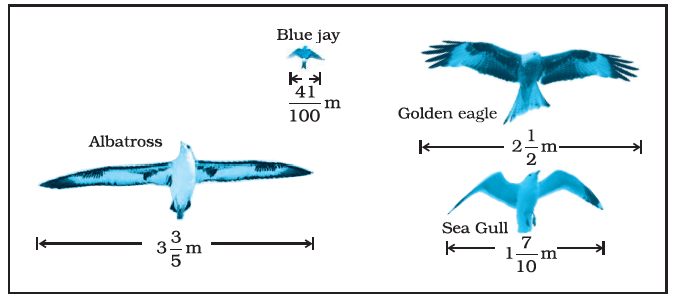
(a) How much longer is the wingspan of an Albatross than the wingspan of a Sea gull?
(b) How much longer is the wingspan of a Golden eagle than the wingspan of a Blue jay?
Answer:
Given (from the diagram):
Wingspan of Albatross $= 3\frac{3}{5}$ m
Wingspan of Sea Gull $= 1\frac{7}{10}$ m
Wingspan of Golden Eagle $= 2\frac{1}{2}$ m
Wingspan of Blue Jay $= \frac{41}{100}$ m
Solution (a):
Difference $= \text{Wingspan of Albatross} - \text{Wingspan of Sea Gull}$
$= 3\frac{3}{5} - 1\frac{7}{10}$
$= \frac{18}{5} - \frac{17}{10}$
$= \frac{36 - 17}{10} = \frac{19}{10} = 1\frac{9}{10}$ m
Therefore, the wingspan of an Albatross is $1\frac{9}{10}$ m longer than that of a Sea Gull.
Solution (b):
Difference $= \text{Wingspan of Golden Eagle} - \text{Wingspan of Blue Jay}$
$= 2\frac{1}{2} - \frac{41}{100}$
$= \frac{5}{2} - \frac{41}{100}$
$= \frac{250 - 41}{100} = \frac{209}{100} = 2\frac{9}{100}$ m
Therefore, the wingspan of a Golden Eagle is $2\frac{9}{100}$ m longer than that of a Blue Jay.
Question 142. Shalini has to cut out circles of diameter $1\frac{1}{4}$ cm from an aluminium strip of dimensions $8\frac{3}{4}$ cm by $1\frac{1}{4}$ cm. How many full circles can Shalini cut? Also calculate the wastage of the aluminium strip.
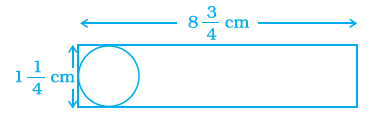
Answer:
Given:
Length of strip $= 8\frac{3}{4} = \frac{35}{4}$ cm
Width of strip $= 1\frac{1}{4} = \frac{5}{4}$ cm
Diameter of each circle $= 1\frac{1}{4} = \frac{5}{4}$ cm
Solution:
1. Number of full circles:
Since the width of the strip and the diameter of the circle are equal, the circles can only be cut along the length.
Number of circles $= \text{Length of strip} \div \text{Diameter of circle}$
$= \frac{35}{4} \div \frac{5}{4}$
$= \frac{35}{4} \times \frac{4}{5} = 7$ circles
Thus, Shalini can cut 7 full circles.
2. Calculation of Wastage:
Wastage $= \text{Area of strip} - \text{Area of 7 circles}$
Area of strip $= \frac{35}{4} \times \frac{5}{4} = \frac{175}{16}$ cm$^{2}$
Radius ($r$) of circle $= \text{Diameter} \div 2 = \frac{5}{4} \times \frac{1}{2} = \frac{5}{8}$ cm
Area of 7 circles $= 7 \times \pi r^{2} = 7 \times \frac{22}{7} \times \frac{5}{8} \times \frac{5}{8} = \frac{22 \times 25}{64} = \frac{11 \times 25}{32} = \frac{275}{32}$ cm$^{2}$
Wastage $= \frac{175}{16} - \frac{275}{32} = \frac{350 - 275}{32} = \frac{75}{32}$ cm$^{2}$
Therefore, the wastage is $2\frac{11}{32}$ cm$^{2}$.
Question 143. One fruit salad recipe requires $\frac{1}{2}$ cup of sugar. Another recipe for thesame fruit salad requires 2 tablespoons of sugar. If 1 tablespoon isequivalent to $\frac{1}{16}$ cup, how much more sugar does the first reciperequire?
Answer:
Given:
Sugar for 1st recipe $= \frac{1}{2}$ cup
Sugar for 2nd recipe $= 2$ tablespoons
Conversion: 1 tablespoon $= \frac{1}{16}$ cup
Solution:
First, convert the 2nd recipe's requirement into cups:
Sugar for 2nd recipe $= 2 \times \frac{1}{16} = \frac{1}{8}$ cup
Now, find the difference:
Difference $= \frac{1}{2} - \frac{1}{8}$
$= \frac{4 - 1}{8} = \frac{3}{8}$ cup
Therefore, the first recipe requires $\frac{3}{8}$ cup more sugar.
Question 144. Four friends had a competition to see how far could they hop on one foot. The table given shows the distance covered by each.
| Name | Distance covered (km) |
|---|---|
| Seema | $\frac{1}{25}$ |
| Nancy | $\frac{1}{32}$ |
| Megha | $\frac{1}{40}$ |
| Soni | $\frac{1}{20}$ |
(a) How farther did Soni hop than Nancy?
(b) What is the total distance covered by Seema and Megha?
(c) Who walked farther, Nancy or Megha?
Answer:
Solution (a):
Difference $= \text{Distance of Soni} - \text{Distance of Nancy}$
$= \frac{1}{20} - \frac{1}{32}$
L.C.M. of 20 and 32 is 160.
$= \frac{8 - 5}{160} = \frac{3}{160}$ km
Soni hopped $\frac{3}{160}$ km farther than Nancy.
Solution (b):
Total distance $= \text{Distance of Seema} + \text{Distance of Megha}$
$= \frac{1}{25} + \frac{1}{40}$
L.C.M. of 25 and 40 is 200.
$= \frac{8 + 5}{200} = \frac{13}{200}$ km
Total distance covered is $\frac{13}{200}$ km.
Solution (c):
Comparing Nancy ($\frac{1}{32}$) and Megha ($\frac{1}{40}$):
When the numerators are the same, the fraction with the smaller denominator is larger.
Since $32 < 40$, it implies $\frac{1}{32} > \frac{1}{40}$.
Therefore, Nancy hopped farther.
Question 145. The table given below shows the distances, in kilometres, between four villages of a state. To find the distance between two villages, locate the square where the row for one village and the column for the other village intersect.
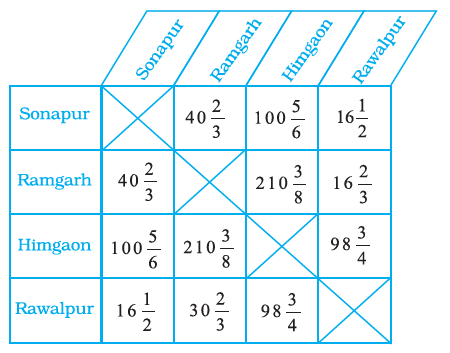
(a) Compare the distance between Himgaon and Rawalpur to Sonapur and Ramgarh?
(b) If you drove from Himgaon to Sonapur and then from Sonapur to Rawalpur, how far would you drive?
Answer:
Step 1: Locate distances from the table.
Distance between Himgaon and Rawalpur $= 98\frac{3}{4}$ km
Distance between Sonapur and Ramgarh $= 40\frac{2}{3}$ km
Distance between Himgaon and Sonapur $= 100\frac{5}{6}$ km
Distance between Sonapur and Rawalpur $= 16\frac{1}{2}$ km
Solution (a):
We need to compare $98\frac{3}{4}$ and $40\frac{2}{3}$.
Clearly, $98 > 40$.
Therefore, the distance between Himgaon and Rawalpur is greater than the distance between Sonapur and Ramgarh.
Solution (b):
Total drive $= (\text{Himgaon to Sonapur}) + (\text{Sonapur to Rawalpur})$
$= 100\frac{5}{6} + 16\frac{1}{2}$
$= \frac{605}{6} + \frac{33}{2}$
$= \frac{605 + 99}{6} = \frac{704}{6}$
Simplifying:
$= \frac{352}{3} = 117\frac{1}{3}$ km
You would drive a total of $117\frac{1}{3}$ km.
Question 146. The table shows the portion of some common materials that are recycled.
| Material | Recycled |
|---|---|
| Paper | $\frac{5}{11}$ |
| Aluminium cans | $\frac{5}{8}$ |
| Glass | $\frac{2}{5}$ |
| Scrap | $\frac{3}{4}$ |
(a) Is the rational number expressing the amount of paper recycled more than $\frac{1}{2}$ or less than $\frac{1}{2}$ ?
(b) Which items have a recycled amount less than $\frac{1}{2}$ ?
(c) Is the quantity of aluminium cans recycled more (or less) thanhalf of the quantity of aluminium cans?
(d) Arrange the rate of recycling the materials from the greatest to the smallest.
Answer:
Given:
Recycled portions: Paper = $\frac{5}{11}$, Aluminium cans = $\frac{5}{8}$, Glass = $\frac{2}{5}$, Scrap = $\frac{3}{4}$.
Solution:
(a) Paper recycled:
Comparing $\frac{5}{11}$ with $\frac{1}{2}$:
$\frac{5}{11} \approx 0.45$ and $\frac{1}{2} = 0.5$
Since $0.45 < 0.5$, the amount of paper recycled is less than $\frac{1}{2}$.
(b) Items with amount less than $\frac{1}{2}$:
Let's convert all fractions to decimals:
Paper: $\frac{5}{11} \approx 0.45$ (Less than 0.5)
Aluminium cans: $\frac{5}{8} = 0.625$ (More than 0.5)
Glass: $\frac{2}{5} = 0.4$ (Less than 0.5)
Scrap: $\frac{3}{4} = 0.75$ (More than 0.5)
Items with amount less than $\frac{1}{2}$ are Paper and Glass.
(c) Aluminium cans:
As calculated above, $\frac{5}{8} = 0.625$. Since $0.625 > 0.5$, the quantity is more than half.
(d) Arrangement (Greatest to smallest):
Comparing decimals: $0.75 > 0.625 > 0.45 > 0.4$
Order: Scrap, Aluminium cans, Paper, Glass.
Question 147. The overall width in cm of several wide-screen televisions are 97.28 cm, $98\frac{4}{9}$ cm, $98\frac{1}{25}$ cm and 97.94 cm. Express these numbers as rational numbers in the form $\frac{p}{q}$ and arrange the widths in ascending order.
Answer:
Solution:
To express the given widths as rational numbers in the form $\frac{p}{q}$ and arrange them, we first convert each into a fraction and then compare their decimal values.
Step 1: Expressing in $\frac{p}{q}$ form and finding decimal equivalents:
1. $97.28$ cm:
$97.28 = \frac{9728}{100}$
Dividing both numerator and denominator by 4:
$= \frac{2432}{25}$ cm
Decimal value $= 97.28$
2. $98\frac{4}{9}$ cm:
$98\frac{4}{9} = \frac{98 \times 9 + 4}{9} = \frac{882 + 4}{9}$
$= \frac{886}{9}$ cm
Decimal value $\approx 98.44$ (approx)
3. $98\frac{1}{25}$ cm:
$98\frac{1}{25} = \frac{98 \times 25 + 1}{25} = \frac{2450 + 1}{25}$
$= \frac{2451}{25}$ cm
Decimal value $= 98.04$
4. $97.94$ cm:
$97.94 = \frac{9794}{100}$
Dividing both numerator and denominator by 2:
$= \frac{4897}{50}$ cm
Decimal value $= 97.94$
Step 2: Arranging in ascending order:
Comparing the decimal values: $97.28 < 97.94 < 98.04 < 98.44$
Therefore, the widths in ascending order are:
$97.28$ cm, $97.94$ cm, $98\frac{1}{25}$ cm, $98\frac{4}{9}$ cm
In $\frac{p}{q}$ form: $\frac{2432}{25}, \frac{4897}{50}, \frac{2451}{25}, \frac{886}{9}$
Question 148. Roller Coaster at an amusement park is $\frac{2}{3}$ m high. If a new roller coaster is built that is $\frac{3}{5}$ times the height of the existing coaster, what will be the height of the new roller coaster?
Answer:
Given:
Height of existing coaster $= \frac{2}{3}$ m
Scale of new coaster $= \frac{3}{5}$ times
Solution:
Height of new coaster $= \frac{3}{5} \times \frac{2}{3}$
$= \frac{\cancel{3} \times 2}{5 \times \cancel{3}} = \frac{2}{5}$ m
Height of the new roller coaster will be $0.4$ m (or $\frac{2}{5}$ m).
Question 149. Here is a table which gives the information about the total rainfall for several months compared to the average monthly rains of a town. Write each decimal in the form of rational number $\frac{p}{q}$ .
| Month | Above / Below normal (in cm) |
|---|---|
| May | 2.6934 |
| June | 0.6096 |
| July | - 6.9088 |
| August | - 8.636 |
Answer:
Solution:
To convert the decimal rainfall values into the rational form $\frac{p}{q}$, we write the number without the decimal point as the numerator and a power of 10 as the denominator, then simplify to the lowest terms.
1. May: $2.6934$
$2.6934 = \frac{26934}{10000}$
Dividing both by 2:
$= \mathbf{\frac{13467}{5000}}$
2. June: $0.6096$
$0.6096 = \frac{6096}{10000}$
Dividing both by 16:
$= \mathbf{\frac{381}{625}}$
3. July: $-6.9088$
$-6.9088 = -\frac{69088}{10000}$
Dividing both by 16:
$= \mathbf{-\frac{4318}{625}}$
4. August: $-8.636$
$-8.636 = -\frac{8636}{1000}$
Dividing both by 4:
$= \mathbf{-\frac{2159}{250}}$
Question 150. The average life expectancies of males for several states are shown in the table. Express each decimal in the form $\frac{p}{q}$ and arrange the states from the least to the greatest male life expectancy.
State-wise data are included below; more indicators can be found in the “FACTFILE” section on the homepage for each state.
| State | Male % | $\frac{p}{q}$ form | Lowest terms |
|---|---|---|---|
| Andhra Pradesh | 61.6 | ||
| Assam | 57.1 | ||
| Bihar | 60.7 | ||
| Gujarat | 61.9 | ||
| Haryana | 64.1 | ||
| Himachal Pradesh | 65.1 | ||
| Karnataka | 62.4 | ||
| Kerala | 70.6 | ||
| Madhya Pradesh | 56.5 | ||
| Maharashtra | 64.5 | ||
| Orissa | 57.6 | ||
| Punjab | 66.9 | ||
| Rajasthan | 59.8 | ||
| Tamil Nadu | 63.7 | ||
| Uttar Pradesh | 58.9 | ||
| West Bengal | 62.8 | ||
| India | 60.8 |
Answer:
Solution:
To express each decimal in the form $\frac{p}{q}$, we write the given decimal as a fraction with a power of 10 in the denominator and then simplify it to its lowest terms.
| State | Male % | $\frac{p}{q}$ form | Lowest terms |
| Andhra Pradesh | 61.6 | $\frac{616}{10}$ | $\frac{308}{5}$ |
| Assam | 57.1 | $\frac{571}{10}$ | $\frac{571}{10}$ |
| Bihar | 60.7 | $\frac{607}{10}$ | $\frac{607}{10}$ |
| Gujarat | 61.9 | $\frac{619}{10}$ | $\frac{619}{10}$ |
| Haryana | 64.1 | $\frac{641}{10}$ | $\frac{641}{10}$ |
| Himachal Pradesh | 65.1 | $\frac{651}{10}$ | $\frac{651}{10}$ |
| Karnataka | 62.4 | $\frac{624}{10}$ | $\frac{312}{5}$ |
| Kerala | 70.6 | $\frac{706}{10}$ | $\frac{353}{5}$ |
| Madhya Pradesh | 56.5 | $\frac{565}{10}$ | $\frac{113}{2}$ |
| Maharashtra | 64.5 | $\frac{645}{10}$ | $\frac{129}{2}$ |
| Orissa | 57.6 | $\frac{576}{10}$ | $\frac{288}{5}$ |
| Punjab | 66.9 | $\frac{669}{10}$ | $\frac{669}{10}$ |
| Rajasthan | 59.8 | $\frac{598}{10}$ | $\frac{299}{5}$ |
| Tamil Nadu | 63.7 | $\frac{637}{10}$ | $\frac{637}{10}$ |
| Uttar Pradesh | 58.9 | $\frac{589}{10}$ | $\frac{589}{10}$ |
| West Bengal | 62.8 | $\frac{628}{10}$ | $\frac{314}{5}$ |
| India | 60.8 | $\frac{608}{10}$ | $\frac{304}{5}$ |
Arranging states from the least to the greatest male life expectancy (Ascending Order):
By comparing the decimal values (Male %), the order is as follows:
1. Madhya Pradesh ($56.5$)
2. Assam ($57.1$)
3. Orissa ($57.6$)
4. Uttar Pradesh ($58.9$)
5. Rajasthan ($59.8$)
6. Bihar ($60.7$)
7. Andhra Pradesh ($61.6$)
8. Gujarat ($61.9$)
9. Karnataka ($62.4$)
10. West Bengal ($62.8$)
11. Tamil Nadu ($63.7$)
12. Haryana ($64.1$)
13. Maharashtra ($64.5$)
14. Himachal Pradesh ($65.1$)
15. Punjab ($66.9$)
16. Kerala ($70.6$)
Note: India (Average) at $60.8$ lies between Bihar and Andhra Pradesh.
Question 151. A skirt that is $35\frac{7}{8}$ cm long has a hem of $3\frac{1}{8}$ cm. How long will the skirt be if the hem is let down?
Answer:
Given:
Current length of skirt $= 35\frac{7}{8}$ cm
Length of hem $= 3\frac{1}{8}$ cm
Solution:
New length $= 35\frac{7}{8} + 3\frac{1}{8}$
$= \frac{287}{8} + \frac{25}{8}$
$= \frac{312}{8} = 39$ cm
The skirt will be 39 cm long.
Question 152. Manavi and Kuber each receives an equal allowance. The table shows the fraction of their allowance each deposits into his/her saving account and the fraction each spends at the mall. If allowance of each is Rs. 1260 find the amount left with each.
| Where money goes | Fraction of allowance | |
|---|---|---|
| Manavi | Kuber | |
| Saving Account | $\frac{1}{2}$ | $\frac{1}{3}$ |
| Spend at mall | $\frac{1}{4}$ | $\frac{3}{5}$ |
| Left over | ? | ? |
Answer:
Given: Allowance of each $= \textsf{₹} 1260$.
Solution for Manavi:
Money saved $= \frac{1}{2} \times 1260 = \textsf{₹} 630$
Money spent $= \frac{1}{4} \times 1260 = \textsf{₹} 315$
Amount left $= 1260 - (630 + 315) = 1260 - 945 = \mathbf{\textsf{₹} 315}$
Solution for Kuber:
Money saved $= \frac{1}{3} \times 1260 = \textsf{₹} 420$
Money spent $= \frac{3}{5} \times 1260 = 3 \times 252 = \textsf{₹} 756$
Amount left $= 1260 - (420 + 756) = 1260 - 1176 = \mathbf{\textsf{₹} 84}$