

Chapter 10 Direct & Inverse Proportions (Class 8 - Maths NCERT Exemplar Solutions)
Welcome to the comprehensive resource for NCERT Exemplar Solutions for Class 8 Mathematics: Chapter 10 Direct & Inverse Proportions! This chapter is designed to move beyond routine exercises, challenging students to correctly identify the type of variation between quantities in non-obvious contexts. By tackling complex scenarios through multi-step reasoning, these solutions foster the analytical skills required to solve diverse real-world problems involving proportional relationships.
The solutions provide clear guidance on Direct Proportion, where the ratio of two quantities $x$ and $y$ remains constant ($\frac{x}{y} = k$). For comparing two states, the key formula $\mathbf{\frac{x_1}{y_1} = \frac{x_2}{y_2}}$ is applied to practical examples such as calculating costs in $\textsf{₹}$, constant speed travel, and map scale interpretations. This relationship ensures that a proportional increase or decrease in one quantity is mirrored by the other.
Conversely, Inverse Proportion is explored where the product of two quantities remains constant ($xy = k$). Using the equation $\mathbf{x_1 y_1 = x_2 y_2}$, the solutions address common scenarios such as the time and work relationship, speed-time variations for fixed distances, and food provision calculations. A primary focus of the Exemplar is guiding students through the critical step of identifying the proportion type before applying algebraic manipulation.
Our solutions cater to all formats, including Multiple Choice Questions (MCQs), Fill-in-the-Blanks, and complex Short/Long Answer questions. Each solution provides step-by-step calculations and logical justifications prepared by learningspot.co, ensuring students can distinguish between direct and inverse variation and solve complex practical problems with accuracy and confidence.
| Content On This Page | ||
|---|---|---|
| Solved Examples (Examples 1 to 13) | Question 1 to 16 (Multiple Choice Questions) | Question 17 to 42 (Fill in the Blanks) |
| Question 43 to 59 (True or False) | Question 60 to 106 | |
Solved Examples (Examples 1 to 13)
In examples 1 to 3, there are four options out of which one is correct. Choose the correct answer.
Example 1: If x and y are directly proportional and when x = 13, y = 39, which of the following is not a possible pair of corresponding values of x and y ?
(a) 1 and 3
(b) 17 and 51
(c) 30 and 10
(d) 6 and 18
Answer:
Given:
$x = 13, y = 39$
Solution:
Since $x$ and $y$ are directly proportional, their ratio must be constant:
$\frac{x}{y} = k$
$k = \frac{13}{39} = \frac{1}{3}$
Now, we check the ratio $\frac{x}{y}$ for each option:
(a) For $x = 1$ and $y = 3$, $\frac{x}{y} = \frac{1}{3}$ (Possible)
(b) For $x = 17$ and $y = 51$, $\frac{x}{y} = \frac{17}{51} = \frac{1}{3}$ (Possible)
(c) For $x = 30$ and $y = 10$, $\frac{x}{y} = \frac{30}{10} = 3$ (Not Possible, as $3 \neq \frac{1}{3}$)
(d) For $x = 6$ and $y = 18$, $\frac{x}{y} = \frac{6}{18} = \frac{1}{3}$ (Possible)
Final Answer: The correct option is (c) 30 and 10.
Example 2: A car covers a distance in 40 minutes with an average speed of 60 km per hour. The average speed to cover the same distance in 30 minutes is
(a) 80 km/h
(b) $\frac{45}{2}$ km/h
(c) 70 km/h
(d) 45 km/h
Answer:
Given:
$T_1 = 40 \text{ minutes}, S_1 = 60 \text{ km/h}$
$T_2 = 30 \text{ minutes}$
To Find:
The new average speed ($S_2$).
Solution:
Since the distance remains the same, speed and time are in inverse proportion. Thus, $S_1 T_1 = S_2 T_2$.
$60 \times 40 = S_2 \times 30$
$S_2 = \frac{60 \times 40}{30}$
$S_2 = \frac{\cancel{60}^{2} \times 40}{\cancel{30}_{1}}$
$S_2 = 2 \times 40 = 80 \text{ km/h}$
Final Answer: The correct option is (a) 80 km/h.
Example 3: Which of the following is in direct proportion?
(a) One side of a cuboid and its volume.
(b) Speed of a vehicle and the distance travelled in a fixed time interval.
(c) Change in weight and height among individuals.
(d) Number of pipes to fill a tank and the time required to fill the same tank.
Answer:
Solution:
(a) Incorrect: Volume depends on three sides ($V = l \times b \times h$). If only one side changes, it is direct, but usually volume is related to the cube of a side in a cube, not a cuboid generally.
(b) Correct: Since $\text{Distance} = \text{Speed} \times \text{Time}$, if time is fixed, $\text{Distance} \propto \text{Speed}$. As speed increases, distance travelled increases in the same proportion.
(c) Incorrect: Height and weight do not increase in a constant ratio for all individuals.
(d) Incorrect: More pipes will take less time to fill a tank. This is an inverse proportion.
Final Answer: The correct option is (b).
In examples 4 to 6, fill in the blanks to make the statements true.
Example 4: Amrita takes 18 hours to travel 720 kilometres. Time taken by her to travel 360 kilometres is _______.
Answer:
Given:
$D_1 = 720 \text{ km}, T_1 = 18 \text{ hours}$
$D_2 = 360 \text{ km}$
Solution:
Distance and time are in direct proportion when speed is constant:
$\frac{D_1}{T_1} = \frac{D_2}{T_2}$
$\frac{720}{18} = \frac{360}{T_2}$
$T_2 = \frac{360 \times 18}{720}$
$T_2 = \frac{\cancel{360}^{1} \times 18}{\cancel{720}_{2}} = 9 \text{ hours}$
Final Answer: The time taken is 9 hours.
Example 5: If x and y are inversely proportional then _____ = k where k is positive constant.
Answer:
Solution:
When two quantities $x$ and $y$ are in inverse proportion, their product remains constant.
$x \times y = k$
Final Answer: The blank should be filled with $xy$.
Example 6: Side of a rhombus and its perimeter are in ______ proportion.
Answer:
Solution:
Let the side of the rhombus be $s$ and its perimeter be $P$.
$P = 4s$
$\frac{P}{s} = 4 = \text{constant}$
Since the ratio of the perimeter to the side is constant, they are in direct proportion.
Final Answer: The blank should be filled with direct.
In examples 7 to 9, state whether the statements are true (T) or false (F):
Example 7: When two quantities x and y are in inverse proportion, then $\frac{x}{y}$ is a constant.
Answer:
Solution:
For inverse proportion, the product $xy$ is constant. The ratio $\frac{x}{y}$ being constant is the condition for direct proportion.
Final Answer: The statement is False (F).
Example 8: If the cost of 10 pencils is Rs 90, then the cost of 19 pencils is Rs 171.
Answer:
Given:
Cost of 10 pencils = $\textsf{₹} 90$
Solution:
$\text{Cost of 1 pencil} = \frac{90}{10} = \textsf{₹} 9$
$\text{Cost of 19 pencils} = 19 \times 9 = \textsf{₹} 171$
The calculated cost matches the value given in the statement.
Final Answer: The statement is True (T).
Example 9: If 5 persons can finish a job in 10 days then one person will finish it in 2 days.
Answer:
Given:
$5 \text{ persons} \rightarrow 10 \text{ days}$
Solution:
The number of persons and the time taken are in inverse proportion. As the number of persons decreases, the time taken increases.
$x_1 y_1 = x_2 y_2$
$5 \times 10 = 1 \times y_2$
$y_2 = 50 \text{ days}$
Since $50 \text{ days} \neq 2 \text{ days}$, the statement is incorrect.
Final Answer: The statement is False (F).
Example 10: In a scout camp, there is food provision for 300 cadets for 42 days. If 50 more persons join the camp, for how many days will the provision last?
Answer:
Given:
Initial number of cadets ($x_1$) = $300$
Number of days food lasts ($y_1$) = $42$ days
New number of cadets ($x_2$) = $300 + 50 = 350$
To Find:
Number of days the provision will last ($y_2$).
Solution:
The number of cadets and the number of days the food lasts are in inverse proportion. This means if the number of cadets increases, the food will last for fewer days.
$x_1 y_1 = x_2 y_2$
(Inverse Proportion)
$300 \times 42 = 350 \times y_2$
$y_2 = \frac{300 \times 42}{350}$
Simplifying the fraction:
$y_2 = \frac{30 \times 42}{35}$
[Dividing by 10]
$y_2 = \frac{30 \times 6}{5}$
[Dividing 42 and 35 by 7]
$y_2 = 6 \times 6 = 36$
Final Answer: The provision will last for $36$ days.
Example 11: If two cardboard boxes occupy 500 cubic centimetres space, then how much space is required to keep 200 such boxes?
Answer:
Given:
Number of boxes ($x_1$) = $2$
Space occupied ($y_1$) = $500 \text{ cm}^3$
New number of boxes ($x_2$) = $200$
To Find:
Space required for 200 boxes ($y_2$).
Solution:
The number of boxes and the space they occupy are in direct proportion. As the number of boxes increases, the space occupied also increases.
$\frac{x_1}{y_1} = \frac{x_2}{y_2}$
(Direct Proportion)
$\frac{2}{500} = \frac{200}{y_2}$
$y_2 = \frac{200 \times 500}{2}$
$y_2 = 100 \times 500$
$y_2 = 50,000 \text{ cm}^3$
Final Answer: The space required to keep 200 boxes is $50,000 \text{ cm}^3$.
Example 12: Under the condition that the temperature remains constant, the volume of gas is inversely proportional to its pressure. If the volume of gas is 630 cubic centimetres at a pressure of 360 mm of mercury, then what will be the pressure of the gas if its volume is 720 cubic centimetres at the same temperature?
Answer:
Given:
Initial volume ($V_1$) = $630 \text{ cm}^3$
Initial pressure ($P_1$) = $360 \text{ mm}$
Final volume ($V_2$) = $720 \text{ cm}^3$
To Find:
Final pressure ($P_2$).
Solution:
According to the problem, volume and pressure are in inverse proportion at constant temperature ($PV = k$).
$P_1 V_1 = P_2 V_2$
$360 \times 630 = P_2 \times 720$
$P_2 = \frac{360 \times 630}{720}$
$P_2 = \frac{\cancel{360}^{1} \times 630}{\cancel{720}_{2}}$
$P_2 = \frac{630}{2} = 315 \text{ mm}$
Final Answer: The pressure of the gas will be $315 \text{ mm}$ of mercury.
Example 13: Lemons were bought at Rs 60 a dozen and sold at the rate of Rs 40 per 10. Find the gain or loss per cent.
Answer:
Given:
Cost Price (CP) of 1 dozen (12 lemons) = $\textsf{₹} 60$
Selling Price (SP) of 10 lemons = $\textsf{₹} 40$
Solution:
To compare the values, we find the CP and SP of a single lemon:
$\text{CP of 1 lemon} = \frac{60}{12} = \textsf{₹} 5$
$\text{SP of 1 lemon} = \frac{40}{10} = \textsf{₹} 4$
Since $\text{CP} > \text{SP}$, there is a loss.
$\text{Loss Amount} = 5 - 4 = \textsf{₹} 1$
$\text{Loss %} = \left( \frac{\text{Loss}}{\text{CP}} \right) \times 100$
$\text{Loss %} = \frac{1}{5} \times 100 = 20\%$
Final Answer: The transaction resulted in a loss of $20\%$.
Exercise
Question 1 to 16 (Multiple Choice Questions)
In questions 1 to 16, there are four options out of which one is correct. Write the correct answer.
Question 1. Both u and v vary directly with each other. When u is 10, v is 15, which of the following is not a possible pair of corresponding values of u and v?
(a) 2 and 3
(b) 8 and 12
(c) 15 and 20
(d) 25 and 37.5
Answer:
Solution:
Since $u$ and $v$ vary directly, their ratio must be constant:
$\frac{u}{v} = k$
$k = \frac{10}{15} = \frac{2}{3}$
Now, we check the ratio $\frac{u}{v}$ for all the options:
(a) $\frac{2}{3} = \frac{2}{3}$ (Possible)
(b) $\frac{8}{12} = \frac{2}{3}$ (Possible)
(c) $\frac{15}{20} = \frac{3}{4}$ (Not possible, since $\frac{3}{4} \neq \frac{2}{3}$)
(d) $\frac{25}{37.5} = \frac{250}{375} = \frac{2}{3}$ (Possible)
Final Answer: The correct option is (c) 15 and 20.
Question 2. Both x and y vary inversely with each other. When x is 10, y is 6, which of the following is not a possible pair of corresponding values of x and y?
(a) 12 and 5
(b) 15 and 4
(c) 25 and 2.4
(d) 45 and 1.3
Answer:
Solution:
Since $x$ and $y$ vary inversely, their product must be constant:
$x \times y = k$
$k = 10 \times 6 = 60$
Now, we check the product $xy$ for all the options:
(a) $12 \times 5 = 60$ (Possible)
(b) $15 \times 4 = 60$ (Possible)
(c) $25 \times 2.4 = 60$ (Possible)
(d) $45 \times 1.3 = 58.5$ (Not possible, since $58.5 \neq 60$)
Final Answer: The correct option is (d) 45 and 1.3.
Question 3. Assuming land to be uniformly fertile, the area of land and the yield on it vary
(a) directly with each other.
(b) inversely with each other.
(c) neither directly nor inversely with each other.
(d) sometimes directly and sometimes inversely with each other
Answer:
Solution:
Under the assumption of uniform fertility, if the area of land increases, the yield (production) will also increase in the same ratio. Similarly, if the area decreases, the yield decreases.
Therefore, the area of land and the yield on it vary directly with each other.
Final Answer: The correct option is (a) directly with each other.
Question 4. The number of teeth and the age of a person vary
(a) directly with each other.
(b) inversely with each other.
(c) neither directly nor inversely with each other.
(d) sometimes directly and sometimes inversely with each other.
Answer:
Solution:
The number of teeth in a person increases during childhood, remains constant for a long period during adulthood, and may decrease during old age. This change does not follow a constant ratio or a constant product over time.
Therefore, the number of teeth and the age of a person vary neither directly nor inversely.
Final Answer: The correct option is (c) neither directly nor inversely with each other.
Question 5. A truck needs 54 litres of diesel for covering a distance of 297 km. The diesel required by the truck to cover a distance of 550 km is
(a) 100 litres
(b) 50 litres
(c) 25.16 litres
(d) 25 litres
Answer:
Given:
Diesel consumed ($x_1$) = $54$ litres
Distance covered ($y_1$) = $297$ km
New Distance ($y_2$) = $550$ km
Solution:
The distance covered and the diesel required vary directly with each other.
$\frac{x_1}{y_1} = \frac{x_2}{y_2}$
$\frac{54}{297} = \frac{x_2}{550}$
$x_2 = \frac{54 \times 550}{297}$
$x_2 = \frac{2 \times 550}{11}$
$x_2 = 2 \times 50 = 100 \text{ litres}$
Final Answer: The correct option is (a) 100 litres.
Question 6. By travelling at a speed of 48 kilometres per hour, a car can finish a certain journey in 10 hours. To cover the same distance in 8 hours, the speed of the car should be
(a) 60 km/h
(b) 80 km/h
(c) 30 km/h
(d) 40 km/h
Answer:
Given:
Speed ($s_1$) = $48$ km/h
Time ($t_1$) = $10$ hours
New Time ($t_2$) = $8$ hours
Solution:
Speed and time are inversely proportional when the distance is constant.
$s_1 \times t_1 = s_2 \times t_2$
$48 \times 10 = s_2 \times 8$
$s_2 = \frac{48 \times 10}{8}$
$s_2 = 6 \times 10 = 60 \text{ km/h}$
Final Answer: The correct option is (a) 60 km/h.
Question 7. In which of the following case, do the quantities vary directly with each other?
(a)
| x | 0.5 | 2 | 8 | 32 |
|---|---|---|---|---|
| y | 2 | 8 | 32 | 128 |
(b)
| p | 12 | 22 | 32 | 42 |
|---|---|---|---|---|
| q | 13 | 23 | 33 | 43 |
(c)
| r | 2 | 5 | 10 | 25 | 50 |
|---|---|---|---|---|---|
| s | 25 | 10 | 5 | 2 | 0.5 |
(d)
| u | 2 | 4 | 6 | 9 | 12 |
|---|---|---|---|---|---|
| v | 18 | 9 | 6 | 4 | 3 |
Answer:
Solution:
For two quantities to vary directly, their ratio must be constant ($\frac{x}{y} = k$). We will check the ratio for each case:
Case (a):
$\frac{x}{y} = \frac{0.5}{2} = 0.25$
$\frac{x}{y} = \frac{2}{8} = 0.25$
$\frac{x}{y} = \frac{8}{32} = 0.25$
$\frac{x}{y} = \frac{32}{128} = 0.25$
Since the ratio is constant ($0.25$) for all pairs, these quantities vary directly.
Case (b):
$\frac{p}{q} = \frac{1^2}{1^3} = 1$
$\frac{p}{q} = \frac{2^2}{2^3} = \frac{4}{8} = 0.5$
The ratios $1$ and $0.5$ are not equal, so they do not vary directly.
Case (c):
$\frac{r}{s} = \frac{2}{25} = 0.08$
$\frac{r}{s} = \frac{5}{10} = 0.5$
The ratios are not constant, so they do not vary directly.
Case (d):
$\frac{u}{v} = \frac{2}{18} \approx 0.11$
$\frac{u}{v} = \frac{4}{9} \approx 0.44$
The ratios are not constant, so they do not vary directly.
Final Answer: The quantities in option (a) vary directly.
Question 8. Which quantities in the previous question vary inversely with each other?
(a) x and y
(b) p and q
(c) r and s
(d) u and v
Answer:
Solution:
For two quantities to vary inversely, their product must be constant ($x \times y = k$). We will check the product for each case from the previous question:
Case (a):
$x \times y = 0.5 \times 2 = 1$
$x \times y = 2 \times 8 = 16$
Products are not constant.
Case (b):
$p \times q = 1^2 \times 1^3 = 1$
$p \times q = 2^2 \times 2^3 = 4 \times 8 = 32$
Products are not constant.
Case (c):
$r \times s = 2 \times 25 = 50$
$r \times s = 5 \times 10 = 50$
$r \times s = 10 \times 5 = 50$
$r \times s = 25 \times 2 = 50$
$r \times s = 50 \times 0.5 = 25$
Since the last product ($25$) is different from $50$, this is not a perfect inverse variation.
Case (d):
$u \times v = 2 \times 18 = 36$
$u \times v = 4 \times 9 = 36$
$u \times v = 6 \times 6 = 36$
$u \times v = 9 \times 4 = 36$
$u \times v = 12 \times 3 = 36$
Since the product is constant ($36$) for all pairs, these quantities vary inversely.
Final Answer: The quantities in option (d) vary inversely.
Question 9. Which of the following vary inversely with each other?
(a) speed and distance covered.
(b) distance covered and taxi fare.
(c) distance travelled and time taken.
(d) speed and time taken.
Answer:
Solution:
Two quantities vary inversely if an increase in one leads to a proportional decrease in the other, such that their product remains constant.
(a) Speed and distance covered: If speed increases, more distance is covered in a fixed time. This is a direct variation.
(b) Distance covered and taxi fare: Generally, more distance means more fare. This is a direct variation.
(c) Distance travelled and time taken: To cover more distance at a fixed speed, more time is required. This is a direct variation.
(d) Speed and time taken: To cover a fixed distance, if the speed increases, the time taken decreases. Their product (Speed $\times$ Time) equals the constant distance. This is an inverse variation.
Final Answer: The correct option is (d) speed and time taken.
Question 10. Both x and y are in direct proportion, then $\frac{1}{x}$ and $\frac{1}{y}$ are
(a) in direct proportion.
(b) in inverse proportion.
(c) neither in direct nor in inverse proportion.
(d) sometimes in direct and sometimes in inverse proportion.
Answer:
Solution:
Given: $x$ and $y$ are in direct proportion.
$\frac{x}{y} = k$ (where $k$ is a constant)
We need to find the relationship between $\frac{1}{x}$ and $\frac{1}{y}$. Let us find their ratio:
$\frac{1/x}{1/y} = \frac{1}{x} \div \frac{1}{y}$
$\frac{1/x}{1/y} = \frac{1}{x} \times y = \frac{y}{x}$
Since $\frac{x}{y} = k$, then $\frac{y}{x} = \frac{1}{k}$. Since $\frac{1}{k}$ is also a constant, the ratio of $\frac{1}{x}$ to $\frac{1}{y}$ is constant.
Therefore, $\frac{1}{x}$ and $\frac{1}{y}$ are also in direct proportion.
Final Answer: $\frac{1}{x}$ and $\frac{1}{y}$ are in direct proportion.
Question 11. Meenakshee cycles to her school at an average speed of 12 km/h and takes 20 minutes to reach her school. If she wants to reach her school in 12 minutes, her average speed should be
(a) $\frac{20}{3}$ km/h
(b) 16 km/h
(c) 20 km/h
(d) 15 km/h
Answer:
Given:
Initial speed ($s_1$) = $12$ km/h
Initial time ($t_1$) = $20$ minutes
Target time ($t_2$) = $12$ minutes
Solution:
Since the distance to the school remains constant, speed and time vary inversely.
$s_1 \times t_1 = s_2 \times t_2$
$12 \times 20 = s_2 \times 12$
$s_2 = \frac{12 \times 20}{12}$
$s_2 = 20 \text{ km/h}$
Final Answer: The correct option is (c) 20 km/h.
Question 12. 100 persons had food provision for 24 days. If 20 persons left the place, the provision will last for
(a) 30 days
(b) $\frac{96}{5}$ days
(c) 120 days
(d) 40 days
Answer:
Given:
Initial persons ($x_1$) = $100$
Initial days ($y_1$) = $24$
New number of persons ($x_2$) = $100 - 20 = 80$
Solution:
The number of persons and the number of days for which food lasts are in inverse proportion.
$x_1 \times y_1 = x_2 \times y_2$
$100 \times 24 = 80 \times y_2$
$y_2 = \frac{100 \times 24}{80}$
$y_2 = \frac{10 \times 24}{8}$
$y_2 = 10 \times 3 = 30 \text{ days}$
Final Answer: The correct option is (a) 30 days.
Question 13. If two quantities x and y vary directly with each other, then
(a) $\frac{x}{y}$ remains constant.
(b) x – y remains constant.
(c) x + y remains constant.
(d) x × y remains constant.
Answer:
Solution:
By definition of direct proportion, two quantities $x$ and $y$ are said to vary directly if they increase or decrease together such that the ratio of their corresponding values remains constant.
$\frac{x}{y} = k$ (constant)
Final Answer: The correct option is (a) $\frac{x}{y}$ remains constant.
Question 14. If two quantities p and q vary inversely with each other, then
(a) $\frac{p}{q}$ remains constant.
(b) p + q remains constant.
(c) p × q remains constant.
(d) p – q remains constant.
Answer:
Solution:
By definition of inverse proportion, two quantities $p$ and $q$ are said to vary inversely if an increase in $p$ causes a proportional decrease in $q$ (and vice versa) such that their product remains constant.
$p \times q = k$ (constant)
Final Answer: The correct option is (c) p × q remains constant.
Question 15. If the distance travelled by a rickshaw in one hour is 10 km, then the distance travelled by the same rickshaw with the same speed in one minute is
(a) $\frac{250}{9}$ m
(b) $\frac{500}{9}$ m
(c) 1000 m
(d) $\frac{500}{3}$ m
Answer:
Given:
Distance in 1 hour = $10$ km
Time = $1$ hour = $60$ minutes
Solution:
First, we convert the distance into meters:
$10 \text{ km} = 10 \times 1000 = 10,000 \text{ meters}$
Since speed is constant, distance and time are in direct proportion.
$\text{Distance in 60 minutes} = 10,000 \text{ m}$
$\text{Distance in 1 minute} = \frac{10,000}{60} \text{ m}$
$\text{Distance in 1 minute} = \frac{1000}{6} = \frac{500}{3} \text{ m}$
Final Answer: The correct option is (d) $\frac{500}{3}$ m.
Question 16. Both x and y vary directly with each other and when x is 10, y is 14, which of the following is not a possible pair of corresponding values of x and y?
(a) 25 and 35
(b) 35 and 25
(c) 35 and 49
(d) 15 and 21
Answer:
Solution:
Since $x$ and $y$ vary directly, their ratio must be constant:
$\frac{x}{y} = \frac{10}{14} = \frac{5}{7}$
We check the ratio $\frac{x}{y}$ for all options:
(a) $\frac{25}{35} = \frac{5}{7}$ (Possible)
(b) $\frac{35}{25} = \frac{7}{5}$ (Not possible, as $\frac{7}{5} \neq \frac{5}{7}$)
(c) $\frac{35}{49} = \frac{5}{7}$ (Possible)
(d) $\frac{15}{21} = \frac{5}{7}$ (Possible)
Final Answer: The correct option is (b) 35 and 25.
Question 17 to 42 (Fill in the Blanks)
In questions 17 to 42, fill in the blanks to make the statements true:
Question 17. If x = 5y, then x and y vary ______ with each other.
Answer:
Solution:
The given equation is $x = 5y$.
$\frac{x}{y} = 5$
Since the ratio of $x$ and $y$ is a constant ($5$), they vary directly with each other.
Final Answer: The blank should be filled with directly.
Question 18. If xy = 10, then x and y vary ______ with each other.
Answer:
Solution:
The given equation is $xy = 10$.
Since the product of $x$ and $y$ is a constant ($10$), they vary inversely with each other.
Final Answer: The blank should be filled with inversely.
Question 19. When two quantities x and y are in ______ proportion or vary ______ they are written as x ∝ y.
Answer:
Solution:
The symbol $\propto$ denotes proportionality. The notation $x \propto y$ represents that $x$ is proportional to $y$.
Final Answer: The blanks should be filled with direct and directly.
Question 20. When two quantities x and y are in _______ proportion or vary ______ they are written as x ∝ $\frac{1}{y}$.
Answer:
Solution:
The notation $x \propto \frac{1}{y}$ represents that $x$ is proportional to the reciprocal of $y$, which means they are in inverse proportion.
Final Answer: The blanks should be filled with inverse and inversely.
Question 21. Both x and y are said to vary ______ with each other if for some positive number k, xy = k.
Answer:
Solution:
When the product of two variables is equal to a constant $k$, the relationship is known as inverse variation.
Final Answer: The blank should be filled with inversely.
Question 22. x and y are said to vary directly with each other if for some positive number k, ______ = k.
Answer:
Solution:
In direct variation, the ratio of the two quantities remains constant.
$\frac{x}{y} = k$
Final Answer: The blank should be filled with $\frac{x}{y}$.
Question 23. Two quantities are said to vary ______ with each other if they increase (decrease) together in such a manner that the ratio of their corresponding values remains constant.
Answer:
Solution:
When the ratio of two quantities is constant, they are said to be in direct proportion.
Final Answer: The blank should be filled with directly.
Question 24. Two quantities are said to vary ______ with each other if an increase in one causes a decrease in the other in such a manner that the product of their corresponding values remains constant.
Answer:
Solution:
When the product of two quantities is constant, an increase in one will cause a decrease in the other. This is called inverse variation.
Final Answer: The blank should be filled with inversely.
Question 25. If 12 pumps can empty a reservoir in 20 hours, then time required by 45 such pumps to empty the same reservoir is ______ hours.
Answer:
Given:
Number of pumps ($x_1$) = $12$
Time taken ($y_1$) = $20$ hours
New number of pumps ($x_2$) = $45$
Solution:
The number of pumps and the time taken to empty the reservoir vary inversely. More pumps will take less time.
$x_1 \times y_1 = x_2 \times y_2$
$12 \times 20 = 45 \times y_2$
$y_2 = \frac{12 \times 20}{45}$
$y_2 = \frac{240}{45}$
$y_2 = \frac{16}{3} = 5\frac{1}{3} \text{ hours}$
Final Answer: The blank should be filled with $5\frac{1}{3}$ (or approximately $5.33$).
Question 26. If x varies inversely as y, then
| x | _____ | 60 |
|---|---|---|
| y | 2 | 10 |
Answer:
Solution:
Since $x$ varies inversely as $y$, the product $xy$ must be constant.
From the second column:
$k = x \times y = 60 \times 10 = 600$
Using this constant for the first column:
$x \times 2 = 600$
$x = \frac{600}{2} = 300$
Final Answer: The blank in the table should be filled with 300.
Question 27. If x varies directly as y, then
| x | 12 | 6 |
|---|---|---|
| y | 48 | _____ |
Answer:
Solution:
Since $x$ varies directly as $y$, the ratio $\frac{x}{y}$ must be constant.
From the first column:
$\frac{x}{y} = \frac{12}{48} = \frac{1}{4}$
Using this constant for the second column:
$\frac{6}{y} = \frac{1}{4}$
$y = 6 \times 4 = 24$
Final Answer: The blank in the table should be filled with 24.
Question 28. When the speed remains constant, the distance travelled is ______proportional to the time.
Answer:
Solution:
We know the formula for distance is:
$\text{Distance} = \text{Speed} \times \text{Time}$
If speed is constant, then the ratio $\frac{\text{Distance}}{\text{Time}}$ is constant. Therefore, distance is directly proportional to time.
Final Answer: The blank should be filled with directly.
Question 29. On increasing a, b increases in such a manner that $\frac{a}{b}$ remains______ and positive, then a and b are said to vary directly with each other.
Answer:
Solution:
By the definition of direct variation, the ratio of the two quantities must remain constant as they change together.
Final Answer: The blank should be filled with constant.
Question 30. If on increasing a, b decreases in such a manner that _______ remains ______ and positive, then a and b are said to vary inversely with each other.
Answer:
Solution:
In inverse variation, as one quantity increases, the other decreases in such a way that their product remains unchanged.
Final Answer: The blanks should be filled with their product and constant respectively.
Question 31. If two quantities x and y vary directly with each other, then ______ of their corresponding values remains constant.
Answer:
Solution:
Direct variation implies that the quotient or the ratio of the corresponding values of the two quantities is always the same.
Final Answer: The blank should be filled with ratio (or quotient).
Question 32. If two quantities p and q vary inversely with each other then ______ of their corresponding values remains constant.
Answer:
Solution:
Inverse variation is defined by the property that the product of the two quantities remains fixed.
Final Answer: The blank should be filled with product.
Question 33. The perimeter of a circle and its diameter vary _______ with each other.
Answer:
Solution:
The perimeter (circumference) $C$ of a circle is given by $C = \pi d$, where $d$ is the diameter.
$\frac{C}{d} = \pi$
Since $\pi$ is a constant, the ratio of perimeter to diameter is constant, which means they vary directly.
Final Answer: The blank should be filled with directly.
Question 34. A car is travelling 48 km in one hour. The distance travelled by the car in 12 minutes is _________.
Answer:
Given:
Distance in 60 minutes (1 hour) = $48$ km
Time = $12$ minutes
Solution:
Distance and time are in direct proportion.
$\frac{48}{60} = \frac{x}{12}$
$x = \frac{48 \times 12}{60}$
$x = \frac{48 \times 1}{5} = 9.6 \text{ km}$
Final Answer: The distance travelled is $9.6$ km.
Question 35. An auto rickshaw takes 3 hours to cover a distance of 36 km. If its speed is increased by 4 km/h, the time taken by it to cover the same distance is __________.
Answer:
Given:
Initial time = $3$ hours
Distance = $36$ km
Solution:
First, we find the initial speed:
$\text{Initial speed} = \frac{\text{Distance}}{\text{Time}} = \frac{36}{3} = 12 \text{ km/h}$
The speed is increased by $4$ km/h:
$\text{New speed} = 12 + 4 = 16 \text{ km/h}$
Now, calculate the new time for the same distance:
$\text{New time} = \frac{\text{Distance}}{\text{New speed}} = \frac{36}{16}$
$\text{New time} = \frac{9}{4} = 2.25 \text{ hours}$
Converting $0.25$ hours to minutes: $0.25 \times 60 = 15$ minutes.
Final Answer: The time taken is $2.25$ hours (or $2$ hours $15$ minutes).
Question 36. If the thickness of a pile of 12 cardboard sheets is 45 mm, then the thickness of a pile of 240 sheets is _______ cm.
Answer:
Given:
Thickness of 12 sheets = $45$ mm
Number of sheets = $240$
Solution:
The number of sheets and thickness are in direct proportion.
$\frac{12}{45} = \frac{240}{x}$
$x = \frac{45 \times 240}{12}$
$x = 45 \times 20 = 900 \text{ mm}$
We need the answer in cm. Since $10 \text{ mm} = 1 \text{ cm}$:
$x = \frac{900}{10} = 90 \text{ cm}$
Final Answer: The thickness of the pile is $90$ cm.
Question 37. If x varies inversely as y and x = 4 when y = 6, then when x = 3 the value of y is _______.
Answer:
Solution:
Since $x$ varies inversely as $y$, their product remains constant:
$x_1 y_1 = x_2 y_2$
$4 \times 6 = 3 \times y$
$24 = 3y$
$y = \frac{24}{3} = 8$
Final Answer: The blank should be filled with 8.
Question 38. In direct proportion, $\frac{a_1}{b_1}$ ____________ $\frac{a_2}{b_2}$ .
Answer:
Solution:
In a direct proportion, the ratio between the corresponding values of two quantities remains equal and constant.
Final Answer: The blank should be filled with is equal to (or the symbol $=$).
Question 39. In case of inverse proportion, $\frac{a_2}{-}$ = $\frac{b_2}{-}$
Answer:
Solution:
For inverse proportion, the product is constant ($a_1 b_1 = a_2 b_2$). This can be rearranged as a ratio:
$\frac{a_1}{a_2} = \frac{b_2}{b_1}$
Final Answer: The blanks should be filled such that the expression becomes $\frac{a_1}{a_2} = \frac{b_2}{b_1}$.
Question 40. If the area occupied by 15 postal stamps is 60 cm2, then the area occupied by 120 such postal stamps will be _______.
Answer:
Given:
Number of stamps ($x_1$) = $15$
Area ($y_1$) = $60 \text{ cm}^2$
New number of stamps ($x_2$) = $120$
Solution:
The number of stamps and the area they occupy are in direct proportion.
$\frac{x_1}{y_1} = \frac{x_2}{y_2}$
$\frac{15}{60} = \frac{120}{y_2}$
$y_2 = \frac{120 \times 60}{15}$
$y_2 = 120 \times 4 = 480 \text{ cm}^2$
Final Answer: The area occupied will be $480 \text{ cm}^2$.
Question 41. If 45 persons can complete a work in 20 days, then the time taken by 75 persons will be ______ hours.
Answer:
Given:
Number of persons ($x_1$) = $45$
Time ($y_1$) = $20$ days
New number of persons ($x_2$) = $75$
Solution:
The number of persons and time taken are in inverse proportion ($x_1 y_1 = x_2 y_2$).
$45 \times 20 = 75 \times y_2$
$y_2 = \frac{45 \times 20}{75}$
$y_2 = \frac{3 \times 20}{5} = 3 \times 4 = 12 \text{ days}$
Now, convert the time into hours ($1 \text{ day} = 24 \text{ hours}$):
$\text{Time in hours} = 12 \times 24 = 288 \text{ hours}$
Final Answer: The time taken will be 288 hours.
Question 42. Devangi travels 50 m distance in 75 steps, then the distance travelled in 375 steps is _______ km.
Answer:
Given:
Distance ($d_1$) = $50$ m
Steps ($s_1$) = $75$
New steps ($s_2$) = $375$
Solution:
Steps and distance are in direct proportion.
$\frac{50}{75} = \frac{d_2}{375}$
$d_2 = \frac{50 \times 375}{75}$
$d_2 = 50 \times 5 = 250 \text{ m}$
Convert distance to kilometers ($1 \text{ km} = 1000 \text{ m}$):
$\text{Distance in km} = \frac{250}{1000} = 0.25 \text{ km}$
Final Answer: The distance travelled is $0.25$ km.
Question 43 to 59 (True or False)
In questions from 43 to 59, state whether the statements are true (T) or false (F).
Question 43. Two quantities x and y are said to vary directly with each other if for some rational number k, xy = k.
Answer:
Solution:
The condition $xy = k$ defines inverse variation. For direct variation, the condition is $\frac{x}{y} = k$.
Final Answer: The statement is False (F).
Question 44. When the speed is kept fixed, time and distance vary inversely with each other.
Answer:
Solution:
When speed is fixed, $\text{Distance} = \text{Speed} \times \text{Time}$. This means as time increases, the distance covered also increases. Therefore, they vary directly.
Final Answer: The statement is False (F).
Question 45. When the distance is kept fixed, speed and time vary directly with each other.
Answer:
Solution:
When distance is fixed, $\text{Speed} \times \text{Time} = \text{Constant}$. As speed increases, time taken decreases. Therefore, they vary inversely.
Final Answer: The statement is False (F).
Question 46. Length of a side of a square and its area vary directly with each other.
Answer:
Solution:
The area of a square ($A$) is given by $A = s^2$, where $s$ is the side. For direct variation, the ratio $\frac{A}{s}$ must be constant. Here, $\frac{A}{s} = \frac{s^2}{s} = s$. Since the ratio depends on the side and is not a constant value, they do not vary directly.
Final Answer: The statement is False (F).
Question 47. Length of a side of an equilateral triangle and its perimeter vary inversely with each other.
Answer:
Solution:
For an equilateral triangle with side $s$, the perimeter $P$ is given by:
$P = 3s$
This can be written as:
$\frac{P}{s} = 3$ (Constant)
Since the ratio of the perimeter to the side is a constant, they vary directly with each other, not inversely.
Final Answer: The statement is False (F).
Question 48. If d varies directly as t2, then we can write dt2 = k, where k is some constant.
Answer:
Solution:
If $d$ varies directly as $t^2$, then the ratio of $d$ to $t^2$ must be constant:
$\frac{d}{t^2} = k$
The expression $dt^2 = k$ represents inverse variation between $d$ and $t^2$.
Final Answer: The statement is False (F).
Question 49. If a tree 24 m high casts a shadow of 15 m, then the height of a pole that casts a shadow of 6 m under similar conditions is 9.6 m.
Answer:
Given:
Height of tree ($x_1$) = $24$ m
Shadow of tree ($y_1$) = $15$ m
Shadow of pole ($y_2$) = $6$ m
Solution:
Under similar conditions, the height of an object and the length of its shadow are in direct proportion.
$\frac{x_1}{y_1} = \frac{x_2}{y_2}$
$\frac{24}{15} = \frac{x_2}{6}$
$x_2 = \frac{24 \times 6}{15}$
$x_2 = \frac{144}{15} = 9.6 \text{ m}$
The calculated height matches the statement.
Final Answer: The statement is True (T).
Question 50. If x and y are in direct proportion, then (x – 1) and (y – 1) are also in direct proportion.
Answer:
Solution:
If $x$ and $y$ are in direct proportion, then $\frac{x}{y} = k$. For $(x - 1)$ and $(y - 1)$ to be in direct proportion, the ratio $\frac{x - 1}{y - 1}$ must also equal the same constant $k$.
Let $x = 10$ and $y = 20$, so $k = 0.5$.
$\frac{10 - 1}{20 - 1} = \frac{9}{19} \approx 0.47 \neq 0.5$
Since the ratio changes, they are not in direct proportion.
Final Answer: The statement is False (F).
Question 51. If x and y are in inverse proportion, then (x + 1) and (y + 1) are also in inverse proportion.
Answer:
Solution:
If $x$ and $y$ are in inverse proportion, $xy = k$. For $(x + 1)$ and $(y + 1)$ to be in inverse proportion, their product $(x + 1)(y + 1)$ must remain constant.
Let $x = 2$ and $y = 6$, so $k = 12$.
$(2 + 1)(6 + 1) = 3 \times 7 = 21 \neq 12$
Since the product is not constant, they are not in inverse proportion.
Final Answer: The statement is False (F).
Question 52. If p and q are in inverse variation then (p + 2) and (q – 2) are also in inverse proportion.
Answer:
Solution:
Similar to the previous examples, adding or subtracting a constant from variables in an inverse proportion does not maintain the constant product property ($p \times q = k$).
$(p + 2)(q - 2) = pq - 2p + 2q - 4$
This expression will not result in the constant $k$ for all values of $p$ and $q$.
Final Answer: The statement is False (F).
Question 53. If one angle of a triangle is kept fixed then the measure of the remaining two angles vary inversely with each other.
Answer:
Solution:
Let the angles be $A$, $B$, and $C$. If $\angle A$ is fixed:
$A + B + C = 180^\circ$
$B + C = 180^\circ - A = \text{Constant}$
Inverse variation requires the product of the quantities to be constant ($B \times C = k$). Here, the sum is constant, which does not define inverse proportion.
Final Answer: The statement is False (F).
Question 54. When two quantities are related in such a manner that, if one increases, the other also increases, then they always vary directly.
Answer:
Solution:
Direct variation requires more than just both quantities increasing; they must increase in a constant ratio. For example, in $y = x^2$, as $x$ increases, $y$ increases, but the ratio $\frac{y}{x}$ is not constant ($x$), so it is not a direct variation.
Final Answer: The statement is False (F).
Question 55. When two quantities are related in such a manner that if one increases and the other decreases, then they always vary inversely.
Answer:
Solution:
Inverse variation requires the product of the quantities to be constant. If one increases and the other decreases, they do not "always" vary inversely. For example, in $y = 10 - x$ (where $x < 10$), as $x$ increases, $y$ decreases, but their product $x(10 - x)$ is not constant.
Final Answer: The statement is False (F).
Question 56. If x varies inversely as y and when x = 6, y = 8, then for x = 8 the value of y is 10.
Answer:
Given:
$x_1 = 6, y_1 = 8$
$x_2 = 8$
Solution:
In inverse variation:
$x_1 y_1 = x_2 y_2$
$6 \times 8 = 8 \times y_2$
$48 = 8 y_2$
$y_2 = \frac{48}{8} = 6$
The statement claims $y = 10$, which is incorrect.
Final Answer: The statement is False (F).
Question 57. The number of workers and the time to complete a job is a case of direct proportion.
Answer:
Solution:
The number of workers and the time taken to complete a job vary inversely. If the number of workers increases, the time required to finish the job decreases. Since they do not increase or decrease together in a constant ratio, it is not a case of direct proportion.
Final Answer: The statement is False (F).
Question 58. For fixed time period and rate of interest, the simple interest is directly proportional to the principal.
Answer:
Solution:
The formula for Simple Interest (SI) is:
$\text{SI} = \frac{P \times R \times T}{100}$
If the Rate ($R$) and Time ($T$) are fixed, then $\frac{RT}{100}$ becomes a constant $k$. Thus, $\text{SI} = k \times P$. Since the ratio $\frac{\text{SI}}{P}$ remains constant, they are in direct proportion.
Final Answer: The statement is True (T).
Question 59. The area of cultivated land and the crop harvested is a case of direct proportion.
Answer:
Solution:
Assuming the fertility of the land is uniform, an increase in the area of cultivated land will result in a proportional increase in the amount of crop harvested. Therefore, it is a case of direct proportion.
Final Answer: The statement is True (T).
Question 60 to 106
In questions 60 to 62, which of the following vary directly and which vary inversely with each other and which are neither of the two?
Question 60.
(i) The time taken by a train to cover a fixed distance and the speed of the train.
(ii) The distance travelled by CNG bus and the amount of CNG used.
(iii) The number of people working and the time to complete a given work.
(iv) Income tax and the income.
(v) Distance travelled by an auto-rickshaw and time taken.
Answer:
Solution:
(i) Vary Inversely: For a fixed distance, increasing the speed reduces the time taken.
(ii) Vary Directly: More distance covered requires more CNG.
(iii) Vary Inversely: More people working reduces the time taken to finish the work.
(iv) Vary Directly: As the income increases, the income tax amount also increases (as per Indian tax slabs).
(v) Vary Directly: For a constant speed, as the time increases, the distance travelled also increases.
Question 61.
(i) Number of students in a hostel and consumption of food.
(ii) Area of the walls of a room and the cost of white washing the walls.
(iii) The number of people working and the quantity of work.
(iv) Simple interest on a given sum and the rate of interest.
(v) Compound interest on a given sum and the sum invested.
Answer:
Solution:
(i) Vary Directly: More students will consume more food.
(ii) Vary Directly: Larger wall area leads to a higher cost of white washing.
(iii) Vary Directly: More people working (for a fixed time) can complete a greater quantity of work.
(iv) Vary Directly: A higher rate of interest results in more simple interest for the same sum and time.
(v) Vary Directly: A larger sum invested will result in a higher compound interest earned.
Question 62.
(i) The quantity of rice and its cost.
(ii) The height of a tree and the number of years.
(iii) Increase in cost and number of shirts that can be purchased if the budget remains the same.
(iv) Area of land and its cost.
(v) Sales Tax and the amount of the bill.
Answer:
Solution:
(i) Vary Directly: More quantity of rice will cost more.
(ii) Neither: A tree's growth is not proportional to time throughout its life; it eventually stops or slows down significantly.
(iii) Vary Inversely: If the price per shirt increases, the number of shirts you can buy with a fixed budget decreases.
(iv) Vary Directly: Larger area of land costs more.
(v) Vary Directly: A higher bill amount results in a higher sales tax (calculated as a percentage of the bill).
Solve the following :
Question 63. If x varies inversely as y and x = 20 when y = 600, find y when x = 400.
Answer:
Given:
$x_1 = 20, y_1 = 600$
$x_2 = 400$
To Find:
The value of $y_2$.
Solution:
Since $x$ and $y$ vary inversely, their product remains constant:
$x_1 y_1 = x_2 y_2$
$20 \times 600 = 400 \times y_2$
$12,000 = 400 y_2$
$y_2 = \frac{12,000}{400}$
$y_2 = \frac{120}{4} = 30$
Final Answer: The value of $y$ is 30.
Question 64. The variable x varies directly as y and x = 80 when y is 160. What is y when x is 64?
Answer:
Given:
Initial value of $x$ ($x_1$) = $80$
Initial value of $y$ ($y_1$) = $160$
New value of $x$ ($x_2$) = $64$
Solution:
Since $x$ and $y$ vary directly, their ratio remains constant:
$\frac{x_1}{y_1} = \frac{x_2}{y_2}$
$\frac{80}{160} = \frac{64}{y_2}$
$\frac{1}{2} = \frac{64}{y_2}$
$y_2 = 64 \times 2$
$y_2 = 128$
Final Answer: The value of $y$ is 128.
Question 65. l varies directly as m and l is equal to 5, when m = $\frac{2}{3}$ . Find l when m = $\frac{16}{3}$ .
Answer:
Given:
$l_1 = 5, m_1 = \frac{2}{3}$
$m_2 = \frac{16}{3}$
Solution:
For direct variation, the ratio of the quantities is constant:
$\frac{l_1}{m_1} = \frac{l_2}{m_2}$
$l_1 \times m_2 = l_2 \times m_1$
$5 \times \frac{16}{3} = l_2 \times \frac{2}{3}$
Multiplying both sides by $3$ to simplify:
$5 \times 16 = l_2 \times 2$
$80 = 2 \times l_2$
$l_2 = \frac{80}{2} = 40$
Final Answer: The value of $l$ is 40.
Question 66. If x varies inversely as y and y = 60 when x = 1.5. Find x. when y = 4.5.
Answer:
Given:
$x_1 = 1.5, y_1 = 60$
$y_2 = 4.5$
Solution:
Since $x$ varies inversely as $y$, their product remains constant:
$x_1 \times y_1 = x_2 \times y_2$
$1.5 \times 60 = x_2 \times 4.5$
$90 = x_2 \times 4.5$
$x_2 = \frac{90}{4.5}$
$x_2 = \frac{900}{45} = 20$
Final Answer: The value of $x$ is 20.
Question 67. In a camp, there is enough flour for 300 persons for 42 days. How long will the flour last if 20 more persons join the camp?
Answer:
Given:
Initial number of persons ($x_1$) = $300$
Initial number of days ($y_1$) = $42$
New number of persons ($x_2$) = $300 + 20 = 320$
Solution:
The number of persons and the number of days for which the flour lasts are in inverse proportion.
$x_1 \times y_1 = x_2 \times y_2$
$300 \times 42 = 320 \times y_2$
$y_2 = \frac{300 \times 42}{320}$
$y_2 = \frac{30 \times 42}{32}$
$y_2 = \frac{15 \times 42}{16} = \frac{15 \times 21}{8}$
$y_2 = \frac{315}{8} = 39.375 \text{ days}$
Final Answer: The flour will last for 39.375 days.
Question 68. A contractor undertook a contract to complete a part of a stadium in 9 months with a team of 560 persons. Later on, it was required to complete the job in 5 months. How many extra persons should he employ to complete the work?
Answer:
Given:
Initial time ($t_1$) = $9$ months
Initial persons ($p_1$) = $560$
New time ($t_2$) = $5$ months
Solution:
The time taken and the number of persons are in inverse proportion.
$t_1 \times p_1 = t_2 \times p_2$
$9 \times 560 = 5 \times p_2$
$p_2 = \frac{9 \times 560}{5}$
$p_2 = 9 \times 112 = 1008 \text{ persons}$
To find the extra persons required:
$\text{Extra persons} = 1008 - 560 = 448$
Final Answer: He should employ 448 extra persons.
Question 69. Sobi types 108 words in 6 minutes. How many words would she type in half an hour?
Answer:
Given:
Words typed ($w_1$) = $108$
Time taken ($t_1$) = $6$ minutes
New time ($t_2$) = $\frac{1}{2}$ hour = $30$ minutes
Solution:
The number of words typed and time taken vary directly.
$\frac{w_1}{t_1} = \frac{w_2}{t_2}$
$\frac{108}{6} = \frac{w_2}{30}$
$18 = \frac{w_2}{30}$
$w_2 = 18 \times 30 = 540$
Final Answer: She would type 540 words in half an hour.
Question 70. A car covers a distance in 40 minutes with an average speed of 60 km/h. What should be the average speed to cover the same distance in 25 minutes?
Answer:
Given:
Initial time ($t_1$) = $40$ minutes
Initial average speed ($s_1$) = $60$ km/h
New time ($t_2$) = $25$ minutes
Solution:
Speed and time are in inverse proportion for a fixed distance.
$s_1 \times t_1 = s_2 \times t_2$
$60 \times 40 = s_2 \times 25$
$2400 = 25 \times s_2$
$s_2 = \frac{2400}{25} = 96 \text{ km/h}$
Final Answer: The average speed should be 96 km/h.
Question 71. It is given that l varies directly as m.
(i) Write an equation which relates l and m.
(ii) Find the constant of proportion (k), when l is 6 then m is 18.
(iii) Find l, when m is 33.
(iv) Find m when l is 8.
Answer:
Solution:
Since $l$ varies directly as $m$, their ratio is constant.
(i) Equation relating $l$ and $m$:
$l \propto m$
$l = km$
(ii) Finding the constant of proportion ($k$):
Given: $l = 6, m = 18$
$k = \frac{l}{m}$
$k = \frac{\cancel{6}^1}{\cancel{18}_3} = \frac{1}{3}$
(iii) Finding $l$ when $m = 33$:
$l = km$
$l = \frac{1}{3} \times 33 = 11$
(iv) Finding $m$ when $l = 8$:
$l = km$
$8 = \frac{1}{3} \times m$
$m = 8 \times 3 = 24$
Final Answers: (i) $l = km$, (ii) $k = \frac{1}{3}$, (iii) $l = 11$, (iv) $m = 24$.
Question 72. If a deposit of Rs 2,000 earns an interest of Rs 500 in 3 years, how much interest would a deposit of Rs 36,000 earn in 3 years with the same rate of simple interest?
Answer:
Given:
Initial Principal ($P_1$) = $\textsf{₹} 2,000$
Interest earned ($I_1$) = $\textsf{₹} 500$
New Principal ($P_2$) = $\textsf{₹} 36,000$
To Find:
Interest earned on the new deposit ($I_2$).
Solution:
Since the time period (3 years) and the rate of interest are the same, the simple interest earned varies directly with the principal deposited.
$\frac{I_1}{P_1} = \frac{I_2}{P_2}$
$\frac{500}{2000} = \frac{I_2}{36000}$
$\frac{1}{4} = \frac{I_2}{36000}$
$I_2 = \frac{36000}{4} = 9,000$
Final Answer: A deposit of $\textsf{₹} 36,000$ would earn $\textsf{₹} 9,000$ interest.
Question 73. The mass of an aluminium rod varies directly with its length. If a 16 cm long rod has a mass of 192 g, find the length of the rod whose mass is 105 g.
Answer:
Given:
Initial length ($l_1$) = $16$ cm
Initial mass ($m_1$) = $192$ g
New mass ($m_2$) = $105$ g
To Find:
New length ($l_2$).
Solution:
The mass and length are in direct proportion.
$\frac{l_1}{m_1} = \frac{l_2}{m_2}$
$\frac{16}{192} = \frac{l_2}{105}$
$\frac{1}{12} = \frac{l_2}{105}$
$l_2 = \frac{105}{12}$
$l_2 = 8.75 \text{ cm}$
Final Answer: The length of the rod is $8.75$ cm.
Question 74. Find the values of x and y if a and b are in inverse proportion:
| a. | 12 | x | 8 |
| b. | 30 | 5 | y |
Answer:
Solution:
Since $a$ and $b$ are in inverse proportion, their product remains constant ($ab = k$).
From the given data pairs:
$k = 12 \times 30 = 360$
Finding $x$:
$x \times 5 = 360$
$x = \frac{360}{5} = 72$
Finding $y$:
$8 \times y = 360$
$y = \frac{360}{8} = 45$
Final Answer: The values are $x = 72$ and $y = 45$.
Question 75. If Naresh walks 250 steps to cover a distance of 200 metres, find the distance travelled in 350 steps.
Answer:
Given:
Initial steps ($s_1$) = $250$
Initial distance ($d_1$) = $200$ m
New steps ($s_2$) = $350$
To Find:
Distance covered in 350 steps ($d_2$).
Solution:
Steps and distance are in direct proportion.
$\frac{s_1}{d_1} = \frac{s_2}{d_2}$
$\frac{250}{200} = \frac{350}{d_2}$
$\frac{5}{4} = \frac{350}{d_2}$
$d_2 = \frac{350 \times 4}{5}$
$d_2 = 70 \times 4 = 280 \text{ m}$
Final Answer: The distance travelled in 350 steps is $280$ metres.
Question 76. A car travels a distance of 225 km in 25 litres of petrol. How many litres of petrol will be required to cover a distance of 540 kilometres by this car?
Answer:
Given:
Distance covered ($d_1$) = $225$ km
Petrol consumed ($p_1$) = $25$ litres
New distance to cover ($d_2$) = $540$ km
Solution:
The distance covered and the petrol required are in direct proportion.
$\frac{d_1}{p_1} = \frac{d_2}{p_2}$
$\frac{225}{25} = \frac{540}{p_2}$
$9 = \frac{540}{p_2}$
$p_2 = \frac{540}{9} = 60 \text{ litres}$
Final Answer: The car will require $60$ litres of petrol to cover $540$ km.
Question 77. From the following table, determine if x and y are in direct proportion or not.
(i)
| x | 3 | 6 | 15 | 20 | 30 |
|---|---|---|---|---|---|
| y | 12 | 24 | 45 | 60 | 210 |
(ii)
| x | 4 | 7 | 10 | 16 |
|---|---|---|---|---|
| y | 24 | 42 | 60 | 96 |
(iii)
| x | 1 | 4 | 9 | 20 |
|---|---|---|---|---|
| y | 1.5 | 6 | 13.5 | 30 |
Answer:
For $x$ and $y$ to be in direct proportion, the ratio $\frac{y}{x}$ (or $\frac{x}{y}$) must be constant for all pairs.
(i) Calculation:
$\frac{y}{x} = \frac{12}{3} = 4$
$\frac{y}{x} = \frac{24}{6} = 4$
$\frac{y}{x} = \frac{45}{15} = 3$
Since the ratio is not constant ($4 \neq 3$), $x$ and $y$ are not in direct proportion.
(ii) Calculation:
$\frac{y}{x} = \frac{24}{4} = 6$
$\frac{y}{x} = \frac{42}{7} = 6$
$\frac{y}{x} = \frac{60}{10} = 6$
$\frac{y}{x} = \frac{96}{16} = 6$
Since the ratio is constant ($6$) for all pairs, $x$ and $y$ are in direct proportion.
(iii) Calculation:
$\frac{y}{x} = \frac{1.5}{1} = 1.5$
$\frac{y}{x} = \frac{6}{4} = 1.5$
$\frac{y}{x} = \frac{13.5}{9} = 1.5$
$\frac{y}{x} = \frac{30}{20} = 1.5$
Since the ratio is constant ($1.5$) for all pairs, $x$ and $y$ are in direct proportion.
Question 78. If a and b vary inversely to each other, then find the values of p, q, r ; x, y, z and l, m, n
(i)
| a | 6 | 8 | q | 25 |
|---|---|---|---|---|
| b | 18 | p | 39 | r |
(ii)
| a | 2 | y | 6 | 10 |
|---|---|---|---|---|
| b | x | 12.5 | 15 | z |
(iii)
| a | l | 9 | n | 6 |
|---|---|---|---|---|
| b | 5 | m | 25 | 10 |
Answer:
Since $a$ and $b$ vary inversely, their product must be constant ($ab = k$).
(i) Calculation:
$k = 6 \times 18 = 108$
$p = \frac{108}{8} = 13.5$
$q = \frac{108}{39} = \frac{36}{13} \approx 2.77$
$r = \frac{108}{25} = 4.32$
(ii) Calculation:
$k = 6 \times 15 = 90$
$x = \frac{90}{2} = 45$
$y = \frac{90}{12.5} = 7.2$
$z = \frac{90}{10} = 9$
(iii) Calculation:
$k = 6 \times 10 = 60$
$l = \frac{60}{5} = 12$
$m = \frac{60}{9} = \frac{20}{3} \approx 6.67$
$n = \frac{60}{25} = 2.4$
Question 79. If 25 metres of cloth costs Rs 337.50, then
(i) What will be the cost of 40 metres of the same type of cloth?
(ii) What will be the length of the cloth bought for Rs 810?
Answer:
The length of the cloth and its cost are in direct proportion.
$\text{Cost per metre} = \frac{337.50}{25} = \textsf{₹} 13.50$
(i) Cost of 40 metres:
$\text{Cost} = 40 \times 13.50 = \textsf{₹} 540$
(ii) Length for $\textsf{₹} 810$:
$\text{Length} = \frac{810}{13.50} = 60 \text{ metres}$
Question 80. A swimming pool can be filled in 4 hours by 8 pumps of the same type. How many such pumps are required if the pool is to be filled in $2\frac{2}{3}$ hours?
Answer:
Initial time ($t_1$) = $4$ hours
Initial pumps ($p_1$) = $8$
New time ($t_2$) = $2\frac{2}{3}$ hours = $\frac{8}{3}$ hours
Solution:
The time taken and the number of pumps vary inversely.
$p_1 \times t_1 = p_2 \times t_2$
$8 \times 4 = p_2 \times \frac{8}{3}$
$32 = \frac{8p_2}{3}$
$p_2 = \frac{32 \times 3}{8}$
$p_2 = 4 \times 3 = 12 \text{ pumps}$
Final Answer: 12 pumps are required to fill the pool in $2\frac{2}{3}$ hours.
Question 81. The cost of 27 kg of iron is Rs 1,080, what will be the cost of 120 kg of iron of the same quality?
Answer:
Given:
Weight of iron ($x_1$) = $27$ kg
Cost of iron ($y_1$) = $\textsf{₹} 1,080$
New weight of iron ($x_2$) = $120$ kg
To Find:
The cost of $120$ kg of iron ($y_2$).
Solution:
The weight of iron and its cost vary directly with each other. As the weight increases, the cost also increases.
$\frac{x_1}{y_1} = \frac{x_2}{y_2}$
$\frac{27}{1080} = \frac{120}{y_2}$
$y_2 = \frac{120 \times 1080}{27}$
$y_2 = 120 \times 40$
$y_2 = \textsf{₹} 4,800$
Final Answer: The cost of $120$ kg of iron will be $\textsf{₹} 4,800$.
Question 82. At a particular time, the length of the shadow of Qutub Minar whose height is 72 m is 80 m. What will be the height of an electric pole, the length of whose shadow at the same time is 1000 cm?
Answer:
Given:
Height of Qutub Minar ($h_1$) = $72$ m
Length of shadow of Qutub Minar ($s_1$) = $80$ m
Length of shadow of electric pole ($s_2$) = $1000$ cm = $10$ m
To Find:
The height of the electric pole ($h_2$).
Solution:
At a particular time, the height of an object and the length of its shadow vary directly.
$\frac{h_1}{s_1} = \frac{h_2}{s_2}$
$\frac{72}{80} = \frac{h_2}{10}$
$h_2 = \frac{72 \times 10}{80}$
$h_2 = \frac{72}{8}$
$h_2 = 9$ m
Final Answer: The height of the electric pole is $9$ m.
Question 83. In a hostel of 50 girls, there are food provisions for 40 days. If 30 more girls join the hostel, how long will these provisions last?
Answer:
Given:
Initial number of girls ($x_1$) = $50$
Number of days food lasts ($y_1$) = $40$
New number of girls ($x_2$) = $50 + 30 = 80$
To Find:
The number of days the provision will last ($y_2$).
Solution:
The number of girls and the time the food lasts vary inversely. More girls will consume the food faster.
$x_1 \times y_1 = x_2 \times y_2$
$50 \times 40 = 80 \times y_2$
$2000 = 80 \times y_2$
$y_2 = \frac{2000}{80}$
$y_2 = 25$ days
Final Answer: The food provisions will last for $25$ days.
Question 84. Campus and Welfare Committee of school is planning to develop a blue shade for painting the entire school building. For this purpose various shades are tried by mixing containers of blue paint and white paint. In each of the following mixtures, decide which is a lighter shade of blue and also find the lightest blue shade among all of them.
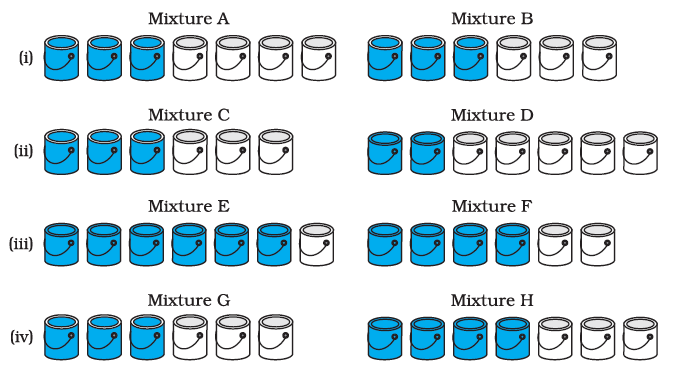
If one container has one litre paint and the building requires 105 litres for painting, how many container of each type is required to paint the building by darkest blue shade?
Answer:
Solution:
A shade is considered "lighter" if the ratio of blue paint to white paint is smaller. Let us count the containers from the image and calculate the ratios:
| Mixture | Blue (B) | White (W) | Ratio (B : W) |
| A | 3 | 4 | $3 : 4 = 0.75$ |
| B | 3 | 3 | $3 : 3 = 1.00$ |
| C | 3 | 3 | $3 : 3 = 1.00$ |
| D | 2 | 5 | $2 : 5 = 0.40$ |
| E | 6 | 1 | $6 : 1 = 6.00$ |
| F | 4 | 2 | $4 : 2 = 2.00$ |
| G | 3 | 3 | $3 : 3 = 1.00$ |
| H | 4 | 3 | $4 : 3 \approx 1.33$ |
Comparing the Mixtures:
(i) Between A and B: Mixture A ($0.75$) has a lower ratio than B ($1.00$). So, Mixture A is a lighter shade.
(ii) Between C and D: Mixture D ($0.40$) has a lower ratio than C ($1.00$). So, Mixture D is a lighter shade.
(iii) Between E and F: Mixture F ($2.00$) has a lower ratio than E ($6.00$). So, Mixture F is a lighter shade.
(iv) Between G and H: Mixture G ($1.00$) has a lower ratio than H ($1.33$). So, Mixture G is a lighter shade.
Lightest Blue Shade:
The lightest blue shade is the one with the minimum ratio of blue paint to white paint.
Comparing all ratios: $0.75, 1.00, 1.00, 0.40, 6.00, 2.00, 1.00, 1.33$.
The minimum value is $0.40$, which belongs to Mixture D.
Darkest Blue Shade Calculation:
The darkest blue shade is the one with the maximum ratio. The maximum ratio is $6.00$ for Mixture E.
$\text{Ratio of Blue to White} = 6 : 1$
$\text{Total parts} = 6 + 1 = 7$
The building requires $105$ litres of paint. Since each container is $1$ litre:
$\text{Quantity of one part} = \frac{105}{7} = 15 \text{ litres}$
$\text{Number of Blue containers} = 6 \times 15 = 90$
$\text{Number of White containers} = 1 \times 15 = 15$
Final Answer: The lightest shade is D. To paint the building with the darkest shade (E), 90 blue containers and 15 white containers are required.
Question 85. Posing a question
Work with a partner to write at least five ratio statements about this quilt, which has white, blue, and purple squares.
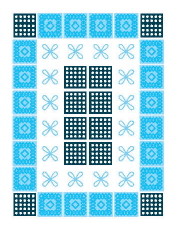
How many squares of each colour will be there in 12 such quilts?
Answer:
Solution:
Based on the observation of the quilt pattern, we have the following count of squares for each colour in one quilt:
- Number of Purple squares (dark pattern): $12$
- Number of White squares (flower pattern): $16$
- Number of Blue squares (light pattern): $20$
Total squares in one quilt = $12 + 16 + 20 = 48$ squares.
Five Ratio Statements:
1. The ratio of Purple squares to White squares is $12 : 16$, which simplifies to $3 : 4$.
2. The ratio of White squares to Blue squares is $16 : 20$, which simplifies to $4 : 5$.
3. The ratio of Purple squares to Blue squares is $12 : 20$, which simplifies to $3 : 5$.
4. The ratio of Purple squares to the Total squares is $12 : 48$, which simplifies to $1 : 4$.
5. The ratio of Blue squares to the Total squares is $20 : 48$, which simplifies to $5 : 12$.
Calculation for 12 Quilts:
Since the number of squares of each colour is in direct proportion to the number of quilts, we multiply the count of each colour in one quilt by 12.
For Purple squares:
$12 \times 12 = 144$
For White squares:
$16 \times 12 = 192$
For Blue squares:
$20 \times 12 = 240$
Final Answer: In 12 such quilts, there will be 144 Purple squares, 192 White squares, and 240 Blue squares.
Question 86. A packet of sweets was distributed among 10 children and each of them received 4 sweets. If it is distributed among 8 children, how many sweets will each child get?
Answer:
Given:
Initial number of children ($x_1$) = $10$
Sweets per child ($y_1$) = $4$
New number of children ($x_2$) = $8$
Solution:
The number of children and the number of sweets each child gets are in inverse proportion, as the total number of sweets remains constant.
$x_1 y_1 = x_2 y_2$
$10 \times 4 = 8 \times y_2$
$40 = 8y_2$
$y_2 = \frac{40}{8} = 5$
Final Answer: Each child will get 5 sweets.
Question 87. 44 cows can graze a field in 9 days. How many less/more cows will graze the same field in 12 days?
Answer:
Given:
Initial number of cows ($x_1$) = $44$
Number of days ($y_1$) = $9$
New number of days ($y_2$) = $12$
Solution:
The number of cows and the number of days required to graze the field are in inverse proportion. More cows will take fewer days to graze the same field.
$x_1 y_1 = x_2 y_2$
$44 \times 9 = x_2 \times 12$
$x_2 = \frac{44 \times 9}{12}$
$x_2 = 11 \times 3 = 33 \text{ cows}$
To find how many less cows are needed:
$\text{Decrease in cows} = 44 - 33 = 11$
Final Answer: 11 less cows will graze the field in 12 days.
Question 88. 30 persons can reap a field in 17 days. How many more persons should be engaged to reap the same field in 10 days?
Answer:
Given:
Initial number of persons ($x_1$) = $30$
Number of days ($y_1$) = $17$
Target number of days ($y_2$) = $10$
Solution:
The number of persons and the number of days to reap the field are in inverse proportion.
$x_1 y_1 = x_2 y_2$
$30 \times 17 = x_2 \times 10$
$x_2 = \frac{30 \times 17}{10} = 3 \times 17 = 51 \text{ persons}$
To find how many more persons are required:
$\text{More persons} = 51 - 30 = 21$
Final Answer: 21 more persons should be engaged.
Question 89. Shabnam takes 20 minutes to reach her school if she goes at a speed of 6 km/h. If she wants to reach school in 24 minutes, what should be her speed?
Answer:
Given:
Initial time ($t_1$) = $20$ minutes
Initial speed ($s_1$) = $6$ km/h
New time ($t_2$) = $24$ minutes
Solution:
Speed and time are in inverse proportion when the distance is constant.
$s_1 t_1 = s_2 t_2$
$6 \times 20 = s_2 \times 24$
$s_2 = \frac{120}{24} = 5 \text{ km/h}$
Final Answer: Her speed should be 5 km/h.
Question 90. Ravi starts for his school at 8:20 a.m. on his bicycle. If he travels at a speed of 10km/h, then he reaches his school late by 8 minutes but on travelling at 16 km/h he reaches the school 10 minutes early. At what time does the school start?
Answer:
Given:
Speed 1 ($s_1$) = $10$ km/h
Speed 2 ($s_2$) = $16$ km/h
Time difference = $8$ min late to $10$ min early = $18$ minutes
Solution:
Let the distance to the school be $D$ km.
Time taken at speed $s_1$ ($t_1$) = $\frac{D}{10}$ hours
Time taken at speed $s_2$ ($t_2$) = $\frac{D}{16}$ hours
The difference between these times is $18$ minutes, which is $\frac{18}{60} = \frac{3}{10}$ hours.
$\frac{D}{10} - \frac{D}{16} = \frac{3}{10}$
Taking LCM of $10$ and $16$, which is $80$:
$\frac{8D - 5D}{80} = \frac{3}{10}$
$\frac{3D}{80} = \frac{3}{10}$
$D = \frac{3}{10} \times \frac{80}{3} = 8 \text{ km}$
Now, calculate time taken at $10$ km/h:
$t_1 = \frac{8}{10} \text{ hours} = 48 \text{ minutes}$
Since he is $8$ minutes late at this speed, the actual time allowed to reach school is:
$\text{Allowed Time} = 48 - 8 = 40 \text{ minutes}$
The school starts 40 minutes after he leaves at 8:20 a.m.:
$\text{School Start Time} = 8:20 \text{ a.m.} + 40 \text{ minutes} = 9:00 \text{ a.m.}$
Final Answer: The school starts at 9:00 a.m.
Question 91. Match each of the entries in Column I with the appropriate entry in Column II
Column I
1. x and y vary inversely to each other
2. Mathematical representation of inverse variation of quantities p and q
3. Mathematical representation of direct variation of quantities m and n
4. When x = 5, y = 2.5 and when y = 5, x = 10
5. When x = 10 , y = 5 and when x = 20, y = 2.5
6. x and y vary directly with each other
7. If x and y vary inversely then on decreasing x
8. If x and y vary directly then on H. x and y vary inversely decreasing x
Column II
A. $\frac{x}{y}$ = Constant
B. y will increase in proportion
C. xy = Constant
D. p ∝ $\frac{1}{q}$
E. y will decrease in proportion
F. x and y are directly proportional
G. m ∝ n
H. x and y vary inversely
I. p ∝ q
J. m ∝ $\frac{1}{n}$
Answer:
Solution:
According to the definitions and mathematical properties of direct and inverse proportions, the correct matching is provided below:
1. x and y vary inversely to each other — This is a conceptual statement regarding the relationship between the two variables. It matches with H. x and y vary inversely.
2. Mathematical representation of inverse variation of quantities p and q — Inverse variation is represented as one quantity being proportional to the reciprocal of the other. It matches with D. $p \propto \frac{1}{q}$.
3. Mathematical representation of direct variation of quantities m and n — Direct variation is represented as one quantity being proportional to the other. It matches with G. $m \propto n$.
4. When x = 5, y = 2.5 and when y = 5, x = 10 — Here, the ratio $\frac{x}{y} = \frac{5}{2.5} = 2$ and $\frac{10}{5} = 2$. Since the ratio is constant, it matches with F. x and y are directly proportional.
5. When x = 10, y = 5 and when x = 20, y = 2.5 — Here, the product $x \times y = 10 \times 5 = 50$ and $20 \times 2.5 = 50$. Since the product is constant, it matches with C. $xy = \text{Constant}$.
6. x and y vary directly with each other — By definition, for direct variation, the ratio of corresponding values is always the same. It matches with A. $\frac{x}{y} = \text{Constant}$.
7. If x and y vary inversely then on decreasing x — In an inverse relationship, as one value decreases, the other must increase to maintain a constant product. It matches with B. y will increase in proportion.
8. If x and y vary directly then on decreasing x — In a direct relationship, both values move in the same direction to maintain a constant ratio. It matches with E. y will decrease in proportion.
Final Answer (Mapping):
1 — H; 2 — D; 3 — G; 4 — F; 5 — C; 6 — A; 7 — B; 8 — E
Question 92. There are 20 grams of protein in 75 grams of sauted fish. How manygrams of protein is in 225 gm of that fish?
Answer:
Given:
Weight of fish ($w_1$) = $75$ g
Amount of protein ($p_1$) = $20$ g
New weight of fish ($w_2$) = $225$ g
To Find:
Amount of protein in 225 g of fish ($p_2$).
Solution:
The amount of protein in the fish varies directly with the total weight of the fish.
$\frac{p_1}{w_1} = \frac{p_2}{w_2}$
$\frac{20}{75} = \frac{p_2}{225}$
$p_2 = \frac{20 \times 225}{75}$
$p_2 = 20 \times 3$
$p_2 = 60 \text{ g}$
Final Answer: There are $60$ grams of protein in $225$ gm of fish.
Question 93. Ms. Anita has to drive from Jhareda to Ganwari. She measures a distance of 3.5 cm between these villages on the map. What is the actual distance between the villages if the map scale is 1 cm = 10 km?
Answer:
Given:
Distance on map = $3.5$ cm
Map scale: $1$ cm = $10$ km
To Find:
Actual distance between the villages.
Solution:
The actual distance is directly proportional to the distance measured on the map.
$\text{Actual distance} = \text{Map distance} \times \text{Scale factor}$
$\text{Actual distance} = 3.5 \times 10$
$\text{Actual distance} = 35 \text{ km}$
Final Answer: The actual distance between the villages is $35$ km.
Question 94. A water tank casts a shadow 21 m long. A tree of height 9.5 m casts a shadow 8 m long at the same time. The lengths of the shadows are directly proprotional to their heights. Find the height of the tank.
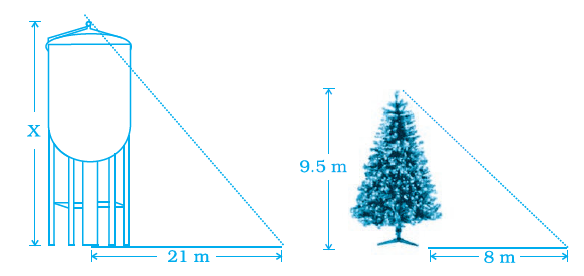
Answer:
Given:
Length of the tank's shadow ($s_1$) = $21 \text{ m}$
Height of the tree ($h_2$) = $9.5 \text{ m}$
Length of the tree's shadow ($s_2$) = $8 \text{ m}$
To Find:
Height of the water tank ($x$ or $h_1$).
Solution:
As given, the heights of the objects and the lengths of their shadows are in direct proportion.
$\frac{\text{Height of tank}}{\text{Shadow of tank}} = \frac{\text{Height of tree}}{\text{Shadow of tree}}$
$\frac{x}{21} = \frac{9.5}{8}$
$x = \frac{9.5 \times 21}{8}$
$x = \frac{199.5}{8}$
$x = 24.9375 \text{ m}$
Final Answer: The height of the water tank is $24.9375 \text{ m}$.
Question 95. The table shows the time four elevators take to travel various distances. Find which elevator is fastest and which is slowest.
| Distance (m) | Time (sec.) | |
|---|---|---|
| Elevator - A | 435 | 29 |
| Elevator - B | 448 | 28 |
| Elevator - C | 130 | 10 |
| Elevator - D | 85 | 5 |
How much distance will be travelled by elevators B and C seperately in 140 sec? Who travelled more and by how much?
Answer:
Solution:
First, we calculate the speed of each elevator using the formula $\text{Speed} = \frac{\text{Distance}}{\text{Time}}$.
Elevator A:
$\text{Speed}_A = \frac{435}{29} = 15 \text{ m/s}$
Elevator B:
$\text{Speed}_B = \frac{448}{28} = 16 \text{ m/s}$
Elevator C:
$\text{Speed}_C = \frac{130}{10} = 13 \text{ m/s}$
Elevator D:
$\text{Speed}_D = \frac{85}{5} = 17 \text{ m/s}$
Comparing the speeds: $17 > 16 > 15 > 13$. Thus, Elevator D is the fastest and Elevator C is the slowest.
Distance travelled in 140 seconds:
For Elevator B:
$\text{Distance} = \text{Speed} \times \text{Time}$
$\text{Distance}_B = 16 \times 140 = 2240 \text{ m}$
For Elevator C:
$\text{Distance}_C = 13 \times 140 = 1820 \text{ m}$
Comparison:
$\text{Difference} = 2240 - 1820 = 420 \text{ m}$
Final Answer: Elevator D is the fastest and C is the slowest. In 140 sec, Elevator B travelled more than Elevator C by $420 \text{ m}$.
Question 96. A volleyball court is in a rectangular shape and its dimensions are directly proportional to the dimensions of the swimming pool given below. Find the width of the pool.
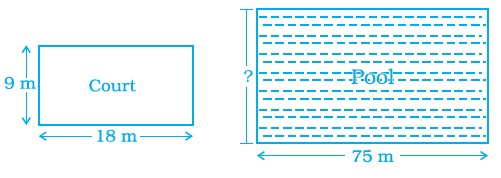
Answer:
Given:
Dimensions of the Volleyball Court: $\text{Width}_1 = 9 \text{ m}$, $\text{Length}_1 = 18 \text{ m}$
Dimensions of the Swimming Pool: $\text{Length}_2 = 75 \text{ m}$
To Find:
Width of the swimming pool ($w$).
Solution:
Since the dimensions are directly proportional, the ratio of width to length remains constant.
$\frac{\text{Width}_1}{\text{Length}_1} = \frac{\text{Width}_2}{\text{Length}_2}$
$\frac{9}{18} = \frac{w}{75}$
$\frac{1}{2} = \frac{w}{75}$
$w = \frac{75}{2}$
$w = 37.5 \text{ m}$
Final Answer: The width of the swimming pool is $37.5 \text{ m}$.
Question 97. A recipe for a particular type of muffins requires 1 cup of milk and 1.5 cups of chocolates. Riya has 7.5 cups of chocolates. If she is using the recipe as a guide, how many cups of milk will she need to prepare muffins?
Answer:
Given:
Milk required for the recipe ($m_1$) = $1$ cup
Chocolates required for the recipe ($c_1$) = $1.5$ cups
Available chocolates ($c_2$) = $7.5$ cups
To Find:
Number of cups of milk needed ($m_2$).
Solution:
The amount of milk and chocolates required for muffins are in direct proportion.
$\frac{m_1}{c_1} = \frac{m_2}{c_2}$
$\frac{1}{1.5} = \frac{m_2}{7.5}$
$m_2 = \frac{1 \times 7.5}{1.5}$
$m_2 = \frac{75}{15} = 5 \text{ cups}$
Final Answer: Riya will need 5 cups of milk.
Question 98. Pattern B consists of four tiles like pattern A. Write a proportion involving red dots and blue dots in pattern A and B. Are they in direct proportion? If yes, write the constant of proportion.
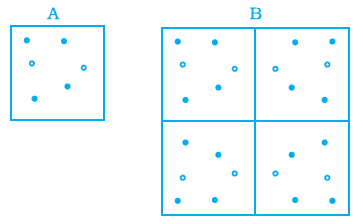
Answer:
Solution:
By observing the given patterns in the image:
For Pattern A:
Number of blue dots = $4$
Number of red dots = $2$
For Pattern B:
Pattern B consists of four tiles of Pattern A. Therefore:
Number of blue dots = $4 \times 4 = 16$
Number of red dots = $2 \times 4 = 8$
Checking for Proportion:
To determine if they are in direct proportion, we compare the ratio of red dots to blue dots for both patterns:
$\text{Ratio in Pattern A} = \frac{2}{4} = \frac{1}{2}$
$\text{Ratio in Pattern B} = \frac{8}{16} = \frac{1}{2}$
Since the ratio of the corresponding values is constant ($\frac{1}{2} = \frac{1}{2}$), the number of red dots and blue dots are in direct proportion.
Constant of Proportion:
The constant of proportion ($k$) is the constant ratio between the two quantities:
$k = \frac{2}{4} = \frac{1}{2}$ (or $0.5$)
Final Answer: Yes, they are in direct proportion. The constant of proportion is $k = \frac{1}{2}$.
Question 99. A bowler throws a cricket ball at a speed of 120 km/h. How long does this ball take to travel a distance of 20 metres to reach the batsman?
Answer:
Given:
Speed of the ball = $120$ km/h
Distance = $20$ m
Solution:
First, we convert the speed from km/h to m/s:
$120 \text{ km/h} = 120 \times \frac{5}{18} \text{ m/s}$
$\text{Speed} = \frac{20 \times 5}{3} = \frac{100}{3} \text{ m/s}$
Now, we find the time using the formula:
$\text{Time} = \frac{\text{Distance}}{\text{Speed}}$
$\text{Time} = \frac{20}{100/3}$
$\text{Time} = 20 \times \frac{3}{100}$
$\text{Time} = \frac{60}{100} = 0.6 \text{ seconds}$
Final Answer: The ball takes 0.6 seconds to reach the batsman.
Question 100. The variable x is inversely proportional to y. If x increases by p%, then by what per cent will y decrease?
Answer:
Solution:
Given that $x$ and $y$ are inversely proportional to each other. This means their product remains constant:
$x \times y = \text{Constant}$
In an inverse variation, if one quantity increases by a certain percentage, the other quantity must decrease to ensure that the product of the two variables does not change.
According to the properties of inverse proportion for such variations, an increase in the value of $x$ by $p\%$ is balanced by a corresponding decrease in the value of $y$ to maintain the equilibrium of the product.
Therefore, the percentage decrease in $y$ will be equal to the percentage increase in $x$.
$\text{Percentage decrease in } y = p\%$
Final Answer: If $x$ increases by $p\%$, then $y$ will decrease by $p\%$.
Question 101. Here is a key board of a harmonium:
(a) Find the ratio of white keys to black keys on the keyboard.

(b) What is the ratio of black keys to all keys on the given keyboard.
(c) This pattern of keys is repeated on larger keyboard. How many black keys would you expect to find on a keyboard with 14 such patterns.
Answer:
Solution:
By observing the given pattern of the harmonium keyboard provided in the image:
Number of white keys = $10$
Number of black keys = $7$
Total number of keys = $10 + 7 = 17$
(a) Ratio of white keys to black keys:
$\text{Ratio} = \frac{\text{Number of white keys}}{\text{Number of black keys}}$
$\text{Ratio} = \frac{10}{7}$
$\text{Ratio} = 10 : 7$
(b) Ratio of black keys to all keys:
$\text{Ratio} = \frac{\text{Number of black keys}}{\text{Total number of keys}}$
$\text{Ratio} = \frac{7}{17}$
$\text{Ratio} = 7 : 17$
(c) Black keys in 14 such patterns:
Since the number of black keys is directly proportional to the number of patterns:
$\text{Black keys in 1 pattern} = 7$
$\text{Black keys in 14 patterns} = 7 \times 14$
$\text{Total black keys} = 98$
Final Answer: (a) The ratio of white keys to black keys is $10 : 7$. (b) The ratio of black keys to all keys is $7 : 17$. (c) There would be $98$ black keys in 14 such patterns.
Question 102. The following table shows the distance travelled by one of the new eco-friendly energy-efficient cars travelled on gas.
| Litres of gas | 1 | 0.5 | 2 | 2.5 | 3 | 5 |
|---|---|---|---|---|---|---|
| Distance (km) | 15 | 7.5 | 30 | 37.5 | 45 | 75 |
Which type of properties are indicated by the table? How much distance will be covered by the car in 8 litres of gas?
Answer:
Solution:
To determine the type of property, let us check the ratio of distance ($y$) to litres of gas ($x$) for each pair:
$\frac{15}{1} = 15$
$\frac{7.5}{0.5} = 15$
$\frac{30}{2} = 15$
$\frac{37.5}{2.5} = 15$
$\frac{45}{3} = 15$
$\frac{75}{5} = 15$
Since the ratio $\frac{y}{x}$ is constant ($k = 15$), the table indicates the property of direct proportion.
Distance covered in 8 litres:
Since $\text{Distance} = 15 \times \text{Litres of gas}$:
$\text{Distance} = 15 \times 8 = 120 \text{ km}$
Final Answer: The table indicates direct proportion and the car will cover $120$ km in 8 litres of gas.
Question 103. Kritika is following this recipe for bread. She realises her sister used most of sugar syrup for her breakfast. Kritika has only $\frac{1}{6}$ cup of syrup, so she decides to make a small size of bread. How much of each ingredient shall she use?
Bread recipe
1 cup quick cooking oats
2 cups bread flour
$\frac{1}{3}$ cup sugar syrup
1 tablespoon cooking oil
$1\frac{1}{3}$ cups water
3 tablespoons yeast
1 teaspoon salt.
Answer:
Solution:
Kritika has $\frac{1}{6}$ cup of sugar syrup, while the original recipe requires $\frac{1}{3}$ cup. We first find the scaling factor:
$\text{Scaling Factor} = \frac{\text{Amount Available}}{\text{Recipe Amount}} = \frac{1/6}{1/3} = \frac{1}{6} \times 3 = \frac{1}{2}$
Since she is using half the amount of syrup, she must use half of every other ingredient to maintain the proportion.
New Quantities:
- Quick cooking oats: $1 \times \frac{1}{2} = \frac{1}{2}$ cup
- Bread flour: $2 \times \frac{1}{2} = 1$ cup
- Sugar syrup: $\frac{1}{6}$ cup (Given)
- Cooking oil: $1 \times \frac{1}{2} = \frac{1}{2}$ tablespoon
- Water: $1\frac{1}{3} = \frac{4}{3}$ cups; $\frac{4}{3} \times \frac{1}{2} = \frac{2}{3}$ cup
- Yeast: $3 \times \frac{1}{2} = 1\frac{1}{2}$ tablespoons
- Salt: $1 \times \frac{1}{2} = \frac{1}{2}$ teaspoon
Final Answer: Kritika should use the scaled quantities listed above.
Question 104. Many schools have a recommended students-teacher ratio as 35 : 1. Next year, school expects an increase in enrolment by 280 students. How many new teachers will they have to appoint to maintain the students-teacher ratio?
Answer:
Given:
Student-Teacher ratio = $35 : 1$
Increase in students = $280$
Solution:
The number of teachers required is directly proportional to the number of students. Let the number of new teachers to be appointed be $x$.
$\frac{\text{Students}}{\text{Teachers}} = \frac{35}{1}$
$\frac{280}{x} = \frac{35}{1}$
$x = \frac{280}{35}$
$x = \frac{\cancel{280}^{8}}{\cancel{35}_{1}} = 8$
Final Answer: The school will have to appoint 8 new teachers.
Question 105. Kusum always forgets how to convert miles to kilometres and back again. However she remembers that her car’s speedometer shows both miles and kilometres. She knows that travelling 50 miles per hour is same as travelling 80 kilometres per hour. To cover a distance of 200 km, how many miles Kusum would have to go?
Answer:
Given:
$50 \text{ miles} = 80 \text{ kilometres}$
Target distance = $200$ km
Solution:
The conversion between miles and kilometres is a direct proportion.
$\frac{\text{Miles}}{\text{Kilometres}} = \frac{50}{80}$
$\text{Miles for 200 km} = \frac{50}{80} \times 200$
$\text{Miles} = \frac{5}{8} \times 200$
$\text{Miles} = 5 \times 25 = 125 \text{ miles}$
Final Answer: Kusum would have to go 125 miles.
Question 106. The students of Anju’s class sold posters to raise money. Anju wanted to create a ratio for finding the amount of money her class would make for different numbers of posters sold. She knew they could raise Rs 250 for every 60 posters sold.
(a) How much money would Anju’s class make for selling 102 posters?
(b) Could Anju’s class raise exactly Rs 2,000? If so, how many posters would they need to sell? If not, why?
Answer:
Given:
Money raised = $\textsf{₹} 250$ for $60$ posters.
(a) Solution:
The money raised is in direct proportion to the number of posters sold.
$\text{Ratio} = \frac{\textsf{₹} 250}{60 \text{ posters}}$
$\text{Money for 102 posters} = \frac{250}{60} \times 102$
$\text{Money} = \frac{25}{6} \times 102 = 25 \times 17$
$\text{Money} = \textsf{₹} 425$
(b) Solution:
To check if they can raise exactly $\textsf{₹} 2,000$, we find the number of posters ($x$):
$\frac{250}{60} = \frac{2000}{x}$
$x = \frac{2000 \times 60}{250}$
$x = \frac{200 \times 60}{25} = 8 \times 60$
$x = 480 \text{ posters}$
Since $480$ is a whole number, it is possible to raise exactly $\textsf{₹} 2,000$.
Final Answer: (a) They would make $\textsf{₹} 425$. (b) Yes, they would need to sell 480 posters.