

Chapter 11 Mensuration (Class 8 - Maths NCERT Exemplar Solutions)
Welcome to the comprehensive resource for NCERT Exemplar Solutions for Class 8 Mathematics: Chapter 11 Mensuration! This chapter significantly ramps up the difficulty compared to standard exercises, challenging students with complex 2D shapes and advanced 3D calculations. These problems are designed to demand a deeper geometric analysis of enclosed regions and surfaces, building the problem-solving strategies and computational fluency required for high-level mathematical tasks.
The solutions cover a wide range of two-dimensional figures, including the area of Trapeziums, General Quadrilaterals, and Regular Polygons. For 3D geometry, the primary focus is on the Lateral Surface Area (LSA), Total Surface Area (TSA), and Volume of cubes, cuboids, and right circular cylinders. Students will master key formulas such as $V = \pi r^2 h$, $V = s^3$, and $TSA = 2(lb + bh + hl)$, while learning to handle intricate scenarios involving composite solids and uniform pathways.
Significant emphasis is placed on practical applications, such as calculating the cost of painting or leveling surfaces using the $\textsf{₹}$ symbol, analyzing scaling effects, and mastering unit conversions like $1 m^3 = 1000 L$. Whether determining the capacity of a tank or the number of smaller bricks fitting into a container, these solutions require careful multi-step reasoning. With step-by-step guidance and logical justifications prepared by learningspot.co, students can confidently master higher-order thinking skills in advanced mensuration.
| Content On This Page | ||
|---|---|---|
| Solved Examples (Examples 1 to 11) | Question 1 to 28 (Multiple Choice Questions) | Question 29 to 52 (Fill in the Blanks) |
| Question 53 to 61 (True or False) | Question 62 to 126 | |
Solved Examples (Examples 1 to 11)
In examples 1 and 2, there are four options out of which one is correct. Write the correct answer.
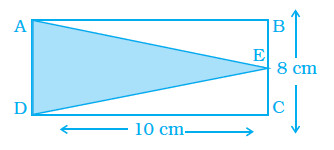
Example 1: What is the area of the triangle ADE in the following figure?
(a) 45 cm2
(b) 50 cm2
(c) 55 cm2
(d) 40 cm2
Answer:
Given:
Rectangle $ABCD$ with length $AB = 10 \text{ cm}$ and width $BC = 8 \text{ cm}$.
$\triangle ADE$ is formed with point $E$ on side $BC$.
Solution:
In $\triangle ADE$, let the base be $AD$. Since $ABCD$ is a rectangle:
$AD = BC = 8 \text{ cm}$
The height (altitude) of $\triangle ADE$ corresponding to the base $AD$ is the perpendicular distance from vertex $E$ to the line containing $AD$. This distance is equal to the length of the rectangle:
$\text{Height} = AB = 10 \text{ cm}$
Now, calculate the area of the triangle:
$\text{Area of } \triangle ADE = \frac{1}{2} \times \text{base} \times \text{height}$
$\text{Area} = \frac{1}{2} \times 8 \times 10$
$\text{Area} = 4 \times 10 = 40 \text{ cm}^2$
Final Answer: The correct option is (d) 40 cm2.
Example 2: What will be the change in the volume of a cube when its side becomes 10 times the original side?
(a) Volume becomes 1000 times.
(b) Volume becomes 10 times.
(c) Volume becomes 100 times.
(d) Volume becomes $\frac{1}{1000}$ times.
Answer:
Solution:
Let the original side of the cube be $s$.
$\text{Original Volume } (V_1) = s^3$
When the side becomes $10$ times, the new side $s' = 10s$.
$\text{New Volume } (V_2) = (s')^3$
$V_2 = (10s)^3$
$V_2 = 1000s^3$
$V_2 = 1000 \times V_1$
Final Answer: The correct option is (a) Volume becomes 1000 times.
In examples 3 and 4, fill in the blanks to make the statements true.
Example 3: Area of a rhombus is equal to __________ of its diagonals.
Answer:
Solution:
The formula for the area of a rhombus is $\frac{1}{2} \times d_1 \times d_2$, where $d_1$ and $d_2$ are the lengths of its diagonals.
Final Answer: The blank should be filled with half the product.
Example 4: If the area of a face of a cube is 10 cm2, then the total surface area of the cube is __________.
Answer:
Given:
Area of one face = $10 \text{ cm}^2$
Solution:
A cube has $6$ identical square faces. The total surface area (TSA) is the sum of the areas of all six faces.
$\text{TSA} = 6 \times \text{Area of one face}$
$\text{TSA} = 6 \times 10 = 60 \text{ cm}^2$
Final Answer: The blank should be filled with 60 cm2.
In examples 5 and 6, state whether the statements are true (T) or false (F).
Example 5: 1L = 1000 cm3
Answer:
Solution:
In the metric system, $1$ litre is defined as the volume of a cube with $10 \text{ cm}$ sides. Therefore, $1 \text{ L} = 10 \text{ cm} \times 10 \text{ cm} \times 10 \text{ cm} = 1000 \text{ cm}^3$.
Final Answer: The statement is True (T).
Example 6: Amount of region occupied by a solid is called its surface
Answer:
Solution:
The amount of space or region occupied by a solid is called its volume. Surface area is the measure of the total area that the surface of the object occupies.
Final Answer: The statement is False (F).
Example 7: 160 m3 of water is to be used to irrigate a rectangular field whose area is 800 m2. What will be the height of the water level in the field?
Answer:
Given:
Volume of water ($V$) = $160 \text{ m}^3$
Area of the field ($A$) = $800 \text{ m}^2$
To Find:
Height of the water level ($h$).
Solution:
The volume of a rectangular prism (the layer of water) is calculated as:
$\text{Volume} = \text{Area of base} \times \text{Height}$
$160 = 800 \times h$
$h = \frac{160}{800}$
$h = \frac{16}{80} = \frac{1}{5}$
$h = 0.2 \text{ m}$
To convert this into centimetres ($1 \text{ m} = 100 \text{ cm}$):
$h = 0.2 \times 100 = 20 \text{ cm}$
Final Answer: The height of the water level in the field will be $0.2 \text{ m}$ or $20 \text{ cm}$.
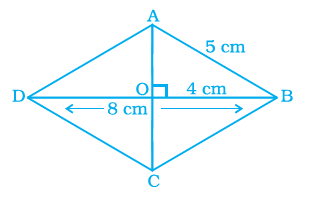
Example 8: Find the area of a rhombus whose one side measures 5 cm and one diagonal as 8 cm.
Answer:
Given:
Side of rhombus ($AB$) = $5$ cm
One diagonal ($BD$, let it be $d_1$) = $8$ cm
To Find:
Area of the rhombus.
Solution:
In a rhombus, diagonals bisect each other at right angles ($90^\circ$). Let the diagonals $AC$ and $BD$ intersect at point $O$.
$OB = \frac{1}{2} BD = \frac{1}{2} \times 8 = 4 \text{ cm}$
In $\triangle AOB$, using Pythagoras Theorem:
$AO^2 + OB^2 = AB^2$
$AO^2 + 4^2 = 5^2$
$AO^2 + 16 = 25$
$AO^2 = 25 - 16 = 9$
$AO = \sqrt{9} = 3 \text{ cm}$
The second diagonal $AC$ ($d_2$) is:
$AC = 2 \times AO = 2 \times 3 = 6 \text{ cm}$
Now, the area of the rhombus is:
$\text{Area} = \frac{1}{2} \times d_1 \times d_2$
$\text{Area} = \frac{1}{2} \times 8 \times 6$
$\text{Area} = 4 \times 6 = 24 \text{ cm}^2$
Final Answer: The area of the rhombus is $24 \text{ cm}^2$.
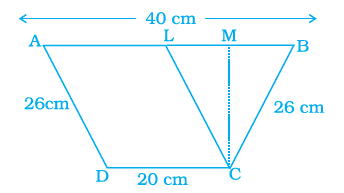
Example 9: The parallel sides of a trapezium are 40 cm and 20 cm. If its non-parallel sides are both equal, each being 26 cm, find the area of the trapezium.
Answer:
Given:
Parallel sides: $AB = 40$ cm and $CD = 20$ cm.
Non-parallel sides: $AD = 26$ cm and $BC = 26$ cm.
To Find:
Area of the trapezium $ABCD$.
Solution:
Based on the construction shown in the image, we draw $LC \parallel AD$ such that $L$ is a point on $AB$. We also draw the altitude $CM \perp AB$.
In quadrilateral $ADCL$, since $AL \parallel DC$ and $AD \parallel LC$, $ADCL$ is a parallelogram.
$AL = DC = 20 \text{ cm}$
$LC = AD = 26 \text{ cm}$
Now, we find the length of $LB$:
$LB = AB - AL = 40 - 20 = 20 \text{ cm}$
In $\triangle LBC$, we have $LC = 26 \text{ cm}$ and $BC = 26 \text{ cm}$. Since $LC = BC$, $\triangle LBC$ is an isosceles triangle. In an isosceles triangle, the altitude from the vertex bisects the base.
$MB = \frac{1}{2} LB = \frac{1}{2} \times 20 = 10 \text{ cm}$
Now, in right-angled $\triangle CMB$, we use the Pythagoras Theorem to find the height $h$ ($CM$):
$CM^2 + MB^2 = BC^2$
$h^2 + 10^2 = 26^2$
$h^2 + 100 = 676$
$h^2 = 676 - 100 = 576$
$h = \sqrt{576} = 24 \text{ cm}$
Finally, we calculate the area of the trapezium:
$\text{Area} = \frac{1}{2} \times (\text{Sum of parallel sides}) \times \text{height}$
$\text{Area} = \frac{1}{2} \times (40 + 20) \times 24$
$\text{Area} = \frac{1}{2} \times 60 \times 24$
$\text{Area} = 30 \times 24 = 720 \text{ cm}^2$
Final Answer: The area of the trapezium is $720 \text{ cm}^2$.
Example 10: Find the area of polygon ABCDEF, if AD = 18cm, AQ = 14 cm, AP = 12 cm, AN = 8 cm, AM = 4 cm, and FM, EP, QC and BN are perpendiculars to diagonal AD.

Answer:
Given:
$AD = 18 \text{ cm}$
$AQ = 14 \text{ cm}, AP = 12 \text{ cm}, AN = 8 \text{ cm}, AM = 4 \text{ cm}$
$FM, EP, QC \text{ and } BN$ are perpendiculars to diagonal $AD$ with lengths:
$FM = 5 \text{ cm}, EP = 6 \text{ cm}, QC = 4 \text{ cm}, BN = 5 \text{ cm}$
To Find:
Area of polygon $ABCDEF$.
Solution:
The polygon is divided into several triangles and trapeziums. We will calculate the area of each part separately.
1. Area of $\triangle AFM$:
$\text{Area} = \frac{1}{2} \times AM \times FM = \frac{1}{2} \times 4 \times 5 = 10 \text{ cm}^2$
2. Area of trapezium $FMPE$:
$\text{Height } MP = AP - AM = 12 - 4 = 8 \text{ cm}$
$\text{Area} = \frac{1}{2} \times (FM + EP) \times MP = \frac{1}{2} \times (5 + 6) \times 8 = 44 \text{ cm}^2$
3. Area of $\triangle EPD$:
$\text{Base } PD = AD - AP = 18 - 12 = 6 \text{ cm}$
$\text{Area} = \frac{1}{2} \times PD \times EP = \frac{1}{2} \times 6 \times 6 = 18 \text{ cm}^2$
4. Area of $\triangle ABN$:
$\text{Area} = \frac{1}{2} \times AN \times BN = \frac{1}{2} \times 8 \times 5 = 20 \text{ cm}^2$
5. Area of trapezium $BNQC$:
$\text{Height } NQ = AQ - AN = 14 - 8 = 6 \text{ cm}$
$\text{Area} = \frac{1}{2} \times (BN + QC) \times NQ = \frac{1}{2} \times (5 + 4) \times 6 = 27 \text{ cm}^2$
6. Area of $\triangle QCD$:
$\text{Base } QD = AD - AQ = 18 - 14 = 4 \text{ cm}$
$\text{Area} = \frac{1}{2} \times QD \times QC = \frac{1}{2} \times 4 \times 4 = 8 \text{ cm}^2$
Total Area of Polygon $ABCDEF$:
$\text{Total Area} = \text{Area}(\triangle AFM) + \text{Area}(FMPE) + \text{Area}(\triangle EPD) $$ + \text{Area}(\triangle ABN) + \text{Area}(BNQC) + \text{Area}(\triangle QCD)$
$\text{Total Area} = 10 + 44 + 18 + 20 + 27 + 8$
$\text{Total Area} = 127 \text{ cm}^2$
Final Answer: The area of the polygon $ABCDEF$ is $127 \text{ cm}^2$.
Example 11: Horse stable is in the form of a cuboid, whose external dimensions are 70 m × 35 m × 40 m, surrounded by a cylinder halved vertically through diameter 35 m and it is open from one rectangular face 70 m × 40 m. Find the cost of painting the exterior of the stable at the rate of Rs 2/m2.
Answer:
Given:
Dimensions of the cuboidal part:
Length ($L$) = $70 \text{ m}$
Breadth ($B$) = $35 \text{ m}$
Height ($H$) = $40 \text{ m}$
Dimensions of the half-cylindrical roof:
Diameter ($d$) = $35 \text{ m}$
Radius ($r$) = $\frac{35}{2} = 17.5 \text{ m}$
Length of the cylinder ($h$) = $70 \text{ m}$
Cost of painting = $\textsf{₹} 2/\text{m}^2$
Condition: One rectangular face ($70 \text{ m} \times 40 \text{ m}$) is open.
To Find:
Total cost of painting the exterior of the stable.
Solution:
The total area to be painted consists of the exterior walls of the cuboid (excluding the open front face), the curved surface of the half-cylinder, and the two semi-circular ends of the roof.
1. Area of the cuboidal walls:
We need to paint two side walls ($35 \times 40$) and one back wall ($70 \times 40$).
$\text{Area of walls} = 2(B \times H) + (L \times H)$
$\text{Area of walls} = 2(35 \times 40) + (70 \times 40)$
$\text{Area of walls} = 2800 + 2800 = 5600 \text{ m}^2$
2. Area of the half-cylindrical roof:
This includes the curved surface area (CSA) of the half-cylinder.
$\text{CSA of half-cylinder} = \frac{1}{2} (2\pi r h) = \pi r h$
$\text{CSA} = \frac{22}{7} \times 17.5 \times 70$
$\text{CSA} = 22 \times 17.5 \times 10 = 3850 \text{ m}^2$
3. Area of the two semi-circular ends:
There are two semi-circular faces at the ends of the cylindrical roof.
$\text{Area of 2 semi-circles} = 2 \times \frac{1}{2} \pi r^2 = \pi r^2$
$\text{Area of ends} = \frac{22}{7} \times (17.5)^2$
$\text{Area of ends} = \frac{22}{7} \times 306.25 = 962.5 \text{ m}^2$
4. Total exterior area:
$\text{Total Area} = \text{Area of walls} + \text{CSA of roof} + \text{Area of ends}$
$\text{Total Area} = 5600 + 3850 + 962.5$
$\text{Total Area} = 10412.5 \text{ m}^2$
5. Total cost of painting:
$\text{Cost} = \text{Total Area} \times \text{Rate}$
$\text{Cost} = 10412.5 \times 2 = \textsf{₹} 20,825$
Final Answer: The total cost of painting the exterior of the stable is $\textsf{₹} 20,825$.
Exercise
Question 1 to 28 (Multiple Choice Questions)
In questions 1 to 28, there are four options out of which one is correct. Write the correct answer.
Question 1. A cube of side 5 cm is painted on all its faces. If it is sliced into 1 cubic centimetre cubes, how many 1 cubic centimetre cubes will have exactly one of their faces painted?
(a) 27
(b) 42
(c) 54
(d) 142
Answer:
Solution:
A cube of side $n \text{ cm}$ cut into $1 \text{ cm}^3$ cubes has several properties. For $n = 5$:
The cubes with exactly one face painted are those located on the centers of the 6 faces, excluding the edges and corners.
The number of such cubes on one face is $(n-2)^2$.
$\text{Cubes per face} = (5-2)^2 = 3^2 = 9$
Since there are 6 faces in a cube:
$\text{Total cubes with one face painted} = 6 \times (n-2)^2$
$\text{Total} = 6 \times 9 = 54$
Final Answer: The correct option is (c) 54.
Question 2. A cube of side 4 cm is cut into 1 cm cubes. What is the ratio of the surface areas of the original cubes and cut-out cubes?
(a) 1 : 2
(b) 1 : 3
(c) 1 : 4
(d) 1 : 6
Answer:
Solution:
1. Original Cube:
Side ($S$) = $4$ cm
$\text{Surface Area } (A_1) = 6S^2 = 6(4)^2 = 6 \times 16 = 96 \text{ cm}^2$
2. Cut-out Cubes:
Volume of original cube = $4^3 = 64 \text{ cm}^3$. Since each small cube is $1 \text{ cm}^3$, there are 64 small cubes.
$\text{Surface Area of one small cube} = 6(1)^2 = 6 \text{ cm}^2$
$\text{Total Surface Area of 64 cubes } (A_2) = 64 \times 6 = 384 \text{ cm}^2$
3. Ratio:
$\text{Ratio} = \frac{A_1}{A_2} = \frac{96}{384} = \frac{1}{4}$
Final Answer: The correct option is (c) 1 : 4.
Question 3. A circle of maximum possible size is cut from a square sheet of board.
Subsequently, a square of maximum possible size is cut from the resultant circle. What will be the area of the final square?
(a) $\frac{3}{4}$ of original square.
(b) $\frac{1}{2}$ of original square.
(c) $\frac{1}{4}$ of original square.
(d) $\frac{2}{3}$ of original square.
Answer:
Solution:
Let the side of the original square be $a$.
$\text{Area of original square } (S_1) = a^2$
The maximum circle cut from this square will have a diameter equal to the side of the square ($d = a$), so the radius $r = \frac{a}{2}$.
Now, a square of maximum size is cut from this circle. The diagonal ($D$) of this new square will be equal to the diameter of the circle ($D = a$).
Area of a square with diagonal $D$ is $\frac{1}{2}D^2$:
$\text{Area of final square } (S_2) = \frac{1}{2}(a)^2 = \frac{1}{2}a^2$
Comparing $S_2$ to $S_1$:
$S_2 = \frac{1}{2} S_1$
Final Answer: The correct option is (b) $\frac{1}{2}$ of original square.
Question 4. What is the area of the largest triangle that can be fitted into a rectangle of length l units and width w units?
(a) $\frac{lw}{2}$
(b) $\frac{lw}{3}$
(c) $\frac{lw}{6}$
(d) $\frac{lw}{4}$
Answer:
Solution:
The largest triangle that can fit in a rectangle will have its base equal to one side of the rectangle and its height equal to the other side.
$\text{Base} = l$
$\text{Height} = w$
$\text{Area of triangle} = \frac{1}{2} \times \text{base} \times \text{height}$
$\text{Area} = \frac{1}{2} \times l \times w = \frac{lw}{2}$
Final Answer: The correct option is (a) $\frac{lw}{2}$.
Question 5. If the height of a cylinder becomes $\frac{1}{4}$ of the original height and the radius is doubled, then which of the following will be true?
(a) Volume of the cylinder will be doubled.
(b) Volume of the cylinder will remain unchanged.
(c) Volume of the cylinder will be halved.
(d) Volume of the cylinder will be $\frac{1}{4}$ of the original volume.
Answer:
Solution:
Let original radius be $r$ and height be $h$.
$\text{Original Volume } (V_1) = \pi r^2 h$
New radius $r' = 2r$ and new height $h' = \frac{1}{4}h$.
$\text{New Volume } (V_2) = \pi (r')^2 h'$
$V_2 = \pi (2r)^2 (\frac{1}{4}h)$
$V_2 = \pi (4r^2) (\frac{1}{4}h)$
$V_2 = \pi r^2 h = V_1$
Final Answer: The correct option is (b) Volume of the cylinder will remain unchanged.
Question 6. If the height of a cylinder becomes $\frac{1}{4}$ of the original height and the radius is doubled, then which of the following will be true?
(a) Curved surface area of the cylinder will be doubled.
(b) Curved surface area of the cylinder will remain unchanged.
(c) Curved surface area of the cylinder will be halved.
(d) Curved surface area will be $\frac{1}{4}$ of the original curved surface.
Answer:
Solution:
Let original radius be $r$ and height be $h$.
$\text{Original CSA } (C_1) = 2\pi rh$
New radius $r' = 2r$ and new height $h' = \frac{1}{4}h$.
$\text{New CSA } (C_2) = 2\pi (r') (h')$
$C_2 = 2\pi (2r) (\frac{1}{4}h)$
$C_2 = \pi rh = \frac{1}{2} (2\pi rh) = \frac{1}{2} C_1$
Final Answer: The correct option is (c) Curved surface area of the cylinder will be halved.
Question 7. If the height of a cylinder becomes $\frac{1}{4}$ of the original height and the radius is doubled, then which of the following will be true?
(a) Total surface area of the cylinder will be doubled.
(b) Total surface area of the cylinder will remain unchanged.
(c) Total surface of the cylinder will be halved.
(d) None of the above.
Answer:
Solution:
$\text{Total Surface Area (TSA)} = 2\pi r(r + h)$
Let's check if the TSA doubles or halves using the new dimensions $r' = 2r$ and $h' = \frac{1}{4}h$.
$\text{New TSA} = 2\pi (2r) (2r + \frac{1}{4}h) = 4\pi r (2r + \frac{h}{4})$
This expression does not simplify to a constant multiple (like 2 or 1/2) of the original TSA, as the terms inside the bracket change differently. Thus, options (a), (b), and (c) are incorrect.
Final Answer: The correct option is (d) None of the above.
Question 8. The surface area of the three coterminus faces of a cuboid are 6, 15 and 10 cm2 respectively. The volume of the cuboid is
(a) 30 cm3
(b) 40 cm3
(c) 20 cm3
(d) 35 cm3
Answer:
Solution:
Let the length, breadth, and height of the cuboid be $l, b, h$. The areas of the three coterminous faces are:
$lb = 6$
$bh = 15$
$hl = 10$
To find the volume ($V = lbh$), multiply the three equations:
$(lb) \times (bh) \times (hl) = 6 \times 15 \times 10$
$l^2 b^2 h^2 = 900$
$(lbh)^2 = 900$
$lbh = \sqrt{900} = 30 \text{ cm}^3$
Final Answer: The correct option is (a) 30 cm3.
Question 9. A regular hexagon is inscribed in a circle of radius r. The perimeter of the regular hexagon is
(a) 3r
(b) 6r
(c) 9r
(d) 12r
Answer:
Solution:
For a regular hexagon inscribed in a circle, each side of the hexagon is equal to the radius ($r$) of the circle. This is because a regular hexagon consists of 6 equilateral triangles meeting at the center of the circle.
$\text{Side of hexagon } (s) = r$
$\text{Perimeter} = 6 \times s = 6 \times r = 6r$
Final Answer: The correct option is (b) 6r.
Question 10. The dimensions of a godown are 40 m, 25 m and 10 m. If it is filled with cuboidal boxes each of dimensions 2 m × 1.25 m × 1 m, then the number of boxes will be
(a) 1800
(b) 2000
(c) 4000
(d) 8000
Answer:
Given:
$\text{Volume of godown} = 40 \times 25 \times 10 = 10,000 \text{ m}^3$
$\text{Volume of one box} = 2 \times 1.25 \times 1 = 2.5 \text{ m}^3$
Solution:
$\text{Number of boxes} = \frac{\text{Volume of godown}}{\text{Volume of one box}}$
$\text{Number of boxes} = \frac{10000}{2.5} = \frac{100000}{25}$
$\text{Number of boxes} = 4000$
Final Answer: The correct option is (c) 4000.
Question 11. The volume of a cube is 64 cm3. Its surface area is
(a) 16 cm2
(b) 64 cm2
(c) 96 cm2
(d) 128 cm2
Answer:
Given:
$\text{Volume } (V) = 64 \text{ cm}^3$
Solution:
$s^3 = 64$
$s = \sqrt[3]{64} = 4 \text{ cm}$
Now, calculate surface area (TSA):
$\text{Surface Area} = 6s^2 = 6(4)^2$
$\text{Surface Area} = 6 \times 16 = 96 \text{ cm}^2$
Final Answer: The correct option is (c) 96 cm2.
Question 12. If the radius of a cylinder is tripled but its curved surface area is unchanged, then its height will be
(a) tripled
(b) constant
(c) one sixth
(d) one third
Answer:
Solution:
$\text{Original CSA } (C_1) = 2\pi rh$
New radius $r' = 3r$. Let the new height be $h'$.
$\text{New CSA } (C_2) = 2\pi (3r) h'$
Since $C_1 = C_2$:
$2\pi rh = 6\pi rh'$
$h = 3h'$
$h' = \frac{1}{3}h$
Final Answer: The correct option is (d) one third.
Question 13. How many small cubes with edge of 20 cm each can be jus accommodated in a cubical box of 2 m edge?
(a) 10
(b) 100
(c) 1000
(d) 10000
Answer:
Given:
$\text{Side of larger box} = 2 \text{ m} = 200 \text{ cm}$
$\text{Side of small cube} = 20 \text{ cm}$
Solution:
$\text{Number of cubes} = \frac{\text{Volume of box}}{\text{Volume of small cube}}$
$\text{Number of cubes} = \frac{200 \times 200 \times 200}{20 \times 20 \times 20}$
$\text{Number of cubes} = 10 \times 10 \times 10 = 1000$
Final Answer: The correct option is (c) 1000.
Question 14. The volume of a cylinder whose radius r is equal to its height is
(a) $\frac{1}{4}$ πr3
(b) $\frac{πr^3}{32}$
(c) πr3
(d) $\frac{r^3}{8}$
Answer:
Solution:
$\text{Volume of cylinder } (V) = \pi r^2 h$
Given $h = r$:
$V = \pi r^2 (r) = \pi r^3$
Final Answer: The correct option is (c) πr3.
Question 15. The volume of a cube whose edge is 3x is
(a) 27x3
(b) 9x3
(c) 6x3
(d) 3x3
Answer:
Solution:
$\text{Volume} = \text{edge}^3$
$\text{Volume} = (3x)^3 = 3^3 \cdot x^3 = 27x^3$
Final Answer: The correct option is (a) 27x3.
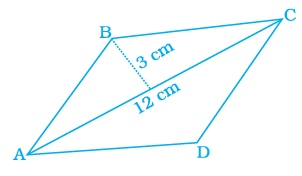
Question 16. The figure ABCD is a quadrilateral in which AB = CD and BC = AD. Its area is
(a) 72 cm2
(b) 36 cm2
(c) 24 cm2
(d) 18 cm2
Answer:
Solution:
In quadrilateral $ABCD$, since $AB = CD$ and $BC = AD$, opposite sides are equal, which means $ABCD$ is a parallelogram. Diagonal $AC$ divides the parallelogram into two triangles of equal area.
From the image, we see that diagonal $AC = 12 \text{ cm}$ and the perpendicular height from vertex $B$ to $AC$ is $3 \text{ cm}$.
$\text{Area of parallelogram } ABCD = 2 \times \text{Area}(\triangle ABC)$
$\text{Area} = 2 \times \left( \frac{1}{2} \times \text{base} \times \text{height} \right)$
$\text{Area} = 2 \times \left( \frac{1}{2} \times 12 \times 3 \right)$
$\text{Area} = 12 \times 3 = 36 \text{ cm}^2$
Final Answer: The correct option is (b) 36 cm2.
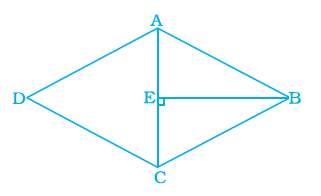
Question 17. What is the area of the rhombus ABCD below if AC = 6 cm, and BE = 4cm?
(a) 36 cm2
(b) 16 cm2
(c) 24 cm2
(d) 13 cm2
Answer:
Given:
Diagonal $AC = 6 \text{ cm}$
Length $BE = 4 \text{ cm}$ (Perpendicular from $B$ to diagonal $AC$)
Solution:
In a rhombus, the diagonals bisect each other at right angles. Thus, $BE$ is half of the second diagonal $BD$.
$\text{Diagonal } d_1 = AC = 6 \text{ cm}$
$\text{Diagonal } d_2 = BD = 2 \times BE = 2 \times 4 = 8 \text{ cm}$
The area of a rhombus is given by:
$\text{Area} = \frac{1}{2} \times d_1 \times d_2$
$\text{Area} = \frac{1}{2} \times 6 \times 8$
$\text{Area} = 3 \times 8 = 24 \text{ cm}^2$
Final Answer: The correct option is (c) 24 cm2.
Question 18. The area of a parallelogram is 60 cm2 and one of its altitude is 5 cm. The length of its corresponding side is
(a) 12 cm
(b) 6 cm
(c) 4 cm
(d) 2 cm
Answer:
Given:
$\text{Area of parallelogram} = 60 \text{ cm}^2$
$\text{Altitude (height)} = 5 \text{ cm}$
Solution:
The area of a parallelogram is calculated as:
$\text{Area} = \text{Base} \times \text{Height}$
$60 = \text{Base} \times 5$
$\text{Base} = \frac{60}{5} = 12 \text{ cm}$
Final Answer: The correct option is (a) 12 cm.
Question 19. The perimeter of a trapezium is 52 cm and its each non-parallel side is equal to 10 cm with its height 8 cm. Its area is
(a) 124 cm2
(b) 118 cm2
(c) 128 cm2
(d) 112 cm2
Answer:
Given:
$\text{Perimeter} = 52 \text{ cm}$
$\text{Non-parallel sides } (c \text{ and } d) = 10 \text{ cm each}$
$\text{Height } (h) = 8 \text{ cm}$
Solution:
Let the parallel sides be $a$ and $b$.
$\text{Perimeter} = a + b + c + d$
$52 = a + b + 10 + 10$
$52 = a + b + 20$
$a + b = 32 \text{ cm}$
The area of the trapezium is:
$\text{Area} = \frac{1}{2} \times (a + b) \times h$
$\text{Area} = \frac{1}{2} \times 32 \times 8$
$\text{Area} = 16 \times 8 = 128 \text{ cm}^2$
Final Answer: The correct option is (c) 128 cm2.
Question 20. Area of a quadrilateral ABCD is 20 cm2 and perpendiculars on BD from opposite vertices are 1 cm and 1.5 cm. The length of BD is
(a) 4 cm
(b) 15 cm
(c) 16 cm
(d) 18 cm
Answer:
Given:
$\text{Area of quadrilateral} = 20 \text{ cm}^2$
$\text{Heights } h_1 = 1 \text{ cm, } h_2 = 1.5 \text{ cm}$
Solution:
Area of a quadrilateral with diagonal $d$ and perpendicular offsets $h_1, h_2$ is:
$\text{Area} = \frac{1}{2} \times d \times (h_1 + h_2)$
$20 = \frac{1}{2} \times BD \times (1 + 1.5)$
$20 = \frac{1}{2} \times BD \times 2.5$
$40 = BD \times 2.5$
$BD = \frac{40}{2.5} = 16 \text{ cm}$
Final Answer: The correct option is (c) 16 cm.
Question 21. A metal sheet 27 cm long, 8 cm broad and 1 cm thick is melted into a cube. The side of the cube is
(a) 6 cm
(b) 8 cm
(c) 12 cm
(d) 24 cm
Answer:
Given:
$\text{Length } (l) = 27 \text{ cm, Breadth } (b) = 8 \text{ cm, Thickness } (h) = 1 \text{ cm}$
Solution:
The volume of the metal sheet is:
$\text{Volume} = l \times b \times h$
$\text{Volume} = 27 \times 8 \times 1 = 216 \text{ cm}^3$
When melted into a cube, the volume remains the same ($V = a^3$):
$a^3 = 216$
$a = \sqrt[3]{216} = 6 \text{ cm}$
Final Answer: The correct option is (a) 6 cm.
Question 22. Three cubes of metal whose edges are 6 cm, 8 cm and 10 cm respectively are melted to form a single cube. The edge of the new cube is
(a) 12 cm
(b) 24 cm
(c) 18 cm
(d) 20 cm
Answer:
Solution:
Total volume of the three cubes is:
$\text{Total Volume} = 6^3 + 8^3 + 10^3$
$\text{Total Volume} = 216 + 512 + 1000 = 1728 \text{ cm}^3$
Let the edge of the new cube be $A$.
$A^3 = 1728$
$A = \sqrt[3]{1728} = 12 \text{ cm}$
Final Answer: The correct option is (a) 12 cm.
Question 23. A covered wooden box has the inner measures as 115 cm, 75 cm and 35 cm and thickness of wood as 2.5 cm. The volume of the wood is
(a) 85,000 cm3
(b) 80,000 cm3
(c) 82,125 cm3
(d) 84,000 cm3
Answer:
Given:
$\text{Inner dimensions: } l = 115, b = 75, h = 35 \text{ cm}$
$\text{Thickness } = 2.5 \text{ cm}$
Solution:
First, calculate the outer dimensions:
$\text{Outer } L = 115 + 2(2.5) = 120 \text{ cm}$
$\text{Outer } B = 75 + 2(2.5) = 80 \text{ cm}$
$\text{Outer } H = 35 + 2(2.5) = 40 \text{ cm}$
Now, calculate the volumes:
$\text{Outer Volume} = 120 \times 80 \times 40 = 384,000 \text{ cm}^3$
$\text{Inner Volume} = 115 \times 75 \times 35 = 301,875 \text{ cm}^3$
Volume of wood:
$\text{Volume of wood} = 384,000 - 301,875 = 82,125 \text{ cm}^3$
Final Answer: The correct option is (c) 82,125 cm3.
Question 24. The ratio of radii of two cylinders is 1: 2 and heights are in the ratio 2:3. The ratio of their volumes is
(a) 1:6
(b) 1:9
(c) 1:3
(d) 2:9
Answer:
Given:
$r_1 : r_2 = 1 : 2 \text{ and } h_1 : h_2 = 2 : 3$
Solution:
The volume of a cylinder is $V = \pi r^2 h$.
$\text{Ratio of volumes} = \frac{\pi r_1^2 h_1}{\pi r_2^2 h_2}$
$\text{Ratio} = \left( \frac{r_1}{r_2} \right)^2 \times \left( \frac{h_1}{h_2} \right)$
$\text{Ratio} = \left( \frac{1}{2} \right)^2 \times \left( \frac{2}{3} \right)$
$\text{Ratio} = \frac{1}{4} \times \frac{2}{3} = \frac{1}{6}$
Final Answer: The correct option is (a) 1:6.
Question 25. Two cubes have volumes in the ratio 1:64. The ratio of the area of a face of first cube to that of the other is
(a) 1:4
(b) 1:8
(c) 1:16
(d) 1:32
Answer:
Solution:
Let the sides of the two cubes be $s_1$ and $s_2$.
Given the ratio of their volumes:
$\frac{V_1}{V_2} = \frac{s_1^3}{s_2^3} = \frac{1}{64}$
Taking the cube root on both sides to find the ratio of their sides:
$\frac{s_1}{s_2} = \sqrt[3]{\frac{1}{64}} = \frac{1}{4}$
The area of one face of a cube is $s^2$. The ratio of the areas of their faces is:
$\text{Ratio of face areas} = \frac{s_1^2}{s_2^2} = \left( \frac{s_1}{s_2} \right)^2$
$\text{Ratio} = \left( \frac{1}{4} \right)^2 = \frac{1}{16}$
Final Answer: The correct option is (c) 1:16.
Question 26. The surface areas of the six faces of a rectangular solid are 16, 16, 32, 32, 72 and 72 square centimetres. The volume of the solid, in cubic centimetres, is
(a) 192
(b) 384
(c) 480
(d) 2592
Answer:
Solution:
Let the length, breadth, and height of the rectangular solid (cuboid) be $l$, $b$, and $h$. The areas of the three distinct faces are:
$lb = 16$
$bh = 32$
$hl = 72$
We know that the square of the volume $V$ is the product of the areas of these three faces:
$V^2 = (lb) \times (bh) \times (hl)$
$V^2 = 16 \times 32 \times 72$
$V^2 = 16 \times (16 \times 2) \times (36 \times 2)$
$V^2 = 16^2 \times 36 \times 4$
$V^2 = 16^2 \times 6^2 \times 2^2$
Taking the square root:
$V = 16 \times 6 \times 2 = 192 \text{ cm}^3$
Final Answer: The correct option is (a) 192.
Question 27. Ramesh has three containers.
(a) Cylindrical container A having radius r and height h,
(b) Cylindrical container B having radius 2r and height 1/2 h, and
(c) Cuboidal container C having dimensions r × r × h
The arrangement of the containers in the increasing order of their volumes is
(a) A, B, C
(b) B, C, A
(c) C, A, B
(d) cannot be arranged
Answer:
Solution:
Let's calculate the volume of each container:
Volume of A:
$V_A = \pi r^2 h \approx 3.14 r^2 h$
Volume of B:
$V_B = \pi (2r)^2 \left( \frac{h}{2} \right) = \pi (4r^2) \left( \frac{h}{2} \right) = 2\pi r^2 h \approx 6.28 r^2 h$
Volume of C:
$V_C = r \times r \times h = r^2 h$
Comparing the coefficients: $1 < 3.14 < 6.28$.
Therefore, the increasing order is $V_C < V_A < V_B$.
Final Answer: The correct option is (c) C, A, B.
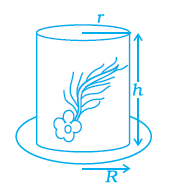
Question 28. If R is the radius of the base of the hat, then the total outer surface area of the hat is
(a) πr (2h + R)
(b) 2πr (h + R)
(c) 2πrh + πR2
(d) None of these
Answer:
Solution:
The total outer surface area of the hat consists of three parts:
1. Curved surface area of the cylindrical part: $2\pi rh$
2. Area of the top circular face: $\pi r^2$
3. Area of the brim (annulus): The brim is the region between the outer radius $R$ and the inner radius $r$. Area $= \pi R^2 - \pi r^2$.
Adding these together:
$\text{Total Area} = 2\pi rh + \pi r^2 + (\pi R^2 - \pi r^2)$
$\text{Total Area} = 2\pi rh + \pi R^2$
Final Answer: The correct option is (c) 2πrh + πR2.
Question 29 to 52 (Fill in the Blanks)
In questions 29 to 52, fill in the blanks to make the statements true.
Question 29. A cube of side 4 cm is painted on all its sides. If it is sliced in 1 cubic cm cubes, then number of such cubes that will have exactly two of their faces painted is __________.
Answer:
Solution:
For a cube of side $n$ units cut into $1$ unit cubes, the number of cubes with exactly two faces painted is given by $12(n - 2)$. Here, $n = 4$.
$\text{Number of cubes} = 12(4 - 2)$
$\text{Number of cubes} = 12 \times 2 = 24$
Final Answer: The blank should be filled with 24.
Question 30. A cube of side 5 cm is cut into 1 cm cubes. The percentage increase in volume after such cutting is __________.
Answer:
Solution:
When a solid object is cut into smaller pieces, the total volume remains constant.
$\text{Original Volume} = 5^3 = 125 \text{ cm}^3$
$\text{Volume of 125 small cubes} = 125 \times 1^3 = 125 \text{ cm}^3$
Since the volume does not change, the increase in volume is $0$.
Final Answer: The blank should be filled with 0%.
Question 31. The surface area of a cuboid formed by joining two cubes of side a face to face is __________.
Answer:
Solution:
When two cubes of side $a$ are joined face to face, the resulting cuboid has dimensions:
$\text{Length } (L) = a + a = 2a$
$\text{Breadth } (B) = a$
$\text{Height } (H) = a$
The total surface area of this cuboid is:
$\text{SA} = 2(LB + BH + HL)$
$\text{SA} = 2(2a \cdot a + a \cdot a + a \cdot 2a)$
$\text{SA} = 2(2a^2 + a^2 + 2a^2) = 2(5a^2)$
$\text{SA} = 10a^2$
Final Answer: The blank should be filled with 10a2.
Question 32. If the diagonals of a rhombus get doubled, then the area of the rhombus becomes __________ its original area.
Answer:
Solution:
Let the original diagonals be $d_1$ and $d_2$.
$\text{Original Area} = \frac{1}{2} d_1 d_2$
If diagonals are doubled, new diagonals are $2d_1$ and $2d_2$.
$\text{New Area} = \frac{1}{2} (2d_1)(2d_2)$
$\text{New Area} = 2 d_1 d_2 = 4 \times \left( \frac{1}{2} d_1 d_2 \right)$
Final Answer: The blank should be filled with four times.
Question 33. If a cube fits exactly in a cylinder with height h, then the volume of the cube is __________ and surface area of the cube is __________.
Answer:
Solution:
If a cube fits exactly inside a cylinder of height $h$, the height of the cube must be equal to the height of the cylinder. Therefore, the side of the cube ($a$) is $h$.
$\text{Volume of the cube} = a^3 = h^3$
$\text{Surface area of the cube} = 6a^2 = 6h^2$
Final Answer: The blanks should be filled with h3 and 6h2.
Question 34. The volume of a cylinder becomes __________ the original volume if its radius becomes half of the original radius.
Answer:
Solution:
Let the original radius be $r$ and height be $h$.
$\text{Original Volume } (V_1) = \pi r^2 h$
If the radius becomes half ($r' = \frac{r}{2}$), the new volume is:
$\text{New Volume } (V_2) = \pi \left( \frac{r}{2} \right)^2 h$
$V_2 = \pi \frac{r^2}{4} h = \frac{1}{4} \pi r^2 h$
$V_2 = \frac{1}{4} V_1$
Final Answer: The blank should be filled with one-fourth.
Question 35. The curved surface area of a cylinder is reduced by ____________ per cent if the height is half of the original height.
Answer:
Solution:
Let the original height be $h$. The original curved surface area (CSA) is $2\pi rh$.
If the height becomes half ($h' = \frac{h}{2}$), the new CSA is:
$\text{New CSA} = 2\pi r \left( \frac{h}{2} \right) = \pi rh$
The reduction in CSA is:
$\text{Reduction} = 2\pi rh - \pi rh = \pi rh$
$\text{Percentage Reduction} = \left( \frac{\pi rh}{2\pi rh} \right) \times 100 = 50\%$
Final Answer: The blank should be filled with 50.
Question 36. The volume of a cylinder which exactly fits in a cube of side a is __________.
Answer:
Solution:
If a cylinder fits exactly in a cube of side $a$:
$\text{Height of cylinder } (h) = a$
$\text{Diameter of cylinder } (d) = a \implies \text{Radius } (r) = \frac{a}{2}$
$\text{Volume} = \pi r^2 h = \pi \left( \frac{a}{2} \right)^2 a$
$\text{Volume} = \frac{\pi a^3}{4}$
Final Answer: The blank should be filled with $\frac{\pi a^3}{4}$.
Question 37. The surface area of a cylinder which exactly fits in a cube of side b is __________.
Answer:
Solution:
For a cylinder fitting exactly in a cube of side $b$:
$\text{Radius } (r) = \frac{b}{2}, \text{ Height } (h) = b$
The total surface area (TSA) is $2\pi r(r + h)$:
$\text{TSA} = 2\pi \left( \frac{b}{2} \right) \left( \frac{b}{2} + b \right)$
$\text{TSA} = \pi b \left( \frac{3b}{2} \right) = \frac{3}{2}\pi b^2$
Final Answer: The blank should be filled with $\frac{3}{2}\pi b^2$.
Question 38. If the diagonal d of a quadrilateral is doubled and the heights h1 and h2 falling on d are halved, then the area of quadrilateral is __________.
Answer:
Solution:
$\text{Original Area} = \frac{1}{2} d (h_1 + h_2)$
New dimensions: $D = 2d, H_1 = \frac{h_1}{2}, H_2 = \frac{h_2}{2}$.
$\text{New Area} = \frac{1}{2} (2d) \left( \frac{h_1}{2} + \frac{h_2}{2} \right)$
$\text{New Area} = d \left[ \frac{1}{2} (h_1 + h_2) \right] = \frac{1}{2} d (h_1 + h_2)$
Since the formula results in the same value, the area remains unchanged.
Final Answer: The blank should be filled with the same (or unchanged).
Question 39. The perimeter of a rectangle becomes __________ times its original perimeter, if its length and breadth are doubled.
Answer:
Solution:
$\text{Original Perimeter} = 2(l + b)$
If length ($2l$) and breadth ($2b$) are doubled:
$\text{New Perimeter} = 2(2l + 2b) = 4(l + b)$
$\text{New Perimeter} = 2 \times [2(l + b)]$
Final Answer: The blank should be filled with two.
Question 40. A trapezium with 3 equal sides and one side double the equal side can be divided into __________ equilateral triangles of _______ area.
Answer:
Solution:
Let the three equal sides be $a$. The fourth side (the longer parallel base) is $2a$. By drawing two lines from the endpoints of the shorter parallel side to the midpoint of the longer side, the trapezium is divided into 3 triangles.
Since all sides of these triangles will be $a$, they are equilateral triangles.
Final Answer: The blanks should be filled with three and equal.
Question 41. All six faces of a cuboid are __________ in shape and of ______ area.
Answer:
Solution:
A cuboid is a three-dimensional solid object which has six faces. By definition, these faces are rectangular in shape. While opposite faces have equal areas, all six faces generally have different areas (unless some sides are equal).
Final Answer: The blanks should be filled with rectangular and different (or not equal).
Question 42. Opposite faces of a cuboid are _________ in area.
Answer:
Solution:
In a cuboid, the faces that are parallel to each other (opposite faces) are identical in dimensions. Therefore, their areas are always the same.
Final Answer: The blank should be filled with equal.
Question 43. Curved surface area of a cylinder of radius h and height r is _______.
Answer:
Solution:
The standard formula for the curved surface area (CSA) of a cylinder is $2\pi \times \text{radius} \times \text{height}$.
Given:
$\text{Radius} = h$
$\text{Height} = r$
Substituting these into the formula:
$\text{CSA} = 2\pi(h)(r) = 2\pi hr$
Final Answer: The blank should be filled with $2\pi hr$.
Question 44. Total surface area of a cylinder of radius h and height r is _________
Answer:
Solution:
The standard formula for the total surface area (TSA) of a cylinder is $2\pi \times \text{radius} \times (\text{radius} + \text{height})$.
Given:
$\text{Radius} = h$
$\text{Height} = r$
Substituting these values:
$\text{TSA} = 2\pi h(h + r)$
Final Answer: The blank should be filled with $2\pi h(h + r)$.
Question 45. Volume of a cylinder with radius h and height r is __________.
Answer:
Solution:
The standard formula for the volume of a cylinder is $\pi \times (\text{radius})^2 \times \text{height}$.
Given:
$\text{Radius} = h$
$\text{Height} = r$
Substituting these values:
$\text{Volume} = \pi (h)^2 (r) = \pi h^2 r$
Final Answer: The blank should be filled with $\pi h^2 r$.
Question 46. Area of a rhombus = $\frac{1}{2}$ product of _________.
Answer:
Solution:
The area of a rhombus is calculated using its diagonals ($d_1$ and $d_2$). The formula is $\text{Area} = \frac{1}{2} \times d_1 \times d_2$.
Final Answer: The blank should be filled with its diagonals.
Question 47. Two cylinders A and B are formed by folding a rectangular sheet of dimensions 20 cm × 10 cm along its length and also along its breadth respectively. Then volume of A is ________ of volume of B.
Answer:
Solution:
Cylinder A (along length 20 cm):
Circumference $C = 20 \text{ cm}$ and Height $H = 10 \text{ cm}$.
$2\pi r_A = 20 \implies r_A = \frac{10}{\pi}$
$V_A = \pi r_A^2 H = \pi \left( \frac{10}{\pi} \right)^2 \times 10 = \frac{1000}{\pi} \text{ cm}^3$
Cylinder B (along breadth 10 cm):
Circumference $C = 10 \text{ cm}$ and Height $H = 20 \text{ cm}$.
$2\pi r_B = 10 \implies r_B = \frac{5}{\pi}$
$V_B = \pi r_B^2 H = \pi \left( \frac{5}{\pi} \right)^2 \times 20 = \pi \times \frac{25}{\pi^2} \times 20 = \frac{500}{\pi} \text{ cm}^3$
Comparison:
$\frac{V_A}{V_B} = \frac{1000/\pi}{500/\pi} = 2$
Final Answer: The volume of A is double (or twice) the volume of B.
Question 48. In the above question, curved surface area of A is ________ curved surface area of B.
Answer:
Solution:
The curved surface area (CSA) of a cylinder formed by folding a sheet is equal to the area of the rectangular sheet itself ($\text{Circumference} \times \text{Height}$).
$\text{CSA of Cylinder A} = 20 \times 10 = 200 \text{ cm}^2$
$\text{CSA of Cylinder B} = 10 \times 20 = 200 \text{ cm}^2$
Final Answer: The blank should be filled with equal to.
Question 49. __________ of a solid is the measurement of the space occupied by it.
Answer:
Solution:
In three-dimensional geometry, the amount of region or space occupied by a solid object is known as its volume.
Final Answer: The blank should be filled with Volume.
Question 50. __________ surface area of room = area of 4 walls.
Answer:
Solution:
The area of the four vertical walls of a room (excluding the floor and the ceiling) is called the lateral surface area of the room.
$\text{Area of 4 walls} = 2(l + b)h$
Final Answer: The blank should be filled with Lateral.
Question 51. Two cylinders of equal volume have heights in the ratio 1:9. The ratio of their radii is __________.
Answer:
Given:
$V_1 = V_2$
$h_1 : h_2 = 1 : 9$
Solution:
The volume of a cylinder is $V = \pi r^2 h$. Since volumes are equal:
$\pi r_1^2 h_1 = \pi r_2^2 h_2$
$r_1^2 h_1 = r_2^2 h_2$
$\frac{r_1^2}{r_2^2} = \frac{h_2}{h_1}$
Substitute the ratio of heights ($\frac{h_1}{h_2} = \frac{1}{9} \implies \frac{h_2}{h_1} = 9$):
$\left( \frac{r_1}{r_2} \right)^2 = 9$
$\frac{r_1}{r_2} = \sqrt{9} = 3$
Final Answer: The ratio of their radii is $3 : 1$.
Question 52. Two cylinders of same volume have their radii in the ratio 1:6, then ratio of their heights is __________.
Answer:
Given:
$V_1 = V_2$
$r_1 : r_2 = 1 : 6$
Solution:
Using the equality of volumes:
$\pi r_1^2 h_1 = \pi r_2^2 h_2$
$\frac{h_1}{h_2} = \frac{r_2^2}{r_1^2} = \left( \frac{r_2}{r_1} \right)^2$
Substitute the ratio of radii ($\frac{r_1}{r_2} = \frac{1}{6} \implies \frac{r_2}{r_1} = 6$):
$\frac{h_1}{h_2} = (6)^2 = 36$
Final Answer: The ratio of their heights is $36 : 1$.
Question 53 to 61 (True or False)
In question 53 to 61, state whether the statements are true (T) or false (F).
Question 53. The areas of any two faces of a cube are equal.
Answer:
Solution:
A cube consists of six faces, and every face is a square of the same side length $s$. Thus, the area of every face is $s^2$. Therefore, any two faces chosen will have equal areas.
Final Answer: The statement is True (T).
Question 54. The areas of any two faces of a cuboid are equal.
Answer:
Solution:
In a cuboid, only the opposite faces are guaranteed to be equal in area. Adjacent faces (for example, length $\times$ breadth and breadth $\times$ height) are generally different unless the cuboid is a cube or has some equal dimensions.
Final Answer: The statement is False (F).
Question 55. The surface area of a cuboid formed by joining face to face 3 cubes of side x is 3 times the surface area of a cube of side x.
Answer:
Solution:
1. Surface area of one cube of side $x = 6x^2$. So, 3 times this area is $18x^2$.
2. When 3 cubes are joined face to face, the resulting cuboid has dimensions $L = 3x, B = x, H = x$.
$\text{Surface Area} = 2(LB + BH + HL)$
$\text{Surface Area} = 2(3x \cdot x + x \cdot x + x \cdot 3x)$
$\text{Surface Area} = 2(3x^2 + x^2 + 3x^2) = 2(7x^2) = 14x^2$
Since $14x^2 \neq 18x^2$, the statement is incorrect.
Final Answer: The statement is False (F).
Question 56. Two cuboids with equal volumes will always have equal surface areas.
Answer:
Solution:
Volume is the product of three dimensions ($l \times b \times h$), while surface area depends on the sum of products of pairs of dimensions ($2(lb + bh + hl)$). Different combinations of dimensions can yield the same volume but different surface areas.
Example: Cuboid A ($1 \times 1 \times 12$) has volume $12$. Cuboid B ($2 \times 2 \times 3$) has volume $12$.
$\text{SA of A} = 2(1 + 12 + 12) = 50$
$\text{SA of B} = 2(4 + 6 + 6) = 32$
Final Answer: The statement is False (F).
Question 57. The area of a trapezium become 4 times if its height gets doubled.
Answer:
Solution:
The area ($A$) of a trapezium with parallel sides $a$ and $b$ and height $h$ is given by:
$A = \frac{1}{2} (a + b) h$
If the height is doubled ($h' = 2h$), the new area ($A'$) becomes:
$A' = \frac{1}{2} (a + b) (2h)$
$A' = 2 \times [\frac{1}{2} (a + b) h] = 2A$
The area becomes 2 times, not 4 times.
Final Answer: The statement is False (F).
Question 58. A cube of side 3 cm painted on all its faces, when sliced into 1 cubic centimetre cubes, will have exactly 1 cube with none of its faces painted.
Answer:
Solution:
For a cube of side $n$ units cut into $1$ unit cubes, the number of cubes with none of their faces painted (the inner cubes) is given by $(n - 2)^3$.
Given: $n = 3$ cm.
$\text{Number of unpainted cubes} = (3 - 2)^3$
$\text{Number of unpainted cubes} = 1^3 = 1$
Final Answer: The statement is True (T).
Question 59. Two cylinders with equal volume will always have equal surface areas.
Answer:
Solution:
Volume of a cylinder ($V = \pi r^2 h$) and total surface area ($S = 2\pi r(r + h)$) are dependent on both radius ($r$) and height ($h$). Different pairs of $r$ and $h$ can result in the same volume but different surface areas.
Example: Cylinder 1 ($r=2, h=4 \implies V=16\pi$) and Cylinder 2 ($r=4, h=1 \implies V=16\pi$).
$\text{SA of Cylinder 1} = 2\pi (2)(2+4) = 24\pi$
$\text{SA of Cylinder 2} = 2\pi (4)(4+1) = 40\pi$
Final Answer: The statement is False (F).
Question 60. The surface area of a cube formed by cutting a cuboid of dimensions 2 × 1 × 1 in 2 equal parts is 2 sq. units.
Answer:
Solution:
When a cuboid of dimensions $2 \times 1 \times 1$ is cut into two equal parts along its length, each part becomes a cube of dimensions $1 \times 1 \times 1$.
The surface area of a cube of side $1$ unit is:
$\text{Surface Area} = 6 \times (\text{side})^2$
$\text{Surface Area} = 6 \times (1)^2 = 6 \text{ sq. units}$
The statement claims it is 2 sq. units, which is incorrect.
Final Answer: The statement is False (F).
Question 61. Ratio of area of a circle to the area of a square whose side equals radius of circle is 1 : π.
Answer:
Solution:
Let the radius of the circle be $r$. Then the side of the square is $s = r$.
$\text{Area of circle} = \pi r^2$
$\text{Area of square} = s^2 = r^2$
The ratio of the area of the circle to the area of the square is:
$\text{Ratio} = \frac{\pi r^2}{r^2} = \frac{\pi}{1}$
$\text{Ratio} = \pi : 1$
Final Answer: The statement is False (F) (as it is $\pi : 1$, not $1 : \pi$).
Question 62 to 126
Solve the following:
Question 62. The area of a rectangular field is 48 m2 and one of its sides is 6m. How long will a lady take to cross the field diagonally at the rate of 20 m/minute?
Answer:
Given:
Area of rectangle = $48 \text{ m}^2$
One side ($b$) = $6 \text{ m}$
Rate (speed) = $20 \text{ m/minute}$
To Find:
Time taken to cross the field diagonally.
Solution:
First, find the length of the other side ($l$):
$\text{Area} = l \times b$
$48 = l \times 6$
$l = \frac{48}{6} = 8 \text{ m}$
Now, calculate the length of the diagonal ($d$):
$d = \sqrt{l^2 + b^2} = \sqrt{8^2 + 6^2}$
$d = \sqrt{64 + 36} = \sqrt{100} = 10 \text{ m}$
Finally, calculate the time taken:
$\text{Time} = \frac{\text{Distance}}{\text{Speed}} = \frac{10}{20}$
$\text{Time} = 0.5 \text{ minutes}$
$\text{Time in seconds} = 0.5 \times 60 = 30 \text{ seconds}$
Final Answer: The lady will take $30$ seconds (or $0.5$ minutes) to cross the field diagonally.
Question 63. The circumference of the front wheel of a cart is 3 m long and that of the back wheel is 4 m long. What is the distance travelled by the cart, when the front wheel makes five more revolutions than the rear wheel?
Answer:
Given:
Circumference of front wheel ($C_f$) = $3 \text{ m}$
Circumference of back wheel ($C_b$) = $4 \text{ m}$
Condition: Front wheel makes 5 more revolutions than the back wheel.
To Find:
Total distance travelled ($D$).
Solution:
Let the number of revolutions made by the back wheel be $n$. Then the number of revolutions made by the front wheel is $n + 5$.
The distance travelled by both wheels is the same:
$D = \text{Circumference} \times \text{Revolutions}$
$D = 4 \times n = 3 \times (n + 5)$
Solving for $n$:
$4n = 3n + 15$
$4n - 3n = 15$
$n = 15 \text{ revolutions}$
Now, find the distance $D$:
$D = 4 \times 15 = 60 \text{ m}$
Final Answer: The distance travelled by the cart is $60$ metres.
Question 64. Four horses are tethered with equal ropes at 4 corners of a square field of side 70 metres so that they just can reach one another. Find the area left ungrazed by the horses.
Answer:
Given:
Side of the square field ($a$) = $70\text{ m}$
Since the horses are tethered at the corners and just reach each other, the length of each rope ($r$) is half the side of the square.
Radius of the sector ($r$) = $\frac{70}{2} = 35\text{ m}$
To Find:
The area of the field left ungrazed by the horses.
Construction Required:
The diagram represents a square of side $70\text{ m}$ with four quadrants of radius $35\text{ m}$ at each corner.
Solution:
The area grazed by each horse is a quadrant of a circle. Since there are 4 horses at 4 corners, the total grazed area is equal to the area of one full circle.
Total area grazed = $4 \times \frac{1}{4} \times \pi \times r^2$
Total area grazed = $\frac{22}{7} \times 35 \times 35$
Total area grazed = $22 \times 5 \times 35$
Total area grazed = $3850\text{ m}^2$
Area of the square field = $\text{side} \times \text{side}$
Area of the square field = $70 \times 70 = 4900\text{ m}^2$
Area left ungrazed = $\text{Area of square field} - \text{Total area grazed}$
Area left ungrazed = $4900 - 3850$
Area left ungrazed = $1050\text{ m}^2$
Therefore, the area left ungrazed is $1050\text{ m}^2$.
Question 65. The walls and ceiling of a room are to be plastered. The length, breadth and height of the room are 4.5 m, 3 m, and 350 cm respectively. Find the cost of plastering at the rate of Rs 8 per m2.
Answer:
Given:
Length ($l$) = $4.5\text{ m}$
Breadth ($b$) = $3\text{ m}$
Height ($h$) = $350\text{ cm} = 3.5\text{ m}$
Rate of plastering = $\textsf{₹}$ $8\text{ per m}^2$
To Find:
The total cost of plastering the four walls and the ceiling.
Solution:
Area of the four walls = $2 \times h \times (l + b)$
Area of the four walls = $2 \times 3.5 \times (4.5 + 3)$
Area of the four walls = $7 \times 7.5 = 52.5\text{ m}^2$
Area of the ceiling = $l \times b$
Area of the ceiling = $4.5 \times 3 = 13.5\text{ m}^2$
Total area to be plastered = $\text{Area of 4 walls} + \text{Area of ceiling}$
Total area to be plastered = $52.5 + 13.5 = 66\text{ m}^2$
Cost of plastering = $\text{Total area} \times \text{Rate}$
Cost of plastering = $66 \times 8$
Cost of plastering = $\textsf{₹}$ $528$
Therefore, the total cost of plastering the room is $\textsf{₹}$ $528$.
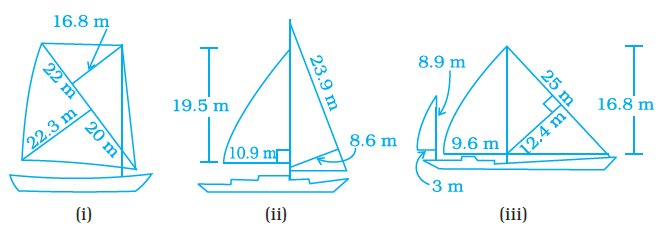
Question 66. Most of the sailboats have two sails, the jib and the mainsail. Assume that the sails are triangles. Find the total area of each sail of the sail boats to the nearest tenth.
Answer:
Boat (i)
Given:
The sail is composed of two triangles sharing a common diagonal.
Common base (diagonal) ($d$) = $42\text{ m}$
Height of the Mainsail (upper triangle) ($h_1$) = $16.8\text{ m}$
Height of the Jib (lower triangle) ($h_2$) = $22.3\text{ m}$
To Find:
The area of each sail to the nearest tenth.
Solution:
We use the formula: $\text{Area of triangle} = \frac{1}{2} \times \text{base} \times \text{height}$
1. Area of the Mainsail:
$\text{Area} = \frac{1}{2} \times 42 \times 16.8$
$\text{Area} = \frac{\cancel{42}^{21}}{\cancel{2}_{1}} \times 16.8$
$\text{Area} = 21 \times 16.8$
$\text{Area} = 352.8\text{ m}^2$
2. Area of the Jib:
$\text{Area} = \frac{1}{2} \times 42 \times 22.3$
$\text{Area} = 21 \times 22.3$
$\text{Area} = 468.3\text{ m}^2$
Boat (ii)
Given:
For the Jib (Left triangle): Base ($b_1$) = $10.9\text{ m}$, Height ($h_1$) = $19.5\text{ m}$
For the Mainsail (Right triangle): Base ($b_2$) = $23.9\text{ m}$, Height ($h_2$) = $8.6\text{ m}$
To Find:
The area of each sail to the nearest tenth.
Solution:
1. Area of the Jib:
$\text{Area} = \frac{1}{2} \times 10.9 \times 19.5$
$\text{Area} = \frac{212.55}{2} = 106.275\text{ m}^2$
To the nearest tenth, Area of Jib $\approx 106.3\text{ m}^2$.
2. Area of the Mainsail:
$\text{Area} = \frac{1}{2} \times 23.9 \times 8.6$
$\text{Area} = 23.9 \times 4.3 = 102.77\text{ m}^2$
To the nearest tenth, Area of Mainsail $\approx 102.8\text{ m}^2$.
Boat (iii)
Given:
For the Jib (Smallest triangle): Base = $3\text{ m}$, Height = $8.9\text{ m}$
For the Mainsail (Composite sail):
Triangle A: Base = $9.6\text{ m}$, Height = $16.8\text{ m}$
Triangle B: Base = $12.4\text{ m}$, Height = $25\text{ m}$ (as indicated by the right angle symbol)
To Find:
The area of each sail to the nearest tenth.
Solution:
1. Area of the Jib:
$\text{Area} = \frac{1}{2} \times 3 \times 8.9 = 13.35\text{ m}^2$
To the nearest tenth, Area of Jib $\approx 13.4\text{ m}^2$.
2. Area of the Mainsail:
$\text{Total Area} = (\text{Area of Triangle A}) + (\text{Area of Triangle B})$
$\text{Total Area} = (\frac{1}{2} \times 9.6 \times 16.8) + (\frac{1}{2} \times 12.4 \times 25)$
$\text{Total Area} = 80.64 + 155 = 235.64\text{ m}^2$
To the nearest tenth, Area of Mainsail $\approx 235.6\text{ m}^2$.
Final Summary of Results:
Boat (i): Mainsail Area = $352.8\text{ m}^2$, Jib Area = $468.3\text{ m}^2$
Boat (ii): Jib Area = $106.3\text{ m}^2$, Mainsail Area = $102.8\text{ m}^2$
Boat (iii): Jib Area = $13.4\text{ m}^2$, Mainsail Area = $235.6\text{ m}^2$
Question 67. The area of a trapezium with equal non-parallel sides is 168 m2. If the lengths of the parallel sides are 36 m and 20 m, find the length of the non-parallel sides.
Answer:
Given:
Area of trapezium = $168\text{ m}^2$
Parallel sides: $a = 36\text{ m}$, $b = 20\text{ m}$
Non-parallel sides are equal.
To Find:
Length of the non-parallel sides.
Construction Required:
Draw perpendiculars from the ends of the top side to the base, dividing the base into three parts: $x$, $20\text{ m}$, and $x$.
Solution:
Area of trapezium = $\frac{1}{2} \times (a + b) \times \text{height}$
$168 = \frac{1}{2} \times (36 + 20) \times h$
$168 = \frac{1}{2} \times 56 \times h$
$168 = 28 \times h$
$h = \frac{168}{28} = 6\text{ m}$
Since it is an isosceles trapezium, the base of the right triangle formed by the height is:
$x = \frac{36 - 20}{2} = \frac{16}{2} = 8\text{ m}$
Using Pythagoras Theorem for the non-parallel side ($s$):
$s^2 = h^2 + x^2$
$s^2 = 6^2 + 8^2$
$s^2 = 36 + 64$
$s^2 = 100$
$s = 10\text{ m}$
Therefore, the length of the non-parallel sides is $10\text{ m}$.
Question 68. Mukesh walks around a circular track of radius 14 m with a speed of 4 km/hr. If he takes 20 rounds of the track, for how long does he walk?
Answer:
Given:
Radius of circular track ($r$) = $14\text{ m}$
Speed = $4\text{ km/hr}$
Number of rounds = $20$
To Find:
Total time taken for 20 rounds.
Solution:
Circumference of the track = $2 \times \pi \times r$
Circumference = $2 \times \frac{22}{7} \times 14 = 88\text{ m}$
Total distance covered in 20 rounds = $20 \times 88 = 1760\text{ m}$
Converting distance to kilometres: $1760\text{ m} = 1.76\text{ km}$
Time = $\frac{\text{Distance}}{\text{Speed}}$
Time = $\frac{1.76}{4} = 0.44\text{ hours}$
Converting hours to minutes: $0.44 \times 60 = 26.4\text{ minutes}$
Converting $0.4$ minutes to seconds: $0.4 \times 60 = 24\text{ seconds}$
Therefore, Mukesh walks for 26 minutes and 24 seconds.
Question 69. The areas of two circles are in the ratio 49:64. Find the ratio of their circumferences.
Answer:
Given:
Ratio of areas of two circles = $49 : 64$
To Find:
Ratio of their circumferences.
Solution:
Let the radii of the two circles be $r_1$ and $r_2$.
$\frac{\text{Area of Circle 1}}{\text{Area of Circle 2}} = \frac{\pi r_1^2}{\pi r_2^2} = \frac{49}{64}$
$\frac{r_1^2}{r_2^2} = \frac{49}{64}$
Taking square root on both sides:
$\frac{r_1}{r_2} = \frac{7}{8}$
Now, Ratio of Circumferences = $\frac{2 \pi r_1}{2 \pi r_2} = \frac{r_1}{r_2}$
Ratio of Circumferences = $\frac{7}{8}$
Therefore, the ratio of their circumferences is $7 : 8$.
Question 70. There is a circular pond and a footpath runs along its boundary. A person walks around it, exactly once keeping close to the edge. If his step is 66 cm long and he takes exactly 400 steps to go around the pond, find the diameter of the pond.
Answer:
Given:
Length of one step = $66\text{ cm}$
Total steps taken = $400$
To Find:
The diameter of the pond.
Solution:
Total distance covered (Circumference) = $\text{Number of steps} \times \text{Length of one step}$
Circumference ($C$) = $400 \times 66 = 26400\text{ cm}$
In metres, $C = \frac{26400}{100} = 264\text{ m}$
We know that, Circumference ($C$) = $\pi \times d$ (where $d$ is the diameter)
$264 = \frac{22}{7} \times d$
$d = \frac{264 \times 7}{22}$
$d = \frac{\cancel{264}^{12} \times 7}{\cancel{22}_{1}}$
$d = 12 \times 7 = 84\text{ m}$
Therefore, the diameter of the pond is $84\text{ m}$.
Question 71. A running track has 2 semicircular ends of radius 63 m and two straight lengths. The perimeter of the track is 1000 m. Find each straight length.
Answer:
Given:
Radius of each semicircular end ($r$) = $63\text{ m}$
Total perimeter of the track = $1000\text{ m}$
To Find:
The length of each straight part of the track.
Construction Required:
The track consists of two parallel straight lengths and two semicircular arcs at the ends.
Solution:
Perimeter of the track = $2 \times (\text{Length of straight part}) + 2 \times (\text{Circumference of semicircle})$
Let the length of each straight part be $L$.
Circumference of one semicircular end = $\pi r$
Circumference = $\frac{22}{7} \times 63$
(Using $\pi = \frac{22}{7}$)
Circumference of one end = $22 \times 9 = 198\text{ m}$
Total distance of both semicircular ends = $2 \times 198 = 396\text{ m}$
According to the question:
$1000 = 2L + 396$
$2L = 1000 - 396$
$2L = 604$
$L = \frac{604}{2}$
$L = 302\text{ m}$
Therefore, the length of each straight part is $302\text{ m}$.
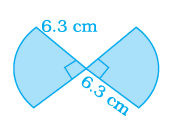
Question 72. Find the perimeter of the given figure.
Answer:
Given:
From the figure and observation, the object consists of two identical sectors.
Radius ($r$) = $6.3\text{ cm}$
Central angle of each sector ($\theta$) = $90^\circ$
To Find:
The total perimeter of the figure.
Solution:
The perimeter of this figure is the sum of the lengths of the 2 curved arcs and the 4 straight radii.
Step 1: Calculate the length of the 2 arcs.
Length of one arc = $\frac{\theta}{360} \times 2\pi r$
Length of one arc = $\frac{90}{360} \times 2 \times \frac{22}{7} \times 6.3$
Length of one arc = $\frac{1}{4} \times 2 \times 22 \times 0.9 = 9.9\text{ cm}$
Total length of 2 arcs = $2 \times 9.9 = 19.8\text{ cm}$
Step 2: Calculate the length of the 4 radii.
Total length of 4 radii = $4 \times r$
Total length of 4 radii = $4 \times 6.3 = 25.2\text{ cm}$
Step 3: Calculate the total perimeter.
Total Perimeter = $\text{Total arc length} + \text{Total radial length}$
Total Perimeter = $19.8 + 25.2 = 45.0\text{ cm}$
Therefore, the total perimeter of the figure is $45\text{ cm}$.
Question 73. A bicycle wheel makes 500 revolutions in moving 1 km. Find the diameter of the wheel.
Answer:
Given:
Total distance covered = $1\text{ km} = 1000\text{ m}$
Total revolutions = $500$
To Find:
The diameter ($d$) of the wheel.
Solution:
Distance covered in one revolution = $\frac{\text{Total Distance}}{\text{Total Revolutions}}$
Distance in 1 revolution = $\frac{1000}{500} = 2\text{ m}$
We know that the distance covered in one revolution is equal to the circumference ($C$) of the wheel.
$C = \pi d$
$2 = \frac{22}{7} \times d$
$d = \frac{2 \times 7}{22} = \frac{14}{22}$
$d = \frac{\cancel{14}^{7}}{\cancel{22}_{11}}\text{ m}$
$d = \frac{7}{11}\text{ m} \approx 0.636\text{ m}$
In centimetres, $d = \frac{7}{11} \times 100 = \frac{700}{11} \approx 63.63\text{ cm}$
Therefore, the diameter of the wheel is approximately $63.63\text{ cm}$.
Question 74. A boy is cycling such that the wheels of the cycle are making 140 revolutions per hour. If the diameter of the wheel is 60 cm, calculate the speed in km/h with which the boy is cycling.
Answer:
Given:
Diameter of the wheel ($d$) = $60\text{ cm} = 0.6\text{ m}$
Number of revolutions = $140\text{ per hour}$
To Find:
Speed of the boy in $\text{km/h}$.
Solution:
Circumference of the wheel = $\pi d$
Circumference = $\frac{22}{7} \times 60 = \frac{1320}{7}\text{ cm}$
Distance covered in 1 hour = $\text{Number of revolutions} \times \text{Circumference}$
Distance = $140 \times \frac{1320}{7}$
Distance = $20 \times 1320 = 26400\text{ cm}$
Now, convert the distance from $\text{cm}$ to $\text{km}$:
$26400\text{ cm} = \frac{26400}{100}\text{ m} = 264\text{ m}$
$264\text{ m} = \frac{264}{1000}\text{ km} = 0.264\text{ km}$
Since this distance is covered in one hour:
$\text{Speed} = 0.264\text{ km/h}$
Therefore, the boy is cycling at a speed of $0.264\text{ km/h}$.
Question 75. Find the length of the largest pole that can be placed in a room of dimensions 12 m × 4 m × 3 m.
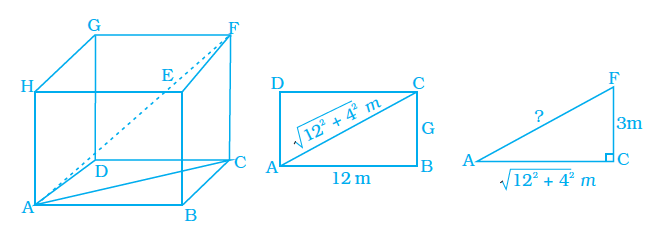
Answer:
Given:
Length ($l$) = $12\text{ m}$
Breadth ($b$) = $4\text{ m}$
Height ($h$) = $3\text{ m}$
To Find:
The length of the largest pole that can fit in the room.
Solution:
The largest pole that can be placed in a rectangular room corresponds to the diagonal of the cuboid.
$\text{Length of diagonal} = \sqrt{l^2 + b^2 + h^2}$
$\text{Diagonal} = \sqrt{12^2 + 4^2 + 3^2}$
$\text{Diagonal} = \sqrt{144 + 16 + 9}$
$\text{Diagonal} = \sqrt{169}$
$\text{Diagonal} = 13\text{ m}$
Therefore, the length of the largest pole is $13\text{ m}$.
Find the area of the following fields. All dimensions are in metres.
Question 76.
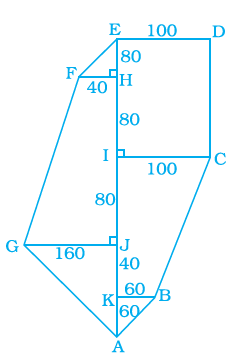
Answer:
Given:
The field is a polygon ABCDEFG. The central spine is AE.
Dimensions along the spine: $AK = 60\text{ m}$, $KJ = 40\text{ m}$, $JI = 80\text{ m}$, $IH = 80\text{ m}$, $HE = 80\text{ m}$.
Perpendicular offsets: $KB = 60\text{ m}$, $IC = 100\text{ m}$, $HD = 100\text{ m}$, $HF = 40\text{ m}$, $JG = 160\text{ m}$.
To Find:
Total area of the field.
Solution:
The total area is the sum of the areas of the individual triangles and trapezia.
1. Area of $\triangle ABK$ (Right side):
$\text{Area} = \frac{1}{2} \times AK \times KB = \frac{1}{2} \times 60 \times 60 = 1800\text{ m}^2$
2. Area of Trapezium $BCIK$ (Right side):
Height = $KJ + JI = 40 + 80 = 120\text{ m}$
$\text{Area} = \frac{1}{2} \times (KB + IC) \times \text{height} = \frac{1}{2} \times (60 + 100) \times 120 $$ = 80 \times 120 = 9600\text{ m}^2$
3. Area of Rectangle $CDEI$ (Right side):
$\text{Area} = IC \times EI = 100 \times 160 = 16000\text{ m}^2$
4. Area of $\triangle AGJ$ (Left side):
Height = $AK + KJ = 60 + 40 = 100\text{ m}$
$\text{Area} = \frac{1}{2} \times \text{height} \times JG = \frac{1}{2} \times 100 \times 160 = 8000\text{ m}^2$
5. Area of Trapezium $GJHF$ (Left side):
Height = $JI + IH = 80 + 80 = 160\text{ m}$
$\text{Area} = \frac{1}{2} \times (JG + HF) \times \text{height} = \frac{1}{2} \times (160 + 40) \times 160 $$ = 100 \times 160 = 16000\text{ m}^2$
6. Area of $\triangle FEH$ (Left side):
$\text{Area} = \frac{1}{2} \times HE \times HF = \frac{1}{2} \times 80 \times 40 = 1600\text{ m}^2$
Total Area:
Total Area = $1800 + 9600 + 16000 + 8000 + 16000 + 1600$
Total Area = $53000\text{ m}^2$
Therefore, the area of the field is $53000\text{ m}^2$.
Question 77.
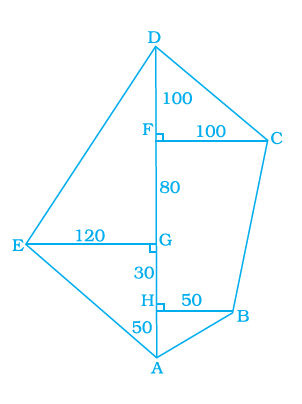
Answer:
Given:
Polygon ABCDE with central spine AD.
Segments along spine: $AH = 50\text{ m}$, $HG = 30\text{ m}$, $GF = 80\text{ m}$, $FD = 100\text{ m}$.
Perpendicular offsets: $HB = 50\text{ m}$, $FC = 100\text{ m}$, $GE = 120\text{ m}$.
To Find:
Total area of the field.
Solution:
1. Area of $\triangle ABH$ (Right side):
$\text{Area} = \frac{1}{2} \times AH \times HB = \frac{1}{2} \times 50 \times 50 = 1250\text{ m}^2$
2. Area of Trapezium $BCFH$ (Right side):
Height = $HG + GF = 30 + 80 = 110\text{ m}$
$\text{Area} = \frac{1}{2} \times (HB + FC) \times \text{height} = \frac{1}{2} \times (50 + 100) \times 110 $$ = 75 \times 110 = 8250\text{ m}^2$
3. Area of $\triangle CDF$ (Right side):
$\text{Area} = \frac{1}{2} \times FD \times FC = \frac{1}{2} \times 100 \times 100 = 5000\text{ m}^2$
4. Area of $\triangle AEG$ (Left side):
Height = $AH + HG = 50 + 30 = 80\text{ m}$
$\text{Area} = \frac{1}{2} \times \text{height} \times GE = \frac{1}{2} \times 80 \times 120 = 4800\text{ m}^2$
5. Area of $\triangle EDG$ (Left side):
Height = $GF + FD = 80 + 100 = 180\text{ m}$
$\text{Area} = \frac{1}{2} \times \text{height} \times GE = \frac{1}{2} \times 180 \times 120 = 10800\text{ m}^2$
Total Area:
Total Area = $1250 + 8250 + 5000 + 4800 + 10800 = 30100\text{ m}^2$
Therefore, the area of the field is $30100\text{ m}^2$.
Find the area of the shaded portion in the following figures.
Question 78.
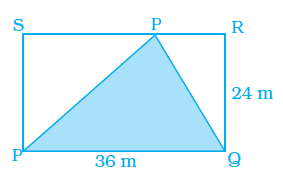
Answer:
Given:
A rectangle PQRS with length $36\text{ m}$ and breadth $24\text{ m}$.
The shaded portion is a triangle with base equal to the length of the rectangle and height equal to the breadth of the rectangle.
To Find:
Area of the shaded portion.
Solution:
Base of the triangle ($b$) = $36\text{ m}$
Height of the triangle ($h$) = $24\text{ m}$
Area of the shaded triangle = $\frac{1}{2} \times \text{base} \times \text{height}$
Area = $\frac{1}{2} \times 36 \times 24$
Area = $18 \times 24 = 432\text{ m}^2$
Therefore, the area of the shaded portion is $432\text{ m}^2$.
Question 79.
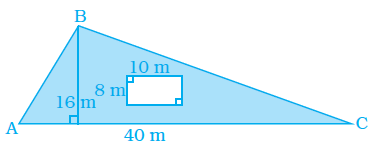
Answer:
Given:
A large triangle ABC with base $40\text{ m}$ and height $16\text{ m}$.
An unshaded rectangular hole with length $10\text{ m}$ and breadth $8\text{ m}$.
To Find:
Area of the shaded portion.
Solution:
Area of shaded portion = Area of triangle ABC $-$ Area of rectangle
Area of triangle ABC = $\frac{1}{2} \times \text{base} \times \text{height}$
Area of triangle ABC = $\frac{1}{2} \times 40 \times 16 = 320\text{ m}^2$
Area of rectangle = $\text{length} \times \text{breadth}$
Area of rectangle = $10 \times 8 = 80\text{ m}^2$
Shaded Area = $320 - 80 = 240\text{ m}^2$
Therefore, the area of the shaded portion is $240\text{ m}^2$.
Question 80.
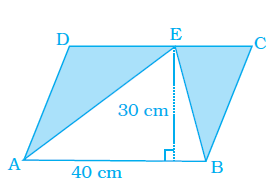
Answer:
Given:
A parallelogram ABCD with base $40\text{ cm}$ and height $30\text{ cm}$.
The unshaded part is a triangle ABE where E lies on the opposite side CD.
To Find:
Area of the shaded portion.
Solution:
Area of the parallelogram = $\text{base} \times \text{height}$
Area of parallelogram = $40 \times 30 = 1200\text{ cm}^2$
The unshaded triangle ABE has the same base and the same height as the parallelogram.
Area of triangle ABE = $\frac{1}{2} \times \text{base} \times \text{height}$
Area of triangle ABE = $\frac{1}{2} \times 40 \times 30 = 600\text{ cm}^2$
Area of shaded portion = $\text{Area of parallelogram} - \text{Area of triangle ABE}$
Area of shaded portion = $1200 - 600 = 600\text{ cm}^2$
Therefore, the area of the shaded portion is $600\text{ cm}^2$.
Question 81.

Answer:
Given:
The figure is a trapezium ABCD with two unshaded parts (a rectangle and a circle) inside it.
Parallel sides of the trapezium: $a = 120\text{ cm}$ and $b = 160\text{ cm}$
Height of the trapezium ($h$) = $100\text{ cm}$
Dimensions of the unshaded rectangle: $40\text{ cm} \times 20\text{ cm}$
Radius of the unshaded circle ($r$) = $7\text{ cm}$
To Find:
Area of the shaded portion.
Solution:
Area of the shaded portion = $\text{Area of trapezium} - (\text{Area of rectangle} + \text{Area of circle})$
1. Area of the trapezium ABCD:
Area = $\frac{1}{2} \times (a + b) \times h$
Area = $\frac{1}{2} \times (120 + 160) \times 100$
Area = $\frac{1}{2} \times 280 \times 100 = 140 \times 100 = 14000\text{ cm}^2$
2. Area of the unshaded rectangle:
Area = $\text{length} \times \text{breadth}$
Area = $40 \times 20 = 800\text{ cm}^2$
3. Area of the unshaded circle:
Area = $\pi r^2$
Area = $\frac{22}{7} \times 7 \times 7 = 22 \times 7 = 154\text{ cm}^2$
4. Area of the shaded portion:
Shaded Area = $14000 - (800 + 154)$
Shaded Area = $14000 - 954 = 13046\text{ cm}^2$
Therefore, the area of the shaded portion is $13046\text{ cm}^2$.
Question 82.
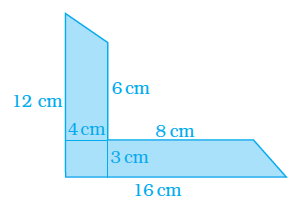
Answer:
Given:
From the figure and the specific breakdown of the composite shape, we have three parts:
1. Vertical Trapezium (Left Part):
Parallel sides are $a_1 = (12 - 3) = 9\text{ cm}$ and $b_1 = 6\text{ cm}$.
Width (Height of this trapezium) $h_1 = 4\text{ cm}$.
2. Middle Rectangle (Corner Part):
Length $l = 4\text{ cm}$ and height $b = 3\text{ cm}$.
3. Horizontal Trapezium (Right Part):
Parallel sides are $a_2 = 8\text{ cm}$ and $b_2 = (16 - 4) = 12\text{ cm}$.
Height of this trapezium $h_2 = 3\text{ cm}$.
To Find:
The total area of the shaded portion.
Solution:
The total area of the shaded portion is the sum of the areas of the two trapezia and the middle rectangle.
Step 1: Area of the Vertical Trapezium (Left)
Area of Trapezium = $\frac{1}{2} \times (\text{sum of parallel sides}) \times \text{height}$
$\text{Area}_1 = \frac{1}{2} \times (9 + 6) \times 4$
$\text{Area}_1 = 15 \times 2$
[By simplifying $\frac{4}{2}$]
$\text{Area}_1 = 30\text{ cm}^2$
Step 2: Area of the Middle Rectangle
Area of Rectangle = $\text{length} \times \text{breadth}$
$\text{Area}_2 = 4 \times 3$
$\text{Area}_2 = 12\text{ cm}^2$
Step 3: Area of the Horizontal Trapezium (Right)
Area of Trapezium = $\frac{1}{2} \times (\text{sum of parallel sides}) \times \text{height}$
$\text{Area}_3 = \frac{1}{2} \times (8 + 12) \times 3$
$\text{Area}_3 = \frac{1}{2} \times 20 \times 3$
$\text{Area}_3 = 10 \times 3$
[By simplifying $\frac{20}{2}$]
$\text{Area}_3 = 30\text{ cm}^2$
Step 4: Total Area of the Shaded Portion
Total Area = $\text{Area}_1 + \text{Area}_2 + \text{Area}_3$
Total Area = $30 + 12 + 30$
Total Area = $72\text{ cm}^2$
Final Answer:
The total area of the shaded portion is $72\text{ cm}^2$.
Question 83.
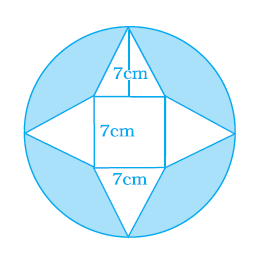
Answer:
Given:
The figure consists of a shaded circle with unshaded internal parts: a central square and four triangles.
Side of the inner square = $7\text{ cm}$
Height of each triangle = $7\text{ cm}$, Base of each triangle = $7\text{ cm}$
The tip of each triangle touches the circumference of the circle.
To Find:
Area of the shaded portion.
Solution:
1. Finding the radius of the circle ($R$):
The distance from the center of the square to the tip of the triangle is the radius.
$R = (\text{Half of square side}) + \text{Height of triangle}$
$R = \frac{7}{2} + 7 = 3.5 + 7 = 10.5\text{ cm}$
2. Area of the circle:
Area = $\pi R^2 = \frac{22}{7} \times 10.5 \times 10.5$
Area = $22 \times 1.5 \times 10.5 = 33 \times 10.5 = 346.5\text{ cm}^2$
3. Area of unshaded parts:
Area of square = $7 \times 7 = 49\text{ cm}^2$
Area of 4 triangles = $4 \times (\frac{1}{2} \times \text{base} \times \text{height})$
Area of 4 triangles = $4 \times (\frac{1}{2} \times 7 \times 7) = 2 \times 49 = 98\text{ cm}^2$
Total unshaded area = $49 + 98 = 147\text{ cm}^2$
4. Area of the shaded portion:
Shaded Area = $\text{Area of circle} - \text{Total unshaded area}$
Shaded Area = $346.5 - 147 = 199.5\text{ cm}^2$
Therefore, the area of the shaded portion is $199.5\text{ cm}^2$.
Question 84.
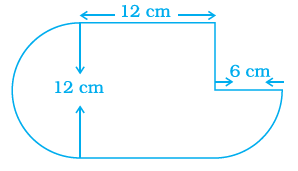
Answer:
Given:
According to the figure and the specific logic provided:
1. Dimensions of the rectangle part: Length ($l$) = $12\text{ cm}$, Breadth ($b$) = $12\text{ cm}$.
2. Radius of the semicircle and the quadrant ($r$) = $6\text{ cm}$ (since the total height is $12\text{ cm}$).
To Find:
The total area of the figure based on the provided logic.
Solution:
The total area is calculated using the following formula:
$\text{Total Area} = \text{Area of rectangle} + \text{Area of 2 semicircles} $$ - \text{Half of area of 1 semicircle}$
Step 1: Calculate the area of the rectangle
$\text{Area of rectangle} = l \times b = 12 \times 12$
$\text{Area of rectangle} = 144\text{ cm}^2$
Step 2: Calculate the area of 2 semicircles
Area of one semicircle = $\frac{1}{2} \pi r^2$
Area of two semicircles = $2 \times \left( \frac{1}{2} \times \pi \times 6^2 \right)$
Area of two semicircles = $36\pi\text{ cm}^2$
Step 3: Calculate the area of half of 1 semicircle (Quadrant)
Area of half a semicircle = $\frac{1}{2} \times \left( \frac{1}{2} \times \pi \times 6^2 \right)$
Area of half a semicircle = $\frac{1}{4} \times \pi \times 36$
Area of half a semicircle = $9\pi\text{ cm}^2$
Step 4: Calculate the final total area
Total Area = $144 + 36\pi - 9\pi$
Total Area = $144 + 27\pi$
Taking the value of $\pi = 3.14$:
Total Area = $144 + (27 \times 3.14)$
Total Area = $144 + 84.78$
Total Area = $228.78\text{ cm}^2$
Final Answer:
The total area of the figure is $228.78\text{ cm}^2$.
Question 85.
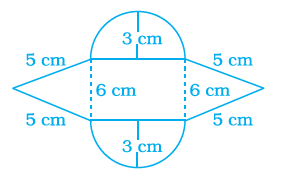
Answer:
Given:
The figure consists of a central square/rectangle, two identical triangles on the sides, and two identical semicircles on top and bottom.
The central square side = $6\text{ cm}$
Slant height of the triangles = $5\text{ cm}$
Vertical height of the semicircle = $3\text{ cm}$ (Radius = $3\text{ cm}$, so Diameter = $6\text{ cm}$)
To Find:
Total area of the figure.
Solution:
1. Area of the two semicircles:
Two semicircles together make one full circle with radius $r = 3\text{ cm}$.
Area = $\pi r^2 = 3.14 \times 3^2 = 3.14 \times 9 = 28.26\text{ cm}^2$
2. Area of the central square:
Area = $\text{side} \times \text{side} = 6 \times 6 = 36\text{ cm}^2$
3. Area of the two triangles:
First, find the base ($b$) of each triangle using Pythagoras theorem.
Half the side of the square = $3\text{ cm}$ (this is the vertical part of the triangle).
$b^2 + 3^2 = 5^2$
$b^2 + 9 = 25 \Rightarrow b^2 = 16 \Rightarrow b = 4\text{ cm}$
Area of one triangle = $\frac{1}{2} \times \text{base} \times \text{height (full side of square)}$
Area of two triangles = $2 \times (\frac{1}{2} \times 4 \times 6) = 24\text{ cm}^2$
4. Total Area:
Total Area = $\text{Area of circle} + \text{Area of square} + \text{Area of triangles}$
Total Area = $28.26 + 36 + 24 = 88.26\text{ cm}^2$
Therefore, the total area of the figure is $88.26\text{ cm}^2$.
Question 86. Find the volume of each of the given figure if volume = base area × height.

Answer:
Figure (a)
Given:
The figure is a triangular prism.
Base of the triangular face = $\frac{x}{2}$
Height of the triangular face = $x$
Height of the prism = $2x$
Solution:
First, we find the Base Area (Area of the triangle):
$\text{Base Area} = \frac{1}{2} \times \text{base} \times \text{height}$
$\text{Base Area} = \frac{1}{2} \times \frac{x}{2} \times x = \frac{x^2}{4}$
Now, Volume of the figure:
$\text{Volume} = \text{Base Area} \times \text{Height of prism}$
$\text{Volume} = \frac{x^2}{4} \times 2x$
$\text{Volume} = \frac{\cancel{2}x^3}{\cancel{4}_2} = \frac{x^3}{2}$
Figure (b)
Given:
The figure is a cuboid.
Length = $3y$, Breadth = $y$, Height = $2y$
Solution:
$\text{Base Area} = \text{Length} \times \text{Breadth} = 3y \times y = 3y^2$
$\text{Volume} = \text{Base Area} \times \text{Height}$
$\text{Volume} = 3y^2 \times 2y = 6y^3$
Figure (c)
Given:
The figure is a regular hexagonal prism.
Side of the hexagon = $2p$
Height of the prism = $2p$ (assuming the dimension applies to height as well based on the symmetry of the problem type)
Solution:
Area of a regular hexagon = $6 \times \frac{\sqrt{3}}{4} \times (\text{side})^2$
$\text{Base Area} = 6 \times \frac{\sqrt{3}}{4} \times (2p)^2$
$\text{Base Area} = 6 \times \frac{\sqrt{3}}{4} \times 4p^2 = 6\sqrt{3}p^2$
$\text{Volume} = \text{Base Area} \times \text{Height}$
$\text{Volume} = 6\sqrt{3}p^2 \times 2p = 12\sqrt{3}p^3$
Question 87. A cube of side 5 cm is cut into as many 1 cm cubes as possible. What is the ratio of the surface area of the original cube to that of the sum of the surface areas of the smaller cubes?
Answer:
Given:
Side of the original large cube ($S$) = $5\text{ cm}$
Side of each smaller cube ($s$) = $1\text{ cm}$
To Find:
Ratio of the surface area of the original cube to the sum of the surface areas of all smaller cubes.
Solution:
Step 1: Calculate the number of smaller cubes.
$\text{Number of cubes} = \frac{\text{Volume of large cube}}{\text{Volume of small cube}}$
$\text{Number of cubes} = \frac{5 \times 5 \times 5}{1 \times 1 \times 1} = 125$
Step 2: Calculate the Surface Area of the original cube.
$\text{Surface Area (Original)} = 6 \times S^2$
$\text{Surface Area (Original)} = 6 \times 5^2 = 6 \times 25 = 150\text{ cm}^2$
Step 3: Calculate the sum of Surface Areas of all 125 smaller cubes.
$\text{Surface Area of 1 small cube} = 6 \times s^2 = 6 \times 1^2 = 6\text{ cm}^2$
$\text{Total Surface Area of 125 cubes} = 125 \times 6 = 750\text{ cm}^2$
Step 4: Find the ratio.
$\text{Ratio} = \frac{150}{750}$
$\text{Ratio} = \frac{\cancel{150}^1}{\cancel{750}_5} = 1 : 5$
Therefore, the required ratio is $1 : 5$.
Question 88. A square sheet of paper is converted into a cylinder by rolling it along its side. What is the ratio of the base radius to the side of the square?
Answer:
Given:
A square sheet of paper with side $a$. It is rolled along its side to form a cylinder.
To Find:
The ratio of the base radius ($r$) to the side ($a$).
Solution:
When the square sheet is rolled along its side, the side of the square becomes the circumference of the cylinder's base.
$\text{Circumference} = \text{Side of square}$
(By rolling)
$2\pi r = a$
To find the ratio of radius ($r$) to side ($a$), we rearrange the equation:
$\frac{r}{a} = \frac{1}{2\pi}$
Therefore, the ratio of the base radius to the side of the square is $1 : 2\pi$.
Question 89. How many cubic metres of earth must be dug to construct a well 7 m deep and of diameter 2.8 m?
Answer:
Given:
Depth of the well ($h$) = $7\text{ m}$
Diameter of the well ($d$) = $2.8\text{ m}$
Radius ($r$) = $\frac{2.8}{2} = 1.4\text{ m}$
To Find:
Volume of earth to be dug (Volume of the cylinder).
Solution:
Volume of a cylinder = $\pi r^2 h$
$\text{Volume} = \frac{22}{7} \times 1.4 \times 1.4 \times 7$
$\text{Volume} = 22 \times (1.4 \times 1.4)$
$\text{Volume} = 22 \times 1.96$
$\text{Volume} = 43.12\text{ m}^3$
Therefore, $43.12\text{ cubic metres}$ of earth must be dug.
Question 90. The radius and height of a cylinder are in the ratio 3:2 and its volume is 19,404 cm3. Find its radius and height.
Answer:
Given:
Ratio of radius to height ($r : h$) = $3 : 2$
Volume of the cylinder = $19404\text{ cm}^3$
To Find:
Radius ($r$) and height ($h$).
Solution:
Let the radius be $3x$ and the height be $2x$.
$\text{Volume of cylinder} = \pi r^2 h$
$19404 = \frac{22}{7} \times (3x)^2 \times (2x)$
$19404 = \frac{22}{7} \times 9x^2 \times 2x$
$19404 = \frac{396}{7} x^3$
$x^3 = \frac{19404 \times 7}{396}$
$x^3 = 49 \times 7$
$x^3 = 343$
$x = \sqrt[3]{343} = 7$
Now, we calculate the dimensions:
$\text{Radius } (r) = 3x = 3 \times 7 = 21\text{ cm}$
$\text{Height } (h) = 2x = 2 \times 7 = 14\text{ cm}$
Therefore, the radius is $21\text{ cm}$ and the height is $14\text{ cm}$.
Question 91. The thickness of a hollow metallic cylinder is 2 cm. It is 70 cm long with outer radius of 14 cm. Find the volume of the metal used in making the cylinder, assuming that it is open at both the ends. Also find its weight if the metal weighs 8 g per cm3.
Answer:
Given:
Outer radius of the cylinder ($R$) = $14\text{ cm}$
Thickness of the metal = $2\text{ cm}$
Length (Height) of the cylinder ($h$) = $70\text{ cm}$
Density of the metal = $8\text{ g/cm}^3$
To Find:
Volume of the metal used and the total weight of the cylinder.
Construction Required:
Solution:
First, we find the inner radius ($r$) of the hollow cylinder:
$r = R - \text{thickness}$
$r = 14 - 2 = 12\text{ cm}$
The volume of the metal used is the difference between the outer volume and the inner volume.
$\text{Volume of metal} = \pi R^2 h - \pi r^2 h$
$\text{Volume of metal} = \pi h (R^2 - r^2)$
$\text{Volume of metal} = \frac{22}{7} \times 70 \times (14^2 - 12^2)$
$\text{Volume of metal} = 22 \times 10 \times (196 - 144)$
$\text{Volume of metal} = 220 \times 52$
$\text{Volume of metal} = 11440\text{ cm}^3$
Now, we find the weight of the metal:
$\text{Weight} = \text{Volume} \times \text{Density}$
$\text{Weight} = 11440 \times 8$
$\text{Weight} = 91520\text{ g}$
Converting weight into kilograms ($1\text{ kg} = 1000\text{ g}$):
$\text{Weight} = \frac{91520}{1000} = 91.52\text{ kg}$
Therefore, the volume of the metal used is $11440\text{ cm}^3$ and its weight is $91.52\text{ kg}$.
Question 92. Radius of a cylinder is r and the height is h. Find the change in the volume if the
(a) height is doubled.
(b) height is doubled and the radius is halved.
(c) height remains same and the radius is halved.
Answer:
Given:
Initial radius = $r$
Initial height = $h$
Initial Volume ($V$) = $\pi r^2 h$
Solution:
(a) If height is doubled:
New height ($h'$) = $2h$, Radius remains $r$.
New Volume ($V_a$) = $\pi \times r^2 \times (2h) = 2(\pi r^2 h) = 2V$
The volume is doubled.
(b) If height is doubled and radius is halved:
New height ($h'$) = $2h$, New radius ($r'$) = $\frac{r}{2}$.
New Volume ($V_b$) = $\pi \times (\frac{r}{2})^2 \times (2h)$
$V_b = \pi \times \frac{r^2}{4} \times 2h = \frac{1}{2} (\pi r^2 h) = \frac{1}{2} V$
The volume becomes half of the original volume.
(c) If height remains same and radius is halved:
New height remains $h$, New radius ($r'$) = $\frac{r}{2}$.
New Volume ($V_c$) = $\pi \times (\frac{r}{2})^2 \times h$
$V_c = \pi \times \frac{r^2}{4} \times h = \frac{1}{4} (\pi r^2 h) = \frac{1}{4} V$
The volume becomes one-fourth of the original volume.
Question 93. If the length of each edge of a cube is tripled, what will be the change in its volume?
Answer:
Given:
Let the original edge of the cube be $a$.
Original Volume ($V$) = $a^3$
Solution:
According to the question, the new edge is tripled.
New edge ($a'$) = $3a$
New Volume ($V'$) = $(a')^3 = (3a)^3$
$V' = 27 a^3$
Comparing with the original volume:
$V' = 27 \times V$
Therefore, the volume of the cube becomes 27 times the original volume.
Question 94. A carpenter makes a box which has a volume of 13,400 cm3. The base has an area of 670 cm2. What is the height of the box?
Answer:
Given:
Volume of the box ($V$) = $13400\text{ cm}^3$
Base Area of the box ($A$) = $670\text{ cm}^2$
To Find:
The height ($h$) of the box.
Solution:
We know that the volume of a cuboidal box is given by:
$\text{Volume} = \text{Base Area} \times \text{Height}$
$13400 = 670 \times h$
$h = \frac{13400}{670}$
$h = \frac{1340}{67}$
$h = 20\text{ cm}$
Therefore, the height of the box is $20\text{ cm}$.
Question 95. A cuboidal tin box opened at the top has dimensions 20 cm × 16 cm × 14 cm. What is the total area of metal sheet required to make 10 such boxes?
Answer:
Given:
Length ($l$) = $20\text{ cm}$
Breadth ($b$) = $16\text{ cm}$
Height ($h$) = $14\text{ cm}$
The box is open at the top.
To Find:
Total area of metal sheet for 10 such boxes.
Solution:
Area of metal sheet for one box = Area of 4 walls + Area of the base
Area = $2h(l + b) + (l \times b)$
Area = $2 \times 14 \times (20 + 16) + (20 \times 16)$
Area = $28 \times 36 + 320$
Area = $1008 + 320$
Area = $1328\text{ cm}^2$
Now, for 10 such boxes:
Total Area = $10 \times 1328 = 13280\text{ cm}^2$
Therefore, the total area of metal sheet required is $13280\text{ cm}^2$.
Question 96. Find the capacity of water tank, in litres, whose dimensions are 4.2 m, 3 m and 1.8 m?
Answer:
Given:
Length of the tank ($l$) = $4.2\text{ m}$
Breadth of the tank ($b$) = $3\text{ m}$
Height of the tank ($h$) = $1.8\text{ m}$
To Find:
Capacity of the water tank in litres.
Solution:
First, we find the volume of the tank in cubic metres.
$\text{Volume} = l \times b \times h$
$\text{Volume} = 4.2 \times 3 \times 1.8$
$\text{Volume} = 12.6 \times 1.8 = 22.68\text{ m}^3$
We know the conversion from cubic metres to litres:
$1\text{ m}^3 = 1000\text{ litres}$
(Standard Unit conversion)
$\text{Capacity in litres} = 22.68 \times 1000$
$\text{Capacity in litres} = 22680\text{ litres}$
Therefore, the capacity of the water tank is $22680\text{ litres}$.
Question 97. How many cubes each of side 0.5 cm are required to build a cube of volume 8 cm3 ?
Answer:
Given:
Side of the small cube ($s$) = $0.5\text{ cm}$
Volume of the required larger cube ($V$) = $8\text{ cm}^3$
To Find:
Number of small cubes required.
Solution:
First, we calculate the volume of one small cube.
$\text{Volume of one small cube} = s^3 = (0.5)^3$
$\text{Volume of one small cube} = 0.5 \times 0.5 \times 0.5 = 0.125\text{ cm}^3$
Now, to find the number of cubes:
$\text{Number of cubes} = \frac{\text{Total Volume}}{\text{Volume of one small cube}}$
$\text{Number of cubes} = \frac{8}{0.125}$
$\text{Number of cubes} = \frac{8000}{125}$
$\text{Number of cubes} = 64$
Therefore, $64$ small cubes are required to build the larger cube.
Question 98. A wooden box (including the lid) has external dimensions 40 cm by 34 cm by 30 cm. If the wood is 1 cm thick, how many cm3 of wood is used in it?
Answer:
Given:
External length ($L$) = $40\text{ cm}$
External breadth ($B$) = $34\text{ cm}$
External height ($H$) = $30\text{ cm}$
Thickness of wood ($t$) = $1\text{ cm}$
To Find:
Volume of wood used to make the box.
Solution:
Step 1: Calculate External Volume ($V_{ext}$)
$V_{ext} = L \times B \times H$
$V_{ext} = 40 \times 34 \times 30 = 40800\text{ cm}^3$
Step 2: Calculate Internal Dimensions and Internal Volume ($V_{int}$)
Internal dimensions are found by subtracting twice the thickness from each external dimension.
Internal length ($l$) = $40 - (2 \times 1) = 38\text{ cm}$
Internal breadth ($b$) = $34 - (2 \times 1) = 32\text{ cm}$
Internal height ($h$) = $30 - (2 \times 1) = 28\text{ cm}$
$V_{int} = l \times b \times h = 38 \times 32 \times 28 = 34048\text{ cm}^3$
Step 3: Calculate Volume of Wood Used
$\text{Volume of wood} = V_{ext} - V_{int}$
$\text{Volume of wood} = 40800 - 34048$
$\text{Volume of wood} = 6752\text{ cm}^3$
Therefore, the volume of wood used is $6752\text{ cm}^3$.
Question 99. A river 2 m deep and 45 m wide is flowing at the rate of 3 km per hour. Find the amount of water in cubic metres that runs into the sea per minute.
Answer:
Given:
Depth of river ($h$) = $2\text{ m}$
Width of river ($b$) = $45\text{ m}$
Rate of flow (Speed) = $3\text{ km/h}$
To Find:
Amount of water (Volume) running into the sea per minute.
Solution:
First, we convert the rate of flow into metres per minute.
$\text{Speed} = 3\text{ km/h} = \frac{3 \times 1000\text{ m}}{60\text{ min}}$
$\text{Speed} = \frac{3000}{60} = 50\text{ m/min}$
The length of water flowing in 1 minute ($l$) is $50\text{ m}$.
Now, the volume of water running into the sea per minute is:
$\text{Volume} = l \times b \times h$
$\text{Volume} = 50 \times 45 \times 2$
$\text{Volume} = 100 \times 45 = 4500\text{ m}^3$
Therefore, $4500\text{ cubic metres}$ of water runs into the sea per minute.
Question 100. Find the area to be painted in the following block with a cylindrical hole. Given that length is 15 cm, width 12 cm, height 20 cm and radius of the hole 2.8 cm.

Answer:
Given:
Length of the block ($L$) = $15\text{ cm}$
Width of the block ($W$) = $12\text{ cm}$
Height of the block ($H$) = $20\text{ cm}$
Radius of the cylindrical hole ($r$) = $2.8\text{ cm}$
To Find:
Total surface area to be painted.
Solution:
The total area to be painted includes the external surface area of the cuboid (excluding the two circular openings of the hole) plus the internal curved surface area of the cylindrical hole.
Step 1: Total Surface Area (TSA) of the cuboid
$\text{TSA of cuboid} = 2(LW + WH + HL)$
$\text{TSA} = 2(15 \times 12 + 12 \times 20 + 20 \times 15)$
$\text{TSA} = 2(180 + 240 + 300) = 2 \times 720 = 1440\text{ cm}^2$
Step 2: Area of the two circular openings
$\text{Area} = 2 \times \pi r^2 = 2 \times \frac{22}{7} \times 2.8 \times 2.8$
$\text{Area} = 2 \times 22 \times 0.4 \times 2.8 = 49.28\text{ cm}^2$
Step 3: Curved Surface Area (CSA) of the inner cylinder
$\text{CSA} = 2\pi rH = 2 \times \frac{22}{7} \times 2.8 \times 20$
$\text{CSA} = 2 \times 22 \times 0.4 \times 20 = 352\text{ cm}^2$
Step 4: Total Area to be painted
$\text{Area} = \text{TSA of cuboid} - \text{Area of openings} + \text{CSA of inner hole}$
$\text{Area} = 1440 - 49.28 + 352$
$\text{Area} = 1792 - 49.28 = 1742.72\text{ cm}^2$
Therefore, the total area to be painted is $1742.72\text{ cm}^2$.
Question 101. A truck carrying 7.8 m3 concrete arrives at a job site. A platform of width 5 m and height 2 m is being contructed at the site. Find the length of the platform, constructed from the amount of concrete on the truck?
Answer:
Given:
Volume of concrete ($V$) = $7.8\text{ m}^3$
Width of the platform ($w$) = $5\text{ m}$
Height of the platform ($h$) = $2\text{ m}$
To Find:
The length ($l$) of the platform.
Solution:
We know that the volume of a rectangular platform is given by the formula:
$\text{Volume} = \text{length} \times \text{width} \times \text{height}$
Substituting the given values:
$7.8 = l \times 5 \times 2$
$7.8 = l \times 10$
$l = \frac{7.8}{10}$
$l = 0.78\text{ m}$
To express it in centimetres:
$l = 0.78 \times 100 = 78\text{ cm}$
Therefore, the length of the platform is $0.78\text{ m}$ or $78\text{ cm}$.
Question 102. A hollow garden roller of 42 cm diameter and length 152 cm is made of cast iron 2 cm thick. Find the volume of iron used in the roller.
Answer:
Given:
Outer diameter of the roller ($D$) = $42\text{ cm}$
Outer radius ($R$) = $\frac{42}{2} = 21\text{ cm}$
Thickness of iron ($t$) = $2\text{ cm}$
Length (Height) of the roller ($h$) = $152\text{ cm}$
To Find:
Volume of iron used in the roller.
Solution:
First, we find the inner radius ($r$):
$r = \text{Outer radius} - \text{Thickness}$
$r = 21 - 2 = 19\text{ cm}$
The volume of iron used is the difference between the outer and inner volumes of the cylinder:
$\text{Volume of iron} = \pi R^2 h - \pi r^2 h$
$\text{Volume of iron} = \pi h (R^2 - r^2)$
Using the identity $a^2 - b^2 = (a - b)(a + b)$:
$\text{Volume} = \frac{22}{7} \times 152 \times (21 - 19)(21 + 19)$
$\text{Volume} = \frac{22}{7} \times 152 \times 2 \times 40$
$\text{Volume} = \frac{22 \times 152 \times 80}{7}$
$\text{Volume} = \frac{267520}{7}$
$\text{Volume} \approx 38217.14\text{ cm}^3$
Therefore, the volume of iron used is approximately $38217.14\text{ cm}^3$.
Question 103. Three cubes each of side 10 cm are joined end to end. Find the surface area of the resultant figure.
Answer:
Given:
Side of each cube ($a$) = $10\text{ cm}$
Three cubes are joined end to end.
To Find:
Total surface area of the resultant cuboid.
Construction Required:
Solution:
When three cubes are joined end to end, the dimensions of the resulting cuboid are:
Length ($l$) = $10 + 10 + 10 = 30\text{ cm}$
Breadth ($b$) = $10\text{ cm}$
Height ($h$) = $10\text{ cm}$
Total Surface Area of the cuboid is given by:
$\text{Surface Area} = 2(lb + bh + hl)$
$\text{Surface Area} = 2(30 \times 10 + 10 \times 10 + 10 \times 30)$
$\text{Surface Area} = 2(300 + 100 + 300)$
$\text{Surface Area} = 2 \times 700 = 1400\text{ cm}^2$
Therefore, the surface area of the resultant figure is $1400\text{ cm}^2$.
Question 104. Below are the drawings of cross sections of two different pipes used to fill swimming pools. Figure A is a combination of 2 pipes each having a radius of 8 cm. Figure B is a pipe having a radius of 15 cm. If the force of the flow of water coming out of the pipes is the same in both the cases, which will fill the swimming pool faster?
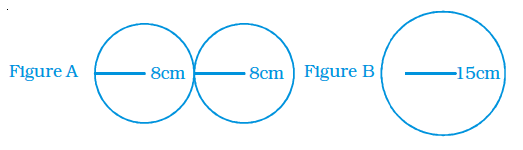
Answer:
Given:
Figure A: Two pipes, each with radius $r_A = 8\text{ cm}$.
Figure B: One pipe with radius $r_B = 15\text{ cm}$.
Flow force is same in both cases.
To Find:
Which configuration fills the pool faster (requires finding which has a greater cross-sectional area).
Solution:
The rate at which water fills the pool is directly proportional to the total cross-sectional area of the pipes.
Step 1: Calculate total area for Figure A
$\text{Area of one pipe} = \pi r^2 = \pi \times (8)^2 = 64\pi\text{ cm}^2$
$\text{Total Area (Figure A)} = 2 \times 64\pi = 128\pi\text{ cm}^2$
Step 2: Calculate total area for Figure B
$\text{Total Area (Figure B)} = \pi \times (15)^2 = 225\pi\text{ cm}^2$
Step 3: Comparison
Comparing the two areas:
$225\pi\text{ cm}^2 > 128\pi\text{ cm}^2$
$\text{Area of Figure B} > \text{Area of Figure A}$
Therefore, the pipe in Figure B will fill the swimming pool faster because it has a larger cross-sectional area.
Question 105. A swimming pool is 200 m by 50 m and has an average depth of 2 m. By the end of a summer day, the water level drops by 2 cm. How many cubic metres of water is lost on the day?
Answer:
Given:
Length of the pool ($l$) = $200\text{ m}$
Breadth of the pool ($b$) = $50\text{ m}$
Drop in water level ($h$) = $2\text{ cm} = \frac{2}{100}\text{ m} = 0.02\text{ m}$
To Find:
The volume of water lost in cubic metres ($m^3$).
Solution:
The volume of water lost is the volume of the rectangular layer of water that has evaporated or dropped.
$\text{Volume lost} = \text{Length} \times \text{Breadth} \times \text{Drop in level}$
$\text{Volume lost} = 200 \times 50 \times 0.02$
$\text{Volume lost} = 10000 \times 0.02$
$\text{Volume lost} = 200\text{ m}^3$
Therefore, $200\text{ cubic metres}$ of water is lost on that day.
Question 106. A housing society consisting of 5,500 people needs 100 L of water per person per day. The cylindrical supply tank is 7 m high and has a diameter 10 m. For how many days will the water in the tank last for the society?
Answer:
Given:
Total number of people = $5500$
Water needed per person = $100\text{ L}$
Height of the tank ($h$) = $7\text{ m}$
Diameter of the tank = $10\text{ m}$
Radius of the tank ($r$) = $5\text{ m}$
(Radius = Diameter / 2)
To Find:
Number of days the water in the tank will last.
Solution:
Step 1: Calculate daily water requirement of the society.
Total water needed per day = $5500 \times 100\text{ L}$
Total water needed per day = $5,50,000\text{ L}$
Step 2: Calculate the capacity of the cylindrical tank.
Volume of the tank = $\pi r^2 h$
Volume = $\frac{22}{7} \times 5 \times 5 \times 7$
Volume = $22 \times 25 = 550\text{ m}^3$
Converting the volume to litres ($1\text{ m}^3 = 1000\text{ L}$):
Capacity of the tank = $550 \times 1000 = 5,50,000\text{ L}$
Step 3: Calculate the number of days.
$\text{Number of days} = \frac{\text{Capacity of the tank}}{\text{Daily requirement}}$
$\text{Number of days} = \frac{5,50,000}{5,50,000} = 1$
Therefore, the water in the tank will last for 1 day.
Question 107. Metallic discs of radius 0.75 cm and thickness 0.2 cm are melted to obtain 508.68 cm3 of metal. Find the number of discs melted (use π = 3.14).
Answer:
Given:
Radius of each disc ($r$) = $0.75\text{ cm}$
Thickness of each disc ($h$) = $0.2\text{ cm}$
Total volume of metal = $508.68\text{ cm}^3$
To Find:
Number of discs melted.
Solution:
A disc is cylindrical in shape. Volume of one disc = $\pi r^2 h$
Volume of one disc = $3.14 \times (0.75)^2 \times 0.2$
Volume of one disc = $3.14 \times 0.5625 \times 0.2$
Volume of one disc = $0.35325\text{ cm}^3$
Now, to find the number of discs:
$\text{Number of discs} = \frac{\text{Total volume of metal}}{\text{Volume of one disc}}$
$\text{Number of discs} = \frac{508.68}{0.35325}$
$\text{Number of discs} = 1440$
Therefore, $1440$ metallic discs were melted.
Question 108. The ratio of the radius and height of a cylinder is 2:3. If its volume is 12,936 cm3, find the total surface area of the cylinder.
Answer:
Given:
Ratio of radius to height ($r:h$) = $2:3$
Volume of the cylinder = $12936\text{ cm}^3$
To Find:
Total Surface Area (TSA) of the cylinder.
Solution:
Let the radius ($r$) be $2x$ and the height ($h$) be $3x$.
Volume of a cylinder = $\pi r^2 h$
$12936 = \frac{22}{7} \times (2x)^2 \times 3x$
$12936 = \frac{22}{7} \times 4x^2 \times 3x$
$12936 = \frac{22 \times 12}{7} x^3$
$x^3 = \frac{12936 \times 7}{264}$
$x^3 = 49 \times 7 = 343$
$x = \sqrt[3]{343} = 7$
So, Radius ($r$) = $2 \times 7 = 14\text{ cm}$
Height ($h$) = $3 \times 7 = 21\text{ cm}$
Now, Total Surface Area (TSA) = $2\pi r (r + h)$
$\text{TSA} = 2 \times \frac{22}{7} \times 14 \times (14 + 21)$
$\text{TSA} = 44 \times 2 \times 35$
$\text{TSA} = 88 \times 35 = 3080\text{ cm}^2$
Therefore, the total surface area of the cylinder is $3080\text{ cm}^2$.
Question 109. External dimensions of a closed wooden box are in the ratio 5 : 4 : 3. If the cost of painting its outer surface at the rate of Rs 5 per dm2 is Rs 11,750, find the dimensions of the box.
Answer:
Given:
Ratio of dimensions ($l:b:h$) = $5:4:3$
Total cost of painting = $\textsf{₹} 11750$
Rate of painting = $\textsf{₹} 5/\text{dm}^2$
To Find:
The dimensions of the box (Length, Breadth, and Height).
Solution:
First, we find the total surface area painted.
$\text{Total Surface Area (TSA)} = \frac{\text{Total Cost}}{\text{Rate}}$
$\text{TSA} = \frac{11750}{5} = 2350\text{ dm}^2$
Let the dimensions be $l = 5x$, $b = 4x$, and $h = 3x$ (in dm).
Formula for TSA of a closed box = $2(lb + bh + hl)$
$2350 = 2( (5x \times 4x) + (4x \times 3x) + (3x \times 5x) )$
$2350 = 2( 20x^2 + 12x^2 + 15x^2 )$
$1175 = 47x^2$
$x^2 = \frac{1175}{47} = 25$
$x = \sqrt{25} = 5$
Now, calculate the dimensions:
Length ($l$) = $5 \times 5 = 25\text{ dm}$
Breadth ($b$) = $4 \times 5 = 20\text{ dm}$
Height ($h$) = $3 \times 5 = 15\text{ dm}$
Therefore, the dimensions of the box are $25\text{ dm}, 20\text{ dm, and } 15\text{ dm}$.
Question 110. The capacity of a closed cylindrical vessel of height 1 m is 15.4 L. How many square metres of metal sheet would be needed to make it?
Answer:
Given:
Height of the vessel ($h$) = $1\text{ m}$
Capacity of the vessel = $15.4\text{ L}$
To Find:
Total area of the metal sheet ($TSA$) required in square metres.
Solution:
First, we convert the capacity into cubic metres.
$1000\text{ L} = 1\text{ m}^3 \Rightarrow 1\text{ L} = 0.001\text{ m}^3$
Volume ($V$) = $15.4 \times 0.001 = 0.0154\text{ m}^3$
We know that $V = \pi r^2 h$
$0.0154 = \frac{22}{7} \times r^2 \times 1$
$r^2 = \frac{0.0154 \times 7}{22}$
$r^2 = 0.0007 \times 7 = 0.0049$
$r = \sqrt{0.0049} = 0.07\text{ m}$
Now, calculate the area of the metal sheet needed (TSA of closed cylinder):
$\text{TSA} = 2\pi r (r + h)$
$\text{TSA} = 2 \times \frac{22}{7} \times 0.07 \times (0.07 + 1)$
$\text{TSA} = 44 \times 0.01 \times 1.07$
$\text{TSA} = 0.44 \times 1.07 = 0.4708\text{ m}^2$
Therefore, $0.4708\text{ m}^2$ of metal sheet would be needed.
Question 111. What will happen to the volume of the cube, if its edge is
(a) tripled
(b) reduced to one-fourth?
Answer:
Given:
Let the original edge of the cube be $a$.
Original volume of the cube ($V$) = $a^3$.
Solution:
(a) If the edge is tripled:
New edge ($a'$) = $3a$
New volume ($V'$) = $(a')^3 = (3a)^3$
New volume ($V'$) = $27a^3 = 27V$
Therefore, the volume will become $27$ times the original volume.
(b) If the edge is reduced to one-fourth:
New edge ($a''$) = $\frac{a}{4}$
New volume ($V''$) = $(a'')^3 = (\frac{a}{4})^3$
New volume ($V''$) = $\frac{a^3}{64} = \frac{1}{64}V$
Therefore, the volume will become $\frac{1}{64}$ of the original volume.
Question 112. A rectangular sheet of dimensions 25 cm × 7 cm is rotated about its longer side. Find the volume and the whole surface area of the solid thus generated.
Answer:
Given:
Dimensions of the rectangular sheet = $25\text{ cm} \times 7\text{ cm}$.
The sheet is rotated about its longer side ($25\text{ cm}$).
To Find:
Volume and the Whole Surface Area (Total Surface Area) of the solid thus generated.
Construction Required:
Solution:
According to the condition, the side about which the rectangle is rotated becomes the circumference of the base of the cylinder.
Therefore, for the generated cylinder:
Circumference of base ($C$) = $25\text{ cm}$
(Longer side)
Height ($h$) = $7\text{ cm}$
(Shorter side)
We know that $C = 2\pi r$.
$2\pi r = 25$
$r = \frac{25}{2\pi} = \frac{25}{2 \times \frac{22}{7}} = \frac{25 \times 7}{44} = \frac{175}{44}\text{ cm}$
1. Volume of the solid (Cylinder):
$\text{Volume} = \pi r^2 h$
$\text{Volume} = \frac{22}{7} \times \left(\frac{175}{44}\right)^2 \times 7$
$\text{Volume} = \frac{22}{7} \times \frac{175 \times 175}{44 \times 44} \times 7$
$\text{Volume} = \frac{175 \times 175}{2 \times 44} = \frac{30625}{88}\text{ cm}^3$
$\text{Volume} \approx 348.01\text{ cm}^3$
2. Whole Surface Area (Total Surface Area):
$\text{TSA} = 2\pi r(r + h)$
$\text{Since } 2\pi r = 25$:
$\text{TSA} = 25 \times \left(\frac{175}{44} + 7\right)$
$\text{TSA} = 25 \times \left(\frac{175 + 308}{44}\right)$
$\text{TSA} = 25 \times \frac{483}{44}$
$\text{TSA} = \frac{12075}{44}\text{ cm}^2$
$\text{TSA} \approx 274.43\text{ cm}^2$
Therefore, the volume of the generated solid is approximately $348.01\text{ cm}^3$ and the whole surface area is approximately $274.43\text{ cm}^2$.
Question 113. From a pipe of inner radius 0.75 cm, water flows at the rate of 7 m per second. Find the volume in litres of water delivered by the pipe in 1 hour.
Answer:
Given:
Inner radius of the pipe ($r$) = $0.75\text{ cm}$
Rate of flow (speed) = $7\text{ m/s} = 700\text{ cm/s}$
Time ($t$) = $1\text{ hour} = 3600\text{ seconds}$
To Find:
Volume of water delivered in litres.
Solution:
The volume of water delivered in time $t$ is equivalent to the volume of a cylinder with radius $r$ and length $L$ (where $L$ is the distance covered by water in that time).
$L = \text{speed} \times \text{time} = 700 \times 3600\text{ cm}$
$\text{Volume} = \pi r^2 L$
$\text{Volume} = \frac{22}{7} \times (0.75)^2 \times (700 \times 3600)$
$\text{Volume} = 22 \times 0.5625 \times 100 \times 3600$
$\text{Volume} = 22 \times 56.25 \times 3600$
$\text{Volume} = 1237.5 \times 3600 = 4455000\text{ cm}^3$
Converting cubic centimetres to litres ($1000\text{ cm}^3 = 1\text{ litre}$):
$\text{Volume in litres} = \frac{4455000}{1000} = 4455\text{ L}$
Therefore, the pipe delivers $4455\text{ litres}$ of water in one hour.
Question 114. Four times the area of the curved surface of a cylinder is equal to 6 times the sum of the areas of its bases. If its height is 12 cm, find its curved surface area.
Answer:
Given:
Height of the cylinder ($h$) = $12\text{ cm}$
Condition: $4 \times (\text{Curved Surface Area}) = 6 \times (\text{Sum of base areas})$
To Find:
The Curved Surface Area (CSA) of the cylinder.
Solution:
Let the radius of the cylinder be $r$.
Curved Surface Area (CSA) = $2\pi rh$
Sum of areas of its two bases = $2\pi r^2$
According to the given condition:
$4 \times (2\pi rh) = 6 \times (2\pi r^2)$
$8\pi rh = 12\pi r^2$
Dividing both sides by $4\pi r$:
$2h = 3r$
Substituting the value of $h = 12$:
$2 \times 12 = 3r$
$24 = 3r \Rightarrow r = \frac{24}{3} = 8\text{ cm}$
Now, calculate the CSA:
$\text{CSA} = 2\pi rh = 2 \times \frac{22}{7} \times 8 \times 12$
$\text{CSA} = \frac{4224}{7} \approx 603.43\text{ cm}^2$
Therefore, the curved surface area is approximately $603.43\text{ cm}^2$.
Question 115. A cylindrical tank has a radius of 154 cm. It is filled with water to a height of 3 m. If water to a height of 4.5 m is poured into it, what will be the increase in the volume of water in kl?
Answer:
Given:
Radius of the tank ($r$) = $154\text{ cm} = 1.54\text{ m}$
Initial height of water ($h_1$) = $3\text{ m}$
Final height of water ($h_2$) = $4.5\text{ m}$
To Find:
Increase in the volume of water in kilolitres (kl).
Solution:
The increase in height ($\Delta h$) = $4.5 - 3 = 1.5\text{ m}$
$\text{Increase in Volume} = \pi r^2 \Delta h$
$\text{Increase in Volume} = \frac{22}{7} \times (1.54) \times (1.54) \times 1.5$
$\text{Increase in Volume} = 22 \times 0.22 \times 1.54 \times 1.5$
$\text{Increase in Volume} = 4.84 \times 2.31 = 11.1804\text{ m}^3$
Since $1\text{ m}^3 = 1000\text{ litres} = 1\text{ kl}$:
$\text{Increase in Volume} = 11.1804\text{ kl}$
Therefore, the increase in volume of water is $11.1804\text{ kl}$.
Question 116. The length, breadth and height of a cuboidal reservoir is 7 m, 6 m and 15 m respectively. 8400 L of water is pumped out from the reservoir. Find the fall in the water level in the reservoir.
Answer:
Given:
Length of the reservoir ($l$) = $7\text{ m}$
Breadth of the reservoir ($b$) = $6\text{ m}$
Volume of water pumped out = $8400\text{ L}$
To Find:
The fall in the water level in the reservoir.
Solution:
First, we convert the volume of water from litres to cubic metres.
$1\text{ m}^3 = 1000\text{ L}$
(Conversion factor)
Volume of water pumped out in $\text{m}^3 = \frac{8400}{1000} = 8.4\text{ m}^3$
Let the fall in the water level be $h$.
The volume of water pumped out corresponds to the volume of the reservoir up to height $h$.
$\text{Volume} = l \times b \times h$
$8.4 = 7 \times 6 \times h$
$8.4 = 42 \times h$
$h = \frac{8.4}{42} = 0.2\text{ m}$
To convert the fall into centimetres:
$h = 0.2 \times 100 = 20\text{ cm}$
Therefore, the fall in the water level is $20\text{ cm}$.
Question 117. How many bricks of size 22 cm × 10 cm × 7 cm are required to construct a wall 11m long, 3.5 m high and 40 cm thick, if the cement and sand used in the construction occupy (1/10)th part of the wall?
Answer:
Given:
Dimensions of one brick: $22\text{ cm} \times 10\text{ cm} \times 7\text{ cm}$
Dimensions of the wall: Length ($L$) = $11\text{ m} = 1100\text{ cm}$, Height ($H$) = $3.5\text{ m} = 350\text{ cm}$, Thickness ($B$) = $40\text{ cm}$
Mortar (cement and sand) occupies $\frac{1}{10}$ of the wall volume.
To Find:
Number of bricks required.
Solution:
Step 1: Calculate the total volume of the wall.
$\text{Total Volume} = L \times B \times H$
$\text{Total Volume} = 1100 \times 40 \times 350 = 1,54,00,000\text{ cm}^3$
Step 2: Calculate the volume occupied by bricks.
Since mortar occupies $\frac{1}{10}$ of the volume, the bricks occupy the remaining part.
$\text{Volume of bricks} = \text{Total Volume} - \text{Volume of mortar}$
$\text{Volume of bricks} = (1 - \frac{1}{10}) \times 1,54,00,000$
$\text{Volume of bricks} = \frac{9}{10} \times 1,54,00,000 = 1,38,60,000\text{ cm}^3$
Step 3: Calculate the volume of one brick.
$\text{Volume of one brick} = 22 \times 10 \times 7 = 1540\text{ cm}^3$
Step 4: Calculate the number of bricks.
$\text{Number of bricks} = \frac{\text{Total volume of bricks}}{\text{Volume of one brick}}$
$\text{Number of bricks} = \frac{13860000}{1540}$
$\text{Number of bricks} = \frac{\cancel{1386000}^{9000}}{\cancel{154}_{1}} = 9000$
Therefore, $9000$ bricks are required to construct the wall.
Question 118. A rectangular examination hall having seats for 500 candidates has to be built so as to allow 4 cubic metres of air and 0.5 square metres of floor area per candidate. If the length of hall be 25 m, find the height and breadth of the hall.
Answer:
Given:
Total number of candidates = $500$
Air required per candidate = $4\text{ m}^3$
Floor area required per candidate = $0.5\text{ m}^2$
Length of the hall ($l$) = $25\text{ m}$
To Find:
Height ($h$) and Breadth ($b$) of the hall.
Solution:
Step 1: Find the total floor area.
$\text{Total Floor Area} = \text{Candidates} \times \text{Area per candidate}$
$\text{Total Floor Area} = 500 \times 0.5 = 250\text{ m}^2$
We know, $\text{Floor Area} = l \times b$
$250 = 25 \times b$
$b = \frac{250}{25} = 10\text{ m}$
Step 2: Find the total volume of air.
$\text{Total Volume} = \text{Candidates} \times \text{Air per candidate}$
$\text{Total Volume} = 500 \times 4 = 2000\text{ m}^3$
We know, $\text{Volume} = l \times b \times h$
$2000 = 25 \times 10 \times h$
$2000 = 250 \times h$
$h = \frac{2000}{250} = 8\text{ m}$
Therefore, the breadth of the hall is $10\text{ m}$ and the height is $8\text{ m}$.
Question 119. The ratio between the curved surface area and the total surface area of a right circular cylinder is 1:2. Find the ratio between the height and radius of the cylinder.
Answer:
Given:
Ratio of Curved Surface Area (CSA) to Total Surface Area (TSA) = $1:2$
To Find:
The ratio between the height ($h$) and radius ($r$) of the cylinder.
Solution:
Formula for CSA = $2\pi rh$
Formula for TSA = $2\pi r(h + r)$
According to the given ratio:
$\frac{\text{CSA}}{\text{TSA}} = \frac{1}{2}$
$\frac{2\pi rh}{2\pi r(h + r)} = \frac{1}{2}$
By cancelling $2\pi r$ from the numerator and denominator:
$\frac{h}{h + r} = \frac{1}{2}$
Cross-multiplying the terms:
$2h = 1 \times (h + r)$
$2h = h + r$
$2h - h = r$
$h = r$
To find the ratio $h:r$:
$\frac{h}{r} = \frac{1}{1}$
Therefore, the ratio between the height and radius of the cylinder is $1:1$.
Question 120. A birthday cake has two tiers as shown in the figure below. Find the volume of the cake.
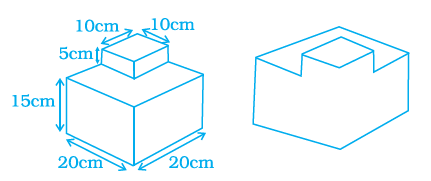
Answer:
Given:
The cake consists of two cuboidal tiers.
Bottom Tier: Length ($l_1$) = $20\text{ cm}$, Breadth ($b_1$) = $20\text{ cm}$, Height ($h_1$) = $15\text{ cm}$
Top Tier: Length ($l_2$) = $10\text{ cm}$, Breadth ($b_2$) = $10\text{ cm}$, Height ($h_2$) = $5\text{ cm}$
To Find:
Total volume of the cake.
Solution:
The total volume of the cake is the sum of the volumes of the two tiers.
Step 1: Calculate the volume of the bottom tier.
$\text{Volume}_1 = l_1 \times b_1 \times h_1$
$\text{Volume}_1 = 20 \times 20 \times 15$
$\text{Volume}_1 = 400 \times 15 = 6000\text{ cm}^3$
Step 2: Calculate the volume of the top tier.
$\text{Volume}_2 = l_2 \times b_2 \times h_2$
$\text{Volume}_2 = 10 \times 10 \times 5$
$\text{Volume}_2 = 100 \times 5 = 500\text{ cm}^3$
Step 3: Calculate total volume.
$\text{Total Volume} = \text{Volume}_1 + \text{Volume}_2$
$\text{Total Volume} = 6000 + 500 = 6500\text{ cm}^3$
Therefore, the total volume of the birthday cake is $6500\text{ cm}^3$.
Work out the surface area of following shapes in questions 121 to 124 (use π = 3.14).
Question 121.
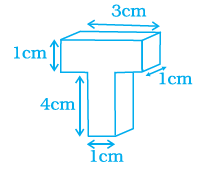
Answer:
Given:
The figure consists of two cuboids joined together in a T-shape.
1. Top Cuboid: Length ($l_1$) = $3\text{ cm}$, Breadth ($b_1$) = $1\text{ cm}$, Height ($h_1$) = $1\text{ cm}$
2. Bottom Cuboid: Length ($l_2$) = $4\text{ cm}$, Breadth ($b_2$) = $1\text{ cm}$, Height ($h_2$) = $1\text{ cm}$
3. Joined Area: They are joined at a square face of dimension $1\text{ cm} \times 1\text{ cm}$.
To Find:
The total surface area of the combined shape.
Solution:
The surface area of the combined shape is the sum of the Total Surface Areas (TSA) of both cuboids minus twice the area of the face where they are joined (because that area is no longer on the surface).
Step 1: Calculate TSA of the Top Cuboid
$\text{TSA}_1 = 2(l_1 b_1 + b_1 h_1 + h_1 l_1)$
$\text{TSA}_1 = 2(3 \times 1 + 1 \times 1 + 1 \times 3)$
$\text{TSA}_1 = 2(3 + 1 + 3)$
$\text{TSA}_1 = 2(7) = 14\text{ cm}^2$
Step 2: Calculate TSA of the Bottom Cuboid
$\text{TSA}_2 = 2(l_2 b_2 + b_2 h_2 + h_2 l_2)$
$\text{TSA}_2 = 2(4 \times 1 + 1 \times 1 + 1 \times 4)$
$\text{TSA}_2 = 2(4 + 1 + 4)$
$\text{TSA}_2 = 2(9) = 18\text{ cm}^2$
Step 3: Calculate the area joined together
$\text{Joining Area} = 1\text{ cm} \times 1\text{ cm} = 1\text{ cm}^2$
Step 4: Calculate the Total Surface Area of the Shape
$\text{Area of the Shape} = \text{TSA}_1 + \text{TSA}_2 - 2(\text{Joining Area})$
$\text{Area of the Shape} = 14 + 18 - 2(1)$
$\text{Area of the Shape} = 32 - 2 = 30\text{ cm}^2$
Final Answer:
The total surface area of the generated T-shape is $30\text{ cm}^2$.
Question 122.

Answer:
Given:
A cuboid and a cube are joined together side by side.
Left Cuboidal Box: Length ($l$) = $24\text{ cm}$, Breadth ($b$) = $12\text{ cm}$, Height ($h$) = $12\text{ cm}$
Right Cube: Side ($s$) = $12\text{ cm}$
Joined Area: The shapes are joined at a face of dimension $12\text{ cm} \times 12\text{ cm}$.
To Find:
Total surface area of the combined solid.
Solution:
Step 1: TSA of the Left Cuboid
$\text{TSA}_1 = 2(lb + bh + hl)$
$\text{TSA}_1 = 2(24 \times 12 + 12 \times 12 + 12 \times 24)$
$\text{TSA}_1 = 2(288 + 144 + 288) = 2(720) = 1440\text{ cm}^2$
Step 2: TSA of the Right Cube
$\text{TSA}_2 = 6s^2$
$\text{TSA}_2 = 6 \times (12)^2 = 6 \times 144 = 864\text{ cm}^2$
Step 3: Calculate the Total Surface Area
$\text{Area of Shape} = \text{TSA}_1 + \text{TSA}_2 - 2(\text{Joining Area})$
Area of joining face = $12 \times 12 = 144\text{ cm}^2$
$\text{Area} = 1440 + 864 - 2(144)$
$\text{Area} = 2304 - 288 = 2016\text{ cm}^2$
Therefore, the total surface area of the solid is $2016\text{ cm}^2$.
Question 123.
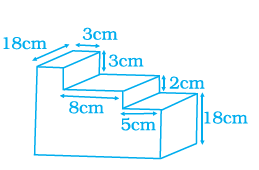
Answer:
Given:
The shape is composed of three cuboidal blocks joined together like stairs. Based on the dimensions provided:
1. Left Cuboid: Length ($l_1$) = $18\text{ cm}$, Breadth ($b_1$) = $3\text{ cm}$, Height ($h_1$) = $23\text{ cm}$
2. Middle Cuboid: Length ($l_2$) = $18\text{ cm}$, Breadth ($b_2$) = $8\text{ cm}$, Height ($h_2$) = $20\text{ cm}$
3. Right Cuboid: Length ($l_3$) = $18\text{ cm}$, Breadth ($b_3$) = $5\text{ cm}$, Height ($h_3$) = $18\text{ cm}$
The cuboids are joined at specific interfaces:
Joined Area 1 (Left & Middle): $18\text{ cm} \times 20\text{ cm}$
Joined Area 2 (Middle & Right): $18\text{ cm} \times 18\text{ cm}$
To Find:
Total surface area of the resulting staircase shape.
Solution:
The total surface area of the composite shape is calculated by adding the Total Surface Areas (TSA) of all three cuboids and subtracting twice the area of the faces that are joined together.
Step 1: Calculate TSA of the Left Cuboid
$\text{TSA}_1 = 2(l_1b_1 + b_1h_1 + h_1l_1)$
$\text{TSA}_1 = 2(18 \times 3 + 3 \times 23 + 23 \times 18)$
$\text{TSA}_1 = 2(54 + 69 + 414) = 2(537) = 1074\text{ cm}^2$
Step 2: Calculate TSA of the Middle Cuboid
$\text{TSA}_2 = 2(l_2b_2 + b_2h_2 + h_2l_2)$
$\text{TSA}_2 = 2(18 \times 8 + 8 \times 20 + 20 \times 18)$
$\text{TSA}_2 = 2(144 + 160 + 360) = 2(664) = 1328\text{ cm}^2$
Step 3: Calculate TSA of the Right Cuboid
$\text{TSA}_3 = 2(l_3b_3 + b_3h_3 + h_3l_3)$
$\text{TSA}_3 = 2(18 \times 5 + 5 \times 18 + 18 \times 18)$
$\text{TSA}_3 = 2(90 + 90 + 324) = 2(504) = 1008\text{ cm}^2$
Step 4: Calculate the total area of the shape
Area of Joining 1 = $18 \times 20 = 360\text{ cm}^2$
Area of Joining 2 = $18 \times 18 = 324\text{ cm}^2$
$\text{Total Area} = \text{TSA}_1 + \text{TSA}_2 + \text{TSA}_3 - 2(\text{Area Joined 1}) $$ - 2(\text{Area Joined 2})$
$\text{Total Area} = 1074 + 1328 + 1008 - 2(360) - 2(324)$
$\text{Total Area} = 3410 - 720 - 648$
$\text{Total Area} = 2042\text{ cm}^2$
Final Answer:
The total surface area of the staircase-shaped solid is $2042\text{ cm}^2$.
Question 124.

Answer:
Given:
The figure represents a composite solid formed by a cube and a cylinder joined side by side.
1. Cube: Side ($s$) = $5\text{ cm}$
2. Cylinder: Diameter ($d$) = $4\text{ cm}$, Radius ($r$) = $2\text{ cm}$, Height ($h$) = $20\text{ cm}$
3. Joining Interface: The cylinder is joined to the cube along a circular area of diameter $4\text{ cm}$ ($\text{radius } 2\text{ cm}$).
As per the instructions, we use $\pi = 3.14$.
To Find:
Total surface area of the combined shape.
Solution:
The total surface area is the sum of the Total Surface Areas (TSA) of both solids minus twice the circular area where they are joined together (since that area is no longer on the surface).
Step 1: Calculate Total Surface Area (TSA) of the Cube
$\text{TSA of Cube} = 6s^2$
$\text{TSA of Cube} = 6 \times (5)^2 = 6 \times 25$
$\text{TSA of Cube} = 150\text{ cm}^2$
Step 2: Calculate Total Surface Area (TSA) of the Cylinder
$\text{TSA of Cylinder} = 2\pi r(r + h)$
$\text{TSA of Cylinder} = 2 \times 3.14 \times 2 \times (2 + 20)$
$\text{TSA of Cylinder} = 12.56 \times 22$
$\text{TSA of Cylinder} = 276.32\text{ cm}^2$
Step 3: Calculate the area of the joining circular face
$\text{Joining Area} = \pi r^2$
$\text{Joining Area} = 3.14 \times (2)^2$
$\text{Joining Area} = 3.14 \times 4 = 12.56\text{ cm}^2$
Step 4: Calculate the Total Surface Area of the combined Shape
$\text{Total Area} = \text{TSA of Cube} + \text{TSA of Cylinder} - 2 \times (\text{Joining Area})$
$\text{Total Area} = 150 + 276.32 - 2(12.56)$
$\text{Total Area} = 426.32 - 25.12$
$\text{Total Area} = 401.2\text{ cm}^2$
Final Answer:
The total surface area of the combined shape is $401.2\text{ cm}^2$.
Question 125. Water flows from a tank with a rectangular base measuring 80 cm by 70 cm into another tank with a square base of side 60 cm. If the water in the first tank is 45 cm deep, how deep will it be in the second tank?
Answer:
Given:
For the first tank:
Length ($l_1$) = $80\text{ cm}$, Breadth ($b_1$) = $70\text{ cm}$, Height of water ($h_1$) = $45\text{ cm}$
For the second tank:
Side of the square base ($s$) = $60\text{ cm}$
To Find:
The depth of water ($h_2$) in the second tank.
Solution:
The volume of water transferred from the first tank remains the same in the second tank.
$\text{Volume of water in first tank} = l_1 \times b_1 \times h_1$
$\text{Volume} = 80 \times 70 \times 45 = 252000\text{ cm}^3$
Now, this volume is poured into the second tank with a square base.
$\text{Volume in second tank} = \text{Base Area} \times \text{depth}$
$252000 = (60 \times 60) \times h_2$
$252000 = 3600 \times h_2$
$h_2 = \frac{252000}{3600}$
$h_2 = \frac{2520}{36} = 70\text{ cm}$
Therefore, the water will be $70\text{ cm}$ deep in the second tank.
Question 126. A rectangular sheet of paper is rolled in two different ways to form two different cylinders. Find the volume of cylinders in each case if the sheet measures 44 cm × 33 cm.
Answer:
Given:
Dimensions of the rectangular sheet = $44\text{ cm} \times 33\text{ cm}$
Solution:
Case 1: Rolled along its length ($44\text{ cm}$)
When the sheet is rolled along its length, the length becomes the circumference of the base and the breadth becomes the height.
Circumference ($C$) = $2\pi r = 44\text{ cm}$
$2 \times \frac{22}{7} \times r = 44 \Rightarrow r = 7\text{ cm}$
Height ($h$) = $33\text{ cm}$
$\text{Volume}_1 = \pi r^2 h = \frac{22}{7} \times 7 \times 7 \times 33$
$\text{Volume}_1 = 154 \times 33 = 5082\text{ cm}^3$
Case 2: Rolled along its breadth ($33\text{ cm}$)
When the sheet is rolled along its breadth, the breadth becomes the circumference of the base and the length becomes the height.
Circumference ($C$) = $2\pi r = 33\text{ cm}$
$2 \times \frac{22}{7} \times r = 33 \Rightarrow r = \frac{33 \times 7}{44} = \frac{21}{4} = 5.25\text{ cm}$
Height ($h$) = $44\text{ cm}$
$\text{Volume}_2 = \pi r^2 h = \frac{22}{7} \times \frac{21}{4} \times \frac{21}{4} \times 44$
$\text{Volume}_2 = 22 \times 3 \times \frac{21}{16} \times 44 = 66 \times \frac{21}{4} \times 11$
$\text{Volume}_2 = \frac{15246}{4} = 3811.5\text{ cm}^3$
Therefore, the volumes of the cylinders are $5082\text{ cm}^3$ and $3811.5\text{ cm}^3$ respectively.