

Chapter 3 Square-Square Root & Cube-Cube Root (Class 8 - Maths NCERT Exemplar Solutions)
Welcome to the comprehensive resource for NCERT Exemplar Solutions for Class 8 Mathematics: Chapter 3 Square-Square Root & Cube-Cube Root! This chapter is intentionally designed to push students beyond routine formula memorization, fostering a deeper conceptual understanding of the fundamental properties of square and cube numbers. Through numerical patterns, estimation techniques, and multi-step reasoning, these solutions build the analytical skills required to tackle intricate mathematical challenges.
The solutions meticulously cover perfect squares, their characteristic unit digits (0, 1, 4, 5, 6, 9), and Pythagorean triplets. Students will master finding square roots ($\sqrt{N}$) using both the prime factorization method and the versatile long division method, which is essential for handling large numbers and decimals with precision. The chapter also explores perfect cubes and the process of finding cube roots ($\sqrt[3]{N}$), emphasizing the grouping of prime factors into triplets.
Significant focus is placed on application-based problems, such as finding the smallest number to multiply or divide to achieve a perfect square or cube. Word problems involving calculating sides from the Area of a square ($s = \sqrt{\text{Area}}$) or the Volume of a cube ($s = \sqrt[3]{\text{Volume}}$) are addressed with logical depth. With step-by-step guidance prepared by learningspot.co, students can achieve both computational accuracy and higher-order thinking skills in these critical areas of algebra.
| Content On This Page | ||
|---|---|---|
| Solved Examples (Examples 1 to 33) | Question 1 to 24 (Multiple Choice Questions) | Question 25 to 48 (Fill in the Blanks) |
| Question 49 to 86 (True or False) | Question 87 to 142 | |
Solved Examples (Examples 1 to 33)
In examples 1 to 7, out of given four choices only one is correct. Write the correct answer.
Example 1: Which of the following is the square of an odd number?
(a) 256
(b) 361
(c) 144
(d) 400
Answer:
Solution:
We know that the square of an even number is always even, and the square of an odd number is always an odd number.
In the given options, we check the units digit of each number:
1. 256: Units digit is 6 (Even number)
2. 361: Units digit is 1 (Odd number)
3. 144: Units digit is 4 (Even number)
4. 400: Units digit is 0 (Even number)
Since 361 is the only odd number among the choices, it must be the square of an odd number ($19^2 = 361$).
The correct option is (b).
Example 2: Which of the following will have 1 at its units place?
(a) 192
(b) 172
(c) 182
(d) 162
Answer:
Solution:
The units digit of a square number depends only on the units digit of the number being squared.
(a) For $19^2$, the units digit is 9. Since $9 \times 9 = 81$, the units place will be 1.
(b) For $17^2$, the units digit is 7. Since $7 \times 7 = 49$, the units place will be 9.
(c) For $18^2$, the units digit is 8. Since $8 \times 8 = 64$, the units place will be 4.
(d) For $16^2$, the units digit is 6. Since $6 \times 6 = 36$, the units place will be 6.
The correct option is (a).
Example 3: How many natural numbers lie between 182 and 192?
(a) 30
(b) 37
(c) 35
(d) 36
Answer:
Solution:
There is a general property that between the squares of two consecutive numbers $n$ and $(n+1)$, there are $2n$ non-perfect square natural numbers.
Here, $n = 18$ and $n + 1 = 19$.
Calculation:
$\text{Number of natural numbers} = 2n$
$\text{Number} = 2 \times 18$
$\text{Number} = 36$
The correct option is (d).
Example 4: Which of the following is not a perfect square?
(a) 361
(b) 1156
(c) 1128
(d) 1681
Answer:
Solution:
A perfect square number can only end with the digits 0, 1, 4, 5, 6, or 9 at its ones place.
A number ending in 2, 3, 7, or 8 is never a perfect square.
Looking at the given numbers:
(a) 361 ends in 1 (Could be a square)
(b) 1156 ends in 6 (Could be a square)
(c) 1128 ends in 8
(d) 1681 ends in 1 (Could be a square)
Since 1128 ends in 8, it is not a perfect square.
The correct option is (c).
Example 5: A perfect square can never have the following digit at ones place.
(a) 1
(b) 6
(c) 5
(d) 3
Answer:
Solution:
By observing the squares of digits from 0 to 9:
$0^2=0, 1^2=1, 2^2=4, 3^2=9, 4^2=16, 5^2=25, 6^2=36, $$ 7^2=49, 8^2=64, 9^2=81$.
The units digits of perfect squares are always 0, 1, 4, 5, 6, or 9.
A perfect square never ends in 2, 3, 7, or 8.
From the given options, the digit 3 can never be at the ones place of a perfect square.
The correct option is (d).
Example 6: The value of $\sqrt{176 + \sqrt{2401}}$ is
(a) 14
(b) 15
(c) 16
(d) 17
Answer:
To Find:
The value of $\sqrt{176 + \sqrt{2401}}$
Solution:
Step 1: Find the square root of 2401.
$\begin{array}{c|cc} & 4 \ 9 & \\ \hline \phantom{()} 4 & \overline{24} \ \overline{01} \\ + \; 4 & 16 \phantom{(..)} \\ \hline \phantom{()} 8 \; 9 & 8 \ 01 \\ \phantom{()} +9 & 8 \ 01 \\ \hline & 0 \end{array}$So, $\sqrt{2401} = 49$.
Step 2: Substitute this value back into the original expression.
$\sqrt{176 + 49}$ = $\sqrt{225}$
Now, we find $\sqrt{225}$. We know that $15 \times 15 = 225$.
$\sqrt{225} = 15$
The correct option is (b).
Example 7: Given that $\sqrt{5625}$ = 75, the value of $\sqrt{0.5625}$ + $\sqrt{56.25}$ is:
(a) 82.5
(b) 0.75
(c) 8.25
(d) 75.05
Answer:
Given:
$\sqrt{5625} = 75$
Solution:
We use the given value to find the square roots of the decimals:
1. $\sqrt{0.5625} = \sqrt{\frac{5625}{10000}} = \frac{75}{100} = 0.75$
2. $\sqrt{56.25} = \sqrt{\frac{5625}{100}} = \frac{75}{10} = 7.5$
Addition:
$\begin{array}{cc} & 0 & . & 7 & 5 \\ + & 7 & . & 5 & 0 \\ \hline & 8 & . & 2 & 5 \\ \hline \end{array}$
The sum is 8.25.
The correct option is (c).
In examples 8 to 14, fill in the blanks to make the statements true.
Example 8: There are __________ perfect squares between 1 and 50.
Answer:
Solution:
The perfect squares starting from 1 are:
$1^2 = 1$
$2^2 = 4$
$3^2 = 9$
$4^2 = 16$
$5^2 = 25$
$6^2 = 36$
$7^2 = 49$
$8^2 = 64$
The numbers "between" 1 and 50 are those greater than 1 and less than 50.
These are: 4, 9, 16, 25, 36, and 49.
Counting them, we find there are 6 perfect squares.
Answer: 6
Example 9: The cube of 100 will have __________ zeroes.
Answer:
Solution:
The cube of a number is obtained by multiplying the number by itself three times. To find the cube of 100, we perform the following calculation:
$100^3 = 100 \times 100 \times 100$
$10,000 \times 100 = 1,000,000$
The number of zeroes in 1,000,000 is 6.
Generally, if a number has $n$ zeroes, its cube will have $3n$ zeroes. Here $n=2$, so $3 \times 2 = 6$.
Answer: 6
Example 10: The square of 6.1 is ____________.
Answer:
Solution:
To find the square of 6.1, we multiply 6.1 by itself:
$(6.1)^2 = 6.1 \times 6.1$
Since there is one decimal place in each factor, the product will have two decimal places.
$(6.1)^2 = 37.21$
Answer: 37.21
Example 11: The cube of 0.3 is ____________.
Answer:
Solution:
To find the cube of 0.3, we multiply 0.3 by itself three times:
$(0.3)^3 = 0.3 \times 0.3 \times 0.3$
Since the total decimal places are three ($1+1+1=3$), we place the decimal accordingly:
$(0.3)^3 = 0.027$
Answer: 0.027
Example 12: 682 will have __________ at the units place.
Answer:
Solution:
The digit at the units place of the square of a number depends only on the units digit of the original number.
The units digit of 68 is 8.
The square of 8 is $8 \times 8 = 64$.
The units digit of 64 is 4.
Therefore, $68^2$ will have 4 at the units place.
Answer: 4
Example 13: The positive square root of a number x is denoted by __________.
Answer:
Solution:
In mathematics, the radical sign is used to denote the square root of a value. For any positive number $x$, the positive (principal) square root is represented symbolically.
Answer: $\sqrt{x}$
Example 14: The least number to be multiplied with 9 to make it a perfect cube is _______________.
Answer:
Solution:
First, find the prime factorisation of 9:
$\begin{array}{c|cc} 3 & 9 \\ \hline 3 & 3 \\ \hline & 1 \end{array}$
$9 = 3 \times 3$
To be a perfect cube, every prime factor must appear in a group of three (triplets).
In the factorisation of 9, the factor 3 appears only twice. We need one more 3 to complete the triplet ($3 \times 3 \times 3 = 27$).
Therefore, the least number to be multiplied is 3.
Answer: 3
In examples 15 to 19, state whether the statements are true (T) or false (F).
Example 15: The square of 0.4 is 0.16.
Answer:
Solution:
To check the statement, we calculate the square of 0.4:
$(0.4)^2 = 0.4 \times 0.4$
Since there are two decimal places in total ($1 + 1$), the result is $0.16$.
The statement is True (T).
Example 16: The cube root of 729 is 8.
Answer:
Solution:
We check this by finding the cube of 8:
$8^3 = 8 \times 8 \times 8$
$8 \times 8 = 64$
$64 \times 8 = 512$
Since $8^3 = 512$ and not 729, the statement is incorrect. The cube root of 729 is actually 9 ($9 \times 9 \times 9 = 729$).
The statement is False (F).
Example 17: There are 21 natural numbers between 102 and 112.
Answer:
Solution:
We know that the number of natural numbers lying between the squares of two consecutive numbers $n$ and $(n + 1)$ is given by the formula $2n$.
Here, $n = 10$ and $n + 1 = 11$.
Number of natural numbers $= 2n$
Number of natural numbers $= 2 \times 10 = 20$
Since there are 20 natural numbers between $10^2$ and $11^2$, the given statement is False (F).
Example 18: The sum of first 7 odd natural numbers is 49.
Answer:
Solution:
The sum of the first $n$ odd natural numbers is always equal to $n^2$.
In this case, $n = 7$.
Sum $= 7^2$
Sum $= 7 \times 7 = 49$
The calculation matches the statement. Therefore, the statement is True (T).
Example 19: The square root of a perfect square of n digits will have $\frac{n}{2}$ digits if n is even.
Answer:
Solution:
There is a mathematical property regarding the number of digits in a square root:
1. If a perfect square has $n$ digits and $n$ is even, its square root contains $\frac{n}{2}$ digits.
2. If $n$ is odd, its square root contains $\frac{n + 1}{2}$ digits.
The statement correctly identifies the condition for an even number of digits. Therefore, the statement is True (T).
Example 20: Express 36 as a sum of successive odd natural numbers.
Answer:
Given: The number is 36.
Solution:
We know that $36 = 6^2$. A perfect square $n^2$ can be expressed as the sum of the first $n$ successive odd natural numbers.
Since $n = 6$, we need to add the first 6 odd numbers:
The first six odd numbers are: 1, 3, 5, 7, 9, 11.
Expression:
$36 = 1 + 3 + 5 + 7 + 9 + 11$
Example 21: Check whether 90 is a perfect square or not by using prime factorisation.
Answer:
Given: The number is 90.
Solution:
First, we find the prime factorisation of 90:
$\begin{array}{c|cc} 2 & 90 \\ \hline 3 & 45 \\ \hline 3 & 15 \\ \hline 5 & 5 \\ \hline & 1 \end{array}$
The prime factorisation is: $90 = 2 \times 3 \times 3 \times 5$
Grouping the identical factors in pairs:
$90 = \underbrace{3 \times 3}_{\text{pair}} \times 2 \times 5$
In a perfect square, all prime factors must exist in pairs. Here, the prime factors 2 and 5 do not have pairs. Therefore, 90 is not a perfect square.
Example 22: Check whether 1728 is a perfect cube by using prime factorisation.
Answer:
Given: The number is 1728.
Solution:
Performing the prime factorisation of 1728:
$\begin{array}{c|cc} 2 & 1728 \\ \hline 2 & 864 \\ \hline 2 & 432 \\ \hline 2 & 216 \\ \hline 2 & 108 \\ \hline 2 & 54 \\ \hline 3 & 27 \\ \hline 3 & 9 \\ \hline 3 & 3 \\ \hline & 1 \end{array}$
Prime factorisation: $1728 = 2 \times 2 \times 2 \times 2 \times 2 \times 2 \times 3 \times 3 \times 3$
Grouping the factors in triplets:
$1728 = (2 \times 2 \times 2) \times (2 \times 2 \times 2) \times (3 \times 3 \times 3)$
Since every prime factor appears in groups of three (triplets), 1728 is a perfect cube.
Specifically, $1728 = (2 \times 2 \times 3)^3 = 12^3$.
Example 23: Using distributive law, find the square of 43.
Answer:
To Find: $43^2$ using the distributive law.
Solution:
We can write 43 as $(40 + 3)$.
$43^2 = (40 + 3)^2$
$43^2 = (40 + 3)(40 + 3)$
By applying the distributive law $a(b + c) = ab + ac$:
$43^2 = 40(40 + 3) + 3(40 + 3)$
$43^2 = (40 \times 40) + (40 \times 3) + (3 \times 40) + (3 \times 3)$
$43^2 = 1600 + 120 + 120 + 9$
$43^2 = 1849$
The square of 43 is 1849.
Example 24: Write a pythagorean triplet whose smallest number is 6.
Answer:
Given: Smallest number $= 6$.
Solution:
For any natural number $m > 1$, the three numbers $2m$, $m^2 - 1$, and $m^2 + 1$ form a Pythagorean triplet.
Let the smallest number be $2m$.
$2m = 6$
$m = \frac{6}{2} = 3$
Now, we find the other two members of the triplet:
Second member $= m^2 - 1 = 3^2 - 1 = 9 - 1 = 8$
Third member $= m^2 + 1 = 3^2 + 1 = 9 + 1 = 10$
Checking the triplet (6, 8, 10):
$6^2 + 8^2 = 36 + 64 = 100$
$10^2 = 100$
Since $6^2 + 8^2 = 10^2$, the triplet is valid and 6 is indeed the smallest number.
The Pythagorean triplet is (6, 8, 10).
Example 25: Using prime factorisation, find the cube root of 5832.
Answer:
Given: The number is 5832.
To Find: Cube root of 5832 ($\sqrt[3]{5832}$).
Solution:
First, we perform the prime factorisation of 5832:
$\begin{array}{c|cc} 2 & 5832 \\ \hline 2 & 2916 \\ \hline 2 & 1458 \\ \hline 3 & 729 \\ \hline 3 & 243 \\ \hline 3 & 81 \\ \hline 3 & 27 \\ \hline 3 & 9 \\ \hline 3 & 3 \\ \hline & 1 \end{array}$
The prime factorisation is:
$5832 = 2 \times 2 \times 2 \times 3 \times 3 \times 3 \times 3 \times 3 \times 3$
Now, we group the identical factors into triplets:
$5832 = (2 \times 2 \times 2) \times (3 \times 3 \times 3) \times (3 \times 3 \times 3)$
Taking one factor from each triplet to find the cube root:
$\sqrt[3]{5832} = 2 \times 3 \times 3$
$\sqrt[3]{5832} = 18$
Therefore, the cube root of 5832 is 18.
Example 26: Evaluate the square root of 22.09 by long division method.
Answer:
Given: The decimal number is 22.09.
To Find: Square root using the long division method.
Solution:
We pair the digits starting from the decimal point. We have 22 in the integer part and 09 in the decimal part.
$\begin{array}{c|cc} & 4 \ . \ 7 & \\ \hline \phantom{()} 4 & \overline{22} \; . \overline{09} \\ + \; 4 & 16\phantom{(........)} \\ \hline \phantom{()} 8 \; 7 & 6 \; 09 \phantom{(.....)} \\ \phantom{()} +7 & 6 \; 09 \phantom{(...)} \\ \hline \phantom{()} & 0 \end{array}$
Steps followed:
1. Find the largest square less than or equal to 22, which is $16 = 4^2$.
2. Subtract 16 from 22 to get 6. Bring down the next pair 09. Put a decimal in the quotient.
3. Double the divisor (4) to get 8. Find a digit $x$ such that $8x \times x$ is less than or equal to 609.
4. $87 \times 7 = 609$.
Therefore, $\sqrt{22.09} = 4.7$.
Example 27: Find the smallest perfect square divisible by 3, 4, 5 and 6.
Answer:
Given: The numbers are 3, 4, 5, and 6.
To Find: The smallest perfect square divisible by all these numbers.
Solution:
First, we find the LCM (Least Common Multiple) of 3, 4, 5, and 6.
$\begin{array}{c|cc} 2 & 3 \;, & 4 \;, & 5 \;, & 6 \\ \hline 2 & 3 \;, & 2 \;, & 5 \;, & 3 \\ \hline 3 & 3 \;, & 1 \;, & 5 \;, & 3 \\ \hline 5 & 1 \;, & 1 \;, & 5 \;, & 1 \\ \hline & 1 \;, & 1 \;, & 1 \;, & 1 \end{array}$
LCM $= 2 \times 2 \times 3 \times 5 = 60$.
Now, observe the prime factorisation of 60:
$60 = \underbrace{2 \times 2}_{\text{pair}} \times 3 \times 5$
For a number to be a perfect square, all its prime factors must exist in pairs. In the factorisation of 60, the factors 3 and 5 do not have pairs.
To make it a perfect square, we must multiply 60 by 3 and 5.
$\text{Smallest perfect square} = 60 \times 3 \times 5$
$\text{Smallest perfect square} = 60 \times 15 = 900$
The smallest perfect square divisible by 3, 4, 5, and 6 is 900.
Example 28: A ladder 10m long rests against a vertical wall. If the foot of the ladder is 6m away from the wall and the ladder just reaches the top of the wall, how high is the wall?
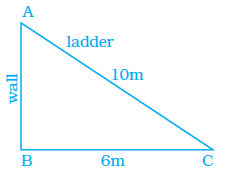
Answer:
Given:
Length of the ladder (Hypotenuse, $AC$) $= 10 \text{ m}$
Distance of the foot from the wall (Base, $BC$) $= 6 \text{ m}$
To Find:
Height of the wall (Perpendicular, $AB$).
Solution:
The wall and the ground form a right angle ($90^\circ$). According to the Pythagoras Theorem:
$AC^2 = AB^2 + BC^2$
Substituting the given values:
$10^2 = AB^2 + 6^2$
$100 = AB^2 + 36$
$AB^2 = 100 - 36$
$AB^2 = 64$
$AB = \sqrt{64} = 8 \text{ m}$
The height of the wall is 8 m.
Example 29: Find the length of a diagonal of a rectangle with dimensions 20m by 15m.
Answer:
Given:
Length of the rectangle ($l$) $= 20 \text{ m}$
Breadth of the rectangle ($b$) $= 15 \text{ m}$
To Find:
Length of the diagonal ($d$).
Solution:
In a rectangle, the length, breadth, and diagonal form a right-angled triangle. We can use the Pythagoras Theorem to find the diagonal.
$d = \sqrt{l^2 + b^2}$
$d = \sqrt{20^2 + 15^2}$
$d = \sqrt{400 + 225}$
$d = \sqrt{625}$
$d = 25 \text{ m}$
The length of the diagonal of the rectangle is 25 m.
Example 30: The area of a rectangular field whose length is twice its breadth is 2450 m2. Find the perimeter of the field.
Answer:
Given:
Area of the rectangular field $= 2450 \text{ m}^2$
Length ($l$) of the field $= 2 \times \text{Breadth } (b)$
To Find:
The perimeter of the field.
Solution:
Let the breadth of the rectangular field be $x$ metres.
Then, the length of the field $= 2x$ metres.
We know that $\text{Area} = \text{Length} \times \text{Breadth}$
$2450 = 2x \times x$
$2450 = 2x^2$
$x^2 = \frac{2450}{2}$
$x^2 = 1225$
$x = \sqrt{1225}$
To find the square root of 1225:
$\begin{array}{c|cc} 5 & 1225 \\ \hline 5 & 245 \\ \hline 7 & 49 \\ \hline 7 & 7 \\ \hline & 1 \end{array}$
$1225 = 5 \times 5 \times 7 \times 7$
$\sqrt{1225} = 5 \times 7 = 35$
So, Breadth $= 35 \text{ m}$
Length $= 2 \times 35 = 70 \text{ m}$
Now, $\text{Perimeter} = 2(\text{Length} + \text{Breadth})$
$\text{Perimeter} = 2(70 + 35)$
$\text{Perimeter} = 2(105) = 210 \text{ m}$
The perimeter of the field is $210 \text{ m}$.
Example 31: During a mass drill exercise, 6250 students of different schools are arranged in rows such that the number of students in each row is equal to the number of rows. In doing so, the instructor finds out that 9 children are left out. Find the number of children in each row of the square.
Answer:
Given:
Total number of students $= 6250$
Number of students left out after square arrangement $= 9$
To Find:
The number of children in each row.
Solution:
The students who formed a perfect square are:
$\text{Students in square} = 6250 - 9 = 6241$
Let the number of children in each row be $x$. Since the number of rows is equal to the number of students in each row:
$x \times x = 6241$
$x^2 = 6241$
$x = \sqrt{6241}$
Using long division method to find the square root:
$\begin{array}{c|cc} & 7 \ 9 & \\ \hline \phantom{()} 7 & \overline{62} \ \overline{41} \\ + \; 7 & 49 \phantom{(..)} \\ \hline \phantom{()} 14 \; 9 & 13 \ 41 \\ \phantom{()} +9 & 13 \ 41 \\ \hline & 0 \end{array}$The value of $x$ is 79.
Therefore, there are $79$ children in each row.
Example 32: Find the least number that must be added to 1500 so as to get a perfect square. Also find the square root of the perfect square.
Answer:
Given: The number is 1500.
To Find: The least number to be added to make it a perfect square and its square root.
Solution:
First, we find the square root of 1500 by long division method to find the remainder.
$\begin{array}{c|cc} & 3 \ 8 & \\ \hline \phantom{()} 3 & \overline{15} \ \overline{00} \\ + \; 3 & 9 \phantom{(..)} \\ \hline \phantom{()} 6 \; 8 & 6 \ 00 \\ \phantom{()} +8 & 5 \ 44 \\ \hline & 56 \end{array}$Here, the remainder is 56. This shows that $38^2 < 1500$.
The next perfect square number will be the square of 39.
$39^2 = 1521$
The number to be added $= 39^2 - 1500$
$\text{Number to be added} = 1521 - 1500 = 21$
The least number to be added is $21$.
The perfect square is $1521$ and its square root is $39$.
Example 33: Application of problem solving strategies
Find the smallest number by which 1620 must be divided to get a perfect square.
Answer:
Given: The number is 1620.
To Find: The smallest number to divide 1620 to make it a perfect square.
Solution:
We start by finding the prime factorisation of 1620:
$\begin{array}{c|cc} 2 & 1620 \\ \hline 2 & 810 \\ \hline 3 & 405 \\ \hline 3 & 135 \\ \hline 3 & 45 \\ \hline 3 & 15 \\ \hline 3 & 5 \\ \hline 5 & 5 \\ \hline & 1 \end{array}$
The prime factorisation is:
$1620 = 2 \times 2 \times 3 \times 3 \times 3 \times 3 \times 5$
Grouping the identical factors in pairs:
$1620 = (2 \times 2) \times (3 \times 3) \times (3 \times 3) \times 5$
We observe that the prime factor 5 does not have a pair.
To make the number a perfect square, we must divide 1620 by 5 so that all remaining factors are in pairs.
$\text{New number} = \frac{1620}{5} = 324$
As $324 = 18^2$, it is a perfect square.
Therefore, the smallest number by which 1620 must be divided is $5$.
Exercise
Question 1 to 24 (Multiple Choice Questions)
In each of the questions, 1 to 24, write the correct answer from the given four options.
Question 1. 196 is the square of
(a) 11
(b) 12
(c) 14
(d) 16
Answer:
Solution:
To find which number's square is 196, we can square each of the given options:
(a) $11^2 = 11 \times 11 = 121$
(b) $12^2 = 12 \times 12 = 144$
(c) $14^2 = 14 \times 14 = 196$
(d) $16^2 = 16 \times 16 = 256$
Comparing the results with 196, we see that $14^2 = 196$.
Therefore, 196 is the square of 14.
The correct option is (c) 14.
Question 2. Which of the following is a square of an even number?
(a) 144
(b) 169
(c) 441
(d) 625
Answer:
Solution:
We know that the square of an even number is always an even number, and the square of an odd number is always an odd number.
Let's examine the given options:
(a) 144 is an even number.
(b) 169 is an odd number.
(c) 441 is an odd number.
(d) 625 is an odd number.
Since the square of an even number must be even, only option (a) 144 can be the square of an even number among the given options.
Let's verify if 144 is a perfect square and if its square root is even.
We find the square root of 144:
$\sqrt{144} = 12$
The number 12 is an even number.
Therefore, 144 is the square of the even number 12.
The correct option is (a) 144.
Question 3. A number ending in 9 will have the units place of its square as
(a) 3
(b) 9
(c) 1
(d) 6
Answer:
Solution:
To find the units place of the square of a number, we only need to consider the units place of the number itself.
If a number ends in 9, its units digit is 9.
We find the square of the units digit:
$9^2 = 81$
The units digit of $9^2$ is 1.
Therefore, the units place of the square of any number ending in 9 will be 1.
For example:
$9^2 = 81$ (units digit is 1)
$19^2 = 361$ (units digit is 1)
$29^2 = 841$ (units digit is 1)
The correct option is (c) 1.
Question 4. Which of the following will have 4 at the units place?
(a) 142
(b) 622
(c) 272
(d) 352
Answer:
Solution:
To find the units place of the square of a number, we only need to consider the units place of the number itself.
Let's check the units digit of the square for each option:
(a) $14^2$: The units digit of 14 is 4. The units digit of $4^2 = 16$ is 6.
(b) $62^2$: The units digit of 62 is 2. The units digit of $2^2 = 4$ is 4.
(c) $27^2$: The units digit of 27 is 7. The units digit of $7^2 = 49$ is 9.
(d) $35^2$: The units digit of 35 is 5. The units digit of $5^2 = 25$ is 5.
We are looking for the number whose square has 4 at the units place. From the above calculations, only $62^2$ has 4 at the units place.
The correct option is (b) 622.
Question 5. How many natural numbers lie between 52 and 62?
(a) 9
(b) 10
(c) 11
(d) 12
Answer:
Solution:
We are asked to find the number of natural numbers that lie between $5^2$ and $6^2$.
First, let's calculate the squares of the two numbers:
$5^2 = 5 \times 5 = 25$
$6^2 = 6 \times 6 = 36$
We need to find the number of natural numbers that are greater than 25 and less than 36.
These numbers are 26, 27, 28, 29, 30, 31, 32, 33, 34, and 35.
Counting these numbers, we find there are 10 natural numbers between 25 and 36.
Alternatively:
There is a general formula for the number of non-perfect square natural numbers between the squares of two consecutive natural numbers, $n^2$ and $(n+1)^2$. The number of such numbers is $2n$.
In this question, the consecutive natural numbers are 5 and 6. So, $n=5$.
The number of natural numbers between $5^2$ and $6^2$ is $2 \times 5 = 10$.
The correct option is (b) 10.
Question 6. Which of the following cannot be a perfect square?
(a) 841
(b) 529
(c) 198
(d) All of the above
Answer:
Solution:
A perfect square is a number obtained by squaring an integer. The units digit of a perfect square can only be 0, 1, 4, 5, 6, or 9. A number whose units digit is 2, 3, 7, or 8 cannot be a perfect square.
Let's look at the units digit of each option:
(a) 841: The units digit is 1. A number ending in 1 can be a perfect square (e.g., $1^2=1$, $9^2=81$). In fact, $29^2 = 841$, so 841 is a perfect square.
(b) 529: The units digit is 9. A number ending in 9 can be a perfect square (e.g., $3^2=9$, $7^2=49$). In fact, $23^2 = 529$, so 529 is a perfect square.
(c) 198: The units digit is 8. A number ending in 8 cannot be a perfect square.
(d) All of the above: Since (a) and (b) are perfect squares, this option is incorrect.
Based on the units digit rule, 198 cannot be a perfect square because its units digit is 8.
The correct option is (c) 198.
Question 7. The one’s digit of the cube of 23 is
(a) 6
(b) 7
(c) 3
(d) 9
Answer:
Solution:
To find the one's digit (units digit) of the cube of a number, we only need to find the one's digit of the cube of the one's digit of the original number.
The given number is 23.
The one's digit of 23 is 3.
Now, we cube the one's digit:
$3^3 = 3 \times 3 \times 3 = 9 \times 3 = 27$
The one's digit of 27 is 7.
Therefore, the one's digit of the cube of 23 is 7.
The correct option is (b) 7.
Question 8. A square board has an area of 144 square units. How long is each side of the board?
(a) 11 units
(b) 12 units
(c) 13 units
(d) 14 units
Answer:
Given:
Area of the square board = 144 square units.
To Find:
The length of each side of the board.
Solution:
The area of a square is calculated by squaring the length of its side.
Area = $(\text{side})^2$
We are given that the area is 144 square units. So,
$(\text{side})^2 = 144$
To find the length of the side, we need to calculate the square root of the area.
$\text{side} = \sqrt{144}$
We know that $12 \times 12 = 144$.
Therefore, $\sqrt{144} = 12$.
The length of each side of the board is 12 units.
The correct option is (b) 12 units.
Question 9. Which letter best represents the location of √25 on a number line?
(a) A
(b) B
(c) C
(d) D
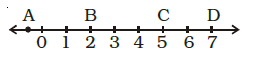
Answer:
Given: The value is $\sqrt{25}$.
To Find: The letter representing this value on the number line.
Solution:
First, we calculate the square root of 25:
$\sqrt{25} = \sqrt{5 \times 5}$
$\sqrt{25} = 5$
Now, we observe the given number line to find the point corresponding to the number 5.
1. Point A is located to the left of 0 (representing a negative value).
2. Point B is located at the number 2.
3. Point C is located at the number 5.
4. Point D is located at the number 7.
Since the value of $\sqrt{25}$ is 5, the letter C best represents its location.
The correct option is (c).
Question 10. If one member of a pythagorean triplet is 2m, then the other two members are
(a) m, m2 + 1
(b) m2 + 1 , m2 – 1
(c) m2 , m2 – 1
(d) m2 , m + 1
Answer:
Solution:
A Pythagorean triplet consists of three positive integers $a$, $b$, and $c$, such that $a^2 + b^2 = c^2$.
For any natural number $m > 1$, the triplet $(2m, m^2 - 1, m^2 + 1)$ is a Pythagorean triplet because:
$(2m)^2 + (m^2 - 1)^2 = 4m^2 + (m^4 - 2m^2 + 1) = m^4 + 2m^2 + 1 $$ = (m^2 + 1)^2$
The members of this triplet are $2m$, $m^2 - 1$, and $m^2 + 1$.
If one member of a Pythagorean triplet is given as $2m$, then the other two members are $m^2 - 1$ and $m^2 + 1$. Note that the order of the last two members can be switched, as seen in option (b).
Comparing this with the given options, option (b) lists $m^2 + 1$ and $m^2 - 1$ as the other two members.
The correct option is (b) m2 + 1 , m2 – 1.
Question 11. The sum of successive odd numbers 1, 3, 5, 7, 9, 11, 13 and 15 is
(a) 81
(b) 64
(c) 49
(d) 36
Answer:
Solution:
We need to find the sum of the given successive odd numbers: 1, 3, 5, 7, 9, 11, 13, and 15.
We can find the sum by adding the numbers directly:
$1 + 3 + 5 + 7 + 9 + 11 + 13 + 15$
$= 4 + 5 + 7 + 9 + 11 + 13 + 15$
$= 9 + 7 + 9 + 11 + 13 + 15$
$= 16 + 9 + 11 + 13 + 15$
$= 25 + 11 + 13 + 15$
$= 36 + 13 + 15$
$= 49 + 15$
$= 64$
Alternatively:
The sum of the first $n$ successive odd natural numbers is equal to $n^2$.
Let's count the number of terms in the given sum: 1, 3, 5, 7, 9, 11, 13, 15.
There are 8 terms in the sequence. So, $n=8$.
The sum is equal to $n^2 = 8^2$.
$8^2 = 8 \times 8 = 64$
The sum of the successive odd numbers 1, 3, 5, 7, 9, 11, 13, and 15 is 64.
The correct option is (b) 64.
Question 12. The sum of first n odd natural numbers is
(a) 2n + 1
(b) n2
(c) n2 – 1
(d) n2 + 1
Answer:
Solution:
According to the property of square numbers, the sum of the first $n$ odd natural numbers is always equal to the square of $n$.
For example:
Sum of first 1 odd number: $1 = 1^2$
Sum of first 2 odd numbers: $1 + 3 = 4 = 2^2$
Sum of first 3 odd numbers: $1 + 3 + 5 = 9 = 3^2$
In general, for $n$ terms:
$1 + 3 + 5 + ... + (2n - 1) = n^2$
The correct option is (b).
Question 13. Which of the following numbers is a perfect cube?
(a) 243
(b) 216
(c) 392
(d) 8640
Answer:
Solution:
A perfect cube is a number that can be obtained by multiplying an integer by itself three times (cubing it). To check if a number is a perfect cube, we can use prime factorization. If the prime factors of a number can be grouped into triplets, then the number is a perfect cube.
Let's find the prime factorization of each option:
(a) 243:
$\begin{array}{c|cc} 3 & 243 \\ \hline 3 & 81 \\ \hline 3 & 27 \\ \hline 3 & 9 \\ \hline 3 & 3 \\ \hline & 1 \end{array}$
$243 = 3 \times 3 \times 3 \times 3 \times 3 = 3^5$. The prime factor 3 appears 5 times, which is not a multiple of 3. Thus, 243 is not a perfect cube.
(b) 216:
$\begin{array}{c|cc} 2 & 216 \\ \hline 2 & 108 \\ \hline 2 & 54 \\ \hline 3 & 27 \\ \hline 3 & 9 \\ \hline 3 & 3 \\ \hline & 1 \end{array}$
$216 = 2 \times 2 \times 2 \times 3 \times 3 \times 3 = 2^3 \times 3^3 = (2 \times 3)^3 = 6^3$. The prime factors 2 and 3 appear in groups of three. Thus, 216 is a perfect cube.
(c) 392:
$\begin{array}{c|cc} 2 & 392 \\ \hline 2 & 196 \\ \hline 2 & 98 \\ \hline 7 & 49 \\ \hline 7 & 7 \\ \hline & 1 \end{array}$
$392 = 2 \times 2 \times 2 \times 7 \times 7 = 2^3 \times 7^2$. The prime factor 7 appears 2 times, which is not a multiple of 3. Thus, 392 is not a perfect cube.
(d) 8640:
$\begin{array}{c|cc} 2 & 8640 \\ \hline 2 & 4320 \\ \hline 2 & 2160 \\ \hline 2 & 1080 \\ \hline 2 & 540 \\ \hline 2 & 270 \\ \hline 3 & 135 \\ \hline 3 & 45 \\ \hline 3 & 15 \\ \hline 5 & 5 \\ \hline & 1 \end{array}$
$8640 = 2^6 \times 3^3 \times 5^1$. The prime factor 5 appears once, which is not a multiple of 3. Thus, 8640 is not a perfect cube.
From the prime factorizations, only 216 has all prime factors appearing in groups of three.
The correct option is (b) 216.
Question 14. The hypotenuse of a right triangle with its legs of lengths 3x × 4x is
(a) 5x
(b) 7x
(c) 16x
(d) 25x
Answer:
Given:
Length of one leg of the right triangle = $3x$
Length of the other leg of the right triangle = $4x$
To Find:
The length of the hypotenuse.
Solution:
In a right-angled triangle, the lengths of the sides are related by the Pythagorean theorem, which states that the square of the hypotenuse (the side opposite the right angle) is equal to the sum of the squares of the other two sides (the legs).
Let the lengths of the legs be $a$ and $b$, and the length of the hypotenuse be $c$.
According to the Pythagorean theorem:
$a^2 + b^2 = c^2$
Given the lengths of the legs are $3x$ and $4x$, we can substitute these values into the formula:
$(3x)^2 + (4x)^2 = c^2$
Calculate the squares of the terms:
$(3x)^2 = 3^2 \times x^2 = 9x^2$
$(4x)^2 = 4^2 \times x^2 = 16x^2$
Substitute these back into the equation:
$9x^2 + 16x^2 = c^2$
Combine the terms on the left side:
$(9+16)x^2 = c^2$
$25x^2 = c^2$
To find the length of the hypotenuse $c$, take the square root of both sides of the equation:
$c = \sqrt{25x^2}$
$c = \sqrt{25} \times \sqrt{x^2}$
Since the length of a side must be positive, we consider the positive square root. $\sqrt{25} = 5$ and $\sqrt{x^2} = x$ (assuming $x$ represents a positive length).
$c = 5 \times x$
$c = 5x$
Thus, the length of the hypotenuse is $5x$.
The correct option is (a) 5x.
Question 15. The next two numbers in the number pattern 1, 4, 9, 16, 25 ... are
(a) 35, 48
(b) 36, 49
(c) 36, 48
(d) 35, 49
Answer:
Solution:
Let's examine the given number pattern: 1, 4, 9, 16, 25, ...
We can observe the relationship between each number and its position in the sequence:
The first term is 1, which is $1^2$.
The second term is 4, which is $2^2$.
The third term is 9, which is $3^2$.
The fourth term is 16, which is $4^2$.
The fifth term is 25, which is $5^2$.
The pattern shows that each number is the square of the corresponding natural number representing its position in the sequence.
Therefore, the next two numbers will be the square of the 6th and 7th natural numbers.
The 6th number is $6^2 = 6 \times 6 = 36$.
The 7th number is $7^2 = 7 \times 7 = 49$.
So, the next two numbers in the pattern are 36 and 49.
The correct option is (b) 36, 49.
Question 16. Which among 432, 672, 522, 592 would end with digit 1?
(a) 432
(b) 672
(c) 522
(d) 592
Answer:
Solution:
The units digit of the square of a number is determined by the units digit of the number itself.
We need to find which of the given squares ends with the digit 1.
Let's examine the units digit of each number and its square:
(a) For $43^2$, the units digit of 43 is 3. The units digit of $3^2 = 9$ is 9.
(b) For $67^2$, the units digit of 67 is 7. The units digit of $7^2 = 49$ is 9.
(c) For $52^2$, the units digit of 52 is 2. The units digit of $2^2 = 4$ is 4.
(d) For $59^2$, the units digit of 59 is 9. The units digit of $9^2 = 81$ is 1.
The square of a number ends with the digit 1 if the number itself ends with 1 or 9.
Among the given numbers, only 59 ends with 9.
Therefore, $59^2$ will end with the digit 1.
The correct option is (d) 592.
Question 17. A perfect square can never have the following digit in its ones place.
(a) 1
(b) 8
(c) 0
(d) 6
Answer:
Solution:
The units digit of a perfect square is determined by the units digit of the number being squared.
Let's look at the units digits of the squares of the digits 0 through 9:
$0^2 = 0$ (units digit 0)
$1^2 = 1$ (units digit 1)
$2^2 = 4$ (units digit 4)
$3^2 = 9$ (units digit 9)
$4^2 = 16$ (units digit 6)
$5^2 = 25$ (units digit 5)
$6^2 = 36$ (units digit 6)
$7^2 = 49$ (units digit 9)
$8^2 = 64$ (units digit 4)
$9^2 = 81$ (units digit 1)
The possible units digits of a perfect square are 0, 1, 4, 5, 6, and 9.
This means that a number ending in 2, 3, 7, or 8 can never be a perfect square.
Let's check the given options:
(a) 1 is a possible units digit of a perfect square.
(b) 8 is not a possible units digit of a perfect square.
(c) 0 is a possible units digit of a perfect square.
(d) 6 is a possible units digit of a perfect square.
Therefore, a perfect square can never have the digit 8 in its ones place.
The correct option is (b) 8.
Question 18. Which of the following numbers is not a perfect cube?
(a) 216
(b) 567
(c) 125
(d) 343
Answer:
Solution:
A perfect cube is a number that can be obtained by cubing an integer. To determine if a number is a perfect cube, we can find its prime factorization. A number is a perfect cube if and only if the exponents of all prime factors in its prime factorization are multiples of 3.
Let's examine the prime factorization of each option:
(a) 216:
$216 = 6^3 = (2 \times 3)^3 = 2^3 \times 3^3$. The exponents (3 and 3) are multiples of 3. So, 216 is a perfect cube.
(b) 567:
Let's find the prime factorization of 567:
$\begin{array}{c|cc} 3 & 567 \\ \hline 3 & 189 \\ \hline 3 & 63 \\ \hline 3 & 21 \\ \hline 7 & 7 \\ \hline & 1 \end{array}$
$567 = 3 \times 3 \times 3 \times 3 \times 7 = 3^4 \times 7^1$. The exponents (4 and 1) are not multiples of 3. So, 567 is not a perfect cube.
(c) 125:
$125 = 5^3$. The exponent (3) is a multiple of 3. So, 125 is a perfect cube.
(d) 343:
$343 = 7^3$. The exponent (3) is a multiple of 3. So, 343 is a perfect cube.
From the analysis, only 567 is not a perfect cube because the exponents in its prime factorization are not multiples of 3.
The correct option is (b) 567.
Question 19. $\sqrt[3]{1000}$ is equal to
(a) 10
(b) 100
(c) 1
(d) None of these
Answer:
Solution:
We are asked to find the value of $\sqrt[3]{1000}$.
The cube root of a number is the value that, when multiplied by itself three times, gives the original number.
We need to find a number $x$ such that $x \times x \times x = 1000$, or $x^3 = 1000$.
Let's check the options:
(a) $10^3 = 10 \times 10 \times 10 = 100 \times 10 = 1000$.
(b) $100^3 = 100 \times 100 \times 100 = 10000 \times 100 = 1000000$.
(c) $1^3 = 1 \times 1 \times 1 = 1$.
Since $10^3 = 1000$, the cube root of 1000 is 10.
So, $\sqrt[3]{1000} = 10$.
The correct option is (a) 10.
Question 20. If m is the square of a natural number n, then n is
(a) the square of m
(b) greater than m
(c) equal to m
(d) $\sqrt{m}$
Answer:
Solution:
We are given that $m$ is the square of a natural number $n$.
This can be written mathematically as:
$m = n^2$
We need to express $n$ in terms of $m$. To do this, we can take the square root of both sides of the equation:
$\sqrt{m} = \sqrt{n^2}$
Since $n$ is a natural number, $n$ is positive. The square root of $n^2$ for a positive number $n$ is $n$.
So, $\sqrt{n^2} = n$.
Substituting this back into the equation, we get:
$n = \sqrt{m}$
Thus, if $m$ is the square of a natural number $n$, then $n$ is the square root of $m$.
The correct option is (d) $\sqrt{m}$.
Question 21. A perfect square number having n digits where n is even will have square root with
(a) n + 1 digit
(b) $\frac{n}{2}$ digit
(c) $\frac{n}{3}$ digit
(d) $\frac{n + 1}{2}$ digit
Answer:
Solution:
There is a mathematical rule to determine the number of digits in the square root of a perfect square:
1. If the number of digits ($n$) in a perfect square is even, the number of digits in its square root is $\frac{n}{2}$.
2. If the number of digits ($n$) in a perfect square is odd, the number of digits in its square root is $\frac{n + 1}{2}$.
Since the question specifies that $n$ is even, the number of digits in the square root will be $\frac{n}{2}$.
The correct option is (b).
Question 22. If m is the cube root of n, then n is
(a) m3
(b) $\sqrt{m}$
(c) $\frac{m}{3}$
(d) $\sqrt[3]{m}$
Answer:
Solution:
We are given that $m$ is the cube root of $n$.
This relationship can be written mathematically as:
$m = \sqrt[3]{n}$
To find $n$ in terms of $m$, we need to remove the cube root from $n$. We can do this by cubing both sides of the equation.
$(m)^3 = (\sqrt[3]{n})^3$
When we cube a cube root, the operations cancel each other out:
$m^3 = n$
So, $n$ is equal to $m^3$.
The correct option is (a) m3.
Question 23. The value of $\sqrt{248 + \sqrt{52+\sqrt{144}}}$ is
(a) 14
(b) 12
(c) 16
(d) 13
Answer:
Solution:
We need to find the value of the expression $\sqrt{248 + \sqrt{52+\sqrt{144}}}$.
We evaluate the expression from the innermost square root outwards.
First, evaluate the innermost square root:
$\sqrt{144}$
Since $12^2 = 144$, we have $\sqrt{144} = 12$.
Substitute this value back into the expression:
$\sqrt{248 + \sqrt{52+12}}$
Now, evaluate the expression inside the next square root:
$52 + 12 = 64$
So, the expression becomes:
$\sqrt{248 + \sqrt{64}}$
Now, evaluate the square root of 64:
$\sqrt{64}$
Since $8^2 = 64$, we have $\sqrt{64} = 8$.
Substitute this value back into the outermost square root:
$\sqrt{248 + 8}$
Finally, evaluate the expression inside the outermost square root:
$248 + 8 = 256$
The expression simplifies to:
$\sqrt{256}$
We need to find the square root of 256. We know that $16^2 = 16 \times 16 = 256$.
Therefore, $\sqrt{256} = 16$.
The value of the expression is 16.
The correct option is (c) 16.
Question 24. Given that $\sqrt{4096}$ = 64, the value of $\sqrt{4096}$ + $\sqrt{40.96}$ is
(a) 74
(b) 60.4
(c) 64.4
(d) 70.4
Answer:
Given:
$\sqrt{4096} = 64$
To Find:
The value of $\sqrt{4096}$ + $\sqrt{40.96}$
Solution:
We are given the value of $\sqrt{4096} = 64$.
Now, we need to find the value of $\sqrt{40.96}$.
We can write 40.96 as a fraction:
$40.96 = \frac{4096}{100}$
Using the property of square roots, $\sqrt{\frac{a}{b}} = \frac{\sqrt{a}}{\sqrt{b}}$, we have:
$\sqrt{40.96} = \sqrt{\frac{4096}{100}} = \frac{\sqrt{4096}}{\sqrt{100}}$
We know that $\sqrt{4096} = 64$ (given) and $\sqrt{100} = 10$ (since $10 \times 10 = 100$).
Substitute these values:
$\sqrt{40.96} = \frac{64}{10}$
$\sqrt{40.96} = 6.4$
Now, we need to calculate the sum $\sqrt{4096}$ + $\sqrt{40.96}$.
$\sqrt{4096}$ + $\sqrt{40.96}$ = $64 + 6.4$
Perform the addition:
$64.0 + 6.4 = 70.4$
Thus, the value of $\sqrt{4096}$ + $\sqrt{40.96}$ is 70.4.
The correct option is (d) 70.4.
Question 25 to 48 (Fill in the Blanks)
In questions 25 to 48, fill in the blanks to make the statements true.
Question 25. There are _________ perfect squares between 1 and 100.
Answer:
Solution:
The perfect squares from $1$ to $100$ are as follows:
$1^2 = 1$
$2^2 = 4$
$3^2 = 9$
$4^2 = 16$
$5^2 = 25$
$6^2 = 36$
$7^2 = 49$
$8^2 = 64$
$9^2 = 81$
$10^2 = 100$
The question asks for the number of perfect squares between 1 and 100. This means we must exclude the boundary numbers 1 and 100 themselves.
The numbers are: 4, 9, 16, 25, 36, 49, 64, and 81.
Counting these values, we find there are 8 perfect squares.
Answer: 8
Question 26. There are _________ perfect cubes between 1 and 1000.
Answer:
Solution:
We need to find the number of perfect cubes that lie between 1 and 1000 (strictly greater than 1 and strictly less than 1000).
A perfect cube is a number that is the cube of an integer.
Let's list the cubes of natural numbers starting from 1:
$1^3 = 1$
$2^3 = 8$
$3^3 = 27$
$4^3 = 64$
$5^3 = 125$
$6^3 = 216$
$7^3 = 343$
$8^3 = 512$
$9^3 = 729$
$10^3 = 1000$
We are looking for perfect cubes greater than 1 and less than 1000.
From the list, the numbers that satisfy this condition are 8, 27, 64, 125, 216, 343, 512, and 729.
Counting these numbers, we find there are 8 perfect cubes between 1 and 1000.
There are 8 perfect cubes between 1 and 1000.
Question 27. The units digit in the square of 1294 is _________.
Answer:
Solution:
To find the units digit of the square of a number, we only need to consider the units digit of the original number.
The units digit of the number 1294 is 4.
Now, we find the square of this units digit:
$4^2 = 4 \times 4 = 16$
The units digit of 16 is 6.
Therefore, the units digit in the square of 1294 is 6.
The units digit in the square of 1294 is 6.
Question 28. The square of 500 will have _________ zeroes.
Answer:
Solution:
We need to find the number of zeroes in the square of 500.
The number 500 can be written as $5 \times 100$, or $5 \times 10^2$.
The square of 500 is $(500)^2$.
$(500)^2 = (5 \times 100)^2 = 5^2 \times (100)^2$
$5^2 = 25$
$(100)^2 = 100 \times 100 = 10000$
So, $(500)^2 = 25 \times 10000 = 250000$
The number 250000 has 4 zeroes at the end.
Alternatively:
A property of squaring numbers ending in zeroes is that the number of zeroes in the square is twice the number of zeroes in the original number.
The number 500 has 2 zeroes.
So, the square of 500 will have $2 \times 2 = 4$ zeroes.
The square of 500 will have 4 zeroes.
Question 29. There are _________ natural numbers between n2 and (n + 1)2
Answer:
Solution:
According to the properties of square numbers, the number of non-perfect square natural numbers lying between the squares of two consecutive natural numbers $n$ and $(n + 1)$ is always equal to $2n$.
For example, if $n = 3$ and $n + 1 = 4$:
$n^2 = 3^2 = 9$
$(n + 1)^2 = 4^2 = 16$
Numbers between 9 and 16 are: 10, 11, 12, 13, 14, 15 (Total 6 numbers).
Using the formula: $2n = 2 \times 3 = 6$.
Answer: $2n$
Question 30. The square root of 24025 will have _________ digits.
Answer:
Given: The number is $24025$.
Solution:
The number of digits in the given perfect square is $n = 5$.
Since $n$ is an odd number, the number of digits in its square root is calculated by the formula:
$\text{Number of digits} = \frac{n + 1}{2}$
Substituting $n = 5$:
$\text{Number of digits} = \frac{5 + 1}{2}$
$\text{Number of digits} = \frac{6}{2} = 3$
Alternate Method:
By placing bars over pairs of digits from right to left: $\overline{2} \ \overline{40} \ \overline{25}$. The number of bars is 3, which indicates the number of digits in the square root.
Answer: 3
Question 31. The square of 5.5 is _________.
Answer:
Solution:
We need to find the square of 5.5.
The square of a number is the result of multiplying the number by itself.
$(5.5)^2 = 5.5 \times 5.5$
We can perform the multiplication:
$5.5 \times 5.5 = 30.25$
Alternatively, we can think of $5.5 = \frac{11}{2}$.
$(5.5)^2 = \left(\frac{11}{2}\right)^2 = \frac{11^2}{2^2} = \frac{121}{4}$
Converting the fraction to a decimal:
$\frac{121}{4} = 30.25$
The square of 5.5 is 30.25.
The square of 5.5 is 30.25.
Question 32. The square root of 5.3 × 5.3 is _________.
Answer:
Solution:
We are asked to find the value of $\sqrt{5.3 \times 5.3}$.
The expression inside the square root is $5.3 \times 5.3$, which is the same as $(5.3)^2$.
So, we need to find the value of $\sqrt{(5.3)^2}$.
The square root operation is the inverse of squaring (for non-negative numbers).
For any non-negative number $a$, $\sqrt{a^2} = a$.
In this case, $a = 5.3$, which is a positive number.
Therefore, $\sqrt{(5.3)^2} = 5.3$.
The value of $\sqrt{5.3 \times 5.3}$ is 5.3.
The square root of 5.3 × 5.3 is 5.3.
Question 33. The cube of 100 will have _________ zeroes.
Answer:
Solution:
We need to find the number of zeroes in the cube of 100.
The number 100 can be written as $10^2$.
The cube of 100 is $(100)^3$.
$(100)^3 = (10^2)^3$
Using the property of exponents $(a^m)^n = a^{m \times n}$, we get:
$(10^2)^3 = 10^{2 \times 3} = 10^6$
$10^6$ is equal to 1 followed by 6 zeroes, which is 1,000,000.
The number 1,000,000 has 6 zeroes.
Alternatively:
A property of cubing numbers ending in zeroes is that the number of zeroes in the cube is three times the number of zeroes in the original number.
The number 100 has 2 zeroes.
So, the cube of 100 will have $3 \times 2 = 6$ zeroes.
The cube of 100 will have 6 zeroes.
Question 34. 1m2 = _________ cm2.
Answer:
Solution:
We are asked to convert 1 square meter ($1\text{ m}^2$) to square centimeters ($\text{cm}^2$).
We know the relationship between meters and centimeters for linear measurement:
1 meter = 100 centimeters
So, $1\text{ m} = 100\text{ cm}$.
To convert square units, we square the linear conversion factor:
$1\text{ m}^2 = (1\text{ m}) \times (1\text{ m})$
Substitute the equivalent value in centimeters for each meter:
$1\text{ m}^2 = (100\text{ cm}) \times (100\text{ cm})$
Multiply the numbers and the units:
$1\text{ m}^2 = (100 \times 100) \text{ cm} \times \text{cm}$
$1\text{ m}^2 = 10000 \text{ cm}^2$
Thus, 1 square meter is equal to 10000 square centimeters.
1m2 = 10000 cm2.
Question 35. 1m3 = _________ cm3.
Answer:
Solution:
We are asked to convert 1 cubic meter ($1\text{ m}^3$) to cubic centimeters ($\text{cm}^3$).
We know the basic linear conversion between meters and centimeters:
1 meter = 100 centimeters
So, $1\text{ m} = 100\text{ cm}$.
To convert cubic units, we need to cube the linear conversion factor. This means we multiply the conversion factor by itself three times.
$1\text{ m}^3 = (1\text{ m}) \times (1\text{ m}) \times (1\text{ m})$
Substitute the equivalent value in centimeters for each meter:
$1\text{ m}^3 = (100\text{ cm}) \times (100\text{ cm}) \times (100\text{ cm})$
Now, multiply the numbers and the units:
$1\text{ m}^3 = (100 \times 100 \times 100) \text{ cm} \times \text{cm} \times \text{cm}$
$100 \times 100 \times 100 = 10000 \times 100 = 1,000,000$
So, $1\text{ m}^3 = 1,000,000 \text{ cm}^3$
Thus, 1 cubic meter is equal to 1,000,000 cubic centimeters.
1m3 = 1000000 cm3.
Question 36. Ones digit in the cube of 38 is _________.
Answer:
Solution:
To find the one's digit (units digit) of the cube of a number, we only need to consider the one's digit of the original number and find its cube's one's digit.
The given number is 38.
The one's digit of 38 is 8.
Now, we find the cube of the one's digit:
$8^3 = 8 \times 8 \times 8 = 64 \times 8 = 512$
The one's digit of 512 is 2.
Therefore, the one's digit in the cube of 38 is 2.
Ones digit in the cube of 38 is 2.
Question 37. The square of 0.7 is _________.
Answer:
Solution:
We need to find the square of 0.7.
The square of a number is the result of multiplying the number by itself.
$(0.7)^2 = 0.7 \times 0.7$
To multiply decimals, we can multiply them as if they were whole numbers and then place the decimal point in the product.
$7 \times 7 = 49$
The number 0.7 has one decimal place. When we multiply 0.7 by 0.7, the total number of decimal places in the product will be the sum of the decimal places in the numbers being multiplied ($1 + 1 = 2$).
So, we place the decimal point in 49 such that there are two decimal places.
$0.7 \times 0.7 = 0.49$
The square of 0.7 is 0.49.
The square of 0.7 is 0.49.
Question 38. The sum of first six odd natural numbers is _________.
Answer:
Solution:
We need to find the sum of the first six odd natural numbers.
The first six odd natural numbers are 1, 3, 5, 7, 9, and 11.
We can add these numbers:
$1 + 3 + 5 + 7 + 9 + 11$
$= 4 + 5 + 7 + 9 + 11$
$= 9 + 7 + 9 + 11$
$= 16 + 9 + 11$
$= 25 + 11$
$= 36$
Alternatively:
The sum of the first $n$ odd natural numbers is given by the formula $n^2$.
Here, we are asked for the sum of the first six odd natural numbers, so $n=6$.
Sum $= 6^2 = 6 \times 6 = 36$
The sum of the first six odd natural numbers is 36.
The sum of first six odd natural numbers is 36.
Question 39. The digit at the ones place of 572 is _________.
Answer:
Solution:
To find the digit at the ones place (units digit) of the square of a number, we only need to consider the units digit of the original number.
The units digit of the number 57 is 7.
Now, we find the square of this units digit:
$7^2 = 7 \times 7 = 49$
The units digit of 49 is 9.
Therefore, the digit at the ones place of $57^2$ is 9.
The digit at the ones place of 572 is 9.
Question 40. The sides of a right triangle whose hypotenuse is 17 cm are _________ and _________.
Answer:
Given:
$\text{Hypotenuse } (c) = 17 \text{ cm}$
(Given)
To Find:
The lengths of the other two sides (the legs) of the right-angled triangle.
Solution:
According to the Pythagoras Theorem, in a right-angled triangle, the sum of the squares of the two legs is equal to the square of the hypotenuse.
$a^2 + b^2 = c^2$
Substituting the value of the hypotenuse:
$a^2 + b^2 = 17^2$
$a^2 + b^2 = 289$
To find the sides, we use the general formula for a Pythagorean Triplet. For any natural number $m > 1$, the three members of a triplet are given by:
$2m, \ m^2 - 1, \text{ and } m^2 + 1$
Since the hypotenuse is always the longest side, we set the largest member of the triplet equal to 17:
$m^2 + 1 = 17$
$m^2 = 17 - 1$
$m^2 = 16$
$m = \sqrt{16} = 4$
Now, we find the other two sides using the value of $m = 4$:
First side $(a) = 2m = 2 \times 4 = 8 \text{ cm}$
Second side $(b) = m^2 - 1 = 4^2 - 1 = 16 - 1 = 15 \text{ cm}$
Verification:
We check if $8^2 + 15^2 = 17^2$:
$8^2 = 64$
$15^2 = 225$
$64 + 225 = 289$
$17^2 = 289$
Since the sum of the squares of 8 and 15 is exactly equal to the square of 17, the sides are correct.
Answer: The sides are 8 cm and 15 cm.
Question 41. $\sqrt{1.96}$ = _________.
Answer:
Solution:
We need to find the value of $\sqrt{1.96}$.
We can convert the decimal number 1.96 into a fraction:
$1.96 = \frac{196}{100}$
Now, we need to find the square root of this fraction:
$\sqrt{1.96} = \sqrt{\frac{196}{100}}$
Using the property of square roots, $\sqrt{\frac{a}{b}} = \frac{\sqrt{a}}{\sqrt{b}}$, we can write:
$\sqrt{\frac{196}{100}} = \frac{\sqrt{196}}{\sqrt{100}}$
We know that $14^2 = 196$, so $\sqrt{196} = 14$.
We also know that $10^2 = 100$, so $\sqrt{100} = 10$.
Substitute these values into the expression:
$\frac{\sqrt{196}}{\sqrt{100}} = \frac{14}{10}$
Convert the fraction back to a decimal:
$\frac{14}{10} = 1.4$
So, $\sqrt{1.96} = 1.4$.
$\sqrt{1.96}$ = 1.4.
Question 42. (1.2)3 = _________.
Answer:
To Find: The value of $(1.2)^3$.
Solution:
The cube of a number is obtained by multiplying the number by itself three times.
$(1.2)^3 = 1.2 \times 1.2 \times 1.2$
We know that $12^3 = 1728$.
Since there is one decimal place in 1.2, its cube will have three decimal places ($1 \times 3 = 3$).
$(1.2)^3 = 1.728$
Answer: 1.728
Question 43. The cube of an odd number is always an _________ number.
Answer:
Solution:
We need to determine whether the cube of an odd number is odd or even.
Recall the properties of multiplying odd and even numbers:
Odd $\times$ Odd = Odd
Odd $\times$ Even = Even
Even $\times$ Even = Even
The cube of a number is the number multiplied by itself three times. If the number is odd, let's call it $O$.
$O^3 = O \times O \times O$
First, $O \times O = \text{Odd} \times \text{Odd} = \text{Odd}$.
Then, the cube is $(\text{Odd} \times \text{Odd}) \times O = \text{Odd} \times \text{Odd}$.
Odd $\times$ Odd = Odd.
Let's check with some examples of odd numbers:
$1^3 = 1$ (Odd)
$3^3 = 27$ (Odd)
$5^3 = 125$ (Odd)
$7^3 = 343$ (Odd)
In all cases, the cube of an odd number is an odd number.
The cube of an odd number is always an odd number.
Question 44. The cube root of a number x is denoted by _________.
Answer:
Solution:
The cube root of a number $x$ is the value $y$ such that $y^3 = x$.
The standard mathematical notation for the cube root of $x$ is using the radical symbol ($\sqrt{\phantom{x}}$) with a small 3 (called the index) placed above and to the left of the symbol.
So, the cube root of a number $x$ is denoted by $\sqrt[3]{x}$.
The cube root of a number x is denoted by $\sqrt[3]{x}$.
Question 45. The least number by which 125 be multiplied to make it a perfect square is _____________.
Answer:
Given: The number is 125.
To Find: The least number to be multiplied to make it a perfect square.
Solution:
First, we find the prime factorisation of 125:
$\begin{array}{c|cc} 5 & 125 \\ \hline 5 & 25 \\ \hline 5 & 5 \\ \hline & 1 \end{array}$
The prime factorisation is: $125 = \underbrace{5 \times 5}_{\text{pair}} \times 5$
For a number to be a perfect square, every prime factor must exist in a pair. In the factorisation above, one factor 5 is left without a pair.
To make it a perfect square, we must multiply the number by 5.
New number $= 125 \times 5 = 625$ (which is $25^2$).
Answer: 5
Question 46. The least number by which 72 be multiplied to make it a perfect cube is _____________.
Answer:
Given: The number is 72.
To Find: The least number to be multiplied to make it a perfect cube.
Solution:
First, we find the prime factorisation of 72:
$\begin{array}{c|cc} 2 & 72 \\ \hline 2 & 36 \\ \hline 2 & 18 \\ \hline 3 & 9 \\ \hline 3 & 3 \\ \hline & 1 \end{array}$
The prime factorisation is: $72 = \underbrace{2 \times 2 \times 2}_{\text{triplet}} \times \underbrace{3 \times 3}_{\text{incomplete}}$
For a number to be a perfect cube, every prime factor must appear in a group of three (triplets). In the factorisation of 72, the factor 3 appears only twice.
To complete the triplet of 3, we need one more 3.
New number $= 72 \times 3 = 216$ (which is $6^3$).
Answer: 3
Question 47. The least number by which 72 be divided to make it a perfect cube is _____________.
Answer:
Given: The number is 72.
To Find: The least number by which 72 should be divided to make it a perfect cube.
Solution:
Performing the prime factorisation of 72:
$\begin{array}{c|cc} 2 & 72 \\ \hline 2 & 36 \\ \hline 2 & 18 \\ \hline 3 & 9 \\ \hline 3 & 3 \\ \hline & 1 \end{array}$
The prime factorisation is: $72 = \underbrace{2 \times 2 \times 2}_{\text{triplet}} \times 3 \times 3$
In the factorisation, 2 forms a complete triplet, but the factors $3 \times 3$ are extra as they do not form a triplet.
To make the number a perfect cube, we must divide 72 by the product of these extra factors.
Divisor $= 3 \times 3 = 9$
New number $= \frac{72}{9} = 8$ (which is $2^3$).
Answer: 9
Question 48. Cube of a number ending in 7 will end in the digit _______________.
Answer:
Solution:
To find the units digit of the cube of a number, we only need to find the units digit of the cube of the units digit of the original number.
The units digit of the original number is 7.
We need to find the units digit of $7^3$.
$7^3 = 7 \times 7 \times 7$
First, calculate $7 \times 7 = 49$. The units digit is 9.
Next, multiply the units digit (9) by 7: $9 \times 7 = 63$. The units digit is 3.
Therefore, the cube of a number ending in 7 will end in the digit 3.
Let's verify with an example:
Consider the number 17, which ends in 7.
$17^3 = 17 \times 17 \times 17 = 289 \times 17$.
The units digit of $289 \times 17$ is the units digit of $9 \times 7 = 63$, which is 3.
Indeed, $17^3 = 4913$, which ends in 3.
Cube of a number ending in 7 will end in the digit 3.
Question 49 to 86 (True or False)
In questions 49 to 86, state whether the statements are true (T) or false (F).
Question 49. The square of 86 will have 6 at the units place.
Answer:
To find the units digit of the square of a number, we only need to consider the units digit of the original number.
The units digit of the number 86 is 6.
We find the square of the units digit: $6^2 = 36$.
The units digit of 36 is 6.
Therefore, the units digit of the square of 86 will be 6.
The statement is True.
Question 50. The sum of two perfect squares is a perfect square.
Answer:
Let's consider an example.
Take two perfect squares, $1^2 = 1$ and $2^2 = 4$.
Their sum is $1 + 4 = 5$.
The number 5 is not a perfect square because there is no integer whose square is 5.
Another example: Take $2^2 = 4$ and $3^2 = 9$.
Their sum is $4 + 9 = 13$.
The number 13 is not a perfect square.
While there are instances where the sum of two perfect squares is a perfect square (e.g., $3^2 + 4^2 = 9 + 16 = 25 = 5^2$), the statement claims it is true for *any* two perfect squares, which is not correct.
The statement is False.
Question 51. The product of two perfect squares is a perfect square.
Answer:
Let the two perfect squares be $m^2$ and $n^2$, where $m$ and $n$ are integers.
The product of these two perfect squares is $m^2 \times n^2$.
Using the properties of exponents, we know that $m^2 \times n^2 = (m \times n)^2$.
Since $m$ and $n$ are integers, their product $m \times n$ is also an integer.
Therefore, $(m \times n)^2$ is the square of an integer, which means it is a perfect square.
Let's take an example:
Consider the perfect squares $9$ ($3^2$) and $16$ ($4^2$).
Their product is $9 \times 16 = 144$.
The number 144 is a perfect square because $12^2 = 144$. Note that $12 = 3 \times 4$, which aligns with $(m \times n)^2$.
The statement is True.
Question 52. There is no square number between 50 and 60.
Answer:
We need to check the perfect squares of integers around this range.
Let's list some perfect squares:
$1^2 = 1$
$2^2 = 4$
$3^2 = 9$
$4^2 = 16$
$5^2 = 25$
$6^2 = 36$
$7^2 = 49$
$8^2 = 64$
The perfect square just before 50 is $7^2 = 49$.
The perfect square just after 60 is $8^2 = 64$.
There are no perfect squares between 49 and 64. Since the range is 50 and 60 (exclusive of 50 and 60), there are no perfect squares in this interval.
The statement is True.
Question 53. The square root of 1521 is 31.
Answer:
To check if the square root of 1521 is 31, we need to calculate the square of 31.
The square of 31 is $31 \times 31$.
$31^2 = 961$.
Since $31^2 = 961$ and not 1521, the statement is incorrect.
(For completeness, the square root of 1521 is 39, as $39^2 = 1521$).
The statement is False.
Question 54. Each prime factor appears 3 times in its cube.
Answer:
Statement: Each prime factor appears 3 times in its cube.
Answer: True (T)
Solution:
According to the properties of cubes, when a number is cubed, every prime factor in its prime factorisation is repeated three times (or appears in triplets). For example, if the prime factorisation of a number $x$ contains a prime factor $p$ exactly $n$ times, then in $x^3$, the prime factor $p$ will appear $3n$ times, which is always a multiple of 3.
Question 55. The square of 2.8 is 78.4.
Answer:
To check the statement, we need to calculate the square of 2.8.
The square of 2.8 is $(2.8)^2$.
$(2.8)^2 = 2.8 \times 2.8$.
Multiplying 28 by 28 gives 784. Since there is one decimal place in 2.8, there will be $1 + 1 = 2$ decimal places in the product.
So, $2.8 \times 2.8 = 7.84$.
The calculated value of the square of 2.8 is $7.84$.
The statement claims the square of 2.8 is $78.4$.
Since $7.84 \neq 78.4$, the statement is incorrect.
The statement is False.
Question 56. The cube of 0.4 is 0.064.
Answer:
To verify the statement, we need to calculate the cube of 0.4.
The cube of 0.4 is $(0.4)^3$.
$(0.4)^3 = 0.4 \times 0.4 \times 0.4$.
First, multiply the numbers without considering the decimal point: $4 \times 4 \times 4 = 64$.
Now, count the total number of decimal places in the factors. Each 0.4 has one decimal place. Since we are multiplying three times, the total number of decimal places in the product will be $1 + 1 + 1 = 3$.
Place the decimal point 3 places from the right in the number 64. This gives 0.064.
So, $(0.4)^3 = 0.064$.
The calculated value matches the value given in the statement.
The statement is True.
Question 57. The square root of 0.9 is 0.3.
Answer:
To check if the square root of 0.9 is 0.3, we need to calculate the square of 0.3.
The square of 0.3 is $(0.3)^2$.
$(0.3)^2 = 0.3 \times 0.3$.
Multiplying the numbers without considering the decimal point: $3 \times 3 = 9$.
Count the total number of decimal places in the factors. Each 0.3 has one decimal place. So, the product will have $1 + 1 = 2$ decimal places.
Place the decimal point 2 places from the right in the number 9. This gives 0.09.
So, $(0.3)^2 = 0.09$.
The statement claims that the square root of 0.9 is 0.3, which means $(0.3)^2$ should be equal to 0.9.
Since $0.09 \neq 0.9$, the statement is incorrect.
The statement is False.
Question 58. The square of every natural number is always greater than the number itself.
Answer:
Let $n$ be a natural number. We need to check if $n^2 > n$ for all natural numbers $n$.
Natural numbers are usually considered to be $1, 2, 3, \dots$.
Let's test the statement with the first few natural numbers:
For $n=1$, the square is $1^2 = 1$. Is $1 > 1$? No, $1$ is equal to $1$.
For $n=2$, the square is $2^2 = 4$. Is $4 > 2$? Yes.
For $n=3$, the square is $3^2 = 9$. Is $9 > 3$? Yes.
For any natural number $n > 1$, multiplying $n$ by itself (which is greater than 1) will result in a number larger than $n$. So, $n^2 > n$ for $n > 1$.
However, for $n=1$, we have $1^2 = 1$, which is not strictly greater than 1.
Since the statement claims the square is *always* greater than the number itself for *every* natural number, the case $n=1$ serves as a counterexample.
The statement is False.
Question 59. The cube root of 8000 is 200.
Answer:
Statement: The cube root of 8000 is 200.
Answer: False (F)
Solution:
To verify the statement, we can calculate the cube of 200:
$200^3 = 200 \times 200 \times 200 = 8,000,000$
Now, let's find the actual cube root of 8000:
$\sqrt[3]{8000} = \sqrt[3]{20 \times 20 \times 20}$
$\sqrt[3]{8000} = 20$
Since the cube root is 20 and not 200, the statement is false.
Question 60. There are five perfect cubes between 1 and 100.
Answer:
We need to find the perfect cubes of natural numbers and check which ones fall between 1 and 100.
Let's list the first few perfect cubes:
$1^3 = 1$
$2^3 = 8$
$3^3 = 27$
$4^3 = 64$
$5^3 = 125$
We are looking for perfect cubes that are strictly greater than 1 and strictly less than 100.
From the list above:
$1^3 = 1$ is not between 1 and 100.
$2^3 = 8$ is between 1 and 100.
$3^3 = 27$ is between 1 and 100.
$4^3 = 64$ is between 1 and 100.
$5^3 = 125$ is not between 1 and 100.
The perfect cubes between 1 and 100 are 8, 27, and 64.
There are 3 perfect cubes between 1 and 100.
The statement claims there are five perfect cubes between 1 and 100.
The statement is False.
Question 61. There are 200 natural numbers between 1002 and 1012.
Answer:
Statement: There are 200 natural numbers between $100^2$ and $101^2$.
Answer: True (T)
Solution:
We know that the number of non-perfect square natural numbers lying between the squares of two consecutive natural numbers $n$ and $(n + 1)$ is given by the formula $2n$.
In this problem, $n = 100$ and $n + 1 = 101$.
$\text{Number of natural numbers} = 2 \times n$
$\text{Number of natural numbers} = 2 \times 100 = 200$
Since the result matches the statement, it is true.
Question 62. The sum of first n odd natural numbers is n2.
Answer:
Statement: The sum of first $n$ odd natural numbers is $n^2$.
Answer: True (T)
Solution:
This is a fundamental property of square numbers. The sum of the first $n$ consecutive odd natural numbers starting from 1 is always equal to the square of $n$.
For example:
If $n = 1$, Sum $= 1 = 1^2$
If $n = 2$, Sum $= 1 + 3 = 4 = 2^2$
If $n = 3$, Sum $= 1 + 3 + 5 = 9 = 3^2$
Question 63. 1000 is a perfect square.
Answer:
Statement: 1000 is a perfect square.
Answer: False (F)
Solution:
A perfect square ending in zeros must always have an even number of trailing zeros (e.g., 100, 10,000, 1,000,000). The number 1000 has 3 zeros, which is an odd number, so it cannot be a perfect square.
Furthermore, we know that $31^2 = 961$ and $32^2 = 1024$. Since 1000 lies between two consecutive perfect squares, it is not a perfect square itself.
Question 64. A perfect square can have 8 as its units digit.
Answer:
The units digit of a perfect square is determined by the units digit of the number being squared.
Let's examine the units digits of the squares of the digits from 0 to 9:
$0^2 = 0$ (Units digit is 0)
$1^2 = 1$ (Units digit is 1)
$2^2 = 4$ (Units digit is 4)
$3^2 = 9$ (Units digit is 9)
$4^2 = 16$ (Units digit is 6)
$5^2 = 25$ (Units digit is 5)
$6^2 = 36$ (Units digit is 6)
$7^2 = 49$ (Units digit is 9)
$8^2 = 64$ (Units digit is 4)
$9^2 = 81$ (Units digit is 1)
The possible units digits of a perfect square are 0, 1, 4, 5, 6, and 9.
The digit 8 is not among these possible units digits.
Therefore, a number ending in 8 cannot be a perfect square.
The statement is False.
Question 65. For every natural number m, (2m – 1, 2m2 – 2m, 2m2 – 2m + 1) is a pythagorean triplet.
Answer:
Statement: For every natural number $m$, $(2m – 1, 2m^2 – 2m, 2m^2 – 2m + 1)$ is a pythagorean triplet.
Answer: True (T)
Solution:
Let $a = 2m - 1$, $b = 2m^2 - 2m$, and $c = 2m^2 - 2m + 1$. For these to form a Pythagorean triplet, the condition $a^2 + b^2 = c^2$ must be satisfied.
Observe that $c = b + 1$.
R.H.S: $c^2 = (b + 1)^2 = b^2 + 2b + 1$
L.H.S: $a^2 + b^2 = (2m - 1)^2 + b^2$
Expanding $(2m - 1)^2$: $4m^2 - 4m + 1$
We also know $2b = 2(2m^2 - 2m) = 4m^2 - 4m$.
Therefore, $a^2 = 2b + 1$.
Substituting this in L.H.S: $a^2 + b^2 = (2b + 1) + b^2 = b^2 + 2b + 1$.
Since L.H.S = R.H.S, the numbers form a Pythagorean triplet.
Question 66. All numbers of a pythagorean triplet are odd.
Answer:
Statement: All numbers of a pythagorean triplet are odd.
Answer: False (F)
Solution:
In a Pythagorean triplet $(a, b, c)$, it is impossible for all three numbers to be odd. This is because the square of an odd number is odd, and the sum of two odd numbers is always even. Thus, if $a$ and $b$ are odd, $a^2 + b^2$ (which equals $c^2$) must be even, meaning $c$ must be even.
Common examples of triplets with even numbers are $(3, 4, 5)$ and $(6, 8, 10)$.
Question 67. For an integer a, a3 is always greater than a2.
Answer:
Statement: For an integer $a$, $a^3$ is always greater than $a^2$.
Answer: False (F)
Solution:
We can provide counter-examples where this statement fails:
1. If $a = 1$, then $a^3 = 1^3 = 1$ and $a^2 = 1^2 = 1$. Here, $a^3 = a^2$.
2. If $a = 0$, then $a^3 = 0$ and $a^2 = 0$. Here, $a^3 = a^2$.
3. If $a = -2$ (a negative integer), then $a^3 = (-2)^3 = -8$ and $a^2 = (-2)^2 = 4$. Here, $-8 < 4$, so $a^3 < a^2$.
Question 68. If x and y are integers such that x2 > y2, then x3 > y3.
Answer:
Statement: If $x$ and $y$ are integers such that $x^2 > y^2$, then $x^3 > y^3$.
Answer: False (F)
Solution:
Let's consider a counter-example using negative integers.
Let $x = -3$ and $y = 2$.
$x^2 = (-3)^2 = 9$
$y^2 = (2)^2 = 4$
Here, $x^2 > y^2$ ($9 > 4$) is True.
Now check the cubes:
$x^3 = (-3)^3 = -27$
$y^3 = (2)^3 = 8$
Here, $x^3 > y^3$ ($-27 > 8$) is False, because $-27$ is less than $8$.
Question 69. Let x and y be natural numbers. If x divides y, then x3 divides y3.
Answer:
Statement: Let $x$ and $y$ be natural numbers. If $x$ divides $y$, then $x^3$ divides $y^3$.
Answer: True (T)
Solution:
If $x$ divides $y$, it means $y$ can be expressed as a multiple of $x$.
$y = kx$ (where $k$ is some natural number)
Cubing both sides of the equation:
$y^3 = (kx)^3$
$y^3 = k^3 \cdot x^3$
Since $k$ is a natural number, $k^3$ is also a natural number. This shows that $y^3$ is a multiple of $x^3$. Therefore, $x^3$ divides $y^3$.
Question 70. If a2 ends in 5, then a3 ends in 25.
Answer:
To Find: Whether the statement is true or false.
Solution:
If $a^2$ ends in $5$, it implies that the units digit of $a$ must be $5$. Let us test this with different numbers ending in $5$.
Case 1: Let $a = 5$
$a^2 = 5^2 = 25$
(Ends in 5)
$a^3 = 5^3 = 125$
(Ends in 25)
Case 2: Let $a = 15$
$a^2 = 15^2 = 225$
(Ends in 5)
$a^3 = 15^3 = 3375$
(Ends in 75)
In the second case, while $a^2$ ends in $5$, $a^3$ ends in $75$, not $25$. Therefore, the statement is not always true.
Final Answer: False (F)
Question 71. If a2 ends in 9, then a3 ends in 7.
Answer:
To Find: Whether the statement is true or false.
Solution:
If $a^2$ ends in $9$, the units digit of $a$ can be either $3$ or $7$ (since $3^2 = 9$ and $7^2 = 49$).
Case 1: If the units digit of $a$ is $3$
$a = 3 \Rightarrow a^3 = 3^3 = 27$
(Ends in 7)
Case 2: If the units digit of $a$ is $7$
$a = 7 \Rightarrow a^3 = 7^3 = 343$
(Ends in 3)
Since $a^3$ can end in either $7$ or $3$, the statement that it must end in $7$ is false.
Final Answer: False (F)
Question 72. The square root of a perfect square of n digits will have $\left( \frac{n\;+\;1}{2} \right)$ digits, if n is odd.
Answer:
To Find: Whether the statement regarding the number of digits in a square root is true or false.
Solution:
According to the mathematical rule for perfect squares:
1. If the number of digits $n$ is even, the number of digits in the square root is $\frac{n}{2}$.
2. If the number of digits $n$ is odd, the number of digits in the square root is $\frac{n + 1}{2}$.
Example: Consider the perfect square $625$.
$n = 3$
(Odd number of digits)
Using the formula:
$\text{Number of digits} = \frac{3 + 1}{2} = 2$
Since $\sqrt{625} = 25$, which has $2$ digits, the statement is verified.
Final Answer: True (T)
Question 73. Square root of a number x is denoted by $\sqrt{x}$ .
Answer:
In mathematics, the symbol $\sqrt{\ }$ is used to denote the square root of a number.
For a number $x$, its square root is denoted by $\sqrt{x}$.
Specifically, $\sqrt{x}$ represents the principal (non-negative) square root of $x$ when $x$ is a non-negative real number.
This is the standard and widely accepted notation for the square root.
The statement is True.
Question 74. A number having 7 at its ones place will have 3 at the units place of its square.
Answer:
To determine the units digit of the square of a number, we only need to consider the units digit of the original number.
The units digit of the number is given as 7.
We need to find the units digit of the square of a number ending in 7. This is the same as finding the units digit of $7^2$.
$7^2 = 49$.
The units digit of 49 is 9.
So, a number having 7 at its ones place will have 9 (not 3) at the units place of its square.
The statement is False.
Question 75. A number having 7 at its ones place will have 3 at the ones place of its cube.
Answer:
To determine the units digit of the cube of a number, we only need to consider the units digit of the original number.
The units digit of the number is given as 7.
We need to find the units digit of the cube of a number ending in 7. This is the same as finding the units digit of $7^3$.
$7^3 = 7 \times 7 \times 7 = 49 \times 7$.
To find the units digit of $49 \times 7$, we only need to multiply the units digits: $9 \times 7 = 63$.
The units digit of 63 is 3.
So, the units digit of $7^3$ is 3.
Therefore, a number having 7 at its ones place will have 3 at the ones place of its cube.
The statement is True.
Question 76. The cube of a one digit number cannot be a two digit number.
Answer:
A one-digit number is an integer from 0 to 9. We need to examine the cubes of these numbers and check if any of them result in a two-digit number.
$0^3 = 0$ (One-digit number)
$1^3 = 1$ (One-digit number)
$2^3 = 8$ (One-digit number)
$3^3 = 27$ (Two-digit number)
$4^3 = 64$ (Two-digit number)
$5^3 = 125$ (Three-digit number)
$6^3 = 216$ (Three-digit number)
$7^3 = 343$ (Three-digit number)
$8^3 = 512$ (Three-digit number)
$9^3 = 729$ (Three-digit number)
We can see that the cubes of the one-digit numbers 3 and 4 are 27 and 64, respectively. Both 27 and 64 are two-digit numbers.
Since the cube of a one-digit number can indeed be a two-digit number, the statement is false.
The statement is False.
Question 77. Cube of an even number is odd.
Answer:
We need to check the parity (whether a number is odd or even) of the cube of an even number.
An even number can be represented in the form $2k$, where $k$ is an integer.
Let's find the cube of an even number $(2k)$:
$(2k)^3 = (2k) \times (2k) \times (2k)$.
Using the property of multiplication, $(ab)^n = a^n b^n$, we have:
$(2k)^3 = 2^3 \times k^3 = 8 \times k^3$.
Since $8k^3$ is a multiple of 8, it is also a multiple of 2. Any integer that is a multiple of 2 is an even number.
Therefore, the cube of an even number is always an even number.
Example:
Let the even number be 2. Its cube is $2^3 = 8$. 8 is even.
Let the even number be 4. Its cube is $4^3 = 64$. 64 is even.
Let the even number be 6. Its cube is $6^3 = 216$. 216 is even.
The statement claims that the cube of an even number is odd.
The statement is False.
Question 78. Cube of an odd number is even.
Answer:
To Find: Whether the statement is true or false.
Solution:
We know that the product of three odd numbers is always an odd number.
$Odd \times Odd \times Odd = Odd$
Example: Let the odd number be $5$.
$5^3 = 5 \times 5 \times 5 = 125$
As $125$ is an odd number, the statement that the cube of an odd number is even is incorrect.
Final Answer: False (F)
Question 79. Cube of an even number is even.
Answer:
To Find: Whether the statement is true or false.
Solution:
We know that the product of three even numbers is always an even number.
$Even \times Even \times Even = Even$
Example: Let the even number be $4$.
$4^3 = 4 \times 4 \times 4 = 64$
As $64$ is an even number, the statement is correct.
Final Answer: True (T)
Question 80. Cube of an odd number is odd.
Answer:
To Find: Whether the statement is true or false.
Solution:
According to the properties of numbers, an odd number is of the form $2n + 1$. When we multiply three odd numbers together, the result is always odd.
$Odd \times Odd \times Odd = Odd$
Example: Let us take the odd number $7$.
$7^3 = 7 \times 7 \times 7 = 343$
Since $343$ is an odd number, the statement is true.
Final Answer: True (T)
Question 81. 999 is a perfect cube.
Answer:
A perfect cube is an integer that is the cube of an integer. To determine if 999 is a perfect cube, we can find its prime factorization.
We perform the prime factorization of 999:
Divide 999 by the smallest prime factor, which is 3:
$\begin{array}{c|cc} 3 & 999 \\ \hline 3 & 333 \\ \hline 3 & 111 \\ \hline 37 & 37 \\ \hline & 1 \end{array}$
The prime factorization of 999 is $3 \times 3 \times 3 \times 37$.
We can write this using exponents: $999 = 3^3 \times 37^1$.
For a number to be a perfect cube, the exponents of all its prime factors must be multiples of 3.
In the prime factorization of 999, the exponent of the prime factor 3 is 3 (which is a multiple of 3), but the exponent of the prime factor 37 is 1 (which is not a multiple of 3).
Since the exponent of at least one prime factor is not a multiple of 3, 999 is not a perfect cube.
The statement is False.
Question 82. 363 × 81 is a perfect cube.
Answer:
To Find: Whether the product $363 \times 81$ is a perfect cube.
Solution:
To determine if a number is a perfect cube, we perform Prime Factorisation and check if the prime factors can be grouped into triplets.
First, find the prime factors of $363$:
$\begin{array}{c|cc} 3 & 363 \\ \hline 11 & 121 \\ \hline 11 & 11 \\ \hline & 1 \end{array}$
Next, find the prime factors of $81$:
$\begin{array}{c|cc} 3 & 81 \\ \hline 3 & 27 \\ \hline 3 & 9 \\ \hline 3 & 3 \\ \hline & 1 \end{array}$
Now, multiply the factors together:
$363 \times 81 = (3 \times 11 \times 11) \times (3 \times 3 \times 3 \times 3)$
Group the same prime factors:
$363 \times 81 = (3 \times 3 \times 3) \times 3 \times 3 \times 11 \times 11$
$363 \times 81 = 3^3 \times 3^2 \times 11^2$
For a number to be a perfect cube, the power of every prime factor must be a multiple of $3$. Here, the powers of $3$ (total power 5) and $11$ are not multiples of $3$.
Final Answer: False (F)
Question 83. Cube roots of 8 are + 2 and –2.
Answer:
We are asked to determine if the cube roots of 8 are +2 and -2.
A cube root of a number $x$ is a number $y$ such that $y^3 = x$.
Let's check if $(+2)^3 = 8$:
$(+2)^3 = 2 \times 2 \times 2 = 8$.
So, +2 is a cube root of 8.
Now let's check if $(-2)^3 = 8$:
$(-2)^3 = (-2) \times (-2) \times (-2)$.
$(-2) \times (-2) = +4$.
$(+4) \times (-2) = -8$.
So, $(-2)^3 = -8$, which is not equal to 8.
Therefore, -2 is not a cube root of 8.
For real numbers, every positive number has exactly one positive real cube root. The cube root of 8 is the unique real number whose cube is 8.
The notation $\sqrt[3]{8}$ denotes the principal (real) cube root of 8, which is +2.
While there are complex cube roots for any non-zero number, when referring to "the cube root" in this context, it typically means the real cube root.
Since -2 is not a cube root of 8, the statement that the cube roots are +2 and -2 is false.
The statement is False.
Question 84. $\sqrt[3]{8\;+\;27}$ = $\sqrt[3]{8}$ + $\sqrt[3]{27}$
Answer:
We need to evaluate both sides of the given equation and check if they are equal.
Consider the left side of the equation: $\sqrt[3]{8\;+\;27}$.
First, perform the addition inside the cube root: $8 + 27 = 35$.
So, the left side is $\sqrt[3]{35}$.
The number 35 is not a perfect cube (since $3^3 = 27$ and $4^3 = 64$). Thus, $\sqrt[3]{35}$ is an irrational number (or not a simple integer).
Now, consider the right side of the equation: $\sqrt[3]{8}$ + $\sqrt[3]{27}$.
First, find the cube root of 8. Since $2^3 = 8$, the cube root of 8 is 2.
$\sqrt[3]{8} = 2$.
Next, find the cube root of 27. Since $3^3 = 27$, the cube root of 27 is 3.
$\sqrt[3]{27} = 3$.
Now, add these cube roots: $\sqrt[3]{8}$ + $\sqrt[3]{27} = 2 + 3 = 5$.
We compare the values of the left side and the right side:
Left side = $\sqrt[3]{35}$.
Right side = 5.
To check if $\sqrt[3]{35} = 5$, we can cube both sides:
$(\sqrt[3]{35})^3 = 35$.
$5^3 = 5 \times 5 \times 5 = 125$.
Since $35 \neq 125$, the statement $\sqrt[3]{35} = 5$ is false.
Therefore, $\sqrt[3]{8\;+\;27} \neq \sqrt[3]{8}$ + $\sqrt[3]{27}$.
In general, for any positive numbers $a$ and $b$, $\sqrt[n]{a+b} \neq \sqrt[n]{a} + \sqrt[n]{b}$ for $n > 1$.
The statement is False.
Question 85. There is no cube root of a negative integer.
Answer:
To Find: Whether the statement is true or false.
Solution:
Unlike square roots of negative numbers (which are not real numbers), the cube root of a negative integer is always defined and is a negative integer.
Example: Let us find the cube root of $-8$.
$\sqrt[3]{-8} = -2$
(Since $(-2) \times (-2) \times (-2) = -8$)
Since negative integers do have cube roots, the statement is false.
Final Answer: False (F)
Question 86. Square of a number is positive, so the cube of that number will also be positive.
Answer:
To Find: Whether the statement is true or false.
Solution:
The square of any non-zero number (whether positive or negative) is always positive because the product of two negative signs is positive. However, the cube of a number depends on the sign of the original number.
Let the number be $x$.
Case 1: If $x = 2$ (Positive number)
$x^2 = 2^2 = 4$ (Positive)
$x^3 = 2^3 = 8$ (Positive)
Case 2: If $x = -2$ (Negative number)
$x^2 = (-2)^2 = 4$ (Positive)
$x^3 = (-2)^3 = -8$ (Negative)
In Case 2, while the square is positive, the cube is negative. Therefore, the statement is not always true.
Final Answer: False (F)
Question 87 to 142
Solve the following questions.
Question 87. Write the first five square numbers.
Answer:
The first five square numbers are the squares of the first five natural numbers.
The first five natural numbers are 1, 2, 3, 4, and 5.
The square of the first natural number is $1^2 = 1 \times 1 = 1$.
The square of the second natural number is $2^2 = 2 \times 2 = 4$.
The square of the third natural number is $3^2 = 3 \times 3 = 9$.
The square of the fourth natural number is $4^2 = 4 \times 4 = 16$.
The square of the fifth natural number is $5^2 = 5 \times 5 = 25$.
The first five square numbers are 1, 4, 9, 16, and 25.
Question 88. Write cubes of first three multiples of 3.
Answer:
The first three multiples of 3 are obtained by multiplying 3 by the first three natural numbers (1, 2, and 3).
The first multiple of 3 is $3 \times 1 = 3$.
The second multiple of 3 is $3 \times 2 = 6$.
The third multiple of 3 is $3 \times 3 = 9$.
So, the first three multiples of 3 are 3, 6, and 9.
Now, we need to find the cubes of these numbers.
The cube of the first multiple (3) is $3^3 = 3 \times 3 \times 3 = 27$.
The cube of the second multiple (6) is $6^3 = 6 \times 6 \times 6 = 36 \times 6 = 216$.
The cube of the third multiple (9) is $9^3 = 9 \times 9 \times 9 = 81 \times 9 = 729$.
The cubes of the first three multiples of 3 are 27, 216, and 729.
Question 89. Show that 500 is not a perfect square.
Answer:
To Show: 500 is not a perfect square.
Solution:
To determine if a number is a perfect square, we find its prime factors. If any prime factor does not occur in a pair, the number is not a perfect square.
Let us perform the Prime Factorisation of $500$:
$\begin{array}{c|cc} 2 & 500 \\ \hline 2 & 250 \\ \hline 5 & 125 \\ \hline 5 & 25 \\ \hline 5 & 5 \\ \hline & 1 \end{array}$
The prime factors of $500$ are:
$500 = 2 \times 2 \times 5 \times 5 \times 5$
Grouping the identical factors into pairs:
$500 = (2 \times 2) \times (5 \times 5) \times 5$
We observe that the prime factor $5$ is left without a pair. For a number to be a perfect square, all its prime factors must exist in pairs.
Hence, $500$ is not a perfect square.
Question 90. Express 81 as the sum of first nine consecutive odd numbers.
Answer:
We know that the sum of the first $n$ consecutive odd natural numbers is equal to $n^2$.
In this question, the number is 81. We recognize that $81 = 9^2$.
According to the property, $9^2$ is the sum of the first 9 consecutive odd natural numbers.
The first nine consecutive odd natural numbers are:
1, 3, 5, 7, 9, 11, 13, 15, 17.
Let's find the sum of these numbers:
Sum = $1 + 3 + 5 + 7 + 9 + 11 + 13 + 15 + 17$.
We can group them for easier addition:
Sum = $(1 + 17) + (3 + 15) + (5 + 13) + (7 + 11) + 9$
Sum = $18 + 18 + 18 + 18 + 9$
Sum = $4 \times 18 + 9$
Sum = $72 + 9$
Sum = $81$.
So, 81 can be expressed as the sum of the first nine consecutive odd numbers as follows:
$81 = 1 + 3 + 5 + 7 + 9 + 11 + 13 + 15 + 17$.
Question 91. Using prime factorisation, find which of the following are perfect squares.
(a) 484
(b) 11250
(c) 841
(d) 729
Answer:
(a) 484
Prime factorisation of $484$:
$\begin{array}{c|cc} 2 & 484 \\ \hline 2 & 242 \\ \hline 11 & 121 \\ \hline 11 & 11 \\ \hline & 1 \end{array}$
$484 = 2 \times 2 \times 11 \times 11 = (2 \times 11)^2 = 22^2$
Since all factors are in pairs, 484 is a perfect square.
(b) 11250
Prime factorisation of $11250$:
$\begin{array}{c|cc} 2 & 11250 \\ \hline 3 & 5625 \\ \hline 3 & 1875 \\ \hline 5 & 625 \\ \hline 5 & 125 \\ \hline 5 & 25 \\ \hline 5 & 5 \\ \hline & 1 \end{array}$
$11250 = 2 \times 3 \times 3 \times 5 \times 5 \times 5 \times 5 = 2 \times (3 \times 3) \times (5 \times 5) \times (5 \times 5)$
The factor $2$ does not have a pair. Thus, 11250 is not a perfect square.
(c) 841
Prime factorisation of $841$:
$\begin{array}{c|cc} 29 & 841 \\ \hline 29 & 29 \\ \hline & 1 \end{array}$
$841 = 29 \times 29 = 29^2$
Since the factor $29$ is in a pair, 841 is a perfect square.
(d) 729
Prime factorisation of $729$:
$\begin{array}{c|cc} 3 & 729 \\ \hline 3 & 243 \\ \hline 3 & 81 \\ \hline 3 & 27 \\ \hline 3 & 9 \\ \hline 3 & 3 \\ \hline & 1 \end{array}$
$729 = 3 \times 3 \times 3 \times 3 \times 3 \times 3 = (3 \times 3 \times 3)^2 = 27^2$
Since all factors are in pairs, 729 is a perfect square.
Question 92. Using prime factorisation, find which of the following are perfect cubes.
(a) 128
(b) 343
(c) 729
(d) 1331
Answer:
A number is a perfect cube if and only if in its prime factorization, all the exponents of the prime factors are multiples of 3.
(a) 128
Find the prime factorization of 128:
$\begin{array}{c|cc} 2 & 128 \\ \hline 2 & 64 \\ \hline 2 & 32 \\ \hline 2 & 16 \\ \hline 2 & 8 \\ \hline 2 & 4 \\ \hline 2 & 2 \\ \hline & 1 \end{array}$
The prime factorization of 128 is $2 \times 2 \times 2 \times 2 \times 2 \times 2 \times 2 = 2^7$.
The exponent of the prime factor 2 is 7. Since 7 is not a multiple of 3, 128 is not a perfect cube.
(b) 343
Find the prime factorization of 343:
$\begin{array}{c|cc} 7 & 343 \\ \hline 7 & 49 \\ \hline 7 & 7 \\ \hline & 1 \end{array}$
The prime factorization of 343 is $7 \times 7 \times 7 = 7^3$.
The exponent of the prime factor 7 is 3. Since 3 is a multiple of 3, 343 is a perfect cube ($\sqrt[3]{343} = 7$).
(c) 729
Find the prime factorization of 729:
$\begin{array}{c|cc} 3 & 729 \\ \hline 3 & 243 \\ \hline 3 & 81 \\ \hline 3 & 27 \\ \hline 3 & 9 \\ \hline 3 & 3 \\ \hline & 1 \end{array}$
The prime factorization of 729 is $3 \times 3 \times 3 \times 3 \times 3 \times 3 = 3^6$.
The exponent of the prime factor 3 is 6. Since 6 is a multiple of 3 ($6 = 3 \times 2$), 729 is a perfect cube ($\sqrt[3]{729} = \sqrt[3]{3^6} = 3^{6/3} = 3^2 = 9$).
(d) 1331
Find the prime factorization of 1331:
$\begin{array}{c|cc} 11 & 1331 \\ \hline 11 & 121 \\ \hline 11 & 11 \\ \hline & 1 \end{array}$
The prime factorization of 1331 is $11 \times 11 \times 11 = 11^3$.
The exponent of the prime factor 11 is 3. Since 3 is a multiple of 3, 1331 is a perfect cube ($\sqrt[3]{1331} = 11$).
Based on the prime factorizations, the perfect cubes are 343, 729, and 1331.
Question 93. Using distributive law, find the squares of
(a) 101
(b) 72
Answer:
The distributive law of multiplication over addition states that $a \times (b + c) = a \times b + a \times c$. We can use this property, often in conjunction with the identity $(x+y)^2 = x^2 + 2xy + y^2$ or $(x-y)^2 = x^2 - 2xy + y^2$, which are derived from the distributive property, to find the squares.
(a) 101
We can write 101 as the sum of two numbers, such as $100 + 1$.
Then, the square of 101 is $101^2 = (100 + 1)^2$.
Using the identity $(x+y)^2 = x^2 + 2xy + y^2$ with $x = 100$ and $y = 1$:
$101^2 = (100)^2 + 2(100)(1) + (1)^2$
$101^2 = 10000 + 200 + 1$
$101^2 = 10201$.
(b) 72
We can write 72 as the sum or difference of two numbers, such as $70 + 2$ or $80 - 8$. Let's use $70 + 2$.
The square of 72 is $72^2 = (70 + 2)^2$.
Using the identity $(x+y)^2 = x^2 + 2xy + y^2$ with $x = 70$ and $y = 2$:
$72^2 = (70)^2 + 2(70)(2) + (2)^2$
$72^2 = 4900 + 280 + 4$
$72^2 = 5180 + 4$
$72^2 = 5184$.
Alternatively, using $80 - 8$:
$72^2 = (80 - 8)^2$.
Using the identity $(x-y)^2 = x^2 - 2xy + y^2$ with $x = 80$ and $y = 8$:
$72^2 = (80)^2 - 2(80)(8) + (8)^2$
$72^2 = 6400 - 1280 + 64$
$72^2 = 5120 + 64$
$72^2 = 5184$.
Question 94. Can a right triangle with sides 6 cm, 10 cm and 8 cm be formed? Give reason.
Answer:
Given: Sides of the triangle are $6\text{ cm}$, $8\text{ cm}$, and $10\text{ cm}$.
To Find: Whether these sides form a right-angled triangle.
Solution:
A triangle is right-angled if the square of the longest side (hypotenuse) is equal to the sum of the squares of the other two sides. This is known as the Pythagoras Theorem.
$a^2 + b^2 = c^2$
Let $a = 6\text{ cm}$, $b = 8\text{ cm}$, and $c = 10\text{ cm}$ (longest side).
Calculating the squares of the sides:
$a^2 = 6^2 = 36$
$b^2 = 8^2 = 64$
$c^2 = 10^2 = 100$
Now, checking the sum of $a^2$ and $b^2$:
$a^2 + b^2 = 36 + 64 = 100$
$a^2 + b^2 = c^2$
(Since $100 = 100$)
Reason: Since the sides satisfy the Pythagoras property, they form a Pythagorean triplet.
Answer: Yes, a right triangle can be formed.
Question 95. Write the Pythagorean triplet whose one of the numbers is 4.
Answer:
To Find: A Pythagorean triplet with one number as $4$.
Solution:
For any natural number $m > 1$, the general form of a Pythagorean triplet is $2m$, $m^2 - 1$, and $m^2 + 1$.
Let us assume $2m = 4$:
$m = \frac{4}{2} = 2$
Now, find the other two numbers:
$m^2 - 1 = 2^2 - 1 = 4 - 1 = 3$
$m^2 + 1 = 2^2 + 1 = 4 + 1 = 5$
The numbers are $3$, $4$, and $5$. Let us verify:
$3^2 + 4^2 = 9 + 16 = 25 = 5^2$
Final Answer: The Pythagorean triplet is (3, 4, 5).
Question 96. Using prime factorisation, find the square roots of
(a) 11025
(b) 4761
Answer:
To find the square root of a number using prime factorization, we first find the prime factorization of the number. Then, we group the identical prime factors into pairs. The square root is obtained by taking one factor from each pair and multiplying them.
(a) 11025
Find the prime factorization of 11025:
$\begin{array}{c|cc} 3 & 11025 \\ \hline 3 & 3675 \\ \hline 5 & 1225 \\ \hline 5 & 245 \\ \hline 7 & 49 \\ \hline 7 & 7 \\ \hline & 1 \end{array}$
The prime factorization of 11025 is $3 \times 3 \times 5 \times 5 \times 7 \times 7$.
Group the prime factors into pairs: $(3 \times 3) \times (5 \times 5) \times (7 \times 7) = 3^2 \times 5^2 \times 7^2$.
To find the square root, take one factor from each pair: $3 \times 5 \times 7$.
Multiply these factors: $3 \times 5 \times 7 = 15 \times 7 = 105$.
So, $\sqrt{11025} = 105$.
(b) 4761
Find the prime factorization of 4761.
The sum of the digits is $4 + 7 + 6 + 1 = 18$, which is divisible by 3, so 4761 is divisible by 3.
$\begin{array}{c|cc} 3 & 4761 \\ \hline 3 & 1587 \\ \hline 23 & 529 \\ \hline 23 & 23 \\ \hline & 1 \end{array}$
The prime factorization of 4761 is $3 \times 3 \times 23 \times 23$.
Group the prime factors into pairs: $(3 \times 3) \times (23 \times 23) = 3^2 \times 23^2$.
To find the square root, take one factor from each pair: $3 \times 23$.
Multiply these factors: $3 \times 23 = 69$.
So, $\sqrt{4761} = 69$.
Question 97. Using prime factorisation, find the cube roots of
(a) 512
(b) 2197
Answer:
(a) 512
Prime factorisation of $512$:
$\begin{array}{c|cc} 2 & 512 \\ \hline 2 & 256 \\ \hline 2 & 128 \\ \hline 2 & 64 \\ \hline 2 & 32 \\ \hline 2 & 16 \\ \hline 2 & 8 \\ \hline 2 & 4 \\ \hline 2 & 2 \\ \hline & 1 \end{array}$
$512 = (2 \times 2 \times 2) \times (2 \times 2 \times 2) \times (2 \times 2 \times 2)$
Taking one factor from each triplet for the cube root:
$\sqrt[3]{512} = 2 \times 2 \times 2 = 8$
(b) 2197
Prime factorisation of $2197$:
$\begin{array}{c|cc} 13 & 2197 \\ \hline 13 & 169 \\ \hline 13 & 13 \\ \hline & 1 \end{array}$
$2197 = 13 \times 13 \times 13$
Since $13$ forms a complete triplet:
$\sqrt[3]{2197} = 13$
Question 98. Is 176 a perfect square? If not, find the smallest number by which it should be multiplied to get a perfect square.
Answer:
Given: The number is $176$.
To Find: Whether $176$ is a perfect square and the smallest number to multiply it with to make it a perfect square.
Solution:
To check if $176$ is a perfect square, we perform Prime Factorisation:
$\begin{array}{c|cc} 2 & 176 \\ \hline 2 & 88 \\ \hline 2 & 44 \\ \hline 2 & 22 \\ \hline 11 & 11 \\ \hline & 1 \end{array}$
The prime factors of $176$ are:
$176 = 2 \times 2 \times 2 \times 2 \times 11$
Grouping the prime factors into pairs:
$176 = (2 \times 2) \times (2 \times 2) \times 11$
Since the prime factor $11$ does not have a pair, 176 is not a perfect square.
To make it a perfect square, every factor must be in a pair. Therefore, we must multiply $176$ by $11$.
$176 \times 11 = 1936$
Verification:
$1936 = (2 \times 2) \times (2 \times 2) \times (11 \times 11) = 44^2$
Final Answer: $176$ is not a perfect square. The smallest number by which it should be multiplied is 11.
Question 99. Is 9720 a perfect cube? If not, find the smallest number by which it should be divided to get a perfect cube.
Answer:
Given: The number is $9720$.
To Find: Whether $9720$ is a perfect cube and the smallest number to divide it by to make it a perfect cube.
Solution:
To determine if $9720$ is a perfect cube, we perform Prime Factorisation:
$\begin{array}{c|cc} 2 & 9720 \\ \hline 2 & 4860 \\ \hline 2 & 2430 \\ \hline 3 & 1215 \\ \hline 3 & 405 \\ \hline 3 & 135 \\ \hline 3 & 45 \\ \hline 3 & 15 \\ \hline 5 & 5 \\ \hline & 1 \end{array}$
The prime factors of $9720$ are:
$9720 = 2 \times 2 \times 2 \times 3 \times 3 \times 3 \times 3 \times 3 \times 5$
Grouping the factors into triplets:
$9720 = (2 \times 2 \times 2) \times (3 \times 3 \times 3) \times (3 \times 3 \times 5)$
Since the factors $3 \times 3 \times 5$ do not form a complete triplet, 9720 is not a perfect cube.
To make it a perfect cube, we must divide by the extra factors that are not part of a triplet.
$\text{Divisor} = 3 \times 3 \times 5 = 45$
If we divide $9720$ by $45$:
$9720 \div 45 = 216$
(Which is $6^3$)
Final Answer: $9720$ is not a perfect cube. The smallest number by which it should be divided is 45.
Question 100. Write two Pythagorean triplets each having one of the numbers as 5.
Answer:
To Find: Two different Pythagorean triplets that contain the number $5$.
Solution:
A Pythagorean triplet consists of three positive integers $a, b,$ and $c$ such that $a^2 + b^2 = c^2$.
Triplet 1: Let us consider the case where $5$ is the largest number (hypotenuse).
We know that $3^2 + 4^2 = 9 + 16 = 25$.
$3^2 + 4^2 = 5^2$
Thus, (3, 4, 5) is the first triplet.
Triplet 2: Let us consider the case where $5$ is the smallest number.
For an odd number $n$, a Pythagorean triplet can be found using the formula: $n, \frac{n^2 - 1}{2}, \frac{n^2 + 1}{2}$.
Substituting $n = 5$:
$\text{Second number} = \frac{5^2 - 1}{2} = \frac{25 - 1}{2} = \frac{24}{2} = 12$
$\text{Third number} = \frac{5^2 + 1}{2} = \frac{25 + 1}{2} = \frac{26}{2} = 13$
Verification:
$5^2 + 12^2 = 25 + 144 = 169 = 13^2$
Thus, (5, 12, 13) is the second triplet.
Final Answer: The two Pythagorean triplets are (3, 4, 5) and (5, 12, 13).
Question 101. By what smallest number should 216 be divided so that the quotient is a perfect square. Also find the square root of the quotient.
Answer:
Given: The number is $216$.
To Find: The smallest number to divide $216$ to get a perfect square and its square root.
Solution:
First, we find the Prime Factorisation of $216$:
$\begin{array}{c|cc} 2 & 216 \\ \hline 2 & 108 \\ \hline 2 & 54 \\ \hline 3 & 27 \\ \hline 3 & 9 \\ \hline 3 & 3 \\ \hline & 1 \end{array}$
The factors are: $216 = 2 \times 2 \times 2 \times 3 \times 3 \times 3$.
Grouping the factors into pairs:
$216 = (2 \times 2) \times 2 \times (3 \times 3) \times 3$
The factors $2$ and $3$ do not have pairs. To make the quotient a perfect square, we must divide $216$ by the product of these unpaired factors.
$\text{Divisor} = 2 \times 3 = 6$
Now, finding the quotient:
$\text{Quotient} = 216 \div 6 = 36$
Finding the square root of the quotient:
$\sqrt{36} = 6$
Final Answer: The smallest number is 6 and the square root of the quotient is 6.
Question 102. By what smallest number should 3600 be multiplied so that the quotient is a perfect cube. Also find the cube root of the quotient.
Answer:
Given: The number is $3600$.
To Find:
1. The smallest number by which $3600$ should be multiplied to make it a perfect cube.
2. The cube root of the resulting product.
Solution:
To find the smallest number required for multiplication, we first determine the Prime Factorisation of $3600$:
$\begin{array}{c|cc} 2 & 3600 \\ \hline 2 & 1800 \\ \hline 2 & 900 \\ \hline 2 & 450 \\ \hline 3 & 225 \\ \hline 3 & 75 \\ \hline 5 & 25 \\ \hline 5 & 5 \\ \hline & 1 \end{array}$
The prime factors of $3600$ are:
$3600 = 2 \times 2 \times 2 \times 2 \times 3 \times 3 \times 5 \times 5$
Now, we group these prime factors into triplets:
$3600 = (2 \times 2 \times 2) \times 2 \times (3 \times 3) \times (5 \times 5)$
To make the number a perfect cube, every prime factor must appear in a triplet. Looking at the grouping above, we observe that:
1. The factor $2$ appears once outside the triplet. We need two more $2$s ($2 \times 2$) to complete this triplet.
2. The factor $3$ appears twice. We need one more $3$ to complete this triplet.
3. The factor $5$ appears twice. We need one more $5$ to complete this triplet.
Calculating the Smallest Number:
The smallest number to be multiplied is the product of the missing factors identified above:
$\text{Smallest Number} = (2 \times 2) \times 3 \times 5$
$\text{Smallest Number} = 4 \times 15$
$\text{Smallest Number} = 60$
Finding the Product and its Cube Root:
Now, multiply $3600$ by $60$ to get the perfect cube:
$\text{Product} = 3600 \times 60 = 2,16,000$
The cube root of the new product is:
$\sqrt[3]{2,16,000} = \sqrt[3]{3600 \times 60}$
$\sqrt[3]{2,16,000} = \sqrt[3]{(2^3 \times 2^3) \times 3^3 \times 5^3}$
$\sqrt[3]{2,16,000} = 2 \times 2 \times 3 \times 5$
$\sqrt[3]{2,16,000} = 60$
Final Answer: The smallest number by which $3600$ should be multiplied is 60 and the cube root of the resulting product is 60.
Question 103. Find the square root of the following by long division method.
(a) 1369
(b) 5625
Answer:
(a) 1369
$\begin{array}{c|cc} & 3 \ 7 & \\ \hline \phantom{()} 3 & \overline{13} \ \overline{69} \\ + \; 3 & 9\phantom{(....)} \\ \hline \phantom{()} 6 \ 7 & 4 \ 69 \\ \phantom{()} +7 & 4 \ 69 \\ \hline \phantom{()} & 0 \end{array}$
$\sqrt{1369} = 37$
(b) 5625
$\begin{array}{c|cc} & 7 \ 5 & \\ \hline \phantom{()} 7 & \overline{56} \ \overline{25} \\ + \; 7 & 49\phantom{(....)} \\ \hline \phantom{()} 14 \ 5 & 7 \ 25 \\ \phantom{()} +5 & 7 \ 25 \\ \hline \phantom{()} & 0 \end{array}$
$\sqrt{5625} = 75$
Question 104. Find the square root of the following by long division method.
(a) 27.04
(b) 1.44
Answer:
(a) 27.04
$\begin{array}{c|cc} & 5 \ . \ 2 & \\ \hline \phantom{()} 5 & \overline{27} \ . \ \overline{04} \\ + \; 5 & 25\phantom{(....)} \\ \hline \phantom{()} 10 \ 2 & 2 \ 04 \\ \phantom{()} +2 & 2 \ 04 \\ \hline \phantom{()} & 0 \end{array}$
$\sqrt{27.04} = 5.2$
(b) 1.44
$\begin{array}{c|cc} & 1 \ . \ 2 & \\ \hline \phantom{()} 1 & \overline{1} \ . \ \overline{44} \\ + \; 1 & 1\phantom{(....)} \\ \hline \phantom{()} 2 \ 2 & 0 \ 44 \\ \phantom{()} +2 & 44 \\ \hline \phantom{()} & 0 \end{array}$
$\sqrt{1.44} = 1.2$
Question 105. What is the least number that should be subtracted from 1385 to get a perfect square? Also find the square root of the perfect square.
Answer:
Solution:
We use the long division method to find the remainder for $1385$.
$\begin{array}{c|cc} & 3 \ 7 & \\ \hline \phantom{()} 3 & \overline{13} \ \overline{85} \\ + \; 3 & 9\phantom{(....)} \\ \hline \phantom{()} 6 \ 7 & 4 \ 85 \\ \phantom{()} +7 & 4 \ 69 \\ \hline \phantom{()} & 16 \end{array}$
The remainder is $16$. This means that $37^2$ is less than $1385$ by $16$.
$\text{Required Number to subtract} = 16$
Now, the perfect square is:
$1385 - 16 = 1369$
Square root of $1369$:
$\sqrt{1369} = 37$
Final Answer: The least number to be subtracted is 16 and the square root is 37.
Question 106. What is the least number that should be added to 6200 to make it a perfect square?
Answer:
Solution:
First, we perform long division on $6200$.
$\begin{array}{c|cc} & 7 \ 8 & \\ \hline \phantom{()} 7 & \overline{62} \ \overline{00} \\ + \; 7 & 49\phantom{(....)} \\ \hline \phantom{()} 14 \ 8 & 13 \ 00 \\ \phantom{()} +8 & 11 \ 84 \\ \hline \phantom{()} & 116 \end{array}$
Here, $78^2 < 6200$. The next perfect square will be $79^2$.
Calculating $79^2$:
$79 \times 79 = 6241$
The number to be added is the difference between the next perfect square and $6200$:
$6241 - 6200 = 41$
Final Answer: The least number that should be added is 41.
Question 107. Find the least number of four digits that is a perfect square.
Answer:
To Find: The smallest $4$-digit number which is a perfect square.
Solution:
The smallest $4$-digit number is $1000$. To find the least $4$-digit perfect square, we find the square root of $1000$ using the Long Division Method.
$\begin{array}{c|cc} & 3 \ 1 & \\ \hline \phantom{()} 3 & \overline{10} \ \overline{00} \\ + \; 3 & 9\phantom{(....)} \\ \hline \phantom{()} 6 \ 1 & 1 \ 00 \\ \phantom{()} +1 & 61 \\ \hline \phantom{()} & 39 \end{array}$
The remainder is $39$. This shows that $31^2 < 1000$.
The next natural number after $31$ is $32$. Therefore, the smallest $4$-digit perfect square will be the square of $32$.
$32^2 = 32 \times 32$
$32^2 = 1024$
Final Answer: The least number of four digits that is a perfect square is 1024.
Question 108. Find the greatest number of three digits that is a perfect square.
Answer:
To Find: The largest $3$-digit number which is a perfect square.
Solution:
The greatest $3$-digit number is $999$. We find the square root of $999$ using the Long Division Method to see how much more it is than a perfect square.
$\begin{array}{c|cc} & 3 \ 1 & \\ \hline \phantom{()} 3 & \overline{9} \ \overline{99} \\ + \; 3 & 9\phantom{(....)} \\ \hline \phantom{()} 6 \ 1 & 0 \ 99 \\ \phantom{()} +1 & 61 \\ \hline \phantom{()} & 38 \end{array}$
The remainder is $38$. This means that if we subtract $38$ from $999$, we will get a perfect square.
$\text{Perfect Square} = 999 - 38$
$\text{Perfect Square} = 961$
We can verify this as $31^2 = 961$. The next square is $32^2 = 1024$, which is a $4$-digit number.
Final Answer: The greatest number of three digits that is a perfect square is 961.
Question 109. Find the least square number which is exactly divisible by 3, 4, 5, 6 and 8.
Answer:
To Find: The smallest perfect square number divisible by $3, 4, 5, 6$ and $8$.
Solution:
First, we find the LCM of $3, 4, 5, 6$ and $8$ to find the smallest number divisible by all of them.
$\begin{array}{c|ccccc} 2 & 3 \;, & 4 \;, & 5 \;, & 6 \;, & 8 \\ \hline 2 & 3 \; , & 2 \; , & 5 \; , & 3 \;, & 4 \\ \hline 2 & 3 \; , & 1 \; , & 5 \; , & 3 \;, & 2 \\ \hline 3 & 3 \; , & 1 \; , & 5 \; , & 3 \;, & 1 \\ \hline 5 & 1 \; , & 1 \; , & 5 \; , & 1 \;, & 1 \\ \hline & 1 \; , & 1 \; , & 1 \; , & 1 \;, & 1 \end{array}$
$\text{LCM} = 2 \times 2 \times 2 \times 3 \times 5 = 120$
Now, let us look at the prime factorisation of $120$:
$120 = (2 \times 2) \times 2 \times 3 \times 5$
To make $120$ a perfect square, all factors must be in pairs. Here, $2, 3,$ and $5$ are not in pairs. Thus, we must multiply $120$ by $(2 \times 3 \times 5) = 30$.
$\text{Required Square Number} = 120 \times 30$
$\text{Required Square Number} = 3600$
Final Answer: The least square number is 3600.
Question 110. Find the length of the side of a square if the length of its diagonal is 10cm.
Answer:
Given: Diagonal of a square $= 10\text{ cm}$.
To Find: The length of the side of the square.
Solution:
Let the side of the square be $s$. In a square, the diagonal $d$ forms a right-angled triangle with two sides. By Pythagoras Theorem:
$s^2 + s^2 = d^2$
$2s^2 = 10^2$
$2s^2 = 100$
$s^2 = 50$
Taking square root on both sides:
$s = \sqrt{50}$
$s = \sqrt{25 \times 2} = 5\sqrt{2}\text{ cm}$
If we take the value of $\sqrt{2} \approx 1.414$:
$s = 5 \times 1.414 = 7.07\text{ cm}$
Final Answer: The length of the side of the square is $5\sqrt{2}$ cm or approximately 7.07 cm.
Question 111. A decimal number is multiplied by itself. If the product is 51.84, find the number.
Answer:
Given: Product of a decimal number with itself $= 51.84$.
To Find: The decimal number.
Solution:
Let the decimal number be $x$. According to the question:
$x \times x = 51.84$
$x^2 = 51.84$
$x = \sqrt{51.84}$
Calculating the square root by Long Division Method:
$\begin{array}{c|cc} & 7 \ . \ 2 & \\ \hline \phantom{()} 7 & \overline{51} \ . \ \overline{84} \\ + \; 7 & 49\phantom{(....)} \\ \hline \phantom{()} 14 \ 2 & 2 \ 84 \\ \phantom{()} +2 & 2 \ 84 \\ \hline \phantom{()} & 0 \end{array}$
Final Answer: The decimal number is 7.2.
Question 112. Find the decimal fraction which when multiplied by itself gives 84.64.
Answer:
To Find: The number $x$ such that $x^2 = 84.64$.
Solution:
We need to find the square root of $84.64$.
$x = \sqrt{84.64}$
Using the Long Division Method:
$\begin{array}{c|cc} & 9 \ . \ 2 & \\ \hline \phantom{()} 9 & \overline{84} \ . \ \overline{64} \\ + \; 9 & 81\phantom{(....)} \\ \hline \phantom{()} 18 \ 2 & 3 \ 64 \\ \phantom{()} +2 & 3 \ 64 \\ \hline \phantom{()} & 0 \end{array}$
Final Answer: The decimal fraction is 9.2.
Question 113. A farmer wants to plough his square field of side 150m. How much area will he have to plough?
Answer:
Given that the field is a square.
The length of the side of the square field is 150 m.
To find the area the farmer will have to plough, we need to calculate the area of the square field.
The formula for the area of a square with side length $s$ is:
Area $= s \times s = s^2$
... (i)
Substitute the given side length, $s = 150$ m, into the formula:
Area $= (150 \text{ m})^2$
Area $= 150 \times 150 \text{ m}^2$
Calculate the product:
$150 \times 150 = 22500$
Area $= 22500 \text{ m}^2$
... (ii)
The farmer will have to plough an area of 22500 $\text{m}^2$.
Question 114. What will be the number of unit squares on each side of a square graph paper if the total number of unit squares is 256?
Answer:
Given:
Total number of unit squares in the square graph paper = $256$
To Find:
The number of unit squares on each side of the graph paper.
Solution:
Since the graph paper is in the shape of a square, let the number of unit squares on each side be $s$.
The total number of unit squares is equal to the area of the square, which is given by:
$s^2 = 256$
[Area of square = $\text{side}^2$]
To find the value of $s$, we need to find the square root of $256$. We can use the Prime Factorisation method:
$\begin{array}{c|cc} 2 & 256 \\ \hline 2 & 128 \\ \hline 2 & 64 \\ \hline 2 & 32 \\ \hline 2 & 16 \\ \hline 2 & 8 \\ \hline 2 & 4 \\ \hline 2 & 2 \\ \hline & 1 \end{array}$
Writing $256$ as a product of its prime factors:
$256 = 2 \times 2 \times 2 \times 2 \times 2 \times 2 \times 2 \times 2$
Grouping the factors in pairs:
$256 = (2 \times 2) \times (2 \times 2) \times (2 \times 2) \times (2 \times 2)$
Taking one factor from each pair for the square root:
$s = 2 \times 2 \times 2 \times 2$
$s = 16$
Final Answer:
The number of unit squares on each side of the square graph paper is 16.
Question 115. If one side of a cube is 15m in length, find its volume.
Answer:
Given:
The length of one side of a cube is 15 m.
To Find:
The volume of the cube.
Solution:
The formula for the volume of a cube with side length $s$ is given by:
Volume $(V) = s^3$
... (i)
Substitute the given side length, $s = 15$ m, into the formula:
$V = (15 \text{ m})^3$
$V = 15 \times 15 \times 15 \text{ m}^3$
Calculate the value:
$15 \times 15 = 225$
$225 \times 15 = 3375$
$V = 3375 \text{ m}^3$
... (ii)
The volume of the cube is 3375 $\text{m}^3$.
Question 116. The dimensions of a rectangular field are 80m and 18m. Find the length of its diagonal.
Answer:
Given:
Length of the rectangular field ($l$) = $80 \text{ m}$
Breadth of the rectangular field ($b$) = $18 \text{ m}$
To Find:
The length of its diagonal ($d$).
Solution:
In a rectangle, the length, breadth, and diagonal form a right-angled triangle. By the Pythagoras Theorem, the square of the diagonal is equal to the sum of the squares of its length and breadth.
$d^2 = l^2 + b^2$
... (i)
Substituting the given values in equation (i):
$d^2 = 80^2 + 18^2$
$d^2 = 6400 + 324$
$d^2 = 6724$
To find the diagonal $d$, we take the square root of $6724$ using the Long Division Method:
$\begin{array}{c|cc} & 8\ . \ 2 & \\ \hline \phantom{()} 8 & \overline{67} \ \overline{24} \\ + \; 8 & 64\phantom{(....)} \\ \hline \phantom{()} 16 \ 2 & 3 \ 24 \\ \phantom{()} +2 & 3 \ 24 \\ \hline \phantom{()} & 0 \end{array}$
$d = 82 \text{ m}$
Final Answer:
The length of the diagonal of the rectangular field is 82 m.
Question 117. Find the area of a square field if its perimeter is 96m.
Answer:
Given:
The perimeter of the square field is 96 m.
To Find:
The area of the square field.
Solution:
Let the length of each side of the square field be $s$ meters.
The formula for the perimeter of a square is:
Perimeter $= 4 \times \text{side}$
Perimeter $= 4s$
... (i)
We are given that the perimeter is 96 m.
So, we can set up the equation:
$4s = 96$
To find the side length $s$, divide both sides by 4:
$s = \frac{96}{4}$
$s = 24$ m
[Length of the side]
Now that we have the side length, we can find the area of the square field.
The formula for the area of a square is:
Area $= \text{side} \times \text{side}$
Area $= s^2$
... (ii)
Substitute the value of $s = 24$ m into the formula:
Area $= (24 \text{ m})^2$
Area $= 24 \times 24 \text{ m}^2$
Calculate the value:
$24 \times 24 = 576$
Area $= 576 \text{ m}^2$
... (iii)
The area of the square field is 576 $\text{m}^2$.
Question 118. Find the length of each side of a cube if its volume is 512 cm3.
Answer:
Given:
The volume of the cube is 512 cm$^3$.
To Find:
The length of each side of the cube.
Solution:
Let the length of each side of the cube be $s$ cm.
The formula for the volume of a cube with side length $s$ is given by:
Volume $(V) = s^3$
... (i)
We are given that the volume $V = 512$ cm$^3$.
Substitute the given volume into the formula:
$s^3 = 512 \text{ cm}^3$
To find the side length $s$, we need to find the cube root of 512.
$s = \sqrt[3]{512}$ cm
[Taking the real cube root as side length is real and positive]
We need to find a number which, when multiplied by itself three times, equals 512.
We know that $8 \times 8 \times 8 = 64 \times 8 = 512$.
$8^3 = 512$
Therefore, the cube root of 512 is 8.
$s = 8$ cm
... (ii)
The length of each side of the cube is 8 cm.
Question 119. Three numbers are in the ratio 1 : 2 : 3 and the sum of their cubes is 4500. Find the numbers.
Answer:
Given:
The ratio of three numbers is 1 : 2 : 3.
The sum of their cubes is 4500.
To Find:
The three numbers.
Solution:
Let the three numbers be $x$, $2x$, and $3x$, where $x$ is a common factor.
According to the problem, the sum of the cubes of these numbers is 4500.
$(x)^3 + (2x)^3 + (3x)^3 = 4500$
... (i)
Cube each term:
$x^3 + (2^3 \times x^3) + (3^3 \times x^3) = 4500$
$x^3 + 8x^3 + 27x^3 = 4500$
($2^3=8$, $3^3=27$)
Combine the terms with $x^3$:
$(1 + 8 + 27)x^3 = 4500$
$36x^3 = 4500$
... (ii)
Solve for $x^3$ by dividing both sides by 36:
$x^3 = \frac{4500}{36}$
Simplify the fraction:
$x^3 = \frac{1125}{9}$
[Dividing numerator and denominator by 4]
$x^3 = 125$
[Dividing numerator and denominator by 9]
$x^3 = 5^3$
... (iii)
Take the cube root of both sides to find $x$:
$x = \sqrt[3]{125}$
$x = 5$
... (iv)
Now, find the three numbers using the value of $x=5$:
- First number = $x = 5$
- Second number = $2x = 2 \times 5 = 10$
- Third number = $3x = 3 \times 5 = 15$
The three numbers are 5, 10, and 15.
Question 120. How many square metres of carpet will be required for a square room of side 6.5m to be carpeted.
Answer:
Given:
The room is square-shaped.
The length of the side of the square room is 6.5 m.
To Find:
The area of carpet required to cover the room.
Solution:
The area of carpet required is equal to the area of the square room.
Let the side length of the square room be $s$.
The formula for the area of a square is:
Area $= s \times s = s^2$
... (i)
Substitute the given side length, $s = 6.5$ m, into the formula:
Area $= (6.5 \text{ m})^2$
Area $= 6.5 \times 6.5 \text{ m}^2$
Calculate the product:
$6.5 \times 6.5 = 42.25$
Area $= 42.25 \text{ m}^2$
... (ii)
The number of square metres of carpet required for the room is 42.25 $\text{m}^2$.
Question 121. Find the side of a square whose area is equal to the area of a rectangle with sides 6.4m and 2.5m.
Answer:
Given:
The area of a square is equal to the area of a rectangle.
Dimensions of the rectangle: length ($l$) = 6.4 m, width ($w$) = 2.5 m.
To Find:
The length of the side of the square.
Solution:
First, find the area of the rectangle.
The formula for the area of a rectangle is:
Area of rectangle $= \text{length} \times \text{width}$
Area of rectangle $= l \times w$
... (i)
Substitute the given dimensions:
Area of rectangle $= 6.4 \text{ m} \times 2.5 \text{ m}$
Calculate the product:
$6.4 \times 2.5 = 16.00$
Area of rectangle $= 16 \text{ m}^2$
... (ii)
Let the side of the square be $s$ meters.
The area of the square is given by the formula:
Area of square $= \text{side} \times \text{side}$
Area of square $= s^2$
... (iii)
According to the problem, the area of the square is equal to the area of the rectangle:
Area of square = Area of rectangle
... (iv)
$s^2 = 16 \text{ m}^2$
To find the side length $s$, take the square root of both sides:
$s = \sqrt{16} \text{ m}$
[Taking the positive square root as side length is positive]
$s = 4$ m
The length of the side of the square is 4 m.
Question 122. Difference of two perfect cubes is 189. If the cube root of the smaller of the two numbers is 3, find the cube root of the larger number.
Answer:
Given:
Difference between two perfect cubes = $189$
Cube root of the smaller number = $3$
To Find:
The cube root of the larger number.
Solution:
Let the larger perfect cube be $x^3$ and the smaller perfect cube be $y^3$.
According to the given condition, we have:
$x^3 - y^3 = 189$
... (i)
We are given that the cube root of the smaller number is $3$:
$y = 3$
Now, find the value of the smaller perfect cube $y^3$:
$y^3 = 3^3 = 27$
... (ii)
Substituting the value of $y^3$ from equation (ii) into equation (i):
$x^3 - 27 = 189$
$x^3 = 189 + 27$
$x^3 = 216$
[Larger perfect cube] ... (iii)
To find the cube root of the larger number ($x$), we perform the prime factorisation of $216$:
$\begin{array}{c|cc} 2 & 216 \\ \hline 2 & 108 \\ \hline 2 & 54 \\ \hline 3 & 27 \\ \hline 3 & 9 \\ \hline 3 & 3 \\ \hline & 1 \end{array}$
The prime factors of $216$ are:
$216 = 2 \times 2 \times 2 \times 3 \times 3 \times 3$
Grouping the factors into triplets:
$216 = (2 \times 2 \times 2) \times (3 \times 3 \times 3)$
Taking the cube root on both sides of equation (iii):
$x = \sqrt[3]{216}$
$x = 2 \times 3$
$x = 6$
Final Answer:
The cube root of the larger number is 6.
Question 123. Find the number of plants in each row if 1024 plants are arranged so that number of plants in a row is the same as the number of rows.
Answer:
Given:
Total number of plants = $1024$
Condition: Number of plants in each row = Number of rows
To Find:
The number of plants in each row.
Solution:
Let the number of rows be $x$.
Since the number of plants in each row is the same as the number of rows, the number of plants in each row is also $x$.
$\text{Total plants} = \text{Number of rows} \times \text{Plants in each row}$
$1024 = x \times x$
$x^2 = 1024$
$x = \sqrt{1024}$
We find the square root of $1024$ using Long Division Method:
$\begin{array}{c|cc} & 3 \ 2 & \\ \hline \phantom{()} 3 & \overline{10} \ \overline{24} \\ + \; 3 & 9\phantom{(....)} \\ \hline \phantom{()} 6 \ 2 & 1 \ 24 \\ \phantom{()} +2 & 1 \ 24 \\ \hline \phantom{()} & 0 \end{array}$
$x = 32$
Final Answer: The number of plants in each row is 32.
Question 124. A hall has a capacity of 2704 seats. If the number of rows is equal to the number of seats in each row, then find the number of seats in each row.
Answer:
Given:
Total capacity (seats) = $2704$
Condition: Number of rows = Number of seats in each row
To Find:
The number of seats in each row.
Solution:
Let the number of seats in each row be $s$.
Since the number of rows is equal to the number of seats in each row, the number of rows is also $s$.
$s \times s = 2704$
$s^2 = 2704$
$s = \sqrt{2704}$
Calculating square root of $2704$ by Long Division Method:
$\begin{array}{c|cc} & 5 \ 2 & \\ \hline \phantom{()} 5 & \overline{27} \ \overline{04} \\ + \; 5 & 25\phantom{(....)} \\ \hline \phantom{()} 10 \ 2 & 2 \ 04 \\ \phantom{()} +2 & 2 \ 04 \\ \hline \phantom{()} & 0 \end{array}$
$s = 52$
Final Answer: The number of seats in each row is 52.
Question 125. A General wishes to draw up his 7500 soldiers in the form of a square. After arranging, he found out that some of them are left out. How many soldiers were left out?
Answer:
Given:
Total number of soldiers = $7500$
To Find:
The number of soldiers left out after forming a square.
Solution:
To find the number of soldiers left out, we need to find the remainder when $7500$ is processed for a square root using the Long Division Method. The remainder will represent the "left out" soldiers.
$\begin{array}{c|cc} & 8 \ 6 & \\ \hline \phantom{()} 8 & \overline{75} \ \overline{00} \\ + \; 8 & 64\phantom{(....)} \\ \hline \phantom{()} 16 \ 6 & 11 \ 00 \\ \phantom{()} +6 & 9 \ 96 \\ \hline \phantom{()} & 104 \end{array}$
From the division, we see that $86^2$ is the largest perfect square less than $7500$.
$86^2 = 7396$
$\text{Soldiers left out} = 7500 - 7396$
$\text{Soldiers left out} = 104$
Final Answer: The number of soldiers left out was 104.
Question 126. 8649 students were sitting in a lecture room in such a manner that there were as many students in the row as there were rows in the lecture room. How many students were there in each row of the lecture room?
Answer:
Given:
Total number of students = $8649$
Condition: Number of students in each row = Number of rows
To Find:
The number of students in each row.
Solution:
Let the number of rows be $n$. Then the number of students in each row is also $n$.
$n \times n = 8649$
$n^2 = 8649$
$n = \sqrt{8649}$
Applying the Long Division Method to find the square root:
$\begin{array}{c|cc} & 9 \ 3 & \\ \hline \phantom{()} 9 & \overline{86} \ \overline{49} \\ + \; 9 & 81\phantom{(....)} \\ \hline \phantom{()} 18 \ 3 & 5 \ 49 \\ \phantom{()} +3 & 5 \ 49 \\ \hline \phantom{()} & 0 \end{array}$
$n = 93$
Final Answer: There were 93 students in each row.
Question 127. Rahul walks 12 m north from his house and turns west to walk 35 m to reach his friend’s house. While returning, he walks diagonally from his friend’s house to reach back to his house. What distance did he walk while returning?
Answer:
Given:
Distance walked towards North = $12 \text{ m}$
Distance walked towards West = $35 \text{ m}$
To Find:
The diagonal distance from the friend's house to Rahul's house.
Construction/Diagram:
Solution:
Let Rahul's house be at point $A$. He walks $12 \text{ m}$ North to reach point $B$. Then he turns West and walks $35 \text{ m}$ to reach his friend's house at point $C$.
The path forms a right-angled triangle $ABC$, where $\angle B = 90^\circ$.
According to the Pythagoras Theorem:
$AC^2 = AB^2 + BC^2$
Substituting the given values in equation (i):
$AC^2 = 12^2 + 35^2$
$AC^2 = 144 + 1225$
$AC^2 = 1369$
$AC = \sqrt{1369}$
We find the square root of $1369$ using the Long Division Method:
$\begin{array}{c|cc} & 3 \ 7 & \\ \hline \phantom{()} 3 & \overline{13} \ \overline{69} \\ + \; 3 & 9\phantom{(....)} \\ \hline \phantom{()} 6 \ 7 & 4 \ 69 \\ \phantom{()} +7 & 4 \ 69 \\ \hline \phantom{()} & 0 \end{array}$
$AC = 37 \text{ m}$
Final Answer:
Rahul walked a distance of 37 m while returning.
Question 128. A 5.5 m long ladder is leaned against a wall. The ladder reaches the wall to a height of 4.4 m. Find the distance between the wall and the foot of the ladder.
Answer:
Given:
Length of the ladder (Hypotenuse, $c$) = $5.5 \text{ m}$
Height reached on the wall (Perpendicular, $a$) = $4.4 \text{ m}$
To Find:
Distance between the wall and the foot of the ladder (Base, $b$).
Construction/Diagram:
Solution:
The ladder, wall, and the ground form a right-angled triangle. According to the Pythagoras Theorem:
$a^2 + b^2 = c^2$
Substituting the given values:
$(4.4)^2 + b^2 = (5.5)^2$
$19.36 + b^2 = 30.25$
$b^2 = 30.25 - 19.36$
$b^2 = 10.89$
$b = \sqrt{10.89}$
We find the square root of $10.89$ using the Long Division Method:
$\begin{array}{c|cc} & 3\ . \ 3 & \\ \hline \phantom{()} 3 & \overline{10} \; . \overline{89} \\ + \; 3 & 9\phantom{(....)} \\ \hline \phantom{()} 6 \; 3 & 1 \; 89 \\ \phantom{()} +3 & 1 \; 89 \\ \hline \phantom{()} & 0 \end{array}$
$b = 3.3 \text{ m}$
Final Answer: The distance between the wall and the foot of the ladder is 3.3 m.
Question 129. A king wanted to reward his advisor, a wise man of the kingdom. So he asked the wiseman to name his own reward. The wiseman thanked the king but said that he would ask only for some gold coins each day for a month. The coins were to be counted out in a pattern of one coin for the first day, 3 coins for the second day, 5 coins for the third day and so on for 30 days. Without making calculations, find how many coins will the advisor get in that month?
Answer:
Given:
Pattern of coins: $1, 3, 5, 7, \dots$
Duration: $30$ days
To Find:
Total number of coins received in 30 days.
Solution:
The number of coins given each day forms a sequence of successive odd natural numbers starting from 1.
According to the property of square numbers, the sum of the first $n$ odd natural numbers is equal to $n^2$.
$\text{Total Coins} = 1 + 3 + 5 + \dots \text{ (up to 30 terms)}$
Here, $n = 30$.
$\text{Sum} = n^2$
$\text{Sum} = 30^2$
$\text{Sum} = 900$
Final Answer: The advisor will get 900 gold coins in that month.
Question 130. Find three numbers in the ratio 2 : 3 : 5, the sum of whose squares is 608.
Answer:
Given:
Ratio of three numbers = $2 : 3 : 5$
Sum of their squares = $608$
To Find:
The three numbers.
Solution:
Let the common ratio be $x$.
Therefore, the three numbers are $2x, 3x,$ and $5x$.
According to the question:
$(2x)^2 + (3x)^2 + (5x)^2 = 608$
$4x^2 + 9x^2 + 25x^2 = 608$
$38x^2 = 608$
$x^2 = \frac{608}{38}$
$x^2 = 16$
$x = \sqrt{16} = 4$
Now, we find the three numbers:
First number = $2x = 2 \times 4 = 8$
Second number = $3x = 3 \times 4 = 12$
Third number = $5x = 5 \times 4 = 20$
Final Answer: The three numbers are 8, 12, and 20.
Question 131. Find the smallest square number divisible by each one of the numbers 8, 9 and 10.
Answer:
To Find: The smallest perfect square divisible by $8, 9,$ and $10$.
Solution:
First, we find the LCM of $8, 9,$ and $10$:
$\begin{array}{c|ccc} 2 & 8 \;, & 9 \;, & 10 \\ \hline 2 & 4 \; , & 9 \; , & 5 \\ \hline 2 & 2 \; , & 9 \; , & 5 \\ \hline 3 & 1 \; , & 9 \; , & 5 \\ \hline 3 & 1 \; , & 3 \; , & 5 \\ \hline 5 & 1 \; , & 1 \; , & 5 \\ \hline & 1 \; , & 1 \; , & 1 \end{array}$
$\text{LCM} = 2 \times 2 \times 2 \times 3 \times 3 \times 5 = 360$
Now, we look at the prime factorisation of $360$:
$360 = (2 \times 2) \times 2 \times (3 \times 3) \times 5$
For $360$ to be a perfect square, all factors must be in pairs. Here, the factors $2$ and $5$ are not in pairs. So, we must multiply $360$ by $2 \times 5 = 10$.
$\text{Required Square Number} = 360 \times 10 = 3600$
Final Answer: The smallest square number is 3600.
Question 132. The area of a square plot is $101\frac{1}{400}$ m2. Find the length of one side of the plot.
Answer:
Given:
Area of square plot = $101\frac{1}{400} \text{ m}^2$
To Find:
Length of one side of the plot ($s$).
Solution:
First, convert the mixed fraction into an improper fraction:
$Area = \frac{101 \times 400 + 1}{400} = \frac{40400 + 1}{400}$
$Area = \frac{40401}{400}$
We know that $Area = s^2$. Therefore:
$s = \sqrt{\frac{40401}{400}} = \frac{\sqrt{40401}}{\sqrt{400}}$
Finding $\sqrt{40401}$ using Long Division Method:
$\begin{array}{c|cc} & 2 \ 0 \ 1 & \\ \hline \phantom{()} 2 & \overline{4} \ \overline{04} \ \overline{01} \\ + \; 2 & 4\phantom{(....)} \\ \hline \phantom{()} 40 \ 0 & 0 \ 04 \phantom{(...)} \\ \phantom{()} +0 & 0 \ 00 \phantom{(...)} \\ \hline \phantom{()} 401 \ 1 & 4 \ 01 \\ \phantom{()} +1 & 4 \ 01 \\ \hline \phantom{()} & 0 \end{array}$
And $\sqrt{400} = 20$.
$s = \frac{201}{20} \text{ m}$
$s = 10.05 \text{ m}$
Final Answer: The length of one side of the plot is 10.05 m.
Question 133. Find the square root of 324 by the method of repeated subtraction.
Answer:
To find the square root of 324 by the method of repeated subtraction, we repeatedly subtract consecutive odd numbers starting from 1 from 324 until the result is 0. The number of steps required to reach 0 is the square root.
Let's perform the repeated subtraction:
Step 1: $324 - 1 = 323$
Step 2: $323 - 3 = 320$
Step 3: $320 - 5 = 315$
Step 4: $315 - 7 = 308$
Step 5: $308 - 9 = 299$
Step 6: $299 - 11 = 288$
Step 7: $288 - 13 = 275$
Step 8: $275 - 15 = 260$
Step 9: $260 - 17 = 243$
Step 10: $243 - 19 = 224$
Step 11: $224 - 21 = 203$
Step 12: $203 - 23 = 180$
Step 13: $180 - 25 = 155$
Step 14: $155 - 27 = 128$
Step 15: $128 - 29 = 99$
Step 16: $99 - 31 = 68$
Step 17: $68 - 33 = 35$
Step 18: $35 - 35 = 0$
We reached 0 in 18 steps.
Therefore, the square root of 324 is the number of steps taken.
$\sqrt{324} = 18$
The square root of 324 is 18.
Question 134. Three numbers are in the ratio 2 : 3 : 4. The sum of their cubes is 0.334125. Find the numbers.
Answer:
Given:
Ratio of three numbers = $2 : 3 : 4$
Sum of their cubes = $0.334125$
To Find:
The three numbers.
Solution:
Let the common ratio be $x$.
The three numbers are $2x, 3x,$ and $4x$.
According to the question, the sum of their cubes is $0.334125$:
$(2x)^3 + (3x)^3 + (4x)^3 = 0.334125$
$8x^3 + 27x^3 + 64x^3 = 0.334125$
$99x^3 = 0.334125$
$x^3 = \frac{0.334125}{99}$
$x^3 = 0.003375$
To find $x$, we take the cube root of $0.003375$.
$x = \sqrt[3]{\frac{3375}{1000000}}$
Finding the prime factorisation of $3375$:
$\begin{array}{c|cc} 3 & 3375 \\ \hline 3 & 1125 \\ \hline 3 & 375 \\ \hline 5 & 125 \\ \hline 5 & 25 \\ \hline 5 & 5 \\ \hline & 1 \end{array}$
Thus, $\sqrt[3]{3375} = 3 \times 5 = 15$.
$x = \frac{15}{100} = 0.15$
Now, we find the three numbers:
First number = $2x = 2 \times 0.15 = 0.30$
Second number = $3x = 3 \times 0.15 = 0.45$
Third number = $4x = 4 \times 0.15 = 0.60$
Final Answer: The numbers are 0.3, 0.45, and 0.6.
Question 135. Evaluate : $\sqrt[3]{27}$ + $\sqrt[3]{0.008}$ + $\sqrt[3]{0.064}$
Answer:
To Evaluate: $\sqrt[3]{27} + \sqrt[3]{0.008} + \sqrt[3]{0.064}$
Solution:
Step 1: Find the cube root of $27$.
$\sqrt[3]{27} = \sqrt[3]{3 \times 3 \times 3} = 3$
Step 2: Find the cube root of $0.008$.
$\sqrt[3]{0.008} = \sqrt[3]{\frac{8}{1000}} = \frac{2}{10} = 0.2$
Step 3: Find the cube root of $0.064$.
$\sqrt[3]{0.064} = \sqrt[3]{\frac{64}{1000}} = \frac{4}{10} = 0.4$
Step 4: Add the results obtained:
$3 + 0.2 + 0.4 = 3.6$
Final Answer: The value of the expression is 3.6.
Question 136. $\left\{ \left( 5^2 \;+\;(12^2)^{\frac{1}{2}} \right) \right\}^{3}$
Answer:
To Evaluate: $\{ ( 5^2 + (12^2)^{\frac{1}{2}} ) \}^{3}$
Solution:
First, simplify the terms inside the parentheses:
$5^2 = 25$
$(12^2)^{\frac{1}{2}} = 12^{2 \times \frac{1}{2}} = 12^1 = 12$
Now, substitute these values back into the expression:
$\{ 25 + 12 \}^3$
$\{ 37 \}^3$
Calculating the cube of $37$:
$37 \times 37 \times 37 = 50653$
Final Answer: The evaluated result is 50653.
Question 137. $\left\{ \left( 6^2 \;+\;(8^2)^{\frac{1}{2}} \right) \right\}^{3}$
Answer:
To Evaluate: $\{ ( 6^2 + (8^2)^{\frac{1}{2}} ) \}^{3}$
Solution:
First, simplify the terms inside the parentheses:
$6^2 = 36$
$(8^2)^{\frac{1}{2}} = 8^{2 \times \frac{1}{2}} = 8^1 = 8$
Now, substitute these values back into the expression:
$\{ 36 + 8 \}^3$
$\{ 44 \}^3$
Calculating the cube of $44$:
$44 \times 44 \times 44 = 85184$
Final Answer: The evaluated result is 85184.
Question 138. A perfect square number has four digits, none of which is zero. The digits from left to right have values that are: even, even, odd, even. Find the number.
Answer:
To Find: A 4-digit perfect square $n$ such that its digits follow the pattern: Even, Even, Odd, Even and contains no zeros.
Solution:
Let the 4-digit perfect square be $x^2$. Since it is a 4-digit number, the range of $x$ is from $32$ ($\because 32^2 = 1024$) to $99$ ($\because 99^2 = 9801$).
We are given that the digits are Even, Even, Odd, Even. Let's analyze the properties of squares:
1. If a square ends in an even digit, that digit must be $4$ or $6$ (since $0$ is excluded).
2. Property of squares: If a square ends in $6$, its tens digit must be odd.
3. Property of squares: If a square ends in $4$, its tens digit must be even.
Since our required pattern has an odd digit in the tens place, the number must end in $6$. Thus, the pattern is: $\text{Even, Even, Odd, 6}$.
Now, we check squares of numbers ending in $4$ or $6$ (since only they result in a unit digit of $6$) within the range $80$ to $99$ (as the first two digits must be even and large):
$94^2 = 8836$
Let us check the digits of $8836$:
First digit: $8$ (Even)
Second digit: $8$ (Even)
Third digit: $3$ (Odd)
Fourth digit: $6$ (Even)
All conditions are satisfied, and there is no zero in the number.
Final Answer: The number is 8836.
Question 139. Put three different numbers in the circles so that when you add the numbers at the end of each line you always get a perfect square.
Answer:
To Find: Three different numbers $x, y,$ and $z$ such that $(x+y), (y+z),$ and $(z+x)$ are all perfect squares.
Solution:
Let the three numbers be $x, y,$ and $z$. We want:
$x + y = a^2$
$y + z = b^2$
$z + x = c^2$
Let us try sets of perfect squares. Suppose we want the sums to be $25, 49,$ and $36$.
$x + y = 25$
... (i)
$y + z = 49$
... (ii)
$z + x = 36$
... (iii)
Adding (i), (ii), and (iii):
$2(x + y + z) = 25 + 49 + 36 = 110$
$x + y + z = 55$
... (iv)
Now, subtract each original equation from (iv):
$z = 55 - (x+y) = 55 - 25 = 30$
$x = 55 - (y+z) = 55 - 49 = 6$
$y = 55 - (z+x) = 55 - 36 = 19$
Verification: $6+19=25 (5^2)$, $19+30=49 (7^2)$, $30+6=36 (6^2)$. All three are different numbers.
Final Answer: The three numbers are 6, 19, and 30.
Question 140. The perimeters of two squares are 40 and 96 metres respectively. Find the perimeter of another square equal in area to the sum of the first two squares.
Answer:
Given:
Perimeter of first square ($P_1$) = $40 \text{ m}$
Perimeter of second square ($P_2$) = $96 \text{ m}$
To Find:
Perimeter of a third square whose area is the sum of the areas of the first two squares.
Solution:
First, find the sides of the two squares:
$Side_1 = \frac{P_1}{4} = \frac{40}{4} = 10 \text{ m}$
$Side_2 = \frac{P_2}{4} = \frac{96}{4} = 24 \text{ m}$
Now, calculate their areas:
$Area_1 = 10^2 = 100 \text{ m}^2$
$Area_2 = 24^2 = 576 \text{ m}^2$
Let the area of the third square be $A_3$:
$A_3 = Area_1 + Area_2 = 100 + 576 = 676 \text{ m}^2$
Find the side of the third square ($Side_3$):
$Side_3 = \sqrt{676}$
Using the prime factorisation of $676 = 2 \times 2 \times 13 \times 13$, we get $Side_3 = 2 \times 13 = 26 \text{ m}$.
Finally, find the perimeter of the third square ($P_3$):
$P_3 = 4 \times Side_3 = 4 \times 26 = 104 \text{ m}$
Final Answer: The perimeter of the new square is 104 m.
Question 141. A three digit perfect square is such that if it is viewed upside down, the number seen is also a perfect square. What is the number?
(Hint: The digits 1, 0 and 8 stay the same when viewed upside down, whereas 9 becomes 6 and 6 becomes 9.)
Answer:
To Find: A 3-digit perfect square that remains a perfect square when rotated $180^\circ$ (upside down).
Solution:
According to the hint, we can only use digits $\{0, 1, 6, 8, 9\}$ because other digits like $2, 3, 4, 5, 7$ do not form valid digits when viewed upside down.
List of 3-digit perfect squares using only digits $0, 1, 6, 8, 9$:
1. $100$ ($10^2$)
2. $169$ ($13^2$)
3. $196$ ($14^2$)
4. $676$ (Invalid, contains 7)
5. $961$ ($31^2$)
Now let's view them upside down:
• $100$ becomes $001$ (which is $1^2$, but usually not considered a 3-digit number).
• $169$: Looking upside down, $9$ becomes $6$ (first digit), $6$ becomes $9$ (middle), and $1$ stays $1$. It becomes $691$. (Not a perfect square).
• $196$: Looking upside down, $6$ becomes $9$ (first digit), $9$ becomes $6$ (middle), and $1$ stays $1$. It becomes 961. $961$ is $31^2$.
• $961$: Looking upside down, $1$ stays $1$ (first digit), $6$ becomes $9$ (middle), and $9$ becomes $6$. It becomes 196. $196$ is $14^2$.
Final Answer: The number is 196 (or 961).
Question 142. 13 and 31 is a strange pair of numbers such that their squares 169 and 961 are also mirror images of each other. Can you find two other such pairs?
Answer:
To Find: Two pairs of numbers $(a, b)$ such that $b$ is the mirror image of $a$, and $b^2$ is the mirror image of $a^2$.
Solution:
We are looking for numbers where the squaring process does not involve any "carry-over" to other positions, as carry-overs would disrupt the mirror symmetry.
Pair 1: Let's try $12$ and $21$.
$12^2 = 144$
$21^2 = 441$
Mirror images: $12 \leftrightarrow 21$ and $144 \leftrightarrow 441$. This is a valid pair.
Pair 2: Let's try $112$ and $211$.
$112^2 = 12544$
$211^2 = 44521$
Mirror images: $112 \leftrightarrow 211$ and $12544 \leftrightarrow 44521$. This is another valid pair.
Final Answer: Two other such pairs are (12, 21) and (112, 211).