

Chapter 5 Understanding Quadrilaterals & Practical Geometry (Class 8 - Maths NCERT Exemplar Solutions)
Welcome to the comprehensive resource for NCERT Exemplar Solutions for Class 8 Mathematics: Chapter 5! This integrated section is designed to move beyond routine exercises, challenging students to perform a deeper analysis of quadrilateral properties and master intricate construction tasks. By combining theoretical reasoning with practical precision, these solutions build a robust understanding of geometric figures and the logical planning required to create them accurately.
The theoretical portion delves into the classification of polygons, including convex, concave, regular, and irregular types. Students will apply the Angle Sum Property, where the sum of interior angles of an $n$-sided polygon is $(n-2) \times 180^\circ$ (which is $360^\circ$ for quadrilaterals). Detailed focus is placed on special quadrilaterals like Parallelograms, Rhombuses, Rectangles, Squares, and Kites, exploring their unique side, angle, and diagonal properties to solve complex multi-step problems.
In Practical Geometry, the solutions provide meticulous instructions for constructions using only an ungraduated ruler and a pair of compasses. Scenarios include building quadrilaterals given four sides and a diagonal, or three sides and both diagonals. Special constructions for squares and rhombuses are also covered, where inherent properties serve as the necessary constraints. With step-by-step guidance and clear diagrams prepared by learningspot.co, students can significantly develop their geometric reasoning and proficiency in technical drawing.
| Content On This Page | ||
|---|---|---|
| Solved Examples (Examples 1 to 38) | Question 1 to 52 (Multiple Choice Questions) | Question 53 to 91 (Fill in the Blanks) |
| Question 92 to 131 (True or False) | Question 132 to 203 | |
Solved Examples (Examples 1 to 38)
In examples 1 to 8, there are four options out of which one is correct. Write the correct answer.
Example 1: The number of diagonals in a polygon of n sides is
(a) $\frac{n (n\; -\; 1)}{2}$
(b) $\frac{n (n \;-\; 2)}{2}$
(c) $\frac{n(n \;-\; 3)}{2}$
(d) n(n - 3)
Answer:
To Find:
The formula for the number of diagonals in a polygon of $n$ sides.
Solution:
In a polygon with $n$ vertices, we can draw lines connecting any two vertices.
Total lines = $\frac{n(n - 1)}{2}$
Among these lines, $n$ lines are the sides of the polygon. The remaining lines are the diagonals.
Number of diagonals = (Total lines) - (Number of sides)
Number of diagonals = $\frac{n(n - 1)}{2} - n$
Taking the LCM to simplify the expression:
Number of diagonals = $\frac{n^2 - n - 2n}{2}$
Number of diagonals = $\frac{n^2 - 3n}{2}$
Number of diagonals = $\frac{n(n - 3)}{2}$
Thus, the correct option is (c).
Example 2: The angles of a quadrilateral ABCD taken in an order are in the ratio 3 : 7 : 6 : 4. Then ABCD is a
(a) kite
(b) parallelogram
(c) rhombus
(d) trapezium
Answer:
Given:
The angles of a quadrilateral $ABCD$ are in the ratio $3 : 7 : 6 : 4$.
Solution:
Let the angles of the quadrilateral be $3x, 7x, 6x,$ and $4x$.
We know that the sum of the interior angles of a quadrilateral is $360^\circ$.
$3x + 7x + 6x + 4x = 360^\circ$
$20x = 360^\circ$
$x = \frac{360}{20} = 18^\circ$
Now, let's find the measure of each angle:
- $\angle A = 3 \times 18^\circ = 54^\circ$
- $\angle B = 7 \times 18^\circ = 126^\circ$
- $\angle C = 6 \times 18^\circ = 108^\circ$
- $\angle D = 4 \times 18^\circ = 72^\circ$
Checking for parallel sides:
$\angle A + \angle B = 54^\circ + 126^\circ = 180^\circ$
Since the sum of consecutive interior angles is $180^\circ$, the sides $AD$ and $BC$ are parallel ($AD \parallel BC$).
A quadrilateral with at least one pair of parallel sides is called a trapezium.
Thus, the correct option is (d).
Example 3: If the diagonals of a quadrilateral bisect each other at right angles, it will be a
(a) rhombus
(b) trapezium
(c) rectangle
(d) kite
Answer:
Solution:
According to the properties of quadrilaterals:
1. In a parallelogram, diagonals bisect each other.
2. In a rhombus, diagonals bisect each other at right angles ($90^\circ$).
3. In a square, diagonals also bisect each other at right angles (but a square is also a special type of rhombus).
4. In a rectangle, diagonals are equal and bisect each other, but not necessarily at right angles.
Since the given condition is that diagonals bisect each other at right angles, it must be a rhombus.
Thus, the correct option is (a).
Example 4: The sum of the angles of a quadrilateral is
(a) 180°
(b) 270°
(c) 360°
(d) 300°
Answer:
Solution:
The sum of the interior angles of any polygon is given by the formula $(n - 2) \times 180^\circ$, where $n$ is the number of sides.
For a quadrilateral, $n = 4$.
Sum of angles = $(4 - 2) \times 180^\circ$
Sum of angles = $2 \times 180^\circ$
Sum of angles = $360^\circ$
Thus, the correct option is (c).
Example 5: In a square ABCD, the diagonals meet at point O. The ∆AOB is
(a) isosceles right triangle
(b) equilateral triangle
(c) isosceles triangle but not right triangle
(d) scalene right triangle.
Answer:
Given:
$ABCD$ is a square where diagonals $AC$ and $BD$ meet at point $O$.
Solution:
In a square:
- Diagonals are equal ($AC = BD$).
- Diagonals bisect each other ($OA = OC$ and $OB = OD$). Since $AC = BD$, then $OA = OB$.
- Diagonals bisect each other at right angles ($\angle AOB = 90^\circ$).
In $\Delta AOB$:
1. Two sides are equal ($OA = OB$), so it is an isosceles triangle.
2. One angle is $90^\circ$ ($\angle AOB = 90^\circ$), so it is a right-angled triangle.
Therefore, $\Delta AOB$ is an isosceles right triangle.
Thus, the correct option is (a).
Example 6: ABCD is a quadrilateral in which AB = 5 cm, CD = 8 cm and the sum of angle A and angle D is 180°. What is the name of this quadrilateral?
(a) Parallelogram
(b) Trapezium
(c) Rhombus
(d) Can not be determined
Answer:
Given:
In quadrilateral $ABCD$, $AB = 5 \text{ cm}$, $CD = 8 \text{ cm}$, and $\angle A + \angle D = 180^\circ$.
Solution:
When the sum of interior angles on the same side of a transversal is $180^\circ$ (supplementary), the lines are parallel.
$\angle A + \angle D = 180^\circ \implies AB \parallel CD$
Since $AB = 5 \text{ cm}$ and $CD = 8 \text{ cm}$, the parallel sides are of unequal length ($AB \neq CD$).
A quadrilateral with one pair of parallel sides of unequal length is a trapezium.
Thus, the correct option is (b).
Example 7: Rukmini has a farm land which is triangular in shape. What is the sum of all the exterior angles taken in an order of the farm land?
(a) 90°
(b) 180°
(c) 360°
(d) Can not be determined.
Answer:
Solution:
The polygon exterior angle sum theorem states that for any convex polygon, the sum of the measures of the exterior angles, taking one at each vertex in an order, is always $360^\circ$.
This rule applies regardless of whether the shape is a triangle, quadrilateral, or any other polygon.
Since the farm land is triangular, the sum of its exterior angles is $360^\circ$.
Thus, the correct option is (c).
Example 8: How many sides does an octagon have?
(A) 7
(b) 8
(c) 9
(d) 10
Answer:
Solution:
In geometry, polygons are named based on the number of sides they possess:
- Pentagon: $5$ sides
- Hexagon: $6$ sides
- Heptagon: $7$ sides
- Octagon: $8$ sides
Therefore, an octagon has $8$ sides.
Thus, the correct option is (b).
In examples 9 and 13, fill in the blanks to make the statements true.
Example 9: The diagonals of a rhombus bisect each other at _____ angles.
Answer:
Solution:
A rhombus is a special type of parallelogram where all four sides are equal. One of the fundamental properties of a rhombus is that its diagonals are perpendicular bisectors of each other.
This means the angle formed at the intersection of the two diagonals is $90^\circ$.
Answer: The diagonals of a rhombus bisect each other at right (or $90^\circ$) angles.
Example 10: For getting diagonals through vertex A of a pentagon ABCDE, A is joined to _________.
Answer:
Solution:
A diagonal is defined as a line segment connecting two non-consecutive vertices of a polygon. In a pentagon $ABCDE$:
1. The vertices adjacent (consecutive) to $A$ are $B$ and $E$. Joining $A$ to these vertices forms the sides of the pentagon.
2. The vertices not adjacent to $A$ are $C$ and $D$.
Therefore, to form diagonals starting from vertex $A$, it must be connected to the opposite vertices.
Answer: For getting diagonals through vertex A of a pentagon ABCDE, A is joined to C and D.
Example 11: For constructing a unique quadrilateral at least __________ measurements are required.
Answer:
Solution:
To construct a unique and specific quadrilateral, we need exactly five independent measurements. These can be various combinations such as:
- Four sides and one diagonal.
- Three sides and two diagonals.
- Four sides and one angle.
- Three sides and two included angles.
- Two adjacent sides and three angles.
Answer: For constructing a unique quadrilateral at least five measurements are required.
Example 12: If diagonals of a quadrilateral bisect at right angles it is a __________.
Answer:
Solution:
We know that if the diagonals of a quadrilateral bisect each other, it is a parallelogram. Furthermore, if those diagonals bisect each other at a right angle ($90^\circ$), the parallelogram must be a rhombus.
Answer: If diagonals of a quadrilateral bisect at right angles it is a rhombus.
Example 13: The diagonals of a __________ intersect at right angles.
Answer:
Solution:
There are specific quadrilaterals where the diagonals meet at $90^\circ$. These include the rhombus, the square, and the kite. However, in a general context regarding standard quadrilateral properties, the rhombus is the most common answer.
Answer: The diagonals of a rhombus (or kite/square) intersect at right angles.
In examples 14 to 23, state whether the statements are true (T) or false (F).
Example 14: Every rectangle is a parallelogram.
Answer:
Solution:
A parallelogram is a quadrilateral with both pairs of opposite sides parallel. In a rectangle, the opposite sides are always parallel and equal, and all internal angles are $90^\circ$. Since it satisfies all the properties of a parallelogram, the statement is correct.
Answer: True (T)
Example 15: Every rhombus is a kite.
Answer:
Solution:
A kite is a quadrilateral that has two distinct pairs of equal adjacent sides. In a rhombus, all four sides are equal. This means the adjacent sides are equal by definition. Thus, every rhombus fits the criteria of being a kite.
Answer: True (T)
Example 16: Every parallelogram is a trapezuim.
Answer:
Solution:
In the Indian Perspective (NCERT), a trapezium is defined as a quadrilateral with at least one pair of parallel sides. Since a parallelogram has two pairs of parallel sides, it automatically qualifies as a trapezium under this inclusive definition.
Answer: True (T)
Example 17: Every kite is a trapezium.
Answer:
Solution:
A trapezium must have at least one pair of parallel sides. A kite, by definition, has two pairs of equal adjacent sides but does not require any sides to be parallel to each other.
Answer: False (F)
Example 18: Every kite is a parallelogram.
Answer:
Solution:
In a parallelogram, opposite sides must be parallel and equal. In a kite, only the adjacent sides are equal, and opposite sides are usually not parallel or equal.
Answer: False (F)
Example 19: Diagonals of a rectangle are perpendicular to each other.
Answer:
Solution:
The diagonals of a rectangle are equal in length and bisect each other, but they only cross at a $90^\circ$ angle if the rectangle is a square. For a standard rectangle where the length is not equal to the width, the diagonals are not perpendicular.
Answer: False (F)
Example 20: For constructing a unique parallelogram lengths of only two sides should be given.
Answer:
Solution:
Knowing only the lengths of two adjacent sides is not enough to construct a unique parallelogram because the angle between those sides can vary, resulting in different shapes. One additional measurement, such as an internal angle or the length of a diagonal, is required.
Answer: False (F)
Example 21:  is a simple closed curve.
Answer:
Solution:
A curve is called a simple closed curve if it starts and ends at the same point and does not cross itself at any point.
The given figure is a six-pointed star. While it is a closed curve, it self-intersects (crosses its own lines) at several points. Therefore, it is not a simple closed curve.
Answer: False
Example 22:
 is a concave polygon.
Answer:
Solution:
A polygon is called a concave polygon if at least one of its interior angles is a reflex angle (greater than $180^\circ$). In such polygons, at least one diagonal lies outside the polygon.
The given figure has an inward "V" shape. The interior angle at that vertex is greater than $180^\circ$. Hence, it is a concave polygon.
Answer: True
Example 23: A triangle is not a polygon.
Answer:
Solution:
A polygon is a simple closed curve made up of only line segments. The smallest possible number of sides for a polygon is three.
Since a triangle is a simple closed curve made up of three line segments, it is the most basic type of polygon.
Answer: False (A triangle is indeed a polygon).
Example 24: The sides AB and CD of a quadrilateral ABCD are extended to points P and Q respectively. Is ∠ADQ + ∠CBP = ∠A + ∠C? Give reason.
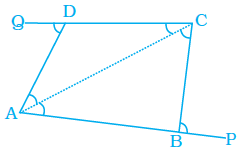
Answer:
Given:
A quadrilateral $ABCD$ where side $AB$ is extended to $P$ and side $CD$ is extended to $Q$.
To Find:
Whether $\angle ADQ + \angle CBP = \angle A + \angle C$ is true, with reasons.
Solution:
In quadrilateral $ABCD$, we know that the sum of all interior angles is $360^\circ$.
$\angle A + \angle B + \angle C + \angle D = 360^\circ$
[Angle sum property of a quadrilateral] ... (i)
Now, consider the angles at vertices $B$ and $D$. The angles on the straight lines $AP$ and $DQ$ form linear pairs.
$\angle ADQ + \angle D = 180^\circ$
[Linear pair] ... (ii)
$\angle CBP + \angle B = 180^\circ$
[Linear pair] ... (iii)
Adding equations (ii) and (iii), we get:
$\angle ADQ + \angle D + \angle CBP + \angle B = 180^\circ + 180^\circ$
$\angle ADQ + \angle CBP + (\angle B + \angle D) = 360^\circ$
... (iv)
From equation (i), we can find the value of $(\angle B + \angle D)$:
$\angle B + \angle D = 360^\circ - (\angle A + \angle C)$
Substituting this value into equation (iv):
$\angle ADQ + \angle CBP + [360^\circ - (\angle A + \angle C)] = 360^\circ$
$\angle ADQ + \angle CBP - (\angle A + \angle C) = 360^\circ - 360^\circ$
$\angle ADQ + \angle CBP - (\angle A + \angle C) = 0$
$\angle ADQ + \angle CBP = \angle A + \angle C$
Conclusion: Yes, the statement $\angle ADQ + \angle CBP = \angle A + \angle C$ is True.
Example 25: If AM and CN are perpendiculars on the diagonal BD of a parallelogram ABCD, Is ∆AMD ≅ ∆CNB? Give reason.
Answer:
Given:
In a parallelogram $ABCD$, $AM \perp BD$ and $CN \perp BD$.
To Prove:
$\Delta AMD \cong \Delta CNB$

Proof:
In $\Delta AMD$ and $\Delta CNB$:
$AD = BC$
[Opposite sides of a parallelogram are equal]
$\angle AMD = \angle CNB$
[Each is $90^\circ$ as $AM \perp BD$ and $CN \perp BD$]
$\angle ADM = \angle CBN$
[Alternate interior angles since $AD \parallel BC$]
By AAS (Angle-Angle-Side) congruence criterion, the two triangles are congruent.
$\Delta AMD \cong \Delta CNB$
Conclusion:
Yes, $\Delta AMD \cong \Delta CNB$.
Example 26: Construct a quadrilateral ABCD in which AB = AD = 5cm, BC = CD = 7cm and BD = 6cm. What type of quadrilateral is this?
Answer:
Given:
In quadrilateral $ABCD$, $AB = AD = 5 \text{ cm}$, $BC = CD = 7 \text{ cm}$, and diagonal $BD = 6 \text{ cm}$.
Construction Steps:
1. Draw a line segment $BD = 6 \text{ cm}$.
2. With $B$ as center and radius $5 \text{ cm}$, draw an arc above $BD$.
3. With $D$ as center and radius $5 \text{ cm}$, draw another arc intersecting the previous arc at point $A$.
4. Join $AB$ and $AD$.
5. With $B$ as center and radius $7 \text{ cm}$, draw an arc below $BD$.
6. With $D$ as center and radius $7 \text{ cm}$, draw another arc intersecting the previous arc at point $C$.
7. Join $BC$ and $CD$.

Type of Quadrilateral:
In this quadrilateral, we have two distinct pairs of equal adjacent sides:
$AB = AD$
(Adjacent sides are equal)
$BC = CD$
(Adjacent sides are equal)
A quadrilateral that has two pairs of equal adjacent sides is called a Kite.
Example 27: Find x in the following figure.
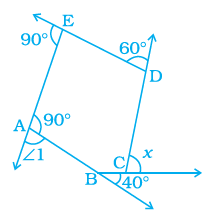
Answer:
To Find:
The value of $x$ in the given pentagon figure.
Solution:
1. Finding Exterior Angle $\angle 1$:
In the given figure, at one of the vertices, the interior angle is marked as a right angle ($90^\circ$). The adjacent exterior angle at this vertex be labeled as $\angle 1$.
Since interior and exterior angles at any vertex lie on a straight line, they form a linear pair:
$\angle 1 + 90^\circ = 180^\circ$
[Linear pair property]
$\angle 1 = 180^\circ - 90^\circ$
$\angle 1 = 90^\circ$
2. Applying Exterior Angle Sum Property:
The given polygon is a convex pentagon. The sum of all exterior angles of any convex polygon is always $360^\circ$.
The five exterior angles of this pentagon are $x$, $\angle 1$, $90^\circ$, $60^\circ$, and $40^\circ$.
$x + \angle 1 + 90^\circ + 60^\circ + 40^\circ = 360^\circ$
[Exterior angle sum property]
Substituting $\angle 1 = 90^\circ$ into the equation:
$x + 90^\circ + 90^\circ + 60^\circ + 40^\circ = 360^\circ$
Simplifying the sum of the known angles:
$x + 280^\circ = 360^\circ$
Solving for $x$:
$x = 360^\circ - 280^\circ$
$x = 80^\circ$
Therefore, the value of $x$ is $80^\circ$.
Example 28: Two adjacent angles of a parallelogram are in the ratio 4 : 5. Find their measures.
Answer:
Given:
The ratio of two adjacent angles of a parallelogram is $4 : 5$.
To Find:
The measure of each angle.
Solution:
Let the two adjacent angles be $4k$ and $5k$.
In a parallelogram, adjacent angles are supplementary, which means their sum is $180^\circ$.
$4k + 5k = 180^\circ$
[Adjacent angles of a parallelogram are supplementary]
$9k = 180^\circ$
$k = \frac{180^\circ}{9}$
$k = 20^\circ$
Now, we find the individual angles:
First angle = $4k = 4 \times 20^\circ = 80^\circ$
Second angle = $5k = 5 \times 20^\circ = 100^\circ$
Therefore, the measures of the adjacent angles are $80^\circ$ and $100^\circ$.
Example 29: The four angles of a quadrilateral are in the ratio 3 : 4 : 5 : 6. Find the angles.
Answer:
Given:
The ratio of the four angles of a quadrilateral is $3 : 4 : 5 : 6$.
To Find:
The measure of all four angles.
Solution:
Let the measures of the four angles be $3k, 4k, 5k,$ and $6k$.
We know that the sum of all interior angles of a quadrilateral is $360^\circ$.
$3k + 4k + 5k + 6k = 360^\circ$
[Angle sum property of a quadrilateral]
$18k = 360^\circ$
$k = \frac{360^\circ}{18}$
$k = 20^\circ$
The measures of the angles are calculated as follows:
First angle = $3 \times 20^\circ = 60^\circ$
Second angle = $4 \times 20^\circ = 80^\circ$
Third angle = $5 \times 20^\circ = 100^\circ$
Fourth angle = $6 \times 20^\circ = 120^\circ$
The four angles of the quadrilateral are $60^\circ, 80^\circ, 100^\circ,$ and $120^\circ$.
Example 30: In a parallelogram PQRS, the bisectors of ∠P and ∠Q meet at O. Find ∠POQ.
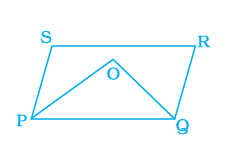
Answer:
Given:
$PQRS$ is a parallelogram. $PO$ is the bisector of $\angle P$ and $QO$ is the bisector of $\angle Q$.
To Find:
The measure of $\angle POQ$.
Solution:
We know that the sum of adjacent angles of a parallelogram is $180^\circ$.
$\angle P + \angle Q = 180^\circ$
[Adjacent angles are supplementary]
Dividing both sides by 2:
$\frac{1}{2}\angle P + \frac{1}{2}\angle Q = \frac{180^\circ}{2}$
$\angle OPQ + \angle OQP = 90^\circ$
[$PO$ and $QO$ are bisectors] ... (i)
In $\Delta POQ$, using the angle sum property of a triangle:
$\angle OPQ + \angle OQP + \angle POQ = 180^\circ$
Substituting the value from equation (i):
$90^\circ + \angle POQ = 180^\circ$
$\angle POQ = 180^\circ - 90^\circ$
$\angle POQ = 90^\circ$
The measure of $\angle POQ$ is $90^\circ$.
Example 31: Three angles of a quadrilateral are 50°, 40° and 123°. Find its fourth angle.
Answer:
Given:
Three angles of a quadrilateral are $50^\circ, 40^\circ$ and $123^\circ$.
To Find:
The measure of the fourth angle.
Solution:
Let the fourth angle of the quadrilateral be $x$.
According to the angle sum property of a quadrilateral, the sum of all interior angles is $360^\circ$.
$50^\circ + 40^\circ + 123^\circ + x = 360^\circ$
Adding the given angles:
$213^\circ + x = 360^\circ$
$x = 360^\circ - 213^\circ$
$x = 147^\circ$
The measure of the fourth angle is $147^\circ$.
Example 32: The ratio of exterior angle to interior angle of a regular polygon is 1:4. Find the number of sides of the polygon.
Answer:
Given:
The ratio of exterior angle to interior angle of a regular polygon is $1:4$.
To Find:
The number of sides of the polygon ($n$).
Solution:
Let the exterior angle be $y$ and the interior angle be $4y$.
We know that an interior angle and its corresponding exterior angle form a linear pair.
$y + 4y = 180^\circ$
$5y = 180^\circ$
$y = \frac{180^\circ}{5} = 36^\circ$
Thus, the exterior angle of the regular polygon is $36^\circ$.
The formula for the number of sides ($n$) of a regular polygon is:
$n = \frac{360^\circ}{\text{Exterior Angle}}$
$n = \frac{360^\circ}{36^\circ}$
$n = 10$
The number of sides of the regular polygon is $10$.
Example 33: Each interior angle of a polygon is 108°. Find the number of sides of the polygon.
Answer:
Given:
Each interior angle of a regular polygon is $108^\circ$.
To Find:
The number of sides ($n$).
Solution:
First, we find the measure of the exterior angle.
$\text{Exterior Angle} = 180^\circ - \text{Interior Angle}$
$\text{Exterior Angle} = 180^\circ - 108^\circ = 72^\circ$
Now, using the exterior angle formula to find $n$:
$n = \frac{360^\circ}{\text{Exterior Angle}}$
$n = \frac{360^\circ}{72^\circ}$
$n = 5$
The number of sides of the polygon is $5$.
Example 34: Construct a rhombus PAIR, given that PA = 6 cm and angle ∠A = 110°.
Answer:
Given:
In rhombus $PAIR$, $PA = 6 \text{ cm}$ and $\angle A = 110^\circ$.
Construction Required:
In a rhombus, all sides are equal. Therefore, $PA = AI = IR = RP = 6 \text{ cm}$.
Construction Steps:
1. Draw a line segment $PA = 6 \text{ cm}$.
2. At vertex $A$, construct an angle of $110^\circ$ using a protractor.
3. With $A$ as center and radius $6 \text{ cm}$, draw an arc on the ray of the angle to locate point $I$.
4. With $I$ as center and radius $6 \text{ cm}$, draw an arc.
5. With $P$ as center and radius $6 \text{ cm}$, draw another arc to intersect the previous arc at point $R$.
6. Join $IR$ and $RP$ to complete the rhombus $PAIR$.

Example 35: One of the diagonals of a rhombus and its sides are equal. Find the angles of the rhombus.
Answer:
Given:
In rhombus $ABCD$, side $AB$ is equal to diagonal $AC$.
To Find:
All the interior angles of the rhombus.
Solution:
Since $ABCD$ is a rhombus, all its sides are equal. Let the side length be $a$.
$AB = BC = CD = DA = a$
It is given that the diagonal is also equal to the side:
$AC = a$
Now, consider $\Delta ABC$. All three sides are equal ($AB = BC = AC = a$). Thus, $\Delta ABC$ is an equilateral triangle.
$\angle B = 60^\circ$
[Angle of equilateral triangle]
Similarly, $\Delta ADC$ is also an equilateral triangle ($AD = DC = AC = a$), so:
$\angle D = 60^\circ$
In a rhombus, adjacent angles are supplementary:
$\angle A + \angle B = 180^\circ$
$\angle A + 60^\circ = 180^\circ \implies \angle A = 120^\circ$
Since opposite angles are equal, $\angle C = \angle A = 120^\circ$.
The angles of the rhombus are $60^\circ, 120^\circ, 60^\circ,$ and $120^\circ$.
Example 36: In the figure, HOPE is a rectangle. Its diagonals meet at G. If HG = 5x + 1 and EG = 4x + 19, find x.

Answer:
Given:
$HOPE$ is a rectangle. Its diagonals $HP$ and $OE$ intersect at $G$.
$HG = 5x + 1$ and $EG = 4x + 19$.
To Find:
The value of $x$.
Solution:
In a rectangle, the diagonals are equal in length and bisect each other.
$HP = OE$
(Diagonals of a rectangle are equal)
Since the diagonals bisect each other, their halves must also be equal.
$HG = \frac{1}{2} HP$ $ \text{and} $ $EG = \frac{1}{2} OE$
Therefore,
$HG = EG$
Substituting the given values:
$5x + 1 = 4x + 19$
Subtracting $4x$ from both sides:
$5x - 4x + 1 = 19$
$x + 1 = 19$
Subtracting $1$ from both sides:
$x = 19 - 1$
$x = 18$
The value of $x$ is $18$.
Example 37: Application on the problem strategy
RICE is a rhombus. Find x, y, z. Justify your findings. Hence, find the perimeter of the rhombus.
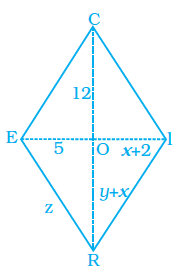
Answer:
Given:
$RICE$ is a rhombus with diagonals intersecting at $O$.
$OE = 5$, $OI = x + 2$, $OC = 12$, $OR = y + x$, and side $ER = z$.
To Find:
1. Values of $x, y,$ and $z$.
2. Perimeter of the rhombus.
Solution:
1. Finding $x$:
In a rhombus, the diagonals bisect each other. Therefore, the parts of the diagonal $EI$ are equal.
$OI = OE$
(Diagonals bisect each other)
$x + 2 = 5$
$x = 5 - 2$
$x = 3$
2. Finding $y$:
Similarly, for diagonal $CR$:
$OR = OC$
$y + x = 12$
Substituting $x = 3$:
$y + 3 = 12$
$y = 12 - 3 = 9$
3. Finding $z$:
In a rhombus, the diagonals bisect each other at right angles. Therefore, $\Delta EOR$ is a right-angled triangle at $O$.
$\angle EOR = 90^\circ$
(Diagonals bisect at $90^\circ$)
Using Pythagoras Theorem in $\Delta EOR$:
$ER^2 = OE^2 + OR^2$
$z^2 = 5^2 + 12^2$
$z^2 = 25 + 144$
$z^2 = 169$
$z = \sqrt{169} = 13$
4. Perimeter:
In a rhombus, all four sides are equal. Each side length is $z = 13$.
$\text{Perimeter} = 4 \times \text{side}$
$\text{Perimeter} = 4 \times 13 = 52$
The required values are $x = 3$, $y = 9$, and $z = 13$. The perimeter of the rhombus is $52$ units.
Example 38: Application on the problem solution strategy
Construct a rhombus with side 4.5cm and diagonal 6cm.
Answer:
Given:
Side of the rhombus $= 4.5 \text{ cm}$.
Diagonal of the rhombus $= 6 \text{ cm}$.
Construction Required:
Let the rhombus be $ABCD$ where side $AB = BC = CD = DA = 4.5 \text{ cm}$ and diagonal $AC = 6 \text{ cm}$.
Construction Steps:
1. Draw a line segment $AC = 6 \text{ cm}$.
2. With $A$ as center and radius $4.5 \text{ cm}$, draw an arc above $AC$ and another arc below $AC$.
3. With $C$ as center and radius $4.5 \text{ cm}$, draw two arcs intersecting the previous arcs at points $B$ (above) and $D$ (below).
4. Join $AB, BC, CD,$ and $DA$.
5. $ABCD$ is the required rhombus.

Exercise
Question 1 to 52 (Multiple Choice Questions)
In questions 1 to 52, there are four options, out of which one is correct. Write the correct answer.
Question 1. If three angles of a quadrilateral are each equal to 75°, the fourth angle is
(a) 150°
(b) 135°
(c) 45°
(d) 75°
Answer:
Given:
Three angles of a quadrilateral are each equal to $75^\circ$.
To Find:
The measure of the fourth angle.
Solution:
Let the measure of the fourth angle be $x$.
According to the angle sum property of a quadrilateral, the sum of all its internal angles is $360^\circ$.
$75^\circ + 75^\circ + 75^\circ + x = 360^\circ$
[Angle Sum Property]
$225^\circ + x = 360^\circ$
$x = 360^\circ - 225^\circ$
$x = 135^\circ$
Thus, the fourth angle is $135^\circ$.
The correct option is (b).
Question 2. For which of the following, diagonals bisect each other?
(a) Square
(b) Kite
(c) Trapezium
(d) Quadrilateral
Answer:
Solution:
In geometry, diagonals bisect each other in all parallelograms (including squares, rectangles, and rhombuses). In a Square, the diagonals are equal, bisect each other, and are perpendicular.
For a Kite, only one diagonal is bisected by the other. For a general Trapezium or Quadrilateral, diagonals do not necessarily bisect each other.
The correct option is (a).
Question 3. For which of the following figures, all angles are equal?
(a) Rectangle
(b) Kite
(c) Trapezium
(d) Rhombus
Answer:
Solution:
In a Rectangle (and a Square), all the interior angles are equal to $90^\circ$. In a Rhombus or Trapezium, all angles are not necessarily equal.
The correct option is (a).
Question 4. For which of the following figures, diagonals are perpendicular to each other?
(a) Parallelogram
(b) Kite
(c) Trapezium
(d) Rectangle
Answer:
Solution:
The diagonals are perpendicular to each other in a Rhombus, a Square, and a Kite. In a general Parallelogram or Rectangle, diagonals are not perpendicular unless the sides are equal.
The correct option is (b).
Question 5. For which of the following figures, diagonals are equal?
(a) Trapezium
(b) Rhombus
(c) Parallelogram
(d) Rectangle
Answer:
Solution:
The diagonals are equal in length for a Rectangle, a Square, and an Isosceles Trapezium. In a Rhombus or a general Parallelogram, diagonals are usually of different lengths.
The correct option is (d).
Question 6. Which of the following figures satisfy the following properties?
- All sides are congruent.
- All angles are right angles.
- Opposite sides are parallel.

(a) P
(b) Q
(c) R
(d) S
Answer:
Solution:
A figure that has all sides congruent (equal) and all angles as right angles is a Square. From the given image (Fig 8):
- P is a Trapezium.
- Q is a Parallelogram.
- R is a Square.
- S is a Rectangle.
Figure R satisfies all the given conditions.
The correct option is (c).
Question 7. Which of the following figures satisfy the following property?
- Has two pairs of congruent adjacent sides.

(a) P
(b) Q
(c) R
(d) S
Answer:
Solution:
A figure that has two pairs of congruent (equal) adjacent sides is a Kite. From the given image (Fig 9):
- P is a Trapezium.
- Q is a Parallelogram.
- R is a Kite.
- S is a Rectangle.
Figure R satisfies the property of having congruent adjacent sides.
The correct option is (c).
Question 8. Which of the following figures satisfy the following property?
- Only one pair of sides are parallel.

(a) P
(b) Q
(c) R
(d) S
Answer:
Solution:
A quadrilateral with only one pair of parallel sides is a Trapezium. From the given image (Fig 10):
- P is a Trapezium.
- Q is a Parallelogram.
- R is a Square.
- S is a Rectangle.
Figure P satisfies the property of having only one pair of sides parallel.
The correct option is (a).
Question 9. Which of the following figures do not satisfy any of the following properties?
- All sides are equal.
- All angles are right angles.
- Opposite sides are parallel.

(a) P
(b) Q
(c) R
(d) S
Answer:
Solution:
Let us analyze each figure based on the given properties:
1. Figure Q (Square): Satisfies all three properties (all sides equal, all angles $90^\circ$, and opposite sides are parallel).
2. Figure R (Rectangle): Satisfies two properties (all angles are right angles and opposite sides are parallel).
3. Figure S (Parallelogram): Satisfies the property that opposite sides are parallel.
4. Figure P (Trapezium): In a trapezium, only one pair of opposite sides is parallel. It does not satisfy the property "Opposite sides are parallel" (which refers to both pairs in the context of parallelograms), nor does it have all sides equal or all right angles.
Therefore, figure P does not satisfy any of the given properties in the sense of the parallelogram family.
The correct option is (a).
Quesiton 10. Which of the following properties describe a trapezium?
(a) A pair of opposite sides is parallel.
(b) The diagonals bisect each other.
(c) The diagonals are perpendicular to each other.
(d) The diagonals are equal.
Answer:
Solution:
By definition, a trapezium is a quadrilateral with at least one pair of parallel opposite sides.
The other properties mentioned (diagonals bisecting, being equal, or being perpendicular) are specific to parallelograms, rectangles, or rhombuses, and do not define a general trapezium.
The correct option is (a).
Question 11. Which of the following is a property of a parallelogram?
(a) Opposite sides are parallel.
(b) The diagonals bisect each other at right angles.
(c) The diagonals are perpendicular to each other.
(d) All angles are equal.
Answer:
Solution:
The fundamental property of a parallelogram is that both pairs of its opposite sides are parallel. Options (b) and (c) are properties specific to a rhombus or square, and option (d) is specific to a rectangle or square.
The correct option is (a).
Question 12. What is the maximum number of obtuse angles that a quadrilateral can have ?
(a) 1
(b) 2
(c) 3
(d) 4
Answer:
Solution:
An obtuse angle is an angle greater than $90^\circ$. We know that the sum of the four interior angles of a quadrilateral is $360^\circ$.
If all four angles were obtuse (say each is $91^\circ$), their sum would be:
$91^\circ \times 4 = 364^\circ$
[Sum exceeds $360^\circ$]
Since the sum cannot exceed $360^\circ$, it is impossible to have four obtuse angles. However, it is possible to have three obtuse angles and one acute angle (e.g., $100^\circ, 100^\circ, 100^\circ, 60^\circ$).
The maximum number of obtuse angles is 3.
The correct option is (c).
Question 13. How many non-overlapping triangles can we make in a n-gon (polygon having n sides), by joining the vertices?
(a) n – 1
(b) n – 2
(c) n – 3
(d) n – 4
Answer:
Solution:
To divide an $n$-sided polygon into non-overlapping triangles, we pick one vertex and draw diagonals to all other non-adjacent vertices. For example:
- A quadrilateral ($n=4$) can be divided into $4 - 2 = 2$ triangles.
- A pentagon ($n=5$) can be divided into $5 - 2 = 3$ triangles.
In general, a polygon with $n$ sides can be divided into $(n - 2)$ triangles.
The correct option is (b).
Question 14. What is the sum of all the angles of a pentagon?
(a) 180°
(b) 360°
(c) 540°
(d) 720°
Answer:
Solution:
The sum of the interior angles of a polygon with $n$ sides is given by the formula:
$\text{Sum} = (n - 2) \times 180^\circ$
For a pentagon, $n = 5$:
$\text{Sum} = (5 - 2) \times 180^\circ$
$\text{Sum} = 3 \times 180^\circ = 540^\circ$
The correct option is (c).
Question 15. What is the sum of all angles of a hexagon?
(a) 180°
(b) 360°
(c) 540°
(d) 720°
Answer:
Solution:
For a hexagon, the number of sides $n = 6$. Using the angle sum formula:
$\text{Sum} = (6 - 2) \times 180^\circ$
$\text{Sum} = 4 \times 180^\circ = 720^\circ$
The correct option is (d).
Question 16. If two adjacent angles of a parallelogram are (5x – 5)° and (10x + 35)°, then the ratio of these angles is
(a) 1 : 3
(b) 2 : 3
(c) 1 : 4
(d) 1 : 2
Answer:
Given:
Adjacent angles of a parallelogram are $(5x - 5)^\circ$ and $(10x + 35)^\circ$.
Solution:
Adjacent angles of a parallelogram are supplementary, meaning their sum is $180^\circ$.
$(5x - 5) + (10x + 35) = 180$
$15x + 30 = 180$
$15x = 180 - 30$
$15x = 150 \implies x = 10$
Now, we find the measures of the angles:
First angle: $5(10) - 5 = 50 - 5 = 45^\circ$
Second angle: $10(10) + 35 = 100 + 35 = 135^\circ$
Ratio of the angles:
$\text{Ratio} = \frac{45}{135}$
$\text{Ratio} = \frac{\cancel{45}^1}{\cancel{135}_3} = 1:3$
The correct option is (a).
Question 17. A quadrilateral whose all sides are equal, opposite angles are equal and the diagonals bisect each other at right angles is a __________.
(a) rhombus
(b) parallelogram
(c) square
(d) rectangle
Answer:
Solution:
Let us examine the properties of the given quadrilateral:
1. All sides are equal: This property is satisfied by a rhombus and a square.
2. Opposite angles are equal: This is a general property of all parallelograms, including rhombuses and squares.
3. Diagonals bisect each other at right angles: This is a specific property of a rhombus and a square.
Since the question does not specify that all angles must be right angles (which would make it a square), the most appropriate and general name for a quadrilateral with these properties is a rhombus.
The correct option is (a).
Question 18. A quadrialateral whose opposite sides and all the angles are equal is a
(a) rectangle
(b) parallelogram
(c) square
(d) rhombus
Answer:
Solution:
Consider the properties mentioned:
1. All angles are equal: In a quadrilateral, the sum of angles is $360^\circ$. If all four angles are equal, each angle must be:
$\text{Each angle} = \frac{360^\circ}{4} = 90^\circ$
2. Opposite sides are equal: A quadrilateral with opposite sides equal and each angle measuring $90^\circ$ is the definition of a rectangle.
The correct option is (a).
Question 19. A quadrilateral whose all sides, diagonals and angles are equal is a
(a) square
(b) trapezium
(c) rectangle
(d) rhombus
Answer:
Solution:
Let us verify the properties for a square:
1. All sides are equal: True for a square.
2. All angles are equal: True for a square (each is $90^\circ$).
3. Diagonals are equal: True for a square.
While a rhombus has all sides equal, its diagonals and angles are not necessarily equal. While a rectangle has all angles and diagonals equal, its sides are not necessarily all equal. Only the square satisfies all these conditions simultaneously.
The correct option is (a).
Question 20. How many diagonals does a hexagon have?
(a) 9
(b) 8
(c) 2
(d) 6
Answer:
Solution:
The number of diagonals in a polygon with $n$ sides is calculated using the formula:
$\text{Number of diagonals} = \frac{n(n - 3)}{2}$
For a hexagon, the number of sides $n = 6$. Substituting this value into the formula:
$\text{Number of diagonals} = \frac{6(6 - 3)}{2}$
$\text{Number of diagonals} = \frac{6 \times 3}{2}$
$\text{Number of diagonals} = \frac{18}{2} = 9$
The correct option is (a).
Question 21. If the adjacent sides of a parallelogram are equal then parallelogram is a
(a) rectangle
(b) trapezium
(c) rhombus
(d) square
Answer:
Solution:
In a parallelogram, opposite sides are always equal. If the adjacent sides are also equal, it implies that all four sides of the parallelogram are equal.
By definition, a parallelogram with all four sides equal is a rhombus.
The correct option is (c).
Question 22. If the diagonals of a quadrilateral are equal and bisect each other, then the quadrilateral is a
(a) rhombus
(b) rectangle
(c) square
(d) parallelogram
Answer:
Solution:
Let us analyze the diagonal properties:
1. Diagonals bisect each other: This property ensures the quadrilateral is a parallelogram.
2. Diagonals are equal: In a parallelogram, if the diagonals are equal, the figure must be a rectangle.
While a square also has equal diagonals that bisect each other, a square requires the additional property of diagonals being perpendicular. The most general quadrilateral defined by these two specific properties is the rectangle.
The correct option is (b).
Question 23. The sum of all exterior angles of a triangle is
(a) 180°
(b) 360°
(c) 540°
(d) 720°
Answer:
Solution:
According to the Polygon Exterior Angle Sum Theorem, the sum of the measures of the exterior angles of any convex polygon, taking one at each vertex, is always $360^\circ$.
This property holds true regardless of the number of sides. Therefore, for a triangle, quadrilateral, or any other polygon, the sum remains constant.
The correct option is (b).
Question 24. Which of the following is an equiangular and equilateral polygon?
(a) Square
(b) Rectangle
(c) Rhombus
(d) Right triangle
Answer:
Solution:
A polygon that is both equilateral (all sides equal) and equiangular (all angles equal) is known as a regular polygon.
Let us check the options:
1. Rectangle: Equiangular but not necessarily equilateral.
2. Rhombus: Equilateral but not necessarily equiangular.
3. Square: It has four equal sides and four equal angles (each $90^\circ$). Thus, it is a regular quadrilateral.
The correct option is (a).
Question 25. Which one has all the properties of a kite and a parallelogram?
(a) Trapezium
(b) Rhombus
(c) Rectangle
(d) Parallelogram
Answer:
To Find:
The quadrilateral that satisfies the properties of both a kite and a parallelogram.
Solution:
Let us evaluate the properties of the given shapes:
1. Kite: A quadrilateral with two pairs of equal adjacent sides. In a kite, the diagonals are perpendicular to each other.
2. Parallelogram: A quadrilateral with two pairs of parallel opposite sides. In a parallelogram, opposite sides are equal, and diagonals bisect each other.
3. Rhombus: A rhombus has all four sides equal. Since all sides are equal, it naturally has two pairs of equal adjacent sides (like a kite). Also, since it is a parallelogram, it has opposite sides parallel (like a parallelogram).
Thus, a rhombus possesses the properties of both a kite and a parallelogram.
The correct option is (b).
Question 26. The angles of a quadrilateral are in the ratio 1 : 2 : 3 : 4. The smallest angle is
(a) 72°
(b) 144°
(c) 36°
(d) 18°
Answer:
Given:
The ratio of the angles of a quadrilateral is $1 : 2 : 3 : 4$.
To Find:
The measure of the smallest angle.
Solution:
Let the angles of the quadrilateral be $x, 2x, 3x,$ and $4x$.
According to the angle sum property of a quadrilateral, the sum of all interior angles is $360^\circ$.
$x + 2x + 3x + 4x = 360^\circ$
[Angle sum property of quadrilateral]
$10x = 360^\circ$
$x = \frac{360^\circ}{10} = 36^\circ$
The smallest angle corresponds to the ratio part $1$, which is $x$.
Smallest Angle = $36^\circ$
The correct option is (c).
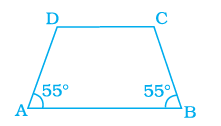
Question 27. In the trapezium ABCD, the measure of ∠D is
(a) 55°
(b) 115°
(c) 135°
(d) 125°
Answer:
Given:
In trapezium $ABCD$, $AB \parallel DC$ and $\angle A = 55^\circ$.
To Find:
The measure of $\angle D$.
Solution:
In a trapezium, the angles on the same side of the transversal (adjacent angles between parallel sides) are supplementary.
Since $AB \parallel DC$, $\angle A$ and $\angle D$ are consecutive interior angles.
$\angle A + \angle D = 180^\circ$
[Adjacent angles between parallel sides]
$55^\circ + \angle D = 180^\circ$
$\angle D = 180^\circ - 55^\circ$
$\angle D = 125^\circ$
The correct option is (d).
Question 28. A quadrilateral has three acute angles. If each measures 80°, then the measure of the fourth angle is
(a) 150°
(b) 120°
(c) 105°
(d) 140°
Answer:
Given:
Three angles of a quadrilateral are each equal to $80^\circ$.
To Find:
The measure of the fourth angle.
Solution:
Let the fourth angle be $x$.
We know that the sum of the four angles of a quadrilateral is $360^\circ$.
$80^\circ + 80^\circ + 80^\circ + x = 360^\circ$
$240^\circ + x = 360^\circ$
$x = 360^\circ - 240^\circ$
$x = 120^\circ$
The correct option is (b).
Question 29. The number of sides of a regular polygon where each exterior angle has a measure of 45° is
(a) 8
(b) 10
(c) 4
(d) 6
Answer:
Given:
Each exterior angle of a regular polygon is $45^\circ$.
To Find:
The number of sides of the regular polygon ($n$).
Solution:
The sum of all exterior angles of any regular polygon is $360^\circ$.
$n = \frac{360^\circ}{\text{measure of each exterior angle}}$
$n = \frac{360^\circ}{45^\circ}$
$n = 8$
The correct option is (a).
Question 30. In a parallelogram PQRS, if ∠P = 60°, then other three angles are
(a) 45°, 135°, 120°
(b) 60°, 120°, 120°
(c) 60°, 135°, 135°
(d) 45°, 135°, 135°
Answer:
Given:
In parallelogram $PQRS$, $\angle P = 60^\circ$.
To Find:
The measure of $\angle Q, \angle R,$ and $\angle S$.
Solution:
In a parallelogram:
1. Opposite angles are equal.
$\angle R = \angle P = 60^\circ$
2. Adjacent angles are supplementary.
$\angle Q + \angle P = 180^\circ$
$\angle Q + 60^\circ = 180^\circ \implies \angle Q = 120^\circ$
3. Again, opposite angles are equal.
$\angle S = \angle Q = 120^\circ$
The measures of the other three angles are $120^\circ, 60^\circ,$ and $120^\circ$.
The correct option is (b).
Question 31. If two adjacent angles of a parallelogram are in the ratio 2 : 3, then the measure of angles are
(a) 72°, 108°
(b) 36°, 54°
(c) 80°, 120°
(d) 96°, 144°
Answer:
Given:
The ratio of two adjacent angles of a parallelogram is $2 : 3$.
To Find:
The measure of the angles.
Solution:
Let the common multiplier be $x$. So the angles are $2x$ and $3x$.
Adjacent angles in a parallelogram are supplementary.
$2x + 3x = 180^\circ$
$5x = 180^\circ \implies x = 36^\circ$
The measures of the angles are:
First Angle = $2 \times 36^\circ = 72^\circ$
Second Angle = $3 \times 36^\circ = 108^\circ$
The correct option is (a).
Question 32. If PQRS is a parallelogram, then ∠P – ∠R is equal to
(a) 60°
(b) 90°
(c) 80°
(d) 0°
Answer:
Given:
$PQRS$ is a parallelogram.
Solution:
In any parallelogram, the opposite angles are equal.
In $PQRS$, $\angle P$ and $\angle R$ are opposite angles.
$\angle P = \angle R$
Subtracting $\angle R$ from both sides:
$\angle P - \angle R = 0^\circ$
The correct option is (d).
Question 33. The sum of adjacent angles of a parallelogram is
(a) 180°
(b) 120°
(c) 360°
(d) 90°
Answer:
Solution:
In a parallelogram, adjacent angles are formed by a transversal cutting two parallel lines. These are consecutive interior angles, which are supplementary.
$\text{Sum of adjacent angles} = 180^\circ$
The correct option is (a).
Question 34. The angle between the two altitudes of a parallelogram through the same vertex of an obtuse angle of the parallelogram is 30°. The measure of the obtuse angle is
(a) 100°
(b) 150°
(c) 105°
(d) 120°
Answer:
To Find: The measure of the obtuse angle of a parallelogram when the angle between two altitudes from that vertex is $30^\circ$.
Solution:

Let $ABCD$ be a parallelogram where $\angle D$ is the obtuse angle. Draw altitudes $DM \perp AB$ and $DN \perp BC$. We consider the quadrilateral $DMBN$.
$\angle DMB = 90^\circ$
[Altitude property] ... (i)
$\angle DNB = 90^\circ$
[Altitude property] ... (ii)
In quadrilateral $DMBN$, the sum of all angles is $360^\circ$.
$\angle MDN + \angle DMB + \angle MBN + \angle DNB = 360^\circ$
Substituting the given angle between altitudes $\angle MDN = 30^\circ$ and the right angles:
$30^\circ + 90^\circ + \angle B + 90^\circ = 360^\circ$
$210^\circ + \angle B = 360^\circ$
$\angle B = 360^\circ - 210^\circ = 150^\circ$
In a parallelogram, opposite angles are equal.
$\angle D = \angle B = 150^\circ$
[Opposite angles of parallelogram]
The correct option is (b).
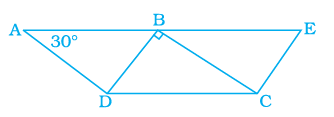
Question 35. In the given figure, ABCD and BDCE are parallelograms with common base DC. If BC ⊥ BD, then ∠BEC =
(a) 60°
(b) 30°
(c) 150°
(d) 120°
Answer:
Given:
1. $ABCD$ is a parallelogram with base $DC$.
2. $BDCE$ is a parallelogram with base $DC$.
3. $BC \perp BD$, which means $\angle DBC = 90^\circ$.
To Find:
The measure of $\angle BEC$.
Solution:
In parallelogram $ABCD$, the opposite sides $AD$ and $BC$ are parallel ($AD \parallel BC$). Since $AB$ is extended to $E$, $AE$ acts as a transversal line. By the property of corresponding angles:
$\angle EBC = \angle BAD$
[Corresponding angles] ... (i)
In parallelogram $BDCE$, the opposite sides $BD$ and $EC$ are parallel ($BD \parallel EC$). Considering $BC$ as a transversal line between these parallel segments, the alternate interior angles are equal:
$\angle BCE = \angle DBC$
[Alternate interior angles] ... (ii)
Given that $BC \perp BD$, we have:
$\angle DBC = 90^\circ$
Substituting this value into equation (ii):
$\angle BCE = 90^\circ$
Based on the geometry of the given figure, where $\angle BAD = 30^\circ$, we substitute this into equation (i):
$\angle EBC = 30^\circ$
Now, in $\Delta BEC$, we apply the angle sum property of a triangle:
$\angle BEC + \angle BCE + \angle EBC = 180^\circ$
$\angle BEC + 90^\circ + 30^\circ = 180^\circ$
[Angle sum property of $\Delta BEC$]
$\angle BEC + 120^\circ = 180^\circ$
$\angle BEC = 180^\circ - 120^\circ$
$\angle BEC = 60^\circ$
Therefore, the measure of $\angle BEC$ is $60^\circ$.
Question 36. Length of one of the diagonals of a rectangle whose sides are 10 cm and 24 cm is
(a) 25 cm
(b) 20 cm
(c) 26 cm
(d) 3.5 cm
Answer:
To Find: The length of the diagonal of a rectangle with sides $10 \text{ cm}$ and $24 \text{ cm}$.
Solution:
A rectangle forms two right-angled triangles with its diagonal as the hypotenuse. Using Pythagoras theorem:
$\text{Diagonal}^2 = \text{length}^2 + \text{breadth}^2$
$\text{Diagonal}^2 = 10^2 + 24^2$
$\text{Diagonal}^2 = 100 + 576 = 676$
$\text{Diagonal} = \sqrt{676} = 26 \text{ cm}$
The correct option is (c).
Question 37. If the adjacent angles of a parallelogram are equal, then the parallelogram is a
(a) rectangle
(b) trapezium
(c) rhombus
(d) any of the three
Answer:
Solution:
Let the equal adjacent angles be $x$. Sum of adjacent angles of a parallelogram is $180^\circ$.
$x + x = 180^\circ \implies 2x = 180^\circ \implies x = 90^\circ$
A parallelogram with each angle equal to $90^\circ$ is a rectangle.
The correct option is (a).
Question 38. Which of the following can be four interior angles of a quadrilateral?
(a) 140°, 40°, 20°, 160°
(b) 270°, 150°, 30°, 20°
(c) 40°, 70°, 90°, 60°
(d) 110°, 40°, 30°, 180°
Answer:
Solution:
The sum of the interior angles of a quadrilateral must be exactly $360^\circ$. Let's check the options:
(a) $140^\circ + 40^\circ + 20^\circ + 160^\circ = 360^\circ$ (Correct)
(b) $270^\circ + 150^\circ + ... > 360^\circ$ (Incorrect)
(c) $40^\circ + 70^\circ + 90^\circ + 60^\circ = 260^\circ$ (Incorrect)
(d) $110^\circ + 40^\circ + 30^\circ + 180^\circ = 360^\circ$ (Incorrect, as $180^\circ$ angle cannot exist in a polygon vertex).
The correct option is (a).
Question 39. The sum of angles of a concave quadrilateral is
(a) more than 360°
(b) less than 360°
(c) equal to 360°
(d) twice of 360°
Answer:
Solution:
The sum of the interior angles of any polygon depends only on the number of sides $n$. For any quadrilateral (convex or concave), $n = 4$.
$\text{Sum} = (4 - 2) \times 180^\circ = 360^\circ$
The correct option is (c).
Question 40. Which of the following can never be the measure of exterior angle of a regular polygon?
(a) 22°
(b) 36°
(c) 45°
(d) 30°
Answer:
Solution:
For a regular polygon, the number of sides $n = \frac{360^\circ}{\text{exterior angle}}$ must be an integer greater than or equal to $3$.
(a) $\frac{360}{22} \approx 16.36$ (Not an integer)
(b) $\frac{360}{36} = 10$
(c) $\frac{360}{45} = 8$
(d) $\frac{360}{30} = 12$
The correct option is (a).
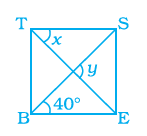
Question 41. In the figure, BEST is a rhombus, Then the value of y – x is
(a) 40°
(b) 50°
(c) 20°
(d) 10°
Answer:
Given:
In the given figure, $BEST$ is a rhombus where the diagonals $BS$ and $ET$ intersect at point $O$. The measure of $\angle OBE = 40^\circ$. We need to find the value of $y - x$.
Solution:
In a rhombus, the opposite sides are parallel. Therefore, $TS \parallel BE$. Considering the diagonal $BS$ as a transversal line intersecting these parallel sides, the alternate interior angles are equal.
$\angle BST = \angle SBE$
(Alternate interior angles)
$\angle BST = 40^\circ$
Now, consider $\Delta OST$. If we extend the side $TO$ to $E$, then $\angle SOE$ (represented by $y$) acts as an exterior angle to $\Delta OST$ at vertex $O$.
According to the exterior angle property of a triangle, the measure of an exterior angle is equal to the sum of its two interior opposite angles.
$\angle SOE = \angle OST + \angle STO$
Substituting the values $y$ for $\angle SOE$, $40^\circ$ for $\angle OST$ (since $\angle OST$ is the same as $\angle BST$), and $x$ for $\angle STO$:
$y = 40^\circ + x$
To find the value of $y - x$, we rearrange the equation by subtracting $x$ from both sides:
$y - x = 40^\circ$
Therefore, the value of $y - x$ is $40^\circ$. The correct option is (a).
Question 42. The closed curve which is also a polygon is

Answer:
To Find:
Identify which of the given figures (a), (b), (c), or (d) is a closed curve that is also a polygon.
Solution:
A polygon is defined as a simple closed curve made up entirely of line segments. Let us carefully observe each figure provided in Fig. 15:
1. Figure (a): This is a star-shaped figure. It is a closed curve made up entirely of line segments. While it is a concave polygon, it satisfies the criteria of being a polygon.
2. Figure (b): This figure consists of two triangles joined at a single vertex. It is not considered a simple closed curve because the boundary crosses itself at that single point.
3. Figure (c): This is an open curve. Since it does not end at the same point where it started, it cannot be a polygon.
4. Figure (d): This figure contains a curved part (a semicircle) attached to a quadrilateral. Since a polygon must be made up only of line segments, this figure is not a polygon.
Conclusion:
Based on the careful observation of the shapes, only figure (a) is a polygon.
The correct option is (a).
Question 43. Which of the following is not true for an exterior angle of a regular polygon with n sides?
(a) Each exterior angle = $\frac{360°}{n}$
(b) Exterior angle = 180° – interior angle
(c) n = $\frac{360°}{extertor \ angle}$
(d) Each exterior angle = $\frac{(n \;−\; 2) \;×\; 180°}{n}$
Answer:
Solution:
For a regular polygon with $n$ sides:
(a) Each exterior angle $= \frac{360^\circ}{n}$ (True)
(b) Exterior angle $= 180^\circ - \text{interior angle}$ (True, they form a linear pair)
(c) $n = \frac{360^\circ}{\text{exterior angle}}$ (True, rearrangement of option a)
(d) Each exterior angle $= \frac{(n - 2) \times 180^\circ}{n}$ (False, this is the formula for an interior angle).
The correct option is (d).
Question 44. PQRS is a square. PR and SQ intersect at O. Then ∠POQ is a
(a) Right angle
(b) Straight angle
(c) Reflex angle
(d) Complete angle
Answer:
Solution:
In a square, the diagonals are equal and bisect each other at right angles ($90^\circ$). Since $PR$ and $SQ$ are diagonals intersecting at $O$:
$\angle POQ = 90^\circ$
An angle of $90^\circ$ is called a Right angle.
The correct option is (a).
Question 45. Two adjacent angles of a parallelogram are in the ratio 1 : 5. Then all the angles of the parallelogram are
(a) 30°, 150°, 30°, 150°
(b) 85°, 95°, 85°, 95°
(c) 45°, 135°, 45°, 135°
(d) 30°, 180°, 30°, 180°
Answer:
To Find: All angles of the parallelogram.
Solution:
Let the adjacent angles be $1x$ and $5x$. In a parallelogram, adjacent angles are supplementary.
$1x + 5x = 180^\circ$
$6x = 180^\circ \implies x = 30^\circ$
The measures of the adjacent angles are:
- Angle 1 $= 30^\circ$
- Angle 2 $= 5 \times 30^\circ = 150^\circ$
Since opposite angles of a parallelogram are equal, all the angles are $30^\circ, 150^\circ, 30^\circ, 150^\circ$.
The correct option is (a).
Question 46. A parallelogram PQRS is constructed with sides QR = 6 cm, PQ = 4 cm and ∠PQR = 90°. Then PQRS is a
(a) square
(b) rectangle
(c) rhombus
(d) trapezium
Answer:
Solution:
In the parallelogram $PQRS$, we are given adjacent sides $PQ = 4 \text{ cm}$ and $QR = 6 \text{ cm}$, with an included angle $\angle PQR = 90^\circ$.
- A parallelogram with at least one right angle is a rectangle.
- Since the adjacent sides are not equal ($4 \neq 6$), it cannot be a square.
The correct option is (b).
Question 47. The angles P, Q, R and S of a quadrilateral are in the ratio 1 : 3 : 7 : 9. Then PQRS is a
(a) parallelogram
(b) trapezium with PQ || RS
(c) trapezium with QR || PS
(d) kite
Answer:
To Find: The type of quadrilateral $PQRS$.
Solution:
Let the angles be $1k, 3k, 7k,$ and $9k$. Sum $= 360^\circ$.
$1k + 3k + 7k + 9k = 360^\circ$
$20k = 360^\circ \implies k = 18^\circ$
Angles are: $\angle P = 18^\circ, \angle Q = 54^\circ, \angle R = 126^\circ, \angle S = 162^\circ$.
Checking for parallel sides using co-interior angles:
$\angle Q + \angle R = 54^\circ + 126^\circ = 180^\circ$
Since co-interior angles sum to $180^\circ$, $PQ \parallel SR$. Similarly, $\angle P + \angle S = 18^\circ + 162^\circ = 180^\circ$.
As only one pair of opposite sides is parallel (since $P + Q \neq 180^\circ$), it is a trapezium with $PQ \parallel RS$.
The correct option is (b).
Question 48. PQRS is a trapezium in which PQ || SR and ∠P = 130°, ∠Q = 110°. Then ∠R is equal to:
(a) 70°
(b) 50°
(c) 65°
(d) 55°
Answer:
To Find: The measure of $\angle R$.
Solution:
In trapezium $PQRS$ with $PQ \parallel SR$, the angles adjacent to the non-parallel sides are supplementary.
$\angle Q + \angle R = 180^\circ$
[Co-interior angles]
$110^\circ + \angle R = 180^\circ$
$\angle R = 180^\circ - 110^\circ = 70^\circ$
The correct option is (a).
Question 49. The number of sides of a regular polygon whose each interior angle is of 135° is
(a) 6
(b) 7
(c) 8
(d) 9
Answer:
Given:
Each interior angle of a regular polygon is $135^\circ$.
To Find:
The number of sides ($n$) of the polygon.
Solution:
We know that an interior angle and its corresponding exterior angle form a linear pair. Therefore, we can find the exterior angle first:
$\text{Exterior Angle} = 180^\circ - \text{Interior Angle}$
$\text{Exterior Angle} = 180^\circ - 135^\circ = 45^\circ$
The number of sides of a regular polygon is given by dividing $360^\circ$ by the measure of each exterior angle:
$n = \frac{360^\circ}{\text{Exterior Angle}}$
$n = \frac{360^\circ}{45^\circ}$
$n = 8$
The polygon is a regular octagon. The correct option is (c).
Question 50. If a diagonal of a quadrilateral bisects both the angles, then it is a
(a) kite
(b) parallelogram
(c) rhombus
(d) rectangle
Answer:
Solution:
A rhombus is a parallelogram with all four sides equal. One of its unique properties is that its diagonals bisect the interior angles through which they pass. Specifically, if a diagonal bisects both pairs of opposite angles, the quadrilateral must be a rhombus (or a square, which is a special rhombus).
The correct option is (c).
Question 51. To construct a unique parallelogram, the minimum number of measurements required is
(a) 2
(b) 3
(c) 4
(d) 5
Answer:
Solution:
A general quadrilateral requires $5$ independent measurements for construction. However, a parallelogram has inherent properties (opposite sides are equal and parallel). Therefore, we only need $3$ independent measurements, such as:
1. Two adjacent sides and the included angle.
2. Two adjacent sides and one diagonal.
The correct option is (b).
Question 52. To construct a unique rectangle, the minimum number of measurements required is
(a) 4
(b) 3
(c) 2
(d) 1
Answer:
Solution:
In a rectangle, all angles are already known to be $90^\circ$. To construct it uniquely, we only need to know the lengths of its two adjacent sides (length and breadth).
The minimum measurements required are $2$. The correct option is (c).
Question 53 to 91 (Fill in the Blanks)
In questions 53 to 91, fill in the blanks to make the statements true.
Question 53. In quadrilateral HOPE, the pairs of opposite sides are __________.
Answer:
Solution:
In a quadrilateral, vertices are named in order (clockwise or anti-clockwise). For $H-O-P-E$:
1. Side $HO$ is opposite to side $PE$.
2. Side $OP$ is opposite to side $HE$.
Answer: (HO, PE) and (OP, HE)
Question 54. In quadrilateral ROPE, the pairs of adjacent angles are __________.
Answer:
Solution:
Adjacent angles are angles that share a common side. In quadrilateral $ROPE$, the pairs are:
1. $\angle R$ and $\angle O$
2. $\angle O$ and $\angle P$
3. $\angle P$ and $\angle E$
4. $\angle E$ and $\angle R$
Answer: ($\angle R, \angle O$), ($\angle O, \angle P$), ($\angle P, \angle E$), and ($\angle E, \angle R$)
Question 55. In quadrilateral WXYZ, the pairs of opposite angles are __________.
Answer:
Solution:
Opposite angles are those that do not share a common side. In quadrilateral $WXYZ$:
1. $\angle W$ is opposite to $\angle Y$.
2. $\angle X$ is opposite to $\angle Z$.
Answer: ($\angle W, \angle Y$) and ($\angle X, \angle Z$)
Question 56. The diagonals of the quadrilateral DEFG are __________ and __________.
Answer:
Solution:
Diagonals are line segments joining non-adjacent vertices. In quadrilateral $DEFG$:
1. Joining $D$ to $F$ gives diagonal DF.
2. Joining $E$ to $G$ gives diagonal EG.
Answer: DF and EG
Question 57. The sum of all __________ of a quadrilateral is 360°.
Answer:
Solution:
According to the angle sum property of a quadrilateral, the sum of all its interior angles is $360^\circ$. Similarly, the sum of all its exterior angles is also $360^\circ$.
Answer: interior angles (or exterior angles)
Question 58. The measure of each exterior angle of a regular pentagon is __________.
Answer:
Given:
A regular pentagon ($n = 5$).
Solution:
The sum of the exterior angles of any convex polygon is $360^\circ$. For a regular polygon, each exterior angle is equal.
$\text{Measure of each exterior angle} = \frac{360^\circ}{n}$
$\text{Measure of each exterior angle} = \frac{360^\circ}{5}$
$\text{Measure of each exterior angle} = 72^\circ$
Answer: $72^\circ$
Question 59. Sum of the angles of a hexagon is __________.
Answer:
Given:
A hexagon ($n = 6$).
Solution:
The sum of the interior angles of a polygon with $n$ sides is given by the formula $(n - 2) \times 180^\circ$.
$\text{Sum of angles} = (6 - 2) \times 180^\circ$
$\text{Sum of angles} = 4 \times 180^\circ$
$\text{Sum of angles} = 720^\circ$
Answer: $720^\circ$
Question 60. The measure of each exterior angle of a regular polygon of 18 sides is __________.
Answer:
Given:
Number of sides, $n = 18$.
Solution:
$\text{Each exterior angle} = \frac{360^\circ}{n}$
$\text{Each exterior angle} = \frac{360^\circ}{18}$
$\text{Each exterior angle} = 20^\circ$
Answer: $20^\circ$
Question 61. The number of sides of a regular polygon, where each exterior angle has a measure of 36°, is __________.
Answer:
Given:
Exterior angle $= 36^\circ$.
Solution:
$n = \frac{360^\circ}{\text{Exterior angle}}$
$n = \frac{360^\circ}{36^\circ}$
$n = 10$
Answer: 10
Question 62.  is a closed curve entirely made up of line segments. The another name for this shape is __________.
Answer:
Solution:
Any closed curve made up entirely of line segments is called a polygon. Since this particular shape has interior angles greater than $180^\circ$, it is specifically a concave polygon.
Answer: polygon (or concave polygon)
Question 63. A quadrilateral that is not a parallelogram but has exactly two opposite angles of equal measure is __________.
Answer:
Solution:
In a kite, there is one pair of opposite angles (the angles between the non-equal sides) that are equal in measure, while the other pair of opposite angles are unequal. It is not a parallelogram because its opposite sides are not parallel.
Answer: kite
Question 64. The measure of each angle of a regular pentagon is __________.
Answer:
Given:
A regular pentagon ($n = 5$).
Solution:
First, find the sum of all interior angles:
$\text{Sum} = (5 - 2) \times 180^\circ = 540^\circ$
Since it is a regular polygon, all angles are equal:
$\text{Each angle} = \frac{540^\circ}{5}$
$\text{Each angle} = 108^\circ$
Answer: $108^\circ$
Question 65. The name of three-sided regular polygon is __________.
Answer:
Solution:
A polygon with three sides is a triangle. A regular triangle is one where all sides and all angles are equal.
Answer: equilateral triangle
Question 66. The number of diagonals in a hexagon is __________.
Answer:
Given:
A hexagon ($n = 6$).
Solution:
$\text{Number of diagonals} = \frac{n(n - 3)}{2}$
$\text{Number of diagonals} = \frac{6(6 - 3)}{2}$
$\text{Number of diagonals} = \frac{6 \times 3}{2} = 9$
Answer: 9
Question 67. A polygon is a simple closed curve made up of only __________.
Answer:
Solution:
By definition, a polygon is a simple closed curve that is formed entirely by line segments. It must not contain any curved paths, and the line segments must only meet at their endpoints.
Answer: line segments
Question 68. A regular polygon is a polygon whose all sides are equal and all __________ are equal.
Answer:
Solution:
A polygon is termed as regular if it is both equilateral (all sides have the same length) and equiangular (all interior angles have the same measure).
Answer: angles (or interior angles)
Question 69. The sum of interior angles of a polygon of n sides is __________right angles.
Answer:
Solution:
The sum of the interior angles of a polygon with $n$ sides is given by the formula:
$\text{Sum} = (n - 2) \times 180^\circ$
Since $180^\circ$ is equal to two right angles ($2 \times 90^\circ$), we can rewrite the formula as:
$\text{Sum} = (n - 2) \times 2 \text{ right angles}$
$\text{Sum} = (2n - 4) \text{ right angles}$
Answer: $(2n - 4)$
Question 70. The sum of all exterior angles of a polygon is __________.
Answer:
Solution:
According to the Polygon Exterior Angle Sum Theorem, the sum of the measures of the exterior angles of any convex polygon, taking one at each vertex, is always constant regardless of the number of sides.
Answer: $360^\circ$
Question 71. __________ is a regular quadrilateral.
Answer:
Solution:
A regular polygon is one where all sides and all angles are equal. A quadrilateral with four equal sides and four equal angles ($90^\circ$ each) is a square.
Answer: Square
Question 72. A quadrilateral in which a pair of opposite sides is parallel is __________.
Answer:
Solution:
A quadrilateral having at least one pair of parallel opposite sides is defined as a trapezium.
Answer: trapezium
Question 73. If all sides of a quadrilateral are equal, it is a __________.
Answer:
Solution:
A quadrilateral that has all four sides of equal length is called a rhombus. While a square also has equal sides, the rhombus is the more general category for this property.
Answer: rhombus
Question 74. In a rhombus diagonals intersect at __________ angles.
Answer:
Solution:
One of the fundamental properties of a rhombus is that its diagonals are perpendicular to each other. This means they intersect at an angle of $90^\circ$.
Answer: right (or $90^\circ$)
Question 75. __________ measurements can determine a quadrilateral uniquely.
Answer:
Solution:
To construct a specific and unique quadrilateral, we require five independent measurements. These could be combinations of sides, angles, and diagonals.
Answer: Five
Question 76. A quadrilateral can be constructed uniquely if its three sides and __________ angles are given.
Answer:
Solution:
A quadrilateral can be uniquely determined if three of its sides and the two included angles between those sides are known. This is often referred to as the SASAS construction criteria.
Answer: two included
Question 77. A rhombus is a parallelogram in which __________ sides are equal.
Answer:
Solution:
By definition, a rhombus is a special type of parallelogram in which all four sides are of equal length. Alternatively, a parallelogram with adjacent sides equal is also a rhombus.
Answer: all (or adjacent)
Question 78. The measure of __________ angle of concave quadrilateral is more than 180°.
Answer:
Solution:
A polygon is concave if at least one of its interior angles is a reflex angle, meaning it measures more than $180^\circ$.
Answer: at least one interior
Question 79. A diagonal of a quadrilateral is a line segment that joins two __________ vertices of the quadrilateral.
Answer:
Solution:
A diagonal is defined as a line segment that connects two vertices of a polygon that are not shared by the same side.
Answer: non-consecutive (or opposite)
Question 80. The number of sides in a regular polygon having measure of an exterior angle as 72° is __________.
Answer:
Given:
Measure of each exterior angle $= 72^\circ$.
To Find:
Number of sides of the regular polygon ($n$).
Solution:
We know that the sum of all exterior angles of a regular polygon is $360^\circ$.
$n = \frac{360^\circ}{\text{Exterior Angle}}$
$n = \frac{360^\circ}{72^\circ}$
$n = 5$
Answer: 5
Question 81. If the diagonals of a quadrilateral bisect each other, it is a __________.
Answer:
Solution:
According to the properties of quadrilaterals, if the diagonals of a quadrilateral bisect each other, then the quadrilateral is a parallelogram. This is a sufficient condition for a quadrilateral to be a parallelogram.
Answer: parallelogram
Question 82. The adjacent sides of a parallelogram are 5 cm and 9 cm. Its perimeter is __________.
Answer:
Given:
Adjacent sides of a parallelogram are $a = 9 \text{ cm}$ and $b = 5 \text{ cm}$.
To Find:
The perimeter of the parallelogram.
Solution:
The perimeter of a parallelogram is the sum of all its sides. Since opposite sides are equal, the formula is:
$\text{Perimeter} = 2(a + b)$
$\text{Perimeter} = 2(9 + 5)$
$\text{Perimeter} = 2 \times 14$
$\text{Perimeter} = 28 \text{ cm}$
Answer: 28 cm
Question 83. A nonagon has __________ sides.
Answer:
Solution:
A nonagon is a polygon characterized by having nine sides and nine vertices.
Answer: 9
Question 84. Diagonals of a rectangle are __________.
Answer:
Solution:
One of the defining properties of a rectangle is that its diagonals are equal in length. They also bisect each other, but the primary property regarding their length is that they are congruent.
Answer: equal
Question 85. A polygon having 10 sides is known as __________.
Answer:
Solution:
A polygon with ten sides and ten vertices is called a decagon.
Answer: decagon
Question 86. A rectangle whose adjacent sides are equal becomes a __________.
Answer:
Solution:
A rectangle already has four right angles. If we add the condition that all its sides are equal (which happens when adjacent sides are equal), it becomes a square.
Answer: square
Question 87. If one diagonal of a rectangle is 6 cm long, length of the other diagonal is __________.
Answer:
Solution:
One of the fundamental properties of a rectangle is that its diagonals are equal in length.
Since one diagonal is given as $6 \text{ cm}$, the other diagonal must also be of the same length.
Answer: $6 \text{ cm}$
Question 88. Adjacent angles of a parallelogram are __________.
Answer:
Solution:
In a parallelogram, adjacent angles are the interior angles on the same side of a transversal. These angles are supplementary, meaning their sum is always $180^\circ$.
Answer: supplementary
Question 89. If only one diagonal of a quadrilateral bisects the other, then the quadrilateral is known as __________.
Answer:
Solution:
In a kite, the two diagonals are perpendicular, and only one of the diagonals (the one connecting the vertices where the unequal sides meet) is bisected by the other diagonal.
Answer: kite
Question 90. In trapezium ABCD with AB || CD, if ∠A = 100°, then ∠D = __________.
Answer:
Given:
In trapezium $ABCD$, $AB \parallel CD$ and $\angle A = 100^\circ$.
Solution:
Since $AB \parallel CD$, the angles $\angle A$ and $\angle D$ are consecutive interior angles (adjacent angles between parallel sides), and thus they are supplementary.
$\angle A + \angle D = 180^\circ$
$100^\circ + \angle D = 180^\circ$
$\angle D = 180^\circ - 100^\circ$
$\angle D = 80^\circ$
Answer: $80^\circ$
Question 91. The polygon in which sum of all exterior angles is equal to the sum of interior angles is called __________.
Answer:
Solution:
The sum of all exterior angles for any convex polygon is always $360^\circ$.
The sum of interior angles of a polygon with $n$ sides is $(n - 2) \times 180^\circ$.
According to the question, these sums are equal:
$(n - 2) \times 180^\circ = 360^\circ$
$n - 2 = \frac{360^\circ}{180^\circ}$
$n - 2 = 2 \implies n = 4$
A polygon with four sides is called a quadrilateral.
Answer: quadrilateral
Question 92 to 131 (True or False)
In questions 92 to 131 state whether the statements are true (T) or (F) false.
Question 92. All angles of a trapezium are equal.
Answer:
Solution:
A trapezium is a quadrilateral with at least one pair of parallel sides. The angles are not necessarily equal. They are only equal if the trapezium is a rectangle or a square.
Answer: False (F)
Question 93. All squares are rectangles.
Answer:
Solution:
A rectangle is defined as a quadrilateral with four right angles. Since every square has four right angles, it satisfies the definition of a rectangle.
Answer: True (T)
Question 94. All kites are squares.
Answer:
Solution:
A kite only requires two pairs of equal adjacent sides. It does not require all sides to be equal or all angles to be $90^\circ$. Therefore, every kite is not a square.
Answer: False (F)
Question 95. All rectangles are parallelograms.
Answer:
Solution:
A parallelogram is a quadrilateral with both pairs of opposite sides parallel. In a rectangle, opposite sides are always parallel and equal. Thus, every rectangle is a parallelogram.
Answer: True (T)
Question 96. All rhombuses are squares.
Answer:
Solution:
A rhombus is a quadrilateral with all four sides equal. For a rhombus to be a square, its angles must also be $90^\circ$. Since a rhombus can have any angle measure, not all rhombuses are squares.
Answer: False (F)
Question 97. Sum of all the angles of a quadrilateral is 180°.
Answer:
Solution:
The sum of the interior angles of a polygon is given by the formula $(n - 2) \times 180^\circ$, where $n$ is the number of sides. For a quadrilateral, $n = 4$.
$\text{Sum} = (4 - 2) \times 180^\circ$
$\text{Sum} = 2 \times 180^\circ = 360^\circ$
Since the sum is $360^\circ$ and not $180^\circ$, the statement is false.
Answer: False (F)
Question 98. A quadrilateral has two diagonals.
Answer:
Solution:
The number of diagonals in a polygon of $n$ sides is $\frac{n(n - 3)}{2}$. For a quadrilateral, $n = 4$.
$\text{Number of diagonals} = \frac{4(4 - 3)}{2}$
$\text{Number of diagonals} = \frac{4 \times 1}{2} = 2$
Thus, a quadrilateral has exactly two diagonals.
Answer: True (T)
Question 99. Triangle is a polygon whose sum of exterior angles is double the sum of interior angles.
Answer:
Solution:
For any triangle:
1. The sum of interior angles is $180^\circ$.
2. The sum of exterior angles (taken in order) for any polygon is $360^\circ$.
$\text{Sum of exterior angles} = 360^\circ$
$2 \times \text{Sum of interior angles} = 2 \times 180^\circ = 360^\circ$
Since $360^\circ$ is indeed double of $180^\circ$, the statement is true.
Answer: True (T)
Question 100.
 is a polygon.
Answer:
Solution:
A polygon is defined as a simple closed curve made up of only line segments.
The given figure is a star. While it is a closed curve made of line segments, it is not a simple curve because it self-intersects (crosses itself). Therefore, it is not considered a polygon in the standard sense.
Answer: False (F)
Question 101. A kite is not a convex quadrilateral.
Answer:
Solution:
A convex quadrilateral is one where all interior angles are less than $180^\circ$ and the diagonals lie entirely within the figure. A standard kite satisfies these properties.
Since a kite is a convex quadrilateral, the statement that it is not convex is false.
Answer: False (F)
Question 102. The sum of interior angles and the sum of exterior angles taken in an order are equal in case of quadrilaterals only.
Answer:
Solution:
Let's check the condition where $\text{Sum of interior angles} = \text{Sum of exterior angles}$:
$(n - 2) \times 180^\circ = 360^\circ$
$n - 2 = \frac{360^\circ}{180^\circ}$
$n - 2 = 2 \implies n = 4$
Since $n = 4$ corresponds to a quadrilateral, this equality holds true only for quadrilaterals.
Answer: True (T)
Question 103. If the sum of interior angles is double the sum of exterior angles taken in an order of a polygon, then it is a hexagon.
Answer:
Solution:
Given condition: $\text{Sum of interior angles} = 2 \times \text{Sum of exterior angles}$
$(n - 2) \times 180^\circ = 2 \times 360^\circ$
$(n - 2) \times 180^\circ = 720^\circ$
$n - 2 = \frac{720^\circ}{180^\circ}$
$n - 2 = 4 \implies n = 6$
A polygon with $6$ sides is a hexagon. Thus, the statement is true.
Answer: True (T)
Question 104. A polygon is regular if all of its sides are equal.
Answer:
Solution:
A polygon is regular only if it is both equilateral (all sides are equal) and equiangular (all angles are equal).
A rhombus has all sides equal but its angles are not necessarily equal, so it is not a regular polygon. Thus, the statement is incomplete and false.
Answer: False (F)
Question 105. Rectangle is a regular quadrilateral.
Answer:
Solution:
A polygon is considered regular if it is both equilateral (all sides are equal) and equiangular (all angles are equal).
While a rectangle is equiangular (all its angles are $90^\circ$), its adjacent sides are not necessarily equal. Therefore, it is not an equilateral quadrilateral. Only a square is a regular quadrilateral.
Answer: False (F)
Question 106. If diagonals of a quadrilateral are equal, it must be a rectangle.
Answer:
Solution:
While the diagonals of a rectangle are indeed equal, there are other quadrilaterals that also possess equal diagonals. For example, an isosceles trapezium has equal diagonals but is not a rectangle.
Answer: False (F)
Question 107. If opposite angles of a quadrilateral are equal, it must be a parallelogram.
Answer:
Solution:
One of the defining properties of a parallelogram is that both pairs of its opposite angles are equal. If a quadrilateral satisfies this property, it is guaranteed to be a parallelogram.
Answer: True (T)
Question 108. The interior angles of a triangle are in the ratio 1 : 2 : 3, then the ratio of its exterior angles is 3 : 2 : 1.
Answer:
Solution:
Let the interior angles be $1k, 2k,$ and $3k$.
$1k + 2k + 3k = 180^\circ$
(Angle sum property)
$6k = 180^\circ \implies k = 30^\circ$
So, the interior angles are $30^\circ, 60^\circ,$ and $90^\circ$.
The corresponding exterior angles (forming linear pairs) are:
- $180^\circ - 30^\circ = 150^\circ$
- $180^\circ - 60^\circ = 120^\circ$
- $180^\circ - 90^\circ = 90^\circ$
The ratio of exterior angles is $150 : 120 : 90$, which simplifies to $5 : 4 : 3$.
Answer: False (F)
Question 109.
 is a concave pentagon.
Answer:
Solution:
By observing the given figure:
1. It has 6 sides in total (the top-right slope, the bottom-right slope, the bottom edge, and the three segments forming the indented section on the left).
2. A polygon with 6 sides is called a hexagon.
3. It is concave because two of its interior angles is a reflex angle (greater than $180^\circ$).
Since the statement identifies it as a pentagon (5 sides) instead of a hexagon, the statement is false.
Answer: False (F)
Question 110. Diagonals of a rhombus are equal and perpendicular to each other.
Answer:
Solution:
In a rhombus, the diagonals are always perpendicular bisectors of each other. However, they are not equal in length unless the rhombus is also a square.
Answer: False (F)
Question 111. Diagonals of a rectangle are equal.
Answer:
Solution:
A fundamental property of a rectangle is that its diagonals are equal in length and bisect each other.
Answer: True (T)
Question 112. Diagonals of rectangle bisect each other at right angles.
Answer:
Solution:
In a rectangle, the diagonals bisect each other, but they only do so at right angles if the rectangle is a square. For a general rectangle, the angle at the intersection is not $90^\circ$.
Answer: False (F)
Question 113. Every kite is a parallelogram.
Answer:
Solution:
A kite is a quadrilateral that has two distinct pairs of equal adjacent sides. A parallelogram is a quadrilateral where both pairs of opposite sides are parallel and equal.
Since a kite does not necessarily have its opposite sides parallel or equal, it does not satisfy the properties of a parallelogram.
Answer: False (F)
Question 114. Every trapezium is a parallelogram.
Answer:
Solution:
A trapezium is a quadrilateral with at least one pair of parallel sides. A parallelogram must have two pairs of parallel sides. A trapezium with only one pair of parallel sides cannot be a parallelogram.
Answer: False (F)
Question 115. Every parallelogram is a rectangle.
Answer:
Solution:
A parallelogram only requires that its opposite sides are parallel and equal. A rectangle is a special type of parallelogram where every internal angle must be a right angle ($90^\circ$). Since a general parallelogram can have angles other than $90^\circ$, every parallelogram is not a rectangle.
Answer: False (F)
Question 116. Every trapezium is a rectangle.
Answer:
Solution:
A trapezium is any quadrilateral with a pair of parallel sides. A rectangle requires two pairs of parallel sides and four right angles. Most trapeziums do not meet these strict requirements.
Answer: False (F)
Question 117. Every rectangle is a trapezium.
Answer:
Solution:
A trapezium is defined as a quadrilateral having a pair of parallel sides. Since a rectangle has two pairs of parallel sides, it also possesses at least one pair of parallel sides. Therefore, every rectangle is a trapezium.
Answer: True (T)
Question 118. Every square is a rhombus.
Answer:
Solution:
A rhombus is a quadrilateral with all four sides equal. Since a square also has all four sides equal, it satisfies the definition of a rhombus.
Answer: True (T)
Question 119. Every square is a parallelogram.
Answer:
Solution:
A parallelogram is a quadrilateral with opposite sides parallel and equal. A square satisfies these properties (along with having equal sides and right angles), so every square is a parallelogram.
Answer: True (T)
Question 120. Every square is a trapezium.
Answer:
Solution:
A trapezium requires a quadrilateral to have at least one pair of parallel sides. Since a square has two pairs of parallel sides, it is also a trapezium.
Answer: True (T)
Question 121. Every rhombus is a trapezium.
Answer:
Solution:
A trapezium is defined as a quadrilateral with at least one pair of parallel sides. Since a rhombus is a type of parallelogram, it has two pairs of opposite sides that are parallel. Therefore, it satisfies the condition of having at least one pair of parallel sides.
Answer: True (T)
Question 122. A quadrilateral can be drawn if only measures of four sides are given.
Answer:
Solution:
To construct a specific and unique quadrilateral, exactly five independent measurements are required. Knowing only the lengths of the four sides is insufficient because the angles between them can vary, resulting in infinitely many different quadrilaterals (a process known as "hinging").
Answer: False (F)
Question 123. A quadrilateral can have all four angles as obtuse.
Answer:
Solution:
An obtuse angle is defined as an angle greater than $90^\circ$. The sum of the four interior angles of a quadrilateral is always $360^\circ$. If all four angles were obtuse (for example, each being $91^\circ$), their sum would be:
$91^\circ \times 4 = 364^\circ$
[Sum exceeds $360^\circ$]
Because the sum cannot be greater than $360^\circ$, it is impossible for all four angles to be obtuse.
Answer: False (F)
Question 124. A quadrilateral can be drawn if all four sides and one diagonal is known.
Answer:
Solution:
This case provides a total of five measurements (four sides and one diagonal). Using these, we can construct the first triangle using the diagonal and two sides (SSS criterion), and then the second triangle on the other side of the diagonal using the remaining two sides. This results in a unique quadrilateral.
Answer: True (T)
Question 125. A quadrilateral can be drawn when all the four angles and one side is given.
Answer:
Solution:
While four angles are mentioned, only three of them are independent because the fourth angle is automatically determined by the sum property ($360^\circ$). With three angles and only one side, we have only four independent measurements. Since five are needed for a unique construction, the quadrilateral cannot be uniquely determined.
Answer: False (F)
Question 126. A quadrilateral can be drawn if all four sides and one angle is known.
Answer:
Solution:
This setup provides five measurements (four sides and one included angle). This is a standard condition for the unique construction of a quadrilateral, as it allows for the precise fixing of all vertices.
Answer: True (T)
Question 127. A quadrilateral can be drawn if three sides and two diagonals are given.
Answer:
Solution:
This provides five independent measurements ($3$ sides $+ 2$ diagonals). We can construct one triangle using two sides and one diagonal, and then locate the fourth vertex using the third side and the second diagonal. This results in a unique quadrilateral.
Answer: True (T)
Question 128. If diagonals of a quadrilateral bisect each other, it must be a parallelogram.
Answer:
Solution:
One of the core properties and defining tests for a parallelogram is that its diagonals bisect each other. If a quadrilateral possesses this property, it is mathematically guaranteed to be a parallelogram.
Answer: True (T)
Question 129. A quadrilateral can be constructed uniquely if three angles and any two sides are given.
Answer:
Solution:
To construct a unique quadrilateral using three angles, the two sides provided must be adjacent sides (the sides included between the given angles). If the two sides are "any two sides" (for example, opposite sides), a unique quadrilateral cannot be guaranteed.
Answer: False (F)
Question 130. A parallelogram can be constructed uniquely if both diagonals and the angle between them is given.
Answer:
Solution:
The diagonals of a parallelogram bisect each other. If we know the lengths of both diagonals and the angle at which they intersect, we can draw one diagonal, locate its midpoint, and draw the second diagonal through that midpoint at the specified angle. Connecting the four endpoints of the diagonals will result in a unique parallelogram.
Answer: True (T)
Question 131. A rhombus can be constructed uniquely if both diagonals are given.
Answer:
Solution:
A rhombus is a special quadrilateral where the diagonals are perpendicular bisectors of each other. Since the angle of intersection is always $90^\circ$, knowing just the lengths of the two diagonals provides enough information (five measurements: four equal segments and a fixed $90^\circ$ angle) to construct it uniquely.
Answer: True (T)
Question 132 to 203
Solve the following:
Question 132. The diagonals of a rhombus are 8 cm and 15 cm. Find its side.
Answer:
Given:
The lengths of the diagonals of a rhombus are $d_1 = 8 \text{ cm}$ and $d_2 = 15 \text{ cm}$.
To Find:
The length of the side of the rhombus.

Solution:
In a rhombus, the diagonals are perpendicular bisectors of each other. This means they intersect at $90^\circ$ and divide each other into two equal halves.
Let $ABCD$ be the rhombus where diagonals $AC$ and $BD$ intersect at point $O$.
$OA = \frac{1}{2} AC = \frac{8}{2} = 4 \text{ cm}$
$OB = \frac{1}{2} BD = \frac{15}{2} = 7.5 \text{ cm}$
Since the diagonals intersect at right angles, $\Delta AOB$ is a right-angled triangle where the side of the rhombus ($AB$) is the hypotenuse.
Using the Pythagoras Theorem in $\Delta AOB$:
$AB^2 = OA^2 + OB^2$
$AB^2 = (4)^2 + (7.5)^2$
$AB^2 = 16 + 56.25$
$AB^2 = 72.25$
$AB = \sqrt{72.25}$
$AB = 8.5 \text{ cm}$
The length of the side of the rhombus is $8.5 \text{ cm}$.
Question 133. Two adjacent angles of a parallelogram are in the ratio 1:3. Find its angles.
Answer:
Given:
The ratio of two adjacent angles of a parallelogram is $1 : 3$.
Solution:
Let the common multiplier be $x$. Thus, the two adjacent angles are $1x$ and $3x$.
In a parallelogram, adjacent angles are supplementary (sum is $180^\circ$).
$x + 3x = 180^\circ$
$4x = 180^\circ$
$x = \frac{180^\circ}{4} = 45^\circ$
Now, we find the measures of the angles:
- First adjacent angle $= x = 45^\circ$
- Second adjacent angle $= 3x = 3 \times 45^\circ = 135^\circ$
Since opposite angles of a parallelogram are equal, the four angles are $45^\circ, 135^\circ, 45^\circ,$ and $135^\circ$.
The angles of the parallelogram are $45^\circ, 135^\circ, 45^\circ,$ and $135^\circ$.
Question 134. Of the four quadrilaterals— square, rectangle, rhombus and trapezium— one is somewhat different from the others because of its design. Find it and give justification.
Answer:
Solution:
Among the given quadrilaterals, the Trapezium is the one that is different from the others.
Justification:
1. Parallelogram Family: Squares, rectangles, and rhombuses are all types of parallelograms. By definition, they all have two pairs of opposite sides that are parallel and equal.
2. Trapezium: A trapezium (in the standard sense) is a quadrilateral that has only one pair of parallel sides (or at least one, but it does not necessarily have two). It does not share the same symmetry and opposite-side properties that define the parallelogram family.
Conclusion: The Trapezium is the odd one out because it is not necessarily a parallelogram, unlike the square, rectangle, and rhombus.
Question 135. In a rectangle ABCD, AB = 25 cm and BC = 15. In what ratio does the bisector of ∠C divide AB?
Answer:
Given:
In rectangle $ABCD$, the length of side $AB = 25 \text{ cm}$ and side $BC = 15 \text{ cm}$. Let the bisector of $\angle C$ intersect the side $AB$ at point $M$.
To Find:
The ratio in which point $M$ divides $AB$, which is $AM : MB$.

Solution:
In a rectangle, every interior angle is $90^\circ$. Since $CM$ is the bisector of $\angle C$:
$\angle BCM = \frac{1}{2} \times 90^\circ = 45^\circ$
In $\Delta BCM$, the angle at vertex $B$ is $90^\circ$ (property of a rectangle). We find the third angle $\angle BMC$ using the angle sum property of a triangle:
$\angle BMC = 180^\circ - (90^\circ + 45^\circ)$
$\angle BMC = 45^\circ$
Since $\angle BCM = \angle BMC = 45^\circ$, $\Delta BCM$ is an isosceles triangle. In an isosceles triangle, sides opposite to equal angles are equal.
$BM = BC$
$BM = 15 \text{ cm}$
Now, we find the length of the remaining segment $AM$:
$AM = AB - BM$
$AM = 25 \text{ cm} - 15 \text{ cm} = 10 \text{ cm}$
The ratio $AM : MB$ is:
$\text{Ratio} = \frac{10}{15}$
$\text{Ratio} = \frac{2}{3}$
Therefore, the bisector of $\angle C$ divides $AB$ in the ratio $2 : 3$.
Question 136. PQRS is a rectangle. The perpendicular ST from S on PR divides ∠S in the ratio 2:3. Find ∠TPQ.
Answer:
Given:
$PQRS$ is a rectangle where $ST \perp PR$. The perpendicular $ST$ divides the right angle $\angle S$ into two parts ($\angle PST$ and $\angle TSR$) in the ratio $2 : 3$.
To Find:
The measure of $\angle TPQ$.

Solution:
In rectangle $PQRS$, $\angle S = 90^\circ$. Let the two parts of $\angle S$ be $2k$ and $3k$.
$2k + 3k = 90^\circ$
$5k = 90^\circ$
$k = 18^\circ$
The measures of the two parts are:
$\angle PST = 2 \times 18^\circ = 36^\circ$
$\angle TSR = 3 \times 18^\circ = 54^\circ$
Now, consider $\Delta STR$. It is given that $ST \perp PR$, so $\angle STR = 90^\circ$. Using the angle sum property of a triangle in $\Delta STR$:
$\angle TRS + \angle STR + \angle TSR = 180^\circ$
$\angle TRS + 90^\circ + 54^\circ = 180^\circ$
$\angle TRS = 180^\circ - 144^\circ = 36^\circ$
In rectangle $PQRS$, opposite sides $PQ$ and $SR$ are parallel ($PQ \parallel SR$). The diagonal $PR$ acts as a transversal. By the property of alternate interior angles:
$\angle TPQ = \angle TRS$
(Alternate interior angles)
$\angle TPQ = 36^\circ$
Therefore, the measure of $\angle TPQ$ is $36^\circ$.
Question 137. A photo frame is in the shape of a quadrilateral. With one diagonal longer than the other. Is it a rectangle? Why or why not?
Answer:
Solution:
No, the photo frame is not a rectangle.
Justification:
According to the properties of a rectangle, the two diagonals must be equal in length. If one diagonal is longer than the other, the quadrilateral fails this fundamental property and cannot be classified as a rectangle. It is likely a general parallelogram or a rhombus.
Question 138. The adjacent angles of a parallelogram are (2x – 4)° and (3x – 1)°. Find the measures of all angles of the parallelogram.
Answer:
Given:
Adjacent angles are $(2x - 4)^\circ$ and $(3x - 1)^\circ$.
Solution:
Adjacent angles of a parallelogram are supplementary.
$(2x - 4) + (3x - 1) = 180$
$5x - 5 = 180$
$5x = 185 \implies x = 37$
Now, calculate the angles:
Angle 1 $= 2(37) - 4 = 74 - 4 = 70^\circ$
Angle 2 $= 3(37) - 1 = 111 - 1 = 110^\circ$
Since opposite angles of a parallelogram are equal, the four angles are $70^\circ, 110^\circ, 70^\circ,$ and $110^\circ$.
The angles are $70^\circ, 110^\circ, 70^\circ,$ and $110^\circ$.
Question 139. The point of intersection of diagonals of a quadrilateral divides one diagonal in the ratio 1 : 2. Can it be a parallelogram? Why or why not?
Answer:
Solution:
No, it cannot be a parallelogram.
Justification:
In a parallelogram, the diagonals must bisect each other. This means the point of intersection must divide each diagonal into two equal parts, creating a ratio of $1 : 1$. A ratio of $1 : 2$ implies that the diagonal is not bisected, so the figure cannot be a parallelogram.
Question 140. The ratio between exterior angle and interior angle of a regular polygon is 1:5. Find the number of sides of the polygon.
Answer:
Given:
Ratio of exterior angle to interior angle $= 1 : 5$.
Solution:
Let the exterior angle be $x$ and the interior angle be $5x$. These angles form a linear pair.
$x + 5x = 180^\circ$
$6x = 180^\circ \implies x = 30^\circ$
The exterior angle is $30^\circ$. The number of sides $n$ is:
$n = \frac{360^\circ}{\text{Exterior angle}}$
$n = \frac{360^\circ}{30^\circ} = 12$
The regular polygon has 12 sides (a dodecagon).
Question 141. Two sticks each of length 5 cm are crossing each other such that they bisect each other. What shape is formed by joining their end points? Give reason.
Answer:
To Find: The shape formed by joining the endpoints of two crossing sticks of length $5 \text{ cm}$ each that bisect each other.
Solution:
In this scenario, the two sticks represent the diagonals of the quadrilateral formed by joining their endpoints.
1. Since both sticks are $5 \text{ cm}$ long, the diagonals are equal.
2. It is given that the sticks bisect each other.
According to the properties of quadrilaterals, a figure whose diagonals bisect each other is a parallelogram. Furthermore, if the diagonals of a parallelogram are equal, the figure is a rectangle.
Answer: The shape formed is a Rectangle.
Question 142. Two sticks each of length 7 cm are crossing each other such that they bisect each other at right angles. What shape is formed by joining their end points? Give reason.
Answer:
To Find: The shape formed by joining the endpoints of two crossing sticks of length $7 \text{ cm}$ each that bisect each other at right angles.
Solution:
Here, the two sticks serve as the diagonals of the resulting quadrilateral.
1. Since both sticks are $7 \text{ cm}$ long, the diagonals are equal.
2. They bisect each other at right angles ($90^\circ$).
A quadrilateral whose diagonals are equal and are perpendicular bisectors of each other is a square.
Answer: The shape formed is a Square.
Question 143. A playground in the town is in the form of a kite. The perimeter is 106 metres. If one of its sides is 23 metres, what are the lengths of other three sides?
Answer:
Given:
Perimeter of the kite-shaped playground $= 106 \text{ m}$. Length of one side $= 23 \text{ m}$.
To Find:
The lengths of the other three sides.
Solution:
A kite has two distinct pairs of equal adjacent sides. Let the lengths of the two pairs of sides be $a$ and $b$.
$\text{Perimeter} = 2(a + b)$
$106 = 2(23 + b)$
$53 = 23 + b$
$b = 53 - 23 = 30 \text{ m}$
Since adjacent sides are equal, the sides are $23 \text{ m}, 23 \text{ m}, 30 \text{ m},$ and $30 \text{ m}$.
Answer: The lengths of the other three sides are $23 \text{ m}, 30 \text{ m},$ and $30 \text{ m}$.
Question 144. In rectangle READ, find ∠EAR, ∠RAD and ∠ROD
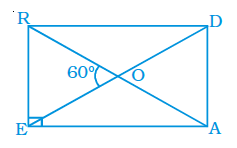
Answer:
Given:
1. $READ$ is a rectangle with diagonals $RA$ and $ED$ intersecting at $O$.
2. From the figure, the angle between the diagonals $\angle ROE = 60^\circ$.
To Find:
The measures of $\angle EAR$, $\angle RAD$, and $\angle ROD$.
Solution:
In a rectangle, diagonals are equal in length and bisect each other. Therefore, the distance from the intersection point $O$ to each vertex is equal:
$OR = OE = OA = OD$
1. Finding $\angle REO$:
In $\Delta ROE$, we have $OR = OE$. This makes $\Delta ROE$ an isosceles triangle. Since the vertex angle $\angle ROE = 60^\circ$, the base angles must be equal:
$\angle REO = \angle ERO = \frac{180^\circ - 60^\circ}{2}$
$\angle REO = 60^\circ$
Since all three angles are $60^\circ$, $\Delta ROE$ is an equilateral triangle.
2. Finding $\angle EAR$:
In rectangle $READ$, $\angle REA = 90^\circ$. We find $\angle OEA$ as follows:
$\angle OEA = \angle REA - \angle REO$
$\angle OEA = 90^\circ - 60^\circ = 30^\circ$
In $\Delta OEA$, since $OE = OA$, it is an isosceles triangle. Thus, $\angle OAE = \angle OEA = 30^\circ$. Since $\angle OAE$ is the same as $\angle EAR$, we have:
$\angle EAR = 30^\circ$
3. Finding $\angle RAD$:
In a rectangle, each interior angle is $90^\circ$. At vertex $A$, $\angle EAD = 90^\circ$.
$\angle RAD = \angle EAD - \angle EAR$
$\angle RAD = 90^\circ - 30^\circ = 60^\circ$
$\angle RAD = 60^\circ$
4. Finding $\angle ROD$:
Since $E-O-D$ is a straight diagonal line, $\angle ROE$ and $\angle ROD$ form a linear pair.
$\angle ROD = 180^\circ - \angle ROE$
$\angle ROD = 180^\circ - 60^\circ = 120^\circ$
$\angle ROD = 120^\circ$
Question 145. In rectangle PAIR, find ∠ARI, ∠RMI and ∠PMA.

Answer:
Given:
1. $PAIR$ is a rectangle with diagonals $PI$ and $AR$ intersecting at $M$.
2. From the figure, $\angle MAI = 35^\circ$ and $\angle PAI = 90^\circ$.
To Find:
The measures of $\angle ARI$, $\angle RMI$, and $\angle PMA$.
Solution:
In a rectangle, diagonals are equal and bisect each other. Thus, $MP = MI = MA = MR$.
1. Finding $\angle ARI$:
In $\Delta ARI$, we know that $\angle AIR = 90^\circ$ (property of a rectangle). Since $M$ lies on diagonal $AR$, $\angle RAI = \angle MAI = 35^\circ$. Using the angle sum property in $\Delta ARI$:
$\angle ARI + \angle RAI + \angle AIR = 180^\circ$
$\angle ARI + 35^\circ + 90^\circ = 180^\circ$
$\angle ARI = 180^\circ - 125^\circ = 55^\circ$
So, $\angle ARI = 55^\circ$.
2. Finding $\angle RMI$:
In $\Delta AMI$, $MA = MI$ (halves of equal diagonals). This makes $\Delta AMI$ an isosceles triangle. Therefore:
$\angle MIA = \angle MAI = 35^\circ$
Using the angle sum property in $\Delta AMI$:
$\angle AMI = 180^\circ - (35^\circ + 35^\circ) = 110^\circ$
Since $A-M-R$ is a straight line diagonal, $\angle AMI$ and $\angle RMI$ form a linear pair:
$\angle RMI = 180^\circ - \angle AMI = 180^\circ - 110^\circ = 70^\circ$
So, $\angle RMI = 70^\circ$.
3. Finding $\angle PMA$:
The angles $\angle PMA$ and $\angle RMI$ are vertically opposite angles formed by the intersection of diagonals $PI$ and $AR$.
$\angle PMA = \angle RMI = 70^\circ$
So, $\angle PMA = 70^\circ$.
Question 146. In parallelogram ABCD, find ∠B, ∠C and ∠D.

Answer:
Given:
$ABCD$ is a parallelogram where $\angle A = 80^\circ$.
To Find:
The measures of $\angle B, \angle C,$ and $\angle D$.
Solution:
In a parallelogram, opposite angles are equal and adjacent angles are supplementary (their sum is $180^\circ$).
1. Finding $\angle C$: Since $\angle C$ is opposite to $\angle A$:
$\angle C = \angle A = 80^\circ$
2. Finding $\angle B$: Since $\angle B$ is adjacent to $\angle A$:
$\angle B + \angle A = 180^\circ$
$\angle B + 80^\circ = 180^\circ \implies \angle B = 100^\circ$
3. Finding $\angle D$: Since $\angle D$ is opposite to $\angle B$:
$\angle D = \angle B = 100^\circ$
Answer: $\angle B = 100^\circ$, $\angle C = 80^\circ$, and $\angle D = 100^\circ$.
Question 147. In parallelogram PQRS, O is the mid point of SQ. Find ∠S, ∠R, PQ, QR and diagonal PR.

Answer:
Given:
Parallelogram $PQRS$ with $PS = 11 \text{ cm}, SR = 15 \text{ cm}, PO = 6 \text{ cm}$ (where $O$ is the diagonal intersection), and exterior angle at $Q = 60^\circ$.
Solution:
1. Finding Sides: In a parallelogram, opposite sides are equal.
$PQ = SR = 15 \text{ cm}$
$QR = PS = 11 \text{ cm}$
2. Finding Angles: At vertex $Q$, the interior and exterior angles form a linear pair.
$\angle PQR = 180^\circ - 60^\circ = 120^\circ$
Since opposite angles are equal, $\angle S = \angle PQR = 120^\circ$.
Adjacent angles are supplementary: $\angle R + \angle PQR = 180^\circ \implies \angle R + 120^\circ = 180^\circ$, so $\angle R = 60^\circ$.
3. Finding Diagonal PR: Diagonals of a parallelogram bisect each other. Thus, $O$ is the midpoint of $PR$.
$PR = 2 \times PO = 2 \times 6 = 12 \text{ cm}$
Answer: $\angle S = 120^\circ, \angle R = 60^\circ, PQ = 15 \text{ cm}, QR = 11 \text{ cm}$, and diagonal $PR = 12 \text{ cm}$.
Question 148. In rhombus BEAM, find ∠AME and ∠AEM.
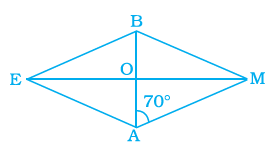
Answer:
Given:
$BEAM$ is a rhombus. Diagonals $BA$ and $EM$ intersect at point $O$. From the figure, $\angle OAM = 70^\circ$.
To Find:
The measures of $\angle AME$ and $\angle AEM$.
Solution:
In a rhombus, the diagonals are perpendicular bisectors of each other. Therefore, the angle at the intersection point $O$ is a right angle.
$\angle AOM = 90^\circ$
In $\Delta AOM$, using the angle sum property of a triangle:
$\angle OMA + \angle OAM + \angle AOM = 180^\circ$
$\angle OMA + 70^\circ + 90^\circ = 180^\circ$
$\angle OMA = 180^\circ - 160^\circ = 20^\circ$
Since $\angle OMA$ is the same as $\angle AME$ (as $O$ lies on the diagonal $EM$), we have:
$\angle AME = 20^\circ$
Now, in a rhombus, all sides are equal. Therefore, in $\Delta AEM$, side $AE = AM$. This makes $\Delta AEM$ an isosceles triangle. In an isosceles triangle, the angles opposite to equal sides are equal.
$\angle AEM = \angle AME$
Since we found $\angle AME = 20^\circ$, it follows that:
$\angle AEM = 20^\circ$
Answer: $\angle AME = 20^\circ$ and $\angle AEM = 20^\circ$.
Question 149. In parallelogram FIST, find ∠SFT, ∠OST and ∠STO.
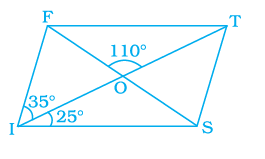
Answer:
Given:
1. $FIST$ is a parallelogram where diagonals $FS$ and $IT$ intersect at $O$.
2. $\angle FIO = 35^\circ$, $\angle OIS = 25^\circ$, and $\angle FOT = 110^\circ$.
To Find:
The measures of $\angle SFT$, $\angle OST$, and $\angle STO$.
Solution:
In a parallelogram, opposite sides are parallel. We use this property to find the required angles through alternate interior angles.
1. Finding $\angle STO$:
Since $FI \parallel TS$ and diagonal $IT$ is a transversal:
$\angle STO = \angle FIO$
[Alternate interior angles]
$\angle STO = 35^\circ$
2. Finding $\angle SFT$:
Since $FT \parallel IS$ and diagonal $IT$ is a transversal:
$\angle OTF = \angle OIS = 25^\circ$
[Alternate interior angles]
Now, in $\Delta FOT$, we use the angle sum property of a triangle:
$\angle OFT + \angle FOT + \angle OTF = 180^\circ$
$\angle OFT + 110^\circ + 25^\circ = 180^\circ$
$\angle OFT + 135^\circ = 180^\circ$
$\angle OFT = 45^\circ$
Since vertex $O$ lies on the diagonal line $FS$, $\angle OFT$ is the same as $\angle SFT$.
$\angle SFT = 45^\circ$
3. Finding $\angle OST$:
In $\Delta FOI$, we find $\angle FOI$ using the linear pair property with $\angle FOT$:
$\angle FOI = 180^\circ - \angle FOT = 180^\circ - 110^\circ = 70^\circ$
Now, using the angle sum property in $\Delta FOI$:
$\angle OFI + \angle FOI + \angle FIO = 180^\circ$
$\angle OFI + 70^\circ + 35^\circ = 180^\circ$
$\angle OFI = 180^\circ - 105^\circ = 75^\circ$
Since $FI \parallel TS$, diagonal $FS$ acts as a transversal:
$\angle OST = \angle OFI$
[Alternate interior angles]
$\angle OST = 75^\circ$
Final Answer: $\angle SFT = 45^\circ, \angle OST = 75^\circ,$ and $\angle STO = 35^\circ$.
Question 150. In the given parallelogram YOUR, ∠RUO = 120° and OY is extended to point S such that ∠SRY = 50°. Find ∠YSR.
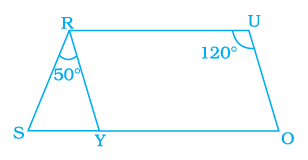
Answer:
Given:
Parallelogram $YOUR$ where $\angle RUO = 120^\circ$. $OY$ is extended to $S$ and $\angle SRY = 50^\circ$.
Solution:
1. In parallelogram $YOUR$, opposite angles are equal:
$\angle RY O = \angle RUO = 120^\circ$
2. Since $O-Y-S$ is a straight line, $\angle RYS$ and $\angle RYO$ form a linear pair:
$\angle RYS = 180^\circ - 120^\circ = 60^\circ$
3. In $\Delta RSY$, using the angle sum property:
$\angle YSR = 180^\circ - (\angle RYS + \angle SRY)$
$\angle YSR = 180^\circ - (60^\circ + 50^\circ)$
$\angle YSR = 70^\circ$
Answer: The measure of $\angle YSR$ is $70^\circ$.
Question 151. In kite WEAR, ∠WEA = 70° and ∠ARW = 80°. Find the remaining two angles.
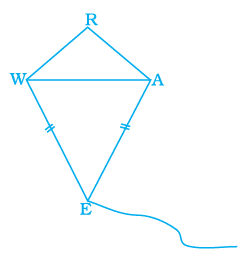
Answer:
Given:
In kite $WEAR$, $\angle WEA = 70^\circ$ and $\angle ARW = 80^\circ$.
To Find:
The remaining two angles, i.e., $\angle RWE$ and $\angle RAE$.
Solution:
In a kite, one pair of opposite angles (those between the unequal sides) are equal.
$\angle RWE = \angle RAE$
(Property of a kite)
Let $\angle RWE = \angle RAE = x$
We know that the sum of the interior angles of a quadrilateral is $360^\circ$.
In kite $WEAR$:
$\angle WEA + \angle ARW + \angle RWE + \angle RAE = 360^\circ$
$70^\circ + 80^\circ + x + x = 360^\circ$
$150^\circ + 2x = 360^\circ$
$2x = 360^\circ - 150^\circ$
$2x = 210^\circ$
$x = \frac{210^\circ}{2}$
$x = 105^\circ$
Therefore, the remaining two angles are $\angle RWE = 105^\circ$ and $\angle RAE = 105^\circ$.
Question 152. A rectangular MORE is shown below:
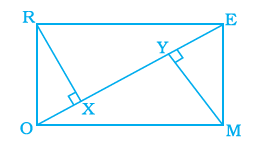
Answer the following questions by giving appropriate reason.
(i) Is RE = OM?
(ii) Is ∠MYO = ∠RXE?
(iii) Is ∠MOY = ∠REX?
(iv) Is ∆MYO ≅ ∆RXE?
(v) Is MY = RX?
Answer:
(i) Is $RE = OM$?
Yes, because $RE$ and $OM$ are opposite sides of the rectangle $MORE$.
$RE = OM$
(Opposite sides of a rectangle are equal)
(ii) Is $\angle MYO = \angle RXE$?
Yes, from the figure it is given that $MY \perp OE$ and $RX \perp OE$.
$\angle MYO = \angle RXE = 90^\circ$
(Given)
(iii) Is $\angle MOY = \angle REX$?
Yes, because $OM \parallel RE$ (opposite sides of a rectangle) and $OE$ is a transversal.
$\angle MOY = \angle REX$
(Alternate interior angles)
(iv) Is $\triangle MYO \cong \triangle RXE$?
Yes. In $\triangle MYO$ and $\triangle RXE$:
$\angle MYO = \angle RXE = 90^\circ$ (Proved above)
$\angle MOY = \angle REX$ (Proved above)
$OM = RE$ (Proved above)
Therefore, $\triangle MYO \cong \triangle RXE$ by AAS (Angle-Angle-Side) congruence criterion.
(v) Is $MY = RX$?
Yes. Since $\triangle MYO \cong \triangle RXE$, their corresponding parts must be equal.
$MY = RX$
(Corresponding parts of congruent triangles - CPCT)
Question 153. In parallelogram LOST, SN⊥OL and SM⊥LT. Find ∠STM, ∠SON and ∠NSM.

Answer:
Given:
$LOST$ is a parallelogram where $SN \perp OL$ and $SM \perp LT$. Also, $\angle MST = 40^\circ$.
Solution:
1. To find $\angle STM$:
In right-angled triangle $\triangle SMT$:
$\angle SMT = 90^\circ$ (Given $SM \perp LT$)
$\angle MST = 40^\circ$ (Given)
Using angle sum property of a triangle:
$\angle STM + \angle SMT + \angle MST = 180^\circ$
$\angle STM + 90^\circ + 40^\circ = 180^\circ$
$\angle STM + 130^\circ = 180^\circ$
$\angle STM = 180^\circ - 130^\circ$
$\angle STM = 50^\circ$
2. To find $\angle SON$:
In parallelogram $LOST$, $LO \parallel ST$ and $LS \parallel OT$.
Opposite angles of a parallelogram are equal.
$\angle SON = \angle STM$
(Opposite angles of parallelogram $LOST$)
$\angle SON = 50^\circ$
3. To find $\angle NSM$:
In right-angled triangle $\triangle SON$ (as part of $\triangle SOL$ where $SN \perp OL$):
$\angle SNO = 90^\circ$
$\angle SON = 50^\circ$
In $\triangle SON$: $\angle NSO + \angle SNO + \angle SON = 180^\circ$
$\angle NSO + 90^\circ + 50^\circ = 180^\circ$
$\angle NSO = 40^\circ$
Now, adjacent angles of a parallelogram are supplementary.
$\angle SOL + \angle TSO = 180^\circ$
$50^\circ + \angle TSO = 180^\circ$
$\angle TSO = 130^\circ$
We can see from the figure that $\angle TSO = \angle MST + \angle NSM + \angle NSO$.
$130^\circ = 40^\circ + \angle NSM + 40^\circ$
$130^\circ = 80^\circ + \angle NSM$
$\angle NSM = 130^\circ - 80^\circ$
$\angle NSM = 50^\circ$
Question 154. In trapezium HARE, EP and RP are bisectors of ∠E and ∠R respectively. Find ∠HAR and ∠EHA.

Answer:
Given:
In trapezium $HARE$, $ER \parallel HA$. $EP$ is the bisector of $\angle HER$ and $RP$ is the bisector of $\angle ARE$.
From the figure, $\angle REP = 25^\circ$ and $\angle PRE = 30^\circ$.
Solution:
Since $EP$ is the bisector of $\angle HER$:
$\angle HER = 2 \times \angle REP$
$\angle HER = 2 \times 25^\circ = 50^\circ$
Since $RP$ is the bisector of $\angle ARE$:
$\angle ARE = 2 \times \angle PRE$
$\angle ARE = 2 \times 30^\circ = 60^\circ$
In trapezium $HARE$, $ER \parallel HA$. Therefore, the co-interior angles are supplementary.
1. To find $\angle EHA$:
$\angle EHA + \angle HER = 180^\circ$
(Co-interior angles, $ER \parallel HA$)
$\angle EHA + 50^\circ = 180^\circ$
$\angle EHA = 180^\circ - 50^\circ$
$\angle EHA = 130^\circ$
2. To find $\angle HAR$:
$\angle HAR + \angle ARE = 180^\circ$
(Co-interior angles, $ER \parallel HA$)
$\angle HAR + 60^\circ = 180^\circ$
$\angle HAR = 180^\circ - 60^\circ$
$\angle HAR = 120^\circ$
Question 155. In parallelogram MODE, the bisector of ∠M and ∠O meet at Q, find the measure of ∠MQO.
Answer:
Given:
$MODE$ is a parallelogram. $MQ$ is the bisector of $\angle M$ and $OQ$ is the bisector of $\angle O$.

Solution:
In parallelogram $MODE$, adjacent angles are supplementary.
$\angle M + \angle O = 180^\circ$
(Adjacent angles of a parallelogram)
Dividing the whole equation by $2$:
$\frac{1}{2}\angle M + \frac{1}{2}\angle O = \frac{180^\circ}{2}$
$\frac{1}{2}\angle M + \frac{1}{2}\angle O = 90^\circ$
Since $MQ$ and $OQ$ are angle bisectors:
$\angle QMO = \frac{1}{2}\angle M$ and $\angle QOM = \frac{1}{2}\angle O$
Substituting these in the above equation:
$\angle QMO + \angle QOM = 90^\circ$
Now, in $\triangle MQO$, using the angle sum property of a triangle:
$\angle QMO + \angle QOM + \angle MQO = 180^\circ$
$90^\circ + \angle MQO = 180^\circ$
$\angle MQO = 180^\circ - 90^\circ$
$\angle MQO = 90^\circ$
Therefore, the measure of $\angle MQO$ is $90^\circ$.
Question 156. A playground is in the form of a rectangle ATEF. Two players are standing at the points F and B where EF = EB. Find the values of x and y.

Answer:
Given:
1. $ATEF$ is a rectangle.
2. $EF = EB$ (indicated by the marks on the sides).
To Find:
The values of $x$ and $y$.
Solution:
In rectangle $ATEF$, every interior angle is $90^\circ$.
$\angle FEB = 90^\circ$
(Angle of a rectangle)
Now, in $\triangle EFB$:
$EF = EB$
(Given)
Since two sides are equal, $\triangle EFB$ is an isosceles right-angled triangle. Therefore, the angles opposite to these sides are equal.
$\angle EFB = \angle EBF$
(Angles opposite to equal sides)
By the angle sum property of a triangle:
$\angle FEB + \angle EFB + \angle EBF = 180^\circ$
$90^\circ + \angle EFB + \angle EFB = 180^\circ$
$2\angle EFB = 90^\circ$
$\angle EFB = 45^\circ$
In rectangle $ATEF$, the interior angle at vertex $F$ is $90^\circ$.
$\angle EFA = 90^\circ$
(Angle of a rectangle)
From the figure, $\angle EFA = \angle EFB + y$.
$45^\circ + y = 90^\circ$
$y = 90^\circ - 45^\circ$
$y = 45^\circ$
In rectangle $ATEF$, the opposite sides $ET$ and $FA$ are parallel ($ET \parallel FA$). The line segment $FB$ acts as a transversal intersecting these parallel lines.
The angles $x$ and $y$ are co-interior angles (also known as consecutive interior angles) on the same side of the transversal.
$x + y = 180^\circ$
(Co-interior angles are supplementary)
Substituting the value of $y$:
$x + 45^\circ = 180^\circ$
$x = 180^\circ - 45^\circ$
$x = 135^\circ$
Final Answer: The value of $x$ is $135^\circ$ and the value of $y$ is $45^\circ$.
Question 157. In the following figure of a ship, ABDH and CEFG are two parallelograms. Find the value of x.
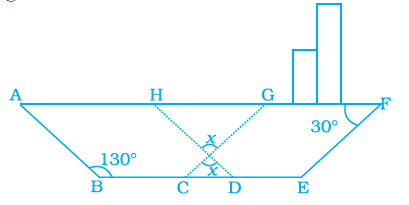
Answer:
Given:
$ABDH$ and $CEFG$ are parallelograms. $\angle B = 130^\circ$ and $\angle F = 30^\circ$.
To Find:
The value of $x$.
Solution:
In parallelogram $ABDH$:
$\angle B + \angle D = 180^\circ$
(Adjacent angles are supplementary)
$130^\circ + \angle D = 180^\circ$
$\angle D = 180^\circ - 130^\circ = 50^\circ$
In parallelogram $CEFG$:
$\angle C = \angle F$
(Opposite angles are equal)
$\angle C = 30^\circ$
Let the point of intersection of the dotted lines be $O$. These lines form a triangle with the base $CD$. In $\triangle OCD$:
$\angle C + \angle D + x = 180^\circ$
$30^\circ + 50^\circ + x = 180^\circ$
$80^\circ + x = 180^\circ$
$x = 180^\circ - 80^\circ$
$x = 100^\circ$
Final Answer: The value of $x$ is $100^\circ$.
Question 158. A Rangoli has been drawn on a floor of a house. ABCD and PQRS both are in the shape of a rhombus. Find the radius of semicircle drawn on each side of rhombus ABCD.
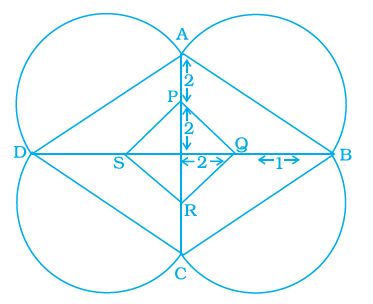
Answer:
Given:
$ABCD$ and $PQRS$ are rhombuses. From the figure, the distances from the center (intersection of diagonals) are:
Distance to $P = 2$ units, Distance to $Q = 2$ units.
Distance from $P$ to $A = 2$ units, Distance from $Q$ to $B = 1$ unit.
To Find:
Radius of the semicircle drawn on each side of rhombus $ABCD$.
Solution:
Let $O$ be the intersection point of the diagonals. In a rhombus, diagonals bisect each other at $90^\circ$.
Length of half-diagonal $OA = OP + PA = 2 + 2 = 4$ units.
Length of half-diagonal $OB = OQ + QB = 2 + 1 = 3$ units.
In right-angled triangle $\triangle AOB$:
$AB^2 = OA^2 + OB^2$
$AB^2 = 4^2 + 3^2$
$AB^2 = 16 + 9 = 25$
$AB = \sqrt{25} = 5$ units.
The side of the rhombus $ABCD$ is $5$ units. This side acts as the diameter of the semicircle.
Radius of semicircle = $\frac{\text{Diameter}}{2} = \frac{5}{2}$
Radius = $2.5$ units.
Final Answer: The radius of the semicircle is $2.5$ units.
Question 159. ABCDE is a regular pentagon. The bisector of angle A meets the side CD at M. Find ∠AMC
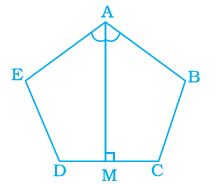
Answer:
Given:
$ABCDE$ is a regular pentagon. $AM$ is the bisector of $\angle A$.
To Find:
$\angle AMC$.
Solution:
Each interior angle of a regular pentagon is given by:
$\text{Interior Angle} = \frac{(n-2) \times 180^\circ}{n} = \frac{(5-2) \times 180^\circ}{5}$
$\text{Interior Angle} = \frac{3 \times 180^\circ}{5} = \frac{540^\circ}{5} = 108^\circ$
So, $\angle A = \angle B = \angle C = \angle D = \angle E = 108^\circ$.
Since $AM$ is the bisector of $\angle A$:
$\angle MAB = \frac{108^\circ}{2} = 54^\circ$
Now, consider the quadrilateral $ABCM$. The sum of angles in a quadrilateral is $360^\circ$.
$\angle MAB + \angle B + \angle BCM + \angle AMC = 360^\circ$
$54^\circ + 108^\circ + 108^\circ + \angle AMC = 360^\circ$
$270^\circ + \angle AMC = 360^\circ$
$\angle AMC = 360^\circ - 270^\circ$
$\angle AMC = 90^\circ$
Final Answer: $\angle AMC = 90^\circ$.
Question 160. Quadrilateral EFGH is a rectangle in which J is the point of intersection of the diagonals. Find the value of x if JF = 8x + 4 and EG = 24x – 8.
Answer:
Given:
1. $EFGH$ is a rectangle.
2. $J$ is the point of intersection of diagonals $EG$ and $FH$.
3. $JF = 8x + 4$
4. $EG = 24x - 8$
To Find:
The value of $x$.

Solution:
In a rectangle, the diagonals are equal in length.
$EG = FH$
(Diagonals of a rectangle are equal)
Also, the diagonals of a rectangle bisect each other. This means the intersection point $J$ is the midpoint of both diagonals.
$JF = \frac{1}{2} FH$
(Diagonals bisect each other)
Since $FH = EG$, we can substitute $EG$ for $FH$ in the above relation:
$JF = \frac{1}{2} EG$
Now, substitute the given algebraic expressions into this equation:
$8x + 4 = \frac{1}{2} (24x - 8)$
Multiply both sides by $2$ to remove the fraction (or distribute the $\frac{1}{2}$):
$8x + 4 = 12x - 4$
Rearrange the terms to solve for $x$:
$4 + 4 = 12x - 8x$
$8 = 4x$
$x = \frac{8}{4}$
$x = 2$
Final Answer: The value of $x$ is $2$.
Question 161. Find the values of x and y in the following parallelogram.
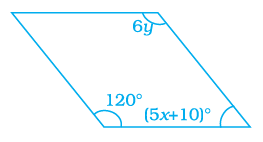
Answer:
Given:
A parallelogram with interior angles marked as $120^\circ$, $6y$ and $(5x + 10)^\circ$.
To Find:
The values of $x$ and $y$.
Solution:
In a parallelogram, opposite angles are equal in measure.
$6y = 120^\circ$
(Opposite angles of a parallelogram)
$y = \frac{120^\circ}{6}$
$y = 20$
Also, in a parallelogram, the sum of adjacent angles is $180^\circ$.
$(5x + 10)^\circ + 120^\circ = 180^\circ$
(Adjacent angles are supplementary)
$5x + 130^\circ = 180^\circ$
$5x = 180^\circ - 130^\circ$
$5x = 50^\circ$
$x = \frac{50^\circ}{5}$
$x = 10$
Final Answer: The values are $x = 10$ and $y = 20$.
Question 162. Find the values of x and y in the following kite.

Answer:
Given:
A kite with interior angles $x$, $110^\circ$, $y$ and $60^\circ$.
To Find:
The values of $x$ and $y$.
Solution:
In a kite, exactly one pair of opposite angles (the angles between the unequal sides) are equal.
By observing the figure, the angles $110^\circ$ and $y$ are the equal pair.
$y = 110^\circ$
(Property of a kite)
We know that the sum of all interior angles of a quadrilateral is $360^\circ$.
$x + 110^\circ + y + 60^\circ = 360^\circ$
Substitute the value of $y$:
$x + 110^\circ + 110^\circ + 60^\circ = 360^\circ$
$x + 280^\circ = 360^\circ$
$x = 360^\circ - 280^\circ$
$x = 80^\circ$
Final Answer: The values are $x = 80^\circ$ and $y = 110^\circ$.
Question 163. Find the value of x in the trapezium ABCD given below.

Answer:
Given:
In trapezium $ABCD$, side $AB \parallel DC$.
$\angle A = (x - 20)^\circ$
$\angle D = (x + 40)^\circ$
To Find:
The value of $x$.
Solution:
Since $AB \parallel DC$ and $AD$ is a transversal, the interior angles on the same side of the transversal (co-interior angles) are supplementary.
$\angle A + \angle D = 180^\circ$
(Co-interior angles are supplementary)
$(x - 20)^\circ + (x + 40)^\circ = 180^\circ$
$2x + 20^\circ = 180^\circ$
$2x = 180^\circ - 20^\circ$
$2x = 160^\circ$
$x = \frac{160^\circ}{2}$
$x = 80$
Final Answer: The value of $x$ is 80.
Question 164. Two angles of a quadrilateral are each of measure 75° and the other two angles are equal. What is the measure of these two angles? Name the possible figures so formed.
Answer:
Given:
Two angles of a quadrilateral $= 75^\circ$ each.
The other two angles are equal. Let each be $z$.
To Find:
The measure of the remaining two angles and the possible names of the figure.
Solution:
The sum of the angles of a quadrilateral is $360^\circ$.
$75^\circ + 75^\circ + z + z = 360^\circ$
$150^\circ + 2z = 360^\circ$
$2z = 360^\circ - 150^\circ$
$2z = 210^\circ$
$z = \frac{210^\circ}{2}$
$z = 105^\circ$
So, the four angles of the quadrilateral are $75^\circ$, $75^\circ$, $105^\circ$, and $105^\circ$.
Possible Figures:
1. Parallelogram: If the equal angles are opposite to each other (e.g., $75^\circ$ opposite $75^\circ$ and $105^\circ$ opposite $105^\circ$), it is a parallelogram because adjacent angles are also supplementary ($75^\circ + 105^\circ = 180^\circ$).
2. Isosceles Trapezium: If the equal angles are adjacent on the same base (e.g., base angles are $75^\circ$ and $75^\circ$ and the other two are $105^\circ$ and $105^\circ$), it forms an isosceles trapezium.
3. Kite: If only one pair of opposite angles is equal (e.g., $105^\circ$ and $105^\circ$ are between unequal sides), it could be a kite.
Final Answer: The measure of the two angles is $105^\circ$. Possible figures are Parallelogram, Isosceles Trapezium, or Kite.
Question 165. In a quadrilateral PQRS, ∠P = 50°, ∠Q = 50°, ∠R = 60°. Find ∠S. Is this quadrilateral convex or concave?
Answer:
Given:
In quadrilateral $PQRS$:
$\angle P = 50^\circ$, $\angle Q = 50^\circ$, $\angle R = 60^\circ$
To Find:
The measure of $\angle S$ and whether the quadrilateral is convex or concave.
Solution:
The sum of interior angles of a quadrilateral is $360^\circ$.
$\angle P + \angle Q + \angle R + \angle S = 360^\circ$
$50^\circ + 50^\circ + 60^\circ + \angle S = 360^\circ$
$160^\circ + \angle S = 360^\circ$
$\angle S = 360^\circ - 160^\circ$
$\angle S = 200^\circ$
A quadrilateral is called concave if at least one of its interior angles is greater than $180^\circ$ (reflex angle).
Since $\angle S = 200^\circ$, which is greater than $180^\circ$, the quadrilateral is concave.
Final Answer: $\angle S = 200^\circ$ and the quadrilateral is concave.
Question 166. Both the pairs of opposite angles of a quadrilateral are equal and supplementary. Find the measure of each angle.
Answer:
Given:
In a quadrilateral, both pairs of opposite angles are equal and each pair is supplementary.
Solution:
Let the quadrilateral be $ABCD$.
According to the question:
$\angle A = \angle C$ and $\angle B = \angle D$ (Opposite angles are equal)
Also, $\angle A + \angle C = 180^\circ$ and $\angle B + \angle D = 180^\circ$ (Opposite angles are supplementary)
Since $\angle A = \angle C$ and $\angle A + \angle C = 180^\circ$:
$\angle A + \angle A = 180^\circ$
$2\angle A = 180^\circ$
$\angle A = \frac{180^\circ}{2} = 90^\circ$
So, $\angle C = 90^\circ$.
Similarly, since $\angle B = \angle D$ and $\angle B + \angle D = 180^\circ$:
$\angle B + \angle B = 180^\circ$
$2\angle B = 180^\circ$
$\angle B = \frac{180^\circ}{2} = 90^\circ$
So, $\angle D = 90^\circ$.
Final Answer: The measure of each angle is $90^\circ$. (The quadrilateral is a rectangle or a square).
Question 167. Find the measure of each angle of a regular octagon.
Answer:
Given:
The polygon is a regular octagon. Therefore, the number of sides $n = 8$.
Solution:
The measure of each interior angle of a regular polygon with $n$ sides is given by the formula:
$\text{Each Interior Angle} = \frac{(n - 2) \times 180^\circ}{n}$
For an octagon, $n = 8$:
$\text{Each Interior Angle} = \frac{(8 - 2) \times 180^\circ}{8}$
$\text{Each Interior Angle} = \frac{6 \times 180^\circ}{8}$
$\text{Each Interior Angle} = \frac{1080^\circ}{8}$
$\text{Each Interior Angle} = 135^\circ$
Final Answer: The measure of each angle of a regular octagon is $135^\circ$.
Question 168. Find the measure of an are exterior angle of a regular pentagon and an exterior angle of a regular decagon. What is the ratio between these two angles?
Answer:
Solution:
We know that the measure of each exterior angle of a regular polygon with $n$ sides is $\frac{360^\circ}{n}$.
1. For a regular pentagon ($n = 5$):
$\text{Exterior Angle}_1 = \frac{360^\circ}{5} = 72^\circ$
2. For a regular decagon ($n = 10$):
$\text{Exterior Angle}_2 = \frac{360^\circ}{10} = 36^\circ$
Finding the Ratio:
$\text{Ratio} = \frac{\text{Exterior angle of pentagon}}{\text{Exterior angle of decagon}}$
$\text{Ratio} = \frac{72^\circ}{36^\circ}$
$\text{Ratio} = \frac{2}{1} = 2 : 1$
Final Answer: The exterior angles are $72^\circ$ and $36^\circ$ respectively, and their ratio is $2 : 1$.
Question 169. In the figure, find the value of x.

Answer:
Given:
A polygon with five exterior angles given as: $x^\circ$, $85^\circ$, $20^\circ$, $92^\circ$, and $89^\circ$.
Solution:
We know that the sum of the exterior angles of any convex polygon is always $360^\circ$.
$x^\circ + 85^\circ + 20^\circ + 92^\circ + 89^\circ = 360^\circ$
$x^\circ + 286^\circ = 360^\circ$
$x^\circ = 360^\circ - 286^\circ$
$x^\circ = 74^\circ$
Final Answer: The value of $x$ is 74.
Question 170. Three angles of a quadrilateral are equal. Fourth angle is of measure 120°. What is the measure of equal angles?
Answer:
Given:
Three angles of a quadrilateral are equal. Let each equal angle be $y$.
The fourth angle $= 120^\circ$.
Solution:
The sum of all interior angles of a quadrilateral is $360^\circ$.
$y + y + y + 120^\circ = 360^\circ$
$3y + 120^\circ = 360^\circ$
$3y = 360^\circ - 120^\circ$
$3y = 240^\circ$
$y = \frac{240^\circ}{3}$
$y = 80^\circ$
Final Answer: The measure of each equal angle is $80^\circ$.
Question 171. In a quadrilateral HOPE, PS and ES are bisectors of ∠P and ∠E respectively. Give reason.
Answer:
Given:
In quadrilateral $HOPE$, $PS$ is the bisector of $\angle P$ and $ES$ is the bisector of $\angle E$. These bisectors meet at point $S$.

To Prove:
$\angle PSE = \frac{1}{2}(\angle H + \angle O)$
Proof:
We know that the sum of the interior angles of a quadrilateral is $360^\circ$.
In quadrilateral $HOPE$:
$\angle H + \angle O + \angle P + \angle E = 360^\circ$
$\angle P + \angle E = 360^\circ - (\angle H + \angle O)$
Multiplying the entire equation by $\frac{1}{2}$:
$\frac{1}{2} (\angle P + \angle E) = \frac{1}{2} [360^\circ - (\angle H + \angle O)]$
$\frac{1}{2} \angle P + \frac{1}{2} \angle E = 180^\circ - \frac{1}{2} (\angle H + \angle O)$
In $\triangle PSE$, by the angle sum property of a triangle:
$\angle PSE + \angle SPE + \angle SEP = 180^\circ$
Since $PS$ and $ES$ are angle bisectors, we have $\angle SPE = \frac{1}{2} \angle P$ and $\angle SEP = \frac{1}{2} \angle E$.
$\angle PSE + (\frac{1}{2} \angle P + \frac{1}{2} \angle E) = 180^\circ$
Now, substitute the value of $(\frac{1}{2} \angle P + \frac{1}{2} \angle E)$ calculated earlier:
$\angle PSE + [180^\circ - \frac{1}{2} (\angle H + \angle O)] = 180^\circ$
$\angle PSE + 180^\circ - \frac{1}{2} (\angle H + \angle O) = 180^\circ$
$\angle PSE = 180^\circ - 180^\circ + \frac{1}{2} (\angle H + \angle O)$
$\angle PSE = \frac{1}{2} (\angle H + \angle O)$
Hence Proved.
Question 172. ABCD is a parallelogram. Find the value of x, y and z.

Answer:
Given:
$ABCD$ is a parallelogram. Diagonals $AC$ and $BD$ intersect at $O$.
$\angle AOB = 100^\circ$ and $\angle DBC = 30^\circ$.
To Find:
The values of $x$, $y$, and $z$.
Solution:
1. To find x:
Since $AOC$ is a straight line, $\angle AOB$ and $\angle BOC$ form a linear pair.
$\angle AOB + \angle BOC = 180^\circ$
(Linear pair)
$100^\circ + x = 180^\circ$
$x = 180^\circ - 100^\circ = 80^\circ$
2. To find y:
In $\triangle BOC$, the sum of angles is $180^\circ$.
$x + y + \angle OBC = 180^\circ$
Given $\angle DBC = 30^\circ$, which is the same as $\angle OBC$.
$80^\circ + y + 30^\circ = 180^\circ$
$y + 110^\circ = 180^\circ$
$y = 180^\circ - 110^\circ = 70^\circ$
3. To find z:
In parallelogram $ABCD$, opposite sides are parallel, so $AD \parallel BC$. $BD$ acts as a transversal.
$z = \angle DBC$
(Alternate interior angles)
$z = 30^\circ$
Final Answer: $x = 80^\circ$, $y = 70^\circ$, and $z = 30^\circ$.
Question 173. Diagonals of a quadrilateral are perpendicular to each other. Is such a quadrilateral always a rhombus? Give a figure to justify your answer.
Answer:
Solution:
No, a quadrilateral with perpendicular diagonals is not always a rhombus.
For a quadrilateral to be a rhombus, the diagonals must not only be perpendicular but must also bisect each other. Additionally, all four sides must be equal.
A Kite is a prime example of a quadrilateral where the diagonals are perpendicular to each other, but it is not a rhombus (as only two pairs of adjacent sides are equal, and only one diagonal is bisected).
Justification Figure:

In the figure above, the diagonals intersect at $90^\circ$, but the sides are not all equal, hence it is not a rhombus.
Question 174. ABCD is a trapezium such that AB||CD, ∠A : ∠D = 2 : 1, ∠B : ∠C = 7 : 5. Find the angles of the trapezium.
Answer:
Given:
Trapezium $ABCD$ with $AB \parallel CD$.
$\angle A : \angle D = 2 : 1$
$\angle B : \angle C = 7 : 5$
Solution:
Since $AB \parallel CD$, the pairs of angles $\angle A, \angle D$ and $\angle B, \angle C$ are co-interior angles, and their sum is $180^\circ$.
1. For angles A and D:
Let $\angle A = 2k$ and $\angle D = 1k$.
$2k + k = 180^\circ$
$3k = 180^\circ$
$k = 60^\circ$
$\angle A = 2 \times 60^\circ = 120^\circ$
$\angle D = 1 \times 60^\circ = 60^\circ$
2. For angles B and C:
Let $\angle B = 7m$ and $\angle C = 5m$.
$7m + 5m = 180^\circ$
$12m = 180^\circ$
$m = \frac{180^\circ}{12} = 15^\circ$
$\angle B = 7 \times 15^\circ = 105^\circ$
$\angle C = 5 \times 15^\circ = 75^\circ$
Final Answer: The angles are $\angle A = 120^\circ$, $\angle B = 105^\circ$, $\angle C = 75^\circ$, and $\angle D = 60^\circ$.
Question 175. A line l is parallel to line m and a transversal p interesects them at X, Y respectively. Bisectors of interior angles at X and Y interesct at P and Q. Is PXQY a rectangle? Given reason.
Answer:
Given:
1. Line $l \parallel m$.
2. Transversal $p$ intersects $l$ at $X$ and $m$ at $Y$.
3. $XP, XQ, YP,$ and $YQ$ are the bisectors of the four interior angles formed at $X$ and $Y$.

Solution:
Yes, the quadrilateral $PXQY$ is a rectangle.
Reasoning:
Let the two interior angles at point $X$ be $\angle AX Y$ and $\angle BXY$, and the two interior angles at point $Y$ be $\angle CYX$ and $\angle DYX$.
1. To show $\angle XPY = 90^\circ$ and $\angle XQY = 90^\circ$:
We know that consecutive interior angles are supplementary.
$\angle AXY + \angle CYX = 180^\circ$
(Consecutive interior angles, $l \parallel m$)
Dividing by $2$:
$\frac{1}{2}\angle AXY + \frac{1}{2}\angle CYX = 90^\circ$
Since $XP$ and $YP$ are angle bisectors, we have $\angle PXY = \frac{1}{2}\angle AXY$ and $\angle PYX = \frac{1}{2}\angle CYX$.
$\angle PXY + \angle PYX = 90^\circ$
In $\triangle XPY$, using the angle sum property:
$\angle XPY = 180^\circ - (\angle PXY + \angle PYX) = 180^\circ - 90^\circ = 90^\circ$
Similarly, we can prove that $\angle XQY = 90^\circ$.
2. To show $\angle PXQ = 90^\circ$ and $\angle PYQ = 90^\circ$:
The two interior angles at vertex $X$ (on either side of the transversal) form a linear pair.
$\angle AXY + \angle BXY = 180^\circ$
(Linear pair)
Dividing by $2$:
$\frac{1}{2}\angle AXY + \frac{1}{2}\angle BXY = 90^\circ$
$\angle PXY + \angle QXY = 90^\circ$
$\angle PXQ = 90^\circ$
Similarly, we can prove that $\angle PYQ = 90^\circ$.
Since all the interior angles of the quadrilateral $PXQY$ are $90^\circ$, it is a rectangle.
Question 176. ABCD is a parallelogram. The bisector of angle A intersects CD at X and bisector of angle C intersects AB at Y. Is AXCY a parallelogram? Give reason.
Answer:
Given:
$ABCD$ is a parallelogram. $AX$ is the bisector of $\angle A$ and $CY$ is the bisector of $\angle C$.

To Find:
Is $AXCY$ a parallelogram?
Solution:
Yes, $AXCY$ is a parallelogram.
In parallelogram $ABCD$, opposite angles are equal.
$\angle A = \angle C$
(Opposite angles of a parallelogram)
Dividing by $2$:
$\frac{1}{2} \angle A = \frac{1}{2} \angle C$
Since $AX$ and $CY$ are bisectors:
$\angle XAY = \angle XCY$
Also, in parallelogram $ABCD$, $AB \parallel CD$, which implies $AY \parallel XC$.
Now, consider transversal $AX$ intersecting parallel lines $AB$ and $CD$:
$\angle AXD = \angle XAY$
(Alternate interior angles)
Since $\angle XAY = \angle XCY$, we have $\angle AXD = \angle XCY$.
These are corresponding angles for lines $AX$ and $CY$ with transversal $CD$. Therefore, $AX \parallel CY$.
Since both pairs of opposite sides ($AY \parallel XC$ and $AX \parallel CY$) are parallel, $AXCY$ is a parallelogram.
Question 177. A diagonal of a parallelogram bisects an angle. Will it also bisect the other angle? Give reason.
Answer:
Given:
$ABCD$ is a parallelogram and diagonal $AC$ bisects $\angle A$.

Solution:
Yes, it will also bisect the other angle ($\angle C$).
Reason:
Since $ABCD$ is a parallelogram, $AB \parallel DC$ and $AD \parallel BC$.
1. Since $AB \parallel DC$ and $AC$ is a transversal:
$\angle BAC = \angle DCA$
(Alternate interior angles)
2. Since $AD \parallel BC$ and $AC$ is a transversal:
$\angle DAC = \angle BCA$
(Alternate interior angles)
3. It is given that $AC$ bisects $\angle A$:
$\angle BAC = \angle DAC$
(Given)
From the above statements, we can conclude that:
$\angle DCA = \angle BCA$
Since $\angle DCA = \angle BCA$, diagonal $AC$ also bisects $\angle C$.
Note: In such a case, the parallelogram is actually a rhombus.
Question 178. The angle between the two altitudes of a parallelogram through the vertex of an obtuse angle of the parallelogram is 45°. Find the angles of the parallelogram.
Answer:
Given:
In parallelogram $ABCD$, let $\angle B$ be the obtuse angle. Altitudes $BM$ and $BN$ are drawn from $B$ to sides $AD$ and $CD$ respectively. The angle between them, $\angle MBN = 45^\circ$.

Solution:
Consider the quadrilateral $BMDN$.
In this quadrilateral:
$\angle BMD = 90^\circ$ (Since $BM$ is an altitude to $AD$)
$\angle BND = 90^\circ$ (Since $BN$ is an altitude to $CD$)
$\angle MBN = 45^\circ$ (Given)
Sum of angles of a quadrilateral is $360^\circ$:
$\angle BMD + \angle BND + \angle MBN + \angle D = 360^\circ$
$90^\circ + 90^\circ + 45^\circ + \angle D = 360^\circ$
$225^\circ + \angle D = 360^\circ$
$\angle D = 360^\circ - 225^\circ = 135^\circ$
In parallelogram $ABCD$, opposite angles are equal:
$\angle B = \angle D = 135^\circ$
Adjacent angles are supplementary:
$\angle A + \angle D = 180^\circ$
$\angle A + 135^\circ = 180^\circ$
$\angle A = 180^\circ - 135^\circ = 45^\circ$
Since $\angle C = \angle A$, $\angle C = 45^\circ$.
Final Answer: The angles of the parallelogram are $45^\circ, 135^\circ, 45^\circ, 135^\circ$.
Question 179. ABCD is a rhombus such that the perpendicular bisector of AB passes through D. Find the angles of the rhombus.
Hint: Join BD. Then ∆ ABD is equilateral.
Answer:
Given:
$ABCD$ is a rhombus. The perpendicular bisector of $AB$ passes through vertex $D$.

Solution:
Let $M$ be the midpoint of $AB$. Since $DM$ is the perpendicular bisector of $AB$, any point on $DM$ is equidistant from $A$ and $B$.
$AD = BD$
(Property of perpendicular bisector)
In a rhombus, all sides are equal. Therefore:
$AD = AB$
(Sides of rhombus)
From the two equations above, we get:
$AD = AB = BD$
This means $\triangle ABD$ is an equilateral triangle.
In an equilateral triangle, each angle is $60^\circ$.
$\angle A = 60^\circ$
In rhombus $ABCD$:
$\angle C = \angle A = 60^\circ$ (Opposite angles)
$\angle A + \angle B = 180^\circ$ (Adjacent angles are supplementary)
$60^\circ + \angle B = 180^\circ$
$\angle B = 120^\circ$
$\angle D = \angle B = 120^\circ$ (Opposite angles)
Final Answer: The angles of the rhombus are $60^\circ, 120^\circ, 60^\circ, 120^\circ$.
Question 180. ABCD is a parallelogram. Points P and Q are taken on the sides AB and AD respectively and the parallelogram PRQA is formed. If ∠C = 45°, find ∠R.
Answer:
Given:
1. $ABCD$ is a parallelogram with $\angle C = 45^\circ$.
2. $PRQA$ is another parallelogram where $P$ lies on $AB$ and $Q$ lies on $AD$.

To Find:
The measure of $\angle R$.
Solution:
In parallelogram $ABCD$:
$\angle A = \angle C$
(Opposite angles of a parallelogram)
Given $\angle C = 45^\circ$, therefore $\angle A = 45^\circ$.
Now, consider parallelogram $PRQA$. In this parallelogram, $\angle A$ and $\angle R$ are opposite angles.
$\angle R = \angle A$
(Opposite angles of parallelogram $PRQA$)
Since $\angle A = 45^\circ$:
$\angle R = 45^\circ$
Final Answer: The measure of $\angle R$ is $45^\circ$.
Question 181. In parallelogram ABCD, the angle bisector of ∠A bisects BC. Will angle bisector of B also bisect AD? Give reason.
Answer:
Given:
1. $ABCD$ is a parallelogram where $AD \parallel BC$ and $AB \parallel DC$.
2. The bisector of $\angle A$ intersects $BC$ at $E$ such that $BE = EC = \frac{1}{2}BC$.

To Find:
Whether the angle bisector of $\angle B$ also bisects $AD$.
Solution:
Step 1: Establishing the relationship between sides AB and BC.
$\angle DAE = \angle BAE$
(AE is the bisector of $\angle A$)
$\angle DAE = \angle AEB$
(Alternate interior angles, $AD \parallel BC$)
From the above two equations, we get:
$\angle BAE = \angle AEB$
In $\triangle ABE$, since the base angles are equal, the sides opposite to them must be equal.
$AB = BE$
(Sides opposite to equal angles)
Since $E$ is the midpoint of $BC$ (given that $AE$ bisects $BC$):
$BE = \frac{1}{2} BC$
Substituting $AB = BE$:
$AB = \frac{1}{2} BC$, which means $BC = 2AB$.
Step 2: Checking the bisector of $\angle B$.
Let the bisector of $\angle B$ intersect $AD$ at point $F$.
$\angle ABF = \angle CBF$
(BF is the bisector of $\angle B$)
$\angle CBF = \angle AFB$
(Alternate interior angles, $AD \parallel BC$)
Therefore, $\angle ABF = \angle AFB$.
In $\triangle ABF$, since the angles are equal, the opposite sides are equal:
$AF = AB$
(Sides opposite to equal angles)
Step 3: Conclusion.
In parallelogram $ABCD$, opposite sides are equal ($AD = BC$).
From Step 1, we found $BC = 2AB$. Therefore, $AD = 2AB$.
From Step 2, we found $AF = AB$.
Comparing these:
$AF = \frac{1}{2} AD$
Since $AF$ is exactly half of $AD$, the point $F$ is the midpoint of $AD$.
Final Answer: Yes, the angle bisector of $\angle B$ will also bisect $AD$ because the sides of the parallelogram are in the ratio $1 : 2$.
Question 182. A regular pentagon ABCDE and a square ABFG are formed on opposite sides of AB. Find ∠BCF.
Answer:
Given:
1. $ABCDE$ is a regular pentagon.
2. $ABFG$ is a square formed on the opposite side of $AB$.

Solution:
The interior angle of a regular pentagon ($n = 5$) is:
$\angle ABC = \frac{(5 - 2) \times 180^\circ}{5} = \frac{540^\circ}{5} = 108^\circ$
The interior angle of a square is $90^\circ$. So, $\angle ABF = 90^\circ$.
Since the pentagon and square are on opposite sides of $AB$, the angle $\angle CBF$ is:
$\angle CBF = 360^\circ - (\angle ABC + \angle ABF)$
$\angle CBF = 360^\circ - (108^\circ + 90^\circ) = 360^\circ - 198^\circ = 162^\circ$
In regular pentagon $ABCDE$, all sides are equal, so $BC = AB$.
In square $ABFG$, all sides are equal, so $BF = AB$.
Therefore, $BC = BF$. This makes $\triangle BCF$ an isosceles triangle.
In $\triangle BCF$:
$\angle BCF = \angle BFC$ (Angles opposite to equal sides)
Using the angle sum property:
$\angle CBF + \angle BCF + \angle BFC = 180^\circ$
$162^\circ + 2\angle BCF = 180^\circ$
$2\angle BCF = 180^\circ - 162^\circ = 18^\circ$
$\angle BCF = \frac{18^\circ}{2} = 9^\circ$
Final Answer: The measure of $\angle BCF$ is $9^\circ$.
Question 183. Find maximum number of acute angles which a convex, a quadrilateral, a pentagon and a hexagon can have. Observe the pattern and generalise the result for any polygon.
Answer:
Solution:
Let's analyze the number of acute angles in a convex polygon with $n$ sides.
1. If an interior angle is acute ($< 90^\circ$), then its corresponding exterior angle must be obtuse ($> 90^\circ$) because they form a linear pair.
2. We know that the sum of all exterior angles of any convex polygon is exactly $360^\circ$.
3. If a polygon has 4 or more acute interior angles, it must have 4 or more obtuse exterior angles. However, the sum of 4 obtuse angles (each $> 90^\circ$) would be greater than $4 \times 90^\circ = 360^\circ$.
4. Since the sum cannot exceed $360^\circ$, a convex polygon can have at most 3 obtuse exterior angles, which means it can have at most 3 acute interior angles.
Observations:
1. Quadrilateral ($n = 4$): Maximum 3 acute angles (e.g., a kite with angles $70^\circ, 70^\circ, 70^\circ, 150^\circ$).
2. Pentagon ($n = 5$): Maximum 3 acute angles.
3. Hexagon ($n = 6$): Maximum 3 acute angles.
Generalisation:
For any convex polygon with $n$ sides ($n \geq 3$), the maximum number of acute interior angles it can have is 3.
Question 184. In the following figure, FD||BC||AE and AC||ED. Find the value of x.

Answer:
Given:
1. $FD \parallel BC \parallel AE$
2. $AC \parallel ED$
3. In $\triangle ABC$, $\angle ABC = 64^\circ$ and $\angle BAC = 52^\circ$.
Solution:
First, find $\angle BCA$ in $\triangle ABC$:
$\angle BCA = 180^\circ - (\angle ABC + \angle BAC)$
$\angle BCA = 180^\circ - (64^\circ + 52^\circ) = 180^\circ - 116^\circ = 64^\circ$
Since $BC \parallel AE$ and $AC$ is a transversal:
$\angle CAE = \angle BCA = 64^\circ$
(Alternate interior angles)
Now, consider the quadrilateral $ACDE$.
Since $AE \parallel FD$ (part of the given $AE \parallel BC \parallel FD$) and $AC \parallel ED$, the quadrilateral $ACDE$ is a parallelogram.
In a parallelogram, adjacent angles are supplementary.
$\angle CAE + \angle AED = 180^\circ$
(Adjacent angles are supplementary)
$64^\circ + x = 180^\circ$
$x = 180^\circ - 64^\circ$
$x = 116^\circ$
Final Answer: The value of $x$ is 116.
Question 185. In the following figure, AB||DC and AD = BC. Find the value of x.

Answer:
Given:
In trapezium $ABCD$:
$AB \parallel DC$
$AD = BC = 10 \text{ cm}$
$DC = 20 \text{ cm}$
$AB = x \text{ cm}$
$\angle DAB = 60^\circ$
To Find:
The value of $x$.
Construction Required:
Draw a line $CE$ parallel to $AD$, such that $E$ lies on $AB$.

Solution:
In quadrilateral $AECD$:
$AE \parallel DC$
(Given, as $AB \parallel DC$)
$AD \parallel CE$
(By construction)
Since both pairs of opposite sides are parallel, $AECD$ is a parallelogram.
In a parallelogram, opposite sides are equal.
$AE = DC = 20 \text{ cm}$
[Opposite sides are equal] ... (i)
$CE = AD = 10 \text{ cm}$
[Opposite sides are equal] ... (ii)
Now, since $AD \parallel CE$ and $AB$ is a transversal:
$\angle CEB = \angle DAB = 60^\circ$
(Corresponding angles)
In $\triangle CEB$:
$CE = 10 \text{ cm}$
(From (ii))
$BC = 10 \text{ cm}$
(Given)
Since $CE = BC$, $\triangle CEB$ is an isosceles triangle. The angles opposite to equal sides must be equal.
$\angle B = \angle CEB = 60^\circ$
(Angles opposite to equal sides)
Now, by the angle sum property in $\triangle CEB$:
$\angle ECB + \angle CEB + \angle B = 180^\circ$
$\angle ECB + 60^\circ + 60^\circ = 180^\circ$
$\angle ECB + 120^\circ = 180^\circ$
$\angle ECB = 60^\circ$
Since all three angles of $\triangle CEB$ are $60^\circ$, it is an equilateral triangle.
In an equilateral triangle, all sides are equal. Therefore:
$EB = CE = 10 \text{ cm}$
[Sides of equilateral triangle] ... (iii)
From the figure, we can see that:
$AB = AE + EB$
$x = 20 \text{ cm} + 10 \text{ cm}$ (Using (i) and (iii))
$x = 30 \text{ cm}$
Final Answer: The value of $x$ is 30.
Question 186. Construct a trapezium ABCD in which AB||DC, ∠A = 105°, AD = 3 cm, AB = 4 cm and CD = 8 cm.
Answer:
Given:
In trapezium $ABCD$, $AB \parallel DC$, $\angle A = 105^\circ$, $AD = 3\text{ cm}$, $AB = 4\text{ cm}$, and $CD = 8\text{ cm}$.
To Construct:
A trapezium $ABCD$ with the given measurements.

Steps of Construction:
1. Draw a line segment $AB = 4\text{ cm}$.
2. At point $A$, construct an angle $\angle XAB = 105^\circ$ using a protractor or compass.
3. With $A$ as center and radius $3\text{ cm}$, draw an arc on ray $AX$ to mark point $D$. Thus, $AD = 3\text{ cm}$.
4. Since $AB \parallel DC$, the sum of consecutive interior angles $\angle A$ and $\angle D$ must be $180^\circ$.
$\angle D = 180^\circ - 105^\circ = 75^\circ$
(Co-interior angles)
5. At point $D$, construct an angle of $75^\circ$ with respect to $AD$ such that the new ray $DY$ is parallel to $AB$.
6. With $D$ as center and radius $8\text{ cm}$, draw an arc on ray $DY$ to mark point $C$. Thus, $DC = 8\text{ cm}$.
7. Join points $B$ and $C$.
8. $ABCD$ is the required trapezium.
Question 187. Construct a parallelogram ABCD in which AB = 4 cm, BC = 5 cm and ∠B = 60°.
Answer:
Given:
In parallelogram $ABCD$, $AB = 4\text{ cm}$, $BC = 5\text{ cm}$, and $\angle B = 60^\circ$.
To Construct:
Parallelogram $ABCD$.

Steps of Construction:
1. Draw a line segment $AB = 4\text{ cm}$.
2. At point $B$, construct an angle $\angle ABX = 60^\circ$.
3. With $B$ as center and radius $5\text{ cm}$, draw an arc on ray $BX$ to mark point $C$.
4. We know that in a parallelogram, opposite sides are equal. Therefore, $CD = AB = 4\text{ cm}$ and $AD = BC = 5\text{ cm}$.
5. With $C$ as center and radius $4\text{ cm}$, draw an arc.
6. With $A$ as center and radius $5\text{ cm}$, draw another arc intersecting the previous arc at point $D$.
7. Join $AD$ and $CD$.
8. $ABCD$ is the required parallelogram.
Question 188. Construct a rhombus whose side is 5 cm and one angle is of 60°.
Answer:
Given:
In rhombus $ABCD$, side length $= 5\text{ cm}$ and $\angle A = 60^\circ$.
To Construct:
A rhombus $ABCD$.

Steps of Construction:
1. Draw a line segment $AB = 5\text{ cm}$.
2. At point $A$, construct an angle $\angle XAB = 60^\circ$.
3. With $A$ as center and radius $5\text{ cm}$, draw an arc on ray $AX$ to mark point $D$.
4. In a rhombus, all sides are equal. Thus, $BC = 5\text{ cm}$ and $CD = 5\text{ cm}$.
5. With $D$ as center and radius $5\text{ cm}$, draw an arc.
6. With $B$ as center and radius $5\text{ cm}$, draw another arc intersecting the previous arc at point $C$.
7. Join $BC$ and $CD$.
8. $ABCD$ is the required rhombus.
Question 189. Construct a rectangle whose one side is 3 cm and a diagonal equal to 5 cm.
Answer:
Given:
In rectangle $ABCD$, one side (let $AB$) $= 3\text{ cm}$ and diagonal (let $AC$) $= 5\text{ cm}$.
To Construct:
A rectangle $ABCD$.

Steps of Construction:
1. Draw a line segment $AB = 3\text{ cm}$.
2. At point $B$, construct an angle of $90^\circ$ (since all angles of a rectangle are $90^\circ$). Let the ray be $BY$.
3. With $A$ as center and radius $5\text{ cm}$ (length of diagonal), draw an arc intersecting ray $BY$ at point $C$.
4. Measure the length $BC$. (By Pythagoras theorem, $BC = \sqrt{5^2 - 3^2} = 4\text{ cm}$).
5. With $A$ as center and radius equal to $BC$ ($4\text{ cm}$), draw an arc.
6. With $C$ as center and radius equal to $AB$ ($3\text{ cm}$), draw another arc intersecting the previous arc at point $D$.
7. Join $AD$ and $CD$.
8. $ABCD$ is the required rectangle.
Question 190. Construct a square of side 4 cm.
Answer:
Given:
In square $ABCD$, side length $= 4\text{ cm}$.
To Construct:
A square $ABCD$.

Steps of Construction:
1. Draw a line segment $AB = 4\text{ cm}$.
2. At point $A$, construct an angle of $90^\circ$ and draw ray $AX$.
3. At point $B$, construct an angle of $90^\circ$ and draw ray $BY$.
4. With $A$ as center and radius $4\text{ cm}$, draw an arc on ray $AX$ to mark point $D$.
5. With $B$ as center and radius $4\text{ cm}$, draw an arc on ray $BY$ to mark point $C$.
6. Join $CD$.
7. $ABCD$ is the required square where all sides are $4\text{ cm}$ and all angles are $90^\circ$.
Question 191. Construct a rhombus CLUE in which CL = 7.5 cm and LE = 6 cm.
Answer:
Given:
In rhombus $CLUE$:
1. Side $CL = 7.5\text{ cm}$. Since it is a rhombus, all sides are equal ($CL = LU = UE = EC = 7.5\text{ cm}$).
2. Diagonal $LE = 6\text{ cm}$.

Steps of Construction:
1. Draw a line segment $CL = 7.5\text{ cm}$.
2. With $C$ as center and radius $7.5\text{ cm}$, draw an arc.
3. With $L$ as center and radius $6\text{ cm}$ (diagonal $LE$), draw another arc intersecting the previous arc at point $E$.
4. Join $CE$ and $LE$.
5. With $E$ as center and radius $7.5\text{ cm}$, draw an arc.
6. With $L$ as center and radius $7.5\text{ cm}$, draw an arc intersecting the previous arc at point $U$.
7. Join $EU$ and $LU$.
8. $CLUE$ is the required rhombus.
Question 192. Construct a quadrilateral BEAR in which BE = 6 cm, EA = 7 cm, RB = RE = 5 cm and BA = 9 cm. Measure its fourth side.
Answer:
Given:
In quadrilateral $BEAR$:
$BE = 6\text{ cm}$, $EA = 7\text{ cm}$, $RB = 5\text{ cm}$, $RE = 5\text{ cm}$ and diagonal $BA = 9\text{ cm}$.

Steps of Construction:
1. Draw a line segment $BE = 6\text{ cm}$.
2. With $B$ as center and radius $5\text{ cm}$, and with $E$ as center and radius $5\text{ cm}$, draw arcs that intersect at point $R$. Join $BR$ and $ER$.
3. Now, with $B$ as center and radius $9\text{ cm}$ (diagonal $BA$), draw an arc.
4. With $E$ as center and radius $7\text{ cm}$, draw another arc intersecting the previous arc at point $A$.
5. Join $EA$ and $BA$.
6. Join $RA$ to complete the quadrilateral $BEAR$.
To Find:
Measure the fourth side $RA$.
On measuring the length of $RA$ using a scale, we find:
$RA \approx 4.8\text{ cm}$ (The exact value may vary slightly depending on construction precision).
Question 193. Construct a parallelogram POUR in which, PO=5.5 cm, OU = 7.2 cm and ∠O = 70°.
Answer:
Given:
In parallelogram $POUR$:
$PO = 5.5\text{ cm}$, $OU = 7.2\text{ cm}$, and $\angle O = 70^\circ$.

Steps of Construction:
1. Draw a line segment $OU = 7.2\text{ cm}$.
2. At point $O$, construct an angle $\angle XOU = 70^\circ$ using a protractor.
3. With $O$ as center and radius $5.5\text{ cm}$, draw an arc on ray $OX$ to mark point $P$.
4. Since opposite sides of a parallelogram are equal, $PR = OU = 7.2\text{ cm}$ and $UR = PO = 5.5\text{ cm}$.
5. With $P$ as center and radius $7.2\text{ cm}$, draw an arc.
6. With $U$ as center and radius $5.5\text{ cm}$, draw an arc intersecting the previous arc at point $R$.
7. Join $PR$ and $UR$.
8. $POUR$ is the required parallelogram.
Question 194. Draw a circle of radius 3 cm and draw its diameter and label it as AC.
Construct its perpendicular bisector and let it intersect the circle at B and D. What type of quadrilateral is ABCD? Justify your answer.
Answer:
Given:
A circle with radius $r = 3\text{ cm}$. Diameter $AC = 2r = 6\text{ cm}$.

Steps of Construction:
1. Mark a point $O$ as center and draw a circle of radius $3\text{ cm}$.
2. Draw a diameter and label its endpoints as $A$ and $C$.
3. Construct the perpendicular bisector of $AC$. This line will pass through the center $O$.
4. Let this perpendicular bisector intersect the circle at points $B$ and $D$.
5. Join $AB, BC, CD,$ and $DA$.
Finding the type of Quadrilateral:
The quadrilateral $ABCD$ is a Square.
Justification:
1. $AC$ and $BD$ are both diameters of the circle. Therefore, $AC = BD = 6\text{ cm}$. (Diagonals are equal).
2. Both diameters intersect at the center $O$, so they bisect each other ($AO = OC = BO = OD = 3\text{ cm}$). (Diagonals bisect each other).
3. By construction, $BD$ is the perpendicular bisector of $AC$, so $\angle AOB = 90^\circ$. (Diagonals are perpendicular).
A quadrilateral whose diagonals are equal, bisect each other, and are perpendicular to each other is a Square.
Question 195. Construct a parallelogram HOME with HO = 6 cm, HE = 4 cm and OE = 3 cm.
Answer:
Given:
In parallelogram $HOME$:
Adjacent sides $HO = 6\text{ cm}$ and $HE = 4\text{ cm}$. Diagonal $OE = 3\text{ cm}$.

Steps of Construction:
1. Draw a line segment $HO = 6\text{ cm}$.
2. With $H$ as center and radius $4\text{ cm}$ (side $HE$), draw an arc.
3. With $O$ as center and radius $3\text{ cm}$ (diagonal $OE$), draw an arc intersecting the previous arc at point $E$.
4. Join $HE$ and $OE$.
5. Since opposite sides of a parallelogram are equal, $EM = HO = 6\text{ cm}$ and $OM = HE = 4\text{ cm}$.
6. With $E$ as center and radius $6\text{ cm}$, draw an arc.
7. With $O$ as center and radius $4\text{ cm}$, draw an arc intersecting the previous arc at point $M$.
8. Join $EM$ and $OM$.
9. $HOME$ is the required parallelogram.
Question 196. Is it possible to construct a quadrilateral ABCD in which AB = 3 cm, BC = 4 cm, CD = 5.4 cm, DA = 5.9 cm and diagonal AC = 8 cm? If not, why?
Answer:
Given:
$AB = 3\text{ cm}$, $BC = 4\text{ cm}$, $CD = 5.4\text{ cm}$, $DA = 5.9\text{ cm}$ and diagonal $AC = 8\text{ cm}$.
Solution:
To construct a quadrilateral, it must be possible to construct the two triangles it is composed of, which are separated by the diagonal.
Let's check the constructibility of $\triangle ABC$ using the Triangle Inequality Property (the sum of any two sides of a triangle must be greater than the third side).
In $\triangle ABC$:
Side $AB = 3\text{ cm}$
Side $BC = 4\text{ cm}$
Side $AC = 8\text{ cm}$
Now, let's find the sum of the two smaller sides:
$AB + BC = 3\text{ cm} + 4\text{ cm} = 7\text{ cm}$
Here, we observe that:
$7\text{ cm} < 8\text{ cm}$
$AB + BC < AC$
Since the sum of two sides is less than the third side, $\triangle ABC$ cannot be formed. If the triangle cannot be formed, the quadrilateral cannot be constructed.
Final Answer: No, it is not possible to construct the quadrilateral $ABCD$ because the triangle inequality property is not satisfied for $\triangle ABC$.
Question 197. Is it possible to construct a quadrilateral ROAM in which RO=4 cm, OA = 5 cm, ∠O = 120°, ∠R = 105° and ∠A = 135°? If not, why?
Answer:
Given:
In quadrilateral $ROAM$:
$\angle O = 120^\circ$, $\angle R = 105^\circ$ and $\angle A = 135^\circ$.
Solution:
We know that according to the Angle Sum Property of a quadrilateral, the sum of all four interior angles must be exactly $360^\circ$.
Let's calculate the sum of the three given angles:
Sum $= \angle R + \angle O + \angle A$
Sum $= 105^\circ + 120^\circ + 135^\circ$
Sum $= 360^\circ$
The sum of just three angles of the quadrilateral is already $360^\circ$. This implies that the fourth angle ($\angle M$) would have to be:
$\angle M = 360^\circ - 360^\circ = 0^\circ$
A quadrilateral cannot have an angle of $0^\circ$ as it would then cease to be a four-sided closed figure (it would collapse into a triangle or a line).
Final Answer: No, it is not possible to construct this quadrilateral because the sum of the given three angles is $360^\circ$, leaving no room for a fourth angle.
Question 198. Construct a square in which each diagonal is 5cm long.
Answer:
Given:
In a square, both diagonals are equal and they bisect each other at right angles ($90^\circ$).
Diagonal length $= 5\text{ cm}$.

Steps of Construction:
1. Draw a line segment $AC = 5\text{ cm}$ (this is the first diagonal).
2. Draw the perpendicular bisector of $AC$. Let it intersect $AC$ at point $O$. $O$ is the midpoint of $AC$.
3. Since the diagonals bisect each other, the distance from the center $O$ to each vertex must be $\frac{5}{2} = 2.5\text{ cm}$.
4. With $O$ as center and radius $2.5\text{ cm}$, draw two arcs on the perpendicular bisector line, one above $AC$ and one below $AC$. Mark these points as $B$ and $D$.
5. Join $AB, BC, CD,$ and $DA$.
6. $ABCD$ is the required square.
Question 199. Construct a quadrilateral NEWS in which NE = 7cm, EW = 6 cm, ∠N = 60°, ∠E = 110° and ∠S = 85°.
Answer:
Given:
$NE = 7\text{ cm}$, $EW = 6\text{ cm}$, $\angle N = 60^\circ$, $\angle E = 110^\circ$ and $\angle S = 85^\circ$.
Solution:
Before construction, we need the fourth angle $\angle W$ to proceed from the side $EW$.
Using Angle Sum Property of a quadrilateral:
$\angle N + \angle E + \angle W + \angle S = 360^\circ$
$60^\circ + 110^\circ + \angle W + 85^\circ = 360^\circ$
$255^\circ + \angle W = 360^\circ$
$\angle W = 360^\circ - 255^\circ = 105^\circ$

Steps of Construction:
1. Draw a line segment $NE = 7\text{ cm}$.
2. At point $E$, construct an angle $\angle NEX = 110^\circ$ using a protractor.
3. With $E$ as center and radius $6\text{ cm}$, draw an arc on ray $EX$ to mark point $W$.
4. At point $W$, construct an angle $\angle EWY = 105^\circ$.
5. At point $N$, construct an angle $\angle ENZ = 60^\circ$.
6. Let the rays $WY$ and $NZ$ intersect at point $S$.
7. $NEWS$ is the required quadrilateral.
Question 200. Construct a parallelogram when one of its side is 4cm and its two diagonals are 5.6 cm and 7cm. Measure the other side.
Answer:
Given:
In parallelogram $ABCD$:
Side $AB = 4\text{ cm}$.
Diagonal $AC = 7\text{ cm} \implies$ Half diagonal $OA = 3.5\text{ cm}$.
Diagonal $BD = 5.6\text{ cm} \implies$ Half diagonal $OB = 2.8\text{ cm}$.

Steps of Construction:
1. Draw the side $AB = 4\text{ cm}$.
2. With $A$ as center and radius $3.5\text{ cm}$, draw an arc.
3. With $B$ as center and radius $2.8\text{ cm}$, draw another arc intersecting the previous arc at point $O$. ($O$ is the intersection of diagonals).
4. Join $AO$ and produce it to point $C$ such that $OC = OA = 3.5\text{ cm}$.
5. Join $BO$ and produce it to point $D$ such that $OD = OB = 2.8\text{ cm}$.
6. Join $BC, CD,$ and $DA$.
7. $ABCD$ is the required parallelogram.
To Find:
Measure the other side $BC$ (or $AD$).
By using a scale to measure $BC$ on the constructed figure, we find:
$BC \approx 4.5\text{ cm}$ (Value may vary slightly with construction).
Question 201. Find the measure of each angle of a regular polygon of 20 sides?
Answer:
Given:
Number of sides of the regular polygon, $n = 20$.
To Find:
The measure of each interior angle.
Solution:
We know that the formula for the measure of each interior angle of a regular polygon with $n$ sides is:
$\text{Each Interior Angle} = \frac{(n - 2) \times 180^\circ}{n}$
Substituting the value of $n = 20$ in the formula:
$\text{Each Interior Angle} = \frac{(20 - 2) \times 180^\circ}{20}$
$\text{Each Interior Angle} = \frac{18 \times 180^\circ}{20}$
$\text{Each Interior Angle} = 18 \times \frac{\cancel{180}^{9}}{\cancel{20}_{1}}$
$\text{Each Interior Angle} = 18 \times 9^\circ$
$\text{Each Interior Angle} = 162^\circ$
Final Answer: The measure of each angle of a regular polygon with 20 sides is 162°.
Question 202. Construct a trapezium RISK in which RI || KS, RI = 7 cm, IS = 5 cm, RK=6.5 cm and ∠I = 60°.
Answer:
Given:
In trapezium $RISK$, parallel sides are $RI$ and $KS$ ($RI \parallel KS$).
$RI = 7\text{ cm}$, $IS = 5\text{ cm}$, $RK = 6.5\text{ cm}$ and $\angle I = 60^\circ$.
To Construct:
A trapezium $RISK$.

Steps of Construction:
1. Draw a line segment $RI = 7\text{ cm}$.
2. At point $I$, construct an angle $\angle XIR = 60^\circ$ using a protractor or compass.
3. With $I$ as center and radius $5\text{ cm}$, draw an arc on ray $IX$ to mark point $S$. Thus, $IS = 5\text{ cm}$.
4. Since $RI \parallel KS$, at point $S$, construct a line $SY$ parallel to $RI$. This can be done by constructing an angle $\angle YSI = 120^\circ$ (since co-interior angles $60^\circ + 120^\circ = 180^\circ$ for parallel lines).
5. With $R$ as center and radius $6.5\text{ cm}$, draw an arc intersecting the ray $SY$ at point $K$.
6. Join $RK$ and $SK$.
7. $RISK$ is the required trapezium.
Question 203. Construct a trapezium ABCD where AB || CD, AD = BC = 3.2cm, AB = 6.4 cm and CD = 9.6 cm. Measure ∠B and ∠A.

[Hint: Difference of two parallel sides gives an equilateral triangle.]
Answer:
Given:
In trapezium $ABCD$, $AB \parallel CD$, $AD = BC = 3.2\text{ cm}$, $AB = 6.4\text{ cm}$ and $CD = 9.6\text{ cm}$.
Construction Required:
On side $CD$, mark a point $E$ such that $DE = AB = 6.4\text{ cm}$. Join $BE$.

Steps of Construction:
1. Draw a line segment $CD = 9.6\text{ cm}$.
2. Mark point $E$ on $CD$ such that $DE = 6.4\text{ cm}$. Then $EC = CD - DE = 9.6\text{ cm} - 6.4\text{ cm} = 3.2\text{ cm}$.
3. Construct $\triangle BEC$ such that $BC = 3.2\text{ cm}$ and $BE = 3.2\text{ cm}$ (as $BE \parallel AD$ and $BE = AD$).
4. Since $BC = EC = BE = 3.2\text{ cm}$, $\triangle BEC$ is an equilateral triangle.
5. From point $B$, draw a line $BA$ parallel to $ED$ such that $BA = 6.4\text{ cm}$.
6. Join $AD$. $ABCD$ is the required trapezium.
Solution:
In equilateral $\triangle BEC$:
$\angle C = 60^\circ$
(Angle of an equilateral triangle)
$\angle BEC = 60^\circ$
(Angle of an equilateral triangle)
Since $AD \parallel BE$ and $CD$ is the transversal:
$\angle D = \angle BEC = 60^\circ$
(Corresponding angles)
In trapezium $ABCD$, since $AB \parallel CD$:
$\angle A + \angle D = 180^\circ$
(Co-interior angles)
$\angle A + 60^\circ = 180^\circ$
$\angle A = 120^\circ$
Similarly, for parallel lines $AB$ and $CD$ with transversal $BC$:
$\angle B + \angle C = 180^\circ$
(Co-interior angles)
$\angle B + 60^\circ = 180^\circ$
$\angle B = 120^\circ$
Final Answer: On measuring the angles, the values are $\angle A = 120^\circ$ and $\angle B = 120^\circ$.