

Chapter 6 Visualising Solid Shapes (Class 8 - Maths NCERT Exemplar Solutions)
Welcome to the comprehensive resource for NCERT Exemplar Solutions for Class 8 Mathematics: Chapter 6 Visualising Solid Shapes! This chapter is designed to move beyond basic shape identification, challenging students to significantly strengthen their spatial reasoning abilities. These problems push learners to interpret complex 3D objects and explore diverse 2D representations, building a robust conceptual foundation for geometry and architectural visualization.
The solutions meticulously cover the identification of 3D forms such as prisms and pyramids, focusing on their core components: faces (F), edges (E), and vertices (V). Students will master the analysis of nets—the 2D patterns that fold into 3D solids—and learn to critically evaluate whether specific flat patterns can create closed shapes. Furthermore, the chapter explores representing solids through Top, Front, and Side views, which is a vital skill for technical drawing and engineering.
A cornerstone of this chapter is the application of Euler's Formula for polyhedrons: $F + V - E = 2$. Students will learn to verify this relationship for various solids and use it algebraically to find missing values. With step-by-step guidance, clear diagrams, and logical justifications prepared by learningspot.co, students can accurately visualize the structure of solids and master the problem-solving techniques required for advanced spatial studies.
| Content On This Page | ||
|---|---|---|
| Solved Examples (Examples 1 to 18) | Question 1 to 21 (Multiple Choice Questions) | Question 22 to 41 (Fill in the Blanks) |
| Question 42 to 61 (True or False) | Question 62 to 102 | |
Solved Examples (Examples 1 to 18)
In examples 1 and 2, write the correct answer from the given four options.
Example 1: A prism is a polyhedron whose lateral faces are
(a) Circles
(b) Triangles
(c) Parallelograms
(d) Rhombuses or Rhombi
Answer:
Solution:
By definition, a prism is a polyhedron whose bottom and top faces (bases) are congruent polygons and whose other faces, known as lateral faces, are parallelograms. In the case of a right prism, these lateral faces are specifically rectangles.
Hence, the correct option is (c).
Example 2: A pyramid is a polyhedron whose lateral faces are
(a) Rectangles
(b) Triangles
(c) Parallelograms
(d) Rhombuses or Rhombi
Answer:
Solution:
A pyramid is a polyhedron whose base is a polygon (of any number of sides) and whose lateral faces are triangles with a common vertex (called the apex).
Hence, the correct option is (b).
In examples 3 and 4, fill in the blanks to make the statements true
Example 3: In a regular polyhedron ______ number of faces meet at each vertex.
Answer:
Solution:
A polyhedron is said to be regular if its faces are made up of regular polygons and the same number of faces meet at each vertex.
Answer: same
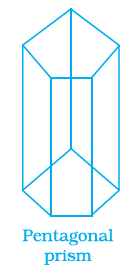
Example 4: A pentagonal prism has ______ edges.
Answer:
Solution:
A pentagonal prism has two pentagonal bases (top and bottom) and five rectangular lateral faces.
1. Number of edges in the top pentagonal base = $5$
2. Number of edges in the bottom pentagonal base = $5$
3. Number of lateral edges connecting the two bases = $5$
$\text{Total number of edges} = 5 + 5 + 5 = 15$
Answer: 15
In examples 5 and 6, state whether the statements are true or false.
Example 5: A sphere is a polyhedron.
Answer:
Solution:
A polyhedron is a solid figure bounded by flat polygonal faces. A sphere has a continuously curved surface and no flat faces, edges, or vertices.
Answer: False
Example 6: In a prism the lateral faces need not be congruent
Answer:
Solution:
The lateral faces of a prism are parallelograms. While they must have the same height, their widths depend on the lengths of the sides of the base polygon. If the base is not a regular polygon, the side lengths will differ, making the lateral faces non-congruent.
Answer: True
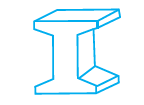
Example 7: Draw the top, front and side views of the given solid.
Answer:
Solution:
By observing the given "I" shaped solid from different directions, we can visualize its 2D projections:
1. Top View: When viewed from the top, we only see the upper horizontal rectangular face.
2. Front View: When viewed from the front, the entire "I" shape is visible.
3. Side View: When viewed from the side, we see a vertical rectangular strip representing the thickness of the "I" block.
Example 8: Use isometric dot paper to sketch a rectangular prism with length 4 units, height 2 units and width 3 units.
Answer:
Solution:
To sketch this on isometric dot paper, follow these steps:
1. Mark a starting point on the dot paper.
2. Draw a line segment of 4 units representing the length.
3. From the endpoints, draw segments of 3 units at an angle to represent the width.
4. Draw vertical segments of 2 units from all corners to represent the height.
5. Connect the top endpoints to complete the 3D rectangular prism (cuboid).
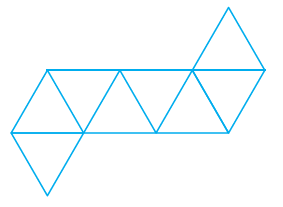
Example 9: Identify the shape whose net is given below.
Answer:
Given:
A net consisting of $8$ congruent equilateral triangles.
To Find:
The name of the solid shape formed by this net.
Solution:
By observing the given net, we can count the total number of faces. There are $8$ triangular faces in total.
A polyhedron that is bounded by eight faces is called an Octahedron. Since all the triangles in this net are equilateral and congruent, they will form a regular solid.
Hence, the shape whose net is given is an Octahedron.
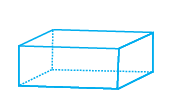
Example 10: The solid given below is a rectangular prism or cuboid. Make all the diagonals of this shape.
Answer:
Given:
A rectangular prism or a cuboid.
To Find:
Draw and identify all the space diagonals of the shape.
Solution:
In a solid shape like a cuboid, a space diagonal is a line segment connecting two vertices that do not lie on the same face. These diagonals pass through the interior of the solid.
A cuboid has exactly $4$ space diagonals. If we label the vertices of the bottom face as $A, B, C, D$ and the corresponding top vertices as $E, F, G, H$, the diagonals would be:
1. From $A$ to $G$
2. From $B$ to $H$
3. From $C$ to $E$
4. From $D$ to $F$
Thus, there are 4 space diagonals in a cuboid.
Example 11: Count the number of cubes in the given shapes.
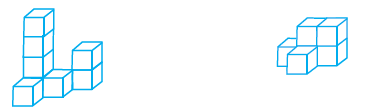
Answer:
To Find:
The total number of unit cubes in the first and second shape.
Solution:
(i) First Shape (Left):
We count the cubes by observing the different columns and layers:
$\bullet$ The leftmost vertical column has $4$ cubes.
$\bullet$ The middle section has $2$ cubes in the bottom layer and $1$ cube in the second layer.
$\bullet$ The rightmost section has $1$ cube in the bottom layer.
$\text{Total number of cubes} = 4 + 2 + 1 + 1 = 8$
(ii) Second Shape (Right):
We count the cubes visible in the layers:
$\bullet$ The bottom layer has $4$ cubes.
$\bullet$ The top layer has $2$ cubes placed over the back row.
$\text{Total number of cubes} = 4 + 2 = 6$
Ans: (i) 8 cubes, (ii) 6 cubes
Example 12: Name the following polyhedrons and verify the Euler’s formula for each of them.
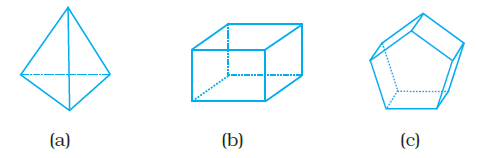
Answer:
Solution:
Euler’s formula for any polyhedron states that: $F + V - E = 2$
where $F$ is the number of faces, $V$ is the number of vertices, and $E$ is the number of edges.
(a) Triangular Pyramid (Tetrahedron):
$\bullet$ Number of Faces ($F$) = $4$
$\bullet$ Number of Vertices ($V$) = $4$
$\bullet$ Number of Edges ($E$) = $6$
$\text{Verification:} \ F + V - E = 4 + 4 - 6 = 8 - 6 = 2$
Hence, Euler's formula is verified.
(b) Rectangular Prism (Cuboid):
$\bullet$ Number of Faces ($F$) = $6$
$\bullet$ Number of Vertices ($V$) = $8$
$\bullet$ Number of Edges ($E$) = $12$
$\text{Verification:} \ F + V - E = 6 + 8 - 12 = 14 - 12 = 2$
Hence, Euler's formula is verified.
(c) Pentagonal Prism:
$\bullet$ Number of Faces ($F$) = $7$ ($2$ pentagonal bases + $5$ lateral faces)
$\bullet$ Number of Vertices ($V$) = $10$ ($5$ on top + $5$ on bottom)
$\bullet$ Number of Edges ($E$) = $15$ ($5$ top + $5$ bottom + $5$ lateral)
$\text{Verification:} \ F + V - E = 7 + 10 - 15 = 17 - 15 = 2$
Hence, Euler's formula is verified.
Example 13: A polyhedron has 7 faces and 10 vertices. How many edges does the polyhedron have?
Answer:
Given:
Number of faces, $F = 7$
Number of vertices, $V = 10$
To Find:
Number of edges, $E$.
Solution:
According to Euler's formula for a polyhedron:
$F + V - E = 2$
Substituting the given values in the formula:
$7 + 10 - E = 2$
$17 - E = 2$
$E = 17 - 2$
$E = 15$
Ans: 15 edges
Example 14: Find the number of vertices in a polyhedron which has 30 edges and 12 faces.
Answer:
Given:
Number of edges ($E$) = 30
Number of faces ($F$) = 12
To Find:
The number of vertices ($V$).
Solution:
We use Euler's Formula for any polyhedron, which is given by:
$F + V - E = 2$
Substituting the given values into the formula:
$12 + V - 30 = 2$
Now, simplify the expression:
$V - 18 = 2$
To find $V$, add 18 to both sides:
$V = 2 + 18$
$V = 20$
Therefore, the number of vertices in the polyhedron is 20.
Example 15: The distance between City A and City B on a map is given as 6 cm. If the scale represents 1 cm = 200 km, then find the actual distance between City A and City B.
Answer:
Given:
Distance on the map = $6\text{ cm}$
Scale used = $1\text{ cm} : 200\text{ km}$
To Find:
The actual distance between City A and City B.
Solution:
According to the given scale, $1\text{ cm}$ on the map represents $200\text{ km}$ in reality.
The actual distance is calculated by multiplying the map distance by the scale factor.
$\text{Actual distance} = 6 \times 200$
(Using map distance $\times$ scale)
$\text{Actual distance} = 1200\text{ km}$
Therefore, the actual distance between City A and City B is 1200 km.
Example 16: Height of a building is 9 m and this building is represented by 9 cm on a map. What is the scale used for the map?
Answer:
Given:
Actual height of the building = $9\text{ m}$
Height on the map = $9\text{ cm}$
To Find:
The scale used for the map.
Solution:
The scale of a map is the ratio of the distance on the map to the actual distance. Both values must be in the same units to find the ratio.
First, convert the actual height from metres to centimetres:
$1\text{ m} = 100\text{ cm}$
$9\text{ m} = 9 \times 100\text{ cm} = 900\text{ cm}$
Now, calculate the scale ratio:
$\text{Scale} = \text{Map Height} : \text{Actual Height}$
$\text{Scale} = 9\text{ cm} : 900\text{ cm}$
Divide both sides by 9:
$\text{Scale} = 1 : 100$
Therefore, the scale used for the map is 1 cm : 100 cm or simply 1 : 100.
Example 17: The scale on a map is 1 mm : 4 m. Find the distance on the map for an actual distance of 52 m.
Answer:
Given:
Scale = $1\text{ mm} : 4\text{ m}$
Actual distance = $52\text{ m}$
To Find:
The distance on the map.
Solution:
From the scale, we know that $4\text{ m}$ of actual distance is represented by $1\text{ mm}$ on the map.
Let the map distance be $x\text{ mm}$.
Using the unitary method:
$4\text{ m}$ (actual) $= 1\text{ mm}$ (map)
$1\text{ m}$ (actual) $= \frac{1}{4}\text{ mm}$ (map)
$52\text{ m}$ (actual) $= \frac{1}{4} \times 52\text{ mm}$ (map)
On simplifying:
$x = \frac{52}{4}$
$x = 13\text{ mm}$
Therefore, the distance on the map is 13 mm.
Example 18: Application of problem solving strategy
Determine the number of edges, vertices and in the following figure:
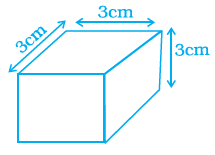
Answer:
Solution:
By observing the given solid figure, we identify it as a Rectangular Prism (specifically a Cube, as all dimensions are given as $3\text{ cm}$).
Let us count the components of this polyhedron:
1. Faces ($F$):
The figure has a top face, a bottom face, and four lateral faces.
$\text{Number of faces (F)} = 6$
2. Vertices ($V$):
There are 4 corners on the top face and 4 corners on the bottom face.
$\text{Number of vertices (V)} = 8$
3. Edges ($E$):
There are 4 edges at the top, 4 edges at the bottom, and 4 vertical edges connecting them.
$\text{Number of edges (E)} = 12$
Verification:
We can verify our counts using Euler's Formula:
$F + V - E = 6 + 8 - 12$
$F + V - E = 14 - 12 = 2$
Since the result is 2, our counts are correct.
Ans: Faces = 6, Vertices = 8, Edges = 12.
Exercise
Question 1 to 21 (Multiple Choice Questions)
In each of the questions 1 to 21, out of four options only one is correct. Write the correct answer.
Question 1. Which amongst the following is not a polyhedron?
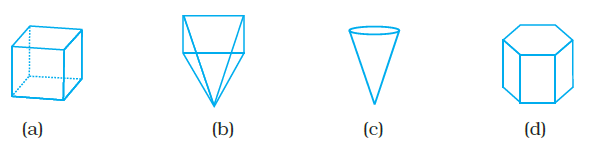
Answer:
Solution:
A polyhedron is a three-dimensional solid figure whose surface is made up of flat polygonal faces, straight edges, and vertices. Examples include cubes, prisms, and pyramids.
Let's analyze the given figures:
(a) Cube: It has flat square faces. It is a polyhedron.
(b) Triangular Pyramid: It has flat triangular faces. It is a polyhedron.
(c) Cone: It has a curved surface and a circular base. Since a polyhedron must be bounded by flat polygonal faces, a cone is not a polyhedron.
(d) Hexagonal Prism: It has flat hexagonal and rectangular faces. It is a polyhedron.
Hence, the correct option is (c).
Question 2. Which of the following will not form a polyhedron?
(a) 3 triangles
(b) 2 triangles and 3 parallelogram
(c) 8 triangles
(d) 1 pentagon and 5 triangles
Answer:
Solution:
To form a polyhedron, the faces must enclose a three-dimensional space. The simplest polyhedron is a triangular pyramid (tetrahedron), which requires at least $4$ triangular faces.
$\bullet$ 3 triangles: It is impossible to enclose space with only $3$ triangles. Thus, it cannot form a polyhedron.
$\bullet$ 2 triangles and 3 parallelograms: This combination forms a triangular prism.
$\bullet$ 8 triangles: This combination forms an octahedron.
$\bullet$ 1 pentagon and 5 triangles: This combination forms a pentagonal pyramid.
Hence, the correct option is (a).
Question 3. Which of the following is a regular polyhedron?
(a) Cuboid
(b) Triangular prism
(c) Cube
(d) Square prism
Answer:
Solution:
A polyhedron is said to be regular if all its faces are congruent regular polygons and the same number of faces meet at each vertex.
$\bullet$ Cuboid: Faces are rectangles, which are not regular polygons (unless they are squares).
$\bullet$ Triangular prism: The faces consist of triangles and rectangles; they are not all identical.
$\bullet$ Cube: All six faces are congruent squares (which are regular polygons), and exactly $3$ faces meet at each vertex. Therefore, a cube is a regular polyhedron.
$\bullet$ Square prism: Similar to a cuboid, the lateral faces are usually rectangles, not squares.
Hence, the correct option is (c).
Question 4. Which of the following is a two Dimensional figure?
(a) Rectangle
(b) Rectangular Prism
(c) Square Pyramid
(d) Square Prism
Answer:
Solution:
A two-dimensional (2D) figure is a flat plane figure that has only length and width but no depth or height.
$\bullet$ Rectangle: It is a flat plane figure. It is 2D.
$\bullet$ Rectangular Prism, Square Pyramid, and Square Prism: These are all solid shapes that have length, width, and height. They are three-dimensional (3D) figures.
Hence, the correct option is (a).
Question 5. Which of the following can be the base of a pyramid?
(a) Line segment
(b) Circle
(c) Octagon
(d) Oval
Answer:
Solution:
By definition, a pyramid is a polyhedron whose base is a polygon and whose lateral faces are triangles meeting at a common vertex.
$\bullet$ Line segment: It is 1D and not a polygon.
$\bullet$ Circle and Oval: These are curved shapes, not polygons. A base that is a circle forms a cone, not a pyramid.
$\bullet$ Octagon: It is a polygon with eight sides. It can serve as the base of an octagonal pyramid.
Hence, the correct option is (c).
Question 6. Which of the following 3D shapes does not have a vertex?
(a) Pyramid
(b) Prism
(c) Cone
(d) Sphere
Answer:
Solution:
A vertex is a point where two or more edges meet.
$\bullet$ Pyramid and Prism: These have multiple vertices where their flat faces meet.
$\bullet$ Cone: It has one vertex (the apex) at the top.
$\bullet$ Sphere: It is a perfectly round 3D shape with a continuous curved surface. It has no edges and no vertices.
Hence, the correct option is (d).
Question 7. Solid having only line segments as its edges is a
(a) Polyhedron
(b) Cone
(c) Cylinder
(d) Polygon
Answer:
Solution:
A polyhedron is a solid whose edges are all straight line segments, formed by the intersection of its flat polygonal faces.
$\bullet$ Cone and Cylinder: These have curved surfaces and circular edges (which are not line segments).
$\bullet$ Polygon: This is a 2D figure, not a solid (3D) shape.
Hence, the correct option is (a).
Question 8. In a solid if F = V = 5, then the number of edges in this shape is
(a) 6
(b) 4
(c) 8
(d) 2
Answer:
Given:
Number of faces ($F$) = $5$
Number of vertices ($V$) = $5$
To Find:
Number of edges ($E$).
Solution:
According to Euler's Formula for any polyhedron:
$F + V - E = 2$
Substituting the given values into the formula:
$5 + 5 - E = 2$
$10 - E = 2$
Transposing $E$ to the other side:
$E = 10 - 2$
$E = 8$
Therefore, the number of edges in this shape is $8$. This corresponds to a square pyramid.
Hence, the correct option is (c).
Question 9. Which of the following is the top view of the given shape?
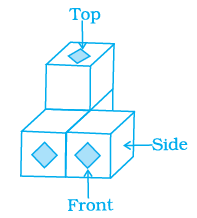

Answer:
Given:
A solid shape composed of four unit cubes arranged in an L-shaped base with one cube stacked on top.
Solution:
To find the top view, we imagine looking straight down at the object from above.
$\bullet$ The base of the solid consists of three squares in an 'L' orientation.
$\bullet$ From the top, we will see these three squares.
$\bullet$ Looking at the original figure, there is a diamond marker on the top-most face of the stack.
$\bullet$ The other two cubes that are not part of the stack will show their top faces as plain squares (unless marked, but the figure shows only one diamond on the top level).
Comparing this with the given options, option (a) shows three squares in an L-shape with a diamond marker on the square that corresponds to the top of the vertical stack.
Hence, the correct option is (a).
Question 10. The net shown below can be folded into the shape of a cube. The face marked with the letter L is opposite to the face marked with which letter?

(a) M
(b) N
(c) Q
(d) O
Answer:
Given:
A net of a cube with faces labelled M, N, O, P, L, and Q.
Solution:
In a net of a cube, the faces that are opposite to each other never share a common edge. A useful rule is that in a straight strip of the net, alternate faces are opposite to each other.
Let's analyze the folding process:
1. If we keep face O as the base, then N folds up to be the left face and P folds up to be the right face. Thus, N and P are opposite.
2. Face M folds up to be the back face.
3. Face L folds up to be the front face. Thus, M and L are opposite.
4. Face Q folds over the top to become the top face. Thus, O and Q are opposite.
Therefore, the face opposite to L is M.
Hence, the correct option is (a).
Question 11. Which of the nets given below will generate a cone?


Answer:
Solution:
A cone is a 3D shape with a circular base and a curved lateral surface that tapers to a point (vertex).
$\bullet$ The net of the lateral surface of a cone is a sector of a circle.
$\bullet$ Option (a) shows a sector of a circle, which when rolled, joins its two radii to form the curved surface of a cone.
$\bullet$ Option (b) is the net of a square pyramid.
$\bullet$ Option (c) is a triangle, which is a 2D shape.
$\bullet$ Option (d) is a rectangle, which is part of the net of a cylinder.
Hence, the correct option is (a).
Question 12. Which of the following is not a prism?
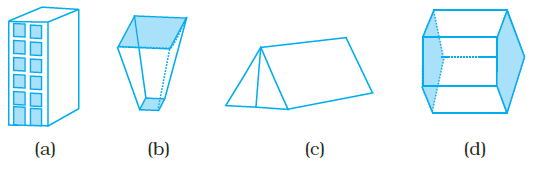
Answer:
Solution:
A prism is a polyhedron whose bottom and top faces (bases) are congruent polygons and whose lateral faces are parallelograms (or rectangles).
$\bullet$ (a) is a rectangular prism (cuboid).
$\bullet$ (b) is a frustum of a pyramid. Its top and bottom faces are squares of different sizes, so they are not congruent. Therefore, it is not a prism.
$\bullet$ (c) is a triangular prism.
$\bullet$ (d) is a hexagonal prism.
Hence, the correct option is (b).
Question 13. We have 4 congruent equilateral triangles. What do we need more to make a pyramid?
(a) An equilateral triangle.
(b) A square with same side length as of triangle.
(c) 2 equilateral triangles with side length same as triangle.
(d) 2 squares with side length same as triangle.
Answer:
Solution:
A pyramid consists of a polygonal base and triangular lateral faces. A square pyramid requires a square base and four triangular faces for its sides.
Since we already have 4 congruent equilateral triangles to serve as the lateral faces, we need a square with the same side length to act as the base of the pyramid.
Note: While 4 triangles can form a triangular pyramid (tetrahedron) on their own, the context of "what do we need more" implies we are looking to complete a shape that uses these 4 as sides.
Hence, the correct option is (b).
Question 14. Side of a square garden is 30 m. If the scale used to draw its picture is 1 cm : 5 m, the perimeter of the square in the picture is
(a) 20 cm
(b) 24 cm
(c) 28 cm
(d) 30 cm
Answer:
Given:
Actual side of square garden = $30\text{ m}$
Scale = $1\text{ cm} : 5\text{ m}$
To Find:
Perimeter of the square in the picture.
Solution:
First, find the side of the square in the picture using the scale:
$\text{Side in picture} = \frac{30}{5} = 6\text{ cm}$
Now, calculate the perimeter of this square:
$\text{Perimeter} = 4 \times \text{side}$
$\text{Perimeter} = 4 \times 6 = 24\text{ cm}$
Hence, the correct option is (b).
Question 15. Which of the following shapes has a vertex.
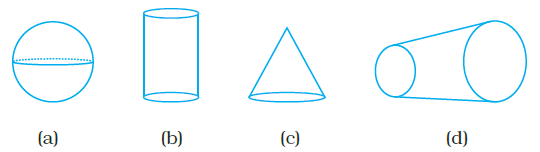
Answer:
Solution:
A vertex is a point where two or more lines or edges meet. In 3D geometry, it is a corner point.
$\bullet$ (a) Sphere: Has no edges and no vertices.
$\bullet$ (b) Cylinder: Has two circular edges but no vertices.
$\bullet$ (c) Cone: Has one circular edge and one vertex (the apex) at the top.
$\bullet$ (d) Frustum: Has two circular edges but no single vertex point.
Hence, the correct option is (c).
Question 16. In the given map, the distance between the places is shown using the scale 1 cm : 0.5 km. Then the actual distance (in km) between school and the book shop is
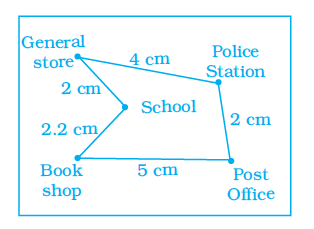
(a) 1.25
(b) 2.5
(c) 2
(d) 1.1
Answer:
Given:
Distance between School and Book shop on map = $2.2\text{ cm}$
Scale = $1\text{ cm} : 0.5\text{ km}$
To Find:
The actual distance in km.
Solution:
Using the given scale, we multiply the map distance by the scale factor:
$\text{Actual distance} = \text{Map distance} \times \text{Scale}$
$\text{Actual distance} = 2.2 \times 0.5$
$\text{Actual distance} = 1.1\text{ km}$
Hence, the correct option is (d).
Question 17. Which of the following cannot be true for a polyhedron?
(a) V = 4, F = 4, E = 6
(b) V = 6, F = 8, E = 12
(c) V = 20, F = 12, E = 30
(d) V = 4, F = 6, E = 6
Answer:
To Find:
Identify which set of Vertices ($V$), Faces ($F$), and Edges ($E$) does not satisfy the condition for a polyhedron.
Solution:
For any polyhedron, Euler's Formula must be satisfied:
$F + V - E = 2$
Let's check each option:
(a) $F = 4, V = 4, E = 6 \implies 4 + 4 - 6 = 2$ (True)
(b) $F = 8, V = 6, E = 12 \implies 8 + 6 - 12 = 2$ (True)
(c) $F = 12, V = 20, E = 30 \implies 12 + 20 - 30 = 2$ (True)
(d) $F = 6, V = 4, E = 6 \implies 6 + 4 - 6 = 4 \neq 2$ (False)
Since option (d) does not satisfy Euler's Formula, it cannot be true for a polyhedron.
Hence, the correct option is (d).
Question 18. In a blueprint of a room, an architect has shown the height of the room as 33 cm. If the actual height of the room is 330 cm, then the scale used by her is
(a) 1 : 11
(b) 1 : 10
(c) 1 : 100
(d) 1 : 3
Answer:
Given:
Height on blueprint (Map distance) = $33 \text{ cm}$
Actual height (Actual distance) = $330 \text{ cm}$
Solution:
The scale is the ratio of the drawing distance to the actual distance.
$\text{Scale} = \frac{\text{Drawing Distance}}{\text{Actual Distance}}$
$\text{Scale} = \frac{33}{330}$
Dividing both by 33:
$\text{Scale} = \frac{1}{10}$
The scale is $1 : 10$.
Hence, the correct option is (b).
Question 19. The following is the map of a town. Based on it answer question 19-21.
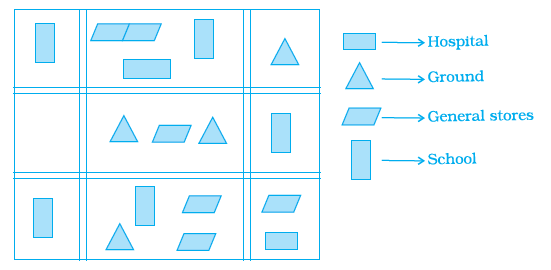
The number of hospitals in the town is
(a) 1
(b) 2
(c) 3
(d) 4
Answer:
Solution:
According to the legend on the map, the Hospital is represented by a horizontal light blue rectangle symbol.
By observing the map:
1. One hospital is located in the top-middle sector of the map.
2. Another hospital is located in the bottom-right sector of the map.
Total number of hospitals = $2$.
Hence, the correct option is (b).
Question 20. The ratio of the number of general stores and that of the ground is
(a) 1 : 2
(b) 2 : 1
(c) 2 : 3
(d) 3 : 2
Answer:
Solution:
Based on the symbols in the map legend:
$\bullet$ General Stores are represented by parallelograms. Counting them on the map, there are $6$ general stores.
$\bullet$ Grounds are represented by triangles. Counting them on the map, there are $4$ grounds.
Required Ratio = Number of General Stores $:$ Number of Grounds
$\text{Ratio} = 6 : 4$
Simplifying the ratio by dividing by 2:
$\text{Ratio} = 3 : 2$
Hence, the correct option is (d).
Question 21. According to the map, the number of schools in the town is
(a) 4
(b) 3
(c) 5
(d) 2
Answer:
Solution:
According to the legend, the School is represented by a vertical light blue rectangle.
Counting the vertical rectangles on the map:
1. One in the top-left sector.
2. One in the top-middle sector.
3. One in the middle-right sector.
4. One in the bottom-left sector.
5. One in the bottom-middle sector.
Total number of schools = $5$.
Hence, the correct option is (c).
Question 22 to 41 (Fill in the Blanks)
In questions 22 to 41, fill in the blanks to make the statements true.
Question 22. Square prism is also called a _______.
Answer:
Solution:
A square prism is a three-dimensional shape with two square bases and four rectangular lateral faces. If all the faces (including lateral faces) are squares, it is called a cube. In general geometry, it is a type of cuboid.
Answer: cube (or cuboid)
Question 23. Rectangular prism is also called a ________.
Answer:
Solution:
A rectangular prism is a polyhedron with six rectangular faces. In standard terminology, this shape is commonly known as a cuboid.
Answer: cuboid
Question 24. In the figure,
 the number of faces meeting at B is ________.
Answer:
Solution:
By observing the given figure, we can see that the solid is a regular octahedron (which consists of two square pyramids joined at their bases). In this specific solid geometry, vertex B is one of the corners where the upper and lower parts of the solid meet.
In a regular octahedron, exactly four triangular faces meet at every vertex. By counting the faces that share vertex B in the illustration:
$\bullet$ Two triangular faces from the top pyramid meet at point B.
$\bullet$ Two triangular faces from the bottom pyramid also meet at point B.
$\text{Total number of faces meeting at B} = 2 + 2 = 4$
Answer: 4
Question 25. A pyramid on an n sided polygon has ______ faces.
Answer:
Solution:
In a pyramid, there is one base which is a polygon, and if the base has $n$ sides, there are $n$ triangular lateral faces meeting at the apex.
$\text{Total faces} = \text{Base face} + \text{Lateral faces}$
$\text{Total faces} = 1 + n$
Answer: $n + 1$
Question 26. If a solid shape has 12 faces and 20 vertices, then the number of edges in this solid is ______.
Answer:
Given:
Number of faces ($F$) = $12$
Number of vertices ($V$) = $20$
Solution:
Using Euler's Formula: $F + V - E = 2$
$12 + 20 - E = 2$
$32 - E = 2$
$E = 32 - 2 = 30$
Answer: 30
Question 27. The given net
 can be folded to make a ______.
Answer:
Solution:
The provided net consists of three rectangles and two triangles. When folded, the two triangles become the bases and the three rectangles form the lateral faces.
Answer: triangular prism
Question 28. A solid figure with only 1 vertex is a ______.
Answer:
Solution:
A cone has a circular base and a curved surface that tapers to a single point at the top. This point is the only vertex of the solid.
Answer: cone
Question 29. Total number of faces in a pyramid which has eight edges is______.
Answer:
Given:
Number of edges ($E$) = $8$
Solution:
In a pyramid with an $n$-sided base, the number of edges is $2n$.
$2n = 8 \implies n = 4$
The base is a quadrilateral (like a square). The number of faces in such a pyramid is $n + 1$.
$\text{Number of faces} = 4 + 1 = 5$
Answer: 5
Question 30. The net of a rectangular prism has ______ rectangles.
(Hint: Every square is a rectangle but every rectangle is not a square.)
Answer:
Solution:
A rectangular prism (cuboid) is bounded by six faces, all of which are rectangles.
Answer: 6
Question 31. In a three-dimensional shape, diagonal is a line segment that joins two vertices that do not lie on the ______ face.
Answer:
Solution:
A space diagonal of a polyhedron is a segment connecting two vertices that are not on the same face. If they were on the same face, the segment would be a face diagonal or an edge.
Answer: same
Question 32. If 4 km on a map is represented by 1 cm, then 16 km is represented by ______ cm.
Answer:
Given:
Scale: $4 \text{ km} = 1 \text{ cm}$
Solution:
$\text{Representation of 4 km} = 1 \text{ cm}$
$\text{Representation of 1 km} = \frac{1}{4} \text{ cm}$
$\text{Representation of 16 km} = \frac{1}{4} \times 16 = 4 \text{ cm}$
Answer: 4
Question 33. If actual distance between two places A and B is 110 km and it is represented on a map by 25 mm. Then the scale used is ______.
Answer:
Given:
Actual distance = $110 \text{ km}$
Map distance = $25 \text{ mm}$
Solution:
To find the scale as a ratio, we must convert both measurements to the same unit (centimetres).
Step 1: Convert Map distance from mm to cm.
$10 \text{ mm} = 1 \text{ cm}$
$25 \text{ mm} = \frac{25}{10} = 2.5 \text{ cm}$
Step 2: Convert Actual distance from km to cm.
$1 \text{ km} = 1,000 \text{ m}$
$1 \text{ m} = 100 \text{ cm}$
So, $1 \text{ km} = 1,00,000 \text{ cm}$
$110 \text{ km} = 110 \times 1,00,000 = 1,10,00,000 \text{ cm}$
Step 3: Calculate the Scale Ratio.
$\text{Scale} = \text{Map distance} : \text{Actual distance}$
$\text{Scale} = 2.5 : 1,10,00,000$
To remove the decimal, multiply both sides by $10$:
$\text{Scale} = 25 : 11,00,00,000$
Dividing both sides by $25$:
$\text{Scale} = 1 : 44,00,000$
Answer: 1 : 44,00,000
Question 34. A pentagonal prism has ______ faces.
Answer:
Solution:
A pentagonal prism has $2$ pentagonal bases and $5$ rectangular lateral faces.
$\text{Total faces} = 2 + 5 = 7$
Answer: 7
Question 35. If a pyramid has a hexagonal base, then the number of vertices is ______.
Answer:
Given:
The solid is a pyramid with a hexagonal base.
To Find:
The total number of vertices ($V$) of the pyramid.
Solution:
For any pyramid, the number of vertices is always one more than the number of sides of its base polygon. This is because there are vertices at each corner of the base and one additional vertex at the top (apex).
A hexagon has $n = 6$ sides.
$\text{Number of vertices (V)} = n + 1$
$\text{Number of vertices (V)} = 6 + 1$
$\text{Number of vertices (V)} = 7$
Answer: 7
Question 36.
 is the _______ view of

Answer:
Solution:
By observing the solid shape of the house:
$\bullet$ The front view shows the door and the triangular part of the roof.
$\bullet$ The side view shows a single rectangular wall and a sloping roof edge.
$\bullet$ The top view shows the two sloping rectangular surfaces of the roof meeting at the top ridge line.
The first image consists of two rectangles joined along a middle line, which exactly represents how the two slopes of the roof appear when looked at from directly above.
Answer: top
Question 37. The number of cubes in  are ______.
Answer:
Solution:
Let's count the cubes by observing the arrangement in the given figure:
$\bullet$ In the bottom layer, we can see $3$ cubes in the front row. There are also cubes behind them to support the top layer. By observing the structure, the bottom layer consists of a $3 \times 2$ arrangement supporting the structure.
$\bullet$ In the top layer (second level), there are $2$ cubes visible.
Total number of cubes $= 6 \text{ (bottom layer)} + 2 \text{ (top layer)}$
Total number of cubes $= 8$
Answer: 8
Question 38. If the sum of number of vertices and faces in a polyhedron is 14, then the number of edges in that shape is ______.
Answer:
Given:
Sum of faces ($F$) and vertices ($V$) $= 14$
$\text{i.e., } F + V = 14$
To Find:
The number of edges ($E$).
Solution:
According to Euler's Formula for any polyhedron:
$F + V - E = 2$
Substituting the given sum into the formula:
$14 - E = 2$
To find $E$, we rearrange the equation:
$E = 14 - 2$
$E = 12$
Answer: 12
Question 39. Total number of regular polyhedra is ______.
Answer:
Solution:
A regular polyhedron (also known as a Platonic Solid) is a convex polyhedron whose faces are congruent regular polygons and where the same number of faces meet at each vertex. There are exactly five such solids:
1. Tetrahedron (4 triangular faces)
2. Cube (6 square faces)
3. Octahedron (8 triangular faces)
4. Dodecahedron (12 pentagonal faces)
5. Icosahedron (20 triangular faces)
Answer: 5
Question 40. A regular polyhedron is a solid made up of ______ faces.
Answer:
Solution:
A polyhedron is considered regular if all its faces are identical regular polygons. For example, a cube is a regular polyhedron because all its faces are congruent squares.
Answer: congruent regular polygonal
Question 41. For each of the following solids, identify the front, side and top views and write it in the space provided.
(a)
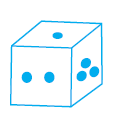

(b)


(c)
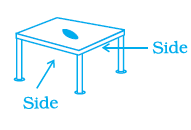
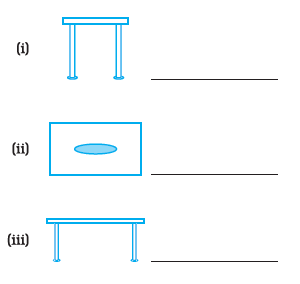
(d)
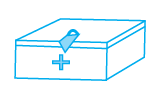
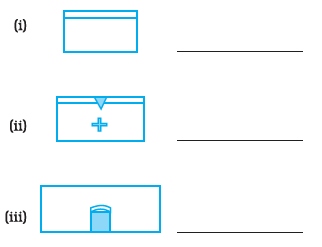
Answer:
Solution (a): Analysis of the Dice
By observing the 3D solid figure of the dice:
$\bullet$ The face with 1 dot is at the top.
$\bullet$ The face with 2 dots is facing us directly, which is the front.
$\bullet$ The face with 3 dots is on the left, which is the side view.
Therefore, the identification for (a) is:
(i) Front View
(ii) Side View
(iii) Top View
Solution (b): Analysis of the House
By observing the 3D solid figure of the house:
$\bullet$ The small vertical wall with the door and the triangular part of the roof is the front.
$\bullet$ The longer wall with the window and the sloping roof is the side.
$\bullet$ From the top, we only see the two sloping rectangles of the roof meeting at the ridge.
Therefore, the identification for (b) is:
(i) Side View
(ii) Top View
(iii) Front View
Solution (c): Analysis of the Table
By observing the 3D solid figure of the table:
$\bullet$ The view from the top shows the rectangular surface with the oval design.
$\bullet$ The view from the long side of the rectangle is the front view.
$\bullet$ The view from the narrow side of the rectangle is the side view.
Therefore, the identification for (c) is:
(i) Side View
(ii) Top View
(iii) Front View
Solution (d): Analysis of the Box
By observing the 3D solid figure of the rectangular box:
$\bullet$ The face with the plus ($+$) sign and the locking latch is the front.
$\bullet$ The plain rectangular face without any markings is the side.
$\bullet$ The top lid which features the handle is the top view.
Therefore, the identification for (d) is:
(i) Side View
(ii) Front View
(iii) Top View
Question 42 to 61 (True or False)
In each of the questions 42 to 61, state whether the following statements are true (T) or false (F).
Question 42. The other name of cuboid is tetrahedron.
Answer:
Solution:
A cuboid is a polyhedron with $6$ rectangular faces. A tetrahedron (also known as a triangular pyramid) is a polyhedron with $4$ triangular faces.
Since they have different numbers of faces and different shapes, they are not the same.
Answer: False (F)
Question 43. A polyhedron can have 3 faces.
Answer:
Solution:
A polyhedron must enclose a three-dimensional space. The simplest polyhedron is a triangular pyramid, which requires a minimum of $4$ faces ($1$ base and $3$ lateral faces).
It is impossible to form a closed solid with only $3$ faces.
Answer: False (F)
Question 44. A polyhedron with least number of faces is known as a triangular pyramid.
Answer:
Solution:
As established, the minimum number of faces required to form a polyhedron is $4$. A polyhedron with $4$ faces is a triangular pyramid (tetrahedron). Therefore, it is the polyhedron with the least number of faces.
Answer: True (T)
Question 45. Regular octahedron has 8 congruent faces which are isosceles triangles.
Answer:
Solution:
A regular polyhedron must have faces that are congruent regular polygons. A regular triangle is an equilateral triangle. While an equilateral triangle is technically a type of isosceles triangle, the specific requirement for a regular octahedron is that the faces must be equilateral.
Answer: False (F)
Question 46. Pentagonal prism has 5 pentagons.
Answer:
Solution:
A pentagonal prism consists of $2$ pentagonal bases (top and bottom) and $5$ rectangular lateral faces. It has a total of $7$ faces, but only 2 of them are pentagons.
Answer: False (F)
Question 47. Every cylinder has 2 opposite faces as congruent circles, so it is also a prism.
Answer:
Solution:
A prism is a type of polyhedron, which means all its faces must be polygons (flat surfaces with straight edges). Since a cylinder has curved surfaces and circular bases (which are not polygons), it cannot be classified as a prism.
Answer: False (F)
Question 48. Euler’s formula is true for all three-dimensional shapes.
Answer:
Solution:
Euler's formula ($F + V - E = 2$) is specifically applicable to polyhedra (solids with flat faces and straight edges). It does not hold true for 3D shapes with curved surfaces, such as spheres, cones, or cylinders.
Answer: False (F)
Question 49. A polyhedron can have 10 faces, 20 edges and 15 vertices.
Answer:
Given:
Number of faces ($F$) = $10$
Number of vertices ($V$) = $15$
Number of edges ($E$) = $20$
Solution:
We check these values using Euler's Formula ($F + V - E = 2$):
$L.H.S = F + V - E$
$L.H.S = 10 + 15 - 20$
$L.H.S = 25 - 20$
$L.H.S = 5$
Since $5 \neq 2$, Euler's formula is not satisfied. Thus, such a polyhedron cannot exist.
Answer: False (F)
Question 50. The top view of
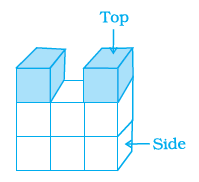 is
is
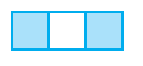
Answer:
Solution:
By observing the first image (the solid):
$\bullet$ It is a row of three columns of cubes.
$\bullet$ The left column is $3$ units high, the middle column is $2$ units high, and the right column is $3$ units high.
$\bullet$ From the top view, looking straight down, we see a $3 \times 1$ horizontal strip of squares.
$\bullet$ The top faces of the leftmost and rightmost columns are shaded light blue in the diagram, while the top face of the middle (lower) column is white.
The second image correctly represents this: a row of three squares where the outer ones are shaded and the middle one is white.
Answer: True (T)
Question 51. The number of edges in a parallelogram is 4.
Answer:
Solution:
In the context of geometry, especially in the chapter "Visualising Solid Shapes," there is a technical distinction between the components of two-dimensional (2D) and three-dimensional (3D) figures.
A parallelogram is a two-dimensional plane figure. For 2D shapes, the line segments that form the boundary are technically called sides, not edges. The term edge is reserved for three-dimensional polyhedra, where it refers to the line segment where two polygonal faces meet.
Since a parallelogram is a polygon (2D) and not a polyhedron (3D), it has 4 sides, but it is technically incorrect to say it has "edges" in this mathematical context.
Answer: False (F)
Question 52. Every solid shape has a unique net.
Answer:
Solution:
A net is a 2D pattern that can be folded to form a 3D solid. A single solid shape can have multiple different nets depending on how it is unfolded. For example, a cube has 11 different possible nets.
Since the net is not unique to the shape, the statement is false.
Answer: False (F)
Question 53. Pyramids do not have a diagonal.
Answer:
Solution:
In a three-dimensional shape, a space diagonal is a line segment connecting two vertices that do not lie on the same face. In any pyramid, all vertices of the base are connected to the apex (top vertex), meaning the apex shares a face with every vertex of the base. Furthermore, all vertices of the base lie on the same face (the base itself).
Because there is no pair of vertices in a pyramid that does not share a common face, pyramids do not have space diagonals.
Answer: True (T)
Question 54. The given shape is a cylinder.
Answer:
Solution:
(Note: This question typically refers to an image of a frustum or a cone in textbook exercises.)
A cylinder must have two congruent circular bases and a uniform curved surface. If the given figure has bases of different sizes (like a bucket shape/frustum) or tapers to a point (like a cone), it is not a cylinder.
Answer: False (F)
Question 55. A cuboid has atleast 4 diagonals.
Answer:
Solution:
A cuboid has exactly 4 space diagonals. These are segments that connect opposite vertices passing through the interior of the solid. Since it has exactly 4, the statement "at least 4" is mathematically correct.
Answer: True (T)
Question 56. All cubes are prisms.
Answer:
Solution:
A prism is a polyhedron with two congruent and parallel polygonal bases and rectangular (or parallelogram) lateral faces. A cube fits this definition perfectly as it has two congruent square bases and four square (which are also rectangular) lateral faces. In fact, a cube is a special type of square prism.
Answer: True (T)
Question 57. A cylinder is a 3-D shape having two circular faces of different radii.
Answer:
Solution:
By definition, a cylinder is a solid with two congruent and parallel circular bases. "Congruent" means the two circles must have the exact same radius and size.
If the two circular faces have different radii, the shape is called a frustum of a cone, not a cylinder.
Answer: False (F)
Question 58. On the basis of the given figure, the length of a rectangle in the net of a cylinder is same as circumference of circles in its net.
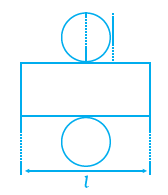
Answer:
Solution:
When the 2D net of a cylinder is folded to form the 3D solid, the rectangular part wraps around the circular bases. For the rectangle to perfectly enclose the circle without overlapping or leaving a gap, the length ($l$) of the rectangle must be exactly equal to the circumference of the circular base.
Answer: True (T)
Question 59. If a length of 100 m is represented on a map by 1 cm, then the actual distance corresponding to 2 cm is 200 m.
Answer:
Given:
Scale of the map: $1\text{ cm} = 100\text{ m}$
Solution:
Using the unitary method, we can find the actual distance for $2\text{ cm}$ on the map:
$\text{Actual distance for 1 cm} = 100\text{ m}$
$\text{Actual distance for 2 cm} = 2 \times 100\text{ m}$
$\text{Actual distance for 2 cm} = 200\text{ m}$
The statement is correct.
Answer: True (T)
Question 60. The model of a ship shown is of height 3.5 cm. The actual height of the ship is 210 cm if the scale chosen is 1: 60.
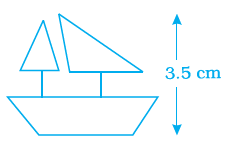
Answer:
Given:
Height of the ship model = $3.5\text{ cm}$
Scale $= 1 : 60$
To Find:
Verify if the actual height is $210\text{ cm}$.
Solution:
A scale of $1 : 60$ means that $1\text{ unit}$ on the model represents $60\text{ units}$ on the actual ship.
$\text{Actual Height} = \text{Model Height} \times 60$
$\text{Actual Height} = 3.5 \times 60$
$\text{Actual Height} = 210.0\text{ cm}$
The calculation matches the statement.
Answer: True (T)
Question 61. The actual width of a store room is 280 cm. If the scale chosen to make its drawing is 1:7, then the width of the room in the drawing will be 40 cm.
Answer:
Given:
Actual width of the room = $280\text{ cm}$
Scale chosen $= 1 : 7$
To Find:
Width in the drawing.
Solution:
The scale $1 : 7$ implies that $7\text{ cm}$ of the actual room is represented by $1\text{ cm}$ in the drawing.
$\text{Drawing Width} = \frac{\text{Actual Width}}{7}$
$\text{Drawing Width} = \frac{280}{7}$
$\text{Drawing Width} = 40\text{ cm}$
The statement is correct.
Answer: True (T)
Question 62 to 102
Question 62. Complete the table given below:
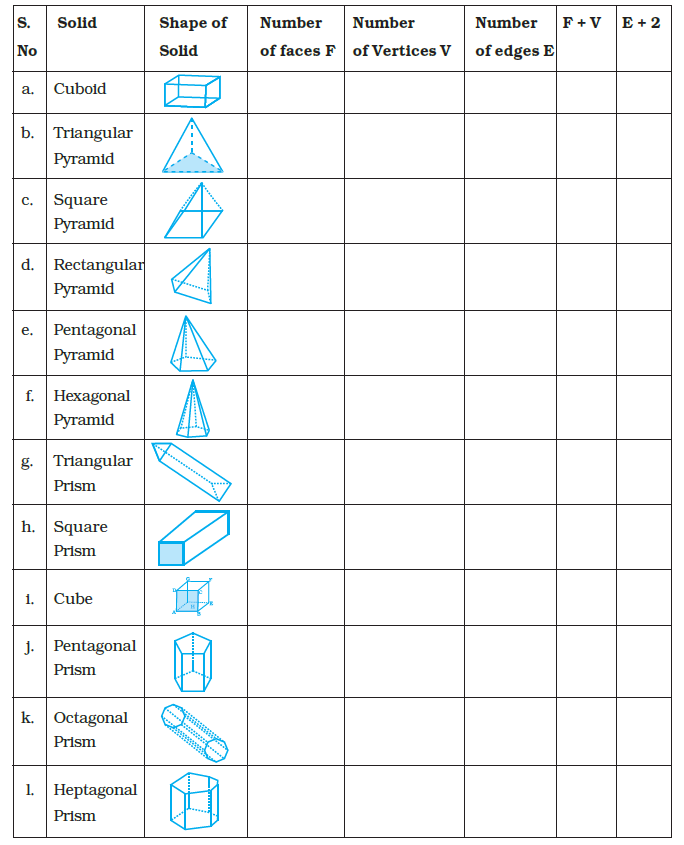
Answer:
Given:
A list of various polyhedrons including different types of prisms and pyramids.
To Find:
The number of faces ($F$), vertices ($V$), and edges ($E$) for each solid and verification of Euler's formula by calculating $F + V$ and $E + 2$.
Solution:
We use the properties of prisms and pyramids to determine the values. For a pyramid with an $n$-sided base: $F = n + 1$, $V = n + 1$, and $E = 2n$. For a prism with an $n$-sided base: $F = n + 2$, $V = 2n$, and $E = 3n$.
| S. No. | Solid | Number of faces ($F$) | Number of Vertices ($V$) | Number of edges ($E$) | $F + V$ | $E + 2$ |
| a. | Cuboid | $6$ | $8$ | $12$ | $14$ | $14$ |
| b. | Triangular Pyramid | $4$ | $4$ | $6$ | $8$ | $8$ |
| c. | Square Pyramid | $5$ | $5$ | $8$ | $10$ | $10$ |
| d. | Rectangular Pyramid | $5$ | $5$ | $8$ | $10$ | $10$ |
| e. | Pentagonal Pyramid | $6$ | $6$ | $10$ | $12$ | $12$ |
| f. | Hexagonal Pyramid | $7$ | $7$ | $12$ | $14$ | $14$ |
| g. | Triangular Prism | $5$ | $6$ | $9$ | $11$ | $11$ |
| h. | Square Prism | $6$ | $8$ | $12$ | $14$ | $14$ |
| i. | Cube | $6$ | $8$ | $12$ | $14$ | $14$ |
| j. | Pentagonal Prism | $7$ | $10$ | $15$ | $17$ | $17$ |
| k. | Octagonal Prism | $10$ | $16$ | $24$ | $26$ | $26$ |
| l. | Heptagonal Prism | $9$ | $14$ | $21$ | $23$ | $23$ |
As observed, for all the listed solid shapes, the value of $F + V$ is equal to $E + 2$, thus verifying Euler’s Formula.
Question 63. How many faces does each of the following solids, have?
(a) Tetrahedron
(b) Hexahedron
(c) Octagonal Pyramid
(d) Octahedron
Answer:
Solution:
The number of faces ($F$) in each solid is determined by its geometric definition:
(a) Tetrahedron: A tetrahedron is a triangular pyramid. It has $1$ triangular base and $3$ triangular lateral faces.
$\text{Number of faces} = 4$
(b) Hexahedron: "Hexa" means six. A hexahedron is a polyhedron with six faces (e.g., a cube or a cuboid).
$\text{Number of faces} = 6$
(c) Octagonal Pyramid: This pyramid has an $8$-sided base ($1$ face) and $8$ triangular lateral faces.
$\text{Number of faces} = 1 + 8 = 9$
(d) Octahedron: "Octa" means eight. An octahedron is a polyhedron with eight faces.
$\text{Number of faces} = 8$
Question 64. Draw a prism with its base as regular hexagon with one of its face facing you. Now draw the top view, front view and side view of this solid.
Answer:
Solution:
A Hexagonal Prism has two hexagonal bases and six rectangular lateral faces. If one rectangular face is directly facing us, the views will be as follows:
1. 3D Solid Figure:
2. Top View: From above, we see the flat hexagonal base.
3. Front View: From the front, we see the rectangular lateral face facing us.
4. Side View: From the side, we see the adjacent rectangular faces at an angle, which also project as a rectangle.
Question 65. How many vertices does each of the following solids have?
(a) Cone
(b) Cylinder
(c) Sphere
(d) Octagonal Pyramid
(e) Tetrahedron
(f) Hexagonal Prism
Answer:
Solution:
The number of vertices ($V$) for the given solids are:
(a) Cone: A cone has exactly one point at the top where the curved surface meets.
$\text{Number of vertices} = 1$
(b) Cylinder: A cylinder has curved edges and no corner points where three or more edges meet.
$\text{Number of vertices} = 0$
(c) Sphere: A sphere is a perfectly smooth curved surface with no edges or corners.
$\text{Number of vertices} = 0$
(d) Octagonal Pyramid: It has $8$ vertices at the corners of the base and $1$ vertex at the top (apex).
$\text{Number of vertices} = 8 + 1 = 9$
(e) Tetrahedron: It has $3$ vertices at the base and $1$ vertex at the top.
$\text{Number of vertices} = 4$
(f) Hexagonal Prism: It has $6$ vertices on the top hexagonal base and $6$ vertices on the bottom base.
$\text{Number of vertices} = 6 + 6 = 12$
Question 66. How many edges does each of following solids have?
(a) Cone
(b) Cylinder
(c) Sphere
(d) Octagonal Pyramid
(e) Hexagonal Prism
(f) Kaleidoscope
Answer:
Solution:
The number of edges ($E$) for the given solids are:
(a) Cone: A cone has one circular edge at its base.
$\text{Number of edges} = 1$
(b) Cylinder: A cylinder has two circular edges (one for each base).
$\text{Number of edges} = 2$
(c) Sphere: A sphere has no edges.
$\text{Number of edges} = 0$
(d) Octagonal Pyramid: It has $8$ edges on the base and $8$ lateral edges connecting to the apex.
$\text{Number of edges} = 8 + 8 = 16$
(e) Hexagonal Prism: It has $6$ edges on the top base, $6$ on the bottom base, and $6$ vertical lateral edges.
$\text{Number of edges} = 6 + 6 + 6 = 18$
(f) Kaleidoscope: A typical kaleidoscope is shaped like a triangular prism. It has $3$ edges on each of the two triangular ends and $3$ lateral edges.
$\text{Number of edges} = 3 + 3 + 3 = 9$
Question 67. Look at the shapes given below and state which of these are polyhedra using Euler’s formula.
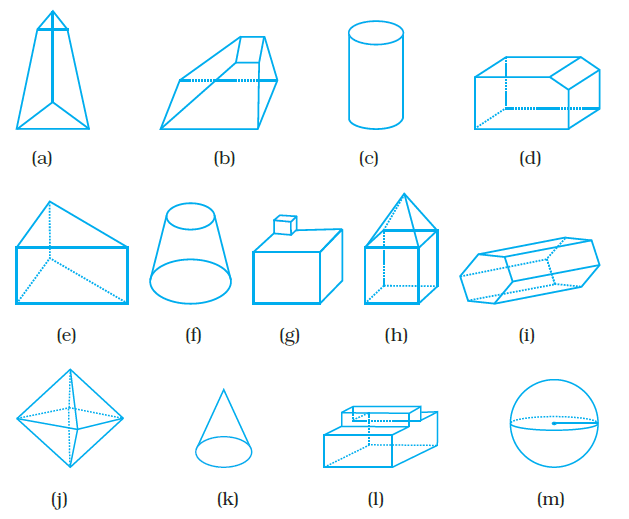
Answer:
Given:
A set of thirteen solid shapes labeled from (a) to (m).
To Find:
Identify which of the given shapes are polyhedra by applying Euler's formula: $F + V - E = 2$.
Solution:
A polyhedron is a three-dimensional solid bounded by flat polygonal faces. It must have only straight edges and sharp vertices. Solids with curved surfaces (like cylinders, cones, and spheres) are not polyhedra, and Euler's formula does not apply to them in the standard way.
Step 1: Identifying shapes with curved surfaces
The following shapes have curved surfaces and therefore are not polyhedra:
$\bullet$ (c) Cylinder
$\bullet$ (f) Frustum of a cone
$\bullet$ (k) Cone
$\bullet$ (m) Sphere
Step 2: Verifying remaining shapes using Euler's Formula ($F + V - E = 2$)
The remaining shapes are bounded by flat polygonal faces. Let us verify a few to confirm they are polyhedra:
| Shape | Faces ($F$) | Vertices ($V$) | Edges ($E$) | Euler's Formula ($F+V-E$) | Polyhedron? |
| (a) | $4$ | $4$ | $6$ | $4 + 4 - 6 = 2$ | Yes |
| (b) | $5$ | $6$ | $9$ | $5 + 6 - 9 = 2$ | Yes |
| (i) | $8$ | $12$ | $18$ | $8 + 12 - 18 = 2$ | Yes |
| (j) | $8$ | $6$ | $12$ | $8 + 6 - 12 = 2$ | Yes |
By visual inspection of the remaining composite solids (d, e, g, h, l), we can observe that they are all formed by joining two or more polyhedra along their faces. Since they consist entirely of flat polygonal faces and straight edges, they also satisfy Euler's formula.
Conclusion:
The shapes (a), (b), (d), (e), (g), (h), (i), (j), and (l) are polyhedra.
The shapes (c), (f), (k), and (m) are not polyhedra.
Question 68. Count the number of cubes in the given shapes.
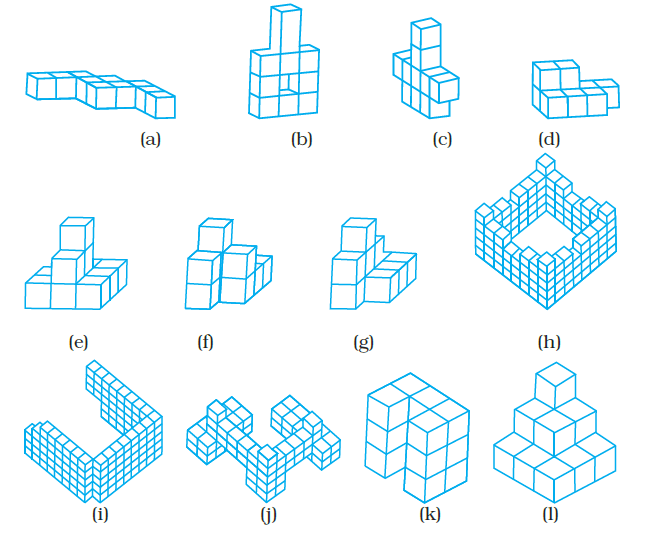
Answer:
To Find:
The total number of unit cubes present in each of the twelve given solid shapes labelled from (a) to (l).
Solution:
To count the number of cubes, we observe the visible faces and account for the hidden cubes that must be present to support the cubes at higher levels. For complex shapes, we can divide them into layers or segments.
For example, in shape (l), which is a pyramid:
Number of cubes in the top layer = $1$
Number of cubes in the second layer = $2 \times 2 = 4$
Number of cubes in the third (bottom) layer = $3 \times 3 = 9$
Total cubes = $1 + 4 + 9 = 14$
Similarly, by counting the cubes in each structure, we obtain the following results:
| Shape Label | Number of Cubes | Shape Label | Number of Cubes |
| (a) | $10$ | (g) | $11$ |
| (b) | $10$ | (h) | $110$ |
| (c) | $10$ | (i) | $113$ |
| (d) | $9$ | (j) | $66$ |
| (e) | $11$ | (k) | $15$ |
| (f) | $9$ | (l) | $14$ |
Final Answer:
The number of cubes in the given shapes are:
(a) 10, (b) 10, (c) 10, (d) 9, (e) 11, (f) 9, (g) 11, (h) 110, (i) 113, (j) 66, (k) 15, (l) 14.
Question 69. Draw the front, side and top view of the given shapes.

Answer:
Given:
Ten solid shapes labelled from (a) to (j), including basic geometric solids (cuboid, pyramid, cone) and complex structures made of unit cubes.
To Find:
The Front View, Side View, and Top View for each of the given shapes.
Solution:
In 3D visualization, the views are orthographic projections. The Top view (Plan) is what is seen from directly above, the Front view (Elevation) is seen from the front, and the Side view is seen from one of the sides.
Part (a): Cuboid
The front view is a long rectangle, the side view is a smaller rectangle, and the top view is a rectangle showing the length and breadth.
Part (b): Square Pyramid
The front and side views are triangles. The top view is a square with two intersecting diagonal lines representing the edges meeting at the apex.
Part (c): Cone
The front and side views are triangles. The top view is a circle with a central dot representing the apex.
Part (d): Cube Arrangement
This shape has 4 cubes in a row at the base and 2 cubes on top. The front view shows a $4 \times 1$ base with $2$ squares in the middle row. The top view shows a $4 \times 1$ row of squares.
Part (e): Cube Arrangement
The front view shows 3 squares in a row with 1 square on the left above. The top view shows an L-shape made of 3 squares.
Part (f): Cube Arrangement
The front view shows 3 squares in a row with 1 square on top of the middle cube. The side view shows 2 vertical squares.
Part (g): Cube Arrangement
This is a U-shaped solid. The front view shows the vertical ends and the recessed middle. The top view shows the U-shaped boundary of the squares.
Part (h): Complex Cube Solid
The front view shows a $3 \times 3$ grid with a missing corner. The top view shows two rows of squares.
Part (i): Pyramid of Cubes
The front view looks like a symmetrical stepped structure. The top view shows a $3 \times 3$ square area where the center and middle row edges are raised.
Part (j): Large Pyramid of Cubes
The front view is a large triangle-like stepped shape. The top view is a $5 \times 5$ square representing the base, with nested squares representing the higher levels.
Question 70. Using Euler’s formula, find the value of unknown x, y, z, p, q, r, in the following table.
| (I) | (II) | (III) | (IV) | (V) | (VI) | |
|---|---|---|---|---|---|---|
| Facts | 7 | y | 9 | p | 6 | 8 |
| Vertices | 10 | 12 | z | 6 | q | 11 |
| Edges | x | 18 | 16 | 12 | 12 | r |
Answer:
Given:
A table containing the number of Faces ($F$), Vertices ($V$), and Edges ($E$) for six different polyhedra.
To Find:
The values of unknown variables $x, y, z, p, q, \text{ and } r$ using Euler's formula.
Solution:
According to Euler’s formula for any polyhedron:
$F + V - E = 2$
We will apply this formula to each case:
(I) To find x:
$F = 7, V = 10, E = x$
$7 + 10 - x = 2$
$17 - x = 2 \Rightarrow x = 17 - 2 = 15$
(II) To find y:
$F = y, V = 12, E = 18$
$y + 12 - 18 = 2$
$y - 6 = 2 \Rightarrow y = 6 + 2 = 8$
(III) To find z:
$F = 9, V = z, E = 16$
$9 + z - 16 = 2$
$z - 7 = 2 \Rightarrow z = 7 + 2 = 9$
(IV) To find p:
$F = p, V = 6, E = 12$
$p + 6 - 12 = 2$
$p - 6 = 2 \Rightarrow p = 6 + 2 = 8$
(V) To find q:
$F = 6, V = q, E = 12$
$6 + q - 12 = 2$
$q - 6 = 2 \Rightarrow q = 6 + 2 = 8$
(VI) To find r:
$F = 8, V = 11, E = r$
$8 + 11 - r = 2$
$19 - r = 2 \Rightarrow r = 19 - 2 = 17$
Final Answer:
The values are: x = 15, y = 8, z = 9, p = 8, q = 8, r = 17.
Question 71. Can a polyhedron have V = F = 9 and E = 16 ? If yes, draw its figure.
Answer:
Given:
Number of Vertices ($V$) = $9$
Number of Faces ($F$) = $9$
Number of Edges ($E$) = $16$
To Find:
Whether such a polyhedron can exist and draw its figure if it does.
Solution:
We check the existence of the polyhedron using Euler's Formula:
$F + V - E = 2$
Substituting the given values in the Left Hand Side (L.H.S):
$\text{L.H.S} = F + V - E$
$\text{L.H.S} = 9 + 9 - 16$
$\text{L.H.S} = 18 - 16 = 2$
Since $\text{L.H.S} = \text{R.H.S}$, a polyhedron with these dimensions is possible.
An example of such a polyhedron is an Octagonal Pyramid (a pyramid with an octagon as its base).
Final Answer:
Yes, a polyhedron can have $V=9, F=9, \text{ and } E=16$.
Question 72. Check whether a polyhedron can have V = 12, E = 6 and F = 8.
Answer:
Given:
Number of Vertices ($V$) = $12$
Number of Edges ($E$) = $6$
Number of Faces ($F$) = $8$
Solution:
We apply Euler's Formula to check the validity of these dimensions:
$F + V - E = 2$
Substituting the values:
$\text{L.H.S} = F + V - E$
$\text{L.H.S} = 8 + 12 - 6$
$\text{L.H.S} = 20 - 6 = 14$
As per the formula, the result should be $2$. However:
$14 \neq 2$
Additionally, in any polyhedron, the number of edges ($E$) must always be greater than or equal to $V-1$ and $F-1$. Here, $E=6$ is much less than $V=12$, which is physically impossible for a polyhedron.
Final Answer:
No, a polyhedron cannot have $V = 12, E = 6, \text{ and } F = 8$.
Question 73. A polyhedron has 60 edges and 40 vertices. Find the number of its faces.
Answer:
Given:
Number of Edges ($E$) = $60$
Number of Vertices ($V$) = $40$
To Find:
The number of Faces ($F$).
Solution:
We use Euler's Formula:
$F + V - E = 2$
Substituting the given values into the formula:
$F + 40 - 60 = 2$
$F - 20 = 2$
$F = 2 + 20$
$F = 22$
Final Answer:
The number of faces of the polyhedron is 22.
Question 74. Find the number of faces in the given shapes:
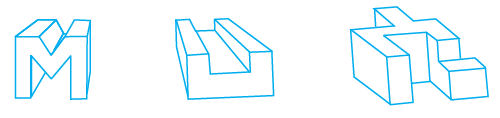
Answer:
Given:
Three complex solid shapes labelled as (i), (ii), and (iii) in the image.
To Find:
The total number of faces for each given shape.
Solution:
A face is a flat surface of a solid. To count the total number of faces, we account for all outer surfaces, including those that are hidden from the current perspective (like the back and bottom) and the internal surfaces of the cutouts.
(i) Analysis of the first shape (M-shape):
We can count the faces by their orientation:
1. Front and Back: $2$ faces.
2. Bottom (the base of the two legs): $2$ faces.
3. Outer sides (left and right): $2$ faces.
4. Top horizontal surfaces: $2$ faces.
5. Inner vertical surfaces (inside the legs): $2$ faces.
6. Inner horizontal surfaces (steps): $2$ faces.
7. Inner slanted/diagonal surfaces (the "V" notch): $2$ faces.
$\text{Total Faces} = 2 + 2 + 2 + 2 + 2 + 2 + 2$
$\text{Total Faces} = 14$
(ii) Analysis of the second shape (U-shape):
Counting the surfaces for the trough-like structure:
1. Front and Back: $2$ faces.
2. Outer sides (left and right): $2$ faces.
3. Outer bottom: $1$ face.
4. Top edges: $2$ faces.
5. Inner sides (left and right walls of the channel): $2$ faces.
6. Inner bottom (floor of the channel): $1$ face.
$\text{Total Faces} = 2 + 2 + 1 + 2 + 2 + 1$
$\text{Total Faces} = 10$
(iii) Analysis of the third shape (Complex stepped solid):
Counting the surfaces carefully based on the geometry:
1. Large Front and Back surfaces: $2$ faces.
2. Base (bottom): $1$ face.
3. Horizontal top surfaces (at different levels): $5$ faces.
4. Vertical side/inner surfaces: $8$ faces.
$\text{Total Faces} = 2 + 1 + 5 + 8$
[Calculation for complex solid]
$\text{Total Faces} = 16$
Final Answer:
The total number of faces in the given shapes are:
(a) 14
(b) 10
(c) 16
Question 75. A polyhedron has 20 faces and 12 vertices. Find the edges of the polyhedron.
Answer:
Given:
Number of Faces ($F$) = $20$
Number of Vertices ($V$) = $12$
To Find:
Number of Edges ($E$).
Solution:
We use Euler’s Formula for polyhedrons:
$F + V - E = 2$
Substituting the given values into the formula:
$20 + 12 - E = 2$
$32 - E = 2$
$E = 32 - 2$
$E = 30$
Final Answer:
The number of edges of the polyhedron is 30.
Question 76. A solid has forty faces and, sixty edges. Find the number of vertices of the solid.
Answer:
Given:
Number of Faces ($F$) = $40$
Number of Edges ($E$) = $60$
To Find:
Number of Vertices ($V$).
Solution:
Using Euler’s Formula:
$F + V - E = 2$
Substituting the values:
$40 + V - 60 = 2$
$V - 20 = 2$
$V = 2 + 20$
$V = 22$
Final Answer:
The number of vertices of the solid is 22.
Question 77. Draw the net of a regular hexahedron with side 3 cm. (Hint: Regular hexahedron - cube)
Answer:
Given:
A regular hexahedron (Cube) with side length $s = 3\text{ cm}$.
To Find:
The net of the cube.
Solution:
A net is a 2D pattern that can be folded to form a 3D solid. A cube has $6$ faces, and its net consists of $6$ congruent squares. When drawn to scale, each square in the net should have a side of $3\text{ cm}$.
Common layouts for a cube net include the "Cross" shape or "T" shape.
Final Answer:
The net of a regular hexahedron consists of 6 squares connected such that they can be folded into a cube of side $3\text{ cm}$.
Question 78. Draw the net of a regular tetrahedron with side 6 cm.
Answer:
Given:
A regular tetrahedron with each side equal to $6\text{ cm}$.
To Draw:
The net of the regular tetrahedron.
Solution:
A regular tetrahedron is a triangular pyramid where all four faces are congruent equilateral triangles. Since each side is given as $6\text{ cm}$, the net will consist of four equilateral triangles, each having a side of $6\text{ cm}$.
The most common net for a tetrahedron consists of a central equilateral triangle with three other equilateral triangles attached to its edges.
When these three outer triangles are folded upwards such that their vertices meet at a single point (the apex), a regular tetrahedron is formed.
Question 79. Draw the net of the following cuboid:
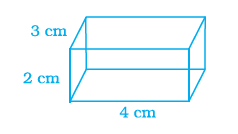
Answer:
Given:
A cuboid with the following dimensions:
Length ($l$) = $4\text{ cm}$
Breadth ($b$) = $3\text{ cm}$
Height ($h$) = $2\text{ cm}$
To Draw:
The net of the cuboid.
Solution:
The net of a cuboid consists of 6 rectangular faces. In this specific cuboid, the faces will come in three pairs of congruent rectangles:
1. Two rectangles of dimensions $4\text{ cm} \times 2\text{ cm}$ (Front and Back faces).
2. Two rectangles of dimensions $4\text{ cm} \times 3\text{ cm}$ (Top and Bottom faces).
3. Two rectangles of dimensions $3\text{ cm} \times 2\text{ cm}$ (Side faces).
These rectangles must be arranged in a way that they can be folded to form a closed box.
Question 80. Match the following:

Answer:
Solution:
Based on the geometric properties of the figures shown in the image, the matching is as follows:
1. Figure (a): It has two congruent hexagonal bases and rectangular side faces. This is a Hexagonal Prism.
2. Figure (b): It has a circular base tapering to a single point (apex). This is a Cone.
3. Figure (c): It has a square base and four triangular faces meeting at an apex. This is a Square Pyramid.
4. Figure (d): It is a solid with 6 square faces (a cube). A solid with 6 faces is generally called a Hexahedron.
| Figure | Name |
| (a) | (b) Hexagonal Prism |
| (b) | (d) Cone |
| (c) | (c) Square Pyramid |
| (d) | (a) Hexahedron |
Final Answer:
The correct matching is: (a)-(b), (b)-(d), (c)-(c), (d)-(a).
Question 81. Complete the table given below by putting tick mark across the respective property found in the solids mentioned.
| Solids | ||||
|---|---|---|---|---|
| Properties | Cone | Cylinder | Prism | Pyramid |
| 1. The figure is a polyhedron | ||||
| 2. The figure has diagonals | ||||
| 3. The shape has curved edges | ||||
| 4. The base of figure is a polygon. | ||||
| 5. The base are congruent. | ||||
| 6. The base of figure is a polygon and other faces meet at a single point. | ||||
| 7. The base of figure is a curved edge and othe faces meet at a single point. | ||||
Answer:
Solution:
A polyhedron is a three-dimensional solid made up of flat polygonal faces, straight edges, and sharp corners (vertices). Solids like prisms and pyramids are polyhedrons, whereas cones and cylinders are not because they have curved surfaces.
| Properties | Cone | Cylinder | Prism | Pyramid |
| 1. The figure is a polyhedron | $\checkmark$ | $\checkmark$ | ||
| 2. The figure has diagonals | $\checkmark$ | |||
| 3. The shape has curved edges | $\checkmark$ | $\checkmark$ | ||
| 4. The base of figure is a polygon. | $\checkmark$ | $\checkmark$ | ||
| 5. The bases are congruent. | $\checkmark$ | $\checkmark$ | ||
| 6. The base is a polygon and other faces meet at a point. | $\checkmark$ | |||
| 7. The base is a curved edge and other faces meet at a point. | $\checkmark$ |
Question 82. Draw the net of the following shape.
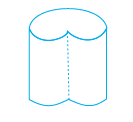
Answer:
Solution:
The given solid is a cylinder with a non-circular, indented base (resembling a heart shape). The net of this solid consists of two identical heart-shaped bases and one rectangular lateral surface.
When the curved surface is opened up, it forms a rectangle whose length is equal to the perimeter of the base and whose width is equal to the height of the solid.
Alternate Solution:
One can also visualize the net as a rectangular strip with the two heart-shaped bases attached at the top and bottom edges of the rectangle respectively.
Question 83. Draw the net of the following solid.
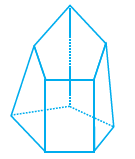
(Hint: Pentagons are not congruent.)
Answer:
Solution:
The given solid is a frustum of a pentagonal pyramid. It is bounded by two parallel pentagonal bases of different sizes and five lateral faces that are trapeziums.
Construction Required: To draw the net, we place the larger pentagonal base in the center and attach the five trapezoidal lateral faces to each of its sides. Finally, the smaller pentagonal base is attached to the top edge of one of the trapeziums.
Question 84. Find the number of cubes in the base layer of the following figure.
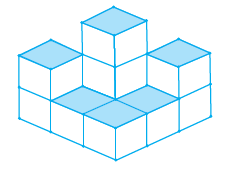
Answer:
To Find: Number of cubes in the base layer.
Solution:
The base layer contains one cube for every vertical column of cubes present in the structure. Looking at the figure, we can observe the columns extending in different directions.
Cubes in the central pillar = $1$
Cubes in the front arm (extended) = $2$
Cubes in the back arm (extended) = $2$
Cube in the left arm = $1$
Cube in the right arm = $1$
Total number of cubes in the base layer = $1 + 2 + 2 + 1 + 1$
Total number of cubes in the base layer = 7
Question 85. In the above figure, if only the shaded cubes are visible from the top, draw the base layer.
Answer:
Solution:
If only the shaded cubes are visible from the top, it implies that the top view (plan) of the solid consists of $5$ cubes arranged in a cross-like pattern. In such a vertical stack, the base layer must contain a cube for every column visible from the top to support the structure.
The base layer will consist of $5$ cubes arranged as follows:
Central cube = $1$
[Positioned at center]
Surrounding cubes = $4$
[One on each side of the center]
The layout forms a "plus" or cross shape.
Question 86. How many faces, edges and vertices does a pyramid have with n sided polygon as its base?
Answer:
Given: A pyramid having an $n$-sided polygon as its base.
To Find: The number of faces, edges, and vertices of the pyramid.
Solution:
A pyramid is a polyhedron formed by connecting a polygonal base and a point, called the apex. Each base edge and apex form a triangle, called a lateral face.
1. Faces ($F$): A pyramid with an $n$-sided base has $1$ base face and $n$ triangular lateral faces.
Faces $= n + 1$
2. Vertices ($V$): It has $n$ vertices at the base and $1$ vertex at the top (apex).
Vertices $= n + 1$
3. Edges ($E$): It has $n$ edges along the base and $n$ lateral edges joining the base vertices to the apex.
Edges $= 2n$
Hence, for a pyramid with an $n$-sided polygon base, it has $n + 1$ faces, $2n$ edges, and $n + 1$ vertices.
Question 87. Draw a figure that represents your mathematics textbook. What is the name of this figure? Is it a prism?
Answer:
Solution:
A mathematics textbook has six rectangular faces, where opposite faces are identical and parallel to each other.
1. Name of the figure: The 3D figure representing a mathematics textbook is a Cuboid (or a rectangular parallelepiped).
2. Is it a prism? Yes, it is a rectangular prism because it has two congruent and parallel rectangular bases, and its lateral faces are also rectangles (parallelograms).
Question 88. In the given figures, identify the different shapes involved.
.png "Page 200 Chapter 6 Class 8th NCERT Exemplar")
.png "Page 200 Chapter 6 Class 8th NCERT Exemplar")
Answer:
Solution:
By decomposing the composite solids into basic 3D geometric shapes, we identify the following:
1. First Figure (Cola Container):
This shape is a combination of a Cylinder (forming the main container body) and a Hemisphere (or semi-circular handle/dome at the top).
2. Second Figure (Pencil):
This shape is a combination of a Cone (at the sharpened front tip) and a Hexagonal Prism (forming the main unsharpened body of the pencil).
Question 89. What figure is formed if only the height of a cube is increased or decreased?
Answer:
Solution:
A cube is a three-dimensional solid object bounded by six square faces, where all three dimensions (length, width, and height) are equal.
If only the height of a cube is increased or decreased while keeping its length and width unchanged:
1. The square faces on the sides turn into rectangular faces.
2. The resulting solid no longer has all equal edges.
Therefore, the new figure formed is a Cuboid (or a rectangular prism).
Question 90. Use isometric dot paper to draw each figure.
(a) A tetrahedron.
(b) A rectangular prism with length 4 units, width 2 units and height 2 units.
Answer:
Solution:
(a) A Tetrahedron:
A tetrahedron is a triangular pyramid bounded by four triangular faces. It is drawn by connecting four non-coplanar points on isometric dot paper to form a triangular base and an apex vertex.
(b) A Rectangular Prism ($4 \text{ units} \times 2 \text{ units} \times 2 \text{ units}$):
To draw this cuboid on isometric dot paper:
1. Draw a front rectangular face of length $4$ units and height $2$ units along the isometric grid lines.
2. Draw slant parallel lines of length $2$ units from each corner to represent the width.
3. Connect the back endpoints to complete the rectangular prism.
Question 91. Identify the nets given below and mention the name of the corresponding solid in the space provided.
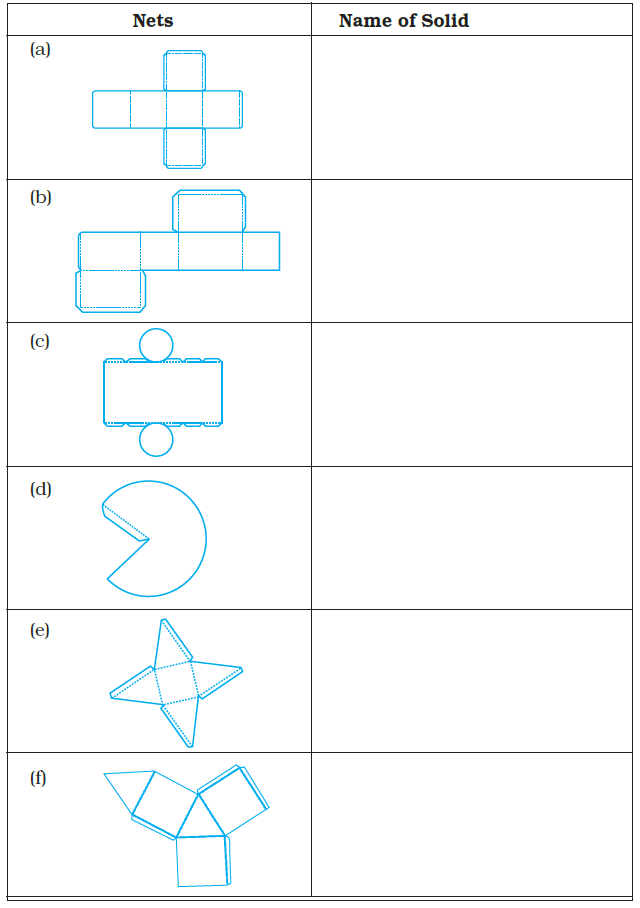
Answer:
Solution:
By analyzing the shapes of the faces in each net and how they would fold to form a three-dimensional object, we can identify the solids as follows:
| Net | Name of Solid |
| (a) | Cube (consists of 6 identical square faces) |
| (b) | Cuboid (consists of 6 rectangular faces) |
| (c) | Cylinder (consists of a rectangular lateral surface and two circular bases) |
| (d) | Cone (consists of a sector of a circle) |
| (e) | Square Pyramid (consists of a square base and 4 triangular lateral faces) |
| (f) | Triangular Prism (consists of 2 triangular bases and 3 rectangular lateral faces) |
Question 92. Draw a map of your school playground. Mark all necessary places like 2 library, Playground, Medical Room, Classrooms, Assembly area, etc.
Answer:
Solution:
To draw a map of a school, we use symbols to represent different locations and ensure the relative positions are accurate.
The map includes the following key areas:
1. Main Gate and Security.
2. Assembly Area (Central Courtyard).
3. Classroom Blocks (North and South wings).
4. Library and Medical Room.
5. Playground (located at the rear end).
Question 93. Refer to the given map to answer the following questions.
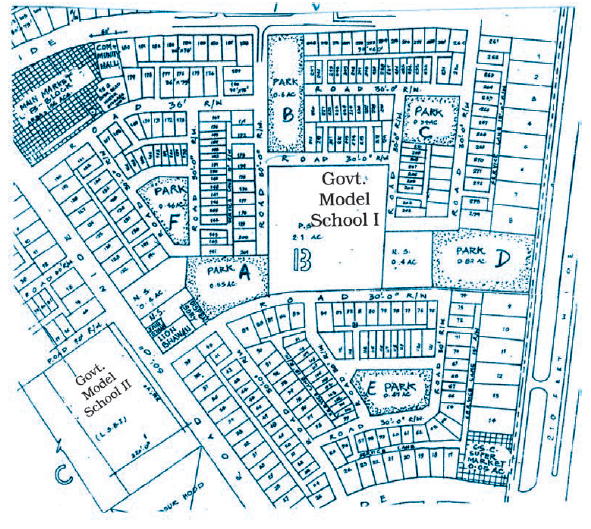
(a) What is the built-up area of Govt. Model School I ?
(b) Name the schools shown in the picture.
(c) Which park is nearest to the dispensary?
(d) To which block does the main market belong?
(e) How many parks have been represented in the map?
Answer:
Solution:
By observing the provided map carefully, we find the following information:
(a) The built-up area of Govt. Model School I is $2.1$ Acres (as labeled on the central building block).
(b) There are two schools shown: Govt. Model School I and Govt. Model School II.
(c) The Park A is nearest to the dispensary (located near Sony Bhawan and Jain Mandir).
(d) The main market belongs to Block B (as indicated in the top left section of the map).
(e) There are $6$ parks represented in the map, labeled as Park A, Park B, Park C, Park D, Park E, and Park F.
Question 94. Look at the map given below.
Answer the following questions.
(a) Which two hospitals are opposite to each other?
(b) A person residing at Niti Bagh has to go to Chirag Delhi after dropping her daughter at Asiad Tower. Mention the important landmarks he will pass alongwith the roads taken.
(c) Name of which road is similar to the name of some month.

Answer:
Solution:
From the map of the South Delhi area, we can conclude:
(a) AIIMS and Safdarjung Hospital are opposite to each other on Aurobindo Marg.
(b) The route would be as follows:
1. Start from Niti Bagh and take August Kranti Marg.
2. Turn onto Khel Gaon Marg to reach Asiad Village/Tower.
3. From Asiad Village, take the Outer Ring Road towards the east to reach Chirag Delhi.
Important landmarks passed: Kamala Nehru College, Siri Fort Auditorium, and Asiad Village.
(c) The August Kranti Marg has a name similar to the month of August.
Question 95. Look at the map given below.
⬜ Houses
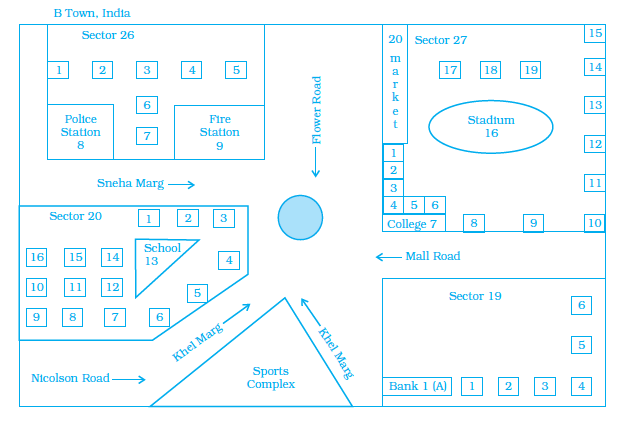
Now answer the following questions.
(a) Name the roads that meet at round about.
(b) What is the address of the stadium?
(c) On which road is the Police Station situated?
(d) If Ritika stays adjacent to bank and you have to send her a card, what address will you write?
(e) Which sector has maximum number of houses?
(f) In which sector is Fire Station located?
(g) In the map, how many sectors have been shown?
Answer:
Solution:
Based on the sector map of B Town, India:
(a) The roads meeting at the roundabout are Sneha Marg, Flower Road, Khel Marg, and Mall Road.
(b) The stadium is located in Sector 27 (labeled as Stadium 16).
(c) The Police Station is situated on Sneha Marg.
(d) Since Ritika stays adjacent to Bank 1(A), her address would be House No. 1, Sector 19.
(e) Sector 27 has the maximum number of houses (numbered up to 19, excluding the stadium).
(f) The Fire Station is located in Sector 26.
(g) A total of $4$ sectors have been shown: Sector 26, Sector 27, Sector 20, and Sector 19.
Alternate Solution for (e):
Counting the visible squares labeled with numbers in each sector:
Sector 20: 16 houses
Sector 26: 7 houses
Sector 19: 6 houses
Sector 27: 19 houses
Thus, Sector 27 clearly has the most residential plots.
Question 96. A photographer uses a computer program to enlarge a photograph. What is the scale according to which the width has enlarged?
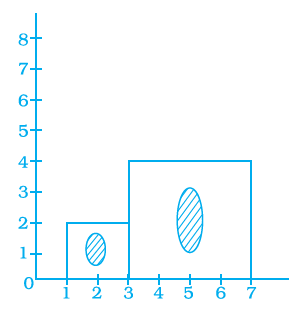
Answer:
Given: A graph showing an original photograph and its enlarged version.
To Find: The scale of enlargement for the width.
Solution:
By observing the given graph, we can determine the width of both photographs using the $x$-axis coordinates.
Width of the original photograph (from $x = 1$ to $x = 3$):
$W_1 = 3 - 1 = 2 \text{ units}$
Width of the enlarged photograph (from $x = 3$ to $x = 7$):
$W_2 = 7 - 3 = 4 \text{ units}$
The scale of enlargement is the ratio of the original width to the enlarged width:
Scale $= W_1 : W_2$
Scale $= 2 : 4$
Dividing both sides by 2, we get:
Scale $= 1 : 2$
Thus, the width has been enlarged according to the scale 1 : 2.
Question 97. The side of a square board is 50 cm. A student has to draw its image in her notebook. If the drawing of the square board in the notebook has perimeter of 40 cm, then by which scale the figure has been drawn?
Answer:
Given:
Actual side of square board $= 50$ cm
Perimeter of the drawing $= 40$ cm
To Find: The scale of the drawing.
Solution:
First, we find the actual perimeter of the square board:
Actual Perimeter $= 4 \times \text{side}$
Actual Perimeter $= 4 \times 50 \text{ cm} = 200 \text{ cm}$
Now, the scale is the ratio of the drawing's dimension to the actual dimension:
Scale $= \frac{\text{Perimeter of drawing}}{\text{Actual perimeter}}$
Scale $= \frac{40}{200}$
Scale $= \frac{\cancel{40}^1}{\cancel{200}_5}$
The scale of the drawing is 1 : 5.
Question 98. The distance between school and house of a girl is given by 5 cm in a picture, using the scale 1 cm : 5 km. Find the actual distance between the two places?
Answer:
Given:
Distance in the picture $= 5$ cm
Scale $= 1$ cm : $5$ km
To Find: Actual distance between the school and the house.
Solution:
According to the given scale:
$1 \text{ cm on map} = 5 \text{ km actual}$
(Given Scale)
Therefore, the actual distance for $5$ cm in the picture is:
Actual distance $= 5 \times 5 \text{ km}$
Actual distance $= 25 \text{ km}$
The actual distance between the two places is 25 km.
Question 99. Use a ruler to measure the distance in cm between the places joined by dotted lines. If the map has been drawn using the scale 1 cm :10 km, find the actual distances between
(1) School and Library
(2) College and Complex
(3) House and School

Answer:
Given:
Scale $= 1$ cm : $10$ km
Map measurements (from the figure):
Distance between School and Complex $= 6$ cm
Distance between House and School $= 3.5$ cm
Distance between College and Complex $= 2$ cm
Solution:
(1) Actual distance between School and Library:
From the map, measuring the distance from the School dot to the Library dot, we find it is approximately $5$ cm.
Actual distance $= 5 \times 10 \text{ km} = 50 \text{ km}$
(2) Actual distance between College and Complex:
From the map, this distance is given as $2$ cm.
Actual distance $= 2 \times 10 \text{ km} = 20 \text{ km}$
(3) Actual distance between House and School:
From the map, this distance is given as $3.5$ cm.
Actual distance $= 3.5 \times 10 \text{ km} = 35 \text{ km}$
Question 100. The actual length of a painting was 2 m. What is its length in the photograph if the scale used is 1 mm : 20 cm.

Answer:
Given:
Actual length of the painting $= 2$ m
Scale $= 1$ mm : $20$ cm
To Find: Length of the painting in the photograph.
Solution:
First, we convert the actual length from meters to centimeters:
$2 \text{ m} = 2 \times 100 \text{ cm} = 200 \text{ cm}$
According to the scale, $20$ cm of actual length is represented by $1$ mm in the photograph.
Number of $20$ cm units in $200$ cm $= \frac{200}{20} = 10$
Length in photograph $= 10 \times 1 \text{ mm}$
Length in photograph $= 10 \text{ mm}$
Question 101. Find the scale.
(a) Actual size 12 m
Drawing size 3 cm
(b) Actual size 45 feet
Drawing size 5 inches
Answer:
(a) Solution:
Given:
Actual size $= 12 \text{ m}$
Drawing size $= 3 \text{ cm}$
To Find: The scale of the drawing.
Solution:
To find the scale, we must first ensure both dimensions are in the same unit. We know that $1 \text{ m} = 100 \text{ cm}$.
Actual size in cm $= 12 \times 100 \text{ cm} = 1200 \text{ cm}$
The scale is defined as the ratio of the drawing size to the actual size:
Scale $= \frac{\text{Drawing size}}{\text{Actual size}}$
Scale $= \frac{\cancel{3}^1}{\cancel{1200}_{400}}$
The scale for part (a) is 1 : 400.
(b) Solution:
Given:
Actual size $= 45 \text{ feet}$
Drawing size $= 5 \text{ inches}$
To Find: The scale of the drawing.
Solution:
We convert the actual size into inches. We know that $1 \text{ foot} = 12 \text{ inches}$.
Actual size in inches $= 45 \times 12 \text{ inches}$
Actual size $= 540 \text{ inches}$
The scale is the ratio of drawing size to actual size:
Scale $= \frac{5}{540}$
Scale $= \frac{\cancel{5}^1}{\cancel{540}_{108}}$
The scale for part (b) is 1 : 108.
Question 102. In a town, an ice cream parlour has displayed an ice cream sculpture of height 360 cm. The parlour claims that these ice creams and the sculpture are in the scale 1:30. What is the height of the ice creams served?
Answer:
Given:
Height of the ice cream sculpture $= 360 \text{ cm}$
Scale $= 1 : 30$
To Find: Height of the ice cream served.
Solution:
The scale $1 : 30$ implies that the actual object (the ice cream served) is $1$ unit for every $30$ units of the model (the sculpture). In mapping and modeling, the ratio is typically expressed as:
$\text{Scale} = \frac{\text{Height of ice cream served}}{\text{Height of sculpture}}$
$\frac{1}{30} = \frac{\text{Height of ice cream served}}{360}$
Height of ice cream served $= \frac{1}{30} \times 360$
Height of ice cream served $= \frac{\cancel{360}^{12}}{\cancel{30}_1}$
Height of ice cream served $= 12 \text{ cm}$
The height of the ice creams served is 12 cm.
Alternate Solution:
We can use the unitary method. If $30$ units of the sculpture represent $1$ unit of the actual ice cream:
$30 \text{ units} \rightarrow 1 \text{ unit}$
$1 \text{ unit} \rightarrow \frac{1}{30} \text{ unit}$
$360 \text{ cm} \rightarrow \frac{1}{30} \times 360 = 12 \text{ cm}$