

Chapter 7 Algebraic Expression, Identities & Factorisation (Class 8 - Maths NCERT Exemplar Solutions)
Welcome to the comprehensive resource for NCERT Exemplar Solutions for Class 8 Mathematics: Chapter 7 Algebraic Expression, Identities & Factorisation! This chapter is meticulously designed to demand stronger algebraic manipulation skills and the strategic application of standard identities. These problems elevate the challenge beyond standard exercises, ensuring a deeper understanding of polynomial multiplication and the diverse techniques required for efficient factorization.
The solutions provide detailed guidance on multiplying various expressions, from monomials to complex polynomials. A cornerstone of this chapter is the mastery of standard algebraic identities: $(a+b)^2 = a^2 + 2ab + b^2$, $(a-b)^2 = a^2 - 2ab + b^2$, $(a+b)(a-b) = a^2 - b^2$, and $(x+a)(x+b) = x^2 + (a+b)x + ab$. Students will learn to use these not just for expansion but for the efficient evaluation of numerical expressions and as fundamental tools in the reverse process of factorisation.
The Factorisation section covers essential techniques, including taking out common factors, regrouping terms, and identifying perfect square trinomials or the difference of squares. Additionally, the solutions address the division of algebraic expressions through systematic factorization and cancellation. With step-by-step manipulations and logical justifications prepared by learningspot.co, students can build the confidence and speed required to excel in advanced algebraic problem-solving.
| Content On This Page | ||
|---|---|---|
| Solved Examples (Examples 1 to 20) | Question 1 to 33 (Multiple Choice Questions) | Question 34 to 58 (Fill in the Blanks) |
| Question 59 to 80 (True or False) | Question 81 to 125 | |
Solved Examples (Examples 1 to 20)
In examples 1 to 4, there are four options given out of which one is correct. Write the correct answer.
Example 1: Which is the like term as 24a2bc?
(a) 13 × 8a × 2b × c × a
(b) 8 × 3 × a × b × c
(c) 3 × 8 × a × b × c × c
(d) 3 × 8 × a × b × b × c
Answer:
To Find:
The term that is a like term to $24a^2bc$.
Solution:
Like terms are terms that have the same algebraic variables raised to the same powers. The numerical coefficients do not need to match.
The variable part of the given term is $a^2bc$. Let us simplify the options to find the one with the same variable part:
(a) $13 \times 8a \times 2b \times c \times a = (13 \times 8 \times 2) \times (a \times a) \times b \times c = 208a^2bc$.
(b) $8 \times 3 \times a \times b \times c = 24abc$.
(c) $3 \times 8 \times a \times b \times c \times c = 24abc^2$.
(d) $3 \times 8 \times a \times b \times b \times c = 24ab^2c$.
Clearly, option (a) has the same variable part $a^2bc$.
The correct option is (a).
Example 2: Which of the following is an identity?
(a) (p + q)2 = p2 + q2
(b) p2 – q2 = (p – q)2
(c) p2 – q2 = p2 + 2pq – q2
(d) (p + q)2 = p2 + 2pq + q2
Answer:
Solution:
An algebraic identity is an equality that holds true regardless of the values chosen for its variables.
The standard identities are:
1. $(a + b)^2 = a^2 + 2ab + b^2$
2. $(a - b)^2 = a^2 - 2ab + b^2$
3. $a^2 - b^2 = (a + b)(a - b)$
Comparing these with the options:
- Option (a) is incorrect because the middle term $2pq$ is missing.
- Option (b) is incorrect because $p^2 - q^2 \neq p^2 - 2pq + q^2$.
- Option (d) matches the standard identity $(p + q)^2 = p^2 + 2pq + q^2$.
The correct option is (d).
Example 3: The irreducible factorisation of 3a3 + 6a is
(a) 3a (a2 + 2)
(b) 3 (a3 + 2)
(c) a (3a2 + 6)
(d) 3 × a × a × a + 2 × 3 × a
Answer:
To Find:
The irreducible factorisation of the expression $3a^3 + 6a$.
Solution:
To factorise the expression, we find the Greatest Common Factor (GCF) of the terms:
$3a^3 = 3 \times a \times a \times a$
$6a = 2 \times 3 \times a$
The common factors are $3$ and $a$. So, the common factor is $3a$.
Dividing each term by $3a$:
$3a^3 + 6a = 3a(a^2 + 2)$
Since $(a^2 + 2)$ cannot be factorised further over the set of real numbers, this is the irreducible factorisation.
The correct option is (a).
Example 4: a (b + c) = ab + ac is
(a) commutative property
(b) distributive property
(c) associative property
(d) closure property
Answer:
Solution:
The property $a(b + c) = ab + ac$ represents the multiplication being distributed over addition.
This is known as the Distributive Property of multiplication over addition.
The correct option is (b).
In examples 5 and 6, fill in the blanks to make the statements true.
Example 5: The representation of an expression as the product of its factors is called __________.
Answer:
Solution:
When an algebraic expression is written as the product of two or more expressions, the process is called factorisation. Each of the expressions in the product is called a factor of the original expression.
Answer: factorisation
Example 6: (x + a) (x + b) = x2 + (a + b)x + ________.
Answer:
Solution:
This is one of the standard algebraic identities. Let us expand the Left Hand Side (LHS):
$(x + a)(x + b) = x(x + b) + a(x + b)$
$= x^2 + bx + ax + ab$
$= x^2 + (b + a)x + ab$
Comparing this with the given expression: $x^2 + (a + b)x + \text{ab}$.
Answer: ab
In examples 7 to 9, state whether the statements are true (T) or false (F).
Example 7: An identity is true for all values of its variables.
Answer:
Solution:
By definition, an identity is an equation which remains true for any value that is substituted for its variables. This distinguishes it from a conditional equation, which is true only for specific values of the variable.
Answer: True (T)
Example 8: Common factor of x2y and – xy2 is xy.
Answer:
Solution:
Let's find the factors of both terms:
$x^2y = x \times x \times y$
$-xy^2 = -1 \times x \times y \times y$
The factors common to both are one $x$ and one $y$. Their product is $x \times y = xy$.
Thus, $xy$ is the common factor.
Answer: True (T)
Example 9: (3x + 3x2) ÷ 3x = 3x2
Answer:
Solution:
To divide the binomial by the monomial, we divide each term of the numerator by the denominator:
$\frac{3x + 3x^2}{3x} = \frac{3x}{3x} + \frac{3x^2}{3x}$
$= 1 + x$
The result is $1 + x$, not $3x^2$. Therefore, the statement is false.
Answer: False (F)
Example 10: Simplify
(i) – pqr (p2 + q2 + r2)
(ii) (px + qy) (ax – by)
Answer:
(i) Simplify: $-pqr(p^2 + q^2 + r^2)$
Using the distributive property, we multiply the monomial $-pqr$ with each term inside the trinomial:
$= (-pqr \times p^2) + (-pqr \times q^2) + (-pqr \times r^2)$
$= -p^{1+2}qr - pq^{1+2}r - pqr^{1+2}$
$= -p^3qr - pq^3r - pqr^3$
(ii) Simplify: $(px + qy)(ax - by)$
Multiplying the two binomials using the distributive law:
$= px(ax - by) + qy(ax - by)$
$= apx^2 - bpxy + aqxy - bqy^2$
Example 11: Find the expansion of the following using suitable identity.
(i) (3x + 7y) (3x – 7y)
(ii) $\left( \frac{4x}{5}+\frac{y}{4} \right)\left( \frac{4x}{5}+\frac{3y}{4} \right)$
Answer:
(i) Expand: $(3x + 7y)(3x - 7y)$
Using the identity $(a + b)(a - b) = a^2 - b^2$:
$= (3x)^2 - (7y)^2$
$= 9x^2 - 49y^2$
(ii) Expand: $\left( \frac{4x}{5}+\frac{y}{4} \right)\left( \frac{4x}{5}+\frac{3y}{4} \right)$
Using the identity $(x + a)(x + b) = x^2 + (a + b)x + ab$:
$= \left( \frac{4x}{5} \right)^2 + \left( \frac{y}{4} + \frac{3y}{4} \right)\left( \frac{4x}{5} \right) + \left( \frac{y}{4} \right)\left( \frac{3y}{4} \right)$
$= \frac{16x^2}{25} + \left( \frac{4y}{4} \right)\left( \frac{4x}{5} \right) + \frac{3y^2}{16}$
$= \frac{16x^2}{25} + \frac{4xy}{5} + \frac{3y^2}{16}$
Example 12: Factorise the following.
(i) 21x2y3 + 27x3y2
(ii) a3 – 4a2 + 12 – 3a
(iii) 4x2 – 20x + 25
(iv) $\frac{y^2}{9}$ - 9
(v) x4 – 256
Answer:
(i) Factorise: $21x^2y^3 + 27x^3y^2$
Find the common factors: $21x^2y^3 = 3 \times 7 \times x^2 \times y^3$ and $27x^3y^2 = 3 \times 9 \times x^3 \times y^2$.
The Greatest Common Factor (GCF) is $3x^2y^2$.
$= 3x^2y^2 (7y + 9x)$
(ii) Factorise: $a^3 - 4a^2 + 12 - 3a$
Regrouping the terms:
$= (a^3 - 4a^2) - (3a - 12)$
$= a^2(a - 4) - 3(a - 4)$
$= (a - 4)(a^2 - 3)$
(iii) Factorise: $4x^2 - 20x + 25$
Using the identity $a^2 - 2ab + b^2 = (a - b)^2$:
$= (2x)^2 - 2(2x)(5) + 5^2$
$= (2x - 5)^2$
(iv) Factorise: $\frac{y^2}{9} - 9$
Using the identity $a^2 - b^2 = (a + b)(a - b)$:
$= \left( \frac{y}{3} \right)^2 - 3^2$
$= \left( \frac{y}{3} + 3 \right) \left( \frac{y}{3} - 3 \right)$
(v) Factorise: $x^4 - 256$
$= (x^2)^2 - (16)^2$
$= (x^2 + 16)(x^2 - 16)$
$= (x^2 + 16)(x + 4)(x - 4)$
Example 13: Evaluate using suitable identities.
(i) (48)2
(ii) 1812 – 192
(iii) 497 × 505
(iv) 2.07 × 1.93
Answer:
(i) Evaluate: $(48)^2$
$48^2 = (50 - 2)^2$
$= 50^2 - 2(50)(2) + 2^2$
[$(a-b)^2 = a^2-2ab+b^2$]
$= 2500 - 200 + 4 = 2304$
(ii) Evaluate: $181^2 - 19^2$
$181^2 - 19^2 = (181 + 19)(181 - 19)$
[$a^2-b^2 = (a+b)(a-b)$]
$= 200 \times 162 = 32400$
(iii) Evaluate: $497 \times 505$
$497 \times 505 = (500 - 3)(500 + 5)$
$= 500^2 + (5 - 3)500 + (-3)(5)$
[$(x+a)(x+b) = x^2+(a+b)x+ab$]
$= 250000 + 1000 - 15 = 250985$
(iv) Evaluate: $2.07 \times 1.93$
$2.07 \times 1.93 = (2 + 0.07)(2 - 0.07)$
$= 2^2 - (0.07)^2 = 4 - 0.0049 = 3.9951$
Example 14: Verify that
(3x + 5y)2 – 30xy = 9x2 + 25y2
Answer:
Verify: $(3x + 5y)^2 - 30xy = 9x^2 + 25y^2$
Expanding the LHS (Left Hand Side):
LHS $= (3x + 5y)^2 - 30xy$
$= (3x)^2 + 2(3x)(5y) + (5y)^2 - 30xy$
[Using $(a+b)^2 = a^2+2ab+b^2$]
$= 9x^2 + 30xy + 25y^2 - 30xy$
$= 9x^2 + 25y^2$
Since LHS = RHS, the expression is verified.
Example 15: Verify that (11pq + 4q)2 – (11pq – 4q)2 = 176pq2
Answer:
To Prove:
$(11pq + 4q)^2 - (11pq - 4q)^2 = 176pq^2$
Proof:
Let us consider the Left Hand Side (LHS) of the equation:
LHS $= (11pq + 4q)^2 - (11pq - 4q)^2$
This expression is in the form $a^2 - b^2$, where $a = (11pq + 4q)$ and $b = (11pq - 4q)$.
Using the identity $a^2 - b^2 = (a + b)(a - b)$:
LHS $= [(11pq + 4q) + (11pq - 4q)] [(11pq + 4q) - (11pq - 4q)]$
Simplifying the terms within the brackets:
LHS $= [11pq + 4q + 11pq - 4q] [11pq + 4q - 11pq + 4q]$
LHS $= [22pq] [8q]$
LHS $= 176pq^2$
Since LHS is equal to the Right Hand Side (RHS), the equation is verified.
Example 16: The area of a rectangle is x2 + 12xy + 27y2 and its length is (x + 9y). Find the breadth of the rectangle.
Answer:
Given:
Area of the rectangle $= x^2 + 12xy + 27y^2$
Length of the rectangle $= (x + 9y)$
To Find:
The breadth of the rectangle.
Solution:
We know that the area of a rectangle is the product of its length and breadth.
$\text{Breadth} = \frac{\text{Area}}{\text{Length}}$
First, let's factorise the area expression $x^2 + 12xy + 27y^2$ by splitting the middle term:
$\text{Area} = x^2 + 9xy + 3xy + 27y^2$
$\text{Area} = x(x + 9y) + 3y(x + 9y)$
$\text{Area} = (x + 9y)(x + 3y)$
Now, substitute the values to find the breadth:
$\text{Breadth} = \frac{(x + 9y)(x + 3y)}{(x + 9y)}$
$\text{Breadth} = (x + 3y)$
The breadth of the rectangle is $(x + 3y)$.
Example 17: Divide 15 (y + 3) (y2 – 16) by 5 (y2 – y – 12).
Answer:
To Solve:
Divide $15(y + 3)(y^2 - 16)$ by $5(y^2 - y - 12)$.
Solution:
First, factorise the numerator and the denominator separately.
Factorising the numerator:
$y^2 - 16 = (y)^2 - (4)^2 = (y + 4)(y - 4)$
So, Numerator $= 15(y + 3)(y + 4)(y - 4)$.
Factorising the denominator:
$y^2 - y - 12 = y^2 - 4y + 3y - 12$
$= y(y - 4) + 3(y - 4) = (y - 4)(y + 3)$
So, Denominator $= 5(y - 4)(y + 3)$.
Performing the division:
$\frac{15(y + 3)(y + 4)(y - 4)}{5(y - 4)(y + 3)}$
Cancelling the common terms $(y + 3)$, $(y - 4)$, and dividing 15 by 5:
$= 3(y + 4)$
The result is $3(y + 4)$ or $3y + 12$.
Example 18: By using suitable identity, evaluate x2 + $\frac{1}{x^2}$ , if x + $\frac{1}{x}$ = 5.
Answer:
Given:
$x + \frac{1}{x} = 5$
To Find:
The value of $x^2 + \frac{1}{x^2}$
Solution:
Consider the identity $(a + b)^2 = a^2 + b^2 + 2ab$.
Let's square both sides of the given equation:
$\left( x + \frac{1}{x} \right)^2 = (5)^2$
Expanding the LHS:
$x^2 + \left( \frac{1}{x} \right)^2 + 2(x)\left( \frac{1}{x} \right) = 25$
$x^2 + \frac{1}{x^2} + 2 = 25$
Transposing 2 to the right side:
$x^2 + \frac{1}{x^2} = 25 - 2$
$x^2 + \frac{1}{x^2} = 23$
The value is 23.
Example 19: Find the value of $\frac{38^{2} \;-\; 22^{2}}{16}$ , using a suitable identity.
Answer:
To Evaluate:
$\frac{38^2 - 22^2}{16}$
Solution:
Using the identity $a^2 - b^2 = (a + b)(a - b)$ in the numerator:
$38^2 - 22^2 = (38 + 22)(38 - 22)$
$38^2 - 22^2 = (60)(16)$
Now, substitute this back into the original expression:
$\frac{60 \times 16}{16}$
Cancelling 16 from the numerator and denominator:
$= 60$
The value is 60.
Example 20: Find the value of x, if
10000x = (9982)2 – (18)2
Answer:
Given:
$10000x = (9982)^2 - (18)^2$
To Find:
The value of $x$.
Solution:
Using the identity $a^2 - b^2 = (a + b)(a - b)$ on the RHS:
$10000x = (9982 + 18)(9982 - 18)$
$10000x = (10000)(9964)$
Divide both sides by 10000:
$x = \frac{10000 \times 9964}{10000}$
$x = 9964$
The value of $x$ is 9964.
Exercise
Question 1 to 33 (Multiple Choice Questions)
In questions 1 to 33, there are four options out of which one is correct. Write the correct answer.
Question 1. The product of a monomial and a binomial is a
(a) monomial
(b) binomial
(c) trinomial
(d) none of these
Answer:
A monomial is an expression containing only one term, and a binomial is an expression containing two terms.
According to the distributive law, when we multiply a monomial by a binomial, the monomial is multiplied by each term of the binomial.
Example:
Let the monomial be $x$ and the binomial be $(y + z)$.
Product $= x \times (y + z) = (x \times y) + (x \times z) = xy + xz$
The resulting expression $xy + xz$ has two terms, which is a binomial.
Correct Option: (b) binomial
Question 2. In a polynomial, the exponents of the variables are always
(a) integers
(b) positive integers
(c) non-negative integers
(d) non-positive integers
Answer:
By definition, a polynomial is an algebraic expression in which the variables involved have only non-negative integer powers (also known as whole numbers).
This means the exponents can be $0, 1, 2, 3, \dots$ and so on. Exponents cannot be negative or in fractional form.
Correct Option: (c) non-negative integers
Question 3. Which of the following is correct?
(a) (a – b)2 = a2 + 2ab – b2
(b) (a – b)2 = a2 – 2ab + b2
(c) (a – b)2 = a2 – b2
(d) (a + b)2 = a2 + 2ab – b2
Answer:
We can check the identity by multiplying $(a - b)$ by itself:
$(a - b)^2 = (a - b)(a - b)$
$= a(a - b) - b(a - b)$
$= a^2 - ab - ba + b^2$
$= a^2 - 2ab + b^2$
This matches option (b). The other options provide incorrect expansion of the algebraic identities.
Correct Option: (b) $(a - b)^2 = a^2 - 2ab + b^2$
Question 4. The sum of –7pq and 2pq is
(a) –9pq
(b) 9pq
(c) 5pq
(d) – 5pq
Answer:
To find the sum of like terms, we add their numerical coefficients while keeping the literal (variable) part the same.
Sum $= -7pq + 2pq$
$= (-7 + 2) \times pq$
$= -5pq$
Correct Option: (d) $-5pq$
Question 5. If we subtract –3x2y2 from x2y2, then we get
(a) – 4x2y2
(b) – 2x2y2
(c) 2x2y2
(d) 4x2y2
Answer:
The expression can be written as:
$x^2y^2 - (-3x^2y^2)$
When we subtract a negative term, it becomes addition:
$= x^2y^2 + 3x^2y^2$
$= (1 + 3)x^2y^2$
$= 4x^2y^2$
Correct Option: (d) $4x^2y^2$
Question 6. Like term as 4m3n2 is
(a) 4m2n2
(b) – 6m3n2
(c) 6pm3n2
(d) 4m3n
Answer:
Like terms are terms that have the same variables with the same corresponding exponents. The numerical coefficient does not need to be the same.
For the term $4m^3n^2$, the variable part is $m^3n^2$.
(a) $4m^2n^2$ $\rightarrow$ powers of $m$ are different.
(b) $-6m^3n^2$ $\rightarrow$ variable part $m^3n^2$ is exactly the same. (Like term)
(c) $6pm^3n^2$ $\rightarrow$ contains an extra variable $p$.
(d) $4m^3n$ $\rightarrow$ power of $n$ is different.
Correct Option: (b) $-6m^3n^2$
Question 7. Which of the following is a binomial?
(a) 7 × a + a
(b) 6a2 + 7b + 2c
(c) 4a × 3b × 2c
(d) 6 (a2 + b)
Answer:
A binomial is an algebraic expression containing exactly two terms.
(a) $7 \times a + a = 7a + a = 8a$ (One term $\rightarrow$ Monomial)
(b) $6a^2 + 7b + 2c$ (Three terms $\rightarrow$ Trinomial)
(c) $4a \times 3b \times 2c = 24abc$ (One term $\rightarrow$ Monomial)
(d) $6(a^2 + b) = 6a^2 + 6b$ (Two terms $\rightarrow$ Binomial)
Correct Option: (d) $6(a^2 + b)$
Question 8. Sum of a – b + ab, b + c – bc and c – a – ac is
(a) 2c + ab – ac – bc
(b) 2c – ab – ac – bc
(c) 2c + ab + ac + bc
(d) 2c – ab + ac + bc
Answer:
To find the sum, we combine the given expressions and group the like terms together:
Sum $= (a - b + ab) + (b + c - bc) + (c - a - ac)$
Rearranging the terms:
$= (a - a) + (-b + b) + (c + c) + ab - bc - ac$
$= 0 + 0 + 2c + ab - bc - ac$
$= 2c + ab - bc - ac$
This can also be written as $2c + ab - ac - bc$.
Correct Option: (a) $2c + ab - ac - bc$
Question 9. Product of the following monomials 4p, – 7q3, –7pq is
(a) 196 p2q4
(b) 196 pq4
(c) – 196 p2q4
(d) 196 p2q3
Answer:
To find the product of monomials, we multiply their numerical coefficients and then multiply their variable parts using the laws of exponents.
Product $= (4p) \times (-7q^3) \times (-7pq)$
$= [4 \times (-7) \times (-7)] \times [p \times q^3 \times p \times q]$
$= [196] \times [p^{(1+1)} \times q^{(3+1)}]$
$= 196 p^2 q^4$
Correct Option: (a) $196 p^2 q^4$
Question 10. Area of a rectangle with length 4ab and breadth 6b2 is
(a) 24a2b2
(b) 24ab3
(c) 24ab2
(d) 24ab
Answer:
We know that the formula for the area of a rectangle is:
Area $= \text{Length} \times \text{Breadth}$
Given:
Length $= 4ab$
Breadth $= 6b^2$
Area $= (4ab) \times (6b^2)$
$= (4 \times 6) \times (a \times b \times b^2)$
$= 24 \times a \times b^{(1+2)}$
$= 24ab^3$
Correct Option: (b) $24ab^3$
Question 11. Volume of a rectangular box (cuboid) with length = 2ab, breadth = 3ac and height = 2ac is
(a) 12a3bc2
(b) 12a3bc
(c) 12a2bc
(d) 2ab + 3ac + 2ac
Answer:
The volume of a rectangular box (cuboid) is given by the product of its length, breadth, and height.
Volume $= \text{Length} \times \text{Breadth} \times \text{Height}$
Given:
Length $= 2ab$
Breadth $= 3ac$
Height $= 2ac$
Volume $= (2ab) \times (3ac) \times (2ac)$
$= (2 \times 3 \times 2) \times (a \times a \times a) \times b \times (c \times c)$
$= 12 \times a^{(1+1+1)} \times b \times c^{(1+1)}$
$= 12 a^3 b c^2$
Correct Option: (a) $12a^3bc^2$
Question 12. Product of 6a2 – 7b + 5ab and 2ab is
(a) 12a3b – 14ab2 + 10ab
(b) 12a3b – 14ab2 + 10a2b2
(c) 6a2 – 7b + 7ab
(d) 12a2b – 7ab2 + 10ab
Answer:
To find the product of a trinomial and a monomial, we use the distributive property:
$m(x + y + z) = mx + my + mz$
Product $= 2ab \times (6a^2 - 7b + 5ab)$
$= (2ab \times 6a^2) - (2ab \times 7b) + (2ab \times 5ab)$
$= 12 a^{(1+2)} b - 14 a b^{(1+1)} + 10 a^{(1+1)} b^{(1+1)}$
$= 12a^3b - 14ab^2 + 10a^2b^2$
Correct Option: (b) $12a^3b - 14ab^2 + 10a^2b^2$
Question 13. Square of 3x – 4y is
(a) 9x2 – 16y2
(b) 6x2 – 8y2
(c) 9x2 + 16y2 + 24xy
(d) 9x2 + 16y2 – 24xy
Answer:
We use the standard identity for the square of a binomial difference:
$(A - B)^2 = A^2 - 2AB + B^2$
Here, $A = 3x$ and $B = 4y$.
$(3x - 4y)^2 = (3x)^2 - 2(3x)(4y) + (4y)^2$
$= 9x^2 - 24xy + 16y^2$
This can be rearranged as $9x^2 + 16y^2 - 24xy$.
Correct Option: (d) $9x^2 + 16y^2 - 24xy$
Question 14. Which of the following are like terms?
(a) 5xyz2, – 3xy2z
(b) – 5xyz2, 7xyz2
(c) 5xyz2, 5x2yz
(d) 5xyz2, x2y2z2
Answer:
Like terms are terms that have exactly the same literal (variable) factors with the same exponents.
(a) Variable parts are $xyz^2$ and $xy^2z$. Powers of $y$ and $z$ are different.
(b) Variable parts are $xyz^2$ and $xyz^2$. These are exactly the same. (Like terms)
(c) Variable parts are $xyz^2$ and $x^2yz$. Powers of $x$ and $z$ are different.
(d) Variable parts are $xyz^2$ and $x^2y^2z^2$. Powers of all variables are different.
Correct Option: (b) $-5xyz^2$ and $7xyz^2$
Question 15. Coefficient of y in the term $\frac{-y}{3}$ is
(a) – 1
(b) – 3
(c) $\frac{-1}{3}$
(d) $\frac{1}{3}$
Answer:
The coefficient of a variable in a term is the numerical factor multiplied by that variable.
The term $\frac{-y}{3}$ can be rewritten as:
$\frac{-1}{3} \times y$
Here, the numerical factor multiplied by $y$ is $\frac{-1}{3}$.
Correct Option: (c) $\frac{-1}{3}$
Question 16. a2 – b2 is equal to
(a) (a – b)2
(b) (a – b) (a – b)
(c) (a + b) (a – b)
(d) (a + b) (a + b)
Answer:
This is a standard algebraic identity representing the difference of two squares.
The identity states that:
$a^2 - b^2 = (a + b)(a - b)$
Verification:
$(a + b)(a - b) = a(a - b) + b(a - b)$
$= a^2 - ab + ba - b^2$
$= a^2 - b^2$
Correct Option: (c) $(a + b)(a - b)$
Question 17. Common factor of 17abc, 34ab2, 51a2b is
(a) 17abc
(b) 17ab
(c) 17ac
(d) 17a2b2c
Answer:
To find the common factor, we first express each term in its irreducible factor form:
$17abc = 17 \times a \times b \times c$
$34ab^2 = 2 \times 17 \times a \times b \times b$
$51a^2b = 3 \times 17 \times a \times a \times b$
The common factors in all three terms are $17$, $a$, and $b$.
$\text{Common factor} = 17 \times a \times b = 17ab$
Correct Option: (b) 17ab
Question 18. Square of 9x – 7xy is
(a) 81x2 + 49x2y2
(b) 81x2 – 49x2y2
(c) 81x2 + 49x2y2 –126x2y
(d) 81x2 + 49x2y2 – 63x2y
Answer:
Using the identity $(a - b)^2 = a^2 - 2ab + b^2$:
Here, $a = 9x$ and $b = 7xy$.
$(9x - 7xy)^2 = (9x)^2 - 2(9x)(7xy) + (7xy)^2$
$= 81x^2 - 126x^2y + 49x^2y^2$
$= 81x^2 + 49x^2y^2 - 126x^2y$
Correct Option: (c) 81x2 + 49x2y2 – 126x2y
Question 19. Factorised form of 23xy – 46x + 54y – 108 is
(a) (23x + 54) (y – 2)
(b) (23x + 54y) (y – 2)
(c) (23xy + 54y) (– 46x – 108)
(d) (23x + 54) (y + 2)
Answer:
We use the grouping method to factorise the given expression:
$23xy - 46x + 54y - 108$
$= (23xy - 46x) + (54y - 108)$
Factor out the common terms from each group:
$= 23x(y - 2) + 54(y - 2)$
Now, factor out the common binomial $(y - 2)$:
$= (23x + 54)(y - 2)$
Correct Option: (a) (23x + 54) (y – 2)
Question 20. Factorised form of r2 – 10r + 21 is
(a) (r – 1) (r – 4)
(b) (r – 7) (r – 3)
(c) (r – 7) (r + 3)
(d) (r + 7) (r + 3)
Answer:
We use the splitting the middle term method. We need two numbers whose sum is $-10$ and product is $21$.
The numbers are $-7$ and $-3$ ($ -7 \times -3 = 21$ and $-7 + (-3) = -10$).
$r^2 - 10r + 21 = r^2 - 7r - 3r + 21$
$= r(r - 7) - 3(r - 7)$
$= (r - 7)(r - 3)$
Correct Option: (b) (r – 7) (r – 3)
Question 21. Factorised form of p2 – 17p – 38 is
(a) (p – 19) (p + 2)
(b) (p – 19) (p – 2)
(c) (p + 19) (p + 2)
(d) (p + 19) (p – 2)
Answer:
We split the middle term. We need two numbers whose sum is $-17$ and product is $-38$.
The numbers are $-19$ and $+2$ ($-19 \times 2 = -38$ and $-19 + 2 = -17$).
$p^2 - 17p - 38 = p^2 - 19p + 2p - 38$
$= p(p - 19) + 2(p - 19)$
$= (p - 19)(p + 2)$
Correct Option: (a) (p – 19) (p + 2)
Question 22. On dividing 57p2qr by 114pq, we get
(a) $\frac{1}{4}$ pr
(b) $\frac{3}{4}$ pr
(c) $\frac{1}{2}$ pr
(d) 2pr
Answer:
We write the division as a fraction:
$\frac{57p^2qr}{114pq} = \frac{\cancel{57}^{1}}{\cancel{114}_{2}} \times \frac{p^2}{p} \times \frac{q}{q} \times r$
Using laws of exponents for the variables:
$= \frac{1}{2} \times p^{(2-1)} \times 1 \times r$
$= \frac{1}{2}pr$
Correct Option: (c) $\frac{1}{2}$ pr
Question 23. On dividing p (4p2 – 16) by 4p (p – 2), we get
(a) 2p + 4
(b) 2p – 4
(c) p + 2
(d) p – 2
Answer:
First, factorise the expression in the numerator:
$p(4p^2 - 16) = p \times 4(p^2 - 4)$
$= 4p(p^2 - 2^2)$
$= 4p(p - 2)(p + 2)$
Now, perform the division:
$\frac{4p(p - 2)(p + 2)}{4p(p - 2)}$
Cancelling common factors:
$\frac{\cancel{4p(p - 2)}(p + 2)}{\cancel{4p(p - 2)}} = p + 2$
Correct Option: (c) p + 2
Question 24. The common factor of 3ab and 2cd is
(a) 1
(b) – 1
(c) a
(d) c
Answer:
The irreducible factors are:
$3ab = 3 \times a \times b \times 1$
$2cd = 2 \times c \times d \times 1$
There are no common numerical factors (other than 1) and no common variable factors between the two terms.
Therefore, the highest common factor is $1$.
Correct Option: (a) 1
Question 25. An irreducible factor of 24x2y2 is
(a) x2
(b) y2
(c) x
(d) 24x
Answer:
An irreducible factor is a factor that cannot be expressed further as a product of other factors. Let us look at the prime factorisation of the given term:
$24x^2y^2 = 2 \times 2 \times 2 \times 3 \times x \times x \times y \times y$
(a) $x^2$ is reducible because it can be written as $x \times x$.
(b) $y^2$ is reducible because it can be written as $y \times y$.
(c) $x$ is irreducible because it cannot be factored further.
(d) $24x$ is reducible because it can be written as $2 \times 2 \times 2 \times 3 \times x$.
Correct Option: (c) x
Question 26. Number of factors of (a + b)2 is
(a) 4
(b) 3
(c) 2
(d) 1
Answer:
In algebraic expressions, factors of a term are the parts that are multiplied together to obtain that term.
The expression $(a + b)^2$ can be written as:
$(a + b)^2 = (a + b) \times (a + b)$
Here, the factor $(a + b)$ is repeated twice. Therefore, the number of factors is $2$.
Correct Option: (c) 2
Question 27. The factorised form of 3x – 24 is
(a) 3x × 24
(b) 3 (x – 8)
(c) 24 (x – 3)
(d) 3(x – 12)
Answer:
To factorise $3x - 24$, we need to find the Highest Common Factor (HCF) of the terms $3x$ and $24$.
$3x = 3 \times x$
$24 = 3 \times 8$
The HCF is $3$. Taking $3$ as a common factor out of the brackets:
$3x - 24 = 3(x - 8)$
Correct Option: (b) 3 (x – 8)
Question 28. The factors of x2 – 4 are
(a) (x – 2), (x – 2)
(b) (x + 2), (x – 2)
(c) (x + 2), (x + 2)
(d) (x – 4), (x – 4)
Answer:
We can write $4$ as $2^2$. The expression then becomes a difference of two squares.
$x^2 - 4 = x^2 - 2^2$
Using the identity $a^2 - b^2 = (a + b)(a - b)$, where $a = x$ and $b = 2$:
$x^2 - 2^2 = (x + 2)(x - 2)$
Therefore, the factors are $(x + 2)$ and $(x - 2)$.
Correct Option: (b) (x + 2), (x – 2)
Question 29. The value of (– 27x2y) ÷ (– 9xy) is
(a) 3xy
(b) – 3xy
(c) – 3x
(d) 3x
Answer:
To divide the monomials, we express them as a fraction:
$\frac{-27x^2y}{-9xy}$
Separating the numerical and literal parts:
$\frac{\cancel{-27}^{3}}{\cancel{-9}_{1}} \times \frac{x^2}{x} \times \frac{y}{y}$
$= 3 \times x^{(2-1)} \times 1$
$= 3x$
Correct Option: (d) 3x
Question 30. The value of (2x2 + 4) ÷ 2 is
(a) 2x2 + 2
(b) x2 + 2
(c) x2 + 4
(d) 2x2 + 4
Answer:
To divide $(2x^2 + 4)$ by $2$, we first factorise the numerator by taking the common factor out:
$2x^2 + 4 = 2(x^2 + 2)$
Now, perform the division:
$\frac{\cancel{2}(x^2 + 2)}{\cancel{2}} = x^2 + 2$
Correct Option: (b) x2 + 2
Question 31. The value of (3x3 + 9x2 + 27x) ÷ 3x is
(a) x2 + 9 + 27x
(b) 3x3 + 3x2 + 27x
(c) 3x3 + 9x2 + 9
(d) x2 + 3x + 9
Answer:
We divide each term of the trinomial by the monomial $3x$:
$\frac{3x^3 + 9x^2 + 27x}{3x} = \frac{3x^3}{3x} + \frac{9x^2}{3x} + \frac{27x}{3x}$
Simplify each term separately:
$\frac{3x^3}{3x} = x^{(3-1)} = x^2$
$\frac{9x^2}{3x} = 3 \times x^{(2-1)} = 3x$
$\frac{27x}{3x} = 9 \times 1 = 9$
The result is $x^2 + 3x + 9$.
Correct Option: (d) x2 + 3x + 9
Question 32. The value of (a + b)2 + (a – b)2 is
(a) 2a + 2b
(b) 2a – 2b
(c) 2a2 + 2b2
(d) 2a2 – 2b2
Answer:
Using the standard algebraic identities:
$(a + b)^2 = a^2 + 2ab + b^2$
$(a - b)^2 = a^2 - 2ab + b^2$
Adding the two expressions:
$(a + b)^2 + (a - b)^2 = (a^2 + 2ab + b^2) + (a^2 - 2ab + b^2)$
$= a^2 + a^2 + b^2 + b^2 + 2ab - 2ab$
$= 2a^2 + 2b^2$
Correct Option: (c) 2a2 + 2b2
Question 33. The value of (a + b)2 – (a – b)2 is
(a) 4ab
(b) – 4ab
(c) 2a2 + 2b2
(d) 2a2 – 2b2
Answer:
We use the standard algebraic identities to expand both parts of the expression:
$(a + b)^2 = a^2 + 2ab + b^2$
$(a - b)^2 = a^2 - 2ab + b^2$
Now, subtract the second expression from the first:
$(a + b)^2 - (a - b)^2 = (a^2 + 2ab + b^2) - (a^2 - 2ab + b^2)$
$= a^2 + 2ab + b^2 - a^2 + 2ab - b^2$
$= (a^2 - a^2) + (b^2 - b^2) + (2ab + 2ab)$
$= 0 + 0 + 4ab$
$= 4ab$
Correct Option: (a) 4ab
Question 34 to 58 (Fill in the Blanks)
In questions 34 to 58, fill in the blanks to make the statements true:
Question 34. The product of two terms with like signs is a __________ term.
Answer:
According to the rules of multiplication for signs:
$(+) \times (+) = (+)$
$(-) \times (-) = (+)$
In both cases, when the signs are the same (like signs), the resulting product is always positive.
Answer: positive
Question 35. The product of two terms with unlike signs is a _____term.
Answer:
According to the rules of multiplication for signs:
$(+) \times (-) = (-)$
$(-) \times (+) = (-)$
When the signs are different (unlike signs), the resulting product is always negative.
Answer: negative
Question 36. a(b + c) = ax ____ × ax _____.
Answer:
Using the Distributive Law of multiplication over addition:
$a(b + c) = (a \times b) + (a \times c)$
Comparing this with the given blank format $a \times \text{____} + a \times \text{____}$:
The blanks should be filled with $b$ and $c$.
Answer: b, c
Question 37. (a – b) _________ = a2 – 2ab + b2
Answer:
The expression $a^2 - 2ab + b^2$ is the result of multiplying $(a - b)$ by itself.
$(a - b) \times (a - b) = (a - b)^2$
Using the identity $(x - y)^2 = x^2 - 2xy + y^2$.
Answer: $^2$ (or square)
Question 38. a2 – b2 = (a + b ) __________.
Answer:
This is the standard algebraic identity for the difference of two squares.
$a^2 - b^2 = (a + b)(a - b)$
Verification: $(a + b)(a - b) = a(a - b) + b(a - b) = a^2 - ab + ab - b^2 = a^2 - b^2$.
Answer: (a – b)
Question 39. (a – b)2 + ____________ = a2 – b2
Answer:
Let the missing term be $X$.
$(a - b)^2 + X = a^2 - b^2$
Expanding the identity:
$(a^2 - 2ab + b^2) + X = a^2 - b^2$
To find $X$, rearrange the equation:
$X = (a^2 - b^2) - (a^2 - 2ab + b^2)$
$X = a^2 - b^2 - a^2 + 2ab - b^2$
$X = 2ab - 2b^2$
Answer: $2ab - 2b^2$
Question 40. (a + b)2 – 2ab = ___________ + ____________
Answer:
Expand the squared binomial using the identity $(a + b)^2 = a^2 + 2ab + b^2$:
$(a^2 + 2ab + b^2) - 2ab$
Combine the like terms:
$a^2 + (2ab - 2ab) + b^2$
$= a^2 + 0 + b^2$
$= a^2 + b^2$
Answer: $a^2, b^2$
Question 41. (x + a) (x + b) = x2 + (a + b) x + ________.
Answer:
Solution:
According to the standard algebraic identity for the product of two binomials with a common term:
$(x + a)(x + b) = x^2 + (a + b)x + ab$
(Standard Identity)
By comparing the given expression with the identity, the blank should be filled with $ab$.
Hence, $(x + a)(x + b) = x^2 + (a + b)x +$ $ab$.
Question 42. The product of two polynomials is a ________.
Answer:
Solution:
In algebra, when we multiply two polynomials, the resulting expression is always another polynomial. This is because the multiplication involves the distributive property, and the powers of the variables remain non-negative integers.
Hence, the product of two polynomials is a polynomial.
Question 43. Common factor of ax2 + bx is __________.
Answer:
Solution:
Given: The expression is $ax^2 + bx$.
To find the common factor, we express each term as a product of its irreducible factors:
$ax^2 = a \times x \times x$
$bx = b \times x$
The common factor in both terms is $x$.
Therefore, we can write:
$ax^2 + bx = x(ax + b)$
Hence, the common factor of $ax^2 + bx$ is $x$.
Question 44. Factorised form of 18mn + 10mnp is ________.
Answer:
Solution:
Given: The expression is $18mn + 10mnp$.
We find the Highest Common Factor (HCF) of the two terms:
Factors of $18mn = 2 \times 3 \times 3 \times m \times n$
Factors of $10mnp = 2 \times 5 \times m \times n \times p$
Common factors are $2$, $m$, and $n$. So, the HCF is $2mn$.
Taking out the common factor $2mn$:
$18mn + 10mnp = 2mn(9 + 5p)$
Hence, the factorised form is $2mn(9 + 5p)$.
Question 45. Factorised form of 4y2 – 12y + 9 is ________.
Answer:
Solution:
Given: $4y^2 - 12y + 9$
We can rewrite the terms as squares and a product:
$4y^2 = (2y)^2$
$9 = (3)^2$
$12y = 2(2y)(3)$
The expression is in the form $a^2 - 2ab + b^2$:
$(2y)^2 - 2(2y)(3) + (3)^2$
Using $(a - b)^2 = a^2 - 2ab + b^2$
Here, $a = 2y$ and $b = 3$.
So, the factorised form is $(2y - 3)^2$ or $(2y - 3)(2y - 3)$.
Question 46. 38x3y2z ÷ 19xy2 is equal to _________.
Answer:
Solution:
Given: $\frac{38x^3y^2z}{19xy^2}$
We can divide the numerical coefficients and the variables separately:
$\frac{38}{19} \times \frac{x^3}{x} \times \frac{y^2}{y^2} \times z$
Using the laws of exponents $\frac{a^m}{a^n} = a^{m-n}$:
$2 \times x^{3-1} \times y^{2-2} \times z$
$2 \times x^2 \times y^0 \times z$
$2x^2z$
Since $y^0 = 1$
Hence, $38x^3y^2z \div 19xy^2 =$ $2x^2z$.
Question 47. Volume of a rectangular box with length 2x, breadth 3y and height 4z is _________.
Answer:
Solution:
Given:
Length $(l) = 2x$
Breadth $(b) = 3y$
Height $(h) = 4z$
The formula for the Volume $(V)$ of a rectangular box is:
$V = l \times b \times h$
(Formula for volume)
Substituting the given values:
$V = (2x) \times (3y) \times (4z)$
$V = (2 \times 3 \times 4) \times (x \times y \times z)$
$V = 24xyz$
Hence, the volume is $24xyz$ cubic units.
Question 48. 672 – 372 = (67 – 37) × ________ = _________.
Answer:
Solution:
The expression is in the form of the identity $a^2 - b^2$.
$a^2 - b^2 = (a - b)(a + b)$
(Identity)
Here, $a = 67$ and $b = 37$.
$67^2 - 37^2 = (67 - 37) \times (67 + 37)$
Calculating the values:
$(67 - 37) = 30$
$(67 + 37) = 104$
Product: $30 \times 104 = 3120$
Hence, $67^2 - 37^2 = (67 - 37) \times$ $(67 + 37)$ $=$ $3120$.
Question 49. 1032 – 1022 = ________ × (103 – 102) = _________.
Answer:
Solution:
Using the algebraic identity $a^2 - b^2 = (a + b)(a - b)$:
$103^2 - 102^2 = (103 + 102)(103 - 102)$
[Where $a = 103, b = 102$]
Calculating the values:
$(103 + 102) = 205$
$(103 - 102) = 1$
Product: $205 \times 1 = 205$
Hence, $103^2 - 102^2 =$ $(103 + 102)$ $\times (103 - 102) =$ $205$.
Question 50. Area of a rectangular plot with sides 4x2 and 3y2 is __________.
Answer:
Given:
Side 1 (Length, $l$) = $4x^2$
Side 2 (Breadth, $b$) = $3y^2$
To Find: Area of the rectangular plot.
Solution:
The area of a rectangle is calculated by the product of its adjacent sides.
Area = Length $\times$ Breadth
(Formula)
Substituting the given values:
Area = $4x^2 \times 3y^2$
Area = $(4 \times 3) \times (x^2 \times y^2)$
Area = $12x^2y^2$
Hence, the area of the rectangular plot is $12x^2y^2$.
Question 51. Volume of a rectangular box with l = b = h = 2x is _________.
Answer:
Given:
Length ($l$) = $2x$
Breadth ($b$) = $2x$
Height ($h$) = $2x$
To Find: Volume of the rectangular box.
Solution:
The volume ($V$) of a rectangular box (cuboid) is given by:
$V = l \times b \times h$
...(i)
Substituting the values in equation (i):
$V = 2x \times 2x \times 2x$
$V = (2 \times 2 \times 2) \times (x \times x \times x)$
$V = 8x^3$
Hence, the volume of the rectangular box is $8x^3$.
Question 52. The coefficient in – 37abc is __________.
Answer:
Solution:
In an algebraic term, the numerical factor is called its numerical coefficient or simply the coefficient.
The given term is $-37abc$.
Here, the numerical factor is $-37$.
Hence, the coefficient in $-37abc$ is $-37$.
Question 53. Number of terms in the expression a2 + bc × d is ________.
Answer:
Solution:
Terms are added or subtracted to form an expression. Parts of an expression which are formed by products of variables and constants are single terms.
The given expression is $a^2 + bc \times d$.
We can simplify the second part: $bc \times d = bcd$.
So, the expression becomes $a^2 + bcd$.
The terms are:
1. $a^2$
2. $bcd$
Since there are two distinct parts separated by a plus sign, there are 2 terms.
Hence, the number of terms is $2$.
Question 54. The sum of areas of two squares with sides 4a and 4b is _______.
Answer:
Solution:
The area of a square is given by $(\text{side})^2$.
Area of the first square with side $4a = (4a)^2 = 16a^2$.
Area of the second square with side $4b = (4b)^2 = 16b^2$.
Sum of the areas = $16a^2 + 16b^2$.
We can take $16$ as a common factor:
Sum = $16(a^2 + b^2)$.
Hence, the sum of areas is $16a^2 + 16b^2$ or $16(a^2 + b^2)$.
Question 55. The common factor method of factorisation for a polynomial is based on ___________ property.
Answer:
Solution:
In the common factor method, we look for factors that are common to every term in the expression and then use the property $a(b + c) = ab + ac$ in reverse.
This property is known as the Distributive property of multiplication over addition.
Hence, the method is based on the distributive property.
Question 56. The side of the square of area 9y2 is __________.
Answer:
Given: Area of the square = $9y^2$
Solution:
We know that the area of a square is given by:
Area = $(\text{Side})^2$
To find the side, we take the square root of the area:
$\text{Side} = \sqrt{\text{Area}}$
$\text{Side} = \sqrt{9y^2}$
$\text{Side} = \sqrt{3 \times 3 \times y \times y}$
$\text{Side} = 3y$
Hence, the side of the square is $3y$.
Question 57. On simplification $\frac{3x \;+\; 3}{3}$ = ____________.
Answer:
Solution:
The given expression is $\frac{3x + 3}{3}$.
First, we factorise the numerator by taking the common factor $3$ out:
$3x + 3 = 3(x + 1)$
Now, substituting this back into the expression:
$\frac{3(x + 1)}{3}$
Cancelling the common factor $3$ from the numerator and denominator:
$\frac{\cancel{3}^1(x + 1)}{\cancel{3}_1} = x + 1$
Hence, the simplified form is $x + 1$.
Question 58. The factorisation of 2x + 4y is __________.
Answer:
Solution:
To factorise $2x + 4y$, we identify the greatest common factor of the terms $2x$ and $4y$.
Factors of $2x = 2 \times x$
Factors of $4y = 2 \times 2 \times y$
The common factor is $2$.
Taking $2$ out as a common factor:
$2x + 4y = 2(x + 2y)$
Hence, the factorisation is $2(x + 2y)$.
Question 59 to 80 (True or False)
In questions 59 to 80, state whether the statements are True (T) or False (F):
Question 59. (a + b)2 = a2 + b2
Answer:
Solution:
The given statement is False.
According to the standard algebraic identity, the square of a binomial is given by:
$(a + b)^2 = a^2 + 2ab + b^2$
(Identity)
The term $2ab$ is missing in the given statement, therefore it is incorrect.
Question 60. (a – b)2 = a2 – b2
Answer:
Solution:
The given statement is False.
The expansion of $(a - b)^2$ is:
$(a - b)^2 = a^2 - 2ab + b^2$
(Identity)
The expression $a^2 - b^2$ represents the difference of squares, which is actually equal to $(a - b)(a + b)$.
Question 61. (a + b) (a – b) = a2 – b2
Answer:
Solution:
The given statement is True.
This is a standard algebraic identity called the Difference of Squares identity.
$(a + b)(a - b) = a(a - b) + b(a - b)$
$= a^2 - ab + ab - b^2$
$= a^2 - b^2$
Since the LHS equals the RHS, the statement is correct.
Question 62. The product of two negative terms is a negative term.
Answer:
Solution:
The given statement is False.
According to the rules of multiplication for integers and algebraic terms, the product of two negative values is always a positive value.
$(\text{negative}) \times (\text{negative}) = \text{positive}$
(Rule of signs)
Example: $(-2x) \times (-3y) = 6xy$, which is a positive term.
Question 63. The product of one negative and one positive term is a negative term.
Answer:
Solution:
The given statement is True.
According to the rules of signs, when a positive term is multiplied by a negative term, the resulting product is always negative.
$(\text{positive}) \times (\text{negative}) = \text{negative}$
(Rule of signs)
Example: $(5a) \times (-2b) = -10ab$.
Question 64. The coefficient of the term – 6x2y2 is – 6.
Answer:
Solution:
The given statement is True.
In an algebraic term, the numerical part (including its sign) is known as the numerical coefficient.
In the term $-6x^2y^2$, the numerical factor multiplied with the variables is $-6$.
Question 65. p2q + q2r + r2q is a binomial.
Answer:
Solution:
The given statement is False.
A binomial is an algebraic expression containing exactly two terms. Let's analyze the given expression:
$p^2q + q^2r + r^2q$
This expression consists of three distinct terms: $p^2q$, $q^2r$, and $r^2q$. Since there are three terms, it is a trinomial, not a binomial.
Question 66. The factors of a2 – 2ab + b2 are (a + b) and (a + b).
Answer:
Solution:
The given statement is False.
Using the identity for the square of a difference:
$a^2 - 2ab + b^2 = (a - b)^2$
Expanding the square, we get:
$(a - b)^2 = (a - b)(a - b)$
The factors are $(a - b)$ and $(a - b)$. The factors $(a + b)$ and $(a + b)$ would result in $a^2 + 2ab + b^2$.
Question 67. h is a factor of 2π (h + r).
Answer:
Solution:
The given statement is False.
An expression is a factor of another if it divides the latter completely. In the expression $2\pi(h + r)$, the individual factors are $2$, $\pi$, and $(h + r)$.
While $h$ is a term within the factor $(h + r)$, it is not a factor of the entire expression because we cannot divide $2\pi(h + r)$ by $h$ to get a polynomial result (unless $r$ is also a multiple of $h$).
For example, if we expand: $2\pi h + 2\pi r$. $h$ is present in the first term but not in the second term as a factor.
Question 68. Some of the factors of $\frac{n^2}{2} + \frac{n}{2}$ are $\frac{1}{2}$ , n and (n + 1).
Answer:
Solution:
The given statement is True.
To find the factors, let us factorise the given expression:
Given expression: $\frac{n^2}{2} + \frac{n}{2}$
We can take out the common factor $\frac{1}{2}$ from both terms:
$\frac{1}{2}(n^2 + n)$
Now, within the bracket, we can see that $n$ is a common factor for $n^2$ and $n$:
$\frac{1}{2} \cdot n \cdot (n + 1)$
As we can see, the expression is a product of $\frac{1}{2}$, $n$, and $(n + 1)$. Therefore, they are all factors of the given expression.
Question 69. An equation is true for all values of its variables.
Answer:
Solution:
The given statement is False.
In algebra, we distinguish between an Identity and an Equation:
1. An Identity is an equality that is true for all values of the variables. For example: $(a+b)^2 = a^2 + 2ab + b^2$.
2. An Equation is an equality that is true only for certain specific values of the variables. For example: $2x + 3 = 7$ is only true when $x = 2$.
Therefore, saying an equation is true for all values is incorrect.
Question 70. x2 + (a + b)x + ab = (a + b) (x + ab)
Answer:
Solution:
The given statement is False.
Let us check the Left Hand Side (LHS) and Right Hand Side (RHS):
LHS: $x^2 + (a + b)x + ab = (x + a)(x + b)$
(Standard Identity)
Now let's expand the RHS:
RHS: $(a + b)(x + ab) = ax + a^2b + bx + ab^2$
Clearly, $(x + a)(x + b) \neq (a + b)(x + ab)$. Hence the statement is false.
Question 71. Common factor of 11pq2, 121p2q3, 1331p2q is 11p2q2.
Answer:
Solution:
The given statement is False.
Let's find the Highest Common Factor (HCF) of the three terms:
1. $11pq^2 = 11 \times p \times q \times q$
2. $121p^2q^3 = 11 \times 11 \times p \times p \times q \times q \times q$
3. $1331p^2q = 11 \times 11 \times 11 \times p \times p \times q$
Common numerical factor: $11$
Common variable factors: $p$ (lowest power is $p^1$) and $q$ (lowest power is $q^1$).
HCF = $11 \times p \times q = 11pq$.
The statement claims the common factor is $11p^2q^2$, which is incorrect.
Question 72. Common factor of 12a2b2 + 4ab2 – 32 is 4.
Answer:
Solution:
The given statement is True.
Let's find the common factors of the three terms in the expression:
Term 1: $12a^2b^2 = 4 \times 3 \times a^2 \times b^2$
Term 2: $4ab^2 = 4 \times 1 \times a \times b^2$
Term 3: $-32 = 4 \times (-8)$
As we can see, the number $4$ is the greatest numerical factor common to all three terms. Since the third term $(-32)$ has no variables, there are no variable common factors.
Thus, the common factor is indeed $4$.
Question 73. Factorisation of – 3a2 + 3ab + 3ac is 3a (–a – b – c).
Answer:
Solution:
The given statement is False.
Let's factorise the expression $-3a^2 + 3ab + 3ac$:
Taking $3a$ as a common factor from each term:
$-3a^2 = 3a \times (-a)$
$3ab = 3a \times (b)$
$3ac = 3a \times (c)$
So, $-3a^2 + 3ab + 3ac = 3a(-a + b + c)$.
The statement says $3a(-a - b - c)$, which has incorrect signs for the $b$ and $c$ terms.
Question 74. Factorised form of p2 + 30p + 216 is (p + 18) (p – 12).
Answer:
Solution:
The given statement is False.
To check this, let us multiply the factors provided in the statement:
$(p + 18)(p - 12) = p(p - 12) + 18(p - 12)$
$= p^2 - 12p + 18p - 216$
$= p^2 + 6p - 216$
This does not match the original expression $p^2 + 30p + 216$.
Note: The correct factorisation of $p^2 + 30p + 216$ is $(p + 18)(p + 12)$ because $18 + 12 = 30$ and $18 \times 12 = 216$.
Question 75. The difference of the squares of two consecutive numbers is their sum.
Answer:
Solution:
The given statement is True.
Let the two consecutive numbers be $n$ and $n+1$.
Difference of their squares:
$(n+1)^2 - n^2$
... (i)
Using identity $a^2 - b^2 = (a+b)(a-b)$:
$[(n+1) + n] \times [(n+1) - n]$
$[2n + 1] \times [1]$
$2n + 1$
Now, let's find their sum:
$(n+1) + n = 2n + 1$
... (ii)
Since (i) = (ii), the difference of squares of two consecutive numbers is equal to their sum.
Question 76. abc + bca + cab is a monomial.
Answer:
Solution:
The given statement is True.
An algebraic expression is called a monomial if it contains only one term. In the given expression $abc + bca + cab$, let us observe the terms:
By the commutative property of multiplication, we know that $abc = bca = cab$.
Therefore, we can simplify the expression as:
$abc + abc + abc = 3abc$
Since the simplified expression $3abc$ consists of only one single term, it is a monomial.
Question 77. On dividing $\frac{p}{3}$ by $\frac{3}{p}$ , the quotient is 9.
Answer:
Solution:
The given statement is False.
To find the quotient, we perform the division operation:
$\frac{p}{3} \div \frac{3}{p}$
To divide by a fraction, we multiply by its reciprocal:
$\frac{p}{3} \times \frac{p}{3}$
$\frac{p \times p}{3 \times 3} = \frac{p^2}{9}$
The quotient is $\frac{p^2}{9}$, not $9$.
Question 78. The value of p for 512 – 492 = 100p is 2.
Answer:
Solution:
The given statement is True.
Given: $51^2 - 49^2 = 100p$
Using the identity $a^2 - b^2 = (a - b)(a + b)$ for the left-hand side (LHS):
$(51 - 49)(51 + 49) = 100p$
$(2)(100) = 100p$
$200 = 100p$
$p = \frac{200}{100}$
$p = 2$
The value of $p$ is indeed $2$.
Question 79. (9x – 51) ÷ 9 is x – 51.
Answer:
Solution:
The given statement is False.
Let us perform the division:
$\frac{9x - 51}{9}$
Distributing the divisor over the numerator:
$\frac{9x}{9} - \frac{51}{9}$
$x - \frac{17}{3}$
As we can see, $x - \frac{17}{3} \neq x - 51$. The division must apply to every term in the expression.
Question 80. The value of (a + 1) (a – 1) (a2 + 1) is a4 – 1.
Answer:
Solution:
The given statement is True.
Using the identity $(x + y)(x - y) = x^2 - y^2$:
First, we multiply $(a + 1)(a - 1)$:
$(a + 1)(a - 1) = a^2 - 1^2 = a^2 - 1$
...(i)
Now, we multiply the result from (i) with $(a^2 + 1)$:
$(a^2 - 1)(a^2 + 1)$
Again using the same identity where $x = a^2$ and $y = 1$:
$(a^2)^2 - (1)^2 = a^4 - 1$
Thus, $(a + 1)(a - 1)(a^2 + 1) = a^4 - 1$.
Question 81 to 125
Question 81. Add:
(i) 7a2bc, – 3abc2, 3a2bc, 2abc2
(ii) 9ax + 3by – cz, – 5by + ax + 3cz
(iii) xy2z2 + 3x2y2z – 4x2yz2, – 9x2y2z + 3xy2z2 + x2yz2
(iv) 5x2 – 3xy + 4y2 – 9, 7y2 + 5xy – 2x2 + 13
(v) 2p4 – 3p3 + p2 – 5p + 7, –3p4 – 7p3 – 3p2 – p – 12
(vi) 3a (a – b + c), 2b (a – b + c)
(vii) 3a (2b + 5c), 3c (2a + 2b)
Answer:
Solution (i):
We need to add the like terms together:
$(7a^2bc + 3a^2bc) + (-3abc^2 + 2abc^2)$
$\begin{array}{cc} & 7a^2bc & -3abc^2 \\ + & 3a^2bc & +2abc^2 \\ \hline & 10a^2bc & -abc^2 \\ \hline \end{array}$
The sum is $10a^2bc - abc^2$.
Solution (ii):
Summing the given expressions by grouping like terms:
$(9ax + ax) + (3by - 5by) + (-cz + 3cz)$
$\begin{array}{cc} & 9ax & +3by & -cz \\ + & ax & -5by & +3cz \\ \hline & 10ax & -2by & +2cz \\ \hline \end{array}$
The sum is $10ax - 2by + 2cz$.
Solution (iii):
Group the like terms:
$(xy^2z^2 + 3xy^2z^2) + (3x^2y^2z - 9x^2y^2z) + (-4x^2yz^2 + x^2yz^2)$
$\begin{array}{cc} & xy^2z^2 & +3x^2y^2z & -4x^2yz^2 \\ + & 3xy^2z^2 & -9x^2y^2z & +x^2yz^2 \\ \hline & 4xy^2z^2 & -6x^2y^2z & -3x^2yz^2 \\ \hline \end{array}$
The sum is $4xy^2z^2 - 6x^2y^2z - 3x^2yz^2$.
Solution (iv):
Arrange the terms in order and add:
$(5x^2 - 2x^2) + (-3xy + 5xy) + (4y^2 + 7y^2) + (-9 + 13)$
$\begin{array}{cc} & 5x^2 & -3xy & +4y^2 & -9 \\ + & -2x^2 & +5xy & +7y^2 & +13 \\ \hline & 3x^2 & +2xy & +11y^2 & +4 \\ \hline \end{array}$
The sum is $3x^2 + 2xy + 11y^2 + 4$.
Solution (v):
Add the coefficients of the terms with the same powers of $p$:
$\begin{array}{cc} & 2p^4 & -3p^3 & +p^2 & -5p & +7 \\ + & -3p^4 & -7p^3 & -3p^2 & -p & -12 \\ \hline & -p^4 & -10p^3 & -2p^2 & -6p & -5 \\ \hline \end{array}$
The sum is $-p^4 - 10p^3 - 2p^2 - 6p - 5$.
Solution (vi):
First, expand each expression:
$3a(a - b + c) = 3a^2 - 3ab + 3ac$
$2b(a - b + c) = 2ab - 2b^2 + 2bc$
Now, add them together:
$3a^2 - 3ab + 3ac + 2ab - 2b^2 + 2bc$
$3a^2 + (-3ab + 2ab) + 3ac - 2b^2 + 2bc$
$3a^2 - ab + 3ac - 2b^2 + 2bc$
Solution (vii):
First, expand each expression:
$3a(2b + 5c) = 6ab + 15ac$
$3c(2a + 2b) = 6ac + 6bc$
Now, add them together:
$6ab + 15ac + 6ac + 6bc$
$6ab + (15ac + 6ac) + 6bc$
$6ab + 21ac + 6bc$
Question 82. Subtract:
(i) 5a2b2c2 from – 7a2b2c2
(ii) 6x2 – 4xy + 5y2 from 8y2 + 6xy – 3x2
(iii) 2ab2c2 + 4a2b2c – 5a2bc2 from –10a2b2c + 4ab2c2 + 2a2bc2
(iv) 3t4 – 4t3 + 2t2 – 6t + 6 from – 4t4 + 8t3 – 4t2 – 2t + 11
(v) 2ab + 5bc – 7ac from 5ab – 2bc – 2ac + 10abc
(vi) 7p (3q + 7p) from 8p (2p – 7q)
(vii) –3p2 + 3pq + 3px from 3p(– p – a – r)
Answer:
Solution (i):
We need to subtract $5a^2b^2c^2$ from $-7a^2b^2c^2$.
$\begin{array}{cc} & -7a^2b^2c^2 \\ - & 5a^2b^2c^2 \\ \hline & -12a^2b^2c^2 \\ \hline \end{array}$
The result is $-12a^2b^2c^2$.
Solution (ii):
Rearranging terms to align like variables:
Subtract $(6x^2 - 4xy + 5y^2)$ from $(-3x^2 + 6xy + 8y^2)$.
$\begin{array}{cc} & -3x^2 & +6xy & +8y^2 \\ - & (6x^2 & -4xy & +5y^2) \\ \hline & -9x^2 & +10xy & +3y^2 \\ \hline \end{array}$
The result is $-9x^2 + 10xy + 3y^2$.
Solution (iii):
Aligning like terms based on variables and powers:
$\begin{array}{cc} & -10a^2b^2c & +4ab^2c^2 & +2a^2bc^2 \\ - & (4a^2b^2c & +2ab^2c^2 & -5a^2bc^2) \\ \hline & -14a^2b^2c & +2ab^2c^2 & +7a^2bc^2 \\ \hline \end{array}$
The result is $-14a^2b^2c + 2ab^2c^2 + 7a^2bc^2$.
Solution (iv):
Subtracting term by term:
$\begin{array}{cc} & -4t^4 & +8t^3 & -4t^2 & -2t & +11 \\ - & (3t^4 & -4t^3 & +2t^2 & -6t & +6) \\ \hline & -7t^4 & +12t^3 & -6t^2 & +4t & +5 \\ \hline \end{array}$
The result is $-7t^4 + 12t^3 - 6t^2 + 4t + 5$.
Solution (v):
$\begin{array}{cc} & 5ab & -2bc & -2ac & +10abc \\ - & (2ab & +5bc & -7ac & +0) \\ \hline & 3ab & -7bc & +5ac & +10abc \\ \hline \end{array}$
The result is $3ab - 7bc + 5ac + 10abc$.
Solution (vi):
First, expand both expressions:
$7p(3q + 7p) = 21pq + 49p^2$
$8p(2p - 7q) = 16p^2 - 56pq$
Subtracting: $(16p^2 - 56pq) - (49p^2 + 21pq)$
$\begin{array}{cc} & 16p^2 & -56pq \\ - & 49p^2 & +21pq \\ \hline & -33p^2 & -77pq \\ \hline \end{array}$
The result is $-33p^2 - 77pq$.
Solution (vii):
Expand the target expression: $3p(-p - a - r) = -3p^2 - 3pa - 3pr$
Subtracting: $(-3p^2 - 3pa - 3pr) - (-3p^2 + 3pq + 3px)$
$= -3p^2 - 3pa - 3pr + 3p^2 - 3pq - 3px$
$= -3pa - 3pr - 3pq - 3px$
The result is $-3pa - 3pr - 3pq - 3px$.
Question 83. Multiply the following:
(i) – 7pq2r3, – 13p3q2r
(ii) 3x2y2z2, 17xyz
(iii) 15xy2, 17yz2
(iv) –5a2bc, 11ab, 13abc2
(v) –3x2y, (5y – xy)
(vi) abc, (bc + ca)
(vii) 7pqr, (p – q + r)
(viii) x2y2z2, (xy – yz + zx)
(ix) (p + 6), (q – 7)
(x) 6mn, 0mn
(xi) a, a5, a6
(xii) –7st, –1, – 13st2
(xiii) b3, 3b2, 7ab5
(xiv) $-\frac{100}{9}$ rs; $\frac{3}{4}$ r3s2
(xv) (a2 – b2), (a2 + b2)
(xvi) (ab + c), (ab + c)
(xvii) (pq – 2r), (pq – 2r)
(xviii) $\left( \frac{3}{4}x - \frac{4}{3}y \right)$ , $\left( \frac{2}{3}x + \frac{3}{2}y \right)$
(xix) $\frac{3}{2}$ p2 + $\frac{2}{3}$ q2 , (2p2 – 3q2)
(xx) (x2 – 5x + 6), (2x + 7)
(xxi) (3x2 + 4x – 8), (2x2 – 4x + 3)
(xxii) (2x – 2y – 3), (x + y + 5)
Answer:
(i) $-7pq^2r^3$ and $-13p^3q^2r$
To multiply these monomials, we multiply their numerical coefficients and their literal factors separately.
Product $= (-7 \times -13) \times (p \times p^3) \times (q^2 \times q^2) \times (r^3 \times r)$
Using the law of exponents $a^m \times a^n = a^{m+n}$:
Product $= 91 \times p^{1+3} \times q^{2+2} \times r^{3+1}$
Final Result: $91p^4q^4r^4$
(ii) $3x^2y^2z^2$ and $17xyz$
Product $= (3 \times 17) \times (x^2 \times x) \times (y^2 \times y) \times (z^2 \times z)$
Product $= 51 \times x^{2+1} \times y^{2+1} \times z^{2+1}$
Final Result: $51x^3y^3z^3$
(iii) $15xy^2$ and $17yz^2$
Product $= (15 \times 17) \times x \times (y^2 \times y) \times z^2$
Product $= 255 \times x \times y^{2+1} \times z^2$
Final Result: $255xy^3z^2$
(iv) $-5a^2bc, 11ab$ and $13abc^2$
Product $= (-5 \times 11 \times 13) \times (a^2 \times a \times a) \times (b \times b \times b) \times (c \times c^2)$
Product $= -715 \times a^{2+1+1} \times b^{1+1+1} \times c^{1+2}$
Final Result: $-715a^4b^3c^3$
(v) $-3x^2y$ and $(5y - xy)$
Using the Distributive Property: $a(b - c) = ab - ac$
Product $= (-3x^2y \times 5y) - (-3x^2y \times xy)$
Product $= -15x^2y^2 - (-3x^3y^2)$
Final Result: $-15x^2y^2 + 3x^3y^2$
(vi) $abc$ and $(bc + ca)$
Product $= (abc \times bc) + (abc \times ca)$
Product $= ab^{1+1}c^{1+1} + a^{1+1}bc^{1+1}$
Final Result: $ab^2c^2 + a^2bc^2$
(vii) $7pqr$ and $(p - q + r)$
Product $= (7pqr \times p) - (7pqr \times q) + (7pqr \times r)$
Final Result: $7p^2qr - 7pq^2r + 7pqr^2$
(viii) $x^2y^2z^2$ and $(xy - yz + zx)$
Product $= (x^2y^2z^2 \times xy) - (x^2y^2z^2 \times yz) + (x^2y^2z^2 \times zx)$
Final Result: $x^3y^3z^2 - x^2y^3z^3 + x^3y^2z^3$
(ix) $(p + 6)$ and $(q - 7)$
Using binomial multiplication: $(a+b)(c+d) = a(c+d) + b(c+d)$
Product $= p(q - 7) + 6(q - 7)$
Product $= pq - 7p + 6q - 42$
Final Result: $pq - 7p + 6q - 42$
(x) $6mn$ and $0mn$
Any term multiplied by zero results in zero.
Product $= (6 \times 0) \times (m \times m) \times (n \times n)$
Final Result: $0$
(xi) $a, a^5$ and $a^6$
Product $= a^1 \times a^5 \times a^6 = a^{1+5+6}$
Final Result: $a^{12}$
(xii) $-7st, -1$ and $-13st^2$
Product $= (-7 \times -1 \times -13) \times (s \times s) \times (t \times t^2)$
Product $= -91 \times s^{1+1} \times t^{1+2}$
Final Result: $-91s^2t^3$
(xiii) $b^3, 3b^2$ and $7ab^5$
Product $= (1 \times 3 \times 7) \times a \times (b^3 \times b^2 \times b^5)$
Product $= 21 \times a \times b^{3+2+5}$
Final Result: $21ab^{10}$
(xiv) $-\frac{100}{9}rs$ and $\frac{3}{4}r^3s^2$
Product $= \left( - \frac{100}{9} \times \frac{3}{4} \right) \times (r \times r^3) \times (s \times s^2)$
Simplifying the fraction:
Product $= \left( - \frac{\cancel{100}^{25}}{\cancel{9}_3} \times \frac{\cancel{3}^1}{\cancel{4}_1} \right) \times r^4 \times s^3$
Final Result: $ - \frac{25}{3}r^4s^3$
(xv) $(a^2 - b^2)$ and $(a^2 + b^2)$
Using the identity: $(x - y)(x + y) = x^2 - y^2$
Here, $x = a^2$ and $y = b^2$.
Product $= (a^2)^2 - (b^2)^2$
Final Result: $a^4 - b^4$
(xvi) $(ab + c)$ and $(ab + c)$
This is $(ab + c)^2$. Using the identity: $(x + y)^2 = x^2 + 2xy + y^2$
Product $= (ab)^2 + 2(ab)(c) + c^2$
Final Result: $a^2b^2 + 2abc + c^2$
(xvii) $(pq - 2r)$ and $(pq - 2r)$
This is $(pq - 2r)^2$. Using the identity: $(x - y)^2 = x^2 - 2xy + y^2$
Product $= (pq)^2 - 2(pq)(2r) + (2r)^2$
Final Result: $p^2q^2 - 4pqr + 4r^2$
(xviii) $\left( \frac{3}{4}x - \frac{4}{3}y \right)$ and $\left( \frac{2}{3}x + \frac{3}{2}y \right)$
Multiplying term by term:
$= \frac{3}{4}x \left( \frac{2}{3}x + \frac{3}{2}y \right) - \frac{4}{3}y \left( \frac{2}{3}x + \frac{3}{2}y \right)$
$= \left( \frac{3}{4} \cdot \frac{2}{3} \right)x^2 + \left( \frac{3}{4} \cdot \frac{3}{2} \right)xy - \left( \frac{4}{3} \cdot \frac{2}{3} \right)xy - \left( \frac{4}{3} \cdot \frac{3}{2} \right)y^2$
$= \frac{1}{2}x^2 + \frac{9}{8}xy - \frac{8}{9}xy - 2y^2$
To combine $xy$ terms, take LCM of $8$ and $9$ which is $72$:
$= \frac{1}{2}x^2 + \left( \frac{81 - 64}{72} \right)xy - 2y^2$
Final Result: $\frac{1}{2}x^2 + \frac{17}{72}xy - 2y^2$
(xix) $\left( \frac{3}{2}p^2 + \frac{2}{3}q^2 \right)$ and $(2p^2 - 3q^2)$
$= \frac{3}{2}p^2(2p^2 - 3q^2) + \frac{2}{3}q^2(2p^2 - 3q^2)$
$= \left( \frac{3}{2} \times 2 \right)p^4 - \left( \frac{3}{2} \times 3 \right)p^2q^2 + \left( \frac{2}{3} \times 2 \right)q^2p^2 - \left( \frac{2}{3} \times 3 \right)q^4$
$= 3p^4 - \frac{9}{2}p^2q^2 + \frac{4}{3}p^2q^2 - 2q^4$
Combining $p^2q^2$ terms with LCM $6$:
$= 3p^4 + \left( \frac{-27 + 8}{6} \right)p^2q^2 - 2q^4$
Final Result: $3p^4 - \frac{19}{6}p^2q^2 - 2q^4$
(xx) $(x^2 - 5x + 6)$ and $(2x + 7)$
$= 2x(x^2 - 5x + 6) + 7(x^2 - 5x + 6)$
$= (2x^3 - 10x^2 + 12x) + (7x^2 - 35x + 42)$
Grouping like terms:
$= 2x^3 + (-10x^2 + 7x^2) + (12x - 35x) + 42$
Final Result: $2x^3 - 3x^2 - 23x + 42$
(xxi) $(3x^2 + 4x - 8)$ and $(2x^2 - 4x + 3)$
$= 3x^2(2x^2 - 4x + 3) + 4x(2x^2 - 4x + 3) - 8(2x^2 - 4x + 3)$
$= (6x^4 - 12x^3 + 9x^2) + (8x^3 - 16x^2 + 12x) - (16x^2 - 32x + 24)$
$= 6x^4 - 12x^3 + 8x^3 + 9x^2 - 16x^2 - 16x^2 + 12x + 32x - 24$
Final Result: $6x^4 - 4x^3 - 23x^2 + 44x - 24$
(xxii) $(2x - 2y - 3)$ and $(x + y + 5)$
$= 2x(x + y + 5) - 2y(x + y + 5) - 3(x + y + 5)$
$= (2x^2 + 2xy + 10x) - (2xy + 2y^2 + 10y) - (3x + 3y + 15)$
$= 2x^2 + 2xy - 2xy - 2y^2 + 10x - 3x - 10y - 3y - 15$
Final Result: $2x^2 - 2y^2 + 7x - 13y - 15$
Question 84. Simplify
(i) (3x + 2y)2 + (3x – 2y)2
(ii) (3x + 2y)2 – (3x – 2y)2
(iii) $\left( \frac{7}{9}a + \frac{9}{7}b \right)^2$ - ab
(iv) $\left( \frac{3}{4}x - \frac{4}{3}y \right)^2$ + 2xy
(v) (1.5p + 1.2q)2 – (1.5p – 1.2q)2
(vi) (2.5m + 1.5q)2 + (2.5m – 1.5q)2
(vii) (x2 – 4) + (x2 + 4) + 16
(viii) (ab – c)2 + 2abc
(ix) (a – b) (a2 + b2 + ab) – (a + b) (a2 + b2 – ab)
(x) (b2 – 49) (b + 7) + 343
(xi) (4.5a + 1.5b)2 + (4.5b + 1.5a)2
(xii) (pq – qr)2 + 4pq2r
(xiii) (s2t + tq2)2 – (2stq)2
Answer:
(i) $(3x + 2y)^2 + (3x - 2y)^2$
To simplify this expression, we use the algebraic identities for $(a + b)^2$ and $(a - b)^2$.
$(a + b)^2 = a^2 + 2ab + b^2$
... (i)
$(a - b)^2 = a^2 - 2ab + b^2$
... (ii)
Expanding the given terms:
$(3x + 2y)^2 = (3x)^2 + 2(3x)(2y) + (2y)^2 = 9x^2 + 12xy + 4y^2$
$(3x - 2y)^2 = (3x)^2 - 2(3x)(2y) + (2y)^2 = 9x^2 - 12xy + 4y^2$
Adding both expressions:
$(9x^2 + 12xy + 4y^2) + (9x^2 - 12xy + 4y^2)$
$= 9x^2 + 9x^2 + 12xy - 12xy + 4y^2 + 4y^2$
$= 18x^2 + 8y^2$
Alternative Method:
$(a + b)^2 + (a - b)^2 = 2(a^2 + b^2)$
(Standard Identity)
$= 2[(3x)^2 + (2y)^2] = 2(9x^2 + 4y^2) = 18x^2 + 8y^2$
Final Result: $18x^2 + 8y^2$
(ii) $(3x + 2y)^2 - (3x - 2y)^2$
We can use the identity for the difference of squares of sum and difference:
$(a + b)^2 - (a - b)^2 = 4ab$
(Standard Identity)
Here, $a = 3x$ and $b = 2y$.
$= 4(3x)(2y)$
$= 24xy$
Final Result: $24xy$
(iii) $\left( \frac{7}{9}a + \frac{9}{7}b \right)^2 - ab$
Expanding the squared term using $(x + y)^2 = x^2 + 2xy + y^2$:
$= \left( \frac{7}{9}a \right)^2 + 2 \left( \frac{7}{9}a \right) \left( \frac{9}{7}b \right) + \left( \frac{9}{7}b \right)^2 - ab$
$= \frac{49}{81}a^2 + 2 \left( \frac{\cancel{7}}{\cancel{9}} \cdot \frac{\cancel{9}}{\cancel{7}} \right) ab + \frac{81}{49}b^2 - ab$
$= \frac{49}{81}a^2 + 2ab + \frac{81}{49}b^2 - ab$
Combining like terms ($2ab - ab$):
$= \frac{49}{81}a^2 + ab + \frac{81}{49}b^2$
Final Result: $\frac{49}{81}a^2 + ab + \frac{81}{49}b^2$
(iv) $\left( \frac{3}{4}x - \frac{4}{3}y \right)^2 + 2xy$
Expanding the squared term using $(a - b)^2 = a^2 - 2ab + b^2$:
$= \left( \frac{3}{4}x \right)^2 - 2 \left( \frac{3}{4}x \right) \left( \frac{4}{3}y \right) + \left( \frac{4}{3}y \right)^2 + 2xy$
$= \frac{9}{16}x^2 - 2 \left( \frac{\cancel{3}}{\cancel{4}} \cdot \frac{\cancel{4}}{\cancel{3}} \right) xy + \frac{16}{9}y^2 + 2xy$
$= \frac{9}{16}x^2 - 2xy + \frac{16}{9}y^2 + 2xy$
The $-2xy$ and $+2xy$ cancel each other out.
Final Result: $\frac{9}{16}x^2 + \frac{16}{9}y^2$
(v) $(1.5p + 1.2q)^2 - (1.5p - 1.2q)^2$
Using the identity $(a + b)^2 - (a - b)^2 = 4ab$:
Here, $a = 1.5p$ and $b = 1.2q$.
$= 4(1.5p)(1.2q)$
$= 4 \times 1.5 \times 1.2 \times p \times q$
$= 6.0 \times 1.2 \times pq$
$= 7.2pq$
Final Result: $7.2pq$
(vi) $(2.5m + 1.5q)^2 + (2.5m - 1.5q)^2$
Using the identity $(a + b)^2 + (a - b)^2 = 2(a^2 + b^2)$:
Here, $a = 2.5m$ and $b = 1.5q$.
$= 2[(2.5m)^2 + (1.5q)^2]$
$= 2(6.25m^2 + 2.25q^2)$
$= 12.5m^2 + 4.5q^2$
Final Result: $12.5m^2 + 4.5q^2$
(vii) $(x^2 - 4) + (x^2 + 4) + 16$
Removing the parentheses and combining like terms:
$= x^2 - 4 + x^2 + 4 + 16$
$= (x^2 + x^2) + (-4 + 4) + 16$
$= 2x^2 + 0 + 16$
Final Result: $2x^2 + 16$
(viii) $(ab - c)^2 + 2abc$
Expanding using $(x - y)^2 = x^2 - 2xy + y^2$:
$= (ab)^2 - 2(ab)(c) + c^2 + 2abc$
$= a^2b^2 - 2abc + c^2 + 2abc$
The $-2abc$ and $+2abc$ terms cancel out.
Final Result: $a^2b^2 + c^2$
(ix) $(a - b)(a^2 + b^2 + ab) - (a + b)(a^2 + b^2 - ab)$
We recognize these as the standard factorisations for the difference and sum of cubes:
$(a - b)(a^2 + ab + b^2) = a^3 - b^3$
(Identity)
$(a + b)(a^2 - ab + b^2) = a^3 + b^3$
(Identity)
Substituting these into the expression:
$= (a^3 - b^3) - (a^3 + b^3)$
$= a^3 - b^3 - a^3 - b^3$
$= -2b^3$
Final Result: $-2b^3$
(x) $(b^2 - 49)(b + 7) + 343$
Expanding the product using distributive property:
$= b^2(b + 7) - 49(b + 7) + 343$
$= b^3 + 7b^2 - 49b - 343 + 343$
$= b^3 + 7b^2 - 49b$
Final Result: $b^3 + 7b^2 - 49b$
(xi) $(4.5a + 1.5b)^2 + (4.5b + 1.5a)^2$
Expanding both squares:
$(4.5a + 1.5b)^2 = (4.5a)^2 + 2(4.5a)(1.5b) + (1.5b)^2 $$ = 20.25a^2 + 13.5ab + 2.25b^2$
$(4.5b + 1.5a)^2 = (4.5b)^2 + 2(4.5b)(1.5a) + (1.5a)^2 $$ = 20.25b^2 + 13.5ab + 2.25a^2$
Adding them together:
$= (20.25a^2 + 2.25a^2) + (13.5ab + 13.5ab) + (2.25b^2 + 20.25b^2)$
$= 22.5a^2 + 27ab + 22.5b^2$
Final Result: $22.5a^2 + 27ab + 22.5b^2$
(xii) $(pq - qr)^2 + 4pq^2r$
Expanding the squared term:
$= (pq)^2 - 2(pq)(qr) + (qr)^2 + 4pq^2r$
$= p^2q^2 - 2pq^2r + q^2r^2 + 4pq^2r$
Combining like terms ($-2pq^2r + 4pq^2r$):
$= p^2q^2 + 2pq^2r + q^2r^2$
This is now in the form $x^2 + 2xy + y^2$, which is $(pq + qr)^2$.
Final Result: $(pq + qr)^2$ or $p^2q^2 + 2pq^2r + q^2r^2$
(xiii) $(s^2t + tq^2)^2 - (2stq)^2$
Expanding both squares:
$(s^2t + tq^2)^2 = (s^2t)^2 + 2(s^2t)(tq^2) + (tq^2)^2 = s^4t^2 + 2s^2t^2q^2 + t^2q^4$
$(2stq)^2 = 4s^2t^2q^2$
Subtracting them:
$= s^4t^2 + 2s^2t^2q^2 + t^2q^4 - 4s^2t^2q^2$
$= s^4t^2 - 2s^2t^2q^2 + t^2q^4$
This matches the identity for $(a - b)^2 = a^2 - 2ab + b^2$.
Final Result: $(s^2t - tq^2)^2$
Question 85. Expand the following, using suitable identities.
(i) (xy + yz)2
(ii) (x2y – xy2)2
(iii) $\left( \frac{4}{5}a + \frac{5}{4}b \right)^2$
(iv) $\left( \frac{2}{3}x - \frac{3}{2}y \right)^2$
(v) $\left( \frac{4}{5}p + \frac{5}{3}q \right)^2$
(vi) (x + 3) (x + 7)
(vii) (2x + 9) (2x – 7)
(viii) $\left( \frac{4x}{5} + \frac{y}{4} \right) \left( \frac{4x}{5} + \frac{3y}{4} \right)$
(ix) $\left( \frac{2x}{3} - \frac{2}{3} \right) \left( \frac{2x}{3} + \frac{2a}{3} \right)$
(x) (2x – 5y) (2x – 5y)
(xi) $\left( \frac{2a}{3} + \frac{b}{3} \right) \left( \frac{2a}{3} - \frac{b}{3} \right)$
(xii) (x2 + y2) (x2 – y2)
(xiii) (a2 + b2)2
(xiv) (7x + 5)2
(xv) (0.9p – 0.5q)2
(xvi) x2y2 = (xy)2
Answer:
(i) $(xy + yz)^2$
Using the identity for the square of a sum:
$(a + b)^2 = a^2 + 2ab + b^2$
(Identity)
Here, $a = xy$ and $b = yz$.
$(xy + yz)^2 = (xy)^2 + 2(xy)(yz) + (yz)^2$
$= x^2y^2 + 2xy^2z + y^2z^2$
Final Result: $x^2y^2 + 2xy^2z + y^2z^2$
(ii) $(x^2y - xy^2)^2$
Using the identity for the square of a difference:
$(a - b)^2 = a^2 - 2ab + b^2$
(Identity)
Here, $a = x^2y$ and $b = xy^2$.
$(x^2y - xy^2)^2 = (x^2y)^2 - 2(x^2y)(xy^2) + (xy^2)^2$
$= x^4y^2 - 2x^3y^3 + x^2y^4$
Final Result: $x^4y^2 - 2x^3y^3 + x^2y^4$
(iii) $\left( \frac{4}{5}a + \frac{5}{4}b \right)^2$
Using $(a + b)^2 = a^2 + 2ab + b^2$:
$\left( \frac{4}{5}a + \frac{5}{4}b \right)^2 = \left( \frac{4}{5}a \right)^2 + 2\left( \frac{4}{5}a \right)\left( \frac{5}{4}b \right) + \left( \frac{5}{4}b \right)^2$
$= \frac{16}{25}a^2 + 2\left( \frac{\cancel{4}}{\cancel{5}} \cdot \frac{\cancel{5}}{\cancel{4}} \right)ab + \frac{25}{16}b^2$
$= \frac{16}{25}a^2 + 2ab + \frac{25}{16}b^2$
Final Result: $\frac{16}{25}a^2 + 2ab + \frac{25}{16}b^2$
(iv) $\left( \frac{2}{3}x - \frac{3}{2}y \right)^2$
Using $(a - b)^2 = a^2 - 2ab + b^2$:
$\left( \frac{2}{3}x - \frac{3}{2}y \right)^2 = \left( \frac{2}{3}x \right)^2 - 2\left( \frac{2}{3}x \right)\left( \frac{3}{2}y \right) + \left( \frac{3}{2}y \right)^2$
$= \frac{4}{9}x^2 - 2\left( \frac{\cancel{2}}{\cancel{3}} \cdot \frac{\cancel{3}}{\cancel{2}} \right)xy + \frac{9}{4}y^2$
$= \frac{4}{9}x^2 - 2xy + \frac{9}{4}y^2$
Final Result: $\frac{4}{9}x^2 - 2xy + \frac{9}{4}y^2$
(v) $\left( \frac{4}{5}p + \frac{5}{3}q \right)^2$
Using $(a + b)^2 = a^2 + 2ab + b^2$:
$\left( \frac{4}{5}p + \frac{5}{3}q \right)^2 = \left( \frac{4}{5}p \right)^2 + 2\left( \frac{4}{5}p \right)\left( \frac{5}{3}q \right) + \left( \frac{5}{3}q \right)^2$
$= \frac{16}{25}p^2 + 2\left( \frac{4}{\cancel{5}} \cdot \frac{\cancel{5}}{3} \right)pq + \frac{25}{9}q^2$
$= \frac{16}{25}p^2 + \frac{8}{3}pq + \frac{25}{9}q^2$
Final Result: $\frac{16}{25}p^2 + \frac{8}{3}pq + \frac{25}{9}q^2$
(vi) $(x + 3)(x + 7)$
Using the identity for product of binomials with a common term:
$(x + a)(x + b) = x^2 + (a + b)x + ab$
(Identity)
Here, $a = 3$ and $b = 7$.
$(x + 3)(x + 7) = x^2 + (3 + 7)x + (3 \times 7)$
$= x^2 + 10x + 21$
Final Result: $x^2 + 10x + 21$
(vii) $(2x + 9)(2x - 7)$
Using the identity $(X + a)(X + b) = X^2 + (a + b)X + ab$:
Here, $X = 2x$, $a = 9$, and $b = -7$.
$(2x + 9)(2x - 7) = (2x)^2 + (9 + (-7))(2x) + (9)(-7)$
$= 4x^2 + (2)(2x) - 63$
$= 4x^2 + 4x - 63$
Final Result: $4x^2 + 4x - 63$
(viii) $\left( \frac{4x}{5} + \frac{y}{4} \right) \left( \frac{4x}{5} + \frac{3y}{4} \right)$
Using $(X + a)(X + b) = X^2 + (a + b)X + ab$:
Here, $X = \frac{4x}{5}$, $a = \frac{y}{4}$, and $b = \frac{3y}{4}$.
$= \left( \frac{4x}{5} \right)^2 + \left( \frac{y}{4} + \frac{3y}{4} \right)\left( \frac{4x}{5} \right) + \left( \frac{y}{4} \cdot \frac{3y}{4} \right)$
$= \frac{16x^2}{25} + \left( \frac{4y}{4} \right)\left( \frac{4x}{5} \right) + \frac{3y^2}{16}$
$= \frac{16x^2}{25} + \frac{4xy}{5} + \frac{3y^2}{16}$
Final Result: $\frac{16x^2}{25} + \frac{4xy}{5} + \frac{3y^2}{16}$
(ix) $\left( \frac{2x}{3} - \frac{2}{3} \right) \left( \frac{2x}{3} + \frac{2a}{3} \right)$
Using $(X + a)(X + b) = X^2 + (a + b)X + ab$:
Here, $X = \frac{2x}{3}$, $a = -\frac{2}{3}$, and $b = \frac{2a}{3}$.
$= \left( \frac{2x}{3} \right)^2 + \left( -\frac{2}{3} + \frac{2a}{3} \right)\left( \frac{2x}{3} \right) + \left( -\frac{2}{3} \cdot \frac{2a}{3} \right)$
$= \frac{4x^2}{9} + \left( \frac{2a - 2}{3} \right)\frac{2x}{3} - \frac{4a}{9}$
$= \frac{4x^2}{9} + \frac{4x(a - 1)}{9} - \frac{4a}{9}$
Final Result: $\frac{4x^2}{9} + \frac{4ax - 4x}{9} - \frac{4a}{9}$
(x) $(2x - 5y)(2x - 5y)$
This is $(2x - 5y)^2$. Using $(a - b)^2 = a^2 - 2ab + b^2$:
$= (2x)^2 - 2(2x)(5y) + (5y)^2$
$= 4x^2 - 20xy + 25y^2$
Final Result: $4x^2 - 20xy + 25y^2$
(xi) $\left( \frac{2a}{3} + \frac{b}{3} \right) \left( \frac{2a}{3} - \frac{b}{3} \right)$
Using the identity for difference of squares:
$(x + y)(x - y) = x^2 - y^2$
(Identity)
Here, $x = \frac{2a}{3}$ and $y = \frac{b}{3}$.
$= \left( \frac{2a}{3} \right)^2 - \left( \frac{b}{3} \right)^2$
$= \frac{4a^2}{9} - \frac{b^2}{9}$
Final Result: $\frac{4a^2}{9} - \frac{b^2}{9}$
(xii) $(x^2 + y^2)(x^2 - y^2)$
Using $(a + b)(a - b) = a^2 - b^2$ where $a = x^2$ and $b = y^2$:
$= (x^2)^2 - (y^2)^2$
$= x^4 - y^4$
Final Result: $x^4 - y^4$
(xiii) $(a^2 + b^2)^2$
Using $(x + y)^2 = x^2 + 2xy + y^2$ where $x = a^2$ and $y = b^2$:
$= (a^2)^2 + 2(a^2)(b^2) + (b^2)^2$
$= a^4 + 2a^2b^2 + b^4$
Final Result: $a^4 + 2a^2b^2 + b^4$
(xiv) $(7x + 5)^2$
Using $(a + b)^2 = a^2 + 2ab + b^2$:
$= (7x)^2 + 2(7x)(5) + (5)^2$
$= 49x^2 + 70x + 25$
Final Result: $49x^2 + 70x + 25$
(xv) $(0.9p - 0.5q)^2$
Using $(a - b)^2 = a^2 - 2ab + b^2$:
$= (0.9p)^2 - 2(0.9p)(0.5q) + (0.5q)^2$
$= 0.81p^2 - 0.90pq + 0.25q^2$
Final Result: $0.81p^2 - 0.9pq + 0.25q^2$
(xvi) $x^2y^2 = (xy)^2$
According to the Power of a Product Rule in exponents:
$(ab)^n = a^n \cdot b^n$
(Laws of exponents)
Applying this to $x^2y^2$:
$x^2y^2 = (x \cdot y)^2 = (xy)^2$
The statement effectively shows that the product of the squares is equal to the square of the product.
Question 86. Using suitable identities, evaluate the following.
(i) (52)2
(ii) (49)2
(iii) (103)2
(iv) (98)2
(v) (1005)2
(vi) (995)2
(vii) 47 × 53
(viii) 52 × 53
(ix) 105 × 95
(x) 104 × 97
(xi) 101 × 103
(xii) 98 × 103
(xiii) (9.9)2
(xiv) 9.8 × 10.2
(xv) 10.1 × 10.2
(xvi) (35.4)2 – (14.6)2
(xvii) (69.3)2 – (30.7)2
(xviii) (9.7)2 – (0.3)2
(xix) (132)2 – (68)2
(xx) (339)2 – (161)2
(xxi) (729)2 – (271)2
Answer:
(i) Evaluate $(52)^2$.
We can write $52$ as $50 + 2$. Using the identity $(a+b)^2 = a^2 + 2ab + b^2$ with $a=50$ and $b=2$:
$(52)^2 = (50+2)^2 = 50^2 + 2(50)(2) + 2^2$
$= 2500 + 200 + 4$
$= 2704$
(ii) Evaluate $(49)^2$.
We can write $49$ as $50 - 1$. Using the identity $(a-b)^2 = a^2 - 2ab + b^2$ with $a=50$ and $b=1$:
$(49)^2 = (50-1)^2 = 50^2 - 2(50)(1) + 1^2$
$= 2500 - 100 + 1$
$= 2400 + 1$
$= 2401$
(iii) Evaluate $(103)^2$.
We can write $103$ as $100 + 3$. Using the identity $(a+b)^2 = a^2 + 2ab + b^2$ with $a=100$ and $b=3$:
$(103)^2 = (100+3)^2 = 100^2 + 2(100)(3) + 3^2$
$= 10000 + 600 + 9$
$= 10609$
(iv) Evaluate $(98)^2$.
We can write $98$ as $100 - 2$. Using the identity $(a-b)^2 = a^2 - 2ab + b^2$ with $a=100$ and $b=2$:
$(98)^2 = (100-2)^2 = 100^2 - 2(100)(2) + 2^2$
$= 10000 - 400 + 4$
$= 9600 + 4$
$= 9604$
(v) Evaluate $(1005)^2$.
We can write $1005$ as $1000 + 5$. Using the identity $(a+b)^2 = a^2 + 2ab + b^2$ with $a=1000$ and $b=5$:
$(1005)^2 = (1000+5)^2 = 1000^2 + 2(1000)(5) + 5^2$
$= 1000000 + 10000 + 25$
$= 1010025$
(vi) Evaluate $(995)^2$.
We can write $995$ as $1000 - 5$. Using the identity $(a-b)^2 = a^2 - 2ab + b^2$ with $a=1000$ and $b=5$:
$(995)^2 = (1000-5)^2 = 1000^2 - 2(1000)(5) + 5^2$
$= 1000000 - 10000 + 25$
$= 990000 + 25$
$= 990025$
(vii) Evaluate $47 \times 53$.
We can write $47$ as $50 - 3$ and $53$ as $50 + 3$. Using the identity $(a-b)(a+b) = a^2 - b^2$ with $a=50$ and $b=3$:
$47 \times 53 = (50 - 3)(50 + 3) = 50^2 - 3^2$
$= 2500 - 9$
$= 2491$
(viii) Evaluate $52 \times 53$.
We can write $52$ as $50 + 2$ and $53$ as $50 + 3$. Using the identity $(x+a)(x+b) = x^2 + (a+b)x + ab$ with $x=50$, $a=2$, and $b=3$:
$52 \times 53 = (50 + 2)(50 + 3) = 50^2 + (2+3)(50) + (2)(3)$
$= 2500 + (5)(50) + 6$
$= 2500 + 250 + 6$
$= 2750 + 6$
$= 2756$
(ix) Evaluate $105 \times 95$.
We can write $105$ as $100 + 5$ and $95$ as $100 - 5$. Using the identity $(a+b)(a-b) = a^2 - b^2$ with $a=100$ and $b=5$:
$105 \times 95 = (100 + 5)(100 - 5) = 100^2 - 5^2$
$= 10000 - 25$
$= 9975$
(x) Evaluate $104 \times 97$.
We can write $104$ as $100 + 4$ and $97$ as $100 - 3$. Using the identity $(x+a)(x+b) = x^2 + (a+b)x + ab$ with $x=100$, $a=4$, and $b=-3$:
$104 \times 97 = (100 + 4)(100 - 3) = 100^2 + (4 + (-3))(100) + (4)(-3)$
$= 10000 + (1)(100) - 12$
$= 10000 + 100 - 12$
$= 10100 - 12$
$= 10088$
(xi) Evaluate $101 \times 103$.
We can write $101$ as $100 + 1$ and $103$ as $100 + 3$. Using the identity $(x+a)(x+b) = x^2 + (a+b)x + ab$ with $x=100$, $a=1$, and $b=3$:
$101 \times 103 = (100 + 1)(100 + 3) = 100^2 + (1+3)(100) + (1)(3)$
$= 10000 + (4)(100) + 3$
$= 10000 + 400 + 3$
$= 10403$
(xii) Evaluate $98 \times 103$.
We can write $98$ as $100 - 2$ and $103$ as $100 + 3$. Using the identity $(x+a)(x+b) = x^2 + (a+b)x + ab$ with $x=100$, $a=-2$, and $b=3$:
$98 \times 103 = (100 - 2)(100 + 3) = 100^2 + (-2+3)(100) + (-2)(3)$
$= 10000 + (1)(100) - 6$
$= 10000 + 100 - 6$
$= 10100 - 6$
$= 10094$
(xiii) Evaluate $(9.9)^2$.
We can write $9.9$ as $10 - 0.1$. Using the identity $(a-b)^2 = a^2 - 2ab + b^2$ with $a=10$ and $b=0.1$:
$(9.9)^2 = (10 - 0.1)^2 = 10^2 - 2(10)(0.1) + (0.1)^2$
$= 100 - 2(1) + 0.01$
$= 100 - 2 + 0.01$
$= 98 + 0.01$
$= 98.01$
(xiv) Evaluate $9.8 \times 10.2$.
We can write $9.8$ as $10 - 0.2$ and $10.2$ as $10 + 0.2$. Using the identity $(a-b)(a+b) = a^2 - b^2$ with $a=10$ and $b=0.2$:
$9.8 \times 10.2 = (10 - 0.2)(10 + 0.2) = 10^2 - (0.2)^2$
$= 100 - 0.04$
$= 99.96$
(xv) Evaluate $10.1 \times 10.2$.
We can write $10.1$ as $10 + 0.1$ and $10.2$ as $10 + 0.2$. Using the identity $(x+a)(x+b) = x^2 + (a+b)x + ab$ with $x=10$, $a=0.1$, and $b=0.2$:
$10.1 \times 10.2 = (10 + 0.1)(10 + 0.2) = 10^2 + (0.1 + 0.2)(10) + (0.1)(0.2)$
$= 100 + (0.3)(10) + 0.02$
$= 100 + 3 + 0.02$
$= 103.02$
(xvi) Evaluate $(35.4)^2 – (14.6)^2$.
Using the identity $a^2 - b^2 = (a - b)(a + b)$ with $a=35.4$ and $b=14.6$:
$(35.4)^2 – (14.6)^2 = (35.4 - 14.6)(35.4 + 14.6)$
$= (20.8)(50)$
$= 20.8 \times 50$
$= 1040$
(xvii) Evaluate (69.3)2 – (30.7)2.
Using the identity $a^2 - b^2 = (a - b)(a + b)$ with $a=69.3$ and $b=30.7$:
$(69.3)^2 – (30.7)^2 = (69.3 - 30.7)(69.3 + 30.7)$
$= (38.6)(100)$
$= 3860$
(xviii) Evaluate (9.7)2 – (0.3)2.
Using the identity $a^2 - b^2 = (a - b)(a + b)$ with $a=9.7$ and $b=0.3$:
$(9.7)^2 – (0.3)^2 = (9.7 - 0.3)(9.7 + 0.3)$
$= (9.4)(10.0)$
$= 94$
(xix) Evaluate (132)2 – (68)2.
Using the identity $a^2 - b^2 = (a - b)(a + b)$ with $a=132$ and $b=68$:
$(132)^2 – (68)^2 = (132 - 68)(132 + 68)$
$= (64)(200)$
$= 12800$
(xx) Evaluate (339)2 – (161)2.
Using the identity $a^2 - b^2 = (a - b)(a + b)$ with $a=339$ and $b=161$:
$(339)^2 – (161)^2 = (339 - 161)(339 + 161)$
$= (178)(500)$
$178 \times 500 = 178 \times 5 \times 100 = 890 \times 100 = 89000$
$= 89000$
(xxi) Evaluate (729)2 – (271)2.
Using the identity $a^2 - b^2 = (a - b)(a + b)$ with $a=729$ and $b=271$:
$(729)^2 – (271)^2 = (729 - 271)(729 + 271)$
$= (458)(1000)$
$= 458000$
Question 87. Write the greatest common factor in each of the following terms.
(i) – 18a2, 108a
(ii) 3x2y, 18xy2, – 6xy
(iii) 2xy, –y2, 2x2y
(iv) l2m2n, lm2n2, l2mn2
(v) 21pqr, –7p2q2r2, 49p2qr
(vi) qrxy, pryz, rxyz
(vii) 3x3y2z, –6xy3z2, 12x2yz3
(viii) 63p2a2r2s, – 9pq2r2s2, 15p2qr2s2, – 60p2a2rs2
(ix) 13x2y, 169xy
(x) 11x2, 12y2
Answer:
To find the Greatest Common Factor (GCF) or Highest Common Factor (HCF) of algebraic terms, we find the HCF of the numerical coefficients and multiply it by the common literal variables raised to their lowest powers present in all terms.
(i) $-18a^2, 108a$
First, let's find the prime factorisation of the numerical coefficients:
$\begin{array}{c|cc} 2 & 18 \\ \hline 3 & 9 \\ \hline 3 & 3 \\ \hline & 1 \end{array}$ $\;$ and $\;$ $\begin{array}{c|cc} 2 & 108 \\ \hline 2 & 54 \\ \hline 3 & 27 \\ \hline 3 & 9 \\ \hline 3 & 3 \\ \hline & 1 \end{array}$
Numerical factors: $18 = 2 \times 3^2$ and $108 = 2^2 \times 3^3$.
The HCF of 18 and 108 is $2 \times 3^2 = 18$.
Common literal factor: The lowest power of $a$ is $a^1$.
Hence, the Greatest Common Factor is $18a$.
(ii) $3x^2y, 18xy^2, -6xy$
Numerical coefficients are 3, 18, and 6.
The HCF of (3, 18, 6) is 3.
Common variables with lowest powers:
Variable $x$: $x^2, x^1, x^1 \implies$ lowest power is $x$.
Variable $y$: $y^1, y^2, y^1 \implies$ lowest power is $y$.
Hence, the Greatest Common Factor is $3xy$.
(iii) $2xy, -y^2, 2x^2y$
Numerical coefficients are 2, -1, and 2. The HCF of the numbers is 1.
Common variables with lowest powers:
Variable $x$: Present in first and third term only, so it is not common.
Variable $y$: $y^1, y^2, y^1 \implies$ lowest power is $y$.
Hence, the Greatest Common Factor is $y$.
(iv) $l^2m^2n, lm^2n^2, l^2mn^2$
The numerical coefficient in all terms is 1.
Common variables with lowest powers:
For $l$: $l^2, l^1, l^2 \implies$ lowest is $l$.
For $m$: $m^2, m^2, m^1 \implies$ lowest is $m$.
For $n$: $n^1, n^2, n^2 \implies$ lowest is $n$.
Hence, the Greatest Common Factor is $lmn$.
(v) $21pqr, -7p^2q^2r^2, 49p^2qr$
Numerical coefficients are 21, 7, and 49. The HCF of (21, 7, 49) is 7.
Common variables with lowest powers:
For $p$: $p^1, p^2, p^2 \implies$ lowest is $p$.
For $q$: $q^1, q^2, q^1 \implies$ lowest is $q$.
For $r$: $r^1, r^2, r^1 \implies$ lowest is $r$.
Hence, the Greatest Common Factor is $7pqr$.
(vi) $qrxy, pryz, rxyz$
Common variables with lowest powers:
Variable $r$ is present in all terms: lowest power is $r$.
Variable $y$ is present in all terms: lowest power is $y$.
Variables $q, p, x, z$ are not present in all terms.
Hence, the Greatest Common Factor is $ry$.
(vii) $3x^3y^2z, -6xy^3z^2, 12x^2yz^3$
Numerical coefficients are 3, 6, and 12. The HCF of (3, 6, 12) is 3.
Common variables with lowest powers:
For $x$: $x^3, x^1, x^2 \implies$ lowest is $x$.
For $y$: $y^2, y^3, y^1 \implies$ lowest is $y$.
For $z$: $z^1, z^2, z^3 \implies$ lowest is $z$.
Hence, the Greatest Common Factor is $3xyz$.
(viii) $63p^2a^2r^2s, -9pq^2r^2s^2, 15p^2qr^2s^2, -60p^2a^2rs^2$
First, find the HCF of 63, 9, 15, and 60.
$63 = 3 \times 3 \times 7$
$9 = 3 \times 3$
$15 = 3 \times 5$
$60 = 2 \times 2 \times 3 \times 5$
The common numerical factor is 3.
Common variables with lowest powers:
For $p$: $p^2, p^1, p^2, p^2 \implies$ lowest is $p$.
For $r$: $r^2, r^2, r^2, r^1 \implies$ lowest is $r$.
For $s$: $s^1, s^2, s^2, s^2 \implies$ lowest is $s$.
Variable $a$ is only in 1st and 4th term. Variable $q$ is only in 2nd and 3rd term.
Hence, the Greatest Common Factor is $3prs$.
(ix) $13x^2y, 169xy$
Numerical coefficients are 13 and 169. Since $169 = 13 \times 13$, the HCF is 13.
Common variables with lowest powers:
For $x$: $x^2, x^1 \implies$ lowest is $x$.
For $y$: $y^1, y^1 \implies$ lowest is $y$.
Hence, the Greatest Common Factor is $13xy$.
(x) $11x^2, 12y^2$
Numerical coefficients are 11 and 12. 11 is prime and 12 is $2 \times 2 \times 3$. They have no common factor other than 1.
Common variables: $x$ is in the first term, $y$ is in the second term. There are no common variables.
Hence, the Greatest Common Factor is $1$.
Question 88. Factorise the following expressions.
(i) 6ab + 12bc
(ii) –xy – ay
(iii) ax3 – bx2 + cx
(iv) l2m2n – lm2n2 – l2mn2
(v) 3pqr – 6p2q2r2 – 15r2
(vi) x3y2 + x2y3 – xy4 + xy
(vii) 4xy2 – 10x2y + 16x2y2 + 2xy
(viii) 2a3 – 3a2b + 5ab2 – ab
(ix) 63p2q2r2s – 9pq2r2s2 + 15p2qr2s2 – 60p2q2rs2
(x) 24x2yz3 – 6xy3z2 + 15x2y2z – 5xyz
(xi) a3 + a2 + a + 1
(xii) lx + my + mx + ly
(xiii) a3x – x4 + a2x2 – ax3
(xiv) 2x2 – 2y + 4xy – x
(xv) y2 + 8zx – 2xy – 4yz
(xvi) ax2y – bxyz – ax2z + bxy2
(xvii) a2b + a2c + ab + ac + b2c + c2b
(xviii) 2ax2 + 4axy + 3bx2 + 2ay2 + 6bxy + 3by2
Answer:
Factorisation involves writing an algebraic expression as a product of its factors. We use methods such as taking out common factors, grouping terms, or using algebraic identities.
Solution (i): $6ab + 12bc$
First, we identify the Greatest Common Factor (GCF) of the two terms.
Factors of $6ab = 2 \times 3 \times a \times b$
Factors of $12bc = 2 \times 2 \times 3 \times b \times c$
The GCF is $2 \times 3 \times b = 6b$. Taking this common:
$6ab + 12bc = 6b(a + 2c)$
Hence, the factorised form is $6b(a + 2c)$.
Solution (ii): $-xy - ay$
Both terms have $y$ as a common variable. We can also take out the negative sign.
$-xy - ay = -y(x + a)$
Hence, the factorised form is $-y(x + a)$.
Solution (iii): $ax^3 - bx^2 + cx$
All three terms contain the variable $x$. The lowest power of $x$ present is $x^1$.
$ax^3 - bx^2 + cx = x(ax^2 - bx + c)$
Hence, the factorised form is $x(ax^2 - bx + c)$.
Solution (iv): $l^2m^2n - lm^2n^2 - l^2mn^2$
The common literal factors in all three terms are $l$, $m$, and $n$. The lowest power for each is $l^1$, $m^1$, and $n^1$.
Taking $lmn$ common:
$l^2m^2n - lm^2n^2 - l^2mn^2 = lmn(lm - mn - ln)$
Hence, the factorised form is $lmn(lm - mn - ln)$.
Solution (v): $3pqr - 6p^2q^2r^2 - 15r^2$
The numerical GCF of 3, 6, and 15 is 3. The common variable in all terms is $r$ with the lowest power $r^1$.
Taking $3r$ common:
$3pqr - 6p^2q^2r^2 - 15r^2 = 3r(pq - 2p^2q^2r - 5r)$
Hence, the factorised form is $3r(pq - 2p^2q^2r - 5r)$.
Solution (vi): $x^3y^2 + x^2y^3 - xy^4 + xy$
The common factor for all terms is $xy$.
$x^3y^2 + x^2y^3 - xy^4 + xy = xy(x^2y + xy^2 - y^3 + 1)$
Hence, the factorised form is $xy(x^2y + xy^2 - y^3 + 1)$.
Solution (vii): $4xy^2 - 10x^2y + 16x^2y^2 + 2xy$
The numerical HCF of 4, 10, 16, and 2 is 2. The variable HCF is $xy$.
$4xy^2 - 10x^2y + 16x^2y^2 + 2xy = 2xy(2y - 5x + 8xy + 1)$
Hence, the factorised form is $2xy(2y - 5x + 8xy + 1)$.
Solution (viii): $2a^3 - 3a^2b + 5ab^2 - ab$
Taking the common variable $a$ out from all terms:
$2a^3 - 3a^2b + 5ab^2 - ab = a(2a^2 - 3ab + 5b^2 - b)$
Hence, the factorised form is $a(2a^2 - 3ab + 5b^2 - b)$.
Solution (ix): $63p^2q^2r^2s - 9pq^2r^2s^2 + 15p^2qr^2s^2 - 60p^2q^2rs^2$
Numerical HCF of 63, 9, 15, and 60 is 3. Variable HCF is $pqrs$.
$= 3pqrs(21pqr - 3qrs + 5prs - 20pqs)$
Hence, the factorised form is $3pqrs(21pqr - 3qrs + 5prs - 20pqs)$.
Solution (x): $24x^2yz^3 - 6xy^3z^2 + 15x^2y^2z - 5xyz$
The numerical factors have no common factor other than 1 for all four terms simultaneously (due to the coefficient 5). However, $xyz$ is common to all terms.
$24x^2yz^3 - 6xy^3z^2 + 15x^2y^2z - 5xyz = xyz(24xz^2 - 6y^2z + 15xy - 5)$
Hence, the factorised form is $xyz(24xz^2 - 6y^2z + 15xy - 5)$.
Solution (xi): $a^3 + a^2 + a + 1$
We use the method of Factorisation by Grouping.
Group the first two terms and the last two terms:
$(a^3 + a^2) + (a + 1)$
Take $a^2$ common from the first group and $1$ from the second:
$a^2(a + 1) + 1(a + 1)$
Now, $(a + 1)$ is common to both terms:
$(a + 1)(a^2 + 1)$
Hence, the factorised form is $(a + 1)(a^2 + 1)$.
Solution (xii): $lx + my + mx + ly$
Rearrange the terms to group them by common variables:
$(lx + mx) + (ly + my)$
Take $x$ common from the first group and $y$ from the second:
$x(l + m) + y(l + m)$
Take $(l + m)$ common:
$(l + m)(x + y)$
Hence, the factorised form is $(l + m)(x + y)$.
Solution (xiii): $a^3x - x^4 + a^2x^2 - ax^3$
First, take $x$ common from all terms:
$x(a^3 - x^3 + a^2x - ax^2)$
Now group the terms inside the bracket:
$x[(a^3 + a^2x) - (ax^2 + x^3)]$
$x[a^2(a + x) - x^2(a + x)]$
$x(a + x)(a^2 - x^2)$
Using identity $(a^2 - x^2) = (a + x)(a - x)$:
$x(a + x)(a + x)(a - x) = x(a + x)^2(a - x)$
Hence, the factorised form is $x(a + x)^2(a - x)$.
Solution (xiv): $2x^2 - 2y + 4xy - x$
Rearrange the terms for easier grouping:
$(2x^2 + 4xy) - (x + 2y)$
$2x(x + 2y) - 1(x + 2y)$
Take $(x + 2y)$ common:
$(x + 2y)(2x - 1)$
Hence, the factorised form is $(x + 2y)(2x - 1)$.
Solution (xv): $y^2 + 8zx - 2xy - 4yz$
Rearrange the terms:
$(y^2 - 2xy) - (4yz - 8zx)$
$y(y - 2x) - 4z(y - 2x)$
Take $(y - 2x)$ common:
$(y - 2x)(y - 4z)$
Hence, the factorised form is $(y - 2x)(y - 4z)$.
Solution (xvi): $ax^2y - bxyz - ax^2z + bxy^2$
Rearrange the terms:
$(ax^2y - ax^2z) + (bxy^2 - bxyz)$
$ax^2(y - z) + bxy(y - z)$
Take $(y - z)$ common:
$(y - z)(ax^2 + bxy)$
We can further take $x$ common from the second bracket:
$x(y - z)(ax + by)$
Hence, the factorised form is $x(y - z)(ax + by)$.
Solution (xvii): $a^2b + a^2c + ab + ac + b^2c + c^2b$
Group the terms in pairs:
$a^2(b + c) + a(b + c) + bc(b + c)$
Now, $(b + c)$ is common to all three terms:
$(b + c)(a^2 + a + bc)$
Hence, the factorised form is $(b + c)(a^2 + a + bc)$.
Solution (xviii): $2ax^2 + 4axy + 3bx^2 + 2ay^2 + 6bxy + 3by^2$
Rearrange and group the terms containing '$a$' and '$b$' separately:
$(2ax^2 + 4axy + 2ay^2) + (3bx^2 + 6bxy + 3by^2)$
Take $2a$ common from the first group and $3b$ from the second:
$2a(x^2 + 2xy + y^2) + 3b(x^2 + 2xy + y^2)$
Using the identity $x^2 + 2xy + y^2 = (x + y)^2$:
$2a(x + y)^2 + 3b(x + y)^2$
Take $(x + y)^2$ common:
$(2a + 3b)(x + y)^2$
Hence, the factorised form is $(2a + 3b)(x + y)^2$.
Question 89. Factorise the following, using the identity a2 + 2ab + b2 = (a + b)2
(i) x2 + 6x + 9
(ii) x2 + 12x + 36
(iii) x2 + 14x + 49
(iv) x2 + 2x + 1
(v) 4x2 + 4x + 1
(vi) a2x2 + 2ax + 1
(vii) a2x2 + 2abx + b2
(viii) a2x2 + 2abxy + b2y2
(ix) 4x2 + 12x + 9
(x) 16x2 + 40x +25
(xi) 9x2 + 24x + 16
(xii) 9x2 + 30x + 25
(xiii) 2x3 + 24x2 + 72x
(xiv) a2x3 + 2abx2 + b2x
(xv) 4x4 + 12x3 + 9x2
(xvi) $\frac{x^2}{4}$ + 2x + 4
(xvii) 9x2 + 2xy + $\frac{y^2}{9}$
Answer:
(i) $x^2 + 6x + 9$
To factorise this, we identify the square terms:
$x^2$ is the square of $x$ and $9$ is the square of $3$.
$x^2 + 2(x)(3) + 3^2 = (x + 3)^2$
[Using $a^2 + 2ab + b^2 = (a + b)^2$]
Hence, the factorised form is $(x + 3)^2$.
(ii) $x^2 + 12x + 36$
Identifying the square terms:
$x^2 = (x)^2$ and $36 = (6)^2$.
$x^2 + 2(x)(6) + 6^2 = (x + 6)^2$
[Using $a^2 + 2ab + b^2 = (a + b)^2$]
Hence, the factorised form is $(x + 6)^2$.
(iii) $x^2 + 14x + 49$
Identifying the square terms:
$x^2 = (x)^2$ and $49 = (7)^2$.
$x^2 + 2(x)(7) + 7^2 = (x + 7)^2$
[Using $a^2 + 2ab + b^2 = (a + b)^2$]
Hence, the factorised form is $(x + 7)^2$.
(iv) $x^2 + 2x + 1$
Identifying the square terms:
$x^2 = (x)^2$ and $1 = (1)^2$.
$x^2 + 2(x)(1) + 1^2 = (x + 1)^2$
[Using $a^2 + 2ab + b^2 = (a + b)^2$]
Hence, the factorised form is $(x + 1)^2$.
(v) $4x^2 + 4x + 1$
Identifying the square terms:
$4x^2 = (2x)^2$ and $1 = (1)^2$.
$(2x)^2 + 2(2x)(1) + 1^2 = (2x + 1)^2$
[Using $a^2 + 2ab + b^2 = (a + b)^2$]
Hence, the factorised form is $(2x + 1)^2$.
(vi) $a^2x^2 + 2ax + 1$
Identifying the square terms:
$a^2x^2 = (ax)^2$ and $1 = (1)^2$.
$(ax)^2 + 2(ax)(1) + 1^2 = (ax + 1)^2$
[Using $a^2 + 2ab + b^2 = (a + b)^2$]
Hence, the factorised form is $(ax + 1)^2$.
(vii) $a^2x^2 + 2abx + b^2$
Identifying the square terms:
$a^2x^2 = (ax)^2$ and $b^2 = (b)^2$.
$(ax)^2 + 2(ax)(b) + b^2 = (ax + b)^2$
[Using $a^2 + 2ab + b^2 = (a + b)^2$]
Hence, the factorised form is $(ax + b)^2$.
(viii) $a^2x^2 + 2abxy + b^2y^2$
Identifying the square terms:
$a^2x^2 = (ax)^2$ and $b^2y^2 = (by)^2$.
$(ax)^2 + 2(ax)(by) + (by)^2 = (ax + by)^2$
[Using $a^2 + 2ab + b^2 = (a + b)^2$]
Hence, the factorised form is $(ax + by)^2$.
(ix) $4x^2 + 12x + 9$
Identifying the square terms:
$4x^2 = (2x)^2$ and $9 = (3)^2$.
$(2x)^2 + 2(2x)(3) + 3^2 = (2x + 3)^2$
[Using $a^2 + 2ab + b^2 = (a + b)^2$]
Hence, the factorised form is $(2x + 3)^2$.
(x) $16x^2 + 40x + 25$
Identifying the square terms:
$16x^2 = (4x)^2$ and $25 = (5)^2$.
$(4x)^2 + 2(4x)(5) + 5^2 = (4x + 5)^2$
[Using $a^2 + 2ab + b^2 = (a + b)^2$]
Hence, the factorised form is $(4x + 5)^2$.
(xi) $9x^2 + 24x + 16$
Identifying the square terms:
$9x^2 = (3x)^2$ and $16 = (4)^2$.
$(3x)^2 + 2(3x)(4) + 4^2 = (3x + 4)^2$
[Using $a^2 + 2ab + b^2 = (a + b)^2$]
Hence, the factorised form is $(3x + 4)^2$.
(xii) $9x^2 + 30x + 25$
Identifying the square terms:
$9x^2 = (3x)^2$ and $25 = (5)^2$.
$(3x)^2 + 2(3x)(5) + 5^2 = (3x + 5)^2$
[Using $a^2 + 2ab + b^2 = (a + b)^2$]
Hence, the factorised form is $(3x + 5)^2$.
(xiii) $2x^3 + 24x^2 + 72x$
First, we take out the common factor $2x$:
$2x(x^2 + 12x + 36)$
Now, factorising the term inside the bracket:
$x^2 + 2(x)(6) + 6^2 = (x + 6)^2$
[Using $a^2 + 2ab + b^2 = (a + b)^2$]
Substituting this back into the expression:
$2x(x + 6)^2$
Hence, the factorised form is $2x(x + 6)^2$.
(xiv) $a^2x^3 + 2abx^2 + b^2x$
First, we take out the common factor $x$:
$x(a^2x^2 + 2abx + b^2)$
Now, factorising the term inside the bracket:
$(ax)^2 + 2(ax)(b) + b^2 = (ax + b)^2$
[Using $a^2 + 2ab + b^2 = (a + b)^2$]
Hence, the factorised form is $x(ax + b)^2$.
(xv) $4x^4 + 12x^3 + 9x^2$
First, we take out the common factor $x^2$:
$x^2(4x^2 + 12x + 9)$
Now, factorising the term inside the bracket:
$(2x)^2 + 2(2x)(3) + 3^2 = (2x + 3)^2$
[Using $a^2 + 2ab + b^2 = (a + b)^2$]
Hence, the factorised form is $x^2(2x + 3)^2$.
(xvi) $\frac{x^2}{4} + 2x + 4$
Identifying the square terms:
$\frac{x^2}{4} = \left(\frac{x}{2}\right)^2$ and $4 = (2)^2$.
The middle term is $2\left(\frac{x}{2}\right)(2) = 2x$.
$\left(\frac{x}{2}\right)^2 + 2\left(\frac{x}{2}\right)(2) + 2^2 = \left(\frac{x}{2} + 2\right)^2$
[Using $a^2 + 2ab + b^2 = (a + b)^2$]
Hence, the factorised form is $\left(\frac{x}{2} + 2\right)^2$.
(xvii) $9x^2 + 2xy + \frac{y^2}{9}$
Identifying the square terms:
$9x^2 = (3x)^2$ and $\frac{y^2}{9} = \left(\frac{y}{3}\right)^2$.
The middle term is $2(3x)\left(\frac{y}{3}\right) = 2xy$.
$(3x)^2 + 2(3x)\left(\frac{y}{3}\right) + \left(\frac{y}{3}\right)^2 = \left(3x + \frac{y}{3}\right)^2$
[Using $a^2 + 2ab + b^2 = (a + b)^2$]
Hence, the factorised form is $\left(3x + \frac{y}{3}\right)^2$.
Question 90. Factorise the following, using the identity a2 – 2ab + b2 = (a – b)2.
(i) x2 – 8x + 16
(ii) x2 – 10x + 25
(iii) y2 – 14y + 49
(iv) p2 – 2p + 1
(v) 4a2 – 4ab + b2
(vi) p2y2 – 2py + 1
(vii) a2y2 – 2aby + b2
(viii) 9x2 – 12x + 4
(ix) 4y2 – 12y + 9
(x) $\frac{x^2}{4}$ - 2x + 4
(xi) a2y3 – 2aby2 + b2y
(xii) 9y2 – 4xy + $\frac{4x^2}{9}$
Answer:
Solution (i): $x^2 - 8x + 16$
To factorise this expression, we first identify the square terms and the middle term.
$x^2 = (x)^2$
$16 = (4)^2$
The middle term is $8x = 2 \times x \times 4$.
The expression can be written as:
$(x)^2 - 2(x)(4) + (4)^2$
[Using $a^2 - 2ab + b^2 = (a - b)^2$]
Here, $a = x$ and $b = 4$.
Hence, the factorised form is $(x - 4)^2$.
Solution (ii): $x^2 - 10x + 25$
Identifying the square terms:
$x^2 = (x)^2$ and $25 = (5)^2$.
The middle term is $10x = 2 \times x \times 5$.
The expression is:
$(x)^2 - 2(x)(5) + (5)^2$
[Using $a^2 - 2ab + b^2 = (a - b)^2$]
Hence, the factorised form is $(x - 5)^2$.
Solution (iii): $y^2 - 14y + 49$
Identifying the square terms:
$y^2 = (y)^2$ and $49 = (7)^2$.
The middle term is $14y = 2 \times y \times 7$.
The expression is:
$(y)^2 - 2(y)(7) + (7)^2$
[Using $a^2 - 2ab + b^2 = (a - b)^2$]
Hence, the factorised form is $(y - 7)^2$.
Solution (iv): $p^2 - 2p + 1$
Identifying the square terms:
$p^2 = (p)^2$ and $1 = (1)^2$.
The middle term is $2p = 2 \times p \times 1$.
The expression is:
$(p)^2 - 2(p)(1) + (1)^2$
[Using $a^2 - 2ab + b^2 = (a - b)^2$]
Hence, the factorised form is $(p - 1)^2$.
Solution (v): $4a^2 - 4ab + b^2$
Identifying the square terms:
$4a^2 = (2a)^2$ and $b^2 = (b)^2$.
The middle term is $4ab = 2 \times (2a) \times b$.
The expression is:
$(2a)^2 - 2(2a)(b) + (b)^2$
[Using $a^2 - 2ab + b^2 = (a - b)^2$]
Hence, the factorised form is $(2a - b)^2$.
Solution (vi): $p^2y^2 - 2py + 1$
Identifying the square terms:
$p^2y^2 = (py)^2$ and $1 = (1)^2$.
The middle term is $2py = 2 \times (py) \times 1$.
The expression is:
$(py)^2 - 2(py)(1) + (1)^2$
[Using $a^2 - 2ab + b^2 = (a - b)^2$]
Hence, the factorised form is $(py - 1)^2$.
Solution (vii): $a^2y^2 - 2aby + b^2$
Identifying the square terms:
$a^2y^2 = (ay)^2$ and $b^2 = (b)^2$.
The middle term is $2aby = 2 \times (ay) \times b$.
The expression is:
$(ay)^2 - 2(ay)(b) + (b)^2$
[Using $a^2 - 2ab + b^2 = (a - b)^2$]
Hence, the factorised form is $(ay - b)^2$.
Solution (viii): $9x^2 - 12x + 4$
Identifying the square terms:
$9x^2 = (3x)^2$ and $4 = (2)^2$.
The middle term is $12x = 2 \times (3x) \times 2$.
The expression is:
$(3x)^2 - 2(3x)(2) + (2)^2$
[Using $a^2 - 2ab + b^2 = (a - b)^2$]
Hence, the factorised form is $(3x - 2)^2$.
Solution (ix): $4y^2 - 12y + 9$
Identifying the square terms:
$4y^2 = (2y)^2$ and $9 = (3)^2$.
The middle term is $12y = 2 \times (2y) \times 3$.
The expression is:
$(2y)^2 - 2(2y)(3) + (3)^2$
[Using $a^2 - 2ab + b^2 = (a - b)^2$]
Hence, the factorised form is $(2y - 3)^2$.
Solution (x): $\frac{x^2}{4} - 2x + 4$
Identifying the square terms:
$\frac{x^2}{4} = (\frac{x}{2})^2$ and $4 = (2)^2$.
The middle term is $2x = 2 \times (\frac{x}{2}) \times 2$.
The expression is:
$ (\frac{x}{2})^2 - 2(\frac{x}{2})(2) + (2)^2 $
[Using $a^2 - 2ab + b^2 = (a - b)^2$]
Hence, the factorised form is $(\frac{x}{2} - 2)^2$.
Solution (xi): $a^2y^3 - 2aby^2 + b^2y$
Given: $a^2y^3 - 2aby^2 + b^2y$
First, we take out the common factor $y$ from all terms:
$y(a^2y^2 - 2aby + b^2)$
Now, factorising the expression inside the bracket:
$(ay)^2 - 2(ay)(b) + (b)^2$
[Using $a^2 - 2ab + b^2 = (a - b)^2$]
The factorised bracket is $(ay - b)^2$.
Hence, the complete factorised form is $y(ay - b)^2$.
Solution (xii): $9y^2 - 4xy + \frac{4x^2}{9}$
Identifying the square terms:
$9y^2 = (3y)^2$ and $\frac{4x^2}{9} = (\frac{2x}{3})^2$.
The middle term is $4xy = 2 \times (3y) \times (\frac{2x}{3})$.
The expression is:
$(3y)^2 - 2(3y)(\frac{2x}{3}) + (\frac{2x}{3})^2$
[Using $a^2 - 2ab + b^2 = (a - b)^2$]
Hence, the factorised form is $(3y - \frac{2x}{3})^2$.
Question 91. Factorise the following.
(i) x2 + 15x + 26
(ii) x2 + 9x + 20
(iii) y2 + 18y + 65
(iv) p2 + 14p + 13
(v) y2 + 4y – 21
(vi) y2 – 2y – 15
(vii) 18 + 11x + x2
(viii) x2 – 10x + 21
(ix) x2 - 17x + 60
(x) x2 + 4x – 77
(xi) y2 + 7y + 12
(xii) p2 – 13p – 30
(xiii) a2 – 16p – 80
Answer:
To factorise these trinomials of the form $x^2 + px + q$, we use the method of splitting the middle term. We find two numbers whose product is equal to the constant term ($q$) and whose sum is equal to the coefficient of the middle term ($p$).
Solution (i): $x^2 + 15x + 26$
We need to find two numbers whose product is $26$ and sum is $15$. These numbers are $13$ and $2$.
$x^2 + 13x + 2x + 26$
$x(x + 13) + 2(x + 13)$
$(x + 13)(x + 2)$
(Taking $(x + 13)$ as common factor)
Hence, the factorised form is $(x + 13)(x + 2)$.
Solution (ii): $x^2 + 9x + 20$
Find two numbers with product $20$ and sum $9$. These numbers are $5$ and $4$.
$x^2 + 5x + 4x + 20$
$x(x + 5) + 4(x + 5)$
Hence, the factorised form is $(x + 5)(x + 4)$.
Solution (iii): $y^2 + 18y + 65$
Find two numbers with product $65$ and sum $18$. These numbers are $13$ and $5$.
$y^2 + 13y + 5y + 65$
$y(y + 13) + 5(y + 13)$
Hence, the factorised form is $(y + 13)(y + 5)$.
Solution (iv): $p^2 + 14p + 13$
Find two numbers with product $13$ and sum $14$. These numbers are $13$ and $1$.
$p^2 + 13p + p + 13$
$p(p + 13) + 1(p + 13)$
Hence, the factorised form is $(p + 13)(p + 1)$.
Solution (v): $y^2 + 4y - 21$
Find two numbers with product $-21$ and sum $4$. These numbers are $7$ and $-3$.
$y^2 + 7y - 3y - 21$
$y(y + 7) - 3(y + 7)$
Hence, the factorised form is $(y + 7)(y - 3)$.
Solution (vi): $y^2 - 2y - 15$
Find two numbers with product $-15$ and sum $-2$. These numbers are $-5$ and $3$.
$y^2 - 5y + 3y - 15$
$y(y - 5) + 3(y - 5)$
Hence, the factorised form is $(y - 5)(y + 3)$.
Solution (vii): $18 + 11x + x^2$
Rearranging in descending powers: $x^2 + 11x + 18$.
Find two numbers with product $18$ and sum $11$. These numbers are $9$ and $2$.
$x^2 + 9x + 2x + 18$
$x(x + 9) + 2(x + 9)$
Hence, the factorised form is $(x + 9)(x + 2)$.
Solution (viii): $x^2 - 10x + 21$
Find two numbers with product $21$ and sum $-10$. These numbers are $-7$ and $-3$.
$x^2 - 7x - 3x + 21$
$x(x - 7) - 3(x - 7)$
Hence, the factorised form is $(x - 7)(x - 3)$.
Solution (ix): $x^2 - 17x + 60$
Find two numbers with product $60$ and sum $-17$. These numbers are $-12$ and $-5$.
$x^2 - 12x - 5x + 60$
$x(x - 12) - 5(x - 12)$
Hence, the factorised form is $(x - 12)(x - 5)$.
Solution (x): $x^2 + 4x - 77$
Find two numbers with product $-77$ and sum $4$. These numbers are $11$ and $-7$.
$x^2 + 11x - 7x - 77$
$x(x + 11) - 7(x + 11)$
Hence, the factorised form is $(x + 11)(x - 7)$.
Solution (xi): $y^2 + 7y + 12$
Find two numbers with product $12$ and sum $7$. These numbers are $4$ and $3$.
$y^2 + 4y + 3y + 12$
$y(y + 4) + 3(y + 4)$
Hence, the factorised form is $(y + 4)(y + 3)$.
Solution (xii): $p^2 - 13p - 30$
Find two numbers with product $-30$ and sum $-13$. These numbers are $-15$ and $2$.
$p^2 - 15p + 2p - 30$
$p(p - 15) + 2(p - 15)$
Hence, the factorised form is $(p - 15)(p + 2)$.
Solution (xiii): $a^2 - 16a - 80$
(Note: Assuming variable $p$ in input is a typo for $a$)
Find two numbers with product $-80$ and sum $-16$. These numbers are $-20$ and $4$.
$a^2 - 20a + 4a - 80$
$a(a - 20) + 4(a - 20)$
Hence, the factorised form is $(a - 20)(a + 4)$.
Question 92. Factorise the following using the identity a2 – b2 = (a + b) (a – b).
(i) x2 – 9
(ii) 4x2 – 25y2
(iii) 4x2 – 49y2
(iv) 3a2b3 – 27a4b
(v) 28ay2 – 175ax2
(vi) 9x2 – 1
(vii) 25ax2 – 25a
(viii) $\frac{x^2}{9}$ - $\frac{y^2}{25}$
(ix) $\frac{2p^2}{25}$ - 32q2
(x) 49x2 – 36y2
(xi) y3 - $\frac{y}{9}$
(xii) $\frac{x^2}{25}$ - 625
(xiii) $\frac{x^2}{8}$ - $\frac{y^2}{18}$
(xiv) $\frac{4x^2}{9}$ - $\frac{9y^2}{16}$
(xv) $\frac{x^3y}{9}$ - $\frac{xy^3}{16}$
(xvi) 1331x3y – 11y3x
(xvii) $\frac{1}{36}$ a2b2 - $\frac{16}{49}$ b2c2
(xviii) a4 – (a – b)4
(xix) x4 – 1
(xx) y4 – 625
(xxi) p5 – 16p
(xxii) 16x4 – 81
(xxiii) x4 – y4
(xxiv) y4 – 81
(xxv) 16x4 – 625y4
(xxvi) (a – b)2 – (b – c)2
(xxvii) (x + y)4 – (x – y)4
(xxviii) x4 – y4 + x2 – y2
(xxix) 8a3 – 2a
(xxx) x2 - $\frac{y^2}{100}$
(xxxi) 9x2 – (3y + z)2
Answer:
Solution (i): $x^2 - 9$
We can write the expression as a difference of two squares:
$x^2 - 9 = (x)^2 - (3)^2$
Applying the identity $a^2 - b^2 = (a + b)(a - b)$:
Final Result: $(x + 3)(x - 3)$
Solution (ii): $4x^2 - 25y^2$
Expressing as squares:
$4x^2 - 25y^2 = (2x)^2 - (5y)^2$
Applying the identity:
Final Result: $(2x + 5y)(2x - 5y)$
Solution (iii): $4x^2 - 49y^2$
Expressing as squares:
$4x^2 - 49y^2 = (2x)^2 - (7y)^2$
Applying the identity:
Final Result: $(2x + 7y)(2x - 7y)$
Solution (iv): $3a^2b^3 - 27a^4b$
First, we take out the greatest common factor $3a^2b$:
$3a^2b(b^2 - 9a^2)$
Now, factorise the expression inside the bracket as a difference of squares:
$3a^2b[(b)^2 - (3a)^2]$
Final Result: $3a^2b(b + 3a)(b - 3a)$
Solution (v): $28ay^2 - 175ax^2$
Taking out the common factor $7a$:
$7a(4y^2 - 25x^2)$
Factorising the bracket:
$7a[(2y)^2 - (5x)^2]$
Final Result: $7a(2y + 5x)(2y - 5x)$
Solution (vi): $9x^2 - 1$
$9x^2 - 1 = (3x)^2 - (1)^2$
Final Result: $(3x + 1)(3x - 1)$
Solution (vii): $25ax^2 - 25a$
Taking out common factor $25a$:
$25a(x^2 - 1)$
Factorising the bracket:
$25a(x + 1)(x - 1)$
Final Result: $25a(x + 1)(x - 1)$
Solution (viii): $\frac{x^2}{9} - \frac{y^2}{25}$
Expressing as squares:
$\left( \frac{x}{3} \right)^2 - \left( \frac{y}{5} \right)^2$
Final Result: $\left( \frac{x}{3} + \frac{y}{5} \right)\left( \frac{x}{3} - \frac{y}{5} \right)$
Solution (ix): $\frac{2p^2}{25} - 32q^2$
Taking out the common factor $2$:
$2 \left( \frac{p^2}{25} - 16q^2 \right)$
Factorising the bracket:
$2 \left[ \left( \frac{p}{5} \right)^2 - (4q)^2 \right]$
Final Result: $2 \left( \frac{p}{5} + 4q \right)\left( \frac{p}{5} - 4q \right)$
Solution (x): $49x^2 - 36y^2$
$(7x)^2 - (6y)^2$
Final Result: $(7x + 6y)(7x - 6y)$
Solution (xi): $y^3 - \frac{y}{9}$
Taking out the common factor $y$:
$y \left( y^2 - \frac{1}{9} \right)$
Factorising the bracket:
$y \left[ (y)^2 - \left( \frac{1}{3} \right)^2 \right]$
Final Result: $y \left( y + \frac{1}{3} \right)\left( y - \frac{1}{3} \right)$
Solution (xii): $\frac{x^2}{25} - 625$
$\left( \frac{x}{5} \right)^2 - (25)^2$
Final Result: $\left( \frac{x}{5} + 25 \right)\left( \frac{x}{5} - 25 \right)$
Solution (xiii): $\frac{x^2}{8} - \frac{y^2}{18}$
Taking out the common factor $\frac{1}{2}$:
$\frac{1}{2} \left( \frac{x^2}{4} - \frac{y^2}{9} \right)$
Factorising the bracket:
$\frac{1}{2} \left[ \left( \frac{x}{2} \right)^2 - \left( \frac{y}{3} \right)^2 \right]$
Final Result: $\frac{1}{2} \left( \frac{x}{2} + \frac{y}{3} \right)\left( \frac{x}{2} - \frac{y}{3} \right)$
Solution (xiv): $\frac{4x^2}{9} - \frac{9y^2}{16}$
$\left( \frac{2x}{3} \right)^2 - \left( \frac{3y}{4} \right)^2$
Final Result: $\left( \frac{2x}{3} + \frac{3y}{4} \right)\left( \frac{2x}{3} - \frac{3y}{4} \right)$
Solution (xv): $\frac{x^3y}{9} - \frac{xy^3}{16}$
Taking out the common factor $xy$:
$xy \left( \frac{x^2}{9} - \frac{y^2}{16} \right)$
Factorising the bracket:
$xy \left[ \left( \frac{x}{3} \right)^2 - \left( \frac{y}{4} \right)^2 \right]$
Final Result: $xy \left( \frac{x}{3} + \frac{y}{4} \right)\left( \frac{x}{3} - \frac{y}{4} \right)$
Solution (xvi): $1331x^3y - 11y^3x$
Taking out the common factor $11xy$:
$11xy(121x^2 - y^2)$
Factorising the bracket:
$11xy[(11x)^2 - (y)^2]$
Final Result: $11xy(11x + y)(11x - y)$
Solution (xvii): $\frac{1}{36}a^2b^2 - \frac{16}{49}b^2c^2$
Taking out common factor $b^2$:
$b^2 \left( \frac{a^2}{36} - \frac{16c^2}{49} \right)$
Factorising the bracket:
$b^2 \left[ \left( \frac{a}{6} \right)^2 - \left( \frac{4c}{7} \right)^2 \right]$
Final Result: $b^2 \left( \frac{a}{6} + \frac{4c}{7} \right)\left( \frac{a}{6} - \frac{4c}{7} \right)$
Solution (xviii): $a^4 - (a - b)^4$
$(a^2)^2 - [(a - b)^2]^2$
$[a^2 + (a - b)^2][a^2 - (a - b)^2]$
Apply the identity again to the second bracket:
$[a^2 + a^2 - 2ab + b^2][(a + (a - b))(a - (a - b))]$
$[2a^2 - 2ab + b^2][(2a - b)(b)]$
Final Result: $b(2a - b)(2a^2 - 2ab + b^2)$
Solution (xix): $x^4 - 1$
$(x^2)^2 - (1)^2$
$(x^2 + 1)(x^2 - 1)$
Factorising the second bracket again:
Final Result: $(x^2 + 1)(x + 1)(x - 1)$
Solution (xx): $y^4 - 625$
$(y^2)^2 - (25)^2$
$(y^2 + 25)(y^2 - 25)$
Factorising the second bracket again:
Final Result: $(y^2 + 25)(y + 5)(y - 5)$
Solution (xxi): $p^5 - 16p$
Taking $p$ common: $p(p^4 - 16)$
$p[(p^2)^2 - (4)^2]$
$p(p^2 + 4)(p^2 - 4)$
Final Result: $p(p^2 + 4)(p + 2)(p - 2)$
Solution (xxii): $16x^4 - 81$
$(4x^2)^2 - (9)^2$
$(4x^2 + 9)(4x^2 - 9)$
Final Result: $(4x^2 + 9)(2x + 3)(2x - 3)$
Solution (xxiii): $x^4 - y^4$
$(x^2)^2 - (y^2)^2$
$(x^2 + y^2)(x^2 - y^2)$
Final Result: $(x^2 + y^2)(x + y)(x - y)$
Solution (xxiv): $y^4 - 81$
$(y^2)^2 - (9)^2$
$(y^2 + 9)(y^2 - 9)$
Final Result: $(y^2 + 9)(y + 3)(y - 3)$
Solution (xxv): $16x^4 - 625y^4$
$(4x^2)^2 - (25y^2)^2$
$(4x^2 + 25y^2)(4x^2 - 25y^2)$
Final Result: $(4x^2 + 25y^2)(2x + 5y)(2x - 5y)$
Solution (xxvi): $(a - b)^2 - (b - c)^2$
Let $X = (a - b)$ and $Y = (b - c)$. Using $X^2 - Y^2 = (X + Y)(X - Y)$:
$[(a - b) + (b - c)][(a - b) - (b - c)]$
$(a - c)(a - 2b + c)$
Final Result: $(a - c)(a - 2b + c)$
Solution (xxvii): $(x + y)^4 - (x - y)^4$
$[(x + y)^2]^2 - [(x - y)^2]^2$
$[(x + y)^2 + (x - y)^2][(x + y)^2 - (x - y)^2]$
Expand first bracket and factorise second:
$[x^2 + 2xy + y^2 + x^2 - 2xy + y^2][((x + y) + (x - y))((x + y) - (x - y))]$
$[2x^2 + 2y^2][(2x)(2y)]$
$2(x^2 + y^2)(4xy)$
Final Result: $8xy(x^2 + y^2)$
Solution (xxviii): $x^4 - y^4 + x^2 - y^2$
Grouping: $(x^4 - y^4) + (x^2 - y^2)$
$(x^2 + y^2)(x^2 - y^2) + 1(x^2 - y^2)$
Taking $(x^2 - y^2)$ common:
$(x^2 - y^2)(x^2 + y^2 + 1)$
Final Result: $(x + y)(x - y)(x^2 + y^2 + 1)$
Solution (xxix): $8a^3 - 2a$
Taking $2a$ common: $2a(4a^2 - 1)$
$2a[(2a)^2 - (1)^2]$
Final Result: $2a(2a + 1)(2a - 1)$
Solution (xxx): $x^2 - \frac{y^2}{100}$
$(x)^2 - \left( \frac{y}{10} \right)^2$
Final Result: $\left( x + \frac{y}{10} \right)\left( x - \frac{y}{10} \right)$
Solution (xxxi): $9x^2 - (3y + z)^2$
$(3x)^2 - (3y + z)^2$
$[3x + (3y + z)][3x - (3y + z)]$
Final Result: $(3x + 3y + z)(3x - 3y - z)$
Question 93. The following expressions are the areas of rectangles. Find the possible lengths and breadths of these rectangles.
(i) x2 – 6x + 8
(ii) x2 – 3x + 2
(iii) x2 – 7x + 10
(iv) x2 + 19x – 20
(v) x2 + 9x + 20
Answer:
The area of a rectangle is the product of its length and breadth ($\text{Area} = \text{Length} \times \text{Breadth}$). To find the dimensions, we need to factorise the given quadratic expressions.
Solution (i):
Given: $\text{Area} = x^2 - 6x + 8$
We factorise by splitting the middle term. We need two numbers whose product is $8$ and sum is $-6$. These numbers are $-4$ and $-2$.
$x^2 - 4x - 2x + 8$
$x(x - 4) - 2(x - 4)$
$(x - 4)(x - 2)$
Possible dimensions: Length $= (x - 4)$ and Breadth $= (x - 2)$ (or vice versa).
Solution (ii):
Given: $\text{Area} = x^2 - 3x + 2$
We need two numbers whose product is $2$ and sum is $-3$. These are $-2$ and $-1$.
$x^2 - 2x - x + 2$
$x(x - 2) - 1(x - 2)$
$(x - 2)(x - 1)$
Possible dimensions: Length $= (x - 2)$ and Breadth $= (x - 1)$.
Solution (iii):
Given: $\text{Area} = x^2 - 7x + 10$
We need two numbers whose product is $10$ and sum is $-7$. These are $-5$ and $-2$.
$x^2 - 5x - 2x + 10$
$x(x - 5) - 2(x - 5)$
$(x - 5)(x - 2)$
Possible dimensions: Length $= (x - 5)$ and Breadth $= (x - 2)$.
Solution (iv):
Given: $\text{Area} = x^2 + 19x - 20$
We need two numbers whose product is $-20$ and sum is $19$. These are $20$ and $-1$.
$x^2 + 20x - x - 20$
$x(x + 20) - 1(x + 20)$
$(x + 20)(x - 1)$
Possible dimensions: Length $= (x + 20)$ and Breadth $= (x - 1)$.
Solution (v):
Given: $\text{Area} = x^2 + 9x + 20$
We need two numbers whose product is $20$ and sum is $9$. These are $5$ and $4$.
$x^2 + 5x + 4x + 20$
$x(x + 5) + 4(x + 5)$
$(x + 5)(x + 4)$
Possible dimensions: Length $= (x + 5)$ and Breadth $= (x + 4)$.
Question 94. Carry out the following divisions:
(i) 51x3y2z ÷ 17xyz
(ii) 76x3yz3 ÷ 19x2y2
(iii) 17ab2c3 ÷ (–abc2)
(iv) –121p3q3r3 ÷ (–11xy2z3)
Answer:
Solution (i): $51x^3y^2z \div 17xyz$
$\frac{51x^3y^2z}{17xyz} = \left(\frac{51}{17}\right) \times x^{3-1} \times y^{2-1} \times z^{1-1}$
$= 3 \times x^2 \times y^1 \times z^0$
$= 3x^2y$
Final Result: $3x^2y$
Solution (ii): $76x^3yz^3 \div 19x^2y^2$
$\frac{76x^3yz^3}{19x^2y^2} = \left(\frac{76}{19}\right) \times x^{3-2} \times y^{1-2} \times z^3$
$= 4 \times x^1 \times y^{-1} \times z^3$
$= \frac{4xz^3}{y}$
Final Result: $\frac{4xz^3}{y}$
Solution (iii): $17ab^2c^3 \div (-abc^2)$
$\frac{17ab^2c^3}{-1abc^2} = \left(\frac{17}{-1}\right) \times a^{1-1} \times b^{2-1} \times c^{3-2}$
$= -17 \times a^0 \times b^1 \times c^1$
$= -17bc$
Final Result: $-17bc$
Solution (iv): $-121p^3q^3r^3 \div (-11xy^2z^3)$
$\frac{-121p^3q^3r^3}{-11xy^2z^3} = \left(\frac{-121}{-11}\right) \times \frac{p^3q^3r^3}{xy^2z^3}$
$= \frac{11p^3q^3r^3}{xy^2z^3}$
Final Result: $\frac{11p^3q^3r^3}{xy^2z^3}$
Question 95. Perform the following divisions:
(i) (3pqr – 6p2q2r2) ÷ 3pq
(ii) (ax3 – bx2 + cx) ÷ (– dx)
(iii) (x3y3 + x2y3 – xy4 + xy) ÷ xy
(iv) (– qrxy + pryz – rxyz) ÷ (– xyz)
Answer:
Solution (i): $(3pqr - 6p^2q^2r^2) \div 3pq$
$\frac{3pqr - 6p^2q^2r^2}{3pq} = \frac{3pqr}{3pq} - \frac{6p^2q^2r^2}{3pq}$
$= r - 2pqr^2$
Final Result: $r - 2pqr^2$
Solution (ii): $(ax^3 - bx^2 + cx) \div (-dx)$
$\frac{ax^3 - bx^2 + cx}{-dx} = \frac{ax^3}{-dx} - \frac{bx^2}{-dx} + \frac{cx}{-dx}$
$= -\frac{ax^2}{d} + \frac{bx}{d} - \frac{c}{d}$
Final Result: $\frac{-ax^2 + bx - c}{d}$
Solution (iii): $(x^3y^3 + x^2y^3 - xy^4 + xy) \div xy$
$\frac{x^3y^3 + x^2y^3 - xy^4 + xy}{xy} = \frac{x^3y^3}{xy} + \frac{x^2y^3}{xy} - \frac{xy^4}{xy} + \frac{xy}{xy}$
$= x^2y^2 + xy^2 - y^3 + 1$
Final Result: $x^2y^2 + xy^2 - y^3 + 1$
Solution (iv): $(-qrxy + pryz - rxyz) \div (-xyz)$
$\frac{-qrxy + pryz - rxyz}{-xyz} = \frac{-qrxy}{-xyz} + \frac{pryz}{-xyz} - \frac{rxyz}{-xyz}$
$= \frac{qr}{z} - \frac{pr}{x} + r$
Final Result: $\frac{qr}{z} - \frac{pr}{x} + r$
Question 96. Factorise the expressions and divide them as directed:
(i) (x2 – 22x + 117) ÷ (x – 13)
(ii) (x3 + x2 – 132x) ÷ x (x – 11)
(iii) (2x3 – 12x2 + 16x) ÷ (x – 2) (x – 4)
(iv) (9x2 – 4) ÷ (3x + 2)
(v) (3x2 – 48) ÷ (x – 4)
(vi) (x4 – 16) ÷ x3 + 2x2 + 4x + 8
(vii) (3x4 – 1875) ÷ (3x2 – 75)
Answer:
Solution (i): $(x^2 - 22x + 117) \div (x - 13)$
First, we factorise the dividend $x^2 - 22x + 117$ by splitting the middle term. We look for two numbers whose product is $117$ and whose sum is $-22$. These numbers are $-13$ and $-9$.
$x^2 - 13x - 9x + 117$
$x(x - 13) - 9(x - 13)$
$(x - 13)(x - 9)$
Now, we perform the division:
$\frac{(x - 13)(x - 9)}{(x - 13)}$
$\frac{\cancel{(x - 13)}^1(x - 9)}{\cancel{(x - 13)}_1} = x - 9$
Final Result: $x - 9$
Solution (ii): $(x^3 + x^2 - 132x) \div x(x - 11)$
First, factorise the dividend by taking out the common factor $x$:
$x(x^2 + x - 132)$
Now, factorise the quadratic expression $x^2 + x - 132$ by splitting the middle term. We need two numbers with product $-132$ and sum $1$. These are $12$ and $-11$.
$x[x^2 + 12x - 11x - 132]$
$x[x(x + 12) - 11(x + 12)]$
$x(x + 12)(x - 11)$
Now, perform the division:
$\frac{x(x + 12)(x - 11)}{x(x - 11)}$
$\frac{\cancel{x}^1(x + 12)\cancel{(x - 11)}^1}{\cancel{x}_1\cancel{(x - 11)}_1} = x + 12$
Final Result: $x + 12$
Solution (iii): $(2x^3 - 12x^2 + 16x) \div (x - 2)(x - 4)$
Factorise the dividend by taking $2x$ as a common factor:
$2x(x^2 - 6x + 8)$
Factorising the quadratic inside the bracket (product $= 8$, sum $= -6 \implies -4, -2$):
$2x[x^2 - 4x - 2x + 8]$
$2x[x(x - 4) - 2(x - 4)]$
$2x(x - 4)(x - 2)$
Now, perform the division:
$\frac{2x(x - 4)(x - 2)}{(x - 2)(x - 4)}$
$\frac{2x\cancel{(x - 4)}^1\cancel{(x - 2)}^1}{\cancel{(x - 2)}_1\cancel{(x - 4)}_1} = 2x$
Final Result: $2x$
Solution (iv): $(9x^2 - 4) \div (3x + 2)$
Factorise the dividend using the identity $a^2 - b^2 = (a - b)(a + b)$:
$9x^2 - 4 = (3x)^2 - (2)^2$
(Difference of squares)
$(3x + 2)(3x - 2)$
Now, perform the division:
$\frac{(3x + 2)(3x - 2)}{(3x + 2)}$
$\frac{\cancel{(3x + 2)}^1(3x - 2)}{\cancel{(3x + 2)}_1} = 3x - 2$
Final Result: $3x - 2$
Solution (v): $(3x^2 - 48) \div (x - 4)$
First, take $3$ common from the dividend:
$3(x^2 - 16)$
Now, factorise $(x^2 - 16)$ as $(x^2 - 4^2)$:
$3(x + 4)(x - 4)$
Now, perform the division:
$\frac{3(x + 4)(x - 4)}{(x - 4)}$
$\frac{3(x + 4)\cancel{(x - 4)}^1}{\cancel{(x - 4)}_1} = 3(x + 4)$
Final Result: $3x + 12$
Solution (vi): $(x^4 - 16) \div (x^3 + 2x^2 + 4x + 8)$
Factorise the dividend $(x^4 - 16)$:
$x^4 - 16 = (x^2)^2 - (4)^2 = (x^2 + 4)(x^2 - 4)$
Further factorising $(x^2 - 4)$: $(x^2 + 4)(x + 2)(x - 2)$
Now, factorise the divisor $(x^3 + 2x^2 + 4x + 8)$ by grouping:
$x^2(x + 2) + 4(x + 2) = (x + 2)(x^2 + 4)$
Performing the division:
$\frac{(x^2 + 4)(x + 2)(x - 2)}{(x + 2)(x^2 + 4)}$
$\frac{\cancel{(x^2 + 4)}^1\cancel{(x + 2)}^1(x - 2)}{\cancel{(x + 2)}_1\cancel{(x^2 + 4)}_1} = x - 2$
Final Result: $x - 2$
Solution (vii): $(3x^4 - 1875) \div (3x^2 - 75)$
First, take $3$ common from both dividend and divisor:
Dividend: $3(x^4 - 625) = 3((x^2)^2 - (25)^2) = 3(x^2 + 25)(x^2 - 25)$
Divisor: $3(x^2 - 25)$
Now, perform the division:
$\frac{3(x^2 + 25)(x^2 - 25)}{3(x^2 - 25)}$
$\frac{\cancel{3}^1(x^2 + 25)\cancel{(x^2 - 25)}^1}{\cancel{3}_1\cancel{(x^2 - 25)}_1} = x^2 + 25$
Final Result: $x^2 + 25$
Question 97. The area of a square is given by 4x2 + 12xy + 9y2. Find the side of the square.
Answer:
Given:
Area of the square = $4x^2 + 12xy + 9y^2$
To Find:
The side of the square.
Solution:
We know that the area of a square is the square of its side.
Area = $(\text{Side})^2$
(Formula)
We need to express the given expression $4x^2 + 12xy + 9y^2$ as a perfect square. We use the identity $a^2 + 2ab + b^2 = (a + b)^2$.
Here, we can write:
$4x^2 = (2x)^2$
$9y^2 = (3y)^2$
The middle term $12xy$ can be written as $2(2x)(3y)$.
So, the expression becomes:
Area = $(2x)^2 + 2(2x)(3y) + (3y)^2$
Area = $(2x + 3y)^2$
Comparing this with the area formula $(\text{Side})^2$:
$\text{Side} = \sqrt{(2x + 3y)^2}$
$\text{Side} = 2x + 3y$
Hence, the side of the square is $2x + 3y$ units.
Question 98. The area of a square is 9x2 + 24xy + 16y2. Find the side of the square.
Answer:
Given:
Area of the square = $9x^2 + 24xy + 16y^2$
To Find:
The side of the square.
Solution:
The area of a square is defined as:
Area = $(\text{Side})^2$
We factorise the given expression using the identity $a^2 + 2ab + b^2 = (a + b)^2$.
We have:
$9x^2 = (3x)^2$
$16y^2 = (4y)^2$
The middle term $24xy$ matches $2(3x)(4y)$.
Thus, Area = $(3x)^2 + 2(3x)(4y) + (4y)^2$
Area = $(3x + 4y)^2$
From equation (i), we have:
$(\text{Side})^2 = (3x + 4y)^2$
$\text{Side} = 3x + 4y$
Hence, the side of the square is $3x + 4y$ units.
Question 99. The area of a rectangle is x2 + 7x + 12. If its breadth is (x + 3), then find its length.
Answer:
Given:
Area of the rectangle = $x^2 + 7x + 12$
Breadth of the rectangle = $(x + 3)$
To Find:
The length of the rectangle.
Solution:
The area of a rectangle is the product of its length and breadth.
Area = Length $\times$ Breadth
(Formula)
To find the length, we divide the area by the breadth:
Length = $\frac{\text{Area}}{\text{Breadth}}$
Length = $\frac{x^2 + 7x + 12}{x + 3}$
First, we factorise the numerator $x^2 + 7x + 12$ by splitting the middle term ($7x$):
$x^2 + 4x + 3x + 12$
$x(x + 4) + 3(x + 4)$
$(x + 4)(x + 3)$
Now, substituting this back into the length formula:
Length = $\frac{(x + 4)\cancel{(x + 3)}^1}{\cancel{(x + 3)}_1}$
Length = $x + 4$
Hence, the length of the rectangle is $x + 4$ units.
Question 100. The curved surface area of a cylinder is 2π (y2 – 7y + 12) and its radius is (y – 3). Find the height of the cylinder (C.S.A. of cylinder = 2πrh).
Answer:
Given:
Curved Surface Area (C.S.A.) = $2\pi(y^2 - 7y + 12)$
Radius ($r$) = $(y - 3)$
To Find:
The height ($h$) of the cylinder.
Solution:
The formula for the Curved Surface Area of a cylinder is:
C.S.A. = $2\pi rh$
Equating the given value with the formula:
$2\pi(y^2 - 7y + 12) = 2\pi(y - 3)h$
Dividing both sides by $2\pi$:
$y^2 - 7y + 12 = (y - 3)h$
To find $h$, we need to factorise the expression $y^2 - 7y + 12$. We look for two numbers whose product is $12$ and whose sum is $-7$. These numbers are $-4$ and $-3$.
$y^2 - 4y - 3y + 12 = (y - 3)h$
$y(y - 4) - 3(y - 4) = (y - 3)h$
$(y - 4)(y - 3) = (y - 3)h$
Dividing by $(y - 3)$:
$h = \frac{(y - 4)\cancel{(y - 3)}^1}{\cancel{(y - 3)}_1}$
$h = y - 4$
Hence, the height of the cylinder is $y - 4$ units.
Question 101. The area of a circle is given by the expression πx2 + 6πx + 9π. Find the radius of the circle.
Answer:
Given:
Area of the circle ($A$) = $\pi x^2 + 6\pi x + 9\pi$
To Find:
The radius ($r$) of the circle.
Solution:
We know that the area of a circle is given by the formula:
$A = \pi r^2$
(Formula)
The given expression for the area is:
$A = \pi x^2 + 6\pi x + 9\pi$
Taking $\pi$ as a common factor from all terms:
$A = \pi(x^2 + 6x + 9)$
Now, we factorise the expression inside the bracket using the identity $a^2 + 2ab + b^2 = (a + b)^2$:
$x^2 + 6x + 9 = (x)^2 + 2(x)(3) + (3)^2$
$x^2 + 6x + 9 = (x + 3)^2$
Substituting this back into the area expression:
$A = \pi(x + 3)^2$
... (i)
Comparing equation (i) with the standard formula $A = \pi r^2$:
$\pi r^2 = \pi(x + 3)^2$
$r^2 = (x + 3)^2$
$r = x + 3$
Hence, the radius of the circle is $x + 3$ units.
Question 102. The sum of first n natural numbers is given by the expression $\frac{n^2}{2}+\frac{n}{2}$ . Factorise this expression.
Answer:
Given:
Expression = $\frac{n^2}{2} + \frac{n}{2}$
Solution:
To factorise the given expression, we identify the common factors in both terms.
In the expression $\frac{n^2}{2} + \frac{n}{2}$, the common factor is $\frac{n}{2}$.
Taking $\frac{n}{2}$ out as a common factor:
$\frac{n^2}{2} + \frac{n}{2} = \frac{n}{2}(n) + \frac{n}{2}(1)$
$\frac{n^2}{2} + \frac{n}{2} = \frac{n}{2}(n + 1)$
Hence, the factorised form is $\frac{n(n + 1)}{2}$.
Question 103. The sum of (x + 5) observations is x4 – 625. Find the mean of the observations
Answer:
Given:
Sum of observations = $x^4 - 625$
Number of observations = $x + 5$
To Find:
Mean of the observations.
Solution:
The mean of observations is calculated using the formula:
$\text{Mean} = \frac{\text{Sum of observations}}{\text{Number of observations}}$
(Formula)
First, let's factorise the sum $x^4 - 625$ using the identity $a^2 - b^2 = (a - b)(a + b)$:
$x^4 - 625 = (x^2)^2 - (25)^2$
$x^4 - 625 = (x^2 - 25)(x^2 + 25)$
Now, factorise $(x^2 - 25)$ further:
$x^2 - 25 = (x)^2 - (5)^2 = (x - 5)(x + 5)$
So, the sum of observations becomes:
Sum = $(x - 5)(x + 5)(x^2 + 25)$
Now, calculating the Mean:
$\text{Mean} = \frac{(x - 5)(x + 5)(x^2 + 25)}{x + 5}$
Cancelling the common factor $(x + 5)$ from the numerator and denominator:
$\text{Mean} = \frac{(x - 5)\cancel{(x + 5)}^{1}(x^2 + 25)}{\cancel{(x + 5)}_{1}}$
$\text{Mean} = (x - 5)(x^2 + 25)$
Expanding the result:
$\text{Mean} = x(x^2 + 25) - 5(x^2 + 25)$
$\text{Mean} = x^3 + 25x - 5x^2 - 125$
Hence, the mean of the observations is $x^3 - 5x^2 + 25x - 125$.
Question 104. The height of a triangle is x4 + y4 and its base is 14xy. Find the area of the triangle.
Answer:
Given:
Height of the triangle ($h$) = $x^4 + y^4$
Base of the triangle ($b$) = $14xy$
To Find:
Area of the triangle.
Solution:
The area of a triangle is given by the formula:
Area = $\frac{1}{2} \times \text{Base} \times \text{Height}$
(Formula)
Substituting the given values:
Area = $\frac{1}{2} \times (14xy) \times (x^4 + y^4)$
Area = $\frac{\cancel{14}^{7}}{\cancel{2}_{1}}xy \times (x^4 + y^4)$
Area = $7xy(x^4 + y^4)$
Expanding the expression:
Area = $7xy \cdot x^4 + 7xy \cdot y^4$
Area = $7x^5y + 7xy^5$
Hence, the area of the triangle is $7x^5y + 7xy^5$ square units.
Question 105. The cost of a chocolate is Rs (x + 4) and Rohit bought (x + 4) chocolates. Find the total amount paid by him in terms of x. If x = 10, find the amount paid by him.
Answer:
Given:
Cost of one chocolate = $\textsf{₹}(x + 4)$
Number of chocolates bought = $(x + 4)$
To Find:
1. Total amount paid in terms of $x$.
2. Amount paid if $x = 10$.
Solution:
The total amount paid is calculated by multiplying the cost of one chocolate by the total number of chocolates bought.
Total Amount = Cost $\times$ Quantity
(Formula)
Substituting the given values:
Total Amount = $(x + 4) \times (x + 4)$
Total Amount = $(x + 4)^2$
... (i)
Now, we expand the expression using the algebraic identity $(a + b)^2 = a^2 + 2ab + b^2$:
Here, $a = x$ and $b = 4$.
Total Amount = $(x)^2 + 2(x)(4) + (4)^2$
Total Amount = $x^2 + 8x + 16$
Amount paid when $x = 10$:
To find the numerical value of the amount paid, we substitute $x = 10$ into equation (i):
Total Amount = $(10 + 4)^2$
Total Amount = $(14)^2$
Total Amount = $14 \times 14$
Total Amount = $196$
Alternate Calculation for x = 10:
We can also substitute $x = 10$ into the expanded form $x^2 + 8x + 16$:
Total Amount = $(10)^2 + 8(10) + 16$
Total Amount = $100 + 80 + 16$
Total Amount = $196$
Hence, the total amount paid by Rohit in terms of $x$ is $\textsf{₹}(x^2 + 8x + 16)$ and the amount paid when $x = 10$ is $\textsf{₹}196$.
Question 106. The base of a parallelogram is (2x + 3 units) and the corresponding height is (2x – 3 units). Find the area of the parallelogram in terms of x. What will be the area of parallelogram of x = 30 units?
Answer:
Given:
Base of the parallelogram ($b$) = $(2x + 3)$ units
Height of the parallelogram ($h$) = $(2x - 3)$ units
To Find:
1. Area of the parallelogram in terms of $x$.
2. Area of the parallelogram when $x = 30$ units.
Solution:
The area of a parallelogram is calculated by the product of its base and the corresponding height.
Area = Base $\times$ Height
(Formula)
Substituting the given values into the formula:
Area = $(2x + 3) \times (2x - 3)$
Using the algebraic identity $(a + b)(a - b) = a^2 - b^2$:
Area = $(2x)^2 - (3)^2$
[Where $a = 2x$ and $b = 3$]
Area = $4x^2 - 9$
Calculation for x = 30 units:
To find the numerical value of the area, we substitute $x = 30$ into the expression obtained above:
Area = $4(30)^2 - 9$
Area = $4(900) - 9$
Area = $3600 - 9$
Area = $3591$
Hence, the area of the parallelogram in terms of $x$ is $4x^2 - 9$ sq. units and for $x = 30$ units, the area is $3591$ sq. units.
Question 107. The radius of a circle is 7ab – 7bc – 14ac. Find the circumference of the circle. $\left( \pi=\frac{22}{7} \right)$
Answer:
Given:
Radius of the circle ($r$) = $7ab - 7bc - 14ac$
Value of $\pi = \frac{22}{7}$
To Find:
Circumference of the circle.
Solution:
The circumference ($C$) of a circle is given by the formula:
$C = 2\pi r$
(Formula)
First, we simplify the expression for the radius by taking out the common factor $7$:
$r = 7(ab - bc - 2ac)$
Now, substitute the values of $r$ and $\pi$ into the circumference formula:
$C = 2 \times \frac{22}{7} \times 7(ab - bc - 2ac)$
We can cancel the $7$ in the numerator and the denominator:
$C = 2 \times 22 \times \frac{\cancel{7}^1}{\cancel{7}_1}(ab - bc - 2ac)$
$C = 44(ab - bc - 2ac)$
Expanding the expression:
$C = 44ab - 44bc - 88ac$
Hence, the circumference of the circle is $44(ab - bc - 2ac)$ or $44ab - 44bc - 88ac$ units.
Question 108. If p + q = 12 and pq = 22, then find p2 + q2.
Answer:
Given:
$p+q = 12$
$pq = 22$
To Find:
The value of $p^2 + q^2$.
Solution:
We know the algebraic identity for the square of a sum of two terms:
$(p+q)^2 = p^2 + 2pq + q^2$
We can rearrange this identity to find an expression for $p^2 + q^2$:
$p^2 + q^2 = (p+q)^2 - 2pq$
We are given the values of $(p+q)$ and $pq$. Substitute these values into the rearranged identity:
$p^2 + q^2 = (12)^2 - 2(22)$
Calculate the square of 12:
$(12)^2 = 12 \times 12 = 144$
Calculate the product of 2 and 22:
$2 \times 22 = 44$
Substitute these results back into the expression for $p^2 + q^2$:
$p^2 + q^2 = 144 - 44$
Perform the subtraction:
$144 - 44 = 100$
Therefore, the value of $p^2 + q^2$ is 100.
Question 109. If a + b = 25 and a2 + b2 = 225, then find ab.
Answer:
Given:
$a+b = 25$
$a^2 + b^2 = 225$
To Find:
The value of $ab$.
Solution:
We use the algebraic identity for the square of the sum of two terms:
$(a+b)^2 = a^2 + 2ab + b^2$
We can rearrange this identity to solve for $2ab$:
$2ab = (a+b)^2 - (a^2 + b^2)$
We are given the values of $(a+b)$ and $(a^2 + b^2)$. Substitute these values into the rearranged identity:
$2ab = (25)^2 - (225)$
Calculate the square of 25:
$(25)^2 = 25 \times 25 = 625$
Substitute this value back into the equation:
$2ab = 625 - 225$
Perform the subtraction:
$2ab = 400$
Now, to find $ab$, divide both sides of the equation by 2:
$ab = \frac{400}{2}$
$ab = 200$
Therefore, the value of $ab$ is 200.
Question 110. If x – y = 13 and xy = 28, then find x2 + y2.
Answer:
Given:
$x - y = 13$
$xy = 28$
To Find:
The value of $x^2 + y^2$.
Solution:
We know the algebraic identity for the square of the difference of two terms:
$(x-y)^2 = x^2 - 2xy + y^2$
We can rearrange this identity to find an expression for $x^2 + y^2$:
$x^2 + y^2 = (x-y)^2 + 2xy$
We are given the values of $(x-y)$ and $xy$. Substitute these values into the rearranged identity:
$x^2 + y^2 = (13)^2 + 2(28)$
Calculate the square of 13:
$(13)^2 = 13 \times 13 = 169$
Calculate the product of 2 and 28:
$2 \times 28 = 56$
Substitute these results back into the expression for $x^2 + y^2$:
$x^2 + y^2 = 169 + 56$
Perform the addition:
$169 + 56 = 225$
Therefore, the value of $x^2 + y^2$ is 225.
Question 111. If m – n = 16 and m2 + n2 = 400, then find mn.
Answer:
Given:
$m - n = 16$
$m^2 + n^2 = 400$
To Find:
The value of $mn$.
Solution:
We use the algebraic identity for the square of the difference of two terms:
$(m-n)^2 = m^2 - 2mn + n^2$
We can rearrange this identity to solve for $-2mn$ or $2mn$:
$(m-n)^2 = (m^2 + n^2) - 2mn$
Now, substitute the given values of $(m-n)$ and $(m^2 + n^2)$ into the equation:
$(16)^2 = (400) - 2mn$
Calculate the square of 16:
$(16)^2 = 16 \times 16 = 256$
Substitute this value back into the equation:
$256 = 400 - 2mn$
Now, we need to isolate the term $2mn$. Add $2mn$ to both sides of the equation and subtract $256$ from both sides:
$2mn = 400 - 256$
Perform the subtraction:
$400 - 256 = 144$
So, we have:
$2mn = 144$
To find $mn$, divide both sides of the equation by 2:
$mn = \frac{144}{2}$
$mn = 72$
Therefore, the value of $mn$ is 72.
Question 112. If a2 + b2 = 74 and ab = 35, then find a + b.
Answer:
Given:
$a^2 + b^2 = 74$
$ab = 35$
To Find:
The value of $a+b$.
Solution:
We know the algebraic identity for the square of the sum of two terms:
$(a+b)^2 = a^2 + 2ab + b^2$
We can rearrange the right side of the identity as:
$(a+b)^2 = (a^2 + b^2) + 2ab$
We are given the values of $(a^2 + b^2)$ and $ab$. Substitute these values into the identity:
$(a+b)^2 = (74) + 2(35)$
Calculate the product of 2 and 35:
$2 \times 35 = 70$
Substitute this value back into the equation:
$(a+b)^2 = 74 + 70$
Perform the addition:
$(a+b)^2 = 144$
Now, to find $a+b$, take the square root of both sides of the equation:
$\sqrt{(a+b)^2} = \sqrt{144}$
$a+b = \pm 12$
Therefore, the value of $a+b$ can be $+12$ or $-12$.
Question 113. Verify the following:
(i) (ab + bc) (ab – bc) + (bc + ca) (bc – ca) + (ca + ab) (ca – ab) = 0
(ii) (a + b + c) (a2 + b2 + c2 – ab – bc – ca) = a3 + b3 + c3 – 3abc
(iii) (p – q) (p2 + pq + q2) = p3 – q3
(iv) (m + n) (m2 – mn + n2) = m3 + n3
(v) (a + b) (a + b) (a + b) = a3 + 3a2b + 3ab2 + b3
(vi) (a – b) (a – b) (a – b) = a3 – 3a2b + 3ab2 – b3
(vii) (a2 – b2) (a2 + b2) + (b2 – c2) (b2 + c2) + (c2 – a2) + (c2 + a2) = 0
(viii) (5x + 8)2 – 160x = (5x – 8)2
(ix) (7p – 13q)2 + 364pq = (7p + 13q)2
(x) $\left( \frac{3p}{7}+\frac{7}{6p} \right)^{2}$ - $\left( \frac{3p}{7}+\frac{7}{6p} \right)^{2}$ = 2
Answer:
Solution (i): $(ab + bc) (ab – bc) + (bc + ca) (bc – ca) $$ + (ca + ab) (ca – ab) $$ = 0$
To verify this, we will use the identity $(x + y)(x – y) = x^2 – y^2$ for each part of the Left Hand Side (LHS).
LHS = $[(ab)^2 – (bc)^2] + [(bc)^2 – (ca)^2] + [(ca)^2 – (ab)^2]$
LHS = $a^2b^2 – b^2c^2 + b^2c^2 – c^2a^2 + c^2a^2 – a^2b^2$
Grouping the like terms together:
LHS = $(a^2b^2 – a^2b^2) + (b^2c^2 – b^2c^2) + (c^2a^2 – c^2a^2)$
LHS = $0 + 0 + 0 = 0$
Since LHS = RHS, the statement is verified.
Solution (ii): $(a + b + c) (a^2 + b^2 + c^2 – ab – bc – ca) = a^3 + b^3 + c^3 – 3abc$
LHS = $a(a^2 + b^2 + c^2 – ab – bc – ca) + b(a^2 + b^2 + c^2 – ab – bc – ca) $$ + c(a^2 + b^2 + c^2 – ab – bc – ca)$
Expanding the brackets:
= $(a^3 + ab^2 + ac^2 – a^2b – abc – a^2c) + (ba^2 + b^3 + bc^2 – ab^2 – b^2c – abc) $$ + (ca^2 + cb^2 + c^3 – abc – bc^2 – ac^2)$
Rearranging and cancelling the terms:
= $a^3 + b^3 + c^3 – abc – abc – abc + (ab^2 – ab^2) + (ac^2 – ac^2) + (a^2b – a^2b) $$ + (a^2c – a^2c) + (b^2c – b^2c) + (bc^2 – bc^2)$
= $a^3 + b^3 + c^3 – 3abc$
Since LHS = RHS, the statement is verified.
Solution (iii): $(p – q) (p^2 + pq + q^2) = p^3 – q^3$
LHS = $p(p^2 + pq + q^2) – q(p^2 + pq + q^2)$
Expanding the brackets:
= $(p^3 + p^2q + pq^2) – (p^2q + pq^2 + q^3)$
= $p^3 + p^2q + pq^2 – p^2q – pq^2 – q^3$
= $p^3 + (p^2q – p^2q) + (pq^2 – pq^2) – q^3$
= $p^3 – q^3$
Since LHS = RHS, the statement is verified.
Solution (iv): $(m + n) (m^2 – mn + n^2) = m^3 + n^3$
LHS = $m(m^2 – mn + n^2) + n(m^2 – mn + n^2)$
Expanding the brackets:
= $(m^3 – m^2n + mn^2) + (m^2n – mn^2 + n^3)$
= $m^3 – m^2n + m^2n + mn^2 – mn^2 + n^3$
= $m^3 + n^3$
Since LHS = RHS, the statement is verified.
Solution (v): $(a + b) (a + b) (a + b) = a^3 + 3a^2b + 3ab^2 + b^3$
LHS = $(a + b) [(a + b) (a + b)] = (a + b) (a + b)^2$
LHS = $(a + b) (a^2 + 2ab + b^2)$
[Using $(a + b)^2 = a^2 + 2ab + b^2$]
= $a(a^2 + 2ab + b^2) + b(a^2 + 2ab + b^2)$
= $a^3 + 2a^2b + ab^2 + ba^2 + 2ab^2 + b^3$
= $a^3 + 3a^2b + 3ab^2 + b^3$
Since LHS = RHS, the statement is verified.
Solution (vi): $(a – b) (a – b) (a – b) = a^3 – 3a^2b + 3ab^2 – b^3$
LHS = $(a – b) (a – b)^2$
LHS = $(a – b) (a^2 – 2ab + b^2)$
[Using $(a – b)^2 = a^2 – 2ab + b^2$]
= $a(a^2 – 2ab + b^2) – b(a^2 – 2ab + b^2)$
= $a^3 – 2a^2b + ab^2 – ba^2 + 2ab^2 – b^3$
= $a^3 – 3a^2b + 3ab^2 – b^3$
Since LHS = RHS, the statement is verified.
Solution (vii): $(a^2 – b^2) (a^2 + b^2) + (b^2 – c^2) (b^2 + c^2) + (c^2 – a^2) (c^2 + a^2) = 0$
Using the identity $(x – y)(x + y) = x^2 – y^2$:
LHS = $[(a^2)^2 – (b^2)^2] + [(b^2)^2 – (c^2)^2] + [(c^2)^2 – (a^2)^2]$
LHS = $a^4 – b^4 + b^4 – c^4 + c^4 – a^4$
Grouping the terms:
LHS = $(a^4 – a^4) + (b^4 – b^4) + (c^4 – c^4) = 0$
Since LHS = RHS, the statement is verified.
Solution (viii): $(5x + 8)^2 – 160x = (5x – 8)^2$
LHS = $(5x)^2 + 2(5x)(8) + 8^2 – 160x$
LHS = $25x^2 + 80x + 64 – 160x$
LHS = $25x^2 – 80x + 64$
Now, RHS = $(5x – 8)^2$
RHS = $(5x)^2 – 2(5x)(8) + 8^2 = 25x^2 – 80x + 64$
Since LHS = RHS, the statement is verified.
Solution (ix): $(7p – 13q)^2 + 364pq = (7p + 13q)^2$
LHS = $(7p)^2 – 2(7p)(13q) + (13q)^2 + 364pq$
LHS = $49p^2 – 182pq + 169q^2 + 364pq$
LHS = $49p^2 + 182pq + 169q^2$
Now, RHS = $(7p + 13q)^2$
RHS = $(7p)^2 + 2(7p)(13q) + (13q)^2 = 49p^2 + 182pq + 169q^2$
Since LHS = RHS, the statement is verified.
Solution (x): $\left( \frac{3p}{7} + \frac{7}{6p} \right)^2 - \left( \frac{3p}{7} - \frac{7}{6p} \right)^2 = 2$
Using the identity $(a + b)^2 – (a – b)^2 = 4ab$:
Here, $a = \frac{3p}{7}$ and $b = \frac{7}{6p}$.
LHS = $4 \left( \frac{3p}{7} \right) \left( \frac{7}{6p} \right)$
LHS = $4 \times \left( \frac{3 \times \cancel{p} \times \cancel{7}}{\cancel{7} \times 6 \times \cancel{p}} \right)$
LHS = $4 \times \left( \frac{3}{6} \right) = 4 \times \frac{1}{2} = 2$
Since LHS = RHS, the statement is verified.
Question 114. Find the value of a, if
(i) 8a = 352 – 272
(ii) 9a = 762 – 672
(iii) pqa = (3p + q)2 – (3p – q)2
(iv) pq2a = (4pq + 3q)2 – (4pq – 3q)2
Answer:
Solution (i): $8a = 35^2 – 27^2$
Using the algebraic identity $x^2 – y^2 = (x – y)(x + y)$:
$8a = (35 - 27)(35 + 27)$
[Identity: $x^2 - y^2 = (x - y)(x + y)$]
$8a = (8)(62)$
$a = \frac{8 \times 62}{8}$
$a = 62$
Hence, the value of $a$ is 62.
Solution (ii): $9a = 76^2 – 67^2$
Using the algebraic identity $x^2 – y^2 = (x – y)(x + y)$:
$9a = (76 - 67)(76 + 67)$
[Identity: $x^2 - y^2 = (x - y)(x + y)$]
$9a = (9)(143)$
$a = \frac{9 \times 143}{9}$
$a = 143$
Hence, the value of $a$ is 143.
Solution (iii): $pqa = (3p + q)^2 – (3p – q)^2$
Using the identity $(x + y)^2 – (x – y)^2 = 4xy$:
$pqa = 4(3p)(q)$
[Identity: $(x + y)^2 - (x - y)^2 = 4xy$]
$pqa = 12pq$
$a = \frac{12pq}{pq}$
$a = 12$
Hence, the value of $a$ is 12.
Solution (iv): $pq^2a = (4pq + 3q)^2 – (4pq – 3q)^2$
Using the identity $(x + y)^2 – (x – y)^2 = 4xy$:
$pq^2a = 4(4pq)(3q)$
[Identity: $(x + y)^2 - (x - y)^2 = 4xy$]
$pq^2a = 48pq^2$
$a = \frac{48pq^2}{pq^2}$
$a = 48$
Hence, the value of $a$ is 48.
Question 115. What should be added to 4c (– a + b + c) to obtain 3a (a + b + c) – 2b (a – b + c)?
Answer:
To Find: The expression that must be added.
Solution:
Let the required expression be $X$. According to the question:
$4c(-a + b + c) + X = 3a(a + b + c) - 2b(a - b + c)$
$X = [3a(a + b + c) - 2b(a - b + c)] - [4c(-a + b + c)]$
First, let's simplify the first part (the expression we want to obtain):
$3a(a + b + c) - 2b(a - b + c)$
$= (3a^2 + 3ab + 3ac) - (2ab - 2b^2 + 2bc)$
$= 3a^2 + 3ab + 3ac - 2ab + 2b^2 - 2bc$
$3a^2 + 2b^2 + ab + 3ac - 2bc$
... (i)
Now, let's simplify the given expression (the expression we are adding to):
$4c(-a + b + c)$
$-4ac + 4bc + 4c^2$
... (ii)
To find $X$, we subtract (ii) from (i):
$X = (3a^2 + 2b^2 + ab + 3ac - 2bc) - (-4ac + 4bc + 4c^2)$
$X = 3a^2 + 2b^2 + ab + 3ac - 2bc + 4ac - 4bc - 4c^2$
Grouping and adding the like terms:
$X = 3a^2 + 2b^2 - 4c^2 + ab + (3ac + 4ac) + (-2bc - 4bc)$
$X = 3a^2 + 2b^2 - 4c^2 + ab + 7ac - 6bc$
Hence, the expression to be added is $3a^2 + 2b^2 - 4c^2 + ab + 7ac - 6bc$.
Question 116. Subtract b (b2 + b – 7) + 5 from 3b2 – 8 and find the value of expression obtained for b = – 3.
Answer:
Solution:
First, we simplify the expression to be subtracted:
$b(b^2 + b - 7) + 5 = b^3 + b^2 - 7b + 5$
Now, we subtract this from $(3b^2 - 8)$:
$(3b^2 - 8) - (b^3 + b^2 - 7b + 5)$
Opening the brackets and changing the signs of the terms being subtracted:
$3b^2 - 8 - b^3 - b^2 + 7b - 5$
Grouping the like terms together:
$-b^3 + (3b^2 - b^2) + 7b + (-8 - 5)$
$-b^3 + 2b^2 + 7b - 13$
... (i)
Now, we find the value of this expression for $b = -3$. Substituting the value in equation (i):
$-(-3)^3 + 2(-3)^2 + 7(-3) - 13$
$-(-27) + 2(9) - 21 - 13$
$27 + 18 - 21 - 13$
$45 - 34 = 11$
Hence, the simplified expression is $-b^3 + 2b^2 + 7b - 13$ and its value for $b = -3$ is 11.
Question 117. If x - $\frac{1}{x}$ = 7 then find the value of x2 + $\frac{1}{x^2}$
Answer:
Given:
$x - \frac{1}{x} = 7$
...(i)
Solution:
Squaring both sides of equation (i):
$(x - \frac{1}{x})^2 = (7)^2$
Using the identity $(a - b)^2 = a^2 - 2ab + b^2$:
$x^2 - 2(x)(\frac{1}{x}) + (\frac{1}{x})^2 = 49$
$x^2 - 2 + \frac{1}{x^2} = 49$
Transposing $-2$ to the Right Hand Side:
$x^2 + \frac{1}{x^2} = 49 + 2$
$x^2 + \frac{1}{x^2} = 51$
Hence, the value of $x^2 + \frac{1}{x^2}$ is 51.
Question 118. Factorise x2 + $\frac{1}{x^2}$ + 2 - 3x - $\frac{3}{x}$ .
Answer:
Solution:
We can rewrite the expression by grouping the terms:
$(x^2 + \frac{1}{x^2} + 2) - (3x + \frac{3}{x})$
The first part $(x^2 + \frac{1}{x^2} + 2)$ can be expressed as $(x)^2 + (\frac{1}{x})^2 + 2(x)(\frac{1}{x})$, which is the expansion of $(x + \frac{1}{x})^2$.
In the second part, we take 3 as a common factor:
$(x + \frac{1}{x})^2 - 3(x + \frac{1}{x})$
Now, taking $(x + \frac{1}{x})$ as a common factor from the entire expression:
$(x + \frac{1}{x}) [ (x + \frac{1}{x}) - 3 ]$
$(x + \frac{1}{x}) (x + \frac{1}{x} - 3)$
Hence, the factorised form is $(x + \frac{1}{x})(x + \frac{1}{x} - 3)$.
Question 119. Factorise p4 + q4 + p2q2.
Answer:
Solution:
To factorise this expression, we use the method of completing the square. We can add and subtract $p^2q^2$:
$p^4 + q^4 + p^2q^2 + p^2q^2 - p^2q^2$
Rearranging the terms:
$(p^4 + q^4 + 2p^2q^2) - p^2q^2$
The terms in the bracket form a perfect square $(p^2 + q^2)^2$:
$(p^2 + q^2)^2 - (pq)^2$
Now, using the identity $a^2 - b^2 = (a + b)(a - b)$, where $a = (p^2 + q^2)$ and $b = pq$:
$(p^2 + q^2 + pq)(p^2 + q^2 - pq)$
Hence, the factorised form is $(p^2 + pq + q^2)(p^2 - pq + q^2)$.
Question 120. Find the value of
(i) $\frac{6.25 \;×\; 6.25 \;–\; 1.75 \;×\; 1.75}{4.5}$
(ii) $\frac{198 \;×\; 198 \;–\; 102 \;×\; 102}{96}$
Answer:
(i) $\frac{6.25 \times 6.25 - 1.75 \times 1.75}{4.5}$
Solution:
The numerator is in the form of $a^2 - b^2$, where $a = 6.25$ and $b = 1.75$.
Using the identity $a^2 - b^2 = (a + b)(a - b)$:
$\frac{(6.25 + 1.75)(6.25 - 1.75)}{4.5}$
$\frac{(8.00)(4.50)}{4.5}$
Cancelling the common factor $4.5$ from the numerator and denominator:
$\frac{8.00 \times \cancel{4.5}^1}{\cancel{4.5}_1} = 8$
Hence, the value is 8.
(ii) $\frac{198 \times 198 - 102 \times 102}{96}$
Solution:
Using the same identity $a^2 - b^2 = (a + b)(a - b)$, where $a = 198$ and $b = 102$:
$\frac{(198 + 102)(198 - 102)}{96}$
$\frac{(300)(96)}{96}$
Cancelling the common factor $96$ from the numerator and denominator:
$\frac{300 \times \cancel{96}^1}{\cancel{96}_1} = 300$
Hence, the value is 300.
Question 121. The product of two expressions is x5 + x3 + x. If one of them is x2 + x + 1, find the other.
Answer:
Given:
Product of two expressions = $x^5 + x^3 + x$
One expression = $x^2 + x + 1$
To Find:
The other expression.
Solution:
The other expression can be found by dividing the product by the given expression.
Other Expression = $\frac{x^5 + x^3 + x}{x^2 + x + 1}$
(Formula)
Performing long division:
$\begin{array}{r} x^3 - x^2 + x \phantom{x^2+x+1)} \\ x^2+x+1{\overline{\smash{\big)}\,x^5 + 0x^4 + x^3 + 0x^2 + x \phantom{)}}} \\ \underline{-~\phantom{(}(x^5 + x^4 + x^3)\phantom{-b---)}} \\ 0 - x^4 + 0x^3 + 0x^2 \phantom{)} \\ \underline{-~\phantom{()}(-x^4 - x^3 - x^2)} \\ 0 + x^3 + x^2 + x \phantom{)} \\ \underline{-~\phantom{()}(x^3 + x^2 + x)} \\ 0 \phantom{)} \end{array}$
Hence, the other expression is $x^3 - x^2 + x$.
Question 122. Find the length of the side of the given square if area of the square is 625 square units and then find the value of x.

Answer:
Given:
Area of the square = $625$ square units
From the figure, side of the square = $(4x + 5)$ units
To Find:
1. Length of the side of the square.
2. Value of $x$.
Solution:
We know that the area of a square is the square of its side.
Area = $(\text{Side})^2$
... (i)
Taking square root on both sides:
$\text{Side} = \sqrt{\text{Area}}$
$\text{Side} = \sqrt{625}$
$\text{Side} = 25$ units
Now, equating the side from the figure to the calculated side:
$4x + 5 = 25$
... (ii)
$4x = 25 - 5$
$4x = 20$
$x = \frac{20}{4}$
$x = 5$
Hence, the length of the side is 25 units and the value of $x$ is 5.
Question 123. Take suitable number of cards given in the adjoining diagram [G(x × x) representing x2, R (x × 1) representing x and Y (1 × 1) representing 1] to factorise the following expressions, by arranging the cards in the form of rectangles:
(i) 2x2 + 6x + 4
(ii) x2 + 4x + 4.
Factorise 2x2 + 6x + 4 by using the figure.
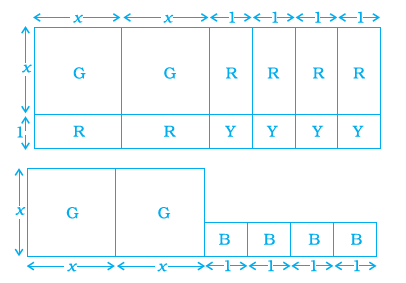
Calculate the area of figure.
Answer:
(i) $2x^2 + 6x + 4$
Given: The expression to factorise is $2x^2 + 6x + 4$.
Solution:
To represent this expression using cards, we need:
1. 2 Green cards (G): Area of each is $x \times x = x^2$. Total area = $2x^2$.
2. 6 Red cards (R): Area of each is $x \times 1 = x$. Total area = $6x$.
3. 4 Yellow cards (Y): Area of each is $1 \times 1 = 1$. Total area = $4$.
As shown in the middle figure of the provided diagram, these $12$ cards are arranged to form one large rectangle.
Dimensions of the resulting rectangle:
The total length is the sum of the widths of the cards placed side-by-side:
$\text{Length} = x + x + 1 + 1 + 1 + 1 = 2x + 4$
The total breadth is the sum of the heights of the cards placed one above the other:
$\text{Breadth} = x + 1$
Since the Area of a rectangle = $\text{Length} \times \text{Breadth}$, we have:
$2x^2 + 6x + 4 = (2x + 4)(x + 1)$
By taking out the common factor $2$ from the first bracket:
$2x^2 + 6x + 4 = 2(x + 2)(x + 1)$
Hence, the factorised form is $2(x + 2)(x + 1)$.
(ii) $x^2 + 4x + 4$
Given: The expression to factorise is $x^2 + 4x + 4$.
Solution:
To represent this expression, we need:
1. 1 Green card (G): Area = $x^2$.
2. 4 Red cards (R): Area = $4x$.
3. 4 Yellow cards (Y): Area = $4$.
To factorise, we arrange these cards to form a square (a special type of rectangle). To make a square of area $x^2 + 4x + 4$, the cards would be arranged such that:
1. The Green card is at a corner.
2. 2 Red cards are placed horizontally next to it, and 2 Red cards are placed vertically below it.
3. The 4 Yellow cards fill the remaining gap to complete the square.
Dimensions of the resulting square:
$\text{Side length} = x + 1 + 1 = x + 2$
$\text{Side height} = x + 1 + 1 = x + 2$
Area = $(x + 2) \times (x + 2) = (x + 2)^2$
Hence, the factorised form is $(x + 2)^2$.
Calculation of Area for the Top Figure (Large Rectangle)
Given:
The top figure is a rectangle composed of three types of tiles:
1. Green tiles (G): Two squares with side $x$, representing $x^2$ each.
2. Red tiles (R): Six rectangles with dimensions $x$ and $1$, representing $x$ each.
3. Yellow tiles (Y): Four unit squares with side $1$, representing $1$ each.
To Find:
Total area of the top rectangular arrangement.
Solution:
The area can be calculated using two methods: summing the individual parts or multiplying the total dimensions.
Method 1: Sum of individual tiles
$\text{Area} = 2(x^2) + 6(x) + 4(1)$
(Sum of areas of G, R, and Y tiles)
$\text{Area} = 2x^2 + 6x + 4$
Method 2: Product of Dimensions (Length $\times$ Breadth)
From the diagram, the total dimensions are:
$\text{Length} = x + x + 1 + 1 + 1 + 1 = 2x + 4$
$\text{Breadth} = x + 1$
$\text{Area} = \text{Length} \times \text{Breadth}$
$\text{Area} = (2x + 4)(x + 1)$
$\text{Area} = 2x(x + 1) + 4(x + 1)$
$\text{Area} = 2x^2 + 2x + 4x + 4$
$\text{Area} = 2x^2 + 6x + 4$
Hence, the total area of the top figure is $2x^2 + 6x + 4$ square units.
Calculation of Area for the Bottom Figure (Composite Shape)
Given:
The bottom figure is a composite shape consisting of:
1. Green tiles (G): Two squares of side $x$.
2. Blue tiles (B): Four small unit squares of side $1$.
To Find:
Total area of the bottom arrangement.
Solution:
The total area is the sum of the areas of all the constituent tiles shown in the figure.
Area of one Green tile (G) = $x \times x = x^2$
Area of two Green tiles = $2x^2$
Area of one Blue tile (B) = $1 \times 1 = 1$
Area of four Blue tiles = $4 \times 1 = 4$
The total area is the sum of these two components:
$\text{Total Area} = 2x^2 + 4$
We can also express this in factorised form:
$\text{Total Area} = 2(x^2 + 2)$
Hence, the total area of the bottom figure is $2x^2 + 4$ square units.
Question 124. The figure shows the dimensions of a wall having a window and a door of a room. Write an algebraic expression for the area of the wall to be painted.
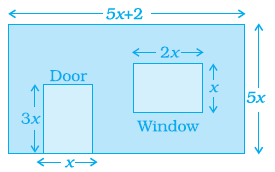
Answer:
Given:
From the figure, the dimensions are:
Length of the wall = $(5x + 2)$ units
Height of the wall = $5x$ units
Width of the door = $x$ units
Height of the door = $3x$ units
Width of the window = $2x$ units
Height of the window = $x$ units
To Find:
The area of the wall to be painted (excluding the area of the door and the window).
Solution:
The area to be painted is equal to the total area of the wall minus the areas of the door and the window.
Area to be painted = Area of Wall – (Area of Door + Area of Window)
... (i)
Step 1: Calculate the Area of the Wall
Area of Wall = $\text{Length} \times \text{Height}$
Area of Wall = $(5x + 2) \times 5x$
Area of Wall = $25x^2 + 10x$
... (ii)
Step 2: Calculate the Area of the Door
Area of Door = $\text{Width} \times \text{Height}$
Area of Door = $x \times 3x = 3x^2$
... (iii)
Step 3: Calculate the Area of the Window
Area of Window = $\text{Width} \times \text{Height}$
Area of Window = $2x \times x = 2x^2$
... (iv)
Step 4: Calculate the Area to be painted
Substitute values from (ii), (iii), and (iv) into equation (i):
Area to be painted = $(25x^2 + 10x) - (3x^2 + 2x^2)$
Area to be painted = $25x^2 + 10x - 5x^2$
Area to be painted = $20x^2 + 10x$
Hence, the algebraic expression for the area of the wall to be painted is $20x^2 + 10x$ square units.
Question 125. Match the expressions of column I with that of column II:
Column I
(1) (21x + 13y)2
(2) (21x – 13y)2
(3) (21x – 13y) (21x + 13y)
Column II
(a) 441x2 – 169y2
(b) 441x2 + 169y2 + 546xy
(c) 441x2 + 169y2 – 546xy
(d) 441x2 – 169y2 + 546xy
Answer:
Solution:
We will expand each expression in Column I using algebraic identities to find the corresponding match in Column II.
For (1): $(21x + 13y)^2$
Using identity $(a + b)^2 = a^2 + 2ab + b^2$:
$a = 21x, b = 13y$
$(21x)^2 + 2(21x)(13y) + (13y)^2$
$441x^2 + 546xy + 169y^2$
This matches with (b) in Column II.
For (2): $(21x - 13y)^2$
Using identity $(a - b)^2 = a^2 - 2ab + b^2$:
$a = 21x, b = 13y$
$(21x)^2 - 2(21x)(13y) + (13y)^2$
$441x^2 - 546xy + 169y^2$
This matches with (c) in Column II.
For (3): $(21x - 13y)(21x + 13y)$
Using identity $(a - b)(a + b) = a^2 - b^2$:
$a = 21x, b = 13y$
$(21x)^2 - (13y)^2$
$441x^2 - 169y^2$
This matches with (a) in Column II.
Final Match Table:
| Column I | Column II |
| (1) $(21x + 13y)^2$ | (b) $441x^2 + 169y^2 + 546xy$ |
| (2) $(21x - 13y)^2$ | (c) $441x^2 + 169y^2 - 546xy$ |
| (3) $(21x - 13y)(21x + 13y)$ | (a) $441x^2 - 169y^2$ |
Hence, the correct matching is: (1) $\rightarrow$ (b), (2) $\rightarrow$ (c), (3) $\rightarrow$ (a).