

Chapter 8 Exponents & Powers (Class 8 - Maths NCERT Exemplar Solutions)
Welcome to the comprehensive resource for NCERT Exemplar Solutions for Class 8 Mathematics: Chapter 8 Exponents & Powers! This chapter is intentionally designed to move beyond routine exercises, focusing on the mastery of exponential laws and the manipulation of negative exponents. By tackling more complex expressions and scientific applications, these solutions build the algebraic proficiency required for future studies in science and higher mathematics.
The solutions provide clear guidance on fundamental definitions, including the Zero Exponent Law ($a^0 = 1$) and the Negative Exponent Law ($a^{-n} = \frac{1}{a^n}$). A major emphasis is placed on the strategic application of the core Laws of Exponents: the Product Law ($a^m \times a^n = a^{m+n}$), the Quotient Law ($a^m \div a^n = a^{m-n}$), and the Power of a Power Law ($(a^m)^n = a^{mn}$), ensuring students can simplify intricate expressions involving multiple bases and integer exponents.
A significant challenge in this chapter involves Standard Form (Scientific Notation), which allows for the concise representation of very large or very small numbers as $k \times 10^n$, where $1 \le k < 10$ and $n$ is an integer. Students will also learn the technique of base equalization to solve exponential equations where the unknown variable resides in the exponent. With step-by-step guidance and logical justifications prepared by learningspot.co, students can accurately navigate multi-faceted problems and build a strong foundation for quantitative reasoning.
| Content On This Page | ||
|---|---|---|
| Solved Examples (Examples 1 to 9) | Question 1 to 33 (Multiple Choice Questions) | Question 34 to 65 (Fill in the Blanks) |
| Question 66 to 90 (True or False) | Question 91 to 180 | |
Solved Examples (Examples 1 to 9)
In example 1 and 2, there are four options given out of which one is correct. Write the correct answer.
Example 1: Multiplicative inverse of 27 is
(a) 2–7
(b) 72
(c) – 27
(d) – 27
Answer:
Solution:
The multiplicative inverse of a number $n$ is a number which, when multiplied by $n$, gives the product $1$. It is also known as the reciprocal of the number.
The given number is $2^7$.
Multiplicative inverse of $2^7 = \frac{1}{2^7}$
According to the laws of exponents, $\frac{1}{a^n} = a^{-n}$.
Therefore, $\frac{1}{2^7} = 2^{-7}$.
Hence, the correct option is (a).
Example 2: The human body has about 100 billion cells. This number can be written in exponential form as
(a) 10–11
(b) 1011
(c) 109
(d) 10–9
Answer:
Solution:
First, let's understand the value of a billion in the decimal system. In the international system, $1$ billion is $1,000,000,000$ (one followed by nine zeros).
$1 \text{ billion} = 10^9$
In the Indian perspective, $100$ billion is equivalent to $10,000$ crore ($1$ kharab).
Now, $100$ billion can be written as:
$100 \times 1,000,000,000$
$= 100,000,000,000$
Counting the zeros, there are $11$ zeros. Thus, it can be written as $10^{11}$.
Hence, the correct option is (b).
In examples 3 to 5, fill in the blanks to make the statements true.
Example 3: (-4)4 × $\left( \frac{5}{4} \right)^4$ = ______________________.
Answer:
Solution:
We use the law of exponents: $a^n \times b^n = (a \times b)^n$.
Here, $a = -4$, $b = \frac{5}{4}$, and $n = 4$.
$(-4)^4 \times \left( \frac{5}{4} \right)^4 = \left( -4 \times \frac{5}{4} \right)^4$
On simplifying the term inside the bracket:
$\left( -\cancel{4}^1 \times \frac{5}{\cancel{4}_1} \right)^4 = (-5)^4$
Since the exponent is an even number, $(-5)^4 = 5^4 = 5 \times 5 \times 5 \times 5 = 625$.
Hence, the blank should be filled with $625$ or $(-5)^4$.
Example 4: (2-3)2 × (3-2)3
Answer:
Solution:
Using the law of exponents $(a^m)^n = a^{m \times n}$:
$(2^{-3})^2 = 2^{-3 \times 2} = 2^{-6}$
$(3^{-2})^3 = 3^{-2 \times 3} = 3^{-6}$
Now multiplying the results:
$2^{-6} \times 3^{-6}$
Using the law $a^n \times b^n = (ab)^n$:
$(2 \times 3)^{-6} = 6^{-6}$
We can also write this as $\frac{1}{6^6}$.
Hence, the blank should be filled with $6^{-6}$.
Example 5: The distance between earth and sun is 150 million kilometres which can be written in exponential form as _______.
Answer:
Solution:
First, we convert 150 million into numerical form. One million is $1,000,000$ ($10^6$).
150 million = $150 \times 1,000,000 = 150,000,000$
To write this in standard exponential form (scientific notation), we move the decimal point 8 places to the left:
$150,000,000 = 1.5 \times 10^8$
Hence, the distance is $1.5 \times 10^8$ km.
In examples 6 and 7, state whether the statements are true (T) or false (F):
Example 6: Very small numbers can be expressed in standard form using positive exponents.
Answer:
Solution:
The statement is False.
Very small numbers (numbers between 0 and 1) are expressed in standard form using negative exponents. For example, $0.00007$ is written as $7 \times 10^{-5}$. Positive exponents are used for very large numbers.
Example 7: (–10) × (–10) × (–10) × (–10) = 10–4
Answer:
Solution:
The statement is False.
The product of $(-10)$ multiplied four times is $(-10)^4$.
Since the exponent is even, the result is positive:
$(-10) \times (-10) \times (-10) \times (-10) = 10,000 = 10^4$
Note that $10^4$ is not equal to $10^{-4}$ (which is $0.0001$).
Example 8: Simplify $\frac{(-2)^3 \;\times\; (-2)^7}{3 \;\times\; 4^6}$
Answer:
Solution:
Given: $\frac{(-2)^3 \times (-2)^7}{3 \times 4^6}$
First, simplify the numerator using $a^m \times a^n = a^{m+n}$:
$(-2)^3 \times (-2)^7 = (-2)^{3+7} = (-2)^{10}$
Since the exponent $10$ is even, $(-2)^{10} = 2^{10}$.
Next, express the denominator in base 2. We know $4 = 2^2$:
$4^6 = (2^2)^6 = 2^{2 \times 6} = 2^{12}$
The expression now becomes:
$\frac{2^{10}}{3 \times 2^{12}}$
Using the law $\frac{a^m}{a^n} = a^{m-n}$ or $\frac{1}{a^{n-m}}$:
$\frac{1}{3 \times 2^{12-10}} = \frac{1}{3 \times 2^2}$
$\frac{1}{3 \times 4} = \frac{1}{12}$
Hence, the simplified value is $\frac{1}{12}$.
Example 9: Find x so that (–5)x+1 × (–5)5 = (–5)7
Answer:
Solution:
Given: $(-5)^{x+1} \times (-5)^5 = (-5)^7$
Using the law of exponents $a^m \times a^n = a^{m+n}$ on the Left Hand Side (LHS):
$(-5)^{(x+1) + 5} = (-5)^7$
$(-5)^{x+6} = (-5)^7$
Since the bases on both sides are the same and not equal to $0$, $1$, or $-1$, we can equate the exponents:
$x + 6 = 7$
Transposing 6 to the RHS:
$x = 7 - 6$
$x = 1$
Hence, the value of $x$ is $1$.
Exercise
Question 1 to 33 (Multiple Choice Questions)
In questions 1 to 33, out of the four options, only one is correct. Write the correct answer.
Question 1. In 2n, n is known as
(a) Base
(b) Constant
(c) x
(d) Variable
Answer:
Solution:
In the exponential expression $2^n$:
1. The number $2$ is called the base.
2. The number $n$ is called the exponent, index, or power.
In algebraic terms, if $n$ can take different values, it is a variable exponent. However, the standard mathematical name for the position of $n$ is the exponent.
Given the options provided:
(a) Base - Incorrect (2 is the base)
(b) Constant - Incorrect (n is typically the variable)
(c) x - Incorrect
(d) Variable - Correct (as $n$ is the variable representing the power)
Hence, the correct option is (d).
Question 2. For a fixed base, if the exponent decreases by 1, the number becomes
(a) One-tenth of the previous number.
(b) Ten times of the previous number.
(c) Hundredth of the previous number.
(d) Hundred times of the previous number.
Answer:
Solution:
Let the base be $a$ and the original exponent be $n$. The original number is $a^n$.
If the exponent decreases by $1$, the new number is $a^{n-1}$.
By the law of exponents:
$a^{n-1} = \frac{a^n}{a}$
This means the number becomes $\frac{1}{a}$ times the previous number.
In the context of the decimal number system (base $10$), if the exponent decreases by $1$, the number becomes $\frac{1}{10}$ (one-tenth) of the previous number.
Hence, the correct option is (a).
Question 3. 3–2 can be written as
(a) 32
(b) $\frac{1}{3^2}$
(c) $\frac{1}{3^{-2}}$
(d) $-\frac{2}{3}$
Answer:
Solution:
According to the law of negative exponents:
$a^{-n} = \frac{1}{a^n}$
Applying this to $3^{-2}$:
$3^{-2} = \frac{1}{3^2}$
Hence, the correct option is (b).
Question 4. The value of $\frac{1}{4^{-2}}$ is
(a) 16
(b) 8
(c) $\frac{1}{16}$
(d) $\frac{1}{8}$
Answer:
Solution:
Using the law of exponents $\frac{1}{a^{-n}} = a^n$:
$\frac{1}{4^{-2}} = 4^2$
$4^2 = 4 \times 4 = 16$
Hence, the correct option is (a).
Question 5. The value of 35 ÷ 3–6 is
(a) 35
(b) 3–6
(c) 311
(d) 3–11
Answer:
Solution:
Using the law of exponents $a^m \div a^n = a^{m-n}$:
$3^5 \div 3^{-6} = 3^{5 - (-6)}$
$= 3^{5 + 6}$
$= 3^{11}$
Hence, the correct option is (c).
Question 6. The value of $\left( \frac{2}{5} \right)^{-2}$ is
(a) $\frac{4}{5}$
(b) $\frac{4}{25}$
(c) $\frac{25}{4}$
(d) $\frac{5}{2}$
Answer:
Solution:
Using the law $\left( \frac{a}{b} \right)^{-n} = \left( \frac{b}{a} \right)^n$:
$\left( \frac{2}{5} \right)^{-2} = \left( \frac{5}{2} \right)^2$
$= \frac{5^2}{2^2} = \frac{25}{4}$
Hence, the correct option is (c).
Question 7. The reciprocal of $\left( \frac{2}{5} \right)^{-1}$ is
(a) $\frac{2}{5}$
(b) $\frac{5}{2}$
(c) $-\frac{5}{2}$
(d) $-\frac{2}{5}$
Answer:
Solution:
First, let's find the value of $\left( \frac{2}{5} \right)^{-1}$:
$\left( \frac{2}{5} \right)^{-1} = \frac{5}{2}$
Now, we need to find the reciprocal of $\frac{5}{2}$. The reciprocal of a fraction $\frac{a}{b}$ is $\frac{b}{a}$.
Reciprocal of $\frac{5}{2} = \frac{2}{5}$
Hence, the correct option is (a).
Question 8. The multiplicative inverse of 10–100 is
(a) 10
(b) 100
(c) 10100
(d) 10–100
Answer:
Solution:
The multiplicative inverse of a number $x$ is $\frac{1}{x}$.
Multiplicative inverse of $10^{-100} = \frac{1}{10^{-100}}$
Using the law $\frac{1}{a^{-n}} = a^n$:
$\frac{1}{10^{-100}} = 10^{100}$
Hence, the correct option is (c).
Question 9. The value of (–2)2 × 3 – 1 is
(a) 32
(b) 64
(c) – 32
(d) -64
Answer:
Solution:
First, we calculate the value of the exponent:
$2 \times 3 - 1 = 6 - 1 = 5$
Now, the expression becomes $(-2)^5$.
Since the exponent is an odd number, the result will be negative:
$(-2)^5 = (-2) \times (-2) \times (-2) \times (-2) \times (-2)$
$(-2)^5 = -32$
Hence, the correct option is (c).
Question 10. The value of $\left( -\frac{2}{3} \right)^{4}$ is equal to
(a) $\frac{16}{81}$
(b) $\frac{81}{16}$
(c) $\frac{-16}{81}$
(d) $\frac{81}{-16}$
Answer:
Solution:
We use the law of exponents $\left( \frac{a}{b} \right)^n = \frac{a^n}{b^n}$:
$\left( -\frac{2}{3} \right)^{4} = \frac{(-2)^4}{3^4}$
Since the exponent $4$ is an even number, the result of $(-2)^4$ will be positive:
$(-2)^4 = 16$
$3^4 = 3 \times 3 \times 3 \times 3 = 81$
Therefore, the value is $\frac{16}{81}$.
Hence, the correct option is (a).
Question 11. The multiplicative inverse of $\left( -\frac{5}{9} \right)^{-99}$ is
(a) $\left( -\frac{5}{9} \right)^{99}$
(b) $\left( \frac{5}{9} \right)^{99}$
(c) $\left( \frac{9}{- 5} \right)^{99}$
(d) $\left( \frac{9}{5} \right)^{99}$
Answer:
Solution:
The multiplicative inverse of a number $z$ is $\frac{1}{z}$.
Multiplicative inverse of $\left( -\frac{5}{9} \right)^{-99} = \frac{1}{\left( -\frac{5}{9} \right)^{-99}}$
Using the law of exponents $\frac{1}{a^{-n}} = a^n$:
$\frac{1}{\left( -\frac{5}{9} \right)^{-99}} = \left( -\frac{5}{9} \right)^{99}$
Hence, the correct option is (a).
Question 12. If x be any non-zero integer and m, n be negative integers, then xm × xn is equal to
(a) xm
(b) xm + n
(c) xn
(d) xm – n
Answer:
Solution:
According to the Product Law of Exponents, for any non-zero integer $x$ and any integers $m$ and $n$ (whether positive or negative):
$x^m \times x^n = x^{m + n}$
(Product Law)
Hence, the correct option is (b).
Question 13. If y be any non-zero integer, then y0 is equal to
(a) 1
(b) 0
(c) – 1
(d) Not defined
Answer:
Solution:
According to the Zero Exponent Rule, any non-zero base raised to the power of zero is always equal to $1$.
$y^0 = 1$
(for $y \neq 0$)
Hence, the correct option is (a).
Question 14. If x be any non-zero integer, then x–1 is equal to
(a) x
(b) $\frac{1}{x}$
(c) -x
(d) $\frac{-1}{x}$
Answer:
Solution:
A negative exponent indicates the reciprocal of the base.
$x^{-1} = \frac{1}{x^1}$
So, $x^{-1} = \frac{1}{x}$.
Hence, the correct option is (b).
Question 15. If x be any integer different from zero and m be any positive integer, then x–m is equal to
(a) xm
(b) -xm
(c) $\frac{1}{x^m}$
(d) $\frac{-1}{x^m}$
Answer:
Solution:
By the definition of negative exponents:
$x^{-m} = \frac{1}{x^m}$
This rule states that $x^{-m}$ is the multiplicative inverse of $x^m$.
Hence, the correct option is (c).
Question 16. If x be any integer different from zero and m, n be any integers, then (xm)n is equal to
(a) xm + n
(b) xmn
(c) $x^{\frac{m}{n}}$
(d) xm – n
Answer:
Solution:
According to the Power of a Power Law of exponents, when a power is raised to another power, we multiply the exponents.
$(x^m)^n = x^{m \times n} = x^{mn}$
Hence, the correct option is (b).
Question 17. Which of the following is equal to $\left( -\frac{3}{4} \right)^{-3}$ ?
(a) $\left( \frac{3}{4} \right)^{-3}$
(b) $-\left( \frac{3}{4} \right)^{-3}$
(c) $\left( \frac{4}{3} \right)^{3}$
(d) $\left( -\frac{4}{3} \right)^{3}$
Answer:
Solution:
Using the rule $\left( \frac{a}{b} \right)^{-n} = \left( \frac{b}{a} \right)^n$:
$\left( -\frac{3}{4} \right)^{-3} = \left( -\frac{4}{3} \right)^{3}$
The base $-\frac{3}{4}$ is inverted to become $-\frac{4}{3}$, and the sign of the exponent changes from $-3$ to $3$.
Hence, the correct option is (d).
Question 18. $\left( -\frac{5}{7} \right)^{-5}$ is equal to
(a) $\left( \frac{5}{7} \right)^{-5}$
(b) $\left( \frac{5}{7} \right)^{5}$
(c) $\left( \frac{7}{5} \right)^{5}$
(d) $\left( -\frac{7}{5} \right)^{5}$
Answer:
Solution:
Applying the reciprocal rule for negative exponents:
$\left( \frac{a}{b} \right)^{-n} = \left( \frac{b}{a} \right)^n$
Substituting $a = -5$, $b = 7$, and $n = 5$:
$\left( -\frac{5}{7} \right)^{-5} = \left( \frac{7}{-5} \right)^5 = \left( -\frac{7}{5} \right)^5$
Hence, the correct option is (d).
Question 19. $\left( \frac{-7}{5} \right)^{-1}$ is equal to
(a) $\frac{5}{7}$
(b) $-\frac{5}{7}$
(c) $\frac{7}{5}$
(d) $\frac{-7}{5}$
Answer:
Solution:
According to the law of exponents, for any non-zero rational number $\frac{a}{b}$:
$\left( \frac{a}{b} \right)^{-1} = \frac{b}{a}$
Given expression is $\left( \frac{-7}{5} \right)^{-1}$. Here $a = -7$ and $b = 5$.
Applying the rule:
$\left( \frac{-7}{5} \right)^{-1} = \frac{5}{-7} = -\frac{5}{7}$
Hence, the correct option is (b).
Question 20. (–9)3 ÷ (–9)8 is equal to
(a) (9)5
(b) (9)–5
(c) (– 9)5
(d) (– 9)–5
Answer:
Solution:
Using the law of exponents for division with the same base: $a^m \div a^n = a^{m - n}$.
Here, the base $a = -9$, $m = 3$, and $n = 8$.
$(-9)^3 \div (-9)^8 = (-9)^{3 - 8}$
$= (-9)^{-5}$
Hence, the correct option is (d).
Question 21. For a non-zero integer x, x7 ÷ x12 is equal to
(a) x5
(b) x19
(c) x–5
(d) x–19
Answer:
Solution:
Using the law of exponents: $x^m \div x^n = x^{m - n}$.
Substituting the given values $m = 7$ and $n = 12$:
$x^7 \div x^{12} = x^{7 - 12}$
$= x^{-5}$
Hence, the correct option is (c).
Question 22. For a non-zero integer x, (x4)–3 is equal to
(a) x12
(b) x–12
(c) x64
(d) x–64
Answer:
Solution:
Using the power of a power law of exponents: $(a^m)^n = a^{m \times n}$.
Here, $a = x$, $m = 4$, and $n = -3$.
$(x^4)^{-3} = x^{4 \times (-3)}$
$= x^{-12}$
Hence, the correct option is (b).
Question 23. The value of (7–1 – 8–1)–1 – (3–1 – 4–1)–1 is
(a) 44
(b) 56
(c) 68
(d) 12
Answer:
Solution:
First, we simplify the terms inside the parentheses using the rule $a^{-1} = \frac{1}{a}$:
$( \frac{1}{7} - \frac{1}{8} )^{-1} - ( \frac{1}{3} - \frac{1}{4} )^{-1}$
Taking the LCM for the fractions:
$( \frac{8 - 7}{56} )^{-1} - ( \frac{4 - 3}{12} )^{-1}$
$( \frac{1}{56} )^{-1} - ( \frac{1}{12} )^{-1}$
Since $( \frac{1}{a} )^{-1} = a$:
$56 - 12 = 44$
Hence, the correct option is (a).
Question 24. The standard form for 0.000064 is
(a) 64 × 104
(b) 64 × 10–4
(c) 6.4 × 10⁵
(d) 6.4 × 10⁻⁵
Answer:
Solution:
To write a number in standard form ($m \times 10^n$), we move the decimal point so that there is only one non-zero digit to the left of the decimal point.
For $0.000064$, we move the decimal point 5 places to the right.
When the decimal moves to the right, the exponent of 10 is negative.
$0.000064 = 6.4 \times 10^{-5}$
Hence, the correct option is (d).
Question 25. The standard form for 234000000 is
(a) 2.34 × 10⁸
(b) 0.234 × 10⁹
(c) 2.34 × 10⁻⁸
(d) 0.234×10⁻⁹
Answer:
Solution:
In the Indian perspective, this number is 23 crore 40 lakh.
To express $234,000,000$ in standard form, we move the decimal point from the end of the number to the position between 2 and 3.
The decimal moves 8 places to the left.
When the decimal moves to the left, the exponent of 10 is positive.
$234,000,000 = 2.34 \times 10^8$
Hence, the correct option is (a).
Question 26. The usual form for 2.03 × 10⁻⁵
(a) 0.203
(b) 0.00203
(c) 203000
(d) 0.0000203
Answer:
Solution:
To convert from standard form to usual form with a negative exponent, we move the decimal point to the left by the number of places indicated by the exponent.
Here, the exponent is $-5$, so we move the decimal point 5 places to the left starting from the position between 2 and 0.
$2.03 \times 10^{-5} = 0.0000203$
Hence, the correct option is (d).
Question 27. $\left( \frac{1}{10} \right)^{0}$ is equal to
(a) 0
(b) $\frac{1}{10}$
(c) 1
(d) 10
Answer:
Solution:
According to the zero exponent identity, any non-zero number raised to the power of zero is equal to 1.
$a^0 = 1$
(where $a \neq 0$)
Substituting $a = \frac{1}{10}$:
$\left( \frac{1}{10} \right)^0 = 1$
Hence, the correct option is (c).
Question 28. $\left( \frac{3}{4} \right)^{5}$ ÷ $\left( \frac{5}{3} \right)^{5}$ is equal to
(a) $\left(\frac{3}{4} \div \frac{5}{3} \right)^{5}$
(b) $\left(\frac{3}{4} \div \frac{5}{3} \right)^{1}$
(c) $\left(\frac{3}{4} \div \frac{5}{3} \right)^{0}$
(d) $\left(\frac{3}{4} \div \frac{5}{3} \right)^{10}$
Answer:
Solution:
According to the laws of exponents, for any non-zero rational numbers $a$ and $b$ and integer $n$:
$a^n \div b^n = (a \div b)^n$
(Power of a Quotient Law)
Given the expression $\left( \frac{3}{4} \right)^{5} \div \left( \frac{5}{3} \right)^{5}$, we can see that the exponents are the same ($n = 5$).
Applying the law:
$\left( \frac{3}{4} \right)^{5} \div \left( \frac{5}{3} \right)^{5} = \left( \frac{3}{4} \div \frac{5}{3} \right)^{5}$
Hence, the correct option is (a).
Question 29. For any two non-zero rational numbers x and y, x4 ÷ y4 is equal to
(a) (x ÷ y)0
(b) (x ÷ y)1
(c) (x ÷ y)4
(d) (x ÷ y)8
Answer:
Solution:
Using the law of exponents: $a^n \div b^n = (a \div b)^n$.
In the given expression $x^4 \div y^4$:
$a = x, b = y,$ and $n = 4$.
Therefore, $x^4 \div y^4 = (x \div y)^4$.
Hence, the correct option is (c).
Question 30. For a non-zero rational number p, p13 ÷ p8 is equal to
(a) p5
(b) p21
(c) p–5
(d) p–19
Answer:
Solution:
According to the division law of exponents for the same base:
$a^m \div a^n = a^{m - n}$
(Quotient Law)
Given $p^{13} \div p^8$, here $a = p, m = 13,$ and $n = 8$.
Substituting these values:
$p^{13} \div p^8 = p^{13 - 8} = p^5$
Hence, the correct option is (a).
Question 31. For a non-zero rational number z , (z-2)3 is equal to
(a) z6
(b) z–6
(c) z1
(d) z4
Answer:
Solution:
According to the power of a power law of exponents:
$(a^m)^n = a^{m \times n}$
Applying this to $(z^{-2})^3$:
$(z^{-2})^3 = z^{-2 \times 3}$
$= z^{-6}$
Hence, the correct option is (b).
Question 32. Cube of $-\frac{1}{2}$ is
(a) $\frac{1}{8}$
(b) $\frac{1}{16}$
(c) $-\frac{1}{8}$
(d) $-\frac{1}{16}$
Answer:
Solution:
The cube of a number is the number multiplied by itself three times.
$\text{Cube of } \left( -\frac{1}{2} \right) = \left( -\frac{1}{2} \right)^3$
$= \left( -\frac{1}{2} \right) \times \left( -\frac{1}{2} \right) \times \left( -\frac{1}{2} \right)$
Since the product involves three negative signs (odd count), the result will be negative.
$= -\left( \frac{1 \times 1 \times 1}{2 \times 2 \times 2} \right)$
$= -\frac{1}{8}$
Hence, the correct option is (c).
Question 33. Which of the following is not the reciprocal of $ \left( \frac{2}{3} \right)^{4}$?
(a) $\left( \frac{3}{2} \right)^{4}$
(b) $\left( \frac{3}{2} \right)^{-4}$
(c) $\left( \frac{2}{3} \right)^{-4}$
(d) $\frac{3^4}{2^4}$
Answer:
Solution:
First, let's find the reciprocal of $\left( \frac{2}{3} \right)^4$. The reciprocal of any non-zero number $x$ is $\frac{1}{x}$.
$\text{Reciprocal} = \frac{1}{(2/3)^4} = \left( \frac{3}{2} \right)^4$
... (i)
Now let's check the options:
(a) $\left( \frac{3}{2} \right)^4$ — This is the same as (i).
(c) $\left( \frac{2}{3} \right)^{-4}$ — By the law $\left( \frac{a}{b} \right)^{-n} = \left( \frac{b}{a} \right)^n$, this is equal to $\left( \frac{3}{2} \right)^4$.
(d) $\frac{3^4}{2^4}$ — This is just another way to write $\left( \frac{3}{2} \right)^4$.
However, option (b) is $\left( \frac{3}{2} \right)^{-4}$, which is equal to $\left( \frac{2}{3} \right)^4$. A number cannot be its own reciprocal (unless it is 1 or -1).
Hence, the correct option is (b).
Question 34 to 65 (Fill in the Blanks)
In questions 34 to 65, fill in the blanks to make the statements true.
Question 34. The multiplicative inverse of 1010 is ___________.
Answer:
Solution:
The multiplicative inverse of a number $a$ is $\frac{1}{a}$.
Multiplicative inverse of $10^{10} = \frac{1}{10^{10}}$
Using the negative exponent law $\frac{1}{a^n} = a^{-n}$:
$\frac{1}{10^{10}} = 10^{-10}$
Hence, the multiplicative inverse of $10^{10}$ is $10^{-10}$.
Question 35. a3 × a–10 = __________.
Answer:
Solution:
Using the product law of exponents: $a^m \times a^n = a^{m + n}$.
Here, the base is $a$ and the exponents are $3$ and $-10$.
$a^3 \times a^{-10} = a^{3 + (-10)}$
$= a^{3 - 10}$
$= a^{-7}$
Hence, $a^3 \times a^{-10} = $ $a^{-7}$.
Question 36. 50 = __________.
Answer:
According to the Zero Exponent Rule, any non-zero number raised to the power of zero is always equal to 1.
$x^0 = 1$
(for $x \neq 0$)
Applying this to the given expression:
$5^0 = 1$
Hence, $5^0 = $ $1$.
Question 37. 55 × 5–5 = __________.
Answer:
Solution:
According to the product law of exponents:
$a^m \times a^n = a^{m + n}$
Applying this to the given expression:
$5^5 \times 5^{-5} = 5^{5 + (-5)}$
$= 5^0$
$5^0 = 1$
[Since $a^0 = 1$]
Hence, the blank should be filled with 1.
Question 38. The value of $\left( \frac{1}{2^3} \right)^2$ is equal to _________.
Answer:
Solution:
Using the law of exponents $\left( \frac{1}{a^m} \right)^n = \frac{1}{a^{mn}}$:
$\left( \frac{1}{2^3} \right)^2 = \frac{1}{(2^3)^2}$
$= \frac{1}{2^{3 \times 2}}$
$= \frac{1}{2^6}$
Calculating the value: $2^6 = 2 \times 2 \times 2 \times 2 \times 2 \times 2 = 64$.
Hence, the value is $\frac{1}{64}$.
Question 39. The expression for 8–2 as a power with the base 2 is _________.
Answer:
Solution:
First, we express the number 8 as a power of 2:
$8 = 2^3$
Now, substituting this value into the original expression $8^{-2}$:
$(2^3)^{-2}$
Using the power of a power law $(a^m)^n = a^{mn}$:
$= 2^{3 \times (-2)}$
$= 2^{-6}$
Hence, the expression is $2^{-6}$.
Question 40. Very small numbers can be expressed in standard form by using _________ exponents.
Answer:
Solution:
In scientific notation or standard form, numbers much smaller than 1 (like $0.00004$) are written with the decimal point moved to the right, which results in a power of 10 with a negative index.
Hence, very small numbers can be expressed in standard form by using negative exponents.
Question 41. Very large numbers can be expressed in standard form by using _________ exponents.
Answer:
Solution:
In standard form, numbers much larger than 1 (like $5,000,000$) are written with the decimal point moved to the left, which results in a power of 10 with a positive index.
Hence, very large numbers can be expressed in standard form by using positive exponents.
Question 42. By multiplying (10)5 by (10)–10 we get ________.
Answer:
Solution:
We need to multiply $10^5$ by $10^{-10}$. Using the product law of exponents:
$10^5 \times 10^{-10} = 10^{5 + (-10)}$
$= 10^{5 - 10}$
$= 10^{-5}$
Hence, we get $10^{-5}$.
Question 43. $\left[ \left( \frac{2}{13} \right)^{-6}\div\left( \frac{2}{13} \right)^{3} \right]^3\times\left( \frac{2}{13} \right)^{-9}$ = __________.
Answer:
Solution:
First, let us simplify the expression inside the square brackets:
$\left( \frac{2}{13} \right)^{-6} \div \left( \frac{2}{13} \right)^{3}$
Using $a^m \div a^n = a^{m-n}$:
$= \left( \frac{2}{13} \right)^{-6 - 3} = \left( \frac{2}{13} \right)^{-9}$
Now, applying the outer exponent of 3:
$\left[ \left( \frac{2}{13} \right)^{-9} \right]^3 = \left( \frac{2}{13} \right)^{-9 \times 3} = \left( \frac{2}{13} \right)^{-27}$
Now, multiply by the final term:
$\left( \frac{2}{13} \right)^{-27} \times \left( \frac{2}{13} \right)^{-9}$
$= \left( \frac{2}{13} \right)^{-27 + (-9)} = \left( \frac{2}{13} \right)^{-36}$
Hence, the result is $\left( \frac{2}{13} \right)^{-36}$.
Question 44. Find the value [4–1 + 3–1 + 6–2]–1.
Answer:
Solution:
First, we simplify the expression inside the brackets:
$4^{-1} + 3^{-1} + 6^{-2}$
$= \frac{1}{4} + \frac{1}{3} + \frac{1}{6^2}$
$= \frac{1}{4} + \frac{1}{3} + \frac{1}{36}$
To add these fractions, we find the LCM of 4, 3, and 36, which is 36.
$= \frac{9 + 12 + 1}{36}$
$= \frac{\cancel{22}^{11}}{\cancel{36}_{18}} = \frac{11}{18}$
Now, we apply the outer exponent of $-1$:
$\left( \frac{11}{18} \right)^{-1} = \frac{18}{11}$
Hence, the value is $\frac{18}{11}$.
Question 45. [2–1 + 3–1 + 4–1]0 = ______
Answer:
Solution:
According to the law of exponents, any non-zero expression raised to the power of 0 is equal to 1.
$[a]^0 = 1$
(Zero exponent property)
First, check if the base is non-zero:
$2^{-1} + 3^{-1} + 4^{-1} = \frac{1}{2} + \frac{1}{3} + \frac{1}{4}$
Since the sum of positive fractions is clearly not zero, we can apply the property directly.
Hence, $[2^{-1} + 3^{-1} + 4^{-1}]^0 = $ 1.
Question 46. The standard form of $\left( \frac{1}{100000000} \right)$ is ____________.
Answer:
Solution:
First, we count the number of zeros in the denominator. The number $100,000,000$ has 8 zeros.
So, the expression can be written as:
$\frac{1}{10^8}$
Using the law of exponents $\frac{1}{a^n} = a^{-n}$:
$10^{-8}$
In standard form ($m \times 10^n$), we write it as $1 \times 10^{-8}$.
Hence, the blank should be filled with $1 \times 10^{-8}$.
Question 47. The standard form of 12340000 is ______.
Answer:
Solution:
In the Indian perspective, the number 12340000 is $1$ crore $23$ lakh and $40$ thousand.
To write this in standard form ($m \times 10^n$), where $1 \leq m < 10$, we move the decimal point from the end of the number 7 places to the left.
$12340000 = 1.2340000 \times 10^7$
$= 1.234 \times 10^7$
Hence, the blank should be filled with $1.234 \times 10^7$.
Question 48. The usual form of 3.41 × 10⁶ is _______.
Answer:
Solution:
To convert from standard form to usual form, we move the decimal point according to the power of 10.
Since the exponent is $+6$, we move the decimal point 6 places to the right.
$3.41 \times 10^6 = 3410000$
In the Indian perspective, this is $34$ lakh $10$ thousand.
Hence, the blank should be filled with $34,10,000$.
Question 49. The usual form of 2.39461 × 10⁶ is _______.
Answer:
Solution:
The exponent of 10 is $+6$. Therefore, we move the decimal point 6 places to the right.
$2.39461 \times 10^6 = 2394610$
In the Indian perspective, this is $23$ lakh $94$ thousand $610$.
Hence, the blank should be filled with $23,94,610$.
Question 50. If 36 = 6 × 6 = 62, then $\frac{1}{36}$ expressed as a power with the base 6 is ________.
Answer:
Solution:
We are given $36 = 6^2$.
We need to find the value of $\frac{1}{36}$.
$\frac{1}{36} = \frac{1}{6^2}$
Using the law of exponents $\frac{1}{a^n} = a^{-n}$:
$\frac{1}{6^2} = 6^{-2}$
Hence, the blank should be filled with $6^{-2}$.
Quesition 51. By multiplying $\left( \frac{5}{3} \right)^{4}$ by ________ we get 54.
Answer:
Solution:
Let the required number be $x$.
$\left( \frac{5}{3} \right)^4 \times x = 5^4$
Using the law $\left( \frac{a}{b} \right)^n = \frac{a^n}{b^n}$:
$\frac{5^4}{3^4} \times x = 5^4$
$x = 5^4 \times \frac{3^4}{5^4}$
$x = 3^4$
Value of $3^4 = 3 \times 3 \times 3 \times 3 = 81$.
Hence, the blank should be filled with $3^4$ or $81$.
Quesition 52. 35 ÷ 3–6 can be simplified as __________.
Answer:
Solution:
Using the quotient law of exponents $a^m \div a^n = a^{m-n}$:
Here, $a = 3, m = 5$ and $n = -6$.
$3^5 \div 3^{-6} = 3^{5 - (-6)}$
$= 3^{5 + 6}$
$= 3^{11}$
Hence, the blank should be filled with $3^{11}$.
Quesition 53. The value of 3 × 10⁻⁷ is equal to ________.
Answer:
Solution:
To find the value, we convert the standard form into usual form.
Since the exponent is $-7$, we move the decimal point 7 places to the left starting from 3.
$3 \times 10^{-7} = 0.0000003$
Hence, the blank should be filled with $0.0000003$.
Quesition 54. To add the numbers given in standard form, we first convert them into numbers with __ exponents.
Answer:
Solution:
When adding or subtracting numbers in standard form, we cannot perform the operation directly if the powers of 10 are different.
We must first express both numbers such that they have the same (equal) exponents so that we can take the power of 10 as a common factor.
Hence, the blank should be filled with same or equal.
Quesition 55. The standard form for 32,50,00,00,000 is __________.
Answer:
Solution:
To convert a number into standard form ($m \times 10^n$), we move the decimal point so that there is only one non-zero digit to the left of the decimal point. For the number 32,50,00,00,000, we move the decimal point 10 places to the left.
In the Indian perspective, this number is 3250 crore or 32 arab 50 crore.
$32,50,00,00,000 = 3.25 \times 10^{10}$
Hence, the standard form is $3.25 \times 10^{10}$.
Quesition 56. The standard form for 0.000000008 is __________.
Answer:
Solution:
To write 0.000000008 in standard form, we move the decimal point 9 places to the right to bring it after the digit 8.
When the decimal point is moved to the right, the exponent of 10 is negative.
$0.000000008 = 8 \times 10^{-9}$
Hence, the standard form is $8 \times 10^{-9}$.
Quesition 57. The usual form for 2.3 × 10⁻¹⁰ is ____________.
Answer:
Solution:
To convert $2.3 \times 10^{-10}$ into usual form, we move the decimal point 10 places to the left because the exponent is negative.
$2.3 \times 10^{-10} = 0.00000000023$
Hence, the usual form is $0.00000000023$.
Quesition 58. On dividing 85 by _________ we get 8.
Answer:
Solution:
Let the number in the blank be $x$.
$8^5 \div x = 8$
We know that $8 = 8^1$. Using the quotient law of exponents:
$x = 8^5 \div 8^1$
$x = 8^{5 - 1}$
$x = 8^4$
Since $8^4 = 8 \times 8 \times 8 \times 8 = 4096$.
Hence, the blank should be filled with $8^4$ or $4096$.
Quesition 59. On multiplying _________ by 2–5 we get 25.
Answer:
Solution:
Let the number in the blank be $x$.
$x \times 2^{-5} = 2^5$
To find $x$, we divide the product by the given multiplier:
$x = \frac{2^5}{2^{-5}}$
Using the law $\frac{a^m}{a^n} = a^{m - n}$:
$x = 2^{5 - (-5)}$
$x = 2^{5 + 5} = 2^{10}$
Value of $2^{10} = 1024$.
Hence, the blank should be filled with $2^{10}$ or $1024$.
Question 60. The value of [3–1 × 4–1]2 is _________.
Answer:
Solution:
First, simplify the expression inside the bracket using the negative exponent rule $a^{-1} = \frac{1}{a}$:
$[3^{-1} \times 4^{-1}] = \frac{1}{3} \times \frac{1}{4} = \frac{1}{12}$
Now, apply the outer square:
$\left( \frac{1}{12} \right)^2 = \frac{1}{12^2} = \frac{1}{144}$
Alternatively, in exponential form: $12^{-2}$.
Hence, the value is $\frac{1}{144}$.
Question 61. The value of [2–1 × 3–1]–1 is _________.
Answer:
Solution:
First, simplify the expression inside the bracket:
$[2^{-1} \times 3^{-1}] = \frac{1}{2} \times \frac{1}{3} = \frac{1}{6}$
Now, apply the outer exponent of $-1$:
$\left( \frac{1}{6} \right)^{-1}$
According to the law $\left( \frac{1}{a} \right)^{-1} = a$:
$\left( \frac{1}{6} \right)^{-1} = 6$
Hence, the value is $6$.
Question 62. By solving (60 – 70) × (60 + 70) we get ________.
Answer:
Solution:
According to the Zero Exponent Rule, $a^0 = 1$ for any non-zero number $a$.
Substituting $6^0 = 1$ and $7^0 = 1$ in the expression:
$(1 - 1) \times (1 + 1)$
$0 \times 2 = 0$
Hence, the value is $0$.
Question 63. The expression for 35 with a negative exponent is _________.
Answer:
Solution:
According to the law of exponents, $a^n = \frac{1}{a^{-n}}$.
Applying this to $3^5$:
$3^5 = \frac{1}{3^{-5}}$
Hence, the expression for $3^5$ with a negative exponent is $\frac{1}{3^{-5}}$.
Question 64. The value for (–7)6 ÷ 76 is _________.
Answer:
Solution:
First, we consider the base $(-7)$ raised to an even power. According to the laws of exponents, $(-a)^n = a^n$ when $n$ is an even integer.
$(-7)^6 = 7^6$
(Even power property)
Now, substituting this back into the expression:
$7^6 \div 7^6$
Using the law of exponents $a^m \div a^n = a^{m-n}$:
$7^{6-6} = 7^0$
$7^0 = 1$
[Since $a^0 = 1$]
Hence, the blank should be filled with 1.
Question 65. The value of [1–2 + 2–2 + 3–2] × 62 is ________ .
Answer:
Solution:
First, we simplify the terms inside the square brackets using the property $a^{-n} = \frac{1}{a^n}$:
$1^{-2} = \frac{1}{1^2} = 1$
$2^{-2} = \frac{1}{2^2} = \frac{1}{4}$
$3^{-2} = \frac{1}{3^2} = \frac{1}{9}$
Now, substitute these into the expression:
$\left[ 1 + \frac{1}{4} + \frac{1}{9} \right] \times 6^2$
$\left[ 1 + \frac{1}{4} + \frac{1}{9} \right] \times 36$
Using the distributive property:
$(1 \times 36) + \left( \frac{1}{4} \times 36 \right) + \left( \frac{1}{9} \times 36 \right)$
$36 + 9 + 4 = 49$
Hence, the blank should be filled with 49.
Question 66 to 90 (True or False)
In questions 66 to 90, state whether the given statements are true (T) or false (F).
Question 66. The multiplicative inverse of (– 4)–2 is (4)–2.
Answer:
Solution:
The given statement is False.
First, find the value of $(-4)^{-2}$:
$(-4)^{-2} = \frac{1}{(-4)^2} = \frac{1}{16}$
The multiplicative inverse of a number is its reciprocal. The multiplicative inverse of $\frac{1}{16}$ is 16.
However, the statement claims the inverse is $(4)^{-2}$, which is $\frac{1}{4^2} = \frac{1}{16}$. Since $16 \neq \frac{1}{16}$, the statement is incorrect.
Question 67. The multiplicative inverse of $\left( \frac{3}{2} \right)^{2}$ is not equal to $\left( \frac{2}{3} \right)^{-2}$ .
Answer:
Solution:
The given statement is True.
Multiplicative inverse of $\left( \frac{3}{2} \right)^2$ is $\frac{1}{(3/2)^2} = \left( \frac{2}{3} \right)^2 = \frac{4}{9}$.
Now, let's find the value of the other expression $\left( \frac{2}{3} \right)^{-2}$:
$\left( \frac{2}{3} \right)^{-2} = \left( \frac{3}{2} \right)^2 = \frac{9}{4}$
Since $\frac{4}{9}$ is clearly not equal to $\frac{9}{4}$, the statement correctly says they are not equal.
Question 68. 10–2 = $\frac{1}{100}$ .
Answer:
Solution:
The given statement is True.
According to the negative exponent law:
$a^{-n} = \frac{1}{a^n}$
Applying this to $10^{-2}$:
$10^{-2} = \frac{1}{10^2} = \frac{1}{10 \times 10} = \frac{1}{100}$
Question 69. 24.58 = 2 × 10 + 4 × 1 + 5 × 10 + 8 × 100
Answer:
Solution:
The given statement is False.
The correct expanded form of the decimal $24.58$ is:
$24.58 = 2 \times 10^1 + 4 \times 10^0 + 5 \times 10^{-1} + 8 \times 10^{-2}$
$24.58 = 2 \times 10 + 4 \times 1 + \frac{5}{10} + \frac{8}{100}$
The statement incorrectly multiplies the decimal parts (5 and 8) by 10 and 100.
Question 70. 329.25 = 3 × 10² + 2 × 101 + 9 × 100 + 2 × 10⁻¹ + 5 × 10⁻²
Answer:
Solution:
The given statement is True.
Let's check each term of the expansion:
Hundreds place: $3 \times 10^2 = 300$
Tens place: $2 \times 10^1 = 20$
Units place: $9 \times 10^0 = 9 \times 1 = 9$
Tenths place: $2 \times 10^{-1} = \frac{2}{10} = 0.2$
Hundredths place: $5 \times 10^{-2} = \frac{5}{100} = 0.05$
Sum: $300 + 20 + 9 + 0.2 + 0.05 = 329.25$.
Question 71. (–5)–2 × (–5)–3 = (–5)–6
Answer:
Solution:
The given statement is False.
According to the product law of exponents $a^m \times a^n = a^{m+n}$:
$(-5)^{-2} \times (-5)^{-3} = (-5)^{-2 + (-3)} = (-5)^{-5}$
The exponent should be added $(-2 - 3 = -5)$, but the statement shows a multiplication of exponents $(-2 \times -3 = 6)$.
Question 72. (–4)–4 × (4)–1 = (4)5
Answer:
Solution:
The given statement is False.
First, $(-4)^{-4}$ can be simplified because the exponent is even:
$(-4)^{-4} = 4^{-4}$
Now the expression becomes:
$4^{-4} \times 4^{-1} = 4^{-4 + (-1)} = 4^{-5}$
The result is $4^{-5}$ (which is $\frac{1}{4^5}$), which is not equal to $4^5$.
Question 73. $\left( \frac{2}{3} \right)^{-2}$ × $\left( \frac{2}{3} \right)^{-5}$ = $\left( \frac{2}{3} \right)^{10}$
Answer:
Solution:
The given statement is False.
According to the product law of exponents, when multiplying powers with the same base, we add the exponents:
$a^m \times a^n = a^{m+n}$
On the Left Hand Side (LHS):
$\left( \frac{2}{3} \right)^{-2} \times \left( \frac{2}{3} \right)^{-5} = \left( \frac{2}{3} \right)^{-2 + (-5)} = \left( \frac{2}{3} \right)^{-7}$
The resulting exponent is $-7$, whereas the statement claims it is $10$. Therefore, the statement is incorrect.
Question 74. 50 = 5
Answer:
Solution:
The given statement is False.
According to the zero exponent rule, any non-zero number raised to the power of zero is always equal to $1$.
$a^0 = 1$
(where $a \neq 0$)
So, $5^0 = 1$, not $5$.
Question 75. (–2)0 = 2
Answer:
Solution:
The given statement is False.
According to the zero exponent property, any non-zero integer (including negative integers) raised to the power zero is $1$.
Therefore, $(-2)^0 = 1$.
Question 76. $\left( -\frac{8}{2} \right)^{0}$ = 0
Answer:
Solution:
The given statement is False.
First, let's simplify the base:
$-\frac{8}{2} = -4$
Now, applying the zero exponent rule:
$(-4)^0 = 1$
Any non-zero rational number raised to the power $0$ is $1$, not $0$.
Question 77. (–6)0 = –1
Answer:
Solution:
The given statement is False.
As per the laws of exponents, for any non-zero integer $a$, $a^0 = 1$.
Substituting $a = -6$:
$(-6)^0 = 1$
The result is positive $1$, not negative $1$.
Question 78. (–7)–4 × (–7)2 = (–7)–2
Answer:
Solution:
The given statement is True.
Using the law $a^m \times a^n = a^{m+n}$:
LHS = $(-7)^{-4} \times (-7)^2 = (-7)^{-4 + 2}$
LHS = $(-7)^{-2}$
Since the Left Hand Side (LHS) equals the Right Hand Side (RHS), the statement is correct.
Question 79. The value of $\frac{1}{4^{-2}}$ is equal to 16.
Answer:
Solution:
The given statement is True.
According to the law of negative exponents:
$\frac{1}{a^{-n}} = a^n$
Applying this to the given expression:
$\frac{1}{4^{-2}} = 4^2$
$4^2 = 4 \times 4 = 16$
The value is indeed $16$.
Question 80. The expression for 4–3 as a power with the base 2 is 26.
Answer:
Solution:
The given statement is False.
First, express the base $4$ as a power of $2$:
$4 = 2^2$
Now, substitute this into the expression $4^{-3}$:
$4^{-3} = (2^2)^{-3}$
Using the power of a power law $(a^m)^n = a^{mn}$:
$2^{2 \times (-3)} = 2^{-6}$
The correct expression is $2^{-6}$ (which is $\frac{1}{64}$), not $2^6$ (which is $64$).
Question 81. ap × bq = (ab)pq
Answer:
Question 81. ap × bq = (ab)pq
Solution:
The given statement is False.
There is no standard law of exponents that allows combining powers with different bases and different exponents in this manner. The laws that do exist are:
1. $a^n \times b^n = (ab)^n$ (Same exponents, different bases)
2. $a^p \times a^q = a^{p+q}$ (Same bases, different exponents)
The expression $(ab)^{pq}$ would actually be equal to $a^{pq} \times b^{pq}$.
Question 82. $\frac{x^m}{y^m}$ = $\left( \frac{y}{x} \right)^{-m}$
Answer:
Solution:
The given statement is True.
According to the laws of exponents, we have the power of a quotient law:
$\frac{x^m}{y^m} = \left( \frac{x}{y} \right)^m$
... (i)
Also, according to the negative exponent law for fractions, $\left( \frac{a}{b} \right)^{-n} = \left( \frac{b}{a} \right)^n$. Applying this to the right-hand side of the statement:
$\left( \frac{y}{x} \right)^{-m} = \left( \frac{x}{y} \right)^m$
... (ii)
Since both sides are equal to $\left( \frac{x}{y} \right)^m$, the statement is correct.
Question 83. am = $\frac{1}{a^{-m}}$
Answer:
Solution:
The given statement is True.
According to the negative exponent identity:
$x^{-n} = \frac{1}{x^n}$
(Negative Exponent Law)
By cross-multiplying, we can also write:
$x^n = \frac{1}{x^{-n}}$
Substituting $x = a$ and $n = m$, we get $a^m = \frac{1}{a^{-m}}$.
Question 84. The expontential form for (–2)4 × $\left( \frac{5}{2} \right)^{4}$ is 54.
Answer:
Solution:
The given statement is True.
We use the law of exponents $a^n \times b^n = (ab)^n$.
Here, the base $a = -2$ and $b = \frac{5}{2}$, and the exponent $n = 4$.
$(-2)^4 \times \left( \frac{5}{2} \right)^4 = \left( -2 \times \frac{5}{2} \right)^4$
Inside the bracket, the 2 in the numerator cancels the 2 in the denominator:
$\left( -\cancel{2}^1 \times \frac{5}{\cancel{2}_1} \right)^4 = (-5)^4$
Since the exponent 4 is an even number, $(-5)^4$ is equal to $5^4$.
Question 85. The standard form for 0.000037 is 3.7 × 10⁻⁵.
Answer:
Solution:
The given statement is True.
To convert $0.000037$ into standard form, we move the decimal point to the right until there is one non-zero digit to its left. We move it 5 places to the right.
When the decimal point is moved to the right, the exponent of 10 is negative.
$0.000037 = 3.7 \times 10^{-5}$
Question 86. The standard form for 203000 is 2.03 × 10⁵
Answer:
Solution:
The given statement is True.
In the Indian perspective, the number 2,03,000 is "Two Lakh Three Thousand".
To write this in standard form, we move the decimal point 5 places to the left from the end of the number.
When the decimal point is moved to the left, the exponent of 10 is positive.
$203000 = 2.03 \times 10^5$
Question 87. The usual form for 2 × 10⁻² is not equal to 0.02.
Answer:
Solution:
The given statement is False.
Let's calculate the value of $2 \times 10^{-2}$:
$2 \times 10^{-2} = \frac{2}{10^2} = \frac{2}{100}$
$\frac{2}{100} = 0.02$
Since the expression is equal to $0.02$, the statement that says it is "not equal" is incorrect.
Question 88. The value of 5–2 is equal to 25.
Answer:
Solution:
The given statement is False.
According to the negative exponent rule $a^{-n} = \frac{1}{a^n}$:
$5^{-2} = \frac{1}{5^2}$
$5^{-2} = \frac{1}{25}$
The value is $\frac{1}{25}$ (or $0.04$), not $25$.
Question 89. Large numbers can be expressed in the standard form by using positive exponents.
Answer:
Solution:
The given statement is True.
Very large numbers, such as the distance between stars or the population of a country, are written in standard form $m \times 10^n$ by moving the decimal point to the left. This results in a positive integer as the exponent $n$.
Question 90. am × bm = (ab)m
Answer:
Solution:
The given statement is True.
This is a standard law of exponents known as the Power of a Product Law. It states that when two different bases are raised to the same power and multiplied, their product is raised to that same power.
Question 91 to 180
Question 91. Solve the following:
(i) 100–10
(ii) 2–2 × 2–3
(iii) $\left( \frac{1}{2} \right)^{-2}$ ÷ $\left( \frac{1}{2} \right)^{-3}$
Answer:
(i) $100^{-10}$
Solution:
Using the negative exponent law $a^{-n} = \frac{1}{a^n}$:
$100^{-10} = \frac{1}{100^{10}}$
We can also express the base 100 as $10^2$:
$(10^2)^{-10} = 10^{2 \times (-10)} = 10^{-20}$
Hence, the value is $10^{-20}$ or $\frac{1}{100^{10}}$.
(ii) $2^{-2} \times 2^{-3}$
Solution:
Using the product law of exponents $a^m \times a^n = a^{m+n}$:
$2^{-2} \times 2^{-3} = 2^{-2 + (-3)}$
$2^{-5}$
Converting to a positive exponent and calculating the value:
$\frac{1}{2^5} = \frac{1}{2 \times 2 \times 2 \times 2 \times 2} = \frac{1}{32}$
Hence, the result is $\frac{1}{32}$.
(iii) $\left( \frac{1}{2} \right)^{-2} \div \left( \frac{1}{2} \right)^{-3}$
Solution:
Using the quotient law of exponents $a^m \div a^n = a^{m-n}$:
$\left( \frac{1}{2} \right)^{-2} \div \left( \frac{1}{2} \right)^{-3} = \left( \frac{1}{2} \right)^{-2 - (-3)}$
$= \left( \frac{1}{2} \right)^{-2 + 3}$
$= \left( \frac{1}{2} \right)^1 = \frac{1}{2}$
Hence, the result is $\frac{1}{2}$.
Question 92. Express 3–5 × 3–4 as a power of 3 with positive exponent.
Answer:
Solution:
First, apply the product law of exponents:
$3^{-5} \times 3^{-4} = 3^{-5 + (-4)}$
$= 3^{-9}$
To express this with a positive exponent, we use the rule $a^{-n} = \frac{1}{a^n}$:
$3^{-9} = \frac{1}{3^9}$
Hence, the expression with a positive exponent is $\frac{1}{3^9}$.
Question 93. Express 16–2 as a power with the base 2.
Answer:
Solution:
First, we express the base 16 as a power of 2:
$16 = 2 \times 2 \times 2 \times 2 = 2^4$
Now, substitute this into the original expression:
$16^{-2} = (2^4)^{-2}$
Using the power of a power law $(a^m)^n = a^{mn}$:
$2^{4 \times (-2)} = 2^{-8}$
Hence, $16^{-2}$ expressed with base 2 is $2^{-8}$.
Question 94. Express $\frac{27}{64}$ and $\frac{-27}{64}$ as powers of a rational number.
Answer:
Solution:
For $\frac{27}{64}$:
We know that $27 = 3^3$ and $64 = 4^3$.
$\frac{27}{64} = \frac{3^3}{4^3} = \left( \frac{3}{4} \right)^3$
For $\frac{-27}{64}$:
We know that $(-3)^3 = -27$ and $4^3 = 64$.
$\frac{-27}{64} = \frac{(-3)^3}{4^3} = \left( -\frac{3}{4} \right)^3$
Hence, the rational powers are $\left( \frac{3}{4} \right)^3$ and $\left( -\frac{3}{4} \right)^3$ respectively.
Question 95. Express $\frac{16}{81}$ and $\frac{-16}{81}$ as powers of a rational number.
Answer:
Solution:
For $\frac{16}{81}$:
We know that $16 = 2^4$ and $81 = 3^4$.
$\frac{16}{81} = \frac{2^4}{3^4} = \left( \frac{2}{3} \right)^4$
For $\frac{-16}{81}$:
The number is negative. Any rational number raised to an even power (like 4) results in a positive value. Therefore, we can express it with an odd power or by keeping the negative sign outside:
$\frac{-16}{81} = -\left( \frac{2}{3} \right)^4$
Or, as a power with base $-\frac{16}{81}$ and exponent 1:
$\left( -\frac{16}{81} \right)^1$
Hence, $\frac{16}{81}$ is $\left( \frac{2}{3} \right)^4$.
Question 96. Express as a power of a rational number with negative exponent.
(a) $\left( \left( \frac{-3}{2} \right)^{-2} \right)^{-3}$
(b) (25 ÷ 28) × 2-7
Answer:
(a) $\left( \left( \frac{-3}{2} \right)^{-2} \right)^{-3}$
Solution:
Using the power of a power law $(a^m)^n = a^{mn}$:
$\left( \frac{-3}{2} \right)^{-2 \times (-3)} = \left( \frac{-3}{2} \right)^6$
To convert this into an expression with a negative exponent, we use the reciprocal rule $\left( \frac{a}{b} \right)^n = \left( \frac{b}{a} \right)^{-n}$:
$\left( \frac{-3}{2} \right)^6 = \left( \frac{2}{-3} \right)^{-6} = \left( -\frac{2}{3} \right)^{-6}$
Hence, the result is $\left( -\frac{2}{3} \right)^{-6}$.
(b) $(2^5 \div 2^8) \times 2^{-7}$
Solution:
First, simplify the division using $a^m \div a^n = a^{m-n}$:
$2^{5-8} = 2^{-3}$
Now, multiply the result by the next term using $a^m \times a^n = a^{m+n}$:
$2^{-3} \times 2^{-7} = 2^{-3 + (-7)} = 2^{-10}$
To write this as a power of a rational number ($\frac{2}{1}$):
$2^{-10} = \left( \frac{2}{1} \right)^{-10}$
Hence, the result is $2^{-10}$.
Question 97. Find the product of the cube of (–2) and the square of (+4).
Answer:
Solution:
First, we find the cube of $(-2)$:
$\text{Cube of } (-2) = (-2)^3$
$(-2)^3 = (-2) \times (-2) \times (-2) = -8$
Next, we find the square of $(+4)$:
$\text{Square of } (+4) = (4)^2$
$4^2 = 4 \times 4 = 16$
Now, we find the product of these two results:
$\text{Product} = (-8) \times 16 = -128$
Hence, the product is $-128$.
Question 98. Simplify:
(i) $\left( \frac{1}{4} \right)^{-2}$ + $\left( \frac{1}{2} \right)^{-2}$ + $\left( \frac{1}{3} \right)^{-2}$
(ii) $\left( \left( \frac{-2}{3} \right)^{-2} \right)^{3}$ × $\left( \frac{1}{3} \right)^{-4}$ × 3-1 × $\frac{1}{6}$
(iii) $\frac{49 \;×\; z^{−3}}{7^{−3} \;×\; 10 \;×\; z^{−5}}$ (z ≠ 0)
(iv) (25 ÷ 28) × 2-7
Answer:
(i) $\left( \frac{1}{4} \right)^{-2} + \left( \frac{1}{2} \right)^{-2} + \left( \frac{1}{3} \right)^{-2}$
Solution:
Using the negative exponent identity $\left( \frac{a}{b} \right)^{-n} = \left( \frac{b}{a} \right)^n$:
$\left( \frac{1}{4} \right)^{-2} = 4^2 = 16$
$\left( \frac{1}{2} \right)^{-2} = 2^2 = 4$
$\left( \frac{1}{3} \right)^{-2} = 3^2 = 9$
Summing the values:
$16 + 4 + 9 = 29$
Hence, the simplified value is 29.
(ii) $\left( \left( \frac{-2}{3} \right)^{-2} \right)^{3} \times \left( \frac{1}{3} \right)^{-4} \times 3^{-1} \times \frac{1}{6}$
Solution:
First, simplify the power of a power:
$\left( \left( \frac{-2}{3} \right)^{-2} \right)^3 = \left( \frac{-2}{3} \right)^{-6} = \left( -\frac{3}{2} \right)^6 = \frac{3^6}{2^6}$
Now, simplify the other terms:
$\left( \frac{1}{3} \right)^{-4} = 3^4$
$3^{-1} = \frac{1}{3}$
$\frac{1}{6} = \frac{1}{2 \times 3} = 2^{-1} \times 3^{-1}$
Now multiply all parts together using laws of exponents:
$\frac{3^6}{2^6} \times 3^4 \times 3^{-1} \times (2^{-1} \times 3^{-1})$
$\text{Power of 3} = 6 + 4 - 1 - 1 = 8$
$\text{Power of 2} = -6 - 1 = -7$
$\text{Result} = 3^8 \times 2^{-7} = \frac{6561}{128}$
Hence, the simplified result is $\frac{6561}{128}$.
(iii) $\frac{49 \times z^{-3}}{7^{-3} \times 10 \times z^{-5}}$ ($z \neq 0$)
Solution:
Express 49 as a power of 7 ($49 = 7^2$):
$\frac{7^2 \times z^{-3}}{7^{-3} \times 10 \times z^{-5}}$
Using the law $\frac{a^m}{a^n} = a^{m-n}$:
$\frac{7^{2 - (-3)} \times z^{-3 - (-5)}}{10}$
$\frac{7^{2 + 3} \times z^{-3 + 5}}{10} = \frac{7^5 \times z^2}{10}$
Since $7^5 = 16807$:
$\frac{16807 z^2}{10} = 1680.7 z^2$
Hence, the simplified form is $\frac{16807 z^2}{10}$.
(iv) $(2^5 \div 2^8) \times 2^{-7}$
Solution:
First, perform the division inside the bracket using $a^m \div a^n = a^{m-n}$:
$2^{5 - 8} = 2^{-3}$
Now multiply with the next term using $a^m \times a^n = a^{m+n}$:
$2^{-3} \times 2^{-7} = 2^{-3 + (-7)} = 2^{-10}$
$2^{-10} = \frac{1}{2^{10}} = \frac{1}{1024}$
Hence, the simplified value is $2^{-10}$ or $\frac{1}{1024}$.
Question 99. Find the value of x so that
(i) $\left( \frac{5}{3} \right)^{-2}$ × $\left( \frac{5}{3} \right)^{-14}$ = $\left( \frac{5}{3} \right)^{8x}$
(ii) (–2)3 × (–2)–6 = (–2)2x – 1
(iii) (2–1 + 4–1 + 6–1 + 8–1)x = 1
Answer:
(i) $\left( \frac{5}{3} \right)^{-2} \times \left( \frac{5}{3} \right)^{-14} = \left( \frac{5}{3} \right)^{8x}$
Solution:
On the Left Hand Side (LHS), use $a^m \times a^n = a^{m+n}$:
$\left( \frac{5}{3} \right)^{-2 + (-14)} = \left( \frac{5}{3} \right)^{8x}$
$\left( \frac{5}{3} \right)^{-16} = \left( \frac{5}{3} \right)^{8x}$
Since the bases are equal, we equate the exponents:
$-16 = 8x$
$x = \frac{-16}{8}$
$x = -2$
Hence, the value of $x$ is $-2$.
(ii) (–2)3 × (–2)–6 = (–2)2x – 1
Solution:
On the LHS, use $a^m \times a^n = a^{m+n}$:
$(-2)^{3 + (-6)} = (-2)^{2x - 1}$
$(-2)^{-3} = (-2)^{2x - 1}$
Equating the exponents:
$-3 = 2x - 1$
$-3 + 1 = 2x$
$-2 = 2x$
$x = -1$
Hence, the value of $x$ is $-1$.
(iii) (2–1 + 4–1 + 6–1 + 8–1)x = 1
Solution:
We know that for any non-zero base $a$, $a^0 = 1$.
Let's check if the base $(2^{-1} + 4^{-1} + 6^{-1} + 8^{-1})$ is non-zero:
$\frac{1}{2} + \frac{1}{4} + \frac{1}{6} + \frac{1}{8}$ is a sum of positive fractions, so it is clearly not zero.
For $(base)^x = 1$, the exponent $x$ must be $0$.
Hence, the value of $x$ is 0.
Question 100. Divide 293 by 10,00,000 and express the result in standard form.
Answer:
Solution:
The number 10,00,000 is 10 Lakh in the Indian perspective.
$\text{Division} = \frac{293}{10,00,000}$
$\text{Numerical result} = 0.000293$
To convert this into standard form ($m \times 10^n$):
We move the decimal point 4 places to the right to place it after the first non-zero digit (2).
$0.000293 = 2.93 \times 10^{-4}$
Hence, the result in standard form is $2.93 \times 10^{-4}$.
Question 101. Find the value of x–3 if x = (100)1 – 4 ÷ (100)0.
Answer:
Given:
$x = (100)^{1 - 4} \div (100)^0$
... (i)
Solution:
First, simplify the expression for $x$:
The exponent $1 - 4 = -3$.
According to the zero exponent rule, any non-zero number raised to the power of zero is 1.
$(100)^0 = 1$
Substituting these into equation (i):
$x = (100)^{-3} \div 1$
$x = 100^{-3}$
Now, we need to find the value of $x^{-3}$:
$x^{-3} = (100^{-3})^{-3}$
Using the power of a power law $(a^m)^n = a^{mn}$:
$x^{-3} = 100^{(-3) \times (-3)}$
$x^{-3} = 100^9$
We can also write this in base 10 as $100 = 10^2$:
$x^{-3} = (10^2)^9 = 10^{18}$
Hence, the value of $x^{-3}$ is $10^{18}$.
Question 102. By what number should we multiply (–29)0 so that the product becomes (+29)0.
Answer:
Solution:
According to the zero exponent property, any non-zero integer raised to the power zero is always equal to 1.
$(-29)^0 = 1$
... (i)
$(+29)^0 = 1$
... (ii)
Let the required number be $y$. According to the problem:
$(-29)^0 \times y = (29)^0$
$1 \times y = 1$
$y = 1$
Hence, we should multiply by 1.
Question 103. By what number should (–15)–1 be divided so that quotient may be equal to (–15)–1?
Answer:
Solution:
Let the required number be $k$.
According to the problem:
$\frac{(-15)^{-1}}{k} = (-15)^{-1}$
Multiplying both sides by $k$:
$(-15)^{-1} = (-15)^{-1} \times k$
Dividing both sides by $(-15)^{-1}$:
$k = \frac{(-15)^{-1}}{(-15)^{-1}}$
$k = 1$
Hence, the number is 1.
Question 104. Find the multiplicative inverse of (–7)–2 ÷ (90)–1.
Answer:
Solution:
First, let's simplify the given expression:
$(-7)^{-2} \div (90)^{-1}$
Using the negative exponent law $a^{-n} = \frac{1}{a^n}$:
$(-7)^{-2} = \frac{1}{(-7)^2} = \frac{1}{49}$
$(90)^{-1} = \frac{1}{90}$
Now, perform the division:
$\frac{1}{49} \div \frac{1}{90} = \frac{1}{49} \times 90 = \frac{90}{49}$
The multiplicative inverse of a number is its reciprocal.
Multiplicative inverse of $\frac{90}{49} = \frac{1}{90/49} = \frac{49}{90}$
Hence, the multiplicative inverse is $\frac{49}{90}$.
Question 105. If 53x – 1 ÷ 25 = 125, find the value of x.
Answer:
Solution:
Given: $5^{3x - 1} \div 25 = 125$
Express all terms with base 5:
$25 = 5^2$
$125 = 5^3$
Substitute these into the equation:
$5^{3x - 1} \div 5^2 = 5^3$
Using the quotient law $a^m \div a^n = a^{m - n}$:
$5^{(3x - 1) - 2} = 5^3$
$5^{3x - 3} = 5^3$
Since the bases on both sides are equal, we can equate the exponents:
$3x - 3 = 3$
$3x = 3 + 3$
$3x = 6$
$x = \frac{6}{3} = 2$
Hence, the value of $x$ is 2.
Question 106. Write 39,00,00,000 in the standard form.
Answer:
Solution:
In the Indian perspective, the number 39,00,00,000 is 39 Crore.
To write a number in standard form ($m \times 10^n$), we move the decimal point so that there is only one non-zero digit to its left.
For 390,000,000, we move the decimal point 8 places to the left.
When the decimal point moves to the left, the exponent of 10 is positive.
$39,00,00,000 = 3.9 \times 10^8$
Hence, the standard form is $3.9 \times 10^8$.
Question 107. Write 0.000005678 in the standard form.
Answer:
Solution:
To convert 0.000005678 into standard form, we move the decimal point to the right until it is after the first non-zero digit (5).
We move the decimal point 6 places to the right.
When the decimal point moves to the right, the exponent of 10 is negative.
$0.000005678 = 5.678 \times 10^{-6}$
Hence, the standard form is $5.678 \times 10^{-6}$.
Question 108. Express the product of 3.2 × 10⁶ and 4.1 × 10⁻¹ in the standard form.
Answer:
Solution:
To find the product of two numbers given in scientific notation, we multiply the numerical coefficients and the powers of $10$ separately.
$\text{Product} = (3.2 \times 4.1) \times (10^6 \times 10^{-1})$
First, calculating the numerical product:
$3.2 \times 4.1 = 13.12$
Now, applying the product law of exponents $a^m \times a^n = a^{m+n}$ for the powers of $10$:
$10^6 \times 10^{-1} = 10^{6 + (-1)} = 10^5$
Combining the two results:
$\text{Product} = 13.12 \times 10^5$
To express this in standard form ($m \times 10^n$ where $1 \le m < 10$), we must move the decimal point one place to the left:
$13.12 = 1.312 \times 10^1$
Substituting this back:
$\text{Product} = 1.312 \times 10^1 \times 10^5$
$\text{Product} = 1.312 \times 10^{1+5}$
$\text{Product} = 1.312 \times 10^6$
Hence, the product in standard form is $1.312 \times 10^6$.
Question 109. Express $\frac{1.5 \;×\; 10^{6}}{2.5 \;×\; 10^{−4}}$ in the standard form.
Answer:
Solution:
We divide the numerical parts and the exponential parts separately.
$\frac{1.5 \times 10^6}{2.5 \times 10^{-4}} = \left( \frac{1.5}{2.5} \right) \times \left( \frac{10^6}{10^{-4}} \right)$
Simplifying the numerical fraction:
$\frac{1.5}{2.5} = \frac{15}{25} = \frac{3}{5} = 0.6$
Simplifying the powers of 10 using the law $\frac{a^m}{a^n} = a^{m-n}$:
$\frac{10^6}{10^{-4}} = 10^{6 - (-4)} = 10^{6 + 4} = 10^{10}$
Combining the parts:
$0.6 \times 10^{10}$
To convert this into standard form, we move the decimal point one place to the right:
$0.6 = 6.0 \times 10^{-1}$
$6.0 \times 10^{-1} \times 10^{10} = 6.0 \times 10^{-1 + 10}$
$6 \times 10^9$
Hence, the standard form is $6 \times 10^9$.
Question 110. Some migratory birds travel as much as 15,000 km to escape the extreme climatic conditions at home. Write the distance in metres using scientific notation.
Answer:
Given:
Distance = $15,000$ km
Solution:
First, we convert the distance from kilometres to metres.
$1 \text{ km} = 1000 \text{ m}$
(Conversion factor)
Distance in metres $= 15,000 \times 1,000$
Distance in metres $= 1,50,00,000$ m
In the Indian perspective, this distance is 1 Crore 50 Lakh metres.
Now, we convert this into scientific notation (standard form):
Move the decimal point 7 places to the left to place it after the first non-zero digit (1).
$1,50,00,000 = 1.5 \times 10^7$
Hence, the distance in metres using scientific notation is $1.5 \times 10^7$ m.
Question 111. Pluto is 59,1,30,00, 000 m from the sun. Express this in the standard form.
Answer:
Given:
Distance of Pluto $= 5,91,30,00,000$ m
Solution:
In the Indian perspective, the number 5,91,30,00,000 is 591 Crore 30 Lakh.
To express this in standard form ($m \times 10^n$):
We need to move the decimal point from the end of the number to the position immediately after the first non-zero digit (5).
Counting the places to move the decimal to the left:
$\underbrace{5 . 9 1 3 0 0 0 0 0 0}_{9 \text{ places}}$
Since we moved the decimal 9 places to the left, the exponent of 10 is $+9$.
$5,91,30,00,000 = 5.913 \times 10^9$
Hence, the distance in standard form is $5.913 \times 10^9$ m.
Question 112. Special balances can weigh something as 0.00000001 gram. Express this number in the standard form.
Answer:
Solution:
To express the number $0.00000001$ in standard form ($m \times 10^n$), we move the decimal point to the right until there is one non-zero digit to its left.
We move the decimal point 8 places to the right.
Since the decimal moves to the right, the exponent of 10 will be negative.
$0.00000001 = 1.0 \times 10^{-8}$
Hence, the weight in standard form is $1 \times 10^{-8}$ g.
Question 113. A sugar factory has annual sales of 3 billion 720 million kilograms of sugar. Express this number in the standard form.
Answer:
Solution:
First, we convert the descriptive number into a numerical figure. We know that:
$1 \text{ billion} = 1,000,000,000$
$1 \text{ million} = 1,000,000$
So, 3 billion 720 million can be written as:
$3,000,000,000 + 720,000,000 = 3,720,000,000$
In the Indian perspective, this is 372 Crore kilograms.
To convert this into standard form, we move the decimal point 9 places to the left.
$3,720,000,000 = 3.72 \times 10^9$
Hence, the number in standard form is $3.72 \times 10^9$ kg.
Question 114. The number of red blood cells per cubic millimetre of blood is approximately 5.5 million. If the average body contains 5 litres of blood, what is the total number of red cells in the body? Write the standard form. (1 litre = 1,00,000 mm3)
Answer:
Given:
RBC count per $mm^3 = 5.5 \text{ million} = 5.5 \times 10^6$
Total blood volume = 5 litres
Conversion: $1 \text{ litre} = 1,00,000 \text{ mm}^3$ (1 Lakh $mm^3$)
Solution:
First, calculate the total volume of blood in cubic millimetres:
$\text{Volume} = 5 \times 1,00,000 = 5,00,000 \text{ mm}^3$
$\text{Volume in standard form} = 5 \times 10^5 \text{ mm}^3$
Now, calculate the total number of red blood cells:
$\text{Total RBC} = \text{Count per } mm^3 \times \text{Total Volume}$
$\text{Total RBC} = (5.5 \times 10^6) \times (5 \times 10^5)$
$\text{Total RBC} = (5.5 \times 5) \times 10^{6+5}$
$\text{Total RBC} = 27.5 \times 10^{11}$
To write this in standard form:
$27.5 = 2.75 \times 10^1$
$\text{Total RBC} = 2.75 \times 10^1 \times 10^{11} = 2.75 \times 10^{12}$
Hence, the total number of red blood cells is $2.75 \times 10^{12}$.
Question 115. Express each of the following in standard form:
(a) The mass of a proton in gram is
$\frac{1673}{1000000000000000000000000000}$
(b) A Helium atom has a diameter of 0.000000022 cm.
(c) Mass of a molecule of hydrogen gas is about 0.00000000000000000000334 tons.
(d) Human body has 1 trillon of cells which vary in shapes and sizes.
(e) Express 56 km in m.
(f) Express 5 tons in g.
(g) Express 2 years in seconds.
(h) Express 5 hectares in cm2 (1 hectare = 10000 m2)
Answer:
(a) The mass of a proton in gram is $\frac{1673}{1000000000000000000000000000}$
Counting the zeros in the denominator, there are 27 zeros.
Mass $= \frac{1673}{10^{27}} = 1673 \times 10^{-27}$
Standard form: $1.673 \times 10^3 \times 10^{-27} = 1.673 \times 10^{-24}$
Hence, the mass is $1.673 \times 10^{-24}$ g.
(b) A Helium atom has a diameter of 0.000000022 cm.
Move the decimal point 8 places to the right.
Standard form: $2.2 \times 10^{-8}$ cm.
(c) Mass of a molecule of hydrogen gas is about 0.00000000000000000000334 tons.
Counting the decimal places to move it after the first '3': 21 places to the right.
Standard form: $3.34 \times 10^{-21}$ tons.
(d) Human body has 1 trillion of cells which vary in shapes and sizes.
$1 \text{ trillion} = 1,000,000,000,000$ (1 followed by 12 zeros).
In the Indian perspective, this is 1 Lakh Crore.
Standard form: $1 \times 10^{12}$ cells.
(e) Express 56 km in m.
$56 \text{ km} = 56 \times 1000 \text{ m} = 56,000 \text{ m}$
Standard form: $5.6 \times 10^4$ m.
(f) Express 5 tons in g.
$1 \text{ ton} = 1000 \text{ kg}$ and $1 \text{ kg} = 1000 \text{ g}$.
$5 \text{ tons} = 5 \times 1000 \times 1000 \text{ g} = 5,000,000 \text{ g}$
Standard form: $5 \times 10^6$ g.
(g) Express 2 years in seconds.
$2 \text{ years} = 2 \times 365 \times 24 \times 60 \times 60 \text{ seconds}$
$2 \text{ years} = 6,30,72,000 \text{ seconds}$
Standard form: $6.3072 \times 10^7$ seconds.
(h) Express 5 hectares in cm2 (1 hectare = 10,000 m2)
$1 \text{ m}^2 = 100 \text{ cm} \times 100 \text{ cm} = 10,000 \text{ cm}^2$
$5 \text{ hectares} = 5 \times 10,000 \text{ m}^2 = 50,000 \text{ m}^2$
$50,000 \text{ m}^2 = 50,000 \times 10,000 \text{ cm}^2 = 50,00,00,000 \text{ cm}^2$
Standard form: $5 \times 10^8$ cm2.
Question 116. Find x so that $\left( \frac{2}{9} \right)^{3}$ × $\left( \frac{2}{9} \right)^{-6}$ = $\left( \frac{2}{9} \right)^{2x-1}$
Answer:
Given:
$\left( \frac{2}{9} \right)^{3} \times \left( \frac{2}{9} \right)^{-6} = \left( \frac{2}{9} \right)^{2x-1}$
Solution:
On the Left Hand Side (LHS), we use the product law of exponents:
$a^m \times a^n = a^{m+n}$
(Product Law)
Applying this law to the LHS:
$\left( \frac{2}{9} \right)^{3 + (-6)} = \left( \frac{2}{9} \right)^{2x-1}$
$\left( \frac{2}{9} \right)^{-3} = \left( \frac{2}{9} \right)^{2x-1}$
Since the bases on both sides are the same, we can equate the exponents:
$-3 = 2x - 1$
Transposing $-1$ to the LHS:
$-3 + 1 = 2x$
$-2 = 2x$
$x = \frac{-2}{2}$
$x = -1$
Hence, the value of $x$ is $-1$.
Question 117. By what number should $\left( \frac{-3}{2} \right)^{-3}$ be divided so that the quotient may be $\left( \frac{4}{27} \right)^{-2}$ ?
Answer:
Given:
Dividend = $\left( \frac{-3}{2} \right)^{-3}$
Quotient = $\left( \frac{4}{27} \right)^{-2}$
To Find:
The divisor.
Solution:
Let the required number (divisor) be $x$. According to the problem:
$\text{Dividend} \div \text{Divisor} = \text{Quotient}$
$\text{Divisor} = \text{Dividend} \div \text{Quotient}$
$x = \left( \frac{-3}{2} \right)^{-3} \div \left( \frac{4}{27} \right)^{-2}$
... (i)
First, let's simplify the Dividend:
$\left( \frac{-3}{2} \right)^{-3} = \left( \frac{2}{-3} \right)^3$
$= \frac{2^3}{(-3)^3} = \frac{8}{-27} = -\frac{8}{27}$
Next, let's simplify the Quotient:
$\left( \frac{4}{27} \right)^{-2} = \left( \frac{27}{4} \right)^2$
$= \frac{27^2}{4^2} = \frac{729}{16}$
Now, substitute these simplified values back into equation (i):
$x = -\frac{8}{27} \div \frac{729}{16}$
To divide by a fraction, we multiply by its reciprocal:
$x = -\frac{8}{27} \times \frac{16}{729}$
$x = -\frac{8 \times 16}{27 \times 729}$
$x = -\frac{128}{19683}$
Hence, the required number is $-\frac{128}{19683}$.
In questions 118 and 119, find the value of n.
Question 118. $\frac{6^{n}}{6^{-2}}$ = 63
Answer:
Solution:
Given: $\frac{6^{n}}{6^{-2}} = 6^{3}$
Using the law of exponents $\frac{a^m}{a^n} = a^{m - n}$ on the Left Hand Side (LHS):
$6^{n - (-2)} = 6^3$
$6^{n + 2} = 6^3$
Since the bases on both sides are the same, we can equate the exponents:
$n + 2 = 3$
Transposing 2 to the Right Hand Side:
$n = 3 - 2$
$n = 1$
Hence, the value of $n$ is 1.
Question 119. $\frac{2^{n}\;\times\;2^{6}}{2^{-3}}$ = 218
Answer:
Solution:
Given: $\frac{2^{n} \times 2^{6}}{2^{-3}} = 2^{18}$
First, simplify the numerator using the product law $a^m \times a^n = a^{m+n}$:
$\frac{2^{n+6}}{2^{-3}} = 2^{18}$
Now, apply the quotient law $\frac{a^m}{a^n} = a^{m-n}$:
$2^{(n+6) - (-3)} = 2^{18}$
$2^{n + 6 + 3} = 2^{18}$
$2^{n + 9} = 2^{18}$
Equating the exponents since the bases are identical:
$n + 9 = 18$
$n = 18 - 9$
$n = 9$
Hence, the value of $n$ is 9.
Question 120. $\frac{125\;\times\;x^{-3}}{5^{-3}\;\times\;25\;\times\;x^{-6}}$
Answer:
Solution:
Given expression: $\frac{125 \times x^{-3}}{5^{-3} \times 25 \times x^{-6}}$
First, express the numerical constants as powers of 5:
$125 = 5^3$
... (i)
$25 = 5^2$
... (ii)
Substitute these into the expression:
$\frac{5^3 \times x^{-3}}{5^{-3} \times 5^2 \times x^{-6}}$
Simplify the denominator using the product law for the base 5:
$\frac{5^3 \times x^{-3}}{5^{-3 + 2} \times x^{-6}} = \frac{5^3 \times x^{-3}}{5^{-1} \times x^{-6}}$
Now, use the quotient law $\frac{a^m}{a^n} = a^{m-n}$ for both 5 and $x$:
$5^{3 - (-1)} \times x^{-3 - (-6)}$
$5^{3 + 1} \times x^{-3 + 6}$
$5^4 \times x^3$
Since $5^4 = 625$:
$625x^3$
Hence, the simplified form is $625x^3$.
Question 121. $\frac{16\;\times\;10^{2}\;\times\;64}{2^{4}\;\times\;4^{2}}$
Answer:
Solution:
Given expression: $\frac{16 \times 10^{2} \times 64}{2^{4} \times 4^{2}}$
Let us express the terms in powers of 2 where possible:
$16 = 2^4$
$64 = 2^6$
$4^2 = (2^2)^2 = 2^4$
Substituting these back into the expression:
$\frac{2^4 \times 10^2 \times 2^6}{2^4 \times 2^4}$
Simplifying using exponent laws:
$\frac{2^{4+6} \times 10^2}{2^{4+4}} = \frac{2^{10} \times 10^2}{2^8}$
$2^{10-8} \times 10^2 = 2^2 \times 10^2$
$4 \times 100 = 400$
Hence, the value of the expression is 400.
Question 122. $\frac{5^m\;\times\;5^{3}\;\times\;5^{-2}}{5^{-5}}$ = 512, find m.
Answer:
Solution:
Given: $\frac{5^m \times 5^{3} \times 5^{-2}}{5^{-5}} = 5^{12}$
Simplify the numerator using the product law:
$\frac{5^{m + 3 + (-2)}}{5^{-5}} = 5^{12}$
$\frac{5^{m + 1}}{5^{-5}} = 5^{12}$
Now apply the quotient law:
$5^{(m+1) - (-5)} = 5^{12}$
$5^{m + 1 + 5} = 5^{12}$
$5^{m + 6} = 5^{12}$
Since the bases are the same, equating the exponents:
$m + 6 = 12$
$m = 12 - 6$
$m = 6$
Hence, the value of $m$ is 6.
Question 123. A new born bear weighs 4 kg. How many kilograms might a five year old bear weigh if its weight increases by the power of 2 in 5 years?
Answer:
Solution:
Given:
Weight of newborn bear = 4 kg
Growth condition: Weight increases by the power of 2 in 5 years.
According to the problem, if the initial weight is $W$, the weight after 5 years becomes $W^2$.
Weight after 5 years $= (4)^2$ kg
Weight after 5 years $= 4 \times 4 = 16$ kg
Hence, a five year old bear might weigh 16 kg.
Question 124. The cells of a bacteria double in every 30 minutes. A scientist begins with a single cell. How many cells will be there after
(a) 12 hours
(b) 24 hours
Answer:
Solution:
The bacteria population grows exponentially according to the formula:
$N = N_0 \times 2^k$
Where $N_0 = 1$ (starting cell) and $k$ is the number of doubling periods.
Since the cells double every 30 minutes, there are 2 doublings in 1 hour.
(a) After 12 hours:
Number of doubling periods ($k$) $= 12 \times 2 = 24$
Number of cells $= 1 \times 2^{24} = 2^{24}$
(b) After 24 hours:
Number of doubling periods ($k$) $= 24 \times 2 = 48$
Number of cells $= 1 \times 2^{48} = 2^{48}$
Hence, there will be $2^{24}$ cells after 12 hours and $2^{48}$ cells after 24 hours.
Question 125. Planet A is at a distance of 9.35 × 10⁶ km from Earth and planet B is 6.27 × 10⁷ km from Earth. Which planet is nearer to Earth?
Answer:
Solution:
To compare distances in standard form, we should ideally express them with the same power of 10.
Distance of Planet A $= 9.35 \times 10^6$ km
Distance of Planet B $= 6.27 \times 10^7$ km
Let's convert Planet B's distance to the power of $10^6$:
$6.27 \times 10^7 = 6.27 \times 10 \times 10^6 = 62.7 \times 10^6$ km
Now comparing the numerical coefficients of $10^6$:
$9.35 < 62.7$
Therefore, $9.35 \times 10^6$ km is a smaller distance than $6.27 \times 10^7$ km.
Hence, Planet A is nearer to Earth.
Question 126. The cells of a bacteria double itself every hour. How many cells will there be after 8 hours, if initially we start with 1 cell. Express the answer in powers.
Answer:
Solution:
Initially, at $t = 0$, the number of cells is 1, which can be written as $2^0$.
After 1 hour, the cells double: $1 \times 2 = 2^1$ cells.
After 2 hours, they double again: $2 \times 2 = 2^2 = 4$ cells.
Following this pattern, after $n$ hours, the number of cells will be $2^n$.
Therefore, after 8 hours, the number of cells will be $2^8$.
$2^8 = 256$
Hence, the number of cells after 8 hours is $2^8$ (or 256).
Question 127. An insect is on the 0 point of a number line, hopping towards 1. She covers half the distance from her current location to 1 with each hop. So, she will be at $\frac{1}{2}$ after one hop, $\frac{3}{4}$ after two hops, and so on.
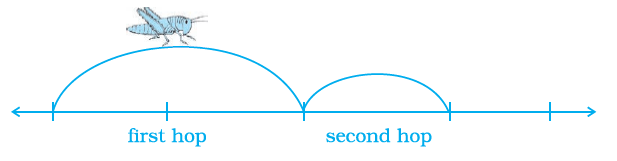
(a) Make a table showing the insect’s location for the first 10 hops.
(b) Where will the insect be after n hops?
(c) Will the insect ever get to 1? Explain.
Answer:
Solution (a): Make a table showing the insect’s location for the first 10 hops.
In each hop, the insect covers half of the remaining distance to 1. The location after $n$ hops is given by $1 - (\frac{1}{2})^n$.
| Hop Number ($n$) | Location Calculation | Location on Number Line |
| 1 | $1 - (1/2)^1$ | $1/2$ |
| 2 | $1 - (1/2)^2$ | $3/4$ |
| 3 | $1 - (1/2)^3$ | $7/8$ |
| 4 | $1 - (1/2)^4$ | $15/16$ |
| 5 | $1 - (1/2)^5$ | $31/32$ |
| 6 | $1 - (1/2)^6$ | $63/64$ |
| 7 | $1 - (1/2)^7$ | $127/128$ |
| 8 | $1 - (1/2)^8$ | $255/256$ |
| 9 | $1 - (1/2)^9$ | $511/512$ |
| 10 | $1 - (1/2)^{10}$ | $1023/1024$ |
Solution (b): Where will the insect be after n hops?
As observed from the pattern in the table, the location of the insect after $n$ hops will be $1 - (\frac{1}{2})^n$.
Solution (c): Will the insect ever get to 1? Explain.
No, the insect will never reach exactly 1. Mathematically, for the insect to reach 1, the term $(\frac{1}{2})^n$ must become 0. However, for any finite number of hops $n$, $(\frac{1}{2})^n$ will always be a very small positive number, not zero. The insect gets infinitely close to 1, but there is always a tiny remaining distance to cover.
Question 128. Predicting the ones digit, copy and complete this table and answer the questions that follow.
| x | 1x | 2x | 3x | 4x | 5x | 6x | 7x | 8x | 9x | 10x |
|---|---|---|---|---|---|---|---|---|---|---|
| 1 | 1 | 2 | ||||||||
| 2 | 1 | 4 | ||||||||
| 3 | 1 | 8 | ||||||||
| 4 | 1 | 16 | ||||||||
| 5 | 1 | 32 | ||||||||
| 6 | 1 | 64 | ||||||||
| 7 | 1 | 128 | ||||||||
| 8 | 1 | 256 | ||||||||
| Ones Digits of the Powers | 1 | 2,4,8,6 |
(a) Describe patterns you see in the ones digits of the powers.
(b) Predict the ones digit in the following:
1. 412
2. 920
3. 317
4. 5100
5. 10500
(c) Predict the ones digit in the following:
1. 3110
2. 1210
3. 1721
4. 2910
Answer:
Completed Table of Powers:
| x (Exponent) | 1x | 2x | 3x | 4x | 5x | 6x | 7x | 8x | 9x | 10x |
|---|---|---|---|---|---|---|---|---|---|---|
| 1 | 1 | 2 | 3 | 4 | 5 | 6 | 7 | 8 | 9 | 10 |
| 2 | 1 | 4 | 9 | 16 | 25 | 36 | 49 | 64 | 81 | 100 |
| 3 | 1 | 8 | 27 | 64 | 125 | 216 | 343 | 512 | 729 | 1000 |
| 4 | 1 | 16 | 81 | 256 | 625 | 1296 | 2401 | 4096 | 6561 | 10000 |
| 5 | 1 | 32 | 243 | 1024 | 3125 | 7776 | 16807 | 32768 | 59049 | 100000 |
| 6 | 1 | 64 | 729 | 4096 | 15625 | 46656 | 117649 | 262144 | 531441 | 1000000 |
| 7 | 1 | 128 | 2187 | 16384 | 78125 | 279936 | 823543 | 2097152 | 4782969 | 10000000 |
| 8 | 1 | 256 | 6561 | 65536 | 327680 | 1679616 | 5764801 | 16777216 | 43046721 | 100000000 |
| Ones Digits | 1 | 2, 4, 8, 6 | 3, 9, 7, 1 | 4, 6 | 5 | 6 | 7, 9, 3, 1 | 8, 4, 2, 6 | 9, 1 | 0 |
(a) Describe patterns you see in the ones digits of the powers.
The patterns observed in the ones digits are known as cyclicity. The cycles for different bases are:
1. Bases 1, 5, 6, 10: These have a cyclicity of 1. The ones digit never changes regardless of the power.
2. Bases 4, 9: These have a cyclicity of 2. The ones digits alternate (4 $\rightarrow$ 6 and 9 $\rightarrow$ 1).
3. Bases 2, 3, 7, 8: These have a cyclicity of 4. The sequence of ones digits repeats every four steps.
(b) Predict the ones digit in the following:
1. 412: Cyclicity of 4 is (4, 6). Since 12 is an even power, the ones digit is 6.
2. 920: Cyclicity of 9 is (9, 1). Since 20 is an even power, the ones digit is 1.
3. 317: Cyclicity of 3 is (3, 9, 7, 1). $17 \div 4$ gives remainder 1. So, ones digit is the same as 31, which is 3.
4. 5100: Base is 5. Any power of 5 results in a ones digit of 5.
5. 10500: Base is 10. Any positive power results in a ones digit of 0.
(c) Predict the ones digit in the following:
1. 3110: Base ends in 1. Ones digit is 1.
2. 1210: Base ends in 2. Cyclicity is (2, 4, 8, 6). $10 \div 4$ gives remainder 2. The 2nd digit in cycle is 4.
3. 1721: Base ends in 7. Cyclicity is (7, 9, 3, 1). $21 \div 4$ gives remainder 1. The 1st digit in cycle is 7.
4. 2910: Base ends in 9. Since the power 10 is even, the ones digit is 1.
Question 129. Astronomy The table shows the mass of the planets, the sun and the moon in our solar system.
| Celestial Body | Mass (kg) | Mass (kg) Standard Notation |
|---|---|---|
| Sun | 1,990,000,000,000,000,000,000,000,000,000 | 1.99 × 1030 |
| Mercury | 330,000,000,000,000,000,000,000 | |
| Venus | 4,870,000,000,000,000,000,000,000 | |
| Earth | 5,970,000,000,000,000,000,000,000 | |
| Mars | 642,000,000,000,000,000,000,000 | |
| Jupiter | 1,900,000,000,000,000,000,000,000,000 | |
| Saturn | 568,000,000,000,000,000,000,000,000 | |
| Uranus | 86,800,000,000,000,000,000,000,000 | |
| Neptune | 102,000,000,000,000,000,000,000,000 | |
| Pluto | 12,700,000,000,000,000,000,000 | |
| Moon | 73,500,000,000,000,000,000,000 |
(a) Write the mass of each planet and the Moon in scientific notation.
(b) Order the planets and the moon by mass, from least to greatest.
(c) Which planet has about the same mass as earth?
Answer:
Below is the completed table showing the mass of each celestial body in standard notation.
| Celestial Body | Mass (kg) | Mass (kg) Standard Notation |
| Sun | 1,990,000,000,000,000,000,000,000,000,000 | $1.99 \times 10^{30}$ |
| Mercury | 330,000,000,000,000,000,000,000 | $3.30 \times 10^{23}$ |
| Venus | 4,870,000,000,000,000,000,000,000 | $4.87 \times 10^{24}$ |
| Earth | 5,970,000,000,000,000,000,000,000 | $5.97 \times 10^{24}$ |
| Mars | 642,000,000,000,000,000,000,000 | $6.42 \times 10^{23}$ |
| Jupiter | 1,900,000,000,000,000,000,000,000,000 | $1.90 \times 10^{27}$ |
| Saturn | 568,000,000,000,000,000,000,000,000 | $5.68 \times 10^{26}$ |
| Uranus | 86,800,000,000,000,000,000,000,000 | $8.68 \times 10^{25}$ |
| Neptune | 102,000,000,000,000,000,000,000,000 | $1.02 \times 10^{26}$ |
| Pluto | 12,700,000,000,000,000,000,000 | $1.27 \times 10^{22}$ |
| Moon | 73,500,000,000,000,000,000,000 | $7.35 \times 10^{22}$ |
(a) The mass of each planet and the Moon in scientific notation:
Mercury: $3.30 \times 10^{23}$ kg
Venus: $4.87 \times 10^{24}$ kg
Earth: $5.97 \times 10^{24}$ kg
Mars: $6.42 \times 10^{23}$ kg
Jupiter: $1.90 \times 10^{27}$ kg
Saturn: $5.68 \times 10^{26}$ kg
Uranus: $8.68 \times 10^{25}$ kg
Neptune: $1.02 \times 10^{26}$ kg
Pluto: $1.27 \times 10^{22}$ kg
Moon: $7.35 \times 10^{22}$ kg
(b) Ordering the planets and the moon by mass, from least to greatest:
To order by mass, we compare the exponents first, then the coefficient (the number before $\times 10$).
The masses (in kg) are approximately:
Pluto: $1.27 \times 10^{22}$
Moon: $7.35 \times 10^{22}$
Mercury: $3.30 \times 10^{23}$
Mars: $6.42 \times 10^{23}$
Venus: $4.87 \times 10^{24}$
Earth: $5.97 \times 10^{24}$
Uranus: $8.68 \times 10^{25}$
Neptune: $1.02 \times 10^{26}$
Saturn: $5.68 \times 10^{26}$
Jupiter: $1.90 \times 10^{27}$
Ordering from least to greatest mass:
Pluto, Moon, Mercury, Mars, Venus, Earth, Uranus, Neptune, Saturn, Jupiter.
(c) Which planet has about the same mass as earth?
Earth's mass is $5.97 \times 10^{24}$ kg.
Comparing this to the other planetary masses:
Venus has a mass of $4.87 \times 10^{24}$ kg. This is the closest mass among the planets to Earth's mass, having the same exponent ($10^{24}$) and a coefficient ($4.87$) that is relatively close to Earth's coefficient ($5.97$).
The planet with about the same mass as Earth is Venus.
Question 130. Investigating Solar System The table shows the average distance from each planet in our solar system to the sun.
| Planet | Distance from Sun (km) | Distance from sun (km) Standard Notation |
|---|---|---|
| Earth | 149,600,000 | 1.496 × 10 8 |
| Jupiter | 778,300,000 | |
| Mars | 227,900,000 | |
| Mercury | 57,900,000 | |
| Neptune | 4,497,000,000 | |
| Pluto | 5,900,000,000 | |
| Saturn | 1,427,000,000 | |
| Uranus | 2,870,000,000 | |
| Venus | 108,200,000 |
(a) Complete the table by expressing the distance from each planet to the Sun in scientific notation.
(b) Order the planets from closest to the sun to farthest from the sun.
Answer:
Below is the completed table showing the average distance from each planet to the Sun in standard notation.
| Planet | Distance from Sun (km) | Distance from Sun (km) Standard Notation |
| Earth | 149,600,000 | $1.496 \times 10^{8}$ |
| Jupiter | 778,300,000 | $7.783 \times 10^{8}$ |
| Mars | 227,900,000 | $2.279 \times 10^{8}$ |
| Mercury | 57,900,000 | $5.79 \times 10^{7}$ |
| Neptune | 4,497,000,000 | $4.497 \times 10^{9}$ |
| Pluto | 5,900,000,000 | $5.90 \times 10^{9}$ |
| Saturn | 1,427,000,000 | $1.427 \times 10^{9}$ |
| Uranus | 2,870,000,000 | $2.870 \times 10^{9}$ |
| Venus | 108,200,000 | $1.082 \times 10^{8}$ |
(a) The distance from each planet to the Sun in scientific notation:
Earth: $1.496 \times 10^{8}$ km
Jupiter: $7.783 \times 10^{8}$ km
Mars: $2.279 \times 10^{8}$ km
Mercury: $5.79 \times 10^{7}$ km
Neptune: $4.497 \times 10^{9}$ km
Pluto: $5.90 \times 10^{9}$ km
Saturn: $1.427 \times 10^{9}$ km
Uranus: $2.870 \times 10^{9}$ km
Venus: $1.082 \times 10^{8}$ km
(b) Ordering the planets from closest to the sun to farthest from the sun:
We compare the exponents first. The smallest exponent means the closest distance. If exponents are the same, we compare the coefficient.
The exponents are 7, 8, and 9.
$10^7$: Mercury ($5.79$)
$10^8$: Venus ($1.082$), Earth ($1.496$), Mars ($2.279$), Jupiter ($7.783$)
$10^9$: Saturn ($1.427$), Uranus ($2.870$), Neptune ($4.497$), Pluto ($5.90$)
Ordering the planets from closest to farthest:
Mercury, Venus, Earth, Mars, Jupiter, Saturn, Uranus, Neptune, Pluto.
Question 131. This table shows the mass of one atom for five chemical elements. Use it to answer the question given.
| Element | Mass of atom (kg) |
|---|---|
| Titanium | 7.95 × 10⁻²⁶ |
| Lead | 3.44 × 10⁻²⁵ |
| Silver | 1.44 × 10⁻²⁵ |
| Lithium | 1.15 × 10⁻²⁶ |
| Hydrogen | 1.674 × 10⁻²⁷ |
(a) Which is the heaviest element?
(b) Which element is lighter, Silver or Titanium?
(c) List all five elements in order from lightest to heaviest.
Answer:
Solution:
To compare numbers in scientific notation, we first look at the power of 10. The number with the higher exponent (closer to zero for negative exponents) is larger. If the exponents are the same, we compare the numerical coefficients.
(a) Which is the heaviest element?
The exponents are $-25, -26,$ and $-27$. Among these, $-25$ is the largest power.
Comparing elements with $10^{-25}$:
Lead: $3.44 \times 10^{-25}$ kg
Silver: $1.44 \times 10^{-25}$ kg
Since $3.44 > 1.44$, Lead is the heaviest element.
(b) Which element is lighter, Silver or Titanium?
Silver: $1.44 \times 10^{-25}$ kg
Titanium: $7.95 \times 10^{-26}$ kg
To compare, let's write them with the same exponent:
Silver: $1.44 \times 10^{-25}$ kg
Titanium: $0.795 \times 10^{-25}$ kg
Since $0.795 < 1.44$, Titanium is lighter than Silver.
(c) List all five elements in order from lightest to heaviest.
Let's convert all masses to the same exponent ($10^{-27}$) for easy comparison:
1. Hydrogen: $1.674 \times 10^{-27}$ kg
2. Lithium: $11.5 \times 10^{-27}$ kg ($1.15 \times 10^{-26}$)
3. Titanium: $79.5 \times 10^{-27}$ kg ($7.95 \times 10^{-26}$)
4. Silver: $144 \times 10^{-27}$ kg ($1.44 \times 10^{-25}$)
5. Lead: $344 \times 10^{-27}$ kg ($3.44 \times 10^{-25}$)
The order from lightest to heaviest is: Hydrogen < Lithium < Titanium < Silver < Lead.
Question 132. The planet Uranus is approximately 2,896,819,200,000 metres away from the Sun. What is this distance in standard form?
Answer:
Given:
Distance = $2,896,819,200,000$ m
Solution:
In the Indian perspective, this distance is 2 Lakh 89 Thousand 681 Crore 92 Lakh metres.
To express a number in standard form ($m \times 10^n$), we move the decimal point so that there is exactly one non-zero digit to the left of the decimal point.
For the number $2,896,819,200,000$, the decimal point is currently at the very end. We move it 12 places to the left to place it between the first 2 and the 8.
Since the decimal is moved to the left, the exponent of 10 is positive.
$2,896,819,200,000 = 2.8968192 \times 10^{12}$
Hence, the distance in standard form is $2.8968192 \times 10^{12}$ m.
Question 133. An inch is approximately equal to 0.02543 metres. Write this distance in standard form.
Answer:
To Find: The standard form of the distance $0.02543$ metres.
To express a number in standard form, we write it as $a \times 10^n$, where $1 \leq a < 10$.
$0.02543 = 2.543 \times 10^{-2}$
(Moving decimal 2 places to the right)
The distance in standard form is $2.543 \times 10^{-2}$ metres.
Question 134. The volume of the Earth is approximately 7.67 × 10⁻⁷ times the volume of the Sun. Express this figure in usual form.
Answer:
To Find: Express $7.67 \times 10^{-7}$ in usual form.
Since the exponent is $-7$, we move the decimal point 7 places to the left.
$7.67 \times 10^{-7} = 0.000000767$
The usual form is $0.000000767$.
Question 135. An electron’s mass is approximately 9.1093826 × 10⁻³¹ kilograms. What is this mass in grams?
Answer:
Given:
Mass of an electron $\approx 9.1093826 \times 10^{-31}$ kilograms.
To Find: The mass in grams.
We know that:
$1 \text{ kg} = 1000 \text{ g} = 10^3 \text{ g}$
(Conversion Factor)
Now, we multiply the given mass by $10^3$ to convert it to grams:
$\text{Mass in grams} = 9.1093826 \times 10^{-31} \times 10^3$
Using the law of exponents $a^m \times a^n = a^{m+n}$:
$\text{Mass} = 9.1093826 \times 10^{-31 + 3}$
$\text{Mass} = 9.1093826 \times 10^{-28} \text{ g}$
The mass of an electron is $9.1093826 \times 10^{-28}$ grams.
Question 136. At the end of the 20th century, the world population was approximately 6.1 × 10⁹ people. Express this population in usual form. How would you say this number in words?
Answer:
Given: World population $\approx 6.1 \times 10^9$.
To Find: Usual form and words (Indian perspective).
(i) Usual Form:
$6.1 \times 10^9 = 6,100,000,000$
(ii) In Words:
In the Indian numbering system, the number $6,10,00,00,000$ is expressed as:
Six hundred and ten crore.
Alternatively, in the International system, it is 6.1 billion or Six billion one hundred million.
Question 137. While studying her family’s history. Shikha discovers records of ancestors 12 generations back. She wonders how many ancestors she has had in the past 12 generations. She starts to make a diagram to help her figure this out. The diagram soon becomes very complex.
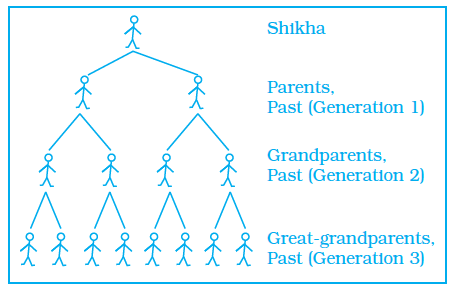
(a) Make a table and a graph showing the number of ancestors in each of the 12 generations.
(b) Write an equation for the number of ancestors in a given generation n.
Answer:
(a) Table of ancestors:
Shikha has 2 parents (Gen 1), 4 grandparents (Gen 2), and 8 great-grandparents (Gen 3). The number of ancestors doubles with each generation.
| Generation ($n$) | Number of Ancestors ($2^n$) |
| 1 | $2^1 = 2$ |
| 2 | $2^2 = 4$ |
| 3 | $2^3 = 8$ |
| 4 | $2^4 = 16$ |
| 5 | $2^5 = 32$ |
| 6 | $2^6 = 64$ |
| 7 | $2^7 = 128$ |
| 8 | $2^8 = 256$ |
| 9 | $2^9 = 512$ |
| 10 | $2^{10} = 1024$ |
| 11 | $2^{11} = 2048$ |
| 12 | $2^{12} = 4096$ |
Graph:
The graph will be an exponential curve starting at $(1, 2)$ and rising sharply to $(12, 4096)$ on a Cartesian plane where the x-axis represents the generation number and the y-axis represents the number of ancestors.
(b) Equation:
Let $A$ be the number of ancestors and $n$ be the generation number.
$A = 2^n$
Question 138. About 230 billion litres of water flows through a river each day. How many litres of water flows through that river in a week? How many litres of water flows through the river in an year? Write your answer in standard notation.
Answer:
Given: Water flow per day = 230 billion litres.
First, express the daily flow in standard notation:
1 billion = $10^9$
Daily flow = $230 \times 10^9 = 2.3 \times 10^{11}$ litres
(i) Water flow in a week:
There are 7 days in a week.
Weekly flow = $7 \times (2.3 \times 10^{11}) = 16.1 \times 10^{11}$
$\text{Weekly flow} = 1.61 \times 10^{12} \text{ litres}$
(ii) Water flow in a year:
Taking a non-leap year of 365 days:
Yearly flow = $365 \times (2.3 \times 10^{11}) = 839.5 \times 10^{11}$
$\text{Yearly flow} = 8.395 \times 10^{13} \text{ litres}$
Question 139. A half-life is the amount of time that it takes for a radioactive substance to decay to one half of its original quantity.
Suppose radioactive decay causes 300 grams of a substance to decrease to 300 × 2–3 grams after 3 half-lives. Evaluate 300 × 2–3 to determine how many grams of the substance are left.
Explain why the expression 300 × 2–n can be used to find the amount of the substance that remains after n half-lives.
Answer:
Evaluation:
The quantity of the substance remaining after 3 half-lives is $300 \times 2^{-3}$ grams.
Using the property $a^{-n} = \frac{1}{a^n}$:
$300 \times 2^{-3} = 300 \times \frac{1}{2^3}$
$300 \times 2^{-3} = \frac{300}{8}$
$\text{Remaining substance} = 37.5 \text{ grams}$
Explanation:
A half-life period means that the quantity of the substance is reduced to half ($\frac{1}{2}$) of its current amount. Mathematically, multiplying by $\frac{1}{2}$ is the same as multiplying by $2^{-1}$.
After 1 half-life, amount = $300 \times (\frac{1}{2})^1 = 300 \times 2^{-1}$
After 2 half-lives, amount = $300 \times (\frac{1}{2}) \times (\frac{1}{2}) = 300 \times (\frac{1}{2})^2 = 300 \times 2^{-2}$
Following this logic, after $n$ half-lives, the amount is multiplied by $(\frac{1}{2})$ a total of $n$ times.
$\text{Remaining amount} = 300 \times 2^{-n}$
[General expression for $n$ half-lives]
Question 140. Consider a quantity of a radioactive substance. The fraction of this quantity that remains after t half-lives can be found by using the expression 3–t.
(a) What fraction of substance remains after 7 half-lives?
(b) After how many half-lives will the fraction be $\frac{1}{243}$ of the original?
Answer:
Given:
The fraction of a radioactive substance remaining after $t$ half-lives is given by the expression $3^{-t}$.
(a) To Find: Fraction of substance remaining after 7 half-lives.
Here, $t = 7$. Substituting this value in the expression:
$\text{Fraction} = 3^{-7}$
(Substituting $t=7$)
$\text{Fraction} = \frac{1}{3^7}$
[Using $a^{-n} = \frac{1}{a^n}$]
Calculating $3^7$:
$3 \times 3 \times 3 \times 3 \times 3 \times 3 \times 3 = 2187$
$\text{Fraction} = \frac{1}{2187}$
(b) To Find: Number of half-lives ($t$) when the fraction is $\frac{1}{243}$.
We set the expression equal to the given fraction:
$3^{-t} = \frac{1}{243}$
(Given Condition)
We can write $243$ as a power of $3$:
$243 = 3 \times 3 \times 3 \times 3 \times 3 = 3^5$
So, the equation becomes:
$\frac{1}{3^t} = \frac{1}{3^5}$
Comparing the exponents on both sides:
$t = 5$
Thus, after 5 half-lives, the fraction will be $\frac{1}{243}$.
Question 141. One Fermi is equal to 10–15 metre. The radius of a proton is 1.3 Fermis. Write the radius of a proton in metres in standard form.
Answer:
Given:
1 Fermi = $10^{-15}$ metre
Radius of a proton = $1.3$ Fermis
To Find: Radius of a proton in metres in standard form.
To convert Fermis to metres, we multiply the given radius by the value of 1 Fermi:
$\text{Radius} = 1.3 \times 10^{-15} \text{ metres}$
Standard form is $a \times 10^n$ where $1 \leq a < 10$. Since $1.3$ is already between 1 and 10, the expression is already in standard form.
$\text{Radius} = 1.3 \times 10^{-15} \text{ m}$
The radius of a proton is $1.3 \times 10^{-15}$ metres.
Question 142. The paper clip below has the indicated length. What is the length in standard form.
Answer:
Given:
Length of the paper clip = $0.05$ m
To Find: Length in standard form.
To write $0.05$ in standard form, we move the decimal point two places to the right:
$0.05 = 5.0 \times 10^{-2}$
[Moving decimal 2 places right]
The length of the paper clip in standard form is $5 \times 10^{-2}$ m.
Question 143. Use the properties of exponents to verify that each statement is true.
(a) $\frac{1}{4}$ (2n) = 2n - 2
(b) 4n - 1 = $\frac{1}{4}$ (4)n
(c) 25(5n – 2) = 5n
Answer:
To Prove: Verification of exponential statements.
(a) $\frac{1}{4} (2^n) = 2^{n - 2}$
L.H.S. $= \frac{1}{4} \times 2^n$
We know that $4 = 2^2$. So,
L.H.S. $= \frac{1}{2^2} \times 2^n$
Using law of exponents $\frac{a^m}{a^n} = a^{m-n}$:
L.H.S. $= 2^{n-2}$
$\text{L.H.S.} = \text{R.H.S.}$
(Hence Verified)
(b) $4^{n - 1} = \frac{1}{4} (4)^n$
R.H.S. $= \frac{1}{4} \times 4^n$
R.H.S. $= \frac{4^n}{4^1}$
Using law of exponents $\frac{a^m}{a^n} = a^{m-n}$:
R.H.S. $= 4^{n-1}$
$\text{R.H.S.} = \text{L.H.S.}$
(Hence Verified)
(c) $25(5^{n - 2}) = 5^n$
L.H.S. $= 25 \times 5^{n-2}$
We know that $25 = 5^2$. So,
L.H.S. $= 5^2 \times 5^{n-2}$
Using law of exponents $a^m \times a^n = a^{m+n}$:
L.H.S. $= 5^{2 + (n - 2)}$
$\text{L.H.S.} = 5^n$
... (i)
$\text{L.H.S.} = \text{R.H.S.}$
(Hence Verified)
Question 144. Fill in the blanks

Answer:
To Find: Fill in the blank circles in the diagram.
Let the blanks be $B_1, B_2,$ and $B_3$.
Step 1: Calculate the first blank
$B_1 = 144 \times 2^{-3}$
$B_1 = 144 \times \frac{1}{2^3} = \frac{144}{8}$
$B_1 = 18$
... (i)
Step 2: Calculate the second blank
$B_2 = B_1 \times 12^{-1}$
$B_2 = 18 \times \frac{1}{12} = \frac{18}{12}$
$B_2 = \frac{3}{2} = 1.5$
... (ii)
Step 3: Calculate the third blank
$B_3 = B_2 \times 3^{-2}$
$B_3 = \frac{3}{2} \times \frac{1}{3^2} = \frac{3}{2} \times \frac{1}{9}$
$B_3 = \frac{3}{18}$
$B_3 = \frac{1}{6}$
... (iii)
The values for the circles are 18, 1.5, and 1/6 respectively.
Question 145. There are 864,00 seconds in a day. How many days long is a second? Express your answer in scientific notation.
Answer:
Given:
Number of seconds in a day = $86,400$
To Find:
The length of a second in terms of days, expressed in scientific notation.
Solution:
To find how many days long a second is, we need to find the reciprocal of the total number of seconds in a day.
$\text{Length of a second} = \frac{1}{86,400} \text{ days}$
First, let us write $86,400$ in scientific notation:
$86,400 = 8.64 \times 10^4$
(Standard Form)
Now, we calculate the value:
$\text{Length} = \frac{1}{8.64 \times 10^4}$
$\text{Length} \approx 0.000011574 \text{ days}$
To express this in scientific notation (standard form $a \times 10^n$ where $1 \leq a < 10$):
$\text{Length} = 1.1574 \times 10^{-5} \text{ days}$
The length of a second is approximately $1.1574 \times 10^{-5}$ days.
Question 146. The given table shows the crop production of a State in the year 2008 and 2009. Observe the table given below and answer the given questions.
| Crop | 2008 Harvest (Hectare) | Increase/Decrease (Hectare) in 2009 |
|---|---|---|
| Bajra | 1.4 × 10³ | - 100 |
| Jowar | 1.7 × 10⁶ | - 440,000 |
| Rice | 3.7 × 10³ | - 100 |
| Wheat | 5.1 × 10⁵ | + 190,000 |
(a) For which crop(s) did the production decrease?
(b) Write the production of all the crops in 2009 in their standard form.
(c) Assuming the same decrease in rice production each year as in 2009, how many acres will be harvested in 2015? Write in standard form.
Answer:
(a) For which crop(s) did the production decrease?
Based on the "Increase/Decrease" column in the table, a negative sign indicates a decrease.
$\text{Bajra: } -100, \text{ Jowar: } -4,40,000, \text{ Rice: } -100$
Therefore, the production decreased for Bajra, Jowar, and Rice.
(b) Write the production of all the crops in 2009 in their standard form.
We calculate the 2009 harvest by adding/subtracting the change from the 2008 harvest.
1. Bajra:
$2008 \text{ Harvest} = 1.4 \times 10^3 = 1400$
$2009 \text{ Harvest} = 1400 - 100 = 1300$
Standard form: $1.3 \times 10^3$
2. Jowar:
$2008 \text{ Harvest} = 1.7 \times 10^6 = 17,00,000$
$2009 \text{ Harvest} = 17,00,000 - 4,40,000 = 12,60,000$
Standard form: $1.26 \times 10^6$
3. Rice:
$2008 \text{ Harvest} = 3.7 \times 10^3 = 3700$
$2009 \text{ Harvest} = 3700 - 100 = 3600$
Standard form: $3.6 \times 10^3$
4. Wheat:
$2008 \text{ Harvest} = 5.1 \times 10^5 = 5,10,000$
$2009 \text{ Harvest} = 5,10,000 + 1,90,000 = 7,00,000$
Standard form: $7.0 \times 10^5$
| Crop | 2009 Harvest (Hectare) | Standard Form |
| Bajra | 1,300 | $1.3 \times 10^3$ |
| Jowar | 12,60,000 | $1.26 \times 10^6$ |
| Rice | 3,600 | $3.6 \times 10^3$ |
| Wheat | 7,00,000 | $7.0 \times 10^5$ |
(c) Rice production in 2015 assuming same annual decrease.
Given:
Initial production (2008) = $3700$ hectares.
Annual decrease = $100$ hectares.
Number of years from 2008 to 2015 = $2015 - 2008 = 7$ years.
To Find:
Production in 2015 in standard form.
Solution:
Total decrease over 7 years = $7 \times 100 = 700$ hectares.
Production in 2015 = $3700 - 700$
$\text{Production in 2015} = 3000$
Converting to standard form:
$3000 = 3.0 \times 10^3$
(Standard Form)
The production in 2015 will be $3.0 \times 10^3$ hectares.
Question 147. Stretching Machine
Suppose you have a stretching machine which could stretch almost anything. For example, if you put a 5 metre stick into a (× 4) stretching machine (as shown below), you get a 20 metre stick.
Now if you put 10 cm carrot into a (× 4) machine, how long will it be when it comes out?
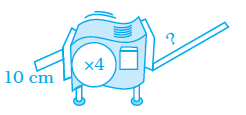
Answer:
Given:
Input length of carrot = $10 \text{ cm}$
Stretching factor of the machine = $\times 4$
To Find:
The output length of the carrot.
Solution:
The stretching machine multiplies the length of the input object by the stretching factor indicated on the machine.
$\text{Output length} = \text{Input length} \times \text{Factor}$
Substituting the given values:
$\text{Output length} = 10 \text{ cm} \times 4$
$\text{Output length} = 40 \text{ cm}$
The carrot will be 40 cm long when it comes out of the machine.
Question 148. Two machines can be hooked together. When something is sent through this hook up, the output from the first machine becomes the input for the second.
(a) Which two machines hooked together do the same work a (× 102) machine does? Is there more than one arrangement of two machines that will work?

(b) Which stretching machine does the same work as two (× 2) machines hooked together?


Answer:
(a) Solution:
A $(\times 10^2)$ machine is equivalent to a $(\times 100)$ machine.
When two machines are hooked together, their stretching factors are multiplied. To find which two machines hooked together equal a $(\times 100)$ machine, we look for factors of 100.
One possible arrangement is hooking two $(\times 10)$ machines together.
$10 \times 10 = 100 = 10^2$
Is there more than one arrangement?
Yes, there are several arrangements possible because there are many pairs of factors for 100. Other arrangements include:
1. A $(\times 2)$ machine and a $(\times 50)$ machine.
2. A $(\times 4)$ machine and a $(\times 25)$ machine.
3. A $(\times 5)$ machine and a $(\times 20)$ machine.
(b) Solution:
To find the single machine equivalent to two $(\times 2)$ machines hooked together, we multiply the factors of both machines.
$\text{Combined factor} = 2 \times 2$
$\text{Combined factor} = 4$
Therefore, a $(\times 4)$ stretching machine does the same work as two $(\times 2)$ machines hooked together.
Question 149. Repeater Machine
Similarly, repeater machine is a hypothetical machine which automatically enlarges items several times. For example, sending a piece of wire through a (× 24) machine is the same as putting it through a (× 2) machine four times. So, if you send a 3 cm piece of wire through a (× 24) machine, its length becomes 3 × 2 × 2 × 2 × 2 = 48 cm. It can also be written that a base (2) machine is being applied 4 times.
What will be the new length of a 4 cm strip inserted in the machine?
Answer:
Given:
Initial length of the strip = $4 \text{ cm}$
Repeater machine factor = $(\times 2^4)$
To Find:
The new length of the strip after passing through the machine.
Solution:
The repeater machine $(\times 2^4)$ applies the base stretch of 2, four times consecutively. This means the total stretching factor is $2^4$.
$\text{Total stretch} = 2^4$
$\text{Total stretch} = 2 \times 2 \times 2 \times 2 = 16$
Now, we calculate the final length of the strip by multiplying the input length with the total stretch factor:
$\text{New Length} = \text{Input Length} \times \text{Total stretch}$
$\text{New Length} = 4 \text{ cm} \times 16$
$\text{New Length} = 64 \text{ cm}$
The new length of the strip will be 64 cm.
Question 150. For the following repeater machines, how many times the base machine is applied and how much the total stretch is?
Answer:
To Find:
Number of times the base machine is applied and the total stretch for machines (a), (b), and (c).
Solution:
In a repeater machine $(\times \text{base}^{\text{power}})$, the base represents the multiplier of the single machine, and the power (exponent) represents how many times that base machine is applied.
| Machine | Base Machine Applied (Times) | Calculation of Total Stretch | Total Stretch |
| (a) $(\times 100^2)$ | 2 | $100 \times 100$ | $10,000$ |
| (b) $(\times 7^5)$ | 5 | $7 \times 7 \times 7 \times 7 \times 7$ | $16,807$ |
| (c) $(\times 5^7)$ | 7 | $5 \times 5 \times 5 \times 5 \times 5 \times 5 \times 5$ | $78,125$ |
For machine (a), the base 100 is applied 2 times for a total stretch of 10,000.
For machine (b), the base 7 is applied 5 times for a total stretch of 16,807.
For machine (c), the base 5 is applied 7 times for a total stretch of 78,125.
Question 151. Find three repeater machines that will do the same work as a (×64) machine. Draw them, or describe them using exponents.
Answer:
To Find:
Three repeater machines equivalent to a $(\times 64)$ machine.
Solution:
To find equivalent repeater machines, we need to express $64$ as a power of different bases (where the base and exponent are integers).
1. Using Base 8:
Since $8 \times 8 = 64$, we can write this as $8^2$.
$\text{Machine 1} = (\times 8^2)$
(Base 8 applied 2 times)
2. Using Base 4:
Since $4 \times 4 \times 4 = 64$, we can write this as $4^3$.
$\text{Machine 2} = (\times 4^3)$
(Base 4 applied 3 times)
3. Using Base 2:
Since $2 \times 2 \times 2 \times 2 \times 2 \times 2 = 64$, we can write this as $2^6$.
$\text{Machine 3} = (\times 2^6)$
(Base 2 applied 6 times)
Thus, the three repeater machines are $(\times 8^2)$, $(\times 4^3)$, and $(\times 2^6)$.
Question 152. What will the following machine do to a 2 cm long piece of chalk?

Answer:
Given:
Initial length of the piece of chalk = $2 \text{ cm}$
Repeater machine factor = $(\times 1^{100})$
To Find:
The length of the chalk after it passes through the machine.
Solution:
The repeater machine $(\times 1^{100})$ applies the base stretch of 1, a total of 100 times. We know that the number 1 raised to any power remains 1.
$1^{100} = 1$
To find the output length, we multiply the input length by the total stretching factor:
$\text{Output length} = 2 \text{ cm} \times 1^{100}$
$\text{Output length} = 2 \text{ cm} \times 1$
$\text{Output length} = 2 \text{ cm}$
Therefore, the machine will not change the length of the chalk. The output remains 2 cm.
Question 153. In a repeater machine with 0 as an exponent, the base machine is applied 0 times.
(a) What do these machines do to a piece of chalk?

(b) What do you think the value of 60 is?
Answer:
(a) Solution:
In a repeater machine, the exponent tells us how many times the stretching factor is applied. If the exponent is $0$, it means the stretching action is applied zero times.
If you do not apply the stretching machine at all, the item remains exactly as it was. Thus, these machines do nothing to the piece of chalk; the piece of chalk stays the same length as its input length.
(b) Solution:
Since applying a repeater machine zero times leaves the object's length unchanged, it is mathematically equivalent to multiplying the length by 1.
Following this logic for any base $a$ (where $a \neq 0$), the value of the base raised to the power of 0 must be 1.
$6^0 = 1$
In general, according to the laws of exponents:
$x^0 = 1$
(For any non-zero $x$)
Therefore, the value of $6^0$ is 1.
Question 154. Shrinking Machine
In a shrinking machine, a piece of stick is compressed to reduce its length. If 9 cm long sandwich is put into the shrinking machine below, how many cm long will it be when it emerges?

Answer:
Given:
Input length of the sandwich = $9 \text{ cm}$
Machine base stretching factor (from image) = $\times 3$
Exponent (number of times applied) = $-1$
To Find:
The final length of the sandwich after it emerges from the machine.
Solution:
The repeater machine follows the rule where the total stretching factor is $(\text{base})^{\text{exponent}}$. In this case, the total factor is $3^{-1}$.
Using the law of exponents:
$a^{-n} = \frac{1}{a^n}$
(Property of negative exponents)
Therefore, the stretching factor is:
$3^{-1} = \frac{1}{3}$
To find the output length, we multiply the input length by the total stretching factor:
$\text{Output length} = \text{Input length} \times \text{Stretching factor}$
$\text{Output length} = 9 \text{ cm} \times \frac{1}{3}$
$\text{Output length} = 3 \text{ cm}$
The sandwich will be 3 cm long when it emerges from the machine.
Question 155. What happens when 1 cm worms are sent through these hook-ups?

Answer:
Given:
Initial length of the worms = $1 \text{ cm}$
Solution for Hook-up (i):
The first machine is a $(\times 2)$ machine and the second machine is a $(\times 2^{-1})$ machine.
When machines are hooked together, their total effect is the product of their factors:
$\text{Total factor} = 2^1 \times 2^{-1}$
Using the law of exponents $a^m \times a^n = a^{m+n}$:
$\text{Total factor} = 2^{1 + (-1)} = 2^0$
$\text{Total factor} = 1$
Now, calculate the final length:
$\text{Output length} = 1 \text{ cm} \times 1 = 1 \text{ cm}$
For hook-up (i), the worm remains 1 cm long.
Solution for Hook-up (ii):
The first machine is a $(\times 2^{-1})$ machine and the second machine is a $(\times 2^{-2})$ machine.
$\text{Total factor} = 2^{-1} \times 2^{-2}$
$\text{Total factor} = 2^{-1-2} = 2^{-3}$
Evaluating the factor:
$2^{-3} = \frac{1}{2^3} = \frac{1}{8}$
Now, calculate the final length:
$\text{Output length} = 1 \text{ cm} \times \frac{1}{8}$
$\text{Output length} = 0.125 \text{ cm}$
For hook-up (ii), the worm shrinks to 0.125 cm.
Question 156. Sanchay put a 1cm stick of gum through a (1 × 3–2) machine. How long was the stick when it came out?
Answer:
Given:
Initial length of the gum = $1 \text{ cm}$
Machine stretching factor = $3^{-2}$
To Find:
The final length of the stick when it emerges from the machine.
Solution:
The length of the object coming out of a repeater machine is the product of its initial length and the stretching factor.
The stretching factor is $3^{-2}$. We can rewrite this using the law of exponents:
$3^{-2} = \frac{1}{3^2}$
(Using $a^{-n} = \frac{1}{a^n}$)
$3^{-2} = \frac{1}{9}$
Now, we calculate the final length:
$\text{Final length} = 1 \text{ cm} \times \frac{1}{9}$
$\text{Final length} = \frac{1}{9} \text{ cm}$
In decimal form, this is approximately $0.11 \text{ cm}$.
Question 157. Ajay had a 1cm piece of gum. He put it through repeater machine given below and it came out $\frac{1}{100,000}$ cm long. What is the missing value?

Answer:
Given:
Initial length = $1 \text{ cm}$
Final length = $\frac{1}{1,00,000} \text{ cm}$
Base machine factor = $\frac{1}{10}$
To Find:
The missing value (exponent), let it be $n$.
Solution:
The machine operates by raising the base to the power of the exponent. The relationship is:
$\text{Initial length} \times (\text{Base})^n = \text{Final length}$
$1 \times (\frac{1}{10})^n = \frac{1}{1,00,000}$
(Substituting given values)
We can express $1,00,000$ as a power of 10:
$1,00,000 = 10^5$
So, the equation becomes:
$(\frac{1}{10})^n = \frac{1}{10^5}$
$(\frac{1}{10})^n = (\frac{1}{10})^5$
By comparing the exponents on both sides:
$n = 5$
The missing value in the machine is 5.
Question 158. Find a single machine that will do the same job as the given hook-up.
(a) a (× 23) machine followed by (× 2–2) machine.
(b) a (× 24) machine followed by $\left( \times\left( \frac{1}{2} \right)^{2} \right)$ machine.
(c) a (× 599) machine followed by a (5–100) machine.
Answer:
To Find:
A single equivalent machine factor for each hook-up.
Solution:
When machines are hooked together, the total stretching factor is found by multiplying the individual factors of each machine.
(a) $(\times 2^3)$ machine followed by $(\times 2^{-2})$ machine:
$\text{Total Factor} = 2^3 \times 2^{-2}$
$\text{Total Factor} = 2^{3 + (-2)}$
(Using $a^m \times a^n = a^{m+n}$)
$\text{Total Factor} = 2^1 = 2$
Single machine: $(\times 2)$.
(b) $(\times 2^4)$ machine followed by $(\times (\frac{1}{2})^2)$ machine:
First, express $(\frac{1}{2})^2$ as a power of 2:
$(\frac{1}{2})^2 = (2^{-1})^2 = 2^{-2}$
$\text{Total Factor} = 2^4 \times 2^{-2}$
$\text{Total Factor} = 2^{4-2} = 2^2 = 4$
Single machine: $(\times 4)$ or $(\times 2^2)$.
(c) $(\times 5^{99})$ machine followed by a $(5^{-100})$ machine:
$\text{Total Factor} = 5^{99} \times 5^{-100}$
$\text{Total Factor} = 5^{99 - 100}$
$\text{Total Factor} = 5^{-1} = \frac{1}{5}$
Single machine: $(\times 5^{-1})$ or $(\times 1/5)$.
Question 159. Find a single repeater machine that will do the same work as each hook-up.


Answer:
To Find:
A single equivalent repeater machine factor for the given hook-ups (a) through (f).
Solution:
When repeater machines are hooked together, the total stretching factor is the product of the stretching factors of the individual machines. We use the law of exponents: $a^m \times a^n = a^{m+n}$ and $a^m \times b^m = (ab)^m$.
(a) Hook-up of $(\times 2^2)$, $(\times 2^3)$, and $(\times 2^4)$:
$\text{Total Factor} = 2^2 \times 2^3 \times 2^4$
$\text{Total Factor} = 2^{2+3+4} = 2^9$
Single machine: $(\times 2^9)$.
(b) Hook-up of $(\times 100^2)$ and $(\times 100^{10})$:
$\text{Total Factor} = 100^2 \times 100^{10}$
$\text{Total Factor} = 100^{2+10} = 100^{12}$
Single machine: $(\times 100^{12})$.
(c) Hook-up of $(\times 7^{10})$, $(\times 7^{50})$, and $(\times 7^1)$:
$\text{Total Factor} = 7^{10} \times 7^{50} \times 7^1$
$\text{Total Factor} = 7^{10+50+1} = 7^{61}$
Single machine: $(\times 7^{61})$.
(d) Hook-up of $(\times 3^y)$ and $(\times 3^y)$:
$\text{Total Factor} = 3^y \times 3^y$
$\text{Total Factor} = 3^{y+y} = 3^{2y}$
Single machine: $(\times 3^{2y})$.
(e) Hook-up of $(\times 2^2)$, $(\times (\frac{1}{2})^3)$, and $(\times 2^4)$:
First, rewrite $(\frac{1}{2})^3$ as $2^{-3}$:
$\text{Total Factor} = 2^2 \times 2^{-3} \times 2^4$
$\text{Total Factor} = 2^{2-3+4} = 2^3$
Single machine: $(\times 2^3)$ or $(\times 8)$.
(f) Hook-up of $(\times (\frac{1}{2})^2)$ and $(\times (\frac{1}{3})^2)$:
Using the law $a^m \times b^m = (ab)^m$:
$\text{Total Factor} = (\frac{1}{2} \times \frac{1}{3})^2$
$\text{Total Factor} = (\frac{1}{6})^2$
Single machine: $(\times (\frac{1}{6})^2)$ or $(\times \frac{1}{36})$.
Question 160. For each hook-up, determine whether there is a single repeater machine that will do the same work. If so, describe or draw it.

Answer:
To Find:
A single equivalent repeater machine for hook-ups (a) to (e).
Solution:
A single repeater machine $(\times \text{base}^{\text{exponent}})$ is possible if the combined stretching factor of the hook-up can be expressed as a single base raised to an integer power.
(a) Hook-up of $(\times 7^3)$ and $(\times 7^2)$:
Since the bases are the same, we add the exponents:
$\text{Total Factor} = 7^3 \times 7^2 = 7^{3+2}$
$\text{Total Factor} = 7^5$
Yes, a single repeater machine $(\times 7^5)$ will do the same work.
(b) Hook-up of $(\times 2^3)$ and $(\times 3^2)$:
The total factor is the product of the two machines:
$\text{Total Factor} = 2^3 \times 3^2 = 8 \times 9$
$\text{Total Factor} = 72$
Since 72 cannot be written as a single integer base raised to a power greater than 1, there is no single repeater machine with a common base for this hook-up.
(c) Hook-up of $(\times 2^2)$, $(\times (\frac{1}{3})^3)$, and $(\times 5^4)$:
The total factor is:
$\text{Total Factor} = 2^2 \times (\frac{1}{3})^3 \times 5^4$
$\text{Total Factor} = 4 \times \frac{1}{27} \times 625 = \frac{2500}{27}$
As the bases 2, 3, and 5 are different primes, the result cannot be expressed as a single base raised to a power. Thus, no single repeater machine exists for this hook-up.
(d) Hook-up of $(\times 0.5^2)$ and $(\times 0.5^3)$:
Since the bases are the same, we add the exponents:
$\text{Total Factor} = 0.5^2 \times 0.5^3 = 0.5^{2+3}$
$\text{Total Factor} = 0.5^5$
Yes, a single repeater machine $(\times 0.5^5)$ will do the same work.
(e) Hook-up of $(\times 12^2)$ and $(\times 12^3)$:
Since the bases are the same, we add the exponents:
$\text{Total Factor} = 12^2 \times 12^3 = 12^{2+3}$
$\text{Total Factor} = 12^5$
Yes, a single repeater machine $(\times 12^5)$ will do the same work.
Question 161. Shikha has an order from a golf course designer to put palm trees through a (× 23) machine and then through a (× 33) machine. She thinks she can do the job with a single repeater machine. What single repeater machine should she use?

Answer:
Given:
First machine stretching factor = $2^3$
Second machine stretching factor = $3^3$
To Find:
A single repeater machine equivalent to the hook-up of these two machines.
Solution:
When two machines are hooked together, the total stretching factor is the product of the individual factors.
$\text{Total Stretch} = 2^3 \times 3^3$
According to the law of exponents, if the exponents are the same but the bases are different, we can multiply the bases:
$a^m \times b^m = (a \times b)^m$
Applying this rule to the given problem:
$\text{Total Stretch} = (2 \times 3)^3$
$\text{Total Stretch} = 6^3$
Therefore, the single repeater machine Shikha should use is $(\times 6^3)$.
Question 162. Neha needs to stretch some sticks to 252 times their original lengths, but her (× 25) machine is broken. Find a hook-up of two repeater machines that will do the same work as a (× 252) machine. To get started, think about the hookup you could use to replace the (× 25) machine.

Answer:
To Find:
A hook-up of two repeater machines equivalent to $(\times 25^2)$.
Solution:
We need a total stretch of $25^2$. Since the $(\times 25)$ machine is broken, we should use a different base to achieve the same result. We know that:
$25 = 5^2$
Therefore, the total required stretch can be expressed with base 5:
$25^2 = (5^2)^2$
Using the law $(a^m)^n = a^{m \times n}$:
$25^2 = 5^4$
To achieve a total stretch of $5^4$ using a hook-up of two machines, we can divide the exponent 4 into two parts (such as $2 + 2$ or $1 + 3$).
One possible arrangement is using two $(\times 5^2)$ machines hooked together:
$5^2 \times 5^2 = 5^{2+2} = 5^4 = 25^2$
Alternatively, if base 25 is strictly unavailable, she can use machines with base 5. Another hook-up could be $(\times 5^1)$ followed by $(\times 5^3)$.
Question 163. Supply the missing information for each diagram.
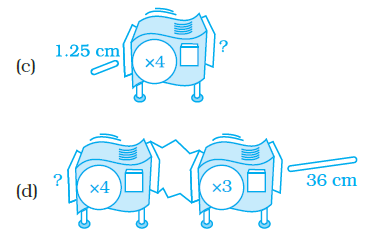
Answer:
(a) Solution:
Input length = $5 \text{ cm}$, Output length = $5 \text{ cm}$.
Since the length remains unchanged, the stretching factor is 1.
$\text{Factor} = \frac{5}{5} = 1$
In terms of exponents, any non-zero base raised to the power of 0 is 1. The missing machine is $(\times 1)$ or any $(\times a^0)$ machine.
(b) Solution:
Input length = $3 \text{ cm}$, Output length = $15 \text{ cm}$.
$\text{Factor} = \frac{15}{3} = 5$
The missing machine information is $(\times 5)$.
(c) Solution:
Input length = $1.25 \text{ cm}$, Machine factor = $(\times 4)$.
$\text{Output length} = 1.25 \times 4$
$\text{Output length} = 5 \text{ cm}$
The missing output value is 5 cm.
(d) Solution:
Two machines are hooked together: $(\times 4)$ and $(\times 3)$. Final Output = $36 \text{ cm}$.
First, find the total stretching factor:
$\text{Total Factor} = 4 \times 3 = 12$
Now, find the input length:
$\text{Input} \times 12 = 36$
$\text{Input} = \frac{36}{12} = 3 \text{ cm}$
The missing input value is 3 cm.
Question 164. If possible, find a hook-up of prime base number machine that will do the same work as the given stretching machine. Do not use (× 1) machines.

Answer:
To Find:
A hook-up of prime base machines for each given stretching factor.
Solution:
To find a hook-up of prime base machines, we perform prime factorisation of the given numbers.
(a) Stretching machine $(\times 100)$:
Prime factorisation of $100$:
$100 = 2 \times 2 \times 5 \times 5 = 2^2 \times 5^2$
The hook-up can be $(\times 2^2)$ machine followed by $(\times 5^2)$ machine.
(b) Stretching machine $(\times 99)$:
Prime factorisation of $99$:
$99 = 3 \times 3 \times 11 = 3^2 \times 11^1$
The hook-up can be $(\times 3^2)$ machine followed by $(\times 11^1)$ machine.
(c) Stretching machine $(\times 37)$:
The number $37$ is already a prime number. Since we are not allowed to use $(\times 1)$ machines, it is not possible to create a hook-up of multiple machines to achieve exactly 37.
(d) Stretching machine $(\times 1,111)$:
Prime factorisation of $1,111$:
$1,111 = 11 \times 101$
Both 11 and 101 are prime numbers. The hook-up can be $(\times 11^1)$ machine followed by $(\times 101^1)$ machine.
Question 165. Find two repeater machines that will do the same work as a (× 81) machine.
Answer:
To Find:
Two repeater machines that equivalent to a $(\times 81)$ machine when hooked together.
Solution:
We need to find two factors of $81$ that can be expressed as powers of the same or different bases. We know that:
$81 = 9 \times 9$
... (i)
Since $9 = 3^2$, we can also write:
$81 = 3^2 \times 3^2 = 3^4$
... (ii)
Possible hook-ups of two repeater machines are:
1. Two $(\times 9^1)$ machines.
2. Two $(\times 3^2)$ machines.
3. A $(\times 3^1)$ machine followed by a $(\times 3^3)$ machine.
Question 166, Find a repeater machine that will do the same work as a $\left( \times \frac{1}{8} \right)$ machine.
Answer:
To Find:
A repeater machine equivalent to $(\times \frac{1}{8})$.
Solution:
A repeater machine is usually expressed in the form $(\times \text{base}^{\text{exponent}})$. We can rewrite $\frac{1}{8}$ as a power of 2 or $\frac{1}{2}$.
We know that $8 = 2^3$. Using the law of exponents $a^{-n} = \frac{1}{a^n}$:
$\frac{1}{8} = \frac{1}{2^3} = 2^{-3}$
... (i)
Alternatively, using base $\frac{1}{2}$:
$\frac{1}{8} = (\frac{1}{2})^3$
... (ii)
The repeater machine can be described as $(\times 2^{-3})$ or $(\times (\frac{1}{2})^3)$.
Question 167. Find three machines that can be replaced with hook-ups of (× 5) machines.
Answer:
To Find:
Three machines that are equivalent to hook-ups of $(\times 5)$ machines.
Solution:
Hook-ups of $(\times 5)$ machines mean we are using base 5 with different positive integer exponents. We can choose any three powers of 5.
1. First Machine:
A hook-up of two $(\times 5)$ machines:
$5 \times 5 = 5^2 = 25$
... (i)
This can be replaced by a $(\times 25)$ machine.
2. Second Machine:
A hook-up of three $(\times 5)$ machines:
$5 \times 5 \times 5 = 5^3 = 125$
... (ii)
This can be replaced by a $(\times 125)$ machine.
3. Third Machine:
A hook-up of four $(\times 5)$ machines:
$5 \times 5 \times 5 \times 5 = 5^4 = 625$
... (iii)
This can be replaced by a $(\times 625)$ machine.
Question 168. The left column of the chart lists the lengths of input pieces of ribbon. Stretching machines are listed across the top. The other entries are the outputs for sending the input ribbon from that row through the machine from that column. Copy and complete the chart.
| Input Length | Machine | |||
|---|---|---|---|---|
| × 2 | ||||
| 1 | 5 | |||
| 3 | 15 | |||
| 14 | 7 | |||
Answer:
Solution:
To complete the chart, we use the relationship: $\text{Input Length} \times \text{Machine Factor} = \text{Output Length}$.
Step 1: Finding Machine Factors and Inputs
From the second row: $\text{Input} \times 2 = 1$, so the first Input Length is $0.5$.
Using this input for the second column: $0.5 \times \text{Machine 2} = 5$, so Machine 2 is $\times 10$.
From the third row: $3 \times \text{Machine 4} = 15$, so Machine 4 is $\times 5$.
From the fourth row: $\text{Input} \times 2 = 14$, so the third Input Length is $7$.
Using this input for the third column: $7 \times \text{Machine 3} = 7$, so Machine 3 is $\times 1$.
Completed Chart:
| Input Length | $\times 2$ | $\times 10$ | $\times 1$ | $\times 5$ |
| 0.5 | 1 | 5 | 0.5 | 2.5 |
| 3 | 6 | 30 | 3 | 15 |
| 7 | 14 | 70 | 7 | 35 |
Question 169. The left column of the chart lists the lengths of input chains of gold. Repeater machines are listed across the top. The other entries are the outputs you get when you send the input chain from that row through the repeater machine from that column. Copy and complete the chart.
| Input Length | Repeater Machine | ||
|---|---|---|---|
| × 23 | |||
| 40 | 125 | ||
| 2 | |||
| 162 | |||
Answer:
Solution:
Step 1: Finding Missing Values
From the second row: $\text{Input} \times 2^3 = 40 \implies \text{Input} \times 8 = 40 \implies \text{Input} = 5$.
Using Input 5 for the third column: $5 \times \text{Machine 3} = 125 \implies \text{Machine 3} = 25$, which is $5^2$.
From the fourth row: The output is 162 in the second machine column. If we assume the input is 2 (from the third row), then $2 \times \text{Machine 2} = 162 \implies \text{Machine 2} = 81$, which is $3^4$.
Step 2: Calculating Remaining Outputs
For Input 5, Machine 2: $5 \times 3^4 = 5 \times 81 = 405$.
For Input 2, Machine 1: $2 \times 2^3 = 2 \times 8 = 16$.
For Input 2, Machine 3: $2 \times 5^2 = 2 \times 25 = 50$.
Completed Chart:
| Input Length | $\times 2^3$ | $\times 3^4$ | $\times 5^2$ |
| 5 | 40 | 405 | 125 |
| 2 | 16 | 162 | 50 |
Note: In the given table, the output 162 was listed in a separate row from input 2, but based on the common factors, it corresponds to input 2 passing through a $3^4$ machine.
Question 170. Long back in ancient times, a farmer saved the life of a king’s daughter. The king decided to reward the farmer with whatever he wished. The farmer, who was a chess champion, made an unusal request:
“I would like you to place 1 rupee on the first square of my chessboard, 2 rupees on the second square, 4 on the third square, 8 on the fourth square, and so on, until you have covered all 64 squares.
Each square should have twice as many rupees as the previous square.” The king thought this to be too less and asked the farmer to think of some better reward, but the farmer didn’t agree.
How much money has the farmer earned?
[Hint: The following table may help you. What is the first square on which the king will place at least Rs 10 lakh?]
| Position of Square ib chess board | Amount (in Rs) |
|---|---|
| 1st square | 1 |
| 2nd square | 2 |
| 3rd square | 4 |
Answer:
Given:
Total squares on a chessboard = 64
Amount on the 1st square = $\textsf{₹} 1$
The amount doubles on each subsequent square.
To Find:
1. The total amount of money earned by the farmer.
2. The first square on which the king will place at least $\textsf{₹} 10 \text{ lakh}$.
Solution:
Step 1: Observe the pattern of money on each square
Let us express the amount on each square as a power of 2:
1st square = $1 = 2^0$
2nd square = $2 = 2^1$
3rd square = $4 = 2^2$
4th square = $8 = 2^3$
Following this pattern, the amount on the $n^{th}$ square is $2^{n-1}$.
Step 2: Calculate the total money earned
The total money is the sum of the amounts on all 64 squares:
$\text{Total Amount} = 2^0 + 2^1 + 2^2 + 2^3 + ... + 2^{63}$
In mathematics, the sum of such a doubling sequence is always one less than the next power of 2.
$\text{Total Amount} = 2^{64} - 1$
The farmer earned $\textsf{₹} (2^{64} - 1)$. This is an incredibly large value (more than 18 quintillion rupees).
Step 3: Find the square for at least $\textsf{₹} 10 \text{ lakh}$
In the Indian numbering system, $10 \text{ lakh} = 10,00,000$.
We need to find the smallest power of 2 that is greater than or equal to $10,00,000$.
We know that:
$2^{10} = 1024$
[Standard value]
Now, let us calculate $2^{20}$:
$2^{20} = 2^{10} \times 2^{10}$
$2^{20} = 1024 \times 1024 = 10,48,576$
Since $10,48,576$ is just over $10,00,000$, we can see that $2^{20}$ is the required power.
As we found in Step 1, the amount on the $n^{th}$ square is $2^{n-1}$. Therefore:
$n - 1 = 20$
$n = 21$
The 21st square is the first square on which the king will place at least $\textsf{₹} 10 \text{ lakh}$.
Question 171. The diameter of the Sun is 1.4 × 10⁹ m and the diameter of the Earth is 1.2756 × 10⁷ m. Compare their diameters by division.
Answer:
Given:
Diameter of the Sun ($D_s$) = $1.4 \times 10^9 \text{ m}$
Diameter of the Earth ($D_e$) = $1.2756 \times 10^7 \text{ m}$
Solution:
To compare the diameters, we divide $D_s$ by $D_e$:
$\text{Ratio} = \frac{1.4 \times 10^9}{1.2756 \times 10^7}$
Using law of exponents $\frac{a^m}{a^n} = a^{m-n}$:
$\text{Ratio} = \frac{1.4}{1.2756} \times 10^{9-7}$
$\text{Ratio} \approx 1.097 \times 10^2$
$\text{Ratio} \approx 109.7$
The diameter of the Sun is approximately 110 times the diameter of the Earth.
Question 172. Mass of Mars is 6.42 × 1029 kg and mass of the Sun is 1.99 × 1030 kg. What is the total mass?
Answer:
Given:
Mass of Mars = $6.42 \times 10^{29} \text{ kg}$
Mass of the Sun = $1.99 \times 10^{30} \text{ kg}$
Solution:
To find the total mass, we must express both masses with the same exponent of 10.
$\text{Mass of Mars} = 0.642 \times 10^{30} \text{ kg}$
Total Mass = Mass of Sun + Mass of Mars
$\text{Total Mass} = (1.99 + 0.642) \times 10^{30} \text{ kg}$
$\text{Total Mass} = 2.632 \times 10^{30} \text{ kg}$
The total mass is $2.632 \times 10^{30} \text{ kg}$.
Question 173. The distance between the Sun and the Earth is 1.496 × 10⁸ km and distance between the Earth and the Moon is 3.84 × 10⁸ m. During solar eclipse the Moon comes in between the Earth and the Sun. What is distance between the Moon and the Sun at that particular time?
Answer:
Given:
Distance (Sun to Earth) = $1.496 \times 10^8 \text{ km} = 14,96,00,000 \text{ km}$
Distance (Earth to Moon) = $3.84 \times 10^8 \text{ m} = 3,84,000 \text{ km}$
Solution:
During a solar eclipse, the Moon is between the Sun and the Earth.
Distance (Moon to Sun) = Distance (Sun to Earth) - Distance (Earth to Moon)
First, we convert both to standard notation in km:
$\text{Distance Sun-Earth} = 1.496 \times 10^8 \text{ km}$
$\text{Distance Earth-Moon} = 0.00384 \times 10^8 \text{ km}$
Subtracting the values:
$\text{Difference} = (1.496 - 0.00384) \times 10^8$
$\text{Distance Moon-Sun} = 1.49216 \times 10^8 \text{ km}$
The distance between the Moon and the Sun is $1.49216 \times 10^8 \text{ km}$.
Question 174. A particular star is at a distance of about 8.1 × 10¹³ km from the Earth. Assuring that light travels at 3 × 10⁸ m per second, find how long does light takes from that star to reach the Earth.
Answer:
Given:
Distance ($d$) = $8.1 \times 10^{13} \text{ km}$
Speed of light ($v$) = $3 \times 10^8 \text{ m/s}$
Solution:
First, convert distance into metres ($1 \text{ km} = 10^3 \text{ m}$):
$d = 8.1 \times 10^{13} \times 10^3 = 8.1 \times 10^{16} \text{ m}$
We use the formula $\text{Time} = \frac{\text{Distance}}{\text{Speed}}$:
$\text{Time} = \frac{8.1 \times 10^{16}}{3 \times 10^8}$
$\text{Time} = (\frac{8.1}{3}) \times 10^{16-8}$
$\text{Time} = 2.7 \times 10^8 \text{ seconds}$
Light takes $2.7 \times 10^8 \text{ seconds}$ to reach the Earth.
Question 175. By what number should (–15)–1 be divided so that the quotient may be equal to (–5)–1?
Answer:
To Find:
The number by which $(-15)^{-1}$ should be divided to get $(-5)^{-1}$.
Solution:
Let the required number be $x$.
According to the problem, we have:
$(-15)^{-1} \div x = (-5)^{-1}$
Using the law of exponents $a^{-1} = \frac{1}{a}$:
$\frac{1}{-15} \div x = \frac{1}{-5}$
$-\frac{1}{15x} = -\frac{1}{5}$
By cross-multiplying:
$15x = 5$
$x = \frac{5}{15}$
$x = \frac{1}{3}$
Therefore, $(-15)^{-1}$ should be divided by $1/3$.
Question 176. By what number should (–8)–3 be multiplied so that that the product may be equal to (–6)–3?
Answer:
To Find:
The number by which $(-8)^{-3}$ should be multiplied to get $(-6)^{-3}$.
Solution:
Let the required number be $x$.
According to the problem:
$(-8)^{-3} \times x = (-6)^{-3}$
Using the law of exponents $a^{-n} = \frac{1}{a^n}$:
$\frac{x}{(-8)^3} = \frac{1}{(-6)^3}$
$x = \frac{(-8)^3}{(-6)^3}$
Using the law $\frac{a^n}{b^n} = (\frac{a}{b})^n$:
$x = \left(\frac{-8}{-6}\right)^3$
$x = \left(\frac{4}{3}\right)^3$
$x = \frac{64}{27}$
Therefore, the number is $64/27$.
Question 177. Find x.
(1) $\left( -\frac{1}{7} \right)^{-5}$ ÷ $\left( -\frac{1}{7} \right)^{-7}$ = (-7)x
(2) $\left( \frac{2}{5} \right)^{2x+6}$ × $\left( \frac{2}{5} \right)^{3}$ = $\left( \frac{2}{5} \right)^{x+2}$
(3) 2x + 2x + 2x = 192
(4) $\left( \frac{-6}{7} \right)^{x-7}$ = 1
(5) 23x = 82x+1
(6) 5x + 5x–1 = 750
Answer:
Solution (1):
$\left( -\frac{1}{7} \right)^{-5} \div \left( -\frac{1}{7} \right)^{-7} = (-7)^x$
Using law $a^m \div a^n = a^{m-n}$:
$\left( -\frac{1}{7} \right)^{-5 - (-7)} = (-7)^x$
$\left( -\frac{1}{7} \right)^{2} = (-7)^x$
Since $(-\frac{1}{7}) = (-7)^{-1}$:
$(-7)^{-2} = (-7)^x$
Comparing exponents: $x = -2$.
Solution (2):
$\left( \frac{2}{5} \right)^{2x+6} \times \left( \frac{2}{5} \right)^{3} = \left( \frac{2}{5} \right)^{x+2}$
Using law $a^m \times a^n = a^{m+n}$:
$\left( \frac{2}{5} \right)^{2x+6+3} = \left( \frac{2}{5} \right)^{x+2}$
$2x + 9 = x + 2$
(Equating exponents)
$x = -7$
Solution (3):
$2^x + 2^x + 2^x = 192$
$3 \times 2^x = 192$
$2^x = \frac{192}{3} = 64$
Since $64 = 2^6$:
$2^x = 2^6$
Therefore, $x = 6$.
Solution (4):
$\left( \frac{-6}{7} \right)^{x-7} = 1$
We know that $a^0 = 1$ for any non-zero $a$. So:
$x - 7 = 0$
Therefore, $x = 7$.
Solution (5):
$2^{3x} = 8^{2x+1}$
Expressing 8 as a power of 2:
$2^{3x} = (2^3)^{2x+1}$
$2^{3x} = 2^{3(2x+1)}$
(Using $(a^m)^n = a^{mn}$)
Equating exponents:
$3x = 6x + 3$
$-3x = 3 \implies x = -1$
Solution (6):
$5^x + 5^{x-1} = 750$
$5^x + \frac{5^x}{5} = 750$
Taking $5^x$ as common:
$5^x \left( 1 + \frac{1}{5} \right) = 750$
$5^x \left( \frac{6}{5} \right) = 750$
$5^x = \frac{750 \times 5}{6} = 125 \times 5$
$5^x = 625$
Since $625 = 5^4$:
$5^x = 5^4$
Therefore, $x = 4$.
Question 178. If a = – 1, b = 2, then find the value of the following:
(1) ab + ba
(2) ab – ba
(3) ab × b2
(4) ab ÷ ba
Answer:
Given:
$a = -1$
$b = 2$
To Find:
The numerical value of the given exponential expressions.
Solution:
(1) Value of $a^b + b^a$:
Substituting the values of $a$ and $b$:
$(-1)^2 + (2)^{-1}$
$1 + \frac{1}{2}$
[Since $(-1)^{\text{even}} = 1$ and $x^{-1} = \frac{1}{x}$]
$\frac{2 + 1}{2} = \frac{3}{2}$
The value is 1.5 or $3/2$.
(2) Value of $a^b - b^a$:
Substituting the values of $a$ and $b$:
$(-1)^2 - (2)^{-1}$
$1 - \frac{1}{2}$
$\frac{2 - 1}{2} = \frac{1}{2}$
The value is 0.5 or $1/2$.
(3) Value of $a^b \times b^2$:
Substituting the values of $a$ and $b$:
$(-1)^2 \times (2)^2$
$1 \times 4 = 4$
The value is 4.
(4) Value of $a^b \div b^a$:
Substituting the values of $a$ and $b$:
$(-1)^2 \div (2)^{-1}$
$1 \div \frac{1}{2}$
$1 \times \frac{2}{1} = 2$
The value is 2.
Question 179. Express each of the following in exponential form:
(1) $\frac{-1296}{14641}$
(2) $\frac{-125}{343}$
(3) $\frac{400}{3969}$
(4) $\frac{-625}{10000}$
Answer:
To Find:
The exponential form of the given rational numbers.
Solution:
(1) Exponential form of $\frac{-1296}{14641}$
Let us find the prime factors of 1296 and 14641:
For 1296:
$\begin{array}{c|cc} 2 & 1296 \\ \hline 2 & 648 \\ \hline 2 & 324 \\ \hline 2 & 162 \\ \hline 3 & 81 \\ \hline 3 & 27 \\ \hline 3 & 9 \\ \hline 3 & 3 \\ \hline & 1 \end{array}$So, $1296 = 2^4 \times 3^4 = (2 \times 3)^4 = 6^4$.
For 14641:
$\begin{array}{c|cc} 11 & 14641 \\ \hline 11 & 1331 \\ \hline 11 & 121 \\ \hline 11 & 11 \\ \hline & 1 \end{array}$So, $14641 = 11^4$.
$\frac{-1296}{14641} = -\frac{6^4}{11^4} = -\left(\frac{6}{11}\right)^4$
(2) Exponential form of $\frac{-125}{343}$
Factorizing numerator and denominator:
$125 = 5 \times 5 \times 5 = 5^3$
$343 = 7 \times 7 \times 7 = 7^3$
$\frac{-125}{343} = \frac{(-5)^3}{7^3} = \left(-\frac{5}{7}\right)^3$
(3) Exponential form of $\frac{400}{3969}$
Factorizing numerator and denominator:
$400 = 20 \times 20 = 20^2$
$3969 = 63 \times 63 = 63^2$
$\frac{400}{3969} = \frac{20^2}{63^2} = \left(\frac{20}{63}\right)^2$
(4) Exponential form of $\frac{-625}{10000}$
Simplifying the fraction first:
$\frac{-625}{10000} = \frac{-\cancel{625}^1}{\cancel{10000}_{16}} = -\frac{1}{16}$
Now, $16 = 2^4$ and $1 = 1^4$.
$-\frac{1}{16} = -\frac{1^4}{2^4} = -\left(\frac{1}{2}\right)^4$
Question 180. Simplify:
(1) $\left[ \left( \frac{1}{2} \right)^{2} - \left( \frac{1}{4} \right)^{3} \right]^{-1} × 2^{-3}$
(2) $\left[ \left( \frac{4}{3} \right)^{-2} - \left( \frac{3}{4} \right)^{2} \right]^{(-2)}$
(3) $\left( \frac{4}{13} \right)^{4}$ × $\left( \frac{13}{7} \right)^{2}$ × $\left( \frac{7}{4} \right)^{3}$
(4) $\left( \frac{1}{5} \right)^{45}$ × $\left( \frac{1}{5} \right)^{-60}$ - $\left( \frac{1}{5} \right)^{+28}$ × $\left( \frac{1}{5} \right)^{-43}$
(5) $\frac{(9)^3 \;×\; 27 \;×\; t^4}{(3)^{−2} \;×\; (3)^4 \;×\; t^2}$
(6) $\frac{(3^{-2})^{2} \;×\; (5^{2})^{-3} \;×\; (t^{-3})^{2}}{(3^{-2})^{5} \;×\; (5^{3})^{-2} \;×\; (t^{-4})^{3}}$
Answer:
Solution (1):
Expression: $\left[ \left( \frac{1}{2} \right)^{2} - \left( \frac{1}{4} \right)^{3} \right]^{-1} \times 2^{-3}$
First, we evaluate the terms inside the square brackets:
$\left( \frac{1}{2} \right)^{2} = \frac{1}{4}$
(Square of $1/2$)
$\left( \frac{1}{4} \right)^{3} = \frac{1}{64}$
(Cube of $1/4$)
Subtracting these fractions:
$\frac{1}{4} - \frac{1}{64} = \frac{16 - 1}{64} = \frac{15}{64}$
Now, applying the exponent $-1$ to the result:
$\left( \frac{15}{64} \right)^{-1} = \frac{64}{15}$
[Using $a^{-1} = \frac{1}{a}$]
Finally, multiplying by $2^{-3}$:
$\frac{64}{15} \times \frac{1}{2^3} = \frac{64}{15} \times \frac{1}{8}$
$= \frac{\cancel{64}^{8}}{15 \times \cancel{8}_{1}} = \frac{8}{15}$
The simplified value is $8/15$.
Solution (2):
Expression: $\left[ \left( \frac{4}{3} \right)^{-2} - \left( \frac{3}{4} \right)^{2} \right]^{(-2)}$
First, we simplify the terms inside the square brackets:
$\left( \frac{4}{3} \right)^{-2} = \left( \frac{3}{4} \right)^{2}$
[Using $(\frac{a}{b})^{-n} = (\frac{b}{a})^n$]
The expression inside the bracket becomes:
$\left( \frac{3}{4} \right)^{2} - \left( \frac{3}{4} \right)^{2} = 0$
Now, applying the outer exponent:
$(0)^{-2} = \frac{1}{0^2}$
(Undefined)
Since division by zero is not possible, the value of this expression is undefined.
Solution (3):
Expression: $\left( \frac{4}{13} \right)^{4} \times \left( \frac{13}{7} \right)^{2} \times \left( \frac{7}{4} \right)^{3}$
We expand the powers:
$= \frac{4^4}{13^4} \times \frac{13^2}{7^2} \times \frac{7^3}{4^3}$
Regrouping the terms with same bases:
$= \frac{4^4}{4^3} \times \frac{13^2}{13^4} \times \frac{7^3}{7^2}$
Using the law $a^m \div a^n = a^{m-n}$:
$= 4^{4-3} \times 13^{2-4} \times 7^{3-2}$
$= 4^1 \times 13^{-2} \times 7^1 = \frac{4 \times 7}{13^2}$
$= \frac{28}{169}$
The simplified value is $28/169$.
Solution (4):
Expression: $\left( \frac{1}{5} \right)^{45} \times \left( \frac{1}{5} \right)^{-60} - \left( \frac{1}{5} \right)^{28} \times \left( \frac{1}{5} \right)^{-43}$
Using the law $a^m \times a^n = a^{m+n}$ for each part:
First part: $\left( \frac{1}{5} \right)^{45 - 60} = \left( \frac{1}{5} \right)^{-15}$
Second part: $\left( \frac{1}{5} \right)^{28 - 43} = \left( \frac{1}{5} \right)^{-15}$
Subtracting the two parts:
$\left( \frac{1}{5} \right)^{-15} - \left( \frac{1}{5} \right)^{-15} = 0$
The result is 0.
Solution (5):
Expression: $\frac{(9)^3 \times 27 \times t^4}{(3)^{-2} \times (3)^4 \times t^2}$
Convert everything to base 3 ($9 = 3^2$ and $27 = 3^3$):
Numerator: $(3^2)^3 \times 3^3 \times t^4 = 3^6 \times 3^3 \times t^4 = 3^9 t^4$
Denominator: $3^{-2} \times 3^4 \times t^2 = 3^{-2+4} \times t^2 = 3^2 t^2$
Now, divide the numerator by the denominator:
$\frac{3^9 t^4}{3^2 t^2} = 3^{9-2} \times t^{4-2} = 3^7 t^2$
$3^7 = 2187$
[As $3 \times 3 \times 3 \times 3 \times 3 \times 3 \times 3$]
The result is $2187 t^2$.
Solution (6):
Expression: $\frac{(3^{-2})^{2} \times (5^{2})^{-3} \times (t^{-3})^{2}}{(3^{-2})^{5} \times (5^{3})^{-2} \times (t^{-4})^{3}}$
Apply the power of a power law $(a^m)^n = a^{mn}$ to simplify:
Numerator: $3^{-4} \times 5^{-6} \times t^{-6}$
Denominator: $3^{-10} \times 5^{-6} \times t^{-12}$
Using the division law $a^m \div a^n = a^{m-n}$:
$3^{-4 - (-10)} \times 5^{-6 - (-6)} \times t^{-6 - (-12)}$
$3^{6} \times 5^{0} \times t^{6}$
Since $5^0 = 1$ and $3^6 = 729$:
$729 \times 1 \times t^6 = 729 t^6$
The result is $729 t^6$.