

Chapter 9 Comparing Quantities (Class 8 - Maths NCERT Exemplar Solutions)
Welcome to the comprehensive resource for NCERT Exemplar Solutions for Class 8 Mathematics: Chapter 9 Comparing Quantities! This chapter is strategically designed to move significantly beyond standard textbook exercises, demanding deeper conceptual understanding and sophisticated multi-step problem-solving. By integrating percentages, market dynamics, and interest calculations, these solutions build robust quantitative reasoning and practical application abilities essential for real-world mathematical mastery.
The solutions meticulously cover advanced applications of percentages, including the net effect of successive percentage changes and finding original values after fluctuations. Students will gain clarity on market concepts such as Marked Price (MP), Selling Price (SP), and discounts. A significant focus is placed on taxes like VAT and GST, as well as Profit and Loss calculations that incorporate overhead expenses into the Cost Price before determining overall gain or loss in $\textsf{₹}$.
A major advancement in Class 8 is the introduction of Compound Interest (CI). While Simple Interest (SI) is revisited using $SI = \frac{P \times R \times T}{100}$, the primary focus is the formula $A = P \left( 1 + \frac{R}{100} \right)^n$, with detailed guidance on half-yearly and quarterly compounding. These concepts are further applied to scenarios like population growth and depreciation. With step-by-step guidance and logical justifications prepared by learningspot.co, students can master complex financial literacy and quantitative problem-solving.
| Content On This Page | ||
|---|---|---|
| Solved Examples (Examples 1 to 15) | Question 1 to 20 (Multiple Choice Questions) | Question 21 to 45 (Fill in the Blanks) |
| Question 46 to 65 (True or False) | Question 66 to 124 | |
Solved Examples (Examples 1 to 15)
In examples 1 to 4, there are four options out of which one is correct. Write the correct answer.
Example 1: A shirt with marked price Rs 800 was sold at Rs 680. The rate of discount allowed on the shirt is
(a) 10%
(b) 15%
(c) 20%
(d) 25%
Answer:
Given:
Marked Price (M.P.) = $\textsf{₹}$ 800
Selling Price (S.P.) = $\textsf{₹}$ 680
To Find:
Rate of discount.
Solution:
First, we calculate the amount of discount:
$\text{Discount} = \text{Marked Price} - \text{Selling Price}$
$\text{Discount} = 800 - 680 = \textsf{₹} 120$
Now, we find the rate of discount (Discount %):
$\text{Discount %} = \frac{\text{Discount}}{\text{Marked Price}} \times 100$
$\text{Discount %} = \frac{120}{800} \times 100$
$\text{Discount %} = \frac{120}{8} = 15\%$
Hence, the correct option is (b).
Example 2: If $\frac{7}{3}$ % of a number is 42, then the number is
(a) 9800
(b) 8
(c) 1800
(d) 180
Answer:
Given:
$\frac{7}{3}\%$ of a number = 42
Solution:
Let the required number be $x$.
According to the question:
$\frac{7}{3}\% \times x = 42$
$\frac{7}{3 \times 100} \times x = 42$
$\frac{7}{300} \times x = 42$
$x = \frac{42 \times 300}{7}$
$x = 6 \times 300$
$x = 1800$
Hence, the correct option is (c).
Example 3: If the cost price of 10 shirts is equal to the selling price of 8 shirts, then which of the following is true for the transaction?
(a) Profit of 25%
(b) Loss of 25%
(c) Profit of 20%
(d) Loss of 20%
Answer:
Given:
Cost Price (C.P.) of 10 shirts = Selling Price (S.P.) of 8 shirts.
Solution:
Let the C.P. of 1 shirt be $\textsf{₹}$ 1.
Then, C.P. of 10 shirts = $\textsf{₹}$ 10.
As per the question, S.P. of 8 shirts = C.P. of 10 shirts = $\textsf{₹}$ 10.
Now, we find the C.P. of 8 shirts = $\textsf{₹}$ 8.
Since S.P. ($10$) > C.P. ($8$), there is a profit.
$\text{Profit} = \text{S.P.} - \text{C.P.} = 10 - 8 = \textsf{₹} 2$
$\text{Profit %} = \frac{\text{Profit}}{\text{C.P.}} \times 100$
$\text{Profit %} = \frac{2}{8} \times 100 = \frac{1}{4} \times 100 = 25\%$
Hence, the correct option is (a).
Example 4: Rs 1600 lent at a compound interest of 5% per annum, compounded half yearly for one year will amount to:
(a) Rs 1640
(b) Rs 1680
(c) Rs 1681
(d) Rs 1764
Answer:
Given:
Principal ($P$) = $\textsf{₹}$ 1600
Rate ($R$) = $5\%$ per annum
Time ($n$) = $1$ year
Solution:
Since the interest is compounded half-yearly:
Rate ($r$) = $\frac{5}{2} = 2.5\%$ per half-year.
Number of conversion periods ($n$) = $1 \times 2 = 2$ half-years.
$\text{Amount (A)} = P \left(1 + \frac{r}{100}\right)^n$
$A = 1600 \left(1 + \frac{2.5}{100}\right)^2$
$A = 1600 \left(1 + \frac{25}{1000}\right)^2 = 1600 \left(1 + \frac{1}{40}\right)^2$
$A = 1600 \left(\frac{41}{40}\right)^2 = 1600 \times \frac{1681}{1600}$
$A = \textsf{₹} 1681$
Hence, the correct option is (c).
In examples 5 to 7, fill in the blanks to make the statements true.
Example 5: By selling 50 pens, a shopkeeper lost the amount equal to the selling price of 10 pens. His loss per cent is __________.
Answer:
Solution:
Let the Selling Price (S.P.) of 1 pen be $\textsf{₹}$ $y$.
S.P. of 50 pens = $50y$
Loss = S.P. of 10 pens = $10y$
We know that $\text{Cost Price (C.P.)} = \text{S.P.} + \text{Loss}$
C.P. of 50 pens = $50y + 10y = 60y$
$\text{Loss %} = \frac{\text{Loss}}{\text{C.P.}} \times 100$
$\text{Loss %} = \frac{10y}{60y} \times 100 = \frac{100}{6} = 16\frac{2}{3}\%$
Answer: 16$\frac{2}{3}$%
Example 6: The discount per cent is calculated on the _________ price of an article.
Answer:
Solution:
Discount is a reduction offered on the price printed on the article or the price tagged by the seller. This price is known as the Marked Price.
Answer: Marked
Example 7: Amna purchased a toy for Rs 660 including sales tax. If the rate of sales tax is 10%, then the selling price of the toy is _________.
Answer:
Given:
Total Price (including tax) = $\textsf{₹}$ 660
Tax rate = $10\%$
Solution:
Let the Selling Price (before tax) be $\textsf{₹}$ $x$.
$\text{Tax} = 10\% \text{ of } x = 0.1x$
$\text{Total Price} = x + 0.1x = 1.1x$
$1.1x = 660$
$x = \frac{660}{1.1} = \frac{6600}{11}$
$x = 600$
Answer: $\textsf{₹}$ 600
In examples 8 to 11, state whether the statements are true (T) or false (F).
Example 8: When the interest is compounded half yearly, the number of conversion periods in a year is four.
Answer:
Solution:
When interest is compounded half-yearly, it is calculated every 6 months. Since there are 12 months in a year, there are $12 / 6 = 2$ conversion periods in a year.
Answer: False (F)
Example 9: Arnav buys a book costing Rs 600. If the rate of sales tax is 7%, then the total amount payable by him is Rs 642.
Answer:
Solution:
$\text{Cost of book} = \textsf{₹} 600$
$\text{Sales Tax} = 7\% \text{ of } 600 = \frac{7}{100} \times 600 = \textsf{₹} 42$
$\text{Total Amount} = \text{Cost} + \text{Tax} = 600 + 42 = \textsf{₹} 642$
The statement is correct.
Answer: True (T)
Example 10: After allowing a discount of 15% on the marked price of an article, it is sold for Rs 680. The marked price of the article is Rs 800.
Answer:
Solution:
$\text{Selling Price (S.P.)} = \text{Marked Price (M.P.)} \times (1 - \text{Discount \%})$
If M.P. = $800$ and Discount = $15\%$, then:
$\text{S.P.} = 800 \times (1 - 0.15) = 800 \times 0.85$
$\text{S.P.} = 680.00$
The statement matches the calculation.
Answer: True (T)
Example 11: Overhead charges, if any, are sometimes included in the cost price.
Answer:
Solution:
In mathematical and commercial terminology used in textbooks, there is a clear distinction between the Cost Price (C.P.) and the Total Cost Price.
The Cost Price refers specifically to the price at which an article is purchased from a seller. Overhead charges, such as transportation, repairs, or labor costs, are expenses incurred after the purchase. These charges are added to the Cost Price to determine the final investment, known as the Total Cost Price.
Since overhead charges are distinct expenses that are added to the cost price rather than being "sometimes included" within the definition of the cost price itself, the statement is technically incorrect from a terminological perspective.
Answer: False (F)
Example 12: A number is increased by 20% and then it is decreased by 20%. Find the net increase or decrease per cent.
Answer:
To Find:
The net increase or decrease percentage after two successive changes.
Solution:
Let the original number be $100$.
First, the number is increased by $20\%$.
$\text{Increase} = 20\% \text{ of } 100 = 20$
$\text{Number after increase} = 100 + 20 = 120$
Now, this new number ($120$) is decreased by $20\%$.
$\text{Decrease} = 20\% \text{ of } 120 = \frac{20}{100} \times 120 = 24$
$\text{Final number} = 120 - 24 = 96$
Now, we find the net change from the original number:
$\text{Net change} = \text{Original number} - \text{Final number}$
$\text{Net change} = 100 - 96 = 4$
Since the final number is less than the original, there is a net decrease.
$\text{Net decrease %} = \frac{4}{100} \times 100 = 4\%$
Ans: Net decrease of 4%
Example 13: Vishakha offers a discount of 20% on all the items at her shop and still makes a profit of 12%. What is the cost price of an article marked at Rs 280?
Answer:
Given:
Marked Price (M.P.) = $\textsf{₹}$ $280$
Discount rate = $20\%$
Profit rate = $12\%$
To Find:
Cost Price (C.P.) of the article.
Solution:
First, we find the Selling Price (S.P.) after the discount is applied to the Marked Price.
$\text{Discount} = 20\% \text{ of M.P.}$
$\text{Discount} = \frac{20}{100} \times 280 = \textsf{₹} 56$
$\text{S.P.} = \text{M.P.} - \text{Discount}$
$\text{S.P.} = 280 - 56 = \textsf{₹} 224$
Now, we know that the shopkeeper makes a profit of $12\%$ on the Cost Price.
$\text{C.P.} = \frac{\text{S.P.} \times 100}{100 + \text{Profit \%}}$
$\text{C.P.} = \frac{224 \times 100}{100 + 12}$
$\text{C.P.} = \frac{224 \times 100}{112}$
$\text{C.P.} = 2 \times 100 = \textsf{₹} 200$
Ans: $\textsf{₹}$ 200
Example 14: Find the compound interest on Rs 48,000 for one year at 8% per annum when compounded half yearly.
Answer:
Given:
Principal ($P$) = $\textsf{₹}$ $48,000$
Rate of interest ($R$) = $8\%$ per annum
Time ($n$) = $1$ year
Solution:
Since the interest is compounded half-yearly:
Rate ($r$) = $\frac{8}{2} = 4\%$ per half-year.
Number of conversion periods ($n$) = $1 \times 2 = 2$ half-years.
$\text{Amount (A)} = P \left(1 + \frac{r}{100}\right)^n$
$A = 48000 \left(1 + \frac{4}{100}\right)^2$
$A = 48000 \left(1 + \frac{1}{25}\right)^2$
$A = 48000 \left(\frac{26}{25}\right)^2$
$A = 48000 \times \frac{676}{625}$
$A = 76.8 \times 676 = \textsf{₹} 51,916.80$
Now, we find the Compound Interest (C.I.):
$\text{C.I.} = \text{Amount} - \text{Principal}$
$\text{C.I.} = 51916.80 - 48000$
$\text{C.I.} = \textsf{₹} 3,916.80$
Ans: $\textsf{₹}$ 3,916.80
Example 15: Lemons were bought at Rs 60 a dozen and sold at the rate of Rs 40 per 10. Find the gain or loss percent.
Answer:
Given:
Cost Price (C.P.) of $12$ lemons (1 dozen) = $\textsf{₹}$ $60$
Selling Price (S.P.) of $10$ lemons = $\textsf{₹}$ $40$
Solution:
To compare the prices, let's find the C.P. and S.P. for one lemon.
$\text{C.P. of 1 lemon} = \frac{60}{12} = \textsf{₹} 5$
$\text{S.P. of 1 lemon} = \frac{40}{10} = \textsf{₹} 4$
Since C.P. ($5$) is greater than S.P. ($4$), there is a loss.
$\text{Loss} = \text{C.P.} - \text{S.P.}$
$\text{Loss} = 5 - 4 = \textsf{₹} 1$
Now, we calculate the loss percent:
$\text{Loss %} = \frac{\text{Loss}}{\text{C.P.}} \times 100$
$\text{Loss %} = \frac{1}{5} \times 100$
$\text{Loss %} = 20\%$
Ans: Loss of 20%
Exercise
Question 1 to 20 (Multiple Choice Questions)
In questions 1 to 20, there are four options out of which one is correct. Write the correct answer.
Question 1. Suppose for the principal P, rate R% and time T, the simple interest is S and compound interest is C. Consider the possibilities.
(i) C > S
(ii) C = S
(iii) C < S
Then
(a) only (i) is correct.
(b) either (i) or (ii) is correct.
(c) either (ii) or (iii) is correct.
(d) only (iii) is correct.
Answer:
Solution:
For a given principal, rate, and time:
1. If the time is exactly 1 year (and interest is compounded annually), the Simple Interest ($S$) and Compound Interest ($C$) are exactly equal. Thus, $C = S$.
2. If the time is more than 1 year, the interest starts earning interest in the compound interest method. Therefore, the compound interest will be greater than the simple interest. Thus, $C > S$.
3. Compound interest can never be less than simple interest for the same parameters. Thus, $C < S$ is impossible.
Therefore, either (i) or (ii) can be correct depending on the time period.
Hence, the correct option is (b).
Question 2. Suppose a certain sum doubles in 2 years at r % rate of simple interest per annum or at R% rate of interest per annum compounded annually. We have
(a) r < R
(b) R < r
(c) R = r
(d) can’t be decided
Answer:
Solution:
Let the principal be $P$. Since the sum doubles, the Amount ($A$) $= 2P$.
Case 1: Simple Interest (r%)
$\text{Interest} = A - P = 2P - P = P$
$P = \frac{P \times r \times 2}{100}$
$1 = \frac{r}{50} \implies r = 50\%$
Case 2: Compound Interest (R%)
$2P = P \left(1 + \frac{R}{100}\right)^2$
$2 = \left(1 + \frac{R}{100}\right)^2$
$\sqrt{2} = 1 + \frac{R}{100}$
$1.414 = 1 + \frac{R}{100}$
$\frac{R}{100} = 0.414 \implies R = 41.4\%$
Comparing the two rates: $41.4\% < 50\%$, so $R < r$.
Hence, the correct option is (b).
Question 3. The compound interest on Rs 50,000 at 4% per annum for 2 years compounded annually is
(a) Rs 4,000
(b) Rs 4,080
(c) Rs 4,280
(d) Rs 4,050
Answer:
Given:
Principal ($P$) = $\textsf{₹}$ 50,000
Rate ($R$) = 4% p.a.
Time ($n$) = 2 years
Solution:
First, we find the Amount ($A$):
$A = P \left(1 + \frac{R}{100}\right)^n$
$A = 50000 \left(1 + \frac{4}{100}\right)^2 = 50000 \left(1 + \frac{1}{25}\right)^2$
$A = 50000 \times \frac{26}{25} \times \frac{26}{25}$
$A = 80 \times 26 \times 26$
$A = 80 \times 676 = \textsf{₹} 54,080$
Now, calculate the Compound Interest ($CI$):
$CI = A - P$
$CI = 54080 - 50000 = \textsf{₹} 4,080$
Hence, the correct option is (b).
Question 4. If marked price of an article is Rs 1,200 and the discount is 12% then the selling price of the article is
(a) Rs 1,056
(b) Rs 1,344
(c) Rs 1,212
(d) Rs 1,188
Answer:
Given:
Marked Price (M.P.) = $\textsf{₹}$ 1,200
Discount = 12%
Solution:
$\text{Discount Amount} = 12\% \text{ of } 1200$
$\text{Discount Amount} = \frac{12}{100} \times 1200 = \textsf{₹} 144$
$\text{Selling Price (S.P.)} = \text{Marked Price} - \text{Discount Amount}$
$\text{S.P.} = 1200 - 144 = \textsf{₹} 1,056$
Hence, the correct option is (a).
Question 5. If 90% of x is 315 km, then the value of x is
(a) 325 km
(b) 350 km
(c) 350 m
(d) 325 m
Answer:
Given:
$90\%$ of $x = 315\text{ km}$
Solution:
$\frac{90}{100} \times x = 315$
$x = \frac{315 \times 100}{90}$
$x = \frac{315 \times 10}{9}$
$x = 35 \times 10 = 350$
Since the unit given is km, $x = 350\text{ km}$.
Hence, the correct option is (b).
Question 6. To gain 25% after allowing a discount of 10%, the shopkeeper must mark the price of the article which costs him Rs 360 as
(a) Rs 500
(b) Rs 450
(c) Rs 460
(d) Rs 486
Answer:
Given:
Cost Price (C.P.) = $\textsf{₹}$ 360
Profit Required = 25%
Discount Offered = 10%
Solution:
First, find the required Selling Price (S.P.):
$\text{S.P.} = \text{C.P.} \times \left(1 + \frac{\text{Profit %}}{100}\right)$
$\text{S.P.} = 360 \times \frac{125}{100} = 360 \times \frac{5}{4} = 90 \times 5 = \textsf{₹} 450$
Now, this S.P. is obtained after a 10% discount on the Marked Price (M.P.).
$\text{S.P.} = \text{M.P.} \times \left(1 - \frac{\text{Discount %}}{100}\right)$
$450 = \text{M.P.} \times \frac{90}{100}$
$\text{M.P.} = \frac{450 \times 100}{90} = 5 \times 100 = \textsf{₹} 500$
Hence, the correct option is (a).
Question 7. If a % is the discount per cent on a marked price x, then discount is
(a) $\frac{x}{a}$ × 100
(b) $\frac{a}{x}$ × 100
(c) x × $\frac{a}{100}$
(d) $\frac{100}{x \;×\; a }$
Answer:
Solution:
The discount is calculated as a percentage of the marked price.
$\text{Discount} = \text{Discount Rate} \times \text{Marked Price}$
$\text{Discount} = a\% \text{ of } x$
$\text{Discount} = \frac{a}{100} \times x = x \times \frac{a}{100}$
Hence, the correct option is (c).
Question 8. Ashima took a loan of Rs 1,00,000 at 12% p.a. compounded half yearly. She paid Rs 1,12,360. If (1.06)2 is equal to 1.1236, then the period for which she took the loan is
(a) 2 years
(b) 1 year
(c) 6 months
(d) $1\frac{1}{2}$ years
Answer:
Given:
Principal ($P$) = $\textsf{₹}$ 1,00,000
Amount ($A$) = $\textsf{₹}$ 1,12,360
Rate ($R$) = 12% p.a. (6% per half-year)
Solution:
$A = P \left(1 + \frac{r}{100}\right)^n$
$112360 = 100000 \left(1 + \frac{6}{100}\right)^n$
$\frac{112360}{100000} = (1.06)^n$
$1.1236 = (1.06)^n$
Since it is given that $1.1236 = (1.06)^2$, we have:
$(1.06)^2 = (1.06)^n \implies n = 2$
Here, $n$ represents the number of conversion periods (half-years). Since there are 2 half-years, the time is 1 year.
Hence, the correct option is (b).
Question 9. For calculation of interest compounded half yearly, keeping the principal same, which one of the following is true.
(a) Double the given annual rate and half the given number of years.
(b) Double the given annual rate as well as the given number of years.
(c) Half the given annual rate as well as the given number of years.
(d) Half the given annual rate and double the given number of years.
Answer:
Solution:
When the interest is compounded half-yearly, the interest is calculated twice in a year (every 6 months). To adjust the standard formula:
1. The annual rate of interest ($R$) is divided by 2 because there are two half-years in a year. So, the new rate becomes $\frac{R}{2}\%$.
2. The number of years ($n$) is multiplied by 2 to find the total number of conversion periods. So, the time becomes $2n$.
Hence, the correct option is (d).
Question 10. Shyama purchases a scooter costing Rs 36,450 and the rate of sales tax is 9%, then the total amount paid by her is
(a) Rs 36,490.50
(b) Rs 39,730.50
(c) Rs 36,454.50
(d) Rs 33,169.50
Answer:
Given:
Cost of scooter = $\textsf{₹} 36,450$
Sales tax rate = $9\%$
Solution:
First, calculate the sales tax amount:
$\text{Sales Tax} = 9\% \text{ of } 36,450$
$\text{Sales Tax} = \frac{9}{100} \times 36450 = 0.09 \times 36450$
$\text{Sales Tax} = \textsf{₹} 3,280.50$
Now, calculate the total amount paid:
$\text{Total Amount} = \text{Cost Price} + \text{Sales Tax}$
$\text{Total Amount} = 36450 + 3280.50$
$\text{Total Amount} = \textsf{₹} 39,730.50$
Hence, the correct option is (b).
Question 11. The marked price of an article is Rs 80 and it is sold at Rs 76, then the discount rate is
(a) 5%
(b) 95%
(c) 10%
(d) appx. 11%
Answer:
Given:
Marked Price (M.P.) = $\textsf{₹} 80$
Selling Price (S.P.) = $\textsf{₹} 76$
Solution:
First, find the discount amount:
$\text{Discount} = \text{M.P.} - \text{S.P.}$
$\text{Discount} = 80 - 76 = \textsf{₹} 4$
Now, find the discount rate:
$\text{Discount Rate} = \frac{\text{Discount}}{\text{M.P.}} \times 100$
$\text{Discount Rate} = \frac{4}{80} \times 100$
$\text{Discount Rate} = \frac{1}{20} \times 100 = 5\%$
Hence, the correct option is (a).
Question 12. A bought a tape recorder for Rs 8,000 and sold it to B. B in turn sold it to C, each earning a profit of 20%. Which of the following is true:
(a) A and B earn the same profit.
(b) A earns more profit than B.
(c) A earns less profit than B.
(d) Cannot be decided.
Answer:
Given:
A's Cost Price (C.P.) = $\textsf{₹} 8,000$
A's profit rate = $20\%$
B's profit rate = $20\%$
Solution:
For A:
$\text{Profit for A} = 20\% \text{ of } 8000 = \frac{20}{100} \times 8000 = \textsf{₹} 1,600$
$\text{A's Selling Price (which is B's C.P.)} = 8000 + 1600 = \textsf{₹} 9,600$
For B:
$\text{Profit for B} = 20\% \text{ of } 9600 = \frac{20}{100} \times 9600 = \textsf{₹} 1,920$
Comparing the profits, $\textsf{₹} 1,600 < \textsf{₹} 1,920$. Thus, A earns less profit than B.
Hence, the correct option is (c).
Question 13. Latika bought a teapot for Rs 120 and a set of cups for Rs 400. She sold teapot at a profit of 5% and cups at a loss of 5%. The amount received by her is
(a) Rs 494
(b) Rs 546
(c) Rs 506
(d) Rs 534
Answer:
Given:
C.P. of teapot = $\textsf{₹} 120$
C.P. of cups = $\textsf{₹} 400$
Solution:
$\text{S.P. of teapot (at 5 % profit)} = 120 + (5\% \text{ of } 120)$
$\text{S.P. of teapot} = 120 + 6 = \textsf{₹} 126$
$\text{S.P. of cups (at 5 % loss)} = 400 - (5\% \text{ of } 400)$
$\text{S.P. of cups} = 400 - 20 = \textsf{₹} 380$
$\text{Total amount received} = \text{Total S.P.} = 126 + 380 = \textsf{₹} 506$
Hence, the correct option is (c).
Question 14. A jacket was sold for Rs 1,120 after allowing a discount of 20%. The marked price of the jacket is
(a) Rs 1440
(b) Rs 1400
(c) Rs 960
(d) Rs 866.66
Answer:
Given:
Selling Price (S.P.) = $\textsf{₹} 1,120$
Discount = $20\%$
Solution:
Let the Marked Price be $x$.
$\text{S.P.} = \text{Marked Price} - \text{Discount}$
$1120 = x - (20\% \text{ of } x)$
$1120 = x - 0.2x$
$1120 = 0.8x$
$x = \frac{1120}{0.8} = \frac{11200}{8}$
$x = \textsf{₹} 1,400$
Hence, the correct option is (b).
Question 15. A sum is taken for two years at 16% p.a. If interest is compounded after every three months, the number of times for which interest is charged in 2 years is
(a) 8
(b) 4
(c) 6
(d) 9
Answer:
Given:
Time = 2 years
Compounding period = every 3 months
Solution:
Compounding every 3 months means the interest is charged quarterly.
Number of quarters in 1 year = $\frac{12}{3} = 4$
Number of quarters in 2 years = $2 \times 4 = 8$
Hence, the correct option is (a).
Question 16. The original price of a washing machine which was bought for Rs 13,500 inclusive of 8% VAT is
(a) Rs 12,420
(b) Rs 14,580
(c) Rs 12,500
(d) Rs 13,492
Answer:
Given:
Price including VAT = $\textsf{₹} 13,500$
VAT rate = $8\%$
Solution:
Let the original price be $x$.
$\text{Price with VAT} = x + (8\% \text{ of } x)$
$13500 = x + 0.08x$
$13500 = 1.08x$
$x = \frac{13500}{1.08} = \frac{1350000}{108}$
$x = \textsf{₹} 12,500$
Hence, the correct option is (c).
Question 17. Avinash bought an electric iron for Rs 900 and sold it at a gain of 10%. He sold another electric iron at 5% loss which was bought Rs 1200. On the transaction he has a
(a) Profit of Rs 75
(b) Loss of Rs 75
(c) Profit of Rs 30
(d) Loss of Rs 30
Answer:
Given:
For the first iron: Cost Price (C.P.1) = $\textsf{₹} 900$, Gain% = $10\%$
For the second iron: Cost Price (C.P.2) = $\textsf{₹} 1200$, Loss% = $5\%$
To Find:
Overall profit or loss in the transaction.
Solution:
First, we calculate the gain or loss on each individual item.
For the first iron:
$\text{Gain} = 10\% \text{ of } \textsf{₹} 900 = \frac{10}{100} \times 900 = \textsf{₹} 90$
For the second iron:
$\text{Loss} = 5\% \text{ of } \textsf{₹} 1200 = \frac{5}{100} \times 1200 = \textsf{₹} 60$
Now, we find the net result of the transaction:
$\text{Net Profit/Loss} = \text{Total Gain} - \text{Total Loss}$
$\text{Net Profit} = 90 - 60 = \textsf{₹} 30$
Since the gain is more than the loss, Avinash has a profit of $\textsf{₹} 30$.
Hence, the correct option is (c).
Question 18. A TV set was bought for Rs 26,250 including 5% VAT. The original price of the TV set is
(a) Rs 27,562.50
(b) Rs 25,000
(c) Rs 24,937.50
(d) Rs 26,245
Answer:
Given:
Price of TV (including VAT) = $\textsf{₹} 26,250$
VAT rate = $5\%$
To Find:
Original price (price before VAT) of the TV set.
Solution:
Let the original price of the TV set be $\textsf{₹} x$.
According to the question, the price including VAT is equal to the original price plus 5% of the original price.
$x + 5\% \text{ of } x = 26250$
$x + 0.05x = 26250$
$1.05x = 26250$
$x = \frac{26250}{1.05}$
$x = \frac{2625000}{105}$
$x = 25000$
Therefore, the original price of the TV set is $\textsf{₹} 25,000$.
Hence, the correct option is (b).
Question 19. 40% of [100 – 20% of 300] is equal to
(a) 20
(b) 16
(c) 140
(d) 64
Answer:
To Find:
The value of the expression $40\% \text{ of } [100 - 20\% \text{ of } 300]$.
Solution:
First, we solve the inner part of the bracket using the BODMAS rule:
Step 1: Calculate $20\% \text{ of } 300$
$20\% \text{ of } 300 = \frac{20}{100} \times 300 = 60$
Step 2: Calculate the value inside the square bracket
$[100 - 60] = 40$
Step 3: Calculate $40\% \text{ of } 40$
$40\% \text{ of } 40 = \frac{40}{100} \times 40 = 16$
Hence, the correct option is (b).
Question 20. Radhika bought a car for Rs 2,50,000. Next year its price decreased by 10% and further next year it decreased by 12%. In the two years overall decrease per cent in the price of the car is
(a) 3.2%
(b) 22%
(c) 20.8%
(d) 8%
Answer:
Given:
Original price of the car = $\textsf{₹} 2,50,000$
Decrease in first year = $10\%$
Decrease in second year = $12\%$
To Find:
Overall decrease percent over two years.
Solution:
Let the initial price be $100$ units.
Price after 1st year:
$\text{Decrease} = 10\% \text{ of } 100 = 10$
$\text{Price} = 100 - 10 = 90$ units
Price after 2nd year:
$\text{Decrease} = 12\% \text{ of } 90 = \frac{12}{100} \times 90 = 10.8$ units
$\text{Final Price} = 90 - 10.8 = 79.2$ units
Net Decrease Calculation:
$\text{Total Decrease} = \text{Initial Price} - \text{Final Price}$
$\text{Total Decrease} = 100 - 79.2 = 20.8$ units
$\text{Overall Decrease %} = \frac{20.8}{100} \times 100 = 20.8\%$
Hence, the correct option is (c).
Question 21 to 45 (Fill in the Blanks)
In questions 21 to 45 fill in the blanks to make the statements true.
Question 21. _________ is a reduction on the marked price of the article.
Answer:
Discount is a reduction on the marked price of the article.
Explanation:
In commercial arithmetic, the price at which an article is listed or printed is called the Marked Price (M.P.). To increase sales or clear old stock, shopkeepers often offer a rebate on this price. This reduction is known as the Discount.
Question 22. Increase of a number from 150 to 162 is equal to increase of _________ per cent.
Answer:
Given:
Original Number = $150$
New Number = $162$
To Find:
Percentage increase.
Solution:
First, we find the absolute increase in the number:
Increase = New Number $-$ Original Number
Increase = $162 - 150 = 12$
Now, we calculate the percentage increase using the formula:
$\text{Percentage Increase} = \left( \frac{\text{Increase}}{\text{Original Number}} \times 100 \right) \%$
$\text{Percentage Increase} = \left( \frac{12}{150} \times 100 \right) \%$
$\text{Percentage Increase} = \frac{12 \times \cancel{100}^2}{\cancel{150}_3} \%$
$\text{Percentage Increase} = \frac{\cancel{12}^4 \times 2}{\cancel{3}_1} \%$
$\text{Percentage Increase} = 4 \times 2 = 8\%$
Hence, the increase is $8$ per cent.
Question 23. 15% increase in price of an article, which is Rs 1,620, is the increase of Rs _________.
Answer:
Given:
Original Price of the article = $\textsf{₹} 1,620$
Increase Percentage = $15\%$
To Find:
The absolute increase in price (in $\textsf{₹}$).
Solution:
The increase in price is calculated as $15\%$ of the original price:
$\text{Increase} = 15\% \text{ of } \textsf{₹} 1,620$
$\text{Increase} = \frac{15}{100} \times 1620$
$\text{Increase} = \frac{\cancel{15}^3}{\cancel{100}_{20}} \times 1620$
$\text{Increase} = \frac{3 \times \cancel{1620}^{81}}{\cancel{20}_1}$
$\text{Increase} = 3 \times 81 = 243$
Hence, the increase is $\textsf{₹} 243$.
Question 24. Discount = _________ – _________.
Answer:
Discount = Marked Price $-$ Sale Price.
Explanation:
The Marked Price (M.P.) is the price printed on the label of an article. The Sale Price (S.P.) is the actual price at which the item is sold after reducing the discount. Therefore, the difference between the M.P. and S.P. is the discount offered.
Question 25. Discount = Discount % of _________.
Answer:
Discount = Discount % of Marked Price.
Explanation:
In financial transactions, discount is always calculated on the Marked Price (M.P.) or List Price of an article, unless stated otherwise. This is similar to how profit or loss percentage is usually calculated on the Cost Price.
Question 26. _________ is charged on the sale of an item by the government and is added to the bill amount.
Answer:
Sales Tax (or GST) is charged on the sale of an item by the government and is added to the bill amount.
In India, previously Sales Tax and Value Added Tax (VAT) were charged. Currently, the Goods and Services Tax (GST) is the indirect tax levied on the supply of goods and services. It is collected by the shopkeeper from the customer and paid to the government.
Question 27. Amount when interest is compounded annually is given by the formula _________.
Answer:
Amount when interest is compounded annually is given by the formula $A = P \left( 1 + \frac{R}{100} \right)^n$.
Where:
$A$ = Total Amount after $n$ years
$P$ = Principal amount (Initial Investment)
$R$ = Rate of interest per annum
$n$ = Number of years (Time period)
Question 28. Sales tax = tax % of _________.
Answer:
Sales tax = tax % of Selling Price.
Explanation:
Sales tax (or GST) is always calculated on the net Selling Price (S.P.) of an item after any discounts have been applied. The final bill amount is the sum of the Selling Price and the calculated Sales Tax.
Question 29. The time period after which the interest is added each time to form a new principal is called the _________.
Answer:
The time period after which the interest is added each time to form a new principal is called the Conversion Period.
Explanation:
In compound interest, interest is not paid out but is added back to the principal at fixed intervals. These intervals (like annually, half-yearly, or quarterly) are known as conversion periods. At the end of each conversion period, the interest earned is added to the previous principal to form the new principal for the next period.
Question 30. _________ expenses are the additional expenses incurred by a buyer for an item over and above its cost of purchase.
Answer:
Overhead expenses are the additional expenses incurred by a buyer for an item over and above its cost of purchase.
Explanation:
When an item is purchased, sometimes extra money is spent on its transportation, repairs, labor charges, or insurance. These are called Overhead Expenses and are always added to the purchase price to calculate the total Effective Cost Price.
$\text{Total Cost Price} = \text{Purchase Price} + \text{Overhead Expenses}$
Question 31. The discount on an item for sale is calculated on the _________.
Answer:
The discount on an item for sale is calculated on the Marked Price.
Explanation:
The Marked Price (M.P.) is the price printed on an article. Since a discount is a reduction offered to the customer on this printed price, the calculation is always based on the Marked Price unless otherwise specified.
Question 32. When principal P is compounded semi-annually at r % per annum for t years, then Amount = _________.
Answer:
Amount = $P \left( 1 + \frac{r}{200} \right)^{2t}$.
Explanation:
When interest is compounded semi-annually (half-yearly):
1. The annual rate of interest ($r$) is halved, becoming $\frac{r}{2}\%$.
2. The time period ($t$) is doubled, as there are two conversion periods in one year, becoming $2t$.
Substituting these into the standard compound interest formula $A = P \left( 1 + \frac{R}{100} \right)^n$, we get:
$A = P \left( 1 + \frac{r/2}{100} \right)^{2t} = P \left( 1 + \frac{r}{200} \right)^{2t}$
Question 33. Percentages are _________ to fractions with _________ equal to 100.
Answer:
Percentages are numerators to fractions with denominator equal to 100.
Explanation:
The word "percent" means "per hundred". Mathematically, $x\%$ represents the fraction $\frac{x}{100}$. Here, $x$ is the numerator and $100$ is the fixed denominator.
Question 34. The marked price of an article when it is sold for Rs 880 after a discount of 12% is _________.
Answer:
Given:
Selling Price ($S.P.$) = $\textsf{₹} 880$
Discount Percentage ($D\%$) = $12\%$
To Find:
Marked Price ($M.P.$).
Solution:
We use the formula relating Marked Price, Selling Price, and Discount Percentage:
$M.P. = \frac{S.P. \times 100}{100 - D\%}$
$M.P. = \textsf{₹} \frac{880 \times 100}{100 - 12}$
$M.P. = \textsf{₹} \frac{\cancel{880}^{10} \times 100}{\cancel{88}_{1}}$
$M.P. = 10 \times 100 = 1000$
The marked price of the article is $\textsf{₹} 1,000$.
Question 35. The compound interest on Rs 8,000 for one year at 16% p.a. compounded half yearly is _________, given that (1.08)2 = 1.1664.
Answer:
Given:
Principal ($P$) = $\textsf{₹} 8,000$
Rate ($R$) = $16\%$ p.a.
Time ($t$) = $1$ year
Interest is compounded half-yearly.
To Find:
Compound Interest ($C.I.$).
Solution:
Since the interest is compounded half-yearly:
New Rate ($r$) = $\frac{16}{2} = 8\%$ per half-year
Number of periods ($n$) = $1 \times 2 = 2$ half-years
Amount ($A$) = $P \left( 1 + \frac{r}{100} \right)^n$
$A = 8000 \left( 1 + \frac{8}{100} \right)^2$
$A = 8000 \times (1.08)^2$
$A = 8000 \times 1.1664$
(Given $(1.08)^2 = 1.1664$)
$A = 9331.20$
Now, Compound Interest ($C.I.$) = $A - P$
$C.I. = 9331.20 - 8000 = 1331.20$
The compound interest is $\textsf{₹} 1,331.20$.
Question 36. In the first year on an investment of Rs 6,00,000 the loss is 5% and in the second year the gain is 10%, the net result is _________.
Answer:
Given:
Initial Investment = $\textsf{₹} 6,00,000$
Loss in 1st year = $5\%$
Gain in 2nd year = $10\%$
To Find:
The net result.
Solution:
Value after 1st year (Loss of 5%):
Value = $6,00,000 - (5\% \text{ of } 6,00,000)$
Value = $6,00,000 - 30,000 = \textsf{₹} 5,70,000$
Value after 2nd year (Gain of 10% on $\textsf{₹} 5,70,000$):
Value = $5,70,000 + (10\% \text{ of } 5,70,000)$
Value = $5,70,000 + 57,000 = \textsf{₹} 6,27,000$
Net Result = Final Value $-$ Initial Investment
Net Result = $6,27,000 - 6,00,000 = 27,000$
The net result is a gain of $\textsf{₹} 27,000$.
Question 37. If amount on the principal of Rs 6,000 is written as 6000 $\left( 1+\frac{5}{100} \right)^{3}$ and compound interest payable half yearly, then rate of interest p.a. is _________ and time in years is _________.
Answer:
Given:
Amount expression: $A = 6000 \left( 1 + \frac{5}{100} \right)^3$
Compounding type: Half-yearly
To Find:
Annual Rate of interest ($R$) and Time in years ($t$).
Solution:
The standard formula for half-yearly compounding is:
$A = P \left( 1 + \frac{R/2}{100} \right)^{2t}$
By comparing the given expression with the standard formula:
1. The term $\frac{R}{2} = 5$
$R = 5 \times 2 = 10\%$ p.a.
2. The power $2t = 3$
$t = \frac{3}{2} = 1.5$ years.
The rate of interest is $10\%$ p.a. and time is $1.5$ years.
Question 38. By selling an article for Rs 1,12,000 a girl gains 40%. The cost price of the article was _________.
Answer:
Given:
Selling Price ($S.P.$) = $\textsf{₹} 1,12,000$
Gain Percentage = $40\%$
To Find:
Cost Price ($C.P.$).
Solution:
We use the formula:
$C.P. = \frac{S.P. \times 100}{100 + Gain\%}$
$C.P. = \frac{112000 \times 100}{100 + 40}$
$C.P. = \frac{112000 \times 100}{140}$
$C.P. = \frac{\cancel{112000}^{800} \times 100}{\cancel{140}_{1}}$
$C.P. = 800 \times 100 = 80,000$
The cost price of the article was $\textsf{₹} 80,000$.
Question 39. The loss per cent on selling 140 geometry boxes at the loss of S.P. of 10 geometry boxes is equal to _________.
Answer:
To Find:
Loss percentage.
Solution:
Let the Selling Price ($S.P.$) of $1$ geometry box be $x$.
Total $S.P.$ of $140$ boxes = $140x$
Loss = $S.P.$ of $10$ boxes = $10x$
We know that: $C.P. = S.P. + Loss$
$C.P. = 140x + 10x = 150x$
$\text{Loss Percentage} = \left( \frac{\text{Loss}}{C.P.} \times 100 \right) \%$
$\text{Loss Percentage} = \left( \frac{10x}{150x} \times 100 \right) \%$
$\text{Loss Percentage} = \frac{\cancel{10}}{\cancel{150}_{15}} \times 100 \%$
$\text{Loss Percentage} = \frac{\cancel{100}^{20}}{\cancel{15}_{3}} \% = \frac{20}{3} \% = 6\frac{2}{3} \%$
The loss per cent is $6\frac{2}{3}\%$ (or approximately $6.67\%$).
Question 40. The cost price of 10 tables is equal to the sale price of 5 tables. The profit per cent in this transaction is _________.
Answer:
Given:
$10 \times C.P. = 5 \times S.P.$
To Find:
Profit percentage.
Solution:
From the given condition:
$\frac{S.P.}{C.P.} = \frac{10}{5} = \frac{2}{1}$
This means if Cost Price ($C.P.$) is $1$ unit, then Selling Price ($S.P.$) is $2$ units.
Profit = $S.P. - C.P. = 2 - 1 = 1$ unit.
$\text{Profit Percentage} = \left( \frac{\text{Profit}}{C.P.} \times 100 \right) \%$
$\text{Profit Percentage} = \left( \frac{1}{1} \times 100 \right) \% = 100 \%$
The profit per cent in this transaction is $100\%$.
Question 41. Abida bought 100 pens at the rate of Rs 3.50 per pen and pays a sales tax of 4%. The total amount paid by Abida is _________.
Answer:
Given:
Number of pens = $100$
Rate per pen = $\textsf{₹} 3.50$
Sales Tax = $4\%$
To Find:
Total amount paid by Abida.
Solution:
First, calculate the total Cost Price ($C.P.$) of the pens before tax:
$\text{Total C.P.} = 100 \times 3.50 = \textsf{₹} 350$
Now, calculate the Sales Tax amount:
$\text{Sales Tax} = 4\% \text{ of } \textsf{₹} 350$
$\text{Sales Tax} = \frac{4}{100} \times 350 = \textsf{₹} 14$
Total Amount Paid = $\text{Total C.P.} + \text{Sales Tax}$
$\text{Total Amount} = 350 + 14 = 364$
The total amount paid by Abida is $\textsf{₹} 364$.
Question 42. The cost of a tape-recorder is Rs 10,800 inclusive of sales tax charged at 8%. The price of the tape-recorder before sales tax was charged is _________.
Answer:
Given:
Total cost (inclusive of tax) = $\textsf{₹} 10,800$
Sales Tax rate = $8\%$
To Find:
The price before sales tax was charged.
Solution:
Let the price before sales tax be $\textsf{₹} x$.
According to the question, the total cost is the price plus $8\%$ tax on that price.
$x + (8\% \text{ of } x) = 10,800$
$x + \frac{8x}{100} = 10,800$
$\frac{108x}{100} = 10,800$
$x = \frac{10800 \times 100}{108}$
$x = \frac{\cancel{10800}^{100} \times 100}{\cancel{108}_{1}}$
$x = 10,000$
The price of the tape-recorder before sales tax was charged is $\textsf{₹} 10,000$.
Question 43. 2500 is greater than 500 by _________%.
Answer:
Given:
Initial value = $500$
Final value = $2500$
To Find:
Percentage increase.
Solution:
Difference (increase) = $2500 - 500 = 2000$
Now, calculate the percentage by which it is greater than the base value ($500$):
$\text{Percentage Increase} = \left( \frac{\text{Difference}}{\text{Base Value}} \times 100 \right) \%$
$\text{Percentage Increase} = \left( \frac{2000}{500} \times 100 \right) \%$
$\text{Percentage Increase} = \frac{\cancel{2000}^{4}}{\cancel{500}_{1}} \times 100\%$
$\text{Percentage Increase} = 400\%$
$2500$ is greater than $500$ by $400\%$.
Question 44. Four times a number is a _________ % increase in the number.
Answer:
Solution:
Let the original number be $x$.
Four times the number = $4x$.
Increase in the number = $4x - x = 3x$.
Percentage Calculation:
$\text{Percentage Increase} = \left( \frac{\text{Increase}}{\text{Original Number}} \times 100 \right) \%$
$\text{Percentage Increase} = \left( \frac{3x}{x} \times 100 \right) \%$
$\text{Percentage Increase} = 3 \times 100 = 300\%$
Four times a number is a $300\%$ increase in the number.
Question 45. 5% sales tax is charged on an article marked Rs 200 after allowing a discount of 5%, then the amount payable is _________.
Answer:
Given:
Marked Price ($M.P.$) = $\textsf{₹} 200$
Discount = $5\%$
Sales Tax = $5\%$
Solution:
First, find the Selling Price after the discount is applied to the Marked Price:
$\text{Discount} = 5\% \text{ of } 200 = \textsf{₹} 10$
$\text{Selling Price (S.P.)} = 200 - 10 = \textsf{₹} 190$
Now, calculate the Sales Tax on the Selling Price:
$\text{Sales Tax} = 5\% \text{ of } 190 = \frac{5}{100} \times 190 = \textsf{₹} 9.50$
$\text{Total Amount Payable} = S.P. + \text{Sales Tax}$
$\text{Amount Payable} = 190 + 9.50 = 199.50$
The amount payable is $\textsf{₹} 199.50$.
Question 46 to 65 (True or False)
In questions 46 to 65 state whether the statements are true (T) or false (F).
Question 46. To calculate the growth of a bacteria if the rate of growth is known, the formula for calculation of amount in compound interest can be used.
Answer:
True (T)
Explanation:
The compound interest formula $A = P(1 + \frac{r}{100})^n$ is used for any quantity that increases or decreases at a constant percentage rate over time, which accurately describes population growth or bacterial growth.
Question 47. Additional expenses made after buying an article are included in the cost price and are known as Value Added Tax.
Answer:
False (F)
Explanation:
Additional expenses like repairs, transportation, and labor are known as Overhead Expenses. Value Added Tax (VAT) is a government tax levied on the sale of goods.
Question 48. Discount is a reduction given on cost price of an article.
Answer:
False (F)
Explanation:
Discount is a reduction offered on the Marked Price (the printed price) of an article to attract customers.
Question 49. Compound interest is the interest calculated on the previous year’s amount.
Answer:
True (T)
Explanation:
In compound interest, the interest for the next period is calculated on the principal plus any accumulated interest from previous periods (which is the previous year's amount).
Question 50. C.P. = M.P. – Discount.
Answer:
False (F)
Explanation:
The correct formula is S.P. = M.P. $-$ Discount. The Cost Price ($C.P.$) is the price paid by the seller to acquire the item, not necessarily the result of subtracting discount from Marked Price.
Question 51. A man purchased a bicycle for Rs 1,040 and sold it for Rs 800. His gain per cent is 30%.
Answer:
False (F)
Given:
Cost Price ($C.P.$) of the bicycle = $\textsf{₹} 1,040$
Selling Price ($S.P.$) of the bicycle = $\textsf{₹} 800$
To Find:
Whether there is a gain or loss, and its percentage.
Solution:
Since the Selling Price ($\textsf{₹} 800$) is less than the Cost Price ($\textsf{₹} 1,040$), the man incurred a loss, not a gain.
$\text{Loss} = C.P. - S.P.$
$\text{Loss} = 1040 - 800 = \textsf{₹} 240$
$\text{Loss Percentage} = \left( \frac{\text{Loss}}{C.P.} \times 100 \right) \%$
$\text{Loss Percentage} = \left( \frac{240}{1040} \times 100 \right) \% \approx 23.08\%$
Since the transaction resulted in a loss and the percentage is not 30%, the statement is false.
Question 52. Three times a number is 200% increase in the number, then one_x0002_third of the same number is 200% decrease in the number.
Answer:
False (F)
Solution:
Let the original number be $x$.
Case 1: Three times the number
New number = $3x$
Increase = $3x - x = 2x$
Percentage Increase = $\left( \frac{2x}{x} \times 100 \right) \% = 200\%$
This part of the statement is true.
Case 2: One-third of the number
New number = $\frac{1}{3}x$
Decrease = $x - \frac{1}{3}x = \frac{2}{3}x$
Percentage Decrease = $\left( \frac{2x/3}{x} \times 100 \right) \% = \frac{200}{3} \% \approx 66.67\%$
Since a decrease of $200\%$ is mathematically impossible (it would result in a negative number), and the actual decrease is $66.67\%$, the statement is false.
Question 53. Simple interest on a given amount is always less than or equal to the compound interest on the same amount for the same time period and at the same rate of interest per annum.
Answer:
True (T)
Reasoning:
For the first conversion period (usually the first year), Simple Interest ($S.I.$) and Compound Interest ($C.I.$) are equal. From the second period onwards, $C.I.$ is calculated on the principal plus the previous interest, making it greater than $S.I.$, which is always calculated on the original principal only.
$C.I. \geq S.I.$
(For the same $P, R, T$)
Question 54. The cost of a sewing machine is Rs 7,000. Its value depreciates at 8% p.a. Then the value of the machine after 2 years is Rs 5,924.80.
Answer:
True (T)
Given:
Principal ($P$) = $\textsf{₹} 7,000$
Rate of depreciation ($R$) = $8\%$ p.a.
Time ($n$) = $2$ years
To Find:
The value after 2 years.
Solution:
Value after $n$ years = $P \left( 1 - \frac{R}{100} \right)^n$
Value = $7000 \left( 1 - \frac{8}{100} \right)^2$
Value = $7000 \times \left( \frac{92}{100} \right)^2$
Value = $7000 \times 0.92 \times 0.92$
Value = $7000 \times 0.8464 = 5924.80$
The calculated value matches the statement, so it is true.
Question 55. If the discount of Rs y is available on the marked price of Rs x, then the discount percent is $\frac{x}{y}$ × 100%
Answer:
False (F)
Reasoning:
The formula for discount percentage is:
$\text{Discount Percentage} = \left( \frac{\text{Discount}}{\text{Marked Price}} \times 100 \right) \%$
Given Discount = $y$ and Marked Price = $x$, the correct formula should be:
$\text{Discount Percentage} = \left( \frac{y}{x} \times 100 \right) \%$
Since the expression in the statement is inverted ($\frac{x}{y}$), it is false.
Question 56. Number of students appearing for class X CBSE examination increases from 91,422 in 1999–2000 to 11,6054 in 2008–09. Increase in the number of students appeared is approximately 27%.
Answer:
True (T)
Given:
Original Number = $91,422$
New Number = $1,16,054$
Solution:
Increase = $1,16,054 - 91,422 = 24,632$
$\text{Percentage Increase} = \left( \frac{24632}{91422} \times 100 \right) \%$
$\text{Percentage Increase} \approx 0.2694 \times 100 \% \approx 26.94\%$
Since $26.94\%$ is approximately $27\%$, the statement is true.
Question 57. Selling price of 9 articles is equal to the cost price of 15 articles. In this transaction there is profit of $66 \frac{2}{3}$ %
Answer:
True (T)
Given:
$9 \times S.P. = 15 \times C.P.$
Solution:
$\frac{S.P.}{C.P.} = \frac{15}{9} = \frac{5}{3}$
Let $C.P. = 3$ and $S.P. = 5$
Profit = $S.P. - C.P. = 5 - 3 = 2$
$\text{Profit Percentage} = \left( \frac{2}{3} \times 100 \right) \% = \frac{200}{3} \% = 66 \frac{2}{3} \%$
The statement is true.
Question 58. The compound interest on a sum of Rs P for T years at R% per annum compounded annually is given by the formula P $\left( 1+\frac{R}{100} \right)$
Answer:
False (F)
Reasoning:
The formula for Amount ($A$) after $T$ years is $P \left( 1 + \frac{R}{100} \right)^T$.
The formula for Compound Interest ($C.I.$) is $A - P$, which is:
$C.I. = P \left[ \left( 1 + \frac{R}{100} \right)^T - 1 \right]$
The expression provided in the statement is neither the correct formula for Amount (missing power $T$) nor for Compound Interest.
Question 59. In case of gain, S.P. = $\frac{(100 \;+\; gain\;\%)\;\times\; C.P.}{100}$ .
Answer:
True (T)
Reasoning:
When there is a gain, the Selling Price is higher than the Cost Price. The gain is calculated as a percentage of the Cost Price. The standard formula for $S.P.$ in terms of $C.P.$ and Gain% is indeed:
$S.P. = C.P. + \left( \frac{Gain\%}{100} \times C.P. \right) = C.P. \left( 1 + \frac{Gain\%}{100} \right) = \frac{(100 + Gain\%) \times C.P.}{100}$
Question 60. In case of loss, C.P. = $\frac{100 \;\times\; S.P.}{100 \;+\; Loss\%}$
Answer:
False (F)
Reasoning:
In case of loss, the correct formula for Cost Price in terms of Selling Price is:
$C.P. = \frac{100 \times S.P.}{100 - Loss\%}$
The statement uses a plus sign ($+$) in the denominator, which would apply to gain, not loss. For loss, the percentage must be subtracted from 100.
Question 61. The value of a car, bought for Rs 4,40,000 depreciates each year by 10% of its value at the beginning of that year. So its value becomes Rs 3,08,000 after three years.
Answer:
False (F)
Given:
Original Value ($P$) = $\textsf{₹} 4,40,000$
Rate of depreciation ($R$) = $10\%$ p.a.
Time ($n$) = $3$ years
Solution:
The value after depreciation is calculated using the formula:
$\text{Value after } n \text{ years} = P \left( 1 - \frac{R}{100} \right)^n$
Value after 3 years = $4,40,000 \left( 1 - \frac{10}{100} \right)^3$
Value after 3 years = $4,40,000 \times \left( \frac{9}{10} \right)^3$
Value after 3 years = $4,40,000 \times \frac{729}{1000}$
Value after 3 years = $440 \times 729 = 3,20,760$
Since the calculated value is $\textsf{₹} 3,20,760$ and not $\textsf{₹} 3,08,000$, the statement is false.
Question 62. The cost of a book marked at Rs 190 after paying a sales tax of 2% is Rs 192.
Answer:
False (F)
Given:
Marked Price ($M.P.$) = $\textsf{₹} 190$
Sales Tax = $2\%$
Solution:
$\text{Sales Tax Amount} = 2\% \text{ of } 190$
$\text{Sales Tax Amount} = \frac{2}{100} \times 190 = \textsf{₹} 3.80$
$\text{Total Cost} = M.P. + \text{Sales Tax}$
$\text{Total Cost} = 190 + 3.80 = 193.80$
The actual cost is $\textsf{₹} 193.80$, not $\textsf{₹} 192$, so the statement is false.
Question 63. The buying price of 5 kg of flour with the rate Rs 20 per kg, when 5% ST is added on the purchase is Rs 21.
Answer:
True (T)
Given:
Quantity of flour = $5\text{ kg}$
Rate of flour = $\textsf{₹} 20\text{ per kg}$
Sales Tax (ST) = $5\%$
Solution:
To determine if the statement is true, we calculate the buying price per unit (per kg) inclusive of sales tax.
Sales Tax on $1\text{ kg}$ of flour = $5\% \text{ of } \textsf{₹} 20$
$\text{Sales Tax} = \frac{5}{100} \times 20 = \textsf{₹} 1$
Now, we find the buying price per kg:
$\text{Buying Price per kg} = \text{Rate} + \text{Sales Tax}$
$\text{Buying Price per kg} = 20 + 1 = \textsf{₹} 21$
Since the resulting buying price per kg matches the value mentioned in the statement ($\textsf{₹} 21$), the statement is considered True.
Note:
In this context, the "buying price" refers to the effective rate at which the item is purchased after adding the tax component to the original rate per kg.
Question 64. The original price of a shampoo bottle bought for Rs 324 if 8% VAT is included in the price is Rs 300.
Answer:
True (T)
Given:
Price inclusive of VAT = $\textsf{₹} 324$
VAT rate = $8\%$
Solution:
Let the original price be $\textsf{₹} x$.
$x + (8\% \text{ of } x) = 324$
$1.08x = 324$
$x = \frac{324}{1.08} = 300$
The original price is indeed $\textsf{₹} 300$, so the statement is true.
Question 65. Sales tax is always calculated on the cost price of an item and is added to the value of the bill.
Answer:
False (F)
Reasoning:
Sales tax is calculated on the Selling Price ($S.P.$) of the item (the price at which the shopkeeper sells it to the customer), not on the Cost Price ($C.P.$) (the price at which the shopkeeper bought it).
Question 66 to 124
Solve the following:
Question 66. In a factory, women are 35% of all the workers, the rest of the workers being men. The number of men exceeds that of women by 252. Find the total number of workers in the factory.
Answer:
Given:
Percentage of women workers = $35\%$
Difference between number of men and women = $252$
To Find:
Total number of workers.
Solution:
Let the total number of workers in the factory be $x$.
Number of women workers = $35\% \text{ of } x = 0.35x$
Percentage of men workers = $(100 - 35)\% = 65\%$
Number of men workers = $65\% \text{ of } x = 0.65x$
According to the question, the number of men exceeds women by $252$:
$\text{Number of Men} - \text{Number of Women} = 252$
$0.65x - 0.35x = 252$
$0.30x = 252$
$x = \frac{252}{0.30}$
$x = \frac{25200}{30} = 840$
The total number of workers in the factory is $840$.
Question 67. Three bags contain 64.2 kg of sugar. The second bag contains $\frac{4}{5}$ of the contents of the first and the third contains $45\frac{1}{2}$ % of what there is in the second bag. How much sugar is there in each bag?
Answer:
Given:
Total weight of sugar in 3 bags = $64.2\text{ kg}$
Bag 2 = $\frac{4}{5} \times \text{Bag 1}$
Bag 3 = $45\frac{1}{2}\% \times \text{Bag 2}$
To Find:
The weight of sugar in each bag.
Solution:
Let the weight of sugar in the first bag be $x\text{ kg}$.
Weight of sugar in the second bag = $\frac{4}{5}x = 0.8x\text{ kg}$
Weight of sugar in the third bag = $45.5\% \text{ of } 0.8x$
Weight of sugar in the third bag = $\frac{45.5}{100} \times 0.8x $$ = 0.455 \times 0.8x $$ = 0.364x\text{ kg}$
Total weight = Sum of weights in all three bags:
$x + 0.8x + 0.364x = 64.2$
$2.164x = 64.2$
$x = \frac{64.2}{2.164} \approx 29.67$
Weight in each bag:
Bag 1 = $29.67\text{ kg}$
Bag 2 = $0.8 \times 29.67 = \mathbf{23.74\text{ kg}}$
Bag 3 = $0.364 \times 29.67 = \mathbf{10.79\text{ kg}}$
(Values are rounded to two decimal places).
Question 68. Find the S.P. if
(a) M.P. = Rs 5450 and discount = 5%
(b) M.P. = Rs 1300 and discount = 1.5%
Answer:
(a) Given:
Marked Price ($M.P.$) = $\textsf{₹} 5450$
Discount = $5\%$
Solution:
Discount Amount = $5\% \text{ of } 5450 = \frac{5}{100} \times 5450 = \textsf{₹} 272.50$
Selling Price ($S.P.$) = $M.P. - \text{Discount}$
$S.P. = 5450 - 272.50 = 5177.50$
The Selling Price is $\textsf{₹} 5,177.50$.
(b) Given:
Marked Price ($M.P.$) = $\textsf{₹} 1300$
Discount = $1.5\%$
Solution:
Discount Amount = $1.5\% \text{ of } 1300 = \frac{1.5}{100} \times 1300 = \textsf{₹} 19.50$
Selling Price ($S.P.$) = $M.P. - \text{Discount}$
$S.P. = 1300 - 19.50 = 1280.50$
The Selling Price is $\textsf{₹} 1,280.50$.
Question 69. Find the M.P. if
(a) S.P. = Rs 495 and discount = 1%
(b) S.P. = Rs 9,250 and discount = $7\frac{1}{2}$ %
Answer:
(a) Given:
Selling Price ($S.P.$) = $\textsf{₹} 495$
Discount = $1\%$
Solution:
We use the formula: $M.P. = \frac{S.P. \times 100}{100 - \text{Discount}\%}$
$M.P. = \frac{495 \times 100}{100 - 1} = \frac{495 \times 100}{99}$
$M.P. = 5 \times 100 = 500$
The Marked Price is $\textsf{₹} 500$.
(b) Given:
Selling Price ($S.P.$) = $\textsf{₹} 9,250$
Discount = $7.5\%$
Solution:
$M.P. = \frac{9250 \times 100}{100 - 7.5} = \frac{9250 \times 100}{92.5}$
$M.P. = \frac{9250 \times 1000}{925}$
$M.P. = 10 \times 1000 = 10000$
The Marked Price is $\textsf{₹} 10,000$.
Question 70. Find discount in per cent when
(a) M.P. = Rs 625 and S.P. = Rs 562.50
(b) M.P. = Rs 900 and S.P. = Rs 873
Answer:
(a) Given:
Marked Price ($M.P.$) = $\textsf{₹} 625$
Selling Price ($S.P.$) = $\textsf{₹} 562.50$
Solution:
Discount = $M.P. - S.P. = 625 - 562.50 = \textsf{₹} 62.50$
$\text{Discount}\% = \left( \frac{\text{Discount}}{M.P.} \times 100 \right) \%$
$\text{Discount}\% = \left( \frac{62.50}{625} \times 100 \right) \% = 10\%$
The discount is $10\%$.
(b) Given:
Marked Price ($M.P.$) = $\textsf{₹} 900$
Selling Price ($S.P.$) = $\textsf{₹} 873$
Solution:
Discount = $M.P. - S.P. = 900 - 873 = \textsf{₹} 27$
$\text{Discount}\% = \left( \frac{27}{900} \times 100 \right) \% = 3\%$
The discount is $3\%$.
Question 71. The marked price of an article is Rs 500. The shopkeeper gives a discount of 5% and still makes a profit of 25%. Find the cost price of the article.
Answer:
Given:
Marked Price ($M.P.$) = $\textsf{₹} 500$
Discount = $5\%$
Profit = $25\%$
To Find:
Cost Price ($C.P.$) of the article.
Solution:
First, calculate the Selling Price ($S.P.$):
$\text{Discount Amount} = 5\% \text{ of } 500 = \textsf{₹} 25$
$S.P. = M.P. - \text{Discount} = 500 - 25 = \textsf{₹} 475$
Now, we have $S.P. = \textsf{₹} 475$ and $\text{Profit} = 25\%$. We find $C.P.$:
$C.P. = \frac{S.P. \times 100}{100 + \text{Profit}\%}$
$C.P. = \frac{475 \times 100}{100 + 25} = \frac{475 \times 100}{125}$
$C.P. = \frac{\cancel{475}^{95} \times \cancel{100}^{4}}{\cancel{125}_{\cancel{5}_1}}$ results in:
$C.P. = 95 \times 4 = 380$
The cost price of the article is $\textsf{₹} 380$.
Question 72. In 2007 – 08, the number of students appeared for Class X examination was 1,05,332 and in 2008–09, the number was 1,16,054. If 88,151 students pass the examination in 2007–08 and 103804 students in 2008–09. What is the increase or decrease in pass % in Class X result?
Answer:
Given:
For 2007-08: Appeared = $1,05,332$; Passed = $88,151$
For 2008-09: Appeared = $1,16,054$; Passed = $1,03,804$
Solution:
Pass % in 2007-08:
$\text{Pass}\% = \left( \frac{88151}{105332} \times 100 \right) \% \approx 83.69\%$
Pass % in 2008-09:
$\text{Pass}\% = \left( \frac{103804}{116054} \times 100 \right) \% \approx 89.44\%$
Comparison:
The pass percentage has increased.
$\text{Increase in Pass}\% = 89.44\% - 83.69\% = 5.75\%$
There is an increase of approximately $5.75\%$ in the pass result.
Question 73. A watch worth Rs 5400 is offered for sale at Rs 4,500. What per cent discount is offered during the sale?
Answer:
Given:
Worth of watch ($M.P.$) = $\textsf{₹} 5400$
Sale Price ($S.P.$) = $\textsf{₹} 4500$
To Find:
Discount percentage.
Solution:
Discount Amount = $M.P. - S.P. = 5400 - 4500 = \textsf{₹} 900$
$\text{Discount}\% = \left( \frac{\text{Discount}}{M.P.} \times 100 \right) \%$
$\text{Discount}\% = \left( \frac{900}{5400} \times 100 \right) \%$
$\text{Discount}\% = \frac{100}{6}\% = 16.67\%$
The discount offered is $16.67\%$ (or $16\frac{2}{3}\%$).
Question 74. In the year 2001, the number of malaria patients admitted in the hospitals of a state was 4,375. Every year this number decreases by 8%. Find the number of patients in 2003.
Answer:
Given:
Initial number of patients in 2001 ($P$) = $4,375$
Rate of decrease ($R$) = $8\%$ p.a.
Time period ($n$) = $2003 - 2001 = 2$ years
To Find:
Number of patients in 2003.
Solution:
This is a case of depreciation (decrease). The formula is:
$\text{Final Count} = P \left( 1 - \frac{R}{100} \right)^n$
$\text{Patients in 2003} = 4375 \left( 1 - \frac{8}{100} \right)^2$
$\text{Patients in 2003} = 4375 \times \left( \frac{92}{100} \right)^2$
$\text{Patients in 2003} = 4375 \times 0.92 \times 0.92$
$\text{Patients in 2003} = 4375 \times 0.8464 = 3703$
The number of malaria patients in 2003 was $3,703$.
Question 75. Jyotsana bought a product for Rs 3,155 including 4.5% sales tax. Find the price before tax was added.
Answer:
Given:
Total amount paid (inclusive of tax) = $\textsf{₹} 3,155$
Sales Tax Rate = $4.5\%$
To Find:
Price of the product before tax.
Solution:
Let the price before tax be $\textsf{₹} x$.
The total price is calculated as the original price plus the sales tax on that price.
$\text{Price} + \text{Sales Tax} = \text{Total Amount}$
$x + (4.5\% \text{ of } x) = 3,155$
$x + \frac{4.5x}{100} = 3,155$
$x + 0.045x = 3,155$
$1.045x = 3,155$
$x = \frac{3155}{1.045}$
$x \approx 3,019.14$
The price before tax was added is $\textsf{₹} 3,019.14$.
Question 76. An average urban Indian uses about 150 litres of water every day.
Activity
Drinking
Cooking
Bathing
Sanitation
Washing clothes
Washing utensils
Gardening
Total
Litres per person per day
3
4
20
40
40
20
23
150
(a) What per cent of water is used for bathing and sanitation together per day?
(b) How much less per cent of water is used for cooking in comparison to that used for bathing?
(c) What per cent of water is used for drinking, cooking and gardening together?
Answer:
Given Data:
| Activity | Litres per person per day |
| Drinking | 3 |
| Cooking | 4 |
| Bathing | 20 |
| Sanitation | 40 |
| Washing clothes | 40 |
| Washing utensils | 20 |
| Gardening | 23 |
| Total | 150 |
(a) Bathing and Sanitation Together:
Water for Bathing = $20\text{ litres}$
Water for Sanitation = $40\text{ litres}$
Total for both = $20 + 40 = 60\text{ litres}$
$\text{Percentage} = \left( \frac{60}{150} \times 100 \right) \% = 40\%$
The percentage of water used for bathing and sanitation together is $40\%$.
(b) Comparison: Cooking and Bathing:
Water for Bathing = $20\text{ litres}$
Water for Cooking = $4\text{ litres}$
Difference in usage = $20 - 4 = 16\text{ litres}$
$\text{Less percentage} = \left( \frac{\text{Difference}}{\text{Bathing usage}} \times 100 \right) \%$
$\text{Percentage} = \left( \frac{16}{20} \times 100 \right) \% = 80\%$
Water used for cooking is $80\%$ less than that used for bathing.
(c) Drinking, Cooking and Gardening Together:
Water for Drinking = $3\text{ litres}$
Water for Cooking = $4\text{ litres}$
Water for Gardening = $23\text{ litres}$
Total for these three = $3 + 4 + 23 = 30\text{ litres}$
$\text{Percentage} = \left( \frac{30}{150} \times 100 \right) \% = 20\%$
The percentage of water used for drinking, cooking and gardening together is $20\%$.
Question 77. In 1975, the consumption of water for human use was about 3850 cu.km/year. It increased to about 6000 cu.km/year in the year 2000. Find the per cent increase in the consumption of water from 1975 to 2000. Also, find the annual per cent increase in consumption (assuming water consumption increases uniformly).
Answer:
Given:
Consumption in $1975$ = $3850\text{ cu.km/year}$
Consumption in $2000$ = $6000\text{ cu.km/year}$
Total time period = $2000 - 1975 = 25\text{ years}$
To Find:
(i) Total percentage increase
(ii) Annual percentage increase
Solution:
First, find the total increase in consumption:
$\text{Total Increase} = 6000 - 3850 = 2150\text{ cu.km/year}$
(i) Total Percentage Increase:
$\text{Total % Increase} = \left( \frac{\text{Increase}}{\text{Initial Consumption}} \times 100 \right) \%$
$\text{Total % Increase} = \left( \frac{2150}{3850} \times 100 \right) \% = \left( \frac{21500}{385} \right) \% \approx 55.84\%$
(ii) Annual Percentage Increase:
Since consumption increases uniformly over 25 years:
$\text{Annual % Increase} = \frac{\text{Total Percentage Increase}}{\text{Number of Years}}$
$\text{Annual % Increase} = \frac{55.84\%}{25} \approx 2.23\%$
The total increase is $55.84\%$ and the annual increase is $2.23\%$.
Question 78. Harshna gave her car for service at service station on 27-05-2009 and was charged as follows:
(a) 3.10 litres engine oil @ Rs 178.75 per litre and VAT @ 20%.
(b) Rs 1,105.12 for all other services and VAT @ 12.5%.
(c) Rs 2,095.80 as labour charges and service tax @10%.
(d) 3% cess on service Tax.
Find the bill amount.
Answer:
Step-by-Step Calculation:
(a) Engine Oil:
Cost of oil = $3.10 \times 178.75 = \textsf{₹} 554.125$
VAT ($20\%$) = $20\% \text{ of } 554.125 = \textsf{₹} 110.825$
Total for Oil = $554.125 + 110.825 = \textsf{₹} 664.95$
(b) Other Services:
Cost = $\textsf{₹} 1,105.12$
VAT ($12.5\%$) = $12.5\% \text{ of } 1105.12 = \textsf{₹} 138.14$
Total for other services = $1105.12 + 138.14 = \textsf{₹} 1,243.26$
(c) Labour Charges and Service Tax:
Labour Cost = $\textsf{₹} 2,095.80$
Service Tax ($10\%$) = $10\% \text{ of } 2095.80 = \textsf{₹} 209.58$
Total for labour cost and service tax = $2,095.80 + 209.58 = \textsf{₹} 2305.38$
(d) Cess on Service Tax:
Cess = $3\% \text{ of } \text{Service Tax}$
Cess = $3\% \text{ of } 209.58 = \textsf{₹} 6.2874 \approx \textsf{₹} 6.29$
Total Bill Amount:
Total = $664.95 + 1243.26 + 2305.38 + 6.29$
$\text{Total} = \textsf{₹} 4,219.88$
The total bill amount is $\textsf{₹} 4,219.88$.
Question 79. Given the principal = Rs 40,000, rate of interest = 8% p.a. compounded annually. Find
(a) Interest if period is one year.
(b) Principal for 2nd year.
(c) Interest for 2nd year.
(d) Amount if period is 2 years.
Answer:
Given:
Initial Principal ($P_1$) = $\textsf{₹} 40,000$
Rate ($R$) = $8\%$ p.a.
(a) Interest for the first year:
$I_1 = \frac{P_1 \times R \times T}{100}$
$I_1 = \frac{40000 \times 8 \times 1}{100} = \textsf{₹} 3,200$
(b) Principal for the 2nd year:
In compound interest, the principal for the next year is the amount at the end of the previous year.
$P_2 = P_1 + I_1$
$P_2 = 40000 + 3200 = \textsf{₹} 43,200$
(c) Interest for the 2nd year:
$I_2 = \frac{P_2 \times R \times 1}{100}$
$I_2 = \frac{43200 \times 8 \times 1}{100} = \textsf{₹} 3,456$
(d) Amount after 2 years:
$A = P_2 + I_2$
$A = 43200 + 3456 = \textsf{₹} 46,656$
The interest for the 1st year is $\textsf{₹} 3,200$, principal for 2nd year is $\textsf{₹} 43,200$, interest for 2nd year is $\textsf{₹} 3,456$, and total amount after 2 years is $\textsf{₹} 46,656$.
Question 80. In Delhi University, in the year 2009 – 10, 49,000 seats were available for admission to various courses at graduation level. Out of these 28,200 seats were for the students of General Category while 7,400 seats were reserved for SC and 3,700 seats for ST. Find the per centage of seats available for
(i) Students of General Category.
(ii) Students of SC Category and ST Category taken together.
Answer:
Given:
Total Seats = $49,000$
General Category Seats = $28,200$
SC Category Seats = $7,400$
ST Category Seats = $3,700$
(i) Percentage of General Category Seats:
$\text{Percentage} = \left( \frac{\text{General Category Seats}}{\text{Total Seats}} \times 100 \right) \%$
$\text{Percentage} = \left( \frac{28200}{49000} \times 100 \right) \%$
$\text{Percentage} = \frac{2820}{49} \% \approx 57.55\%$
(ii) Percentage of SC and ST Category Together:
Total SC + ST Seats = $7400 + 3700 = 11,100$
$\text{Percentage} = \left( \frac{11100}{49000} \times 100 \right) \%$
$\text{Percentage} = \frac{1110}{49} \% \approx 22.65\%$
The percentage for General Category is $57.55\%$ and for SC/ST combined is $22.65\%$.
Question 81. Prachi bought medicines from a medical store as prescribed by her doctor for Rs 36.40 including 4% VAT. Find the price before VAT was added.
Answer:
Given:
Price including VAT = $\textsf{₹} 36.40$
(Given)
Rate of VAT = $4\%$
(Given)
To Find:
Price before VAT was added.
Solution:
Let the price before VAT was added be $x$.
The price including VAT is calculated as:
$\text{Original Price} + \text{VAT} = \text{Total Price}$
$x + (4\% \text{ of } x) = 36.40$
$x + \frac{4}{100}x = 36.40$
$x + 0.04x = 36.40$
$1.04x = 36.40$
Now, we solve for $x$:
$x = \frac{36.40}{1.04}$
$x = \frac{3640}{104}$
[Multiplying numerator and denominator by 100]
$x = 35$
Final Answer: The price of the medicines before VAT was added was $\textsf{₹} 35$.
Question 82. Kritika ordered one pizza and one garlic bread from a pizza store and paid Rs 387 inclusive of taxes of Rs 43. Find the tax%.
Answer:
Given:
Total amount paid = $\textsf{₹} 387$
(Given)
Amount of tax = $\textsf{₹} 43$
(Given)
To Find:
The tax percentage (Tax%).
Solution:
First, we need to find the price before taxes (Net Price):
$\text{Price before tax} = \text{Total amount} - \text{Tax}$
$\text{Price before tax} = 387 - 43$
$\text{Price before tax} = \textsf{₹} 344$
Now, we calculate the tax percentage based on the price before tax:
$\text{Tax %} = \left( \frac{\text{Tax Amount}}{\text{Price before tax}} \right) \times 100$
$\text{Tax %} = \frac{43}{344} \times 100$
Simplifying the fraction:
$\text{Tax %} = \frac{\cancel{43}^{1}}{\cancel{344}_{8}} \times 100$
$\text{Tax %} = \frac{100}{8}$
$\text{Tax %} = 12.5\%$
Final Answer: The tax percentage is $12.5\%$.
Question 83. Arunima bought household items whose marked price and discount % is as follows:
| Item | Quantity | Rate | Amount | Discount % |
|---|---|---|---|---|
| (a) Atta | 1 packet | 200 | 200 | 16% |
| (b) Detergent | 1 packet | 371 | 371 | 22.10% |
| (c) Namkeen | 1 packet | 153 | 153 | 18.30% |
Find the total amount of the bill she has to pay.
Answer:
Solution:
We calculate the discount and the net amount for each item separately.
(a) Atta:
$\text{Discount} = 16\% \text{ of } 200 = \frac{16}{100} \times 200 = \textsf{₹} 32$
$\text{Net Amount} = 200 - 32 = \textsf{₹} 168$
(b) Detergent:
$\text{Discount} = 22.10\% \text{ of } 371 = \frac{22.10}{100} \times 371 = \textsf{₹} 81.991$
$\text{Net Amount} = 371 - 81.991 = \textsf{₹} 289.009$
(c) Namkeen:
$\text{Discount} = 18.30\% \text{ of } 153 = \frac{18.30}{100} \times 153 = \textsf{₹} 27.999$
$\text{Net Amount} = 153 - 27.999 = \textsf{₹} 125.001$
Bill Summary:
| Item | Marked Price ($\textsf{₹}$) | Discount Amount ($\textsf{₹}$) | Net Amount ($\textsf{₹}$) |
| Atta | 200.00 | 32.00 | 168.00 |
| Detergent | 371.00 | 81.99 | 289.01 |
| Namkeen | 153.00 | 28.00 | 125.00 |
Calculating the total bill amount:
$\text{Total Bill} = 168.00 + 289.01 + 125.00$
$\text{Total Bill} = 582.01$
Final Answer: The total amount of the bill Arunima has to pay is $\textsf{₹} 582.01$.
Question 84. Devangi’s phone subscription charges for the period 17-02-09 to 16-03-09 were as follows :
| Period | Amount (in Rs) | Service Tax % |
|---|---|---|
| 17-02-09 to 23-02-09 | 199.75 | 12 |
| 24-02-09 to 16-03-09 | 599.25 | 10 |
Find the final bill amount if 3% education cess was also charged on service tax.
Answer:
Solution:
First, we calculate the service tax for both periods.
Period 1 (17-02-09 to 23-02-09):
$\text{Service Tax}_1 = 12\% \text{ of } 199.75$
$\text{Service Tax}_1 = \frac{12}{100} \times 199.75 = \textsf{₹} 23.97$
Period 2 (24-02-09 to 16-03-09):
$\text{Service Tax}_2 = 10\% \text{ of } 599.25$
$\text{Service Tax}_2 = \frac{10}{100} \times 599.25 = \textsf{₹} 59.925$
Total Service Tax:
$\text{Total Service Tax} = 23.97 + 59.925 = \textsf{₹} 83.895$
Education Cess:
Education cess is charged at $3\%$ on the service tax amount.
$\text{Cess} = 3\% \text{ of } 83.895$
$\text{Cess} = \frac{3}{100} \times 83.895 = \textsf{₹} 2.51685$
Final Bill Amount:
$\text{Final Amount} = \text{Sub-total} + \text{Total Service Tax} + \text{Cess}$
$\text{Final Amount} = (199.75 + 599.25) + 83.895 + 2.51685$
$\text{Final Amount} = 799.00 + 83.895 + 2.51685$
$\text{Final Amount} = \textsf{₹} 885.41185$
Final Answer: Rounding to two decimal places, the final bill amount is $\textsf{₹} 885.41$.
Question 85. If principal = Rs 1,00,000. rate of interest = 10% compounded half yearly. Find
(i) Interest for 6 months.
(ii) Amount after 6 months.
(iii) Interest for next 6 months.
(iv) Amount after one year.
Answer:
Given:
$P = \textsf{₹} 1,00,000$
(Principal)
$R = 10\% \text{ per annum}$
(Rate of interest)
Since the interest is compounded half-yearly, the rate for 6 months (half year) is:
$\text{Half-yearly rate} = \frac{10\%}{2} = 5\%$
(i) Interest for 6 months:
$I_1 = \frac{P \times R \times T}{100}$
$I_1 = \frac{1,00,000 \times 10 \times \frac{1}{2}}{100} = \frac{1,00,000 \times 5}{100}$
$I_1 = \textsf{₹} 5,000$
(ii) Amount after 6 months:
$A_1 = P + I_1$
$A_1 = 1,00,000 + 5,000$
$A_1 = \textsf{₹} 1,05,000$
(iii) Interest for next 6 months:
For compounding, the amount after the first 6 months becomes the principal for the next 6 months.
$I_2 = \frac{A_1 \times R_{half} \times 1}{100}$
$I_2 = \frac{1,05,000 \times 5}{100}$
$I_2 = 1,050 \times 5 = \textsf{₹} 5,250$
(iv) Amount after one year:
$A_2 = A_1 + I_2$
$A_2 = 1,05,000 + 5,250$
$A_2 = \textsf{₹} 1,10,250$
Final Answers:
(i) Interest for 6 months = $\textsf{₹} 5,000$
(ii) Amount after 6 months = $\textsf{₹} 1,05,000$
(iii) Interest for next 6 months = $\textsf{₹} 5,250$
(iv) Amount after one year = $\textsf{₹} 1,10,250$
Question 86. Babita bought 160 kg of mangoes at Rs 48 per kg. She sold 70% of the mangoes at Rs 70 per kg and the remaining mangoes at Rs 40 per kg. Find Babita’s gain or loss per cent on the whole dealing.
Answer:
Given:
Total weight of mangoes = $160$ kg
(Given)
Cost Price (CP) per kg = $\textsf{₹} 48$
(Given)
To Find:
Gain or Loss percentage on the whole dealing.
Solution:
First, we calculate the Total Cost Price (CP):
$\text{Total CP} = 160 \times 48 = \textsf{₹} 7680$
Now, we find the quantity sold at different rates:
$\text{Quantity sold at ₹ 70} = 70\% \text{ of } 160$
$\text{Quantity} = \frac{70}{100} \times 160 = 112$ kg
$\text{Remaining Quantity} = 160 - 112 = 48$ kg
Now, we calculate the Total Selling Price (SP):
$\text{SP}_1 = 112 \times 70 = \textsf{₹} 7840$
$\text{SP}_2 = 48 \times 40 = \textsf{₹} 1920$
$\text{Total SP} = 7840 + 1920 = \textsf{₹} 9760$
Since $\text{Total SP} > \text{Total CP}$, there is a Gain:
$\text{Gain} = 9760 - 7680 = \textsf{₹} 2080$
Now, we calculate the Gain Percentage:
$\text{Gain %} = \left( \frac{\text{Gain}}{\text{Total CP}} \right) \times 100$
$\text{Gain %} = \frac{2080}{7680} \times 100$
$\text{Gain %} = \frac{20800}{768} \approx 27.08\%$
Final Answer: Babita's gain percentage on the whole dealing is $27.08\%$.
Question 87. A shopkeeper was selling all his items at 25% discount. During the off season, he offered 30% discount over and above the existing discount. If Pragya bought a skirt which was marked for Rs 1,200, how much did she pay for it?
Answer:
Given:
Marked Price (MP) = $\textsf{₹} 1,200$
(Given)
First Discount = $25\%$
(Standard discount)
Second Discount = $30\%$
(Off-season discount)
To Find:
The final amount paid by Pragya.
Solution:
This is a case of successive discounts. First, we apply the 25% discount on the marked price:
$\text{Price after first discount} = 1200 - (25\% \text{ of } 1200)$
$\text{Price after first discount} = 1200 - \left( \frac{25}{100} \times 1200 \right)$
$\text{Price after first discount} = 1200 - 300 = \textsf{₹} 900$
Now, the 30% off-season discount is applied to the reduced price:
$\text{Final Price} = 900 - (30\% \text{ of } 900)$
$\text{Final Price} = 900 - \left( \frac{30}{100} \times 900 \right)$
$\text{Final Price} = 900 - 270 = \textsf{₹} 630$
Final Answer: Pragya paid $\textsf{₹} 630$ for the skirt.
Question 88. Ayesha announced a festival discount of 25% on all the items in her mobile phone shop. Ramandeep bought a mobile phone for himself. He got a discount of Rs 1,960. What was the marked price of the mobile phone?
Answer:
Given:
Discount Percentage = $25\%$
(Given)
Discount Amount = $\textsf{₹} 1,960$
(Given)
To Find:
Marked Price (MP) of the mobile phone.
Solution:
Let the Marked Price of the mobile phone be $x$.
The discount amount is calculated as a percentage of the marked price:
$\text{Discount} = 25\% \text{ of } x$
$1960 = \frac{25}{100} \times x$
$1960 = \frac{1}{4} \times x$
[Simplifying 25/100]
Solving for $x$:
$x = 1960 \times 4$
$x = \textsf{₹} 7,840$
Final Answer: The marked price of the mobile phone was $\textsf{₹} 7,840$.
Question 89. Find the difference between Compound Interest and Simple Interest on Rs 45,000 at 12% per annum for 5 years.
Answer:
Given:
Principal ($P$) = $\textsf{₹} 45,000$
Rate ($R$) = $12\%$ per annum
Time ($T$ or $n$) = $5$ years
Solution:
1. Calculation of Simple Interest (SI):
$\text{SI} = \frac{P \times R \times T}{100}$
$\text{SI} = \frac{45000 \times 12 \times 5}{100}$
$\text{SI} = 450 \times 60 = \textsf{₹} 27,000$
2. Calculation of Compound Interest (CI):
$\text{Amount (A)} = P \left( 1 + \frac{R}{100} \right)^n$
$A = 45000 \left( 1 + \frac{12}{100} \right)^5$
$A = 45000 (1.12)^5$
$A \approx 45000 \times 1.76234$
$A \approx \textsf{₹} 79,305.30$
$\text{CI} = A - P = 79305.30 - 45000 = \textsf{₹} 34,305.30$
3. Difference between CI and SI:
$\text{Difference} = \text{CI} - \text{SI}$
$\text{Difference} = 34305.30 - 27000 = \textsf{₹} 7,305.30$
Final Answer: The difference between CI and SI is $\textsf{₹} 7,305.30$.
Question 90. A new computer costs Rs 1,00,000. The depreciation of computers is very high as new models with better technological advantages are coming into the market. The depreciation is as high as 50% every year. How much will the cost of computer be after two years?
Answer:
Given:
Initial Cost ($P$) = $\textsf{₹} 1,00,000$
Rate of Depreciation ($R$) = $50\%$ per year
Time ($n$) = $2$ years
To Find:
The cost of the computer after two years.
Solution:
Depreciation follows the compound interest formula but with a negative rate of interest:
$\text{Final Cost} = P \left( 1 - \frac{R}{100} \right)^n$
$\text{Cost after 2 years} = 100000 \left( 1 - \frac{50}{100} \right)^2$
$\text{Cost} = 100000 \left( 1 - \frac{1}{2} \right)^2$
$\text{Cost} = 100000 \times \left( \frac{1}{2} \right)^2$
$\text{Cost} = 100000 \times \frac{1}{4}$
$\text{Cost} = \textsf{₹} 25,000$
Final Answer: The cost of the computer after two years will be $\textsf{₹} 25,000$.
Question 91. The population of a town was decreasing every year due to migration, poverty and unemployment. The present population of the town is 6,31,680. Last year the migration was 4% and the year before last, it was 6%. What was the population two years ago?
Answer:
Given:
Present Population ($P$) = $6,31,680$
Migration rate last year ($R_2$) = $4\%$
Migration rate year before last ($R_1$) = $6\%$
To Find:
Population two years ago ($P_0$).
Solution:
The population decreases successively. The formula for the population after two years of decrease is:
$P = P_0 \left( 1 - \frac{R_1}{100} \right) \left( 1 - \frac{R_2}{100} \right)$
Substituting the given values:
$6,31,680 = P_0 \left( 1 - \frac{6}{100} \right) \left( 1 - \frac{4}{100} \right)$
$6,31,680 = P_0 \left( \frac{94}{100} \right) \left( \frac{96}{100} \right)$
$P_0 = \frac{6,31,680 \times 100 \times 100}{94 \times 96}$
$P_0 = \frac{6,31,680 \times 10,000}{9,024}$
$P_0 = 70 \times 10,000$
[On dividing 631680 by 9024]
$P_0 = 7,00,000$
Final Answer: The population of the town two years ago was $7,00,000$.
Question 92. Lemons were bought at Rs 48 per dozen and sold at the rate of Rs 40 per 10. Find the gain or loss per cent.
Answer:
Given:
Cost Price (CP) of 1 dozen (12 lemons) = $\textsf{₹} 48$
Selling Price (SP) of 10 lemons = $\textsf{₹} 40$
To Find:
Gain or Loss percentage.
Solution:
First, we find the Cost Price and Selling Price of one lemon:
$\text{CP of 1 lemon} = \frac{48}{12} = \textsf{₹} 4$
$\text{SP of 1 lemon} = \frac{40}{10} = \textsf{₹} 4$
Since the Cost Price is equal to the Selling Price ($CP = SP$):
$\text{Gain or Loss} = 4 - 4 = 0$
Final Answer: There is no gain and no loss (0%) in the whole transaction.
Question 93. If the price of petrol, diesel and LPG is slashed as follows:
| Fuel /L | Old price/litre (in Rs) | New price/litre (in Rs) | % Decrease |
|---|---|---|---|
| Petrol/L | 45.62 | 40.62 | _________ |
| Diesel/L | 32.86 | 30.86 | _________ |
| LPG/14.2 kg | 304.70 | 279.70 | _________ |
Complete the above table.
Answer:
Solution:
The formula to calculate the Percentage Decrease is:
$\text{% Decrease} = \frac{\text{Old Price} - \text{New Price}}{\text{Old Price}} \times 100$
1. For Petrol:
$\text{Decrease} = 45.62 - 40.62 = \textsf{₹} 5.00$
$\text{% Decrease} = \frac{5}{45.62} \times 100 \approx 10.96\%$
2. For Diesel:
$\text{Decrease} = 32.86 - 30.86 = \textsf{₹} 2.00$
$\text{% Decrease} = \frac{2}{32.86} \times 100 \approx 6.09\%$
3. For LPG:
$\text{Decrease} = 304.70 - 279.70 = \textsf{₹} 25.00$
$\text{% Decrease} = \frac{25}{304.70} \times 100 \approx 8.20\%$
Completed Table:
| Fuel /L | Old Price ($\textsf{₹}$) | New Price ($\textsf{₹}$) | % Decrease |
| Petrol/L | 45.62 | 40.62 | 10.96% |
| Diesel/L | 32.86 | 30.86 | 6.09% |
| LPG/14.2 kg | 304.70 | 279.70 | 8.20% |
Question 94. What is the percentage increase or decrease in the number of seats won by A, B, C and D in the general elections of 2009 as compared to the results of 2004?
| Political party | Number of seats won in 2004 | Number of seats won in 2009 |
|---|---|---|
| A | 206 | 145 |
| B | 116 | 138 |
| C | 4 | 24 |
| D | 11 | 12 |
Answer:
Solution:
We calculate the percentage change for each party using the formula:
$\text{% Change} = \frac{\text{Seats in 2009} - \text{Seats in 2004}}{\text{Seats in 2004}} \times 100$
Party A:
$\text{Change} = 145 - 206 = -61$
(Decrease)
$\text{% Decrease} = \frac{61}{206} \times 100 \approx 29.61\%$
Party B:
$\text{Change} = 138 - 116 = +22$
(Increase)
$\text{% Increase} = \frac{22}{116} \times 100 \approx 18.97\%$
Party C:
$\text{Change} = 24 - 4 = +20$
(Increase)
$\text{% Increase} = \frac{20}{4} \times 100 = 500\%$
Party D:
$\text{Change} = 12 - 11 = +1$
(Increase)
$\text{% Increase} = \frac{1}{11} \times 100 \approx 9.09\%$
Final Results:
Party A: $29.61\%$ decrease
Party B: $18.97\%$ increase
Party C: $500\%$ increase
Party D: $9.09\%$ increase
Question 95. How much more per cent seats were won by X as compared to Y in Assembly Election in the state based on the data given below.
| Party | Won (out of 294) |
|---|---|
| X | 158 |
| Y | 105 |
| Z | 18 |
| W | 13 |
Answer:
Given:
Seats won by Party X = $158$
Seats won by Party Y = $105$
To Find:
Percentage of more seats won by X as compared to Y.
Solution:
First, we find the difference in seats between X and Y:
$\text{Difference} = 158 - 105 = 53 \text{ seats}$
Now, we calculate this difference as a percentage of Party Y's seats:
$\text{Percentage More} = \left( \frac{\text{Difference}}{\text{Seats of Party Y}} \right) \times 100$
$\text{Percentage More} = \frac{53}{105} \times 100$
$\text{Percentage More} = \frac{5300}{105} \approx 50.48\%$
Final Answer: Party X won $50.48\%$ more seats as compared to Party Y.
Question 96. Ashima sold two coolers for Rs 3,990 each. On selling one cooler she gained 5% and on selling the the other she suffered a loss of 5%. Find her overall gain or loss % in whole transaction.
Answer:
Given:
Selling Price (SP) of each cooler = $\textsf{₹} 3,990$
(Given)
Gain on first cooler = $5\%$
Loss on second cooler = $5\%$
To Find:
Overall gain or loss %.
Solution:
For the first cooler (Gain):
$\text{CP}_1 = \frac{\text{SP} \times 100}{100 + \text{Gain %}}$
$\text{CP}_1 = \frac{3990 \times 100}{105}$
$\text{CP}_1 = \textsf{₹} 3,800$
For the second cooler (Loss):
$\text{CP}_2 = \frac{\text{SP} \times 100}{100 - \text{Loss %}}$
$\text{CP}_2 = \frac{3990 \times 100}{95}$
$\text{CP}_2 = \textsf{₹} 4,200$
Total Transaction:
$\text{Total CP} = 3800 + 4200 = \textsf{₹} 8,000$
$\text{Total SP} = 3990 + 3990 = \textsf{₹} 7,980$
$\text{Net Loss} = 8000 - 7980 = \textsf{₹} 20$
$\text{Loss %} = \frac{20}{8000} \times 100$
$\text{Loss %} = 0.25\%$
Final Answer: Ashima suffered an overall loss of $0.25\%$.
Alternate Solution:
When two items are sold at the same price, one at a gain of $x\%$ and another at a loss of $x\%$, there is always a loss given by:
$\text{Loss %} = \left( \frac{x}{10} \right)^2$
$\text{Loss %} = \left( \frac{5}{10} \right)^2 = (0.5)^2 = 0.25\%$
Question 97. A lady buys some pencils for Rs 3 and an equal number for Rs 6. She sells them for Rs 7. Find her gain or loss%.
Answer:
Given:
CP of first set of pencils = $\textsf{₹} 3$
(Given)
CP of second set of pencils = $\textsf{₹} 6$
(Given)
Selling Price (SP) of all pencils = $\textsf{₹} 7$
(Given)
To Find:
Gain or Loss percentage.
Solution:
$\text{Total CP} = 3 + 6 = \textsf{₹} 9$
$\text{Total SP} = \textsf{₹} 7$
Since $\text{CP} > \text{SP}$, there is a loss:
$\text{Loss} = \text{CP} - \text{SP} = 9 - 7 = \textsf{₹} 2$
Calculating the loss percentage:
$\text{Loss %} = \left( \frac{\text{Loss}}{\text{CP}} \right) \times 100$
$\text{Loss %} = \frac{2}{9} \times 100$
$\text{Loss %} = \frac{200}{9} \approx 22.22\%$
Final Answer: The lady suffered a loss of $22.22\%$.
Question 98. On selling a chair for Rs 736, a shopkeeper suffers a loss of 8%. At what price should he sell it so as to gain 8%?
Answer:
Given:
Selling Price ($\text{SP}_1$) = $\textsf{₹} 736$
Loss Percentage = $8\%$
Target Gain Percentage = $8\%$
To Find:
New Selling Price ($\text{SP}_2$).
Solution:
First, we find the Cost Price (CP) of the chair:
$\text{CP} = \frac{\text{SP}_1 \times 100}{100 - \text{Loss %}}$
$\text{CP} = \frac{736 \times 100}{92}$
$\text{CP} = 8 \times 100 = \textsf{₹} 800$
Now, we calculate the Selling Price to achieve an $8\%$ gain:
$\text{SP}_2 = \frac{\text{CP} \times (100 + \text{Gain %})}{100}$
$\text{SP}_2 = \frac{800 \times 108}{100}$
$\text{SP}_2 = 8 \times 108 = \textsf{₹} 864$
Final Answer: The shopkeeper should sell the chair for $\textsf{₹} 864$ to gain 8%.
Question 99. A dining table is purchased for Rs 3,200 and sold at a gain of 6%. If a customer pays sales tax at the rate of 5%. How much does the customer pay in all for the table?
Answer:
Given:
CP of the table = $\textsf{₹} 3,200$
Gain percentage = $6\%$
Sales Tax = $5\%$
To Find:
Total amount paid by the customer.
Solution:
First, we find the Selling Price (SP) before tax:
$\text{SP} = \text{CP} + (6\% \text{ of CP})$
$\text{SP} = 3200 + \frac{6}{100} \times 3200$
$\text{SP} = 3200 + 192 = \textsf{₹} 3,392$
Now, we calculate the sales tax on this selling price:
$\text{Sales Tax} = 5\% \text{ of } 3392$
$\text{Sales Tax} = \frac{5}{100} \times 3392 = \textsf{₹} 169.60$
Total amount paid by the customer:
$\text{Total} = \text{SP} + \text{Sales Tax}$
$\text{Total} = 3392 + 169.60 = \textsf{₹} 3,561.60$
Final Answer: The customer pays $\textsf{₹} 3,561.60$ in all.
Question 100. Achal bought a second-hand car for Rs 2,25,000 and spend Rs 25,000 for repairing. If he sold it for Rs 3,25,000, what is his profit per cent?
Answer:
Given:
Purchase Price = $\textsf{₹} 2,25,000$
Repairing Cost = $\textsf{₹} 25,000$
Selling Price (SP) = $\textsf{₹} 3,25,000$
To Find:
Profit percentage.
Solution:
First, calculate the Total Cost Price (CP):
$\text{Total CP} = \text{Purchase Price} + \text{Repairing Cost}$
$\text{Total CP} = 2,25,000 + 25,000 = \textsf{₹} 2,50,000$
Now, calculate the profit:
$\text{Profit} = \text{SP} - \text{Total CP}$
$\text{Profit} = 3,25,000 - 2,50,000 = \textsf{₹} 75,000$
Calculating the profit percentage:
$\text{Profit %} = \left( \frac{\text{Profit}}{\text{Total CP}} \right) \times 100$
$\text{Profit %} = \frac{75,000}{2,50,000} \times 100$
$\text{Profit %} = \frac{75}{250} \times 100 = 30\%$
Final Answer: Achal's profit percentage is $30\%$.
Question 101. A lady bought an air-conditioner for Rs 15,200 and spent Rs 300 and Rs 500 on its transportation and repair respectively. At what price should she sell it to make a gain of 15%?
Answer:
Given:
Purchase Price = $\textsf{₹} 15,200$
Transportation Charges = $\textsf{₹} 300$
Repair Charges = $\textsf{₹} 500$
Target $\text{Gain %}$ = $15\%$
To Find:
The Selling Price (SP) of the air-conditioner.
Solution:
First, we calculate the Total Cost Price (CP) by adding the overhead expenses:
$\text{Total CP} = 15200 + 300 + 500$
$\text{Total CP} = \textsf{₹} 16,000$
Now, we calculate the Selling Price to achieve a gain of $15\%$:
$\text{SP} = \text{Total CP} \times \left( \frac{100 + \text{Gain %}}{100} \right)$
$\text{SP} = 16000 \times \left( \frac{100 + 15}{100} \right)$
$\text{SP} = 16000 \times \frac{115}{100}$
$\text{SP} = 160 \times 115$
$\text{SP} = \textsf{₹} 18,400$
Final Answer: The lady should sell the air-conditioner for $\textsf{₹} 18,400$.
Question 102. What price should a shopkeeper mark on an article that costs him Rs 600 to gain 20%, after allowing a discount of 10%
Answer:
Given:
Cost Price (CP) = $\textsf{₹} 600$
Desired $\text{Gain %}$ = $20\%$
$\text{Discount %}$ = $10\%$
To Find:
Marked Price (MP) of the article.
Solution:
First, we find the Selling Price (SP) that the shopkeeper needs to achieve the desired gain:
$\text{SP} = \text{CP} + (\text{Gain % of CP})$
$\text{SP} = 600 + (20\% \text{ of } 600)$
$\text{SP} = 600 + 120 = \textsf{₹} 720$
The Selling Price is also the amount after applying the discount to the Marked Price:
$\text{SP} = \text{MP} - (\text{Discount % of MP})$
$720 = \text{MP} \times \left( \frac{100 - 10}{100} \right)$
$720 = \text{MP} \times \frac{90}{100}$
Solving for MP:
$\text{MP} = \frac{720 \times 100}{90}$
$\text{MP} = 8 \times 100 = \textsf{₹} 800$
Final Answer: The shopkeeper should mark the article at $\textsf{₹} 800$.
Question 103. Brinda purchased 18 coats at the rate of Rs 1,500 each and sold them at a profit of 6%. If customer is to pay sales tax at the rate of 4%, how much will one coat cost to the customer and what will be the total profit earned by Brinda after selling all coats?
Answer:
Given:
Number of coats = $18$
$\text{CP per coat}$ = $\textsf{₹} 1,500$
$\text{Profit %}$ = $6\%$
$\text{Sales Tax}$ = $4\%$
To Find:
1. Cost of one coat to the customer.
2. Total profit earned by Brinda.
Solution:
I. Calculation for one coat:
$\text{SP before tax} = 1500 + (6\% \text{ of } 1500)$
$\text{SP before tax} = 1500 + 90 = \textsf{₹} 1,590$
$\text{Sales Tax} = 4\% \text{ of } 1590 = \frac{4}{100} \times 1590 = \textsf{₹} 63.60$
$\text{Total Cost to Customer} = 1590 + 63.60 = \textsf{₹} 1,653.60$
II. Calculation of Total Profit:
$\text{Profit on one coat} = \textsf{₹} 90$
$\text{Total Profit} = 18 \times 90$
$\text{Total Profit} = \textsf{₹} 1,620$
Final Answer: The cost of one coat to the customer is $\textsf{₹} 1,653.60$ and the total profit earned by Brinda is $\textsf{₹} 1,620$.
Question 104. Rahim borrowed Rs 10,24,000 from a bank for one year. If the bank charges interest of 5% per annum, compounded half-yearly, what amount will he have to pay after the given time period. Also, find the interest paid by him.
Answer:
Given:
Principal ($P$) = $\textsf{₹} 10,24,000$
Rate ($R$) = $5\%$ per annum
Time ($n$) = $1$ year
Solution:
Since the interest is compounded half-yearly:
$\text{New Rate} (r) = \frac{5}{2} = 2.5\%$ per half year
$\text{Number of periods} (n) = 1 \times 2 = 2$ half years
We use the compound interest formula for Amount ($A$):
$A = P \left( 1 + \frac{r}{100} \right)^n$
$A = 10,24,000 \left( 1 + \frac{2.5}{100} \right)^2$
$A = 10,24,000 \left( \frac{102.5}{100} \right)^2$
$A = 10,24,000 \times \left( \frac{41}{40} \right)^2$
$A = 10,24,000 \times \frac{1681}{1600}$
$A = 640 \times 1681$
$A = \textsf{₹} 10,75,840$
Calculating Interest Paid:
$\text{Interest} = A - P = 10,75,840 - 10,24,000$
$\text{Interest} = \textsf{₹} 51,840$
Final Answer: Rahim will pay $\textsf{₹} 10,75,840$ in total, and the interest paid is $\textsf{₹} 51,840$.
Question 105. The following items are purchased from showroom:
T-Shirt worth Rs 1200.
Jeans worth Rs 1000.
2 Skirts worth Rs 1350 each.
What will these items cost to Shikha if the sales tax is 7%?
Answer:
Given:
Price of T-Shirt = $\textsf{₹} 1,200$
Price of Jeans = $\textsf{₹} 1,000$
Price of 2 Skirts = $2 \times \textsf{₹} 1,350 = \textsf{₹} 2,700$
$\text{Sales Tax}$ = $7\%$
To Find:
The total cost of all items including sales tax.
Solution:
First, calculate the total price of all items before tax:
$\text{Total Price} = 1200 + 1000 + 2700$
$\text{Total Price} = \textsf{₹} 4,900$
Now, calculate the sales tax on the total price:
$\text{Sales Tax Amount} = 7\% \text{ of } 4900$
$\text{Sales Tax Amount} = \frac{7}{100} \times 4900 = \textsf{₹} 343$
Finally, calculate the total cost for Shikha:
$\text{Total Cost} = 4900 + 343 = \textsf{₹} 5,243$
Final Answer: The items will cost Shikha $\textsf{₹} 5,243$.
Question 106. The food labels given below give information about 2 types of soup: cream of tomato and sweet corn. Use these labels to answer the given questions. (All the servings are based on a 2000 calorie diet.)
(a) Which can be measured more accurately : the total amount of fat in cream of tomato soup or the total amount of fat in sweet corn soup? Explain.
(b) One serving of cream of tomato soup contains 29% of the recommended daily value of sodium for a 2000 calorie diet. What is the recommended daily value of sodium in milligrams? Express the answer upto 2 decimal places.
(c) Find the increase per cent of sugar consumed if cream of tomato soup is chosen over sweet corn soup.
(d) Calculate ratio of calories from fat in sweet corn soup to the calories from fat in cream of tomato soup.
Answer:
(a) Solution:
The total amount of fat in Cream of Tomato soup can be measured more accurately. This is because the label provides a more precise measurement for its components, such as Saturated Fat being $1.5$g (expressed as a decimal), whereas the Sweet Corn label uses only whole numbers ($0$g), indicating a lower level of precision in reporting.
(b) Given:
Sodium content in Cream of Tomato = $690$ mg
(From label)
Percentage of Daily Value ($\text{DV %}$) = $29\%$
To Find:
The recommended daily value of sodium in milligrams.
Solution:
According to the provided data, the sodium content in one serving is $690$ mg. To find the total recommended daily value (100%):
$\text{Recommended Daily Value} = 690$ mg
Final Answer: The recommended daily value of sodium is $690$ mg.
(c) Solution:
Given:
Sugar in Sweet Corn soup = $5$ g
Sugar in Cream of Tomato soup = $11$ g
Calculation:
$\text{Increase in sugar} = 11 - 5 = 6$ g
$\text{Increase %} = \left( \frac{\text{Increase}}{\text{Original Amount}} \right) \times 100$
$\text{Increase %} = \frac{6}{5} \times 100 = 120\%$
Final Answer: The increase per cent of sugar is $120\%$.
(d) Solution:
Given:
$\text{Calories from fat (Sweet Corn)} = 9$
$\text{Calories from fat (Cream of Tomato)} = 21$
Calculation:
$\text{Ratio} = \frac{9}{21}$
Dividing both numerator and denominator by their common factor $3$:
$\text{Ratio} = \frac{\cancel{9}^{3}}{\cancel{21}_{7}}$
$\text{Ratio} = 3 : 7$
Final Answer: The ratio of calories from fat is $3 : 7$.
Question 107. Music CD originally priced at Rs 120 is on sale for 25% off. What is the S.P.?
Sonia and Rahul have different ways of calculating the sale price for the items they bought.
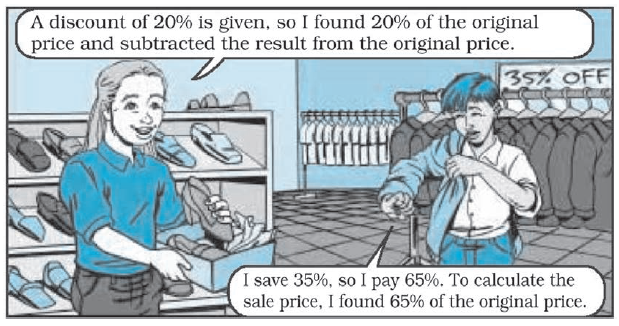
As you work on the next problem, try both of these methods to see which you prefer.
Answer:
Given:
Original Price (MP) = $\textsf{₹} 120$
$\text{Discount %}$ = $25\%$
Method 1 (Sonia's Method):
Find $25\%$ of the original price and subtract it from the original price.
$\text{Discount Amount} = 25\% \text{ of } 120$
$\text{Discount Amount} = \frac{25}{100} \times 120 = \textsf{₹} 30$
$\text{Sale Price (SP)} = 120 - 30 = \textsf{₹} 90$
Method 2 (Rahul's Method):
If the discount is $25\%$, the customer pays $100\% - 25\% = 75\%$ of the original price.
$\text{Sale Price (SP)} = 75\% \text{ of } 120$
$\text{Sale Price (SP)} = \frac{75}{100} \times 120$
$\text{Sale Price (SP)} = \frac{3}{4} \times 120 = 3 \times 30 = \textsf{₹} 90$
Final Answer: The Selling Price (S.P.) of the music CD is $\textsf{₹} 90$.
Question 108. Store A and Store B both charge Rs 750 for a video game. This week the video game is on sale for Rs 600 at Store B and for 25% off at Store A. At which store is the game less expensive?
Answer:
Given:
Original Price at both stores = $\textsf{₹} 750$
To Find:
Which store offers the game at a lower price?
Solution:
Store A:
Offers a discount of $25\%$. We will use Rahul's method to find the Sale Price:
$\text{Percentage to pay} = 100\% - 25\% = 75\%$
$\text{SP at Store A} = 75\% \text{ of } 750$
$\text{SP at Store A} = \frac{75}{100} \times 750 = 0.75 \times 750$
$\text{SP at Store A} = \textsf{₹} 562.50$
Store B:
$\text{SP at Store B} = \textsf{₹} 600$
(Given)
Comparison:
$\textsf{₹} 562.50 < \textsf{₹} 600$
Final Answer: The game is less expensive at Store A.
Question 109. At a toy shop price of all the toys is reduced to 66% of the original price.
(a) What is the sale price of a toy that originally costs Rs 90?
(b) How much money would you save on a toy costing Rs 90?
Answer:
Given:
Original Price = $\textsf{₹} 90$
Reduced Price Percentage = $66\%$ of original
(a) Solution:
The sale price is calculated as $66\%$ of the original price:
$\text{Sale Price} = 66\% \text{ of } 90$
$\text{Sale Price} = \frac{66}{100} \times 90$
$\text{Sale Price} = 0.66 \times 90 = \textsf{₹} 59.40$
(b) Solution:
The savings is the difference between the original price and the sale price:
$\text{Savings} = \text{Original Price} - \text{Sale Price}$
$\text{Savings} = 90 - 59.40 = \textsf{₹} 30.60$
Final Answer: (a) The sale price is $\textsf{₹} 59.40$. (b) The amount saved is $\textsf{₹} 30.60$.
Question 110. A store is having a 25% discount sale. Sheela has a Rs 50 gift voucher and wants to use it to buy a board game marked for Rs 320. She is not sure how to calculate the concession she will get. The sales clerk has suggested two ways to calculate the amount payable.
- Method 1: Subtract Rs 50 from the price and take 25% off the resulting price.
- Method 2: Take 25% off the original price and then subtract Rs 50.
a. Do you think both the methods will give the same result? If not, predict which method will be beneficial for her.
b. For each method, calculate the amount Sheela would have to pay. Show your work.
c. Which method do you think stores actually use? Why?
Answer:
Given:
Marked Price = $\textsf{₹} 320$
$\text{Discount %}$ = $25\%$
Gift Voucher = $\textsf{₹} 50$
(a) Solution:
No, both methods will not give the same result. Method 2 will be more beneficial for Sheela because the $25\%$ discount is applied to the larger original amount, leading to a higher total discount before the voucher is deducted.
(b) Calculation:
Method 1: Subtract $\textsf{₹} 50$ first, then apply $25\%$ discount.
$\text{Reduced Price} = 320 - 50 = \textsf{₹} 270$
$\text{Amount Payable} = 270 - (25\% \text{ of } 270)$
$\text{Amount Payable} = 270 - 67.50 = \textsf{₹} 202.50$
Method 2: Apply $25\%$ discount first, then subtract $\textsf{₹} 50$.
$\text{Price after discount} = 320 - (25\% \text{ of } 320)$
$\text{Price after discount} = 320 - 80 = \textsf{₹} 240$
$\text{Amount Payable} = 240 - 50 = \textsf{₹} 190$
(c) Solution:
Most stores use Method 1. By subtracting the voucher amount first, the store reduces the base price on which the percentage discount is calculated, meaning the store gives away less money in the form of a percentage discount.
Final Answer: Sheela pays $\textsf{₹} 202.50$ by Method 1 and $\textsf{₹} 190$ by Method 2. Method 2 is better for her.
Question 111. Living on your own: Sanjay is looking for one-bedroom appartment on rent. At Neelgiri appartments, rent for the first two months is 20% off. The one bedroom rate at Neelgiri is Rs 6,000 per month. At Savana appartments, the first month is 50% off. The one bedroom rate at Savana appartments is Rs 7000 per month. Which appartment will be cheaper for the first two months? By how much?
Answer:
Solution:
Neelgiri Apartments:
Monthly Rent = $\textsf{₹} 6,000$
$\text{Discount for first 2 months} = 20\%$
$\text{Rent for 1 month (discounted)} = 6000 - (20\% \text{ of } 6000) = \textsf{₹} 4,800$
$\text{Total for 2 months} = 4800 \times 2 = \textsf{₹} 9,600$
Savana Apartments:
Monthly Rent = $\textsf{₹} 7,000$
$\text{Rent for 1st month (50% off)} = 50\% \text{ of } 7000 = \textsf{₹} 3,500$
$\text{Rent for 2nd month (full)} = \textsf{₹} 7,000$
$\text{Total for 2 months} = 3500 + 7000 = \textsf{₹} 10,500$
Comparison:
$\text{Difference} = 10500 - 9600 = \textsf{₹} 900$
Final Answer: Neelgiri Apartments will be cheaper by $\textsf{₹} 900$.
Question 112. For an amount, explain why, a 20% increase followed by a 20% decrease is less than the original amount.
Answer:
Explanation:
Let the original amount be $x$.
1. After a $20\%$ increase:
$\text{New Amount} = x + 0.20x = 1.20x$
2. After a $20\%$ decrease on the new amount:
The decrease is now calculated on $1.20x$, not the original $x$.
$\text{Final Amount} = 1.20x - (20\% \text{ of } 1.20x)$
$\text{Final Amount} = 1.20x - 0.24x = 0.96x$
Since $0.96x < x$, the final amount is less than the original amount. This happens because the $20\%$ decrease is applied to a larger base ($1.20x$) than the $20\%$ increase was applied to ($x$), resulting in a larger absolute subtraction than the initial addition.
Question 113. Sunscreens block harmful ultraviolet (UV) rays produced by the sun.
Each sunscreen has a Sun Protection Factor (SPF) that tells you how many minutes you can stay in the sun before you receive one minute of burning UV rays. For example, if you apply sunscreen with SPF 15, you get 1 minute of UV rays for every 15 minutes you stay in the sun.
1. A sunscreen with SPF 15 allows only $\frac{1}{15}$ of the sun’s UV rays. What per cent of UV rays does the sunscreen abort?
2. Suppose a sunscreen allows 25% of the sun’s UV rays.
a. What fraction of UV rays does this sunscreen block? Give your answer in lowest terms.
b. Use your answer from Part (a) to calculate this sunscreen’s SPF. Explain how you found your answer.
3. A label on a sunscreen with SPF 30 claims that the sunscreen blocks about 97% of harmful UV rays. Assuming the SPF factor is accurate, is this claim true? Explain.
Answer:
1. Solution:
If the sunscreen allows $\frac{1}{15}$ of rays, it "aborts" (blocks) the rest:
$\text{Rays Blocked} = 1 - \frac{1}{15} = \frac{14}{15}$
$\text{Block Percentage} = \frac{14}{15} \times 100 \approx 93.33\%$
2. Solution:
(a) If it allows $25\%$, it blocks $100\% - 25\% = 75\%$.
$\text{Fraction Blocked} = \frac{75}{100} = \frac{3}{4}$
(b) SPF is the reciprocal of the fraction of rays allowed.
$\text{Fraction Allowed} = 25\% = \frac{1}{4}$
$\text{SPF} = \frac{1}{\text{Fraction Allowed}} = \frac{1}{1/4} = 4$
3. Solution:
For SPF 30, the fraction of rays allowed is $\frac{1}{30}$.
$\text{Percentage Blocked} = \left( 1 - \frac{1}{30} \right) \times 100$
$\text{Percentage Blocked} = \frac{29}{30} \times 100 \approx 96.67\%$
Since $96.67\%$ is approximately $97\%$, the claim is true.
Question 114. A real estate agent receives Rs 50,000 as commission, which is 4% of the selling price. At what price does the agent sell the property?
Answer:
Given:
Commission = $\textsf{₹} 50,000$
$\text{Commission %}$ = $4\%$
To Find:
Selling Price (SP) of the property.
Solution:
Let the Selling Price of the property be $x$.
$4\% \text{ of } x = 50,000$
$\frac{4}{100} \times x = 50,000$
Solving for $x$:
$x = \frac{50,000 \times 100}{4}$
$x = 50,000 \times 25$
$x = \textsf{₹} 12,50,000$
Final Answer: The agent sells the property for $\textsf{₹} 12,50,000$.
Question 115. With the decrease in prices of tea by 15% Tonu, the chaiwallah, was able to buy 2 kg more of tea with the same Rs 45 that he spent each month on buying tea leaves for his chai shop. What was the reduced price of tea? What was the original price of tea?
Answer:
Given:
Total expenditure = $\textsf{₹} 45$
(Given)
Reduction in price = $15\%$
Extra quantity bought = $2$ kg
To Find:
The reduced price and the original price of tea.
Solution:
First, we calculate the money saved due to the $15\%$ reduction in price:
$\text{Savings} = 15\% \text{ of } 45$
$\text{Savings} = \frac{15}{100} \times 45 = \textsf{₹} 6.75$
With this saved amount of $\textsf{₹} 6.75$, Tonu is able to buy $2$ kg more tea at the reduced price. Therefore:
$\text{Reduced price of 2 kg tea} = \textsf{₹} 6.75$
$\text{Reduced price per kg} = \frac{6.75}{2} = \textsf{₹} 3.375$
Now, let the original price per kg be $x$. Since the reduced price is $85\%$ of the original price ($100\% - 15\%$):
$85\% \text{ of } x = 3.375$
$\frac{85}{100} \times x = 3.375$
$x = \frac{3.375 \times 100}{85} = \frac{337.5}{85}$
$x \approx \textsf{₹} 3.97$
Final Answer: The reduced price of tea is $\textsf{₹} 3.375$ per kg and the original price was approximately $\textsf{₹} 3.97$ per kg.
Question 116. Below is the Report Card of Vidit Atrey. Vidit’s teacher left the last column blank. Vidit is not able to make out, in which subject he performed better and in which he needs improvement. Complete the table to help Vidit know his comparative performance.
| Subject | Internal assessment | Examination | Total | Final % |
|---|---|---|---|---|
| 1. English Literature | 20/25 | 82/100 | 102/125 | |
| 2. English Language | 22/25 | 91/100 | 113/125 | |
| 3. Hindi Literature | 18/25 | 67/75 | 85/100 | |
| 4. Hindi Language | 16/25 | 68/75 | 84/100 | |
| 5. Mathematics | 42/50 | 88/100 | 130/150 | |
| 6. Sanskrit | 14/20 | 75/100 | 99/120 | |
| 7. Physics | 45/50 | 90/100 | 135/150 | |
| 8. Chemistry | 41/50 | 82/100 | 123/150 | |
| 9 Biology | 43/50 | 87/100 | 130/150 | |
| 10. History and Civics | 19/25 | 68/75 | 87/100 | |
| 11. Geography | 17/20 | 71.5/80 | 88.5/100 |
Answer:
Solution:
To find the Final %, we use the formula: $\text{Final % } = \left( \frac{\text{Total Marks Obtained}}{\text{Maximum Total Marks}} \right) \times 100$.
| Subject | Total Marks | Calculation | Final % |
| English Literature | 102/125 | $(102/125) \times 100$ | 81.6% |
| English Language | 113/125 | $(113/125) \times 100$ | 90.4% |
| Hindi Literature | 85/100 | $(85/100) \times 100$ | 85% |
| Hindi Language | 84/100 | $(84/100) \times 100$ | 84% |
| Mathematics | 130/150 | $(130/150) \times 100$ | 86.67% |
| Sanskrit | 99/120 | $(99/120) \times 100$ | 82.5% |
| Physics | 135/150 | $(135/150) \times 100$ | 90% |
| Chemistry | 123/150 | $(123/150) \times 100$ | 82% |
| Biology | 130/150 | $(130/150) \times 100$ | 86.67% |
| History and Civics | 87/100 | $(87/100) \times 100$ | 87% |
| Geography | 88.5/100 | $(88.5/100) \times 100$ | 88.5% |
Observation: Vidit performed best in English Language (90.4%) and Physics (90%). He needs improvement in English Literature (81.6%) and Chemistry (82%).
Question 117. Sita is practicing basket ball. She has managed to score 32 baskets in 35 attempts. What is her success rate in per centage?
Answer:
Given:
Number of baskets scored = $32$
Total attempts = $35$
To Find:
Success rate in percentage ($\text{Success %}$).
Solution:
$\text{Success %} = \left( \frac{\text{Baskets Scored}}{\text{Total Attempts}} \right) \times 100$
$\text{Success %} = \frac{32}{35} \times 100$
$\text{Success %} = \frac{3200}{35}$
$\text{Success %} \approx 91.43\%$
Final Answer: Sita's success rate is approximately $91.43\%$.
Question 118. During school hours, Neha finished 73% of her homework and Minakshi completed $\frac{5}{8}$ of her homework. Who must finish a greater per cent of homework?
Answer:
Solution:
To compare their progress, we express both as percentages.
1. Neha:
$\text{Homework finished} = 73\%$
$\text{Homework left to finish} = 100\% - 73\% = 27\%$
2. Minakshi:
$\text{Homework finished} = \frac{5}{8}$
$\text{Percentage finished} = \frac{5}{8} \times 100 = 62.5\%$
$\text{Homework left to finish} = 100\% - 62.5\% = 37.5\%$
Comparison:
Comparing the remaining work:
$37.5\% > 27\%$
Final Answer: Minakshi must finish a greater per cent of her homework.
Question 119. Rain forests are home to 90,000 of the 2,50,000 identified plant species in the world. What per cent of the world’s identified plant species are found in rain forests?
Answer:
Given:
Species in rain forests = $90,000$
Total identified species = $2,50,000$
To Find:
Percentage of species found in rain forests.
Solution:
$\text{Percentage} = \left( \frac{\text{Species in rain forests}}{\text{Total species}} \right) \times 100$
$\text{Percentage} = \frac{90,000}{2,50,000} \times 100$
$\text{Percentage} = \frac{9}{25} \times 100$
$\text{Percentage} = 9 \times 4 = 36\%$
Final Answer: $36\%$ of the world’s identified plant species are found in rain forests.
Question 120. Madhu’s room measures 6m × 3m. Her carpet covers 8m2. What per cent of floor is covered by the carpet?
Answer:
Given:
Dimensions of the room = $6$ m $\times 3$ m
Area covered by the carpet = $8$ m$^2$
To Find:
Percentage of the floor covered by the carpet.
Solution:
First, we calculate the total area of the floor:
$\text{Total Area of Floor} = \text{Length} \times \text{Breadth}$
$\text{Area} = 6 \times 3 = 18 \text{ m}^2$
Now, we calculate the percentage of the floor covered:
$\text{Percentage Covered} = \left( \frac{\text{Carpet Area}}{\text{Total Floor Area}} \right) \times 100$
$\text{Percentage Covered} = \frac{8}{18} \times 100$
$\text{Percentage Covered} = \frac{4}{9} \times 100 = \frac{400}{9}$
$\text{Percentage Covered} \approx 44.44\%$
Final Answer: The carpet covers $44.44\%$ of the floor.
Question 121. The human body is made up mostly of water. In fact, about 67% of a person’s total body weight is water. If Jyoti weights 56 kg, how much of her weight is water?
Answer:
Given:
Jyoti's total body weight = $56$ kg
Percentage of water in body weight = $67\%$
To Find:
Weight of water in Jyoti's body.
Solution:
$\text{Weight of water} = 67\% \text{ of } 56$
$\text{Weight of water} = \frac{67}{100} \times 56$
$\text{Weight of water} = 0.67 \times 56 = 37.52 \text{ kg}$
Final Answer: The weight of water in Jyoti's body is $37.52$ kg.
Question 122. The per cent of pure gold in 14 carat gold is about 58.3%. A 14 carat gold ring weighs 7.6 grams. How many grams of pure gold are in the ring?
Answer:
Given:
Weight of the 14 carat gold ring = $7.6$ g
Percentage of pure gold = $58.3\%$
To Find:
The amount of pure gold in grams.
Solution:
$\text{Weight of pure gold} = 58.3\% \text{ of } 7.6$
$\text{Weight of pure gold} = \frac{58.3}{100} \times 7.6$
$\text{Weight of pure gold} = 0.583 \times 7.6 = 4.4308 \text{ g}$
Final Answer: There are $4.4308$ grams of pure gold in the ring.
Question 123. A student used the proportion $\frac{n}{100}$ = $\frac{5}{32}$ to find 5% of 32. What did the student do wrong?
Answer:
Solution:
The student's error lies in the incorrect setup of the proportion. To find a percentage of a number, the standard proportion is:
$\frac{\text{Part}}{\text{Whole}} = \frac{\text{Percent}}{100}$
In the problem "Find $5\%$ of $32$":
- The Percent is $5$.
- The Whole is $32$.
- The Part ($n$) is what we need to find.
Therefore, the correct proportion should have been:
$\frac{n}{32} = \frac{5}{100}$
What the student did wrong: The student placed $32$ as the "Whole" in the denominator of the percent side and $100$ in the denominator of the part side. By using $\frac{n}{100} = \frac{5}{32}$, the student is actually calculating what value $n$ is out of $100$ if $5$ is a part of $32$.
Question 124. The table shows the cost of sunscreen of two brands with and without sales tax. Which brand has a greater sales tax rate? Give the sales tax rate of each brand.
| Cost (in Rs) | Cost + Tax (in Rs) | |
|---|---|---|
| 1. X (100 gm) | 70 | 75 |
| 2. Y (100 gm) | 62 | 65 |
Answer:
Solution:
To find the sales tax rate, we first find the tax amount and then calculate its percentage relative to the original cost.
For Brand X:
$\text{Tax Amount} = 75 - 70 = \textsf{₹} 5$
$\text{Tax Rate (X)} = \frac{5}{70} \times 100$
$\text{Tax Rate (X)} = \frac{50}{7} \approx 7.14\%$
For Brand Y:
$\text{Tax Amount} = 65 - 62 = \textsf{₹} 3$
$\text{Tax Rate (Y)} = \frac{3}{62} \times 100$
$\text{Tax Rate (Y)} = \frac{300}{62} \approx 4.84\%$
Comparison:
Since $7.14\% > 4.84\%$, Brand X has a greater sales tax rate.
Final Answer: Brand X has a greater sales tax rate. The rates are $7.14\%$ for Brand X and $4.84\%$ for Brand Y.