

Chapter 12 Heron's Formula (Class 9 - Maths NCERT Exemplar Solutions)
Welcome to the comprehensive resource for NCERT Exemplar Solutions for Class 9 Mathematics: Chapter 12 Heron's Formula! These problems are meticulously designed to push your understanding beyond basic applications, presenting challenges that involve complex calculations and the clever subdivision of polygons. By exploring intricate word problems that demand a practical translation of real-world scenarios into geometric area calculations, these solutions build the analytical foundation required for advanced mathematical studies.
The solutions focus on the core of the chapter: Heron's Formula, a powerful tool for calculating the area of a triangle when only the lengths of its three sides are known. Students will master the calculation of the semi-perimeter ($s = \frac{a+b+c}{2}$) and the application of the formula $\text{Area} = \sqrt{s(s-a)(s-b)(s-c)}$ to various triangle types, including scalene and isosceles. This section demonstrates how to handle variable side lengths and situations where the perimeter is used to determine unknown dimensions.
Significant attention is given to finding the area of quadrilaterals and polygons by strategically partitioning them into triangles. The Exemplar rigorously tests these skills through word problems involving land plots and cost calculations, alongside MCQs and Long Answer questions that demand meticulous step-by-step work. With detailed guidance and logical justifications prepared by learningspot.co, students can master the critical skills needed to effectively solve complex problems involving composite figures and square root simplifications.
Sample Question 1 (Before Exercise 12.1)
Write the correct answer:
Sample Question 1: The base of a right triangle is 8 cm and hypotenuse is 10 cm. Its area will be
(A) 24 cm2
(B) 40 cm2
(C) 48 cm2
(D) 80 cm2
Answer:
Given: In a right-angled triangle, Base ($b$) $= 8 \textsf{ cm}$ and Hypotenuse ($h$) $= 10 \textsf{ cm}$.
To Find: The area of the triangle.
Solution:
Let the height (altitude) of the triangle be $p$. According to Pythagoras Theorem:
$p^2 + b^2 = h^2$
Substituting the given values:
$p^2 + 8^2 = 10^2$
$p^2 + 64 = 100$
$p^2 = 100 - 64$
$p^2 = 36$
$p = 6 \textsf{ cm}$
... (i)
Now, the formula for the Area of a triangle is:
$\text{Area} = \frac{1}{2} \times \text{base} \times \text{height}$
$\text{Area} = \frac{1}{2} \times 8 \times 6$
$\text{Area} = 24 \textsf{ cm}^2$
The correct option is (A).
Exercise 12.1
Question 1. An isosceles right triangle has area 8 cm2 . The length of its hypotenuse is
(A) $\sqrt{32}$ cm
(B) $\sqrt{16}$ cm
(C) $\sqrt{48}$ cm
(D) $\sqrt{24}$ cm
Answer:
Given: An isosceles right triangle with Area $= 8 \textsf{ cm}^2$.
To Find: The length of the hypotenuse.
Solution:
In an isosceles right triangle, the two legs (base and height) are equal. Let the length of each leg be $x$.
$\text{Area} = \frac{1}{2} \times x \times x = 8$
$\frac{1}{2} x^2 = 8$
$x^2 = 16$
$x = 4 \textsf{ cm}$
(Sides of triangle)
Now, to find the hypotenuse ($h$):
$h = \sqrt{x^2 + x^2}$
(Pythagoras Theorem)
$h = \sqrt{4^2 + 4^2}$
$h = \sqrt{16 + 16}$
$h = \sqrt{32} \textsf{ cm}$
The correct option is (A).
Question 2. The perimeter of an equilateral triangle is 60 m. The area is
(A) 10$\sqrt{3}$ m2
(B) 15$\sqrt{3}$ m2
(C) 20$\sqrt{3}$ m2
(D) 100$\sqrt{3}$ m2
Answer:
Given: Perimeter of an equilateral triangle $= 60 \textsf{ m}$.
To Find: Area of the triangle.
Solution:
Let the side of the equilateral triangle be $a$.
$\text{Perimeter} = 3a = 60$
$a = \frac{60}{3} = 20 \textsf{ m}$
The area of an equilateral triangle is given by the formula:
$\text{Area} = \frac{\sqrt{3}}{4} a^2$
Substituting the value of $a$:
$\text{Area} = \frac{\sqrt{3}}{4} \times (20)^2$
$\text{Area} = \frac{\sqrt{3}}{4} \times 400$
$\text{Area} = 100\sqrt{3} \textsf{ m}^2$
The correct option is (D).
Question 3. The sides of a triangle are 56 cm, 60 cm and 52 cm long. Then the area of the triangle is
(A) 1322 cm2
(B) 1311 cm2
(C) 1344 cm2
(D) 1392 cm2
Answer:
Given: Sides of the triangle $a = 56 \textsf{ cm}$, $b = 60 \textsf{ cm}$, and $c = 52 \textsf{ cm}$.
To Find: Area of the triangle using Heron's formula.
Solution:
First, we calculate the semi-perimeter ($s$):
$s = \frac{a + b + c}{2}$
$s = \frac{56 + 60 + 52}{2} = \frac{168}{2}$
$s = 84 \textsf{ cm}$
Now, using Heron's formula for Area:
$\text{Area} = \sqrt{s(s-a)(s-b)(s-c)}$
$\text{Area} = \sqrt{84(84-56)(84-60)(84-52)}$
$\text{Area} = \sqrt{84 \times 28 \times 24 \times 32}$
Breaking into prime factors:
$\text{Area} = \sqrt{(3 \times 28) \times 28 \times (3 \times 8) \times (4 \times 8)}$
$\text{Area} = \sqrt{28^2 \times 3^2 \times 8^2 \times 2^2}$
$\text{Area} = 28 \times 3 \times 8 \times 2$
$\text{Area} = 1344 \textsf{ cm}^2$
The correct option is (C).
Question 4. The area of an equilateral triangle with side 2$\sqrt{3}$ cm is
(A) 5.196 cm2
(B) 0.866 cm2
(C) 3.496 cm2
(D) 1.732 cm2
Answer:
Given: Side of the equilateral triangle $a = 2\sqrt{3} \textsf{ cm}$.
To Find: The numerical value of the area.
Solution:
The formula for Area is:
$\text{Area} = \frac{\sqrt{3}}{4} a^2$
Substituting $a = 2\sqrt{3}$:
$\text{Area} = \frac{\sqrt{3}}{4} \times (2\sqrt{3})^2$
$\text{Area} = \frac{\sqrt{3}}{4} \times (4 \times 3)$
$\text{Area} = \frac{\sqrt{3}}{4} \times 12$
$\text{Area} = 3\sqrt{3} \textsf{ cm}^2$
Using the approximate value $\sqrt{3} \approx 1.732$:
$\text{Area} = 3 \times 1.732$
$\text{Area} = 5.196 \textsf{ cm}^2$
The correct option is (A).
Question 5. The length of each side of an equilateral triangle having an area of 9$\sqrt{3}$ cm2 is
(A) 8 cm
(B) 36 cm
(C) 4 cm
(D) 6 cm
Answer:
Given: Area of an equilateral triangle $= 9\sqrt{3} \textsf{ cm}^2$.
To Find: The length of each side of the triangle.
Solution:
Let the length of each side of the equilateral triangle be $a$.
We know that the area of an equilateral triangle is given by the formula:
$\text{Area} = \frac{\sqrt{3}}{4} a^2$
Substituting the given area into the formula:
$9\sqrt{3} = \frac{\sqrt{3}}{4} a^2$
Cancelling $\sqrt{3}$ from both sides:
$9 = \frac{a^2}{4}$
$a^2 = 9 \times 4$
$a^2 = 36$
$a = \sqrt{36}$
$a = 6 \textsf{ cm}$
... (i)
Thus, the length of each side is $6 \textsf{ cm}$.
The correct option is (D).
Question 6. If the area of an equilateral triangle is 16$\sqrt{3}$ cm2 , then the perimeter of the triangle is
(A) 48 cm
(B) 24 cm
(C) 12 cm
(D) 36 cm
Answer:
Given: Area of an equilateral triangle $= 16\sqrt{3} \textsf{ cm}^2$.
To Find: The perimeter of the triangle.
Solution:
Let the side of the equilateral triangle be $a$.
$\text{Area} = \frac{\sqrt{3}}{4} a^2$
$16\sqrt{3} = \frac{\sqrt{3}}{4} a^2$
$16 = \frac{a^2}{4}$
$a^2 = 16 \times 4 = 64$
$a = 8 \textsf{ cm}$
... (i)
Now, the perimeter of an equilateral triangle is given by:
$\text{Perimeter} = 3a$
$\text{Perimeter} = 3 \times 8 = 24 \textsf{ cm}$
The correct option is (B).
Question 7. The sides of a triangle are 35 cm, 54 cm and 61 cm, respectively. The length of its longest altitude
(A) 16$\sqrt{5}$ cm
(B) 10$\sqrt{5}$ cm
(C) 24$\sqrt{5}$ cm
(D) 28 cm
Answer:
Given: Sides of triangle $a = 35 \textsf{ cm}$, $b = 54 \textsf{ cm}$, and $c = 61 \textsf{ cm}$.
To Find: The length of the longest altitude.
Solution:
The altitude of a triangle is longest when it is drawn to the shortest side as the base. Here, the shortest side is $35 \textsf{ cm}$.
First, find the semi-perimeter ($s$):
$s = \frac{35 + 54 + 61}{2} = \frac{150}{2} = 75 \textsf{ cm}$
Using Heron's formula for Area:
$\text{Area} = \sqrt{s(s-a)(s-b)(s-c)}$
$\text{Area} = \sqrt{75(75-35)(75-54)(75-61)}$
$\text{Area} = \sqrt{75 \times 40 \times 21 \times 14}$
$\text{Area} = \sqrt{(5 \cdot 5 \cdot 3) \cdot (2 \cdot 2 \cdot 2 \cdot 5) \cdot (3 \cdot 7) \cdot (2 \cdot 7)}$
$\text{Area} = 5 \times 3 \times 2 \times 2 \times 7 \sqrt{5} = 420\sqrt{5} \textsf{ cm}^2$
Let the longest altitude be $h$. Using the shortest side ($35 \textsf{ cm}$) as base:
$\text{Area} = \frac{1}{2} \times \text{base} \times \text{altitude}$
$420\sqrt{5} = \frac{1}{2} \times 35 \times h$
$h = \frac{2 \times 420\sqrt{5}}{35}$
$h = \frac{\cancel{840}^{24}\sqrt{5}}{\cancel{35}_{1}}$
$h = 24\sqrt{5} \textsf{ cm}$
The correct option is (C).
Question 8. The area of an isosceles triangle having base 2 cm and the length of one of the equal sides 4 cm, is
(A) $\sqrt{15}$ cm2
(B) $\sqrt{\frac{15}{2}}$ cm2
(C) 2$\sqrt{15}$ cm2
(D) 4$\sqrt{15}$ cm2
Answer:
Given: Base $(b) = 2 \textsf{ cm}$ and equal sides $(a) = 4 \textsf{ cm}$.
To Find: Area of the isosceles triangle.
Solution:
The area of an isosceles triangle with base $b$ and equal sides $a$ is:
$\text{Area} = \frac{b}{4} \sqrt{4a^2 - b^2}$
Substituting the values $a = 4$ and $b = 2$:
$\text{Area} = \frac{2}{4} \sqrt{4(4)^2 - (2)^2}$
$\text{Area} = \frac{1}{2} \sqrt{4(16) - 4}$
$\text{Area} = \frac{1}{2} \sqrt{64 - 4} = \frac{1}{2} \sqrt{60}$
$\text{Area} = \frac{1}{2} \times \sqrt{4 \times 15}$
$\text{Area} = \frac{1}{2} \times 2\sqrt{15}$
$\text{Area} = \sqrt{15} \textsf{ cm}^2$
The correct option is (A).
Question 9. The edges of a triangular board are 6 cm, 8 cm and 10 cm. The cost of painting it at the rate of 9 paise per cm2 is
(A) Rs 2.00
(B) Rs 2.16
(C) Rs 2.48
(D) Rs 3.00
Answer:
Given: Sides of triangular board are $6 \textsf{ cm}$, $8 \textsf{ cm}$, and $10 \textsf{ cm}$. Rate of painting $= 9 \text{ paise/cm}^2$.
To Find: Total cost of painting.
Solution:
We observe that $6^2 + 8^2 = 36 + 64 = 100 = 10^2$. This is a right-angled triangle.
$\text{Area} = \frac{1}{2} \times \text{base} \times \text{height}$
$\text{Area} = \frac{1}{2} \times 6 \times 8 = 24 \textsf{ cm}^2$
Now, calculating the cost:
$\text{Cost} = \text{Area} \times \text{Rate}$
$\text{Cost} = 24 \times 9 = 216 \text{ paise}$
Converting to Rupees:
$\text{Cost in } \textsf{₹} = \frac{216}{100} = \textsf{₹ } 2.16$
The correct option is (B).
Sample Question 1 (Before Exercise 12.2)
Write True or False and justify your answer:
Sample Question 1: If a, b, c are the lengths of three sides of a triangle, then area of a triangle = $\sqrt{s(s-a)(s-b)(s-c)}$ where s = perimeter of triangle.
Answer:
Answer:
False.
Justification:
The formula for the area of a triangle with side lengths a, b, and c is indeed given by Heron's formula: Area $= \sqrt{s(s-a)(s-b)(s-c)}$.
However, the variable $s$ in Heron's formula represents the semi-perimeter of the triangle, not the perimeter.
The semi-perimeter $s$ is defined as half of the perimeter:
$s = \frac{a+b+c}{2}$
The statement incorrectly defines $s$ as the perimeter of the triangle.
Therefore, the given statement is false because of the incorrect definition of $s$.
Exercise 12.2
Write True or False and justify your answer:
Question 1. The area of a triangle with base 4 cm and height 6 cm is 24 cm2 .
Answer:
Answer:
False.
Justification:
The formula for the area of a triangle is given by:
Area $= \frac{1}{2} \times \text{base} \times \text{height}$
Given base $= 4$ cm and height $= 6$ cm.
Substituting these values into the formula:
Area $= \frac{1}{2} \times 4 \text{ cm} \times 6 \text{ cm}$
Area $= \frac{1}{2} \times 24 \text{ cm}^2$
Area $= 12$ cm$^2$
The calculated area of the triangle is 12 cm$^2$, which is not equal to 24 cm$^2$.
Therefore, the statement is false.
Question 2. The area of ∆ABC is 8 cm2 in which AB = AC = 4 cm and ∠A = 90º.
Answer:
Answer:
True.
Justification:
The triangle ABC is given with AB = AC = 4 cm and $\angle A = 90^\circ$.
Since $\angle A = 90^\circ$, the triangle is a right-angled triangle at vertex A.
In a right-angled triangle, the two sides forming the right angle can be considered as the base and the height.
Here, AB and AC are the sides forming the right angle at A. We can take AB as the base and AC as the height (or vice versa).
The formula for the area of a right-angled triangle is:
Area $= \frac{1}{2} \times \text{base} \times \text{height}$
Substitute the given values: base $= \text{AB} = 4$ cm and height $= \text{AC} = 4$ cm.
Area $= \frac{1}{2} \times 4 \text{ cm} \times 4 \text{ cm}$
Area $= \frac{1}{2} \times 16 \text{ cm}^2$
Area $= 8$ cm$^2$
The calculated area of the triangle is 8 cm$^2$, which matches the area given in the statement.
Therefore, the statement is true.
Question 3. The area of the isosceles triangle is $\frac{5}{4}\sqrt{11}$ cm2 , if the perimeter is 11 cm and the base is 5 cm.
Answer:
Answer:
True.
Justification:
Let the isosceles triangle have equal sides of length $a$ and base of length $b$.
Given: Base $b = 5$ cm.
Given: Perimeter = 11 cm.
The perimeter of an isosceles triangle is $a + a + b = 2a + b$.
So, $2a + 5 = 11$.
$2a = 11 - 5$
$2a = 6$
$a = 3$ cm.
The side lengths of the triangle are 3 cm, 3 cm, and 5 cm.
To find the area, we can use Heron's formula. First, calculate the semi-perimeter ($s$).
$s = \frac{\text{Perimeter}}{2}$
$s = \frac{11}{2}$ cm.
Now, calculate the terms for Heron's formula:
$s-a = \frac{11}{2} - 3 = \frac{11 - 6}{2} = \frac{5}{2}$
$s-b = \frac{11}{2} - 3 = \frac{11 - 6}{2} = \frac{5}{2}$
$s-c = \frac{11}{2} - 5 = \frac{11 - 10}{2} = \frac{1}{2}$
Heron's formula for the area of a triangle is:
Area $= \sqrt{s(s-a)(s-b)(s-c)}$
Substitute the calculated values:
Area $= \sqrt{\frac{11}{2} \times \frac{5}{2} \times \frac{5}{2} \times \frac{1}{2}}$
Area $= \sqrt{\frac{11 \times 5 \times 5 \times 1}{2 \times 2 \times 2 \times 2}}$
Area $= \sqrt{\frac{25 \times 11}{16}}$
Area $= \frac{\sqrt{25} \times \sqrt{11}}{\sqrt{16}}$
Area $= \frac{5 \times \sqrt{11}}{4}$
Area $= \frac{5\sqrt{11}}{4}$ cm$^2$.
The calculated area matches the area given in the statement.
Therefore, the statement is true.
Question 4. The area of the equilateral triangle is 20$\sqrt{3}$ cm2 whose each side is 8 cm.
Answer:
Answer:
False.
Justification:
Let the side length of the equilateral triangle be $a$.
Given: Side length $a = 8$ cm.
The formula for the area of an equilateral triangle with side length $a$ is given by:
Area $= \frac{\sqrt{3}}{4} a^2$
Substitute the given side length $a = 8$ cm into the formula:
Area $= \frac{\sqrt{3}}{4} (8)^2$
Area $= \frac{\sqrt{3}}{4} \times 64$
Area $= \sqrt{3} \times \frac{64}{4}$
Area $= \sqrt{3} \times 16$
Area $= 16\sqrt{3}$ cm$^2$
The calculated area of the equilateral triangle is $16\sqrt{3}$ cm$^2$.
The statement claims the area is $20\sqrt{3}$ cm$^2$.
Since $16\sqrt{3} \neq 20\sqrt{3}$, the statement is false.
Question 5. If the side of a rhombus is 10 cm and one diagonal is 16 cm, the area of the rhombus is 96 cm2 .
Answer:
Statement: If the side of a rhombus is $10 \textsf{ cm}$ and one diagonal is $16 \textsf{ cm}$, the area of the rhombus is $96 \textsf{ cm}^2$.
Result: True
Given:
In a rhombus $ABCD$:
Side $AB = BC = CD = DA = 10 \textsf{ cm}$
Diagonal $AC = 16 \textsf{ cm}$
To Find:
The total area of the rhombus using Heron's Formula.
Solution:
A diagonal of a rhombus divides it into two congruent triangles of equal area. Let us consider $\triangle ABC$ and $\triangle ADC$.
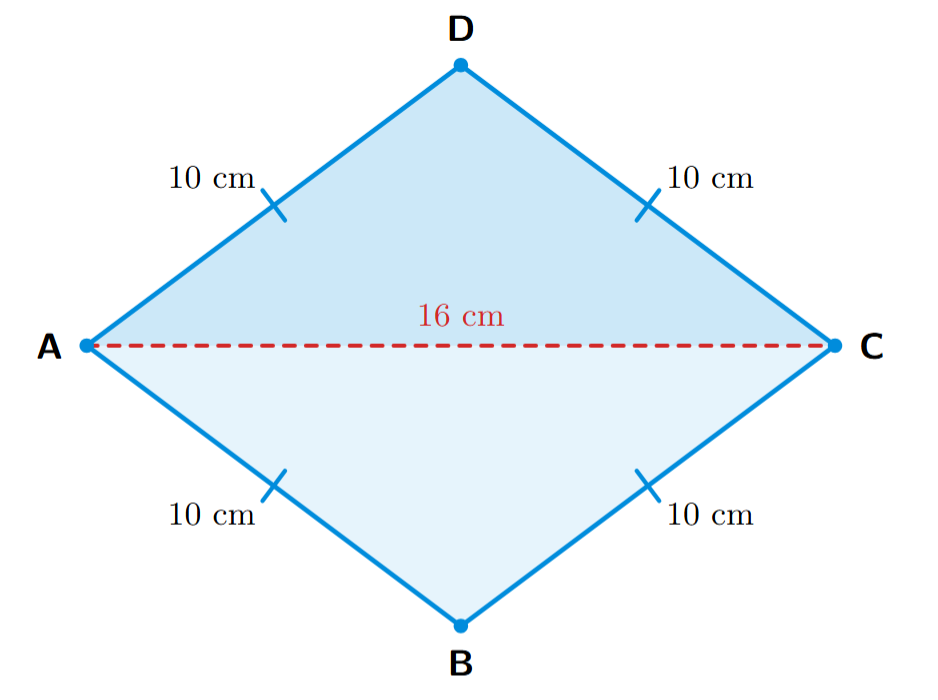
Step 1: Calculate the area of $\triangle ABC$
The sides of $\triangle ABC$ are $a = 10 \textsf{ cm}$, $b = 10 \textsf{ cm}$ and $c = 16 \textsf{ cm}$.
The semi-perimeter ($s$) is calculated as:
$s = \frac{a + b + c}{2}$
$s = \frac{10 + 10 + 16}{2} = \frac{36}{2}$
$s = 18 \textsf{ cm}$
... (i)
Now, using Heron's Formula:
$\text{Area of } \triangle ABC = \sqrt{s(s-a)(s-b)(s-c)}$
$\text{Area} = \sqrt{18(18-10)(18-10)(18-16)}$
$\text{Area} = \sqrt{18 \times 8 \times 8 \times 2}$
$\text{Area} = \sqrt{(18 \times 2) \times (8 \times 8)}$
$\text{Area} = \sqrt{36 \times 64}$
$\text{Area} = 6 \times 8 = 48 \textsf{ cm}^2$
... (ii)
Step 2: Calculate the area of $\triangle ADC$
In a rhombus, since all sides are equal and the diagonal is common, $\triangle ADC$ also has sides $10 \textsf{ cm}$, $10 \textsf{ cm}$ and $16 \textsf{ cm}$.
$\text{Area of } \triangle ADC = \text{Area of } \triangle ABC$
$\text{Area of } \triangle ADC = 48 \textsf{ cm}^2$
... (iii)
Step 3: Calculate the Total Area of Rhombus $ABCD$
$\text{Total Area} = \text{Area}(\triangle ABC) + \text{Area}(\triangle ADC)$
$\text{Total Area} = 48 + 48$
$\text{Total Area} = 96 \textsf{ cm}^2$
[Verified] ... (iv)
Conclusion: Since the calculated area using Heron's formula is exactly $96 \textsf{ cm}^2$, the statement is True.
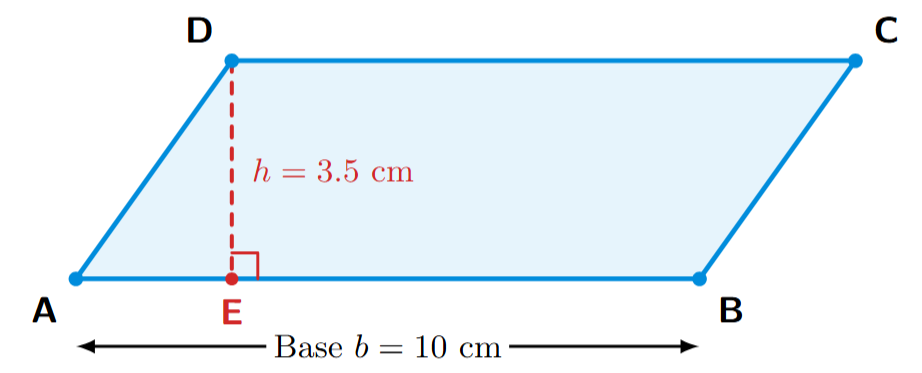
Question 6. The base and the corresponding altitude of a parallelogram are 10 cm and 3.5 cm, respectively. The area of the parallelogram is 30 cm2 .
Answer:
Statement: The area of the parallelogram is $30 \textsf{ cm}^2$.
Result: False
Given:
Base of the parallelogram ($b$) $= 10 \textsf{ cm}$
Corresponding altitude ($h$) $= 3.5 \textsf{ cm}$
Justification:
The area of a parallelogram is calculated using the formula:
$\text{Area} = \text{base} \times \text{altitude}$
Substituting the given values:
$\text{Area} = 10 \times 3.5$
$\text{Area} = 35 \textsf{ cm}^2$
... (i)
Since the calculated area is $35 \textsf{ cm}^2$ and the statement says $30 \textsf{ cm}^2$, the statement is incorrect.
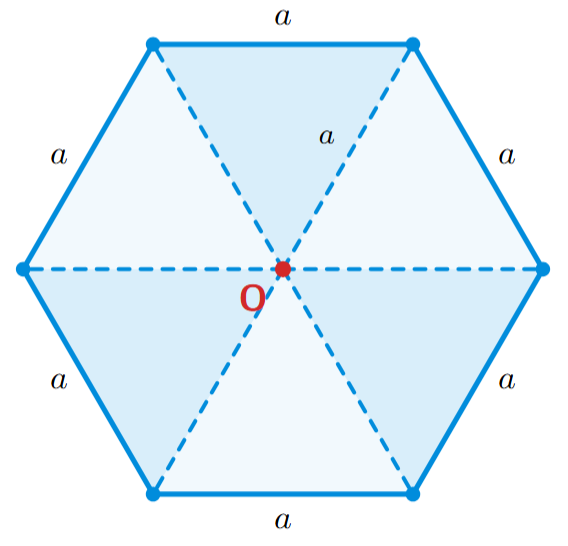
Question 7. The area of a regular hexagon of side ‘a’ is the sum of the areas of the five equilateral triangles with side a.
Answer:
Statement: Area of a regular hexagon is the sum of areas of five equilateral triangles with side $a$.
Result: False
Justification:
A regular hexagon is a polygon with six equal sides. By joining the center of a regular hexagon to all its vertices, we divide the hexagon into six congruent equilateral triangles.
$\text{Area of hexagon} = 6 \times \text{Area of an equilateral triangle}$
$\text{Area of hexagon} = 6 \times \frac{\sqrt{3}}{4} a^2$
... (i)
Since the statement claims it is the sum of five equilateral triangles instead of six, it is false.
Question 8. The cost of levelling the ground in the form of a triangle having the sides 51 m, 37 m and 20 m at the rate of Rs 3 per m2 is Rs 918.
Answer:
Statement: The cost of levelling the triangular ground is $\textsf{₹ } 918$.
Result: True
Given:
Sides of the triangle: $a = 51 \textsf{ m}$, $b = 37 \textsf{ m}$, $c = 20 \textsf{ m}$
Rate of levelling $= \textsf{₹ } 3 \text{ per } \textsf{m}^2$
Justification:
First, we find the semi-perimeter ($s$):
$s = \frac{51 + 37 + 20}{2}$
$s = \frac{108}{2} = 54 \textsf{ m}$
Using Heron's Formula to find the area ($A$):
$A = \sqrt{s(s-a)(s-b)(s-c)}$
$A = \sqrt{54(54-51)(54-37)(54-20)}$
$A = \sqrt{54 \times 3 \times 17 \times 34}$
$A = \sqrt{(18 \times 3) \times 3 \times 17 \times (17 \times 2)}$
$A = \sqrt{36 \times 9 \times 289}$
$A = 6 \times 3 \times 17 = 306 \textsf{ m}^2$
... (i)
Now, calculating the total cost:
$\text{Total Cost} = \text{Area} \times \text{Rate}$
$\text{Total Cost} = 306 \times 3$
$\text{Total Cost} = \textsf{₹ } 918$
Since the calculated cost matches the statement, it is True.
Question 9. In a triangle, the sides are given as 11cm, 12cm and 13cm. The length of the altitude is 10.25 cm corresponding to the side having length 12cm.
Answer:
Given: Sides of the triangle are $a = 11 \textsf{ cm}$, $b = 12 \textsf{ cm}$, and $c = 13 \textsf{ cm}$. The length of the altitude corresponding to the $12 \textsf{ cm}$ side is given as $10.25 \textsf{ cm}$.
To Find: To verify if the given altitude is True or False by calculation.
Solution:
First, we calculate the semi-perimeter ($s$) of the triangle:
$s = \frac{a + b + c}{2}$
$s = \frac{11 + 12 + 13}{2} = \frac{36}{2}$
$s = 18 \textsf{ cm}$
... (i)
Now, we find the area of the triangle using Heron's Formula:
$\text{Area} = \sqrt{s(s-a)(s-b)(s-c)}$
$\text{Area} = \sqrt{18(18-11)(18-12)(18-13)}$
$\text{Area} = \sqrt{18 \times 7 \times 6 \times 5}$
$\text{Area} = \sqrt{3780}$
$\text{Area} = \sqrt{36 \times 105} = 6\sqrt{105} \textsf{ cm}^2$
... (ii)
Let the altitude corresponding to the side $12 \textsf{ cm}$ be $h$. We know that:
$\text{Area} = \frac{1}{2} \times \text{base} \times h$
$6\sqrt{105} = \frac{1}{2} \times 12 \times h$
$6\sqrt{105} = 6h$
$h = \sqrt{105}$
[Dividing by 6] ... (iii)
$h \approx 10.2469... \textsf{ cm}$
Rounding off the value to two decimal places, we get:
$h \approx 10.25 \textsf{ cm}$
(Rounded off)
Result: True
Sample Question 1 & 2 (Before Exercise 12.3)
Sample Question 1: The sides of a triangular field are 41 m, 40 m and 9 m. Find the number of rose beds that can be prepared in the field, if each rose bed, on an average needs 900 cm2 space.
Answer:
Given:
Sides of the triangular field are $a = 41 \textsf{ m}$, $b = 40 \textsf{ m}$, and $c = 9 \textsf{ m}$.
Area required for one rose bed $= 900 \textsf{ cm}^2$.
To Find:
The total number of rose beds that can be prepared in the field.
Solution:
First, we calculate the semi-perimeter ($s$) of the triangular field:
$s = \frac{a + b + c}{2}$
$s = \frac{41 + 40 + 9}{2} = \frac{90}{2}$
$s = 45 \textsf{ m}$
... (i)
Now, we find the area of the triangular field using Heron's Formula:
$\text{Area} = \sqrt{s(s - a)(s - b)(s - c)}$
$\text{Area} = \sqrt{45(45 - 41)(45 - 40)(45 - 9)}$
$\text{Area} = \sqrt{45 \times 4 \times 5 \times 36}$
$\text{Area} = \sqrt{32400}$
$\text{Area} = 180 \textsf{ m}^2$
... (ii)
The space needed for one rose bed is given in $\textsf{cm}^2$. We must convert it to $\textsf{m}^2$:
$1 \textsf{ m}^2 = 10,000 \textsf{ cm}^2$
$\text{Area of 1 rose bed} = \frac{900}{10000} \textsf{ m}^2 = 0.09 \textsf{ m}^2$
Now, we calculate the number of rose beds:
$\text{Number of rose beds} = \frac{\text{Total Area}}{\text{Area of 1 rose bed}}$
$\text{Number of rose beds} = \frac{180}{0.09} = \frac{18000}{9}$
$\text{Number of rose beds} = 2000$
Conclusion: 2000 rose beds can be prepared in the field.
Sample Question 2: Calculate the area of the shaded region in Fig. 12.1.

Answer:
Given:
From the given figure 12.1:
For the outer triangle, the sides are $a = 122 \textsf{ m}$, $b = 120 \textsf{ m}$, and $c = 22 \textsf{ m}$.
For the inner white triangle, the sides are $a' = 26 \textsf{ m}$, $b' = 24 \textsf{ m}$, and $c' = 22 \textsf{ m}$ (common base).
To Find:
The area of the shaded region using Heron's Formula for both triangles.
Solution:
Step 1: Calculate the area of the outer triangle
The semi-perimeter ($s_1$) is:
$s_1 = \frac{122 + 120 + 22}{2}$
$s_1 = \frac{264}{2} = 132 \textsf{ m}$
Using Heron's Formula:
$\text{Area}_1 = \sqrt{s_1(s_1 - a)(s_1 - b)(s_1 - c)}$
$\text{Area}_1 = \sqrt{132(132 - 122)(132 - 120)(132 - 22)}$
$\text{Area}_1 = \sqrt{132 \times 10 \times 12 \times 110}$
$\text{Area}_1 = \sqrt{1742400}$
$\text{Area}_1 = 1320 \textsf{ m}^2$
... (i)
Step 2: Calculate the area of the inner triangle
The semi-perimeter ($s_2$) for the inner triangle is:
$s_2 = \frac{26 + 24 + 22}{2}$
$s_2 = \frac{72}{2} = 36 \textsf{ m}$
Using Heron's Formula:
$\text{Area}_2 = \sqrt{s_2(s_2 - a')(s_2 - b')(s_2 - c')}$
$\text{Area}_2 = \sqrt{36(36 - 26)(36 - 24)(36 - 22)}$
$\text{Area}_2 = \sqrt{36 \times 10 \times 12 \times 14}$
$\text{Area}_2 = \sqrt{60480}$
Finding the square root of $60480$ using long division:
$\begin{array}{c|cc} & 2\ 4\ 5\ . \ 9 \ 2 \ 6 \ ... & \\ \hline \phantom{()} 2 & \overline{6} \ \overline{04} \ \overline{80} \; . \overline{00} \; \overline{00} \\ + \; 2 & 4\phantom{(........)} \\ \hline \phantom{()} 44 & 2 \ 04 \phantom{(.....)} \\ \phantom{()} +4 & 1 \ 76 \phantom{(...)} \\ \hline \phantom{()} 485 & 28 \ 80 \\ \phantom{()} +5 & 24 \ 25 \\ \hline \phantom{()} 4909 & \phantom{(.)} 4 \ 55 \ 00 \\ \phantom{(.)}+ 9 & \phantom{(.)} 4 \ 41 \ 81 \\ \hline \phantom{()} 49182 & \phantom{(....)} 13 \ 19 \ 00 \end{array}$$\text{Area}_2 \approx 245.93 \textsf{ m}^2$
... (ii)
Step 3: Calculate the shaded area
$\text{Shaded Area} = \text{Area}_1 - \text{Area}_2$
$\text{Shaded Area} = 1320 - 245.93$
$\text{Shaded Area} = 1074.07 \textsf{ m}^2$
Rounding off to the nearest whole number:
$\text{Shaded Area} \approx 1074 \textsf{ m}^2$
Conclusion: The area of the shaded region is $1074 \textsf{ m}^2$.
Exercise 12.3
Question 1. Find the cost of laying grass in a triangular field of sides 50 m, 65 m and 65 m at the rate of Rs 7 per m2 .
Answer:
Given:
The lengths of the sides of the triangular field are $a = 50$ m, $b = 65$ m, and $c = 65$ m.
The rate of laying grass is $\textsf{₹} 7$ per m$^2$.
To Find:
The cost of laying grass in the triangular field.
Solution:
First, we need to find the area of the triangular field. Since the sides are given, we can use Heron's formula.
Calculate the semi-perimeter ($s$) of the triangle:
$s = \frac{a+b+c}{2}$
$s = \frac{50 + 65 + 65}{2}$
$s = \frac{180}{2}$
$s = 90$ m
Now, calculate the terms $(s-a)$, $(s-b)$, and $(s-c)$:
$s-a = 90 - 50 = 40$
$s-b = 90 - 65 = 25$
$s-c = 90 - 65 = 25$
Heron's formula for the area of a triangle is:
Area $= \sqrt{s(s-a)(s-b)(s-c)}$
Substitute the calculated values:
Area $= \sqrt{90 \times 40 \times 25 \times 25}$
Area $= \sqrt{(9 \times 10) \times (4 \times 10) \times 25 \times 25}$
Area $= \sqrt{9 \times 4 \times 10 \times 10 \times 25 \times 25}$
Area $= \sqrt{9 \times 4 \times 100 \times 625}$
Area $= \sqrt{9} \times \sqrt{4} \times \sqrt{100} \times \sqrt{625}$
Area $= 3 \times 2 \times 10 \times 25$
Area $= 6 \times 250$
Area $= 1500$ m$^2$
The area of the triangular field is 1500 m$^2$.
The cost of laying grass is $\textsf{₹} 7$ per m$^2$.
Total cost $=$ Area $\times$ Rate per m$^2$
Total cost $=$ $1500 \text{ m}^2 \times \textsf{₹} 7/\text{m}^2$
Total cost $=$ $1500 \times 7$ $\textsf{₹}$
Total cost $=$ $10500$ $\textsf{₹}$
The cost of laying grass in the field is $\textsf{₹} 10500$.
Question 2. The triangular side walls of a flyover have been used for advertisements. The sides of the walls are 13 m, 14 m and 15 m. The advertisements yield an earning of Rs. 2000 per m2 a year. A company hired one of its walls for 6 months. How much rent did it pay?
Answer:
Given:
The sides of the triangular wall are $a = 13$ m, $b = 14$ m, and $c = 15$ m.
Annual earning rate from advertisement $= \textsf{₹} 2000$ per m$^2$ per year.
Time period for which the wall was hired $= 6$ months.
To Find:
The total rent paid for hiring the wall for 6 months.
Solution:
First, we need to find the area of the triangular wall using Heron's formula.
Calculate the semi-perimeter ($s$) of the triangle:
$s = \frac{a+b+c}{2}$
$s = \frac{13 + 14 + 15}{2}$
$s = \frac{42}{2}$
$s = 21$ m
Now, calculate the terms $(s-a)$, $(s-b)$, and $(s-c)$:
$s-a = 21 - 13 = 8$
$s-b = 21 - 14 = 7$
$s-c = 21 - 15 = 6$
Heron's formula for the area of a triangle is:
Area $= \sqrt{s(s-a)(s-b)(s-c)}$
Substitute the calculated values:
Area $= \sqrt{21 \times 8 \times 7 \times 6}$
Factorize the numbers inside the square root:
$21 = 3 \times 7$
$8 = 2^3$
$7 = 7^1$
$6 = 2 \times 3 = 2^1 \times 3^1$
Area $= \sqrt{(3 \times 7) \times (2^3) \times 7 \times (2 \times 3)}$
Combine the powers of the prime factors:
Area $= \sqrt{2^{3+1} \times 3^{1+1} \times 7^{1+1}}$
Area $= \sqrt{2^4 \times 3^2 \times 7^2}$
Take the square root by dividing the exponents by 2:
Area $= 2^{4/2} \times 3^{2/2} \times 7^{2/2}$
Area $= 2^2 \times 3^1 \times 7^1$
Area $= 4 \times 3 \times 7$
Area $= 12 \times 7$
Area $= 84$ m$^2$
The area of the triangular wall is 84 m$^2$.
The advertisement earning rate is $\textsf{₹} 2000$ per m$^2$ per year.
The wall was hired for 6 months, which is $\frac{6}{12} = \frac{1}{2}$ a year.
The earning rate for 6 months will be half of the annual rate.
Earning rate for 6 months $= \frac{1}{2} \times \textsf{₹} 2000 \text{ per m}^2 \text{ per year}$
Earning rate for 6 months $= \textsf{₹} 1000$ per m$^2$ for 6 months.
The total rent paid is the area of the wall multiplied by the rate for 6 months.
Total Rent $=$ Area $\times$ Rate for 6 months
Total Rent $=$ $84 \text{ m}^2 \times \textsf{₹} 1000/\text{m}^2$
Total Rent $=$ $84 \times 1000$ $\textsf{₹}$
Total Rent $=$ $84000$ $\textsf{₹}$
The company paid a rent of $\textsf{₹} 84000$ for hiring the wall for 6 months.
Question 3. From a point in the interior of an equilateral triangle, perpendiculars are drawn on the three sides. The lengths of the perpendiculars are 14 cm, 10 cm and 6 cm. Find the area of the triangle.
Answer:
Given:
In an equilateral triangle $ABC$, let $O$ be an interior point.
The lengths of perpendiculars from $O$ to the sides $BC$, $CA$, and $AB$ are $p_1 = 14 \text{ cm}$, $p_2 = 10 \text{ cm}$, and $p_3 = 6 \text{ cm}$ respectively.
To Find:
Area of the equilateral triangle $ABC$.
Solution:
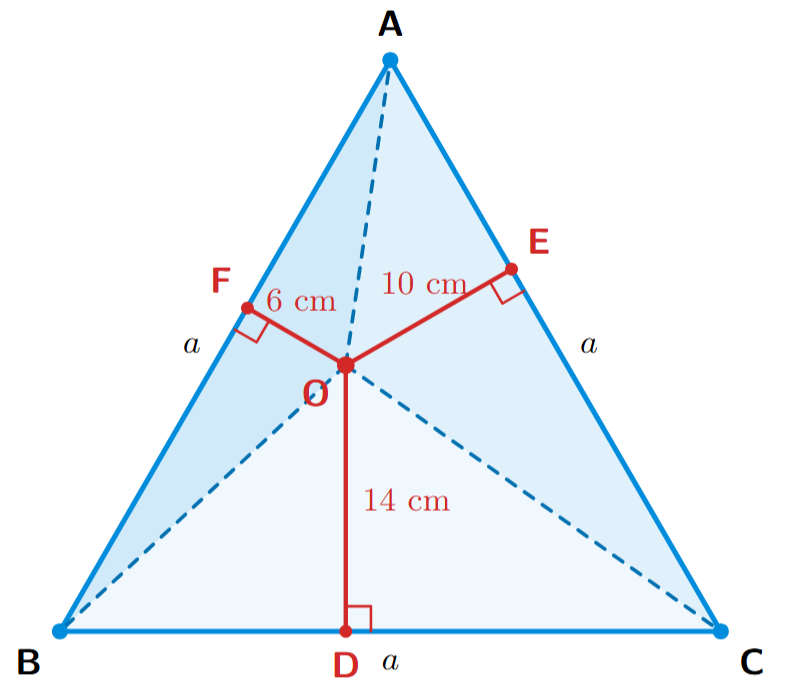
Let the side of the equilateral triangle be $a \text{ cm}$.
The area of $\triangle ABC$ is equal to the sum of the areas of $\triangle OBC$, $\triangle OCA$, and $\triangle OAB$.
$\text{Area}(\triangle ABC) = \text{Area}(\triangle OBC) + \text{Area}(\triangle OCA) + \text{Area}(\triangle OAB)$
$\frac{\sqrt{3}}{4} a^2 = \frac{1}{2} \cdot a \cdot p_1 + \frac{1}{2} \cdot a \cdot p_2 + \frac{1}{2} \cdot a \cdot p_3$
$\frac{\sqrt{3}}{4} a^2 = \frac{1}{2} a (p_1 + p_2 + p_3)$
$\frac{\sqrt{3}}{2} a = p_1 + p_2 + p_3$
... (i)
Substituting the given values of perpendiculars in equation (i):
$\frac{\sqrt{3}}{2} a = 14 + 10 + 6$
$\frac{\sqrt{3}}{2} a = 30$
$a = \frac{60}{\sqrt{3}}$
$a = 20\sqrt{3} \text{ cm}$
Now, we find the area of the equilateral triangle:
$\text{Area} = \frac{\sqrt{3}}{4} a^2$
$\text{Area} = \frac{\sqrt{3}}{4} (20\sqrt{3})^2$
$\text{Area} = \frac{\sqrt{3}}{4} \times 400 \times 3$
$\text{Area} = 300\sqrt{3} \text{ cm}^2$
Therefore, the area of the equilateral triangle is $300\sqrt{3} \text{ cm}^2$.
Question 4. The perimeter of an isosceles triangle is 32 cm. The ratio of the equal side to its base is 3 : 2. Find the area of the triangle.
Answer:
Given:
Perimeter of an isosceles triangle $= 32 \text{ cm}$.
Ratio of equal side to base $= 3 : 2$.
To Find:
Area of the triangle.
Solution:
Let the equal sides be $3x$, $3x$ and the base be $2x$.
$3x + 3x + 2x = 32$
(Perimeter = sum of all sides)
$8x = 32$
$x = 4$
So, the sides of the triangle are:
Side $a = 3 \times 4 = 12 \text{ cm}$
Side $b = 3 \times 4 = 12 \text{ cm}$
Side $c = 2 \times 4 = 8 \text{ cm}$
Semi-perimeter ($s$):
$s = \frac{a+b+c}{2} = \frac{32}{2} = 16 \text{ cm}$
Using Heron's Formula for area:
$\text{Area} = \sqrt{s(s-a)(s-b)(s-c)}$
$\text{Area} = \sqrt{16(16-12)(16-12)(16-8)}$
$\text{Area} = \sqrt{16 \times 4 \times 4 \times 8}$
$\text{Area} = 4 \times 4 \times \sqrt{8}$
$\text{Area} = 16 \times 2\sqrt{2}$
$\text{Area} = 32\sqrt{2} \text{ cm}^2$
Thus, the area of the isosceles triangle is $32\sqrt{2} \text{ cm}^2$.
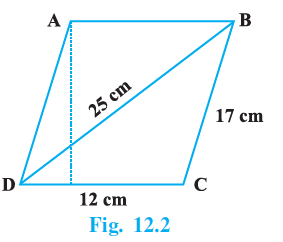
Question 5. Find the area of a parallelogram given in Fig. 12.2. Also find the length of the altitude from vertex A on the side DC.
Answer:
Given:
A parallelogram $ABCD$ where $AB = DC = 12 \text{ cm}$, $BC = AD = 17 \text{ cm}$, and diagonal $BD = 25 \text{ cm}$ (from Fig. 12.2).
To Find:
1. Area of parallelogram $ABCD$.
2. Length of the altitude from vertex $A$ on side $DC$.
Solution:
A diagonal divides a parallelogram into two triangles of equal area. Area of parallelogram $ABCD = 2 \times \text{Area of } \triangle BCD$.
For $\triangle BCD$, sides are $a = 12 \text{ cm}$, $b = 17 \text{ cm}$, $c = 25 \text{ cm}$.
$s = \frac{12 + 17 + 25}{2} = \frac{54}{2} = 27 \text{ cm}$
Using Heron's Formula for $\triangle BCD$:
$\text{Area}(\triangle BCD) = \sqrt{s(s-a)(s-b)(s-c)}$
$\text{Area} = \sqrt{27(27-12)(27-17)(27-25)}$
$\text{Area} = \sqrt{27 \times 15 \times 10 \times 2}$
$\text{Area} = \sqrt{8100}$
$\text{Area} = 90 \text{ cm}^2$
Now, Area of parallelogram $ABCD$:
$\text{Area} = 2 \times 90 = 180 \text{ cm}^2$
Let $h$ be the altitude from $A$ to side $DC$.
$\text{Area of Parallelogram} = \text{Base} \times \text{Altitude}$
$180 = 12 \times h$
$h = \frac{180}{12}$
$h = 15 \text{ cm}$
The area of the parallelogram is $180 \text{ cm}^2$ and the altitude is $15 \text{ cm}$.
Question 6. A field in the form of a parallelogram has sides 60 m and 40 m and one of its diagonals is 80 m long. Find the area of the parallelogram.
Answer:
Given:
Sides of a parallelogram field are $a = 60 \text{ m}$ and $b = 40 \text{ m}$.
Length of diagonal $d = 80 \text{ m}$.
To Find:
Area of the parallelogram field.
Solution:
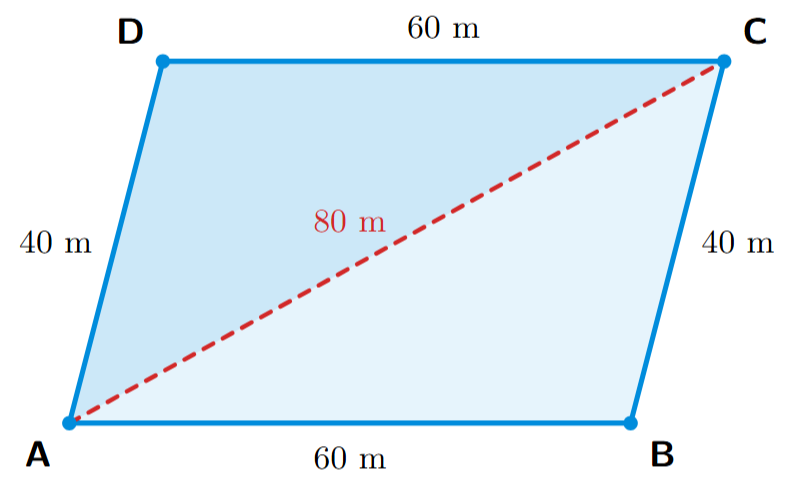
The diagonal of the parallelogram divides it into two congruent triangles. Thus, the area of the parallelogram is twice the area of one triangle with sides 60 m, 40 m, and 80 m.
For the triangle, semi-perimeter ($s$):
$s = \frac{60 + 40 + 80}{2} = \frac{180}{2} = 90 \text{ m}$
Using Heron's Formula for the triangle area:
$\text{Area}(\triangle) = \sqrt{s(s-60)(s-40)(s-80)}$
$\text{Area} = \sqrt{90(30)(50)(10)}$
$\text{Area} = \sqrt{1350000}$
$\text{Area} = \sqrt{9 \times 15 \times 10000}$
$\text{Area} = 3 \times 100 \times \sqrt{15} = 300\sqrt{15} \text{ m}^2$
Area of the parallelogram field:
$\text{Total Area} = 2 \times 300\sqrt{15}$
$\text{Total Area} = 600\sqrt{15} \text{ m}^2$
Thus, the area of the parallelogram is $600\sqrt{15} \text{ m}^2$.
Question 7. The perimeter of a triangular field is 420 m and its sides are in the ratio 6 : 7 : 8. Find the area of the triangular field.
Answer:
Given:
Perimeter of the triangular field $= 420 \text{ m}$
Ratio of the sides $= 6 : 7 : 8$
To Find:
Area of the triangular field.
Solution:
Let the sides of the triangular field be $6x$, $7x$, and $8x$.
$6x + 7x + 8x = 420$
[Perimeter = sum of sides]
$21x = 420$
$x = \frac{420}{21}$
$x = 20$
Therefore, the sides are:
$a = 6 \times 20 = 120 \text{ m}$
$b = 7 \times 20 = 140 \text{ m}$
$c = 8 \times 20 = 160 \text{ m}$
Semi-perimeter ($s$):
$s = \frac{420}{2} = 210 \text{ m}$
Using Heron's Formula:
$\text{Area} = \sqrt{s(s-a)(s-b)(s-c)}$
$\text{Area} = \sqrt{210(210-120)(210-140)(210-160)}$
$\text{Area} = \sqrt{210 \times 90 \times 70 \times 50}$
$\text{Area} = \sqrt{(70 \times 3) \times (30 \times 3) \times 70 \times (10 \times 5)}$
Simplifying the square root:
$\text{Area} = \sqrt{70^2 \times 3^2 \times 10^2 \times 3 \times 5 \times 3}$
$\text{Area} = 70 \times 3 \times 10 \times 3 \times \sqrt{15}$
$\text{Area} = 2100\sqrt{15} \text{ m}^2$
The area of the triangular field is $2100\sqrt{15} \text{ m}^2$.
Question 8. The sides of a quadrilateral ABCD are 6 cm, 8 cm, 12 cm and 14 cm (taken in order) respectively, and the angle between the first two sides is a right angle. Find its area.
Answer:
Given:
A quadrilateral $ABCD$ where $AB = 6 \text{ cm}$, $BC = 8 \text{ cm}$, $CD = 12 \text{ cm}$, and $DA = 14 \text{ cm}$.
$\angle ABC = 90^\circ$
To Find:
Area of quadrilateral $ABCD$.
Construction:
Join the diagonal $AC$.
Solution:
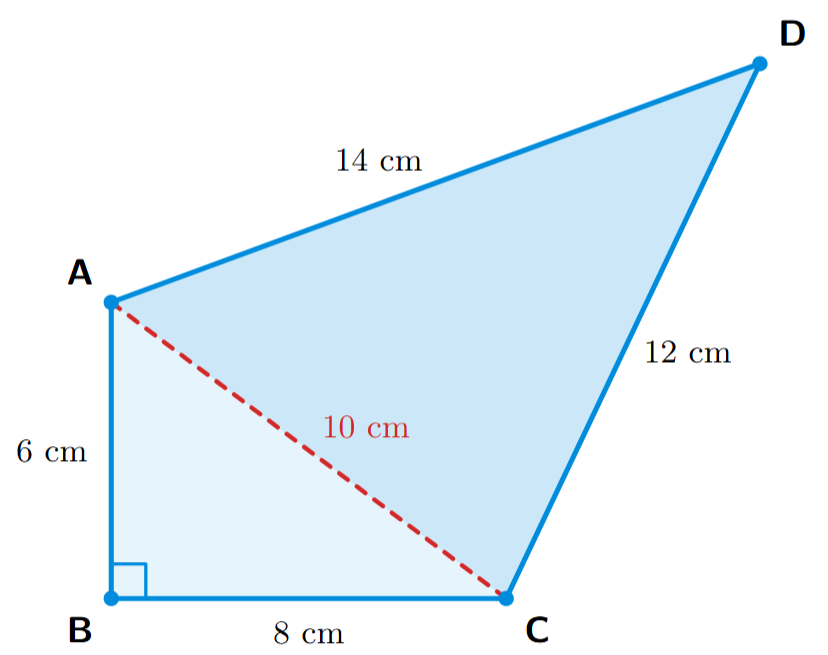
In right-angled $\triangle ABC$:
$AC^2 = AB^2 + BC^2$
[Pythagoras Theorem]
$AC^2 = 6^2 + 8^2 = 36 + 64 = 100$
$AC = 10 \text{ cm}$
Now, Area of quadrilateral $ABCD = \text{Area}(\triangle ABC) + \text{Area}(\triangle ADC)$.
1. Area of $\triangle ABC$:
$\text{Area} = \frac{1}{2} \times \text{base} \times \text{height} = \frac{1}{2} \times 6 \times 8 = 24 \text{ cm}^2$
2. Area of $\triangle ADC$:
Sides are $a = 10 \text{ cm}$, $b = 12 \text{ cm}$, $c = 14 \text{ cm}$.
$s = \frac{10 + 12 + 14}{2} = \frac{36}{2} = 18 \text{ cm}$
$\text{Area} = \sqrt{18(18-10)(18-12)(18-14)}$
$\text{Area} = \sqrt{18 \times 8 \times 6 \times 4} = \sqrt{3456}$
$\text{Area} = \sqrt{576 \times 6} = 24\sqrt{6} \text{ cm}^2$
Total Area of quadrilateral $ABCD = (24 + 24\sqrt{6}) \text{ cm}^2$.
$\text{Total Area} \approx 24 + 24(2.45) = 24 + 58.8 = 82.8 \text{ cm}^2$
The area of the quadrilateral is $24(1 + \sqrt{6}) \text{ cm}^2$.
Question 9. A rhombus shaped sheet with perimeter 40 cm and one diagonal 12 cm, is painted on both sides at the rate of Rs 5 per cm2 . Find the cost of painting.
Answer:
Given:
Perimeter of the rhombus-shaped sheet $= 40 \text{ cm}$
Length of one diagonal ($d_1$) $= 12 \text{ cm}$
Rate of painting $= \textsf{₹} \ 5$ per $\text{cm}^2$
To Find:
The total cost of painting both sides of the rhombus-shaped sheet.
Solution:
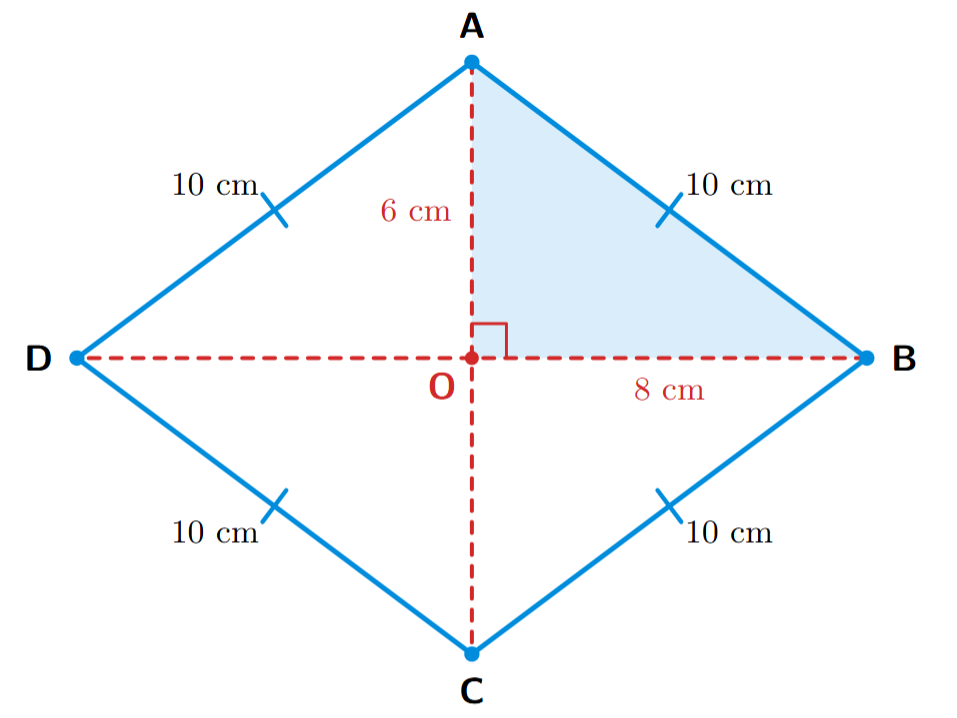
Let the side of the rhombus be $a \text{ cm}$. Since all four sides of a rhombus are equal in length:
$4a = 40$
(Perimeter = $4 \times \text{side}$)
$a = 10 \text{ cm}$
... (i)
We know that the diagonals of a rhombus bisect each other at right angles ($90^\circ$). Let $ABCD$ be the rhombus where diagonals $AC$ and $BD$ intersect at point $O$.
Let $AC = d_1 = 12 \text{ cm}$. Then:
$AO = \frac{AC}{2} = \frac{12}{2} = 6 \text{ cm}$
In the right-angled triangle $\triangle AOB$:
$AB^2 = AO^2 + BO^2$
[By Pythagoras Theorem] ... (ii)
Substituting the values of $AB$ (side $a$) and $AO$:
$10^2 = 6^2 + BO^2$
$100 = 36 + BO^2$
$BO^2 = 100 - 36 = 64$
$BO = \sqrt{64} = 8 \text{ cm}$
Now, the length of the second diagonal ($d_2$) is:
$BD = 2 \times BO = 2 \times 8 = 16 \text{ cm}$
The area of one side of the rhombus-shaped sheet is given by:
$\text{Area} = \frac{1}{2} \times d_1 \times d_2$
$\text{Area} = \frac{1}{2} \times 12 \times 16$
$\text{Area} = 6 \times 16 = 96 \text{ cm}^2$
Since the sheet is painted on both sides, the total area to be painted is:
$\text{Total Area} = 2 \times 96 = 192 \text{ cm}^2$
Now, calculating the total cost of painting at the rate of $\textsf{₹} \ 5$ per $\text{cm}^2$:
$\text{Total Cost} = \text{Total Area} \times \text{Rate}$
$\text{Total Cost} = 192 \times 5$
$\text{Total Cost} = \textsf{₹} \ 960$
Hence, the total cost of painting the sheet on both sides is $\textsf{₹} \ 960$.
Alternate Solution:
The area of the rhombus can also be found by splitting it into two congruent triangles $\triangle ABC$ and $\triangle ADC$ using diagonal $AC = 12 \text{ cm}$ and sides $10 \text{ cm}$ each. Using Heron's Formula for $\triangle ABC$:
$s = \frac{10 + 10 + 12}{2} = 16 \text{ cm}$
$\text{Area}(\triangle ABC) = \sqrt{16(16-10)(16-10)(16-12)} = \sqrt{16 \times 6 \times 6 \times 4} $$ = 4 \times 6 \times 2 = 48 \text{ cm}^2$
$\text{Area of rhombus} = 2 \times 48 = 96 \text{ cm}^2$. Total area for both sides is $192 \text{ cm}^2$, leading to the same cost of $\textsf{₹} \ 960$.
Question 10. Find the area of the trapezium PQRS with height PQ given in Fig. 12.3

Answer:
Given:
A trapezium $PQRS$ as shown in Fig. 12.3 where $PS = 12 \text{ m}$, $QR = 7 \text{ m}$, and $SR = 13 \text{ m}$.
$PQ$ is the height of the trapezium (meaning $PS \parallel QR$ is not the case here, rather $PS$ and $QR$ are parallel vertical sides and $PQ$ is the horizontal distance).
To Find:
Area of trapezium $PQRS$.
Construction:
Draw $RT \perp PS$ meeting $PS$ at $T$.
Solution:
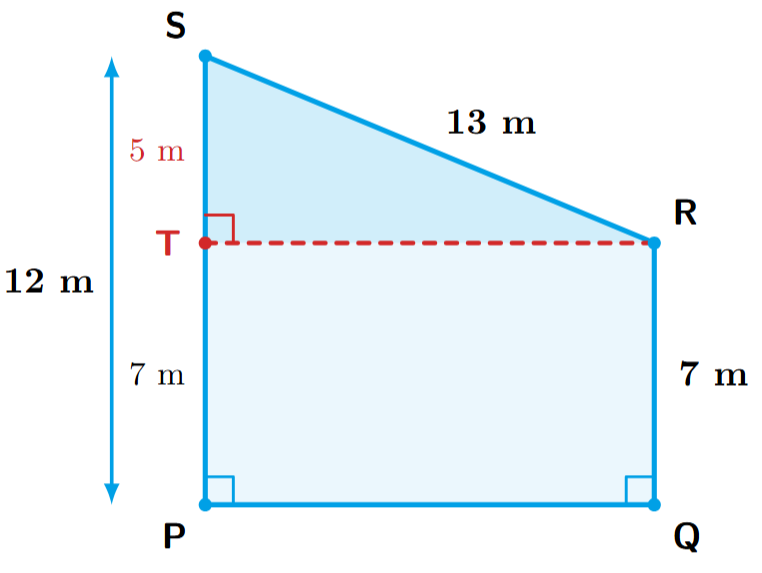
From the construction, $PQRT$ forms a rectangle. Therefore, $PT = QR = 7 \text{ m}$.
Now, calculate $ST$:
$ST = PS - PT = 12 - 7 = 5 \text{ m}$
In right-angled $\triangle STR$:
$SR^2 = ST^2 + RT^2$
[Pythagoras Theorem]
$13^2 = 5^2 + RT^2$
$169 - 25 = RT^2 \Rightarrow 144 = RT^2$
$RT = 12 \text{ m}$
Since $RT$ is equal to height $PQ$:
$PQ = 12 \text{ m}$
Area of trapezium $PQRS$:
$\text{Area} = \frac{1}{2} \times (\text{sum of parallel sides}) \times \text{height}$
$\text{Area} = \frac{1}{2} \times (PS + QR) \times PQ$
$\text{Area} = \frac{1}{2} \times (12 + 7) \times 12$
$\text{Area} = 19 \times 6 = 114 \text{ m}^2$
Therefore, the area of the trapezium $PQRS$ is $114 \text{ m}^2$.
Sample Question 1 (Before Exercise 12.4)
Sample Question 1: If each side of a triangle is doubled, then find the ratio of area of the new triangle thus formed and the given triangle.
Answer:
Given:
Let the sides of the original triangle be $a$, $b$, and $c$.
If each side is doubled, the sides of the new triangle are $2a$, $2b$, and $2c$.
To Find:
The ratio of the area of the new triangle to the area of the given triangle.
Solution:
Let $s$ be the semi-perimeter of the original triangle.
$s = \frac{a+b+c}{2}$
... (i)
The area of the original triangle ($A$) by Heron's Formula is:
$A = \sqrt{s(s-a)(s-b)(s-c)}$
For the new triangle, the semi-perimeter ($s'$) is:
$s' = \frac{2a+2b+2c}{2} = \frac{2(a+b+c)}{2} = 2s$
The area of the new triangle ($A'$) is:
$A' = \sqrt{s'(s'-2a)(s'-2b)(s'-2c)}$
$A' = \sqrt{2s(2s-2a)(2s-2b)(2s-2c)}$
$A' = \sqrt{2s \cdot 2(s-a) \cdot 2(s-b) \cdot 2(s-c)}$
$A' = \sqrt{16s(s-a)(s-b)(s-c)}$
$A' = 4\sqrt{s(s-a)(s-b)(s-c)} = 4A$
The ratio of the area of the new triangle to the given triangle is:
$\frac{A'}{A} = \frac{4A}{A} = \frac{4}{1}$
Therefore, the required ratio is $4 : 1$.
Exercise 12.4
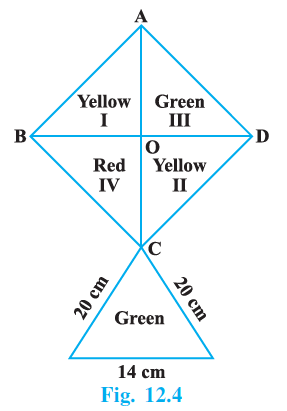
Question 1. How much paper of each shade is needed to make a kite given in Fig. 12.4, in which ABCD is a square with diagonal 44 cm.
Answer:
Given:
$ABCD$ is a square with diagonal $AC = BD = 44 \text{ cm}$.
A bottom triangular tail (Green) with sides $20 \text{ cm}$, $20 \text{ cm}$, and $14 \text{ cm}$.
To Find:
Area of paper needed for each shade: Yellow, Green, and Red.
Solution:
Area of square $ABCD$:
$\text{Area} = \frac{1}{2} \times d^2 = \frac{1}{2} \times 44 \times 44 = 968 \text{ cm}^2$
The diagonals of a square divide it into four congruent triangles of equal area.
$\text{Area of each small triangle} = \frac{968}{4} = 242 \text{ cm}^2$
1. Yellow Shade: Consists of Part I and Part II.
$\text{Area} = 242 + 242 = 484 \text{ cm}^2$
2. Red Shade: Consists of Part IV.
$\text{Area} = 242 \text{ cm}^2$
3. Green Shade: Consists of Part III plus the triangular tail.
For the tail triangle, $a = 20$, $b = 20$, $c = 14$.
$s = \frac{20+20+14}{2} = 27 \text{ cm}$
$\text{Area of tail} = \sqrt{27(27-20)(27-20)(27-14)}$
$\text{Area of tail} = \sqrt{27 \times 7 \times 7 \times 13} = 7 \sqrt{351} \approx 7 \times 18.735 = 131.14 \text{ cm}^2$
$\text{Total Green Area} = 242 + 131.14 = 373.14 \text{ cm}^2$
Final requirements: Yellow = $484 \text{ cm}^2$, Red = $242 \text{ cm}^2$, Green = $373.14 \text{ cm}^2$.
Question 2. The perimeter of a triangle is 50 cm. One side of a triangle is 4 cm longer than the smaller side and the third side is 6 cm less than twice the smaller side. Find the area of the triangle.
Answer:
Given:
Perimeter $= 50 \text{ cm}$.
Let the smaller side be $x \text{ cm}$.
Second side $= x + 4 \text{ cm}$.
Third side $= 2x - 6 \text{ cm}$.
To Find:
Area of the triangle.
Solution:
Using the definition of perimeter:
$x + (x + 4) + (2x - 6) = 50$
$4x - 2 = 50$
$4x = 52 \Rightarrow x = 13 \text{ cm}$
The sides of the triangle are:
$a = 13 \text{ cm}$
$b = 13 + 4 = 17 \text{ cm}$
$c = 2(13) - 6 = 20 \text{ cm}$
Semi-perimeter ($s$):
$s = \frac{50}{2} = 25 \text{ cm}$
Using Heron's Formula:
$\text{Area} = \sqrt{25(25-13)(25-17)(25-20)}$
$\text{Area} = \sqrt{25 \times 12 \times 8 \times 5}$
$\text{Area} = \sqrt{15000} = \sqrt{2500 \times 6}$
$\text{Area} = 50\sqrt{6} \text{ cm}^2 \approx 122.47 \text{ cm}^2$
The area of the triangle is $50\sqrt{6} \text{ cm}^2$.
Question 3. The area of a trapezium is 475 cm2 and the height is 19 cm. Find the lengths of its two parallel sides if one side is 4 cm greater than the other.
Answer:
Given:
Area of trapezium $= 475 \text{ cm}^2$.
Height ($h$) $= 19 \text{ cm}$.
Let the shorter parallel side be $x \text{ cm}$.
The longer parallel side $= x + 4 \text{ cm}$.
To Find:
The lengths of the two parallel sides.
Solution:
The formula for the area of a trapezium is:
$\text{Area} = \frac{1}{2} \times (\text{sum of parallel sides}) \times \text{height}$
Substituting the given values:
$475 = \frac{1}{2} \times (x + x + 4) \times 19$
$475 = \frac{19}{2} \times (2x + 4)$
$475 = 19 \times (x + 2)$
$x + 2 = \frac{475}{19}$
$x + 2 = 25$
$x = 23 \text{ cm}$
The lengths of the parallel sides are:
Shorter side $= 23 \text{ cm}$
Longer side $= 23 + 4 = 27 \text{ cm}$
The lengths of the parallel sides are $23 \text{ cm}$ and $27 \text{ cm}$.
Question 4. A rectangular plot is given for constructing a house, having a measurement of 40 m long and 15 m in the front. According to the laws, a minimum of 3 m, wide space should be left in the front and back each and 2 m wide space on each of other sides. Find the largest area where house can be constructed.
Answer:
Given:
Length of the rectangular plot ($L$) = $40 \text{ m}$
Width (Front) of the rectangular plot ($W$) = $15 \text{ m}$
Margin space to be left at the front and back = $3 \text{ m}$ each
Margin space to be left on the other two sides = $2 \text{ m}$ each
To Find:
The largest area where the house can be constructed.
Solution:
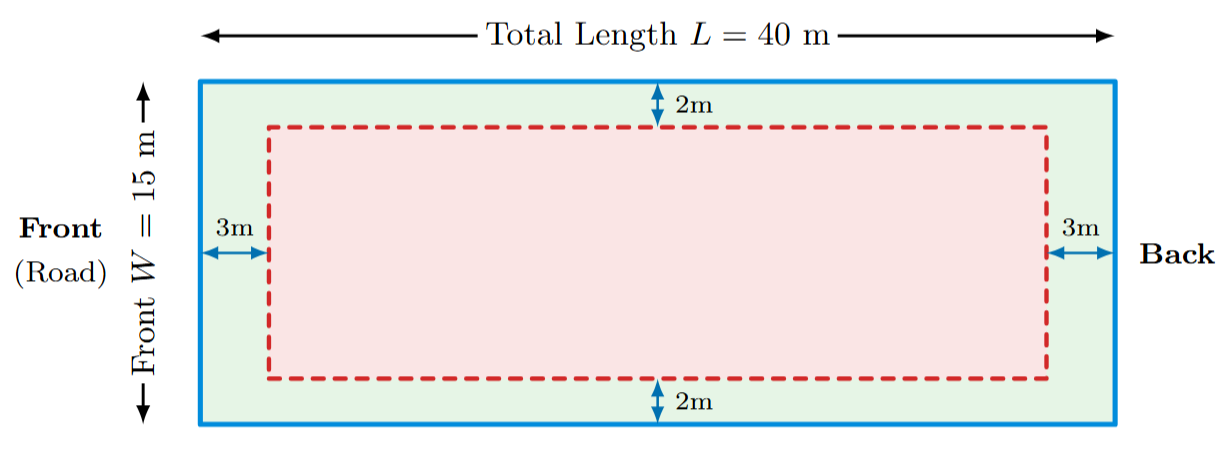
The house can be constructed in the inner rectangular area after leaving the mandatory margins on all sides. We need to find the dimensions of this inner rectangle.
The length of the construction area ($l$) is obtained by subtracting the front and back margins from the total length of the plot:
$l = 40 - (3 + 3)$
... (i)
$l = 40 - 6 = 34 \text{ m}$
The width of the construction area ($w$) is obtained by subtracting the side margins from the total front width of the plot:
$w = 15 - (2 + 2)$
... (ii)
$w = 15 - 4 = 11 \text{ m}$
The largest area where the house can be constructed is the area of this inner rectangle:
$\text{Area} = l \times w$
Substituting the values from (i) and (ii):
$\text{Area} = 34 \times 11$
$\text{Area} = 374 \text{ m}^2$
Thus, the largest area where the house can be constructed is $374 \text{ m}^2$.
Alternate Solution:
One can visualize the construction area as the remaining portion after removing two strips of $3 \text{ m}$ from the length and two strips of $2 \text{ m}$ from the width. By calculating the new dimensions directly as $34 \text{ m}$ and $11 \text{ m}$, the area is simply the product of these dimensions, which equals $374 \text{ m}^2$.
Question 5. A field is in the shape of a trapezium having parallel sides 90 m and 30 m. These sides meet the third side at right angles. The length of the fourth side is 100 m. If it costs Rs 4 to plough 1m2 of the field, find the total cost of ploughing the field.
Answer:
Given:
Parallel sides of the trapezium-shaped field are $a = 90 \text{ m}$ and $b = 30 \text{ m}$.
The third side is perpendicular to these parallel sides, which represents the height ($h$) of the trapezium.
The length of the fourth side (slant side) is $l = 100 \text{ m}$.
Cost of ploughing $= \textsf{₹} \ 4 \text{ per } \text{m}^2$.
To Find:
The total cost of ploughing the field.
Solution:
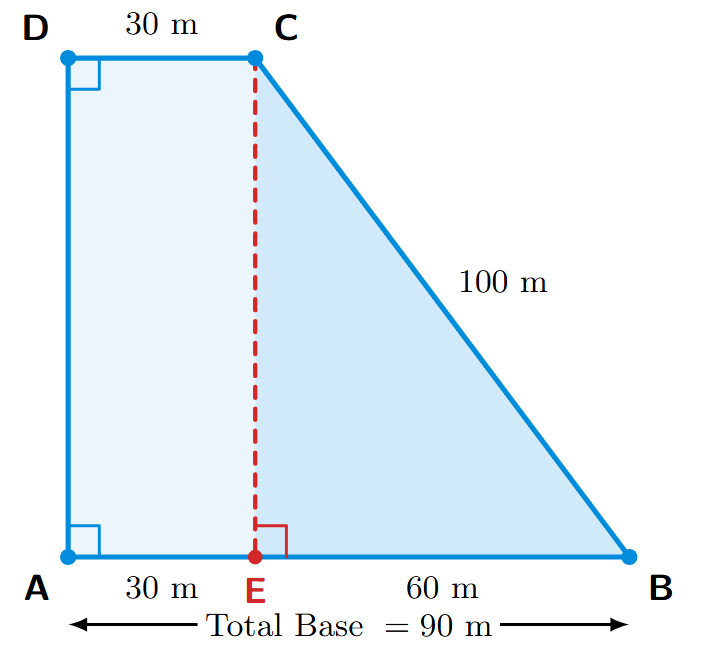
In a right-angled trapezium, the height $h$ can be found by considering a right-angled triangle formed by the slant side. The base of this triangle is the difference between the two parallel sides.
$\text{Base of the triangle} = 90 - 30 = 60 \text{ m}$
Using the Pythagoras Theorem in this right-angled triangle:
$h^2 + 60^2 = 100^2$
... (i)
$h^2 + 3600 = 10000$
$h^2 = 10000 - 3600$
$h^2 = 6400$
$h = \sqrt{6400} = 80 \text{ m}$
[Height of the trapezium] ... (ii)
Now, we find the area of the trapezium field:
$\text{Area} = \frac{1}{2} \times (\text{sum of parallel sides}) \times \text{height}$
$\text{Area} = \frac{1}{2} \times (90 + 30) \times 80$
$\text{Area} = \frac{1}{2} \times 120 \times 80$
$\text{Area} = 60 \times 80 = 4800 \text{ m}^2$
To find the total cost of ploughing, we multiply the area by the given rate:
$\text{Total Cost} = \text{Area} \times \text{Rate}$
$\text{Total Cost} = 4800 \times \textsf{₹} \ 4$
$\text{Total Cost} = \textsf{₹} \ 19200$
Thus, the total cost of ploughing the field is $\textsf{₹} \ 19200$.
Alternate Solution:
The trapezium field can be divided into two parts: a rectangle of sides $30 \text{ m}$ and $80 \text{ m}$, and a right-angled triangle with base $60 \text{ m}$ and height $80 \text{ m}$.
$\text{Area of rectangle} = 30 \times 80 = 2400 \text{ m}^2$
$\text{Area of triangle} = \frac{1}{2} \times 60 \times 80 = 2400 \text{ m}^2$
$\text{Total Area} = 2400 + 2400 = 4800 \text{ m}^2$
Total cost $= 4800 \times 4 = \textsf{₹} \ 19200$.
Question 6. In Fig. 12.5, ∆ ABC has sides AB = 7.5 cm, AC = 6.5 cm and BC = 7 cm. On base BC a parallelogram DBCE of same area as that of ∆ ABC is constructed. Find the height DF of the parallelogram.

Answer:
Given:
In $\triangle ABC$, sides are $AB = 7.5 \text{ cm}$, $AC = 6.5 \text{ cm}$ and $BC = 7 \text{ cm}$.
Parallelogram $DBCE$ and $\triangle ABC$ have the same area and the same base $BC$.
To Find:
Height $DF$ of the parallelogram $DBCE$.
Solution:
First, calculate the area of $\triangle ABC$ using Heron's Formula.
Semi-perimeter ($s$):
$s = \frac{7.5 + 6.5 + 7}{2} = \frac{21}{2} = 10.5 \text{ cm}$
Area of $\triangle ABC$:
$\text{Area} = \sqrt{s(s-a)(s-b)(s-c)}$
$\text{Area} = \sqrt{10.5(10.5-7.5)(10.5-6.5)(10.5-7)}$
$\text{Area} = \sqrt{10.5 \times 3 \times 4 \times 3.5}$
$\text{Area} = \sqrt{441} = 21 \text{ cm}^2$
According to the question, Area of parallelogram $DBCE = \text{Area}(\triangle ABC)$.
$\text{Area of Parallelogram} = \text{Base} \times \text{Height}$
$21 = BC \times DF$
$21 = 7 \times DF$
$DF = \frac{21}{7} = 3 \text{ cm}$
The height $DF$ of the parallelogram is $3 \text{ cm}$.
Question 7. The dimensions of a rectangle ABCD are 51 cm × 25 cm. A trapezium PQCD with its parallel sides QC and PD in the ratio 9 : 8, is cut off from the rectangle as shown in the Fig. 12.6. If the area of the trapezium PQCD is $\frac{5}{6}$ th part of the area of the rectangle, find the lengths QC and PD.
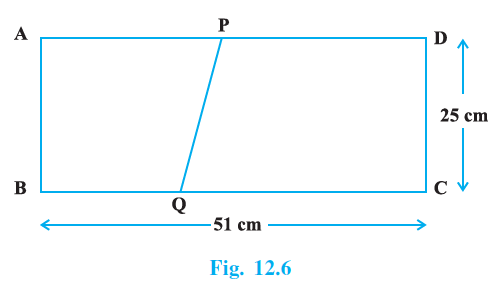
Answer:
Given:
Rectangle $ABCD$ with length $= 51 \text{ cm}$ and width $= 25 \text{ cm}$.
Ratio of parallel sides of trapezium $PQCD$, $QC : PD = 9 : 8$.
$\text{Area of trapezium } PQCD = \frac{5}{6} \times \text{Area of rectangle } ABCD$.
To Find:
Lengths of $QC$ and $PD$.
Solution:
Area of rectangle $ABCD$:
$\text{Area}(ABCD) = 51 \times 25 = 1275 \text{ cm}^2$
Area of trapezium $PQCD$:
$\text{Area}(PQCD) = \frac{5}{6} \times 1275 = 1062.5 \text{ cm}^2$
Let $QC = 9x$ and $PD = 8x$.
The height of the trapezium is the distance between the parallel sides $QC$ and $PD$, which is the side $CD = 25 \text{ cm}$ (assuming the long sides are horizontal in the figure).
$\text{Area}(PQCD) = \frac{1}{2} \times (QC + PD) \times h$
$1062.5 = \frac{1}{2} \times (9x + 8x) \times 51$
[Note: Height is length 51]
Actually, looking at Fig 12.6, $PD$ and $QC$ are segments on the vertical sides, so the height is the horizontal distance $CD = 25 \text{ cm}$. Wait, if $ABCD$ is $51 \times 25$, the diagram shows the horizontal side is $51 \text{ cm}$. Parallel sides are $PD$ and $QC$. Height $= 51 \text{ cm}$.
$1062.5 = \frac{1}{2} \times (17x) \times 25$
$2125 = 425x$
$x = \frac{2125}{425} = 5$
Lengths of the parallel sides:
$QC = 9 \times 5 = 45 \text{ cm}$
$PD = 8 \times 5 = 40 \text{ cm}$
The lengths of $QC$ and $PD$ are $45 \text{ cm}$ and $40 \text{ cm}$ respectively.
Question 8. A design is made on a rectangular tile of dimensions 50 cm × 70 cm as shown in Fig. 12.7. The design shows 8 triangles, each of sides 26 cm, 17 cm and 25 cm. Find the total area of the design and the remaining area of the tile.
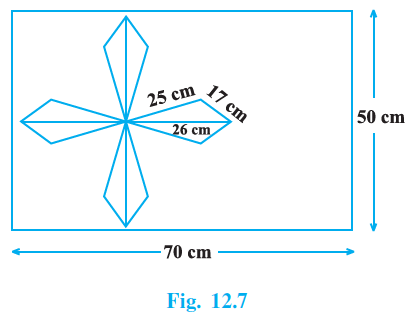
Answer:
Given:
Dimensions of rectangular tile = $50 \text{ cm} \times 70 \text{ cm}$.
Number of design triangles = $8$.
Sides of each triangle: $a = 26 \text{ cm}, b = 17 \text{ cm}, c = 25 \text{ cm}$.
To Find:
1. Total area of the design.
2. Remaining area of the tile.
Solution:
Calculate the area of one triangle using Heron's Formula.
Semi-perimeter ($s$):
$s = \frac{26 + 17 + 25}{2} = \frac{68}{2} = 34 \text{ cm}$
Area of one triangle:
$\text{Area} = \sqrt{34(34-26)(34-17)(34-25)}$
$\text{Area} = \sqrt{34 \times 8 \times 17 \times 9}$
$\text{Area} = \sqrt{(17 \times 2) \times (2^3) \times 17 \times 3^2}$
$\text{Area} = \sqrt{17^2 \times 2^4 \times 3^2}$
$\text{Area} = 17 \times 4 \times 3 = 204 \text{ cm}^2$
Total area of the design (8 triangles):
$\text{Total Design Area} = 8 \times 204 = 1632 \text{ cm}^2$
Total area of the rectangular tile:
$\text{Area of Tile} = 50 \times 70 = 3500 \text{ cm}^2$
Remaining area of the tile:
$\text{Remaining Area} = 3500 - 1632 = 1868 \text{ cm}^2$
Total design area is $1632 \text{ cm}^2$ and the remaining area is $1868 \text{ cm}^2$.