

Chapter 13 Surface Areas and Volumes (Class 9 - Maths NCERT Exemplar Solutions)
Welcome to the comprehensive resource for NCERT Exemplar Solutions for Class 9 Mathematics: Chapter 13 Surface Areas and Volumes! These problems are specifically designed to elevate the level of challenge beyond standard textbook exercises, demanding complex calculations and the ability to handle composite shapes. By deciphering intricate word problems and mastering the precise application of formulas, these solutions build the computational proficiency and analytical depth required for mastering the mensuration of three-dimensional solids.
The solutions cover the essential repertoire of geometric solids, including the Cube, Cuboid, Right Circular Cylinder, Right Circular Cone, Sphere, and Hemisphere. Students will master the formulas for **Curved Surface Area (CSA)**, **Total Surface Area (TSA)**, and **Volume**, such as $V = \frac{1}{3}\pi r^2 h$ for cones or $SA = 4\pi r^2$ for spheres. A primary focus is placed on algebraic manipulation, where students must work backwards to find unknown dimensions like radius or height when the area or volume is provided.
Significant attention is given to real-world word problems, ranging from calculating the cost of painting surfaces to performing critical unit conversions, such as converting cubic centimeters to litres. The Exemplar rigorously tests skills through ratios between dimensions and multi-step scenarios involving material requirements for construction. With step-by-step guidance and meticulous calculations prepared by learningspot.co, students can master the critical skills needed to effectively solve complex 3D geometry problems and handle calculations involving $\pi$ and square roots with precision.
Sample Question 1 (Before Exercise 13.1)
Write the correct answer
Sample Question 1: In a cylinder, if radius is halved and height is doubled, the volume will be
(A) same
(B) doubled
(C) halved
(D) four times
Answer:
Given:
Let the original radius of the cylinder be $r$ and the original height be $h$.
New radius, $r_1 = \frac{r}{2}$
New height, $h_1 = 2h$
To Find:
The relationship between the new volume and the original volume.
Solution:
The volume of the original cylinder ($V$) is given by:
$V = \pi r^2 h$
…(i)
The volume of the new cylinder ($V_1$) is:
$V_1 = \pi (r_1)^2 h_1$
Substituting the values of $r_1$ and $h_1$:
$V_1 = \pi \left( \frac{r}{2} \right)^2 (2h)$
$V_1 = \pi \left( \frac{r^2}{4} \right) (2h)$
$V_1 = \frac{1}{2} \pi r^2 h$
Comparing with equation (i):
$V_1 = \frac{1}{2} V$
Therefore, the volume will be halved.
Hence, the correct option is (C).
Exercise 13.1
Write the correct answer in each of the following :
Question 1. The radius of a sphere is 2r, then its volume will be
(A) $\frac{4}{3}\pi r^2$
(B) $4\pi r^3$
(C) $\frac{8\pi r^3}{3}$
(D) $\frac{32}{3}\pi r^3$
Answer:
Given:
Radius of the sphere, $R = 2r$.
To Find:
The volume of the sphere.
Solution:
The standard formula for the volume of a sphere with radius $R$ is:
$V = \frac{4}{3} \pi R^3$
Substituting the given radius $R = 2r$ into the formula:
$V = \frac{4}{3} \pi (2r)^3$
$V = \frac{4}{3} \pi (8r^3)$
$V = \frac{32}{3} \pi r^3$
Therefore, the volume of the sphere is $\frac{32}{3} \pi r^3$.
Hence, the correct option is (D).
Question 2. The total surface area of a cube is 96 cm2 . The volume of the cube is:
(A) 8 cm3
(B) 512 cm3
(C) 64 cm3
(D) 27 cm3
Answer:
Given:
Total surface area (TSA) of the cube $= 96 \text{ cm}^2$.
To Find:
The volume of the cube.
Solution:
Let the edge of the cube be $a \text{ cm}$.
The formula for the Total Surface Area of a cube is:
$TSA = 6a^2$
Equating the given value:
$6a^2 = 96$
$a^2 = \frac{96}{6}$
$a^2 = 16$
$a = 4 \text{ cm}$
Now, the volume of the cube ($V$) is given by:
$V = a^3$
$V = (4)^3$
$V = 64 \text{ cm}^3$
The volume of the cube is $64 \text{ cm}^3$.
Hence, the correct option is (C).
Question 3. A cone is 8.4 cm high and the radius of its base is 2.1 cm. It is melted and recast into a sphere. The radius of the sphere is :
(A) 4.2 cm
(B) 2.1 cm
(C) 2.4 cm
(D) 1.6 cm
Answer:
Given:
Height of the cone, $h = 8.4 \text{ cm}$.
Base radius of the cone, $r = 2.1 \text{ cm}$.
To Find:
The radius of the recast sphere ($R$).
Solution:
When an object is melted and recast into another shape, its volume remains the same.
$\text{Volume of sphere} = \text{Volume of cone}$
Using the formulas for volume:
$\frac{4}{3} \pi R^3 = \frac{1}{3} \pi r^2 h$
Cancelling $\frac{1}{3} \pi$ from both sides:
$4R^3 = r^2 h$
Substituting the given values of $r$ and $h$:
$4R^3 = (2.1)^2 \times 8.4$
$R^3 = \frac{2.1 \times 2.1 \times 8.4}{4}$
$R^3 = 2.1 \times 2.1 \times 2.1$
$R = 2.1 \text{ cm}$
The radius of the sphere is $2.1 \text{ cm}$.
Hence, the correct option is (B).
Question 4. In a cylinder, radius is doubled and height is halved, curved surface area will be
(A) halved
(B) doubled
(C) same
(D) four times
Answer:
Given:
Original radius $= r$, Original height $= h$.
New radius, $r' = 2r$.
New height, $h' = \frac{h}{2}$.
To Find:
Effect on the curved surface area (CSA).
Solution:
The original curved surface area of the cylinder is:
$CSA = 2\pi r h$
…(i)
The new curved surface area ($CSA'$) is:
$CSA' = 2\pi r' h'$
Substituting the new dimensions:
$CSA' = 2\pi (2r) \left( \frac{h}{2} \right)$
$CSA' = 2\pi r h$
Comparing with equation (i):
$CSA' = CSA$
The curved surface area remains the same.
Hence, the correct option is (C).
Question 5. The total surface area of a cone whose radius is $\frac{r}{2}$ and slant height 2l is
(A) 2πr (l + r)
(B) πr$\left( l + \frac{r}{4} \right)$
(C) πr (l + r)
(D) 2πrl
Answer:
Given:
Radius of the cone, $R = \frac{r}{2}$.
Slant height of the cone, $L = 2l$.
To Find:
The total surface area (TSA) of the cone.
Solution:
The formula for the Total Surface Area of a cone is:
$TSA = \pi R (L + R)$
Substituting the given values of $R$ and $L$:
$TSA = \pi \left( \frac{r}{2} \right) \left( 2l + \frac{r}{2} \right)$
Distributing $\frac{1}{2}$ inside the bracket:
$TSA = \pi r \left( \frac{2l}{2} + \frac{r}{2 \times 2} \right)$
$TSA = \pi r \left( l + \frac{r}{4} \right)$
The total surface area of the cone is $\pi r \left( l + \frac{r}{4} \right)$.
Hence, the correct option is (B).
Question 6. The radii of two cylinders are in the ratio of 2:3 and their heights are in the ratio of 5:3. The ratio of their volumes is:
(A) 10 : 17
(B) 20 : 27
(C) 17 : 27
(D) 20 : 37
Answer:
Given:
Ratio of radii of two cylinders, $r_1 : r_2 = 2 : 3$
Ratio of their heights, $h_1 : h_2 = 5 : 3$
To Find:
The ratio of their volumes $V_1 : V_2$.
Solution:
Let the radii be $2x$ and $3x$, and the heights be $5y$ and $3y$.
The volume of a cylinder is given by the formula $V = \pi r^2 h$.
The ratio of their volumes is:
$\frac{V_1}{V_2} = \frac{\pi r_1^2 h_1}{\pi r_2^2 h_2}$
$\frac{V_1}{V_2} = \left(\frac{r_1}{r_2}\right)^2 \times \left(\frac{h_1}{h_2}\right)$
Substituting the given ratios:
$\frac{V_1}{V_2} = \left(\frac{2}{3}\right)^2 \times \left(\frac{5}{3}\right)$
$\frac{V_1}{V_2} = \frac{4}{9} \times \frac{5}{3} = \frac{20}{27}$
Thus, the ratio of their volumes is $20 : 27$.
Hence, the correct option is (B).
Question 7. The lateral surface area of a cube is 256 m2 . The volume of the cube is
(A) 512 m3
(B) 64 m3
(C) 216 m3
(D) 256 m3
Answer:
Given:
Lateral surface area (LSA) of the cube $= 256 \text{ m}^2$
To Find:
Volume of the cube.
Solution:
Let the edge of the cube be $a$.
The formula for the lateral surface area of a cube is $4a^2$.
$4a^2 = 256$
$a^2 = \frac{256}{4} = 64$
$a = \sqrt{64} = 8 \text{ m}$
Now, the volume of the cube ($V$) is given by $a^3$:
$V = 8^3 = 8 \times 8 \times 8 = 512 \text{ m}^3$
Thus, the volume of the cube is $512 \text{ m}^3$.
Hence, the correct option is (A).
Question 8. The number of planks of dimensions (4 m × 50 cm × 20 cm) that can be stored in a pit which is 16 m long, 12 m wide and 4 m deep is
(A) 1900
(B) 1920
(C) 1800
(D) 1840
Answer:
Given:
Dimensions of the pit: $16 \text{ m} \times 12 \text{ m} \times 4 \text{ m}$
Dimensions of one plank: $4 \text{ m} \times 50 \text{ cm} \times 20 \text{ cm}$
To Find:
Number of planks that can be stored.
Solution:
First, convert all dimensions into meters:
For the plank: Length $= 4 \text{ m}$, Breadth $= 50 \text{ cm} = 0.5 \text{ m}$, Height $= 20 \text{ cm} = 0.2 \text{ m}$.
Volume of the pit ($V_{pit}$):
$V_{pit} = 16 \times 12 \times 4 = 768 \text{ m}^3$
Volume of one plank ($V_{plank}$):
$V_{plank} = 4 \times 0.5 \times 0.2 = 0.4 \text{ m}^3$
Number of planks ($n$):
$n = \frac{\text{Volume of pit}}{\text{Volume of one plank}}$
$n = \frac{768}{0.4} = \frac{7680}{4}$
$n = 1920$
Thus, 1920 planks can be stored in the pit.
Hence, the correct option is (B).
Question 9. The length of the longest pole that can be put in a room of dimensions (10 m × 10 m × 5m) is
(A) 15 m
(B) 16 m
(C) 10 m
(D) 12 m
Answer:
Given:
Dimensions of the room: $l = 10 \text{ m}$, $b = 10 \text{ m}$, $h = 5 \text{ m}$.
To Find:
The length of the longest pole.
Solution:
The length of the longest pole in a cuboidal room is equal to the length of its diagonal.
The formula for the diagonal of a cuboid is $\sqrt{l^2 + b^2 + h^2}$.
$\text{Length of pole} = \sqrt{10^2 + 10^2 + 5^2}$
$\text{Length of pole} = \sqrt{100 + 100 + 25}$
$\text{Length of pole} = \sqrt{225} = 15 \text{ m}$
Thus, the length of the longest pole is $15 \text{ m}$.
Hence, the correct option is (A).
Question 10. The radius of a hemispherical balloon increases from 6 cm to 12 cm as air is being pumped into it. The ratios of the surface areas of the balloon in the two cases is
(A) 1 : 4
(B) 1 : 3
(C) 2 : 3
(D) 2 : 1
Answer:
Given:
Initial radius, $r_1 = 6 \text{ cm}$
Final radius, $r_2 = 12 \text{ cm}$
To Find:
Ratio of surface areas $S_1 : S_2$.
Solution:
The surface area of a hemisphere (curved) is given by $2\pi r^2$.
$\frac{S_1}{S_2} = \frac{2\pi r_1^2}{2\pi r_2^2}$
$\frac{S_1}{S_2} = \left(\frac{r_1}{r_2}\right)^2$
Substituting the given radii:
$\frac{S_1}{S_2} = \left(\frac{6}{12}\right)^2 = \left(\frac{1}{2}\right)^2$
$\frac{S_1}{S_2} = \frac{1}{4}$
Thus, the ratio of the surface areas is $1 : 4$.
Hence, the correct option is (A).
Sample Question 1 & 2 (Before Exercise 13.2)
Write True or False and justify your answer.
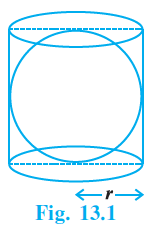
Sample Question 1: A right circular cylinder just encloses a sphere of radius r as shown in Fig 13.1. The surface area of the sphere is equal to the curved surface area of the cylinder.
Answer:
Result: True
Justification:
Let the radius of the sphere be $r$.
The surface area of the sphere is given by:
$S_1 = 4\pi r^2$
... (i)
Since the cylinder just encloses the sphere, the radius of the cylinder is also $r$ and its height $h$ is equal to the diameter of the sphere.
$h = 2r$
[Height of cylinder = Diameter of sphere]
The curved surface area (CSA) of the cylinder is given by:
$S_2 = 2\pi r h$
Substituting $h = 2r$ in the formula:
$S_2 = 2\pi r (2r) = 4\pi r^2$
[Substituting value of h] ... (ii)
From equations (i) and (ii), we can see that $S_1 = S_2$.
Therefore, the surface area of the sphere is equal to the curved surface area of the cylinder.
Sample Question 2: An edge of a cube measures r cm. If the largest possible right circular cone is cut out of this cube, then the volume of the cone (in cm3) is $\frac{1}{6}$πr3
Answer:
Result: False
Justification:
The edge of the cube is given as $r \text{ cm}$.
For the largest possible cone cut out from this cube, the diameter of the base of the cone must be equal to the edge of the cube, and the height of the cone must also be equal to the edge of the cube.
Thus, for the cone:
Radius ($R$) $= \frac{\text{edge}}{2} = \frac{r}{2} \text{ cm}$
Height ($H$) $= r \text{ cm}$
The volume of the cone ($V$) is given by:
$V = \frac{1}{3} \pi R^2 H$
Substituting the values of $R$ and $H$:
$V = \frac{1}{3} \pi \left( \frac{r}{2} \right)^2 (r)$
$V = \frac{1}{3} \pi \left( \frac{r^2}{4} \right) r$
$V = \frac{1}{12} \pi r^3 \text{ cm}^3$
Since the calculated volume is $\frac{1}{12}\pi r^3$ and not $\frac{1}{6}\pi r^3$, the statement is false.
Exercise 13.2
Write True or False and justify your answer in each of the following :
Question 1. The volume of a sphere is equal to two-third of the volume of a cylinder whose height and diameter are equal to the diameter of the sphere.
Answer:
Result: True
Justification:
Let the radius of the sphere be $r$. Then its volume ($V_s$) is:
$V_s = \frac{4}{3} \pi r^3$
... (i)
For the cylinder, the height ($h$) and diameter are equal to the diameter of the sphere ($2r$).
$h = 2r$ and Radius of cylinder $= r$
The volume of the cylinder ($V_c$) is:
$V_c = \pi r^2 h = \pi r^2 (2r) = 2\pi r^3$
Now, let's find two-third of the volume of the cylinder:
$\frac{2}{3} V_c = \frac{2}{3} (2\pi r^3) = \frac{4}{3} \pi r^3$
Comparing this with equation (i), we see that $V_s = \frac{2}{3} V_c$. Hence, the statement is true.
Question 2. If the radius of a right circular cone is halved and height is doubled, the volume will remain unchanged.
Answer:
Result: False
Justification:
Let the original radius be $r$ and original height be $h$. The original volume is:
$V_1 = \frac{1}{3} \pi r^2 h$
According to the question, the new radius $r' = \frac{r}{2}$ and the new height $h' = 2h$.
The new volume ($V_2$) is:
$V_2 = \frac{1}{3} \pi (r')^2 h' = \frac{1}{3} \pi \left( \frac{r}{2} \right)^2 (2h)$
$V_2 = \frac{1}{3} \pi \frac{r^2}{4} \times 2h = \frac{1}{6} \pi r^2 h$
$V_2 = \frac{1}{2} \left( \frac{1}{3} \pi r^2 h \right) = \frac{1}{2} V_1$
The volume becomes half of the original volume, so it does not remain unchanged.
Question 3. In a right circular cone, height, radius and slant height do not always be sides of a right triangle.
Answer:
Result: False
Justification:
By the definition of a right circular cone, the axis (height $h$) is perpendicular to the base. The radius ($r$) lies on the base and the slant height ($l$) connects the vertex to the circumference of the base.
These three segments always form a right-angled triangle where the slant height is the hypotenuse.
The relationship is always governed by the Pythagoras theorem:
$l^2 = r^2 + h^2$
Therefore, they always form the sides of a right triangle.
Question 4. If the radius of a cylinder is doubled and its curved surface area is not changed, the height must be halved.
Answer:
Result: True
Justification:
Let the initial radius be $r$ and height be $h$. The initial Curved Surface Area (CSA) is:
$CSA_1 = 2 \pi r h$
Now, let the new radius be $r' = 2r$ and new height be $h'$. The new CSA is:
$CSA_2 = 2 \pi (2r) h' = 4 \pi r h'$
Since the CSA is not changed ($CSA_1 = CSA_2$):
$2 \pi r h = 4 \pi r h'$
$h = 2h' \Rightarrow h' = \frac{h}{2}$
This confirms that the height must be halved.
Question 5. The volume of the largest right circular cone that can be fitted in a cube whose edge is 2r equals to the volume of a hemisphere of radius r.
Answer:
Result: True
Justification:
The edge of the cube is given as $2r$.
For the largest possible cone to be fitted inside this cube, its base diameter must be equal to the edge of the cube and its height must also be equal to the edge of the cube.
$\text{Radius of cone (R)} = \frac{2r}{2} = r$
$\text{Height of cone (H)} = 2r$
The volume of the cone ($V_1$) is given by:
$V_1 = \frac{1}{3}\pi R^2 H$
$V_1 = \frac{1}{3}\pi (r)^2 (2r) = \frac{2}{3}\pi r^3$
... (i)
Now, the volume of a hemisphere ($V_2$) of radius $r$ is given by:
$V_2 = \frac{2}{3}\pi r^3$
... (ii)
From equations (i) and (ii), we can see that $V_1 = V_2$.
Hence, the statement is true.
Question 6. A cylinder and a right circular cone are having the same base and same height. The volume of the cylinder is three times the volume of the cone.
Answer:
Result: True
Justification:
Let the common radius of the base be $r$ and the common height be $h$.
The volume of the cylinder ($V_{cyl}$) is given by:
$V_{cyl} = \pi r^2 h$
... (i)
The volume of the right circular cone ($V_{cone}$) is given by:
$V_{cone} = \frac{1}{3}\pi r^2 h$
From equation (i), we can write:
$V_{cyl} = 3 \times \left( \frac{1}{3}\pi r^2 h \right)$
$V_{cyl} = 3 \times V_{cone}$
Therefore, the volume of the cylinder is indeed three times the volume of the cone.
Question 7. A cone, a hemisphere and a cylinder stand on equal bases and have the same height. The ratio of their volumes is 1 : 2 : 3.
Answer:
Result: True
Justification:
Let the radius of the equal bases be $r$.
For a hemisphere, the height is equal to its radius. Since they all have the same height, the height ($h$) for all three solids must be $r$.
$h = r$
(Height of hemisphere)
Now, calculating their volumes:
Volume of Cone ($V_1$) $= \frac{1}{3}\pi r^2 h = \frac{1}{3}\pi r^2 (r) = \frac{1}{3}\pi r^3$
Volume of Hemisphere ($V_2$) $= \frac{2}{3}\pi r^3$
Volume of Cylinder ($V_3$) $= \pi r^2 h = \pi r^2 (r) = \pi r^3$
Ratio of their volumes ($V_1 : V_2 : V_3$):
$\frac{1}{3}\pi r^3 : \frac{2}{3}\pi r^3 : \pi r^3$
$\frac{1}{3} : \frac{2}{3} : 1$
Multiplying by 3 to simplify:
$1 : 2 : 3$
Hence, the statement is true.
Question 8. If the length of the diagonal of a cube is 6$\sqrt{3}$ cm, then the length of the edge of the cube is 3 cm.
Answer:
Result: False
Justification:
Let the edge of the cube be $a \text{ cm}$.
The formula for the diagonal of a cube is given by:
$\text{Diagonal} = a\sqrt{3}$
Given that the diagonal is $6\sqrt{3} \text{ cm}$:
$a\sqrt{3} = 6\sqrt{3}$
$a = 6 \text{ cm}$
[Edge of the cube] ... (i)
Since the edge is $6 \text{ cm}$ and not $3 \text{ cm}$, the statement is false.
Question 9. If a sphere is inscribed in a cube, then the ratio of the volume of the cube to the volume of the sphere will be 6 : π.
Answer:
Result: True
Justification:
Let the radius of the sphere be $r$.
When a sphere is inscribed in a cube, the diameter of the sphere is equal to the edge of the cube.
$\text{Edge of cube (a)} = 2r$
Volume of the cube ($V_{cube}$) $= a^3 = (2r)^3 = 8r^3$
Volume of the sphere ($V_{sphere}$) $= \frac{4}{3}\pi r^3$
Ratio of Volume of Cube to Volume of Sphere:
$\frac{V_{cube}}{V_{sphere}} = \frac{8r^3}{\frac{4}{3}\pi r^3}$
$\frac{V_{cube}}{V_{sphere}} = \frac{8 \times 3}{4\pi} = \frac{24}{4\pi} = \frac{6}{\pi}$
The ratio is $6 : \pi$. Hence, the statement is true.
Question 10. If the radius of a cylinder is doubled and height is halved, the volume will be doubled.
Answer:
Result: True
Justification:
Let the initial radius be $r$ and the initial height be $h$.
$V_{initial} = \pi r^2 h$
... (i)
According to the question, the new radius $r' = 2r$ and the new height $h' = \frac{h}{2}$.
The new volume ($V_{new}$) is:
$V_{new} = \pi (r')^2 h'$
$V_{new} = \pi (2r)^2 \left( \frac{h}{2} \right)$
$V_{new} = \pi (4r^2) \left( \frac{h}{2} \right)$
$V_{new} = 2\pi r^2 h$
Comparing with equation (i):
$V_{new} = 2 \times V_{initial}$
The volume is doubled. Hence, the statement is true.
Sample Question 1 & 2 (Before Exercise 13.3)
Sample Question 1: The surface area of a sphere of radius 5 cm is five times the area of the curved surface of a cone of radius 4 cm. Find the height and the volume of the cone (taking π = $\frac{22}{7}$ )
Answer:
Given:
Radius of sphere ($R$) $= 5 \text{ cm}$
Radius of cone ($r$) $= 4 \text{ cm}$
$\text{Surface Area of sphere} = 5 \times \text{Curved Surface Area of cone}$
To Find:
Height ($h$) and Volume ($V$) of the cone.
Solution:
First, we find the slant height ($l$) of the cone using the given condition.
$4 \pi R^2 = 5 \times (\pi r l)$
... (i)
Substituting the values of $R$ and $r$:
$4 \times \pi \times (5)^2 = 5 \times \pi \times 4 \times l$
$100 \pi = 20 \pi l$
$l = \frac{100 \pi}{20 \pi} = 5 \text{ cm}$
[Slant height of the cone] ... (ii)
Now, we find the height ($h$) of the cone using Pythagoras theorem:
$l^2 = r^2 + h^2$
$5^2 = 4^2 + h^2$
$25 = 16 + h^2$
$h^2 = 9 \Rightarrow h = 3 \text{ cm}$
The volume of the cone is given by:
$V = \frac{1}{3} \pi r^2 h$
$V = \frac{1}{3} \times \frac{22}{7} \times (4)^2 \times 3$
$V = \frac{22 \times 16}{7} = \frac{352}{7} \text{ cm}^3$
$V \approx 50.28 \text{ cm}^3$
Thus, the height of the cone is $3 \text{ cm}$ and its volume is $50.28 \text{ cm}^3$.
Sample Question 2: The radius of a sphere is increased by 10%. Prove that the volume will be increased by 33.1% approximately
Answer:
Given:
Let the initial radius of the sphere be $r$.
Increase in radius $= 10\%$ of $r = 0.1r$.
New radius ($r'$) $= r + 0.1r = 1.1r$.
To Prove:
The volume increases by approximately $33.1\%$.
Solution:
Initial volume ($V$):
$V = \frac{4}{3} \pi r^3$
... (i)
New volume ($V'$):
$V' = \frac{4}{3} \pi (r')^3$
$V' = \frac{4}{3} \pi (1.1r)^3$
$V' = \frac{4}{3} \pi (1.331 r^3)$
$V' = 1.331 \times \left( \frac{4}{3} \pi r^3 \right) = 1.331 V$
[From (i)] ... (ii)
Increase in volume $= V' - V$:
$\text{Increase} = 1.331V - V = 0.331V$
Percentage increase in volume:
$\% \text{ Increase} = \frac{0.331V}{V} \times 100$
$\% \text{ Increase} = 33.1\%$
Hence, the volume increases by $33.1\%$. (Proved)
Exercise 13.3
Question 1. Metal spheres, each of radius 2 cm, are packed into a rectangular box of internal dimensions 16 cm × 8 cm × 8 cm. When 16 spheres are packed the box is filled with preservative liquid. Find the volume of this liquid. Give your answer to the nearest integer. [ Use π = 3.14]
Answer:
Given:
Dimensions of rectangular box: $16 \text{ cm} \times 8 \text{ cm} \times 8 \text{ cm}$
Number of spheres $= 16$
Radius of each sphere ($r$) $= 2 \text{ cm}$
To Find:
Volume of the preservative liquid.
Solution:
The volume of the liquid is the difference between the volume of the rectangular box and the total volume of the 16 spheres.
Internal volume of the rectangular box ($V_{box}$):
$V_{box} = 16 \times 8 \times 8 = 1024 \text{ cm}^3$
... (i)
Volume of one sphere ($V_s$):
$V_s = \frac{4}{3} \pi r^3$
$V_s = \frac{4}{3} \times 3.14 \times (2)^3 = \frac{4 \times 3.14 \times 8}{3} = \frac{100.48}{3} \text{ cm}^3$
Total volume of 16 spheres ($V_{total\_s}$):
$V_{total\_s} = 16 \times \frac{100.48}{3} = \frac{1607.68}{3} = 535.893 \text{ cm}^3$
... (ii)
Volume of preservative liquid ($V_l$):
$V_l = V_{box} - V_{total\_s}$
$V_l = 1024 - 535.893 = 488.107 \text{ cm}^3$
Rounding to the nearest integer:
$V_l \approx 488 \text{ cm}^3$
Thus, the volume of the preservative liquid is $488 \text{ cm}^3$.
Question 2. A storage tank is in the form of a cube. When it is full of water, the volume of water is 15.625 m3. If the present depth of water is 1.3 m, find the volume of water already used from the tank.
Answer:
Given:
Full volume of the cubical tank $= 15.625 \text{ m}^3$
Present depth of water $= 1.3 \text{ m}$
To Find:
Volume of water already used from the tank.
Solution:
Let the side (edge) of the cubical tank be $a$.
$a^3 = 15.625$
$a = \sqrt[3]{15.625} = 2.5 \text{ m}$
... (i)
Since the tank is a cube, its height is also $2.5 \text{ m}$.
The height of the water used is the difference between the total height and the current depth:
$h_{used} = 2.5 - 1.3 = 1.2 \text{ m}$
The volume of water used is the area of the base ($a \times a$) multiplied by the height of water used:
$V_{used} = a \times a \times h_{used}$
$V_{used} = 2.5 \times 2.5 \times 1.2$
$V_{used} = 6.25 \times 1.2 = 7.5 \text{ m}^3$
Thus, the volume of water already used from the tank is $7.5 \text{ m}^3$.
Question 3. Find the amount of water displaced by a solid spherical ball of diameter 4.2 cm, when it is completely immersed in water.
Answer:
Given:
Diameter of the solid spherical ball ($d$) $= 4.2 \text{ cm}$
To Find:
The amount of water displaced (Volume of the sphere).
Solution:
First, we calculate the radius ($r$) of the spherical ball:
$r = \frac{d}{2} = \frac{4.2}{2}$
$r = 2.1 \text{ cm}$
... (i)
According to Archimedes' Principle, the amount of water displaced by a solid when it is completely immersed is equal to its own volume.
$\text{Volume of sphere} = \frac{4}{3} \pi r^3$
Substituting the value of $r$ from equation (i):
$V = \frac{4}{3} \times \frac{22}{7} \times (2.1)^3$
$V = \frac{4}{3} \times \frac{22}{7} \times 2.1 \times 2.1 \times 2.1$
$V = 4 \times 22 \times 0.1 \times 0.7 \times 0.7$
[Cancelling 3 and 7 with 2.1] ... (ii)
$V = 88 \times 0.441$
$V = 38.808 \text{ cm}^3$
Thus, the amount of water displaced by the spherical ball is $38.808 \text{ cm}^3$.
Question 4. How many square metres of canvas is required for a conical tent whose height is 3.5 m and the radius of the base is 12 m?
Answer:
Given:
Height of the conical tent ($h$) $= 3.5 \text{ m}$
Radius of the base ($r$) $= 12 \text{ m}$
To Find:
The area of canvas required (Curved Surface Area of the cone).
Solution:
To find the curved surface area, we first need to calculate the slant height ($l$):
$l = \sqrt{r^2 + h^2}$
[By Pythagoras Theorem]
$l = \sqrt{12^2 + 3.5^2}$
$l = \sqrt{144 + 12.25}$
$l = \sqrt{156.25}$
$l = 12.5 \text{ m}$
... (i)
The area of canvas required for the tent is its Curved Surface Area (CSA):
$CSA = \pi r l$
$CSA = \frac{22}{7} \times 12 \times 12.5$
$CSA = \frac{22 \times 150}{7}$
$CSA = \frac{3300}{7} \approx 471.43 \text{ m}^2$
Thus, approximately $471.43 \text{ m}^2$ of canvas is required for the tent.
Question 5. Two solid spheres made of the same metal have weights 5920 g and 740 g, respectively. Determine the radius of the larger sphere, if the diameter of the smaller one is 5 cm.
Answer:
Given:
Weight of the larger sphere ($W_1$) $= 5920 \text{ g}$
Weight of the smaller sphere ($W_2$) $= 740 \text{ g}$
Diameter of the smaller sphere $= 5 \text{ cm} \Rightarrow \text{Radius } (r_2) = 2.5 \text{ cm}$
To Find:
Radius of the larger sphere ($r_1$).
Solution:
Since both spheres are made of the same metal, their density is the same. Therefore, the ratio of their weights is equal to the ratio of their volumes.
$\frac{W_1}{W_2} = \frac{V_1}{V_2}$
The volume of a sphere is $\frac{4}{3} \pi r^3$. Thus:
$\frac{W_1}{W_2} = \frac{\frac{4}{3} \pi r_1^3}{\frac{4}{3} \pi r_2^3} = \frac{r_1^3}{r_2^3}$
Substituting the given values:
$\frac{5920}{740} = \frac{r_1^3}{(2.5)^3}$
$8 = \frac{r_1^3}{15.625}$
[Dividing 5920 by 740]
$r_1^3 = 8 \times 15.625$
$r_1^3 = 125$
$r_1 = \sqrt[3]{125} = 5 \text{ cm}$
The radius of the larger sphere is $5 \text{ cm}$.
Question 6. A school provides milk to the students daily in a cylindrical glasses of diameter 7 cm. If the glass is filled with milk upto an height of 12 cm, find how many litres of milk is needed to serve 1600 students.
Answer:
Given:
Diameter of the cylindrical glass ($d$) $= 7 \text{ cm} \Rightarrow \text{Radius } (r) = 3.5 \text{ cm}$
Height of milk in the glass ($h$) $= 12 \text{ cm}$
Number of students $= 1600$
To Find:
Total milk needed in litres.
Solution:
First, calculate the volume of milk in one glass:
$\text{Volume of one glass} = \pi r^2 h$
$V = \frac{22}{7} \times (3.5)^2 \times 12$
$V = \frac{22}{7} \times 12.25 \times 12$
$V = 462 \text{ cm}^3$
... (i)
Now, calculate the total volume for 1600 students:
$\text{Total Volume} = 462 \times 1600 = 739200 \text{ cm}^3$
Since we need the answer in litres, we use the conversion factor:
$1 \text{ Litre} = 1000 \text{ cm}^3$
[Standard Conversion] ... (ii)
$\text{Milk in Litres} = \frac{739200}{1000}$
$\text{Milk in Litres} = 739.2 \text{ litres}$
Thus, $739.2$ litres of milk is needed to serve 1600 students.
Question 7. A cylindrical roller 2.5 m in length, 1.75 m in radius when rolled on a road was found to cover the area of 5500 m2 . How many revolutions did it make?
Answer:
Given:
$\text{Length of the roller } (h) = 2.5 \text{ m}$
(Given)
$\text{Radius of the roller } (r) = 1.75 \text{ m}$
(Given)
$\text{Total area covered} = 5500 \text{ m}^2$
(Given)
To Find:
Number of revolutions made by the roller.
Solution:
When a cylindrical roller rolls once, it covers an area equal to its Curved Surface Area (CSA).
$CSA = 2\pi rh$
... (i)
Substituting the values ($r = 1.75 \text{ m}$, $h = 2.5 \text{ m}$):
$CSA = 2 \times \frac{22}{7} \times 1.75 \times 2.5$
$CSA = 2 \times \frac{22}{7} \times \frac{175}{100} \times \frac{25}{10}$
$CSA = 2 \times \frac{22}{7} \times \frac{7}{4} \times \frac{5}{2}$
$CSA = \frac{11 \times 5}{2} = 27.5 \text{ m}^2$
Let the number of revolutions be $n$.
$\text{Total Area} = n \times CSA$
$5500 = n \times 27.5$
$n = \frac{5500}{27.5}$
$n = \frac{55000}{275}$
$n = 200$
Thus, the roller made 200 revolutions to cover the road.
Alternate Solution:
We can solve it by writing the ratio directly:
$n = \frac{\text{Total Area}}{2 \times \pi \times r \times h} = \frac{5500}{2 \times \frac{22}{7} \times 1.75 \times 2.5} = 200$.
Question 8. A small village, having a population of 5000, requires 75 litres of water per head per day. The village has got an overhead tank of measurement 40 m × 25 m × 15 m. For how many days will the water of this tank last?
Answer:
Given:
$\text{Population} = 5000$
$\text{Water consumption per head} = 75 \text{ litres}$
$\text{Tank dimensions} = 40 \text{ m} \times 25 \text{ m} \times 15 \text{ m}$
To Find:
Number of days the water in the tank will last.
Solution:
First, we calculate the total volume of the tank ($V_{tank}$):
$V_{tank} = 40 \times 25 \times 15 = 15000 \text{ m}^3$
We know that $1 \text{ m}^3 = 1000 \text{ litres}$. Converting the tank volume into litres:
$V_{tank\_litres} = 15000 \times 1000 = 15,000,000 \text{ litres}$
... (i)
Now, we calculate the total water required by the village per day:
$\text{Daily requirement} = 5000 \times 75 = 375,000 \text{ litres}$
... (ii)
The number of days ($D$) is given by:
$D = \frac{\text{Total volume of tank}}{\text{Total daily requirement}}$
$D = \frac{15,000,000}{375,000}$
$D = \frac{15000}{375} = 40$
Thus, the water of this tank will last for 40 days.
Question 9. A shopkeeper has one spherical laddoo of radius 5cm. With the same amount of material, how many laddoos of radius 2.5 cm can be made?
Answer:
Given:
$\text{Radius of big laddoo } (R) = 5 \text{ cm}$
$\text{Radius of small laddoo } (r) = 2.5 \text{ cm}$
To Find:
Number of small laddoos that can be made.
Solution:
The material remains the same, so the volume of the big laddoo equals the total volume of the small laddoos.
Let $n$ be the number of small laddoos.
$\text{Volume of big laddoo} = n \times \text{Volume of one small laddoo}$
Using the formula for the volume of a sphere ($\frac{4}{3}\pi r^3$):
$\frac{4}{3}\pi R^3 = n \times \frac{4}{3}\pi r^3$
Cancelling $\frac{4}{3}\pi$ from both sides:
$R^3 = n \times r^3$
... (i)
$5^3 = n \times (2.5)^3$
$125 = n \times 15.625$
$n = \frac{125}{15.625}$
$n = 8$
Thus, 8 laddoos of radius 2.5 cm can be made.
Question 10. A right triangle with sides 6 cm, 8 cm and 10 cm is revolved about the side 8 cm. Find the volume and the curved surface of the solid so formed.
Answer:
Given:
Sides of the right triangle are $6 \text{ cm}, 8 \text{ cm},$ and $10 \text{ cm}$.
The triangle is revolved about the side $8 \text{ cm}$.
To Find:
1. Volume of the solid formed.
2. Curved Surface Area of the solid formed.
Solution:
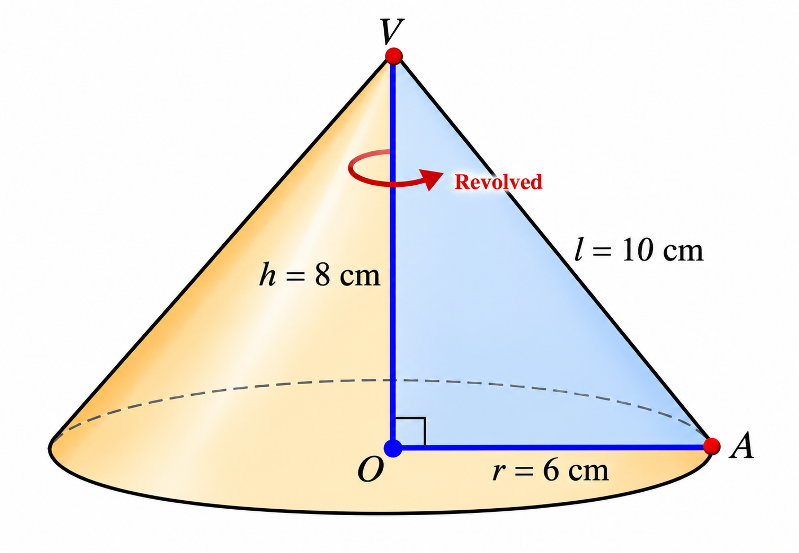
When a right triangle is revolved about one of its sides (the altitude), the solid so formed is a right circular cone.
Since it is revolved about the $8 \text{ cm}$ side:
$\text{Height of the cone } (h) = 8 \text{ cm}$
$\text{Radius of the base } (r) = 6 \text{ cm}$
$\text{Slant height } (l) = 10 \text{ cm}$
1. Volume of the cone:
$V = \frac{1}{3}\pi r^2 h$
$V = \frac{1}{3} \times \pi \times 6^2 \times 8$
$V = \frac{1}{3} \times \pi \times 36 \times 8 = 12 \times 8 \times \pi$
$V = 96\pi \text{ cm}^3 \approx 301.44 \text{ cm}^3$
... (i)
2. Curved Surface Area of the cone:
$CSA = \pi rl$
$CSA = \pi \times 6 \times 10$
$CSA = 60\pi \text{ cm}^2 \approx 188.4 \text{ cm}^2$
... (ii)
Thus, the volume is $96\pi \text{ cm}^3$ and the curved surface area is $60\pi \text{ cm}^2$.
Sample Question 1 (Before Exercise 13.4)
Sample Question 1: Rain water which falls on a flat rectangular surface of length 6 m and breadth 4 m is transferred into a cylindrical vessel of internal radius 20cm. What will be the height of water in the cylindrical vessel if the rain fall is 1 cm. Give your answer to the nearest integer. (Take π = 3.14)
Answer:
Given:
Length of the rectangular surface ($L$) = $6 \text{ m} = 600 \text{ cm}$
Breadth of the rectangular surface ($B$) = $4 \text{ m} = 400 \text{ cm}$
Height of rainfall ($h_{rain}$) = $1 \text{ cm}$
Internal radius of the cylindrical vessel ($r$) = $20 \text{ cm}$
To Find:
Height of water in the cylindrical vessel ($H$).
Solution:
First, we calculate the volume of rain water collected on the rectangular surface. Since the water is transferred, the volume of water remains constant.
$\text{Volume of rain water} = L \times B \times h_{rain}$
$\text{Volume} = 600 \times 400 \times 1$
$\text{Volume} = 2,40,000 \text{ cm}^3$
[Volume of water] ... (i)
Let $H$ be the height of water in the cylindrical vessel. The volume of water in the cylinder is given by:
$\text{Volume in vessel} = \pi r^2 H$
Equating the volumes:
$3.14 \times (20)^2 \times H = 2,40,000$
$3.14 \times 400 \times H = 2,40,000$
$1256 \times H = 2,40,000$
$H = \frac{2,40,000}{1256}$
$H \approx 191.08 \text{ cm}$
Rounding to the nearest integer, we get $191 \text{ cm}$.
The height of water in the cylindrical vessel is 191 cm.
Exercise 13.4
Question 1. A cylindrical tube opened at both the ends is made of iron sheet which is 2 cm thick. If the outer diameter is 16 cm and its length is 100 cm, find how many cubic centimeters of iron has been used in making the tube ?
Answer:
Given:
Outer diameter of the tube = $16 \text{ cm} \Rightarrow$ Outer radius ($R$) = $8 \text{ cm}$
Thickness of the iron sheet = $2 \text{ cm}$
Length of the tube ($h$) = $100 \text{ cm}$
To Find:
Volume of iron used in making the tube.
Solution:
The inner radius ($r$) is calculated by subtracting the thickness from the outer radius:
$r = R - \text{Thickness}$
$r = 8 - 2 = 6 \text{ cm}$
The volume of iron used is the difference between the volume of the outer cylinder and the inner cylinder:
$\text{Volume of iron} = \pi R^2 h - \pi r^2 h$
$\text{Volume} = \pi h (R^2 - r^2)$
... (i)
$\text{Volume} = \frac{22}{7} \times 100 \times (8^2 - 6^2)$
$\text{Volume} = \frac{2200}{7} \times (64 - 36)$
$\text{Volume} = \frac{2200}{7} \times 28$
$\text{Volume} = 2200 \times 4$
$\text{Volume} = 8800 \text{ cm}^3$
Thus, the amount of iron used is $8800 \text{ cm}^3$.
Question 2. A semi-circular sheet of metal of diameter 28cm is bent to form an open conical cup. Find the capacity of the cup
Answer:
Given:
Diameter of the semi-circular sheet = $28 \text{ cm} \Rightarrow$ Radius ($R$) = $14 \text{ cm}$.
To Find:
Capacity (Volume) of the conical cup.
Solution:
When a semi-circular sheet is bent into a cone:
1. The radius of the sheet becomes the slant height ($l$) of the cone.
2. The circumference of the base of the cone ($2\pi r$) is equal to the arc length of the semi-circle ($\pi R$).
$l = R = 14 \text{ cm}$
... (i)
$2\pi r = \pi R$
$2r = 14 \Rightarrow r = 7 \text{ cm}$
... (ii)
Now, we find the height ($h$) of the cone:
$h = \sqrt{l^2 - r^2}$
$h = \sqrt{14^2 - 7^2} = \sqrt{196 - 49} = \sqrt{147}$
$h = 7\sqrt{3} \approx 12.124 \text{ cm}$
Capacity of the cup ($V$):
$V = \frac{1}{3} \pi r^2 h$
$V = \frac{1}{3} \times \frac{22}{7} \times 7^2 \times 7\sqrt{3}$
$V = \frac{1}{3} \times 22 \times 7 \times 7\sqrt{3} \approx 622.38 \text{ cm}^3$
The capacity of the cup is $622.38 \text{ cm}^3$.
Question 3. A cloth having an area of 165 m2 is shaped into the form of a conical tent of radius 5 m
(i) How many students can sit in the tent if a student, on an average, occupies $\frac{5}{7}$ m2 on the ground?
(ii) Find the volume of the cone.
Answer:
Given:
Area of cloth (Curved Surface Area) = $165 \text{ m}^2$
Radius of the tent ($r$) = $5 \text{ m}$
Area occupied by one student on the ground = $\frac{5}{7} \text{ m}^2$
To Find:
(i) Number of students who can sit in the tent.
(ii) Volume of the cone.
Solution:
(i) Calculation for students:
Students sit on the ground, which is the base of the cone. The base is a circle.
$\text{Base Area} = \pi r^2 = \frac{22}{7} \times 5^2$
$\text{Base Area} = \frac{550}{7} \text{ m}^2$
[Area of the ground] ... (i)
$\text{Number of students} = \frac{\text{Total Ground Area}}{\text{Area per student}}$
$n = \frac{550/7}{5/7} = \frac{550}{5} = 110$
So, 110 students can sit in the tent.
(ii) Calculation for Volume:
The area of cloth used for the tent corresponds to the curved surface area (CSA).
$CSA = \pi r l = 165$
$\frac{22}{7} \times 5 \times l = 165$
$l = \frac{165 \times 7}{110} = 1.5 \times 7 = 10.5 \text{ m}$
Now, calculate the height ($h$):
$h = \sqrt{l^2 - r^2} = \sqrt{(10.5)^2 - 5^2}$
$h = \sqrt{110.25 - 25} = \sqrt{85.25} \approx 9.23 \text{ m}$
Volume ($V$):
$V = \frac{1}{3} \pi r^2 h = \frac{1}{3} \times \frac{550}{7} \times 9.23 \approx 241.74 \text{ m}^3$
The volume of the cone is approximately $241.74 \text{ m}^3$.
Question 4. The water for a factory is stored in a hemispherical tank whose internal diameter is 14 m. The tank contains 50 kilolitres of water. Water is pumped into the tank to fill to its capacity. Calculate the volume of water pumped into the tank.
Answer:
Given:
Internal diameter of the hemispherical tank ($d$) $= 14 \text{ m}$
Initial volume of water in the tank $= 50 \text{ kilolitres}$
To Find:
The volume of water pumped into the tank to fill it to its capacity.
Solution:
First, calculate the internal radius ($r$) of the tank:
$r = \frac{14}{2} = 7 \text{ m}$
The capacity of a hemispherical tank is its volume ($V$):
$V = \frac{2}{3} \pi r^3$
$V = \frac{2}{3} \times \frac{22}{7} \times (7)^3$
$V = \frac{2}{3} \times 22 \times 49 = \frac{2156}{3} \text{ m}^3$
$V \approx 718.67 \text{ m}^3$
[Capacity of the tank] ... (i)
$1 \text{ m}^3 = 1000 \text{ litres} = 1 \text{ kilolitre}$.
So, the initial volume of water is $50 \text{ m}^3$.
Volume of water to be pumped ($V_p$):
$V_p = \text{Total Capacity} - \text{Initial Volume}$
$V_p = 718.67 - 50 = 668.67 \text{ m}^3$
Thus, the volume of water pumped into the tank is $668.67 \text{ m}^3$ (or $668.67 \text{ kilolitres}$).
Question 5. The volumes of the two spheres are in the ratio 64 : 27. Find the ratio of their surface areas.
Answer:
Given:
Ratio of the volumes of two spheres, $V_1 : V_2 = 64 : 27$
To Find:
The ratio of their surface areas $S_1 : S_2$.
Solution:
Let the radii of the two spheres be $r_1$ and $r_2$.
$\frac{V_1}{V_2} = \frac{\frac{4}{3} \pi r_1^3}{\frac{4}{3} \pi r_2^3} = \frac{64}{27}$
$\left( \frac{r_1}{r_2} \right)^3 = \frac{64}{27}$
$\frac{r_1}{r_2} = \sqrt[3]{\frac{64}{27}} = \frac{4}{3}$
[Ratio of radii] ... (i)
Now, the ratio of their surface areas is:
$\frac{S_1}{S_2} = \frac{4\pi r_1^2}{4\pi r_2^2} = \left( \frac{r_1}{r_2} \right)^2$
Substituting the ratio from equation (i):
$\frac{S_1}{S_2} = \left( \frac{4}{3} \right)^2 = \frac{16}{9}$
The ratio of their surface areas is $16 : 9$.
Question 6. A cube of side 4 cm contains a sphere touching its sides. Find the volume of the gap in between.
Answer:
Given:
Side of the cube ($a$) $= 4 \text{ cm}$
A sphere is placed inside the cube touching its sides.
To Find:
Volume of the gap in between the cube and the sphere.
Solution:
When a sphere touches all sides of a cube, its diameter is equal to the side of the cube.
$d = a = 4 \text{ cm}$
$r = \frac{4}{2} = 2 \text{ cm}$
Volume of the cube ($V_c$):
$V_c = a^3 = 4^3 = 64 \text{ cm}^3$
Volume of the sphere ($V_s$):
$V_s = \frac{4}{3} \pi r^3$
$V_s = \frac{4}{3} \times \frac{22}{7} \times (2)^3 = \frac{704}{21} \approx 33.52 \text{ cm}^3$
Volume of the gap ($V_g$):
$V_g = V_c - V_s$
$V_g = 64 - 33.52 = 30.48 \text{ cm}^3$
The volume of the gap is $30.48 \text{ cm}^3$.
Question 7. A sphere and a right circular cylinder of the same radius have equal volumes. By what percentage does the diameter of the cylinder exceed its height ?
Answer:
Given:
Radius of sphere $=$ Radius of cylinder $= r$
Volume of sphere $=$ Volume of cylinder
To Find:
Percentage by which the diameter of the cylinder exceeds its height.
Solution:
Let $h$ be the height of the cylinder.
$\frac{4}{3} \pi r^3 = \pi r^2 h$
(Volumes are equal)
$h = \frac{4}{3} r$
... (i)
The diameter of the cylinder ($D$) is $2r$. We need to find how much $D$ exceeds $h$.
$D - h = 2r - \frac{4}{3} r = \frac{2}{3} r$
Percentage exceed ($P$):
$P = \frac{D - h}{h} \times 100$
$P = \frac{\frac{2}{3}r}{\frac{4}{3}r} \times 100 = \frac{2}{4} \times 100$
$P = 50\%$
The diameter of the cylinder exceeds its height by $50\%$.
Question 8. 30 circular plates, each of radius 14 cm and thickness 3 cm are placed one above the another to form a cylindrical solid. Find :
(i) the total surface area
(ii) volume of the cylinder so formed.
Answer:
Given:
Radius of each plate ($r$) $= 14 \text{ cm}$
Thickness of each plate $= 3 \text{ cm}$
Number of plates $= 30$
To Find:
(i) Total Surface Area (TSA) of the cylinder.
(ii) Volume of the cylinder.
Solution:
When plates are stacked, they form a cylinder with total height ($H$):
$H = 30 \times 3 = 90 \text{ cm}$
(i) Total Surface Area (TSA):
$TSA = 2 \pi r (r + H)$
$TSA = 2 \times \frac{22}{7} \times 14 \times (14 + 90)$
$TSA = 88 \times 104 = 9152 \text{ cm}^2$
(ii) Volume of the cylinder ($V$):
$V = \pi r^2 H$
$V = \frac{22}{7} \times 14 \times 14 \times 90$
$V = 22 \times 2 \times 14 \times 90$
$V = 55440 \text{ cm}^3$
The Total Surface Area is $9152 \text{ cm}^2$ and the Volume is $55440 \text{ cm}^3$.