

Chapter 3 Coordinate Geometry (Class 9 - Maths NCERT Exemplar Solutions)
Welcome to the comprehensive resource for NCERT Exemplar Solutions for Class 9 Mathematics: Chapter 3 Coordinate Geometry! While the standard syllabus introduces the basics of plotting, these Exemplar questions are designed to move beyond simple exercises, challenging students with nuanced applications of the Cartesian coordinate system. Mastering this chapter is vital as it forms the bedrock for understanding linear graphs and analytical geometry in higher classes.
The solutions provide a firm understanding of the Cartesian plane, defined by the horizontal x-axis and vertical y-axis intersecting at the Origin $(0, 0)$. Students will master the four Quadrants and their specific sign conventions—$(+, +)$, $(-, +)$, $(-, -)$, and $(+, -)$—to correctly locate points. Key terms such as abscissa ($x$-coordinate) and ordinate ($y$-coordinate) are used precisely to identify a point's distance from the axes.
Significant emphasis is placed on identifying geometric figures formed by joining points and finding coordinates that satisfy specific conditions, such as points lying on the x-axis $(x, 0)$ or y-axis $(0, y)$. Students will also learn to determine the reflection of a point across either axis and identify points purely based on coordinate signs. With clear explanations and precise plotting instructions prepared by learningspot.co, students can build a strong, intuitive understanding of coordinate systems necessary for future success in higher mathematics.
Sample Question 1 (Before Exercise 3.1)
Write the correct answer:
Sample Question 1: The points (other than origin) for which abscissa is equal to the ordinate will lie in
(A) I quadrant only
(B) I and II quadrants
(C) I and III quadrants
(D) II and IV quadrants
Answer:
The abscissa of a point is its x-coordinate, and the ordinate is its y-coordinate.
The problem states that the abscissa is equal to the ordinate. This means that for a point $(x, y)$, we have $x = y$.
So, any point satisfying this condition will be of the form $(x, x)$.
We are asked about points other than the origin. The origin is the point $(0, 0)$, where $x=0$. So, we consider points $(x, x)$ where $x \neq 0$.
Now, let's consider the location of these points based on the sign of $x$:
If $x > 0$, then both coordinates are positive $(+, +)$. Points with positive x and positive y coordinates lie in the I quadrant.
If $x < 0$, then both coordinates are negative $(-, -)$. Points with negative x and negative y coordinates lie in the III quadrant.
Therefore, points (other than origin) where the abscissa equals the ordinate, i.e., points of the form $(x, x)$ with $x \neq 0$, lie in both the I quadrant (when $x > 0$) and the III quadrant (when $x < 0$).
Comparing this with the given options, the correct answer is (C).
The correct option is (C) I and III quadrants.
Exercise 3.1
Write the correct answer in each of the following:
Question 1. Point (–3, 5) lies in the
(A) first quadrant
(B) second quadrant
(C) third quadrant
(D) fourth quadrant
Answer:
The given point is $(-3, 5)$.
In a coordinate plane, the location of a point $(x, y)$ is determined by the signs of its x-coordinate (abscissa) and y-coordinate (ordinate).
For the point $(-3, 5)$:
The x-coordinate is $-3$, which is negative ($x < 0$).
The y-coordinate is $5$, which is positive ($y > 0$).
The quadrants are defined by the signs of the coordinates as follows:
Quadrant I: $(+, +)$ (x positive, y positive)
Quadrant II: $(-, +)$ (x negative, y positive)
Quadrant III: $(-, -)$ (x negative, y negative)
Quadrant IV: $(+, -)$ (x positive, y negative)
Since the point $(-3, 5)$ has a negative x-coordinate and a positive y-coordinate, it lies in the quadrant where x is negative and y is positive.
This corresponds to the second quadrant.
Therefore, the point $(-3, 5)$ lies in the second quadrant.
Comparing with the given options, the correct answer is (B).
The correct option is (B) second quadrant.
Question 2. Signs of the abscissa and ordinate of a point in the second quadrant are respectively
(A) +, +
(B) –, –
(C) –, +
(D) +, –
Answer:
In a coordinate system, the abscissa refers to the x-coordinate of a point, and the ordinate refers to the y-coordinate of a point.
The coordinate plane is divided into four quadrants by the x-axis and y-axis. The signs of the x and y coordinates determine which quadrant a point lies in.
The signs in each quadrant are as follows:
- First Quadrant (I): x is positive, y is positive. Signs are (+, +).
- Second Quadrant (II): x is negative, y is positive. Signs are (–, +).
- Third Quadrant (III): x is negative, y is negative. Signs are (–, –).
- Fourth Quadrant (IV): x is positive, y is negative. Signs are (+, –).
The question asks for the signs of the abscissa and ordinate of a point in the second quadrant.
In the second quadrant, the x-coordinate (abscissa) is negative (–) and the y-coordinate (ordinate) is positive (+).
Thus, the signs of the abscissa and ordinate of a point in the second quadrant are respectively –, +.
Comparing this with the given options, the correct answer is (C).
The correct option is (C) –, +.
Question 3. Point (0, –7) lies
(A) on the x –axis
(B) in the second quadrant
(C) on the y-axis
(D) in the fourth quadrant
Answer:
The given point is $(0, -7)$.
For a point $(x, y)$:
If the x-coordinate ($x$) is 0, the point lies on the y-axis.
If the y-coordinate ($y$) is 0, the point lies on the x-axis.
If both coordinates ($x$ and $y$) are non-zero, the point lies in one of the four quadrants.
In the given point $(0, -7)$, the x-coordinate is $0$.
$x = 0$
$y = -7$
Since the x-coordinate is $0$, the point must lie on the y-axis.
Furthermore, since the y-coordinate is $-7$ (which is negative), the point lies on the negative part of the y-axis.
Therefore, the point $(0, -7)$ lies on the y-axis.
Comparing with the given options, the correct answer is (C).
The correct option is (C) on the y-axis.
Question 4. Point (– 10, 0) lies
(A) on the negative direction of the x-axis
(B) on the negative direction of the y-axis
(C) in the third quadrant
(D) in the fourth quadrant
Answer:
The given point is $(-10, 0)$.
For any point $(x, y)$ in the coordinate plane:
- If the y-coordinate is $0$ ($y=0$), the point lies on the x-axis.
- If the x-coordinate is $0$ ($x=0$), the point lies on the y-axis.
- If both coordinates are non-zero ($x \neq 0$ and $y \neq 0$), the point lies in one of the four quadrants.
In the point $(-10, 0)$, the y-coordinate is $0$.
$x = -10$
$y = 0$
Since the y-coordinate is $0$, the point lies on the x-axis.
Now, we need to determine the direction on the x-axis. The x-coordinate is $-10$, which is a negative value.
Points on the x-axis with a negative x-coordinate lie on the negative direction of the x-axis.
Therefore, the point $(-10, 0)$ lies on the negative direction of the x-axis.
Comparing with the given options, the correct answer is (A).
The correct option is (A) on the negative direction of the x-axis.
Question 5. Abscissa of all the points on the x-axis is
(A) 0
(B) 1
(C) 2
(D) any number
Answer:
The abscissa of a point is its x-coordinate.
The x-axis is a horizontal line in the coordinate system. By definition, any point that lies on the x-axis has its y-coordinate equal to 0.
A general point on the x-axis can be represented in the form $(x, 0)$, where $x$ can be any real number.
Examples of points on the x-axis are $(1, 0)$, $(-5, 0)$, $(0, 0)$ (the origin), $(2.5, 0)$, etc.
In the point $(x, 0)$, the abscissa is $x$. Since $x$ can take any real value for points on the x-axis, the abscissa of points on the x-axis can be any number.
Note that the question asks for the abscissa, which is the x-coordinate, not the ordinate (y-coordinate). The ordinate of all points on the x-axis is 0.
Therefore, the abscissa of all the points on the x-axis is any number.
Comparing with the given options, the correct answer is (D).
The correct option is (D) any number.
Question 6. Ordinate of all points on the x-axis is
(A) 0
(B) 1
(C) – 1
(D) any number
Answer:
The ordinate of a point is its y-coordinate.
The x-axis is the horizontal line in the coordinate system. Any point that lies on the x-axis has a specific characteristic regarding its coordinates.
Consider any point on the x-axis. Its position is purely horizontal; it does not move up or down from the x-axis itself. This means its vertical position is at the level of the x-axis, which corresponds to a y-coordinate of 0.
A general point on the x-axis can be represented as $(x, 0)$, where $x$ is the abscissa and can be any real number, and $0$ is the ordinate.
For example, points like $(5, 0)$, $(-2, 0)$, $(0, 0)$, $(\frac{1}{2}, 0)$ all lie on the x-axis. In all these points, the y-coordinate (ordinate) is 0.
Therefore, the ordinate of all points on the x-axis is 0.
Comparing with the given options, the correct answer is (A).
The correct option is (A) 0.
Question 7. The point at which the two coordinate axes meet is called the
(A) abscissa
(B) ordinate
(C) origin
(D) quadrant
Answer:
In the Cartesian coordinate system, the two coordinate axes are the x-axis (horizontal axis) and the y-axis (vertical axis).
These two axes intersect at a specific point.
The point where the x-axis and the y-axis intersect is the central point of the coordinate system.
This point has coordinates $(0, 0)$, meaning its abscissa (x-coordinate) is 0 and its ordinate (y-coordinate) is 0.
This special point is known as the origin.
Definitions of other terms:
- Abscissa: The x-coordinate of a point.
- Ordinate: The y-coordinate of a point.
- Quadrant: One of the four regions into which the coordinate plane is divided by the axes.
Therefore, the point at which the two coordinate axes meet is called the origin.
Comparing with the given options, the correct answer is (C).
The correct option is (C) origin.
Question 8. A point both of whose coordinates are negative will lie in
(A) I quadrant
(B) II quadrant
(C) III quadrant
(D) IV quadrant
Answer:
The question asks for the quadrant in which a point lies if both of its coordinates are negative.
Let the point be $(x, y)$. We are given that both coordinates are negative, which means $x < 0$ and $y < 0$.
We need to identify the quadrant based on the signs of the coordinates:
- Quadrant I: x positive, y positive $(+, +)$
- Quadrant II: x negative, y positive $(-, +)$
- Quadrant III: x negative, y negative $(-, -)$
- Quadrant IV: x positive, y negative $(+, -)$
Since both the x-coordinate and the y-coordinate are negative for the given point $(x, y)$ where $x < 0$ and $y < 0$, the signs are $(-, -)$.
The quadrant where both coordinates are negative is the third quadrant.
Therefore, a point both of whose coordinates are negative will lie in the III quadrant.
Comparing with the given options, the correct answer is (C).
The correct option is (C) III quadrant.
Question 9. Points (1, – 1), (2, – 2), (4, – 5), (– 3, – 4)
(A) lie in II quadrant
(B) lie in III quadrant
(C) lie in IV quadrant
(D) do not lie in the same quadrant
Answer:
To determine if the given points lie in the same quadrant, we need to check the signs of the coordinates for each point and identify its quadrant.
The quadrants are defined by the signs of the x-coordinate (abscissa) and the y-coordinate (ordinate) as follows:
- Quadrant I: (+, +)
- Quadrant II: (–, +)
- Quadrant III: (–, –)
- Quadrant IV: (+, –)
Let's examine each point:
- Point 1: $(1, -1)$. The x-coordinate is $1$ (positive) and the y-coordinate is $-1$ (negative). The signs are $(+, -)$. This point lies in the IV quadrant.
- Point 2: $(2, -2)$. The x-coordinate is $2$ (positive) and the y-coordinate is $-2$ (negative). The signs are $(+, -)$. This point lies in the IV quadrant.
- Point 3: $(4, -5)$. The x-coordinate is $4$ (positive) and the y-coordinate is $-5$ (negative). The signs are $(+, -)$. This point lies in the IV quadrant.
- Point 4: $(-3, -4)$. The x-coordinate is $-3$ (negative) and the y-coordinate is $-4$ (negative). The signs are $(-, -)$. This point lies in the III quadrant.
We can see that the first three points $(1, -1)$, $(2, -2)$, and $(4, -5)$ lie in the IV quadrant. However, the fourth point $(-3, -4)$ lies in the III quadrant.
Since not all points lie in the same quadrant (specifically, points 1, 2, and 3 are in IV, while point 4 is in III), the given statement that they lie in the same quadrant is false.
Therefore, the points do not lie in the same quadrant.
Comparing with the given options, the correct answer is (D).
The correct option is (D) do not lie in the same quadrant.
Question 10. If y coordinate of a point is zero, then this point always lies
(A) in I quadrant
(B) in II quadrant
(C) on x - axis
(D) on y - axis
Answer:
The question asks about the location of a point whose y-coordinate is zero.
Let the point be $(x, y)$. We are given that the y-coordinate is zero, so $y = 0$. The point is of the form $(x, 0)$.
Let's consider the meaning of a zero y-coordinate in the Cartesian coordinate system.
The y-coordinate measures the vertical distance of a point from the x-axis. If the y-coordinate is positive, the point is above the x-axis. If the y-coordinate is negative, the point is below the x-axis. If the y-coordinate is zero, the point has no vertical distance from the x-axis; it lies precisely on the x-axis.
Points with a y-coordinate of 0 include, for example, $(5, 0)$, $(-3, 0)$, $(0, 0)$, and $(\frac{7}{2}, 0)$. All these points are located on the horizontal axis, which is the x-axis.
Points lying strictly in any of the four quadrants have non-zero x and y coordinates.
- Quadrant I: $x > 0, y > 0$
- Quadrant II: $x < 0, y > 0$
- Quadrant III: $x < 0, y < 0$
- Quadrant IV: $x > 0, y < 0$
Since $y=0$ for the given point, it cannot lie in any of the quadrants.
Therefore, a point whose y coordinate is zero always lies on the x-axis.
Comparing with the given options, the correct answer is (C).
The correct option is (C) on x - axis.
Question 11. The points (–5, 2) and (2, – 5) lie in the
(A) same quadrant
(B) II and III quadrants, respectively
(C) II and IV quadrants, respectively
(D) IV and II quadrants, respectively
Answer:
To determine the quadrant for each point, we examine the signs of their x and y coordinates.
The quadrants are defined by the signs of the coordinates as follows:
- Quadrant I: (+, +)
- Quadrant II: (–, +)
- Quadrant III: (–, –)
- Quadrant IV: (+, –)
Let's examine the first point: $(-5, 2)$.
The x-coordinate is $-5$, which is negative (–).
The y-coordinate is $2$, which is positive (+).
The signs are $(–, +)$. A point with these signs lies in the II quadrant.
Now, let's examine the second point: $(2, -5)$.
The x-coordinate is $2$, which is positive (+).
The y-coordinate is $-5$, which is negative (–).
The signs are $(+, –)$. A point with these signs lies in the IV quadrant.
So, the point $(-5, 2)$ lies in the II quadrant, and the point $(2, -5)$ lies in the IV quadrant.
The question asks where the points lie respectively. This means we state the quadrant for the first point, then the quadrant for the second point, in that order.
The points $(-5, 2)$ and $(2, -5)$ lie in the II and IV quadrants, respectively.
Comparing with the given options, the correct answer is (C).
The correct option is (C) II and IV quadrants, respectively.
Question 12. If the perpendicular distance of a point P from the x-axis is 5 units and the foot of the perpendicular lies on the negative direction of x-axis, then the point P has
(A) x coordinate = – 5
(B) y coordinate = 5 only
(C) y coordinate = – 5 only
(D) y coordinate = 5 or –5
Answer:
Given:
Perpendicular distance of point $P$ from the $x$-axis is $5$ units.
The foot of the perpendicular lies on the negative direction of the $x$-axis.
To Find:
The coordinate property that point $P$ must satisfy from the given options.
Solution:
We know that the perpendicular distance of a point $(x, y)$ from the $x$-axis is given by the absolute value of its $y$-coordinate ($|y|$).
$\text{Distance from } x\text{-axis} = |y|$
(Formula)
According to the question, this distance is $5$ units. Therefore:
$|y| = 5$
... (i)
This implies that the $y$-coordinate can be either $5$ or $-5$.
$y = 5 \text{ or } y = -5$
... (ii)
Next, it is given that the foot of the perpendicular lies on the negative direction of the $x$-axis. This means the $x$-coordinate of the point $P$ must be negative (i.e., $x < 0$).
Since the distance from the $x$-axis only determines the $y$-coordinate, and the point can lie either in the second quadrant (where $y$ is positive) or the third quadrant (where $y$ is negative), the $y$-coordinate can be either $5$ or $-5$.
Comparing our findings with the given options:
Option (A) is incorrect because we only know $x$ is negative, not necessarily $-5$.
Option (B) and (C) are incorrect as they provide only one possible value for $y$.
Option (D) correctly states that the $y$-coordinate can be $5$ or $-5$.
Correct Option: (D) y coordinate = 5 or –5
Question 13. On plotting the points O (0, 0), A (3, 0), B (3, 4), C (0, 4) and joining OA, AB, BC and CO which of the following figure is obtained?
(A) Square
(B) Rectangle
(C) Trapezium
(D) Rhombus
Answer:
Given:
The coordinates of the points are $O(0, 0)$, $A(3, 0)$, $B(3, 4)$, and $C(0, 4)$.
To Find:
The type of quadrilateral formed by joining the points $O, A, B,$ and $C$ in order.
Solution (By Observation of Coordinates):
We analyze the positions of the points on the Cartesian plane:
1. Point $O(0, 0)$ is the origin where the $x$-axis and $y$-axis intersect.
2. Point $A(3, 0)$ lies on the $x$-axis because its $y$-coordinate is $0$. The segment $OA$ lies along the $x$-axis and has a length of $3$ units.
3. Point $B(3, 4)$ has the same $x$-coordinate as point $A(3, 0)$. This means the line segment $AB$ is a vertical line (parallel to the $y$-axis). Its length is the difference in $y$-coordinates, which is $4 - 0 = 4$ units.
4. Point $C(0, 4)$ has the same $y$-coordinate as point $B(3, 4)$. This means the line segment $BC$ is a horizontal line (parallel to the $x$-axis). Its length is the difference in $x$-coordinates, which is $3 - 0 = 3$ units.
5. Segment $CO$ joins $C(0, 4)$ and $O(0, 0)$. Since both points have an $x$-coordinate of $0$, this segment lies along the $y$-axis. Its length is $4$ units.
Properties Observed:
$OA = BC = 3 \text{ units}$
(Opposite sides are equal)
$AB = CO = 4 \text{ units}$
(Opposite sides are equal)
Since $OA$ is on the $x$-axis and $CO$ is on the $y$-axis, they are perpendicular to each other. Similarly, all adjacent sides are perpendicular, meaning all internal angles are $90^\circ$.
$OA \neq AB$
($3 \neq 4$)
In this quadrilateral, opposite sides are equal and all angles are $90^\circ$, but the adjacent sides are unequal. Therefore, the figure formed is a Rectangle.
Correct Option: (B) Rectangle
Question 14. If P (– 1, 1), Q (3, – 4), R(1, –1), S(–2, –3) and T (– 4, 4) are plotted on the graph paper, then the point(s) in the fourth quadrant are
(A) P and T
(B) Q and R
(C) Only S
(D) P and R
Answer:
We are given five points and need to identify which of them lie in the fourth quadrant.
The fourth quadrant is defined by points $(x, y)$ where the x-coordinate is positive ($x > 0$) and the y-coordinate is negative ($y < 0$). The signs are (+, –).
Let's examine each point and determine its quadrant based on the signs of its coordinates:
- Point P: $(-1, 1)$. x is negative, y is positive. Signs are $(-, +)$. This point is in the II quadrant.
- Point Q: $(3, -4)$. x is positive, y is negative. Signs are $(+, -)$. This point is in the IV quadrant.
- Point R: $(1, -1)$. x is positive, y is negative. Signs are $(+, -)$. This point is in the IV quadrant.
- Point S: $(-2, -3)$. x is negative, y is negative. Signs are $(-, -)$. This point is in the III quadrant.
- Point T: $(-4, 4)$. x is negative, y is positive. Signs are $(-, +)$. This point is in the II quadrant.
The points that lie in the fourth quadrant (where signs are (+, –)) are Q $(3, -4)$ and R $(1, -1)$.
Comparing this finding with the given options, the correct answer is (B).
The correct option is (B) Q and R.
Question 15. If the coordinates of the two points are P (–2, 3) and Q(–3, 5), then (abscissa of P) – (abscissa of Q) is
(A) – 5
(B) 1
(C) – 1
(D) – 2
Answer:
The abscissa of a point is its x-coordinate.
The coordinates of point P are $(-2, 3)$.
Abscissa of P $= -2$
The coordinates of point Q are $(-3, 5)$.
Abscissa of Q $= -3$
We need to calculate (abscissa of P) – (abscissa of Q).
(Abscissa of P) – (Abscissa of Q) $= -2 - (-3)$
Calculating the subtraction:
$-2 - (-3) = -2 + 3 = 1$
So, (abscissa of P) – (abscissa of Q) is $1$.
Comparing with the given options, the correct answer is (B).
The correct option is (B) 1.
Question 16. If P (5, 1), Q (8, 0), R (0, 4), S (0, 5) and O (0, 0) are plotted on the graph paper, then the point(s) on the x-axis are
(A) P and R
(B) R and S
(C) Only Q
(D) Q and O
Answer:
A point lies on the x-axis if and only if its y-coordinate (ordinate) is 0.
Let's examine the y-coordinate of each given point:
- Point P: $(5, 1)$. The y-coordinate is $1$. Since $1 \neq 0$, P does not lie on the x-axis.
- Point Q: $(8, 0)$. The y-coordinate is $0$. Since the y-coordinate is $0$, Q lies on the x-axis. (It lies on the positive direction of the x-axis as x is positive).
- Point R: $(0, 4)$. The y-coordinate is $4$. Since $4 \neq 0$, R does not lie on the x-axis. (It lies on the positive direction of the y-axis as x is 0 and y is positive).
- Point S: $(0, 5)$. The y-coordinate is $5$. Since $5 \neq 0$, S does not lie on the x-axis. (It lies on the positive direction of the y-axis as x is 0 and y is positive).
- Point O: $(0, 0)$. The y-coordinate is $0$. Since the y-coordinate is $0$, O lies on the x-axis. (This is the origin, which lies on both the x-axis and the y-axis).
The points with a y-coordinate of 0 are Q $(8, 0)$ and O $(0, 0)$.
Therefore, the points on the x-axis are Q and O.
Comparing with the given options, the correct answer is (D).
The correct option is (D) Q and O.
Question 17. Abscissa of a point is positive in
(A) I and II quadrants
(B) I and IV quadrants
(C) I quadrant only
(D) II quadrant only
Answer:
The abscissa of a point is its x-coordinate.
We need to identify the quadrants where the x-coordinate of a point is positive ($x > 0$).
Let's consider the signs of the coordinates in each quadrant:
- Quadrant I: x positive, y positive $(+, +)$. Here, the abscissa is positive.
- Quadrant II: x negative, y positive $(-, +)$. Here, the abscissa is negative.
- Quadrant III: x negative, y negative $(-, -)$. Here, the abscissa is negative.
- Quadrant IV: x positive, y negative $(+, -)$. Here, the abscissa is positive.
Based on the signs, the abscissa of a point is positive in the I quadrant (where $x > 0$ and $y > 0$) and the IV quadrant (where $x > 0$ and $y < 0$).
Therefore, the abscissa of a point is positive in I and IV quadrants.
Comparing with the given options, the correct answer is (B).
The correct option is (B) I and IV quadrants.
Question 18. The points whose abscissa and ordinate have different signs will lie in
(A) I and II quadrants
(B) II and III quadrants
(C) I and III quadrants
(D) II and IV quadrants
Answer:
The abscissa is the x-coordinate, and the ordinate is the y-coordinate. We are looking for points where the signs of the x and y coordinates are different.
Let's look at the signs of $(x, y)$ in each quadrant:
- Quadrant I: $(+, +)$. The signs are the same (both positive).
- Quadrant II: $(-, +)$. The signs are different (x negative, y positive).
- Quadrant III: $(-, -)$. The signs are the same (both negative).
- Quadrant IV: $(+, -)$. The signs are different (x positive, y negative).
The quadrants where the abscissa and ordinate have different signs are the II quadrant (where x is negative and y is positive) and the IV quadrant (where x is positive and y is negative).
Therefore, the points whose abscissa and ordinate have different signs will lie in II and IV quadrants.
Comparing with the given options, the correct answer is (D).
The correct option is (D) II and IV quadrants.
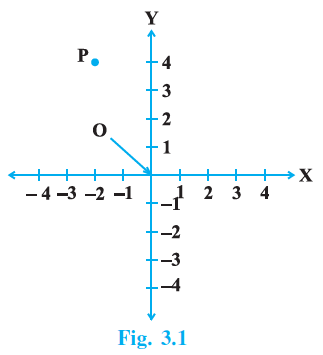
Question 19. In Fig. 3.1, coordinates of P are
(A) (– 4, 2)
(B) (–2, 4)
(C) (4, – 2)
(D) (2, – 4)
Answer:
To Find:
The coordinates $(x, y)$ of point $P$.
Solution:
To determine the coordinates of a point $P$, we find its position relative to the $x$-axis and $y$-axis.
1. Abscissa ($x$-coordinate): We drop a perpendicular from point $P$ to the $x$-axis. The point where this perpendicular meets the $x$-axis is $-2$. Thus, the $x$-coordinate is $-2$.
2. Ordinate ($y$-coordinate): We drop a perpendicular from point $P$ to the $y$-axis. The point where this perpendicular meets the $y$-axis is $4$. Thus, the $y$-coordinate is $4$.
The coordinates are always written in the form $(x, y)$.
$P = (-2, 4)$
(Coordinates of P)
Correct Option: (B) (–2, 4)
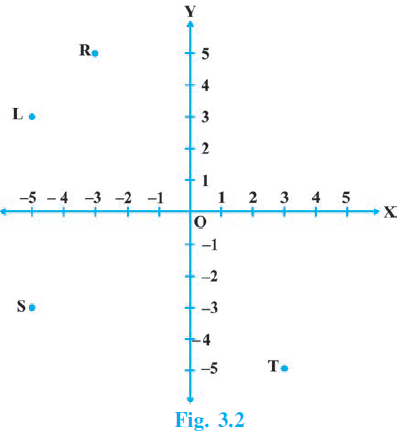
Question 20. In Fig. 3.2, the point identified by the coordinates (–5, 3) is
(A) T
(B) R
(C) L
(D) S
Answer:
To Find:
The point that corresponds to the coordinates $(-5, 3)$.
Solution:
The coordinates are $(-5, 3)$. This means:
1. The x-coordinate is $-5$. We move $5$ units to the left of the origin along the $x$-axis.
2. The y-coordinate is $3$. We move $3$ units upward from the $x$-axis at the point where $x = -5$.
By observing the provided graph (Fig. 3.2):
Point L is located at $x = -5$ and $y = 3$. Therefore, its coordinates are $(-5, 3)$.
For additional clarity, let us observe the other points:
Point $R$ is at $(-3, 5)$.
Point $S$ is at $(-5, -3)$.
Point $T$ is at $(3, -5)$.
Comparing these, the point identified by $(-5, 3)$ is $L$.
Correct Option: (C) L
Question 21. The point whose ordinate is 4 and which lies on y-axis is
(A) (4, 0)
(B) (0, 4)
(C) (1, 4)
(D) (4, 2)
Answer:
We are looking for a point that satisfies two conditions:
1. Its ordinate is 4.
2. It lies on the y-axis.
The ordinate of a point is its y-coordinate. So, the first condition tells us that the y-coordinate of the point is 4.
y-coordinate $= 4$
A point lies on the y-axis if and only if its abscissa (x-coordinate) is 0.
x-coordinate $= 0$
So, the point must have an x-coordinate of 0 and a y-coordinate of 4.
The coordinates of the point are $(x, y) = (0, 4)$.
Let's examine the given options:
- (A) $(4, 0)$: Ordinate is 0, lies on the x-axis.
- (B) $(0, 4)$: Abscissa is 0, ordinate is 4. This point lies on the y-axis and has ordinate 4.
- (C) $(1, 4)$: Abscissa is 1, ordinate is 4. Does not lie on the y-axis.
- (D) $(4, 2)$: Abscissa is 4, ordinate is 2. Does not lie on the y-axis.
The point that satisfies both conditions is $(0, 4)$.
Comparing with the given options, the correct answer is (B).
The correct option is (B) (0, 4).
Question 22. Which of the points P(0, 3), Q(1, 0), R(0, – 1), S(–5, 0), T(1, 2) do not lie on the x-axis?
(A) P and R only
(B) Q and S only
(C) P, R and T
(D) Q, S and T
Answer:
A point lies on the x-axis if and only if its y-coordinate is 0.
We need to find the points that do not lie on the x-axis. These are the points whose y-coordinate is not 0.
Let's examine the y-coordinate of each given point:
- Point P: $(0, 3)$. The y-coordinate is $3$. Since $3 \neq 0$, P does not lie on the x-axis. (It lies on the y-axis).
- Point Q: $(1, 0)$. The y-coordinate is $0$. Since the y-coordinate is $0$, Q lies on the x-axis.
- Point R: $(0, -1)$. The y-coordinate is $-1$. Since $-1 \neq 0$, R does not lie on the x-axis. (It lies on the y-axis).
- Point S: $(-5, 0)$. The y-coordinate is $0$. Since the y-coordinate is $0$, S lies on the x-axis.
- Point T: $(1, 2)$. The y-coordinate is $2$. Since $2 \neq 0$, T does not lie on the x-axis. (It lies in the I quadrant).
The points whose y-coordinate is not 0 are P $(0, 3)$, R $(0, -1)$, and T $(1, 2)$.
Therefore, the points that do not lie on the x-axis are P, R, and T.
Comparing with the given options, the correct answer is (C).
The correct option is (C) P, R and T.
Question 23. The point which lies on y-axis at a distance of 5 units in the negative direction of y-axis is
(A) (0, 5)
(B) (5, 0)
(C) (0, – 5)
(D) (– 5, 0)
Answer:
We are looking for a point that satisfies two conditions:
1. It lies on the y-axis.
2. It is at a distance of 5 units in the negative direction of the y-axis.
A point lying on the y-axis has its x-coordinate equal to 0.
x-coordinate $= 0$
The distance of a point $(x, y)$ from the x-axis is $|y|$. This also represents the distance from the origin along the y-axis if the point is on the y-axis (i.e., $x=0$).
The point is at a distance of 5 units from the origin along the y-axis.
The direction is the negative direction of the y-axis. The y-values are negative in the negative direction of the y-axis.
So, the y-coordinate of the point is $-5$.
y-coordinate $= -5$
Combining the x and y coordinates, the point is $(0, -5)$.
Let's examine the given options:
- (A) $(0, 5)$: Lies on the y-axis, distance 5 units from origin, but in the positive direction.
- (B) $(5, 0)$: Lies on the x-axis, distance 5 units from origin.
- (C) $(0, -5)$: Lies on the y-axis (x=0), at a distance of $|-5| = 5$ units from the origin, and in the negative direction of the y-axis (y is negative).
- (D) $(-5, 0)$: Lies on the x-axis, distance 5 units from origin, in the negative direction of the x-axis.
The point that satisfies all conditions is $(0, -5)$.
Comparing with the given options, the correct answer is (C).
The correct option is (C) (0, – 5).
Question 24. The perpendicular distance of the point P (3, 4) from the y-axis is
(A) 3
(B) 4
(C) 5
(D) 7
Answer:
Let the point be P $(3, 4)$.
The perpendicular distance of a point from the y-axis is the absolute value of its x-coordinate (abscissa).
For the point P $(3, 4)$, the x-coordinate is $3$ and the y-coordinate is $4$.
The perpendicular distance from the y-axis is $|x| = |3| = 3$ units.
Think of it this way: To reach the point $(3, 4)$ from the origin $(0, 0)$, you move 3 units along the x-axis (horizontally) and then 4 units parallel to the y-axis (vertically). The horizontal movement of 3 units is the distance from the y-axis.
Note that the perpendicular distance of the point P $(3, 4)$ from the x-axis is $|y| = |4| = 4$ units.
We are asked for the distance from the y-axis, which is the absolute value of the x-coordinate.
The perpendicular distance of the point P $(3, 4)$ from the y-axis is 3.
Comparing with the given options, the correct answer is (A).
The correct option is (A) 3.
Sample Question 1 (Before Exercise 3.2)
Sample Question 1: Write whether the following statements are True or False? Justify your answer.
(i) Point (0, –2) lies on y-axis.
(ii) The perpendicular distance of the point (4, 3) from the x-axis is 4.
Answer:
(i) Point (0, –2) lies on y-axis.
For a point to lie on the y-axis, its abscissa (x-coordinate) must be $0$.
The given point is $(0, -2)$.
The x-coordinate of the point $(0, -2)$ is $0$.
Since the x-coordinate is $0$, the point $(0, -2)$ lies on the y-axis.
The statement is True.
Justification: A point $(x, y)$ lies on the y-axis if and only if $x=0$. For the point $(0, -2)$, the x-coordinate is $0$. Therefore, the point lies on the y-axis.
(ii) The perpendicular distance of the point (4, 3) from the x-axis is 4.
The perpendicular distance of a point $(x, y)$ from the x-axis is given by the absolute value of its ordinate (y-coordinate), i.e., $|y|$.
The given point is $(4, 3)$.
The x-coordinate is $4$ and the y-coordinate is $3$.
The perpendicular distance from the x-axis is the absolute value of the y-coordinate.
Distance $= |3| = 3$ units
The statement claims the perpendicular distance is 4, but we calculated it to be 3.
The statement is False.
Justification: The perpendicular distance of a point $(x, y)$ from the x-axis is $|y|$. For the point $(4, 3)$, the y-coordinate is $3$. The perpendicular distance from the x-axis is $|3| = 3$. The statement says the distance is 4, which is incorrect.
Exercise 3.2
Question 1. Write whether the following statements are True or False? Justify your answer.
(i) Point (3, 0) lies in the first quadrant.
(ii) Points (1, –1) and (–1, 1) lie in the same quadrant.
(iii) The coordinates of a point whose ordinate is $-\frac{1}{2}$ and abscissa is 1 are $-\frac{1}{2}$ , 1.
(iv) A point lies on y-axis at a distance of 2 units from the x-axis. Its coordinates are (2, 0).
(v) (-1, 7) is a point in the second quadrant.
Answer:
Statement (i): Point (3, 0) lies in the first quadrant.
Result: False
Justification:
A point $(x, y)$ lies in the first quadrant only if both $x > 0$ and $y > 0$.
For the point $(3, 0)$, the $y$-coordinate (ordinate) is $0$.
$y = 0$
(Point lies on the $x$-axis)
Any point that lies on the axes does not belong to any quadrant. Therefore, $(3, 0)$ lies on the positive $x$-axis, not in the first quadrant.
Statement (ii): Points (1, –1) and (–1, 1) lie in the same quadrant.
Result: False
Justification:
To determine the quadrant, we look at the signs of the coordinates:
1. For the point $(1, -1)$, the signs are $(+, -)$. This point lies in the IV quadrant.
2. For the point $(-1, 1)$, the signs are $(-, +)$. This point lies in the II quadrant.
Since one point is in the second quadrant and the other is in the fourth quadrant, they do not lie in the same quadrant.
Statement (iii): The coordinates of a point whose ordinate is $-\frac{1}{2}$ and abscissa is 1 are $-\frac{1}{2}$, 1.
Result: False
Justification:
In coordinate geometry, the coordinates of a point are always written in the order $(\text{abscissa, ordinate})$, which corresponds to $(x, y)$.
Given:
$\text{Abscissa } (x) = 1$
(Given)
$\text{Ordinate } (y) = -\frac{1}{2}$
(Given)
Therefore, the coordinates of the point must be $(1, -\frac{1}{2})$. The statement provides the coordinates in the wrong order.
Statement (iv): A point lies on y-axis at a distance of 2 units from the x-axis. Its coordinates are (2, 0).
Result: False
Justification:
1. If a point lies on the $y$-axis, its $x$-coordinate (abscissa) must be $0$. Thus, the point is of the form $(0, y)$.
2. The distance from the $x$-axis is given by the absolute value of the $y$-coordinate ($|y|$). Here, distance is $2$ units, so $|y| = 2$. This means $y = 2$ or $y = -2$.
The correct coordinates should be $(0, 2)$ or $(0, -2)$. The coordinates $(2, 0)$ represent a point on the $x$-axis at a distance of $2$ units from the $y$-axis.
Statement (v): (-1, 7) is a point in the second quadrant.
Result: True
Justification:
In the Cartesian plane, the second quadrant (II Quadrant) is characterized by:
$x < 0 \text{ and } y > 0$
(Signs are $(-, +)$)
For the point $(-1, 7)$:
$x = -1$ (negative)
$y = 7$ (positive)
Since the point follows the sign convention $(-, +)$, it correctly lies in the second quadrant.
Sample Question 1 & 2 (Before Exercise 3.3)
Sample Question 1: Plot the point P (– 6, 2) and from it draw PM and PN as perpendiculars to x-axis and y-axis, respectively. Write the coordinates of the points M and N.
Answer:
Given:
The point to be plotted is $P(-6, 2)$.
$PM$ is a perpendicular drawn from $P$ to the $x$-axis.
$PN$ is a perpendicular drawn from $P$ to the $y$-axis.
To Find:
The coordinates of point $M$ and point $N$.
Solution:
The point $P(-6, 2)$ has an abscissa of $-6$ and an ordinate of $2$. It lies in the second quadrant.
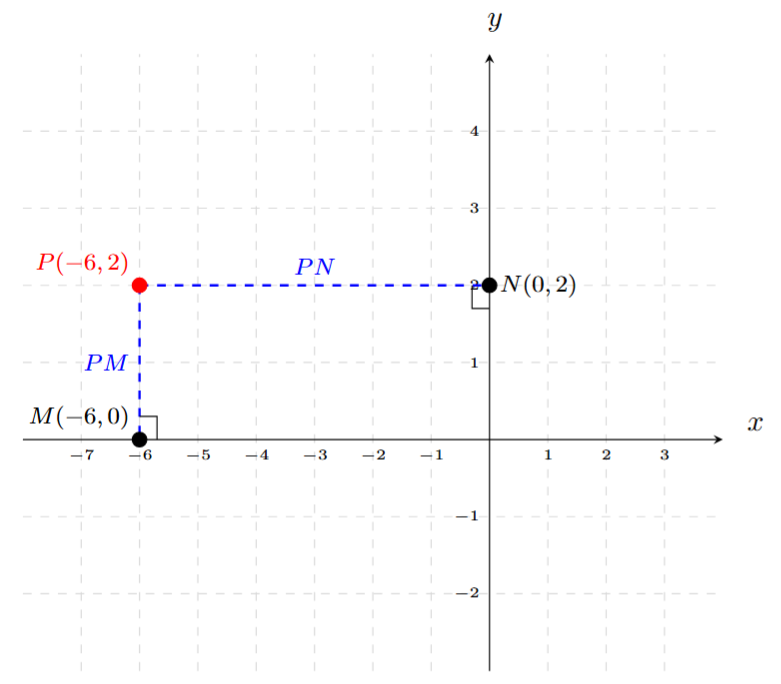
1. For point M: Since $PM$ is perpendicular to the $x$-axis, $M$ is the foot of the perpendicular on the $x$-axis. For any point on the $x$-axis, the $y$-coordinate is always $0$, and its $x$-coordinate is the same as that of point $P$.
$M = (-6, 0)$
[Foot of the perpendicular on x-axis]
2. For point N: Since $PN$ is perpendicular to the $y$-axis, $N$ is the foot of the perpendicular on the $y$-axis. For any point on the $y$-axis, the $x$-coordinate is always $0$, and its $y$-coordinate is the same as that of point $P$.
$N = (0, 2)$
[Foot of the perpendicular on y-axis]
Final Answer: The coordinates of $M$ are $(-6, 0)$ and the coordinates of $N$ are $(0, 2)$.
Sample Question 2: From the Fig. 3.4, write the following:
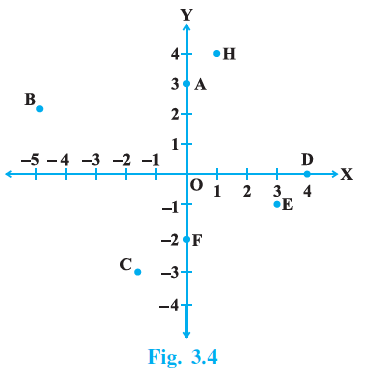
(i) Coordinates of B, C and E
(ii) The point identified by the coordinates (0, – 2)
(iii) The abscissa of the point H
(iv) The ordinate of the point D
Answer:
Given:
The coordinate plane Fig. 3.4 showing points $A, B, C, D, E, F,$ and $H$.
Solution:
By observing the given Cartesian plane, we can determine the positions of the points:
(i) Coordinates of B, C and E:
For point B: It is located $5$ units to the left of the $y$-axis ($x = -5$) and $2$ units above the $x$-axis ($y = 2$).
$B = (-5, 2)$
(Point in II Quadrant)
For point C: It is located $2$ units to the left of the $y$-axis ($x = -2$) and $3$ units below the $x$-axis ($y = -3$).
$C = (-2, -3)$
(Point in III Quadrant)
For point E: It is located $3$ units to the right of the $y$-axis ($x = 3$) and $1$ unit below the $x$-axis ($y = -1$).
$E = (3, -1)$
(Point in IV Quadrant)
(ii) The point identified by the coordinates (0, – 2):
A point with $x$-coordinate $0$ lies on the $y$-axis. At $y = -2$ on the $y$-axis, we find the point labelled $F$.
$\text{Required point} = F$
(Lies on negative y-axis)
(iii) The abscissa of the point H:
The abscissa is the $x$-coordinate. Point $H$ is aligned with $1$ on the $x$-axis and $4$ on the $y$-axis, so its coordinates are $(1, 4)$.
$\text{Abscissa of } H = 1$
(iv) The ordinate of the point D:
The ordinate is the $y$-coordinate. Point $D$ lies exactly on the $x$-axis at the position $4$. For any point on the $x$-axis, the $y$-coordinate is always $0$.
$\text{Ordinate of } D = 0$
Exercise 3.3
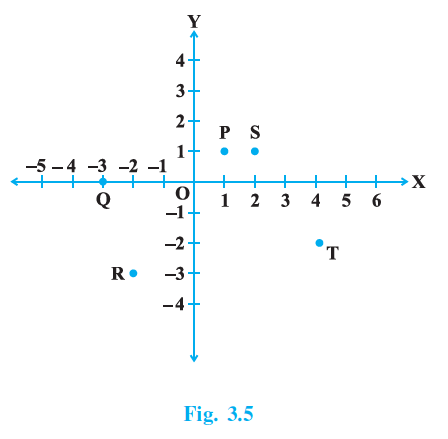
Question 1. Write the coordinates of each of the points P, Q, R, S, T and O from the Fig. 3.5.
Answer:
Given:
A coordinate plane Fig. 3.5 with points O, P, Q, R, S, and T plotted on it.
To Find:
The coordinates $(x, y)$ for each of the given points.
Solution:
The coordinates of a point are determined by its perpendicular distance from the $y$-axis (abscissa or $x$) and its perpendicular distance from the $x$-axis (ordinate or $y$).
1. Point O:
Point $O$ is the intersection of the $x$-axis and the $y$-axis, which is known as the origin.
$\text{Coordinates of } O = (0, 0)$
(Origin)
2. Point P:
Point $P$ is $1$ unit to the right of the $y$-axis and $1$ unit above the $x$-axis.
$\text{Coordinates of } P = (1, 1)$
(I Quadrant)
3. Point Q:
Point $Q$ lies exactly on the $x$-axis at a distance of $3$ units to the left of the origin. For any point on the $x$-axis, the $y$-coordinate is $0$.
$\text{Coordinates of } Q = (-3, 0)$
(On negative x-axis)
4. Point R:
Point $R$ is $2$ units to the left of the $y$-axis and $3$ units below the $x$-axis.
$\text{Coordinates of } R = (-2, -3)$
(III Quadrant)
5. Point S:
Point $S$ is $2$ units to the right of the $y$-axis and $1$ unit above the $x$-axis.
$\text{Coordinates of } S = (2, 1)$
(I Quadrant)
6. Point T:
Point $T$ is $4$ units to the right of the $y$-axis and $2$ units below the $x$-axis.
$\text{Coordinates of } T = (4, -2)$
(IV Quadrant)
Final Answer:
The coordinates of the points are: O(0, 0), P(1, 1), Q(-3, 0), R(-2, -3), S(2, 1), and T(4, -2).
Question 2. Plot the following points and write the name of the figure obtained by joining them in order:
P(– 3, 2), Q (– 7, – 3), R (6, – 3), S (2, 2)
Answer:
Given:
The points to be plotted are $P(-3, 2)$, $Q(-7, -3)$, $R(6, -3)$, and $S(2, 2)$.
To Find:
The name of the geometrical figure obtained by joining $P, Q, R,$ and $S$ in order.
Solution:
After plotting the points on a Cartesian plane and joining them in the order $P \rightarrow Q \rightarrow R \rightarrow S \rightarrow P$:
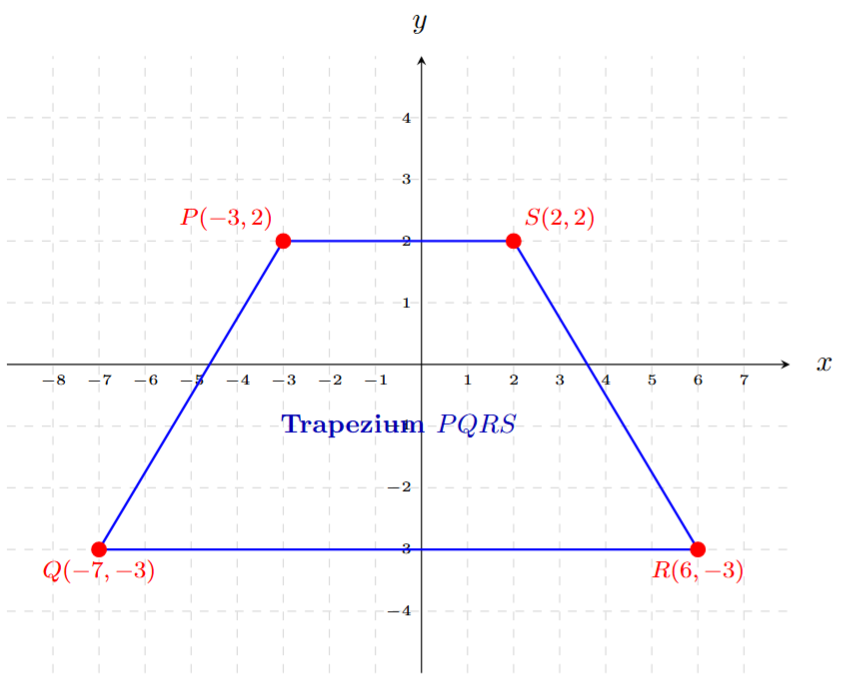
1. Observation of sides $PS$ and $QR$:
Ordinate of $P = 2, \text{ Ordinate of } S = 2$
(Points lie on line $y = 2$)
Ordinate of $Q = -3, \text{ Ordinate of } R = -3$
(Points lie on line $y = -3$)
Since both $PS$ and $QR$ are horizontal lines (parallel to the $x$-axis), they are parallel to each other ($PS \parallel QR$).
2. Observation of lengths:
$PS = |2 - (-3)| = 5 \text{ units}$
$QR = |6 - (-7)| = 13 \text{ units}$
Since $PS \parallel QR$ and $PS \neq QR$, the quadrilateral has only one pair of opposite sides parallel and unequal.
Hence, the figure obtained is a Trapezium.
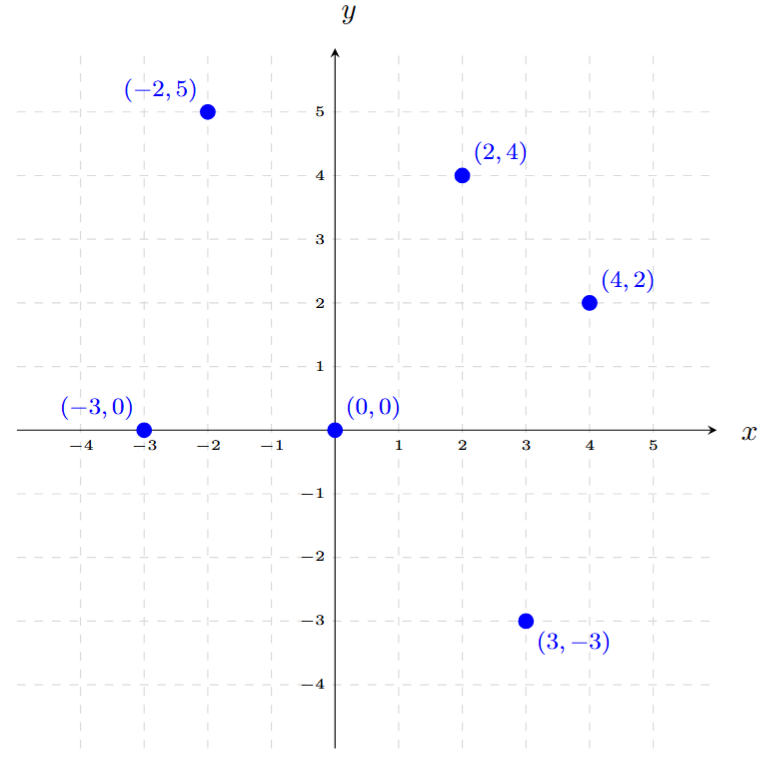
Question 3. Plot the points (x, y) given by the following table:
| x | 2 | 4 | -3 | -2 | 3 | 0 |
|---|---|---|---|---|---|---|
| y | 4 | 2 | 0 | 5 | -3 | 0 |
Answer:
Given:
The following table representing coordinates $(x, y)$:
| Abscissa (x) | Ordinate (y) | Point (x, y) |
| 2 | 4 | (2, 4) |
| 4 | 2 | (4, 2) |
| -3 | 0 | (-3, 0) |
| -2 | 5 | (-2, 5) |
| 3 | -3 | (3, -3) |
| 0 | 0 | (0, 0) |
To Find:
Plot these points on the Cartesian plane.
Solution:
To plot these points, we follow these steps:
1. (2, 4): Move $2$ units right on the $x$-axis and $4$ units up.
2. (4, 2): Move $4$ units right on the $x$-axis and $2$ units up.
3. (-3, 0): Move $3$ units left on the $x$-axis. Since $y=0$, it lies on the $x$-axis.
4. (-2, 5): Move $2$ units left on the $x$-axis and $5$ units up.
5. (3, -3): Move $3$ units right on the $x$-axis and $3$ units down.
6. (0, 0): This is the origin.
Question 4. Plot the following points and check whether they are collinear or not :
(i) (1, 3), (– 1, – 1), (– 2, – 3)
(ii) (1, 1), (2, – 3), (– 1, – 2)
(iii) (0, 0), (2, 2), (5, 5)
Answer:
Definition:
Points are said to be collinear if they all lie on the same straight line.
Solution (i): (1, 3), (– 1, – 1), (– 2, – 3)
Let the points be $A(1, 3)$, $B(-1, -1)$, and $C(-2, -3)$.
Upon plotting these points on a graph and joining them, we observe that they all lie on a single straight line.
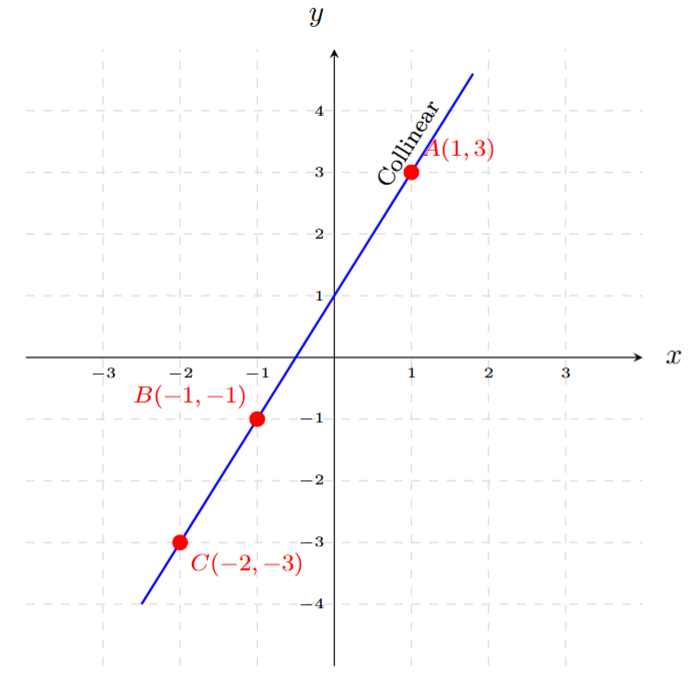
Result: The points are collinear.
Solution (ii): (1, 1), (2, – 3), (– 1, – 2)
Let the points be $P(1, 1)$, $Q(2, -3)$, and $R(-1, -2)$.
Upon plotting these points, we see that they form a triangle. No single straight line can pass through all three points simultaneously.
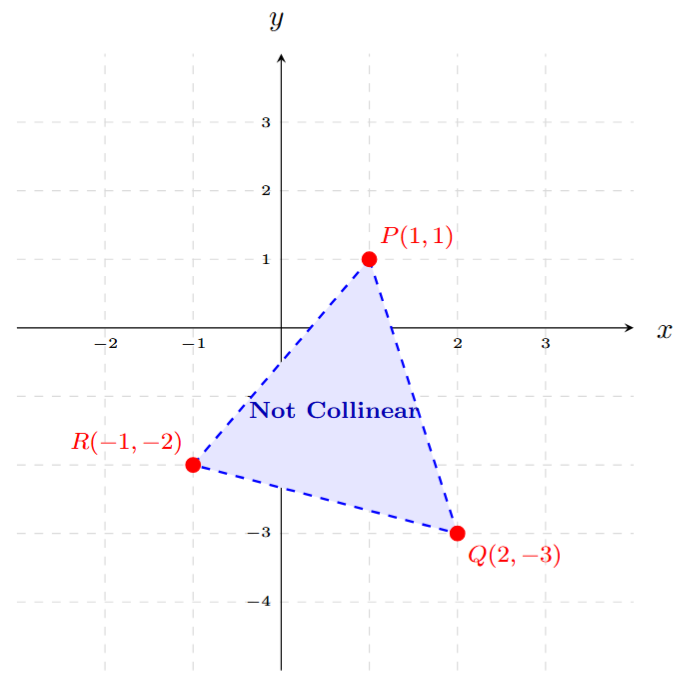
Result: The points are not collinear.
Solution (iii): (0, 0), (2, 2), (5, 5)
Let the points be $O(0, 0)$, $A(2, 2)$, and $B(5, 5)$.
In each point, the $x$-coordinate is equal to the $y$-coordinate ($x = y$). All such points lie on the line $y = x$ passing through the origin at an angle of $45^\circ$.
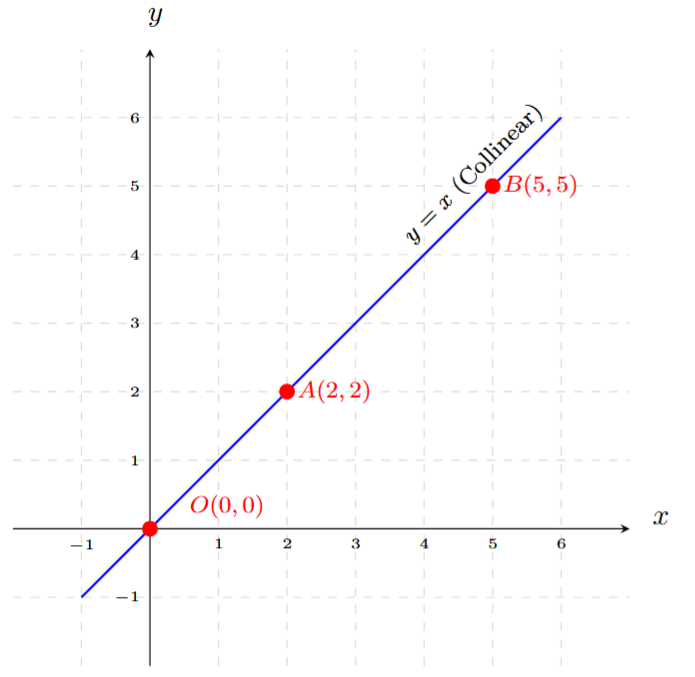
Result: The points are collinear.
Question 5. Without plotting the points indicate the quadrant in which they will lie, if
(i) ordinate is 5 and abscissa is – 3
(ii) abscissa is – 5 and ordinate is – 3
(iii) abscissa is – 5 and ordinate is 3
(iv) ordinate is 5 and abscissa is 3
Answer:
The quadrant in which a point $(x, y)$ lies is determined by the signs of its coordinates.
The rules for the quadrants are:
- Quadrant I: $x > 0$, $y > 0$ (abscissa positive, ordinate positive) - (+, +)
- Quadrant II: $x < 0$, $y > 0$ (abscissa negative, ordinate positive) - (–, +)
- Quadrant III: $x < 0$, $y < 0$ (abscissa negative, ordinate negative) - (–, –)
- Quadrant IV: $x > 0$, $y < 0$ (abscissa positive, ordinate negative) - (+, –)
Points on the axes (where either x or y is 0) do not lie in any quadrant.
Now let's consider each case:
(i) ordinate is 5 and abscissa is – 3
Abscissa (x-coordinate) $= -3$ (negative)
Ordinate (y-coordinate) $= 5$ (positive)
The signs are $(–, +)$. This corresponds to the II quadrant.
(ii) abscissa is – 5 and ordinate is – 3
Abscissa (x-coordinate) $= -5$ (negative)
Ordinate (y-coordinate) $= -3$ (negative)
The signs are $(–, –)$. This corresponds to the III quadrant.
(iii) abscissa is – 5 and ordinate is 3
Abscissa (x-coordinate) $= -5$ (negative)
Ordinate (y-coordinate) $= 3$ (positive)
The signs are $(–, +)$. This corresponds to the II quadrant.
(iv) ordinate is 5 and abscissa is 3
Abscissa (x-coordinate) $= 3$ (positive)
Ordinate (y-coordinate) $= 5$ (positive)
The signs are $(+, +)$. This corresponds to the I quadrant.
Summary of findings:
(i) II quadrant
(ii) III quadrant
(iii) II quadrant
(iv) I quadrant
Question 6. In Fig. 3.6, LM is a line parallel to the y-axis at a distance of 3 units.
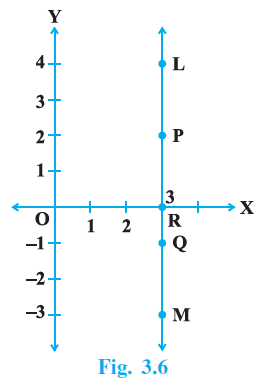
(i) What are the coordinates of the points P, R and Q?
(ii) What is the difference between the abscissa of the points L and M?
Answer:
Given:
In Fig. 3.6, $LM$ is a straight line parallel to the $y$-axis.
The distance of the line $LM$ from the $y$-axis is $3$ units.
To Find:
(i) The coordinates of points $P, R,$ and $Q$.
(ii) The difference between the abscissa of point $L$ and point $M$.
Solution:
We know that any line parallel to the $y$-axis has a constant $x$-coordinate for all points lying on it. Since the line $LM$ is at a distance of $3$ units from the $y$-axis in the positive direction of the $x$-axis, the $x$-coordinate (abscissa) for every point on this line is $3$.
$\text{Abscissa (x) of any point on } LM = 3$
(i) Coordinates of P, R, and Q:
1. For point P: It lies on line $LM$, so its $x$-coordinate is $3$. By looking at the $y$-axis, $P$ is aligned with the value $2$.
$\text{Coordinates of } P = (3, 2)$
2. For point R: It lies on line $LM$ and specifically at the intersection with the $x$-axis. For any point on the $x$-axis, the $y$-coordinate is always $0$.
$\text{Coordinates of } R = (3, 0)$
3. For point Q: It lies on line $LM$, so its $x$-coordinate is $3$. By looking at the $y$-axis, $Q$ is aligned with the value $-1$.
$\text{Coordinates of } Q = (3, -1)$
(ii) Difference between the abscissa of L and M:
The abscissa refers to the $x$-coordinate of a point.
Since both points $L$ and $M$ lie on the line $LM$ which is parallel to the $y$-axis at a distance of $3$ units:
$\text{Abscissa of } L = 3$
$\text{Abscissa of } M = 3$
Now, we calculate the difference:
$\text{Difference} = 3 - 3 = 0$
Final Answer:
(i) The coordinates are P(3, 2), R(3, 0) and Q(3, – 1).
(ii) The difference between the abscissa of $L$ and $M$ is 0.
Question 7. In which quadrant or on which axis each of the following points lie?
(– 3, 5), (4, – 1), (2, 0), (2, 2), (– 3, – 6)
Answer:
To determine the quadrant or axis a point $(x, y)$ lies on, we examine the signs of its coordinates:
- If $x > 0$ and $y > 0$, the point is in Quadrant I.
- If $x < 0$ and $y > 0$, the point is in Quadrant II.
- If $x < 0$ and $y < 0$, the point is in Quadrant III.
- If $x > 0$ and $y < 0$, the point is in Quadrant IV.
- If $y = 0$ and $x \neq 0$, the point is on the x-axis.
- If $x = 0$ and $y \neq 0$, the point is on the y-axis.
- If $x = 0$ and $y = 0$, the point is the origin (lies on both axes).
Let's analyze each point:
Point (– 3, 5):
x-coordinate is $-3$ (negative).
y-coordinate is $5$ (positive).
Since $x < 0$ and $y > 0$, the point lies in the II quadrant.
Point (4, – 1):
x-coordinate is $4$ (positive).
y-coordinate is $-1$ (negative).
Since $x > 0$ and $y < 0$, the point lies in the IV quadrant.
Point (2, 0):
x-coordinate is $2$ (non-zero).
y-coordinate is $0$.
Since $y = 0$ and $x \neq 0$, the point lies on the x-axis.
Point (2, 2):
x-coordinate is $2$ (positive).
y-coordinate is $2$ (positive).
Since $x > 0$ and $y > 0$, the point lies in the I quadrant.
Point (– 3, – 6):
x-coordinate is $-3$ (negative).
y-coordinate is $-6$ (negative).
Since $x < 0$ and $y < 0$, the point lies in the III quadrant.
Summary of locations:
- (– 3, 5): II quadrant
- (4, – 1): IV quadrant
- (2, 0): on the x-axis
- (2, 2): I quadrant
- (– 3, – 6): III quadrant
Question 8. Which of the following points lie on y-axis?
A (1, 1), B (1, 0), C (0, 1), D (0, 0), E (0, – 1), F (– 1, 0), G (0, 5), H (– 7, 0), I (3, 3).
Answer:
A point lies on the y-axis if and only if its x-coordinate (abscissa) is 0.
We need to examine the x-coordinate of each given point to check if it is 0.
- Point A (1, 1): The x-coordinate is $1$. Since $1 \neq 0$, point A does not lie on the y-axis.
- Point B (1, 0): The x-coordinate is $1$. Since $1 \neq 0$, point B does not lie on the y-axis. (It lies on the x-axis).
- Point C (0, 1): The x-coordinate is $0$. Since the x-coordinate is $0$, point C lies on the y-axis.
- Point D (0, 0): The x-coordinate is $0$. Since the x-coordinate is $0$, point D lies on the y-axis. (This is the origin, which lies on both axes).
- Point E (0, – 1): The x-coordinate is $0$. Since the x-coordinate is $0$, point E lies on the y-axis.
- Point F (– 1, 0): The x-coordinate is $-1$. Since $-1 \neq 0$, point F does not lie on the y-axis. (It lies on the x-axis).
- Point G (0, 5): The x-coordinate is $0$. Since the x-coordinate is $0$, point G lies on the y-axis.
- Point H (– 7, 0): The x-coordinate is $-7$. Since $-7 \neq 0$, point H does not lie on the y-axis. (It lies on the x-axis).
- Point I (3, 3): The x-coordinate is $3$. Since $3 \neq 0$, point I does not lie on the y-axis.
The points whose x-coordinate is 0 are C (0, 1), D (0, 0), E (0, – 1), and G (0, 5).
Therefore, the points that lie on the y-axis are C, D, E, and G.
Question 9. Plot the points (x, y) given by the following table. Use scale 1 cm = 0.25 units
| x | 1.25 | 0.25 | 1.5 | -1.75 |
|---|---|---|---|---|
| y | -0.5 | 1 | 1.5 | -0.25 |
Answer:
Given:
The points $(x, y)$ to be plotted as per the table:
| Abscissa (x) | Ordinate (y) | Point (x, y) |
| 1.25 | -0.5 | (1.25, -0.5) |
| 0.25 | 1 | (0.25, 1) |
| 1.5 | 1.5 | (1.5, 1.5) |
| -1.75 | -0.25 | (-1.75, -0.25) |
Scale to be used: $1 \text{ cm} = 0.25 \text{ units}$.
To Find:
Plot these points on a Cartesian coordinate plane based on the specified scale.
Solution:
The scale is given as $1 \text{ cm} = 0.25 \text{ units}$. To find the number of centimeters from the origin for each point, we divide the coordinate value by $0.25$.
$\text{Distance in cm} = \frac{\text{Coordinate Value}}{0.25}$
(Scale Conversion)
For example, to plot $x = 1.25$:
$\text{Distance} = \frac{1.25}{0.25} = 5 \text{ cm}$
Similarly, we calculate the distances for all points:
1. Point (1.25, -0.5): $5 \text{ cm}$ right on $x$-axis, $2 \text{ cm}$ down on $y$-axis.
2. Point (0.25, 1): $1 \text{ cm}$ right on $x$-axis, $4 \text{ cm}$ up on $y$-axis.
3. Point (1.5, 1.5): $6 \text{ cm}$ right on $x$-axis, $6 \text{ cm}$ up on $y$-axis.
4. Point (-1.75, -0.25): $7 \text{ cm}$ left on $x$-axis, $1 \text{ cm}$ down on $y$-axis.
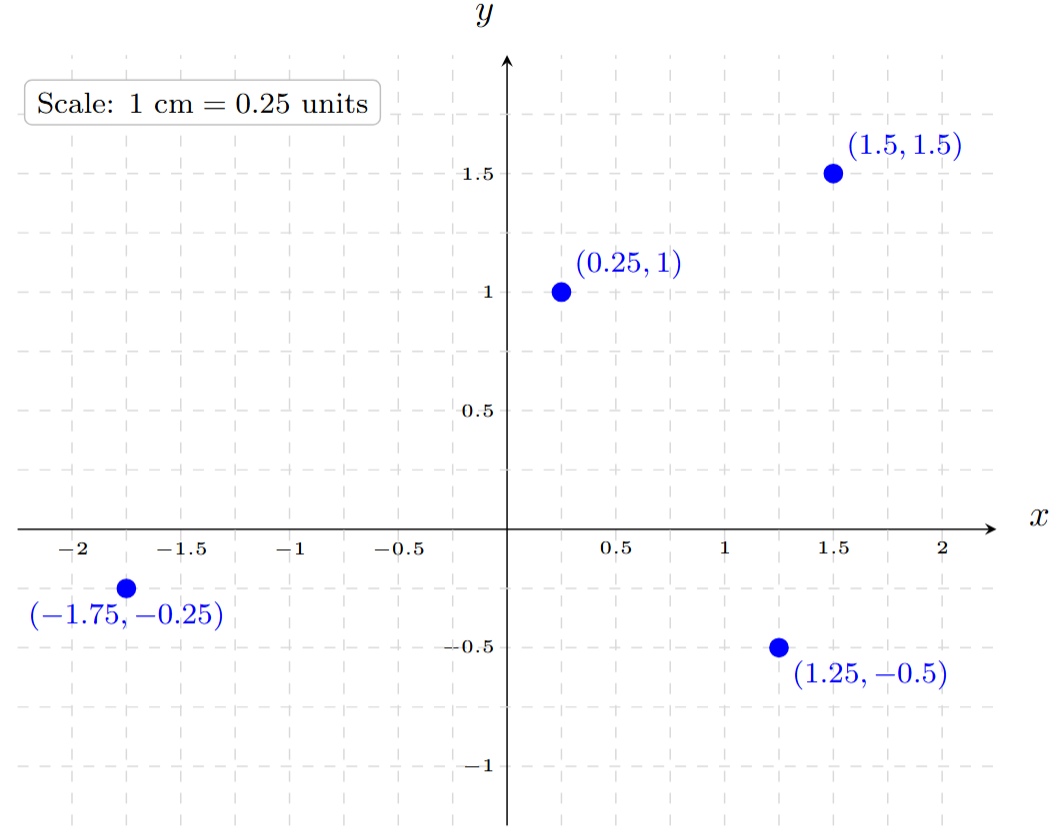
The points are plotted by identifying their respective quadrants based on the signs of $x$ and $y$ and measuring the distances as per the converted scale.
Question 10. A point lies on the x-axis at a distance of 7 units from the y-axis. What are its coordinates? What will be the coordinates if it lies on y-axis at a distance of –7 units from x-axis?
Answer:
Given:
Case 1: A point lies on the $x$-axis at a distance of $7$ units from the $y$-axis.
Case 2: A point lies on the $y$-axis at a distance of $-7$ units from the $x$-axis.
To Find:
The coordinates of the points in both the cases.
Solution:
Case 1: Point on the $x$-axis
We know that for any point lying on the $x$-axis, the $y$-coordinate (ordinate) is always $0$.
$y = 0$
(Property of x-axis)
The distance of a point from the $y$-axis is given by its $x$-coordinate (abscissa). Since the distance is $7$ units, the point can be on either the positive or the negative side of the $x$-axis.
$x = 7 \text{ or } x = -7$
Therefore, the coordinates of the point are $(7, 0)$ or $(-7, 0)$.
Case 2: Point on the $y$-axis
We know that for any point lying on the $y$-axis, the $x$-coordinate (abscissa) is always $0$.
$x = 0$
(Property of y-axis)
The distance of a point from the $x$-axis is given by its $y$-coordinate (ordinate). It is given that the distance is $-7$ units. In coordinate geometry, a "distance" specified with a negative sign indicates the direction relative to the origin.
$y = -7$
[Negative direction of y-axis]
Therefore, the coordinates of the point are $(0, -7)$.
Question 11. Find the coordinates of the point
(i) which lies on x and y axes both.
(ii) whose ordinate is – 4 and which lies on y-axis.
(iii) whose abscissa is 5 and which lies on x-axis.
Answer:
Let the coordinates of a point be $(x, y)$.
(i) which lies on x and y axes both.
A point lies on the x-axis if its y-coordinate is 0.
A point lies on the y-axis if its x-coordinate is 0.
For a point to lie on both the x-axis and the y-axis, both of these conditions must be met.
x-coordinate $= 0$
y-coordinate $= 0$
The only point with coordinates $(0, 0)$ is the origin.
The coordinates of the point which lies on x and y axes both are (0, 0).
(ii) whose ordinate is – 4 and which lies on y-axis.
The ordinate is the y-coordinate. We are given that the ordinate is $-4$.
y-coordinate $= -4$
The point lies on the y-axis. A point on the y-axis has its x-coordinate (abscissa) equal to 0.
x-coordinate $= 0$
Combining the x and y coordinates, the point is $(0, -4)$.
The coordinates of the point are (0, –4).
(iii) whose abscissa is 5 and which lies on x-axis.
The abscissa is the x-coordinate. We are given that the abscissa is $5$.
x-coordinate $= 5$
The point lies on the x-axis. A point on the x-axis has its y-coordinate (ordinate) equal to 0.
y-coordinate $= 0$
Combining the x and y coordinates, the point is $(5, 0)$.
The coordinates of the point are (5, 0).
Question 12. Taking 0.5 cm as 1 unit, plot the following points on the graph paper :
A (1, 3), B (– 3, – 1), C (1, – 4), D (– 2, 3), E (0, – 8), F (1, 0)
Answer:
Given:
The points to be plotted are $A(1, 3)$, $B(-3, -1)$, $C(1, -4)$, $D(-2, 3)$, $E(0, -8)$, and $F(1, 0)$.
The scale to be used is $0.5 \text{ cm} = 1 \text{ unit}$.
To Find:
Plot these points on a graph paper according to the given scale.
Solution:
According to the scale $1 \text{ unit} = 0.5 \text{ cm}$, the distance of any point from the origin on the graph paper will be half of its numerical coordinate value in centimeters.
We determine the location of each point as follows:
1. Point A(1, 3): Since both coordinates are positive, it lies in the I Quadrant. It is $0.5 \text{ cm}$ from the $y$-axis and $1.5 \text{ cm}$ from the $x$-axis.
2. Point B(– 3, – 1): Since both coordinates are negative, it lies in the III Quadrant. It is $1.5 \text{ cm}$ to the left of the $y$-axis and $0.5 \text{ cm}$ below the $x$-axis.
3. Point C(1, – 4): Since the $x$-coordinate is positive and the $y$-coordinate is negative, it lies in the IV Quadrant. It is $0.5 \text{ cm}$ to the right of the $y$-axis and $2 \text{ cm}$ below the $x$-axis.
4. Point D(– 2, 3): Since the $x$-coordinate is negative and the $y$-coordinate is positive, it lies in the II Quadrant. It is $1 \text{ cm}$ to the left of the $y$-axis and $1.5 \text{ cm}$ above the $x$-axis.
5. Point E(0, – 8): Since the $x$-coordinate is $0$, the point lies on the $y$-axis. Specifically, it is $4 \text{ cm}$ below the origin on the negative $y$-axis.
6. Point F(1, 0): Since the $y$-coordinate is $0$, the point lies on the $x$-axis. Specifically, it is $0.5 \text{ cm}$ to the right of the origin on the positive $x$-axis.
Graph:
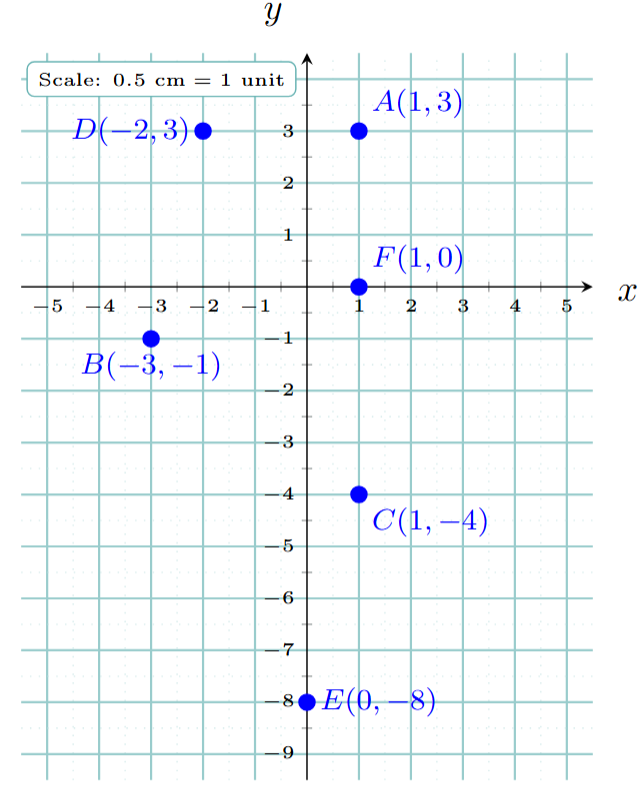
By following the steps above and using the specified scale, the points are accurately plotted on the Cartesian plane.
Sample Question 1 (Before Exercise 3.4)
Sample Question 1: Three vertices of a rectangle are (3, 2), (– 4, 2) and (– 4, 5). Plot these points and find the coordinates of the fourth vertex.
Answer:
Given:
Three vertices of a rectangle are $A(3, 2)$, $B(-4, 2)$, and $C(-4, 5)$.
To Find:
Plot the points on a graph and find the coordinates of the fourth vertex, say $D$.
Solution:
Let the given points be $A(3, 2)$, $B(-4, 2)$, and $C(-4, 5)$.
1. Plotting the points: We plot $A$, $B$, and $C$ on the Cartesian plane. By joining $A$ to $B$ and $B$ to $C$, we observe the following:
$\text{Ordinate of } A = \text{Ordinate of } B = 2$
[Line AB is parallel to x-axis]
$\text{Abscissa of } B = \text{Abscissa of } C = -4$
[Line BC is parallel to y-axis]
2. Finding the fourth vertex D: In a rectangle $ABCD$, opposite sides are parallel and equal. Also, all internal angles are $90^\circ$.
Since $AB$ is a horizontal line, the opposite side $CD$ must also be a horizontal line. This means the $y$-coordinate of $D$ must be the same as the $y$-coordinate of $C$.
$y\text{-coordinate of } D = 5$
[Since CD is parallel to AB]
Since $BC$ is a vertical line, the opposite side $AD$ must also be a vertical line. This means the $x$-coordinate of $D$ must be the same as the $x$-coordinate of $A$.
$x\text{-coordinate of } D = 3$
[Since AD is parallel to BC]
Combining these, the coordinates of the fourth vertex $D$ are $(3, 5)$.
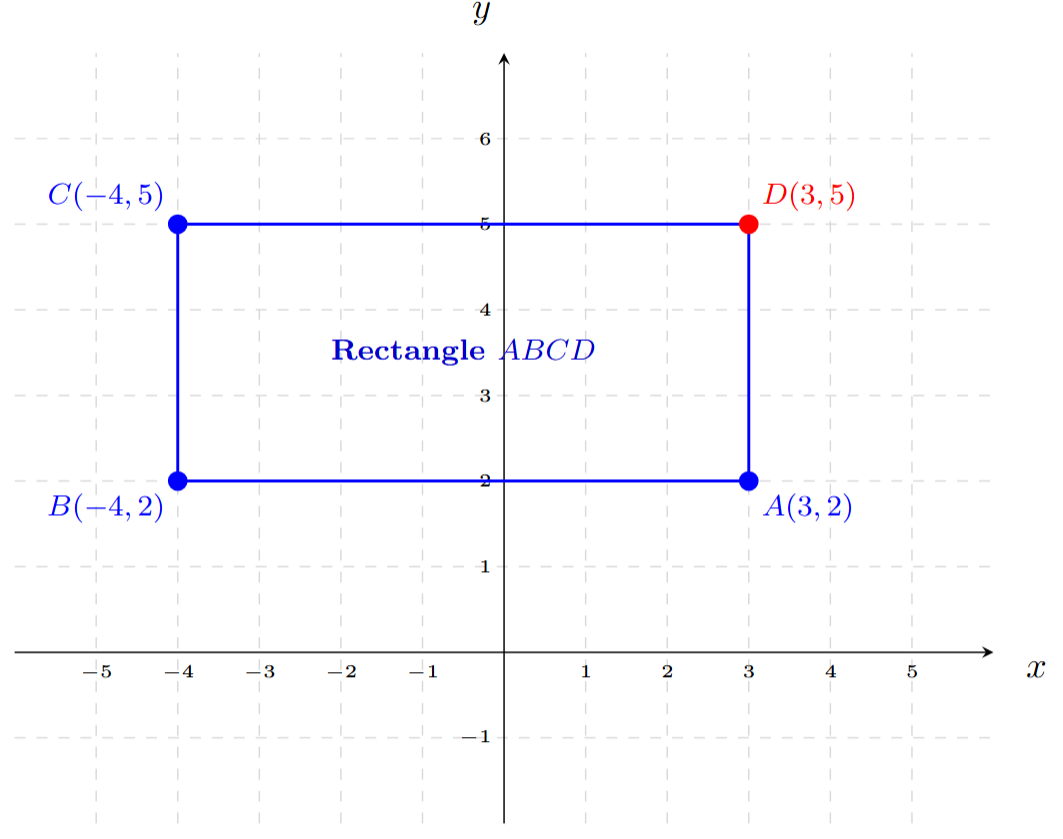
Final Answer: The coordinates of the fourth vertex are (3, 5).
Alternate Solution:
In a rectangle, the diagonals bisect each other. This means the midpoint of diagonal $AC$ is the same as the midpoint of diagonal $BD$.
Let $D$ be $(x, y)$.
$\text{Midpoint of } AC = \left( \frac{3 + (-4)}{2}, \frac{2 + 5}{2} \right) = (-0.5, 3.5)$
$\text{Midpoint of } BD = \left( \frac{-4 + x}{2}, \frac{2 + y}{2} \right)$
Equating the midpoints:
For $x$: $\frac{-4 + x}{2} = -0.5 \Rightarrow -4 + x = -1 \Rightarrow x = 3$
For $y$: $\frac{2 + y}{2} = 3.5 \Rightarrow 2 + y = 7 \Rightarrow y = 5$
Thus, the coordinates of $D$ are (3, 5).
Exercise 3.4
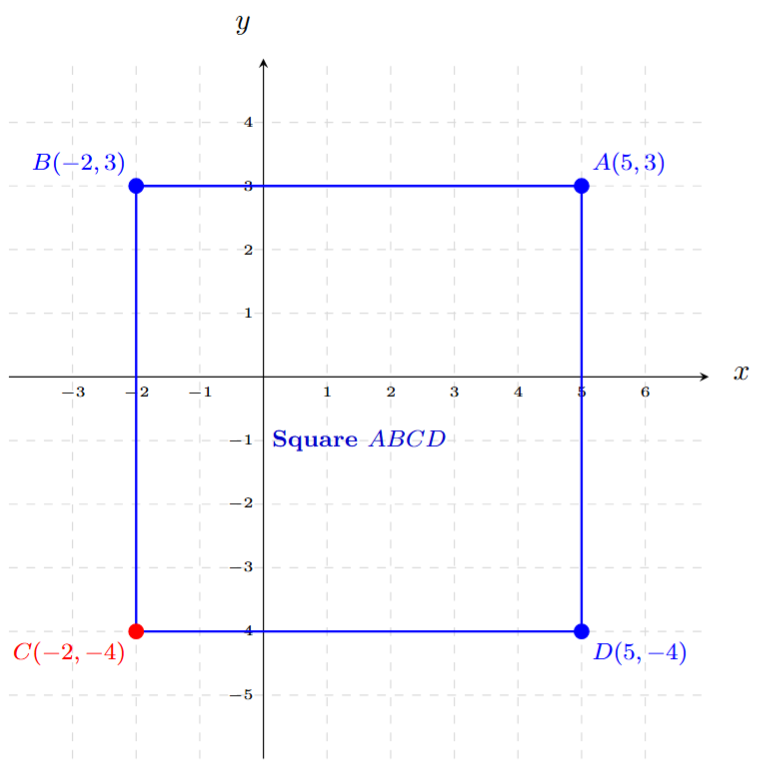
Question 1. Points A (5, 3), B (– 2, 3) and D (5, – 4) are three vertices of a square ABCD. Plot these points on a graph paper and hence find the coordinates of the vertex C.
Answer:
Given:
Three vertices of a square $ABCD$ are $A(5, 3)$, $B(-2, 3)$, and $D(5, -4)$.
To Find:
The coordinates of the fourth vertex $C$.
Solution:
In a square $ABCD$, all sides are equal and adjacent sides are perpendicular. Let us analyze the given coordinates:
1. Side AB: Points $A(5, 3)$ and $B(-2, 3)$ have the same $y$-coordinate. Thus, $AB$ is a horizontal line segment.
$\text{Length of } AB = |5 - (-2)| = 7 \text{ units}$
2. Side AD: Points $A(5, 3)$ and $D(5, -4)$ have the same $x$-coordinate. Thus, $AD$ is a vertical line segment.
$\text{Length of } AD = |3 - (-4)| = 7 \text{ units}$
3. Finding Vertex C: Since $ABCD$ is a square, the side $BC$ must be perpendicular to $AB$. Since $AB$ is horizontal, $BC$ must be a vertical line starting from $B(-2, 3)$. This means the $x$-coordinate of $C$ must be $-2$.
Similarly, the side $DC$ must be perpendicular to $AD$. Since $AD$ is vertical, $DC$ must be a horizontal line starting from $D(5, -4)$. This means the $y$-coordinate of $C$ must be $-4$.
$C = (-2, -4)$
[Opposite to vertex A]
Final Answer: The coordinates of the vertex $C$ are (-2, -4).
Question 2. Write the coordinates of the vertices of a rectangle whose length and breadth are 5 and 3 units respectively, one vertex at the origin, the longer side lies on the x-axis and one of the vertices lies in the third quadrant.
Answer:
Given:
Rectangle length $= 5 \text{ units}$, Breadth $= 3 \text{ units}$.
One vertex is at the origin $(0, 0)$.
The longer side lies on the $x$-axis.
One vertex lies in the third quadrant (where both $x$ and $y$ are negative).
To Find:
The coordinates of all four vertices of the rectangle.
Solution:
1. First Vertex: Given as the origin.
$V_1 = (0, 0)$
2. Second Vertex: The longer side (5 units) lies on the $x$-axis. Since the rectangle must extend into the third quadrant, we must move in the negative $x$ direction.
$V_2 = (-5, 0)$
3. Third Vertex: Since the breadth is $3$ units and the rectangle lies in the third quadrant, we move $3$ units down from $V_2$ in the negative $y$ direction.
$V_3 = (-5, -3)$
(Lies in III quadrant)
4. Fourth Vertex: This point will be on the $y$-axis, $3$ units below the origin.
$V_4 = (0, -3)$
Final Answer: The coordinates of the vertices are (0, 0), (-5, 0), (-5, -3), and (0, -3).
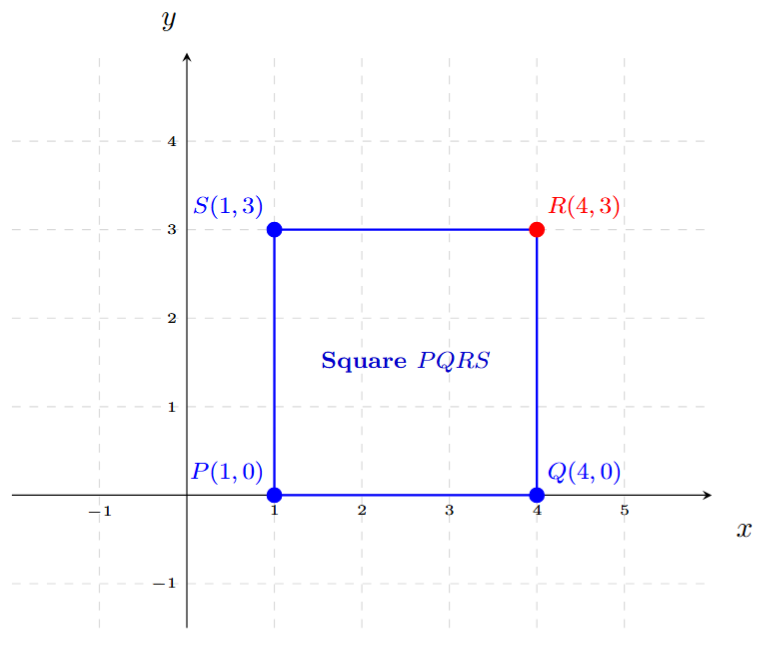
Question 3. Plot the points P (1, 0), Q (4, 0) and S (1, 3). Find the coordinates of the point R such that PQRS is a square.
Answer:
Given:
Vertices $P(1, 0)$, $Q(4, 0)$, and $S(1, 3)$.
To Find:
The coordinates of point $R$ such that $PQRS$ is a square.
Solution:
1. Analyze side PQ: Both points have $y = 0$. So, $PQ$ lies on the $x$-axis.
$\text{Length of side } PQ = |4 - 1| = 3 \text{ units}$
2. Analyze side PS: Both points have $x = 1$. So, $PS$ is a vertical line.
$\text{Length of side } PS = |3 - 0| = 3 \text{ units}$
Since $PQ = PS = 3$ units and they are perpendicular, they form two adjacent sides of a square.
3. Finding point R: To complete the square $PQRS$:
Point $R$ must have the same $x$-coordinate as point $Q$ to make $QR$ a vertical line.
$x\text{-coordinate of } R = 4$
[From point Q]
Point $R$ must have the same $y$-coordinate as point $S$ to make $SR$ a horizontal line.
$y\text{-coordinate of } R = 3$
[From point S]
Final Answer: The coordinates of point $R$ are (4, 3).
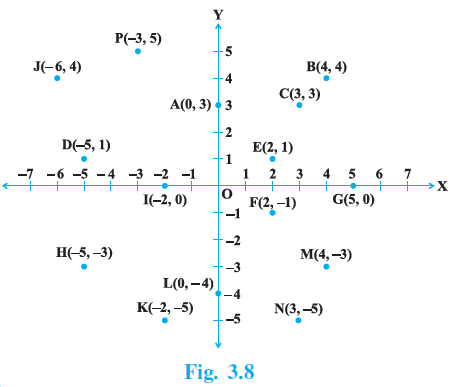
Question 4. From the Fig. 3.8, answer the following :
(i) Write the points whose abscissa is 0.
(ii) Write the points whose ordinate is 0.
(iii) Write the points whose abscissa is – 5.
Answer:
Given:
The Cartesian plane in Fig. 3.8 contains several points including the origin $O$ and points $A, B, C, D, E, F, G, H, I, J, K, L, M, N$ and $P$.
To Find:
(i) Points where the abscissa ($x$-coordinate) is $0$.
(ii) Points where the ordinate ($y$-coordinate) is $0$.
(iii) Points where the abscissa is $-5$.
Solution:
In a coordinate system, any point is represented as $(x, y)$, where $x$ is the abscissa and $y$ is the ordinate. The origin $O$ has coordinates $(0, 0)$.
(i) Points whose abscissa is 0:
Points with an abscissa of $0$ lie on the $y$-axis. By observing Fig. 3.8, we identify the following points on the vertical axis:
1. Point A with coordinates $(0, 3)$.
2. Point L with coordinates $(0, -4)$.
3. Point O (Origin) with coordinates $(0, 0)$.
$\text{Points: } A, L, \text{ and } O$
(Abscissa = 0)
(ii) Points whose ordinate is 0:
Points with an ordinate of $0$ lie on the $x$-axis. By observing Fig. 3.8, we identify the following points on the horizontal axis:
1. Point G with coordinates $(5, 0)$.
2. Point I with coordinates $(-2, 0)$.
3. Point O (Origin) with coordinates $(0, 0)$.
$\text{Points: } G, I, \text{ and } O$
(Ordinate = 0)
(iii) Points whose abscissa is – 5:
To find these points, we look for all points that are aligned with $-5$ on the $x$-axis. By observing Fig. 3.8, these points are:
1. Point D with coordinates $(-5, 1)$.
2. Point H with coordinates $(-5, -3)$.
$\text{Points: } D \text{ and } H$
(Abscissa = -5)
Final Answer:
(i) The points with abscissa $0$ are A, L, and O.
(ii) The points with ordinate $0$ are G, I, and O.
(iii) The points with abscissa $-5$ are D and H.
Question 5. Plot the points A (1, – 1) and B (4, 5)
(i) Draw a line segment joining these points. Write the coordinates of a point on this line segment between the points A and B.
(ii) Extend this line segment and write the coordinates of a point on this line which lies outside the line segment AB.
Answer:
Given:
Two points $A(1, -1)$ and $B(4, 5)$.
To Find:
(i) Coordinates of a point on the line segment $AB$.
(ii) Coordinates of a point on the line $AB$ lying outside the segment $AB$.
Solution:
First, we plot the given points on the Cartesian plane. Point $A(1, -1)$ lies in the IV quadrant and point $B(4, 5)$ lies in the I quadrant.
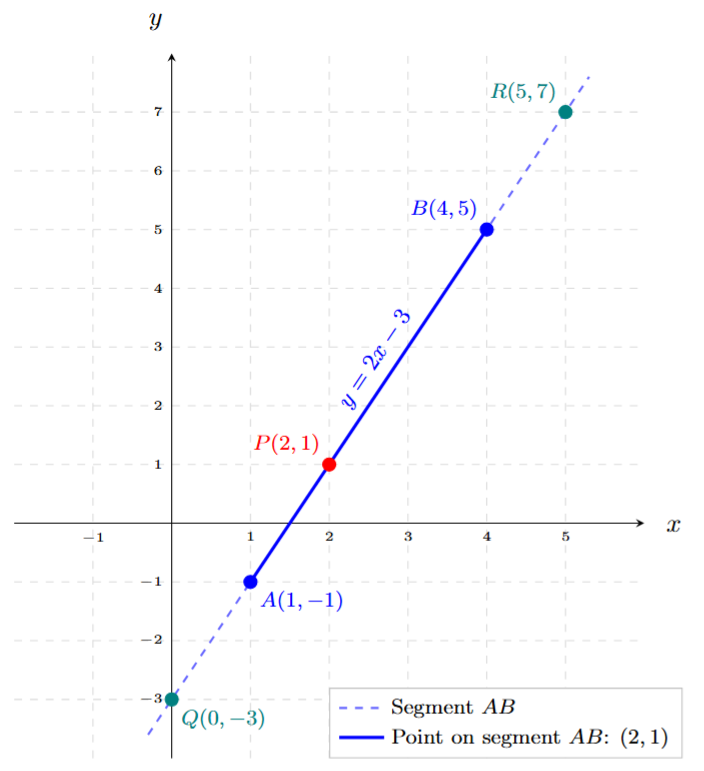
(i) Point on the line segment AB:
To find a point between $A$ and $B$, we can determine the relationship between $x$ and $y$ for the line $AB$. For every $1$ unit increase in $x$, we observe the increase in $y$:
$\text{Slope (m)} = \frac{5 - (-1)}{4 - 1} = \frac{6}{3} = 2$
This means for every $1$ unit the abscissa increases, the ordinate increases by $2$ units. Starting from point $A(1, -1)$:
If we increase $x$ by $1$ unit: $x = 1 + 1 = 2$.
Then $y$ increases by $2$ units: $y = -1 + 2 = 1$.
So, the point $(2, 1)$ lies on the line segment $AB$ because its $x$-coordinate ($2$) is between the $x$-coordinates of $A(1)$ and $B(4)$.
$\text{Point between A and B} = (2, 1)$
(ii) Point outside the line segment AB:
To find a point outside the segment, we can either move further beyond $B$ or before $A$ along the same line.
Moving beyond B:
Starting from $B(4, 5)$, let us increase the abscissa by $1$ unit: $x = 4 + 1 = 5$.
The ordinate increases by $2$ units: $y = 5 + 2 = 7$.
$\text{Point outside AB} = (5, 7)$
Alternatively (Moving before A):
Starting from $A(1, -1)$, let us decrease the abscissa by $1$ unit: $x = 1 - 1 = 0$.
The ordinate decreases by $2$ units: $y = -1 - 2 = -3$.
$\text{Another point outside AB} = (0, -3)$
Final Answer:
(i) A point on the segment $AB$ is (2, 1).
(ii) A point outside the segment $AB$ is (5, 7) or (0, -3).