

Chapter 4 Linear Equations In Two Variables (Class 9 - Maths NCERT Exemplar Solutions)
Welcome to the comprehensive resource for NCERT Exemplar Solutions for Class 9 Mathematics: Chapter 4 Linear Equations in Two Variables! These problems are strategically designed to move beyond foundational exercises, focusing on the deep algebraic and graphical representation of equations. By tackling complex scenarios and multi-faceted word problems, these solutions build the quantitative reasoning and modeling skills required for advanced mathematical studies.
The solutions meticulously cover the standard form $ax+by+c=0$, emphasizing that such equations possess infinitely many solutions expressed as ordered pairs $(x, y)$. A major focus is placed on the graphical representation, reinforcing the principle that every linear equation in two variables represents a straight line. Students will master plotting points precisely and handling special cases, such as lines parallel to the x-axis ($y=k$) or parallel to the y-axis ($x=k$), as well as identifying equations for the axes ($y=0$ and $x=0$).
The Exemplar also challenges students to interpret intercepts and verify if a line passes through the origin $(0,0)$. With step-by-step manipulations and logical justifications prepared by learningspot.co, students can confidently model real-world situations and master the problem-solving techniques required for success in higher-level geometry and algebra.
Sample Question 1 to 3 (Before Exercise 4.1)
Write the correct answer:
Sample Question 1: The linear equation 3x – y = x – 1 has :
(A) A unique solution
(B) Two solutions
(C) Infinitely many solutions
(D) No solution
Answer:
Given:
The equation is $3x - y = x - 1$.
To Find:
The number of solutions for the given equation.
Solution:
First, we simplify the given equation by grouping the like terms on one side:
$3x - x - y = -1$
$2x - y = -1$
... (i)
The simplified equation is a linear equation in two variables ($x$ and $y$). Geometrically, a linear equation in two variables represents a straight line on the Cartesian plane.
Every point $(x, y)$ that lies on this straight line is a solution to the equation. Since a straight line is made up of an infinite number of points, the linear equation has infinitely many solutions.
Correct Option: (C) Infinitely many solutions
Sample Question 2: A linear equation in two variables is of the form ax + by + c = 0, where
(A) a ≠ 0, b ≠ 0
(B) a = 0, b ≠ 0
(C) a ≠ 0, b = 0
(D) a = 0, c = 0
Answer:
Given:
A general linear equation $ax + by + c = 0$.
To Find:
The conditions on the coefficients $a$ and $b$ such that the equation remains a linear equation in two variables.
Solution:
For an equation to be classified as a linear equation in two variables, both variables (in this case $x$ and $y$) must be present in the equation.
If $a = 0$, the term $ax$ becomes zero, and the equation reduces to $by + c = 0$, which is a linear equation in only one variable ($y$).
Similarly, if $b = 0$, the term $by$ becomes zero, and the equation reduces to $ax + c = 0$, which is a linear equation in only one variable ($x$).
Therefore, for the equation to be a linear equation in two variables, both $a$ and $b$ must be non-zero simultaneously.
$a \neq 0$ and $b \neq 0$
(Required Condition)
Correct Option: (A) a ≠ 0, b ≠ 0
Sample Question 3: Any point on the y-axis is of the form
(A) (x, 0)
(B) (x, y)
(C) (0, y)
(D) ( y, y)
Answer:
Given:
A point lying on the $y$-axis.
To Find:
The general form of the coordinates of any point on the $y$-axis.
Solution:
In a Cartesian coordinate system, any point is represented as $(x, y)$, where $x$ is the abscissa (distance from the $y$-axis) and $y$ is the ordinate (distance from the $x$-axis).
If a point lies on the $y$-axis, its perpendicular distance from the $y$-axis itself is zero. This implies that its $x$-coordinate (abscissa) must be $0$.
$x = 0$
(For any point on y-axis)
The $y$-coordinate can be any real number, which we represent as $y$. Thus, the coordinates of any point on the $y$-axis take the form $(0, y)$.
Correct Option: (C) (0, y)
Exercise 4.1
Write the correct answer in each of the following:
Question 1. The linear equation 2x – 5y = 7 has
(A) A unique solution
(B) Two solutions
(C) Infinitely many solutions
(D) No solution
Answer:
Given:
A linear equation in two variables:
$2x - 5y = 7$
…(i)
Solution:
The given equation is a linear equation in two variables ($x$ and $y$).
We can express $y$ in terms of $x$ as follows:
$5y = 2x - 7$
$y = \frac{2x - 7}{5}$
For every real value of $x$, there is a corresponding real value of $y$. Since there are infinitely many real numbers that can be substituted for $x$, there are infinitely many pairs $(x, y)$ that satisfy the equation.
In the Cartesian plane, a linear equation in two variables represents a straight line, and every point on this line is a solution to the equation. Since a line contains infinitely many points, the equation has infinitely many solutions.
Correct Option: (C) Infinitely many solutions
Question 2. The equation 2x + 5y = 7 has a unique solution, if x, y are :
(A) Natural numbers
(B) Positive real numbers
(C) Real numbers
(D) Rational numbers
Answer:
Given:
The linear equation:
$2x + 5y = 7$
…(i)
Solution:
We need to find the set of numbers for which the equation has only one solution.
Let's test Natural numbers (where $x, y \in \{1, 2, 3, ...\}$):
If $x = 1$:
$2(1) + 5y = 7$
$5y = 7 - 2 = 5$
$y = 1$
(A natural number)
If $x = 2$:
$2(2) + 5y = 7 \implies 4 + 5y = 7 \implies 5y = 3$
$y = \frac{3}{5}$
(Not a natural number)
If $x \geq 4$, then $2x \geq 8$, which would make $5y$ negative, but $y$ must be a natural number ($y \geq 1$).
Thus, $(1, 1)$ is the unique solution in the set of natural numbers.
For Real, Positive Real, or Rational numbers, there would be infinitely many solutions.
Correct Option: (A) Natural numbers
Question 3. If (2, 0) is a solution of the linear equation 2x + 3y = k, then the value of k is
(A) 4
(B) 6
(C) 5
(D) 2
Answer:
Given:
Linear equation: $2x + 3y = k$
Solution point: $(x, y) = (2, 0)$
To Find:
The value of $k$.
Solution:
Since $(2, 0)$ is a solution of the given equation, it must satisfy the equation when substituted.
Substituting $x = 2$ and $y = 0$ in the equation:
$2(2) + 3(0) = k$
$4 + 0 = k$
$k = 4$
Correct Option: (A) 4
Question 4. Any solution of the linear equation 2x + 0y + 9 = 0 in two variables is of the form
(A) $\left( -\frac{9}{2} , m \right)$
(B) $\left( n , -\frac{9}{2} \right)$
(C) $\left( 0 , -\frac{9}{2} \right)$
(D) (– 9, 0)
Answer:
Given:
The linear equation in two variables:
$2x + 0y + 9 = 0$
…(i)
Solution:
We can simplify the given equation to find the value of $x$:
$2x + 9 = 0$
$2x = -9$
$x = -\frac{9}{2}$
In the equation $2x + 0y + 9 = 0$, the coefficient of $y$ is $0$. This means that no matter what value we choose for $y$, the term $0y$ will always be $0$.
Let $y = m$, where $m$ is any real number.
Then the solution $(x, y)$ will always be in the form $\left( -\frac{9}{2}, m \right)$.
Correct Option: (A) $\left( -\frac{9}{2} , m \right)$
Question 5. The graph of the linear equation 2x + 3y = 6 cuts the y-axis at the point
(A) (2, 0)
(B) (0, 3)
(C) (3, 0)
(D) (0, 2)
Answer:
Given:
The linear equation: $2x + 3y = 6$
To Find:
The point where the graph cuts the $y$-axis.
Solution:
A graph cuts the $y$-axis at a point where the $x$-coordinate is zero.
$x = 0$
(Condition for y-axis intercept)
Substituting $x = 0$ in the given equation:
$2(0) + 3y = 6$
$0 + 3y = 6$
$3y = 6$
$y = \frac{6}{3}$
$y = 2$
The point is $(x, y) = (0, 2)$.
Correct Option: (D) (0, 2)
Question 6. The equation x = 7, in two variables, can be written as
(A) 1.x + 1.y = 7
(B) 1.x + 0.y = 7
(C) 0.x + 1.y = 7
(D) 0.x + 0.y = 7
Answer:
Given:
An equation in one variable:
$x = 7$
Solution:
A linear equation in two variables $x$ and $y$ is generally expressed in the form $ax + by + c = 0$ or $ax + by = d$.
In the given equation $x = 7$, the variable $y$ is missing. To represent this in two variables, we can assume the coefficient of $y$ to be $0$.
The term $x$ can be written as $1 \cdot x$ and the absence of $y$ can be represented as $0 \cdot y$.
Substituting these into the equation, we get:
$1 \cdot x + 0 \cdot y = 7$
... (i)
This matches the form required for a linear equation in two variables where the value of $x$ remains 7 regardless of the value of $y$.
Correct Option: (B) 1.x + 0.y = 7
Question 7. Any point on the x-axis is of the form
(A) (x, y)
(B) (0, y)
(C) (x, 0)
(D) (x, x)
Answer:
Solution:
In the Cartesian coordinate system, the x-axis is the horizontal line where the vertical displacement is zero.
For any point located on the $x$-axis, the perpendicular distance from the $x$-axis (which is the $y$-coordinate) must be $0$.
Therefore, while the $x$-coordinate can be any real number $x$, the $y$-coordinate is strictly $0$.
The general coordinates for such a point are expressed as:
$(x, 0)$
Correct Option: (C) (x, 0)
Question 8. Any point on the line y = x is of the form
(A) (a, a)
(B) (0, a)
(C) (a, 0)
(D) a, – a)
Answer:
Given:
Equation of the line:
$y = x$
Solution:
The equation $y = x$ implies that for any point $(x, y)$ lying on this line, the ordinate ($y$-coordinate) is always equal to the abscissa ($x$-coordinate).
If we let the $x$-coordinate be a real number $a$, then according to the equation:
$x = a$
$y = a$
[Since $y = x$]
Thus, the point must be of the form $(a, a)$.
Correct Option: (A) (a, a)
Question 9. The equation of x-axis is of the form
(A) x = 0
(B) y = 0
(C) x + y = 0
(D) x = y
Answer:
Solution:
The $x$-axis is a horizontal line passing through the origin $(0,0)$.
Every point on the $x$-axis has a $y$-coordinate (ordinate) equal to $0$. Whether the point is $(1, 0)$, $(-5, 0)$, or $(\pi, 0)$, the value of $y$ never changes.
This constant property defines the equation of the line.
Hence, the equation representing the $x$-axis is:
$y = 0$
Correct Option: (B) y = 0
Question 10. The graph of y = 6 is a line
(A) parallel to x-axis at a distance 6 units from the origin
(B) parallel to y-axis at a distance 6 units from the origin
(C) making an intercept 6 on the x-axis.
(D) making an intercept 6 on both the axes.
Answer:
Given:
Equation of the graph:
$y = 6$
Solution:
The equation $y = 6$ can be written in two variables as $0 \cdot x + 1 \cdot y = 6$.
For any value of $x$, the value of $y$ is always $6$. Let's look at some points on this graph:
$(0, 6), (1, 6), (-2, 6), (5, 6)$ etc.
When these points are plotted on a Cartesian plane and joined, they form a horizontal line.
Since the line is horizontal, it is parallel to the x-axis. Since the $y$-value is constant at $6$, the line is at a distance of $6$ units from the $x$-axis (and thus from the origin along the $y$-direction).
Correct Option: (A) parallel to x-axis at a distance 6 units from the origin
Question 11. x = 5, y = 2 is a solution of the linear equation
(A) x + 2y = 7
(B) 5x + 2y = 7
(C) x + y = 7
(D) 5x + y = 7
Answer:
Given:
Values: $x = 5$ and $y = 2$.
Solution:
To find which equation has $(5, 2)$ as a solution, we substitute these values into each given option:
For (A): $x + 2y = 7$
$5 + 2(2) = 5 + 4 = 9 \neq 7$
For (B): $5x + 2y = 7$
$5(5) + 2(2) = 25 + 4 = 29 \neq 7$
For (C): $x + y = 7$
$5 + 2 = 7$
(True)
For (D): $5x + y = 7$
$5(5) + 2 = 25 + 2 = 27 \neq 7$
Since the values satisfy the equation in option (C), it is the correct answer.
Correct Option: (C) x + y = 7
Question 12. If a linear equation has solutions (–2, 2), (0, 0) and (2, – 2), then it is of the form
(A) y – x = 0
(B) x + y = 0
(C) –2x + y = 0
(D) –x + 2y = 0
Answer:
Given:
Solutions of the linear equation are $(-2, 2)$, $(0, 0)$, and $(2, -2)$.
Solution:
Let's check which equation form is satisfied by all three points:
For the point $(0, 0)$, all options (A), (B), (C), and (D) are satisfied as they all pass through the origin.
Let's test the point $(2, -2)$ where $x = 2$ and $y = -2$:
Option (A): $y - x = -2 - 2 = -4 \neq 0$
Option (B): $x + y = 2 + (-2) = 0$
Option (C): $-2x + y = -2(2) + (-2) = -4 - 2 = -6 \neq 0$
Option (D): $-x + 2y = -2 + 2(-2) = -2 - 4 = -6 \neq 0$
We can verify option (B) with the point $(-2, 2)$ as well:
$x + y = -2 + 2 = 0$
Since all points satisfy $x + y = 0$, the equation is of this form.
Correct Option: (B) x + y = 0
Question 13. The positive solutions of the equation ax + by + c = 0 always lie in the
(A) 1st quadrant
(B) 2nd quadrant
(C) 3rd quadrant
(D) 4th quadrant
Answer:
Solution:
The term "positive solutions" refers to the ordered pairs $(x, y)$ where both the coordinates are positive.
In the Cartesian plane:
1. In the 1st Quadrant, $x > 0$ and $y > 0$.
2. In the 2nd Quadrant, $x < 0$ and $y > 0$.
3. In the 3rd Quadrant, $x < 0$ and $y < 0$.
4. In the 4th Quadrant, $x > 0$ and $y < 0$.
Since a positive solution implies that both $x$ and $y$ must be positive real numbers, such points must always lie in the first quadrant.
Correct Option: (A) 1st quadrant
Question 14. The graph of the linear equation 2x + 3y = 6 is a line which meets the x-axis at the point
(A) (0, 2)
(B) (2, 0)
(C) (3, 0)
(D) (0, 3)
Answer:
Given:
Equation: $2x + 3y = 6$
Solution:
A line meets the x-axis at a point where the $y$-coordinate is zero.
$y = 0$
(At x-axis intercept)
Substituting $y = 0$ in the given equation:
$2x + 3(0) = 6$
$2x + 0 = 6$
$2x = 6$
$x = \frac{6}{2}$
$x = 3$
The coordinates of the point are $(3, 0)$.
Correct Option: (C) (3, 0)
Question 15. The graph of the linear equation y = x passes through the point
(A) $\left( \frac{3}{2},\frac{-3}{2} \right)$
(B) $\left( 0 ,\frac{3}{2} \right)$
(C) (1, 1)
(D) $\left( \frac{-1}{2} ,\frac{1}{2} \right)$
Answer:
Given:
The linear equation: $y = x$
Solution:
The equation $y = x$ states that for any point on its graph, the $x$-coordinate and $y$-coordinate must be exactly equal.
Let's evaluate the given points:
(A) $\left( \frac{3}{2}, -\frac{3}{2} \right)$: Here $x = \frac{3}{2}$ and $y = -\frac{3}{2}$. Since $\frac{3}{2} \neq -\frac{3}{2}$, this point does not lie on the line.
(B) $\left( 0, \frac{3}{2} \right)$: Here $x = 0$ and $y = \frac{3}{2}$. Since $0 \neq \frac{3}{2}$, this point does not lie on the line.
(C) $(1, 1)$: Here $x = 1$ and $y = 1$. Since $1 = 1$, the coordinates satisfy the equation $y = x$.
(D) $\left( -\frac{1}{2}, \frac{1}{2} \right)$: Here $x = -\frac{1}{2}$ and $y = \frac{1}{2}$. Since $-\frac{1}{2} \neq \frac{1}{2}$, this point does not lie on the line.
Thus, the graph passes through $(1, 1)$.
Correct Option: (C) (1, 1)
Question 16. If we multiply or divide both sides of a linear equation with a non-zero number, then the solution of the linear equation :
(A) Changes
(B) Remains the same
(C) Changes in case of multiplication only
(D) Changes in case of division only
Answer:
Given:
A linear equation and a non-zero number $k$.
Solution:
Consider a general linear equation in two variables:
$ax + by + c = 0$
…(i)
According to the properties of equality, if we multiply both sides of an equation by a non-zero constant $k$, we get:
$k(ax + by + c) = k \cdot 0$
$kax + kby + kc = 0$
…(ii)
Similarly, dividing by $k$ (where $k \neq 0$):
$\frac{a}{k}x + \frac{b}{k}y + \frac{c}{k} = 0$
…(iii)
Equations (i), (ii), and (iii) are equivalent equations. This means they represent the same line on a graph and are satisfied by the same set of ordered pairs $(x, y)$.
Therefore, the solution set of the linear equation does not change.
Correct Option: (B) Remains the same
Question 17. How many linear equations in x and y can be satisfied by x = 1 and y = 2?
(A) Only one
(B) Two
(C) Infinitely many
(D) Three
Answer:
Given:
A point $(x, y) = (1, 2)$.
Solution:
A linear equation in two variables represents a straight line in the Cartesian plane. The question asks how many such lines can pass through the point $(1, 2)$.
From the fundamental principles of geometry, we know that through a single given point, infinitely many lines can be drawn.
Examples of such equations satisfied by $(1, 2)$ are:
1. $x + y = 3$ (as $1 + 2 = 3$)
2. $y = 2x$ (as $2 = 2 \cdot 1$)
3. $2x + y = 4$ (as $2(1) + 2 = 4$)
4. $x - y = -1$ (as $1 - 2 = -1$)
By changing the coefficients of $x$ and $y$, we can generate an unlimited number of linear equations that are satisfied by the coordinates $(1, 2)$.
Correct Option: (C) Infinitely many
Question 18. The point of the form (a, a) always lies on :
(A) x-axis
(B) y-axis
(C) On the line y = x
(D) On the line x + y = 0
Answer:
Given:
A point with coordinates $(a, a)$.
Solution:
In the given coordinate pair $(a, a)$:
$x = a$
$y = a$
Comparing the values of $x$ and $y$:
$y = x$
[Since both are equal to $a$]
This means that for any real number $a$, the point $(a, a)$ satisfies the equation $y = x$. Such points include $(1, 1)$, $(2, 2)$, $(-3, -3)$, etc.
These points always lie on the line where the ordinate is equal to the abscissa.
Correct Option: (C) On the line y = x
Question 19. The point of the form (a, – a) always lies on the line
(A) x = a
(B) y = – a
(C) y = x
(D) x + y = 0
Answer:
Given:
A point with coordinates $(a, -a)$.
Solution:
In the coordinate pair $(a, -a)$:
$x = a$
$y = -a$
Let's find the relationship between $x$ and $y$ by adding them:
$x + y = a + (-a)$
$x + y = 0$
This indicates that the sum of the coordinates is always zero. Any point where the $y$-coordinate is the negative of the $x$-coordinate will satisfy the linear equation $x + y = 0$.
Examples include $(5, -5)$, $(-2, 2)$, and $(0, 0)$.
Correct Option: (D) x + y = 0
Sample Question 1 & 2 (Before Exercise 4.2)
Sample Question 1: Write whether the following statements are True or False? Justify your answers.
(i) ax + by + c = 0, where a, b and c are real numbers, is a linear equation in two variables.
(ii) A linear equation 2x + 3y = 5 has a unique solution.
(iii) All the points (2, 0), (–3, 0), (4, 2) and (0, 5) lie on the x-axis.
(iv) The line parallel to the y-axis at a distance 4 units to the left of y-axis is given by the equation x = – 4.
(v) The graph of the equation y = mx + c passes through the origin.
Answer:
Statement (i): $ax + by + c = 0$, where $a, b$ and $c$ are real numbers, is a linear equation in two variables.
Result: False
Justification:
A linear equation in two variables $x$ and $y$ is of the form $ax + by + c = 0$, but there is a necessary condition that both $a$ and $b$ cannot be zero simultaneously.
$a^2 + b^2 \neq 0$
(Condition for two variables)
If $a = 0$ and $b = 0$, the equation reduces to $c = 0$, which is no longer an equation in two variables. Thus, the statement is false as it lacks this condition.
Statement (ii): A linear equation $2x + 3y = 5$ has a unique solution.
Result: False
Justification:
A linear equation in two variables represents a straight line on a Cartesian plane. Every point on this line is a solution to the equation.
Since a line consists of an infinite number of points, a linear equation in two variables has infinitely many solutions.
$y = \frac{5 - 2x}{3}$
[For every real $x$, there is a real $y$]
Statement (iii): All the points (2, 0), (–3, 0), (4, 2) and (0, 5) lie on the x-axis.
Result: False
Justification:
A point $(x, y)$ lies on the $x$-axis only if its ordinate (y-coordinate) is zero.
1. For $(2, 0)$ and $(-3, 0)$, the ordinate is $0$. (They lie on the $x$-axis).
2. For $(4, 2)$, the ordinate is $2 \neq 0$. (It lies in the I quadrant).
3. For $(0, 5)$, the abscissa is $0$ and ordinate is $5$. (It lies on the $y$-axis).
Therefore, all points do not lie on the $x$-axis.
Statement (iv): The line parallel to the y-axis at a distance 4 units to the left of y-axis is given by the equation x = – 4.
Result: True
Justification:
An equation of a line parallel to the $y$-axis is always of the form $x = a$, where $a$ is the distance from the $y$-axis.
If the line is to the left of the $y$-axis, the distance is measured in the negative direction of the $x$-axis.
$x = -4$
(Distance is 4 units left)
Statement (v): The graph of the equation $y = mx + c$ passes through the origin.
Result: False
Justification:
A line passes through the origin $(0, 0)$ if the coordinates $(0, 0)$ satisfy the equation. Substituting $x = 0$ and $y = 0$ in $y = mx + c$:
$0 = m(0) + c$
$c = 0$
(Condition to pass through origin)
The equation $y = mx + c$ passes through the origin only if $c = 0$. If $c \neq 0$, it does not pass through the origin.
Sample Question 2: Write whether the following statement is True or False? Justify your answer.
The coordinates of points given in the table :
| x | 0 | 1 | 2 | 3 | 4 |
|---|---|---|---|---|---|
| y | 2 | 4 | 6 | 8 | 10 |
represent some of the solutions of the equation 2x + 2 = y.
Answer:
Given:
The equation is $2x + 2 = y$.
The points to check are $(0, 2), (1, 4), (2, 6), (3, 8),$ and $(4, 10)$.
Result: True
Justification:
We check if each $(x, y)$ pair from the table satisfies the given equation $y = 2x + 2$.
1. For x = 0:
$y = 2(0) + 2 = 2$
(Matches table value y = 2)
2. For x = 1:
$y = 2(1) + 2 = 4$
(Matches table value y = 4)
3. For x = 2:
$y = 2(2) + 2 = 6$
(Matches table value y = 6)
4. For x = 3:
$y = 2(3) + 2 = 8$
(Matches table value y = 8)
5. For x = 4:
$y = 2(4) + 2 = 10$
(Matches table value y = 10)
Since all the pairs of values satisfy the given equation, the statement that these points represent some of the solutions is True.
Exercise 4.2
Write whether the following statements are True or False? Justify your answers:
Question 1. The point (0, 3) lies on the graph of the linear equation 3x + 4y = 12.
Answer:
Result: True
Justification:
A point lies on the graph of a linear equation if its coordinates satisfy the given equation. Here, we substitute $x = 0$ and $y = 3$ in the equation $3x + 4y = 12$.
L.H.S. $= 3(0) + 4(3)$
L.H.S. $= 0 + 12 = 12$
$L.H.S. = R.H.S.$
(As $12 = 12$)
Since the point $(0, 3)$ satisfies the equation, it lies on the graph of the equation.
Question 2. The graph of the linear equation x + 2y = 7 passes through the point (0, 7).
Answer:
Result: False
Justification:
To check if the graph passes through $(0, 7)$, we substitute $x = 0$ and $y = 7$ in the equation $x + 2y = 7$.
L.H.S. $= 0 + 2(7)$
$L.H.S. = 14$
However, the R.H.S. of the equation is $7$.
$14 \neq 7$
Since the point does not satisfy the equation, the graph of the equation does not pass through the point $(0, 7)$.
Question 3. The graph given below represents the linear equation x + y = 0.

Answer:
Result: True
Justification:
From the given graph (Fig. 4.1), we can identify points such as $(-1, 1)$, $(-3, 3)$, and the origin $(0, 0)$ lying on the line. Let us check if these points satisfy the equation $x + y = 0$.
1. For $(-1, 1)$: $-1 + 1 = 0$ (Satisfied)
2. For $(-3, 3)$: $-3 + 3 = 0$ (Satisfied)
3. For $(0, 0)$: $0 + 0 = 0$ (Satisfied)
Since the points on the graph satisfy the given equation, the graph correctly represents $x + y = 0$.
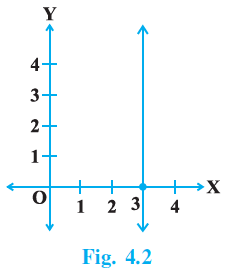
Question 4. The graph given below represents the linear equation x = 3 (see Fig. 4.2).
Answer:
Result: True
Justification:
The graph shows a straight line parallel to the $y$-axis. Any line parallel to the $y$-axis is represented by an equation of the form $x = a$, where $a$ is the distance from the $y$-axis.
In the given Fig 4.2, the line passes through the point $(3, 0)$ on the $x$-axis and all points on this line have the same abscissa, which is $3$. Therefore, the equation of this line is $x = 3$.
Question 5. The coordinates of points in the table:
| x | 0 | 1 | 2 | 3 | 4 |
|---|---|---|---|---|---|
| y | 2 | 3 | 4 | -5 | 6 |
represent some of the solutions of the equation x – y + 2 = 0.
Answer:
Result: False
Justification:
The given equation is $x - y + 2 = 0$, which can be rewritten as $y = x + 2$. Let us check the coordinates from the provided table:
1. For $x = 0$, $y = 0 + 2 = 2$ (Matches)
2. For $x = 1$, $y = 1 + 2 = 3$ (Matches)
3. For $x = 2$, $y = 2 + 2 = 4$ (Matches)
4. For $x = 3$, $y = 3 + 2 = 5$. However, the table gives $y = -5$.
$5 \neq -5$
[Point (3, -5) does not satisfy the equation] ... (i)
Since all the points in the table do not satisfy the equation, the statement is false.
Question 6. Every point on the graph of a linear equation in two variables does not represent a solution of the linear equation.
Answer:
Result: False
Justification:
By the definition of the graph of a linear equation, every point lying on the line represents a pair of values $(x, y)$ that satisfy the equation. Therefore, every point on the graph must be a solution of that linear equation.
Question 7. The graph of every linear equation in two variables need not be a line.
Answer:
Result: False
Justification:
A linear equation in two variables of the form $ax + by + c = 0$ is geometrically represented by a straight line. The name "linear" itself implies that its graphical representation is always a line.
Sample Question 1 to 4 (Before Exercise 4.3)
Sample Question 1: Find the points where the graph of the equation 3x + 4y = 12 cuts the x-axis and the y-axis.
Answer:
Given:
The linear equation is $3x + 4y = 12$.
To Find:
The points where the graph of this equation intersects (cuts) the $x$-axis and the $y$-axis.
Solution:
1. To find the point where the graph cuts the x-axis:
We know that for any point on the $x$-axis, the $y$-coordinate is always $0$. Therefore, we substitute $y = 0$ in the given equation:
$3x + 4(0) = 12$
$3x = 12$
$x = 4$
... (i)
So, the graph cuts the $x$-axis at the point (4, 0).
2. To find the point where the graph cuts the y-axis:
We know that for any point on the $y$-axis, the $x$-coordinate is always $0$. Therefore, we substitute $x = 0$ in the given equation:
$3(0) + 4y = 12$
$4y = 12$
$y = 3$
... (ii)
So, the graph cuts the $y$-axis at the point (0, 3).
Sample Question 2: At what point does the graph of the linear equation x + y = 5 meet a line which is parallel to the y-axis, at a distance 2 units from the origin and in the positive direction of x-axis
Answer:
Given:
Linear equation: $x + y = 5$.
The second line is parallel to the $y$-axis at a distance of $2$ units from the origin in the positive $x$ direction.
To Find:
The point of intersection of these two lines.
Solution:
The equation of a line parallel to the $y$-axis at a distance '$a$' from the origin is $x = a$. Since the distance is $2$ units in the positive direction:
$x = 2$
... (i)
To find the point where this line meets $x + y = 5$, we substitute $x = 2$ into the equation:
$2 + y = 5$
$y = 5 - 2 = 3$
... (ii)
Final Answer: The graph meets the given line at the point (2, 3).
Sample Question 3: Determine the point on the graph of the equation 2x + 5y = 20 whose x-coordinate is $\frac{5}{2}$ times its ordinate.
Answer:
Given:
Linear equation: $2x + 5y = 20$.
Condition: $x$-coordinate is $\frac{5}{2}$ times the $y$-coordinate (ordinate).
To Find:
The coordinates of the point satisfying this condition.
Solution:
Let the ordinate ($y$-coordinate) of the point be $y$.
According to the given condition:
$x = \frac{5}{2}y$
... (i)
Now, substitute the value of $x$ from equation (i) into the given equation $2x + 5y = 20$:
$2\left( \frac{5}{2}y \right) + 5y = 20$
$5y + 5y = 20$
[On simplifying the first term] ... (ii)
$10y = 20$
$y = 2$
Now, substitute $y = 2$ back into equation (i) to find $x$:
$x = \frac{5}{2}(2) = 5$
Final Answer: The required point on the graph is (5, 2).
Sample Question 4: Draw the graph of the equation represented by the straight line which is parallel to the x-axis and is 4 units above it.
Answer:
Given:
A straight line parallel to the $x$-axis and $4$ units above it.
To Find:
The equation of the line and its graph.
Solution:
Any line parallel to the $x$-axis is represented by an equation of the form $y = k$, where $k$ is the distance from the $x$-axis.
Since the line is $4$ units above the $x$-axis, the value of $k$ is $4$.
$y = 4$
... (i)
To draw the graph, we identify that for any value of $x$, the value of $y$ will always remain $4$. Some points on this line are $(0, 4)$, $(1, 4)$, $(-2, 4)$, etc.
The graph is a horizontal line passing through the point $(0, 4)$ on the $y$-axis.
Exercise 4.3
Question 1. Draw the graphs of linear equations y = x and y = – x on the same cartesian plane. What do you observe?
Answer:
Given:
Two linear equations: $y = x$ and $y = -x$.
To Find:
Plot the graphs on the same Cartesian plane and state the observation.
Solution:
First, we find a few solutions for both equations to plot the lines.
For $y = x$:
| x | y | Point (x, y) |
| 0 | 0 | (0, 0) |
| 2 | 2 | (2, 2) |
| -2 | -2 | (-2, -2) |
For $y = -x$:
| x | y | Point (x, y) |
| 0 | 0 | (0, 0) |
| 2 | -2 | (2, -2) |
| -2 | 2 | (-2, 2) |
Observations:
1. Both lines pass through the Origin (0, 0).
2. The lines are perpendicular to each other, intersecting at an angle of $90^\circ$.
3. The line $y = x$ bisects the first and third quadrants, while $y = -x$ bisects the second and fourth quadrants.
Question 2. Determine the point on the graph of the linear equation 2x + 5y = 19, whose ordinate is $1\frac{1}{2}$times its abscissa.
Answer:
Given:
Linear equation: $2x + 5y = 19$
Condition: Ordinate ($y$) is $1\frac{1}{2}$ times its abscissa ($x$).
To Find:
The coordinates of the point $(x, y)$.
Solution:
According to the given condition, we can write the relationship as:
$y = 1\frac{1}{2}x$
(Given Condition)
$y = \frac{3}{2}x$
... (i)
Now, we substitute the value of $y$ from equation (i) into the linear equation $2x + 5y = 19$:
$2x + 5\left(\frac{3}{2}x\right) = 19$
$2x + \frac{15}{2}x = 19$
Taking the L.C.M. on the left side:
$\frac{4x + 15x}{2} = 19$
$\frac{19x}{2} = 19$
$19x = 19 \times 2$
$x = 2$
... (ii)
Now, substitute the value of $x = 2$ back into equation (i) to find $y$:
$y = \frac{3}{2}(2)$
$y = 3$
[Ordinate of the point] ... (iii)
Final Answer: The required point on the graph is (2, 3).
Question 3. Draw the graph of the equation represented by a straight line which is parallel to the x-axis and at a distance 3 units below it.
Answer:
Given:
A straight line parallel to the $x$-axis and at a distance of $3$ units below it.
To Find:
The equation of the line and its graph.
Solution:
We know that the equation of any line parallel to the $x$-axis is of the form $y = k$.
Since the line is 3 units below the $x$-axis, it lies in the negative direction of the $y$-axis.
$y = -3$
... (i)
To plot this graph, we note that the ordinate ($y$) is always $-3$ regardless of the value of $x$. Points such as $(0, -3)$, $(2, -3)$, and $(-2, -3)$ lie on this line.
Final Answer: The equation of the line is $y = -3$.
Question 4. Draw the graph of the linear equation whose solutions are represented by the points having the sum of the coordinates as 10 units.
Answer:
Given:
Sum of the coordinates of a point $(x, y)$ is $10$ units.
To Find:
The linear equation and its graph.
Solution:
Let the coordinates of a point be $x$ and $y$. According to the given condition:
$x + y = 10$
... (i)
To draw the graph, we find at least two solutions for the equation:
1. If $x = 0$, then $0 + y = 10 \Rightarrow y = 10$. Point is $(0, 10)$.
2. If $y = 0$, then $x + 0 = 10 \Rightarrow x = 10$. Point is $(10, 0)$.
3. If $x = 5$, then $5 + y = 10 \Rightarrow y = 5$. Point is $(5, 5)$.
| x | y (y = 10 - x) | Point (x, y) |
| 0 | 10 | (0, 10) |
| 10 | 0 | (10, 0) |
| 5 | 5 | (5, 5) |
Final Answer: The equation is $x + y = 10$.
Question 5. Write the linear equation such that each point on its graph has an ordinate 3 times its abscissa.
Answer:
Given:
Condition: Ordinate ($y$) is $3$ times the abscissa ($x$).
To Find:
The linear equation representing this condition.
Solution:
By the definition of coordinates, we have:
Abscissa $= x$
Ordinate $= y$
As per the given condition:
$y = 3x$
[As per the condition] ... (i)
This can also be written in the general form $ax + by + c = 0$ as:
$3x - y = 0$
Final Answer: The required linear equation is $y = 3x$ or $3x - y = 0$.
Question 6. If the point (3, 4) lies on the graph of 3y = ax + 7, then find the value of a.
Answer:
Given:
The linear equation is $3y = ax + 7$.
The point $(3, 4)$ lies on the graph of this equation.
To Find:
The value of the constant $a$.
Solution:
Since the point $(3, 4)$ lies on the graph of the equation, its coordinates must satisfy the equation. We substitute $x = 3$ and $y = 4$ into the given equation:
$3(4) = a(3) + 7$
$12 = 3a + 7$
Subtracting $7$ from both sides:
$12 - 7 = 3a$
$5 = 3a$
$a = \frac{5}{3}$
[Final value of a] ... (i)
Final Answer: The value of $a$ is $\frac{5}{3}$.
Question 7. How many solution(s) of the equation 2x + 1 = x – 3 are there on the :
(i) Number line
(ii) Cartesian plane
Answer:
Given:
The equation is $2x + 1 = x - 3$.
Solution:
First, we solve the given equation for $x$:
$2x - x = -3 - 1$
$x = -4$
(i) On the Number Line:
On a number line, the equation $x = -4$ represents a unique point. Therefore, there is only one solution.
(ii) On the Cartesian Plane:
In a Cartesian plane, the equation $x = -4$ can be treated as a linear equation in two variables, written as:
$1 \cdot x + 0 \cdot y = -4$
This represents a straight line parallel to the $y$-axis. Every point on this line is a solution to the equation. Since a line contains an infinite number of points, there are infinitely many solutions.
Question 8. Find the solution of the linear equation x + 2y = 8 which represents a point on
(i) x-axis
(ii) y-axis
Answer:
Given:
Linear equation: $x + 2y = 8$.
Solution:
(i) On the x-axis:
We know that for any point on the $x$-axis, the $y$-coordinate is $0$.
$y = 0$
(Condition for x-axis)
Substituting $y = 0$ in the equation:
$x + 2(0) = 8$
$x = 8$
So, the point is (8, 0).
(ii) On the y-axis:
We know that for any point on the $y$-axis, the $x$-coordinate is $0$.
$x = 0$
(Condition for y-axis)
Substituting $x = 0$ in the equation:
$0 + 2y = 8$
$2y = 8$
$y = 4$
So, the point is (0, 4).
Question 9. For what value of c, the linear equation 2x + cy = 8 has equal values of x and y for its solution.
Answer:
Given:
Linear equation: $2x + cy = 8$.
Condition: $x$ and $y$ have equal values in the solution ($x = y$).
Solution:
Let $x = y = k$, where $k$ is a real number ($k \neq 0$ for a unique $c$). Substituting $y = x$ in the equation:
$2x + c(x) = 8$
$x(2 + c) = 8$
From this, we can express $c$ in terms of $x$:
$2 + c = \frac{8}{x}$
$c = \frac{8}{x} - 2$
[Where (x, x) is the solution]
Question 10. Let y varies directly as x. If y = 12 when x = 4, then write a linear equation. What is the value of y when x = 5?
Answer:
Given:
$y$ varies directly as $x$ ($y \propto x$).
$y = 12$ when $x = 4$.
To Find:
1. The linear equation.
2. The value of $y$ when $x = 5$.
Solution:
Since $y$ varies directly as $x$, we have:
$y = kx$
(Where k is a constant)
Substitute $y = 12$ and $x = 4$ to find $k$:
$12 = k(4)$
$k = \frac{12}{4} = 3$
Thus, the required linear equation is:
$y = 3x$
... (i)
Now, to find the value of $y$ when $x = 5$, we substitute $x = 5$ in equation (i):
$y = 3(5)$
$y = 15$
Final Answer: The linear equation is $y = 3x$ and the value of $y$ when $x = 5$ is 15.
Sample Question 1 to 4 (Before Exercise 4.4)
Sample Question 1: Draw the graph of the linear equation 2x + 3y = 12. At what points, the graph of the equation cuts the x-axis and the y-axis?
Answer:
Given:
The linear equation is $2x + 3y = 12$.
To Find:
1. The points where the graph cuts the $x$-axis and the $y$-axis.
2. Draw the graph of the equation.
Solution:
To find the points where the graph cuts the axes, we follow these steps:
1. For the x-axis: We know that for any point on the $x$-axis, the $y$-coordinate is always $0$. Substituting $y = 0$ in the equation:
$2x + 3(0) = 12$
$2x = 12$
$x = 6$
... (i)
Thus, the point is (6, 0).
2. For the y-axis: We know that for any point on the $y$-axis, the $x$-coordinate is always $0$. Substituting $x = 0$ in the equation:
$2(0) + 3y = 12$
$3y = 12$
$y = 4$
... (ii)
Thus, the point is (0, 4).
Table for Graph:
| x | y | Point (x, y) |
| 6 | 0 | (6, 0) |
| 0 | 4 | (0, 4) |
| 3 | 2 | (3, 2) |
Final Answer: The graph cuts the $x$-axis at (6, 0) and the $y$-axis at (0, 4).
Sample Question 2: The following values of x and y are thought to satisfy a linear equation :
| x | 1 | 2 |
|---|---|---|
| y | 1 | 3 |
Draw the graph, using the values of x, y as given in the above table. At what point the graph of the linear equation
(i) cuts the x-axis.
(ii) cuts the y-axis.
Answer:
Given:
The values of $x$ and $y$ satisfying a linear equation are:
| Abscissa x | Ordinate y | Point (x, y) |
| 1 | 1 | (1, 1) |
| 2 | 3 | (2, 3) |
To Find:
1. Draw the graph of the linear equation.
2. The point where the graph cuts the x-axis.
3. The point where the graph cuts the y-axis.
Solution:
Step 1: Drawing the graph
We plot the points $A(1, 1)$ and $B(2, 3)$ on the Cartesian plane. By joining these two points and extending the line in both directions, we obtain the graph of the linear equation.
Step 2: Finding the Equation
To find the exact points of intersection with the axes, we first determine the linear equation. Let the equation be $y = mx + c$. Using the given points:
$\text{Slope (m)} = \frac{3 - 1}{2 - 1} = 2$
Now, substituting $m = 2$ and point $(1, 1)$ into $y = mx + c$:
$1 = 2(1) + c$
$1 = 2 + c$
$c = -1$
Thus, the linear equation is:
$y = 2x - 1$
... (i)
Step 3: Finding Intercepts
(i) Point where the graph cuts the x-axis:
On the $x$-axis, the $y$-coordinate is $0$. Substituting $y = 0$ in equation (i):
$0 = 2x - 1$
(Substituting y = 0)
$2x = 1$
$x = 0.5$
[Abscissa on x-axis] ... (ii)
Therefore, the graph cuts the x-axis at the point (0.5, 0).
(ii) Point where the graph cuts the y-axis:
On the $y$-axis, the $x$-coordinate is $0$. Substituting $x = 0$ in equation (i):
$y = 2(0) - 1$
(Substituting x = 0)
$y = -1$
[Ordinate on y-axis] ... (iii)
Therefore, the graph cuts the y-axis at the point (0, –1).
Final Answer:
(i) The point where the graph cuts the $x$-axis is (0.5, 0).
(ii) The point where the graph cuts the $y$-axis is (0, –1).
Sample Question 3: The Autorikshaw fare in a city is charged Rs 10 for the first kilometer and @ Rs 4 per kilometer for subsequent distance covered. Write the linear equation to express the above statement. Draw the graph of the linear equation
Answer:
Given:
Fare for the first km $= \textsf{₹} 10$.
Fare for subsequent distance $= \textsf{₹} 4$ per km.
To Find:
Linear equation and its graph.
Solution:
Let the total distance covered be $x$ km and the total fare be $\textsf{₹} y$.
According to the condition:
Fare for the first km $= 10$
Remaining distance $= (x - 1)$ km
Fare for remaining distance $= 4(x - 1)$
Total Fare ($y$) $= 10 + 4(x - 1)$
$y = 10 + 4x - 4$
$y = 4x + 6$
... (i)
Table for Graph:
| Distance x (km) | Fare y ($\textsf{₹}$) | Point (x, y) |
| 1 | 10 | (1, 10) |
| 2 | 14 | (2, 14) |
| 3 | 18 | (3, 18) |
Note: Distance cannot be negative, so the graph starts from $x=0$ (theoretically) or $x=1$ (practically).
Sample Question 4: The work done by a body on application of a constant force is the product of the constant force and the distance travelled by the body in the direction of force. Express this in the form of a linear equation in two variables and draw its
Answer:
Given:
Work done $=$ Constant Force $\times$ Distance.
Solution:
Let the work done be $y$ units and the distance travelled be $x$ units.
Let the constant force be $k$ units.
The linear equation is:
$y = kx$
... (i)
To draw the graph, let us assume the constant force $k = 3$ units.
Then the equation becomes $y = 3x$.
Points to plot:
1. If $x = 0, y = 0$. Point is $(0, 0)$.
2. If $x = 1, y = 3$. Point is $(1, 3)$.
3. If $x = 2, y = 6$. Point is $(2, 6)$.
The graph is a straight line passing through the origin.
Exercise 4.4
Question 1. Show that the points A (1, 2), B (– 1, – 16) and C (0, – 7) lie on the graph of the linear equation y = 9x – 7.
Answer:
Given:
Linear equation: $y = 9x - 7$
Points: $A(1, 2)$, $B(-1, -16)$, and $C(0, -7)$.
To Prove:
Points $A, B,$ and $C$ lie on the graph of the given linear equation.
Proof:
A point lies on the graph of an equation if its coordinates satisfy the equation.
1. For Point A(1, 2):
Substituting $x = 1$ and $y = 2$ in the equation $y = 9x - 7$:
$L.H.S. = 2$
$R.H.S. = 9(1) - 7 = 9 - 7 = 2$
$L.H.S. = R.H.S.$
[Hence, A lies on the graph]
2. For Point B(–1, –16):
Substituting $x = -1$ and $y = -16$ in the equation $y = 9x - 7$:
$L.H.S. = -16$
$R.H.S. = 9(-1) - 7 = -9 - 7 = -16$
$L.H.S. = R.H.S.$
[Hence, B lies on the graph]
3. For Point C(0, –7):
Substituting $x = 0$ and $y = -7$ in the equation $y = 9x - 7$:
$L.H.S. = -7$
$R.H.S. = 9(0) - 7 = 0 - 7 = -7$
$L.H.S. = R.H.S.$
[Hence, C lies on the graph]
Since all three points satisfy the equation, they all lie on the graph of $y = 9x - 7$.
Question 2. The following observed values of x and y are thought to satisfy a linear equation. Write the linear equation :
| x | 6 | -6 |
|---|---|---|
| y | -2 | 6 |
Draw the graph using the values of x, y as given in the above table. At what points the graph of the linear equation
(i) cuts the x-axis
(ii) cuts the y-axis
Answer:
Given:
Two solutions of a linear equation: $(6, -2)$ and $(-6, 6)$.
To Find:
1. The linear equation.
2. The graph of the equation.
3. Points where it cuts the $x$-axis and $y$-axis.
Solution:
Let the linear equation be $ax + by = c$. We can find the equation using the two-point form:
$y - y_1 = \frac{y_2 - y_1}{x_2 - x_1}(x - x_1)$
Substituting $(x_1, y_1) = (6, -2)$ and $(x_2, y_2) = (-6, 6)$:
$y - (-2) = \frac{6 - (-2)}{-6 - 6}(x - 6)$
$y + 2 = \frac{8}{-12}(x - 6)$
$y + 2 = -\frac{2}{3}(x - 6)$
$3(y + 2) = -2(x - 6)$
$3y + 6 = -2x + 12$
$2x + 3y = 6$
[The required linear equation] ... (i)
Points on the Axes:
(i) Point where it cuts the x-axis:
Substitute $y = 0$ in equation (i):
$2x + 3(0) = 6$
$x = 3$
... (ii)
So, the point is (3, 0).
(ii) Point where it cuts the y-axis:
Substitute $x = 0$ in equation (i):
$2(0) + 3y = 6$
$y = 2$
... (iii)
So, the point is (0, 2).
Graph:
Question 3. Draw the graph of the linear equation 3x + 4y = 6. At what points, the graph cuts the x-axis and the y-axis.
Answer:
Given:
The linear equation is $3x + 4y = 6$.
To Find:
1. The graph of the equation.
2. Points where the graph cuts the $x$-axis and the $y$-axis.
Solution:
To draw the graph, we find the points of intersection with the axes.
1. Intersection with the x-axis:
On the $x$-axis, $y = 0$. Substituting $y = 0$ in $3x + 4y = 6$:
$3x + 4(0) = 6$
$3x = 6$
$x = 2$
... (i)
So, the point is (2, 0).
2. Intersection with the y-axis:
On the $y$-axis, $x = 0$. Substituting $x = 0$ in $3x + 4y = 6$:
$3(0) + 4y = 6$
$4y = 6$
$y = 1.5$
... (ii)
So, the point is (0, 1.5).
Table of solutions:
| x | y | Point (x, y) |
| 2 | 0 | (2, 0) |
| 0 | 1.5 | (0, 1.5) |
| -2 | 3 | (-2, 3) |
Graph:
Final Answer: The graph cuts the $x$-axis at (2, 0) and the $y$-axis at (0, 1.5).
Question 4. The linear equation that converts Fahrenheit (F) to Celsius (C) is given by the relation C = $\frac{5F - 160}{9}$
(i) If the temperature is 86°F, what is the temperature in Celsius?
(ii) If the temperature is 35°C, what is the temperature in Fahrenheit?
(iii) If the temperature is 0°C what is the temperature in Fahrenheit and if the temperature is 0°F, what is the temperature in Celsius?
(iv) What is the numerical value of the temperature which is same in both the scales?
Answer:
Given:
The relation between Celsius ($C$) and Fahrenheit ($F$) is:
$C = \frac{5F - 160}{9}$
... (i)
Solution (i):
Given temperature is $86^\circ\text{F}$. Substituting $F = 86$ in equation (i):
$C = \frac{5(86) - 160}{9}$
$C = \frac{430 - 160}{9}$
$C = \frac{270}{9}$
$C = 30$
[Value in Celsius]
The temperature in Celsius is $30^\circ\text{C}$.
Solution (ii):
Given temperature is $35^\circ\text{C}$. Substituting $C = 35$ in equation (i):
$35 = \frac{5F - 160}{9}$
$35 \times 9 = 5F - 160$
$315 = 5F - 160$
$5F = 315 + 160$
$F = \frac{475}{5} = 95$
[Value in Fahrenheit]
The temperature in Fahrenheit is $95^\circ\text{F}$.
Solution (iii):
Case A: If temperature is $0^\circ\text{C}$, find $F$.
$0 = \frac{5F - 160}{9}$
$0 = 5F - 160$
$F = \frac{160}{5} = 32$
[Value in Fahrenheit]
Case B: If temperature is $0^\circ\text{F}$, find $C$.
$C = \frac{5(0) - 160}{9}$
$C = -\frac{160}{9} \approx -17.78$
[Value in Celsius]
Solution (iv):
Let the temperature be $x$ such that $C = F = x$. Substituting this in equation (i):
$x = \frac{5x - 160}{9}$
$9x = 5x - 160$
$9x - 5x = -160$
$4x = -160$
$x = -40$
Hence, $-40^\circ$ is the numerical value which is same in both Celsius and Fahrenheit scales.
Question 5. If the temperature of a liquid can be measured in Kelvin units as x°K or in Fahrenheit units as y°F, the relation between the two systems of measurement of temperature is given by the linear equation y = $\frac{9}{5}$ (x – 273) + 32
(i) Find the temperature of the liquid in Fahrenheit if the temperature of the liquid is 313°K.
(ii) If the temperature is 158° F, then find the temperature in Kelvin.
Answer:
Given:
The relation is $y = \frac{9}{5}(x - 273) + 32$, where $x$ is in Kelvin and $y$ is in Fahrenheit.
Solution (i):
Given $x = 313^\circ\text{K}$. Substituting this value in the equation:
$y = \frac{9}{5}(313 - 273) + 32$
$y = \frac{9}{5}(40) + 32$
$y = 9(8) + 32$
$y = 72 + 32 = 104$
[Value in Fahrenheit]
The temperature is $104^\circ\text{F}$.
Solution (ii):
Given $y = 158^\circ\text{F}$. Substituting this value in the equation:
$158 = \frac{9}{5}(x - 273) + 32$
$158 - 32 = \frac{9}{5}(x - 273)$
$126 = \frac{9}{5}(x - 273)$
$\frac{126 \times 5}{9} = x - 273$
$14 \times 5 = x - 273$
$70 = x - 273$
$x = 70 + 273 = 343$
[Value in Kelvin]
The temperature is $343^\circ\text{K}$.
Question 6. The force exerted to pull a cart is directly proportional to the acceleration produced in the body. Express the statement as a linear equation of two variables and draw the graph of the same by taking the constant mass equal to 6 kg. Read from the graph, the force required when the acceleration produced is
(i) 5 m/sec2 ,
(ii) 6 m/sec2 .
Answer:
Given:
Force ($F$) is directly proportional to acceleration ($a$).
$F \propto a$
Constant of proportionality is mass ($m = 6$ kg).
Solution:
Let Force be $y$ units and Acceleration be $x$ units. According to Newton's Second Law ($F = ma$):
$y = 6x$
... (i)
To draw the graph, we find some solutions for $y = 6x$:
| Acceleration x ($\text{m/s}^2$) | Force y ($\text{N}$) ($y = 6x$) | Point (x, y) |
| 0 | 0 | (0, 0) |
| 1 | 6 | (1, 6) |
| 5 | 30 | (5, 30) |
| 6 | 36 | (6, 36) |
From the linear equation and the graph:
(i) When acceleration ($x$) is $5 \text{ m/sec}^2$:
$y = 6(5) = 30$
[Force in Newtons]
(ii) When acceleration ($x$) is $6 \text{ m/sec}^2$:
$y = 6(6) = 36$
[Force in Newtons]
Final Answer: The required force values are $30 \text{ N}$ and $36 \text{ N}$ respectively.