

Class 9 Maths Sample Paper Set I (NCERT Exemplar Solutions)
Welcome to the crucial resource for Class 9 Mathematics Sample Paper Set I, aligned with the rigorous NCERT Exemplar standards! These papers are meticulously designed to provide a truly realistic assessment experience by mirroring the difficulty level and diverse question typologies expected in final examinations. By focusing on Higher-Order Thinking Skills (HOTS) and application-based problems, these solutions build the analytical foundation and conceptual depth required to navigate the most demanding academic assessments.
The sample papers draw from the entire Class 9 syllabus, covering essential topics such as Number Systems, Polynomials, Triangles, Circles, and Surface Areas and Volumes. Students will encounter a comprehensive range of formats, including MCQs, Fill-in-the-Blanks, and Long Answer questions. Significant attention is given to the practical application of core concepts and theorems, such as the relationship $\text{ar}(\triangle) = \frac{1}{2} \text{ar}(\text{gm})$ for triangles and parallelograms on the same base, as well as the calculation of areas using Heron's Formula ($\sqrt{s(s-a)(s-b)(s-c)}$).
Beyond providing final answers, this resource serves as a strategic learning tool to refine time management and model the expected standards for logical answer presentation. These solutions provide a powerful mechanism for self-assessment, allowing students to pinpoint specific areas requiring further revision. With step-by-step guidance and thorough justifications prepared by learningspot.co, students can master the critical skills needed to effectively solve integrated problems and approach their final revision cycles with confidence.
| Content On This Page | ||
|---|---|---|
| Section A | Section B | Section C |
| Section D | ||
Section A
In Questions 1 to 10, four options of answer are given in each, out of which only one is correct. Write the correct option.
Question 1. Every rational number is:
(A) a natural number
(B) an integer
(C) a real number
(D) a whole number
Answer:
Solution:
A rational number is any number that can be expressed in the form $\frac{p}{q}$, where $p$ and $q$ are integers and $q \neq 0$.
The collection of Real Numbers is made up of both rational numbers and irrational numbers. Therefore, every rational number is a part of the real number system.
1. It is not necessarily a natural number (e.g., $\frac{1}{2}$ is rational but not natural).
2. It is not necessarily an integer (e.g., $\frac{3}{4}$ is rational but not an integer).
3. It is not necessarily a whole number (e.g., $-\frac{5}{1}$ is rational but not a whole number).
Hence, every rational number is a real number.
Correct option is (C).
Question 2. The distance of point (2, 4) from x-axis is
(A) 2 units
(B) 4 units
(C) 6 units
(D) $\sqrt{2^{2} \;+\; 4^{2}}$ units
Answer:
Given:
Point $P(x, y) = (2, 4)$.
To Find:
The distance of the point from the x-axis.
Solution:
The distance of any point $P(x, y)$ from the x-axis is equal to the absolute value of its y-coordinate (also known as the ordinate).
For the point $(2, 4)$:
x-coordinate (abscissa) = 2
y-coordinate (ordinate) = 4
Therefore, the distance from the x-axis is 4 units.
Correct option is (B).
Question 3. The degree of the polynomial (x3 + 7) (3 – x2) is:
(A) 5
(B) 3
(C) 2
(D) –5
Answer:
To Find:
The degree of the polynomial $(x^3 + 7)(3 - x^2)$.
Solution:
The degree of a polynomial is the highest power of the variable in its expanded form.
Let us expand the given expression:
$P(x) = (x^3 + 7)(3 - x^2)$
$P(x) = x^3(3 - x^2) + 7(3 - x^2)$
$P(x) = 3x^3 - x^5 + 21 - 7x^2$
Arranging in descending order of powers:
$P(x) = -x^5 + 3x^3 - 7x^2 + 21$
The highest power of $x$ in this expression is 5.
Correct option is (A).
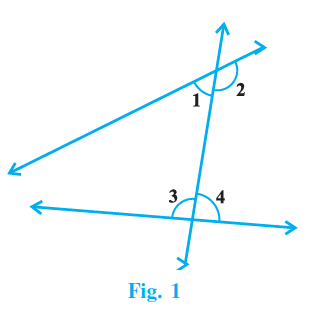
Question 4. In Fig. 1, according to Euclid’s 5th postulate, the pair of angles, having the sum less than 180° is:
(A) 1 and 2
(B) 2 and 4
(C) 1 and 3
(D) 3 and 4
Answer:
Solution:
Euclid’s 5th Postulate states that if a straight line falling on two straight lines makes the interior angles on the same side of it taken together less than two right angles ($180^\circ$), then the two straight lines, if produced indefinitely, meet on that side on which the sum of angles is less than two right angles.
In Fig. 1, we observe the two lines and the transversal line. The interior angles on the same side are:
1. Angles $\angle 1$ and $\angle 3$ (on the left side).
2. Angles $\angle 2$ and $\angle 4$ (on the right side).
The lines are visibly converging (getting closer) on the left side. According to the postulate, the lines will meet on the side where the sum of interior angles is less than $180^\circ$.
Therefore, the sum of $\angle 1$ and $\angle 3$ is less than $180^\circ$.
Correct option is (C).
Question 5. The length of the chord which is at a distance of 12 cm from the centre of a circle of radius 13cm is:
(A) 5 cm
(B) 12 cm
(C) 13 cm
(D) 10 cm
Answer:
Given:
1. Radius of the circle ($r$) = 13 cm.
2. Distance of the chord from the centre ($d$) = 12 cm.
To Find:
The length of the chord.
Construction:
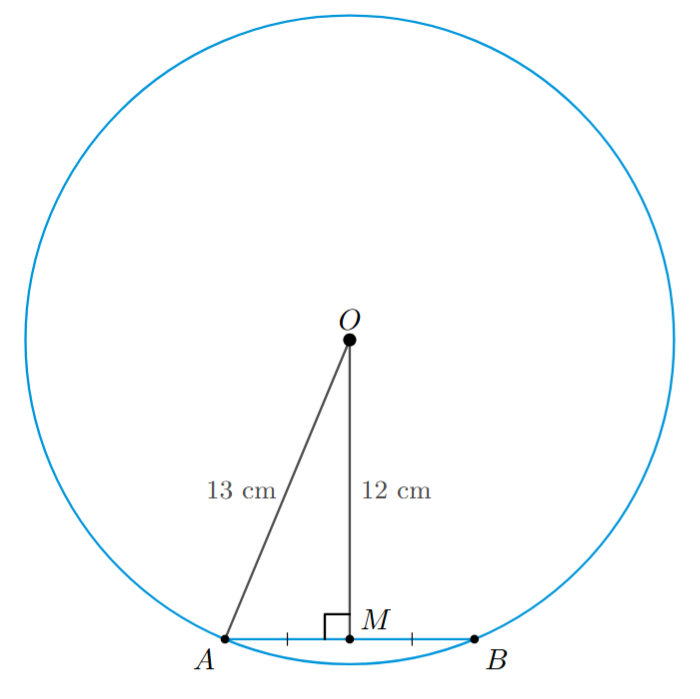
Draw a circle with centre $O$. Let $AB$ be the chord. Draw $OM \perp AB$. Join $OA$.
Solution:
Let $O$ be the centre of the circle and $AB$ be the chord. $OM$ is the perpendicular distance from the centre to the chord.
$OM = 12 \text{ cm}$
(Given)
$OA = 13 \text{ cm}$
(Radius of the circle)
We know that the perpendicular from the centre of a circle to a chord bisects the chord.
$AM = MB = \frac{1}{2}AB$
In the right-angled triangle $\triangle OMA$, using the Pythagoras Theorem:
$OA^2 = OM^2 + AM^2$
Substituting the known values:
$13^2 = 12^2 + AM^2$
$169 = 144 + AM^2$
Subtracting 144 from both sides:
$AM^2 = 169 - 144$
$AM^2 = 25$
$AM = \sqrt{25} = 5 \text{ cm}$
Now, to find the full length of the chord $AB$:
$AB = 2 \times AM$
$AB = 2 \times 5$
$AB = 10 \text{ cm}$
Hence, the length of the chord is 10 cm.
Correct option is (D).
Question 6. If the volume of a sphere is numerically equal to its surface area, then its diameter is:
(A) 2 units
(B) 1 units
(C) 3 units
(D) 6 units
Answer:
Given:
The volume of a sphere is numerically equal to its surface area.
To Find:
The diameter of the sphere.
Solution:
Let the radius of the sphere be $r$ units.
$\text{Volume of sphere} = \frac{4}{3}\pi r^{3}$
... (i)
$\text{Surface Area of sphere} = 4\pi r^{2}$
... (ii)
According to the question, these two values are numerically equal:
$\frac{4}{3}\pi r^{3} = 4\pi r^{2}$
(Given)
Dividing both sides by $4\pi r^{2}$ (assuming $r \neq 0$):
$\frac{r}{3} = 1$
$r = 3 \text{ units}$
... (iii)
We need to find the diameter ($d$):
$d = 2r$
$d = 2 \times 3 = 6 \text{ units}$
Hence, the diameter of the sphere is 6 units.
Correct option is (D).
Question 7. Two sides of a triangle are 5 cm and 13 cm and its perimeter is 30 cm. The area of the triangle is:
(A) 30 cm2
(B) 60 cm2
(C) 32.5 cm2
(D) 65 cm2
Answer:
Given:
Sides of the triangle, $a = 5 \text{ cm}$ and $b = 13 \text{ cm}$.
Perimeter ($P$) = $30 \text{ cm}$.
To Find:
The area of the triangle.
Solution:
First, we find the third side ($c$):
$a + b + c = 30$
(Perimeter)
$5 + 13 + c = 30$
$c = 30 - 18 = 12 \text{ cm}$
... (i)
Now, we calculate the semi-perimeter ($s$):
$s = \frac{a + b + c}{2} = \frac{30}{2} = 15 \text{ cm}$
Using Heron's Formula for the area of the triangle:
$\text{Area} = \sqrt{s(s - a)(s - b)(s - c)}$
$\text{Area} = \sqrt{15(15 - 5)(15 - 13)(15 - 12)}$
$\text{Area} = \sqrt{15 \times 10 \times 2 \times 3}$
$\text{Area} = \sqrt{900}$
$\text{Area} = 30 \text{ cm}^{2}$
Hence, the area of the triangle is 30 cm2.
Correct option is (A).
Question 8. Which of the following cannot be the empiral probability of an event
(A) $\frac{2}{3}$
(B) $\frac{3}{2}$
(C) 0
(D) 1
Answer:
Solution:
The probability $P(E)$ of any event $E$ always lies between 0 and 1, inclusive of both values. Mathematically, it is expressed as:
$0 \leq P(E) \leq 1$
Let us check the given options:
(A) $\frac{2}{3} \approx 0.67$ (Lies between 0 and 1)
(B) $\frac{3}{2} = 1.5$ (Greater than 1)
(C) 0 (Possible for an impossible event)
(D) 1 (Possible for a sure event)
Since the probability cannot be greater than 1, $\frac{3}{2}$ cannot be the probability of an event.
Correct option is (B).
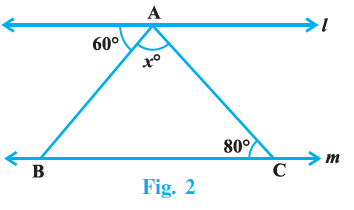
Question 9. In Fig. 2, if l || m , then the value of x is:
(A) 60
(B) 80
(C) 40
(D) 140
Answer:
Given:
Line $l \parallel m$.
Angles shown in Fig. 2: $60^\circ$ at $A$ (between $l$ and $AB$) and $80^\circ$ at $C$ (interior $\angle BCA$).
To Find:
The value of $x$.
Solution:
In Fig. 2, $l \parallel m$ and $AC$ is a transversal.
The angle between line $l$ and $AC$ (on the right side of point $A$) and $\angle BCA$ are alternate interior angles.
$\text{Angle between } l \text{ and } AC = 80^\circ$
(Alternate Interior Angles)
The angles $60^\circ$, $x^\circ$, and $80^\circ$ lie on the straight line $l$ at point $A$. The sum of angles on a straight line is $180^\circ$.
$60^\circ + x^\circ + 80^\circ = 180^\circ$
(Linear Pair/Straight Angle)
$x^\circ + 140^\circ = 180^\circ$
$x^\circ = 180^\circ - 140^\circ$
$x = 40$
Hence, the value of $x$ is 40.
Correct option is (C).
Question 10. The diagonals of a parallelogram :
(A) are equal
(B) bisect each other
(C) are perpendicular to each other
(D) bisect each other at right angles.
Answer:
Solution:
A parallelogram is a quadrilateral where opposite sides are parallel and equal.
By the properties of a parallelogram:
1. Diagonals bisect each other: Each diagonal divides the other into two equal parts.
2. Diagonals are not necessarily equal (unless it is a rectangle or square).
3. Diagonals are not necessarily perpendicular (unless it is a rhombus or square).
4. Diagonals do not necessarily bisect at right angles (unless it is a rhombus or square).
Thus, the most general property that holds for all parallelograms is that the diagonals bisect each other.
Correct option is (B).
Section B
Question 11. Is – 5 a rational number? Give reasons to your answer.
Answer:
Given:
The number $-5$.
To Find:
To determine if $-5$ is a rational number and provide reasons.
Solution:
Yes, $-5$ is a rational number.
Reason:
According to the definition, a number is called a rational number if it can be expressed in the form $\frac{p}{q}$, where $p$ and $q$ are integers and $q \neq 0$.
The integer $-5$ can be expressed in the fraction form as follows:
$-5 = \frac{-5}{1}$
In this expression:
1. The numerator $p = -5$ is an integer.
2. The denominator $q = 1$ is an integer.
3. The denominator $q \neq 0$.
Since $-5$ satisfies all the conditions of a rational number, it is classified as one.
Question 12. Without actually finding p(5), find whether (x–5) is a factor of p (x) = x3 – 7x2 + 16x – 12. Justify your answer.
Answer:
Given:
Polynomial $p(x) = x^{3} - 7x^{2} + 16x - 12$.
Divisor = $(x - 5)$.
To Find:
Whether $(x - 5)$ is a factor of $p(x)$ without evaluating $p(5)$.
Solution:
Since we are not to find $p(5)$, we can use the Long Division Method to check if the remainder is zero. If the remainder is zero, then $(x - 5)$ is a factor.
$\begin{array}{r} x^2-2x+6\phantom{x^3-7x^2)} \\ x-5{\overline{\smash{\big)}\,x^3-7x^2+16x-12\phantom{)}}} \\ \underline{-~\phantom{(}(x^3-5x^2)\phantom{-b---)}} \\ -2x^2+16x\phantom{)} \\ \underline{-~\phantom{()}(-2x^2+10x)} \\ 6x-12 \\ \underline{-~\phantom{()}(6x-30)} \\ 18\phantom{)} \end{array}$
Justification:
After performing the long division, we find that the remainder is 18, which is not equal to zero. For a polynomial to be a factor of another, the remainder upon division must be exactly zero.
Therefore, $(x - 5)$ is not a factor of $p(x) = x^{3} - 7x^{2} + 16x - 12$.
Question 13. Is (1, 8) the only solution of y = 3x + 5? Give reasons.
Answer:
Given:
Equation $y = 3x + 5$.
A specific solution $(1, 8)$.
To Find:
Whether $(1, 8)$ is the only solution.
Solution:
No, $(1, 8)$ is not the only solution for the equation $y = 3x + 5$.
Reason:
The given equation $y = 3x + 5$ is a linear equation in two variables. Geometrically, it represents a straight line on a graph.
1. A line is made up of an infinite number of points.
2. Every single point $(x, y)$ that lies on this line is a valid solution to the equation.
By choosing any value for $x$, we can find a corresponding value for $y$. For example:
If $x = 0$, then $y = 3(0) + 5 = 5$. Thus, $(0, 5)$ is another solution.
If $x = -1$, then $y = 3(-1) + 5 = 2$. Thus, $(-1, 2)$ is another solution.
Therefore, a linear equation in two variables has infinitely many solutions.
Question 14. Write the coordinates of a point on x-axis at a distance of 4 units from origin in the positive direction of x-axis and then justify your answer.
Answer:
To Find:
The coordinates of a point on the x-axis, 4 units from the origin in the positive direction.
Solution:
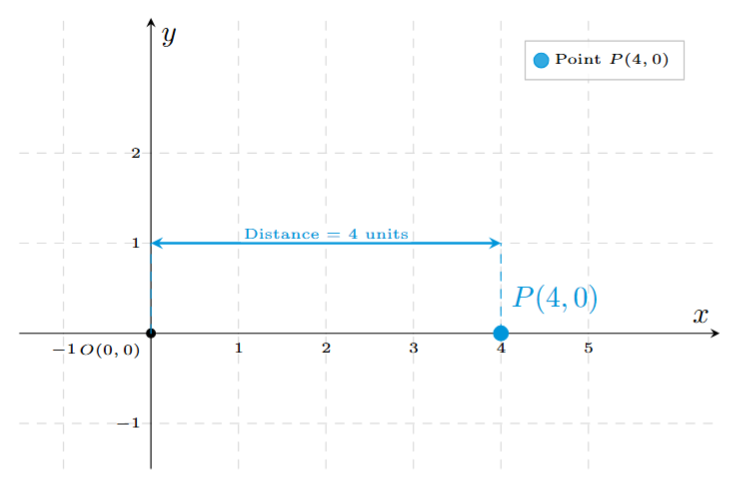
The coordinates of the point are $(4, 0)$.
Justification:
1. Any point that lies on the x-axis always has its y-coordinate (ordinate) as 0. Hence, the coordinates are of the form $(x, 0)$.
2. The distance from the origin $(0, 0)$ along the x-axis determines the x-coordinate (abscissa) of the point.
3. Since the point is at a distance of 4 units in the positive direction, the value of the x-coordinate is $+4$.
Combining these conditions, we get the point $(4, 0)$.
Question 15. Two coins are tossed simultaneously 500 times. If we get two heads 100 times, one head 270 times and no head 130 times, then find the probability of getting one or more than one head. Give reasons to your answer also.
Answer:
Given:
Total number of trials ($n$) = 500.
Frequency of 2 heads = 100.
Frequency of 1 head = 270.
Frequency of 0 heads = 130.
To Find:
The probability of getting one or more than one head.
Solution:
The event "getting one or more than one head" consists of two outcomes: getting exactly 1 head or getting exactly 2 heads.
Number of favorable outcomes ($m$):
$m = \text{Freq(1 head)} + \text{Freq(2 heads)}$
$m = 270 + 100 = 370$
... (i)
The empirical probability $P(E)$ is defined as:
$P(E) = \frac{\text{Number of favorable outcomes}}{\text{Total number of trials}}$
Substituting the values:
$P(E) = \frac{370}{500}$
Simplifying the fraction:
$P(E) = \frac{\cancel{370}^{37}}{\cancel{500}_{50}}$
$P(E) = 0.74$
[Probability Value] ... (ii)
Reason:
In this experiment, "one or more heads" is the same as the complement of getting "no heads". The probability is 0.74 because in 370 out of the 500 trials, the result satisfied the condition of having at least one head.
Section C
Question 16. Simplify the following expression
($\sqrt{3}$ + 1) (1 - $\sqrt{12}$) + $\frac{9}{\sqrt{3} \;+\; \sqrt{12}}$
OR
Express 0.12$\overline{3}$ in the form of $\frac{p}{q}$ q ≠ 0, p and q are integers.
Answer:
Solution (Part 1):
To Simplify: $(\sqrt{3} + 1) (1 - \sqrt{12}) + \frac{9}{\sqrt{3} + \sqrt{12}}$
Step 1: Simplify the terms inside the expression.
We know that $\sqrt{12} = \sqrt{4 \times 3} = 2\sqrt{3}$.
Substituting this into the first part of the expression:
$(\sqrt{3} + 1)(1 - 2\sqrt{3}) = \sqrt{3}(1) - \sqrt{3}(2\sqrt{3}) + 1(1) - 1(2\sqrt{3})$
$= \sqrt{3} - 6 + 1 - 2\sqrt{3}$
$ = -5 - \sqrt{3}$
... (i)
Step 2: Simplify the second part of the expression.
$\frac{9}{\sqrt{3} + \sqrt{12}} = \frac{9}{\sqrt{3} + 2\sqrt{3}}$
$= \frac{9}{3\sqrt{3}}$
Cancelling the numerator and denominator:
$\frac{\cancel{9}^{3}}{\cancel{3}_{1}\sqrt{3}} = \frac{3}{\sqrt{3}}$
Since $3 = \sqrt{3} \times \sqrt{3}$:
$ = \sqrt{3}$
... (ii)
Step 3: Combine (i) and (ii).
$(-5 - \sqrt{3}) + \sqrt{3} = -5$
Final Answer: $-5$
OR (Alternate Question 16):
To Find: The $\frac{p}{q}$ form of $0.12\overline{3}$.
Solution:
Let the given decimal be $x$.
$x = 0.12333...$
…(i)
Since two digits (1 and 2) are not repeating, multiply both sides by 100:
$100x = 12.333...$
…(ii)
Since one digit (3) is repeating, multiply equation (ii) by 10:
$1000x = 123.333...$
…(iii)
Subtracting equation (ii) from equation (iii):
$1000x - 100x = 123.333... - 12.333...$
$900x = 111$
$x = \frac{111}{900}$
Simplifying the fraction by dividing by 3:
$x = \frac{\cancel{111}^{37}}{\cancel{900}_{300}}$
$x = \frac{37}{300}$
... (iv)
Final Answer: The $\frac{p}{q}$ form is $\frac{37}{300}$.
Question 17. Verify that:
x3 + y3 + z3 - 3xyz $\frac{1}{2}$ (x + y + z) [(x - y)2 + (y - z)2 + (z - x)2 ]
Answer:
Solution:
To verify the identity, we start with the Right Hand Side (RHS) and simplify it to reach the Left Hand Side (LHS).
RHS: $\frac{1}{2} (x + y + z) [(x - y)^{2} + (y - z)^{2} + (z - x)^{2}]$
Expand the squares using $(a - b)^2 = a^2 - 2ab + b^2$:
$= \frac{1}{2} (x + y + z) [(x^2 - 2xy + y^2) + (y^2 - 2yz + z^2) $$ + (z^2 - 2zx + x^2)]$
Combine the like terms:
$= \frac{1}{2} (x + y + z) [2x^2 + 2y^2 + 2z^2 - 2xy - 2yz - 2zx]$
Factor out 2 from the square brackets:
$= \frac{1}{2} (x + y + z) \cdot 2 [x^2 + y^2 + z^2 - xy - yz - zx]$
The 2 in the numerator and denominator cancel each other:
$ = (x + y + z) (x^2 + y^2 + z^2 - xy - yz - zx)$
We know the algebraic identity:
$(x+y+z)(x^2+y^2+z^2-xy-yz-zx) = x^3+y^3+z^3-3xyz$
$ = x^3 + y^3 + z^3 - 3xyz$
$ = \text{LHS}$
Hence, the identity is verified.
Question 18. Find the value of k, if (x – 2) is a factor of 4x3 + 3x2 – 4x + k.
Answer:
Given:
Polynomial $p(x) = 4x^{3} + 3x^{2} - 4x + k$
Factor = $(x - 2)$
To Find:
The value of $k$.
Solution:
According to the Factor Theorem, if $(x - a)$ is a factor of $p(x)$, then $p(a) = 0$.
Here, $(x - 2)$ is a factor, so we must have:
$p(2) = 0$
... (i)
Substitute $x = 2$ in $p(x)$:
$p(2) = 4(2)^{3} + 3(2)^{2} - 4(2) + k$
$p(2) = 4(8) + 3(4) - 8 + k$
$p(2) = 32 + 12 - 8 + k$
$p(2) = 36 + k$
Setting $p(2) = 0$ as per equation (i):
$36 + k = 0$
$k = -36$
... (ii)
Hence, the value of $k$ is $-36$.
Question 19. Write the quadrant in which each of the following points lie :
(i) (–3, –5)
(ii) (2, –5)
(iii) (–3, 5)
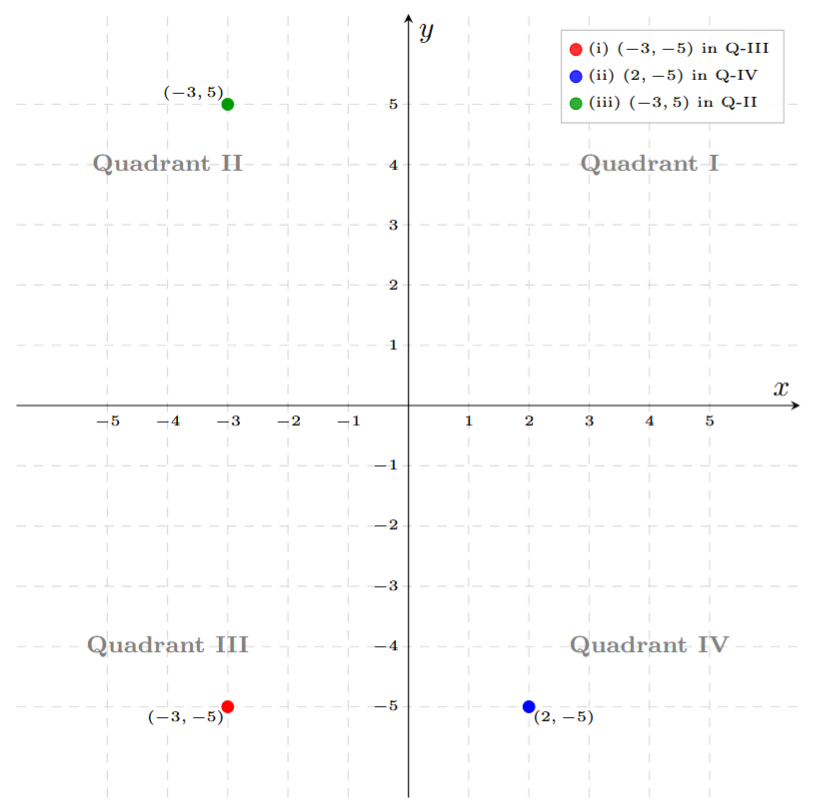
Also, verify by locating them on the cartesian plane.
Answer:
Solution:
In the Cartesian coordinate system:
1. Quadrant I: both $x$ and $y$ are positive ($+, +$)
2. Quadrant II: $x$ is negative and $y$ is positive ($-, +$)
3. Quadrant III: both $x$ and $y$ are negative ($-, -$)
4. Quadrant IV: $x$ is positive and $y$ is negative ($+, -$)
(i) Point (–3, –5):
Since both $x$ and $y$ coordinates are negative, this point lies in Quadrant III.
(ii) Point (2, –5):
Since $x$ is positive and $y$ is negative, this point lies in Quadrant IV.
(iii) Point (–3, 5):
Since $x$ is negative and $y$ is positive, this point lies in Quadrant II.
Verification:
Locating these points on the Cartesian plane:
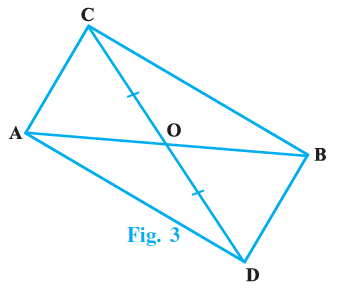
Question 20. In Figure 3, ABC and ABD are two triangles on the same base AB.
If the line segment CD is bisected by AB at O, then show that: area (∆ABC) = area (∆ABD)
Answer:
Given:
1. $\triangle ABC$ and $\triangle ABD$ are on the same base $AB$.
2. Line segment $CD$ is bisected by $AB$ at $O$. Therefore, $CO = OD$.
To Prove:
$\text{Area}(\triangle ABC) = \text{Area}(\triangle ABD)$
Solution:
Consider $\triangle ACD$. In this triangle, $AO$ is a line segment from vertex $A$ to the midpoint $O$ of the opposite side $CD$.
$AO$ is the median of $\triangle ACD$
[$O$ is the midpoint of $CD$]
We know that a median of a triangle divides it into two triangles of equal area.
$\text{Area}(\triangle AOC) = \text{Area}(\triangle AOD)$
... (i)
Similarly, consider $\triangle BCD$. In this triangle, $BO$ is a line segment from vertex $B$ to the midpoint $O$ of the opposite side $CD$.
$BO$ is the median of $\triangle BCD$
[$O$ is the midpoint of $CD$]
Therefore:
$\text{Area}(\triangle BOC) = \text{Area}(\triangle BOD)$
... (ii)
Adding equation (i) and equation (ii):
$\text{Area}(\triangle AOC) + \text{Area}(\triangle BOC) = \text{Area}(\triangle AOD) + \text{Area}(\triangle BOD)$
From the figure, we see that:
1. $\text{Area}(\triangle AOC) + \text{Area}(\triangle BOC) = \text{Area}(\triangle ABC)$
2. $\text{Area}(\triangle AOD) + \text{Area}(\triangle BOD) = \text{Area}(\triangle ABD)$
Substituting these in the sum:
$\text{Area}(\triangle ABC) = \text{Area}(\triangle ABD)$
Hence proved.
Alternate Solution:
Draw perpendiculars $CM \perp AB$ and $DN \perp AB$. In $\triangle COM$ and $\triangle DON$:
1. $\angle CMO = \angle DNO = 90^\circ$
2. $\angle COM = \angle DON$ (Vertically opposite angles)
3. $CO = OD$ (Given)
By AAS Congruence Rule, $\triangle COM \cong \triangle DON$.
Therefore, $CM = DN$ (by CPCT).
$\text{Area}(\triangle ABC) = \frac{1}{2} \times AB \times CM$
$\text{Area}(\triangle ABD) = \frac{1}{2} \times AB \times DN$
Since $CM = DN$, their areas must be equal.
Question 21. Solve the equation 3x + 2 = 2x – 2 and represent the solution on the cartesian plane.
Answer:
Given:
The linear equation in one variable: $3x + 2 = 2x - 2$.
To Find:
1. The value of $x$.
2. Representation of the solution on the Cartesian plane.
Solution:
First, we solve the equation for $x$:
$3x + 2 = 2x - 2$
... (i)
Transpose $2x$ to the left hand side and $2$ to the right hand side:
$3x - 2x = -2 - 2$
$x = -4$
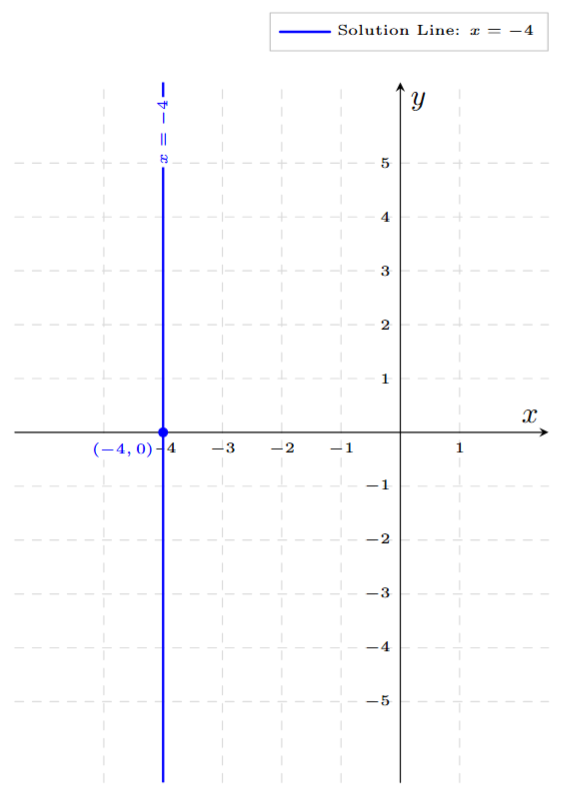
To represent this on the Cartesian plane, we treat it as a linear equation in two variables: $x + 0y = -4$.
This equation represents a straight line parallel to the y-axis, passing through the point $(-4, 0)$.
Question 22. Construct a right triangle whose base is 12 cm and the difference in lengths of its hypotenuse and the other side is 8cm. Also give justification of the steps of construction.
Answer:
Given:
Base ($BC$) = $12 \text{ cm}$.
Difference between hypotenuse ($AC$) and the other side ($AB$) = $8 \text{ cm}$.
$\angle B = 90^\circ$ (since it is a right triangle).
Construction Required:
Construction Required:
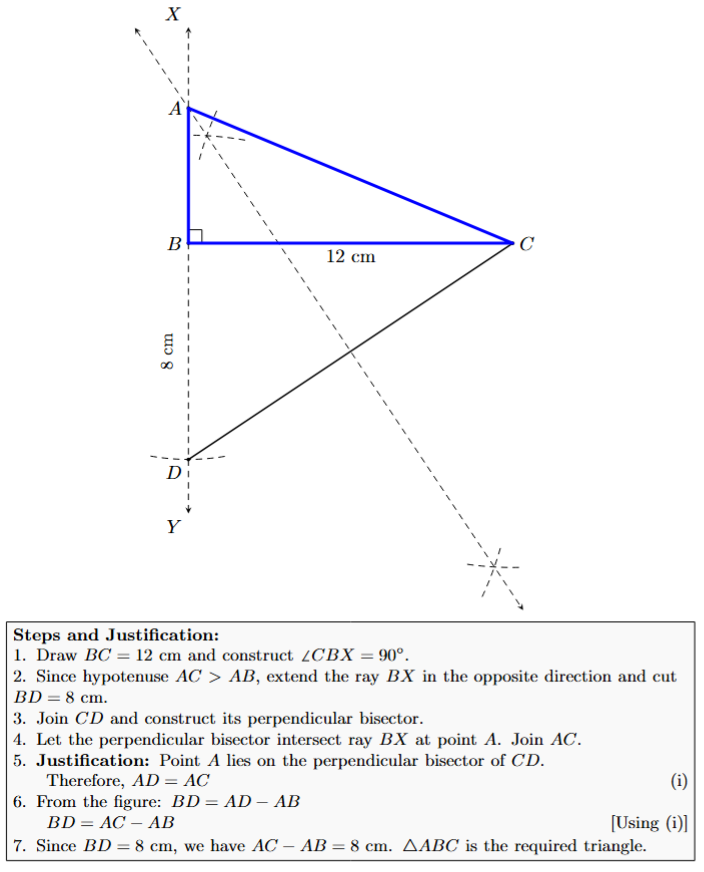
1. Draw a line segment $BC = 12\text{ cm}$.
2. At point $B$, construct $\angle CBX = 90^\circ$.
3. Since $AC > AB$, extend the ray $BX$ in the opposite direction (downwards) to form ray $BY$.
4. From the ray $BY$, cut a line segment $BD = 8\text{ cm}$.
5. Join the points $C$ and $D$.
6. Construct the perpendicular bisector of the line segment $CD$.
7. Let this perpendicular bisector intersect the ray $BX$ at point $A$.
8. Join $AC$.
9. $\triangle ABC$ is the required right-angled triangle.
Justification:
Point $A$ lies on the perpendicular bisector of $CD$.
$AD = AC$
[Points on perpendicular bisector are equidistant from endpoints] ... (i)
From the figure, we see that:
$BD = AB + AD$
Substituting $AD = AC$ from equation (i):
$BD = AC - AB$
Given that $BD = 8 \text{ cm}$, therefore:
$AC - AB = 8 \text{ cm}$
This matches the given condition.
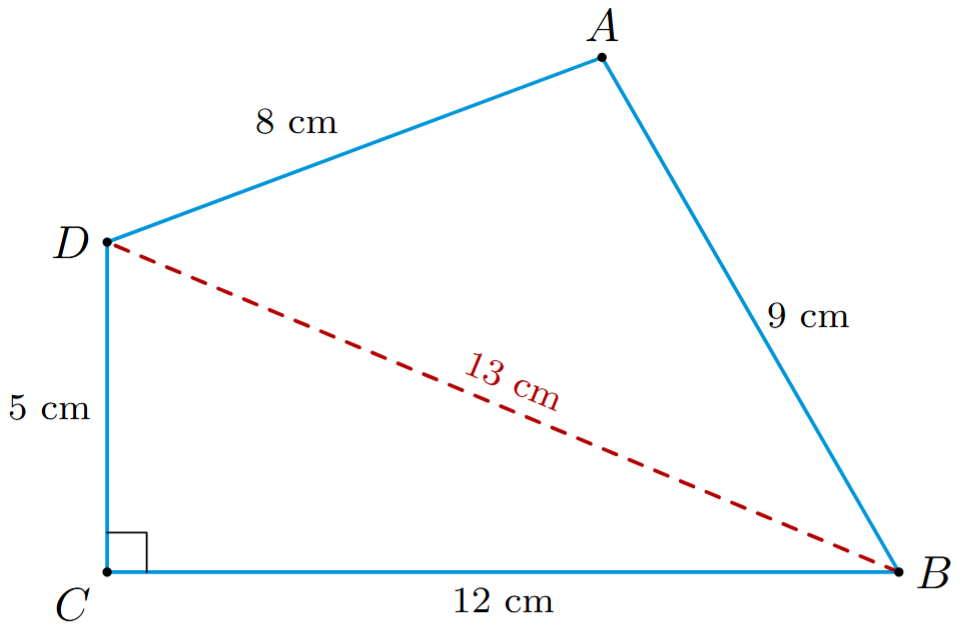
Question 23. In a quadrilateral ABCD, AB = 9 cm, BC = 12 cm, CD = 5 cm, AD = 8 cm and ∠C = 90°. Find the area of ∆ABD
Answer:
Given:
In quadrilateral $ABCD$,
$AB = 9 \text{ cm}$
$BC = 12 \text{ cm}$
$CD = 5 \text{ cm}$
$AD = 8 \text{ cm}$
$\angle C = 90^\circ$
To Find:
Area of $\triangle ABD$.
Construction:
Join the diagonal $BD$ to divide the quadrilateral into two triangles, $\triangle BCD$ and $\triangle ABD$.
Solution:
Step 1: Calculate the length of diagonal $BD$.
In $\triangle BCD$, it is given that $\angle C = 90^\circ$. Therefore, $\triangle BCD$ is a right-angled triangle.
Using the Pythagoras Theorem in $\triangle BCD$:
$BD^{2} = BC^{2} + CD^{2}$
Substituting the given values:
$BD^{2} = 12^{2} + 5^{2}$
$BD^{2} = 144 + 25$
$BD^{2} = 169$
$BD = \sqrt{169} = 13 \text{ cm}$
... (i)
Step 2: Calculate the semi-perimeter of $\triangle ABD$.
Now, in $\triangle ABD$, we have three sides:
$a = AB = 9 \text{ cm}$
$b = AD = 8 \text{ cm}$
$c = BD = 13 \text{ cm}$
The semi-perimeter ($s$) of $\triangle ABD$ is given by:
$s = \frac{a + b + c}{2}$
$s = \frac{9 + 8 + 13}{2}$
$s = \frac{30}{2} = 15 \text{ cm}$
... (ii)
Step 3: Calculate the area of $\triangle ABD$ using Heron's Formula.
$\text{Area} = \sqrt{s(s - a)(s - b)(s - c)}$
Substituting the values of $s, a, b,$ and $c$:
$\text{Area} = \sqrt{15(15 - 9)(15 - 8)(15 - 13)}$
$\text{Area} = \sqrt{15 \times 6 \times 7 \times 2}$
$\text{Area} = \sqrt{1260}$
We find the square root of 1260 using the long division method:
$$\begin{array}{c|cc} & 3\ 5\ . \ 4\ 9\ ... & \\ \hline \phantom{()} 3 & \overline{12} \; \overline{60} \; . \overline{00} \; \overline{00} \\ + \; 3 & 9\phantom{(........)} \\ \hline \phantom{()} 65 & 3 \; 60 \phantom{(.....)} \\ \phantom{()} +5 & 3 \; 25 \phantom{(...)} \\ \hline \phantom{()} 704 & \phantom{(.)} 35 \; 00 \\ \phantom{(.)}+ 4 & \phantom{(.)} 28 \; 16 \\ \hline \phantom{()} 7089 & \phantom{(.)} 6 \; 84 \; 00 \end{array}$$$\text{Area} \approx 35.50 \text{ cm}^{2}$
Hence, the area of $\triangle ABD$ is $35.50 \text{ cm}^{2}$ (approx.).
Question 24. In a hot water heating system, there is a cylindrical pipe of length 35 m and diameter 10 cm. Find the total radiating surface in the system.
OR
The floor of a rectangular hall has a perimeter 150 m. If the cost of painting the four walls at the rate of Rs 10 per m2 is Rs 9000, find the height of the hall.
Answer:
Solution:
Given (Part 1):
Length of the cylindrical pipe ($h$) = $35 \text{ m}$.
Diameter ($d$) = $10 \text{ cm} = 0.1 \text{ m}$.
Radius ($r$) = $0.05 \text{ m}$.
To Find:
The total radiating surface in the system (Curved Surface Area).
Solution:
In a hot water system, the radiating surface is the curved surface area (CSA) of the pipe.
$\text{CSA} = 2\pi rh$
Substituting the values ($\pi = \frac{22}{7}$):
$\text{CSA} = 2 \times \frac{22}{7} \times 0.05 \times 35$
$\text{CSA} = 2 \times 22 \times 0.05 \times 5$
$\text{CSA} = 44 \times 0.25 = 11 \text{ m}^{2}$
The total radiating surface is $11 \text{ m}^{2}$.
OR (Alternate Solution):
Given:
Perimeter of the floor = $150 \text{ m}$.
Total cost of painting 4 walls = $\textsf{₹} 9000$.
Rate of painting = $\textsf{₹} 10 \text{ per m}^{2}$.
To Find:
The height ($h$) of the hall.
Solution:
First, we find the area of the four walls:
$\text{Area of 4 walls} = \frac{\text{Total Cost}}{\text{Rate}}$
$\text{Area of 4 walls} = \frac{9000}{10} = 900 \text{ m}^{2}$
The area of 4 walls is also the lateral surface area of the rectangular hall:
$\text{Area of 4 walls} = 2h(l + b)$
We know that $2(l + b)$ is the perimeter of the floor.
$900 = \text{Perimeter} \times h$
$900 = 150 \times h$
$h = \frac{\cancel{900}^{6}}{\cancel{150}_{1}}$
$h = 6 \text{ m}$
Hence, the height of the hall is $6 \text{ m}$.
Question 25. Three coins are tossed simultaneously 200 times with the following frequencies of different outcomes:
| Outcome | 3 tails | 2 tails | 1 tail | no tail |
|---|---|---|---|---|
| Frequency | 20 | 68 | 82 | 30 |
If the three coins are simultaneously tossed again, compute the probability of getting less than 3 tails.
Answer:
Given:
Total number of trials ($n$) = 200.
Frequency of 3 tails = 20.
Frequency of 2 tails = 68.
Frequency of 1 tail = 82.
Frequency of 0 tails = 30.
To Find:
The probability of getting less than 3 tails.
Solution:
The event "less than 3 tails" includes the outcomes of getting 0 tails, 1 tail, or 2 tails.
Number of favorable outcomes ($m$):
$m = \text{Freq(0 tails)} + \text{Freq(1 tail)} + \text{Freq(2 tails)}$
$m = 30 + 82 + 68 = 180$
The empirical probability $P(E)$ is given by:
$P(E) = \frac{m}{n}$
$P(E) = \frac{180}{200}$
Simplifying the fraction:
$P(E) = \frac{\cancel{18}^{9}}{\cancel{20}_{10}} = 0.9$
Hence, the probability of getting less than 3 tails is 0.9.
Section D
Question 26. The taxi fair in a city is as follows:
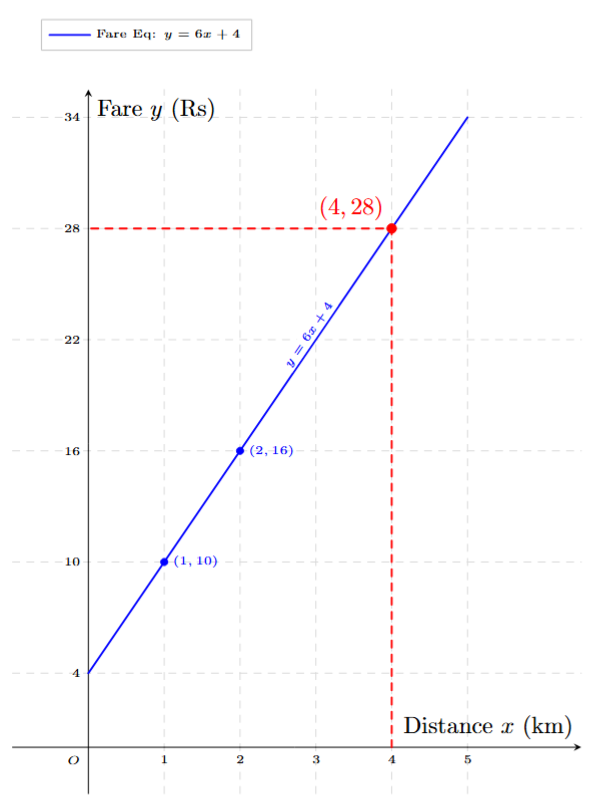
For the first kilometer, the fare is Rs 10 and for the subsequent distance it is Rs 6 per km. Taking the distance covered as x km and total fare as Rs y, write a linear equation for this information and draw its graph.
From the graph, find the fare for travelling a distance of 4 km.
Answer:
Given:
Total distance covered = $x$ km
Total fare = $\textsf{₹}$ $y$
Fare for the 1st km = $\textsf{₹}$ 10
Fare for subsequent distance = $\textsf{₹}$ 6 per km
Solution:
The distance after the first kilometer is $(x - 1)$ km.
Therefore, the fare for subsequent distance is $6(x - 1)$.
Total fare $y = \text{Fare for 1st km} + \text{Fare for subsequent distance}$
$y = 10 + 6(x - 1)$
$y = 10 + 6x - 6$
$y = 6x + 4$
... (i)
To draw the graph, we find at least two points:
| Distance $x$ (km) | Fare $y = 6x + 4$ ($\textsf{₹}$) | Point $(x, y)$ |
| 1 | 10 | (1, 10) |
| 2 | 16 | (2, 16) |
| 4 | 28 | (4, 28) |
From the graph:
We locate $x = 4$ on the x-axis and see the corresponding value of $y$ on the line.
The value of $y$ at $x = 4$ is 28.
Hence, the fare for 4 km is $\textsf{₹}$ 28.
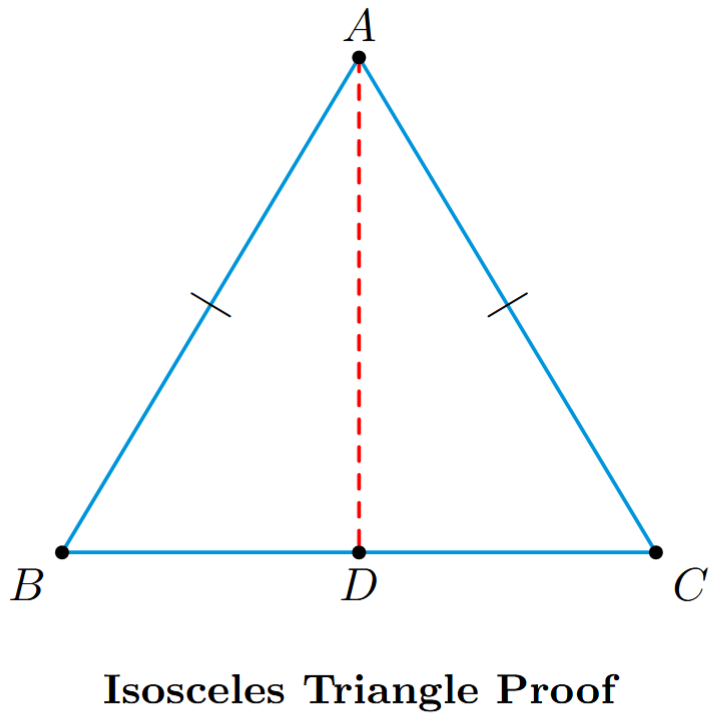
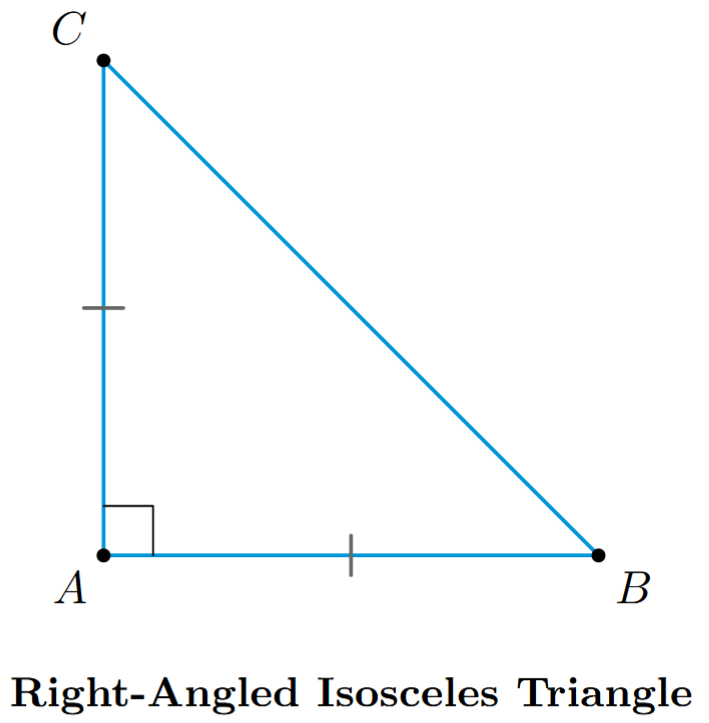
Question 27. Prove that the angles opposite to equal sides of an isosceles triangle are equal. Using the above, find ∠B in a right triangle ABC, right angled at A with AB = AC.
Answer:
Given:
$\text{In } \triangle ABC, AB = AC$
(Isosceles Triangle)
To Prove:
$\angle B = \angle C$
Construction Required:
Draw the angle bisector of $\angle A$, which meets the base $BC$ at point $D$.
Proof:
In $\triangle ABD$ and $\triangle ACD$:
$AB = AC$
(Given)
$\angle BAD = \angle CAD$
(By Construction)
$AD = AD$
(Common side)
By SAS (Side-Angle-Side) Congruence Rule:
$\triangle ABD \cong \triangle ACD$
Since the triangles are congruent, their corresponding parts must be equal by CPCT (Corresponding Parts of Congruent Triangles):
$\angle B = \angle C$
Hence, the angles opposite to equal sides of an isosceles triangle are equal.
Application:
Given:
In $\triangle ABC$, $\angle A = 90^\circ$ and $AB = AC$.
To Find:
The value of $\angle B$.
Solution:
In $\triangle ABC$, since $AB = AC$:
$\angle B = \angle C$
[Angles opposite to equal sides] ... (i)
According to the Angle Sum Property of a triangle:
$\angle A + \angle B + \angle C = 180^\circ$
…(ii)
Substituting $\angle A = 90^\circ$ and $\angle C = \angle B$ from equation (i) into equation (ii):
$90^\circ + \angle B + \angle B = 180^\circ$
$90^\circ + 2\angle B = 180^\circ$
$2\angle B = 180^\circ - 90^\circ$
$2\angle B = 90^\circ$
$\angle B = \frac{\cancel{90}^{45}}{\cancel{2}_{1}}$
$\angle B = 45^\circ$
…(iii)
Hence, the value of $\angle B$ in the given right-angled isosceles triangle is $45^\circ$.
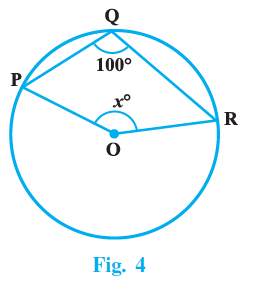
Question 28. Prove that the angle subtended by an arc at the centre is double the angle subtended by it at any point on the remaining part of the circle.
Using the above result, find x in figure 4 where O is the centre of the circle.
Answer:
Part A: Theorem Proof
Given:
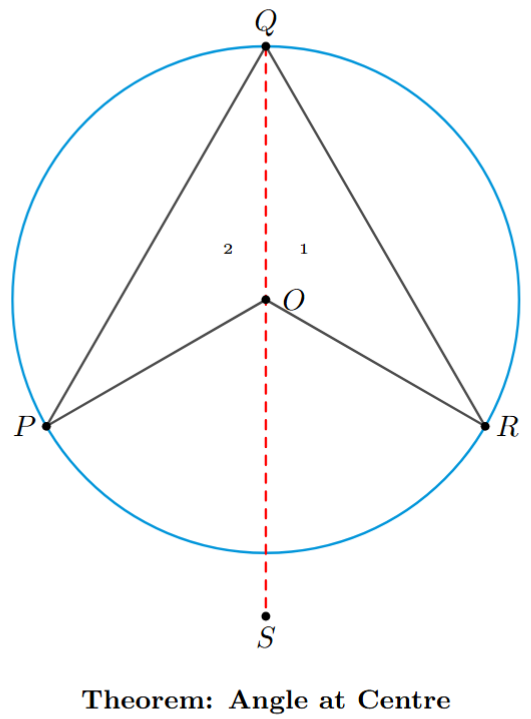
A circle with centre $O$. An arc $PR$ subtends $\angle POR$ at the centre and $\angle PQR$ at a point $Q$ on the remaining part of the circle.
To Prove:
$\angle POR = 2\angle PQR$
Construction Required:
Join the point $Q$ to the centre $O$ and extend the line segment $QO$ to a point $S$ outside the circle.
Proof:
Consider $\triangle POQ$. In this triangle:
$OP = OQ$
(Radii of the same circle)
Since the angles opposite to equal sides of a triangle are equal:
$\angle OPQ = \angle OQP$
... (i)
In $\triangle POQ$, $\angle POS$ is the exterior angle formed by extending side $QO$. According to the exterior angle property:
$\angle POS = \angle OPQ + \angle OQP$
Using the relation from equation (i):
$\angle POS = \angle OQP + \angle OQP$
$\angle POS = 2\angle OQP$
... (ii)
Similarly, by considering $\triangle ROQ$ and the exterior angle $\angle ROS$:
$\angle ROS = 2\angle OQR$
... (iii)
Adding equations (ii) and (iii):
$\angle POS + \angle ROS = 2\angle OQP + 2\angle OQR$
$\angle POS + \angle ROS = 2(\angle OQP + \angle OQR)$
From the figure, $\angle POS + \angle ROS = \angle POR$ and $\angle OQP + \angle OQR = \angle PQR$. Therefore:
$\angle POR = 2\angle PQR$
Note: If the arc $PR$ is a major arc, the theorem holds for the reflex angle at the centre.
Hence proved.
Part B: Application (Solution of Fig. 4)
Given:
A circle with centre $O$ as shown in Figure 4.
Angle subtended at the circumference, $\angle PQR = 100^\circ$.
To Find:
The value of $x$ (where $x^\circ$ is the minor $\angle POR$).
Solution:
By the theorem proved above, the angle subtended by an arc at the centre is double the angle subtended by it at the remaining part of the circle.
In Fig. 4, the major arc $PR$ subtends the Reflex $\angle POR$ at the centre and $\angle PQR$ at point $Q$.
$\text{Reflex } \angle POR = 2 \times \angle PQR$
Substituting the given value of $\angle PQR$:
$\text{Reflex } \angle POR = 2 \times 100^\circ$
$\text{Reflex } \angle POR = 200^\circ$
... (iv)
We know that the sum of angles around a point is $360^\circ$. Therefore:
$\text{Reflex } \angle POR + \text{Minor } \angle POR = 360^\circ$
From the figure, Minor $\angle POR = x^\circ$. Substituting the value from equation (iv):
$200^\circ + x^\circ = 360^\circ$
$x^\circ = 360^\circ - 200^\circ$
$x^\circ = 160^\circ$
[Final value of x] ... (v)
Hence, the value of $x$ is 160.
Question 29. A heap of wheat is in the form of a cone whose diameter is 48 m and height is 7 m. Find its volume. If the heap is to be covered by canvas to protect it from rain, find the area of the canvas required.
OR
A dome of a building is in the form of a hollow hemisphere. From inside, it was white-washed at the cost of Rs 498.96. If the rate of white washing is Rs 2.00 per square meter, find the volume of air inside the dome.
Answer:
Solution:
Given (Cone):
Diameter $d = 48$ m, so Radius $r = 24$ m.
Height $h = 7$ m.
Part 1: Volume of wheat heap
$V = \frac{1}{3}\pi r^{2}h$
$V = \frac{1}{3} \times \frac{22}{7} \times 24 \times 24 \times 7$
$V = 22 \times 8 \times 24 = 4224 \text{ m}^{3}$
Part 2: Area of canvas (CSA)
First, find the slant height $l$:
$l = \sqrt{r^{2} + h^{2}} = \sqrt{24^{2} + 7^{2}}$
$l = \sqrt{576 + 49} = \sqrt{625} = 25$ m.
Area of canvas $= \pi rl$
$\text{Area} = \frac{22}{7} \times 24 \times 25$
$\text{Area} = \frac{13200}{7} \approx 1885.71 \text{ m}^{2}$
OR (Alternate Solution):
Given (Hemisphere):
Total cost = $\textsf{₹}$ 498.96
Rate = $\textsf{₹}$ 2.00 per $\text{m}^{2}$
Step 1: Find Inner Surface Area
$\text{Area} = \frac{\text{Total Cost}}{\text{Rate}} = \frac{498.96}{2} = 249.48 \text{ m}^{2}$
Step 2: Find Radius $r$
$2\pi r^{2} = 249.48$
$2 \times \frac{22}{7} \times r^{2} = 249.48$
$r^{2} = \frac{249.48 \times 7}{44} = 5.67 \times 7 = 39.69$
$r = 6.3$ m.
Step 3: Find Volume of air
$V = \frac{2}{3}\pi r^{3}$
$V = \frac{2}{3} \times \frac{22}{7} \times (6.3)^{3}$
$V = \frac{2}{3} \times \frac{22}{7} \times 6.3 \times 6.3 \times 6.3$
$V = 2 \times 22 \times 0.3 \times 6.3 \times 6.3 \times \frac{1}{1} = 523.908 \text{ m}^{3}$
The volume of air inside the dome is 523.91 $\text{m}^{3}$ (approx).
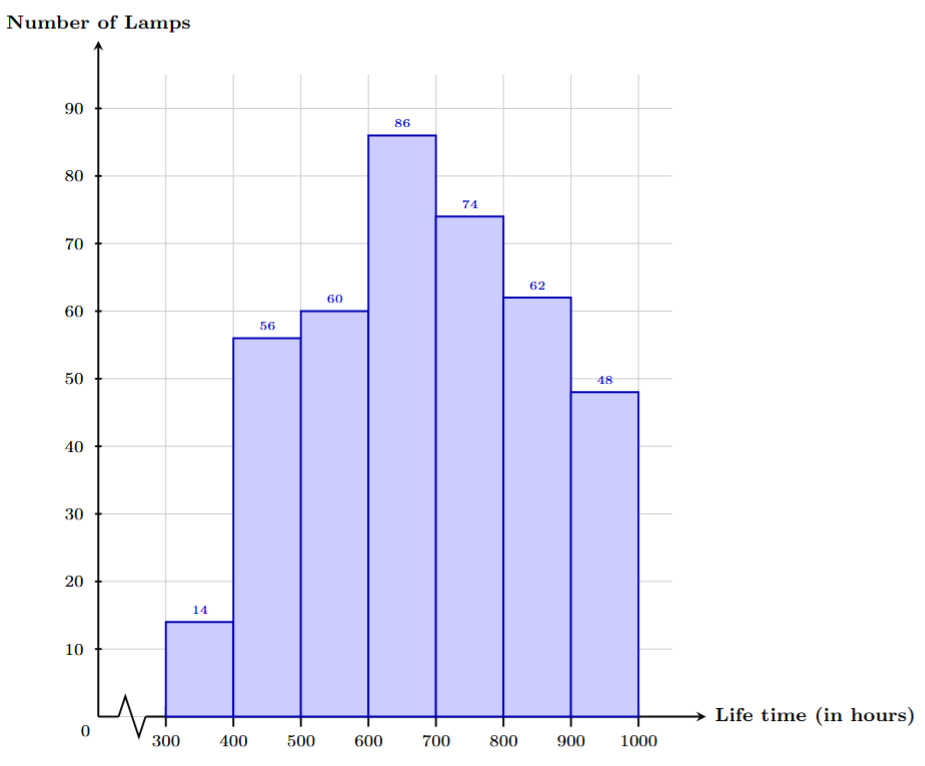
Question 30. The following table gives the life times of 400 neon lamps
| Life time (in hours) | 300 - 400 | 400 - 500 | 500 - 600 | 600 - 700 | 700 - 800 | 800 - 900 | 900 - 1000 |
|---|---|---|---|---|---|---|---|
| Number of Lamps | 14 | 56 | 60 | 86 | 74 | 62 | 48 |
(i) Represent the given information with the help of a histogram.
(ii) How many lamps have a lifetime of less than 600 hours?
Answer:
Solution:
(i) Histogram:
We represent Life time (in hours) on the x-axis and Number of lamps on the y-axis.
The scale for y-axis: 1 unit = 10 lamps.
Since the intervals start from 300, a kink is drawn on the x-axis.
(ii) Lamps with lifetime less than 600 hours:
This includes lamps in categories: $300-400$, $400-500$, and $500-600$.
$\text{Total lamps} = 14 + 56 + 60$
$\text{Total lamps} = 130$
Hence, 130 lamps have a lifetime of less than 600 hours.