
Class 9 Maths Sample Paper Set II (Class 9 - Maths NCERT Exemplar Solutions)
Welcome to the second comprehensive resource for Class 9 Mathematics Sample Paper Set II, aligned with the rigorous NCERT Exemplar standards! These papers are meticulously designed to provide a truly realistic assessment experience by mirroring the anticipated difficulty level and diverse question typologies expected in final examinations. By focusing on Higher-Order Thinking Skills (HOTS) and application-based problems, these solutions build the analytical foundation and conceptual depth required to navigate the most demanding academic assessments.
The sample papers draw from the entire Class 9 syllabus, covering essential topics such as Number Systems, Polynomials, Coordinate Geometry, Triangles, and Circles. Students will encounter a comprehensive range of formats, including MCQs, Fill-in-the-Blanks, and Long Answer questions. Significant attention is given to the practical application of core concepts and theorems, such as the calculation of areas using Heron's Formula ($\text{Area} = \sqrt{s(s-a)(s-b)(s-c)}$) and theorems related to Areas of Parallelograms and Triangles.
Beyond providing final answers, this resource serves as a strategic learning tool to refine time management and model the expected standards for systematic proof construction. These solutions provide a powerful mechanism for self-assessment, allowing students to pinpoint specific topics requiring further practice before the final exam. With step-by-step guidance and thorough justifications prepared by learningspot.co, students can master the critical skills needed to effectively solve integrated problems and approach their final revision cycles with confidence.
| Content On This Page | ||
|---|---|---|
| Section A | Section B | Section C |
| Section D | ||
Section A
In Questions 1 to 10, four options of answer are given in each, out of which only one is correct. Write the correct option.
Question 1. Which of the following represent a line parallel to x-axis?
(A) x + y = 3
(B) 2x + 3 = 7
(C) 2y − 3 = y +1
(D) x + 3 = 0
Answer:
Solution:
A line parallel to the x-axis is represented by an equation where the y-coordinate is constant for all values of $x$. Such an equation is of the general form $y = k$, where $k$ is a constant.
Let us examine the options:
(A) $x + y = 3$ can be written as $y = 3 - x$. This is a linear equation representing a slanting line.
(B) $2x + 3 = 7 \Rightarrow 2x = 4 \Rightarrow x = 2$. This represents a line parallel to the y-axis.
(C) $2y - 3 = y + 1$
Simplifying the equation:
$2y - y = 1 + 3$
$y = 4$
... (i)
Since the equation results in $y$ being a constant, it represents a line parallel to the x-axis.
(D) $x + 3 = 0 \Rightarrow x = -3$. This represents a line parallel to the y-axis.
Hence, the correct option is (C).
Question 2. Zero of the polynomial p( x) = 3x + 5 is :
(A) 0
(B) - 5
(C) $\frac{5}{3}$
(D) $\frac{-5}{3}$
Answer:
Given:
Polynomial $p(x) = 3x + 5$.
To Find:
The zero of the polynomial.
Solution:
To find the zero of a polynomial, we equate the polynomial to zero and solve for $x$.
$p(x) = 0$
$3x + 5 = 0$
... (i)
Transposing 5 to the right-hand side:
$3x = -5$
Dividing by 3:
$x = \frac{-5}{3}$
... (ii)
Hence, the zero of the polynomial is $-\frac{5}{3}$.
Correct option is (D).
Question 3. The abscissa of a point P, in cartesian plane, is the perpendicular distance of P from:
(A) y-axis
(B) x-axis
(C) origin
(D) line y = x
Answer:
Solution:
In a Cartesian coordinate system, any point $P$ is represented by coordinates $(x, y)$.
1. The abscissa (x-coordinate) represents the perpendicular distance of the point from the y-axis.
2. The ordinate (y-coordinate) represents the perpendicular distance of the point from the x-axis.
Since the question asks for the abscissa, it is the distance from the y-axis.
Hence, the correct option is (A).
Question 4. The reflex angle is an angle:
(A) less than 90°
(B) greater than 90°
(C) less than 180°
(D) greater than 180°
Answer:
Solution:
Angles are categorized based on their measure:
1. Acute Angle: $0^\circ < \theta < 90^\circ$
2. Right Angle: $\theta = 90^\circ$
3. Obtuse Angle: $90^\circ < \theta < 180^\circ$
4. Straight Angle: $\theta = 180^\circ$
5. Reflex Angle: An angle which is greater than $180^\circ$ but less than $360^\circ$.
Hence, a reflex angle is an angle greater than $180^\circ$.
Correct option is (D).
Question 5. If the lines l, m, and n are such that l ||m and m||n, then
(A) l || n
(B) l ⊥ n
(C) l and n are intersecting
(D) l = n
Answer:
Given:
Three lines $l, m,$ and $n$.
$l \parallel m$ and $m \parallel n$.
Solution:
According to the theorem in geometry, lines which are parallel to the same line are parallel to each other.
$l \parallel m$
... (i)
$m \parallel n$
... (ii)
From equations (i) and (ii), since both $l$ and $n$ are parallel to line $m$, we can conclude:
$l \parallel n$
Hence, the correct option is (A).
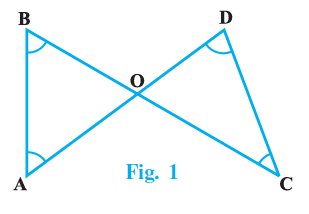
Question 6. In Fig.1, B < A and D > C, then:
(A) AD > BC
(B) AD = BC
(C) AD < BC
(D) AD = 2BC
Answer:
Given:
In the given figure, $\angle B < \angle A$ and $\angle D > \angle C$ (or $\angle C < \angle D$).
To Find:
The relationship between sides $AD$ and $BC$.
Solution:
In $\triangle OAB$:
$\angle B < \angle A$
(Given)
We know that in a triangle, the side opposite to the smaller angle is shorter.
$OA < OB$
... (i)
Similarly, in $\triangle OCD$:
$\angle C < \angle D$
(Given)
Since the side opposite to the smaller angle is shorter:
$OD < OC$
... (ii)
Adding inequations (i) and (ii):
$OA + OD < OB + OC$
From the figure, we observe that $OA + OD = AD$ and $OB + OC = BC$.
Therefore:
$AD < BC$
Hence, the correct option is (C) AD < BC.
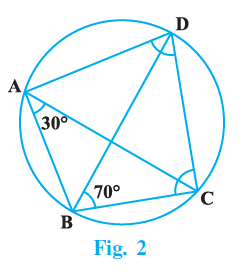
Question 7. In Fig. 2, the measure of ∠BCD is:
(A) 100°
(B) 70°
(C) 80°
(D) 30°
Answer:
Given:
A circle with points $A, B, C, D$ on the circumference. $\angle BAC = 30^\circ$ and $\angle CBD = 70^\circ$.
To Find:
The measure of $\angle BCD$.
Solution:
We know that angles in the same segment of a circle are equal.
Both $\angle BAC$ and $\angle BDC$ are subtended by the same arc $BC$.
$\angle BDC = \angle BAC = 30^\circ$
(Angles in same segment)
Now, consider $\triangle BCD$. Using the angle sum property of a triangle:
$\angle CBD + \angle BDC + \angle BCD = 180^\circ$
Substituting the known values:
$70^\circ + 30^\circ + \angle BCD = 180^\circ$
$100^\circ + \angle BCD = 180^\circ$
$\angle BCD = 180^\circ - 100^\circ$
$\angle BCD = 80^\circ$
... (i)
Hence, the measure of $\angle BCD$ is 80°.
The correct option is (C).
Question 8. The height of a cone of diameter 10 cm and slant height 13cm is:
(A) $\sqrt{69}$
(B) 12 cm
(C) 13 cm
(D) $\sqrt{194}$ cm
Answer:
Given:
Diameter of the cone ($d$) = 10 cm.
Slant height ($l$) = 13 cm.
To Find:
The height ($h$) of the cone.
Solution:
First, we find the radius ($r$):
$r = \frac{d}{2} = \frac{10}{2} = 5 \text{ cm}$
We know the relationship between slant height, radius, and height of a cone:
$l^2 = r^2 + h^2$
Substituting the given values:
$13^2 = 5^2 + h^2$
$169 = 25 + h^2$
$h^2 = 169 - 25$
$h^2 = 144$
Taking square root on both sides:
$h = \sqrt{144} = 12 \text{ cm}$
Hence, the height of the cone is 12 cm.
The correct option is (B).
Question 9. The surface area of a solid hemisphere with radius r is
(A) 4πr2
(B) 2πr2
(C) 3πr2
(D) $\frac{2}{3}$ πr3
Answer:
Solution:
A hemisphere is half of a sphere. For a solid hemisphere, the surface area consists of two parts:
1. The Curved Surface Area (CSA): $2\pi r^2$
2. The flat circular base area: $\pi r^2$
Therefore, the total surface area of a solid hemisphere is:
$\text{Total Surface Area} = \text{Curved Surface Area} + \text{Area of Base}$
$\text{Total Surface Area} = 2\pi r^2 + \pi r^2$
$\text{Total Surface Area} = 3\pi r^2$
Hence, the correct option is (C) 3πr2.
Question 10. If the mode of the following data
| 10 | 11 | 12 | 10 | 15 | 14 | 15 | 13 | 12 | $x$ |
| 9 | 7 |
is 15, then the value of x is:
(A) 10
(B) 15
(C) 12
(D) $\frac{21}{2}$
Answer:
Given:
Data: 10, 11, 12, 10, 15, 14, 15, 13, 12, $x$, 9, 7.
Mode of the data = 15.
To Find:
The value of $x$.
Solution:
Mode is the observation that occurs with the highest frequency in a data set.
Let us count the current frequencies of the observations (excluding $x$):
10: appears 2 times
11: appears 1 time
12: appears 2 times
15: appears 2 times
14: appears 1 time
13: appears 1 time
9: appears 1 time
7: appears 1 time
Currently, 10, 12, and 15 all have the same maximum frequency of 2.
Since it is given that the mode is 15, the value 15 must occur more times than any other observation. For this to happen, the frequency of 15 must be at least 3.
This implies that $x$ must be 15.
$x = 15$
When $x = 15$, the frequency of 15 becomes 3, making it the unique mode.
Hence, the correct option is (B) 15.
Section B
Question 11. Find an irrational number between two numbers $\frac{1}{7}$ and $\frac{2}{7}$ and justify your answer.
It is given that $\frac{1}{7}$ = 0.$\overline{142857}$
Answer:
Given:
Rational number $\frac{1}{7} = 0.142857142857...$ (or $0.\overline{142857}$)
To Find:
An irrational number between $\frac{1}{7}$ and $\frac{2}{7}$.
Solution:
First, we find the decimal representation of $\frac{2}{7}$:
$\frac{2}{7} = 2 \times \frac{1}{7}$
$\frac{2}{7} = 2 \times 0.142857... = 0.285714...$
We need to find an irrational number $s$ such that:
$0.142857... < s < 0.285714...$
An irrational number is a non-terminating and non-recurring decimal. We can pick any such decimal between $0.14$ and $0.28$.
Let the irrational number be $0.15015001500015...$
Justification:
1. The number $0.15015001500015...$ is clearly greater than $0.142857...$ and less than $0.285714...$.
2. It is irrational because its decimal expansion is non-terminating and it does not have a repeating block of digits (the number of zeros between the fifteen increases each time).
Question 12. Without actually dividing, find the remainder when x4 + x3 − 2x2 + x +1 is divided by x −1, and justify your answer.
Answer:
Given:
Dividend polynomial $p(x) = x^{4} + x^{3} - 2x^{2} + x + 1$
Divisor $g(x) = x - 1$
To Find:
The remainder using the Remainder Theorem.
Solution:
According to the Remainder Theorem, when a polynomial $p(x)$ is divided by $(x - a)$, the remainder is equal to $p(a)$.
Here, the divisor is $(x - 1)$, so $a = 1$.
To find the remainder, we calculate $p(1)$:
$p(1) = (1)^{4} + (1)^{3} - 2(1)^{2} + (1) + 1$
$p(1) = 1 + 1 - 2(1) + 1 + 1$
$p(1) = 1 + 1 - 2 + 1 + 1$
$p(1) = 2$
... (i)
Hence, the remainder is 2.
Justification:
The Remainder Theorem provides a direct method to find the remainder of a division involving linear divisors without performing the long division process. Since $p(1) = 2$, it is mathematically certain that the remainder of the division is 2.
Question 13. Give the equations of two lines passing through (2, 10). How many more such lines are there, and why?
Answer:
Given:
A point $(x, y) = (2, 10)$.
Solution:
To find equations of lines passing through $(2, 10)$, we need to form linear equations in $x$ and $y$ that are satisfied by $x = 2$ and $y = 10$.
Equation 1:
Let us consider the sum of $x$ and $y$:
$x + y = 2 + 10 = 12$
$x + y = 12$
... (i)
Equation 2:
Let us consider a relationship where $y$ is a multiple of $x$:
$y = 5x \implies 5x - y = 0$
$5x - y = 0$
... (ii)
Conclusion:
There are infinitely many such lines passing through the point $(2, 10)$.
Reason: Through a single point in a plane, an infinite number of straight lines can be drawn in different directions. Every such line will have a unique linear equation that is satisfied by the coordinates of that point.
Question 14. Two points with coordinates (2, 3) and (2, –1) lie on a line, parallel to which axis? Justify your answer.
Answer:
Given:
Points $A(2, 3)$ and $B(2, -1)$.
Solution:
We observe that both points have the same x-coordinate, which is 2.
The equation of the line passing through these points is $x = 2$.
A line with the equation $x = k$ (where $k$ is a constant) is always a vertical line.
Hence, the line is parallel to the y-axis.
Justification:
1. In the Cartesian plane, all points with a constant x-coordinate form a vertical line.
2. A vertical line is perpendicular to the x-axis and therefore parallel to the y-axis.
3. Since the x-coordinates of both $(2, 3)$ and $(2, -1)$ are identical, the distance of every point on this line from the y-axis is a constant 2 units.
Question 15. A die was rolled 100 times and the number of times, 6 came up was noted. If the experimental probability calculated from this information is $\frac{2}{5}$ then how many times 6 came up? Justify your answer.
Answer:
Given:
Total number of trials ($n$) = 100
Experimental probability of getting a 6, $P(E) = \frac{2}{5}$
To Find:
The frequency ($f$) of 6 coming up.
Solution:
The formula for experimental probability is:
$P(E) = \frac{\text{Number of times event occurs}}{\text{Total number of trials}}$
Let $f$ be the number of times 6 came up. Substituting the values:
$\frac{2}{5} = \frac{f}{100}$
By cross-multiplication:
$5f = 2 \times 100$
$5f = 200$
$f = \frac{\cancel{200}^{40}}{\cancel{5}_{1}}$
$f = 40$
... (i)
Hence, 6 came up 40 times.
Justification:
Probability represents the ratio of successes to total attempts. If $\frac{2}{5}$ of the total 100 rolls were 6s, then we simply multiply the total trials by the probability fraction: $100 \times \frac{2}{5} = 40$. This satisfies the experimental data provided.
Section C
Question 16. Find three rational numbers between $\frac{2}{5}$ and $\frac{3}{5}$
Answer:
Given:
Two rational numbers $\frac{2}{5}$ and $\frac{3}{5}$.
To Find:
Three rational numbers between them.
Solution:
To find three rational numbers, we multiply the numerator and denominator of both fractions by $(3 + 1) = 4$.
For the first number:
$\frac{2}{5} = \frac{2 \times 4}{5 \times 4} = \frac{8}{20}$
... (i)
For the second number:
$\frac{3}{5} = \frac{3 \times 4}{5 \times 4} = \frac{12}{20}$
... (ii)
Now, we can choose any three integers between the numerators 8 and 12, which are 9, 10, and 11.
The rational numbers are $\frac{9}{20}$, $\frac{10}{20}$, and $\frac{11}{20}$.
Simplifying where possible:
$\frac{10}{20} = \frac{\cancel{10}^{1}}{\cancel{20}_{2}} = \frac{1}{2}$
The three rational numbers are $\frac{9}{20}$, $\frac{1}{2}$, and $\frac{11}{20}$.
Question 17. Factorise: 54a3 - 250b3
Answer:
To Factorise:
$54a^{3} - 250b^{3}$
Solution:
First, we take out the common factor 2 from both terms:
$2(27a^{3} - 125b^{3})$
... (i)
The expression inside the bracket can be written as a difference of two cubes:
$2[(3a)^{3} - (5b)^{3}]$
Using the algebraic identity $x^{3} - y^{3} = (x - y)(x^{2} + xy + y^{2})$:
Here, $x = 3a$ and $y = 5b$.
$= 2(3a - 5b)[(3a)^{2} + (3a)(5b) + (5b)^{2}]$
$= 2(3a - 5b)(9a^{2} + 15ab + 25b^{2})$
Hence, the factorised form is $2(3a - 5b)(9a^{2} + 15ab + 25b^{2})$.
Question 18. Check whether the polynomial
p(y) = 2y3 + y2 +4y −15 is a multiple of (2y – 3).
Answer:
Given:
Polynomial $p(y) = 2y^{3} + y^{2} + 4y - 15$
Divisor = $(2y - 3)$
To Find:
Whether $p(y)$ is a multiple of $(2y - 3)$.
Solution:
A polynomial $p(y)$ is a multiple of $(2y - 3)$ if $(2y - 3)$ is a factor of $p(y)$. By Factor Theorem, this is true if the remainder is zero when $p(y)$ is divided by $(2y - 3)$.
First, find the zero of the divisor:
$2y - 3 = 0 \implies 2y = 3 \implies y = \frac{3}{2}$
Now, calculate $p\left(\frac{3}{2}\right)$:
$p\left(\frac{3}{2}\right) = 2\left(\frac{3}{2}\right)^{3} + \left(\frac{3}{2}\right)^{2} + 4\left(\frac{3}{2}\right) - 15$
$p\left(\frac{3}{2}\right) = 2\left(\frac{27}{8}\right) + \left(\frac{9}{4}\right) + 6 - 15$
$p\left(\frac{3}{2}\right) = \frac{27}{4} + \frac{9}{4} - 9$
$p\left(\frac{3}{2}\right) = \frac{36}{4} - 9$
$p\left(\frac{3}{2}\right) = 9 - 9 = 0$
Since the remainder is zero, the given polynomial $p(y)$ is indeed a multiple of $(2y - 3)$.
Question 19. If the point (3, 4) lies on the graph of the equation 2y = ax + 6 , find whether (6, 5) also lies on the same graph.
Answer:
Given:
Equation: $2y = ax + 6$.
Point $(3, 4)$ lies on the graph.
To Find:
Does the point $(6, 5)$ lie on the same graph?
Solution:
Step 1: Find the value of $a$.
Substitute $x = 3$ and $y = 4$ into the equation:
$2(4) = a(3) + 6$
$8 = 3a + 6$
$3a = 8 - 6 = 2$
$a = \frac{2}{3}$
... (i)
Now, the equation becomes $2y = \frac{2}{3}x + 6$.
Step 2: Check if $(6, 5)$ satisfies the equation.
Substitute $x = 6$ and $y = 5$ in the new equation:
$\text{LHS} = 2(5) = 10$
$\text{RHS} = \frac{2}{3}(6) + 6$
$\text{RHS} = 2(2) + 6 = 4 + 6 = 10$
Since $\text{LHS} = \text{RHS}$, the point $(6, 5)$ also lies on the graph.
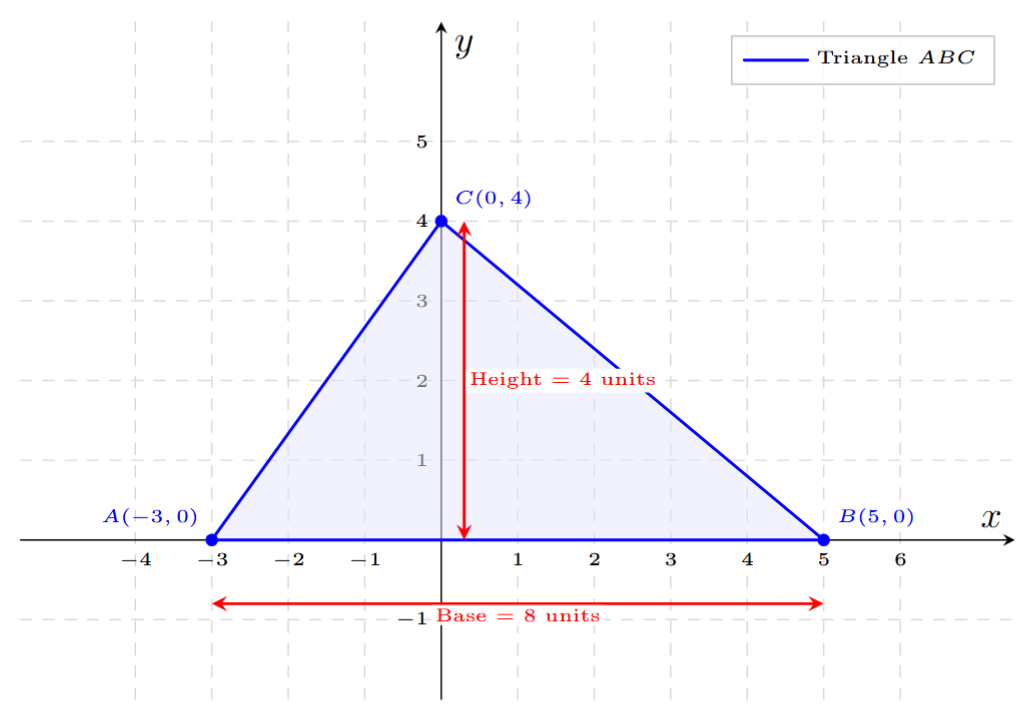
Question 20. Plot (–3, 0), (5, 0) and (0, 4) on cartesian plane. Name the figure formed by joining these points and find its area.
Answer:
Given:
Points $A(-3, 0)$, $B(5, 0)$, and $C(0, 4)$.
Solution:
Step 1: Plotting and identifying the figure.
When we plot these points and join them, we obtain a Triangle ($\triangle ABC$).
Step 2: Calculating the Area.
The base of the triangle lies on the x-axis between $x = -3$ and $x = 5$.
$\text{Base } AB = |5 - (-3)| = 8 \text{ units}$
The height of the triangle is the y-coordinate of vertex $C$ (which lies on the y-axis).
$\text{Height } h = 4 \text{ units}$
The area of a triangle is given by:
$\text{Area} = \frac{1}{2} \times \text{Base} \times \text{Height}$
$\text{Area} = \frac{1}{2} \times 8 \times 4$
$\text{Area} = 16 \text{ sq units}$
... (i)
Hence, the figure formed is a triangle and its area is 16 sq units.
Question 21. Diagonals AC and BD of a trapezium ABCD with AB || DC, intersect each other at O. Prove that ar(AOD) = ar(BOC).
OR
ABCD is a rectangle in which diagonal AC bisects A as well as C. Show that ABCD is a square.
Answer:
Part 1: Area of Triangles in a Trapezium
Given:
A trapezium $ABCD$ where $AB \parallel DC$. The diagonals $AC$ and $BD$ intersect at point $O$.
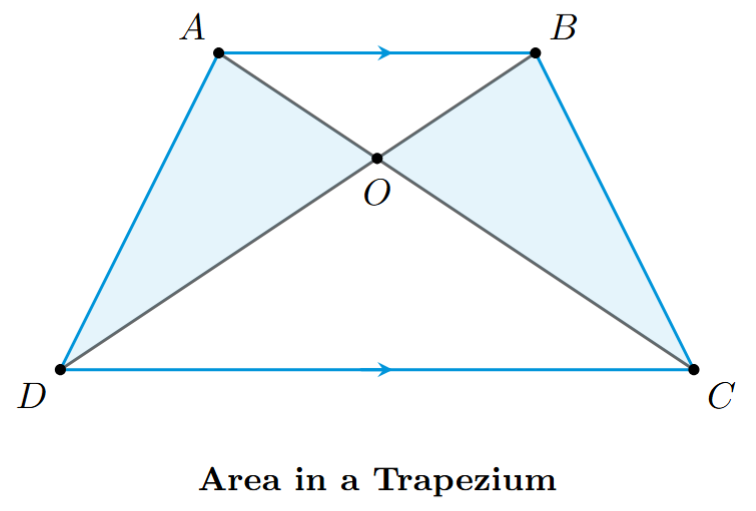
To Prove:
$\text{ar}(\triangle AOD) = \text{ar}(\triangle BOC)$
Proof:
We observe that $\triangle ADC$ and $\triangle BDC$ are on the same base $DC$ and lie between the same parallels $AB$ and $DC$.
We know that triangles on the same base and between the same parallels are equal in area.
$\text{ar}(\triangle ADC) = \text{ar}(\triangle BDC)$
... (i)
From the figure, we can expand these areas as follows:
$\text{ar}(\triangle ADC) = \text{ar}(\triangle AOD) + \text{ar}(\triangle ODC)$
$\text{ar}(\triangle BDC) = \text{ar}(\triangle BOC) + \text{ar}(\triangle ODC)$
Substituting these relations into equation (i):
$\text{ar}(\triangle AOD) + \text{ar}(\triangle ODC) = \text{ar}(\triangle BOC) + \text{ar}(\triangle ODC)$
Subtracting the common area $\text{ar}(\triangle ODC)$ from both sides:
$\text{ar}(\triangle AOD) = \text{ar}(\triangle BOC)$
Hence proved.
OR (Alternate Question)
Given:
$ABCD$ is a rectangle. Diagonal $AC$ bisects $\angle A$ and $\angle C$.
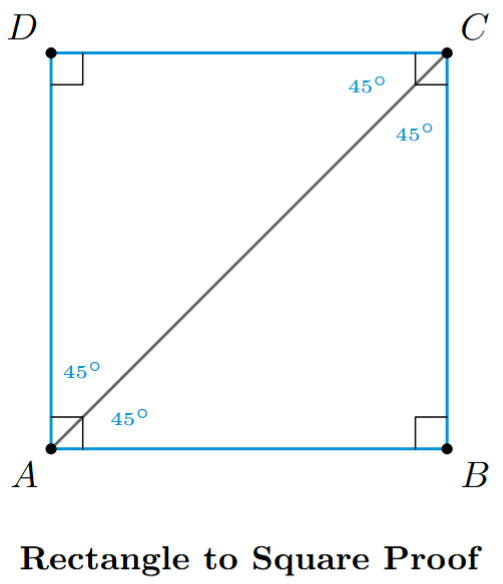
To Prove:
$ABCD$ is a square.
Proof:
In rectangle $ABCD$, all angles are $90^\circ$.
$\angle A = 90^\circ \text{ and } \angle C = 90^\circ$
Since $AC$ bisects $\angle A$:
$\angle DAC = \angle BAC = \frac{90^\circ}{2} = 45^\circ$
... (i)
Since $AC$ bisects $\angle C$:
$\angle DCA = \angle BCA = \frac{90^\circ}{2} = 45^\circ$
... (ii)
Now, consider $\triangle ADC$. From (i) and (ii):
$\angle DAC = \angle DCA = 45^\circ$
In a triangle, sides opposite to equal angles are equal. Therefore:
$AD = DC$
[Adjacent sides are equal] ... (iii)
In a rectangle, opposite sides are already equal ($AB = DC$ and $AD = BC$). From equation (iii), we can conclude that all four sides are equal:
$AB = BC = CD = DA$
A rectangle with all sides equal is a square.
Hence, ABCD is a square.
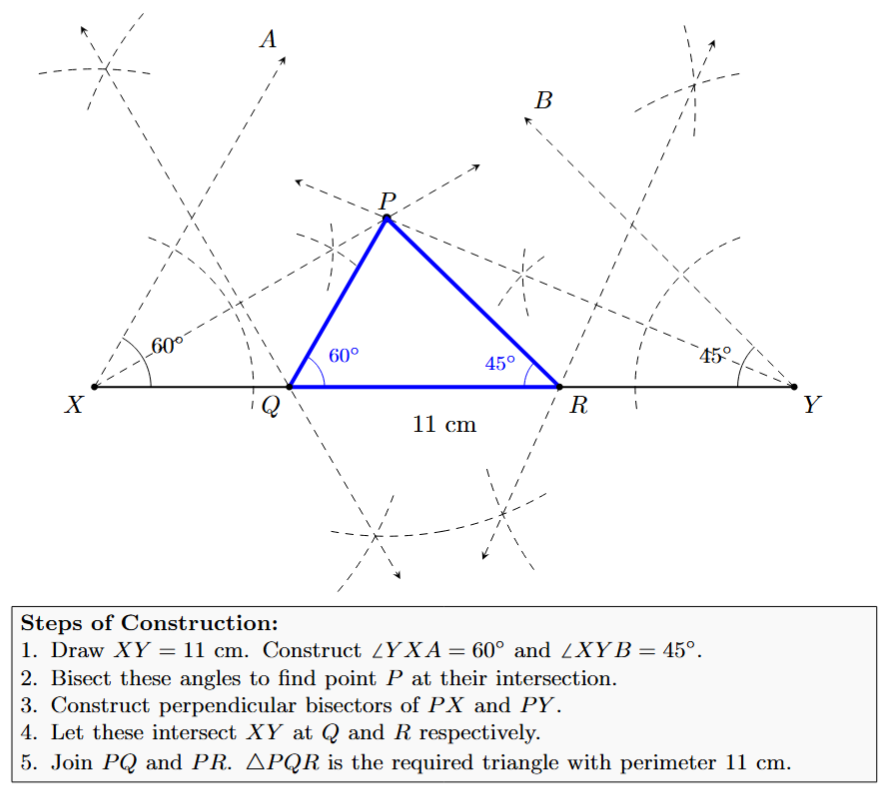
Question 22. Construct a triangle PQR in which Q = 60° and R = 45° and PQ + QR + PR = 11 cm.
Answer:
Given:
Perimeter of $\triangle PQR$ = 11 cm.
$\angle Q = 60^\circ$ and $\angle R = 45^\circ$.
Construction Required:
1. Draw a line segment $XY$ equal to the perimeter, i.e., $11 \text{ cm}$.
2. At $X$, construct $\angle YXA = 60^\circ$ and at $Y$, construct $\angle XYB = 45^\circ$.
3. Bisect $\angle YXA$ and $\angle XYB$. Let these bisectors intersect at point $P$.
4. Draw the perpendicular bisector of $PX$ and $PY$ to intersect $XY$ at points $Q$ and $R$ respectively.
5. Join $PQ$ and $PR$. $\triangle PQR$ is the required triangle.
Solution:
The resulting triangle $PQR$ has $\angle PQR = 60^\circ$, $\angle PRQ = 45^\circ$ and the sum of its sides $PQ + QR + PR = 11 \text{ cm}$.
Question 23. Find the area of a triangle two sides of which are 18 cm and 10 cm and the perimeter is 42 cm.
Answer:
Given:
Two sides of the triangle: $a = 18 \text{ cm}$ and $b = 10 \text{ cm}$.
Perimeter ($P$) = $42 \text{ cm}$.
To Find:
Area of the triangle.
Solution:
First, find the third side $c$ of the triangle:
$a + b + c = 42$
(Perimeter)
$18 + 10 + c = 42$
$c = 42 - 28 = 14 \text{ cm}$
... (i)
Now, calculate the semi-perimeter ($s$):
$s = \frac{P}{2} = \frac{42}{2} = 21 \text{ cm}$
Using Heron's Formula for the area:
$\text{Area} = \sqrt{s(s - a)(s - b)(s - c)}$
$\text{Area} = \sqrt{21(21 - 18)(21 - 10)(21 - 14)}$
$\text{Area} = \sqrt{21 \times 3 \times 11 \times 7}$
$\text{Area} = \sqrt{(21 \times 1) \times (3 \times 7) \times 11}$
$\text{Area} = \sqrt{21 \times 21 \times 11}$
$\text{Area} = 21\sqrt{11} \text{ cm}^{2}$
Hence, the area of the triangle is $21\sqrt{11} \text{ cm}^{2}$.
Question 24. A cylindrical pillar is 50 cm in diameter and 3.5 m in height. Find the cost of painting the curved surface of the pillar at the rate of Rs 12.50 per m2.
OR
The height of a solid cone is 16 cm and its base radius is 12 cm. Find the total surface area of cone $\left(Use \;\pi = \frac{22}{7} \right)$
Answer:
Given:
Diameter of the pillar ($d$) = $50 \text{ cm}$ = $0.5 \text{ m}$.
Height of the pillar ($h$) = $3.5 \text{ m}$.
Rate of painting = $\textsf{₹} 12.50$ per $m^{2}$.
To Find:
Total cost of painting the curved surface.
Solution:
First, we find the radius ($r$):
$r = \frac{d}{2} = \frac{0.5}{2} = 0.25 \text{ m}$
Curved Surface Area (CSA) of a cylinder = $2\pi rh$.
$\text{CSA} = 2 \times \frac{22}{7} \times 0.25 \times 3.5$
$\text{CSA} = 44 \times 0.25 \times 0.5$
$\text{CSA} = 11 \times 0.5 = 5.5 \text{ m}^{2}$
Now, calculating the total cost:
$\text{Cost} = \text{Area} \times \text{Rate}$
$\text{Cost} = 5.5 \times 12.50$
$\text{Cost} = \textsf{₹} 68.75$
Hence, the cost of painting the pillar is $\textsf{₹} 68.75$.
OR (Alternate Question)
Given:
Height of the cone ($h$) = $16 \text{ cm}$.
Radius of the cone ($r$) = $12 \text{ cm}$.
To Find:
Total Surface Area (TSA) of the cone.
Solution:
First, we calculate the slant height ($l$):
$l = \sqrt{r^2 + h^2}$
$l = \sqrt{12^2 + 16^2} = \sqrt{144 + 256}$
$l = \sqrt{400} = 20 \text{ cm}$
... (i)
Total Surface Area (TSA) of a cone = $\pi r(l + r)$.
$\text{TSA} = \frac{22}{7} \times 12 \times (20 + 12)$
$\text{TSA} = \frac{22 \times 12 \times 32}{7}$
$\text{TSA} = \frac{8448}{7} \approx 1206.86 \text{ cm}^{2}$
Hence, the total surface area of the cone is approximately $1206.86 \text{ cm}^{2}$.
Question 25. A die is thrown 400 times, the frequency of the outcomes of the events are given as under.
| Outcome | 1 | 2 | 3 | 4 | 5 | 6 |
|---|---|---|---|---|---|---|
| Frequency | 70 | 65 | 60 | 75 | 63 | 67 |
Find the probability of occurence of an odd number.
Answer:
Given:
Total number of trials ($n$) = 400.
Frequencies of outcomes: $1 \to 70$, $2 \to 65$, $3 \to 60$, $4 \to 75$, $5 \to 63$, $6 \to 67$.
To Find:
Probability of getting an odd number.
Solution:
An odd number on a die includes the outcomes 1, 3, and 5.
Total frequency of favorable outcomes ($m$):
$m = \text{Freq(1)} + \text{Freq(3)} + \text{Freq(5)}$
$m = 70 + 60 + 63$
$m = 193$
... (i)
Experimental Probability $P(E)$ is given by:
$P(E) = \frac{m}{n}$
Substituting values from (i) and the given trials:
$P(E) = \frac{193}{400}$
$P(E) = 0.4825$
Hence, the probability of the occurrence of an odd number is 0.4825.
Section D
Question 26. A field is in the shape of a trapezium whose parallel sides are 25 m and 10 m. The non-parallel sides are 14 m and 13 m. Find the area of the field.
Answer:
Given:
Parallel sides of the trapezium ($a$ and $b$) = 25 m and 10 m.
Non-parallel sides = 14 m and 13 m.
To Find:
The area of the trapezium field.
Construction Required:
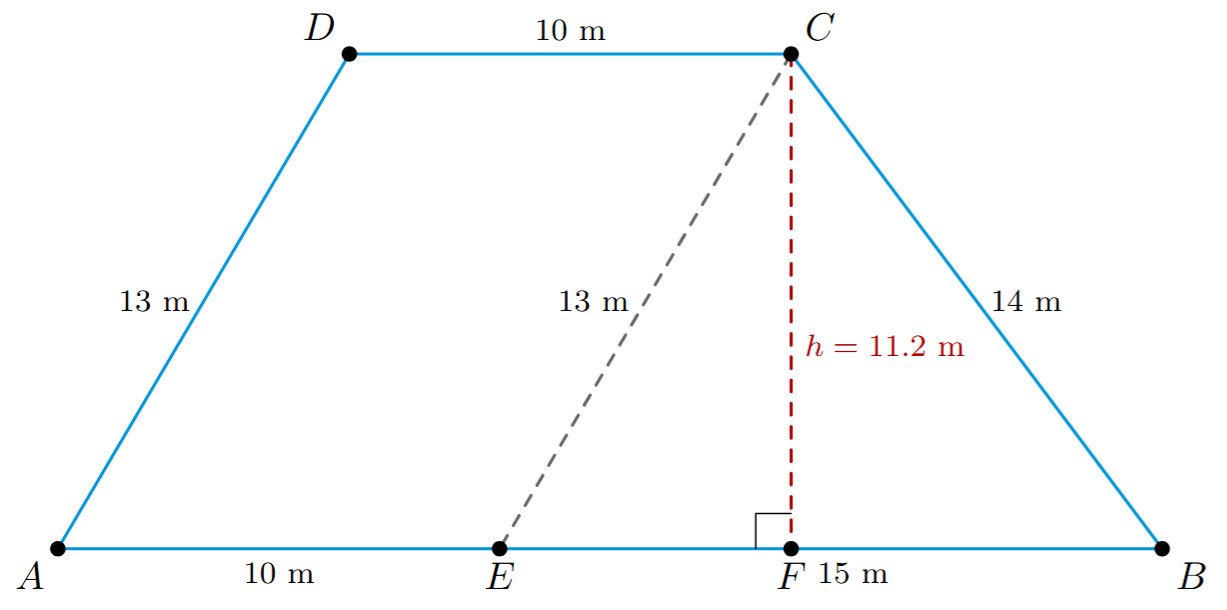
Let the trapezium be $ABCD$ where $AB \parallel CD$, $AB = 25 \text{ m}$ and $CD = 10 \text{ m}$. Draw $CE \parallel DA$ such that $E$ lies on $AB$. Drop a perpendicular $CF \perp AB$.
Solution:
In the construction, $AECD$ is a parallelogram because $AE \parallel DC$ and $AD \parallel EC$.
Opposite sides of a parallelogram are equal:
$AE = DC = 10 \text{ m}$
$EC = AD = 13 \text{ m}$
Now, calculate $EB$:
$EB = AB - AE = 25 - 10 = 15 \text{ m}$
Consider $\triangle CEB$ with sides $13 \text{ m}$, $14 \text{ m}$, and $15 \text{ m}$.
Semi-perimeter ($s$) of $\triangle CEB$:
$s = \frac{13 + 14 + 15}{2} = 21 \text{ m}$
Using Heron's Formula for the area of $\triangle CEB$:
$\text{Area} = \sqrt{21(21 - 13)(21 - 14)(21 - 15)}$
$\text{Area} = \sqrt{21 \times 8 \times 7 \times 6}$
$\text{Area} = \sqrt{7 \times 3 \times 4 \times 2 \times 7 \times 3 \times 2}$
$\text{Area of } \triangle CEB = 84 \text{ m}^{2}$
... (i)
We also know that $\text{Area}(\triangle CEB) = \frac{1}{2} \times \text{Base} \times \text{Height}$:
$84 = \frac{1}{2} \times 15 \times CF$
$CF = \frac{84 \times 2}{15} = \frac{168}{15} = 11.2 \text{ m}$
... (ii)
This $CF$ is the height ($h$) of the trapezium.
Area of Trapezium $= \frac{1}{2} \times (a + b) \times h$
$\text{Area} = \frac{1}{2} \times (25 + 10) \times 11.2$
$\text{Area} = \frac{1}{2} \times 35 \times 11.2 = 35 \times 5.6$
$\text{Area} = 196 \text{ m}^{2}$
The area of the field is 196 m2.
Question 27. Draw a histogram and frequency polygon for the following distribution:
| Mark Obtained | 0 - 10 | 10 - 20 | 20 - 30 | 30 - 40 | 40 - 50 | 50 - 60 | 60 - 70 | 70 - 80 |
|---|---|---|---|---|---|---|---|---|
| No. of Students | 7 | 10 | 6 | 8 | 12 | 3 | 2 | 2 |
Answer:
To Find: Represent the given data as a histogram and a frequency polygon.
Solution:
To draw the frequency polygon, we first determine the Class Marks (mid-points) for each interval.
| Mark Obtained | Class Mark ($x$) | Frequency ($f$) |
| 0 - 10 | 5 | 7 |
| 10 - 20 | 15 | 10 |
| 20 - 30 | 25 | 6 |
| 30 - 40 | 35 | 8 |
| 40 - 50 | 45 | 12 |
| 50 - 60 | 55 | 3 |
| 60 - 70 | 65 | 2 |
| 70 - 80 | 75 | 2 |
Steps for Construction:
1. Represent Marks Obtained on the horizontal axis (x-axis) and No. of Students on the vertical axis (y-axis).
2. Choose a scale for y-axis: 1 unit = 2 students.
3. Draw the histogram rectangles based on class intervals and frequencies.
4. Join the mid-points of the top of the histogram bars sequentially to form the frequency polygon. Extend it to the imaginary class marks -5 and 85 with zero frequency.
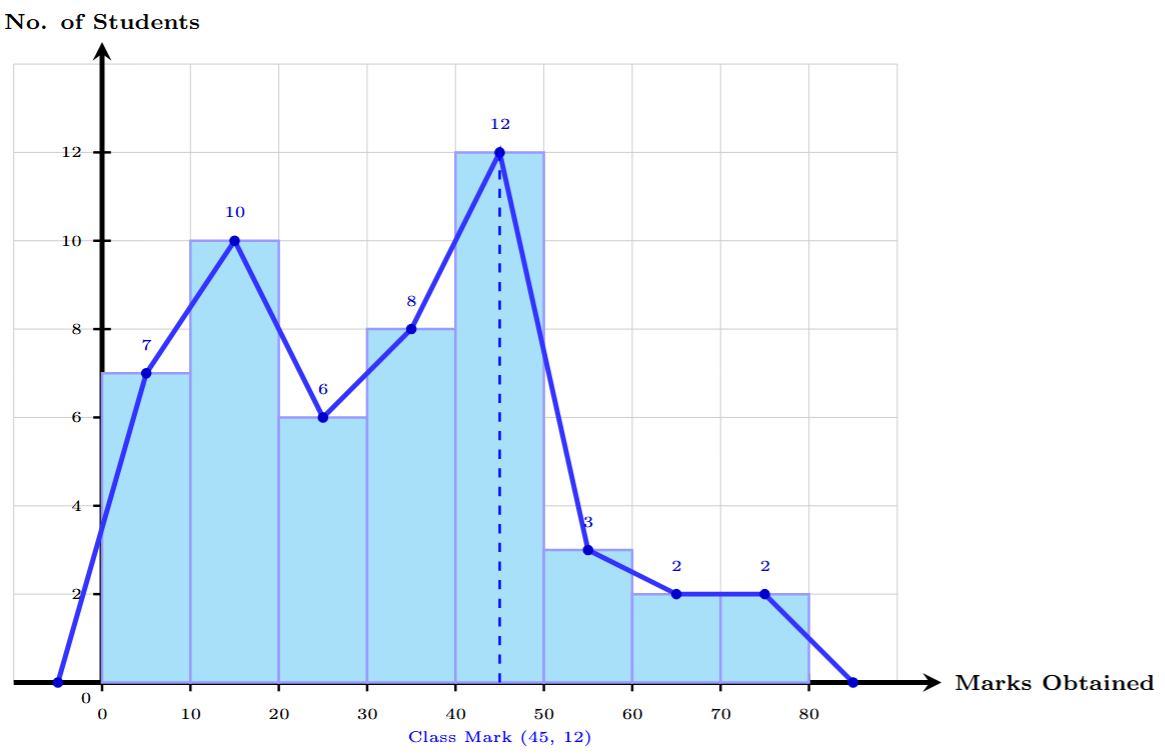
Question 28. Prove that two triangles are congruent if two angles and the included side of one triangle are equal to two angles and the included side of the other triangle.
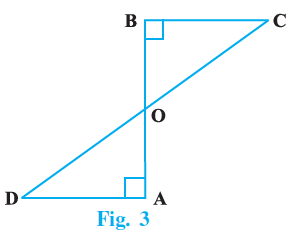
Using above, prove that CD bisects AB, in Figure 3, where AD and BC are equal perpendiculars to line segment AB.
Answer:
Part 1: Theorem Proof (ASA Congruence Rule)
Given:
Two triangles $\triangle ABC$ and $\triangle DEF$ such that $\angle B = \angle E$, $\angle C = \angle F$ and the included side $BC = EF$.
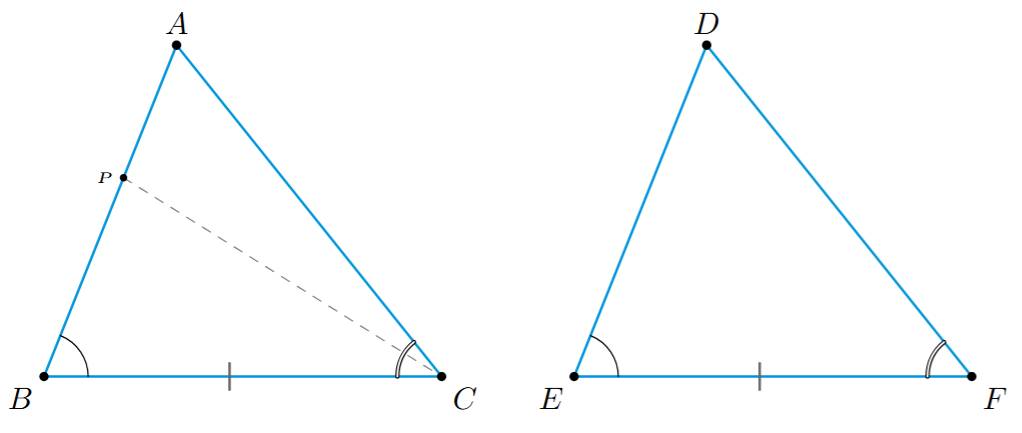
To Prove:
$\triangle ABC \cong \triangle DEF$
Proof:
To prove the congruence, we consider three cases based on the lengths of $AB$ and $DE$.
Case 1: Let $AB = DE$.
In $\triangle ABC$ and $\triangle DEF$:
$AB = DE$
(Assumed)
$\angle B = \angle E$
(Given)
$BC = EF$
(Given)
By SAS Congruence Rule, $\triangle ABC \cong \triangle DEF$.
Case 2: Let $AB > DE$.
Take a point $P$ on $AB$ such that $PB = DE$. Now, in $\triangle PBC$ and $\triangle DEF$, by SAS rule, $\triangle PBC \cong \triangle DEF$. This implies $\angle PCB = \angle DFE$ (by CPCT). But it is given that $\angle ACB = \angle DFE$. This is only possible if $P$ coincides with $A$. Thus, $AB$ must be equal to $DE$.
Case 3: Let $AB < DE$.
By choosing a point on $DE$ and using the same logic as Case 2, we find that this also leads to a contradiction unless $AB = DE$.
Thus, in all cases, the triangles are congruent. Hence proved.
Part 2: Application (Solution of Fig. 3)
Given:
$AD \perp AB$ and $BC \perp AB$. Also, $AD = BC$.
To Prove:
$CD$ bisects $AB$ (i.e., $OA = OB$).
Solution:
In $\triangle OAD$ and $\triangle OBC$:
$\angle OAD = \angle OBC = 90^\circ$
(Given perpendiculars)
$\angle AOD = \angle BOC$
(Vertically opposite angles)
$AD = BC$
(Given)
By AAS (Angle-Angle-Side) Congruence Rule:
$\triangle OAD \cong \triangle OBC$
By CPCT (Corresponding Parts of Congruent Triangles):
$OA = OB$
Since $OA = OB$, point $O$ is the midpoint of $AB$. Therefore, $CD$ bisects $AB$.
Question 29. Prove that equal chords AB and CD of a circle subtend equal angles at the centre. Use the above to find ABO in Figure 4, where O is the centre of the circle
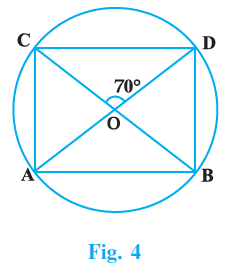
Answer:
Part 1: Theorem Proof
Given:
A circle with centre $O$ and two equal chords $AB$ and $CD$.
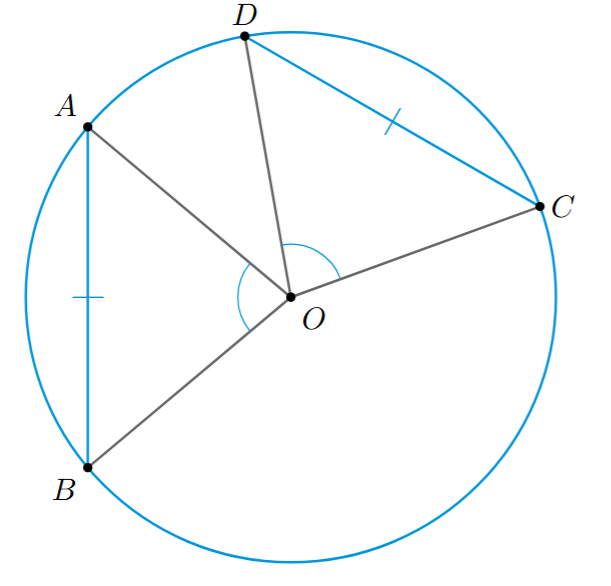
To Prove:
$\angle AOB = \angle COD$
Proof:
In $\triangle AOB$ and $\triangle COD$:
$OA = OC$
(Radii of the same circle)
$OB = OD$
(Radii of the same circle)
$AB = CD$
(Given)
By SSS (Side-Side-Side) Congruence Rule:
$\triangle AOB \cong \triangle COD$
By CPCT (Corresponding Parts of Congruent Triangles):
$\angle AOB = \angle COD$
Hence proved.
Part 2: Application (Solution of Fig. 4)
Given:
In Figure 4, $AB = CD$ and $\angle COD = 70^\circ$.
To Find:
The measure of $\angle ABO$.
Solution:
Since equal chords subtend equal angles at the centre:
$\angle AOB = \angle COD = 70^\circ$
Now, in $\triangle AOB$, $OA = OB$ (Radii of the same circle).
In an isosceles triangle, the angles opposite to equal sides are equal.
$\angle OAB = \angle OBA = \angle ABO$
Using the Angle Sum Property in $\triangle AOB$:
$\angle AOB + \angle OAB + \angle OBA = 180^\circ$
$70^\circ + \angle ABO + \angle ABO = 180^\circ$
$2\angle ABO = 180^\circ - 70^\circ$
$2\angle ABO = 110^\circ$
$\angle ABO = 55^\circ$
Hence, the measure of $\angle ABO$ is 55°.
Question 30. Factorise the expression
8x3 + 27 y3 + 36x2 y + 54xy2
OR
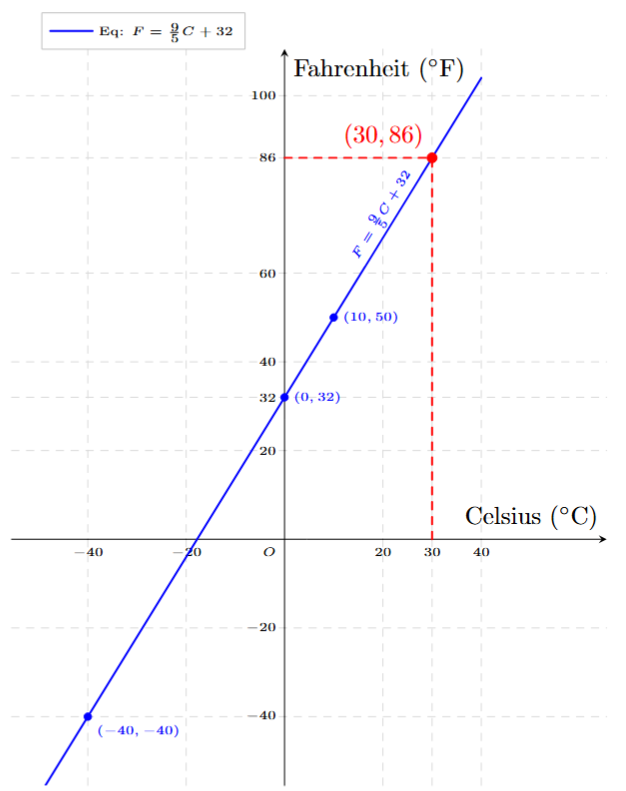
The Linear equation that converts Fahrenheit to Celsius is F = $\frac{9}{5}$ C + 32
Draw the graph of the equation using Celsius for x-axis and Fahrenheit for y-axis.
From the graph find the temperature in Fahrenheit for a temprature of 30°C.
Answer:
Solution (Part 1):
To Factorise: $8x^{3} + 27 y^{3} + 36x^{2} y + 54xy^{2}$
We use the algebraic identity $(a + b)^{3} = a^{3} + b^{3} + 3a^{2}b + 3ab^{2}$.
We can rewrite the given expression as:
$= (2x)^{3} + (3y)^{3} + 3(2x)^{2}(3y) + 3(2x)(3y)^{2}$
Comparing this with the identity where $a = 2x$ and $b = 3y$:
$ = (2x + 3y)^{3}$
So, the factorised form is $(2x + 3y)(2x + 3y)(2x + 3y)$.
OR (Alternate Solution):
To Find: Graph of $F = \frac{9}{5}C + 32$ and value of $F$ at $C = 30^\circ$.
Let $C$ be the x-axis and $F$ be the y-axis. We calculate coordinates:
| Celsius C (x) | Fahrenheit F (y) ($y=\frac{9}{5}x+32$) | Point (C, F) |
| 0 | 32 | (0, 32) |
| -40 | -40 | (-40, -40) |
| 10 | 50 | (10, 50) |
From the graph:
When the temperature is 30°C ($x = 30$):
$F = \frac{9}{5} \times 30 + 32$
$F = 9 \times 6 + 32$
$F = 54 + 32 = 86$
Hence, the temperature in Fahrenheit is 86°F.