

Chapter 1 Large Numbers Around Us (Class 7 - Latest Maths NCERT (Ganita Prakash I) Solutions)
Welcome to the complete solutions for Chapter 1: Large Numbers Around Us from the latest Class 7 NCERT Mathematics textbook Ganita Prakash I. This page provides clear, accurate, and step-by-step answers to all the exercises and in-text questions covered in the chapter. Whether you are learning about large numbers, place value systems, estimation, approximation, or comparing quantities of different magnitudes, these solutions are designed to help you understand every concept with confidence.
The chapter introduces the fascinating world of large numbers and their use in real-life situations such as population counts, distances, measurements, and scientific data. Through these solutions, students will learn how to read and write numbers in both the Indian Place Value System and the International Place Value System, convert numbers between the two systems, compare large quantities, and apply rounding and estimation techniques effectively. Each answer is explained systematically to help students develop strong numerical understanding and problem-solving skills.
To make learning easier, every solution follows a logical step-by-step approach based on the latest NCERT guidelines. These solutions, curated by learningspot.co, are ideal for homework assistance, revision, self-study, and exam preparation, helping students build confidence while mastering the concepts presented in this chapter.
Intext Questions (Page No. 2)
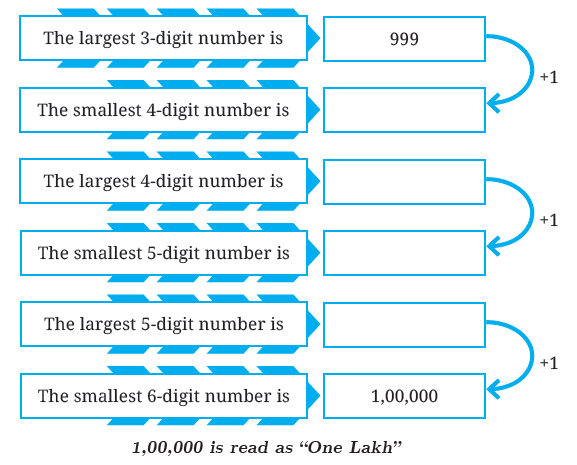
Question. Observe the pattern and fill in the boxes given below.
Answer:
Given:
1. A pattern relating the largest $n$-digit numbers to the smallest $(n+1)$-digit numbers by adding $1$.
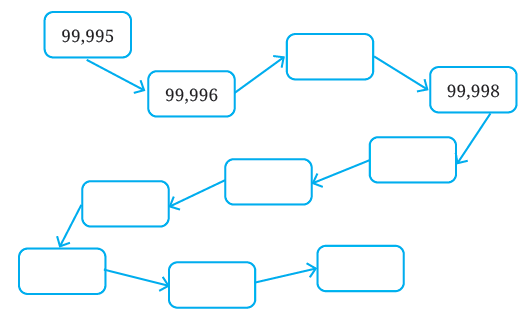
2. A number path starting with $99,995$, $99,996$, and $99,998$ with several empty boxes to be filled consecutively.
To Find:
1. The values to be filled in the empty boxes for the largest and smallest numbers of 4 and 5 digits.
2. The missing consecutive numbers in the sequence starting from $99,995$.
Solution:
In the Indian Numeral System, the transition between digits happens when we add $1$ to the greatest number of a specific digit count.
Part 1: Completing the Digit Patterns
By observing the first image, we can determine the values for the empty boxes:
Step 1: The largest 3-digit number is $999$. Adding $1$ to it gives the smallest 4-digit number.
$999 + 1 = 1,000$
(Smallest 4-digit number)
Step 2: The largest 4-digit number is formed by four nines.
Largest 4-digit number = $9,999$
(Nine thousand nine hundred ninety-nine)
Step 3: Adding $1$ to the largest 4-digit number gives the smallest 5-digit number.
$9,999 + 1 = 10,000$
(Smallest 5-digit number)
Step 4: The largest 5-digit number is formed by five nines.
Largest 5-digit number = $99,999$
(Ninety-nine thousand nine hundred ninety-nine)
Step 5: Adding $1$ to $99,999$ gives the smallest 6-digit number, which is One Lakh ($1,00,000$).
Part 2: Completing the Successive Number Sequence
The sequence follows the logic of adding $1$ to the previous number to find its successor. The values to be filled in the boxes are:
1. $99,995$ (Given)
2. $99,996$ (Given)
3. Next number: $99,996 + 1 = \mathbf{99,997}$
4. $99,998$ (Given)
5. Next number: $99,998 + 1 = \mathbf{99,999}$ (The largest 5-digit number)
6. Next number: $99,999 + 1 = \mathbf{1,00,000}$ (The smallest 6-digit number - One Lakh)
7. Next number: $1,00,000 + 1 = \mathbf{1,00,001}$
8. Next number: $1,00,001 + 1 = \mathbf{1,00,002}$
9. Next number: $1,00,002 + 1 = \mathbf{1,00,003}$
10. Next number: $1,00,003 + 1 = \mathbf{1,00,004}$
Final Answer Summary:
| Digit Category | Largest Number | Smallest Number (Next) |
| 3-Digit to 4-Digit | $999$ | $1,000$ |
| 4-Digit to 5-Digit | $9,999$ | $10,000$ |
| 5-Digit to 6-Digit | $99,999$ | $1,00,000$ (One Lakh) |
The missing numbers in the sequence are: 99,997, 99,999, 1,00,000, 1,00,001, 1,00,002, 1,00,003, and 1,00,004.
Figure it Out (Page No. 3)
Question 1. According to the $2011$ Census, the population of the town of Chintamani was about $75,000$. How much less than one lakh is $75,000$?
Answer:
Given:
Population of Chintamani in $2011 = 75,000$
Value of one lakh $= 1,00,000$
To Find:
The difference between one lakh and the population of $75,000$.
Solution:
To find how much less $75,000$ is than one lakh, we perform subtraction:
$\text{Required value} = 1,00,000 - 75,000$
$\text{Required value} = 25,000$
Thus, $75,000$ is $25,000$ less than one lakh.
Question 2. The estimated population of Chintamani in the year $2024$ is $1,06,000$. How much more than one lakh is $1,06,000$?
Answer:
Given:
Estimated population of Chintamani in $2024 = 1,06,000$
Value of one lakh $= 1,00,000$
To Find:
How much $1,06,000$ exceeds one lakh.
Solution:
We subtract one lakh from the estimated population of $2024$:
$\text{Extra population} = 1,06,000 - 1,00,000$
$\text{Extra population} = 6,000$
Hence, $1,06,000$ is $6,000$ more than one lakh.
Question 3. By how much did the population of Chintamani increase from $2011$ to $2024$?
Answer:
Given:
Population in $2011 = 75,000$
Population in $2024 = 1,06,000$
To Find:
The total increase in population over these years.
Solution:
The increase in population is calculated by subtracting the initial population from the final population:
$\text{Population Increase} = 1,06,000 - 75,000$
$\text{Population Increase} = 31,000$
Alternate Solution:
We can also find the increase by using one lakh as a benchmark point:
1. Increase required to reach one lakh from $75,000 = 25,000$ (as found in Q1).
2. Increase beyond one lakh to reach $1,06,000 = 6,000$ (as found in Q2).
$\text{Total Increase} = 25,000 + 6,000$
$\text{Total Increase} = 31,000$
Therefore, the population of Chintamani increased by $31,000$ from $2011$ to $2024$.
Intext Questions (Page No. 4)
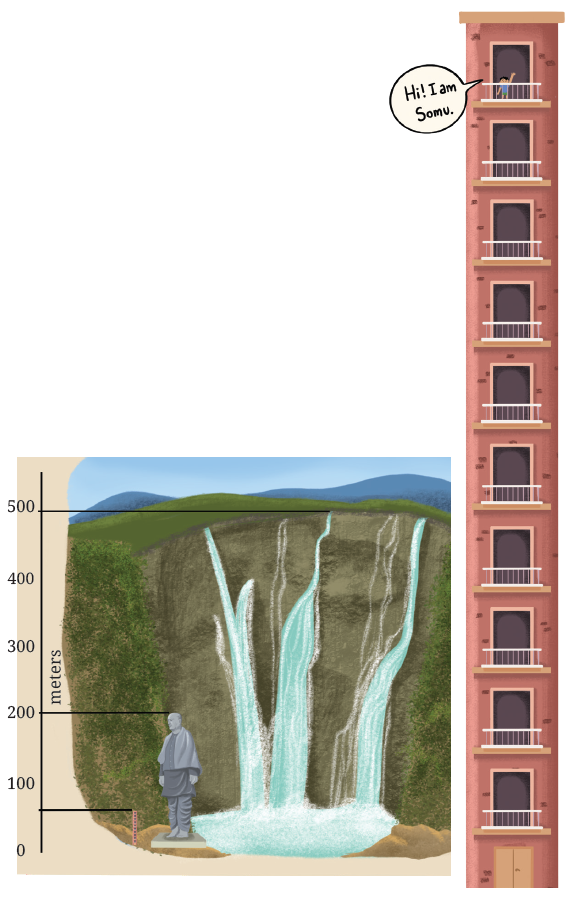
Question 1. Which is taller — The Statue of Unity or this building? How much taller?
Answer:
Given:
1. The approximate height of the building is $40\text{ m}$.
2. The Statue of Unity is $140\text{ m}$ taller than the building.
To Find:
Which structure is taller and the exact difference in their heights.
Solution:
First, we calculate the total height of the Statue of Unity by adding the given difference to the building's height:
$\text{Height of Statue of Unity} = 40\text{ m} + 140\text{ m}$
$\text{Height of Statue of Unity} = 180\text{ m}$
Now, we compare the height of the Statue of Unity with the height of the building:
Height of the Statue of Unity = $180\text{ m}$
Height of the building = $40\text{ m}$
$180\text{ m} > 40\text{ m}$
(Comparison of heights)
Since the height of the statue is greater than the height of the building, the Statue of Unity is taller.
To find how much taller it is, we look at the difference provided:
$\text{Difference} = 180\text{ m} - 40\text{ m}$
(Subtraction of heights)
$\text{Difference} = 140\text{ m}$
Final Answer: The Statue of Unity is taller than the building by $140\text{ meters}$.
Alternate Solution:
The problem directly states that the Statue of Unity is $140\text{ m}$ taller than the building. In an additive comparison, if object A is $x$ units taller than object B, then object A is the taller one and the difference is exactly $x$ units.
Therefore, without calculating the absolute height, we can conclude that the Statue of Unity is taller by $140\text{ m}$.
Question 2. We can see that the height of the Statue of Unity is close to $4$ times the height of Somu’s building.
How much taller is the Kunchikal waterfall than Somu's building?
Answer:
Given:
1. The approximate height of Somu's building is $40\text{ meters}$.
2. The approximate height of the Kunchikal waterfall is $450\text{ meters}$.
To Find:
The difference in height between the Kunchikal waterfall and Somu's building.
Solution:
To find how much taller the waterfall is, we subtract the height of the building from the height of the waterfall:
$\text{Difference} = \text{Height of Waterfall} - \text{Height of Building}$
$\text{Difference} = 450\text{ m} - 40\text{ m}$
$\text{Difference} = 410\text{ m}$
Therefore, the Kunchikal waterfall is $410\text{ meters}$ taller than Somu's building.
Question 3. How many floors should Somu’s building have to be as high as the waterfall?
Answer:
Given:
1. The height of Somu's building is $40\text{ meters}$.
2. The number of floors in the building is $10$ floors.
3. The height of the Kunchikal waterfall is $450\text{ meters}$.
To Find:
The total number of floors required to reach the height of the waterfall.
Solution:
First, we calculate the height of a single floor of the building:
$\text{Height of one floor} = \frac{\text{Total height}}{\text{Number of floors}}$
(Formula for uniform floor height)
$\text{Height of one floor} = \frac{40\text{ m}}{10}$
$\text{Height of one floor} = 4\text{ meters}$
Now, we find how many such floors are needed to equal the height of the waterfall ($450\text{ meters}$):
$\text{Required floors} = \frac{\text{Height of Waterfall}}{\text{Height of one floor}}$
(Division for floor count)
$\text{Required floors} = \frac{450}{4}$
$\text{Required floors} = 112.5$
Since the number of floors is usually a whole number, we can say it is approximately $113$ floors.
Thus, Somu’s building should have approximately $113$ floors to be as high as the Kunchikal waterfall.
Alternate Solution:
We can use a simple ratio to find the number of floors:
$40\text{ m}$ height is equivalent to $10$ floors.
$1\text{ m}$ height is equivalent to $\frac{10}{40}$ floors.
$450\text{ m}$ height is equivalent to $\frac{10}{40} \times 450$ floors.
$\text{Number of floors} = \frac{450}{4} = 112.5 \approx 113$ floors.
Intext Questions (Page No. 4 - 5)
Question. Write each of the numbers given below in words:
(a) $3,00,600$
(b) $5,04,085$
(c) $27,30,000$
(d) $70,53,138$
Answer:
Solution:
Using the Indian Place Value System, we can write the given numbers in words as follows:
(a) $3,00,600$: Three lakh six hundred
(b) $5,04,085$: Five lakh four thousand eighty-five
(c) $27,30,000$: Twenty-seven lakh thirty thousand
(d) $70,53,138$: Seventy lakh fifty-three thousand one hundred thirty-eight
Question. Write the corresponding number in the Indian place value system for each of the following:
(a) One lakh twenty three thousand four hundred and fifty six
(b) Four lakh seven thousand seven hundred and four
(c) Fifty lakhs five thousand and fifty
(d) Ten lakhs two hundred and thirty five
Answer:
Solution:
The numerical representation for each word expression is:
(a) One lakh twenty-three thousand four hundred and fifty-six: $1,23,456$
(b) Four lakh seven thousand seven hundred and four: $4,07,704$
(c) Fifty lakhs five thousand and fifty: $50,05,050$
(d) Ten lakhs two hundred and thirty-five: $10,00,235$
Intext Questions (Page No. 5 - 6)
In the Land of Tens, there are special calculators with special buttons.
Question 1. The Thoughtful Thousands only has a $+1000$ button. How many times should it be pressed to show:
(a) Three thousand? $3$ times
(b) $10,000$? ____________
(c) Fifty three thousand? ___________
(d) $90,000$? ______________
(e) One Lakh? ________________
(f) ___________? $153$ times
(g) How many thousands are required to make one lakh?
Answer:
Solution:
Since the button adds $1,000$ each time, we divide the target number by $1,000$ to find the number of presses.
(b) For $10,000$: $10,000 \div 1,000 = \mathbf{10}$ times
(c) For Fifty three thousand ($53,000$): $53,000 \div 1,000 = \mathbf{53}$ times
(d) For $90,000$: $90,000 \div 1,000 = \mathbf{90}$ times
(e) For One Lakh ($1,00,000$): $1,00,000 \div 1,000 = \mathbf{100}$ times
(f) For $153$ times: $153 \times 1,000 = \mathbf{1,53,000}$ (One lakh fifty-three thousand)
(g) To make one lakh, $100$ thousands are required.
Question 2. The Tedious Tens only has a $+10$ button. How many times should it be pressed to show:
(a) Five hundred? _____________
(b) $780$? _________
(c) $1000$? _________
(d) $3700$? ________
(e) $10,000$? ___________
(f) One lakh? _____________
(g) ___________? $435$ times
Answer:
Solution:
We divide the target number by $10$ to find the number of presses.
(a) Five hundred ($500$): $500 \div 10 = \mathbf{50}$ times
(b) $780$: $780 \div 10 = \mathbf{78}$ times
(c) $1,000$: $1,000 \div 10 = \mathbf{100}$ times
(d) $3,700$: $3,700 \div 10 = \mathbf{370}$ times
(e) $10,000$: $10,000 \div 10 = \mathbf{1,000}$ times
(f) One lakh ($1,00,000$): $1,00,000 \div 10 = \mathbf{10,000}$ times
(g) For $435$ times: $435 \times 10 = \mathbf{4,350}$
Question 3. The Handy Hundreds only has a $+100$ button. How many times should it be pressed to show:
(a) Four hundred? ___________times
(b) $3,700$? __________
(c) $10,000$? __________
(d) Fifty three thousand? __________
(e) $90,000$? __________
(f) $97,600$? __________
(g) $1,00,000$? __________
(h) ________? $582$ times
(i) How many hundreds are required to make ten thousand?
(j) How many hundreds are required to make one lakh?
(k) Handy Hundreds says, “There are some numbers which Tedious Tens and Thoughtful Thousands can’t show but I can.” Is this statement true? Think and explore.
Answer:
Solution:
We divide the target number by $100$ to find the number of presses.
(a) Four hundred ($400$): $400 \div 100 = \mathbf{4}$ times
(b) $3,700$: $3,700 \div 100 = \mathbf{37}$ times
(c) $10,000$: $10,000 \div 100 = \mathbf{100}$ times
(d) Fifty three thousand ($53,000$): $53,000 \div 100 = \mathbf{530}$ times
(e) $90,000$: $90,000 \div 100 = \mathbf{900}$ times
(f) $97,600$: $97,600 \div 100 = \mathbf{976}$ times
(g) $1,00,000$: $1,00,000 \div 100 = \mathbf{1,000}$ times
(h) For $582$ times: $582 \times 100 = \mathbf{58,200}$
(i) $100$ hundreds are required to make ten thousand ($10,000$).
(j) $1,000$ hundreds are required to make one lakh ($1,00,000$).
(k) Statement Analysis:
No, the statement is not true.
Reason: Every number that can be shown by Handy Hundreds (multiples of $100$) can also be shown by Tedious Tens (multiples of $10$). For example, to show $500$, Handy Hundreds is pressed $5$ times, while Tedious Tens would be pressed $50$ times. Since every multiple of $100$ is also a multiple of $10$, Tedious Tens can show everything Handy Hundreds can.
Question 4. Creative Chitti is a different kind of calculator. It has the following buttons: $+1$, $+10$, $+100$, $+1000$, $+10000$, $+100000$ and $+1000000$. It always has multiple ways of doing things. “How so?”, you might ask.
To get the number $321$, it presses $+10$ thirty two times and $+1$ once. Will it get $321$? Alternatively, it can press $+100$ two times and $+10$ twelve times and $+1$ once.
Find a different way to get $5072$ and write an expression for the same.
Answer:
Given:
Buttons available on the calculator: $+1$, $+10$, $+100$, $+1000$, $+10000$, $+100000$, and $+1000000$.
Target Number: $5072$
To Find:
Different ways to obtain the sum $5072$ using the available buttons and writing their mathematical expressions.
Solution:
The standard way to represent $5072$ using place value is 5 thousands, 0 hundreds, 7 tens, and 2 ones. However, Creative Chitti can use various combinations by decomposing higher place values into lower ones.
For example, $1$ thousand can be replaced by $10$ hundreds, or $1$ hundred can be replaced by $10$ tens.
Let us explore multiple ways in the table below:
| Way | Buttons Used (Combinations) | Mathematical Expression |
| 1 | 5 buttons of $+1000$, 7 buttons of $+10$, 2 buttons of $+1$ | $(5 \times 1000) + (7 \times 10) + (2 \times 1)$ |
| 2 | 4 buttons of $+1000$, 10 buttons of $+100$, 7 buttons of $+10$, 2 buttons of $+1$ | $(4 \times 1000) + (10 \times 100) + (7 \times 10) + (2 \times 1)$ |
| 3 | 50 buttons of $+100$, 7 buttons of $+10$, 2 buttons of $+1$ | $(50 \times 100) + (7 \times 10) + (2 \times 1)$ |
| 4 | 507 buttons of $+10$, 2 buttons of $+1$ | $(507 \times 10) + (2 \times 1)$ |
| 5 | 5 buttons of $+1000$, 6 buttons of $+10$, 12 buttons of $+1$ | $(5 \times 1000) + (6 \times 10) + (12 \times 1)$ |
Figure it Out (Page No. 6 - 7)
Question. For each number given below, write expressions for at least two different ways to obtain the number through button clicks. Think like Chitti and be creative.
(a) $8300$
(b) $40629$
(c) $56354$
(d) $66666$
(e) $367813$
Answer:
Given:
Available buttons: $+1$, $+10$, $+100$, $+1000$, $+10000$, $+100000$, and $+1000000$.
To Find:
At least two different expressions for the given numbers using combinations of these buttons.
Solution:
We can represent each number by grouping the digits according to their place values or by decomposing larger units into smaller ones (e.g., $1$ thousand = $10$ hundreds).
| Number | Way 1 (Standard) | Way 2 (Creative) |
| (a) $8300$ | $(8 \times 1000) $$ + (3 \times 100)$ | $(7 \times 1000) $$ + (13 \times 100)$ |
| (b) $40629$ | $(4 \times 10000) $$ + (6 \times 100) $$ + (2 \times 10) $$ + (9 \times 1)$ | $(40 \times 1000) $$ + (62 \times 10) $$ + (9 \times 1)$ |
| (c) $56354$ | $(5 \times 10000) $$ + (6 \times 1000) $$ + (3 \times 100) $$ + (5 \times 10) $$ + (4 \times 1)$ | $(56 \times 1000) $$ + (35 \times 10) $$ + (4 \times 1)$ |
| (d) $66666$ | $(6 \times 10000) $$ + (6 \times 1000) $$ + (6 \times 100) $$ + (6 \times 10) $$ + (6 \times 1)$ | $(66 \times 1000) $$ + (66 \times 10) $$ + (6 \times 1)$ |
| (e) $367813$ | $(3 \times 100000) $$ + (6 \times 10000) $$ + (7 \times 1000) $$ + (8 \times 100) $$ + (1 \times 10) $$ + (3 \times 1)$ | $(367 \times 1000) $$ + (81 \times 10) $$ + (3 \times 1)$ |
In Way 2, we have combined place values to use fewer types of buttons but more clicks of a specific button, just like Chitti.
Question. Creative Chitti has some questions for you —
(a) You have to make exactly $30$ button presses. What is the largest $3$-digit number you can make? What is the smallest $3$-digit number you can make?
(b) $997$ can be made using $25$ clicks. Can you make $997$ with a different number of clicks?
Answer:
Solution for Part (a):
We have to use exactly 30 clicks to form $3$-digit numbers.
1. To find the Largest $3$-digit number:
To make the number as large as possible, we should use the $+100$ button as many times as we can without crossing $999$.
Let's use the $+100$ button 9 times.
$9 \times 100 = 900$
(9 clicks used)
Now we have $30 - 9 = 21$ clicks left. We use the $+10$ button next.
If we use $+10$ button 8 times:
$8 \times 10 = 80$
(8 clicks used)
Remaining clicks $= 21 - 8 = 13$. We use these for the $+1$ button:
$13 \times 1 = 13$
(13 clicks used)
Total clicks $= 9 + 8 + 13 = 30$ clicks.
Total value $= 900 + 80 + 13 = 993$.
If we used one more '10' button, the number would become $1002$, which is a $4$-digit number. So, the largest $3$-digit number is $993$.
2. To find the Smallest $3$-digit number:
To make the number small, we should use the $+1$ and $+10$ buttons as much as possible because they increase the value slowly.
The smallest $3$-digit number is $100$. Let's try to get close to it using $30$ clicks.
If we use the $+10$ button 8 times and $+1$ button 22 times:
$Value = (8 \times 10) + (22 \times 1)$
$Value = 80 + 22 = 102$
($8 + 22 = 30$ clicks)
If we used only $7$ buttons of $+10$, the total would be $70 + 23 = 93$, which is a $2$-digit number. So, the smallest $3$-digit number is $102$.
Solution for Part (b):
Yes, $997$ can be made using a different number of clicks.
In the question, $997$ is made using $25$ clicks as: $(9 \times 100) + (9 \times 10) + (7 \times 1)$.
We can get a different number of clicks by exchanging a larger button for smaller ones. For example, $1$ click of $+100$ is equal to $10$ clicks of $+10$.
New Way: Use 8 clicks of $+100$ and 19 clicks of $+10$ and 7 clicks of $+1$.
$Value = 800 + 190 + 7 = 997$
Now, let's count the clicks:
$Clicks = 8 + 19 + 7 = 34$
(Different from 25)
So, we can make $997$ using $34$ clicks (or even more if we keep exchanging buttons for smaller ones).
Intext Questions (Page No. 7)
Question. Systematic Sippy is a different kind of calculator. It has the following buttons: $+1$, $+10$, $+100$, $+1000$, $+10000$, $+100000$. It wants to be used as minimally as possible.
How can we get the numbers using as few button clicks as possible?
(a) $5072$
(b) $8300$
Answer:
To Find:
The smallest number of button clicks required to form the numbers $5072$ and $8300$.
Solution:
To use the minimum number of clicks, we must use the largest possible button values first. This is equivalent to writing the number in its standard expanded form.
(a) For $5072$:
We use the highest available button ($1000$) for the thousands place, then skip the hundreds (since it is $0$), use the tens button, and finally the ones button.
$5072 = (5 \times 1000) + (7 \times 10) + (2 \times 1)$
Number of clicks:
$5 + 7 + 2 = 14$
(Minimal Clicks)
(b) For $8300$:
We use the thousands button and the hundreds button.
$8300 = (8 \times 1000) + (3 \times 100)$
Number of clicks:
$8 + 3 = 11$
(Minimal Clicks)
Figure it Out (Page No. 7)
Question 1. For the numbers in the previous exercise, find out how to get each number by making the smallest number of button clicks and write the expression.
Answer:
Solution:
The previous exercise included the numbers: (a) $8300$, (b) $40629$, (c) $56354$, (d) $66666$, and (e) $367813$. To get the smallest number of clicks, we use the place value expansion:
| Number | Smallest Clicks Expression | Total Clicks |
| $8300$ | $(8 \times 1000) $$ + (3 \times 100)$ | $8+3 = 11$ |
| $40629$ | $(4 \times 10000) $$ + (6 \times 100) $$ + (2 \times 10) $$ + (9 \times 1)$ | $4+0+6+2+9 = 21$ |
| $56354$ | $(5 \times 10000) $$ + (6 \times 1000) $$ + (3 \times 100) $$ + (5 \times 10) $$ + (4 \times 1)$ | $5+6+3+5+4 = 23$ |
| $66666$ | $(6 \times 10000) $$ + (6 \times 1000) $$ + (6 \times 100) $$ + (6 \times 10) $$ + (6 \times 1)$ | $6+6+6+6+6 = 30$ |
| $367813$ | $(3 \times 100000) $$ + (6 \times 10000) $$ + (7 \times 1000) $$ + (8 \times 100) $$ + (1 \times 10) $$ + (3 \times 1)$ | $3+6+7+8+1+3 = 28$ |
Question 2. Do you see any connection between each number and the corresponding smallest number of button clicks?
Answer:
Observation:
By observing the table in the previous question, we can see a clear pattern.
For example, for the number $40629$, the smallest number of clicks is $4 + 0 + 6 + 2 + 9 = 21$.
Conclusion:
The smallest number of button clicks is exactly equal to the sum of the digits of the given number.
Question 3. If you notice, the expressions for the least button clicks also give the Indian place value notation of the numbers. Think about why this is so.
Answer:
Reasoning:
This happens because our number system (the decimal system) is based on powers of $10$. Each button on Systematic Sippy ($+1$, $+10$, $+100$, etc.) represents a specific place value ($10^0$, $10^1$, $10^2$, etc.).
To use the least clicks, we always use the largest available denomination for each place. For example, to get $50$, we press $+10$ five times (5 clicks) instead of $+1$ fifty times (50 clicks). This matches the logic of our place value system, where we group units into tens, tens into hundreds, and so on.
We group numbers using lakhs and crores, but the fundamental logic of using the highest units to minimize counting remains the same as Systematic Sippy's logic.
Intext Questions (Page No. 8 - 9)
Question. How many zeros does a thousand lakh have? _____
Answer:
Calculation:
In the Indian system, $1$ lakh is written as $1,00,000$.
$1 \text{ lakh} = 10^5$
(5 zeros)
Now, a thousand lakh means:
$1000 \times 1,00,000 = 10,00,00,000$
Counting the zeros in $10,00,00,000$:
$Zeros = 8$
Final Answer:
A thousand lakh has $8$ zeros. (This is also called $10$ crores).
Question. How many zeros does a hundred thousand have? ____
Answer:
Calculation:
A hundred thousand means:
$100 \times 1000$
Multiplying these:
$100 \times 1000 = 1,00,000$
Counting the zeros in $1,00,000$:
$Zeros = 5$
Final Answer:
A hundred thousand has $5$ zeros. (In the Indian system, this is equal to $1$ lakh).
Figure it Out (Page No. 9)
Question 1. Read the following numbers in Indian place value notation and write their number names in both the Indian and American systems:
(a) $4050678$
(b) $48121620$
(c) $20022002$
(d) $246813579$
(e) $345000543$
(f) $1020304050$
Answer:
Solution:
To write number names, we first place commas according to the respective systems. In the Indian system, the first comma is after $3$ digits and then every $2$ digits. In the American (International) system, commas are placed after every $3$ digits.
| Number | Indian System (Notation & Name) | American System (Notation & Name) |
| (a) $4050678$ | $40,50,678$: Forty lakh fifty thousand six hundred seventy-eight | $4,050,678$: Four million fifty thousand six hundred seventy-eight |
| (b) $48121620$ | $4,81,21,620$: Four crore eighty-one lakh twenty-one thousand six hundred twenty | $48,121,620$: Forty-eight million one hundred twenty-one thousand six hundred twenty |
| (c) $20022002$ | $2,00,22,002$: Two crore twenty-two thousand two | $20,022,002$: Twenty million twenty-two thousand two |
| (d) $246813579$ | $24,68,13,579$: Twenty-four crore sixty-eight lakh thirteen thousand five hundred seventy-nine | $246,813,579$: Two hundred forty-six million eight hundred thirteen thousand five hundred seventy-nine |
| (e) $345000543$ | $34,50,00,543$: Thirty-four crore fifty lakh five hundred forty-three | $345,000,543$: Three hundred forty-five million five hundred forty-three |
| (f) $1020304050$ | $1,02,03,04,050$: One hundred two crore three lakh four thousand fifty | $1,020,304,050$: One billion twenty million three hundred four thousand fifty |
Question 2. Write the following numbers in Indian place value notation:
(a) One crore one lakh one thousand ten
(b) One billion one million one thousand one
(c) Ten crore twenty lakh thirty thousand forty
(d) Nine billion eighty million seven hundred thousand six hundred
Answer:
Solution:
We convert the word forms into digits and then apply the Indian comma pattern (e.g., $1,00,00,000$).
(a) One crore one lakh one thousand ten
$1,01,01,010$
(b) One billion one million one thousand one
First, identify the value: $1$ billion $= 100$ crore, $1$ million $= 10$ lakh.
Value $= 1,00,10,01,001$
$1,00,10,01,001$
(One hundred crore ten lakh one thousand one)
(c) Ten crore twenty lakh thirty thousand forty
$10,20,30,040$
(d) Nine billion eighty million seven hundred thousand six hundred
Value $= 9,08,07,00,600$
$9,08,07,00,600$
(Nine hundred eight crore seven lakh six hundred)
Question 3. Compare and write ‘$<$’, ‘$>$’ or ‘$=$’:
(a) $30$ thousand ____ $3$ lakhs
(b) $500$ lakhs ______ $5$ million
(c) $800$ thousand ____ $8$ million
(d) $640$ crore ______ $60$ billion
Answer:
Solution:
To compare, we convert both sides to the same unit or standard numerical form.
(a) $30$ thousand ____ $3$ lakhs
$30,000$ vs $3,00,000$
$30$ thousand $<$ $3$ lakhs
(b) $500$ lakhs ______ $5$ million
$500 \text{ lakhs} = 5 \text{ crores} = 50,000,000$
$5 \text{ million} = 50 \text{ lakhs} = 5,000,000$
$500$ lakhs $>$ $5$ million
(c) $800$ thousand ____ $8$ million
$800,000$ vs $8,000,000$
$800$ thousand $<$ $8$ million
(d) $640$ crore ______ $60$ billion
$60 \text{ billion} = 6000 \text{ crore}$ (since $1$ billion $= 100$ crore)
$640 \text{ crore} < 6000 \text{ crore}$
$640$ crore $<$ $60$ billion
Intext Questions (Page No. 10)
Question 1. Think and share situations where it is appropriate to:
(a) round up
(b) round down
(c) either rounding up or rounding down is okay
(d) when exact numbers are needed
Answer:
Solution:
(a) Round up: When buying supplies to ensure you don't run out. For example, if a recipe needs $2.2$ litres of milk, you buy $3$ litres. Also, when booking a taxi for $5$ people where the car fits $4$, you need $2$ cars (rounding up the number of cars).
(b) Round down: When calculating if you have enough money. If you have $\textsf{₹} 495$ and want to buy items worth $\textsf{₹} 100$ each, you round down to realize you can only buy $4$ items. Also, when stating one's age, we usually round down to the last birthday.
(c) Either: When estimating the number of people at a large public gathering or a wedding. Whether you say $500$ or $550$ for a crowd of $523$, it conveys the general scale effectively.
(d) Exact numbers: In financial transactions, bank account balances, medicine dosages, phone numbers, and PIN codes. Here, even a difference of $1$ can cause a major error.
Intext Questions (Page No. 11)
Question 1. With large numbers it is useful to know the nearest thousand, lakh or crore. For example, the nearest neighbours of the number $6,72,85,183$ are shown in the table below.
| Nearest thousand | $6,72,85,000$ |
| Nearest ten thousand | $6,72,90,000$ |
| Nearest lakh | $6,73,00,000$ |
| Nearest ten lakh | $6,70,00,000$ |
| Nearest crore | $7,00,00,000$ |
Similarly, write the five nearest neighbours for these numbers:
(a) $3,87,69,957$
(b) $29,05,32,481$
Answer:
Solution:
We apply the rules of rounding: if the digit to the right of the place value is $5$ or more, we round up; otherwise, we round down.
(a) For $3,87,69,957$:
| Rounding Type | Nearest Neighbour |
| Nearest thousand | $3,87,70,000$ |
| Nearest ten thousand | $3,87,70,000$ |
| Nearest lakh | $3,88,00,000$ |
| Nearest ten lakh | $3,90,00,000$ |
| Nearest crore | $4,00,00,000$ |
(b) For $29,05,32,481$:
| Rounding Type | Nearest Neighbour |
| Nearest thousand | $29,05,32,000$ |
| Nearest ten thousand | $29,05,30,000$ |
| Nearest lakh | $29,05,00,000$ |
| Nearest ten lakh | $29,10,00,000$ |
| Nearest crore | $29,00,00,000$ |
Question 2. I have a number for which all five nearest neighbours are $5,00,00,000$. What could the number be? How many such numbers are there?
Answer:
Solution:
For all five neighbours (thousand, ten thousand, lakh, ten lakh, and crore) to be exactly $5,00,00,000$, the number must be very close to $5$ crore.
To have $5,00,00,000$ as the nearest thousand, the number must be in the range:
$4,99,99,500 \leq x < 5,00,00,500$
If the number is within this narrow range, it will also automatically round to $5,00,00,000$ for all the larger place values (ten thousand, lakh, etc.).
Example of such a number: $5,00,00,123$ or $4,99,99,999$.
How many such numbers:
The smallest integer is $4,99,99,500$ and the largest integer is $5,00,00,499$.
$Total = 5,00,00,499 - 4,99,99,500 + 1$
$Total = 1000$
There are $1000$ such whole numbers.
Intext Questions (Page No. 12 - 13)
Observe the populations of some Indian cities in the table below.
| Rank | City | Population ($2011$) | Population ($2001$) |
|---|---|---|---|
| $1$ | Mumbai | $1,24,42,373$ | $1,19,78,450$ |
| $2$ | New Delhi | $1,10,07,835$ | $98,79,172$ |
| $3$ | Bengaluru | $84,25,970$ | $43,01,326$ |
| $4$ | Hyderabad | $68,09,970$ | $36,37,483$ |
| $5$ | Ahmedabad | $55,70,585$ | $35,20,085$ |
| $6$ | Chennai | $46,81,087$ | $43,43,645$ |
| $7$ | Kolkata | $44,86,679$ | $45,72,876$ |
| $8$ | Surat | $44,67,797$ | $24,33,835$ |
| $9$ | Vadodara | $35,52,371$ | $16,90,000$ |
| $10$ | Pune | $31,15,431$ | $25,38,473$ |
| $11$ | Jaipur | $30,46,163$ | $23,22,575$ |
| $12$ | Lucknow | $28,15,601$ | $21,85,927$ |
| $13$ | Kanpur | $27,67,031$ | $25,51,337$ |
| $14$ | Nagpur | $24,05,665$ | $20,52,066$ |
| $15$ | Indore | $19,60,631$ | $14,74,968$ |
| $16$ | Thane | $18,18,872$ | $12,62,551$ |
| $17$ | Bhopal | $17,98,218$ | $14,37,354$ |
| $18$ | Visakhapatnam | $17,28,128$ | $13,45,938$ |
| $19$ | Pimpri-Chinchwad | $17,27,692$ | $10,12,472$ |
| $20$ | Patna | $16,84,222$ | $13,66,444$ |
Question. From the information given in the table, answer the following question by approximation:
1. What is your general observation about this data? Share it with the class.
2. What is an appropriate title for the above table?
3. How much is the population of Pune in $2011$? Approximately, by how much has it increased compared to $2001$?
4. Which city’s population increased the most between $2001$ and $2011$?
5. Are there cities whose population has almost doubled? Which are they?
6. By what number should we multiply Patna’s population to get a number/population close to that of Mumbai?
Answer:
General Observations:
The data reveals a significant trend of rapid urbanization in India between $2001$ and $2011$. Most major cities saw a substantial rise in population, reflecting migration and urban growth. While most cities grew, Kolkata is an interesting exception as its population showed a slight decline. Cities like Bengaluru and Surat experienced exceptionally high growth rates compared to the older metropolitan hubs.
Appropriate Title:
"Comparative Population Analysis of Major Indian Cities ($2001$–$2011$)"
Population of Pune:
In $2011$, the population of Pune was $31,15,431$ (approximately $31.15$ lakhs).
Compared to its $2001$ population of $25,38,473$, the population increased by approximately $5,76,958$. In simpler terms, Pune's population grew by nearly $5.77$ lakh people over the decade.
City with the Highest Increase:
Among all the cities listed, Bengaluru witnessed the most dramatic increase in population. Its population jumped from approximately $43$ lakhs in $2001$ to over $84$ lakhs in $2011$, marking an absolute increase of more than $41$ lakh people.
Cities that Almost Doubled:
Based on the approximation of the $2001$ and $2011$ figures, the following cities saw their populations almost double or more than double:
1. Bengaluru: Increased from approx $43$ lakhs to $84$ lakhs (Nearly double).
2. Vadodara: Increased from approx $16.9$ lakhs to $35.5$ lakhs (More than double).
3. Surat: Increased from approx $24.3$ lakhs to $44.6$ lakhs (Significant growth, close to doubling).
4. Pimpri-Chinchwad: Increased from approx $10.1$ lakhs to $17.2$ lakhs (Nearly double).
Patna vs Mumbai Population:
The population of Patna is approximately $16.84$ lakhs, while Mumbai’s population is approximately $124.42$ lakhs.
To reach a number close to Mumbai's population, we should multiply Patna’s population by approximately $7$ or $8$.
$16.84 \times 7.4 \approx 124.42$
[Approximate Factor]
Intext Questions (Page No. 14)
Question. Using the meaning of multiplication and division, can you explain why multiplying by $5$ is the same as dividing by $2$ and multiplying by $10$?
Answer:
Proof/Explanation:
Mathematically, the number $5$ can be expressed as a fraction:
$5 = \frac{10}{2}$
When we multiply any number $x$ by $5$, we can substitute $5$ with $\frac{10}{2}$:
$x \times 5 = x \times \left( \frac{10}{2} \right)$
According to the rules of multiplication and division:
$x \times 5 = \frac{x \times 10}{2}$
This shows that multiplying by $5$ is equivalent to first multiplying the number by $10$ and then dividing the result by $2$. For example, $12 \times 5$ is $60$, and $(12 \times 10) \div 2 = 120 \div 2 = 60$.
Figure it Out (Page No. 14)
Question 1. Find quick ways to calculate these products:
(a) $2 \times 1768 \times 50$
(b) $72 \times 125$ [Hint: $125 = \frac{1000}{8}$]
(c) $125 \times 40 \times 8 \times 25$
Answer:
(a) $2 \times 1768 \times 50$
We can regroup the numbers to make the multiplication easier:
$= (2 \times 50) \times 1768$
$= 100 \times 1768 = 1,76,800$
(b) $72 \times 125$
Using the hint $125 = \frac{1000}{8}$:
$= 72 \times \frac{1000}{8}$
$= \frac{72}{8} \times 1000$
$= 9 \times 1000 = 9,000$
(c) $125 \times 40 \times 8 \times 25$
Regrouping to form powers of $10$:
$= (125 \times 8) \times (40 \times 25)$
$= 1000 \times 1000 = 10,00,000$
Question 2. Calculate these products quickly.
(a) $25 \times 12 = $ _____________
(b) $25 \times 240 = $ _____________
(c) $250 \times 120 = $ _____________
(d) $2500 \times 12 = $ _____________
(e) ______ $\times$ ______ $= 120000000$
Answer:
(a) $25 \times 12$
$25 \times 12 = \frac{100}{4} \times 12$
[Replacing $25$ with $\frac{100}{4}$]
$ = 100 \times \frac{\cancel{12}^{3}}{\cancel{4}_{1}}$
$ = 100 \times 3 = 300$
Final Answer: $300$
(b) $25 \times 240$
$25 \times 240 = \frac{100}{4} \times 240$
$ = 100 \times \frac{\cancel{240}^{60}}{\cancel{4}_{1}}$
$ = 100 \times 60 = 6,000$
Final Answer: $6,000$
(c) $250 \times 120$
We can write $250$ as $25 \times 10$ and then use the fraction:
$250 \times 120 = (25 \times 10) \times 120$
$ = \frac{100}{4} \times 1200$
$ = 100 \times \frac{\cancel{1200}^{300}}{\cancel{4}_{1}}$
$ = 100 \times 300 = 30,000$
Final Answer: $30,000$
(d) $2500 \times 12$
We can write $2500$ as $25 \times 100$ and then use the fraction:
$2500 \times 12 = (25 \times 100) \times 12$
$ = \frac{100}{4} \times 100 \times 12$
$ = 10000 \times \frac{\cancel{12}^{3}}{\cancel{4}_{1}}$
$ = 10000 \times 3 = 30,000$
Final Answer: $30,000$
(e) ______ $\times$ ______ $= 12,00,00,000$
The easiest way to find factors for a large number like Twelve Crore ($12,00,00,000$) is to split the number based on its digits and its zeros (powers of $10$).
Using the property of powers of $10$:
$12 \times 1,00,00,000 = 12,00,00,000$
(Twelve $\times$ One crore)
Alternatively, we can split it into $12,000$ and $10,000$:
$12,000 \times 10,000 = 12,00,00,000$
(Combining zeros)
Final Answer: $12,000$ $\times$ $10,000$ $= 12,00,00,000$
Intext Questions (Page No. 14 - 15)
In each of the following boxes, the multiplications produce interesting patterns. Evaluate them to find the pattern. Extend the multiplications based on the observed pattern.
$11 \times 11 =$
$111 \times 111 =$
$1111 \times 1111 =$
$66 \times 61 =$
$666 \times 661 =$
$6666 \times 6661 =$
$3 \times 5 =$
$33 \times 35 =$
$333 \times 335 =$
$101 \times 101 =$
$102 \times 102 =$
$103 \times 103 =$
Pattern Evaluation and Extension:
Box 1: Squares of numbers consisting only of 1s
$11 \times 11 = 121$
$111 \times 111 = 12321$
$1111 \times 1111 = 1234321$
Extension: $11111 \times 11111 = 123454321$
Box 2: Multiplications involving 6s
$66 \times 61 = 4026$
$666 \times 661 = 440226$
$6666 \times 6661 = 44402226$
Extension: $66666 \times 66661 = 4444022226$
Box 3: Multiplications involving 3s and 5
$3 \times 5 = 15$
$33 \times 35 = 1155$
$333 \times 335 = 111555$
Extension: $3333 \times 3335 = 11115555$
Box 4: Squares of numbers near 100
$101 \times 101 = 10201$
$102 \times 102 = 10404$
$103 \times 103 = 10609$
Extension: $104 \times 104 = 10816$
Question. Observe the number of digits in the two numbers being multiplied and their product in each case. Is there any connection between the numbers being multiplied and the number of digits in their product?
Answer:
Observation:
If we multiply a number with $m$ digits and a number with $n$ digits, we observe a consistent rule regarding the number of digits in the resulting product.
1. In Box 1 ($3$-digits $\times$ $3$-digits), the product $12321$ has $5$ digits. ($3 + 3 - 1 = 5$)
2. In Box 3 ($2$-digits $\times$ $2$-digits), the product $1155$ has $4$ digits. ($2 + 2 = 4$)
Conclusion:
The number of digits in the product of an $n$-digit number and an $m$-digit number is always either $(n + m)$ or $(n + m - 1)$.
Question. Roxie says that the product of two $2$-digit numbers can only be a $3$- or a $4$-digit number. Is she correct?
Answer:
Verification:
Yes, Roxie is correct. We can verify this by checking the smallest and largest possible $2$-digit numbers.
1. Smallest $2$-digit product:
$10 \times 10 = 100$
(Smallest 3-digit number)
2. Largest $2$-digit product:
$99 \times 99 = 9801$
(Largest 4-digit product)
Since the smallest product is $3$-digits and the largest is $4$-digits, all other products must fall within this range.
Question. Should we try all possible multiplications with $2$-digit numbers to tell whether Roxie’s claim is true? Or is there a better way to find out?
She explains her reasoning: “We want to know about the number of digits in the product of two $2$-digit numbers. To know the smallest such product I took $10 \times 10$, so all other products will be greater than $100$. To know the greatest such product I multiplied the smallest $3$-digit numbers ($100 \times 100$) to get $10,000$; so the product of all the $2$-digit multiplications will be less than $10,000$.”
Answer:
Solution:
No, we do not need to try all possible multiplications. There is a much better and faster way using the concept of boundary values.
By testing only the extremes (the smallest possible values and the smallest values of the next digit category), we can determine the entire possible range of digits for any multiplication.
As Roxie explained:
$\bullet$ To find the minimum digits, multiply the smallest $2$-digit numbers: $10 \times 10 = 100$ ($3$ digits).
$\bullet$ To find the maximum digits, multiply the smallest $3$-digit numbers: $100 \times 100 = 10,000$. Since $99 \times 99$ must be less than $10,000$, it can have at most $4$ digits.
Question. Can multiplying a $3$-digit number with another $3$-digit number give a $4$-digit number?
Answer:
Analysis:
To find the smallest possible product of two $3$-digit numbers, we multiply the smallest $3$-digit number by itself:
$100 \times 100 = 10,000$
The result, $10,000$, is a $5$-digit number. Since any other $3$-digit multiplication will involve numbers greater than or equal to $100$, the product will always be $10,000$ or more.
Final Answer:
No, multiplying a $3$-digit number with another $3$-digit number cannot give a $4$-digit number; it will always result in at least a $5$-digit number.
Question. Can multiplying a $4$-digit number with a $2$-digit number give a $5$-digit number?
Answer:
Analysis:
Let's find the range of digits for this multiplication.
1. Smallest product ($4$-digit $\times$ $2$-digit):
$1000 \times 10 = 10,000$
($5$ digits)
2. Largest product ($4$-digit $\times$ $2$-digit):
$9999 \times 99 = 9,89,901$
($6$ digits)
Final Answer:
Yes, multiplying a $4$-digit number with a $2$-digit number can result in a $5$-digit number (e.g., $1000 \times 10 = 10,000$) or a $6$-digit number.
Question. Observe the multiplication statements below. Do you notice any patterns? See if this pattern extends for other numbers as well.
$1$-digit $\times$ $1$-digit $=$ $1$-digit or $2$-digit
$2$-digit $\times$ $1$-digit $=$ $2$-digit or $3$-digit
$2$-digit $\times$ $2$-digit $=$ $3$-digit or $4$-digit
$3$-digit $\times$ $3$-digit $=$ $5$-digit or $6$-digit
$5$-digit $\times$ $5$-digit $=$ ______ or ______
$8$-digit $\times$ $3$-digit $=$ ______ or ______
$12$-digit $\times$ $13$-digit $=$ ______ or ______
Answer:
Pattern Discovery:
The pattern shows that the number of digits in the product of an $n$-digit and an $m$-digit number is either $(n+m)$ or $(n+m-1)$.
Completing the Pattern:
1. $5$-digit $\times$ $5$-digit:
Sum of digits $= 5 + 5 = 10$.
Result $=$ $9$-digit or $10$-digit
2. $8$-digit $\times$ $3$-digit:
Sum of digits $= 8 + 3 = 11$.
Result $=$ $10$-digit or $11$-digit
3. $12$-digit $\times$ $13$-digit:
Sum of digits $= 12 + 13 = 25$.
Result $=$ $24$-digit or $25$-digit
This pattern holds true for all whole numbers in the decimal system used in Indian mathematics.
Intext Questions (Page No. 19)
Question. The RMS Titanic ship carried about $2500$ passengers. Can the population of Mumbai fit into $5000$ such ships?
The population of Mumbai is more than $1$ crore $24$ lakhs.
Answer:
Given:
Capacity of one Titanic ship $\approx 2500$ passengers.
Number of ships $= 5000$.
Population of Mumbai $\approx 1,24,00,000$ (One crore twenty-four lakhs).
Solution:
First, we calculate the total capacity of $5000$ such ships:
$Total \ Capacity = 5000 \times 2500$
To multiply quickly: $5 \times 25 = 125$, and then add the five zeros from both numbers.
$Total \ Capacity = 1,25,00,000$
(One crore twenty-five lakhs)
Now, comparing the total capacity with the population of Mumbai:
$1,25,00,000 > 1,24,00,000$
Final Answer:
Yes, the population of Mumbai can fit into $5000$ such ships because the ships have a combined capacity of $1.25$ crore people, which is slightly more than Mumbai's population.
Question. Find out if you can reach the Sun in a lifetime, if you travel $1000$ kilometers every day. (You had written down the distance between the Earth and the Sun in a previous exercise.)
Answer:
Given:
Speed of travel $= 1000$ km per day.
Average distance from Earth to Sun $\approx 15,00,00,000$ km ($15$ crore km).
Average human lifetime $\approx 80$ years.
Solution:
First, let's calculate the total distance a person can travel in $80$ years.
Number of days in $80$ years:
$80 \times 365 = 29,200$ days
Total distance traveled in a lifetime:
$29,200 \times 1000 = 2,92,00,000$ km
(Two crore ninety-two lakh km)
Now, compare this with the distance to the Sun:
$2,92,00,000$ km $<$ $15,00,00,000$ km
Final Answer:
No, you cannot reach the Sun in a lifetime. Even at $1000$ km/day, you would only cover about $2.92$ crore km, which is much less than the $15$ crore km required to reach the Sun.
Question. Make necessary reasonable assumptions and answer the questions below:
(a) If a single sheet of paper weighs $5$ grams, could you lift one lakh sheets of paper together at the same time?
(b) If $250$ babies are born every minute across the world, will a million babies be born in a day?
(c) Can you count $1$ million coins in a day? Assume you can count $1$ coin every second.
Answer:
(a) Lifting one lakh sheets:
Weight of $1$ sheet $= 5$ g.
Weight of $1,00,000$ (one lakh) sheets:
$1,00,000 \times 5 = 5,00,000$ g
Converting grams to kilograms ($1000$ g $= 1$ kg):
$5,00,000 \div 1000 = 500$ kg
Conclusion: No, you cannot lift them. $500$ kg is equivalent to the weight of about $7$ to $8$ adults, which is impossible for one person to lift.
(b) Million babies in a day:
Number of minutes in a day $= 24 \text{ hours} \times 60 \text{ minutes} = 1440$ minutes.
Babies born in a day:
$1440 \times 250 = 3,60,000$ babies
Comparing with $1$ million ($10,00,000$):
$3,60,000 < 10,00,000$
Conclusion: No, a million babies will not be born in a day; approximately $3.6$ lakh babies will be born.
(c) Counting $1$ million coins:
Number of seconds in a day $= 24 \times 60 \times 60 = 86,400$ seconds.
If you count $1$ coin per second, you can count $86,400$ coins in a full day (without sleeping or eating).
Comparing with $1$ million ($10,00,000$):
$86,400 < 10,00,000$
Conclusion: No, you cannot count $1$ million coins in a single day. It would take more than $11$ days of continuous counting to reach $1$ million.
Figure it Out (Page No. 19 - 21)
Question 1. Using all digits from $0 - 9$ exactly once (the first digit cannot be $0$) to create a $10$-digit number, write the —
(a) Largest multiple of $5$
(b) Smallest even number
Answer:
Given:
Digits available: $0, 1, 2, 3, 4, 5, 6, 7, 8, 9$.
Condition: Use each digit exactly once to form a $10$-digit number (first digit cannot be $0$).
To Find:
(a) The largest multiple of $5$.
(b) The smallest even number.
Solution:
(a) Largest multiple of $5$:
To be a multiple of $5$, the last digit must be either $0$ or $5$. To make the number as large as possible, we place the largest digits in the highest place values (from left to right).
$\bullet$ If the last digit is $0$, the largest arrangement of the remaining digits is $987654321$. The number is $9,87,65,43,210$.
$\bullet$ If the last digit is $5$, the largest arrangement of the remaining digits is $987643210$. The number is $9,87,64,32,105$.
Comparing the two, $9,87,65,43,210 > 9,87,64,32,105$.
Largest multiple of $5$: $9,87,65,43,210$
(b) Smallest even number:
To be an even number, the last digit must be $0, 2, 4, 6,$ or $8$. To make the number as small as possible, we place the smallest digits in the highest place values.
The smallest available non-zero digit for the first place is $1$. Following this, we use the remaining smallest digits: $0, 2, 3, 4, 5, 6, 7$. For the last two places, we have $8$ and $9$. To keep the number smallest and even, we place $9$ in the tens place and $8$ in the units place.
Smallest even number: $1,02,34,56,798$
Question 2. The number $10,30,285$ in words is Ten lakhs thirty thousand two hundred eighty five, which has $43$ letters. Give a $7$-digit number name which has the maximum number of letters.
Answer:
To Find:
A $7$-digit number name (in the Indian system) which has the maximum number of letters.
Solution:
To maximize the number of letters, we should use digits that have long names in English, such as "Seventy" ($7$ letters), "seventy-three" ($12$ letters), "seventy-eight" ($12$ letters), and "thousand" ($8$ letters).
Let's consider the number $73,78,778$.
Number Name: Seventy-three lakh seventy-eight thousand seven hundred seventy-eight.
Letter Count:
$\bullet$ Seventy-three ($12$) + lakh ($4$) = $16$
$\bullet$ Seventy-eight ($12$) + thousand ($8$) = $20$
$\bullet$ Seven ($5$) + hundred ($7$) = $12$
$\bullet$ Seventy-eight ($12$)
Total Letters: $16 + 20 + 12 + 12 = 60$ letters (excluding spaces and hyphens).
Final Answer: $73,78,778$
Question 3. Write a $9$-digit number where exchanging any two digits results in a bigger number. How many such numbers exist?
Answer:
To Find:
A $9$-digit number where exchanging any two digits results in a bigger number.
Solution:
For a swap between two digits to always result in a bigger number, the digit on the left (higher place value) must always be smaller than the digit on the right (lower place value). This means the digits must be in strictly ascending order ($d_1 < d_2 < d_3 ... < d_9$).
$\bullet$ Available digits: $\{0, 1, 2, 3, 4, 5, 6, 7, 8, 9\}$.
$\bullet$ $0$ cannot be the first digit, and since it is the smallest, it would have to be first. Thus, $0$ cannot be used.
$\bullet$ Using digits $1$ to $9$ in ascending order, we get: $12,34,56,789$.
$\bullet$ Regarding the number $98,76,54,312$: Swapping $1$ and $2$ makes it bigger ($98,76,54,321$), but swapping $9$ and $8$ makes it smaller ($89,76,54,312$). Therefore, it does not satisfy the condition for any two digits.
Total such numbers: $1$ (which is $12,34,56,789$).
Question 4. Strike out $10$ digits from the number $12345123451234512345$ so that the remaining number is as large as possible.
Answer:
Given:
The number: $12345123451234512345$ ($20$ digits).
To Find:
The largest possible $10$-digit number by striking out $10$ digits.
Solution:
To make the remaining number as large as possible, we want the most significant digits (leftmost) to be as high as possible.
1. We try to get $5$ in the first position. To do this, we strike the first four digits ($1, 2, 3, 4$). (Strikes used: 4)
2. Next, we try to get another $5$ in the second position. We strike the next four digits ($1, 2, 3, 4$). (Strikes used: 8)
3. We have $10$ digits remaining in the string: $1, 2, 3, 4, 5, 1, 2, 3, 4, 5$. We need to pick $8$ more digits, which means we must strike $2$ more digits ($10 - 8 = 2$). (Total strikes: 10)
4. To maximize the value, we strike the smallest digits from the remaining leftmost part, which are the next $1$ and $2$.
The remaining digits are: $5, 5, 3, 4, 5, 1, 2, 3, 4, 5$.
Final Answer: $5,53,45,12,345$
Question 5. The words ‘zero’ and ‘one’ share letters ‘e’ and ‘o’. The words ‘one’ and ‘two’ share a letter ‘o’, and the words ‘two’ and ‘three’ also share a letter ‘t’. How far do you have to count to find two consecutive numbers which do not share an English letter in common?
Answer:
Solution:
Let us check the English names of consecutive numbers to see if they share any letters:
$\bullet$ $0$ (zero) and $1$ (one): share 'e' and 'o'.
$\bullet$ $1$ (one) and $2$ (two): share 'o'.
$\bullet$ $2$ (two) and $3$ (three): share 't'.
$\bullet$ $3$ (three) and $4$ (four): share 'r'.
$\bullet$ $4$ (four) and $5$ (five): share 'f'.
$\bullet$ $5$ (five) and $6$ (six): share 'i'.
$\bullet$ $6$ (six) and $7$ (seven): share 's'.
$\bullet$ $7$ (seven) and $8$ (eight): share 'e'.
$\bullet$ $8$ (eight) and $9$ (nine): share 'e' and 'i'.
$\bullet$ $9$ (nine) and $10$ (ten): share 'n' and 'e'.
This pattern continues because most number names in English rely on a small set of letters (vowels like 'e', 'o', 'i' and consonants like 't', 'n', 'r', 's'). In fact, nearly all consecutive numbers in English share at least one common letter. You would have to count extremely far, and even then, a pair may not exist in standard naming conventions.
Question 6. Suppose you write down all the numbers $1, 2, 3, 4, \dots, 9, 10, 11, \dots$ The $10^{th}$ digit you write is ‘$1$’ and the $11^{th}$ digit is ‘$0$’, as part of the number $10$.
(a) What would the $1000^{th}$ digit be? At which number would it occur?
(b) What number would contain the millionth digit?
(c) When would you have written the digit ‘$5$’ for the $5000^{th}$ time?
Answer:
(a) Solution:
We need to find the $1000^{th}$ digit in the sequence of natural numbers.
1. Digits from $1$-digit numbers ($1$ to $9$): $9 \times 1 = 9$ digits.
2. Digits from $2$-digit numbers ($10$ to $99$): $90 \times 2 = 180$ digits.
3. Total digits used so far: $9 + 180 = 189$ digits.
4. Digits remaining to reach the $1000^{th}$ position: $1000 - 189 = 811$ digits.
5. These digits come from $3$-digit numbers (starting from $100$). Since each has $3$ digits:
$811 \div 3 = 270 \text{ with a remainder of } 1$
6. This means $270$ full $3$-digit numbers have passed. The $271^{st}$ $3$-digit number is:
$100 + (271 - 1) = 370$
7. The remainder $1$ tells us to take the $1^{st}$ digit of the number $370$.
Result: The $1000^{th}$ digit is $3$ and it occurs at the number $370$.
(b) Solution:
Following the same logic for the millionth digit ($10,00,000$):
1. Digits up to $99,999$ total: $4,88,889$ digits.
2. Remaining digits: $10,00,000 - 4,88,889 = 5,11,111$ digits.
3. These come from $6$-digit numbers: $5,11,111 \div 6 = 85,185$ remainder $1$.
4. The $85,186^{th}$ $6$-digit number is: $1,00,000 + 85,185 = 1,85,185$.
Result: The millionth digit is contained in the number $1,85,185$.
(c) Solution:
To find the $5000^{th}$ occurrence of the digit '$5$':
1. In the range $1 - 9999$, the digit '$5$' appears $4000$ times.
2. In the range $10,000 - 12,999$, the digit '$5$' appears $3 \times 300 = 900$ times. (Total = $4900$).
3. We need $100$ more '$5$s'. In every block of $100$ numbers, '$5$' appears $20$ times.
4. For $100$ occurrences, we need $5$ such blocks: $13,000$ to $13,499$.
5. At the end of number $13,499$, we have written '$5$' exactly $5000$ times.
Result: You would have written the $5000^{th}$ '$5$' when you finish writing the number $13,499$ (it specifically appears last as the units digit of $13,495$).
Question 7. A calculator has only ‘$+10,000$’ and ‘$+100$’ buttons. Write an expression describing the number of button clicks to be made for the following numbers:
(a) $20,800$
(b) $92,100$
(c) $1,20,500$
(d) $65,30,000$
(e) $70,25,700$
Answer:
To find the total number of button clicks for Systematic Sippy's calculator, we represent the given numbers as a sum of the values of the available buttons ($+10,000$ and $+100$). The number of clicks is determined by the coefficients in the expression.
(a) $20,800$
$(2 \times 10,000) + (8 \times 100)$
(Expression)
$2 + 8 = 10$
(Total clicks)
Total clicks for $20,800$ = $10$ clicks
(b) $92,100$
$(9 \times 10,000) + (21 \times 100)$
(Expression)
$9 + 21 = 30$
(Total clicks)
Total clicks for $92,100$ = $30$ clicks
(c) $1,20,500$
$(12 \times 10,000) + (5 \times 100)$
(Expression)
$12 + 5 = 17$
(Total clicks)
Total clicks for $1,20,500$ = $17$ clicks
(d) $65,30,000$
$(653 \times 10,000)$
(Expression)
$653 + 0 = 653$
(Total clicks)
Total clicks for $65,30,000$ = $653$ clicks
(e) $70,25,700$
$(702 \times 10,000) + (57 \times 100)$
(Expression)
$702 + 57 = 759$
(Total clicks)
Total clicks for $70,25,700$ = $759$ clicks
Conclusion: By using the Indian place value system logic, we converted lakhs and crores into multiple clicks of the ten-thousand button to minimize the total clicks for larger numbers.
Question 8. How many lakhs make a billion?
Answer:
Solution:
1. In the American system, $1$ Billion $= 1,000,000,000$ ($9$ zeros).
2. In the Indian system, $1$ Lakh $= 1,00,000$ ($5$ zeros).
To find how many lakhs are in a billion:
$\text{Ratio} = \frac{1,000,000,000}{1,00,000}$
$\text{Ratio} = 10,000$
Final Answer: $10,000$ lakhs make one billion.
Question 9. You are given two sets of number cards numbered from $1 - 9$. Place a number card in each box below to get the:
(a) largest possible sum
(b) smallest possible difference of the two resulting numbers.
Answer:
Given:
Two sets of number cards containing digits from $1$ to $9$.
Total available cards: $\{1, 1, 2, 2, 3, 3, 4, 4, 5, 5, 6, 6, 7, 7, 8, 8, 9, 9\}$.
(a) Largest Possible Sum:
To obtain the largest possible sum, we arrange the highest value cards ($9, 8, 7, \dots$) in the highest place values (the leftmost boxes). When these large numbers are added, the "carry-over" effect pushes the sum into a higher place value (Crore).
The target sum is $1,00,54,320$.
| Number | Crore | T-Lakh | Lakh | T-Th | Thousand | Hundred | Ten | Unit |
| First Number | $5$ | $1$ | $6$ | $4$ | $7$ | $2$ | $9$ | |
| Second Number | $4$ | $8$ | $8$ | $9$ | $5$ | $9$ | $1$ | |
| Sum | $1$ | $0$ | $0$ | $5$ | $4$ | $3$ | $2$ | $0$ |
In this arrangement, we use the cards to maximize the lead digits, resulting in a sum that reaches One crore fifty-four thousand three hundred twenty.
(b) Smallest Possible Difference:
To achieve the smallest possible difference, we ensure the two numbers are as close as possible on the number line. We achieve this by picking consecutive digits for the leftmost place and then making the larger number as small as possible and the smaller number as large as possible.
The target difference is $10,22,447$.
| Number | T-Lakh | Lakh | T-Th | Thousand | Hundred | Ten | Unit |
| First Number | $2$ | $3$ | $4$ | $5$ | $6$ | $1$ | $9$ |
| Second Number | $1$ | $3$ | $2$ | $3$ | $1$ | $7$ | $2$ |
| Difference | $1$ | $0$ | $2$ | $2$ | $4$ | $4$ | $7$ |
By placing the digits strategically, the gap between the two numbers is minimized to Ten lakh twenty-two thousand four hundred forty-seven.
Question 10. You are given some number cards; $4000, 13000, 300, 70000, 150000, 20, 5$. Using the cards get as close as you can to the numbers below using any operation you want. Each card can be used only once for making a particular number.
(a) $1,10,000$: Closest I could make is $4000 \times (20 + 5) + 13000 = 1,13,000$
(b) $2,00,000$:
(c) $5,80,000$:
(d) $12,45,000$:
(e) $20,90,800$:
Answer:
Given Number Cards: $4,000$, $13,000$, $300$, $70,000$, $1,50,000$, $20$, $5$
(a) Target: $1,10,000$
$\text{Calculation: } 4,000 \times (20 + 5) + 13,000$
$\text{Result: } 1,00,000 + 13,000 = 1,13,000$
(b) Target: $2,00,000$
$\text{Calculation: } 1,50,000 + 70,000 - (4,000 \times 5)$
$\text{Result: } 2,20,000 - 20,000 = 2,00,000$
(c) Target: $5,80,000$
$\text{Calculation: } 1,50,000 \times (20 \div 5) - (4,000 \times 5)$
$\text{Result: } 6,00,000 - 20,000 = 5,80,000$
(d) Target: $12,45,000$
$\text{Calculation: } (70,000 \times 20) - 1,50,000 - 4,000 - (300 \times 5)$
$\text{Result: } 14,00,000 - 1,50,000 - 4,000 - 1,500 = 12,44,500$
(e) Target: $20,90,800$
$\text{Calculation: } 1,50,000 \times (13 + 5 \div 5) + 4,000 - 13,000$
$\text{Result: } 1,50,000 \times 14 + 4,000 - 13,000 = 20,91,000$
Question 11. Find out how many coins should be stacked to match the height of the Statue of Unity. Assume each coin is $1 \text{ mm}$ thick.
Answer:
Given:
Height of the Statue of Unity $= 182 \text{ m}$
Thickness of one coin $= 1 \text{ mm}$
To Find:
Number of coins required to match the height of the statue.
Solution:
First, we convert the height of the statue from metres to millimetres to match the units of the coin thickness.
$1 \text{ m} = 1000 \text{ mm}$
(Standard Unit conversion)
Height of the Statue in $\text{mm} = 182 \times 1000 \text{ mm}$
$H = 1,82,000 \text{ mm}$
Now, we find the number of coins:
Number of coins $= \frac{\text{Total Height}}{\text{Thickness of one coin}}$
Number of coins $= \frac{1,82,000 \text{ mm}}{1 \text{ mm}}$
Number of coins $= 1,82,000$
Therefore, 1,82,000 coins should be stacked to match the height of the Statue of Unity.
Question 12. Grey-headed albatrosses have a roughly $7$-feet wide wingspan. They are known to migrate across several oceans. Albatrosses can cover about $900 - 1000 \text{ km}$ in a day. One of the longest single trips recorded is about $12,000 \text{ km}$. How many days would such a trip take to cross the Pacific Ocean approximately?
Answer:
Given:
Total trip distance $= 12,000 \text{ km}$
Daily travel range $= 900 \text{ km}$ to $1000 \text{ km}$
To Find:
Approximate number of days required for the trip.
Solution:
To find the approximate time, we divide the total distance by the average daily distance.
If the bird covers $1000 \text{ km}$ per day:
Time $= \frac{12,000 \text{ km}}{1,000 \text{ km/day}} = 12 \text{ days}$
If the bird covers $900 \text{ km}$ per day:
Time $= \frac{12,000 \text{ km}}{900 \text{ km/day}} \approx 13.33 \text{ days}$
Thus, the trip would take approximately 12 to 14 days.
Question 13. A bar-tailed godwit holds the record for the longest recorded non-stop flight. It travelled $13,560 \text{ km}$ from Alaska to Australia without stopping. Its journey started on $13 \text{ October } 2022$ and continued for about $11 \text{ days}$. Find out the approximate distance it covered every day. Find out the approximate distance it covered every hour.
Answer:
Given:
Total distance $= 13,560 \text{ km}$
Total time $= 11 \text{ days}$
To Find:
1. Distance covered per day.
2. Distance covered per hour.
Solution:
1. Finding distance covered per day:
Distance per day $= \frac{\text{Total Distance}}{\text{Total Days}}$
Distance per day $= \frac{13,560}{11} \approx 1,232.727 \text{ km}$
The bird covered approximately 1,232.73 km every day.
2. Finding distance covered per hour:
First, calculate total hours in 11 days:
Total hours $= 11 \times 24 \text{ hours}$
Total hours $= 264 \text{ hours}$
Now, calculate distance per hour:
Distance per hour $= \frac{13,560}{264} \approx 51.363 \text{ km}$
The bird covered approximately 51.36 km every hour.
Question 14. Bald eagles are known to fly as high as $4500 - 6000 \text{ m}$ above the ground level. Mount Everest is about $8850 \text{ m}$ high. Aeroplanes can fly as high as $10,000 - 12,800 \text{ m}$. How many times bigger are these heights compared to Somu’s building?
Answer:
Given:
Height of Somu's building $= 40 \text{ m}$
Solution:
(i) Bald eagles' flight height comparison ($4,500 - 6,000 \text{ m}$):
Lower estimate $= 4500 \div 40 = 112.5 \text{ times}$
Upper estimate $= 6000 \div 40 = 150 \text{ times}$
Bald eagles fly about 112 to 150 times higher than Somu's building.
(ii) Mount Everest height comparison ($8,850 \text{ m}$):
Ratio $= 8850 \div 40 = 221.25$
Mount Everest is approximately 221 times taller than Somu's building.
(iii) Aeroplanes flight height comparison ($10,000 - 12,800 \text{ m}$):
Lower estimate $= 10,000 \div 40 = 250$
Upper estimate $= 12,800 \div 40 = 320$
Airplanes fly about 250 to 320 times as high as Somu's building.