

Chapter 2 Arithmetic Expressions (Class 7 - Latest Maths NCERT (Ganita Prakash I) Solutions)
Welcome to the complete solutions for Chapter 2: Arithmetic Expressions from the latest Class 7 NCERT Mathematics textbook Ganita Prakash I. This page provides clear, accurate, and step-by-step answers to all the exercises and in-text questions covered in the chapter. Whether you are evaluating expressions, applying the order of operations, working with brackets, or exploring the properties of arithmetic operations, these solutions are designed to help you understand every concept with confidence.
The chapter introduces students to the language of arithmetic expressions and the logic behind simplifying them correctly. Through these solutions, you will learn how to identify terms, evaluate expressions systematically, use brackets effectively, and apply important properties such as the Commutative, Associative, and Distributive Properties. Each answer is explained in a simple and logical manner to strengthen conceptual understanding and mathematical reasoning.
To make learning easier, every solution follows a step-by-step approach based on the latest NCERT guidelines. These solutions, curated by learningspot.co, are ideal for homework assistance, revision, self-study, and exam preparation, helping students build a strong foundation in arithmetic expressions and their applications.
Intext Questions (Page No. 24)
Question. Different expressions can have the same value. For example, here are multiple ways to express the number $12$, using two numbers and any of the four operations $+$, $-$, $\times$ and $\div$:
$10 + 2, 15 - 3, 3 \times 4, 24 \div 2$
Choose your favourite number and write as many expressions as you can having that value.
Answer:
Let the chosen favourite number be 20.
Following are the multiple ways to express the number $20$ using different operations:
1. Using Addition:
$15 + 5 = 20$
$18 + 2 = 20$
2. Using Subtraction:
$25 - 5 = 20$
$32 - 12 = 20$
3. Using Multiplication:
$4 \times 5 = 20$
$2 \times 10 = 20$
4. Using Division:
$40 \div 2 = 20$
$100 \div 5 = 20$
Alternate Solution:
We can also use more than two numbers to express 20:
$(2 \times 5) + 10 = 20$
$50 - 40 + 10 = 20$
Figure it Out (Page No. 25)
Question 1. Fill in the blanks to make the expressions equal on both sides of the $=$ sign:
(a) $13 + 4 = \text{____} + 6$
(b) $22 + \text{____} = 6 \times 5$
(c) $8 \times \text{____} = 64 \div 2$
(d) $34 - \text{____} = 25$
Answer:
(a) $13 + 4 = \text{____} + 6$
Left Hand Side (LHS) $= 13 + 4 = 17$
To make the Right Hand Side (RHS) equal to $17$, we need: $11 + 6 = 17$
Blank $= 11$
(b) $22 + \text{____} = 6 \times 5$
Right Hand Side (RHS) $= 6 \times 5 = 30$
To make the Left Hand Side (LHS) equal to $30$, we need: $22 + 8 = 30$
Blank $= 8$
(c) $8 \times \text{____} = 64 \div 2$
Right Hand Side (RHS) $= 64 \div 2 = 32$
To make the Left Hand Side (LHS) equal to $32$, we need: $8 \times 4 = 32$
Blank $= 4$
(d) $34 - \text{____} = 25$
To get $25$ from $34$, we need to subtract $9$.
Blank $= 9$
Question 2. Arrange the following expressions in ascending (increasing) order of their values.
(a) $67 - 19$
(b) $67 - 20$
(c) $35 + 25$
(d) $5 \times 11$
(e) $120 \div 3$
Answer:
First, let us calculate the value of each expression:
(a) $67 - 19 = 48$
(b) $67 - 20 = 47$
(c) $35 + 25 = 60$
(d) $5 \times 11 = 55$
(e) $120 \div 3 = 40$
Now, arranging the values in ascending order (smallest to largest):
$40 < 47 < 48 < 55 < 60$
Replacing the values with their original expressions:
(e) $120 \div 3$ , (b) $67 - 20$ , (a) $67 - 19$ , (d) $5 \times 11$ , (c) $35 + 25$
Intext Questions (Page No. 26)
Question. Use ‘$>$’ or ‘$<$’ or ‘$=$’ in each of the following expressions to compare them. Can you do it without complicated calculations? Explain your thinking in each case.
(a) $245 + 289$ ________ $246 + 285$
(b) $273 - 145$ ________ $272 - 144$
(c) $364 + 587$ ________ $363 + 589$
(d) $124 + 245$ ________ $129 + 245$
(e) $213 - 77$ ________ $214 - 76$
Answer:
(a) $245 + 289 > 246 + 285$
Thinking: Compare the terms. $245$ is $1$ less than $246$, but $289$ is $4$ more than $285$. Since the increase ($+4$) is more than the decrease ($-1$), the left side is greater.
(b) $273 - 145 = 272 - 144$
Thinking: In the second expression, both the number we start with ($273 \to 272$) and the number we subtract ($145 \to 144$) have decreased by $1$. The difference between them remains the same.
(c) $364 + 587 < 363 + 589$
Thinking: $364$ is $1$ more than $363$, but $587$ is $2$ less than $589$. Since the decrease on the left side is larger than the increase, the right side is greater.
(d) $124 + 245 < 129 + 245$
Thinking: Since $245$ is common to both sides, we only compare $124$ and $129$. As $124 < 129$, the right side is greater.
(e) $213 - 77 < 214 - 76$
Thinking: On the right side, we are starting with a larger number ($214 > 213$) and subtracting a smaller number ($76 < 77$). Both these changes make the result on the right side larger.
Intext Questions (Page No. 28)
Question. The inverse of $14$ is $-14$, and the inverse of $-14$ is $14$. Thus, subtracting $14$ from $83$ is the same as adding $-14$ to $83$. That is,
$83 - 14 = 83 + (-14)$
Thus, the terms of the expression $83 - 14$ are $83$ and $-14$. Check if replacing subtraction by addition in this way does not change the value of the expression, by taking different examples.
Answer:
Given:
An expression $83 - 14$ which can be written as $83 + (-14)$. The inverse of a number $a$ is $-a$.
To Find:
To verify if replacing subtraction with the addition of its inverse changes the value of the expression using different examples.
Solution:
Let us consider the original example provided:
$83 - 14 = 69$
(Direct Subtraction)
$83 + (-14) = 69$
(Adding Inverse)
Now, let us take Example 1:
Consider $25 - 10$. The inverse of $10$ is $-10$.
$25 - 10 = 15$
... (i)
$25 + (-10) = 15$
... (ii)
From (i) and (ii), the values are equal.
Now, let us take Example 2 (where result is negative):
Consider $15 - 20$. The inverse of $20$ is $-20$.
$15 - 20 = -5$
... (iii)
$15 + (-20) = -5$
... (iv)
From (iii) and (iv), the values are equal.
Now, let us take Example 3 (subtracting a negative number):
Consider $10 - (-5)$. The inverse of $-5$ is $5$.
$10 - (-5) = 10 + 5 = 15$
... (v)
$10 + (5) = 15$
... (vi)
Conclusion: In all cases, replacing subtraction with the addition of the additive inverse does not change the value of the expression.
Question. Can you explain why subtracting a number is the same as adding its inverse, using the Token Model of integers that we saw in the Class $6$ textbook of mathematics?
Answer:
Explanation using Token Model:
In the Token Model, we use two types of tokens: Positive tokens ($+1$) and Negative tokens ($-1$). A key concept is the Zero Pair, where one positive token and one negative token together equal zero.
$(+1) + (-1) = 0$
(Zero Pair)
1. Concept of Subtraction:
Subtraction ($a - b$) means taking away $b$ tokens from a collection of $a$ tokens. If we have $5$ positive tokens and we take away $2$, we are left with $3$ positive tokens.
2. Concept of Adding Inverse:
Adding the inverse ($a + (-b)$) means adding $b$ negative tokens to the collection. When we add $2$ negative tokens to $5$ positive tokens, they pair up with $2$ of the positive tokens to form zero pairs.
These pairs effectively "neutralize" or remove the value of the positive tokens, leaving behind the same $3$ positive tokens.
3. Conclusion:
Whether we remove a positive token or add a negative token (to cancel out a positive one), the result on the total value is exactly the same. Thus:
$a - b = a + (-b)$
Example Illustration:
To calculate $3 - 4$, we start with $3$ positive tokens. Since we cannot take away $4$, we add one zero pair (one positive and one negative token) so that we have $4$ positive tokens and $1$ negative token.
After taking away $4$ positive tokens, we are left with $1$ negative token ($-1$). This is identical to $3 + (-4) = -1$.
Intext Questions (Page No. 29 - 30)
Question. Complete the table.
| Expression | Expression as the sum of its terms | Terms |
|---|---|---|
| $13 - 2 + 6$ | $13 + (-2) + 6$ | $13, -2, 6$ |
| $5 + 6 \times 3$ | $5 + (6 \times 3)$ | |
| $4 + 15 - 9$ | ______ $+$ ______ $+$ ______ | |
| $23 - 2 \times 4 + 16$ | ______ $+$ ______ $+$ ______ | |
| $28 + 19 - 8$ | ______ $+$ ______ $+$ ______ |
Answer:
Following is the completed table where subtractions are converted into the addition of negative terms, and products are treated as single terms according to the order of operations.
| Expression | Expression as the sum of its terms | Terms |
| $13 - 2 + 6$ | $13 + (-2) + 6$ | $13, -2, 6$ |
| $5 + 6 \times 3$ | $5 + (18)$ | $5, 18$ |
| $4 + 15 - 9$ | $4 + 15 + (-9)$ | $4, 15, -9$ |
| $23 - 2 \times 4 + 16$ | $23 + (-8) + 16$ | $23, -8, 16$ |
| $28 + 19 - 8$ | $28 + 19 + (-8)$ | $28, 19, -8$ |
Question. Does changing the order in which the terms are added give different values?
Answer:
No, changing the order in which the terms are added does not change the final value of the expression.
This is due to the Commutative Property of Addition, which states that for any two numbers $a$ and $b$, $a + b = b + a$. Similarly, the Associative Property allows us to group terms in any order without affecting the sum.
Example:
Consider the terms from the first row of the table: $13, -2,$ and $6$.
Order 1: $13 + (-2) + 6 = 11 + 6 = 17$
Order 2: $6 + 13 + (-2) = 19 + (-2) = 17$
Order 3: $(-2) + 6 + 13 = 4 + 13 = 17$
In all cases, the result remains the same.
Question. Madhu is flying a drone from a terrace. The drone goes $6\text{ m}$ up and then $4\text{ m}$ down.
The drone is $6 - 4 = 2\text{ m}$ above the terrace. Writing it as sum of terms: $6 + (-4) = 2$.
Will this also hold when there are terms having negative numbers as well? Take some more expressions and check.
Answer:
Yes, the concept of writing an expression as a sum of terms holds true even when the numbers themselves are negative.
Let us verify this with additional examples:
Example 1: Starting below the terrace
Suppose the drone is $2\text{ m}$ below the terrace (at a depth), it goes $5\text{ m}$ up, and then $4\text{ m}$ down.
Terms: $-2$ (initial position), $+5$ (upward), $-4$ (downward).
Sum of terms: $(-2) + 5 + (-4)$
Calculation: $3 + (-4) = -1$
Result: The drone is $1\text{ m}$ below the terrace level.
Example 2: All negative movements
A lift starts at ground level ($0$), goes $3$ floors down, and then another $2$ floors down.
Terms: $-3, -2$
Sum of terms: $(-3) + (-2) = -5$
Result: The lift is $5$ floors below the ground level.
Conclusion: Treating subtraction as the addition of a negative number allows the rules of addition to work consistently across all integers.
Question. Can you explain why this is happening using the Token Model of integers that we saw in the Class $6$ textbook of mathematics?
Answer:
Explanation using Token Model:
In the Token Model, we use positive tokens ($+1$) and negative tokens ($-1$). A Zero Pair (one positive and one negative token) results in a value of zero.
1. Representation of terms:
Every term in our expression is represented by a set of tokens. For example, the term $+6$ is 6 blue tokens, and the term $-4$ is 4 red tokens.
2. Combining (Adding) the terms:
When we "add" these terms, we simply put all the tokens into one single bag. In the drone example ($6 + (-4)$), we put 6 blue tokens and 4 red tokens together.
3. Why the order doesn't matter:
No matter which tokens you put into the bag first—whether you put the 6 blue ones first or the 4 red ones first—the total collection in the bag remains the same. Once they are in the bag, the 4 red tokens will cancel out with 4 blue tokens to form 4 zero pairs.
$\text{Collection} = \underbrace{||||||}_{\text{6 blue}} + \underbrace{||||}_{\text{4 red}}$
After pairing:
$\text{Remaining} = 2 \text{ blue tokens} = +2$
4. Conclusion:
Because the Token Model treats addition as simply pooling together a collection of objects, the final count of "leftover" tokens is always the same, regardless of the sequence in which the tokens were added or grouped. This is why subtraction, rewritten as the addition of negative terms, follows the commutative and associative properties.
Intext Questions (Page No. 30)
Question. Now consider an expression having three terms: $(-7) + 10 + (-11)$. Let us add these terms in the following two different orders:
$-7 + 10 + (-11)$ (adding the first two terms and then adding their sum to the third term)
$-7 + 10 + (-11)$ (adding the last two terms and then adding their sum to the first term)
What do you see? The sums are the same in both cases. Again, we know that while adding positive numbers, grouping them in any of the above two ways gives the same sum. Will this also hold when there are terms having negative numbers as well? Take some more expressions and check.
Answer:
To Find: To check if the sum of integers remains the same when the order of grouping (associativity) is changed.
Solution:
Let us evaluate the given expression $(-7) + 10 + (-11)$ in two different ways as suggested.
Case 1: Adding the first two terms first
$[(-7) + 10] + (-11)$
$= 3 + (-11)$
$= -8$
Case 2: Adding the last two terms first
$(-7) + [10 + (-11)]$
$= (-7) + (-1)$
$= -8$
In both cases, the sum is $-8$.
Check with more expressions:
Let us take another example: $(-5) + (-2) + 8$
Case 1: $[(-5) + (-2)] + 8$
$= (-7) + 8$
$= 1$
Case 2: $(-5) + [(-2) + 8]$
$= (-5) + 6$
$= 1$
Conclusion:
We observe that for any three integers $a$, $b$, and $c$, we have:
$a + (b + c) = (a + b) + c$
This property is known as the Associative Property of addition for integers. Yes, it holds true even when the terms include negative numbers.
Question. Can you explain why this is happening using the Token Model of integers that we saw in the Class $6$ textbook of mathematics?
Answer:
Explanation:
In the Token Model, we represent integers using colored tokens. Typically, a positive integer is represented by a Green (or Blue) token $(+)$ and a negative integer is represented by a Red token $(-)$.
Key principle of the Token Model: One positive token and one negative token together form a Zero Pair ($1 - 1 = 0$).
For the expression $(-7) + 10 + (-11)$, we have:
1. 7 Red tokens representing $-7$
2. 10 Green tokens representing $+10$
3. 11 Red tokens representing $-11$
When we group them in any order, we are essentially putting all these tokens into a single container. The total collection of tokens remains the same regardless of which tokens we pick up first to group.
Total tokens in the collection:
Total Red tokens $= 7 + 11 = 18$ Red tokens
Total Green tokens $= 10$ Green tokens
When we pair them up to find the sum, $10$ Green tokens will pair with $10$ Red tokens to form Zero Pairs.
$18 \text{ (Red)} - 10 \text{ (Green)} = 8 \text{ (Red)}$
(Remaining tokens)
Since 8 Red tokens are left, the result is always $-8$.
Final Conclusion:
The sum depends only on the net count of positive and negative tokens. Since changing the grouping (the order of addition) does not change the total number of positive or negative tokens in the set, the final result remains identical. This is why the Associative Property holds for integers.
Intext Questions (Page No. 31)
Question. Does adding the terms of an expression in any order give the same value? Take some more expressions and check. Consider expressions with more than $3$ terms also.
Answer:
To Check: Whether the sum of an expression remains the same regardless of the order of its terms.
Solution:
According to the Commutative and Associative properties of addition, the order and grouping of terms do not change the final sum. Let us verify this with examples involving more than three terms.
Example 1: An expression with 4 terms
Let the expression be: $15 + (-8) + (-5) + 12$
Order 1: (Left to right)
$[15 + (-8)] + (-5) + 12$
$= [7 + (-5)] + 12$
$= 2 + 12$
$= 14$
Order 2: (Grouping positive and negative terms separately)
$(15 + 12) + [(-8) + (-5)]$
$= 27 + (-13)$
$= 14$
Example 2: An expression with 5 terms
Let the expression be: $(-10) + 20 + (-30) + 40 + (-50)$
Order 1:
$(-10 + 20) + (-30 + 40) + (-50)$
$= 10 + 10 + (-50)$
$= 20 + (-50)$
$= -30$
Order 2:
$(20 + 40) + [(-10) + (-30) + (-50)]$
$= 60 + (-90)$
$= -30$
Conclusion:
In both cases, and with any number of terms, the sum remains the same. This confirms that addition of integers is commutative and associative, allowing us to add them in any order that is convenient for us.
Question. Can you explain why this is happening using the Token Model of integers that we saw in the Class $6$ textbook of mathematics?
Answer:
Explanation using Token Model:
In the Token Model, every integer is represented by a specific number of tokens. For example, $+1$ is a green token and $-1$ is a red token.
When we add terms in an expression, we are essentially "collecting" all the tokens representing those terms into a single pile or container.
Consider the expression: $5 + (-3) + 2$
This means we have:
1. A group of 5 Green tokens
2. A group of 3 Red tokens
3. A group of 2 Green tokens
The total value of the expression is determined by the total number of tokens of each color in the final pile, after removing "Zero Pairs" (one Red and one Green token together).
$\text{Total Green tokens} = 5 + 2 = 7$
(Regardless of order)
$\text{Total Red tokens} = 3$
(Regardless of order)
Since the composition of the final pile (7 Green and 3 Red) does not change based on which group was thrown into the pile first, the final result will always be the same ($7 - 3 = 4$ Green tokens, or $+4$).
Thus, the order of addition does not matter because it does not change the total count of positive and negative tokens we started with.
Question. Manasa is adding a long list of numbers. It took her five minutes to add them all and she got the answer $11749$. Then she realised that she had forgotten to include the fourth number $9055$. Does she have to start all over again?
$$ \begin{array}{r} 1342 \\ 774 \\ 8611 \\ 9055 \\ + 1022 \\ \hline \end{array} $$
Answer:
Given:
Sum of the list (excluding the 4th number) $= 11749$
The forgotten 4th number $= 9055$
Solution:
No, Manasa does not have to start all over again. Because of the associative and commutative properties of addition, the sum of a group of numbers remains the same regardless of the order or grouping.
If we let the other numbers be $S$, then the total sum she calculated was $S = 11749$. To get the correct total sum including the forgotten number, she simply needs to add $9055$ to her previous result.
$\text{Correct Total} = 11749 + 9055$
(Adding the missing term)
Let us perform the addition:
$\begin{array}{cc} & 1 & 1 & 7 & 4 & 9 \\ + & & 9 & 0 & 5 & 5 \\ \hline & 2 & 0 & 8 & 0 & 4 \\ \hline \end{array}$
Final Answer:
Manasa just needs to add $9055$ to her current sum. The correct total answer is 20804.
Intext Questions (Page No. 32 - 33)
Question. Amu, Charan, Madhu, and John went to a hotel and ordered four dosas. Each dosa cost $\textsf{₹}23$, and they wish to thank the waiter by tipping $\textsf{₹}5$. Write an expression describing the total cost.
Answer:
Given:
Number of dosas = $4$
Cost of each dosa = $\textsf{₹}23$
Tip amount = $\textsf{₹}5$
Solution:
The total cost consists of the price of the four dosas and the tip given to the waiter.
The cost of 4 dosas is calculated as $4 \times 23$.
Adding the tip to this amount, we get the total cost expression.
Expression: $(4 \times 23) + 5$
In this expression, the terms are $(4 \times 23)$ and $5$.
Question. If the total number of friends goes up to $7$ and the tip remains the same, how much will they have to pay? Write an expression for this situation and identify its terms.
Answer:
Given:
New number of friends (and dosas) = $7$
Cost per dosa = $\textsf{₹}23$
Tip amount = $\textsf{₹}5$
Solution:
When the number of friends increases to 7, they will order 7 dosas.
Cost of 7 dosas = $7 \times 23$
Total amount to pay = Cost of dosas + Tip
Expression: $(7 \times 23) + 5$
Calculation:
$= 161 + 5$
$= 166$
They will have to pay $\textsf{₹}166$.
Terms of the expression:
The terms in the expression $(7 \times 23) + 5$ are:
1. $(7 \times 23)$
2. $5$
Question. Children in a class are playing “Fire in the mountain, run, run, run!”. Whenever the teacher calls out a number, students are supposed to arrange themselves in groups of that number. Whoever is not part of the announced group size, is out.
For each of the cases below, write the expression and identify its terms:
If the teacher had called out ‘$4$’, Ruby would write ____________
If the teacher had called out ‘$7$’, Ruby would write ____________
Write expressions like the above for your class size.
Answer:
To write the expression, let us assume the total number of students in the class is $30$.
Case 1: Teacher calls out '4'
Number of students = $30$
Group size = $4$
Number of groups formed = $7$ ($7 \times 4 = 28$)
Students left out = $30 - 28 = 2$
Expression: $(7 \times 4) + 2$
Terms: $(7 \times 4)$ and $2$
Case 2: Teacher calls out '7'
Number of students = $30$
Group size = $7$
Number of groups formed = $4$ ($4 \times 7 = 28$)
Students left out = $30 - 28 = 2$
Expression: $(4 \times 7) + 2$
Terms: $(4 \times 7)$ and $2$
For your class size (Let's assume 42 students):
If the teacher calls out '5':
$42 = (8 \times 5) + 2$
Terms: $(8 \times 5)$ and $2$
Question. Kannan has to pay $\textsf{₹}432$ to a shopkeeper using coins of $\textsf{₹}1$ and $\textsf{₹}5$, and notes of $\textsf{₹}10, \textsf{₹}20, \textsf{₹}50$ and $\textsf{₹}100$. How can he do it?
There is more than one possibility. For example,
$432 = 4 \times 100 + 1 \times 20 + 1 \times 10 + 2 \times 1$ (Meaning: $4$ notes of $\textsf{₹}100$, $1$ note of $\textsf{₹}20$, $1$ note of $\textsf{₹}10$ and $2$ notes of $\textsf{₹}1$)
$432 = 8 \times 50 + 1 \times 10 + 4 \times 5 + 2 \times 1$ (Meaning: $8$ notes of $\textsf{₹}50$, $1$ note of $\textsf{₹}10$, $4$ notes of $\textsf{₹}5$ and $2$ notes of $\textsf{₹}1$)
Identify the terms in the two expressions above. Can you think of some more ways of giving $\textsf{₹}432$ to someone?
Answer:
Identification of Terms:
In the first expression ($4 \times 100 + 1 \times 20 + 1 \times 10 + 2 \times 1$), the terms are:
$(4 \times 100)$, $(1 \times 20)$, $(1 \times 10)$, and $(2 \times 1)$.
In the second expression ($8 \times 50 + 1 \times 10 + 4 \times 5 + 2 \times 1$), the terms are:
$(8 \times 50)$, $(1 \times 10)$, $(4 \times 5)$, and $(2 \times 1)$.
Alternate Ways to pay $\textsf{₹}432$:
Option 1: Using mostly 20 and 10 rupee notes
$432 = 4 \times 100 + 1 \times 20 + 2 \times 5 + 2 \times 1$
Terms: $(4 \times 100)$, $(1 \times 20)$, $(2 \times 5)$, and $(2 \times 1)$.
Option 2: Using only 50 and 20 rupee notes with coins
$432 = 6 \times 50 + 6 \times 20 + 2 \times 5 + 2 \times 1$
Terms: $(6 \times 50)$, $(6 \times 20)$, $(2 \times 5)$, and $(2 \times 1)$.
Option 3: Using 100, 20 and 5 rupee denominations
$432 = 4 \times 100 + 6 \times 5 + 2 \times 1$
Terms: $(4 \times 100)$, $(6 \times 5)$, and $(2 \times 1)$.
Figure it Out (Page No. 34 - 35)
Question 1. Find the values of the following expressions by writing the terms in each case.
(a) $28 - 7 + 8$
(b) $39 - 2 \times 6 + 11$
(c) $40 - 10 + 10 + 10$
(d) $48 - 10 \times 2 + 16 \div 2$
(e) $6 \times 3 - 4 \times 8 \times 5$
Answer:
(a) $28 - 7 + 8$
Terms: $28$, $-7$, and $8$.
Value: $28 - 7 + 8 = 21 + 8 = 29$.
(b) $39 - 2 \times 6 + 11$
Terms: $39$, $-(2 \times 6)$, and $11$.
Value: $39 - 12 + 11 = 27 + 11 = 38$.
(c) $40 - 10 + 10 + 10$
Terms: $40$, $-10$, $10$, and $10$.
Value: $40 - 10 + 10 + 10 = 30 + 10 + 10 = 50$.
(d) $48 - 10 \times 2 + 16 \div 2$
Terms: $48$, $-(10 \times 2)$, and $(16 \div 2)$.
Value: $48 - 20 + 8 = 28 + 8 = 36$.
(e) $6 \times 3 - 4 \times 8 \times 5$
Terms: $(6 \times 3)$ and $-(4 \times 8 \times 5)$.
Value: $18 - 160 = -142$.
Question 2. Write a story/situation for each of the following expressions and find their values.
(a) $89 + 21 - 10$
(b) $5 \times 12 - 6$
(c) $4 \times 9 + 2 \times 6$
Answer:
(a) $89 + 21 - 10$
Situation: Rahul had $\textsf{₹}89$ in his piggy bank. His grandmother gave him $\textsf{₹}21$ as a gift. Later, he spent $\textsf{₹}10$ to buy a chocolate. How much money does he have now?
Value: $89 + 21 - 10 = 110 - 10 = 100$.
(b) $5 \times 12 - 6$
Situation: A teacher bought $5$ packets of pencils, each containing $12$ pencils. If $6$ pencils were found to be broken, how many usable pencils are left?
Value: $5 \times 12 - 6 = 60 - 6 = 54$.
(c) $4 \times 9 + 2 \times 6$
Situation: In a small garden, there are $4$ rows of marigold plants with $9$ plants in each row, and $2$ rows of jasmine plants with $6$ plants in each row. What is the total number of plants in the garden?
Value: $4 \times 9 + 2 \times 6 = 36 + 12 = 48$.
Question 3. For each of the following situations, write the expression describing the situation, identify its terms and find the value of the expression.
(a) Queen Alia gave $100$ gold coins to Princess Elsa and $100$ gold coins to Princess Anna last year. Princess Elsa used the coins to start a business and doubled her coins. Princess Anna bought jewellery and has only half of the coins left. Write an expression describing how many gold coins Princess Elsa and Princess Anna together have.
(b) A metro train ticket between two stations is $\textsf{₹}40$ for an adult and $\textsf{₹}20$ for a child. What is the total cost of tickets:
(i) for four adults and three children?
(ii) for two groups having three adults each?
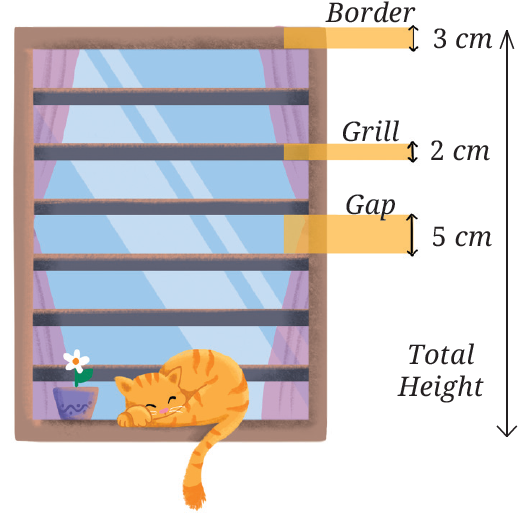
(c) Find the total height of the window by writing an expression describing the relationship among the measurements shown in the picture.
Answer:
(a) Gold Coins Situation
Expression: $(100 \times 2) + (100 \div 2)$
Terms: $(100 \times 2)$ and $(100 \div 2)$.
Value: $200 + 50 = 250$ gold coins.
(b) Metro Tickets
(i) For four adults and three children:
Expression: $(4 \times 40) + (3 \times 20)$
Terms: $(4 \times 40)$ and $(3 \times 20)$.
Value: $160 + 60 = \textsf{₹}220$.
(ii) For two groups having three adults each:
Expression: $2 \times (3 \times 40)$
Terms: $2 \times (3 \times 40)$.
Value: $2 \times 120 = \textsf{₹}240$.
(c) Total Height of the Window
Given:
Top and bottom border thickness = $3 \text{ cm}$ each.
Thickness of each grill = $2 \text{ cm}$. There are $6$ such grills.
Gap between two grills = $5 \text{ cm}$. There are $5$ such gaps.
Expression: $3 + (6 \times 2) + (5 \times 5) + 3$
Terms: $3$, $(6 \times 2)$, $(5 \times 5)$, and $3$.
Value: $3 + 12 + 25 + 3 = 43 \text{ cm}$.
Intext Questions (Page No. 36 - 37)
Question. Some expressions are given in following three columns. In each column, one or more terms are changed from the first expression. Go through the example (in the first column) and fill the blanks, doing as little computation as possible.
$53 + (-16) = 37$
$54 + (-16) = 38$
$54$ is one more than $53$, so the value will be $1$ more than $37$.
$53 + (-15) =$ ______
Is $-15$ one more or one less than $-16$?
$53 + (-16) = 37$
$52 + (-16) =$ ______
$52$ is one less than $53$, so the value will be $1$ more than $37$.
$53 + (-17) =$ ______
Is $-17$ one more or one less than $-16$?
$-87 + (-16) =$ ______
$-88 + (-15) =$ ______
$-86 + (-18) =$ ______
$-97 + (-26) =$ ______
Answer:
Solution for Column 1:
The first expression is $53 + (-16) = 37$.
In the third expression, we have $53 + (-15)$.
Comparing $-15$ and $-16$, we know that $-15$ is one more than $-16$.
Since we are adding a number that is $1$ more, the result will also be $1$ more than the original sum ($37$).
$53 + (-15) = 37 + 1 = 38$
Solution for Column 2:
The first expression is $53 + (-16) = 37$.
1. For the first blank: $52 + (-16)$
Here, $52$ is one less than $53$. Therefore, the value will be $1$ less than $37$.
$52 + (-16) = 36$
2. For the second blank: $53 + (-17)$
Is $-17$ one more or one less than $-16$? $-17$ is one less than $-16$.
Since we are adding a number that is $1$ less, the result will be $1$ less than $37$.
$53 + (-17) = 36$
Solution for Column 3:
We use the relative change in integers to find the sums:
1. First blank: $-87 + (-16)$
Adding two negative integers: $-(87 + 16) = -103$.
$-87 + (-16) = -103$
2. Second blank: $-88 + (-15)$
Comparing with the first row: $-88$ is $1$ less than $-87$, and $-15$ is $1$ more than $-16$.
The net change is $(-1 + 1) = 0$. So the sum remains $-103$.
3. Third blank: $-86 + (-18)$
Comparing with the first row: $-86$ is $1$ more than $-87$, and $-18$ is $2$ less than $-16$.
The net change is $(+1 - 2) = -1$. So the sum is $-104$.
4. Fourth blank: $-97 + (-26)$
Comparing with the first row: $-97$ is $10$ less than $-87$, and $-26$ is $10$ less than $-16$.
The total change is a decrease of $20$. So, $-103 - 20 = -123$.
$-97 + (-26) = -123$
Summary of Correct Answers:
| Column 1 | Column 2 | Column 3 |
| $53 + (-15) = 38$ | $52 + (-16) = 36$ | $-87 + (-16) = -103$ |
| $53 + (-17) = 36$ | $-88 + (-15) = -103$ | |
| $-86 + (-18) = -104$ | ||
| $-97 + (-26) = -123$ |
Figure it Out (Page No. 37 - 38)
Question 1. Fill in the blanks with numbers, and boxes with operation signs such that the expressions on both sides are equal.
(a) $24 + (6 - 4) = 24 + 6 \ \square \ \text{ _____ }$
(b) $38 + (\text{_____} \ \square \ \text{_____}) = 38 + 9 - 4$
(c) $24 - (6 + 4) = 24 \ \square \ 6 - 4$
(d) $24 - 6 - 4 = 24 - 6 \ \square \ \text{ _____ }$
(e) $27 - (8 + 3) = 27 \text{ _____ } 8 \text{ _____ } 3$
(f) $27 - (\text{_____} \ \square \ \text{_____}) = 27 - 8 + 3$
Answer:
Concept: To solve these problems, we apply the Rules of Signs for Opening Brackets.
1. If there is a positive (+) sign before the bracket, the signs of the terms inside the bracket remain the same when the bracket is removed.
2. If there is a negative (-) sign before the bracket, the signs of all terms inside the bracket are reversed (positive becomes negative, and negative becomes positive) when the bracket is removed.
(a) $24 + (6 - 4) = 24 + 6 \ \square \ \text{ _____ }$
There is a positive sign ($+$) outside the bracket. Therefore, the sign of $6$ (which is $+6$) remains positive, and the sign of $-4$ remains negative.
$24 + (6 - 4) = 24 + 6 - 4$
(Signs inside the bracket remain unchanged)
The solution is: $24 + (6 - 4) = 24 + 6 \ \boxed{-} \ \mathbf{\underline{4}}$
(b) $38 + (\text{_____} \ \square \ \text{_____}) = 38 + 9 - 4$
Here, we are grouping the terms $9$ and $-4$ into a bracket preceded by a $+$ sign. Since a positive sign does not change the internal signs, we can directly place them inside.
$38 + 9 - 4 = 38 + (9 - 4)$
(Grouping with a positive sign)
The solution is: $38 + (\mathbf{\underline{9}} \ \boxed{-} \ \mathbf{\underline{4}}) = 38 + 9 - 4$
(c) $24 - (6 + 4) = 24 \ \square \ 6 - 4$
There is a negative sign ($-$) outside the bracket. When removing the bracket, the sign of $+6$ changes to $-6$ and the sign of $+4$ changes to $-4$.
$24 - (6 + 4) = 24 - 6 - 4$
(Negative sign reverses signs inside: $+ \rightarrow -$)
The solution is: $24 - (6 + 4) = 24 \ \boxed{-} \ 6 - 4$
(d) $24 - 6 - 4 = 24 - 6 \ \square \ \text{ _____ }$
This is a direct comparison of the terms on the Left Hand Side (LHS) and the Right Hand Side (RHS). The first two terms ($24 - 6$) are already present.
The solution is: $24 - 6 - 4 = 24 - 6 \ \boxed{-} \ \mathbf{\underline{4}}$
(e) $27 - (8 + 3) = 27 \text{ _____ } 8 \text{ _____ } 3$
Applying the rule of a negative sign outside the bracket, both $+8$ and $+3$ inside the bracket will have their signs reversed to negative.
$27 - (8 + 3) = 27 - 8 - 3$
(Reversing signs: $+8 \rightarrow -8$ and $+3 \rightarrow -3$)
The solution is: $27 - (8 + 3) = 27 \ \mathbf{\underline{-}} \ 8 \ \mathbf{\underline{-}} \ 3$
(f) $27 - (\text{_____} \ \square \ \text{_____}) = 27 - 8 + 3$
We are putting $-8$ and $+3$ into a bracket preceded by a negative sign ($-$). To do this, we must reverse their signs.
The $-8$ becomes $+8$ and the $+3$ becomes $-3$ inside the bracket.
$27 - 8 + 3 = 27 - (8 - 3)$
(Reversing signs for grouping with a minus sign)
The solution is: $27 - (\mathbf{\underline{8}} \ \boxed{-} \ \mathbf{\underline{3}}) = 27 - 8 + 3$
Question 2. Remove the brackets and write the expression having the same value.
(a) $14 + (12 + 10)$
(b) $14 - (12 + 10)$
(c) $14 + (12 - 10)$
(d) $14 - (12 - 10)$
(e) $-14 + 12 - 10$
(f) $14 - (-12 - 10)$
Answer:
Rules for Removing Brackets:
In mathematics, specifically when working with integers in the Indian curriculum, we follow the "Rule of Signs" to remove brackets:
1. If a bracket is preceded by a positive (+) sign, the sign of each term inside the bracket remains unchanged.
2. If a bracket is preceded by a negative (-) sign, the sign of each term inside the bracket is reversed (positive becomes negative, and negative becomes positive).
Solution for Each Case:
(a) $14 + (12 + 10)$
Since there is a $+$ sign outside, the signs of $12$ and $10$ remain positive.
$14 + 12 + 10$
[Rule 1 applied]
(b) $14 - (12 + 10)$
Since there is a $-$ sign outside, $+12$ and $+10$ both become negative.
$14 - 12 - 10$
[Rule 2 applied]
(c) $14 + (12 - 10)$
Since there is a $+$ sign outside, the signs remain exactly as they are inside.
$14 + 12 - 10$
[Rule 1 applied]
(d) $14 - (12 - 10)$
Since there is a $-$ sign outside, $+12$ becomes $-12$ and $-10$ becomes $+10$.
$14 - 12 + 10$
[Rule 2 applied]
(e) $-14 + 12 - 10$
This expression contains no brackets, so it remains as it is written.
$-14 + 12 - 10$
(Original form)
(f) $14 - (-12 - 10)$
Since there is a $-$ sign outside, $-12$ becomes $+12$ and $-10$ becomes $+10$.
$14 + 12 + 10$
[Rule 2 applied]
Conclusion:
We observe that the expressions in (a) and (f) result in the exact same mathematical value: $14 + 12 + 10 = 36$.
Therefore, the expressions having the same value are (a) and (f).
Question 3. Find the values of the following expressions. For each pair, first try to guess whether they have the same value. When are the two expressions equal?
(a) $(6 + 10) - 2$ and $6 + (10 - 2)$
(b) $16 - (8 - 3)$ and $(16 - 8) - 3$
(c) $27 - (18 + 4)$ and $27 + (-18 - 4)$
Answer:
Solution:
(a) $(6 + 10) - 2$ and $6 + (10 - 2)$
First expression: $(6 + 10) - 2 = 16 - 2 = 14$
Second expression: $6 + (10 - 2) = 6 + 8 = 14$
Both expressions have the same value. Addition and subtraction are associative in this specific order.
(b) $16 - (8 - 3)$ and $(16 - 8) - 3$
First expression: $16 - (8 - 3) = 16 - 5 = 11$
Second expression: $(16 - 8) - 3 = 8 - 3 = 5$
The values are different. This shows that subtraction is not associative.
(c) $27 - (18 + 4)$ and $27 + (-18 - 4)$
First expression: $27 - (18 + 4) = 27 - 22 = 5$
Second expression: $27 + (-18 - 4) = 27 + (-22) = 5$
Both expressions have the same value. This is because subtracting a sum is the same as adding the negative of each term.
Conclusion:
Two expressions are equal when the rules of Associativity apply or when the rules for distributing a sign across a bracket are correctly followed.
Question 4. In each of the sets of expressions below, identify those that have the same value. Do not evaluate them, but rather use your understanding of terms.
(a) $319 + 537, 319 - 537, -537 + 319, 537 - 319$
(b) $87 + 46 - 109, 87 + 46 - 109, 87 + 46 - 109, \ $$ 87 - 46 + 109, \ $$ 87 - (46 + 109), \ $$ (87 - 46) + 109$
Answer:
(a) $319 + 537, 319 - 537, -537 + 319, 537 - 319$
Let us look at the terms in each expression:
1. $319 + 537$ has terms: $+319$ and $+537$.
2. $319 - 537$ has terms: $+319$ and $-537$.
3. $-537 + 319$ has terms: $-537$ and $+319$.
4. $537 - 319$ has terms: $+537$ and $-319$.
Conclusion: The expressions $319 - 537$ and $-537 + 319$ have the same value because they contain the exact same terms.
(b) $87 + 46 - 109, 87 - 46 + 109, 87 - (46 + 109), (87 - 46) + 109$
Analyzing the terms:
1. $87 + 46 - 109$ consists of $+87, +46, -109$.
2. $87 - 46 + 109$ consists of $+87, -46, +109$.
3. $87 - (46 + 109)$ when simplified is $87 - 46 - 109$, consisting of $+87, -46, -109$.
4. $(87 - 46) + 109$ when simplified is $87 - 46 + 109$, consisting of $+87, -46, +109$.
Conclusion: The expressions $87 - 46 + 109$ and $(87 - 46) + 109$ have the same value.
Question 5. Add brackets at appropriate places in the expressions such that they lead to the values indicated.
(a) $34 - 9 + 12 = 13$
(b) $56 - 14 - 8 = 34$
(c) $-22 - 12 + 10 + 22 = -22$
Answer:
(a) $34 - 9 + 12 = 13$
The correct placement of brackets is: $34 - (9 + 12)$
Check: $34 - 21 = 13$.
(b) $56 - 14 - 8 = 34$
The correct placement of brackets is: $56 - (14 + 8)$
Check: $56 - 22 = 34$.
(c) $-22 - 12 + 10 + 22 = -22$
The correct placement of brackets is: $-22 - (12 + 10) + 22$
Check: $-22 - 22 + 22 = -44 + 22 = -22$.
Question 6. Using only reasoning of how terms change their values, fill the blanks to make the expressions on either side of the equality ($=$) equal.
(a) $423 + \text{______} = 419 + \text{______}$
(b) $207 - 68 = 210 - \text{______}$
Answer:
(a) $423 + \text{______} = 419 + \text{______}$
On the right side, the number $419$ is $4$ less than $423$. To keep both sides equal, the blank on the right must be $4$ more than the blank on the left.
Let the first blank be $0$, then the second blank must be $4$.
Expression: $423 + 0 = 419 + 4$
(b) $207 - 68 = 210 - \text{______}$
On the right side, the starting number $210$ is $3$ more than $207$. Since we are starting with a larger number on the right, we must subtract a larger amount to arrive at the same final value.
The blank must be $68 + 3 = 71$.
Expression: $207 - 68 = 210 - 71$
Verification:
Left Side: $207 - 68 = 139$
Right Side: $210 - 71 = 139$
Both sides are equal.
Question 7. Using the numbers $2, 3$ and $5$, and the operators ‘$+$’ and ‘$-$’, and brackets, as necessary, generate expressions to give as many different values as possible. For example, $2 - 3 + 5 = 4$ and $3 - (5 - 2) = 0$.
Answer:
Solution:
By using the numbers $2, 3$, and $5$ with the operations of addition and subtraction in different combinations and groupings, we can generate several unique values. Here are some possible expressions:
1. To get the value 10:
$2 + 3 + 5 = 10$
2. To get the value 6:
$5 + 3 - 2 = 6$
$5 + (3 - 2) = 6$
3. To get the value 4:
$2 - 3 + 5 = 4$
$5 - (3 - 2) = 4$
4. To get the value 0:
$2 + 3 - 5 = 0$
$3 - (5 - 2) = 0$
5. To get the value -4:
$3 - (2 + 5) = -4$
$2 - 3 - 3 = -4$ (Note: Using each number once as per context)
$3 - 2 - 5 = -4$
6. To get the value -6:
$2 - (3 + 5) = -6$
$2 - 3 - 5 = -6$
7. To get the value -10:
$-2 - 3 - 5 = -10$
Summary of unique values found: $10, 6, 4, 0, -4, -6, -10$.
Question 8. Whenever Jasoda has to subtract $9$ from a number, she subtracts $10$ and adds $1$ to it. For example, $36 - 9 = 26 + 1$.
(a) Do you think she always gets the correct answer? Why?
(b) Can you think of other similar strategies? Give some examples.
Answer:
(a) Reasoning for Jasoda's Strategy:
Yes, Jasoda will always get the correct answer. This is because the number $9$ can be written as $(10 - 1)$.
When we subtract $9$ from any number $x$, we have:
$x - 9 = x - (10 - 1)$
By removing the brackets, the signs change:
$x - 10 + 1$
This is exactly what Jasoda does: she subtracts $10$ first and then adds $1$ to correct the difference. This is a very efficient mental math strategy used commonly in Indian schools for quick calculation.
(b) Similar Strategies:
We can use this "rounding and adjusting" method for many other numbers that are close to multiples of $10$.
1. Subtracting 19: Subtract $20$ and add $1$.
Example: $55 - 19 = 55 - 20 + 1 = 35 + 1 = 36$
2. Adding 9: Add $10$ and subtract $1$.
Example: $47 + 9 = 47 + 10 - 1 = 57 - 1 = 56$
3. Subtracting 8: Subtract $10$ and add $2$.
Example: $\textsf{₹}82 - \textsf{₹}8 = 82 - 10 + 2 = 72 + 2 = \textsf{₹}74$
4. Subtracting 99: Subtract $100$ and add $1$.
Example: $245 - 99 = 245 - 100 + 1 = 145 + 1 = 146$
Question 9. Consider the two expressions: (a) $73 - 14 + 1$, (b) $73 - 14 - 1$. For each of these expressions, identify the expressions from the following collection that are equal to it.
(a) $73 - (14 + 1)$
(b) $73 - (14 - 1)$
(c) $73 + (-14 + 1)$
(d) $73 + (-14 - 1)$
Answer:
Analysis of Base Expressions:
Expression (a): $73 - 14 + 1$ (Consists of terms: $+73$, $-14$, and $+1$)
Expression (b): $73 - 14 - 1$ (Consists of terms: $+73$, $-14$, and $-1$)
Evaluating the Collection:
(i) $73 - (14 + 1)$
Opening the brackets: $73 - 14 - 1$.
This is equal to Expression (b).
(ii) $73 - (14 - 1)$
Opening the brackets (the sign inside changes because of the minus outside): $73 - 14 + 1$.
This is equal to Expression (a).
(iii) $73 + (-14 + 1)$
Opening the brackets: $73 - 14 + 1$.
This is equal to Expression (a).
(iv) $73 + (-14 - 1)$
Opening the brackets: $73 - 14 - 1$.
This is equal to Expression (b).
Summary:
Expressions equal to (a) $73 - 14 + 1$ are: $73 - (14 - 1)$ and $73 + (-14 + 1)$.
Expressions equal to (b) $73 - 14 - 1$ are: $73 - (14 + 1)$ and $73 + (-14 - 1)$.
Intext Questions (Page No. 38 - 39)
Question. Lhamo and Norbu went to a hotel. Each of them ordered a vegetable cutlet and a rasgulla. A vegetable cutlet costs $\text{₹}43$ and a rasgulla costs $\text{₹}24$. Write an expression for the amount they will have to pay.
If another friend, Sangmu, joins them and orders the same items, what will be the expression for the total amount to be paid?
Answer:
Given:
Cost of one vegetable cutlet = $\textsf{₹}43$
Cost of one rasgulla = $\textsf{₹}24$
Solution:
Lhamo and Norbu are two friends. Each orders one cutlet and one rasgulla.
The total cost for one person is $(43 + 24)$.
For two friends, the expression for the amount to be paid is:
$2 \times (43 + 24)$
When Sangmu joins:
Now there are three friends in total, each ordering the same two items.
The expression for the total amount to be paid for three people is:
$3 \times (43 + 24)$
Note: These expressions can also be written using the Distributive Property as $(2 \times 43) + (2 \times 24)$ and $(3 \times 43) + (3 \times 24)$ respectively.
Intext Questions (Page No. 40)
Question 1. $5 \times 4 + 3 \neq 5 \times (4 + 3)$. Can you explain why?
Answer:
Explanation:
The two expressions are different because of the order of operations (BODMAS/PEMDAS) and the presence of brackets.
LHS ($5 \times 4 + 3$):
In this expression, multiplication is performed before addition.
$5 \times 4 + 3 = 20 + 3 = 23$
RHS ($5 \times (4 + 3)$):
In this expression, the brackets tell us to perform the addition first.
$5 \times (4 + 3) = 5 \times 7 = 35$
Conclusion:
Since $23 \neq 35$, the two expressions are not equal. Brackets change the priority of operations, grouping the terms $4$ and $3$ to be added before multiplying by $5$.
Question 2. Is $5 \times (4 + 3) = 5 \times (3 + 4) = (3 + 4) \times 5$?
Answer:
To Find: Whether the three expressions are equal.
Solution:
Let us evaluate each expression one by one:
1. $5 \times (4 + 3) = 5 \times 7 = 35$
2. $5 \times (3 + 4) = 5 \times 7 = 35$
3. $(3 + 4) \times 5 = 7 \times 5 = 35$
Reasoning:
The expressions are equal because of two fundamental properties of mathematics:
Commutative Property of Addition: $(4 + 3)$ is the same as $(3 + 4)$. This explains why the first and second expressions are equal.
Commutative Property of Multiplication: For any two numbers $a$ and $b$, $a \times b = b \times a$. Here, $5 \times 7 = 7 \times 5$. This explains why the second and third expressions are equal.
Final Answer:
Yes, $5 \times (4 + 3) = 5 \times (3 + 4) = (3 + 4) \times 5$. All three expressions have the same value, 35.
Intext Questions (Page No. 41)
Question 1. $97 \times 25$ means $97$ times $25$. We can write it as $(100 - 3) \times 25$. We know that this is the same as the difference of $100$ times $25$ and $3$ times $25$:
$97 \times 25 = 100 \times 25 - 3 \times 25$
Find this value.
Answer:
Given:
Expression: $97 \times 25$ written as $100 \times 25 - 3 \times 25$.
Solution:
Using the Distributive Property of multiplication over subtraction, we evaluate the terms separately:
First term: $100 \times 25 = 2500$
Second term: $3 \times 25 = 75$
Now, find the difference:
$2500 - 75 = 2425$
(Value of the expression)
Final Answer:
The value of $97 \times 25$ is 2425.
Question 2. Use this method to find the following products:
(a) $95 \times 8$
(b) $104 \times 15$
(c) $49 \times 50$
Is this quicker than the multiplication procedure you use generally?
Answer:
Concept: The method used here is the Distributive Property of Multiplication over addition or subtraction. In the Indian curriculum, this is often taught as a mental math strategy to simplify calculations by breaking a number into a sum or difference of "friendly" numbers like $10, 50,$ or $100$.
(a) Find the product: $95 \times 8$
Given: Multiplicand $= 95$, Multiplier $= 8$
To Find: Product using the distributive property.
Solution:
We can express $95$ as $(100 - 5)$.
$95 \times 8 = (100 - 5) \times 8$
(Rewriting $95$)
$= (100 \times 8) - (5 \times 8)$
(Applying Distributive Property)
$= 800 - 40$
$= 760$
The product is $760$.
(b) Find the product: $104 \times 15$
Given: Multiplicand $= 104$, Multiplier $= 15$
To Find: Product using the distributive property.
Solution:
We can express $104$ as $(100 + 4)$.
$104 \times 15 = (100 + 4) \times 15$
(Rewriting $104$)
$= (100 \times 15) + (4 \times 15)$
(Applying Distributive Property)
$= 1500 + 60$
$= 1560$
The product is $1560$.
(c) Find the product: $49 \times 50$
Given: Multiplicand $= 49$, Multiplier $= 50$
To Find: Product using the distributive property.
Solution:
We can express $49$ as $(50 - 1)$.
$49 \times 50 = (50 - 1) \times 50$
(Rewriting $49$)
$= (50 \times 50) - (1 \times 50)$
(Applying Distributive Property)
$= 2500 - 50$
$= 2450$
The product is $2450$.
Conclusion:
Yes, this method is generally quicker than the standard long multiplication procedure. By breaking numbers down, we can perform the multiplication and subsequent addition or subtraction mentally without needing to write down columns for carry-overs, which reduces the chance of calculation errors.
Question 3. Which other products might be quicker to find like the ones above?
Answer:
Concept: The products that are quicker to find using the distributive method are those where one of the numbers is close to a multiple of $10, 50, 100,$ or $1000$. This allows us to rewrite the number as a simple sum or difference, making mental calculation easier.
Types of numbers that work best:
1. Numbers close to $100$: Numbers like $98, 99, 101, 102, 105, 110$.
$99 \times 7 = (100 - 1) \times 7$
(Example of subtraction)
$102 \times 4 = (100 + 2) \times 4$
(Example of addition)
2. Numbers close to $50$ or multiples of $10$: Numbers like $19, 21, 48, 51, 52$.
$48 \times 6 = (50 - 2) \times 6$
[Easy mental subtraction]
3. Large numbers close to $1000$: Numbers like $998, 999, 1002, 1005$.
$998 \times 3 = (1000 - 2) \times 3$
(Simplifying large multiplication)
Examples for Practice:
| Product | Rewritten Form | Mental Calculation |
| $19 \times 8$ | $(20 - 1) \times 8$ | $160 - 8 = 152$ |
| $103 \times 5$ | $(100 + 3) \times 5$ | $500 + 15 = 515$ |
| $995 \times 2$ | $(1000 - 5) \times 2$ | $2000 - 10 = 1990$ |
| $51 \times 12$ | $(50 + 1) \times 12$ | $600 + 12 = 612$ |
Conclusion:
From Vedic Mathematics and mental arithmetic, using these "base" numbers allows us to solve complex problems with minimal pen and paper usage, increasing speed and accuracy in competitive exams and daily life calculations.
Figure it Out (Page No. 41 - 42)
Question 1. Fill in the blanks with numbers, and boxes by signs, so that the expressions on both sides are equal.
(a) $3 \times (6 + 7) = 3 \times 6 + 3 \times 7$
(b) $(8 + 3) \times 4 = 8 \times 4 + 3 \times 4$
(c) $3 \times (5 + 8) = 3 \times 5 \ \square \ 3 \times \text{____}$
(d) $(9 + 2) \times 4 = 9 \times 4 \ \square \ 2 \times\text{____}$
(e) $3 \times (\text{____} + 4) = 3 \text{ ____} + \text{____}$
(f) $(\text{____} + 6) \times 4 = 13 \times 4 + \text{____}$
(g) $3 \times (\text{____} + \text{____}) = 3 \times 5 + 3 \times 2$
(h) $(\text{____} + \text{____}) \times \text{____} = 2 \times 4 + 3 \times 4$
(i) $5 \times (9 – 2) = 5 \times 9 – 5 \times \text{____}$
(j) $(5 – 2) \times 7 = 5 \times 7 – 2 \times \text{____}$
(k) $5 \times (8 – 3) = 5 \times 8 \ \square \ 5 \times \text{____}$
(l) $(8 – 3) \times 7 = 8 \times 7 \ \square \ 3 \times 7$
(m) $5 \times (12 – \text{____}) = \text{____ } \ \square \ 5 \times \text{____}$
(n) $(15 – \text{____}) \times 7 = \text{____ } \ \square \ 6 \times 7$
(o) $5 \times (\text{____} – \text{____}) = 5 \times 9 – 5 \times 4$
(p) $(\text{____} – \text{____}) \times \text{____} = 17 \times 7 – 9 \times 7$
Answer:
Concept: To solve these problems, we use the Distributive Property of Multiplication. In the Indian mathematics curriculum, this property states that multiplying a sum (or difference) by a number gives the same result as multiplying each addend (or term) by the number and then adding (or subtracting) the products together.
$a \times (b \pm c) = (a \times b) \pm (a \times c)$
(Distributive Law)
Solution:
Based on the distributive property, the filled expressions are as follows:
(c) $3 \times (5 + 8) = 3 \times 5 \ \boxed{+} \ 3 \times \mathbf{\underline{8}}$
(d) $(9 + 2) \times 4 = 9 \times 4 \ \boxed{+} \ 2 \times \mathbf{\underline{4}}$
(e) $3 \times (\mathbf{\underline{10}} + 4) = 3 \ \mathbf{\underline{\times \ 10}} + \mathbf{\underline{3 \times 4}}$
(f) $(\mathbf{\underline{13}} + 6) \times 4 = 13 \times 4 + \mathbf{\underline{6 \times 4}}$
(g) $3 \times (\mathbf{\underline{5}} + \mathbf{\underline{2}}) = 3 \times 5 + 3 \times 2$
(h) $(\mathbf{\underline{2}} + \mathbf{\underline{3}}) \times \mathbf{\underline{4}} = 2 \times 4 + 3 \times 4$
(i) $5 \times (9 – 2) = 5 \times 9 – 5 \times \mathbf{\underline{2}}$
(j) $(5 – 2) \times 7 = 5 \times 7 – 2 \times \mathbf{\underline{7}}$
(k) $5 \times (8 – 3) = 5 \times 8 \ \boxed{-} \ 5 \times \mathbf{\underline{3}}$
(l) $(8 – 3) \times 7 = 8 \times 7 \ \boxed{-} \ 3 \times 7$
(m) $5 \times (12 – \mathbf{\underline{3}}) = \mathbf{\underline{5 \times 12}} \ \boxed{-} \ 5 \times \mathbf{\underline{3}}$
(n) $(15 – \mathbf{\underline{6}}) \times 7 = \mathbf{\underline{15 \times 7}} \ \boxed{-} \ 6 \times 7$
(o) $5 \times (\mathbf{\underline{9}} – \mathbf{\underline{4}}) = 5 \times 9 – 5 \times 4$
(p) $(\mathbf{\underline{17}} – \mathbf{\underline{9}}) \times \mathbf{\underline{7}} = 17 \times 7 – 9 \times 7$
Note: These properties are fundamental for simplifying calculations mentally. For example, in part (n), calculating $9 \times 7$ is the same as calculating $(15 - 6) \times 7$.
Question 2. In the boxes below, fill ‘$<$’, ‘$>$’ or ‘$=$’ after analysing the expressions on the LHS and RHS. Use reasoning and understanding of terms and brackets to figure this out and not by evaluating the expressions.
(a) $(8 – 3) \times 29$ ________ $(3 – 8) \times 29$
(b) $15 + 9 \times 18$ ________ $(15 + 9) \times 18$
(c) $23 \times (17 – 9)$ ________ $23 \times 17 + 23 \times 9$
(d) $(34 – 28) \times 42$ ________ $34 \times 42 – 28 \times 42$
Answer:
(a) $(8 - 3) \times 29$ $>$ $(3 - 8) \times 29$
Reasoning: On the LHS, $(8 - 3)$ results in a positive integer ($5$). On the RHS, $(3 - 8)$ results in a negative integer ($-5$). When both are multiplied by the same positive number ($29$), the product on the left will remain positive and the product on the right will remain negative. Any positive number is always greater than a negative number.
(b) $15 + 9 \times 18$ $<$ $(15 + 9) \times 18$
Reasoning: In the LHS, according to the order of operations, only $9$ is multiplied by $18$, and then $15$ is added. In the RHS, the sum of $15$ and $9$ is multiplied by $18$. By the distributive property, the RHS is equal to $15 \times 18 + 9 \times 18$. Since $15 \times 18$ is much larger than $15$, the RHS is greater.
(c) $23 \times (17 - 9)$ $<$ $23 \times 17 + 23 \times 9$
Reasoning: By the Distributive Property, $23 \times (17 - 9)$ is equal to $23 \times 17 - 23 \times 9$. The RHS of the question is $23 \times 17 + 23 \times 9$. Since we are adding $23 \times 9$ on the right but subtracting it on the left, the RHS must be larger.
(d) $(34 - 28) \times 42$ $=$ $34 \times 42 - 28 \times 42$
Reasoning: This is a direct application of the Distributive Property of multiplication over subtraction: $a \times (b - c) = a \times b - a \times c$. Here, $a = 42$, $b = 34$, and $c = 28$. Therefore, both sides are mathematically identical.
Question 3. Here is one way to make $14$: $2 \times (1 + 6) = 14$. Are there other ways of getting $14$? Fill them out below:
(a) $\text{_____} \times (\text{_____} + \text{_____}) = 14$
(b) $\text{_____} \times (\text{_____} + \text{_____}) = 14$
(c) $\text{_____} \times (\text{_____} + \text{_____}) = 14$
(d) $\text{_____} \times (\text{_____} + \text{_____}) = 14$
Answer:
To Find: Different combinations of numbers that satisfy the expression structure to result in 14.
Solution:
We look for factors of $14$, which are $1, 2, 7,$ and $14$. We can set the first blank as one of these factors and ensure the sum inside the bracket equals the other factor needed.
(a) $2$ $\times$ ($3$ $+$ $4$) $= 14$
(b) $7$ $\times$ ($1$ $+$ $1$) $= 14$
(c) $1$ $\times$ ($10$ $+$ $4$) $= 14$
(d) $14$ $\times$ ($1$ $+$ $0$) $= 14$
Alternate Solution:
We can also use negative integers:
$2$ $\times$ ($10$ $+$ $-3$) $= 14$
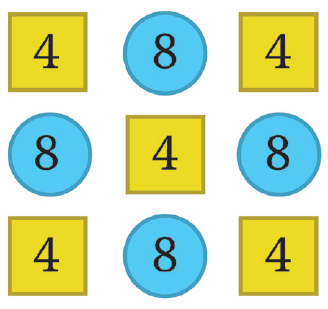
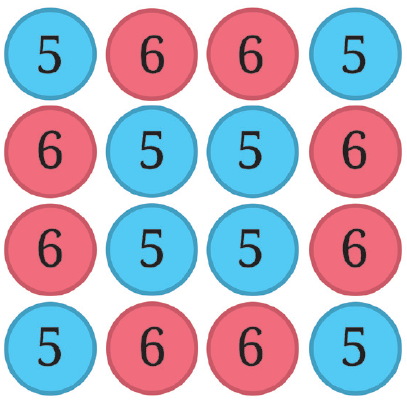
Question 4. Find out the sum of the numbers given in each picture below in at least two different ways. Describe how you solved it through expressions.
Answer:
For the First Picture (Numbers 4 and 8):
By observing the image, we see there are five squares containing the number $4$ and four circles containing the number $8$.
Way 1: Adding total of each number separately
Total sum $= (5 \times 4) + (4 \times 8)$
Total sum $= 20 + 32 = 52$
Way 2: Grouping pairs of 4 and 8
We can see 4 pairs of (4 and 8) at the corners/edges and one 4 in the center.
Total sum $= 4 \times (4 + 8) + 4$
Total sum $= 4 \times 12 + 4 = 48 + 4 = 52$
For the Second Picture (Numbers 5 and 6):
By observing the $4 \times 4$ grid, we see there are eight circles with $5$ and eight circles with $6$.
Way 1: Adding totals of 5s and 6s
Total sum $= (8 \times 5) + (8 \times 6)$
Total sum $= 40 + 48 = 88$
Way 2: Using Distributive Property (Grouping in pairs)
Since there are equal numbers of 5s and 6s, we can pair each 5 with a 6.
Total sum $= 8 \times (5 + 6)$
Total sum $= 8 \times 11 = 88$
Figure it Out (Page No. 42 - 44)
Question 1. Read the situations given below. Write appropriate expressions for each of them and find their values.
(a) The district market in Begur operates on all seven days of a week. Rahim supplies $9\text{ kg}$ of mangoes each day from his orchard and Shyam supplies $11\text{ kg}$ of mangoes each day from his orchard to this market. Find the amount of mangoes supplied by them in a week to the local district market.
(b) Binu earns $\textsf{₹}20,000$ per month. She spends $\textsf{₹}5,000$ on rent, $\textsf{₹}5,000$ on food, and $\textsf{₹}2,000$ on other expenses every month. What is the amount Binu will save by the end of a year?
(c) During the daytime a snail climbs $3\text{ cm}$ up a post, and during the night while asleep, accidentally slips down by $2\text{ cm}$. The post is $10\text{ cm}$ high, and a delicious treat is on its top. In how many days will the snail get the treat?
Answer:
(a) Mango Supply Situation
Given:
Rahim's daily supply = $9\text{ kg}$
Shyam's daily supply = $11\text{ kg}$
Total days in a week = $7$
To Find: Total weekly supply.
Solution:
The total supply per day is $(9 + 11)\text{ kg}$. To find the weekly supply, we multiply this by $7$.
Expression: $7 \times (9 + 11)$
Value: $7 \times 20 = 140\text{ kg}$.
(b) Binu's Savings Situation
Given:
Monthly Income = $\textsf{₹}20,000$
Monthly Expenses = Rent ($\textsf{₹}5,000$) + Food ($\textsf{₹}5,000$) + Others ($\textsf{₹}2,000$)
Total months in a year = $12$
To Find: Total savings in a year.
Solution:
Monthly savings = Income $-$ Total expenses.
Expression: $12 \times [20000 - (5000 + 5000 + 2000)]$
Value: $12 \times [20000 - 12000] = 12 \times 8000 = \textsf{₹}96,000$.
(c) Snail Climbing Situation
Given:
Day climb = $3\text{ cm}$
Night slip = $2\text{ cm}$
Total height of post = $10\text{ cm}$
To Find: Number of days to reach the top.
Solution:
Net climb per day = $(3 - 2) = 1\text{ cm}$. However, on the last day, once the snail reaches the top ($10\text{ cm}$), it will not slip back. This means on the final day, it only needs to be at $7\text{ cm}$ to reach the top with one final $3\text{ cm}$ climb.
Days required to reach $7\text{ cm}$ at $1\text{ cm}$ per day = $7$ days.
On the 8th day, it climbs $3\text{ cm}$ and reaches $7 + 3 = 10\text{ cm}$.
Value: 8 days.
Question 2. Melvin reads a two-page story every day except on Tuesdays and Saturdays. How many stories would he complete reading in $8$ weeks? Which of the expressions below describes this scenario?
(a) $5 \times 2 \times 8$
(b) $(7 - 2) \times 8$
(c) $8 \times 7$
(d) $7 \times 2 \times 8$
(e) $7 \times 5 - 2$
(f) $(7 + 2) \times 8$
(g) $7 \times 8 - 2 \times 8$
(h) $(7 - 5) \times 8$
Answer:
Given:
Reading days in a week = Total days ($7$) $-$ Non-reading days ($2$ : Tue and Sat) = $5$ days.
Total weeks = $8$.
Stories completed per day = $1$ (The question implies he completes one story of two pages each day).
Solution:
Number of reading days per week = $(7 - 2)$.
Total reading days in 8 weeks = $(7 - 2) \times 8$.
Since he reads 1 story per reading day, the total stories completed = $(7 - 2) \times 8$.
Also, by distributive property: $(7 - 2) \times 8 = (7 \times 8) - (2 \times 8)$.
Correct Expressions:
The expressions that describe this scenario correctly are (b) $(7 - 2) \times 8$ and (g) $7 \times 8 - 2 \times 8$.
Total stories completed: $40$ stories.
Question 3. Find different ways of evaluating the following expressions:
(a) $1 - 2 + 3 - 4 + 5 - 6 + 7 - 8 + 9 - 10$
(b) $1 - 1 + 1 - 1 + 1 - 1 + 1 - 1 + 1 - 1$
Answer:
(a) Evaluating $1 - 2 + 3 - 4 + 5 - 6 + 7 - 8 + 9 - 10$
Way 1: By grouping pairs
We can group the terms in pairs of two:
$(1 - 2) + (3 - 4) + (5 - 6) + (7 - 8) + (9 - 10)$
$= (-1) + (-1) + (-1) + (-1) + (-1)$
$= -5$
Way 2: By grouping positive and negative terms separately
Collect all positive terms and all negative terms:
$(1 + 3 + 5 + 7 + 9) - (2 + 4 + 6 + 8 + 10)$
$= 25 - 30$
$= -5$
(b) Evaluating $1 - 1 + 1 - 1 + 1 - 1 + 1 - 1 + 1 - 1$
Way 1: Using Zero Pairs
Each $(1 - 1)$ results in $0$. Since there are 5 such pairs:
$(1 - 1) + (1 - 1) + (1 - 1) + (1 - 1) + (1 - 1)$
$= 0 + 0 + 0 + 0 + 0$
$= 0$
Way 2: Summing terms
Sum of positives $= 1 + 1 + 1 + 1 + 1 = 5$
Sum of negatives $= 1 + 1 + 1 + 1 + 1 = 5$
$5 - 5 = 0$
Question 4. Compare the following pairs of expressions using ‘$<$’, ‘$>$’ or ‘$=$’ or by reasoning.
(a) $49 - 7 + 8$ ________ $49 - 7 + 8$
(b) $83 \times 42 - 18$ ________ $83 \times 40 - 18$
(c) $145 - 17 \times 8$ ________ $145 - 17 \times 6$
(d) $23 \times 48 - 35$ ________ $23 \times (48 - 35)$
(e) $(16 - 11) \times 12$ ________ $-11 \times 12 + 16 \times 12$
(f) $(76 - 53) \times 88$ ________ $88 \times (53 - 76)$
(g) $25 \times (42 + 16)$ ________ $25 \times (43 + 15)$
(h) $36 \times (28 - 16)$ ________ $35 \times (27 - 15)$
Answer:
Concept: To compare these expressions without performing full calculations, we use mathematical reasoning, properties of operations (Commutative, Associative, and Distributive), and the rules of BODMAS/PEMDAS.
(a) $49 - 7 + 8$ ________ $49 - 7 + 8$
Reasoning: Both expressions consist of the same numbers and the same operations in the same order.
$49 - 7 + 8 = 49 - 7 + 8$
(Identical expressions)
The solution is: $49 - 7 + 8$ $=$ $49 - 7 + 8$
(b) $83 \times 42 - 18$ ________ $83 \times 40 - 18$
Reasoning: In both cases, we are subtracting $18$. We compare $83 \times 42$ and $83 \times 40$. Since $42 > 40$, the product $83 \times 42$ is larger. Subtracting the same constant from a larger value results in a larger value.
$83 \times 42 > 83 \times 40$
(As $42 > 40$)
The solution is: $83 \times 42 - 18$ $>$ $83 \times 40 - 18$
(c) $145 - 17 \times 8$ ________ $145 - 17 \times 6$
Reasoning: Here, we are subtracting a product from $145$. On the Left Hand Side (LHS), we subtract $17 \times 8$, while on the Right Hand Side (RHS), we subtract $17 \times 6$. Since we are subtracting more on the left, the final result will be smaller.
$17 \times 8 > 17 \times 6$
(Subtracting a larger number makes the result smaller)
The solution is: $145 - 17 \times 8$ $<$ $145 - 17 \times 6$
(d) $23 \times 48 - 35$ ________ $23 \times (48 - 35)$
Reasoning: According to the Distributive Property, the RHS is equal to $23 \times 48 - 23 \times 35$. Comparing this to the LHS ($23 \times 48 - 35$), we see that the RHS is subtracting $23 \times 35$ (which is $805$), while the LHS is only subtracting $35$. Thus, the LHS is larger.
$23 \times 48 - 35 > 23 \times 48 - 805$
(Subtracting less makes the value greater)
The solution is: $23 \times 48 - 35$ $>$ $23 \times (48 - 35)$
(e) $(16 - 11) \times 12$ ________ $-11 \times 12 + 16 \times 12$
Reasoning: We apply the distributive property to the LHS: $(16 - 11) \times 12 = 16 \times 12 - 11 \times 12$. Due to the Commutative Property of Addition, this is exactly the same as $-11 \times 12 + 16 \times 12$.
$5 \times 12 = 60$
(Both sides equal $60$)
The solution is: $(16 - 11) \times 12$ $=$ $-11 \times 12 + 16 \times 12$
(f) $(76 - 53) \times 88$ ________ $88 \times (53 - 76)$
Reasoning: On the left, $(76 - 53)$ is a positive number ($23$). On the right, $(53 - 76)$ is a negative number ($-23$). A positive number multiplied by a positive number is always greater than a positive number multiplied by a negative number.
$23 \times 88 > -23 \times 88$
(Positive $>$ Negative)
The solution is: $(76 - 53) \times 88$ $>$ $88 \times (53 - 76)$
(g) $25 \times (42 + 16)$ ________ $25 \times (43 + 15)$
Reasoning: We compare the sums inside the brackets. In the LHS, $42 + 16 = 58$. In the RHS, $43 + 15 = 58$. Since the sums are equal, multiplying them by the same factor ($25$) will yield the same result.
$42 + 16 = 43 + 15$
(Sum is 58 on both sides)
The solution is: $25 \times (42 + 16)$ $=$ $25 \times (43 + 15)$
(h) $36 \times (28 - 16)$ ________ $35 \times (27 - 15)$
Reasoning: First, find the values in the brackets: $(28 - 16) = 12$ and $(27 - 15) = 12$. Now we are comparing $36 \times 12$ and $35 \times 12$. Since $36$ is greater than $35$, the left side is larger.
$36 \times 12 > 35 \times 12$
(As $36 > 35$)
The solution is: $36 \times (28 - 16)$ $>$ $35 \times (27 - 15)$
Question 5. Identify which of the following expressions are equal to the given expression without computation. You may rewrite the expressions using terms or removing brackets. There can be more than one expression which is equal to the given expression.
(a) $83 - 37 - 12$
(i) $84 - 38 - 12$
(ii) $84 - (37 + 12)$
(iii) $83 - 38 - 13$
(iv) $- 37 + 83 - 12$
(b) $93 + 37 \times 44 + 76$
(i) $37 + 93 \times 44 + 76$
(ii) $93 + 37 \times 76 + 44$
(iii) $(93 + 37) \times (44 + 76)$
(iv) $37 \times 44 + 93 + 76$
Answer:
(a) Given Expression: $83 - 37 - 12$
The terms in the expression are $+83$, $-37$, and $-12$.
1. (i) $84 - 38 - 12$: This is equal because $84 - 38$ is the same as $83 - 37$. Both result in $46$. So, $46 - 12$ is identical.
2. (iv) $-37 + 83 - 12$: This is equal because the terms are exactly the same, only the order has been changed (Commutative Property).
Correct Options: (i) and (iv)
(b) Given Expression: $93 + 37 \times 44 + 76$
The terms in the expression are $93$, $(37 \times 44)$, and $76$.
1. (iv) $37 \times 44 + 93 + 76$: This is equal because the order of the terms has been rearranged, but the values and the grouped multiplication remain unchanged (Commutative Property of Addition).
Correct Option: (iv)
Question 6. Choose a number and create ten different expressions having that value.
Answer:
Let us choose the number 50. Here are ten different expressions that result in the value 50:
1. $25 + 25$
2. $100 - 50$
3. $5 \times 10$
4. $250 \div 5$
5. $2 \times (15 + 10)$
6. $(10 \times 10) - 50$
7. $45 + 5 - 0$
8. $5 \times 5 \times 2$
9. $50 + (10 - 10)$
10. $(200 \div 2) - 50$
We can think of these as different ways to make a total of $\textsf{₹}50$ using various combinations of notes or transactions.