

Chapter 3 A Peek Beyond the Point (Class 7 - Latest Maths NCERT (Ganita Prakash I) Solutions)
Welcome to the complete solutions for Chapter 3: A Peek Beyond the Point from the latest Class 7 NCERT Mathematics textbook Ganita Prakash I. This page provides clear, accurate, and step-by-step answers to all the exercises and in-text questions covered in the chapter. Whether you are learning about decimal numbers, place value, measurement conversions, or operations involving decimals, these solutions are designed to help you understand every concept with confidence.
The chapter introduces students to the world of decimals and their practical applications in everyday life. Through these solutions, you will learn how to read and write decimal numbers, understand decimal place value, compare and arrange decimals, perform addition and subtraction, and convert measurements involving length, weight, and currency. Each solution is explained logically and systematically to strengthen conceptual understanding and numerical skills.
To make learning easier, every answer follows a step-by-step approach based on the latest NCERT guidelines. These solutions, curated by learningspot.co, are ideal for homework assistance, revision, self-study, and exam preparation, helping students build accuracy and confidence while mastering decimals and their real-life applications.
Intext Questions (Page No. 47)
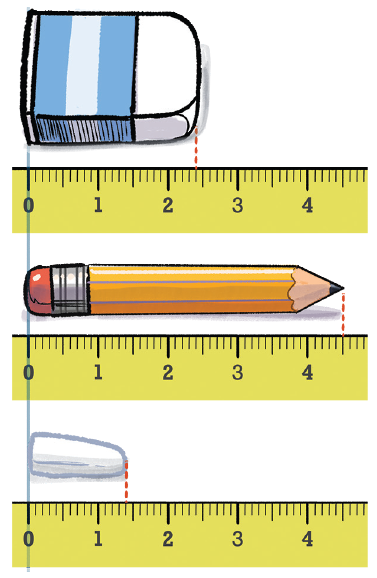
Question . Write the measurements of the objects shown in the picture:
Answer:
Given:
A picture showing three objects (an eraser, a pencil, and a small piece of chalk/crayon) placed against a ruler graduated in centimetres (cm). Each object starts at the zero mark ($0$).
To Find:
The length or measurement of each object shown.
Solution:
To find the measurement, we observe the point on the ruler where the right end of each object aligns with the markings. Each small division on the ruler represents $0.1\text{ cm}$ (or $1\text{ mm}$).
1. Measurement of the Eraser:
The right edge of the eraser aligns with the fourth small mark after the $2\text{ cm}$ mark.
$\text{Length of Eraser} = 2 + 0.4$
(Observing the markings)
So, the length is $2.4\text{ cm}$.
2. Measurement of the Pencil:
The tip of the pencil aligns exactly with the fifth small mark after the $4\text{ cm}$ mark.
$\text{Length of Pencil} = 4 + 0.5$
(Observing the markings)
So, the length is $4.5\text{ cm}$.
3. Measurement of the Small Object:
The right edge of the small object aligns with the fourth small mark after the $1\text{ cm}$ mark.
$\text{Length of Object} = 1 + 0.4$
(Observing the markings)
So, the length is $1.4\text{ cm}$.
Final Answer:
The measurements of the objects are:
$\bullet$ Eraser: $2.4\text{ cm}$
$\bullet$ Pencil: $4.5\text{ cm}$
$\bullet$ Small Object: $1.4\text{ cm}$
Intext Questions (Page No. 49 - 50)
Question. Arrange these lengths in increasing order:
(a) $\frac{9}{10}$
(b) $1 \frac{7}{10}$
(c) $\frac{130}{10}$
(d) $13 \frac{1}{10}$
(e) $10 \frac{5}{10}$
(f) $7 \frac{6}{10}$
(g) $6 \frac{7}{10}$
(h) $\frac{4}{10}$
Answer:
Given:
A set of lengths expressed as fractions and mixed numbers:
$\frac{9}{10}, 1 \frac{7}{10}, \frac{130}{10}, 13 \frac{1}{10}, 10 \frac{5}{10}, 7 \frac{6}{10}, 6 \frac{7}{10}, \frac{4}{10}$
To Find:
Increasing order (Ascending order) of these lengths.
Solution:
To arrange these easily, we first convert all terms into improper fractions with a common denominator of $10$ or convert them into decimals.
(a) $\frac{9}{10} = 0.9$
(b) $1 \frac{7}{10} = \frac{17}{10} = 1.7$
(c) $\frac{130}{10} = 13.0$
(d) $13 \frac{1}{10} = \frac{131}{10} = 13.1$
(e) $10 \frac{5}{10} = \frac{105}{10} = 10.5$
(f) $7 \frac{6}{10} = \frac{76}{10} = 7.6$
(g) $6 \frac{7}{10} = \frac{67}{10} = 6.7$
(h) $\frac{4}{10} = 0.4$
Comparing these decimals:
$0.4 < 0.9 < 1.7 < 6.7 < 7.6 < 10.5 < 13.0 < 13.1$
Final Answer:
The increasing order of the lengths is:
$\frac{4}{10} < \frac{9}{10} < 1 \frac{7}{10} < 6 \frac{7}{10} < 7 \frac{6}{10} < 10 \frac{5}{10} < \frac{130}{10} < 13 \frac{1}{10}$
Question. Arrange the following lengths in increasing order:
$4 \frac{1}{10}$, $\frac{4}{10}$, $\frac{41}{10}$, $41 \frac{1}{10}$
Answer:
Given:
Lengths: $4 \frac{1}{10}$, $\frac{4}{10}$, $\frac{41}{10}$, $41 \frac{1}{10}$
Solution:
Let us convert all of them into decimals for comparison:
1. $4 \frac{1}{10} = \frac{41}{10} = 4.1$
2. $\frac{4}{10} = 0.4$
3. $\frac{41}{10} = 4.1$
4. $41 \frac{1}{10} = \frac{411}{10} = 41.1$
Note: $4 \frac{1}{10}$ and $\frac{41}{10}$ are equal.
Comparing the values: $0.4 < 4.1 = 4.1 < 41.1$
Final Answer:
The increasing order is:
$\frac{4}{10} < 4 \frac{1}{10} = \frac{41}{10} < 41 \frac{1}{10}$
Intext Questions (Page No. 51 - 52)
Question. The lengths of the body parts of a honeybee are given. Find its total length.
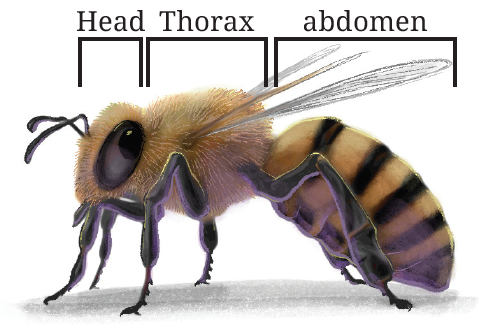
Head: $2 \frac{3}{10}$ units
Thorax: $5 \frac{4}{10}$ units
Abdomen: $7 \frac{5}{10}$ units
Answer:
Given:
Length of Head = $2 \frac{3}{10}$ units
Length of Thorax = $5 \frac{4}{10}$ units
Length of Abdomen = $7 \frac{5}{10}$ units
To Find:
The total length of the honeybee.
Solution:
The total length of the honeybee is the sum of the lengths of its head, thorax, and abdomen.
$\text{Total Length} = 2 \frac{3}{10} + 5 \frac{4}{10} + 7 \frac{5}{10}$
We can add the whole numbers and fractions separately:
Whole numbers: $2 + 5 + 7 = 14$
Fractions: $\frac{3}{10} + \frac{4}{10} + \frac{5}{10} = \frac{3 + 4 + 5}{10} = \frac{12}{10}$
Now, combine them:
$14 + \frac{12}{10} = 14 + 1 \frac{2}{10} = 15 \frac{2}{10}$ units
$\text{Total Length} = 15.2$ units
Final Answer:
The total length of the honeybee is $15 \frac{2}{10}$ units (or $15.2$ units).
Question. A Celestial Pearl Danio’s length is $2 \frac{4}{10}$ cm, and the length of a Philippine Goby is $\frac{9}{10}$ cm. What is the difference in their lengths?
Answer:
Given:
Length of Celestial Pearl Danio = $2 \frac{4}{10}$ cm
Length of Philippine Goby = $\frac{9}{10}$ cm
To Find:
The difference in their lengths.
Solution:
To find the difference, we subtract the length of the smaller fish from the larger one.
$\text{Difference} = 2 \frac{4}{10} - \frac{9}{10}$
Convert the mixed number into an improper fraction:
$2 \frac{4}{10} = \frac{(2 \times 10) + 4}{10} = \frac{24}{10}$
Now, perform the subtraction:
$\text{Difference} = \frac{24}{10} - \frac{9}{10} = \frac{24 - 9}{10}$
$\text{Difference} = \frac{15}{10} = 1 \frac{5}{10}$ cm
Final Answer:
The difference in their lengths is $1 \frac{5}{10}$ cm (or $1.5$ cm).
Question. Observe the given sequences of numbers. Identify the change after each term and extend the pattern:
(a) $4, 4 \frac{3}{10}, 4 \frac{6}{10}$, _________, _________, _________, _________
(b) $8 \frac{2}{10}, 8 \frac{7}{10}, 9 \frac{2}{10}$, _________, _________, _________, _________
(c) $7 \frac{6}{10}, 8 \frac{7}{10}$, _________, _________, _________, _________
(d) $5 \frac{7}{10}, 5 \frac{3}{10}$, _________, _________, _________, _________
(e) $13 \frac{5}{10}, 13, 12 \frac{5}{10}$, _________, _________, _________, _________
(f) $11 \frac{5}{10}, 10 \frac{4}{10}, 9 \frac{3}{10}$, _________, _________, _________, _________
Answer:
(a) Given sequence: $4, 4 \frac{3}{10}, 4 \frac{6}{10}, \dots$
To Find: The common change and the next four terms.
Solution:
$\text{Common difference} = 4 \frac{3}{10} - 4 = \frac{3}{10}$
(Change)
The pattern is increasing by $\frac{3}{10}$.
Next terms are calculated as:
$4 \frac{6}{10} + \frac{3}{10} = 4 \frac{9}{10}$
$4 \frac{9}{10} + \frac{3}{10} = 4 \frac{12}{10} = 5 \frac{2}{10}$
$5 \frac{2}{10} + \frac{3}{10} = 5 \frac{5}{10}$
$5 \frac{5}{10} + \frac{3}{10} = 5 \frac{8}{10}$
Extended pattern: $4, 4 \frac{3}{10}, 4 \frac{6}{10}, \mathbf{4 \frac{9}{10}, 5 \frac{2}{10}, 5 \frac{5}{10}, 5 \frac{8}{10}}$
(b) Given sequence: $8 \frac{2}{10}, 8 \frac{7}{10}, 9 \frac{2}{10}, \dots$
To Find: The common change and the next four terms.
Solution:
$\text{Common difference} = 8 \frac{7}{10} - 8 \frac{2}{10} = \frac{5}{10}$
(Change)
The pattern is increasing by $\frac{5}{10}$ (which is equivalent to $0.5$).
Next terms are calculated as:
$9 \frac{2}{10} + \frac{5}{10} = 9 \frac{7}{10}$
$9 \frac{7}{10} + \frac{5}{10} = 9 \frac{12}{10} = 10 \frac{2}{10}$
$10 \frac{2}{10} + \frac{5}{10} = 10 \frac{7}{10}$
$10 \frac{7}{10} + \frac{5}{10} = 10 \frac{12}{10} = 11 \frac{2}{10}$
Extended pattern: $8 \frac{2}{10}, 8 \frac{7}{10}, 9 \frac{2}{10}, \mathbf{9 \frac{7}{10}, 10 \frac{2}{10}, 10 \frac{7}{10}, 11 \frac{2}{10}}$
(c) Given sequence: $7 \frac{6}{10}, 8 \frac{7}{10}, \dots$
To Find: The common change and the next four terms.
Solution:
$\text{Common difference} = 8 \frac{7}{10} - 7 \frac{6}{10} = 1 \frac{1}{10}$
(Change)
The pattern is increasing by $1 \frac{1}{10}$ (which is equivalent to $1.1$).
Next terms are calculated as:
$8 \frac{7}{10} + 1 \frac{1}{10} = 9 \frac{8}{10}$
$9 \frac{8}{10} + 1 \frac{1}{10} = 10 \frac{9}{10}$
$10 \frac{9}{10} + 1 \frac{1}{10} = 11 \frac{10}{10} = 12$
$12 + 1 \frac{1}{10} = 13 \frac{1}{10}$
Extended pattern: $7 \frac{6}{10}, 8 \frac{7}{10}, \mathbf{9 \frac{8}{10}, 10 \frac{9}{10}, 12, 13 \frac{1}{10}}$
(d) Given sequence: $5 \frac{7}{10}, 5 \frac{3}{10}, \dots$
To Find: The common change and the next four terms.
Solution:
$\text{Common difference} = 5 \frac{3}{10} - 5 \frac{7}{10} = -\frac{4}{10}$
(Change)
The pattern is decreasing by $\frac{4}{10}$ (which is equivalent to $0.4$).
Next terms are calculated as:
$5 \frac{3}{10} - \frac{4}{10} = 4 \frac{13}{10} - \frac{4}{10} = 4 \frac{9}{10}$
$4 \frac{9}{10} - \frac{4}{10} = 4 \frac{5}{10}$
$4 \frac{5}{10} - \frac{4}{10} = 4 \frac{1}{10}$
$4 \frac{1}{10} - \frac{4}{10} = 3 \frac{11}{10} - \frac{4}{10} = 3 \frac{7}{10}$
Extended pattern: $5 \frac{7}{10}, 5 \frac{3}{10}, \mathbf{4 \frac{9}{10}, 4 \frac{5}{10}, 4 \frac{1}{10}, 3 \frac{7}{10}}$
(e) Given sequence: $13 \frac{5}{10}, 13, 12 \frac{5}{10}, \dots$
To Find: The common change and the next four terms.
Solution:
$\text{Common difference} = 13 - 13 \frac{5}{10} = -\frac{5}{10}$
(Change)
The pattern is decreasing by $\frac{5}{10}$ (which is equivalent to $0.5$).
Next terms are calculated as:
$12 \frac{5}{10} - \frac{5}{10} = 12$
$12 - \frac{5}{10} = 11 \frac{5}{10}$
$11 \frac{5}{10} - \frac{5}{10} = 11$
$11 - \frac{5}{10} = 10 \frac{5}{10}$
Extended pattern: $13 \frac{5}{10}, 13, 12 \frac{5}{10}, \mathbf{12, 11 \frac{5}{10}, 11, 10 \frac{5}{10}}$
(f) Given sequence: $11 \frac{5}{10}, 10 \frac{4}{10}, 9 \frac{3}{10}, \dots$
To Find: The common change and the next four terms.
Solution:
$\text{Common difference} = 10 \frac{4}{10} - 11 \frac{5}{10} = -1 \frac{1}{10}$
(Change)
The pattern is decreasing by $1 \frac{1}{10}$ (which is equivalent to $1.1$).
Next terms are calculated as:
$9 \frac{3}{10} - 1 \frac{1}{10} = 8 \frac{2}{10}$
$8 \frac{2}{10} - 1 \frac{1}{10} = 7 \frac{1}{10}$
$7 \frac{1}{10} - 1 \frac{1}{10} = 6 \frac{0}{10} = 6$
$6 - 1 \frac{1}{10} = 5 \frac{10}{10} - 1 \frac{1}{10} = 4 \frac{9}{10}$
Extended pattern: $11 \frac{5}{10}, 10 \frac{4}{10}, 9 \frac{3}{10}, \mathbf{8 \frac{2}{10}, 7 \frac{1}{10}, 6, 4 \frac{9}{10}}$
Intext Questions (Page No. 53 - 56)
Question. How many one-hundredths make one-tenth? Can we also say that the length is 4 units and 45 one-hundredths?
Answer:
To Find:
1. The number of one-hundredths required to form one-tenth.
2. Whether a length of $4.45$ can be expressed as "4 units and 45 one-hundredths".
Solution:
In the decimal place value system, the value of each place is ten times the value of the place to its right. The first place to the right of the decimal point is the tenths place, and the second place is the hundredths place.
Mathematically, one-tenth is represented as $\frac{1}{10}$ and one-hundredth is represented as $\frac{1}{100}$.
To find how many hundredths are in a tenth, we can use the following relation:
$\frac{1}{10} = \frac{1 \times 10}{10 \times 10} = \frac{10}{100}$
From the above equation, it is clear that $10$ one-hundredths make one-tenth.
For the second part of the question, consider the decimal number $4.45$.
In this number:
The digit $4$ is in the ones place (representing $4$ units).
The digit $4$ after the decimal is in the tenths place (representing $\frac{4}{10}$).
The digit $5$ is in the hundredths place (representing $\frac{5}{100}$).
We can combine the decimal part as follows:
$\frac{4}{10} + \frac{5}{100} = \frac{40}{100} + \frac{5}{100} = \frac{45}{100}$
(Combining fractional parts)
This shows that $0.45$ is equivalent to $45$ hundredths.
Therefore, yes, it is correct to say that the length is 4 units and 45 one-hundredths.
Conclusion:
1. $10$ one-hundredths make one-tenth.
2. Yes, we can say that the length is 4 units and 45 one-hundredths.
Question. Observe the figure below. Notice the markings and the corresponding lengths written in the boxes when measured from $0$. Fill the lengths in the empty boxes.

Answer:
Given:
A number line scale starting from $0$.
The distance between any two consecutive whole numbers (like $0$ to $1$) is divided into $10$ large parts, where each large part represents one-tenth ($\frac{1}{10}$).
Each large part is further divided into $10$ small parts, where each small part represents one-hundredth ($\frac{1}{100}$).
To Find:
The fractional values (expressed in hundredths) for the five empty boxes from left to right.
Solution:
We determine the value for each box by counting the number of wholes, tenths, and hundredths from the $0$ mark.
1. For the first empty box:
The arrow is between $0$ and $1$. It points to the 5th tenth marking and $5$ hundredth markings.
$\text{Value} = \frac{50}{100} + \frac{5}{100} = \frac{55}{100}$
(5 tenths and 5 hundredths)
2. For the second empty box:
The arrow is after the whole number $1$. It points to the 5th tenth marking and $5$ hundredth markings after $1$.
$\text{Value} = 1 + \frac{55}{100} = \frac{155}{100}$
(1 unit and 55 hundredths)
3. For the third empty box:
The arrow is after the whole number $1$. It points to the 7th tenth marking and $4$ hundredth markings after $1$.
$\text{Value} = 1 + \frac{74}{100} = \frac{174}{100}$
(1 unit and 74 hundredths)
4. For the fourth empty box:
The arrow is after the whole number $2$. It points exactly to the 2nd hundredth marking after $2$.
$\text{Value} = 2 + \frac{2}{100} = \frac{202}{100}$
(2 units and 2 hundredths)
5. For the fifth empty box:
The arrow is after the whole number $2$. It points to the 4th tenth marking after $2$.
$\text{Value} = 2 + \frac{40}{100} = \frac{240}{100}$
(2 units and 40 hundredths)
Final Answer:
The values for the boxes from left to right are $\frac{55}{100}$, $\frac{155}{100}$, $\frac{174}{100}$, $\frac{202}{100}$, and $\frac{240}{100}$.
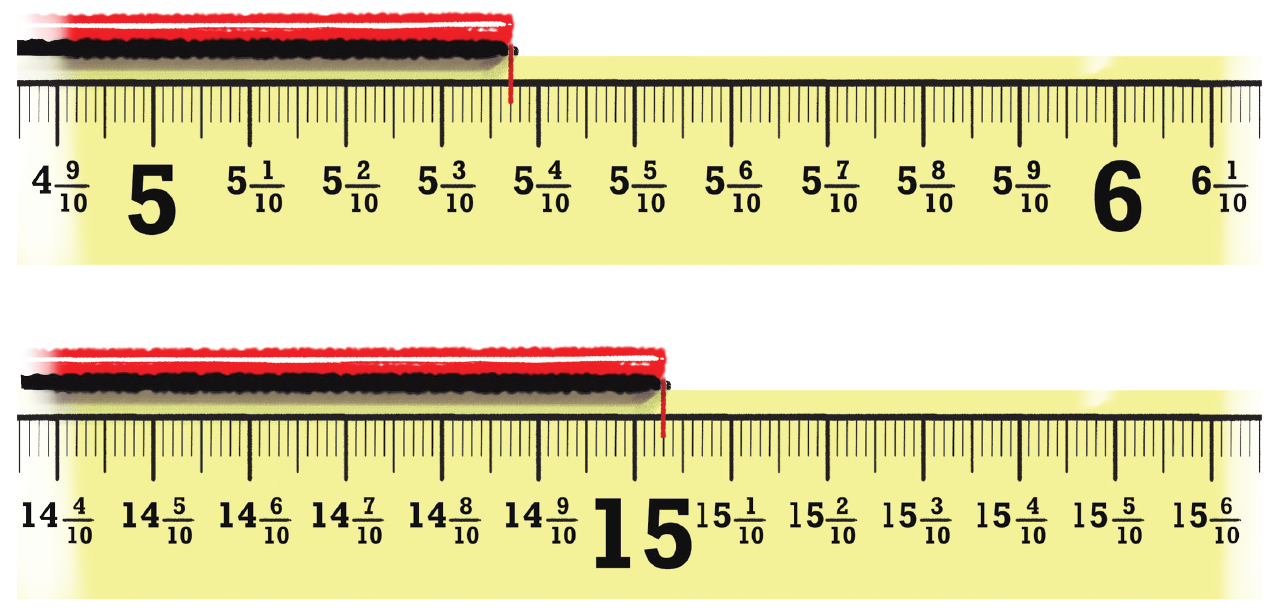
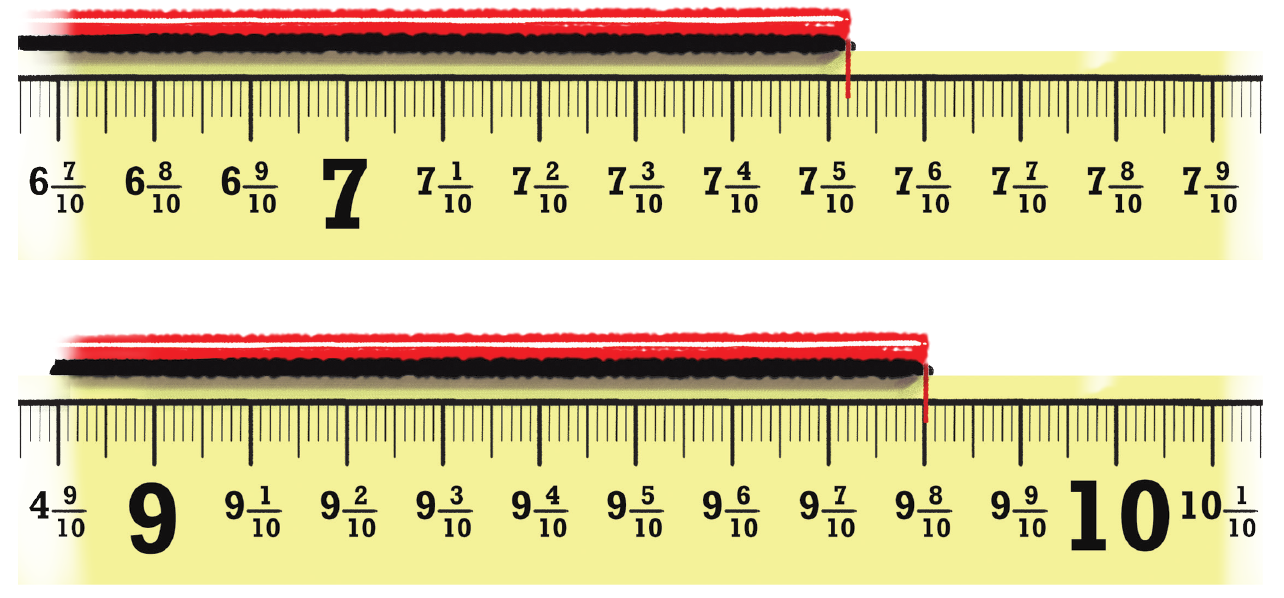
Question. For the lengths shown below write the measurements and read out the measures in words.
Answer:
To Find: The measurements of the four objects shown on the scales and their corresponding representation in words.
Solution:
On these measurement scales, the space between two consecutive tenth markings (like $\frac{3}{10}$ and $\frac{4}{10}$) is divided into $10$ equal smaller parts. Each large division represents a tenth ($\frac{1}{10}$) and each small division represents a hundredth ($\frac{1}{100}$).
1. First Object (Top scale of Image 1):
The right end of the object aligns with the 7th small marking after the $5 \frac{3}{10}$ mark.
Measurement: $5 \frac{3}{10} + \frac{7}{100} = 5 \frac{37}{100}$ units.
In words: 5 units and 37 one-hundredths.
2. Second Object (Bottom scale of Image 1):
The right end of the object aligns with the 2nd small marking after the whole number $15$.
Measurement: $15 + \frac{2}{100} = 15 \frac{2}{100}$ units.
In words: 15 units and 2 one-hundredths.
3. Third Object (Top scale of Image 2):
The right end of the object aligns with the 2nd small marking after the $7 \frac{5}{10}$ mark.
Measurement: $7 \frac{5}{10} + \frac{2}{100} = 7 \frac{52}{100}$ units.
In words: 7 units and 52 one-hundredths.
4. Fourth Object (Bottom scale of Image 2):
The right end of the object aligns with the marking at $9 \frac{8}{10}$.
Measurement: $9 \frac{8}{10} = 9 \frac{80}{100}$ units.
In words: 9 units and 80 one-hundredths.
Question. In each group, identify the longest and the shortest lengths. Mark each length on the scale.
(a) $\frac{3}{10}, \frac{3}{100}, \frac{33}{100}$

(b) $3 \frac{1}{10}, \frac{30}{10}, 1 \frac{3}{10}$

(c) $\frac{45}{100}, \frac{54}{100}, \frac{5}{10}, \frac{4}{10}$

(d) $3 \frac{6}{10}, 3 \frac{6}{100}, 3 \frac{6}{10} + \frac{6}{100}$

(e) $\frac{8}{10} + \frac{2}{100}, \frac{9}{100}, 1 \frac{8}{100}$

(f) $7 \frac{3}{10} + \frac{5}{100}, 7 \frac{5}{10}, 7 \frac{41}{100}$

(g) $\frac{65}{10} + \frac{15}{100}, 5 \frac{87}{100}, 5 \frac{7}{100}$

Answer:
To identify the longest and shortest lengths, we convert each expression into decimal form for a clear comparison.
(a) $\frac{3}{10}, \frac{3}{100}, \frac{33}{100}$
$\bullet$ $\frac{3}{10} = 0.30$
$\bullet$ $\frac{3}{100} = 0.03$
$\bullet$ $\frac{33}{100} = 0.33$
Shortest Length: $\frac{3}{100}$ ($0.03$)
Longest Length: $\frac{33}{100}$ ($0.33$)
(b) $3 \frac{1}{10}, \frac{30}{10}, 1 \frac{3}{10}$
$\bullet$ $3 \frac{1}{10} = 3.1$
$\bullet$ $\frac{30}{10} = 3.0$
$\bullet$ $1 \frac{3}{10} = 1.3$
Shortest Length: $1 \frac{3}{10}$ ($1.3$)
Longest Length: $3 \frac{1}{10}$ ($3.1$)
(c) $\frac{45}{100}, \frac{54}{100}, \frac{5}{10}, \frac{4}{10}$
$\bullet$ $\frac{45}{100} = 0.45$
$\bullet$ $\frac{54}{100} = 0.54$
$\bullet$ $\frac{5}{10} = 0.50$
$\bullet$ $\frac{4}{10} = 0.40$
Shortest Length: $\frac{4}{10}$ ($0.40$)
Longest Length: $\frac{54}{100}$ ($0.54$)
(d) $3 \frac{6}{10}, 3 \frac{6}{100}, 3 \frac{6}{10} + \frac{6}{100}$
$\bullet$ $3 \frac{6}{10} = 3.60$
$\bullet$ $3 \frac{6}{100} = 3.06$
$\bullet$ $3 \frac{6}{10} + \frac{6}{100} = 3.6 + 0.06 = 3.66$
Shortest Length: $3 \frac{6}{100}$ ($3.06$)
Longest Length: $3 \frac{6}{10} + \frac{6}{100}$ ($3.66$)
(e) $\frac{8}{10} + \frac{2}{100}, \frac{9}{100}, 1 \frac{8}{100}$
$\bullet$ $\frac{8}{10} + \frac{2}{100} = 0.82$
$\bullet$ $\frac{9}{100} = 0.09$
$\bullet$ $1 \frac{8}{100} = 1.08$
Shortest Length: $\frac{9}{100}$ ($0.09$)
Longest Length: $1 \frac{8}{100}$ ($1.08$)
(f) $7 \frac{3}{10} + \frac{5}{100}, 7 \frac{5}{10}, 7 \frac{41}{100}$
$\bullet$ $7 \frac{3}{10} + \frac{5}{100} = 7.35$
$\bullet$ $7 \frac{5}{10} = 7.50$
$\bullet$ $7 \frac{41}{100} = 7.41$
Shortest Length: $7 \frac{3}{10} + \frac{5}{100}$ ($7.35$)
Longest Length: $7 \frac{5}{10}$ ($7.50$)
(g) $\frac{65}{10} + \frac{15}{100}, 5 \frac{87}{100}, 5 \frac{7}{100}$
$\bullet$ $\frac{65}{10} + \frac{15}{100} = 6.5 + 0.15 = 6.65$
$\bullet$ $5 \frac{87}{100} = 5.87$
$\bullet$ $5 \frac{7}{100} = 5.07$
Shortest Length: $5 \frac{7}{100}$ ($5.07$)
Longest Length: $\frac{65}{10} + \frac{15}{100}$ ($6.65$)
Alternate Solution:
One can also compare these by making the denominators same. For example, in (a), we have $\frac{30}{100}$, $\frac{3}{100}$, and $\frac{33}{100}$. Since $3 < 30 < 33$, the order is easily established without decimal conversion.
Figure It Out (Page No. 58)
Question. Find the sums and differences:
(a) $\frac{3}{10} + 3 \frac{4}{100}$
(b) $9 \frac{5}{10} \frac{7}{100} + 2 \frac{1}{10} \frac{3}{100}$
(c) $15 \frac{6}{10} \frac{4}{100} + 14 \frac{3}{10} \frac{6}{100}$
(d) $7 \frac{7}{100} - 4 \frac{4}{100}$
(e) $8 \frac{6}{100} - 5 \frac{3}{100}$
(f) $12 \frac{6}{100} \frac{2}{100} - \frac{9}{10} \frac{9}{100}$
Answer:
To Find: The sum or difference for the given expressions in fractional form.
(a) Solution:
To add these, we first convert the fractions into like fractions with a common denominator of $100$.
$\frac{3}{10} = \frac{3 \times 10}{10 \times 10} = \frac{30}{100}$
(Making like fractions)
Now, we add it to the mixed fraction:
$\frac{30}{100} + 3 \frac{4}{100} = 3 \frac{30 + 4}{100}$
Result: $3 \frac{34}{100}$
(b) Solution:
The notation $9 \frac{5}{10} \frac{7}{100}$ represents $9 + \frac{5}{10} + \frac{7}{100}$, which can be written as $9 \frac{57}{100}$.
Similarly, $2 \frac{1}{10} \frac{3}{100}$ can be written as $2 \frac{13}{100}$.
Adding the whole numbers and the fractions separately:
$(9 + 2) + \left(\frac{57}{100} + \frac{13}{100}\right) = 11 + \frac{70}{100}$
(Adding whole and fractional parts)
Result: $11 \frac{70}{100}$ (or $11 \frac{7}{10}$)
(c) Solution:
Combining the tenths and hundredths into single fractions:
$15 \frac{6}{10} \frac{4}{100} = 15 \frac{64}{100}$
$14 \frac{3}{10} \frac{6}{100} = 14 \frac{36}{100}$
Now, adding them together:
$15 \frac{64}{100} + 14 \frac{36}{100} = (15 + 14) + \left(\frac{64 + 36}{100}\right)$
(Grouping wholes and fractions)
$= 29 + \frac{100}{100} = 29 + 1$
Result: $30$
(d) Solution:
Subtract the whole numbers and the fractions:
$7 \frac{7}{100} - 4 \frac{4}{100} = (7 - 4) + \left(\frac{7 - 4}{100}\right)$
(Subtracting like terms)
Result: $3 \frac{3}{100}$
(e) Solution:
Subtracting the parts directly:
$8 \frac{6}{100} - 5 \frac{3}{100} = (8 - 5) + \left(\frac{6 - 3}{100}\right)$
(Performing subtraction)
Result: $3 \frac{3}{100}$
(f) Solution:
First, express the fractions as like fractions with denominator $100$:
$12 \frac{6}{10} \frac{2}{100} = 12 \frac{62}{100}$
$\frac{9}{10} \frac{9}{100} = \frac{90}{100} + \frac{9}{100} = \frac{99}{100}$
Now, perform the subtraction:
$12 \frac{62}{100} - \frac{99}{100} = 11 \frac{162}{100} - \frac{99}{100}$
(Regrouping/Borrowing)
$= 11 + \frac{162 - 99}{100} = 11 + \frac{63}{100}$
Result: $11 \frac{63}{100}$
Intext Questions (Page No. 63 - 64)
Question. Make a place value table similar to the one above. Write each quantity in decimal form and in terms of place value, and read the number:
(a) $2$ ones, $3$ tenths and $5$ hundredths
(b) $1$ ten and $5$ tenths
(c) $4$ ones and $6$ hundredths
(d) $1$ hundred, $1$ one and $1$ hundredth
(e) $\frac{8}{100}$ and $\frac{9}{10}$
(f) $\frac{5}{100}$
(g) $\frac{1}{10}$
(h) $2 \frac{1}{100}$, $4 \frac{1}{10}$ and $7 \frac{7}{1000}$
Answer:
Given: Various quantities expressed in terms of ones, tens, hundreds, and fractions (tenths, hundredths, thousandths).
To Find: The decimal form of each quantity, its representation in a place value table, and the verbal reading of each number.
Solution:
First, we represent all the given quantities in a consolidated Place Value Table. For part (h), since three separate numbers are provided, they are listed individually as (h) i, (h) ii, and (h) iii.
| Part | Hundreds ($100$) | Tens ($10$) | Ones ($1$) | Tenths ($\frac{1}{10}$) | Hundredths ($\frac{1}{100}$) | Thousandths ($\frac{1}{1000}$) | Decimal Form |
| (a) | 0 | 0 | 2 | 3 | 5 | 0 | $2.35$ |
| (b) | 0 | 1 | 0 | 5 | 0 | 0 | $10.5$ |
| (c) | 0 | 0 | 4 | 0 | 6 | 0 | $4.06$ |
| (d) | 1 | 0 | 1 | 0 | 1 | 0 | $101.01$ |
| (e) | 0 | 0 | 0 | 9 | 8 | 0 | $0.98$ |
| (f) | 0 | 0 | 0 | 0 | 5 | 0 | $0.05$ |
| (g) | 0 | 0 | 0 | 1 | 0 | 0 | $0.1$ |
| (h) i | 0 | 0 | 2 | 0 | 1 | 0 | $2.01$ |
| (h) ii | 0 | 0 | 4 | 1 | 0 | 0 | $4.1$ |
| (h) iii | 0 | 0 | 7 | 0 | 0 | 7 | $7.007$ |
Reading the Numbers:
Decimals are read by pronouncing the whole number followed by "point" and then each decimal digit individually.
(a) $2.35$ : Two point three five.
(b) $10.5$ : Ten point five.
(c) $4.06$ : Four point zero six.
(d) $101.01$ : One hundred one point zero one.
(e) $0.98$ : Zero point nine eight.
(f) $0.05$ : Zero point zero five.
(g) $0.1$ : Zero point one.
(h) Mixed parts:
i. $2.01$ : Two point zero one.
ii. $4.1$ : Four point one.
iii. $7.007$ : Seven point zero zero seven.
Question. Write these quantities in decimal form:
(a) 234 hundredths
(b) 105 tenths
Answer:
(a) 234 hundredths
Solution: hundredths means the value is divided by $100$.
$\frac{234}{100} = 2.34$
[Decimal Form]
(b) 105 tenths
Solution: tenths means the value is divided by $10$.
$\frac{105}{10} = 10.5$
[Decimal Form]
Intext Questions (Page No. 65 - 66)
Question. Fill in the blanks below (mm $\leftrightarrow$ cm):
| $12$ mm $= 1.2$ cm | $56$ mm $= 5.6$ cm | $70$ mm = _______ |
| ________ $= 0.9$ cm | $134$ mm = __________ | ________ $= 203.6$ cm |
Answer:
Given: Conversion factor between millimetres (mm) and centimetres (cm).
$10$ mm $= 1$ cm
(Standard unit conversion)
Solution:
To convert mm to cm, we divide by $10$. To convert cm to mm, we multiply by $10$.
| Millimetres (mm) | Centimetres (cm) | Calculation |
| $70$ mm | $7.0$ cm | $70 \div 10$ |
| $9$ mm | $0.9$ cm | $0.9 \times 10$ |
| $134$ mm | $13.4$ cm | $134 \div 10$ |
| $2036$ mm | $203.6$ cm | $203.6 \times 10$ |
Final Answer:
The filled blanks are: $70$ mm = $7.0$ cm, $9$ mm = $0.9$ cm, $134$ mm = $13.4$ cm, and $2036$ mm = $203.6$ cm.
Question. Fill in the blanks below (cm $\leftrightarrow$ m):
| $36$ cm = _______ | $50$ cm = _______ | _______ = $0.89$ m |
| $4$ cm = _______ | $325$ cm = _______ | ________ = $2.07$ m |
Answer:
Given: Conversion factor between centimetres (cm) and metres (m).
$100$ cm $= 1$ m
(Standard unit conversion)
Solution:
To convert cm to m, we divide by $100$. To convert m to cm, we multiply by $100$.
| Centimetres (cm) | Metres (m) | Calculation |
| $36$ cm | $0.36$ m | $36 \div 100$ |
| $50$ cm | $0.50$ m | $50 \div 100$ |
| $89$ cm | $0.89$ m | $0.89 \times 100$ |
| $4$ cm | $0.04$ m | $4 \div 100$ |
| $325$ cm | $3.25$ m | $325 \div 100$ |
| $207$ cm | $2.07$ m | $2.07 \times 100$ |
Final Answer:
The filled values are $0.36$ m, $0.50$ m, $89$ cm, $0.04$ m, $3.25$ m, and $207$ cm respectively.
Question. How many mm does $1$ meter have?
Answer:
To Find: The number of millimetres (mm) in one metre (m).
Solution:
We know that:
$1$ m $= 100$ cm
... (i)
And also:
$1$ cm $= 10$ mm
... (ii)
Substituting the value of (ii) in (i):
$1$ m $= 100 \times 10$ mm
$1$ m $= 1000$ mm
Final Answer:
One metre has $1000$ mm.
Question. Can we write $1$ mm = $\frac{1}{1000}$ m?
Answer:
Solution:
Yes, we can write $1$ mm = $\frac{1}{1000}$ m.
Reasoning:
Since $1000$ millimetres make up $1$ metre, one single millimetre represents one-thousandth of a metre.
Mathematically:
$1000$ mm $= 1$ m
Dividing both sides by $1000$:
$1$ mm $= \frac{1}{1000}$ m
In decimal form, this is written as $0.001$ m.
Intext Questions (Page No. 68 - 69)
Question. Fill in the blanks below (g $\leftrightarrow$ kg):
| $465$ g = _______ | $68$ g = _________ | $1560$ g = ________ |
| $704$ g = _______ | ________ = $0.56$ kg | _______ = $2.5$ kg |
Answer:
Given:
In the metric system, the relationship between grams (g) and kilograms (kg) is defined by the factor of $1000$.
$1000 \text{ g} = 1 \text{ kg}$
(Standard Conversion)
Solution:
To convert from grams to kilograms, we divide the given amount by $1000$. Conversely, to convert from kilograms to grams, we multiply the amount by $1000$.
| Grams (g) | Kilograms (kg) | Process |
| $465$ | $0.465$ | $465 \div 1000$ |
| $68$ | $0.068$ | $68 \div 1000$ |
| $1560$ | $1.560$ | $1560 \div 1000$ |
| $704$ | $0.704$ | $704 \div 1000$ |
| $560$ | $0.56$ | $0.56 \times 1000$ |
| $2500$ | $2.5$ | $2.5 \times 1000$ |
Final Answer:
The filled values are as follows:
$465$ g = $0.465$ kg
$68$ g = $0.068$ kg
$1560$ g = $1.56$ kg
$704$ g = $0.704$ kg
$560$ g = $0.56$ kg
$2500$ g = $2.5$ kg
Question. Fill in the blanks below (rupee $\leftrightarrow$ paise):
| $10$ p = ___________ | _______ p = ₹ $0.05$ | _______ p = ₹ $0.36$ |
| _________ = ₹ $0.50$ | $99$ p = _________ | $250$ p = _________ |
Answer:
Given:
According to the Indian Perspective of currency, the relationship between Rupees ($\textsf{₹}$) and Paise (p) is:
$100 \text{ Paise} = \textsf{₹} 1$
(Currency Conversion)
Solution:
To convert Paise to Rupees, we divide by $100$. To convert Rupees to Paise, we multiply by $100$.
| Paise (p) | Rupees ($\textsf{₹}$) | Process |
| $10$ p | $\textsf{₹} 0.10$ | $10 \div 100$ |
| $5$ p | $\textsf{₹} 0.05$ | $0.05 \times 100$ |
| $36$ p | $\textsf{₹} 0.36$ | $0.36 \times 100$ |
| $50$ p | $\textsf{₹} 0.50$ | $0.50 \times 100$ |
| $99$ p | $\textsf{₹} 0.99$ | $99 \div 100$ |
| $250$ p | $\textsf{₹} 2.50$ | $250 \div 100$ |
Final Answer:
The filled values are as follows:
$10$ p = $\textsf{₹} 0.10$
$5$ p = $\textsf{₹} 0.05$
$36$ p = $\textsf{₹} 0.36$
$50$ p = $\textsf{₹} 0.50$
$99$ p = $\textsf{₹} 0.99$
$250$ p = $\textsf{₹} 2.50$
Intext Questions (Page No. 70)
Question. Name all the divisions between $1$ and $1.1$ on the number line.

Answer:
Given:
A number line showing the interval between $1$ and $1.1$ divided into 10 equal subdivisions.
To Find:
The decimal names of all the divisions between $1$ and $1.1$.
Solution:
The distance between $1$ and $1.1$ represents one-tenth ($0.1$).
Since this interval is divided into 10 equal parts, each small subdivision represents one-hundredth ($0.01$).
$0.1 \div 10 = 0.01$
(Value of one subdivision)
To name the divisions, we add $0.01$ successively starting from $1$ (which can be written as $1.00$):
$\bullet$ 1st division: $1.00 + 0.01 = 1.01$
$\bullet$ 2nd division: $1.00 + 0.02 = 1.02$
$\bullet$ 3rd division: $1.00 + 0.03 = 1.03$
$\bullet$ 4th division: $1.00 + 0.04 = 1.04$
$\bullet$ 5th division: $1.00 + 0.05 = 1.05$
$\bullet$ 6th division: $1.00 + 0.06 = 1.06$
$\bullet$ 7th division: $1.00 + 0.07 = 1.07$
$\bullet$ 8th division: $1.00 + 0.08 = 1.08$
$\bullet$ 9th division: $1.00 + 0.09 = 1.09$
Final Answer:
The divisions between $1$ and $1.1$ are: $1.01, 1.02, 1.03, 1.04, 1.05, 1.06, 1.07, 1.08,$ and $1.09$.
Question. Identify and write the decimal numbers against the letters $A$, $B$, $C$, and $D$.

Answer:
Given:
1. A number line with major markings at $5$, $5.1$, $5.3$, and $5.4$.
2. The interval between major tenth markings (e.g., between $5.0$ and $5.1$) is divided into 10 equal small parts.
To Find:
The decimal values represented by the letters $A$, $B$, $C$, and $D$.
Solution:
First, we determine the value of each small division on the number line. Since there are $10$ small divisions between $5$ and $5.1$, the value of each small tick is:
$\text{Value of 1 small tick} = \frac{0.1}{10} = 0.01$
(Scale calculation)
For Point A:
Point $A$ is at the 9th small tick after the whole number $5$.
$A = 5 + (9 \times 0.01) = 5.09$
(9 hundredths after 5)
For Point B:
Point $B$ is at the 3rd small tick after the marking $5.1$.
$B = 5.1 + (3 \times 0.01) = 5.13$
(3 hundredths after 5.1)
For Point C:
Point $C$ is exactly at the large marking halfway between $5.1$ and $5.3$. This represents the tenth marking $5.2$.
$C = 5.1 + (10 \times 0.01) = 5.2$
(10 hundredths after 5.1)
For Point D:
Point $D$ is at the 1st small tick after the marking $5.3$.
$D = 5.3 + (1 \times 0.01) = 5.31$
(1 hundredth after 5.3)
Final Answer:
The identified decimal numbers are:
$\bullet$ $A = 5.09$
$\bullet$ $B = 5.13$
$\bullet$ $C = 5.2$
$\bullet$ $D = 5.31$
Intext Questions (Page No. 71 - 72)
Question. We can figure this out by looking at the quantities these numbers represent using place value.
| Decimal number | Units | Tenths | Hundredths | Thousandths |
|---|---|---|---|---|
| $0.2$ | $0$ | $2$ | ||
| $0.20$ | $0$ | $2$ | $0$ | |
| $0.200$ | $0$ | $2$ | $0$ | $0$ |
| $0.02$ | $0$ | $0$ | $2$ | |
| $0.002$ | $0$ | $0$ | $0$ | $2$ |
We can see that $0.2$, $0.20$, and $0.200$ are all equal as they represent the same quantity, i.e., $2$ tenths. But $0.2$, $0.02$, and $0.002$ are different.
Can you tell which of these is the smallest and which is the largest?
Answer:
Given:
The decimal numbers provided for comparison are $0.2$, $0.02$, and $0.002$.
To Find:
Identify which of these decimal numbers is the smallest and which is the largest.
Solution:
To compare decimal numbers effectively, we can look at the digits in each place value starting from the left (tenths, then hundredths, then thousandths). Alternatively, we can convert them into like decimals by ensuring they all have the same number of digits after the decimal point.
Let us represent them in a place value table:
| Decimal Number | Units | Tenths ($\frac{1}{10}$) | Hundredths ($\frac{1}{100}$) | Thousandths ($\frac{1}{1000}$) |
| $0.2$ | $0$ | $2$ | $0$ | $0$ |
| $0.02$ | $0$ | $0$ | $2$ | $0$ |
| $0.002$ | $0$ | $0$ | $0$ | $2$ |
By observing the table:
1. In $0.2$, there are $2$ tenths. Since tenths is the largest decimal place value here, this number has the highest value.
$0.2 = \frac{2}{10} = \frac{200}{1000}$
(Largest)
2. In $0.02$, there are $0$ tenths and $2$ hundredths.
$0.02 = \frac{2}{100} = \frac{20}{1000}$
(Intermediate)
3. In $0.002$, there are $0$ tenths, $0$ hundredths, and $2$ thousandths. Since thousandths is the smallest place value here, this number has the lowest value.
$0.002 = \frac{2}{1000}$
(Smallest)
Comparing the thousandths: $200 > 20 > 2$.
Therefore, we have the order: $0.2 > 0.02 > 0.002$.
Final Answer:
$\bullet$ The Largest number is $0.2$.
$\bullet$ The Smallest number is $0.002$.
Question. Which of these are the same: $4.5$, $4.05$, $0.405$, $4.050$, $4.50$, $4.005$, $04.50$?
Answer:
Given:
The set of decimal numbers: $4.5$, $4.05$, $0.405$, $4.050$, $4.50$, $4.005$, and $04.50$.
To Find:
Identify which decimal numbers in the given set represent the same value.
Solution:
In the decimal system, the value of a number is determined by its place value. To identify equivalent decimals, we use the following rules:
1. Trailing Zeros: Adding zeros at the end of the decimal part (to the right) does not change the value of the number. For example, $4.5 = 4.50$.
2. Leading Zeros: Adding zeros to the left of the whole number part does not change the value. For example, $4.5 = 04.5$.
3. Place Value Comparison: We compare the digits in the units, tenths, hundredths, and thousandths places.
Let us organize these numbers in a place value table for clear comparison:
| Decimal Number | Tens | Ones (Units) | Tenths ($\frac{1}{10}$) | Hundredths ($\frac{1}{100}$) | Thousandths ($\frac{1}{1000}$) |
| $4.5$ | $0$ | $4$ | $5$ | $0$ | $0$ |
| $4.05$ | $0$ | $4$ | $0$ | $5$ | $0$ |
| $0.405$ | $0$ | $0$ | $4$ | $0$ | $5$ |
| $4.050$ | $0$ | $4$ | $0$ | $5$ | $0$ |
| $4.50$ | $0$ | $4$ | $5$ | $0$ | $0$ |
| $4.005$ | $0$ | $4$ | $0$ | $0$ | $5$ |
| $04.50$ | $0$ | $4$ | $5$ | $0$ | $0$ |
From the table, we can group the numbers that have identical digits in every place value:
Group 1:
$4.5 = 4.50 = 04.50$
(4 units and 5 tenths)
Group 2:
$4.05 = 4.050$
(4 units and 5 hundredths)
Final Answer:
The following sets of numbers are the same:
1. $4.5$, $4.50$, and $04.50$ are the same.
2. $4.05$ and $4.050$ are the same.
Question. Identify the decimal number in the last number line in Figure (b) denoted by ‘?’.
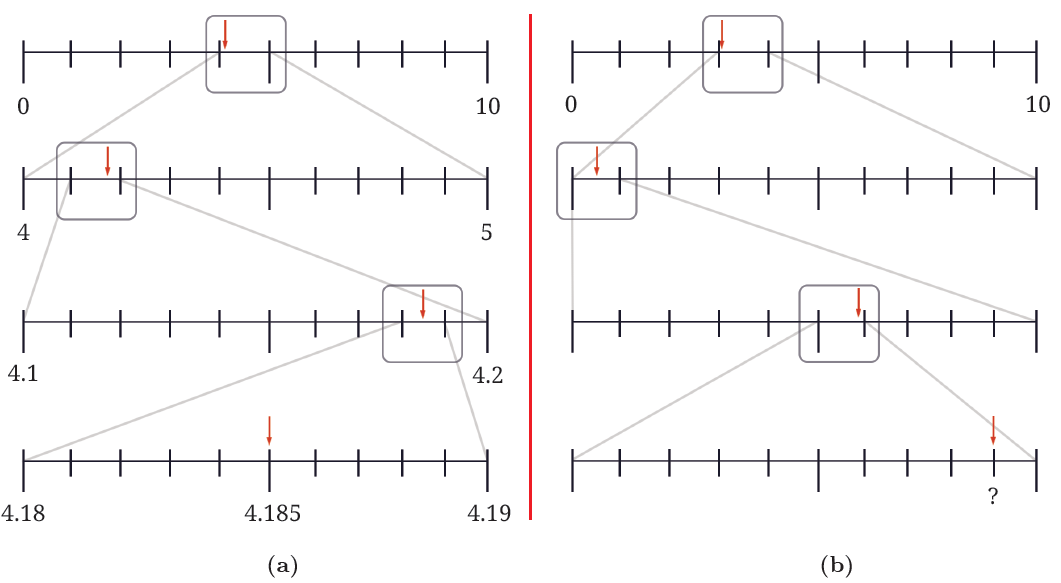
Answer:
Given:
A set of successive number lines in Figure (b) that zoom into smaller intervals to identify a specific point marked by '?'.
To Find:
The exact decimal value denoted by the arrow '?' on the final zoomed-in number line.
Solution:
To identify the number, we observe the range of each zoomed-in section from top to bottom:
Step 1: On the first number line, the interval being zoomed is between the whole numbers $3$ and $4$.
Step 2: The second number line shows the interval between $3$ and $4$ divided into tenths. The zoom focuses on the very first interval, which is between $3.0$ and $3.1$.
Step 3: The third number line divides the interval between $3.0$ and $3.1$ into hundredths ($3.01, 3.02, \dots, 3.10$). The zoom points to the interval between the 5th and 6th marking, which corresponds to $3.05$ and $3.06$.
Step 4: The fourth (last) number line divides the interval between $3.05$ and $3.06$ into ten equal parts. Each small part represents one-thousandth ($0.001$).
The arrow '?' is pointing to the 9th small tick after $3.05$.
$? = 3.05 + \frac{9}{1000}$
[Value of 9 thousandths]
Converting the fraction to decimal form:
$\frac{9}{1000} = 0.009$
(Decimal conversion)
Adding this to the base value of the interval:
$3.05 + 0.009 = 3.059$
Final Answer:
The decimal number denoted by '?' is $3.059$.
Question. Make such number lines for the decimal numbers:
(a) $9.876$
(b) $0.407$
Answer:
(a) Representation of $9.876$
Given: The decimal number $9.876$.
To Find: Successive magnification of number lines to locate $9.876$.
Solution:
To represent $9.876$ on a number line, we look at its place values step-by-step:
1. The number lies between the whole numbers $9$ and $10$.
2. Dividing the interval $[9, 10]$ into ten equal parts, we find that $9.876$ lies between $9.8$ and $9.9$.
3. Dividing the interval $[9.8, 9.9]$ into hundredths, we find that $9.876$ lies between $9.87$ and $9.88$.
4. Finally, dividing the interval $[9.87, 9.88]$ into thousandths, the 6th marking represents $9.876$.
(b) Representation of $0.407$
Given: The decimal number $0.407$.
To Find: Successive magnification of number lines to locate $0.407$.
Solution:
To represent $0.407$ on a number line, we observe the following levels of magnification:
1. The number lies between the whole numbers $0$ and $1$.
2. Dividing the interval $[0, 1]$ into ten equal parts (tenths), we find that $0.407$ lies between $0.4$ and $0.5$.
3. Dividing the interval $[0.4, 0.5]$ into hundredths, we find that $0.407$ lies between $0.40$ and $0.41$.
4. Finally, dividing the interval $[0.40, 0.41]$ into thousandths, the 7th marking represents $0.407$.
Question. In the number line shown below, what decimal numbers do the boxes labelled ‘a’, ‘b’, and ‘c’ denote?
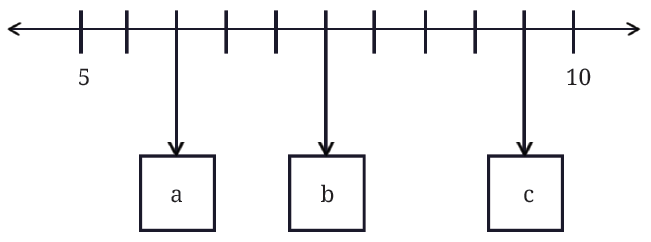
Answer:
Given:
1. A number line starting from $5$ and ending at $10$.
2. There are $10$ equal divisions between the whole numbers $5$ and $10$.
To Find:
The decimal values represented by the boxes ‘a’, ‘b’, and ‘c’.
Solution:
First, we need to find the value of each single division on this number line.
$\text{Total distance} = 10 - 5 = 5$
(Range of the line)
Since this distance of $5$ units is divided into $10$ equal parts, the value of one division is:
$\text{One division} = \frac{5}{10} = 0.5$
(Scale calculation)
Now, we identify the positions of the boxes by counting the divisions from the starting point $5$.
For Box ‘a’:
Box ‘a’ is at the 2nd division after $5$.
$a = 5 + (2 \times 0.5)$
$a = 5 + 1 = 6$
For Box ‘b’:
Box ‘b’ is at the 5th division after $5$.
$b = 5 + (5 \times 0.5)$
$b = 5 + 2.5 = 7.5$
For Box ‘c’:
Box ‘c’ is at the 9th division after $5$.
$c = 5 + (9 \times 0.5)$
$c = 5 + 4.5 = 9.5$
Final Answer:
The decimal numbers denoted by the boxes are:
$\bullet$ $a = 6$
$\bullet$ $b = 7.5$
$\bullet$ $c = 9.5$
Question. Using similar reasoning find out the decimal numbers in the boxes below for labels ‘d’, ‘e’, ‘f’, ‘g’, and ‘h’.
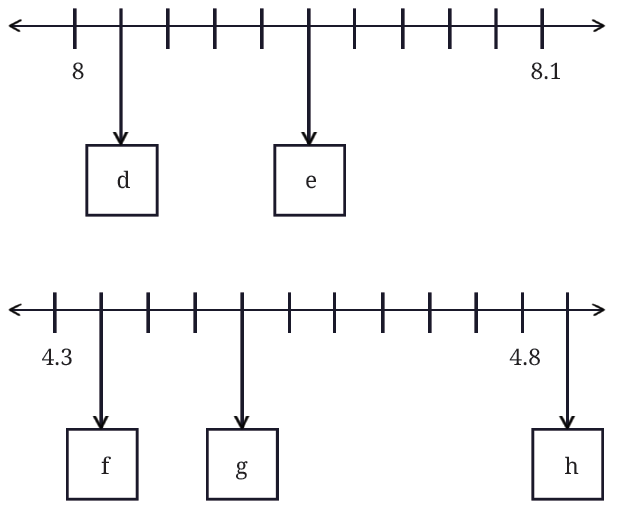
Answer:
Given:
1. First Number Line: Starts at $8$ and ends at $8.1$, divided into $10$ equal parts.
2. Second Number Line: Starts at $4.3$, where each small division represents an increment of $0.05$.
To Find:
The decimal values represented by the boxes labeled ‘d’, ‘e’, ‘f’, ‘g’, and ‘h’.
Solution:
Part 1: For Labels ‘d’ and ‘e’ (First Scale)
The total distance between $8$ and $8.1$ is $8.1 - 8 = 0.1$. Since this interval is divided into $10$ equal divisions, the value of one division is:
$\text{Value per division} = \frac{0.1}{10} = 0.01$
(Scale factor)
$\bullet$ Label ‘d’: It is located at the 1st division after $8$.
$d = 8 + (1 \times 0.01) = 8.01$
$\bullet$ Label ‘e’: It is located at the 5th division after $8$.
$e = 8 + (5 \times 0.01) = 8.05$
Part 2: For Labels ‘f’, ‘g’, and ‘h’ (Second Scale)
On this scale, each division increases the value by $0.05$ starting from $4.3$.
$\bullet$ Label ‘f’: It is located at the 1st tick after $4.3$.
$f = 4.3 + (1 \times 0.05) = 4.35$
$\bullet$ Label ‘g’: It is located at the 4th tick after $4.3$.
$g = 4.3 + (4 \times 0.05) = 4.3 + 0.20 = 4.5$
$\bullet$ Label ‘h’: It is located at the 11th tick after $4.3$.
$h = 4.3 + (11 \times 0.05) = 4.3 + 0.55 = 4.85$
Final Answer:
The decimal numbers denoted by the boxes are:
$\bullet$ $d = 8.01$
$\bullet$ $e = 8.05$
$\bullet$ $f = 4.35$
$\bullet$ $g = 4.5$
$\bullet$ $h = 4.85$
Intext Questions (Page No. 73)
Question. Which decimal number is greater?
(a) $1.23$ or $1.32$
(b) $3.81$ or $13.800$
(c) $1.009$ or $1.090$
Answer:
(a) $1.23$ or $1.32$
To compare these decimal numbers, we first look at the whole number part. Both numbers have $1$ in the ones place. Next, we compare the tenths place.
$3 > 2$
(Tenths place comparison)
Since the tenths digit in $1.32$ is greater than the tenths digit in $1.23$, the former is larger.
Final Answer: $1.32$ is greater.
(b) $3.81$ or $13.800$
First, we compare the whole number parts of the decimals. In the Indian Numbering System, we always prioritize the highest place value.
$13 > 3$
(Whole number part)
Since $13$ is much larger than $3$, the decimal digits do not need to be compared.
Final Answer: $13.800$ is greater.
(c) $1.009$ or $1.090$
Both numbers have the same whole number ($1$) and the same tenths digit ($0$). We move to the hundredths place.
$9 > 0$
(Hundredths place comparison)
Final Answer: $1.090$ is greater.
Question. Consider the decimal numbers $0.9$, $1.1$, $1.01$, and $1.11$. Which of the above is closest to $1.09$?
Answer:
To Find: Which of $0.9, 1.1, 1.01, 1.11$ is closest to $1.09$.
Solution:
We find the difference between $1.09$ and each of the options. The number with the smallest difference is the closest.
$\bullet$ $|1.09 - 0.90| = 0.19$
$\bullet$ $|1.10 - 1.09| = 0.01$
$\bullet$ $|1.09 - 1.01| = 0.08$
$\bullet$ $|1.11 - 1.09| = 0.02$
Comparing the differences, $0.01$ is the smallest value.
Final Answer: $1.1$ is closest to $1.09$.
Question. Which among these is closest to $4$: $3.56$, $3.65$, $3.099$?
Answer:
To Find: Which among $3.56, 3.65, 3.099$ is closest to $4$.
Solution:
We subtract each number from $4.000$ to check the distance:
$\bullet$ Distance of $3.56$ from $4 = 4.00 - 3.56 = 0.44$
$\bullet$ Distance of $3.65$ from $4 = 4.00 - 3.65 = 0.35$
$\bullet$ Distance of $3.099$ from $4 = 4.000 - 3.099 = 0.901$
The smallest distance is $0.35$.
Final Answer: $3.65$ is closest to $4$.
Question. Which among these is closest to $1$: $0.8$, $0.69$, $1.08$?
Answer:
To Find: Which among $0.8, 0.69, 1.08$ is closest to $1$.
Solution:
Let us convert these into like decimals (hundredths) to compare distances from $1.00$:
$\bullet$ For $0.8$: $|1.00 - 0.80| = 0.20$
$\bullet$ For $0.69$: $|1.00 - 0.69| = 0.31$
$\bullet$ For $1.08$: $|1.08 - 1.00| = 0.08$
The smallest gap is $0.08$ units.
Final Answer: $1.08$ is closest to $1$.
Question. In each case below use the digits $4, 1, 8, 2,$ and $5$ exactly once and try to make a decimal number as close as possible to $25$.
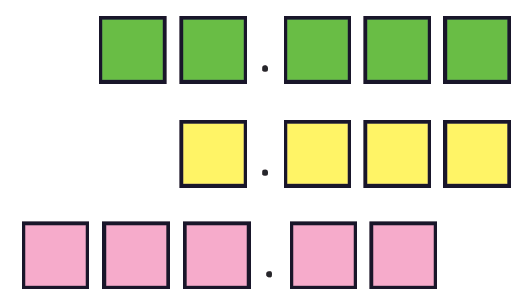
Answer:
Given:
Available digits: $4, 1, 8, 2,$ and $5$ (to be used exactly once in each case).
Target number: $25$
To Find:
The decimal number closest to $25$ for each of the three templates provided in the image.
Solution:
To find the number closest to $25$, we need to minimize the absolute difference between our created number and $25$.
1. Green Template ($\square \square . \square \square \square$):
In this template, we have two positions before the decimal and three after. We have two main possibilities to get close to $25$:
$\bullet$ Case A (Slightly more than 25): We start with $25$ in the whole number part. To stay as close as possible, we use the smallest remaining digits for the decimal parts ($1, 4, 8$).
$\text{Number} = 25.148$
(Difference $= 0.148$)
$\bullet$ Case B (Slightly less than 25): we use $24$ as the whole number part. To stay close, we use the largest remaining digits for the decimal parts ($8, 5, 1$).
$\text{Number} = 24.851$
($25 - 24.851 = 0.149$)
Since $0.148 < 0.149$, the closest number for the green template is $25.148$.
2. Yellow Template ($\square . \square \square \square$):
This template has only one digit before the decimal point. To be closest to $25$, we must make the number as large as possible.
Using the largest available digit for the ones place ($8$) and the next largest digits for the decimal places:
Number: $8.542$
Note: Since we only have four boxes here, the digit '$1$' is left out. If we were to use five digits ($X.XXXX$), the closest would be $8.5421$.
3. Pink Template ($\square \square \square . \square \square$):
This template has three digits before the decimal point. To be closest to $25$, we must make the number as small as possible.
Using the smallest available digits for the hundreds, tens, and ones places ($1, 2, 4$):
Number: $124.58$
Final Answer:
$\bullet$ Green Case ($\square \square . \square \square \square$): $25.148$
$\bullet$ Yellow Case ($\square . \square \square \square$): $8.542$
$\bullet$ Pink Case ($\square \square \square . \square \square$): $124.58$
Figure It Out (Page No. 75)
Question 1. Find the sums
(a) $5.3 + 2.6$
(b) $18 + 8.8$
(c) $2.15 + 5.26$
(d) $9.01 + 9.10$
(e) $29.19 + 9.91$
(f) $0.934 + 0.6$
(g) $0.75 + 0.03$
(h) $6.236 + 0.487$
Answer:
To Find: The sum of the given decimal numbers by aligning their place values.
In the decimal system, we must align the decimal points vertically so that digits in the same place (ones, tenths, hundredths, etc.) can be added together correctly. If necessary, we add placeholder zeros to ensure both numbers have the same number of decimal places.
(a) $5.3 + 2.6$
Both numbers have one decimal place. Aligning them:
$\begin{array}{cc} & 5 & . & 3 \\ + & 2 & . & 6 \\ \hline & 7 & . & 9 \\ \hline \end{array}$
The sum is $7.9$.
(b) $18 + 8.8$
Here, $18$ is a whole number. We write it as $18.0$ to align the decimal point with $8.8$.
$\begin{array}{cc} & 1 & 8 & . & 0 \\ + & & 8 & . & 8 \\ \hline & 2 & 6 & . & 8 \\ \hline \end{array}$
The sum is $26.8$.
(c) $2.15 + 5.26$
Both numbers have two decimal places (hundredths). Adding them vertically:
$\begin{array}{cc} & 2 & . & 1 & 5 \\ + & 5 & . & 2 & 6 \\ \hline & 7 & . & 4 & 1 \\ \hline \end{array}$
The sum is $7.41$.
(d) $9.01 + 9.10$
Aligning the decimal points and adding the hundredths, tenths, and ones:
$\begin{array}{cc} & 9 & . & 0 & 1 \\ + & 9 & . & 1 & 0 \\ \hline 1 & 8 & . & 1 & 1 \\ \hline \end{array}$
The sum is $18.11$.
(e) $29.19 + 9.91$
Adding the digits and carrying over where necessary:
$\begin{array}{cc} & 2 & 9 & . & 1 & 9 \\ + & & 9 & . & 9 & 1 \\ \hline & 3 & 9 & . & 1 & 0 \\ \hline \end{array}$
The sum is $39.10$ or $39.1$.
(f) $0.934 + 0.6$
We convert $0.6$ into a like decimal by adding placeholder zeros to make it $0.600$.
$\begin{array}{cc} & 0 & . & 9 & 3 & 4 \\ + & 0 & . & 6 & 0 & 0 \\ \hline & 1 & . & 5 & 3 & 4 \\ \hline \end{array}$
The sum is $1.534$.
(g) $0.75 + 0.03$
Both represent hundredths. Adding them vertically:
$\begin{array}{cc} & 0 & . & 7 & 5 \\ + & 0 & . & 0 & 3 \\ \hline & 0 & . & 7 & 8 \\ \hline \end{array}$
The sum is $0.78$.
(h) $6.236 + 0.487$
Adding the thousandths, hundredths, and tenths while handling carry-overs:
$\begin{array}{cc} & 6 & . & 2 & 3 & 6 \\ + & 0 & . & 4 & 8 & 7 \\ \hline & 6 & . & 7 & 2 & 3 \\ \hline \end{array}$
The sum is $6.723$.
Note: In the Indian Perspective, you can think of these sums in terms of $\textsf{₹}$ (Rupees). For example, in part (g), $0.75$ is like $75$ paise and $0.03$ is like $3$ paise, making a total of $78$ paise or $\textsf{₹}0.78$.
Question 2. Find the differences
(a) $5.6 - 2.3$
(b) $18 - 8.8$
(c) $10.4 - 4.5$
(d) $17 - 16.198$
(e) $17 - 0.05$
(f) $34.505 - 18.1$
(g) $9.9 - 9.09$
(h) $6.236 - 0.487$
Answer:
To Find: The difference between the given decimal numbers by aligning their place values.
To subtract decimals, we must align the decimal points vertically. If the numbers have an unequal number of digits after the decimal point, we add placeholder zeros to make them like decimals.
(a) $5.6 - 2.3$
Both numbers have one decimal place. Subtracting tenths from tenths and ones from ones:
$\begin{array}{cc} & 5 & . & 6 \\ - & 2 & . & 3 \\ \hline & 3 & . & 3 \\ \hline \end{array}$
The difference is $3.3$.
(b) $18 - 8.8$
We convert the whole number $18$ to $18.0$ to align it with $8.8$. We borrow $1$ from the ones place to subtract the tenths.
$\begin{array}{cc} & 1 & 8 & . & 0 \\ - & & 8 & . & 8 \\ \hline & & 9 & . & 2 \\ \hline \end{array}$
The difference is $9.2$.
(c) $10.4 - 4.5$
Since $4$ tenths is less than $5$ tenths, we borrow from the tens place.
$\begin{array}{cc} & 1 & 0 & . & 4 \\ - & & 4 & . & 5 \\ \hline & & 5 & . & 9 \\ \hline \end{array}$
The difference is $5.9$.
(d) $17 - 16.198$
We add three placeholder zeros to $17$ to make it $17.000$ so we can subtract the thousandths, hundredths, and tenths.
$\begin{array}{cc} & 1 & 7 & . & 0 & 0 & 0 \\ - & 1 & 6 & . & 1 & 9 & 8 \\ \hline & & 0 & . & 8 & 0 & 2 \\ \hline \end{array}$
The difference is $0.802$.
(e) $17 - 0.05$
In the Indian Perspective, this can be viewed as having $\textsf{₹} 17$ and spending $5$ paise. We write $17$ as $17.00$.
$\begin{array}{cc} & 1 & 7 & . & 0 & 0 \\ - & & 0 & . & 0 & 5 \\ \hline & 1 & 6 & . & 9 & 5 \\ \hline \end{array}$
The difference is $16.95$.
(f) $34.505 - 18.1$
Adding placeholder zeros to $18.1$ to match the thousandths place:
$18.1 = 18.100$
(Like decimal conversion)
$\begin{array}{cc} & 3 & 4 & . & 5 & 0 & 5 \\ - & 1 & 8 & . & 1 & 0 & 0 \\ \hline & 1 & 6 & . & 4 & 0 & 5 \\ \hline \end{array}$
The difference is $16.405$.
(g) $9.9 - 9.09$
We write $9.9$ as $9.90$. Subtracting $9$ hundredths from $0$ hundredths requires borrowing.
$\begin{array}{cc} & 9 & . & 9 & 0 \\ - & 9 & . & 0 & 9 \\ \hline & 0 & . & 8 & 1 \\ \hline \end{array}$
The difference is $0.81$.
(h) $6.236 - 0.487$
Subtracting while regrouping across multiple places:
$\begin{array}{cc} & 6 & . & 2 & 3 & 6 \\ - & 0 & . & 4 & 8 & 7 \\ \hline & 5 & . & 7 & 4 & 9 \\ \hline \end{array}$
The difference is $5.749$.
Conclusion: To ensure accuracy, always double-check that the decimal points are perfectly aligned in a vertical line before starting the subtraction.
Intext Questions (Page No. 75 - 76)
Question. Observe this sequence of decimal numbers and identify the change after each term.
$4.4, 4.8, 5.2, 5.6, 6.0, \dots$
We can see that $0.4$ is being added to a term to get the next term. Continue this sequence and write the next $3$ terms.
Answer:
Given:
A decimal sequence: $4.4, 4.8, 5.2, 5.6, 6.0, \dots$
To Find:
The next three terms of the sequence.
Solution:
First, we identify the common difference by subtracting a term from the succeeding term:
$4.8 - 4.4 = 0.4$
(Common difference)
As provided in the question, $0.4$ is being added to each term. To find the next three terms, we continue adding $0.4$ to the last known term ($6.0$):
$\bullet$ Next term 1: $6.0 + 0.4 = 6.4$
$\bullet$ Next term 2: $6.4 + 0.4 = 6.8$
$\bullet$ Next term 3: $6.8 + 0.4 = 7.2$
Final Answer:
The next three terms of the sequence are $6.4$, $6.8$, and $7.2$.
Question. Similarly, identify the change and write the next $3$ terms for each sequence given below. Try to do this computation mentally.
(a) $4.4, 4.45, 4.5, \dots$
(b) $25.75, 26.25, 26.75, \dots$
(c) $10.56, 10.67, 10.78, \dots$
(d) $13.5, 16, 18.5, \dots$
(e) $8.5, 9.4, 10.3, \dots$
(f) $5, 4.95, 4.90, \dots$
(g) $12.45, 11.95, 11.45, \dots$
(h) $36.5, 33, 29.5, \dots$
Answer:
(a) Sequence: $4.4, 4.45, 4.5, \dots$
Given: A sequence of decimal numbers starting with $4.4, 4.45, 4.5$.
To Find: The common change and the next three terms of the sequence.
Solution:
$\text{Change} = 4.45 - 4.40 = 0.05$
(Increasing)
Think of this as $\textsf{₹} 4.40$ increasing to $\textsf{₹} 4.45$. The change is an addition of $5$ paise ($0.05$).
Next three terms: $4.55, 4.60, 4.65$.
(b) Sequence: $25.75, 26.25, 26.75, \dots$
Given: Terms $25.75, 26.25, 26.75$.
To Find: The common change and the next three terms.
Solution:
$\text{Change} = 26.25 - 25.75 = 0.50$
(Increasing)
Mentally, this is like adding $50$ paise to $\textsf{₹} 25.75$, making it $\textsf{₹} 26.25$.
Next three terms: $27.25, 27.75, 28.25$.
(c) Sequence: $10.56, 10.67, 10.78, \dots$
Given: Terms $10.56, 10.67, 10.78$.
To Find: The common change and the next three terms.
Solution:
$\text{Change} = 10.67 - 10.56 = 0.11$
(Increasing)
The sequence increases by $0.11$ (1 tenth and 1 hundredth) after each term.
Next three terms: $10.89, 11.00, 11.11$.
(d) Sequence: $13.5, 16, 18.5, \dots$
Given: Terms $13.5, 16, 18.5$.
To Find: The common change and the next three terms.
Solution:
$\text{Change} = 16.0 - 13.5 = 2.5$
(Increasing)
Adding $2.5$ to each term: $18.5 + 2.5 = 21.0$.
Next three terms: $21.0, 23.5, 26.0$.
(e) Sequence: $8.5, 9.4, 10.3, \dots$
Given: Terms $8.5, 9.4, 10.3$.
To Find: The common change and the next three terms.
Solution:
$\text{Change} = 9.4 - 8.5 = 0.9$
(Increasing)
Each term increases by $0.9$ (which is $1.0 - 0.1$).
Next three terms: $11.2, 12.1, 13.0$.
(f) Sequence: $5, 4.95, 4.90, \dots$
Given: Terms $5, 4.95, 4.90$.
To Find: The common change and the next three terms.
Solution:
$\text{Change} = 5.00 - 4.95 = -0.05$
(Decreasing)
Using the Rupee-Paise analogy, $\textsf{₹} 5.00$ minus $5$ paise becomes $\textsf{₹} 4.95$.
Next three terms: $4.85, 4.80, 4.75$.
(g) Sequence: $12.45, 11.95, 11.45, \dots$
Given: Terms $12.45, 11.95, 11.45$.
To Find: The common change and the next three terms.
Solution:
$\text{Change} = 12.45 - 11.95 = -0.50$
(Decreasing)
Subtracting $50$ paise ($0.50$) from each term.
Next three terms: $10.95, 10.45, 9.95$.
(h) Sequence: $36.5, 33, 29.5, \dots$
Given: Terms $36.5, 33, 29.5$.
To Find: The common change and the next three terms.
Solution:
$\text{Change} = 36.5 - 33.0 = -3.5$
(Decreasing)
Subtracting $3.5$ from each term: $29.5 - 3.5 = 26.0$.
Next three terms: $26.0, 22.5, 19.0$.
Figure It Out (Page No. 78 - 80)
Question 1. Convert the following fractions into decimals:
(a) $\frac{5}{100}$
(b) $\frac{16}{1000}$
(c) $\frac{12}{10}$
(d) $\frac{254}{1000}$
Answer:
To Find:
Decimal representation of the given fractions.
Solution:
To convert a fraction with a denominator of $10, 100, 1000,$ etc., into a decimal, we count the number of zeros in the denominator and place the decimal point that many places from the right in the numerator.
(a) $\frac{5}{100}$
Here, the denominator has two zeros, so the decimal point is placed two places from the right.
$\frac{5}{100} = 0.05$
(b) $\frac{16}{1000}$
The denominator has three zeros, so we place the decimal point three places from the right.
$\frac{16}{1000} = 0.016$
(c) $\frac{12}{10}$
The denominator has one zero, so we place the decimal point one place from the right.
$\frac{12}{10} = 1.2$
(d) $\frac{254}{1000}$
The denominator has three zeros, so we place the decimal point three places from the right.
$\frac{254}{1000} = 0.254$
Question 2. Convert the following decimals into a sum of tenths, hundredths and thousandths:
(a) $0.34$
(b) $1.02$
(c) $0.8$
(d) $0.362$
Answer:
To Find:
Expansion of decimals into fractional place values.
Solution:
The first digit after the decimal point is the tenths place, the second is the hundredths place, and the third is the thousandths place.
(a) $0.34$
$0.34 = \frac{3}{10} + \frac{4}{100}$
(b) $1.02$
$1.02 = 1 + \frac{0}{10} + \frac{2}{100}$
(c) $0.8$
$0.8 = \frac{8}{10}$
(d) $0.362$
$0.362 = \frac{3}{10} + \frac{6}{100} + \frac{2}{1000}$
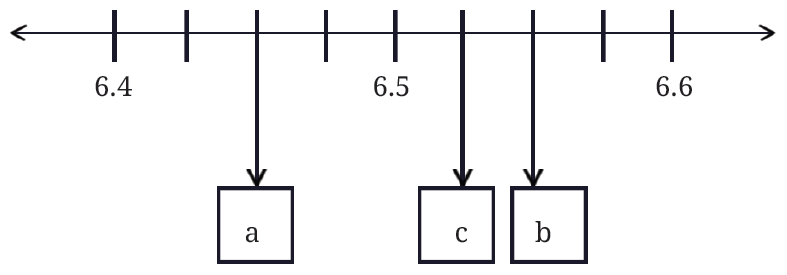
Question 3. What decimal number does each letter represent in the number line below?
Answer:
Given:
1. A number line with major markings at $6.4$, $6.5$, and $6.6$.
2. Points $a$, $b$, and $c$ are marked on the subdivisions between these major markings.
To Find:
The decimal values represented by the letters $a$, $b$, and $c$.
Solution:
First, we determine the value of each small division (tick mark) on the scale. The distance between the major markings $6.4$ and $6.5$ is $0.1$. By observing the line, we see that this interval is divided into $4$ equal parts.
$\text{Value of one division} = \frac{6.5 - 6.4}{4} = \frac{0.1}{4}$
(Scale determination)
$\text{One division} = 0.025$
Now, we calculate the position of each letter by counting the number of divisions from the nearest major marking:
For Point $a$:
Point $a$ is located at the 2nd division after $6.4$.
$a = 6.4 + (2 \times 0.025) = 6.4 + 0.05$
[2 units of 0.025]
$\bullet$ $a = 6.45$
For Point $b$:
Point $b$ is located at the 1st division after $6.5$.
$b = 6.5 + (1 \times 0.025) = 6.5 + 0.025$
[1 unit of 0.025]
$\bullet$ $b = 6.525$
For Point $c$:
Point $c$ is located at the 2nd division after $6.5$.
$c = 6.5 + (2 \times 0.025) = 6.5 + 0.05$
[2 units of 0.025]
$\bullet$ $c = 6.55$
Final Answer:
The decimal numbers represented by the letters are:
$\bullet$ $a = 6.45$
$\bullet$ $b = 6.525$
$\bullet$ $c = 6.55$
Question 4. Arrange the following quantities in descending order:
(a) $11.01, 1.011, 1.101, 11.10, 1.01$
(b) $2.567, 2.675, 2.768, 2.499, 2.698$
(c) $4.678$ g, $4.595$ g, $4.600$ g, $4.656$ g, $4.666$ g
(d) $33.13$ m, $33.31$ m, $33.133$ m, $33.331$ m, $33.313$ m
Answer:
To Find: The arrangement of the given decimal numbers in descending order (from the largest value to the smallest value).
(a) Solution: $11.01, 1.011, 1.101, 11.10, 1.01$
First, we convert the given numbers into like decimals by adding placeholder zeros so they all have three decimal places:
$11.010, 1.011, 1.101, 11.100, 1.010$
Comparing the whole number parts, $11$ is greater than $1$. Among the numbers with $11$ as the whole part, we compare the decimal parts:
$11.100 > 11.010$
(Since 100 thousandths > 10 thousandths)
Now, comparing the numbers with $1$ as the whole part:
$1.101 > 1.011 > 1.010$
Descending Order: $11.10 > 11.01 > 1.101 > 1.011 > 1.01$
(b) Solution: $2.567, 2.675, 2.768, 2.499, 2.698$
All numbers have the same whole number part ($2$). We compare the digits in the tenths place ($5, 6, 7, 4, 6$):
The largest tenth digit is $7$ ($2.768$). The next largest tenth digit is $6$ (found in $2.698$ and $2.675$). Comparing these two by their hundredths place:
$2.698 > 2.675$
(Since 9 > 7 in hundredths place)
Following this logic for the remaining numbers:
Descending Order: $2.768 > 2.698 > 2.675 > 2.567 > 2.499$
(c) Solution: $4.678$ g, $4.595$ g, $4.600$ g, $4.656$ g, $4.666$ g
Comparing the decimal parts (since whole parts are all $4$):
1. The largest value is $4.678$ g.
2. The next is $4.666$ g.
3. Then $4.656$ g.
4. Then $4.600$ g.
5. The smallest is $4.595$ g (as it has only $5$ tenths).
Descending Order: $4.678 \text{ g} > 4.666 \text{ g} > 4.656 \text{ g} > 4.600 \text{ g} > 4.595 \text{ g}$
(d) Solution: $33.13$ m, $33.31$ m, $33.133$ m, $33.331$ m, $33.313$ m
We convert them into like decimals with three decimal places:
$33.130, 33.310, 33.133, 33.331, 33.313$
First, we compare numbers with $3$ in the tenths place: $33.331, 33.313, 33.310$.
$33.331 > 33.313 > 33.310$
Next, we compare numbers with $1$ in the tenths place: $33.133, 33.130$.
$33.133 > 33.130$
Descending Order: $33.331 \text{ m} > 33.313 \text{ m} > 33.31 \text{ m} > 33.133 \text{ m} > 33.13 \text{ m}$
Question 5. Using the digits $1, 4, 0, 8,$ and $6$ make:
(a) the decimal number closest to $30$
(b) the smallest possible decimal number between $100$ and $1000$
Answer:
Given:
Digits $= \{1, 4, 0, 8, 6\}$
Solution:
(a) The decimal number closest to $30$:
Since we don't have the digit $2$ or $3$, we must look at numbers starting with $1$ (like $18.64$) or $4$ (like $40.168$).
$\text{Difference with } 18.64 = 30 - 18.64 = 11.36$
$\text{Difference with } 40.168 = 40.168 - 30 = 10.168$
Since $10.168$ is a smaller difference, $40.168$ is closer to $30$. If we must use all digits and have only one decimal place, we check $40.1$. If two, $40.16$. Using all digits in a common format:
Number: $40.168$
(b) Smallest possible decimal number between $100$ and $1000$:
To make the smallest number in this range, we must place the smallest non-zero digit ($1$) in the hundreds place, followed by the next smallest digit ($0$) in the tens place, and so on.
The whole number part should be $104$ to be between $100$ and $1000$. The remaining digits go to the decimal places in increasing order.
Number: $104.68$
Question 6. Will a decimal number with more digits be greater than a decimal number with fewer digits?
Answer:
Solution:
No, a decimal number with more digits is not necessarily greater than a decimal number with fewer digits.
Reasoning:
The value of a decimal number depends on the place value of its digits, not the total count of digits. For example, consider the numbers $0.5$ and $0.0009$.
$\bullet$ $0.5$ has only one decimal digit, but it represents $5$ tenths.
$\bullet$ $0.0009$ has four decimal digits, but it represents only $9$ ten-thousandths.
Comparing them by making them like decimals:
$0.5000 > 0.0009$
Similarly, $1.2$ is greater than $1.199$ because the digit in the tenths place of the first number ($2$) is greater than the digit in the tenths place of the second number ($1$), regardless of how many digits follow.
Question 7. Mahi purchases $0.25$ kg of beans, $0.3$ kg of carrots, $0.5$ kg of potatoes, $0.2$ kg of capsicums, and $0.05$ kg of ginger. Calculate the total weight of the items she bought.
Answer:
Given:
Weight of beans = $0.25$ kg
Weight of carrots = $0.3$ kg
Weight of potatoes = $0.5$ kg
Weight of capsicums = $0.2$ kg
Weight of ginger = $0.05$ kg
To Find:
The total weight of the items bought by Mahi.
Solution:
To calculate the total weight, we need to add the weights of all individual items. First, we convert the weights into like decimals by adding placeholder zeros so that each number has two decimal places.
Weight of carrots = $0.30$ kg
Weight of potatoes = $0.50$ kg
Weight of capsicums = $0.20$ kg
Now, we align the decimal points vertically and perform the addition:
$\begin{array}{cc} & 0 & . & 2 & 5 \\ & 0 & . & 3 & 0 \\ & 0 & . & 5 & 0 \\ & 0 & . & 2 & 0 \\ + & 0 & . & 0 & 5 \\ \hline & 1 & . & 3 & 0 \\ \hline \end{array}$
The calculation is as follows:
1. Hundredths place: $5 + 0 + 0 + 0 + 5 = 10$. We write $0$ in the hundredths place and carry over $1$ to the tenths place.
2. Tenths place: $2 + 3 + 5 + 2 + 0 + 1 \text{ (carry)} = 13$. We write $3$ in the tenths place and carry over $1$ to the ones place.
3. Ones place: $0 + 0 + 0 + 0 + 0 + 1 \text{ (carry)} = 1$.
$\text{Total Weight} = 1.30 \text{ kg}$
(Sum of all items)
Final Answer:
The total weight of the items Mahi bought is $1.3$ kg (or $1.30$ kg).
Question 8. Pinto supplies $3.79$ L, $4.2$ L, and $4.25$ L of milk to a milk dairy in the first three days. In $6$ days, he supplies $25$ litres of milk. Find the total quantity of milk supplied to the dairy in the last three days.
Answer:
Given:
Milk supplied on Day 1 = $3.79$ L
Milk supplied on Day 2 = $4.2$ L
Milk supplied on Day 3 = $4.25$ L
Total milk supplied in 6 days = $25$ L
To Find:
The total quantity of milk supplied in the last three days (Day 4, Day 5, and Day 6).
Solution:
First, we calculate the total milk supplied in the first three days. To add these, we convert $4.2$ L into a like decimal $4.20$ L.
$\begin{array}{cc} & 3 & . & 7 & 9 \\ & 4 & . & 2 & 0 \\ + & 4 & . & 2 & 5 \\ \hline 1 & 2 & . & 2 & 4 \\ \hline \end{array}$
$\text{Total (First 3 days)} = 12.24 \text{ L}$
(Sum of Day 1, 2, and 3)
Now, to find the milk supplied in the remaining three days, we subtract the above total from the total supply of $25$ litres. We write $25$ as $25.00$ to align the decimal points.
$\begin{array}{cc} & 2 & 5 & . & 0 & 0 \\ - & 1 & 2 & . & 2 & 4 \\ \hline & 1 & 2 & . & 7 & 6 \\ \hline \end{array}$
$\text{Quantity (Last 3 days)} = 12.76 \text{ L}$
(Total - First 3 days)
Final Answer:
The total quantity of milk supplied to the dairy in the last three days is $12.76$ L.
Question 9. Tinku weighed $35.75$ kg in January and $34.50$ kg in February. Has he gained or lost weight? How much is the change?
Answer:
Given:
Weight in January = $35.75$ kg
Weight in February = $34.50$ kg
Solution:
By comparing the weights:
$35.75 > 34.50$
(Weight Comparison)
Since the weight in February is less than the weight in January, Tinku has lost weight.
To find the change, we subtract the smaller value from the larger value:
$\text{Change} = 35.75 - 34.50$
$\text{Change} = 1.25$ kg
Final Answer:
Tinku has lost weight, and the total change is $1.25$ kg.
Question 10. Extend the pattern: $5.5, 6.4, 6.39, 7.29, 7.28, 8.18, 8.17, \dots, \dots$
Answer:
Given:
The sequence of numbers is $5.5, 6.4, 6.39, 7.29, 7.28, 8.18, 8.17, \dots$
To Find:
Identify the rule of the pattern and determine the next two terms.
Solution:
Let us observe the change between each consecutive term in the sequence:
1. From $5.5$ to $6.4$:
$6.4 - 5.5 = 0.9$
(Increase of 0.9)
2. From $6.4$ to $6.39$:
$6.39 - 6.40 = -0.01$
(Decrease of 0.01)
3. From $6.39$ to $7.29$:
$7.29 - 6.39 = 0.9$
(Increase of 0.9)
4. From $7.29$ to $7.28$:
$7.28 - 7.29 = -0.01$
(Decrease of 0.01)
5. From $7.28$ to $8.18$:
$8.18 - 7.28 = 0.9$
(Increase of 0.9)
6. From $8.18$ to $8.17$:
$8.17 - 8.18 = -0.01$
(Decrease of 0.01)
The pattern follows a repetitive cycle: Add $0.9$, then subtract $0.01$.
To find the next two terms, we continue the pattern from the last known term ($8.17$):
Next Term (Step 7): Add $0.9$ to $8.17$.
$8.17 + 0.90 = 9.07$
... (i)
Next Term (Step 8): Subtract $0.01$ from $9.07$.
$9.07 - 0.01 = 9.06$
... (ii)
Alternate Solution:
If we look at the alternate terms:
Odd-positioned terms: $5.5, 6.39, 7.28, 8.17, \dots$ (Each increases by $0.89$)
Even-positioned terms: $6.4, 7.29, 8.18, \dots$ (Each increases by $0.89$)
Next even-positioned term $= 8.18 + 0.89 = \mathbf{9.07}$
Next odd-positioned term $= 8.17 + 0.89 = \mathbf{9.06}$
Final Answer:
The next two terms in the pattern are $9.07$ and $9.06$.
The extended sequence is: $5.5, 6.4, 6.39, 7.29, 7.28, 8.18, 8.17, \mathbf{9.07, 9.06}$.
Question 11. How many millimeters make $1$ kilometer?
Answer:
To Find: The number of millimetres (mm) in one kilometre (km).
Solution:
We use the step-by-step unit conversion method:
$1$ km $= 1000$ m
... (i)
$1$ m $= 100$ cm
... (ii)
$1$ cm $= 10$ mm
... (iii)
Now, combining these conversions:
$1$ km $= 1000 \times 100 \times 10$ mm
$1$ km $= 10,00,000$ mm
Final Answer:
We can say that $10$ lakh millimetres make $1$ kilometre. Total: $10,00,000$ mm.
Question 12. Indian Railways offers optional travel insurance for passengers who book e-tickets. It costs $45$ paise per passenger. If $1$ lakh people opt for insurance in a day, what is the total insurance fee paid?
Answer:
Given:
Insurance cost per passenger $= 45$ paise
Number of passengers $= 1$ lakh $= 1,00,000$
Solution:
Total fee in paise $= 1,00,000 \times 45 = 45,00,000$ paise.
To convert this into Rupees ($\textsf{₹}$), we divide by $100$:
$\text{Total Fee} = \frac{45,00,000}{100}$
[As $100$ p $= \textsf{₹} 1$]
$\text{Total Fee} = \textsf{₹} 45,000$
Final Answer:
The total insurance fee paid in a day is $\textsf{₹}45,000$.
Question 13. Which is greater?
(a) $\frac{10}{1000}$ or $\frac{1}{10}$?
(b) One-hundredth or $90$ thousandths?
(c) One-thousandth or $90$ hundredths?
Answer:
(a) $\frac{10}{1000}$ or $\frac{1}{10}$?
Let us convert them to decimals:
$\frac{10}{1000} = 0.01$
$\frac{1}{10} = 0.1$
Since $0.1 > 0.01$, $\frac{1}{10}$ is greater.
(b) One-hundredth or $90$ thousandths?
One-hundredth $= \frac{1}{100} = 0.010$
$90$ thousandths $= \frac{90}{1000} = 0.090$
Since $0.090 > 0.010$, $90$ thousandths is greater.
(c) One-thousandth or $90$ hundredths?
One-thousandth $= \frac{1}{1000} = 0.001$
$90$ hundredths $= \frac{90}{100} = 0.900$
Since $0.9 > 0.001$, $90$ hundredths is greater.
Question 14. Write the decimal forms of the quantities mentioned (an example is given):
(a) $87$ ones, $5$ tenths and $60$ hundredths $= 88.10$
(b) $12$ tens and $12$ tenths
(c) $10$ tens, $10$ ones, $10$ tenths, and $10$ hundredths
(d) $25$ tens, $25$ ones, $25$ tenths, and $25$ hundredths
Answer:
(b) $12$ tens and $12$ tenths
$12 \text{ tens} = 120$
$12 \text{ tenths} = 1.2$
Total $= 120 + 1.2 = 121.2$
Decimal Form: 121.2
(c) $10$ tens, $10$ ones, $10$ tenths, and $10$ hundredths
$10 \text{ tens} = 100$
$10 \text{ ones} = 10$
$10 \text{ tenths} = 1.0$
$10 \text{ hundredths} = 0.10$
Total $= 100 + 10 + 1.0 + 0.10 = 111.10$
Decimal Form: 111.1
(d) $25$ tens, $25$ ones, $25$ tenths, and $25$ hundredths
$25 \text{ tens} = 250$
$25 \text{ ones} = 25$
$25 \text{ tenths} = 2.5$
$25 \text{ hundredths} = 0.25$
Total $= 250 + 25 + 2.5 + 0.25 = 277.75$
Decimal Form: 277.75
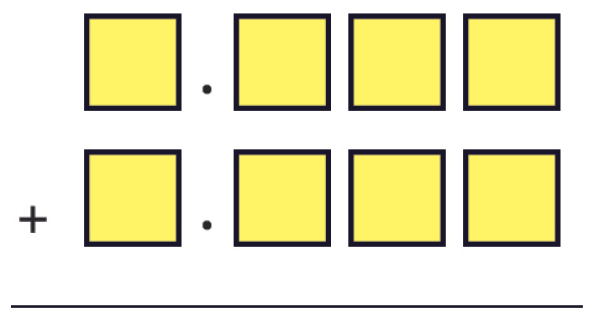
Question 15. Using each digit $0 - 9$ not more than once, fill the boxes below so that the sum is closest to $10.5$:
Answer:
Given:
1. A decimal addition structure: $\square \ . \square \ \square \ \square \ + \ \square \ . \ \square \ \square \ \square$
2. Digits to be used: $0, 1, 2, 3, 4, 5, 6, 7, 8, 9$.
3. Constraint: Each digit must be used at most once.
To Find:
Fill the boxes such that the sum is closest to $10.5$.
Solution:
To reach a sum of exactly $10.5$ (or $10.500$), we can split the target into a whole number sum and a decimal sum. For instance, we can aim for the whole numbers to sum to $10$ and the decimal parts to sum to $0.500$.
Let's try using the whole numbers $1$ and $9$ (Sum $= 10$).
Now we need to find decimal digits that add up to $0.500$ without repeating digits. Let's try:
Tenths place: $0 + 4 = 4$ (We will need a carry of $1$ from the hundredths place to make it $5$).
Hundredths place: $3 + 6 = 9$ (We will need a carry of $1$ from the thousandths place to make it $10$, which leaves $0$ and carries $1$ to tenths).
Thousandths place: $2 + 8 = 10$ (This leaves $0$ and carries $1$ to hundredths).
Let's arrange the digits $1, 9, 0, 4, 3, 6, 2,$ and $8$ in the structure:
$\begin{array}{cc} & 1 & . & 0 & 3 & 2 \\ + & 9 & . & 4 & 6 & 8 \\ \hline 1 & 0 & . & 5 & 0 & 0 \\ \hline \end{array}$
Checking the digits: The set used is $\{0, 1, 2, 3, 4, 6, 8, 9\}$. Every digit is unique and used only once. This yields exactly $10.5$.
Alternate Solution:
We can also try a combination where the whole numbers add up to $9$ and the decimals add up to $1.5$.
Let whole numbers be $2$ and $7$ (Sum $= 9$).
Let tenths be $6$ and $8$ (Sum $= 14$, with a carry from hundredths to make it $15$).
$\begin{array}{cc} & 2 & . & 6 & 0 & 7 \\ + & 7 & . & 8 & 9 & 3 \\ \hline 1 & 0 & . & 5 & 0 & 0 \\ \hline \end{array}$
Digits used: $\{0, 2, 3, 5, 6, 7, 8, 9\}$. This also results in exactly $10.5$.
Final Answer:
One possible way to fill the boxes to get the sum exactly $10.5$ is:
$1.032 + 9.468 = 10.5$
Question 16. Write the following fractions in decimal form:
(a) $\frac{1}{2}$
(b) $\frac{3}{2}$
(c) $\frac{1}{4}$
(d) $\frac{3}{4}$
(e) $\frac{1}{5}$
(f) $\frac{4}{5}$
Answer:
Solution:
To convert these fractions into decimals, we can either perform division or multiply the numerator and denominator by a suitable number to make the denominator a power of $10$ (like $10, 100, \dots$).
(a) $\frac{1}{2}$
$\frac{1 \times 5}{2 \times 5} = \frac{5}{10} = 0.5$
(b) $\frac{3}{2}$
$\frac{3 \times 5}{2 \times 5} = \frac{15}{10} = 1.5$
(c) $\frac{1}{4}$
$\frac{1 \times 25}{4 \times 25} = \frac{25}{100} = 0.25$
(d) $\frac{3}{4}$
$\frac{3 \times 25}{4 \times 25} = \frac{75}{100} = 0.75$
(e) $\frac{1}{5}$
$\frac{1 \times 2}{5 \times 2} = \frac{2}{10} = 0.2$
(f) $\frac{4}{5}$
$\frac{4 \times 2}{5 \times 2} = \frac{8}{10} = 0.8$
Final Answer:
The decimal forms are: (a) $0.5$, (b) $1.5$, (c) $0.25$, (d) $0.75$, (e) $0.2$, and (f) $0.8$.