

Chapter 4 Expressions using Letter-Numbers (Class 7 - Latest Maths NCERT (Ganita Prakash I) NCERT Solutions)
Welcome to the complete NCERT Solutions for Chapter 4: Expressions using Letter-Numbers. In this chapter, students explore the fundamentals of Algebra by learning how letters can represent numbers and how algebraic expressions can be formed, simplified, and interpreted. The solutions provided here are designed to help you understand each concept clearly and develop confidence in working with variables and mathematical relationships.
These step-by-step solutions cover all questions from the latest Ganita Prakash I textbook, including topics such as algebraic expressions, like and unlike terms, substitution of values, simplification using arithmetic properties, and pattern-based reasoning. Each solution follows a logical approach, making it easy to understand the methods and concepts involved.
Prepared by learningspot.co, these NCERT Solutions provide detailed explanations, accurate answers, and exam-oriented guidance to help students complete assignments, revise important concepts, and strengthen their foundation in algebra.
Intext Questions (Page No. 83)
Question. Ketaki prepares and supplies coconut-jaggery laddus. The price of a coconut is ₹$35$ and the price of $1$ kg jaggery is ₹$60$. How much should she pay if she buys $8$ coconuts and $9$ kg jaggery?
Answer:
Given:
Cost of one coconut = $\textsf{₹}35$
Cost of $1\text{ kg}$ jaggery = $\textsf{₹}60$
To Find:
Total amount to be paid for $8$ coconuts and $9\text{ kg}$ jaggery.
Solution:
The total cost is the sum of the cost of the coconuts and the cost of the jaggery.
$\text{Cost of 8 coconuts} = 8 \times 35 = \textsf{₹}280$
$\text{Cost of 9 kg jaggery} = 9 \times 60 = \textsf{₹}540$
Now, we add these two amounts to get the total payment:
$\text{Total Amount} = 280 + 540$
Total Amount = $\textsf{₹}820$
Final Answer:
Ketaki should pay a total of $\textsf{₹}820$.
Figure It Out (Page No. 84 - 85)
Question 1. Write formulas for the perimeter of:
(a) triangle with all sides equal.
(b) a regular pentagon (as we have learnt last year, we use the word ‘regular’ to say that all sidelengths and angle measures are equal)
(c) a regular hexagon
Answer:
Solution:
The perimeter of any closed figure is the total length of its boundary. For a regular polygon with $n$ sides, where each side length is $s$, the perimeter is $n \times s$.
(a) Triangle with all sides equal (Equilateral Triangle):
A triangle has $3$ sides. If each side is $s$, then:
$\text{Perimeter} = 3 \times s$
(b) Regular Pentagon:
A pentagon has $5$ sides. For a regular pentagon with side length $s$:
$\text{Perimeter} = 5 \times s$
(c) Regular Hexagon:
A hexagon has $6$ sides. For a regular hexagon with side length $s$:
$\text{Perimeter} = 6 \times s$
Question 2. Munirathna has a $20$ m long pipe. However, he wants a longer watering pipe for his garden. He joins another pipe of some length to this one. Give the expression for the combined length of the pipe. Use the letter-number ‘$k$’ to denote the length in meters of the other pipe.
Answer:
Given:
Length of the first pipe = $20\text{ m}$
Length of the second pipe = $k\text{ m}$
Solution:
To find the combined length, we need to add the lengths of the two pipes that have been joined together.
Combined length = Length of first pipe $+$ Length of second pipe
Combined length = $(20 + k)\text{ m}$
In this algebraic expression, $20$ is a constant and $k$ is a variable representing the unknown length of the added pipe.
Question 3. What is the total amount Krithika has, if she has the following numbers of notes of ₹$100$, ₹$20$ and ₹$5$? Complete the following table:
| No. of ₹100 notes | No. of ₹20 notes | No. of ₹5 notes | Expression and total amount |
|---|---|---|---|
| $3$ | $5$ | $6$ | |
| $6 \times 100 + 4 \times 20 + 3 \times 5 = 695$ | |||
| $8$ | $4$ | $z$ | |
| $x$ | $y$ | $z$ |
Answer:
Solution:
To find the total amount, we multiply the number of notes by their respective denominations and sum them up.
| No. of $\textsf{₹}100$ notes | No. of $\textsf{₹}20$ notes | No. of $\textsf{₹}5$ notes | Expression and total amount ($\textsf{₹}$) |
| $3$ | $5$ | $6$ | $3 \times 100 + 5 \times 20 + 6 \times 5 = 430$ |
| $6$ | $4$ | $3$ | $6 \times 100 + 4 \times 20 + 3 \times 5 = 695$ |
| $8$ | $4$ | $z$ | $8 \times 100 + 4 \times 20 + z \times 5 = 880 + 5z$ |
| $x$ | $y$ | $z$ | $x \times 100 + y \times 20 + z \times 5 = 100x + 20y + 5z$ |
In the final row, the total amount is expressed as an algebraic expression using the variables $x, y,$ and $z$.
Question 4. Venkatalakshmi owns a flour mill. It takes $10$ seconds for the roller mill to start running. Once it is running, each kg of grain takes $8$ seconds to grind into powder. Which of the expressions below describes the time taken to complete grind ‘$y$’ kg of grain, assuming the machine is off initially?
(a) $10 + 8 + y$
(b) $(10 + 8) \times y$
(c) $10 \times 8 \times y$
(d) $10 + 8 \times y$
(e) $10 \times y + 8$
Answer:
To Find: The algebraic expression representing the total time taken to grind $y$ kg of grain.
Solution:
According to the problem:
Fixed time to start the mill = $10$ seconds.
Grinding time per kg of grain = $8$ seconds.
Time taken to grind $y$ kg of grain = $8 \times y$ seconds.
Total time taken = (Fixed start time) + (Time for $y$ kg grain)
Total time = $10 + 8 \times y$
Final Answer:
Comparing this with the given options, the correct expression is (d) $10 + 8 \times y$.
Question 5. Write algebraic expressions using letters of your choice.
(a) $5$ more than a number
(b) $4$ less than a number
(c) $2$ less than $13$ times a number
(d) $13$ less than $2$ times a number
Answer:
Solution:
Let the number be represented by the letter-number $n$.
(a) $5$ more than a number:
This means we add $5$ to the number.
Expression: $n + 5$
(b) $4$ less than a number:
This means we subtract $4$ from the number.
Expression: $n - 4$
(c) $2$ less than $13$ times a number:
$13$ times a number is $13n$. Subtracting $2$ from this gives:
Expression: $13n - 2$
(d) $13$ less than $2$ times a number:
$2$ times a number is $2n$. Subtracting $13$ from this gives:
Expression: $2n - 13$
Question 6. Describe situations corresponding to the following algebraic expressions:
(a) $8 \times x + 3 \times y$
(b) $15 \times j - 2 \times k$
Answer:
Solution:
(a) Expression: $8 \times x + 3 \times y$
Situation: Suppose a student buys $8$ notebooks costing $\textsf{₹} x$ each and $3$ pens costing $\textsf{₹} y$ each. The expression represents the total amount of money the student spends at the stationary shop.
(b) Expression: $15 \times j - 2 \times k$
Situation: A fruit seller has $15$ boxes of apples, and each box contains $j$ apples. While checking, he finds that $2$ boxes are completely rotten, and each of those boxes had $k$ apples. The expression represents the total number of good apples left with the seller.
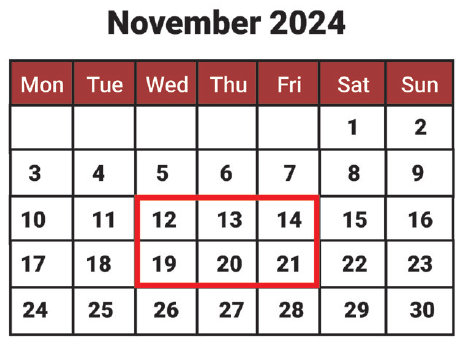
Question 7. In a calendar month, if any $2 \times 3$ grid full of dates is chosen as shown in the picture, write expressions for the dates in the blank cells if the bottom middle cell has date ‘$w$’.
| _______ | _______ | _______ |
| $w - 1$ | $w$ | _______ |
Answer:
Given:
A $2 \times 3$ grid from a calendar. The bottom middle cell is $w$.
Solution:
In any calendar:
1. Dates in the same row differ by $1$. The date to the left is $1$ less, and the date to the right is $1$ more.
2. Dates in the same column differ by $7$. The date in the row above is $7$ less than the date below it.
Filling the Bottom Row:
Middle cell $= w$
Left cell $= w - 1$
Right cell $= w + 1$
Filling the Top Row:
Middle cell (above $w$) $= w - 7$
Left cell (above $w-1$) $= (w - 1) - 7 = w - 8$
Right cell (above $w+1$) $= (w + 1) - 7 = w - 6$
Final Answer:
The completed grid table is:
| $w - 8$ | $w - 7$ | $w - 6$ |
| $w - 1$ | $w$ | $w + 1$ |
Intext Questions (Page No. 92 - 93)
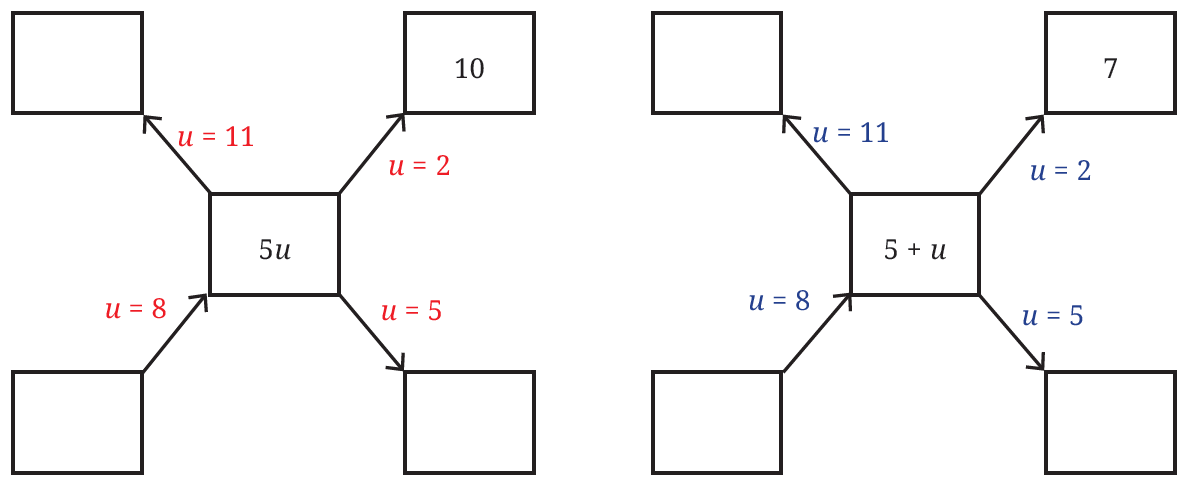
Question. Fill the blanks below by replacing the letter-numbers by numbers; an example is shown. Then compare the values that $5u$ and $5 + u$ take.
Answer:
To Find: To evaluate the expressions $5u$ and $5 + u$ for given values of $u$ and compare them.
Solution:
We substitute the values of $u$ into the center expression to find the result for each outer box.
Evaluations for $5u$:
For $u = 11$, $5 \times 11 = 55$
(Top-left box)
For $u = 2$, $5 \times 2 = 10$
(Top-right box - Given)
For $u = 8$, $5 \times 8 = 40$
(Bottom-left box)
For $u = 5$, $5 \times 5 = 25$
(Bottom-right box)
Evaluations for $5 + u$:
For $u = 11$, $5 + 11 = 16$
(Top-left box)
For $u = 2$, $5 + 2 = 7$
(Top-right box - Given)
For $u = 8$, $5 + 8 = 13$
(Bottom-left box)
For $u = 5$, $5 + 5 = 10$
(Bottom-right box)
Comparison:
When we compare the values of $5u$ (multiplication) and $5 + u$ (addition), we observe that for larger values of $u$, the expression $5u$ increases much faster than $5 + u$. For example, at $u = 11$, $55$ is significantly greater than $16$.
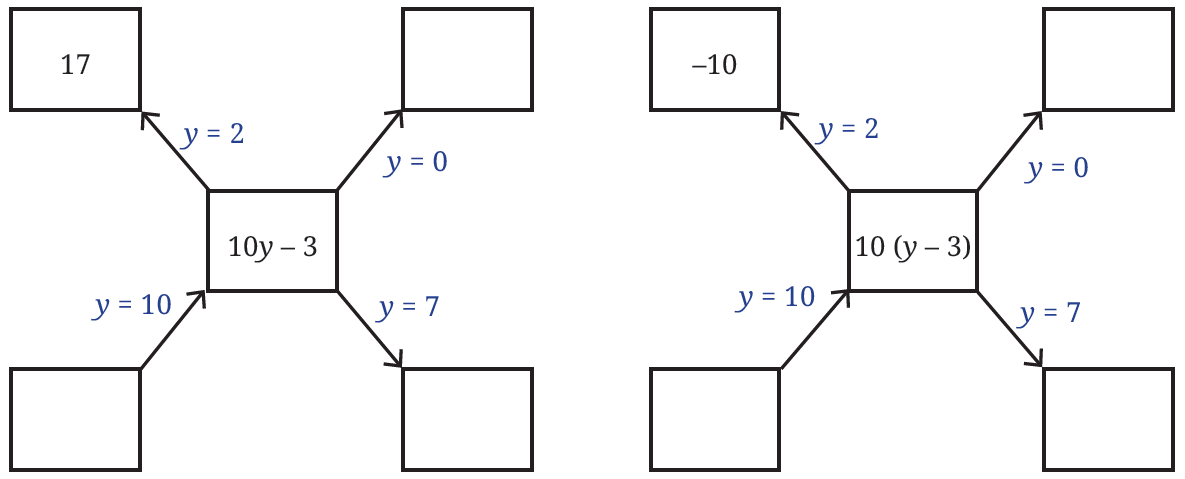
Question. Let us compare the values that these expressions take for different values of $y$.
After filling in the two diagrams, do you think the two expressions are equal?
Answer:
Evaluations for $10y - 3$:
For $y = 2$, $10(2) - 3 = 17$
(Top-left - Given)
For $y = 0$, $10(0) - 3 = -3$
(Top-right box)
For $y = 10$, $10(10) - 3 = 97$
(Bottom-left box)
For $y = 7$, $10(7) - 3 = 67$
(Bottom-right box)
Evaluations for $10(y - 3)$:
For $y = 2$, $10(2 - 3) = -10$
(Top-left - Given)
For $y = 0$, $10(0 - 3) = -30$
(Top-right box)
For $y = 10$, $10(10 - 3) = 70$
(Bottom-left box)
For $y = 7$, $10(7 - 3) = 40$
(Bottom-right box)
Conclusion:
No, the two expressions are not equal. According to the distributive property, $10(y - 3)$ is equal to $10y - 30$, which is different from $10y - 3$. The evaluation results confirm this as none of the pairs of output values match.
Figure It Out (Page No. 93 - 94)
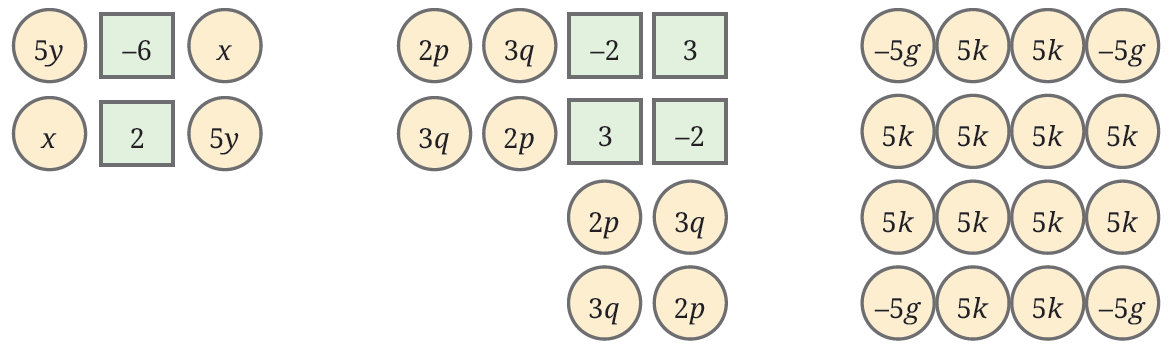
Question 1. Add the numbers in each picture below. Write their corresponding expressions and simplify them. Try adding the numbers in each picture in a couple different ways and see that you get the same thing.
Answer:
To Find: To write and simplify the algebraic expressions for the three groups of terms shown in the image using different methods of addition.
Group 1: Terms involving $x$ and $y$
Way 1: Adding by rows
First row terms: $5y$, $-6$, $x$
Second row terms: $x$, $2$, $5y$
Expression: $(5y - 6 + x) + (x + 2 + 5y)$
Combining like terms: $(5y + 5y) + (x + x) + (-6 + 2)$
Simplified Result: $10y + 2x - 4$
Way 2: Adding like terms directly (Alternate Solution)
Total $y$ terms: $5y + 5y = 10y$
Total $x$ terms: $x + x = 2x$
Total constants: $-6 + 2 = -4$ Combined result: $10y + 2x - 4$
Group 2: Terms involving $p$ and $q$
Way 1: Adding by clusters
Top section: $(2p + 3q - 2 + 3) = 2p + 3q + 1$
Middle section: $(3q + 2p + 3 - 2) = 2p + 3q + 1$
Bottom sections: $(2p + 3q) + (3q + 2p) = 4p + 6q$
Total Sum: $(2p + 3q + 1) + (2p + 3q + 1) + (4p + 6q)$
Simplified Result: $8p + 12q + 2$
Way 2: Counting total occurrences
There are four $2p$ terms, four $3q$ terms, and constants $-2, 3, 3, -2$.
Sum: $4(2p) + 4(3q) + (-2 + 3 + 3 - 2)$
Result: $8p + 12q + 2$
Group 3: Terms involving $g$ and $k$
Way 1: Row-wise addition
Row 1: $-5g + 5k + 5k - 5g = -10g + 10k$
Row 2: $5k + 5k + 5k + 5k = 20k$
Row 3: $5k + 5k + 5k + 5k = 20k$
Row 4: $-5g + 5k + 5k - 5g = -10g + 10k$
Total: $(-10g + 10k) + 20k + 20k + (-10g + 10k)$
Simplified Result: $60k - 20g$
Way 2: Direct count
Total $5k$ circles $= 12 \implies 12 \times 5k = 60k$
Total $-5g$ circles $= 4 \implies 4 \times (-5g) = -20g$
Simplified Result: $60k - 20g$
Question 2. Simplify each of the following expressions:
(a) $p + p + p + p$, $p + p + p + q$, $p + q + p - q$
(b) $p - q + p - q$, $p + q - p + q$
(c) $p + q - (p + q)$, $p - q - p - q$
(d) $2d - d - d - d$, $2d - d - d - c$
(e) $2d - d - (d - c)$, $2d - (d - d) - c$
(f) $2d - d - c - c$
Answer:
Solution:
(a) Simplification:
$\bullet$ $p + p + p + p = \mathbf{4p}$
$\bullet$ $p + p + p + q = \mathbf{3p + q}$
$\bullet$ $p + q + p - q = (p + p) + (q - q) = \mathbf{2p}$
(b) Simplification:
$\bullet$ $p - q + p - q = (p + p) + (-q - q) = \mathbf{2p - 2q}$
$\bullet$ $p + q - p + q = (p - p) + (q + q) = \mathbf{2q}$
(c) Simplification:
$\bullet$ $p + q - (p + q) = p + q - p - q = \mathbf{0}$
$\bullet$ $p - q - p - q = (p - p) + (-q - q) = \mathbf{-2q}$
(d) Simplification:
$\bullet$ $2d - d - d - d = 2d - 3d = \mathbf{-d}$
$\bullet$ $2d - d - d - c = (2d - 2d) - c = \mathbf{-c}$
(e) Simplification:
$\bullet$ $2d - d - (d - c) = d - d + c = \mathbf{c}$
$\bullet$ $2d - (d - d) - c = 2d - (0) - c = \mathbf{2d - c}$
(f) Simplification:
$\bullet$ $2d - d - c - c = (2d - d) + (-c - c) = \mathbf{d - 2c}$
Intext Questions (Page No. 94 - 95)
Question. Some simplifications of algebraic expressions are done below. The expression on the right-hand side should be in its simplest form.
• Observe each of them and see if there is a mistake.
• If you think there is a mistake, try to explain what might have gone wrong.
• Then, simplify it correctly.
| Expression | Simplest Form | Correct Simplest Form |
|---|---|---|
| $3a + 2b$ | $5$ | |
| $3b - 2b - b$ | $0$ | |
| $6(p + 2)$ | $6p + 8$ | |
| $(4x + 3y) - (3x + 4y)$ | $x + y$ | |
| $5 - (2 - 6z)$ | $3 - 6z$ | |
| $2 + (x + 3)$ | $2x - 6$ | |
| $2y + (3y - 6)$ | $-y + 6$ | |
| $7p - p + 5q - 2q$ | $7p + 3q$ | |
| $5(2w + 3x + 4w)$ | $10w + 15x + 20w$ | |
| $3j + 6k + 9h + 12$ | $3(j + 2k + 3h + 4)$ | |
| $4(2r + 3s + 5) - 20$ | $-8r - 12s$ |
Take a look at all the corrected simplest forms (i.e. brackets are removed, like terms are added, and terms with only numbers are also added). Is there any relation between the number of terms and the number of letter-numbers these expressions have?
Answer:
To Find: Identifying mistakes in algebraic simplifications, explaining the errors, and providing the correct simplest forms.
Solution:
In algebra, we must remember that Like Terms (terms with the same letter-numbers) can be added or subtracted, but Unlike Terms cannot. Also, when opening brackets, a negative sign outside changes the signs of all terms inside.
| Expression | Mistake/What went wrong? | Correct Simplest Form |
| $3a + 2b$ | The terms are 'unlike' and cannot be added together as if they were constants. | $3a + 2b$ |
| $3b - 2b - b$ | No mistake; the simplification to $0$ is correct. | $0$ |
| $6(p + 2)$ | The multiplier $6$ was not distributed to the constant $2$. | $6p + 12$ |
| $(4x + 3y) - (3x + 4y)$ | The minus sign before the second bracket was not distributed to $4y$. | $x - y$ |
| $5 - (2 - 6z)$ | Subtracting a negative term ($-6z$) should result in a positive term ($+6z$). | $3 + 6z$ |
| $2 + (x + 3)$ | The addition was treated as multiplication ($2 \times x$). | $x + 5$ |
| $2y + (3y - 6)$ | The addition of like terms $2y$ and $3y$ was calculated incorrectly as subtraction. | $5y - 6$ |
| $7p - p + 5q - 2q$ | The coefficient of $p$ in $7p - p$ should be $7 - 1 = 6$. | $6p + 3q$ |
| $5(2w + 3x + 4w)$ | The like terms ($10w$ and $20w$) were not combined after distribution. | $30w + 15x$ |
| $3j + 6k + 9h + 12$ | No mistake; the factored form is correct, but simplest form usually has brackets removed. | $3j + 6k + 9h + 12$ |
| $4(2r + 3s + 5) - 20$ | Incorrect calculation of coefficients and final signs. | $8r + 12s$ |
Step-by-step correction for $(4x + 3y) - (3x + 4y)$ as an example:
$4x + 3y - 3x - 4y$
(Removing brackets and distributing the minus sign)
$(4x - 3x) + (3y - 4y)$
(Grouping like terms)
$x - y$
[Final simplified form]
Analysis of the relation:
When we look at the Correct Simplest Forms, we observe a clear pattern: In a fully simplified expression, the number of terms is equal to the number of distinct letter-numbers (variables) plus a single constant term (if any numbers are left).
For example, in $6p + 3q$, there are $2$ letter-numbers ($p, q$) and $2$ terms. In $3 + 6z$, there is $1$ letter-number and $2$ terms (including the constant $3$).
In the Indian Perspective of Mathematics, this process is fundamental to solving daily life problems involving multiple variables like cost of items or quantities, ensuring we only combine what is truly similar.
Intext Questions (Page No. 96)
Question. Find the formulas of the number machines below and write the expression for each set of inputs.
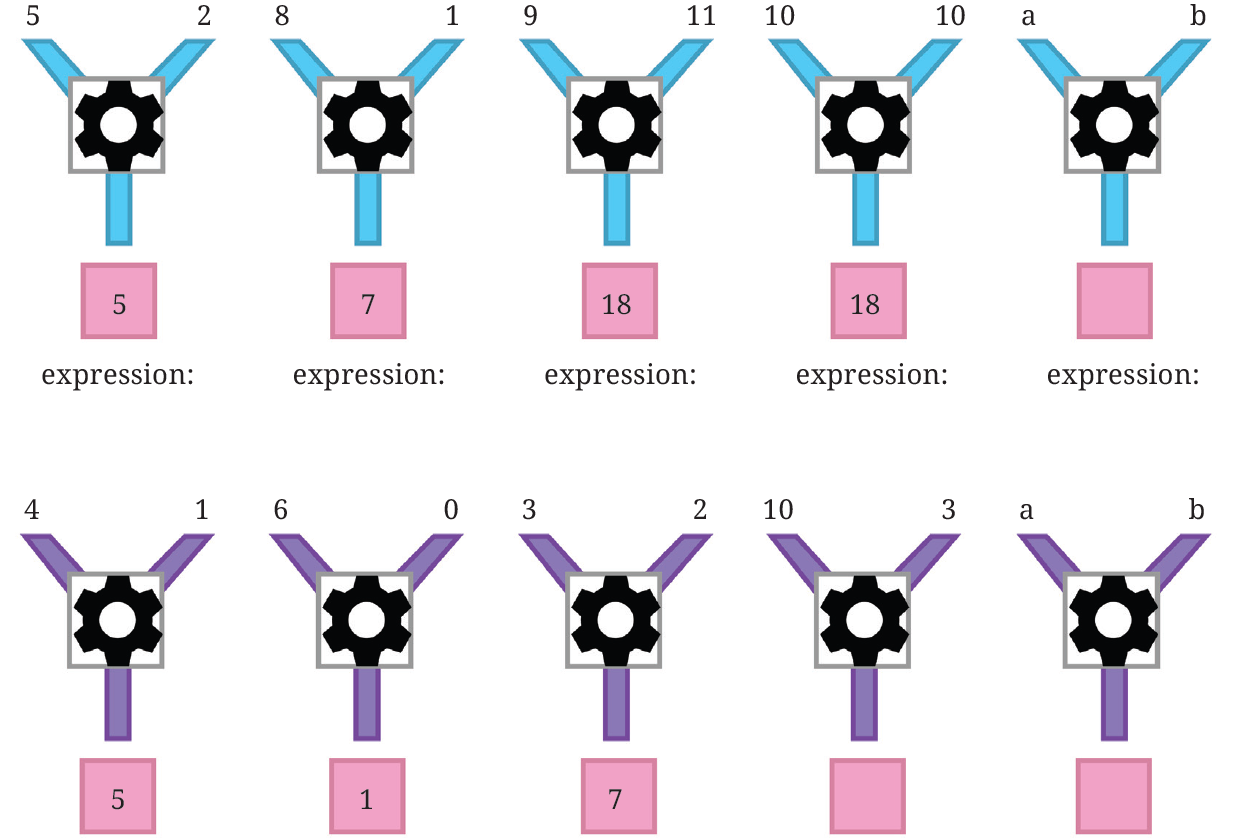
Answer:
Given:
1. Top Row (Blue Machines): Pairs of inputs $(5, 2)$, $(8, 1)$, $(9, 11)$, and $(10, 10)$ result in outputs $5, 7, 18,$ and $18$ respectively.
2. Bottom Row (Purple Machines): Pairs of inputs $(4, 1)$, $(6, 0)$, and $(3, 2)$ result in outputs $5, 1,$ and $7$ respectively.
To Find:
1. The mathematical rule (formula) and the general expression for the Blue Machines.
2. The mathematical rule (formula), the missing output for $(10, 3)$, and the general expression for the Purple Machines.
Solution:
Analysis of the Blue Number Machines (Top Row):
Let the two inputs be $a$ and $b$. We observe the following relationships:
For inputs $5$ and $2$: $5 + 2 = 7$; and $7 - 2 = 5$ (Output)
For inputs $8$ and $1$: $8 + 1 = 9$; and $9 - 2 = 7$ (Output)
For inputs $9$ and $11$: $9 + 11 = 20$; and $20 - 2 = 18$ (Output)
For inputs $10$ and $10$: $10 + 10 = 20$; and $20 - 2 = 18$ (Output)
In each case, the output is found by adding the inputs and subtracting $2$.
$\text{Output} = a + b - 2$
[Formula for Top Row]
The expression for each set of inputs is:
1. $5 + 2 - 2$
2. $8 + 1 - 2$
3. $9 + 11 - 2$
4. $10 + 10 - 2$
5. $a + b - 2$
Analysis of the Purple Number Machines (Bottom Row):
Let the two inputs be $a$ and $b$. We observe the following relationships:
For inputs $4$ and $1$: $4 \times 1 = 4$; and $4 + 1 = 5$ (Output)
For inputs $6$ and $0$: $6 \times 0 = 0$; and $0 + 1 = 1$ (Output)
For inputs $3$ and $2$: $3 \times 2 = 6$; and $6 + 1 = 7$ (Output)
In each case, the output is found by multiplying the inputs and adding $1$.
$\text{Output} = a \times b + 1$
[Formula for Bottom Row]
Using this rule for the missing output (inputs $10$ and $3$):
$\text{Output} = (10 \times 3) + 1 = 31$
(Calculating missing value)
The expression for each set of inputs is:
1. $(4 \times 1) + 1$
2. $(6 \times 0) + 1$
3. $(3 \times 2) + 1$
4. $(10 \times 3) + 1 = 31$
5. $a \times b + 1$
Note: These puzzles are excellent for developing algebraic intuition. By treating numbers as inputs into a machine (Yantra), students learn that variables like $a$ and $b$ represent any number, and the formula represents the logic of the machine.
Final Answer:
$\bullet$ The formula for the Blue machine is $a + b - 2$.
$\bullet$ The formula for the Purple machine is $a \times b + 1$ (or $ab + 1$).
$\bullet$ The missing value for the Purple machine with inputs $10$ and $3$ is $31$.
Intext Questions (Page No. 99)
Question. Consider a set of numbers from the calendar (having endless rows) forming under the following shape:
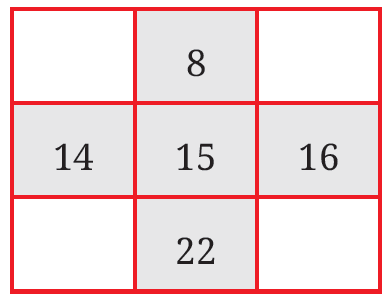
Find the sum of all the numbers. Compare it with the number in the centre: $15$. Repeat this for another set of numbers that forms this shape. What do you observe?
We see that the total sum is always $5$ times the number in the centre. Will this always happen? How do you show this?
[Hint: Consider a general set of numbers that forms this shape. Take the number at the centre to be ‘$a$’. Express the other numbers in terms of ‘$a$’.]
Answer:
Given:
A cross-shaped pattern on a calendar. The first set of numbers has $15$ at the center.
To Find:
1. The sum of the numbers in the shape and its relation to the center number.
2. Verification with another set of numbers.
3. Algebraic proof for the observation.
Solution:
We calculate the sum of the numbers in the shape for two different cases and organize them in the table below. In a standard calendar, the number above is $7$ less, the number below is $7$ more, the left is $1$ less, and the right is $1$ more than the center number.
| Set Description | Numbers in the Shape (Top, Left, Center, Right, Bottom) | Total Sum | Comparison (Sum $\div$ Center) |
| Set 1 (Center 15) | $8, 14, 15, 16, 22$ | $75$ | $75 = 5 \times 15$ |
| Set 2 (Center 10) | $3, 9, 10, 11, 17$ | $50$ | $50 = 5 \times 10$ |
Observation: In both cases, the total sum of the five numbers is exactly $5$ times the number at the center.
Proof:
To show that this will always happen, let us represent the numbers using a variable. Let the number at the center be $a$.
The other numbers in the shape can be expressed in terms of $a$ as follows:
$\text{Center} = a$
$\text{Top} = a - 7$
(7 days before/one week up)
$\text{Bottom} = a + 7$
(7 days after/one week down)
$\text{Left} = a - 1$
(1 day before)
$\text{Right} = a + 1$
(1 day after)
Now, we find the Total Sum ($S$) by adding these expressions:
$S = (a - 7) + (a - 1) + a + (a + 1) + (a + 7)$
By rearranging the terms to group the variables and the constants together:
$S = (a + a + a + a + a) + (-7 + 7) + (-1 + 1)$
$S = 5a + 0 + 0$
$S = 5a$
(Final Expression)
Conclusion:
Since the sum $S$ is equal to $5a$, where $a$ is the center number, we have mathematically proven that the total sum of this calendar shape will always be 5 times the number in the center, regardless of which part of the calendar is chosen.
Intext Questions (Page No. 101)
Question. Look at the picture below. It is a pattern using matchsticks. Can you identify what the pattern is?

We can see that Step $1$ has $1$ triangle, Step $2$ has $2$ triangles, Step $3$ has $3$ triangles, and so on.
Matchsticks are placed in two orientations — (a) horizontal ones at the top and bottom, and (b) the ones placed diagonally in the middle.
For example, in step $2$ there are $2$ matchsticks placed horizontally and $3$ matchsticks placed diagonally.
What are these numbers in Step $3$ and Step $4$?
How does the number of matchsticks change in each orientation as the steps increase? Write an expression for the number of matchsticks at Step ‘$y$’ in each orientation. Do the two expressions add up to $2y + 1$?
Answer:
To Find: The number of horizontal and diagonal matchsticks in Step 3 and Step 4, and the general algebraic expressions for Step $y$.
Solution:
Let us analyze the number of matchsticks in each step based on the provided image:
| Step Number | Horizontal Matchsticks | Diagonal Matchsticks | Total Matchsticks |
| 1 | 1 | 2 | 3 |
| 2 | 2 | 3 | 5 |
| 3 | 3 | 4 | 7 |
| 4 | 4 | 5 | 9 |
Step 3 and Step 4 details:
$\bullet$ In Step 3, there are 3 horizontal matchsticks and 4 diagonal matchsticks.
$\bullet$ In Step 4, there are 4 horizontal matchsticks and 5 diagonal matchsticks.
General expressions for Step '$y$':
By observing the table, we can see a clear pattern for both orientations:
1. Horizontal Matchsticks: The number of horizontal matchsticks is exactly equal to the step number.
Expression for Horizontal $= y$
2. Diagonal Matchsticks: The number of diagonal matchsticks is always one more than the step number.
Expression for Diagonal $= y + 1$
Verification of Total sum:
To find the total number of matchsticks, we add the expressions for both orientations:
$\text{Total} = \text{Horizontal} + \text{Diagonal}$
$\text{Total} = y + (y + 1)$
$\text{Total} = 2y + 1$
Yes, the two expressions add up to $2y + 1$. This formula allows us to find the number of matchsticks for any number of triangles in the pattern.
Figure It Out (Page No. 102 - 105)
Question 1. One plate of Jowar roti costs ₹$30$ and one plate of Pulao costs ₹$20$. If $x$ plates of Jowar roti and $y$ plates of pulao were ordered in a day, which expression(s) describe the total amount in rupees earned that day?
(a) $30x + 20y$
(b) $(30 + 20) \times (x + y)$
(c) $20x + 30y$
(d) $(30 + 20) \times x + y$
(e) $30x - 20y$
Answer:
Given:
Cost of one plate of Jowar roti = $\textsf{₹} 30$
Cost of one plate of Pulao = $\textsf{₹} 20$
Number of Jowar roti plates = $x$
Number of Pulao plates = $y$
Solution:
To find the total amount earned, we calculate the cost for each item separately and then add them together.
$\text{Cost of } x \text{ plates of Jowar roti} = 30 \times x$
$\text{Cost of } y \text{ plates of Pulao} = 20 \times y$
The total amount earned is the sum of these two costs:
$\text{Total Amount} = 30x + 20y$
Final Answer:
The expression that describes the total amount is (a) $30x + 20y$.
Question 2. Pushpita sells two types of flowers on Independence day: champak and marigold. ‘$p$’ customers only bought champak, ‘$q$’ customers only bought marigold, and ‘$r$’ customers bought both. On the same day, she gave away a tiny national flag to every customer. How many flags did she give away that day?
(a) $p + q + r$
(b) $p + q + 2r$
(c) $2 \times (p + q + r)$
(d) $p + q + r + 2$
(e) $p + q + r + 1$
(f) $2 \times (p + q)$
Answer:
Given:
Pushpita gives one flag to every customer. We need to find the total number of unique customers.
Solution:
The total number of customers is the sum of all the different groups of people who visited her shop:
1. Customers who bought only champak = $p$
2. Customers who bought only marigold = $q$
3. Customers who bought both = $r$
$\text{Total unique customers} = p + q + r$
Since each customer receives one flag, the number of flags given away is equal to the total number of customers.
Final Answer:
The correct expression is (a) $p + q + r$.
Question 3. A snail is trying to climb along the wall of a deep well. During the day it climbs up ‘$u$’ cm and during the night it slowly slips down ‘$d$’ cm. This happens for $10$ days and $10$ nights.
(a) Write an expression describing how far away the snail is from its starting position.
(b) What can we say about the snail’s movement if $d > u$?
Answer:
(a) Algebraic Expression:
The net distance the snail covers in one full day and night cycle is the difference between the distance climbed up and the distance slipped down.
$\text{Net climb in 1 day} = (u - d) \text{ cm}$
Since this pattern repeats for $10$ days and $10$ nights, we multiply the daily net progress by 10.
Expression: $10 \times (u - d)$
(b) Analysis for $d > u$:
If $d > u$, it means the distance the snail slips down at night is greater than the distance it climbs up during the day.
In this case, the value of $(u - d)$ will be negative. This implies that the snail is not making any upward progress; instead, it is actually ending up lower than its starting position after each cycle, moving deeper into the well.
Question 4. Radha is preparing for a cycling race and practices daily. The first week she cycles $5$ km every day. Every week she increases the daily distance cycled by ‘$z$’ km. How many kilometers would Radha have cycled after $3$ weeks?
Answer:
Given:
Distance in Week 1 = $5 \text{ km/day}$
Increase per week = $z \text{ km/day}$
Solution:
First, let's find the daily distance for each of the three weeks:
$\bullet$ Daily distance in Week 1 = $5 \text{ km}$
$\bullet$ Daily distance in Week 2 = $(5 + z) \text{ km}$
$\bullet$ Daily distance in Week 3 = $(5 + z + z) = (5 + 2z) \text{ km}$
Now, to find the total distance cycled in $3$ weeks (assuming $7$ days per week):
$\text{Total Distance} = 7 \times [5 + (5 + z) + (5 + 2z)]$
Simplifying the expression inside the bracket:
$\text{Total Distance} = 7 \times [15 + 3z]$
$\text{Total Distance} = 105 + 21z$
Final Answer:
Radha would have cycled a total of $(105 + 21z)$ km after 3 weeks.
Question 5. In the following figure, observe how the expression $w + 2$ becomes $4w + 20$ along one path. Fill in the missing blanks on the remaining paths. The ovals contain expressions and the boxes contain operations.
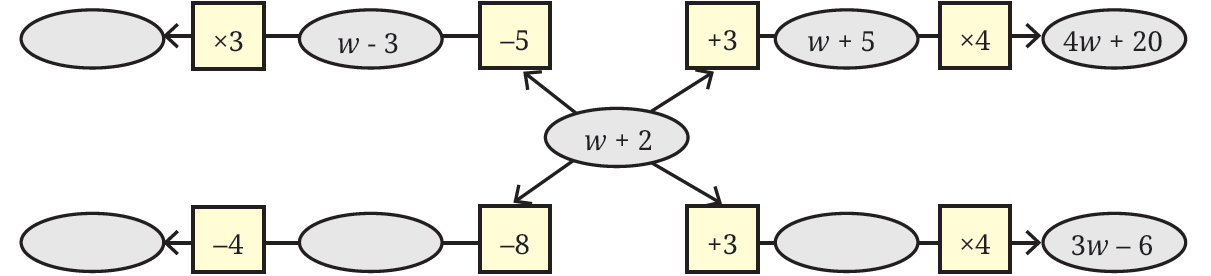
Answer:
Given:
1. A central expression oval containing $w + 2$.
2. A flowchart with four paths, where each path has two operations in boxes and two resulting expressions in ovals.
To Find:
The missing algebraic expressions in the empty ovals for the Top-Left, Bottom-Left, and Bottom-Right paths.
Solution:
We solve for each path by applying the operations given in the boxes to the preceding expression.
1. Top-Left Path:
The starting expression is $w + 2$. The first operation is $-5$.
$(w + 2) - 5 = w - 3$
(Given in middle oval)
The next operation is $\times 3$.
$3 \times (w - 3) = 3w - 9$
(Final oval value)
2. Bottom-Left Path:
The starting expression is $w + 2$. The first operation is $-8$.
$(w + 2) - 8 = w - 6$
(Middle oval value)
The next operation is $-4$.
$(w - 6) - 4 = w - 10$
(Final oval value)
3. Top-Right Path (Example):
Starting with $w + 2$, the first operation is $+3$, resulting in $w + 5$. The second operation is $\times 4$, resulting in $4 \times (w + 5) = 4w + 20$.
4. Bottom-Right Path:
The starting expression is $w + 2$. The first operation is $-4$.
$(w + 2) - 4 = w - 2$
(Middle oval value)
The next operation is $\times 3$.
$3 \times (w - 2) = 3w - 6$
(Verified final value)
Question 6. A local train from Yahapur to Vahapur stops at three stations at equal distances along the way. The time taken in minutes to travel from one station to the next station is the same and is denoted by $t$. The train stops for $2$ minutes at each of the three stations.
(a) If $t = 4$, what is the time taken to travel from Yahapur to Vahapur?
(b) What is the algebraic expression for the time taken to travel from Yahapur to Vahapur? [Hint: Draw a rough diagram to visualise the situation]
Answer:
Given:
Number of intermediate stations = $3$
Time for each travel segment = $t$ minutes
Time for each stop = $2$ minutes
Visualisation:
The journey looks like this:
Yahapur $\xrightarrow{t}$ Station 1 $\xrightarrow{\text{stop } 2}$ Station 2 $\xrightarrow{\text{stop } 2}$ Station 3 $\xrightarrow{\text{stop } 2}$ Vahapur
Wait, if there are 3 stations *along the way*, there are 4 segments of travel:
1. Yahapur to Station 1 ($t$)
2. Station 1 to Station 2 ($t$)
3. Station 2 to Station 3 ($t$)
4. Station 3 to Vahapur ($t$)
Total travel segments = $4$. Total stops at intermediate stations = $3$.
(a) Solution for $t = 4$:
Total travel time $= 4 \times t = 4 \times 4 = 16$ minutes
Total stoppage time $= 3 \times 2 = 6$ minutes
Total time $= 16 + 6 = 22$ minutes
(b) Algebraic Expression:
The total time taken is the sum of travel time for all segments and the total stoppage time.
$\text{Total Time} = (4 \times t) + (3 \times 2)$
Expression: $4t + 6$
This is similar to calculating the schedule of a Mumbai Local or a Metro train, where the total journey time is always the sum of running time and fixed dwell times at platforms.
Question 7. Simplify the following expressions:
(a) $3a + 9b - 6 + 8a - 4b - 7a + 16$
(b) $3(3a - 3b) - 8a - 4b - 16$
(c) $2(2x - 3) + 8x + 12$
(d) $8x - (2x - 3) + 12$
(e) $8h - (5 + 7h) + 9$
(f) $23 + 4(6m - 3n) - 8n - 3m - 18$
Answer:
(a) $3a + 9b - 6 + 8a - 4b - 7a + 16$
Grouping like terms:
$= (3a + 8a - 7a) + (9b - 4b) + (-6 + 16)$
$= \mathbf{4a + 5b + 10}$
(b) $3(3a - 3b) - 8a - 4b - 16$
Distributing the 3:
$= 9a - 9b - 8a - 4b - 16$
$= (9a - 8a) + (-9b - 4b) - 16$
$= \mathbf{a - 13b - 16}$
(c) $2(2x - 3) + 8x + 12$
Distributing the 2:
$= 4x - 6 + 8x + 12$
$= (4x + 8x) + (12 - 6)$
$= \mathbf{12x + 6}$
(d) $8x - (2x - 3) + 12$
Removing the bracket (signs change):
$= 8x - 2x + 3 + 12$
$= \mathbf{6x + 15}$
(e) $8h - (5 + 7h) + 9$
Removing the bracket:
$= 8h - 5 - 7h + 9$
$= (8h - 7h) + (9 - 5)$
$= \mathbf{h + 4}$
(f) $23 + 4(6m - 3n) - 8n - 3m - 18$
Distributing the 4 and grouping terms:
$= 23 + 24m - 12n - 8n - 3m - 18$
$= (24m - 3m) + (-12n - 8n) + (23 - 18)$
$= \mathbf{21m - 20n + 5}$
Question 8. Add the expressions given below:
(a) $4d - 7c + 9$ and $8c - 11 + 9d$
(b) $-6f + 19 - 8s$ and $-23 + 13f + 12s$
(c) $8d - 14c + 9$ and $16c - (11 + 9d)$
(d) $6f - 20 + 8s$ and $23 - 13f - 12s$
(e) $13m - 12n$ and $12n - 13m$
(f) $-26m + 24n$ and $26m - 24n$
Answer:
Solution:
To add algebraic expressions, we group the like terms (terms with the same literal coefficients) together and then perform the addition or subtraction on their numerical coefficients.
(a) $(4d - 7c + 9) + (8c - 11 + 9d)$
Grouping like terms: $(4d + 9d) + (-7c + 8c) + (9 - 11)$
Result: $13d + c - 2$
(b) $(-6f + 19 - 8s) + (-23 + 13f + 12s)$
Grouping like terms: $(-6f + 13f) + (-8s + 12s) + (19 - 23)$
Result: $7f + 4s - 4$
(c) $(8d - 14c + 9) + [16c - (11 + 9d)]$
First, simplify the second expression: $16c - 11 - 9d$
Now add: $(8d - 9d) + (-14c + 16c) + (9 - 11)$
Result: $-d + 2c - 2$
(d) $(6f - 20 + 8s) + (23 - 13f - 12s)$
Grouping like terms: $(6f - 13f) + (8s - 12s) + (-20 + 23)$
Result: $-7f - 4s + 3$
(e) $(13m - 12n) + (12n - 13m)$
Grouping like terms: $(13m - 13m) + (-12n + 12n)$
Result: $0$
(f) $(-26m + 24n) + (26m - 24n)$
Grouping like terms: $(-26m + 26m) + (24n - 24n)$
Result: $0$
Question 9. Subtract the expressions given below:
(a) $9a - 6b + 14$ from $6a + 9b - 18$
(b) $-15x + 13 - 9y$ from $7y - 10 + 3x$
(c) $17g + 9 - 7h$ from $11 - 10g + 3h$
(d) $9a - 6b + 14$ from $6a - (9b + 18)$
(e) $10x + 2 + 10y$ from $-3y + 8 - 3x$
(f) $8g + 4h - 10$ from $7h - 8g + 20$
Answer:
Solution:
To subtract one expression from another, we change the sign of each term in the expression being subtracted and then add the two expressions.
(a) $(6a + 9b - 18) - (9a - 6b + 14)$
$= 6a + 9b - 18 - 9a + 6b - 14$
$= (6a - 9a) + (9b + 6b) + (-18 - 14)$
Result: $-3a + 15b - 32$
(b) $(7y - 10 + 3x) - (-15x + 13 - 9y)$
$= 7y - 10 + 3x + 15x - 13 + 9y$
$= (3x + 15x) + (7y + 9y) + (-10 - 13)$
Result: $18x + 16y - 23$
(c) $(11 - 10g + 3h) - (17g + 9 - 7h)$
$= 11 - 10g + 3h - 17g - 9 + 7h$
$= (-10g - 17g) + (3h + 7h) + (11 - 9)$
Result: $-27g + 10h + 2$
(d) $[6a - (9b + 18)] - (9a - 6b + 14)$
$= (6a - 9b - 18) - 9a + 6b - 14$
$= (6a - 9a) + (-9b + 6b) + (-18 - 14)$
Result: $-3a - 3b - 32$
(e) $(-3y + 8 - 3x) - (10x + 2 + 10y)$
$= -3y + 8 - 3x - 10x - 2 - 10y$
$= (-3x - 10x) + (-3y - 10y) + (8 - 2)$
Result: $-13x - 13y + 6$
(f) $(7h - 8g + 20) - (8g + 4h - 10)$
$= 7h - 8g + 20 - 8g - 4h + 10$
$= (-8g - 8g) + (7h - 4h) + (20 + 10)$
Result: $-16g + 3h + 30$
Question 10. Describe situations corresponding to the following algebraic expressions:
(a) $8x + 3y$
(b) $15x - 2x$
Answer:
In our daily lives, we often use algebraic thinking while shopping in local markets or managing household supplies.
(a) Situation for $8x + 3y$
Imagine Rohan goes to a stationery shop in Delhi. He buys $8$ notebooks, and each notebook costs $\textsf{₹} x$. He also buys $3$ pens, and each pen costs $\textsf{₹} y$. The total amount Rohan has to pay the shopkeeper is represented by the expression $8x + 3y$.
(b) Situation for $15x - 2x$
Suppose a fruit seller in Mumbai has $15$ identical crates of mangoes, where each crate contains $x$ mangoes. While inspecting the crates, he discovers that $2$ crates have completely spoiled mangoes and cannot be sold. The total number of good mangoes remaining with the seller is represented by $15x - 2x$ (which simplifies to $13x$).
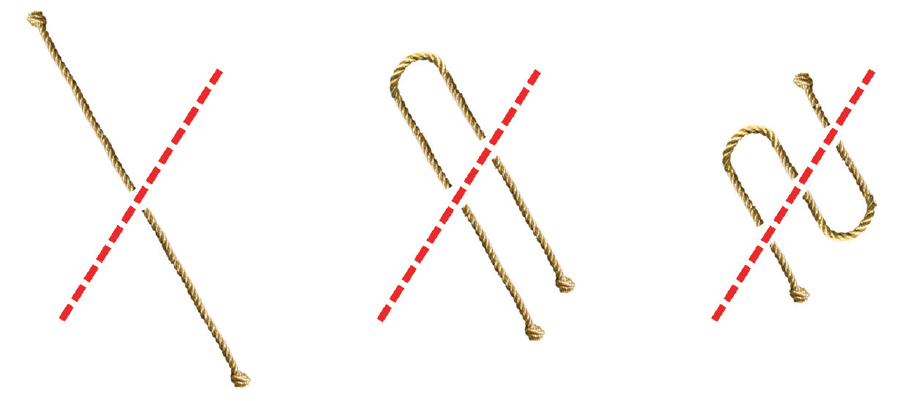
Question 11. Imagine a straight rope. If it is cut once as shown in the picture, we get $2$ pieces. If the rope is folded once and then cut as shown, we get $3$ pieces. Observe the pattern and find the number of pieces if the rope is folded $10$ times and cut. What is the expression for the number of pieces when the rope is folded $r$ times and cut?
Answer:
Given:
$\bullet$ Straight rope (0 folds), 1 cut $\rightarrow$ 2 pieces.
$\bullet$ Folded once (1 fold), 1 cut $\rightarrow$ 3 pieces.
To Find:
1. Number of pieces if the rope is folded $10$ times and cut.
2. The general algebraic expression for $r$ folds.
Solution:
Let us observe the relationship between the number of folds and the number of pieces resulting from a single cut across all layers:
| Number of Folds ($r$) | Number of Pieces | Pattern |
| $0$ | $2$ | $0 + 2$ |
| $1$ | $3$ | $1 + 2$ |
| $2$ | $4$ | $2 + 2$ |
The pattern shows that the number of pieces is always $2$ more than the number of folds.
1. For 10 folds:
$\text{Number of pieces} = 10 + 2$
(Applying the pattern)
Number of pieces = $12$.
2. General Expression:
If the number of folds is represented by the letter-number '$r$', the expression for the number of pieces is:
$\text{Expression} = r + 2$
Indian Perspective:
This is a common observation when children in India fly kites (Patang). When the Manjha (string) is folded multiple times to make a bundle and then cut at one end, the resulting number of small strings follows this exact mathematical pattern.
Question 12. Look at the matchstick pattern below. Observe and identify the pattern. How many matchsticks are required to make $10$ such squares. How many are required to make $w$ squares?

Answer:
Given:
A pattern where squares are joined together. The first square uses $4$ matchsticks, and each subsequent square shares a common wall with the previous one.
To Find:
1. Matchsticks required for $10$ squares.
2. Matchsticks required for $w$ squares.
Solution:
Let us count the matchsticks for the first few steps:
$\bullet$ 1 square: $4$ matchsticks.
$\bullet$ 2 squares: $4 + 3 = 7$ matchsticks.
$\bullet$ 3 squares: $7 + 3 = 10$ matchsticks.
We see that the first square requires $4$ sticks, and every additional square requires $3$ extra sticks because they share one matchstick as a common boundary.
General Formula:
For '$w$' squares, the total matchsticks required is:
$\text{Total} = 4 + (w - 1) \times 3$
$\text{Total} = 4 + 3w - 3$
$\text{Expression} = 3w + 1$
Calculation for 10 squares:
Substituting $w = 10$ into the expression:
$\text{Total sticks} = 3(10) + 1$
$\text{Total sticks} = 30 + 1 = 31$.
Final Answer:
$\bullet$ To make 10 squares, 31 matchsticks are required.
$\bullet$ To make $w$ squares, the algebraic expression is $3w + 1$.
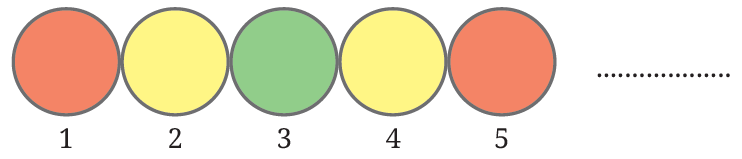
Question 13. Have you noticed how the colours change in a traffic signal? The sequence of colour changes is shown below. Find the colour at positions $90$, $190$, and $343$. Write expressions to describe the positions for each colour.
Answer:
Given:
The sequence follows a repeating pattern of 4 steps:
1. Red, 2. Yellow, 3. Green, 4. Yellow, (repeats: 5. Red, 6. Yellow...)
To Find:
The colour at positions $90$, $190$, and $343$, and general expressions for each colour.
Solution:
The cycle length is $4$. We divide the position number by $4$ and look at the remainder to determine the colour.
$\bullet$ At position 90: $90 \div 4 = 22$ with a remainder of 2. The colour is Yellow.
$\bullet$ At position 190: $190 \div 4 = 47$ with a remainder of 2. The colour is Yellow.
$\bullet$ At position 343: $343 \div 4 = 85$ with a remainder of 3. The colour is Green.
General Expressions (where $k$ is a whole number $0, 1, 2, \dots$):
$\bullet$ Red: $4k + 1$
$\bullet$ Green: $4k + 3$
$\bullet$ Yellow: $4k + 2$ and $4k$ (for $k > 0$)
Question 14. Observe the pattern below. How many squares will be there in Step $4$, Step $10$, Step $50$? Write a general formula. How would the formula change if we want to count the number of vertices of all the squares?

Answer:
Given:
By observing the growing pattern (often called a Vinyasa in Indian mathematics) of the squares:
$\bullet$ In Step 1: There is $1$ central square and $4$ arms with $1$ square each. Total squares $= 1 + 4(1) = 5$.
$\bullet$ In Step 2: There is $1$ central square and $4$ arms with $2$ squares each. Total squares $= 1 + 4(2) = 9$.
$\bullet$ In Step 3: There is $1$ central square and $4$ arms with $3$ squares each. Total squares $= 1 + 4(3) = 13$.
To Find:
1. The number of squares in Step 4, Step 10, and Step 50.
2. A general formula for the number of squares in Step $n$.
3. A formula for the total number of vertices of all the squares.
Solution:
Let the step number be represented by $n$ and the number of squares by $N$. From the given pattern, we see that the number of squares increases by $4$ in each subsequent step.
The general formula for the number of squares is:
$N = 4n + 1$
... (i)
Using this formula, we calculate the required values:
For Step 4 ($n = 4$):
$N = 4(4) + 1 = 16 + 1 = 17$
(Number of squares)
For Step 10 ($n = 10$):
$N = 4(10) + 1 = 40 + 1 = 41$
(Number of squares)
For Step 50 ($n = 50$):
$N = 4(50) + 1 = 200 + 1 = 201$
(Number of squares)
Calculation for Vertices:
We need to find the total number of vertices of all the squares. Each individual square has exactly $4$ vertices.
To find the total number of vertices ($V$), we multiply the total number of squares ($N$) by $4$.
$V = 4 \times N$
(Definition of total vertices)
Substitute the value of $N$ from equation (i):
$V = 4(4n + 1)$
$V = 16n + 4$
... (ii)
Final Answer:
$\bullet$ The number of squares in Step 4 is 17, in Step 10 is 41, and in Step 50 is 201.
$\bullet$ The general formula for the number of squares is $N = 4n + 1$.
$\bullet$ The formula for the total number of vertices of all the squares is $16n + 4$.
Question 15. Numbers are written in a particular sequence in this endless $4$-column grid.
| 1 | 2 | 3 | 4 |
|---|---|---|---|
| 1 | 2 | 3 | 4 |
| 5 | 6 | 7 | 8 |
| 9 | 10 | 11 | 12 |
| 13 | 14 | 15 | 16 |
(a) Give expressions to generate all the numbers in a given column ($1, 2, 3, 4$).
(b) In which row and column will the following numbers appear:
(i) $124$
(ii) $147$
(iii) $201$
(c) What number appears in row $r$ and column $c$?
(d) Observe the positions of multiples of $3$. Do you see any pattern in it? List other patterns that you see.
Answer:
Given:
A number grid with $4$ columns where numbers are arranged consecutively row by row.
(a) Column Expressions:
Let $r$ represent the row number ($r = 1, 2, 3, \dots$). We observe that each row contains $4$ numbers. The expressions for each column are:
$\text{Column 1} = 4r - 3$
... (i)
$\text{Column 2} = 4r - 2$
... (ii)
$\text{Column 3} = 4r - 1$
... (iii)
$\text{Column 4} = 4r$
... (iv)
(b) Finding Row and Column for Specific Numbers:
To find the position of any number $N$, we divide it by the number of columns ($4$). The quotient and remainder determine the row and column.
(i) For the number $124$:
$\begin{array}{r} 31\phantom{)} \\ 4{\overline{\smash{\big)}\,124\phantom{)}}} \\ \underline{-~12\phantom{b)}} \\ 04\phantom{)} \\ \underline{-~04} \\ 0\phantom{)} \end{array}$
Since the remainder is $0$, the number is exactly at the end of the quotient row.
Position: Row 31, Column 4.
(ii) For the number $147$:
$\begin{array}{r} 36\phantom{)} \\ 4{\overline{\smash{\big)}\,147\phantom{)}}} \\ \underline{-~12\phantom{b)}} \\ 27\phantom{)} \\ \underline{-~24} \\ 3\phantom{)} \end{array}$
Quotient $= 36$ and Remainder $= 3$. This means $36$ rows are full, and the number is the $3$rd element of the next row.
Position: Row 37, Column 3.
(iii) For the number $201$:
$\begin{array}{r} 50\phantom{)} \\ 4{\overline{\smash{\big)}\,201\phantom{)}}} \\ \underline{-~20\phantom{b)}} \\ 01\phantom{)} \\ \underline{-~00} \\ 1\phantom{)} \end{array}$
Quotient $= 50$ and Remainder $= 1$. This means the number is the $1$st element of the $51$st row.
Position: Row 51, Column 1.
(c) General Formula:
The number $N$ located in row $r$ and column $c$ can be generated by the expression:
$N = 4(r - 1) + c$
... (v)
(d) Observations of Patterns:
Pattern in Multiples of 3:
The multiples of $3$ ($3, 6, 9, 12, 15, \dots$) appear in a shifting diagonal pattern across the columns:
| Multiple of 3 | Column Position |
| 3 | Column 3 |
| 6 | Column 2 |
| 9 | Column 1 |
| 12 | Column 4 |
| 15 | Column 3 |
We see the column index decreases by $1$ in each row, cycling back to $4$ after reaching $1$.
Other Observed Patterns:
1. Multiples of 4: All multiples of $4$ ($4, 8, 12, 16, \dots$) always appear in Column 4.
2. Even and Odd Columns: Columns $1$ and $3$ consist entirely of Odd Numbers, while Columns $2$ and $4$ consist entirely of Even Numbers.
3. Common Difference: In any column, the difference between numbers in consecutive rows is always $4$.