

Chapter 5 Parallel and Intersecting Lines (Class 7 - Latest Maths NCERT (Ganita Prakash I) NCERT Solutions)
Welcome to the complete NCERT Solutions for Chapter 5: Parallel and Intersecting Lines. This chapter helps students understand the relationships between lines and angles formed when lines intersect or when a transversal cuts across parallel lines. Through these solutions, you will learn how to identify different angle pairs, apply important geometric properties, and solve problems involving parallel and intersecting lines with confidence.
The step-by-step solutions cover all questions from the latest Ganita Prakash I textbook, including vertically opposite angles, linear pairs, corresponding angles, alternate angles, interior angles, and the conditions for determining whether two lines are parallel. Each solution is explained in a simple and logical manner to help students understand the reasoning behind every answer.
Prepared by learningspot.co, these NCERT Solutions provide detailed explanations, accurate methods, and exam-focused guidance. They are designed to strengthen geometric concepts, improve problem-solving skills, and help students perform confidently in school examinations.
Intext Questions (Page No. 107)
Question. Can two straight lines intersect at more than one point?
Answer:
Solution:
No, two distinct straight lines cannot intersect at more than one point.
Reasoning:
A fundamental property of geometry is that two distinct points determine a unique line. If two distinct lines were to share two or more points, they would be the same line. Therefore, if two straight lines are not identical and are not parallel, they will meet at exactly one point.
Question. Draw two lines on a plain sheet of paper so that they intersect. Measure the four angles formed with a protractor. Draw four such pairs of intersecting lines and measure the angles formed at the points of intersection.
What patterns do you observe among these angles?
Answer:
Observation:
When two lines intersect at a point, they form four angles. By measuring these angles across different trials, we can observe specific geometric relationships that remain constant.
Data Collection:
Let us record the measurements for four different pairs of intersecting lines. Let the angles be named $\angle 1, \angle 2, \angle 3,$ and $\angle 4$ in a circular order around the point of intersection.
| Trial | $\angle 1$ | $\angle 2$ | $\angle 3$ | $\angle 4$ |
| 1 | $50^\circ$ | $130^\circ$ | $50^\circ$ | $130^\circ$ |
| 2 | $90^\circ$ | $90^\circ$ | $90^\circ$ | $90^\circ$ |
| 3 | $120^\circ$ | $60^\circ$ | $120^\circ$ | $60^\circ$ |
| 4 | $75^\circ$ | $105^\circ$ | $75^\circ$ | $105^\circ$ |
Patterns Observed:
1. Vertically Opposite Angles: The angles that are opposite to each other (like $\angle 1$ and $\angle 3$, or $\angle 2$ and $\angle 4$) are always equal in measure. In geometry, these are called Vertically Opposite Angles.
2. Linear Pair of Angles: Any two adjacent angles (side-by-side) like $\angle 1$ and $\angle 2$ are formed on a straight line. Their sum is always $180^\circ$. Such angles are called Supplementary Angles or a Linear Pair.
Conclusion:
These observations form the basis of the first theorems in Euclidean geometry. We conclude that:
$\bullet$ $\angle 1 = \angle 3$ and $\angle 2 = \angle 4$
$\bullet$ $\angle 1 + \angle 2 = 180^\circ$
$\bullet$ $\angle 1 + \angle 2 + \angle 3 + \angle 4 = 360^\circ$ (Complete angle at a point)
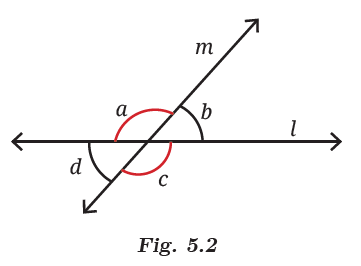
Question. When two lines intersect each other and form four angles, labelled $a$, $b$, $c$ and $d$, as in Fig. 5.2, then $\angle a$ and $\angle c$ are equal, and $\angle b$ and $\angle d$ are equal!
Is this always true for any pair of intersecting lines?
Answer:
Solution:
Yes, this property is always true for any pair of intersecting straight lines. These pairs of angles ($\angle a, \angle c$ and $\angle b, \angle d$) are known as Vertically Opposite Angles.
Reasoning through Proof:
Let us look at line $l$ in the figure. Angles $a$ and $b$ are on a straight line, so they form a linear pair.
$\angle a + \angle b = 180^\circ$
Now, let us look at line $m$. Angles $b$ and $c$ are also on a straight line, forming a linear pair.
$\angle b + \angle c = 180^\circ$
Since both sums equal $180^\circ$, we can equate them:
$\angle a + \angle b = \angle b + \angle c$
Subtracting $\angle b$ from both sides, we get:
$\angle a = \angle c$
Figure It Out (Page No. 108)
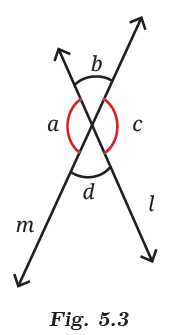
Question. List all the linear pairs and vertically opposite angles you observe in Fig. 5.3:
| Linear Pairs | $\angle a$ and $\angle b$, … |
| Pairs of Vertically Opposite Angles | $\angle b$ and $\angle d$, … |
Answer:
Given:
Two straight lines $l$ and $m$ intersecting at a point, forming four angles: $\angle a$, $\angle b$, $\angle c$, and $\angle d$.
Solution:
By observing the figure, we can identify the relationships between the angles based on their positions relative to the intersecting lines.
1. Linear Pairs: These are pairs of adjacent angles whose non-common arms form a straight line. Their sum is always $180^\circ$.
$\bullet$ Along line $l$: ($\angle a$ and $\angle b$) and ($\angle d$ and $\angle c$)
$\bullet$ Along line $m$: ($\angle a$ and $\angle d$) and ($\angle b$ and $\angle c$)
2. Vertically Opposite Angles: These are pairs of non-adjacent angles formed by the intersection of two straight lines. They are always equal in measure.
$\bullet$ Pair 1: $\angle a$ and $\angle c$
$\bullet$ Pair 2: $\angle b$ and $\angle d$
Final Classification:
| Type of Angle Pair | Pairs identified in Fig. 5.3 |
| Linear Pairs | ($\angle a, \angle b$), ($\angle b, \angle c$), ($\angle c, \angle d$), ($\angle d, \angle a$) |
| Vertically Opposite Angles | ($\angle a, \angle c$) and ($\angle b, \angle d$) |
Intext Questions (Page No. 110)
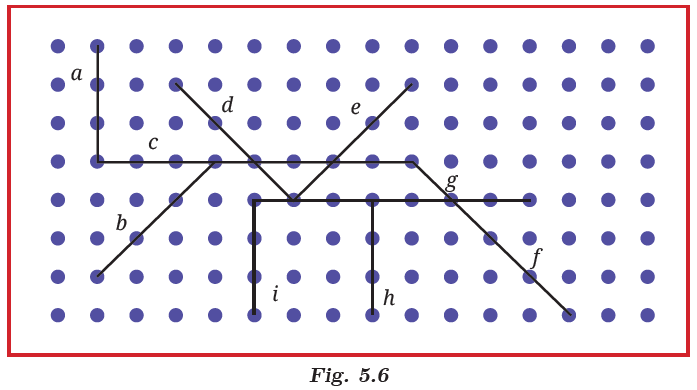
Question. Which pairs of lines appear to be parallel in Fig. 5.6 below?
Answer:
To Find: Identification of parallel lines from the given figure based on their orientation on the dot grid.
Solution:
In geometry, parallel lines are lines in the same plane that never intersect, no matter how far they are extended. On a dot grid, we can identify parallel lines by checking if they have the same inclination (slope) and maintain a constant distance from each other.
By observing Fig. 5.6, we can categorize the lines into the following parallel groups:
1. Vertical Lines:
Lines $a$, $i$, and $h$ are all vertical. They follow the same vertical columns of dots and will never meet.
$\bullet$ Line $a \parallel$ Line $i \parallel$ Line $h$
2. Slanted Lines (Tilted to the Right):
Lines $b$ and $e$ have the same upward tilt. For every unit they move to the right, they move exactly one unit up. Since their slope is the same, they are parallel.
$\bullet$ Line $b \parallel$ Line $e$
3. Slanted Lines (Tilted to the Left):
Lines $d$ and $f$ are tilted downwards to the right (or upwards to the left). They both follow a diagonal path across the dots with the same angle of inclination. Note that the slanted part of line $g$ also follows this same direction.
$\bullet$ Line $d \parallel$ Line $f \parallel$ Slanted part of $g$
4. Horizontal Lines:
Line $c$ is a horizontal line. While there are other horizontal segments in the diagram (like the one passing through $g$ and the base of $i$), only $c$ is a fully labelled horizontal line.
Final Answer:
The parallel pairs/groups are ($a, i, h$), ($b, e$), and ($d, f$).
Intext Questions (Page No. 111)
Question. Take a plain square sheet of paper (use a newspaper for this activity).
• How would you describe the opposite edges of the sheet? They are _________________________ to each other.
• How would you describe the adjacent edges of the sheet? The adjacent edges are _________________________ to each other. They meet at a point. They form right angles.
• Fold the sheet horizontally in half. A new line is formed (see Fig. 5.7).
• How many parallel lines do you see now? How does the new line segment relate to the vertical sides?
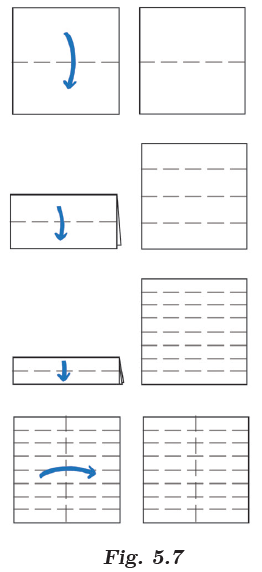
• Make one more horizontal fold in the folded sheet. How many parallel lines do you see now?
• What will happen if you do it once more? How many parallel lines will you get? Is there a pattern? Check if the pattern extends further, if you make another horizontal fold.
• Make a vertical fold in the square sheet. This new vertical line is ___________ to the previous horizontal lines.
• Fold the sheet along a diagonal. Can you find a fold that creates a line parallel to the diagonal line?
Answer:
Solution:
Through this paper-folding activity, we explore the fundamental properties of parallel and perpendicular lines. Let us answer the observations step-by-step:
$\bullet$ The opposite edges of the square sheet are parallel to each other. They will never meet even if extended indefinitely.
$\bullet$ The adjacent edges of the sheet are perpendicular to each other. They meet at a point and form right angles ($90^\circ$).
Observation after the first horizontal fold:
$\bullet$ After one fold, we see $3$ parallel lines (the top edge, the bottom edge, and the crease in the middle).
$\bullet$ The new line segment (the crease) is perpendicular to the vertical sides of the paper.
Observation after subsequent horizontal folds:
$\bullet$ If you make one more horizontal fold in the folded sheet (folding it into quarters), you will see $5$ parallel lines (2 edges + 3 creases) when you unfold it.
$\bullet$ If you do it once more (folding into eighths), you will get $9$ parallel lines (2 edges + 7 creases).
$\bullet$ Pattern: The number of parallel lines follows a geometric pattern. If $n$ is the number of folds, the total number of lines (including edges) is $2^n + 1$.
Adding a vertical fold:
$\bullet$ When you make a vertical fold, the new vertical line is perpendicular to all the previous horizontal lines.
Diagonal folds:
$\bullet$ Yes, you can find a fold parallel to a diagonal. If you fold one of the corners to meet the diagonal crease exactly, the new crease formed will be parallel to the original diagonal line.
This logic of folding and creating parallel creases is traditionally used in tailoring and origami-based crafts. For example, when making "paper fans" or folding a "sari" (pleats), we utilize the concept of multiple parallel lines created through successive folding.
Intext Questions (Page No. 112)
Question. Here is another activity for you to try.
• Take a square sheet of paper, fold it in the middle and unfold it.
• Fold the edges towards the centre line and unfold them.
• Fold the top right and bottom left corners onto the creased line to create triangles. Refer to Fig. 5.8.
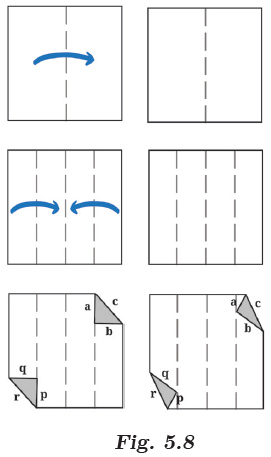
• The triangles should not cross the crease lines.
• Are $a, b$ and $c$ parallel to $p, q$ and $r$ respectively? Why or why not?
Answer:
Given:
A square sheet of paper with vertical creases made by folding the edges towards the centre. Two triangles are formed by folding the top-right corner (sides labelled $a, b, c$) and the bottom-left corner (sides labelled $p, q, r$) as shown in Fig. 5.8.
To Find:
Whether $a \parallel p$, $b \parallel q$, and $c \parallel r$ and the reasoning behind it.
Solution:
Let us analyze each pair of line segments based on the geometry of the folded square paper:
1. Comparing $a$ and $p$:
The segment $a$ is a part of the right-most vertical crease. The segment $p$ is a part of the left-most vertical crease. Since all vertical creases on a rectangular/square sheet of paper are parallel to each other and to the side edges, we can conclude that:
$a \parallel p$
(Both are vertical lines)
2. Comparing $b$ and $q$:
The segment $b$ lies along the top horizontal edge of the square paper. The segment $q$ lies along the bottom horizontal edge of the square paper. In a square, the top and bottom edges are always parallel.
$b \parallel q$
(Both are horizontal lines)
3. Comparing $c$ and $r$:
The segments $c$ and $r$ are the hypotenuses of the two triangles formed. Since the square was folded symmetrically (both corners folded to meet the same vertical creases), the two triangles are congruent. They make the same angle with the horizontal and vertical lines. Because they have the same inclination (slope), they are parallel.
$c \parallel r$
(Corresponding angles are equal)
Final Answer:
Yes, $a, b,$ and $c$ are parallel to $p, q,$ and $r$ respectively. This happens because the initial sheet is a square, and the folding process is symmetric, ensuring that corresponding segments maintain the same orientation in the plane.
Figure It Out (Page No. 113 - 114)
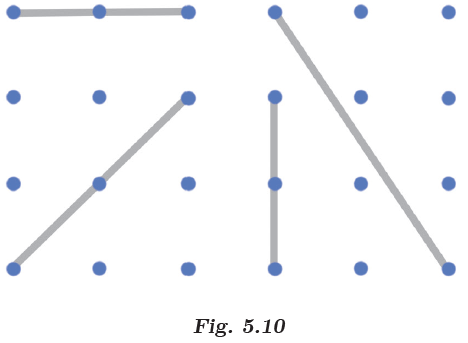
Question 1. Draw some lines perpendicular to the lines given on the dot paper in Fig. 5.10.
Answer:
Concept: Perpendicular lines are lines that intersect at a right angle ($90^\circ$). On a dot grid, we can use the "rise and run" (slope) of the lines to determine the direction of the perpendicular line.
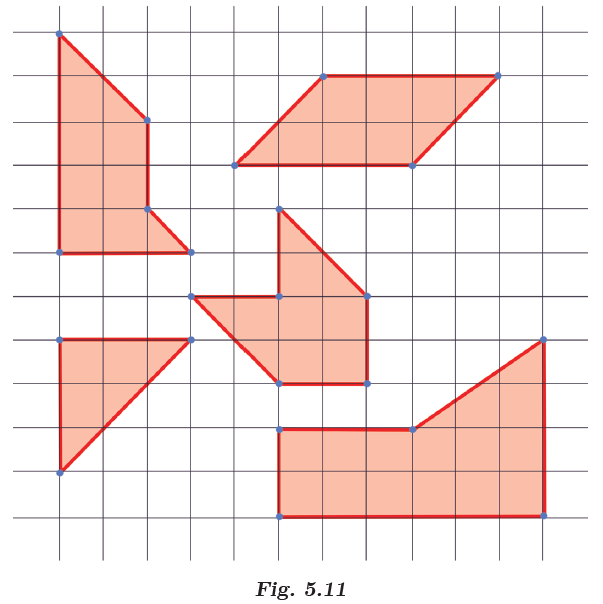
Question 2. In Fig. 5.11, mark the parallel lines using the notation given above (single arrow, double arrow etc.). Mark the angle between perpendicular lines with a square symbol.
(a) How did you spot the perpendicular lines?
(b) How did you spot the parallel lines?
Answer:
Given:
A set of geometric figures (triangle, parallelogram, trapezium, and others) drawn on a square grid background in Fig. 5.11.
To Do:
1. Annotate the figures to show parallel lines using single ($>$) or double ($>>$) arrows.
2. Annotate the figures to show perpendicular lines using the square ($\square$) symbol.
3. Explain the reasoning behind identifying these lines.
Solution:
Below is the visual representation of the figures with the appropriate mathematical markings for parallel and perpendicular lines:
Question 3. In the dot paper following, draw different sets of parallel lines. The line segments can be of different lengths but should have dots as endpoints.
Answer:
Solution:
To draw parallel lines on dot paper, we ensure that both lines follow the same "movement pattern" from one dot to the next.
Steps to draw:
1. Horizontal Set: Draw one segment connecting 3 dots horizontally. Below it, draw another segment connecting 5 dots horizontally. These are parallel.
2. Vertical Set: Draw a vertical segment of length 2 units. Next to it, draw another vertical segment of length 4 units. These are parallel.
3. Slanted Set: Draw a segment that goes "2 dots right and 1 dot up." To make a parallel line, start at a different dot and repeat the same "2 right, 1 up" movement.
We represent parallel lines using arrows like $l \parallel m$. This exercise helps in understanding that length does not affect the parallel nature of two lines; only their orientation does.
Question 4. Using your sense of how parallel lines look, try to draw lines parallel to the line segments on this dot paper.
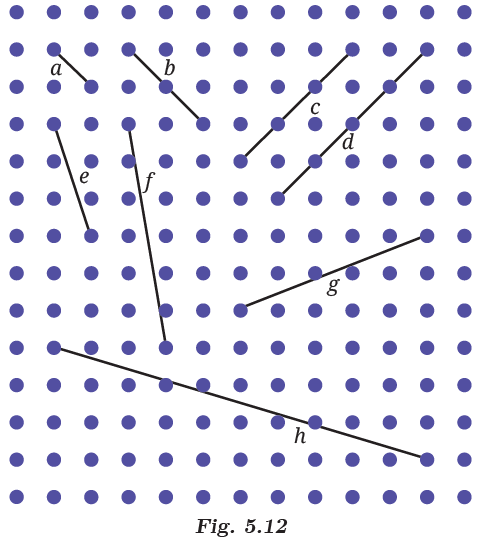
(a) Did you find it challenging to draw some of them?
(b) Which ones?
(c) How did you do it?
Answer:
To Find: Construction of parallel lines on a dot grid for the given segments $a, b, c, d, e, f, g, \text{ and } h$.
Solution:
To draw a line parallel to a given segment on dot paper, we must follow the same slope or pattern of dots. For example, if a line segment moves $2$ dots to the right and $3$ dots down, its parallel line must also move in the same ratio ($2:3$).
The image above shows the segments from the question (in black) and the parallel lines drawn next to them (in red or dashed lines) by following the counting method.
(a) Did you find it challenging to draw some of them?
This part is to be answered by the student based on their personal experience. Generally, students may find it simple to draw lines for $a, b, c, \text{ and } d$ but might find others slightly difficult.
(b) Which ones?
This is to be answered by the student. Usually, segments like $f, g, \text{ and } h$ are more challenging because their slopes involve moving across a larger number of dots ($5$ dots down for $1$ dot right, or $3$ dots down for $8$ dots right), making it harder to track the exact path without careful counting.
(c) How did you do it?
This is to be answered by the student. A common method is as follows:
1. Identify the Pattern: Count the number of horizontal dots (run) and vertical dots (rise) between the start and end of the original segment.
2. Pick a Starting Point: Choose a new dot on the paper to start the parallel line.
3. Replicate the Count: Move the same number of dots horizontally and vertically from the new starting point to find the end point.
4. Connect: Draw a straight line between the new points using a ruler.
Question 5. In Fig. 5.13, which line is parallel to line $a$ — line $b$ or line $c$? How do you decide this?
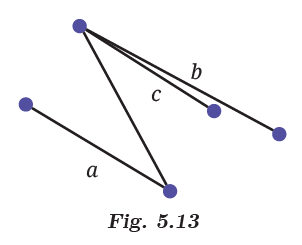
Answer:
To Find: Which line ($b$ or $c$) is parallel to line $a$ and the reasoning behind it.
Solution:
By observing the given Figure 5.13, we can see that line $c$ is parallel to line $a$.
Line $b$ is not parallel to line $a$ because it is tilted at a different angle and would eventually intersect line $a$ if both were extended.
Reasoning / How to decide:
We can decide which lines are parallel using the following geometric methods:
1. Visual Direction and Constant Distance: Parallel lines are those that stay the same distance apart and never meet, no matter how far they are extended. By looking at the segments, line $a$ and line $c$ maintain a constant gap between them, whereas the gap between line $a$ and line $b$ changes.
2. Line $b$ Observation: Line $b$ has a different steepness compared to line $a$. Since their slopes are not equal, they are intersecting lines (though they don't meet within the boundaries of the image, they will eventually meet if extended).
Conclusion: Line $c$ is the line parallel to line $a$.
Intext Questions (Page No. 115)
Question. In Fig. 5.14, line $t$ intersects lines $l$ and $m$. $t$ is called a transversal.
Notice that $8$ angles are formed when a line crosses a pair of lines.
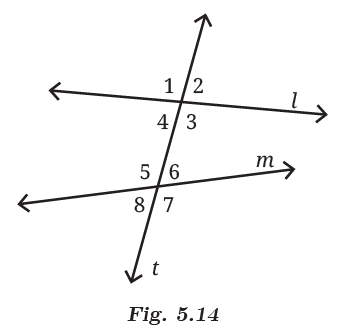
Is it possible for all the eight angles to have different measurements? Why, why not?
Answer:
To Find: Whether it is possible for all eight angles to have different measurements.
Solution:
No, it is not possible for all the eight angles to have different measurements.
This is because whenever two straight lines intersect, the Vertically Opposite Angles (VOA) formed at the point of intersection are always equal. In the given Fig. 5.14, there are two points of intersection, each forming two pairs of equal angles:
$\angle 1 = \angle 3$ and $\angle 2 = \angle 4$
(Vertically Opposite Angles)
$\angle 5 = \angle 7$ and $\angle 6 = \angle 8$
(Vertically Opposite Angles)
Since there are four pairs of equal angles, there can be at most four unique angle measurements among the eight angles formed.
Geometric Reasoning:
In this figure, line $l$ is not parallel to line $m$. Because the lines are not parallel, the pairs of angles that are equal in the case of parallel lines will be different here. These include:
1. Corresponding Angles: Pairs like $(\angle 1, \angle 5)$ and $(\angle 2, \angle 6)$ will have different measurements.
2. Alternate Interior Angles: Pairs like $(\angle 3, \angle 5)$ and $(\angle 4, \angle 6)$ will have different measurements.
3. Alternate Exterior Angles: Pairs like $(\angle 1, \angle 7)$ and $(\angle 2, \angle 8)$ will have different measurements.
Thus, while the lack of parallelism ensures that corresponding and alternate angles are unequal, the property of Vertically Opposite Angles still holds true at each intersection, making it impossible for all eight angles to have different measurements.
Question. What about five different angles — $6, 5, 4, 3$ and $2$?
Answer:
To Find: Whether it is possible to have $6, 5, 4, 3, \text{ or } 2$ unique angle measurements among the eight angles formed by a transversal.
Geometric Reasoning:
When a transversal $t$ intersects two lines $l$ and $m$, two separate points of intersection are formed. At each point, four angles are created. Due to the property of Vertically Opposite Angles (VOA), the angles opposite to each other at each intersection are always equal.
$\angle 1 = \angle 3 \text{ and } \angle 2 = \angle 4$
(At first intersection)
$\angle 5 = \angle 7 \text{ and } \angle 6 = \angle 8$
(At second intersection)
This means at each intersection, there can be at most 2 different angle measurements. If we combine the measurements from both intersections, the maximum possible number of unique angles is:
$2 + 2 = 4$
(Maximum unique angles)
Conclusion:
Among the given options, having 5 or 6 different measurements is mathematically Impossible. Having 4, 3, or 2 different measurements is Possible depending on whether the lines are parallel or perpendicular to the transversal.
Figure It Out (Page No. 119)
Question. Can you draw a line parallel to $l$, that goes through point $A$? How will you do it with the tools from your geometry box? Describe your method.
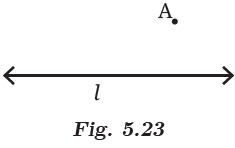
Answer:
To Find: A method to construct a line parallel to $l$ passing through point $A$ using tools from a standard geometry box.
Required Tools: A Ruler and a Set-square (the triangular tool).
Construction Method: The Sliding Set-Square Method
To draw the parallel line precisely, follow these steps:
Step 1: Initial Alignment
Place one of the shorter edges of the set-square exactly along the given line $l$. Ensure that the alignment is perfect so that the edge of the set-square and the line $l$ coincide.
Step 2: Providing Support
Place a ruler firmly against the other shorter edge of the set-square (the vertical edge). Hold the ruler very tightly with one hand so that it does not move during the process.
Step 3: Sliding to the Point
While keeping the ruler fixed, slide the set-square upwards along the edge of the ruler. Continue sliding until the edge that was previously on line $l$ reaches point $A$.
Step 4: Drawing the Parallel Line
Once the edge of the set-square touches point $A$, hold the set-square steady and draw a straight line along this edge passing through $A$. Let this new line be $m$.
$m \parallel l$
(Required parallel line)
Geometric Reasoning:
This method works because the set-square maintains a constant 90-degree angle with the ruler. As it slides along the fixed ruler, the distance between line $l$ and line $m$ remains constant at every point. Lines that are everywhere equidistant from each other are parallel lines.
Alternate Solution (Using Corresponding Angles):
1. Draw any transversal line $n$ passing through $A$ and intersecting line $l$ at point $P$.
2. At point $P$, measure the angle formed between line $l$ and the transversal using a protractor.
3. At point $A$, construct an identical Corresponding Angle with the transversal.
4. The line forming this angle will be parallel to line $l$.
Intext Questions (Page No. 120)
Question. We know how to fold a piece of paper to get a line perpendicular to $l$. Now, try to fold a perpendicular to $l$ such that it passes through point $A$. Let us call this new crease $t$.
Now, fold a line perpendicular to $t$ passing through $A$ again. Let us call this line $m$. The lines $l$ and $m$ are parallel to each other.
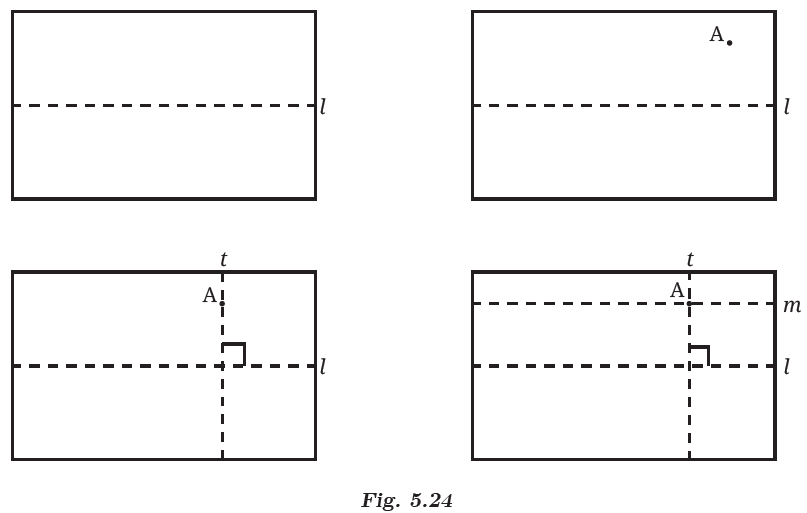
Why are lines $l$ and $m$ parallel to each other?
Answer:
Reasoning:
The lines $l$ and $m$ are parallel because of the Theorem of Perpendiculars in geometry.
Step-by-step Explanation:
1. Line $t$ is perpendicular to line $l$. This means the angle between $t$ and $l$ is $90^\circ$.
2. Line $m$ is perpendicular to line $t$. This means the angle between $m$ and $t$ is also $90^\circ$.
3. Now, consider line $t$ as a transversal for lines $l$ and $m$. The angles formed where $t$ crosses $l$ and $m$ are both right angles.
4. Since the Corresponding Angles (or Alternate Interior Angles) are both $90^\circ$, they are equal.
Conclusion:
Whenever two lines in the same plane are perpendicular to the same third line, they are parallel to each other.
$l \perp t \text{ and } m \perp t \implies l \parallel m$
(Geometric Rule)
This is often used to demonstrate that the distance between parallel lines remains constant, as the perpendicular distance (line $t$) is the same everywhere.
Figure It Out (Page No. 123 - 125)
Question 1. Find the angles marked below.
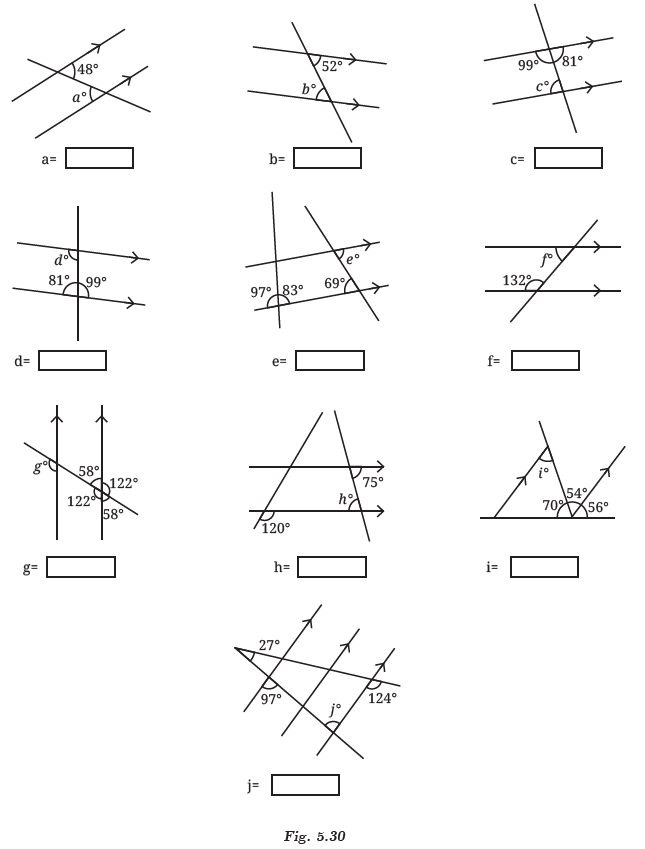
Answer:
To Find: The measures of the marked angles $a, b, c, d, e, f, g, h, i,$ and $j$ in Fig. 5.30.
Solution:
We will find the value of each angle using the properties of parallel lines and transversals, such as Alternate Interior Angles, Corresponding Angles, and Co-interior Angles.
(a) Finding angle $a$:
The transversal intersects two parallel lines. The angle $48^\circ$ and $a^\circ$ are on opposite sides of the transversal and inside the parallel lines.
$a = 48^\circ$
(Alternate Interior Angles)
(b) Finding angle $b$:
The transversal crosses the parallel lines. The angle $52^\circ$ is at the upper-right interior position, and $b^\circ$ is at the lower-left interior position.
$b = 52^\circ$
(Alternate Interior Angles)
(c) Finding angle $c$:
The horizontal lines are parallel. The angle $81^\circ$ and angle $c^\circ$ are alternate interior angles.
$c = 81^\circ$
(Alternate Interior Angles)
(d) Finding angle $d$:
The two horizontal lines are parallel. The angle $99^\circ$ is at the bottom-right interior intersection, and $d^\circ$ is at the top-left interior intersection.
$d = 99^\circ$
(Alternate Interior Angles)
(e) Finding angle $e$:
The diagonal transversal intersects parallel lines. The angle $69^\circ$ and $e^\circ$ are located diagonally opposite between the parallel lines.
$e = 69^\circ$
(Alternate Interior Angles)
(f) Finding angle $f$:
The two interior angles are on the same side of the transversal. Their sum must be $180^\circ$.
$f + 132^\circ = 180^\circ$
[Co-interior angles]
$f = 180^\circ - 132^\circ = 48^\circ$
(g) Finding angle $g$:
The vertical lines are parallel. Angle $g^\circ$ and the $122^\circ$ angle occupy the same relative position at each intersection.
$g = 122^\circ$
(Corresponding Angles)
(h) Finding angle $h$:
The lines with arrows are parallel. The angle $75^\circ$ and $h^\circ$ are between the parallel lines on opposite sides of the transversal.
$h = 75^\circ$
(Alternate Interior Angles)
(i) Finding angle $i$:
For the slanted parallel lines, the horizontal line acts as a transversal. The angle $54^\circ$ and $i^\circ$ are alternate interior angles.
$i = 54^\circ$
(Alternate Interior Angles)
(j) Finding angle $j$:
In the set of three parallel lines, the diagonal transversal creates alternate interior angles. The angle $97^\circ$ and $j^\circ$ are alternate interior angles between two of these parallel lines.
$j = 97^\circ$
(Alternate Interior Angles)
Final Summary:
$a = 48^\circ, \; b = 52^\circ, \; c = 81^\circ, \; d = 99^\circ, \; e = 69^\circ$
$f = 48^\circ, \; g = 122^\circ, \; h = 75^\circ, \; i = 54^\circ, \; j = 97^\circ$
Question 2. Find the angle represented by $a$.
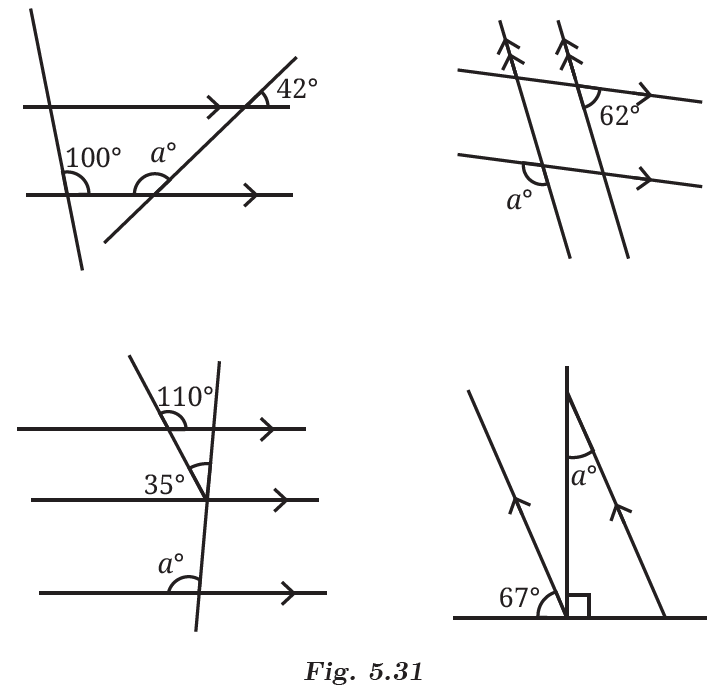
Answer:
Solution for Fig. 5.31:
We apply the properties of parallel lines and transversals to find the value of $a$ in each of the four cases shown.
(i) Top-Left Figure
Given: Two parallel lines $l$ and $m$ intersected by transversal $t$. One angle is given as $42^\circ$.
To Find: Angle $a$.
Solution:
Let $\angle 1 = 42^\circ$. Let $\angle 2$ be the angle adjacent to $\angle 1$ on the same straight line.
$\angle 2 = 180^\circ - 42^\circ = 138^\circ$
(Linear pair angles)
Since lines $l$ and $m$ are parallel and $t$ is a transversal, $\angle 2$ and $a$ are alternate angles.
$a = 138^\circ$
[Alternate interior angles]
(ii) Top-Right Figure
Given: $l \parallel m$ and $s \parallel t$. Given angle is $62^\circ$.
To Find: Angle $a$.
Solution:
Let $\angle 1 = 62^\circ$. First, we find the adjacent angle $\angle 2$ on line $l$.
$\angle 2 = 180^\circ - 62^\circ = 118^\circ$
(Linear pair property)
Now, because lines $l$ and $m$ are parallel and line $s$ is a transversal, $\angle 2$ and its corresponding angle $\angle 3$ on line $m$ are equal.
$\angle 3 = 118^\circ$
Next, since slanted lines $s$ and $t$ are parallel and line $m$ acts as a transversal, $\angle 3$ and $a$ are corresponding angles.
$a = 118^\circ$
[Corresponding angles]
(iii) Bottom-Left Figure
Given: Three parallel lines. One angle is $110^\circ$, and another is $35^\circ$.
To Find: Angle $a$.
Solution:
On the top line, the angle vertically opposite to $110^\circ$ is $\angle 1$.
$\angle 1 = 110^\circ$
(Vertically opposite angles)
Since the first two horizontal lines are parallel, $\angle 1$ and $\angle 2$ (on the middle line) are corresponding angles.
$\angle 2 = 110^\circ$
We find the lower part of this intersection, $\angle 3$, by subtracting $35^\circ$ from $\angle 2$.
$\angle 3 = 110^\circ - 35^\circ = 75^\circ$
Let $\angle 4$ be the angle on the bottom parallel line corresponding to $\angle 3$.
$\angle 4 = 75^\circ$
Finally, $a$ and $\angle 4$ form a linear pair on the bottom line.
$a = 180^\circ - 75^\circ = 105^\circ$
[Linear pair angles]
(iv) Bottom-Right Figure
Given: Two parallel slanted lines $l$ and $t$, a horizontal base, and a vertical line ($90^\circ$). Base angle is $67^\circ$.
To Find: Angle $a$.
Solution:
At the base, the three angles (one is $67^\circ$, one is a right angle $90^\circ$, and one is $\angle 2$) lie on a straight line.
$\angle 2 + 90^\circ + 67^\circ = 180^\circ$
$\angle 2 = 180^\circ - 157^\circ = 23^\circ$
Since the slanted lines $l$ and $t$ are parallel and the vertical line acts as a transversal, $\angle 2$ and $a$ are alternate angles.
$a = 23^\circ$
[Alternate interior angles]
Question 3. In the figures below, what angles do $x$ and $y$ stand for?
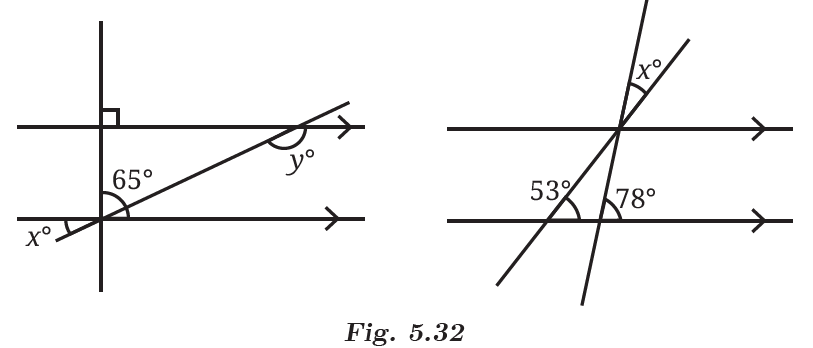
Answer:
To Find: The values of the angles represented by $x$ and $y$ in Fig. 5.32.
Solution for Fig. 5.32 (Left Figure):
In this figure, we have two horizontal parallel lines, let's call them $l$ and $m$. A vertical line is perpendicular to line $l$.
Since the lines are parallel, the vertical line is also perpendicular to the bottom line $m$. Let the angle it makes with line $m$ be $\angle 2$.
$\angle 2 = 90^\circ$
(Lines are perpendicular)
On the bottom line $m$, the angles $\angle 2$, $65^\circ$, and the angle vertically opposite to $x$ lie on a straight line. However, based on the provided logic, we calculate $x$ at the intersection:
$\angle 2 + 65^\circ + x = 180^\circ$
[Angles on a linear pair]
$90^\circ + 65^\circ + x = 180^\circ$
$x = 180^\circ - 90^\circ - 65^\circ$
$x = 25^\circ$
Now, to find $y$, we observe that $l \parallel m$ and the slanted line is a transversal. The angle $y$ is alternate to the sum of the two interior angles formed at the bottom line.
$y = \angle 2 + 65^\circ$
(Alternate angles are equal)
$y = 90^\circ + 65^\circ$
$y = 155^\circ$
Solution for Fig. 5.32 (Right Figure):
Let the top horizontal line be $l$ and the bottom horizontal line be $m$. Since $l \parallel m$ and line $s$ is a transversal:
$\angle 3 = 78^\circ$
(Alternate interior angles)
Similarly, since $l \parallel m$ and line $t$ is a transversal:
$\angle 1 = 53^\circ$
(Alternate interior angles)
At the point of intersection on line $l$, let the angle between the two transversals be $\angle 2$. From the geometric properties of the figure:
$\angle 2 = \angle 3 - \angle 1$
$\angle 2 = 78^\circ - 53^\circ = 25^\circ$
Since the transversals $s$ and $t$ are intersecting lines, angle $x$ and $\angle 2$ are vertically opposite angles.
$x = \angle 2 = 25^\circ$
[Vertically opposite angles]
Thus, $x = 25^\circ$.
Question 4. In Fig. 5.33, $\angle ABC = 45^\circ$ and $\angle IKJ = 78^\circ$. Find angles $\angle GEH, \angle HEF, \angle FED$
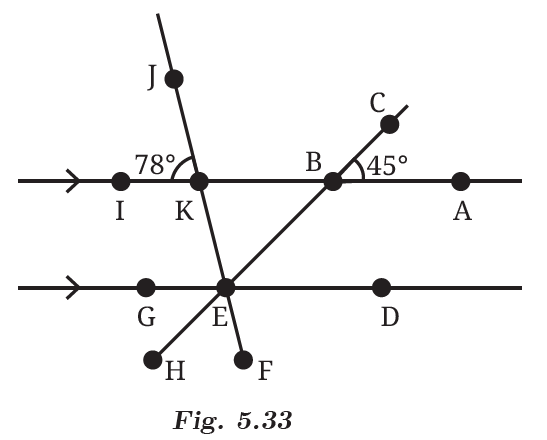
Answer:
Given:
In Fig. 5.33, the lines $IA$ and $GD$ are parallel ($IA \parallel GD$).
$\angle ABC = 45^\circ$
$\angle IKJ = 78^\circ$
To Find:
The measures of angles $\angle GEH, \angle HEF, \text{ and } \angle FED$.
Solution:
First, we look at the intersection of lines $IA$ and $CH$ at point $B$.
$\angle KBE = \angle ABC = 45^\circ$
(Vertically Opposite Angles)
Since line $IA$ is parallel to line $GD$ and $HC$ is a transversal, $\angle KBE$ and $\angle GEH$ are corresponding angles.
$\angle GEH = \angle KBE = 45^\circ$
[Corresponding angles are equal]
Next, we look at the intersection of lines $IA$ and $JF$ at point $K$.
$\angle BKE = \angle IKJ = 78^\circ$
(Vertically Opposite Angles)
Since line $IA$ is parallel to line $GD$ and $JF$ is a transversal, $\angle BKE$ and $\angle FED$ are corresponding angles.
$\angle FED = \angle BKE = 78^\circ$
[Corresponding angles are equal]
Now, we observe that the angles $\angle GEH, \angle HEF, \text{ and } \angle FED$ lie on the straight line $GD$ at point $E$.
$\angle GEH + \angle HEF + \angle FED = 180^\circ$
(Angles on a straight line sum to $180^\circ$)
Substituting the values found above:
$45^\circ + \angle HEF + 78^\circ = 180^\circ$
$123^\circ + \angle HEF = 180^\circ$
$\angle HEF = 180^\circ - 123^\circ$
$\angle HEF = 57^\circ$
Final Results:
The required angles are:
$\angle GEH = 45^\circ$
$\angle FED = 78^\circ$
$\angle HEF = 57^\circ$
Question 5. In Fig. 5.34, $AB$ is parallel to $CD$ and $CD$ is parallel to $EF$. Also, $EA$ is perpendicular to $AB$. If $\angle BEF = 55^\circ$, find the values of $x$ and $y$.
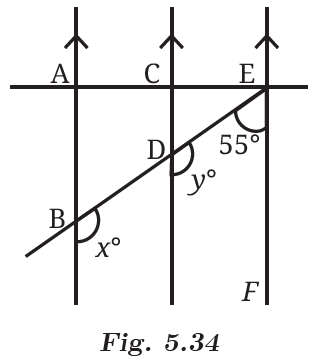
Answer:
Given:
$AB \parallel CD$ and $CD \parallel EF$.
$EA \perp AB$ (implying $EA$ is perpendicular to the parallel lines).
$\angle BEF = 55^\circ$.
To Find:
The values of $x$ and $y$.
Solution:
It is given that $AB \parallel CD$ and $CD \parallel EF$. Since lines parallel to the same line are parallel to each other, we have:
$AB \parallel CD \parallel EF$
(Given properties of parallel lines)
First, we consider parallel lines $CD$ and $EF$ with the transversal $EB$. The angles $y$ and $55^\circ$ are interior angles on the same side of the transversal (co-interior angles).
$y + 55^\circ = 180^\circ$
[Sum of interior angles on the same side is $180^\circ$] ... (i)
Solving for $y$:
$y = 180^\circ - 55^\circ$
$y = 125^\circ$
Next, we consider parallel lines $AB$ and $CD$ with the transversal $EB$. The angle $x$ and the angle $y$ are in the same relative position at each intersection.
$x = y$
[Corresponding angles are equal] ... (ii)
Substituting the value of $y$ obtained from equation (i) into equation (ii):
$x = 125^\circ$
Conclusion:
The calculated values are $x = 125^\circ$ and $y = 125^\circ$.
Question 6. What is the measure of angle $\angle NOP$ in Fig. 5.35?
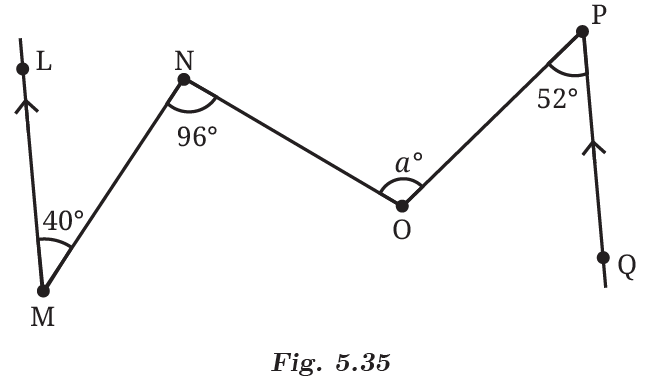
[Hint: Draw lines parallel to $LM$ and $PQ$ through points $N$ and $O$.]
Answer:
Given:
In Fig. 5.35, $LM \parallel PQ$.
$\angle LMN = 40^\circ$
$\angle MNO = 96^\circ$
$\angle OPQ = 52^\circ$
To Find:
The measure of angle $\angle NOP$ (represented by $a^\circ$).
Construction Required:
1. Draw a line $RS$ through point $N$ such that $RS \parallel LM$.
2. Draw a line $TU$ through point $O$ such that $TU \parallel PQ$.
Since $LM \parallel PQ$, all four lines $LM, RS, TU,$ and $PQ$ are parallel to each other.
Solution:
First, we consider parallel lines $LM$ and $RS$ with transversal $MN$.
$\angle MNS = \angle LMN = 40^\circ$
(Alternate Interior Angles)
Now, it is given that $\angle MNO = 96^\circ$. We can find the remaining part of this angle ($\angle SNO$):
$\angle SNO = \angle MNO - \angle MNS$
[Angle subtraction]
$\angle SNO = 96^\circ - 40^\circ = 56^\circ$
Next, we consider parallel lines $RS$ and $TU$ with transversal $NO$.
$\angle NOT = \angle SNO = 56^\circ$
(Alternate Interior Angles)
Similarly, we consider parallel lines $TU$ and $PQ$ with transversal $OP$.
$\angle TOP = \angle OPQ = 52^\circ$
(Alternate Interior Angles)
Finally, we calculate the total measure of angle $a^\circ$ ($\angle NOP$):
$a = \angle NOT + \angle TOP$
[Sum of adjacent angles]
$a = 56^\circ + 52^\circ$
$a = 108^\circ$
Conclusion: The measure of angle $\angle NOP$ is $108^\circ$.