

Chapter 6 Number Play (Class 7 - Latest Maths NCERT (Ganita Prakash I) NCERT Solutions)
Welcome to the complete NCERT Solutions for Chapter 6: Number Play. This chapter explores the fascinating patterns, properties, and puzzles hidden within numbers. Through these solutions, students will develop a deeper understanding of even and odd numbers, number patterns, magic squares, cryptarithms, and other engaging mathematical activities that strengthen logical reasoning and problem-solving skills.
The step-by-step solutions cover all questions from the latest Ganita Prakash I textbook, providing clear explanations and systematic methods for solving problems related to parity, numerical patterns, magic squares, and special number sequences. Each solution is designed to help students understand the concepts behind the answers rather than simply memorizing procedures.
Prepared by learningspot.co, these NCERT Solutions offer accurate answers, detailed reasoning, and exam-oriented guidance. They help students build confidence, improve analytical thinking, and develop a stronger appreciation for the beauty and logic of mathematics.
Intext Questions (Page No. 128)
Question. Write down the number each child should say based on this rule for the arrangement shown below.
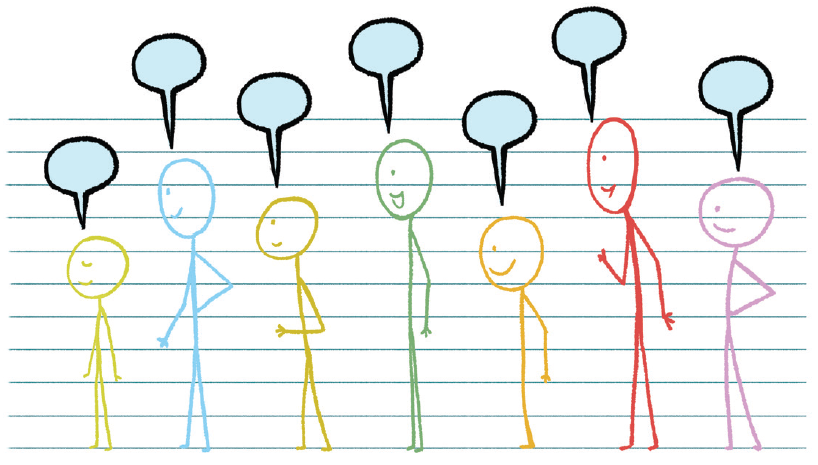
The rule is — each child calls out the number of children in front of them who are taller than them.
Answer:
To Find: The number each of the seven children should say based on the rule: count the number of children in front of them (to their left) who are taller than them.
Solution:
First, we list the given heights of the children (from left to right) as provided:
| Child Order | Colour | Height (units) |
| Child 1 | Yellow | $6.5$ |
| Child 2 | Light Blue | $8.75$ |
| Child 3 | Golden | $7.5$ |
| Child 4 | Green | $9.25$ |
| Child 5 | Orange | $7$ |
| Child 6 | Red | $10$ |
| Child 7 | Pink | $8.25$ |
Now, we apply the rule for each child by comparing their height with the heights of all children standing to their left:
1. Child 1 (Yellow): Height $= 6.5$ units. There is no one standing in front of this child.
Number to say $= 0$
(No one in front)
2. Child 2 (Light Blue): Height $= 8.75$ units. Child 1 ($6.5$) is in front. Since $6.5 < 8.75$, no one is taller.
Number to say $= 0$
($6.5 < 8.75$)
3. Child 3 (Golden): Height $= 7.5$ units. Children in front: Child 1 ($6.5$) and Child 2 ($8.75$). Only Child 2 is taller.
Number to say $= 1$
(Child 2 is taller)
4. Child 4 (Green): Height $= 9.25$ units. Children in front: Child 1 ($6.5$), Child 2 ($8.75$), and Child 3 ($7.5$). None are taller than $9.25$.
Number to say $= 0$
(All in front are shorter)
5. Child 5 (Orange): Height $= 7$ units. Children in front: Child 1 ($6.5$), Child 2 ($8.75$), Child 3 ($7.5$), and Child 4 ($9.25$). Taller children are Child 2, Child 3, and Child 4.
Number to say $= 3$
(8.75, 7.5, and 9.25 are > 7)
6. Child 6 (Red): Height $= 10$ units. Children in front: All children from 1 to 5. The tallest among them is Child 4 ($9.25$). Since $10$ is the tallest so far, no one in front is taller.
Number to say $= 0$
(Child 6 is the tallest so far)
7. Child 7 (Pink): Height $= 8.25$ units. Children in front: 1 ($6.5$), 2 ($8.75$), 3 ($7.5$), 4 ($9.25$), 5 ($7$), and 6 ($10$). Taller children are Child 2 ($8.75$), Child 4 ($9.25$), and Child 6 ($10$).
Number to say $= 3$
(Child 2, 4, and 6 are taller)
Final Answer:
The numbers the children should say, in sequence from Child 1 to Child 7, are: $0, 0, 1, 0, 3, 0,$ and $3$.
Figure It Out (Page No. 128)
Question 1. Arrange the stick figure cutouts given at the end of the book or draw a height arrangement such that the sequence reads:
(a) $0, 1, 1, 2, 4, 1, 5$
(b) $0, 0, 0, 0, 0, 0, 0$
(c) $0, 1, 2, 3, 4, 5, 6$
(d) $0, 1, 0, 1, 0, 1, 0$
(e) $0, 1, 1, 1, 1, 1, 1$
(f) $0, 0, 0, 3, 3, 3, 3$
Answer:
To Find: A method for students to draw or arrange height sequences based on the rule that each number represents the count of children in front (to the left) who are taller than the current child.
Methodology:
To draw these arrangements yourself, follow these logical steps for each child from left to right:
$\bullet$ If the number is $0$: Draw this child taller than everyone already standing in front.
$\bullet$ If the number is $n$: Draw this child such that exactly $n$ children already standing in front are taller than them.
(a) Sequence: $0, 1, 1, 2, 4, 1, 5$
This is a complex non-linear arrangement. To draw this:
1. Draw the first child at a medium height.
2. Draw the second child shorter than the first.
3. Draw the third child taller than the second but still shorter than the first.
4. Draw the fourth child shorter than the first and third.
5. Draw the fifth child as the shortest in the line so far.
6. Draw the sixth child very tall, but slightly shorter than the first one.
7. Draw the seventh child very short, so that five people in front are taller than them.
(b) Sequence: $0, 0, 0, 0, 0, 0, 0$
This sequence indicates that no child has anyone taller in front of them.
Method: Draw the children in Ascending Order (Increasing height). Each child should be taller than the one standing immediately in front of them.
Height pattern
(Shortest to Tallest)
(c) Sequence: $0, 1, 2, 3, 4, 5, 6$
This sequence indicates that for every child, everyone in front is taller than them.
Method: Draw the children in Descending Order (Decreasing height). Each child should be shorter than the one standing immediately in front of them.
Height pattern
(Tallest to Shortest)
(d) Sequence: $0, 1, 0, 1, 0, 1, 0$
This is a "sawtooth" or "zig-zag" arrangement where the height increases significantly at every alternate step.
Method:
1. Draw a child, then a shorter one ($0, 1$).
2. Draw the third child taller than both ($0$).
3. Draw the fourth child taller than the second but shorter than the third ($1$).
4. Draw the fifth child taller than all previous ones ($0$).
5. Continue this logic: $0$ means "tallest so far", and $1$ means "shorter than only the one tallest person in front".
(e) Sequence: $0, 1, 1, 1, 1, 1, 1$
This pattern indicates there is one "giant" at the front of the line.
Method: Draw the first child as the tallest. Draw every subsequent child shorter than the first child, but increasing in height among themselves. For example, heights could be $20, 10, 11, 12, 13, 14, 15$ units.
(f) Sequence: $0, 0, 0, 3, 3, 3, 3$
This represents two distinct groups in the line.
Method:
1. Draw the first three children in increasing order (e.g., heights $5, 6, 7$). They all say $0$.
2. Draw the next four children such that they are all shorter than the first child (e.g., heights $1, 2, 3, 4$). Because the first three are all taller than these four, they will all call out the number $3$.
Question 2. For each of the statements given below, think and identify if it is Always True, Only Sometimes True, or Never True. Share your reasoning.
(a) If a person says ‘$0$’, then they are the tallest in the group.
(b) If a person is the tallest, then their number is ‘$0$’.
(c) The first person’s number is ‘$0$’.
(d) If a person is not first or last in line (i.e., if they are standing somewhere in between), then they cannot say ‘$0$’.
(e) The person who calls out the largest number is the shortest.
(f) What is the largest number possible in a group of $8$ people?
Answer:
To Find: The validity of logical statements regarding the height-counting rule (counting taller people in front).
(a) If a person says ‘$0$’, then they are the tallest in the group.
Result: Only Sometimes True
Reasoning: Saying ‘$0$’ implies that no one in front of that person is taller than them. However, it is possible that someone standing behind them is taller than them. Therefore, they are the tallest "so far" in the line, but not necessarily the tallest in the entire group.
(b) If a person is the tallest, then their number is ‘$0$’.
Result: Always True
Reasoning: If a person is the tallest in the group, there is no one in the entire arrangement (including those in front) who is taller than them. Thus, the count of taller people in front must be $0$.
(c) The first person’s number is ‘$0$’.
Result: Always True
Reasoning: The rule requires counting taller people in front of the person. Since no one is standing in front of the first person, the count of taller people will always be $0$ regardless of their height.
(d) If a person is not first or last in line, then they cannot say ‘$0$’.
Result: Only Sometimes True
Reasoning: This statement is true only if there is at least one person in front who is taller. However, if a middle person is taller than everyone standing in front of them, they can say ‘$0$’. For example, in the arrangement with heights $5, 6, 7$, the middle person (height $6$) says ‘$0$’ because the person in front ($5$) is shorter.
(e) The person who calls out the largest number is the shortest.
Result: Only Sometimes True
Reasoning: While the shortest person often calls out a large number if they are at the end of the line, it depends on their position. If the shortest person stands at the front of the line, they will call out ‘$0$’. The largest number is called by the person who has the most taller people in front of them, which usually requires being both relatively short and standing near the back.
(f) What is the largest number possible in a group of $8$ people?
Result: $7$
Reasoning: In a group of $8$ people, the maximum number of people anyone can have in front of them is $7$ (this is the case for the person standing in the last position). If all $7$ people in front are taller than the 8th person, the 8th person will call out the number $7$.
Figure It Out (Page No. 131)
Question 1. Using your understanding of the pictorial representation of odd and even numbers, find out the parity of the following sums:
(a) Sum of $2$ even numbers and $2$ odd numbers (e.g., even + even + odd + odd)
(b) Sum of $2$ odd numbers and $3$ even numbers
(c) Sum of $5$ even numbers
(d) Sum of $8$ odd numbers
Answer:
To Find: The parity (even or odd nature) of various sums of even and odd numbers.
Solution:
Recall the fundamental rules of parity: Adding two even numbers or two odd numbers results in an Even sum. Adding one even and one odd number results in an Odd sum.
(a) Sum of 2 even numbers and 2 odd numbers:
$(\text{even} + \text{even}) + (\text{odd} + \text{odd})$
$= \text{even} + \text{even} = \mathbf{Even}$
(b) Sum of 2 odd numbers and 3 even numbers:
$(\text{odd} + \text{odd}) + (\text{even} + \text{even} + \text{even})$
$= \text{even} + \text{even} = \mathbf{Even}$
(c) Sum of 5 even numbers:
Any number of even numbers added together will always result in an even sum.
$\text{even} + \text{even} + \text{even} + \text{even} + \text{even} = \mathbf{Even}$
(d) Sum of 8 odd numbers:
We can group 8 odd numbers into 4 pairs. Since each pair adds up to an even number, the total sum of 4 even numbers is even.
$(\text{odd} + \text{odd}) \times 4 = \text{even} \times 4 = \mathbf{Even}$
Question 2. Lakpa has an odd number of $\textsf{₹}1$ coins, an odd number of $\textsf{₹}5$ coins and an even number of $\textsf{₹}10$ coins in his piggy bank. He calculated the total and got $\textsf{₹}205$. Did he make a mistake? If he did, explain why. If he didn’t, how many coins of each type could he have?
Answer:
Given:
$\bullet$ ₹1 coins: Odd number
$\bullet$ ₹5 coins: Odd number
$\bullet$ ₹10 coins: Even number
Total amount calculated by Lakpa = $\textsf{₹}205$
Solution:
Let us check the parity of the total amount using the rules of addition and multiplication:
1. ₹1 coins: $1 \times \text{odd number} = \text{Odd value}$.
2. ₹5 coins: $5 \times \text{odd number} = \text{Odd value}$.
3. ₹10 coins: $10 \times \text{even number} = \text{Even value}$.
Now, we find the parity of the total sum:
$\text{Total} = \text{Odd value (from ₹1)} + \text{Odd value (from ₹5)} $$ + \text{Even value (from ₹10)}$
We know that $\text{odd} + \text{odd} = \text{even}$.
$\text{Total} = \text{Even} + \text{Even} = \mathbf{Even}$.
Conclusion:
The total amount must be an Even number. However, Lakpa calculated the total as $\textsf{₹}205$, which is an Odd number. Therefore, Lakpa did make a mistake in his calculation.
Question 3. We know that:
(a) $\text{even} + \text{even} = \text{even}$
(b) $\text{odd} + \text{odd} = \text{even}$
(c) $\text{even} + \text{odd} = \text{odd}$
Similarly, find out the parity for the scenarios below:
(d) $\text{even} - \text{even} =$ ___________________
(e) $\text{odd} - \text{odd} =$ ___________________
(f) $\text{even} - \text{odd} =$ ___________________
(g) $\text{odd} - \text{even} =$ ___________________
Answer:
To Find: Parity of subtraction results.
Solution:
Subtraction follows the same parity rules as addition. If the two numbers have the same parity, the result is even. If they have different parity, the result is odd.
(d) $\text{even} - \text{even} = \mathbf{Even}$
(Example: $10 - 4 = 6$)
(e) $\text{odd} - \text{odd} = \mathbf{Even}$
(Example: $9 - 3 = 6$)
(f) $\text{even} - \text{odd} = \mathbf{Odd}$
(Example: $8 - 5 = 3$)
(g) $\text{odd} - \text{even} = \mathbf{Odd}$
(Example: $7 - 2 = 5$)
Intext Questions (Page No. 131 - 133)
Question. In a $3 \times 3$ grid, there are $9$ small squares, which is an odd number. Meanwhile, in a $3 \times 4$ grid, there are $12$ small squares, which is an even number.
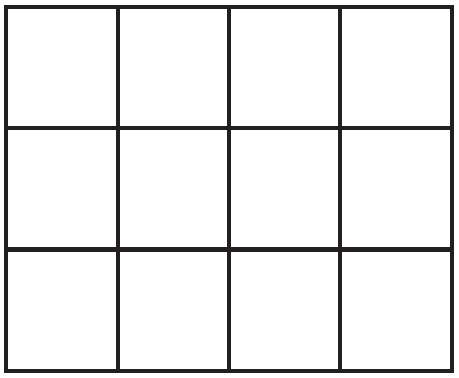
Given the dimensions of a grid, can you tell the parity of the number of small squares without calculating the product?
Answer:
To Find: The parity of the number of small squares in a grid without calculating the actual product.
Solution:
In any grid, the total number of small squares is equal to the product of the number of rows and the number of columns. The parity (whether a number is even or odd) of a product follows these mathematical rules:
$\text{Odd} \times \text{Odd} = \text{Odd}$
$\text{Even} \times \text{Even} = \text{Even}$
$\text{Even} \times \text{Odd} = \text{Even}$
[Rules of Multiplication Parity]
Therefore, we can tell the parity simply by looking at the dimensions:
$\bullet$ If both dimensions are odd numbers, the total number of squares will be Odd.
$\bullet$ If at least one dimension is an even number, the total number of squares will be Even.
Question. Find the parity of the number of small squares in these grids:
(a) $27 \times 13$
(b) $42 \times 78$
(c) $135 \times 654$
Answer:
To Find: Parity of the total squares in specific grids.
Solution:
(a) $27 \times 13$
Both $27$ and $13$ are odd numbers. Since $\text{Odd} \times \text{Odd} = \text{Odd}$, the parity is Odd.
(b) $42 \times 78$
Both $42$ and $78$ are even numbers. Since $\text{Even} \times \text{Even} = \text{Even}$, the parity is Even.
(c) $135 \times 654$
Here, $135$ is an odd number and $654$ is an even number. Since the product of an even and an odd number is always even, the parity is Even.
Question. Consider the algebraic expression: $3n + 4$. For different values of $n$, the expression has different parity:
| $n$ | Value of $3n + 4$ | Parity of the Value |
|---|---|---|
| $3$ | $13$ | odd |
| $8$ | $28$ | even |
| $10$ | $34$ | even |
Come up with an expression that always has even parity.
Answer:
To Find: An algebraic expression that always results in an even number for any integer value of $n$.
Solution:
To ensure an expression always has even parity, the variable $n$ must be multiplied by an even coefficient, which makes the first part of the expression always even regardless of $n$. Then, we can add or subtract an even constant.
The simplest such expression is:
Expression: $2n$
Reasoning:
Multiplying any whole number by $2$ always results in an even number. Let's test with the values from the prompt:
| $n$ | Value of $2n$ | Parity |
| $3$ | $6$ | Even |
| $8$ | $16$ | Even |
| $10$ | $20$ | Even |
Other possible expressions that are always even include $2n + 2$, $4n$, or $n(n+1)$.
Question. Come up with expressions that always have odd parity.
Answer:
To Find: An algebraic expression that always results in an odd number for any integer value of $n$.
Solution:
We know that an even number plus (or minus) an odd number always results in an odd number. Since $2n$ is always even, adding $1$ to it will always yield an odd result.
The standard expression for this is:
Expression: $2n + 1$
Verification:
| $n$ | Value of $2n + 1$ | Parity |
| $1$ | $3$ | Odd |
| $2$ | $5$ | Odd |
| $10$ | $21$ | Odd |
Other examples include $2n - 1$, $4n + 3$, or $6n + 5$.
Question. Come up with other expressions, like $3n + 4$, which could have either odd or even parity.
Answer:
Solution:
An expression has variable parity if the coefficient of the variable $n$ is an odd number. In such cases, the parity of the expression flips whenever $n$ changes from even to odd or vice versa.
Examples of expressions with variable parity:
1. $n$ (The parity is exactly the same as $n$)
2. $n + 1$ (The parity is opposite to $n$)
3. $5n - 2$
4. $7n + 3$
Reasoning:
Consider $n + 1$:
$\bullet$ If $n=2$ (even), then $n+1=3$ (odd).
$\bullet$ If $n=3$ (odd), then $n+1=4$ (even).
Question. Are there expressions using which we can list all the even numbers?
Answer:
Solution:
Yes, there is a very simple expression used to generate the set of all even numbers.
Expression: $2n$
By substituting natural numbers into this expression, we can generate the entire sequence of even numbers:
$\bullet$ For $n=1$, $2(1) = 2$
$\bullet$ For $n=2$, $2(2) = 4$
$\bullet$ For $n=3$, $2(3) = 6$
$\bullet$ ...and so on.
Question. Are there expressions using which we can list all odd numbers?
Answer:
Solution:
Yes, we can use expressions to generate the complete sequence of odd numbers ($1, 3, 5, 7, \dots$).
The most common expressions are:
1. $2n - 1$ (If we start with $n = 1$)
2. $2n + 1$ (If we start with $n = 0$)
Using $2n - 1$ with $n = 1, 2, 3, \dots$:
$\bullet$ For $n=1$, $2(1) - 1 = 1$
$\bullet$ For $n=2$, $2(2) - 1 = 3$
$\bullet$ For $n=3$, $2(3) - 1 = 5$
Question. What would be the $n^{th}$ term for multiples of $2$? Or, what is the $n^{th}$ even number?
Answer:
To Find: The general $n^{th}$ term for the sequence of even numbers.
Solution:
The sequence of multiples of $2$ (even numbers) is: $2, 4, 6, 8, \dots$
We observe that:
$\bullet$ $1^{st}$ term $= 2 \times 1 = 2$
$\bullet$ $2^{nd}$ term $= 2 \times 2 = 4$
$\bullet$ $3^{rd}$ term $= 2 \times 3 = 6$
Following this logic, the $n^{th}$ term is obtained by multiplying the position $n$ by $2$.
Final Answer:
The $n^{th}$ term for multiples of $2$ (or the $n^{th}$ even number) is $2n$.
Intext Questions (Page No. 133 - 136)
Question. Observe this $3 \times 3$ grid. It is filled following a simple rule — use numbers from $1 – 9$ without repeating any of them. There are circled numbers outside the grid.
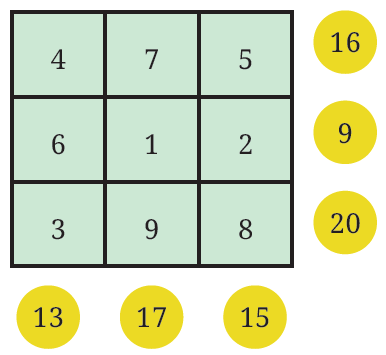
The numbers in the yellow circles are the sums of the corresponding rows and columns.
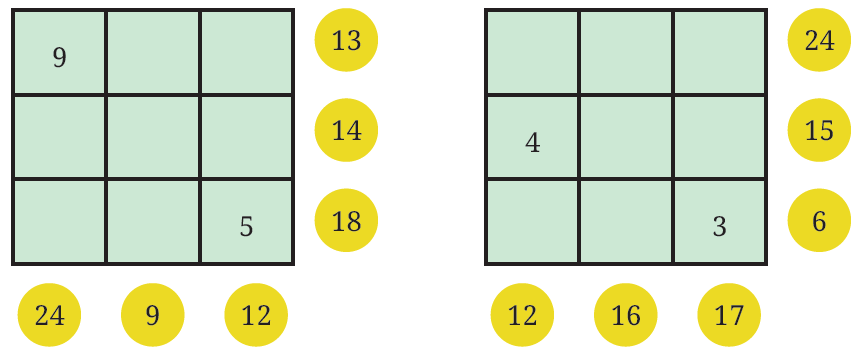
Fill the grids below based on the rule mentioned above:
Answer:
To Find: Fill the $3 \times 3$ grids using digits $1 – 9$ exactly once such that the sum of each row and column matches the numbers provided in the yellow circles.
Solution for Grid 1:
Given digits already placed: $9$ (Row 1, Col 1) and $5$ (Row 3, Col 3).
Remaining digits to use: $\{1, 2, 3, 4, 6, 7, 8\}$
1. Row 1 Sum (13): $9 + \text{Digit 2} + \text{Digit 3} = 13 $$ \implies \text{Digit 2} + \text{Digit 3} = 4$. The only pair from our set is $(1, 3)$.
2. Column 3 Sum (12): $\text{Digit 3} + \text{Digit 6} + 5 = 12 $$ \implies \text{Digit 3} + \text{Digit 6} = 7$. If Digit 3 is $3$, then Digit 6 is $4$. This works.
3. Row 3 Sum (18): $\text{Digit 7} + \text{Digit 8} + 5 = 18 $$ \implies \text{Digit 7} + \text{Digit 8} = 13$. Pairs could be $(6, 7)$.
By logic and testing, we get the following arrangement:
| 9 | 1 | 3 | 13 |
| 8 | 2 | 4 | 14 |
| 7 | 6 | 5 | 18 |
| 24 | 9 | 12 |
Solution for Grid 2:
Given digits already placed: $4$ (Row 2, Col 1) and $3$ (Row 3, Col 3).
Remaining digits to use: $\{1, 2, 5, 6, 7, 8, 9\}$
1. Row 3 Sum (6): $\text{Digit 7} + \text{Digit 8} + 3 = 6 $$ \implies \text{Digit 7} + \text{Digit 8} = 3$. The only pair is $(1, 2)$.
2. Column 1 Sum (12): $\text{Digit 1} + 4 + \text{Digit 7} = 12$. If Digit 7 is $1$, then Digit 1 is $7$.
3. Row 1 Sum (24): $7 + \text{Digit 2} + \text{Digit 3} = 24 $$ \implies \text{Digit 2} + \text{Digit 3} = 17$. The only pair is $(8, 9)$.
By logic and testing, we get the following arrangement:
| 7 | 8 | 9 | 24 |
| 4 | 6 | 5 | 15 |
| 1 | 2 | 3 | 6 |
| 12 | 16 | 17 |
Figure It Out (Page No. 136)
Question 1. How many different magic squares can be made using the numbers $1 - 9$?
Answer:
To Find: The total number of different magic squares we can create using the numbers $1$ to $9$.
Solution:
A $3 \times 3$ magic square is a grid of numbers where the sum of each row, each column, and both the diagonals is the same.
First, we find the total sum of all numbers from $1$ to $9$:
$1 + 2 + 3 + 4 + 5 + 6 + 7 + 8 + 9 = 45$
Since there are $3$ rows, each row must have a sum (called the Magic Constant) of:
$45 \div 3 = 15$
In every $3 \times 3$ magic square using $1-9$, the middle number is always $5$. Although there is only one basic way to arrange these numbers, we can turn (rotate) or flip (reflect) the square to get different looks.
By doing this, we can get a total of $8$ different arrangements.
Example Grid:
Here is one of the most common arrangements of the magic square where every row, column, and diagonal adds up to $15$:
| $8$ | $1$ | $6$ |
| $3$ | $5$ | $7$ |
| $4$ | $9$ | $2$ |
$\bullet$ Row 1 Sum: $8 + 1 + 6 = 15$
$\bullet$ Column 1 Sum: $8 + 3 + 4 = 15$
$\bullet$ Diagonal Sum: $8 + 5 + 2 = 15$
Final Answer:
There are $8$ different magic squares that can be made using the numbers from $1$ to $9$.
Question 2. Create a magic square using the numbers $2 - 10$. What strategy would you use for this? Compare it with the magic squares made using $1 - 9$.
Answer:
To Find: A magic square using numbers $2 - 10$ and the strategy used.
Solution:
Strategy: The easiest way to create this is to take the standard $1 - 9$ magic square and add $1$ to every cell. This preserves the magic property because the relative differences between the numbers stay the same.
| 9 | 2 | 7 |
| 4 | 6 | 8 |
| 5 | 10 | 3 |
Comparison:
$\bullet$ In the $1 - 9$ square, the magic sum (sum of each row/column) is $15$.
$\bullet$ In the $2 - 10$ square, the magic sum is $18$.
The sum increased by exactly $3$ because each of the three numbers in a row/column was increased by $1$.
Question 3. Take a magic square, and
(a) increase each number by $1$
(b) double each number
In each case, is the resulting grid also a magic square? How do the magic sums change in each case?
Answer:
Given: A standard $3 \times 3$ magic square with a magic sum of $15$.
| $8$ | $1$ | $6$ |
| $3$ | $5$ | $7$ |
| $4$ | $9$ | $2$ |
(a) Increase each number by $1$:
If we add $1$ to every number in the grid, the new grid becomes:
| $9$ | $2$ | $7$ |
| $4$ | $6$ | $8$ |
| $5$ | $10$ | $3$ |
Checking the row sums: $9+2+7 = 18$, $4+6+8 = 18$, and $5+10+3 = 18$. The column and diagonal sums are also $18$.
Result: Yes, the resulting grid is still a magic square.
Change in Magic Sum: Since each row has three numbers and each number increased by $1$, the magic sum increases by $3$.
$S_{new} = 15 + (3 \times 1) = 18$
[New Magic Sum]
(b) Double each number:
If we multiply every number in the grid by $2$, the new grid becomes:
| $16$ | $2$ | $12$ |
| $6$ | $10$ | $14$ |
| $8$ | $18$ | $4$ |
Checking the row sums: $16+2+12 = 30$, $6+10+14 = 30$, and $8+18+4 = 30$. The column and diagonal sums are also $30$.
Result: Yes, the resulting grid is still a magic square.
Change in Magic Sum: Since every number is doubled, the total sum of each row is also doubled.
$S_{new} = 15 \times 2 = 30$
[New Magic Sum]
Conclusion:
In both cases, the grid remains a magic square. When you add a constant to every number, the sum increases by $3 \times \text{that constant}$. When you multiply every number by a constant, the magic sum is multiplied by that same constant.
Question 4. What other operations can be performed on a magic square to yield another magic square?
Answer:
To Find: Other mathematical and geometric operations that can be performed on a magic square such that the resulting grid remains a magic square.
Solution:
Apart from addition and multiplication, there are several other operations we can perform on a magic square of order $3 \times 3$ to get a new magic square:
1. Subtraction:
If we subtract a constant number $k$ from every number in the magic square, the grid remains magic. The new magic sum will decrease by $3k$.
$S_{new} = S_{old} - 3k$
[New Magic Sum]
2. Division:
If we divide every number in the magic square by a non-zero constant $k$, the resulting grid is still a magic square. The magic sum will also be divided by $k$.
$S_{new} = S_{old} \div k$
[New Magic Sum]
3. Rotation:
We can rotate the entire grid by $90^\circ$, $180^\circ$, or $270^\circ$. Since the relative positions of the numbers remain consistent across rows, columns, and diagonals, the sum remains the same.
$\text{Rotation}$
(Geometric Operation)
Summary Table of Operations:
| Operation | Resulting Grid | Change in Magic Sum ($S$) |
| Addition ($+k$) | Magic Square | $S + 3k$ |
| Subtraction ($-k$) | Magic Square | $S - 3k$ |
| Multiplication ($\times k$) | Magic Square | $S \times k$ |
| Division ($\div k$) | Magic Square | $S \div k$ |
| Rotation/Flip | Magic Square | No Change |
Question 5. Discuss ways of creating a magic square using any set of $9$ consecutive numbers (like $2 - 10$, $3 - 11$, $9 - 17$, etc.).
Answer:
To Find: Simple and effective ways to create a $3 \times 3$ magic square using any set of $9$ consecutive numbers.
The easiest way for a student to create a new magic square is to take the standard $1 - 9$ magic square and add a fixed number to every cell.
For example, if you want to create a magic square for the numbers $2 - 10$:
1. Start with the numbers $1, 2, 3, 4, 5, 6, 7, 8, 9$.
2. We want $2, 3, 4, 5, 6, 7, 8, 9, 10$.
3. This means we must add $1$ to every number in the standard square.
| $8+1$ | $1+1$ | $6+1$ |
| $3+1$ | $5+1$ | $7+1$ |
| $4+1$ | $9+1$ | $2+1$ |
The resulting magic square for $2-10$ is:
| $9$ | $2$ | $7$ |
| $4$ | $6$ | $8$ |
| $5$ | $10$ | $3$ |
Method to Find the Middle Number:
For any set of $9$ consecutive numbers arranged in order, the middle number is the $5^{\text{th}}$ number in the sequence.
Alternatively, it can be calculated using the average of the first and last numbers:
$\text{Middle Number} = \frac{\text{First Number} + \text{Last Number}}{2}$
1. For the set $(3 - 11)$:
The sequence of $9$ consecutive numbers is: $3, 4, 5, 6, \mathbf{7}, 8, 9, 10, 11$
$\text{Middle Number} = \frac{3 + 11}{2} = \frac{14}{2} = 7$
[$5^{\text{th}}$ number in the list]
$\text{Magic Sum} = 3 \times 7 = 21$
[Each row/col/diagonal sum]
2. For the set $(9 - 17)$:
The sequence of $9$ consecutive numbers is: $9, 10, 11, 12, \mathbf{13}, 14, 15, 16, 17$
$\text{Middle Number} = \frac{9 + 17}{2} = \frac{26}{2} = 13$
[$5^{\text{th}}$ number in the list]
$\text{Magic Sum} = 3 \times 13 = 39$
[Each row/col/diagonal sum]
Summary Table:
| Set of Numbers | Middle Number (Center) | Magic Sum ($3 \times \text{Middle}$) |
| $3 - 11$ | $7$ | $21$ |
| $9 - 17$ | $13$ | $39$ |
Intext Questions (Page No. 137)
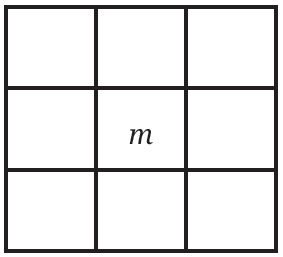
Question. Choose any magic square that you have made so far using consecutive numbers. If $m$ is the letter-number of the number in the centre, express how other numbers are related to $m$, how much more or less than $m$.
[Hint: Remember, how we described a $2 \times 2$ grid of a calendar month in the Algebraic Expressions chapter].
Answer:
To Find: Relate all the numbers in a $3 \times 3$ magic square to the center number $m$ using algebraic expressions.
Solution:
In a magic square formed by nine consecutive numbers, the number in the center ($m$) is always the median of the set. The magic sum of each row, column, and diagonal is always $3 \times m$.
Let us use the standard $3 \times 3$ magic square template (using numbers $1 - 9$, where $m = 5$) and convert it into a general algebraic form where every cell is expressed in terms of $m$.
Algebraic Magic Square Grid:
| $m + 3$ | $m - 4$ | $m + 1$ |
| $m - 2$ | $m$ | $m + 2$ |
| $m - 1$ | $m + 4$ | $m - 3$ |
Verification:
Let us check if the sum of the first row equals the magic sum $3m$:
$\text{Row 1} = (m + 3) + (m - 4) + (m + 1)$
$\text{Row 1} = 3m + 3 - 4 + 1$
$\text{Row 1} = 3m$
(Verified)
Similarly, for the main diagonal:
$\text{Diagonal} = (m + 3) + m + (m - 3)$
$\text{Diagonal} = 3m$
(Verified)
Figure It Out (Page No. 137)
Question 1. Using this generalised form, find a magic square if the centre number is $25$.
Answer:
To Find: A magic square using the generalized algebraic form where the center number $m = 25$.
Solution:
We substitute $m = 25$ into the generalized magic square template:
| $m + 3$ | $m - 4$ | $m + 1$ |
| $m - 2$ | $m$ | $m + 2$ |
| $m - 1$ | $m + 4$ | $m - 3$ |
By calculating the values:
$\bullet$ $m+3 = 28, \;\; m-4 = 21, \;\; m+1 = 26$
$\bullet$ $m-2 = 23, \;\; m = 25, \;\; m+2 = 27$
$\bullet$ $m-1 = 24, \;\; m+4 = 29, \;\; m-3 = 22$
The resulting Magic Square is:
| 28 | 21 | 26 |
| 23 | 25 | 27 |
| 24 | 29 | 22 |
The magic sum is $28 + 21 + 26 = \mathbf{75}$ (which is $3 \times 25$).
Question 2. What is the expression obtained by adding the $3$ terms of any row, column or diagonal?
Answer:
To Find: The algebraic expression for the sum of a $3 \times 3$ magic square and the effect of specific operations using the provided generalized grid.
We use the generalized grid provided below, where $m$ is the middle term:
| $m + 3$ | $m - 4$ | $m + 1$ |
| $m - 2$ | $m$ | $m + 2$ |
| $m - 1$ | $m + 4$ | $m - 3$ |
To find the expression, we add the three terms of the first row:
$S = (m + 3) + (m - 4) + (m + 1)$
We simplify the expression by combining the variables and the constants:
$S = (m + m + m) + (3 - 4 + 1)$
(Grouping like terms)
$S = 3m + 0$
$S = 3m$
(Magic Sum)
The sum of any row, column, or diagonal in this grid is $3m$.
Question 3. Write the result obtained by—
(a) adding $1$ to every term in the generalised form.
(b) doubling every term in the generalised form
Answer:
(a) Adding $1$ to every term in the generalized form:
When we add $1$ to each cell of the original grid, the new magic square is:
| $m + 4$ | $m - 3$ | $m + 2$ |
| $m - 1$ | $m + 1$ | $m + 3$ |
| $m$ | $m + 5$ | $m - 2$ |
Calculating the new magic sum ($S_a$):
$S_a = (m + 4) + (m - 3) + (m + 2)$
$S_a = 3m + 3$
[or $3(m + 1)$]
The resulting sum is $3m + 3$.
(b) Doubling every term in the generalized form:
When we multiply every cell of the original grid by $2$, the new magic square is:
| $2m + 6$ | $2m - 8$ | $2m + 2$ |
| $2m - 4$ | $2m$ | $2m + 4$ |
| $2m - 2$ | $2m + 8$ | $2m - 6$ |
Calculating the new magic sum ($S_b$):
$S_b = (2m + 6) + (2m - 8) + (2m + 2)$
$S_b = 6m + 0$
[or $2(3m)$]
The resulting sum is $6m$.
Question 4. Create a magic square whose magic sum is $60$.
Answer:
To Find: A magic square with a magic sum of $60$.
Solution:
We know that Magic Sum $S = 3m$.
$60 = 3m \implies m = \frac{60}{3} = \mathbf{20}$
Substituting $m = 20$ into our template:
$\bullet$ $m+3 = 23, \;\; m-4 = 16, \;\; m+1 = 21$
$\bullet$ $m-2 = 18, \;\; m = 20, \;\; m+2 = 22$
$\bullet$ $m-1 = 19, \;\; m+4 = 24, \;\; m-3 = 17$
| 23 | 16 | 21 |
| 18 | 20 | 22 |
| 19 | 24 | 17 |
Question 5. Is it possible to get a magic square by filling nine non-consecutive numbers?
Answer:
To Find: Whether magic squares can be made using non-consecutive numbers.
Solution:
Yes, it is absolutely possible. The requirement for a magic square is not that the numbers must be consecutive ($1, 2, 3...$), but that they should follow a symmetric pattern or an Arithmetic Progression (AP).
For example, using multiples of 5 ($5, 10, 15, 20, 25, 30, 35, 40, 45$):
| $40$ | $5$ | $30$ |
| $15$ | $25$ | $35$ |
| $20$ | $45$ | $10$ |
Magic Sum $= 75$. In the Indian perspective, these variations are used to create complex mathematical puzzles that go beyond simple counting.
Intext Questions (Page No. 142)
Question. Write the next $3$ numbers in the sequence: $1, 2, 3, 5, 8, 13, 21, 34, 55, 89, \_\_\_\_, \_\_\_\_, \_\_\_\_, \dots$
If you have to write one more number in the sequence above, can you tell whether it will be an odd number or an even number (without adding the two previous numbers)?
Answer:
To Find: The next three numbers in the sequence and the parity of the following number without performing addition.
Solution:
The given sequence follows the rule that each number is the sum of the two preceding numbers.
Starting from the last given number $89$:
$55 + 89 = 144$
... (i)
$89 + 144 = 233$
... (ii)
$144 + 233 = 377$
... (iii)
The next three numbers are: $144, 233,$ and $377$.
Parity Prediction:
To tell if the next number (after $377$) will be odd or even without adding:
The last two numbers calculated are $233$ (Odd) and $377$ (Odd).
$\text{Odd} + \text{Odd} = \text{Even}$
(Property of Parity)
Since both previous numbers are Odd, their sum must be an Even number.
Question. What is the parity of each number in the sequence? Do you notice any pattern in the sequence of parities?
Answer:
To Find: The parity of each number in the sequence and the repeating pattern observed.
Solution:
Let us identify the parity (Odd or Even) for each term in the sequence:
$1$ (Odd), $2$ (Even), $3$ (Odd), $5$ (Odd), $8$ (Even), $13$ (Odd), $21$ (Odd), $34$ (Even), $55$ (Odd), $89$ (Odd), $144$ (Even), $233$ (Odd), $377$ (Odd).
Listing the parities in order:
Odd, Even, Odd, Odd, Even, Odd, Odd, Even, Odd, Odd, Even, Odd, Odd...
Observation: There is a clear repeating pattern of three terms: (Odd, Even, Odd). In other words, every third number in the sequence is Even.
Figure It Out (Page No. 143 - 144)
Question 1. A light bulb is ON. Dorjee toggles its switch $77$ times. Will the bulb be on or off? Why?
Answer:
Given:
Initial state of the bulb = ON
Number of times the switch is toggled = $77$
Solution:
To determine the final state, we observe the pattern of toggling:
$\bullet$ 1st toggle: ON $\to$ OFF (Odd count)
$\bullet$ 2nd toggle: OFF $\to$ ON (Even count)
$\bullet$ 3rd toggle: ON $\to$ OFF (Odd count)
$\bullet$ 4th toggle: OFF $\to$ ON (Even count)
We notice a rule: An Odd number of toggles changes the original state, while an Even number of toggles returns the bulb to its original state.
$77 \text{ is an Odd number}$
(Parity check)
Since $77$ is an odd number, the state of the bulb will be the opposite of the initial state.
Final Answer:
The bulb will be OFF.
Question 2. Liswini has a large old encyclopaedia. When she opened it, several loose pages fell out of it. She counted $50$ sheets in total, each printed on both sides. Can the sum of the page numbers of the loose sheets be $6000$? Why or why not?
Answer:
Given:
Number of sheets = $50$
Each sheet has two pages (front and back).
Target sum of page numbers = $6000$
Solution:
In any book, a single sheet of paper contains two consecutive page numbers, such as $(1, 2)$, $(3, 4)$, or generally $(n, n+1)$.
The sum of the page numbers on one sheet is always:
$n + (n + 1) = 2n + 1$
(Always an Odd number)
Liswini has $50$ such sheets. To find the total sum, we add the individual sums of these $50$ sheets. Since each sheet's sum is an Odd number, we are adding 50 odd numbers together.
According to the rules of parity:
$\bullet$ The sum of an even number of odd numbers is always Even.
$\bullet$ The sum of an odd number of odd numbers is always Odd.
Since $50$ is an even number, the total sum of the page numbers must be Even.
$6000 \text{ is an Even number}$
(Parity match)
Final Answer:
Yes, the sum can be $6000$. Since $50$ sheets result in an even total sum and $6000$ is an even number, it is mathematically possible (assuming the pages fall within a range that averages to $120$ per sheet).
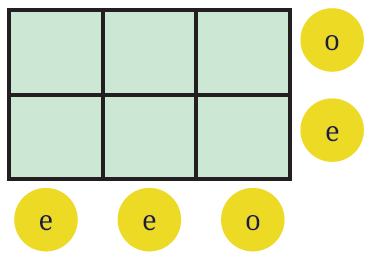
Question 3. Here is a $2 \times 3$ grid. For each row and column, the parity of the sum is written in the circle; ‘e’ for even and ‘o’ for odd. Fill the $6$ boxes with $3$ odd numbers (‘o’) and $3$ even numbers (‘e’) to satisfy the parity of the row and column sums.
Answer:
To Find: A distribution of three 'e's and three 'o's in a $2 \times 3$ grid to match the given row and column parities.
Solution:
Let us denote the cells as $R_1C_1, R_1C_2, R_1C_3$ for the first row and $R_2C_1, R_2C_2, R_2C_3$ for the second row.
$\bullet$ Column 1 must be Even $\implies$ Both cells are 'e' or both are 'o'.
$\bullet$ Column 2 must be Even $\implies$ Both cells are 'e' or both are 'o'.
$\bullet$ Column 3 must be Odd $\implies$ One cell is 'e' and one is 'o'.
Let's test an arrangement using $3$ 'e's and $3$ 'o's:
1. First Column: Set both to 'e'. (Used: 2e)
2. Second Column: Set both to 'o'. (Used: 2e, 2o)
3. Third Column: Set Row 1 to 'e' and Row 2 to 'o'. (Used: 3e, 3o)
Verification:
$\bullet$ Row 1 Sum: $e + o + e = \mathbf{Odd}$ (Matches circle 'o')
$\bullet$ Row 2 Sum: $e + o + o = \mathbf{Even}$ (Matches circle 'e')
$\bullet$ Col 1 Sum: $e + e = \mathbf{Even}$ (Matches circle 'e')
$\bullet$ Col 2 Sum: $o + o = \mathbf{Even}$ (Matches circle 'e')
$\bullet$ Col 3 Sum: $e + o = \mathbf{Odd}$ (Matches circle 'o')
Final Answer:
The grid should be filled as follows:
| e | o | e | o |
| e | o | o | e |
| e | e | o |
(Note: Other valid solutions may exist by swapping columns 1 and 2).
Question 4. Make a $3 \times 3$ magic square with $0$ as the magic sum. All numbers can not be zero. Use negative numbers, as needed.
Answer:
To Find: A $3 \times 3$ magic square where the sum of each row, column, and diagonal is exactly $0$.
Solution:
A simple way to create this is to take the standard magic square of $1 – 9$ (where the magic sum is $15$) and subtract the center number ($5$) from every cell. This will result in a magic sum of $15 - (3 \times 5) = 0$.
The numbers used will be: $\{-4, -3, -2, -1, 0, 1, 2, 3, 4\}$.
| 3 | -4 | 1 |
| -2 | 0 | 2 |
| -1 | 4 | -3 |
Verification:
$\bullet$ Row 1: $3 + (-4) + 1 = 0$
$\bullet$ Column 2: $(-4) + 0 + 4 = 0$
$\bullet$ Diagonal: $3 + 0 + (-3) = 0$
Question 5. Fill in the following blanks with ‘odd’ or ‘even’:
(a) Sum of an odd number of even numbers is ______
(b) Sum of an even number of odd numbers is ______
(c) Sum of an even number of even numbers is ______
(d) Sum of an odd number of odd numbers is ______
Answer:
Solution:
We apply the rules of parity for addition: Even numbers never change the parity of a sum, while each odd number flips the parity.
(a) Sum of an odd number of even numbers is even.
(Reasoning: Adding any number of even numbers always results in an even number.)
(b) Sum of an even number of odd numbers is even.
(Reasoning: Odd numbers can be paired up, and each pair $(\text{odd} + \text{odd})$ results in an even sum.)
(c) Sum of an even number of even numbers is even.
(d) Sum of an odd number of odd numbers is odd.
(Reasoning: After pairing up the odd numbers, one odd number will always remain, making the final sum odd.)
Question 6. What is the parity of the sum of the numbers from $1$ to $100$?
Answer:
To Find: The parity of the sum $1 + 2 + 3 + \dots + 100$.
Solution:
Method 1: Using the Sum Formula
The sum of the first $n$ natural numbers is given by $\frac{n(n+1)}{2}$.
$S = \frac{100 \times 101}{2}$
$= 50 \times 101 = 5050$
Since the last digit of $5050$ is $0$, the number is Even.
Method 2: Using Parity Rules (Indian Mental Math Logic)
In the numbers from $1$ to $100$, there are exactly $50$ odd numbers and $50$ even numbers.
$\bullet$ Sum of $50$ even numbers is Even.
$\bullet$ Sum of $50$ (an even number) of odd numbers is Even.
$\bullet$ $\text{Even} + \text{Even} = \text{Even}$.
Final Answer:
The parity of the sum is Even.
Question 7. Two consecutive numbers in the Virahāṅka sequence are $987$ and $1597$. What are the next $2$ numbers in the sequence? What are the previous $2$ numbers in the sequence?
Answer:
Given:
Two terms of the Virahāṅka (Fibonacci) sequence: $987$ and $1597$.
Solution:
In a Virahāṅka sequence, each term is the sum of the two preceding terms ($a_n = a_{n-1} + a_{n-2}$).
1. Finding the Next 2 numbers:
$\bullet$ Next number $1 = 987 + 1597 = \mathbf{2584}$
$\bullet$ Next number $2 = 1597 + 2584 = \mathbf{4181}$
2. Finding the Previous 2 numbers:
To go backward, we subtract the smaller term from the larger term.
$\bullet$ Previous number $1 = 1597 - 987 = \mathbf{610}$
$\bullet$ Previous number $2 = 987 - 610 = \mathbf{377}$
Question 8. Angaan wants to climb an $8$-step staircase. His playful rule is that he can take either $1$ step or $2$ steps at a time. For example, one of his paths is $1, 2, 2, 1, 2$. In how many different ways can he reach the top?
Answer:
To Find: The total number of different ways Angaan can climb an $8$-step staircase by taking either $1$ step or $2$ steps at a time.
Solution:
We need to find all combinations of $1$s and $2$s that add up to a total sum of $8$. For each combination, we calculate the number of different ways (permutations) those steps can be arranged.
| S.No. | Combination of Steps | Arrangement Details | Number of Ways |
| $1$ | Eight $1$s | $(1, 1, 1, 1, 1, 1, 1, 1)$ | $1$ |
| $2$ | Six $1$s and One $2$ | $(1, 1, 1, 1, 1, 1, 2)$, $(1, 1, 1, 1, 1, 2, 1)$, etc. | $7$ |
| $3$ | Four $1$s and Two $2$s | $(1, 1, 1, 1, 2, 2)$, $(1, 1, 1, 2, 1, 2)$, etc. | $15$ |
| $4$ | Two $1$s and Three $2$s | $(1, 1, 2, 2, 2)$, $(1, 2, 2, 2, 1)$, etc. | $10$ |
| $5$ | Zero $1$s and Four $2$s | $(2, 2, 2, 2)$ | $1$ |
To find the total number of ways, we add the results from all possible combinations:
$\text{Total Ways} = 1 + 7 + 15 + 10 + 1$
$\text{Total Ways} = 34$
[Final Count]
Angaan can reach the top in $34$ different ways.
Question 9. What is the parity of the $20^{th}$ term of the Virahāṅka sequence?
Answer:
To Find: The parity (even or odd) of the $20^{th}$ term of the Virahāṅka sequence.
Solution:
Let us look at the parity pattern of the sequence starting from $1, 2, 3, 5, 8, \dots$
$\bullet$ $1^{st}$ term: 1 (Odd)
$\bullet$ $2^{nd}$ term: 2 (Even)
$\bullet$ $3^{rd}$ term: 3 (Odd)
$\bullet$ $4^{th}$ term: 5 (Odd)
$\bullet$ $5^{th}$ term: 8 (Even)
$\bullet$ $6^{th}$ term: 13 (Odd)
The pattern of parities is Odd, Even, Odd, Odd, Even, Odd, Odd, Even...
Reasoning:
The pattern repeats every 3 terms: (Odd, Even, Odd). To find the $20^{th}$ term:
$20 \div 3 = 6$ with a remainder of 2.
The $2^{nd}$ position in the repeating cycle (Odd, Even, Odd) is Even.
Final Answer:
The $20^{th}$ term of the Virahāṅka sequence is Even.
Question 10. Identify the statements that are true.
(a) The expression $4m - 1$ always gives odd numbers.
(b) All even numbers can be expressed as $6j - 4$.
(c) Both expressions $2p + 1$ and $2q - 1$ describe all odd numbers.
(d) The expression $2f + 3$ gives both even and odd numbers.
Answer:
Solution:
(a) True. $4m$ is always even because it is a multiple of 4. Subtracting 1 from an even number always results in an odd number.
(b) False. While $6j - 4$ always results in an even number, it does not describe all even numbers. For example, the even number $4$ cannot be produced if $j$ is a natural number ($6 \times 1 - 4 = 2$, $6 \times 2 - 4 = 8$). It skips $4$ and $6$.
(c) True. Both $2n+1$ and $2n-1$ are standard algebraic forms used to represent the set of all odd numbers.
(d) False. $2f$ is always even. Adding 3 (an odd number) to an even number always results in an odd number. It can never be even.
Question 11. Solve this cryptarithm:
$$\begin{array}{cccc} & & U & T \\ + & & T & A \\ \hline & T & A & T \\ \hline \end{array}$$
Answer:
Given:
$\begin{array}{cccc} & & U & T \\ + & & T & A \\ \hline & T & A & T \\ \hline \end{array}$
Solution:
1. In the hundreds place of the sum, we see the letter $T$. Since we are adding two 2-digit numbers, the maximum sum is $99 + 98 = 197$. This means the carry-over to the hundreds place must be $1$. Thus, $T = 1$.
2. Substitute $T = 1$ into the cryptarithm:
$\begin{array}{cccc} & & U & 1 \\ + & & 1 & A \\ \hline & 1 & A & 1 \\ \hline \end{array}$
3. Look at the ones column: $1 + A = 1$ or $1 + A = 11$. If $1 + A = 1$, then $A = 0$. Let's check this.
4. Now look at the tens column with $A = 0$ and $T = 1$: $U + 1 = 10$ (since the sum is $1A = 10$).
$U + 1 = 10 \implies \mathbf{U = 9}$.
Verification:
$\begin{array}{cc} & 9 & 1 \\ + & 1 & 0 \\ \hline 1 & 0 & 1 \\ \hline \end{array}$
Here, $U=9, T=1, A=0$. The logic $UT(91) + TA(10) = TAT(101)$ is satisfied.
Final Answer:
The values are $U = 9$, $T = 1$, and $A = 0$.