

Chapter 7 A Tale of Three Intersecting Lines (Class 7 - Latest Maths NCERT (Ganita Prakash I) NCERT Solutions)
Welcome to the complete NCERT Solutions for Chapter 7: A Tale of Three Intersecting Lines. This chapter introduces students to the important concepts of triangles, their properties, and geometric constructions. Through these solutions, you will learn how to identify different types of triangles, apply fundamental geometric properties, and solve construction-based questions with confidence.
The step-by-step solutions cover all questions from the latest Ganita Prakash I textbook, including triangle inequality, classifications of triangles, angle sum property, exterior angle property, altitudes, and triangle constructions using SSS, SAS, and ASA criteria. Each answer is explained in a clear and logical manner to help students understand the concepts and methods involved.
Prepared by learningspot.co, these NCERT Solutions provide accurate answers, detailed explanations, and exam-oriented guidance. They help students strengthen their understanding of geometry, improve construction skills, and build confidence in solving triangle-related problems.
Intext Questions (Page No. 150)
Question. Construct triangles having the following sidelengths (all the units are in cm):
(a) $4, 4, 6$
(b) $3, 4, 5$
(c) $1, 5, 5$
(d) $4, 6, 8$
(e) $3.5, 3.5, 3.5$
Answer:
General Principle:
To construct a triangle with three given sides, we use a Ruler and a Compass. In Indian schools, this is known as the $SSS$ (Side-Side-Side) construction method. Before starting, we verify the Triangle Inequality Property, which states that the sum of the lengths of any two sides must be greater than the length of the third side.
(a) Triangle $ABC$ with sides $4\text{ cm}, 4\text{ cm}, 6\text{ cm}$
Steps of Construction:
1. Using a ruler, draw the base line segment $BC = 6\text{ cm}$.
2. Adjust the compass to a width of $4\text{ cm}$.
3. Place the pointer of the compass at $B$ and draw an arc above the segment $BC$.
4. Without changing the width, place the pointer at $C$ and draw another arc intersecting the first one at point $A$.
5. Join $AB$ and $AC$. The required triangle $ABC$ is formed.
(b) Triangle $ABC$ with sides $3\text{ cm}, 4\text{ cm}, 5\text{ cm}$
Steps of Construction:
1. Draw the base $BC = 5\text{ cm}$ (the longest side is chosen as base for stability).
2. Set the compass to $3\text{ cm}$, place it on $B$, and draw an arc.
3. Set the compass to $4\text{ cm}$, place it on $C$, and draw an arc to cut the first arc at point $A$.
4. Join $AB$ and $AC$. Since $3^2 + 4^2 = 5^2$, this triangle will have a right angle at $A$.
(c) Triangle $ABC$ with sides $1\text{ cm}, 5\text{ cm}, 5\text{ cm}$
Steps of Construction:
1. Draw a short base $BC = 1\text{ cm}$.
2. Set the compass to a radius of $5\text{ cm}$.
3. From $B$, draw a large arc above the base.
4. From $C$, draw another arc of $5\text{ cm}$ to intersect the first one at $A$.
5. Join $AB$ and $AC$. This forms a very narrow isosceles triangle.
(d) Triangle $ABC$ with sides $4\text{ cm}, 6\text{ cm}, 8\text{ cm}$
Steps of Construction:
1. Draw the base $BC = 8\text{ cm}$.
2. Open the compass to $4\text{ cm}$ and draw an arc with $B$ as the centre.
3. Open the compass to $6\text{ cm}$ and draw an arc with $C$ as the centre, intersecting at $A$.
4. Join $AB$ and $AC$ to complete the scalene triangle $ABC$.
(e) Triangle $ABC$ with sides $3.5\text{ cm}, 3.5\text{ cm}, 3.5\text{ cm}$
Steps of Construction:
1. Draw the base $BC = 3.5\text{ cm}$.
2. Set the compass to the same width as the base ($3.5\text{ cm}$).
3. Draw arcs from both $B$ and $C$ that intersect at point $A$.
4. Join $AB$ and $AC$. This forms an Equilateral Triangle where each internal angle is $60^\circ$.
Figure It Out (Page No. 150 - 151)
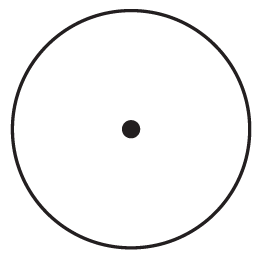
Question 1. Use the points on the circle and/or the centre to form isosceles triangles.
Answer:
Given:
A circle with a defined center point.
To Find:
A way to form an isosceles triangle using the center and points on the circumference.
Solution:
In any circle, all radii (line segments from the center to any point on the boundary) are equal in length. An isosceles triangle is a triangle that has at least two sides of equal length.
Let us label the center of the circle as point $A$. Now, let us pick any two distinct points on the circumference and label them $B$ and $C$. By joining $A$ to $B$, $A$ to $C$, and $B$ to $C$, we form $\Delta ABC$.
$AB = AC$
(Radii of the same circle)
Since $\Delta ABC$ has two equal sides ($AB$ and $AC$), it is an isosceles triangle.
Final Answer:
By connecting the center to any two points on the circle's boundary, we always obtain an isosceles triangle because the lengths of the radii are identical.
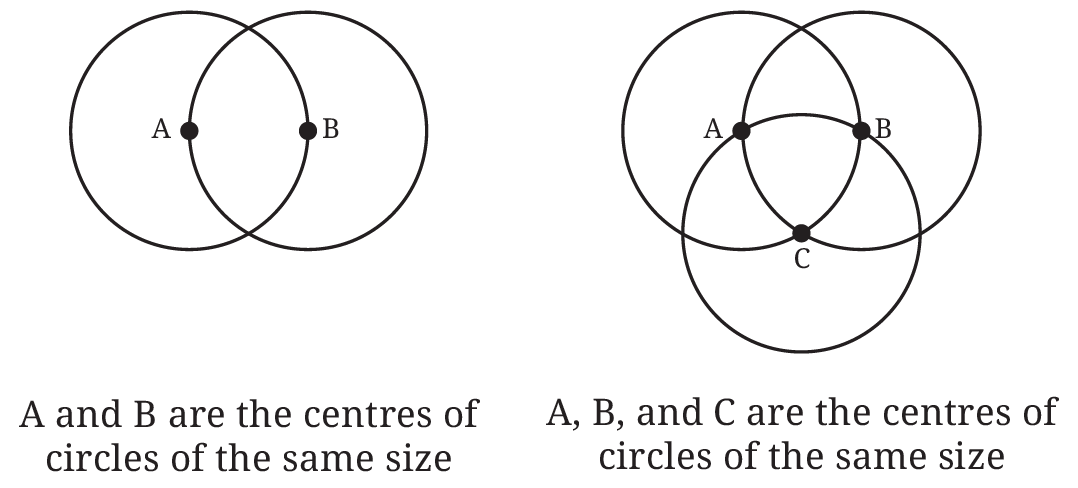
Question 2. Use the points on the circles and/or their centres to form isosceles and equilateral triangles. The circles are of the same size.
Answer:
To Find: Identifying and constructing equilateral and isosceles triangles using the centres and circumferences of overlapping circles of the same size.
1. Using Two Overlapping Circles (Centres A and B):
Consider two circles of the same radius such that each circle passes through the centre of the other. Let the centres be $A$ and $B$.
(i) Equilateral Triangle:
Let $P$ be one of the points of intersection of the two circles. If we join the two centres ($A$ and $B$) and the intersection point $P$, we form $\triangle ABP$.
$AB = AP$
[Radii of the circle with centre A] ... (i)
$AB = BP$
[Radii of the circle with centre B] ... (ii)
$AB = AP = BP$
(From (i) and (ii))
Since all three sides are equal to the radius, $\triangle ABP$ is an equilateral triangle.
(ii) Isosceles Triangle:
Take any point $X$ on the circumference of either circle (excluding the intersection points). If we join both centres $A$ and $B$ to this point $X$ (where $X$ is on circle $A$), we form $\triangle ABX$.
$AX = AB$
(Both are radii of circle A)
Since two sides are equal, $\triangle ABX$ is an isosceles triangle.
2. Using Three Overlapping Circles (Centres A, B, and C):
In this arrangement, three circles of the same size are placed such that the centre of each lies on the circumference of the other two.
(i) Equilateral Triangle:
By joining the three centres $A, B,$ and $C$, we form $\triangle ABC$. Since each centre lies on the circumference of the others, the distance between any two centres is equal to the radius.
$AB = BC = CA$
(All sides are equal to the radius)
Therefore, $\triangle ABC$ is an equilateral triangle.
(ii) Isosceles Triangle:
To form an isosceles triangle using three circles, we join two centres (for example, $A$ and $B$) and then pick a point $Y$ on the circumference of either of the circles whose centres were joined (i.e., point $Y$ must be on circle $A$ or circle $B$).
If point $Y$ is picked on the circumference of the circle with centre $B$ (but not at an intersection point):
$BY = AB$
(Both are radii of circle B)
In $\triangle ABY$, since the two sides $BY$ and $AB$ are equal, $\triangle ABY$ is an isosceles triangle.
Figure It Out (Page No. 154)
Question 1. We checked by construction that there are no triangles having sidelengths $3\text{ cm}, 4\text{ cm}$ and $8\text{ cm}$; and $2\text{ cm}, 3\text{ cm}$ and $6\text{ cm}$. Check if you could have found this without trying to construct the triangle.
Answer:
To Find: A mathematical rule to check the existence of a triangle without construction.
Solution:
Yes, we can find this using the Triangle Inequality Property. This property states that for any triangle to be possible, the sum of the lengths of any two sides must be strictly greater than the length of the third side.
Let us check the given sets:
1. Sidelengths $3\text{ cm}, 4\text{ cm},$ and $8\text{ cm}$:
We add the two smaller sides: $3 + 4 = 7\text{ cm}$.
$7 < 8$
(Sum of two sides is less than the third side)
Since the sum is not greater than the third side, a triangle cannot be formed.
2. Sidelengths $2\text{ cm}, 3\text{ cm},$ and $6\text{ cm}$:
We add the two smaller sides: $2 + 3 = 5\text{ cm}$.
$5 < 6$
(Sum of two sides is less than the third side)
Again, the property is not satisfied, so the triangle does not exist.
Question 2. Can we say anything about the existence of a triangle for each of the following sets of lengths?
(a) $10\text{ km}, 10\text{ km}$ and $25\text{ km}$
(b) $5\text{ mm}, 10\text{ mm}$ and $20\text{ mm}$
(c) $12\text{ cm}, 20\text{ cm}$ and $40\text{ cm}$
You would have realised that using a rough figure and comparing the direct path lengths with their corresponding roundabout path lengths is the same as comparing each length with the sum of the other two lengths. There are three such comparisons to be made.
Answer:
Solution:
To determine if a triangle exists, we must check if the sum of the two shorter lengths is greater than the longest length. This is equivalent to checking if the "roundabout path" is longer than the "direct path."
(a) $10\text{ km}, 10\text{ km}$ and $25\text{ km}$:
Sum of two smaller sides $= 10 + 10 = 20\text{ km}$.
Comparison: $20 < 25$.
Conclusion: Triangle does not exist.
(b) $5\text{ mm}, 10\text{ mm}$ and $20\text{ mm}$:
Sum of two smaller sides $= 5 + 10 = 15\text{ mm}$.
Comparison: $15 < 20$.
Conclusion: Triangle does not exist.
(c) $12\text{ cm}, 20\text{ cm}$ and $40\text{ cm}$:
Sum of two smaller sides $= 12 + 20 = 32\text{ cm}$.
Comparison: $32 < 40$.
Conclusion: Triangle does not exist.
Question 3. For each set of lengths seen so far, you might have noticed that in at least two of the comparisons, the direct length was less than the sum of the other two (if not, check again!). For example, for the set of lengths $10\text{ cm}, 15\text{ cm}$ and $30\text{ cm}$, there are two comparisons where this happens:
$10 < 15 + 30$
$15 < 10 + 30$
But this doesn’t happen for the third length: $30 > 10 + 15$.
Will this always happen? That is, for any set of lengths, will there be at least two comparisons where the direct length is less than the sum of the other two? Explore for different sets of lengths.
Answer:
To Find: To explore whether for any set of three lengths, there will always be at least two comparisons where a single length is less than the sum of the other two lengths.
Solution:
Let the three given lengths be $a, b,$ and $c$. To make the analysis easier, let us assume that $c$ is the longest side (or equal to the longest side).
When we compare one side to the sum of the other two, there are three possible comparisons:
$a < b + c$
(Comparison 1)
$b < a + c$
(Comparison 2)
$c < a + b$
(Comparison 3)
Now, let us examine if the first two comparisons are always true for any positive lengths:
1. In Comparison 1 ($a < b + c$), since $c$ is the longest side, $c \geq a$. Since $b$ is a positive length, the sum $(b + c)$ will always be strictly greater than $a$. Hence, this comparison is Always True.
2. In Comparison 2 ($b < a + c$), since $c$ is the longest side, $c \geq b$. Since $a$ is a positive length, the sum $(a + c)$ will always be strictly greater than $b$. Hence, this comparison is also Always True.
The only comparison that may or may not be true is Comparison 3 ($c < a + b$).
Exploring Different Sets of Lengths:
Let us take different cases to verify this observation:
| Set of Lengths (cm) | Comparison 1 & 2 | Comparison 3 | Result |
| $3, 4, 5$ | $3 < 9$ and $4 < 8$ (True) | $5 < 7$ (True) | 3 comparisons True |
| $5, 5, 10$ | $5 < 15$ and $5 < 15$ (True) | $10 < 10$ (False) | 2 comparisons True |
| $2, 3, 10$ | $2 < 13$ and $3 < 12$ (True) | $10 < 5$ (False) | 2 comparisons True |
Final Conclusion:
Yes, this will always happen. For any set of three positive lengths, there will always be at least two comparisons where the direct length is less than the sum of the other two. This is because a smaller or equal side will always be less than the sum involving the largest side.
Figure It Out (Page No. 156)
Question. Which of the following lengths can be the sidelengths of a triangle? Explain your answers. Note that for each set, the three lengths have the same unit of measure.
(a) $2, 2, 5$
(b) $3, 4, 6$
(c) $2, 4, 8$
(d) $5, 5, 8$
(e) $10, 20, 25$
(f) $10, 20, 35$
(g) $24, 26, 28$
Answer:
Given: Various sets of three lengths to be tested for the formation of a triangle.
To Find: Identify which sets can form a triangle and provide a reason based on geometric properties.
Solution:
According to the Triangle Inequality Property, a triangle can only be formed if the sum of the lengths of any two sides is strictly greater than the length of the third side. In practice, we only need to check if the sum of the two smaller sides is greater than the largest side.
(a) $2, 2, 5$
Smallest sides: $2, 2$; Largest side: $5$.
Sum: $2 + 2 = 4$.
Since $4 < 5$, the property is not satisfied. A triangle cannot be formed.
(b) $3, 4, 6$
Smallest sides: $3, 4$; Largest side: $6$.
Sum: $3 + 4 = 7$.
Since $7 > 6$, the property is satisfied. A triangle can be formed.
(c) $2, 4, 8$
Smallest sides: $2, 4$; Largest side: $8$.
Sum: $2 + 4 = 6$.
Since $6 < 8$, the property is not satisfied. A triangle cannot be formed.
(d) $5, 5, 8$
Smallest sides: $5, 5$; Largest side: $8$.
Sum: $5 + 5 = 10$.
Since $10 > 8$, the property is satisfied. A triangle can be formed.
(e) $10, 20, 25$
Smallest sides: $10, 20$; Largest side: $25$.
Sum: $10 + 20 = 30$.
Since $30 > 25$, the property is satisfied. A triangle can be formed.
(f) $10, 20, 35$
Smallest sides: $10, 20$; Largest side: $35$.
Sum: $10 + 20 = 30$.
Since $30 < 35$, the property is not satisfied. A triangle cannot be formed.
(g) $24, 26, 28$
Smallest sides: $24, 26$; Largest side: $28$.
Sum: $24 + 26 = 50$.
Since $50 > 28$, the property is satisfied. A triangle can be formed.
Final Answer:
The sets of lengths that can form a triangle are: (b), (d), (e), and (g).
Figure It Out (Page No. 159)
Question 1. Check if a triangle exists for each of the following set of lengths:
(a) $1, 100, 100$
(b) $3, 6, 9$
(c) $1, 1, 5$
(d) $5, 10, 12$
Answer:
General Rule: In geometry, the Triangle Inequality Property states that for a triangle to exist, the sum of the lengths of any two sides must be strictly greater than the length of the third side. A quick way is to check if the sum of the two smallest sides is greater than the longest side.
(a) $1, 100, 100$
Smallest sides: $1$ and $100$. Longest side: $100$.
Sum of two smaller sides: $1 + 100 = 101$.
Comparison: $101 > 100$.
Result: The triangle exists.
(b) $3, 6, 9$
Smallest sides: $3$ and $6$. Longest side: $9$.
Sum: $3 + 6 = 9$.
Comparison: $9 = 9$.
Result: The triangle does not exist. (The sum must be strictly greater, not equal).
(c) $1, 1, 5$
Smallest sides: $1$ and $1$. Longest side: $5$.
Sum: $1 + 1 = 2$.
Comparison: $2 < 5$.
Result: The triangle does not exist.
(d) $5, 10, 12$
Smallest sides: $5$ and $10$. Longest side: $12$.
Sum: $5 + 10 = 15$.
Comparison: $15 > 12$.
Result: The triangle exists.
Question 2. Does there exist an equilateral triangle with sides $50, 50, 50$? In general, does there exist an equilateral triangle of any sidelength? Justify your answer.
Answer:
Solution:
Yes, an equilateral triangle with sides $50, 50, 50$ exists.
Justification:
For any triangle with sides $a, b,$ and $c$, the condition $a + b > c$ must be satisfied. In an equilateral triangle, all three sides are equal ($a = b = c = s$).
Let the side length be $s$. The sum of any two sides is $s + s = 2s$.
Comparing the sum to the third side:
Is $2s > s$?
Since any physical length $s$ is always a positive number, $2s$ will always be greater than $s$.
General Conclusion:
Yes, an equilateral triangle can exist for any positive sidelength. Whether the side is $0.1\text{ cm}$ or $1000\text{ km}$, the sum of two sides will always double the length of the third side, fulfilling the triangle inequality criteria.
Question 3. For each of the following, give at least $5$ possible values for the third length so there exists a triangle having these as sidelengths (decimal values could also be chosen):
(a) $1, 100$
(b) $5, 5$
(c) $3, 7$
Answer:
Logic: If the two given sides are $a$ and $b$, the third side $x$ must be greater than their difference and less than their sum:
$(a - b) < x < (a + b)$
(a) Sides: $1, 100$
Difference: $100 - 1 = 99$; Sum: $100 + 1 = 101$.
The third side must be between $99$ and $101$.
5 possible values: $99.1, 99.5, 100, 100.2, 100.9$.
(b) Sides: $5, 5$
Difference: $5 - 5 = 0$; Sum: $5 + 5 = 10$.
The third side must be between $0$ and $10$.
5 possible values: $1, 3, 5, 7, 9$.
(c) Sides: $3, 7$
Difference: $7 - 3 = 4$; Sum: $7 + 3 = 10$.
The third side must be between $4$ and $10$.
5 possible values: $4.5, 5, 6, 8, 9.5$.
Figure It Out (Page No. 161)
Question. Construct triangles for the following measurements where the angle is included between the sides:
(a) $3\text{ cm}, 75^\circ, 7\text{ cm}$
(b) $6\text{ cm}, 25^\circ, 3\text{ cm}$
(c) $3\text{ cm}, 120^\circ, 8\text{ cm}$
Answer:
General Concept:
To construct a triangle given two sides and an included angle (the angle between those two sides), we follow the SAS (Side-Angle-Side) construction criterion. Unlike the SSS case, a triangle will always be formed as long as the angle is between $0^\circ$ and $180^\circ$.
(a) Triangle $ABC$ with sides $3\text{ cm}, 7\text{ cm}$ and included angle $75^\circ$
Steps of Construction:
1. Draw a line segment $BC = 7\text{ cm}$ using a ruler.
2. At point $B$, use a protractor to draw a ray $BX$ making an angle of $75^\circ$ with $BC$.
3. Use a compass to measure $3\text{ cm}$ and, with $B$ as the centre, draw an arc on ray $BX$. Mark this point as $A$.
4. Join the points $A$ and $C$. The required triangle $ABC$ is formed.
(b) Triangle $ABC$ with sides $6\text{ cm}, 3\text{ cm}$ and included angle $25^\circ$
Steps of Construction:
1. Draw the base line segment $BC = 6\text{ cm}$.
2. At point $B$, construct an angle $\angle CBX = 25^\circ$ using a protractor.
3. With $B$ as the centre and a radius of $3\text{ cm}$, draw an arc on the ray $BX$. Label the intersection point as $A$.
4. Join $A$ to $C$. $\Delta ABC$ is the required triangle.
(c) Triangle $ABC$ with sides $3\text{ cm}, 8\text{ cm}$ and included angle $120^\circ$
Steps of Construction:
1. Draw the base segment $BC = 8\text{ cm}$.
2. At point $B$, use a protractor to draw a ray $BX$ at an angle of $120^\circ$ from $BC$ (this will be an obtuse angle).
3. From point $B$, measure and mark point $A$ at a distance of $3\text{ cm}$ on the ray $BX$.
4. Join $A$ and $C$ to complete the obtuse-angled triangle $ABC$.
Question. We have seen that triangles do not exist for all sets of sidelengths. Is there a combination of measurements in the case of two sides and the included angle where a triangle is not possible? Justify your answer using what you observe during construction.
Answer:
Observation and Analysis:
Based on the construction process for SAS (Side-Angle-Side), we observe that for any two given positive lengths and any angle between $0^\circ$ and $180^\circ$, a triangle is always possible.
Justification:
When we construct an SAS triangle, we perform the following logic:
1. We draw one fixed side ($BC$). This gives us two vertices.
2. We fix a specific direction (the angle at $B$) and a specific distance ($BA$) on that ray. This uniquely determines the third vertex $A$.
3. Since $A$ and $C$ are two distinct points in space, we can always join them with a straight line segment to form the third side of the triangle.
Are there impossible cases?
A triangle is not possible only in extreme or degenerate cases:
$\bullet$ If the included angle is $0^\circ$ or $180^\circ$. In these cases, the three points will lie on a single straight line (collinear), and no closed three-sided figure will be formed.
$\bullet$ If any of the side lengths are given as zero or a negative value.
Conclusion:
We conclude that for any valid positive lengths $a, b$ and a valid angle $\theta$ (where $0^\circ < \theta < 180^\circ$), a unique triangle always exists. This is a major difference from the SSS criterion, where the sum of two sides must be checked against the third side.
Figure It Out (Page No. 162)
Question. Construct triangles for the following measurements:
(a) $75^\circ, 5\text{ cm}, 75^\circ$
(b) $25^\circ, 3\text{ cm}, 60^\circ$
(c) $120^\circ, 6\text{ cm}, 30^\circ$
Answer:
General Concept:
To construct a triangle given one side and the two angles adjacent to it, we use the ASA (Angle-Side-Angle) construction criterion. A triangle is only possible if the sum of the two given angles is less than $180^\circ$, as the third angle must be greater than zero.
(a) Triangle $ABC$ with measurements: $75^\circ, 5\text{ cm}, 75^\circ$
Given: Base $BC = 5\text{ cm}$, $\angle B = 75^\circ$, and $\angle C = 75^\circ$.
Check: $75^\circ + 75^\circ = 150^\circ$, which is less than $180^\circ$. The triangle is possible.
Steps of Construction:
1. Using a ruler, draw the base line segment $BC = 5\text{ cm}$.
2. Place the centre of the protractor at point $B$ and mark a point at $75^\circ$. Draw a ray $BX$.
3. Place the centre of the protractor at point $C$ and mark a point at $75^\circ$. Draw a ray $CY$ towards the side of $B$.
4. The point where ray $BX$ and ray $CY$ intersect is labelled as $A$.
5. $\Delta ABC$ is the required isosceles triangle.
(b) Triangle $ABC$ with measurements: $25^\circ, 3\text{ cm}, 60^\circ$
Given: Base $BC = 3\text{ cm}$, $\angle B = 25^\circ$, and $\angle C = 60^\circ$.
Check: $25^\circ + 60^\circ = 85^\circ < 180^\circ$. The triangle is possible.
Steps of Construction:
1. Draw the base line segment $BC = 3\text{ cm}$.
2. At point $B$, use a protractor to construct an angle of $25^\circ$ and draw ray $BX$.
3. At point $C$, use a protractor to construct an angle of $60^\circ$ and draw ray $CY$.
4. Mark the intersection of the two rays as point $A$.
5. Join the segments to complete the scalene triangle $ABC$.
(c) Triangle $ABC$ with measurements: $120^\circ, 6\text{ cm}, 30^\circ$
Given: Base $BC = 6\text{ cm}$, $\angle B = 120^\circ$, and $\angle C = 30^\circ$.
Check: $120^\circ + 30^\circ = 150^\circ < 180^\circ$. The triangle is possible.
Steps of Construction:
1. Draw the base line segment $BC = 6\text{ cm}$.
2. At point $B$, use a protractor to draw an obtuse angle of $120^\circ$ and extend ray $BX$.
3. At point $C$, draw an angle of $30^\circ$ using a protractor and extend ray $CY$.
4. Label the point of intersection of these two rays as $A$.
5. $\Delta ABC$ is the required obtuse-angled triangle.
Figure It Out (Page No. 163)
Question 1. For each of the following angles, find another angle for which a triangle is (a) possible, (b) not possible. Find at least two different angles for each category:
(a) $30^\circ$
(b) $70^\circ$
(c) $54^\circ$
(d) $144^\circ$
Answer:
To Find: Examples of angles that make a triangle possible or impossible when combined with a given angle.
Reasoning: According to the Angle Sum Property of a triangle, the sum of all three interior angles must be exactly $180^\circ$. Therefore, for a triangle to be possible, the sum of any two given angles must be strictly less than $180^\circ$ so that a positive value remains for the third angle.
(a) Given Angle: $30^\circ$
$\bullet$ Possible: $60^\circ$ and $90^\circ$ (Sums are $90^\circ$ and $120^\circ$, both $< 180^\circ$).
$\bullet$ Not Possible: $150^\circ$ and $160^\circ$ (Sums are $180^\circ$ and $190^\circ$, both $\ge 180^\circ$).
(b) Given Angle: $70^\circ$
$\bullet$ Possible: $40^\circ$ and $100^\circ$ (Sums are $110^\circ$ and $170^\circ$).
$\bullet$ Not Possible: $110^\circ$ and $120^\circ$ (Sums are $180^\circ$ and $190^\circ$).
(c) Given Angle: $54^\circ$
$\bullet$ Possible: $54^\circ$ and $100^\circ$ (Sums are $108^\circ$ and $154^\circ$).
$\bullet$ Not Possible: $126^\circ$ and $130^\circ$ (Sums are $180^\circ$ and $184^\circ$).
(d) Given Angle: $144^\circ$
$\bullet$ Possible: $10^\circ$ and $30^\circ$ (Sums are $154^\circ$ and $174^\circ$).
$\bullet$ Not Possible: $36^\circ$ and $40^\circ$ (Sums are $180^\circ$ and $184^\circ$).
Question 2. Determine which of the following pairs can be the angles of a triangle and which cannot:
(a) $35^\circ, 150^\circ$
(b) $70^\circ, 30^\circ$
(c) $90^\circ, 85^\circ$
(d) $50^\circ, 150^\circ$
Answer:
Solution:
We check if the sum of each pair is less than $180^\circ$.
(a) $35^\circ, 150^\circ$
Sum $= 35^\circ + 150^\circ = 185^\circ$
Since $185^\circ > 180^\circ$, this pair cannot be the angles of a triangle.
(b) $70^\circ, 30^\circ$
Sum $= 70^\circ + 30^\circ = 100^\circ$
Since $100^\circ < 180^\circ$, this pair can be the angles of a triangle.
(c) $90^\circ, 85^\circ$
Sum $= 90^\circ + 85^\circ = 175^\circ$
Since $175^\circ < 180^\circ$, this pair can be the angles of a triangle.
(d) $50^\circ, 150^\circ$
Sum $= 50^\circ + 150^\circ = 200^\circ$
Since $200^\circ > 180^\circ$, this pair cannot be the angles of a triangle.
Question. Like the triangle inequality, can you form a rule that describes the two angles for which a triangle is possible?
Answer:
To Find: A geometric rule for any two angles that determines if the formation of a triangle is possible.
Solution:
In any triangle, the sum of the three internal angles must be exactly $180^\circ$. This is a fixed property of Euclidean geometry.
Let the three angles of a triangle be $\angle 1$, $\angle 2$, and $\angle 3$. The relationship is expressed as:
$\angle 1 + \angle 2 + \angle 3 = 180^\circ$
[Angle Sum Property]
For a triangle to physically exist, every angle must be a positive value, meaning $\angle 3 > 0^\circ$.
By rearranging the above equation, we find the sum of any two angles:
$\angle 1 + \angle 2 = 180^\circ - \angle 3$
Since $\angle 3$ is positive, subtracting it from $180^\circ$ will always result in a value less than $180^\circ$.
The Rule:
A triangle is possible if and only if the sum of any two given angles is strictly less than $180^\circ$.
$\angle A + \angle B < 180^\circ$
Verification Table:
| Angle 1 | Angle 2 | Sum ($\angle 1 + \angle 2$) | Is Triangle Possible? |
| $70^\circ$ | $50^\circ$ | $120^\circ$ | Yes ($120^\circ < 180^\circ$) |
| $110^\circ$ | $80^\circ$ | $190^\circ$ | No ($190^\circ > 180^\circ$) |
| $90^\circ$ | $90^\circ$ | $180^\circ$ | No ($180^\circ \not< 180^\circ$) |
Figure It Out (Page No. 165)
Question 1. Find the third angle of a triangle (using a parallel line) when two of the angles are:
(a) $36^\circ, 72^\circ$
(b) $150^\circ, 15^\circ$
(c) $90^\circ, 30^\circ$
(d) $75^\circ, 45^\circ$
Answer:
To Find: The third angle of a triangle given two of its angles, using the construction of a parallel line through the vertex.
General Concept:
In a triangle $ABC$, let the two given angles be $\angle A$ and $\angle B$. To find the third angle $\angle C$, we draw a line $XY$ passing through vertex $C$ such that $XY$ is parallel to the base $AB$.
By the property of Alternate Interior Angles:
$\angle ACX = \angle A$
[Alternate interior angles]
$\angle BCY = \angle B$
[Alternate interior angles]
Since $XY$ is a straight line, the sum of the angles on it at point $C$ is $180^\circ$:
$\angle ACX + \angle ACB + \angle BCY = 180^\circ$
[Linear sum property]
(a) Given angles: $36^\circ, 72^\circ$
Construction: Draw $\triangle ABC$ with $\angle A = 36^\circ$ and $\angle B = 72^\circ$. Construct line $XY \parallel AB$ through vertex $C$.
Solution:
From the parallel line construction:
$\angle ACX = 36^\circ$ and $\angle BCY = 72^\circ$
Using the linear sum property at point $C$:
$36^\circ + \angle ACB + 72^\circ = 180^\circ$
$\angle ACB = 180^\circ - 108^\circ$
$\angle ACB = 72^\circ$
(Result)
(b) Given angles: $150^\circ, 15^\circ$
Construction: Draw $\triangle ABC$ with an obtuse angle $\angle A = 150^\circ$ and $\angle B = 15^\circ$. Construct line $XY \parallel AB$ through vertex $C$.
Solution:
From the parallel line construction:
$\angle ACX = 150^\circ$ and $\angle BCY = 15^\circ$
$150^\circ + \angle ACB + 15^\circ = 180^\circ$
$\angle ACB = 180^\circ - 165^\circ$
$\angle ACB = 15^\circ$
(Result)
(c) Given angles: $90^\circ, 30^\circ$
Construction: Draw right-angled $\triangle ABC$ where $\angle A = 90^\circ$ and $\angle B = 30^\circ$. Construct line $XY \parallel AB$ through vertex $C$.
Solution:
From the parallel line construction:
$\angle ACX = 90^\circ$ and $\angle BCY = 30^\circ$
$90^\circ + \angle ACB + 30^\circ = 180^\circ$
$\angle ACB = 180^\circ - 120^\circ$
$\angle ACB = 60^\circ$
(Result)
(d) Given angles: $75^\circ, 45^\circ$
Construction: Draw $\triangle ABC$ with $\angle A = 75^\circ$ and $\angle B = 45^\circ$. Construct line $XY \parallel AB$ through vertex $C$.
Solution:
$75^\circ + \angle ACB + 45^\circ = 180^\circ$
$\angle ACB = 180^\circ - 120^\circ$
$\angle ACB = 60^\circ$
(Result)
Question 2. Can you construct a triangle all of whose angles are equal to $70^\circ$? If two of the angles are $70^\circ$ what would the third angle be? If all the angles in a triangle have to be equal, then what must its measure be? Explore and find out.
Answer:
Solution:
1. Can we construct a triangle with all angles as $70^\circ$?
No, we cannot. Let's check the sum:
$70^\circ + 70^\circ + 70^\circ = 210^\circ$.
Since the sum is greater than $180^\circ$, such a triangle is mathematically impossible.
2. If two angles are $70^\circ$, what is the third angle?
Sum of two angles $= 70^\circ + 70^\circ = 140^\circ$.
Third angle $= 180^\circ - 140^\circ = \mathbf{40^\circ}$.
3. If all angles are equal, what must their measure be?
Let each equal angle be $x$.
$x + x + x = 180^\circ$
$3x = 180^\circ \implies x = \frac{180^\circ}{3} = 60^\circ$.
Conclusion: If all angles are equal, each must be $60^\circ$. This triangle is called an Equilateral Triangle.
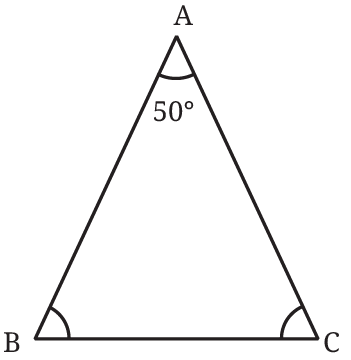
Question 3. Here is a triangle in which we know $\angle B = \angle C$ and $\angle A = 50^\circ$. Can you find $\angle B$ and $\angle C$?
Answer:
Given:
$\bullet$ In $\Delta ABC$, $\angle A = 50^\circ$
$\bullet$ $\angle B = \angle C$
To Find:
The measures of $\angle B$ and $\angle C$.
Solution:
Let the measure of $\angle B$ and $\angle C$ be $x$.
By the Angle Sum Property of a triangle:
$\angle A + \angle B + \angle C = 180^\circ$
$50^\circ + x + x = 180^\circ$
$50^\circ + 2x = 180^\circ$
Subtracting $50^\circ$ from both sides:
$2x = 180^\circ - 50^\circ$
$2x = 130^\circ$
Dividing by $2$:
$x = \frac{130^\circ}{2} = 65^\circ$
Final Answer:
The angles are $\angle B = 65^\circ$ and $\angle C = 65^\circ$.
This triangle is an Isosceles Triangle, where the angles opposite to the equal sides are equal.
Figure It Out (Page No. 170)
Question 1. Construct a triangle $ABC$ with $BC = 5\text{ cm}$, $AB = 6\text{ cm}$, $CA = 5\text{ cm}$. Construct an altitude from $A$ to $BC$.
Answer:
Given:
$\bullet$ Side $BC = 5\text{ cm}$
$\bullet$ Side $AB = 6\text{ cm}$
$\bullet$ Side $CA = 5\text{ cm}$
To Construct:
Triangle $ABC$ and its altitude from vertex $A$ to side $BC$.
Steps of Construction:
1. Draw a line segment $BC = 5\text{ cm}$ using a ruler.
2. Using a compass, take a radius of $6\text{ cm}$. With $B$ as the centre, draw an arc above $BC$.
3. Now, take a radius of $5\text{ cm}$ on the compass. With $C$ as the centre, draw an arc to intersect the previous arc at point $A$.
4. Join $AB$ and $AC$ to complete the triangle $ABC$.
5. To draw the altitude: From vertex $A$, draw an arc of any suitable radius that cuts the line segment $BC$ at two points, say $X$ and $Y$.
6. From $X$ and $Y$, draw arcs of the same radius that intersect each other at a point $Z$ on the opposite side of $A$.
7. Join $A$ to $Z$. Let the line $AZ$ intersect $BC$ at point $D$. $AD$ is the required altitude.
Question 2. Construct a triangle $TRY$ with $RY = 4\text{ cm}$, $TR = 7\text{ cm}$, $\angle R = 140^\circ$. Construct an altitude from $T$ to $RY$.
Answer:
Given:
$\bullet$ Side $RY = 4\text{ cm}$
$\bullet$ Side $TR = 7\text{ cm}$
$\bullet$ $\angle R = 140^\circ$ (Obtuse angle)
To Construct:
Triangle $TRY$ and its altitude from vertex $T$ to the base $RY$.
Steps of Construction:
1. Using a ruler, draw the base line segment $RY = 4\text{ cm}$.
2. At point $R$, use a protractor to draw a ray making an angle of $140^\circ$ with $RY$.
3. Use a compass to measure $7\text{ cm}$ and mark point $T$ on this ray.
4. Join $T$ and $Y$ to complete the obtuse-angled triangle $TRY$.
5. To draw the altitude: Since the triangle is obtuse at $R$, the altitude from $T$ will fall on the extension of the base $RY$.
6. Extend the line segment $RY$ to the left of $R$ using a dotted line.
7. From vertex $T$, draw an arc that cuts this extended line at two points.
8. Construct a perpendicular from $T$ to these points. Let the foot of the perpendicular on the extended line be $M$.
9. $TM$ is the required altitude.
Note: It is a crucial observation in geometry that in an obtuse-angled triangle, two of the altitudes lie outside the triangle.
Question 3. Construct a right-angled triangle $\Delta ABC$ with $\angle B = 90^\circ$, $AC = 5\text{ cm}$. How many different triangles exist with these measurements?
[Hint: Note that the other measurements can take any values. Take $AC$ as the base. What values can $\angle A$ and $\angle C$ take so that the other angle is $90^\circ$?]
Answer:
Given:
$\bullet$ Hypotenuse $AC = 5\text{ cm}$
$\bullet$ Right angle at vertex $B$ ($\angle B = 90^\circ$)
Steps of Construction:
To construct a specific version of this triangle, let us assume $\angle A = 45^\circ$ and $\angle C = 45^\circ$ (Isosceles Right Triangle).
1. Draw a line segment $AC = 5\text{ cm}$ using a ruler.
2. At point $A$, use a protractor to draw a ray at an angle of $45^\circ$.
3. At point $C$, use a protractor to draw another ray at an angle of $45^\circ$ towards the first ray.
4. Label the intersection of these two rays as $B$. By the angle sum property, $\angle B$ will be $180^\circ - (45^\circ + 45^\circ) = 90^\circ$.
Solution for "How many different triangles exist?":
There are infinitely many different triangles that can be constructed with these given measurements.
Reasoning: According to the property of circles, any triangle inscribed in a semicircle with the diameter as its hypotenuse is a right-angled triangle. If we draw a semicircle with $AC = 5\text{ cm}$ as the diameter, every single point on the arc of that semicircle can serve as vertex $B$. Each point results in a different triangle (with different values for $\angle A$ and $\angle C$), but all of them will have $\angle B = 90^\circ$ and $AC = 5\text{ cm}$.
Question 4. Through construction, explore if it is possible to construct an equilateral triangle that is (i) right-angled (ii) obtuse-angled.
Also construct an isosceles triangle that is (i) right-angled (ii) obtuse-angled.
Answer:
1. Equilateral Triangle Investigation:
$\bullet$ (i) Right-angled equilateral triangle: Not Possible. An equilateral triangle must have all angles equal to $60^\circ$. If one angle were $90^\circ$, the sum of angles would exceed $180^\circ$.
$\bullet$ (ii) Obtuse-angled equilateral triangle: Not Possible. For the same reason, all angles are fixed at $60^\circ$, which is acute. It cannot have an angle greater than $90^\circ$.
2. Isosceles Triangle Construction:
(i) Right-angled Isosceles Triangle:
This is possible when the vertex angle is $90^\circ$ and the remaining two base angles are $45^\circ$ each.
$\bullet$ Draw a base $BC$. At $B$, construct a $90^\circ$ angle. Use a compass to mark point $A$ on the perpendicular ray such that $AB = BC$. Join $AC$.
(ii) Obtuse-angled Isosceles Triangle:
This is possible when the vertex angle is greater than $90^\circ$ (e.g., $120^\circ$) and the base angles are equal (e.g., $30^\circ$ each).
$\bullet$ Draw a base $BC$. At $B$, construct an angle of $30^\circ$. At $C$, construct an angle of $30^\circ$. The point where they meet is $A$. The resulting $\angle A$ will be $120^\circ$.
Conclusion:
We emphasize that Equilateral triangles are always acute-angled, whereas Isosceles and Scalene triangles can be acute, right, or obtuse-angled.