

Chapter 1 Geometric Twins (Class 7 - Latest Maths NCERT (Ganita Prakash II) Solutions)
Looking for clear, step-by-step guidance for Chapter 1: Geometric Twins? You’ve come to the right place! This page provides comprehensive NCERT Solutions for the latest Class 7 Maths curriculum, focusing on the fundamental principles of Congruence. Here, we break down complex geometric proofs into easy-to-understand steps, ensuring you can identify and create perfect "twins" by matching shapes and sizes with mathematical precision.
Our solutions cover every exercise regarding the five core congruence criteria: SSS, SAS, ASA, AAS, and RHS. We don’t just provide the answers; we explain the logic behind why certain triangles are congruent and why others—such as those under the AAA or SSA conditions—fail to meet the mark. By following our detailed explanations, you will learn how to correctly map corresponding vertices and use deductive reasoning to solve even the trickiest geometry problems in the Ganita Prakash II textbook.
Whether you are proving the properties of Isosceles triangles or calculating the interior angles of an Equilateral triangle, these curated solutions are designed to help you excel. From analyzing structural symmetry in the Howrah Bridge to solving textbook construction challenges, these resources from learningspot.co ensure you master the art of geometric proof and build a solid foundation for higher mathematics.
| Content On This Page | ||
|---|---|---|
| Figure It Out (Page No. 3 - 4) | Figure It Out (Page No. 8 - 9) | Figure It Out (Page No. 13 - 14) |
| Figure It Out (Page No. 20 - 21) | ||
Figure It Out (Page No. 3 - 4)
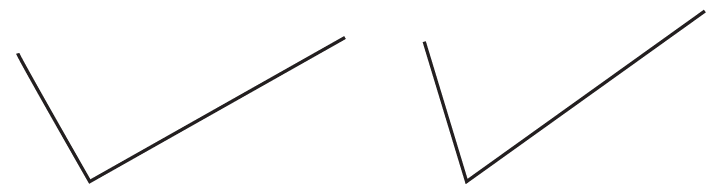
Question 1. Check if the two figures are congruent.
Answer:
Given:
Two geometric figures representing angles with extended arms.
To Find:
Whether the two given figures are congruent or not.
Solution:
Two figures are said to be congruent if they have exactly the same shape and the same size. This means if we place one figure over the other, they should cover each other completely (superimpose).
By observing the two figures:
1. The first figure has two arms of a certain length meeting at a vertex.
2. The second figure has arms that appear significantly longer than the arms of the first figure.
3. While the angle between the arms might appear similar, the size of the figures (the length of the segments) is different.
Since the sizes of the two figures are not equal, they will not cover each other exactly when superimposed.
Therefore, the two figures are not congruent.
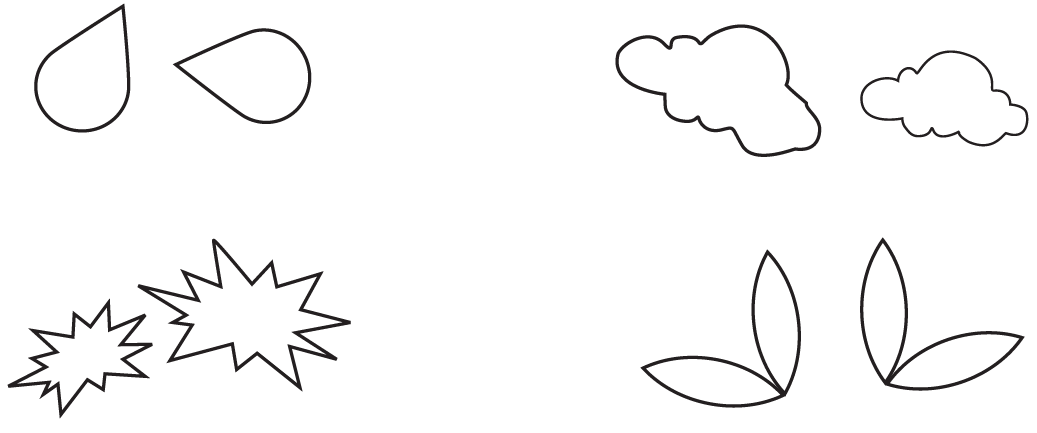
Question 2. Circle the pairs that appear congruent.
Answer:
To Find: Identify the pairs of figures in the image that are congruent.
Concept: Two figures are said to be congruent if they have exactly the same shape and size. They should perfectly coincide when placed one over the other, even if they are rotated or flipped.
Solution:
Let us analyze the four pairs of figures provided:
1. Top-Left Pair (Raindrops): Although they are oriented differently, both raindrops have the same dimensions and curvature. If we rotate the second raindrop, it will perfectly match the first one. Thus, they are congruent.
2. Top-Right Pair (Clouds): By looking at the size, the first cloud is larger than the second one. Since their sizes do not match, they are not congruent.
3. Bottom-Left Pair (Star/Explosion shapes): The two shapes have different numbers of points and different overall sizes. Therefore, they are not congruent.
4. Bottom-Right Pair (Leaves): Both leaves have identical shapes and equal lengths and widths. They are mirrored versions of each other. If one leaf is flipped and placed over the other, they will perfectly coincide. Thus, they are congruent.
Conclusion:
The pairs that appear congruent are:
• The Raindrops (Top-Left Pair)
• The Leaves (Bottom-Right Pair)
Question 3. What measurements would you take to create a figure congruent to a given:
(a) Circle
(b) Rectangle
Using this, state how would you check if two —
(a) Circles are congruent?
(b) Rectangles are congruent?
Answer:
(a) Circle:
To create a figure congruent to a given circle, the only measurement required is the radius ($r$) or the diameter ($d$).
Checking Congruence: Two circles are congruent if they have the same radius. If the radius of the first circle is equal to the radius of the second circle, they will perfectly superimpose on each other.
(b) Rectangle:
To create a figure congruent to a given rectangle, we need to take two measurements: Length ($l$) and Breadth ($b$).
Checking Congruence: Two rectangles are congruent if their corresponding lengths and breadths are equal. That is, the length of the first rectangle must be equal to the length of the second, and the breadth of the first must be equal to the breadth of the second.
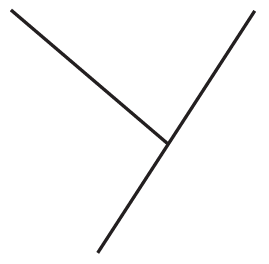
Question 4. How would we check if two figures like the one below are congruent?
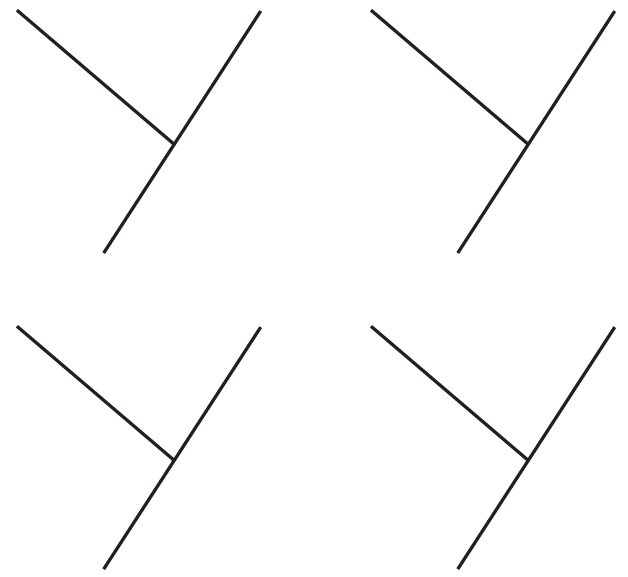
Use this to identify whether each of the following pairs are congruent.
Answer:
To Find: The method to determine congruence for the given line-based figures and to verify if the provided sets are congruent.
Method of Checking:
To check if the two figures are congruent, one would need to measure the lengths of the corresponding line segments and the angle between them.
Alternatively, one can use the superposition method by tracing one figure onto a piece of transparent paper and placing it over the other. If they coincide perfectly, they are congruent.
Analysis and Measurement:
By measuring the segments and angles of the provided figures, we observe the following properties:
$\text{Length of the longer segment} = 3.3 \text{ cm}$
$\text{Length of the shorter segment} = 2.3 \text{ cm}$
$\text{Angle between the segments} = 82^\circ$
Conclusion:
Upon comparing the figures in the second image using the measurements identified above, we find that each figure maintains the exact same segment lengths and the same internal angle.
Yes, each of the given figures is congruent. Although their orientations (positions and rotations) are different, their size and shape are identical.
Figure It Out (Page No. 8 - 9)
Question 1. Suppose $\Delta HEN$ is congruent to $\Delta BIG$. List all the other correct ways of expressing this congruence.
Answer:
Given:
$\Delta HEN \cong \Delta BIG$
To Find:
All other correct ways of expressing this congruence.
Solution:
In triangle congruence, the order of vertices is essential because it specifies the exact correspondence between the vertices, sides, and angles of the two triangles. From the given notation $\Delta HEN \cong \Delta BIG$, we can identify the corresponding vertices as follows:
$H \leftrightarrow B$
(Vertex H corresponds to Vertex B)
$E \leftrightarrow I$
(Vertex E corresponds to Vertex I)
$N \leftrightarrow G$
(Vertex N corresponds to Vertex G)
To list all other ways of expressing this congruence, we rearrange the vertices of the first triangle ($\Delta HEN$) in all possible orders and match them with the fixed corresponding vertices of the second triangle ($\Delta BIG$).
| Order of Vertices in First Triangle | Corresponding Congruent Notation |
| H, N, E | $\Delta HNE \cong \Delta BGI$ |
| E, H, N | $\Delta EHN \cong \Delta IBG$ |
| E, N, H | $\Delta ENH \cong \Delta IGB$ |
| N, H, E | $\Delta NHE \cong \Delta GBI$ |
| N, E, H | $\Delta NEH \cong \Delta GIB$ |
Conclusion:
Including the original statement, there are total six ways to write the congruence of these two triangles. The other five correct ways are $\Delta HNE \cong \Delta BGI$, $\Delta EHN \cong \Delta IBG$, $\Delta ENH \cong \Delta IGB$, $\Delta NHE \cong \Delta GBI$, and $\Delta NEH \cong \Delta GIB$.
Question 2. Determine whether the triangles are congruent. If yes, express the congruence.
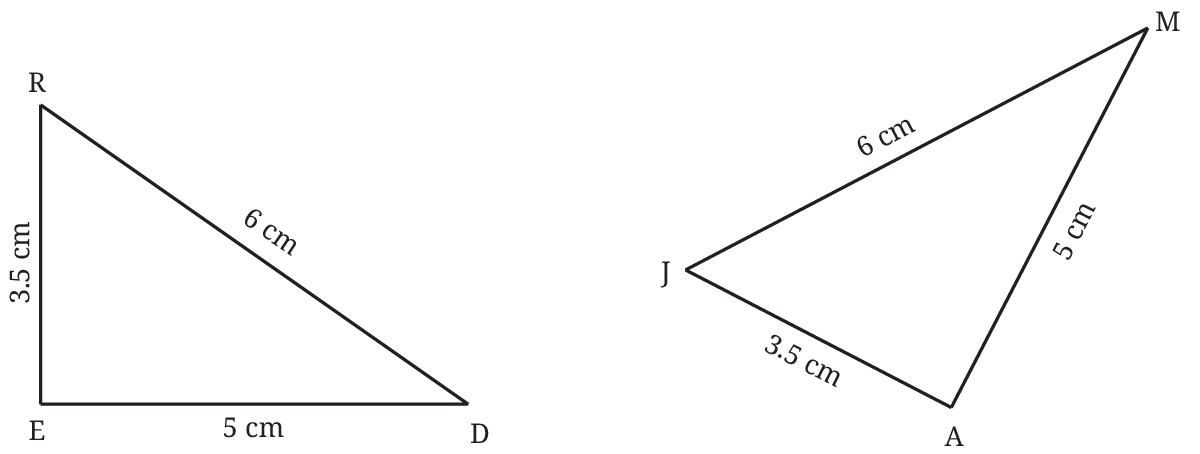
Answer:
Given:
In $\Delta RED$ and $\Delta JAM$:
Side $RE = 3.5\text{ cm}$
Side $ED = 5\text{ cm}$
Side $RD = 6\text{ cm}$
Side $JA = 3.5\text{ cm}$
Side $AM = 5\text{ cm}$
Side $JM = 6\text{ cm}$
To Find:
Whether the triangles are congruent and the expression of congruence.
Solution:
Let us compare the corresponding sides of $\Delta RED$ and $\Delta JAM$:
$RE = JA = 3.5\text{ cm}$
(Given)
$ED = AM = 5\text{ cm}$
(Given)
$RD = JM = 6\text{ cm}$
(Given)
Since all the three sides of one triangle are equal to the three corresponding sides of the other triangle, the two triangles satisfy the SSS (Side-Side-Side) congruence criterion.
The vertex correspondence is:
$R \leftrightarrow J$
$E \leftrightarrow A$
$D \leftrightarrow M$
Therefore, $\Delta RED \cong \Delta JAM$.
Conclusion:
Yes, the triangles are congruent. The congruence is expressed as $\Delta RED \cong \Delta JAM$.
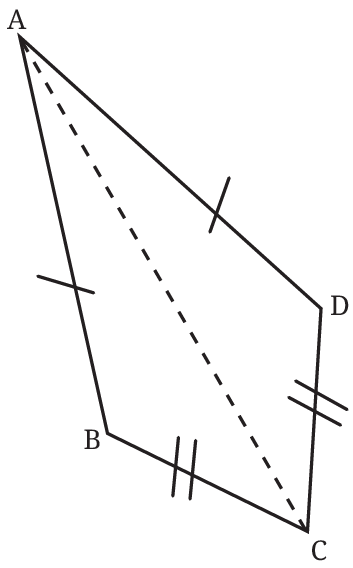
Question 3. In the figure below, $AB = AD$, $CB = CD$.
Can you identify any pair of congruent triangles? If yes, explain why they are congruent.
Does $AC$ divide $\angle BAD$ and $\angle BCD$ into two equal parts? Give reasons.
Answer:
Given:
In quadrilateral $ABCD$, we have:
$AB = AD$
(Given)
$CB = CD$
(Given)
To Find:
1. Identify the pair of congruent triangles and explain the reason.
2. Check if $AC$ bisects $\angle BAD$ and $\angle BCD$.
Proof:
In $\Delta ABC$ and $\Delta ADC$:
$AB = AD$
(Given)
$BC = DC$
(Given)
$AC = AC$
(Common side)
By SSS (Side-Side-Side) congruence criterion, the three sides of $\Delta ABC$ are equal to the three sides of $\Delta ADC$.
Therefore, $\Delta ABC \cong \Delta ADC$.
Angle Division:
Since $\Delta ABC \cong \Delta ADC$, their corresponding parts are equal (CPCT).
$\angle BAC = \angle DAC$
(By CPCT)
$\angle BCA = \angle DCA$
(By CPCT)
Because $\angle BAC = \angle DAC$, it means $AC$ divides $\angle BAD$ into two equal parts.
Similarly, because $\angle BCA = \angle DCA$, it means $AC$ divides $\angle BCD$ into two equal parts.
Conclusion: Yes, $AC$ divides both $\angle BAD$ and $\angle BCD$ into two equal parts.
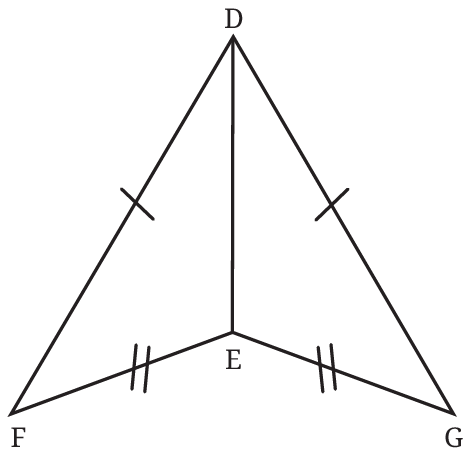
Question 4. In the figure below, are $\Delta DFE$ and $\Delta GED$ congruent to each other? It is given that $DF = DG$ and $FE = GE$.
Answer:
Given:
In the given figure, for triangles $\Delta DFE$ and $\Delta DGE$:
$DF = DG$
(Given)
$FE = GE$
(Given)
To Find:
Whether $\Delta DFE$ is congruent to $\Delta GED$.
Proof / Solution:
Let us compare the two triangles $\Delta DFE$ and $\Delta DGE$ as shown in the figure:
In $\Delta DFE$ and $\Delta DGE$:
$DF = DG$
(Given)
$FE = GE$
(Given)
$DE = DE$
(Common side)
By the SSS (Side-Side-Side) congruence criterion, we can conclude that:
$\Delta DFE \cong \Delta DGE$
In a congruence statement, the order of vertices is extremely important as it represents the correct correspondence between vertices. From the congruence $\Delta DFE \cong \Delta DGE$, the correspondence is:
$D \leftrightarrow D$
$F \leftrightarrow G$
$E \leftrightarrow E$
The question asks if $\Delta DFE \cong \Delta GED$. For this to be true, the corresponding sides would need to be equal as follows:
$DF = GE$
$FE = ED$
$DE = GD$
However, from our given data and the figure, we know that $DF = DG$ and $FE = GE$. Since the segments do not match the correspondence required for the notation $\Delta GED$, the statement is mathematically incorrect.
Conclusion:
The given statements $DF = DG$ and $FE = GE$ do not support the congruence of $\Delta DFE$ and $\Delta GED$ because the corresponding sides are not equal under that specific vertex order. Thus, the answer is No.
Figure It Out (Page No. 13 - 14)
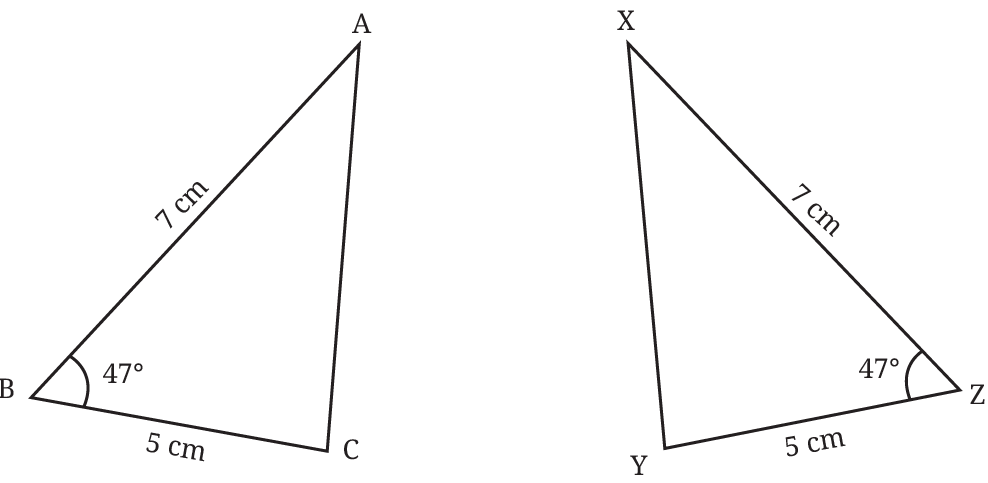
Question 1. Identify whether the triangles below are congruent. What conditions did you use to establish their congruence? Express the congruence.
Answer:
Given:
In $\Delta ABC$ and $\Delta XZY$:
$AB = 7\text{ cm}$
[In first triangle]
$BC = 5\text{ cm}$
[In first triangle]
$\angle ABC = 47^\circ$
[Included angle]
In $\Delta XZY$:
$XZ = 7\text{ cm}$
[In second triangle]
$ZY = 5\text{ cm}$
[In second triangle]
$\angle XZY = 47^\circ$
[Included angle]
To Find:
Whether the triangles are congruent and the condition used.
Solution:
Let us compare the corresponding parts of $\Delta ABC$ and $\Delta XZY$:
$AB = XZ = 7\text{ cm}$
(Side)
$\angle B = \angle Z = 47^\circ$
(Angle)
$BC = ZY = 5\text{ cm}$
(Side)
Since two sides and the included angle of $\Delta ABC$ are equal to the corresponding two sides and the included angle of $\Delta XZY$, the triangles are congruent by the SAS (Side-Angle-Side) congruence criterion.
The vertex correspondence is $A \leftrightarrow X$, $B \leftrightarrow Z$, and $C \leftrightarrow Y$.
Therefore, $\Delta ABC \cong \Delta XZY$.
Question 2. Given that $CD$ and $AB$ are parallel, and $AB = CD$, what are the other equal parts in this figure? (Hint: When the lines are parallel, the alternate angles are equal. Are the two resulting triangles congruent? If so, express the congruence.)
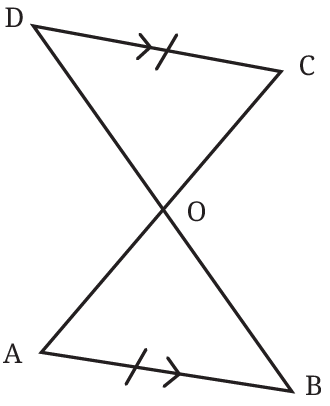
Answer:
Given:
$AB \parallel CD$
(Given)
$AB = CD$
(Given)
Proof of Congruence:
In $\Delta OAB$ and $\Delta OCD$:
$\angle OAB = \angle OCD$
[Alternate interior angles, as $AB \parallel CD$]
$AB = CD$
(Given Side)
$\angle OBA = \angle ODC$
[Alternate interior angles, as $AB \parallel CD$]
By ASA (Angle-Side-Angle) congruence criterion, the two triangles are congruent.
Therefore, $\Delta OAB \cong \Delta OCD$.
Other Equal Parts:
Since $\Delta OAB \cong \Delta OCD$, their corresponding parts are equal by CPCT (Corresponding Parts of Congruent Triangles):
1. $OA = OC$
2. $OB = OD$
3. $\angle AOB = \angle COD$ [Also vertically opposite angles]
This implies that the point $O$ is the midpoint of both line segments $AC$ and $BD$.
Question 3. Given that $\angle ABC = \angle DBC$ and $\angle ACB = \angle DCB$, show that $\angle BAC = \angle BDC$. Are the two triangles congruent?
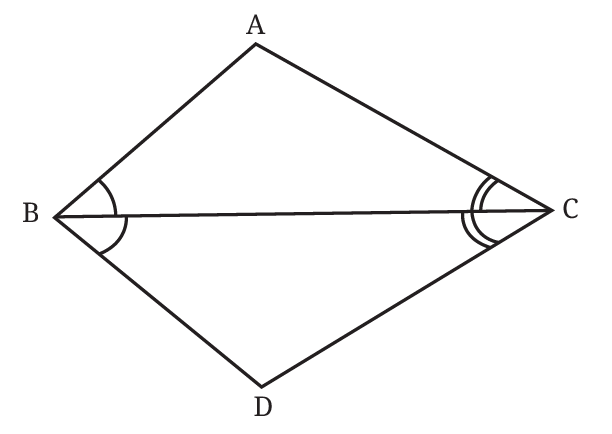
Answer:
Given:
In the given figure, we have two triangles $\Delta ABC$ and $\Delta DBC$ sharing the same base $BC$.
$\angle ABC = \angle DBC$
(Given)
$\angle ACB = \angle DCB$
(Given)
To Prove:
$\angle BAC = \angle BDC$ and to check if $\Delta ABC \cong \Delta DBC$.
Proof:
Compare $\Delta ABC$ and $\Delta DBC$:
$\angle ABC = \angle DBC$
(Given Angle)
$BC = BC$
(Common Side)
$\angle ACB = \angle DCB$
(Given Angle)
By the ASA (Angle-Side-Angle) congruence criterion, the two triangles are congruent.
Therefore, $\Delta ABC \cong \Delta DBC$.
Now, since the triangles are congruent, their corresponding parts must be equal by CPCT (Corresponding Parts of Congruent Triangles).
$\angle BAC = \angle BDC$
(By CPCT)
Conclusion:
Yes, the two triangles are congruent, and it is shown that $\angle BAC = \angle BDC$.
Question 4. Identify the equal parts in the following figure, given that $\angle ABD = \angle DCA$ and $\angle ACB = \angle DBC$.
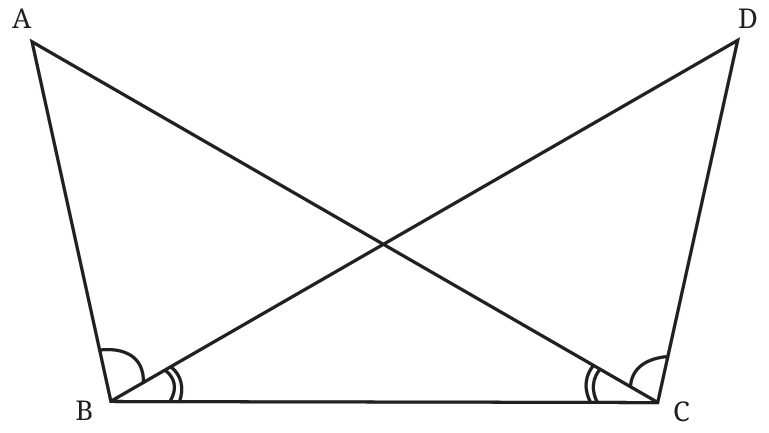
Answer:
Given:
$\angle ABD = \angle DCA$
... (i)
$\angle ACB = \angle DBC$
... (ii)
Solution:
Let us consider the whole angles $\angle ABC$ and $\angle DCB$.
From the figure, $\angle ABC = \angle ABD + \angle DBC$.
Also, $\angle DCB = \angle DCA + \angle ACB$.
By adding equations (i) and (ii):
$\angle ABD + \angle DBC = \angle DCA + \angle ACB$
$\angle ABC = \angle DCB$
... (iii)
Now, let us compare $\Delta ABC$ and $\Delta DCB$:
1. $BC = BC$ (Common base)
2. $\angle ABC = \angle DCB$ (From equation iii)
3. $\angle ACB = \angle DBC$ (Given in equation ii)
Therefore, by ASA (Angle-Side-Angle) congruence criterion:
$\Delta ABC \cong \Delta DCB$
Equal Parts:
Since the triangles are congruent, the following corresponding parts are equal by CPCT:
1. $AB = DC$ (Corresponding sides)
2. $AC = DB$ (Corresponding sides)
3. $\angle BAC = \angle CDB$ (Corresponding angles)
Alternate Solution:
We can also identify that in the small triangles $\Delta OAB$ and $\Delta ODC$ (where $O$ is the intersection):
$\angle ABD = \angle DCA$ (Given)
$\angle AOB = \angle DOC$ (Vertically opposite angles)
This implies $\Delta OAB$ and $\Delta ODC$ are also similar/congruent depending on side lengths.
Figure It Out (Page No. 20 - 21)
Question 1. $\Delta AIR \cong \Delta FLY$. Identify the corresponding vertices, sides and angles.
Answer:
Given:
$\Delta AIR \cong \Delta FLY$
Solution:
When two triangles are congruent, their corresponding vertices, sides, and angles are equal. The order of the letters in the congruence statement indicates the correspondence.
1. Corresponding Vertices:
$A \leftrightarrow F$
$I \leftrightarrow L$
$R \leftrightarrow Y$
2. Corresponding Sides:
$AI = FL$
$IR = LY$
$AR = FY$
3. Corresponding Angles:
$\angle A = \angle F$
$\angle I = \angle L$
$\angle R = \angle Y$
Question 2. Each of the following cases contains certain measurements taken from two triangles. Identify the pairs in which the triangles are congruent to each other, with reason. Express the congruence whenever they are congruent.
(a) $AB = DE$, $BC = EF$, $CA = DF$
(b) $AB = EF$, $\angle A = \angle E$, $AC = ED$
(c) $AB = DF$, $\angle B = \angle D = 90^\circ$, $AC = FE$
(d) $\angle A = \angle D$, $\angle B = \angle E$, $AC = DF$
(e) $AB = DF$, $\angle B = \angle F$, $AC = DE$
Answer:
(a) Solution:
Given: $AB = DE$, $BC = EF$, $CA = DF$.
Analysis: All three corresponding sides of $\Delta ABC$ are equal to the corresponding sides of $\Delta DEF$.
$AB = DE, BC = EF, CA = DF$
(Given)
Reason: SSS (Side-Side-Side) congruence criterion.
Congruence Statement: $\Delta ABC \cong \Delta DEF$
(b) Solution:
Given: $AB = EF$, $\angle A = \angle E$, $AC = ED$.
Analysis: In these triangles, two sides and the included angle (the angle between those two sides) are equal. In $\Delta ABC$, $\angle A$ is between $AB$ and $AC$. In $\Delta EFD$, $\angle E$ is between $EF$ and $ED$.
$AB = EF, \angle A = \angle E, AC = ED$
(Given)
Reason: SAS (Side-Angle-Side) congruence criterion.
Congruence Statement: $\Delta ABC \cong \Delta EFD$
(c) Solution:
Given: $AB = DF$, $\angle B = \angle D = 90^\circ$, $AC = FE$.
Analysis: Both triangles are right-angled. The hypotenuse of the first triangle ($AC$) is equal to the hypotenuse of the second triangle ($FE$). Additionally, one side of the first triangle ($AB$) is equal to a corresponding side of the second triangle ($DF$).
$AC = FE \text{ and } AB = DF$
(Hypotenuse and Side)
Reason: RHS (Right angle-Hypotenuse-Side) congruence criterion.
Congruence Statement: $\Delta ABC \cong \Delta DFE$
(d) Solution:
Given: $\angle A = \angle D$, $\angle B = \angle E$, $AC = DF$.
Analysis: We are given two equal angles and one equal side. Since two angles are equal, by the Angle Sum Property of triangles, the third angle must also be equal ($\angle C = \angle F$). Thus, we have a side ($AC$) included between two equal angles ($\angle A$ and $\angle C$).
$\angle A = \angle D, AC = DF, \angle C = \angle F$
(Angle-Side-Angle)
Reason: ASA (Angle-Side-Angle) or AAS congruence criterion.
Congruence Statement: $\Delta ABC \cong \Delta DEF$
(e) Solution:
Given: $AB = DF$, $\angle B = \angle F$, $AC = DE$.
Analysis: In this case, two sides ($AB, AC$ and $DF, DE$) and one angle ($\angle B, \angle F$) are equal. However, the given angle is not the included angle between the two given sides. For $\Delta ABC$, the included angle is $\angle A$, and for $\Delta DFE$, the included angle is $D$.
Reason: SSA (Side-Side-Angle) is not a valid congruence criterion in geometry.
Conclusion: These triangles are not necessarily congruent.
Question 3. It is given that $OB = OC$, and $OA = OD$. Show that $AB$ is parallel to $CD$.
[Hint: $AD$ is a transversal for these two lines. Are there any equal alternate angles?]
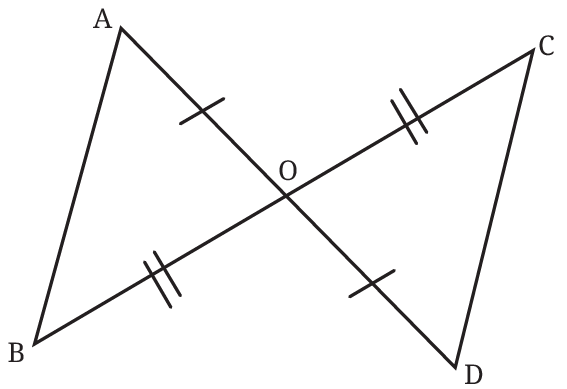
Answer:
Given:
$OB = OC$
(Given)
$OA = OD$
(Given)
To Prove:
$AB \parallel CD$
Proof:
In $\Delta OAB$ and $\Delta ODC$:
$OA = OD$
(Given side)
$\angle AOB = \angle DOC$
(Vertically opposite angles)
$OB = OC$
(Given side)
By SAS (Side-Angle-Side) congruence criterion:
$\Delta OAB \cong \Delta ODC$
Since the triangles are congruent, their corresponding parts are equal (CPCT):
$\angle OAB = \angle ODC$
(By CPCT)
For lines $AB$ and $CD$, $AD$ acts as a transversal. The angles $\angle OAB$ and $\angle ODC$ are a pair of alternate interior angles.
When alternate interior angles are equal, the lines must be parallel.
Therefore, $AB \parallel CD$.
Question 4. $ABCD$ is a square. Show that $\Delta ABC \cong \Delta ADC$. Is $\Delta ABC$ also congruent to $\Delta CDA$?
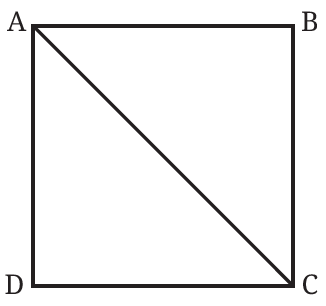
Give more examples of two triangles where one triangle is congruent to the other in two different ways, as in the case above.
Can you give an example of two triangles where one is congruent to the other in six different ways?
Answer:
Given:
$ABCD$ is a square. $AC$ is the diagonal joining vertices $A$ and $C$.
To Prove:
$\Delta ABC \cong \Delta ADC$
Proof:
In $\Delta ABC$ and $\Delta ADC$:
$AB = AD$
(Sides of a square are equal)
$BC = DC$
(Sides of a square are equal)
$AC = AC$
(Common side)
Therefore, by SSS (Side-Side-Side) congruence criterion:
$\Delta ABC \cong \Delta ADC$
Checking if $\Delta ABC \cong \Delta CDA$:
In a square, all sides are equal ($AB = BC = CD = DA$). Let us check the correspondence for $\Delta ABC$ and $\Delta CDA$:
$AB = CD$
(Sides of the square)
$BC = DA$
(Sides of the square)
$AC = CA$
(Common diagonal)
Since the corresponding sides are equal, yes, $\Delta ABC$ is also congruent to $\Delta CDA$.
Triangles congruent in two different ways:
This happens in Isosceles Triangles. If $\Delta PQR$ is an isosceles triangle where $PQ = PR$, then the triangle is congruent to itself in two ways:
1. $\Delta PQR \cong \Delta PQR$ (Identity)
2. $\Delta PQR \cong \Delta PRQ$ (Due to equal sides)
Triangles congruent in six different ways:
An Equilateral Triangle is congruent to another equilateral triangle of the same size in six different ways. Since all three sides are equal and all three angles are $60^\circ$, any vertex of the first triangle can correspond to any vertex of the second triangle.
For example, if $\Delta ABC$ and $\Delta PQR$ are equilateral triangles of side $5\text{ cm}$, the six ways are:
$\Delta ABC \cong \Delta PQR$, $\Delta ABC \cong \Delta PRQ$, $\Delta ABC \cong \Delta QPR$, $\Delta ABC \cong \Delta QRP$, $\Delta ABC \cong \Delta RPQ$, and $\Delta ABC \cong \Delta RQP$.
Question 5. Find $\angle B$ and $\angle C$, if $A$ is the centre of the circle.
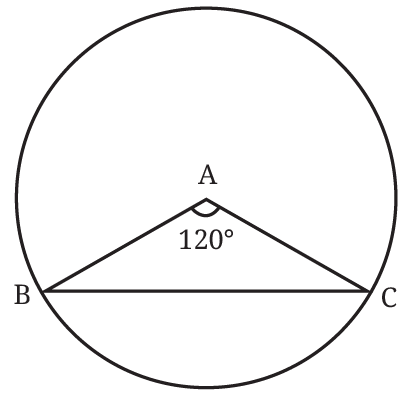
Answer:
Given:
1. $A$ is the centre of the circle.
2. Points $B$ and $C$ lie on the circle.
$\angle BAC = 120^\circ$
(Given)
To Find:
$\angle B$ and $\angle C$
Solution:
In $\Delta ABC$:
$AB = AC$
[Radii of the same circle]
Since two sides of the triangle are equal, $\Delta ABC$ is an isosceles triangle.
We know that angles opposite to equal sides of a triangle are equal.
$\angle ABC = \angle ACB$
Let $\angle ABC = \angle ACB = x$.
In $\Delta ABC$, by the Angle Sum Property:
$\angle BAC + \angle ABC + \angle ACB = 180^\circ$
$120^\circ + x + x = 180^\circ$
$2x = 180^\circ - 120^\circ$
$2x = 60^\circ$
$x = \frac{60^\circ}{2} = 30^\circ$
Therefore, $\angle B = 30^\circ$ and $\angle C = 30^\circ$.
Question 6. Find the missing angles. As per the convention that we have been following, all line segments marked with a single ‘|’ are equal to each other and those marked with a double ‘|’ are equal to each other, etc.
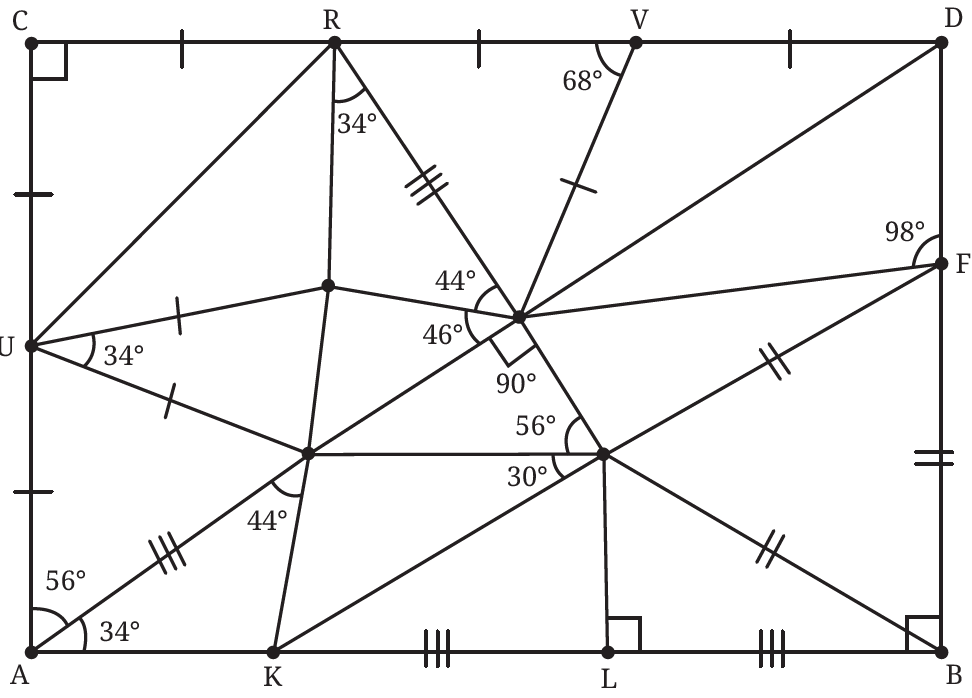
Answer:
Given:
A complex geometric figure where line segments marked with a single ‘|’ are equal, double ‘||’ are equal, and triple ‘|||’ are equal. Specific angles are provided: $\angle C = 90^\circ$, $\angle RVN = 68^\circ$, $\angle UAP = 56^\circ$, $\angle KAP = 34^\circ$, etc.
To Find:
Missing internal angles of various triangles and quadrilaterals within the figure.
Solution:
In $\triangle CUR$:
$\angle CUR = \angle CRU = x$
(CU = CR)
According to the angle sum property of a triangle:
$x + x + 90^\circ = 180^\circ$
$2x = 180^\circ - 90^\circ = 90^\circ$
$x = 45^\circ$
Therefore, $\angle CUR = \angle CRU = 45^\circ$.
In $\triangle VRN$:
$\angle VRN = \angle VNR = a$
(Angles opposite to equal sides are equal)
$VR = VN$
(Given markings)
Since the sum of the angles of a triangle is $180^\circ$:
$a + a + 68^\circ = 180^\circ$
$2a = 180^\circ - 68^\circ$
$2a = 112^\circ$
$a = 56^\circ$
So, $\angle VRN = \angle VNR = 56^\circ$.
In $\triangle AUP$:
$\angle UAP = \angle UPA = 56^\circ$
(UA = UP)
The sum of the angles of a triangle is $180^\circ$:
$56^\circ + 56^\circ + \angle AUP = 180^\circ$
$112^\circ + \angle AUP = 180^\circ$
$\angle AUP = 180^\circ - 112^\circ = 68^\circ$
Analysis of Equilateral Triangle $\Delta BOF$:
$\Delta BOF$ is an equilateral triangle as all sides are marked equal.
$OB = OF = BF$
$\angle FOB = \angle FBO = \angle OFB = 60^\circ$
Finding $\angle DVN$ and angles in $\Delta VND$:
$\angle RVN + \angle DVN = 180^\circ$
(Angles on a straight line)
$68^\circ + \angle DVN = 180^\circ \implies \angle DVN = 112^\circ$
In $\Delta VND$, since $VN = VD$, let $\angle VND = \angle VDN = c$:
$c + c + 112^\circ = 180^\circ$
$2c = 68^\circ \implies c = 34^\circ$
Therefore, $\angle VND = \angle VDN = 34^\circ$.
In $\triangle OLB$:
$\angle OBL = 90^\circ - 60^\circ = 30^\circ$
$\angle LOB = 60^\circ$
(LO || BF and BO is transversal)
In $\triangle OPN$:
$\angle OPN + \angle PON + \angle PNO = 180^\circ$
$\angle OPN + 56^\circ + 90^\circ = 180^\circ$
$\angle OPN = 180^\circ - 146^\circ = 34^\circ$
Calculating $\angle KPO$ and $\angle PKO$:
$\angle APK + \angle KPO + \angle OPN = 180^\circ$
[Straight angle is 180°] ... (i)
$44^\circ + \angle KPO + 34^\circ = 180^\circ$
$\angle KPO = 180^\circ - 78^\circ = 102^\circ$
In $\triangle KPO$:
$102^\circ + 30^\circ + \angle PKO = 180^\circ \implies \angle PKO = 48^\circ$
In $\triangle KAP$ and final angle $\angle OKL$:
$\angle KAP + \angle KPA + \angle AKP = 180^\circ$
$34^\circ + 44^\circ + \angle AKP = 180^\circ \implies \angle AKP = 102^\circ$
Now, at point K on the straight line:
$\angle AKP + \angle PKO + \angle OKL = 180^\circ$
$102^\circ + 48^\circ + \angle OKL = 180^\circ$
$\angle OKL = 180^\circ - 150^\circ = 30^\circ$
In $\triangle KOL$:
$\angle OKL + \angle OLK + \angle KOL = 180^\circ$
$30^\circ + 90^\circ + \angle KOL = 180^\circ \implies \angle KOL = 60^\circ$
Also, $\Delta OKL \cong \Delta OBL$ by Side-Angle-Side (SAS) condition ($KL = LB, \angle OLK = \angle OLB = 90^\circ$).