

Chapter 2 Operations with Integers (Class 7 - Latest Maths NCERT (Ganita Prakash II) Solutions)
Looking for the most accurate and easy-to-follow NCERT Solutions for Chapter 2: Operations with Integers? This page is dedicated to providing clear answers and step-by-step logic for the problems found in your Ganita Prakash II textbook. We move beyond simple arithmetic to help you master the multiplication and division of positive and negative numbers, ensuring you understand how to model magnitude and direction on the number line with confidence.
Our solutions leverage the Token Model and Brahmagupta’s ancient rules of "Fortune" and "Debt" to explain why mathematical signs change during operations. Each exercise is solved using the fundamental properties of integers—including the Commutative, Associative, and Distributive properties. By following our guide, you will see exactly how these rules apply to multi-step calculations, making the transition from abstract concepts to concrete answers seamless.
Whether you are tackling the "Machine Puzzles," calculating an elevator's descent, or determining final exam scores, our detailed walkthroughs provide the clarity you need. These resources, curated by learningspot.co, are designed to help you verify your work, correct common mistakes, and achieve top marks in your Class 7 Maths assessments.
| Content On This Page | ||
|---|---|---|
| Figure It Out (Page No. 25) | Figure It Out (Page No. 31) | Figure It Out (Page No. 33 - 34) |
| Figure It Out (Page No. 39) | Figure It Out (Page No. 42 - 44) | |
Figure It Out (Page No. 25)
Question. Let us try to find a few more pairs of numbers from their sums and differences:
(a) Sum $= 27$, Difference $= 9$
(b) Sum $= 4$, Difference $= 12$
(c) Sum $= 0$, Difference $= 10$
(d) Sum $= 0$, Difference $= -10$
(e) Sum $= -7$, Difference $= -1$
(f) Sum $= -7$, Difference $= -13$
Answer:
Given:
The sum ($S$) and difference ($D$) of two numbers.
Method:
Let the two numbers be $x$ and $y$. We can find them using the following formulas:
$\text{Larger Number } (x) = \frac{\text{Sum} + \text{Difference}}{2}$
$\text{Smaller Number } (y) = \frac{\text{Sum} - \text{Difference}}{2}$
(a) Sum $= 27$, Difference $= 9$
$x = \frac{27 + 9}{2} = \frac{36}{2} = 18$
$y = \frac{27 - 9}{2} = \frac{18}{2} = 9$
The numbers are 18 and 9.
(b) Sum $= 4$, Difference $= 12$
$x = \frac{4 + 12}{2} = \frac{16}{2} = 8$
$y = \frac{4 - 12}{2} = \frac{-8}{2} = -4$
The numbers are 8 and -4.
(c) Sum $= 0$, Difference $= 10$
$x = \frac{0 + 10}{2} = 5$
$y = \frac{0 - 10}{2} = -5$
The numbers are 5 and -5.
(d) Sum $= 0$, Difference $= -10$
$x = \frac{0 + (-10)}{2} = -5$
$y = \frac{0 - (-10)}{2} = \frac{10}{2} = 5$
The numbers are -5 and 5.
(e) Sum $= -7$, Difference $= -1$
$x = \frac{-7 + (-1)}{2} = \frac{-8}{2} = -4$
$y = \frac{-7 - (-1)}{2} = \frac{-7 + 1}{2} = \frac{-6}{2} = -3$
The numbers are -4 and -3.
(f) Sum $= -7$, Difference $= -13$
$x = \frac{-7 + (-13)}{2} = \frac{-20}{2} = -10$
$y = \frac{-7 - (-13)}{2} = \frac{-7 + 13}{2} = \frac{6}{2} = 3$
The numbers are -10 and 3.
Figure It Out (Page No. 31)
Question 1. Using the token interpretation, find the values of:
(a) $3 \times (-2)$
(b) $(-5) \times (-2)$
(c) $(-4) \times (-1)$
(d) $(-7) \times 3$
Answer:
To Find: The product of the given integers using the token interpretation method (where positive tokens represent $+1$ and negative tokens represent $-1$).
General Rule for Token Interpretation:
$\bullet$ If the first number is positive: Add that many groups of tokens to an empty space.
$\bullet$ If the first number is negative: Remove that many groups of tokens from a space representing zero (zero is shown using equal pairs of positive and negative tokens).
(a) $3 \times (-2)$
Interpretation: Add $3$ groups of $2$ negative tokens.
1. Take $3$ groups.
2. Put $2$ negative tokens in each group.
$\text{Total Tokens} = 3 \times (-2) = -6$
(b) $(-5) \times (-2)$
Interpretation: Remove $5$ groups of $2$ negative tokens from zero.
1. To remove $10$ negative tokens, we first represent zero using $10$ pairs of positive and negative tokens.
2. Now, take out (remove) all $10$ negative tokens.
3. We are left with $10$ positive tokens.
$(-5) \times (-2) = +10$
(c) $(-4) \times (-1)$
Interpretation: Remove $4$ groups of $1$ negative token from zero.
1. Represent zero using $4$ pairs of positive and negative tokens.
2. Remove $4$ negative tokens.
3. We are left with $4$ positive tokens.
$(-4) \times (-1) = +4$
(d) $(-7) \times 3$
Interpretation: Remove $7$ groups of $3$ positive tokens from zero.
1. Represent zero using $21$ pairs of positive and negative tokens ($7 \times 3 = 21$).
2. Remove all $21$ positive tokens.
3. We are left with $21$ negative tokens.
$(-7) \times 3 = -21$
Question 2. If $123 \times 456 = 56088$, without calculating, find the value of:
(a) $(-123) \times 456$
(b) $(-123) \times (-456)$
(c) $123 \times (-456)$
Answer:
Given:
$123 \times 456 = 56088$
Solution:
Using the rules of signs for multiplication:
1. $(+) \times (+) = (+)$
2. $(-) \times (-) = (+)$
3. $(-) \times (+) = (-)$
4. $(+) \times (-) = (-)$
(a) $(-123) \times 456$
Since one number is negative and the other is positive, the product is negative.
$(-123) \times 456 = \mathbf{-56088}$
(b) $(-123) \times (-456)$
Since both numbers are negative, the product is positive.
$(-123) \times (-456) = \mathbf{56088}$
(c) $123 \times (-456)$
Since one number is positive and the other is negative, the product is negative.
$123 \times (-456) = \mathbf{-56088}$
Question 3. Try to frame a simple rule to multiply two integers.
Consider the numbers represented by the following tokens:
(a) 
(b) 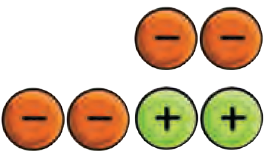
(c) 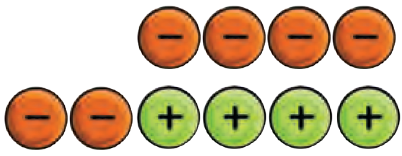
Answer:
To Find: A general rule for the multiplication of two integers and identifying the values represented by the given sets of tokens.
Rule for multiplying two integers:
1. Multiply their absolute values (the numbers without their signs).
2. If the integers have different signs, the product is negative.
3. If both integers have the same sign, the product is positive.
Analysis of Tokens:
In token interpretation, a negative token (orange/red with '-') represents $-1$ and a positive token (green with '+') represents $+1$. When a positive and negative token are paired, they form a zero pair.
(a) For the first image:
There are two negative tokens.
$(-1) + (-1) = -2$
(Value represented)
(b) For the second image:
There are four negative tokens and two positive tokens.
$(-4) + (+2) = -2$
[Two zero pairs are formed]
(c) For the third image:
There are five negative tokens and four positive tokens.
$(-5) + (+4) = -1$
[Four zero pairs are formed]
Figure It Out (Page No. 33 - 34)
Question. Find the following products.
(a) $4 \times (-3)$
(b) $(-6) \times (-3)$
(c) $(-5) \times (-1)$
(d) $(-8) \times 4$
(e) $(-9) \times 10$
(f) $10 \times (-17)$
Answer:
To Find: The product of the given pairs of integers.
Solution:
To find these products, we follow the general rules of multiplication for integers:
$\bullet$ Rule 1: If both integers have the same sign (both positive or both negative), their product is positive.
$\bullet$ Rule 2: If the integers have different signs (one positive and one negative), their product is negative.
(a) $4 \times (-3)$
The integers have different signs ($+$ and $-$).
$4 \times (-3) = -(4 \times 3)$
(Different signs)
$4 \times (-3) = -12$
[Result]
(b) $(-6) \times (-3)$
Both integers have the same sign (both are negative).
$(-6) \times (-3) = +(6 \times 3)$
(Same signs)
$(-6) \times (-3) = 18$
[Result]
(c) $(-5) \times (-1)$
Both integers have the same sign.
$(-5) \times (-1) = +(5 \times 1)$
(Same signs)
$(-5) \times (-1) = 5$
[Result]
(d) $(-8) \times 4$
The integers have different signs.
$(-8) \times 4 = -(8 \times 4)$
(Different signs)
$(-8) \times 4 = -32$
[Result]
(e) $(-9) \times 10$
The integers have different signs.
$(-9) \times 10 = -(9 \times 10)$
(Different signs)
$(-9) \times 10 = -90$
[Result]
(f) $10 \times (-17)$
The integers have different signs.
$10 \times (-17) = -(10 \times 17)$
(Different signs)
$10 \times (-17) = -170$
[Result]
Figure It Out (Page No. 39)
Question 1. Find the values of:
(a) $14 \times (-15)$
(b) $-16 \times (-5)$
(c) $36 \div (-18)$
(d) $(-46) \div (-23)$
Answer:
To Find: The numerical values of the given mathematical expressions involving multiplication and division of integers (Purnank).
Solution:
To solve these problems, we apply the rules of signs for multiplication and division of integers:
$\bullet$ Positive $\times$ Negative = Negative
$\bullet$ Negative $\times$ Negative = Positive
$\bullet$ Positive $\div$ Negative = Negative
$\bullet$ Negative $\div$ Negative = Positive
(a) $14 \times (-15)$
Here, we are multiplying a positive integer by a negative integer. The result will be negative.
$14 \times (-15) = -(14 \times 15)$
[Rule: $(+) \times (-) = (-)$]
$14 \times (-15) = -210$
(Result)
(b) $-16 \times (-5)$
Here, both integers are negative. The product of two negative integers is always positive.
$(-16) \times (-5) = +(16 \times 5)$
[Rule: $(-) \times (-) = (+)$]
$16 \times 5 = 80$
$(-16) \times (-5) = 80$
(Result)
(c) $36 \div (-18)$
In division, if the signs of the dividend and divisor are different, the quotient is negative.
$36 \div (-18) = -(36 \div 18)$
[Rule: $(+) \div (-) = (-)$]
Simplifying the fraction:
$\frac{\cancel{36}^2}{\cancel{18}_1} = 2$
$36 \div (-18) = -2$
(Result)
(d) $(-46) \div (-23)$
When dividing a negative integer by another negative integer, the quotient is positive.
$(-46) \div (-23) = +(46 \div 23)$
[Rule: $(-) \div (-) = (+)$]
Simplifying the values:
$\frac{\cancel{46}^2}{\cancel{23}_1} = 2$
$(-46) \div (-23) = 2$
(Result)
Question 2. A freezing process requires that the room temperature be lowered from $32^\circ\text{C}$ at the rate of $5^\circ\text{C}$ every hour. What will be the room temperature $10$ hours after the process begins?
Answer:
Given:
Initial room temperature $= 32^\circ\text{C}$
Rate of change in temperature $= -5^\circ\text{C}$ per hour (since it is being lowered)
Time $= 10$ hours
To Find:
Room temperature after 10 hours.
Solution:
Temperature change in 1 hour $= -5^\circ\text{C}$
Temperature change in 10 hours $= 10 \times (-5^\circ\text{C}) = -50^\circ\text{C}$
Final temperature $=$ Initial temperature $+$ Total change
Final temperature $= 32^\circ\text{C} + (-50^\circ\text{C})$
Final temperature $= 32^\circ\text{C} - 50^\circ\text{C} = -18^\circ\text{C}$
Therefore, the room temperature after 10 hours will be $-18^\circ\text{C}$.
Question 3. A cement company earns a profit of $\textsf{₹} 8$ per bag of white cement sold and a loss of $\textsf{₹} 5$ per bag of grey cement sold. [Represent the profit/ loss as integers.]
(a) The company sells $3,000$ bags of white cement and $5,000$ bags of grey cement in a month. What is its profit or loss?
(b) If the number of bags of grey cement sold is $6,400$ bags, what is the number of bags of white cement the company must sell to have neither profit nor loss.
Answer:
Given:
Profit on 1 bag of white cement $= +\textsf{₹} 8$
Loss on 1 bag of grey cement $= -\textsf{₹} 5$
(a) Solution:
Number of white cement bags sold $= 3,000$
Total profit $= 3,000 \times 8 = \textsf{₹} 24,000$
Number of grey cement bags sold $= 5,000$
Total loss $= 5,000 \times 5 = \textsf{₹} 25,000$
Net Profit/Loss $=$ Total Profit $-$ Total Loss
Net amount $= 24,000 - 25,000 = -\textsf{₹} 1,000$
Since the result is negative, the company has a loss of $\textsf{₹} 1,000$.
(b) Solution:
Number of grey bags sold $= 6,400$
Total loss $= 6,400 \times 5 = \textsf{₹} 32,000$
For "neither profit nor loss", the total profit must be equal to the total loss.
Total profit required $= \textsf{₹} 32,000$
Let the number of white cement bags be $x$.
$x \times 8 = 32,000$
$x = \frac{\cancel{32000}^{4000}}{\cancel{8}_{1}} = 4,000$
Therefore, the company must sell 4,000 bags of white cement.
Question 4. Replace the blank with an integer to make a true statement.
(a) $(-3) \times \text{_____} = 27$
(b) $5 \times \text{_____} = (-35)$
(c) $\text{_____} \times (-8) = (-56)$
(d) $\text{_____} \times (-12) = 132$
(e) $\text{_____} \div (-8) = 7$
(f) $\text{_____} \div 12 = -11$
Answer:
To Find: The missing integer in each mathematical statement to make it true.
Solution:
To find the missing integer, we use the inverse operation and follow the rules of signs for multiplication and division of Purnank (Integers):
$\bullet$ If the result is positive, both numbers must have the same sign.
$\bullet$ If the result is negative, the numbers must have different signs.
(a) $(-3) \times \text{_____} = 27$
Since the product is positive ($27$) and one factor is negative ($-3$), the missing number must be negative.
$\text{Blank} = 27 \div (-3)$
$\text{Blank} = -9$
(Negative $\times$ Negative = Positive)
(b) $5 \times \text{_____} = (-35)$
Since the product is negative ($-35$) and one factor is positive ($5$), the missing number must be negative.
$\text{Blank} = -35 \div 5$
$\text{Blank} = -7$
(Positive $\times$ Negative = Negative)
(c) $\text{_____} \times (-8) = (-56)$
Since the product is negative ($-56$) and one factor is negative ($-8$), the missing number must be positive.
$\text{Blank} = -56 \div (-8)$
$\text{Blank} = 7$
(Positive $\times$ Negative = Negative)
(d) $\text{_____} \times (-12) = 132$
Since the product is positive ($132$) and one factor is negative ($-12$), the missing number must be negative.
$\text{Blank} = 132 \div (-12)$
$\text{Blank} = -11$
(Negative $\times$ Negative = Positive)
(e) $\text{_____} \div (-8) = 7$
To find the dividend, we multiply the divisor and the quotient.
$\text{Blank} = 7 \times (-8)$
$\text{Blank} = -56$
(Positive $\times$ Negative = Negative)
(f) $\text{_____} \div 12 = -11$
The dividend will be the product of the divisor and the negative quotient.
$\text{Blank} = -11 \times 12$
$\text{Blank} = -132$
(Negative $\div$ Positive = Negative)
Figure It Out (Page No. 42 - 44)
Question 1. Find the values of the following expressions:
(a) $(-5) \times (18 + (-3))$
(b) $(-7) \times 4 \times (-1)$
(c) $(-2) \times (-1) \times (-5) \times (-3)$
Answer:
(a) Solution for $(-5) \times (18 + (-3))$:
According to the BODMAS rule, we first solve the terms inside the parentheses.
$= (-5) \times (18 - 3)$
$= (-5) \times 15$
$= \mathbf{-75}$
(b) Solution for $(-7) \times 4 \times (-1)$:
First, multiply the first two integers:
$= [(-7) \times 4] \times (-1)$
$= (-28) \times (-1)$
Since the product of two negative integers is positive:
$= \mathbf{28}$
(c) Solution for $(-2) \times (-1) \times (-5) \times (-3)$:
We can group them into pairs to multiply:
$= [(-2) \times (-1)] \times [(-5) \times (-3)]$
$= 2 \times 15$
$= \mathbf{30}$
Question 2. Find the values of the following expressions:
(a) $(-27) \div 9$
(b) $84 \div (-4)$
(c) $(-56) \div (-2)$
Answer:
(a) $(-27) \div 9$
$\text{Value} = \frac{\cancel{-27}^{-3}}{\cancel{9}_{1}}$
$\text{Value} = \mathbf{-3}$
(b) $84 \div (-4)$
$\text{Value} = \frac{\cancel{84}^{21}}{\cancel{-4}_{-1}}$
$\text{Value} = \mathbf{-21}$
(c) $(-56) \div (-2)$
When a negative integer is divided by another negative integer, the quotient is positive.
$\text{Value} = \frac{\cancel{-56}^{28}}{\cancel{-2}_{1}}$
$\text{Value} = \mathbf{28}$
Question 3. Find the integer whose product with $(-1)$ is:
(a) $27$
(b) $-31$
(c) $-1$
(d) $1$
(e) $0$
Answer:
To Find: The integer which, when multiplied by $(-1)$, gives the specified results.
Concept:
In the multiplication of integers, multiplying any number by $(-1)$ changes its sign. This is known as finding the additive inverse through multiplication.
$\bullet$ If $a \times (-1) = b$, then $a = b \div (-1) = -b$.
$\bullet$ Positive $\times$ Negative = Negative
$\bullet$ Negative $\times$ Negative = Positive
(a) Result needed: $27$
Let the required integer be $x$.
$x \times (-1) = 27$
$x = 27 \div (-1) = -27$
(Dividing by -1 changes sign)
The required integer is $-27$.
(b) Result needed: $-31$
$x \times (-1) = -31$
$x = (-31) \div (-1) = 31$
(Negative $\div$ Negative = Positive)
The required integer is $31$.
(c) Result needed: $-1$
$x \times (-1) = -1$
$x = (-1) \div (-1) = 1$
(Any number divided by itself is 1)
The required integer is $1$.
(d) Result needed: $1$
$x \times (-1) = 1$
$x = 1 \div (-1) = -1$
(Positive $\div$ Negative = Negative)
The required integer is $-1$.
(e) Result needed: $0$
$x \times (-1) = 0$
$x = 0$
(Product with zero is always zero)
The required integer is $0$.
Question 4. If $47 - 56 + 14 - 8 + 2 - 8 + 5 = -4$, then find the value of $-47 + 56 - 14 + 8 - 2 + 8 - 5$ without calculating the full expression.
Answer:
Given:
$47 - 56 + 14 - 8 + 2 - 8 + 5 = -4$
To Find:
The value of $-47 + 56 - 14 + 8 - 2 + 8 - 5$.
Solution:
Let the given expression be $A$.
$A = 47 - 56 + 14 - 8 + 2 - 8 + 5 = -4$
Now, let the expression to be found be $B$.
$B = -47 + 56 - 14 + 8 - 2 + 8 - 5$
By observing the two expressions, we can see that every term in $B$ has the opposite sign of the corresponding term in $A$. We can factor out a negative sign ($-1$) from the entire expression $B$:
$B = -(47 - 56 + 14 - 8 + 2 - 8 + 5)$
Since the value inside the bracket is given as $-4$:
$B = -(-4)$
$B = 4$
Therefore, the value of the expression is 4.
Question 5. Do you remember the Collatz Conjecture from last year? Try a modified version with integers. The rule is — start with any number; if the number is even, take half of it; if the number is odd, multiply it by $-3$ and add $1$; repeat. An example sequence is shown below.
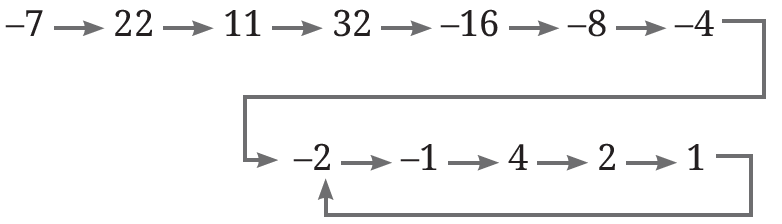
Try this with different starting numbers: $(-21)$, $(-6)$, and so on. Describe the patterns you observe.
Answer:
Given:
The rules for the modified Collatz sequence starting with any integer $n$ are:
1. If the number is even, the next term is $n \div 2$.
2. If the number is odd, the next term is $[n \times (-3)] + 1$.
To Find:
The sequence for starting numbers $-7$, $-21$, and $-6$ and the resulting pattern.
Solution:
(a) Following the rules for the sequence starting with $-7$:
$n_1 = -7$
(Odd)
$[(-7) \times (-3)] + 1 = 21 + 1 = 22$
(Even)
$22 \div 2 = 11$
(Odd)
$[11 \times (-3)] + 1 = -33 + 1 = -32$
(Even)
$-32 \div 2 = -16$
(Even)
$-16 \div 2 = -8$
(Even)
$-8 \div 2 = -4$
(Even)
$-4 \div 2 = -2$
(Even)
$-2 \div 2 = -1$
(Odd)
$[(-1) \times (-3)] + 1 = 3 + 1 = 4$
(Even)
$4 \div 2 = 2$
(Even)
$2 \div 2 = 1$
(Odd)
The sequence for $-7$ is: $-7 \to 22 \to 11 \to -32 \to -16 \to -8 \to -4 \to $$ -2 \to -1 \to 4 \to 2 \to 1$
(b) (i) For the starting number $-21$:
$n_1 = -21$
(Odd)
$[(-21) \times (-3)] + 1 = 63 + 1 = 64$
(Even)
$64 \div 2 = 32$
(Even)
$32 \div 2 = 16$
(Even)
$16 \div 2 = 8$
(Even)
$8 \div 2 = 4$
(Even)
$4 \div 2 = 2$
(Even)
$2 \div 2 = 1$
(Odd)
$[1 \times (-3)] + 1 = -2$
(Even)
$-2 \div 2 = -1$
(Odd)
$[(-1) \times (-3)] + 1 = 4$
(Cycle begins)
The sequence for $-21$ is: $-21 \to 64 \to 32 \to 16 \to 8 \to 4 \to 2 $$ \to 1 $$ \to -2 \to -1 \to 4 \dots$
(ii) For the starting number $-6$:
$n_1 = -6$
(Even)
$-6 \div 2 = -3$
(Odd)
$[(-3) \times (-3)] + 1 = 9 + 1 = 10$
(Even)
$10 \div 2 = 5$
(Odd)
$[5 \times (-3)] + 1 = -15 + 1 = -14$
(Even)
$-14 \div 2 = -7$
(Odd)
From $-7$, the sequence follows the same steps as in part (a):
$-7 \to 22 \to 11 \to -32 \to -16 \to -8 \to -4 \to -2 \to -1 \to 4 \to $$ 2 \to 1 \to -2 \dots$
The sequence for $-6$ is: $-6 \to -3 \to 10 \to 5 \to -14 \to -7 \to $$ 22 \to 11 \to -32 \to -16 \to -8 \to -4 \to -2 \to -1 \to 4 \dots$
Observation:
For different starting numbers like $-21$, $-6$, and $-7$, the sequences eventually reach a repeating loop of $-2, -1, 4, 2, 1, -2$. All starting numbers tested end up trapped in this specific cycle.
Question 6. In a test, $(+4)$ marks are given for every correct answer and $(-2)$ marks are given for every incorrect answer.
(a) Anita answered all the questions in the test. She scored $40$ marks even though $15$ of her answers were correct. How many of her answers were incorrect? How many questions are in the test?
(b) Anil scored $(-10)$ marks even though he had $5$ correct answers. How many of his answers were incorrect? Did he leave any questions unanswered?
Answer:
Given:
Marks for 1 correct answer $= +4$
Marks for 1 incorrect answer $= -2$
(a) Solution for Anita:
Marks obtained for 15 correct answers $= 15 \times 4 = 60$
Total score obtained by Anita $= 40$
Marks lost due to incorrect answers $= \text{Total score} - \text{Marks for correct answers}$
Marks lost $= 40 - 60 = -20$
Number of incorrect answers $= \frac{\text{Marks lost}}{\text{Marks per incorrect answer}} = \frac{-20}{-2} = 10$
Total number of questions $= \text{Correct answers} + \text{Incorrect answers} = 15 + 10 = 25$
Anita had 10 incorrect answers and there were 25 questions in the test.
(b) Solution for Anil:
Marks obtained for 5 correct answers $= 5 \times 4 = 20$
Total score obtained by Anil $= -10$
Marks lost due to incorrect answers $= -10 - 20 = -30$
Number of incorrect answers $= \frac{-30}{-2} = 15$
Total questions attempted by Anil $= 5 + 15 = 20$
Since the total number of questions in the test (from Anita's case) is 25, and Anil only attempted 20 questions:
Questions left unanswered $= 25 - 20 = 5$
Anil had 15 incorrect answers and he left 5 questions unanswered.
Question 7. Pick the pattern — find the operations done by the machine shown below.
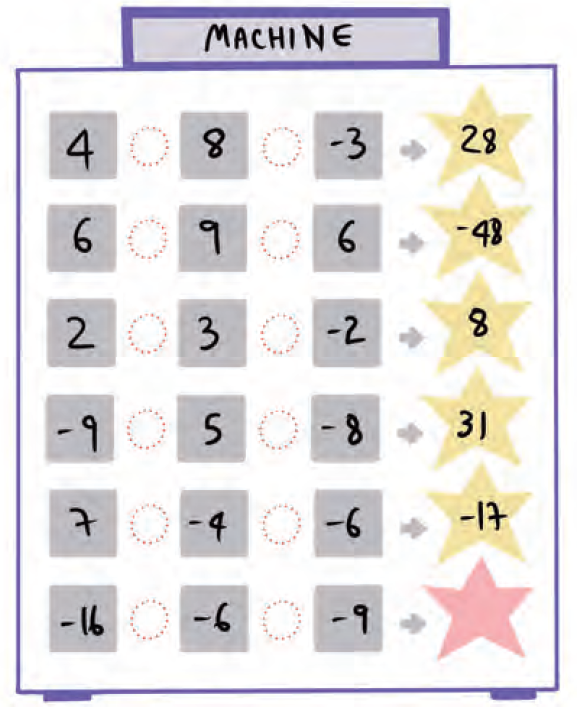
Answer:
Given:
A machine takes three numbers in a row and produces a result shown in the star. We need to identify the mathematical operations connecting these numbers.
To Find:
The operation pattern of the machine and the missing value in the VI row.
Solution:
By observing the given rows, we can identify that the operation performed by the machine is:
Result = (First Number) $-$ [Second Number $\times$ Third Number]
Let us verify this pattern for each row:
I row:
$4 - [8 \times (-3)] = 4 - (-24)$
(Substituting values)
$4 + 24 = 28$
(Matches given result)
II row:
$6 - [9 \times 6] = 6 - 54$
(Substituting values)
$6 - 54 = -48$
(Matches given result)
III row:
$2 - [3 \times (-2)] = 2 - (-6)$
(Substituting values)
$2 + 6 = 8$
(Matches given result)
IV row:
$-9 - [5 \times (-8)] = -9 - (-40)$
(Substituting values)
$-9 + 40 = 31$
(Matches given result)
V row:
$7 - [(-4) \times (-6)] = 7 - (24)$
(Substituting values)
$7 - 24 = -17$
(Matches given result)
VI row (To find missing value):
Now, applying the same pattern to the last row where the numbers are $-16$, $-6$, and $-9$:
$\text{Result} = -16 - [(-6) \times (-9)]$
(Applying the pattern)
$\text{Result} = -16 - (54)$
($-6 \times -9 = 54$)
$\text{Result} = -70$
(Final Calculation)
Thus, we have found that the pattern satisfies all the values in the machine.
Hence, the missing value in the pink star is $-70$.
Question 8. Imagine you’re in a place where the temperature drops by $5^\circ\text{C}$ each hour. If the temperature is currently at $8^\circ\text{C}$, write an expression which denotes the temperature after $4$ hours.
Answer:
Given:
Current temperature $= 8^\circ\text{C}$
Rate of temperature drop $= 5^\circ\text{C}$ per hour
Time $= 4$ hours
Solution:
A "drop" in temperature is represented as a negative integer, i.e., $-5^\circ\text{C}$ per hour.
Temperature change after 4 hours $= 4 \times (-5)$
Final Temperature $=$ Initial Temperature $+$ Total Change
The expression is: $8 + 4 \times (-5)$
Value Calculation:
$8 + (-20) = -12^\circ\text{C}$
The temperature after 4 hours will be $-12^\circ\text{C}$.
Question 9. Find $3$ consecutive numbers with a product of (a) $-6$, (b) $120$.
Answer:
To Find: Three consecutive integers whose product matches the given values.
(a) Product $= -6$
Let the three consecutive integers be $(n-1)$, $n$, and $(n+1)$.
We know that $1 \times 2 \times 3 = 6$. Since the product is $-6$, at least one or all three must be negative.
If we take the numbers: $-3, -2, -1$
$\text{Product} = (-3) \times (-2) \times (-1)$
$\text{Product} = 6 \times (-1) = -6$
Therefore, the three consecutive numbers are $-3, -2, \text{ and } -1$.
(b) Product $= 120$
We look for three consecutive positive integers whose product is $120$.
Let us try small consecutive numbers:
$3 \times 4 \times 5 = 60$
$4 \times 5 \times 6 = 120$
Therefore, the three consecutive numbers are $4, 5, \text{ and } 6$.
Question 10. An alien society uses a peculiar currency called ‘pibs’ with just two denominations of coins — a $+13$ pibs coin and a $-9$ pibs coin. You have several of these coins. Is it possible to purchase an item that costs $+85$ pibs?
Yes, we can use $10$ coins of $+13$ pibs and $5$ coins of $-9$ pibs to make a total of $+85$. Using the two denominations, try to get the following totals:
(a) $+20$
(b) $+40$
(c) $-50$
(d) $+8$
(e) $+10$
(f) $-2$
(g) $+1$
[Hint: Writing down a few multiples of $13$ and $9$ can help.]
(h) Is it possible to purchase an item that costs $1568$ pibs?
Answer:
Given:
The alien currency ‘pibs’ has two denominations of coins:
1. $+13$ pibs coin
2. $-9$ pibs coin
The problem can be represented by the linear equation: $13x - 9y = \text{Total}$, where $x$ and $y$ are the number of coins of each denomination.
To Find:
Combinations to achieve the totals: $+20$, $+40$, $-50$, $+8$, $+10$, $-2$, $+1$, and to check if $+1568$ pibs is possible.
Solution:
(a) For total $+20$:
We need to find integers $x$ and $y$ such that $13x - 9y = 20$.
If $x = 1$, then $13 - 9y = 20 \implies -9y = 7$ (No integer solution).
If $x = 2$, then $26 - 9y = 20 \implies -9y = -6$ (No integer solution).
If $x = 3$, then $39 - 9y = 20 \implies -9y = -19$ (No integer solution).
If $x = 4$, then $52 - 9y = 20 \implies -9y = -32$ (No integer solution).
If $x = 5$, then $65 - 9y = 20 \implies -9y = -45 \implies y = 5$.
Thus, using $5$ coins of $+13$ and $5$ coins of $-9$:
$13(5) - 9(5) = 65 - 45 = 20$
(b) For total $+40$:
Take $10$ coins of $+13$ and $10$ coins of $-9$:
$10 \times 13 - 10 \times 9 = 130 - 90 = +40$ pibs.
(c) For total $-50$:
Take $10$ coins of $+13$ and $20$ coins of $-9$:
$10 \times 13 - 20 \times 9 = 130 - 180 = -50$ pibs.
(d) For total $+8$:
Take $2$ coins of $+13$ and $2$ coins of $-9$:
$2 \times 13 - 2 \times 9 = 26 - 18 = +8$ pibs.
(e) For total $+10$:
Take $7$ coins of $+13$ and $9$ coins of $-9$:
$7 \times 13 - 9 \times 9 = 91 - 81 = +10$ pibs.
(f) For total $-2$:
Take $13$ coins of $+13$ and $19$ coins of $-9$:
$13 \times 13 - 19 \times 9 = 169 - 171 = -2$ pibs.
(g) For total $+1$:
Take $7$ coins of $+13$ and $10$ coins of $-9$:
$7 \times 13 - 10 \times 9 = 91 - 90 = +1$ pibs.
(h) Is it possible to purchase an item that costs $1568$ pibs?
Yes, it is possible.
Take $122$ coins of $+13$ and $2$ coins of $-9$:
$122 \times 13 - 2 \times 9 = 1586 - 18 = 1568$ pibs.
Question 11. Find the values of:
(a) $(32 \times (-18)) \div ((-36))$
(b) $(32) \div ((-36) \times (-18))$
(c) $(25 \times (-12)) \div ((45) \times (-27))$
(d) $(280 \times (-7)) \div ((-8) \times (-35))$
Answer:
(a) $(32 \times (-18)) \div ((-36))$
First, calculate the product: $32 \times (-18) = -576$
Now, divide: $\frac{\cancel{-576}^{16}}{\cancel{-36}_{1}} = \mathbf{16}$
(b) $(32) \div ((-36) \times (-18))$
First, calculate the product: $(-36) \times (-18) = 648$
Value $= \frac{\cancel{32}^{4}}{\cancel{648}_{81}} = \mathbf{\frac{4}{81}}$
(c) $(25 \times (-12)) \div ((45) \times (-27))$
Numerator $= 25 \times (-12) = -300$
Denominator $= 45 \times (-27) = -1215$
Value $= \frac{\cancel{-300}^{20}}{\cancel{-1215}_{81}} = \mathbf{\frac{20}{81}}$ [Dividing by 15]
(d) $(280 \times (-7)) \div ((-8) \times (-35))$
Numerator $= 280 \times (-7) = -1960$
Denominator $= (-8) \times (-35) = 280$
Value $= \frac{\cancel{-1960}^{-7}}{\cancel{280}_{1}} = \mathbf{-7}$
Question 12. Arrange the expressions given below in increasing order.
(a) $(-348) + (-1064)$
(b) $(-348) - (-1064)$
(c) $348 - (-1064)$
(d) $(-348) \times (-1064)$
(e) $348 \times (-1064)$
(f) $348 \times 964$
Answer:
Solution:
Let us estimate or calculate the approximate values:
(a) $(-348) + (-1064) = -1412$
(b) $(-348) + 1064 = 716$
(c) $348 + 1064 = 1412$
(d) $(-348) \times (-1064) = +3,70,272$
(e) $348 \times (-1064) = -3,70,272$
(f) $348 \times 964 = +3,35,472$
Comparison:
Comparing the values: $-3,70,272 < -1412 < 716 < 1412 < 3,35,472 < 3,70,272$
Increasing Order:
The correct order is: (e) < (a) < (b) < (c) < (f) < (d)
Question 13. Given that $(-548) \times 972 = -532656$, write the values of:
(a) $(-547) \times 972$
(b) $(-548) \times 971$
(c) $(-547) \times 971$
Answer:
Given:
$(-548) \times 972 = -532656$
(a) Solution for $(-547) \times 972$:
We can write $-547$ as $(-548 + 1)$.
$(-547) \times 972 = (-548 + 1) \times 972$
$= ((-548) \times 972) + (1 \times 972)$
$= -532656 + 972$
$= \mathbf{-531684}$
(b) Solution for $(-548) \times 971$:
We can write $971$ as $(972 - 1)$.
$(-548) \times 971 = (-548) \times (972 - 1)$
$= ((-548) \times 972) - ((-548) \times 1)$
$= -532656 - (-548)$
$= -532656 + 548$
$= \mathbf{-532108}$
(c) Solution for $(-547) \times 971$:
Using the result from part (a): $(-547) \times 972 = -531684$
$(-547) \times 971 = (-547) \times (972 - 1)$
$= ((-547) \times 972) - ((-547) \times 1)$
$= -531684 - (-547)$
$= -531684 + 547$
$= \mathbf{-531137}$
Question 14. Given that $207 \times (-33 + 7) = -5382$, write the value of $-207 \times (33 - 7) = \text{_________}$.
Answer:
Given:
$207 \times (-33 + 7) = -5382$
Simplifying the given expression: $207 \times (-26) = -5382$
To Find:
The value of $-207 \times (33 - 7)$
Solution:
First, simplify the expression in the bracket:
$(33 - 7) = 26$
Now, we need to find the value of $-207 \times 26$.
We know from the given part that $207 \times 26 = 5382$ (since multiplying by a negative gives a negative, multiplying by the positive gives the positive equivalent).
Therefore:
$-207 \times 26 = -(207 \times 26) = -5382$
The value is $-5382$.
Question 15. Use the numbers $3, -2, 5, -6$ exactly once and the operations ‘$+$’, ‘$-$’, and ‘$\times$’ exactly once and brackets as necessary to write an expression such that —
(a) the result is the maximum possible
(b) the result is the minimum possible
Answer:
Given:
Numbers: $3, -2, 5, -6$
Operations: ‘$+$’, ‘$-$’, and ‘$\times$’ (exactly once each)
To Find:
Expressions using these numbers and operations such that:
(a) The result is the maximum possible.
(b) The result is the minimum possible.
Solution:
(a) For the maximum possible value:
By grouping the positive and negative integers strategically to create a large negative number and then multiplying it by a negative number, we get a large positive result.
Expression: $[(-2) - (3 + 5)] \times (-6)$
$= (-2 - 8) \times (-6)$
$= (-10) \times (-6)$
$= 60$
The maximum possible value is $60$.
(b) For the minimum possible value:
By creating a large positive number within the brackets and multiplying it by a negative number, we obtain the smallest (most negative) result.
Expression: $[3 - (-2) + 5] \times (-6)$
$= (3 + 2 + 5) \times (-6)$
$= (10) \times (-6)$
$= -60$
The minimum possible value is $-60$.
Question 16. Fill in the blanks in at least $5$ different ways with integers:
(a) $\text{_____} + \text{_____} \times \text{_____} = -36$
(b) $(\text{_____} - \text{_____}) \times \text{_____} = 12$
(c) $(\text{_____} - (\text{_____} - \text{_____})) = -1$
Answer:
(a) Solutions for $\_\_\_ + \_\_\_ \times \_\_\_ = -36$:
1. $0 + (-6) \times 6 = -36$
2. $(-6) + (-10) \times 3 = -36$
3. $4 + (-8) \times 5 = -36$
4. $(-40) + 2 \times 2 = -36$
5. $12 + (-6) \times 8 = -36$
(b) Solutions for $(\_\_\_ - \_\_\_) \times \_\_\_ = 12$:
1. $(10 - 4) \times 2 = 12$
2. $(5 - 1) \times 3 = 12$
3. $(2 - 8) \times (-2) = 12$
4. $(0 - (-12)) \times 1 = 12$
5. $(15 - 11) \times 3 = 12$
(c) Solutions for $(\_\_\_ - (\_\_\_ - \_\_\_)) = -1$:
1. $(5 - (10 - 4)) = -1$
2. $(0 - (5 - 4)) = -1$
3. $((-2) - (4 - 5)) = -1$
4. $(10 - (15 - 4)) = -1$
5. $(2 - (5 - 2)) = -1$