

Chapter 4 Another Peek Beyond the Point (Class 7 - Latest Maths NCERT (Ganita Prakash II) Solutions)
Looking for expert-verified NCERT Solutions for Chapter 4: Another Peek Beyond the Point? You’ve arrived at the perfect destination! This page provides clear, step-by-step answers for the latest Class 7 Maths curriculum, helping you master the mechanics of Multiplication and Division of Decimals. We move beyond basic rules to show you how these operations are natural extensions of our place value system, ensuring you can accurately calculate everything from market prices to average travel speeds.
Our solutions offer comprehensive guidance on the Long Division method for Decimal Quotients, illustrating the precise technique of regrouping tenths and hundredths to find exact values. We provide detailed breakdowns for the "Magic of Cycles," including the logic of non-terminating decimals like $10 \div 3$ and the fascinating behavior of the cyclic number 142857. You will also find clear explanations for the relationship between dividends and divisors, helping you understand why dividing by a decimal can result in a larger quotient.
The final section of our solutions covers the astronomical math of the "Look Before You Leap!" topic, where we solve problems related to the Earth’s $365.2422$-day orbit and the logic behind leap years. To support your learning, this page offers detailed place-value breakdowns, step-by-step long division walkthroughs, and visual calendar logic based on the Ganita Prakash II textbook. These resources, curated by learningspot.co, are designed to ensure you master every decimal point with confidence.
| Content On This Page | ||
|---|---|---|
| Figure It Out (Page No. 73 - 74) | Figure It Out (Page No. 83) | Figure It Out (Page No. 86 - 87) |
| Figure It Out (Page No. 93 - 95) | ||
Figure It Out (Page No. 73 - 74)
Question 1. Recall that a tenth is $0.1$, a hundredth is $0.01$, and so on. Find the following products in tenths, hundredths and so on:
(a) $6 \times 4$ tenths $= 24$ tenths
(b) $7 \times 0.3$
(c) $9 \times 5$ hundredths
Answer:
(a) $6 \times 4$ tenths
$6 \times 4 \text{ tenths} = 24 \text{ tenths}$
As a decimal: $\mathbf{2.4}$
(b) $7 \times 0.3$
$0.3$ can be expressed as $3$ tenths.
$7 \times 3 \text{ tenths} = 21 \text{ tenths}$
As a decimal: $\mathbf{2.1}$
(c) $9 \times 5$ hundredths
$9 \times 5 \text{ hundredths} = 45 \text{ hundredths}$
As a decimal: $\mathbf{0.45}$
Question 2. Find the products:
(a) $27.34 \times 6$
(b) $4.23 \times 3.7$
(c) $0.432 \times 0.23$
Answer:
(a) $27.34 \times 6$
Multiplying the numbers ignoring the decimal: $2734 \times 6 = 16404$
Since there are $2$ decimal places in $27.34$, we place the decimal point $2$ places from the right in the product.
Result: $164.04$
(b) $4.23 \times 3.7$
Multiplying the numbers ignoring the decimal: $423 \times 37 = 15651$
Total decimal places in the factors $= 2$ (in $4.23$) $+ 1$ (in $3.7$) $= 3$.
Result: $15.651$
(c) $0.432 \times 0.23$
Multiplying the numbers ignoring the decimal: $432 \times 23 = 9936$
Total decimal places in the factors $= 3$ (in $0.432$) $+ 2$ (in $0.23$) $= 5$.
Result: $0.09936$
Question 3. Thejus needs $1.65\text{ m}$ of cloth for a shirt. How many metres of cloth are needed for $3$ shirts?
Answer:
Given:
Cloth needed for $1$ shirt $= 1.65\text{ m}$
Number of shirts $= 3$
To Find:
Total cloth needed for $3$ shirts.
Solution:
$\text{Total cloth} = 1.65 \times 3$
$\text{Total cloth} = 4.95\text{ m}$
Therefore, $4.95\text{ m}$ of cloth is needed for $3$ shirts.
Question 4. Meenu bought $4$ notebooks and $3$ erasers. The cost of each book was $\textsf{₹} 15.50$ and each eraser was $\textsf{₹} 2.75$. How much did she spend in all?
Answer:
Given:
Number of notebooks $= 4$
Cost of each notebook $= \textsf{₹} 15.50$
Number of erasers $= 3$
Cost of each eraser $= \textsf{₹} 2.75$
To Find:
Total money spent by Meenu.
Solution:
$\text{Total cost of notebooks} = 4 \times 15.50 = \textsf{₹} 62.00$
$\text{Total cost of erasers} = 3 \times 2.75 = \textsf{₹} 8.25$
$\text{Total money spent} = \textsf{₹} 62.00 + \textsf{₹} 8.25 = \textsf{₹} 70.25$
Therefore, she spent $\textsf{₹} 70.25$ in all.
Question 5. The thickness of a rupee coin is $1.45\text{ mm}$. What is the total height of the cylinder formed by placing $36$ rupee coins one over the other? Write the answer in centimeters.
Answer:
Given:
Thickness of one rupee coin $= 1.45\text{ mm}$
Number of coins $= 36$
To Find:
Total height of the cylinder in centimeters.
Solution:
$\text{Total height in mm} = 1.45 \times 36$
$\text{Total height} = 52.2\text{ mm}$
Now, converting the height from millimetres to centimetres (as $10\text{ mm} = 1\text{ cm}$):
$\text{Height in cm} = \frac{52.2}{10} = 5.22\text{ cm}$
Therefore, the total height of the cylinder is $5.22\text{ cm}$.
Question 6. The price of $1\text{ kg}$ of oranges is $\textsf{₹} 56.50$. What is the price of $2.250\text{ kg}$ of oranges?
Can we write $56.50$ as $56.5$ and $2.250$ as $2.25$ and multiply? Will we get the same product? Why?
Answer:
Given:
$\text{Price of } 1\text{ kg orange} = \textsf{₹} 56.50$
(Given)
$\text{Weight of oranges} = 2.250\text{ kg}$
(Given)
To Find:
The total price of $2.250\text{ kg}$ oranges and check if removing trailing zeros affects the result.
Solution:
To find the total price, we multiply the price per kg by the weight.
$\text{Total Price} = 56.50 \times 2.250$
Yes, we can write $56.50$ as $56.5$ and $2.250$ as $2.25$. We will get the same product.
$\text{Total Price} = 56.5 \times 2.25$
Multiplying $565 \times 225$ and placing the decimal point $3$ places from the right:
$\text{Total Price} = \textsf{₹} 127.125$
[Final product]
Therefore, the price of $2.250\text{ kg}$ of oranges is $\textsf{₹} 127.125$.
Question 7. Dwarakanath purchases notebooks at a wholesale price of $\textsf{₹} 23.6$ per piece and sells each notebook at $\textsf{₹} 30/-$. How much profit does he make if he sells $50$ books in a week?
Answer:
Given:
Cost Price (CP) of one notebook $= \textsf{₹} 23.6$
Selling Price (SP) of one notebook $= \textsf{₹} 30$
Number of notebooks sold $= 50$
To Find:
Total profit made in a week.
Solution:
First, let us calculate the profit made on a single notebook.
$\text{Profit per book} = \text{Selling Price} - \text{Cost Price}$
$\text{Profit per book} = 30 - 23.6 = \textsf{₹} 6.4$
Now, calculate the total profit for $50$ notebooks.
$\text{Total Profit} = \text{Profit per book} \times \text{Total books}$
$\text{Total Profit} = 6.4 \times 50$
$\text{Total Profit} = 64 \times 5 = \textsf{₹} 320$
Dwarakanath makes a total profit of $\textsf{₹} 320$.
Alternate Solution:
$\text{Total Selling Price} = 30 \times 50 = \textsf{₹} 1500$
$\text{Total Cost Price} = 23.6 \times 50 = \textsf{₹} 1180$
$\text{Total Profit} = 1500 - 1180 = \textsf{₹} 320$
Question 8. Given that $18 \times 12 = 216$, find the products:
(a) $18 \times 1.2$
(b) $18 \times 0.12$
(c) $1.8 \times 1.2$
(d) $0.18 \times 0.12$
(e) $0.018 \times 0.012$
(f) $1.8 \times 12$
In which of the cases above is the product less than $1$?
Answer:
Given:
The product of two whole numbers:
$18 \times 12 = 216$
(Given)
To Find:
1. The products for cases (a) to (f) using the given information.
2. Identify the cases where the final product is less than $1$.
Solution:
When multiplying decimal numbers, we first multiply them as whole numbers and then place the decimal point in the product. The number of decimal places in the product is equal to the sum of the decimal places in the numbers being multiplied.
We use the fact that the digits in the product will always be $216$.
(a) $18 \times 1.2$
$18 \times 1.2 = 21.6$
[1 decimal place]
(b) $18 \times 0.12$
$18 \times 0.12 = 2.16$
[2 decimal places]
(c) $1.8 \times 1.2$
$1.8 \times 1.2 = 2.16$
[1 + 1 = 2 decimal places]
(d) $0.18 \times 0.12$
$0.18 \times 0.12 = 0.0216$
[2 + 2 = 4 decimal places]
(e) $0.018 \times 0.012$
$0.018 \times 0.012 = 0.000216$
[3 + 3 = 6 decimal places]
(f) $1.8 \times 12$
$1.8 \times 12 = 21.6$
[1 decimal place]
Final Conclusion:
A number is less than $1$ if its integral part (the part before the decimal point) is $0$.
Looking at the results above:
Case (d): $0.0216 < 1$
Case (e): $0.000216 < 1$
Therefore, the products in cases (d) and (e) are less than $1$.
Question 9. In which of the following multiplications is the product less than $1$? Can you find the answer without actually doing the multiplications?
(a) $7 \times 0.6$
(b) $0.7 \times 0.6$
(c) $0.7 \times 6$
(d) $0.07 \times 0.06$
Answer:
Given:
Multiplication expressions: (a) $7 \times 0.6$, (b) $0.7 \times 0.6$, (c) $0.7 \times 6$, and (d) $0.07 \times 0.06$.
To Find:
Identify which products are less than $1$ without performing the full calculation.
Solution:
We can identify if a product is less than $1$ by using the following mathematical principles:
1. Rule of Proper Fractions: If both numbers being multiplied are less than $1$ (i.e., proper decimals), their product will always be less than $1$.
2. Estimation: If one number is significantly larger than $1$, we check if the other decimal factor is small enough to pull the product below $1$.
Let us analyze the options:
(a) $7 \times 0.6$
Here, $7$ is a large whole number. $0.6$ is more than half ($\frac{1}{2}$). Since half of $7$ is $3.5$, the product must be greater than $1$.
(b) $0.7 \times 0.6$
Both factors, $0.7$ and $0.6$, are less than $1$. According to the rule, their product must be less than $1$.
(c) $0.7 \times 6$
Here, $6$ is a whole number greater than $1$. Since $0.7$ is more than half, the product (roughly $4.2$) is clearly greater than $1$.
(d) $0.07 \times 0.06$
Both factors, $0.07$ and $0.06$, are less than $1$. Therefore, their product must be less than $1$.
Final Conclusion:
The products in cases (b) and (d) are less than $1$. We found this by observing that in these cases, both factors are decimals smaller than $1$.
Verification through Calculation:
$0.7 \times 0.6 = 0.42$
[Case (b): $0.42 < 1$]
$0.07 \times 0.06 = 0.0042$
[Case (d): $0.0042 < 1$]
Question 10. Multiplying the following numbers by $10, 100$ and $1000$ to complete the table.
| Number | $\times 10$ | $\times 100$ | $\times 1000$ |
|---|---|---|---|
| $5.7$ | |||
| $23.02$ | |||
| $0.92$ | |||
| $0.306$ | |||
| $24.67$ |
Answer:
Given:
A set of decimal numbers: $5.7$, $23.02$, $0.92$, $0.306$, and $24.67$.
To Find:
The product of these numbers when multiplied by $10$, $100$, and $1000$.
Solution:
When multiplying a decimal number by powers of $10$ (like $10, 100, 1000$), we shift the decimal point to the right by as many places as there are zeros in the multiplier.
1. Multiplying by $10$: Shift decimal point one place to the right.
2. Multiplying by $100$: Shift decimal point two places to the right.
3. Multiplying by $1000$: Shift decimal point three places to the right.
Completed Table:
| Number | $\times 10$ | $\times 100$ | $\times 1000$ |
| $5.7$ | $57$ | $570$ | $5700$ |
| $23.02$ | $230.2$ | $2302$ | $23020$ |
| $0.92$ | $9.2$ | $92$ | $920$ |
| $0.306$ | $3.06$ | $30.6$ | $306$ |
| $24.67$ | $246.7$ | $2467$ | $24670$ |
Exemplary Calculation:
For the number $23.02$:
$23.02 \times 10 = 230.2$
[Shift 1 place right]
$23.02 \times 100 = 2302$
[Shift 2 places right]
$23.02 \times 1000 = 23020$
[Shift 3 places right]
Figure It Out (Page No. 83)
Question 1. Find the quotient by converting the denominator into $1, 10, 100$ or $1000$ and verify the solution by the long division method (division by place value).
(a) $\frac{18}{5}$
(b) $\frac{415}{4}$
(c) $\frac{1217}{2}$
(d) $\frac{4827}{8}$
Answer:
Given:
The following fractions are to be converted into decimals:
(a) $\frac{18}{5}$ (b) $\frac{415}{4}$ (c) $\frac{1217}{2}$ (d) $\frac{4827}{8}$
To Find:
The quotient for each case by converting the denominator into a power of $10$ and verifying through long division.
Solution:
(a) Solving $\frac{18}{5}$
To convert the denominator $5$ into $10$, we multiply both the numerator and the denominator by $2$.
$\frac{18 \times 2}{5 \times 2} = \frac{36}{10}$
$36 \div 10 = 3.6$
Verification: Upon dividing $18$ by $5$, we get $5 \times 3 = 15$. The remainder is $3$. Adding a decimal point and a zero makes it $30$. Since $5 \times 6 = 30$, the quotient is $3.6$.
(b) Solving $\frac{415}{4}$
To convert the denominator $4$ into $100$, we multiply both the numerator and the denominator by $25$.
$\frac{415 \times 25}{4 \times 25} = \frac{10375}{100}$
$10375 \div 100 = 103.75$
Verification: Dividing $415$ by $4$ gives $103$ as the whole number part with a remainder of $3$. Extending the division with decimals, $3.0 \div 4 = 0.7$ with remainder $2$, and $0.20 \div 4 = 0.05$. The total quotient is $103.75$.
(c) Solving $\frac{1217}{2}$
To convert the denominator $2$ into $10$, we multiply both the numerator and the denominator by $5$.
$\frac{1217 \times 5}{2 \times 5} = \frac{6085}{10}$
$6085 \div 10 = 608.5$
Verification: Dividing $1217$ by $2$ gives $608$ with a remainder of $1$. Adding a decimal zero makes it $10$, which divided by $2$ is $5$. Thus, the quotient is $608.5$.
(d) Solving $\frac{4827}{8}$
To convert the denominator $8$ into $1000$, we multiply both the numerator and the denominator by $125$.
$\frac{4827 \times 125}{8 \times 125} = \frac{603375}{1000}$
[$8 \times 125 = 1000$]
$603375 \div 1000 = 603.375$
Verification: Dividing $4827$ by $8$ gives $603$ with a remainder of $3$. Continuing the division into decimals: $30 \div 8 = 3$ (rem $6$), $60 \div 8 = 7$ (rem $4$), and $40 \div 8 = 5$. The final quotient is $603.375$.
Question 2. Choose the correct answer:
(a) $\frac{1526}{4} =$
(i) $38.15$
(ii) $380.15$
(iii) $381.5$
(iv) $381.05$
(b) $\frac{3567}{8} =$
(i) $4458.75$
(ii) $44.5875$
(iii) $445.875$
(iv) $4458.75$
Answer:
(a) Solution:
$\frac{1526}{4} = \frac{1526 \times 25}{4 \times 25} = \frac{38150}{100} = 381.5$
The correct answer is (iii) $381.5$.
(b) Solution:
$\frac{3567}{8} = \frac{3567 \times 125}{8 \times 125} = \frac{445875}{1000} = 445.875$
The correct answer is (iii) $445.875$.
Question 3. What is the quotient?
(a) $132 \div 4 =$
(b) $13.2 \div 4 =$
(c) $1.32 \div 4 =$
(d) $0.132 \div 4 =$
Answer:
Given:
A series of division problems where the divisor is $4$ and the dividends are powers of $10$ variations of $132$.
To Find:
The quotients for (a) $132 \div 4$, (b) $13.2 \div 4$, (c) $1.32 \div 4$, and (d) $0.132 \div 4$.
Solution:
To solve these efficiently, we first calculate the quotient of the whole numbers and then apply the rules for decimal division.
Step 1: Divide the whole numbers
$132 \div 4 = 33$
Step 2: Apply decimal rules
When dividing a decimal by a whole number, we perform the division as if there were no decimal point, and then place the decimal point in the quotient directly above the decimal point in the dividend. Effectively, the quotient has the same number of decimal places as the dividend.
(a) $132 \div 4$
$132 \div 4 = \mathbf{33}$
(Whole number division)
(b) $13.2 \div 4$
$13.2 \div 4 = \mathbf{3.3}$
[1 decimal place in dividend]
(c) $1.32 \div 4$
$1.32 \div 4 = \mathbf{0.33}$
[2 decimal places in dividend]
(d) $0.132 \div 4$
$0.132 \div 4 = \mathbf{0.033}$
[3 decimal places in dividend]
Question 4. What is the quotient?
(a) $126 \div 8 =$
(b) $12.6 \div 8 =$
(c) $1.26 \div 8 =$
(d) $0.126 \div 8 =$
(e) $0.0126 \div 8 =$
Answer:
Given:
Dividends starting from $126$ decreasing by powers of $10$, all divided by the divisor $8$.
To Find:
The quotients for parts (a) through (e).
Solution:
Step 1: Find the basic quotient for $126 \div 8$
We can simplify the fraction $\frac{126}{8}$ by dividing both the numerator and the denominator by their common factor $2$.
$\frac{\cancel{126}^{63}}{\cancel{8}_{4}} = \frac{63}{4}$
Now, dividing $63$ by $4$:
$63 \div 4 = 15.75$
Step 2: Determine quotients by shifting the decimal point
For every power of $10$ that the dividend is reduced, the decimal point in the quotient shifts one place to the left.
(a) $126 \div 8$
$126 \div 8 = \mathbf{15.75}$
(Base calculation)
(b) $12.6 \div 8$
$12.6 \div 8 = \mathbf{1.575}$
[Shift decimal 1 place left]
(c) $1.26 \div 8$
$1.26 \div 8 = \mathbf{0.1575}$
[Shift decimal 2 places left]
(d) $0.126 \div 8$
$0.126 \div 8 = \mathbf{0.01575}$
[Shift decimal 3 places left]
(e) $0.0126 \div 8$
$0.0126 \div 8 = \mathbf{0.001575}$
[Shift decimal 4 places left]
Figure It Out (Page No. 86 - 87)
Question 1. Express the following fractions in decimal form:
(a) $\frac{2}{5}$
(b) $\frac{13}{4}$
(c) $\frac{4}{50}$
(d) $\frac{5}{8}$
Answer:
(a) $\frac{2}{5}$
To convert $\frac{2}{5}$ into decimal form, we multiply both the numerator and the denominator by $2$ to make the denominator $10$.
$\frac{2 \times 2}{5 \times 2} = \frac{4}{10} = \mathbf{0.4}$
(b) $\frac{13}{4}$
To convert $\frac{13}{4}$ into decimal form, we multiply both the numerator and the denominator by $25$ to make the denominator $100$.
$\frac{13 \times 25}{4 \times 25} = \frac{325}{100} = \mathbf{3.25}$
(c) $\frac{4}{50}$
To convert $\frac{4}{50}$ into decimal form, we multiply both the numerator and the denominator by $2$ to make the denominator $100$.
$\frac{4 \times 2}{50 \times 2} = \frac{8}{100} = \mathbf{0.08}$
(d) $\frac{5}{8}$
To convert $\frac{5}{8}$ into decimal form, we multiply both the numerator and the denominator by $125$ to make the denominator $1000$.
$\frac{5 \times 125}{8 \times 125} = \frac{625}{1000} = \mathbf{0.625}$
Question 2. Find the quotients:
(a) $24.86 \div 1.2$
(b) $5.728 \div 1.52$
Answer:
Given:
Two decimal division problems:
(a) $24.86 \div 1.2$
(b) $5.728 \div 1.52$
To Find:
The quotients by converting divisors into whole numbers and performing long division with proper alignment.
Solution:
(a) Solving $24.86 \div 1.2$
First, we convert the divisor $1.2$ into a whole number by multiplying both the dividend and the divisor by $10$.
$\frac{24.86 \times 10}{1.2 \times 10} = \frac{248.6}{12}$
[Shifting decimal 1 place right]
Now, we perform the long division for $248.6 \div 12$:
$\begin{array}{r} 20.716...\phantom{)} \\ 12{\overline{\smash{\big)}\,248.600\phantom{)}}} \\ \underline{-~24\phantom{.600)}} \\ 08\phantom{.600)} \\ \underline{-~~0\phantom{.600)}} \\ 86\phantom{.00)} \\ \underline{-~84\phantom{.00)}} \\ 20\phantom{.0)} \\ \underline{-~12\phantom{.0)}} \\ 80\phantom{)} \\ \underline{-~72\phantom{)}} \\ 8\phantom{)} \end{array}$
The division is non-terminating. Rounding the quotient to two decimal places, we get:
Quotient $\approx 20.72$
(b) Solving $5.728 \div 1.52$
We convert the divisor $1.52$ into a whole number by multiplying both the dividend and the divisor by $100$.
$\frac{5.728 \times 100}{1.52 \times 100} = \frac{572.8}{152}$
[Shifting decimal 2 places right]
Now, we perform the long division for $572.8 \div 152$:
$\begin{array}{r} 3.768...\phantom{)} \\ 152{\overline{\smash{\big)}\,572.800\phantom{)}}} \\ \underline{-~456\phantom{.800)}} \\ 1168\phantom{.00)} \\ \underline{-~1064\phantom{.00)}} \\ 1040\phantom{.0)} \\ \underline{-~~912\phantom{.0)}} \\ 1280\phantom{)} \\ \underline{-~1216\phantom{)}} \\ 64\phantom{)} \end{array}$
Rounding the quotient to two decimal places, we get:
Quotient $\approx 3.77$
Final Answer:
(a) The quotient is approximately $20.72$.
(b) The quotient is approximately $3.77$.
Question 3. Evaluate the following using the information $156 \times 12 = 1872$.
(a) $15.6 \times 1.2 = \text{__________}$
(b) $187.2 \div 1.2 = \text{__________}$
(c) $18.72 \div 15.6 = \text{__________}$
(d) $0.156 \times 0.12 = \text{__________}$
Answer:
Given:
$156 \times 12 = 1872$
To Find:
Evaluate (a) $15.6 \times 1.2$, (b) $187.2 \div 1.2$, (c) $18.72 \div 15.6$ and (d) $0.156 \times 0.12$.
Solution:
(a) Evaluating $15.6 \times 1.2$
When multiplying decimal numbers, we multiply them as whole numbers first and then place the decimal point. The number of decimal places in the product is the sum of decimal places in the factors.
Number of decimal places in $15.6 = 1$
Number of decimal places in $1.2 = 1$
Total decimal places in the product = $1 + 1 = 2$
$15.6 \times 1.2 = 18.72$
[Using 2 decimal places]
(b) Evaluating $187.2 \div 1.2$
To divide, we convert the divisor into a whole number by shifting the decimal point.
$\frac{187.2}{1.2} = \frac{1872}{12}$
From the given information $156 \times 12 = 1872$, we can derive the division fact:
$1872 \div 12 = 156$
Therefore,
$187.2 \div 1.2 = 156$
(c) Evaluating $18.72 \div 15.6$
Similarly, we convert the divisor into a whole number by multiplying both terms by $10$.
$\frac{18.72}{15.6} = \frac{187.2}{156}$
From the given information, $1872 \div 156 = 12$. Since we are dividing $187.2$ (which is $1872 \div 10$), the result will be $12 \div 10$.
$18.72 \div 15.6 = 1.2$
[Using derived division fact]
(d) Evaluating $0.156 \times 0.12$
Number of decimal places in $0.156 = 3$
Number of decimal places in $0.12 = 2$
Total decimal places in the product = $3 + 2 = 5$
We take the base product $1872$ and move the decimal $5$ places to the left. We add a zero as a placeholder.
$0.156 \times 0.12 = 0.01872$
Final Answers:
(a) $18.72$
(b) $156$
(c) $1.2$
(d) $0.01872$
Question 4. Evaluate the following:
(a) $25 \div \text{______} = 0.025$
(b) $25 \div \text{______} = 250$
(c) $25 \div \text{______} = 2.5$
(d) $25 \div 10 = 25 \times \text{_____}$
(e) $25 \div 0.10 = 25 \times \text{______}$
(f) $25 \div 0.01 = 25 \times \text{______}$
Answer:
(a) $25 \div \text{______} = 0.025$
To get $0.025$ from $25$, the decimal point has shifted three places to the left. This happens when we divide by $1000$.
$25 \div \mathbf{1000} = 0.025$
(b) $25 \div \text{______} = 250$
To increase the value from $25$ to $250$ through division, we must divide by a decimal number less than $1$. Here, the value is multiplied by $10$, which is the same as dividing by $0.1$.
$25 \div \mathbf{0.1} = 250$
(c) $25 \div \text{______} = 2.5$
The decimal point has shifted one place to the left. This happens when we divide by $10$.
$25 \div \mathbf{10} = 2.5$
(d) $25 \div 10 = 25 \times \text{_____}$
Division by a number is the same as multiplication by its reciprocal. The reciprocal of $10$ is $\frac{1}{10}$, which is $0.1$.
$25 \div 10 = 25 \times \mathbf{0.1}$
(e) $25 \div 0.10 = 25 \times \text{______}$
The reciprocal of $0.10$ (which is $\frac{1}{10}$) is $10$.
$25 \div 0.10 = 25 \times \mathbf{10}$
(f) $25 \div 0.01 = 25 \times \text{______}$
The reciprocal of $0.01$ (which is $\frac{1}{100}$) is $100$.
$25 \div 0.01 = 25 \times \mathbf{100}$
Question 5. Find the quotient:
(a) $2.46 \div 1.5 =$
(b) $2.46 \div 0.15 =$
(c) $2.46 \div 0.015 =$
Is the quotient obtained in $24.6 \div 1.5$ the same as the quotient obtained in $2.46 \div 0.15$?
Answer:
Given:
Division expressions: (a) $2.46 \div 1.5$, (b) $2.46 \div 0.15$, and (c) $2.46 \div 0.015$.
To Find:
The quotients for the given expressions and a comparison between the quotients of $24.6 \div 1.5$ and $2.46 \div 0.15$.
Solution:
To divide by a decimal, we first convert the divisor into a whole number by multiplying both the dividend and the divisor by an appropriate power of $10$.
(b) Solving $2.46 \div 0.15$ (Base Calculation)
The divisor $0.15$ has two decimal places. Multiplying both terms by $100$ gives:
$\frac{2.46 \times 100}{0.15 \times 100} = \frac{246}{15}$
Performing long division for $246 \div 15$:
$\begin{array}{r} 16.4\phantom{6.0)} \\ 15{\overline{\smash{\big)}\,246.0\phantom{)}}} \\ \underline{-~15\phantom{.00)}} \\ 096\phantom{.00)} \\ \underline{-~90\phantom{.00)}} \\ 06.0\phantom{)} \\ \underline{-~6.0\phantom{)}} \\ 0\phantom{)} \end{array}$
Therefore, the quotient for (b) is $16.4$.
(a) Solving $2.46 \div 1.5$
Multiplying both terms by $10$ to make the divisor a whole number:
$\frac{2.46 \times 10}{1.5 \times 10} = \frac{24.6}{15}$
Since we know from equation (i) that $246 \div 15 = 16.4$, then $24.6 \div 15$ will have the decimal shifted one place to the left.
$24.6 \div 15 = 1.64$
[Using result of $246 \div 15$]
Therefore, the quotient for (a) is $1.64$.
(c) Solving $2.46 \div 0.015$
Multiplying both terms by $1000$ to make the divisor a whole number:
$\frac{2.46 \times 1000}{0.015 \times 1000} = \frac{2460}{15}$
Since $246 \div 15 = 16.4$, then $2460 \div 15$ will be $16.4 \times 10$.
$2460 \div 15 = 164$
[Shifting decimal 1 place right]
Therefore, the quotient for (c) is $164$.
Comparison:
To compare $24.6 \div 1.5$ and $2.46 \div 0.15$, we convert both into fractions with whole number denominators:
For $24.6 \div 1.5$:
$\frac{24.6 \times 10}{1.5 \times 10} = \frac{246}{15} = 16.4$
For $2.46 \div 0.15$:
$\frac{2.46 \times 100}{0.15 \times 100} = \frac{246}{15} = 16.4$
Conclusion: Yes, the quotient obtained in $24.6 \div 1.5$ is the same as the quotient obtained in $2.46 \div 0.15$. Both are equal to $16.4$.
Question 6. A $4\text{ m}$ long wooden block has to be cut into $5$ pieces of equal length. What is the length of each piece?
Answer:
Given:
Total length of the wooden block = $4\text{ m}$
Number of equal pieces = $5$
To Find:
The length of each piece.
Solution:
To find the length of each piece, we divide the total length by the number of pieces.
$\text{Length of each piece} = \text{Total length} \div \text{Number of pieces}$
$\text{Length of each piece} = 4 \div 5$
Since $4$ is smaller than $5$, we add a decimal point and a zero to make it $40$.
$\text{Length of each piece} = 0.8\text{ m}$
Therefore, the length of each piece is $0.8\text{ m}$ (or $80\text{ cm}$).
Question 7. If the perimeter of a regular polygon with $12$ sides is $208.8\text{ cm}$, what is the length of its side?
Answer:
Given:
Perimeter of the regular polygon = $208.8\text{ cm}$
Number of equal sides = $12$
To Find:
The length of one side of the polygon.
Solution:
For a regular polygon, all sides are equal. The perimeter is the sum of all sides.
$\text{Side length} = \text{Perimeter} \div \text{Number of sides}$
$\text{Side length} = 208.8 \div 12$
On dividing $208.8$ by $12$:
$\text{Side length} = 17.4\text{ cm}$
Therefore, the length of each side is $17.4\text{ cm}$.
Question 8. $3$ litres of watermelon juice is shared among $8$ friends equally. How much watermelon juice will each get? Express the quantity of juice in millilitres.
Answer:
Given:
Total watermelon juice = $3\text{ L}$
Number of friends = $8$
To Find:
Quantity of juice each friend gets in millilitres (ml).
Solution:
First, we convert the total juice from litres to millilitres.
$1\text{ L} = 1000\text{ ml}$
(Standard Conversion)
$\text{Total juice in ml} = 3 \times 1000 = 3000\text{ ml}$
Now, divide the total quantity by the number of friends:
$\text{Share of each friend} = 3000 \div 8$
$\text{Share of each friend} = 375\text{ ml}$
Therefore, each friend will get $375\text{ ml}$ of watermelon juice.
Question 9. A car covers $234.45\text{ km}$ using $12.6$ litres of petrol. What is the distance travelled per litre?
Answer:
Given:
Total distance covered = $234.45\text{ km}$
Petrol used = $12.6\text{ L}$
To Find:
The distance travelled per litre of petrol.
Solution:
Distance per litre is found by dividing the total distance by the quantity of petrol.
$\text{Distance per litre} = 234.45 \div 12.6$
To simplify, we shift the decimal point one place to the right in both numbers:
$\text{Distance per litre} = 2344.5 \div 126$
On performing the division:
$\text{Distance per litre} = 18.607\dots\text{ km}$
Rounding to one decimal place, the distance travelled per litre is approximately $18.6\text{ km}$.
Question 10. $13.5\text{ kg}$ of flour (aata) was distributed equally among $15$ students. How much flour did each student receive?
Answer:
Given:
Total quantity of flour = $13.5\text{ kg}$
Number of students = $15$
To Find:
Amount of flour received by each student.
Solution:
$\text{Flour per student} = \text{Total flour} \div \text{Number of students}$
$\text{Flour per student} = 13.5 \div 15$
Since $13$ is smaller than $15$, the quotient starts with $0$. Treating $135$ as the number and dividing by $15$ gives $9$.
$\text{Flour per student} = 0.9\text{ kg}$
Therefore, each student received $0.9\text{ kg}$ (or $900\text{ g}$) of flour.
Figure It Out (Page No. 93 - 95)
Question 1. A $210$ gram packet of peanut chikki costs $\textsf{₹} 70.5$, while a $110$ gram packet of potato chips costs $\textsf{₹} 33.25$. Which is cheaper?
Answer:
Given:
Weight of peanut chikki = $210\text{ g}$
Cost of peanut chikki = $\textsf{₹} 70.5$
Weight of potato chips = $110\text{ g}$
Cost of potato chips = $\textsf{₹} 33.25$
To Find:
Which item is cheaper (by comparing the cost per gram).
Solution:
To compare the prices, we find the cost of $1\text{ gram}$ for each item.
For Peanut Chikki:
$\text{Cost per gram} = \frac{70.5}{210}$
$\text{Cost per gram} \approx \textsf{₹} 0.3357$
For Potato Chips:
$\text{Cost per gram} = \frac{33.25}{110}$
$\text{Cost per gram} \approx \textsf{₹} 0.3022$
Comparison:
Since $\textsf{₹} 0.3022 < \textsf{₹} 0.3357$, the potato chips cost less per gram than the chikki.
Therefore, the potato chips are cheaper.
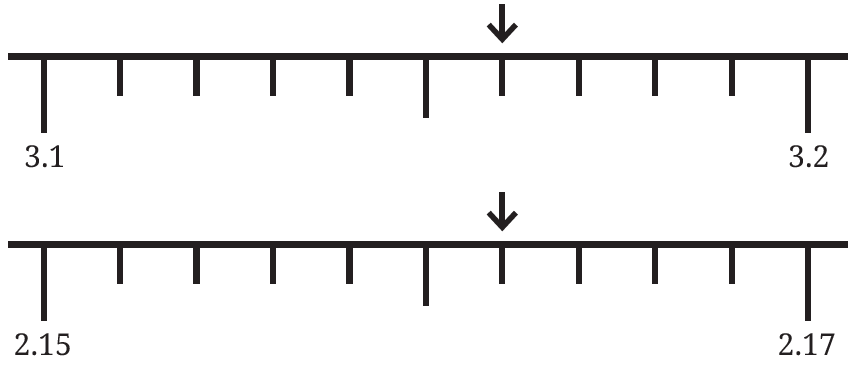
Question 2. Write the decimal number at the arrow mark:
Answer:
Solution for the First Number Line:
The number line starts at $3.1$ and ends at $3.2$. There are $10$ equal divisions between them.
The value of each division is $\frac{3.2 - 3.1}{10} = \frac{0.1}{10} = 0.01$.
The arrow is pointing to the $6^{\text{th}}$ mark after $3.1$.
$\text{Value} = 3.1 + (6 \times 0.01) = 3.1 + 0.06 = 3.16$
Solution for the Second Number Line:
The number line starts at $2.15$ and ends at $2.17$. There are $10$ equal divisions between them.
The value of each division is $\frac{2.17 - 2.15}{10} = \frac{0.02}{10} = 0.002$.
The arrow is pointing to the $6^{\text{th}}$ mark after $2.15$.
$\text{Value} = 2.15 + (6 \times 0.002) = 2.15 + 0.012 = 2.162$
Final Answers:
The first arrow indicates $3.16$ and the second arrow indicates $2.162$.
Question 3. Shyamala bought $3\text{ kg}$ bananas at $\textsf{₹} 30/-$ per kg. She counted $35$ bananas in all. She sells each banana for $\textsf{₹} 5/-$. How much profit does she make selling all the bananas?
Answer:
Given:
Quantity of bananas bought = $3\text{ kg}$
Cost price per kg = $\textsf{₹} 30$
Total number of bananas = $35$
Selling price per banana = $\textsf{₹} 5$
To Find:
Total profit made.
Solution:
First, we calculate the Total Cost Price (CP):
$\text{Total CP} = 3 \times 30 = \textsf{₹} 90$
Next, we calculate the Total Selling Price (SP):
$\text{Total SP} = 35 \times 5 = \textsf{₹} 175$
Finally, we calculate the Profit:
$\text{Profit} = \text{Total SP} - \text{Total CP}$
$\text{Profit} = 175 - 90 = 85$
Therefore, Shyamala makes a profit of $\textsf{₹} 85$.
Question 4. A teacher placed textbooks that are $2.5\text{ cm}$ thick on a bookshelf. The teacher wanted to place $80$ textbooks on the shelf. The bookshelf is $160\text{ cm}$ long. How many books could be placed on the shelf? Was there any space left? If yes, how much?
Answer:
Given:
Thickness of one textbook = $2.5\text{ cm}$
Length of the bookshelf = $160\text{ cm}$
Number of books the teacher wanted to place = $80$
To Find:
1. Number of books that can actually fit.
2. Space left on the shelf.
Solution:
First, let us find how many books can fit on the shelf:
$\text{Number of books} = \frac{\text{Total Length}}{\text{Thickness per book}}$
$\text{Number of books} = \frac{160}{2.5}$
To simplify, multiply numerator and denominator by 10:
$\text{Number of books} = \frac{1600}{25} = 64$
The shelf can only hold $64$ books. Since the teacher wanted to place $80$ books, they will not all fit.
Checking for Space Left:
Since $64$ books occupy exactly $64 \times 2.5 = 160\text{ cm}$, the entire shelf is filled.
If the teacher places the maximum possible ($64$ books), there is no space left ($0\text{ cm}$).
Question 5. Fill in the following blanks appropriately:
$1\text{ cm} = 10\text{ mm}$
$1\text{ m} = 100\text{ cm}$
$1\text{ km} = 1000\text{ m}$
$1\text{ kg} = 1000\text{ g}$
$1\text{ g} = 1000\text{ mg}$
$1\text{ l} = 1000\text{ ml}$
$5.5\text{ km} = \text{_________ m}$
$35\text{ cm} = \text{________ m}$
$14.5\text{ cm} = \text{_______ mm}$
$68\text{ g} = \text{________ kg}$
$9.02\text{ m} = \text{________ mm}$
$125.5\text{ ml} = \text{_______ l}$
Answer:
Using the conversion factors provided:
• $5.5\text{ km} = 5.5 \times 1000\text{ m} = \mathbf{5500\text{ m}}$
• $35\text{ cm} = \frac{35}{100}\text{ m} = \mathbf{0.35\text{ m}}$
• $14.5\text{ cm} = 14.5 \times 10\text{ mm} = \mathbf{145\text{ mm}}$
• $68\text{ g} = \frac{68}{1000}\text{ kg} = \mathbf{0.068\text{ kg}}$
• $9.02\text{ m} = 9.02 \times 1000\text{ mm} = \mathbf{9020\text{ mm}}$
• $125.5\text{ ml} = \frac{125.5}{1000}\text{ l} = \mathbf{0.1255\text{ l}}$
Question 6. The following problem was set by Sridharacharya in his book, Patiganita. “$6 \frac{1}{4}$ is divided by $2 \frac{1}{2}$, and $60 \frac{1}{4}$ is divided by $3 \frac{1}{2}$. Tell the quotients separately.” Can you try to solve it by converting the fractions into decimals?
Answer:
First Case: $6 \frac{1}{4}$ divided by $2 \frac{1}{2}$
Converting to decimals: $6 \frac{1}{4} = 6.25$ and $2 \frac{1}{2} = 2.5$
Calculation: $6.25 \div 2.5 = 62.5 \div 25$
$\text{Quotient} = \mathbf{2.5}$
Second Case: $60 \frac{1}{4}$ divided by $3 \frac{1}{2}$
Converting to decimals: $60 \frac{1}{4} = 60.25$ and $3 \frac{1}{2} = 3.5$
Calculation: $60.25 \div 3.5 = 602.5 \div 35$
$\text{Quotient} = \mathbf{17.214...}$ (or $17 \frac{3}{14}$ in fraction form)
Question 7. Fill the boxes in at least $2$ different ways:
(a) $\text{_____} \times \text{_____} = 2.4$
(b) $\text{_____} \times \text{_____} = 14.5$
Answer:
(a) $\text{_____} \times \text{_____} = 2.4$
1. $2 \times 1.2 = 2.4$
2. $3 \times 0.8 = 2.4$
(b) $\text{_____} \times \text{_____} = 14.5$
1. $2 \times 7.25 = 14.5$
2. $5 \times 2.9 = 14.5$
Question 8. Find the following quotients given that $756 \div 36 = 21$:
(a) $75.6 \div 3.6$
(b) $7.56 \div 0.36$
(c) $756 \div 0.36$
(d) $75.6 \div 360$
(e) $7560 \div 3.6$
(f) $7.56 \div 0.36$
Answer:
Given:
$756 \div 36 = 21$
To Find:
The quotients for parts (a) to (f) based on the given base calculation.
Solution:
To solve these, we use the principle that the quotient remains unchanged if both the dividend and the divisor are multiplied or divided by the same non-zero number. If only one is changed, or they are changed by different powers of $10$, we shift the decimal point accordingly.
(a) $75.6 \div 3.6$
Both the dividend and divisor have one decimal place. Multiplying both by $10$:
$\frac{75.6 \times 10}{3.6 \times 10} = \frac{756}{36}$
[Multiplying by 10/10]
From the given fact (i), the quotient is $21$.
(b) $7.56 \div 0.36$
Both the dividend and divisor have two decimal places. Multiplying both by $100$:
$\frac{7.56 \times 100}{0.36 \times 100} = \frac{756}{36}$
[Multiplying by 100/100]
From the given fact (i), the quotient is $21$.
(c) $756 \div 0.36$
The divisor has two decimal places. Multiplying both terms by $100$ to make the divisor a whole number:
$\frac{756 \times 100}{0.36 \times 100} = \frac{75600}{36}$
Since $756 \div 36 = 21$, then $75600 \div 36$ will be $21$ followed by two zeros.
Therefore, the quotient is $2100$.
(d) $75.6 \div 360$
Converting the expression to a fraction:
$\frac{75.6}{360} = \frac{756}{3600}$
[Multiplying by 10/10]
We know $\frac{756}{36} = 21$. So, $\frac{756}{36 \times 100} = \frac{21}{100}$.
Therefore, the quotient is $0.21$.
(e) $7560 \div 3.6$
Multiplying both dividend and divisor by $10$ to make the divisor a whole number:
$\frac{7560 \times 10}{3.6 \times 10} = \frac{75600}{36}$
As calculated in part (c), $75600 \div 36 = 2100$.
Therefore, the quotient is $2100$.
(f) $7.56 \div 0.36$
This is the same as part (b). Multiplying both by $100$:
$\frac{756}{36} = 21$
Therefore, the quotient is $21$.
Question 9. Find the missing cells if each cell represents $a \div b$:
| $b \setminus a$ | $1517$ | $151.7$ | $15.17$ | $1.517$ | $15170$ |
|---|---|---|---|---|---|
| $37$ | $41$ | ||||
| $3.7$ | $4.1$ | ||||
| $0.37$ | |||||
| $0.037$ | $4100$ | ||||
| $370$ |
Answer:
Given: The base division is $1517 \div 37 = 41$.
Solution: In decimal division, if the dividend ($a$) shifts its decimal point to the left, the quotient shifts its decimal to the left. If the divisor ($b$) shifts its decimal point to the left, the quotient shifts its decimal to the right.
Using this logic, we complete the table:
| $b \setminus a$ | $1517$ | $151.7$ | $15.17$ | $1.517$ | $15170$ |
| $37$ | $41$ | $4.1$ | $0.41$ | $0.041$ | $410$ |
| $3.7$ | $410$ | $41$ | $4.1$ | $0.41$ | $4100$ |
| $0.37$ | $4100$ | $410$ | $41$ | $4.1$ | $41000$ |
| $0.037$ | $41000$ | $4100$ | $410$ | $41$ | $410000$ |
| $370$ | $4.1$ | $0.41$ | $0.041$ | $0.0041$ | $41$ |
Question 10. Using the digits $2, 4, 5, 8$, and $0$ fill the boxes $\square \ \square \ . \ \square \times \ \square \ . \ \square$ to get the:
(a) maximum product
(b) minimum product
(c) product greater than $150$
(d) product nearest to $100$
(e) product nearest to $5$
Answer:
Given:
Available digits: $\{2, 4, 5, 8, 0\}$
Expression structure: $\square \square . \square \times \square . \square$ (A 3-digit decimal multiplied by a 2-digit decimal).
To Find:
Combinations of the given digits that result in the maximum, minimum, and specified range or proximity products.
Solution:
To solve these, we place the largest digits in the most significant place values (tens and units) to maximize the product, and the smallest digits in those positions to minimize it.
(a) Maximum product
To get the maximum product, we use the largest available digits ($8, 5, 4$) in the leading positions.
$82.0 \times 5.4 = 442.8$
[Using 8 and 5 in leading positions]
Another combination giving the same result is $54.0 \times 8.2 = 442.8$.
(b) Minimum product
To get the minimum product, we place $0$ in the units place of the second number (making it a pure decimal less than $1$) and use the smallest remaining digits for the leading tens place.
$45.8 \times 0.2 = 9.16$
[Using 0 and 2 as multipliers]
(c) Product greater than $150$
We can use digits that ensure a product significantly above $150$.
$85.4 \times 2.0 = 170.8$
($170.8 > 150$)
(d) Product nearest to $100$
We look for numbers whose leading digits multiply to approximately $100$ (like $20 \times 5$ or $25 \times 4$).
$20.5 \times 4.8 = 98.4$
[Difference = $1.6$]
Another close option is $25.8 \times 4.0 = 103.2$ (Difference = $3.2$). Thus, $20.5 \times 4.8$ is the nearest.
(e) Product nearest to $5$
Using the smallest possible configuration from the available digits:
$45.8 \times 0.2 = 9.16$
[Difference = $4.16$]
Other combinations like $25.8 \times 0.4 = 10.32$ or $28.5 \times 0.4 = 11.4$ result in products further away from $5$.
Final Summary:
(a) Maximum product: $82.0 \times 5.4 = 442.8$
(b) Minimum product: $45.8 \times 0.2 = 9.16$
(c) Product greater than $150$: $85.4 \times 2.0 = 170.8$
(d) Product nearest to $100$: $20.5 \times 4.8 = 98.4$
(e) Product nearest to $5$: $45.8 \times 0.2 = 9.16$
Question 11. Sort the following expressions in increasing order:
(a) $245.05 \times 0.942368$
(b) $245.05 \times 7.9682$
(c) $245.05 \div 7.9682$
(d) $245.05 \div 0.942368$
(e) $245.05$
(f) $7.9682$
Answer:
Given:
The following expressions and values:
(a) $245.05 \times 0.942368$ (b) $245.05 \times 7.9682$ (c) $245.05 \div 7.9682$
(d) $245.05 \div 0.942368$ (e) $245.05$ (f) $7.9682$
To Find:
The correct arrangement of these expressions in increasing order (from smallest to largest) without performing the full multiplications or divisions.
Solution:
To sort these expressions, let us analyze the effect of multiplying and dividing by numbers greater than or less than $1$ relative to the base value $245.05$.
Let $X = 245.05$. Note that $X$ is significantly larger than the other factors ($0.942368$ and $7.9682$).
1. Smallest values:
The value in (f) is $7.9682$, which is a very small number compared to $245.05$.
The value in (c) is $245.05 \div 7.9682$. Dividing a number by a factor greater than $1$ reduces its value. Since $245.05$ is divided by roughly $8$, the result will be around $30.75$.
Comparing these two: $7.9682 < (245.05 \div 7.9682)$. Thus, (f) is the smallest, followed by (c).
2. Mid-range values (Comparing with $245.05$):
In (a), we have $245.05 \times 0.942368$. Multiplying a positive number by a fraction less than $1$ results in a value smaller than the original number.
In (e), we have the base value $245.05$.
In (d), we have $245.05 \div 0.942368$. Dividing by a number less than $1$ results in a value larger than the original number.
Therefore: $(245.05 \times 0.942368) < 245.05 < (245.05 \div 0.942368)$. This orders (a), (e), and (d).
3. Largest value:
In (b), we have $245.05 \times 7.9682$. Multiplying a large number by another number much greater than $1$ results in a very large product (roughly $245 \times 8 \approx 1960$). This is clearly the largest value.
Final Arrangement (Increasing Order):
Based on the analysis above, the order is:
$7.9682 < (245.05 \div 7.9682) < (245.05 \times 0.942368) < 245.05 $$ < (245.05 \div 0.942368) < (245.05 \times 7.9682)$
Using the option letters:
(f) < (c) < (a) < (e) < (d) < (b)