

Chapter 7 Finding the Unknown (Class 7 - Latest Maths NCERT (Ganita Prakash II) Solutions)
Looking for accurate and clear NCERT Solutions for Chapter 7: Finding the Unknown? This page provides detailed, step-by-step answers for the latest Class 7 Maths curriculum, helping you master the essential principles of Bījagaṇita (Algebra). We simplify the process of solving for hidden numbers by using the intuitive model of a balancing weighing scale, ensuring you understand how to keep the Left Hand Side (LHS) and Right Hand Side (RHS) in perfect mathematical harmony.
Our solutions move beyond simple guessing to focus on Systematic Solving and the mastery of Inverse Operations. We provide comprehensive breakdowns of how to isolate variables in everything from matchstick patterns to price calculations. Additionally, we incorporate the Historical Context found in the Ganita Prakash II textbook, offering clear explanations of Brahmagupta’s general formulas for solving equations. By following our guides, you will learn how to apply 7th-century algebraic wisdom to modern mathematical challenges.
To help you become an expert in equations, this page offers step-by-step transposition guides, visual weighing-scale analogies, and "Mind the Mistake" logic checks. Whether you are working on taxi fare problems or 1,000-year-old mathematical riddles, these resources from learningspot.co are designed to help you verify your work, build confidence, and achieve excellence in your Class 7 assessments.
| Content On This Page | ||
|---|---|---|
| Figure It Out (Page No. 172) | Figure It Out (Page No. 181) | Figure It Out (Page No. 185 - 189) |
Figure It Out (Page No. 172)
Question 1. Solve these equations and check the solutions.
(a) $3x - 10 = 35$
(b) $5s = 3s$
(c) $3u - 7 = 2u + 3$
(d) $4(m + 6) - 8 = 2m - 4$
(e) $\frac{u}{15} = 6$
Answer:
(a) $3x - 10 = 35$
To solve for $x$, we use the method of transposing. First, we transpose $-10$ to the Right Hand Side (RHS), which changes its sign to $+10$.
$3x = 35 + 10$
$3x = 45$
Now, we transpose $3$ (which is in multiplication) to the RHS, where it becomes a divisor.
$x = \frac{45}{3}$
$x = 15$
Check: Substituting $x = 15$ into the Left Hand Side (LHS):
$\text{LHS} = 3(15) - 10 = 45 - 10 = 35$
Since $\text{LHS} = \text{RHS}$, the solution $x = 15$ is correct.
(b) $5s = 3s$
We transpose $3s$ to the LHS to group the variables together.
$5s - 3s = 0$
$2s = 0$
$s = \frac{0}{2}$
$s = 0$
Check: Substituting $s = 0$ into the equation:
$\text{LHS} = 5(0) = 0$
$\text{RHS} = 3(0) = 0$
Since $\text{LHS} = \text{RHS}$, the solution $s = 0$ is correct.
(c) $3u - 7 = 2u + 3$
We group the terms with $u$ on the LHS and constant terms on the RHS.
$3u - 2u = 3 + 7$
$u = 10$
Check: Substituting $u = 10$ into the equation:
$\text{LHS} = 3(10) - 7 = 30 - 7 = 23$
$\text{RHS} = 2(10) + 3 = 20 + 3 = 23$
Since $\text{LHS} = \text{RHS}$, the solution $u = 10$ is correct.
(d) $4(m + 6) - 8 = 2m - 4$
First, we open the brackets on the LHS.
$4m + 24 - 8 = 2m - 4$
$4m + 16 = 2m - 4$
Now, transpose $2m$ to the LHS and $16$ to the RHS.
$4m - 2m = -4 - 16$
$2m = -20$
$m = \frac{-20}{2}$
$m = -10$
Check: Substituting $m = -10$ into the original equation:
$\text{LHS} = 4(-10 + 6) - 8 = 4(-4) - 8 = -16 - 8 = -24$
$\text{RHS} = 2(-10) - 4 = -20 - 4 = -24$
Since $\text{LHS} = \text{RHS}$, the solution $m = -10$ is correct.
(e) $\frac{u}{15} = 6$
We transpose $15$ from the denominator of the LHS to the numerator of the RHS.
$u = 6 \times 15$
$u = 90$
Check: Substituting $u = 90$ into the LHS:
$\text{LHS} = \frac{90}{15} = 6$
Since $\text{LHS} = \text{RHS}$, the solution $u = 90$ is correct.
Question 2. Frame an equation that has no solution.
[Hint: $4$ more than a number, and $5$ more than a number can never be equal!]
Answer:
To Frame: An equation that possesses no solution.
Solution:
Using the provided hint, let the number be $x$.
The phrase "$4$ more than a number" can be written as $x + 4$.
The phrase "$5$ more than a number" can be written as $x + 5$.
Setting them equal to each other, we get the equation:
$x + 4 = x + 5$
Justification:
If we try to solve this equation by transposing $x$ from the RHS to the LHS:
$x - x + 4 = 5$
$0 + 4 = 5$
$4 = 5$
The above statement is a contradiction because $4$ is not equal to $5$. This means that there is no value of $x$ that can ever make this equation true. Therefore, the equation $x + 4 = x + 5$ has no solution.
Figure It Out (Page No. 181)
Question 1. Write $5$ equations whose solution is $x = -2$.
Answer:
To find equations with the solution $x = -2$, we can start with the statement $x = -2$ and perform the same mathematical operations on both sides.
1. Multiply both sides by $3$:
$3x = -6$
2. Add $5$ to both sides:
$x + 5 = -2 + 5$
$x + 5 = 3$
3. Multiply both sides by $2$ and then add $4$:
$2x = -4$
$2x + 4 = 0$
4. Subtract $x$ from $10$:
$10 - x = 10 - (-2)$
$10 - x = 12$
5. Multiply both sides by $-5$:
$-5x = 10$
The five equations are: $3x = -6$, $x + 5 = 3$, $2x + 4 = 0$, $10 - x = 12$, and $-5x = 10$.
Question 2. Find the value of each unknown:
(a) $2y = 60$
(b) $-8 = 5x - 3$
(c) $-53w = -15$
(d) $13 - z = 8$
(e) $k + 8 = 12 - k$
(f) $7m = m - 3$
(g) $3n = 10 + n$
Answer:
Given:
The following linear equations in one variable:
(a) $2y = 60$, (b) $-8 = 5x - 3$, (c) $-53w = -15$, (d) $13 - z = 8$, (e) $k + 8 = 12 - k$, (f) $7m = m - 3$, (g) $3n = 10 + n$
To Find:
The value of each unknown variable using the balance method (operating on both sides of the equation).
Solution:
(a) Solving $2y = 60$
$2y = 60$
(Given)
$\frac{2y}{2} = \frac{60}{2}$
(Dividing both sides by 2)
$y = \frac{\cancel{60}^{30}}{\cancel{2}_{1}}$
$y = 30$
(b) Solving $-8 = 5x - 3$
$-8 = 5x - 3$
(Given)
$-8 + 3 = 5x - 3 + 3$
(Adding 3 to both sides)
$-5 = 5x$
$\frac{-5}{5} = \frac{5x}{5}$
(Dividing both sides by 5)
$x = \frac{\cancel{-5}^{-1}}{\cancel{5}_{1}}$
$x = -1$
(c) Solving $-53w = -15$
$-53w = -15$
(Given)
$\frac{-53w}{-53} = \frac{-15}{-53}$
(Dividing both sides by -53)
$w = \frac{15}{53}$
(d) Solving $13 - z = 8$
$13 - z = 8$
(Given)
$13 - 13 - z = 8 - 13$
(Subtracting 13 from both sides)
$-z = -5$
$-z \times (-1) = -5 \times (-1)$
(Multiplying both sides by -1)
$z = 5$
(e) Solving $k + 8 = 12 - k$
$k + 8 = 12 - k$
(Given)
$k + k + 8 = 12 - k + k$
(Adding k to both sides)
$2k + 8 = 12$
$2k + 8 - 8 = 12 - 8$
(Subtracting 8 from both sides)
$2k = 4$
$\frac{2k}{2} = \frac{4}{2}$
(Dividing both sides by 2)
$k = \frac{\cancel{4}^{2}}{\cancel{2}_{1}}$
$k = 2$
(f) Solving $7m = m - 3$
$7m = m - 3$
(Given)
$7m - m = m - m - 3$
(Subtracting m from both sides)
$6m = -3$
$\frac{6m}{6} = \frac{-3}{6}$
(Dividing both sides by 6)
$m = -\frac{\cancel{3}^{1}}{\cancel{6}_{2}}$
$m = -\frac{1}{2}$
(g) Solving $3n = 10 + n$
$3n = 10 + n$
(Given)
$3n - n = 10 + n - n$
(Subtracting n from both sides)
$2n = 10$
$\frac{2n}{2} = \frac{10}{2}$
(Dividing both sides by 2)
$n = \frac{\cancel{10}^{5}}{\cancel{2}_{1}}$
$n = 5$
Question 3. I am a $3$-digit number. My hundred’s digit is $3$ less than my ten’s digit. My ten’s digit is $3$ less than my unit’s digit. The sum of all the three digits is $15$. Who am I?
Answer:
Given:
Sum of the digits = $15$.
Hundred's digit = Ten's digit $- 3$.
Ten's digit = Unit's digit $- 3$.
To Find:
The $3$-digit number.
Solution:
Let the Unit's digit be $x$.
Then, according to the question:
$\text{Ten's digit} = x - 3$
... (i)
$\text{Hundred's digit} = (x - 3) - 3 = x - 6$
... (ii)
The sum of all three digits is given as $15$:
$\text{Hundred's digit} + \text{Ten's digit} + \text{Unit's digit} = 15$
$(x - 6) + (x - 3) + x = 15$
$3x - 9 = 15$
$3x = 15 + 9$
$3x = 24$
$x = \frac{24}{3}$
$x = 8$
Now, we find each digit:
Unit's digit $= x = 8$
Ten's digit $= x - 3 = 8 - 3 = 5$
Hundred's digit $= x - 6 = 8 - 6 = 2$
The $3$-digit number is $258$.
Question 4. The weight of a brick is $1$ kg more than half its weight. What is the weight of the brick?
Answer:
Given:
Weight of the brick is $1\text{ kg}$ more than half of its total weight.
To Find:
The total weight of the brick.
Solution:
Let the total weight of the brick be $x\text{ kg}$.
According to the problem, the weight is equal to half of itself plus $1\text{ kg}$.
$x = \frac{x}{2} + 1$
To solve for $x$, we transpose the variable term $\frac{x}{2}$ to the Left Hand Side (LHS):
$x - \frac{x}{2} = 1$
$\frac{2x - x}{2} = 1$
$\frac{x}{2} = 1$
Multiplying both sides by $2$:
$x = 1 \times 2$
$x = 2$
The weight of the brick is $2\text{ kg}$.
Question 5. One quarter of a number increased by $9$ gives the same number. What is the number?
Answer:
Given:
One quarter ($\frac{1}{4}$) of a number added to $9$ results in the original number itself.
To Find:
The value of the number.
Solution:
Let the required number be $y$.
One quarter of the number is $\frac{y}{4}$.
As per the given condition:
$\frac{y}{4} + 9 = y$
Transposing $\frac{y}{4}$ to the Right Hand Side (RHS):
$9 = y - \frac{y}{4}$
$9 = \frac{4y - y}{4}$
$9 = \frac{3y}{4}$
Now, multiplying both sides by $4$:
$9 \times 4 = 3y$
$36 = 3y$
Dividing both sides by $3$:
$y = \frac{36}{3}$
$y = \frac{\cancel{36}^{12}}{\cancel{3}_{1}}$
$y = 12$
The required number is $12$.
Question 6. Given $4k + 1 = 13$, find the values of:
(a) $8k + 2$
(b) $4k$
(c) $k$
(d) $4k - 1$
(e) $-k - 2$
Answer:
Given:
The linear equation in one variable is:
$4k + 1 = 13$
(Given)
To Find:
The values of the following expressions:
(a) $8k + 2$
(b) $4k$
(c) $k$
(d) $4k - 1$
(e) $-k - 2$
Solution:
First, we will find the values of $4k$ and $k$ by using the balance method on the given equation.
Step 1: Finding the value of $4k$
To isolate the term containing $k$, we subtract $1$ from both sides of the equation.
$4k + 1 - 1 = 13 - 1$
(Subtracting 1 from both sides)
$4k = 12$
(Result for part b)
Step 2: Finding the value of $k$
Now, we divide both sides of the equation by $4$.
$\frac{4k}{4} = \frac{12}{4}$
(Dividing both sides by 4)
$k = 3$
(Result for part c)
Evaluation of each expression:
(a) To find the value of $8k + 2$
Substituting the value $k = 3$ into the expression:
$8k + 2 = 8(3) + 2$
$8k + 2 = 24 + 2$
$8k + 2 = 26$
(b) To find the value of $4k$
From our balancing step in Step 1, we found:
$4k = 12$
(c) To find the value of $k$
From our balancing step in Step 2, we found:
$k = 3$
(d) To find the value of $4k - 1$
Using the value of $4k = 12$ from part (b):
$4k - 1 = 12 - 1$
$4k - 1 = 11$
(e) To find the value of $-k - 2$
Substituting the value $k = 3$ into the expression:
$-k - 2 = -(3) - 2$
$-k - 2 = -3 - 2$
$-k - 2 = -5$
Figure It Out (Page No. 185 - 189)
Question 1. Fill in the blanks with integers.
(a) $5 \times \text{___} - 8 = 37$
(b) $37 - (33 - \text{____} ) = 35$
(c) $-3 \times (-11 + \text{____} ) = 45$
Answer:
(a) Let the missing integer be $x$.
$5 \times x - 8 = 37$
Transposing $-8$ to the RHS:
$5x = 37 + 8$
$5x = 45$
$x = \frac{\cancel{45}^{9}}{\cancel{5}_{1}}$
[Dividing by $5$]
So, the missing integer is $9$.
(b) Let the missing integer be $x$.
$37 - (33 - x) = 35$
Opening the bracket:
$37 - 33 + x = 35$
$4 + x = 35$
$x = 35 - 4$
So, the missing integer is $31$.
(c) Let the missing integer be $x$.
$-3 \times (-11 + x) = 45$
Dividing both sides by $-3$:
$-11 + x = \frac{45}{-3}$
$-11 + x = -15$
$x = -15 + 11$
So, the missing integer is $-4$.
Question 2. Ranju is a daily wage labourer. She earns $\textsf{₹} 750$ a day. Her employer pays her in $50$ and $100$ rupee notes. If Ranju gets an equal number of $50$ and $100$ rupee notes, how many notes of each does she have?
Answer:
Given:
Total earnings of Ranju = $\textsf{₹} 750$
Denominations of notes = $\textsf{₹} 50$ and $\textsf{₹} 100$
Condition: Number of $\textsf{₹} 50$ notes = Number of $\textsf{₹} 100$ notes
To Find:
The number of notes of each denomination.
Solution:
Let the number of $\textsf{₹} 50$ notes be $n$.
According to the given condition, the number of $\textsf{₹} 100$ notes is also $n$.
The total value can be expressed as:
$50 \times n + 100 \times n = 750$
$150n = 750$
To find $n$, we divide the total amount by the combined value of one note of each kind:
$n = \frac{750}{150}$
[Transposing $150$]
$n = \frac{\cancel{750}^{5}}{\cancel{150}_{1}}$
$n = 5$
Therefore, Ranju has $5$ notes of $\textsf{₹} 50$ and $5$ notes of $\textsf{₹} 100$.
Check: $(5 \times 50) + (5 \times 100) = 250 + 500 = 750$. The solution is correct.
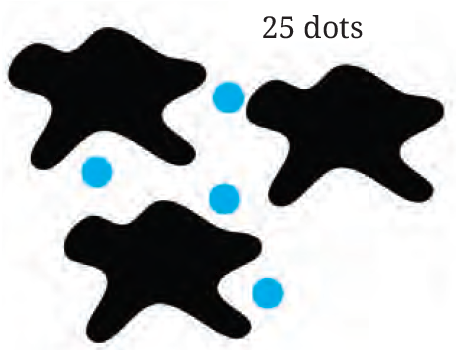
Question 3. In the given picture, each black blob hides an equal number of blue dots. If there are $25$ dots in total, how many dots are covered by one blob? Write an equation to describe this problem.
Answer:
Given:
Total number of dots = $25$
Number of black blobs = $3$
Number of visible blue dots = $4$
Each blob covers an equal number of dots.
To Find:
The number of dots covered by one blob and the equation for the problem.
Solution:
Let the number of dots covered by one blob be $x$.
Total dots = (Dots under blobs) + (Visible dots)
$3x + 4 = 25$
[Required Equation]
Solving the equation for $x$:
$3x = 25 - 4$
$3x = 21$
$x = \frac{21}{3}$
$x = 7$
So, each black blob covers $7$ blue dots.
Question 4. Here are machines that take an input, perform an operation on it and send out the result as an output.
(a) 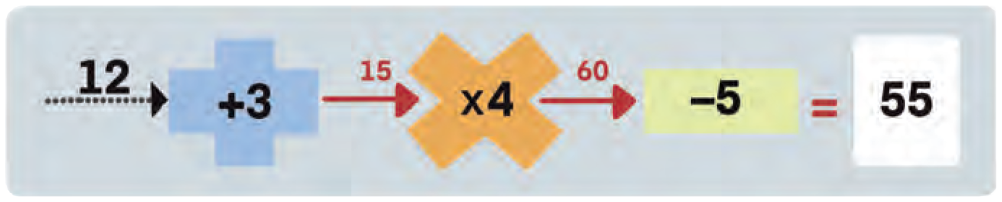
(b) 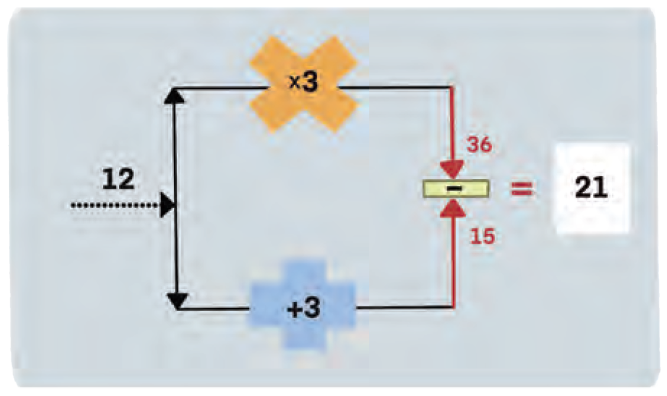
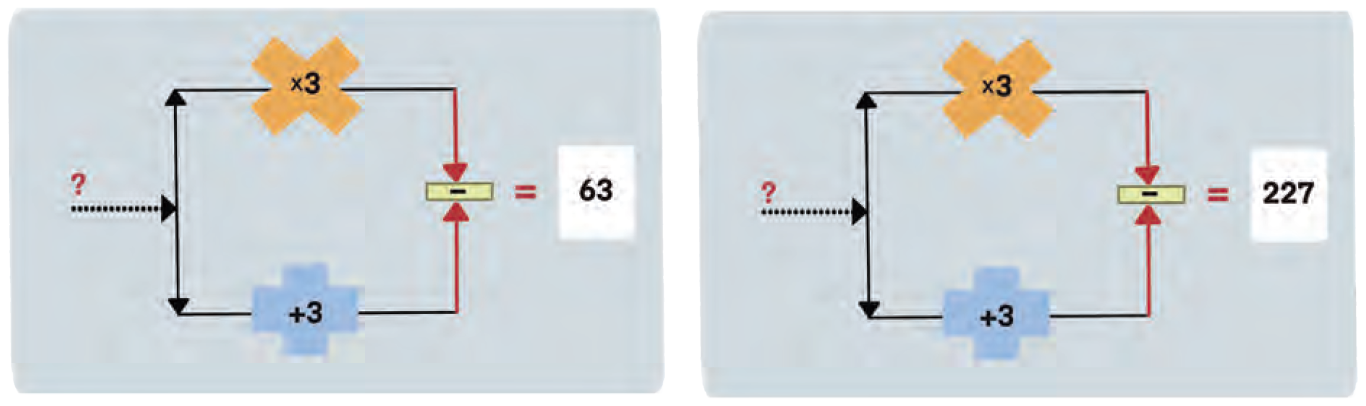
Answer:
Part (a):
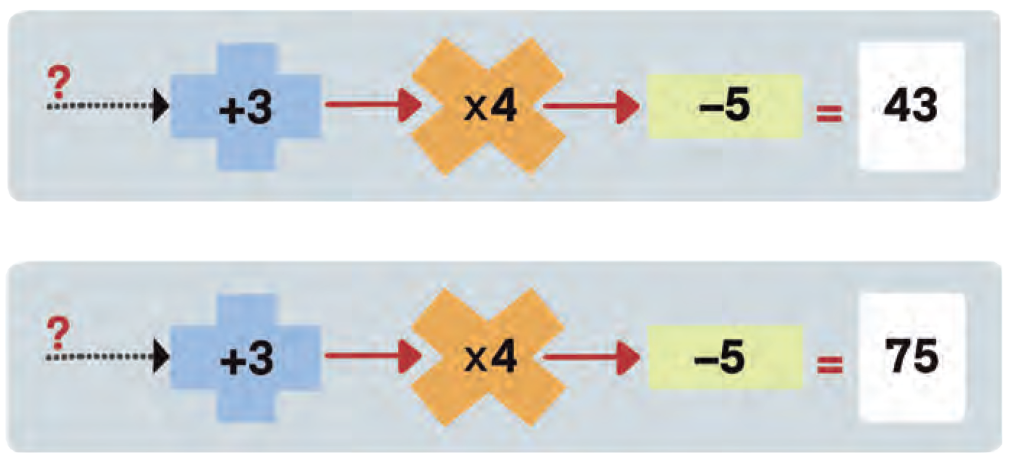
By observing the example machine, the sequence of operations on input $x$ is: Add $3$, then Multiply by $4$, then Subtract $5$.
$\text{Output} = 4 \times (x + 3) - 5$
Case 1: Output is $43$
$4(x + 3) - 5 = 43$
$4(x + 3) = 43 + 5$
$4(x + 3) = 48$
$x + 3 = \frac{48}{4}$
$x + 3 = 12$
$x = 12 - 3 = 9$
The input is $9$.
Case 2: Output is $75$
$4(x + 3) - 5 = 75$
$4(x + 3) = 75 + 5$
$4(x + 3) = 80$
$x + 3 = \frac{80}{4}$
$x + 3 = 20$
$x = 20 - 3 = 17$
The input is $17$.
Part (b):
The machine takes input $x$ and splits it into two paths. Path 1: Multiply by $3$ ($\rightarrow 3x$). Path 2: Add $3$ ($\rightarrow x + 3$). The result is the subtraction of Path 2 from Path 1.
$\text{Output} = 3x - (x + 3)$
$\text{Output} = 2x - 3$
Case 1: Output is $63$
$2x - 3 = 63$
$2x = 63 + 3$
$2x = 66$
$x = 33$
The input is $33$.
Case 2: Output is $227$
$2x - 3 = 227$
$2x = 227 + 3$
$2x = 230$
$x = 115$
The input is $115$.
Question 5. What are the inputs to these machines?
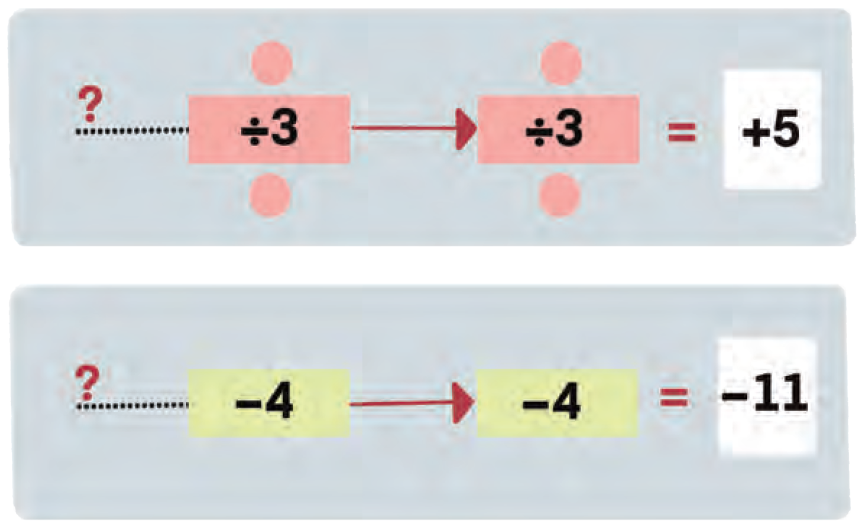
Answer:
Part 1: Division Machine
Given:
The machine performs two successive divisions by $3$.
The final output is $+5$.
To Find:
The initial input value.
Solution:
Let the input be $x$. The operations can be written as an equation:
$(x \div 3) \div 3 = 5$
$\frac{x}{9} = 5$
Multiplying both sides by $9$:
$x = 5 \times 9$
$x = 45$
The input to the first machine is $45$.
Part 2: Subtraction Machine
Given:
The machine performs two successive subtractions of $4$.
The final output is $-11$.
To Find:
The initial input value.
Solution:
Let the input be $y$. The operations can be written as an equation:
$(y - 4) - 4 = -11$
$y - 8 = -11$
Transposing $-8$ to the Right Hand Side (RHS):
$y = -11 + 8$
$y = -3$
The input to the second machine is $-3$.
Question 6. A taxi driver charges a fixed fee of $\textsf{₹} 800$ per day plus $\textsf{₹} 20$ for each kilometer traveled. If the total cost for a taxi ride is $\textsf{₹} 2200$, determine the number of kilometres traveled.
Answer:
Given:
Fixed fee per day = $\textsf{₹} 800$
Rate per kilometer = $\textsf{₹} 20$
Total cost of the ride = $\textsf{₹} 2200$
To Find:
Total distance traveled in kilometers.
Solution:
Let the number of kilometers traveled be $k$.
The total cost is the sum of the fixed fee and the variable cost (rate $\times$ distance).
$\text{Total Cost} = \text{Fixed Fee} + (\text{Rate per km} \times \text{Distance})$
$800 + 20k = 2200$
Subtracting $800$ from both sides:
$20k = 2200 - 800$
$20k = 1400$
Dividing by $20$:
$k = \frac{1400}{20}$
[Transposing $20$]
$k = \frac{\cancel{1400}^{70}}{\cancel{20}_{1}}$
$k = 70$
The total distance traveled by the taxi is $70 \text{ km}$.
Question 7. The sum of two numbers is $76$. One number is three times the other number. What are the numbers?
Answer:
Given:
Sum of two numbers $= 76$
Condition: One number is $3$ times the other number.
To Find:
The values of both numbers.
Solution:
Let the smaller number be $x$.
Then, the larger number is $3x$.
According to the problem, their sum is $76$:
$x + 3x = 76$
$4x = 76$
$x = \frac{76}{4}$
$x = 19$
Now, we find the second number:
$\text{Larger number} = 3x = 3 \times 19 = 57$
The two numbers are $19$ and $57$.
Check: $19 + 57 = 76$. The condition is satisfied.
Question 8. The figure shows the diagram for a window with a grill. What is the gap between two rods in the grill?
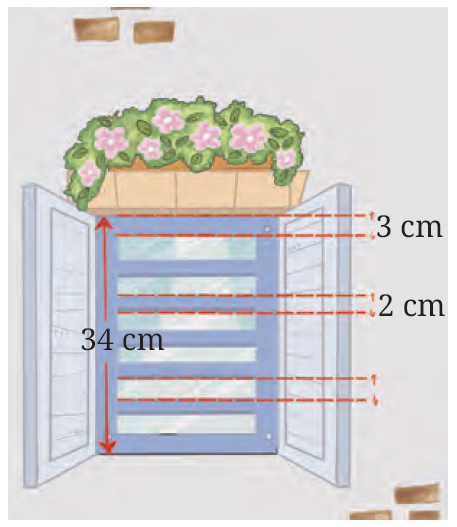
Answer:
Given:
Total height of the door/grill frame = $34\text{ cm}$
Number of openings (gaps) in the grill = $6$
Thickness of bars at the top and bottom = $3\text{ cm}$ each
Number of bars in between = $5$
Thickness of each middle bar = $2\text{ cm}$
To Find:
The width of the gap between two rods (let the gap be represented by the variable $x$).
Solution:
First, we calculate the total space occupied by all the horizontal bars in the grill.
$\text{Total thickness of top and bottom bars} = 3\text{ cm} + 3\text{ cm} = 6\text{ cm}$
$\text{Total thickness of middle bars} = 5 \times 2\text{ cm} = 10\text{ cm}$
$\text{Sum of all bar thicknesses} = 6\text{ cm} + 10\text{ cm} = 16\text{ cm}$
Now, we frame the equation for the total height of the grill, which is the sum of the thicknesses of all bars and the width of all gaps.
$34 = 16 + 6x$
(Where 6x represents the 6 gaps)
To isolate the term with $x$, we subtract $16$ from both sides of the equation.
$34 - 16 = 6x$
$18 = 6x$
Dividing both sides by $6$ to find the value of $x$:
$x = \frac{\cancel{18}^{3}}{\cancel{6}_{1}}$
[Calculation for width of one gap]
$x = 3\text{ cm}$
Therefore, the gap between two rods in the grill is $3\text{ cm}$.
Question 9. In a restaurant, a fruit juice costs $\textsf{₹} 15$ less than a chocolate milkshake. If $4$ fruit juices and $7$ chocolate milkshakes cost $\textsf{₹} 600$, find the cost of the fruit juice and milkshake.
Answer:
Given:
Cost of fruit juice = Cost of chocolate milkshake $- \textsf{₹} 15$
Cost of $4$ fruit juices $+ 7$ chocolate milkshakes = $\textsf{₹} 600$
To Find:
The cost of one fruit juice and one chocolate milkshake.
Solution:
Let the cost of one chocolate milkshake be $\textsf{₹} x$.
Then, the cost of one fruit juice $= \textsf{₹} (x - 15)$.
According to the problem:
$4(x - 15) + 7x = 600$
$4x - 60 + 7x = 600$
$11x - 60 = 600$
Transposing $-60$ to the Right Hand Side (RHS):
$11x = 600 + 60$
$11x = 660$
$x = \frac{660}{11}$
$x = 60$
Now, calculating the costs:
Cost of chocolate milkshake $= x =$ $\textsf{₹} 60$
Cost of fruit juice $= x - 15 = 60 - 15 =$ $\textsf{₹} 45$
Check: $4(45) + 7(60) = 180 + 420 = 600$. The solution is correct.
Question 10. Given $28p - 36 = 98$, find the value of $14p - 19$ and $28p - 38$.
Answer:
Given Equation:
$28p - 36 = 98$
To Find (Part 1): The value of $14p - 19$.
Dividing the given equation by $2$ on both sides:
$\frac{28p - 36}{2} = \frac{98}{2}$
$14p - 18 = 49$
Subtracting $1$ from both sides to get the required expression:
$14p - 18 - 1 = 49 - 1$
$14p - 19 = 48$
To Find (Part 2): The value of $28p - 38$.
Starting again with the given equation:
$28p - 36 = 98$
Subtracting $2$ from both sides to get the required expression:
$28p - 36 - 2 = 98 - 2$
$28p - 38 = 96$
Question 11. The steps to solve three equations are shown below. Identify and correct any mistakes.
(a) $\cancel{6}x + 9 = \cancel{66}^{11}$
$x + 9 = 11$
$x = 11 - 9$
$x = 2$
(b) $14y + 24 = 36$
$7y + 12 = 18$
$7y = 6$
$y = \frac{6}{7}$
(c) $4x - 5 = 9x + 8$
$4x = 9x + 8 - 5$
$4x = 9x + 3$
$4x - 9x = 3$
$-5x = 3$
$x = -\frac{3}{5}$
Answer:
(a) Analysis:
Mistake: The student performed partial division. In an equation, when dividing by a number, every term on both sides must be divided. The student divided $6x$ and $66$ by $6$ but ignored the number $9$.
Correct Solution:
$6x + 9 = 66$
$6x = 66 - 9$
$6x = 57$
$x = \frac{57}{6} = 9.5$
(b) Analysis:
Mistake: There is no mistake in the provided steps. The student correctly divided the entire equation by $2$ and then solved for $y$.
Result: $y = \frac{6}{7}$ is correct.
(c) Analysis:
Mistake: There is a sign error during transposition. When $-5$ is moved from the LHS to the RHS, it should become $+5$. The student wrote $8 - 5$ instead of $8 + 5$.
Correct Solution:
$4x - 5 = 9x + 8$
$4x - 9x = 8 + 5$
$-5x = 13$
$x = -\frac{13}{5}$
Question 12. Find the measures of the angles of these triangles.
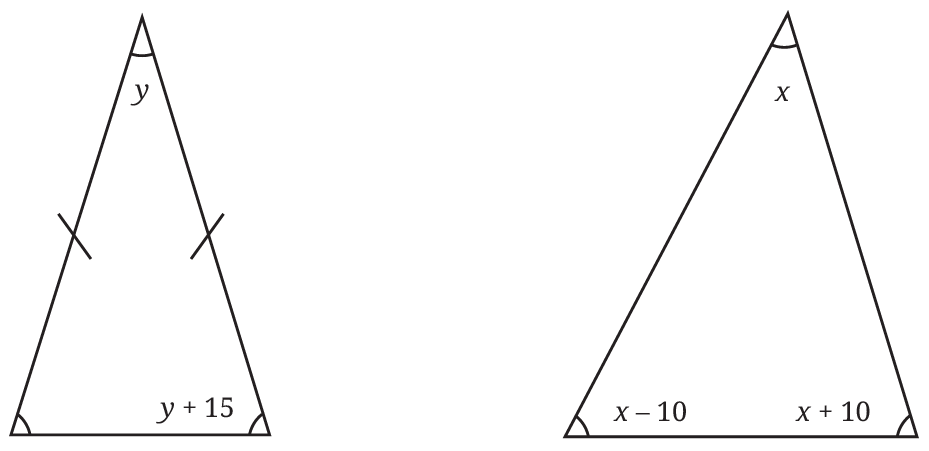
Answer:
Analysis of Triangle 1 (Left):
The marks on the sides indicate it is an Isosceles Triangle. Therefore, the two base angles are equal.
Angles: $y, y + 15, y + 15$
Using the Angle Sum Property ($180^\circ$):
$y + (y + 15) + (y + 15) = 180$
$3y + 30 = 180$
$3y = 150$
$y = 50$
Angles: $50^\circ, (50 + 15)^\circ, (50 + 15)^\circ \Rightarrow$ $50^\circ, 65^\circ, 65^\circ$.
Analysis of Triangle 2 (Right):
Angles: $x, x - 10, x + 10$
Using the Angle Sum Property ($180^\circ$):
$x + (x - 10) + (x + 10) = 180$
$3x = 180$
$x = 60$
Angles: $60^\circ, (60 - 10)^\circ, (60 + 10)^\circ \Rightarrow$ $60^\circ, 50^\circ, 70^\circ$.
Question 13. Write $4$ equations whose solution is $u = 6$.
Answer:
To write equations with the solution $u = 6$, we start with the equality and apply the same mathematical operations to both the Left Hand Side (LHS) and the Right Hand Side (RHS).
1. Equation by Addition and Multiplication:
Start with $u = 6$. Multiply both sides by $2$ and then add $5$.
$2u + 5 = 12 + 5$
$2u + 5 = 17$
2. Equation by Subtraction:
Start with $u = 6$. Subtract $10$ from both sides.
$u - 10 = 6 - 10$
$u - 10 = -4$
3. Equation using Brackets:
Start with $u = 6$. Subtract $1$ from both sides and then multiply by $4$.
$4(u - 1) = 4(6 - 1)$
$4(u - 1) = 20$
4. Equation by Division:
Start with $u = 6$. Divide both sides by $3$ and then add $2$.
$\frac{u}{3} + 2 = \frac{6}{3} + 2$
$\frac{u}{3} + 2 = 4$
Question 14. The Bakhśhāli Manuscript ($300$ CE) mentions the following problem. The amount given to the first person is not known. The second person is given twice as much as the first. The third person is given thrice as much as the second; and the fourth person four times as much as the third. The total amount distributed is $132$. What is the amount given to the first person?
Answer:
Given:
Total amount distributed = $132$
Amount to 2nd person = $2 \times$ Amount to 1st person
Amount to 3rd person = $3 \times$ Amount to 2nd person
Amount to 4th person = $4 \times$ Amount to 3rd person
To Find:
The amount given to the first person.
Solution:
Let the amount given to the first person be $x$.
Then, according to the conditions:
$\text{Amount to 2nd person} = 2x$
$\text{Amount to 3rd person} = 3 \times (2x) = 6x$
$\text{Amount to 4th person} = 4 \times (6x) = 24x$
The sum of all portions equals the total amount:
$x + 2x + 6x + 24x = 132$
$33x = 132$
To find $x$, we transpose $33$ to the RHS:
$x = \frac{132}{33}$
[Calculation of base share]
$x = \frac{\cancel{132}^{4}}{\cancel{33}_{1}}$
$x = 4$
The amount given to the first person is $4$.
Question 15. The height of a giraffe is two and a half metres more than half its height. How tall is the giraffe?
Answer:
Given:
The giraffe's height is $2.5\text{ m}$ more than half of its total height.
To Find:
The total height of the giraffe.
Solution:
Let the total height of the giraffe be $H\text{ metres}$.
According to the problem description:
$H = \frac{H}{2} + 2.5$
Transpose the term $\frac{H}{2}$ to the Left Hand Side (LHS):
$H - \frac{H}{2} = 2.5$
$\frac{2H - H}{2} = 2.5$
$\frac{H}{2} = 2.5$
Multiplying both sides by $2$ to solve for $H$:
$H = 2.5 \times 2$
$H = 5$
The height of the giraffe is $5\text{ metres}$.
Question 16. Two separate figures are given below. Each figure shows the first few positions in a sequence of arrangements made with sticks. Identify the pattern and answer the following questions for each figure:
(a) How many squares are in position number $11$ of the sequence?
(b) How many sticks are needed to make the arrangement in position number $11$ of the sequence?
(c) Can an arrangement in this sequence be made using exactly $85$ sticks? If yes, which position number will it correspond to?
(d) Can an arrangement in this sequence be made using exactly $150$ sticks? If yes, which position number will it correspond to?
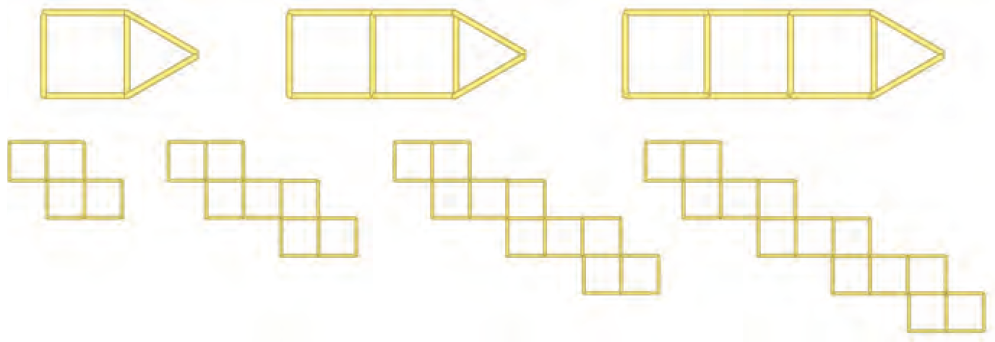
Answer:
(A) First Pattern Analysis
Given:
Position 1: 1 square, 6 sticks
Position 2: 2 squares, 9 sticks
Position 3: 3 squares, 12 sticks
To Find:
The number of squares and sticks for position $n = 11$, and checking feasibility for $85$ and $150$ sticks.
Solution:
(a) Number of squares at position 11:
By observing the sequence, the number of squares is equal to the position number $n$.
$\text{Squares} = n$
For position number $11$:
$\text{Number of squares} = \mathbf{11}$
(b) Number of sticks at position 11:
The sequence of sticks is $6, 9, 12, \dots$ which increases by $3$ for each step. The general formula for the number of sticks in position $n$ is:
$T = 3(n + 1)$
For position $n = 11$:
$T = 3(11 + 1)$
$T = 3 \times 12$
$\text{Number of sticks} = \mathbf{36}$
(c) Arrangement with 85 sticks:
Using the formula from the above equation:
$3(n + 1) = 85$
$n + 1 = \frac{85}{3}$
[Dividing both sides by 3]
$n = 28.33 - 1 = 27.33$
Since the position number $n$ must be a whole number, an arrangement with exactly $85$ sticks is NOT possible.
(d) Arrangement with 150 sticks:
$3(n + 1) = 150$
$n + 1 = \frac{\cancel{150}^{50}}{\cancel{3}_{1}}$
[Dividing by 3]
$n + 1 = 50$
$n = 49$
Thus, an arrangement at position 49 can be made using exactly $150$ sticks.
(B) Second Pattern Analysis
Given:
Position 1: 4 squares, 13 sticks
Position 2: 7 squares, 22 sticks
Position 3: 10 squares, 31 sticks
Solution:
(a) Number of squares at position 11:
The sequence for squares is $4, 7, 10, \dots$ which increases by $3$. The general formula is:
$S = 3n + 1$
For $n = 11$:
$S = 3 \times 11 + 1$
$S = 33 + 1 = \mathbf{34 \text{ squares}}$
(b) Number of sticks at position 11:
The sequence for sticks is $13, 22, 31, \dots$ which increases by $9$. The general formula is:
$T = 9n + 4$
For $n = 11$:
$T = 9 \times 11 + 4$
$T = 99 + 4 = \mathbf{103 \text{ sticks}}$
(c) Arrangement with 85 sticks:
$9n + 4 = 85$
$9n = 81$
[Subtracting 4 from both sides]
$n = \frac{81}{9}$
$n = 9$
Thus, an arrangement at position 9 can be made using exactly $85$ sticks.
(d) Arrangement with 150 sticks:
$9n + 4 = 150$
$9n = 146$
$n = \frac{146}{9} \approx 16.22$
Since $n$ is not a whole number, no arrangement is possible with exactly $150$ sticks in this sequence.
Question 17. A number increased by $36$ is equal to ten times itself. What is the number?
Answer:
Given:
A number, which when increased by $36$, becomes equal to ten times the original number.
To Find:
The value of the number.
Solution:
Let the required number be $x$.
According to the given condition:
$x + 36 = 10x$
[Forming the equation]
To solve for $x$, we transpose $x$ from the Left Hand Side (LHS) to the Right Hand Side (RHS):
$36 = 10x - x$
$36 = 9x$
Dividing both sides by $9$:
$x = \frac{36}{9}$
$x = 4$
The required number is $4$.
Check: $4 + 36 = 40$, and $10 \times 4 = 40$. Since $40 = 40$, the answer is correct.
Question 18. Solve these equations:
(a) $5(r + 2) = 10$
(b) $-3(u + 2) = 2(u - 1)$
(c) $2(7 - 2n) = -6$
(d) $2(x - 4) = -16$
(e) $6(x - 1) = 2(x - 1) - 4$
(f) $3 - 7s = 7 - 3s$
(g) $2x + 1 = 6 - (2x - 3)$
(h) $10 - 5x = 3(x - 4) - 2(x - 7)$
Answer:
(a) $5(r + 2) = 10$
Dividing both sides by $5$:
$r + 2 = 2$
$r = 2 - 2$
$r = 0$
(b) $-3(u + 2) = 2(u - 1)$
Opening the brackets:
$-3u - 6 = 2u - 2$
Transposing $2u$ to LHS and $-6$ to RHS:
$-3u - 2u = -2 + 6$
$-5u = 4$
$u = -\frac{4}{5}$ (or $-0.8$)
(c) $2(7 - 2n) = -6$
Dividing both sides by $2$:
$7 - 2n = -3$
$7 + 3 = 2n$
$10 = 2n$
$n = 5$
(d) $2(x - 4) = -16$
Dividing both sides by $2$:
$x - 4 = -8$
$x = -8 + 4$
$x = -4$
(e) $6(x - 1) = 2(x - 1) - 4$
Transposing $2(x - 1)$ to LHS:
$6(x - 1) - 2(x - 1) = -4$
$4(x - 1) = -4$
Dividing by $4$:
$x - 1 = -1$
$x = -1 + 1$
$x = 0$
(f) $3 - 7s = 7 - 3s$
Transposing $-7s$ to RHS and $7$ to LHS:
$3 - 7 = 7s - 3s$
$-4 = 4s$
$s = -\frac{4}{4}$
$s = -1$
(g) $2x + 1 = 6 - (2x - 3)$
Opening the bracket on RHS:
$2x + 1 = 6 - 2x + 3$
$2x + 1 = 9 - 2x$
Transposing $-2x$ to LHS and $1$ to RHS:
$2x + 2x = 9 - 1$
$4x = 8$
$x = 2$
(h) $10 - 5x = 3(x - 4) - 2(x - 7)$
$10 - 5x = 3x - 12 - 2x + 14$
$10 - 5x = x + 2$
Transposing $2$ to LHS and $-5x$ to RHS:
$10 - 2 = x + 5x$
$8 = 6x$
$x = \frac{8}{6}$
$x = \frac{4}{3}$
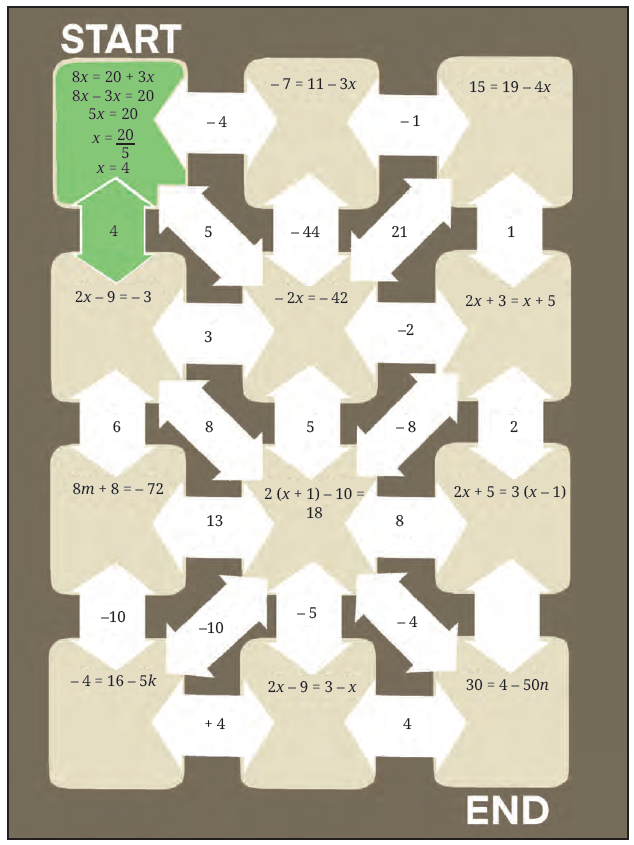
Question 19. Solve the equations to find a path from Start to the End. Show your work in the given boxes provided and colour your path as you proceed.
Answer:
Given:
A mathematical maze containing various linear equations. The solution of one equation leads to the next box via a numbered arrow.
To Find:
The step-by-step solutions for the equations that form the path from the START to the END.
Solution:
We solve the equations sequentially to determine the correct path based on the solutions provided on the arrows.
| Step | Equation | Solving Steps | Solution |
| 1 | $8x = 20 + 3x$ | $8x - 3x = 20$ $5x = 20$ $x = \frac{20}{5}$ $x = 4$ |
$4$ |
| 2 | $2x - 9 = -3$ | $2x = -3 + 9$ $2x = 6$ $x = \frac{6}{2}$ $x = 3$ |
$3$ |
| 3 | $-2x = -42$ | $x = \frac{-42}{-2}$ $x = 21$ |
$21$ |
| 4 | $15 = 19 - 4x$ | $4x = 19 - 15$ $4x = 4$ $x = \frac{4}{4}$ $x = 1$ |
$1$ |
| 5 | $2x + 3 = x + 5$ | $2x - x = 5 - 3$ $x = 2$ |
$2$ |
| 6 | $2x + 5 = 3(x - 1)$ | $2x + 5 = 3x - 3$ $5 + 3 = 3x - 2x$ $x = 8$ |
$8$ |
| 7 | $2(x + 1) - 10 = 18$ | $2x + 2 - 10 = 18$ $2x - 8 = 18$ $2x = 18 + 8$ $2x = 26$ $x = \frac{26}{2}$ $x = 13$ |
$13$ |
| 8 | $8m + 8 = -72$ | $8m = -72 - 8$ $8m = -80$ $m = \frac{-80}{8}$ $m = -10$ |
$-10$ |
| 9 | $-4 = 16 - 5k$ | $5k = 16 + 4$ $5k = 20$ $k = \frac{20}{5}$ $k = 4$ |
$4$ |
| 10 | $2x - 9 = 3 - x$ | $2x + x = 3 + 9$ $3x = 12$ $x = \frac{12}{3}$ $x = 4$ |
$4$ |
| 11 | $30 = 4 - 50n$ | $50n = 4 - 30$ $50n = -26$ $n = -\frac{26}{50}$ $n = -0.52$ |
END |
The path follows the solutions: $4 \to 3 \to 21 \to 1 \to 2 \to 8 \to 13 \to -10 \to 4 \to 4 \to \text{END}$.
Question 20. There are some children and donkeys on a beach. Together they have $28$ heads and $80$ feet. How many donkeys are there? How many children are there?
Answer:
Given:
Total number of heads = $28$
Total number of feet = $80$
We know that each child has $1$ head and $2$ feet, and each donkey has $1$ head and $4$ feet.
To Find:
The number of children and the number of donkeys.
Solution:
Let the number of children be $x$ and the number of donkeys be $y$.
Based on the total number of heads:
$x + y = 28$
... (i)
Based on the total number of feet:
$2x + 4y = 80$
... (ii)
From equation (i), we can express $x$ in terms of $y$:
$x = 28 - y$
... (iii)
Now, we substitute the value of $x$ from equation (iii) into equation (ii):
$2(28 - y) + 4y = 80$
[Substitution Method]
$56 - 2y + 4y = 80$
$56 + 2y = 80$
Subtracting $56$ from both sides:
$2y = 80 - 56$
$2y = 24$
Dividing both sides by $2$:
$y = \frac{\cancel{24}^{12}}{\cancel{2}_{1}}$
$y = 12$
Now, substitute the value of $y = 12$ back into equation (iii) to find $x$:
$x = 28 - 12$
$x = 16$
Final Answer:
There are $16$ children and $12$ donkeys on the beach.